WO2022249959A1 - インクジェットインク用顔料分散体、インクジェットインク及び印刷物 - Google Patents
インクジェットインク用顔料分散体、インクジェットインク及び印刷物 Download PDFInfo
- Publication number
- WO2022249959A1 WO2022249959A1 PCT/JP2022/020760 JP2022020760W WO2022249959A1 WO 2022249959 A1 WO2022249959 A1 WO 2022249959A1 JP 2022020760 W JP2022020760 W JP 2022020760W WO 2022249959 A1 WO2022249959 A1 WO 2022249959A1
- Authority
- WO
- WIPO (PCT)
- Prior art keywords
- ink
- pigment
- pigment dispersion
- acid
- inkjet
- Prior art date
- Legal status (The legal status is an assumption and is not a legal conclusion. Google has not performed a legal analysis and makes no representation as to the accuracy of the status listed.)
- Ceased
Links
Classifications
-
- B—PERFORMING OPERATIONS; TRANSPORTING
- B41—PRINTING; LINING MACHINES; TYPEWRITERS; STAMPS
- B41J—TYPEWRITERS; SELECTIVE PRINTING MECHANISMS, i.e. MECHANISMS PRINTING OTHERWISE THAN FROM A FORME; CORRECTION OF TYPOGRAPHICAL ERRORS
- B41J2/00—Typewriters or selective printing mechanisms characterised by the printing or marking process for which they are designed
- B41J2/005—Typewriters or selective printing mechanisms characterised by the printing or marking process for which they are designed characterised by bringing liquid or particles selectively into contact with a printing material
- B41J2/01—Ink jet
- B41J2/21—Ink jet for multi-colour printing
- B41J2/2107—Ink jet for multi-colour printing characterised by the ink properties
- B41J2/211—Mixing of inks, solvent or air prior to paper contact
-
- B—PERFORMING OPERATIONS; TRANSPORTING
- B41—PRINTING; LINING MACHINES; TYPEWRITERS; STAMPS
- B41J—TYPEWRITERS; SELECTIVE PRINTING MECHANISMS, i.e. MECHANISMS PRINTING OTHERWISE THAN FROM A FORME; CORRECTION OF TYPOGRAPHICAL ERRORS
- B41J3/00—Typewriters or selective printing or marking mechanisms characterised by the purpose for which they are constructed
- B41J3/407—Typewriters or selective printing or marking mechanisms characterised by the purpose for which they are constructed for marking on special material
-
- B—PERFORMING OPERATIONS; TRANSPORTING
- B41—PRINTING; LINING MACHINES; TYPEWRITERS; STAMPS
- B41M—PRINTING, DUPLICATING, MARKING, OR COPYING PROCESSES; COLOUR PRINTING
- B41M5/00—Duplicating or marking methods; Sheet materials for use therein
- B41M5/0041—Digital printing on surfaces other than ordinary paper
- B41M5/0047—Digital printing on surfaces other than ordinary paper by ink-jet printing
-
- B—PERFORMING OPERATIONS; TRANSPORTING
- B41—PRINTING; LINING MACHINES; TYPEWRITERS; STAMPS
- B41M—PRINTING, DUPLICATING, MARKING, OR COPYING PROCESSES; COLOUR PRINTING
- B41M5/00—Duplicating or marking methods; Sheet materials for use therein
- B41M5/0041—Digital printing on surfaces other than ordinary paper
- B41M5/0064—Digital printing on surfaces other than ordinary paper on plastics, horn, rubber, or other organic polymers
-
- C—CHEMISTRY; METALLURGY
- C09—DYES; PAINTS; POLISHES; NATURAL RESINS; ADHESIVES; COMPOSITIONS NOT OTHERWISE PROVIDED FOR; APPLICATIONS OF MATERIALS NOT OTHERWISE PROVIDED FOR
- C09D—COATING COMPOSITIONS, e.g. PAINTS, VARNISHES OR LACQUERS; FILLING PASTES; CHEMICAL PAINT OR INK REMOVERS; INKS; CORRECTING FLUIDS; WOODSTAINS; PASTES OR SOLIDS FOR COLOURING OR PRINTING; USE OF MATERIALS THEREFOR
- C09D11/00—Inks
- C09D11/02—Printing inks
- C09D11/10—Printing inks based on artificial resins
- C09D11/102—Printing inks based on artificial resins containing macromolecular compounds obtained by reactions other than those only involving unsaturated carbon-to-carbon bonds
-
- C—CHEMISTRY; METALLURGY
- C09—DYES; PAINTS; POLISHES; NATURAL RESINS; ADHESIVES; COMPOSITIONS NOT OTHERWISE PROVIDED FOR; APPLICATIONS OF MATERIALS NOT OTHERWISE PROVIDED FOR
- C09D—COATING COMPOSITIONS, e.g. PAINTS, VARNISHES OR LACQUERS; FILLING PASTES; CHEMICAL PAINT OR INK REMOVERS; INKS; CORRECTING FLUIDS; WOODSTAINS; PASTES OR SOLIDS FOR COLOURING OR PRINTING; USE OF MATERIALS THEREFOR
- C09D11/00—Inks
- C09D11/02—Printing inks
- C09D11/10—Printing inks based on artificial resins
- C09D11/102—Printing inks based on artificial resins containing macromolecular compounds obtained by reactions other than those only involving unsaturated carbon-to-carbon bonds
- C09D11/104—Polyesters
-
- C—CHEMISTRY; METALLURGY
- C09—DYES; PAINTS; POLISHES; NATURAL RESINS; ADHESIVES; COMPOSITIONS NOT OTHERWISE PROVIDED FOR; APPLICATIONS OF MATERIALS NOT OTHERWISE PROVIDED FOR
- C09D—COATING COMPOSITIONS, e.g. PAINTS, VARNISHES OR LACQUERS; FILLING PASTES; CHEMICAL PAINT OR INK REMOVERS; INKS; CORRECTING FLUIDS; WOODSTAINS; PASTES OR SOLIDS FOR COLOURING OR PRINTING; USE OF MATERIALS THEREFOR
- C09D11/00—Inks
- C09D11/30—Inkjet printing inks
-
- C—CHEMISTRY; METALLURGY
- C09—DYES; PAINTS; POLISHES; NATURAL RESINS; ADHESIVES; COMPOSITIONS NOT OTHERWISE PROVIDED FOR; APPLICATIONS OF MATERIALS NOT OTHERWISE PROVIDED FOR
- C09D—COATING COMPOSITIONS, e.g. PAINTS, VARNISHES OR LACQUERS; FILLING PASTES; CHEMICAL PAINT OR INK REMOVERS; INKS; CORRECTING FLUIDS; WOODSTAINS; PASTES OR SOLIDS FOR COLOURING OR PRINTING; USE OF MATERIALS THEREFOR
- C09D11/00—Inks
- C09D11/30—Inkjet printing inks
- C09D11/32—Inkjet printing inks characterised by colouring agents
- C09D11/322—Pigment inks
-
- C—CHEMISTRY; METALLURGY
- C09—DYES; PAINTS; POLISHES; NATURAL RESINS; ADHESIVES; COMPOSITIONS NOT OTHERWISE PROVIDED FOR; APPLICATIONS OF MATERIALS NOT OTHERWISE PROVIDED FOR
- C09D—COATING COMPOSITIONS, e.g. PAINTS, VARNISHES OR LACQUERS; FILLING PASTES; CHEMICAL PAINT OR INK REMOVERS; INKS; CORRECTING FLUIDS; WOODSTAINS; PASTES OR SOLIDS FOR COLOURING OR PRINTING; USE OF MATERIALS THEREFOR
- C09D11/00—Inks
- C09D11/30—Inkjet printing inks
- C09D11/38—Inkjet printing inks characterised by non-macromolecular additives other than solvents, pigments or dyes
Definitions
- the present invention relates to a pigment dispersion used for inkjet ink applications, an inkjet ink prepared using the pigment dispersion, and a printed matter subjected to inkjet printing using the inkjet ink.
- water-based inkjet inks have poorer blocking resistance and abrasion resistance that accompany set-off of printed patterns, and lamination strength when adhesive is applied to the printed surface and the film is laminated. There was a problem that it was still not enough. Moreover, these problems were more conspicuous when the base material was a film base material.
- Patent Document 1 discloses an inkjet ink that uses polycarbonate-based urethane resin particles having a minimum film-forming temperature of 25° C. or higher, and has good drying properties and abrasion resistance on nonporous substrates.
- Patent Document 1 no lamination strength test is performed, and further improvement in lamination strength is desired for development in package applications.
- the problems to be solved by the present invention are: a water-based inkjet ink excellent in blocking resistance, scratch resistance and lamination strength; a pigment dispersion capable of preparing the inkjet ink; Regarding printed matter.
- the binder (A) is a polyol (a1) containing a polyol (a1-1) having an acid group and a polyester polyol (a1-2) other than the polyol (a1-1), and a poly having a ring structure
- Some or all of the acid groups of the urethane resin (A1) are neutralized
- the “pigment dispersion for inkjet ink” (hereinafter sometimes simply referred to as “pigment dispersion” or “dispersion”) of the present invention comprises a binder (A), a pigment (B), and an aqueous medium (C). It contains Hereinafter, “binder (A)” may be referred to as “(A) component”, and other components may be referred to in the same way.
- the pigment dispersions of the invention are produced as intermediate products for inkjet inks and, after dilution, are used in inkjet printing as aqueous inkjet inks.
- the binder (A) contains a urethane resin (A1), and the urethane resin (A1) is a reaction product of polyol (a1) and polyisocyanate (a2).
- the urethane resin (A1) in the present invention is a resin obtained by reacting a polyol (a1) and a polyisocyanate (a2). It can be obtained by polymerizing components (a1) and (a2) in the presence of an arbitrary polymerization initiator using a known method such as radical polymerization.
- the resin (A1) having an acid group imparts hydrophilicity to the urethane resin (A1), making it possible to stably disperse the pigment (B) in water.
- the polyol (a1) in the present invention includes a polyol (a1-1) having an acid group and a polyester polyol (a1-2) other than the polyol (a1-1).
- the acid group includes a carboxyl group, a sulfonic acid group, a phosphoric acid group, a thiocarboxyl group and the like, and a carboxyl group or a sulfonic acid group is preferred.
- polyols having carboxyl groups include 2,2-dimethylolpropionic acid, 2,2-dimethylolbutanoic acid, 2,2-dimethylolvaleric acid and the like. Among them, 2,2-dimethylolpropionic acid and 2,2-dimethylolbutanoic acid are preferred because of their good dispersion stability.
- a polyester polyol having a carboxyl group obtained by reacting a polyol having a carboxyl group with various polycarboxylic acids can also be used. These carboxyl group-containing polyols can be used alone or in combination of two or more.
- Examples of polyols having a sulfonic acid group include dicarboxylic acids such as 5-sulfoisophthalic acid, sulfoterephthalic acid, 4-sulfophthalic acid, 5-(4-sulfophenoxy)isophthalic acid, salts thereof, ethylene glycol and propylene.
- Polyester polyols obtained by reacting low-molecular-weight polyols such as glycol, 1,4-butanediol, 1,6-hexanediol, diethylene glycol and neopentyl glycol can be mentioned. These sulfonic acid group-containing polyols can be used alone or in combination of two or more.
- the polyol (a1-1) having an acid group is preferably used in a range in which the acid value of the urethane resin (A1) is 10 to 30 mgKOH/g, more preferably 10 to 28 mgKOH/g. .
- the acid value referred to in the present invention is a theoretical value calculated based on the amount of the acid group-containing compound such as the polyol (a1-1) having an acid group used in the production of the urethane resin (A1).
- the acid groups in the acid group-containing polyol (a1-1) are neutralized.
- Favorable water dispersibility can be expressed by partially or entirely neutralizing the acid groups.
- the method of neutralization is not particularly limited, examples thereof include neutralization using metals or organic amines.
- the metal used for neutralization is not particularly limited, but is preferably neutralized with metal ions such as sodium, potassium, calcium, copper and lithium to form a metal salt. Moreover, at least a part of the acid groups may be neutralized to form a metal salt.
- Metal ions such as sodium, potassium, calcium, copper, and lithium that can be used for neutralizing acid groups include metal hydroxides such as sodium hydroxide, potassium hydroxide, and lithium hydroxide, and sodium chloride. , metal chlorides such as potassium chloride, and metal sulfides such as copper sulfate.
- Organic amines used for neutralization include polyalkyleneimines, polyallylamines, (poly)ethylenepolyamines, alkanolamines and alkylamines. Among these, alkylamines are preferred from the viewpoint of pigment dispersibility.
- the polyalkyleneimine is preferably a polyalkyleneimine having an alkylene group having 2 to 5 carbon atoms, more preferably a polyalkyleneimine having an alkylene group having 2 to 4 carbon atoms, still more preferably polyethyleneimine or Polypropyleneimine, particularly preferably polyethyleneimine. These may be used alone or in combination of two or more.
- the number average molecular weight of the polyalkyleneimine is preferably 150 or more, more preferably 500 or more, still more preferably 800 or more, still more preferably 1000 or more, and preferably 10000 or less, more preferably 5000 or less, still more preferably 4000 or less.
- polyallylamine examples include polymers having amino groups in side chains, such as homopolymers or copolymers of allyl compounds such as allylamine and dimethylallylamine.
- the weight average molecular weight of polyallylamine is preferably 800 or more, more preferably 1000 or more, still more preferably 1500 or more, and preferably 10000 or less, more preferably 5000 or less, still more preferably 4000 or less.
- (Poly)ethylenepolyamines include, for example, ethylenediamine, diethylenetriamine, triethylenetetramine, tetraethylenepentamine, pentaethylenehexamine, and the like. Among these, ethylenediamine, diethylenetriamine, triethylenetetramine, and tetraethylenepentamine are preferred, and ethylenediamine is particularly preferred.
- the alkanolamine is preferably an alkanolamine having 2 or more and 9 or less carbon atoms.
- alkanolamines include primary alkanolamines such as monoethanolamine, monopropanolamine and monobutanolamine; monoalkanol secondary amines such as N-methylethanolamine and N-methylpropanolamine; diethanolamine and diisopropanolamine; Secondary alkanolamines such as dialkanol secondary amines of; - tertiary alkanolamines such as dialkanol tertiary amines such as ethyldiethanolamine, and trialkanol tertiary amines such as triethanolamine and triisopropanolamine.
- tertiary alkanolamines having 2 to 9 carbon atoms are preferred, and triisopropanolamine is particularly preferred.
- the alkylamine is preferably an alkylamine having 1 or more and 6 or less carbon atoms.
- alkylamines include primary amines such as propylamine, butylamine and hexylamine; secondary amines such as diethylamine and dipropylamine; and tertiary amines such as triethylamine.
- the polyester polyol (a1-2) is a polyester polyol that does not correspond to the above polyol (a1-1).
- the polarity and Tg value are controlled by the presence of ester groups in the structure.
- the urethane resin (A1) can be imparted with appropriate flexibility and adhesion to the substrate, and as a result, lamination strength and abrasion resistance can be improved.
- the polyester polyol (a1-2) is a reaction product (polycondensate) obtained by a reaction (eg, polycondensation reaction) of a polyhydric carboxylic acid and a polyhydric alcohol, and the polyester polyol is derived from a polyhydric carboxylic acid. It has structural units and structural units derived from polyhydric alcohols.
- polycarboxylic acids include phthalic acid, isophthalic acid, terephthalic acid, adipic acid, maleic acid, fumaric acid, succinic acid, oxalic acid, malonic acid, glutaric acid, pimelic acid, suberic acid, azelaic acid, and sebacic acid.
- polyhydric alcohols include ethylene glycol, propylene glycol, 1,3-propanediol, 1,4-butanediol, 1,5-pentanediol, 1,6-hexanediol, diethylene glycol, triethylene glycol, and tetraethylene.
- Glycols such as glycol, dipropylene glycol, tripropylene glycol, 1,4-cyclohexanediol, 1,4-cyclohexanedimethanol; 2-methyl-1,5-pentanediol, 3-methyl-1,5-pentanediol, 1,2-butanediol, 1,3-butanediol, 2-butyl-2-ethyl-1,3-propanediol, 1,2-propanediol, 2-methyl-1,3-propanediol, neopentyl glycol , 2-isopropyl-1,4-butanediol, 2,4-dimethyl-1,5-pentanediol 2,4-diethyl-1,5-pentanediol, 2-ethyl-1,3-hexanediol, 2- glycols having a branched structure such as ethyl-1,6-
- the polyester polyol (a1-2) preferably has a number average molecular weight in the range of 500 to 8,000, more preferably in the range of 800 to 7,000, since it has good compatibility with the pigment (B) and the like. is more preferred, and a range of 900 to 6,000 is even more preferred.
- the number average and weight average molecular weights are values measured by gel permeation chromatography (GPC).
- the polyol (a1) may contain polyols other than the acid group-containing polyol (a1-1) and the polyester polyol (a1-2).
- polyether polyols, polycarbonate polyols, and polyols having ring structures other than the above may be included.
- Polyisocyanate (a2) includes polyisocyanate (a2-1) having a ring structure.
- ring structures include cyclobutyl ring, cyclopentyl ring, cyclohexyl ring, cycloheptyl ring, cyclooctyl ring, propylcyclohexyl ring, tricyclo[5.2.1.0.2.6]decyl skeleton, bicyclo[4.3 .0]-nonyl skeleton, tricyclo[5.3.1.1]dodecyl skeleton, propyltricyclo[5.3.1.1]dodecyl skeleton, norbornene skeleton, isobornyl skeleton, dicyclopentanyl skeleton, adamantyl skeleton, etc. and aromatic ring structures such as benzene ring and naphthalene ring.
- polyisocyanate (a2-1) having an alicyclic structure examples include cyclohexane diisocyanate, hydrogenated xylylene diisocyanate, isophorone diisocyanate, dicyclohexylmethane diisocyanate and the like.
- polyisocyanate (a2-1) having an aromatic ring structure examples include 4,4′-diphenylmethane diisocyanate, 2,4′-diphenylmethane diisocyanate, carbodiimide-modified diphenylmethane diisocyanate, crude diphenylmethane diisocyanate, phenylene diisocyanate, tolylene diisocyanate, and naphthalene.
- polyisocyanates (a2-1) can be used alone or in combination of two or more.
- the polyisocyanate (a2) may contain an isocyanate compound (a2-2) other than the polyisocyanate (a2-1) having a ring structure.
- an isocyanate compound (a2-2) other than (a2-1) polyols having no ring structure, such as aliphatic polyisocyanates such as hexamethylene diisocyanate and lysine diisocyanate, can be used in combination.
- the isocyanate (a2) is mixed and reacted at a reaction temperature of about 50°C to 150°C.
- the equivalent ratio of the isocyanate groups of the polyisocyanate (a2) to the hydroxyl groups of the polyol (a1) is in the range of 0.8 to 2.5. is preferably carried out in the range of 0.9 to 1.5.
- the urethane resin (A1) of the present invention necessarily has a ring structure derived from the polyisocyanate (a2-1) having a ring structure in the resin structure. Moreover, when the polyol (a1) has a polyol having a ring structure, the alicyclic structure derived therefrom also constitutes the urethane resin (A1). The urethane resin (A1) having an alicyclic structure can improve scratch resistance.
- the ring structure is preferably present in the range of 500 to 5000 mmol/kg, more preferably 600 to 4000 mmol/kg, still more preferably 800 to 3500 mmol/kg, and 800 to 2000 mmol/kg relative to the entire urethane resin (A1). /kg is particularly preferred.
- the ratio of the alicyclic structure contained in the urethane resin (A1) to the entire urethane resin (A1) referred to in the present invention is the polyol (a1) or polyisocyanate used in the production of the urethane resin (A1). It is a theoretical value calculated based on the total mass of all raw materials such as (a2) and the amount of the ring-structured substance contained in the ring-structure-containing compound used in the production of the urethane resin (A1).
- a chain extender can be used as needed.
- the chain extender include polyamines, hydrazine compounds, and other compounds having active hydrogen atoms. These chain extenders can be used alone or in combination of two or more.
- polyamine examples include ethylenediamine, 1,2-propanediamine, 1,6-hexamethylenediamine, piperazine, 2,5-dimethylpiperazine, isophoronediamine, 4,4'-dicyclohexylmethanediamine, 3,3'- diamines such as dimethyl-4,4′-dicyclohexylmethanediamine and 1,4-cyclohexanediamine; N-hydroxymethylaminoethylamine, N-hydroxyethylaminoethylamine, N-hydroxypropylaminopropylamine, N-ethylaminoethylamine, N -methylaminopropylamine, diethylenetriamine, dipropylenetriamine, triethylenetetramine and the like. Among these, piperazine or ethylenediamine is preferred.
- hydrazine compound examples include hydrazine, N,N'-dimethylhydrazine, 1,6-hexamethylenebishydrazine, succinic acid dihydrazide, adipic acid dihydrazide, glutaric acid dihydrazide, sebacic acid dihydrazide, isophthalic acid dihydrazide, and ⁇ -semicarbazide.
- hydrazine is preferred.
- Examples of other compounds having active hydrogen include ethylene glycol, diethylene glycol, triethylene glycol, propylene glycol, 1,3-propanediol, 1,3-butanediol, 1,4-butanediol, hexamethylene glycol, glycols such as saccharose, methylene glycol, glycerin and sorbitol; Water etc. are mentioned.
- organic solvents examples include ketone solvents such as acetone and methyl ethyl ketone; ether solvents such as tetrahydrofuran and dioxane; acetic acid ester solvents such as ethyl acetate and butyl acetate; nitrile solvents; amide solvents such as dimethylformamide and N-methylpyrrolidone; These organic solvents can be used alone or in combination of two or more.
- ketone solvents such as acetone and methyl ethyl ketone
- ether solvents such as tetrahydrofuran and dioxane
- acetic acid ester solvents such as ethyl acetate and butyl acetate
- nitrile solvents such as ethyl acetate and butyl acetate
- amide solvents such as dimethylformamide and N-methylpyrrolidone
- the glass transition temperature (Tg) of the urethane resin (A1) is 70°C or lower, preferably 50°C or lower, more preferably 40°C or lower. A Tg within this range provides good anti-blocking properties.
- the minimum film-forming temperature (MFT) of the urethane resin (A1) is preferably 40° C. or lower, more preferably 35° C. or lower, and 33° C. or lower from the viewpoint of lowering the drying temperature during the production of printed matter and improving energy efficiency. More preferred.
- the organic solvent is partially or wholly removed, for example, by distillation under reduced pressure during or after the production of the urethane resin (A1).
- the urethane resin (A1) obtained by the above method preferably has a mass average molecular weight in the range of 5,000 to 500,000, because it can express the durability of printed matter. It is more preferred to use those with weight average molecular weights in the range of 000, and even more preferred to use weight average molecular weights in the range of 20,000 to 100,000.
- the measurement of the weight average molecular weight (in terms of polystyrene) by GPC (gel permeation chromatography) in the present invention was performed under the following conditions using an HLC8220 system manufactured by Tosoh Corporation. Separation column: 4 TSKgelGMHHR-N manufactured by Tosoh Corporation Mobile bed: Tetrahydrofuran manufactured by Wako Pure Chemical Industries, Ltd. Flow rate: 1.0 ml/min. Sample concentration: 0.4% by mass Sample injection volume: 100 microliters. Detector: Differential Refractometer
- the mass-average molecular weight is 5,000 or more, not only is the durability of printed matter improved, but various problems such as blocking due to poor drying tend not to occur. In particular, it is preferable because problems such as a decrease in ink ejection property are unlikely to occur.
- the content (solid content) of the binder (A) is preferably 5 to 30% by mass, more preferably 5 to 25% by mass, and even more preferably 5 to 15% by mass, based on the total amount of the pigment dispersion.
- the binder (A) may consist of only the urethane resin (A1), or may contain other resins.
- the pigment (B) is not particularly limited as long as it can be dispersed well in the dispersion, but it is preferable to use one that can be dispersed with an average particle size of about 10 to 400 nm (details will be described later) ).
- organic pigments, inorganic pigments, and dyes used in general inks, paints, and recording agents can be used.
- organic pigments examples include azo, phthalocyanine, anthraquinone, perylene, perinone, quinacridone, thioindigo, dioxazine, isoindolinone, quinophthalone, azomethineazo, ditopyrrolopyrrole, and isoindoline pigments. pigments. Copper phthalocyanine is preferably used for the indigo ink from the viewpoint of cost and light resistance.
- Inorganic pigments include carbon black, titanium oxide, zinc oxide, zinc sulfide, barium sulfate, calcium carbonate, chromium oxide, silica, red iron oxide, and mica (mica).
- a bright pigment Metalashine; Nippon Sheet Glass Co., Ltd. obtained by coating a metal or metal oxide on a base material of glass flakes or massive flakes can also be used. From the viewpoint of cost and coloring power, it is preferable to use titanium oxide for white ink, carbon black for black ink, aluminum for gold and silver inks, and mica for pearl ink.
- the pigment is preferably dispersed with a volume average particle diameter of 10 to 400 nm.
- the average particle size of the pigment can be measured by a known method such as a dynamic light scattering method in a state in which the pigment is uniformly dispersed in the dispersion after preparing the dispersion.
- the volume average particle size of the dispersion is preferably 10 to 300 nm, more preferably 50 to 200 nm, still more preferably 50 to 150 nm, and particularly preferably 50 nm or more and less than 100 nm.
- the volume average particle diameter is 50 nm or more, aggregation of the pigment during storage of the pigment dispersion can be suppressed.
- the volume average particle diameter is 400 nm or less (particularly preferably 100 nm or less), the ink jettability is improved.
- the content of the pigment in the dispersion is not particularly limited, it is preferably 10 to 30% by mass based on the total amount of the dispersion. If it is less than 10% by mass, there is a risk that sufficient ink coloring power cannot be obtained in an inkjet ink prepared by diluting the dispersion. If the amount is more than 30% by mass, the pigment may aggregate during transportation or storage of the dispersion, depending on the type of pigment. In addition, depending on the degree of dilution, there is a concern that the ink jettability may deteriorate.
- the pigment concentration is preferably 10 to 30 mass %, more preferably 10 to 25 mass % when the pigment is an organic pigment or carbon black.
- the pigment when an inkjet ink is prepared by dilution adjustment, it is possible to favorably achieve both ink coloring power and ink jettability.
- the pigment when the pigment is an inorganic pigment, it is preferably 25 to 60% by mass, more preferably 30 to 50% by mass.
- the pigment dispersion of the present invention further contains an aqueous medium in order to adjust the viscosity to suitable for pumping the dispersion and filtering the dispersion.
- the aqueous medium (C) include water, organic solvents miscible with water, and mixtures thereof.
- water-miscible organic solvents examples include alcohol solvents such as methanol, ethanol, n-propanol and isopropanol; ketone solvents such as acetone and methyl ethyl ketone; polyalkylene glycols such as ethylene glycol, diethylene glycol and propylene glycol; alkyl ethers of; and lactam solvents such as N-methyl-2-pyrrolidone.
- alcohol solvents such as methanol, ethanol, n-propanol and isopropanol
- ketone solvents such as acetone and methyl ethyl ketone
- polyalkylene glycols such as ethylene glycol, diethylene glycol and propylene glycol
- alkyl ethers of alkyl ethers of
- lactam solvents such as N-methyl-2-pyrrolidone.
- aqueous medium (C) water alone or a mixture of water and an organic solvent miscible with water is prefer
- the pigment dispersion of the present invention contains other optional components in addition to the above components (A), (B), and water (C) within a range that does not impair the effects of the present invention. good too.
- Other components include, for example, an amine compound having a boiling point of 100° C. or higher, resins other than the above components, surfactants, waxes, low surface tension organic solvents, wetting agents, penetrants, dispersants other than the above, antifoaming agents, Preservatives, viscosity modifiers, pH modifiers, chelating agents, plasticizers, antioxidants, UV absorbers and the like are included.
- Such amine compounds include polyalkyleneimines, polyallylamines, (poly)ethylenepolyamines, alkanolamines and alkylamines. Among these, alkanolamine is preferable from the viewpoint of pigment dispersibility, odor and re-solubility.
- the polyalkyleneimine is preferably a polyalkyleneimine having an alkylene group having 2 or more and 5 or less carbon atoms.
- the polyalkyleneimine is preferably a polyalkyleneimine in which the alkylene group has 2 or more and 4 or less carbon atoms, more preferably polyethyleneimine or polypropyleneimine, and still more preferably polyethyleneimine. These may be used alone or in combination of two or more.
- the number average molecular weight of the polyalkyleneimine is preferably 150 or more, more preferably 500 or more, still more preferably 800 or more, still more preferably 1,000 or more, and preferably 10,000 or less, more preferably 5,000 or more. 000 or less, more preferably 4,000 or less.
- the molecular weight value is determined by the method described in Examples.
- polyallylamine examples include polymers having amino groups in side chains, such as homopolymers or copolymers of allyl compounds such as allylamine and dimethylallylamine.
- the weight average molecular weight of polyallylamine is preferably 800 or more, more preferably 1,000 or more, still more preferably 1,500 or more, and preferably 10,000 or less, more preferably 5,000 or less, and still more preferably is 4,000 or less.
- polyethylene polyamine (polyethylene polyamine)
- Polyethylenepolyamines include, for example, ethylenediamine, diethylenetriamine, triethylenetetramine, tetraethylenepentamine, pentaethylenehexamine, and the like. Among these, diethylenetriamine, triethylenetetramine, and tetraethylenepentamine are preferred.
- alkanolamine is preferably an alkanolamine having 2 to 9 carbon atoms.
- alkanolamines include primary alkanolamines such as monoethanolamine, monopropanolamine and monobutanolamine; monoalkanol secondary amines such as N-methylethanolamine and N-methylpropanolamine; diethanolamine and diisopropanolamine; Secondary alkanolamines such as dialkanol secondary amines of; - tertiary alkanolamines such as dialkanol tertiary amines such as ethyldiethanolamine, and trialkanol tertiary amines such as triethanolamine and triisopropanolamine.
- tertiary alkanolamines having 2 to 9 carbon atoms are preferred, and triisopropanolamine is particularly preferred.
- alkylamine is preferably an alkylamine having 1 to 6 carbon atoms.
- alkylamines include primary amines such as propylamine, butylamine and hexylamine; secondary amines such as diethylamine and dipropylamine.
- resins may be aqueous resins suitable for preparing pigment dispersions, and preferred examples include acrylic resins such as polyvinyl alcohols, polyvinylpyrrolidones, acrylic acid-acrylic acid ester copolymers, and styrene.
- Surfactants include anionic surfactants, nonionic surfactants, cationic surfactants, amphoteric surfactants, etc. Among these, anionic surfactants or nonionic surfactants is preferred.
- anionic surfactants include alkylbenzenesulfonates, alkylphenylsulfonates, alkylnaphthalenesulfonates, higher fatty acid salts, sulfuric acid ester salts of higher fatty acid esters, sulfonates of higher fatty acid esters, and higher alcohol ethers. Sulfuric acid ester salts and sulfonates, higher alkyl sulfosuccinates, polyoxyethylene alkyl ether carboxylates, polyoxyethylene alkyl ether sulfates, alkyl phosphates, polyoxyethylene alkyl ether phosphates, etc.
- Specific examples thereof include dodecylbenzenesulfonate, isopropylnaphthalenesulfonate, monobutylphenylphenol monosulfonate, monobutylbiphenylsulfonate, and dibutylphenylphenoldisulfonate.
- nonionic surfactants include polyoxyethylene alkyl ethers, polyoxyethylene alkylphenyl ethers, polyoxyethylene fatty acid esters, sorbitan fatty acid esters, polyoxyethylene sorbitan fatty acid esters, polyoxyethylene sorbitol fatty acid esters, and glycerin fatty acid esters.
- polyoxyethylene glycerin fatty acid ester polyglycerin fatty acid ester, sucrose fatty acid ester, polyoxyethylene alkylamine, polyoxyethylene fatty acid amide, fatty acid alkylolamide, alkylalkanolamide, acetylene glycol, oxyethylene adduct of acetylene glycol, polyethylene glycol polypropylene glycol block copolymers, alkylphenol ethoxylates, etc., among which polyoxyethylene nonylphenyl ether, polyoxyethylene octylphenyl ether, polyoxyethylene dodecylphenyl ether, polyoxyethylene alkyl ether , polyoxyethylene fatty acid esters, sorbitan fatty acid esters, polyoxyethylene sorbitan fatty acid esters, fatty acid alkylolamides, acetylene glycol, oxyethylene adducts of acetylene glycol, polyethylene glycol polypropylene glycol,
- surfactants include silicon-based surfactants such as polysiloxane oxyethylene adducts; fluorine-based surfactants such as perfluoroalkyl carboxylates, perfluoroalkyl sulfonates, and oxyethylene perfluoroalkyl ethers. spiculisporic acid, rhamnolipids, biosurfactants such as lysolecithin, and the like can also be used.
- surfactants can be used singly or in combination of two or more. Further, considering the dissolution stability and the like of the surfactant, the HLB is preferably in the range of 7-20.
- fluorosurfactants include Novec FC-4430, FC-4432 (manufactured by Sumitomo 3M), Zonyl FSO-100, FSN-100, FS-300, FSO (manufactured by DuPont), Ftop EF- 122A, EF-351, 352801, 802 (manufactured by Jemco), Megafac F-470, F-1405, F474, F-444 (manufactured by DIC), Surflon S-111, S-112, S-113, S121, S131 , S132, S-141, S-145 (manufactured by Asahi Glass), Futergent series (manufactured by Neos), Fluorad FC series (manufactured by Minnesota Mining and Manufacturing Company), Monflor (Imperial ⁇ chemical industry), Licowet VPF series (manufactured by Parkwerke Hoechst).
- silicone surfactants examples include KF-351A, KF-642, Olfine PD-501, Olfine PD-502, Olfine PD-570 (manufactured by Shin-Etsu Chemical), BYK347, and BYK348 (manufactured by BYK-Chemie Japan).
- Polyoxyethylene alkyl ether surfactants include BT series (Nikko Chemicals), Nonipor series (Sanyo Kasei), D-, P-series (Takemoto Oil), Emalex DAPE series (Nippon Emulsion), Pegnol series ( Toho Chemical Industry). Pegnol (Toho Kagaku Kogyo Co., Ltd.) is exemplified as a polyethylene glycol alkyl ester type.
- acetylene glycol-based surfactants examples include Olphine E1010, STG, Y (manufactured by Nissin Chemical Co., Ltd.), Surfynol 104, 82, 420, 440, 465, 485, and TG (manufactured by Air Products and Chemicals Inc.). mentioned.
- Waxes include, for example, plant and animal waxes such as carnauba wax, candy wax, beeswax, rice wax, and lanolin; mineral waxes such as montan wax and ozokerite; paraffin wax, which is so-called petroleum wax; carbon wax, Hoechst wax. , polyolefin wax, silicone wax, synthetic waxes such as stearic acid amide, natural and synthetic wax emulsions such as ⁇ -olefin/maleic anhydride copolymer, and waxes such as blended waxes. These waxes have the effect of imparting slip properties to the surface of the printed matter and improving the scratch resistance. These waxes can be used singly or in combination. Among these, silicone wax, polyolefin wax, paraffin wax and the like are preferably used.
- silicone waxes include, for example, SM8706EX, SM7036EX, SM7060EX, SM7025EX, SM490EX, SM8701EX, SM8709SR, SM8716SR, IE-7045, IE-7046T, SH7024, BY22-744EX, BY8FZ-X5, FZ-X5, FZ-8Z44E 4634EX, FZ-4602 (trade names, manufactured by Dow Corning Toray Co., Ltd.), POLON-MF-14, POLON-MF-14EC, POLON-MF-23 POLON-MF-63, POLON-MF-18T, POLON-MF -56, POLON-MF-49, POLON-MF-33A, POLON-MF-55T, POLON-MF-28T, POLONMF-50, POLON-MK-206, POLON-SR-CONC, KM-9771, KM-9774
- polyolefin waxes examples include waxes produced from olefins such as ethylene, propylene and butylene, or derivatives thereof, and copolymers thereof, specifically polyethylene waxes, polypropylene waxes, polybutylene waxes, and the like.
- Polyolefin waxes can be used singly or in combination of two or more.
- polyethylene-based waxes are preferable from the viewpoint of being less likely to react with the crosslinkable groups of the urethane resin particles having the above-mentioned crosslinkable groups and having excellent ejection stability.
- polyolefin waxes include, for example, AQUACER513 (polyethylene wax, average particle size 100 nm or more and 200 nm or less, melting point 130°C, solid content 30%), AQUACER507, AQUACER515, AQUACER840, AQUACER1547 (all trade names, BYK-Chemie Japan Co., Ltd.
- Paraffin wax is a so-called petroleum wax.
- paraffin means an alkane having 20 or more carbon atoms
- paraffin wax is mainly composed of linear paraffinic hydrocarbons having 20 or more and 30 or less carbon atoms, and a small amount of isoparaffin.
- the recorded matter is imparted with slipperiness and water repellency, thereby improving scratch resistance.
- Commercially available products of paraffin wax include, for example, AQUACER537 and AQUACER539 (both trade names, manufactured by BYK-Chemie Japan).
- the wax is preferably contained in the pigment dispersion in the form of fine particles, that is, in the form of emulsion or suspension. This makes it easier to adjust the viscosity of the ink so that it falls within an appropriate range for ejection using an inkjet head, and to ensure ejection stability and intermittent ejection characteristics during recording.
- low surface tension organic solvents such as glycol ether compounds
- diethylene glycol mono(alkyl having 1 to 8 carbon atoms) ether triethylene glycol mono(alkyl having 1 to 8 carbon atoms) ether
- propylene glycol mono(1 to 8 carbon atoms) C-6 alkyl) ethers dipropylene glycol mono(C 1-6 alkyl) ethers can be mentioned, and these can be used singly or as a mixture of two or more.
- ethylene glycol monomethyl ether ethylene glycol monoethyl ether, ethylene glycol mono-iso-propyl ether, ethylene glycol monobutyl ether, ethylene glycol mono-t-butyl ether, diethylene glycol monomethyl ether, diethylene glycol monoethyl ether, diethylene glycol monopropyl.
- Glycol ethers, surfactants, etc. can be used as surface tension modifiers to adjust the surface tension of the ink. Specifically, it can be added appropriately so that the surface tension of the ink is 15 mN/m to 30 mN/m or less, and the amount of the surfactant added is in the range of about 0.1 to 10% by mass with respect to the aqueous pigment dispersion. It is preferably 0.3 to 2% by mass, more preferably 0.3 to 2% by mass. More preferably, the surface tension is in the range of 16-28, most preferably in the range of 18-25.
- the wetting agent is not particularly limited, it is preferable to use a wetting agent that is miscible with water and that can prevent clogging of the ink jet printer head.
- a wetting agent that is miscible with water and that can prevent clogging of the ink jet printer head.
- glycerin ethylene glycol, diethylene glycol, triethylene glycol, polyethylene glycol having a molecular weight of 2000 or less, propylene glycol, dipropylene glycol, tripropylene glycol, 1,3-propylene glycol, isopropylene glycol, isobutylene glycol, 1,2-butane Diol, 1,4-butanediol, 1,2-pentanediol, 1,5-pentanediol, 1,2-hexanediol, 1,6-hexanediol, 2-methylpentane-2,4-diol, 1, Diol compounds such as 2-heptanediol, 1,2-n
- penetrants examples include lower alcohols such as ethanol and isopropyl alcohol, ethylene oxide adducts of alkyl alcohols such as ethylene glycol hexyl ether and diethylene glycol butyl ether, and propylene oxide adducts of alkyl alcohols such as propylene glycol propyl ether.
- the content of the penetrant in the pigment dispersion is preferably 0.01 to 10 mass %.
- the method for producing the pigment dispersion in the present invention is not limited at all.
- Components (A) to (C) and optionally added optional components may be dispersed to form a pigment dispersion, or a part of components (A), (B) and (C) may be prepared in advance.
- a pigment-dispersed millbase liquid having a high pigment concentration may be prepared using a medium or the like, optionally added with optional components, and diluted with an aqueous medium such as component (C) to obtain a pigment dispersion for preparing an aqueous inkjet ink.
- An aqueous pigment dispersion in which a pigment is dispersed with a desired volume average particle size can be easily obtained by preparing a pigment dispersion millbase liquid in advance by dispersing the pigment using a stirring/dispersing device and then preparing the pigment dispersion. be able to.
- the latter method of preparing a pigment-dispersed millbase liquid and then converting it into a pigment dispersion will be described below.
- Examples of the method for producing the pigment-dispersed millbase liquid include the following methods. (1) A method of adding a pigment to an aqueous medium containing a pigment dispersant as necessary, and then dispersing the pigment in the aqueous medium using a stirring/dispersing device to prepare a pigment-dispersed millbase liquid. (2) A pigment and, if necessary, a pigment dispersant are kneaded using a kneader such as a two-roll kneader or a mixer, the resulting kneaded product is added to an aqueous medium, and the pigment is dispersed using a stirring/dispersing device. A method for preparing a dispersed millbase liquor.
- stirring/dispersing device examples include an ultrasonic homogenizer, a high-pressure homogenizer, a paint shaker, a ball mill, a roll mill, a sand mill, a sand grinder, a Dyno mill, a dispermat, an SC mill, a nanomizer, and the like. may be used alone, or two or more types of devices may be used in combination.
- the pigment dispersion of the present invention is used and diluted with an aqueous medium so that the pigment content is 1 to 30% by mass to prepare an aqueous inkjet ink.
- This aqueous medium may be water, similar to component (C), a mixture of water and an organic solvent, or an organic solvent alone.
- the organic solvent is not particularly limited as long as it is miscible with water, and examples thereof include those mentioned above as optional components as the "solvent other than water”.
- optional components of the pigment dispersion for example, surfactants, preservatives, surface tension modifiers, etc.
- the inkjet ink of the present invention has excellent printing properties on various substrates, it is possible to suitably produce a printed material having a plastic substrate and a printed layer formed by the inkjet ink.
- plastic substrates include polyamide resins such as Ny6, nylon 66, and nylon 46; polyester resins such as polyethylene terephthalate, polyethylene naphthalate, polytrimethylene terephthalate, polytrimethylene naphthalate, polybutylene terephthalate, and polybutylene naphthalate; Polyhydroxycarboxylic acids such as polylactic acid; biodegradable resins typified by aliphatic polyester resins such as poly (ethylene succinate) and poly (butylene succinate); polyolefin resins such as polypropylene and polyethylene; Examples include plastic substrates made of thermoplastic resins such as polyimide resins, polyarylate resins, or mixtures thereof, and laminates thereof. Among them, substrates made of polyester, polyamide, polyethylene, polypropylene, and polyvinyl chloride are preferred. Available.
- the plastic substrate may be a plastic film.
- the plastic film may be either an unstretched film or a stretched film, and its production method is not limited.
- the thickness of the film is not particularly limited, but it is usually in the range of 1 to 500 ⁇ m.
- the printing surface of the film is subjected to a corona discharge treatment.
- silica, alumina, or the like may be vapor-deposited on the printed surface.
- the printed matter of the present invention has good printability on plastic substrates and can be produced by inkjet printing, so it can be suitably used as a packaging material.
- it is excellent in designability and on-demand printability, so it can be used particularly preferably for food packaging.
- the inkjet ink of the present invention is excellent in abrasion resistance, it can be used as a surface-printed matter in which the surface to be the front surface is subjected to inkjet printing.
- part means “mass part”
- % means “mass%” unless otherwise specified.
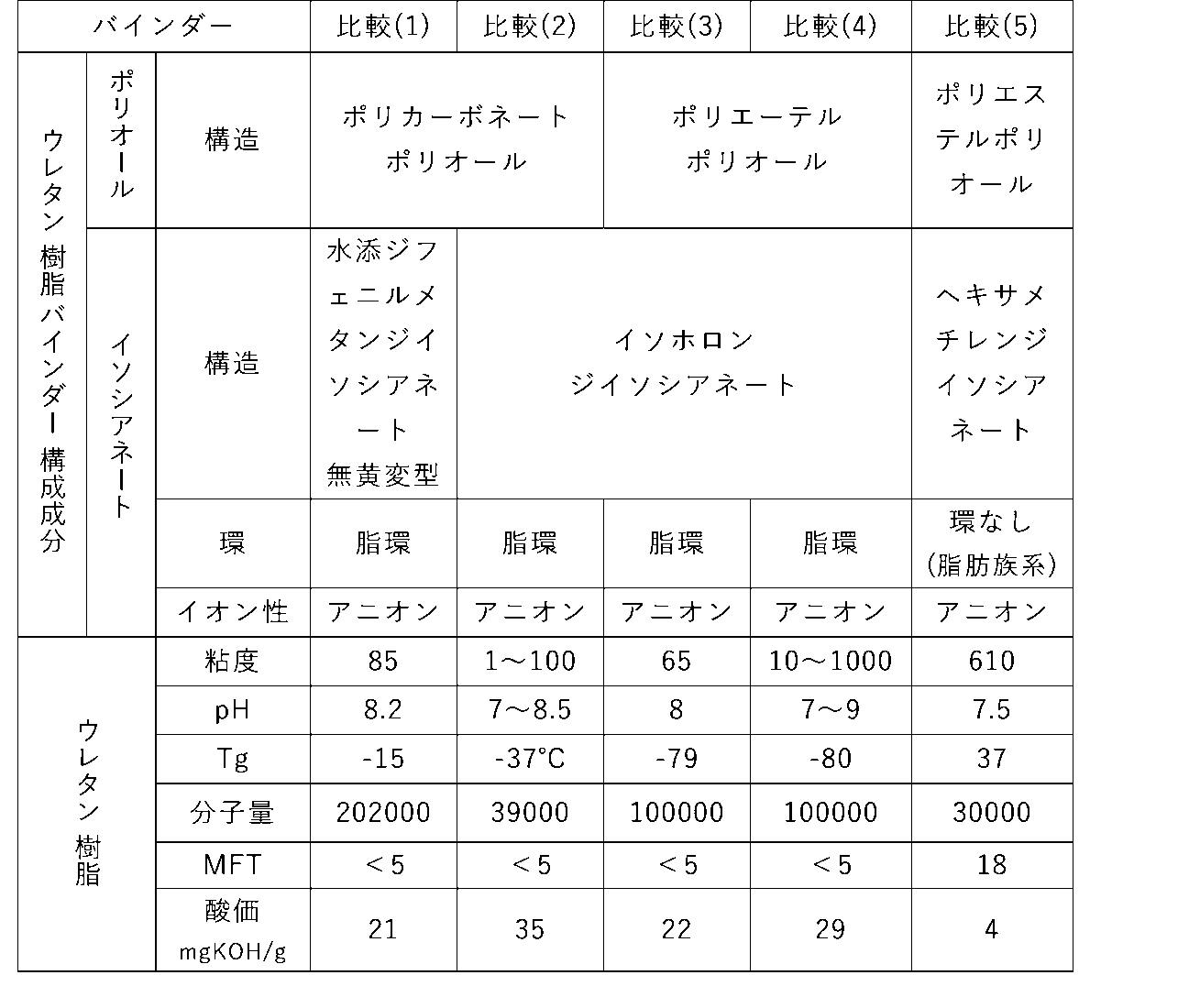
- Binders (1) to (3) and comparative binders (1) to (5) used in this example are shown below.
- aqueous pigment dispersion for preparation of aqueous inkjet ink Various water-based pigment dispersions were obtained according to the following composition by adjusting the pigment concentration in the water-based pigment dispersion to 30% by weight.
- the binder the binder of each example described above was used in an amount such that the solid content of each binder was 10.5% by mass based on the total amount of the pigment dispersion.
- Pigment kneaded meat base 50.0 parts
- Aqueous medium (B) 10.0 parts Water balance
- ⁇ Blocking resistance evaluation> Cut the film into 4 cm x 4 cm size so that the printed surface and the non-printed surface of the printed matter are in contact with each other, stack them, apply a load of 5 kgf/cm 2 , leave them in an environment of 50 ° C for 24 hours, and then remove the film.
- the state of ink transfer (set-off) to the non-printed surface when peeled off was visually evaluated based on the area ratio (%) of the set-off portion.
- x Transfer due to set-off of 10% or more is observed.
- Laminate evaluation was performed according to JIS Z 1707:2019. Specifically, it is as follows.
- OPP film A heat-sealing adhesive was formulated by mixing aromatic-ether adhesives (LX401 and SP60, both manufactured by DIC) and diluting with ethyl acetate to a non-volatile content of 25%. Adhesive was applied to the printed surface of the OPP film so as to be 2 g/m 2 , and a CCP film (pylen film-CT P1128, manufactured by Toyobo Co., Ltd.) was laminated with a heated roller lamination tester set at 40 ° C. . After that, curing was performed at 40° C.
- a test piece having a width of 10.0 ⁇ 0.1 mm and a developed length of 100 mm or more in a perpendicular direction was taken from the produced laminate film.
- the test piece was opened at 180° with the laminated part of the test piece in the center, and both ends of the test piece were attached to the grips of a constant-speed elongation type tensile tester with an interval of 50 mm or more between the grips.
- a tensile load was applied until the laminate was broken, and the maximum load (N/10 mm) during that period was determined, and the laminate strength was evaluated according to the criteria shown below.
- ⁇ Scratch resistance> In accordance with JIS K5701-1:2000, the abrasion resistance of the printed OPP film was evaluated using a Gakushin type rubbing fastness tester (manufactured by Tester Sangyo Co., Ltd., AB-301). The printed matter was set in the tester, and the dry friction test was performed using PPC paper as the friction paper, a load of 200 g, and 100 reciprocations. The test was conducted under the conditions of After the test, the degree of ink peeling on the printed matter was visually evaluated according to the following evaluation criteria. A: No peeling occurred in both the dry friction test and the wet friction test. ⁇ : Less than 1% of peeling occurred in either the dry friction test or the wet friction test, whichever is worse.
- ⁇ 1% or more and less than 5% of peeling occurred in either the dry rubbing test or the wet rubbing test, whichever is worse.
- x 5% or more and less than 10% of peeling occurred in either dry friction test or wet friction test, whichever is worse.
- ⁇ Storage stability evaluation> Particle size/viscosity change
- Each ink was stored in a constant temperature bath at 70° C. for 5 days and subjected to an accelerated storage stability test.
- the ink before and after the accelerated storage stability test was measured with a nanoparticle size measuring device (Nanotrac wave II Ex150, manufactured by Microtrac Bell Co., Ltd.), and the average particle size before and after the accelerated storage stability test was compared.
- the inks before and after the accelerated storage stability test were measured with an E-type viscometer (TVE-25L model, manufactured by Toki Sangyo Co., Ltd.), the viscosities before and after the accelerated storage stability test were compared, and evaluated on a three-grade scale from A to C.
- a grade of B or above is acceptable.
- the inkjet inks of Examples 1 to 3 according to the present invention are excellent in blocking resistance and abrasion resistance to plastic substrates, and are excellent in lamination when an adhesive is applied to the printed surface and the film is laminated. It was confirmed that the strength was exhibited.
- the water-based inkjet inks of Comparative Examples 1-5 were inferior in any of the properties, unlike the inks of Examples 1-3. Therefore, it was confirmed that the pigment dispersion of the present invention can be suitably used for water-based inkjet inks.
Landscapes
- Chemical & Material Sciences (AREA)
- Life Sciences & Earth Sciences (AREA)
- Engineering & Computer Science (AREA)
- Materials Engineering (AREA)
- Wood Science & Technology (AREA)
- Organic Chemistry (AREA)
- Chemical Kinetics & Catalysis (AREA)
- Inks, Pencil-Leads, Or Crayons (AREA)
- Ink Jet Recording Methods And Recording Media Thereof (AREA)
- Ink Jet (AREA)
Abstract
Description
従来、フィルム基材への印刷では溶剤型フレキソインクや溶剤型グラビアインクが主流だった。しかしながら、これらの印刷方法では製版が必要なことからコストが増大し、且つ、印刷までに時間を要するという課題があった。そのため、フィルムパッケージ印刷においても、製版が不要でオンデマンド印刷が可能なインクジェット印刷への要望が大きくなっている。
(1)バインダー(A)、顔料(B)、及び水性媒体(C)を含有するインクジェット用顔料分散体であって、
前記バインダー(A)が、酸基を有するポリオール(a1-1)と、前記ポリオール(a1-1)以外のポリエステルポリオール(a1-2)とを含むポリオール(a1)、及び、環構造を有するポリイソシアネート(a2-1)を含むポリイソシアネート(a2)の反応物であるウレタン樹脂(A1)を含有するバインダーであって、
前記ウレタン樹脂(A1)の有する酸基の一部又は全部が中和されたものであり、
前記ウレタン樹脂(A1)のガラス転移温度が70℃以下であることを特徴とする、インクジェット用顔料分散体。
(2)前記ウレタン樹脂(A1)の酸価が、10~40mgKOH/gである、(1)のインクジェット用顔料分散体。
(3)前記バインダー(A)の含有量が、顔料分散体全量中の5~30質量%である、(1)又は(2)のインクジェット用顔料分散体。
(4)プラスチック基材への印刷用である、(1)~(2)いずれかのインクジェット用顔料分散体。
(5)(1)~(4)いずれかのインクジェット用顔料分散体を用いたインクジェットインク。
(6)(5)のインクジェットインクで印刷した印刷物。
本発明の顔料分散体は、インクジェットインクのための中間製品として製造されるものであって、希釈した後に水性のインクジェットインクとしてインクジェット印刷に使用される。
バインダー(A)は、ウレタン樹脂(A1)を含有するものであって、ウレタン樹脂(A1)は、ポリオール(a1)とポリイソシアネート(a2)の反応物である。
本発明におけるウレタン樹脂(A1)は、ポリオール(a1)とポリイソシアネート(a2)とを反応させて得られる樹脂である。(a1)成分と(a2)成分とを任意の重合開始剤の存在下でラジカル重合等の公知の方法を用いて重合させることにより得られる。樹脂(A1)が酸基を有することにより、ウレタン樹脂(A1)に親水性が付与され、顔料(B)を水中で安定に分散することが可能となる。
本発明におけるポリオール(a1)は、酸基を有するポリオール(a1-1)と、前記ポリオール(a1-1)以外のポリエステルポリオール(a1-2)とを含む。
カルボキシル基を有するポリオールとしては、例えば、2,2-ジメチロールプロピオン酸、2,2-ジメチロールブタン酸、2,2-ジメチロール吉草酸等が挙げられる。なかでも分散安定性が良好な、2,2-ジメチロールプロピオン酸や2,2-ジメチロールブタン酸が好ましい。また、カルボキシル基を有するポリオールと各種ポリカルボン酸とを反応させて得られるカルボキシル基を有するポリエステルポリオールを用いることもできる。これらのカルボキシル基を有するポリオールは、単独で用いることも2種以上併用することもできる。
スルホン酸基を有するポリオールとしては、例えば、5-スルホイソフタル酸、スルホテレフタル酸、4-スルホフタル酸、5-(4-スルホフェノキシ)イソフタル酸等のジカルボン酸またそれらの塩と、エチレングリコールやプロピレングリコール、1,4-ブタンジオール、1,6-ヘキサンジオール、ジエチレングリコール、ネオペンチルグリコール等の低分子ポリオールとを反応させて得られるポリエステルポリオールが挙げられる。これらのスルホン酸基を有するポリオールは、単独で用いることも2種以上併用することもできる。
中和の方法は特に限定されるものではないが、例えば、金属や有機アミンを用いた中和が挙げられる。
酸基を中和する際に用いることができるナトリウム、カリウム、カルシウム、銅、リチウム等の金属イオンは、例えば、水酸化ナトリウム、水酸化カリウム、水酸化リチウムなどの金属水酸化物や、塩化ナトリウム、塩化カリウムなどの金属塩化物、硫酸銅などの金属硫化物から得られる。
これらの中でも、顔料分散性の観点から、アルキルアミンが好ましい。
ポリアルキレンイミンの数平均分子量は、好ましくは150以上、より好ましくは500以上、更に好ましくは800以上、更に好ましくは1000以上であり、そして、好ましくは10000以下、より好ましくは5000以下、更に好ましくは4000以下である。
ポリアリルアミンの重量平均分子量は、好ましくは800以上、より好ましくは1000以上、更に好ましくは1500以上であり、そして、好ましくは10000以下、より好ましくは5000以下、更に好ましくは4000以下である。
多価カルボン酸としては、例えば、フタル酸、イソフタル酸、テレフタル酸、アジピン酸、マレイン酸、フマル酸、こはく酸、しゅう酸、マロン酸、グルタル酸、ピメリン酸、スベリン酸、アゼライン酸、セバシン酸、ダイマー酸、トリメリット酸、ベンゼンテトラカルボン酸、ベンゼンペンタカルボン酸、ベンゼンヘキサカルボン酸等が挙げられる。
多価アルコールとしては、例えば、エチレングリコール、プロピレングリコール、1,3-プロパンジオール、1,4-ブタンジオール、1,5-ペンタンジオール、1,6-ヘキサンジオール、ジエチレングリコール、トリエチレングリコール、テトラエチレングリコール、ジプロピレングリコール、トリプロピレングリコール、1,4-シクロヘキサンジオール、1,4-シクロヘキサンジメタノール等のグリコール;2-メチル-1,5-ペンタンジオール、3-メチル-1,5-ペンタンジオール、1,2-ブタンジオール、1,3-ブタンジオール、2-ブチル-2-エチル-1,3-プロパンジオール、1,2-プロパンジオール、2-メチル-1,3-プロパンジオール、ネオペンチルグリコール、2-イソプロピル-1,4-ブタンジオール、2,4-ジメチル-1,5-ペンタンジオール2,4-ジエチル-1,5-ペンタンジオール、2-エチル-1,3-ヘキサンジオール、2-エチル-1,6-ヘキサンジオール、3,5-ヘプタンジオール、2-メチル-1,8-オクタンジオール等の分岐構造を有するグリコール;グリセリン、トリメチロールプロパン、トリメチロールエタン、ペンタエリスリトール、ソルビトール等が挙げられる。
ポリエステルポリオール(a1-2)としては、顔料(B)等との相溶性が良いことから、数平均分子量500~8,000の範囲であることが好ましく、800~7,000の範囲であることがより好ましく、900~6,000の範囲であることが更に好ましい。本発明において、数平均及び重量平均分子量は、ゲル・パーミエーション・クロマトグラフィー(GPC)法により測定した値を示す。
ポリイソシアネート(a2)は、環構造を有するポリイソシアネート(a2-1)を含む。
環構造としては、例えば、シクロブチル環、シクロペンチル環、シクロヘキシル環、シクロヘプチル環、シクロオクチル環、プロピルシクロヘキシル環、トリシクロ[5.2.1.0.2.6]デシル骨格、ビシクロ[4.3.0]-ノニル骨格、トリシクロ[5.3.1.1]ドデシル骨格、プロピルトリシクロ[5.3.1.1]ドデシル骨格、ノルボルネン骨格、イソボルニル骨格、ジシクロペンタニル骨格、アダマンチル骨格等の脂環構造;ベンゼン環、ナフタレン環等の芳香環構造が挙げられる。
芳香環構造を有するポリイソシアネート(a2-1)としては、例えば、4,4’-ジフェニルメタンジイソシアネート、2,4’-ジフェニルメタンジイソシアネート、カルボジイミド変性ジフェニルメタンジイソシアネート、クルードジフェニルメタンジイソシアネート、フェニレンジイソシアネート、トリレンジイソシアネート、ナフタレンジイソシアネート、キシリレンジイソシアネート、テトラメチルキシリレンジイソシアネート等が挙げられる。
なかでも、トリレンジイソシアネート又はイソホロンジイソシアネートが好ましく、トリレンジイソシアネートが特に好ましい。
これらのポリイソシアネート(a2-1)は、単独で用いることも2種以上を併用することもできる。
(a2-1)以外のイソシアネート化合物(a2-2)として、環構造を有さないポリオール、例えば、ヘキサメチレンジイソシアネート、リジンジイソシアネート等の脂肪族ポリイソシアネート等を併用することができる。
なお、本発明でいう、ウレタン樹脂(A1)の全体に対する、ウレタン樹脂(A1)中に含まれる脂環式構造の割合は、ウレタン樹脂(A1)の製造に使用するポリオール(a1)やポリイソシアネート(a2)等の全原料の合計質量と、ウレタン樹脂(A1)の製造に使用した環構造含有化合物が有する環構造の物質量に基づいて算出した理論値である。
前記鎖伸長剤としては、例えば、ポリアミン、ヒドラジン化合物、その他活性水素原子を有する化合物が挙げられる。これらの鎖伸長剤は、単独で用いることも、2種以上を併用することもできる。
ウレタン樹脂(A1)の最低造膜温度(MFT)は、印刷物製造時の乾燥温度を低くしてエネルギー効率を向上させる観点から、40℃以下が好ましく、35℃以下がより好ましく、33℃以下がさらに好ましい。
なお、本発明におけるGPC(ゲルパーミエーションクロマトグラフィー)による重量
平均分子量(ポリスチレン換算)の測定は、東ソー(株)社製HLC8220システムを用
い以下の条件で行った。
分離カラム:東ソー(株)製TSKgelGMHHR-Nを4本使用
移動層:和光純薬工業(株)製テトラヒドロフラン
流速:1.0ml/分。試料濃度:0.4質量%
試料注入量:100マイクロリットル。検出器:示差屈折計
顔料(B)は、分散体中に良好に分散し得るものであれば特に限定されるものではないが、平均粒子径10~400nm程度でで分散しうるものを用いることが好ましい(詳細は後述)。例えば、一般のインク、塗料、及び記録剤などに使用されている有機顔料、無機顔料や染料を使用することができる。
また、顔料が無機顔料の場合、25~60質量%が好ましく、30~50質量%がより好ましい。
本発明の顔料分散体は、該分散体のポンプ輸送や分散体のフィルターろ過に好適な粘度に調製するために、さらに水性媒体を含有する。
水性媒体(C)としては、例えば、水、水と混和する有機溶剤、及び、これらの混合物が挙げられる。
水と混和する有機溶剤としては、例えば、メタノール、エタノール、n-プロパノール及びイソプロパノール等のアルコール溶剤;アセトン、メチルエチルケトン等のケトン溶剤;エチレングリコール、ジエチレングリコール、プロピレングリコール等のポリアルキレングリコール類;ポリアルキレングリコールのアルキルエーテル類;N-メチル-2-ピロリドン等のラクタム溶剤などが挙げられる。本発明では、水のみを用いても良く、また水及び水と混和する有機溶剤との混合物を用いても良く、水と混和する有機溶剤のみを用いても良い。
水性媒体(C)としては、安全性や環境に対する負荷の点から、水のみ、または、水及び水と混和する有機溶剤との混合物が好ましく、水のみが特に好ましい。
本発明の顔料分散体は、本発明の効果が損なわれない範囲内で、上述の(A)成分、(B)成分、及び水(C)に加えて、その他の任意成分を含有していてもよい。
その他の成分として例えば、沸点が100℃以上のアミン化合物、上記成分以外のその他樹脂、界面活性剤、ワックス、低表面張力有機溶剤、湿潤剤、浸透剤、上記以外の分散剤、消泡剤、防腐剤、粘度調製剤、pH調製剤、キレート化剤、可塑剤、酸化防止剤、紫外線吸収剤等が挙げられる。
このようなアミン化合物としては、ポリアルキレンイミン、ポリアリルアミン、(ポリ)エチレンポリアミン、アルカノールアミン、アルキルアミンが挙げられる。
これらの中でも、顔料分散性、臭気及び再溶解性の観点から、アルカノールアミンが好ましい。
ポリアルキレンイミンは、好ましくは炭素数が2以上5以下のアルキレン基を有するポリアルキレンイミンである。
ポリアルキレンイミンは、好ましくはアルキレン基の炭素数が2以上4以下のポリアルキレンイミン、より好ましくはポリエチレンイミン又はポリプロピレンイミン、更に好ましくはポリエチレンイミンである。これらは、1種又は2種以上を用いてもよい。
該分子量の値は、実施例に記載の方法により求められる。
ポリアリルアミンとしては、アリルアミン、ジメチルアリルアミン等のアリル化合物の単独重合体又は共重合体などのアミノ基を側鎖に有するポリマーが挙げられる。
ポリアリルアミンの重量平均分子量は、好ましくは800以上、より好ましくは1,000以上、更に好ましくは1,500以上であり、そして、好ましくは10,000以下、より好ましくは5,000以下、更に好ましくは4,000以下である。
(ポリ)エチレンポリアミンとしては、例えば、エチレンジアミン、ジエチレントリアミン、トリエチレンテトラミン、テトラエチレンペンタミン、ペンタエチレンヘキサミン等が挙げられる。これらの中でも、ジエチレントリアミン、トリエチレンテトラミン、テトラエチレンペンタミンが好ましい。
アルカノールアミンとしては、好ましくは炭素数2以上9以下のアルカノールアミンである。アルカノールアミンとしては、例えば、モノエタノールアミン、モノプロパノールアミン、モノブタノールアミン等の1級アルカノールアミン;N-メチルエタノールアミン、N-メチルプロパノールアミン等のモノアルカノール2級アミン、ジエタノールアミン、ジイソプロパノールアミン等のジアルカノール2級アミンなどの2級アルカノールアミン;N,N-ジメチルエタノールアミン、N,N-ジメチルプロパノールアミン、N,N-ジエチルエタノールアミン等のモノアルカノール3級アミン、N-メチルジエタノールアミン、N-エチルジエタノールアミン等のジアルカノール3級アミン、トリエタノールアミン、トリイソプロパノールアミン等のトリアルカノール3級アミンなどの3級アルカノールアミンが挙げられる。これらの中でも、炭素数2以上9以下の3級アルカノールアミンが好ましく、トリイソプロパノールアミンが特に好ましい。
アルキルアミンとしては、好ましくは炭素数1以上6以下のアルキルアミンである。アルキルアミンとしては、例えば、プロピルアミン、ブチルアミン、ヘキシルアミン等の1級アミン;ジエチルアミン、ジプロピルアミン等の2級アミンが挙げられる。
パラフィンワックスの市販品としては、例えば、AQUACER537、AQUACER539(以上商品名、ビックケミー・ジャパン株式会社製)等が挙げられる。
湿潤剤のインク中の含有量は3~50質量%であることが好ましい。
本発明における顔料分散体の製造方法は何ら限定されるものではない。
(A)~(C)成分と、必要に応じて添加される任意成分とを分散させて顔料分散体としてもよいし、予め、(A)、(B)成分及び(C)成分の一部や媒体等により顔料濃度の高い顔料分散ミルベース液を作製し、適宜任意成分を添加、(C)成分等の水性媒体で希釈して水性インクジェットインクの調製のための顔料分散体としてもよい。攪拌・分散装置を用いて顔料を分散させて顔料分散ミルベース液を予め作製した後に顔料分散体を作製することにより、所望の体積平均粒子径で顔料が分散された水性顔料分散体を容易に得ることができる。
以下、後者の顔料分散ミルベース液を作製した後、顔料分散体とする方法について述べる。
(1)必要に応じて顔料分散剤を含有する水性媒体に顔料を添加した後、攪拌・分散装置を用いて顔料を該水性媒体中に分散させることにより、顔料分散ミルベース液を調製する方法。
(2)顔料、及び必要に応じて顔料分散剤を2本ロール、ミキサー等の混練機を用いて混練し、得られた混練物を水性媒体中に添加し、攪拌・分散装置を用いて顔料分散ミルベース液を調製する方法。
(3)メチルエチルケトン、テトラヒドロフラン等の水と相溶性を有する有機溶剤中に顔料分散剤を溶解して得られた溶液に顔料を添加した後、攪拌・分散装置を用いて顔料を有機溶液中に分散させ、次いで水性媒体を用いて転相乳化させた後、前記有機溶剤を留去し顔料分散ミルベース液を調製する方法。
本発明の顔料分散体を用い、顔料の含有率が1~30質量%となる様に水性媒体で希釈し水性インクジェットインクとする。この水性媒体は、(C)成分と同様に水であってもよく、水と有機溶剤との混合物であってもよく、有機溶剤のみであってもよい。有機溶剤としては、水と混和するものであれば特に限定されないが、「水以外の溶媒」として任意成分中で上述したものが挙げられる。
また、水性媒体中に、顔料分散体の任意成分(例えば、界面活性剤、防腐剤、表面張力調整剤等)を含有させることもできる。
本発明のインクジェットインクは、各種基材への印刷特性に優れることから、プラスチック基材とインクジェットインクによる印刷層とを有する印刷物を好適に製造することが可能である。
また、フィルムの印刷面には、コロナ放電処理がされていることが好ましい。また、印刷面にシリカ、アルミナ等が蒸着されていても構わない。

白色顔料ベースを以下の組成によりよく撹拌混合した後、ビーズミル(使用ビーズはニッカトー株式会社YTZビーズ1.0mmφ、ビーズ充填率80%)で練肉し、顔料の体積平均粒子径を上記同様に測定し、体積平均粒子径280nmの練肉ベースを作製した。
二酸化チタン JR-600A白顔料(テイカ社製) 60部
ノニオン系顔料分散剤(BYK社製) 10部
水 30部
シリコン系消泡剤(BYK社製) 0.1部
以下の組成に従い、水性顔料分散体中の顔料濃度が、30重量%になるように調製して各種水性顔料分散体を得た。バインダーは、上述した各例のバインダーを、固形分量がいずれも顔料分散体全量中の10.5質量%となるような量で用いた。
顔料練肉ベース 50.0部
バインダー 20~50部
水性媒体(B) 10.0部
水 残部
以下のインク組成に従い、プラスチック基材用水性インクジェットインク中の顔料濃度が、8重量%になる様に調製して、実施例1~3及び比較例1~5のプラスチック基材用水性インクジェットインクを得た。
水性顔料分散体 4.0部
プロピレングリコール 10.0部
1,2-ヘキサンジオール 5.0部
ポリオキシエチレンアルキルエーテル 0.5部
イオン交換水 残部
各例の顔料分散体をインクジェットプリンター(セイコーエプソン(株)製、MJ-510C)のインクカートリッジに充填し、表1、表2に示すコロナ処理ポリエチレンテレフタレート(PET)フィルム(東洋紡績(株)製 エステルE5100 厚さ12μm)、または、コロナ処理ポリプロピレン(OPP)二軸延伸フィルム(東洋紡績(株)製 パイレンP2161 厚さ20μm)に、ベタ絵柄を印刷後、ドライヤーで乾燥したのち、更に80℃オーブンに入れ10分乾燥し印刷物を得た。
実施例及び比較例のインク組成物をインクジェットプリンター(セイコーエプソン(株)製、MJ-510C)のインクカートリッジに充填し、コロナ処理ポリエチレンテレフタレート(PET)フィルム(東洋紡績(株)製 エステルE5100 厚さ12μm)、または、コロナ処理ポリプロピレン(OPP)二軸延伸フィルム(東洋紡績(株)製 パイレンP2161 厚さ20μm)に、ベタ絵柄を印刷後、ドライヤーで乾燥したのち、更に90℃オーブンに入れ10分乾燥し印刷物を得た。
得られた印刷物を用い、以下に示す評価方法で評価を行った。結果を下表に併記する。
印刷物の印刷面と非印刷面が接触するようにフィルムを4cm×4cmサイズにカットしてから重ねあわせ、5Kgf/cm2の荷重をかけ、50℃の環境下に24時間放置した後、フィルムを剥離した際の非印刷面へのインクの転移(裏移り)の状態を、裏移りの部分の面積比率(%)を基準に目視で判定した。
◎:非印刷面への転移は全く見られない。
〇:5%未満と僅かであるが、裏移りによる転移が見られる。
△:5%以上~10%未満と許容範囲内ではあるが、裏移りによる転移が見られる。
×:10%以上の裏移りによる転移が見られる。
ラミネート評価は、JIS Z 1707:2019に準じて行った。具体的には以下の通りである。
(OPPフィルム)
芳香族‐エーテル系接着剤(LX401及びSP60、いずれもDIC社製)を混合し、酢酸エチルで不揮発分が25%となるように希釈することで、ヒートシール用接着剤を配合した。OPPフィルムの印刷面に2g/m2となるように接着剤を塗布し、40℃に設定した加熱ローラー型ラミネート試験機にて、CCPフィルム(パイレンフィルム-CT P1128、東洋紡社製)を張り合わせた。その後、40℃にて3日間のキュアリングを行い、ラミネートフィルムを作製した。
作製されたラミネートフィルムより、直角の方向に幅10.0±0.1mm,展開長さ100mm以上の試験片を採取した。
試験片のラミネート部を中央にして180°に開き、つかみの間隔を50mm以上として試験片の両端を定速伸長形引張試験機のつかみに取り付けた。ラミネート部が破断するまで引張荷重を加えることによりその間の最大荷重(N/10mm)を求め、以下に示す基準に従ってラミネート強度を評価した。
(PETフィルム)
ヒートシール接着剤に脂肪族-エステル系接着剤(LX703VLおよびKR-90、いずれもDIC社製)を用い、張り合わせフィルムにLLDPEフィルム(TUX-HC、三井東セロ社製)を用いた以外は同様の方法で、ラミネート強度を評価した。
◎:最大荷重(N/10mm)が3以上
〇:最大荷重(N/10mm)が2~3未満
△:最大荷重(N/10mm)が1~2未満
×:最大荷重(N/10mm)が0~1未満
JIS K5701-1:2000に従って、学振型摩擦堅牢度試験機(テスター産業(株)製、AB-301)を用いてOPPフィルム印刷物の耐擦過性を評価した。印刷物を試験機にセットし、乾摩擦試験は摩擦用紙としてPPCペーパー、荷重200g、100往復の条件とし、湿摩擦試験は摩擦用紙としてイオン交換水で湿らせたカナキン3号、荷重200g、10往復の条件として試験を行った。試験後の印刷物におけるインクの剥がれ具合について、目視にて以下の評価基準に従って評価した。
◎:乾摩擦試験、湿摩擦試験のいずれも全く剥がれが生じなかった。
〇:乾摩擦試験、湿摩擦試験のいずれか劣る方が1%未満の剥がれがあった。
△:乾摩擦試験、湿摩擦試験のいずれか劣る方が1%以上5%未満の剥がれがあった。
×:乾摩擦試験、湿摩擦試験のいずれか劣る方が5%以上10%未満の剥がれがあった。
(粒径・粘度変化)
各インクを70℃の恒温槽で5日間貯蔵し、促進貯蔵安定性試験を行った。
促進貯蔵安定性試験前後のインクをナノ粒子径測定装置(Nanotrac wave II Ex150、マイクロトラック・ベル株式会社製)で測定し、促進貯蔵安定性試験前後の平均粒径を比較した。
促進貯蔵安定性試験前後のインクをE型粘度計(TVE-25L型、東機産業製)で測定し、促進貯蔵安定性試験前後の粘度を比較し、A~Cの三段階で評価した。B以上を合格とする。
A:平均粒径・粘度共に、促進貯蔵安定性試験前後の変化率が5%未満だった。
B:平均粒径・粘度のうち、結果が劣る方の悪促進貯蔵安定性試験前後の変化率が5%~15%だった。
C:平均粒径・粘度のうち、結果が劣る方の悪促進貯蔵安定性試験前後の変化率が15%超だった。
(色変化)
上記同様に促進貯蔵安定性試験を行った後、目視で色味を確認し、A~Cの三段階で評価した。B以上を合格とする。
A:試験前後で色変化がなかった。
B:試験前後で色変化がわずかに見られた。
C:試験前後で色変化が比較的大きかった。
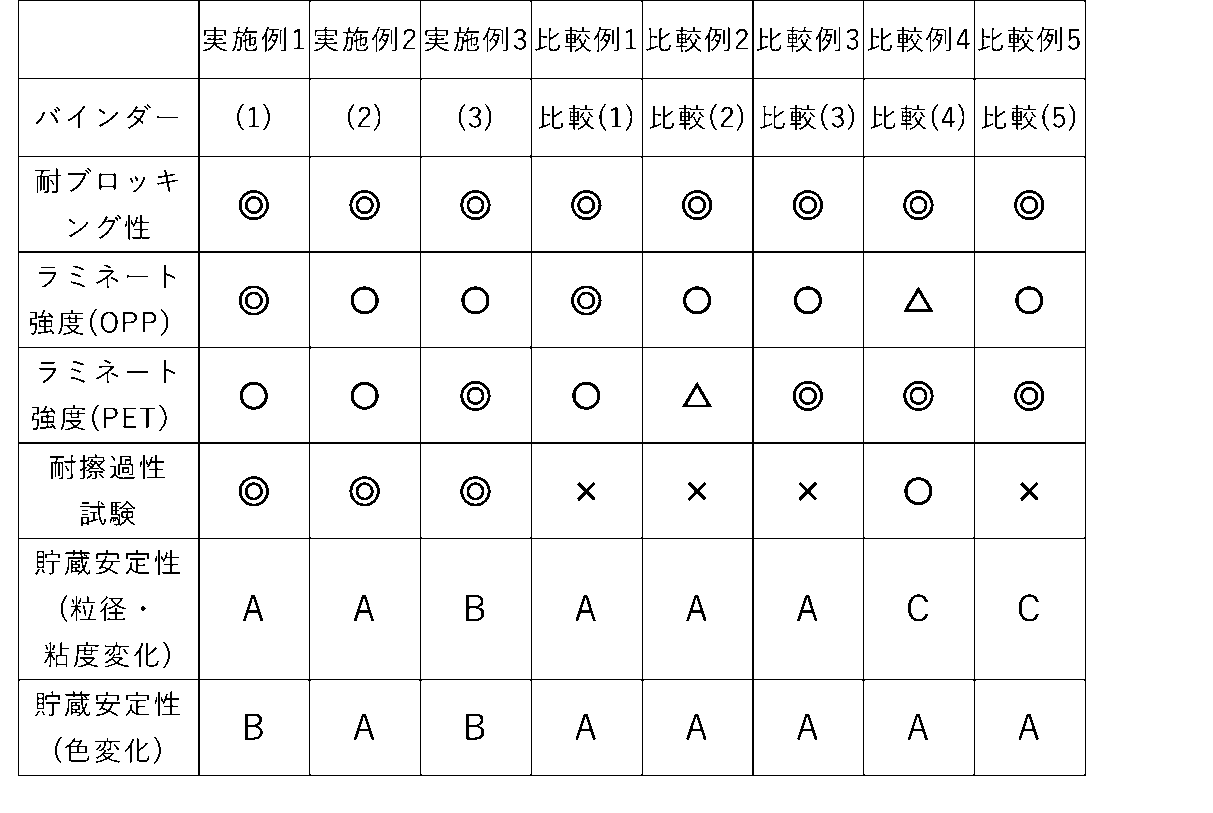
一方、比較例1~5の水性インクジェットインクは、実施例1~3のインクとは異なり、いずれかの特性に劣るものであった。
よって、本発明の顔料分散体は、水性のインクジェットインクに好適に用いうることが確認できた。
Claims (6)
- バインダー(A)、顔料(B)、及び水性媒体(C)を含有するインクジェット用顔料分散体であって、
前記バインダー(A)が、酸基を有するポリオール(a1-1)と、前記ポリオール(a1-1)以外のポリエステルポリオール(a1-2)とを含むポリオール(a1)、及び、環構造を有するポリイソシアネート(a2-1)を含むポリイソシアネート(a2)の反応物であるウレタン樹脂(A1)を含有するバインダーであって、
前記ウレタン樹脂(A1)の有する酸基の一部又は全部が中和されたものであり、
前記ウレタン樹脂(A1)のガラス転移温度が70℃以下であることを特徴とする、インクジェット用顔料分散体。 - 前記ウレタン樹脂(A1)の酸価が、10~40mgKOH/gである、請求項1に記載のインクジェット用顔料分散体。
- 前記バインダー(A)の含有量が、顔料分散体全量中の5~30質量%である、請求項1に記載のインクジェット用顔料分散体。
- プラスチック基材への印刷用である、請求項1に記載のインクジェット用顔料分散体。
- 請求項1~4のいずれか一項に記載のインクジェット用顔料分散体を用いたインクジェットインク。
- 請求項5に記載のインクジェットインクで印刷した印刷物。
Priority Applications (5)
| Application Number | Priority Date | Filing Date | Title |
|---|---|---|---|
| EP22811231.4A EP4321340A4 (en) | 2021-05-27 | 2022-05-19 | PIGMENT DISPERSION FOR INKJET INK, INKJET INK AND PRINTED PRODUCT |
| US18/560,023 US20240227411A1 (en) | 2021-05-27 | 2022-05-19 | Pigment dispersion for ink jet ink, ink jet ink, and printed matter |
| JP2023521876A JP7355276B2 (ja) | 2021-05-27 | 2022-05-19 | インクジェットインク用顔料分散体、インクジェットインク及び印刷物 |
| CN202280032937.XA CN117242142B (zh) | 2021-05-27 | 2022-05-19 | 喷墨油墨用颜料分散体、喷墨油墨及印刷物 |
| KR1020237038716A KR20240013105A (ko) | 2021-05-27 | 2022-05-19 | 잉크젯 잉크용 안료 분산체, 잉크젯 잉크 및 인쇄물 |
Applications Claiming Priority (2)
| Application Number | Priority Date | Filing Date | Title |
|---|---|---|---|
| JP2021-089115 | 2021-05-27 | ||
| JP2021089115 | 2021-05-27 |
Publications (1)
| Publication Number | Publication Date |
|---|---|
| WO2022249959A1 true WO2022249959A1 (ja) | 2022-12-01 |
Family
ID=84230030
Family Applications (1)
| Application Number | Title | Priority Date | Filing Date |
|---|---|---|---|
| PCT/JP2022/020760 Ceased WO2022249959A1 (ja) | 2021-05-27 | 2022-05-19 | インクジェットインク用顔料分散体、インクジェットインク及び印刷物 |
Country Status (6)
| Country | Link |
|---|---|
| US (1) | US20240227411A1 (ja) |
| EP (1) | EP4321340A4 (ja) |
| JP (1) | JP7355276B2 (ja) |
| KR (1) | KR20240013105A (ja) |
| CN (1) | CN117242142B (ja) |
| WO (1) | WO2022249959A1 (ja) |
Citations (6)
| Publication number | Priority date | Publication date | Assignee | Title |
|---|---|---|---|---|
| JP2004149806A (ja) * | 2002-10-31 | 2004-05-27 | Eastman Kodak Co | インクジェットインク組成物 |
| JP2013510929A (ja) * | 2009-11-10 | 2013-03-28 | イー・アイ・デュポン・ドウ・ヌムール・アンド・カンパニー | 耐スミア性インクジェットインク |
| JP2017088839A (ja) * | 2015-11-06 | 2017-05-25 | 株式会社リコー | インク、インク収容容器、インクジェット記録方法、インクジェット記録装置、及び記録物 |
| JP6295825B2 (ja) | 2014-01-09 | 2018-03-20 | 株式会社リコー | インクジェット用水性インク、インクジェット記録方法、インクジェット記録物の製造方法及びインクジェット記録装置 |
| JP2020169232A (ja) * | 2019-04-01 | 2020-10-15 | 株式会社リコー | 白色インク、インク収容容器、記録装置、記録方法、及び記録物 |
| JP2022061609A (ja) * | 2020-10-07 | 2022-04-19 | 株式会社リコー | インク、水系分散体、及び印刷物 |
Family Cites Families (12)
| Publication number | Priority date | Publication date | Assignee | Title |
|---|---|---|---|---|
| JPH0224579Y2 (ja) | 1985-12-04 | 1990-07-05 | ||
| JP2004175918A (ja) * | 2002-11-27 | 2004-06-24 | Sharp Corp | 水性インク組成物、インクジェット記録方法及び記録物 |
| US20120164400A1 (en) * | 2009-07-09 | 2012-06-28 | Dic Corporation | Binder for ink-jet printing ink, ink-jet printing ink containing the same, and printed matter |
| JP6550792B2 (ja) * | 2014-03-13 | 2019-07-31 | 株式会社リコー | インク、インクジェット記録方法、記録物 |
| WO2016199391A1 (en) * | 2015-06-10 | 2016-12-15 | Ricoh Company, Ltd. | Ink, inkjet recording method, inkjet recording apparatus, and recorded matter |
| JP6645201B2 (ja) * | 2015-06-10 | 2020-02-14 | 株式会社リコー | インク、並びにインクジェット記録方法、インクジェット記録装置、及び記録物 |
| JP6638232B2 (ja) * | 2015-07-22 | 2020-01-29 | 株式会社リコー | インク、インクカートリッジ、インクジェット記録装置、インクジェット記録方法、及び記録物 |
| US9938421B2 (en) * | 2015-07-24 | 2018-04-10 | Ricoh Company, Ltd. | Set of ink and print medium, inkjet printing method, inkjet printing apparatus, printed matter, ink, and ink stored container |
| US10119042B2 (en) * | 2015-12-18 | 2018-11-06 | Ricoh Company, Ltd. | Ink, inkjet printing apparatus, inkjet printing method, and printed matter |
| JP6391859B2 (ja) * | 2016-05-27 | 2018-09-19 | Dicグラフィックス株式会社 | 水性リキッドインキ用バインダー、水性リキッドインキ及び印刷物 |
| CN109476941B (zh) * | 2016-07-27 | 2021-10-08 | 东洋油墨Sc控股株式会社 | 用于叠层体的溶剂型凹印油墨、印刷品和叠层产品 |
| JP7275467B2 (ja) * | 2019-05-28 | 2023-05-18 | 株式会社リコー | インク、インクの製造方法、印刷方法及び印刷装置 |
-
2022
- 2022-05-19 EP EP22811231.4A patent/EP4321340A4/en active Pending
- 2022-05-19 CN CN202280032937.XA patent/CN117242142B/zh active Active
- 2022-05-19 JP JP2023521876A patent/JP7355276B2/ja active Active
- 2022-05-19 WO PCT/JP2022/020760 patent/WO2022249959A1/ja not_active Ceased
- 2022-05-19 US US18/560,023 patent/US20240227411A1/en active Pending
- 2022-05-19 KR KR1020237038716A patent/KR20240013105A/ko active Pending
Patent Citations (6)
| Publication number | Priority date | Publication date | Assignee | Title |
|---|---|---|---|---|
| JP2004149806A (ja) * | 2002-10-31 | 2004-05-27 | Eastman Kodak Co | インクジェットインク組成物 |
| JP2013510929A (ja) * | 2009-11-10 | 2013-03-28 | イー・アイ・デュポン・ドウ・ヌムール・アンド・カンパニー | 耐スミア性インクジェットインク |
| JP6295825B2 (ja) | 2014-01-09 | 2018-03-20 | 株式会社リコー | インクジェット用水性インク、インクジェット記録方法、インクジェット記録物の製造方法及びインクジェット記録装置 |
| JP2017088839A (ja) * | 2015-11-06 | 2017-05-25 | 株式会社リコー | インク、インク収容容器、インクジェット記録方法、インクジェット記録装置、及び記録物 |
| JP2020169232A (ja) * | 2019-04-01 | 2020-10-15 | 株式会社リコー | 白色インク、インク収容容器、記録装置、記録方法、及び記録物 |
| JP2022061609A (ja) * | 2020-10-07 | 2022-04-19 | 株式会社リコー | インク、水系分散体、及び印刷物 |
Non-Patent Citations (1)
| Title |
|---|
| See also references of EP4321340A4 |
Also Published As
| Publication number | Publication date |
|---|---|
| JP7355276B2 (ja) | 2023-10-03 |
| CN117242142B (zh) | 2026-04-17 |
| KR20240013105A (ko) | 2024-01-30 |
| EP4321340A1 (en) | 2024-02-14 |
| CN117242142A (zh) | 2023-12-15 |
| TW202311454A (zh) | 2023-03-16 |
| EP4321340A4 (en) | 2024-10-09 |
| US20240227411A1 (en) | 2024-07-11 |
| JPWO2022249959A1 (ja) | 2022-12-01 |
Similar Documents
| Publication | Publication Date | Title |
|---|---|---|
| JP6977500B2 (ja) | 水性記録液セット、およびそれらを用いた印刷物の製造方法 | |
| TW201202357A (en) | Ink composition for ink-jet recording | |
| CN108699371A (zh) | 墨、墨和基材的套件、喷墨印刷方法、喷墨印刷机和印刷物 | |
| EP3230390A1 (en) | Inks | |
| CN109153869B (zh) | 水性液体墨用粘合剂、水性液体墨和印刷物 | |
| JP2014065826A (ja) | インクジェット記録用水性インクセット | |
| WO2023047707A1 (ja) | 前処理液、インキセット、及び、印刷物 | |
| JP7465072B2 (ja) | 版印刷用水性インキ | |
| JP6830727B2 (ja) | 発泡カップ用水性フレキソインキ及び発泡カップ | |
| TWI880006B (zh) | 用於製備塑膠基材用水性噴墨墨水的水性顏料分散體、水性噴墨墨水及印刷物 | |
| JP7355276B2 (ja) | インクジェットインク用顔料分散体、インクジェットインク及び印刷物 | |
| AU2018373094B2 (en) | Aqueous liquid ink and printed article | |
| JP7243942B2 (ja) | インクジェットインク用顔料分散体、インクジェットインク及び印刷物 | |
| AU2018373095B2 (en) | Aqueous liquid ink and printed article | |
| TWI917632B (zh) | 噴墨油墨用顏料分散體、噴墨油墨及印刷物 | |
| JP7619052B2 (ja) | インクジェットインク用顔料分散体、インクジェットインク及び印刷物 | |
| JP7800601B2 (ja) | インクジェットインク用顔料分散体、インクジェットインク及び印刷物 | |
| JP2022146196A (ja) | インクジェットインク組成物、インクセット、記録方法、及び記録物 | |
| JP2021042263A (ja) | 水性インクジェットインク、印刷物及びインクジェット記録方法 |
Legal Events
| Date | Code | Title | Description |
|---|---|---|---|
| 121 | Ep: the epo has been informed by wipo that ep was designated in this application |
Ref document number: 22811231 Country of ref document: EP Kind code of ref document: A1 |
|
| ENP | Entry into the national phase |
Ref document number: 2023521876 Country of ref document: JP Kind code of ref document: A |
|
| WWE | Wipo information: entry into national phase |
Ref document number: 202280032937.X Country of ref document: CN |
|
| WWE | Wipo information: entry into national phase |
Ref document number: 18560023 Country of ref document: US Ref document number: 2022811231 Country of ref document: EP |
|
| ENP | Entry into the national phase |
Ref document number: 2022811231 Country of ref document: EP Effective date: 20231109 |
|
| NENP | Non-entry into the national phase |
Ref country code: DE |