WO2022260168A1 - ヒドロキシチエノイミダゾール誘導体、ビニルスルフィド誘導体、n-ブチリデンスルフィド誘導体、及び飽和直鎖炭化水素置換チエノイミダゾール誘導体の製造方法 - Google Patents
ヒドロキシチエノイミダゾール誘導体、ビニルスルフィド誘導体、n-ブチリデンスルフィド誘導体、及び飽和直鎖炭化水素置換チエノイミダゾール誘導体の製造方法 Download PDFInfo
- Publication number
- WO2022260168A1 WO2022260168A1 PCT/JP2022/023481 JP2022023481W WO2022260168A1 WO 2022260168 A1 WO2022260168 A1 WO 2022260168A1 JP 2022023481 W JP2022023481 W JP 2022023481W WO 2022260168 A1 WO2022260168 A1 WO 2022260168A1
- Authority
- WO
- WIPO (PCT)
- Prior art keywords
- formula
- derivative
- represented
- hydroxythienoimidazole
- mol
- Prior art date
- Legal status (The legal status is an assumption and is not a legal conclusion. Google has not performed a legal analysis and makes no representation as to the accuracy of the status listed.)
- Ceased
Links
Classifications
-
- C—CHEMISTRY; METALLURGY
- C07—ORGANIC CHEMISTRY
- C07D—HETEROCYCLIC COMPOUNDS
- C07D495/00—Heterocyclic compounds containing in the condensed system at least one hetero ring having sulfur atoms as the only ring hetero atoms
- C07D495/02—Heterocyclic compounds containing in the condensed system at least one hetero ring having sulfur atoms as the only ring hetero atoms in which the condensed system contains two hetero rings
- C07D495/04—Ortho-condensed systems
Definitions
- the present invention relates to methods for producing hydroxythienoimidazole derivatives, vinyl sulfide derivatives, n-butylidene sulfide derivatives, and saturated straight-chain hydrocarbon-substituted thienoimidazole derivatives.
- biotin shown below is considered a type of vitamin useful as animal feed and pharmaceuticals.
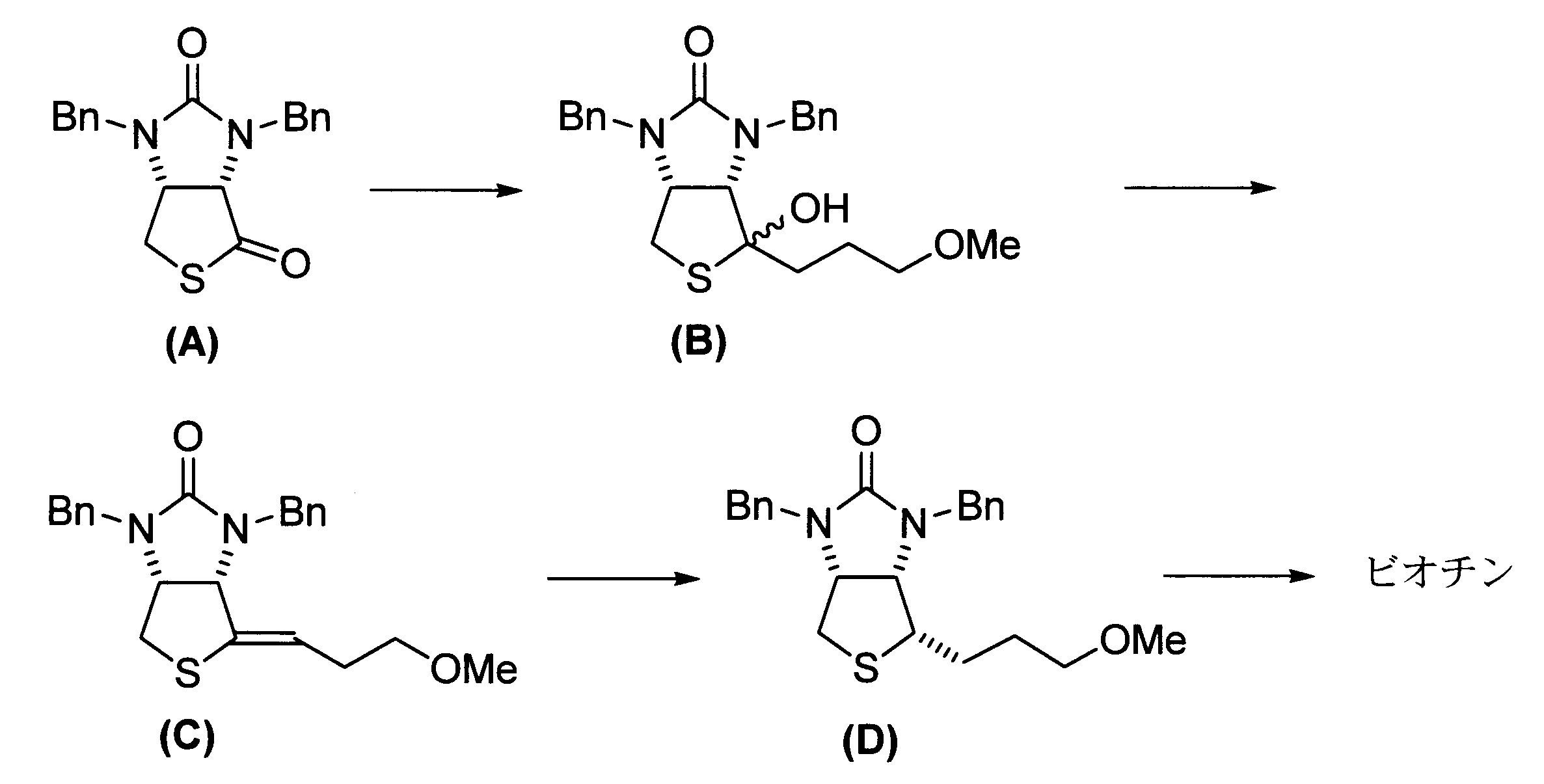
- Non-Patent Document 1 describes a biotin synthesis method using the Grignard reagent ClMg(CH 2 ) 3 OMe. Specifically, as shown below, the thiolactone compound (A) is subjected to an addition reaction with the Grignard reagent, and then the product is hydrolyzed to obtain an intermediate (B), which is then dehydrated to obtain a compound (C). ) is obtained, the compound (C) is hydrogenated to obtain the compound (D), and finally the compound (D) is subjected to coupling with a malonate ester and deprotection to obtain biotin is stated to obtain "Bn” represents a benzyl group, and "Me” represents a methyl group.
- An object of the present invention is to provide a method for producing a hydroxythienoimidazole derivative, a vinyl sulfide derivative, an n-butylidene sulfide derivative, and a saturated linear hydrocarbon-substituted thienoimidazole derivative in high yield.
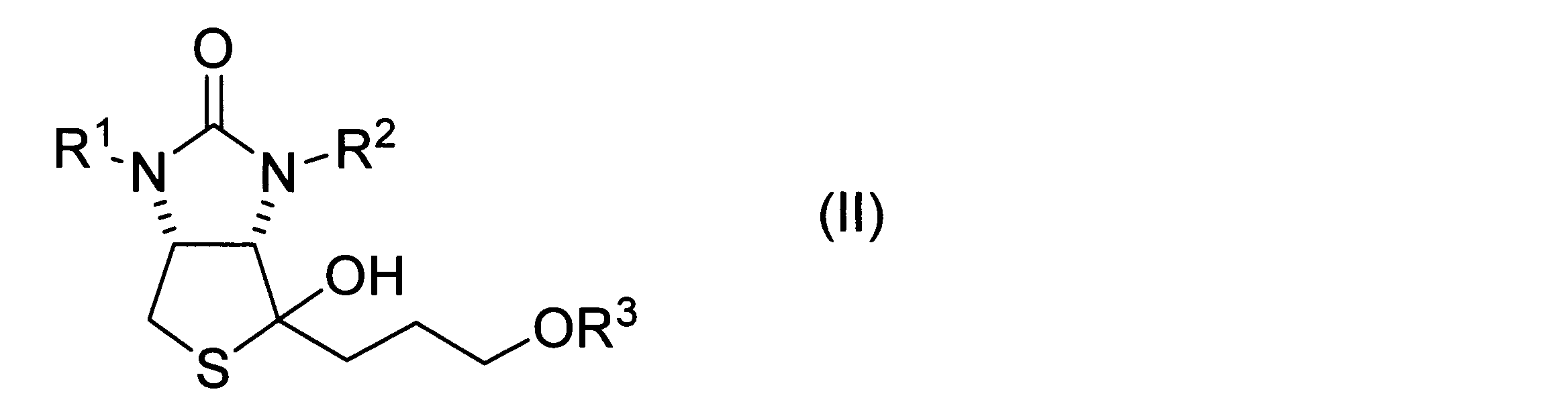
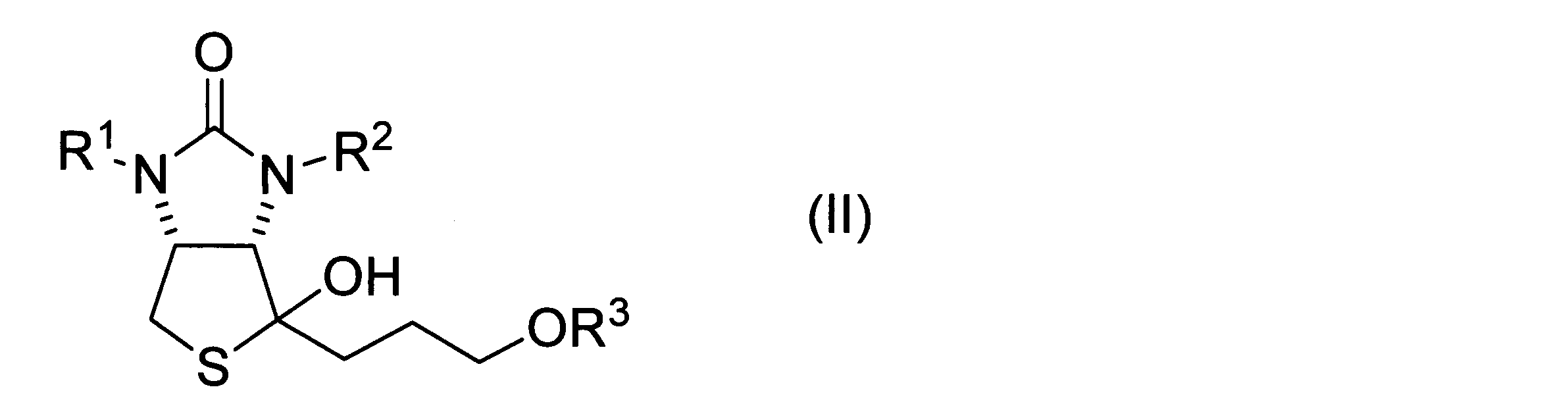
- a method for producing a hydroxythienoimidazole derivative represented by formula (II) below is provided.
- a thiolactone derivative represented by the following formula (I) a Grignard reagent represented by the following formula (1), and a copper salt are mixed to obtain a hydroxythienoimidazole derivative represented by the following formula (II).
- a thiolactone derivative represented by the following formula (I) a Grignard reagent represented by the following formula (1), and a copper salt are mixed to obtain a hydroxythienoimidazole derivative represented by the following formula (II).
- a hydroxythienoimidazole derivative represented by the following formula (II) including the step of obtaining
- R 1 and R 2 are each independently an alkyl group, a substituted alkyl group, an aryl group, or a substituted aryl group.
- R 3 is an alkyl group, an alkyl group having a substituent, an aryl group, or an aryl group having a substituent.
- X 1 is a halogen atom.
- R 1 and R 2 have the same definitions as in formula (I).
- R 3 has the same definition as in formula (1).
- a method for producing a hydroxythienoimidazole derivative represented by formula (IV) below comprises mixing a thiolactone derivative represented by the above formula (I), a Grignard reagent represented by the following formula (2), and a copper salt to obtain a hydroxythienoimidazole derivative represented by the following formula (IV). including the step of obtaining
- each X2 is independently a halogen atom.
- R 1 and R 2 have the same definitions as in formula (I).
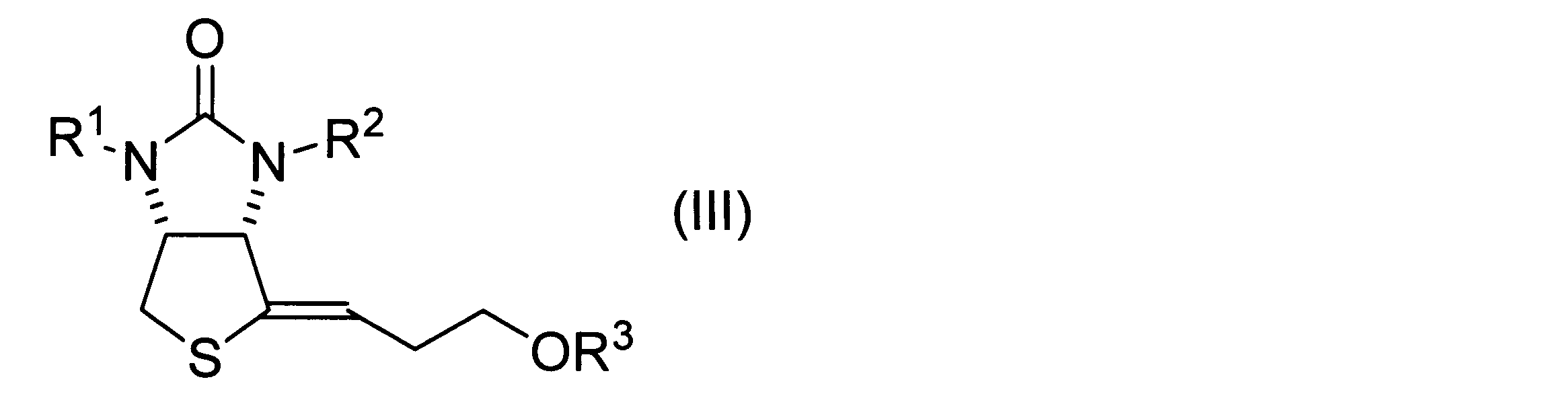
- a method for producing a vinyl sulfide derivative represented by the following formula (III) includes the steps of obtaining a hydroxythienoimidazole derivative represented by the above formula (II) by the method according to the above embodiment, dehydrating the obtained hydroxythienoimidazole derivative, and obtaining a product represented by the following formula (III). and obtaining a vinyl sulfide derivative.
- R 1 and R 2 have the same definitions as in formula (I).
- R 3 has the same definition as in formula (1).
- This production method includes the steps of obtaining the vinyl sulfide derivative represented by the above formula (III) by the method according to the above embodiment, and bringing the obtained vinyl sulfide derivative into contact with hydrogen in the presence of a catalyst to obtain the following formula ( obtaining a saturated linear hydrocarbon-substituted thienoimidazole derivative represented by VI).
- R 1 and R 2 have the same definitions as in formula (I).
- R 3 has the same definition as in formula (1).
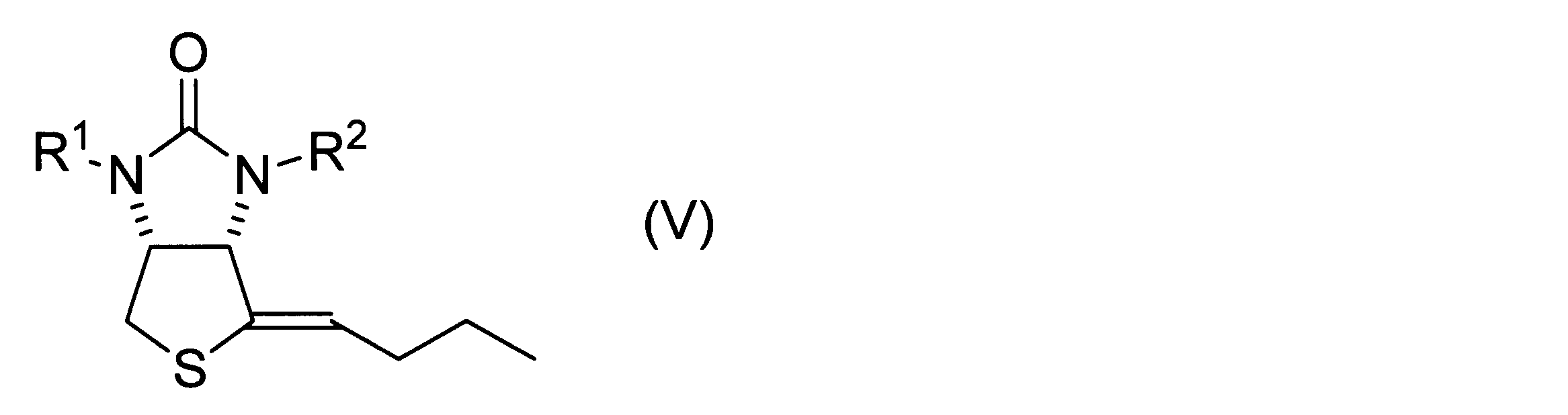
- This production method includes the steps of obtaining a hydroxythienoimidazole derivative represented by the above formula (IV) by the method according to the above embodiment, dehydrating the obtained hydroxythienoimidazole derivative, and obtaining a product represented by the following formula (V). obtaining the n-butylidene sulfide derivative.
- R 1 and R 2 have the same definitions as in formula (I).
- a method for producing hydroxythienoimidazole derivatives, vinyl sulfide derivatives, n-butylidene sulfide derivatives, and saturated linear hydrocarbon-substituted thienoimidazole derivatives with high yield is provided.
- a production method comprises mixing a thiolactone derivative represented by the above formula (I) and a Grignard reagent represented by the above formula (1) or (2) in the presence of a copper salt, and obtaining a hydroxythienoimidazole derivative represented by formula (II) or (IV) above.
- Hydroxythienoimidazole derivatives can be used, for example, as intermediates for the synthesis of biotin and biotin derivatives described above.
- a hydroxythienoimidazole derivative can be obtained in high yield. That is, copper (Cu) has a high affinity with sulfur (S). Therefore, Cu in the copper salt is easily coordinated to the S atom of the thiolactone derivative, and as a result activates the S atom site of the thiolactone derivative. It is believed that this makes it easier for the Grignard reagent to react with the carbon atom having a carbonyl group adjacent to the S atom of the thiolactone derivative.
- a thiolactone derivative is represented by the following formula (I).
- Thiolactone derivatives can be used as intermediates for biotin synthesis as described above.
- R 1 and R 2 are each independently an alkyl group, a substituted alkyl group, an aryl group, or a substituted aryl group.
- R 1 and R 2 may be the same functional group, or different types of functional groups.
- R 1 and R 2 are each independently preferably an alkyl group having a substituent, more preferably an alkyl group having a phenyl group, and even more preferably a benzyl group.
- the alkyl group represented by R 1 or R 2 may be linear or branched.
- the number of carbon atoms in the alkyl group represented by R 1 or R 2 is, for example, 1 or more and 20 or less, preferably 1 or more and 10 or less, more preferably 1 or more and 8 or less, still more preferably 1 or more and 6 or less, still more preferably 1 or more and 4 or less, more preferably 1 or more and 3 or less, still more preferably 1 or 2, and still more preferably 1.
- the alkyl group represented by R 1 or R 2 may have a substituent.
- Substituents that the alkyl group represented by R 1 or R 2 may have include, for example, those having 3 to 20 carbon atoms (preferably 6 to 20 carbon atoms, more preferably 6 to 14 carbon atoms, still more preferably 6 or more 10 or less), an alkoxy group having 1 or more and 6 or less carbon atoms (preferably 1 or more and 4 or less, more preferably 1 or more and 3 or less, still more preferably 1 or 2), and a halogen atom.
- Aryl groups can be monocyclic, bicyclic or tricyclic aromatic hydrocarbon ring groups.
- the aryl group is preferably a monocyclic 3- to 8-membered ring, more preferably a phenyl group.
- An alkoxy group may be linear or branched.
- Halogen atoms can be selected from fluorine, chlorine, bromine and iodine atoms.
- a substituent which the alkyl group represented by R 1 or R 2 may have an aryl group having 3 or more and 8 or less carbon atoms is preferable, and a phenyl group is more preferable.
- the alkyl group represented by R 1 or R 2 has a substituent, the number of substituents is, for example, 1 or more and 5 or less, preferably 1 or more and 3 or less, more preferably 1 or 2, still more preferably 1. be.
- the aryl group represented by R 1 or R 2 can be a monocyclic, bicyclic or tricyclic aromatic hydrocarbon ring group.
- the aryl group represented by R 1 or R 2 is preferably a 3- to 8-membered monocyclic ring.
- the number of carbon atoms in the aryl group represented by R 1 or R 2 is, for example, 3 or more and 30 or less, preferably 3 or more and 20 or less, more preferably 6 or more and 20 or less, still more preferably 6 or more and 14 or less, still more preferably It is 6 or more and 10 or less.
- the aryl group represented by R 1 or R 2 is preferably a phenyl group.
- the aryl group represented by R 1 or R 2 may have a substituent.
- Substituents that the aryl group represented by R 1 or R 2 may have include, for example, 1 to 6 carbon atoms (preferably 1 to 4, more preferably 1 to 3, still more preferably 1 or 2) alkyl groups, alkoxy groups having 1 to 6 carbon atoms (preferably 1 to 4 carbon atoms, more preferably 1 to 3 carbon atoms, still more preferably 1 or 2 carbon atoms), carboxyl groups, halogen atoms, and the like.
- Alkyl groups and alkoxy groups may be linear or branched.
- Halogen atoms can be selected from fluorine, chlorine, bromine and iodine atoms.
- the number of substituents is, for example, 1 or more and 5 or less, preferably 1 or more and 3 or less, more preferably 1 or 2, and still more preferably 1. be.
- the first Grignard reagent is represented by the following formula (1).
- R 3 is an alkyl group, an alkyl group having a substituent, an aryl group, or an aryl group having a substituent.
- the above descriptions of the alkyl group, substituted alkyl group, aryl group, and substituted aryl group represented by R 1 or R 2 refer to the alkyl group and substituted aryl group represented by R 3 It also applies to alkyl groups, aryl groups, and aryl groups having substituents. Examples of the alkyl group, substituted alkyl group, aryl group, and substituted aryl group represented by R 3 include the same groups as those exemplified for R 1 and R 2 .
- R 3 is preferably an alkyl group having 1 to 6 carbon atoms, more preferably a methyl group or an ethyl group.
- X 1 is a halogen atom.
- a halogen atom can be selected from a fluorine atom, a chlorine atom, a bromine atom and an iodine atom, preferably a chlorine atom or a bromine atom.
- the first Grignard reagent is obtained, for example, by bringing an organic halogen derivative represented by the following formula (1a) into contact with magnesium.
- R 3 and X 1 have the same definitions as in formula (1).
- Magnesium may be powdered or strip-shaped.
- the contact temperature between the organohalogen derivative represented by the above formula (1a) and magnesium is, for example, 40°C or higher and 150°C or lower, preferably 60°C or higher and 100°C or lower.
- the contact time between the organohalogen derivative represented by the formula (1a) and magnesium is, for example, 10 minutes or more and 10 hours or less, preferably 1 hour or more and 5 hours or less.
- the amount of the organic halogen derivative represented by formula (1a) per 1 mol of magnesium is, for example, 0.1 mol or more and 2 mol or less, preferably 0.5 mol or more and 1.5 mol or less.
- the contact between the organohalogen derivative represented by the above formula (1a) and magnesium is preferably carried out in the presence of a magnesium activator.
- a magnesium activator for example, at least one selected from the group consisting of 1,2-dibromoethane, bromine, iodine, and trimethylsilyl chloride can be used.
- the amount of the magnesium activator to 1 mol of magnesium is, for example, 0.01 mol or more and 1.5 mol or less, preferably 0.2 mol or more and 0.8 mol or less.
- the contact between the organohalogen derivative represented by the above formula (1a) and magnesium is preferably carried out in the presence of the first reaction solvent.
- the first reaction solvent include acetonitrile, propionitrile, tetrahydrofuran (THF), 2-methyl-tetrahydrofuran, 1,4-dioxane, tert-butyl methyl ether, diisopropyl ether, dimethyloxyethane, diglyme, acetone, and methyl ethyl ketone.
- the amount of the first reaction solvent used in the production of the first Grignard reagent is, for example, 0.001 mL or more and 10 mL or less, preferably 0.01 mL or more and 1 mL or less, relative to 1 mg of magnesium.
- the first Grignard reagent When using the first reaction solvent, it is preferable to prepare the first Grignard reagent by the following method. First, the organic halogen derivative represented by the formula (1a) and half of the first reaction solvent are mixed to prepare an organic halogen derivative solution. Next, magnesium, magnesium activator, and half of the first reaction solvent are mixed to obtain a first mixture. An organohalogen derivative solution is added dropwise to this first mixture to obtain a second mixture. After the second mixture is heated to the above contact temperature, it is stirred for the above contact time to obtain the first Grignard reagent.
- Copper salt The valence of the copper atom contained in the copper salt is preferably monovalent or divalent, more preferably monovalent.
- a copper salt in which the valence of the copper atom is monovalent has excellent catalytic activity.
- Copper salts include, for example, copper (I) chloride (CuCl), copper (II) chloride (CuCl 2 ), copper (I) bromide (CuBr), copper (II) bromide (CuBr 2 ), copper cyanide (I) (CuCN), copper (I) 3-methylsalicylate, copper mesitylene (I) (MesCu), copper (I) isopropoxy (iPrOCu), copper (I) iodide (CuI), copper (II) iodide ) (CuI 2 ), copper(I) acetate (CuOAc), copper(II) acetate (Cu(OAc) 2 ), copper(II) sulfate (CuSO 4 ), copper(I) oxide (Cu 2
- Copper (I) thiophene-2-carboxylate is preferably used as the sulfur-containing copper salt.
- CuCl, CuI or CuBr is particularly preferred among the copper salts in which the valence of the copper atom is monovalent.
- CuCl, CuI and CuBr are particularly catalytic.
- a method for producing a hydroxythienoimidazole derivative represented by formula (II) comprises mixing a thiolactone derivative represented by formula (I), a first Grignard reagent, and a copper salt.
- the amount of copper salt used is preferably 0.05 mol or more and 1 mol or less per 1 mol of the first Grignard reagent.
- the amount of the copper salt used is more preferably 0.5 mol or more and 0.8 mol or less, still more preferably 0.6 mol or more and 0.72 mol or less, relative to 1 mol of the first Grignard reagent. be.
- the amount of the copper salt used is generally 0.1 mol or more and 10 mol or less, preferably 0.5 mol or more and 5 mol or less, more preferably 0.5 mol or more and 2 mol or less, relative to 1 mol of the thiolactone derivative.
- the amount of the first Grignard reagent to be used is generally 0.5 to 10 mol, preferably 1.0 to 5 mol, more preferably 1.0 to 2.0 mol, per 1 mol of the thiolactone derivative. It is below.
- the thiolactone derivative, the first Grignard reagent, and the copper salt may be mixed in the presence of the second reaction solvent.
- the second reaction solvent include tetrahydrofuran (THF), 2-methyl-tetrahydrofuran, 1,4-dioxane, tert-butyl methyl ether, cyclopentyl methyl ether, dimethoxyethane, diglyme, methylene chloride, toluene, xylene, hexane, At least one selected from heptane and the like can be used.
- the second reaction solvent may be used singly or in combination of two or more as a mixed solvent.
- the second reaction solvent is preferably THF, toluene or a mixed solvent thereof.
- the amount of the second reaction solvent used is, for example, 1 mL or more and 100 mL or less, preferably 2 mL or more and 50 mL or less, per 1 g of the thiolactone derivative.
- the temperature at which the thiolactone derivative, the first Grignard reagent, and the copper salt are mixed is, for example, within the range of -40°C or higher and 100°C or lower.
- the temperature during mixing is preferably -20°C or higher and 40°C or lower, more preferably -10°C or higher and 20°C or lower. Within this temperature range, the yield of the hydroxythienoimidazole derivative tends to be higher.
- the time for mixing the thiolactone derivative, the first Grignard reagent and the copper salt is usually 0.5 to 72 hours, preferably 1 to 48 hours.
- the mixing of the thiolactone derivative, the first Grignard reagent and the copper salt is preferably carried out by the following method.
- a first Grignard reagent and a copper salt are mixed to obtain an organic copper reagent.
- a first Grignard reagent solution obtained by dissolving the first Grignard reagent in the first or second reaction solvent may be used.
- a copper salt solution obtained by dissolving the copper salt in the second reaction solvent may be used.
- the temperature for mixing the first Grignard reagent and the copper salt may be within the range of the temperature for mixing the thiolactone derivative, the first Grignard reagent, and the copper salt.
- the mixing time of the first Grignard reagent and the copper salt is, for example, 1 minute or more and 1 hour or less.
- the first Grignard reagent and the copper salt are thought to form a copper complex represented by the following formula (3).
- R 3 and X 1 have the same definitions as in formula (1).
- Y represents an anion of the copper salt.
- Each of m and n is an integer of 1 or more and 3 or less.
- this organocopper reagent is brought into contact with the thiolactone derivative represented by formula (I).
- a thiolactone derivative solution obtained by dissolving this thiolactone derivative in a second reaction solvent may be used.
- the contact temperature of the organocopper reagent and the thiolactone derivative may be within the range of the mixing temperature of the thiolactone derivative, the first Grignard reagent, and the copper salt.
- the contact time of the organocopper reagent and the thiolactone derivative may be within the range of the mixing time of the thiolactone derivative, the first Grignard reagent, and the copper salt.
- hydroxythienoimidazole derivative represented by formula (II)>
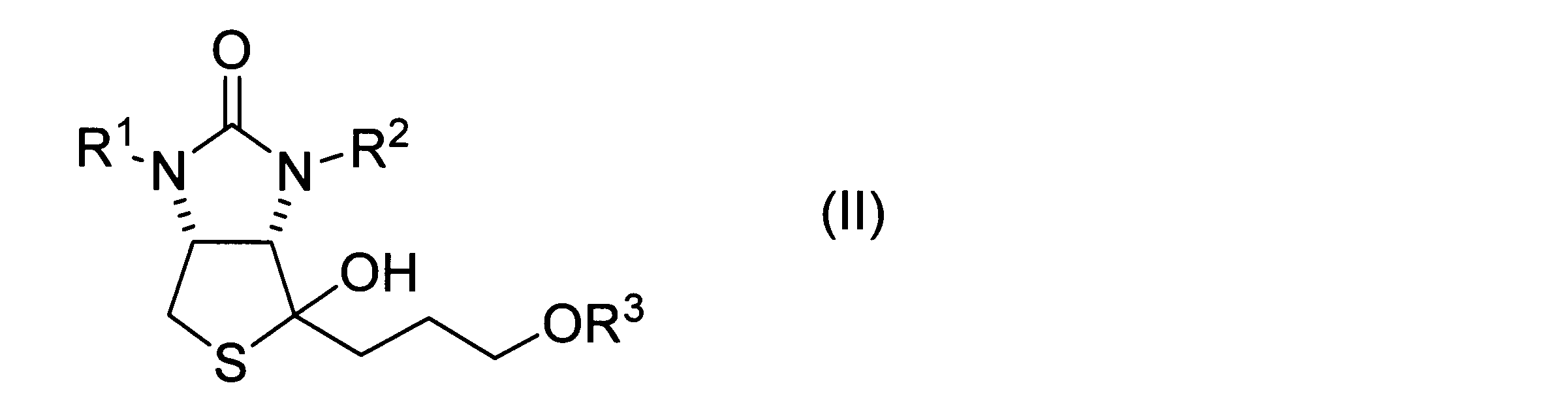
- a hydroxythienoimidazole derivative is represented by the following formula (II). Hydroxythienoimidazole derivatives can be used as intermediates for biotin synthesis as described above.
- R 1 and R 2 have the same definitions as in formula (I).
- R 3 has the same definition as in formula (1).
- a hydroxythienoimidazole derivative is derived into biotin by a known method.
- a vinyl sulfide derivative represented by the following formula (III) is obtained by dehydrating the hydroxythienoimidazole derivative represented by the formula (II).
- R 1 and R 2 have the same definitions as in formula (I).
- R 3 has the same definition as in formula (1).
- Examples of dehydration methods for hydroxythienoimidazole derivatives include acid treatment and heat treatment.
- the acid treatment includes, for example, contacting the hydroxythienoimidazole derivative represented by formula (II) with an acid catalyst.
- Acid catalysts include, for example, sulfuric acid, hydrochloric acid, or mixtures thereof.
- the temperature of the heat treatment is, for example, -20 to 120°C, preferably 0 to 70°C. Acid treatment and heat treatment may be combined.
- the vinyl sulfide derivative represented by formula (III) is hydrogenated, for example, in the presence of a Pd catalyst to obtain a compound represented by formula (VI) below.
- a Pd catalyst for example, a Pd catalyst
- the obtained compound is reacted with CH 2 (COOEt) 2 to obtain a compound represented by the following formula (XI).
- Biotin is obtained by debenzylation of the resulting compound followed by treatment with, for example, hydrogen bromide.
- "Et" represents an ethyl group.
- R 1 and R 2 have the same definitions as in formula (I).
- R 3 has the same definition as in formula (1).
- This saturated straight-chain hydrocarbon-substituted thienoimidazole derivative is obtained by, for example, contacting the vinyl sulfide derivative represented by the formula (III) obtained by the method according to the above embodiment with hydrogen (H 2 ) in the presence of a catalyst. obtained by
- catalysts include platinum catalysts such as platinum carbon and platinum oxide; palladium catalysts such as palladium black, palladium carbon, palladium acetate, palladium chloride, and palladium oxide; nickel catalysts such as Raney nickel, cobalt catalysts such as Raney cobalt, and ruthenium chloride catalysts. Ruthenium catalysts, iridium catalysts such as iridium chloride, and iron catalysts such as iron powder may be used. At least one of Raney nickel and palladium carbon is preferred.
- the amount of the catalyst is, for example, 0.001 to 1000 mol%, preferably 0.1 to 800 mol%, relative to the substrate vinyl sulfide derivative.
- the hydrogen pressure is, for example, 1 to 150 atmospheres, preferably 1 to 50 atmospheres.
- the contact temperature is, for example, 10 to 200°C, preferably 25 to 150°C.
- the contact time is, for example, 0.5 to 100 hours, preferably 1 to 72 hours.
- the contact between the vinyl sulfide derivative represented by formula (III) and hydrogen in the presence of a catalyst may be carried out in the presence of a solvent.
- Solvents include methanol, ethanol, isopropanol, butanol, 2-butanol, ethylene glycol, 1,2-dimethoxyethane, methyl cellosolve, ethyl acetate, methyl acetate, THF, cyclopentyl methyl ether, 1,4-dioxane, acetic acid, water. , or a mixed solvent thereof can be used.
- methanol or a mixed solvent of methanol and water is used.
- the amount of the solvent used is, for example, 1-200 mL, preferably 3-100 mL, per 1 g of the vinyl sulfide derivative that is the substrate.
- the hydroxythienoimidazole derivative represented by formula (IV) is produced by the same method as the method for producing the hydroxythienoimidazole derivative represented by formula (II) above, except that the second Grignard reagent is used instead of the first Grignard reagent. It can be manufactured by the method of
- a method for producing a hydroxythienoimidazole derivative represented by formula (IV) includes mixing a thiolactone derivative represented by formula (I), a Grignard reagent represented by formula (2), and a copper salt. Including process.
- R 1 and R 2 have the same definitions as in formula (I).
- X2 has the same definition as in formula ( 2 ).
- the second Grignard reagent is represented by the following formula (2).
- each X2 is independently a halogen atom.
- a halogen atom can be selected from a fluorine atom, a chlorine atom, a bromine atom and an iodine atom, preferably a chlorine atom or a bromine atom.
- Two X2's may be the same kind of halogen atom or different kinds of halogen atoms.
- an organic halogen derivative represented by the following formula (2a) is used. It can be manufactured by the same method as the method.
- a second Grignard reagent and a copper salt are mixed in the same manner as in the method for producing the hydroxythienoimidazole derivative represented by formula (II). It is preferred to use an organocopper reagent prepared by
- the second Grignard reagent and the copper salt are thought to form a copper complex represented by the following formula (4).
- X2 has the same meaning as in formula ( 2 ).
- Z represents an anion of the copper salt.
- p and q are each an integer of 1 or more and 3 or less.
- the amount of copper salt used is preferably 0.1 mol or more and 2 mol or less per 1 mol of the second Grignard reagent.
- the amount of the copper salt used is more preferably 0.5 mol or more and 1.5 mol or less, still more preferably 0.6 mol or more and 1.2 mol or less, relative to 1 mol of the second Grignard reagent.
- the amount of the copper salt used is generally 0.1 mol or more and 10 mol or less, preferably 0.5 mol or more and 5 mol or less, more preferably 0.5 mol or more and 2 mol or less, relative to 1 mol of the thiolactone derivative.
- the amount of the second Grignard reagent used is generally 0.5 mol or more and 10 mol or less, preferably 1.0 mol or more and 5 mol or less, more preferably 1.0 mol or more and 2 mol or less, per 1 mol of the thiolactone derivative. be.
- a hydroxythienoimidazole derivative is represented by the following formula (IV). This hydroxythienoimidazole derivative can be used as an intermediate for the synthesis of biotin derivatives.
- R 1 and R 2 have the same definitions as in formula (I).
- n-butylidene sulfide derivative represented by the following formula (V) is obtained.
- This n-butylidene sulfide derivative can be used as an intermediate for biotin synthesis.
- R 1 and R 2 have the same definitions as in formula (I).
- Examples of dehydration methods for hydroxythienoimidazole derivatives include acid treatment and heat treatment.
- Acid treatment includes, for example, contacting the hydroxythienoimidazole derivative represented by formula (IV) with an acid catalyst.
- Acid catalysts include, for example, sulfuric acid, hydrochloric acid, or mixtures thereof.
- the temperature of the heat treatment is, for example, -20 to 120°C, preferably 0 to 70°C. Acid treatment and heat treatment may be combined.
- first Grignard reagent was prepared by the following method. Mg (24.3 mg, 1.00 mmol, 2.0 eq) was activated by adding THF (1.00 mL), 1,2-dibromoethane (0.05 mL), followed by 1-chloro-3-methoxy A solution of propane (54.3 mg, 0.500 mmol, 1.00 eq) in THF (1.00 mL) was slowly added dropwise. After the addition was completed, the mixture was stirred at 80°C for 3 hours.
- the mixture was stirred at a temperature of 0° C. for 2 hours to obtain a reactant.
- the reaction was developed by thin layer chromatography (TLC) to confirm completion of the reaction.
- TLC thin layer chromatography
- a developing solvent a mixed solvent in which ethyl acetate and n-hexane were mixed at a volume ratio of 1:1 was used.
- the Rf value of the compound represented by formula (II') was 0.11.
- the plate used in TLC is coated with silica gel, and this silica gel acts as an acid, and hydrolysis of the intermediate (see formula (Ia)) yields the compound represented by formula (II'). .
- Example 2 The amount of 1,2-dibromoethane was 0.025 mL, the amount of CuCl was 18.6 mg (0.188 mmol, 0.75 equivalents), and the amount of THF solution of the first Grignard reagent was 1 .10 mL (0.275 mmol, 1.1 equivalents) was used to convert the compound represented by formula (I′) to formula (III′) in the same manner as described in Example 1. A compound was obtained. The yield of the compound represented by formula (III') was 100%.
- a second Grignard reagent was prepared by the following method. Mg (48.6 mg, 2.00 mmol, 4.0 eq) was activated by addition of THF (1.00 mL), 1,2-dibromoethane (0.05 mL, 0.58 mmol), followed by 1,4 - A solution of dichlorobutane (63.5 mg, 0.500 mmol, 1.00 eq) in THF (1.00 mL) was slowly added dropwise. After the addition was completed, the mixture was stirred at 80°C for 3 hours.
- reaction product was stirred at a temperature of 0° C. for 1 hour to obtain a reaction product.
- the reaction was developed by thin layer chromatography (TLC) to confirm completion of the reaction.
- TLC thin layer chromatography
- a developing solvent a mixed solvent in which ethyl acetate and n-hexane were mixed at a volume ratio of 1:1 was used.
- the Rf value of the compound represented by formula (IV') was 0.15.
- the plate used in TLC is coated with silica gel, and this silica gel acts as an acid, and the hydrolysis of the intermediate (see formula (Ib)) yields the compound represented by formula (IV'). .
- Raney nickel (92.5 wt% in water, 100 mg, 1.58 mmol, 6.7 eq) was quickly weighed into a glass autoclave test tube and methanol (5.00 mL) was added. After adding a methanol solution (5.00 mL) of the compound represented by formula (III') (92.6 mg, 0.235 mmol, 1.0 equivalent), the mixture was stirred at 40°C under a hydrogen pressure of 20 atm for 20 hours. The reaction was developed by thin layer chromatography (TLC) to confirm completion of the reaction. As a developing solvent, a mixed solvent in which ethyl acetate and n-hexane were mixed at a volume ratio of 1:1 was used. The Rf value of the compound represented by formula (VI') was 0.51.
Landscapes
- Chemical & Material Sciences (AREA)
- Organic Chemistry (AREA)
- Low-Molecular Organic Synthesis Reactions Using Catalysts (AREA)
- Heterocyclic Carbon Compounds Containing A Hetero Ring Having Oxygen Or Sulfur (AREA)
- Organic Low-Molecular-Weight Compounds And Preparation Thereof (AREA)
Abstract
Description







チオラクトン誘導体は、下記式(I)に表される。チオラクトン誘導体は、上述したビオチン合成のための中間体として用い得る。

第1グリニャール試薬は、下記式(1)に表される。


銅塩に含まれる銅原子の価数は、1価又は2価であることが好ましく、1価であることがより好ましい。銅原子の価数が1価である銅塩は、触媒作用が優れている。銅塩としては、例えば、塩化銅(I)(CuCl)、塩化銅(II)(CuCl2)、臭化銅(I)(CuBr)、臭化銅(II)(CuBr2)、シアン化銅(I)(CuCN)、3-メチルサリチル酸銅(I)、メシチレン銅(I)(MesCu)、イソプロポキシ銅(I)(iPrOCu)、ヨウ化銅(I)(CuI)、ヨウ化銅(II)(CuI2)、酢酸銅(I)(CuOAc)、酢酸銅(II)(Cu(OAc)2)、硫酸銅(II)(CuSO4)、酸化銅(I)(Cu2O)、酸化銅(II)(CuO)、ピバル酸銅(I)(CuOPiv)、ピバル酸銅(II)(Cu(OPiv)2)、硫黄含有銅塩等から選ばれる少なくとも1種を用いることができる。硫黄含有銅塩としては、銅(I)チオフェン-2-カルボン酸塩を用いることが好ましい。銅原子の価数が1価である銅塩のうち、CuCl、CuI又はCuBrが特に好ましい。CuCl、CuI及びCuBrは、触媒作用が特に優れている。
式(II)に表されるヒドロキシチエノイミダゾール誘導体を製造する方法は、式(I)に表されるチオラクトン誘導体と、第1グリニャール試薬と、銅塩とを混合する工程を含む。


ヒドロキシチエノイミダゾール誘導体は、下記式(II)に表される。ヒドロキシチエノイミダゾール誘導体は、上述したビオチン合成のための中間体として用い得る。
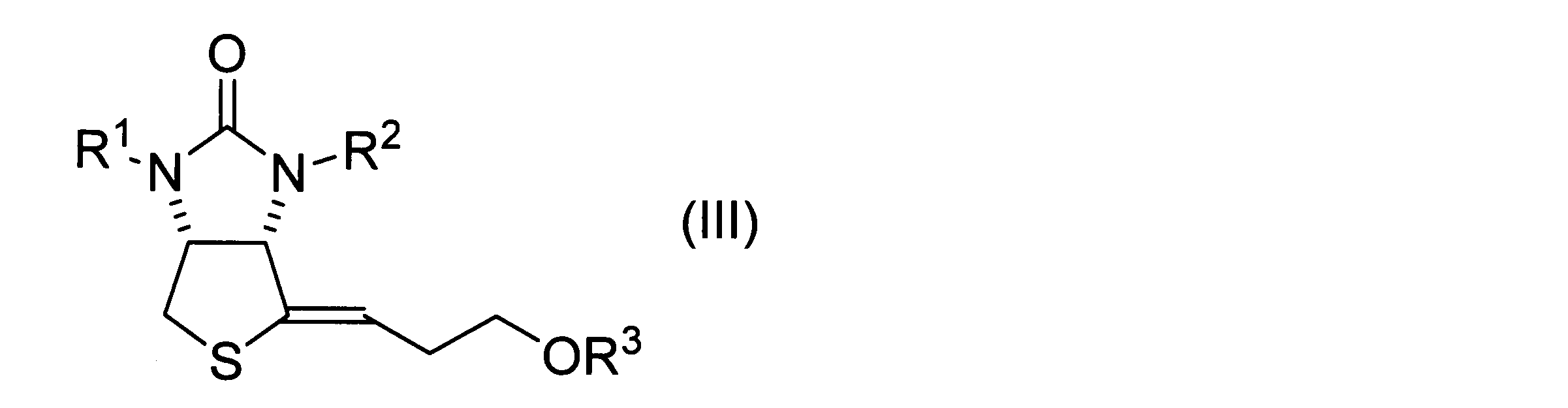

飽和直鎖炭化水素置換チエノイミダゾール誘導体は、下記式(VI)に表される。飽和直鎖炭化水素置換チエノイミダゾール誘導体は、上述したビオチン合成のための中間体として用い得る。

式(IV)に表されるヒドロキシチエノイミダゾール誘導体は、第1グリニャール試薬の代わりに第2グリニャール試薬を用いること以外は、上述した式(II)に表されるヒドロキシチエノイミダゾール誘導体の製造方法と同一の方法で製造できる。

第2グリニャール試薬は、下記式(2)に表される。



ヒドロキシチエノイミダゾール誘導体は、下記式(IV)に表される。このヒドロキシチエノイミダゾール誘導体は、ビオチン誘導体の合成のための中間体として用い得る。


下記反応式に示すように、式(I’)に表される化合物から、式(III’)に表される化合物を得た。なお、「Bn」はベンジル基を表し、「Me」はメチル基を表す。
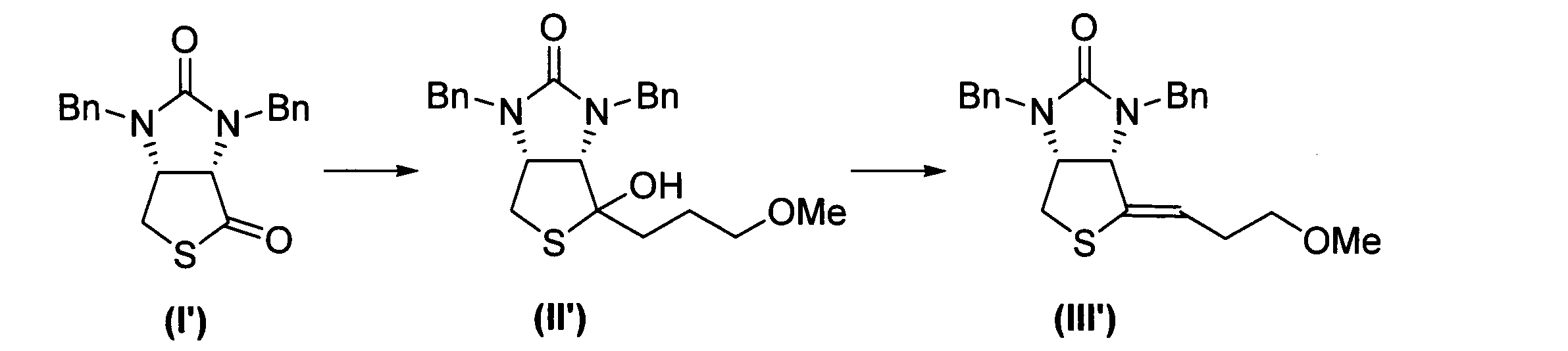
先ず、以下の方法で第1グリニャール試薬を準備した。Mg(24.3mg、1.00mmol、2.0当量)にTHF(1.00mL)、1,2-ジブロモエタン(0.05mL)を加えて活性化させた後、1-クロロ-3-メトキシプロパン(54.3mg、0.500mmol、1.00当量)のTHF(1.00mL)溶液をゆっくり滴下した。すべて加え終わった後、80℃で3時間撹拌した。
CuCl(24.8mg、0.250mmol、1.0当量)の乾燥THF(1.50mL)懸濁液に、上記の方法で得られた第1グリニャール試薬(0.25M)のTHF溶液(1.50mL、0.375mmol、1.5当量)を0℃の温度下で5分間にわたって滴下した後、0℃の温度で10分間攪拌して有機銅試薬を得た。この有機銅試薬に、式(I’)に表される化合物(84.6mg、0.250mmol、1.0当量)のTHF溶液(2.00mL)を0℃の温度下で5分間にわたって滴下した後、0℃の温度で2時間にわたって攪拌して反応物を得た。反応物を薄層クロマトグラフィー(TLC)で展開し、反応終了を確認した。展開溶媒としては、酢酸エチルとn-ヘキサンと1:1の体積比で混合した混合溶媒を用いた。式(II’)に表される化合物のRf値は0.11であった。なお、TLCで使用されるプレートにはシリカゲルが塗布されており、このシリカゲルが酸として働き、中間体(式(Ia)参照)の加水分解により、式(II’)に表される化合物が生じる。反応物に10%H2SO4溶液(2mL)とトルエン(5mL)とを0℃の温度下で加えた後、室温で30分にわたって攪拌し、水層と有機層とに分離させて有機層を得た。
1H NMR (400MHz,CDCl3,30℃) δ 7.35-7.22(m,10H),5.16-5.10(m,1H),4.86-4.78(m,1H),4.43(s,1H),4.17-3.96(m,3H),3.67(dd,J=15.7,9.3Hz,1H),3.61-3.32(m,5H),3.04-2.77(m,2H),2.38-2.31(m,1H),2.01-1.67(m,3H)。
次に、この有機層に1滴(触媒量)の濃硫酸を加えた後、60℃で1時間にわたって攪拌して混合物を得た。この混合物を上記と同様の方法でTLCで展開した。式(III’)に表される化合物のRf値は0.50であった。混合物を5mLの1M塩酸で3回洗浄し、更に5mLの食塩水で洗浄した後、Na2SO4を用いて乾燥させて残留物を得た。この残留物についてNMRを用いて分析して、上記式(III’)に表される化合物を含むことを確認した。収率は97%であった。式(III’)に表される化合物のNMR結果は下記のとおりであった。
1H NMR (400MHz,CDCl3,30℃) δ 7.36-7.27(m,10H),5.51(t,J=7.0Hz,1H),4.93(d,J=15.6Hz,1H),4.79(d,J=15.3Hz,1H),4.30(d,J=7.7Hz,1H),4.23(d,J=15.3Hz,1H),4.10-4.04(m,2H),3.36(dt,J=12.9,2.1Hz,2H),3.32(s,3H),3.00-2.92(m,2H),2.41-2.23(m,2H)。
1,2-ジブロモエタンの量を0.025mLとしたこと、CuClの量を18.6mg(0.188mmol、0.75当量)としたこと、及び、第1グリニャール試薬のTHF溶液の量を1.10mL(0.275mmol、1.1当量)としたこと以外は、実施例1に記載したのと同様の方法で、式(I’)に表される化合物から式(III’)に表される化合物を得た。式(III’)に表される化合物の収率は100%であった。
下記反応式に示すように、式(I’)に表される化合物から、式(V’)に表される化合物を得た。なお、「Bn」はベンジル基を表す。
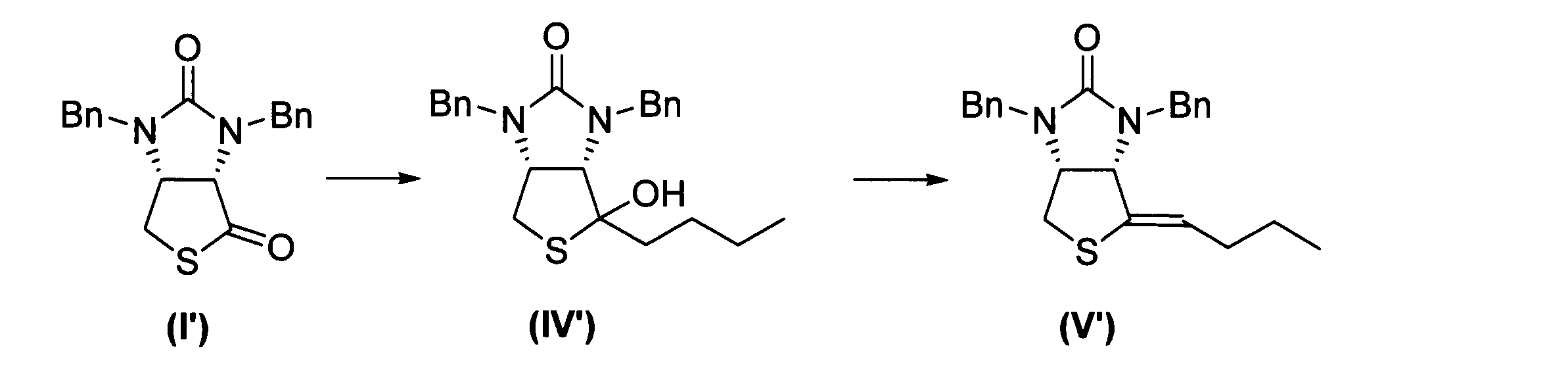
先ず、以下の方法で第2グリニャール試薬を準備した。Mg(48.6mg、2.00mmol、4.0当量)にTHF(1.00mL)、1,2-ジブロモエタン(0.05mL、0.58mmol)を加えて活性化させた後、1,4-ジクロロブタン(63.5mg、0.500mmol、1.00当量)のTHF(1.00mL)溶液をゆっくり滴下した。すべて加え終わった後、80℃で3時間撹拌した。
CuCl(27.2mg、0.275mmol、1.1当量)の乾燥THF(2.00mL)懸濁液に、上記の方法で得られた第2グリニャール試薬(0.25M)のTHF溶液(1.10mL、0.275mmol、1.1当量)を0℃の温度下で5分間にわたって滴下した後、0℃の温度で10分間攪拌して有機銅試薬を得た。この有機銅試薬に、式(I’)に表される化合物(84.6mg、0.250mmol、1.0当量)のTHF溶液(2.00mL)を0℃の温度下で5分間にわたって滴下した後、0℃の温度で1時間にわたって攪拌して反応物を得た。反応物を薄層クロマトグラフィー(TLC)で展開し、反応終了を確認した。展開溶媒としては、酢酸エチルとn-ヘキサンとを1:1の体積比で混合した混合溶媒を用いた。式(IV’)に表される化合物のRf値は0.15であった。なお、TLCで使用されるプレートにはシリカゲルが塗布されており、このシリカゲルが酸として働き、中間体(式(Ib)参照)の加水分解により、式(IV’)に表される化合物が生じる。反応物に10%H2SO4溶液(2mL)とトルエン(5mL)とを0℃の温度下で加えた後、室温で30分にわたって攪拌し、水層と有機層とに分離させて有機層を得た。
次に、この有機層に1滴(触媒量)の濃硫酸を加えた後、60℃で1時間にわたって攪拌して混合物を得た。この混合物を上記と同様の方法でTLCで展開した。式(V’)に表される化合物のRf値は0.6であった。混合物を5mLの1M塩酸で3回洗浄し、更に5mLの食塩水で洗浄した後、Na2SO4を用いて乾燥させて残留物を得た。この残留物についてNMRを用いて分析して、上記式(V’)に表される化合物を含むことを確認した。収率は36%であった。式(V’)に表される化合物のNMR結果は下記のとおりであった。
1H NMR (400MHz,CDCl3,30℃) δ 7.36-7.24(m,10H),5.46(t,J=7.2Hz,1H),4.97(d,J=15.8Hz,1H),4.81(d,J=15.2Hz,1H),4.31-4.20(m,2H),4.15-4.01(m,2H),3.00-2.92(m,2H),2.04(hept,J=8.0Hz,2H),1.39(sext,J=7.3Hz,1H),1.26(t,J=7.1Hz,1H),0.91(t,J=7.3Hz,3H)。
下記反応式に示すように、下記式(III’)に表される化合物から、式(VI’)に表される化合物を得た。なお、「Bn」はベンジル基を表し、「Me」はメチル基を表す。
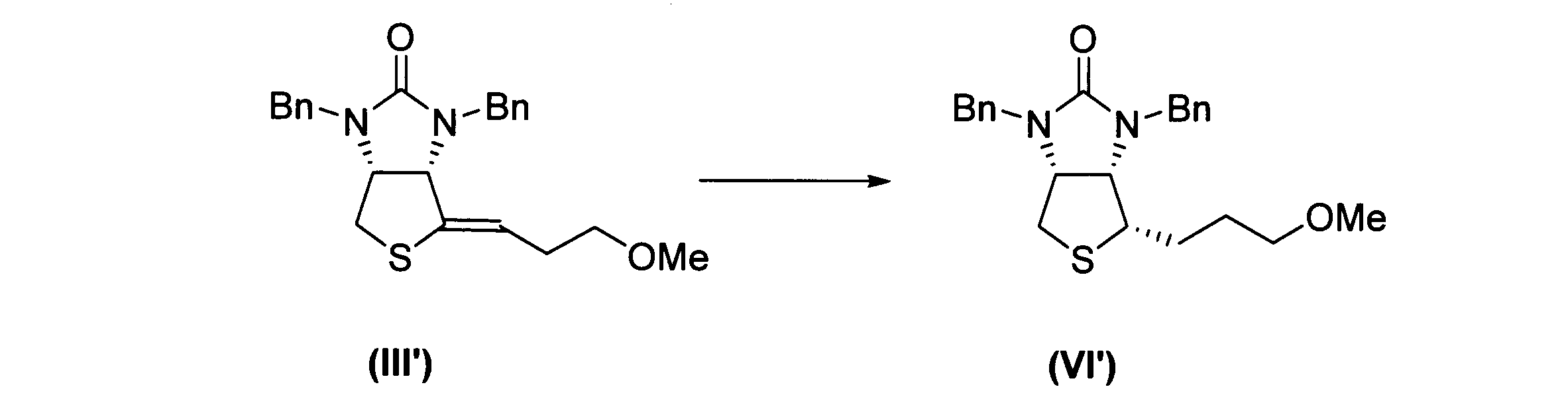
1H NMR (400 MHz,CDCl3,30°C) δ 7.34-7.24(m,10H),5.10(d,J=15.2Hz,1H),4.75(d,J=15.1Hz,1H),4.14(d,J=15.2Hz,1H),3.99-3.95(m,2H),3.87(dd,J=9.5,5.6Hz,1H),3.43-3.35(m,2H),3.34(s,3H),3.335-3.25(m,1H),3.17-3.11(m,1H),2.77-2.66(m,1H),1.90-1.74(m,2H),1.61-1.45(m,2H);13C{1H} NMR (100MHz,CDCl3,30℃) δ 161.1,137.1,137.0,128.8,128.80,128.4,127.8,72.2,62.7,61.3,58.7,54.2,47.9,46.8,34.9,29.2,25.6; HRMS (FAB+) m/z calcd. for C23H29N2O2S 397.1950 ([M+H]+) found 397.1946。
Claims (9)
- 下記式(I):

に表されるチオラクトン誘導体、
下記式(1):

に表されるグリニャール試薬、及び
銅塩
を混合して、下記式(II):
に表されるヒドロキシチエノイミダゾール誘導体を得る工程を含む、ヒドロキシチエノイミダゾール誘導体の製造方法。 - 前記工程において、前記式(1)に表されるグリニャール試薬及び前記銅塩を混合して有機銅試薬を形成させた後、前記有機銅試薬と前記式(I)に表されるチオラクトン誘導体とを接触させて、前記式(II)に表されるヒドロキシチエノイミダゾール誘導体を得る、請求項1に記載のヒドロキシチエノイミダゾール誘導体の製造方法。
- 1モルの前記式(1)に表されるグリニャール試薬に対する前記銅塩の量は、0.05モル以上1モル以下である、請求項1に記載のヒドロキシチエノイミダゾール誘導体の製造方法。
- 請求項1乃至3の何れか一項に記載の方法で前記ヒドロキシチエノイミダゾール誘導体を得る工程と、
前記ヒドロキシチエノイミダゾール誘導体を脱水して、下記式(III):

に表されるビニルスルフィド誘導体を得る工程と
を含む、ビニルスルフィド誘導体の製造方法。 - 請求項4に記載の方法で前記ビニルスルフィド誘導体を得る工程と、
触媒存在下で前記ビニルスルフィド誘導体と水素とを接触させて、下記式(VI):

に表される飽和直鎖炭化水素置換チエノイミダゾール誘導体を得る工程と
を含む、飽和直鎖炭化水素置換チエノイミダゾール誘導体の製造方法。 - 下記式(I):

に表されるチオラクトン誘導体、
下記式(2):

に表されるグリニャール試薬、及び
銅塩
を混合して、下記式(IV):

- 前記工程において、前記式(2)に表されるグリニャール試薬及び前記銅塩を混合して有機銅試薬を形成させた後、前記有機銅試薬と前記式(I)に表されるチオラクトン誘導体とを接触させて、前記式(IV)に表されるヒドロキシチエノイミダゾール誘導体を得る、請求項6に記載のヒドロキシチエノイミダゾール誘導体の製造方法。
- 1モルの前記式(2)に表されるグリニャール試薬に対する前記銅塩の量は、0.1モル以上2モル以下である、請求項6に記載のヒドロキシチエノイミダゾール誘導体の製造方法。
- 請求項6乃至8の何れか一項に記載の方法で前記ヒドロキシチエノイミダゾール誘導体を得る工程と、
前記ヒドロキシチエノイミダゾール誘導体を脱水して、下記式(V):
を含む、n-ブチリデンスルフィド誘導体の製造方法。
Priority Applications (4)
| Application Number | Priority Date | Filing Date | Title |
|---|---|---|---|
| JP2022557190A JP7229434B1 (ja) | 2021-06-11 | 2022-06-10 | ヒドロキシチエノイミダゾール誘導体、ビニルスルフィド誘導体、n-ブチリデンスルフィド誘導体、及び飽和直鎖炭化水素置換チエノイミダゾール誘導体の製造方法 |
| CN202280008852.8A CN116685567B (zh) | 2021-06-11 | 2022-06-10 | 羟基噻吩并咪唑衍生物、乙烯基硫醚衍生物、正丁亚基硫醚衍生物、及饱和直链烃取代噻吩并咪唑衍生物的制造方法 |
| EP22820346.9A EP4353728A4 (en) | 2021-06-11 | 2022-06-10 | HYDROXYTHIENOIMIDAZOLE DERIVATIVE, VINYL SULFIDE DERIVATIVE, N-BUTYLIDENE SULFIDE DERIVATIVE AND PROCESS FOR PRODUCING A STRAIGHT-CHAIN SATURATED HYDROCARBON-SUBSTITUTED THIENOIMIDAZOLE |
| US18/287,236 US20240217986A1 (en) | 2021-06-11 | 2022-06-10 | Method of producing hydroxythienoimidazole derivative, vinyl sulfide derivative, n-butylidene sulfide derivative, and thienoimidazole derivative substituted with straight-chain saturated hydrocarbon |
Applications Claiming Priority (2)
| Application Number | Priority Date | Filing Date | Title |
|---|---|---|---|
| JP2021-098332 | 2021-06-11 | ||
| JP2021098332 | 2021-06-11 |
Publications (1)
| Publication Number | Publication Date |
|---|---|
| WO2022260168A1 true WO2022260168A1 (ja) | 2022-12-15 |
Family
ID=84424576
Family Applications (1)
| Application Number | Title | Priority Date | Filing Date |
|---|---|---|---|
| PCT/JP2022/023481 Ceased WO2022260168A1 (ja) | 2021-06-11 | 2022-06-10 | ヒドロキシチエノイミダゾール誘導体、ビニルスルフィド誘導体、n-ブチリデンスルフィド誘導体、及び飽和直鎖炭化水素置換チエノイミダゾール誘導体の製造方法 |
Country Status (6)
| Country | Link |
|---|---|
| US (1) | US20240217986A1 (ja) |
| EP (1) | EP4353728A4 (ja) |
| JP (1) | JP7229434B1 (ja) |
| CN (1) | CN116685567B (ja) |
| TW (1) | TW202317584A (ja) |
| WO (1) | WO2022260168A1 (ja) |
Cited By (1)
| Publication number | Priority date | Publication date | Assignee | Title |
|---|---|---|---|---|
| WO2024080317A1 (ja) * | 2022-10-13 | 2024-04-18 | 株式会社トクヤマ | ヒドロキシビオチン誘導体及びビニルビオチン誘導体の製造方法 |
Families Citing this family (2)
| Publication number | Priority date | Publication date | Assignee | Title |
|---|---|---|---|---|
| CN117645613A (zh) * | 2023-10-19 | 2024-03-05 | 江西天新药业股份有限公司 | 提纯生物素中间体的方法和应用 |
| WO2025216186A1 (ja) * | 2024-04-10 | 2025-10-16 | 株式会社トクヤマ | ヒドロキシビオチン誘導体及びビニルビオチン誘導体の製造方法 |
Citations (3)
| Publication number | Priority date | Publication date | Assignee | Title |
|---|---|---|---|---|
| JPS5327279B1 (ja) * | 1969-11-29 | 1978-08-07 | ||
| WO2008124922A1 (en) * | 2007-04-12 | 2008-10-23 | Endorecherche, Inc. | 17alpha-substituted steroids as systemic antiandrogens and selective androgen receptor modulators |
| US20130065935A1 (en) * | 2011-07-15 | 2013-03-14 | Michael P. Kavanaugh | Novel Inhibitors of the Amino Acid Transporters ASCT1 and ASCT2 |
Family Cites Families (3)
| Publication number | Priority date | Publication date | Assignee | Title |
|---|---|---|---|---|
| CN105418634B (zh) * | 2015-12-10 | 2018-07-10 | 蚌埠丰原医药科技发展有限公司 | 生物素中间体杂质的制备方法 |
| CN107973806A (zh) * | 2016-10-21 | 2018-05-01 | 大丰海嘉诺药业有限公司 | 一种制备d-生物素溴盐中间体的方法 |
| CN110577547B (zh) * | 2019-08-05 | 2021-05-11 | 浙江工业大学 | 一种生物素中间体的合成方法 |
-
2022
- 2022-06-10 EP EP22820346.9A patent/EP4353728A4/en active Pending
- 2022-06-10 WO PCT/JP2022/023481 patent/WO2022260168A1/ja not_active Ceased
- 2022-06-10 JP JP2022557190A patent/JP7229434B1/ja active Active
- 2022-06-10 TW TW111121650A patent/TW202317584A/zh unknown
- 2022-06-10 US US18/287,236 patent/US20240217986A1/en active Pending
- 2022-06-10 CN CN202280008852.8A patent/CN116685567B/zh active Active
Patent Citations (3)
| Publication number | Priority date | Publication date | Assignee | Title |
|---|---|---|---|---|
| JPS5327279B1 (ja) * | 1969-11-29 | 1978-08-07 | ||
| WO2008124922A1 (en) * | 2007-04-12 | 2008-10-23 | Endorecherche, Inc. | 17alpha-substituted steroids as systemic antiandrogens and selective androgen receptor modulators |
| US20130065935A1 (en) * | 2011-07-15 | 2013-03-14 | Michael P. Kavanaugh | Novel Inhibitors of the Amino Acid Transporters ASCT1 and ASCT2 |
Non-Patent Citations (6)
| Title |
|---|
| DATABASE CAPLUS 1 January 1900 (1900-01-01), LEE H. L, RAGGIOLINI E G, USKOKOVIC M R: "Synthesis of D-biotin from cysteine", XP002375145, Database accession no. 1988-492607 * |
| ISAKA ICHIRO, KAZUO KUBO, MUTSUO TAKASHIMA, MASUO MURAKAMI: "Studies on the synthesis of biotin. 3. Grignard-reaction of 3,4-(1',3'-dibenzyl-2'-oxoimidazolido)-2-oxothiophane", PHARMACY MAGAZINE, vol. 88, no. 8, 31 August 1968 (1968-08-31), pages 1068 - 1073, XP093014488, DOI: 10.1248/yakushi1947.88.8_1068 * |
| KATO DAIKI, TOMOYA MURASE, JALINDAR TALODE, HARUKI NAGAE, HAYATO TSURUGI, MASAHIKO SEKI, KAZUSHI MASHIMA: "Diarylcuprates for Selective Syntheses of Multifunctionalized Ketones from Thioesters under Mild Conditions", CHEMISTRY - A EUROPEAN JOURNAL, vol. 28, no. 26, 15 March 2022 (2022-03-15), pages e202200474, XP093014490, DOI: 10.1002/chem.202200474 * |
| M. GERECKEJ. -P. ZIMMERMANNW. ASCHWANDE: "116. Versuche zur Biotinsynthese. Herstellung von (3aS, 6aR)-1,3-Dibenzyl-tetrahydro-4H-thieno[3,4-d]imidazol-2,4(1H)-dion", HELV. CHIM. ACTA., vol. 53, 1970, pages 991 - 999 |
| See also references of EP4353728A4 |
| WARM ALEKSANDER, NAUGHTON ANDREW B., SAIKALI ELIE A.: "Process Development Implications of Biotin Production Scale-Up", ORGANIC PROCESS RESEARCH & DEVELOPMENT, AMERICAN CHEMICAL SOCIETY, US, vol. 7, no. 3, 1 May 2003 (2003-05-01), US , pages 272 - 284, XP093014489, ISSN: 1083-6160, DOI: 10.1021/op020089o * |
Cited By (1)
| Publication number | Priority date | Publication date | Assignee | Title |
|---|---|---|---|---|
| WO2024080317A1 (ja) * | 2022-10-13 | 2024-04-18 | 株式会社トクヤマ | ヒドロキシビオチン誘導体及びビニルビオチン誘導体の製造方法 |
Also Published As
| Publication number | Publication date |
|---|---|
| CN116685567A (zh) | 2023-09-01 |
| EP4353728A4 (en) | 2025-07-16 |
| US20240217986A1 (en) | 2024-07-04 |
| TW202317584A (zh) | 2023-05-01 |
| EP4353728A1 (en) | 2024-04-17 |
| CN116685567B (zh) | 2024-11-19 |
| JPWO2022260168A1 (ja) | 2022-12-15 |
| JP7229434B1 (ja) | 2023-02-27 |
Similar Documents
| Publication | Publication Date | Title |
|---|---|---|
| JP7229434B1 (ja) | ヒドロキシチエノイミダゾール誘導体、ビニルスルフィド誘導体、n-ブチリデンスルフィド誘導体、及び飽和直鎖炭化水素置換チエノイミダゾール誘導体の製造方法 | |
| CN107417505B (zh) | α-卤代四甲基环己酮及其与(2,3,4,4-四甲基环戊基)甲基羧酸酯的制备方法 | |
| CN105348321B (zh) | 一种合成α,α‑二氟亚甲基烯基膦酸酯的方法 | |
| CN103402973B (zh) | 化合物及其生产方法,以及用于生产磷酸奥司他韦的方法 | |
| US6476250B1 (en) | Optically active fluorinated binaphthol derivative | |
| CN113173908A (zh) | 一种噻吩类化合物的制备方法 | |
| Sasabe et al. | Preparation of Ru (η3-2-alkenylallyl)(CO) Cl (PPh3) 2 complexes via carbometallation of allenes with alkenyl ruthenium complexes | |
| JP2917552B2 (ja) | α−メチレンシクロペンタノン誘導体の製造法 | |
| CN101397247B (zh) | 用于环氯茚酸的原料药的茚满-1-羧酸合成方法 | |
| JP2026014512A (ja) | ヒドロキシチエノイミダゾール誘導体、ビニルスルフィド誘導体、及び飽和直鎖炭化水素置換チエノイミダゾール誘導体の製造方法 | |
| KR102467497B1 (ko) | 유기금속 화합물을 제조하기 위한 리간드의 합성 방법 | |
| JP7470080B2 (ja) | (6z,9z)-6,9-ドデカジエン-1-イン及びその製造方法 | |
| JPH0959290A (ja) | フェロセニルジフェニルホスフィン誘導体、該配位子金属錯体によるヒドロシリル化 | |
| JP4789108B2 (ja) | 光学活性なα−トリフルオロメチルケトン化合物の製造方法 | |
| CN109970616A (zh) | 一种过渡金属钌催化下的n-酰基吡咯衍生物的制备方法 | |
| JP4034040B2 (ja) | 含フッ素ジエン化合物 | |
| JP2000044509A (ja) | 含フッ素カルボン酸誘導体及びその製造方法 | |
| JP4839678B2 (ja) | ジハロゲン化ビアリール誘導体の製造方法 | |
| CN119504695A (zh) | 一种药物中间体氮杂螺[4.5]癸烷衍生物的制备方法 | |
| JP2004292340A (ja) | α−ペンタフルオロエチルアクリル酸誘導体およびその製造方法 | |
| Toledano-Pinedo et al. | Zn-Catalyzed Direct Synthesis of 3-Iodo-1, 3-dienes from¿-Allenols | |
| CN119219602A (zh) | 一种4-月桂基-β-内酰胺衍生物及其制备方法 | |
| JPH08311020A (ja) | β−カロテンの製造方法 | |
| CN111592439A (zh) | 一种番茄红素的合成方法 | |
| JP2008069104A (ja) | ヘリセン誘導体、トリイン誘導体、ヘリセン誘導体の製造方法 |
Legal Events
| Date | Code | Title | Description |
|---|---|---|---|
| ENP | Entry into the national phase |
Ref document number: 2022557190 Country of ref document: JP Kind code of ref document: A |
|
| 121 | Ep: the epo has been informed by wipo that ep was designated in this application |
Ref document number: 22820346 Country of ref document: EP Kind code of ref document: A1 |
|
| WWE | Wipo information: entry into national phase |
Ref document number: 202280008852.8 Country of ref document: CN |
|
| WWE | Wipo information: entry into national phase |
Ref document number: 18287236 Country of ref document: US |
|
| WWE | Wipo information: entry into national phase |
Ref document number: 202317079338 Country of ref document: IN |
|
| WWE | Wipo information: entry into national phase |
Ref document number: 2022820346 Country of ref document: EP |
|
| NENP | Non-entry into the national phase |
Ref country code: DE |
|
| ENP | Entry into the national phase |
Ref document number: 2022820346 Country of ref document: EP Effective date: 20240111 |