WO2022264237A1 - 累積計算装置、累積計算方法、及びプログラム - Google Patents
累積計算装置、累積計算方法、及びプログラム Download PDFInfo
- Publication number
- WO2022264237A1 WO2022264237A1 PCT/JP2021/022586 JP2021022586W WO2022264237A1 WO 2022264237 A1 WO2022264237 A1 WO 2022264237A1 JP 2021022586 W JP2021022586 W JP 2021022586W WO 2022264237 A1 WO2022264237 A1 WO 2022264237A1
- Authority
- WO
- WIPO (PCT)
- Prior art keywords
- binary operation
- new
- cumulative
- cumulative calculation
- calculation
- Prior art date
- Legal status (The legal status is an assumption and is not a legal conclusion. Google has not performed a legal analysis and makes no representation as to the accuracy of the status listed.)
- Ceased
Links
Images

Classifications
-
- H—ELECTRICITY
- H04—ELECTRIC COMMUNICATION TECHNIQUE
- H04L—TRANSMISSION OF DIGITAL INFORMATION, e.g. TELEGRAPHIC COMMUNICATION
- H04L9/00—Cryptographic mechanisms or cryptographic arrangements for secret or secure communications; Network security protocols
- H04L9/08—Key distribution or management, e.g. generation, sharing or updating, of cryptographic keys or passwords
- H04L9/0816—Key establishment, i.e. cryptographic processes or cryptographic protocols whereby a shared secret becomes available to two or more parties, for subsequent use
- H04L9/085—Secret sharing or secret splitting, e.g. threshold schemes
-
- G—PHYSICS
- G06—COMPUTING OR CALCULATING; COUNTING
- G06F—ELECTRIC DIGITAL DATA PROCESSING
- G06F7/00—Methods or arrangements for processing data by operating upon the order or content of the data handled
- G06F7/38—Methods or arrangements for performing computations using exclusively denominational number representation, e.g. using binary, ternary, decimal representation
-
- G—PHYSICS
- G06—COMPUTING OR CALCULATING; COUNTING
- G06F—ELECTRIC DIGITAL DATA PROCESSING
- G06F7/00—Methods or arrangements for processing data by operating upon the order or content of the data handled
- G06F7/38—Methods or arrangements for performing computations using exclusively denominational number representation, e.g. using binary, ternary, decimal representation
- G06F7/48—Methods or arrangements for performing computations using exclusively denominational number representation, e.g. using binary, ternary, decimal representation using non-contact-making devices, e.g. tube, solid state device; using unspecified devices
- G06F7/544—Methods or arrangements for performing computations using exclusively denominational number representation, e.g. using binary, ternary, decimal representation using non-contact-making devices, e.g. tube, solid state device; using unspecified devices for evaluating functions by calculation
Definitions
- the present invention relates to an accumulative calculation device, an accumulative calculation method, and a program.
- Non-Patent Document 1 describes a three-party secret sharing technique.
- Non-Patent Document 2 describes a method of calculating statistical values (average value, maximum value, aggregate, etc.) for each group of grouped data by secure calculation. Note that these statistics are realized by accumulating associative dyadic operations.
- the conventional method is specially designed for secure computation so that group-by-group statistics can be calculated (i.e., the accumulation of binomial operations) while hiding the group, and ordinary data that is not secure computation is used. It was inefficient because the cumulative calculation method used in the process could not be used in the secure calculation as it is.
- An embodiment of the present invention has been made in view of the above points, and aims to efficiently perform cumulative calculation for each group.
- Let c ( c 1 , .
- v 1 to v i′ are the first group
- v i′+1 to v i′′ form the second group
- v i′′+1 to v n form the third group.
- the accumulative calculation device 10 calculates the total data (that is, n values v 1 ′, . . . , v n ′)), a new binary operation is created so that the accumulation for each group can be calculated by the above binary operation, and the accumulation of the entire data is calculated with this new binary operation. Since cumulative calculation of the entire data is used in normal data processing, the cumulative calculation device 10 according to the present embodiment, for example, even when performing cumulative calculation for each group by secure calculation, It is possible to perform the calculation
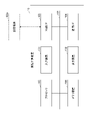
- FIG. 1 shows the hardware configuration of the cumulative computing device 10 according to this embodiment.
- the cumulative calculation device 10 according to the present embodiment is realized by the hardware configuration of a general computer or computer system, and includes an input device 101, a display device 102, an external I/F 103, a communication I /F 104 , processor 105 and memory device 106 . Each of these pieces of hardware is communicably connected via a bus 107 .
- the input device 101 is, for example, a keyboard, mouse, touch panel, various physical buttons, and the like.
- the display device 102 is, for example, a display. Note that the cumulative calculation device 10 may not have at least one of the input device 101 and the display device 102, for example.
- the external I/F 103 is an interface with an external device such as the recording medium 103a.
- the accumulative calculation device 10 can perform reading, writing, etc. of the recording medium 103 a via the external I/F 103 .
- Examples of the recording medium 103a include CD (Compact Disc), DVD (Digital Versatile Disk), SD memory card (Secure Digital memory card), USB (Universal Serial Bus) memory card, and the like.
- the communication I/F 104 is an interface for connecting the cumulative computing device 10 to a communication network.
- the processor 105 is, for example, various arithmetic units such as a CPU (Central Processing Unit) and a GPU (Graphics Processing Unit).
- the memory device 106 is, for example, various storage devices such as HDD (Hard Disk Drive), SSD (Solid State Drive), flash memory, RAM (Random Access Memory), and ROM (Read Only Memory).
- the cumulative computing device 10 can implement various processes described later.
- the hardware configuration shown in FIG. 1 is an example, and the cumulative calculation device 10 may have, for example, a plurality of processors 105 or a plurality of memory devices 106 .
- the cumulative calculation device 10 may have various hardware other than the illustrated hardware.
- FIG. 2 shows the functional configuration of the cumulative computing device 10 according to this embodiment.
- the accumulative calculation device 10 has a value converter 201 , a binary operation generator 202 , an accumulative calculator 203 , an output unit 204 , and a storage unit 205 .
- the value conversion unit 201, the binary operation creation unit 202, the cumulative calculation unit 203, and the output unit 204 are implemented by, for example, processing that one or more programs installed in the cumulative calculation device 10 cause the processor 105 to execute.
- the storage unit 205 is realized by the memory device 106, for example. Note that the storage unit 205 may be implemented by, for example, a storage device or the like connected to the cumulative calculation device 10 via a communication network.
- the binary operation creation unit 202 creates a new binary operation that can calculate the accumulation for each group based on the original binary operation through the accumulation calculation for the entire data.
- the output unit 204 extracts the result of the cumulative calculation for each group by the original binary operation from the result of the cumulative calculation by the new binary operation, and outputs the extracted result.
- the binary operation creating unit 202 can calculate the accumulation for each group according to the original binary operation by performing the accumulation calculation on the entire data (that is, the entire n values v 1 ', . . . , v n ').
- step S102 a binary operation defined by the following is created (step S102).
- w and y are variables that can take arbitrary values
- x and z are variables that can take 0 or 1
- OR is 1 when at least one of x and z is 1, and 0 otherwise. It is an operator (that is, an operator representing a logical sum).
- i 1, . . . , n
- the output destination of the output unit 204 may be arbitrary, but it is conceivable, for example, to store it in the storage unit 205 or transmit it to another device or device.
- max(x, y) is a binary operation that outputs the maximum value of x and y.
- the accumulation is computed with a new binary operation for the whole.
- the accumulative calculation device 10 performs accumulative calculation by a binary operation in each group. Otherwise, a flag of 0 is given and a new binary operation is defined, and cumulative calculation is performed on the entire data (that is, the entire set of values and flags) by this new binary operation.
- This new binary operation takes advantage of the fact that the top element of the group has already calculated the value of the accumulation, and regards the flag as indicating whether or not it has been calculated. It is an extension of binary operations to binary operations on pairs of values and flags.
- the accumulative calculation device 10 can efficiently perform accumulative calculation for each group by, for example, secret calculation (including secret sharing). Become. This is because any method that applies the binary operations we want to compute the accumulations to in a given order allows us to compute the accumulations by group with secure computation in the same order. Therefore, for example, by using max or min as a binary operation, it is possible to efficiently implement group by max or group by min operations in secure calculation.
- the cumulative computing device 10 according to the present embodiment can be used not only for normal data processing, but also, for example, for data processing and data analysis while keeping the data content confidential.
- the cumulative computing device 10 according to the present embodiment creates learning data for a machine learning model that realizes a predetermined task (for example, prediction, classification, etc.) while keeping the data content confidential. It is possible to
- the cumulative computing device 10 according to the present embodiment can perform various predictions and classifications by machine learning models learned with the learning data, and other devices, devices, systems, etc. based on the predictions or classification results. It may also be possible to control the
Landscapes
- Engineering & Computer Science (AREA)
- General Physics & Mathematics (AREA)
- Theoretical Computer Science (AREA)
- Physics & Mathematics (AREA)
- Computing Systems (AREA)
- Mathematical Analysis (AREA)
- Mathematical Optimization (AREA)
- Pure & Applied Mathematics (AREA)
- General Engineering & Computer Science (AREA)
- Computational Mathematics (AREA)
- Computer Security & Cryptography (AREA)
- Computer Networks & Wireless Communication (AREA)
- Signal Processing (AREA)
- Complex Calculations (AREA)
Abstract
Description

本実施形態に係る累積計算装置10のハードウェア構成を図1に示す。図1に示すように、本実施形態に係る累積計算装置10は一般的なコンピュータ又はコンピュータシステムのハードウェア構成で実現され、入力装置101と、表示装置102と、外部I/F103と、通信I/F104と、プロセッサ105と、メモリ装置106とを有する。これらの各ハードウェアは、それぞれがバス107により通信可能に接続される。
本実施形態に係る累積計算装置10の機能構成を図2に示す。図2に示すように、本実施形態に係る累積計算装置10は、値変換部201と、二項演算作成部202と、累積計算部203と、出力部204と、記憶部205とを有する。値変換部201、二項演算作成部202、累積計算部203、及び出力部204は、例えば、累積計算装置10にインストールされた1以上のプログラムがプロセッサ105に実行させる処理により実現される。また、記憶部205は、例えば、メモリ装置106により実現される。なお、記憶部205は、例えば、累積計算装置10と通信ネットワークを介して接続される記憶装置等により実現されていてもよい。
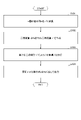
本実施形態に係る累積計算処理の流れについて図3を参照しながら説明する。



以下では、上記の累積計算処理の実施例について説明する。
本実施例では、先頭から4、2、1、3個ずつの4つのグループに分けられた値の列v=(3,5,1,2,4,6,1,3,2,8)が与えられ、二項演算max(x,y)によるグループごとの累積計算を行う場合について説明する。なお、max(x,y)はxとyの最大値を出力する二項演算である。
上記のステップS102では、上記の数3で定義される新たな二項演算が作成され、上記のステップS103で、v'=((v1,c1),・・・,(v10,c10))全体に対して新たな二項演算により累積が計算される。

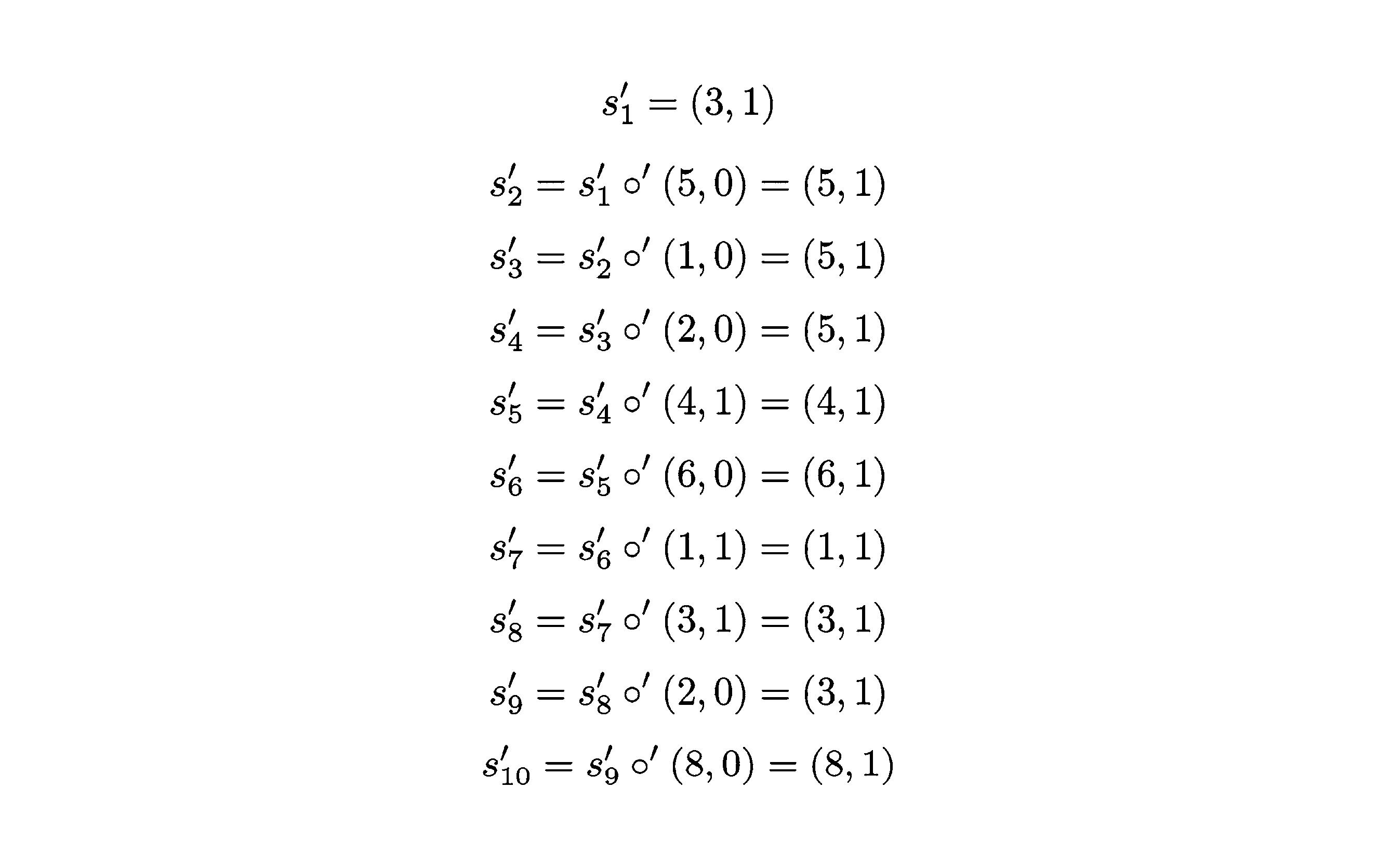
上記の実施例1では、ステップS103で新たな二項演算によりs1',・・・,s10'を左から順に計算したが、その代わりに、本実施例ではs1',・・・,s10'を並列に計算する。これにより、実施例1よりも効率的に累積の計算を行うことが可能となる。なお、結合的な二項演算が並列に計算可能であることは既知である。
以上のように、本実施形態に係る累積計算装置10は、各グループ内で二項演算による累積の計算を行う際に、累積対象の各値に対してグループの先頭の要素には1、それ以外には0となるフラグを付与すると共に新たな二項演算を定義し、この新たな二項演算によりデータ全体(つまり、値とフラグの組の全体)に対して累積計算を行う。この新たな二項演算は、グループの先頭の要素は累積の値が計算済みであることを利用して、当該フラグを計算済みであるか否かを表すものと見做することで、元の二項演算を、値とフラグの組に対する二項演算に拡張したものである。
101 入力装置
102 表示装置
103 外部I/F
103a 記録媒体
104 通信I/F
105 プロセッサ
106 メモリ装置
107 バス
201 値変換部
202 二項演算作成部
203 累積計算部
204 出力部
205 記憶部
Claims (5)
- グループに分けられたn個の値の列v=(v1,・・・,vn)に関して、結合的な二項演算により前記グループごとの累積を計算する累積計算装置であって、
vの各要素v1,・・・,vnのうち、前記グループの先頭の要素には1、前記先頭以外の要素には0を対応させた値の列をc=(c1,・・・,cn)として、vをv'=(v1',・・・,vn')(ただし、vi'=(vi,ci))に変換する値変換部と、
前記二項演算を用いて、2つの対(w,x)と(y,z)(ただし、x,z∈{0,1})に対して新しい対(p,q)を計算する新たな二項演算を作成する二項演算作成部と、
i=1,・・・,nについて、前記新たな二項演算により累積si'(ただし、si'は前記新たな二項演算によるv1'からvi'までの累積)を計算する累積計算部と、
各si'(i=1,・・・,n)から前記グループごとの累積を示す値の列u=(u1,・・・,un)を取り出し、取り出したuを出力する出力部と、
を有し、
前記新たな二項演算は、z=0である場合は前記二項演算によるwとyの演算結果をp、z=1である場合はyをpとし、xとzの論理和をqとする、累積計算装置。 - 前記二項演算作成部は、
前記二項演算によるwとyの演算結果をr、論理和を表す演算子をORとして、前記新たな二項演算による(w,x)と(y,z)の演算結果を(zy+(1-z)r,xORz)と定義することで、前記新たな二項演算を作成する、請求項1に記載の累積計算装置。 - 前記出力部は、
si'=(ui,di)として、u=(u1,・・・,un)を取り出し、取り出したuを出力する、請求項1又は2に記載の累積計算装置。 - グループに分けられたn個の値の列v=(v1,・・・,vn)に関して、結合的な二項演算により前記グループごとの累積を計算する累積計算装置が、
vの各要素v1,・・・,vnのうち、前記グループの先頭の要素には1、前記先頭以外の要素には0を対応させた値の列をc=(c1,・・・,cn)として、vをv'=(v1',・・・,vn')(ただし、vi'=(vi,ci))に変換する値変換手順と、
前記二項演算を用いて、2つの対(w,x)と(y,z)(ただし、x,z∈{0,1})に対して新しい対(p,q)を計算する新たな二項演算を作成する二項演算作成手順と、
i=1,・・・,nについて、前記新たな二項演算により累積si'(ただし、si'は前記新たな二項演算によるv1'からvi'までの累積)を計算する累積計算手順と、
各si'(i=1,・・・,n)から前記グループごとの累積を示す値の列u=(u1,・・・,un)を取り出し、取り出したuを出力する出力手順と、
を実行し、
前記新たな二項演算は、z=0である場合は前記二項演算によるwとyの演算結果をp、z=1である場合はyをpとし、xとzの論理和をqとする、累積計算方法。 - コンピュータを、請求項1乃至3の何れか一項に記載の累積計算装置として機能させるプログラム。
Priority Applications (5)
| Application Number | Priority Date | Filing Date | Title |
|---|---|---|---|
| EP21945917.9A EP4358070B1 (en) | 2021-06-14 | 2021-06-14 | Cumulative calculation device, cumulative calculation method, and program |
| CN202180099278.7A CN117480545A (zh) | 2021-06-14 | 2021-06-14 | 累积计算装置、累积计算方法和程序 |
| JP2023528779A JP7544274B2 (ja) | 2021-06-14 | 2021-06-14 | 累積計算装置、累積計算方法、及びプログラム |
| US18/568,542 US20240281208A1 (en) | 2021-06-14 | 2021-06-14 | Cumulative calculation apparatus, cumulative calculation method, and program |
| PCT/JP2021/022586 WO2022264237A1 (ja) | 2021-06-14 | 2021-06-14 | 累積計算装置、累積計算方法、及びプログラム |
Applications Claiming Priority (1)
| Application Number | Priority Date | Filing Date | Title |
|---|---|---|---|
| PCT/JP2021/022586 WO2022264237A1 (ja) | 2021-06-14 | 2021-06-14 | 累積計算装置、累積計算方法、及びプログラム |
Publications (1)
| Publication Number | Publication Date |
|---|---|
| WO2022264237A1 true WO2022264237A1 (ja) | 2022-12-22 |
Family
ID=84526861
Family Applications (1)
| Application Number | Title | Priority Date | Filing Date |
|---|---|---|---|
| PCT/JP2021/022586 Ceased WO2022264237A1 (ja) | 2021-06-14 | 2021-06-14 | 累積計算装置、累積計算方法、及びプログラム |
Country Status (5)
| Country | Link |
|---|---|
| US (1) | US20240281208A1 (ja) |
| EP (1) | EP4358070B1 (ja) |
| JP (1) | JP7544274B2 (ja) |
| CN (1) | CN117480545A (ja) |
| WO (1) | WO2022264237A1 (ja) |
Families Citing this family (1)
| Publication number | Priority date | Publication date | Assignee | Title |
|---|---|---|---|---|
| AU2019461061B2 (en) * | 2019-08-14 | 2023-03-30 | Ntt, Inc. | Secure gradient descent computation method, secure deep learning method, secure gradient descent computation system, secure deep learning system, secure computation apparatus, and program |
Citations (5)
| Publication number | Priority date | Publication date | Assignee | Title |
|---|---|---|---|---|
| JP2014081475A (ja) * | 2012-10-16 | 2014-05-08 | Nippon Telegr & Teleph Corp <Ntt> | 秘密計算システム、集約関数装置、秘密計算方法、およびプログラム |
| WO2019208485A1 (ja) * | 2018-04-25 | 2019-10-31 | 日本電信電話株式会社 | 秘密集約最大値システム、秘密集約最小値システム、秘密計算装置、秘密集約最大値方法、秘密集約最小値方法、およびプログラム |
| WO2019208486A1 (ja) * | 2018-04-26 | 2019-10-31 | 日本電信電話株式会社 | 秘密集約中央値システム、秘密計算装置、秘密集約中央値方法、およびプログラム |
| WO2019208484A1 (ja) * | 2018-04-25 | 2019-10-31 | 日本電信電話株式会社 | 秘密集約総和システム、秘密計算装置、秘密集約総和方法、およびプログラム |
| WO2019225401A1 (ja) * | 2018-05-25 | 2019-11-28 | 日本電信電話株式会社 | 秘密集約関数計算システム、秘密計算装置、秘密集約関数計算方法、およびプログラム |
Family Cites Families (8)
| Publication number | Priority date | Publication date | Assignee | Title |
|---|---|---|---|---|
| FR2780535B1 (fr) * | 1998-06-25 | 2000-08-25 | Inst Nat Rech Inf Automat | Dispositif de traitement de donnees d'acquisition, notamment de donnees d'image |
| CN101031944A (zh) * | 2004-09-30 | 2007-09-05 | 索尼株式会社 | 加密计算方法、加密系统和计算机程序 |
| JP4876156B2 (ja) * | 2009-07-29 | 2012-02-15 | 京楽産業.株式会社 | 電子機器、遊技機、主制御基板、周辺基板、認証方法および認証プログラム |
| WO2011086668A1 (ja) * | 2010-01-13 | 2011-07-21 | 三菱電機株式会社 | 秘匿検索システム及び公開パラメータ生成装置及び暗号化装置及びユーザ秘密鍵生成装置及びクエリ発行装置及び検索装置及びコンピュータプログラム及び秘匿検索方法及び公開パラメータ生成方法及び暗号化方法及びユーザ秘密鍵生成方法及びクエリ発行方法及び検索方法 |
| JP5466763B2 (ja) * | 2010-07-23 | 2014-04-09 | 日本電信電話株式会社 | 暗号化装置、復号装置、暗号化方法、復号方法、プログラム、及び記録媒体 |
| CN106170943A (zh) * | 2013-09-25 | 2016-11-30 | 汤姆逊许可公司 | 使用部分同态加密和掩码的隐私保护岭回归 |
| EP3796290B1 (en) * | 2018-05-17 | 2023-07-12 | Nippon Telegraph And Telephone Corporation | Secret cross tabulation system, secret calculation device, secret cross tabulation method, and program |
| CN111126579B (zh) * | 2019-11-05 | 2023-06-27 | 复旦大学 | 一种适用于二值卷积神经网络计算的存内计算装置 |
-
2021
- 2021-06-14 WO PCT/JP2021/022586 patent/WO2022264237A1/ja not_active Ceased
- 2021-06-14 US US18/568,542 patent/US20240281208A1/en active Pending
- 2021-06-14 CN CN202180099278.7A patent/CN117480545A/zh active Pending
- 2021-06-14 EP EP21945917.9A patent/EP4358070B1/en active Active
- 2021-06-14 JP JP2023528779A patent/JP7544274B2/ja active Active
Patent Citations (5)
| Publication number | Priority date | Publication date | Assignee | Title |
|---|---|---|---|---|
| JP2014081475A (ja) * | 2012-10-16 | 2014-05-08 | Nippon Telegr & Teleph Corp <Ntt> | 秘密計算システム、集約関数装置、秘密計算方法、およびプログラム |
| WO2019208485A1 (ja) * | 2018-04-25 | 2019-10-31 | 日本電信電話株式会社 | 秘密集約最大値システム、秘密集約最小値システム、秘密計算装置、秘密集約最大値方法、秘密集約最小値方法、およびプログラム |
| WO2019208484A1 (ja) * | 2018-04-25 | 2019-10-31 | 日本電信電話株式会社 | 秘密集約総和システム、秘密計算装置、秘密集約総和方法、およびプログラム |
| WO2019208486A1 (ja) * | 2018-04-26 | 2019-10-31 | 日本電信電話株式会社 | 秘密集約中央値システム、秘密計算装置、秘密集約中央値方法、およびプログラム |
| WO2019225401A1 (ja) * | 2018-05-25 | 2019-11-28 | 日本電信電話株式会社 | 秘密集約関数計算システム、秘密計算装置、秘密集約関数計算方法、およびプログラム |
Non-Patent Citations (3)
| Title |
|---|
| DAI IKARASHIKOJI CHIDAKOKI HAMADAKATSUMI TAKAHASHI: "Efficiency of Lightweight Verifiable Three-Party Secret Function Computation and Secure Database Processing Using the Same", SCIS, 2011, pages 1 - 8 |
| KOJI CHIDAKOKI HAMADADAI IKARASHIKATSUMI TAKAHASHI: "Reconsideration of Lightweight Verifiable Three-Party Secret Function Calculation", CSS, 2010 |
| See also references of EP4358070A4 |
Also Published As
| Publication number | Publication date |
|---|---|
| EP4358070B1 (en) | 2026-03-25 |
| EP4358070A4 (en) | 2025-03-26 |
| EP4358070A1 (en) | 2024-04-24 |
| CN117480545A (zh) | 2024-01-30 |
| US20240281208A1 (en) | 2024-08-22 |
| JPWO2022264237A1 (ja) | 2022-12-22 |
| JP7544274B2 (ja) | 2024-09-03 |
Similar Documents
| Publication | Publication Date | Title |
|---|---|---|
| JP6111543B2 (ja) | 類似サブ時系列の抽出方法及び装置 | |
| JP7544274B2 (ja) | 累積計算装置、累積計算方法、及びプログラム | |
| WO2021214833A1 (ja) | 学習装置、異常検知装置、学習方法及び異常検知方法 | |
| Purnaye et al. | BiSHM: Evidence detection and preservation model for cloud forensics | |
| US20210319080A1 (en) | Tensor data calculating apparatus, tensor data calculating method and program | |
| JP7476715B2 (ja) | 情報処理装置及び重複率見積もりプログラム | |
| CN106796764B (zh) | 部分字符串位置检测装置、方法及记录介质 | |
| CN109478381A (zh) | 秘密计算系统、秘密计算装置、秘密计算方法以及程序 | |
| JP6142878B2 (ja) | 情報システムの性能評価装置、方法およびプログラム | |
| CN111679959A (zh) | 计算机性能数据确定方法、装置、计算机设备及存储介质 | |
| JP7548450B2 (ja) | 安全性評価指標計算装置、安全性評価指標計算方法、及びプログラム | |
| WO2022264238A1 (ja) | 累積計算装置、累積計算方法、及びプログラム | |
| JP7694684B2 (ja) | 秘密分割装置、秘密分割方法、及びプログラム | |
| KR102321064B1 (ko) | 부호화된 네트워크 생성 장치 및 방법 | |
| JP7491390B2 (ja) | 秘密グループ分け装置、秘密グループ分けシステム、秘密グループ分け方法、及びプログラム | |
| JP6831307B2 (ja) | 解算出装置、解算出方法及び解算出プログラム | |
| WO2022259489A1 (ja) | プライベートべき乗変換装置、プライベートべき乗変換方法、及びプログラム | |
| JP7614611B2 (ja) | 解釈方法、解釈装置、及びプログラム | |
| CN113223612B (zh) | 基因组的特征提取方法 | |
| JP7452700B2 (ja) | 疑似データ生成装置、疑似データ生成方法及びプログラム | |
| EP4465279A1 (en) | Secret random number calculation system, secret random number calculation device, secret random number calculation method, secret cluster calculation system, secret cluster calculation device, secret cluster calculation method, and program | |
| WO2025177386A1 (ja) | 検証装置、検証方法、及びプログラム | |
| JP5582017B2 (ja) | 相図生成プログラム,相図生成システムおよび相図生成方法 | |
| CN117455695A (zh) | 资源借调违约预测方法、装置、计算机设备和存储介质 | |
| WO2022044233A1 (ja) | 推定装置、推定方法及びプログラム |
Legal Events
| Date | Code | Title | Description |
|---|---|---|---|
| 121 | Ep: the epo has been informed by wipo that ep was designated in this application |
Ref document number: 21945917 Country of ref document: EP Kind code of ref document: A1 |
|
| WWE | Wipo information: entry into national phase |
Ref document number: 2023528779 Country of ref document: JP |
|
| WWE | Wipo information: entry into national phase |
Ref document number: 18568542 Country of ref document: US |
|
| WWE | Wipo information: entry into national phase |
Ref document number: 202180099278.7 Country of ref document: CN |
|
| WWE | Wipo information: entry into national phase |
Ref document number: 2021945917 Country of ref document: EP |
|
| NENP | Non-entry into the national phase |
Ref country code: DE |
|
| ENP | Entry into the national phase |
Ref document number: 2021945917 Country of ref document: EP Effective date: 20240115 |
|
| WWG | Wipo information: grant in national office |
Ref document number: 2021945917 Country of ref document: EP |