WO2022268052A1 - (r) -glutarimide crbn ligands and methods of use - Google Patents
(r) -glutarimide crbn ligands and methods of use Download PDFInfo
- Publication number
- WO2022268052A1 WO2022268052A1 PCT/CN2022/100017 CN2022100017W WO2022268052A1 WO 2022268052 A1 WO2022268052 A1 WO 2022268052A1 CN 2022100017 W CN2022100017 W CN 2022100017W WO 2022268052 A1 WO2022268052 A1 WO 2022268052A1
- Authority
- WO
- WIPO (PCT)
- Prior art keywords
- aryl
- heterocyclyl
- alkyl
- heteroaryl
- cycloalkyl
- Prior art date
- Legal status (The legal status is an assumption and is not a legal conclusion. Google has not performed a legal analysis and makes no representation as to the accuracy of the status listed.)
- Ceased
Links
Classifications
-
- A—HUMAN NECESSITIES
- A61—MEDICAL OR VETERINARY SCIENCE; HYGIENE
- A61K—PREPARATIONS FOR MEDICAL, DENTAL OR TOILETRY PURPOSES
- A61K31/00—Medicinal preparations containing organic active ingredients
- A61K31/33—Heterocyclic compounds
- A61K31/395—Heterocyclic compounds having nitrogen as a ring hetero atom, e.g. guanethidine or rifamycins
- A61K31/495—Heterocyclic compounds having nitrogen as a ring hetero atom, e.g. guanethidine or rifamycins having six-membered rings with two or more nitrogen atoms as the only ring heteroatoms, e.g. piperazine or tetrazines
- A61K31/505—Pyrimidines; Hydrogenated pyrimidines, e.g. trimethoprim
- A61K31/506—Pyrimidines; Hydrogenated pyrimidines, e.g. trimethoprim not condensed and containing further heterocyclic rings
-
- C—CHEMISTRY; METALLURGY
- C07—ORGANIC CHEMISTRY
- C07D—HETEROCYCLIC COMPOUNDS
- C07D211/00—Heterocyclic compounds containing hydrogenated pyridine rings, not condensed with other rings
- C07D211/04—Heterocyclic compounds containing hydrogenated pyridine rings, not condensed with other rings with only hydrogen or carbon atoms directly attached to the ring nitrogen atom
- C07D211/80—Heterocyclic compounds containing hydrogenated pyridine rings, not condensed with other rings with only hydrogen or carbon atoms directly attached to the ring nitrogen atom having two double bonds between ring members or between ring members and non-ring members
- C07D211/84—Heterocyclic compounds containing hydrogenated pyridine rings, not condensed with other rings with only hydrogen or carbon atoms directly attached to the ring nitrogen atom having two double bonds between ring members or between ring members and non-ring members with hetero atoms or with carbon atoms having three bonds to hetero atoms, with at the most one bond to halogen directly attached to ring carbon atoms
- C07D211/86—Oxygen atoms
- C07D211/88—Oxygen atoms attached in positions 2 and 6, e.g. glutarimide
-
- A—HUMAN NECESSITIES
- A61—MEDICAL OR VETERINARY SCIENCE; HYGIENE
- A61K—PREPARATIONS FOR MEDICAL, DENTAL OR TOILETRY PURPOSES
- A61K31/00—Medicinal preparations containing organic active ingredients
- A61K31/33—Heterocyclic compounds
- A61K31/395—Heterocyclic compounds having nitrogen as a ring hetero atom, e.g. guanethidine or rifamycins
- A61K31/435—Heterocyclic compounds having nitrogen as a ring hetero atom, e.g. guanethidine or rifamycins having six-membered rings with one nitrogen as the only ring hetero atom
- A61K31/44—Non condensed pyridines; Hydrogenated derivatives thereof
- A61K31/445—Non condensed piperidines, e.g. piperocaine
- A61K31/4523—Non condensed piperidines, e.g. piperocaine containing further heterocyclic ring systems
- A61K31/4545—Non condensed piperidines, e.g. piperocaine containing further heterocyclic ring systems containing a six-membered ring with nitrogen as a ring hetero atom, e.g. pipamperone, anabasine
-
- A—HUMAN NECESSITIES
- A61—MEDICAL OR VETERINARY SCIENCE; HYGIENE
- A61K—PREPARATIONS FOR MEDICAL, DENTAL OR TOILETRY PURPOSES
- A61K47/00—Medicinal preparations characterised by the non-active ingredients used, e.g. carriers or inert additives; Targeting or modifying agents chemically bound to the active ingredient
- A61K47/50—Medicinal preparations characterised by the non-active ingredients used, e.g. carriers or inert additives; Targeting or modifying agents chemically bound to the active ingredient the non-active ingredient being chemically bound to the active ingredient, e.g. polymer-drug conjugates
- A61K47/51—Medicinal preparations characterised by the non-active ingredients used, e.g. carriers or inert additives; Targeting or modifying agents chemically bound to the active ingredient the non-active ingredient being chemically bound to the active ingredient, e.g. polymer-drug conjugates the non-active ingredient being a modifying agent
- A61K47/54—Medicinal preparations characterised by the non-active ingredients used, e.g. carriers or inert additives; Targeting or modifying agents chemically bound to the active ingredient the non-active ingredient being chemically bound to the active ingredient, e.g. polymer-drug conjugates the non-active ingredient being a modifying agent the modifying agent being an organic compound
- A61K47/545—Heterocyclic compounds
-
- A—HUMAN NECESSITIES
- A61—MEDICAL OR VETERINARY SCIENCE; HYGIENE
- A61K—PREPARATIONS FOR MEDICAL, DENTAL OR TOILETRY PURPOSES
- A61K47/00—Medicinal preparations characterised by the non-active ingredients used, e.g. carriers or inert additives; Targeting or modifying agents chemically bound to the active ingredient
- A61K47/50—Medicinal preparations characterised by the non-active ingredients used, e.g. carriers or inert additives; Targeting or modifying agents chemically bound to the active ingredient the non-active ingredient being chemically bound to the active ingredient, e.g. polymer-drug conjugates
- A61K47/51—Medicinal preparations characterised by the non-active ingredients used, e.g. carriers or inert additives; Targeting or modifying agents chemically bound to the active ingredient the non-active ingredient being chemically bound to the active ingredient, e.g. polymer-drug conjugates the non-active ingredient being a modifying agent
- A61K47/54—Medicinal preparations characterised by the non-active ingredients used, e.g. carriers or inert additives; Targeting or modifying agents chemically bound to the active ingredient the non-active ingredient being chemically bound to the active ingredient, e.g. polymer-drug conjugates the non-active ingredient being a modifying agent the modifying agent being an organic compound
- A61K47/55—Medicinal preparations characterised by the non-active ingredients used, e.g. carriers or inert additives; Targeting or modifying agents chemically bound to the active ingredient the non-active ingredient being chemically bound to the active ingredient, e.g. polymer-drug conjugates the non-active ingredient being a modifying agent the modifying agent being an organic compound the modifying agent being also a pharmacologically or therapeutically active agent, i.e. the entire conjugate being a codrug
-
- A—HUMAN NECESSITIES
- A61—MEDICAL OR VETERINARY SCIENCE; HYGIENE
- A61P—SPECIFIC THERAPEUTIC ACTIVITY OF CHEMICAL COMPOUNDS OR MEDICINAL PREPARATIONS
- A61P25/00—Drugs for disorders of the nervous system
-
- A—HUMAN NECESSITIES
- A61—MEDICAL OR VETERINARY SCIENCE; HYGIENE
- A61P—SPECIFIC THERAPEUTIC ACTIVITY OF CHEMICAL COMPOUNDS OR MEDICINAL PREPARATIONS
- A61P35/00—Antineoplastic agents
-
- C—CHEMISTRY; METALLURGY
- C07—ORGANIC CHEMISTRY
- C07D—HETEROCYCLIC COMPOUNDS
- C07D401/00—Heterocyclic compounds containing two or more hetero rings, having nitrogen atoms as the only ring hetero atoms, at least one ring being a six-membered ring with only one nitrogen atom
- C07D401/02—Heterocyclic compounds containing two or more hetero rings, having nitrogen atoms as the only ring hetero atoms, at least one ring being a six-membered ring with only one nitrogen atom containing two hetero rings
- C07D401/10—Heterocyclic compounds containing two or more hetero rings, having nitrogen atoms as the only ring hetero atoms, at least one ring being a six-membered ring with only one nitrogen atom containing two hetero rings linked by a carbon chain containing aromatic rings
-
- C—CHEMISTRY; METALLURGY
- C07—ORGANIC CHEMISTRY
- C07D—HETEROCYCLIC COMPOUNDS
- C07D401/00—Heterocyclic compounds containing two or more hetero rings, having nitrogen atoms as the only ring hetero atoms, at least one ring being a six-membered ring with only one nitrogen atom
- C07D401/14—Heterocyclic compounds containing two or more hetero rings, having nitrogen atoms as the only ring hetero atoms, at least one ring being a six-membered ring with only one nitrogen atom containing three or more hetero rings
-
- C—CHEMISTRY; METALLURGY
- C07—ORGANIC CHEMISTRY
- C07D—HETEROCYCLIC COMPOUNDS
- C07D405/00—Heterocyclic compounds containing both one or more hetero rings having oxygen atoms as the only ring hetero atoms, and one or more rings having nitrogen as the only ring hetero atom
- C07D405/14—Heterocyclic compounds containing both one or more hetero rings having oxygen atoms as the only ring hetero atoms, and one or more rings having nitrogen as the only ring hetero atom containing three or more hetero rings
-
- C—CHEMISTRY; METALLURGY
- C07—ORGANIC CHEMISTRY
- C07D—HETEROCYCLIC COMPOUNDS
- C07D413/00—Heterocyclic compounds containing two or more hetero rings, at least one ring having nitrogen and oxygen atoms as the only ring hetero atoms
- C07D413/02—Heterocyclic compounds containing two or more hetero rings, at least one ring having nitrogen and oxygen atoms as the only ring hetero atoms containing two hetero rings
- C07D413/12—Heterocyclic compounds containing two or more hetero rings, at least one ring having nitrogen and oxygen atoms as the only ring hetero atoms containing two hetero rings linked by a chain containing hetero atoms as chain links
-
- C—CHEMISTRY; METALLURGY
- C07—ORGANIC CHEMISTRY
- C07D—HETEROCYCLIC COMPOUNDS
- C07D413/00—Heterocyclic compounds containing two or more hetero rings, at least one ring having nitrogen and oxygen atoms as the only ring hetero atoms
- C07D413/14—Heterocyclic compounds containing two or more hetero rings, at least one ring having nitrogen and oxygen atoms as the only ring hetero atoms containing three or more hetero rings
-
- C—CHEMISTRY; METALLURGY
- C07—ORGANIC CHEMISTRY
- C07D—HETEROCYCLIC COMPOUNDS
- C07D471/00—Heterocyclic compounds containing nitrogen atoms as the only ring hetero atoms in the condensed system, at least one ring being a six-membered ring with one nitrogen atom, not provided for by groups C07D451/00 - C07D463/00
- C07D471/02—Heterocyclic compounds containing nitrogen atoms as the only ring hetero atoms in the condensed system, at least one ring being a six-membered ring with one nitrogen atom, not provided for by groups C07D451/00 - C07D463/00 in which the condensed system contains two hetero rings
- C07D471/04—Ortho-condensed systems
-
- C—CHEMISTRY; METALLURGY
- C07—ORGANIC CHEMISTRY
- C07D—HETEROCYCLIC COMPOUNDS
- C07D487/00—Heterocyclic compounds containing nitrogen atoms as the only ring hetero atoms in the condensed system, not provided for by groups C07D451/00 - C07D477/00
- C07D487/02—Heterocyclic compounds containing nitrogen atoms as the only ring hetero atoms in the condensed system, not provided for by groups C07D451/00 - C07D477/00 in which the condensed system contains two hetero rings
- C07D487/04—Ortho-condensed systems
-
- C—CHEMISTRY; METALLURGY
- C07—ORGANIC CHEMISTRY
- C07F—ACYCLIC, CARBOCYCLIC OR HETEROCYCLIC COMPOUNDS CONTAINING ELEMENTS OTHER THAN CARBON, HYDROGEN, HALOGEN, OXYGEN, NITROGEN, SULFUR, SELENIUM OR TELLURIUM
- C07F9/00—Compounds containing elements of Groups 5 or 15 of the Periodic Table
- C07F9/02—Phosphorus compounds
- C07F9/547—Heterocyclic compounds, e.g. containing phosphorus as a ring hetero atom
- C07F9/6558—Heterocyclic compounds, e.g. containing phosphorus as a ring hetero atom containing at least two different or differently substituted hetero rings neither condensed among themselves nor condensed with a common carbocyclic ring or ring system
- C07F9/65583—Heterocyclic compounds, e.g. containing phosphorus as a ring hetero atom containing at least two different or differently substituted hetero rings neither condensed among themselves nor condensed with a common carbocyclic ring or ring system each of the hetero rings containing nitrogen as ring hetero atom
-
- C—CHEMISTRY; METALLURGY
- C07—ORGANIC CHEMISTRY
- C07B—GENERAL METHODS OF ORGANIC CHEMISTRY; APPARATUS THEREFOR
- C07B2200/00—Indexing scheme relating to specific properties of organic compounds
- C07B2200/07—Optical isomers
Definitions
- CRBN cereblon
- the present invention also provides compounds that can be used as synthetic intermediates in the preparation of bifunctional compounds for use in targeted protein degradation. The present compounds are thus useful for the treatment or prophylaxis tumors and cancer.
- Proteolysis targeting chimera consists of two covalently linked protein-binding molecules: one capable of engaging an E3 ubiquitin ligase, and another that binds to the protein of interest (POI) a target meant for degradation (Sakamoto KM et al., Proc. Natl. Acad. Sci. 2001, 98: 8554–9.; Sakamoto K.M. et al., Methods Enzymol. 2005; 399: 833 ⁇ 847. ) . Rather than inhibiting the target protein's enzymatic activity, recruitment of the E3 ligase to the specific unwanted proteins results in ubiquitination and subsequent degradation of the target protein by the proteasome.
- ubiquitin-proteasome pathway The whole process of ubiquitination and proteasomal degradation is known as the ubiquitin-proteasome pathway (UPP) (Ardley H. et al., Essays Biochem. 2005, 41, 15-30; Komander D. et al., Biochem. 2012, 81, 203-229; Grice G.L. et al., Cell Rep. 2015, 12, 545-553; Swatek K.N. et al., Cell Res. 2016, 26, 399-422) .
- Proteasomes are protein complexes which degrade unneeded, misfolded or abnormal proteins into small peptides to maintain the health and productivity of the cells.
- Ubiquitin ligases also called an E3 ubiquitin ligase, directly catalyze the transfer of ubiquitin from the E2 to the target protein for degradation.
- E3 ubiquitin ligases also called an E3 ubiquitin ligase, directly catalyze the transfer of ubiquitin from the E2 to the target protein for degradation.
- the human genome encodes over 600 putative E3 ligases, only a limited number of E3 ubiquitin ligases have been widely applied by small molecule PROTAC technology: cereblon (CRBN) , Von Hippel-Lindau (VHL) , mouse double minute 2 homologue (MDM2) cellular inhibitor of apoptosis protein (cIAP) (Philipp O. et al., Chem. Biol.
- RDF114 Human Ring Finger Protein 114
- DCAF16 DDB1 And CUL4 Associated Factor 16
- Cereblon forms an E3 ubiquitin ligase complex with damaged DNA binding protein 1 (DDB1) and Cullin-4A (CUL4A) to ubiquitinate a number of other proteins followed by the degradation via proteasomes.
- Immunomodulatory drugs including thalidomide, lenalidomide, and pomalidomide, function as monovalent promoters of PPIs by binding to the cereblon (CRBN) subunit of the CRL4A CRBN E3 ligase complex and recruiting neosubstrate proteins.
- CRBN cereblon subunit of the CRL4A CRBN E3 ligase complex and recruiting neosubstrate proteins.
- One objective of the present invention is to provide compounds and derivatives formed by conjugating target protein moieties with E3 ligase Ligand moieties, which function to recruit targeted proteins to E3 ubiquitin ligase for degradation, and methods of preparation and uses thereof.
- Warhead is a targeting moiety that binds to a target protein; wherein the target protein is a mediator of a disease in a subject;
- Linker is a divalent chemical group that connects the Warhead moiety and the moiety
- s1 is 0 or 1
- s2 is 0 or 1;
- Z 1 , Z 2 and Z 3 are each independently N or CR z , provided that Z 1 , Z 2 and Z 3 are not N at the same time;
- R z at each occurrence, is independently selected from hydrogen, halogen, -C 1-8 alkyl, -NR Za R Zb , -OR Za , -SR Za , C 3 -C 8 cycloalkyl, 3-to 8-membered heterocyclyl or CN; each of -C 1-8 alkyl, C 3 -C 8 cycloalkyl, 3-to 8-membered heterocyclyl is optionally substituted with at least one R Zc ;
- the moiety is linked to the moiety via any one of Z 1 , Z 2 or Z 3 which is CR z and R z is hydrogen;
- R Za and R Zb are each independently selected from hydrogen, -C 1 -C 8 alkyl, C 3 -C 8 cycloalkyl, 3-to 8-membered heterocyclyl, C 6 -C 12 aryl, or 5-to 12-membered heteroaryl, each of said -C 1-8 alkyl, -C 2- 8 alkenyl, -C 2-8 alkynyl, C 3 -C 8 cycloalkyl, 3-to 8-membered heterocyclyl, C 6 -C 12 aryl, or 5-to 12-membered heteroaryl is optionally substituted with at least one substituent R Zd ;
- R Zc and R Zd are each independently halogen, hydroxy, -C 1-8 alkoxy, 3-to 8-membered heterocyclyl, C 6 -C 12 aryl, or 5-to 12-membered heteroaryl;
- R 1 and R 2 are each independently selected from halogen, -C 1-8 alkyl, -C 2-8 alkenyl, -C 2-8 alkynyl, -C 1- 8 alkoxy, -C 3 -C 8 cycloalkyl, 3-to 8-membered heterocyclyl, -C 6 -C 12 aryl, 5-to 12-membered heteroaryl, -CN, -SO 2 R 1a , -SO 2 NR 1a R 1b , -COR 1a , -CO 2 R 1a , -CONR 1a R 1b , -NR 1a R 1b , -NR 1a COR 1b , -NR 1a CO 2 R 1b , or –NR 1a SO 2 R 1b ; each of -C 1-8 alkyl, -C 2-8 alkenyl, -C 2-8 alkynyl, -C 1-8 alkoxy, -C 3 -C 8 cyclo
- R 1a , R 1b , R 1c and R 1d are each independently hydrogen, -C 1-8 alkyl, -C 2-8 alkenyl, -C 2-8 alkynyl, C 3 -C 8 cycloalkyl, 3-to 8-membered heterocyclyl, C 6 -C 12 aryl, or 5-to 12-membered heteroaryl.
- Aspect 2 The compound of aspect 1, wherein at most one of Z 1 , Z 2 and Z 3 is N.
- Aspect 3 The compound of any one of aspects 1-2, wherein Z 1 , Z 2 and Z 3 are each independently CR z .
- Aspect 4 The compound of any one of aspects 1-3, wherein R Z , at each occurrence, is independently selected from hydrogen, -F, -Cl, -Br, -I, methyl, ethyl, propyl, butyl, pentyl, hexyl, heptyl, octyl, -NR Za R Zb , -OR Za , -SR Za , cyclopropyl, cyclobutyl, cyclopentyl, cyclohexyl, cycloheptyl, cyclooctyl, 3-to 8-membered heterocyclyl, phenyl, 5-to 12-membered heteroaryl, or CN; each of methyl, ethyl, propyl, butyl, pentyl, hexyl, heptyl, octyl, cyclopropyl, cyclobutyl, cyclopentyl, cyclo
- R Za and R Zb are each independently selected from hydrogen, methyl, ethyl, propyl, butyl, pentyl, hexyl, heptyl, octyl, -C 2-8 alkenyl, -C 2-8 alkynyl, cyclopropyl, cyclobutyl, cyclopentyl, cyclohexyl, cycloheptyl, cyclooctyl, 3-to 8-membered heterocyclyl, phenyl or 5-to 12-membered heteroaryl, each of said hydrogen, methyl, ethyl, propyl, butyl, pentyl, hexyl, heptyl, octyl, -C 2-8 alkenyl, -C 2-8 alkynyl, cyclopropyl, cyclobutyl, cyclopentyl, cyclohexyl, cycloheptyl, cycl
- R Zc and R Zd are each independently -F, -Cl, -Br, -I, hydroxy, methyl, ethyl, propyl, butyl, pentyl, hexyl, heptyl, octyl, -C 1-8 alkoxy, -C 2-8 alkenyl, -C 2-8 alkynyl, cyclopropyl, cyclobutyl, cyclopentyl, cyclohexyl, cycloheptyl, cyclooctyl, 3-to 8-membered heterocyclyl, phenyl, or 5-to 12-membered heteroaryl.
- Aspect 5 The compound of any one of aspects 1-4, wherein R z is selected from H, -CH 3 , -C 2 H 5 , F, -CH 2 F, -CHF 2 , -CF 3 , -OCH 3 , -OC 2 H 5 , -C 3 H 7 , -OCH 2 F, -OCHF 2 , -OCH 2 CF 3 , -OCF 3, -SCF 3 , -CF 3 or -CH (OH) CH 3 .
- Aspect 6 The compound of any one of aspects 1-5, wherein R 1 and R 2 are each independently selected from F, Cl, Br, I, methyl, ethyl, propyl, butyl, pentyl, hexyl, heptyl, octyl, methoxy, ethoxy, propoxy, butoxy, pentoxy, hexoxy, heptyloxy, octyloxy, cyclopropyl, cyclobutyl, cyclopentyl, cyclohexyl, cycloheptyl, cyclooctyl, -C 2-8 alkenyl, -C 2-8 alkynyl, 3-to 8-membered heterocyclyl, -C 6 -C 12 aryl, 5-to 12-membered heteroaryl, -CN, -SO 2 R 1a , -SO 2 NR 1a R 1b , -COR 1a , -CO 2 R 1
- R 1a , R 1b , R 1c and R 1d are each independently hydrogen, methyl, ethyl, propyl, butyl, pentyl, hexyl, heptyl, octyl, octyloxy, cyclopropyl, cyclobutyl, cyclopentyl, cyclohexyl, cycloheptyl, cyclooctyl, -C 2- 8 alkenyl, -C 2-8 alkynyl, 3-to 8-membered heterocyclyl, -C 6 -C 12 aryl, or 5-to 12-membered heteroaryl.
- Aspect 7 The compound of any one of aspects 1-6, wherein R 1 and R 2 are each independently selected from F, Cl, Br, I, methyl, ethyl, propyl, butyl, pentyl, hexyl, heptyl, octyl, methoxy, ethoxy, propoxy, butoxy, pentoxy, hexoxy, heptyloxy, octyloxy, cyclopropyl, cyclobutyl, cyclopentyl, cyclohexyl, cycloheptyl, cyclooctyl, -CN, -CH 2 F, -CHF 2 , -CF 3 , -OCH 2 F, -OCHF 2 , -OCH 2 CF 3 , -OCF 3, -SCF 3 , or phenyl.
- Aspect 8 The compound of any one of aspects 1-7, wherein the compound is Formula (II)
- Warhead and Linker are defined as aspect 1.
- Aspect 9 The compound of any one of aspects 1-8, wherein Linker is wherein *refers to the position attached to the moiety, and **refers to the position attached to the moiety;
- L 1 is selected from a single bond, -O-, -SO 2 -, -C (O) -, -NR L1a -, -C 3 -C 8 cycloalkylene-, * L1 -O-C 1- 8 alkylene-** L1 , * L1 -C 1-8 alkylene-O-** L1 , * L1 -SO 2 -C 1-8 alkylene-** L1 , * L1 -C 1-8 alkylene-SO 2 -** L1 , * L1 -CO-C 1-8 alkylene-** L1 , * L1 -C 1-8 alkylene-CO-** L1 , * L1 -NR L1a -C 1-8 alkylene-** L1 , * L1 -C 1-8 alkylene-** L1 , * L1 -NR L1a C (O) -** L1 , * L1 -C (O) NR L1a , * L1
- R L1a and R L1b are each independently selected from hydrogen, -C 1-8 alkyl, -C 2-8 alkenyl, -C 2-8 alkynyl, C 3 -C 8 cycloalkyl, 3-to 8-membered heterocyclyl, C 6 -C 12 aryl, 5-to 12-membered heteroaryl, each of said -C 1-8 alkyl, -C 2-8 alkenyl, -C 2-8 alkynyl, C 3 -C 8 cycloalkyl, 3-to 8-membered heterocyclyl, C 6 -C 12 aryl or 5-to 12-membered heteroaryl is optionally substituted with at least one substituent R L1d ;
- each of said R L1c and R L1d are independently oxo, halogen, hydroxy, -C 1-8 alkyl, -C 1-8 alkoxy, -C 2- 8 alkenyl, -C 2-8 alkynyl, C 3 -C 8 cycloalkyl, 3-to 8-membered heterocyclyl, C 6 -C 12 aryl or 5-to 12-membered heteroaryl; or
- L 2 is selected from a single bond, -O-, -SO 2 -, -CO-, -NR L2a -, -C 3 -C 8 cycloalkylene-, * L2 -O-C 1- 8 alkylene-** L2 , * L2 -C 1-8 alkylene-O-** L2 , * L2 -SO 2 -C 1-8 alkylene-** L2 , * L2 -C 1-8 alkylene-SO 2 -** L2 , * L2 -CO-C 1-8 alkylene-** L2 , * L2 -C 1-8 alkylene-CO-** L2 , * L2 -NR L2a -C 1-8 alkylene-** L2 , * L2 -C 1-8 alkylene-** L2 , * L2 -C 1-8 alkylene-NR L2a -** L2 , * L2 -NR L2a C (O) -** L2 , *
- R L2a and R L2b are each independently selected from hydrogen, -C 1-8 alkyl, -C 2-8 alkenyl, -C 2-8 alkynyl, C 3 -C 8 cycloalkyl, 3-to 8-membered heterocyclyl, C 6 -C 12 aryl or 5-to 12-membered heteroaryl, each of said -C 1-8 alkyl, -C 2-8 alkenyl, -C 2-8 alkynyl, C 3 -C 8 cycloalkyl, 3-to 8-membered heterocyclyl, C 6 -C 12 aryl or 5-to 12-membered heteroaryl is optionally substituted with at least one substituent R L2d ;
- each of said R L2c and R L2d are independently oxo, halogen, hydroxy, -C 1-8 alkyl, -C 1-8 alkoxy, -C 2- 8 alkenyl, -C 2-8 alkynyl, C 3 -C 8 cycloalkyl, 3-to 8-membered heterocyclyl, C 6 -C 12 aryl or 5-to 12-membered heteroaryl; or
- L 3 is selected from a single bond, -O-, -SO 2 -, -CO-, -NR L3a -, -C 3 -C 8 cycloalkylene-, * L3 -O-C 1- 8 alkylene-** L3 , * L3 -C 1-8 alkylene-O-** L3 , * L3 -SO 2 -C 1-8 alkylene-** L3 , * L3 -C 1-8 alkylene-SO 2 -** L3 , * L3 -CO-C 1-8 alkylene-** L3 , * L3 -C 1-8 alkylene-CO-** L3 , * L3 -NR L3a -C 1-8 alkylene-** L3 , * L3 -C 1-8 alkylene-** L3 , * L3 -NR L3a C (O) -** L3 , * L3 -C (O) NR L3a -** L3 , * L3
- R L3a and R L3b are each independently selected from hydrogen, -C 1-8 alkyl, -C 2-8 alkenyl, -C 2-8 alkynyl, C 3 -C 8 cycloalkyl, 3-to 8-membered heterocyclyl, C 6 -C 12 aryl or 5-to 12-membered heteroaryl, each of said -C 1-8 alkyl, -C 2-8 alkenyl, -C 2-8 alkynyl, C 3 -C 8 cycloalkyl, 3-to 8-membered heterocyclyl, C 6 -C 12 aryl or 5-to 12-membered heteroaryl is optionally substituted with at least one substituent R L3d ;
- each of said R L3c and R L3d are independently oxo, halogen, hydroxy, -C 1-8 alkyl, -C 1-8 alkoxy, -C 2- 8 alkenyl, -C 2-8 alkynyl, C 3 -C 8 cycloalkyl, 3-to 8-membered heterocyclyl, C 6 -C 12 aryl or 5-to 12-membered heteroaryl; or
- R 12 is independently selected from hydrogen, halogen, -C 1-8 alkyl, -NR 12a R 12b , -OR 12a , -C 3 -C 8 cycloalkyl, 3-to 8-membered heterocyclyl, -C 6 -C 12 aryl, 5-to 12-membered heteroaryl, oxo, or -CN; each of -C 1-8 alkyl, C 3 -C 8 cycloalkyl, 3-to 8-membered heterocyclyl, C 6 -C 12 aryl, or 5-to 12-membered heteroaryl is optionally substituted with at least one substituent R 12c ; or
- R 12 two R 12 together with the carbon atoms to which they are attached, form a 3-to 12-membered ring, said ring comprising 0-3 heteroatoms independently selected from nitrogen, oxygen or sulfur; said ring is optionally substituted with at least one substituent R 12c ;
- R 12a and R 12b are each independently selected from hydrogen, -C 1-8 alkyl, -C 2-8 alkenyl, -C 2-8 alkynyl, -C 3 -C 8 cycloalkyl, 3-to 8-membered heterocyclyl, -C 6 -C 12 aryl or 5-to 12-membered heteroaryl, each of said -C 1-8 alkyl, -C 2-8 alkenyl, -C 2-8 alkynyl, C 3 -C 8 cycloalkyl, 3-to 8-membered heterocyclyl, C 6 -C 12 aryl or 5-to 12-membered heteroaryl is optionally substituted with at least one substituent R 12d ; or
- R 12c and R 12d are each independently halogen, hydroxy, -C 1-8 alkyl, -C 1-8 alkoxy, -C 2-8 alkenyl, -C 2- 8 alkynyl, -C 3 -C 8 cycloalkyl, 3-to 8-membered heterocyclyl, -C 6 -C 12 aryl or 5-to 12-membered heteroaryl;
- X 1 , X 2 , X 3 and X 4 are each independently selected from -CR a , or N;
- X 5 , X 6 and X 7 are each independently selected from -NR a -, -O-, -S-and -CR a R b -;
- X 12 and X 13 are each independently selected from -C (O) -, -NR a -and -O-;
- Q 1 , Q 2 , Q 3 and Q 4 are each independently selected from CR a or N;
- Q 5 is each independently selected from -O-, -NR a -, -CR a R b -, -S-or -C (O) -;
- P 1 is a single bond, -O-, -NR a -, -CR a R b -, -S-, -SO-or -SO 2 -;
- R a and R b are each independently selected from hydrogen, hydroxy, halogen, CN, -C 1-8 alkyl, -C 1-8 alkoxy, -C 2-8 alkenyl, -C 2-8 alkynyl, -C 3 -C 8 cycloalkyl, 3-to 8-membered heterocyclyl, -C 6 -C 12 aryl or 5-to 12-membered heteroaryl, each of said -C 1-8 alkyl, -C 1-8 alkoxy, -C 2-8 alkenyl, -C 2- 8 alkynyl, -C 3 -C 8 cycloalkyl, 3-to 8-membered heterocyclyl, -C 6 -C 12 aryl or 5-to 12-membered heteroaryl is optionally substituted with at least one substituent halogen, hydroxy, halogen, -C 1-8 alkyl, -C 1-8 alkoxy, -C 2-8 alkeny
- R a and R b together with the carbon atoms to which they are attached, form a 3-to 12-membered ring, said ring comprising 0-3 heteroatoms independently selected from nitrogen, oxygen or sulfur; said ring is optionally substituted with at least one substituent halogen, hydroxy, -C 1-8 alkyl, -C 2-8 alkenyl, -C 2-8 alkynyl, -C 1-8 alkoxy, -C 2-8 alkenyl, -C 2-8 alkynyl, C 3 -C 8 cycloalkyl, 3-to 8-membered heterocyclyl, C 6 -C 12 aryl or 5-to 12-membered heteroaryl;
- n 1 is 0 or 1
- n 2 and m3 is 0, 1, 2, 3, 4, 5, 6, 7 or 8;
- n 4 and m 5 are each independently 0, 1, 2 or 3;
- n, n 1 , n 2, n 3 , n 4 and n 5 are each independently 0, 1, 2 or 3.
- Aspect 10 The compound of aspect 9, wherein L 1 is selected from a single bond, -C 1-8 alkylene- (preferably -CH 2 -, -C 2 H 4 -, -C 3 H 6 -) , -CO-, -O-, -N (CH 3 ) -, -NH-,
- Aspect 11 The compound of any one of aspects 9-10, wherein X 1 and X 2 are each independently selected from -CR a or N;
- R a is selected from hydrogen, -F, -Cl, -Br, -I, CN, methyl, ethyl, methoxy, ethoxy, or cyclopropyl, wherein each of said methyl, ethyl, methoxy, ethoxy, and cyclopropyl is optionally substituted with at least one substituent -F, -Cl, -Br, -I, hydroxy, methyl, ethyl (preferably, X 1 and X 2 are each independently selected from CH, C (F) , C (CH 3 ) or N) ;
- R 12 is hydrogen, oxo, methoxymethyl, hydroxymethyl, -CN or -CH 3 .
- Aspect 12 The compound of any one of aspects 9-11, wherein m 1 is 1; preferably, moiety is wherein * X refers to the position attached to moiety, and ** X refers to the position attached to the moiety.
- Aspect 13 The compound of any one of aspects 9-12, wherein m 1 is 1, moiety is
- Aspect 14 The compound of any one of aspects 9-13, wherein L 2 is selected from a single bond, -C 1- 8 alkylene- (preferably -CH 2 -, -C 2 H 4 -, -C 3 H 6 -) , -CO-, -O-, -N (CH 3 ) -, -NH-,
- Aspect 15 The compound of any one of aspects 9-14, wherein L 3 is selected from single bond, -C 1- 8 alkylene- (preferably -CH 2 -, -C 2 H 4 -, -C 3 H 6 -) , -CO-, -O-, -N (CH 3 ) -, -NH-,
- Aspect 16 The compound of any one of aspects 9-15, wherein L 2 is a single bond; or L 3 is a single bond; or L 2 is a single bond and L 3 is a single bond.
- Aspect 17 The compound of any one of aspects 9-16, wherein is selected from
- Warhead is a moiety which binds to a target protein
- said target protein is selected from the group consisting of structural proteins, receptors, enzymes, cell surface proteins, proteins pertinent to the integrated function of a cell, including proteins involved in catalytic activity, aromatase activity, motor activity, helicase activity, metabolic processes (anabolism and catabolism) , antioxidant activity, proteolysis, biosynthesis, proteins with kinase activity, oxidoreductase activity, transferase activity, hydrolase activity, lyase activity, isomerase activity, ligase activity, enzyme regulator activity, signal transducer activity, structural molecule activity, binding activity (protein, lipid carbohydrate) , receptor activity, cell motility, membrane fusion, cell communication, regulation of biological processes, development, cell differentiation, response to stimulus, behavioral proteins, cell adhesion proteins, proteins involved in cell death, proteins involved in transport (including protein transporter activity, nuclear transport, ion transporter activity,
- Warhead is a moiety which binds to a target protein
- said target protein is selected from the group consisting of ErbB receptors, B7.1 and B7, TINFR1m, TNFR2, NADPH oxidase, Bcl-Bax and other partners in the apotosis pathway, C5a receptor, HMG-CoA reductase, PDE V phosphodiesterase type, PDE IV phosphodiesterase type 4, PDE I, PDEII, PDEIII, squalene cyclase inhibitor, CXCR1, CXCR2, nitric oxide (NO) synthase, cyclo-oxygenase 1, cyclo-oxygenase 2, 5HT receptors, dopamine receptors, G Proteins, i.e., Gq, histamine receptors, 5-lipoxygenase, tryptase serine protease, thymidylate synthe
- Aspect 20 The compound of any one of aspects 1-19, wherein Warhead is wherein R 13 is selected from -P (O) R 13a R 13b , -SO 2 R 13a , -SO 2 -NR 13a R 13b or -N (R 13a ) -SO 2 R 13b ;
- R 13a and R 13b are each independently selected from hydrogen, -C 1 -C 8 alkyl or C 3 -C 8 cycloalkyl, said -C 1 -C 8 alkyl or C 3 -C 8 cycloalkyl is optionally substituted with at least one halogen;
- R 14 and R 15 are each independently selected from hydrogen, halogen, -C 1 -C 8 alkyl, -C 3 -C 8 cycloalkyl, 3-to 8-membered heterocyclyl, C 6 -C 12 aryl, 5-to 12-membered heteroaryl, -CN, -OR 14a , -SO 2 R 14a , -SO 2 NR 14a R 14b , -COR 14a , -CO 2 R 14a , -CONR 14a R 14b , -NR 14a R 14b , -NR 14a COR 14b , -NR 14a CO 2 R 14b , or –NR 14a SO 2 R 14b ; each of -C 1 -C 8 alkyl, C 3 -C 8 cycloalkyl, 3-to 8-membered heterocyclyl, C 6 -C 12 aryl or 5-to 12-membered heteroaryl is optionally substituted with at least one substituent R 14d
- R 14 and R 15 together with the carbon atoms to which they are attached, form a 5 or 6-membered unsaturated or saturated ring, said ring comprising 0-3 heteroatoms independently selected from nitrogen, oxygen or sulfur; said ring is optionally substituted with at least one substituent R 14e ;
- R 14a and R 14b are each independently selected from hydrogen, -C 1 -C 8 alkyl, -C 1 -C 8 haloalkyl, -C 2 -C 8 alkenyl, -C 2 -C 8 alkynyl, C 1 -C 8 alkoxy-C 1 -C 8 alkyl-, C 3 -C 8 cycloalkyl, 3-to 8-membered heterocyclyl, C 6 -C 12 aryl or 5-to 12-membered heteroaryl;
- R 14d is independently halogen, -OH, -CN, oxo, -C 1 -C 8 alkyl, -C 2 -C 8 alkenyl, -C 2 -C 8 alkynyl, -C 3 -C 8 cycloalkyl, 3-to 8-membered heterocyclyl, -C 6 -C 12 aryl, or 5-to 12-membered heteroaryl;
- R 4 is selected from hydrogen, halogen, -C 1 -C 8 alkyl, -C 2 -C 8 alkenyl, -C 2 -C 8 alkynyl, -C 1 -C 8 alkoxy, -C 3 -C 8 cycloalkyl, 3-to 8-membered heterocyclyl, -C 6 -C 12 aryl, 5-to 12-membered heteroaryl, -CN, -SO 2 R 4a , -SO 2 NR 4a R 4b , -COR 4a , -CO 2 R 4a , -CONR 4a R 4b , -NR 4a R 4b , -NR 4a COR 4b , -NR 4a CO 2 R 4b or -NR 4a SO 2 R 4b ; each of -C 1 -C 8 alkyl, -C 2 -C 8 alkenyl, -C 2 -C 8 alkynyl, -C 1
- R 4a , R 4b , R 4c and R 4d are each independently hydrogen, -C 1 -C 8 alkyl, -C 2 -C 8 alkenyl, -C 2 -C 8 alkynyl, C 3 -C 8 cycloalkyl, 3-to 8-membered heterocyclyl, C 6 -C 12 aryl, or 5-to 12-membered heteroaryl;
- R 9 , R 10 and R 11 are each independently selected from hydrogen, halogen, -C 1 -C 8 alkyl, -NR 9a R 9b , -OR 9a , -C 3 -C 8 cycloalkyl, 3-to 8-membered heterocyclyl, -C 6 -C 12 aryl, 5-to 12-membered heteroaryl, oxo or -CN; each of -C 1 -C 8 alkyl, C 3 -C 8 cycloalkyl, 3-to 8-membered heterocyclyl, C 6 -C 12 aryl or 5-to 12-membered heteroaryl is optionally substituted with at least one substituent R 9c ;
- R 9a and R 9b are each independently selected from hydrogen, -C 1 -C 8 alkyl, -C 2 -C 8 alkenyl, -C 2 -C 8 alkynyl, -C 3 -C 8 cycloalkyl, 3-to 8-membered heterocyclyl, -C 6 -C 12 aryl or 5-to 12-membered heteroaryl; each of said -C 1 -C 8 alkyl, -C 2 -C 8 alkenyl, -C 2 -C 8 alkynyl, C 3 -C 8 cycloalkyl, 3-to 8-membered heterocyclyl, C 6 -C 12 aryl or 5-to 12-membered heteroaryl is optionally substituted with at least one substituent R 9d ; or
- R 9c and R 9d are each independently halogen, hydroxy, -C 1 -C 8 alkyl, -C 1 -C 8 alkoxy, -C 2 -C 8 alkenyl, -C 2 -C 8 alkynyl, -C 3 -C 8 cycloalkyl, 3-to 8-membered heterocyclyl, -C 6 -C 12 aryl or 5-to 12-membered heteroaryl;
- Z 4 , Z 5 , Z 6 and Z 7 are each independently selected from -CR Z4 , or N;
- R Z4 is independently selected from hydrogen, halogen, -C 1 -C 8 alkyl, -NR Z4a R Z4b , -OR Z4a , -SR Z4a , C 3 -C 8 cycloalkyl, 3-to 8-membered heterocyclyl, C 6 -C 12 aryl, 5-to 12-membered heteroaryl, or CN; each of -C 1 -C 8 alkyl, C 3 -C 8 cycloalkyl, 3-to 8-membered heterocyclyl, C 6 -C 12 aryl, or 5-to 12-membered heteroaryl is optionally substituted with at least one R Z4c ;
- R Z4a and R Z4b are each independently selected from hydrogen, -C 1 -C 8 alkyl, -C 2 -C 8 alkenyl, -C 2 -C 8 alkynyl, C 3 -C 8 cycloalkyl, 3-to 8-membered heterocyclyl, C 6 -C 12 aryl, or 5-to 12-membered heteroaryl, each of said -C 1 -C 8 alkyl, -C 2 -C 8 alkenyl, -C 2 -C 8 alkynyl, C 3 -C 8 cycloalkyl, 3-to 8-membered heterocyclyl, C 6 -C 12 aryl, or 5-to 12-membered heteroaryl is optionally substituted with at least one substituent R Z4d ;
- R Z4c and R Z4d are each independently halogen, hydroxy, -C 1 -C 8 alkyl, -C 1 -C 8 alkoxy, -C 2 -C 8 alkenyl, -C 2 -C 8 alkynyl, C 3 -C 8 cycloalkyl, 3-to 8-membered heterocyclyl, C 6 -C 12 aryl, or 5-to 12-membered heteroaryl.
- R 13 is selected from -P (O) R 13a R 13b or -N (R 13a ) -SO 2 R 13b , wherein R 13a and R 13b are each independently selected from hydrogen, -C 1 -C 8 alkyl (preferably -CH 3 , -C 2 H 5 , -C 3 H 7 , -C 4 H 9 or -C 5 H 11 ; more preferably -CH 3 , -CH 2 CH 3 , -CH 2 CH 2 CH 3 , -iso-C 3 H 7 , -CH 2 CH 2 CH 2 CH 3 , -iso-C 4 H 9 , -sec-C 4 H 9 or -tert-C 4 H 9 ) or C 3 -C 8 cycloalkyl (preferably cyclopropyl, cyclobutyl or cyclopentyl) .
- R 13a and R 13b are each independently selected from hydrogen, -C 1 -C 8 alkyl (preferably -CH 3
- Aspect 22 The compound of aspect 20, wherein R 13 is selected from -P (O) (CH 3 ) 2 , -NH-SO 2 CH 3 or -N (CH 3 ) -SO 2 CH 3 .
- Aspect 23 The compound of aspect 20, wherein R 13 is -P (O) (CH 3 ) 2 .
- R 14 and R 15 are each independently selected from hydrogen, -F, -Cl, -Br, -I, methyl, ethyl, propyl, butyl, pentyl, hexyl, heptyl, octyl, cyclopropyl, cyclobutyl, cyclopentyl, cyclohexyl, cycloheptyl, cyclooctyl, 3-to 8-membered heterocyclyl, C 6 -C 12 aryl, 5-to 12-membered heteroaryl, -CN, -OR 14a , -SO 2 R 14a , -SO 2 NR 14a R 14b , -COR 14a , -CO 2 R 14a , -CONR 14a R 14b , -NR 14a R 14b , -NR 14a COR 14b , -NR 14a CO 2 R 14b , or
- R 14 and R 15 together with the carbon atoms to which they are attached, form a 5 or 6-membered unsaturated or saturated ring, said ring comprising 0, 1, 2 or 3 heteroatoms independently selected from nitrogen, oxygen or sulfur; said ring is optionally substituted with at least one substituent R 14e ;
- R 14e is independently -H, -F, -Cl, -Br, -I, methyl, ethyl, propyl, butyl, pentyl, hexyl, heptyl, octyl, methoxy, ethoxy, propoxy, butoxy, pentoxy, hexoxy, heptyloxy, octyloxy, cyclopropyl, cyclobutyl, cyclopentyl, cyclohexyl, cycloheptyl, cyclooctyl, phenyl, 3-to 8-membered heterocyclyl, 5-to 12-membered heteroaryl, oxo, -CN, CF 3 , CHF 2 , CH 2 F, thioxo, -SCF 3 , -SCHF 2 , -SCH 2 F, -SCH 2 CF 3 , -SCF 2 CH 3 ,
- R 14a and R 14b are each independently selected from hydrogen, methyl, ethyl, propyl, butyl, pentyl, hexyl, heptyl, octyl, methoxy, ethoxy, propoxy, butoxy, pentoxy, hexoxy, heptyloxy, octyloxy, C 1 -C 8 alkoxy-C 1 -C 8 alkyl-, cyclopropyl, cyclobutyl, cyclopentyl, cyclohexyl, cycloheptyl, cyclooctyl, 3-to 8-membered heterocyclyl, phenyl or 5-to 12-membered heteroaryl;
- R 14d is independently halogen, -OH, methyl, ethyl, propyl, butyl, pentyl, hexyl, heptyl, octyl, cyclopropyl, cyclobutyl, cyclopentyl, cyclohexyl, cycloheptyl, cyclooctyl, 3-to 8-membered heterocyclyl, phenyl, or 5-to 12-membered heteroaryl.
- Aspect 25 The compound of aspect 20, wherein R 14 and R 15 together with the carbon atoms to which they are attached, form a 5 or 6-membered unsaturated (preferred aromatic) or saturated ring, said ring comprising 1 or 2 nitrogen heteroatoms; said ring is optionally substituted with at least one substituent -H, -F, -Cl, -Br, -I, methyl, ethyl, propyl (n-or iso-) , butyl, pentyl, methoxy, ethoxy, propoxy, butoxy, pentoxy, cyclopropyl, cyclobutyl, cyclopentyl, cyclohexyl, cycloheptyl, cyclooctyl, -CH 2 OH, -SCH 3 , -SC 2 H 5 , oxo, thioxo, -CF 3 , -CHF 2 , -CH 2 F, -SCF 3 ,
- Aspect 26 The compound of aspect 20, wherein R 14 and R 15 together with the carbon atoms to which they are attached, form a 6-membered unsaturated (preferred aromatic) , said ring comprising 1 or 2 nitrogen heteroatoms; said ring is optionally substituted with one substituent -H, -F, -Cl, -Br, -I, methyl, ethyl or cyclopropyl.
- Aspect 27 The compound of aspect 20, wherein R 4 is hydrogen, -F, -Cl, -Br, -I, methyl, ethyl, propyl, butyl, pentyl, hexyl, heptyl, octyl, cyclopropyl, cyclobutyl, cyclopentyl, cyclohexyl, cycloheptyl, cyclooctyl, -C 2 -C 8 alkenyl, -C 2 -C 8 alkynyl or -C 1 -C 8 alkoxy; each of methyl, ethyl, propyl, butyl, pentyl, hexyl, heptyl, octyl, cyclopropyl, cyclobutyl, cyclopentyl, cyclohexyl, cycloheptyl, cyclooctyl, -C 2 -
- Aspect 28 The compound of aspect 20, wherein R 4 is hydrogen, -F, -Cl, -Br, -I, -CH 3 , -CF 3 , -CH 2 F, or -CHF 2 .
- Aspect 29 The compound of aspect 20, wherein R 4 is hydrogen, -F, -Cl, -Br or -I.
- R 9 , R 10 and R 11 are each independently selected from hydrogen, -F, -Cl, -Br, -I, methyl, ethyl, propyl, butyl, pentyl, hexyl, heptyl, octyl, -NR 9a R 9b , -OR 9a , cyclopropyl, cyclobutyl, cyclopentyl, cyclohexyl, cycloheptyl, cyclooctyl, 3-to 8-membered heterocyclyl, phenyl, 5-to 12-membered heteroaryl, oxo, or -CN; each of -methyl, ethyl, propyl, butyl, pentyl, hexyl, heptyl, octyl, cyclopropyl, cyclobutyl, cyclopentyl, cyclohe
- R 9a and R 9b are each independently selected from hydrogen, methyl, ethyl, propyl, butyl, pentyl, hexyl, heptyl, octyl, cyclopropyl, cyclobutyl, cyclopentyl, cyclohexyl, cycloheptyl, cyclooctyl, 3-to 8-membered heterocyclyl, phenyl or 5-to 12-membered heteroaryl, each of said methyl, ethyl, propyl, butyl, pentyl, hexyl, heptyl, octyl, cyclopropyl, cyclobutyl, cyclopentyl, cyclohexyl, cycloheptyl, cyclooctyl, 3-to 8-membered heterocyclyl, phenyl or 5-to 12-membered heteroaryl is optionally substituted with at least one substitu
- R 9c and R 9d are each independently -F, -Cl, -Br, -I, hydroxy, methyl, ethyl, propyl, butyl, pentyl, hexyl, heptyl, octyl, methoxy, ethoxy, propoxy, butoxy, pentoxy, hexoxy, heptyloxy, octyloxy, cyclopropyl, cyclobutyl, cyclopentyl, cyclohexyl, cycloheptyl, cyclooctyl, 3-to 8-membered heterocyclyl, phenyl or 5-to 12-membered heteroaryl.
- Aspect 31 The compound of aspect 20, wherein R 9 , R 10 and R 11 are each independently selected from hydrogen, -F, -Cl, -Br, -I, methyl, ethyl, propyl, butyl, -NH 2 , -NHCH 3 , -OH, -OCH 3 , -OC 2 H 5 , cyclopropyl, cyclobutyl, cyclopentyl, cyclohexyl, -CH 2 OH, -CH 2 OMe, oxo, or -CN.
- Aspect 32 The compound of aspect 20, wherein R 9 , R 10 and R 11 are each independently selected from hydrogen, -CH 3, -F, -Cl, -Br or -I.
- Aspect 33 The compound of aspect 20, wherein Z 4 , Z 5 , Z 6 and Z 7 are each independently -CR 4z ;
- R 4Z is independently selected from hydrogen, -F, -Cl, -Br, -I, methyl, ethyl, propyl, butyl, pentyl, hexyl, heptyl, octyl, -NR 4Za R 4Zb , -OR 4Za , -SR 4Za , cyclopropyl, cyclobutyl, cyclopentyl, cyclohexyl, cycloheptyl, cyclooctyl, 3-to 8-membered heterocyclyl, phenyl, 5-to 12-membered heteroaryl, or CN; each of methyl, ethyl, propyl, butyl, pentyl, hexyl, heptyl, octyl, cyclopropyl, cyclobutyl, cyclopentyl, cyclohexyl, cycloo
- R 4Za and R 4Zb are each independently selected from hydrogen, methyl, ethyl, propyl, butyl, pentyl, hexyl, heptyl, octyl, -C 2 -C 8 alkenyl, -C 2 -C 8 alkynyl, cyclopropyl, cyclobutyl, cyclopentyl, cyclohexyl, cycloheptyl, cyclooctyl, 3-to 8-membered heterocyclyl, phenyl or 5-to 12-membered heteroaryl, each of said hydrogen, methyl, ethyl, propyl, butyl, pentyl, hexyl, heptyl, octyl, -C 2 -C 8 alkenyl, -C 2 -C 8 alkynyl, cyclopropyl, cyclobutyl, cyclopentyl, cyclo
- R 4Zc and R 4Zd are each independently -F, -Cl, -Br, -I, hydroxy, methyl, ethyl, propyl, butyl, pentyl, hexyl, heptyl, octyl, -C 1 -C 8 alkoxy, -C 2 -C 8 alkenyl, -C 2 -C 8 alkynyl, cyclopropyl, cyclobutyl, cyclopentyl, cyclohexyl, cycloheptyl, cyclooctyl, 3-to 8-membered heterocyclyl, phenyl, or 5-to 12-membered heteroaryl.
- Aspect 34 The compound of aspect 20, wherein R 4z is selected from H, -CH 3 , -C 2 H 5 , F, -CH 2 F, -CHF 2 , -CF 3 , -OCH 3 , -OC 2 H 5 , -C 3 H 7 , -OCH 2 F, -OCHF 2 , -OCH 2 CF 3 , -OCF 3, -SCF 3 , -CF 3 , -CH (OH) CH 3 ,
- Aspect 35 The compound of any one of aspects 1-19, wherein Warhead is
- p1, p2 and p3 are each independently 0, 1, 2, 3 or 4;
- R 10a , R 10b and R 10c are each independently hydrogen, -C 1-8 alkyl, -C 2-8 alkenyl, -C 2-8 alkynyl, cycloalkyl, heterocyclyl, aryl, or heteroaryl.
- Z 8 , Z 9 , Z 10 and Z 11 are each independently selected from CH or N; wherein *cy1 refers to the position attached to the moiety, and **cy1 refers to the position attached to L 1 .
- Aspect 37 The compound of aspect 35, wherein is selected from
- Aspect 38 The compound of aspect 35, wherein p3 is 0, 1, or 2, and each R 107 is independently selected from halogen, -C 1-8 alkyl, or -C 1-8 alkoxy, preferably F, Cl, Br, I, CH 3 , or -OCH 3 .
- Aspect 39 The compound of aspect 35, wherein R 10a and R 10b are independently selected from hydrogen or CH 3 ; and n1 is 1 or 2.
- Aspect 40 The compound of aspect 35, wherein R 101 is methyl, -CH 2 OH, -OCH 3 , -CH 2 OCH 3 or halogen; p1 is 0 or 1, and R 102 is halogen.
- Aspect 41 The compound of aspect 35, wherein R 103 and R 105 are hydrogen; and R 104 is selected from hydrogen or methyl.
- R 109 is Y 101 , Y 102 , Y 103 and Y 104 are selected from CH, O, S or N;
- Aspect 43 The compound of aspect 35, wherein Y 101 is CH, S, N or O; Y 102 is CH, O or N; Y 103 is O, S or N; and Y 104 is S, CH or N.
- Aspect 44 The compound of any one of aspects 1-19, wherein Warhead is
- ring A 201 and B 201 are each independently an aromatic ring comprising 0-3 heteroatoms selected from nitrogen, sulfur and oxygen as ring member (s) ;
- Z 201 , Z 203 and Z 204 are each independently N or CR 20z ;
- L 201 is independently a bond, -C 1-8 alkylene-, -N (R 204 ) -, -O-, -S-, *L201 -C 1-8 alkylene-O- **L201 , *L201 -O-C 1-8 alkylene- **L201 , *L201 -N (R 204 ) CO- **L201 , *L201 -CON (R 204 ) - **L201 , *L201 -N (R 204 ) CO-C 1-8 alkylene- **L201 , *L201 -CON (R 204 ) -C 1-8 alkylene- **L201 , *L201 -N (R 204 ) -C 1-8 alkylene- **L201 , *L201 -C 1-8 alkylene-N (R 204 ) - **L201 , -heterocyclene-, or -heteroarylene-, wherein each of said -C 1-8 alkylene
- n201 and q201 are each independently 0, 1, 2, 3 or 4;
- t201 is 0, 1 or 2;
- R 201 , R 202 , and R 204 are each independently hydrogen, -C 1-8 alkyl, -C 2-8 alkenyl, -C 2-8 alkynyl, cycloalkyl, heterocyclyl, aryl, or heteroaryl, wherein each of said -C 1-8 alkyl, -C 2-8 alkenyl, -C 2-8 alkynyl, cycloalkyl, heterocyclyl, aryl, or heteroaryl is optionally substituted with halogen, hydroxy, -C 1-8 alkyoxy, cycloalkyl, heterocyclyl, aryl, or heteroaryl;
- R 20a , R 20b , and R 20c are each independently hydrogen, -C 1-8 alkyl, -C 2-8 alkenyl, -C 2-8 alkynyl, cycloalkyl, heterocyclyl, aryl, or heteroaryl;
- R 203f , R 203g , R 203h , R 203i , and R 203j are each independently hydrogen, -C 1-8 alkyl, C 1-8 alkoxy-C 1-8 alkyl-, -C 2-8 alkenyl, -C 2-8 alkynyl, cycloalkyl, heterocyclyl, aryl, or heteroaryl.
- Aspect 45 The compound according to any one of Aspects 44, wherein L 201 is a bond, -CH 2 -, -C 2 H 4 -, -C 3 H 6 -, -C 4 H 8 -, -C 5 H 10 -, -O-, -NH-, *L201 -NHCH 2 - **L201 , *L201 -NHC 2 H 4 - **L201 , *L201 -NHC 3 H 6 - **L201 , *L201 -NHC 4 H 8 - **L201 , *L201 -NHC 5 H 10 - **L201 , *L201 -OCH 2 - **L201 , *L201 -OC 2 H 4 - **L201 , *L201 -OC 3 H 6 - **L201 , *L201 -OC 4 H 8 - **L201 , *L201 -OC 5 H 10 - **L201 , *L201 -CH 2 O- **L201 ,
- Aspect 46 The compound according to Aspect 44, wherein L 201 is a bond, -O-, *L201 -OCH 2 - **L201 , *L201 -CH 2 O- **L201 , -NH-, *L201 -CONH- **L201 , *L201 -NHCO- **L201 , *L201 -CONHCH 2 - **L201 , *L201 -CONHCH 2 CH 2 - **L201 , *L201 -CONHCH 2 CH 2 CH 2 - **L201 , *L201 -CONHCH (CH 3 ) - **L201 , *L201 -CONHCH (C 2 H 5 ) - **L201 , *L201 -NHCH 2 - **L201 , *L201 -NHCH 2 CH 2 - **L201 , *L201 -NHCH 2 CH 2 CH 2 - **L201 , *L201 -NHCH (CH 3 ) - **L201 or *L
- Aspect 47 The compound according to Aspect 44, wherein L 201 is *L201 -N (R 204 ) CO- **L201 , R 203 and R 204 , together with the atoms to which they are attached, form a 5-, 6-or 7-membered ring, said ring comprising 0, 1 or 2 additional heteroatoms independently selected from nitrogen, oxygen or optionally oxidized sulfur as ring member (s) , said ring is optionally substituted with at least one substituent independently selected from -F, -Cl, -Br, -I, -CH 3 , -C 2 H 5 , -C 3 H 7 , -C 4 H 9 , -C 5 H 11 , cycloalkyl, heterocyclyl, aryl, heteroaryl, or oxo.
- Aspect 48 The compound according to Aspect 44, wherein moiety is wherein Z 205 , Z 206 , Z 207 , Z 208 , Z 209 , Z 206 ’, Z 207 ’, Z 208 ’ and Z 209 ’ are each independently N or C (H) ; Z 210 is N (H) , O or S.
- Aspect 49 The compound according to Aspect 44, wherein ring A201 is a 5-to 6-membered aromatic ring comprising 0-3 heteroatoms selected from nitrogen, sulfur and oxygen as ring member (s) .
- Aspect 50 The compound according to Aspect 44, wherein ring A201 is phenyl, naphthalenyl, quinoxalinyl, pyridinyl, pyridazinyl, pyrimidinyl, imidazolyl, thiazolyl, oxazolyl, oxadiazole, pyridyl, pyrazinyl, pyridazinyl, pyrrolyl, imidazolyl, pyrazolyl, triazolyl, furanyl, pyrimidinyl, pyrazinyl, pyrrolopyridinyl or dihydropyrrolopyrazinyl.
- Aspect 51 The compound according to Aspect 44, wherein the moiety is
- Aspect 52 The compound according to Aspect 44, wherein R 203 is hydrogen, oxo, -F, -Cl, -Br, -I, -CH 3 , -C 2 H 5 , -C 3 H 7 , -C 4 H 9 , -C 5 H 11 , -OCH 3 , -OC 2 H 5 , -OC 3 H 7 , -OC 4 H 9 , -OC 5 H 11 , cyclopropyl, cyclobutyl, cyclopentyl, tetrahydropyrrolyl or phenyl, wherein each of said -CH 3 , -C 2 H 5 , -C 3 H 7 , -C 4 H 9 , -C 5 H 11 , -OCH 3 , -OC 2 H 5 , -OC 3 H 7 , -OC 4 H 9 , -OC 5 H 11 , cyclopropyl, cyclobutyl, cycl
- Aspect 53 The compound according to Aspect 44, wherein R 203 is hydrogen, oxo, -F, -Cl, -Br, -I, methyl, ethyl, n-propyl, iso-propyl, n-butyl, iso-butyl, sec-butyl, tert-butyl, trifluoromethyl, difluoromethyl, fluoromethyl, -OMe, -OEt, -OPr, -OBu, cyclopropyl, cyclobutyl, tetrahydropyrrolyl or phenyl.
- Aspect 54 The compound according to Aspect 44, wherein two R 203 , together with the atoms to which they are attached, form a 4-, 5-, 6-, 7-or 8-membered ring, said ring comprising 0, 1 or 2 additional heteroatoms independently selected from nitrogen, oxygen or optionally oxidized sulfur as ring member (s) , said ring is optionally substituted with at least one substituent independently selected from -F, -Cl, -Br, -I, -CH 3 , -C 2 H 5 , -C 3 H 7 , -C 4 H 9 , -C 5 H 11 , -OCH 3 , -OC 2 H 5 , -OC 3 H 7 , -OC 4 H 9 , -OC 5 H 11 , -OH, -CN, cyclopropyl, cyclobutyl or cyclopentyl.
- Aspect 55 The compound according to Aspect 44, wherein the moiety is
- Aspect 56 The compound according to Aspect 44, wherein the moiety is wherein Z 205 , Z 206 , Z 207 and Z 208 are defined as above.
- Aspect 58 The compound according to Aspect 44, wherein ring B201 is phenyl, pyridinyl, imidazolyl, thiazolyl, oxazolyl, pyridyl, pyrimidinyl, pyrazinyl, pyridazinyl, pyrrolyl, imidazolyl, pyrazolyl, thiazolyl, oxazolyl, triazolyl, thiophenyl, furanyl, pyrimidinyl or pyrazinyl, each of which is optionally substituted with (R 206 ) q201 .
- Aspect 59 The compound according to Aspect 44, wherein R 206 is hydrogen, -F, -Cl, -Br, -I, -CH 3 , -C 2 H 5 , -C 3 H 7 , -C 4 H 9 , -C 5 H 11 , -CN, -OCH 3 , -OC 2 H 5 , -OC 3 H 7 , -OC 4 H 9 or -OC 5 H 11 , wherein each of said -CH 3 , -C 2 H 5 , -C 3 H 7 , -C 4 H 9 , -C 5 H 11 , -OCH 3 , -OC 2 H 5 , -OC 3 H 7 , -OC 4 H 9 or -OC 5 H 11 is optionally substituted with -F, -Cl, -Br, -I, hydroxy, -C 1-8 alkyoxy, cycloalkyl, heterocyclyl, aryl, or heteroaryl.
- Aspect 60 The compound according to Aspect 44, wherein the moiety is
- Aspect 61 The compound according to Aspect 44, wherein R 201 and R 202 are each independently hydrogen, -CH 3 , -C 2 H 5 , -C 3 H 7 , -C 4 H 9 , -C 5 H 11 , -C 2-8 alkenyl, -C 2-8 alkynyl or aryl.
- Aspect 62 The compound according to Aspect 44, wherein R 201 and R 202 are both H.
- Aspect 63 The compound according to Aspect 44, wherein R 205 is independently hydrogen, -F, -Cl, -Br, -I, -CH 3 , -C 2 H 5 , -C 3 H 7 , -C 4 H 9 , -C 5 H 11 , -C 2-8 alkenyl, -C 2-8 alkynyl or aryl.
- Aspect 64 The compound according to Aspect 44, wherein R 20z is hydrogen, -F, -Cl, -Br, -I, -CH 3 , -C 2 H 5 , -C 3 H 7 , -C 4 H 9 or -C 5 H 11 .
- Aspect 65 The compound according to any one of Aspects 44 to 64, wherein the moiety is
- Aspect 66 The compound of any one of aspects 1-19, wherein Warhead is
- Cy302 is a 5-or 6-membered saturated ring or unsaturated ring (preferably aromatic ring) comprising 0-3 heteroatoms selected from nitrogen, oxygen and sulfur as ring member (s) ;
- R 306 and R 307 are each independently hydrogen, -C 1-8 alkyl, -C 2-8 alkenyl, -C 2-8 alkynyl, cycloalkyl, heterocyclyl, aryl or heteroaryl, each of said -C 1-8 alkyl, -C 2-8 alkenyl, -C 2-8 alkynyl, cycloalkyl, heterocyclyl, aryl, or heteroaryl is optionally substituted with halogen, hydroxy, -haloC 1-8 alkyl, -C 1-8 alkyoxy, cycloalkyl, heterocyclyl, aryl, or heteroaryl;
- p301 and p302 are each independently 0, 1, 2, 3 or 4;
- R 30c , R 30d and R 30e are each independently hydrogen, -C 1-8 alkyl, -C 2-8 alkenyl, -C 2-8 alkynyl, cycloalkyl, heterocyclyl, aryl, or heteroaryl; or
- R 30c and R 30d or (R 30d and R 30e ) together with the atom (s) to which they are attached, form a 3-to 12-membered ring, said ring comprising 0, 1 or 2 additional heteroatoms independently selected from nitrogen, oxygen or optionally oxidized sulfur as ring member (s) , said ring is optionally substituted with at least one substituent independently selected from halogen, -C 1-8 alkyl, -C 2-8 alkenyl, -C 2-8 alkynyl, cycloalkyl, heterocyclyl, aryl, heteroaryl, oxo, -CN or -NO 2 .
- Aspect 67 The compound of Aspect 66, wherein
- R 30c , R 30d and R 30e are each independently hydrogen, methyl, ethyl, propyl, butyl, pentyl, hexyl, heptyl, octyl, -C 2-8 alkenyl, -C 2-8 alkynyl, cyclopropyl, cyclobutyl, cyclopentyl, cyclohexyl, cycloheptyl, cyclooctyl, heterocyclyl, aryl, or heteroaryl; or
- R 30c and R 30d or (R 30d and R 30e ) together with the atom (s) to which they are attached, form a 3-, 4-, 5-, 6-, 7-or 8-membered ring, said ring comprising 0, 1 or 2 additional heteroatoms independently selected from nitrogen, oxygen or optionally oxidized sulfur as ring member (s) , said ring is optionally substituted with at least one substituent independently selected from halogen, -C 1-8 alkyl, -C 2-8 alkenyl, -C 2-8 alkynyl, cycloalkyl, heterocyclyl, aryl, heteroaryl, oxo, -CN or -NO 2 .
- Aspect 68 The compound of any aspect of Aspects 66-67, wherein R 301 is hydrogen, F, Cl, Br, I, methyl, ethyl, propyl, butyl, pentyl, hexyl, heptyl, octyl, methoxy, ethoxy, propoxy, butoxy, pentoxy, hexoxy, heptoxy, octoxy, -C 2-8 alkenyl, -C 2-8 alkynyl, cyclopropyl, cyclobutyl, cyclopentyl, cyclohexyl, cycloheptyl, cyclooctyl, heterocyclyl, aryl, heteroaryl, -CN or -NO 2 ; preferably R1 is hydrogen, F, Cl, Br, I, methyl, ethyl, propyl, butyl, cyclopropyl, cyclobutyl.
- Aspect 69 The compound of any aspect of Aspects 66-68, wherein
- R 30c , R 30d and R 30e are each independently hydrogen, methyl, ethyl, propyl, butyl, pentyl, hexyl, heptyl, octyl, -C 2-8 alkenyl, -C 2-8 alkynyl, cyclopropyl, cyclobutyl, cyclopentyl, cyclohexyl, cycloheptyl, cyclooctyl, heterocyclyl, aryl, or heteroaryl; or
- R 30c and R 30d or (R 30d and R 30e ) together with the atom (s) to which they are attached, form a 3-, 4-, 5-, 6-, 7-or 8-membered ring, said ring comprising 0, 1 or 2 additional heteroatoms independently selected from nitrogen, oxygen or optionally oxidized sulfur as ring member (s) , said ring is optionally substituted with at least one substituent independently selected from halogen, -C 1-8 alkyl, -C 2-8 alkenyl, -C 2-8 alkynyl, cycloalkyl, heterocyclyl, aryl, heteroaryl, oxo, -CN or -NO 2 .
- Aspect 70 The compound of any aspect of Aspects 66-69, wherein R 302 is hydrogen, F, Cl, Br, I, methyl, ethyl, propyl, butyl, pentyl, hexyl, heptyl, octyl, methoxy, ethoxy, propoxy, butoxy, pentoxy, hexoxy, heptoxy, octoxy, -C 2-8 alkenyl, -C 2-8 alkynyl, cyclopropyl, cyclobutyl, cyclopentyl, cyclohexyl, cycloheptyl, cyclooctyl, heterocyclyl, aryl, heteroaryl, -CN or -NO 2 ; preferably R 302 is hydrogen, F, Cl, Br, I, methyl, ethyl, propyl, butyl, methoxy, ethoxy, propoxy, butoxy, cyclopropyl,
- Aspect 71 The compound of any aspect of Aspects 66-70, wherein
- R 30c , R 30d and R 30e are each independently hydrogen, methyl, ethyl, propyl, butyl, pentyl, hexyl, heptyl, octyl, -C 2-8 alkenyl, -C 2-8 alkynyl, cyclopropyl, cyclobutyl, cyclopentyl, cyclohexyl, cycloheptyl, cyclooctyl, heterocyclyl, aryl, or heteroaryl; or
- R 30c and R 30d or (R 30d and R 30e ) together with the atom (s) to which they are attached, form a 3-, 4-, 5-, 6-, 7-or 8-membered ring, said ring comprising 0, 1 or 2 additional heteroatoms independently selected from nitrogen, oxygen or optionally oxidized sulfur as ring member (s) , said ring is optionally substituted with at least one substituent independently selected from halogen, -C 1-8 alkyl, -C 2-8 alkenyl, -C 2-8 alkynyl, cycloalkyl, heterocyclyl, aryl, heteroaryl, oxo, -CN or -NO 2 .
- Aspect 72 The compound of any aspect of Aspects 66-71, wherein R 303 and R 304 are each independently hydrogen, F, Cl, Br, I, methyl, ethyl, propyl, butyl, pentyl, hexyl, heptyl, octyl, methoxy, ethoxy, propoxy, cyclopropyl, cyclobutyl, cyclopentyl, cyclohexyl, cycloheptyl, cyclooctyl, heterocyclyl, aryl, heteroaryl or -CN; preferably R 303 and R 304 are each independently hydrogen, methyl, ethyl, propyl, butyl, cyclopropyl, cyclobutyl or cyclopentyl.
- Aspect 73 The compound of any aspect of Aspects 66-72, wherein the moiety is wherein *303 refers to the position attached to the moiety, and **303 refers to the position attached to moiety.
- Aspect 74 The compound of any aspect of Aspects 66-73, wherein R 306 and R 307 are each independently hydrogen, methyl, ethyl, propyl, butyl, pentyl, hexyl, heptyl, octyl, -C 2-8 alkenyl, -C 2-8 alkynyl, cyclopropyl, cyclobutyl, cyclopentyl, cyclohexyl, cycloheptyl, cyclooctyl, heterocyclyl, aryl or heteroaryl, each of said methyl, ethyl, propyl, butyl, pentyl, hexyl, heptyl, octyl, -C 2-8 alkenyl, -C 2-8 alkynyl, cyclopropyl, cyclobutyl, cyclopentyl, cyclohexyl, cycloheptyl
- Aspect 76 The compound of Aspect 75, wherein Y 301 is CH, S, N or O; Y 302 is CH, S, O or N; Y 303 is CH, O, S or N; and Y 304 is CH, O, S or N.
- Aspect 77 The compound of Aspect 75, wherein is selected from
- Aspect 78 The compound according to Aspect 75, wherein, R 315 is selected from -H, -F, -Cl, -Br, -I, -CH 3 , -C 2 H 5 , -C 3 H 7 , -C 4 H 9 , -C 5 H 11 , -C 6 H 13 , methoxy, ethoxy, propoxy, butoxy, pentoxy, hexoxy, cyclopropyl, cyclobutyl, cyclopentyl, cyclohexyl, -C 2-8 alkenyl, -C 2-8 alkynyl, -CH 2 OH, -CH 2 CH 2 OH, -CH (OH) CH 3 , -CH 2 CH 2 CH 2 OH, -CH (OH) CH 2 CH 3 , -CH 2 CH (OH) CH 3 , -CH 2 OCH 3 , -CFH 2 , -CF 2 H, -CF 3 , -
- Aspect 80 The compound of any aspect of Aspects 66-79, wherein the moiety is
- Aspect 81 The compound of any aspect of Aspects 66-80, wherein Cy302 is a 5-or 6-membered aromatic ring comprising 0-3 heteroatoms selected from nitrogen, oxygen and sulfur as ring member (s) .
- Aspect 82 The compound of any aspect of Aspects 66-81, wherein is
- Y 301 , Y 302 , Y 303 and Y 304 are each independently defined as in aspect 66;
- Aspect 83 The compound of any aspect of Aspects 66-82, wherein is
- Aspect 84 The compound of any aspect of Aspects 66-83, wherein
- R 30c , R 30d and R 30e are each independently hydrogen, methyl, ethyl, propyl, butyl, pentyl, hexyl, heptyl, octyl, -C 2-8 alkenyl, -C 2-8 alkynyl, cyclopropyl, cyclobutyl, cyclopentyl, cyclohexyl, cycloheptyl, cyclooctyl, heterocyclyl, aryl, or heteroaryl; or
- R 30c and R 30d or (R 30d and R 30e ) together with the atom (s) to which they are attached, form a 3-, 4-, 5-, 6-, 7-or 8-membered ring, said ring comprising 0, 1 or 2 additional heteroatoms independently selected from nitrogen, oxygen or optionally oxidized sulfur as ring member (s) , said ring is optionally substituted with at least one substituent independently selected from halogen, -C 1-8 alkyl, -C 2-8 alkenyl, -C 2-8 alkynyl, cycloalkyl, heterocyclyl, aryl, heteroaryl, oxo, -CN or -NO 2 .
- Aspect 85 The compound of any aspect of Aspects 66-84, wherein R 308 is hydrogen, F, Cl, Br, I, methyl, ethyl, propyl, butyl, pentyl, hexyl, heptyl, octyl, methoxy, ethoxy, propoxy, butoxy, pentoxy, hexoxy, heptoxy, octoxy, -C 2-8 alkenyl, -C 2-8 alkynyl, cyclopropyl, cyclobutyl, cyclopentyl, cyclohexyl, cycloheptyl, cyclooctyl, heterocyclyl, aryl, heteroaryl, -CN or -NO 2 ; preferably R 308 is hydrogen, F, Cl, Br, I, methyl, ethyl, propyl, butyl, methoxy, ethoxy, propoxy, butoxy, cyclopropyl,
- Aspect 86 The compound of any aspect of Aspects 66-85, wherein is
- Aspect 87 The compound of any aspect of Aspects 66-85, wherein the moiety is selected from
- a pharmaceutical composition comprising a compound of any one of Aspects 1-87 or a pharmaceutically acceptable salt, tautomer or prodrug thereof, together with a pharmaceutically acceptable excipient.
- Aspect 89 A method of treating a disease that can be treated by degrading the target protein that the Warhead can combine by using a compound of any one of Aspects 1-87 .
- Aspect 90 The method of aspect 89, wherein said target protein is selected from the group consisting of structural proteins, receptors, enzymes, cell surface proteins, proteins pertinent to the integrated function of a cell, including proteins involved in catalytic activity, aromatase activity, motor activity, helicase activity, metabolic processes (anabolism and catabolism) , antioxidant activity, proteolysis, biosynthesis, proteins with kinase activity, oxidoreductase activity, transferase activity, hydrolase activity, lyase activity, isomerase activity, ligase activity, enzyme regulator activity, signal transducer activity, structural molecule activity, binding activity (protein, lipid carbohydrate) , receptor activity, cell motility, membrane fusion, cell communication, regulation of biological processes, development, cell differentiation, response to stimulus, behavioral proteins, cell adhesion proteins, proteins involved in cell death, proteins involved in transport (including protein transporter activity, nuclear transport, ion transporter activity, channel transporter activity, carrier activity, permease activity, secretion activity, electron transporter
- Warhead is a moiety which binds to a target protein, wherein said target protein is selected from the group consisting of ErbB receptors, B7.1 and B7, TINFR1m, TNFR2, NADPH oxidase, Bcl-Bax and other partners in the apotosis pathway, C5a receptor, HMG-CoA reductase, PDE V phosphodiesterase type, PDE IV phosphodiesterase type 4, PDE I, PDEII, PDEIII, squalene cyclase inhibitor, CXCR1, CXCR2, nitric oxide (NO) synthase, cyclo-oxygenase 1, cyclo-oxygenase 2, 5HT receptors, dopamine receptors, G Proteins, i.e., Gq, histamine receptors, 5-lipoxygenase, tryptase serine protease, thymidylate syntha
- G Proteins i.e., Gq
- Aspect 92 The method of Aspect 89, wherein the disease is a cancer.
- Warhead, Linker, s2, Z 1 , Z 2 , Z 3 , R 1 and R 2 are defined as in any preceding aspects;
- Aspect 94 A method of binding and altering the specificity of cereblon complex to induce the degradation of a complex-associated protein by using the compound of Claim 93, wherein the protein is selected from ErbB receptors, B7.1 and B7, TINFR1m, TNFR2, NADPH oxidase, Bcl-Bax and other partners in the apotosis pathway, C5a receptor, HMG-CoA reductase, PDE V phosphodiesterase type, PDE IV phosphodiesterase type 4, PDE I, PDEII, PDEIII, squalene cyclase inhibitor, CXCR1, CXCR2, nitric oxide (NO) synthase, cyclo-oxygenase 1, cyclo-oxygenase 2, 5HT receptors, dopamine receptors, G Proteins, i.e., Gq, histamine receptors, 5-lipoxygenase, tryptase serine protease, thymid
- a method of treating an CRBN-mediated disorder, disease, or condition in a patient comprising administering to said patient the pharmaceutical composition of claim 93, preferably, the disorder disease, or condition is selected from proliferative disorders, neurological disorders and disorder associated with transplantation.
- the compound is selected from:
- subject refers to mammal and human, preferably human.
- alkyl includes a hydrocarbon group selected from linear and branched, saturated hydrocarbon groups comprising from 1 to 18, such as from 1 to 12, further such as from 1 to 10, more further such as from 1 to 8, or from 1 to 6, or from 1 to 4, carbon atoms.
- alkyl groups comprising from 1 to 6 carbon atoms include, but not limited to, methyl, ethyl, 1-propyl or n-propyl ( “n-Pr” ) , 2-propyl or isopropyl ( “i-Pr” ) , 1-butyl or n-butyl ( “n-Bu” ) , 2-methyl-1-propyl or isobutyl ( “i-Bu” ) , 1-methylpropyl or s-butyl ( “s-Bu” ) , 1, 1-dimethylethyl or t-butyl ( “t-Bu” ) , 1-pentyl, 2-pentyl, 3-pentyl, 2-methyl-2-butyl, 3-methyl-2-butyl, 3-methyl-1-butyl, 2-methyl-1-butyl, 1-hexyl, 2-hexyl, 3-hexyl, 2-methyl-2-penty
- propyl includes 1-propyl or n-propyl ( “n-Pr” ) , 2-propyl or isopropyl ( “i-Pr” ) .
- butyl includes 1-butyl or n-butyl ( “n-Bu” ) , 2-methyl-1-propyl or isobutyl ( “i-Bu” ) , 1-methylpropyl or s-butyl ( “s-Bu” ) , 1, 1-dimethylethyl or t-butyl ( “t-Bu” ) .
- pentyl includes 1-pentyl, 2-pentyl, 3-pentyl, 2-methyl-2-butyl, 3-methyl-2-butyl, 3-methyl-1-butyl, 2-methyl-1-butyl.
- hexyl includes 1-hexyl, 2-hexyl, 3-hexyl, 2-methyl-2-pentyl, 3-methyl-2-pentyl, 4-methyl-2-pentyl, 3-methyl-3-pentyl, 2-methyl-3-pentyl, 2, 3-dimethyl-2-butyl and 3, 3-dimethyl-2-butyl.
- alkylene refers to a divalent alkyl group by removing two hydrogen from alkane.
- Alkylene includes but not limited to methylene, ethylene, propylene, and so on.
- halogen includes fluoro (F) , chloro (Cl) , bromo (Br) and iodo (I) .
- alkenyl group e.g., C 2-6 alkenyl
- examples of the alkenyl group, e.g., C 2-6 alkenyl include, but not limited to ethenyl or vinyl, prop-1-enyl, prop-2-enyl, 2-methylprop-1-enyl, but-1-enyl, but-2-enyl, but-3-enyl, buta-1, 3-dienyl, 2-methylbuta-1, 3-dienyl, hex-1-enyl, hex-2-enyl, hex-3-enyl, hex-4-enyl, and hexa-1, 3-dienyl groups.
- alkenylene refers to a divalent alkenyl group by removing two hydrogen from alkene.
- Alkenylene includes but not limited to, vinylidene, butenylene, and so on.
- alkynyl includes a hydrocarbon group selected from linear and branched hydrocarbon group, comprising at least one C ⁇ C triple bond and from 2 to 18, such as 2 to 8, further such as from 2 to 6, carbon atoms.
- alkynyl group e.g., C 2-6 alkynyl
- alkynylene refers to a divalent alkynyl group by removing two hydrogen from alkyne.
- Alkenylene includes but not limited to ethynylene and so on.
- cycloalkyl includes a hydrocarbon group selected from saturated cyclic hydrocarbon groups, comprising monocyclic and polycyclic (e.g., bicyclic and tricyclic) groups including fused, bridged or spiro cycloalkyl.
- the cycloalkyl group may comprise from 3 to 12, such as from 3 to 10, further such as 3 to 8, further such as 3 to 6, 3 to 5, or 3 to 4 carbon atoms.
- the cycloalkyl group may be selected from monocyclic group comprising from 3 to 12, such as from 3 to 10, further such as 3 to 8, 3 to 6 carbon atoms.
- Examples of the monocyclic cycloalkyl group include cyclopropyl, cyclobutyl, cyclopentyl, cyclohexyl, cycloheptyl, cyclooctyl, cyclononyl, cyclodecyl, cycloundecyl, and cyclododecyl groups.
- examples of the saturated monocyclic cycloalkyl group include, but not limited to cyclopropyl, cyclobutyl, cyclopentyl, cyclohexyl, cycloheptyl, and cyclooctyl groups.
- the cycloalkyl is a monocyclic ring comprising 3 to 6 carbon atoms (abbreviated as C 3-6 cycloalkyl) , including but not limited to, cyclopropyl, cyclobutyl, cyclopentyl, and cyclohexyl.
- bicyclic cycloalkyl groups include those having from 7 to 12 ring atoms arranged as a fused bicyclic ring selected from [4, 4] , [4, 5] , [5, 5] , [5, 6] and [6, 6] ring systems, or as a bridged bicyclic ring selected from bicyclo [2.2.1] heptane, bicyclo [2.2.2] octane, and bicyclo [3.2.2] nonane.
- bicyclic cycloalkyl groups include those arranged as a bicyclic ring selected from [5, 6] and [6, 6] ring systems.
- spiro cycloalkyl includes a cyclic structure which contains carbon atoms and is formed by at least two rings sharing one atom.
- fused cycloalkyl includes a bicyclic cycloalkyl group as defined herein which is saturated and is formed by two or more rings sharing two adjacent atoms.
- bridged cycloalkyl includes a cyclic structure which contains carbon atoms and is formed by two rings sharing two atoms which are not adjacent to each other.
- 7 to 10 membered bridged cycloalkyl includes a cyclic structure which contains 7 to 12 carbon atoms and is formed by two rings sharing two atoms which are not adjacent to each other.
- fused cycloalkyl, fused cycloalkenyl, or fused cycloalkynyl include but are not limited to bicyclo [1.1.0] butyl, bicyclo [2.1.0] pentyl, bicyclo [3.1.0] hexyl, bicyclo [4.1.0] heptyl, bicyclo [3.3.0] octyl, bicyclo [4.2.0] octyl, decalin, as well as benzo 3 to 8 membered cycloalkyl, benzo C 4- 6 cycloalkenyl, 2, 3-dihydro-1H-indenyl, 1H-indenyl, 1, 2, 3, 4-tetralyl, 1, 4-dihydronaphthyl, etc.
- Preferred embodiments are 8 to 9 membered fused rings, which refer to cyclic structures containing 8 to 9 ring atoms within the above examples.
- aryl used alone or in combination with other terms includes a group selected from:
- bicyclic ring systems such as 7 to 12 membered bicyclic ring systems, wherein at least one ring is carbocyclic and aromatic, e.g., naphthyl and indanyl; and,
- tricyclic ring systems such as 10 to 15 membered tricyclic ring systems wherein at least one ring is carbocyclic and aromatic, e.g., fluorenyl.
- a monocyclic or bicyclic aromatic hydrocarbon ring has 5 to 10 ring-forming carbon atoms (i.e., C 5-10 aryl) .
- Examples of a monocyclic or bicyclic aromatic hydrocarbon ring includes, but not limited to, phenyl, naphth-1-yl, naphth-2-yl, anthracenyl, phenanthrenyl, and the like.
- the aromatic hydrocarbon ring is a naphthalene ring (naphth-1-yl or naphth-2-yl) or phenyl ring.
- the aromatic hydrocarbon ring is a phenyl ring.
- bicyclic fused aryl includes a bicyclic aryl ring as defined herein.
- the typical bicyclic fused aryl is naphthalene.
- heteroaryl includes a group selected from:
- 5-, 6-or 7-membered aromatic, monocyclic rings comprising at least one heteroatom, for example, from 1 to 4, or, in some embodiments, from 1 to 3, in some embodiments, from 1 to 2, heteroatoms, selected from nitrogen (N) , sulfur (S) and oxygen (O) , with the remaining ring atoms being carbon;
- 7-to 12-membered bicyclic rings comprising at least one heteroatom, for example, from 1 to 4, or, in some embodiments, from 1 to 3, or, in other embodiments, 1 or 2, heteroatoms, selected from N, O, and S, with the remaining ring atoms being carbon and wherein at least one ring is aromatic and at least one heteroatom is present in the aromatic ring; and
- 11-to 14-membered tricyclic rings comprising at least one heteroatom, for example, from 1 to 4, or in some embodiments, from 1 to 3, or, in other embodiments, 1 or 2, heteroatoms, selected from N, O, and S, with the remaining ring atoms being carbon and wherein at least one ring is aromatic and at least one heteroatom is present in an aromatic ring.
- the total number of S and O atoms in the heteroaryl group exceeds 1, those heteroatoms are not adjacent to one another. In some embodiments, the total number of S and O atoms in the heteroaryl group is not more than 2. In some embodiments, the total number of S and O atoms in the aromatic heterocycle is not more than 1.
- the heteroaryl group contains more than one heteroatom ring member, the heteroatoms may be the same or different. The nitrogen atoms in the ring (s) of the heteroaryl group can be oxidized to form N-oxides.
- bicyclic fused heteroaryl includes a 7-to 12-membered, preferably 7-to 10-membered, more preferably 9-or 10-membered fused bicyclic heteroaryl ring as defined herein.
- a bicyclic fused heteroaryl is 5-membered/5-membered, 5-membered/6-membered, 6-membered/6-membered, or 6-membered/7-membered bicyclic. The group can be attached to the remainder of the molecule through either ring.
- Heterocyclyl , “heterocycle” or “heterocyclic” are interchangeable and include a non-aromatic heterocyclyl group comprising one or more heteroatoms selected from nitrogen, oxygen or optionally oxidized sulfur as ring members, with the remaining ring members being carbon, including monocyclic, fused, bridged, and spiro ring, i.e., containing monocyclic heterocyclyl, bridged heterocyclyl, spiro heterocyclyl, and fused heterocyclic groups.
- H or hydrogen disclosed herein includes Hydrogen and the non-radioisotope deuterium.
- At least one substituent includes, for example, from 1 to 4, such as from 1 to 3, further as 1 or 2, substituents, provided that the theory of valence is met.
- at least one substituent F disclosed herein includes from 1 to 4, such as from 1 to 3, further as 1 or 2, substituents F.
- divalent refers to a linking group capable of forming covalent bonds with two other moieties.
- a divalent cycloalkyl group refers to a cycloalkyl group obtained by removing two hydrogen from the corresponding cycloalkane to form a linking group.
- divalent aryl group refers to a cycloalkyl group obtained by removing two hydrogen from the corresponding cycloalkane to form a linking group.
- divalent heterocyclyl group or “divalent heteroaryl group” should be understood in a similar manner.
- Enantiomers refer to two stereoisomers of a compound which are non-superimposable mirror images of one another. Where the compounds disclosed herein possess two or more asymmetric centers, they may additionally exist as diastereomers. Enantiomers and diastereomers fall within the broader class of stereoisomers. All such possible stereoisomers as substantially pure resolved enantiomers, racemic mixtures thereof, as well as mixtures of diastereomers are intended to be included. All stereoisomers of the compounds disclosed herein and/or pharmaceutically acceptable salts thereof are intended to be included. Unless specifically mentioned otherwise, reference to one isomer applies to any of the possible isomers. Whenever the isomeric composition is unspecified, all possible isomers are included.
- substituents found on such ring system may adopt cis and trans formations.
- Cis formation means that both substituents are found on the upper side of the 2 substituent placements on the carbon, while trans would mean that they were on opposing sides.
- the di-substituted cyclic ring system may be cyclohexyl or cyclobutyl ring.
- reaction products from one another and/or from starting materials.
- the desired products of each step or series of steps is separated and/or purified (hereinafter separated) to the desired degree of homogeneity by the techniques common in the art.
- separations involve multiphase extraction, crystallization from a solvent or solvent mixture, distillation, sublimation, or chromatography.
- Chromatography can involve any number of methods including, for example: reverse-phase and normal phase; size exclusion; ion exchange; high, medium and low pressure liquid chromatography methods and apparatus; small scale analytical; simulated moving bed ( "SMB” ) and preparative thin or thick layer chromatography, as well as techniques of small scale thin layer and flash chromatography.
- SMB simulated moving bed
- Diastereomers refer to stereoisomers of a compound with two or more chiral centers but which are not mirror images of one another. Diastereomeric mixtures can be separated into their individual diastereomers on the basis of their physical chemical differences by methods well known to those skilled in the art, such as by chromatography and/or fractional crystallization.
- Enantiomers can be separated by converting the enantiomeric mixture into a diastereomeric mixture by reaction with an appropriate optically active compound (e.g., chiral auxiliary such as a chiral alcohol or Mosher’s acid chloride) , separating the diastereomers and converting (e.g., hydrolyzing) the individual diastereoisomers to the corresponding pure enantiomers.
- an appropriate optically active compound e.g., chiral auxiliary such as a chiral alcohol or Mosher’s acid chloride
- Enantiomers can also be separated by use of a chiral HPLC column.
- a single stereoisomer e.g., a substantially pure enantiomer
- Racemic mixtures of chiral compounds of the invention can be separated and isolated by any suitable method, including: (1) formation of ionic, diastereomeric salts with chiral compounds and separation by fractional crystallization or other methods, (2) formation of diastereomeric compounds with chiral derivatizing reagents, separation of the diastereomers, and conversion to the pure stereoisomers, and (3) separation of the substantially pure or enriched stereoisomers directly under chiral conditions. See: Wainer, Irving W., Ed. Drug Stereochemistry: Analytical Methods and Pharmacology. New York: Marcel Dekker, Inc., 1993.
- keto and enol forms are also intended to be included where applicable.
- Prodrug refers to a derivative of an active agent that requires a transformation within the body to release the active agent. In some embodiments, the transformation is an enzymatic transformation. Prodrugs are frequently, although not necessarily, pharmacologically inactive until converted to the active agent.
- deuterated analog refers to a derivative of an active agent that an arbitrary hydrogen is substituted with deuterium.
- the deuterated site is on the Warhead moiety.
- the deuterated site is on the Linker moiety.
- the deuterated site is on the Degron moiety.
- “Pharmaceutically acceptable salts” refer to those salts which are, within the scope of sound medical judgment, suitable for use in contact with the tissues of humans and lower animals without undue toxicity, irritation, allergic response and the like, and are commensurate with a reasonable benefit/risk ratio.
- a pharmaceutically acceptable salt may be prepared in situ during the final isolation and purification of the compounds disclosed herein, or separately by reacting the free base function with a suitable organic acid or by reacting the acidic group with a suitable base.
- the term also includes salts of the stereoisomers (such as enantiomers and/or diastereomers) , tautomers and prodrugs of the compound of the invention.
- the free base can be obtained by basifying a solution of the acid salt.
- an addition salt such as a pharmaceutically acceptable addition salt, may be produced by dissolving the free base in a suitable organic solvent and treating the solution with an acid, in accordance with conventional procedures for preparing acid addition salts from base compounds.
- administration when applied to an animal, human, experimental subject, cell, tissue, organ, or biological fluid, mean contact of an exogenous pharmaceutical, therapeutic, diagnostic agent, or composition to the animal, human, subject, cell, tissue, organ, or biological fluid.
- Treatment of a cell encompasses contact of a reagent to the cell, as well as contact of a reagent to a fluid, where the fluid is in contact with the cell.
- administration and “treatment” also means in vitro and ex vivo treatments, e.g., of a cell, by a reagent, diagnostic, binding compound, or by another cell.
- subject herein includes any organism, preferably an animal, more preferably a mammal (e.g., rat, mouse, dog, cat, and rabbit) and most preferably a human.
- an effective amount refers to an amount of the active ingredient, such as compound that, when administered to a subject for treating a disease, or at least one of the clinical symptoms of a disease or disorder, is sufficient to affect such treatment for the disease, disorder, or symptom.
- therapeutically effective amount can vary with the compound, the disease, disorder, and/or symptoms of the disease or disorder, severity of the disease, disorder, and/or symptoms of the disease or disorder, the age of the subject to be treated, and/or the weight of the subject to be treated. An appropriate amount in any given instance can be apparent to those skilled in the art or can be determined by routine experiments.
- “therapeutically effective amount” is an amount of at least one compound and/or at least one stereoisomer, tautomer or prodrug thereof, and/or at least one pharmaceutically acceptable salt thereof disclosed herein effective to “treat” as defined herein, a disease or disorder in a subject.
- the term “therapeutically effective amount” refers to the total amount of the combination objects for the effective treatment of a disease, a disorder or a condition.
- disease refers to any disease, discomfort, illness, symptoms or indications, and can be interchangeable with the term “disorder” or “condition” .
- C n-m or “C n -C m ” indicates a range which includes the endpoints, wherein n and m are integers and indicate the number of carbons. Examples include C 1-8 , C 1-6 , C 1 -C 8 , C 1 -C 6 , and the like.
- reaction flasks were fitted with rubber septa for the introduction of substrates and reagents via syringe; and glassware was oven dried and/or heat dried.
- LCMS-1 LC-MS spectrometer (Agilent 1260 Infinity) Detector: MWD (190-400 nm) , Mass detector: 6120 SQ Mobile phase: A: water with 0.1%Formic acid, B: acetonitrile with 0.1%Formic acid Column: Poroshell 120 EC-C18, 4.6x50 mm, 2.7pm Gradient method: Flow: 1.8 mL/min Time (min) A (%) B (%)
- LCMS, LCMS-3 LC-MS spectrometer (Agilent 1260 Infinity II) Detector: MWD (190-400 nm) , Mass detector: G6125C SQ Mobile phase: A: water with 0.1%Formic acid, B: acetonitrile with 0.1%Formic acid Column: Poroshell 120 EC-C18, 4.6x50 mm, 2.7pm Gradient method: Flow: 1.8 mL/min Time (min) A (%) B (%)
- LCMS-2 LC-MS spectrometer (Agilent 1290 Infinity II) Detector: MWD (190-400 nm) , Mass detector: G6125C SQ Mobile phase: A: water with 0.1%Formic acid, B: acetonitrile with 0.1%Formic acid Column: Poroshell 120 EC-C18, 4.6x50 mm, 2.7pm Gradient method: Flow: 1.2 mL/min Time (min) A (%) B (%)
- Preparative HPLC was conducted on a column (150 x 21.2 mm ID, 5 pm, Gemini NXC 18) at a flow rate of 20 ml/min, injection volume 2 ml, at room temperature and UV Detection at 214 nm and 254 nm.
- Step 1 ethyl 4- (4-bromo-2, 6-difluorophenyl) -4-cyanobutanoate
- Step 2 4- (4-bromo-2, 6-difluorophenyl) -4-cyanobutanoic acid
- Step 4 (S, E) -3- (4- (2-ethoxyvinyl) -2, 6-difluorophenyl) piperidine-2, 6-dione and (R, E) -3- (4- (2- ethoxyvinyl) -2, 6-difluorophenyl) piperidine-2, 6-dione
- reaction solution was diluted with water (400 mL) , and extracted with EtOAc (100 mL x 2) .
- EtOAc 100 mL x 2
- the combined organic layers were washed with water (100 mL) and brine (100 mL) , dried over anhydrous Na 2 SO 4 , filtered and concentrated under reduced pressure.
- Step 1 methyl (R) -1- (4-bromo-3, 5-difluorophenyl) pyrrolidine-3-carboxylate
- Step 2 methyl (R) -1- (4- (2, 6-bis (benzyloxy) pyridin-3-yl) -3, 5-difluorophenyl) pyrrolidine-3-carboxylate
- Step 3 (R) -1- (4- (2, 6-bis (benzyloxy) pyridin-3-yl) -3, 5-difluorophenyl) pyrrolidine-3-carboxylic acid
- Step 4 (R) -1- (4- ( (R) -2, 6-dioxopiperidin-3-yl) -3, 5-difluorophenyl) pyrrolidine-3-carboxylic acid (5) and (R) -1- (4- ( (S) -2, 6-dioxopiperidin-3-yl) -3, 5-difluorophenyl) pyrrolidine-3-carboxylic acid (6)
- Step 1 (1- (4- (2, 6-bis (benzyloxy) pyridin-3-yl) -3, 5-difluorophenyl) azetidin-3-yl) methanol
- Step 2 3- (2, 6-difluoro-4- (3- (hydroxymethyl) azetidin-1-yl) phenyl) piperidine-2, 6-dione
- Step 1 2, 6-bis (benzyloxy) -3- (4-bromophenyl) pyridine
- Step 2 methyl (R) -1- (4- (2, 6-bis (benzyloxy) pyridin-3-yl) phenyl) pyrrolidine-3-carboxylate
- Step 3 (R) -1- (4- (2, 6-bis (benzyloxy) pyridin-3-yl) phenyl) pyrrolidine-3-carboxylic acid
- Step 4 (3R) -1- (4- (2, 6-dioxopiperidin-3-yl) phenyl) pyrrolidine-3-carboxylic acid
- Step 1 2- (4- (4, 4, 5, 5-tetramethyl-1, 3, 2-dioxaborolan-2-yl) phenyl) ethan-1-ol
- Step 2 2- (4- (2, 6-bis (benzyloxy) pyridin-3-yl) phenyl) ethan-1-ol
- Step 3 3- (4- (2-hydroxyethyl) phenyl) piperidine-2, 6-dione
- Step 1 tert-butyl 4- (1- (2-bromo-5-methoxy-4-nitrophenyl) piperidin-4-yl) piperazine-1-carboxylate
- Step 2 tert-butyl 4- (1- (5-methoxy-4-nitro-2-vinylphenyl) piperidin-4-yl) piperazine-1-carboxylate
- Step 3 tert-butyl 4- (1- (4-amino-2-ethyl-5-methoxyphenyl) piperidin-4-yl) piperazine-1-carboxylate
- Step 5 (6- ( (5-bromo-2-chloropyrimidin-4-yl) amino) quinoxalin-5-yl) dimethylphosphine oxide
- Step 6 (6- ( (5-bromo-2- ( (5-ethyl-2-methoxy-4- (4- (piperazin-1-yl) piperidin-1- yl) phenyl) amino) pyrimidin-4-yl) amino) quinoxalin-5-yl) dimethylphosphine oxide
- Step 7 (R) -2- (4- (2, 6-dioxopiperidin-3-yl) -3, 5-difluorophenyl) acetaldehyde
- Step 8 (R) -3- (4- (2- (4- (1- (4- ( (5-bromo-4- ( (5- (dimethylphosphoryl) quinoxalin-6-yl) amino) pyrimidin-2- yl) amino) -2-ethyl-5-methoxyphenyl) piperidin-4-yl) piperazin-1-yl) ethyl) -2, 6-difluorophenyl) piperidine- 2, 6-dione
- Example 21 step 9 The title compound (34 mg, 25%) was prepared in a manner similar to that in Example 21 step 9 from (6- ( (5-bromo-2- ( (5-ethyl-2-methoxy-4- (4- (piperazin-1-yl) piperidin-1-yl) phenyl) amino) pyrimidin-4-yl) amino) quinoxalin-5-yl) dimethylphosphine oxide and (R) -2- (4- (2, 6-dioxopiperidin-3-yl) -3, 5-difluorophenyl) acetaldehyde.
- Example 18 3- (4- (2- (4- (1- (4- ( (5-bromo-4- ( (5- (dimethylphosphoryl) quinoxalin-6-yl) amino) pyrimidin-2-yl) amino) -2-ethyl-5-methoxyphenyl) piperidin-4-yl) piperazin-1-yl) ethyl) -2, 6-difluorophenyl) piperidine-2, 6-dione
- Step 7 (6- ( (5-bromo-2-chloropyrimidin-4-yl) amino) -2-ethylquinolin-5-yl) dimethylphosphine oxide
- Step 8 (6- ( (5-bromo-2- ( (5-ethyl-2-methoxy-4- (4- (piperazin-1-yl) piperidin-1- yl) phenyl) amino) pyrimidin-4-yl) amino) -2-ethylquinolin-5-yl) dimethylphosphine oxide
- Step 9 (R) -3- (4- (2- (4- (1- (4- ( (5-bromo-4- ( (5- (dimethylphosphoryl) -2-ethylquinolin-6- yl) amino) pyrimidin-2-yl) amino) -2-ethyl-5-methoxyphenyl) piperidin-4-yl) piperazin-1-yl) ethyl) -2, 6- difluorophenyl) piperidine-2, 6-dione
- Step 3 (6- ( (5-bromo-2-chloropyrimidin-4-yl) amino) -2-methylquinolin-5-yl) dimethylphosphine oxide
- Step 4 (6- ( (5-bromo-2- ( (5-ethyl-2-methoxy-4- (4- (piperazin-1-yl) piperidin-1-yl) phenyl) amino) pyrimidin- 4-yl) amino) -2-methylquinolin-5-yl) dimethylphosphine oxide
- Step 5 (R) -3- (4- ( (R) -3- (4- (1- (4- ( (5-bromo-4- ( (5- (dimethylphosphoryl) -2-methylquinolin-6- yl) amino) pyrimidin-2-yl) amino) -2-ethyl-5-methoxyphenyl) piperidin-4-yl) piperazine-1- carbonyl) pyrrolidin-1-yl) -2, 6-difluorophenyl) piperidine-2, 6-dione
- Step 2 tert-butyl 4- (1- (2-bromo-5-cyclopropoxy-4-nitrophenyl) piperidin-4-yl) piperazine-1- carboxylate
- Step 3 tert-butyl 4- (1- (5-cyclopropoxy-4-nitro-2-vinylphenyl) piperidin-4-yl) piperazine-1- carboxylate
- Step 4 tert-butyl 4- (1- (4-amino-5-cyclopropoxy-2-ethylphenyl) piperidin-4-yl) piperazine-1- carboxylate
- Step 5 (6- ( (5-bromo-2- ( (2-cyclopropoxy-5-ethyl-4- (4- (piperazin-1-yl) piperidin-1- yl) phenyl) amino) pyrimidin-4-yl) amino) -2-methylquinolin-5-yl) dimethylphosphine oxide
- Step 6 (R) -3- (4- (2- (4- (1- (4- ( (5-bromo-4- ( (5- (dimethylphosphoryl) -2-methylquinolin-6- yl) amino) pyrimidin-2-yl) amino) -5-cyclopropoxy-2-ethylphenyl) piperidin-4-yl) piperazin-1-yl) ethyl) -2, 6- difluorophenyl) piperidine-2, 6-dione
- Example 21 step 9 The title compound (32 mg, 48%) was prepared in a manner similar to that in Example 21 step 9 from (6- ( (5-bromo-2- ( (2-cyclopropoxy-5-ethyl-4- (4- (piperazin-1-yl) piperidin-1-yl) phenyl) amino) pyrimidin-4-yl) amino) -2-methylquinolin-5-yl) dimethylphosphine oxide and (R) -2- (4- (2, 6-dioxopiperidin-3-yl) -3, 5-difluorophenyl) acetaldehyde.
- Step 1 (2-methyl-4- (4, 4, 5, 5-tetramethyl-1, 3, 2-dioxaborolan-2-yl) phenyl) methanamine
- Step 2 5- (tert-butyl) -N- (2-methyl-4- (4, 4, 5, 5-tetramethyl-1, 3, 2-dioxaborolan-2-yl) benzyl) -1, 2, 4- oxadiazole-3-carboxamide
- Step 3 tert-butyl 5-bromo-3- (4- ( (5- (tert-butyl) -1, 2, 4-oxadiazole-3-carboxamido) methyl) -3- methylphenyl) -1H-pyrazolo [3, 4-b] pyridine-1-carboxylate
- Step 4 tert-butyl 5- (4- (1- (tert-butoxycarbonyl) piperidin-4-yl) phenyl) -3- (4- ( (5- (tert-butyl) -1, 2, 4- oxadiazole-3-carboxamido) methyl) -3-methylphenyl) -1H-pyrazolo [3, 4-b] pyridine-1-carboxylate
- Step 5 5- (tert-butyl) -N- (2-methyl-4- (5- (4- (piperidin-4-yl) phenyl) -1H-pyrazolo [3, 4-b] pyridin-3- yl) benzyl) -1, 2, 4-oxadiazole-3-carboxamide
- Step 6 2- (4- (2, 6-dioxopiperidin-3-yl) phenyl) acetaldehyde
- Step 7 3- (tert-butyl) -N- (4- (5- (4- (1- (4- (2, 6-dioxopiperidin-3-yl) phenethyl) piperidin-4-yl) phenyl) -1H- pyrazolo [3, 4-b] pyridin-3-yl) -2-methylbenzyl) -1, 2, 4-oxadiazole-5-carboxamide
- Example B33 7- (4- ( (1- (4- (2, 4-dioxotetrahydropyrimidin-1 (2H) -yl) phenyl) piperidin-4-yl) methyl) piperazin-1-yl) -2- (2-fluoro-5-methyl-4- ( (6-methylpyridin-2-yl) carbamoyl) phenyl) -9, 10-dihydro-4H-benzo [d] pyrazolo [1, 5-a] [1, 3] diazepine-3-carboxamide
- Step 1 5-amino-3-bromo-1- (2, 5-dibromophenethyl) -1H-pyrazole-4-carbonitrile
- Step 2 2, 7-dibromo-9, 10-dihydro-4H-benzo [d] pyrazolo [1, 5-a] [1, 3] diazepine-3-carbonitrile
- Step 3 benzyl 4- (2-bromo-3-cyano-9, 10-dihydro-4H-benzo [d] pyrazolo [1, 5-a] [1, 3] diazepin-7- yl) piperazine-1-carboxylate
- Step 4 4-bromo-5-fluoro-2-methyl-N- (6-methylpyridin-2-yl) benzamide
- Step 5 5-fluoro-2-methyl-N- (6-methylpyridin-2-yl) -4- (4, 4, 5, 5-tetramethyl-1, 3, 2-dioxaborolan-2- yl) benzamide
- Step 6 benzyl 4- (3-cyano-2- (2-fluoro-5-methyl-4- ( (6-methylpyridin-2-yl) carbamoyl) phenyl) -9, 10- dihydro-4H-benzo [d] pyrazolo [1, 5-a] [1, 3] diazepin-7-yl) piperazine-1-carboxylate
- Step 7 2- (2-fluoro-5-methyl-4- ( (6-methylpyridin-2-yl) carbamoyl) phenyl) -7- (piperazin-1-yl) -9, 10- dihydro-4H-benzo [d] pyrazolo [1, 5-a] [1, 3] diazepine-3-carboxamide
- Step 8 7- (4- ( (1- (4- (2, 4-dioxotetrahydropyrimidin-1 (2H) -yl) phenyl) piperidin-4-yl) methyl) piperazin-1-yl) - 2- (2-fluoro-5-methyl-4- ( (6-methylpyridin-2-yl) carbamoyl) phenyl) -9, 10-dihydro-4H- benzo [d] pyrazolo [1, 5-a] [1, 3] diazepine-3-carboxamide
- Example B34 7- (4- ( (1- (4- (2, 4-dioxotetrahydropyrimidin-1 (2H) -yl) -3-methylphenyl) piperidin-4-yl) methyl) piperazin-1-yl) -2- (2-fluoro-3-methyl-4- ( (6-methylpyridin-2-yl) carbamoyl) phenyl) -9, 10-dihydro-4H-benzo [d] pyrazolo [1, 5-a] [1, 3] diazepine-3-carboxamide
- Step 1 1- (4- (2, 4-dioxotetrahydropyrimidin-1 (2H) -yl) -3-methylphenyl) piperidine-4-carbaldehyde
- Step 2 7- (4- ( (1- (4- (2, 4-dioxotetrahydropyrimidin-1 (2H) -yl) -3-methylphenyl) piperidin-4- yl) methyl) piperazin-1-yl) -2- (2-fluoro-3-methyl-4- ( (6-methylpyridin-2-yl) carbamoyl) phenyl) -9, 10- dihydro-4H-benzo [d] pyrazolo [1, 5-a] [1, 3] diazepine-3-carboxamide
- Example B35 (R) -7- (4- (4- (2, 6-dioxopiperidin-3-yl) -3, 5-difluorophenethyl) piperazin-1-yl) -2- (2-fluoro-3-methyl-4- ( (6-methylpyridin-2-yl) carbamoyl) phenyl) -9, 10-dihydro-4H-benzo [d] pyrazolo [1, 5-a] [1, 3] diazepine-3-carboxamide
- Example B36 7- (4- ( (1- (4- (2, 4-dioxotetrahydropyrimidin-1 (2H) -yl) phenyl) piperidin-4-yl) methyl) piperazin-1-yl) -2- (2-fluoro-3-methyl-4- ( (1-methyl-1H-imidazol-4-yl) carbamoyl) phenyl) -9, 10-dihydro-4H-benzo [d] pyrazolo [1, 5-a] [1, 3] diazepine-3-carboxamide
- Step 3 methyl 3-fluoro-2-methyl-4- (4, 4, 5, 5-tetramethyl-1, 3, 2-dioxaborolan-2-yl) benzoate
- Step 4 benzyl 4- (3-cyano-2- (2-fluoro-4- (methoxycarbonyl) -3-methylphenyl) -9, 10-dihydro-4H- benzo [d] pyrazolo [1, 5-a] [1, 3] diazepin-7-yl) piperazine-1-carboxylate
- Step 5 benzyl 4- (3-cyano-2- (2-fluoro-3-methyl-4- ( (1-methyl-1H-imidazol-4-yl) carbamoyl) phenyl) -9, 10- dihydro-4H-benzo [d] pyrazolo [1, 5-a] [1, 3] diazepin-7-yl) piperazine-1-carboxylate
- Step 6 2- (2-fluoro-3-methyl-4- ( (1-methyl-1H-imidazol-4-yl) carbamoyl) phenyl) -7- (piperazin-1-yl) -9, 10- dihydro-4H-benzo [d] pyrazolo [1, 5-a] [1, 3] diazepine-3-carboxamide
- Step 7 7- (4- ( (1- (4- (2, 4-dioxotetrahydropyrimidin-1 (2H) -yl) phenyl) piperidin-4-yl) methyl) piperazin-1-yl) - 2- (2-fluoro-3-methyl-4- ( (1-methyl-1H-imidazol-4-yl) carbamoyl) phenyl) -9, 10-dihydro-4H- benzo [d] pyrazolo [1, 5-a] [1, 3] diazepine-3-carboxamide
- Example B37 (R) -7- (4- (4- (2, 6-dioxopiperidin-3-yl) -3, 5-difluorophenethyl) piperazin-1-yl) -2- (2-fluoro-3-methyl-4- ( (1-methyl-1H-imidazol-4-yl) carbamoyl) phenyl) -9, 10-dihydro-4H-benzo [d] pyrazolo [1, 5-a] [1, 3] diazepine-3-carboxamide
- Example B38 (R) -7- (4- (4- (2, 6-dioxopiperidin-3-yl) -3, 5-difluorophenethyl) piperazin-1-yl) -2- (2-fluoro-3-methyl-4- (thiazol-4-ylcarbamoyl) phenyl) -9, 10-dihydro-4H-benzo [d] pyrazolo [1, 5-a] [1, 3] diazepine-3-carboxamide
- Step 1 (R) -3- (tert-butyl) -N- (1- (5-fluoro-2-methyl-4- (4, 4, 5, 5-tetramethyl-1, 3, 2-dioxaborolan-2- yl) phenyl) ethyl) -1, 2, 4-oxadiazole-5-carboxamide
- Step 2 tert-butyl 4- (3- ( (6-chloropyrimidin-4-yl) amino) phenyl) piperazine-1-carboxylate
- Step 3 tert-butyl (R) -4- (3- ( (6- (4- (1- (3- (tert-butyl) -1, 2, 4-oxadiazole-5-carboxamido) ethyl) -2-fluoro-5- methylphenyl) pyrimidin-4-yl) amino) phenyl) piperazine-1-carboxylate
- Step 4 (R) -3- (tert-butyl) -N- (1- (5-fluoro-2-methyl-4- (6- ( (3- (piperazin-1-yl) phenyl) amino) pyrimidin-4- yl) phenyl) ethyl) -1, 2, 4-oxadiazole-5-carboxamide
- Step 5 (R) -3- (tert-butyl) -N- (1- (4- (6- ( (3- (4- ( (1- (4- (2, 4-dioxotetrahydropyrimidin-1 (2H) - yl) phenyl) piperidin-4-yl) methyl) piperazin-1-yl) phenyl) amino) pyrimidin-4-yl) -5-fluoro-2- methylphenyl) ethyl) -1, 2, 4-oxadiazole-5-carboxamide
- Example C40 (R) -3- (tert-butyl) -N- (1- (4- (2- ( (6- (4- ( (1- (4- (2, 4-dioxotetrahydropyrimidin-1 (2H) -yl) phenyl) piperidin-4-yl) methyl) piperazin-1-yl) pyridazin-3-yl) amino) pyrimidin-4-yl) -2-methylphenyl) ethyl) -1, 2, 4-oxadiazole-5-carboxamide
- Step 1 tert-butyl 4- (6-chloropyridazin-3-yl) piperazine-1-carboxylate
- Step 2 tert-butyl 4- (6- ( (diphenylmethylene) amino) pyridazin-3-yl) piperazine-1-carboxylate
- Step 3 tert-butyl 4- (6-aminopyridazin-3-yl) piperazine-1-carboxylate
- Step 4 tert-butyl (R) -4- (6- ( (6- (4- (1- (3- (tert-butyl) -1, 2, 4-oxadiazole-5-carboxamido) ethyl) -3- methylphenyl) pyrimidin-4-yl) amino) pyridazin-3-yl) piperazine-1-carboxylate
- Step 5 (R) -3- (tert-butyl) -N- (1- (2-methyl-4- (6- ( (6- (piperazin-1-yl) pyridazin-3-yl) amino) pyrimidin-4- yl) phenyl) ethyl) -1, 2, 4-oxadiazole-5-carboxamide
- Step 6 (R) -3- (tert-butyl) -N- (1- (4- (2- ( (6- (4- ( (1- (4- (2, 4-dioxotetrahydropyrimidin-1 (2H) - yl) phenyl) piperidin-4-yl) methyl) piperazin-1-yl) pyridazin-3-yl) amino) pyrimidin-4-yl) -2- methylphenyl) ethyl) -1, 2, 4-oxadiazole-5-carboxamide
- Example C41 3- (tert-butyl) -N- ( (R) -1- (4- (6- ( (5- (4- (4- ( (R) -2, 6-dioxopiperidin-3-yl) -3, 5-difluorophenethyl) piperazin-1-yl) pyridin-2-yl) amino) pyrimidin-4-yl) -2-methylphenyl) ethyl) -1, 2, 4-oxadiazole-5-carboxamide
- Example 42 3- ( (4- (4- (4- (4- (4- (4- (2, 6-dioxopiperidin-3-yl) -3, 5-difluorophenethyl) piperazin-1-yl) piperidin-1-yl) -3-methoxyphenyl) amino) -6-ethyl-5- ( (tetrahydro-2H-pyran-4-yl) amino) pyrazine-2-carboxamide
- Step 1 ethyl 2- (3, 5-difluoro-4-nitrophenyl) acetate
- Step 2 ethyl 2- (4-amino-3, 5-difluorophenyl) acetate
- Step 3 ethyl 2- (3, 5-difluoro-4-iodophenyl) acetate
- Step 4 ethyl 2- (4- (2, 6-bis (benzyloxy) pyridin-3-yl) -3, 5-difluorophenyl) acetate
- Step 5 2- (4- (2, 6-bis (benzyloxy) pyridin-3-yl) -3, 5-difluorophenyl) ethanol
- Step 6 3- (2, 6-difluoro-4- (2-hydroxyethyl) phenyl) piperidine-2, 6-dione
- Step 7 4- (2, 6-dioxopiperidin-3-yl) -3, 5-difluorophenethyl methanesulfonate
- Step 8 3- ( (4- (4- (4- (4- (4- (4- (2, 6-dioxopiperidin-3-yl) -3, 5-difluorophenethyl) piperazin-1-yl) piperidin- 1-yl) -3-methoxyphenyl) amino) -6-ethyl-5- ( (tetrahydro-2H-pyran-4-yl) amino) pyrazine-2- carboxamide
- H1975-clone#28 (Del19/T790M/C797S) was stably expressed in H1975 cell lines (from ATCC) by lentivirus-mediated over-expression.
- the EGFR over-expressed cells then underwent gene knockout, in which the EGFR targeting sgRNA was designed to only target the endogenous EGFR copies and preserve the exogenous EGFR copies.
- the edited H1975 cells were seeded in 96 well plates at the concentration of 1 cell/cell, cultured for about 2 weeks to allow single clones formation. The formed clones were screened by DNA sequencing and whole exon sequencing analysis for the desired edition.
- H1975-clone#28 was finally confirmed as homozygous Del19/T790M/C797S EGFR clone
- BaF3 WT, BaF3-LTC (L858R/T790M/C797S) , BaF3-DTC (Del19/T790M/C797S) cells are seeded at 20000 cells/well (LTC &DTC) in cell culture medium [RPMI1640 (Gibco, phenol red free, Cat#11835-030) , 10%heat-inactive FBS, 1%PS (Gibco, Cat#10378) ] in Corning 96 well plate (Cat#3799) .
- H1975-clone#28 (Del19/T790M/C797S) 10000 cells/well correspondingly in cell culture medium [RPMI1640 (Gibco, Cat#72400-047) , 10%heat-inactive FBS, 1%PS (Gibco, Cat#10378) ] in Corning 96 well plate (Cat#3599) .
- BaF3-LTC (L858R/T790M/C797S) and BaF3-DTC (Del19/T790M/C797S) cells are treated with compounds diluted in 0.2%DMSO cell culture medium and incubate for 16h, 37°C, 5%CO 2
- H1975-#28 cells are treated with compounds diluted in 0.2%DMSO cell culture medium on day 2, incubate for 16h, 37°C, 5%CO 2 .
- the final concentriation of compounds in all assay is start with 10uM, 5-fold dilution, total 8 doses were included.
- TMD-8 cells are seeded at 20000 cells/well at a volume of 15 ⁇ l/well in cell culture medium [RPMI1640 (Gibco, phenol red free, Cat#11835-030) , 10%heat-inactive FBS, 1%PS (Gibco, Cat#10378) ] in Corning 96 well plate (Cat#3799) .
- TMD-8 cells are treated with compounds diluted in 0.2%DMSO, dilution is done according to the following protocol: (1) make 500 ⁇ stock solution in DMSO from 1mM by 6-fold dilution, total 8 doses were included; (2) make 2 ⁇ solution in cell culture medium by transferring 0.5 ⁇ l 500 ⁇ stock solution into 125 ⁇ l medium; (3) 15 ⁇ l of 2 ⁇ solution is added to cells and incubate for 6h.
- HTRF lysis buffer After 16h treatment, add HTRF lysis buffer to each well ; seal the plate and incubate 1 hour at room temperature on a plate shaker; Once the cells are lysed, 16 ⁇ L of cell lysate are transferred to a PE 384-well HTRF detection plate; 4 ⁇ L of pre-mixed HTRF antibodies are added to each well ; Cover the plate with a plate sealer, spin 1000 rpm for 1 min, Incubate overnight at room temperature; Read on BMG PheraStar with HTRF protocol (337nm-665nm-620nm) .
- High control Cell group with added DMSO and without compound, indicating microplate readings without EGFR degradation
- Dmax is the maximum percentage of inhibition (degradation) .
- High control Cell group with added DMSO and without compound, indicating microplate readings without BTK degradation
- Dmax is the maximum percentage of inhibition (degradation) .
- the IC 50 (DC 50 ) value of a compound can be obtained by fitting the following equation
- X and Y are known values, and IC 50 , Hillslope, Top and Bottom are the parameters obtained by fitting with software.
- Y is the inhibition percentage (calculated from the equation)
- X is the concentration of the compound
- IC 50 is the concentration of the compound when the 50%inhibition is reached. The smaller the IC 50 value is, the stronger the inhibitory ability of the compound is. Vice versa, the higher the IC 50 value is, the weaker the ability the inhibitory ability of the compound is
- Hillslope represents the slope of the fitted curve, generally around 1 *
- Bottom represents the minimum value of the curve obtained by data fitting, which is generally 0% ⁇ 20%
- Top represents the maximum value of the curve obtained by data fitting, which is generally 100% ⁇ 20%.
- the experimental data were fitted by calculating and analyzing with Dotmatics data analysis software.
- Biochemical potency of compound was determined by using CRBN&DDB1 protein (His Tag) .
- CRBN&DDB1 protein CRBN, aa 40-442, DDB1, 1-1140, Viva Biotech
- TR-FRET time-resolved fluorescence-resonance energy transfer
- the protein was preincubated with compound for 60 minutes at room temperature and biotin labeled thalidomide was added to plate. After further incubation at room temperature for 60 minutes detection reagents Mab Anti-6His Eu cryptate Gold (Cisbio, Cat#61HI2KLB) and Streptavidin-XL665 (Cisbio, Cat#610SAXLG) were added to plate. Plates were sealed and incubated at room temperature for 1 hour, and the TR-FRET signals (ex337nm, em665nm/620nm) were recorded on a PHERAstar FSX plate reader (BMG Labtech) .
- the inhibition percentage of CRBN&DDB1 protein interaction with biotin labeled thalidomide in presence of increasing concentrations of compounds was calculated based on the ratio of fluorescence at 665 nm to that at 620 nm.
- IC 50 was derived from fitting the dose-response %inhibition data to the four-parameter logistic model by Dotmatics.
- TMD-8 cells were seeded at 20000 cells/well at a volume of 15 ⁇ l/well in cell culture medium [RPMI1640 (Gibco, phenol red free, Cat#11835-030) , 10%heat-inactive FBS, 1%PS (Gibco, Cat#10378) ] in Corning 96 well plate (Cat#3799) .
- TMD-8 cells were treated with compounds diluted in 0.2%DMSO, dilution was done according to the following protocol: (1) making 500 ⁇ stock solution in DMSO from 1mM by 6-fold dilution, total 8 doses were included; (2) making 2 ⁇ solution in cell culture medium by transferring 0.5 ⁇ l 500 ⁇ stock solution into 125 ⁇ l medium; (3) adding 15 ⁇ l of 2 ⁇ solution to cells for incubation of 6h.
- the inhibition (degradation) percentage of the compound was calculated by the following equation:
- High control Cell group with added DMSO and without compound, indicating microplate readings without BTK degradation
- Dmax is the maximum percentage of inhibition (degradation) .
- the IC 50 (DC 50 ) value of a compound can be obtained by fitting the following equation
- Y Bottom + (TOP-Bottom) / (1 + ( (IC 50 /X) ⁇ hillslope) )
- X and Y are known values
- IC 50 , Hillslope, Top and Bottom are the parameters obtained by fitting with software.
- Y is the inhibition percentage (calculated from the equation)
- X is the concentration of the compound
- IC 50 is the concentration of the compound when the 50%inhibition is reached. The smaller the IC 50 value is, the stronger the inhibitory ability of the compound is.
- HEK-293 cells were seeded at 2000 cells/well at a volume of 50ul/well in cell culture medium [DMEM (Gibco, Cat#11965-092) , 10%heat-inactive FBS (Gibco, Cat#10099) , 1%PS (Gibco, Cat#10378) ] in Corning 96 well plate (Cat#3903) , and then incubated overnight.
- DMEM Gibco, Cat#11965-092
- 10%heat-inactive FBS Gibco, Cat#10099
- 1%PS Gabco, Cat#10378
- HEK-293 cells were treated with compounds diluted in 0.2%DMSO, dilution was done according to the following protocol: (1) making 500 ⁇ stock solution in DMSO from 5mM by 4-fold dilution, total 8 doses were included; (2) making 2 ⁇ solution in cell culture medium by transferring 0.5ul 500 ⁇ stock solution into 125ul medium; (3) adding 50ul of 2 ⁇ solution to cells for incubation of 72h.
- High control Cell group with added DMSO and without compound, indicating cells proliferation with no inhibition
- Imax is the maximum percentage of inhibition.
- the IC50 value of a compound can be obtained by fitting the following equation
- X and Y are known values, and IC50, Hillslope, Top and Bottom are the parameters obtained by fitting with software.
- Y is the inhibition percentage (calculated from the equation)
- X is the concentration of the compound
- IC50 is the concentration of the compound when the 50%inhibition is reached. The smaller the IC50 value is, the stronger the inhibitory ability of the compound is. Vice versa, the higher the IC50 value is, the weaker the ability the inhibitory ability of the compound is
- Hillslope represents the slope of the fitted curve, generally around 1 *
- Bottom represents the minimum value of the curve obtained by data fitting, which is generally 0% ⁇ 20%
- Top represents the maximum value of the curve obtained by data fitting, which is generally 100% ⁇ 20%.
- the experimental data were fitted by calculating and analyzing with Dotmatics data analysis software.
- THP-1 cells are seeded at 100000 cells/well at a volume of 15 ⁇ l/well in cell culture medium [RPMI1640 (Gibco, phenol red free, Cat#11835-030) , 10%heat-inactive FBS, 1%PS (Gibco, Cat#10378) ] in Corning 96 well plate (Cat#3799) .
- THP-1 cells are treated with compounds diluted in 0.2%DMSO, dilution is done according to the following protocol: (1) make 500 ⁇ stock solution in DMSO from 5mM by 5-fold dilution, total 8 doses were included; (2) make 2 ⁇ solution in cell culture medium by transferring 0.5 ⁇ l 500 ⁇ stock solution into 125 ⁇ l medium; (3) 15 ⁇ l of 2 ⁇ solution is added to cells and incubate for 6h.
- High control Cell group with added DMSO and without compound, indicating microplate readings without IRAKM degradation
- Dmax is the maximum percentage of inhibition (degradation) .
- the IC 50 (DC 50 ) value of a compound can be obtained by fitting the following equation
- X and Y are known values, and IC 50 , Hillslope, Top and Bottom are the parameters obtained by fitting with software.
- Y is the inhibition percentage (calculated from the equation)
- X is the concentration of the compound
- IC 50 is the concentration of the compound when the 50%inhibition is reached. The smaller the IC 50 value is, the stronger the inhibitory ability of the compound is. Vice versa, the higher the IC 50 value is, the weaker the ability the inhibitory ability of the compound is;
- Hillslope represents the slope of the fitted curve, generally around 1 *;
- the experimental data were fitted by calculating and analyzing with Dotmatics data analysis software.
Landscapes
- Chemical & Material Sciences (AREA)
- Organic Chemistry (AREA)
- Health & Medical Sciences (AREA)
- General Health & Medical Sciences (AREA)
- Life Sciences & Earth Sciences (AREA)
- Veterinary Medicine (AREA)
- Pharmacology & Pharmacy (AREA)
- Medicinal Chemistry (AREA)
- Animal Behavior & Ethology (AREA)
- Public Health (AREA)
- General Chemical & Material Sciences (AREA)
- Chemical Kinetics & Catalysis (AREA)
- Nuclear Medicine, Radiotherapy & Molecular Imaging (AREA)
- Bioinformatics & Cheminformatics (AREA)
- Epidemiology (AREA)
- Engineering & Computer Science (AREA)
- Molecular Biology (AREA)
- Biochemistry (AREA)
- Biomedical Technology (AREA)
- Neurology (AREA)
- Neurosurgery (AREA)
- Pharmaceuticals Containing Other Organic And Inorganic Compounds (AREA)
- Peptides Or Proteins (AREA)
- Plural Heterocyclic Compounds (AREA)
- Medicines That Contain Protein Lipid Enzymes And Other Medicines (AREA)
Abstract
Description


| Time (min) | A (%) | B (%) |
| 0.00 | 95 | 5 |
| 1.5 | 5 | 95 |
| 2.0 | 5 | 95 |
| 2.1 | 95 | 5 |
| 3.0 | 95 | 5 |
| Time (min) | A (%) | B (%) |
| 0.00 | 95 | 5 |
| 1.5 | 5 | 95 |
| 2.0 | 5 | 95 |
| 2.1 | 95 | 5 |
| 3.0 | 95 | 5 |
| Time (min) | A (%) | B (%) |
| 0.00 | 90 | 10 |
| 1.5 | 5 | 95 |
| 2.0 | 5 | 95 |
| 2.1 | 90 | 10 |
| 3.0 | 90 | 10 |


| Example | DC 50 (nM) | Dmax (%) |
| 31 | >2000.0 | 11.99 |
| 32 | 5.33 | 97.38 |
| Example | IC 50 (nM) |
| 2 | 406 |
| 5 | 26 |
| 6 | 1070 |
| 7 | 22 |
| 9 | 64 |
| 12 | 178 |
| 13 | 27 |
| 14 | 24 |
| 15 | 239 |

| Example | IC50 of HEK293 (nM) | DC50 (nM) |
| B35 | >10000.0 | 2.32 |
| Example | IC50 of HEK293 (nM) | DC50 (nM) |
| B37 | >10000.0 | 0.414 |
| B38 | 26.78 | 1.7 |
| C39 | >10000.0 | 242.2 |
| C41 | >10000.0 | 2.73 |
| Example | DC 50 (nM) | Dmax |
| D42 | 2.8 | 88 |
Claims (95)
- A compound of Formula (I) :
 or a pharmaceutically acceptable salt thereof, or a deuterated analog thereof, or a prodrug thereof, wherein:Warhead is a targeting moiety that binds to a target protein; wherein the target protein is a mediator of a disease in a subject;Linker is a divalent chemical group that connects the Warhead moiety and themoiety;
 s1 is 0 or 1;s2 is 0 or 1;Z 1, Z 2 and Z 3 are each independently N or CR z, provided that Z 1, Z 2 and Z 3 are not N at the same time;R z, at each occurrence, is independently selected from hydrogen, halogen, -C 1-8alkyl, -NR ZaR Zb, -OR Za, -SR Za, C 3-C 8cycloalkyl, 3-to 8-membered heterocyclyl or CN; each of -C 1-8alkyl, C 3-C 8cycloalkyl, 3-to 8-membered heterocyclyl is optionally substituted with at least one R Zc;themoiety is linked to the
 moiety via any one of Z 1, Z 2 or Z 3 which is CR z and R z is hydrogen;
 R Za and R Zb are each independently selected from hydrogen, -C 1-C 8alkyl, C 3-C 8cycloalkyl, 3-to 8-membered heterocyclyl, C 6-C 12aryl, or 5-to 12-membered heteroaryl, each of said -C 1-8alkyl, -C 2- 8alkenyl, -C 2-8alkynyl, C 3-C 8cycloalkyl, 3-to 8-membered heterocyclyl, C 6-C 12aryl, or 5-to 12-membered heteroaryl is optionally substituted with at least one substituent R Zd;R Zc and R Zd are each independently halogen, hydroxy, -C 1-C 8alkyl, C 3-C 8cycloalkyl, -C 1-8alkoxy, 3-to 8-membered heterocyclyl, C 6-C 12aryl, or 5-to 12-membered heteroaryl;R 1 and R 2 are each independently selected from halogen, -C 1-8alkyl, -C 2-8alkenyl, -C 2-8alkynyl, -C 1- 8alkoxy, -C 3-C 8cycloalkyl, 3-to 8-membered heterocyclyl, -C 6-C 12aryl, 5-to 12-membered heteroaryl, -CN, -SO 2R 1a, -SO 2NR 1aR 1b, -COR 1a, -CO 2R 1a, -CONR 1aR 1b, -NR 1aR 1b, -NR 1aCOR 1b, -NR 1aCO 2R 1b, or –NR 1aSO 2R 1b; each of -C 1-8alkyl, -C 2-8alkenyl, -C 2-8alkynyl, -C 1-8alkoxy, -C 3-C 8cycloalkyl, 3-to 8-membered heterocyclyl, -C 6-C 12aryl or 5-to 12-membered heteroaryl is optionally substituted with halogen, -C 1-8alkyl, -C 2-8alkenyl, -C 2-8alkynyl, -C 3-C 8cycloalkyl, 3-to 8-membered heterocyclyl, C 6-C 12aryl, 5-to 12-membered heteroaryl, oxo, -CN, -OR 1c, -SO 2R 1c, -SO 2NR 1cR 1d, -COR 1c, -CO 2R 1c, -CONR 1cR 1d, -NR 1cR 1d, -NR 1cCOR 1d, -NR 1cCO 2R 1d, or –NR 1cSO 2R 1d;R 1a, R 1b, R 1c and R 1d are each independently hydrogen, -C 1-8alkyl, -C 2-8alkenyl, -C 2-8alkynyl, C 3-C 8cycloalkyl, 3-to 8-membered heterocyclyl, C 6-C 12aryl, or 5-to 12-membered heteroaryl.
 - The compound of claim 1, wherein at most one of Z 1, Z 2 and Z 3 is N.
- The compound of any one of claims 1-2, wherein Z 1, Z 2 and Z 3 are each independently CR z.
- The compound of any one of claims 1-3, wherein R Z, at each occurrence, is independently selected from hydrogen, -F, -Cl, -Br, -I, methyl, ethyl, propyl, butyl, pentyl, hexyl, heptyl, octyl, -NR ZaR Zb, -OR Za, -SR Za, cyclopropyl, cyclobutyl, cyclopentyl, cyclohexyl, cycloheptyl, cyclooctyl, 3-to 8-membered heterocyclyl, phenyl, 5-to 12-membered heteroaryl, or CN; each of methyl, ethyl, propyl, butyl, pentyl, hexyl, heptyl, octyl, cyclopropyl, cyclobutyl, cyclopentyl, cyclohexyl, cycloheptyl, cyclooctyl, 3-to 8-membered heterocyclyl, phenyl, or 5-to 12-membered heteroaryl is optionally substituted with at least one R Zc;R Za and R Zb are each independently selected from hydrogen, methyl, ethyl, propyl, butyl, pentyl, hexyl, heptyl, octyl, -C 2-8alkenyl, -C 2-8alkynyl, cyclopropyl, cyclobutyl, cyclopentyl, cyclohexyl, cycloheptyl, cyclooctyl, 3-to 8-membered heterocyclyl, phenyl or 5-to 12-membered heteroaryl, each of said hydrogen, methyl, ethyl, propyl, butyl, pentyl, hexyl, heptyl, octyl, -C 2-8alkenyl, -C 2-8alkynyl, cyclopropyl, cyclobutyl, cyclopentyl, cyclohexyl, cycloheptyl, cyclooctyl, 3-to 8-membered heterocyclyl, phenyl or 5-to 12-membered heteroaryl is optionally substituted with at least one substituent R Zd;R Zc and R Zd are each independently -F, -Cl, -Br, -I, hydroxy, methyl, ethyl, propyl, butyl, pentyl, hexyl, heptyl, octyl, -C 1-8alkoxy, -C 2-8alkenyl, -C 2-8alkynyl, cyclopropyl, cyclobutyl, cyclopentyl, cyclohexyl, cycloheptyl, cyclooctyl, 3-to 8-membered heterocyclyl, phenyl, or 5-to 12-membered heteroaryl.
- The compound of any one of claims 1-4, wherein R z is selected from H, -CH 3, -C 2H 5, F, -CH 2F, -CHF 2, -CF 3, -OCH 3, -OC 2H 5, -C 3H 7, -OCH 2F, -OCHF 2, -OCH 2CF 3, -OCF 3, -SCF 3, -CF 3 or -CH (OH) CH 3.
- The compound of any one of claims 1-5, wherein R 1 and R 2 are each independently selected from F, Cl, Br, I, methyl, ethyl, propyl, butyl, pentyl, hexyl, heptyl, octyl, methoxy, ethoxy, propoxy, butoxy, pentoxy, hexoxy, heptyloxy, octyloxy, cyclopropyl, cyclobutyl, cyclopentyl, cyclohexyl, cycloheptyl, cyclooctyl, -C 2-8alkenyl, -C 2-8alkynyl, 3-to 8-membered heterocyclyl, -C 6-C 12aryl, 5-to 12-membered heteroaryl, -CN, -SO 2R 1a, -SO 2NR 1aR 1b, -COR 1a, -CO 2R 1a, -CONR 1aR 1b, -NR 1aR 1b, -NR 1aCOR 1b, -NR 1aCO 2R 1b, or –NR 1aSO 2R 1b; each of methyl, ethyl, propyl, butyl, pentyl, hexyl, heptyl, octyl, methoxy, ethoxy, propoxy, butoxy, pentoxy, hexoxy, heptyloxy, octyloxy, cyclopropyl, cyclobutyl, cyclopentyl, cyclohexyl, cycloheptyl, cyclooctyl, -C 2-8alkenyl, -C 2-8alkynyl, 3-to 8-membered heterocyclyl, -C 6-C 12aryl, 5-to 12-membered heteroaryl is optionally substituted with F, Cl, Br, I, methyl, ethyl, propyl, butyl, pentyl, hexyl, heptyl, octyl, methoxy, ethoxy, propoxy, butoxy, pentoxy, hexoxy, heptyloxy, octyloxy, cyclopropyl, cyclobutyl, cyclopentyl, cyclohexyl, cycloheptyl, cyclooctyl, -C 2-8alkenyl, -C 2- 8alkynyl, 3-to 8-membered heterocyclyl, -C 6-C 12aryl, 5-to 12-membered heteroaryl, oxo, -CN, -OR 1c, -SO 2R 1c, -SO 2NR 1cR 1d, -COR 1c, -CO 2R 1c, -CONR 1cR 1d, -NR 1cR 1d, -NR 1cCOR 1d, -NR 1cCO 2R 1d, or –NR 1cSO 2R 1d;R 1a, R 1b, R 1c and R 1d are each independently hydrogen, methyl, ethyl, propyl, butyl, pentyl, hexyl, heptyl, octyl, octyloxy, cyclopropyl, cyclobutyl, cyclopentyl, cyclohexyl, cycloheptyl, cyclooctyl, -C 2- 8alkenyl, -C 2-8alkynyl, 3-to 8-membered heterocyclyl, -C 6-C 12aryl, or 5-to 12-membered heteroaryl.
- The compound of any one of claims 1-6, wherein R 1 and R 2 are each independently selected from F, Cl, Br, I, methyl, ethyl, propyl, butyl, pentyl, hexyl, heptyl, octyl, methoxy, ethoxy, propoxy, butoxy, pentoxy, hexoxy, heptyloxy, octyloxy, cyclopropyl, cyclobutyl, cyclopentyl, cyclohexyl, cycloheptyl, cyclooctyl, -CN, -CH 2F, -CHF 2, -CF 3, -OCH 2F, -OCHF 2, -OCH 2CF 3, -OCF 3, -SCF 3, or phenyl.
- The compound of any one of claims 1-7, wherein the compound is Formula (II)
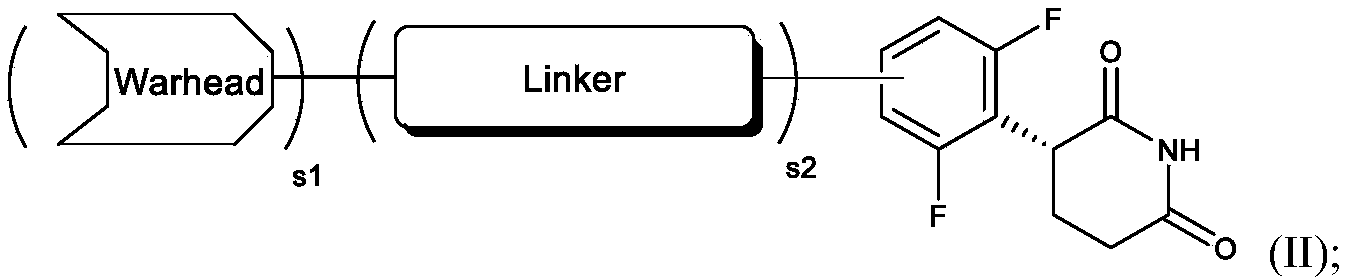 wherein Warhead and Linker are defined as claim 1.
 - The compound of any one of claims 1-8, wherein Linker iswherein *refers to the position attached to the
 moiety, and ** refers to the position attached to the
 moiety;
 L 1 is selected from a single bond, -O-, -SO 2-, -C (O) -, -NR L1a-, -C 3-C 8cycloalkylene-, * L1-O-C 1- 8alkylene-** L1, * L1-C 1-8alkylene-O-** L1, * L1-SO 2-C 1-8alkylene-** L1, * L1-C 1-8alkylene-SO 2-** L1, * L1-CO-C 1-8alkylene-** L1, * L1-C 1-8alkylene-CO-** L1, * L1-NR L1a-C 1-8alkylene-** L1, * L1-C 1-8alkylene-NR L1a-** L1, * L1-NR L1aC (O) -** L1, * L1-C (O) NR L1a-** L1, -C 1-8alkylene-, -C 2-8alkenylene-, -C 2-8alkynylene-, - [O (CR L1aR L1b) m4] m5-,
 wherein each of said -C 3-C 8cycloalkylene-, * L1-O-C 1-8alkylene-** L1, * L1-C 1-8alkylene-O-** L1, * L1-SO 2-C 1-8alkylene-** L1, * L1-C 1-8alkylene-SO 2-** L1, * L1-CO-C 1-8alkylene-** L1, * L1-C 1-8alkylene-CO-** L1, * L1-NR L1a-C 1-8alkylene-** L1, * L1-C 1-8alkylene-NR L1a-** L1, -C 1-8alkylene-, -C 2-8alkenylene-, -C 2- 8alkynylene-,
 is optionally substituted with at least one R L1c;
 wherein * L1 refers to the position attached to themoiety, and ** L1 refers to the position attached to the
 moiety;
 R L1a and R L1b are each independently selected from hydrogen, -C 1-8alkyl, -C 2-8alkenyl, -C 2-8alkynyl, C 3-C 8cycloalkyl, 3-to 8-membered heterocyclyl, C 6-C 12aryl, 5-to 12-membered heteroaryl, each of said -C 1-8alkyl, -C 2-8alkenyl, -C 2-8alkynyl, C 3-C 8cycloalkyl, 3-to 8-membered heterocyclyl, C 6-C 12aryl or 5-to 12-membered heteroaryl is optionally substituted with at least one substituent R L1d;each of said R L1c and R L1d are independently oxo, halogen, hydroxy, -C 1-8alkyl, -C 1-8alkoxy, -C 2- 8alkenyl, -C 2-8alkynyl, C 3-C 8cycloalkyl, 3-to 8-membered heterocyclyl, C 6-C 12aryl or 5-to 12-membered heteroaryl; ortwo R L1c together with the atoms to which they are attached, form a 3-to 12-membered ring, said ring comprising 0-3 heteroatoms independently selected from nitrogen, oxygen or sulfur; said ring is optionally substituted with at least one substituent halogen, hydroxy, or -C 1-8alkyl;L 2 is selected from a single bond, -O-, -SO 2-, -CO-, -NR L2a-, -C 3-C 8cycloalkylene-, * L2-O-C 1- 8alkylene-** L2, * L2-C 1-8alkylene-O-** L2, * L2-SO 2-C 1-8alkylene-** L2, * L2-C 1-8alkylene-SO 2-** L2, * L2-CO-C 1-8alkylene-** L2, * L2-C 1-8alkylene-CO-** L2, * L2-NR L2a-C 1-8alkylene-** L2, * L2-C 1-8alkylene-NR L2a-** L2, * L2-NR L2aC (O) -** L2, * L2-C (O) NR L2a-** L2, -C 1-8alkylene-, -C 2-8alkenylene-, -C 2-8alkynylene-, - [O (CR L2aR L2b) m4] m5-,
 wherein each of said -C 3-C 8cycloalkylene-, * L2-O-C 1-8alkylene-** L2, * L2-C 1-8alkylene-O-** L2, * L2-SO 2-C 1-8alkylene-** L2, * L2-C 1-8alkylene-SO 2-** L2, * L2-CO-C 1-8alkylene-** L2, * L2-C 1-8alkylene-CO-** L2, * L2-NR L2a-C 1-8alkylene-** L2, * L2-C 1-8alkylene-NR L2a-** L2, -C 1-8alkylene-, -C 2-8alkenylene-, -C 2- 8alkynylene-,
 is optionally substituted with at least one substituent R L2c;
 wherein * L2 refers to the position attached tomoiety, and ** L2 refers to the position attached to the
 moiety;
 R L2a and R L2b are each independently selected from hydrogen, -C 1-8alkyl, -C 2-8alkenyl, -C 2-8alkynyl, C 3-C 8cycloalkyl, 3-to 8-membered heterocyclyl, C 6-C 12aryl or 5-to 12-membered heteroaryl, each of said -C 1-8alkyl, -C 2-8alkenyl, -C 2-8alkynyl, C 3-C 8cycloalkyl, 3-to 8-membered heterocyclyl, C 6-C 12aryl or 5-to 12-membered heteroaryl is optionally substituted with at least one substituent R L2d;each of said R L2c and R L2d are independently oxo, halogen, hydroxy, -C 1-8alkyl, -C 1-8alkoxy, -C 2- 8alkenyl, -C 2-8alkynyl, C 3-C 8cycloalkyl, 3-to 8-membered heterocyclyl, C 6-C 12aryl or 5-to 12-membered heteroaryl; ortwo R L2c together with the atoms to which they are attached, form a 3-to 12-membered ring, said ring comprising 0-3 heteroatoms independently selected from nitrogen, oxygen or sulfur; said ring is optionally substituted with at least one substituent halogen, hydroxy, -C 1-8alkyl;L 3 is selected from a single bond, -O-, -SO 2-, -CO-, -NR L3a-, -C 3-C 8cycloalkylene-, * L3-O-C 1- 8alkylene-** L3, * L3-C 1-8alkylene-O-** L3, * L3-SO 2-C 1-8alkylene-** L3, * L3-C 1-8alkylene-SO 2-** L3, * L3-CO-C 1-8alkylene-** L3, * L3-C 1-8alkylene-CO-** L3, * L3-NR L3a-C 1-8alkylene-** L3, * L3-C 1-8alkylene-NR L3a-** L3, * L3-NR L3aC (O) -** L3, * L3-C (O) NR L3a-** L3, -C 1-8alkylene-, -C 2-8alkenylene-, -C 2-8alkynylene-, - [O (CR L3aR L3b) m4] m5-,
 wherein each of said -C 3-C 8cycloalkylene-, * L3-O-C 1-8alkylene-** L3, * L3-C 1-8alkylene-O-** L3, * L3-SO 2-C 1-8alkylene-** L3, * L3-C 1-8alkylene-SO 2-** L3, * L3-CO-C 1-8alkylene-** L3, * L3-C 1-8alkylene-CO-** L3, * L3-NR L3a-C 1-8alkylene-** L3, * L3-C 1-8alkylene-NR L3a-** L3, -C 1-8alkylene-, -C 2-8alkenylene-, -C 2- 8alkynylene-,
 is optionally substituted with at least one substituent R L3c;
 wherein * L3 refers to the position attached tomoiety, and ** L3 refers to the position attached to the
 moiety;
 R L3a and R L3b are each independently selected from hydrogen, -C 1-8alkyl, -C 2-8alkenyl, -C 2-8alkynyl, C 3-C 8cycloalkyl, 3-to 8-membered heterocyclyl, C 6-C 12aryl or 5-to 12-membered heteroaryl, each of said -C 1-8alkyl, -C 2-8alkenyl, -C 2-8alkynyl, C 3-C 8cycloalkyl, 3-to 8-membered heterocyclyl, C 6-C 12aryl or 5-to 12-membered heteroaryl is optionally substituted with at least one substituent R L3d;each of said R L3c and R L3d are independently oxo, halogen, hydroxy, -C 1-8alkyl, -C 1-8alkoxy, -C 2- 8alkenyl, -C 2-8alkynyl, C 3-C 8cycloalkyl, 3-to 8-membered heterocyclyl, C 6-C 12aryl or 5-to 12-membered heteroaryl; ortwo R L3c together with the atoms to which they are attached, form a 3-to 12-membered ring, said ring comprising 0-3 heteroatoms independently selected from nitrogen, oxygen or sulfur; said ring is optionally substituted with at least one substituent halogen, hydroxy, or -C 1-8alkyl;R 12 is independently selected from hydrogen, halogen, -C 1-8alkyl, -NR 12aR 12b, -OR 12a, -C 3-C 8cycloalkyl, 3-to 8-membered heterocyclyl, -C 6-C 12aryl, 5-to 12-membered heteroaryl, oxo, or -CN; each of -C 1-8alkyl, C 3-C 8cycloalkyl, 3-to 8-membered heterocyclyl, C 6-C 12aryl, or 5-to 12-membered heteroaryl is optionally substituted with at least one substituent R 12c; ortwo R 12 together with the carbon atoms to which they are attached, form a 3-to 12-membered ring, said ring comprising 0-3 heteroatoms independently selected from nitrogen, oxygen or sulfur; said ring is optionally substituted with at least one substituent R 12c;R 12a and R 12b are each independently selected from hydrogen, -C 1-8alkyl, -C 2-8alkenyl, -C 2-8alkynyl, -C 3-C 8cycloalkyl, 3-to 8-membered heterocyclyl, -C 6-C 12aryl or 5-to 12-membered heteroaryl, each of said -C 1-8alkyl, -C 2-8alkenyl, -C 2-8alkynyl, C 3-C 8cycloalkyl, 3-to 8-membered heterocyclyl, C 6-C 12aryl or 5-to 12-membered heteroaryl is optionally substituted with at least one substituent R 12d; orR 12c and R 12d are each independently halogen, hydroxy, -C 1-8alkyl, -C 1-8alkoxy, -C 2-8alkenyl, -C 2- 8alkynyl, -C 3-C 8cycloalkyl, 3-to 8-membered heterocyclyl, -C 6-C 12aryl or 5-to 12-membered heteroaryl;X 1, X 2, X 3 and X 4 are each independently selected from -CR a, or N;X 5, X 6 and X 7 are each independently selected from -NR a-, -O-, -S-and -CR aR b-;X 12 and X 13 are each independently selected from -C (O) -, -NR a-and -O-;Q 1, Q 2, Q 3 and Q 4 are each independently selected from CR a or N;Q 5 is each independently selected from -O-, -NR a-, -CR aR b-, -S-or -C (O) -;P 1 is a single bond, -O-, -NR a-, -CR aR b -, -S-, -SO-or -SO 2-;at each occurrence, R a and R b are each independently selected from hydrogen, hydroxy, halogen, CN, -C 1-8alkyl, -C 1-8alkoxy, -C 2-8alkenyl, -C 2-8alkynyl, -C 3-C 8cycloalkyl, 3-to 8-membered heterocyclyl, -C 6-C 12aryl or 5-to 12-membered heteroaryl, each of said -C 1-8alkyl, -C 1-8alkoxy, -C 2-8alkenyl, -C 2- 8alkynyl, -C 3-C 8cycloalkyl, 3-to 8-membered heterocyclyl, -C 6-C 12aryl or 5-to 12-membered heteroaryl is optionally substituted with at least one substituent halogen, hydroxy, halogen, -C 1-8alkyl, -C 1-8alkoxy, -C 2-8alkenyl, -C 2-8alkynyl, -C 3-C 8cycloalkyl, 3-to 8-membered heterocyclyl, -C 6-C 12aryl or 5-to 12-membered heteroaryl; orR a and R b together with the carbon atoms to which they are attached, form a 3-to 12-membered ring, said ring comprising 0-3 heteroatoms independently selected from nitrogen, oxygen or sulfur; said ring is optionally substituted with at least one substituent halogen, hydroxy, -C 1-8alkyl, -C 2-8alkenyl, -C 2-8alkynyl, -C 1-8alkoxy, -C 2-8alkenyl, -C 2-8alkynyl, C 3-C 8cycloalkyl, 3-to 8-membered heterocyclyl, C 6-C 12aryl or 5-to 12-membered heteroaryl;m 1 is 0 or 1;m 2 and m3 is 0, 1, 2, 3, 4, 5, 6, 7 or 8;m 4 and m 5 are each independently 0, 1, 2 or 3;n, n 1, n 2, n 3, n 4 and n 5 are each independently 0, 1, 2 or 3.
 - The compound of claim 9, wherein L 1 is selected from a single bond, -C 1-8alkylene- (preferably -CH 2-, -C 2H 4-, -C 3H 6-) , -CO-, -O-, -N (CH 3) -, -NH-,


- The compound of any one of claims 9-10, wherein X 1 and X 2 are each independently selected from -CR a or N;R a is selected from hydrogen, -F, -Cl, -Br, -I, CN, methyl, ethyl, methoxy, ethoxy, or cyclopropyl, wherein each of said methyl, ethyl, methoxy, ethoxy, and cyclopropyl is optionally substituted with at least one substituent -F, -Cl, -Br, -I, hydroxy, methyl, ethyl (preferably, X 1 and X 2 are each independently selected from CH, C (F) , C (CH 3) or N) ;m 1=1 or 0;R 12 is hydrogen, oxo, methoxymethyl, hydroxymethyl, -CN or -CH 3.
- The compound of any one of claims 9-11, wherein m 1 is 1; preferably,moiety is


 wherein * X refers to the position attached to
 moiety, and ** X refers to the position attached to the
 moiety.
- The compound of any one of claims 9-12, wherein m 1 is 1,moiety is


- The compound of any one of claims 9-13, wherein L 2 is selected from a single bond, -C 1-8alkylene- (preferably -CH 2-, -C 2H 4-, -C 3H 6-) , -CO-, -O-, -N (CH 3) -, -NH-,


- The compound of any one of claims 9-14, wherein L 3 is selected from single bond, -C 1-8alkylene- (preferably -CH 2-, -C 2H 4-, -C 3H 6-) , -CO-, -O-, -N (CH 3) -, -NH-,


- The compound of any one of claims 9-15, wherein L 2 is a single bond; or L 3 is a single bond; or L 2 is a single bond and L 3 is a single bond.
- The compound of any one of claims 9-16, whereinis selected from


- The compound of any one of claims 1-17, wherein Warhead is a moiety which binds to a target protein, wherein said target protein is selected from the group consisting of structural proteins, receptors, enzymes, cell surface proteins, proteins pertinent to the integrated function of a cell, including proteins involved in catalytic activity, aromatase activity, motor activity, helicase activity, metabolic processes (anabolism and catabolism) , antioxidant activity, proteolysis, biosynthesis, proteins with kinase activity, oxidoreductase activity, transferase activity, hydrolase activity, lyase activity, isomerase activity, ligase activity, enzyme regulator activity, signal transducer activity, structural molecule activity, binding activity (protein, lipid carbohydrate) , receptor activity, cell motility, membrane fusion, cell communication, regulation of biological processes, development, cell differentiation, response to stimulus, behavioral proteins, cell adhesion proteins, proteins involved in cell death, proteins involved in transport (including protein transporter activity, nuclear transport, ion transporter activity, channel transporter activity, carrier activity, permease activity, secretion activity, electron transporter activity, pathogenesis, chaperone regulator activity, nucleic acid binding activity, transcription regulator activity, extracellular organization and biogenesis activity and translation regulator activity.
- The compound of any one of claims 1-18, wherein Warhead is a moiety which binds to a target protein, wherein said target protein is selected from the group consisting of ErbB receptors, B7.1 and B7, TINFR1m, TNFR2, NADPH oxidase, Bcl-Bax and other partners in the apotosis pathway, C5a receptor, HMG-CoA reductase, PDE V phosphodiesterase type, PDE IV phosphodiesterase type 4, PDE I, PDEII, PDEIII, squalene cyclase inhibitor, CXCR1, CXCR2, nitric oxide (NO) synthase, cyclo-oxygenase 1, cyclo-oxygenase 2, 5HT receptors, dopamine receptors, G Proteins, i.e., Gq, histamine receptors, 5-lipoxygenase, tryptase serine protease, thymidylate synthase, purine nucleoside phosphorylase, GAPDH trypanosomal, glycogen phosphorylase, Carbonic anhydrase, chemokine receptors, JAW STAT, RXR and similar, HIV 1 protease, HIV 1 integrase, influenza, neuramimidase, hepatitis B reverse transcriptase, sodium channel, multi drug resistance (MDR) , protein P-glycoprotein (and MRP) , tyrosine kinases (including Bruton’s Tyrosine Kinase) , CD23, CD124, tyrosine kinase p561ck, CD4, CD5, IL-2 receptor, IL-1 receptor, TNF-alphaR, ICAM1, Cat+ channels, VCAM, VLA-4 integrin, selectins, CD40/CD40L, newokinins and receptors, inosine monophosphate dehydrogenase, p38 MAP Kinase, RAS-RAF-MEK-ERK pathway, interleukin-1 converting enzyme, caspase, HCV, NS3 protease, HCV NS3 RNA helicase, glycinamide ribonucleotide formyl transferase, rhinovirus 3C protease, herpes simplex virus-1 (HSV-I) , protease, cytomegalovirus (CMV) protease, poly (ADP-ribose) polymerase, cyclin dependent kinases, vascular endothelial growth factor, oxytocin receptor, microsomal transfer protein inhibitor, bile acid transport inhibitor, 5 alpha reductase inhibitors, angiotensin 11, glycine receptor, noradrenaline reuptake receptor, endothelin receptors, neuropeptide Y and receptor, adenosine receptors, adenosine kinase and AMP deaminase, purinergic receptors (P2Y1, P2Y2, P2Y4, P2Y6, P2X 1-7) , farnesyltransferases, geranylgeranyl transferase, TrkA a receptor for NGF, beta-amyloid, tyrosine kinase Flk-IIKDR, vitronectin receptor, integrin receptor, Her-21 neu, telomerase inhibition, cytosolic phospholipaseA2 and EGF receptor tyrosine kinase, ecdysone 20-monooxygenase, ion channel of the GABA gated chloride channel, acetylcholinesterase, voltage-sensitive sodium channel protein, calcium release channel, chloride channels, Acetyl-CoA carboxylase, adenylosuccinate synthetase, protoporphyrinogen oxidase, L-1 receptor associated kinase-3 (IRAK-3 or IRAK-M) or enolpyruvyl-shikimate-phosphate synthase.
- The compound of any one of claims 1-19, wherein Warhead is
 wherein R 13 is selected from -P (O) R 13aR 13b, -SO 2R 13a, -SO 2-NR 13aR 13b or -N (R 13a) -SO 2R 13b;R 13a and R 13b are each independently selected from hydrogen, -C 1-C 8alkyl or C 3-C 8cycloalkyl, said -C 1-C 8alkyl or C 3-C 8cycloalkyl is optionally substituted with at least one halogen;R 14 and R 15 are each independently selected from hydrogen, halogen, -C 1-C 8alkyl, -C 3-C 8cycloalkyl, 3-to 8-membered heterocyclyl, C 6-C 12aryl, 5-to 12-membered heteroaryl, -CN, -OR 14a, -SO 2R 14a, -SO 2NR 14aR 14b, -COR 14a, -CO 2R 14a, -CONR 14aR 14b, -NR 14aR 14b, -NR 14aCOR 14b, -NR 14aCO 2R 14b, or –NR 14aSO 2R 14b; each of -C 1-C 8alkyl, C 3-C 8cycloalkyl, 3-to 8-membered heterocyclyl, C 6-C 12aryl or 5-to 12-membered heteroaryl is optionally substituted with at least one substituent R 14d, orR 14 and R 15 together with the carbon atoms to which they are attached, form a 5 or 6-membered unsaturated or saturated ring, said ring comprising 0-3 heteroatoms independently selected from nitrogen, oxygen or sulfur; said ring is optionally substituted with at least one substituent R 14e;R 14e, at each occurrence, is independently hydrogen, halogen, -C 1-C 8alkyl, -C 1-C 8alkoxy, -C 3-C 8cycloalkyl, 3-to 8-membered heterocyclyl, C 6-C 12aryl, 5-to 12-membered heteroaryl, oxo (=O) , - OR 14a, thioxo (=S) , -SR 14a, -CN, -SO 2R 14a, -SO 2NR 14aR 14b, -COR 14a, -CO 2R 14a, -CONR 14aR 14b, -NR 14aR 14b, -NR 14aCOR 14b, -NR 14aCO 2R 14b or -NR 14aSO 2R 14b; each of -C 1-C 8alkyl, -C 1-C 8alkoxy, C 3-C 8cycloalkyl, 3-to 8-membered heterocyclyl, C 6-C 12aryl or 5-to 12-membered heteroaryl is optionally substituted with at least one substituent R 14d;R 14a and R 14b are each independently selected from hydrogen, -C 1-C 8alkyl, -C 1-C 8haloalkyl, -C 2-C 8alkenyl, -C 2-C 8alkynyl, C 1-C 8alkoxy-C 1-C 8alkyl-, C 3-C 8cycloalkyl, 3-to 8-membered heterocyclyl, C 6-C 12aryl or 5-to 12-membered heteroaryl;R 14d, at each occurrence, is independently halogen, -OH, -CN, oxo, -C 1-C 8alkyl, -C 2-C 8alkenyl, -C 2-C 8alkynyl, -C 3-C 8cycloalkyl, 3-to 8-membered heterocyclyl, -C 6-C 12aryl, or 5-to 12-membered heteroaryl;R 4 is selected from hydrogen, halogen, -C 1-C 8alkyl, -C 2-C 8alkenyl, -C 2-C 8alkynyl, -C 1-C 8alkoxy, -C 3-C 8cycloalkyl, 3-to 8-membered heterocyclyl, -C 6-C 12aryl, 5-to 12-membered heteroaryl, -CN, -SO 2R 4a, -SO 2NR 4aR 4b, -COR 4a, -CO 2R 4a, -CONR 4aR 4b, -NR 4aR 4b, -NR 4aCOR 4b, -NR 4aCO 2R 4b or -NR 4aSO 2R 4b; each of -C 1-C 8alkyl, -C 2-C 8alkenyl, -C 2-C 8alkynyl, -C 1-C 8alkoxy, -C 3-C 8cycloalkyl, 3-to 8-membered heterocyclyl, -C 6-C 12aryl or 5-to 12-membered heteroaryl is optionally substituted with halogen, -C 1-C 8alkyl, -C 2-C 8alkenyl, -C 2-C 8alkynyl, -C 3-C 8cycloalkyl, 3-to 8-membered heterocyclyl, C 6-C 12aryl, 5-to 12-membered heteroaryl, oxo, -CN, -OR 4c, -SO 2R 4c, -SO 2NR 4cR 4d, -COR 4c, -CO 2R 4c, -CONR 4cR 4d, -NR 4cR 4d, -NR 4cCOR 4d, -NR 4cCO 2R 4d or -NR 4cSO 2R 4d;R 4a, R 4b, R 4c and R 4d are each independently hydrogen, -C 1-C 8alkyl, -C 2-C 8alkenyl, -C 2-C 8alkynyl, C 3-C 8cycloalkyl, 3-to 8-membered heterocyclyl, C 6-C 12aryl, or 5-to 12-membered heteroaryl;R 9, R 10 and R 11 are each independently selected from hydrogen, halogen, -C 1-C 8alkyl, -NR 9aR 9b, -OR 9a, -C 3-C 8cycloalkyl, 3-to 8-membered heterocyclyl, -C 6-C 12aryl, 5-to 12-membered heteroaryl, oxo or -CN; each of -C 1-C 8alkyl, C 3-C 8cycloalkyl, 3-to 8-membered heterocyclyl, C 6-C 12aryl or 5-to 12-membered heteroaryl is optionally substituted with at least one substituent R 9c;R 9a and R 9b are each independently selected from hydrogen, -C 1-C 8alkyl, -C 2-C 8alkenyl, -C 2-C 8alkynyl, -C 3-C 8cycloalkyl, 3-to 8-membered heterocyclyl, -C 6-C 12aryl or 5-to 12-membered heteroaryl; each of said -C 1-C 8alkyl, -C 2-C 8alkenyl, -C 2-C 8alkynyl, C 3-C 8cycloalkyl, 3-to 8-membered heterocyclyl, C 6-C 12aryl or 5-to 12-membered heteroaryl is optionally substituted with at least one substituent R 9d; orR 9c and R 9d are each independently halogen, hydroxy, -C 1-C 8alkyl, -C 1-C 8alkoxy, -C 2-C 8alkenyl, -C 2-C 8alkynyl, -C 3-C 8cycloalkyl, 3-to 8-membered heterocyclyl, -C 6-C 12aryl or 5-to 12-membered heteroaryl;Z 4, Z 5, Z 6 and Z 7 are each independently selected from -CR Z4, or N;R Z4, at each occurrence, is independently selected from hydrogen, halogen, -C 1-C 8alkyl, -NR Z4aR Z4b, -OR Z4a, -SR Z4a, C 3-C 8cycloalkyl, 3-to 8-membered heterocyclyl, C 6-C 12aryl, 5-to 12-membered heteroaryl, or CN; each of -C 1-C 8alkyl, C 3-C 8cycloalkyl, 3-to 8-membered heterocyclyl, C 6-C 12aryl, or 5-to 12-membered heteroaryl is optionally substituted with at least one R Z4c;R Z4a and R Z4b are each independently selected from hydrogen, -C 1-C 8alkyl, -C 2-C 8alkenyl, -C 2-C 8alkynyl, C 3-C 8cycloalkyl, 3-to 8-membered heterocyclyl, C 6-C 12aryl, or 5-to 12-membered heteroaryl, each of said -C 1-C 8alkyl, -C 2-C 8alkenyl, -C 2-C 8alkynyl, C 3-C 8cycloalkyl, 3-to 8-membered heterocyclyl, C 6-C 12aryl, or 5-to 12-membered heteroaryl is optionally substituted with at least one substituent R Z4d;R Z4c and R Z4d are each independently halogen, hydroxy, -C 1-C 8alkyl, -C 1-C 8alkoxy, -C 2-C 8alkenyl, -C 2-C 8alkynyl, C 3-C 8cycloalkyl, 3-to 8-membered heterocyclyl, C 6-C 12aryl, or 5-to 12-membered heteroaryl.
 - The compound of claim 20, wherein R 13 is selected from -P (O) R 13aR 13b or -N (R 13a) -SO 2R 13b, wherein R 13a and R 13b are each independently selected from hydrogen, -C 1-C 8alkyl (preferably -CH 3, -C 2H 5, -C 3H 7, -C 4H 9 or -C 5H 11; more preferably -CH 3, -CH 2CH 3, -CH 2CH 2CH 3, -iso-C 3H 7, -CH 2CH 2CH 2CH 3, -iso-C 4H 9, -sec-C 4H 9 or -tert-C 4H 9) or C 3-C 8cycloalkyl (preferably cyclopropyl, cyclobutyl or cyclopentyl) .
- The compound of claim 20, wherein R 13 is selected from -P (O) (CH 3) 2, -NH-SO 2CH 3 or -N (CH 3) -SO 2CH 3.
- The compound of claim 20, wherein R 13 is -P (O) (CH 3) 2.
- The compound of claim 20, wherein R 14 and R 15 are each independently selected from hydrogen, -F, -Cl, -Br, -I, methyl, ethyl, propyl, butyl, pentyl, hexyl, heptyl, octyl, cyclopropyl, cyclobutyl, cyclopentyl, cyclohexyl, cycloheptyl, cyclooctyl, 3-to 8-membered heterocyclyl, C 6-C 12aryl, 5-to 12-membered heteroaryl, -CN, -OR 14a, -SO 2R 14a, -SO 2NR 14aR 14b, -COR 14a, -CO 2R 14a, -CONR 14aR 14b, -NR 14aR 14b, -NR 14aCOR 14b, -NR 14aCO 2R 14b, or –NR 14aSO 2R 14b; each of methyl, ethyl, propyl, butyl, pentyl, hexyl, heptyl, octyl, cyclopropyl, cyclobutyl, cyclopentyl, cyclohexyl, cycloheptyl, cyclooctyl, 3-to 8-membered heterocyclyl, C 6-C 12aryl or 5-to 12-membered heteroaryl is optionally substituted with at least one substituent R 14d, orR 14 and R 15 together with the carbon atoms to which they are attached, form a 5 or 6-membered unsaturated or saturated ring, said ring comprising 0, 1, 2 or 3 heteroatoms independently selected from nitrogen, oxygen or sulfur; said ring is optionally substituted with at least one substituent R 14e;R 14e, at each occurrence, is independently -H, -F, -Cl, -Br, -I, methyl, ethyl, propyl, butyl, pentyl, hexyl, heptyl, octyl, methoxy, ethoxy, propoxy, butoxy, pentoxy, hexoxy, heptyloxy, octyloxy, cyclopropyl, cyclobutyl, cyclopentyl, cyclohexyl, cycloheptyl, cyclooctyl, phenyl, 3-to 8-membered heterocyclyl, 5-to 12-membered heteroaryl, oxo, -CN, CF 3, CHF 2, CH 2F, thioxo, -SCF 3, -SCHF 2, -SCH 2F, -SCH 2CF 3, -SCF 2CH 3, -SCF 2CF 3, -SO 2R 14a, -SO 2NR 14aR 14b, -COR 14a, -CO 2R 14a, -CONR 14aR 14b, -NR 14aR 14b, -NR 14aCOR 14b, -NR 14aCO 2R 14b or -NR 14aSO 2R 14b; each of methyl, ethyl, propyl, butyl, pentyl, hexyl, heptyl, octyl, methoxy, ethoxy, propoxy, butoxy, pentoxy, hexoxy, heptyloxy, octyloxy, cyclopropyl, cyclobutyl, cyclopentyl, cyclohexyl, cycloheptyl, cyclooctyl, phenyl, 3-to 8-membered heterocyclyl, 5-to 12-membered heteroaryl is optionally substituted with at least one substituent R 14d;R 14a and R 14b are each independently selected from hydrogen, methyl, ethyl, propyl, butyl, pentyl, hexyl, heptyl, octyl, methoxy, ethoxy, propoxy, butoxy, pentoxy, hexoxy, heptyloxy, octyloxy, C 1-C 8alkoxy-C 1-C 8alkyl-, cyclopropyl, cyclobutyl, cyclopentyl, cyclohexyl, cycloheptyl, cyclooctyl, 3-to 8-membered heterocyclyl, phenyl or 5-to 12-membered heteroaryl;R 14d, at each occurrence, is independently halogen, -OH, methyl, ethyl, propyl, butyl, pentyl, hexyl, heptyl, octyl, cyclopropyl, cyclobutyl, cyclopentyl, cyclohexyl, cycloheptyl, cyclooctyl, 3-to 8-membered heterocyclyl, phenyl, or 5-to 12-membered heteroaryl.
- The compound of claim 20, wherein R 14 and R 15 together with the carbon atoms to which they are attached, form a 5 or 6-membered unsaturated (preferred aromatic) or saturated ring, said ring comprising 1 or 2 nitrogen heteroatoms; said ring is optionally substituted with at least one substituent -H, -F, -Cl, -Br, -I, methyl, ethyl, propyl (n-or iso-) , butyl, pentyl, methoxy, ethoxy, propoxy, butoxy, pentoxy, cyclopropyl, cyclobutyl, cyclopentyl, cyclohexyl, cycloheptyl, cyclooctyl, -CH 2OH, -SCH 3, -SC 2H 5, oxo, thioxo, -CF 3, -CHF 2, -CH 2F, -SCF 3, -OMe, -OC 2H 5, -CN, -C (O) CH 3,

- The compound of claim 20, wherein R 14 and R 15 together with the carbon atoms to which they are attached, form a 6-membered unsaturated (preferred aromatic) , said ring comprising 1 or 2 nitrogen heteroatoms; said ring is optionally substituted with one substituent -H, -F, -Cl, -Br, -I, methyl, ethyl or cyclopropyl.
- The compound of claim 20, wherein R 4 is hydrogen, -F, -Cl, -Br, -I, methyl, ethyl, propyl, butyl, pentyl, hexyl, heptyl, octyl, cyclopropyl, cyclobutyl, cyclopentyl, cyclohexyl, cycloheptyl, cyclooctyl, -C 2-C 8alkenyl, -C 2-C 8alkynyl or -C 1-C 8alkoxy; each of methyl, ethyl, propyl, butyl, pentyl, hexyl, heptyl, octyl, cyclopropyl, cyclobutyl, cyclopentyl, cyclohexyl, cycloheptyl, cyclooctyl, -C 2-C 8alkenyl or -C 2-C 8alkynyl is optionally substituted with -F, -Cl, -Br, -I, oxo, or -CN.
- The compound of claim 20, wherein R 4 is hydrogen, -F, -Cl, -Br, -I, -CH 3, -CF 3, -CH 2F, or -CHF 2.
- The compound of claim 20, wherein R 4 is hydrogen, -F, -Cl, -Br or -I.
- The compound of claim 20, wherein R 9, R 10 and R 11 are each independently selected from hydrogen, -F, -Cl, -Br, -I, methyl, ethyl, propyl, butyl, pentyl, hexyl, heptyl, octyl, -NR 9aR 9b, -OR 9a, cyclopropyl, cyclobutyl, cyclopentyl, cyclohexyl, cycloheptyl, cyclooctyl, 3-to 8-membered heterocyclyl, phenyl, 5-to 12-membered heteroaryl, oxo, or -CN; each of -methyl, ethyl, propyl, butyl, pentyl, hexyl, heptyl, octyl, cyclopropyl, cyclobutyl, cyclopentyl, cyclohexyl, cycloheptyl, cyclooctyl, 3-to 8-membered heterocyclyl, phenyl or 5-to 12-membered heteroaryl is optionally substituted with at least one substituent R 9c;R 9a and R 9b are each independently selected from hydrogen, methyl, ethyl, propyl, butyl, pentyl, hexyl, heptyl, octyl, cyclopropyl, cyclobutyl, cyclopentyl, cyclohexyl, cycloheptyl, cyclooctyl, 3-to 8-membered heterocyclyl, phenyl or 5-to 12-membered heteroaryl, each of said methyl, ethyl, propyl, butyl, pentyl, hexyl, heptyl, octyl, cyclopropyl, cyclobutyl, cyclopentyl, cyclohexyl, cycloheptyl, cyclooctyl, 3-to 8-membered heterocyclyl, phenyl or 5-to 12-membered heteroaryl is optionally substituted with at least one substituent R 9d;R 9c and R 9d are each independently -F, -Cl, -Br, -I, hydroxy, methyl, ethyl, propyl, butyl, pentyl, hexyl, heptyl, octyl, methoxy, ethoxy, propoxy, butoxy, pentoxy, hexoxy, heptyloxy, octyloxy, cyclopropyl, cyclobutyl, cyclopentyl, cyclohexyl, cycloheptyl, cyclooctyl, 3-to 8-membered heterocyclyl, phenyl or 5-to 12-membered heteroaryl.
- The compound of claim 20, wherein R 9, R 10 and R 11 are each independently selected from hydrogen, -F, -Cl, -Br, -I, methyl, ethyl, propyl, butyl, -NH 2, -NHCH 3, -OH, -OCH 3, -OC 2H 5, cyclopropyl, cyclobutyl, cyclopentyl, cyclohexyl, -CH 2OH, -CH 2OMe, oxo, or -CN.
- The compound of claim 20, wherein R 9, R 10 and R 11 are each independently selected from hydrogen, -CH 3, -F, -Cl, -Br or -I.
- The compound of claim 20, wherein Z 4, Z 5, Z 6 and Z 7 are each independently -CR 4z;R 4Z, at each occurrence, is independently selected from hydrogen, -F, -Cl, -Br, -I, methyl, ethyl, propyl, butyl, pentyl, hexyl, heptyl, octyl, -NR 4ZaR 4Zb, -OR 4Za, -SR 4Za, cyclopropyl, cyclobutyl, cyclopentyl, cyclohexyl, cycloheptyl, cyclooctyl, 3-to 8-membered heterocyclyl, phenyl, 5-to 12-membered heteroaryl, or CN; each of methyl, ethyl, propyl, butyl, pentyl, hexyl, heptyl, octyl, cyclopropyl, cyclobutyl, cyclopentyl, cyclohexyl, cycloheptyl, cyclooctyl, 3-to 8-membered heterocyclyl, phenyl, or 5-to 12-membered heteroaryl is optionally substituted with at least one R 4Zc;R 4Za and R 4Zb are each independently selected from hydrogen, methyl, ethyl, propyl, butyl, pentyl, hexyl, heptyl, octyl, -C 2-C 8alkenyl, -C 2-C 8alkynyl, cyclopropyl, cyclobutyl, cyclopentyl, cyclohexyl, cycloheptyl, cyclooctyl, 3-to 8-membered heterocyclyl, phenyl or 5-to 12-membered heteroaryl, each of said hydrogen, methyl, ethyl, propyl, butyl, pentyl, hexyl, heptyl, octyl, -C 2-C 8alkenyl, -C 2-C 8alkynyl, cyclopropyl, cyclobutyl, cyclopentyl, cyclohexyl, cycloheptyl, cyclooctyl, 3-to 8-membered heterocyclyl, phenyl or 5-to 12-membered heteroaryl is optionally substituted with at least one substituent R 4Zd;R 4Zc and R 4Zd are each independently -F, -Cl, -Br, -I, hydroxy, methyl, ethyl, propyl, butyl, pentyl, hexyl, heptyl, octyl, -C 1-C 8alkoxy, -C 2-C 8alkenyl, -C 2-C 8alkynyl, cyclopropyl, cyclobutyl, cyclopentyl, cyclohexyl, cycloheptyl, cyclooctyl, 3-to 8-membered heterocyclyl, phenyl, or 5-to 12-membered heteroaryl.
- The compound of claim 20, wherein R 4z is selected from H, -CH 3, -C 2H 5, F, -CH 2F, -CHF 2, -CF 3, -OCH 3, -OC 2H 5, -C 3H 7, -OCH 2F, -OCHF 2, -OCH 2CF 3, -OCF 3, -SCF 3, -CF 3, -CH (OH) CH 3,


- The compound of any one of claims 1-19, wherein Warhead is
 whereinis a 5-or 6-membered aromatic ring comprising 0-3 heteroatoms selected from nitrogen, oxygen and sulfur;
 R 101, R 102, R 103, R 104, R 105, R 106 and R 107 are each independently hydrogen, halogen, -C 1-8alkyl, -C 1- 8alkoxy, -C 2-8alkenyl, -C 2-8alkynyl, cycloalkyl, heterocyclyl, aryl, heteroaryl, -CN, -NO 2, -OR 10a, -SO 2R 10a, -COR 10a, -CO 2R 10a, -CONR 10aR 10b, -C (=NR 10a) NR 10bR 10c, -NR 10aR 10b, -NR 10aCOR 10b, -NR 10aCONR 10bR 10c, -NR 10aCO 2R 10b, -NR 10aSONR 10bR 10c, -NR 10aSO 2NR 10bR 10c, or –NR 10aSO 2R 10b, each of said -C 1-8alkyl, -C 2- 8alkenyl, -C 2-8alkynyl, cycloalkyl, heterocyclyl, aryl, or heteroaryl is optionally substituted with halogen, hydroxy, -haloC 1-8alkyl, -C 1-8alkyoxy, cycloalkyl, heterocyclyl, aryl, or heteroaryl;R 109 is 5-or 6-membered aromatic ring comprising 0-3 heteroatoms selected from nitrogen, oxygen and sulfur; said aromatic ring is optionally substituted with halogen, -C 1-8alkyl, -C 2-8alkenyl, -C 2-8alkynyl, -C 1-8alkoxy, cycloalkyl, heterocyclyl, aryl, heteroaryl, -CN, -NO 2, -OR 10a, -SO 2R 10a, -COR 10a, -CO 2R 10a, -CONR 10aR 10b, -C (=NR 10a) NR 10bR 10c, -NR 10aR 10b, -NR 10aCOR 10b, -NR 10aCONR 10bR 10c, -NR 10aCO 2R 10b, -NR 10aSONR 10bR 10c, -NR 10aSO 2NR 10bR 10c, or –NR 10aSO 2R 10b, each of said -C 1-8alkyl, -C 2-8alkenyl, -C 2- 8alkynyl, cycloalkyl, heterocyclyl, aryl, or heteroaryl is optionally substituted with halogen, hydroxy, -haloC 1-8alkyl, -C 1-8alkyoxy, cycloalkyl, heterocyclyl, aryl, or heteroaryl;p1, p2 and p3 are each independently 0, 1, 2, 3 or 4;R 10a, R 10b and R 10c are each independently hydrogen, -C 1-8alkyl, -C 2-8alkenyl, -C 2-8alkynyl, cycloalkyl, heterocyclyl, aryl, or heteroaryl.
 - The compound of claim 35, whereinis


 wherein Z 8, Z 9, Z 10 and Z 11 are each independently selected from CH or N; wherein *cy1 refers to the position attached to themoiety, and **cy1 refers to the position attached to L 1.
- The compound of claim 35, whereinis selected from


- The compound of claim 35, wherein p3 is 0, 1, or 2, and each R 107 is independently selected from halogen, -C 1-8alkyl, or -C 1-8alkoxy, preferably F, Cl, Br, I, CH 3, or -OCH 3.
- The compound of claim 35, wherein R 10a and R 10b are independently selected from hydrogen or CH 3; and n1 is 1 or 2.
- The compound of claim 35, wherein R 101 is methyl, -CH 2OH, -OCH 3, -CH 2OCH 3 or halogen; p1 is 0 or 1, and R 102 is halogen.
- The compound of claim 35, wherein R 103 and R 105 are hydrogen; and R 104 is selected from hydrogen or methyl.
- The compound of claim 35, wherein R 109 isY 101, Y 102, Y 103 and Y 104 are selected from CH, O, S or N; R 111 is selected from hydrogen, halogen, -C 1-8alkyl, -C 1-8alkoxy, -C 2- 8alkenyl, -C 2-8alkynyl, cycloalkyl, heterocyclyl, aryl, heteroaryl, -CN, -NO 2, -OR 10a, -SO 2R 10a, -COR 10a, -CO 2R 10a, -CONR 10aR 10b, -C (=NR 10a) NR 10bR 10c, -NR 10aR 10b, -NR 10aCOR 10b, -NR 10aCONR 10bR 10c, -NR 10aCO 2R 10b, -NR 10aSONR 10bR 10c, -NR 10aSO 2NR 10bR 10c, or –NR 10aSO 2R 10b, each of said -C 1-8alkyl, -C 2- 8alkenyl, -C 2-8alkynyl, cycloalkyl, heterocyclyl, aryl, or heteroaryl is optionally substituted with halogen, hydroxy, -haloC 1-8alkyl, -C 1-8alkyoxy, cycloalkyl, heterocyclyl, aryl, or heteroaryl; R 10a, R 10b, and R 10c are each independently hydrogen, -C 1-8alkyl, -C 2-8alkenyl, -C 2-8alkynyl, cycloalkyl, heterocyclyl, aryl, or heteroaryl; and p6 is 0, 1, 2, 3 or 4.

- The compound of claim 35, wherein Y 101 is CH, S, N or O; Y 102 is CH, O or N; Y 103 is O, S or N; and Y 104 is S, CH or N.
- The compound of any one of claims 1-19, wherein Warhead is
 ring A 201 and B 201 are each independently an aromatic ring comprising 0-3 heteroatoms selected from nitrogen, sulfur and oxygen as ring member (s) ;Z 201, Z 203 and Z 204 are each independently N or CR 20z;L 201 is independently a bond, -C 1-8alkylene-, -N (R 204) -, -O-, -S-, *L201-C 1-8alkylene-O- **L201, *L201-O-C 1-8alkylene- **L201, *L201-N (R 204) CO- **L201, *L201-CON (R 204) - **L201, *L201-N (R 204) CO-C 1-8alkylene- **L201, *L201-CON (R 204) -C 1-8alkylene- **L201, *L201-N (R 204) -C 1-8alkylene- **L201, *L201-C 1-8alkylene-N (R 204) - **L201, -heterocyclene-, or -heteroarylene-, wherein each of said -C 1-8alkylene-, *L201-C 1-8alkylene-O- **L201, *L201-O-C 1-8alkylene- **L201, *L201-N (R 204) CO-C 1-8alkylene- **L201, *L201-CON (R 204) -C 1-8alkylene- **L201, *L201-N (R 204) -C 1-8alkylene- **L201, *L201-C 1-8alkylene-N (R 204) - **L201, -heterocyclene-and -heteroarylene-is optionally substituted with at least one substituent R 20L;wherein * L201 refers to the position attached to ring A, and ** L201 refers to the position attached to ring B;m201, n201 and q201 are each independently 0, 1, 2, 3 or 4;t201 is 0, 1 or 2;R 201, R 202, and R 204 are each independently hydrogen, -C 1-8alkyl, -C 2-8alkenyl, -C 2-8alkynyl, cycloalkyl, heterocyclyl, aryl, or heteroaryl, wherein each of said -C 1-8alkyl, -C 2-8alkenyl, -C 2-8alkynyl, cycloalkyl, heterocyclyl, aryl, or heteroaryl is optionally substituted with halogen, hydroxy, -C 1-8alkyoxy, cycloalkyl, heterocyclyl, aryl, or heteroaryl;R 20L, R 203, R 205 and R 206 are each independently hydrogen, halogen, -C 1-8alkyl, -C 2-8alkenyl, -C 2- 8alkynyl, cycloalkyl, heterocyclyl, aryl, heteroaryl, -CN, -NO 2, -OR 20a, -SO 2R 20a, -COR 20a, -CO 2R 20a, - CONR 20aR 20b, -C (=NR 20a) NR 20bR 20c, -NR 20aR 20b, -NR 20aCOR 20b, -NR 20aCONR 20bR 20c, -NR 20aCO 2R 20b, -NR 20aSONR 20bR 20c, -NR 20aSO 2NR 20bR 20c, or –NR 20aSO 2R 20b, wherein each of said -C 1-8alkyl, -C 2-8alkenyl, -C 2-8alkynyl, cycloalkyl, heterocyclyl, aryl, or heteroaryl is optionally substituted with at least one halogen, hydroxy, -C 1-8alkyl, -C 1-8alkyoxy, cycloalkyl, heterocyclyl, aryl, or heteroaryl;R 20z is selected from hydrogen, halogen, -C 1-8alkyl, -C 2-8alkenyl, -C 2-8alkynyl, cycloalkyl, heterocyclyl, aryl, heteroaryl, -CN, -NO 2, -OR 20a, -SO 2R 20a, -COR 20a, -CO 2R 20a, -CONR 20aR 20b, -C (=NR 20a) NR 20bR 20c, -NR 20aR 20b, -NR 20aCOR 20b, -NR 20aCONR 20bR 20c, -NR 20aCO 2R 20b, -NR 20aSONR 20bR 20c, -NR 20aSO 2NR 20bR 20c, or –NR 20aSO 2R 20b, each of said -C 1-8alkyl, -C 2-8alkenyl, -C 2-8alkynyl, cycloalkyl, heterocyclyl, aryl, or heteroaryl is optionally substituted with at least one halogen, hydroxy, -C 1-8alkyl, -C 1- 8alkyoxy, cycloalkyl, heterocyclyl, aryl, or heteroaryl;R 20a, R 20b, and R 20c are each independently hydrogen, -C 1-8alkyl, -C 2-8alkenyl, -C 2-8alkynyl, cycloalkyl, heterocyclyl, aryl, or heteroaryl;or two R 20L, together with the atom (s) to which they are attached, form a 3-to 12-membered ring, said ring comprising 0, 1 or 2 additional heteroatoms independently selected from nitrogen, oxygen or optionally oxidized sulfur as ring member (s) , said ring is optionally substituted with at least one substituent independently selected from halogen, -C 1-8alkyl, -C 2-8alkenyl, -C 2-8alkynyl, cycloalkyl, heterocyclyl, aryl, heteroaryl, oxo, -CN, -NO 2, -OR 203f, -SO 2R 203f, -SO 2NR 203fR 203g, -COR 203f, -CO 2R 203f, -CONR 203fR 203g, -C (=NR 203f) NR 203gR 203h, -NR 203fR 203g, -NR 203fCOR 203g, -NR 203fCONR 203gR 203h, -NR 203fCO 2R 203f, -NR 203fSONR 203fR 203g, -NR 203fSO 2NR 203gR 203h, or –NR 203fSO 2R 203g, each of said -C 1-8alkyl, -C 2-8alkenyl, -C 2- 8alkynyl, cycloalkyl, heterocyclyl, aryl, or heteroaryl is optionally substituted with at least one substituent selected from halogen, -C 1-8alkyl, -OR 203i, -NR 203iR 203j, cycloalkyl, heterocyclyl, aryl, or heteroaryl;or two R 203, together with the atoms to which they are attached, form a 3-to 12-membered ring, said ring comprising 0, 1 or 2 additional heteroatoms independently selected from nitrogen, oxygen or optionally oxidized sulfur as ring member (s) , said ring is optionally substituted with at least one substituent independently selected from halogen, -C 1-8alkyl, -C 2-8alkenyl, -C 2-8alkynyl, cycloalkyl, heterocyclyl, aryl, heteroaryl, oxo, -CN, -NO 2, -OR 203f, -SO 2R 203f, -SO 2NR 203fR 203g, -COR 203f, -CO 2R 203f, -CONR 203fR 203g, -C (=NR 203f) NR 203gR 203h, -NR 203fR 203g, -NR 203fCOR 203g, -NR 203fCONR 203gR 203h, -NR 203fCO 2R 203f, -NR 203fSONR 203fR 203g, -NR 203fSO 2NR 203gR 203h, or –NR 203fSO 2R 203g, each of said -C 1-8alkyl, -C 2-8alkenyl, -C 2- 8alkynyl, cycloalkyl, heterocyclyl, aryl, or heteroaryl is optionally substituted with at least one substituent selected from halogen, -C 1-8alkyl, -OR 203i, -NR 203iR 203j, cycloalkyl, heterocyclyl, aryl, or heteroaryl;or R 4 and one of R 3, together with the atoms to which they are attached, form a 3-to 12-membered ring, said ring comprising 0, 1 or 2 additional heteroatoms independently selected from nitrogen, oxygen or optionally oxidized sulfur as ring member (s) , said ring is optionally substituted with at least one substituent independently selected from halogen, -C 1-8alkyl, -C 2-8alkenyl, -C 2-8alkynyl, cycloalkyl, heterocyclyl, aryl, heteroaryl, oxo, -CN, -NO 2, -OR 203f, -SO 2R 203f, -SO 2NR 203fR 203g, -COR 203f, -CO 2R 203f, -CONR 203fR 203g, -C (=NR 203f) NR 203gR 203h, -NR 203fR 203g, -NR 203fCOR 203g, -NR 203fCONR 203gR 203h, -NR 203fCO 2R 203f, -NR 203fSONR 203fR 203g, -NR 203fSO 2NR 203gR 203h, or –NR 203fSO 2R 203g, each of said -C 1-8alkyl, -C 2-8alkenyl, -C 2-8alkynyl, cycloalkyl, heterocyclyl, aryl, or heteroaryl is optionally substituted with at least one substituent selected from halogen, -C 1-8alkyl, -OR 203i, -NR 203iR 203j, cycloalkyl, heterocyclyl, aryl, or heteroaryl;R 203f, R 203g, R 203h, R 203i, and R 203j are each independently hydrogen, -C 1-8alkyl, C 1-8alkoxy-C 1-8alkyl-, -C 2-8alkenyl, -C 2-8alkynyl, cycloalkyl, heterocyclyl, aryl, or heteroaryl.
 - The compound according to any one of Claims 44, wherein L 201 is a bond, -CH 2-, -C 2H 4-, -C 3H 6-, -C 4H 8-, -C 5H 10-, -O-, -NH-, *L201-NHCH 2- **L201, *L201-NHC 2H 4- **L201, *L201-NHC 3H 6- **L201, *L201-NHC 4H 8- **L201, *L201-NHC 5H 10- **L201, *L201-OCH 2- **L201, *L201-OC 2H 4- **L201, *L201-OC 3H 6- **L201, *L201-OC 4H 8- **L201, *L201-OC 5H 10- **L201, *L201-CH 2O- **L201, *L201-C 2H 4O- **L201, *L201-C 3H 6O- **L201, *L201-C 4H 8O- **L201, *L201-C 5H 10O- **L201, *L201-CONH- **L201, *L201-NHCO- **L201, *L201-CONHCH 2- **L201, *L201-CONHC 2H 4- **L201, *L201-CONHC 3H 6- **L201, *L201-CONHC 4H 8- **L201, *L201-CONHC 5H 10- **L201, 3-to 8-membered -heterocyclene-or 5-to 6-membered -heteroarylene-; wherein each of said -CH 2-, -C 2H 4-, -C 3H 6-, -C 4H 8-, -C 5H 10-, -O-, -NH-, *L201-NHCH 2- **L201, *L201-NHC 2H 4- **L201, *L201-NHC 3H 6- **L201, *L201-NHC 4H 8- **L201, *L201-NHC 5H 10- **L201, *L201-OCH 2- **L201, *L201-OC 2H 4- **L201, *L201-OC 3H 6- **L201, *L201-OC 4H 8- **L201, *L201-OC 5H 10- **L201, *L201-CH 2O- **L201, *L201-C 2H 4O- **L201, *L201-C 3H 6O- **L201, *L201-C 4H 8O- **L201, *L201-C 5H 10O- **L201, *L201-CONH- **L201, *L201-NHCO- **L201, *L201-CONHCH 2- **L201, *L201-CONHC 2H 4- **L201, *L201-CONHC 3H 6- **L201, *L201-CONHC 4H 8- **L201, *L201-CONHC 5H 10- **L201, 3-to 8-membered heterocyclene-and 5-to 6-membered heteroarylene-is optionally substituted with at least one substituent R 20L; wherein R 20L is defined as above.
- The compound according to Claim 44, wherein L 201 is a bond, -O-, *L201-OCH 2- **L201, *L201-CH 2O- **L201, -NH-, *L201-CONH- **L201, *L201-NHCO- **L201, *L201-CONHCH 2- **L201, *L201-CONHCH 2CH 2- **L201, *L201-CONHCH 2CH 2CH 2- **L201, *L201-CONHCH (CH 3) - **L201, *L201-CONHCH (C 2H 5) - **L201, *L201-NHCH 2- **L201, *L201-NHCH 2CH 2- **L201, *L201-NHCH 2CH 2CH 2- **L201, *L201-NHCH (CH 3) - **L201 or *L-NHCH (C 2H 5) - **L.
- The compound according to Claim 44, wherein L 201 is *L201-N (R 204) CO- **L201,R 203 and R 204, together with the atoms to which they are attached, form a 5-, 6-or 7-membered ring, said ring comprising 0, 1 or 2 additional heteroatoms independently selected from nitrogen, oxygen or optionally oxidized sulfur as ring member (s) , said ring is optionally substituted with at least one substituent independently selected from -F, -Cl, -Br, -I, -CH 3, -C 2H 5, -C 3H 7, -C 4H 9, -C 5H 11, cycloalkyl, heterocyclyl, aryl, heteroaryl, or oxo.
- The compound according to Claim 44, whereinmoiety is


 wherein Z 205, Z 206, Z 207, Z 208, Z 209, Z 206’, Z 207’, Z 208’ and Z 209’ are each independently N or C (H) ; Z 210 is N (H) , O or S.
- The compound according to Claim 44, wherein ring A201 is a 5-to 6-membered aromatic ring comprising 0-3 heteroatoms selected from nitrogen, sulfur and oxygen as ring member (s) .
- The compound according to Claim 44, wherein ring A201 is phenyl, naphthalenyl, quinoxalinyl, pyridinyl, pyridazinyl, pyrimidinyl, imidazolyl, thiazolyl, oxazolyl, oxadiazole, pyridyl, pyrazinyl, pyridazinyl, pyrrolyl, imidazolyl, pyrazolyl, triazolyl, furanyl, pyrimidinyl, pyrazinyl, pyrrolopyridinyl or dihydropyrrolopyrazinyl.
- The compound according to Claim 44, wherein themoiety is


- The compound according to Claim 44, wherein R 203 is hydrogen, oxo, -F, -Cl, -Br, -I, -CH 3, -C 2H 5, -C 3H 7, -C 4H 9, -C 5H 11, -OCH 3, -OC 2H 5, -OC 3H 7, -OC 4H 9, -OC 5H 11, cyclopropyl, cyclobutyl, cyclopentyl, tetrahydropyrrolyl or phenyl, wherein each of said -CH 3, -C 2H 5, -C 3H 7, -C 4H 9, -C 5H 11, -OCH 3, -OC 2H 5, -OC 3H 7, -OC 4H 9, -OC 5H 11, cyclopropyl, cyclobutyl, cyclopentyl, tetrahydropyrrolyl or phenyl, is optionally substituted with at least one -F, -Cl, -Br, -I, -CH 3, -C 2H 5, -C 3H 7, -C 4H 9, -C 5H 11, -OCH 3, -OC 2H 5, -OC 3H 7, -OC 4H 9, -OC 5H 11, -OH, cyclopropyl, cyclobutyl or cyclopentyl.
- The compound according to Claim 44, wherein R 203 is hydrogen, oxo, -F, -Cl, -Br, -I, methyl, ethyl, n-propyl, iso-propyl, n-butyl, iso-butyl, sec-butyl, tert-butyl, trifluoromethyl, difluoromethyl, fluoromethyl, -OMe, -OEt, -OPr, -OBu, cyclopropyl, cyclobutyl, tetrahydropyrrolyl or phenyl.
- The compound according to Claim 44, wherein two R 203, together with the atoms to which they are attached, form a 4-, 5-, 6-, 7-or 8-membered ring, said ring comprising 0, 1 or 2 additional heteroatoms independently selected from nitrogen, oxygen or optionally oxidized sulfur as ring member (s) , said ring is optionally substituted with at least one substituent independently selected from -F, -Cl, -Br, -I, -CH 3, -C 2H 5, -C 3H 7, -C 4H 9, -C 5H 11, -OCH 3, -OC 2H 5, -OC 3H 7, -OC 4H 9, -OC 5H 11, -OH, -CN, cyclopropyl, cyclobutyl or cyclopentyl.
- The compound according to Claim 44, wherein themoiety is


- The compound according to Claim 44, wherein themoiety is
 wherein Z 205, Z 206, Z 207 and Z 208 are defined as above.
- The compound according to Claim 44, wherein themoiety is


- The compound according to Claim 44, wherein ring B201 is phenyl, pyridinyl, imidazolyl, thiazolyl, oxazolyl, pyridyl, pyrimidinyl, pyrazinyl, pyridazinyl, pyrrolyl, imidazolyl, pyrazolyl, thiazolyl, oxazolyl, triazolyl, thiophenyl, furanyl, pyrimidinyl or pyrazinyl, each of which is optionally substituted with (R 206) q201.
- The compound according to Claim 44, wherein R 206 is hydrogen, -F, -Cl, -Br, -I, -CH 3, -C 2H 5, -C 3H 7, -C 4H 9, -C 5H 11, -CN, -OCH 3, -OC 2H 5, -OC 3H 7, -OC 4H 9 or -OC 5H 11, wherein each of said -CH 3, -C 2H 5, -C 3H 7, -C 4H 9, -C 5H 11, -OCH 3, -OC 2H 5, -OC 3H 7, -OC 4H 9 or -OC 5H 11 is optionally substituted with -F, -Cl, -Br, -I, hydroxy, -C 1-8alkyoxy, cycloalkyl, heterocyclyl, aryl, or heteroaryl.
- The compound according to Claim 44, wherein themoiety is


- The compound according to Claim 44, wherein R 201 and R 202 are each independently hydrogen, -CH 3, -C 2H 5, -C 3H 7, -C 4H 9, -C 5H 11, -C 2-8alkenyl, -C 2-8alkynyl or aryl.
- The compound according to Claim 44, wherein R 201 and R 202 are both H.
- The compound according to any one of Claims 1-27, wherein R 205 is independently hydrogen, -F, -Cl, -Br, -I, -CH 3, -C 2H 5, -C 3H 7, -C 4H 9, -C 5H 11, -C 2-8alkenyl, -C 2-8alkynyl or aryl.
- The compound according to Claim 44, wherein R 20z is hydrogen, -F, -Cl, -Br, -I, -CH 3, -C 2H 5, -C 3H 7, -C 4H 9 or -C 5H 11.
- The compound according to any one of Claims 44 to 64, wherein themoiety is


- The compound of any one of claims 1-19, wherein Warhead is
 wherein:Cy302 is a 5-or 6-membered saturated ring or unsaturated ring (preferably aromatic ring) comprising 0-3 heteroatoms selected from nitrogen, oxygen and sulfur as ring member (s) ;each of occurrence, R 301, R 302, R 303, R 304 and R 308 are each independently hydrogen, halogen, -C 1-8alkyl, -C 1-8alkoxy, -C 2-8alkenyl, -C 2-8alkynyl, cycloalkyl, heterocyclyl, aryl, heteroaryl, oxo (=O) , -CN, -NO 2, -OR 30c, -SO 2R 30c, -COR 30c, -CO 2R 30c, -CONR 30cR 30d, -C (=NR 30c) NR 30dR 30e, -NR 30cR 30d, -NR 30cCOR 30d, -NR 30cCONR 30dR 30e, -NR 30cCO 2R 30d, -NR 30cSONR 30dR 30e, -NR 30cSO 2NR 30dR 30e, or –NR 30cSO 2R 30d, each of said -C 1-8alkyl, -C 2-8alkenyl, -C 2-8alkynyl, cycloalkyl, heterocyclyl, aryl, or heteroaryl is optionally substituted with halogen, hydroxy, -haloC 1-8alkyl, -C 1-8alkyoxy, cycloalkyl, heterocyclyl, aryl, or heteroaryl;R 306 and R 307 are each independently hydrogen, -C 1-8alkyl, -C 2-8alkenyl, -C 2-8alkynyl, cycloalkyl, heterocyclyl, aryl or heteroaryl, each of said -C 1-8alkyl, -C 2-8alkenyl, -C 2-8alkynyl, cycloalkyl, heterocyclyl, aryl, or heteroaryl is optionally substituted with halogen, hydroxy, -haloC 1-8alkyl, -C 1-8alkyoxy, cycloalkyl, heterocyclyl, aryl, or heteroaryl;R 305 is 5-or 6-membered aromatic ring comprising 0-3 heteroatoms selected from nitrogen, oxygen and sulfur as ring member (s) ; said aromatic ring is optionally substituted with halogen, -C 1-8alkyl, -C 2- 8alkenyl, -C 2-8alkynyl, -C 1-8alkoxy, cycloalkyl, heterocyclyl, aryl, heteroaryl, -CN, -NO 2, -OR 30c, -SO 2R 30c, -COR 30c, -CO 2R 30c, -CONR 30cR 30d, -C (=NR 30c) NR 30dR 30e, -NR 30cR 30d, -NR 30cCOR 30d, -NR 30cCONR 30dR 30e, -NR 30cCO 2R 30d, -NR 30cSONR 30dR 30e, -NR 30cSO 2NR 30dR 30e, or –NR 30cSO 2R 30d, each of said -C 1-8alkyl, -C 2- 8alkenyl, -C 2-8alkynyl, cycloalkyl, heterocyclyl, aryl, or heteroaryl is optionally substituted with -C 1-8alkyl, halogen, hydroxy, -haloC 1-8alkyl, -C 1-8alkyoxy, cycloalkyl, heterocyclyl, aryl, or heteroaryl;p301 and p302 are each independently 0, 1, 2, 3 or 4;R 30c, R 30d and R 30e are each independently hydrogen, -C 1-8alkyl, -C 2-8alkenyl, -C 2-8alkynyl, cycloalkyl, heterocyclyl, aryl, or heteroaryl; or(R 30c and R 30d) or (R 30d and R 30e) together with the atom (s) to which they are attached, form a 3-to 12-membered ring, said ring comprising 0, 1 or 2 additional heteroatoms independently selected from nitrogen, oxygen or optionally oxidized sulfur as ring member (s) , said ring is optionally substituted with at least one substituent independently selected from halogen, -C 1-8alkyl, -C 2-8alkenyl, -C 2-8alkynyl, cycloalkyl, heterocyclyl, aryl, heteroaryl, oxo, -CN or -NO 2.
 - The compound of Claim 66, whereinR 301 is hydrogen, F, Cl, Br, I, methyl, ethyl, propyl, butyl, pentyl, hexyl, heptyl, octyl, methoxy, ethoxy, propoxy, butoxy, pentoxy, hexoxy, heptoxy, octoxy, -C 2-8alkenyl, -C 2-8alkynyl, cyclopropyl, cyclobutyl, cyclopentyl, cyclohexyl, cycloheptyl, cyclooctyl, heterocyclyl, aryl, heteroaryl, -CN, -NO 2, -OR 30c, -SO 2R 30c, -COR 30c, -CO 2R 30c, -CONR 30cR 30d, -C (=NR 30c) NR 30dR 30e, -NR 30cR 30d, -NR 30cCOR 30d, -NR 30cCONR 30dR 30e, -NR 30cCO 2R 30d, -NR 30cSONR 30dR 30e, -NR 30cSO 2NR 30dR 30e, or –NR 30cSO 2R 30d, each of said methyl, ethyl, propyl, butyl, pentyl, hexyl, heptyl, octyl, methoxy, ethoxy, propoxy, butoxy, pentoxy, hexoxy, heptoxy, octoxy, -C 2-8alkenyl, -C 2-8alkynyl, cyclopropyl, cyclobutyl, cyclopentyl, cyclohexyl, cycloheptyl, cyclooctyl, heterocyclyl, aryl or heteroaryl is optionally substituted with F, Cl, Br, I, hydroxy, -haloC 1-8alkyl, -methoxy, ethoxy, propoxy, butoxy, pentoxy, hexoxy, heptoxy, octoxy, cyclopropyl, cyclobutyl, cyclopentyl, cyclohexyl, cycloheptyl, cyclooctyl, heterocyclyl, aryl, or heteroaryl;R 30c, R 30d and R 30e are each independently hydrogen, methyl, ethyl, propyl, butyl, pentyl, hexyl, heptyl, octyl, -C 2-8alkenyl, -C 2-8alkynyl, cyclopropyl, cyclobutyl, cyclopentyl, cyclohexyl, cycloheptyl, cyclooctyl, heterocyclyl, aryl, or heteroaryl; or(R 30c and R 30d) or (R 30d and R 30e) together with the atom (s) to which they are attached, form a 3-, 4-, 5-, 6-, 7-or 8-membered ring, said ring comprising 0, 1 or 2 additional heteroatoms independently selected from nitrogen, oxygen or optionally oxidized sulfur as ring member (s) , said ring is optionally substituted with at least one substituent independently selected from halogen, -C 1-8alkyl, -C 2-8alkenyl, -C 2-8alkynyl, cycloalkyl, heterocyclyl, aryl, heteroaryl, oxo, -CN or -NO 2.
- The compound of any claim of Claims 66-67, wherein R 301 is hydrogen, F, Cl, Br, I, methyl, ethyl, propyl, butyl, pentyl, hexyl, heptyl, octyl, methoxy, ethoxy, propoxy, butoxy, pentoxy, hexoxy, heptoxy, octoxy, -C 2-8alkenyl, -C 2-8alkynyl, cyclopropyl, cyclobutyl, cyclopentyl, cyclohexyl, cycloheptyl, cyclooctyl, heterocyclyl, aryl, heteroaryl, -CN or -NO 2; preferably R1 is hydrogen, F, Cl, Br, I, methyl, ethyl, propyl, butyl, cyclopropyl, cyclobutyl.
- The compound of any claim of Claims 66-68, whereinR 302 is hydrogen, F, Cl, Br, I, methyl, ethyl, propyl, butyl, pentyl, hexyl, heptyl, octyl, methoxy, ethoxy, propoxy, butoxy, pentoxy, hexoxy, heptoxy, octoxy, -C 2-8alkenyl, -C 2-8alkynyl, cyclopropyl, cyclobutyl, cyclopentyl, cyclohexyl, cycloheptyl, cyclooctyl, heterocyclyl, aryl, heteroaryl, -CN, -NO 2, -OR 30c, -SO 2R 30c, -COR 30c, -CO 2R 30c, -CONR 30cR 30d, -C (=NR 30c) NR 30dR 30e, -NR 30cR 30d, -NR 30cCOR 30d, -NR 30cCONR 30dR 30e, -NR 30cCO 2R 30d, -NR 30cSONR 30dR 30e, -NR 30cSO 2NR 30dR 30e, or –NR 30cSO 2R 30d, each of said methyl, ethyl, propyl, butyl, pentyl, hexyl, heptyl, octyl, methoxy, ethoxy, propoxy, butoxy, pentoxy, hexoxy, heptoxy, octoxy, -C 2-8alkenyl, -C 2-8alkynyl, cyclopropyl, cyclobutyl, cyclopentyl, cyclohexyl, cycloheptyl, cyclooctyl, heterocyclyl, aryl or heteroaryl is optionally substituted with F, Cl, Br, I, hydroxy, -haloC 1-8alkyl, -methoxy, ethoxy, propoxy, butoxy, pentoxy, hexoxy, heptoxy, octoxy, cyclopropyl, cyclobutyl, cyclopentyl, cyclohexyl, cycloheptyl, cyclooctyl, heterocyclyl, aryl, or heteroaryl;R 30c, R 30d and R 30e are each independently hydrogen, methyl, ethyl, propyl, butyl, pentyl, hexyl, heptyl, octyl, -C 2-8alkenyl, -C 2-8alkynyl, cyclopropyl, cyclobutyl, cyclopentyl, cyclohexyl, cycloheptyl, cyclooctyl, heterocyclyl, aryl, or heteroaryl; or(R 30c and R 30d) or (R 30d and R 30e) together with the atom (s) to which they are attached, form a 3-, 4-, 5-, 6-, 7-or 8-membered ring, said ring comprising 0, 1 or 2 additional heteroatoms independently selected from nitrogen, oxygen or optionally oxidized sulfur as ring member (s) , said ring is optionally substituted with at least one substituent independently selected from halogen, -C 1-8alkyl, -C 2-8alkenyl, -C 2-8alkynyl, cycloalkyl, heterocyclyl, aryl, heteroaryl, oxo, -CN or -NO 2.
- The compound of any claim of Claims 66-69, wherein R 302 is hydrogen, F, Cl, Br, I, methyl, ethyl, propyl, butyl, pentyl, hexyl, heptyl, octyl, methoxy, ethoxy, propoxy, butoxy, pentoxy, hexoxy, heptoxy, octoxy, -C 2-8alkenyl, -C 2-8alkynyl, cyclopropyl, cyclobutyl, cyclopentyl, cyclohexyl, cycloheptyl, cyclooctyl, heterocyclyl, aryl, heteroaryl, -CN or -NO 2; preferably R 302 is hydrogen, F, Cl, Br, I, methyl, ethyl, propyl, butyl, methoxy, ethoxy, propoxy, butoxy, cyclopropyl, cyclobutyl, cyclopentyl, -CN or -NO 2.
- The compound of any claim of Claims 66-70, whereinR 303 and R 304 are each independently hydrogen, F, Cl, Br, I, methyl, ethyl, propyl, butyl, pentyl, hexyl, heptyl, octyl, methoxy, ethoxy, propoxy, butoxy, pentoxy, hexoxy, heptoxy, octoxy, -C 2-8alkenyl, -C 2- 8alkynyl, cyclopropyl, cyclobutyl, cyclopentyl, cyclohexyl, cycloheptyl, cyclooctyl, heterocyclyl, aryl, heteroaryl, -CN, -NO 2, -OR 30c, -SO 2R 30c, -COR 30c, -CO 2R 30c, -CONR 30cR 30d, -C (=NR 30c) NR 30dR 30e, -NR 30cR 30d, -NR 30cCOR 30d, -NR 30cCONR 30dR 30e, -NR 30cCO 2R 30d, -NR 30cSONR 30dR 30e, -NR 30cSO 2NR 30dR 30e, or –NR 30cSO 2R 30d, each of said methyl, ethyl, propyl, butyl, pentyl, hexyl, heptyl, octyl, methoxy, ethoxy, propoxy, butoxy, pentoxy, hexoxy, heptoxy, octoxy, -C 2-8alkenyl, -C 2-8alkynyl, cyclopropyl, cyclobutyl, cyclopentyl, cyclohexyl, cycloheptyl, cyclooctyl, heterocyclyl, aryl or heteroaryl is optionally substituted with F, Cl, Br, I, hydroxy, -haloC 1-8alkyl, -methoxy, ethoxy, propoxy, butoxy, pentoxy, hexoxy, heptoxy, octoxy, cyclopropyl, cyclobutyl, cyclopentyl, cyclohexyl, cycloheptyl, cyclooctyl, heterocyclyl, aryl, or heteroaryl;R 30c, R 30d and R 30e are each independently hydrogen, methyl, ethyl, propyl, butyl, pentyl, hexyl, heptyl, octyl, -C 2-8alkenyl, -C 2-8alkynyl, cyclopropyl, cyclobutyl, cyclopentyl, cyclohexyl, cycloheptyl, cyclooctyl, heterocyclyl, aryl, or heteroaryl; or(R 30c and R 30d) or (R 30d and R 30e) together with the atom (s) to which they are attached, form a 3-, 4-, 5-, 6-, 7-or 8-membered ring, said ring comprising 0, 1 or 2 additional heteroatoms independently selected from nitrogen, oxygen or optionally oxidized sulfur as ring member (s) , said ring is optionally substituted with at least one substituent independently selected from halogen, -C 1-8alkyl, -C 2-8alkenyl, -C 2-8alkynyl, cycloalkyl, heterocyclyl, aryl, heteroaryl, oxo, -CN or -NO 2.
- The compound of any claim of Claims 66-71, wherein R 303 and R 304 are each independently hydrogen, F, Cl, Br, I, methyl, ethyl, propyl, butyl, pentyl, hexyl, heptyl, octyl, methoxy, ethoxy, propoxy, cyclopropyl, cyclobutyl, cyclopentyl, cyclohexyl, cycloheptyl, cyclooctyl, heterocyclyl, aryl, heteroaryl or -CN; preferably R 303 and R 304 are each independently hydrogen, methyl, ethyl, propyl, butyl, cyclopropyl, cyclobutyl or cyclopentyl.
- The compound of any claim of Claims 66-72, wherein themoiety is

 wherein *303 refers to the position attached to the
 moiety, and **303 refers to the position attached to
 moiety.
- The compound of any claim of Claims 66-73, wherein R 306 and R 307 are each independently hydrogen, methyl, ethyl, propyl, butyl, pentyl, hexyl, heptyl, octyl, -C 2-8alkenyl, -C 2-8alkynyl, cyclopropyl, cyclobutyl, cyclopentyl, cyclohexyl, cycloheptyl, cyclooctyl, heterocyclyl, aryl or heteroaryl, each of said methyl, ethyl, propyl, butyl, pentyl, hexyl, heptyl, octyl, -C 2-8alkenyl, -C 2-8alkynyl, cyclopropyl, cyclobutyl, cyclopentyl, cyclohexyl, cycloheptyl, cyclooctyl, heterocyclyl, aryl or heteroaryl is optionally substituted with F, Cl, Br, I, hydroxy, -haloC 1-8alkyl, methoxy, ethoxy, propoxy, butoxy, pentoxy, hexoxy, heptoxy, octoxy, cyclopropyl, cyclobutyl, cyclopentyl, cyclohexyl, cycloheptyl, cyclooctyl, heterocyclyl, aryl or heteroaryl; preferably, R 306 and R 307 are each independently H, methyl, ethyl, propyl butyl, pentyl, hexyl, cyclopropyl, cyclobutyl, cyclopentyl or cyclohexyl.
- The compound of any claim of Claims 66-74, wherein R 305 isY 301, Y 302, Y 303 and Y 304 are each independently selected from CH, O, S or N; R 315 is each independently selected from hydrogen, halogen, -C 1-8alkyl, -C 1-8alkoxy, -C 2-8alkenyl, -C 2-8alkynyl, cycloalkyl, heterocyclyl, aryl, heteroaryl, -CN, -NO 2, -OR 30c, -SO 2R 30c, -COR 30c, -CO 2R 30c, -CONR 30cR 30d, -C (=NR 30c) NR 30dR 30e, -NR 30cR 30d, -NR 30cCOR 30d, -NR 30cCONR 30dR 30e, -NR 30cCO 2R 30d, -NR 30cSONR 30dR 30e, -NR 30cSO 2NR 30dR 30e, or –NR 30cSO 2R 30d, each of said -C 1-8alkyl, -C 1-8alkoxy, -C 2-8alkenyl, -C 2-8alkynyl, cycloalkyl, heterocyclyl, aryl, or heteroaryl is optionally substituted with halogen, hydroxy, -haloC 1-8alkyl, -C 1-8alkyoxy, cycloalkyl, heterocyclyl, aryl, or heteroaryl; R 30c, R 30d, and R 30e are each independently defined as in claim 66; and p307 is 0, 1, 2, 3 or 4.

- The compound of Claim 75, wherein Y 301 is CH, S, N or O; Y 302 is CH, S, O or N; Y 303 is CH, O, S or N; and Y 304 is CH, O, S or N.
- The compound of Claim 75, whereinis selected from


- The compound according to Claim 75, wherein, R 315 is selected from -H, -F, -Cl, -Br, -I, -CH 3, -C 2H 5, -C 3H 7, -C 4H 9, -C 5H 11, -C 6H 13, methoxy, ethoxy, propoxy, butoxy, pentoxy, hexoxy, cyclopropyl, cyclobutyl, cyclopentyl, cyclohexyl, -C 2-8alkenyl, -C 2-8alkynyl, -CH 2OH, -CH 2CH 2OH, -CH (OH) CH 3, -CH 2CH 2CH 2OH, -CH (OH) CH 2CH 3, -CH 2CH (OH) CH 3, -CH 2OCH 3, -CFH 2, -CF 2H, -CF 3, -CH 2CF 3, -CH 2CH 2CF 3, each of said -CH 3, -C 2H 5, -C 3H 7, -C 4H 9, -C 5H 11, -C 6H 13, methoxy, ethoxy, propoxy, butoxy, pentoxy, hexoxy, cyclopropyl, cyclobutyl, cyclopentyl, cyclohexyl, -C 2-8alkenyl, -C 2-8alkynyl is optionally substituted with at least one F, Cl, Br, I, hydroxy, -haloC 1-8alkyl, -C 1-8alkyoxy, cycloalkyl, heterocyclyl, aryl, or heteroaryl.
- The compound according to Claim 75, wherein, R 315 is selected from


- The compound of any claim of Claims 66-79, wherein themoiety is


- The compound of any claim of Claims 66-80, wherein Cy302 is a 5-or 6-membered aromatic ring comprising 0-3 heteroatoms selected from nitrogen, oxygen and sulfur as ring member (s) .
- The compound of any claim of Claims 66-81, whereinis


 Y 301, Y 302, Y 303 and Y 304 are each independently defined as in claim 66;wherein *Cy302 refers to the position attached to -N (R 307) -in themoiety, and **Cy302 refers to the position attached to
 moiety.
- The compound of any claim of Claims 66-82, whereinis


- The compound of any claim of Claims 66-83, whereinR 308 is hydrogen, F, Cl, Br, I, methyl, ethyl, propyl, butyl, pentyl, hexyl, heptyl, octyl, methoxy, ethoxy, propoxy, butoxy, pentoxy, hexoxy, heptoxy, octoxy, -C 2-8alkenyl, -C 2-8alkynyl, cyclopropyl, cyclobutyl, cyclopentyl, cyclohexyl, cycloheptyl, cyclooctyl, heterocyclyl, aryl, heteroaryl, -CN, -NO 2, -OR 30c, -SO 2R 30c, -COR 30c, -CO 2R 30c, -CONR 30cR 30d, -C (=NR 30c) NR 30dR 30e, -NR 30cR 30d, -NR 30cCOR 30d, -NR 30cCONR 30dR 30e, -NR 30cCO 2R 30d, -NR 30cSONR 30dR 30e, -NR 30cSO 2NR 30dR 30e, or –NR 30cSO 2R 30d, each of said methyl, ethyl, propyl, butyl, pentyl, hexyl, heptyl, octyl, methoxy, ethoxy, propoxy, butoxy, pentoxy, hexoxy, heptoxy, octoxy, -C 2-8alkenyl, -C 2-8alkynyl, cyclopropyl, cyclobutyl, cyclopentyl, cyclohexyl, cycloheptyl, cyclooctyl, heterocyclyl, aryl or heteroaryl is optionally substituted with F, Cl, Br, I, hydroxy, -haloC 1-8alkyl, -methoxy, ethoxy, propoxy, butoxy, pentoxy, hexoxy, heptoxy, octoxy, cyclopropyl, cyclobutyl, cyclopentyl, cyclohexyl, cycloheptyl, cyclooctyl, heterocyclyl, aryl, or heteroaryl;R 30c, R 30d and R 30e are each independently hydrogen, methyl, ethyl, propyl, butyl, pentyl, hexyl, heptyl, octyl, -C 2-8alkenyl, -C 2-8alkynyl, cyclopropyl, cyclobutyl, cyclopentyl, cyclohexyl, cycloheptyl, cyclooctyl, heterocyclyl, aryl, or heteroaryl; or(R 30c and R 30d) or (R 30d and R 30e) together with the atom (s) to which they are attached, form a 3-, 4-, 5-, 6-, 7-or 8-membered ring, said ring comprising 0, 1 or 2 additional heteroatoms independently selected from nitrogen, oxygen or optionally oxidized sulfur as ring member (s) , said ring is optionally substituted with at least one substituent independently selected from halogen, -C 1-8alkyl, -C 2-8alkenyl, -C 2-8alkynyl, cycloalkyl, heterocyclyl, aryl, heteroaryl, oxo, -CN or -NO 2.
- The compound of any claim of Claims 66-84, wherein R 308 is hydrogen, F, Cl, Br, I, methyl, ethyl, propyl, butyl, pentyl, hexyl, heptyl, octyl, methoxy, ethoxy, propoxy, butoxy, pentoxy, hexoxy, heptoxy, octoxy, -C 2-8alkenyl, -C 2-8alkynyl, cyclopropyl, cyclobutyl, cyclopentyl, cyclohexyl, cycloheptyl, cyclooctyl, heterocyclyl, aryl, heteroaryl, -CN or -NO 2; preferably R2 is hydrogen, F, Cl, Br, I, methyl, ethyl, propyl, butyl, methoxy, ethoxy, propoxy, butoxy, cyclopropyl, cyclobutyl, cyclopentyl, -CN or -NO 2.
- The compound of any claim of Claims 66-85, whereinis


- The compound of any claim of claims 66-85, wherein themoiety is selected from


- A pharmaceutical composition comprising a compound of any one of Claims 1-87 or a pharmaceutically acceptable salt, tautomer or prodrug thereof, together with a pharmaceutically acceptable excipient.
- A method of treating a disease that can be treated by degrading the target protein that the Warhead can combine.
- The method of claim 89, wherein said target protein is selected from the group consisting of structural proteins, receptors, enzymes, cell surface proteins, proteins pertinent to the integrated function of a cell, including proteins involved in catalytic activity, aromatase activity, motor activity, helicase activity, metabolic processes (anabolism and catabolism) , antioxidant activity, proteolysis, biosynthesis, proteins with kinase activity, oxidoreductase activity, transferase activity, hydrolase activity, lyase activity, isomerase activity, ligase activity, enzyme regulator activity, signal transducer activity, structural molecule activity, binding activity (protein, lipid carbohydrate) , receptor activity, cell motility, membrane fusion, cell communication, regulation of biological processes, development, cell differentiation, response to stimulus, behavioral proteins, cell adhesion proteins, proteins involved in cell death, proteins involved in transport (including protein transporter activity, nuclear transport, ion transporter activity, channel transporter activity, carrier activity, permease activity, secretion activity, electron transporter activity, pathogenesis, chaperone regulator activity, nucleic acid binding activity, transcription regulator activity, extracellular organization and biogenesis activity and translation regulator activity.
- The method of claim 89, wherein Warhead is a moiety which binds to a target protein, wherein said target protein is selected from the group consisting of ErbB receptors, B7.1 and B7, TINFR1m, TNFR2, NADPH oxidase, Bcl-Bax and other partners in the apotosis pathway, C5a receptor, HMG-CoA reductase, PDE V phosphodiesterase type, PDE IV phosphodiesterase type 4, PDE I, PDEII, PDEIII, squalene cyclase inhibitor, CXCR1, CXCR2, nitric oxide (NO) synthase, cyclo-oxygenase 1, cyclo-oxygenase 2, 5HT receptors, dopamine receptors, G Proteins, i.e., Gq, histamine receptors, 5-lipoxygenase, tryptase serine protease, thymidylate synthase, purine nucleoside phosphorylase, GAPDH trypanosomal, glycogen phosphorylase, Carbonic anhydrase, chemokine receptors, JAW STAT, RXR and similar, HIV 1 protease, HIV 1 integrase, influenza, neuramimidase, hepatitis B reverse transcriptase, sodium channel, multi drug resistance (MDR) , protein P-glycoprotein (and MRP) , tyrosine kinases (including Bruton’s Tyrosine Kinase) , CD23, CD124, tyrosine kinase p561ck, CD4, CD5, IL-2 receptor, IL-1 receptor, TNF-alphaR, ICAM1, Cat+ channels, VCAM, VLA-4 integrin, selectins, CD40/CD40L, newokinins and receptors, inosine monophosphate dehydrogenase, p38 MAP Kinase, RAS-RAF-MEK-ERK pathway, interleukin-1 converting enzyme, caspase, HCV, NS3 protease, HCV NS3 RNA helicase, glycinamide ribonucleotide formyl transferase, rhinovirus 3C protease, herpes simplex virus-1 (HSV-I) , protease, cytomegalovirus (CMV) protease, poly (ADP-ribose) polymerase, cyclin dependent kinases, vascular endothelial growth factor, oxytocin receptor, microsomal transfer protein inhibitor, bile acid transport inhibitor, 5 alpha reductase inhibitors, angiotensin 11, glycine receptor, noradrenaline reuptake receptor, endothelin receptors, neuropeptide Y and receptor, adenosine receptors, adenosine kinase and AMP deaminase, purinergic receptors (P2Y1, P2Y2, P2Y4, P2Y6, P2X 1-7) , farnesyltransferases, geranylgeranyl transferase, TrkA a receptor for NGF, beta-amyloid, tyrosine kinase Flk-IIKDR, vitronectin receptor, integrin receptor, Her-21 neu, telomerase inhibition, cytosolic phospholipaseA2 and EGF receptor tyrosine kinase, ecdysone 20-monooxygenase, ion channel of the GABA gated chloride channel, acetylcholinesterase, voltage-sensitive sodium channel protein, calcium release channel, chloride channels, Acetyl-CoA carboxylase, adenylosuccinate synthetase, protoporphyrinogen oxidase, L-1 receptor associated kinase-3 (IRAK-3 or IRAK-M) or enolpyruvyl-shikimate-phosphate synthase.
- The method of claim 89, wherein the disease is cancer.
- A compound of Formula (I) :
 or a pharmaceutically acceptable salt thereof, or a deuterated analog thereof, or a prodrug thereof, wherein:Warhead, Linker, s2, Z 1, Z 2, Z 3, R 1 and R 2 are as defined as any preceding claims;s1 is 0.
 - A method of binding and altering the specificity of cereblon complex to induce the degradation of a complex-associated protein by using the compound of Claim 93, wherein the protein is selected from ErbB receptors, B7.1 and B7, TINFR1m, TNFR2, NADPH oxidase, Bcl-Bax and other partners in the apotosis pathway, C5a receptor, HMG-CoA reductase, PDE V phosphodiesterase type, PDE IV phosphodiesterase type 4, PDE I, PDEII, PDEIII, squalene cyclase inhibitor, CXCR1, CXCR2, nitric oxide (NO) synthase, cyclo-oxygenase 1, cyclo-oxygenase 2, 5HT receptors, dopamine receptors, G Proteins, i.e., Gq, histamine receptors, 5-lipoxygenase, tryptase serine protease, thymidylate synthase, purine nucleoside phosphorylase, GAPDH trypanosomal, glycogen phosphorylase, Carbonic anhydrase, chemokine receptors, JAW STAT, RXR and similar, HIV 1 protease, HIV 1 integrase, influenza, neuramimidase, hepatitis B reverse transcriptase, sodium channel, multi drug resistance (MDR) , protein P-glycoprotein (and MRP) , tyrosine kinases (including Bruton’s Tyrosine Kinase) , CD23, CD124, tyrosine kinase p561ck, CD4, CD5, IL-2 receptor, IL-1 receptor, TNF-alphaR, ICAM1, Cat+ channels, VCAM, VLA-4 integrin, selectins, CD40/CD40L, newokinins and receptors, inosine monophosphate dehydrogenase, p38 MAP Kinase, RAS-RAF-MEK-ERK pathway, interleukin-1 converting enzyme, caspase, HCV, NS3 protease, HCV NS3 RNA helicase, glycinamide ribonucleotide formyl transferase, rhinovirus 3C protease, herpes simplex virus-1 (HSV-I) , protease, cytomegalovirus (CMV) protease, poly (ADP-ribose) polymerase, cyclin dependent kinases, vascular endothelial growth factor, oxytocin receptor, microsomal transfer protein inhibitor, bile acid transport inhibitor, 5 alpha reductase inhibitors, angiotensin 11, glycine receptor, noradrenaline reuptake receptor, endothelin receptors, neuropeptide Y and receptor, adenosine receptors, adenosine kinase and AMP deaminase, purinergic receptors (P2Y1, P2Y2, P2Y4, P2Y6, P2X 1-7) , farnesyltransferases, geranylgeranyl transferase, TrkA a receptor for NGF, beta-amyloid, tyrosine kinase Flk-IIKDR, vitronectin receptor, integrin receptor, Her-21 neu, telomerase inhibition, cytosolic phospholipaseA2 and EGF receptor tyrosine kinase, ecdysone 20-monooxygenase, ion channel of the GABA gated chloride channel, acetylcholinesterase, voltage-sensitive sodium channel protein, calcium release channel, chloride channels, Acetyl-CoA carboxylase, adenylosuccinate synthetase, protoporphyrinogen oxidase, L-1 receptor associated kinase-3 (IRAK-3 or IRAK-M) , enolpyruvyl-shikimate-phosphate synthase or neo-substrates (like IKZF1, IKZF3, and CK1a) .
- A method of treating an CRBN-mediated disorder, disease, or condition in a patient comprising administering to said patient the pharmaceutical composition of claim 93, preferably, the disorder disease, or condition is selected from proliferative disorders, neurological disorders and disorder associated with transplantation.
Priority Applications (11)
| Application Number | Priority Date | Filing Date | Title |
|---|---|---|---|
| IL309528A IL309528A (en) | 2021-06-21 | 2022-06-21 | (r) -glutarimide crbn ligands and methods of use |
| KR1020237044030A KR20240025529A (en) | 2021-06-21 | 2022-06-21 | (R)-Glutarimide CRBN Ligand and Methods of Use |
| AU2022300033A AU2022300033A1 (en) | 2021-06-21 | 2022-06-21 | (r) -glutarimide crbn ligands and methods of use |
| EP22827545.9A EP4359403A4 (en) | 2021-06-21 | 2022-06-21 | (R)-GLUTARIMIDE-CRBN LIGANDS AND METHODS OF USE |
| CA3224739A CA3224739A1 (en) | 2021-06-21 | 2022-06-21 | (r)-glutarimide crbn ligands and methods of use |
| CN202280044443.3A CN117616021A (en) | 2021-06-21 | 2022-06-21 | (R)-Glutarimide CRBN ligand and methods of use |
| JP2023577943A JP2024525181A (en) | 2021-06-21 | 2022-06-21 | (R)-Glutarimide CRBN Ligands and Methods of Use |
| CN202410607844.6A CN118791426A (en) | 2021-06-21 | 2022-06-21 | (R)-Glutarimide CRBN ligands and methods of use |
| MX2024000082A MX2024000082A (en) | 2021-06-21 | 2022-06-21 | (r) -glutarimide crbn ligands and methods of use. |
| CONC2023/0017812A CO2023017812A2 (en) | 2021-06-21 | 2023-12-19 | (r)-glutarimide crbn ligands and methods of use |
| US18/391,154 US20240207267A1 (en) | 2021-06-21 | 2023-12-20 | (R)-Glutarimide CRBN Ligands and Methods of Use |
Applications Claiming Priority (4)
| Application Number | Priority Date | Filing Date | Title |
|---|---|---|---|
| CN2021101281 | 2021-06-21 | ||
| CNPCT/CN2021/101281 | 2021-06-21 | ||
| CN2021142802 | 2021-12-30 | ||
| CNPCT/CN2021/142802 | 2021-12-30 |
Related Child Applications (1)
| Application Number | Title | Priority Date | Filing Date |
|---|---|---|---|
| US18/391,154 Continuation US20240207267A1 (en) | 2021-06-21 | 2023-12-20 | (R)-Glutarimide CRBN Ligands and Methods of Use |
Publications (2)
| Publication Number | Publication Date |
|---|---|
| WO2022268052A1 true WO2022268052A1 (en) | 2022-12-29 |
| WO2022268052A9 WO2022268052A9 (en) | 2023-08-17 |
Family
ID=84544952
Family Applications (1)
| Application Number | Title | Priority Date | Filing Date |
|---|---|---|---|
| PCT/CN2022/100017 Ceased WO2022268052A1 (en) | 2021-06-21 | 2022-06-21 | (r) -glutarimide crbn ligands and methods of use |
Country Status (12)
| Country | Link |
|---|---|
| US (1) | US20240207267A1 (en) |
| EP (1) | EP4359403A4 (en) |
| JP (1) | JP2024525181A (en) |
| KR (1) | KR20240025529A (en) |
| CN (2) | CN118791426A (en) |
| AU (1) | AU2022300033A1 (en) |
| CA (1) | CA3224739A1 (en) |
| CO (1) | CO2023017812A2 (en) |
| IL (1) | IL309528A (en) |
| MX (1) | MX2024000082A (en) |
| TW (1) | TW202317558A (en) |
| WO (1) | WO2022268052A1 (en) |
Cited By (5)
| Publication number | Priority date | Publication date | Assignee | Title |
|---|---|---|---|---|
| WO2023125908A1 (en) * | 2021-12-30 | 2023-07-06 | Beigene, Ltd. | Degradation of bruton's tyrosine kinase (btk) by conjugation of btk inhibitors with e3 ligase ligand and methods of use |
| US12097261B2 (en) | 2021-05-07 | 2024-09-24 | Kymera Therapeutics, Inc. | CDK2 degraders and uses thereof |
| US12172992B2 (en) | 2022-03-22 | 2024-12-24 | Abbvie Inc. | Pyrimidines for degrading Bruton's tyrosine kinase |
| WO2025101854A1 (en) * | 2023-11-09 | 2025-05-15 | University Of Kentucky Research Foundation | Opioid compounds |
| US12459920B2 (en) | 2023-07-25 | 2025-11-04 | Monte Rosa Therapeutics Ag | Targeted protein degradation |
Families Citing this family (1)
| Publication number | Priority date | Publication date | Assignee | Title |
|---|---|---|---|---|
| WO2026021570A1 (en) * | 2024-07-26 | 2026-01-29 | Ascentage Pharma (Suzhou) Co., Ltd. | Btk degrader and use thereof |
Citations (14)
| Publication number | Priority date | Publication date | Assignee | Title |
|---|---|---|---|---|
| WO2007026720A1 (en) * | 2005-08-31 | 2007-03-08 | Taisho Pharmaceutical Co., Ltd. | Ring-fused pyrazole derivative |
| CN104884458A (en) * | 2013-04-25 | 2015-09-02 | 百济神州有限公司 | Fused heterocyclic compounds as protein kinase inhibitors |
| CN106459002A (en) * | 2013-12-11 | 2017-02-22 | 比奥根Ma公司 | Biaryl compounds useful in the treatment of human oncological, neurological and immunological diseases |
| CN109422733A (en) * | 2017-09-03 | 2019-03-05 | 上海美志医药科技有限公司 | One kind inhibits and the compound for the tyrosine protein kinase ALK that degrades |
| CN109641874A (en) * | 2016-05-10 | 2019-04-16 | C4医药公司 | C for target protein degradation3The glutarimide degron body of carbon connection |
| WO2019113071A1 (en) * | 2017-12-05 | 2019-06-13 | Icahn School Of Medicine At Mount Sinai | Compositions and methods for treating alk-mediated cancer |
| WO2021018018A1 (en) * | 2019-07-26 | 2021-02-04 | Beigene, Ltd. | Degradation of bruton's tyrosine kinase (btk) by conjugation of btk inidbitors with e3 ligase ligand and methods of use |
| WO2021036922A1 (en) * | 2019-08-23 | 2021-03-04 | 北京泰德制药股份有限公司 | Compound inhibiting and inducing degradation of egfr and alk |
| WO2021058017A1 (en) * | 2019-09-29 | 2021-04-01 | Beigene, Ltd. | Degradation of androgen receptor (ar) by conjugation of ar antagonists with e3 ligase ligand and methods of use |
| WO2021180103A1 (en) * | 2020-03-11 | 2021-09-16 | Beigene, Ltd. | Degradation of bruton's tyrosine kinase (btk) by conjugation of btk inhibitors with e3 ligase ligand and methods of use |
| WO2021219070A1 (en) * | 2020-04-30 | 2021-11-04 | Beigene, Ltd. | Degradation of bruton's tyrosine kinase (btk) by conjugation of btk inhibitors with e3 ligase ligand and methods of use |
| WO2022012622A1 (en) * | 2020-07-16 | 2022-01-20 | Beigene, Ltd. | Degradation of (egfr) by conjugation of egfr inhibitors with e3 ligase ligand and methods of use |
| WO2022012623A1 (en) * | 2020-07-16 | 2022-01-20 | Beigene, Ltd. | Degradation of (egfr) by conjugation of egfr inhibitors with e3 ligase ligand and methods of use |
| WO2022068849A1 (en) * | 2020-09-30 | 2022-04-07 | Beigene, Ltd. | Bifunctional compounds for degradation of egfr and related methods of use |
Family Cites Families (1)
| Publication number | Priority date | Publication date | Assignee | Title |
|---|---|---|---|---|
| PH12020550034B1 (en) * | 2017-07-19 | 2024-05-22 | Chia Tai Tianqing Pharmaceutical Group Co Ltd | Aryl-phosphorus-oxygen compound as egfr kinase inhibitor |
-
2022
- 2022-06-21 IL IL309528A patent/IL309528A/en unknown
- 2022-06-21 EP EP22827545.9A patent/EP4359403A4/en active Pending
- 2022-06-21 TW TW111122979A patent/TW202317558A/en unknown
- 2022-06-21 AU AU2022300033A patent/AU2022300033A1/en active Pending
- 2022-06-21 CN CN202410607844.6A patent/CN118791426A/en active Pending
- 2022-06-21 JP JP2023577943A patent/JP2024525181A/en active Pending
- 2022-06-21 WO PCT/CN2022/100017 patent/WO2022268052A1/en not_active Ceased
- 2022-06-21 KR KR1020237044030A patent/KR20240025529A/en active Pending
- 2022-06-21 MX MX2024000082A patent/MX2024000082A/en unknown
- 2022-06-21 CA CA3224739A patent/CA3224739A1/en active Pending
- 2022-06-21 CN CN202280044443.3A patent/CN117616021A/en active Pending
-
2023
- 2023-12-19 CO CONC2023/0017812A patent/CO2023017812A2/en unknown
- 2023-12-20 US US18/391,154 patent/US20240207267A1/en active Pending
Patent Citations (14)
| Publication number | Priority date | Publication date | Assignee | Title |
|---|---|---|---|---|
| WO2007026720A1 (en) * | 2005-08-31 | 2007-03-08 | Taisho Pharmaceutical Co., Ltd. | Ring-fused pyrazole derivative |
| CN104884458A (en) * | 2013-04-25 | 2015-09-02 | 百济神州有限公司 | Fused heterocyclic compounds as protein kinase inhibitors |
| CN106459002A (en) * | 2013-12-11 | 2017-02-22 | 比奥根Ma公司 | Biaryl compounds useful in the treatment of human oncological, neurological and immunological diseases |
| CN109641874A (en) * | 2016-05-10 | 2019-04-16 | C4医药公司 | C for target protein degradation3The glutarimide degron body of carbon connection |
| CN109422733A (en) * | 2017-09-03 | 2019-03-05 | 上海美志医药科技有限公司 | One kind inhibits and the compound for the tyrosine protein kinase ALK that degrades |
| WO2019113071A1 (en) * | 2017-12-05 | 2019-06-13 | Icahn School Of Medicine At Mount Sinai | Compositions and methods for treating alk-mediated cancer |
| WO2021018018A1 (en) * | 2019-07-26 | 2021-02-04 | Beigene, Ltd. | Degradation of bruton's tyrosine kinase (btk) by conjugation of btk inidbitors with e3 ligase ligand and methods of use |
| WO2021036922A1 (en) * | 2019-08-23 | 2021-03-04 | 北京泰德制药股份有限公司 | Compound inhibiting and inducing degradation of egfr and alk |
| WO2021058017A1 (en) * | 2019-09-29 | 2021-04-01 | Beigene, Ltd. | Degradation of androgen receptor (ar) by conjugation of ar antagonists with e3 ligase ligand and methods of use |
| WO2021180103A1 (en) * | 2020-03-11 | 2021-09-16 | Beigene, Ltd. | Degradation of bruton's tyrosine kinase (btk) by conjugation of btk inhibitors with e3 ligase ligand and methods of use |
| WO2021219070A1 (en) * | 2020-04-30 | 2021-11-04 | Beigene, Ltd. | Degradation of bruton's tyrosine kinase (btk) by conjugation of btk inhibitors with e3 ligase ligand and methods of use |
| WO2022012622A1 (en) * | 2020-07-16 | 2022-01-20 | Beigene, Ltd. | Degradation of (egfr) by conjugation of egfr inhibitors with e3 ligase ligand and methods of use |
| WO2022012623A1 (en) * | 2020-07-16 | 2022-01-20 | Beigene, Ltd. | Degradation of (egfr) by conjugation of egfr inhibitors with e3 ligase ligand and methods of use |
| WO2022068849A1 (en) * | 2020-09-30 | 2022-04-07 | Beigene, Ltd. | Bifunctional compounds for degradation of egfr and related methods of use |
Non-Patent Citations (1)
| Title |
|---|
| See also references of EP4359403A4 * |
Cited By (7)
| Publication number | Priority date | Publication date | Assignee | Title |
|---|---|---|---|---|
| US12097261B2 (en) | 2021-05-07 | 2024-09-24 | Kymera Therapeutics, Inc. | CDK2 degraders and uses thereof |
| WO2023125908A1 (en) * | 2021-12-30 | 2023-07-06 | Beigene, Ltd. | Degradation of bruton's tyrosine kinase (btk) by conjugation of btk inhibitors with e3 ligase ligand and methods of use |
| EP4457225A4 (en) * | 2021-12-30 | 2025-09-24 | Beigene Switzerland Gmbh | Degradation of Bruton's tyrosine kinase (BTK) by conjugation of BTK inhibitors with E3 ligase ligand and methods of use |
| US12521440B2 (en) | 2021-12-30 | 2026-01-13 | Beone Medicines I Gmbh | Degradation of bruton's tyrosine kinase (BTK) by conjugation of BTK inhibitors with E3 ligase ligand and methods of use |
| US12172992B2 (en) | 2022-03-22 | 2024-12-24 | Abbvie Inc. | Pyrimidines for degrading Bruton's tyrosine kinase |
| US12459920B2 (en) | 2023-07-25 | 2025-11-04 | Monte Rosa Therapeutics Ag | Targeted protein degradation |
| WO2025101854A1 (en) * | 2023-11-09 | 2025-05-15 | University Of Kentucky Research Foundation | Opioid compounds |
Also Published As
| Publication number | Publication date |
|---|---|
| TW202317558A (en) | 2023-05-01 |
| CN117616021A (en) | 2024-02-27 |
| MX2024000082A (en) | 2024-03-05 |
| AU2022300033A1 (en) | 2024-01-18 |
| EP4359403A1 (en) | 2024-05-01 |
| CA3224739A1 (en) | 2022-12-29 |
| EP4359403A4 (en) | 2025-10-22 |
| IL309528A (en) | 2024-02-01 |
| CN118791426A (en) | 2024-10-18 |
| CO2023017812A2 (en) | 2024-03-07 |
| US20240207267A1 (en) | 2024-06-27 |
| WO2022268052A9 (en) | 2023-08-17 |
| KR20240025529A (en) | 2024-02-27 |
| JP2024525181A (en) | 2024-07-10 |
Similar Documents
| Publication | Publication Date | Title |
|---|---|---|
| WO2022268052A1 (en) | (r) -glutarimide crbn ligands and methods of use | |
| WO2022171123A1 (en) | Egfr degraders and methods of use | |
| WO2022174031A1 (en) | Cdk inhibitors and methods of use thereof | |
| CN101883764B (en) | Pyrazole derivatives and use thereof as inhibitors of cyclin dependent kinases | |
| WO2022012623A1 (en) | Degradation of (egfr) by conjugation of egfr inhibitors with e3 ligase ligand and methods of use | |
| WO2022068849A1 (en) | Bifunctional compounds for degradation of egfr and related methods of use | |
| WO2019034009A1 (en) | Btk INHIBITORS WITH IMPROVED DUAL SELECTIVITY | |
| US20240131167A1 (en) | EGFR Degraders and Associated Methods of Use | |
| JP2017527606A (en) | Tricyclic derivatives | |
| WO2024099395A1 (en) | Compounds for the degradation of egfr kinase | |
| US20250000854A1 (en) | 4-(Aminomethyl)-6-(1-Methyl-1H-Pyrazol-4-YL)Isoquinolin-1(2H)-One Derivatives as MTA-Cooperative Inhibitors of PRMT5 | |
| US20230373960A1 (en) | Indoline compounds and derivatives as egfr inhibitors | |
| WO2023138607A1 (en) | Degradation of (egfr) by conjugation of egfr inhibitors with e3 ligase ligand and methods of use | |
| EP4720068A1 (en) | Compounds for the degradation of egfr kinase | |
| US20250136586A1 (en) | Substituted 7-(Pyrimidin-4-yl)Quinolin-4(1H)-One Compounds as Cyclin Dependent Kinase Inhibitors | |
| WO2024099402A1 (en) | Intermediates and process of compounds for the degradation of egfr kinase | |
| WO2024099400A1 (en) | Intermediates and process of compounds for the degradation of egfr kinase | |
| EP4720071A1 (en) | Compounds for the degradation of egfr kinase | |
| WO2022227032A1 (en) | Egfr degraders and associated methods of use | |
| HK40108258A (en) | (r)-glutarimide crbn ligands and methods of use | |
| WO2025126115A1 (en) | Degradation of irak4 by conjugation of irak4 inhibitors with e3 ligase ligands and methods of use | |
| WO2025078995A1 (en) | Substituted 6-(pyrimidin-4-yl)quinoline compounds as cyclin dependent kinase inhibitors |
Legal Events
| Date | Code | Title | Description |
|---|---|---|---|
| 121 | Ep: the epo has been informed by wipo that ep was designated in this application |
Ref document number: 22827545 Country of ref document: EP Kind code of ref document: A1 |
|
| ENP | Entry into the national phase |
Ref document number: 2023577943 Country of ref document: JP Kind code of ref document: A |
|
| WWE | Wipo information: entry into national phase |
Ref document number: 2022300033 Country of ref document: AU Ref document number: 806760 Country of ref document: NZ Ref document number: AU2022300033 Country of ref document: AU |
|
| ENP | Entry into the national phase |
Ref document number: 3224739 Country of ref document: CA |
|
| WWE | Wipo information: entry into national phase |
Ref document number: NC2023/0017812 Country of ref document: CO Ref document number: 12023553470 Country of ref document: PH Ref document number: 202393322 Country of ref document: EA Ref document number: P6003295/2023 Country of ref document: AE Ref document number: 309528 Country of ref document: IL Ref document number: 2301008291 Country of ref document: TH |
|
| WWE | Wipo information: entry into national phase |
Ref document number: 202317087771 Country of ref document: IN Ref document number: 202280044443.3 Country of ref document: CN |
|
| REG | Reference to national code |
Ref country code: BR Ref legal event code: B01A Ref document number: 112023026740 Country of ref document: BR |
|
| WWE | Wipo information: entry into national phase |
Ref document number: MX/A/2024/000082 Country of ref document: MX |
|
| ENP | Entry into the national phase |
Ref document number: 2022300033 Country of ref document: AU Date of ref document: 20220621 Kind code of ref document: A |
|
| WWE | Wipo information: entry into national phase |
Ref document number: 2022827545 Country of ref document: EP |
|
| NENP | Non-entry into the national phase |
Ref country code: DE |
|
| WWE | Wipo information: entry into national phase |
Ref document number: 523451999 Country of ref document: SA |
|
| ENP | Entry into the national phase |
Ref document number: 2022827545 Country of ref document: EP Effective date: 20240122 |
|
| WWP | Wipo information: published in national office |
Ref document number: NC2023/0017812 Country of ref document: CO |
|
| WWE | Wipo information: entry into national phase |
Ref document number: 523451999 Country of ref document: SA |
|
| ENP | Entry into the national phase |
Ref document number: 112023026740 Country of ref document: BR Kind code of ref document: A2 Effective date: 20231218 |
|
| WWE | Wipo information: entry into national phase |
Ref document number: 523451999 Country of ref document: SA |
|
| WWE | Wipo information: entry into national phase |
Ref document number: 523451999 Country of ref document: SA |