WO2023002704A1 - 芳香族化合物の製造方法 - Google Patents
芳香族化合物の製造方法 Download PDFInfo
- Publication number
- WO2023002704A1 WO2023002704A1 PCT/JP2022/013664 JP2022013664W WO2023002704A1 WO 2023002704 A1 WO2023002704 A1 WO 2023002704A1 JP 2022013664 W JP2022013664 W JP 2022013664W WO 2023002704 A1 WO2023002704 A1 WO 2023002704A1
- Authority
- WO
- WIPO (PCT)
- Prior art keywords
- gas
- raw material
- mixture
- carbon dioxide
- hydrogen
- Prior art date
- Legal status (The legal status is an assumption and is not a legal conclusion. Google has not performed a legal analysis and makes no representation as to the accuracy of the status listed.)
- Ceased
Links
Images

Classifications
-
- C—CHEMISTRY; METALLURGY
- C07—ORGANIC CHEMISTRY
- C07C—ACYCLIC OR CARBOCYCLIC COMPOUNDS
- C07C1/00—Preparation of hydrocarbons from one or more compounds, none of them being a hydrocarbon
- C07C1/02—Preparation of hydrocarbons from one or more compounds, none of them being a hydrocarbon from oxides of a carbon
- C07C1/12—Preparation of hydrocarbons from one or more compounds, none of them being a hydrocarbon from oxides of a carbon from carbon dioxide with hydrogen
-
- C—CHEMISTRY; METALLURGY
- C07—ORGANIC CHEMISTRY
- C07C—ACYCLIC OR CARBOCYCLIC COMPOUNDS
- C07C1/00—Preparation of hydrocarbons from one or more compounds, none of them being a hydrocarbon
- C07C1/02—Preparation of hydrocarbons from one or more compounds, none of them being a hydrocarbon from oxides of a carbon
- C07C1/04—Preparation of hydrocarbons from one or more compounds, none of them being a hydrocarbon from oxides of a carbon from carbon monoxide with hydrogen
- C07C1/0485—Set-up of reactors or accessories; Multi-step processes
-
- C—CHEMISTRY; METALLURGY
- C07—ORGANIC CHEMISTRY
- C07C—ACYCLIC OR CARBOCYCLIC COMPOUNDS
- C07C7/00—Purification; Separation; Use of additives
- C07C7/12—Purification; Separation; Use of additives by adsorption, i.e. purification or separation of hydrocarbons with the aid of solids, e.g. with ion-exchangers
-
- C—CHEMISTRY; METALLURGY
- C07—ORGANIC CHEMISTRY
- C07C—ACYCLIC OR CARBOCYCLIC COMPOUNDS
- C07C7/00—Purification; Separation; Use of additives
- C07C7/144—Purification; Separation; Use of additives using membranes, e.g. selective permeation
-
- C—CHEMISTRY; METALLURGY
- C10—PETROLEUM, GAS OR COKE INDUSTRIES; TECHNICAL GASES CONTAINING CARBON MONOXIDE; FUELS; LUBRICANTS; PEAT
- C10G—CRACKING HYDROCARBON OILS; PRODUCTION OF LIQUID HYDROCARBON MIXTURES, e.g. BY DESTRUCTIVE HYDROGENATION, OLIGOMERISATION, POLYMERISATION; RECOVERY OF HYDROCARBON OILS FROM OIL-SHALE, OIL-SAND, OR GASES; REFINING MIXTURES MAINLY CONSISTING OF HYDROCARBONS; REFORMING OF NAPHTHA; MINERAL WAXES
- C10G2/00—Production of liquid hydrocarbon mixtures of undefined composition from oxides of carbon
- C10G2/30—Production of liquid hydrocarbon mixtures of undefined composition from oxides of carbon from carbon monoxide with hydrogen
- C10G2/32—Production of liquid hydrocarbon mixtures of undefined composition from oxides of carbon from carbon monoxide with hydrogen with the use of catalysts
- C10G2/33—Production of liquid hydrocarbon mixtures of undefined composition from oxides of carbon from carbon monoxide with hydrogen with the use of catalysts characterised by the catalyst used
- C10G2/331—Production of liquid hydrocarbon mixtures of undefined composition from oxides of carbon from carbon monoxide with hydrogen with the use of catalysts characterised by the catalyst used containing group VIII-metals
- C10G2/332—Production of liquid hydrocarbon mixtures of undefined composition from oxides of carbon from carbon monoxide with hydrogen with the use of catalysts characterised by the catalyst used containing group VIII-metals of the iron-group
-
- C—CHEMISTRY; METALLURGY
- C10—PETROLEUM, GAS OR COKE INDUSTRIES; TECHNICAL GASES CONTAINING CARBON MONOXIDE; FUELS; LUBRICANTS; PEAT
- C10G—CRACKING HYDROCARBON OILS; PRODUCTION OF LIQUID HYDROCARBON MIXTURES, e.g. BY DESTRUCTIVE HYDROGENATION, OLIGOMERISATION, POLYMERISATION; RECOVERY OF HYDROCARBON OILS FROM OIL-SHALE, OIL-SAND, OR GASES; REFINING MIXTURES MAINLY CONSISTING OF HYDROCARBONS; REFORMING OF NAPHTHA; MINERAL WAXES
- C10G2/00—Production of liquid hydrocarbon mixtures of undefined composition from oxides of carbon
- C10G2/30—Production of liquid hydrocarbon mixtures of undefined composition from oxides of carbon from carbon monoxide with hydrogen
- C10G2/32—Production of liquid hydrocarbon mixtures of undefined composition from oxides of carbon from carbon monoxide with hydrogen with the use of catalysts
- C10G2/33—Production of liquid hydrocarbon mixtures of undefined composition from oxides of carbon from carbon monoxide with hydrogen with the use of catalysts characterised by the catalyst used
- C10G2/334—Production of liquid hydrocarbon mixtures of undefined composition from oxides of carbon from carbon monoxide with hydrogen with the use of catalysts characterised by the catalyst used containing molecular sieve catalysts
-
- C—CHEMISTRY; METALLURGY
- C10—PETROLEUM, GAS OR COKE INDUSTRIES; TECHNICAL GASES CONTAINING CARBON MONOXIDE; FUELS; LUBRICANTS; PEAT
- C10G—CRACKING HYDROCARBON OILS; PRODUCTION OF LIQUID HYDROCARBON MIXTURES, e.g. BY DESTRUCTIVE HYDROGENATION, OLIGOMERISATION, POLYMERISATION; RECOVERY OF HYDROCARBON OILS FROM OIL-SHALE, OIL-SAND, OR GASES; REFINING MIXTURES MAINLY CONSISTING OF HYDROCARBONS; REFORMING OF NAPHTHA; MINERAL WAXES
- C10G35/00—Reforming naphtha
- C10G35/04—Catalytic reforming
-
- C—CHEMISTRY; METALLURGY
- C07—ORGANIC CHEMISTRY
- C07C—ACYCLIC OR CARBOCYCLIC COMPOUNDS
- C07C2523/00—Catalysts comprising metals or metal oxides or hydroxides, not provided for in group C07C2521/00
- C07C2523/06—Catalysts comprising metals or metal oxides or hydroxides, not provided for in group C07C2521/00 of zinc, cadmium or mercury
-
- C—CHEMISTRY; METALLURGY
- C07—ORGANIC CHEMISTRY
- C07C—ACYCLIC OR CARBOCYCLIC COMPOUNDS
- C07C2523/00—Catalysts comprising metals or metal oxides or hydroxides, not provided for in group C07C2521/00
- C07C2523/16—Catalysts comprising metals or metal oxides or hydroxides, not provided for in group C07C2521/00 of arsenic, antimony, bismuth, vanadium, niobium, tantalum, polonium, chromium, molybdenum, tungsten, manganese, technetium or rhenium
- C07C2523/24—Chromium, molybdenum or tungsten
- C07C2523/26—Chromium
-
- C—CHEMISTRY; METALLURGY
- C07—ORGANIC CHEMISTRY
- C07C—ACYCLIC OR CARBOCYCLIC COMPOUNDS
- C07C2523/00—Catalysts comprising metals or metal oxides or hydroxides, not provided for in group C07C2521/00
- C07C2523/70—Catalysts comprising metals or metal oxides or hydroxides, not provided for in group C07C2521/00 of the iron group metals or copper
- C07C2523/72—Copper
-
- C—CHEMISTRY; METALLURGY
- C07—ORGANIC CHEMISTRY
- C07C—ACYCLIC OR CARBOCYCLIC COMPOUNDS
- C07C2529/00—Catalysts comprising molecular sieves
- C07C2529/03—Catalysts comprising molecular sieves not having base-exchange properties
- C07C2529/035—Crystalline silica polymorphs, e.g. silicalites
-
- C—CHEMISTRY; METALLURGY
- C07—ORGANIC CHEMISTRY
- C07C—ACYCLIC OR CARBOCYCLIC COMPOUNDS
- C07C2529/00—Catalysts comprising molecular sieves
- C07C2529/04—Catalysts comprising molecular sieves having base-exchange properties, e.g. crystalline zeolites, pillared clays
- C07C2529/06—Crystalline aluminosilicate zeolites; Isomorphous compounds thereof
- C07C2529/40—Crystalline aluminosilicate zeolites; Isomorphous compounds thereof of the pentasil type, e.g. types ZSM-5, ZSM-8 or ZSM-11
-
- Y—GENERAL TAGGING OF NEW TECHNOLOGICAL DEVELOPMENTS; GENERAL TAGGING OF CROSS-SECTIONAL TECHNOLOGIES SPANNING OVER SEVERAL SECTIONS OF THE IPC; TECHNICAL SUBJECTS COVERED BY FORMER USPC CROSS-REFERENCE ART COLLECTIONS [XRACs] AND DIGESTS
- Y02—TECHNOLOGIES OR APPLICATIONS FOR MITIGATION OR ADAPTATION AGAINST CLIMATE CHANGE
- Y02P—CLIMATE CHANGE MITIGATION TECHNOLOGIES IN THE PRODUCTION OR PROCESSING OF GOODS
- Y02P20/00—Technologies relating to chemical industry
- Y02P20/50—Improvements relating to the production of bulk chemicals
- Y02P20/52—Improvements relating to the production of bulk chemicals using catalysts, e.g. selective catalysts
Definitions
- the present invention relates to a method for producing aromatic compounds.
- Aromatic compounds represented by benzene, toluene and xylene are important chemical substances used in large amounts as basic raw materials in the petrochemical industry. Initially, BTX was separated and refined from crude light oil (coal-based BTX) obtained by distilling the tar generated during the carbonization of coal (coal-based BTX). has been replaced. Petroleum-based BTX includes cracked oil-based BTX that separates and refines BTX from the cracked oil that is a by-product of the thermal cracking of naphtha to produce olefins, and BTX from reformed oil that is obtained by catalytic reforming of heavy naphtha.
- BTX obtained by separating and refining BTX, and there is also synthetic BTX produced from light naphtha, LPG and olefins.
- All of these methods use fossil resource (coal, petroleum, natural gas, etc., especially petroleum)-derived hydrocarbons (hereinafter referred to as “fossil resource-based hydrocarbons") as raw materials, so resource depletion is expected in the future. It is feared and has difficulties in sustainability.
- biomass-based hydrocarbons have also been developed.
- BTX particularly BTX separated from it
- a method for producing purified para-xylene has been proposed (Patent Document 1).
- synthesis gas is converted to methanol by a catalyst such as a ZnCr 2 O 4 spinel structure, and then the methanol is converted to H-ZSM-5 zeolite (hydrogen-form ZSM-5 zeolite).
- a BTX mixture containing para-xylene is converted to a BTX mixture containing para-xylene using a catalyst or the like in which the outer surface of a material substituted (doped) with metal atoms such as silicalite-1 is coated with silicalite-1. It has also been proposed to synthesize para-xylene from carbon monoxide and hydrogen in a single reaction operation by using a mixture of these catalysts.
- Patent Document 2 it is taught that para-xylene can be synthesized in one step (and a catalyst used therefor) even if a mixed gas of carbon dioxide and hydrogen is used as a raw material instead of a mixed gas of carbon monoxide and hydrogen (Patent Document 2).
- the method of Patent Document 2 uses a catalyst composed of chromium oxide instead of the spinel catalyst as the methanol synthesis catalyst, and uses H-ZSM-5 zeolite as the para-xylene synthesis catalyst (but not doped with zinc or the like) as described above.
- a silicalite-1-coated catalyst and mixing the methanol synthesis catalyst and the para-xylene synthesis catalyst para-xylene is synthesized from carbon dioxide and hydrogen in a single reaction operation. This method not only does not consume fossil resources, but also uses carbon dioxide as a raw material, which is considered to contribute to the reduction of carbon dioxide emissions.
- Patent Literature 1 and Patent Literature 2 do not use a raw material consisting of fossil resource-based (or biomass-based) hydrocarbons such as naphtha and LPG, but from a mixed gas of carbon monoxide or carbon dioxide and hydrogen. Since BTX, which is an aromatic compound, can be synthesized in a high yield, it can be said to be an effective method for the future when there is concern about the depletion of fossil (particularly petroleum) resources. However, compared with the method of using hydrocarbons such as naphtha and LPG, which generally have high energy levels, the method of using carbon dioxide, which has a low energy level, as a raw material cannot be said to be advantageous in terms of production costs. .
- fossil resource-based hydrocarbons such as naphtha and LPG
- Such a method using carbon dioxide (or carbon monoxide produced by electrolytic reduction or reverse shift reaction from carbon dioxide) as a raw material can partially use an existing plant or combine BTX and BTX in a flow that is combined with an existing plant. It is desirable to be able to reduce overall costs and reduce carbon dioxide emissions by having a plant that manufactures chemical products derived from them.
- the present invention seeks to solve the problem of providing a method that meets such objectives.
- the present invention comprises a step A of producing a mixture of aromatic compounds from a raw material mixed gas containing carbon dioxide or carbon monoxide or both of them and hydrogen; Step B of producing a mixture; Step C of combining the mixture of aromatic compounds produced in Step A and the mixture of aromatic compounds produced in Step B; A method for producing an aromatic compound, comprising a step D of separating and purifying the aromatic compound, thereby solving the above problems.
- the entire process can be carried out simply by doing so (a hybrid plant that is a fusion of an existing BTX plant and a plant that produces BTX from a raw material mixture gas containing carbon dioxide, carbon monoxide, or both, and hydrogen, hence the name ), and it is possible to reduce the waste of materials and energy by mutually utilizing the surplus raw materials and emissions generated in step A or step B, and aromatic compounds at low cost can be manufactured.
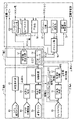
- 1 shows an example of an apparatus configuration suitable for carrying out the method of the present invention.
- 1 shows an apparatus configuration used to carry out an embodiment of the method of the present invention;
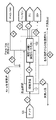
- 1 shows an apparatus configuration used to carry out a comparative example of the method of the invention;
- the method of the present invention includes a step A of producing a mixture of aromatic compounds from a raw material mixed gas containing carbon dioxide or carbon monoxide or both of them and hydrogen; Step B of producing a mixture of compounds; Step C of combining the mixture of aromatic compounds produced in Step A and the mixture of aromatic compounds produced in Step B; and Step D of separating and purifying the desired aromatic compound.
- step A a mixture of aromatic compounds is produced from a raw material mixed gas containing carbon dioxide or carbon monoxide or both of them and hydrogen.
- a product containing an aromatic compound is produced using a mixed gas of carbon monoxide and hydrogen (so-called synthesis gas) as a raw material
- methanol or dimethyl ether is produced by hydrogenation of carbon monoxide as shown in formula (1). It is said that the methanol and dimethyl ether thus produced form a mixture of various aromatic compounds via lower olefins as shown in formula (2).
- the catalyst for advancing the methanol synthesis reaction of formula (1) is preferably a spinel-structured catalyst made of a composite oxide of zinc (or copper) and chromium, as described in Patent Document 1.
- Zn/H-ZSM-5 zeolite ZSM-5 zeolite in hydrogen form doped with zinc
- ZSM-5 zeolite in hydrogen form doped with zinc can be used as a catalyst for proceeding the reaction of formula (2) to synthesize a mixture of aromatic compounds. can be preferably used.
- the outer surface of the Zn/H-ZSM-5 zeolite is coated with a silicon-containing compound (preferably one such as silicalite-1 which has the same lattice structure as ZSM-5 zeolite and does not have acid sites), , and BTX, the production ratio of para-xylene, which is particularly in high demand, can be increased. If these catalysts are mixed and used, the reaction of formula (1) and the reaction of formula (2) proceed continuously or in parallel, so that a product containing an aromatic compound can be produced in a single-stage reactor. can.
- a silicon-containing compound preferably one such as silicalite-1 which has the same lattice structure as ZSM-5 zeolite and does not have acid sites
- the use of 5 can increase the yield of aromatic compounds.
- At least one selected appropriately from chromium, zinc and copper is used according to the abundance ratio of carbon dioxide and carbon monoxide in the raw material mixed gas and the content of other components.
- Catalyst containing metal oxide and H-ZSM-5 zeolite appropriately doped with zinc or the like (coated with a silicon-containing compound such as Silicalite-1 to increase the production rate of paraxylene) It may be used by mixing with a catalyst.
- hydrogen-type ZSM-5 zeolite or hydrogen-type ZSM-5 zeolite doped (ion-exchanged) with various ions is generically referred to as ZSM-5 zeolite.
- the product containing the mixture of aromatic compounds obtained in step A is subjected to gas-liquid separation, and only the separated oil phase (containing most of the aromatic compounds) is separated from the step. It is preferable to combine with the mixture of aromatic compounds obtained in B, and the gas phase separated by gas-liquid separation (including unreacted carbon dioxide, carbon monoxide and hydrogen) is returned to the inlet side of the reactor. is preferred. In that case, the ratio of carbon dioxide to carbon monoxide and the content of other components mentioned above should be considered at the reactor inlet (combined feed gas and returned gas phase components). is.
- step A when carbon dioxide is used as at least part of the raw material mixed gas, carbon dioxide and ammonia separated from exhaust gas from equipment that burns fuel that generates carbon dioxide, such as thermal power plants and various heating furnaces.
- Carbon dioxide separated from the air can be used. This is preferable because it leads to a reduction in the amount of carbon dioxide released into the atmosphere.
- the hydrogen constituting the raw material mixed gas hydrogen generated by electrolyzing water using electricity generated by renewable energy such as solar power, wind power, hydraulic power, geothermal power, biomass, or nuclear power is used. is preferred.
- surplus hydrogen is generated in step B, which will be described later, such surplus hydrogen can be used as part of the raw material mixed gas in step A.
- synthesis gas produced by a gasification furnace, off-gas discharged from a blast furnace in a steel plant, off-gas separated in a hydrogen production unit, synthesis gas produced by co-electrolysis of water and carbon dioxide, hydrogen and carbon dioxide A synthesis gas or the like produced by the reverse shift reaction may be used as the raw material mixed gas.
- the type of reactor should be one that allows gas-solid contact operation between the raw material mixed gas (gas) and the reaction catalyst (solid) and can maintain the desired temperature and pressure (packed bed, moving bed, fluidized bed, etc.). Although not particularly limited, a packed bed is preferable in terms of high contact efficiency, less channeling, and less mechanical damage to the catalyst particles.
- the catalyst filling amount and gas flow rate can be set as appropriate, but in the case of a packed bed type, it is preferable to set the catalyst filling amount and gas flow rate so that the space velocity (SV) is about 100 to 10000/hr based on the empty column. . Moreover, it is preferable to set the reaction temperature to about 250° C. to 600° C. and the reaction pressure to about 1 to 10 MPaG.
- the gaseous reaction product taken out from the reactor is cooled to condense the high boiling point components including aromatic compounds, and then separated into a gas phase and a liquid phase by gas-liquid separation.
- the phases are preferably further divided into an aqueous phase containing water and water-soluble components such as alcohol produced by the reaction and an oil phase containing aromatic compounds immiscible with water. That is, the cooled reaction product is separated from the bottom of the gas-liquid separator into a water phase that forms a lower layer, an oil phase that forms an intermediate layer, and a gas phase that forms an upper layer. It can be pulled out of the device from the position where it is located.
- the liquid phase may be separated into an oil phase and an aqueous phase by a separation method such as centrifugal separation or sedimentation using a difference in specific gravity.
- the reaction product When the reaction product is separated into an aqueous phase, an oil phase, and a gas phase and taken out from the gas-liquid separator, almost all of the aromatic compounds including BTX are contained in the oil phase. Therefore, in the latter step C, only the oil phase needs to be combined with the mixture of aromatic compounds produced in step B.
- the gas phase contains unreacted gases such as carbon dioxide, carbon monoxide and hydrogen, it is preferable to return this to the inlet side of the heater, which is the preceding stage of the reactor, and circulate it through the reactor.
- the gas phase contains by-product lower alkanes with 1 to 4 carbon atoms (mainly methane), and these lower alkanes are used in the synthesis of aromatic compounds in the reactor. Since they hardly participate in the reaction, these lower alkanes gradually accumulate in the circulation path. Therefore, part of the gas in the circulation must be purged to the outside. By purging about 1 to 20% by volume of the total circulation, the lower alkane concentration in the gas in the circulation can be maintained below 40% by volume. Since the aqueous phase does not contain many useful components, it is preferable to discharge it to the outside after treating it with a wastewater treatment apparatus.
- the aqueous phase does not contain many useful components, it is preferable to discharge it to the outside after treating it with a wastewater treatment apparatus.
- the gas purged from the circulation path contains unreacted carbon dioxide, carbon monoxide and hydrogen, as well as by-produced lower alkanes, so it can be used as fuel gas for heating.
- carbon dioxide and carbon monoxide may be recovered from the purge gas. These gases can be separated and recovered from the purge gas by membrane separation using an appropriate membrane.
- Heating of the raw material mixed gas at the inlet side of the reactor and cooling of the product gas mixture at the outlet side of the reactor can be performed by using the heat recovered by cooling the product gas mixture for heating the raw material mixed gas. , which is preferable because the energy required for heating and cooling can be saved. Further, when sufficient cooling of the product gas mixture cannot be expected only by heat exchange, the product gas mixture whose temperature has been lowered to some extent by the heat exchange operation may be further cooled.
- a mixture of aromatic compounds is produced from a raw material consisting of fossil resource-based or biomass-based hydrocarbons.
- a mixture of aromatic compounds is produced by a cracked oil BTX production process, a reformed oil BTX production process, or a synthetic BTX production process using naphtha, LPG, or the like as raw materials.
- the BTX contained in the cracked oil which is a by-product when naphtha is thermally cracked to produce olefins, is separated and taken out by distillation or the like. Since the cracked oil contains unsaturated compounds and sulfur compounds, it is preferable to perform the separation operation after hydrotreating.
- the reformed oil-based BTX production process cyclizes and dehydrogenates the paraffins and naphthenes contained in heavy naphtha through catalytic reforming of heavy naphtha to aromatize it.
- the catalytic reforming process produces BTX along with a high octane gasoline basestock.
- the reformate-based BTX production process includes various processes with different types of reaction towers and catalyst regeneration methods, and there are various types of catalysts to be used. If performed, any of these processes or catalysts may be employed.
- the synthetic BTX production process is to produce a mixture of aromatic compounds by aromaticizing light naphtha, LPG, and olefins into BTX. and a process using LPG or light naphtha as a raw material. Any of these processes may be used when performing a synthetic process in step B of the present invention.
- surplus hydrogen is generated in the catalytic reforming in the reformed oil-based BTX manufacturing process and in the synthetic BTX manufacturing process.
- Such surplus hydrogen is conventionally used for desulfurization of kerosene and light oil in oil refineries, but there is still a surplus and it is used as fuel gas for heating.
- the demand for petroleum-derived kerosene and light oil will decrease due to the spread of biofuels and the shift to EVs from the trend of decarbonization. It becomes a surplus direction.
- the surplus hydrogen generated in the step B can be used as part of the raw material mixed gas in the step A, the surplus hydrogen can be effectively used.
- step C the mixture of aromatic compounds produced in step A and the mixture of aromatic compounds produced in step B are combined.
- Process A is for producing aromatic compounds from a mixed gas feedstock of carbon monoxide or carbon dioxide and hydrogen
- Process B is for producing aromatic compounds from a hydrocarbon feedstock such as naphtha or LPG. Since all products are mixtures of aromatic compounds containing BTX, they can be separated and purified in basically the same purification steps. Therefore, when the plant for performing the step B and the subsequent purification step exists as an existing plant, it is possible to separate and purify the product of step A together with the product of step B using the purification step. can.
- the type of device that combines the product of process A and the product of process B is not particularly limited.
- the product stream of step A and the product stream of step B may flow into a single mixing tank and mix in the tank, or the product stream of step A and the product of step B may flow together. It is also possible to provide a mechanism for simply merging the flows of the two and mixing the two after the merging.
- step B When a reformed oil-based BTX production process is adopted in step B, the ratio of xylenes or heavy aromatics having 9 or more carbon atoms contained in the product mixture is large, so before or after combining with the product of step A After combining, it is preferred to separate them first.
- a cracked oil-based BTX production process (or a reformed oil-based BTX production process including it) is adopted in step B, the resulting mixture contains a large amount of light paraffin having about 6 to 7 carbon atoms. , before or after combining with the product of step A.
- the synthetic BTX production process is adopted in step B, the content of heavy aromatics and light paraffins is small, so this is not the case.
- step D the desired aromatic compound is separated and purified from the mixture of aromatic compounds combined in step C. Since the mixture combined in step C contains various aromatic compounds such as benzene, toluene, ortho-xylene, meta-xylene and para-xylene, ethylbenzene, trimethylbenzene, etc., it is necessary to separate them into individual target compounds and purify them. Specifically, the resulting mixture is first distilled to obtain xylenes (ortho-xylene, meta-xylene, para-xylene) and benzene and toluene, which have a boiling point lower than that of ethylbenzene, as low-boiling fractions. It is preferable to separate high-boiling fractions such as trimethylbenzene, which has a high boiling point.
- xylenes ortho-xylene, meta-xylene, para-xylene
- benzene and toluene which have a boiling point lower than that
- the boiling points of the xylenes (ortho-xylene, meta-xylene, para-xylene) and ethylbenzene remaining after the low-boiling fraction and high-boiling fraction are separated and removed are close to each other, so it is inefficient to separate them by distillation alone. be. Therefore, it is preferable to obtain a mixture of these as a xylene fraction and then adsorb and separate this mixture with zeolite.
- zeolite Since zeolite has pores having a molecular size of para-xylene, it adsorbs para-xylene well, but hardly adsorbs ortho-xylene, meta-xylene and ethylbenzene, and functions as a molecular sieve. That is, components other than para-xylene (ortho-xylene, meta-xylene, ethylbenzene, and other impurities) pass through the adsorption tower without being adsorbed by zeolite. Xylene can be concentrated and purified.
- a xylene mixture is passed through an adsorption tower packed with an adsorbent (zeolite) to adsorb only paraxylene, and the adsorbent containing the paraxylene is brought into contact with the desorbent to desorb the paraxylene.
- a high-concentration para-xylene can be obtained by separating the para-xylene mixture in a distillation column.
- benzene After removing light paraffins from the low-boiling fraction by aromatic extraction separation, benzene can be separated and purified from toluene (and a small amount of xylenes) by distillation. Toluene can also be converted to benzene by dealkylation, or converted to benzene and xylenes by disproportionation (transalkylation). On the other hand, heavy aromatics separated as high-boiling fractions can be used as additives for high-octane gasoline. After conversion to a xylene mixture containing para-xylene, it can be returned to the inlet side of the purification process. Specifically, a mixture containing toluene and trimethylbenzene is heated and passed through a reactor filled with a zeolite catalyst for disproportionation treatment.
- xylene may be isomerized.
- Ortho-xylene and meta-xylene remaining after obtaining high-purity para-xylene in the purification process can be partially converted to para-xylene by isomerization treatment and then returned to the inlet side of the purification process.
- the mixture of ortho-xylene and meta-xylene after separation of para-xylene is heated and passed through a reactor packed with a zeolite catalyst for isomerization.
- step A comprises a step of producing a mixture of aromatic compounds from a raw material mixed gas 10 containing hydrogen, carbon monoxide and carbon dioxide
- step B comprises catalytically reforming a heavy naphtha 20.
- 1 illustrates an example of a process flow of a method
- Step A a raw material mixed gas 10 containing hydrogen, carbon monoxide and carbon dioxide is heated and introduced into a reactor 11 for synthesizing aromatic compounds.
- a catalyst containing at least one metal oxide selected from chromium, zinc and copper and a catalyst containing ZSM-5 zeolite are mixed and filled in the reactor 11 to form a mixed catalyst layer,
- the raw material mixed gas reacts with the mixed catalyst in the reactor 11 under a high temperature and high pressure atmosphere of 250° C. to 600° C. and 1 to 10 MPaG to become a product gas mixture containing various aromatic compounds.
- the obtained product gas mixture is cooled to about room temperature and introduced into the gas-liquid-liquid separator 12, and the product gas mixture containing condensed high-boiling-point components is converted into an aqueous phase containing water-soluble components in the gas-liquid-liquid separator 12. (lower layer), an oil phase (middle layer) containing a mixture of aromatic compounds, and a gas phase (upper layer) containing unreacted gas.
- the oil phase forming the middle layer containing the mixture of aromatic compounds is extracted from the gas-liquid-liquid separator 12 and then combined with the mixture of aromatic compounds produced in step B (step C ), and then separated and refined into various aromatic compound products (step D).
- the gas phase forming the upper layer contains unreacted gases such as hydrogen, carbon dioxide, carbon monoxide, and lower alkanes as by-products, it is extracted from the gas-liquid-liquid separator 12 and reacts as a circulation gas. It is mixed with the raw material mixed gas flow on the inlet side of the vessel 11, heated again, and subjected to the aromatic compound synthesis reaction. A part of the circulating gas is purged out of the system in order to prevent the accumulation of lower alkanes, etc., and is effectively used as a heat source for a nearby heating furnace as a fuel gas.
- unreacted gases such as hydrogen, carbon dioxide, carbon monoxide, and lower alkanes as by-products
- the aqueous phase forming the lower layer is sent to a wastewater treatment device for treatment in order to remove water-soluble organic matter and the like, and then discharged out of the system.
- Step B In FIG. 1, a heavy naphtha 20 is introduced into a reformer 22 filled with a reforming catalyst after sulfur components and the like have been removed by a hydrorefining treatment 21, where it is brought into contact at a high temperature of 500° C. and about 0.4 MPaG. It is reformed and converted into a mixture (reformate) containing various aromatic compounds. Further, the naphtha cracking residue 30 is subjected to hydrorefining 31 to remove sulfur components and the like, and is reformed as a mixture containing various aromatic compounds (step C). Light naphtha and LPG 40 are aromatized in the presence of a catalyst at a high temperature of about 500° C. and about 0.5 MPaG by an aromatic synthesis process 41 to form a mixture containing various aromatic compounds.
- the oil phase extracted from the middle layer of the gas-liquid-liquid separator 12 in step A, and the product (reformate) obtained by hydrorefining 21 and catalytic reforming 22 of heavy naphtha 20 in step B and naphtha cracking residue 30 are all mixtures of aromatic compounds containing benzene, toluene and xylene (BTX).
- Light components containing benzene and toluene having a number of 7 or less and heavy components containing xylene and ethylbenzene having carbon atoms of 8 or more are separated. is separated and removed.
- the product aromatized from light naphtha and LPG in step B mainly consists of benzene and toluene, and contains some xylenes and almost all paraffins with boiling points close to those of benzene and toluene. Since they are not present, they are combined with the light component stream after they have been removed in the aromatic extraction separator 52 .
- Process D The mixture of aromatic compounds combined in step C is then separated into individual aromatic compounds by operations such as distillation, adsorption, and extraction according to conventional methods.
- the light components having 7 or less carbon atoms separated by the reformate splitter 51 are separated and removed from the light paraffin by the aromatic extraction separator 52, and then benzene and benzene by the distillation column (benzene column, toluene column) 53. It is divided into toluene and xylene, which is contained in a small amount.
- the ratio of demand for both is large for benzene. to adjust the rate of production to meet demand.
- the compounds with 8 or more carbon atoms separated by the reformate splitter 51 or separated by the toluene column are separated into xylene and heavy aromatic compounds with 9 or more carbon atoms in the distillation column (xylene column) 56. Since the boiling points of ortho, meta, and para xylenes are close to each other, it is difficult to separate them by distillation. Therefore, the para-xylene, which is the most demanded of these three mixtures, is separated by adsorption 57 . Also, the remaining two types of xylene can be converted to para-xylene by the xylene isomerization process 58 .
- the heavy aromatic compounds separated from xylene are partially subjected to a disproportionation treatment 55 in the heavy aromatic column 59 to disproportionate the components having 8 carbon atoms, and are used as gasoline additives to increase the octane number. Used.
- a mixture of aromatic compounds is produced by catalytic reforming 22 of hydrorefined heavy naphtha 20, or a mixture of aromatic compounds is produced by synthetic aromatic production process 41 from light naphtha or LPG 40.
- excess hydrogen is generated, which is used as a raw material for synthesizing aromatic compounds from hydrogen, carbon monoxide and carbon dioxide 10. This makes it possible to effectively utilize surplus hydrogen.
- FIG. 2 shows that step A comprises a step of producing a mixture of aromatic compounds from a raw material mixed gas containing hydrogen and carbon dioxide, and step B comprises a step of catalytically reforming heavy naphtha to produce a mixture of aromatic compounds.
- An example of the process configuration of the method for producing an aromatic compound of the present invention when it consists only of the step of producing (reformulated oil-based BTX production process) is shown.
- Step A a raw material mixed gas 110 containing hydrogen and carbon dioxide is heated and introduced into a reactor 111 for synthesizing aromatic compounds.
- Reactor 111 is filled with a catalyst containing at least one metal oxide selected from chromium, zinc and copper and a catalyst containing ZSM-5 zeolite surface-coated with silicalite-1.
- a mixed catalyst layer is formed, and the raw material mixed gas reacts by contacting the mixed catalyst in a high temperature and high pressure atmosphere of 250° C. to 600° C. and 1 to 10 MPaG in the reactor 111 to produce various aromatic compounds. become a gas mixture.
- the obtained product gas mixture is cooled to around room temperature and introduced into a gas-liquid-liquid separator (not shown), and the product gas mixture containing the condensed high-boiling-point components is divided into an aqueous phase (lower layer) containing water-soluble components and an aromatic It is separated into three layers: an oil phase (middle layer) containing a mixture of group compounds and a gas phase (upper layer) containing unreacted gas.
- the oil phase forming the middle layer containing the mixture of aromatic compounds is combined with the mixture of aromatic compounds produced in step B (step C), and then separated and refined into various aromatic compound products.
- process D the vapor phase forming the upper layer is mixed as a circulating gas with the raw material mixed gas flow on the inlet side of the reactor 111, and part of it is purged out of the system as a purge gas.
- the aqueous phase forming the lower layer is discharged out of the system after being sent to a wastewater treatment apparatus and treated.
- Step B a heavy naphtha 120 from which sulfur has been removed in advance is catalytically reformed in a reformer 121 filled with a reforming catalyst and converted into a mixture (reformate) containing various aromatic compounds.
- Steps C and D In FIG. 2, the oil phase extracted from the middle layer of the gas-liquid-liquid separator in step A and the product (reformate) obtained by catalytic reforming 22 of heavy naphtha in step B are combined in step C. After combining, in step D, they are subjected to a purification treatment 122 such as separation, isomerization, disproportionation, etc., to separate the individual aromatic compounds.
- a purification treatment 122 such as separation, isomerization, disproportionation, etc.
- the carbon dioxide contained in the combustion exhaust gas from each heating furnace in step B and step D is recovered by absorption separation 112 such as amine absorption, and is used as a raw material for synthesizing aromatic compounds from hydrogen and carbon dioxide in step A. can be used as
- Table 1 is an example of material balance summarizing the mass flow rate of each stream and the mass fraction of each component in Example 2.
- FIG. 3 shows, from FIG. A comparative example in which the step of combining the That is, the comparative example shown in FIG. 3 has a process configuration including only the process B and the process D of the second embodiment.
- the surplus hydrogen generated in the process B and the carbon dioxide recovered from the exhaust gas generated in the heating furnace of each process cannot be used as raw materials in the process A.
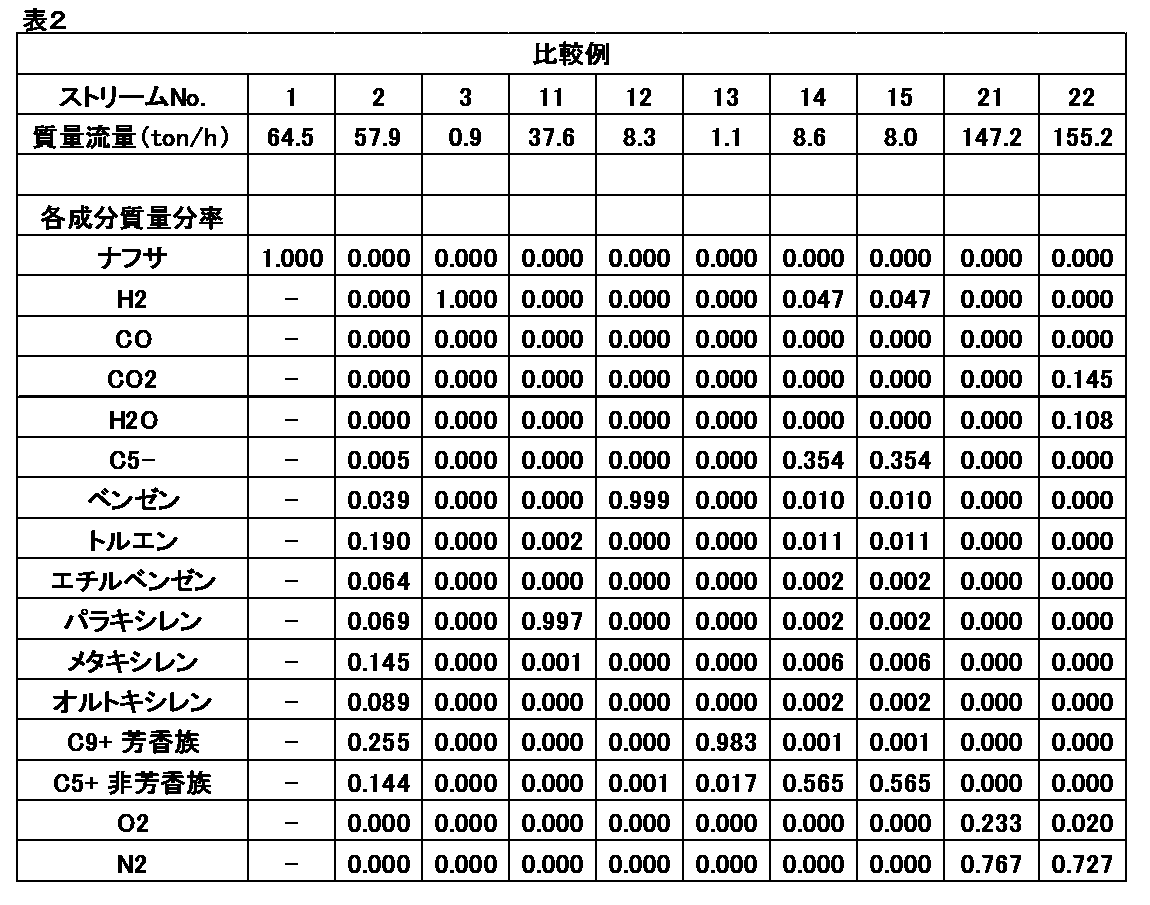
- Table 2 is an example of material balance summarizing the mass flow rate of each stream and the mass fraction of each component in this comparative example.
Landscapes
- Chemical & Material Sciences (AREA)
- Organic Chemistry (AREA)
- Oil, Petroleum & Natural Gas (AREA)
- Engineering & Computer Science (AREA)
- Chemical Kinetics & Catalysis (AREA)
- General Chemical & Material Sciences (AREA)
- Analytical Chemistry (AREA)
- Water Supply & Treatment (AREA)
- Organic Low-Molecular-Weight Compounds And Preparation Thereof (AREA)
- Production Of Liquid Hydrocarbon Mixture For Refining Petroleum (AREA)
- Separation Using Semi-Permeable Membranes (AREA)
- Low-Molecular Organic Synthesis Reactions Using Catalysts (AREA)
Abstract
Description
工程Aでは、二酸化炭素もしくは一酸化炭素またはその両方と水素とを含む原料混合ガスから芳香族化合物の混合物を製造する。一酸化炭素と水素との混合ガス(所謂合成ガス)を原料として芳香族化合物を含む生成物を製造する場合には、式(1)に示すように一酸化炭素の水素化によりメタノールやジメチルエーテルが生成し、こうして生成したメタノールやジメチルエーテルが式(2)に示すように低級オレフィンを経由して各種芳香族化合物の混合物を生成するとされている。
2CO+2H2 ⇒ 2CH3OH (⇔ CH3OCH3+H2O) (1)
CH3OCH3 ⇒ C2H4、C3H6等 ⇒ 各種芳香族化合物 (2)
CO2+3H2 ⇒ CH3OH+H2O
(⇔ CH3OCH3+2H2O) (3)
すなわち、メタノールやジメチルエーテルが生成される際に副生される水の量が多くなるため、特許文献2に記載されるように、式(3)の反応を進行させる触媒として上記亜鉛(または銅)とクロムの複合酸化物からなる触媒ではなく(亜鉛または銅を含まない)酸化クロムからなる触媒を用い、式(2)の反応を進行させる触媒として亜鉛ドープを行わない水素型のH-ZSM-5を用いる方が芳香族化合物の収率を上げることができる。
工程Bでは、化石資源系あるいはバイオマス系炭化水素からなる原料から芳香族化合物の混合物を製造する。例えば、ナフサやLPGなどを原料として用いる分解油系BTX製造プロセス、改質油系BTX製造プロセス、合成系BTX製造プロセスにより芳香族化合物の混合物を製造する。
工程Cでは、工程Aで製造された芳香族化合物の混合物と、工程Bで製造された芳香族化合物の混合物を合わせる。工程Aは一酸化炭素または二酸化炭素と水素という混合ガス原料から芳香族化合物を製造するものであり、工程BはナフサやLPGといった炭化水素原料から芳香族化合物を製造するものであるが、それらの製造物はいずれもBTXを含む芳香族化合物の混合物であるから、基本的に同じ精製工程で分離精製することができる。従って、工程Bとそれに続く精製工程を実施するプラントが既存のプラントとして存在する場合には、その精製工程を利用して工程Aの製造物を工程Bの製造物と一緒に分離精製することができる。
工程Dでは、工程Cで合わせた芳香族化合物の混合物から所望の芳香族化合物を分離精製する。工程Cで合わせた混合物はベンゼン、トルエン、オルトキシレン、メタキシレン及びパラキシレン、エチルベンゼン、トリメチルベンゼンなどといった各種芳香族化合物を含むため、これを個々の目的化合物に分離して精製する必要がある。具体的には、得られた混合物は、先ず蒸留操作によりキシレン類(オルトキシレン、メタキシレン、パラキシレン)やエチルベンゼンより沸点が低いベンゼンやトルエンなどを低沸点留分として、またキシレン類やエチルベンゼンより沸点が高いトリメチルベンゼンなどを高沸点留分として分離することが好ましい。
図1は、工程Aが、水素と一酸化炭素と二酸化炭素とを含む原料混合ガス10から芳香族化合物の混合物を製造する工程からなり、工程Bが、重質ナフサ20を接触改質することにより芳香族化合物の混合物を製造する工程(改質油系BTX製造プロセス)と、ナフサからオレフィンを製造する際に発生する熱分解残油30から芳香族化合物を分離する工程(分解油系BTX製造プロセス)と、軽質ナフサやLPG40を芳香族化して芳香族化合物の混合物を製造する工程(合成系BTX製造プロセス)のいずれか一つまたは複数の組み合わせとからなる、本発明の芳香族化合物の製造方法のプロセスフローの一例を示す。
図1において、水素と一酸化炭素と二酸化炭素を含む原料混合ガス10は、加熱されて芳香族化合物合成のための反応器11に導入される。反応器11内にはクロム、亜鉛および銅から選択される少なくとも1種の金属の酸化物を含む触媒とZSM-5系ゼオライトを含む触媒とが混合充填されて混合触媒層を形成しており、原料混合ガスは反応器11内で250℃~600℃および1~10MPaGの高温高圧雰囲気下に混合触媒と接触することにより反応して各種芳香族化合物を含む生成ガス混合物になる。得られた生成ガス混合物は、常温付近まで冷却されて気液液分離器12に導入され、凝縮した高沸点成分を含む生成ガス混合物は気液液分離器12内で水溶性成分を含む水相(下層)と芳香族化合物の混合物を含む油相(中層)と未反応ガスを含む気相(上層)の3層に分離される。
図1において、重質ナフサ20は、水素化精製処理21により硫黄成分等が除去された後、改質触媒を充填したリフォーマー22内に導入され、500℃、0.4MPaG程度の高温下に接触改質されて各種芳香族化合物を含む混合物(リフォーメート)に変換される。また、ナフサ分解残油30は、水素化精製処理31により硫黄成分等が除去され、各種芳香族化合物を含む混合物としてリフォーメートに合わせられる(工程C)。また、軽質ナフサやLPG40は、芳香族合成プロセス41により、触媒の存在下に500℃、0.5MPaG程度の高温下で芳香族化され、各種芳香族化合物を含む混合物となる。
図1において、工程Aで気液液分離器12の中層から引き抜かれた油相と、工程Bで重質ナフサ20の水素化精製21と接触改質22により得られた生成物(リフォーメート)やナフサ分解残油30の水素化精製により得られた生成物は、何れもベンゼン、トルエン及びキシレン(BTX)を含む芳香族化合物の混合物なので、これらを合わせた後、リフォーメートスプリッター51で一旦炭素数7以下のベンゼンやトルエンを含む軽質成分と炭素数8以上のキシレンやエチルベンゼンを含む重質成分とに分けられ、その後、軽質成分は芳香族抽出分離器52でベンゼンやトルエンと沸点の近いパラフィンが分離除去される。
工程Cで合わせられた芳香族化合物の混合物は、その後、常法に従って、蒸留・吸着・抽出等の操作により、個々の芳香族化合物に分離される。図1では、リフォーメートスプリッター51で分離された炭素数7以下の軽質成分は、芳香族抽出分離器52で軽質パラフィンが分離除去された後、蒸留塔(ベンゼン塔、トルエン塔)53でベンゼンとトルエンと少量含まれるキシレン等とに分けられる。ベンゼンとトルエンの生成比率に比べて、両者の需要の比率はベンゼンが大きいので、生成したトルエンの一部を脱アルキル54してベンゼンに変換したり、ベンゼンとキシレンとに不均化55したりして、生成量の比率を需要に見合うように調整することができる。
図2は、工程Aが、水素と二酸化炭素とを含む原料混合ガスから芳香族化合物の混合物を製造する工程からなり、工程Bが、重質ナフサを接触改質することにより芳香族化合物の混合物を製造する工程(改質油系BTX製造プロセス)のみからなる場合の、本発明の芳香族化合物の製造方法のプロセス構成の一例を示す。
図2において、水素と二酸化炭素を含む原料混合ガス110は、加熱されて芳香族化合物合成のための反応器111に導入される。反応器111内にはクロム、亜鉛および銅から選択される少なくとも1種の金属の酸化物を含む触媒とシリカライト-1で表面被覆されたZSM-5系ゼオライトを含む触媒とが混合充填されて混合触媒層を形成しており、原料混合ガスは反応器111内で250℃~600℃および1~10MPaGの高温高圧雰囲気下に混合触媒と接触することにより反応して各種芳香族化合物を含む生成ガス混合物になる。得られた生成ガス混合物は、常温付近まで冷却されて気液液分離器(不図示)に導入され、凝縮した高沸点成分を含む生成ガス混合物は水溶性成分を含む水相(下層)と芳香族化合物の混合物を含む油相(中層)と未反応ガスを含む気相(上層)の3層に分離される。
図2において、予め硫黄分が除去された重質ナフサ120は、改質触媒を充填したリフォーマー121内で接触改質されて各種芳香族化合物を含む混合物(リフォーメート)に変換される。
図2において、工程Aで気液液分離器の中層から引き抜かれた油相と、工程Bで重質ナフサの接触改質22により得られた生成物(リフォーメート)は、工程Cでこれらを合わせた後、工程Dで分離、異性化、不均化等の精製処理122を受けて、個々の芳香族化合物に分離される。
図2において、工程Bの重質ナフサの接触改質121により芳香族化合物の混合物(リフォーメート)を製造する過程で発生した水素は、重質ナフサの前処理などにも用いられるが、一部は使いきれずに余剰水素となるので、これは工程Aにおいて水素と二酸化炭素から芳香族化合物を合成するための原料として用いられる。これにより余剰水素を有効に活用することができる。
工程Bや工程Dにおける各加熱炉からの燃焼排ガスに含まれる二酸化炭素は、アミン吸収等による吸収分離112により回収し、これを工程Aにおいて水素と二酸化炭素から芳香族化合物を合成するための原料として用いることができる。
図2において、物質の流れを示す線に菱形で囲って付記した数字は、当該ストリームの番号を示す。表1は、実施例2における各ストリームの質量流量と各成分の質量分率をまとめた物質収支例である。
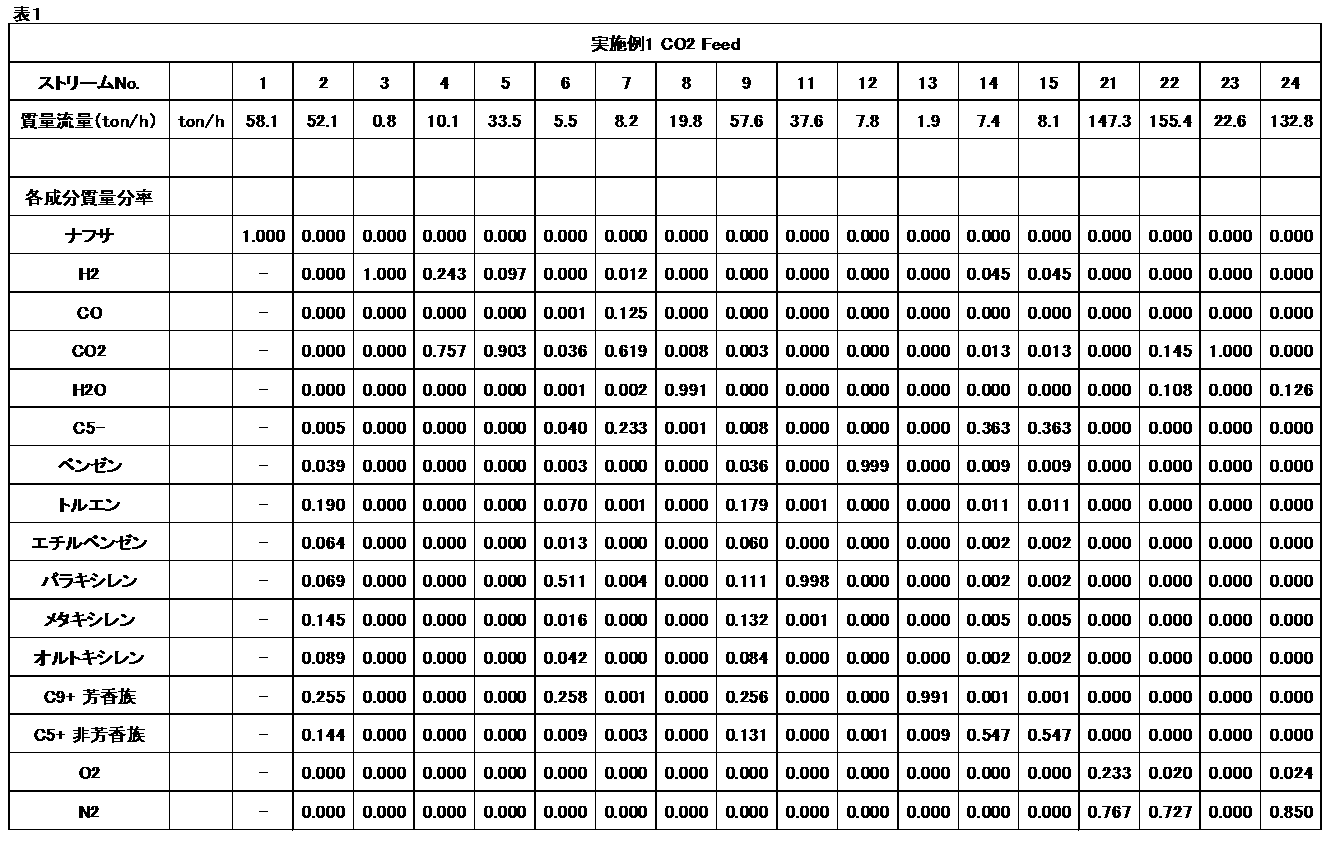
図3は、図2から工程A(水素及び二酸化炭素からの芳香族化合物を合成する工程)と工程C(工程Aで得られた芳香族化合物と工程Bで得られた芳香族化合物とを合わせる工程)を除いた場合である比較例を示す。すなわち、図3に示す比較例は、実施例2の工程B及び工程Dのみからなるプロセス構成である。この比較例では、工程Aが存在しないため、工程Bで発生する余剰水素や、各工程の加熱炉で発生する排ガスから回収した二酸化炭素の工程Aでの原料としての利用はできない。
図3において、物質の流れを示す線に菱形で囲って付記した数字は、当該ストリームの番号を示す。表2は、この比較例における各ストリームの質量流量と各成分の質量分率をまとめた物質収支例である。
11 芳香族化合物合成反応器
12 気液液分離器
20 重質ナフサ(改質油系芳香族製造原料)
21 水素化精製装置
22 接触改質装置
30 ナフサ分解残油(分解油系芳香族製造原料)
31 水素化精製装置
40 LPG/軽質ナフサ(芳香族合成プロセス原料)
41 芳香族合成反応装置
51 リフォーメートスプリッター
52 芳香族抽出分離装置
53 蒸留装置(ベンゼン塔/トルエン塔)
54 脱アルキル反応装置
55 不均化反応装置
56 蒸留装置(キシレン塔)
57 吸着装置(パラキシレン分離塔)
58 キシレン異性化反応装置
59 蒸留装置(重質芳香族塔)
110 原料混合ガス
111 芳香族化合物合成反応装置(気液液分離及び気相循環を含む)
112 二酸化炭素分離回収装置
120 ナフサ(脱硫処理済み)
121 接触改質装置
122 精製(分離・異性化・不均化)装置
Claims (15)
- 二酸化炭素もしくは一酸化炭素またはその両方と水素とを含む原料混合ガスから芳香族化合物の混合物を製造する工程Aと、化石資源系もしくはバイオマス系炭化水素からなる原料から芳香族化合物の混合物を製造する工程Bと、工程Aで製造された芳香族化合物の混合物と工程Bで製造された芳香族化合物の混合物を合わせる工程Cと、工程Cで合わせた芳香族化合物の混合物から所望の芳香族化合物を分離精製する工程Dとを含むことを特徴とする芳香族化合物の製造方法。
- 前記工程Aが、前記原料混合ガスを高温高圧下で反応触媒に接触させることにより反応させて芳香族化合物を含む生成ガス混合物を取得する反応工程と、該反応工程で得られた生成ガス混合物を冷却することにより高沸点成分を凝縮させて水溶性成分を含む水相と芳香族化合物の混合物を含む油相と未反応ガスを含む気相とに分離する分離工程と、該分離工程で分離された気相の少なくとも一部を原料混合ガスに混合する循環工程とを含み、該分離工程で分離された油相を前記工程Bで製造された芳香族化合物の混合物と合わせる、請求項1に記載の方法。
- 前記分離工程において、生成ガス混合物を冷却して得られた気液混合物を、まず液相と気相とに分離し、次いで分離された液相を比重差を利用した分離法で油相と水相とに分離する、請求項2に記載の方法。
- 前記循環工程において、循環する気相の一部をパージし、パージしたガスから分離回収した水素を原料混合ガスに混合する、請求項2または3に記載の方法。
- 前記循環工程においてパージしたガスから水素を分離回収する方法として、圧力スイング吸着(Pressure Swing Adsorption)または水素分離膜を用いた膜分離を行う、請求項4に記載の方法。
- 前記循環工程において、循環する気相の一部をパージし、パージしたガスを前記工程Bまたは工程Dにおける加熱炉の燃料の一部として用いる、請求項2または3に記載の方法。
- 前記工程Bまたは工程Dにおいて、加熱炉の燃焼ガスから二酸化炭素を分離回収し、回収した二酸化炭素を前記工程Aにおける原料混合ガスに混合する、請求項2~6のいずれか一項に記載の方法。
- 前記反応工程で用いられる反応触媒が、クロム、亜鉛および銅から選択される少なくとも1種の金属の酸化物を含む第1の触媒とZSM-5系ゼオライトを含む第2の触媒との混合物を含む混合触媒である、請求項2~7のいずれか一項に記載の方法。
- 前記反応工程において、原料混合ガスを反応温度250~600℃、反応圧力1~10MPaGで反応触媒に接触させる、請求項8に記載の方法。
- 前記原料混合ガスと前記生成ガス混合物とを熱交換させた後、該原料混合ガスを反応工程に移送する、請求項2~9のいずれか一項に記載の方法。
- 前記工程Bが、重質ナフサを接触改質する工程を含み、該接触改質工程で発生した余剰水素を前記工程Aにおける原料混合ガスを構成する水素の少なくとも一部として用いる、請求項1~10のいずれか一項に記載の方法。
- 前記工程Bが、軽質ナフサ、LPG又はオレフィンを芳香族化する工程を含み、該芳香族化工程で発生した余剰水素を前記工程Aにおける原料混合ガスを構成する水素の少なくとも一部として用いる、請求項1~11のいずれか一項に記載の方法。
- 太陽光、風力、水力、地熱、バイオマスまたは原子力により発生した電力を用いて水を電気分解することで生成された水素を、前記工程Aにおける原料混合ガスを構成する水素の少なくとも一部として用いる、請求項1~12のいずれか一項に記載の方法。
- 火力発電所もしくは加熱炉の燃焼排ガスから分離された二酸化炭素、アンモニア製造装置、エチレングリコール製造装置もしくは水素製造装置において分離された二酸化炭素、石炭、バイオマスもしくはゴミのガス化炉の生成ガスから分離された二酸化炭素、製鉄所の高炉から分離された二酸化炭素、または大気中の空気から分離した二酸化炭素を、前記工程Aにおける原料混合ガスを構成する二酸化炭素の少なくとも一部として用いる、請求項1~13のいずれか一項に記載の方法。
- ガス化炉により生成された合成ガス、製鉄所の高炉から排出されるオフガス、水素製造装置において分離されたオフガス、水と二酸化炭素の共電解により生成された合成ガス、または水素と二酸化炭素の逆シフト反応により生成された合成ガスを、前記工程Aにおける原料混合ガスの少なくとも一部として用いる、請求項1~14のいずれか一項に記載の方法。
Priority Applications (4)
| Application Number | Priority Date | Filing Date | Title |
|---|---|---|---|
| EP22782810.0A EP4163267A4 (en) | 2021-07-21 | 2022-03-23 | METHOD FOR PRODUCING AN AROMATIC COMPOUND |
| US18/580,296 US20240336543A1 (en) | 2021-07-21 | 2022-03-23 | Aromatic compound manufacturing method |
| CN202280051148.0A CN117677600A (zh) | 2021-07-21 | 2022-03-23 | 芳族化合物的制造方法 |
| CA3227107A CA3227107A1 (en) | 2021-07-21 | 2022-03-23 | Aromatic compound manufacturing method |
Applications Claiming Priority (2)
| Application Number | Priority Date | Filing Date | Title |
|---|---|---|---|
| JP2021120306A JP7222034B2 (ja) | 2021-07-21 | 2021-07-21 | 芳香族化合物の製造方法 |
| JP2021-120306 | 2021-07-21 |
Publications (1)
| Publication Number | Publication Date |
|---|---|
| WO2023002704A1 true WO2023002704A1 (ja) | 2023-01-26 |
Family
ID=84327499
Family Applications (1)
| Application Number | Title | Priority Date | Filing Date |
|---|---|---|---|
| PCT/JP2022/013664 Ceased WO2023002704A1 (ja) | 2021-07-21 | 2022-03-23 | 芳香族化合物の製造方法 |
Country Status (6)
| Country | Link |
|---|---|
| US (1) | US20240336543A1 (ja) |
| EP (1) | EP4163267A4 (ja) |
| JP (1) | JP7222034B2 (ja) |
| CN (1) | CN117677600A (ja) |
| CA (1) | CA3227107A1 (ja) |
| WO (1) | WO2023002704A1 (ja) |
Families Citing this family (3)
| Publication number | Priority date | Publication date | Assignee | Title |
|---|---|---|---|---|
| WO2024262156A1 (ja) * | 2023-06-20 | 2024-12-26 | Eneos株式会社 | 単環芳香族炭化水素、テレフタル酸、及びポリエチレンテレフタレートの製造方法並びにそれらの管理方法 |
| WO2024262154A1 (ja) * | 2023-06-20 | 2024-12-26 | Eneos株式会社 | パラキシレン、テレフタル酸、及びポリエチレンテレフタレートの製造方法並びにそれらの管理方法 |
| WO2024262155A1 (ja) * | 2023-06-20 | 2024-12-26 | Eneos株式会社 | 単環芳香族炭化水素、テレフタル酸、及びポリエチレンテレフタレートの製造方法並びにそれらの管理方法 |
Citations (5)
| Publication number | Priority date | Publication date | Assignee | Title |
|---|---|---|---|---|
| JP2017511813A (ja) * | 2014-02-25 | 2017-04-27 | サウジ ベーシック インダストリーズ コーポレイションSaudi Basic Industries Corporaiton | 炭化水素をオレフィンに変換する方法 |
| JP2019205969A (ja) | 2018-05-29 | 2019-12-05 | 日本製鉄株式会社 | パラキシレン製造用触媒、パラキシレン製造用触媒の製造方法、およびパラキシレンの製造方法 |
| JP2020533425A (ja) * | 2017-07-27 | 2020-11-19 | アネロテック・インコーポレイテッドAnellotech,Inc. | バイオマス触媒熱分解流出物からの有価成分の効率的回収方法 |
| JP2020535966A (ja) * | 2017-09-30 | 2020-12-10 | ハイケム株式会社 | 合成ガスからパラキシレンを直接製造する触媒及びその製造方法と使用 |
| JP2021120306A (ja) | 2020-01-30 | 2021-08-19 | 株式会社リコー | シート材供給部、画像形成装置 |
Family Cites Families (5)
| Publication number | Priority date | Publication date | Assignee | Title |
|---|---|---|---|---|
| CN102796553B (zh) * | 2011-05-27 | 2015-07-29 | 中国石油化工股份有限公司 | 一种石脑油催化重整方法 |
| WO2014018653A1 (en) * | 2012-07-24 | 2014-01-30 | Kansas State University Research Foundation | Nanoparticle catalyst capable of forming aromatic hydrocarbons from co2 and h2 |
| US10196325B2 (en) * | 2015-01-15 | 2019-02-05 | Exxonmobil Chemical Patents Inc. | Process for converting syngas to aromatics and catalyst system suitable therefor |
| US10927058B2 (en) * | 2015-05-15 | 2021-02-23 | Sabic Global Technologies B.V. | Systems and methods related to the syngas to olefin process |
| CN106518591B (zh) * | 2016-10-14 | 2019-10-01 | 中国科学院山西煤炭化学研究所 | 一种合成气制芳烃的联合工艺 |
-
2021
- 2021-07-21 JP JP2021120306A patent/JP7222034B2/ja active Active
-
2022
- 2022-03-23 US US18/580,296 patent/US20240336543A1/en active Pending
- 2022-03-23 EP EP22782810.0A patent/EP4163267A4/en active Pending
- 2022-03-23 WO PCT/JP2022/013664 patent/WO2023002704A1/ja not_active Ceased
- 2022-03-23 CN CN202280051148.0A patent/CN117677600A/zh active Pending
- 2022-03-23 CA CA3227107A patent/CA3227107A1/en active Pending
Patent Citations (5)
| Publication number | Priority date | Publication date | Assignee | Title |
|---|---|---|---|---|
| JP2017511813A (ja) * | 2014-02-25 | 2017-04-27 | サウジ ベーシック インダストリーズ コーポレイションSaudi Basic Industries Corporaiton | 炭化水素をオレフィンに変換する方法 |
| JP2020533425A (ja) * | 2017-07-27 | 2020-11-19 | アネロテック・インコーポレイテッドAnellotech,Inc. | バイオマス触媒熱分解流出物からの有価成分の効率的回収方法 |
| JP2020535966A (ja) * | 2017-09-30 | 2020-12-10 | ハイケム株式会社 | 合成ガスからパラキシレンを直接製造する触媒及びその製造方法と使用 |
| JP2019205969A (ja) | 2018-05-29 | 2019-12-05 | 日本製鉄株式会社 | パラキシレン製造用触媒、パラキシレン製造用触媒の製造方法、およびパラキシレンの製造方法 |
| JP2021120306A (ja) | 2020-01-30 | 2021-08-19 | 株式会社リコー | シート材供給部、画像形成装置 |
Non-Patent Citations (1)
| Title |
|---|
| See also references of EP4163267A4 |
Also Published As
| Publication number | Publication date |
|---|---|
| EP4163267A4 (en) | 2023-11-01 |
| CN117677600A (zh) | 2024-03-08 |
| CA3227107A1 (en) | 2023-01-26 |
| EP4163267A1 (en) | 2023-04-12 |
| US20240336543A1 (en) | 2024-10-10 |
| JP2023016167A (ja) | 2023-02-02 |
| JP7222034B2 (ja) | 2023-02-14 |
Similar Documents
| Publication | Publication Date | Title |
|---|---|---|
| CN101208412B (zh) | 提高由碳氢化合物原料制备轻质烯烃碳氢化合物的产率的方法 | |
| CN102686540B (zh) | 从合成气中生产烃特别是汽油的方法 | |
| JP7222034B2 (ja) | 芳香族化合物の製造方法 | |
| EP2861696B1 (en) | Direct catalytic cracking of crude oil by a temperature gradient process | |
| KR20220108806A (ko) | 수소 및 석유화학물질을 형성하기 위한 처리 시설 | |
| WO2015147700A1 (ru) | Способ получения концентрата ароматических углеводородов из легких алифатических углеводородов и установка для его осуществления | |
| CN102822321B (zh) | 用于将轻循环油烷基化和氢化的方法和设备 | |
| KR20220108807A (ko) | 수소 및 석유화학물질을 생성하기 위한 처리 시설 | |
| TW201247860A (en) | Naphtha catalytic rearrangement method | |
| RU2418840C2 (ru) | Система синтеза жидкого топлива | |
| JPWO2010087133A1 (ja) | Ft合成油の精製方法及び混合原油 | |
| JP5011127B2 (ja) | 水素源からの水素含有ストリーム中の水素の管理 | |
| Pisarenko et al. | Prospects for progress in developing production processes for the synthesis of olefins based on light alkanes | |
| RU2592286C2 (ru) | Способ производства олефинов и бензина с низким содержанием бензола | |
| UA115304C2 (uk) | Конверсія природного газу | |
| JP7321207B2 (ja) | パラキシレンの製造方法 | |
| JP2011084528A (ja) | プロピレンの製造方法 | |
| CN110382450B (zh) | 处理c8-c10芳族进料流以制备和回收三甲基化苯 | |
| EA020582B1 (ru) | Способ получения жидкого топлива и система для получения жидкого топлива | |
| CN118434703A (zh) | 对二甲苯的制造方法 | |
| US12617739B2 (en) | Method for producing para-xylene | |
| US20250346543A1 (en) | Lpg synthesis from bio-based sources | |
| RU2630307C1 (ru) | Способ и установка для получения высокооктановой синтетической бензиновой фракции из природного или попутного газов | |
| US20250376634A1 (en) | Method of heat management in lpg synthesis from bio-based sources | |
| US20250188004A1 (en) | Integrated naphtha reforming and benzyl toluene production process |
Legal Events
| Date | Code | Title | Description |
|---|---|---|---|
| ENP | Entry into the national phase |
Ref document number: 2022782810 Country of ref document: EP Effective date: 20221012 |
|
| WWE | Wipo information: entry into national phase |
Ref document number: 2401000333 Country of ref document: TH |
|
| WWE | Wipo information: entry into national phase |
Ref document number: 202280051148.0 Country of ref document: CN Ref document number: 3227107 Country of ref document: CA |
|
| WWE | Wipo information: entry into national phase |
Ref document number: 202447010603 Country of ref document: IN |
|
| NENP | Non-entry into the national phase |
Ref country code: DE |