WO2023008381A1 - 樹脂組成物 - Google Patents
樹脂組成物 Download PDFInfo
- Publication number
- WO2023008381A1 WO2023008381A1 PCT/JP2022/028648 JP2022028648W WO2023008381A1 WO 2023008381 A1 WO2023008381 A1 WO 2023008381A1 JP 2022028648 W JP2022028648 W JP 2022028648W WO 2023008381 A1 WO2023008381 A1 WO 2023008381A1
- Authority
- WO
- WIPO (PCT)
- Prior art keywords
- polymer
- group
- mass
- mol
- members
- Prior art date
- Legal status (The legal status is an assumption and is not a legal conclusion. Google has not performed a legal analysis and makes no representation as to the accuracy of the status listed.)
- Ceased
Links
Classifications
-
- C—CHEMISTRY; METALLURGY
- C08—ORGANIC MACROMOLECULAR COMPOUNDS; THEIR PREPARATION OR CHEMICAL WORKING-UP; COMPOSITIONS BASED THEREON
- C08L—COMPOSITIONS OF MACROMOLECULAR COMPOUNDS
- C08L23/00—Compositions of homopolymers or copolymers of unsaturated aliphatic hydrocarbons having only one carbon-to-carbon double bond; Compositions of derivatives of such polymers
- C08L23/02—Compositions of homopolymers or copolymers of unsaturated aliphatic hydrocarbons having only one carbon-to-carbon double bond; Compositions of derivatives of such polymers not modified by chemical after-treatment
- C08L23/10—Homopolymers or copolymers of propene
- C08L23/12—Polypropene
-
- C—CHEMISTRY; METALLURGY
- C08—ORGANIC MACROMOLECULAR COMPOUNDS; THEIR PREPARATION OR CHEMICAL WORKING-UP; COMPOSITIONS BASED THEREON
- C08L—COMPOSITIONS OF MACROMOLECULAR COMPOUNDS
- C08L2205/00—Polymer mixtures characterised by other features
- C08L2205/03—Polymer mixtures characterised by other features containing three or more polymers in a blend
Definitions
- the present invention relates to resin compositions.
- olefin polymers are inexpensive, lightweight, and have excellent properties such as moldability, mechanical properties, heat resistance, and long-term heat deterioration. For this reason, olefin polymers are widely used in bottles and other containers, food packaging materials, container caps, stationery, daily necessities, textiles for carpets and sofas, interior and exterior materials for automobiles, parts for electrical and electronic equipment, and building materials. It is also used as a building material such as interior materials for houses. In recent years, improvements in airtightness, paintability, dyeability, etc. are often required for these articles.
- Patent Document 1 polyethylene terephthalate and polybutylene terephthalate are represented, and are superior in airtightness, paintability, and dyeability to olefinic polymers.
- a method of blending a thermoplastic polyester with an olefinic polymer can be considered.
- olefinic polymers and thermoplastic polyesters have poor compatibility. Therefore, even if a composition containing a sufficiently melt-kneaded olefinic polymer and a thermoplastic polyester is dyed with a disperse dye, the composition can be efficiently dyed due to phase separation between the olefinic polymer and the thermoplastic polyester. There was a problem that it was difficult to dye well.
- the present invention has been made in view of the above problems, and an object of the present invention is to provide a resin composition containing an olefin polymer and a thermoplastic polyester and having excellent dyeability.
- One aspect of the present invention is a resin composition containing an olefinic polymer A, a polymer B-1, and a polymer B-2
- the polymer B-1 is a poly(3-hydroxyalkanoate) polymer having a melting point of 150° C. to 220° C.
- the polymer B-2 is an aromatic polyester having a melting point of 180-220° C.
- the content of the olefin polymer A is 70 to 95 parts by mass with respect to a total of 100 parts by mass of the olefin polymer A, the polymer B-1, and the polymer B-2.
- the content of the coalescence B-1 is 1 to 15 parts by mass
- the content of the polymer B-2 is 1 to 25 parts by mass.
- the content of the olefin polymer A is 80 to 90 parts by mass with respect to a total of 100 parts by mass of the olefin polymer A, the polymer B-1 and the polymer B-2.
- the content of the polymer B-1 may be 1 to 10 parts by mass, and the content of the polymer B-2 may be 1 to 20 parts by mass.
- the olefin polymer A may be a propylene homopolymer.
- the polymer B-1 may contain a 3-hydroxybutyrate structural unit.
- the polymer B-1 can contain 50 mol % or more of 3-hydroxybutyrate structural units with respect to all hydroxyalkanoate structural units (100 mol %).
- a resin composition containing an olefin polymer and a thermoplastic polyester and having excellent dyeability is provided.
- the resin composition according to the present invention contains an olefinic polymer A, a polymer B-1, and a polymer B-2.
- the olefinic polymer A is a polymer containing 50% by mass or more of structural units derived from an olefin having 2 to 10 carbon atoms (where the total amount of the olefinic polymer is 100% by mass).
- olefins having 2 to 10 carbon atoms are ethylene, propylene, 1-butene, 4-methyl-1-pentene, 1-hexene, 1-octene and 1-decene.
- the olefinic polymer A may contain structural units derived from monomers other than olefins having 2 to 10 carbon atoms.
- monomers other than olefins having 2 to 10 carbon atoms include aromatic vinyl monomers such as styrene; unsaturated carboxylic acids such as acrylic acid and methacrylic acid; methyl acrylate, ethyl acrylate, and acrylic acid; Unsaturated carboxylic acid esters such as butyl, methyl methacrylate and ethyl methacrylate; vinyl ester compounds such as vinyl acetate; conjugated dienes such as 1,3-butadiene and 2-methyl-1,3-butadiene (isoprene); Non-conjugated dienes such as dicyclopentadiene and 5-ethylidene-2-norbornene.
- the olefin-based polymer A can be at least one selected from the group consisting of an ethylene-based polymer, a propylene-based polymer, and a butene-based polymer, and a combination of any two or more thereof There may be.
- the ethylene-based copolymer is a polymer containing 50% by mass or more of structural units derived from ethylene, examples of which include ethylene homopolymer, ethylene-1-butene copolymer, and ethylene-1-hexene copolymer. ethylene-1-octene copolymer and ethylene-1-butene-1-hexene copolymer.
- the ethylene-based copolymer may be a combination of two or more ethylene-based copolymers.
- a propylene-based copolymer is a polymer containing 50% by mass or more of structural units derived from propylene, and examples thereof include propylene homopolymers, propylene-ethylene copolymers, and propylene-1-butene copolymers. , propylene-1-hexene copolymer, propylene-1-octene copolymer, propylene-ethylene-1-butene copolymer, propylene-ethylene-1-hexene copolymer, and propylene-ethylene-1-octene It is a copolymer.
- the propylene-based copolymer may be a combination of two or more propylene-based copolymers. It is preferable that the olefin polymer A is a propylene copolymer.
- the butene-based copolymer is a polymer containing 50% by mass or more of structural units derived from 1-butene, examples of which include 1-butene homopolymer, 1-butene-ethylene copolymer, 1- Butene-propylene copolymer, 1-butene-1-hexene copolymer, 1-butene-1-octene copolymer, 1-butene-ethylene-propylene copolymer, 1-butene-ethylene-1-hexene copolymer 1-butene-ethylene-1-octene copolymer, 1-butene-propylene-1-hexene copolymer, and 1-butene-propylene-1-octene copolymer.
- the butene-based copolymer may be a combination of two or more butene-based copolymers.
- the olefinic polymer may be one kind of polymer or a mixture of two or more kinds of polymers.
- the melt mass flow rate (MFR) of the olefin polymer A measured under conditions of a temperature of 230°C or 190°C and a load of 2.16 kgf according to JIS K7210-2014 is preferably 0.1 g/10 min or more and 200 g/10 min or less. is.
- the melting point of the olefin polymer A can be 110-180°C.
- the above olefin polymer A can be produced using a known polymerization method using a known polymerization catalyst.
- the olefin polymer A is preferably a propylene homopolymer.
- a propylene homopolymer is a polymer consisting only of structural units derived from propylene.
- the melt mass flow rate of the propylene homopolymer measured at a temperature of 230° C. and a load of 2.16 kgf is 0.1 g/10 minutes or more, 1 g/10 minutes or more, 3 g/10 minutes or more, It can be 5 g/10 minutes or more.
- the melt mass flow rate can be 80 g/10 min or less, 60 g/10 min or less, 50 g/10 min or less, 30 g/10 min or less, 20 g/10 min or less.
- the melt mass flow rate of propylene homopolymer is determined according to JIS K 7210-2014.
- the propylene homopolymer can be a propylene homopolymer having an isotactic structure. Having an isotactic structure means that the isotactic pentad fraction (hereinafter also referred to as [mmmm]) measured using 13C-NMR is 0.85 or more. This [mmmm] is preferably 0.90 or more, and can be 0.95 or more, 0.96 or more, or 0.97 or more. [mmmm] may be 0.99 or less.
- the isotactic pentad fraction indicates the abundance ratio of isotactic chains in the pentad units in the molecular chain measured using 13C-NMR
- the structural unit derived from propylene is It is the fraction of structural units derived from propylene at the center of a chain in which five consecutive meso-bonds are attached. Specifically, it is a value calculated as a fraction of [mmmm] peaks in all absorption peaks in the methyl carbon region observed in the 13C-NMR spectrum.
- the [mmmm] peak is a peak derived from propylene at the center of a chain in which five consecutive meso bonds are formed.
- Propylene homopolymer is a catalyst system formed by contacting a known solid titanium catalyst component, an organometallic compound catalyst component, and, if necessary, an electron donor; A catalyst system formed by contacting a Group 4 transition metal compound with an alkylaluminoxane; It can be produced by a known polymerization method using a compound that forms a complex, a catalyst system formed by contacting an organoaluminum compound, and the like.
- Polymer B-1 is a poly(3-hydroxyalkanoate) polymer having a melting point of 150-220.degree.
- a poly(3-hydroxyalkanoate) polymer is a polyhydroxyalkanoate, ie, a polyester of hydroxyalkanoic acid, and necessarily contains a 3-hydroxyalkanoate structural unit represented by formula (1).
- R is a hydrogen atom, a halogen atom, an alkyl group having 1 to 15 carbon atoms, a cyano group, an amino group having 1 to 18 carbon atoms, an alkoxy group having 1 to 11 carbon atoms (alkyloxy group ), an amide group having 1 to 20 carbon atoms, an aryl group having 6 to 12 carbon atoms, or a monovalent heterocyclic group having 1 to 9 carbon atoms. These groups may have a substituent.
- R is an alkyl group having 1 to 8 carbon atoms, Amido groups of 20 or aryl groups of 6 to 8 carbon atoms are preferred.
- halogen atoms are F, Cl, Br, and I.
- the alkyl group having 1 to 15 carbon atoms may be linear or branched.
- the number of carbon atoms in the alkyl group is preferably 1-8, more preferably 1-4.
- alkyl groups are methyl, ethyl, propyl, isopropyl, butyl, isobutyl, sec-butyl, tert-butyl, pentyl, isopentyl, 2-methylbutyl, 1-methylbutyl, hexyl group, isohexyl group, 3-methylpentyl group, 2-methylpentyl group, 1-methylpentyl group, heptyl group, octyl group, isooctyl group, 2-ethylhexyl group, 3,7-dimethyloctyl group, nonyl group, decyl group, undecyl group, dodecyl group, tetradecyl group, pentadecyl group.
- amino groups having 1 to 18 carbon atoms are amino groups, alkylamino groups, dialkylamino groups, arylamino groups, alkylarylamino groups, benzylamino groups and dibenzylamino groups.
- alkylamino groups are methylamino, ethylamino, propylamino, butylamino, pentylamino, hexylamino, heptylamino, octylamino, nonylamino, decylamino, dodecylamino, isopropyl amino group, isobutylamino group, isopentylamino group, sec-butylamino group, tert-butylamino group, sec-pentylamino group, tert-pentylamino group, tert-octylamino group, neopentylamino group, cyclopropylamino cyclobutylamino group, cyclopentylamino group, cyclohexylamino group, cycloheptylamino group, cyclooctylamino group, 1-adamantamino group and 2-adamant
- dialkylamino groups are dimethylamino, diethylamino, dipropylamino, dibutylamino, dipentylamino, diisopropylamino, diisobutylamino, diisopentylamino, methylethylamino and methylpropylamino groups. , methylbutylamino group, methylisobutylamino group, dicyclopropylamino group, pyrrolidino group, piperidino group and piperazino group.
- arylamino groups include anilino group, 1-naphthylamino group, 2-naphthylamino group, o-toluidino group, m-toluidino group, p-toluidino group, 1-fluoreneamino group, 2-fluoreneamino group, 2-thiazoleamino group and p-terphenylamino group.
- the alkylarylamino group includes an N-methylanilino group, an N-ethylanilino group, an N-propylanilino group, an N-butylanilino group, an N-isopropylanilino group and an N-pentylanilino group.
- alkoxy groups having 1 to 11 carbon atoms are methoxy, ethoxy, propoxy, isopropoxy, butoxy, isobutoxy, sec-butoxy, tert-butoxy, cyclopropoxy, cyclobutoxy, It is a cyclopentoxy group.
- Amido group means a group obtained by removing one hydrogen atom bonded to a nitrogen atom from carboxylic acid amide.
- the organic group can be an alkyl group, an alkoxy group, an aryl group optionally substituted with a halogen atom.
- the amide group is preferably a formamide group, an acetamide group, a propionamide group, a butyroamide group, and a benzamide group.
- aryl group having 6 to 12 carbon atoms examples include phenyl group, tolyl group, xylyl group, naphthyl group and biphenyl group, and among them, phenyl group, tolyl group and xylyl group are preferable.
- heteroatoms in monovalent heterocyclic groups having 1 to 9 carbon atoms are N, O, and S, which may be saturated or unsaturated, and the heteroatom is singular. may have more than one heteroatom or different heteroatoms.
- heterocyclic groups include thienyl, pyrrolyl, furyl, pyridyl, piperidinyl, quinolinyl, isoquinolinyl, pyrimidinyl, triazinyl and thiazolyl groups.
- the constituent units of the polymer B-1 may consist of only one or more 3-hydroxyalkanoates represented by formula (1), or may consist of one or more 3-hydroxyalkanos represented by formula (1). ate and one or more other hydroxyalkanoates.
- the polymer B-1 preferably contains 50 mol% or more of the 3-hydroxyalkanoate structural unit represented by the formula (1) with respect to the total hydroxyalkanoate structural units (100 mol%), more preferably. is 70 mol % or more.
- 3HB 3-hydroxybutyrate
- 3HV 3-hydroxyvalerate
- 3HH 3-hydroxyhexano
- 3HH 3-hydroxyoctanoate
- R is a hydrogen atom be.
- polymer B-1 having only one structural unit represented by formula (1) is poly(3-hydroxybutyrate) (hereinafter sometimes referred to as P3HB).
- poly(3-hydroxybutyrate-co-3-hydroxyhexanoate) hereinafter referred to as P3HB3HH
- poly (3-hydroxybutyrate-co-3-hydroxyvalerate) hereinafter sometimes referred to as P3HB3HV
- poly (3-hydroxybutyrate-co-3-hydroxypropionate hereinafter, it may be described as P3HB3HP.
- hydroxyalkanoates other than the 3-hydroxyalkanoate represented by formula (1) include structural units represented by formula (2) (wherein R 1 is a hydrogen atom or C n H 2n+1 an alkyl group, n is an integer of 1 or more and 15 or less, and m is an integer of 2 to 10).
- polymer B-1 containing structural units of formulas (1) and (2) is poly(3-hydroxybutyrate-co-4-hydroxybutyrate) (for example, the following formula (P3HB4HB)).
- the constituent units of the polymer B-1 contain at least 3-hydroxybutyrate among the 3-hydroxyalkanoates represented by the formula (1).
- the polymer B-1 preferably contains 3-hydroxybutyrate structural units in an amount of 50 mol% or more, more preferably 70 mol% or more, relative to all hydroxyalkanoate structural units (100 mol%). .
- Polymer B-1 may have two or more types of ester units, for example, a di-polymer having two types of units, a tri-copolymer having three types of units as described above, and , a tetra-copolymer having four constitutional units.
- an example of a tri-copolymer is poly(3-hydroxybutyrate-co-3-hydroxyvalerate-co-3-hydroxyhexanoate) (hereinafter sometimes referred to as (P3HB3HV3HH)).
- P3HB3HV3HH poly(3-hydroxybutyrate-co-3-hydroxyvalerate-co-3-hydroxyhexanoate)
- the polymer B-1 preferably contains 3-hydroxybutyrate among the constituent units of the 3-hydroxyalkanoate represented by formula (1).
- the ratio XX of the 3-hydroxybutyrate structural unit is preferably 90 mol % or more, more preferably 95 mol % or more, relative to 100 mol of the ester structural units of all the hydroxyalkanoates. It is more preferably 0 mol % or more.
- the proportion XX is usually 100 mol% or less, preferably 99.9 mol% or less, and preferably 99.8 mol% or less.
- the arrangement of the copolymer may be random copolymer, alternating copolymer, block copolymer, graft copolymer, or the like.
- the polymer B-1 may have ester constitutional units other than formulas (1) and (2), but the main chain of the other ester constitutional units does not contain an aromatic hydrocarbon structure. That is, polymer B-1 is an aliphatic polyester. However, it is possible that a group having an aromatic hydrocarbon group is bonded to the carbon of the main chain of the other ester constitutional unit.
- composition ratio of the structural units in the polymer B-1 is the same as that of L.I. Tripathi. , M. C. As described in Factories, 11, 44 (2012), it can be obtained by calculation from NMR measurement results such as 1H-NMR and 13C-NMR.
- Polymer B-1 may also be a blend (mixture) of two or more poly(3-hydroxyalkanoate) polymers.
- the weight average molecular weight (Mw) of the polymer B-1 can be 10,000 to 1,000,000, preferably 20,000 to 800,000, more preferably 30,000 to 600,000. By setting the weight-average molecular weight (Mw) to 10,000 or more, it becomes possible to obtain a molded article excellent in impact strength and tensile elongation. Further, by setting the weight average molecular weight to 500,000 or less, the dispersibility in the olefin polymer A is improved.
- the weight average molecular weight may be 400,000 or less, 300,000 or less, or 200,000 or less. In this specification, the weight average molecular weight (Mw) is measured by GPC using standard polystyrene as a molecular weight standard.
- the polymer B-1 is preferably a thermoplastic resin and crystalline.
- melt mass flow rate (MFR (B-1)) of polymer B-1 measured at a temperature of 190°C and a load of 2.16 kgf is preferably 0.1 g/10 min or more, 200 g /10 minutes or less.
- MFR (B-1) may be 1 g/10 minutes or more, 3 g/10 minutes or more, or 5 g/10 minutes or more.
- MFR (B-1) may be 7 g/10 minutes or more, 8 g/10 minutes or more, 10 g/10 minutes or more, or 20 g/10 minutes or more.
- MFR(B) may be 150 g/10 minutes or less, or 100 g/10 minutes or less.
- the melting point (Tm) of the polymer B-1 is 150°C or higher, and may be 155°C or higher, 160°C or higher, 165°C or higher, 170°C or higher, or 175°C or higher.
- the melting point (Tm) of the polymer B-1 is 220° C. or lower, may be 210° C. or lower, may be 200° C. or lower, or may be 190° C. or lower.
- the melting point (Tm) of each polymer in this specification is measured by the position of the main peak based on the melting of the crystal obtained by differential scanning calorimeter (DSC) measurement in accordance with JIS K7121.
- the poly(3-hydroxyalkanoate)-based polymer may be produced by microorganisms, or may be derived from compounds derived from petroleum or plant materials (eg, cyclic lactones, etc.).
- the poly(3-hydroxyalkanoate)-based polymer may consist of only D (R) hydroxyalkanoate constituent units, such as those produced from microorganisms, but may contain D (R) and The constituent units of the hydroxyalkanoate may contain both D (R) and L (S) forms, such as those derived from mixtures of L (S) forms.
- the structural unit of formula (1) can be expressed as the following formula. (BI-1)
- n represents the degree of polymerization.
- poly-(3-hydroxybutyrate) produced from microorganisms has the following structure.
- (BI-2) In the formula, n represents the degree of polymerization.
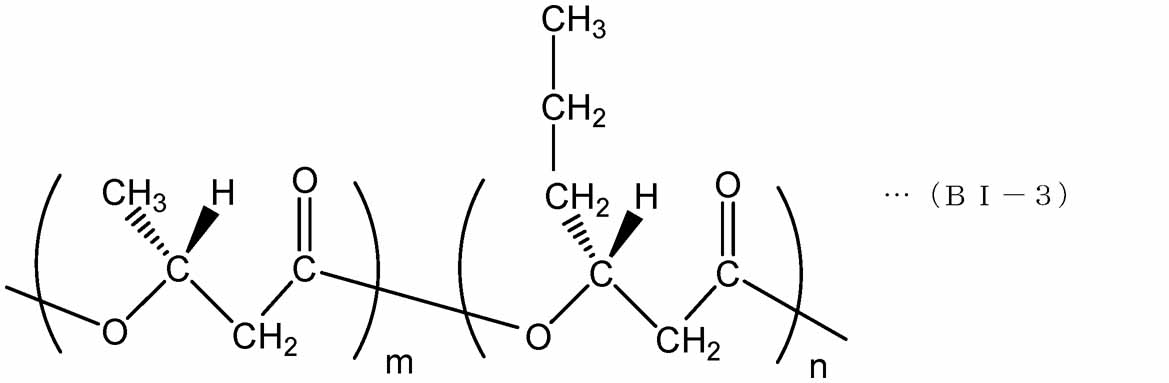
- poly-(3-hydroxybutyrate-co-3-hydroxyhexanoate) produced from microorganisms has the following structure. (BI-3) where m and n represent the degree of polymerization.
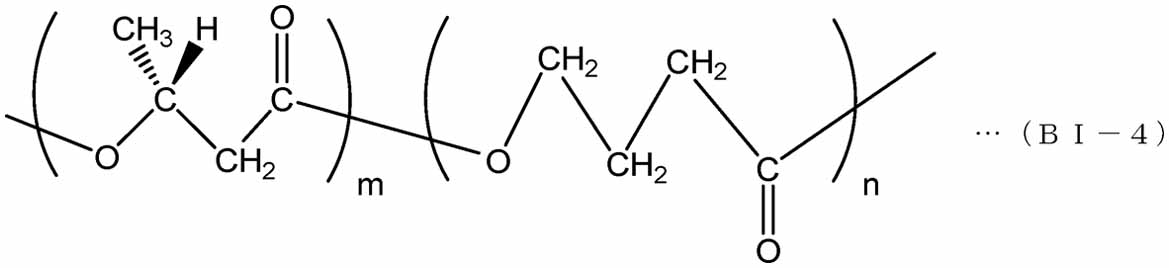
- poly-(3-hydroxybutyrate-co-4-hydroxybutyrate) produced from microorganisms has the following structure. (BI-4) where m and n represent the degree of polymerization.
- the polymer B-1 can be biodegradable.
- the poly(3-hydroxyalkanoate)-based polymer is the Alcaligenes eutrophus strain AC32, in which the PHA synthase gene derived from Aeromonascaviae was introduced into Alcaligenes eutrophus (international deposit based on the Budapest Treaty, international depositary authority: Independent Administrative Agency Industrial Technology Institute Patent Organism Depositary Center (1-1-1 Higashi, Tsukuba, Ibaraki, Japan), Original Deposit Date: August 12, 1996, Transferred to August 7, 1997, Deposit Number FERMBP-6038 (Transferred from original deposit FERM P-15786)) (J. Bacteriol., 179, 4821 (1997)).
- Polymer B-2 of this embodiment is an aromatic polyester having a melting point of 180-220.degree.
- An aromatic polyester is a polymer having an aromatic hydrocarbon structure (aromatic ring) and an ester bond in its main chain.
- the polymer B-2 can be a polycondensate of polycarboxylic acid and polyol (polyhydroxy compound).
- Polycarboxylic acid refers to an organic compound having multiple carboxyl groups or a derivative thereof (eg, acid anhydride, ester).
- a polyol (polyhydroxy compound) refers to an organic compound having a plurality of hydroxyl groups.
- the main chain of the structural unit derived from the polycarboxylic acid may have an aromatic ring
- the main chain of the structural unit derived from the polyol may have an aromatic ring
- the poly Both the main chain of the carboxylic acid-derived structural unit and the polyol-derived structural unit may have an aromatic ring.
- the polycarboxylic acid-derived structural unit has an aromatic ring in the main chain and the polyol-derived structural unit does not have an aromatic ring in the main chain. More preferably, the polyol-derived structural unit is aliphatic. Aliphatic includes those containing oxygen atoms.
- polycarboxylic acids in which the main chain of the polycarboxylic acid-derived structural unit has an aromatic ring include terephthalic acid, isophthalic acid, orthophthalic acid, 2,6-naphthalenedicarboxylic acid, and diphenyl ether 4,4'-dicarboxylic acid. , trimetic acid, trimetic acid, and derivatives thereof.
- the polycarboxylic acid may contain one type of polycarboxylic acid, but may contain a plurality of types of polycarboxylic acid.
- Polycarboxylic acid preferably contains terephthalic acid among others.
- the ratio of the number of moles of structural units derived from polycarboxylic acids other than terephthalic acid to the number of moles of structural units derived from all acid components is 10 mol% or less, 5 mol% or less, 1 mol% or less, and 0.5 mol% or less. can.
- the polycarboxylic acid may contain other polycarboxylic acid components in addition to terephthalic acid.
- polycarboxylic acid components include the above aromatic polycarboxylic acids other than terephthalic acid, adipic acid, sebacic acid, succinic acid, dimer acid, 1,4-cyclohexadicarboxylic acid, and derivatives thereof.
- aromatic polycarboxylic acids other than terephthalic acid, adipic acid, sebacic acid, succinic acid, dimer acid, 1,4-cyclohexadicarboxylic acid, and derivatives thereof.
- is an aliphatic polycarboxylic acid such as
- polyols in which the constituent units derived from the polyol are aliphatic are ethylene glycol, 2,2-dimethyl-1,3-propanediol (neopentyl glycol), 1,3-propanediol, 2-methyl-1 ,3-propanediol, 2-butyl-2-ethyl-1,3-propanediol, 1,2-propanediol, 1,4-butanediol, 1,3-butanediol, diethylene glycol, 1,4-cyclohexanediol , 1,4-cyclohexanedimethanol.
- Either one of the polyols may be added alone, or two or more of them may be added in an arbitrary ratio.
- aliphatic polyols a mixture of ethylene glycol and an aliphatic polyol having a longer chain length than ethylene glycol is preferable from the viewpoint of lowering the melting point.
- polyols with longer chain lengths than ethylene glycol are 2,2-dimethyl-1,3-propanediol (neopentyl glycol), 1,3-propanediol, 2-methyl-1,3-propanediol, 2 -aliphatic polyols such as butyl-2-ethyl-1,3-propanediol, 1,4-butanediol, 1,3-butanediol, diethylene glycol, 1,4-cyclohexanediol, 1,4-cyclohexanedimethanol is.
- the chain length is the length of the atomic chain present between OH groups.
- the aliphatic polyol having a chain length longer than that of ethylene glycol may be of only one type, or may be a mixture of two or more types.
- the amount of structural units derived from ethylene glycol is preferably 10 mol % or more with respect to the total amount of structural units derived from polyol.
- the amount of ethylene glycol-derived structural units may be 20 mol % or more, 30 mol % or more, 40 mol % or more, or 45 mol % or more with respect to the total amount of polyol-derived structural units.
- the amount of structural units derived from polyols having a chain length longer than that of ethylene glycol is preferably 27 mol % or more with respect to the total amount of structural units derived from polyols.
- the amount of polyol-derived structural units having a longer chain length than ethylene glycol may be 30 mol% or more, 35 mol% or more, 40 mol% or more, and 55 mol% or less, 52 mol%, relative to the total amount of polyol-derived structural units. Below, it may be 50 mol % or less and 45 mol % or less.
- the polymer B-2 preferably contains structural units derived from ethylene glycol and 2,2-dimethyl-1,3-propanediol (neopentyl glycol) as structural units derived from aliphatic polyols.
- the content of structural units derived from neopentyl glycol is preferably 27 mol% or more, more preferably 30 mol% or more, more preferably 35 mol% or more, and 40 mol, relative to the total amount of polyol-derived structural units. % or more is more preferable. If it is 25 mol % or less, the molding temperature of the composition will exceed 200°C.
- the content of structural units derived from neopentyl glycol is preferably 55 mol% or less, more preferably 52 mol% or less, and more preferably 50 mol% or less, relative to the total amount of structural units derived from the polyol component. It is more preferable that it is 45 mol % or less. If it exceeds 55 mol %, sufficient mechanical properties may not be obtained.
- aromatic polyester when the structural unit derived from polycarboxylic acid has an aromatic ring in the main chain, and the structural unit derived from the polyhydroxy compound also has an aromatic ring in the main chain, the aromatic in the main chain
- ring-containing polyhydroxy compounds are hydroquinone, 4,4'-dihydroxybiphenyl, bisphenol-A.
- the polymer B-2 may also be a polycondensate of monomers containing no polycarboxylic acid.
- the polymer B-2 may be a polycondensate of an aromatic hydroxycarboxylic acid in which two H's on the aromatic ring are substituted with a hydroxy group and a carboxyl group.
- aromatic hydroxycarboxylic acids are parahydroxybenzoic acid, 6-hydroxy-2-naphthalenecarboxylic acid.
- Polymer B-2 may also be a polycondensate of a mixture of aromatic hydroxycarboxylic acid and at least one of polyol and polycarboxylic acid.
- the polyol and polycarboxylic acid in this case may each independently be aliphatic or aromatic having an aromatic ring in the main chain.
- the melting point of the polymer B-2 is 180-220°C, preferably 180-210°C, more preferably 180-200°C.
- the melt mass flow rate (MFR (B-2)) of polymer B-2 measured at a temperature of 230° C. and a load of 2.16 kgf is preferably 0.1 g/10 min or more, 200 g /10 minutes or less.
- MFR (B-2) may be 1 g/10 min or more, 3 g/10 min or more, 5 g/10 min or more, 7 g/10 min or more, 8 g/10 min or more, or 10 g/10 min or more. It may be 10 minutes or longer, or 20 g/10 minutes or longer.
- MFR (B-2) may be 150 g/10 minutes or more, 100 g/10 minutes or more, or 70 g/10 minutes or less.
- the resin composition contains 70 to 95 parts by mass of the olefinic polymer A and the polymer B-1 with respect to a total of 100 parts by mass of the olefinic polymer A, the polymer B-1 and the polymer B-2. and 1 to 25 parts by mass of the polymer B-2.
- the resin composition can contain 80 to 90 parts by mass of the olefinic polymer A, 1 to 10 parts by mass of the polymer B-1, and 1 to 20 parts by mass of the polymer B-2.
- Polymer B-2 may be 2 parts by mass or more, 4 parts by mass or more, 18 parts by mass or less, or 16 parts by mass or less.
- the total proportion of the olefinic polymer A, the polymer B-1 and the polymer B-2 in the entire resin composition can be 50% by mass or more, preferably 60% by mass or more. and more preferably at least 70% by mass.
- the expression that the resin polymer B-1 forms a dispersed phase means that the resin composition has a sea-island structure in which the olefin polymer A is the continuous phase (sea portion) and the polymer B is the dispersed phase (island portion). It means that it has The average equivalent circle diameter of the dispersed phase (islands) can be from 10 nm to 400 ⁇ m.
- the resin composition may contain additives as necessary. Additives include stabilizers, antibacterial agents, antifungal agents, dispersants, plasticizers, flame retardants, tackifiers, colorants, metal powders, organic powders, inorganic fibers, organic fibers, organic and inorganic composite fibers. , inorganic whiskers, and fillers.
- stabilizers include at least one selected from the group consisting of lubricants, antioxidants, heat stabilizers, light stabilizers, weather stabilizers, metal deactivators, ultraviolet absorbers, light stabilizers, and copper damage inhibitors. is.
- light stabilizers are hindered amine light stabilizers.
- colorants are dyes such as organic dyes, or at least one selected from the group consisting of titanium oxide, carbon black and organic pigments.
- An example of a metal powder is ferrite.
- organic powder is protein.
- inorganic fibers are glass fibers and metal fibers.
- organic fibers are carbon fibers and aramid fibers.
- inorganic whiskers are potassium titanate whiskers.
- fillers are glass beads, glass balloons, glass flakes, asbestos, mica, calcium carbonate, talc, silica, calcium silicate, hydrotalcite, kaolin, diatomaceous earth, graphite, pumice, evo flour, cotton floc, It is at least one selected from the group consisting of cork powder, barium sulfate, fluororesin, cellulose powder, and wood powder.
- the resin composition may contain only one of the above additives, or may contain a combination of two or more.
- the additive may be contained in any of the olefin polymer A, polymer B-1, and polymer B-2.
- the additive may form a dispersed phase separate from the polymers B-1 and B-2 in the continuous phase of the olefinic polymer A.
- the above resin composition can be obtained by melt-kneading the olefinic polymer A, the polymer B-1, the polymer B-2, and optional additives.
- the kneading temperature (set temperature of the kneader) is preferably 150 to 300°C, more preferably 170 to 280°C.
- a part of each of the olefin polymer A and the polymers B-1 and B-2 is melt-kneaded to obtain a pre-kneaded product, followed by the olefin polymer A and the polymers B-1 and B- The remainder of 2 can be added to the pre-kneaded product and further melt-kneaded to obtain a resin composition.
- Method for producing molded article of resin composition Using known resin molding methods such as injection molding, extrusion molding, spinning molding, vacuum molding, air pressure molding, press molding, foam molding, blow molding, and rotational molding, the desired shape is obtained. It is possible to obtain a molded article of the above propylene-based composition having
- the above resin composition can be laminated with other materials such as other resins, fibers, metals, paper, leather, etc. to obtain a multilayer structure.
- a surface treatment may be applied to the surface of the molded body of the resin composition of the present invention.
- Examples of surface treatment methods include embossing, corona discharge treatment, flame treatment, plasma treatment, and ozone treatment.
- the above resin composition can be widely used as a resin material.
- inventions include fiber materials, exterior structural members, furniture and interior decoration members, house members, toy members, gardening members, automobile members, and packaging materials.
- textile materials include clothing fabric members, interior fabric members, and industrial textile members.
- Exterior structural members include, for example, carport members, fence members, gate members, gatepost members, post members, and cycle ports. members, deck members, sunroom members, roof members, terrace members, handrail members, shade members, awning members, etc.
- furniture and interior decoration members include sofa members, table members, chair members, bed members, chests of drawers.
- Examples include members, cabinet members, and dresser members.
- home appliance members include watch members, mobile phone members, white goods members, and the like.
- toy members include plastic model members, diorama members, and videos.
- Examples include game body members, gardening members include planter members, vase members, and flowerpot members, and automobile members include bumper materials, instrument panel materials, airbag cover materials, and the like.
- Examples of materials include food packaging materials, fiber packaging materials, miscellaneous goods packaging materials, and the like.
- other uses include, for example, monitor members, office automation (OA) equipment members, medical members, drainage pans, toiletry members, bottles, containers, snow removal product members, and various construction members.
- OA office automation
- Olefin polymer A (A-1) Propylene homopolymer MFR (230°C, 2.16 kg load): 7 g/10 minutes Melting point (Tm): 163°C
- Melt mass flow rate (MFR, unit: g/10 minutes) It was measured according to the method specified in JIS K7210-2014. The measurement temperature was 230° C. or 190° C., and the load was 2.16 kg.
- the weight average molecular weight (Mw) was calculated based on the measurement results of gel permeation chromatography (GPC).
- GPC gel permeation chromatography
- GPC-150C manufactured by Waters Co., Ltd. was used as a measuring apparatus, an ortho-dichlorobenzene solution having a polymer concentration of 0.05% by weight was used, and a mixed polystyrene gel column (PSKgelGMH6-HT manufactured by Tosoh Corporation) was used as a column. was used, and the measurement temperature was 135°C.
- the content of the comonomer component is the number of structural units other than 3-hydroxybutyrate with respect to the total number of ester structural units of hydroxyalkanoate of polymer B-1. It refers to the molar ratio of (3-hydroxyhexanoate (3HH) or 4-hydroxybutyrate (4HB)).
- the content of the comonomer component is determined according to L.I. Tripathi. , M. C. Factories, 11, 44 (2012) was obtained by the method using the 1H-NMR spectrum.
- ⁇ Measurement condition Model: Bruker AVANCE600 Probe: 10mm cryoprobe Measurement temperature: 135°C Pulse repetition time: 1 second Pulse width: 45° Accumulated times: 700 times Magnetic field strength: 600 MHz
- Tm Melting point
- the degree of dyeing was obtained from the following formula (3).
- Dyeing degree ⁇ [integrated value (2) of 450 to 650 nm in the absorption spectrum of the molded body after soaping] - [integrated value (1) of 450 to 650 nm in the absorption spectrum of the molded body] ⁇ / Molded body thickness ( ⁇ m) (3)
- a higher value indicates better dyeability.
- Example 1 85% by mass of polymer (A-1), 5% by mass of polymer (B-1-1), and 10% by mass of polymer (B-2-1) are uniformly mixed in a powder state. After that, the mixture was supplied to a small kneader (Xplore; manufactured by DSM) and kneaded under conditions of a resin temperature of 190°C, a kneading time of 4 minutes, and a screw rotation speed of 100 rpm to obtain a resin composition. The dyeing degree and density of the resin composition were evaluated.
- Xplore manufactured by DSM
- Example 2 82% by mass of polymer (A-1), 8% by mass of polymer (B-1-1), and 10% by mass of polymer (B-2-1), except for using Example 1 I did the same.
- Example 3 Example 1 except that 70% by mass of the polymer (A-1), 5% by mass of the polymer (B-1-1), and 25% by mass of the polymer (B-2-1) are used. I did the same.
- Example 2 The procedure was the same as in Example 1, except that 85% by mass of the polymer (A-1) and 15% by mass of the polymer (B-1-1) were used.
- Example 3 The procedure was the same as in Example 1, except that 85% by mass of the polymer (A-1) and 15% by mass of the polymer (B-2-1) were used.
- Example 4 Example 1 except that 85% by mass of the polymer (A-1), 5% by mass of the polymer (B-1-2), and 10% by mass of the polymer (B-2-1) are used. I did the same.
- Table 1 shows the conditions and results.
Landscapes
- Chemical & Material Sciences (AREA)
- Health & Medical Sciences (AREA)
- Chemical Kinetics & Catalysis (AREA)
- Medicinal Chemistry (AREA)
- Polymers & Plastics (AREA)
- Organic Chemistry (AREA)
- Compositions Of Macromolecular Compounds (AREA)
- Biological Depolymerization Polymers (AREA)
Abstract
Description
前記重合体B-1は150℃~220℃の融点を有するポリ(3-ヒドロキシアルカノエート)系重合体であり、
前記重合体B-2は、180~220℃の融点を有する芳香族ポリエステルであり、
前記オレフィン系重合体Aと前記重合体B-1と前記重合体B-2との合計100質量部に対して、前記オレフィン系重合体Aの含有量は70~95質量部であり、前記重合体B-1の含有量は1~15質量部であり、前記重合体B-2の含有量は1~25質量部である。
前記重合体B-1は、3-ヒドロキシブチレートの構成単位を含むことができる。
前記重合体B-1は、ヒドロキシアルカノエートの全構成単位(100モル%)に対して、3-ヒドロキシブチレートの構成単位を50モル%以上含むことができる。
オレフィン系重合体Aとは、炭素原子数2以上10以下のオレフィンに由来する構造単位を50質量%以上含有する重合体である(ただし、オレフィン系重合体の全量を100質量%とする)。炭素原子数2以上10以下のオレフィンの例は、エチレン、プロピレン、1-ブテン、4-メチル-1-ペンテン、1-ヘキセン、1-オクテン、1-デセンである。
重合体B-1は150~220℃の融点を有するポリ(3-ヒドロキシアルカノエート)系重合体である。


本実施形態の重合体B-2は180~220℃の融点を有する芳香族ポリエステルである。芳香族ポリエステルとは、主鎖に芳香族炭化水素構造(芳香族環)及びエステル結合を有する重合体である。
エチレングリコールよりも鎖長の長いポリオール由来の構成単位の量は、ポリオール由来の構成単位の総量に対して、27mol%以上であると好ましい。エチレングリコールよりも鎖長の長いポリオール成分を含むことにより、重合体B-2の融点を下げることができる。エチレングリコールよりも鎖長の長いポリオール由来の構成単位の量は、ポリオール由来の構成単位の総量に対して、30mol%以上、35mol%以上、40mol%以上であってよく、55mol%以下、52mol%以下、50mol%以下、45mol%以下であってよい。
樹脂組成物は、オレフィン系重合体Aと重合体B-1と重合体B-2との合計100質量部に対して、オレフィン系重合体Aを70~95質量部と、重合体B-1を1~15質量部と、重合体B-2を1~25質量部含む。樹脂組成物は、オレフィン系重合体Aを80~90質量部と、重合体B-1を1~10質量部と、重合体B-2を1~20質量部を含むことができる。重合体B-2は、2質量部以上でもよく、4質量部以上でもよく、18質量部以下でもよく、16質量部以下でもよい。
樹脂組成物は、必要に応じて、添加剤を含んでもよい。添加剤としては、安定剤、防菌剤、防黴剤、分散剤、可塑剤、難燃剤、粘着付与剤、着色剤、金属粉末、有機粉末、無機繊維、有機繊維、有機及び無機の複合繊維、無機ウィスカー、及び、充填剤からなる群から選択される少なくとも一種であることができる。
上記の樹脂組成物は、オレフィン系重合体A、重合体B-1、重合体B-2、及び、必要に応じて添加される添加剤を、溶融混練して得ることができる。混練温度(混練機の設定温度)を150~300℃とすることが好ましく、170℃~280℃とすることがより好ましい。また、オレフィン系重合体A及び重合体B-1、B-2の各一部を溶融混練して予備混練物を得て、続いて、オレフィン系重合体Aと重合体B-1、B-2の残りを予備混練物に加えてさらに溶融混練して樹脂組成物を得ることもできる。
射出成形法、押出成形法、紡績成形法、真空成形法、圧空成形法、プレス成形法、発泡成形法、ブロー成形法、回転成形法などの公知の樹脂の成形方法を用いて、所要の形状を有する上記のプロピレン系組成物の成形体を得ることができる。
(A-1)プロピレン単独重合体
MFR(230℃、2.16kg荷重):7g/10分
融点(Tm):163℃
(B-1-1)ポリ(3-ヒドロキシブチレート-コ-3-ヒドロキシヘキサノエート)
構造式:(BI-3)式
コモノマー(3HH)成分の含有量(モル%):0.2モル%
重量平均分子量(Mw):104000
MFR(190℃、2.16kg荷重):7.8g/10分
融点(Tm):177℃
構造式:(BI-4)式
(商品名)M4300:CJ第一製糖社製
コモノマー(4HB)成分の含有量(モル%):45モル%
重量平均分子量(Mw):216000
MFR(190℃、2.16kg荷重):4.0g/10分
融点(Tm):48.7℃
(B-2-1)芳香族ポリエステル
ポリカルボン酸:テレフタル酸(100mol%)
ポリオール:エチレングリコール(67mol%)
ポリオール:ネオペンチルグリコール(33mol%)
MFR(230℃、2.16kg荷重):48g/10分
融点(Tm):198℃
(商品名)ベルペットEFG70:ベルポリエステルプロダクツ社製
ポリカルボン酸:テレフタル酸
ポリオール:エチレングリコール
固有粘度:0.75dl/g
融点(Tm):255℃
JIS K7210-2014に規定された方法に従って測定した。測定温度は230℃又は190℃、荷重は2.16kgとした。
重量平均分子量(Mw)を、ゲルパーミエーションクロマトグラフィー(GPC)の測定結果に基づき算出した。GPCの測定において、測定装置としてウォーターズ社製GPC-150Cを用い、ポリマー濃度0.05重量%のオルトジクロロベンゼン溶液を用い、カラムとして混合ポリスチレンゲルカラム(東ソー(株)社製PSKgelGMH6-HT)を使用し、測定温度を135℃とした。
コモノマー成分の含有量は、重合体B-1のヒドロキシアルカノエートの全エステル構成単位の数に対する、3-ヒドロキシブチレート以外の他の構成単位(3-ヒドロキシヘキサノエート(3HH)又は4-ヒドロキシブチレート(4HB))のモル比のことである。
〔測定条件〕
機種:Bruker AVANCE600
プローブ:10mmクライオプローブ
測定温度:135℃
パルス繰り返し時間:1秒
パルス幅:45°
積算回数:700回
磁場強度:600MHz
JIS K7121に規定された方法に従って、測定した。測定温度は-50℃~200℃もしくは、-50℃~250℃で、昇温速度は10℃/分で測定した。
新藤金属工業所圧縮成形機(P-37)を用い、温度210℃で5分間樹脂を予熱した後、温度210℃・圧力10MPa・5分間の条件で加圧し、幅23mm、長さ43mm、厚み50μmの形状に賦形された成形体を得た。
得られた成形体を、分光光度計(島津製作所製UV3150)を用いて、吸収スペクトルを得たのち、波長範囲450~650nmにおける吸収スペクトルの積分値(1)を算出した。
次に水を500mL、有機染料(江蘇徳旺製Mecikron rubine spw)を15g、ポリエチレングリコールモノオレートを0.5g、グリセロールモノステアレートを0.5g、酢酸0.5mlを混ぜて染色液とし、前述の成形体とともに密閉型リアクターに入れ、密閉し、マグネチックスターラーで攪拌しながら110℃で40分の条件で成形体を染色した。
次に、水を300mL、硫酸ナトリウムを0.9g、水酸化ナトリウムを1.2g、ポリエチレングリコール4000を0.3gを混ぜてソーピング液とし、前述の染色された成形体とともに密閉型リアクターに入れ、密閉し、マグネチックスターラーで攪拌しながら、70℃で20分の条件で、ソーピングした。
ソーピングされた成形体を、分光光度計(島津製作所製UV3150)を用いて、吸収スペクトルを得たのち、波長範囲450~650nmにおける吸収スペクトルの積分値(2)を算出した。
得られた吸収スペクトルの積分値(1)、得られた吸収スペクトルの積分値(2)及び成形体の厚みを用いて、下記の式(3)から染色度を得た。
染色度={[ソーピング後の成形体の吸収スペクトルの吸収スペクトにおける450~650nmの積分値(2)]-[成形体の吸収スペクトルの吸収スペクトルにおける450~650nmの積分値(1)]}/成形体の厚み(μm)…(3)
数値が大きいほど染色性がよいことを示す。
樹脂組成物の密度は、JISK7112-1999に規定された方法でのA方法に従って求めた。
85質量%の重合体(A-1)と、5質量%の重合体(B-1-1)と、10質量%の重合体(B-2-1)を粉体の状態で均一に混合したのち、小型混練機(Xplore;DSM社製)に供給して樹脂温度190℃、混練時間4分、スクリュー回転速度100rpmの条件で混練を行い、樹脂組成物を得た。前記樹脂組成物の染色度と密度を評価した。
82質量%の重合体(A-1)と、8質量%の重合体(B-1-1)と、10質量%の重合体(B-2-1)を用いる以外は、実施例1と同様にした。
70質量%の重合体(A-1)と、5質量%の重合体(B-1-1)と、25質量%の重合体(B-2-1)を用いる以外は、実施例1と同様にした。
100質量%の重合体(A-1)を単独で用いる以外は、実施例1と同様にした。
85質量%の重合体(A-1)と、15質量%の重合体(B-1-1)を用いる以外は、実施例1と同様にした。
85質量%の重合体(A-1)と、15質量%の重合体(B-2-1)を用いる以外は、実施例1と同様にした。
85質量%の重合体(A-1)と、5質量%の重合体(B-1-2)と、10質量%の重合体(B-2-1)を用いる以外は、実施例1と同様にした。
85質量%の重合体(A-1)と、5質量%の重合体(B-1-1)と、10質量%の重合体(B-2-2)を用いることと、混練時の樹脂温度を230℃とした以外は、実施例1と同様にした。

Claims (5)
- オレフィン系重合体Aと、重合体B-1と、重合体B-2と、を含む組成物であって、
前記重合体B-1は、150~220℃の融点を有するポリ(3-ヒドロキシアルカノエート)系重合体であり、
前記重合体B-2は、180~220℃の融点を有する芳香族ポリエステルであり、
前記オレフィン系重合体Aと前記重合体B-1と前記重合体B-2との合計100質量部に対して、前記オレフィン系重合体Aの含有量は70~95質量部であり、前記重合体B-1の含有量は1~15質量部であり、前記重合体B-2の含有量は1~25質量部である、樹脂組成物。 - 前記オレフィン系重合体Aと前記重合体B-1と前記重合体B-2の合計100質量部に対して、前記オレフィン系重合体Aの含有量は80~90質量部であり、前記重合体B-1の含有量が1~10質量部であり、前記重合体B-2の含有量は1~20質量部である、請求項1に記載の樹脂組成物。
- 前記オレフィン系重合体Aがプロピレン単独重合体である請求項1または2に記載の樹脂組成物。
- 前記重合体B-1は、3-ヒドロキシブチレートの構成単位を含む、請求項1~3のいずれか一項に記載の樹脂組成物。
- 前記重合体B-1は、ヒドロキシアルカノエートの全構成単位(100モル%)に対して、3-ヒドロキシブチレートの構成単位を50モル%以上含む、請求項1~4のいずれか一項に記載の樹脂組成物。
Priority Applications (3)
| Application Number | Priority Date | Filing Date | Title |
|---|---|---|---|
| US18/580,687 US20240360301A1 (en) | 2021-07-27 | 2022-07-25 | Resin composition |
| EP22849442.3A EP4368668A4 (en) | 2021-07-27 | 2022-07-25 | Resin composition |
| CN202280050989.XA CN117836364A (zh) | 2021-07-27 | 2022-07-25 | 树脂组合物 |
Applications Claiming Priority (2)
| Application Number | Priority Date | Filing Date | Title |
|---|---|---|---|
| JP2021-122430 | 2021-07-27 | ||
| JP2021122430A JP7695139B2 (ja) | 2021-07-27 | 2021-07-27 | 樹脂組成物 |
Publications (1)
| Publication Number | Publication Date |
|---|---|
| WO2023008381A1 true WO2023008381A1 (ja) | 2023-02-02 |
Family
ID=85087000
Family Applications (1)
| Application Number | Title | Priority Date | Filing Date |
|---|---|---|---|
| PCT/JP2022/028648 Ceased WO2023008381A1 (ja) | 2021-07-27 | 2022-07-25 | 樹脂組成物 |
Country Status (5)
| Country | Link |
|---|---|
| US (1) | US20240360301A1 (ja) |
| EP (1) | EP4368668A4 (ja) |
| JP (1) | JP7695139B2 (ja) |
| CN (1) | CN117836364A (ja) |
| WO (1) | WO2023008381A1 (ja) |
Families Citing this family (2)
| Publication number | Priority date | Publication date | Assignee | Title |
|---|---|---|---|---|
| JP2024177093A (ja) * | 2023-06-09 | 2024-12-19 | 住友化学株式会社 | 樹脂組成物 |
| JP2025146734A (ja) * | 2024-03-21 | 2025-10-03 | 住友化学株式会社 | 樹脂組成物 |
Citations (6)
| Publication number | Priority date | Publication date | Assignee | Title |
|---|---|---|---|---|
| JP2003096668A (ja) * | 2001-09-27 | 2003-04-03 | Kuraray Co Ltd | 海棲生物付着防止効果を有する繊維 |
| JP2008261070A (ja) | 2007-04-12 | 2008-10-30 | Mitsubishi Rayon Co Ltd | ポリプロピレン系繊維及び織編物 |
| JP2010031237A (ja) * | 2008-06-30 | 2010-02-12 | Sanyo Chem Ind Ltd | 搬送材用成形品樹脂組成物 |
| CN102146598A (zh) * | 2011-04-22 | 2011-08-10 | 中国科学院宁波材料技术与工程研究所 | 一种含phbv的生物基化学纤维及其制备方法 |
| JP2012036361A (ja) * | 2010-07-13 | 2012-02-23 | Toyobo Co Ltd | バイオマス由来の脂肪族ポリエステルを含有したポリエステル樹脂組成物 |
| CN105419047A (zh) * | 2015-12-01 | 2016-03-23 | 王威淞 | 一种可降解阻燃环保塑料 |
Family Cites Families (2)
| Publication number | Priority date | Publication date | Assignee | Title |
|---|---|---|---|---|
| CN109370036A (zh) * | 2018-10-26 | 2019-02-22 | 苏州福慧材料科技有限公司 | 一种高阻隔的生物降解地膜及其制备方法 |
| CN110294914A (zh) * | 2019-05-13 | 2019-10-01 | 山东寿光鲁清石化有限公司 | 一种耐热抗冲击htpp及其制备工艺 |
-
2021
- 2021-07-27 JP JP2021122430A patent/JP7695139B2/ja active Active
-
2022
- 2022-07-25 WO PCT/JP2022/028648 patent/WO2023008381A1/ja not_active Ceased
- 2022-07-25 US US18/580,687 patent/US20240360301A1/en active Pending
- 2022-07-25 EP EP22849442.3A patent/EP4368668A4/en active Pending
- 2022-07-25 CN CN202280050989.XA patent/CN117836364A/zh active Pending
Patent Citations (6)
| Publication number | Priority date | Publication date | Assignee | Title |
|---|---|---|---|---|
| JP2003096668A (ja) * | 2001-09-27 | 2003-04-03 | Kuraray Co Ltd | 海棲生物付着防止効果を有する繊維 |
| JP2008261070A (ja) | 2007-04-12 | 2008-10-30 | Mitsubishi Rayon Co Ltd | ポリプロピレン系繊維及び織編物 |
| JP2010031237A (ja) * | 2008-06-30 | 2010-02-12 | Sanyo Chem Ind Ltd | 搬送材用成形品樹脂組成物 |
| JP2012036361A (ja) * | 2010-07-13 | 2012-02-23 | Toyobo Co Ltd | バイオマス由来の脂肪族ポリエステルを含有したポリエステル樹脂組成物 |
| CN102146598A (zh) * | 2011-04-22 | 2011-08-10 | 中国科学院宁波材料技术与工程研究所 | 一种含phbv的生物基化学纤维及其制备方法 |
| CN105419047A (zh) * | 2015-12-01 | 2016-03-23 | 王威淞 | 一种可降解阻燃环保塑料 |
Non-Patent Citations (3)
| Title |
|---|
| A. ZAMBELLI ET AL., MACROMOLECULES, vol. 6, 1973 |
| J. BACTERIOL., 1997, pages 1794821 |
| See also references of EP4368668A4 |
Also Published As
| Publication number | Publication date |
|---|---|
| US20240360301A1 (en) | 2024-10-31 |
| TW202309234A (zh) | 2023-03-01 |
| JP7695139B2 (ja) | 2025-06-18 |
| CN117836364A (zh) | 2024-04-05 |
| EP4368668A1 (en) | 2024-05-15 |
| EP4368668A4 (en) | 2025-05-21 |
| JP2023018362A (ja) | 2023-02-08 |
Similar Documents
| Publication | Publication Date | Title |
|---|---|---|
| TWI900735B (zh) | 組合物 | |
| CA2895274A1 (en) | Polylactic resin composition, molded product, and method for producing polylactic resin composition | |
| JP7695139B2 (ja) | 樹脂組成物 | |
| TWI922720B (zh) | 樹脂組合物 | |
| KR20250025605A (ko) | 조성물 | |
| Fradet et al. | Polyesters | |
| JP2024162836A (ja) | 樹脂組成物成形体 | |
| WO2024232343A1 (ja) | 樹脂組成物 | |
| JP2024177093A (ja) | 樹脂組成物 | |
| JP2024056260A (ja) | 組成物 | |
| WO2023223702A1 (ja) | 組成物 | |
| WO2024209856A1 (ja) | 組成物及び成形体 | |
| Sandhya | Synthesis and characterization of aliphatic aromatic polyesters | |
| JP2025146734A (ja) | 樹脂組成物 | |
| TW201833173A (zh) | 經二酸所修飾之共聚酯類 | |
| JPS59138222A (ja) | 熱可塑性ポリエステル | |
| JPS6394812A (ja) | ポリエステルの溶融成形方法 | |
| JPH10330604A (ja) | ポリアルキレンナフタレート樹脂組成物 |
Legal Events
| Date | Code | Title | Description |
|---|---|---|---|
| 121 | Ep: the epo has been informed by wipo that ep was designated in this application |
Ref document number: 22849442 Country of ref document: EP Kind code of ref document: A1 |
|
| WWE | Wipo information: entry into national phase |
Ref document number: 202280050989.X Country of ref document: CN |
|
| WWE | Wipo information: entry into national phase |
Ref document number: 2022849442 Country of ref document: EP |
|
| ENP | Entry into the national phase |
Ref document number: 2022849442 Country of ref document: EP Effective date: 20240207 |
|
| NENP | Non-entry into the national phase |
Ref country code: DE |