WO2023032231A1 - 廃石膏ボードの破砕方法、及びそれに用いるサイロ - Google Patents
廃石膏ボードの破砕方法、及びそれに用いるサイロ Download PDFInfo
- Publication number
- WO2023032231A1 WO2023032231A1 PCT/JP2021/038759 JP2021038759W WO2023032231A1 WO 2023032231 A1 WO2023032231 A1 WO 2023032231A1 JP 2021038759 W JP2021038759 W JP 2021038759W WO 2023032231 A1 WO2023032231 A1 WO 2023032231A1
- Authority
- WO
- WIPO (PCT)
- Prior art keywords
- gypsum
- silo
- granules
- crushing
- waste
- Prior art date
- Legal status (The legal status is an assumption and is not a legal conclusion. Google has not performed a legal analysis and makes no representation as to the accuracy of the status listed.)
- Ceased
Links
Images



Classifications
-
- B—PERFORMING OPERATIONS; TRANSPORTING
- B02—CRUSHING, PULVERISING, OR DISINTEGRATING; PREPARATORY TREATMENT OF GRAIN FOR MILLING
- B02C—CRUSHING, PULVERISING, OR DISINTEGRATING IN GENERAL; MILLING GRAIN
- B02C19/00—Other disintegrating devices or methods
- B02C19/0056—Other disintegrating devices or methods specially adapted for specific materials not otherwise provided for
-
- B—PERFORMING OPERATIONS; TRANSPORTING
- B03—SEPARATION OF SOLID MATERIALS USING LIQUIDS OR USING PNEUMATIC TABLES OR JIGS; MAGNETIC OR ELECTROSTATIC SEPARATION OF SOLID MATERIALS FROM SOLID MATERIALS OR FLUIDS; SEPARATION BY HIGH-VOLTAGE ELECTRIC FIELDS
- B03C—MAGNETIC OR ELECTROSTATIC SEPARATION OF SOLID MATERIALS FROM SOLID MATERIALS OR FLUIDS; SEPARATION BY HIGH-VOLTAGE ELECTRIC FIELDS
- B03C1/00—Magnetic separation
- B03C1/02—Magnetic separation acting directly on the substance being separated
- B03C1/16—Magnetic separation acting directly on the substance being separated with material carriers in the form of belts
-
- B—PERFORMING OPERATIONS; TRANSPORTING
- B02—CRUSHING, PULVERISING, OR DISINTEGRATING; PREPARATORY TREATMENT OF GRAIN FOR MILLING
- B02C—CRUSHING, PULVERISING, OR DISINTEGRATING IN GENERAL; MILLING GRAIN
- B02C23/00—Auxiliary methods or auxiliary devices or accessories specially adapted for crushing or disintegrating not provided for in preceding groups or not specially adapted to apparatus covered by a single preceding group
- B02C23/02—Feeding devices
-
- B—PERFORMING OPERATIONS; TRANSPORTING
- B02—CRUSHING, PULVERISING, OR DISINTEGRATING; PREPARATORY TREATMENT OF GRAIN FOR MILLING
- B02C—CRUSHING, PULVERISING, OR DISINTEGRATING IN GENERAL; MILLING GRAIN
- B02C23/00—Auxiliary methods or auxiliary devices or accessories specially adapted for crushing or disintegrating not provided for in preceding groups or not specially adapted to apparatus covered by a single preceding group
- B02C23/08—Separating or sorting of material, associated with crushing or disintegrating
-
- B—PERFORMING OPERATIONS; TRANSPORTING
- B03—SEPARATION OF SOLID MATERIALS USING LIQUIDS OR USING PNEUMATIC TABLES OR JIGS; MAGNETIC OR ELECTROSTATIC SEPARATION OF SOLID MATERIALS FROM SOLID MATERIALS OR FLUIDS; SEPARATION BY HIGH-VOLTAGE ELECTRIC FIELDS
- B03B—SEPARATING SOLID MATERIALS USING LIQUIDS OR USING PNEUMATIC TABLES OR JIGS
- B03B9/00—General arrangement of separating plant, e.g. flow sheets
- B03B9/06—General arrangement of separating plant, e.g. flow sheets specially adapted for refuse
- B03B9/061—General arrangement of separating plant, e.g. flow sheets specially adapted for refuse the refuse being industrial
- B03B9/065—General arrangement of separating plant, e.g. flow sheets specially adapted for refuse the refuse being industrial the refuse being building rubble
-
- B—PERFORMING OPERATIONS; TRANSPORTING
- B03—SEPARATION OF SOLID MATERIALS USING LIQUIDS OR USING PNEUMATIC TABLES OR JIGS; MAGNETIC OR ELECTROSTATIC SEPARATION OF SOLID MATERIALS FROM SOLID MATERIALS OR FLUIDS; SEPARATION BY HIGH-VOLTAGE ELECTRIC FIELDS
- B03C—MAGNETIC OR ELECTROSTATIC SEPARATION OF SOLID MATERIALS FROM SOLID MATERIALS OR FLUIDS; SEPARATION BY HIGH-VOLTAGE ELECTRIC FIELDS
- B03C1/00—Magnetic separation
- B03C1/02—Magnetic separation acting directly on the substance being separated
- B03C1/025—High gradient magnetic separators
- B03C1/031—Component parts; Auxiliary operations
- B03C1/033—Component parts; Auxiliary operations characterised by the magnetic circuit
- B03C1/0332—Component parts; Auxiliary operations characterised by the magnetic circuit using permanent magnets
-
- B—PERFORMING OPERATIONS; TRANSPORTING
- B03—SEPARATION OF SOLID MATERIALS USING LIQUIDS OR USING PNEUMATIC TABLES OR JIGS; MAGNETIC OR ELECTROSTATIC SEPARATION OF SOLID MATERIALS FROM SOLID MATERIALS OR FLUIDS; SEPARATION BY HIGH-VOLTAGE ELECTRIC FIELDS
- B03C—MAGNETIC OR ELECTROSTATIC SEPARATION OF SOLID MATERIALS FROM SOLID MATERIALS OR FLUIDS; SEPARATION BY HIGH-VOLTAGE ELECTRIC FIELDS
- B03C1/00—Magnetic separation
- B03C1/02—Magnetic separation acting directly on the substance being separated
- B03C1/025—High gradient magnetic separators
- B03C1/031—Component parts; Auxiliary operations
- B03C1/033—Component parts; Auxiliary operations characterised by the magnetic circuit
- B03C1/0335—Component parts; Auxiliary operations characterised by the magnetic circuit using coils
-
- B—PERFORMING OPERATIONS; TRANSPORTING
- B03—SEPARATION OF SOLID MATERIALS USING LIQUIDS OR USING PNEUMATIC TABLES OR JIGS; MAGNETIC OR ELECTROSTATIC SEPARATION OF SOLID MATERIALS FROM SOLID MATERIALS OR FLUIDS; SEPARATION BY HIGH-VOLTAGE ELECTRIC FIELDS
- B03C—MAGNETIC OR ELECTROSTATIC SEPARATION OF SOLID MATERIALS FROM SOLID MATERIALS OR FLUIDS; SEPARATION BY HIGH-VOLTAGE ELECTRIC FIELDS
- B03C1/00—Magnetic separation
- B03C1/02—Magnetic separation acting directly on the substance being separated
- B03C1/035—Open gradient magnetic separators, i.e. separators in which the gap is unobstructed, characterised by the configuration of the gap
-
- B—PERFORMING OPERATIONS; TRANSPORTING
- B03—SEPARATION OF SOLID MATERIALS USING LIQUIDS OR USING PNEUMATIC TABLES OR JIGS; MAGNETIC OR ELECTROSTATIC SEPARATION OF SOLID MATERIALS FROM SOLID MATERIALS OR FLUIDS; SEPARATION BY HIGH-VOLTAGE ELECTRIC FIELDS
- B03C—MAGNETIC OR ELECTROSTATIC SEPARATION OF SOLID MATERIALS FROM SOLID MATERIALS OR FLUIDS; SEPARATION BY HIGH-VOLTAGE ELECTRIC FIELDS
- B03C1/00—Magnetic separation
- B03C1/02—Magnetic separation acting directly on the substance being separated
- B03C1/30—Combinations with other devices, not otherwise provided for
-
- B—PERFORMING OPERATIONS; TRANSPORTING
- B03—SEPARATION OF SOLID MATERIALS USING LIQUIDS OR USING PNEUMATIC TABLES OR JIGS; MAGNETIC OR ELECTROSTATIC SEPARATION OF SOLID MATERIALS FROM SOLID MATERIALS OR FLUIDS; SEPARATION BY HIGH-VOLTAGE ELECTRIC FIELDS
- B03C—MAGNETIC OR ELECTROSTATIC SEPARATION OF SOLID MATERIALS FROM SOLID MATERIALS OR FLUIDS; SEPARATION BY HIGH-VOLTAGE ELECTRIC FIELDS
- B03C2201/00—Details of magnetic or electrostatic separation
- B03C2201/20—Magnetic separation of bulk or dry particles in mixtures
-
- B—PERFORMING OPERATIONS; TRANSPORTING
- B65—CONVEYING; PACKING; STORING; HANDLING THIN OR FILAMENTARY MATERIAL
- B65G—TRANSPORT OR STORAGE DEVICES, e.g. CONVEYORS FOR LOADING OR TIPPING, SHOP CONVEYOR SYSTEMS OR PNEUMATIC TUBE CONVEYORS
- B65G65/00—Loading or unloading
- B65G65/30—Methods or devices for filling or emptying bunkers, hoppers, tanks, or like containers, of interest apart from their use in particular chemical or physical processes or their application in particular machines, e.g. not covered by a single other subclass
- B65G65/34—Emptying devices
- B65G65/40—Devices for emptying otherwise than from the top
- B65G65/46—Devices for emptying otherwise than from the top using screw conveyors
Definitions
- This invention relates to the crushing of waste gypsum board and the silo used for it.
- Waste gypsum board consists of gypsum board with a paper surface and may contain foreign matter such as metal.
- waste gypsum board is first roughly crushed by a cutting machine. The crushed waste gypsum board is conveyed by a belt conveyor, and foreign substances such as metals are visually removed on the belt conveyor. Next, the roughly crushed waste gypsum board is crushed into gypsum granules by a four-axis roll crusher, and the waste gypsum board is separated into paper pieces and gypsum granules by a subsequent sieve. Before and after processing with the 4-axis roll crusher, metallic foreign matter is further removed with a magnetic separator.
- the obtained gypsum granules are calcined and converted into, for example, gypsum hemihydrate.
- the converted gypsum hemihydrate or the like is mixed with a gypsum slurry, and gypsum particles such as gypsum dihydrate are precipitated in a closed-loop crystallizer.
- the precipitated gypsum particles are solid-liquid separated from the slurry, the gypsum particles can be recovered from the waste gypsum board.
- the collected gypsum particles can be recycled into gypsum board or used as a raw material for cement.
- the object of this invention is to enable smooth removal of gypsum granules from the silo when the gypsum granules obtained by crushing the waste gypsum board are stored in the silo.
- a crushing step of crushing the waste gypsum board into gypsum granules and a storage step of storing the gypsum granules obtained in the crushing step in a silo are performed.
- the method for crushing waste gypsum boards of the present invention is characterized in that, in the storage step, gypsum granules in the silo are discharged out of the silo by means of a plurality of screw conveyors provided at the bottom of the silo.
- the silo of this invention is a silo for storing gypsum granules obtained by crushing waste gypsum boards.
- the silo of the present invention is characterized by having a plurality of screw conveyors at the bottom so as to discharge the gypsum granules inside the silo to the outside of the silo.
- the description regarding the crushing method of the waste gypsum board also applies to the crushing system of the waste gypsum board consisting of a silo or the like.
- the gypsum granules in the silo lose fluidity due to condensation, and may not be discharged from the silo due to gravity.
- gypsum granules are forcibly discharged by a screw conveyor at the bottom of the silo. Since a screw conveyor is used, the gypsum can be discharged even if the fluidity of the gypsum is reduced.
- a plurality of screw conveyors are provided at the bottom of the silo in order to discharge the gypsum granules from almost the entire bottom of the silo. Therefore, gypsum granules can be discharged from almost the entire bottom of the silo.
- the inner wall of the silo is inclined from the vertical direction to face the inside of the silo. Then, the gypsum granule bridge cannot be supported by friction with the inner wall of the silo, and the bridge naturally collapses. Also, even if the gypsum adheres to the inner wall of the silo, the gypsum is likely to separate from the inner wall due to gravity. The mechanism described above prevents the gypsum from hanging on the shelf inside the silo and also prevents the gypsum from sticking to the inner wall.
- the gypsum granules discharged by a plurality of screw conveyors are collected by other screw conveyors and discharged to the outside of the silo. Since a plurality of screw conveyors are used, the gypsum granules are discharged through slits or elongated holes having a certain length. Discharging the discharged gypsum granules in a hopper or the like requires additional space and may cause the gypsum granules to agglomerate in the hopper. Therefore, preferably, the gypsum granules are collected at one place by another screw conveyor and discharged.
- the gypsum granules are stored in the silo so that the inner diameter D is equal to or greater than the height H, where D is the inner diameter of the silo bottom and H is the height of the gypsum granules. If the height H is larger than the inner diameter D, the gypsum granules tend to solidify in the silo.
- a preferred embodiment of the crushing step will be explained.
- gypsum granules generated by crushing may cover the foreign substances.
- the foreign matter may not be visible and may not be removed. Therefore, after crushing the waste gypsum board with a crusher, the crushed waste gypsum board is sieved. Then, fine gypsum granules generated by crushing are separated under the sieve.
- the sieved components that have not passed through the mesh of the sieve are conveyed by the belt conveyor, the foreign substances are easily visible, so that the foreign substances can be easily removed on the belt conveyor.
- the gypsum granules obtained by roughly crushing the waste gypsum board are large in size and should be called crushed pieces or coarse granules. It is preferable to finely crush the gypsum granules with a fine crusher to a size suitable for subsequent treatment. At this time, it is necessary to supply a predetermined amount of crushed waste gypsum boards to the fine crusher. Therefore, it is preferable to use a constant-rate conveying conveyor that has a belt, a plurality of plates erected from the belt, and side plates on both sides of the belt, and that conveys the gypsum granules obliquely upward.
- the gypsum granules are supplied from the preceding belt conveyor to the fixed-quantity conveyor, and the gypsum granules are supplied to the fine crusher while the amount of gypsum granules is regulated by the plate. Since the amount of gypsum granules per stage is determined by the plate and the side plates on both sides of the constant-rate conveyer, gypsum granules are supplied to the fine crusher in predetermined amounts. Therefore, gypsum granules do not overflow from the fine crusher.
- the gypsum granules crushed by the fine crusher are supplied to the pipe, and the gypsum granules are conveyed to the silo by the air flow due to the pressure difference between the ends of the pipe.
- a magnet is attached to the pipe, and magnetic substances such as metal pieces are sorted out from the gypsum granules by magnetic force.
- the magnetic substance flowing through the pipe on the air current is not covered with gypsum particles, so it is easily attracted to the magnet. In this way, small magnetic substances that tend to be buried in gypsum granules are removed.
- Process chart showing processing from crushing of waste gypsum board to storage in a silo in an embodiment
- FIG. 1 shows the overall method of recovering gypsum from waste gypsum boards.
- the gypsum granules are calcined to change into granules such as hemihydrate gypsum and anhydrous type III gypsum.
- the crystallization step 6 the calcined gypsum granules are mixed with a gypsum slurry or the like, and gypsum particles such as gypsum dihydrate are precipitated in a crystallization tank.
- the gypsum slurry is sieved to remove paper dust and the like, and then the gypsum slurry is treated with a filter to separate gypsum powder.
- the present invention relates to the pretreatment step 2.
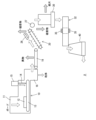
- the pretreatment process 2 is shown in detail in FIG.
- the waste gypsum board 12 is put into the crusher 10 from the inlet 11, conveyed by the built-in conveyor 13, and the blades 14 are dropped, for example, to roughly crush the waste gypsum board 12.
- Reference numeral 15 denotes a drive unit that lifts the blade and allows it to fall freely.
- a sieve 16 is provided on the outlet side of the crusher 10 to separate the gypsum granules generated by the crushing under the sieve.
- the mesh size of the sieve 16 is preferably about 5 to 15 mm.
- the type of the crusher 10 is arbitrary, and when a range is specified by "-" in this specification, the upper limit and the lower limit are included. For example, 5 to 15 mm means 5 mm or more and 15 mm or less.
- the gypsum granules that have passed through the sorting conveyor 18 are put into the fixed-quantity conveying conveyor 20 in FIG.
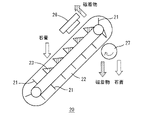
- the fixed-quantity conveying conveyor 20 is a belt conveyor divided by a plate 21 perpendicular to the belt for each predetermined length. Both sides of the belt are surrounded by side plates 22, and the size of one storage location (cell) is determined by the plates 21 and the side plates 22.
- the fixed-quantity conveying conveyor 20 is inclined from the horizontal plane at an angle of inclination of, for example, about 30 to 50°, and the amount of gypsum granules that exceeds the size of the cell falls to the lower cell, and the amount of gypsum granules per cell is measured. can be restricted. Therefore, even if the amount of gypsum granules fed from the sorting conveyor 18 shown in FIG.
- the hanging magnetic separator 26 or the magnetized drum 27 or the like attracts magnetic substances such as metals and separates them from the gypsum granules. It should be noted that the removal of magnetic deposits at conveyor 20 is not part of this invention.
- the gypsum granules are supplied from the constant-quantity conveying conveyor 20 to a fine crusher 30 such as a roller crusher, and crushed into a size suitable for the crystallization step 6. Further, a sieve (not shown) is provided in the fine crusher 30 to separate the paper pieces derived from the waste gypsum board as an over-sieve component. The gypsum granules under the sieve are put on the air flow by the magnetic separation pipe 32 and supplied to the silo 40 .
- a fine crusher 30 such as a roller crusher
- a magnetic separation unit 34 is attached to the pipe 33 of the magnetic separation pipe 32 .
- the gypsum granules flow to the outlet side of the magnetic separation pipe 32 together with the air.
- a permanent magnet or an electromagnet 35 is attached to the magnetic separation unit 34 to attract magnetic substances flowing through the magnetic separation pipe 32 .
- the attracted magnetic substance is manually removed from the door 36 periodically, for example.
- the magnetic separation pipe 32 is preferably slanted upward so that foreign matter with a high specific gravity such as gravel is separated from the bottom of the pipe 32 .
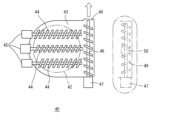
- Figures 5 and 6 show a silo 40 for gypsum granules crushed from waste gypsum boards.
- 41 is the side wall
- 42 is the inlet
- 43 is the bottom.
- Side walls 41 are slanted inward from the vertical direction, for example 1° to 20°, preferably 3° to 10°, and have a wider bottom 43 than inlet 42 .
- This tilt angle is represented by ⁇ .
- D be the inner diameter (diameter) of the bottom 43 and H be the height of the gypsum granules in the silo 40 .
- Making the inner diameter D greater than or equal to the height H is effective in preventing caking of the gypsum granules.
- the inner diameter D is, for example, 3 to 4 m
- the height H of the gypsum granules is, for example, 3 m
- the volume of the gypsum granules to be stored is, for example, 20 m 3 .
- the volume of gypsum granules stored in the silo 40 is preferably about 5 m 3 to 30 m 3 , for example.
- a plurality of screw conveyors 44 (for example, 3 to 5) are provided on the bottom 43 of the silo 40 and driven by a drive unit 45.
- a screw conveyor 44 conveys the gypsum granules to the right side in FIGS.
- Another screw conveyor 46 is provided on the bottom 43 and is driven by the driving part 47 to discharge the gypsum granules from the discharge port 48 .
- a screw conveyor 49 may be provided in which the conveying direction of the gypsum granules is reversed, and the gypsum granules may be discharged from an outlet 50.
- FIG. instead of the screw conveyors 46, 49, hoppers may be provided. However, additional space is required for the hopper and gypsum granules tend to caking in the hopper.
- the action of the silo 40 will be explained.
- the gypsum granules obtained by crushing the waste gypsum board tend to coagulate and are difficult to remove from the silo 40 itself. Then, the gypsum granules are conveyed from substantially the entire bottom 43 by a plurality of screw conveyors 44, collected by screw conveyors 46, 49, and discharged from outlets 48, 50.
- the gypsum granules are carried out from almost the entire surface of the bottom 43 and the side walls 41 are inclined inward, the bridges of the gypsum granules naturally collapse. Also, the gypsum granules adhering to the side wall 41 are likely to fall off. Furthermore, since the height H of the gypsum granules is made smaller than the inner diameter D of the bottom 43, the effect of the gap formed by the screw conveyor 44 easily affects the gypsum granules in the upper portion. Therefore, it is possible to prevent gypsum granules from hanging on the silo 40 (formation of bridges) and gypsum from sticking to the side walls 41 .
- Pretreatment process 4 Calcination process 6 Crystallization process 8 Filtration process 10
- Crusher 11 Input port 12 Waste gypsum board 13 Conveyor 14 Blade 15 Drive unit 16 Sieve 18 Screening conveyor 20
- Fixed quantity conveying conveyor 21 Plate 22
- Side plate 23 Gypsum granules 26
- Suspended magnetic separator 27 magnetized drum 30
- fine crusher 32 magnetic separation pipe 33 pipe 34 magnetic separation unit 35 magnet 36 door 40 silo 41 side wall 42 inlet 43 bottom 44, 46, 49 screw conveyors 45, 47 drive units 48, 50 outlet
Landscapes
- Engineering & Computer Science (AREA)
- Food Science & Technology (AREA)
- Processing Of Solid Wastes (AREA)
- Disintegrating Or Milling (AREA)
Abstract
廃石膏ボードを破砕した石膏粒体をサイロに貯蔵する際に、円滑に石膏粒体をサイロから取り出せるようにする。廃石膏ボードを石膏粒体へと破砕しサイロに貯蔵する。サイロの底部に複数のスクリューコンベヤを設け、サイロ内の石膏粒体をスクリューコンベヤによりサイロの外部へ排出する。
Description
この発明は廃石膏ボードの破砕とそれに用いるサイロに関する。
発明者らは、廃石膏ボードから石膏を回収する方法を提案した(例えば、特許文献1:WO2012/176688)。廃石膏ボードは石膏のボードと表面の紙とから成り、金属等の異物を含んでいることがある。特許文献1では、最初に廃石膏ボードを切断機で大まかに破砕する。破砕した廃石膏ボードをベルトコンベヤにより搬送し、ベルトコンベヤ上では金属等の異物を目視で取り除く。次いで、4軸ロール破砕機により、大まかに破砕した廃石膏ボードを石膏粒体へ破砕し、後段の篩により、廃石膏ボードを紙片と石膏粒体とへ分離する。また4軸ロール破砕機で処理する前後に、金属異物を磁選機によりさらに除去する。
得られた石膏粒体をか焼し、例えば半水石膏に変換する。変換した半水石膏等を石膏スラリーと混合し、クローズドループ型の晶析槽中で二水石膏等の石膏粒子を析出させる。析出した石膏粒子をスラリーから固液分離すると、廃石膏ボードから石膏粒子を回収できる。回収した石膏粒子は、石膏ボードに再生する他、セメント原料などに利用できる。
廃石膏ボードを破砕する場合、破砕により得られた石膏粒体をサイロにストックすることが好ましい。しかしながら廃石膏ボードから回収した石膏粒体は水分により凝結しやすく、サイロから石膏粒体を重力で排出すること自体が難しい。またサイロ内の石膏粒体はしばしばブリッジを形成し(この現象は「棚吊り」と呼ばれる)、またサイロの内壁に固結しやすい。建物の解体現場などで廃石膏ボードが水に濡れると、棚吊りや固結が特に発生しやすくなる。
この発明の課題は、廃石膏ボードを破砕することにより得られた石膏粒体をサイロに貯蔵する際に、円滑に石膏粒体をサイロから取り出せるようにすることにある。
この発明の廃石膏ボードの破砕方法では、廃石膏ボードを石膏粒体へと破砕する破砕ステップと、破砕ステップで得られる石膏粒体をサイロに貯蔵する貯蔵ステップとを行う。この発明の廃石膏ボードの破砕方法は、貯蔵ステップで、サイロの底部に設けられた複数のスクリューコンベヤにより、サイロ内の石膏粒体をサイロの外部へ向けて排出することを特徴とする。
この発明のサイロは、廃石膏ボードを破砕した石膏粒体を貯蔵するためのサイロである。この発明のサイロは、 サイロ内の石膏粒体をサイロの外部へ向けて排出するように、複数のスクリューコンベヤを底部に備えていることを特徴とする。なおこの明細書において、廃石膏ボードの破砕方法に関する記載は、サイロ等から成る廃石膏ボードの破砕システムにもそのまま当てはまる。
サイロ内の石膏粒体は凝結により流動性を失い、重力による自然落下ではサイロから排出できなくなることがある。この発明では、サイロ底部のスクリューコンベヤにより石膏粒体を強制的に排出する。スクリューコンベヤを用いるので、石膏の流動性が低下しても排出できる。またサイロ底部のほぼ全体から石膏粒体を排出するため、スクリューコンベヤをサイロの底部に複数設ける。このため、サイロの底部のほぼ全体から石膏粒体を排出できる。
好ましくは、サイロの内壁を鉛直方向からサイロの内側を向くように傾斜させる。すると石膏粒体のブリッジをサイロの内壁との摩擦で支持することができなくなり、ブリッジは自然と崩壊する。またサイロの内壁に石膏が固着しても、重力によって石膏は内壁から剥離しやすくなる。以上の機構等により、サイロ内部での石膏の棚吊りを防止し、かつ内壁の石膏の固着も防止する。
好ましくは、複数のスクリューコンベヤにより排出された石膏粒体を、他のスクリューコンベヤにより集めてサイロの外部へ排出する。スクリューコンベヤを複数用いるので、ある程度の長さが有るスリットあるいは長孔から石膏粒体は排出される。排出された石膏粒体をホッパーなどで排出すると、追加のスペースが必要であるし、ホッパー内で石膏粒体が固結することがある。そこで好ましくは、他のスクリューコンベヤにより石膏粒体を1個所に集めて排出する。
好ましくは、貯蔵ステップでは、サイロ底部の内径をD、石膏粒体の収容高さをHとする際に、内径Dが高さH以上となるようにサイロ内に石膏粒体を収容する。高さHが内径Dよりも大きいと、サイロ内で石膏粒体が固結しやすい。
破砕ステップでの好ましい態様を説明する。コンベヤ上で目視により金属等の異物を除去する際に、破砕で生じた石膏粒体が異物を覆っていることがある。すると異物が見えず除去できないことがある。そこで廃石膏ボードを破砕機により破砕した後、破砕後の廃石膏ボードを篩に掛ける。すると破砕で生じた細かな石膏粒体は篩下に分離される。そして篩の目を通過しなかった篩上成分をベルトコンベヤにより搬送すると、異物が見えやすいので、ベルトコンベヤ上で異物を除去しやすくなる。
廃石膏ボードを粗く破砕した石膏粒体はサイズが大きく、破砕片あるいは粗粒体とでもいうべきものである。この石膏粒体を細破砕機により細かく破砕し、後段の処理に適したサイズにすることが好ましい。そしてこの時、細破砕機に所定量ずつ破砕した廃石膏ボードを供給する必要がある。そこで好ましくは、ベルトと、ベルトから起立するように取り付けた複数のプレートと、ベルトの両側の側板とを有し、斜め上方へ石膏粒体を搬送する定量搬送コンベヤを用いる。前段のベルトコンベヤから石膏粒体を定量搬送コンベヤに供給し、プレートにより石膏粒体の量を規制しながら、石膏粒体を細破砕機へ供給する。定量搬送コンベヤでは、1段当たりの石膏粒体の量はプレートと両側面の側板で決まるので、所定量ずつ石膏粒体が細破砕機に供給される。従って、石膏粒体が細破砕機から溢れ出したりすることがない。
サイロへ石膏粒体を供給する前に、ベルトコンベヤ上で異物を除去し、また磁選機等により細破砕の前後等で金属異物を除去する。それでもネジ、釘等の小さな金属片はベルトコンベヤも磁選機も通過することがある。そこで好ましくは、細破砕機で破砕した後の石膏粒体をパイプに供給し、パイプ両端間の圧力差により石膏粒体を空気流によりサイロへ搬送する。そしてパイプに磁石を取り付け、磁力により石膏粒体から金属片等の磁着物を選別する。気流に乗ってパイプを流れる磁着物は、石膏粒体に覆われていないので、磁石に吸着しやすい。このようにして、石膏粒体中に埋没しやすい小さな磁着物を除去する。
以下に本発明を実施するための実施例を示す。この発明の範囲は、特許請求の範囲の記載に基づき、明細書の記載とこの分野での周知技術とを参酌し、当業者の理解に従って定められるべきである。この発明の範囲は実施例により限定されるものではない。
図1~図6に実施例を示す。図1は廃石膏ボードからの石膏回収方法の全体を示し、前処理工程2で廃石膏ボードを破砕し、得られた石膏粒体をサイロ40に貯蔵する。次のか焼工程4で石膏粒体をか焼し、半水石膏、無水III型石膏等の粒体へ変化させる。晶析工程6では、か焼後の石膏粒体を石膏スラリー等と混合し、晶析槽で二水石膏等の石膏粒子を析出させる。最後のろ過工程8で、石膏スラリーを篩に掛けて紙粉等を除き、次いで石膏スラリーをろ過器により処理し、石膏粉体を分離する。なおこの発明は前処理工程2に関する。
前処理工程2を図2に詳細に示す。破砕機10へ投入口11から廃石膏ボード12を投入し、内蔵のコンベヤ13により搬送し、例えば刃14を落下させることにより、廃石膏ボード12を粗く破砕する。15は刃を上昇させると共に自由落下させる駆動部である。破砕機10の出口側に篩16を設け、破砕により生じた石膏粒体を篩下へ分離する。篩16の目開きは5~15mm程度が好ましい。なお破砕機10の種類は任意で、この明細書で”~”により範囲を指定する場合、上限と下限を含むものとする。例えば5~15mmは5mm以上15mm以下を意味する。
篩16で石膏粒体を分離すると、廃石膏ボードの破砕片中の金属、モルタル、木片等の異物が見えやすくなる。そこで篩16の篩上成分を選別コンベヤ18へ供給し、目視により、あるいはAI等による画像認識とロボットハンド等により、これらの異物をコンベヤ18上で取り除く。
選別コンベヤ18を通過した石膏粒体を、図3の定量搬送コンベヤ20に投入する。定量搬送コンベヤ20は、ベルトコンベヤのベルトを、所定の長さ毎に、ベルトに垂直なプレート21により仕切ったものである。またベルトの両側は側板22により囲まれ、プレート21と側板22とにより1個の収容場所(セル)のサイズが決まる。定量搬送コンベヤ20は例えば30~50°程度の傾斜角で水平面から傾斜し、投入された石膏粒体でセルのサイズを超える分は下のセルへ落下し、1セル当たりの石膏粒体の量を制限できる。このため図2の選別コンベヤ18から投入される石膏粒体の量が増しても、後段の細破砕機30で石膏粒体が溢れることはない。
定量搬送コンベヤ20では、吊下式磁選装置26あるいは磁化ドラム27等により、金属等の磁着物を吸着し、石膏粒体から分離する。なおコンベヤ20での磁着物の除去は、この発明の一部ではない。
図2に戻り、定量搬送コンベヤ20から、石膏粒体をローラ破砕機等の細破砕機30に供給し、晶析工程6に適したサイズへ破砕する。また細破砕機30に図示しない篩を設けて、廃石膏ボード由来の紙片を篩上成分として分離する。篩下の石膏粒体を磁選パイプ32により空気流に乗せて、サイロ40へ供給する。
図4に示すように、磁選パイプ32ではパイプ33に磁選ユニット34が取り付けられている。そして磁選パイプ32の出口側を減圧することにより、石膏粒体は空気と共に磁選パイプ32の出口側へ流れる。磁選ユニット34には永久磁石あるいは電磁石の磁石35が取り付けられ、磁選パイプ32を流れる磁着物を吸着する。そして吸着した磁着物は、扉36から例えば定期的にマニュアルで取り除く。磁選パイプ32は好ましくは上向きに傾斜しており、砂利等の比重が大きな異物はパイプ32の底から分離される。
図5,図6に廃石膏ボードを破砕した石膏粒体のサイロ40を示す。サイロ40に関して、41は側壁、42は投入口、43は底である。側壁41は鉛直方向から内側へ向け、例えば1°~20°、好ましくは3°~10°傾斜し、投入口42に比べて底43が広くなっている。この傾斜角をθで表す。
底43の内径(直径)をD、サイロ40内の石膏粒体の高さをHとする。内径Dを高さH以上にすることが、石膏粒体の固結を防止する上で有効である。実施例では、内径Dを例えば3~4m、石膏粒体の収容高さHを例えば3m、貯蔵する石膏粒体の体積を例えば20m3とする。なおサイロ40に貯蔵する石膏粒体の体積は、例えば5m3~30m3程度が好ましい。
サイロ40の底43に複数のスクリューコンベヤ44(例えば3本~5本)を設け、駆動部45により駆動する。スクリューコンベヤ44により、石膏粒体を図5,図6の右側へ搬送する。
底43に他のスクリューコンベヤ46を設けて、駆動部47により駆動し、石膏粒体を排出口48から排出する。なお図6の右側に鎖線で示すように、石膏粒体の搬送方向が途中で逆になるスクリューコンベヤ49を設け、出口50から石膏粒体を排出しても良い。スクリューコンベヤ46、49の代わりに、ホッパーを設けても良い。しかしホッパー用に追加のスペースが必要で、しかも石膏粒体はホッパー内で固結しやすい。
サイロ40の作用を説明する。廃石膏ボードを破砕した石膏粒体は凝結しやすく、サイロ40から取り出すこと自体が難しい。そこで複数のスクリューコンベヤ44により底43のほぼ全体から石膏粒体を搬送し、スクリューコンベヤ46、49により集め、排出口48,50から排出する。
底43のほぼ全面から石膏粒体を搬出し、さらに側壁41を内側へ向けて傾斜させるので、石膏粒体のブリッジは自然と崩壊する。また側壁41に付着した石膏粒体も落下しやすくなる。さらに、石膏粒体の高さHを底43の内径Dよりも小さくするので、スクリューコンベヤ44により形成した隙間の影響が、上部の石膏粒体にも及びやすくなる。これらのため、サイロ40内での石膏粒体の棚吊り(ブリッジの形成)と、側壁41への石膏の固着を防止できる。
2 前処理工程
4 か焼工程
6 晶析工程
8 ろ過工程
10 破砕機
11 投入口
12 廃石膏ボード
13 コンベヤ
14 刃
15 駆動部
16 篩
18 選別コンベヤ
20 定量搬送コンベヤ
21 プレート
22 側板
23 石膏粒体
26 吊下式磁選装置
27 磁化ドラム
30 細破砕機
32 磁選パイプ
33 パイプ
34 磁選ユニット
35 磁石
36 扉
40 サイロ
41 側壁
42 投入口
43 底
44,46,49 スクリューコンベヤ
45,47 駆動部
48,50 排出口
4 か焼工程
6 晶析工程
8 ろ過工程
10 破砕機
11 投入口
12 廃石膏ボード
13 コンベヤ
14 刃
15 駆動部
16 篩
18 選別コンベヤ
20 定量搬送コンベヤ
21 プレート
22 側板
23 石膏粒体
26 吊下式磁選装置
27 磁化ドラム
30 細破砕機
32 磁選パイプ
33 パイプ
34 磁選ユニット
35 磁石
36 扉
40 サイロ
41 側壁
42 投入口
43 底
44,46,49 スクリューコンベヤ
45,47 駆動部
48,50 排出口
Claims (8)
- 廃石膏ボードを石膏粒体へと破砕する破砕ステップと、
破砕ステップで得られる石膏粒体をサイロに貯蔵する貯蔵ステップとを行う、
廃石膏ボードの破砕方法において、
前記貯蔵ステップでは、前記サイロの底部に設けられた複数のスクリューコンベヤにより、サイロ内の石膏粒体をサイロの外部へ向けて排出することを特徴とする、廃石膏ボードの破砕方法。 - 前記サイロの内壁を鉛直方向からサイロの内側を向くように傾斜させることにより、サイロの内部に石膏粒体のブリッジが形成されることを防止することを特徴とする、請求項1の廃石膏ボードの破砕方法。
- 前記複数のスクリューコンベヤにより排出された石膏粒体を、他のスクリューコンベヤにより集めてサイロの外部へ排出することを特徴とする、請求項1または2の廃石膏ボードの破砕方法。
- 前記貯蔵ステップでは、前記サイロ底部の内径をD、石膏粒体の収容高さをHとする際に、内径Dが高さH以上となるように、サイロ内に石膏粒体を収容することを特徴とする、請求項1~3のいずれかの廃石膏ボードの破砕方法。
- 前記破砕ステップでは、廃石膏ボードを破砕機により破砕し、破砕後の廃石膏ボードを篩に掛け、篩の目を通過しなかった成分をベルトコンベヤにより搬送すると共にベルトコンベヤ上で異物を除去することを特徴とする、請求項1~4のいずれかの廃石膏ボードの破砕方法。
- 前記破砕ステップではさらに、
ベルトと、ベルトから起立するように取り付けた複数のプレートと、ベルトの両側の側板とを有し、斜め上方へ搬送する定量搬送コンベヤを用い、
前記ベルトコンベヤを通過した石膏粒体を定量搬送コンベヤに供給し、前記プレートにより石膏粒体の量を規制しながら、石膏粒体を細破砕機へ供給し再度破砕することを特徴とする、請求項5の廃石膏ボードの破砕方法。 - 前記破砕ステップではさらに、細破砕機で破砕した後の石膏粒体をパイプに供給し、パイプ両端間の圧力差により石膏粒体を前記サイロへ搬送すると共に、前記パイプに磁石を取り付け、磁力により石膏粒体から磁着物を選別することを特徴とする、請求項6の廃石膏ボードの破砕方法。
- 廃石膏ボードを破砕した石膏粒体を貯蔵するためのサイロにおいて、
サイロ内の石膏粒体をサイロの外部へ向けて排出するように、複数のスクリューコンベヤを底部に備えていることを特徴とする、サイロ。
Priority Applications (2)
| Application Number | Priority Date | Filing Date | Title |
|---|---|---|---|
| US17/773,089 US20240139755A1 (en) | 2021-09-02 | 2021-10-20 | A method for crushing wasted gypsum boards and a silo therefor |
| EP21920123.3A EP4166234A4 (en) | 2021-09-02 | 2021-10-20 | METHOD FOR CRUSHING GYPSUM WASTE BOARDS AND SILO THEREFOR |
Applications Claiming Priority (2)
| Application Number | Priority Date | Filing Date | Title |
|---|---|---|---|
| JP2021-143113 | 2021-09-02 | ||
| JP2021143113A JP7741664B2 (ja) | 2021-09-02 | 2021-09-02 | 廃石膏ボードの破砕方法、及びそれに用いるサイロ |
Publications (1)
| Publication Number | Publication Date |
|---|---|
| WO2023032231A1 true WO2023032231A1 (ja) | 2023-03-09 |
Family
ID=84330655
Family Applications (1)
| Application Number | Title | Priority Date | Filing Date |
|---|---|---|---|
| PCT/JP2021/038759 Ceased WO2023032231A1 (ja) | 2021-09-02 | 2021-10-20 | 廃石膏ボードの破砕方法、及びそれに用いるサイロ |
Country Status (4)
| Country | Link |
|---|---|
| US (1) | US20240139755A1 (ja) |
| EP (1) | EP4166234A4 (ja) |
| JP (1) | JP7741664B2 (ja) |
| WO (1) | WO2023032231A1 (ja) |
Cited By (1)
| Publication number | Priority date | Publication date | Assignee | Title |
|---|---|---|---|---|
| WO2025177776A1 (ja) * | 2024-02-20 | 2025-08-28 | 株式会社トクヤマ | 廃石膏ボードから紙片と石膏粒体を回収する方法 |
Families Citing this family (2)
| Publication number | Priority date | Publication date | Assignee | Title |
|---|---|---|---|---|
| JPWO2024219102A1 (ja) * | 2023-04-20 | 2024-10-24 | ||
| JP2025126967A (ja) * | 2024-02-20 | 2025-09-01 | 株式会社トクヤマ | 廃石膏粒体の貯蔵方法および貯蔵システム |
Citations (11)
| Publication number | Priority date | Publication date | Assignee | Title |
|---|---|---|---|---|
| JPS4739088Y1 (ja) * | 1969-03-03 | 1972-11-27 | ||
| JPS5777126A (en) * | 1980-10-27 | 1982-05-14 | Ishikawajima Harima Heavy Ind Co Ltd | Delivery device of bulk storage silo |
| JPS5932690U (ja) * | 1982-08-26 | 1984-02-29 | 大須賀 勇雄 | 竪型貯留装置 |
| JPS60136732U (ja) * | 1984-02-22 | 1985-09-11 | 三菱重工業株式会社 | 粉状物混合装置 |
| JPS615832U (ja) * | 1984-06-19 | 1986-01-14 | 株式会社 間組 | サイロの搬出装置 |
| JPH10167481A (ja) * | 1996-12-03 | 1998-06-23 | Miike Tekkosho Kk | 細片状物や粉状物のサイロ装置 |
| JP2006305419A (ja) * | 2005-04-26 | 2006-11-09 | Kameyama:Kk | ロール軸型破砕装置およびそれを用いた石膏ボード破砕/分離機 |
| JP2012005986A (ja) * | 2010-06-28 | 2012-01-12 | Kamacho Scale Co Ltd | 金属混入廃材分別機 |
| WO2012176688A1 (ja) | 2011-06-21 | 2012-12-27 | 株式会社トクヤマ | 石膏ボード廃材から石膏を再生する方法 |
| CN210854440U (zh) * | 2019-11-01 | 2020-06-26 | 大唐郓城发电有限公司 | 一种火力发电厂用石膏仓卸料装置 |
| CN211443550U (zh) * | 2019-11-28 | 2020-09-08 | 四川什邡市星天丰科技有限公司 | 一种磷石膏储料仓卸料装置 |
Family Cites Families (11)
| Publication number | Priority date | Publication date | Assignee | Title |
|---|---|---|---|---|
| US3215290A (en) * | 1963-09-26 | 1965-11-02 | Wellons Charles Lauren | Silo structure having bottom feed-out unit |
| US3512683A (en) * | 1968-03-14 | 1970-05-19 | Frisbie Construction Co Inc | Material handling control |
| AT362290B (de) * | 1978-06-26 | 1981-04-27 | Simmering Graz Pauker Ag | Verfahren zur regenerierung und reaktivierung inaktiv gewordenen zementes |
| US4993648A (en) * | 1989-05-22 | 1991-02-19 | Torp Per C | Knife assembly |
| US5100063A (en) * | 1990-06-19 | 1992-03-31 | West Fab, Inc. | Recovery of components of waste plasterboard |
| US5148999A (en) * | 1991-01-11 | 1992-09-22 | Farm Shop, Inc. | Animal feed mixing system |
| US7028610B1 (en) * | 2004-12-30 | 2006-04-18 | Ralicki Daniel J | Compacting apparatus |
| MX347714B (es) * | 2011-09-06 | 2017-05-10 | Anaeco Ltd | Aparato para el paso y la transportación de material compresible. |
| ES2424683A1 (es) * | 2013-02-06 | 2013-10-07 | Jesús Alcantud, S.A. | Silo para almacenaje y dosificacion de productos pulverulentos |
| CN111232677B (zh) * | 2020-03-18 | 2025-01-24 | 河南强耐新材股份有限公司 | 卧式智能化物料储料罐 |
| US12024371B2 (en) * | 2020-08-11 | 2024-07-02 | Scott Equipment Company | Mobile method for processing organics and system |
-
2021
- 2021-09-02 JP JP2021143113A patent/JP7741664B2/ja active Active
- 2021-10-20 WO PCT/JP2021/038759 patent/WO2023032231A1/ja not_active Ceased
- 2021-10-20 EP EP21920123.3A patent/EP4166234A4/en not_active Withdrawn
- 2021-10-20 US US17/773,089 patent/US20240139755A1/en not_active Abandoned
Patent Citations (11)
| Publication number | Priority date | Publication date | Assignee | Title |
|---|---|---|---|---|
| JPS4739088Y1 (ja) * | 1969-03-03 | 1972-11-27 | ||
| JPS5777126A (en) * | 1980-10-27 | 1982-05-14 | Ishikawajima Harima Heavy Ind Co Ltd | Delivery device of bulk storage silo |
| JPS5932690U (ja) * | 1982-08-26 | 1984-02-29 | 大須賀 勇雄 | 竪型貯留装置 |
| JPS60136732U (ja) * | 1984-02-22 | 1985-09-11 | 三菱重工業株式会社 | 粉状物混合装置 |
| JPS615832U (ja) * | 1984-06-19 | 1986-01-14 | 株式会社 間組 | サイロの搬出装置 |
| JPH10167481A (ja) * | 1996-12-03 | 1998-06-23 | Miike Tekkosho Kk | 細片状物や粉状物のサイロ装置 |
| JP2006305419A (ja) * | 2005-04-26 | 2006-11-09 | Kameyama:Kk | ロール軸型破砕装置およびそれを用いた石膏ボード破砕/分離機 |
| JP2012005986A (ja) * | 2010-06-28 | 2012-01-12 | Kamacho Scale Co Ltd | 金属混入廃材分別機 |
| WO2012176688A1 (ja) | 2011-06-21 | 2012-12-27 | 株式会社トクヤマ | 石膏ボード廃材から石膏を再生する方法 |
| CN210854440U (zh) * | 2019-11-01 | 2020-06-26 | 大唐郓城发电有限公司 | 一种火力发电厂用石膏仓卸料装置 |
| CN211443550U (zh) * | 2019-11-28 | 2020-09-08 | 四川什邡市星天丰科技有限公司 | 一种磷石膏储料仓卸料装置 |
Non-Patent Citations (1)
| Title |
|---|
| See also references of EP4166234A4 |
Cited By (1)
| Publication number | Priority date | Publication date | Assignee | Title |
|---|---|---|---|---|
| WO2025177776A1 (ja) * | 2024-02-20 | 2025-08-28 | 株式会社トクヤマ | 廃石膏ボードから紙片と石膏粒体を回収する方法 |
Also Published As
| Publication number | Publication date |
|---|---|
| JP7741664B2 (ja) | 2025-09-18 |
| JP2023036204A (ja) | 2023-03-14 |
| EP4166234A4 (en) | 2024-06-12 |
| US20240139755A1 (en) | 2024-05-02 |
| EP4166234A1 (en) | 2023-04-19 |
Similar Documents
| Publication | Publication Date | Title |
|---|---|---|
| JP5574876B2 (ja) | 石膏廃材再生原料化装置 | |
| JP7741664B2 (ja) | 廃石膏ボードの破砕方法、及びそれに用いるサイロ | |
| US10799880B2 (en) | Method and apparatus for washing and grading silica sand for glass production | |
| RU2189865C2 (ru) | Способ первичной переработки смешанных отходов и перерабатывающая установка | |
| JP2012024690A (ja) | 廃石膏ボード分別処理システム | |
| JP2009172498A (ja) | 廃石膏ボードの分別リサイクルシステム、分別リサイクル装置及び分別リサイクル方法 | |
| UA110550C2 (en) | Modular mining and dressing plant | |
| JP4909101B2 (ja) | 廃棄物溶融炉の水砕処理物の処理方法及びその設備 | |
| JP6432711B1 (ja) | 造粒物製造設備及び造粒物の製造方法 | |
| JPH11253833A (ja) | 混入物分離及び洗浄装置 | |
| CN107008563A (zh) | 土灯干法选矿介质、选矿机及选矿方法 | |
| JP7589399B2 (ja) | 異物除去装置、石膏系建築用面材製造装置、異物除去方法 | |
| JPH11138043A (ja) | 骨材の比重選別装置 | |
| JP3803928B2 (ja) | スポンジチタン粒の製造方法 | |
| JP2025126967A (ja) | 廃石膏粒体の貯蔵方法および貯蔵システム | |
| JP2021079303A (ja) | 廃石膏ボードの処理方法 | |
| CN2612646Y (zh) | 料斗大块分离物重力式自动监测装置 | |
| JPH11276924A (ja) | コンクリート骨材用砂の製造方法及びこの方法で使用する装置 | |
| JP2025126966A (ja) | 廃石膏ボードから紙片と石膏粒体を回収する方法 | |
| BR112023018365B1 (pt) | Aparelho para fabricação de placas de construção à base de gesso | |
| JP2006341227A (ja) | 振動式真空脱水装置 | |
| JP2024115371A (ja) | 金属被膜樹脂材の金属と樹脂材の分離回収方法及びその分離回収装置 | |
| PL429688A1 (pl) | Układ technologiczny do oczyszczania odpadów z produkcji nawozów sztucznych | |
| JPS5930473B2 (ja) | 長物分別装置 | |
| JPH03172A (ja) | コンクリート廃材からの異物除去方法 |
Legal Events
| Date | Code | Title | Description |
|---|---|---|---|
| ENP | Entry into the national phase |
Ref document number: 2021920123 Country of ref document: EP Effective date: 20220728 |
|
| WWE | Wipo information: entry into national phase |
Ref document number: 17773089 Country of ref document: US |
|
| NENP | Non-entry into the national phase |
Ref country code: DE |
|
| WWW | Wipo information: withdrawn in national office |
Ref document number: 2021920123 Country of ref document: EP |