WO2023033145A1 - 水性組成物及びその硬化物 - Google Patents
水性組成物及びその硬化物 Download PDFInfo
- Publication number
- WO2023033145A1 WO2023033145A1 PCT/JP2022/033124 JP2022033124W WO2023033145A1 WO 2023033145 A1 WO2023033145 A1 WO 2023033145A1 JP 2022033124 W JP2022033124 W JP 2022033124W WO 2023033145 A1 WO2023033145 A1 WO 2023033145A1
- Authority
- WO
- WIPO (PCT)
- Prior art keywords
- aqueous composition
- silicate
- weight
- cured product
- powder material
- Prior art date
- Legal status (The legal status is an assumption and is not a legal conclusion. Google has not performed a legal analysis and makes no representation as to the accuracy of the status listed.)
- Ceased
Links
Classifications
-
- C—CHEMISTRY; METALLURGY
- C09—DYES; PAINTS; POLISHES; NATURAL RESINS; ADHESIVES; COMPOSITIONS NOT OTHERWISE PROVIDED FOR; APPLICATIONS OF MATERIALS NOT OTHERWISE PROVIDED FOR
- C09D—COATING COMPOSITIONS, e.g. PAINTS, VARNISHES OR LACQUERS; FILLING PASTES; CHEMICAL PAINT OR INK REMOVERS; INKS; CORRECTING FLUIDS; WOODSTAINS; PASTES OR SOLIDS FOR COLOURING OR PRINTING; USE OF MATERIALS THEREFOR
- C09D133/00—Coating compositions based on homopolymers or copolymers of compounds having one or more unsaturated aliphatic radicals, each having only one carbon-to-carbon double bond, and at least one being terminated by only one carboxyl radical, or of salts, anhydrides, esters, amides, imides, or nitriles thereof; Coating compositions based on derivatives of such polymers
- C09D133/24—Homopolymers or copolymers of amides or imides
- C09D133/26—Homopolymers or copolymers of acrylamide or methacrylamide
-
- C—CHEMISTRY; METALLURGY
- C09—DYES; PAINTS; POLISHES; NATURAL RESINS; ADHESIVES; COMPOSITIONS NOT OTHERWISE PROVIDED FOR; APPLICATIONS OF MATERIALS NOT OTHERWISE PROVIDED FOR
- C09D—COATING COMPOSITIONS, e.g. PAINTS, VARNISHES OR LACQUERS; FILLING PASTES; CHEMICAL PAINT OR INK REMOVERS; INKS; CORRECTING FLUIDS; WOODSTAINS; PASTES OR SOLIDS FOR COLOURING OR PRINTING; USE OF MATERIALS THEREFOR
- C09D1/00—Coating compositions, e.g. paints, varnishes or lacquers, based on inorganic substances
- C09D1/02—Coating compositions, e.g. paints, varnishes or lacquers, based on inorganic substances alkali metal silicates
- C09D1/04—Coating compositions, e.g. paints, varnishes or lacquers, based on inorganic substances alkali metal silicates with organic additives
-
- C—CHEMISTRY; METALLURGY
- C08—ORGANIC MACROMOLECULAR COMPOUNDS; THEIR PREPARATION OR CHEMICAL WORKING-UP; COMPOSITIONS BASED THEREON
- C08K—Use of inorganic or non-macromolecular organic substances as compounding ingredients
- C08K3/00—Use of inorganic substances as compounding ingredients
- C08K3/18—Oxygen-containing compounds, e.g. metal carbonyls
- C08K3/20—Oxides; Hydroxides
- C08K3/22—Oxides; Hydroxides of metals
-
- C—CHEMISTRY; METALLURGY
- C08—ORGANIC MACROMOLECULAR COMPOUNDS; THEIR PREPARATION OR CHEMICAL WORKING-UP; COMPOSITIONS BASED THEREON
- C08K—Use of inorganic or non-macromolecular organic substances as compounding ingredients
- C08K7/00—Use of ingredients characterised by shape
- C08K7/02—Fibres or whiskers
- C08K7/04—Fibres or whiskers inorganic
-
- C—CHEMISTRY; METALLURGY
- C08—ORGANIC MACROMOLECULAR COMPOUNDS; THEIR PREPARATION OR CHEMICAL WORKING-UP; COMPOSITIONS BASED THEREON
- C08K—Use of inorganic or non-macromolecular organic substances as compounding ingredients
- C08K9/00—Use of pretreated ingredients
- C08K9/04—Ingredients treated with organic substances
-
- C—CHEMISTRY; METALLURGY
- C08—ORGANIC MACROMOLECULAR COMPOUNDS; THEIR PREPARATION OR CHEMICAL WORKING-UP; COMPOSITIONS BASED THEREON
- C08L—COMPOSITIONS OF MACROMOLECULAR COMPOUNDS
- C08L79/00—Compositions of macromolecular compounds obtained by reactions forming in the main chain of the macromolecule a linkage containing nitrogen with or without oxygen or carbon only, not provided for in groups C08L61/00 - C08L77/00
- C08L79/04—Polycondensates having nitrogen-containing heterocyclic rings in the main chain; Polyhydrazides; Polyamide acids or similar polyimide precursors
- C08L79/08—Polyimides; Polyester-imides; Polyamide-imides; Polyamide acids or similar polyimide precursors
-
- C—CHEMISTRY; METALLURGY
- C09—DYES; PAINTS; POLISHES; NATURAL RESINS; ADHESIVES; COMPOSITIONS NOT OTHERWISE PROVIDED FOR; APPLICATIONS OF MATERIALS NOT OTHERWISE PROVIDED FOR
- C09C—TREATMENT OF INORGANIC MATERIALS, OTHER THAN FIBROUS FILLERS, TO ENHANCE THEIR PIGMENTING OR FILLING PROPERTIES ; PREPARATION OF CARBON BLACK ; PREPARATION OF INORGANIC MATERIALS WHICH ARE NO SINGLE CHEMICAL COMPOUNDS AND WHICH ARE MAINLY USED AS PIGMENTS OR FILLERS
- C09C1/00—Treatment of specific inorganic materials other than fibrous fillers; Preparation of carbon black
- C09C1/28—Compounds of silicon
- C09C1/30—Silicic acid
-
- C—CHEMISTRY; METALLURGY
- C09—DYES; PAINTS; POLISHES; NATURAL RESINS; ADHESIVES; COMPOSITIONS NOT OTHERWISE PROVIDED FOR; APPLICATIONS OF MATERIALS NOT OTHERWISE PROVIDED FOR
- C09D—COATING COMPOSITIONS, e.g. PAINTS, VARNISHES OR LACQUERS; FILLING PASTES; CHEMICAL PAINT OR INK REMOVERS; INKS; CORRECTING FLUIDS; WOODSTAINS; PASTES OR SOLIDS FOR COLOURING OR PRINTING; USE OF MATERIALS THEREFOR
- C09D5/00—Coating compositions, e.g. paints, varnishes or lacquers, characterised by their physical nature or the effects produced; Filling pastes
- C09D5/18—Fireproof paints including high temperature resistant paints
-
- C—CHEMISTRY; METALLURGY
- C09—DYES; PAINTS; POLISHES; NATURAL RESINS; ADHESIVES; COMPOSITIONS NOT OTHERWISE PROVIDED FOR; APPLICATIONS OF MATERIALS NOT OTHERWISE PROVIDED FOR
- C09D—COATING COMPOSITIONS, e.g. PAINTS, VARNISHES OR LACQUERS; FILLING PASTES; CHEMICAL PAINT OR INK REMOVERS; INKS; CORRECTING FLUIDS; WOODSTAINS; PASTES OR SOLIDS FOR COLOURING OR PRINTING; USE OF MATERIALS THEREFOR
- C09D7/00—Features of coating compositions, not provided for in group C09D5/00; Processes for incorporating ingredients in coating compositions
- C09D7/40—Additives
- C09D7/60—Additives non-macromolecular
- C09D7/61—Additives non-macromolecular inorganic
-
- C—CHEMISTRY; METALLURGY
- C09—DYES; PAINTS; POLISHES; NATURAL RESINS; ADHESIVES; COMPOSITIONS NOT OTHERWISE PROVIDED FOR; APPLICATIONS OF MATERIALS NOT OTHERWISE PROVIDED FOR
- C09D—COATING COMPOSITIONS, e.g. PAINTS, VARNISHES OR LACQUERS; FILLING PASTES; CHEMICAL PAINT OR INK REMOVERS; INKS; CORRECTING FLUIDS; WOODSTAINS; PASTES OR SOLIDS FOR COLOURING OR PRINTING; USE OF MATERIALS THEREFOR
- C09D7/00—Features of coating compositions, not provided for in group C09D5/00; Processes for incorporating ingredients in coating compositions
- C09D7/40—Additives
- C09D7/65—Additives macromolecular
-
- C—CHEMISTRY; METALLURGY
- C09—DYES; PAINTS; POLISHES; NATURAL RESINS; ADHESIVES; COMPOSITIONS NOT OTHERWISE PROVIDED FOR; APPLICATIONS OF MATERIALS NOT OTHERWISE PROVIDED FOR
- C09D—COATING COMPOSITIONS, e.g. PAINTS, VARNISHES OR LACQUERS; FILLING PASTES; CHEMICAL PAINT OR INK REMOVERS; INKS; CORRECTING FLUIDS; WOODSTAINS; PASTES OR SOLIDS FOR COLOURING OR PRINTING; USE OF MATERIALS THEREFOR
- C09D7/00—Features of coating compositions, not provided for in group C09D5/00; Processes for incorporating ingredients in coating compositions
- C09D7/40—Additives
- C09D7/66—Additives characterised by particle size
- C09D7/69—Particle size larger than 1000 nm
-
- C—CHEMISTRY; METALLURGY
- C09—DYES; PAINTS; POLISHES; NATURAL RESINS; ADHESIVES; COMPOSITIONS NOT OTHERWISE PROVIDED FOR; APPLICATIONS OF MATERIALS NOT OTHERWISE PROVIDED FOR
- C09D—COATING COMPOSITIONS, e.g. PAINTS, VARNISHES OR LACQUERS; FILLING PASTES; CHEMICAL PAINT OR INK REMOVERS; INKS; CORRECTING FLUIDS; WOODSTAINS; PASTES OR SOLIDS FOR COLOURING OR PRINTING; USE OF MATERIALS THEREFOR
- C09D7/00—Features of coating compositions, not provided for in group C09D5/00; Processes for incorporating ingredients in coating compositions
- C09D7/40—Additives
- C09D7/70—Additives characterised by shape, e.g. fibres, flakes or microspheres
-
- C—CHEMISTRY; METALLURGY
- C09—DYES; PAINTS; POLISHES; NATURAL RESINS; ADHESIVES; COMPOSITIONS NOT OTHERWISE PROVIDED FOR; APPLICATIONS OF MATERIALS NOT OTHERWISE PROVIDED FOR
- C09D—COATING COMPOSITIONS, e.g. PAINTS, VARNISHES OR LACQUERS; FILLING PASTES; CHEMICAL PAINT OR INK REMOVERS; INKS; CORRECTING FLUIDS; WOODSTAINS; PASTES OR SOLIDS FOR COLOURING OR PRINTING; USE OF MATERIALS THEREFOR
- C09D7/00—Features of coating compositions, not provided for in group C09D5/00; Processes for incorporating ingredients in coating compositions
- C09D7/80—Processes for incorporating ingredients
-
- C—CHEMISTRY; METALLURGY
- C08—ORGANIC MACROMOLECULAR COMPOUNDS; THEIR PREPARATION OR CHEMICAL WORKING-UP; COMPOSITIONS BASED THEREON
- C08K—Use of inorganic or non-macromolecular organic substances as compounding ingredients
- C08K2201/00—Specific properties of additives
- C08K2201/001—Conductive additives
-
- C—CHEMISTRY; METALLURGY
- C08—ORGANIC MACROMOLECULAR COMPOUNDS; THEIR PREPARATION OR CHEMICAL WORKING-UP; COMPOSITIONS BASED THEREON
- C08K—Use of inorganic or non-macromolecular organic substances as compounding ingredients
- C08K2201/00—Specific properties of additives
- C08K2201/002—Physical properties
- C08K2201/005—Additives being defined by their particle size in general
-
- C—CHEMISTRY; METALLURGY
- C08—ORGANIC MACROMOLECULAR COMPOUNDS; THEIR PREPARATION OR CHEMICAL WORKING-UP; COMPOSITIONS BASED THEREON
- C08K—Use of inorganic or non-macromolecular organic substances as compounding ingredients
- C08K3/00—Use of inorganic substances as compounding ingredients
- C08K3/34—Silicon-containing compounds
-
- C—CHEMISTRY; METALLURGY
- C08—ORGANIC MACROMOLECULAR COMPOUNDS; THEIR PREPARATION OR CHEMICAL WORKING-UP; COMPOSITIONS BASED THEREON
- C08K—Use of inorganic or non-macromolecular organic substances as compounding ingredients
- C08K7/00—Use of ingredients characterised by shape
- C08K7/02—Fibres or whiskers
- C08K7/04—Fibres or whiskers inorganic
- C08K7/08—Oxygen-containing compounds
-
- C—CHEMISTRY; METALLURGY
- C08—ORGANIC MACROMOLECULAR COMPOUNDS; THEIR PREPARATION OR CHEMICAL WORKING-UP; COMPOSITIONS BASED THEREON
- C08K—Use of inorganic or non-macromolecular organic substances as compounding ingredients
- C08K7/00—Use of ingredients characterised by shape
- C08K7/16—Solid spheres
- C08K7/18—Solid spheres inorganic
-
- C—CHEMISTRY; METALLURGY
- C08—ORGANIC MACROMOLECULAR COMPOUNDS; THEIR PREPARATION OR CHEMICAL WORKING-UP; COMPOSITIONS BASED THEREON
- C08K—Use of inorganic or non-macromolecular organic substances as compounding ingredients
- C08K7/00—Use of ingredients characterised by shape
- C08K7/22—Expanded, porous or hollow particles
- C08K7/24—Expanded, porous or hollow particles inorganic
- C08K7/26—Silicon- containing compounds
Definitions
- the present invention relates to an aqueous composition and its cured product.
- the cured product of the present invention is particularly useful as a heat insulating coating formed by painting on the internal combustion engine combustion chamber wall surface.
- thermal spray coating made of a ceramic composition as a material with low thermal conductivity is applied to the combustion chamber wall surface, or the combustion chamber wall member itself is made of a sintered ceramic material.
- the heat insulating layer of Patent Documents 2 and 3 is made of an anodized film, and while intentionally forming a hard alumite film with a thickness of several tens of ⁇ m, vertical holes and holes are generated inside, and the surface layer of the vertical holes is exemplified as a low-volume specific-heat, low-thermal-conducting film that maintains a predetermined spatial volume by sealing the .
- the paint is in the form of a hollow metal oxide aggregate, and the adhesion between the aluminum base material and the paint is improved by oxidizing the surface of the aluminum base material in advance by alumite processing. are doing.
- Patent Documents 2 and 3 since a step of immersion in an electrolytic solution occurs in the anodized film formation process, precise masking management other than the surface to be treated and a certain amount of time are required for the anodizing process. There are problems in terms of mass production efficiency. In addition, since it is premised on alumite processing, the conventional method disclosed in Patent Document 2 cannot be applied to members other than aluminum members. In Patent Document 3, application to base materials other than Al base materials is also realized by providing a metal layer containing an Al component by thermal spraying and welding before forming an anodized film, but thermal spraying and welding processes is required separately, and there are new restrictions in the film formation process.
- Patent Document 4 since the coating form is specified, it is shown as an advantage that a heat insulating coating can be continuously formed only by coating and baking. It is premised on applying an anodizing process to the surface of the base material, and there is a problem of application limitation assuming application only to aluminum base materials.
- the present invention solves the above-mentioned problems while exhibiting at least the same performance as the practical thermophysical property values of Patent Document 2, and while exhibiting high heat insulation, it also has mass productivity, and only aluminum type To obtain a coating composition capable of forming a film on not only iron-based, titanium-based, and other metal substrates.
- the usage environment is at a high temperature of 300°C or higher for normal use, and depending on conditions such as knocking, a heat load cycle of 300 to 600°C is generated locally, and at the same time, it is in a high-frequency impact environment due to high-speed piston movement. Therefore, the coating must be resistant to these physical loads. In addition, the coating must be able to withstand the surface strength required for the coating to withstand combustion pressure and fuel injection pressure.
- the base material is made of aluminum, it is necessary to adjust the alkali content to an appropriate concentration so that the aluminum base material is not excessively oxidized and embrittled by the alkali component of the aqueous composition.
- the object of the present invention is to provide a coating that can be applied on a substrate by coating, can withstand high temperature and high frequency impact, has surface strength of the coating that can withstand combustion pressure and fuel injection pressure, and has a low specific heat and low thermal conductivity.
- a novel aqueous composition capable of forming a cured product coating film and giving a cured product capable of forming a film not only on aluminum alloy substrates but also on metal substrates such as iron-based and titanium-based substrates, and the cured product thereof. It is to be.
- an aqueous composition having a specific composition can achieve the above object of the present invention, and completed the present invention.
- the present invention provides the following.
- a hollow powder material made of a silicon dioxide-based compound having a porous or single spherical hollow structure inside; a non-hollow metal oxide powder material; a metal oxide fiber material; alkali metal silicates; water and, An aqueous composition containing Containing at least sodium silicate and potassium silicate as the alkali metal silicates,
- the hollow powder material has an average particle diameter in the range of 5 ⁇ m to 40 ⁇ m, a bulk specific gravity in the range of 0.14 to 0.95 g/cm 3 , and a pressure resistance strength of 10 Mpa or more.
- the aqueous composition is made of a silicon dioxide-based compound having a porous or single spherical hollow structure inside; a non-hollow metal oxide powder material; a metal oxide fiber material; alkali metal silicates; water and, An aqueous composition containing Containing at least sodium silicate and potassium silicate as the alkali metal silicates,
- the hollow powder material has an average
- the aqueous composition contains a first liquid comprising an adhesive solution containing at least the alkali metal silicate, the hollow powder material, the metal oxide powder material, and the metal oxide fibrous material.
- (1) to (5) which is a two-part aqueous composition in which the second liquid is an aqueous dispersion or an aqueous dispersion containing at least one of the alkali metal silicates in the aqueous dispersion.
- the dispersant is a water-based anionic polymer, and the amount added is 0.1 to 3.0% by weight based on the total weight of the hollow powder material, the metal oxide powder material and the metal oxide fiber material.
- (11) A structure comprising a metal substrate and a coating formed on the metal substrate and comprising the cured product according to (10).
- the metal substrate is made of an aluminum alloy material, and the content of the alkali metal silicate in the cured product is 40% or less by volume relative to the volume of the entire cured product, (11 ) described structure.
- the coating made of the cured product comprises a first cured product layer in direct contact with the metal substrate and a second cured product layer formed on the first cured product layer, and the second
- the solid content volume ratio derived from the alkali metal silicate contained in the cured product layer is 1.05 to 2.0 times the solid content volume ratio derived from the alkali metal silicate contained in the first cured product layer.
- the aqueous composition of the present invention can be applied on a substrate by coating, can withstand high temperature and high frequency impact, has a coating surface strength that can withstand combustion pressure and fuel injection pressure, and has a low specific heat and low thermal conductivity. can form a cured product coating film of In addition, the film can be formed not only on aluminum alloy substrates but also on metal substrates such as iron-based and titanium-based substrates.
- the aqueous composition of the present invention contains a hollow powder material comprising a silicon dioxide-based compound and having specific properties.
- silicon dioxide compound means a compound containing 50% by weight or more of silicon dioxide.
- hollow may be porous or have single spherical voids.
- Preferred examples of hollow powder materials made of silicon dioxide compounds include, but are not limited to, shirasu balloons, fly ash balloons and borosilicate glass balloons. Borosilicate glass balloons are particularly preferred.
- the bulk specific gravity of the hollow powder material is in the range of 0.14-0.95 g/cm 3 , preferably in the range of 0.17-0.50 g/cm 3 .
- the average particle size of the hollow powder material is based on the fact that the normal thickness of the cured coating is 30 ⁇ m to 100 ⁇ m. In view of this, it is 5 ⁇ m to 40 ⁇ m, preferably 5 ⁇ m to 25 ⁇ m.
- the average particle size is less than 5 ⁇ m, the ratio of the internal space volume becomes relatively small, and it is thought that the heat insulation efficiency that depends on the hollow structure will not exhibit sufficient effects. be done.
- the average particle size exceeds 40 ⁇ m, the particle size affects the smoothness of the film surface and clogs nozzles during spray coating, which is not preferable.
- the compressive strength of the hollow powder material is 10 MPa or more, preferably 20 MPa or more. If the pressure resistance is 10 MPa or more, a cured product having high surface strength can be obtained.
- the upper limit of the compressive strength of the hollow powder material is not particularly limited, the upper limit of the compressive strength is usually about 180 MPa.
- the composition of the present invention comprises a non-hollow metal oxide powder material.
- the non-hollow metal oxide powder material functions as an inorganic filler.
- the metal oxide powder material preferably has a true density of 3.6 or less, more preferably 3.0 or less, from the viewpoint of preventing sedimentation during storage of a composition having a viscosity suitable for coating. Although there is no particular lower limit for the true density, the lower limit for the true density of the metal oxide powder is usually about 2.0.
- solid metal oxide powder materials exhibiting a true density of 3.6 or less include cristobalite, kaolin, talc, amorphous silica, cordierite, steatite, mica, forsterite, vermiculite, sepiolite, and glass flakes. , potassium titanate, magnesium titanate, etc., but are not limited to these.
- a material having a low occupational exposure limit concentration of 0.1 mg/m 3 or more such as kaolin, amorphous silica, or talc.
- the restrictions on the above exposure limit concentration differ greatly depending on the application method during film formation. Cristobalite, which contains a large amount of crystalline silica, can be used without any problem if the construction method is used.
- the average particle size of the non-hollow metal oxide powder material is preferably 1 ⁇ m to 15 ⁇ m, more preferably 2 ⁇ m to 8 ⁇ m.
- the average particle size is 1 ⁇ m or more, the function of the aggregate supporting the hardened coating film is exhibited satisfactorily, and when the average particle size is 15 ⁇ m or less, sedimentation in the liquid phase is reduced.
- the average particle size is 2 ⁇ m to 8 ⁇ m, it is particularly preferable because it facilitates formation of a close-packed structure with the above-described hollow powder material.
- the blending ratio of the filler particles in the cured film having a suitable particle size range of 1 to 15 ⁇ m is It is preferably in the range of 7 to 100 parts. If the amount is less than 7 parts, sufficient thermal shock resistance of the film cannot be obtained. In addition, considering other heat insulating properties, it is desirable to suppress the filler ratio, and a more preferable upper limit ratio of the filler is 75 parts or less.
- the composition of the present invention further contains a metal oxide fibrous material.
- a metal oxide fibrous material At least one selected from the group consisting of potassium titanate whiskers, wollastonite and acicular titanium oxide is preferable as the metal oxide fiber material.
- the length of the metal oxide fiber is preferably 25 ⁇ m or less, and the aspect ratio is preferably about 5 to 15 times, particularly about 8 to 12 times.
- the lower limit of the length of the metal oxide fibers is not particularly limited, the lower limit of the length is usually about 4 ⁇ m.
- Such metal oxide fibrous materials are commercially available, and commercially available products can be preferably used.
- the metal oxide fibrous material By dispersing the metal oxide fibrous material in the composition, after the composition is cured, the metal oxide fibrous material is arranged in a three-dimensional direction in the coating, increasing the strength of the coating.
- composition of the present invention further contains alkali metal silicates.
- Alkali metal silicates contain at least sodium silicate and potassium silicate. By containing alkali metal silicates, the effect of high-temperature environment resistance that can withstand temperatures of 300° C. or higher in normal use can be obtained in the cured product.
- the ratio of sodium silicate and potassium silicate is not particularly limited, but preferably 50 parts by weight to 400 parts by weight, more preferably 100 parts by weight to 200 parts by weight of potassium silicate with respect to 100 parts by weight of sodium silicate. be.
- sodium silicate for example, sodium disilicate, sodium tetrasilicate, etc., or a mixture thereof can be used.
- Commercially available sodium silicate can be used, and examples of commercially available products include J Sodium Silicate No. 1, 58 Sodium Silicate No. 1, 53 Sodium Silicate No. 1, 50 Sodium Silicate No. 1, and 47 Silicate. Soda No. 1, 38 Sodium Silicate No. 1, 48 Sodium Silicate No. 2, 45 Sodium Silicate No. 2, 43 Sodium Silicate No. 2, J Sodium Silicate No. 3, Sodium Silicate No. 4 (manufactured by Nippon Kagaku Kogyo Co., Ltd.), etc. is mentioned.
- J Sodium Silicate No. 1 is an aqueous sodium silicate solution containing 54.5% by weight of sodium silicate.
- potassium silicate examples include potassium hydrogen silicate (potassium tetrasilicate) and potassium disilicate, and these potassium silicates are used singly or in combination.
- Potassium silicate can be a commercially available product, and examples of commercially available products include 2K potassium silicate, A potassium silicate, B potassium silicate, C potassium silicate, and 1K potassium silicate (above, Nippon Kagaku Kogyo ( Co., Ltd.) and the like.
- 2K potassium silicate is an aqueous solution of potassium silicate containing 30% by weight of potassium silicate.
- Alkali metal silicates may consist only of sodium silicate and potassium silicate, but other alkali metal silicates may be contained in addition to sodium silicate and potassium silicate within a range that does not impair the effects of the present invention. can do.
- Lithium silicate etc. are mentioned as an example of this alkali metal silicate.
- the mixing ratio of the alkali metal silicates other than sodium silicate and potassium silicate is not particularly limited as long as it does not impair the effects of the present invention, but it is usually 10% by weight or less based on the alkali metal silicates. .
- composition of the present invention contains water as a dispersion medium. Accordingly, the compositions of the invention are aqueous.
- the composition of the present invention preferably further contains a polyimide resin.
- a polyimide resin By blending the polyimide resin, the brittleness of the cured film is improved, and the impact resistance and thermal shock resistance are improved.
- the amount of the polyimide resin to be added is preferably in the range of 3 to 50 parts by weight with respect to 100 parts by weight of the alkali metal silicate in the film after heat curing.
- the temperature of the internal combustion engine is normally over 300°C, so it is desirable to use a grade of polyimide resin with excellent heat resistance. It is preferable to show 400° C. or more from the viewpoint of normal use temperature.
- a polyimide resin is preferably in a shape that can be added to the water-based paint.
- a polyimide varnish dissolved in water may be used as a form that can be added to the polyamic acid aqueous solution, and more specifically, an aqueous polyamic acid solution that is polyimideized by heating after being added to the water-based paint is also preferable.
- the polyimide powder raw material may be produced not only from the general-purpose powder material but also from the varnish material.
- polyimide resin varnishes are generally sold in a state dissolved in a solvent such as NMP, but instead of NMP, the polyamic acid aqueous solution using water as a solvent may be used, and these varnishes are heated. It may be used after being hardened and then pulverized. It is to be noted that polyamic acid that is imidized into polyimide during heat curing is also considered to correspond to the "polyimide resin" in the present invention.
- polyimide powder exhibiting heat resistance examples include Evonik's P84 grade and Ube Industries' UIP series, and polyimide aqueous solutions include DSP Gokyo's SC-1901 and Ube Industries' Upia NF.
- polyimide varnishes that can be pulverized and exhibit high heat resistance examples include UPIA AT and ST manufactured by Ube Industries, Ltd. and U-imide manufactured by Unitika.
- the polyimide resin does not use the varnish or the like.
- a powdery material it is preferable to use a powder with a particle size of 30 ⁇ m or less due to the limitation of the thickness of the heat insulating coating. It is more preferable to employ fine powder having an average particle size of 10 ⁇ m or less, because even a small amount of addition can be dispersed throughout the coating without deviation and the effect can be exhibited.
- fine powder "UIP-S (average particle size 8 ⁇ m)" and “UIP-R (average particle size 7 ⁇ m)” manufactured by Ube Industries can be adopted, but they are not limited to these. do not have.
- Ube Industries average particle size 8 ⁇ m
- Ube Industries average particle size 7 ⁇ m
- the content of the hollow powder material is preferably 8 parts by weight to 75 parts by weight.
- the content of the metal oxide powder material is 5 parts by weight to 70 parts by weight
- the content of the metal oxide fiber material is 3 parts by weight to 35 parts by weight
- the content of the alkali metal silicates is 80 parts by weight. ⁇ 175 parts by weight.
- the composition of the present invention can be used as a single liquid containing all of the above components.
- an aqueous dispersion is prepared using only the components excluding the silicate component as the first liquid, and then the paint is added.
- the silicate component may be mixed as a second liquid before use. Such a two-liquid system may extend the usable life of the composition.
- these components are added as a second component. It can also be dispersed in advance on the silicate side of the two-liquid. Further, the first aqueous dispersion from which the silicate component is removed may be partially added with the silicate component in advance, for example, to the first aqueous dispersion.
- the first aqueous dispersion contains a boron component or an alkali-soluble component, depending on the concentration of the part of the silicates to be mixed, the curing acceleration effect of boron and the effect of amorphous silica, etc. This is because the dissolution is slight, so that the usable life is hardly affected.
- a first liquid comprising an adhesive solution containing at least the alkali metal silicate, and an aqueous dispersion containing the hollow powder material, the metal oxide powder material, and the metal oxide fiber material, or the A two-component aqueous composition can also be prepared by using an aqueous dispersion containing at least one of the alkali metal silicates as the second component.
- a dispersing agent for dispersing the hollow powder material, the metal oxide powder material, and the metal oxide fiber material is added to the water or a liquid containing at least one of the sodium silicate and the potassium silicate in the water.
- water-based anionic polymers can be mentioned as preferred dispersants.
- water-based anionic polymers include water-soluble poly(meth)acrylates.
- Such dispersants are commercially available as anionic surfactants and the like (for example, Toagosei Co., Ltd. Aron grade, San Nopco Co., Ltd. Noprax grade, SN Dispersant grade, etc.), and commercially available products can be preferably used. (See Examples below).
- the amount of such a dispersant added is preferably 0.1 to 3.0% by weight with respect to the total weight of the hollow powder material, the metal oxide powder material and the metal oxide fiber material.
- aqueous composition of the present invention Since various oxide particles are mixed in the aqueous composition of the present invention, as described above, it is effective to use a so-called polymeric dispersant.
- An antifoaming agent or the like may be used because the aqueous composition is likely to cause foam entrapment.
- Preferable antifoaming agents include, for example, San Nopco's Noptum grades and SN Deformer grades. Since these antifoaming agents are commercially available, commercial products can be preferably used.
- the amount of the antifoaming agent to be added is not particularly limited and can be set as appropriate, but is usually about 0.1% by weight to 1.0% by weight relative to the total amount of the aqueous composition.
- a wetting agent that promotes the reduction of the surface tension
- examples of preferred wetting agents include SN Wet Grade manufactured by San Nopco. Since these wetting agents are commercially available, commercial products can be preferably used.
- the amount of the wetting agent to be added is not particularly limited and can be set as appropriate, but is usually about 0.1% to 1.0% by weight relative to the total amount of the aqueous composition.
- composition of the present invention can be applied to the internal combustion chamber wall surface of an internal combustion engine. By heating after applying the composition, a film of the composition of the present invention is formed on the applied surface.
- Application can be performed by well-known methods such as spray coating, spin coating, dipping, and brush coating. Of these, spray coating is generally preferred.
- the composition will be easier to form a uniform film on the coating surface. preferable.
- the composition of the present invention is an aqueous composition, it is desirable that no oil adheres to the surface to be applied.
- the composition When applying by spray coating, the composition preferably has a viscosity of 40 cps to 120 cps at 25°C. When it is 120 cps or less, the jetting action during spraying is stable, and when it is 40 cps or more, each component is less likely to settle during storage, which is preferable.
- the heating temperature is preferably between 150°C and 250°C.
- the composition of the present invention is aqueous and contains water, if it is suddenly heated at 150°C to 250°C, the surface will harden first and water will be trapped inside, so-called “skinning” occurs. Evaporation of water from the film may cause voids or exfoliation of the interface. In order to prevent this, it is preferable to employ a two-step heating method in which the water is evaporated at a temperature of 100°C or less, eg, 50-70°C, and then heated at 150°C-250°C.
- the thickness of the film after curing is preferably 30 ⁇ m to 100 ⁇ m, particularly preferably 30 ⁇ m to 70 ⁇ m.
- the film thickness is 100 ⁇ m or less, preferably 70 ⁇ m or less, the heat capacity of the film does not become too large, and errors in physical properties of the film are less likely to occur under various cycle environments such as high temperature, high compression, and high frequency vibration. preferable.
- the film thickness is 30 ⁇ m or more, a smooth film surface can be obtained, which is preferable.
- the coating thickness before heating is preferably about 45 ⁇ m to 150 ⁇ m.
- the base material (coating surface) is made of an aluminum alloy material
- the components of the composition and the aluminum alloy of the base material react excessively during use, and the surface layer of the base material becomes embrittled. Therefore, even if the base material is made of an aluminum alloy material, it can be used without problems.
- the substrate is made of an aluminum alloy material
- the content of the alkali metal silicate in the cured product is 40% or less on a volume basis with respect to the volume of the entire cured product. It is preferable to prevent quenching.
- the cured film into a two-layer structure with different contents of alkali metal silicates, which is particularly preferable when the base material is an aluminum alloy base material. That is, after forming the first cured material layer in direct contact with the substrate, the second cured material layer is formed on the first cured material layer.
- the solid content volume ratio derived from the alkali metal silicate contained in the second cured material layer is relative to the solid content volume ratio derived from the alkali metal silicate contained in the first cured material layer is preferably in the range of 1.05 to 2.0 times.
- the content of the alkali metal silicate in the first cured product layer is preferably 40% or less on a volume basis with respect to the volume of the entire cured product.
- the aqueous composition of the present invention is a heat-insulating coating that can be used in the vicinity of an internal combustion engine and has high heat resistance, thermal shock resistance, and properties that can withstand various high-frequency vibrations, and also has good adhesion to metals. Because of its excellent properties, it can be used in various applications, for example, as a heat-insulating coating for metal substrates in high-temperature environments of 250° C. or higher, where organic coatings are difficult to use.
- One example is the use as a heat insulating layer on the inner wall of exhaust pipes such as exhaust pipes and exhaust manifolds that are close to internal combustion engines. More specifically, a three-way catalyst or the like is generally used for the purpose of purifying HC, CO, and NoX in the exhaust gas. activity may not be obtained sufficiently. At that time, by forming a heat insulating film on the inner wall of the exhaust pipe, the cooling loss of the heat quantity of the exhaust gas immediately after the engine is started can be reduced, and the catalyst is warmed up early. Examples are assumed.
- the density in water described below refers to the various oxide particles and fibers in the aqueous composition of the present invention. Since it was not possible to correctly consider the amount of the solution and the effect on the density of the voids in the closed structure into which the solution could not enter, the density of each material in water was derived by the following method. Specifically, after adding a predetermined weight of each of the various oxide particles or fibers to a predetermined weight of water, they are sufficiently dispersed and defoamed to obtain a dispersion solution in which water is permeated into the openings. Above, the volume and weight of the dispersion solution and the volume and weight of water were compared and adopted as the water density of various particles and fibers in water.
- Example 1 30 g of an aqueous sodium silicate solution (J Sodium Silicate No. 1), 30 g of an aqueous potassium silicate solution (2K potassium silicate), and 40 g of pure water were mixed and thoroughly stirred to prepare an aqueous alkali metal silicate solution.
- this alkali metal silicate aqueous solution was heated at 200°C for 2 hours , the solid weight of the silicate aqueous solution was 28 g. 12g of kaolin (5M kaolin manufactured by Takehara Chemical Co.
- This mixture was then transferred to a ball mill and mixed for 120 minutes.
- the liquid temperature during mixing was controlled to be 20°C to 30°C. It was easily defoamed during the ball milling.
- Five types of mixed liquids were prepared in this manner and used as heat insulating paints.
- the various heat insulating paints described above were sprayed onto the aluminum substrate (200 mm x 100 mm x 4 mm thick), and the thickness of the coating after heat curing was adjusted to 60 ⁇ m. Then, this coating was heated at 200° C./2 hr to form a film to obtain a heat-insulating coating. The coating was then subjected to a heat load of 300°C/5 hours.
- the material addition ratio and manufacturing method were the same as in Example 1, two types of liquid agents were obtained, films were formed in the same manner as in Example 1, and a heat load was applied to obtain two types of comparative films. .
- Example 1 and Comparative Example 1 after the heat load were subjected to a JIS K5600 DuPont type falling ball impact test, and the impact resistance of each coating was confirmed after a 500 g steel ball was dropped from a height of 500 mm. bottom.
- the state of each coating was evaluated in six stages based on JIS K 5600-8. The results are listed in Table 1.
- Table 2 summarizes the thermal shock resistance test results of the two types of coatings of Comparative Example 1.
- Example 2 30 g of an aqueous sodium silicate solution (J Sodium Silicate No. 1), 30 g of an aqueous potassium silicate solution (2K potassium silicate), and 40 g of pure water were mixed and thoroughly stirred to prepare an aqueous alkali metal silicate solution.
- this alkali metal silicate aqueous solution is heated at 200° C. for 2 hours, the solid weight of the silicate aqueous solution is 28 g, and the bulk specific gravity is 0.21 g/cm 3 and the density in water is 2.54 g/cm 3 .
- iM30K manufactured by 3M, compressive strength 186 MPa
- the rotation speed of the stirring was further increased and the stirring was continued to obtain the aqueous composition of the present invention.
- the above-mentioned filler was selected from the above-mentioned cristobalite, and ASP-400P, 5M kaolin and E- 75, P-3, POAG and FF-200 were substituted to obtain mixtures with different fillers.
- This mixture was then transferred to a ball mill and mixed for 120 minutes.
- the liquid temperature during mixing was controlled to be 20°C to 30°C. It was easily defoamed during the ball milling.
- Six types of mixed liquids were prepared in this manner and used as heat insulating paints.
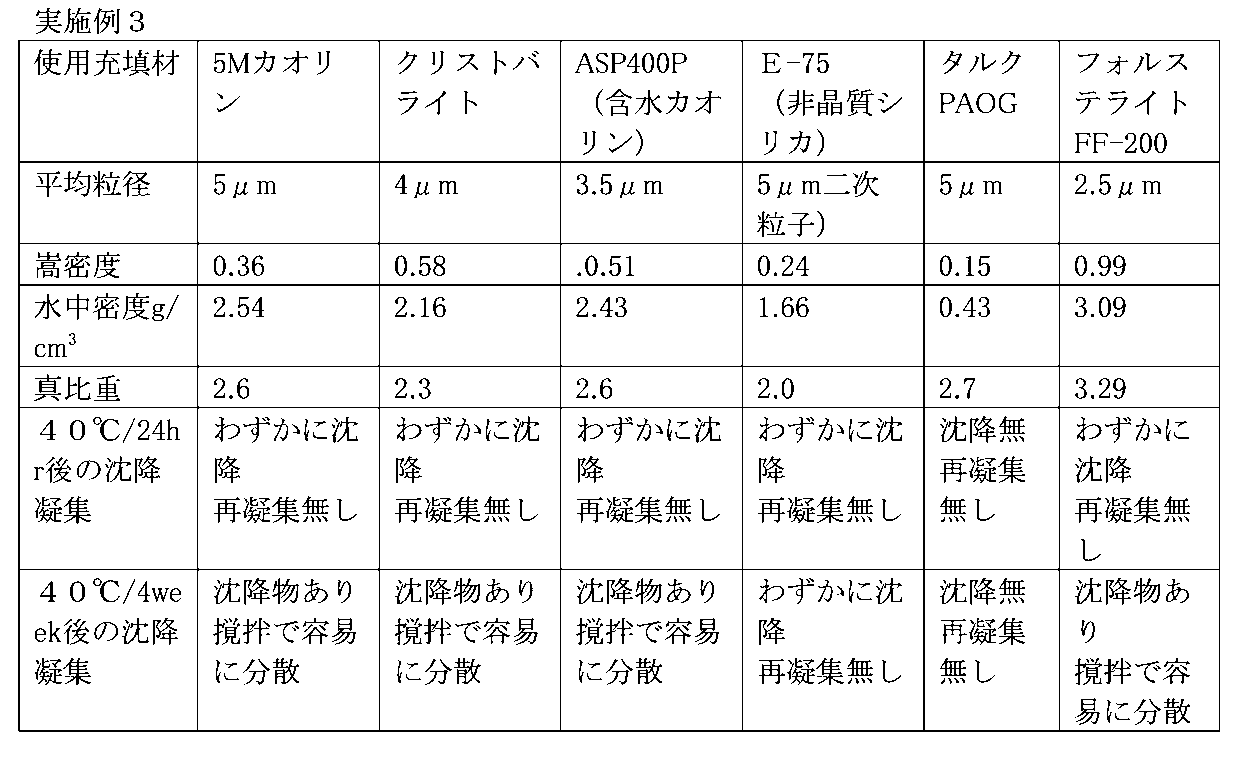
- Example 3 After preparation, the four mixed liquids of Example 2 were stored at 40° C. for 24 hours, and the sedimentation state of the filler was confirmed. The results are shown in Table 3 below.
- Example 4 30 g of an aqueous sodium silicate solution (J Sodium Silicate No. 1), 30 g of an aqueous potassium silicate solution (2K potassium silicate), and 40 g of pure water were mixed and thoroughly stirred to prepare an aqueous alkali metal silicate solution.
- this alkali metal silicate aqueous solution is heated at 200° C. for 2 hours, the solid weight of the silicate aqueous solution is 28 g .
- the various heat insulating paints described above were sprayed onto the aluminum substrate (200 mm x 100 mm x 4 mm thick), and the thickness of the coating after heat curing was adjusted to 60 ⁇ m. Then, this coating was heated at 200° C./2 hr to form a film to obtain a heat-insulating coating. The coating was then subjected to a heat load of 300°C/5 hours.
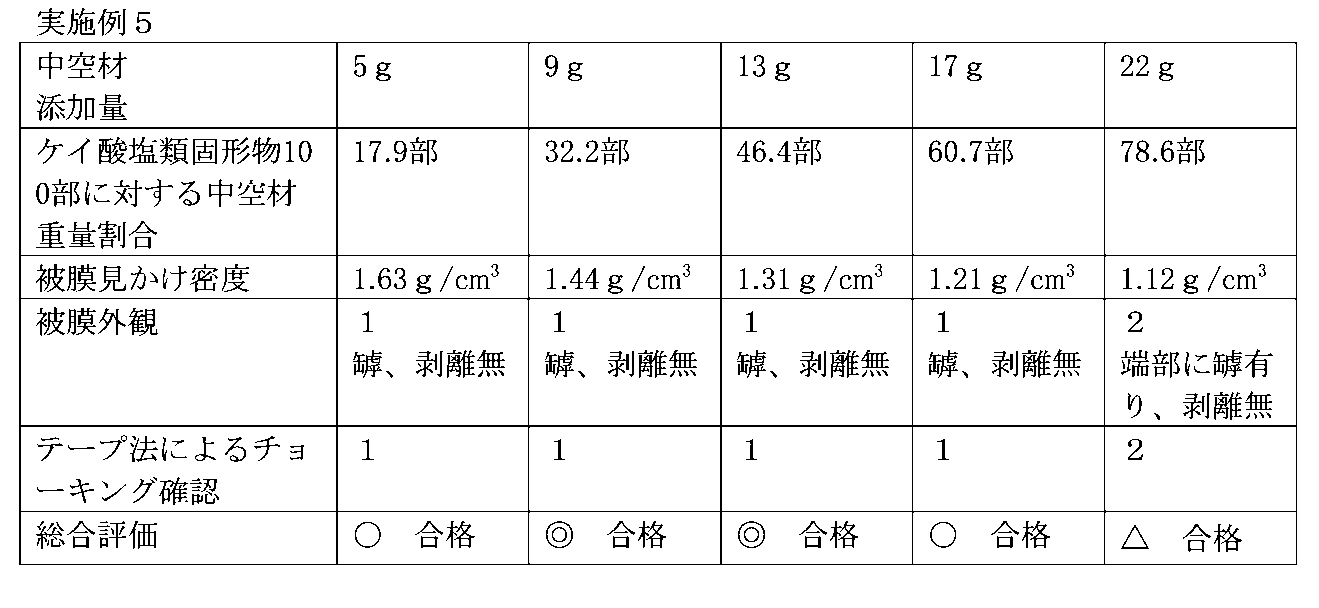
- Example 5 JIS K5600-1-7: 2014 Paint general test method 5 Measurement of dry film thickness 5.3 Calculate the thickness and weight of the film from the mass method for the film after heat load obtained from the five kinds of mixed liquids in Example 4. and the density was obtained. At the same time, the state of each film was evaluated in six grades based on JIS K 5600-8. In particular, regarding the chalking state of the film, the chalking property was confirmed by evaluating in six stages based on the JIS K 5600-8-1 test "grade of chalking (tape method)". The results are shown in Table 4 below.
- Example 6 30 g of an aqueous sodium silicate solution (J Sodium Silicate No. 1), 30 g of an aqueous potassium silicate solution (2K potassium silicate), and 40 g of pure water were mixed and thoroughly stirred to prepare an aqueous alkali metal silicate solution.
- this alkali metal silicate aqueous solution is heated at 200° C. for 2 hours, the solid weight of the silicate aqueous solution is 28 g .
- 12g of kaolin (5M kaolin manufactured by Takehara Chemical Industry Co., Ltd.), 12g of borosilicate glass hollow particles (iM30K manufactured by 3M, compressive strength 186MPa) with a bulk density of 0.30g/ cm3 and a density in water of 0.59g/ cm3 , and a bulk density of 0.62g/ 5 g of potassium titanate whisker (Tismo D manufactured by Otsuka Chemical Co., Ltd.) having a density in water of 2.41 g/cm 3 equivalent to 2.41 g/cm 3 in cm 3 was added to the alkali metal silicate aqueous solution while stirring.
- iM30K manufactured by 3M, compressive strength 186MPa
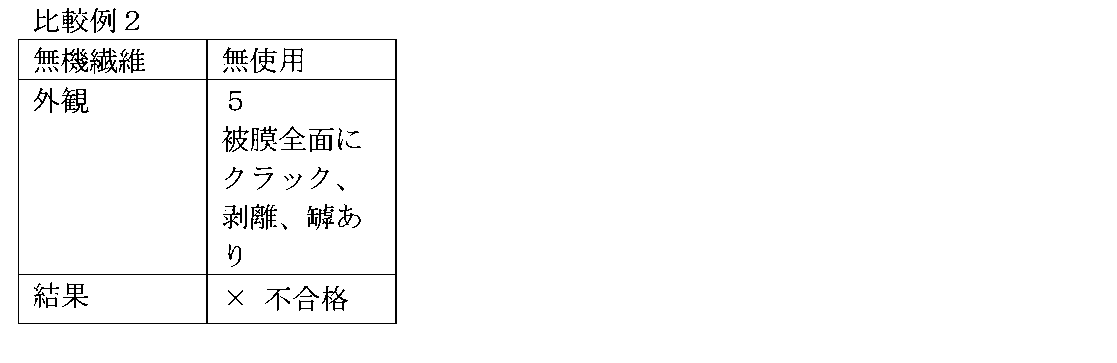
- Comparative example 2 A kind of heat insulation paint was obtained without adding the inorganic fiber of Example 6, and the other material addition ratio and manufacturing method were the same as in Example 5.
- Example 6 using the three liquid agents of Example 6 and one liquid agent of Comparative Example 2, various heat insulating paints were sprayed onto the aluminum substrate (200 mm ⁇ 100 mm ⁇ 4 mm thick), and the film thickness after heat curing was adjusted to 60 ⁇ m. Then, this coating was heated at 200° C./2 hr to form a film to obtain a heat-insulating coating. The coating was then subjected to a heat load of 300°C/5 hours.
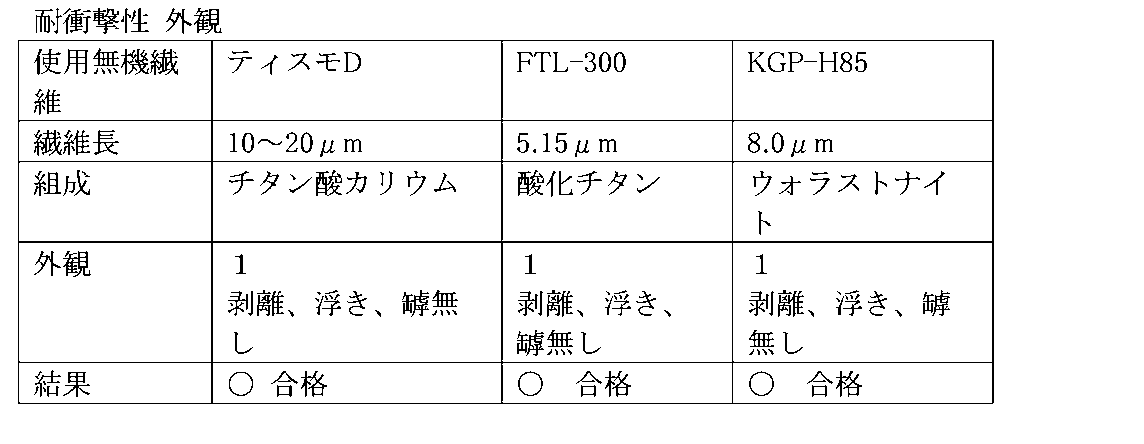
- Example 7 A JIS K5600 DuPont type falling ball impact test was performed on the films obtained from the three mixed solutions of Example 6 and the one mixed solution of Comparative Example 2 after heat load. The impact resistance of each coating was confirmed. In addition, the state of each film was evaluated in six grades based on JIS K 5600-8. The results are listed in Table 5.
- Table 6 summarizes the thermal shock resistance test results of the coating of Comparative Example 2.
- Example 8 30 g of an aqueous sodium silicate solution (J Sodium Silicate No. 1), 30 g of an aqueous potassium silicate solution (2K potassium silicate), and 40 g of pure water were mixed and thoroughly stirred to prepare an aqueous alkali metal silicate solution.
- Kaolin having a bulk density of 0.21/cm 3 and a density in water of 2.54 g/cm 3 is added to the aqueous silicate solution at a rate of 28 g in terms of solid weight when the aqueous alkali metal silicate solution is heated at 200°C for 2 hours.
- the aqueous acid salt solution is added while stirring, and after sufficient stirring and confirmation that the metal oxide powder is sufficiently dispersed, the stirring speed is further increased and stirring is continued to obtain the aqueous composition of the present invention.
- rice field In the same manner, in the course of preparing the aqueous composition, only the polyimide powder was replaced with 3g/7g/11g/14g to obtain five types of mixed liquids each using a different amount of polyimide powder. This mixture was then transferred to a ball mill and mixed for 120 minutes. The liquid temperature during mixing was controlled to be 20°C to 30°C. It was easily defoamed during the ball milling. Five types of mixed liquids were prepared in this manner and used as heat insulating paints.
- Example 8 using the five liquid agents of Example 8, various heat insulating paints were sprayed onto the aluminum substrate (200 mm ⁇ 100 mm ⁇ 4 mm thick) so that the film thickness after heat curing was 60 ⁇ m. It was adjusted. Then, this coating was heated at 200° C./2 hr to form a film to obtain a heat-insulating coating. The coating was then subjected to a heat load of 300°C/5 hours.
- Example 9 Next, a JIS K5600 DuPont type falling ball impact test was performed on the coating of Example 8 after the heat load, and the impact resistance of each coating was confirmed after a 500 g steel ball was dropped from a height of 500 mm.
- the coating was immersed in purified water at 25 ° C within 5 seconds after being left still for 10 minutes in a furnace at 400 ° C, and then quenched. Thermal shock was applied.
- the state of each film was evaluated in six grades based on JIS K 5600-8.
- the chalking property was confirmed by evaluating in six stages based on the JIS K 5600-8-1 test "grade of chalking (tape method)". The results are listed in Table 7.
- Example 10 30 g of an aqueous sodium silicate solution (J Sodium Silicate No. 1), 30 g of an aqueous potassium silicate solution (2K potassium silicate), and 40 g of pure water were mixed and thoroughly stirred to prepare an aqueous alkali metal silicate solution.
- Kaolin having a bulk specific gravity of 0.21 g/cm3 and a density in water of 2.54 g/ cm3 is added to the aqueous silicate solution at a rate of 28 g in terms of solid content when the aqueous alkali metal silicate solution is heated at 200°C for 2 hours.
- the volume of the silicate cured product was calculated to be 33.3 vol% in 100 vol% of the cured film made of this aqueous composition.
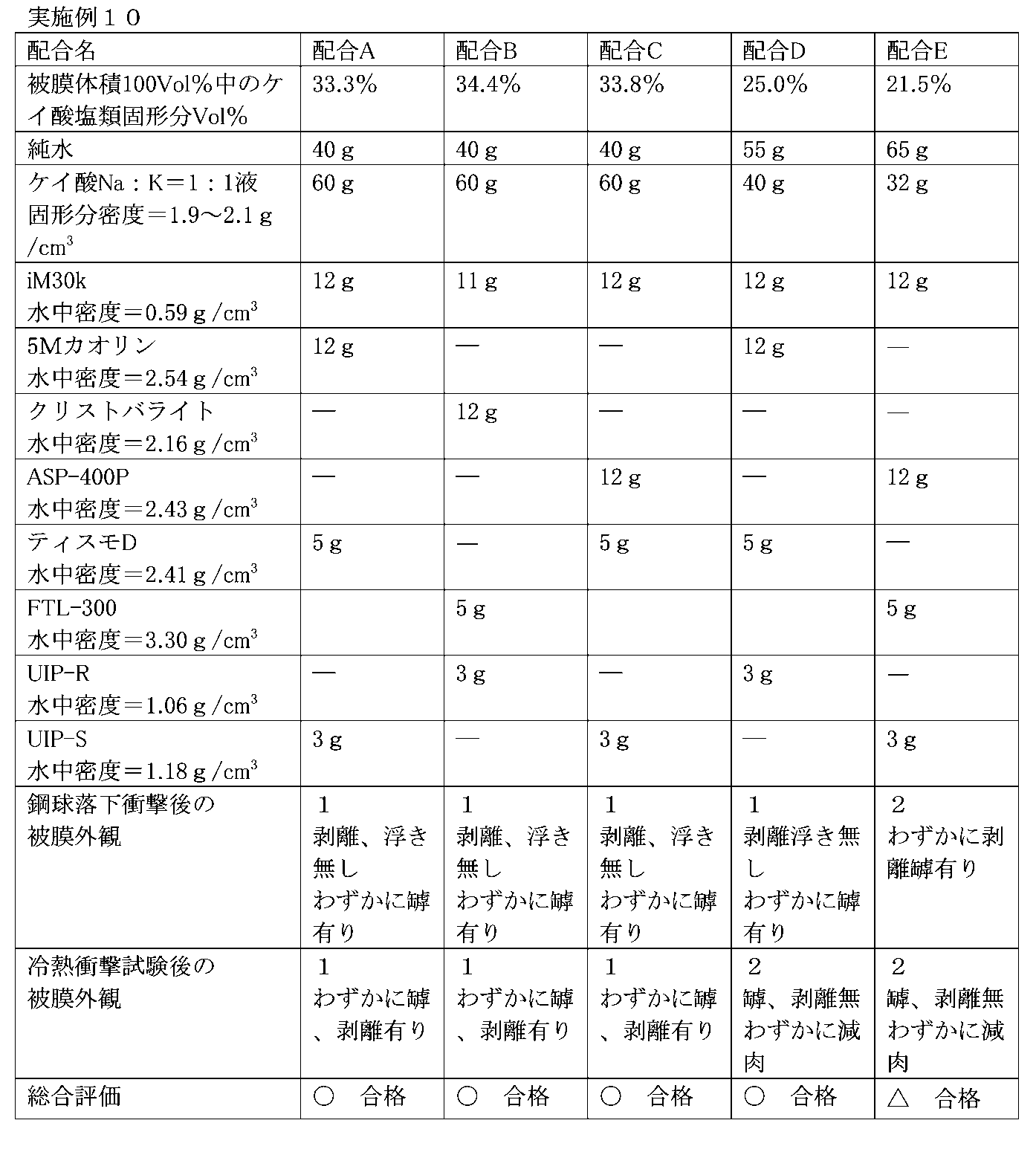
- the type and amount of the filler added were changed as shown in Table 10 below, and while changing the weight ratio of the aggregates used respectively, the above Five kinds of mixed liquids were obtained by adjusting the volume ratio of the silicates cured product to 40 vol % or less in 100 vol % of the cured film. This mixture was then transferred to a ball mill and mixed for 120 minutes. The liquid temperature during mixing was controlled to be 20°C to 30°C. Degassing was easily performed in the middle of the ball mill. Five types of mixed liquids were prepared in this manner, and thermal insulation paints were prepared so that the silicate solid content volume was adjusted to 40 vol % or less.
- Example 10 using the five liquid agents of Example 10, various heat insulating paints were sprayed onto the aluminum substrate (200 mm ⁇ 100 mm ⁇ 4 mm thick) so that the film thickness after heat curing was 60 ⁇ m. It was adjusted. Then, this coating was heated at 200° C./2 hr to form a film to obtain a heat-insulating coating. The coating was then subjected to a heat load of 300°C/5 hours.
- Example 11 Next, a JIS K5600 DuPont type falling ball impact test was performed on the coating of Example 10 after the heat load, and the impact resistance of each coating was confirmed after a 500 g steel ball was dropped from a height of 500 mm.
- the coating was immersed in purified water at 25 ° C within 5 seconds after being left still for 10 minutes in a furnace at 500 ° C, and then quenched. Thermal shock was applied.
- the state of each film was evaluated in six grades based on JIS K 5600-8. The results are listed in Table 8.
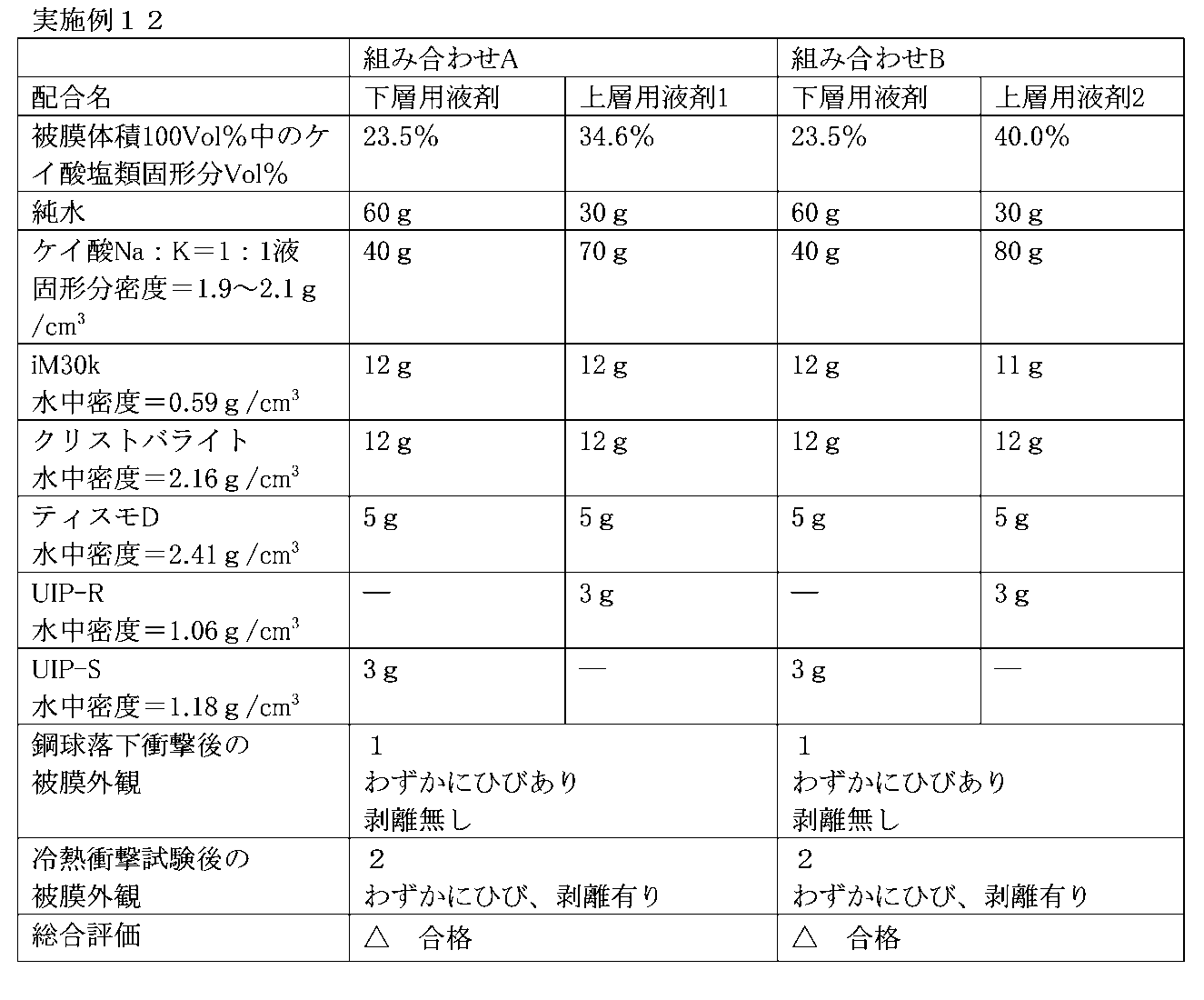
- Example 12 20 g of an aqueous sodium silicate solution (J Sodium Silicate No. 1), 20 g of an aqueous potassium silicate solution (2K potassium silicate), and 60 g of pure water were mixed and thoroughly stirred to prepare an aqueous alkali metal silicate solution. When this alkali metal silicate aqueous solution is heated at 200° C. for 2 hours, the solid weight of the silicate aqueous solution is 28 g .
- the volume of the silicate cured product was calculated to be 24.5 vol% in 100 vol% of the cured film made of this aqueous composition.
- the type and amount of filler added were changed as shown in Table 9 below, and while changing the addition weight ratio of each component used, the coating film
- Two types of mixed liquids were obtained by adjusting the volume ratio of the silicate cured product to 40 vol% or less in 100 vol% of the cured product. This mixture was then transferred to a ball mill and mixed for 120 minutes. The liquid temperature during mixing was controlled to be 20°C to 30°C. Degassing was easily performed in the middle of the ball mill. In this way, a total of three mixed liquids were prepared and used as heat insulating paints.
- Example 12 using the three liquid agents of Example 12, various heat insulating paints were sprayed onto the aluminum substrate (200 mm ⁇ 100 mm ⁇ 4 mm thick), and the film thickness after heat curing was adjusted to 60 ⁇ m. bottom. Then, this coating was heated at 200° C./2 hr to form a film to obtain a heat-insulating coating. The coating was then subjected to a heat load of 300°C/5 hours.
- Example 13 Next, a JIS K5600 DuPont type falling ball impact test was performed on the coating of Example 12 after the heat load, and the impact resistance of each coating was confirmed after a 500 g steel ball was dropped from a height of 500 mm.
- the coating was immersed in purified water at 25 ° C within 5 seconds after being left in a furnace at 500 ° C for 10 minutes, followed by rapid cooling. Thermal shock was applied.
- the state of each film was evaluated in six grades based on JIS K 5600-8. The results are listed in Table 9.
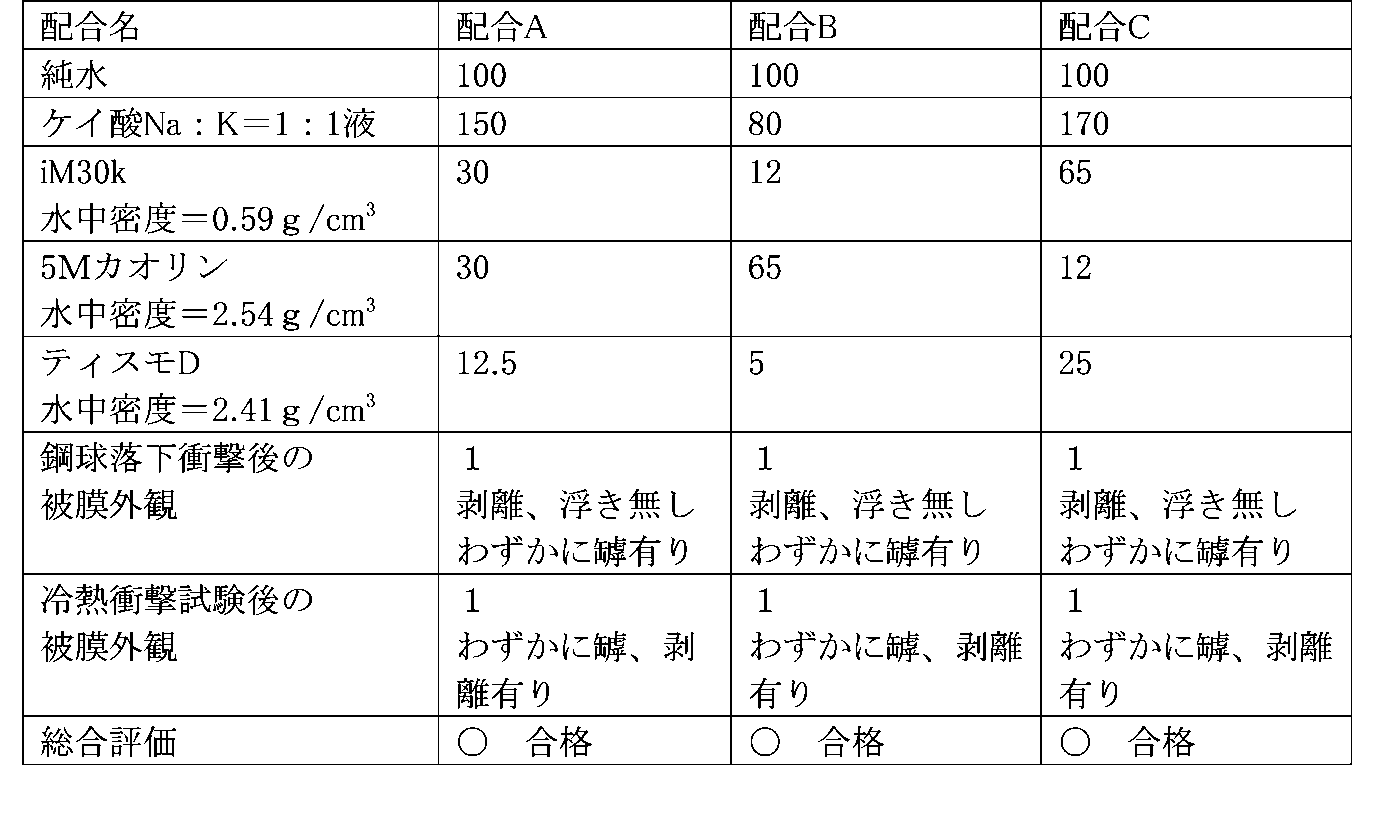
- Example 14 75 parts by weight of sodium silicate aqueous solution (J sodium silicate No. 1) and 75 parts by weight of potassium silicate aqueous solution (2K potassium silicate) are mixed with 100 parts by weight of pure water, and sufficiently stirred to obtain an alkali metal silicate aqueous solution. was prepared.
- This aqueous composition was designated as "Formulation A”.
- formulation A This aqueous composition was designated as "Formulation A”.
- formulation B Two types of mixed liquids were obtained, which were adjusted to be within the addition range for the above, and were designated as formulation B and formulation C, respectively.
- This mixture was then transferred to a ball mill and mixed for 120 minutes.
- the liquid temperature during mixing was controlled to be 20°C to 30°C. Degassing was easily performed in the middle of the ball mill. In this way, three types of mixed liquids were prepared and used as heat insulating paints.
- various heat insulating paints were formed on the aluminum substrate (200 mm ⁇ 100 mm ⁇ 4 mm thick) by spraying using the three types of liquid agents of the above examples, and the film thickness after heat curing was adjusted to 60 ⁇ m. . Then, this coating was heated at 200° C./2 hr to form a film to obtain a heat-insulating coating. A heat load of 400° C./1 hour was then applied to this film.
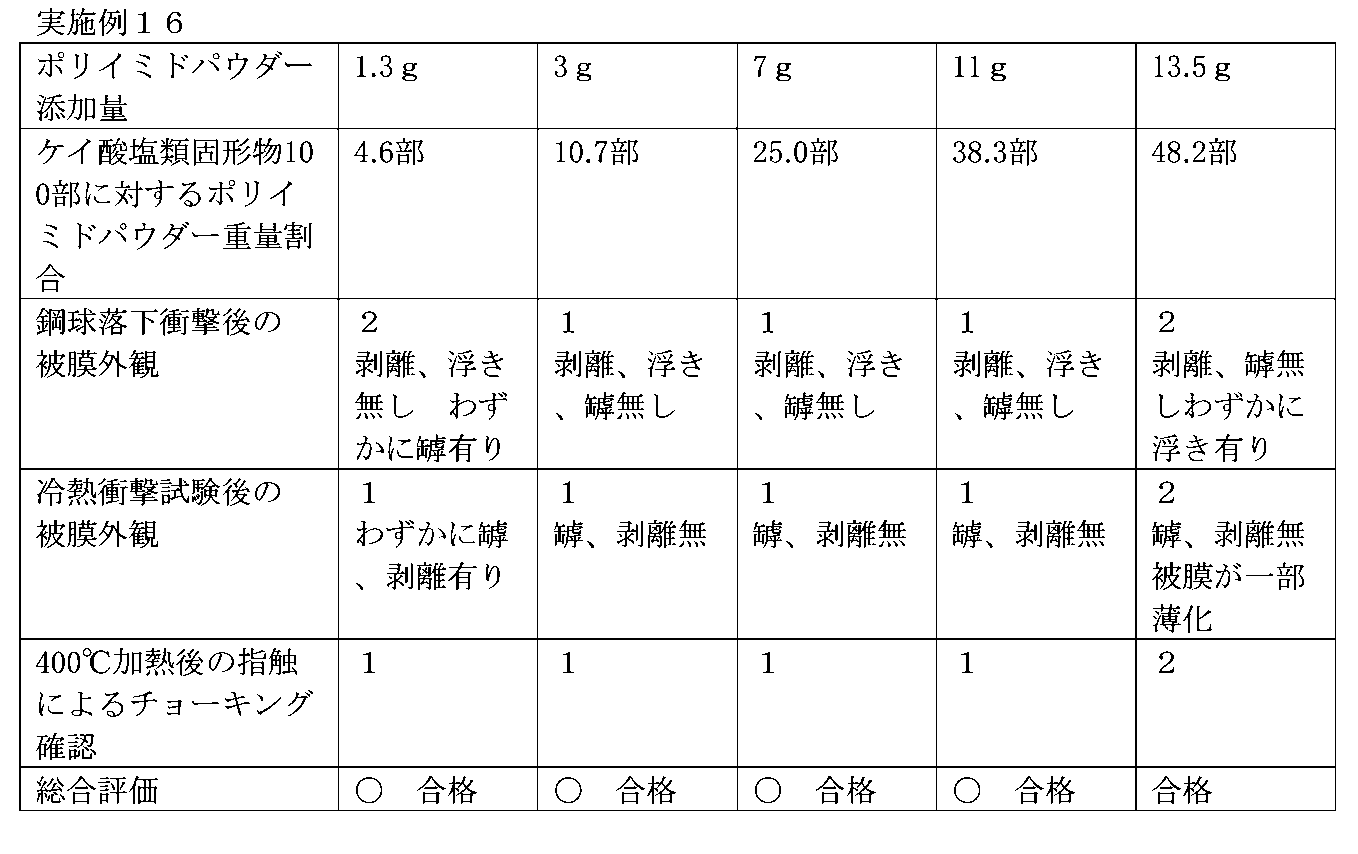
- Example 15 40 g of pure water, 12 g of kaolin (5M kaolin manufactured by Takehara Chemical Industry Co., Ltd.) with a bulk density of 0.21 g/ cm3 and a density in water of 2.54 g/cm3, and boron with a bulk density of 0.30 g/ cm3 and a density in water of 0.59 g/ cm3 .
- the weight ratio was adjusted so that 30 g of the sodium silicate aqueous solution (J Sodium Silicate No. 1) and 30 g of the potassium silicate aqueous solution (2K potassium silicate) were equivalent to 40 g of pure water in the five main ingredients. and mixed for 20 minutes using a propeller stirrer so that the main ingredient and silicates are well mixed, and the ratio of components was the same as that of the five aqueous compositions described in Example 8 above.
- Example 15 using the five kinds of liquid agents of Example 15, various heat insulating paints were sprayed onto the aluminum substrate (200 mm ⁇ 100 mm ⁇ 4 mm thick) so that the film thickness after heat curing was 60 ⁇ m. It was adjusted. Then, this coating was heated at 200° C./2 hr to form a film to obtain a heat-insulating coating. The coating was then subjected to a heat load of 300°C/5 hours.
- Example 16 Next, a JIS K5600 DuPont type falling ball impact test was conducted on the coating of Example 15 after the heat load, and the impact resistance of each coating was confirmed after a 500 g steel ball was dropped from a height of 500 mm.
- the coating was immersed in purified water at 25 ° C within 5 seconds after being left in a furnace at 400 ° C for 10 minutes, followed by rapid cooling. Thermal shock was applied.
- the state of each film was evaluated in six grades based on JIS K 5600-8.
- the chalking property was confirmed by evaluating in six stages based on the JIS K 5600-8-1 test "grade of chalking (tape method)". The results are listed in Table 11.
- the heat insulating paint of Example 8 was prepared by a two-liquid method in which the adhesive component was added later, and the film was formed and evaluated. Sufficient impact resistance and thermal shock resistance were obtained even after a thermal shock load at 400°C, even with the method of post-adding the salt component.
- Example 17 To 40 g of pure water was added 0.15 g of SN Dispersant 5027, a polymer side dispersant manufactured by San Nopco Co., Ltd., followed by 12 g of kaolin (5M kaolin manufactured by Takehara Chemical Industry Co., Ltd.) having a bulk specific gravity of 0.21 g/cm 3 and a density in water of 2.54 g/cm 3 .
- the weight ratio was adjusted so that 30 g of the sodium silicate aqueous solution (J Sodium Silicate No. 1) and 30 g of the potassium silicate aqueous solution (2K potassium silicate) would correspond to 40 g of pure water in the three main ingredients. Then, they were mixed for 20 minutes using a propeller stirrer so that the main agent and the silicates were well mixed to obtain three kinds of heat insulating paints.
- Example 18 The three types of liquid agents of Example 17 were evaluated as follows for the purpose of confirming the homogenization effect of the coating liquid by the dispersant. First, after blasting in advance, the aluminum substrate (200 mm ⁇ 100 mm ⁇ 4 mm thick) was prepared with masking on the four sides of the outer edge of the substrate, and three types of liquid agents of Example 17 were sprayed to form a film, The masking tape was removed immediately after film formation. At that time, it was confirmed whether or not the adhesive solution component flowed out as bleeding from the edge of the coating liquid during masking due to the action of capillary action on the blasted base material from which the tape had been removed. Table 12 shows the results.
Landscapes
- Chemical & Material Sciences (AREA)
- Organic Chemistry (AREA)
- Engineering & Computer Science (AREA)
- Life Sciences & Earth Sciences (AREA)
- Materials Engineering (AREA)
- Wood Science & Technology (AREA)
- Health & Medical Sciences (AREA)
- Chemical Kinetics & Catalysis (AREA)
- Medicinal Chemistry (AREA)
- Polymers & Plastics (AREA)
- Inorganic Chemistry (AREA)
- Nanotechnology (AREA)
- Paints Or Removers (AREA)
- Pigments, Carbon Blacks, Or Wood Stains (AREA)
Abstract
Description
非中空構造の金属酸化物粉末材料と、
金属酸化物繊維材料と、
アルカリ金属ケイ酸塩類と、
水と、
を含有する水性組成物であって、
前記アルカリ金属ケイ酸塩類として少なくともケイ酸ナトリウムとケイ酸カリウムとを含有し、
前記中空状粉末材料の平均粒径が5μm~40μmの範囲であり、またその嵩比重が0.14~0.95g/cm3の範囲であり、耐圧強度が10Mpa以上である、
前記水性組成物。
(2) 前記金属酸化物粉末材料の平均粒径が1μm~15μmの範囲であり、その真密度が3.6以下である、(1)記載の水性組成物。
(3) 前記無機酸化物繊維が、チタン酸カリウムウイスカ、ウォラストナイト及び針状酸化チタンから成る群より選ばれる少なくとも1種である、(1)~(2)のいずれかに記載の水性組成物。
(4) ポリイミド樹脂をさらに含み、該ポリイミド樹脂の添加割合が、熱硬化後の被膜中の前記アルカリ金属ケイ酸塩類100重量部に対して3~50重量部の範囲である、(1)~(3)のいずれかに記載の水性組成物。
(5) 前記水性組成物中の前記水の含有量を100重量部とした場合、前記中空状粉末材料の含有量が8重量部~75重量部、前記金属酸化物粉末材料の含有量が5重量部~70重量部、前記金属酸化物繊維材料の含有量が3重量部~35重量部、前記アルカリ金属ケイ酸塩類の含有量が80重量部~175重量部である、(1)~(4)のいずれかに記載の水性組成物。
(6) 前記水性組成物は、少なくとも前記アルカリ金属ケイ酸塩類を含有する接着剤溶液からなる第一液と、前記中空状粉末材料、前記金属酸化物粉末材料及び前記金属酸化物繊維材料を含有する水分散液又は該水分散液に前記アルカリ金属ケイ酸塩類の少なくとも一種を含有する水分散液を第二液とした、二液系の水性組成物である、(1)~(5)のいずれかに記載の水性組成物。
(7) 前記水又は前記水に前記ケイ酸ナトリウム及び前記ケイ酸カリウムの少なくとも一種を含む液に対し、前記中空状粉末材料、前記金属酸化物粉末材料及び前記金属酸化物繊維材料を分散させる分散剤を添加した、(1)~(6)のいずれかに記載の水性組成物。
(8) 前記分散剤が水系アニオン性高分子であり、その添加量が前記中空状粉末材料、前記金属酸化物粉末材料及び前記金属酸化物繊維材料の合計重量に対して0.1~3.0重量%である(7)記載の水性組成物。
(9) (1)~(8)のいずれかに記載の水性組成物の硬化物。
(10) 金属基材上に形成された被膜の形態にある(9)記載の硬化物。
(11) 金属基材と、該金属基材上に形成された、(10)記載の硬化物から成る被膜とを具備する構造体。
(12) 前記金属基材がアルミ合金系材料から成り、前記硬化物中の前記アルカリ金属ケイ酸塩類の含有量が、硬化物全体の体積に対して体積基準で40%以下である、(11)記載の構造体。
(13) 前記硬化物から成る被膜が、前記金属基材に直接接する第1の硬化物層と、該第1の硬化物層上に形成された第2の硬化物層から成り、前記第2の硬化物層に含まれる前記アルカリ金属ケイ酸塩由来の固形分体積割合が、前記第1の硬化物層に含まれる前記アルカリ金属ケイ酸塩由来の固形分体積割合に対して1.05~2.0倍の範囲である、(11)又は(12)記載の構造体。
上記のとおり、本発明の水性組成物は、二酸化ケイ素系化合物から成り、特定の性質を有する中空状粉末材料を含有する。ここで、「二酸化ケイ素化合物」は、二酸化ケイ素を50重量%以上含む化合物を意味する。また、「中空」は、多孔質でも単一球状の空隙を持つものであってもよい。二酸化ケイ素化合物から成る中空状粉末材料の好ましい例としては、シラスバルーン、フライアッシュバルーン及びホウケイ酸ガラスバルーンを挙げることができるがこれらに限定されるものではない。ホウケイ酸ガラスバルーンが特に好ましい。
本発明の組成物は、非中空構造の金属酸化物粉末材料を含む。非中空構造の金属酸化物粉末材料は、無機充填材として機能するものである。金属酸化物粉末材料は、塗布に適した粘度を有する組成物の貯蔵時の沈降を防止する観点から、真密度が3.6以下であることが好ましく、3.0以下であることがさらに好ましい。真密度の下限値は特にないが、金属酸化物粉末の真密度の下限値は、通常、2.0程度である。
本発明の組成物は、さらに金属酸化物繊維材料を含む。金属酸化物繊維材料としては、チタン酸カリウムウイスカ、ウォラストナイト及び針状酸化チタンから成る群より選ばれる少なくとも1種が好ましい。金属酸化物繊維の長さは、25μm以下であることが好ましく、アスペクト比が5倍~15倍程度、特に8倍~12倍程度が好ましい。金属酸化物繊維の長さの下限値は特に限定されないが、通常、長さの下限値は、4μm程度である。このような金属酸化物繊維材料は、市販されており、市販品を好ましく用いることができる。市販品の具体例としては、大塚化学社製「ティスモN」及び「ティスモD」や、石原産業社製「FTL300」、関西マテック社製「KGP-H85」などが挙げられる。
ケイ酸ナトリウム水溶液(J珪酸ソーダ1号)30gと、ケイ酸カリウム水溶液(2K珪酸カリ)30gと、純水40gとを混合し、充分撹拌してアルカリ金属ケイ酸塩類水溶液を調製した。このアルカリ金属ケイ酸塩類水溶液を200℃で2時間加熱した際に固形分重量で28gとなる割合の前記ケイ酸塩類水溶液に対し、平均粒径5μmで嵩比重0.21g/cm3かつ水中密度2.54g/ cm3のカオリン(竹原化学工業社製5Mカオリン)12g、平均粒径16μmで嵩比重0.30g/cm3かつ水中密度0.59g/ cm3相当のホウ珪酸ガラス中空粒子(3M社製iM30K 耐圧強度=186MPa)12gと嵩密度0.62g/ cm3かつ水中密度2.41g/ cm3相当のチタン酸カリウム繊維(大塚化学製 ティスモD)5gを、前記アルカリ金属ケイ酸塩類水溶液を撹拌しながら投入し、充分撹拌の上金属酸化物粉末が充分分散したことを確認してから、さらに撹拌の回転数を上げ撹拌を継続して、本発明の水性組成物を得た。また、同様の手法で、水性組成物を作成する過程で、中空粒子のみを前記iM30kから、前記の粒度範囲に収まる平均粒径であり耐圧強度の異なる中空粒子として同3M社製の平均粒径25μmのS32HS(耐圧強度=41MPa)と平均粒径20μmのiM16k(耐圧強度=110MPa) と平均粒径30μmのS28HS(耐圧強度=21MPa)と、前記3M製中空粒子と同一の化合物である平均粒径12μmのホウ珪酸ガラスバルーンとして(ポッターズバロティーニ製 110P8 耐圧強度=69MPa)とに置き換え、それぞれ使用する中空粒子の耐圧強度が異なる混合液を得た。次いで、この混合液をボールミルに移し、120分間混合した。混合時の液温は20℃から30℃になるように制御した。ボールミルの途中簡単に脱泡した。このようにして五種類の混合液を調製し、断熱塗料とした。
実施例1の中空粒子のみ耐圧強度の劣るシラスバルーン(井川産業製 シラファインISM-F015 耐圧強度=8MPa)と、ホウ珪酸ガラスバルーン(ポッターズバロティーニ製 25P45 耐圧強度=5MPa)とし、それ以外の材料添加比率や製法は実施例1と同様とした上で、液剤二種を得て、前記実施例1と同様の手法で成膜し、熱負荷を加え、比較例の被膜二種を得た。


ケイ酸ナトリウム水溶液(J珪酸ソーダ1号)30gと、ケイ酸カリウム水溶液(2K珪酸カリ)30gと、純水40gとを混合し、充分撹拌してアルカリ金属ケイ酸塩類水溶液を調製した。このアルカリ金属ケイ酸塩類水溶液を200℃で2時間加熱した際に固形分重量で28gとなる割合の前記ケイ酸塩類水溶液に対し、嵩比重0.21g/ cm3かつ水中密度2.54g/ cm3のカオリン(竹原化学工業社製5Mカオリン)12g、嵩比重0.30g/ cm3かつ水中密度0.59g/ cm3相当のホウ珪酸ガラス中空粒子(3M製iM30K 耐圧強度=186MPa)12gと嵩密度0.62g/ cm3かつ水中密度2.41g/ cm3相当のチタン酸カリウム繊維(大塚化学製 ティスモD)5gを、前記アルカリ金属ケイ酸塩類水溶液を撹拌しながら投入し、充分撹拌の上金属酸化物粉末が充分分散したことを確認してから、さらに撹拌の回転数を上げ撹拌を継続して、本発明の水性組成物を得た。また、同様の手法で水性組成物を作成する過程で、前記の充填材のみを前記クリストバライトから、前記充填材の粒度範囲に収まる平均粒径である充填材としてASP-400Pと5MカオリンとE-75とP-3とPOAGとFF-200に置き換え、それぞれ使用する充填材が異なる混合液を得た。次いで、この混合液をボールミルに移し、120分間混合した。混合時の液温は20℃から30℃になるように制御した。ボールミルの途中簡単に脱泡した。このようにして六種類の混合液を調製し、断熱塗料とした。
前記実施例2の混合液四種について、製作後40℃に保管の状態で24時間静置し、充填材の沈降状態を確認した。結果を下記表3に示す。
ケイ酸ナトリウム水溶液(J珪酸ソーダ1号)30gと、ケイ酸カリウム水溶液(2K珪酸カリ)30gと、純水40gとを混合し、充分撹拌してアルカリ金属ケイ酸塩類水溶液を調製した。このアルカリ金属ケイ酸塩類水溶液を200℃で2時間加熱した際に固形分重量で28gとなる割合の前記ケイ酸塩類水溶液に対し、嵩比重0.21g/cm3かつ水中密度2.54g/cm3のカオリン(竹原化学工業社製5Mカオリン)12g、嵩比重0.30g/cm3かつ水中密度0.59g/cm3相当のホウ珪酸ガラス中空粒子(3M製iM30K 耐圧強度=186MPa)をそれぞれ5g/9g/13g/17g/22gと添加量を変化させ、更にそれぞれに嵩密度0.62g/cm3かつ水中密度2.41g/cm3相当のチタン酸カリウム繊維(大塚化学製 ティスモD)5gを、前記アルカリ金属ケイ酸塩類水溶液を撹拌をしながら投入し、充分撹拌の上金属酸化物粉末が充分分散したことを確認してから、さらに撹拌の回転数を上げ撹拌を継続して、本発明の五種類の水性組成物を得た。次いで、この混合液をボールミルに移し、120分間混合した。混合時の液温は20℃から30℃になるように制御した。ボールミルの途中簡単に脱泡した。このようにして前記中空材料の添加量が異なる五種類の混合液を調製し、断熱塗料とした。
前記実施例4の混合液五種から得られた熱負荷後の被膜について、JIS K5600-1-7:2014 塗料一般試験方法の5 乾燥膜厚の測定5.3質量法から被膜の厚みと重量を算出し密度を求めた。また、同時にそれぞれの被膜の状態についてはJIS K 5600-8に基づいて六段階で評価をした。特に被膜のチョーキング状態についてはJIS K 5600-8-1試験の「白亜化の等級(テープ法)」に基づいて6段階での評価にてチョーキング性を確認した。結果を下記表4に示す。
ケイ酸ナトリウム水溶液(J珪酸ソーダ1号)30gと、ケイ酸カリウム水溶液(2K珪酸カリ)30gと、純水40gとを混合し、充分撹拌してアルカリ金属ケイ酸塩類水溶液を調製した。このアルカリ金属ケイ酸塩類水溶液を200℃で2時間加熱した際に固形分重量で28gとなる割合の前記ケイ酸塩類水溶液に対し、嵩比重0.21g/cm3かつ水中密度2.54g/cm3のカオリン(竹原化学工業社製5Mカオリン)12g、嵩比重0.30g/cm3かつ水中密度0.59g/cm3相当のホウ珪酸ガラス中空粒子(3M製iM30K 耐圧強度=186MPa)12gと嵩密度0.62g/cm3かつ水中密度2.41g/cm3相当のチタン酸カリウムウイスカ(大塚化学製 ティスモD)5gを、前記アルカリ金属ケイ酸塩類水溶液を撹拌しながら投入し、充分撹拌の上金属酸化物粉末が充分分散したことを確認してから、さらに撹拌の回転数を上げ撹拌を継続して、本発明の水性組成物を得た。また、同様の手法で、水性組成物を作成する過程で、無機繊維のみを前記チタン酸カリウムウイスカから、針状酸化チタンの石原産業製「FTL-300(繊維長5.15μm)」と、関西マテック社製ウォラストナイト「KGP-H85(繊維長8μm)」に置き換え、それぞれ使用する無機繊維が異なる混合液を得た。次いで、この混合液をボールミルに移し、120分間混合した。混合時の液温は20℃から30℃になるように制御した。ボールミルの途中簡単に脱泡した。このようにして三種類の混合液を調製し、断熱塗料とした。
前記実施例6の無機繊維を添加せず、その他の材料添加比率や製法は実施例5と同様とした上で、断熱塗料一種を得た。
前記実施例6の混合液三種と比較例2の混合液一種から得られた熱負荷後の被膜に対してJIS K5600のデュポン式落球衝撃試験を実施し、500mm高さからの500g鋼球落下後にそれぞれの被膜の耐衝撃性を確認した。また、それぞれの被膜の状態についてはJIS K 5600-8に基づいて六段階で評価をした。結果を表5に記載する。
ケイ酸ナトリウム水溶液(J珪酸ソーダ1号)30gと、ケイ酸カリウム水溶液(2K珪酸カリ)30gと、純水40gとを混合し、充分撹拌してアルカリ金属ケイ酸塩類水溶液を調製した。このアルカリ金属ケイ酸塩類水溶液を200℃で2時間加熱した際に固形分重量で28gとなる割合の前記ケイ酸塩類水溶液に対し、嵩比重0.21/cm3かつ水中密度2.54g/cm3のカオリン(竹原化学工業社製5Mカオリン)12g、嵩比重0.30g/cm3かつ水中密度0.59g/cm3相当のホウ珪酸ガラス中空粒子(3M製iM30K 耐圧強度=186MPa)12gと嵩密度0.62g/cm3かつ水中密度2.41g/cm3相当のチタン酸カリウムウイスカ(大塚化学製 ティスモD)5gと嵩密度0.38g/cm3のポリイミドパウダー(宇部興産製 UIP-S)1.3gを、前記アルカリ金属ケイ酸塩類水溶液を撹拌しながら投入し、充分撹拌の上金属酸化物粉末が充分分散したことを確認してから、さらに撹拌の回転数を上げ撹拌を継続して、本発明の水性組成物を得た。また、同様の手法で、水性組成物を作成する過程で、前記ポリイミドパウダーのみを3g/7g/11g/14gに置き換え、それぞれ使用するポリイミドパウダー量が異なる混合液五種を得た。次いで、この混合液をボールミルに移し、120分間混合した。混合時の液温は20℃から30℃になるように制御した。ボールミルの途中簡単に脱泡した。このようにして五種類の混合液を調製し、断熱塗料とした。
次に熱負荷後の実施例8の被膜に対してJIS K5600のデュポン式落球衝撃試験を実施し、500mm高さからの500g鋼球落下後にそれぞれの被膜の耐衝撃性を確認した。また、同様に得られた熱負荷後の被膜に対して、更に400℃の炉内に10分静置した状態から5秒以内に25℃の精製水に基材ごと被膜を浸漬し、急冷の熱衝撃を加えた。また、それぞれの被膜の状態についてはJIS K 5600-8に基づいて六段階で評価をした。特に被膜のチョーキング状態についてはJIS K 5600-8-1試験の「白亜化の等級(テープ法)」に基づいて6段階での評価にてチョーキング性を確認した。結果を表7に記載する。

ケイ酸ナトリウム水溶液(J珪酸ソーダ1号)30gと、ケイ酸カリウム水溶液(2K珪酸カリ)30gと、純水40gとを混合し、充分撹拌してアルカリ金属ケイ酸塩類水溶液を調製した。このアルカリ金属ケイ酸塩類水溶液を200℃で2時間加熱した際に固形分重量で28gとなる割合の前記ケイ酸塩類水溶液に対し、嵩比重0.21g/cm3かつ水中密度2.54g/cm3のカオリン(竹原化学工業社製5Mカオリン)12g、嵩比重0.30g/cm3かつ水中密度0.59g/cm3相当のホウ珪酸ガラス中空粒子(3M製iM30K 耐圧強度=186MPa)12gと嵩密度0.62g/cm3かつ水中密度2.41g/cm3相当のチタン酸カリウムウイスカ(大塚化学製 ティスモD)5gと嵩密度0.38g/cm3かつ水中密度1.18g/cm3のポリイミドパウダー(宇部興産製 UIP-S)1.3gを、前記アルカリ金属ケイ酸塩類水溶液を撹拌をしながら投入し、充分撹拌の上金属酸化物粉末が充分分散したことを確認してから、さらに撹拌の回転数を上げ撹拌を継続して、本発明の水性組成物を得た。
次に熱負荷後の実施例10の被膜に対してJIS K5600のデュポン式落球衝撃試験を実施し、500mm高さからの500g鋼球落下後にそれぞれの被膜の耐衝撃性を確認した。また、同様に得られた熱負荷後の被膜に対して、更に500℃の炉内に10分静置した状態から5秒以内に25℃の精製水に基材ごと被膜を浸漬し、急冷の熱衝撃を加えた。また、それぞれの被膜の状態についてはJIS K 5600-8に基づいて六段階で評価をした。結果を表8に記載する。
ケイ酸ナトリウム水溶液(J珪酸ソーダ1号)20gと、ケイ酸カリウム水溶液(2K珪酸カリ)20gと、純水60gとを混合し、充分撹拌してアルカリ金属ケイ酸塩類水溶液を調製した。このアルカリ金属ケイ酸塩類水溶液を200℃で2時間加熱した際に固形分重量で28gとなる割合の前記ケイ酸塩類水溶液に対し、嵩比重0.21g/cm3かつ水中密度2.16g/cm3のクリストバライト(SIBELCO社製 M6000)12g、嵩比重0.30g/cm3かつ水中密度0.59g/cm3相当のホウ珪酸ガラス中空粒子(3M製iM30K 耐圧強度=186MPa)12gと嵩密度0.62g/cm3かつ水中密度2.41g/cm3相当のチタン酸カリウムウイスカ(大塚化学製 ティスモD)5gと嵩密度0.38g/cm3かつ水中密度1.18g/cm3のポリイミドパウダー(宇部興産製 UIP-S)1.3gを、前記アルカリ金属ケイ酸塩類水溶液を撹拌しながら投入し、充分撹拌の上金属酸化物粉末が充分分散したことを確認してから、さらに撹拌の回転数を上げ撹拌を継続して、本発明の水性組成物を得た。
次に熱負荷後の実施例12の被膜に対してJIS K5600のデュポン式落球衝撃試験を実施し、500mm高さからの500g鋼球落下後にそれぞれの被膜の耐衝撃性を確認した。また、同様に得られた熱負荷後の被膜に対して、更に500℃の炉内に10分間静置した状態から5秒以内に25℃の精製水に基材ごと被膜を浸漬し、急冷の熱衝撃を加えた。また、それぞれの被膜の状態についてはJIS K 5600-8に基づいて六段階で評価をした。結果を表9に記載する。
純水100重量部に対しケイ酸ナトリウム水溶液(J珪酸ソーダ1号)75重量部と、ケイ酸カリウム水溶液(2K珪酸カリ)75重量部とを混合し、充分撹拌してアルカリ金属ケイ酸塩類水溶液を調製した。また、前記純水100重量部に対し、嵩比重0.21g/cm3かつ水中密度2.54g/cm3のカオリン(竹原化学工業社製5Mカオリン)30重量部、嵩比重0.30g/cm3かつ水中密度0.59g/cm3相当のホウ珪酸ガラス中空粒子(3M製iM30K 耐圧強度=186MPa)30重量部と嵩密度0.62g/cm3かつ水中密度2.41g/cm3相当のチタン酸カリウムウイスカ(大塚化学製 ティスモD)12.5重量部を、前記アルカリ金属ケイ酸塩類水溶液を撹拌しながら投入し、充分撹拌の上金属酸化物粉末が充分分散したことを確認してから、さらに撹拌の回転数を上げ撹拌を継続して、本発明の水性組成物を得た。
純水40gと嵩比重0.21g/cm3かつ水中密度2.54g/cm3のカオリン(竹原化学工業社製5Mカオリン)12g、嵩比重0.30g/cm3かつ水中密度0.59g/cm3相当のホウ珪酸ガラス中空粒子(3M製iM30K 耐圧強度=186MPa)12gと嵩密度0.62g/cm3かつ水中密度2.41g/cm3相当のチタン酸カリウムウイスカ(大塚化学製 ティスモD)5gと嵩密度0.38g/cm3のポリイミドパウダー(宇部興産製 UIP-S)1.3gを、前記純水を撹拌しながら投入し、充分撹拌の上金属酸化物粉末が充分分散したことを確認してから、さらに撹拌の回転数を上げ撹拌を継続して、前記ケイ酸塩を含まない状態の水性組成物を得た。また、同様の手法で、水性組成物を作成する過程で、前記ポリイミドパウダーのみを3g/7g/11g/14gに置き換え、それぞれ使用するポリイミドパウダー量が異なる混合液五種を得た。次いで、この混合液をボールミルに移し、120分間混合した。混合時の液温は20℃から30℃になるように制御した。ボールミルの途中簡単に脱泡した。このようにして五種類の混合液を調製し、接着剤成分となる前記ケイ酸塩を投入する前の主剤5種とした。
次に熱負荷後の実施例15の被膜に対してJIS K5600のデュポン式落球衝撃試験を実施し、500mm高さからの500g鋼球落下後にそれぞれの被膜の耐衝撃性を確認した。また、同様に得られた熱負荷後の被膜に対して、更に400℃の炉内に10分間静置した状態から5秒以内に25℃の精製水に基材ごと被膜を浸漬し、急冷の熱衝撃を加えた。また、それぞれの被膜の状態についてはJIS K 5600-8に基づいて六段階で評価をした。特に被膜のチョーキング状態についてはJIS K 5600-8-1試験の「白亜化の等級(テープ法)」に基づいて6段階での評価にてチョーキング性を確認した。結果を表11に記載する。
純水40gにサンノプコ社製高分子側分散剤SNディスパーサント5027を0.15g添加し、次いで嵩比重0.21g/cm3かつ水中密度2.54g/cm3のカオリン(竹原化学工業社製5Mカオリン)12g、嵩比重0.30g/cm3かつ水中密度0.59g/cm3相当のホウ珪酸ガラス中空粒子(3M製iM30K 耐圧強度=186MPa)12gと嵩密度0.62g/cm3かつ水中密度2.41g/cm3相当のチタン酸カリウムウイスカ(大塚化学製 ティスモD)5gと嵩密度0.38g/cm3のポリイミドパウダー(宇部興産製 UIP-S)7gを、前記純水を撹拌しながら投入し、充分撹拌の上金属酸化物粉末が充分分散したことを確認してから、さらに撹拌の回転数を上げ撹拌を継続して、前記ケイ酸塩を含まない状態の水性組成物を得た。尚、前記ディスパーサント5027の添加量は、前記無機粉末/無機粒子/無機繊維の合計重量に対して約0.5%となる様に調整した。また、同様の手法で、水性組成物を作成する過程で、前記分散剤のみを同サンノプコ社製ノプラックス6000HとSNディスパーサント2010に置き換え、それぞれ使用する分散剤種が異なる混合液三種を得た。次いで、この混合液をボールミルに移し、120分間混合した。混合時の液温は20℃から30℃になるように制御した。ボールミルの途中簡単に脱泡した。このようにして三種類の混合液を調製し、接着剤成分となる前記ケイ酸塩を投入する前の主剤三種とした。
前記実施例17の液剤三種について、前記分散剤による塗工液の均質化効果の確認目的で次の通りの評価を実施した。まず予めブラスト処理の上、基材の外縁部四辺にマスキングを施した前記のアルミ基材(200mm×100mm×4mm厚)を準備の上、実施例17の液剤三種をスプレーにて成膜し、成膜直後にマスキングテープを除去した。その際、テープを除去したブラスト済基材に対して毛細管現象が働きマスキング際の塗工液端部より接着剤溶液成分が滲みとして流亡するかを確認した。結果を表12に示す。

Claims (13)
- 内部に多孔質状または単一球状構造の中空構造を有する、二酸化ケイ素系化合物から成る中空状粉末材料と、
非中空構造の金属酸化物粉末材料と、
金属酸化物繊維材料と、
アルカリ金属ケイ酸塩類と、
水と、
を含有する水性組成物であって、
前記アルカリ金属ケイ酸塩類として少なくともケイ酸ナトリウムとケイ酸カリウムとを含有し、
前記中空状粉末材料の平均粒径が5μm~40μmの範囲であり、またその嵩比重が0.14~0.95g/cm3の範囲であり、耐圧強度が10Mpa以上である、
前記水性組成物。 - 前記金属酸化物粉末材料の平均粒径が1μm~15μmの範囲であり、その真密度が3.6以下である、請求項1記載の水性組成物。
- 前記無機酸化物繊維が、チタン酸カリウムウイスカ、ウォラストナイト及び針状酸化チタンから成る群より選ばれる少なくとも1種である、請求項1~2のいずれか1項に記載の水性組成物。
- ポリイミド樹脂をさらに含み、該ポリイミド樹脂の添加割合が、熱硬化後の被膜中の前記アルカリ金属ケイ酸塩類100重量部に対して3~50重量部の範囲である、請求項1~3のいずれか1項に記載の水性組成物。
- 前記水性組成物中の前記水の含有量を100重量部とした場合、前記中空状粉末材料の含有量が8重量部~75重量部、前記金属酸化物粉末材料の含有量が5重量部~70重量部、前記金属酸化物繊維材料の含有量が3重量部~35重量部、前記アルカリ金属ケイ酸塩類の含有量が80重量部~175重量部である、請求項1~4のいずれか1項に記載の水性組成物。
- 前記水性組成物は、少なくとも前記アルカリ金属ケイ酸塩類を含有する接着剤溶液からなる第一液と、前記中空状粉末材料、前記金属酸化物粉末材料及び前記金属酸化物繊維材料を含有する水分散液又は該水分散液に前記アルカリ金属ケイ酸塩類の少なくとも一種を含有する水分散液を第二液とした、二液系の水性組成物である、請求項1~5のいずれか1項に記載の水性組成物。
- 前記水又は前記水に前記ケイ酸ナトリウム及び前記ケイ酸カリウムの少なくとも一種を含む液に対し、前記中空状粉末材料、前記金属酸化物粉末材料及び前記金属酸化物繊維材料を分散させる分散剤を添加した、請求項1~6のいずれか1項に記載の水性組成物。
- 前記分散剤が水系アニオン性高分子であり、その添加量が前記中空状粉末材料、前記金属酸化物粉末材料及び前記金属酸化物繊維材料の合計重量に対して0.1~3.0重量%である請求項7記載の水性組成物。
- 請求項1~8のいずれか1項に記載の水性組成物の硬化物。
- 金属基材上に形成された被膜の形態にある請求項9記載の硬化物。
- 金属基材と、該金属基材上に形成された、請求項9記載の硬化物から成る被膜とを具備する構造体。
- 前記金属基材がアルミ合金系材料から成り、前記硬化物中の前記アルカリ金属ケイ酸塩類の含有量が、硬化物全体の体積に対して体積基準で40%以下である、請求項11記載の構造体。
- 前記硬化物から成る被膜が、前記金属基材に直接接する第1の硬化物層と、該第1の硬化物層上に形成された第2の硬化物層から成り、前記第2の硬化物層に含まれる前記アルカリ金属ケイ酸塩由来の固形分体積割合が、前記第1の硬化物層に含まれる前記アルカリ金属ケイ酸塩由来の固形分体積割合に対して1.05~2.0倍の範囲である、請求項11又は12記載の構造体。
Priority Applications (4)
| Application Number | Priority Date | Filing Date | Title |
|---|---|---|---|
| EP22864727.7A EP4397723A4 (en) | 2021-09-03 | 2022-09-02 | AQUEOUS COMPOSITION AND HARDENED PRODUCT THEREIN |
| JP2022566131A JP7252689B1 (ja) | 2021-09-03 | 2022-09-02 | 水性組成物及びその硬化物 |
| CN202280038930.9A CN117413032A (zh) | 2021-09-03 | 2022-09-02 | 水性组合物及其固化物 |
| US18/565,144 US20240263036A1 (en) | 2021-09-03 | 2022-09-02 | Aqueous composition and cured product thereof |
Applications Claiming Priority (2)
| Application Number | Priority Date | Filing Date | Title |
|---|---|---|---|
| JP2021143744 | 2021-09-03 | ||
| JP2021-143744 | 2021-09-03 |
Publications (1)
| Publication Number | Publication Date |
|---|---|
| WO2023033145A1 true WO2023033145A1 (ja) | 2023-03-09 |
Family
ID=85413188
Family Applications (1)
| Application Number | Title | Priority Date | Filing Date |
|---|---|---|---|
| PCT/JP2022/033124 Ceased WO2023033145A1 (ja) | 2021-09-03 | 2022-09-02 | 水性組成物及びその硬化物 |
Country Status (5)
| Country | Link |
|---|---|
| US (1) | US20240263036A1 (ja) |
| EP (1) | EP4397723A4 (ja) |
| JP (1) | JP7252689B1 (ja) |
| CN (1) | CN117413032A (ja) |
| WO (1) | WO2023033145A1 (ja) |
Cited By (1)
| Publication number | Priority date | Publication date | Assignee | Title |
|---|---|---|---|---|
| WO2026134038A1 (ja) * | 2024-12-16 | 2026-06-25 | 大塚化学株式会社 | 塗料組成物、塗膜、およびその製造方法 |
Citations (9)
| Publication number | Priority date | Publication date | Assignee | Title |
|---|---|---|---|---|
| JPH0277582A (ja) * | 1988-07-21 | 1990-03-16 | Eka Nobel Ab | 金属のセラミックコーティング |
| JP2000143328A (ja) * | 1998-11-06 | 2000-05-23 | Ohbayashi Corp | 断熱被覆組成物 |
| JP2001072480A (ja) * | 1999-08-31 | 2001-03-21 | Hitachi Chem Co Ltd | 断熱被覆組成物 |
| WO2009020206A1 (ja) | 2007-08-09 | 2009-02-12 | Kabushiki Kaisha Toyota Chuo Kenkyusho | 内燃機関 |
| JP2015032116A (ja) | 2013-08-01 | 2015-02-16 | 富士通株式会社 | 読み順確認装置、読み順確認方法及び読み順確認プログラム |
| JP2015068302A (ja) | 2013-09-30 | 2015-04-13 | マツダ株式会社 | エンジン燃焼室に臨む部材表面の断熱層及びその製造方法 |
| JP2020190023A (ja) | 2019-05-24 | 2020-11-26 | 株式会社豊田中央研究所 | 遮熱膜、被覆部材およびその製造方法 |
| WO2021004558A1 (en) * | 2019-07-07 | 2021-01-14 | First Point a.s. | Thermal insulating plaster mixture |
| WO2021004559A1 (en) * | 2019-07-07 | 2021-01-14 | First Point a.s. | Coating composition and method of its application |
Family Cites Families (13)
| Publication number | Priority date | Publication date | Assignee | Title |
|---|---|---|---|---|
| GB2081246B (en) * | 1980-07-25 | 1984-03-14 | Rolls Royce | Thermal barrier coating composition |
| US4521333A (en) * | 1983-06-20 | 1985-06-04 | Minnesota Mining And Manufacturing Company | Intumescent silicates having improved stability |
| JPH07103816B2 (ja) * | 1984-02-29 | 1995-11-08 | いすゞ自動車株式会社 | 燃焼室壁面を多孔質断熱材で被覆した内燃機関 |
| JP2000159581A (ja) * | 1998-11-24 | 2000-06-13 | Sekisui Chem Co Ltd | アルミノ珪酸塩スラリー及び無機質硬化体の製造方法 |
| JP3927516B2 (ja) * | 2002-05-15 | 2007-06-13 | 積水化学工業株式会社 | 樹脂シート |
| US6797327B1 (en) * | 2003-02-05 | 2004-09-28 | Northrop Grumman Corporation | System and method for forming a low temperature cured ceramic coating for elevated temperature applications |
| WO2005103152A1 (ja) * | 2004-03-31 | 2005-11-03 | Showa Highpolymer Co., Ltd. | ランプリフレクター用低比重不飽和ポリエステル樹脂組成物及びその成形物 |
| JP2008019282A (ja) * | 2004-10-01 | 2008-01-31 | Baham Giken Corp | 水性懸濁状組成物、水性塗料組成物及び塗装物品 |
| WO2014112526A1 (ja) * | 2013-01-15 | 2014-07-24 | 旭硝子株式会社 | アルカリバリア層形成用コート液及び物品 |
| JP6026938B2 (ja) * | 2013-03-29 | 2016-11-16 | 関西ペイント株式会社 | 遮熱性艶消し水性塗料組成物及び遮熱性艶消し塗膜形成方法 |
| CN103275531B (zh) * | 2013-05-29 | 2015-11-25 | 苏州绿科环保新材料有限公司 | 高耐热液体硅酸盐系水性断热涂料及其制法 |
| US11859091B2 (en) * | 2019-05-09 | 2024-01-02 | Zirconia Inc. | Protective coatings for ferrous substrates |
| WO2020235532A1 (ja) * | 2019-05-21 | 2020-11-26 | Agc株式会社 | 分散液及び成形物 |
-
2022
- 2022-09-02 EP EP22864727.7A patent/EP4397723A4/en active Pending
- 2022-09-02 WO PCT/JP2022/033124 patent/WO2023033145A1/ja not_active Ceased
- 2022-09-02 US US18/565,144 patent/US20240263036A1/en active Pending
- 2022-09-02 JP JP2022566131A patent/JP7252689B1/ja active Active
- 2022-09-02 CN CN202280038930.9A patent/CN117413032A/zh active Pending
Patent Citations (9)
| Publication number | Priority date | Publication date | Assignee | Title |
|---|---|---|---|---|
| JPH0277582A (ja) * | 1988-07-21 | 1990-03-16 | Eka Nobel Ab | 金属のセラミックコーティング |
| JP2000143328A (ja) * | 1998-11-06 | 2000-05-23 | Ohbayashi Corp | 断熱被覆組成物 |
| JP2001072480A (ja) * | 1999-08-31 | 2001-03-21 | Hitachi Chem Co Ltd | 断熱被覆組成物 |
| WO2009020206A1 (ja) | 2007-08-09 | 2009-02-12 | Kabushiki Kaisha Toyota Chuo Kenkyusho | 内燃機関 |
| JP2015032116A (ja) | 2013-08-01 | 2015-02-16 | 富士通株式会社 | 読み順確認装置、読み順確認方法及び読み順確認プログラム |
| JP2015068302A (ja) | 2013-09-30 | 2015-04-13 | マツダ株式会社 | エンジン燃焼室に臨む部材表面の断熱層及びその製造方法 |
| JP2020190023A (ja) | 2019-05-24 | 2020-11-26 | 株式会社豊田中央研究所 | 遮熱膜、被覆部材およびその製造方法 |
| WO2021004558A1 (en) * | 2019-07-07 | 2021-01-14 | First Point a.s. | Thermal insulating plaster mixture |
| WO2021004559A1 (en) * | 2019-07-07 | 2021-01-14 | First Point a.s. | Coating composition and method of its application |
Non-Patent Citations (2)
| Title |
|---|
| HIDEO YAMASHITA ET AL.: "Heat Insulation by Temperature Swing in Combustion Chamber Walls (Fifth Report) - Influence of Engine Operating Condition", TRANSACTIONS OF SOCIETY OF AUTOMOTIVE ENGINEERS OF JAPAN, vol. 49, no. 2, 2018, pages 156 - 161 |
| See also references of EP4397723A4 |
Cited By (1)
| Publication number | Priority date | Publication date | Assignee | Title |
|---|---|---|---|---|
| WO2026134038A1 (ja) * | 2024-12-16 | 2026-06-25 | 大塚化学株式会社 | 塗料組成物、塗膜、およびその製造方法 |
Also Published As
| Publication number | Publication date |
|---|---|
| EP4397723A4 (en) | 2025-12-03 |
| CN117413032A (zh) | 2024-01-16 |
| EP4397723A1 (en) | 2024-07-10 |
| JPWO2023033145A1 (ja) | 2023-03-09 |
| US20240263036A1 (en) | 2024-08-08 |
| JP7252689B1 (ja) | 2023-04-05 |
Similar Documents
| Publication | Publication Date | Title |
|---|---|---|
| KR102232758B1 (ko) | 크롬-무함유 실리케이트-기재 세라믹 조성물 | |
| JP5081173B2 (ja) | 排気管用塗料、排気管用塗料の使用方法及び排気管 | |
| KR100970462B1 (ko) | 에너지 절감형 방식용 금속도막 조성물 및 그 제조방법 | |
| JP7252689B1 (ja) | 水性組成物及びその硬化物 | |
| CN114806233B (zh) | 一种高光洁度耐高温防腐蚀无机铝涂料及其使用方法 | |
| JPH0277582A (ja) | 金属のセラミックコーティング | |
| CN102134412B (zh) | 用于高温环境下的阻尼减振降噪涂层材料 | |
| CN109627815A (zh) | 一种耐腐蚀纳米涂料及其制备方法 | |
| CN118271888A (zh) | 锌铝涂料组合物和锌铝涂料及其制备方法以及含有锌铝涂层的制品 | |
| WO2019035164A1 (ja) | 遮熱部品及びその製造方法 | |
| JP2007070459A (ja) | シリカ殻からなるナノ中空粒子を用いた防食膜及びシリカ殻からなるナノ中空粒子を用いた防食塗料 | |
| KR101069950B1 (ko) | 전기전도성이 개선된 강판 및 이에 사용되는 수지 조성물 | |
| CN118580704A (zh) | 一种多层复合膨胀型防火涂料、制备方法及其使用方法 | |
| CN106077445A (zh) | 一种铝合金低压铸造用金属型涂料及其制备方法 | |
| JP2006160776A (ja) | 水性ジンクリッチ塗料 | |
| JPH05202313A (ja) | 親水化処理剤 | |
| JPH11244992A (ja) | 金型鋳造用黒鉛系離型剤及びその製造方法 | |
| CN108997800B (zh) | 一种疏水复合涂层的制备方法 | |
| CN109233374B (zh) | 一种疏水复合材料的制备方法 | |
| CN109161231B (zh) | 一种疏水复合材料 | |
| WO2025134888A1 (ja) | 耐熱性塗装物およびその製造方法 | |
| TW202305065A (zh) | 塗料及其塗裝方法 | |
| CN105440899A (zh) | 一种泵阀用散热型粉末涂料 | |
| CN120310302A (zh) | 改性包覆玻璃粉、无机耐高温抗氧化涂料及其制备方法和应用 | |
| CN117107189A (zh) | 金属陶瓷高温抗氧化复合涂层 |
Legal Events
| Date | Code | Title | Description |
|---|---|---|---|
| ENP | Entry into the national phase |
Ref document number: 2022566131 Country of ref document: JP Kind code of ref document: A |
|
| 121 | Ep: the epo has been informed by wipo that ep was designated in this application |
Ref document number: 22864727 Country of ref document: EP Kind code of ref document: A1 |
|
| WWE | Wipo information: entry into national phase |
Ref document number: 202347079949 Country of ref document: IN |
|
| WWE | Wipo information: entry into national phase |
Ref document number: 202280038930.9 Country of ref document: CN Ref document number: 18565144 Country of ref document: US |
|
| WWE | Wipo information: entry into national phase |
Ref document number: 2022864727 Country of ref document: EP |
|
| NENP | Non-entry into the national phase |
Ref country code: DE |
|
| ENP | Entry into the national phase |
Ref document number: 2022864727 Country of ref document: EP Effective date: 20240403 |
|
| WWW | Wipo information: withdrawn in national office |
Ref document number: 2022864727 Country of ref document: EP |