WO2023047767A1 - インクジェットインク及び画像記録方法 - Google Patents
インクジェットインク及び画像記録方法 Download PDFInfo
- Publication number
- WO2023047767A1 WO2023047767A1 PCT/JP2022/027320 JP2022027320W WO2023047767A1 WO 2023047767 A1 WO2023047767 A1 WO 2023047767A1 JP 2022027320 W JP2022027320 W JP 2022027320W WO 2023047767 A1 WO2023047767 A1 WO 2023047767A1
- Authority
- WO
- WIPO (PCT)
- Prior art keywords
- ink
- mass
- inkjet ink
- group
- formula
- Prior art date
- Legal status (The legal status is an assumption and is not a legal conclusion. Google has not performed a legal analysis and makes no representation as to the accuracy of the status listed.)
- Ceased
Links
Classifications
-
- C—CHEMISTRY; METALLURGY
- C09—DYES; PAINTS; POLISHES; NATURAL RESINS; ADHESIVES; COMPOSITIONS NOT OTHERWISE PROVIDED FOR; APPLICATIONS OF MATERIALS NOT OTHERWISE PROVIDED FOR
- C09D—COATING COMPOSITIONS, e.g. PAINTS, VARNISHES OR LACQUERS; FILLING PASTES; CHEMICAL PAINT OR INK REMOVERS; INKS; CORRECTING FLUIDS; WOODSTAINS; PASTES OR SOLIDS FOR COLOURING OR PRINTING; USE OF MATERIALS THEREFOR
- C09D11/00—Inks
- C09D11/30—Inkjet printing inks
- C09D11/32—Inkjet printing inks characterised by colouring agents
- C09D11/322—Pigment inks
-
- B—PERFORMING OPERATIONS; TRANSPORTING
- B41—PRINTING; LINING MACHINES; TYPEWRITERS; STAMPS
- B41J—TYPEWRITERS; SELECTIVE PRINTING MECHANISMS, i.e. MECHANISMS PRINTING OTHERWISE THAN FROM A FORME; CORRECTION OF TYPOGRAPHICAL ERRORS
- B41J2/00—Typewriters or selective printing mechanisms characterised by the printing or marking process for which they are designed
- B41J2/005—Typewriters or selective printing mechanisms characterised by the printing or marking process for which they are designed characterised by bringing liquid or particles selectively into contact with a printing material
- B41J2/01—Ink jet
-
- B—PERFORMING OPERATIONS; TRANSPORTING
- B41—PRINTING; LINING MACHINES; TYPEWRITERS; STAMPS
- B41J—TYPEWRITERS; SELECTIVE PRINTING MECHANISMS, i.e. MECHANISMS PRINTING OTHERWISE THAN FROM A FORME; CORRECTION OF TYPOGRAPHICAL ERRORS
- B41J2/00—Typewriters or selective printing mechanisms characterised by the printing or marking process for which they are designed
- B41J2/005—Typewriters or selective printing mechanisms characterised by the printing or marking process for which they are designed characterised by bringing liquid or particles selectively into contact with a printing material
- B41J2/01—Ink jet
- B41J2/17—Ink jet characterised by ink handling
- B41J2/175—Ink supply systems ; Circuit parts therefor
- B41J2/17503—Ink cartridges
- B41J2/17513—Inner structure
-
- C—CHEMISTRY; METALLURGY
- C09—DYES; PAINTS; POLISHES; NATURAL RESINS; ADHESIVES; COMPOSITIONS NOT OTHERWISE PROVIDED FOR; APPLICATIONS OF MATERIALS NOT OTHERWISE PROVIDED FOR
- C09D—COATING COMPOSITIONS, e.g. PAINTS, VARNISHES OR LACQUERS; FILLING PASTES; CHEMICAL PAINT OR INK REMOVERS; INKS; CORRECTING FLUIDS; WOODSTAINS; PASTES OR SOLIDS FOR COLOURING OR PRINTING; USE OF MATERIALS THEREFOR
- C09D11/00—Inks
- C09D11/02—Printing inks
- C09D11/10—Printing inks based on artificial resins
- C09D11/106—Printing inks based on artificial resins containing macromolecular compounds obtained by reactions only involving carbon-to-carbon unsaturated bonds
- C09D11/107—Printing inks based on artificial resins containing macromolecular compounds obtained by reactions only involving carbon-to-carbon unsaturated bonds from unsaturated acids or derivatives thereof
-
- C—CHEMISTRY; METALLURGY
- C09—DYES; PAINTS; POLISHES; NATURAL RESINS; ADHESIVES; COMPOSITIONS NOT OTHERWISE PROVIDED FOR; APPLICATIONS OF MATERIALS NOT OTHERWISE PROVIDED FOR
- C09D—COATING COMPOSITIONS, e.g. PAINTS, VARNISHES OR LACQUERS; FILLING PASTES; CHEMICAL PAINT OR INK REMOVERS; INKS; CORRECTING FLUIDS; WOODSTAINS; PASTES OR SOLIDS FOR COLOURING OR PRINTING; USE OF MATERIALS THEREFOR
- C09D11/00—Inks
- C09D11/30—Inkjet printing inks
- C09D11/38—Inkjet printing inks characterised by non-macromolecular additives other than solvents, pigments or dyes
-
- C—CHEMISTRY; METALLURGY
- C09—DYES; PAINTS; POLISHES; NATURAL RESINS; ADHESIVES; COMPOSITIONS NOT OTHERWISE PROVIDED FOR; APPLICATIONS OF MATERIALS NOT OTHERWISE PROVIDED FOR
- C09D—COATING COMPOSITIONS, e.g. PAINTS, VARNISHES OR LACQUERS; FILLING PASTES; CHEMICAL PAINT OR INK REMOVERS; INKS; CORRECTING FLUIDS; WOODSTAINS; PASTES OR SOLIDS FOR COLOURING OR PRINTING; USE OF MATERIALS THEREFOR
- C09D5/00—Coating compositions, e.g. paints, varnishes or lacquers, characterised by their physical nature or the effects produced; Filling pastes
Definitions
- the present disclosure relates to an inkjet ink and an image recording method.
- inkjet ink ink used for this image recording
- Japanese Patent Application Laid-Open No. 2015-063574 discloses that when used in an inkjet recording apparatus having a recording head having a protective layer and a resin member that comes into contact with ink, the thickness of the protective layer is difficult to decrease and the resin member deteriorates.
- a recording head that is, an inkjet head
- at least a portion of a member that contacts ink is made of at least one material selected from the group consisting of silicon, silicon oxide, silicon nitride, and silicon carbide
- An ink for use in an inkjet recording device comprising a contacting resin member, Inks containing pigments, soluble copper ions, and specific compounds containing bipyridine structures are disclosed.
- JP-A-2003-165936 as an inkjet ink excellent in dispersion or dissolution stability without causing changes in ink droplet size, ink droplet ejection speed, ejection failure, etc.,
- a water-based ink is disclosed having a zeta potential between the member and the colorant of 0 to -50 mV at a pH of 6.5 to 11.5.
- Japanese Patent Application Laid-Open No. 2016-044236 discloses that elution of a silicon compound from a recording head (that is, an inkjet head) is suppressed while containing a resin that is effective for increasing the fastness of a recorded image.
- a resin that is effective for increasing the fastness of a recorded image.
- An ink for use in an inkjet recording method in which a recording head in which at least a portion of a member that contacts ink is composed of silicon or a silicon compound is used, and ink is ejected from the recording head to record an image on a recording medium.
- An ink containing a self-dispersing pigment having a phosphonic acid group bonded directly or via another atomic group to the particle surface, a resin having an anionic group, and a specific compound having an amino group is disclosed.
- Japanese Patent Application Laid-Open No. 2011-063000 discloses that when an image is formed by an inkjet head having an ink circulation system, the deterioration of the head member (especially the head plate and the ink flow path) is suppressed, and high definition can be maintained for a long time.
- an image forming method capable of stably forming an image a plurality of droplet ejection elements; a common flow path communicating with the plurality of droplet ejection elements via supply paths; and a common circulation path communicating with the plurality of droplet ejection elements via return paths.
- an ink-jet head comprising an ink circulation device for supplying an ink composition from the common channel to the plurality of droplet ejection elements and circulating the ink composition in the common circulation channel, and a silicate compound.
- An image forming method includes the step of ejecting an ink composition comprising at least one.
- JP-A-2011-111527 describes an aqueous ink composition that is excellent in long-term ejection property and capable of suppressing shape deformation and decrease in liquid repellency of an inkjet head member.
- aqueous ink composition comprising a colorant comprising at least one of an azo pigment having a specific structure, a tautomer thereof, a salt and a hydrate thereof, a dispersant, and colloidal silica.
- the alkaline Inkjet inks may etch ink channel walls that contain silicon. In some cases, it is required to suppress the etching of the wall of the ink flow path from the viewpoint of the ejection property of the inkjet ink.
- An object of one aspect of the present disclosure is to provide an inkjet ink that is ejected from an inkjet head containing silicon in an ink channel wall and that can suppress etching of the ink channel wall, and an inkjet ink. It is to provide an image recording method used.
- the oxidizing agent contains at least one selected from the group consisting of hydrogen peroxide and peroxides.
- the oxidizing agent contains at least one selected from the group consisting of hydrogen peroxide, peracetic acid, sodium percarbonate, and urea hydrogen peroxide.
- the mass ratio of the content of the oxidizing agent to the total content of the resin particles and wax particles is 0 .
- the inkjet ink according to any one of ⁇ 2> to ⁇ 4> is 02 mass % to 6 mass %, the inkjet ink according to any one of ⁇ 2> to ⁇ 4>.
- ⁇ 6> The inkjet ink according to any one of ⁇ 1> to ⁇ 5>, further comprising colloidal silica.
- ⁇ 7> The inkjet ink according to any one of ⁇ 1> to ⁇ 6>, further comprising an organic solvent having a ClogP value of 1.0 to 3.5.
- the organic solvent having a ClogP value of 1.0 to 3.5 is at least one selected from the group consisting of compounds represented by the following formula 1 and compounds represented by formula 2.
- each R 1 independently represents a hydrogen atom or a methyl group
- each R 2 independently represents a linear or branched hydrocarbon group having 4 to 9 carbon atoms, or It represents an aryl group of 6-10
- n represents an integer of 1-3.
- R 3 represents a hydrogen atom or an alkyl group having 1 to 4 carbon atoms
- X 1 represents a divalent linking group
- Y 1 represents an anionic group
- the atom furthest from the main chain is 4 to 27 atoms away from the main chain.
- ⁇ 11> The inkjet ink according to any one of ⁇ 1> to ⁇ 10>, further comprising cellulose nanofibers.
- ⁇ 12> The inkjet ink according to ⁇ 11>, wherein the cellulose nanofibers have an average fiber width of 1 nm or more and 10 nm or less.
- ⁇ 13> The inkjet ink according to ⁇ 11> or ⁇ 12>, wherein the cellulose nanofibers have an average fiber length of 10 nm or more and 1000 nm or less.
- ⁇ 14> The inkjet ink according to any one of ⁇ 11> to ⁇ 13>, wherein the cellulose nanofibers are TEMPO oxidized cellulose nanofibers.
- ⁇ 15> Any one of ⁇ 11> to ⁇ 14>, wherein the mass ratio of the content of cellulose nanofibers to the total content of resin particles and wax particles is 1.00% by mass to 10.00% by mass.
- the inkjet ink described in . ⁇ 16> The inkjet ink according to any one of ⁇ 11> to ⁇ 15>, wherein the content of cellulose nanofibers is 0.01% by mass to 1.00% by mass with respect to the total amount of the inkjet ink.
- ⁇ 17> The inkjet ink of any one of ⁇ 11> to ⁇ 16>, having a viscosity of 3.8 mPa ⁇ s to 6.0 mPa ⁇ s when measured at 30° C. and 100 rpm.
- An image recording method comprising a step of applying the inkjet ink according to any one of ⁇ 1> to ⁇ 17> onto a recording medium by ejecting it from an inkjet head containing silicon on the ink channel wall.
- the inkjet ink is an inkjet ink that is ejected from an inkjet head containing silicon in the ink channel wall, the inkjet ink being able to suppress etching of the ink channel wall, and the inkjet ink.
- An image recording method using the method is provided.
- a numerical range represented using “to” means a range including the numerical values described before and after “to” as lower and upper limits.
- the amount of each component in the composition means the total amount of the above substances present in the composition unless otherwise specified when there are multiple substances corresponding to each component in the composition. do.
- the upper or lower limit value described in a certain numerical range may be replaced with the upper or lower limit value of another numerical range described step by step, Alternatively, the values shown in the examples may be substituted.
- the term "process” includes not only independent processes, but also processes that cannot be clearly distinguished from other processes, as long as the intended purpose of the process is achieved.
- (meth)acryl is a concept that includes both acrylic and methacrylic
- (meth)acrylate is a concept that includes both acrylate and methacrylate.
- the inkjet ink of the present disclosure (hereinafter also simply referred to as "ink”)
- ORP represents the redox potential of the inkjet ink in units of mV, as measured at apparatus conditions such that the redox potential of water at pH 6.2 is 310 mV, and pH is the pH of the inkjet ink.
- an image is recorded by ejecting the inkjet ink from the inkjet head using a conventional alkaline inkjet ink (e.g., pH 7.2 or higher) and an inkjet head containing silicon in the ink channel wall.
- alkaline inkjet inks can etch the ink channel walls that contain silicon. If the ink channel wall is etched, it may impair the ejection performance of the ink from the inkjet head, so it is desirable to suppress the etching of the ink channel wall.
- the ink of the present disclosure is an alkaline ink, it can suppress the etching of the ink channel wall containing silicon of the inkjet head.
- the ink contains at least one of resin particles and wax particles; and
- the ink satisfies the inequality (X) (that is, the redox potential ORPi of the ink is equal to or greater than “285 ⁇ 59 ⁇ (pHi ⁇ 6.2)”).
- etching of the ink channel walls containing silicon of the inkjet head can be suppressed.
- the reason why such an effect is produced is presumed as follows.
- the ink of the present disclosure since the ink satisfies the inequality (X), formation of an oxide film (that is, a silicon oxide film) on the surface of the ink channel wall containing silicon is promoted, and the silicon oxide film causes the ink to flow. It is thought that etching of the ink channel wall is suppressed by protecting the channel wall. Furthermore, in the ink of the present disclosure, the resin particles and/or wax particles in the ink function as a cushioning material, thereby suppressing abrasion of the ink channel wall by the pigment in the ink. This is thought to be due to suppression of etching due to polishing scratches on the channel wall.
- the pH of the ink of the present disclosure (ie, pHi in the inequality (X)) is 7.2-11. That is, the inks of the present disclosure are alkaline inks. As mentioned above, conventional alkaline inks can cause ink channel wall etching, but the inks of the present disclosure solve the problem of ink channel wall etching.
- the pH of the ink is 7.2 to 11.
- the pH of the ink is preferably 7.5-10, more preferably 8.0-9.5.
- pH means a value measured at a temperature of 25°C using a pH meter (eg, product name "WM-50EG” manufactured by Toa DDK).
- ORPi represents the redox potential of the inkjet ink in units of mV, as measured at apparatus conditions such that the redox potential of water at pH 6.2 is 310 mV, and pHi is the pH of the inkjet ink.
- ORPi in the present disclosure is an oxidation-reduction potential measuring device (for example, OPR Tester manufactured by EUTECH) calibrated so that the oxidation-reduction potential of water at pH 6.2 is 310 mV. 10) means the value measured using
- the ink can be adjusted to satisfy the inequality (X).
- the value of “ORPi ⁇ [285 ⁇ 59 ⁇ (pHi ⁇ 6.2)]” is 0 or more as shown in inequality (X).
- the value of “ORPi ⁇ [285 ⁇ 59 ⁇ (pHi ⁇ 6.2)]” is preferably 5.0 or more, more preferably 10 or more, from the viewpoint of further suppressing etching of the ink channel wall. more preferred.
- the upper limit of the value of “ORPi-[285-59 ⁇ (pHi-6.2)]” is not particularly limited, but an example of the upper limit is 30.
- the ink of the present disclosure is ejected from an inkjet head that includes silicon in the ink channel walls.
- the inkjet head it is preferable that the ink channel wall is formed of a silicon-containing member.
- JP-A-2015-063574, JP-A-2003-165936, JP-A-2016-044236, JP-A-2011-063000, JP-A-2011 No. 111527, Japanese Patent No. 4902711, and other known inkjet printers can be referred to as appropriate.
- the inks of the present disclosure contain water.
- the water content relative to the total amount of the ink of the present disclosure is preferably 10% by mass or more, more preferably 30% by mass or more, still more preferably 50% by mass or more, and still more preferably 60% by mass or more. be.
- the upper limit of the water content relative to the total amount of the ink of the present disclosure is, for example, 99% by mass, 90% by mass, 80% by mass, etc., depending on the amount of other components.
- the inks of the present disclosure contain pigments.
- the type of pigment is not particularly limited, and may be either an organic pigment or an inorganic pigment.
- As pigments for example, Seishiro Ito, "Pigment Encyclopedia” (published in 2000); Herbst, K.; Hunger “Industrial Organic Pigments”, JP-A-2002-12607, JP-A-2002-188025, JP-A-2003-26978 and JP-A-2003-342503.
- the content of the pigment is preferably 0.5% by mass to 15% by mass, more preferably 1% by mass to 10% by mass, with respect to the total amount of the ink, from the viewpoint of the ejection property of the ink.
- the ink of the present disclosure contains resin particles and/or wax particles.
- the number of resin particles contained may be one or more. Further, when the ink of the present disclosure contains resin particles, the contained resin particles may be dispersed in the ink by a dispersant for resin particles.
- the wax particles contained may be of one type or two or more types. Further, when the ink of the present disclosure contains wax particles, the contained wax particles may be dispersed in the ink by a dispersant for wax particles.
- the total content of resin particles and wax particles in the ink of the present disclosure is preferably 0.5% by mass to 20% by mass, more preferably 1% by mass to 10% by mass, relative to the total amount of the ink. , 1.5% by mass to 8% by mass.
- the resin particles contain a resin and may contain a core material other than the resin, but are preferably resin particles composed only of the resin.
- the resin particles preferably contain a resin containing a structural unit represented by the following formula 3 (hereinafter also referred to as "structural unit (c1)").
- R 3 represents a hydrogen atom or an alkyl group having 1 to 4 carbon atoms
- X 1 represents a divalent linking group
- Y 1 represents an anionic group
- the atom furthest from the main chain is 4 to 27 atoms away from the main chain.
- the resin particles as a whole are highly hydrophobic, the resin particles are less likely to swell, and the ink according to the present disclosure is considered to have excellent ejection properties.
- the distance of the atom farthest from the main chain is 27 atoms or less from the main chain, the hydrophobicity of the resin particles as a whole is not too high, and the jettability is considered to be excellent.
- the distance of the atom farthest from the main chain in X1 and Y1 is preferably 27 atoms or less from the main chain.
- R 3 is preferably a hydrogen atom or a methyl group.
- R 4 represents a hydrogen atom or an alkyl group having 1 to 4 carbon atoms, preferably a hydrogen atom or a methyl group, more preferably a hydrogen atom.
- M represents a hydrogen atom, an alkali metal or a quaternary ammonium. M may be bound or dissociated. From the viewpoint of the dispersion stability of the resin particles in the ink, M is preferably an alkali metal. Alkali metals include, for example, sodium and potassium.
- the atom farthest from the main chain is 10 to 23 atoms from the main chain from the viewpoint of improving the ejection property of the ink and obtaining an image with excellent graininess. It is preferably spaced apart, more preferably 12 to 20 atoms away from the main chain.
- Structural unit c1 is preferably a structural unit represented by formula 4 or formula 5 below, more preferably a structural unit represented by formula 4.
- each R 3 independently represents a hydrogen atom or an alkyl group having 1 to 4 carbon atoms
- R 4 represents a hydrogen atom or an alkyl group having 1 to 4 carbon atoms
- each L 1 independently represents a divalent linking group having 6 to 22 carbon atoms
- Y 1 represents an anionic group
- the atom farthest from the main chain in L 1 and Y 1 is 4 to 27 atoms away from the main chain.
- R 3 has the same definition as R 3 in Formula 3 above, and preferred embodiments are also the same.
- a 1 is preferably a single bond.
- R 4 is preferably a hydrogen atom or a methyl group, more preferably a hydrogen atom.
- L 1 preferably represents an alkylene group having 6 to 22 carbon atoms.
- the alkylene group may be linear or branched, but is preferably linear from the viewpoint of ink ejection properties.
- L 1 is preferably an alkylene group having 8 to 22 carbon atoms, more preferably an alkylene group having 8 to 16 carbon atoms, and even more preferably an alkylene group having 10 to 12 carbon atoms.
- L 1 is preferably a divalent linking group having 6 to 20 carbon atoms.
- R 4 represents a hydrogen atom or an alkyl group having 1 to 4 carbon atoms, preferably a hydrogen atom or a methyl group, more preferably a hydrogen atom.
- n represents an integer of 5 to 18, preferably 7 to 15, and even more preferably 10 to 12.
- M represents a hydrogen atom, an alkali metal or a quaternary ammonium. M may be bound or dissociated. From the viewpoint of the dispersion stability of the resin particles in the ink, M is preferably an alkali metal. Alkali metals include, for example, sodium and potassium.
- the atom farthest from the main chain in L 1 and Y 1 is 10 atoms from the main chain from the viewpoint of improving the ink ejection property and obtaining an image with excellent graininess. It is preferably ⁇ 23 atoms away, more preferably 12-20 atoms away from the main chain.
- n represents the number of repetitions
- R represents a hydrogen atom or an alkyl group having 1 to 4 carbon atoms.
- the content of the structural unit c1 is 1% by mass to 20% by mass with respect to the total mass of the resin, and from the viewpoint of ink ejection properties, it is preferably 1.5% by mass to 18% by mass, and 2% by mass. % to 12 mass %.
- the resin may contain only one type of structural unit c1, or may contain two or more types.
- the above content refers to the total content of two or more types of structural units c1.
- Structural unit c1 is a structural unit derived from a monomer containing an anionic group, and has a relatively long side chain, so it is highly hydrophobic. If the hydrophobicity of the structural unit derived from the anionic group-containing monomer is high, the hydrophobicity of the resin particles as a whole is increased. As a result, after the ink droplets have landed on the recording medium, the resin particles contained in the ink droplets are quickly fixed, thereby suppressing impact interference. Therefore, it is believed that an image with excellent graininess can be obtained by using the ink of the present disclosure. Furthermore, since the resin particles as a whole are highly hydrophobic, the resin particles are less likely to swell, and the ink according to the present disclosure is considered to have excellent ejection properties.
- the content of structural unit c1 is 1% by mass to 20% by mass with respect to the total mass of the resin, but the type of structural units other than structural unit c1 is not particularly limited. Generally, it is considered that the physical properties of the resin as a whole change depending on the type of each structural unit that constitutes the resin. However, the inventors of the present invention have found that the structural unit c1 derived from the monomer containing an anionic group improves the ink jettability and provides an image with excellent graininess, as described above. I found out that it can be done.
- the resin further contains a structural unit c2 derived from an ethylenically unsaturated compound having an aromatic ring structure or an alicyclic structure (hereinafter also simply referred to as "structural unit c2") as a structural unit other than the structural unit c1. is preferred.
- Examples of the ring contained in the structural unit c2 include a benzene ring, naphthalene ring, anthracene ring, and an aliphatic hydrocarbon ring having 5 to 20 carbon atoms.
- the ring contained in the structural unit c2 is preferably a benzene ring and an aliphatic hydrocarbon ring having 6 to 10 carbon atoms. These rings may have a substituent on the ring.
- the ethylenically unsaturated compound having an aromatic ring structure or an alicyclic structure is preferably an ethylenically unsaturated compound having an ethylenically unsaturated group at the end of the compound, such as styrene, styrene having a substituent, (meth)acrylate
- a compound or a (meth)acrylamide compound is more preferable, and styrene, a styrene having a substituent, or a (meth)acrylate compound is more preferable.
- the structural unit c2 is preferably at least one selected from the group consisting of structural units represented by formulas A to F below. Moreover, from the viewpoint of further improving the ejection property of the ink, the structural unit c2 more preferably contains a structural unit represented by the following formula A.
- R 11 and R 12 each independently represent a hydrogen atom or a methyl group.
- Each R 13 independently represents a linear or branched alkyl group having 1 to 10 carbon atoms.
- Each n is independently an integer of 0-5.
- R 11 is preferably a hydrogen atom.
- R 12 is preferably a methyl group.
- each R 13 is preferably a linear or branched alkyl group having 1 to 4 carbon atoms, more preferably a methyl group or an ethyl group.
- n is preferably an integer of 0 to 2, more preferably 0 or 1, and even more preferably 0.
- L 2 is preferably a divalent linking group containing at least -O- or -NH- at the bonding site with the carbon atom bonded to the carbonyl group described in formula B, and the carbonyl group and A linear or branched alkylene group having at least -O- or -NH- and having 1 to 18 carbon atoms, which may have a ring structure, at the bonding site with the bonded carbon atom
- a divalent linking group is more preferred, -OCH 2 - or -NHCH 2 - is more preferred, and -OCH 2 - is particularly preferred.
- a divalent linking group containing at least -O- or -NH- is preferable at the bonding site with the carbon atom bonded to the carbonyl group, more preferably -O- or -NH-, and more preferably -O-
- the content of the structural unit c2 is preferably 5% by mass to 90% by mass, more preferably 10% by mass to 50% by mass, with respect to the total mass of the resin, from the viewpoint of improving ink ejection properties. preferable.
- the resin may contain only one type of structural unit c2, or may contain two or more types.
- the above content refers to the total content of two or more types of structural units c2.
- the resin may contain a structural unit c3 (hereinafter also simply referred to as "structural unit c3") other than structural unit c1 and structural unit c2.
- the structural unit c3 is not particularly limited, it is preferably a structural unit derived from a (meth)acrylamide compound or a (meth)acrylate compound, and more preferably a structural unit derived from a (meth)acrylate compound. Moreover, it is preferable that the structural unit c3 does not contain an anionic group.
- Structural unit c3 is preferably a structural unit derived from an alkyl (meth)acrylate compound in which the alkyl group has 1 to 10 carbon atoms.
- the alkyl group may be linear or branched, and may have a cyclic structure.
- the resin may or may not contain the structural unit c3.
- the content of the structural unit c3 is preferably 10% by mass to 90% by mass with respect to the total mass of the resin, from the viewpoint of improving the ejection property of the ink, and 30% by mass. % to 85% by mass, more preferably 50% to 80% by mass.
- the resin may contain only one type of structural unit c3, or may contain two or more types.
- the above content refers to the total content of two or more types of structural units c3.
- the content of the anionic group in the resin contained in the resin particles is preferably 0.05 mmol/g to 0.7 mmol/g, preferably 0.1 mmol/g. More preferably, g to 0.4 mmol/g.
- the weight average molecular weight (Mw) of the resin is preferably 10,000 to 1,000,000, more preferably 20,000 to 500,000.
- weight average molecular weight means a value measured by gel permeation chromatography (GPC) unless otherwise specified.
- Measurement by gel permeation chromatography uses HLC (registered trademark)-8020GPC (manufactured by Tosoh Corporation) as a measuring device, and TSKgel (registered trademark) Super Multipore HZ-H (4.6 mm ID ⁇ 15 cm) as a column. , manufactured by Tosoh Corporation), and THF (tetrahydrofuran) is used as an eluent.
- the measurement is performed with a sample concentration of 0.45% by mass, a flow rate of 0.35 ml/min, a sample injection volume of 10 ⁇ l, a measurement temperature of 40° C., and an RI detector.
- the calibration curve is "Standard sample TSK standard, polystyrene” manufactured by Tosoh Corporation: “F-40", “F-20”, “F-4”, “F-1”, “A-5000”, “A- 2500”, “A-1000”, and “n-propylbenzene”.
- the glass transition temperature (Tg) of the resin is preferably 30°C to 120°C, more preferably 50°C to 100°C, and even more preferably 70°C to 100°C, from the viewpoint of improving the scratch resistance of the image.
- Tg glass transition temperature
- a measured Tg obtained by actual measurement is applied.
- the measured Tg is measured under ordinary measurement conditions using a differential scanning calorimeter, for example, a differential scanning calorimeter manufactured by SII Nanotechnology (product name: "EXSTAR6220").
- the calculated Tg calculated by the following formula is applied.
- Tgi is the glass transition temperature (absolute temperature) of the homopolymer of the i-th monomer.
- the value (Tgi) of the homopolymer glass transition temperature of each monomer is described in Polymer Handbook (3rd Edition) (J. Brandrup, E. H. The values given by Immergut (Wiley-Interscience, 1989)) are adopted.
- the volume average particle diameter of the resin particles is preferably 1 nm to 200 nm, more preferably 5 nm to 100 nm, and most preferably 10 nm to 50 nm, from the viewpoint of ink ejection properties.
- the volume average particle diameter is measured by a particle size distribution measuring device using light scattering, for example, a particle size distribution measuring device manufactured by Nikkiso Co., Ltd. (product name “Microtrac UPA (registered trademark) EX150”).
- the method for producing the resin particles is not particularly limited, it is preferably prepared by an emulsion polymerization method.
- the emulsion polymerization method is a method of polymerizing an emulsion prepared by adding additives such as a monomer, a polymerization initiator, an emulsifier, and optionally a chain transfer agent to an aqueous medium (eg, water).
- an aqueous medium eg, water
- the monomer forming the structural unit c1 also functions as an emulsifier. Therefore, it is not necessary to separately add an emulsifier other than the monomer forming the structural unit c1, but a known emulsifier may be added separately as long as it does not degrade the ink dischargeability and image quality.
- the polymerization initiator used in the method for producing resin particles is not particularly limited. azobis(2-amidinopropane) dihydrochloride, 2,2'-azobis[2-methyl-N-(2-hydroxyethyl)-propionamide], etc.), organic peroxides (e.g., peroxypivalic acid-t -butyl, t-butyl hydroperoxide, etc.), and salts thereof.
- azobis(2-amidinopropane) dihydrochloride 2,2'-azobis[2-methyl-N-(2-hydroxyethyl)-propionamide], etc.
- organic peroxides e.g., peroxypivalic acid-t -butyl, t-butyl hydroperoxide, etc.
- the polymerization initiator is preferably an azo initiator or an organic peroxide.
- the amount of the polymerization initiator used is preferably 0.01% by mass to 2% by mass, more preferably 0.2% by mass to 1% by mass, relative to the total mass of the monomers.
- chain transfer agents used in the method for producing resin particles include known compounds such as carbon tetrahalides, styrene dimers, (meth)acrylic acid ester dimers, mercaptans, and sulfides. mentioned. Among them, the chain transfer agent is preferably a styrene dimer or mercaptans described in JP-A-5-17510.
- the resin particles are preferably dispersed in the ink. Further, the resin particles are preferably self-dispersing resin particles. Self-dispersible resin particles are those that, when dispersed by a phase inversion emulsification method in the absence of a surfactant, can be dispersed in an aqueous medium due to the functional groups (e.g., anionic groups) of the resin itself. It refers to resin particles made of a water-insoluble resin.
- the dispersed state means both an emulsified state (emulsion) in which a water-insoluble resin is dispersed in an aqueous medium in a liquid state, and a dispersed state (suspension) in which a water-insoluble resin is dispersed in an aqueous medium in a solid state.
- emulsified state emulsion
- dispersed state suspension
- Water-insoluble means that the amount dissolved in 100 parts by mass of water at 25°C is 5.0 parts by mass or less.
- the resin particles do not function as a pigment dispersant. Also, the resin particles exist in the form of particles in the ink. It is therefore distinguished from the dispersants used in this disclosure.
- the content of the resin particles is preferably 0.5% by mass to 20% by mass, more preferably 1% by mass to 1% by mass, based on the total mass of the ink, from the viewpoint of the storage stability of the ink and the abrasion resistance of the resulting image. It is more preferably 10% by mass, and even more preferably 1.5% by mass to 8% by mass.
- the resin particles are preferably resin particles made of resins shown in the following specific examples. Further, although the following specific examples are all described with the anionic groups in the acid state, part or all of the acid may be in the form of a salt.
- the inks of the present disclosure may be prepared using commercially available resin emulsions (ie, aqueous dispersions of resin particles).
- commercially available resin emulsions include A-810 (Sansui Co., Ltd.), A-995 (Sansui Co., Ltd.), Hyros-X NE-2186 (Seiko PMC Co., Ltd.), Hylos-X TE-1048.
- the inks of the present disclosure may contain wax particles.
- the melting point of the wax constituting the wax particles is preferably 40°C or higher and 140°C or lower, more preferably 45°C or higher and 100°C or lower, and even more preferably 50°C or higher and 95°C or lower.
- Natural waxes and synthetic waxes can be mentioned as the wax that constitutes the wax particles.
- Natural waxes include petroleum waxes, plant waxes, animal and plant waxes.
- Examples of petroleum wax include paraffin wax, microcrystalline wax, petrolatum, and the like.
- Plant waxes include carnauba wax, candelilla wax, rice wax, Japan wax, and the like.
- Examples of animal and plant waxes include lanolin and beeswax.
- Synthetic waxes include synthetic hydrocarbon waxes and modified waxes.
- Synthetic hydrocarbon waxes include polyethylene wax, Fischer-Tropsch wax, and the like.
- Modified waxes include paraffin wax derivatives, montan wax derivatives, microcrystalline wax derivatives and the like, and derivatives thereof.
- carnauba wax is particularly preferable from the viewpoint of further improving the abrasion resistance of the image.
- wax particles include Cerosol 524, Trasol CN, Trasol PF60, Polylon L-787, Polylon P-502 (manufactured by Chukyo Yushi Co., Ltd.), ITOHWAX E-210 (manufactured by Ito Oil Oil Co., Ltd.), Nopcort PEM17 (manufactured by San Nopco Co., Ltd.), AQUACER515 (manufactured by BYK-Chemie Japan Co., Ltd.), and the like. Further, examples of wax particles include ester A described in paragraph 0254 of JP-A-2011-162692. Among these, the carnauba waxes are Cerosol 524 and Trasol CN.
- wax particles such as organic solvents and dispersion stabilizers that can be used when dispersing wax particles
- descriptions in paragraphs 0154 to 0170 of JP-A-2011-162692 can be referred to as appropriate.
- the ink of the present disclosure preferably contains at least one oxidizing agent. This can further suppress etching of the ink flow path wall.
- the oxidizing agent includes at least one selected from the group consisting of hydrogen peroxide and peroxides.
- Peroxides include peracetic acid, sodium percarbonate, urea hydrogen peroxide, and the like.
- the oxidizing agent preferably contains at least one selected from the group consisting of hydrogen peroxide, peracetic acid, sodium percarbonate, and urea hydrogen peroxide. This can further suppress etching of the ink flow path wall.
- the mass ratio of the content of the oxidizing agent to the total content of the resin particles and wax particles is preferably 0.02% by mass to 6% by mass, more preferably 0.05% by mass to 4% by mass. , more preferably 0.1% by mass to 2% by mass.
- the content of the oxidizing agent with respect to the total content of the resin particles and wax particles is 0.02% by mass or more, the etching of the walls of the ink flow path is further suppressed.
- the content of the oxidizing agent with respect to the total content of the resin particles and wax particles is 6% by mass or less, the stability of the ink is further improved.
- the mass ratio of the content of the oxidizing agent to the total amount of the ink is preferably 0.001% by mass to 1% by mass, more preferably 0.01% by mass to 0.1% by mass.
- the content of the oxidizing agent with respect to the total amount of ink is 0.001% by mass or more, the etching of the walls of the ink flow path is further suppressed.
- the content of the oxidizing agent with respect to the total amount of the ink is 1% by mass or less, the stability of the ink is further improved.
- the ink of the present disclosure preferably contains at least one type of colloidal silica. This further suppresses etching of the ink flow path wall.
- Colloidal silica is a colloid composed of fine particles of inorganic oxides containing silicon.
- Colloidal silica contains silicon dioxide (including its hydrates) as a major component and may contain an aluminate as a minor component. Aluminates that may be included as minor components include sodium aluminate, potassium aluminate, and the like.
- colloidal silica may contain inorganic salts such as sodium hydroxide, potassium hydroxide, lithium hydroxide and ammonium hydroxide, and organic salts such as tetramethylammonium hydroxide. These inorganic and organic salts act, for example, as colloid stabilizers.
- a dispersion medium for colloidal silica is not particularly limited, and may be water, an organic solvent, or a mixture thereof.
- the organic solvent may be a water-soluble organic solvent or a water-insoluble organic solvent, but is preferably a water-soluble organic solvent.
- Specific examples of water-soluble organic solvents include methanol, ethanol, isopropyl alcohol, n-propanol, and the like.
- the method for producing colloidal silica is not particularly limited, and it can be produced by a commonly used method.
- it can be produced from aerosil synthesis by thermal decomposition of silicon tetrachloride or from water glass.
- it can also be produced by a liquid phase synthesis method such as hydrolysis of alkoxide (see, for example, "Textiles and Industry", Vol. 60, No. 7 (2004) P376).
- the volume average particle size of colloidal silica should satisfy the particle size ratio [colloidal silica/titanium dioxide particles] of 0.04 or less.
- the volume average particle size of the colloidal silica is preferably 200 nm or less, more preferably 100 nm or less, still more preferably 50 nm or less. It is preferably 25 nm or less, more preferably 20 nm or less. Examples of the lower limit of the volume average particle size of colloidal silica include 1 nm and 3 nm.
- the volume average particle size of colloidal silica is determined by a dynamic light scattering method.
- a dynamic light scattering method for example, Nanotrac UPA manufactured by Microtrac Co., Ltd. is used.
- the shape of the colloidal silica is not particularly limited as long as it does not hinder the ink ejection performance.
- it may be spherical, elongated, acicular, or beaded.
- a spherical shape is preferable from the viewpoint of ink ejection property.
- Colloidal silica may be manufactured or commercially available. Specific examples of commercially available products include; Ludox AM, Ludox AS, Ludox LS, Ludox TM, Ludox HS, etc. (manufactured by EI Du Pont de Nemouvs &Co); Snowtex S, Snowtex XS, Snowtex 20, Snowtex 30, Snowtex 40 , Snowtex N, Snowtex C, Snowtex O, etc. (manufactured by Nissan Chemical Industries, Ltd.); Syton C-30, SytonZOO, etc.
- beaded colloidal silica examples include Snowtex ST-UP, Snowtex PS-S, Snowtex PS-M, Snowtex ST-OUP, PS-SO, and PS-MO (manufactured by Nissan Chemical Industries, Ltd.). and those commercially available under the trade name of
- the solid content of the colloidal silica is preferably 0.01% by mass to 5% by mass, more preferably 0.01% by mass to 5% by mass, based on the total amount of the ink. It is more preferably 2% by mass, and even more preferably 0.01% by mass to 1% by mass.
- the ink of the present disclosure preferably contains an organic solvent from the viewpoint of the ejection property of the ink.
- the content of the organic solvent is preferably 2.5% by mass or more with respect to the total amount of the ink from the viewpoint of the ejection property of the ink.
- the upper limit of the content of the organic solvent is not particularly limited, it is preferably 30% by mass from the viewpoint of ink drying property.
- an organic solvent having a ClogP value of 1.0 to 3.5 is preferable.
- the ClogP value of the organic solvent is 1.0 or more, the hydrophobicity is not too low, which is preferable from the viewpoint of suppressing ink landing interference and improving image graininess.
- the ClogP value of the organic solvent is 3.5 or less, the hydrophobicity is not too high, so the ejection property is excellent.
- organic solvent At least one selected from the group consisting of compounds represented by the following formula 1 and compounds represented by formula 2 is preferable, Organic solvents that are at least one of the above and have a ClogP value of 1.0 to 3.5 are more preferred.
- each R 1 independently represents a hydrogen atom or a methyl group
- each R 2 independently represents a linear or branched hydrocarbon group having 4 to 9 carbon atoms, or It represents an aryl group of 6-10
- n represents an integer of 1-3.
- R1 is preferably a hydrogen atom from the viewpoint of reducing the surface tension of the ink.
- n is preferably 1 or 2 from the viewpoint of reducing the surface tension of the ink.
- Examples of linear or branched hydrocarbon groups having 4 to 9 carbon atoms represented by R 2 in formulas 1 and 2 include n-butyl group, t-butyl group, n-pentyl group, n-hexyl and 2-ethylhexyl groups are included.
- Examples of the aryl group having 6 to 10 carbon atoms represented by R 2 in formulas 1 and 2 include a phenyl group, p-toluyl group, m-toluyl group, 2,6-dimethylphenyl group, 4-t -butylphenyl group, 4-methoxyphenyl group, 4-butoxyphenyl group, 2-chlorophenyl group and naphthyl group.
- organic solvents represented by Formula 1 or Formula 2 and having a ClogP value of 1.0 to 3.5 include: ethylene glycol monoalkyl ethers such as ethylene glycol monopentyl ether, ethylene glycol monohexyl ether, ethylene glycol monoheptyl ether, ethylene glycol monooctyl ether, ethylene glycol monononyl ether, ethylene glycol mono-2-ethylhexyl ether; Diethylene glycol monoalkyl ethers such as diethylene glycol monopentyl ether, diethylene glycol monohexyl ether, diethylene glycol monoheptyl ether, diethylene glycol monooctyl ether, diethylene glycol monononyl ether, diethylene glycol mono-2-ethylhexyl ether; Triethylene glycol monopentyl ether, triethylene glycol monohexyl ether, triethylene glycol monoheptyl ether, triethylene glycol monooc
- propylene glycol monoalkyl ethers such as propylene glycol monobutyl ether, propylene glycol monopentyl ether, propylene glycol monohexyl ether, propylene glycol monoheptyl ether, propylene glycol monooctyl ether, propylene glycol mono-2-ethylhexyl ether; Dipropylene glycol monoalkyl such as dipropylene glycol monobutyl ether, dipropylene glycol monopentyl ether, dipropylene glycol monohexyl ether, dipropylene glycol monoheptyl ether, dipropylene glycol monooctyl ether, dipropylene glycol mono-2-ethylhexyl ether ether; Tripropylene glycol monoalkyl such as tripropylene glycol monobutyl ether, tripropylene glycol monopentyl ether, tripropylene glycol monohexyl ether
- the organic solvent that can be contained in the ink is It is preferably ethylene glycol monoalkyl ether, diethylene glycol monoalkyl ether or alkanediol, Ethylene glycol monohexyl ether, diethylene glycol monohexyl ether (hexyldiglycol), diethylene glycol mono-2-ethylhexyl ether or 1,2-octanediol are more preferred.
- organic solvents that can be contained in the ink of the present disclosure include solvents described in paragraphs 0142 to 0154 of JP-A-2015-180710.
- the inks of the present disclosure may contain at least one dispersant.
- a dispersant has a function of dispersing pigments. The dispersant adsorbs to the surface of the pigment and coats at least a portion of the surface of the pigment, thereby making the pigment more easily dispersed in a dispersion medium (eg, water, a mixture of water and an organic solvent, etc.).
- a dispersion medium eg, water, a mixture of water and an organic solvent, etc.
- the dispersant is preferably crosslinked. It is believed that a part of the dispersant is adsorbed on the surface of the pigment and part of the dispersant is detached from the surface of the pigment and exists in the ink. When the dispersant is crosslinked, the dispersant is less likely to detach from the surface of the pigment, which is thought to improve the ink jettability.
- Whether or not the dispersant is crosslinked can be determined, for example, by the following method. After centrifuging the ink at 10,000 rpm for 30 minutes, the precipitated pigment dispersion is extracted with a highly polar organic solvent and subjected to component analysis by spectroscopy or nuclear magnetic resonance (NMR) to obtain a dispersant. The structure of and the content ratio of the constituent monomers are specified.
- the highly polar organic solvent used here is appropriately selected according to the type of polymer to be extracted.
- the dispersant is preferably a polymer.
- the structure of the dispersant is not particularly limited, and may be any of random polymer, block polymer, and graft polymer.
- the dispersant is a crosslinked polymer (hereinafter also referred to as a “crosslinked polymer”).
- a crosslinked polymer is formed, for example, by crosslinking an uncrosslinked polymer with a crosslinking agent.
- a pigment dispersion containing an uncrosslinked polymer and a pigment is prepared, and then the uncrosslinked polymer in the uncrosslinked pigment dispersion is crosslinked with a crosslinking agent to form a crosslinked polymer (i.e. , to obtain a pigment dispersion comprising crosslinked polymer and pigment).
- the uncrosslinked polymer is a water-soluble polymer.
- water-soluble in “water-soluble polymer” means a property of dissolving 2% by mass or more in distilled water at 25°C.
- the water-soluble resin preferably dissolves in distilled water at 25° C. in an amount of 5% by mass or more, more preferably 10% by mass or more.
- uncrosslinked polymers examples include polyvinyl, polyurethane and polyester. Among them, the uncrosslinked polymer is preferably polyvinyl.
- the uncrosslinked polymer is preferably a polymer having functional groups that can be crosslinked with a crosslinking agent.
- Crosslinkable functional groups include carboxy groups or salts thereof, isocyanate groups, and epoxy groups. Among them, from the viewpoint of improving the dispersibility of the pigment, the crosslinkable functional group is preferably a carboxy group or a salt thereof, and particularly preferably a carboxy group.
- the polymer having a carboxy group is preferably a copolymer containing structural units derived from a monomer containing a carboxy group (hereinafter referred to as "carboxy group-containing monomer").
- the number of structural units derived from the carboxy group-containing monomer contained in the copolymer may be one, or two or more.
- the copolymer may be a random copolymer or a block copolymer.
- Carboxy group-containing monomers include, for example, (meth)acrylic acid, ⁇ -carboxyethyl acrylate, fumaric acid, itaconic acid, maleic acid and crotonic acid.
- the carboxy group-containing monomer is preferably (meth)acrylic acid or ⁇ -carboxyethyl acrylate, more preferably (meth)acrylic acid.
- the copolymer preferably contains structural units derived from hydrophobic monomers in addition to structural units derived from carboxy group-containing monomers.
- the number of structural units derived from the hydrophobic monomer contained in the copolymer may be one, or two or more.
- Hydrophobic monomers include (meth)acrylates having alkyl groups of 1 to 20 carbon atoms and (meth)acrylates having an aromatic ring.
- a polymer having a carboxy group has a structural unit derived from a carboxy group-containing monomer, a structural unit derived from a (meth)acrylate having an alkyl group having 1 to 20 carbon atoms, and a structure derived from a (meth)acrylate having an aromatic ring.
- the acid value of the uncrosslinked polymer is preferably 67 mgKOH/g to 200 mgKOH/g, more preferably 67 mgKOH/g to 150 mgKOH/g, from the viewpoint of pigment dispersibility.
- the acid value of the crosslinked polymer is preferably 55 mgKOH/g to 100 mgKOH/g from the viewpoint of pigment dispersibility.
- the weight average molecular weight (Mw) of the uncrosslinked polymer is not particularly limited, but from the viewpoint of pigment dispersibility, it is preferably 3,000 to 100,000, more preferably 5,000 to 80,000. More preferably, 10,000 to 60,000 is even more preferable.
- the preferred range of the weight average molecular weight of the crosslinked polymer is also the same as the preferred range of the weight average molecular weight of the uncrosslinked polymer.
- the cross-linking agent used for cross-linking the uncross-linked polymer is preferably a compound having two or more reaction sites with the un-cross-linked polymer (eg, polymer having a carboxyl group). Only one type of cross-linking agent may be used, or two or more types may be used.
- a preferred combination of a cross-linking agent and an uncrosslinked polymer is a combination of a compound having two or more epoxy groups (that is, a difunctional or more epoxy compound) and a polymer having a carboxy group.
- a crosslinked structure is formed by the reaction of the epoxy group and the carboxy group. This forms a crosslinked polymer. Formation of a crosslinked structure with a crosslinking agent is preferably carried out after dispersing the pigment with an uncrosslinked polymer.
- Di- or higher-functional epoxy compounds include, for example, ethylene glycol diglycidyl ether, polyethylene glycol diglycidyl ether, 1,6-hexanediol diglycidyl ether, diethylene glycol diglycidyl ether, polyethylene glycol diglycidyl ether, and dipropylene glycol diglycidyl.
- Ethers polypropylene glycol diglycidyl ether and trimethylolpropane triglycidyl ether.
- the di- or more functional epoxy compound is preferably polyethylene glycol diglycidyl ether, diethylene glycol diglycidyl ether, or trimethylolpropane triglycidyl ether.
- Cross-linking agents may be commercially available. Examples of commercially available products include Denacol EX-321, EX-821, EX-830, EX-850 and EX-851 (manufactured by Nagase ChemteX Corporation).
- the molar ratio of the reactive site (e.g., epoxy group) in the cross-linking agent and the reactive site (e.g., carboxy group) in the uncrosslinked polymer is 1:1 from the viewpoint of the cross-linking reaction rate and dispersion stability after cross-linking. .1 to 1:10 is preferred, 1:1.1 to 1:5 is more preferred, and 1:1.1 to 1:3 is even more preferred.
- the mixing ratio of the pigment and the dispersant is preferably 1:0.06 to 1:3, more preferably 1:0.125 to 1:2, and 1:0.125 to 1:1.5 on a mass basis. is more preferred.
- the ink of the present disclosure may contain at least one silicone surfactant.
- the silicone-based surfactant is preferably a compound having a polysiloxane structure in its molecule.
- the ejection property of the ink is improved. It is believed that this is because the ink is less likely to adhere to the nozzles through which the ink is ejected when the silicone-based surfactant is contained.
- silicone-based surfactants include compounds in which an organic group is introduced into a portion of dimethylpolysiloxane.
- the organic groups are introduced into side chains, one end, both ends, or both side chains and ends of dimethylpolysiloxane.
- dimethylpolysiloxane into which an organic group has been introduced examples include modified silicone compounds such as amine-modified silicone, alcohol-modified silicone, polyether-modified silicone, and long-chain alkyl-modified silicone.
- modified silicone compounds such as amine-modified silicone, alcohol-modified silicone, polyether-modified silicone, and long-chain alkyl-modified silicone.
- polyether-modified silicone is preferable as the silicone-based surfactant from the viewpoint of improving the ejection property of the ink.
- the silicone-based surfactant is preferably a compound having a molecular weight of 200 to 2000 and a structure represented by Formula 4 below.
- R 4 represents a hydrogen atom or an alkyl group having 1 to 4 carbon atoms, and x, y and z each independently represents an integer of 1 or more. * represents the bonding position with other structures in the molecule.
- R4 is preferably a hydrogen atom or a methyl group.
- the molecular weight of the silicone-based surfactant is 200-2000, preferably 400-1800.
- a silicone-based surfactant having a molecular weight of 200 to 2,000 is easily oriented at the interface, thereby improving ejection properties.
- the content of the silicone surfactant is preferably 0.03% by mass to 0.8% by mass, more preferably 0.04% by mass to 0.5% by mass, relative to the total mass of the ink. It is preferably 0.05% by mass to 0.3% by mass, and more preferably 0.05% by mass to 0.3% by mass.
- the ink of the present disclosure may contain at least one acetylene glycol surfactant.
- Acetylene glycol-based surfactants include acetylene glycol-based surfactants represented by Formula 6 below.
- R 52 , R 53 , R 54 and R 55 each independently represent a hydrogen atom or a linear, branched or cyclic alkyl group having 1 to 8 carbon atoms.
- Y 2 and Y 3 each independently represent an alkylene group having 2 to 6 carbon atoms.
- x and y represent the average number of added moles, 1 ⁇ x +y ⁇ 85 is satisfied.
- Linear, branched or cyclic alkyl groups having 1 to 8 carbon atoms represented by R 52 and R 54 include, for example, methyl group, ethyl group, n-propyl group, isopropyl group, n-butyl , isobutyl, 2-butyl, t-butyl, hexyl, cyclohexyl and octyl groups.
- R 52 and R 54 represent a cyclic alkyl group
- the alkyl group preferably has 3 to 8 carbon atoms.
- R 52 and R 54 are preferably C 1-3 alkyl groups, most preferably methyl groups.
- Linear, branched or cyclic alkyl groups having 1 to 8 carbon atoms represented by R 53 and R 55 include, for example, methyl group, ethyl group, n-propyl group, isopropyl group, n-butyl , isobutyl, 2-butyl, t-butyl, hexyl, cyclohexyl and octyl groups.
- R 53 and R 55 represent a cyclic alkyl group
- the alkyl group preferably has 3 to 8 carbon atoms.
- R 53 and R 55 are preferably linear, branched or cyclic alkyl groups having 3 to 8 carbon atoms, particularly preferably isobutyl groups.
- the sum of x and y is 1 to 85 (1 ⁇ x+y ⁇ 85), preferably 3 to 50, more preferably 3 to 30, even more preferably 5 to 30.
- the solubility is further improved and the cloud point is higher. This further suppresses separation, precipitation, etc. when the moisturizing liquid is heated to 30° C. or higher.
- the sum of x and y is 30 or less, the effect of lowering surface tension and improving wettability appears more effectively. As a result, when the filled ink is ejected after being filled with the moisturizing liquid, the ejectability of the ejected ink is further enhanced.
- Y 2 and Y 3 are each independently preferably an alkylene group having 2 to 4 carbon atoms, or 3 alkylene groups are more preferred, and 2-carbon alkylene groups (ethylene groups) are particularly preferred. That is, among the compounds represented by Formula 6, acetylene glycol-based surfactants represented by Formula 7 below are more preferable.
- R 52 , R 53 , R 54 , R 55 , x, and y are synonymous with R 52 , R 53 , R 54 , R 55 , x, and y in Formula 6, respectively, and their preferred ranges The same is true for
- Acetylene glycol-based surfactants represented by Formula 6 include 2,4,7,9-tetramethyl-5-decyne-4,7-diol, 3,6-dimethyl-4-octyne-3,6- Alkylene oxide adducts (preferably ethylene oxide adducts) such as diols, 2,5,8,11-tetramethyl-6-dodecyne-5,8-diol, 2,5-dimethyl-3-hexyne-2,5-diol ).
- alkylene oxide adducts preferably ethylene oxide adducts
- the acetylene glycol-based surfactant represented by Formula 6 is an ethylene oxide adduct of 2,4,7,9-tetramethyl-5-decyne-4,7-diol (3 ⁇ x+y ⁇ 30, preferably 5 ⁇ x+y ⁇ 30).
- the acetylene glycol-based surfactant represented by Formula 6 may be a commercial product on the market.
- Commercially available products include the Surfynol series (e.g., Surfynol 420, Surfynol 440, Surfynol 465 and Surfynol 485) manufactured by Air Products Co., Ltd. or Nissin Chemical Industry Co., Ltd., Olphine series (e.g., Olphine E1010 and Olphine E1020), the Dynol series (eg, Dynol 604), and acetylenol manufactured by Kawaken Fine Chemicals. Furthermore, commercially available products are also provided by Dow Chemical Company, General Aniline Company, and the like.
- the content of the acetylene glycol-based surfactant is preferably 0.03% by mass to 5% by mass, more preferably 0.04% by mass to 4% by mass, more preferably 0.04% by mass to 4% by mass, based on the total amount of the ink. 05 mass % to 3 mass %.
- the ink of the present disclosure preferably contains at least one cellulose nanofiber.
- the viscosity of the ink can be effectively increased. As a result, an improvement in ink ejection performance can be expected.
- Cellulose nanofibers are nanocellulose extracted from cellulosic sources such as wood.
- Methods for extracting cellulose nanofibers include, for example, mechanical treatment (eg, crushing treatment with a bead mill) and chemical treatment (eg, TEMPO catalytic oxidation treatment, carboxymethylation treatment, cationization treatment, etc.).
- Cellulose nanofibers that can be contained in the ink of the present disclosure have filter suitability for the ink (that is, filter clogging suppression when the ink passes through the filter; the same shall apply hereinafter). from the viewpoint of further improving TEMPO-oxidized cellulose nanofibers (that is, nanocellulose extracted by TEMPO catalytic oxidation treatment) is preferably included.
- TEMPO means 2,2,6,6-tetramethyl-1-piperidine-oxy radical.
- a commercially available product may be used as the cellulose nanofiber.
- Examples of commercially available cellulose nanofibers include: “Rheocrysta” (registered trademark) manufactured by Daiichi Kogyo Seiyaku; “Celempia” (registered trademark) manufactured by Nippon Paper Industries; IMa-10002, BMa-10002, WMa-10002, AMa-10002, FMa-10002 manufactured by Sugino Machine; "ELEX” manufactured by Daio Paper; "Auro Visco” (registered trademark) manufactured by Oji Paper; etc.
- the average fiber width of the cellulose nanofibers is preferably 1 nm or more and 20 nm or less, more preferably 1 nm or more and 10 nm or less.
- the average fiber width of the cellulose nanofibers is 20 nm or less, the filter suitability of the ink is further improved.
- the average fiber width of cellulose nanofibers is obtained by measuring the fiber widths of 10 cellulose nanofibers by scanning electron microscope observation, and arithmetically averaging the measured values of the obtained 10 fiber widths. demand.
- the average fiber length of the cellulose nanofibers is preferably 10 nm or more and 1000 nm or less, more preferably 100 nm or more and 900 nm or less, still more preferably 100 nm or more and 600 nm or less, still more preferably 200 nm or more and 400 nm or less.
- the average fiber length of the cellulose nanofibers is 1000 nm or less, the filter suitability of the ink is further improved.
- the average fiber length of cellulose nanofibers is obtained by measuring the fiber length of 10 cellulose nanofibers by scanning electron microscope observation, and calculating the arithmetic mean of the measured values of the obtained 10 fiber lengths. Seek by doing.
- the average aspect ratio of the cellulose nanofibers is preferably 100 or more and 400 or less, more preferably 100 or more and 300 or less, from the viewpoint of further improving the effect of increasing the viscosity of the ink and the filterability of the ink.
- the average aspect ratio of cellulose nanofibers is obtained by measuring the aspect ratio of 10 cellulose nanofibers (i.e., the ratio [fiber length/fiber width]) by scanning electron microscopy. Determined by arithmetic averaging the ratio measurements.
- the mass ratio of the content of cellulose nanofibers to the total content of resin particles and wax particles is preferably 1.00% by mass to 10.00% by mass, more preferably 2.00% by mass to 8.00% by mass. more preferably 3.00% by mass to 6.00% by mass.
- the content of cellulose nanofibers with respect to the total content of resin particles and wax particles is 1.00% by mass or more, the viscosity of the ink can be increased more effectively.
- the filter suitability of the ink can be further improved.
- the mass ratio of the cellulose nanofiber content to the total amount of the ink is preferably 0.01% by mass to 1.00% by mass, more preferably 0.03% by mass to 0.50% by mass, It is more preferably 0.05% by mass to 0.40% by mass.
- the content of cellulose nanofibers relative to the total amount of ink is 0.01% by mass or more, the viscosity of the ink can be increased more effectively.
- the filter suitability of the ink can be further improved.
- the inks of the present disclosure may contain other ingredients than those mentioned above.
- Other components include surfactants other than silicone-based surfactants and acetylene glycol-based surfactants.
- other components include preservatives, ultraviolet absorbers, antifading agents, antifungal agents, pH adjusters, antirust agents, antioxidants, emulsion stabilizers, preservatives, antifoaming agents (for example, 2015-180710 paragraph 0159), viscosity modifiers, dispersion stabilizers, chelating agents, solid wetting agents (e.g. urea), water-soluble polymers (e.g., JP-A-2015-180710 water-soluble polymer described in paragraph 0139), and the like.
- preservatives ultraviolet absorbers, antifading agents, antifungal agents, pH adjusters, antirust agents, antioxidants, emulsion stabilizers, preservatives, antifoaming agents (for example, 2015-180710 paragraph 0159), viscosity modifiers, dispersion stabilizers,
- the ink of the present disclosure preferably has a dynamic surface tension of 35 mN/m or less at 10 milliseconds. This improves the image quality of the image printed with the ink. The reason for this is thought to be that the dynamic surface tension at 10 milliseconds of 35 mN/m or less reduces the surface tension of the ink, suppresses landing interference, and improves the wetting and spreading properties of the ink.
- the lower limit of the dynamic surface tension at 10 milliseconds is not particularly limited, it is preferably 15 mN/m from the viewpoint of ink storage stability.
- the dynamic surface tension at 10 milliseconds is measured by the maximum bubble pressure method under an environment of 23° C. temperature and 55% relative humidity.
- the dynamic surface tension at 10 milliseconds is measured using, for example, a bubble pressure dynamic surface tension meter (product name “BP100”, manufactured by KRUSS).
- BP100 bubble pressure dynamic surface tension meter
- the dynamic surface tension at 10 milliseconds is the maximum bubble pressure from the time (0 millisecond) when bubbles are continuously ejected from the probe tubule inserted in the ink and a new interface is generated within the tip of the probe tubule. It is the surface tension calculated from the maximum bubble pressure when the time until it becomes is 10 milliseconds.
- the dynamic surface tension of the ink ejected from the nozzle begins to decrease from the moment it is ejected, continues to decrease even after it lands on the recording medium, and finally converges to the value of the static surface tension of the ink.
- the rate of decrease in dynamic surface tension is greatest immediately after ejection, and gradually decreases as time elapses after ejection.
- the dynamic surface tension of the ink droplet A is the ink droplet B is lower than the dynamic surface tension of If the two ink droplets have different dynamic surface tensions, landing interference is likely to occur between the ink droplet A that lands earlier and the ink droplet B that lands later.
- an ink droplet A having a relatively low dynamic surface tension is attracted to an ink droplet B having a relatively high dynamic surface tension, resulting in uneven image density. If the layer density becomes uneven, the image will have a rough impression. That is, the graininess of the image is inferior.
- the dynamic surface tension at 10 milliseconds is the closest value to the dynamic surface tension at the moment the ink droplet lands on the recording medium.
- the dynamic surface tension at 10 milliseconds is 35 mN/m or less, the ink droplet spreads on the recording medium, and landing interference can be suppressed.
- An image with excellent graininess can be obtained with less unevenness in image density.
- the viscosity measured under the conditions of 30° C. and 100 rpm (revolutions per minute) is preferably 1.2 mPa s to 15.0 mPa s from the viewpoint of ink ejection properties. 0 mPa s to 13.0 mPa s or less, more preferably 2.5 mPa s to 10.0 mPa s or less, and 3.8 mPa s to 6.0 mPa s. is more preferred.
- the viscosity is a value measured using a rotational viscometer.
- a rotational viscometer for example, "VISCOMETER TV-22" (manufactured by TOKI SANGYO CO. LTD) is used.
- the image recording method of the present disclosure includes a step of applying the above-described ink of the present disclosure onto a recording medium by ejecting it from an inkjet head containing silicon on the ink channel wall (hereinafter also referred to as an "ink application step"). include.
- the image recording method of the present disclosure uses the ink of the present disclosure and the inkjet head described above. Therefore, according to the image recording method of the present disclosure, it is possible to suppress the etching of the ink channel walls containing silicon of the inkjet head.
- a step of drying the water and organic solvent contained in the ink applied onto the recording medium (hereinafter also referred to as an “ink drying step”); a step of melting and fixing resin particles contained in the ink (hereinafter also referred to as a “thermal fixing step”); You may have other processes, such as.
- the image recording method of the present disclosure is preferably a method of directly applying the ink of the present disclosure onto a recording medium to record an image. That is, the image recording method of the present disclosure is preferably a so-called one-liquid system.
- the ink of the present disclosure is applied onto the recording medium by being ejected from an ink jet head containing silicon on the ink channel wall.
- an image is recorded with the ink of the present disclosure.
- the recording medium is not particularly limited, and examples thereof include coated paper used in general offset printing and the like.
- Coated paper is obtained by applying a coating material to the surface of fine paper, neutral paper, etc., which is mainly composed of cellulose and which is generally not surface-treated, to form a coating layer.
- Coated paper is available as a commercial product.
- coated paper include "OK Top Coat +” manufactured by Oji Paper Co., Ltd., “Aurora Coat” manufactured by Nippon Paper Industries Co., Ltd., coated paper (A2, B2) such as “Ulite”, and “ Art paper (A1) such as Tokubishi Art.
- Ejection of the ink and application of the ink to the recording medium can be performed using a normal inkjet recording method.
- an inkjet recording method for example, A charge control method that ejects ink using electrostatic attraction, Drop-on-demand method (pressure pulse method) using vibration pressure of piezo elements, Acoustic ink jet method in which electric signals are converted into acoustic beams and irradiated onto ink to eject ink using radiation pressure, and thermal ink jet method in which ink is heated to form air bubbles and pressure generated is used.
- image recording methods by an inkjet recording apparatus include a shuttle scan method (also referred to as a "serial head method”) in which an image is recorded using a short serial head, and a recording element corresponding to the entire width of the recording medium.
- a single-pass method also referred to as a "line head method” in which image recording is performed using a line head in which are arranged.
- the shuttle scan method image recording is performed while scanning the serial head in the width direction of the recording medium.
- the single-pass method an image can be printed on the entire surface of the printing medium by scanning the printing medium in a direction perpendicular to the array direction of the printing elements.
- the single pass method does not require a transport system such as a carriage for scanning the serial head. Further, in the single-pass method, complicated scanning control of the movement of the carriage and the print medium is not required, and only the print medium is moved, so that the printing speed can be increased compared to the shuttle scan method.
- the droplet volume of ink ejected from the inkjet head is preferably 1 pL (picoliter) to 10 pL, more preferably 1.5 pL to 6 pL, from the viewpoint of ensuring image quality.
- the droplet ejection volume means the volume of ink ejected from one nozzle at one time by an inkjet recording method.
- the inkjet head When the inkjet head has a nozzle surface on which nozzles for ejecting ink are arranged, it may have a moisturizing cap that covers the nozzle surface and forms a moisturizing space between the nozzle surface and the nozzle surface.
- a moisturizing liquid can be stored in the moisturizing cap to increase the humidity of the moisturizing space.
- the moisturizing liquid may contain an acetylene glycol-based surfactant, water, and an antiseptic.
- the image recording method of the present disclosure may optionally include an ink drying step.
- the ink drying step is a step of drying the water and organic solvent contained in the ink applied onto the recording medium.
- the heating means is not particularly limited as long as it can dry the water and organic solvent contained in the ink, and examples thereof include heat drums, warm air, infrared lamps, heat ovens and heat plates. The heating temperature and heating time are appropriately adjusted according to the contents of water and organic solvent contained in the ink.
- the image recording method of the present disclosure may optionally include a heat fixing step after the ink application step.
- the heat fixing process is a process of melting and fixing the resin particles contained in the ink. By the heat fixing process, the image is fixed on the recording medium, and the abrasion resistance of the image can be improved.
- paragraphs 0112 to 01 of JP-A-2010-221415 20 can be employed.
- the image recording method of the present disclosure may include a treatment liquid application step of applying a treatment liquid containing water and a coagulant to the surface of the recording medium to which the ink is applied before the ink application step.
- the ink of the present disclosure is applied onto the area of the recording medium to which the treatment liquid has been applied. Accordingly, the components in the ink can be aggregated by the aggregating agent in the treatment liquid that is applied in advance, which is advantageous in terms of image quality (for example, fineness) of the obtained image.
- treatment liquid Regarding the treatment liquid, descriptions in paragraphs 0176 to 0198 of JP-A-2015-180710 can be referred to as appropriate.
- the pH of the treatment liquid at 25° C. is preferably 0.1 to 4.0, more preferably 0.2 to 2.0, from the viewpoint of ink aggregation speed.
- the processing liquid contains water.
- the water content relative to the total amount of the treatment liquid is preferably 50% by mass or more, more preferably 60% by mass or more.
- the upper limit of the content of water with respect to the total amount of the treatment liquid is, for example, 90% by mass, 80% by mass, etc., depending on the amount of other components such as the coagulant.
- the treatment liquid contains a flocculant.
- the treatment liquid preferably contains at least one acidic compound as a flocculating agent.
- the acidic compound as the flocculating agent either an organic acidic compound or an inorganic acidic compound may be used, and two or more kinds of organic acidic compounds and inorganic acidic compounds may be used in combination.
- Organic acidic compounds include organic compounds having an acidic group.
- acidic groups include phosphoric acid groups, phosphonic acid groups, phosphinic acid groups, sulfuric acid groups, sulfonic acid groups, sulfinic acid groups, and carboxy groups. Among them, a phosphate group or a carboxy group is preferable, and a carboxy group is more preferable.
- Organic compounds having a carboxy group include polyacrylic acid, acetic acid, glycolic acid, malonic acid, malic acid (preferably DL-malic acid), maleic acid, ascorbic acid, succinic acid, glutaric acid, Fumaric acid, citric acid, tartaric acid, phthalic acid, 4-methylphthalic acid, lactic acid, sulfonic acid, orthophosphoric acid, pyrrolidonecarboxylic acid, pyrronecarboxylic acid, pyrrolecarboxylic acid, furancarboxylic acid, pyridinecarboxylic acid, coumaric acid, thiophenecarboxylic acid , nicotinic acid, derivatives of these compounds, salts thereof (for example, polyvalent metal salts), and the like are preferred.
- the organic carboxylic acid is preferably a carboxylic acid having a valence of 2 or more (hereinafter also referred to as a polyvalent carboxylic acid), and includes malonic acid, malic acid, maleic acid, succinic acid, glutaric acid, fumaric acid, tartaric acid, 4-methylphthalic acid, and citric acid is more preferred, and at least one selected from the group consisting of malonic acid, malic acid, tartaric acid, and citric acid is particularly preferred.
- inorganic acidic compounds include phosphoric acid, nitric acid, nitrous acid, sulfuric acid, and hydrochloric acid, with phosphoric acid being particularly preferred.
- the total amount of acidic compounds contained in the treatment liquid is not particularly limited, but from the viewpoint of ink aggregation speed, it is preferably 5% by mass to 40% by mass, more preferably 10% by mass to 30% by mass. preferable.
- the content ratio of the organic acidic compound and the inorganic acidic compound the content of the inorganic acidic compound relative to the content of the organic acidic compound is preferably 5 mol% to 50 mol%, and is 10 mol% to 40 mol%. is more preferred, and 15 mol % to 35 mol % is even more preferred.
- the treatment liquid may use other flocculating components such as polyvalent metal salts and cationic polymers in place of or in addition to the acidic compound as a flocculating agent.
- polyvalent metal salts and cationic polymers for example, polyvalent metal salts and cationic polymers described in paragraphs 0155 to 0156 of JP-A-2011-042150 can be used.
- the treatment liquid preferably contains at least one water-soluble polymer compound.
- the water-soluble polymer compound is not particularly limited, and known water-soluble polymer compounds such as polyvinyl alcohol, polyacrylamide, polyvinylpyrrolidone and polyethylene glycol can be used.
- the specific polymer compound described later and the water-soluble polymer compounds described in paragraphs 0026 to 0080 of JP-A-2013-001854 are also suitable.
- the weight average molecular weight of the water-soluble polymer compound is not particularly limited, it can be, for example, 10,000 to 100,000, preferably 20,000 to 80,000, and more preferably 30,000 to 80,000.
- the content of the water-soluble polymer compound in the treatment liquid in the present invention is not particularly limited, but is preferably 0.1% by mass to 10% by mass, more preferably 0.1% by mass to 10% by mass, based on the total amount of the treatment liquid. 4% by mass is more preferable, 0.1% to 2% by mass is more preferable, and 0.1% to 1% by mass is particularly preferable. If the content is 0.1% by mass or more, the spreading of the ink droplets can be further promoted, and if the content is 10% by mass or less, thickening of the treatment liquid can be further suppressed. In addition, if the content is 10% by mass or less, uneven coating of the treatment liquid caused by bubbles in the treatment liquid can be further suppressed.
- a polymer compound containing a hydrophilic structural unit having an ionic group (preferably an anionic group) (hereinafter also referred to as "specific polymer compound") is preferable.
- the ionic group in the specific polymer compound include a carboxyl group, a sulfonic acid group, a phosphoric acid group, a boronic acid group, an amino group, an ammonium group, salts thereof, and the like.
- a carboxyl group, a sulfonic acid group, a phosphoric acid group, or a salt thereof is preferable, a carboxyl group, a sulfonic acid group, or a salt thereof is more preferable, and a sulfonic acid group or a salt thereof is more preferable.
- the hydrophilic structural unit having an ionic group a structural unit derived from a (meth)acrylamide compound having an ionic group (preferably anionic group) is preferred.
- the content of the hydrophilic structural unit having an ionic group (preferably anionic group) in the water-soluble polymer compound is, for example, 10% by mass to 100% by mass of the total mass of the water-soluble polymer compound. It is preferably 10% by mass to 90% by mass, more preferably 10% by mass to 70% by mass, even more preferably 10% by mass to 50% by mass, and 20% by mass to 40% by mass. % by weight is particularly preferred.
- the specific polymer compound contains at least one hydrophobic structural unit.
- an ionic group preferably an anionic group, particularly preferably a sulfonic acid group
- the specific polymer compound contains at least one hydrophobic structural unit. is more preferred. Including a hydrophobic structural unit makes it easier for the specific polymer compound to exist on the surface of the treatment liquid, thereby further promoting the spreading of ink droplets applied to the recording medium and further suppressing the roughness of the image.
- a hydrophobic structural unit a structural unit derived from a (meth)acrylic acid ester (preferably an alkyl ester of (meth)acrylic acid having 1 to 4 carbon atoms) is preferable.
- the content of the hydrophobic structural unit in the specific polymer compound can be, for example, 10% by mass to 90% by mass, preferably 30% by mass to 90% by mass, based on the total mass of the specific polymer compound. , more preferably 50% by mass to 90% by mass, and particularly preferably 60% by mass to 80% by mass.
- the treatment liquid preferably contains at least one water-soluble organic solvent.
- the water-soluble organic solvent is not particularly limited as long as it dissolves 5 g or more in 100 g of water at 20°C.
- a water-soluble organic solvent that can be contained in the ink composition described later can also be used in the treatment liquid.
- polyalkylene glycol or derivatives thereof are preferable, such as diethylene glycol monoalkyl ether, triethylene glycol monoalkyl ether, dipropylene glycol, tripropylene glycol monoalkyl ether, polyoxypropylene glyceryl ether, and More preferably, it is at least one selected from polyoxyethylene polyoxypropylene glycol.
- the content of the water-soluble organic solvent in the treatment liquid is preferably 3% by mass to 20% by mass, more preferably 5% by mass to 15% by mass, with respect to the entire treatment liquid from the viewpoint of coatability. more preferred.
- the treatment liquid may contain at least one surfactant.
- Surfactants can be used as surface tension modifiers. Examples of surface tension modifiers include nonionic surfactants, cationic surfactants, anionic surfactants, betaine surfactants, and the like. Among them, nonionic surfactants or anionic surfactants are preferable from the viewpoint of the aggregation rate of the ink composition.
- surfactant pp. 37-38 of JP-A-59-157636 and Research Disclosure No. 308119 (1989) as surfactants.
- fluorine (fluorinated alkyl)-based surfactants and silicone-based surfactants described in JP-A-2003-322926, JP-A-2004-325707 and JP-A-2004-309806 are also included.
- the treatment liquid may contain other components.
- the other components that may be contained in the treatment liquid the above-described other components in the ink can be appropriately referred to.
- the volume average particle diameter was measured using a particle size distribution analyzer manufactured by Nikkiso Co., Ltd. (product name "Microtrac UPA (registered trademark) EX150").
- the weight-average molecular weight is measured using HLC (registered trademark)-8020GPC (manufactured by Tosoh Corporation) as a measuring device, and TSKgel (registered trademark) Super Multipore as a column.
- HLC registered trademark
- TSKgel registered trademark
- Three HZ-H 4 mm ID ⁇ 15 cm, manufactured by Tosoh Corporation
- THF tetrahydrofuran
- the measurement was performed using an RI detector at a sample concentration of 0.45% by mass, a flow rate of 0.35 mL/min, a sample injection volume of 10 ⁇ L, and a measurement temperature of 40°C.
- the calibration curve is "Standard sample TSK standard, polystyrene” manufactured by Tosoh Corporation: "F-40", “F-20”, “F-4", "F-1", "A-5000”, “A- 2500”, “A-1000”, and "n-propylbenzene”.
- the glass transition temperature was measured using a differential scanning calorimeter (product name "EXSTAR6220") manufactured by SII Nanotechnology.
- the dynamic surface tension at 10 milliseconds was measured using a bubble pressure dynamic surface tension meter (product name "BP100", manufactured by KRUSS).
- Resin particles C-29 in the specific examples of resin particles described above were prepared as follows. Water (250 g), 12-methacrylamide dodecanoic acid (6.7 g), potassium hydrogen carbonate (0.17 g) and isopropanol ( 20 g) was charged, and the temperature was raised to 85° C. under a nitrogen stream. Here, 4,4′-azobis(4-cyanovaleric acid) (radical polymerization initiator, product name “V-501”, manufactured by Fuji Film Wako Pure Chemical Industries, Ltd.) (0.11 g), potassium hydrogen carbonate (0. 08 g) and water (9 g) was added and stirred for 10 minutes.
- 4,4′-azobis(4-cyanovaleric acid) radiocal polymerization initiator, product name “V-501”, manufactured by Fuji Film Wako Pure Chemical Industries, Ltd.
- a monomer solution consisting of styrene (14 g), benzyl methacrylate (14 g), methyl methacrylate (48 g), butyl methacrylate (3.3 g), and hydroxylethyl methacrylate (14 g) was added to the three-necked flask over 3 hours. It was dripped at a constant speed so that the dripping was completed. Furthermore, a mixed solution consisting of V-501 (0.06 g), potassium hydrogen carbonate (0.04 g) and water (6 g) was added to 2 immediately after the start of dropping the monomer solution and 1.5 hours after the start of dropping the monomer solution. added in portions.
- Resin particles C-30, C-23, and C-24 among the specific examples of resin particles described above can be obtained by appropriately changing the types and amounts of the monomers used in the preparation of resin particles C-29. was prepared.
- Pigment Dispersion with Crosslinked Dispersant As a pigment dispersion in which the dispersant is crosslinked (specifically a crosslinked polymer), Projet Cyan APD1000 (manufactured by FUJIFILM Imaging Colorants, cyan pigment dispersion, pigment concentration in pigment dispersion: 12% by mass) prepared.
- ⁇ Sannix GP250 polyoxypropylated glycerin manufactured by Sanyo Chemical Industries, Ltd.
- ⁇ PEG200 polyethylene glycol 200 manufactured by Sanyo Chemical Industries, Ltd.
- ⁇ PVP K-15 Polyvinylpyrrolidone manufactured by Ashland ⁇ Snowtex XS: Colloidal silica manufactured by Nissan Chemical Industries, Ltd.
- Movinyl 972 Aqueous dispersion of styrene/acrylic resin particles manufactured by Japan Coating Resin ⁇ Torasol CN: Chukyo Yushi Wax particles manufactured by Cerozol 524D ... Wax particles manufactured by Chukyo Yushi Co., Ltd. Hitec-E6314 ...
- a sample for evaluation of an ink channel wall containing silicon in an inkjet head was prepared as follows.
- a 1 cm ⁇ 1 cm chip of a silicon substrate (research high-purity silicon wafer 6-P-25, model number: 2-960-59) was prepared.
- a Kapton tape was attached to a part of this chip (that is, a silicon substrate), and a silicon exposed portion that came into contact with the ink and a masking portion to which the Kapton tape was attached were provided to obtain an evaluation sample.
- the ink of each example and each comparative example was placed in a container with a lid, and then the evaluation sample was immersed in the ink.
- a stirrer chip was placed in advance in a lidded container, and the sample for evaluation was immersed in the ink while the ink was being stirred.
- a lidded container containing the ink and the sample for evaluation was placed in an evaluation furnace set at 60° C. and aged for 8 days while being stirred with a stirrer. After the elapse of time, the sample for evaluation was taken out from the container, washed and dried, and then the masking tape was removed.
- the step of the silicon exposed portion with respect to the masking portion was measured with a step measuring instrument (Surfcorder SE-500A manufactured by Kosaka Laboratory Co., Ltd.). Based on the level difference, the etching inhibitory property of the ink channel wall containing silicon was evaluated according to the following evaluation criteria. In the following evaluation criteria, the higher the score, the more excellent the etching suppression property of the ink flow path wall containing silicon (that is, the more the etching is suppressed).
- -Evaluation criteria- 5 No step due to etching was detected. 4.5 A step due to etching was detected, but it was less than 0.2 ⁇ m. 4: The level difference due to etching was 0.2 ⁇ m or more and less than 0.5 ⁇ m. 3.5 The step due to etching was 0.5 ⁇ m or more and less than 1.0 ⁇ m. 3: The level difference due to etching was 1.0 ⁇ m or more and less than 2.0 ⁇ m. 2: The level difference due to etching was 2.0 ⁇ m or more and less than 3.0 ⁇ m. 1: The level difference due to etching was 3.0 ⁇ m or more.
- the image density retention property was evaluated as follows. If the etching of the walls of the ink flow path progresses, ink ejection failure from the inkjet head is likely to occur, and image density fluctuations are likely to occur (that is, image density maintenance is likely to be reduced). First, the ink was loaded into the ink jet recording apparatus shown in the above "image recording" operation, and a solid image was recorded within 3 hours after loading. The density of the obtained solid image was measured with a densitometer (FD-5, manufactured by Konica Minolta), and the obtained result was defined as "initial density”.
- FD-5 densitometer
- the ink was left in the ink jet recording apparatus for 3 days, then a solid image was recorded in the same manner as described above, and the density of the solid image was measured.
- the obtained result was designated as "concentration after 3 days”.
- the ratio (%) of the concentration after 3 days to the initial concentration was determined as the concentration retention rate.
- the image density retention was evaluated according to the following evaluation criteria. In the following evaluation criteria, A is the rank for which the density retention of the image is most suppressed.
- Example 101 The same operation as in Example 24 was performed, except that the ink viscosity measurement and the ink filter suitability evaluation described below were added. That is, the composition of the ink in Example 101 is the same as the composition of the ink in Example 24. Table 4 shows the results.
- ⁇ Ink viscosity measurement> The viscosity (mPa ⁇ s) of the ink composition was measured at 30° C. and 100 rpm (revolutions per minute) using a rotary viscometer “VISCOMETER TV-22” (manufactured by TOKI SANGYO CO. LTD).
- Ink passing amount was 80 g or more. 4: The ink passing amount was 60 g or more and less than 80 g. 3: Ink passing amount was 40 g or more and less than 60 g. 2: The ink passing amount was 20 g or more and less than 40 g. 1: The ink passing amount was less than 20 g.
- Example 102 to 107 The same operation as in Example 101 was performed except that the active ingredients of the ink were changed as shown in Table 4. Table 4 shows the results.
- Example 101 the types and amounts of cellulose nanofibers shown in Table 4 (% by mass based on the total ink) were added to the ink of Example 101.
- Celenpia TC-02X, Celenpia TC-01A, and Celenpia CS-01 are all cellulose nanofibers manufactured by Nippon Paper Industries.
- Celenpia TC-02X and Celenpia TC-01A are TEMPO-oxidized cellulose nanofibers.
- Celenpia TC-02X had an average fiber diameter of 3.5 nm and an average fiber length of 350 nm.
- Celenpia TC-01A had an average fiber diameter of 3.5 nm and an average fiber length of 750 nm.
- Celenpia CS-01 had an average fiber diameter of 13.5 nm and an average fiber length of 1500 nm or more.
- Examples 101 to 107 similarly to Examples 1 to 27, etching of the ink channel wall containing silicon was suppressed.
Landscapes
- Chemical & Material Sciences (AREA)
- Life Sciences & Earth Sciences (AREA)
- Engineering & Computer Science (AREA)
- Materials Engineering (AREA)
- Wood Science & Technology (AREA)
- Organic Chemistry (AREA)
- Chemical Kinetics & Catalysis (AREA)
- Inks, Pencil-Leads, Or Crayons (AREA)
- Ink Jet Recording Methods And Recording Media Thereof (AREA)
- Ink Jet (AREA)
Abstract
Description
インクと接触する部材の少なくとも一部が、珪素、酸化珪素、窒化珪素、及び炭化珪素からなる群より選ばれる少なくとも1種の材料で形成されている記録ヘッド(即ち、インクジェットヘッド)と、インクと接触する樹脂部材とを備えたインクジェット記録装置に用いられるインクであって、
顔料と、溶解性銅イオンと、ビピリジン構造を含む特定の化合物と、を含有するインクが開示されている。
インクと接する部材の少なくとも一部が、シリコン、ガラス、或いはこれらに酸化物、窒化物、金属、有機化合物のいずれかが設けられた膜で形成されるインクジェットプリンタに用いられるインクであって、
pHが6.5~11.5における部材と色材間のゼータ電位が0~-50mVである水性インク
が開示されている。
インクと接触する部材の少なくとも一部が珪素又は珪素化合物により構成されている記録ヘッドを用い、上記記録ヘッドからインクを吐出して記録媒体に画像を記録するインクジェット記録方法に用いられるインクであって、
粒子表面に直接又は他の原子団を介してホスホン酸基が結合されている自己分散顔料、アニオン性基を有する樹脂、及びアミノ基を有する特定の化合物を含有するインク
が開示されている。
複数の液滴吐出素子と、上記複数の液滴吐出素子にそれぞれ供給路を介して連通する共通流路及び上記複数の液滴吐出素子にそれぞれ還流路を介して連通する共通循環路を有し、上記共通流路から上記複数の液滴吐出素子にインク組成物を供給すると共に、上記共通循環路にインク組成物を循環するインク循環装置とを備えたインクジェットヘッドから、ケイ酸化合物から選ばれる少なくとも一種を含むインク組成物を吐出する工程を含む画像
形成方法
が開示されている。
特定構造のアゾ顔料およびその互変異性体ならびにそれらの塩および水和物の少なくとも1種を含む色材と、分散剤と、コロイダルシリカと、を含む水性インク組成物
が開示されている。
インクジェットインクの吐出性の観点から、上記インク流路壁のエッチングを抑制することが求められる場合がある。
<1> インク流路壁にシリコンを含むインクジェットヘッドから吐出されるインクジェットインクであって、
水と、顔料と、樹脂粒子及びワックス粒子の少なくとも一方と、を含有し、
pHが7.2~11であり、
下記不等式(X)を満足する、
インクジェットインク。
ORPi-[285-59×(pHi-6.2)]≧0 … 不等式(X)
不等式(X)中、ORPiは、pH6.2の水の酸化還元電位が310mVとなる装置条件で測定される、mVの単位でのインクジェットインクの酸化還元電位を表し、pHiは、インクジェットインクのpHを表す。
<2> 更に、酸化剤を含有する、<1>に記載のインクジェットインク。
<3> 酸化剤が、過酸化水素及び過酸化物からなる群から選択される少なくとも1種を含む、<2>に記載のインクジェットインク。
<4> 酸化剤が、過酸化水素、過酢酸、過炭酸ナトリウム、及び過酸化水素尿素からなる群から選択される少なくとも1種を含む、<2>又は<3>に記載のインクジェットインク。
<5> 樹脂粒子及びワックス粒子の合計含有量に対する酸化剤の含有量の質量比が、0
.02質量%~6質量%である、<2>~<4>のいずれか1つに記載のインクジェットインク。
<6> 更に、コロイダルシリカを含有する、<1>~<5>のいずれか1つに記載のインクジェットインク。
<7> 更に、ClogP値が1.0~3.5である有機溶剤を含有する、<1>~<6>のいずれか1つに記載のインクジェットインク。
<8> ClogP値が1.0~3.5である有機溶剤は、下記式1で表される化合物及び式2で表される化合物からなる群より選択される少なくとも1種である、<7>に記載のインクジェットインク。

<10> 樹脂粒子が、下記式3で表される構造単位を含む樹脂を含有する、<1>~<9>のいずれか1つに記載のインクジェットインク。

<12> セルロースナノファイバーの平均繊維幅が、1nm以上10nm以下である、<11>に記載のインクジェットインク。
<13> セルロースナノファイバーの平均繊維長さが、10nm以上1000nm以下である、<11>又は<12>に記載のインクジェットインク。
<14> セルロースナノファイバーが、TEMPO酸化型セルロースナノファイバーである、<11>~<13>のいずれか1つに記載のインクジェットインク。
<15> 樹脂粒子及びワックス粒子の合計含有量に対するセルロースナノファイバーの
含有量の質量比が、1.00質量%~10.00質量%である、<11>~<14>のいずれか1つに記載のインクジェットインク。
<16> セルロースナノファイバーの含有量が、インクジェットインクの全量に対し、0.01質量%~1.00質量%である、<11>~<15>のいずれか1つに記載のインクジェットインク。
<17> 30℃、100rpmの条件で測定される粘度が、3.8mPa・s~6.0mPa・sである、<11>~<16>のいずれか1つに記載のインクジェットインク。
本開示において、組成物中の各成分の量は、組成物中に各成分に該当する物質が複数存在する場合、特に断らない限り、組成物中に存在する上記複数の物質の合計量を意味する。
本開示中に段階的に記載されている数値範囲において、ある数値範囲で記載された上限値又は下限値は、他の段階的な記載の数値範囲の上限値又は下限値に置き換えてもよく、また、実施例に示されている値に置き換えてもよい。
本開示において、「工程」との語は、独立した工程だけでなく、他の工程と明確に区別できない場合であっても工程の所期の目的が達成されれば、本用語に含まれる。
本開示において、好ましい態様の組み合わせは、より好ましい態様である。
本開示において、「(メタ)アクリル」は、アクリル及びメタクリルの両方を包含する概念であり、「(メタ)アクリレート」は、アクリレート及びメタクリレートの両方を包含する概念である。
本開示のインクジェットインク(以下、単に「インク」ともいう。)は、
インク流路壁にシリコン(Si)を含むインクジェットヘッドから吐出されるインクジェットインクであって、
水と、顔料と、樹脂粒子及びワックス粒子の少なくとも一方(以下、「樹脂粒子及び/又はワックス粒子」ともいう)と、を含有し、
pHが7.2~11であり、
下記不等式(X)を満足する。
不等式(X)中、ORPは、pH6.2の水の酸化還元電位が310mVとなる装置条件で測定される、mVの単位でのインクジェットインクの酸化還元電位を表し、pHは、インクジェットインクのpHを表す。
と、インク流路壁にシリコンを含むインクジェットヘッドと、を用い、上記インクジェットインクを上記インクジェットヘッドから吐出して画像を記録する場合において、アルカリ性のインクジェットインクにより、シリコンを含むインク流路壁がエッチングされる場合がある。
インク流路壁がエッチングされた場合、インクジェットヘッドからのインクの吐出性が損なわれる場合があるため、インク流路壁のエッチングを抑制することが望ましい。
詳細には、本開示のインクでは、
インクが樹脂粒子及びワックス粒子の少なくとも一方を含有すること、及び、
インクが不等式(X)を満足すること(即ち、インクの酸化還元電位ORPiが、「285-59×(pHi-6.2)」以上であること)
により、上記インクジェットヘッドのシリコンを含むインク流路壁のエッチングを抑制できる。
かかる効果が奏される理由は、以下のように推測される。
更に、本開示のインクでは、インク中の樹脂粒子及び/又はワックス粒子が、緩衝材として機能することにより、インク中の顔料によってインク流路壁が研磨されることが抑制され、その結果、インク流路壁の研磨傷に起因するエッチングが抑制されるためと考えられる。
本開示のインクのpH(即ち、不等式(X)でいうpHi)は、7.2~11である。
即ち、本開示のインクはアルカリ性のインクである。
前述のとおり、従来のアルカリ性のインクでは、インク流路壁のエッチングが生じ得るが、本開示のインクでは、インク流路壁のエッチングの課題が解決される。
インクのpHは、好ましくは7.5~10であり、より好ましくは8.0~9.5である。
本開示のインクは、下記不等式(X)を満足する。
不等式(X)中、ORPiは、pH6.2の水の酸化還元電位が310mVとなる装置条件で測定される、mVの単位でのインクジェットインクの酸化還元電位を表し、pHiは、インクジェットインクのpHを表す。
10)を用いて測定された値を意味する。
例えば、インクに含有される成分の種類及び含有量をそれぞれ調整することにより、インクが不等式(X)を満足するように調整できる。
「ORPi-[285-59×(pHi-6.2)]」の値は、インク流路壁のエッチングをより抑制する観点から、5.0以上であることが好ましく、10以上であることがより好ましい。
「ORPi-[285-59×(pHi-6.2)]」の値の上限は特に制限はないが、上限として、例えば、30が挙げられる。
本開示のインクは、インク流路壁にシリコンを含むインクジェットヘッドから吐出される。
インクジェットヘッドとしては、インク流路壁が、シリコン含有部材によって形成されていることが好ましい。
このようなインクジェットヘッドとしては特に制限はないが、例えば、特開2015-063574号公報、特開2003-165936号公報、特開2016-044236号公報、特開2011-063000号公報、特開2011-111527号公報、特許第4902711号公報等の公知文献に記載のインクジェットを適宜参照できる。
本開示のインクは、水を含有する。
本開示のインクの全量に対する水の含有量は、好ましくは10質量%以上であり、より好ましくは30質量%以上であり、更に好ましくは50質量%以上であり、更に好ましくは60質量%以上である。
本開示のインクの全量に対する水の含有量の上限は、他の成分の量にもよるが、例えば99質量%、90質量%、80質量%、等である。
本開示のインクは、顔料を含有する。
顔料の種類は特に限定されず、有機顔料及び無機顔料のいずれであってもよい。
顔料としては、例えば、伊藤征司郎編「顔料の事典」(2000年刊)、W.Herbst,K.Hunger「Industrial Organic Pigments」、特開2002-12607号公報、特開2002-188025号公報、特開2003-26978号公報及び特開2003-342503号公報に記載の顔料が挙げられる。
本開示のインクは、樹脂粒子及び/又はワックス粒子を含有する。
本開示のインクが樹脂粒子を含有する場合、含有される樹脂粒子は、1種のみであってもよいし2種以上であってもよい。また、本開示のインクが樹脂粒子を含有する場合、含有される樹脂粒子は、樹脂粒子用分散剤によってインク中に分散されていてもよい。
本開示のインクがワックス粒子を含有する場合、含有されるワックス粒子は、1種のみであってもよいし2種以上であってもよい。また、本開示のインクがワックス粒子を含有する場合、含有されるワックス粒子は、ワックス粒子用分散剤によってインク中に分散さ
れていてもよい。
樹脂粒子は、樹脂を含み、樹脂以外の芯剤等を含んでいてもよいが、樹脂のみからなる樹脂粒子であることが好ましい。
樹脂粒子は、下記式3で表される構造単位(以下、「構造単位(c1)」ともいう。)を含む樹脂を含有することが好ましい。

一方、主鎖から最も離れた原子の距離が主鎖から27原子以下であると、樹脂粒子全体として疎水性が高すぎず、吐出性に優れると考えられる。また、原料の入手しやすさ及び製造適性の観点からも、X1及びY1のうち、主鎖から最も離れた原子の距離は主鎖から27原子以下であることが好ましい。

限定されないが、-C(=O)O-、又は、-C(=O)NR4-における炭素原子と、式4又は式5中のR3が結合した炭素原子とが直接結合することが好ましい。

により、上記のとおり、インクの吐出性が向上し、かつ、粒状性に優れた画像が得られることを見出した。
樹脂は、構造単位c1以外の構造単位として、芳香環構造又は脂環式構造を有するエチレン性不飽和化合物由来の構造単位c2(以下、単に「構造単位c2」ともいう。)をさらに含有することが好ましい。
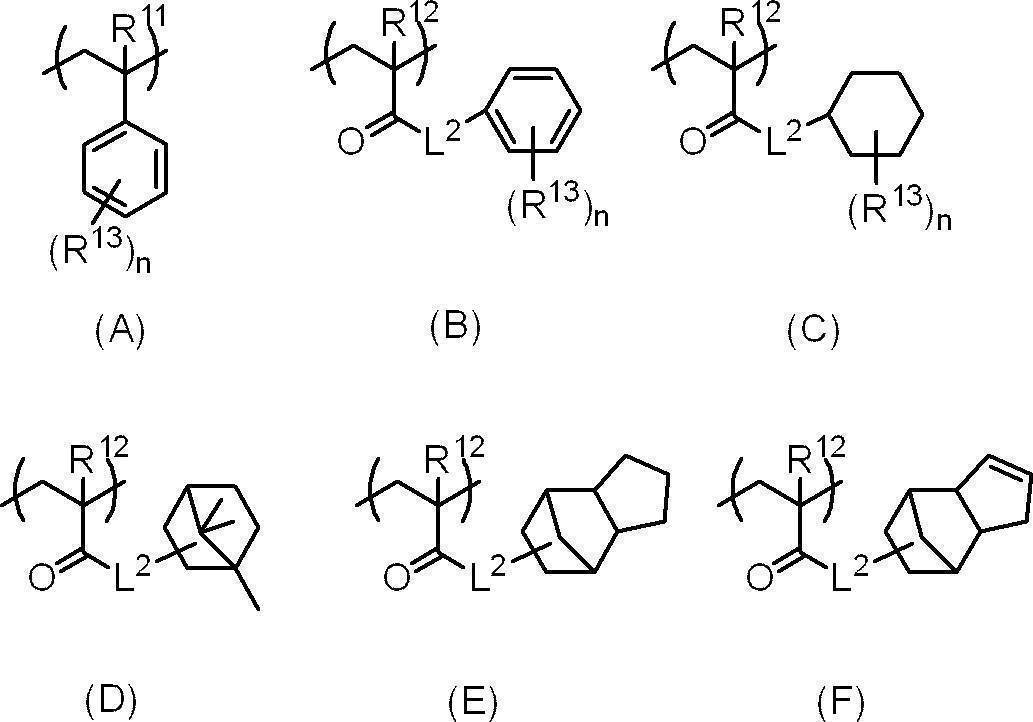
式B~式F中、R12はメチル基であることが好ましい。
式A~式C中、R13はそれぞれ独立に、直鎖状又は分岐鎖状の炭素数1~4のアルキル基であることが好ましく、メチル基又はエチル基であることがより好ましい。
式A~式C中、nは0~2の整数であることが好ましく、0又は1であることがより好ましく、0であることがさらに好ましい。
式B中、L2は、式B中に記載されたカルボニル基と結合した炭素原子との結合部位に、少なくとも-O-又は-NH-を含む2価の連結基が好ましく、上記カルボニル基と結合した炭素原子との結合部位に、少なくとも-O-又は-NH-を含み、かつ、炭素数1~18の、環構造を有してもよい直鎖状又は分岐鎖状のアルキレン基を含む2価の連結基がより好ましく、-OCH2-又は-NHCH2-がさらに好ましく、-OCH2-が特に好ましい
式C~式E中、L2は、式C~式F中に記載されたカルボニル基と結合した炭素原子との結合部位に、少なくとも-O-又は-NH-を含む2価の連結基が好ましく、-O-又は-NH-がより好ましく、-O-がさらに好ましい
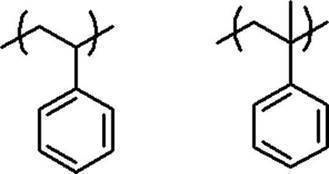


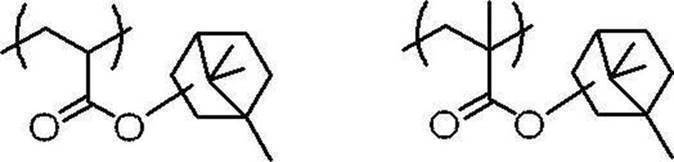


樹脂は、構造単位c1及び構造単位c2以外の、その他の構造単位c3(以下、単に「構造単位c3」ともいう。)を含有していてもよい。
とがより好ましく、50質量%~80質量%であることがさらに好ましい。
樹脂粒子の分散性の観点から、樹脂粒子に含まれる樹脂において、樹脂の全質量に対するアニオン性基の含有量は、0.05mmol/g~0.7mmol/gであることが好ましく0.1mmol/g~0.4mmol/gであることがより好ましい。
1/Tg=Σ(Xi/Tgi) …(1)
ここで、計算対象となるポリマーはi=1からnまでのn種のモノマー成分が共重合しているとする。Xiはi番目のモノマーの質量分率(ΣXi=1)、Tgiはi番目のモノマーの単独重合体のガラス転移温度(絶対温度)である。ただし、Σはi=1からnまでの和をとる。なお、各モノマーの単独重合体ガラス転移温度の値(Tgi)は、Polymer Handbook (3rd Edition) (J.Brandrup,
E.H.Immergut著(Wiley-Interscience、1989))の値を採用する。
る。
樹脂粒子の製造方法は、特に限定されないが、乳化重合法により調製されることが好ましい。乳化重合法は、水性媒体(例えば水)中にモノマー、重合開始剤、乳化剤、及び、必要に応じて連鎖移動剤等の添加剤を加えて調製した乳化物を重合させる方法である。乳化重合法を樹脂粒子の調製に適用する場合において、上記の構造単位c1を形成するモノマーは、乳化剤としても機能する。したがって、構造単位c1を形成するモノマー以外に乳化剤を別途添加する必要はないが、インクの吐出性及び画質を低下させない範囲であれば、既知の乳化剤を別途添加してもよい。
また、樹脂粒子は、自己分散性樹脂粒子であることが好ましい。自己分散性樹脂粒子とは、界面活性剤の不存在下、転相乳化法により分散状態とした場合、樹脂自身が有する官能基(例えば、アニオン性基)によって、水性媒体中で分散状態となり得る水不溶性樹脂からなる樹脂粒子をいう。
味する。樹脂粒子は、下記具体例に示す樹脂からなる樹脂粒子であることが好ましい。また、下記具体例はいずれもアニオン性基が酸の状態で記載されているが、酸の一部又は全部が塩になっていてもよい。


市販の樹脂エマルジョンとしては、例えば、A-810(三水株式会社)、A-995(三水株式会社)、ハイロス-X・NE-2186(星光PMC株式会社)、ハイロス-X・TE-1048(星光PMC株式会社)、サイビノールSK-202(サイデン化学株式会社)、TOCRYL W-1048(トーヨーケム)、WC-M-1217(荒川化学株式会社)、WC-M-1219(荒川化学株式会社)、N985(A)-1(株式会社イーテック)、Neocryl A-1105(DSM coting resin)、アクリットSE-810A、アクリットSE-953A-2、アクリットSE-1658F、アクリットSE-2974F、アクリットSE-2978F(大成ファインケミカル)、ラックスター 7132-C (DIC)、ST200(日本触媒)、モビニール972(ジャパン コーティング レジン株式会社)等が挙げられる。
本開示のインクは、ワックス粒子を含有し得る。
石油系ワックスとして、パラフィンワックス、マイクロクリスタリンワックス、ペトロラタム等が挙げられる。
植物系ワックスとしてはカルナバワックス、キャンデリラワックス、ライスワックス、木ロウ等が挙げられる。
動物植物系ワックスとしてはラノリン、みつろう等を挙げることができる。
合成炭化水素系ワックスとしては、ポリエチレンワックス、フィッシャー・トロブシュワックス等が挙げられる。
変性ワックス系としてはパラフィンワックス誘導体、モンタンワックス誘導体、マイクロクリスタリンワックス誘導体等、及びこれらの誘導体が挙げられる。
また、ワックス粒子としては、特開2011-162692号公報の段落0254に記載のエステルAも挙げられる。
これらのうち、カルナバワックスは、セロゾール524及びトラソルCNである。
本開示のインクは、酸化剤を少なくとも1種含有することが好ましい。
これにより、インク流路壁のエッチングをより抑制できる。
過酸化物としては、過酢酸、過炭酸ナトリウム、過酸化水素尿素、等が挙げられる。
これにより、インク流路壁のエッチングをより抑制できる。
樹脂粒子及びワックス粒子の合計含有量に対する酸化剤の含有量が0.02質量%以上である場合には、インク流路壁のエッチングがより抑制される。
樹脂粒子及びワックス粒子の合計含有量に対する酸化剤の含有量が6質量%以下である場合には、インクの安定性がより向上する。
インクの全量に対する酸化剤の含有量が0.001質量%以上である場合には、インク流路壁のエッチングがより抑制される。
インクの全量に対する酸化剤の含有量が1質量%以下である場合には、インクの安定性がより向上する。
本開示のインクは、コロイダルシリカを少なくとも1種含有することが好ましい。
これにより、インク流路壁のエッチングがより抑制される。
コロイダルシリカは、主成分として二酸化ケイ素(その水和物を含む)を含み、少量成分としてアルミン酸塩を含んでいてもよい。
少量成分として含まれることがあるアルミン酸塩としては、アルミン酸ナトリウム、アルミン酸カリウムなどが挙げられる。
また、コロイダルシリカには、水酸化ナトリウム、水酸化カリウム、水酸化リチウム、水酸化アンモニウム等の無機塩類やテトラメチルアンモニウムヒドロキシド等の有機塩類が含まれていてもよい。これらの無機塩類及び有機塩類は、例えば、コロイドの安定化剤として作用する。
有機溶剤は水溶性有機溶剤であっても非水溶性有機溶剤であってもよいが、水溶性有機溶剤であることが好ましい。
水溶性有機溶剤として、具体的には、例えば、メタノール、エタノ-ル、イソプロピルアルコール、n-プロパノール等を挙げることができる。
ことができる。あるいは、アルコキシドの加水分解といった液相合成法(例えば、「繊維と工業」、Vol.60、No.7(2004)P376参照)などによっても製造することができる。
インクジェットヘッドの磨耗劣化抑制の効果をより効果的に得る観点から、コロイダルシリカの体積平均粒子径は、好ましくは200nm以下であり、より好ましくは100nm以下であり、更に好ましくは50nm以下であり、更に好ましくは25nm以下であり、更に好ましくは20nm以下である。
コロイダルシリカの体積平均粒子径の下限としては、例えば、1nm、3nm等が挙げられる。
動的光散乱法による体積平均粒子径の測定装置としては、例えば、マイクロトラック社製 ナノトラックUPAを用いる。
市販品の具体例としては、例えば;
Ludox AM、Ludox AS、Ludox LS、Ludox TM、Ludox HSなど(以上、E.I.Du Pont de Nemouvs & Co製);スノーテックスS、スノーテックスXS、スノーテックス20、スノーテックス30、スノーテックス40、スノーテックスN、スノーテックスC、スノーテックスOなど(以上、日産化学工業社製);
Syton C-30、SytonZOO など(以上、Mons anto Co製);
Nalcoag-1060 、Nalcoag-ID21~64(以上、Nalco Chem Co製);
メタノールゾル、IPAゾル、MEKゾル、及びトルエンゾル(以上、扶桑化学工業製);
Cataloid-S、Cataloid-F120、Cataloid SI-350
、Cataloid SI-500、Cataloid SI-30、Cataloid
S-20L、Cataloid S-20H、CataloidS-30L、Catal
oid S-30H、Cataloid SI-40、OSCAL-1432(イソプロピルアルコールゾル)など(以上、日揮触媒化成製);
アデライト(旭電化社製);
等が挙げられる。
また、数珠状のコロイダルシリカとして、例えば、スノーテックスST-UP、同PS-S、同PS-M、同ST-OUP、同PS-SO、同PS-MO(以上、日産化学社製)などの商品名で市販されているものも挙げられる。
本開示のインクは、インクの吐出性の観点から、有機溶剤を含有することが好ましい。
有機溶剤の含有量の上限値は特に限定されないが、インク乾燥性の観点から、30質量%であることが好ましい。
有機溶剤のClogP値が1.0以上であると、疎水性が低すぎないので、インクの着弾干渉抑制及び画像の粒状性向上の観点からみて好ましい。
有機溶剤のClogP値が3.5以下であると、疎水性が高すぎないので、吐出性に優れる。
下記式1で表される化合物及び式2で表される化合物からなる群より選択される少なくとも1種が好ましく、
上記少なくとも1種であり、かつ、ClogP値が1.0~3.5である有機溶剤がより好ましい。

エチレングリコールモノペンチルエーテル、エチレングリコールモノヘキシルエーテル、エチレングリコールモノヘプチルエーテル、エチレングリコールモノオクチルエーテル
、エチレングリコールモノノニルエーテル、エチレングリコールモノ-2-エチルヘキシルエーテル等のエチレングリコールモノアルキルエーテル;
ジエチレングリコールモノペンチルエーテル、ジエチレングリコールモノヘキシルエーテル、ジエチレングリコールモノヘプチルエーテル、ジエチレングリコールモノオクチルエーテル、ジエチレングリコールモノノニルエーテル、ジエチレングリコールモノ-2-エチルヘキシルエーテル等のジエチレングリコールモノアルキルエーテル;
トリエチレングリコールモノペンチルエーテル、トリエチレングリコールモノヘキシルエーテル、トリエチレングリコールモノヘプチルエーテル、トリエチレングリコールモノオクチルエーテル、トリエチレングリコールモノノニルエーテル、トリエチレングリコールモノ-2-エチルヘキシルエーテル等のトリエチレングリコールモノアルキルエーテル;
プロピレングリコールモノブチルエーテル、プロピレングリコールモノペンチルエーテル、プロピレングリコールモノヘキシルエーテル、プロピレングリコールモノヘプチルエーテル、プロピレングリコールモノオクチルエーテル、プロピレングリコールモノ-2-エチルヘキシルエーテル等のプロピレングリコールモノアルキルエーテル;
ジプロピレングリコールモノブチルエーテル、ジプロピレングリコールモノペンチルエーテル、ジプロピレングリコールモノヘキシルエーテル、ジプロピレングリコールモノヘプチルエーテル、ジプロピレングリコールモノオクチルエーテル、ジプロピレングリコールモノ-2-エチルヘキシルエーテル等のジプロピレングリコールモノアルキルエーテル;
トリプロピレングリコールモノブチルエーテル、トリプロピレングリコールモノペンチルエーテル、トリプロピレングリコールモノヘキシルエーテル、トリプロピレングリコールモノヘプチルエーテル、トリプロピレングリコールモノオクチルエーテル、トリプロピレングリコールモノ-2-エチルヘキシルエーテル等のトリプロピレングリコールモノアルキルエーテル;及び
1,2-ヘプタンジオール、1,2-オクタンジオール、1,2-ノナンジオール、1,2-デカンジオール等のアルカンジオールが挙げられる。
エチレングリコールモノアルキルエーテル、ジエチレングリコールモノアルキルエーテル又はアルカンジオールであることが好ましく、
エチレングリコールモノヘキシルエーテル、ジエチレングリコールモノヘキシルエーテル(ヘキシルジグリコール)、ジエチレングリコールモノ-2-エチルヘキシルエーテル又は1,2-オクタンジオール
であることがより好ましい。
本開示のインクは、分散剤を少なくとも1種含有してもよい。
本開示において、分散剤とは、顔料を分散させる機能を有する。顔料の表面に分散剤が吸着し、顔料の表面の少なくとも一部を被覆することにより、顔料が分散媒(例えば、水、水及び有機溶剤の混合物、等)中により分散し易くなる。
分散剤は、一部が顔料の表面に吸着し、一部が顔料の表面から脱離してインク中に存在すると考えられる。
分散剤が架橋されている場合には、分散剤が顔料の表面から脱離しにくいため、インクの吐出性が向上すると考えられる。
インクを回転数10,000rpmで30分間遠心分離した後、沈降した顔料分散物を高極性の有機溶剤によって抽出し、分光法又は核磁気共鳴(NMR)法により成分解析を行うことで、分散剤の構造と構成するモノマーの含有比率とを特定する。ここで使用される高極性の有機溶剤は、抽出を目的とするポリマーの種類に応じて適宜選択する。
分散剤の構造は特に限定されず、ランダムポリマー、ブロックポリマー、及びグラフトポリマーのいずれであってもよい。
架橋ポリマーは、例えば、未架橋のポリマーを架橋剤によって架橋することによって形成される。
この場合、まず、未架橋のポリマーと顔料とを含む顔料分散物を調製し、次いで、未架橋の顔料分散物における未架橋のポリマーを架橋剤によって架橋することにより、架橋ポリマーを形成する(即ち、架橋ポリマーと顔料とを含む顔料分散物を得る)ことが好ましい。
未架橋のポリマーは、水溶性ポリマーであることが好ましい。
市販品としては、例えば、Denacol EX-321、EX-821、EX-830、EX-850及びEX-851(ナガセケムテックス社製)が挙げられる。
本開示のインクは、シリコーン系界面活性剤を少なくとも1種含有してもよい。
シリコーン系界面活性剤は、分子中にポリシロキサン構造を有する化合物であることが好ましい。インク中にシリコーン系界面活性剤が含有されていると、インクの吐出性が向上する。これは、シリコーン系界面活性剤が含有されていると、インクが吐出されるノズルに、インクが付着しにくいためであると考えられる。
有機基は、ジメチルポリシロキサンの側鎖、片末端、両末端、又は、側鎖と末端の両方に導入される。
中でも、インクの吐出性を向上させる観点から、シリコーン系界面活性剤は、ポリエーテル変性シリコーンであることが好ましい。
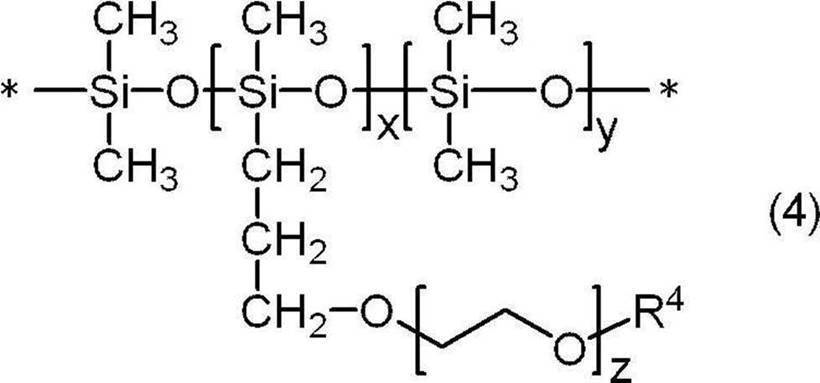
本開示のインクは、アセチレングリコール系界面活性剤を少なくとも1種含有してもよい。
アセチレングリコール系界面活性剤としては、下記式6で表されるアセチレングリコール系界面活性剤が挙げられる。
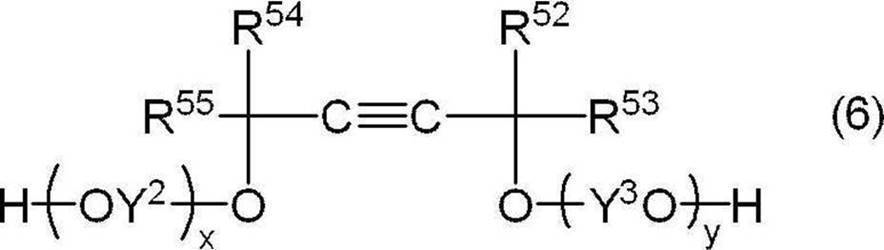
+y≦85を満たす。
基であることが好ましく、メチル基が最も好ましい。
しく、3~30であることがより好ましく、5~30であることがさらに好ましい。xとyとの和が3以上であると、溶解性がより向上し曇点がより高くなる。これにより、保湿液を30℃以上に加熱した際の分離、析出等がより抑制される。一方、xとyとの和が30以下であると、表面張力を下げて濡れ性を良くする効果がより効果的に現れる。これにより、保湿液を充填した後に充填したインクを吐出する場合に、吐出されるインクの吐出性がより高められる。
又は3のアルキレン基がより好ましく、炭素数2の アルキレン基(エチレン基)が特に
好ましい。すなわち、式6で表される化合物のうち、下記式7で表されるアセチレングリ
コール系界面活性剤がより好ましい。

はエチレンオキシド付加物)が挙げられる。特に、式6で表されるアセチレングリコール系界面活性剤は、2,4,7,9-テトラメチル-5-デシン-4,7- ジオールのエ
チレンオキシド付加物(3≦x+y≦30、好ましくは5≦x+y≦30)であることが好ましい。
市販品としては、エアープロダクツ社製又は日信化学工業社製のサーフィノールシリーズ(例えば、サーフィノール420、サーフィノール440、サーフィノール465及びサーフィノール485)、オルフィンシリーズ(例えば、オルフィンE1010及びオルフィンE1020)、ダイノールシリーズ(例えば、ダイノール604)、及び、川研ファインケミカル社製のアセチレノールが挙げられる。さらに、市販品は、ダウケミカル社、ゼネラルアニリン社等からも提供されている。
本開示のインクは、セルロースナノファイバーを少なくとも1種含有することが好ましい。
本開示のインクがセルロースナノファイバーを含有することにより、インクの粘度を効果的に上昇させることができる。これにより、インクの吐出性向上が期待できる。
セルロースナノファイバーの抽出方法としては、例えば、機械的処理(例えば、ビーズミルによる粉砕処理)、及び、化学的処理(例えば、TEMPO触媒酸化処理、カルボキシメチル化処理、カチオン化処理等)が挙げられる。
をより向上させる観点から、TEMPO酸化型セルロースナノファイバー(即ち、TEMPO触媒酸化処理によって抽出されたナノセルロース)を含むことが好ましい。
ここで、TEMPOとは、2,2,6,6-テトラメチル-1-ピぺリジン-オキシラジカルを意味する。
セルロースナノファイバーの市販品としては、例えば;
第一工業製薬社製の「レオクリスタ」(登録商標);
日本製紙社製の「セレンピア」(登録商標);
スギノマシン社製のIMa-10002、BMa-10002、WMa-10002、AMa-10002、FMa-10002;
大王製紙社製の「ELEX」;
王子製紙社製の「アウロ・ヴィスコ」(登録商標);
等が挙げられる。
本開示において、セルロースナノファイバーの平均繊維幅は、走査型電子顕微鏡観察によってセルロースナノファイバー10本の繊維幅をそれぞれ測定し、得られた10本分の繊維幅の測定値を算術平均することによって求める。
本開示において、セルロースナノファイバーの平均繊維長さは、走査型電子顕微鏡観察によってセルロースナノファイバー10本の繊維長さをそれぞれ測定し、得られた10本分の繊維長さの測定値を算術平均することによって求める。
本開示において、セルロースナノファイバーの平均アスペクト比は、走査型電子顕微鏡観察によってセルロースナノファイバー10本のアスペクト比(即ち、比〔繊維長さ/繊維幅〕)をそれぞれ測定し、10本分のアスペクト比の測定値を算術平均することによって求める。
樹脂粒子及びワックス粒子の合計含有量に対するセルロースナノファイバーの含有量が1.00質量%以上である場合には、インクの粘度をより効果的に上昇させることができる。
樹脂粒子及びワックス粒子の合計含有量に対するセルロースナノファイバーの含有量が10.00質量%である場合には、インクのフィルター適性をより向上させることができる。
インクの全量に対するセルロースナノファイバーの含有量が0.01質量%以上である場合には、インクの粘度をより効果的に上昇させることができる。
インクの全量に対するセルロースナノファイバーの含有量が1.00質量%以下である場合には、インクのフィルター適性をより向上させることができる。
本開示のインクは、上述した成分以外のその他の成分を含有してもよい。
その他の成分としては、シリコーン系界面活性剤及びアセチレングリコール系界面活性剤以外の界面活性剤が挙げられる。
また、その他の成分としては、防腐剤、紫外線吸収剤、褪色防止剤、防黴剤、pH調整剤、防錆剤、酸化防止剤、乳化安定剤、防腐剤、消泡剤(例えば、特開2015-180710号公報の段落0159に記載の消泡剤)、粘度調整剤、分散安定剤、キレート剤、固体湿潤剤(例えば尿素)、水溶性高分子(例えば、特開2015-180710号公報の段落0139に記載の水溶性高分子)、等も挙げられる。
(動的表面張力)
本開示のインクは、10ミリ秒時の動的表面張力が35mN/m以下であることが好ましい。
これにより、インクによって記録される画像の画質が向上する。この理由は、10ミリ秒時の動的表面張力が35mN/m以下であることにより、インクの表面張力が低減され、着弾干渉が抑制され、インクの濡れ拡がり性が向上するためと考えられる。
10ミリ秒時の動的表面張力の下限値は特に限定されないが、インクの保存安定性の観点から、15mN/mであることが好ましい。
10ミリ秒時の動的表面張力は、例えば、バブルプレッシャー式動的表面張力計(製品名「BP100」、KRUSS社製)を用いて測定される。
10ミリ秒時の動的表面張力とは、インク中に挿入されたプローブ細管から気泡を連続的に吐出させ、プローブ細管の先端内で新しい界面が生成した時点(0ミリ秒)から最大泡圧となるまでの時間が10ミリ秒である時における最大泡圧から算出された表面張力のことをいう。
最も近い値である。10ミリ秒時の動的表面張力が35mN/m以下であると、記録媒体上にインク滴が拡がり、着弾干渉を抑制することができる。画像濃度のムラが生じにくく、粒状性により優れた画像を得ることができる。
本開示のインクにおいて、30℃、100rpm(revolutions per minute)の条件で測定される粘度は、インクの吐出性の観点から、1.2mPa・s~15.0mPa・sであることが好ましく、2.0mPa・s~13.0mPa・s以下であることがより好ましく、2.5mPa・s~10.0mPa・s以下であることがさらに好ましく、3.8mPa・s~6.0mPa・sであることが更に好ましい。
回転式粘度計としては、例えば、「VISCOMETER TV-22」(TOKI SANGYO CO.LTD製)を用いる。
本開示の画像記録方法は、記録媒体上に、上述した本開示のインクを、インク流路壁にシリコンを含むインクジェットヘッドから吐出して付与する工程(以下、「インク付与工程」ともいう)を含む。
本開示の画像記録方法は、本開示のインクと上記インクジェットヘッドとを用いる。このため、本開示の画像記録方法によれば、上記インクジェットヘッドのシリコンを含むインク流路壁のエッチングを抑制できる。
記録媒体上に付与されたインク中に含まれる水及び有機溶剤を乾燥させる工程(以下、「インク乾燥工程」ともいう。)、
インクに含まれる樹脂粒子を溶融し、定着させる工程(以下、「熱定着工程」ともいう。)、
等の他の工程を有してもよい。
インク付与工程では、記録媒体上に、本開示のインクを、インク流路壁にシリコンを含むインクジェットヘッドから吐出して付与する。これにより、本開示のインクによる画像が記録される。
塗工紙は、セルロースを主体とした一般に表面処理されていない上質紙、中性紙等の表面に、コート材を塗布してコート層を設けたものである。
とができる。
インクジェット記録方式としては、例えば、
静電誘引力を利用してインクを吐出させる電荷制御方式、
ピエゾ素子の振動圧力を利用するドロップオンデマンド方式(圧力パルス方式)、
電気信号を音響ビームに変えインクに照射して放射圧を利用してインクを吐出させる音響インクジェット方式、及び
インクを加熱して気泡を形成し、生じた圧力を利用するサーマルインクジェット方式
が挙げられる。
シャトルスキャン方式では、シリアルヘッドを記録媒体の幅方向に走査させながら画像記録を行う。
これに対して、シングルパス方式では、記録素子の配列方向と直交する方向に記録媒体を走査させることで記録媒体の全面に画像記録を行うことができる。そのため、シングルパス方式では、シャトルスキャン方式と異なり、シリアルヘッドを走査するキャリッジ等の搬送系が不要となる。また、シングルパス方式では、キャリッジの移動と記録媒体との複雑な走査制御が不要となり、記録媒体のみが移動するので、シャトルスキャン方式と比較して記録速度を上げることができる。
本開示の画像記録方法は、必要に応じて、インク乾燥工程を含んでもよい。
インク乾燥工程は、記録媒体上に付与されたインク中に含まれる水及び有機溶剤を乾燥させる工程である。
加熱手段は、インク中に含まれる水及び有機溶剤を乾燥させることができれば特に限定されず、例えば、ヒートドラム、温風、赤外線ランプ、熱オーブン及びヒート版が挙げられる。
加熱温度及び加熱時間は、インクに含まれる水及び有機溶剤の含有量に応じて適宜調整される。
本開示の画像記録方法は、必要に応じて、インク付与工程後、熱定着工程を含んでもよい。
熱定着工程は、インクに含まれる樹脂粒子を溶融し、定着させる工程である。熱定着工程により、記録媒体上の画像の定着が行われ、画像の耐擦過性を向上させることができる。熱定着工程として、例えば、特開2010-221415号公報の段落0112~01
20に記載の熱定着工程を採用することができる。
本開示の画像記録方法は、インク付与工程前に、記録媒体のインクが付与される面に、水及び凝集剤を含有する処理液を付与する処理液付与工程を含んでいてもよい。この場合、インク付与工程では、記録媒体上の処理液が付与された領域上に、本開示のインクを付与する。
これにより、予め付与された処理液中の凝集剤によって、インク中の成分を凝集させることができるので、得られる画像の画質(例えば精細さ)の点で有利である。
処理液については、特開2015-180710号の段落0176~0198の記載を適宜参照できる。
処理液の25℃におけるpHは、インクの凝集速度の観点から、0.1~4.0であることが好ましく、0.2~2.0であることがより好ましい。
処理液の全量に対する水の含有量は、好ましくは50質量%以上であり、より好ましくは60質量%以上である。
処理液の全量に対する水の含有量の上限は、凝集剤等の他の成分の量にもよるが、例えば、90質量%、80質量%等である。
処理液は、凝集剤として、酸性化合物の少なくとも1種を含有することが好ましい。
凝集剤としての酸性化合物としては、有機酸性化合物及び無機酸性化合物のいずれを用いてもよく、有機酸性化合物及び無機酸性化合物を2種以上併用してもよい。
酸性基としては、リン酸基、ホスホン酸基、ホスフィン酸基、硫酸基、スルホン酸基、スルフィン酸基、及びカルボキシ基等を挙げることができる。中でも、リン酸基又はカルボキシ基が好ましく、カルボキシ基がより好ましい。
有機カルボン酸は、2価以上のカルボン酸(以下、多価カルボン酸ともいう。)が好ましく、マロン酸、リンゴ酸、マレイン酸、コハク酸、グルタル酸、フマル酸、酒石酸、4-メチルフタル酸、及びクエン酸からなる群から選ばれる少なくとも1種がより好ましく、マロン酸、リンゴ酸、酒石酸、及びクエン酸からなる群から選ばれる少なくとも1種が特に好ましい。
ら、5質量%~40質量%であることが好ましく、10質量%~30質量%であることがより好ましい。
有機酸性化合物と無機酸性化合物との含有比は、有機酸性化合物の含有量に対する無機酸性化合物の含有量が、5モル%~50モル%であることが好ましく、10モル%~40モル%であることがより好ましく、15モル%~35モル%であることがさらに好ましい。
多価金属塩やカチオン性ポリマーについては、例えば、特開2011-042150号公報の段落0155~0156に記載されている多価金属塩やカチオン性ポリマーを用いることができる。
処理液は、水溶性高分子化合物を少なくとも一種含むことが好ましい。
水溶性高分子化合物としては特に限定はなく、ポリビニルアルコール、ポリアクリルアミド、ポリビニルピロリドン、ポリエチレングリコール等の公知の水溶性高分子化合物を用いることができる。
また、水溶性高分子化合物としては、後述する特定高分子化合物や、特開2013-001854号公報の段落0026~0080に記載された水溶性高分子化合物も好適である。
含有量が0.1質量%以上であれば、インク滴の広がりをより促進でき、含有量が10質量%以下であれば、処理液の増粘をより抑制できる。また、含有量が10質量%以下であれば、処理液中の泡に起因する処理液の塗布ムラをより抑制できる。
特定高分子化合物におけるイオン性基としては、カルボキシル基、スルホン酸基、リン酸基、ボロン酸基、アミノ基、アンモニウム基、又はこれらの塩等が挙げられる。中でも、好ましくは、カルボキシル基、スルホン酸基、リン酸基、又はこれらの塩であり、より好ましくは、カルボキシル基、スルホン酸基、又はこれらの塩であり、さらに好ましくは、スルホン酸基又はその塩である。
イオン性基(好ましくはアニオン性基)を有する親水性の構造単位としては、イオン性基(好ましくはアニオン性基)を有する(メタ)アクリルアミド化合物に由来する構造単位が好ましい。
水溶性高分子化合物中におけるイオン性基(好ましくはアニオン性基)を有する親水性の構造単位の含有量としては、水溶性高分子化合物の全質量中、例えば10質量%~100質量%とすることができ、10質量%~90質量%であることが好ましく、10質量%~70質量%であることがより好ましく、10質量%~50質量%であることがさらに好
ましく、20質量%~40質量%であることが特に好ましい。
疎水性の構造単位としては、(メタ)アクリル酸エステル(好ましくは、(メタ)アクリル酸の炭素原子数1~4のアルキルエステル)に由来する構造単位が好ましい。
処理液は、水溶性有機溶剤の少なくとも1種を含むことが好ましい。
水溶性有機溶剤としては、20℃で100gの水に5g以上溶解する有機溶剤であれば特に制限はない。具体的には、後述するインク組成物が含むことができる水溶性有機溶剤を、処理液においても同様に用いることができる。中でも、カール抑制の観点から、ポリアルキレングリコール又はその誘導体であることが好ましく、ジエチレングリコールモノアルキルエーテル、トリエチレングリコールモノアルキルエーテル、ジプロピレングリコール、トリプロピレングリコールモノアルキルエーテル、ポリオキシプロピレングリセリルエーテル、及びポリオキシエチレンポリオキシプロピレングリコールから選ばれる少なくとも1種であることがより好ましい。
処理液は、界面活性剤の少なくとも1種を含んでもよい。界面活性剤は、表面張力調整剤として用いることができる。表面張力調整剤としては、ノニオン性界面活性剤、カチオン性界面活性剤、アニオン性界面活性剤、ベタイン界面活性剤等が挙げられる。中でも、インク組成物の凝集速度の観点から、ノニオン性界面活性剤又はアニオン性界面活性剤が好ましい。
処理液に含有され得るその他の成分としては、前述したインクにおけるその他の成分を適宜参照できる。
以下、「部」は質量基準である。
表1~表4中の「重量割合(%)」は、「質量%」を意味する。
HZ-H(4.6mmID×15cm、東ソー社製)を3本用い、溶離液として、THF(テトラヒドロフラン)を用いて測定した。また、測定は、試料濃度を0.45質量%、流速を0.35mL/min、サンプル注入量を10μL、及び測定温度を40℃とし、RI検出器を用いて行った。検量線は、東ソー社製の「標準試料TSK standard,polystyrene」:「F-40」、「F-20」、「F-4」、「F-1」、「A-5000」、「A-2500」、「A-1000」、及び「n-プロピルベンゼン」の8サンプルから作製した。
<樹脂粒子C-29の調製>
前述した樹脂粒子の具体例中の樹脂粒子C-29を、以下のようにして調製した。
撹拌機、温度計、還流冷却管、及び窒素ガス導入管を備えた三口フラスコに、水(250g)、12-メタクリルアミドドデカン酸(6.7g)、炭酸水素カリウム(0.17g)及びイソプロパノール(20g)を仕込んで、窒素気流下で85℃まで昇温した。ここに4,4’-アゾビス(4-シアノ吉草酸)(ラジカル重合開始剤、製品名「V-501」、富士フイルム和光純薬工業社製)(0.11g)、炭酸水素カリウム(0.08g)及び水(9g)からなる混合溶液を加え、10分間撹拌した。次いで、上記三口フラスコに、スチレン(14g)とベンジルメタクリレート(14g)とメタクリル酸メチル(48g)とメタクリル酸ブチル(3.3g)とヒドロキシルエチルメタクリレート(14g)とからなるモノマー溶液を、3時間で滴下が完了するように等速で滴下した。さらに、V-501(0.06g)、炭酸水素カリウム(0.04g)及び水(6g)からなる混合溶液を、上記モノマー溶液の滴下開始直後とモノマー溶液の滴下開始1.5時間後の2回に分けて加えた。上記モノマー溶液の滴下完了後、1時間撹拌した。続いて、得られた反応混合物にV-501(0.06g)、炭酸水素カリウム(0.04g)及び水(6g)からなる混合溶液を加え、さらに3時間撹拌した。得られた反応混合物を網目50μmのメッシュでろ過し、樹脂粒子C-29の水性分散液を得た。
樹脂粒子C-29の調製において、使用するモノマーの種類及び量を、適宜変更することにより、前述した樹脂粒子の具体例中の、樹脂粒子C-30、C-23、及びC-24をそれぞれの水性分散液を調製した。
特開2015-180710号公報の段落0240及び0241を参考にし、樹脂粒子Dの水性分散液を得た。
樹脂粒子Dにおける樹脂は、メチルメタクリレート単位/イソボルニルメタクリレート
単位/メタクリル酸単位/メタクリル酸ナトリウム単位(=70/20/5/5[質量比])共重合体である。
分散剤が架橋されている(詳細には架橋ポリマーである)顔料分散液として、
Projet Cyan APD1000(FUJIFILM Imaging Colorants社製、シアン顔料分散液、顔料分散液中の顔料濃度:12質量%)
を準備した。
分散剤が架橋されていない顔料分散液として、
FUJI SP BLUE 6633(冨士色素社製、シアン顔料分散液、顔料分散液中の顔料濃度:17質量%)
を準備した。
<インクの調製>
表1~3に示すインクの有効成分と、水と、を混合し、得られた混合液から粗大粒子を除去し、インクを得た。
表1~3に示すインクの有効成分の量と、水の量と、の合計は、100質量部である。
表1~3中の以下の成分の詳細は以下のとおりである。
・PEG200 … 三洋化成社製のポリエチレングリコール200
・PVP K-15 … Ashland社製のポリビニルピロリドン
・スノーテックスXS … 日産化学工業社製のコロイダルシリカ
・モビニール972 … ジャパンコーティングレジン社製のスチレン/アクリル樹脂粒子の水性分散液
・トラソルCN … 中京油脂社製のワックス粒子
・セロゾール524D … 中京油脂社製のワックス粒子
・ハイテック-E6314 … 東邦化学工業社製のワックス粒子
・BYK-347 … BYK社製のシリコーン系界面活性剤
・BYK-024 … BYK社製のシリコーン系界面活性剤
・オルフィンE1010 … 日信化学工業社製のアセチレングリコール系界面活性剤
・オルフィンE1020 … 日信化学工業社製のアセチレングリコール系界面活性剤
実施例及び比較例のインクについて、pH及び酸化還元電位を測定し、それぞれ、pHi及びORPiとした。
これらの値を用い、不等式(X)の左辺の値を算出した。
結果を表1~3に示す。
結果を表1~3に示す。
下記組成の各成分を混合し、処理液1及び処理液2をそれぞれ得た。
・DEGmBE(ジエチレングリコールモノブチルエーテル)
…6.0質量%
・マロン酸
…5.6質量%
・リンゴ酸
…3.83質量%
・リン酸85質量%水溶液
…3.37質量%
・下記水溶性ポリマー1(下記水溶性ポリマー1において、各構成単位の右下の数字は質量比(質量%)を表し、Mwは重量平均分子量を表す。)
…0.4質量%
・消泡剤(モメンティブ・パフォーマンス・マテリアルズ・ジャパン合同会社製TSA-
739(15%);エマルジョン型シリコーン消泡剤)
… シリコーンオイルの量として0.0083質量%
・ベンゾトリアゾール
…1.0質量%
・テイカパワーBN2070M(テイカ社製の界面活性剤)
…有効成分の量として0.42質量%
・イオン交換水
…合計で100質量%となる残量

・DEGmBE(ジエチレングリコールモノブチルエーテル)
…7.2質量%
・マロン酸
…11.2質量%
・リンゴ酸
…7.66質量%
・リン酸85質量%水溶液
…6.73質量%
・上記水溶性ポリマー1
…0.8質量%
・消泡剤(モメンティブ・パフォーマンス・マテリアルズ・ジャパン合同会社製TSA-
739(15%);エマルジョン型シリコーン消泡剤)
… シリコーンオイルの量として0.01質量%
・ベンゾトリアゾール
…1.2質量%
・テイカパワーBN2070M
…有効成分の量として0.5質量%
・イオン交換水
…合計で100質量%となる残量
記録媒体としてコート紙(商品名「OKトップコート+」、王子製紙社製)を用い、処理液として上記処理液1を用い、インクとして各実施例又は各比較例のインクを用い、インクジェット記録装置としてJet Press 750S(富士フイルム社製)を用いて画像記録を行った。
処理液は、プレコンディショナーとして、インクの付与前に、記録媒体のインクが付与される面に塗布した。
インクは、記録媒体の処理液が付与された面に付与した。
インクによる画像の解像度は1200dpi×1200dpiとし、画像記録の速度は3600sphとした。
ここで、dpiは、dot per inchの略であり、sphは、sheet per hourの略である。
実施例及び比較例のインクを用い、シリコンを含むインク流路壁のエッチング抑制の評価を実施した。
評価結果を表1~3に示す。
評価方法は以下のとおりである。
インクジェットヘッドにおけるシリコンを含むインク流路壁の評価用サンプルを、以下のようにして準備した。
シリコン基板(研究用高純度シリコンウエーハ 6-P-25、型番:2-960-59)の1cm×1cmチップを準備した。このチップ(即ちシリコン基板)の一部にカプトンテープを貼り付け、インクと接触するシリコン露出部と、カプトンテープが貼付けられたマスキング部と、を設け、評価用サンプルとした。
インク及び評価用サンプルが入ったフタつき容器を、60℃に設定した評価炉に入れ、スターラ―撹拌させながら、8日間経時させた。
経時後、評価用サンプルを容器から取り出し、洗浄乾燥後、マスキングテープを外した。
マスキング部に対するシリコン露出部の段差(即ち、エッチングによって生じた段差)を段差測定器(小坂研究所社製 サーフコーダ SE-500A)で測定した。
段差に基づき、下記評価基準に従い、シリコンを含むインク流路壁のエッチング抑制性を評価した。
以下の評価基準において、評点が高い程、シリコンを含むインク流路壁のエッチング抑制性に優れている(即ち、エッチングが抑制されている)。
5 … エッチングによる段差が検出されなかった。
4.5 … エッチングによる段差が検出されたが、0.2μm未満であった。
4 … エッチングによる段差が、0.2μm以上0.5μm未満であった。
3.5 … エッチングによる段差が、0.5μm以上1.0μm未満であった。
3 … エッチングによる段差が、1.0μm以上2.0μm未満であった。
2 … エッチングによる段差が、2.0μm以上3.0μm未満であった。
1 … エッチングによる段差が、3.0μm以上であった。
インク流路壁のエッチング抑制性に対応する評価として、以下のようにして、画像の濃度維持性を評価した。インク流路壁のエッチングが進行した場合、インクジェットヘッドからのインクの吐出不良が発生しやすくなり、画像の濃度変動が発生しやすくなる(即ち、画像の濃度維持性が低下しやすくなる。
まず、上記「画像記録」の操作に示したインクジェット記録装置にインクを搭載し、搭載からから3時間以内に、ベタ画像を記録した。得られたベタ画像の濃度を、濃度計(FD-5、コニカミノルタ製)によって測定し、得られた結果を「初期濃度」とした。
次に、インクジェット記録装置にインクを3日間搭載したまま放置し、次いで上記と同様にしてベタ画像を記録し、ベタ画像の濃度を測定した。得られた結果を、「3日後濃度」とした。
初期濃度に対する3日後濃度の割合(%)を、濃度維持率として求めた。
得られた濃度変動率に基づき、下記評価基準により、画像の濃度維持性を評価した。
下記評価基準において、画像の濃度維持性が最も抑制されているランクはAである。
A … 濃度維持率が95%以上であった。
B … 濃度維持率が70%以上95%未満であった。
C … 濃度維持率が70%未満であった。


これに対し、不等式(X)を満足しない比較例1~4では、シリコンを含むインク流路壁のエッチングの抑制性が不足していた。
抑制性がより向上することがわかる。
また、記録媒体を、LECTA社製のコート紙(商品名「Condat Gloss」)に変更したこと以外は上述した評価と同様にして評価を行ったところ、上述した評価の結果(即ち、表1~表3に示した結果)と同様の結果が得られた。
また、処理液を、処理液2に変更したこと以外は上述した評価と同様にして評価を行ったところ、上述した評価の結果(即ち、表1~表3に示した結果)と同様の結果が得られた。
また、画像記録の速度を5400sphに変更し、処理液を用いず、解像度を1200dpi×600dpiに変更したこと以外は上述した評価と同様にして評価を行ったところ、上述した評価の結果(即ち、表1~表3に示した結果)と同様の結果が得られた。
以下に示すインクの粘度測定及びインクのフィルター適性評価を追加したこと以外は実施例24と同様の操作を行った。
即ち、実施例101におけるインクの組成は、実施例24におけるインクの組成と同様である。
結果を表4に示す。
回転式粘度計「VISCOMETER TV-22」(TOKI SANGYO CO.LTD製)を用い、インク組成物を30℃、100rpm(revolutions per minute)の条件で、インクの粘度(mPa・s)を測定した。
孔径2μmのアイソポアメンブレンフィルター(Merck Millipore Ltd.社製)をシリンジに入れ、シリンジの両端に、それぞれ、インク流路となるチューブをつないだ。
シリンジの一端側につないだチューブにインクを供給し、インクがシリンジ内のアイソポアメンブレンフィルターを通過するように、75kPaの押圧でインクを押し出した。
インクの押出しを開始してから100秒までのインクの通過量(g)を測定した。
測定結果に基づき、下記評価基準に従い、インクのフィルター適性評価を行った。
下記評価基準において、インクのフィルター適性に最も優れるランクは「5」である。
5 … インク通過量が80g以上であった。
4 … インク通過量が60g以上80g未満であった。
3 … インク通過量が40g以上60g未満であった。
2 … インク通過量が20g以上40g未満であった。
1 … インク通過量が20g未満であった。
インクの有効成分を、表4に示すように変更したこと以外は実施例101と同様の操作を行った。
結果を表4に示す。
ここで、セレンピアTC-02X、セレンピアTC-01A、及びセレンピアCS-01は、いずれも、日本製紙社製のセルロースナノファイバーである。
これらのセルロースナノファイバーのうち、セレンピアTC-02X及びセレンピアTC-01Aは、TEMPO酸化型のセルロースナノファイバーである。
セレンピアTC-02Xは、平均繊維径が3.5nmであり、平均繊維長さが350nmであった。
セレンピアTC-01Aは、平均繊維径が3.5nmであり、平均繊維長さが750nmであった。
セレンピアCS-01は、平均繊維径が13.5nmであり、平均繊維長さが1500nm以上であった。

実施例101~107のうち、インクがセルロースナノファイバーを含有する実施例102~107では、インク粘度が効果的に上昇した。これにより、インクの吐出性がより向上することが期待される。
Claims (18)
- インク流路壁にシリコンを含むインクジェットヘッドから吐出されるインクジェットインクであって、
水と、顔料と、樹脂粒子及びワックス粒子の少なくとも一方と、を含有し、
pHが7.2~11であり、
下記不等式(X)を満足する、
インクジェットインク。
ORPi-[285-59×(pHi-6.2)]≧0 … 不等式(X)
不等式(X)中、ORPiは、pH6.2の水の酸化還元電位が310mVとなる装置条件で測定される、mVの単位でのインクジェットインクの酸化還元電位を表し、pHiは、インクジェットインクのpHを表す。 - 更に、酸化剤を含有する、請求項1に記載のインクジェットインク。
- 前記酸化剤が、過酸化水素及び過酸化物からなる群から選択される少なくとも1種を含む、請求項2に記載のインクジェットインク。
- 前記酸化剤が、過酸化水素、過酢酸、過炭酸ナトリウム、及び過酸化水素尿素からなる群から選択される少なくとも1種を含む、請求項2又は請求項3に記載のインクジェットインク。
- 前記樹脂粒子及び前記ワックス粒子の合計含有量に対する前記酸化剤の含有量の質量比が、0.02質量%~6質量%である、請求項2~請求項4のいずれか1項に記載のインクジェットインク。
- 更に、コロイダルシリカを含有する、請求項1~請求項5のいずれか1項に記載のインクジェットインク。
- 更に、ClogP値が1.0~3.5である有機溶剤を含有する、請求項1~請求項6のいずれか1項に記載のインクジェットインク。
- 前記ClogP値が1.0~3.5である有機溶剤は、下記式1で表される化合物及び式2で表される化合物からなる群より選択される少なくとも1種である、請求項7に記載のインクジェットインク。

式1又は式2中、R1はそれぞれ独立に、水素原子又はメチル基を表し、R2はそれぞれ独立に、炭素数4~9の直鎖状若しくは分岐鎖状の炭化水素基、又は炭素数6~10のアリール基を表し、nは1~3の整数を表す。 - 更に、分散剤を含有し、前記分散剤が架橋されている、請求項1~請求項8のいずれか1項に記載のインクジェットインク。
- 前記樹脂粒子が、下記式3で表される構造単位を含む樹脂を含有する、請求項1~請求
項9のいずれか1項に記載のインクジェットインク。
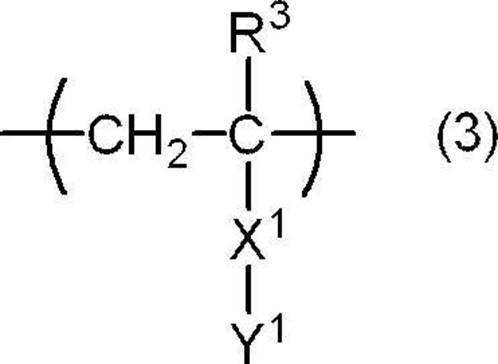
式3中、R3は水素原子又は炭素数1~4のアルキル基を表し、X1は、2価の連結基を表し、Y1は、アニオン性基を表し、X1及びY1のうち、主鎖から最も離れた原子は、主鎖から4原子~27原子離れている。
- 更に、セルロースナノファイバーを含有する、請求項1~請求項10のいずれか1項に記載のインクジェットインク。
- 前記セルロースナノファイバーの平均繊維幅が、1nm以上10nm以下である、請求項11に記載のインクジェットインク。
- 前記セルロースナノファイバーの平均繊維長さが、10nm以上1000nm以下である、請求項11又は請求項12に記載のインクジェットインク。
- 前記セルロースナノファイバーが、TEMPO酸化型セルロースナノファイバーを含む、請求項11~請求項13のいずれか1項に記載のインクジェットインク。
- 前記樹脂粒子及び前記ワックス粒子の合計含有量に対する前記セルロースナノファイバーの含有量の質量比が、1.00質量%~10.00質量%である、請求項11~請求項14のいずれか1項に記載のインクジェットインク。
- 前記セルロースナノファイバーの含有量が、インクジェットインクの全量に対し、
0.01質量%~1.00質量%である、請求項11~請求項15のいずれか1項に記載のインクジェットインク。 - 30℃、100rpmの条件で測定される粘度が、3.8mPa・s~6.0mPa・sである、請求項11~請求項16のいずれか1項に記載のインクジェットインク。
- 記録媒体上に、請求項1~請求項17のいずれか1項に記載のインクジェットインクを、インク流路壁にシリコンを含むインクジェットヘッドから吐出して付与する工程を含む、画像記録方法。
Priority Applications (4)
| Application Number | Priority Date | Filing Date | Title |
|---|---|---|---|
| JP2023549387A JP7767444B2 (ja) | 2021-09-27 | 2022-07-11 | インクジェットインク及び画像記録方法 |
| CN202280064924.0A CN118019814A (zh) | 2021-09-27 | 2022-07-11 | 喷墨油墨及图像记录方法 |
| EP22872523.0A EP4410552A4 (en) | 2021-09-27 | 2022-07-11 | INKJET INK AND IMAGE PRINTING PROCESS |
| US18/609,162 US20240279498A1 (en) | 2021-09-27 | 2024-03-19 | Ink jet ink and image recording method |
Applications Claiming Priority (4)
| Application Number | Priority Date | Filing Date | Title |
|---|---|---|---|
| JP2021-157230 | 2021-09-27 | ||
| JP2021157230 | 2021-09-27 | ||
| JP2022-050285 | 2022-03-25 | ||
| JP2022050285 | 2022-03-25 |
Related Child Applications (1)
| Application Number | Title | Priority Date | Filing Date |
|---|---|---|---|
| US18/609,162 Continuation US20240279498A1 (en) | 2021-09-27 | 2024-03-19 | Ink jet ink and image recording method |
Publications (1)
| Publication Number | Publication Date |
|---|---|
| WO2023047767A1 true WO2023047767A1 (ja) | 2023-03-30 |
Family
ID=85720453
Family Applications (1)
| Application Number | Title | Priority Date | Filing Date |
|---|---|---|---|
| PCT/JP2022/027320 Ceased WO2023047767A1 (ja) | 2021-09-27 | 2022-07-11 | インクジェットインク及び画像記録方法 |
Country Status (4)
| Country | Link |
|---|---|
| US (1) | US20240279498A1 (ja) |
| EP (1) | EP4410552A4 (ja) |
| JP (1) | JP7767444B2 (ja) |
| WO (1) | WO2023047767A1 (ja) |
Cited By (1)
| Publication number | Priority date | Publication date | Assignee | Title |
|---|---|---|---|---|
| WO2026029073A1 (ja) * | 2024-08-02 | 2026-02-05 | 花王株式会社 | インクジェット印刷用水系インク |
Citations (26)
| Publication number | Priority date | Publication date | Assignee | Title |
|---|---|---|---|---|
| JPS59157636A (ja) | 1983-02-25 | 1984-09-07 | Fuji Photo Film Co Ltd | カラ−画像形成方法 |
| JPH0517510A (ja) | 1991-07-15 | 1993-01-26 | Asahi Chem Ind Co Ltd | 新規共重合体ラテツクスの製造方法 |
| JPH1060326A (ja) * | 1996-08-19 | 1998-03-03 | Matsushita Electric Ind Co Ltd | 導電性インク |
| JP2002012607A (ja) | 2000-06-28 | 2002-01-15 | Mitsubishi Chemicals Corp | 光重合性組成物、光重合性着色組成物およびカラーフィルター |
| JP2002188025A (ja) | 2000-10-10 | 2002-07-05 | Toyo Ink Mfg Co Ltd | 活性エネルギー線硬化型インクジェットインキ |
| JP2003026978A (ja) | 1998-09-08 | 2003-01-29 | Ricoh Co Ltd | 記録液体 |
| JP2003165936A (ja) | 2001-03-22 | 2003-06-10 | Ricoh Co Ltd | 水性インク組成物並びにそれを用いたインクジェット記録方法及びインクジェット記録装置 |
| JP2003322926A (ja) | 2002-05-02 | 2003-11-14 | Fuji Photo Film Co Ltd | ハロゲン化銀写真感光材料 |
| JP2003342503A (ja) | 2002-05-28 | 2003-12-03 | Konica Minolta Holdings Inc | インクジェット記録用ブラックインクおよび画像形成方法 |
| JP2004309806A (ja) | 2003-04-08 | 2004-11-04 | Fuji Photo Film Co Ltd | ハロゲン化銀写真感光材料 |
| JP2004325707A (ja) | 2003-04-24 | 2004-11-18 | Fuji Photo Film Co Ltd | ハロゲン化銀写真感光材料および水性塗布組成物 |
| JP2008095088A (ja) * | 2006-09-15 | 2008-04-24 | Ricoh Co Ltd | 記録用インク、記録方法及び記録用装置 |
| US20080171149A1 (en) * | 2004-05-19 | 2008-07-17 | Ged Hastie | Inkjet Printing Ink |
| JP2010221415A (ja) | 2009-03-19 | 2010-10-07 | Fujifilm Corp | インクジェット画像記録方法 |
| JP2011042150A (ja) | 2009-08-24 | 2011-03-03 | Fujifilm Corp | 画像形成方法 |
| JP2011063000A (ja) | 2009-09-18 | 2011-03-31 | Fujifilm Corp | 画像形成方法 |
| JP2011111527A (ja) | 2009-11-26 | 2011-06-09 | Fujifilm Corp | 水性インク組成物および画像形成方法 |
| JP2011162692A (ja) | 2010-02-10 | 2011-08-25 | Fujifilm Corp | インク組成物及び画像形成方法 |
| JP4902711B2 (ja) | 2009-09-18 | 2012-03-21 | 富士フイルム株式会社 | インク組成物、インクセットおよび画像形成方法 |
| JP2013001854A (ja) | 2011-06-17 | 2013-01-07 | Fujifilm Corp | インクセット及び画像形成方法 |
| JP2014065249A (ja) * | 2012-09-26 | 2014-04-17 | Fujifilm Corp | インクジェット記録用メンテナンス液、インクジェット記録用インクセット、及び画像形成方法 |
| JP2015063574A (ja) | 2013-09-24 | 2015-04-09 | キヤノン株式会社 | インク及びインクジェット記録方法 |
| JP2015180710A (ja) | 2013-09-24 | 2015-10-15 | 富士フイルム株式会社 | インクセット及び画像形成方法 |
| JP2016044236A (ja) | 2014-08-22 | 2016-04-04 | キヤノン株式会社 | インク、インクジェット記録方法、及びインクカートリッジ |
| JP2021157230A (ja) | 2020-03-25 | 2021-10-07 | 株式会社日本総合研究所 | 入出金明細管理装置及び方法、並びにプログラム |
| JP2022050285A (ja) | 2020-09-17 | 2022-03-30 | 株式会社Kokusai Electric | 基板処理装置、半導体装置の製造方法、および、プログラム |
Family Cites Families (4)
| Publication number | Priority date | Publication date | Assignee | Title |
|---|---|---|---|---|
| JP6128377B2 (ja) * | 2013-03-25 | 2017-05-17 | 東海カーボン株式会社 | 水性顔料分散組成物、記録方法および記録物 |
| JP6172673B2 (ja) * | 2013-11-21 | 2017-08-02 | 東海カーボン株式会社 | 水性顔料分散組成物、記録方法および記録物 |
| JP7013980B2 (ja) * | 2018-03-20 | 2022-02-01 | セイコーエプソン株式会社 | 顔料捺染インクジェットインク組成物、顔料捺染用インクセット及びインクジェット記録方法 |
| JP7073835B2 (ja) * | 2018-03-26 | 2022-05-24 | セイコーエプソン株式会社 | 顔料捺染インクジェットインク組成物及び顔料捺染インクジェット記録方法 |
-
2022
- 2022-07-11 WO PCT/JP2022/027320 patent/WO2023047767A1/ja not_active Ceased
- 2022-07-11 EP EP22872523.0A patent/EP4410552A4/en active Pending
- 2022-07-11 JP JP2023549387A patent/JP7767444B2/ja active Active
-
2024
- 2024-03-19 US US18/609,162 patent/US20240279498A1/en active Pending
Patent Citations (26)
| Publication number | Priority date | Publication date | Assignee | Title |
|---|---|---|---|---|
| JPS59157636A (ja) | 1983-02-25 | 1984-09-07 | Fuji Photo Film Co Ltd | カラ−画像形成方法 |
| JPH0517510A (ja) | 1991-07-15 | 1993-01-26 | Asahi Chem Ind Co Ltd | 新規共重合体ラテツクスの製造方法 |
| JPH1060326A (ja) * | 1996-08-19 | 1998-03-03 | Matsushita Electric Ind Co Ltd | 導電性インク |
| JP2003026978A (ja) | 1998-09-08 | 2003-01-29 | Ricoh Co Ltd | 記録液体 |
| JP2002012607A (ja) | 2000-06-28 | 2002-01-15 | Mitsubishi Chemicals Corp | 光重合性組成物、光重合性着色組成物およびカラーフィルター |
| JP2002188025A (ja) | 2000-10-10 | 2002-07-05 | Toyo Ink Mfg Co Ltd | 活性エネルギー線硬化型インクジェットインキ |
| JP2003165936A (ja) | 2001-03-22 | 2003-06-10 | Ricoh Co Ltd | 水性インク組成物並びにそれを用いたインクジェット記録方法及びインクジェット記録装置 |
| JP2003322926A (ja) | 2002-05-02 | 2003-11-14 | Fuji Photo Film Co Ltd | ハロゲン化銀写真感光材料 |
| JP2003342503A (ja) | 2002-05-28 | 2003-12-03 | Konica Minolta Holdings Inc | インクジェット記録用ブラックインクおよび画像形成方法 |
| JP2004309806A (ja) | 2003-04-08 | 2004-11-04 | Fuji Photo Film Co Ltd | ハロゲン化銀写真感光材料 |
| JP2004325707A (ja) | 2003-04-24 | 2004-11-18 | Fuji Photo Film Co Ltd | ハロゲン化銀写真感光材料および水性塗布組成物 |
| US20080171149A1 (en) * | 2004-05-19 | 2008-07-17 | Ged Hastie | Inkjet Printing Ink |
| JP2008095088A (ja) * | 2006-09-15 | 2008-04-24 | Ricoh Co Ltd | 記録用インク、記録方法及び記録用装置 |
| JP2010221415A (ja) | 2009-03-19 | 2010-10-07 | Fujifilm Corp | インクジェット画像記録方法 |
| JP2011042150A (ja) | 2009-08-24 | 2011-03-03 | Fujifilm Corp | 画像形成方法 |
| JP4902711B2 (ja) | 2009-09-18 | 2012-03-21 | 富士フイルム株式会社 | インク組成物、インクセットおよび画像形成方法 |
| JP2011063000A (ja) | 2009-09-18 | 2011-03-31 | Fujifilm Corp | 画像形成方法 |
| JP2011111527A (ja) | 2009-11-26 | 2011-06-09 | Fujifilm Corp | 水性インク組成物および画像形成方法 |
| JP2011162692A (ja) | 2010-02-10 | 2011-08-25 | Fujifilm Corp | インク組成物及び画像形成方法 |
| JP2013001854A (ja) | 2011-06-17 | 2013-01-07 | Fujifilm Corp | インクセット及び画像形成方法 |
| JP2014065249A (ja) * | 2012-09-26 | 2014-04-17 | Fujifilm Corp | インクジェット記録用メンテナンス液、インクジェット記録用インクセット、及び画像形成方法 |
| JP2015063574A (ja) | 2013-09-24 | 2015-04-09 | キヤノン株式会社 | インク及びインクジェット記録方法 |
| JP2015180710A (ja) | 2013-09-24 | 2015-10-15 | 富士フイルム株式会社 | インクセット及び画像形成方法 |
| JP2016044236A (ja) | 2014-08-22 | 2016-04-04 | キヤノン株式会社 | インク、インクジェット記録方法、及びインクカートリッジ |
| JP2021157230A (ja) | 2020-03-25 | 2021-10-07 | 株式会社日本総合研究所 | 入出金明細管理装置及び方法、並びにプログラム |
| JP2022050285A (ja) | 2020-09-17 | 2022-03-30 | 株式会社Kokusai Electric | 基板処理装置、半導体装置の製造方法、および、プログラム |
Non-Patent Citations (2)
| Title |
|---|
| J. BRANDRUPE. H. IMMERGUT: "Polymer Handbook", 1989, WILEY-INTERSCIENCE |
| See also references of EP4410552A4 |
Cited By (1)
| Publication number | Priority date | Publication date | Assignee | Title |
|---|---|---|---|---|
| WO2026029073A1 (ja) * | 2024-08-02 | 2026-02-05 | 花王株式会社 | インクジェット印刷用水系インク |
Also Published As
| Publication number | Publication date |
|---|---|
| EP4410552A4 (en) | 2025-04-09 |
| JPWO2023047767A1 (ja) | 2023-03-30 |
| US20240279498A1 (en) | 2024-08-22 |
| EP4410552A1 (en) | 2024-08-07 |
| JP7767444B2 (ja) | 2025-11-11 |
Similar Documents
| Publication | Publication Date | Title |
|---|---|---|
| JP7513700B2 (ja) | インクジェット記録用インク、及び、画像記録方法 | |
| JP5430315B2 (ja) | 画像形成方法及びインク組成物 | |
| JP4897023B2 (ja) | インク組成物、インクセットおよびインクジェット画像形成方法 | |
| JP5490474B2 (ja) | 画像形成方法及びインク組成物 | |
| US8833918B2 (en) | Ink composition, ink set, and image forming method | |
| EP2781565B1 (en) | White ink composition, ink set for forming multiple layers, image forming method and printed matter | |
| JP4902711B2 (ja) | インク組成物、インクセットおよび画像形成方法 | |
| US8651649B2 (en) | Image forming method and ink set | |
| US20150077480A1 (en) | Ink for inkjet, inkjet recording method, inkjet recorder and ink recorded matter | |
| JP2012171987A (ja) | インク組成物、インクセット、及び画像形成方法 | |
| EP3521385B1 (en) | Ink-jet recording aqueous ink composition and image forming method | |
| JP2013223958A (ja) | インクジェット画像形成方法 | |
| EP3119844A1 (en) | White ink | |
| JP2011038008A (ja) | 水性インク組成物、複合粒子の製造方法、インクセット、及び、画像形成方法 | |
| JP2016523993A (ja) | 白色インク | |
| JP2011190344A (ja) | 水性顔料分散組成物、インクジェットインキ、インクジェット記録方法および記録物 | |
| EP3689983A1 (en) | Ink composition for inkjet recording and inkjet recording method | |
| CN102675970B (zh) | 墨水组合物、墨水组和喷墨图像形成方法 | |
| JP7767444B2 (ja) | インクジェットインク及び画像記録方法 | |
| JP2010179519A (ja) | インクジェット記録方法 | |
| WO2020054290A1 (ja) | インク組成物、インクセット及び画像記録方法 | |
| JP7185012B2 (ja) | インク組成物、インクセット、及び画像形成方法 | |
| EP2487210B1 (en) | Ink composition, ink set and image forming method | |
| CN118019814A (zh) | 喷墨油墨及图像记录方法 | |
| JP2016169338A (ja) | インク、インクの製造方法、インク収納容器、インクジェット記録装置 |
Legal Events
| Date | Code | Title | Description |
|---|---|---|---|
| 121 | Ep: the epo has been informed by wipo that ep was designated in this application |
Ref document number: 22872523 Country of ref document: EP Kind code of ref document: A1 |
|
| WWE | Wipo information: entry into national phase |
Ref document number: 202280064924.0 Country of ref document: CN Ref document number: 2023549387 Country of ref document: JP |
|
| NENP | Non-entry into the national phase |
Ref country code: DE |
|
| ENP | Entry into the national phase |
Ref document number: 2022872523 Country of ref document: EP Effective date: 20240429 |