WO2023049724A1 - Prc2 inhibitors for use in treating blood disorders - Google Patents
Prc2 inhibitors for use in treating blood disorders Download PDFInfo
- Publication number
- WO2023049724A1 WO2023049724A1 PCT/US2022/076750 US2022076750W WO2023049724A1 WO 2023049724 A1 WO2023049724 A1 WO 2023049724A1 US 2022076750 W US2022076750 W US 2022076750W WO 2023049724 A1 WO2023049724 A1 WO 2023049724A1
- Authority
- WO
- WIPO (PCT)
- Prior art keywords
- equiv
- μmol
- methyl
- mixture
- mmol
- Prior art date
- Legal status (The legal status is an assumption and is not a legal conclusion. Google has not performed a legal analysis and makes no representation as to the accuracy of the status listed.)
- Ceased
Links
Classifications
-
- A—HUMAN NECESSITIES
- A61—MEDICAL OR VETERINARY SCIENCE; HYGIENE
- A61K—PREPARATIONS FOR MEDICAL, DENTAL OR TOILETRY PURPOSES
- A61K31/00—Medicinal preparations containing organic active ingredients
- A61K31/33—Heterocyclic compounds
- A61K31/395—Heterocyclic compounds having nitrogen as a ring hetero atom, e.g. guanethidine or rifamycins
- A61K31/495—Heterocyclic compounds having nitrogen as a ring hetero atom, e.g. guanethidine or rifamycins having six-membered rings with two or more nitrogen atoms as the only ring heteroatoms, e.g. piperazine or tetrazines
- A61K31/505—Pyrimidines; Hydrogenated pyrimidines, e.g. trimethoprim
- A61K31/519—Pyrimidines; Hydrogenated pyrimidines, e.g. trimethoprim ortho- or peri-condensed with heterocyclic rings
-
- A—HUMAN NECESSITIES
- A61—MEDICAL OR VETERINARY SCIENCE; HYGIENE
- A61K—PREPARATIONS FOR MEDICAL, DENTAL OR TOILETRY PURPOSES
- A61K31/00—Medicinal preparations containing organic active ingredients
- A61K31/33—Heterocyclic compounds
- A61K31/395—Heterocyclic compounds having nitrogen as a ring hetero atom, e.g. guanethidine or rifamycins
- A61K31/535—Heterocyclic compounds having nitrogen as a ring hetero atom, e.g. guanethidine or rifamycins having six-membered rings with at least one nitrogen and one oxygen as the ring hetero atoms, e.g. 1,2-oxazines
- A61K31/5375—1,4-Oxazines, e.g. morpholine
- A61K31/5377—1,4-Oxazines, e.g. morpholine not condensed and containing further heterocyclic rings, e.g. timolol
-
- A—HUMAN NECESSITIES
- A61—MEDICAL OR VETERINARY SCIENCE; HYGIENE
- A61P—SPECIFIC THERAPEUTIC ACTIVITY OF CHEMICAL COMPOUNDS OR MEDICINAL PREPARATIONS
- A61P35/00—Antineoplastic agents
- A61P35/02—Antineoplastic agents specific for leukemia
-
- A—HUMAN NECESSITIES
- A61—MEDICAL OR VETERINARY SCIENCE; HYGIENE
- A61P—SPECIFIC THERAPEUTIC ACTIVITY OF CHEMICAL COMPOUNDS OR MEDICINAL PREPARATIONS
- A61P7/00—Drugs for disorders of the blood or the extracellular fluid
-
- A—HUMAN NECESSITIES
- A61—MEDICAL OR VETERINARY SCIENCE; HYGIENE
- A61P—SPECIFIC THERAPEUTIC ACTIVITY OF CHEMICAL COMPOUNDS OR MEDICINAL PREPARATIONS
- A61P7/00—Drugs for disorders of the blood or the extracellular fluid
- A61P7/06—Antianaemics
-
- C—CHEMISTRY; METALLURGY
- C07—ORGANIC CHEMISTRY
- C07D—HETEROCYCLIC COMPOUNDS
- C07D487/00—Heterocyclic compounds containing nitrogen atoms as the only ring hetero atoms in the condensed system, not provided for by groups C07D451/00 - C07D477/00
- C07D487/02—Heterocyclic compounds containing nitrogen atoms as the only ring hetero atoms in the condensed system, not provided for by groups C07D451/00 - C07D477/00 in which the condensed system contains two hetero rings
- C07D487/04—Ortho-condensed systems
-
- C—CHEMISTRY; METALLURGY
- C07—ORGANIC CHEMISTRY
- C07D—HETEROCYCLIC COMPOUNDS
- C07D519/00—Heterocyclic compounds containing more than one system of two or more relevant hetero rings condensed among themselves or condensed with a common carbocyclic ring system not provided for in groups C07D453/00 or C07D455/00
Definitions
- the present disclosure relates to compounds that inhibit the Polycomb Repressive Complex 2 (PRC2).
- PRC2 Polycomb Repressive Complex 2
- the present disclosure relates to compounds, pharmaceutical compositions comprising the compounds and methods for use therefor in treating blood disorders, including sickle cell disease and thalassemia.
- the Polycomb Repressive Complex 2 is a multiprotein complex that contributes to the epigenetic silencing of target genes to regulate development and homeostasis.
- the PRC2 complex is comprised of three core subunits: enhancer of zeste homolog 2 (EZH2), embryonic ectoderm development protein (EED), and suppressor of zeste 12 (SUZ12).
- EED is a critical regulator of PRC2 in the silencing of expression of genes and gene clusters involved in development including but not limited to fetal orthologues (i.e. gamma globin), Hox genes, X chromosome inactivation, etc.
- EED provides a pharmacologic target for the treatment of diseases or disorders to impact transcription of specific target genes in blood and other tissues.
- a method of treating a blood disorder in a subject comprising administering to the subject a therapeutically effective amount of a compound of Formula (I): or a pharmaceutically acceptable salt thereof: wherein: represents a single or a double bond; Z is O or S; X is O, CR 5 , CR 5 OH, C(R 5 )2, wherein: when X is O, is a single bond; when X is C(R 5 )2, is a single bond; when X is CR 5 OH, is a single bond; or when X is CR 5 , is a double bond; R 1 is aryl, heteroaryl, L-cycloalkyl, or L-heterocyclyl, wherein the aryl, the heteroaryl and the cyclyl portion of the L-cycloalkyl and L-heterocyclyl may be optionally substituted with one or more R 4 ; R 2 is cyano, -COOR 5 or -
- a method of treating a blood disorder in a subject by administering to the subject a therapeutically effective amount of a compound of Formula (I), wherein the blood disorder is selected from Acute lymphoblastic leukemia (ALL), Acute myeloid leukemia (AML) (e.g., acute promyelocytic leukemia, APL), Amyloidosis, Anemia, Aplastic anemia, Bone marrow failure syndromes, Chronic lymphocytic leukemia (CLL), Chronic myeloid leukemia (CML), Deep vein thrombosis (DVT), Diamond-Blackfan anemia, Dyskeratosis congenita (DKC), Eosinophilic disorder, Essential thrombocythemia, Fanconi anemia, Gaucher disease, Hemochromatosis, Hemolytic anemia, Hemophilia, Hereditary spherocytosis, Hodgkin's lymphoma, Idiopathic thrombocytopen
- ALL Acute lymphoblast
- the thalassemia is alpha thalassemia.
- the thalassemia is beta thalassemia.
- FIG.1A depicts the percentage of F cells (cells containing fetal hemoglobin) in 14-day differentiated cells post 7-day treatment with vehicle (veh), compound Example 32, or hydroxyurea (HU) from Donor A.
- FIG.1B depicts the percentage of F cells (cells containing fetal hemoglobin) in 14-day differentiated cells post 7-day treatment with vehicle (veh), compound Example 32 or hydroxyurea (HU) in Donor B.
- FIG.2A depicts HBG1 mRNA levels in 14-day differentiated cells post 7-day treatment with vehicle (veh), compound Example 32 or hydroxyurea (HU) in Donor A.
- FIG.2B depicts HBG2 mRNA levels in 14-day differentiated cells post 7-day treatment with vehicle (veh), compound Example 32 or hydroxyurea (HU) in Donor A.
- FIG.2C depicts HBG1 mRNA levels in 14-day differentiated cells post 7-day treatment with vehicle (veh), compound Example 32 or hydroxyurea (HU) in Donor B.
- FIG.2D depicts HBG2 mRNA levels in 14-day differentiated cells post 7-day treatment with vehicle (veh), compound Example 32 or hydroxyurea (HU) in Donor B.
- DETAILED DESCRIPTION OF THE DISCLOSURE [00016] Unless defined otherwise, all terms and ranges used herein have the same meaning as is commonly understood by one of skill in the art to which this disclosure belongs, unless expressly defined otherwise. All patents, patent applications, and publications referred to herein are incorporated by reference to the extent they are consistent with the present disclosure.
- a bivalent linking moiety can be “alkyl,” in which case those skilled in the art will understand the alkyl to be a divalent radical (e.g., -CH2-CH2-), which is equivalent to the term “alkylene.”
- alkyl a divalent radical
- aryl a divalent moiety that is required and is stated as being “aryl”
- All atoms are understood to have their normal number of valences for bond formation (i.e., 4 for carbon, 3 for N, 2 for O, and 2, 4, or 6 for S, depending on the oxidation state of the S).
- Polycomb Repressive Complex 2 or “PRC2 complex” refers to a mammalian multiprotein complex comprising three core subunits: enhancer of zeste homolog 2 (EZH2), embryonic ectoderm development protein (EED), and suppressor of zeste 12 (SUZ12) and two additional non- essential subunits, AEBP2, and RbAp48.
- EED refers to the embryonic ectoderm development protein subunit of the PRC2 complex.
- EZH2 or “EZH2 enzyme” refers to a mammalian histone methyltransferase, which is the catalytic subunit of the Polycomb Repressive Complex 2 (PRC2), and functions to silence target genes by tri-methylating lysine 27 of histone H3 (H3K27me3).
- PRC2 inhibitor refers to compounds of the present disclosure that are represented by formula (I) as described herein. These compounds are capable of negatively modulating or inhibiting all or a portion of the enzymatic activity of the PRC2 complex.
- inhibitors of the present disclosure may inhibit PRC2 enzymatic activity by binding to EED to prevent assembly of the PRC2 complex on histone H3 tails thereby inhibiting its activity.
- amino refers to –NH2.
- acetyl refers to “-C(O)CH3.
- acyl refers to an alkylcarbonyl or arylcarbonyl substituent wherein the alkyl and aryl portions are as defined herein.
- alkyl as employed herein refers to straight and branched chain aliphatic groups having from 1 to 12 carbon atoms.
- alkyl encompasses C 1 , C 2 , C 3 , C 4 , C 5 , C 6 , C 7 , C 8 , C 9 , C 10 , C 11 and C 12 groups.
- alkyl groups include, without limitation, methyl, ethyl, propyl, isopropyl, butyl, isobutyl, sec-butyl, tert-butyl, pentyl, and hexyl.
- alkenyl as used herein means an unsaturated straight or branched chain aliphatic group with one or more carbon-carbon double bonds, having from 2 to 12 carbon atoms.
- alkenyl encompasses C 2 , C 3 , C 4 , C 5 , C 6 , C 7 , C 8 , C 9 , C 10 , C 11 and C 12 groups.
- alkenyl groups include, without limitation, ethenyl, propenyl, butenyl, pentenyl, and hexenyl.
- alkynyl as used herein means an unsaturated straight or branched chain aliphatic group with one or more carbon-carbon triple bonds, having from 2 to 12 carbon atoms.
- alkynyl encompasses C 2 , C 3 , C 4 , C 5 , C 6 , C 7 , C 8 , C 9 , C 10 , C 11 and C 12 groups.
- alkynyl groups include, without limitation, ethynyl, propynyl, butynyl, pentynyl, and hexynyl.
- An “alkylene,” “alkenylene,” or “alkynylene” group is an alkyl, alkenyl, or alkynyl group, as defined hereinabove, that is positioned between and serves to connect two other chemical groups.
- alkylene groups include, without limitation, methylene, ethylene, propylene, and butylene.
- alkenylene groups include, without limitation, ethenylene, propenylene, and butenylene.
- alkynylene groups include, without limitation, ethynylene, propynylene, and butynylene.
- alkoxy refers to –OC 1 –C 6 alkyl.
- cycloalkyl as employed herein is a saturated and partially unsaturated cyclic hydrocarbon group having 3 to 12 carbons.
- cycloalkyl includes C 3 , C 4 , C 5 , C 6 , C 7 , C 8 , C 9 , C 10 , C 11 and C 12 cyclic hydrocarbon groups.
- cycloalkyl groups include, without limitation, cyclopropyl, cyclobutyl, cyclopentyl, cyclopentenyl, cyclohexyl, cyclohexenyl, cycloheptyl, and cyclooctyl.
- heteroalkyl refers to an alkyl group, as defined hereinabove, wherein one or more carbon atoms in the chain are independently replaced O, S, or NR x , wherein R x is hydrogen or C 1 –C 3 alkyl.
- heteroalkyl groups include methoxymethyl, methoxyethyl and methoxypropyl.
- An “aryl” group is a C 6 -C 14 aromatic moiety comprising one to three aromatic rings. As such, “aryl” includes C 6 , C 10 , C 13 , and C 14 cyclic hydrocarbon groups.
- An exemplary aryl group is a C 6 -C 10 aryl group.
- aryl groups include, without limitation, phenyl, naphthyl, anthracenyl, and fluorenyl.
- An “aralkyl” or “arylalkyl” group comprises an aryl group covalently linked to an alkylene group wherein the moiety is linked to another group via the alkyl moiety.
- An exemplary aralkyl group is –(C 1 -C 6 )alkyl(C 6 -C 10 )aryl, including, without limitation, benzyl, phenethyl, and naphthylmethyl.
- a “heterocyclyl” or “heterocyclic” group is a mono- or bicyclic (fused or spiro) ring structure having from 3 to 12 atoms, (3, 4, 5, 6, 7, 8, 9, 10, 11 or 12 atoms), for example 4 to 8 atoms, wherein one or more ring atoms are independently –C(O)-, N, NR 5 , O, or S, and the remainder of the ring atoms are quaternary or carbonyl carbons.
- heterocyclic groups include, without limitation, epoxy, oxiranyl, oxetanyl, azetidinyl, aziridinyl, tetrahydrofuranyl, tetrahydropyranyl, tetrahydrothiophenyl, pyrrolidinyl, piperidinyl, piperazinyl, imidazolidinyl, thiazolidinyl, thiatanyl, dithianyl, trithianyl, azathianyl, oxathianyl, dioxolanyl, oxazolidinyl, oxazolidinonyl, decahydroquinolinyl, piperidonyl, 4- piperidonyl, thiomorpholinyl, dimethyl-morpholinyl, and morpholinyl.
- L-heterocyclyl refers to a heterocyclyl group covalently linked to another group via an alkylene linker L, where L is C 1 –C 4 alkylene.
- heteroaryl refers to a group having 5 to 14 ring atoms, preferably 5, 6, 10, 13 or 14 ring atoms; having 6, 10, or 14 ⁇ electrons shared in a cyclic array; and having, in addition to carbon atoms, from one to three heteroatoms that are each independently N, O, or S.
- Heteroaryl also includes fused multicyclic (e.g., bicyclic) ring systems in which one or more of the fused rings is non- aromatic, provided that at least one ring is aromatic and at least one ring contains an N, O, or S ring atom.
- fused multicyclic e.g., bicyclic
- heteroaryl groups include acridinyl, azocinyl, benzimidazolyl, benzofuranyl, benzo[d]oxazol-2(3H)-one, 2H-benzo[b][1,4]oxazin-3(4H)-one, benzothiofuranyl, benzothiophenyl, benzoxazolyl, benzthiazolyl, benztriazolyl, benztetrazolyl, benzisoxazolyl, benzisothiazolyl, benzimidazolinyl, carbazolyl, 4aH-carbazolyl, carbolinyl, chromanyl, chromenyl, cinnolinyl, furanyl, furazanyl, imidazolinyl, imidazolyl, 1H-indazolyl, indolenyl, indolinyl, indolizinyl, indolyl, 3H
- a “L-heteroaryl,” “heteroaralkyl” or “heteroarylalkyl” group comprises a heteroaryl group covalently linked to another group via an alkylene linker.
- heteroalkyl groups comprise a C 1 - C 6 alkyl group and a heteroaryl group having 5, 6, 9, or 10 ring atoms.
- heteroaralkyl groups include pyridylmethyl, pyridylethyl, pyrrolylmethyl, pyrrolylethyl, imidazolylmethyl, imidazolylethyl, thiazolylmethyl, thiazolylethyl, benzimidazolylmethyl, benzimidazolylethyl quinazolinylmethyl, quinolinylmethyl, quinolinylethyl, benzofuranylmethyl, indolinylethyl isoquinolinylmethyl, isoinodylmethyl, cinnolinylmethyl, and benzothiophenylethyl.
- arylene is an bivalent aryl, heteroaryl, or heterocyclyl group, respectively, as defined hereinabove, that is positioned between and serves to connect two other chemical groups.
- substituents it is meant that the group optionally has from one to four, preferably from one to three, more preferably one or two, non- hydrogen substituents.
- halogen refers to chlorine, bromine, fluorine, or iodine.
- haloalkyl refers to an alkyl chain in which one or more hydrogens have been replaced by a halogen. Exemplary haloalkyls are trifluoromethyl, difluoromethyl, flurochloromethyl, chloromethyl, and fluoromethyl.
- hydroxyalkyl refers to an alkyl chain, as defined herein, wherein at least on hydrogen of the alkyl chain has been replaced by hydroxyl.
- an effective amount” of a compound is an amount that is sufficient to negatively modulate or inhibit the activity of PRC2 complex.
- a “therapeutically effective amount” of a compound is an amount that is sufficient to ameliorate or in some manner reduce a symptom or stop or reverse progression of a condition, or negatively modulate or inhibit the activity of PRC2 complex. Such amount may be administered as a single dosage or may be administered according to a regimen, whereby it is effective.
- treatment means any manner in which the symptoms or pathology of a condition, disorder or disease in a subject are ameliorated or otherwise beneficially altered.
- amelioration of the symptoms of a particular disorder by administration of a particular compound or pharmaceutical composition refers to any lessening, whether permanent or temporary, lasting, or transient, that can be attributed to or associated with administration of the composition.
- a method of treating a blood disorder in a subject comprising administering to the subject a therapeutically effective amount of a compound of Formula (I): or a pharmaceutically acceptable salt thereof: wherein: represents a single or a double bond; Z is O or S; X is O, CR 5 , CR 5 OH, C(R 5 )2, wherein: when X is O, is a single bond; when X is C(R 5 )2, is a single bond; when X is CR 5 OH, is a single bond; or when X is CR 5 , is a double bond; R 1 is aryl, heteroaryl, L-cycloalkyl, or L-heterocyclyl, wherein the aryl, the heteroaryl and the cyclyl portion of the L-cycloalkyl and L-heterocyclyl may be optionally substituted with one or more R 4 ; R 2 is cyano, -COOR
- Z is O. In one embodiment, Z is S.
- X is C(R 5 ) 2 and is a single bond. [00051] In one embodiment, Z is O or S.
- X is O, CR 5 , CR 5 OH or C(R 5 )2, wherein when X is O, is a single bond; when X is C(R 5 )2, is a single bond; when X is CR 5 OH, is a single bond; or when X is CR 5 , is a double bond.
- n is one. In one embodiment, n is two.
- Z is O, X is O, n is one and is a single bond. In another embodiment, Z is O, X is CR 5 and is a double bond. In one embodiment, Z is O, X is C(R 5 )2, n is one, and is a single bond. In one embodiment, Z is O, X is CR 5 OH, n is one, and is a single bond. In another embodiment, Z is O, X is C(R 5 )2, n is two, and is a single bond. In yet another embodiment, Z is S, X is C(R 5 )2, n is one, and is a single bond.
- R 1 is aryl, which may be optionally substituted with one or more R 4 .
- the aryl is phenyl, which may be optionally substituted with one or more R 4 .
- the aryl is substituted with a single R 4 group. In one embodiment, the aryl is substituted with two R 4 groups. In one embodiment, the aryl is substituted with three R 4 groups.
- Exemplary aryl R 4 groups include halogen, hydroxyl, haloalkyl, -Y 1 -C 1 –C 6 alkyl, Y 2 -C 1 –C 6 alkyl, -L- N(R 5 )2, -Y 1 -N(R 5 )2, -Y 2 -N(R 5 )2, Y 2 -haloalkyl, L-heterocyclyl, or Y 1 -heterocyclyl, wherein the heterocyclyl portion of the L-heterocyclyl, or Y 1 -heterocyclyl may be optionally substituted with one or more R 7 .
- the one or more R 4 are each independently halogen, hydroxyl, haloalkyl, - COOR 5 , -Y 1 -C 1 –C 6 alkyl, Y 2 -C 1 –C 6 alkyl, -L-N(R 5 )2, -O-L-N(R 5 )2, -C(CF3)N(R 5 )2, -Y 1 -N(R 5 )2, -Y 2 - N(R 5 )2, Y 2 -haloalkyl, -L-heterocyclyl, or -Y 1 -heterocyclyl, wherein the heterocyclyl portion of the -L- heterocyclyl or -Y 1 -heterocyclyl may be optionally substituted with one or more R 7 .
- R 1 is phenyl substituted with -Y 2 -C 1 –C 6 alkyl.
- Y is a bond and the C 1 –C 6 alkyl is methyl, ethyl or isopropyl.
- R 1 is phenyl substituted with the Y 2 -C 1 –C 6 alkyl, wherein Y 2 is -SO 2 - and the C1– C6 alkyl is methyl.
- R 1 is phenyl, which is disubstituted with methyl and Y 2 -C 1 –C 6 alkyl, wherein Y 2 is -SO 2 - and the C1– C 6 alkyl is methyl.
- R 1 is phenyl substituted one R 4 , wherein R 4 is a cyano group.
- R 1 is phenyl substituted one R 4 , wherein R 4 is L-heteroaryl. In certain embodiments, the L-heteroaryl is tetrazolyl.
- R 1 is phenyl substituted one R 4 , wherein R 4 is PO 3 (C1-C3 alkyl) 2 .
- R 1 is phenyl substituted one R 4 , wherein R 4 is - COOR 5 .
- R 1 is phenyl substituted one R 4 , wherein R 4 is -O-L-N(R 5 ) 2 . In one embodiment, R 1 is phenyl substituted one R 4 , wherein R 4 is aralkyl. [00059] In one embodiment, R 1 is phenyl substituted with at least one R 4 , wherein R 4 is -L-N(R 5 ) 2 . In one embodiment, L is a bond. In one embodiment, L is methylene. In one embodiment, each R 5 is independently hydrogen. In one embodiment, each R 5 is independently C 1 –C 3 alkyl. In one embodiment, each C 1 –C 3 alkyl is methyl.
- one R 5 is C 1 –C 3 alkyl and the other is hydrogen. In one embodiment, the one C 1 –C 3 alkyl is methyl. In one embodiment, R 1 is phenyl substituted with -L-N(R 5 ) 2 and further substituted with one or more halogen and/or C 1 –C 6 alkyl. [00060] In one embodiment, R 1 is phenyl substituted with one R 4 , wherein R 4 is -Y 1 -N(R 5 ) 2 . In certain embodiments, Y 1 is -C(O)- and each R 5 is independently C 1 –C 3 alkyl. In one embodiment, each C 1 –C 3 alkyl is methyl.
- Y 1 is -C(O)- and each R 5 is hydrogen. In one embodiment, Y 1 is - C(O)- and one R 5 is C 1 –C 3 alkyl and the other is hydrogen. In one embodiment, the one C 1 –C 3 alkyl is methyl. In one embodiment, R 1 is phenyl substituted with -Y 1 -N(R 5 )2 and further substituted with one or more halogen and/or C 1 –C 6 alkyl. [00061] In one embodiment, R 1 is phenyl substituted with the Y 2 -haloalkyl, wherein Y 2 is -S- or -SO 2 - and the haloalkyl is trifluoromethyl.
- R 1 is phenyl substituted with at least one -L-heterocyclyl or -Y 1 - heterocyclyl, each heterocyclyl optionally substituted with one or more R 7 .
- R 1 is phenyl substituted with one R 4 , wherein R 4 is -Y 1 -heterocyclyl optionally substituted with one or more R 7 .
- Y 1 is -C(O)- and the heterocyclyl is piperazinyl optionally substituted with C 1 – C 3 alkyl.
- the R 4 group is L-heterocyclyl optionally substituted with one or more R 7 .
- L is methylene and the heterocyclyl is pyrrolidinyl, piperidinyl, piperazinyl or 4- methyl-piperazinyl.
- L is methylene and the heterocyclyl is azetidinyl, pyrrolidinyl, piperidinyl, piperazinyl, piperazinone, tetrahydropyranyl, morpholinyl, thiomorpholinyl or diazapanyl, each optionally substituted with one or more R 7 .
- R 7 groups include oxo, halogen, hydroxyalkyl and C 1 –C 3 alkyl.
- R 1 is phenyl substituted with Y 1 -heterocyclyl optionally substituted with one or more R 7 .
- Y 1 is -C(O)- and the heterocyclyl is azetidinyl, pyrrolidinyl, piperidinyl, piperazinyl or 4-methyl-piperazinyl, each optionally further substituted with one or more halogen.
- R 1 is phenyl substituted with L-heteroaryl optionally substituted with one or more R 7 .
- the L-heteroaryl is tetrazolyl.
- R 1 is phenyl substituted with PO 3 (C 1 -C 3 alkyl) 2 . In another embodiment, R 1 is phenyl substituted with -COOR 5 . In one embodiment, R 1 is phenyl substituted with hydroxyalkyl, - O-L-N(R 5 ) 2 or aralkyl. [00067] In one embodiment, R 1 is heteroaryl, which may be optionally substituted with one or more R 4 .
- the heteroaryl is pyrazolyl, imidazolyl, oxazolyl, isoxazolyl, thiazolyl, triazinyl, pyridyl, pyridinyl-2-one, pyrazinyl, pyridazinyl, pyrimidinyl, isoxazolyl, isoindolinyl, naphthyridinyl, 1,2,3,4-tetrahydroisoquinolinyl, or 5,6-dihydro-4H-pyrrolo[1,2-b]pyrazolyl, each of which may be optionally substituted with one or more R 4 .
- the heteroaryl is pyrazolyl, imidazolyl, oxazolyl, isoxazolyl, thiazolyl, triazinyl, pyridyl, pyridinyl-2-one, pyrazinyl, pyridazinyl, pyrimidinyl, or 5,6-dihydro-4H-pyrrolo[1,2-b]pyrazolyl, each of which may be optionally substituted with one or more R 4 .
- the heteroaryl is substituted with a single R 4 group. In one embodiment, the heteroaryl is substituted with two R 4 groups. In one embodiment, the heteroaryl is substituted with three R 4 groups.
- heteroaryl R 4 groups include amino, cyano, halogen, alkoxy, hydroxyalkyl, heteroalkyl, haloalkyl, Y 2 -haloalkyl Y 1 -C 1 –C 6 alkyl, Y 2 -C 1 –C 6 alkyl, L-cycloalkyl, L-heteroaryl, L- heterocyclyl, Y 1 -heterocyclyl, -L-N(R 5 )2, or -Y 1 -N(R 5 )2, wherein the ring of the L-cycloalkyl, L- heteroaryl, L-heterocyclyl or Y 1 -heterocyclyl may be optionally substituted with one or more R 7 .
- each R 4 is independently cyano, halogen, -Y 1 -C 1 –C 6 alkyl, -Y 2 -C 1 –C 6 alkyl, alkoxy, hydroxyalkyl, heteroalkyl, haloalkyl, -L-cycloalkyl, -L-N(R 5 )2, -Y 1 -N(R 5 )2, -L-heteroaryl, - L-heterocyclyl, or -Y 1 -heterocyclyl, wherein the heteroaryl of the -L-heteroaryl or the heterocyclyl portion of the L-heterocyclyl, or Y 1 -heterocyclyl may be optionally substituted with one or more R 7 .
- R 7 is amino, hydroxyl, cyano, alkoxy, or halogen. In one embodiment, R 7 is C 1 –C 3 alkyl. In one embodiment, R 7 is halogen, wherein the halogen is fluorine or chlorine. In one embodiment, R 7 is alkoxy, wherein the alkoxy is methoxy or ethoxy. In one embodiment, R 7 is cycloalkyl, wherein the cycloalkyl is cyclopropyl. [00071] In another embodiment, R 1 is heteroaryl and each R 4 is independently hydroxyalkyl, heteroalkyl or haloalkyl.
- the hydroxyalkyl is hydroxymethyl, hydroxyethyl or 2- methyl, 2-hydroxypropyl.
- the heteroalkyl is methoxymethyl or methoxyethyl.
- the haloalkyl is fluoromethyl, difluoromethyl, trifluoromethyl, fluoroethyl, difluoroethyl, or trifluoroethyl.
- R 1 is heteroaryl and R 4 is -Y 1 -C 1 –C 6 alkyl, wherein Y 1 is a bond and the C 1 –C 6 alkyl is methyl, ethyl or isopropyl.
- R 4 is -Y 1 -C 1 –C 6 alkyl, wherein Y 1 is a -C(O)- and the C 1 –C 6 alkyl is methyl, ethyl or isopropyl. In other embodiments, Y 1 is -NHC(O)- and the C 1 –C 6 alkyl portion is methyl. [00073] In one embodiment, R 1 is heteroaryl and R 4 is -Y 2 -C 1 –C 6 alkyl, wherein Y 2 is -SO 2 - and the C 1 –C 6 alkyl is methyl.
- R 4 is -Y 2 -C 1 –C 6 alkyl, wherein Y 2 is -S- and the C 1 –C 6 alkyl is methyl.
- R 1 is heteroaryl and R 4 is -Y 1 -heterocyclyl, which may be optionally substituted with one or more R 7 .
- Y 1 is a bond.
- Y 1 is -C(O)-.
- Y 1 is a bond and the heterocyclyl is azetidinyl, oxetanyl, tetrahydrofuranyl, tetrahydropyranyl, pyrrolidinyl, piperidinyl, piperazinyl or 4-methyl-piperazinyl.
- R 7 is C 1 –C 3 alkyl. In one embodiment, R 7 is halogen.
- the heteroaryl is substituted with at least one R 4 that is -L-heterocyclyl, which may be optionally substituted with one or more R 7 .
- L is ethylene and the heterocyclyl is pyrrolidinyl, piperidinyl, piperazinyl or 4-methyl-piperazinyl. In one embodiment, L is methylene and the heterocyclyl is azetinidyl, pyrrolidinyl, piperidinyl, piperazinyl, piperazinone, tetrahydropyranyl, morpholinyl, thiomorpholinyl or diazapanyl, each optionally substituted with one or more R 7 . [00076] In one embodiment, the R 7 is independently -L-N(R 5 ) 2 , hydroxyl, cyano, alkoxy, or halogen.
- R 7 is C 1 –C 3 alkyl. In one embodiment, R 7 is halogen, wherein the halogen is fluorine or chlorine. In one embodiment, R 7 is alkoxy, wherein the alkoxy is methoxy or ethoxy. In one embodiment, R 7 is cycloalkyl, wherein the cycloalkyl is cyclopropyl. In one embodiment, R 7 is -L- N(R 5 )2. In one embodiment, L is a bond. In one embodiment, L is methylene. In one embodiment, each R 5 is hydrogen. In one embodiment, each R 5 is independently C 1 –C 3 alkyl. In one embodiment, each C 1 –C 3 alkyl is methyl.
- one R 5 is C 1 –C 3 alkyl and the other is hydrogen. In one embodiment, the one C 1 –C 3 alkyl is methyl. [00077] In one embodiment, R 1 is heteroaryl and R 4 is -L-N(R 5 )2. In one embodiment, L is a bond. In one embodiment, L is methylene, ethylene, or propylene. In one embodiment, each R 5 is independently C 1 –C 3 alkyl. In one embodiment, each C 1 –C 3 alkyl is methyl. In one embodiment, one R 5 is C 1 –C 3 alkyl and the other is hydrogen. In one embodiment, the one C 1 –C 3 alkyl is methyl. In one embodiment, each R 5 is hydrogen.
- R 1 is heteroaryl and R 4 is L-heteroaryl, which may be optionally substituted with one or more R 7 .
- L is a bond.
- L is C 1 –C 3 alkylene.
- the C 1 –C 3 alkylene is methylene.
- the heteroaryl of the L-heteroaryl is pyrazolyl, pyridyl, pyrimidinyl, pyrazinyl, triazinyl, thiazolyl or pyridazinyl.
- the heteroaryl of the L-heteroaryl is pyridyl.
- R 1 is heteroaryl which is substituted with two R 4 groups independently selected from two -Y 1 -C 1 –C 6 alkyl groups; -Y 1 -C 1 –C 6 alkyl and alkoxy; -Y 1 -C 1 –C 6 alkyl and cycloalkyl; -Y 1 -C 1 –C 6 alkyl and haloalkyl; -Y 1 -C 1 –C 6 alkyl and amino; two alkoxy groups; alkoxy and halogen; alkoxy and cyano, and amino and haloalkyl.
- R 4 is -Y 1 -C 1 –C 6 alkyl, wherein each Y 1 is a bond and each C 1 –C 6 alkyl is methyl, ethyl or isopropyl.
- the cycloalkyl is cyclopropyl.
- the alkoxy is methoxy.
- the halogen is fluorine or chlorine.
- the haloalkyl is trifluoromethyl or trifluoroethyl.
- R 1 is L-heterocyclyl optionally substituted with one or more R 4 .
- L is a bond and the heterocyclyl is tetrahydrofuranyl, piperidinyl, piperazinyl or morpholinyl.
- L is a methylene and the heterocyclyl is azetidinyl, pyrrolidinyl or 3 ⁇ 2 - azabicyclo[3.1.0]hexanyl.
- the heterocyclyl is substituted with one or more R 4 selected from oxo, halogen, alkoxy, hydroxyl and Y 1 -C 1 –C 6 alkyl, wherein Y is a bond or -C(O)-.
- R 2 is cyano.
- R 2 is -COOR 5 .
- the R 5 group is hydrogen.
- R 2 is -C(O)N(R 5 ) 2 .
- each R 5 is independently C 1 –C 3 alkyl.
- each C 1 –C 3 alkyl is methyl.
- one R 5 is C 1 –C 3 alkyl and the other is hydrogen.
- the one C 1 –C 3 alkyl is methyl.
- each R 5 is hydrogen.
- each R 5 together with the nitrogen atom to which they are attached form a 5 – 8 membered heterocyclic ring optionally substituted with one or more R 6 .
- n is zero. In one embodiment, n is one and R 3 is halogen. In certain embodiments, the halogen is fluorine or chlorine. In one embodiment, the halogen is fluorine.
- R 6 is hydrogen, C 1 –C 3 alkyl, halogen, haloalkyl, hydroxyalkyl, or heteroalkyl. In certain embodiments, R 6 is hydrogen. In other embodiments, R 6 is methyl, ethyl, or propyl. [00085] In one embodiment, the cyclyl portion of R 4 group is substituted with one R 7 group.
- R 7 is oxo, hydroxyl, alkoxy, halogen, haloalkyl, hydroxyalkyl, heteroalkyl, cycloalkyl, -L- N(R 5 )2 or C 1 –C 3 alkyl.
- R 7 is C 1 –C 3 alkyl, wherein the C 1 –C 3 alkyl is methyl, ethyl or isopropyl.
- R 7 is halogen, wherein the halogen is fluorine or chlorine.
- R 7 is oxo. [00086] In one embodiment, the cyclyl portion of R 4 group is substituted with two R 7 groups.
- the two R 7 groups are each halogen, wherein each halogen is fluorine.
- each halogen is fluorine.
- compositions comprising a PRC2 inhibitor as disclosed herein and a pharmaceutically acceptable carrier, excipient, or diluent for use in the treatment of a blood disorder in a subject.
- Compounds of the disclosure may be formulated by any method well known in the art and may be prepared for administration by any route, including, without limitation, parenteral, oral, sublingual, transdermal, topical, intranasal, intratracheal, or intrarectal.
- compounds disclosed herein are administered intravenously in a hospital setting.
- administration may preferably be by the oral route.
- the characteristics of the carrier will depend on the route of administration.
- compositions according to the disclosure may contain, in addition to the inhibitor, diluents, fillers, salts, buffers, stabilizers, solubilizers, and other materials well known in the art.
- diluents such as a cell, cell culture, tissue, or organism
- solubilizers such as a cell, cell culture, tissue, or organism
- the preparation of pharmaceutically acceptable formulations is described in, e.g., Remington's Pharmaceutical Sciences, 18th Edition, ed. A. Gennaro, Mack Publishing Co., Easton, Pa., 1990.
- salts refers to salts that retain the desired biological activity of the above-identified compounds and exhibit minimal or no undesired toxicological effects.
- examples of such salts include, but are not limited to acid addition salts formed with inorganic acids (for example, hydrochloric acid, hydrobromic acid, sulfuric acid, phosphoric acid, nitric acid, and the like), and salts formed with organic acids such as acetic acid, oxalic acid, tartaric acid, succinic acid, malic acid, ascorbic acid, benzoic acid, tannic acid, pamoic acid, alginic acid, polyglutamic acid, naphthalenesulfonic acid, naphthalenedisulfonic acid, and polygalacturonic acid.
- inorganic acids for example, hydrochloric acid, hydrobromic acid, sulfuric acid, phosphoric acid, nitric acid, and the like
- organic acids such as acetic acid, oxalic acid, tartaric acid, succinic
- the compounds can also be administered as pharmaceutically acceptable quaternary salts known by those skilled in the art, which specifically include the quaternary ammonium salt of the formula --NR+Z-, wherein R is hydrogen, alkyl, or benzyl, and Z is a counterion, including chloride, bromide, iodide, --O-alkyl, toluenesulfonate, methylsulfonate, sulfonate, phosphate, or carboxylate (such as benzoate, succinate, acetate, glycolate, maleate, malate, citrate, tartrate, ascorbate, benzoate, cinnamoate, mandeloate, benzyloate, and diphenylacetate).
- R is hydrogen, alkyl, or benzyl
- Z is a counterion, including chloride, bromide, iodide, --O-alkyl, toluenesulfonate, methylsulfonate,
- the active compound is included in the pharmaceutically acceptable carrier or diluent in an amount sufficient to deliver to a subject a therapeutically effective amount without causing serious toxic effects in the subject treated.
- a dose of the active compound for all of the above-mentioned conditions is in the range from about 0.01 to 300 mg/kg, preferably 0.1 to 100 mg/kg per day, more generally 0.5 to about 25 mg per kilogram body weight of the recipient per day.
- a typical topical dosage will range from 0.01-3% wt/wt in a suitable carrier.
- the effective dosage range of the pharmaceutically acceptable derivatives can be calculated based on the weight of the parent compound to be delivered.
- the effective dosage can be estimated as above using the weight of the derivative, or by other means known to those skilled in the art.
- METHODS OF USE [00093] In one embodiment is provided a method of treating a blood disorder in a subject, comprising administering to the subject a therapeutically effective amount of a compound of Formula (I) as disclosed herein.
- a method of treating a blood disorder in a subject comprising administering to the subject a therapeutically effective amount of a compound of Formula (I) as disclosed herein, wherein the blood disorder is selected from Acute lymphoblastic leukemia (ALL), Acute myeloid leukemia (AML) (e.g., acute promyelocytic leukemia, APL), Amyloidosis, Anemia, Aplastic anemia, Bone marrow failure syndromes, Chronic lymphocytic leukemia (CLL), Chronic myeloid leukemia (CML), Deep vein thrombosis (DVT), Diamond-Blackfan anemia, Dyskeratosis congenita (DKC), Eosinophilic disorder, Essential thrombocythemia, Fanconi anemia, Gaucher disease, Hemochromatosis, Hemolytic anemia, Hemophilia, Hereditary spherocytosis, Hodgkin's lymphoma, Id
- the blood disorder is sickle cell disease.
- the blood disorder is thalassemia.
- the thalassemia is alpha thalassemia.
- the thalassemia is beta thalassemia.
- the method results in induction of fetal hemoglobin expression in erythroid cells.
- the method results in upregulation of mRNA levels of fetal hemoglobin protein.
- the method results in increased levels of fetal hemoglobin protein in the subject.
- the concentration and route of administration to the subject will vary depending on the blood disorder to be treated.
- the compounds, pharmaceutically acceptable salts thereof and pharmaceutical compositions comprising such compounds and salts also may be co-administered with other anti- neoplastic compounds, e.g., chemotherapy, or used in combination with other treatments, such as radiation or surgical intervention, either as an adjuvant prior to surgery or post-operatively.
- Other anti- neoplastic compounds e.g., chemotherapy
- other treatments such as radiation or surgical intervention
- the degree of mono- and dimethylation of histone H3K27 may be monitored in the subject using well known methods, including those described in Example A below, to access the effectiveness of treatment, along with other prognostic or biological factors, and dosages may be adjusted accordingly by the attending medical practitioner.
- GENERAL REACTION SCHEME INTERMEDIATES AND EXAMPLES GENERAL REACTION SCHEMES [000101]
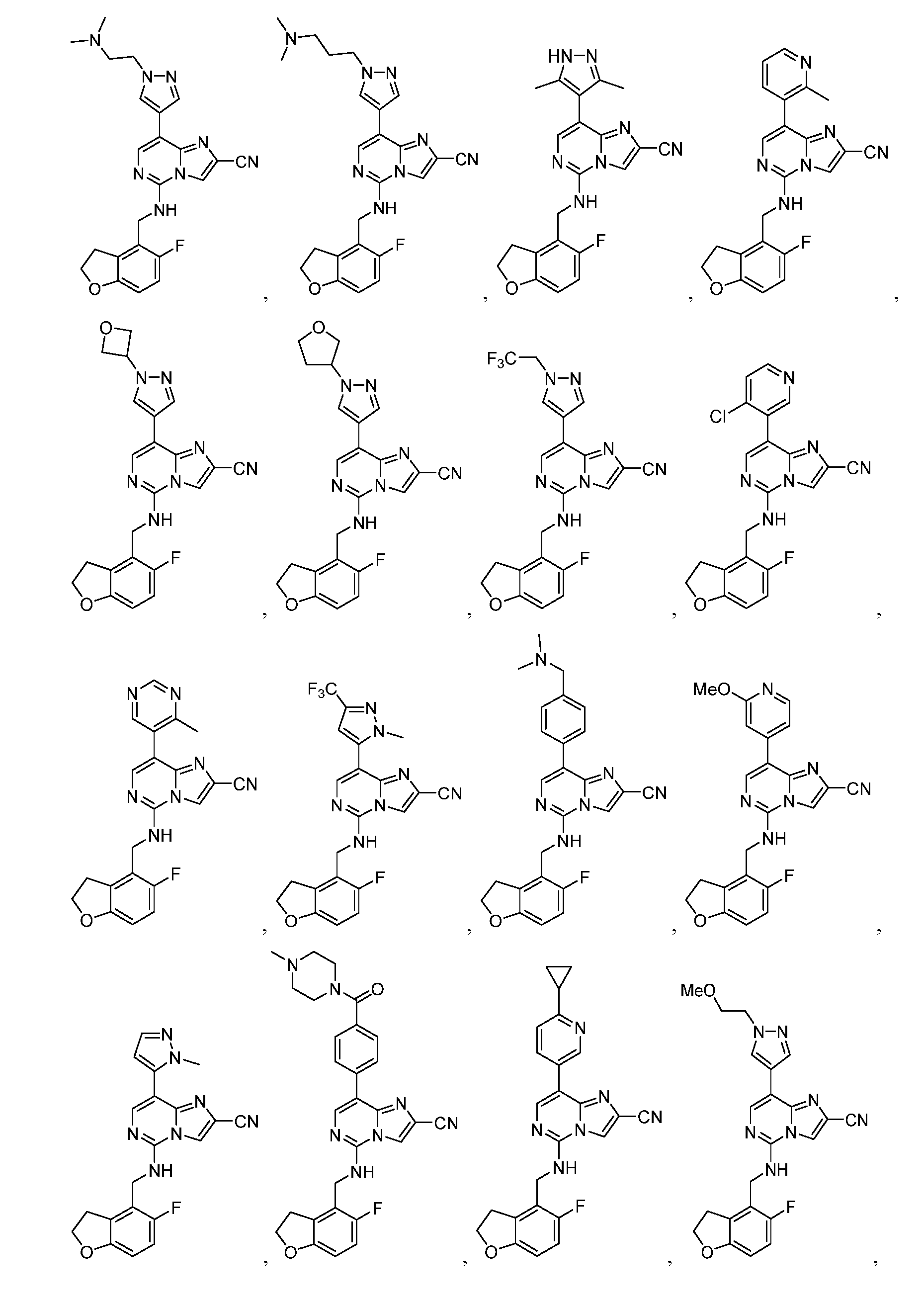
- the compounds disclosed herein may be prepared using methods described in United States Patent No.11,091,495, the contents of which are incorporated by reference herein for that purpose.
- the compounds disclosed herein may also be prepared using methods known to those having ordinary skill in the art and commercially available reagents and intermediates in the synthetic methods and reaction schemes described herein, or may be prepared using other reagents and conventional methods well known to those skilled in the art.
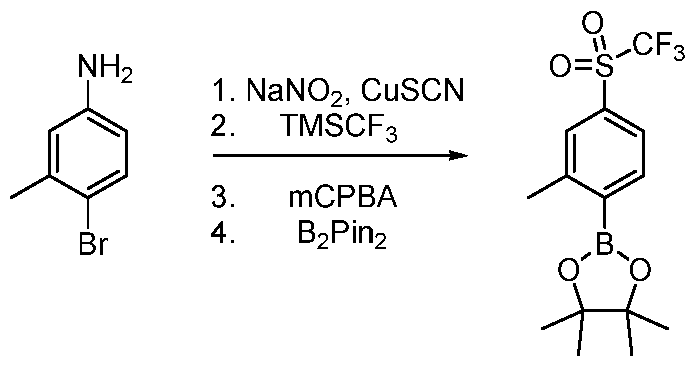
- intermediates for compounds and compounds of formula (I) of the present disclosure may be prepared according to General Reaction Schemes I or II:
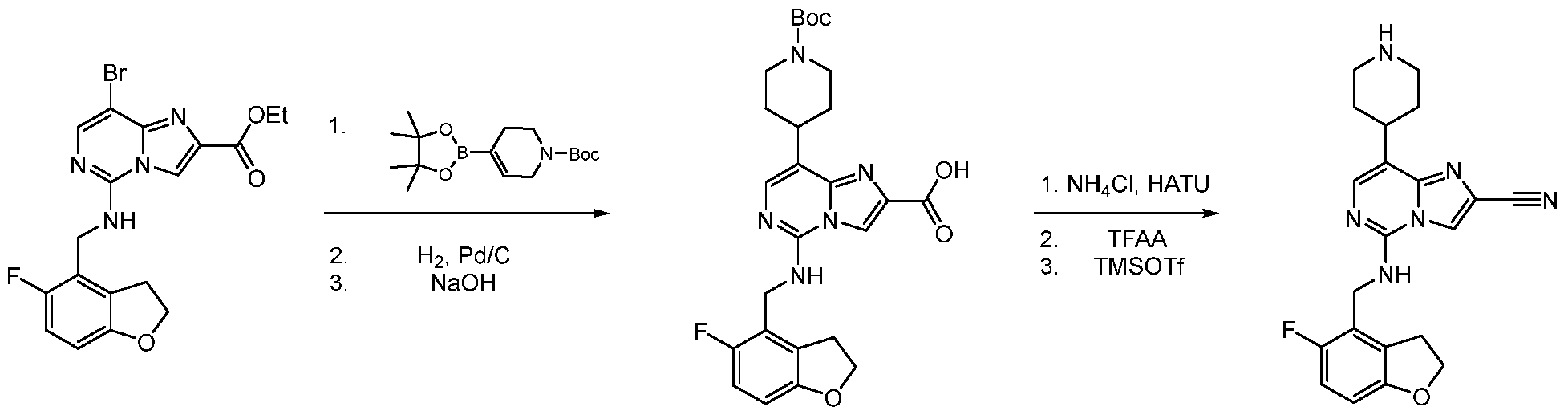
- R 2 -ester substituted imidazo[1,2-c]pyrimidine A is coupled to R 3 optionally substituted intermediate amine B by nucleophilic substitution to yield Intermediate C.
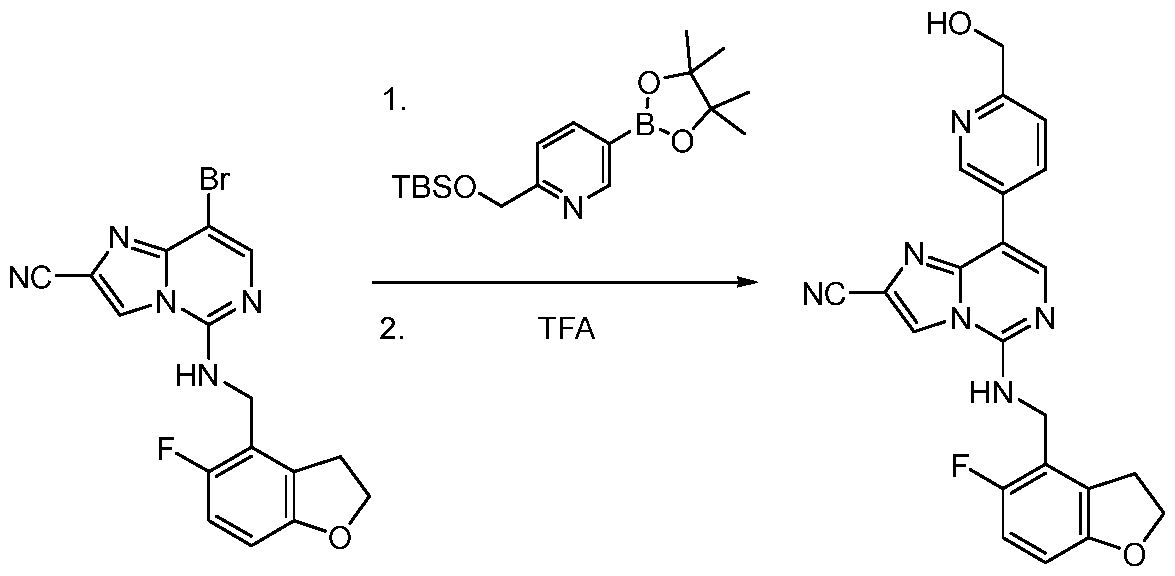
- a boronic acid derivative (Y)-R 1 D is coupled via a Suzuki reaction with halogen substituted Intermediate C in the presence of a suitable base, e.g., sodium carbonate, and the R 2 ester is converted to the acid by saponification with NaOH to generate intermediate acid E.
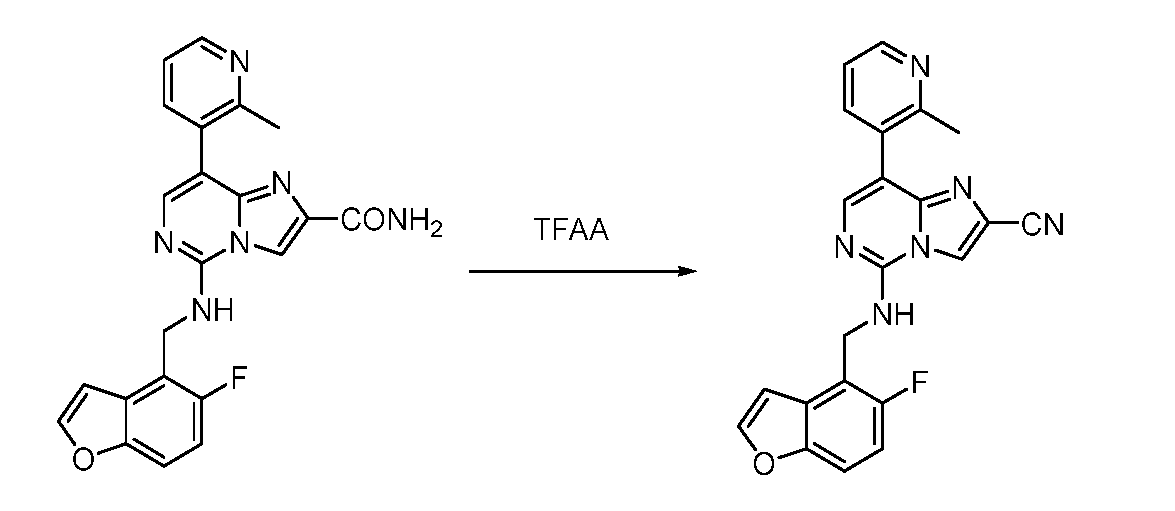
- the acid is converted to the corresponding amide, which is dehydrated to form title compound nitrile G.
- An exemplary Intermediate B, Intermediate B-1 may be used to synthesize compounds of formula I wherein Z is O, n is one, X is C(R 5 )2, and is a single bond.
- reaction mixture was diluted with petroleum ether (100 mL) and washed with brine (50.0 mL ⁇ 4), dried over anhydrous sodium sulfate, filtered, and concentrated under reduced pressure to give a residue.
- the crude material was purified by column chromatography (petroleum ether) to afford 1-bromo-3-(2,2- diethoxyethoxy)benzene (17.0 g, 48.2 mmol, 83.4% yield, 82.0% purity) as a light yellow oil.
- a second exemplary Intermediate B, Intermediate B-2 may be used to synthesize compounds of formula I wherein Z is O, n is one, X is CR 5 , is a double bond and one R 3 is fluorine.
- a third exemplary Intermediate B, Intermediate B-3 may be used to synthesize compounds of formula I wherein Z is O, n is one, X is C(R 5 ) 2 , 3 is a single bond and one R is chlorine.
- the vessel was evacuated and purged with hydrogen several times. The mixture was stirred at 25 °C for 12 h under hydrogen (50.0 psi).
- a fourth exemplary Intermediate B, Intermediate B-4 may be used to synthesize compounds of formula I wherein Z is O, n is one, X is C(R 5 ) 2 , is a single bond and one R 3 is fluorine.
- Z is O
- n is one
- X is C(R 5 ) 2
- R 3 is fluorine.
- a fifth exemplary Intermediate B, Intermediate B-5 may be used to synthesize compounds of formula I wherein Z is S, n is one, X is C(R 5 )2, is a single bond and one R 3 is fluorine.
- a sixth exemplary Intermediate B, Intermediate B-6 may be used to synthesize compounds of formula I wherein Z is O, n is two, X is C(R 5 ) 2 , is a single bond and one R 3 is fluorine.
- An exemplary Intermediate C, Intermediate C-1 may be used to synthesize compounds of formula I wherein Z is O, n is one, X is C(R 5 )2, is a single bond and one R 3 is fluorine.
- a second exemplary Intermediate C, Intermediate C-2 may be used to synthesize compounds of formula I wherein Z is O, n is one, X is CR 5 , is a double bond and one R 3 is fluorine.
- a fourth exemplary Intermediate C, Intermediate C-4 may be used to synthesize compounds of formula I wherein Z is O, n is one, X is C(R 5 )2, is a single bond and one R 3 is chlorine.
- a fifth exemplary Intermediate C, Intermediate C-5 may be used to synthesize compounds of formula I wherein Z is O, n is one, X is C(R 5 ) 2 , is a single bond and one R 3 is fluorine.
- Intermediate C-5 may be prepared as follows: [000207] To a solution of 8-bromo-5-chloro-imidazo[1,2-c]pyrimidine-2- carbonitrile (3.00 g, 11.7 mmol, 1.00 equiv) and (5-fluoro-2,3-dihydrobenzofuran-4-yl) methanamine (2.14 g, 12.8 mmol, 1.10 equiv) in DMF (30.0 mL) was added DIEA (3.01 g, 23.3 mmol, 4.06 mL, 2.00 equiv). The resultant mixture was stirred at 85 °C for 1 h, cooled to rt, and poured into water (100 mL).
- a sixth exemplary Intermediate C, Intermediate C-6 may be used to synthesize compounds of formula I wherein Z is O, n is one, X is C(R 5 )2, is a single bond and one R 3 is fluorine.
- a seventh exemplary Intermediate C, Intermediate C-7 may be used to synthesize compounds of formula I wherein Z is O, n is one, X is C(R 5 ) 2 , is a single 3 1 bond, one R is fluorine and R is heteroaryl which may then be further substituted with one or more R 4 .
- An eighth exemplary Intermediate C, Intermediate C-8 may be used to synthesize compounds of formula I wherein Z is O, n is one, X is C(R 5 )2, is a single bond, one R 3 is fluorine and R 1 is heteroaryl which is substituted two R 4 groups, one of which serves as an intermediate to generate various R 4 groups, e.g., L-N(R 5 )2.
- reaction mixture was diluted with water (10.0 mL) and extracted with ethyl acetate (10.0 mL ⁇ 3). The combined organic layer was washed with brine (20.0 mL), dried over anhydrous sodium sulfate, filtered, and concentrated under reduced pressure to provide a residue.
- reaction mixture was diluted with water (10.0 mL) and extracted with ethyl acetate (10.0 mL ⁇ 3). The combined organic layer was washed with brine (20.0 mL), dried over anhydrous sodium sulfate, filtered, and concentrated under reduced pressure to give a residue.
- the mixture was stirred at 25 °C for 1 h and was subsequently diluted with water (20.0 mL).
- the suspension was filtered and the solid was dried under reduced pressure to give the crude product.
- the crude product diluted with water (60.0 mL) and extracted with ethyl acetate (60.0 mL ⁇ 2).
- reaction was quenched with saturated aqueous potassium fluoride (20.0 mL) and extracted with ethyl acetate (20.0 mL ⁇ 2). The combined organic phase was washed with brine (20.0 mL ⁇ 2), dried over anhydrous sodium sulfate, filtered, and concentrated under vacuum to provide a residue.
- the aqueous phase was extracted with ethyl acetate (3.00 mL ⁇ 2).
- the combined organic phase was washed with brine (3.00 mL ⁇ 2), dried with anhydrous sodium sulfate, filtered, and concentrated under reduced pressure to afford 8-bromo-5-(((5-fluorobenzo[d][1,3]dioxol-4-yl)methyl)amino)imidazo[1,2- c]pyrimidine-2-carbonitrile (50.0 mg, 128 ⁇ mol, 82.5% yield) as a yellow solid.
- a third exemplary Intermediate D, Intermediate D-3 may be used to synthesize compounds of formula I or formula II wherein R 1 is heteroaryl substituted with two R 4 substituents.
- a fourth exemplary Intermediate D, Intermediate D-4 may be used to synthesize compounds of formula I, wherein R 1 is heteroaryl substituted with two R 4 substituents.
- a fifth exemplary Intermediate D, Intermediate D-5 may be used to synthesize compounds of formula I, wherein R 1 is heteroaryl substituted with two R 4 substituents.
- the reaction mixture was diluted with DCM (20.0 mL), washed with satd aq potassium carbonate (20.0 mL x 3), brine (20.0 mL x 2), and the organic phase was concentrated under reduced pressure to give a residue.
- the crude material was purified by column chromatography (petroleum ether/ ethyl acetate, 1 / 0 to 3 / 1) to afford 1-bromo-2-methyl-4- methylsulfonyl-benzene (370 mg, 1.41 mmol, 34.0% yield, 95.0% purity) as a white solid.
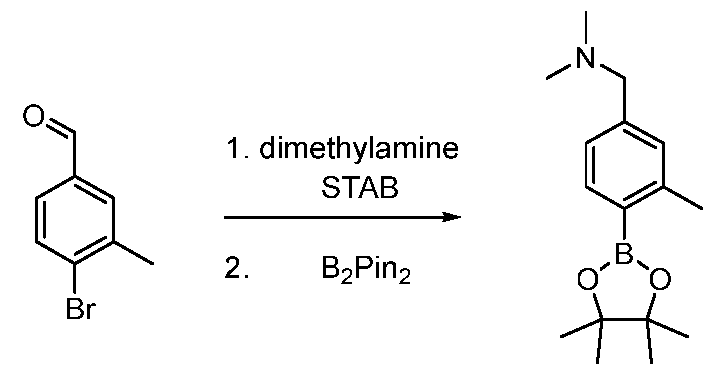
- a seventh exemplary Intermediate D, Intermediate D-7 may be used to synthesize compounds of formula I, wherein R 1 is aryl substituted with an R 4 substituent.
- R 1 is aryl substituted with an R 4 substituent.
- pyrrolidine (1.79 g, 25.1 mmol, 2.10 mL, 5.00 equiv) in methanol (16.0 mL) was added NaBH 3 CN (347 mg, 5.53 mmol, 1.10 equiv). The mixture was stirred at 20 °C for 24 h.
- n- butyllithium (2.50 M, 1.80 mL, 1.00 equiv) was added dropwise over one min to i-PrMgCl (2.00 M, 1.12 mL, 0.500 equiv) in THF (12 mL) at 0 °C under a nitrogen atmosphere.
- the mixture was stirred at 0 °C for 5 min followed by the addition of 5-bromo-4-chloro-2-methoxy-pyridine (1.00 g, 4.50 mmol, 1.00 equiv) after which the mixture was stirred at 0 °C for 45 min.
- a ninth exemplary Intermediate D, Intermediate D-9 may be used to synthesize compounds of formula I, wherein R 1 is heteroaryl substituted with three R 4 substituents.
- An eleventh exemplary Intermediate D, Intermediate D-11 may be used to synthesize compounds of formula I, wherein R 1 is heteroaryl substituted with three R 4 substituents.
- R 1 is heteroaryl substituted with three R 4 substituents.
- (2S)-2-methyloxirane 392 mg, 6.75 mmol, 473 ⁇ L, 15.0 equiv
- cesium carbonate 29.3 mg, 90.1 ⁇ mol, 0.20 equiv).
- a twelfth exemplary Intermediate D, Intermediate D-12 may be used to synthesize compounds of formula I, wherein R 1 is aryl substituted with two R 4 substituents.
- R 1 is aryl substituted with two R 4 substituents.
- DIEA 490 mg, 3.79 mmol, 660 ⁇ L, 3.00 equiv
- N,N-dimethylamine (2.00 M in THF, 1.27 mL, 2.00 equiv) in DMF (3.00 mL) was added HATU (727 mg, 1.91 mmol, 1.50 equiv).
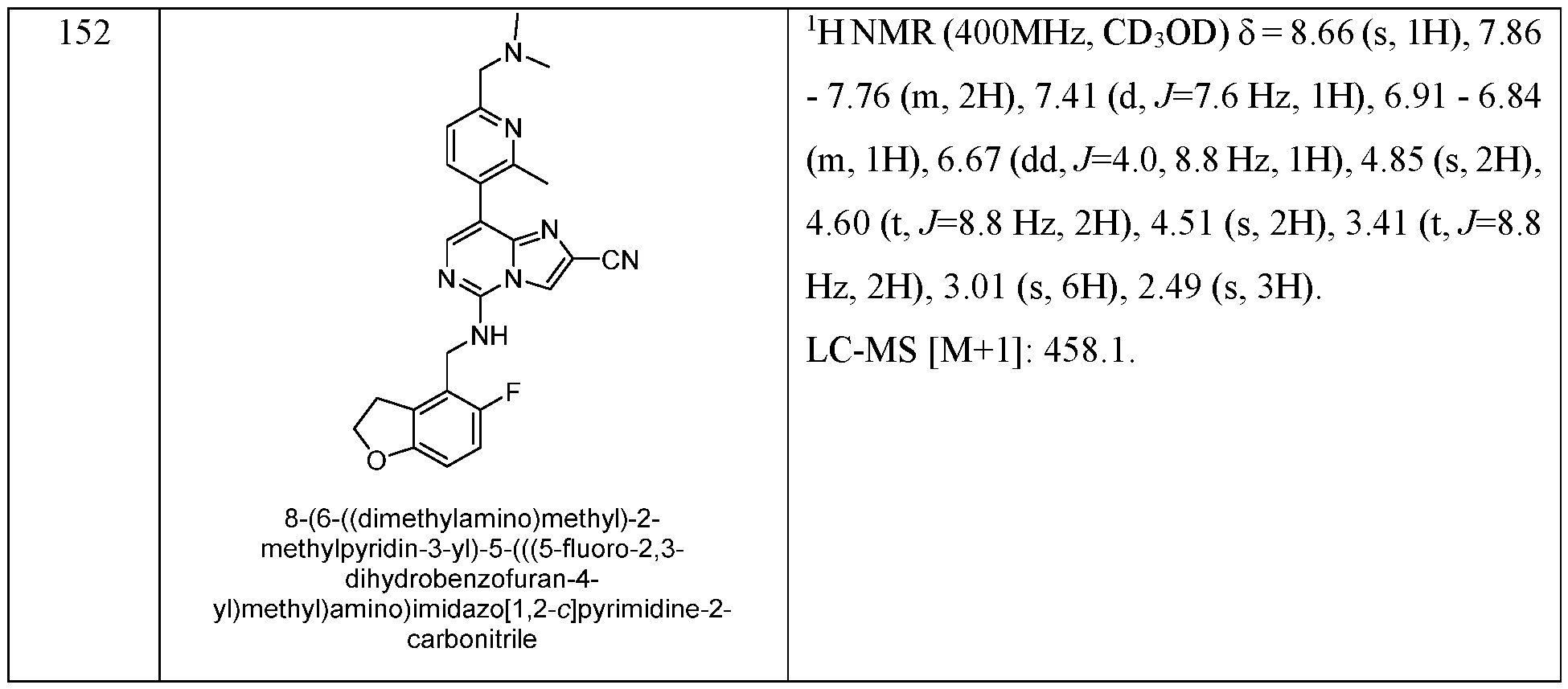
- EXAMPLE 1 8-(1,3-dimethyl-1H-pyrazol-5-yl)-5-(((5-fluoro-2,3-dihydrobenzofuran-4-yl)methyl)amino)imidazo[1,2- c]pyrimidine-2-carboxylic acid
- a mixture of ethyl 8-bromo-5-(((5-fluoro-2,3-dihydrobenzofuran-4- yl)methyl)amino)imidazo[1,2-c]pyrimidine-2-carboxylate (0.100 g, 230 ⁇ mol, 1.00 equiv), 1,3-dimethyl- 5-(4,4,5,5-tetramethyl-1,3,2-dioxaborolan-2-yl)pyrazole (81.6 mg, 368 ⁇ mol, 1.60 equiv), sodium bicarbonate (77.2
- the reaction mixture was stirred at 105 °C for 1 h under nitrogen.
- the mixture was cooled to 25 °C and filtered.
- the filtrate was concentrated in vacuo to provide a residue.
- the precipitate was filtered to provide the crude material (80 mg) as a brown solid.
- the crude material was purified by prep- HPLC(column: Phenomenex Synergi C 1 8150 ⁇ 25 ⁇ 10 ⁇ m; mobile phase:[water (0.1 %TFA) - ACN]; B%: 12% - 42%, 10 min) to afford 5-(((5-fluorobenzofuran-4-yl)methyl)amino)-8-(2-methylpyridin-3- yl)imidazo[1,2-c]pyrimidine-2-carboxylic acid (10.0 mg, 99.7 % purity) as a gray solid.
- EXAMPLE 12 5-(((5-fluorobenzofuran-4-yl)methyl)amino)-8-(2-methylpyridin-3-yl)imidazo[1,2-c]pyrimidine-2- [000380] A mixture of 5-(((5-fluorobenzofuran-4-yl)methyl)amino)-8-(2-methylpyridin-3- yl)imidazo[1,2-c]pyrimidine-2-carboxylic acid (80.0 mg, 192 ⁇ mol, 1.00 equiv), DIEA (74.3 mg, 575 ⁇ mol, 100 ⁇ L, 3.00 equiv) and ammonium chloride (30.8 mg, 575 ⁇ mol, 3 equiv) in DMF (3.00 mL) was cooled to 0 °C.
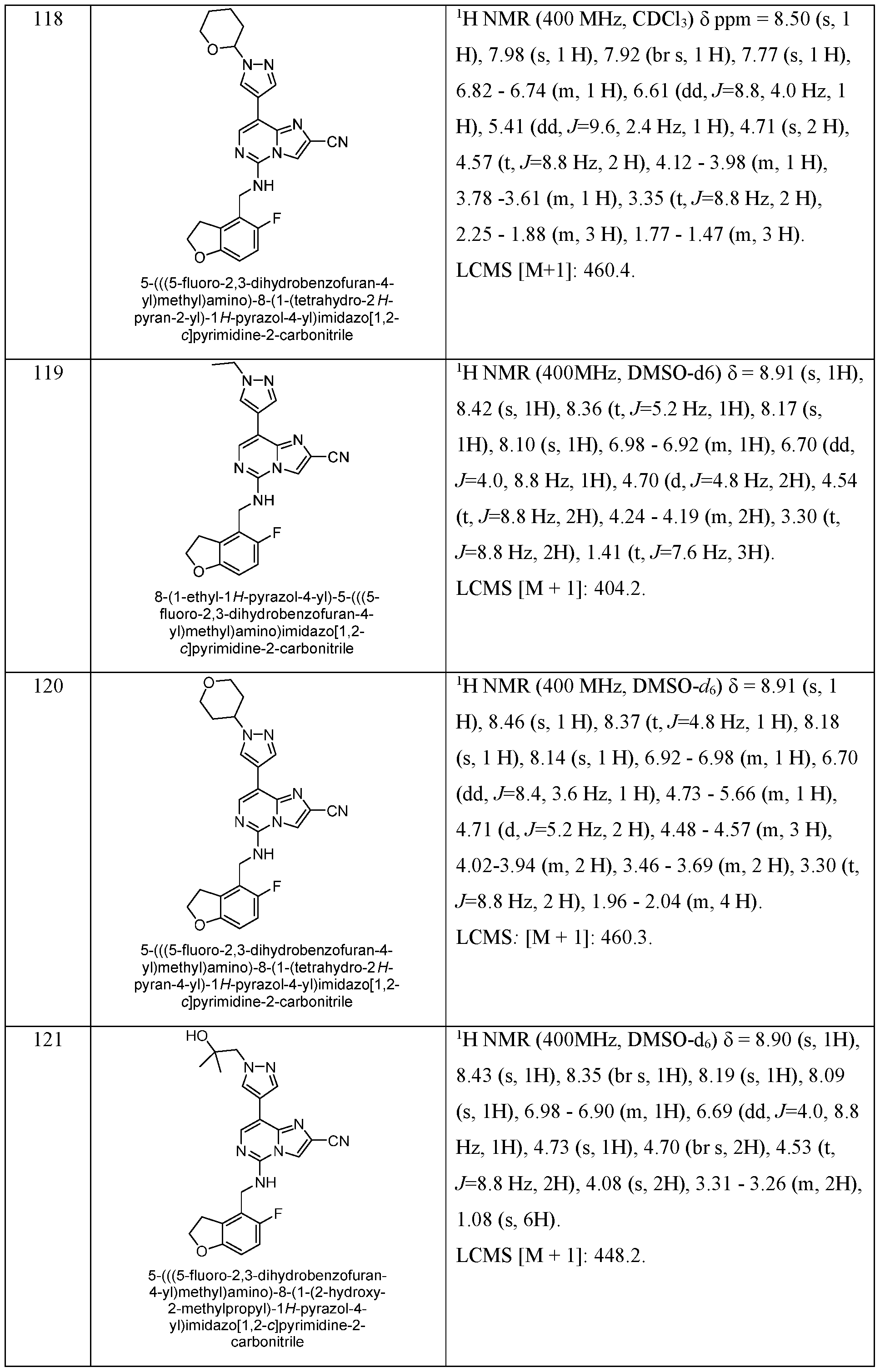
- EXAMPLES 13 -21 were prepared following the procedure set forth in Example 12 and using the general reactions schemes and intermediates described herein. TABLE 2 Characterization of EXAMPLES 13-21 EXAMPLE 22 5-(((5-fluorobenzofuran-4-yl)methyl)amino)-8-(2-methylpyridin-3-yl)imidazo[1,2-c]pyrimidine-2- carbonitrile [000383] To a solution of 5-(((5-fluorobenzofuran-4-yl)methyl)amino)-8-(2-methylpyridin-3- yl)imidazo[1,2-c]pyrimidine-2-carboxamide (45.0 mg, 108 ⁇ mol, 1.00 equiv), TEA (219 mg, 2.16 mmol, 301 ⁇ L, 20.0 equiv) in THF (1.50 mL) was added TFAA (136 mg, 648 ⁇ mol, 90.2 ⁇ L, 6.00 equiv) at 0 °C.
- the mixture was subsequently stirred at 25 °C for 1 h.
- the reaction mixture was diluted with ethyl acetate (10.0 mL) and washed with water (10.0 mL x 3).
- the organic layer was dried over anhydrous sodium sulfate, filtered, and concentrated at reduced pressure to give a residue.
- the mixture was subsequently stirred at 25 °C for 1 h.
- the reaction mixture was diluted with ethyl acetate (10.0 mL), the pH was adjusted to ⁇ 7 with TFA, and the organic layer was washed with brine (5.00 mL ⁇ 3). Concentration in vacuo provided the crude material.
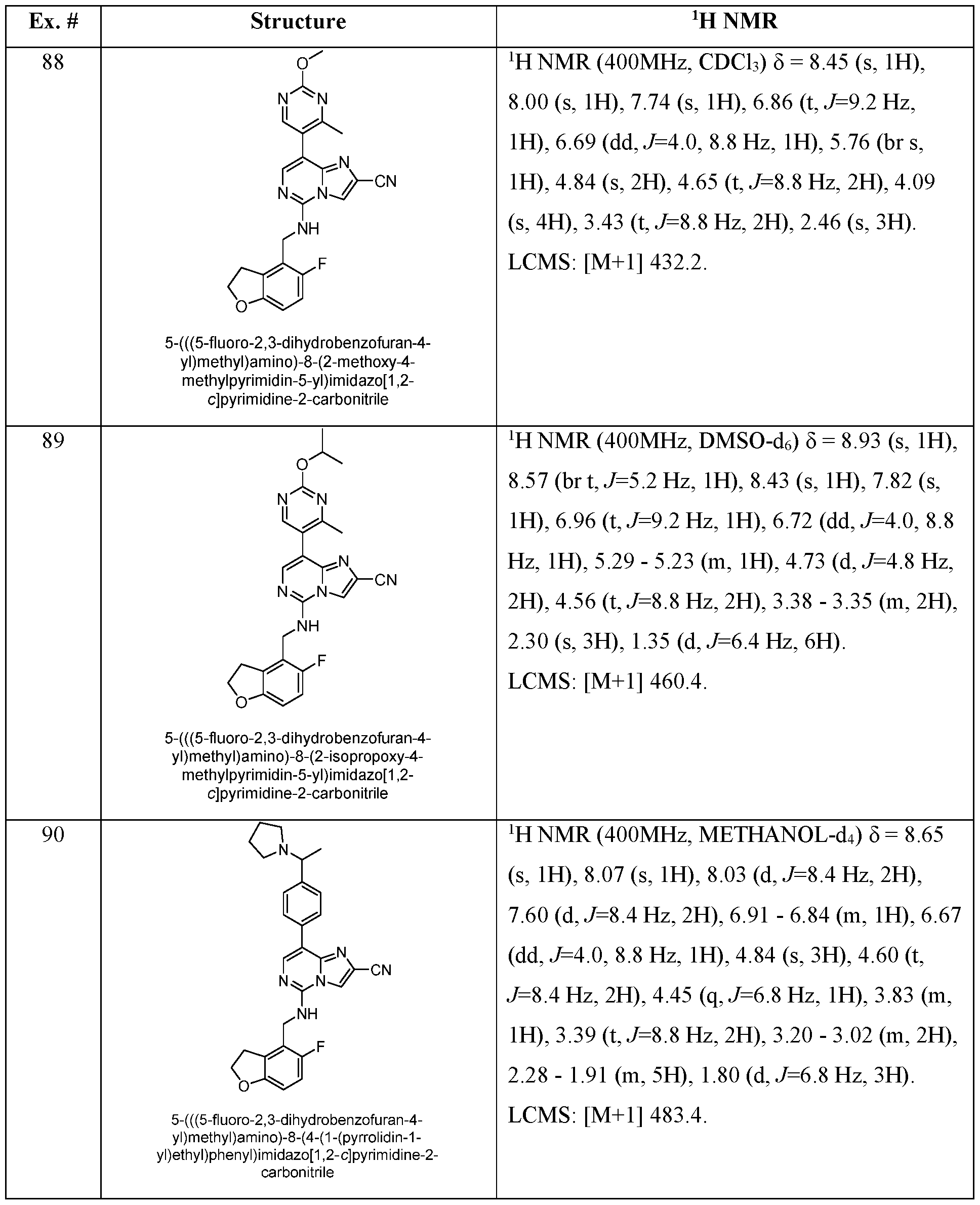
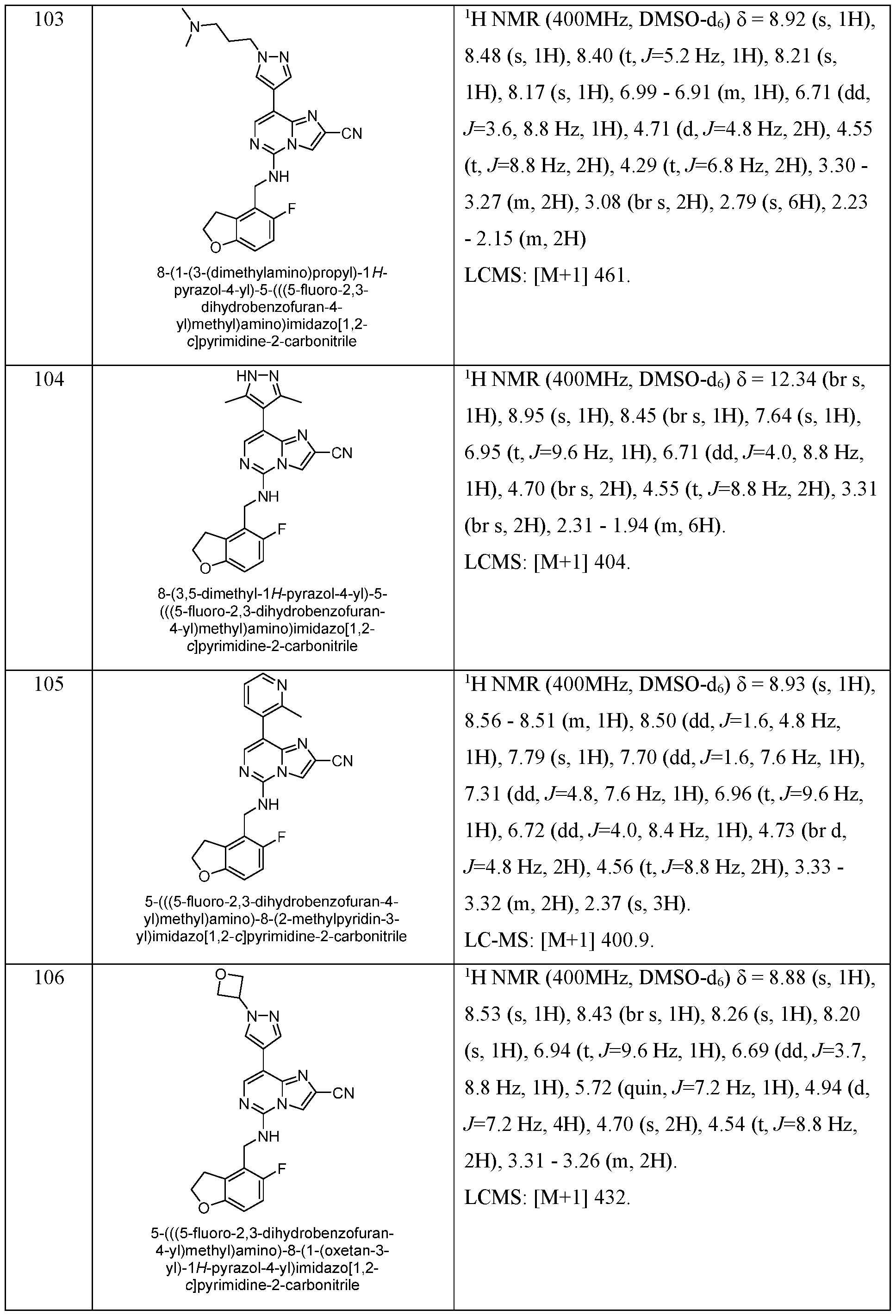
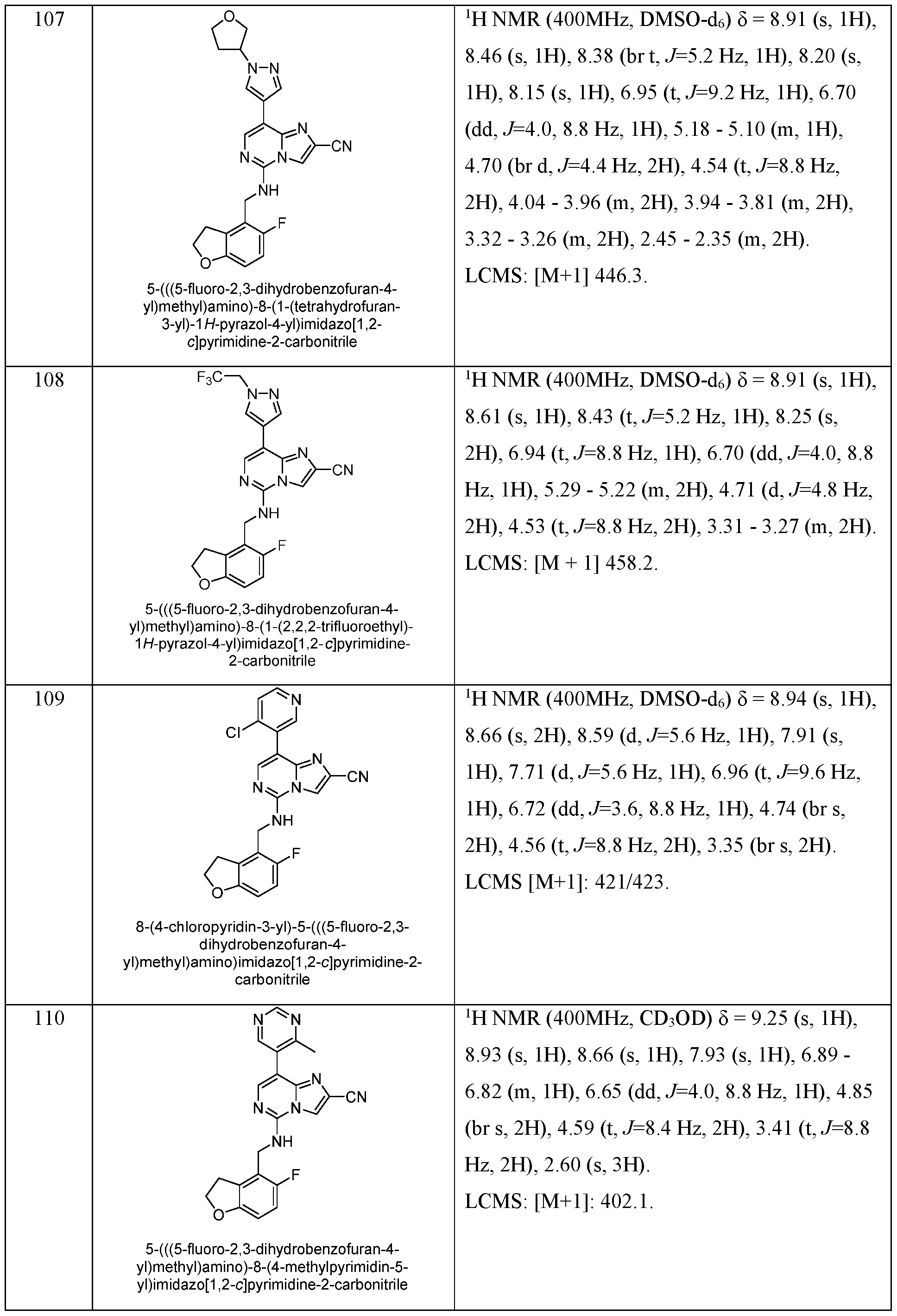
- EXAMPLES 88 -136 were prepared following the procedure set forth in Example 87 and using the general reactions schemes and intermediates described herein. TABLE 4 Characterization of EXAMPLES 88-136 EXAMPLE 137 5-(((5-fluoro-2,3-dihydrobenzofuran-4-yl)methyl)amino)-8-(2-methylpyridin-3-yl)imidazo[1,2- c]pyrimidine-2-carboxamide [000393] A mixture of 5-(((5-fluoro-2,3-dihydrobenzofuran-4-yl)methyl)amino)-8-(2-methylpyridin-3- yl)imidazo[1,2-c]pyrimidine-2-carbonitrile (38.0 mg, 92.5 ⁇ mol, 1.00 equiv) in conc.
- EXAMPLE 140 [000399] A mixture of ethyl 8-bromo-5-(((5-fluoro-2,3-dihydrobenzofuran-4- yl)methyl)amino)imidazo[1,2-c]pyrimidine-2-carboxylate (0.20 g, 460 ⁇ mol, 1.00 equiv), tert-butyl4- (4,4,5,5-tetramethyl-1,3,2-dioxaborolan-2-yl)-3,6-dihydro-2H-pyridine-1-carboxylate(227 mg, 735 ⁇ mol, 1.60 equiv), NaHCO 3 (116 mg, 1.38 mmol, 3.00 equiv), Pd(dppf)Cl 2 (33.6 mg, 46.0 ⁇ mol, 0.100 equiv) in dioxane (2.10 mL) and water (0.700 mL) was purged with nitrogen.
- the vessel was purged with nitrogen, stirred at 105 °C for 1 h and subsequently concentrated in vacuo to provide a residue.
- the residue was purified by Prep- TLC (SiO2, petroleum ether/ethyl acetate, 1/1) to afford ethyl 8-(3,6-dihydro-2H-pyran-4-yl)-5-(((5- fluoro-2,3-dihydrobenzofuran-4-yl)methyl)amino)imidazo[1,2-c]pyrimidine-2-carboxylate (81.0 mg, 77.7% yield, 96.6% purity) as a white solid.
- the resultant mixture was stirred at 0 - 30 °C for 1 h and was subsequently filtered and concentrated to provide the crude residue.
- the residue was purified by prep-HPLC (column: Gemini 150 ⁇ 255 u; mobile phase: [water (0.04 %NH 3 H 2 O) - ACN]; B %: 35.0 % - 65.0 %, 10 min) to afford 5- (((5-fluoro-2,3-dihydrobenzofuran-4-yl)methyl)amino)-8-(tetrahydro-2H-pyran-4-yl)imidazo[1,2- c]pyrimidine-2-carbonitrile (26.0 mg, 63.1 ⁇ mol, 92.7% yield, 95.5% purity) as a yellow solid.
- reaction mixture was cooled to rt and quenched with sat aq potassium fluoride (2.00 mL).
- the mixture was extracted with ethyl acetate (2.00 mL ⁇ 3) and the combined organic layer was washed with brine (2.00 mL ⁇ 2), dried over sodium sulfate, filtered, and concentrated under reduced pressure to give a residue.
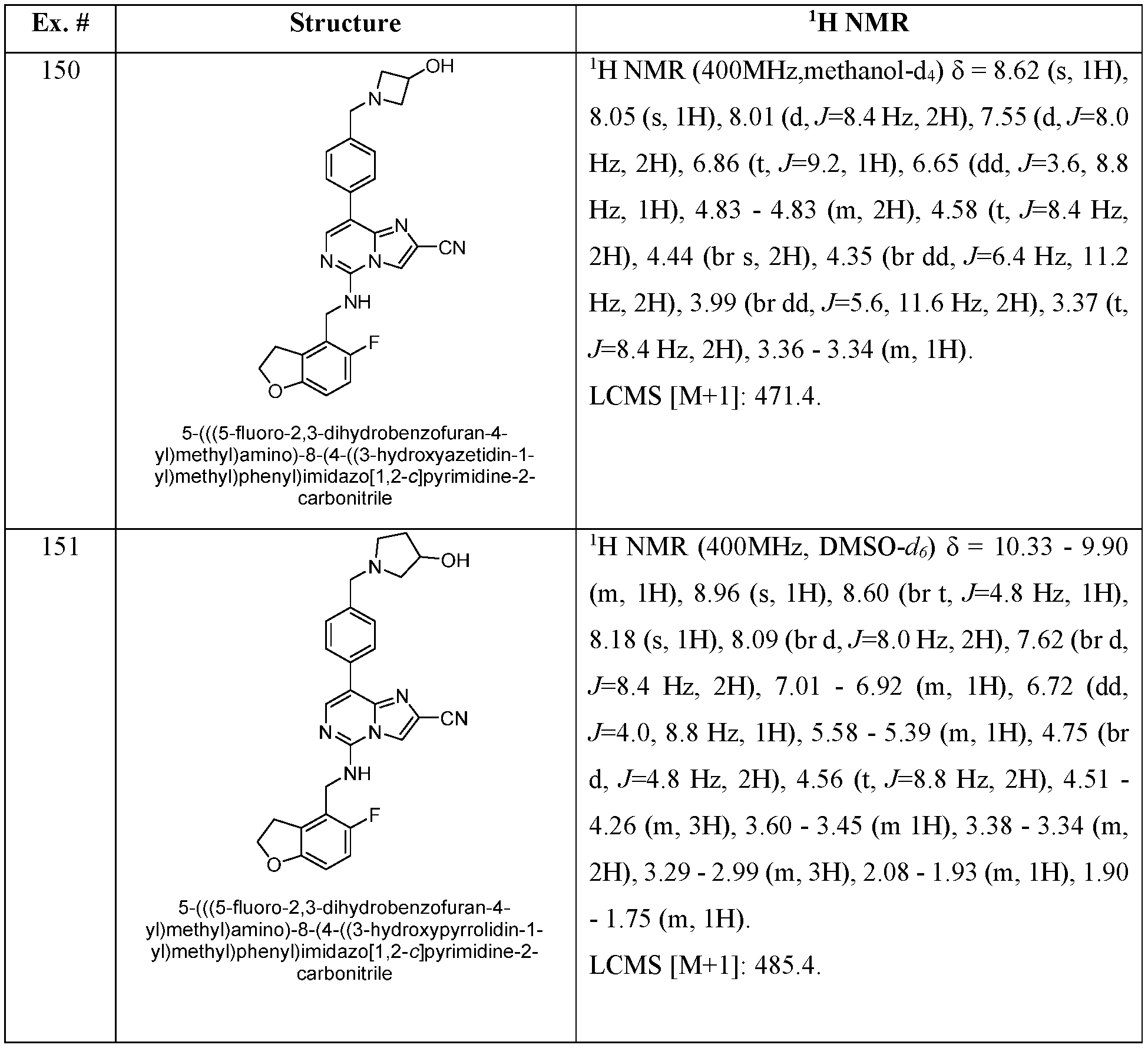
- EXAMPLE 149 8-(4-((dimethylamino)methyl)-3,5-difluorophenyl)-5-(((5-fluoro-2,3-dihydrobenzofuran-4- yl)methyl)amino)imidazo[1,2-c]pyrimidine-2-carbonitrile [000424] To a solution of 8-bromo-5-(((5-fluoro-2,3-dihydrobenzofuran-4- yl)methyl)amino)imidazo[1,2-c]pyrimidine-2-carbonitrile (50.0 mg, 129 ⁇ mol, 1.00 eq.), (3,5-difluoro-4- formyl-phenyl)boronic acid (28.7 mg, 155 ⁇ mol, 1.20 eq.) in dioxane (1.00 mL) and water (0.20 mL) was added Pd(dppf)Cl2 (9.42 mg, 12.9 ⁇ mol, 0.10
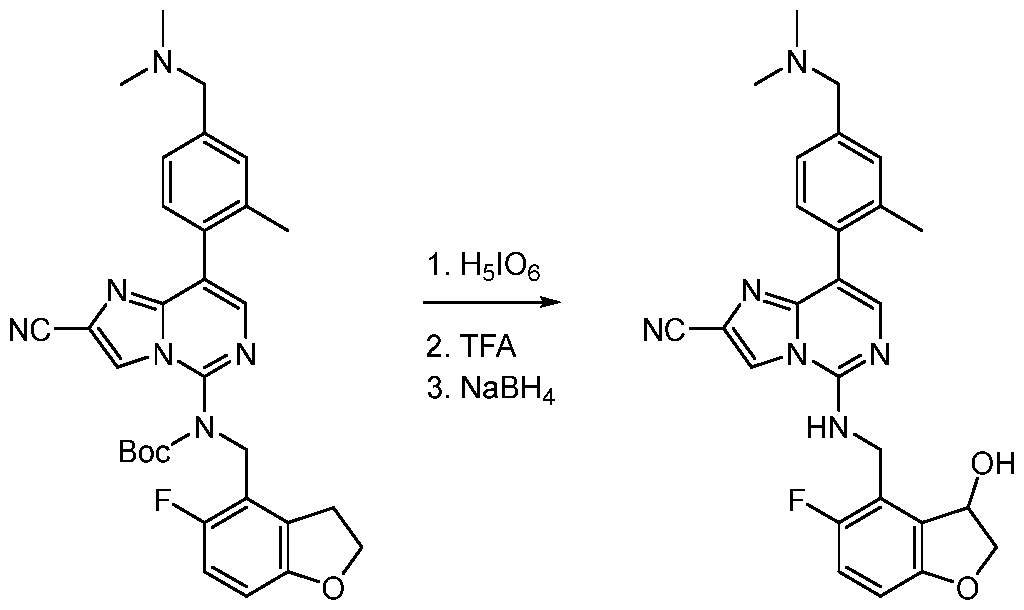
- EXAMPLE 154 was prepared following the procedure set forth in Example 153 and using the general reactions schemes and intermediates described herein. Table 7 Characterization of EXAMPLE 154 EXAMPLE 155 8-(1,3-dimethyl-1H-pyrazol-5-yl)-5-(((5-fluoro-3-hydroxy-2,3-dihydrobenzofuran-4- yl)methyl)amino)imidazo[1,2-c]pyrimidine-2-carbonitrile [000431] To a solution of tert-butyl (8-bromo-2-cyanoimidazo[1,2-c]pyrimidin-5-yl)((5-fluoro-2,3- dihydrobenzofuran-4-yl)methyl)carbamate (200 mg, 410 ⁇ mol, 1.00 eq.) in acetonitrile (4.50 mL) was added periodic acid (345 mg, 1.52 mmol, 345 ⁇ L, 3.70 eq.) and chro
- the mixture was stirred at 15 °C for 3 h.
- the reaction mixture was filtered through a plug of Celite.
- the filtrate was diluted with water (3.00 mL) and extracted with ethyl acetate (5.00 mL ⁇ 3).
- the combined organic phase was washed with aqueous sodium sulfite solution (2.00 mL), brine (2.00 mL), dried over anh sod sulfate, filtered, and concentrated to provide the crude material.
- EXAMPLE 156 5-(((5-fluoro-2,3-dihydrobenzofuran-4-yl)methyl)amino)-8-(1-methyl-2-oxo-1,2-dihydropyridin-3- yl)imidazo[1,2-c]pyrimidine-2-carbonitrile [000436] To a solution of tert-butyl (2-cyano-8-(2-oxo-1,2-dihydropyridin-3-yl)imidazo[1,2- c]pyrimidin-5-yl)((5-fluoro-2,3-dihydrobenzofuran-4-yl)methyl)carbamate (45.0 mg, 89.6 ⁇ mol, 1.00 eq.) in DMF (0.50 mL) was added potassium carbonate (24.8 mg, 179 ⁇ mol, 2.00 eq.) at 0 °C.
- EXAMPLES 157 - 184 were prepared following the procedure set forth in EXAMPLE 87 and using the general reactions schemes and intermediates described herein. Table 8 Characterization of EXAMPLES 157 - 184
- EXAMPLES 193 and 194 [000440] EXAMPLES 193 and 194 were prepared following the procedure set forth in EXAMPLE 142 and using the general reactions schemes and intermediates described herein. Table 9 Characterization of EXAMPLES 193 and 194 EXAMPLES 195 -202 [000441] EXAMPLES 195 -202 were prepared following the procedure set forth in EXAMPLE 149 and using the general reactions schemes and intermediates described herein. Table 10 Characterization of EXAMPLES 195 - 202
- EXAMPLE 207 8-(4-((dimethylamino)methyl)-2-methylphenyl)-5-(((5-fluoro-3-hydroxy-2,3-dihydrobenzofuran-4- yl)methyl)amino)imidazo[1,2-c]pyrimidine-2-carbonitrile [000452]
- EXAMPLE 210 8-(3-((dimethylamino)methyl)-1-methyl-1H-pyrazol-5-yl)-5-(((5-fluoro-2,3-dihydrobenzofuran-4- yl)methyl)amino)imidazo[1,2-c]pyrimidine-2-carbonitrile [000460] To a solution of 5-(2-cyano-5-(((5-fluoro-2,3-dihydrobenzofuran-4- yl)methyl)amino)imidazo[1,2-c]pyrimidin-8-yl)-N,N,1-trimethyl-1H-pyrazole-3-carboxamide (100 mg, 217 ⁇ mol, 1.00 equiv) in THF (1.00 mL) was added di-tert-butyl dicarbonate (56.9 mg, 261 ⁇ mol, 59.9 ⁇ L, 1.20 equiv) and DMAP (2.65 mg, 21.7 ⁇ mol, 0.10 e
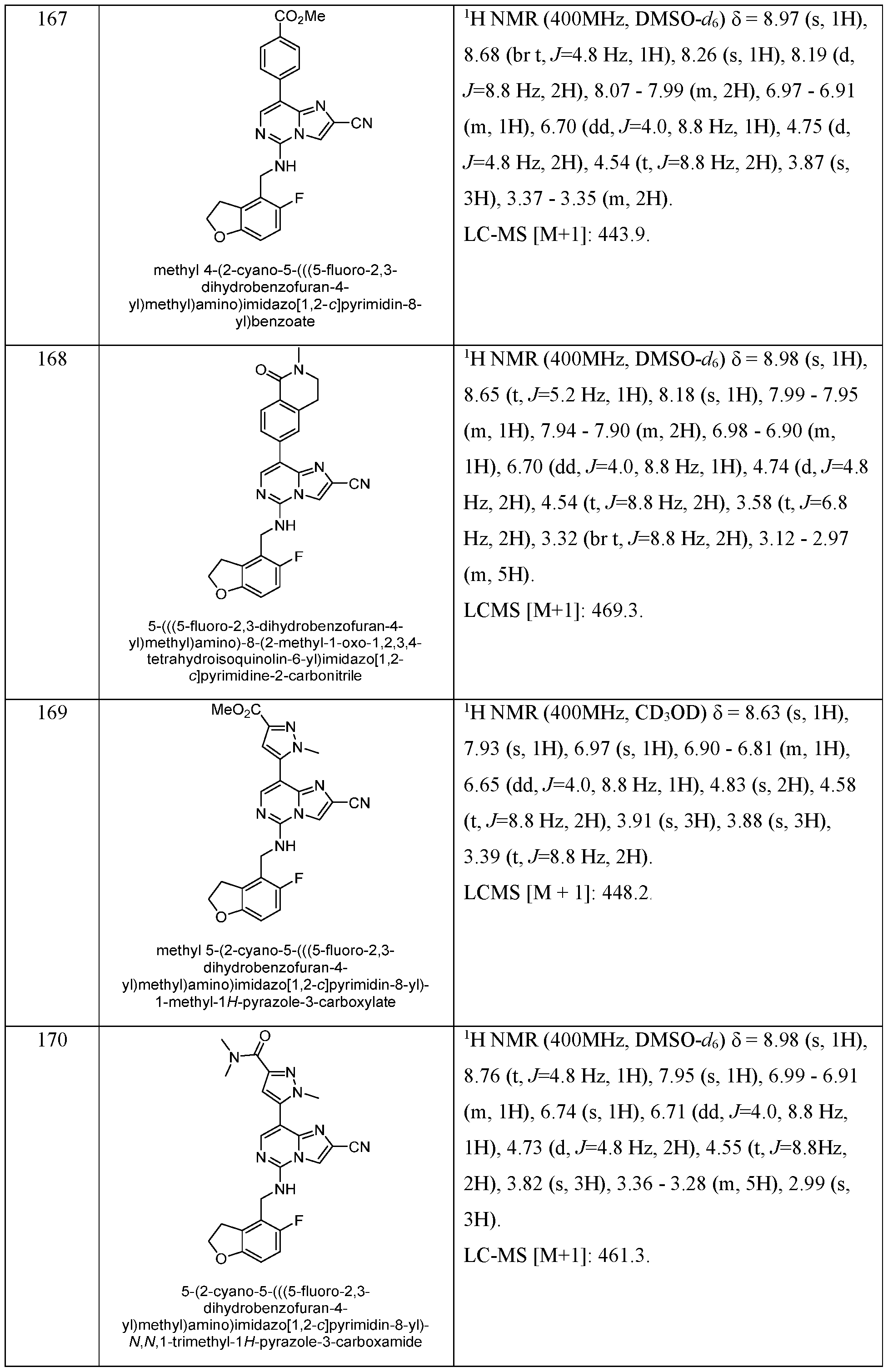
- EXAMPLE 212 8-(3-cyano-1-methyl-1H-pyrazol-5-yl)-5-(((5-fluoro-2,3-dihydrobenzofuran-4- yl)methyl)amino)imidazo[1,2-c]pyrimidine-2-carbonitrile [000468] To a solution of 5-[2-cyano-5-[(5-fluoro-2,3-dihydrobenzofuran -4- yl)methylamino]imidazo[1,2-c]pyrimidin-8-yl]-1-methyl-pyrazole-3-carboxylic acid (100 mg, 185 ⁇ mol, 1.00 equiv) and ammonium chloride (30.0 mg, 561 ⁇ mol, 3.04 equiv) in DMF (2.00 mL) was added HATU (105 mg, 276 ⁇ mol, 1.50 equiv) and DIEA (72.0 mg, 557 ⁇ mol, 97.0 ⁇ L, 3.02 equiv).
- EXAMPLE 216 8-(2-((dimethylamino)methyl)pyrimidin-5-yl)-5-(((5-fluoro-2,3-dihydrobenzofuran-4- yl)methyl)amino)imidazo[1,2-c]pyrimidine-2-carbonitrile [000483] To a solution of tert-butyl ((5-(2-cyano-5-(((5-fluoro-2,3-dihydrobenzofuran-4- yl)methyl)amino)imidazo[1,2-c]pyrimidin-8-yl)pyrimidin-2-yl)methyl)carbamate (90.0 mg, 156 ⁇ mol, 1.00 equiv) in DCM (2.00 mL) was added TFA (890 mg, 7.81 mmol, 578 ⁇ L, 50.0 equiv).
- EXAMPLE 217 8-(3-(2-(dimethylamino)ethyl)phenyl)-5-(((5-fluoro-2,3-dihydrobenzofuran-4- yl)methyl)amino)imidazo[1,2-c]pyrimidine-2-carbonitrile [000486] A mixture of 8-bromo-5-(((5-fluoro-2,3-dihydrobenzofuran-4-yl)methyl)amino)imidazo[1,2- c]pyrimidine-2-carbonitrile (50.0 mg, 129 ⁇ mol, 1.00 equiv), [3-(2-hydroxyethyl)phenyl]boronic acid (32.1 mg, 193 ⁇ mol, 1.50 equiv), sodium bicarbonate (32.5 mg, 386 ⁇ mol, 3.00 equiv) and Pd(dppf)Cl2 (9.42 mg, 12.9 ⁇ mol, 0.10 equiv) in dioxane (2.00
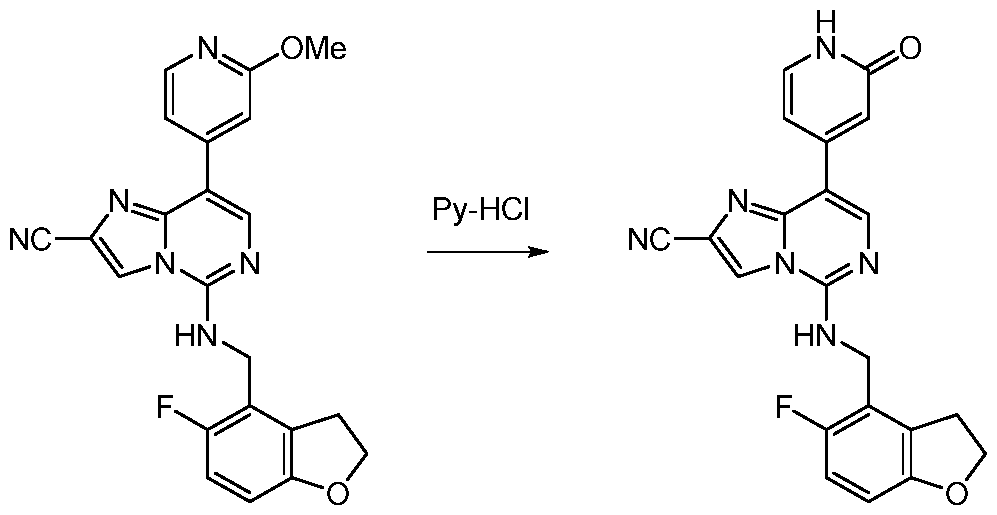
- EXAMPLE 218 5-(((5-fluoro-2,3-dihydrobenzofuran-4-yl)methyl)amino)-8-(2-oxo-1,2-dihydropyridin-4- yl)imidazo[1,2-c]pyrimidine-2-carbonitrile [000491] A mixture of 5-[(5-fluoro-2,3-dihydrobenzofuran-4-yl)methylamino]-8-(2-methoxy-4- pyridyl)imidazo[1,2-c]pyrimidine-2-carbonitrile (55.0 mg, 125 ⁇ mol, 1.00 equiv) and pyridine hydrochloride (71.5 mg, 619 ⁇ mol, 4.93 equiv) was heated at 130 °C for 0.5 h.
- the reaction was stirred at 25 °C for 1 h and was subsequently quenched by the addition of water (30.0 mL) at 25 °C.
- the aqueous layer was diluted with ethyl acetate (50.0 mL), at which time a white precipitate formed.
- EXAMPLE 230 8-(1-(2-(dimethylamino)ethyl)-1H-pyrazol-5-yl)-5-(((5-fluoro-2,3-dihydrobenzofuran-4- yl)methyl)amino)imidazo[1,2-c]pyrimidine-2-carbonitrile [000496] To a solution of tert-butyl (E)-(2-cyano-8-(3-(dimethylamino)acryloyl)imidazo[1,2- c]pyrimidin-5-yl)((5-fluoro-2,3-dihydrobenzofuran-4-yl)methyl)carbamate (13.0 mg, 25.0 ⁇ mol, 1.00 equiv) in ethanol (2.00 mL) was added 2-hydrazino-N,N-dimethyl-ethanamine-HCl (14.0 mg, 99.9 ⁇ mol, 4.00 equiv), the reaction was stirred at 80 °C
- EXAMPLE 231 5-(((5-fluoro-2,3-dihydrobenzofuran-4-yl)methyl)amino)-8-(1-(2-hydroxyethyl)-1H-pyrazol-5- yl)imidazo[1,2-c]pyrimidine-2-carbonitrile [000499] To a solution of tert-butyl (E)-(2-cyano-8-(3-(dimethylamino)acryloyl)imidazo[1,2- c]pyrimidin-5-yl)((5-fluoro-2,3-dihydrobenzofuran-4-yl)methyl)carbamate (16.0 mg, 31.6 ⁇ mol, 1.00 equiv) in ethanol (1.00 mL) was added 2-hydrazinoethanol (4.81 mg, 63.2 ⁇ mol, 4.29 ⁇ L, 2.00 equiv).
- EXAMPLE 232 8-(4-bromo-1H-pyrazol-3-yl)-5-(((5-fluoro-2,3-dihydrobenzofuran-4-yl)methyl)amino)imidazo[1,2- c]pyrimidine-2-carbonitrile [000502] To a solution of tert-butyl (2-cyano-8-(1H-pyrazol-3-yl)imidazo[1,2-c]pyrimidin-5-yl)((5- fluoro-2,3-dihydrobenzofuran-4-yl)methyl)carbamate (95.0 mg, 200 ⁇ mol, 1.00 equiv) in dry chloroform (1.00 mL) was added portionwise NBS (53.5 mg, 300 ⁇ mol, 1.50 equiv).
- the compounds of the present disclosure may have one or more chiral center and, if so, are synthesized as stereoisomeric mixtures, isomers of identical constitution that differ in the arrangement of their atoms in space.
- the compounds may be used as mixtures or the individual components/isomers may be separated using commercially available reagents and conventional methods for isolation of stereoisomers and enantiomers well-known to those skilled in the art, e.g., using CHIRALPAK® (Sigma- Aldrich) or CHIRALCEL® (Diacel Corp) chiral chromatographic HPLC columns according to the manufacturer’s instructions, as well as methods described herein, e.g., EXAMPLES 213 and 214.
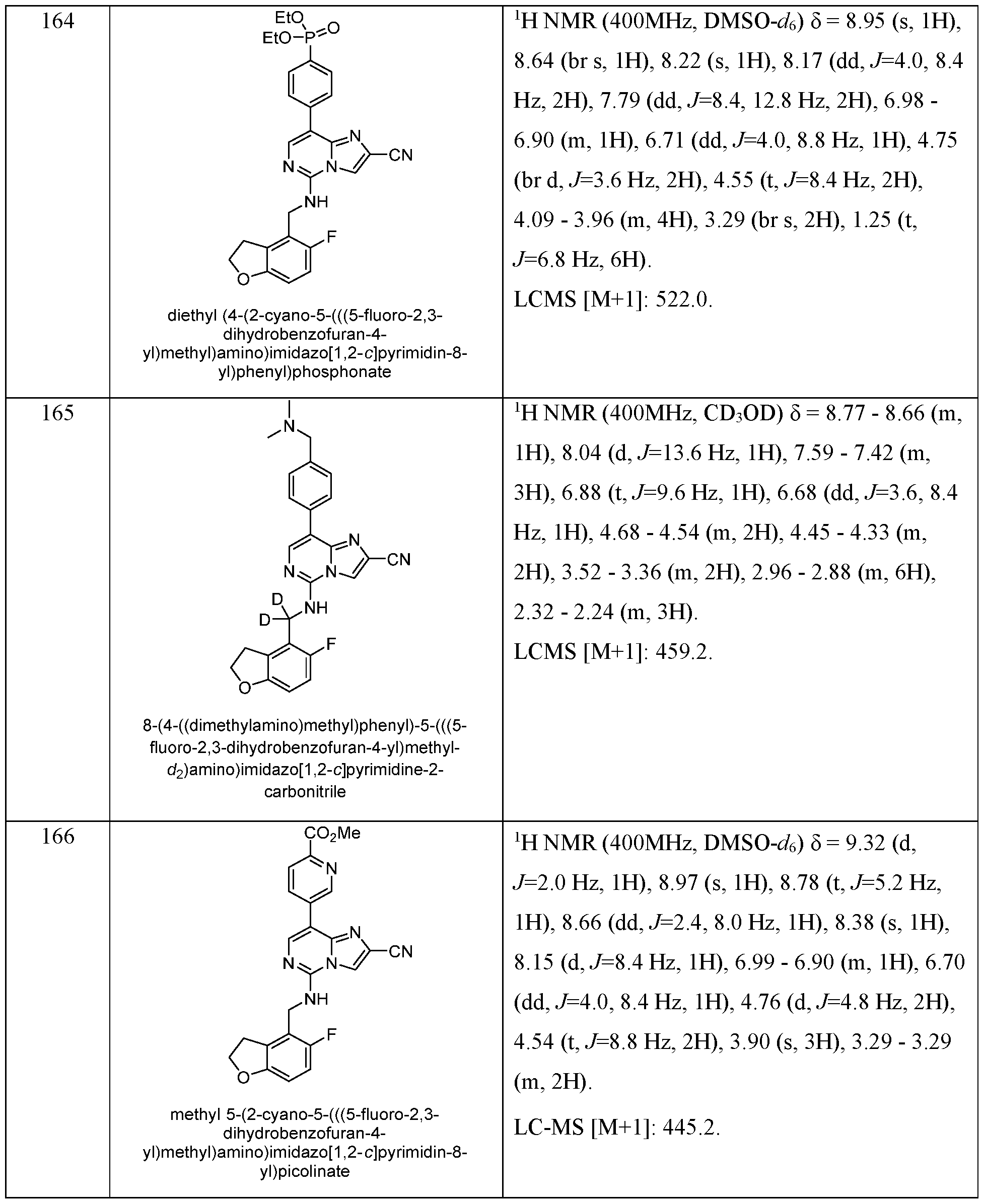
- compounds of the present disclosure may be synthesized using optically pure, chiral reagents and intermediates to prepare individual isomers or enantiomers. Unless otherwise indicated, all chiral (enantiomeric and diastereomeric) and racemic forms are within the scope of the disclosure. [000511] Also contemplated within the scope of the disclosure are variants of compounds of the present disclosure in which one or more hydrogen atoms have been replaced with deuterium. As exemplified herein, Intermediates C-11 and D-31 have one or more hydrogen atom replaced with deuterium and were used to generated EXAMPLE 165 and 173, respectively. Intermediates B-7, B-8, and C18 also contain deuteriums substituted as specifies location(s).
- EXAMPLE 202 illustrates deuterated compounds of the present disclosure wherein R 7 is deuterated.
- R 7 is deuterated.
- deuterated versions of the compounds of the present disclosure can be readily generated using methods well known in the art.
- EXAMPLE A This Example illustrates that exemplary compounds of the present disclosure inhibit PRC2 enzymatic activity.
- Ten-point dose-response curves for compounds of the present disclosure were determined using a Hot Spot HMT assay (Reaction Biology Corp; see Horiuchi et al., Assay Drug Dev Technol. (2013) 4: 227-236 doi: 10.1089/adt.2012.480).
- the assay uses purified human, His-tagged PRC2 complex, including N-terminal His-tagged EZH2 enzyme, N-terminal Flag-tagged embryonic ectoderm development protein (EED), N-terminal His-tagged suppressor of zeste 12 (SUZ12), N-terminal His- tagged AEBP2, and N-terminal His-tagged RbAp48.
- EED embryonic ectoderm development protein
- SAM radiolabeled S-adenosyl methionine
- Example B [000516] This Example illustrates that treatment of bone marrow derived CD34+ cells from two healthy human donors with compound Example 32 (8-(4-((dimethylamino)methyl)-2-methylphenyl)-5-(((5- fluoro-2,3-dihydrobenzofuran-2-yl)methyl)amino)imidazo[1,2-c]pyrimidine-2-carbonitrile) increases fetal hemoglobin levels in the cells. [000517] Cell Culture and differentiation protocol. Human bone marrow derived CD34+ cells from healthy donors were purchased from StemCell (#70002.2).
- the CD34+ cells were differentiated using the STEMdiff TM Erythroid kit (StemCell #100-0074) according to manufacturer’s instructions.
- the CD34+ cells were differentiated for 14 days, and the differentiation medium consisted of StemSpanTM SFEM II media and 10% of STEMdiffTM Erythroid Supplement E2 (10X).
- the CD34+ cells were thawed and plated in a 12-well plate (Corning #3512) at a density of 40,000 cells/well in 1mL of differentiation media.100 ⁇ L of STEMdiffTM Erythroid Supplement E2 (10X) was added to each well on Day 2, 4, 9 and 11 during differentiation. On day 7, cells were passaged and replated at a density of 167,000 cells/well in a 12-well plate.
- RNA extraction and RT-qPCR analysis were performed with vehicle, 7 concentrations of compound Example 32 in concentrations ranging from 15.625 nM to 1 ⁇ M (1:5-fold serial dilution) and 20 ⁇ M of HU.100 ⁇ L of STEMdiffTM Erythroid Supplement E2 (10X) was added to each well on Day 2 and 4.
- Cells were treated with vehicle, compound Example 32, or HU for 7 days and were then harvested for RT-qPCR and flow cytometry. [000519] RNA extraction and RT-qPCR analysis.
- RT qPCR reactions were set up using 3 ⁇ L of 3 ng of RNA in 7 ⁇ L of pre-mixed SensiFASTTM SYBR No-ROX One-Step Kit reagents (BIOLINE, Cat# BIO-98005) and RT-qPCR was run on a Bio-Rad CFX384 Real-Time PCR System. HBG1 and HBG2 mRNA levels were normalized to housekeeping gene RPL27 and are plotted relative to mRNA levels in vehicle treated cells. Primer sequences for RT-qPCR [000520] Flow Cytometry. The cell pellets harvested for flow cytometry analysis were collected in a V- shaped 96-well polypropylene plate (ThermoFisher #249944).
- the cells were washed with PBS and resuspended in 100 ⁇ L of PBS.
- the cells were first stained with eFluor 450 viability dye (diluted 1:250 in cold PBS; Invitrogen #65-0863-14) for 5 minutes on ice in the dark followed by incubation in Fc receptor blocking solution for 10 minutes (BioLegend #422302).
- the cells were then washed with FACS buffer (1X PBS, 0.5% BSA, 0.02% NaAzide and 2 mM EDTA) and resuspend in 100 ⁇ L of FACS buffer.
- the cells were next stained with fluorochrome conjugated antibodies targeted against cell surface receptors such as anti-human CD235a-FITC (StemCell #60152FI) and/or anti-human CD71-APC (StemCell #60106AZ) for 25 minutes on ice.
- the cells were washed twice using FACS buffer and then fixed using Fixation buffer from the Fixation/Permeabilization kit (BD biosciences #554714) for 10 minutes on ice.
- the cells were further washed twice with 1X Permeabilization/Wash buffer and then incubated in the same buffer for 5 minutes.
- the permeabilized cells were stained using anti-human Fetal Hemoglobin-APC (ThermoFisher #MHFH05) for 15 minutes on ice in 1X Permeabilization/Wash buffer. Cells were washed twice and resuspended in FACS buffer and then analyzed by flow cytometry. Data was acquired using SONY SA3800 cytometer (software version 2.0.4.13263) and analyzed using FlowJo. [000521] Bone marrow derived CD34+ cells from two healthy human donors (donor A and donor B) were differentiated into erythroid progenitor cells (erythroblasts) expressing Glycophorin A and CD71.
- donor A and donor B erythroid progenitor cells
- HBG1 and HBG2 are the genes that encode the gamma-globin subunit that is unique to fetal hemoglobin. Consistent with treatment-induced increases in the percentage of fetal hemoglobin containing cells, HBG1 and HBG2 mRNA levels also increased in a dose-dependent manner when cells were treated with compound Example 32 (FIG.2A-2D). Donor A showed a 4-fold increase in HBG1 (FIG. 2A) and a 9-fold increase in HBG2 mRNA levels (FIG.2B) following treatment with compound Example 32. Donor B showed a 4-fold increase in both HBG1 (FIG.
- HBG2 mRNA levels (FIG. 2D) following treatment with compound Example 32.
- Treatment of the cells with hydroxyurea (HU) increased HBG2 levels by 2.7-fold (FIG.2B) but not HBG1 levels in Donor A (FIG.2A).
- a modest increase (1.7-fold) with HU treatment was observed for HBG1 mRNA in Donor B (FIG. 2C), but not for HBG2 (FIG.2D).
Landscapes
- Health & Medical Sciences (AREA)
- Chemical & Material Sciences (AREA)
- Organic Chemistry (AREA)
- Medicinal Chemistry (AREA)
- Pharmacology & Pharmacy (AREA)
- Life Sciences & Earth Sciences (AREA)
- Animal Behavior & Ethology (AREA)
- General Health & Medical Sciences (AREA)
- Public Health (AREA)
- Veterinary Medicine (AREA)
- Epidemiology (AREA)
- General Chemical & Material Sciences (AREA)
- Hematology (AREA)
- Chemical Kinetics & Catalysis (AREA)
- Nuclear Medicine, Radiotherapy & Molecular Imaging (AREA)
- Diabetes (AREA)
- Bioinformatics & Cheminformatics (AREA)
- Engineering & Computer Science (AREA)
- Oncology (AREA)
- Pharmaceuticals Containing Other Organic And Inorganic Compounds (AREA)
Abstract
The present disclosure relates to methods of treating a subject having a blood disorder, comprising administering to the subject a therapeutically effective amount of a compound of Formula (I). Also disclosed herein are such methods wherein the blood disorder is sickle cell disease, or thalassemia, including alpha thalassemia, and beta thalassemia.
Description
PRC2 INHIBITORS FOR USE IN TREATING BLOOD DISORDERS
CROSS-REFERENCE
[0001] This application claims the benefit of U. S. Provisional Application Serial No. 63/248,237 filed September 24, 2021, and U. S. Provisional Application Serial No. 63/298,531 filed January 11, 2022 which are hereby incorporated by reference in their entirety.
FIELD OF THE DISCLOSURE
[0002] The present disclosure relates to compounds that inhibit the Polycomb Repressive Complex 2 (PRC2). In particular, the present disclosure relates to compounds, pharmaceutical compositions comprising the compounds and methods for use therefor in treating blood disorders, including sickle cell disease and thalassemia.
BACKGROUND OF THE DISCLOSURE
[0003] The Polycomb Repressive Complex 2 (PRC2) is a multiprotein complex that contributes to the epigenetic silencing of target genes to regulate development and homeostasis. The PRC2 complex is comprised of three core subunits: enhancer of zeste homolog 2 (EZH2), embryonic ectoderm development protein (EED), and suppressor of zeste 12 (SUZ12). EED is a critical regulator of PRC2 in the silencing of expression of genes and gene clusters involved in development including but not limited to fetal orthologues (i.e. gamma globin), Hox genes, X chromosome inactivation, etc. Thus, EED provides a pharmacologic target for the treatment of diseases or disorders to impact transcription of specific target genes in blood and other tissues.
SUMMARY OF THE DISCLOSURE
[0004] In one embodiment is provided a method of treating a blood disorder in a subject, comprising administering to the subject a therapeutically effective amount of a compound of Formula (I):
or a pharmaceutically acceptable salt thereof:
wherein:
represents a single or a double bond; Z is O or S; X is O, CR5, CR5OH, C(R5)2, wherein: when X is O,
is a single bond; when X is C(R5)2,
is a single bond; when X is CR5OH,
is a single bond; or when X is CR5,
is a double bond; R1 is aryl, heteroaryl, L-cycloalkyl, or L-heterocyclyl, wherein the aryl, the heteroaryl and the cyclyl portion of the L-cycloalkyl and L-heterocyclyl may be optionally substituted with one or more R4; R2 is cyano, -COOR5 or -C(O)N(R5)2; R3 is C1-C3 alkyl or halogen; each R4 is independently oxo, cyano, halogen, -P(O)(OC1-C3)2, alkoxy, hydroxyl, hydroxyalkyl, heteroalkyl, aralkyl, haloalkyl, -COOR5, -Y2-haloalkyl, -Y1-C1–C6 alkyl, -Y2-C1–C6 alkyl, -L- cycloalkyl, -L-heteroaryl, -L-heterocyclyl, -Y1-heterocyclyl, -Y2-heterocyclyl, -L-N(R5)2, -O-L- N(R5)2, -N(R5)CO(R6), -O-L-OR5, -C(CF3)N(R5)2, -Y1-N(R5)2, -Y2-N(R5)2 wherein the ring portion of the aralkyl, -L-cycloalkyl, -L-heteroaryl, -L-heterocyclyl and -Y1-heterocyclyl may be optionally substituted with one or more R7; L is a bond or C1–C4 alkylene; Y1 is a bond, -C(O)-, or -NHC(O)-; Y2 is a bond, -S-, -SO-, -SO2-, or -NR5SO2-, each R5 is independently hydrogen or C1–C3 alkyl; or each R5 taken together with the nitrogen atom to which they are attached form a 5 – 8 membered heterocyclic ring optionally substituted with one or more R6; R6 is hydrogen, C1–C3 alkyl, halogen, haloalkyl, hydroxyalkyl, or heteroalkyl; each R7 is independently oxo, cyano, hydroxyl, alkoxy, halogen, haloalkyl, hydroxyalkyl, heteroalkyl, cycloalkyl, -L-N(R5)2, C1–C6 alkyl or Y1-heterocyclyl, wherein the Y1-heterocyclyl may be optionally substituted with one or more R6; and n is 1 or 2. [0005] In another embodiment is provided a method of treating a blood disorder in a subject by administering to the subject a therapeutically effective amount of a compound of Formula (I), wherein the blood disorder is selected from Acute lymphoblastic leukemia (ALL), Acute myeloid leukemia (AML) (e.g., acute promyelocytic leukemia, APL), Amyloidosis, Anemia, Aplastic anemia, Bone marrow failure syndromes, Chronic lymphocytic leukemia (CLL), Chronic myeloid leukemia (CML), Deep vein thrombosis (DVT), Diamond-Blackfan anemia, Dyskeratosis congenita (DKC), Eosinophilic disorder, Essential thrombocythemia, Fanconi anemia, Gaucher disease, Hemochromatosis, Hemolytic anemia, Hemophilia, Hereditary spherocytosis, Hodgkin's lymphoma, Idiopathic thrombocytopenic purpura (ITP), Inherited bone marrow failure syndromes, Iron-deficiency anemia, Langerhans cell
histiocytosis, Large granular lymphocytic (LGL) leukemia, Leukemia, Leukopenia, Mastocytosis, Monoclonal gammopathy, Multiple myeloma, Myelodysplastic syndromes (MDS), Myelofibrosis, Myeloproliferative neoplasms (MPN), Non-Hodgkin's lymphoma, Paroxysmal nocturnal hemoglobinuria (PNH), Pernicious anemia (B12 deficiency), Polycythemia vera, Porphyria, Post-transplant lymphoproliferative disorder (PTLD), Pulmonary embolism (PE), Shwachman-Diamond syndrome (SDS), sickle cell disease (SCD), Thalassemia (e.g., .beta.-thalassemia), Thrombocytopenia, Thrombotic thrombocytopenic purpura (TTP), Venous thromboembolism, Von Willebrand disease, and Waldenstrom's macroglobulinemia (lymphoplasmacytic lymphoma). [0006] In another embodiment is provided a method of treating a blood disorder in a subject by administering to the subject a therapeutically effective amount of a compound of Formula (I), wherein the blood disorder is sickle cell disease. [0007] In another embodiment is provided a method of treating a blood disorder in a subject by administering to the subject a therapeutically effective amount of a compound of Formula (I), wherein the blood disorder is thalassemia. In one embodiment, the thalassemia is alpha thalassemia. In another embodiment, the thalassemia is beta thalassemia. [0008] Also provided herein is a use of a compound of Formula I, or a pharmaceutically acceptable salt or solvate thereof, as defined herein in the manufacture of a medicament for the inhibition of activity of PRC2. [0009] Also provided herein is the use of a compound of Formula I, or a pharmaceutically acceptable salt or solvate thereof, as defined herein, in the manufacture of a medicament for the treatment of a blood disorder. BRIEF DESCRIPTION OF THE FIGURES [00010] FIG.1A depicts the percentage of F cells (cells containing fetal hemoglobin) in 14-day differentiated cells post 7-day treatment with vehicle (veh), compound Example 32, or hydroxyurea (HU) from Donor A. [00011] FIG.1B depicts the percentage of F cells (cells containing fetal hemoglobin) in 14-day differentiated cells post 7-day treatment with vehicle (veh), compound Example 32 or hydroxyurea (HU) in Donor B. [00012] FIG.2A depicts HBG1 mRNA levels in 14-day differentiated cells post 7-day treatment with vehicle (veh), compound Example 32 or hydroxyurea (HU) in Donor A. [00013] FIG.2B depicts HBG2 mRNA levels in 14-day differentiated cells post 7-day treatment with vehicle (veh), compound Example 32 or hydroxyurea (HU) in Donor A. [00014] FIG.2C depicts HBG1 mRNA levels in 14-day differentiated cells post 7-day treatment with vehicle (veh), compound Example 32 or hydroxyurea (HU) in Donor B. [00015] FIG.2D depicts HBG2 mRNA levels in 14-day differentiated cells post 7-day treatment with vehicle (veh), compound Example 32 or hydroxyurea (HU) in Donor B.
DETAILED DESCRIPTION OF THE DISCLOSURE [00016] Unless defined otherwise, all terms and ranges used herein have the same meaning as is commonly understood by one of skill in the art to which this disclosure belongs, unless expressly defined otherwise. All patents, patent applications, and publications referred to herein are incorporated by reference to the extent they are consistent with the present disclosure. [00017] For simplicity, chemical moieties are defined and referred to throughout primarily as univalent chemical moieties (e.g., alkyl, aryl, etc.). Nevertheless, such terms may also be used to convey corresponding multivalent moieties under the appropriate structural circumstances clear to those skilled in the art. For example, while an “alkyl” moiety generally refers to a monovalent radical (e.g. CH3-CH2- ), in certain circumstances a bivalent linking moiety can be “alkyl,” in which case those skilled in the art will understand the alkyl to be a divalent radical (e.g., -CH2-CH2-), which is equivalent to the term “alkylene.” (Similarly, in circumstances in which a divalent moiety is required and is stated as being “aryl,” those skilled in the art will understand that the term “aryl” refers to the corresponding divalent moiety, arylene.) All atoms are understood to have their normal number of valences for bond formation (i.e., 4 for carbon, 3 for N, 2 for O, and 2, 4, or 6 for S, depending on the oxidation state of the S). [00018] As used herein, “Polycomb Repressive Complex 2” or “PRC2 complex” refers to a mammalian multiprotein complex comprising three core subunits: enhancer of zeste homolog 2 (EZH2), embryonic ectoderm development protein (EED), and suppressor of zeste 12 (SUZ12) and two additional non- essential subunits, AEBP2, and RbAp48. [00019] As used herein, “EED” refers to the embryonic ectoderm development protein subunit of the PRC2 complex. [00020] As used herein, “EZH2” or “EZH2 enzyme” refers to a mammalian histone methyltransferase, which is the catalytic subunit of the Polycomb Repressive Complex 2 (PRC2), and functions to silence target genes by tri-methylating lysine 27 of histone H3 (H3K27me3). [00021] As used herein, an “PRC2 inhibitor” refers to compounds of the present disclosure that are represented by formula (I) as described herein. These compounds are capable of negatively modulating or inhibiting all or a portion of the enzymatic activity of the PRC2 complex. While not wanting to be bound by any theory, we theorize that the inhibitors of the present disclosure may inhibit PRC2 enzymatic activity by binding to EED to prevent assembly of the PRC2 complex on histone H3 tails thereby inhibiting its activity. [00022] The term “amino” refers to –NH2. [00023] The term “acetyl” refers to “-C(O)CH3. [00024] As herein employed, the term “acyl” refers to an alkylcarbonyl or arylcarbonyl substituent wherein the alkyl and aryl portions are as defined herein. [00025] The term “alkyl” as employed herein refers to straight and branched chain aliphatic groups having from 1 to 12 carbon atoms. As such, “alkyl” encompasses C1, C2, C3, C4, C5, C6, C7, C8, C9, C10, C11 and C12 groups. Examples of alkyl groups include, without limitation, methyl, ethyl, propyl, isopropyl, butyl, isobutyl, sec-butyl, tert-butyl, pentyl, and hexyl.
[00026] The term “alkenyl” as used herein means an unsaturated straight or branched chain aliphatic group with one or more carbon-carbon double bonds, having from 2 to 12 carbon atoms. As such, “alkenyl” encompasses C2, C3, C4, C5, C6, C7, C8, C9, C10, C11 and C12 groups. Examples of alkenyl groups include, without limitation, ethenyl, propenyl, butenyl, pentenyl, and hexenyl. [00027] The term “alkynyl” as used herein means an unsaturated straight or branched chain aliphatic group with one or more carbon-carbon triple bonds, having from 2 to 12 carbon atoms. As such, “alkynyl” encompasses C2, C3, C4, C5, C6, C7, C8, C9, C10, C11 and C12 groups. Examples of alkynyl groups include, without limitation, ethynyl, propynyl, butynyl, pentynyl, and hexynyl. [00028] An “alkylene,” “alkenylene,” or “alkynylene” group is an alkyl, alkenyl, or alkynyl group, as defined hereinabove, that is positioned between and serves to connect two other chemical groups. Examples of alkylene groups include, without limitation, methylene, ethylene, propylene, and butylene. Exemplary alkenylene groups include, without limitation, ethenylene, propenylene, and butenylene. Exemplary alkynylene groups include, without limitation, ethynylene, propynylene, and butynylene. [00029] The term “alkoxy” refers to –OC1–C6 alkyl. [00030] The term “cycloalkyl” as employed herein is a saturated and partially unsaturated cyclic hydrocarbon group having 3 to 12 carbons. As such, “cycloalkyl” includes C3, C4, C5, C6, C7, C8, C9, C10, C11 and C12 cyclic hydrocarbon groups. Examples of cycloalkyl groups include, without limitation, cyclopropyl, cyclobutyl, cyclopentyl, cyclopentenyl, cyclohexyl, cyclohexenyl, cycloheptyl, and cyclooctyl. [00031] The term “heteroalkyl” refers to an alkyl group, as defined hereinabove, wherein one or more carbon atoms in the chain are independently replaced O, S, or NRx, wherein Rx is hydrogen or C1–C3 alkyl. Examples of heteroalkyl groups include methoxymethyl, methoxyethyl and methoxypropyl. [00032] An “aryl” group is a C6-C14 aromatic moiety comprising one to three aromatic rings. As such, “aryl” includes C6, C10, C13, and C14 cyclic hydrocarbon groups. An exemplary aryl group is a C6-C10 aryl group. Particular aryl groups include, without limitation, phenyl, naphthyl, anthracenyl, and fluorenyl. [00033] An “aralkyl” or “arylalkyl” group comprises an aryl group covalently linked to an alkylene group wherein the moiety is linked to another group via the alkyl moiety. An exemplary aralkyl group is –(C1-C6)alkyl(C6-C10)aryl, including, without limitation, benzyl, phenethyl, and naphthylmethyl. [00034] A “heterocyclyl” or “heterocyclic” group is a mono- or bicyclic (fused or spiro) ring structure having from 3 to 12 atoms, (3, 4, 5, 6, 7, 8, 9, 10, 11 or 12 atoms), for example 4 to 8 atoms, wherein one or more ring atoms are independently –C(O)-, N, NR5, O, or S, and the remainder of the ring atoms are quaternary or carbonyl carbons. Examples of heterocyclic groups include, without limitation, epoxy, oxiranyl, oxetanyl, azetidinyl, aziridinyl, tetrahydrofuranyl, tetrahydropyranyl, tetrahydrothiophenyl, pyrrolidinyl, piperidinyl, piperazinyl, imidazolidinyl, thiazolidinyl, thiatanyl, dithianyl, trithianyl, azathianyl, oxathianyl, dioxolanyl, oxazolidinyl, oxazolidinonyl, decahydroquinolinyl, piperidonyl, 4- piperidonyl, thiomorpholinyl, dimethyl-morpholinyl, and morpholinyl. Specifically excluded from the scope of this term are compounds having adjacent ring O and/or S atoms.
[00035] As used herein, “L-heterocyclyl” refers to a heterocyclyl group covalently linked to another group via an alkylene linker L, where L is C1–C4 alkylene. [00036] As used herein, the term “heteroaryl” refers to a group having 5 to 14 ring atoms, preferably 5, 6, 10, 13 or 14 ring atoms; having 6, 10, or 14 π electrons shared in a cyclic array; and having, in addition to carbon atoms, from one to three heteroatoms that are each independently N, O, or S. “Heteroaryl” also includes fused multicyclic (e.g., bicyclic) ring systems in which one or more of the fused rings is non- aromatic, provided that at least one ring is aromatic and at least one ring contains an N, O, or S ring atom. [00037] Examples of heteroaryl groups include acridinyl, azocinyl, benzimidazolyl, benzofuranyl, benzo[d]oxazol-2(3H)-one, 2H-benzo[b][1,4]oxazin-3(4H)-one, benzothiofuranyl, benzothiophenyl, benzoxazolyl, benzthiazolyl, benztriazolyl, benztetrazolyl, benzisoxazolyl, benzisothiazolyl, benzimidazolinyl, carbazolyl, 4aH-carbazolyl, carbolinyl, chromanyl, chromenyl, cinnolinyl, furanyl, furazanyl, imidazolinyl, imidazolyl, 1H-indazolyl, indolenyl, indolinyl, indolizinyl, indolyl, 3H-indolyl, isobenzofuranyl, isochromanyl, isoindazolyl, isoindolinyl, isoindolyl, isoquinolinyl, isothiazolyl, isoxazolyl, naphthyridinyl, octahydroisoquinolinyl, oxadiazolyl, 1,2,3-oxadiazolyl, 1,2,4-oxadiazolyl, 1,2,5-oxadiazolyl, 1,3,4-oxadiazolyl, oxazolidinyl, oxazolyl, oxazolidinyl, pyrimidinyl, phenanthridinyl, phenanthrolinyl, phenazinyl, phenothiazinyl, phenoxathiinyl, phenoxazinyl, phthalazinyl, piperonyl, pteridinyl, purinyl, pyranyl, pyrazinyl, pyrazolidinyl, pyrazolinyl, pyrazolyl, pyridazinyl, pyridooxazole, pyridoimidazole, pyridothiazole, pyridinyl, pyridyl, pyrimidinyl, pyrrolinyl, 2H-pyrrolyl, pyrrolyl, quinazolinyl, quinolinyl, 4H-quinolizinyl, quinoxalinyl, quinuclidinyl, tetrahydroisoquinolinyl, tetrahydroquinolinyl, tetrazolyl, 6H-1,2,5-thiadiazinyl, 1,2,3-thiadiazolyl, 1,2,4-thiadiazolyl, 1,2,5- thiadiazolyl, 1,3,4-thiadiazolyl, thianthrenyl, thiazolyl, thienyl, thienothiazolyl, thienooxazolyl, thienoimidazolyl, thiophenyl, triazinyl, 1,2,3-triazolyl, 1,2,4-triazolyl, 1,2,5-triazolyl, 1,3,4-triazolyl, and xanthenyl. [00038] A “L-heteroaryl,” “heteroaralkyl” or “heteroarylalkyl” group comprises a heteroaryl group covalently linked to another group via an alkylene linker. Examples of heteroalkyl groups comprise a C1- C6 alkyl group and a heteroaryl group having 5, 6, 9, or 10 ring atoms. Examples of heteroaralkyl groups include pyridylmethyl, pyridylethyl, pyrrolylmethyl, pyrrolylethyl, imidazolylmethyl, imidazolylethyl, thiazolylmethyl, thiazolylethyl, benzimidazolylmethyl, benzimidazolylethyl quinazolinylmethyl, quinolinylmethyl, quinolinylethyl, benzofuranylmethyl, indolinylethyl isoquinolinylmethyl, isoinodylmethyl, cinnolinylmethyl, and benzothiophenylethyl. Specifically excluded from the scope of this term are compounds having adjacent ring O and/or S atoms. [00039] An “arylene,” “heteroarylene,” or “heterocyclylene” group is an bivalent aryl, heteroaryl, or heterocyclyl group, respectively, as defined hereinabove, that is positioned between and serves to connect two other chemical groups. [00040] As employed herein, when a moiety (e.g., cycloalkyl, aryl, heteroaryl, heterocyclyl, urea, etc.) is described as “optionally substituted” without expressly stating the substituents it is meant that the
group optionally has from one to four, preferably from one to three, more preferably one or two, non- hydrogen substituents. [00041] The term “halogen” or “halo” as employed herein refers to chlorine, bromine, fluorine, or iodine. [00042] The term “haloalkyl” refers to an alkyl chain in which one or more hydrogens have been replaced by a halogen. Exemplary haloalkyls are trifluoromethyl, difluoromethyl, flurochloromethyl, chloromethyl, and fluoromethyl. [00043] The term “hydroxyalkyl” refers to an alkyl chain, as defined herein, wherein at least on hydrogen of the alkyl chain has been replaced by hydroxyl. [00044] As used herein, “an effective amount” of a compound is an amount that is sufficient to negatively modulate or inhibit the activity of PRC2 complex. [00045] As used herein, a “therapeutically effective amount” of a compound is an amount that is sufficient to ameliorate or in some manner reduce a symptom or stop or reverse progression of a condition, or negatively modulate or inhibit the activity of PRC2 complex. Such amount may be administered as a single dosage or may be administered according to a regimen, whereby it is effective. [00046] As used herein, “treatment” means any manner in which the symptoms or pathology of a condition, disorder or disease in a subject are ameliorated or otherwise beneficially altered. [00047] As used herein, “amelioration of the symptoms of a particular disorder by administration of a particular compound or pharmaceutical composition” refers to any lessening, whether permanent or temporary, lasting, or transient, that can be attributed to or associated with administration of the composition. COMPOUNDS [00048] In one embodiment is provided a method of treating a blood disorder in a subject, comprising administering to the subject a therapeutically effective amount of a compound of Formula (I):
or a pharmaceutically acceptable salt thereof: wherein:
represents a single or a double bond;
Z is O or S; X is O, CR5, CR5OH, C(R5)2, wherein: when X is O, is a single bond; when X is C(R5)2,
is a single bond; when X is CR5OH,
is a single bond; or when X is CR5,
is a double bond; R1 is aryl, heteroaryl, L-cycloalkyl, or L-heterocyclyl, wherein the aryl, the heteroaryl and the cyclyl portion of the L-cycloalkyl and L-heterocyclyl may be optionally substituted with one or more R4; R2 is cyano, -COOR5 or -C(O)N(R5) 2; R3 is C1-C3 alkyl or halogen; each R4 is independently oxo, cyano, halogen, -P(O)(OC1-C3)2, alkoxy, hydroxyl, hydroxyalkyl, heteroalkyl, aralkyl, haloalkyl, -COOR5, -Y2-haloalkyl, -Y1-C1–C6 alkyl, -Y2-C1–C6 alkyl, -L- cycloalkyl, -L-heteroaryl, -L-heterocyclyl, -Y1-heterocyclyl, -Y2-heterocyclyl, -L-N(R5)2, -O-L- N(R5)2, -N(R5)CO(R6), -O-L-OR5, -C(CF3)N(R5)2, -Y1-N(R5)2, -Y2-N(R5)2 wherein the ring portion of the aralkyl, -L-cycloalkyl, -L-heteroaryl, -L-heterocyclyl and -Y1-heterocyclyl may be optionally substituted with one or more R7; L is a bond or C1–C4 alkylene; Y1 is a bond, -C(O)-, or -NHC(O)-; Y2 is a bond, -S-, -SO-, -SO2-, or -NR5SO2-, each R5 is independently hydrogen or C1–C3 alkyl; or each R5 taken together with the nitrogen atom to which they are attached form a 5 – 8 membered heterocyclic ring optionally substituted with one or more R6; R6 is hydrogen, C1–C3 alkyl, halogen, haloalkyl, hydroxyalkyl, or heteroalkyl; each R7 is independently oxo, cyano, hydroxyl, alkoxy, halogen, haloalkyl, hydroxyalkyl, heteroalkyl, cycloalkyl, -L-N(R5)2, C1–C6 alkyl or Y1-heterocyclyl, wherein the Y1-heterocyclyl may be optionally substituted with one or more R6; and n is 1 or 2. [00049] In one embodiment, Z is O. In one embodiment, Z is S. [00050] In one embodiment, X is C(R5)2 and
is a single bond. [00051] In one embodiment, Z is O or S. In one embodiment, X is O, CR5, CR5OH or C(R5)2, wherein when X is O,
is a single bond; when X is C(R5)2,
is a single bond; when X is CR5OH,
is a single bond; or when X is CR5,
is a double bond. In one embodiment, n is one. In one embodiment, n is two. [00052] In one embodiment, Z is O, X is O, n is one and
is a single bond. In another embodiment, Z is O, X is CR5 and
is a double bond. In one embodiment, Z is O, X is C(R5)2, n is one, and
is a single bond. In one embodiment, Z is O, X is CR5OH, n is one, and
is a single bond. In another embodiment, Z is O, X is C(R5)2, n is two, and
is a single bond. In yet another embodiment, Z is S, X is C(R5)2, n is one, and is a single bond.
[00053] In one embodiment, R1 is aryl, which may be optionally substituted with one or more R4. In certain embodiments, the aryl is phenyl, which may be optionally substituted with one or more R4. [00054] In one embodiment, the aryl is substituted with a single R4 group. In one embodiment, the aryl is substituted with two R4 groups. In one embodiment, the aryl is substituted with three R4 groups. Exemplary aryl R4 groups include halogen, hydroxyl, haloalkyl, -Y1-C1–C6 alkyl, Y2-C1–C6 alkyl, -L- N(R5)2, -Y1-N(R5)2, -Y2-N(R5)2, Y2-haloalkyl, L-heterocyclyl, or Y1-heterocyclyl, wherein the heterocyclyl portion of the L-heterocyclyl, or Y1-heterocyclyl may be optionally substituted with one or more R7. [00055] In one embodiment, the one or more R4 are each independently halogen, hydroxyl, haloalkyl, - COOR5, -Y1-C1–C6 alkyl, Y2-C1–C6 alkyl, -L-N(R5)2, -O-L-N(R5)2, -C(CF3)N(R5)2, -Y1-N(R5)2, -Y2- N(R5)2, Y2-haloalkyl, -L-heterocyclyl, or -Y1-heterocyclyl, wherein the heterocyclyl portion of the -L- heterocyclyl or -Y1-heterocyclyl may be optionally substituted with one or more R7. [00056] In one embodiment, R1 is phenyl substituted with -Y2-C1–C6 alkyl. In one embodiment, Y is a bond and the C1–C6 alkyl is methyl, ethyl or isopropyl. In one embodiment, R1 is phenyl substituted with the Y2-C1–C6 alkyl, wherein Y2 is -SO2- and the C1– C6 alkyl is methyl. In one embodiment, R1 is phenyl, which is disubstituted with methyl and Y2-C1–C6 alkyl, wherein Y2 is -SO2- and the C1– C6 alkyl is methyl. [00057] In one embodiment, R1 is phenyl substituted one R4, wherein R4 is a cyano group. [00058] In one embodiment, R1 is phenyl substituted one R4, wherein R4 is L-heteroaryl. In certain embodiments, the L-heteroaryl is tetrazolyl. In one embodiment, R1 is phenyl substituted one R4, wherein R4 is PO3(C1-C3 alkyl)2. In one embodiment, R1 is phenyl substituted one R4, wherein R4 is - COOR5. In one embodiment, R1 is phenyl substituted one R4, wherein R4 is -O-L-N(R5)2. In one embodiment, R1 is phenyl substituted one R4, wherein R4 is aralkyl. [00059] In one embodiment, R1 is phenyl substituted with at least one R4, wherein R4 is -L-N(R5)2. In one embodiment, L is a bond. In one embodiment, L is methylene. In one embodiment, each R5 is independently hydrogen. In one embodiment, each R5 is independently C1–C3 alkyl. In one embodiment, each C1–C3 alkyl is methyl. In one embodiment, one R5 is C1–C3 alkyl and the other is hydrogen. In one embodiment, the one C1–C3 alkyl is methyl. In one embodiment, R1 is phenyl substituted with -L-N(R5)2 and further substituted with one or more halogen and/or C1–C6 alkyl. [00060] In one embodiment, R1 is phenyl substituted with one R4, wherein R4 is -Y1-N(R5)2. In certain embodiments, Y1 is -C(O)- and each R5 is independently C1–C3 alkyl. In one embodiment, each C1–C3 alkyl is methyl. In one embodiment, Y1 is -C(O)- and each R5 is hydrogen. In one embodiment, Y1 is - C(O)- and one R5 is C1–C3 alkyl and the other is hydrogen. In one embodiment, the one C1–C3 alkyl is methyl. In one embodiment, R1 is phenyl substituted with -Y1-N(R5)2 and further substituted with one or more halogen and/or C1–C6 alkyl. [00061] In one embodiment, R1 is phenyl substituted with the Y2-haloalkyl, wherein Y2 is -S- or -SO2- and the haloalkyl is trifluoromethyl. [00062] In one embodiment, R1 is phenyl substituted with at least one -L-heterocyclyl or -Y1- heterocyclyl, each heterocyclyl optionally substituted with one or more R7. In one embodiment, R1 is
phenyl substituted with one R4, wherein R4 is -Y1-heterocyclyl optionally substituted with one or more R7. In one embodiment, Y1 is -C(O)- and the heterocyclyl is piperazinyl optionally substituted with C1– C3 alkyl. [00063] In certain embodiments, the R4 group is L-heterocyclyl optionally substituted with one or more R7. In one embodiment, L is methylene and the heterocyclyl is pyrrolidinyl, piperidinyl, piperazinyl or 4- methyl-piperazinyl. In one embodiment, L is methylene and the heterocyclyl is azetidinyl, pyrrolidinyl, piperidinyl, piperazinyl, piperazinone, tetrahydropyranyl, morpholinyl, thiomorpholinyl or diazapanyl, each optionally substituted with one or more R7. Exemplary R7 groups include oxo, halogen, hydroxyalkyl and C1–C3 alkyl. [00064] In one embodiment, R1 is phenyl substituted with Y1-heterocyclyl optionally substituted with one or more R7. In certain embodiments, Y1 is -C(O)- and the heterocyclyl is azetidinyl, pyrrolidinyl, piperidinyl, piperazinyl or 4-methyl-piperazinyl, each optionally further substituted with one or more halogen. [00065] In one embodiment, R1 is phenyl substituted with L-heteroaryl optionally substituted with one or more R7. In certain embodiments, the L-heteroaryl is tetrazolyl. [00066] In one embodiment, R1 is phenyl substituted with PO3(C1-C3 alkyl)2. In another embodiment, R1 is phenyl substituted with -COOR5. In one embodiment, R1 is phenyl substituted with hydroxyalkyl, - O-L-N(R5)2 or aralkyl. [00067] In one embodiment, R1 is heteroaryl, which may be optionally substituted with one or more R4. In certain embodiments, the heteroaryl is pyrazolyl, imidazolyl, oxazolyl, isoxazolyl, thiazolyl, triazinyl, pyridyl, pyridinyl-2-one, pyrazinyl, pyridazinyl, pyrimidinyl, isoxazolyl, isoindolinyl, naphthyridinyl, 1,2,3,4-tetrahydroisoquinolinyl, or 5,6-dihydro-4H-pyrrolo[1,2-b]pyrazolyl, each of which may be optionally substituted with one or more R4. In certain embodiments, the heteroaryl is pyrazolyl, imidazolyl, oxazolyl, isoxazolyl, thiazolyl, triazinyl, pyridyl, pyridinyl-2-one, pyrazinyl, pyridazinyl, pyrimidinyl, or 5,6-dihydro-4H-pyrrolo[1,2-b]pyrazolyl, each of which may be optionally substituted with one or more R4. [00068] In one embodiment, the heteroaryl is substituted with a single R4 group. In one embodiment, the heteroaryl is substituted with two R4 groups. In one embodiment, the heteroaryl is substituted with three R4 groups. Exemplary heteroaryl R4 groups include amino, cyano, halogen, alkoxy, hydroxyalkyl, heteroalkyl, haloalkyl, Y2-haloalkyl Y1-C1–C6 alkyl, Y2-C1–C6 alkyl, L-cycloalkyl, L-heteroaryl, L- heterocyclyl, Y1-heterocyclyl, -L-N(R5)2, or -Y1-N(R5)2, wherein the ring of the L-cycloalkyl, L- heteroaryl, L-heterocyclyl or Y1-heterocyclyl may be optionally substituted with one or more R7. [00069] In one embodiment, each R4 is independently cyano, halogen, -Y1-C1–C6 alkyl, -Y2-C1–C6 alkyl, alkoxy, hydroxyalkyl, heteroalkyl, haloalkyl, -L-cycloalkyl, -L-N(R5)2, -Y1-N(R5)2, -L-heteroaryl, - L-heterocyclyl, or -Y1-heterocyclyl, wherein the heteroaryl of the -L-heteroaryl or the heterocyclyl portion of the L-heterocyclyl, or Y1-heterocyclyl may be optionally substituted with one or more R7. [00070] In one embodiment, R7 is amino, hydroxyl, cyano, alkoxy, or halogen. In one embodiment, R7 is C1–C3 alkyl. In one embodiment, R7 is halogen, wherein the halogen is fluorine or chlorine. In one
embodiment, R7 is alkoxy, wherein the alkoxy is methoxy or ethoxy. In one embodiment, R7 is cycloalkyl, wherein the cycloalkyl is cyclopropyl. [00071] In another embodiment, R1 is heteroaryl and each R4 is independently hydroxyalkyl, heteroalkyl or haloalkyl. In certain embodiments, the hydroxyalkyl is hydroxymethyl, hydroxyethyl or 2- methyl, 2-hydroxypropyl. In certain embodiments, the heteroalkyl is methoxymethyl or methoxyethyl. In certain embodiments, the haloalkyl is fluoromethyl, difluoromethyl, trifluoromethyl, fluoroethyl, difluoroethyl, or trifluoroethyl. [00072] In certain embodiments, R1 is heteroaryl and R4 is -Y1-C1–C6 alkyl, wherein Y1 is a bond and the C1–C6 alkyl is methyl, ethyl or isopropyl. In one embodiment, R4 is -Y1-C1–C6 alkyl, wherein Y1 is a -C(O)- and the C1–C6 alkyl is methyl, ethyl or isopropyl. In other embodiments, Y1is -NHC(O)- and the C1–C6 alkyl portion is methyl. [00073] In one embodiment, R1 is heteroaryl and R4 is -Y2-C1–C6 alkyl, wherein Y2 is -SO2- and the C1–C6 alkyl is methyl. In another embodiment, R4 is -Y2-C1–C6 alkyl, wherein Y2 is -S- and the C1–C6 alkyl is methyl. [00074] In one embodiment, R1 is heteroaryl and R4 is -Y1-heterocyclyl, which may be optionally substituted with one or more R7. In one embodiment, Y1 is a bond. In another embodiment, Y1 is -C(O)-. In one embodiment, Y1 is a bond and the heterocyclyl is azetidinyl, oxetanyl, tetrahydrofuranyl, tetrahydropyranyl, pyrrolidinyl, piperidinyl, piperazinyl or 4-methyl-piperazinyl. In one embodiment, R7 is C1–C3 alkyl. In one embodiment, R7 is halogen. [00075] In one embodiment, the heteroaryl is substituted with at least one R4 that is -L-heterocyclyl, which may be optionally substituted with one or more R7. In one embodiment, L is ethylene and the heterocyclyl is pyrrolidinyl, piperidinyl, piperazinyl or 4-methyl-piperazinyl. In one embodiment, L is methylene and the heterocyclyl is azetinidyl, pyrrolidinyl, piperidinyl, piperazinyl, piperazinone, tetrahydropyranyl, morpholinyl, thiomorpholinyl or diazapanyl, each optionally substituted with one or more R7. [00076] In one embodiment, the R7 is independently -L-N(R5)2, hydroxyl, cyano, alkoxy, or halogen. In one embodiment, R7 is C1–C3 alkyl. In one embodiment, R7 is halogen, wherein the halogen is fluorine or chlorine. In one embodiment, R7 is alkoxy, wherein the alkoxy is methoxy or ethoxy. In one embodiment, R7 is cycloalkyl, wherein the cycloalkyl is cyclopropyl. In one embodiment, R7 is -L- N(R5)2. In one embodiment, L is a bond. In one embodiment, L is methylene. In one embodiment, each R5 is hydrogen. In one embodiment, each R5 is independently C1–C3 alkyl. In one embodiment, each C1–C3 alkyl is methyl. In one embodiment, one R5 is C1–C3 alkyl and the other is hydrogen. In one embodiment, the one C1–C3 alkyl is methyl. [00077] In one embodiment, R1 is heteroaryl and R4 is -L-N(R5)2. In one embodiment, L is a bond. In one embodiment, L is methylene, ethylene, or propylene. In one embodiment, each R5 is independently C1–C3 alkyl. In one embodiment, each C1–C3 alkyl is methyl. In one embodiment, one R5 is C1–C3 alkyl and the other is hydrogen. In one embodiment, the one C1–C3 alkyl is methyl. In one embodiment, each R5 is hydrogen.
[00078] In one embodiment, R1 is heteroaryl and R4 is L-heteroaryl, which may be optionally substituted with one or more R7. In one embodiment, L is a bond. In one embodiment, L is C1–C3 alkylene. In one embodiment, the C1–C3 alkylene is methylene. In certain embodiments, the heteroaryl of the L-heteroaryl is pyrazolyl, pyridyl, pyrimidinyl, pyrazinyl, triazinyl, thiazolyl or pyridazinyl. In one embodiment, the heteroaryl of the L-heteroaryl is pyridyl. [00079] In one embodiment, R1 is heteroaryl which is substituted with two R4 groups independently selected from two -Y1-C1–C6 alkyl groups; -Y1-C1–C6 alkyl and alkoxy; -Y1-C1–C6 alkyl and cycloalkyl; -Y1-C1–C6 alkyl and haloalkyl; -Y1-C1–C6 alkyl and amino; two alkoxy groups; alkoxy and halogen; alkoxy and cyano, and amino and haloalkyl. In certain embodiments, R4 is -Y1-C1–C6 alkyl, wherein each Y1 is a bond and each C1–C6 alkyl is methyl, ethyl or isopropyl. In one embodiment, the cycloalkyl is cyclopropyl. In one embodiment, the alkoxy is methoxy. In one embodiment, the halogen is fluorine or chlorine. In one embodiment, the haloalkyl is trifluoromethyl or trifluoroethyl. [00080] In one embodiment, R1 is L-heterocyclyl optionally substituted with one or more R4. In one embodiment, L is a bond and the heterocyclyl is tetrahydrofuranyl, piperidinyl, piperazinyl or morpholinyl. In one embodiment, L is a methylene and the heterocyclyl is azetidinyl, pyrrolidinyl or 3ƛ2- azabicyclo[3.1.0]hexanyl. In certain embodiments, the heterocyclyl is substituted with one or more R4 selected from oxo, halogen, alkoxy, hydroxyl and Y1-C1–C6 alkyl, wherein Y is a bond or -C(O)-. [00081] In one embodiment, R2 is cyano. In one embodiment, R2 is -COOR5. In certain embodiments, the R5 group is hydrogen. [00082] In one embodiment, R2 is -C(O)N(R5)2. In one embodiment, each R5 is independently C1–C3 alkyl. In certain embodiments, each C1–C3 alkyl is methyl. In one embodiment, one R5 is C1–C3 alkyl and the other is hydrogen. In certain embodiments, the one C1–C3 alkyl is methyl. In one embodiment, each R5 is hydrogen. In one embodiment, each R5 together with the nitrogen atom to which they are attached form a 5 – 8 membered heterocyclic ring optionally substituted with one or more R6. [00083] In one embodiment, n is zero. In one embodiment, n is one and R3 is halogen. In certain embodiments, the halogen is fluorine or chlorine. In one embodiment, the halogen is fluorine. [00084] In one embodiment, R6 is hydrogen, C1–C3 alkyl, halogen, haloalkyl, hydroxyalkyl, or heteroalkyl. In certain embodiments, R6 is hydrogen. In other embodiments, R6 is methyl, ethyl, or propyl. [00085] In one embodiment, the cyclyl portion of R4 group is substituted with one R7 group. In certain embodiments, R7 is oxo, hydroxyl, alkoxy, halogen, haloalkyl, hydroxyalkyl, heteroalkyl, cycloalkyl, -L- N(R5)2 or C1–C3 alkyl. In certain embodiments, R7 is C1–C3 alkyl, wherein the C1–C3 alkyl is methyl, ethyl or isopropyl. In certain embodiments, R7 is halogen, wherein the halogen is fluorine or chlorine. In certain embodiments, R7 is oxo. [00086] In one embodiment, the cyclyl portion of R4 group is substituted with two R7 groups. In certain embodiments, the two R7 groups are each halogen, wherein each halogen is fluorine. [00087] It is understood that in the compounds of Formula (I), when
represents a single bond, there are two R6 present and each is independently selected from the groups set forth herein. It is further
understood that in the compounds of Formula (I), when
represents a single bond, there is one R6 present selected from the groups set forth herein. [00088] In one embodiment, the compound is:
PHARMACEUTICAL COMPOSITIONS [00089] In another aspect, the disclosure provides pharmaceutical compositions comprising a PRC2 inhibitor as disclosed herein and a pharmaceutically acceptable carrier, excipient, or diluent for use in the treatment of a blood disorder in a subject. Compounds of the disclosure may be formulated by any method well known in the art and may be prepared for administration by any route, including, without limitation, parenteral, oral, sublingual, transdermal, topical, intranasal, intratracheal, or intrarectal. In certain embodiments, compounds disclosed herein are administered intravenously in a hospital setting. In certain other embodiments, administration may preferably be by the oral route. [00090] The characteristics of the carrier will depend on the route of administration. As used herein, the term “pharmaceutically acceptable” means a non-toxic material that is compatible with a biological system such as a cell, cell culture, tissue, or organism, and that does not interfere with the effectiveness of the biological activity of the active ingredient(s). Thus, compositions according to the disclosure may contain, in addition to the inhibitor, diluents, fillers, salts, buffers, stabilizers, solubilizers, and other materials well known in the art. The preparation of pharmaceutically acceptable formulations is described in, e.g., Remington's Pharmaceutical Sciences, 18th Edition, ed. A. Gennaro, Mack Publishing Co., Easton, Pa., 1990. [00091] As used herein, the term “pharmaceutically acceptable salts” refers to salts that retain the desired biological activity of the above-identified compounds and exhibit minimal or no undesired toxicological effects. Examples of such salts include, but are not limited to acid addition salts formed with inorganic acids (for example, hydrochloric acid, hydrobromic acid, sulfuric acid, phosphoric acid, nitric acid, and the like), and salts formed with organic acids such as acetic acid, oxalic acid, tartaric acid, succinic acid, malic acid, ascorbic acid, benzoic acid, tannic acid, pamoic acid, alginic acid, polyglutamic acid, naphthalenesulfonic acid, naphthalenedisulfonic acid, and polygalacturonic acid. The compounds can also be administered as pharmaceutically acceptable quaternary salts known by those skilled in the art, which specifically include the quaternary ammonium salt of the formula --NR+Z-, wherein R is hydrogen, alkyl, or benzyl, and Z is a counterion, including chloride, bromide, iodide, --O-alkyl, toluenesulfonate, methylsulfonate, sulfonate, phosphate, or carboxylate (such as benzoate, succinate, acetate, glycolate, maleate, malate, citrate, tartrate, ascorbate, benzoate, cinnamoate, mandeloate, benzyloate, and diphenylacetate).
[00092] The active compound is included in the pharmaceutically acceptable carrier or diluent in an amount sufficient to deliver to a subject a therapeutically effective amount without causing serious toxic effects in the subject treated. A dose of the active compound for all of the above-mentioned conditions is in the range from about 0.01 to 300 mg/kg, preferably 0.1 to 100 mg/kg per day, more generally 0.5 to about 25 mg per kilogram body weight of the recipient per day. A typical topical dosage will range from 0.01-3% wt/wt in a suitable carrier. The effective dosage range of the pharmaceutically acceptable derivatives can be calculated based on the weight of the parent compound to be delivered. If the derivative exhibits activity in itself, the effective dosage can be estimated as above using the weight of the derivative, or by other means known to those skilled in the art. METHODS OF USE [00093] In one embodiment is provided a method of treating a blood disorder in a subject, comprising administering to the subject a therapeutically effective amount of a compound of Formula (I) as disclosed herein. [00094] In another embodiment is provided a method of treating a blood disorder in a subject, comprising administering to the subject a therapeutically effective amount of a compound of Formula (I) as disclosed herein, wherein the blood disorder is selected from Acute lymphoblastic leukemia (ALL), Acute myeloid leukemia (AML) (e.g., acute promyelocytic leukemia, APL), Amyloidosis, Anemia, Aplastic anemia, Bone marrow failure syndromes, Chronic lymphocytic leukemia (CLL), Chronic myeloid leukemia (CML), Deep vein thrombosis (DVT), Diamond-Blackfan anemia, Dyskeratosis congenita (DKC), Eosinophilic disorder, Essential thrombocythemia, Fanconi anemia, Gaucher disease, Hemochromatosis, Hemolytic anemia, Hemophilia, Hereditary spherocytosis, Hodgkin's lymphoma, Idiopathic thrombocytopenic purpura (ITP), Inherited bone marrow failure syndromes, Iron-deficiency anemia, Langerhans cell histiocytosis, Large granular lymphocytic (LGL) leukemia, Leukemia, Leukopenia, Mastocytosis, Monoclonal gammopathy, Multiple myeloma, Myelodysplastic syndromes (MDS), Myelofibrosis, Myeloproliferative neoplasms (MPN), Non-Hodgkin's lymphoma, Paroxysmal nocturnal hemoglobinuria (PNH), Pernicious anemia (B12 deficiency), Polycythemia vera, Porphyria, Post-transplant lymphoproliferative disorder (PTLD), Pulmonary embolism (PE), Shwachman-Diamond syndrome (SDS), sickle cell disease (SCD), Thalassemia (e.g., .beta.-thalassemia), Thrombocytopenia, Thrombotic thrombocytopenic purpura (TTP), Venous thromboembolism, Von Willebrand disease, and Waldenstrom's macroglobulinemia (lymphoplasmacytic lymphoma). [00095] In another embodiment, the blood disorder is sickle cell disease. [00096] In another embodiment, the blood disorder is thalassemia. In one embodiment, the thalassemia is alpha thalassemia. In another embodiment, the thalassemia is beta thalassemia. [00097] In another embodiment is provided any of the methods disclosed herein, wherein the method results in induction of fetal hemoglobin expression in erythroid cells. [00098] In another embodiment is provided any of the methods disclosed herein, wherein the method results in upregulation of mRNA levels of fetal hemoglobin protein.
[00099] In another embodiment is provided any of the methods disclosed herein, wherein the method results in increased levels of fetal hemoglobin protein in the subject. [000100] The concentration and route of administration to the subject will vary depending on the blood disorder to be treated. The compounds, pharmaceutically acceptable salts thereof and pharmaceutical compositions comprising such compounds and salts also may be co-administered with other anti- neoplastic compounds, e.g., chemotherapy, or used in combination with other treatments, such as radiation or surgical intervention, either as an adjuvant prior to surgery or post-operatively. The degree of mono- and dimethylation of histone H3K27 may be monitored in the subject using well known methods, including those described in Example A below, to access the effectiveness of treatment, along with other prognostic or biological factors, and dosages may be adjusted accordingly by the attending medical practitioner. GENERAL REACTION SCHEME, INTERMEDIATES AND EXAMPLES GENERAL REACTION SCHEMES [000101] The compounds disclosed herein may be prepared using methods described in United States Patent No.11,091,495, the contents of which are incorporated by reference herein for that purpose. The compounds disclosed herein may also be prepared using methods known to those having ordinary skill in the art and commercially available reagents and intermediates in the synthetic methods and reaction schemes described herein, or may be prepared using other reagents and conventional methods well known to those skilled in the art. [000102] For instance, intermediates for compounds and compounds of formula (I) of the present disclosure may be prepared according to General Reaction Schemes I or II:
[000103] In General Reaction Scheme I, R2-ester substituted imidazo[1,2-c]pyrimidine A is coupled to R3 optionally substituted intermediate amine B by nucleophilic substitution to yield Intermediate C. A boronic acid derivative (Y)-R1 D is coupled via a Suzuki reaction with halogen substituted Intermediate C in the presence of a suitable base, e.g., sodium carbonate, and the R2 ester is converted to the acid by
saponification with NaOH to generate intermediate acid E. The acid is converted to the corresponding amide, which is dehydrated to form title compound nitrile G. General Reaction Scheme II
[0100] Halogenated Intermediate C containing a suitable R2 reactant, e.g., an ester, in the presence of a suitable base is converted to acid intermediate by saponification, then treated with NH4Cl in the presence of HATU to form the amide which is subsequently dehydrated to form nitrile Intermediate H. R1 is coupled to Intermediate H via a Suzuki reaction using boronic acid derivative (Y) in the presence of base. The nitrile group of R1-containing Intermediate G is hydrolyzed in the presence of acid and water to afford title compound amide F. INTERMEDIATE A-1
[000104] An exemplary Intermediate A, Intermediate A-1, may be used to synthesize compounds of formula (I). A mixture of 6-amino-5-bromo-1H-pyrimidin-2-one (2.00 g, 10.5 mmol, 1.00 equiv) and ethyl 3-bromo-2-oxo-propanoate (3.12 g, 16.0 mmol, 2.00 mL, 1.52 equiv) in DMF (20.0 mL) was stirred at 80 °C for 3 h. The mixture was concentrated in vacuo to give a residue. To the residue was added water (50.0 mL), the mixture was extracted with ethyl acetate (80.0 mL × 3) and the organic layer was concentrated in vacuo. The crude material was heated in methanol (5.00 mL) and the solid was removed by filtration The filtrate was concentrated under reduced pressure to provide ethyl 8-bromo-5- oxo-6H-imidazo[1,2-c]pyrimidine-2-carboxylate (1.00 g, 3.50 mmol, 33.2% yield) as a yellow solid. [000105] 1H NMR (400 MHz, DMSO-d6) δ = 12.09 (br s, 1H), 8.32 (s, 1H), 7.73 (s, 1H), 4.30 (q, J = 7.2 Hz, 2H), 1.31 (t, J = 7.2 Hz, 3H). [000106] A mixture of ethyl 8-bromo-5-oxo-6H-imidazo[1,2-c]pyrimidine-2-carboxylate (500 mg, 1.75 mmol, 1 equiv) and DIEA (564 mg, 4.37 mmol, 760 µL, 2.50 equiv) in POCl3 (8.00 mL) was stirred for 15 h at 120 °C. The mixture was concentrated in vacuo to afford the crude residue. The crude material
was purified by column chromatography (petroleum ether/ethyl acetate, 10/1 to 1/1) to provide ethyl 8- bromo-5-chloro-imidazo[1,2-c]pyrimidine-2-carboxylate (380 mg, 1.25 mmol, 71.4% yield) as a yellow solid. [000107] 1H NMR (400 MHz, CD3OD) δ = 8.61 (s, 1H), 8.20 (s, 1H), 4.46 (q, J = 7.2 Hz, 2H), 1.43 (t, J = 7.2 Hz, 3H). INTERMEDIATE A-2
[000108] A second exemplary Intermediate A, Intermediate A-2, also may be used to synthesize compounds of formula (I). To a solution of ethyl 8-bromo-5-oxo-6H-imidazo[1,2-c]pyrimidine-2- carboxylate (3.00 g, 10.2 mmol, 1.00 equiv) in MeOH (60.0 mL) was added NaOH (1 M, 30.5 mL, 3.00 equiv). The resultant mixture was stirred at 60 °C for 1 h. Subsequently, the reaction mixture was concentrated and the pH was adjusted to 4 with 1M aq HCl at which time a precipitate formed. The solid was filtered and dried under vacuum to provide 8-bromo-5-oxo-6H-imidazo[1,2-c]pyrimidine-2- carboxylic acid (2.60 g, 10.1 mmol, 99.1% yield) as a brown solid. [000109] To a solution of 8-bromo-5-oxo-6H-imidazo[1,2-c]pyrimidine-2-carboxylic acid (2.60 g, 10.1 mmol, 1.00 equiv) in DMF (60.0 mL) was added NH4Cl (1.62 g, 30.2 mmol, 3.00 equiv), DIPEA (11.7 g, 90.7 mmol, 15.8 mL, 9.00 equiv) and HATU (5.75 g, 15.1 mmol, 1.50 equiv). The mixture was stirred at 15 °C for 12 h and was subsequently concentrated in vacuo. The resultant residue was triturated with MeOH (30 mL). The precipitate was washed with water 50 mL, filtered and the filtrate was concentrated in vacuo to afford 8-bromo-5-oxo-6H-imidazo[1,2-c]pyrimidine-2-carboxamide (1.78 g, 6.92 mmol, 68.7% yield) as a light-yellow solid. LC-MS [M+1]: 257.0. [000110] To a solution of 8-bromo-5-oxo-6H-imidazo[1,2-c]pyrimidine-2-carboxamide (1.70 g, 6.61 mmol, 1.00 equiv) in POCl3 (20.0 mL) was added DIPEA (4.27 g, 33.1 mmol, 5.76 mL, 5.00 equiv) dropwise at 0 °C. The mixture was stirred at 120 °C for 12 h. The reaction mixture was filtered and concentrated at reduced pressure to provide the crude material. The crude residue was purified by column chromatography (SiO2, Petroleum ether/Ethyl acetate = 10/1 to 4/1) to afford 8-bromo-5-chloro- imidazo[1,2-c]pyrimidine-2-carbonitrile (950 mg, 3.69 mmol, 55.8% yield) as a light-yellow solid. LC- MS [M+1]: 258.9. [000111] Alternatively, Intermediate A-2 may be prepared on a large scale as follows: [000112] To a solution of cytosine (300 g, 2.70 mol, 1.00 equiv) in DMF (1.5 L) was added NBS (480 g, 2.70 mol, 1.00 equiv). The mixture was stirred at 25 °C for 10 h at which time the crude 1H NMR spectrum indicated that the reaction was complete. The reaction mixture was filtered and the filter cake was washed with water (1 L x 4). The solid was collected and dried under reduced pressure to afford 5- bromocytosine (480 g, 2.53 mol, 93.6% yield) as a white solid. [000113] 1H NMR (400MHz, DMSO-d6) δ 10.80 (br s, 1H), 11.36 - 10.16 (m, 1H), 7.74 (s, 1H), 6.83 (br s, 2H).
[000114] A mixture of compound 5-bromocytosine (150 g, 789 mmol, 1.00 equiv) and ethyl 3-bromo-2- oxo-propanoate (385 g, 1.97 mol, 247 mL, 2.50 equiv) in AcOH (1.5 L) was stirred at 120 °C for 2 h. The crude 1H NMR spectrum indicated that the reaction was complete. Three batches were concentrated to provide a residue that was triturated with MTBE (3 L) and filtered. The filter cake was washed with water (1 L x 4) and dried to afford ethyl 8-bromo-5-oxo-5,6-dihydroimidazo[1,2-c]pyrimidine-2- carboxylate (300 g, 1.05 mol, 44.3% yield) as a brown solid. [000115] 1H NMR (400MHz, DMSO-d6) δ 12.47 - 11.64 (m, 1H), 8.33 (s, 1H), 8.06 (s, 2H), 7.73 (s, 1H), 4.31 (q, J = 7.1 Hz, 2H), 1.32 (t, J = 7.1 Hz, 3H). [000116] To a solution of ethyl 8-bromo-5-oxo-5,6-dihydroimidazo[1,2-c]pyrimidine-2-carboxylate (150 g, 524 mmol, 1.00 equiv) in MeOH (1.5 L) was added NaOH (2 M, 786 mL, 3.00 equiv). The mixture was stirred at 65 °C for 2 h at which time the LCMS indicated that the reaction was complete. The reaction mixture was concentrated to give a residue that was acidified with HCl (2 M) to pH = 2~3. The solid was filtered and the filter cake was washed with water (800 mL x 4). The solid was collected and dried under vacuum to afford 8-bromo-5-oxo-5,6-dihydroimidazo[1,2-c]pyrimidine-2-carboxylic acid (140 g, 543 mmol, 51.7% yield) as a brown solid. LCMS (M+1): 257.9. [000117] 1H NMR (400MHz, DMSO-d6) δ 12.86 - 11.28 (m, 1H), 8.27 (s, 1H), 7.73 (s, 1H). [000118] To a suspension of 8-bromo-5-oxo-5,6-dihydroimidazo[1,2-c]pyrimidine-2-carboxylic acid (120 g, 465 mmol, 1.00 equiv) in SOCl2 (787 g, 6.62 mol, 480 mL, 14.2 equiv) was added DMF (340 mg, 4.65 mmol, 358 µL, 0.01 equiv) and the mixture was stirred at 80 °C for 2 h. The solution was concentrated to give a residue that was dissolved in DCM (200 mL). The resulting mixture was added dropwise to conc. ammonium hydroxide (1.09 kg, 9.35 mol, 1.20 L, 20.1 equiv) at 0 °C and the mixture was subsequently stirred at 25°C for 1 h. LCMS indicated that the reaction was complete. The mixture was filtered, the filter cake was washed with MeOH (200 mL), and the solid was dried under vacuum to afford 8-bromo-5-oxo-5,6-dihydroimidazo[1,2-c]pyrimidine-2-carboxamide (120 g, crude) as a brown solid. LCMS (M+1): 257.0/259.0. [000119] 1H NMR (400MHz, DMSO-d6) δ 8.05 (s, 1H), 7.66 (s, 1H), 7.56 (br s, 1H), 7.41 (br s, 1H). [000120] To a solution of 8-bromo-5-oxo-5,6-dihydroimidazo[1,2-c]pyrimidine-2-carboxamide (20.0 g, 77.8 mmol, 1.00 equiv) in POCl3 (388 g, 2.53 mol, 235 mL, 32.5 equiv) was added DIEA (50.3 g, 389 mmol, 67.8 mL, 5.00 equiv) dropwise at 0 °C. The mixture was stirred at 120 °C for 12 h. The reaction mixture (4 identical batches combined) was cooled to room temperature and was concentrated to afford a residue. The residue was purified by column chromatography (petroleum ether: ethyl acetate = 20:1 to 5:1) to provide 8-bromo-5-chloroimidazo[1,2-c]pyrimidine-2-carbonitrile (19.9 g, 76.1 mmol, 24.5% yield, 98.6% purity) as an off-white solid. LCMS (M+1): 388.0/390.0. [000121] 1H NMR (400MHz, DMSO-d6) δ 9.19 (s, 1H), 8.36 (s, 1H). INTERMEDIATE B-1
[000122] An exemplary Intermediate B, Intermediate B-1, may be used to synthesize compounds of formula I wherein Z is O, n is one, X is C(R5)2, and is a single bond. A mixture of 3- bromophenol (10.0 g, 57.8 mmol, 1.00 equiv) and 2-bromo-1,1-diethoxy-ethane (13.7 g, 69.4 mmol, 10.4 mL, 1.20 equiv) in DMF (100 mL) was added potassium carbonate (24.0 g, 173 mmol, 3.00 equiv). The resultant mixture was stirred at 110 °C for 12 h under a nitrogen atmosphere. The reaction mixture was diluted with petroleum ether (100 mL) and washed with brine (50.0 mL × 4), dried over anhydrous sodium sulfate, filtered, and concentrated under reduced pressure to give a residue. The crude material was purified by column chromatography (petroleum ether) to afford 1-bromo-3-(2,2- diethoxyethoxy)benzene (17.0 g, 48.2 mmol, 83.4% yield, 82.0% purity) as a light yellow oil. [000123] 1H NMR (400MHz, CDCl3) δ = 7.17 - 7.07 (m, 3H), 6.88 - 6.84 (m, 1H), 4.82 (t, J=5.2 Hz, 1H), 3.99 (d, J=5.2 Hz, 2H), 3.80 - 3.74 (m, 1H), 3.80 - 3.73 (m, 2H), 3.68 - 3.61 (m, 2H), 1.25 (t, J=7.2 Hz, 6H). [000124] To a solution of polyphosphoric acid (21.5 g, 63.6 mmol, 1.50 equiv) in toluene (80.0 mL) was added 1-bromo-3-(2,2-diethoxyethoxy)benzene (15.0 g, 42.5 mmol, 1.00 equiv) at 90 °C. The mixture was stirred at 90 °C for 2 h and then concentrated under reduced pressure to give a residue. The crude material was purified by column chromatography (petroleum ether) to afford 4-bromobenzofuran (5.20 g, 13.2 mmol, 31.0% yield, 50.0% purity) as a yellow oil. [000125] 1H NMR (400MHz, CDCl3) δ = 7.70 (s, 1H), 7.67 (d, J=2.0 Hz, 1H), 7.61 (d, J=2.4 Hz, 1H), 7.47 (d, J=8.4 Hz, 2H), 7.41 (d, J=8.0 Hz, 1H), 7.37 (dd, J=1.6, 8.4 Hz, 1H), 7.21 - 7.15 (m, 1H), 6.85 - 6.80 (m, 1H), 6.78 - 6.73 (m, 1H). [000126] To a solution of 4-bromobenzofuran (5.20 g, 13.2 mmol, 1.00 equiv) in DMAC (50.0 mL) was added zinc cyanide (6.85 g, 58.3 mmol, 4.42 equiv) and Pd(PPh3)4 (1.52 g, 1.32 mmol, 0.100 equiv). The mixture was stirred at 140 °C for 12 h under a nitrogen atmosphere. The reaction mixture was diluted with ethyl acetate (80.0 mL), washed with brine (50.0 mL × 3), dried over anhydrous sodium sulfate, filtered, and concentrated under reduced pressure to give a residue. The crude material was purified by column chromatography (petroleum ether / ethyl acetate = 50 / 1 to 0 / 1) to afford benzofuran-4- carbonitrile (1.60 g, 10.1 mmol, 76.2% yield, 90.0% purity) as a light-yellow oil. [000127] 1H NMR (400MHz, CDCl3) δ = 7.80 (d, J=2.0 Hz, 1H), 7.75 (d, J=8.4 Hz, 1H), 7.60 (d, J=8.0 Hz, 1H), 7.38 (t, J=8.4 Hz, 1H), 7.03 - 7.00 (m, 1H). [000128] To a solution of benzofuran-4-carbonitrile (750 mg, 4.72 mmol, 1.00 equiv) in methyl alcohol (10.0 mL) was added Boc2O (3.09 g, 14.2mmol, 3.00 equiv) and Pd/C (4.72 mmol, 10.0 w. %, 1.00 equiv). The mixture was stirred at 30 °C for 24 h under hydrogen (50.0 psi). The reaction mixture was filtered and concentrated under reduced pressure to give the crude material, which was purified by column chromatography (petroleum ether / ethyl acetate = 1 / 0 to 50 / 1) to afford tert-butyl N-(2,3- dihydrobenzofuran-4-ylmethyl) carbamate (140 mg, 562 µmol, 11.9% yield) as a colorless oil. [000129] 1H NMR (400MHz, CDCl3) δ = 7.10 (t, J=8.0 Hz, 1H), 6.74 (dd, J=8.0, 14.0 Hz, 2H), 4.75 (br s, 1H), 4.59 (t, J=8.8 Hz, 2H), 4.28 (br d, J=5.6 Hz, 2H), 3.20 (t, J=8.8 Hz, 2H), 1.47 (s, 9H).
[000130] To a solution of tert-butyl N-(2,3-dihydrobenzofuran-4-ylmethyl) carbamate (140 mg, 562 µmol, 1.00 equiv) in DCM (2.00 mL) was added TFA (640 mg, 5.62 mmol, 416 µL, 10.0 equiv). The mixture was stirred at 25 °C for 1 h. The reaction mixture was diluted with DCM (10.0 mL) and was added to a saturated potassium carbonate aqueous solution (10.0 mL). The biphasic mixture was stirred at 25 °C for 0.5 h. The organic phase was separated, dried over sodium sulfate, concentrated in vacuo to afford 2,3-dihydrobenzofuran-4-ylmethanamine (80.0 mg, 483 µmol, 85.9% yield, 90.0% purity) as a yellow solid. [000131] 1H NMR (400MHz, CDCl3) δ = 7.13 (t, J=8.0 Hz, 1H), 6.84 (d, J=7.6 Hz, 1H), 6.72 (d, J=8.0 Hz, 1H), 4.60 (t, J=8.8 Hz, 2H), 3.82 (s, 2H), 3.20 (t, J=8.8 Hz, 2H). INTERMEDIATE B-2
[000132] A second exemplary Intermediate B, Intermediate B-2, may be used to synthesize compounds of formula I wherein Z is O, n is one, X is CR5,
is a double bond and one R3 is fluorine. To a mixture of 5-fluorobenzofuran-4-carbonitrile (250 mg, 1.47 mmol, 1.00 equiv) and Raney-Ni (126 mg, 1.47 mmol, 1.00 equiv) in methyl alcohol (6.60 mL) was added ammonium hydroxide (1.60 mL). The mixture was purged with nitrogen and stirred at 25 °C for 12 h under a hydrogen atmosphere. The reaction mixture was filtered and concentrated under reduced pressure to afford (5-fluorobenzofuran-4- yl) methanamine (220 mg, 1.20 mmol, 81.3% yield, 90.0% purity) as a brown oil. [000133] 1H NMR (400MHz, CDCl3) δ = 7.67 (s, 1H), 7.33 (br d, J=5.6 Hz, 1H), 7.04 (br t, J=9.6 Hz, 1H), 6.90 (s, 1H), 4.54 - 3.78 (m, 2H). INTERMEDIATE B-3
[000134] A third exemplary Intermediate B, Intermediate B-3, may be used to synthesize compounds of formula I wherein Z is O, n is one, X is C(R5)2, 3
is a single bond and one R is chlorine. To a solution of benzofuran-4-carboxylic acid (900 mg, 5.55 mmol, 1 equiv) in MeOH (9.00 mL) was added palladium on activated carbon (20.0 mg, 555 µmol, 10.0 wt %, 0.10 equiv) under nitrogen. The vessel was evacuated and purged with hydrogen several times. The mixture was stirred at 25 °C for 12 h under hydrogen (50.0 psi). The reaction mixture was filtered and the filtrate was concentrated in vacuo to afford 2,3-dihydrobenzofuran-4-carboxylic acid (750 mg, 3.66 mmol, 65.9% yield, 80.0% purity) as a white solid. [000135] 1H NMR (400MHz, DMSO-d6) δ = 7.38 (d, J=8.0 Hz, 1H), 7.20 (t, J=8.0 Hz, 1H), 6.97 (d, J=8.0 Hz, 1H), 4.54 (t, J=8.8 Hz, 2H), 3.45 (br t, J=8.8 Hz, 2H). [000136] To a solution of 2,3-dihydrobenzofuran-4-carboxylic acid (750 mg, 3.66 mmol, 1.00 equiv) in DMF (1.00 mL) was added Pd(OAc)2 (82.1 mg, 366 µmol, 0.10 equiv) and NCS (586 mg, 4.39 mmol,
1.20 equiv). The reaction was stirred at 110 °C for 12 h under an atmosphere of nitrogen. The reaction mixture was filtered and concentrated in vacuo and the resultant residue was purified by silica gel chromatography (petroleum ether/ethyl acetate = 5/1 to dichloromethane/methanol = 10/1) to afford 5- chloro-2,3-dihydrobenzofuran-4-carboxylic acid (600 mg, crude) as a yellow oil. LC-MS: [M+1] 198.9. [000137] To a solution of 5-chloro-2,3-dihydrobenzofuran-4-carboxylic acid (600 mg, 3.02 mmol, 1.00 equiv) in DMF (5.00 mL) was added ammonium chloride (242 mg, 4.53 mmol, 1.50 equiv), HATU (2.30 g, 6.04 mmol, 2.00 equiv), DIEA (1.17 g, 9.06 mmol, 1.58 mL, 3.00 equiv). The reaction mixture was stirred at 25 °C for 12 h and concentrated in vacuo to give the crude material, which was purified by silica gel chromatography (petroleum ether/ethyl acetate = 10/1 to 1/1) to afford 5-chloro-2,3- dihydrobenzofuran-4-carboxamide (700 mg, 2.83 mmol, 93.8% yield, 80.0% purity) as a white solid. [000138] 1H NMR (400MHz, DMSO-d6) δ =7.87 (br s, 1H), 7.63 (br s, 1H), 7.17 (d, J=8.4 Hz, 1H), 6.79 (d, J=8.4 Hz, 1H), 4.58 (t, J=8.8 Hz, 2H), 3.18 (t, J=8.8 Hz, 2H). [000139] To a solution of 5-chloro-2,3-dihydrobenzofuran-4-carboxamide (300 mg, 1.21 mmol, 1.00 equiv) in THF (5.00 mL) was added dropwise BH3-DMS (10.0 M, 607 µL, 5.00 equiv). The reaction was stirred at 70 °C for 2.5 h, quenched with MeOH (5.00 mL) and concentrated in vacuo to provide a residue. To the residue was added water (20.0 mL) and the mixture was extracted with DCM (20.0 mL×3). The combined organic phase was washed with brine (20.0 mL×2), dried over anhydrous sodium sulfate, filtered, and concentrated to afford (5-chloro-2,3-dihydrobenzofuran-4-yl)methanamine (240 mg, crude) as a brown oil. LC-MS: [M-16] 167.1. INTERMEDIATE B-4
[000140] A fourth exemplary Intermediate B, Intermediate B-4, may be used to synthesize compounds of formula I wherein Z is O, n is one, X is C(R5)2,
is a single bond and one R3 is fluorine. To a solution of 3-bromo-4-fluoro-phenol (100 g, 524 mmol, 1.00 equiv) and 2-bromo-1,1-diethoxy-ethane (124 g, 628 mmol, 94.5 mL, 1.20 equiv) in DMF (600 mL) was added potassium carbonate (217 g, 1.57 mol, 3.00 equiv). The mixture was stirred at 110 °C for 12 h under an atmosphere of nitrogen. The reaction mixture was diluted with ethyl acetate (500 mL), washed with brine (500 ml ×5), and concentrated at reduced pressure to provide a residue. The residue was purified by column chromatography (petroleum ether / ethyl acetate = 1 / 0 to 20 / 1) to afford 2-bromo-4-(2,2- diethoxyethoxy)-1-fluoro-benzene (171 g, 501 mmol, 95.7% yield, 90.0% purity) as a light-yellow oil. [000141] 1H NMR (400MHz, CDCl3) δ = 7.12 (dd, J=2.8, 5.6 Hz, 1H), 7.06 - 6.98 (m, 1H), 6.84 (td, J=3.2, 9.2 Hz, 1H), 4.81 (t, J=5.2 Hz, 1H), 3.96 (d, J=5.2 Hz, 2H), 3.81 - 3.72 (m, 2H), 3.68 - 3.59 (m, 2H), 1.25 (t, J=7.2 Hz, 6H). [000142] To a solution of PPA (254 g, 752 mmol, 1.50 equiv) in toluene (1.30 L) was added 2-bromo-4- (2,2-diethoxyethoxy)-1-fluoro-benzene (171 g, 501 mmol, 1.00 equiv) at 90 °C. The mixture was stirred at 95 °C for 2 h and concentrated at reduced pressure to provide a residue. The residue was purified by
column chromatography (petroleum ether) to give 4-bromo-5-fluoro-benzofuran (87.3 g, 203 mmol, 40.5% yield, 50.0% purity) as a yellow oil. To a mixture of 4-bromo-5-fluoro-benzofuran (85.5 g, 398 mmol, 1.00 equiv) and 6-bromo-5-fluoro-benzofuran (85.5 g, 398 mmol, 1.00 equiv) in DMAC (1.50 L) was added zinc cyanide (31.1 g, 264 mmol, 0.67 equiv) and Pd(PPh3)4 (23.0 g, 19.9 mmol, 0.05 equiv). The mixture was stirred at 90 °C for 12 h under an atmosphere of nitrogen. The reaction mixture was diluted with ethyl acetate (1.00 L) and filtered. The filtrate was washed with brine (1.00 L × 3) and the organic layer was concentrated at reduced pressure to provide a residue. The residue was purified by column chromatography (petroleum ether/ethyl acetate = 1/0 to 50/1) to afford 4-bromo-5-fluoro- benzofuran (78 g, crude) as a white solid. [000143] To a solution of 4-bromo-5-fluoro-benzofuran (87.3 g, 203 mmol, 1.00 equiv) in DMAC (600 mL) was added zinc cyanide (94.6 g, 805 mmol, 3.97 equiv) and Pd(PPh3)4 (23.5 g, 20.3 mmol, 0.10 equiv). The mixture was stirred at 110 °C for 12 h under an atmosphere of nitrogen. The reaction mixture was diluted with ethyl acetate (500 mL), washed with brine (400 mL × 5), dried over anhydrous sodium sulfate, filtered, and concentrated at reduced pressure to provide a residue. The residue was purified by column chromatography (petroleum ether / ethyl acetate = 1 / 0 to 50 / 1) to afford 5-fluorobenzofuran-4- carbonitrile (20.0 g, 118 mmol, 58.1% yield, 95.0% purity) as a white solid. [000144] 1H NMR (400MHz, CDCl3) δ = 7.84 (d, J=2.0 Hz, 1H), 7.73 - 7.67 (m, 1H), 7.14 (t, J=9.2 Hz, 1H), 7.02 - 6.96 (m, 1H). [000145] To a solution of 5-fluorobenzofuran-4-carbonitrile (19.6 g, 116 mmol, 1.00 equiv) in methyl alcohol (1.00 L) was added di-tert-butyl dicarbonate (75.7 g, 347 mmol, 3.00 equiv) and Pd/C 10 w. % (1.16 g). The mixture was stirred at 35 °C for 24 h under an atmosphere of hydrogen gas (50.0 psi). The reaction mixture was filtered and concentrated at reduced pressure to provide a residue. The residue was purified by column chromatography (petroleum ether / ethyl acetate = 1 / 0 to 3 / 1) to afford tert-butyl N-[(5-fluoro-2,3-dihydrobenzofuran-4-yl)methyl]carbamate (22.0 g, 78.2 mmol, 67.7% yield, 95.0% purity) as a white solid. [000146] 1H NMR (400MHz, CDCl3) δ = 6.82 - 6.76 (m, 1H), 6.62 (dd, J=4.0, 8.8 Hz, 1H), 4.88 (br s, 1H), 4.60 (t, J=8.8 Hz, 2H), 4.30 (br d, J=6.0 Hz, 2H), 3.30 (br t, J=8.8 Hz, 2H), 1.44 (s, 9H). [000147] To a solution of tert-butyl N-[(5-fluoro-2,3-dihydrobenzofuran-4-yl)methyl] carbamate (22.0 g, 78.2 mmol, 1.00 equiv) in DCM (200 mL) was added TFA (89.2 g, 782 mmol, 57.9 mL, 10.0 equiv). The mixture was stirred at 25 °C for 0.5 h and subsequently quenched with satd aq potassium carbonate (200 mL). The mixture was allowed to stir at 25 °C for 0.5 hour. The organic phase was separated and dried over sodium sulfate, concentrated in vacuo to afford (5-fluoro-2,3-dihydrobenzofuran-4-yl)methanamine (13.0 g, 73.9 mmol, 94.5% yield, 95.0% purity) as a light yellow oil. [000148] 1H NMR (400MHz, CDCl3) δ = 6.85 - 6.76 (m, 1H), 6.60 (dd, J=4.0, 8.8 Hz, 1H), 4.61 (t, J=8.8 Hz, 2H), 3.82 (s, 2H), 3.24 (t, J=8.8 Hz, 2H). [000149] Alternatively, Intermediate A-2 may be prepared on a large scale as follows: [000150] To a solution of 3-bromo-4-fluorophenol (1.00 kg, 5.24 mol, 1.00 equiv) and Cs2CO3 (3.41 kg, 10.5 mol, 2.00 equiv) in DMF (5.00 L) was added compound 2-bromo-1,1-diethoxyethane (1.24 kg, 6.28
mol, 1.20 equiv) in one portion. The suspension was stirred at 110°C for 12 h. TLC (petroleum ether/ethyl acetate = 10/1, Rf = 0.50) indicated that the reaction was complete. The reaction mixture was filtered, diluted with water (15.0 L), and extracted with MTBE (5.00 L x 2). The combined organic layers were washed with brine (3.00 L), dried over Na2SO4, filtered, and concentrated under reduced pressure to give compound 2-bromo-4-(2,2-diethoxyethoxy)-1-fluorobenzene (1.61 kg, crude) as a yellow oil. [000151] Two reactions were conducted in parallel on the same scale and combined during the workup. To a mixture of polyphosphoric acid (1.30 kg) in toluene (2.40 L) was added 2-bromo-4-(2,2- diethoxyethoxy)-1-fluorobenzene (800 g, 2.60 mol, 1.00 equiv) in one portion at 90 °C. The mixture was stirred at 90 °C for 3 h. TLC (petroleum ether/EtOAc = 10/1, Rf = 0.6) indicated that the reaction was complete. The two reactions were combined prior to work up. The mixture was poured into water (6.00 L) and extracted with MTBE (6.00 L x 2). The combined organic layer was washed with brine (5.00 L x 2), dried over anhydrous Na2SO4, filtered and concentrated in vacuo. The residue was purified by silica gel chromatography (petroleum ether/EtOAc = 1/0 to 100/1) to give a ~1:1 mixture of 4-bromo-5- fluorobenzofuran and 6-bromo-5-fluorobenzofuran (800 g, 3.72 mol, 71.4% yield) as a brown oil. [000152] Two reactions were conducted in parallel on the same scale and combined during the workup. To a mixture of 4-bromo-5-fluorobenzofuran (150 g, 698 mmol, 1.00 equiv) and 6-bromo-5- fluorobenzofuran (150 g, 698 mmol, 1.00 equiv) in DMA (2.40 L) was added Zn(CN)2 (49.2 g, 419 mmol, 0.60 equiv) and Pd(PPh3)4 (40.3 g, 34.9 mmol, 0.05 equiv) in one portion at 25 °C under N2. The mixture was stirred at 90 °C for 12 h. TLC (petroleum ether/EtOAc = 10/1) indicated the consumption of the undesired isomer (6-bromo-5-fluorobenzofuran). The two reactions were combined prior to work up. The mixture was diluted with EtOAc (5.00 L) and filtered. The filtrate was poured into water (8.00 L) and the mixture was extracted with EtOAc (3.00 L x 2). The combined organic phase was washed with brine (4.00 L x 2), dried over anhydrous Na2SO4, filtered and concentrated under reduced pressure. The residue was purified by silica gel chromatography (petroleum ether/EtOAc = 1/0 to 5/1) to give compound 4-bromo-5-fluorobenzofuran (340 g) as a yellow oil. [000153] Two reactions were conducted in parallel on the same scale and combined during the workup. To a mixture of compound 4-bromo-5-fluorobenzofuran (170 g, 791 mmol, 1.00 equiv) in DMA (1.30 L) was added Zn(CN)2 (92.8 g, 791 mmol, 1.00 eq.) and Pd(PPh3)4 (91.4 g, 79.1 mmol, 0.10 equiv) in one portion at 25 °C under N2. The resultant mixture was stirred at 120 °C for 12 h. TLC (petroleum ether/EtOAc = 10/1) indicated that the reaction was complete. The two reactions were combined prior to work up and the mixture was poured into water (3.00 L) and EtOAc (4.00 L), filtered, and the filtrate was extracted with EtOAc (2.00 L x 2). The combined organic layer was washed with brine (3.00 L x2), dried over anhydrous Na2SO4, filtered and concentrated in vacuo. The residue was purified by silica gel chromatography (petroleum ether/EtOAc = 1/0 to 50/1) to afford compound 5-fluorobenzofuran-4- carbonitrile (120 g, 745 mmol, 47.1% yield) as a yellow oil. [000154] 1H NMR (400MHz, CD3OD) δ 8.06 (d, J = 2.0 Hz, 1H), 7.82-7.86 (m, 1H), 7.23-7.28 (m, 1H), 7.02 (d, J = 2.0 Hz, 1H).
[000155] Two reactions were conducted in parallel on the same scale and combined during the workup. To a solution of compound 5-fluorobenzofuran-4-carbonitrile (60.0 g, 372 mmol, 1.00 equiv) in MeOH (1.50 L) was added Boc2O (122 g, 559 mmol, 1.50 equiv) and Pd/C (12.0 g, 10 wt %) under N2. The suspension was evacuated and purged with H2 several times and the mixture was stirred under H2 (50 psi) at 50 °C for 12 h. TLC (petroleum ether/EtOAc = 10/1) indicated that the reaction was complete. The two reactions were combined prior to work up and filtered. The filtrate was concentrated to afford a residue that was triturated with petroleum ether (500 mL), filtered, and dried at 45 °C under vacuum to provide tert-butyl ((5-fluoro-2,3-dihydrobenzofuran-4-yl)methyl)carbamate (100 g, 374 mmol, 50.2% yield) as a white solid. [000156] 1H NMR (400MHz, CDCl3) δ 6.76-6.81 (m, 1H), 6.60-6.63 (m, 1H), 4.60 (t, J = 8.8 Hz, 2H), 4.29-4.31 (m, 2H), 3.30 (t, J = 8.8 Hz, 2H), 1.44 (s, 9H). [000157] Two reactions were conducted in parallel on the same scale and combined during the workup. To a mixture of tert-butyl ((5-fluoro-2,3-dihydrobenzofuran-4-yl)methyl)carbamate (50.0 g, 187 mmol, 1.00 equiv) in EtOAc (400 mL) was added HCl/EtOAc (300 mL, 4M) in one portion at 25 °C under N2. The resultant mixture was stirred for 4 h at which time TLC (petroleum ether/EtOAc = 5/1) indicated that the reaction was complete. The two reactions were combined prior to work up, filtered, and the filter cake was washed by MTBE (100 mL x 2). The filter cake was dissolved in water (200 mL) and the pH was adjusted to 9 with sat.aq. K2CO3 at 0 °C prior to extraction with DCM (200 mL x 4). The combined organic phase was washed with brine (200 mL x 2), dried over anhydrous Na2SO4, filtered and concentrated in vacuo to afford (5-fluoro-2,3-dihydrobenzofuran-4-yl)methanamine (50.0 g, 299 mmol, 79.9% yield) as a brown oil. [000158] 1H NMR (400MHz, DMSO-d6) δ 8.57 (br. s., 3H), 6.97 (m, 1H), 6.77-6.80 (m, 1H), 4.55-4.59 (m, 2H), 3.94 (s, 2H), 3.37-3.42 (m, 2H). INTERMEDIATE B-5
[000159] A fifth exemplary Intermediate B, Intermediate B-5, may be used to synthesize compounds of formula I wherein Z is S, n is one, X is C(R5)2, is a single bond and one R3 is fluorine. A mixture of 3-bromo-4-fluoro-benzenethiol (4.50 g, 21.7 mmol, 1.00 equiv), 2-bromo-1,1-diethoxy-ethane (4.71 g, 23.9 mmol, 3.60 mL, 1.10 equiv), and potassium carbonate (3.60 g, 26.1 mmol, 1.20 equiv) in DMF (50.0 mL) was purged with nitrogen. The mixture was stirred at 80 °C for 0.5 h under an atmosphere of nitrogen. The mixture was concentrated in vacuo to provide a residue, which was purified by column chromatography (petroleum ether/ethyl acetate, 20/1 to 5/1) to afford 2-bromo-4-(2,2- diethoxyethylsulfanyl)-1-fluoro-benzene (6.2 g, 19.2 mmol, 88.3 % yield) as a colorless liquid. [000160] 1H NMR (400 MHz, CDCl3) δ = 7.63 (dd, J = 2.4, 6.4 Hz, 1H), 7.32 (ddd, J = 2.4, 4.4, 8.8 Hz, 1H), 7.03 (t, J = 8.4 Hz, 1H), 4.63 (t, J = 5.6 Hz, 1H), 3.72 - 3.65 (m, 2H), 3.57 - 3.51 (m, 2H), 3.08 (d, J = 5.6 Hz, 2H), 1.20 (t, J = 7.2 Hz, 6H).
[000161] To a solution of polyphosphoric acid (39 g, 710 µL, 1.00 equiv) in chlorobenzene (70.0 mL) was added 2-bromo-4-(2,2-diethoxyethylsulfanyl)-1-fluoro-benzene (5.9 g, 18.3 mmol, 1.00 equiv) and the resultant mixture was stirred at 130 °C for 12 h. The mixture was concentrated in vacuo to provide a residue. The residue was purified by column chromatography (petroleum ether) to afford 4-bromo-5- fluoro-benzothiophene (2.50 g, 10.8 mmol, 29.8% yield, 50% purity) as a colorless liquid. [000162] 1H NMR (400 MHz, CDCl3) δ = 7.75 (dd, J = 4.4, 8.8 Hz, 1H), 7.61 (d, J = 5.6 Hz, 1H), 7.49 (d, J = 5.6 Hz, 1H), 7.17 (t, J = 8.8 Hz, 1H). [000163] To a solution of 4-bromo-5-fluoro-benzothiophene (1.25 g, 5.41 mmol, 1.00 equiv) in DMAC (12.0 mL) was added zinc cyanide (953 mg, 8.11 mmol, 515 µL, 1.50 equiv) and Pd(PPh3)4 (938 mg, 811 µmol, 0.150 equiv). The mixture was stirred at 100 °C for 12 h under an atmosphere of nitrogen. Water (50.0 mL) was added and the mixture was extracted with ethyl acetate (80.0 mL × 3). The combined organic layer was concentrated in vacuo to provide a residue. The residue was purified by column chromatography (petroleum ether) to afford 5-fluorobenzothiophene-4-carbonitrile (530 mg, 2.99 mmol, 27.7% yield) as a white solid. [000164] 1H NMR (400 MHz, CDCl3) δ = 8.05 (dd, J = 4.4, 8.8 Hz, 1H), 7.80 (d, J = 5.6 Hz, 1H), 7.57 (d, J = 5.6 Hz, 1H), 7.23 (t, J = 8.8 Hz, 1H). [000165] To a mixture of 5-fluorobenzothiophene-4-carbonitrile (300 mg, 1.69 mmol, 1.00 equiv) in THF (2.00 mL) was added BH3-Me2S (10 M, 677 µL, 4.00 equiv) at 0 °C and the mixture was stirred for 6 h at 75 °C. The mixture was cooled to room temperature and was quenched with ethanol (10.0 mL) and the pH was adjusted to 3 with aq HCl (2 M). The mixture was concentrated in vacuo to provide a residue to which water (20.0 mL) was added. The aqueous mixture was extracted with ethyl acetate (40.0 mL × 4) and the combined organic layer was concentrated to afford (5-fluorobenzothiophen-4-yl)methanamine (150 mg, 828 µmol, 48.9% yield) as a yellow solid. INTERMEDIATE B-6
[000166] A sixth exemplary Intermediate B, Intermediate B-6, may be used to synthesize compounds of formula I wherein Z is O, n is two, X is C(R5)2,
is a single bond and one R3 is fluorine. [000167] To a solution of 2-bromo-6-hydroxy-benzaldehyde (0.30 g, 1.49 mmol, 1.00 eq.) and ethyl 2- diethoxyphosphorylacetate (669 mg, 2.98 mmol, 592 µL, 2.00 eq.) in DMF (3.00 mL) was added NaH (119 mg, 2.98 mmol, 60% purity, 2.00 eq.) at rt under a nitrogen atmosphere. The resultant mixture was stirred at 40 °C for 12 h. The reaction mixture was diluted with ethyl acetate (50.0 mL) and quenched with water (10.0 mL). The combined organic phase was washed with brine (30.0 mL × 3), dried over sodium sulfate, filtered, and concentrated in vacuo. The crude residue was purified by column chromatography (SiO2, Petroleum ether/Ethyl acetate = 10/1 to 4/1) to afford ethyl (E)-3-(2-bromo-6- hydroxy-phenyl)prop-2-enoate (380 mg, 1.37 mmol, 92.0% yield, 98.0% purity) as a white solid.
[000168] 1H NMR (400MHz, CD3OD) δ = 8.02 (d, J=16.0 Hz, 1H), 7.15 (dd, J=1.2, 8.0 Hz, 1H), 7.06 (t, J=8.0 Hz, 1H), 6.97 (d, J=16.0 Hz, 1H), 6.86 (d, J=8.0 Hz, 1H), 4.56 (s, 1H), 4.25 (q, J=7.2 Hz, 2H), 1.33 (t, J=7.2 Hz, 3H). [000169] To a solution of ethyl (E)-3-(2-bromo-6-hydroxy-phenyl)prop-2-enoate (380 mg, 1.37 mmol, 1.00 eq.) in THF (5.00 mL) and water (5.00 mL) was added NaOAc (225 mg, 2.75 mmol, 2.00 eq.) and 4-methylbenzenesulfonohydrazide (512 mg, 2.75 mmol, 2.00 eq.). The mixture was stirred at 70 °C for 12 h. The mixture was cooled to rt and extracted with ethyl acetate (20.0 mL × 2). The combined organic phase was washed with brine (30.0 mL × 3), dried over sodium sulfate, filtered, and concentrated in vacuo. The crude residue was purified by column chromatography (SiO2, petroleum ether/ethyl acetate = 20/1 to 10/1) to afford ethyl 3-(2-bromo-6-hydroxy-phenyl)propanoate (380 mg, 1.32 mmol, 96.2% yield, 95.0% purity) as a light-yellow oil. [000170] 1H NMR (400MHz, CDCl3) δ = 8.27 (s, 1H), 7.14 (dd, J=1.2, 8.0 Hz, 1H), 6.99 (t, J=8.0 Hz, 1H), 6.93 - 6.88 (m, 1H), 4.17 (q, J=7.2 Hz, 2H), 3.50 (s, 1H), 3.10 - 3.03 (m, 2H), 2.87 - 2.79 (m, 2H), 1.28 - 1.24 (m, 3H). [000171] To a solution of ethyl 3-(2-bromo-6-hydroxy-phenyl)propanoate (0.10 g, 348 µmol, 1.00 eq.) in THF (2.00 mL) was added LAH (39.6 mg, 1.04 mmol, 3.00 eq.) at 0 °C. The mixture was stirred at rt for 2 h. The reaction mixture was quenched with water (0.50 mL) and was diluted with DCM (30.0 mL). The mixture was dried over magnesium sulfate, filtered, and concentrated in vacuo. The crude residue was purified by prep-TLC (SiO2, PE: EA = 2:1) to afford 3-bromo-2-(3-hydroxypropyl)phenol (70.0 mg, 297 µmol, 85.4% yield, 98.0% purity) as a yellow oil. [000172] 1H NMR (400MHz, CDCl3) δ = 7.66 (br s, 1H), 7.14 (dd, J=1.2, 8.0 Hz, 1H), 6.97 (t, J=8.0 Hz, 1H), 6.84 (dd, J=1.2, 8.0 Hz, 1H), 3.64 (t, J=5.6 Hz, 2H), 3.03 - 2.94 (m, 2H), 2.01 - 1.90 (m, 2H). [000173] Iodine (3.30 g, 13.0 mmol, 2.62 mL, 1.65 eq.) was added to a solution of imidazole (2.42 g, 35.5 mmol, 4.50 eq.) and PPh3 (3.72 g, 14.2 mmol, 1.80 eq.) in DCM (40.0 mL) at 0 °C. The reaction mixture was stirred for 15 min followed by the dropwise addition of a solution of 3-bromo-2-(3- hydroxypropyl)phenol (1.85 g, 7.89 mmol, 1.00 eq.) in DCM (10.0 mL). The reaction mixture was protected from light and stirred for 12 h at rt. The mixture was diluted with DCM (50.0 mL) and washed with brine (40.0 mL × 2). The combined organic phase was dried over sodium sulfate, filtered, and concentrated in vacuo. The crude material was purified by column chromatography (SiO2, petroleum ether/ethyl acetate = 1/0 to 20/1) to afford 3-bromo-2-(3-iodopropyl)phenol (2.10 g, 6.16 mmol, 78.1% yield) as a white solid. [000174] To a solution of 3-bromo-2-(3-iodopropyl)phenol (2.10 g, 6.16 mmol, 1.00 eq.) in acetone (50.0 mL) was added K2CO3 (1.70 g, 12.3 mmol, 2.00 eq.). The mixture was stirred at 50 °C for 12 h. The reaction mixture was filtered and concentrated in vacuo. The crude material was purified by column chromatography (SiO2, petroleum ether) to afford 5-bromochromane (1.20 g, 5.63 mmol, 91.5% yield, 100% purity) as a light-yellow oil. [000175] A mixture of 5-bromochromane (0.10 g, 469 µmol, 1.00 eq.), Zn(CN)2 (110 mg, 939 µmol, 2.00 eq.), Pd(PPh3)4 (81.4 mg, 70.4 µmol, 0.15 eq.) in DMAC (1.00 mL) was purged with nitrogen. The
mixture was stirred at 100 °C for 8 h. The reaction mixture was diluted with ethyl acetate (20.0 mL) and washed with brine (15.0 mL × 3). The combined organic phase was dried over sodium sulfate, filtered, and concentrated in vacuo. The crude material was purified by prep-TLC (SiO2, PE: EA = 10:1) to afford chromane-5-carbonitrile (60.0 mg, 377 µmol, 80.3% yield) as a light-yellow oil. [000176] 1H NMR (400MHz, CDCl3) δ = 7.22 - 7.18 (m, 1H), 7.18 - 7.13 (m, 1H), 7.02 (dd, J=1.2, 8.0 Hz, 1H), 4.28 - 4.19 (m, 2H), 2.97 (t, J=6.4 Hz, 2H), 2.16 - 2.02 (m, 2H). [000177] To a solution of chromane-5-carbonitrile (60.0 mg, 377 µmol, 1.00 eq.) in THF (3.00 mL) was added LAH (57.2 mg, 1.51 mmol, 4.00 eq.) at 0 °C. The mixture was stirred at rt for 2 h. The reaction mixture was quenched with water (1.00 mL) and diluted with DCM (30 mL). The mixture was dried with magnesium sulfate and filtered. The filtrate was concentrated in vacuo to afford chroman-5- ylmethanamine (70.0 mg, crude) as a light-yellow oil. INTERMEDIATE B-7
[000178] To a solution of 5-fluorobenzofuran-4-carbonitrile (2.00 g, 12.4 mmol, 1.00 equiv) in dimethyl sulfoxide (20.0 mL) was added hydrogen peroxide (7.04 g, 62.1 mmol, 5.96 mL, 30% purity, 5.00 equiv) and potassium carbonate (1.72 g, 12.4 mmol, 1.00 equiv) at 0 °C. The mixture was stirred at 25 °C for 1 h. The residue was poured into ice-water (5.00 mL) and stirred for 10 min. The mixture was filtered and concentrated under vacuum to give 5-fluorobenzofuran-4-carboxamide (1.80 g, 10.1 mmol, 81.0% yield) as a white solid. [000179] 1H NMR (400 MHz, DMSO-d6) δ = 8.11 (d, J=2.0 Hz, 1H), 7.81 (br s, 1H), 7.73 (dd, J=4.0, 8.8 Hz, 2H), 7.23 (dd, J=9.2, 10.4 Hz, 1H), 7.10 (d, J=1.2 Hz, 1H). [000180] A solution of 5-fluorobenzofuran-4-carboxamide (1.80 g, 10.1 mmol, 1.00 equiv) in methyl alcohol (4.00 mL) was charged with hydrogen (50 psi) and Pd/C (500 mg, 50% purity). The mixture was stirred at 35 °C for 12 h. The mixture was filtered and concentrated under vacuum to give 5-fluoro-2,3- dihydrobenzofuran-4-carboxamide (1.60 g, 8.83 mmol, 87.9% yield) as a white solid. LCMS [M+1]: 182.2. [000181] 1H NMR (400 MHz, DMSO-d6) δ = 7.82 - 7.55 (m, 2H), 6.96 (t, J=8.8 Hz, 1H), 6.79 (dd, J=4.0, 8.8 Hz, 1H), 4.54 (t, J=8.8 Hz, 2H), 3.25 (t, J=8.8 Hz, 2H). [000182] To a solution of 5-fluoro-2,3-dihydrobenzofuran-4-carboxamide (1.60 g, 8.83 mmol, 1.00 equiv) in tetrahydrofuran (20.0 mL) was added lithium aluminumdeuteride (670 mg, 17.7 mmol, 911 µL, 2.00 equiv) at 0 °C. The mixture was stirred at 60 °C for 12 h. The mixture was quenched with water (1.60 mL) (stirred for 15 min), followed by sodium hydroxide (1.50 mL, 15% aq.) (15 min) and water (4.80 mL) (30 min). The suspension was filtered and concentrated in vacuo to give a residue. The residue was purified by prep-HPLC (basic conditions) to afford (5-fluoro-2,3-dihydrobenzofuran-4-yl)methan- d2-amine (0.80 g, 4.56 mmol, 51.6% yield, 96.4% purity) as a red oil.
[000183] 1H NMR (400 MHz, CHLOROFORM-d) δ = 6.82 - 6.76 (m, 1H), 6.59 (dd, J=4.0, 8.8 Hz, 1H), 4.59 (t, J=8.8 Hz, 2H), 3.23 (t, J=8.8 Hz, 2H). INTERMEDIATE B-8
[000184] To a solution of 5-fluorobenzofuran-4-carbonitrile (100 mg, 620 µmol, 1.00 equiv) in methanol-d4 (1.00 mL) was added di-tert-butyl dicarbonate (135 mg, 620 µmol, 143 µL, 1.00 equiv) and palladium on carbon (100 mg, 10.0 w%, 0.09 equiv). The mixture was stirred at 35 °C for 12 h under a deuterium gas atmosphere (15 psi). The reaction was filtered and concentrated at reduced pressure to give tert-butyl ((5-fluoro-2,3-dihydrobenzofuran-4-yl-2,3-d2)methyl-d2)carbamate (45.0 mg, 166 µmol, 26.7% yield) as a white solid. [000185] 1H NMR (400MHz, CDCl3) δ = 6.82 - 6.76 (m, 1H), 6.62 (dd, J=3.6, 8.4 Hz, 1H), 4.86 (br s, 1H), 4.57 (br d, J=10.0 Hz, 1H), 3.27 (br d, J=6.8 Hz, 1H), 1.46 - 1.41 (s, 9H). [000186] To a solution of tert-butyl ((5-fluoro-2,3-dihydrobenzofuran-4-yl-2,3-d2)methyl-d2)carbamate (40.0 mg, 147 µmol, 1.00 equiv) in dichloromethane (2.00 mL) was added trifluoroacetic acid (109 µL, 1.47 mmol, 10.0 equiv). The mixture was stirred at 25 °C for 1 h. and subsequently was concentrated at reduced pressure to give a residue. The residue was added to saturated sodium bicarbonate (2.00 mL) and stirred for 5 min. The aqueous phase was extracted with ethyl acetate (2.00 mL × 3). The combined organic phase was washed with brine (2.00 mL × 3), dried with anhydrous sodium sulfate, filtered, and concentrated at reduced pressure to afford dideuterio-(2,3-dideuterio-5-fluoro-2,3-dihydrobenzofuran -4- yl)methanamine (25.0 mg, crude) as a white solid, which was used without further purification. INTERMEDIATE B-9
[000187] To a solution of 5-fluoro-1,3-benzodioxole (500 mg, 3.57 mmol, 1.00 equiv) in THF (5.00 mL) was added n-BuLi (2.50 M, 1.57 mL, 1.10 equiv) dropwise at -78 °C. The mixture was stirred at -78 °C for 15 min followed by the dropwise addition of DMF (235 mg, 3.21 mmol, 247 µL, 0.90 equiv) and continued stirring at -78 °C for 0.5 h. The mixture was poured into saturated ammonium chloride aqueous solution (5.00 mL) and stirred for 15 min. The aqueous phase was extracted with ethyl acetate (6.00 mL × 2). The combined organic phase was washed with brine (6.00 mL × 3), dried with anhydrous sodium sulfate, filtered, and concentrated under reduced pressure to give 5-fluoro-1,3-benzodioxole-4- carbaldehyde (370 mg, 2.20 mmol, 61.7% yield) as a white solid. [000188] 1H NMR (400 MHz, DMSO-d6) δ = 10.07 (s, 1H), 7.12 (dd, J=4.4, 8.4 Hz, 1H), 6.72 (dd, J=8.8, 11.6 Hz, 1H), 6.17 (s, 2H).
[000189] To a solution of 5-fluoro-1,3-benzodioxole-4-carbaldehyde (200 mg, 1.19 mmol, 1.00 equiv) in ethyl alcohol (6.00 mL) was added hydroxylamine-hydrochloride (248 mg, 3.57 mmol, 3.00 equiv) and triethylamine (827 µL, 5.95 mmol, 5.00 equiv). The mixture was stirred at 15 °C for 0.5 h and the mixture was concentrated under reduced pressure to give a residue. The residue was triturated with water (3.00 mL × 2) and filtered, the filter cake was collected and dried under reduced pressure to give 5- fluoro-1,3-benzodioxole-4-carbaldehyde oxime (200 mg, 1.09 mmol, 91.8% yield) as a white solid. [000190] 1H NMR (400 MHz, DMSO-d6) δ = 11.68 (s, 1H), 8.08 (s, 1H), 6.91 (br dd, J=4.0, 8.4 Hz, 1H), 6.77 - 6.65 (m, 1H), 6.12 (s, 2H). [000191] To a solution of 5-fluoro-1,3-benzodioxole-4-carbaldehyde oxime (280 mg, 2.07 mmol, 1.00 equiv) in methyl alcohol (3.00 mL) was added Pd/C (2.07 mmol, 10% purity, 1.00 equiv) and di-tert- butyl dicarbonate (906 mg, 4.15 mmol, 953 µL, 2.00 equiv). The mixture was stirred at 25 °C for 12 h under a hydrogen atmosphere (15 psi). The mixture was filtered and concentrated under reduced pressure to give a residue. The residue was purified by column chromatography (SiO2, petroleum ether/ethyl acetate = 1/0 to 2/1) to afford tert-butyl N-[(5-fluoro-1,3-benzodioxol-4-yl)methyl]carbamate (350 mg, 1.71 mmol, 82.3% yield) as a white solid. LCMS [M-55]: 214.1. [000192] To a solution of tert-butyl ((5-fluorobenzo[d][1,3]dioxol-4-yl)methyl)carbamate (85.0 mg, 316 µmol, 1.00 equiv) in DCM (1.00 mL) was added TFA (0.30 mL). The mixture was stirred at 25 °C for 0.5 h. The reaction mixture was neutralized with saturated aq potassium carbonate (5.00 mL) and stirred for 30 min. The aqueous phase was extracted with DCM (5.00 mL × 2). The combined organic phase was washed with brine (5.00 mL × 2), dried with anhydrous sodium sulfate, filtered, and concentrated under reduced pressure to give (5-fluorobenzo[d][1,3]dioxol-4-yl)methanamine (45.0 mg, 266 µmol, 84.3% yield) as a yellow oil. [000193] 1H NMR (400 MHz, CDCl3) δ = 6.63 (dd, J=4.4, 8.4 Hz, 1H), 6.52 (dd, J=8.4, 10.4 Hz, 1H), 6.00 (s, 2H), 3.89 (s, 2H). INTERMEDIATE C-1
[000194] An exemplary Intermediate C, Intermediate C-1, may be used to synthesize compounds of formula I wherein Z is O, n is one, X is C(R5)2, is a single bond and one R3 is fluorine. A mixture of ethyl 8-bromo-5-chloro-imidazo[1,2-c]pyrimidine-2-carboxylate (380 mg, 1.25 mmol, 1.00 equiv), (5-fluoro-2,3-dihydrobenzofuran-4-yl)methanamine (250.34 mg, 1.50 mmol, 1.20 equiv), DIEA (322 mg, 2.50 mmol, 434 µL, 2.00 equiv) in DMF (3.00 mL) was purged with nitrogen and was stirred at 85 °C for 0.5 h. To this mixture was added water (10.0 mL) and ethyl acetate (8.00 mL). The biphasic mixture was filtered to remove a solid impurity and the organic layer was concentrated in vacuo to
provide ethyl 8-bromo-5-(((5-fluoro-2,3-dihydrobenzofuran-4-yl)methyl)amino)imidazo[1,2- c]pyrimidine-2-carboxylate (443 mg, 1.02 mmol, 81.5% yield) as a white solid. [000195] 1H NMR (400 MHz, DMSO-d6) δ = 8.87 (s, 1H), 8.50 (t, J = 4.8 Hz, 1H), 7.90 (s, 1H), 6.93 (t, J = 9.6 Hz, 1H), 6.69 (dd, J = 4.0, 8.8 Hz, 1H), 4.65 (d, J = 4.8 Hz, 2H), 4.52 (t, J = 8.8 Hz, 2H), 4.32 (q, J = 7.2 Hz, 2H), 3.25 (t, J = 8.8 Hz, 2H), 1.32 (t, J = 7.2 Hz, 3H). INTERMEDIATE C-2
[000196] A second exemplary Intermediate C, Intermediate C-2, may be used to synthesize compounds of formula I wherein Z is O, n is one, X is CR5,
is a double bond and one R3 is fluorine. A mixture of 8-bromo-5-chloro-imidazo[1,2-c]pyrimidine-2-carboxylate (160 mg, 525 µmol, 1.00 equiv), (5-fluorobenzofuran-4-yl)methanamine (116 mg, 630 µmol, 1.20 equiv) and DIEA (136 mg, 1.05 mmol, 183 µL, 2.00 equiv) in DMF (2.00 mL) was stirred at 85 °C for 0.5 h under a nitrogen atmosphere. The reaction mixture was concentrated under reduced pressure to give a residue. The crude material was purified by column chromatography (petroleum ether/ethyl acetate, 0/1 to 2/1) to afford ethyl 8-bromo-5- (((5-fluorobenzofuran-4-yl)methyl)amino)imidazo[1,2-c]pyrimidine-2-carboxylate (180 mg, 78.2% yield) as a brown solid. LCMS [M+1]: 433.1. [000197] 1H NMR (400MHz, CD3OD) δ = 8.63 (s, 1H), 7.92 (s, 1H), 7.80 (d, J=2.0 Hz, 1H), 7.45 (dd, J=3.6, 8.8 Hz, 1H), 7.13 - 7.07 (m, 1H), 7.06 (d, J=1.2 Hz, 1H), 5.04 (s, 2H), 4.38 (q, J=6.8 Hz, 2H), 1.38 (t, J=7.2 Hz, 3H). INTERMEDIATE C-3
[000198] A third exemplary Intermediate C, Intermediate C-3, may be used to synthesize compounds of formula I wherein Z is O, n is one, X is O, and
is a single bond. To a solution of ethyl 8-bromo- 5-chloro-imidazo[1,2-c] pyrimidine -2-carboxylate (103 mg, 328 µmol, 1.00 equiv), 1,3-benzodioxol-4- ylmethanamine (54.6 mg, 361 µmol, 1.10 equiv) in DMF (2.00 mL) was added DIEA (42.4 mg, 328 µmol, 57.2 µL, 1.00 equiv). The resultant mixture was stirred at 85 °C for 1 h and was subsequently concentrated to afford the crude material. The residue was washed with water (3.00 mL × 2) to provide ethyl 5-((benzo[d][1,3]dioxol-4-ylmethyl)amino)-8-bromoimidazo[1,2-c]pyrimidine-2-carboxylate (120 mg, 286.24 µmol, 87.2% yield) as a brown solid. LCMS: [M+1] 421.2.
[000199] 1H NMR (400MHz, DMSO-d6) δ = 8.87 (s, 1H), 8.65 (br s, 1H), 7.88 (s, 1H), 6.90 - 6.77 (m, 3H), 6.03 (s, 2H), 4.66 (d, J=4.8 Hz, 2H), 4.36 - 4.31(m, 2H), 1.33 (t, J=7.2 Hz, 3H). INTERMEDIATE C-4
[000200] A fourth exemplary Intermediate C, Intermediate C-4, may be used to synthesize compounds of formula I wherein Z is O, n is one, X is C(R5)2,
is a single bond and one R3 is chlorine. To a solution of ethyl 8-bromo-5-chloro-imidazo[1,2-c]pyrimidine-2-carboxylate (230 mg, 755 µmol, 1.00 equiv), (5-chloro-2,3-dihydrobenzofuran-4-yl)methanamine (118 mg, 642 µmol, 0.850 equiv) in DMF (2.00 mL) was added DIEA (195 mg, 1.51 mmol, 263 µL, 2.00 equiv) and the reaction mixture was stirred at 85 °C for 1 h. The solution was concentrated in vacuo to give the crude material, which was purified by prep-TLC (petroleum ether/ethyl acetate = 1/1) to afford ethyl 8-bromo-5-(((5-chloro-2,3- dihydrobenzofuran-4-yl)methyl)amino)imidazo[1,2-c]pyrimidine-2-carboxylate (320 mg) as a brown solid. LCMS: [M+3] 453.1. INTERMEDIATE C-4A
[000201] Another Intermediate C, Intermediate C-4A, may be used to synthesize compounds of formula I wherein Z is O, n is two, X is C(R5)2, and
is a single bond. To a solution of ethyl 8-bromo-5- chloro-imidazo[1,2-c]pyrimidine-2-carboxylate (250 mg, 802 µmol, 1.00 eq.) in DMF (3.00 mL) was added DIPEA (207 mg, 1.60 mmol, 279 µL, 2.00 eq.) and chroman-5-ylmethanamine (170 mg, 1.04 mmol, 1.30 eq.). The mixture was stirred at 85 °C for 30 min. The reaction mixture was diluted with water (40 mL) and filtered. The solid was dried under vacuum to afford ethyl 8-bromo-5-((chroman-5- ylmethyl)amino)imidazo[1,2-c]pyrimidine-2-carboxylate (320 mg, 742 µmol, 92.5% yield) as a yellow solid. LC-MS: [M+1] 433.3. INTERMEDIATE C-4B
[000202] Yet another exemplary Intermediate C, Intermediate C-4B, may be used to synthesize compounds of formula I wherein Z is S, n is one, X is C(R5)2, 3
is a single bond and one R is fluorine. To a solution of (5-fluorobenzothiophen-4-yl)methanamine (39.4 mg, 218 µmol, 1.40 eq.) and 8-bromo-5-chloro-imidazo[1,2-c]pyrimidine-2-carbonitrile (40.0 mg, 155 µmol, 1.00 eq.) in DMF (2.00 mL) was added DIEA (60.2 mg, 466 µmol, 81.2 µL, 3.00 eq.). The reaction mixture was stirred at 85 °C for 1 h. The mixture was diluted with ethyl acetate (10.0 mL), washed with brine (10.0 mL × 2), dried with anhydrous sodium sulfate, filtered, and concentrated in vacuo to afford the crude residue. The crude material was purified by prep-TLC(petroleum ether/ethyl acetate = 1/1) to give 8-bromo-5-((5- fluorobenzo[b]thiophen-4-yl)amino)imidazo[1,2-c]pyrimidine-2-carbonitrile (35.0 mg, 87.0 µmol, 56.0% yield) as a brown solid. LCMS [M+1]: 404.0. INTERMEDIATE C-5
[000203] A fifth exemplary Intermediate C, Intermediate C-5, may be used to synthesize compounds of formula I wherein Z is O, n is one, X is C(R5)2,
is a single bond and one R3 is fluorine. A mixture of ethyl 8-bromo-5-(((5-fluoro-2,3-dihydrobenzofuran-4-yl)methyl)amino)imidazo[1,2- c]pyrimidine-2-carboxylate (160 mg, 367 µmol, 1 equiv) and sodium hydroxide (1 M, 1.10 mL, 3 equiv) in methanol (3.30 mL) was stirred at 55 °C for 0.5 h under an atmosphere of nitrogen. The mixture was concentrated in vacuo and the residue was diluted with water (1.00 mL). The pH was adjusted to pH = 2 with HCl (1 M) and the solid was collected by filtration. The resultant solid was dried under reduced pressure to afford 8-bromo-5-(((5-fluoro-2,3-dihydrobenzofuran-4-yl)methyl)amino)imidazo[1,2- c]pyrimidine-2-carboxylic acid (124 mg, 304 µmol, 82.8% yield) as a white solid. LC-MS: [M+1] 408.8. [000204] A mixture of 8-bromo-5-(((5-fluoro-2,3-dihydrobenzofuran-4-yl)methyl)amino)imidazo[1,2- c]pyrimidine-2-carboxylic acid (124 mg, 304. µmol, 1.00 equiv), ammonium chloride (48.8 mg, 913 µmol, 3.00 equiv), HATU (173 mg, 1.50 equiv), DIEA (314 mg, 2.44 mmol, 424 µL, 8 equiv) in DMF (1.00 mL) was stirred at 30 °C for 1 h under an atmosphere of nitrogen. Subsequently, the mixture was concentrated in vacuo. To the crude material was added water (1.00 mL) and the resultant solid was collected by filtration. The solid was dried under reduced pressure to provide 8-bromo-5-(((5-fluoro-2,3- dihydrobenzofuran-4-yl)methyl)amino)imidazo[1,2-c]pyrimidine-2-carboxamide (100 mg) as a white solid, which was used without further purification. [000205] To a mixture of 8-bromo-5-(((5-fluoro-2,3-dihydrobenzofuran-4- yl)methyl)amino)imidazo[1,2-c]pyrimidine-2-carboxamide (100 mg, 246. µmol, 1.00 equiv), TEA (484 mg, 4.79 mmol, 666 µL, 19.4 equiv) in THF (2.00 mL) was added TFAA (302 mg, 1.44 mmol, 200 µL, 5.84 equiv) at 0 °C. Subsequently, the mixture was stirred at 0–30 °C for 40 min under an atmosphere of nitrogen. The mixture was concentrated to provide the crude residue, which was purified by column
chromatography (petroleum ether/ethyl acetate, 5/1 to 0/1) to afford 8-bromo-5-(((5-fluoro-2,3- dihydrobenzofuran-4-yl)methyl)amino)imidazo[1,2-c]pyrimidine-2-carbonitrile (100 mg, 245 µmol, 99.7% yield) as a yellow solid. LC-MS: [M+1] 387.8. [000206] Alternatively, Intermediate C-5 may be prepared as follows:
[000207] To a solution of 8-bromo-5-chloro-imidazo[1,2-c]pyrimidine-2- carbonitrile (3.00 g, 11.7 mmol, 1.00 equiv) and (5-fluoro-2,3-dihydrobenzofuran-4-yl) methanamine (2.14 g, 12.8 mmol, 1.10 equiv) in DMF (30.0 mL) was added DIEA (3.01 g, 23.3 mmol, 4.06 mL, 2.00 equiv). The resultant mixture was stirred at 85 °C for 1 h, cooled to rt, and poured into water (100 mL). The mixture was extracted with ethyl acetate (50.0 mL × 3). The combined organic phase was washed with brine (50.0 mL × 2), dried with anhydrous sodium sulfate, filtered, and concentrated to give a residue. The residue was purified by silica gel chromatography (petroleum ether/ethyl acetate = 10/1 to 1/1) to afford 8-bromo-5- (((5-fluoro-2,3-dihydrobenzofuran-4-yl)methyl)amino)imidazo[1,2-c]pyrimidine-2-carbonitrile (4.00 g, 10.3 mmol, 88.4% yield) as a yellow solid. LCMS [M+1]: 390.1. INTERMEDIATE C-6
[000208] A sixth exemplary Intermediate C, Intermediate C-6, may be used to synthesize compounds of formula I wherein Z is O, n is one, X is C(R5)2, is a single bond and one R3 is fluorine. A mixture of ethyl 8-bromo-5-(((5-fluoro-2,3-dihydrobenzofuran-4-yl)methyl)amino)imidazo[1,2- c]pyrimidine-2-carboxylate (204 mg, 460 µmol, 1.00 equiv), di-tert-butyl dicarbonate (201 mg, 919 µmol, 2.00 equiv), 4-(dimethylamino)pyridine (561 ug, 4.60 µmol, 0.01 equiv) in tetrahydrofuran (2.00 mL) was purged with nitrogen and subsequently allowed to stir at 25 °C for 2 h under an atmosphere of nitrogen. The mixture was diluted with water (3.00 mL) and extracted with ethyl acetate (2.00 mL × 3). The combined organic layers were washed with brine (2.00 mL × 3), dried over anhydrous sodium sulfate, filtered, and concentrated under reduced pressure to provide a residue. The crude material was purified by prep-TLC (SiO2, petroleum ether/ethyl acetate, 3/1) to afford ethyl 8-bromo-5-((tert- butoxycarbonyl)((5-fluoro-2,3-dihydrobenzofuran-4-yl)methyl)amino)imidazo[1,2-c]pyrimidine-2- carboxylate (160 mg, 198 µmol, 43.0% yield, 66.2% purity) as a white solid. LC-MS [M+1]: 537.2.
[000209] 1H NMR (400MHz, CDCl3) δ = 8.11 (s, 1H), 7.93 (s, 1H), 6.67 - 6.61 (m, 1H), 6.59 - 6.54 (m, 1H), 5.08 (s, 2H), 4.58 (t, J=8.8 Hz, 2H), 4.47 (q, J=7.2 Hz, 2H), 3.32 (br t, J=8.8 Hz, 2H), 1.43 (t, J=7.2 Hz, 3H), 1.36 (s, 9H). INTERMEDIATE C-7
[000210] A seventh exemplary Intermediate C, Intermediate C-7, may be used to synthesize compounds of formula I wherein Z is O, n is one, X is C(R5)2, is a single 3 1
bond, one R is fluorine and R is heteroaryl which may then be further substituted with one or more R4. To a solution of tert-butyl (8- bromo-2-cyanoimidazo[1,2-c]pyrimidin-5-yl)((5-fluoro-2,3-dihydrobenzofuran-4-yl)methyl)carbamate (500 mg, 1.01 mmol, 1.00 eq.), 3-(4,4,5,5-tetramethyl-1,3,2-dioxaborolan-2-yl)-1H-pyrazole (295 mg, 1.52 mmol, 1.50 eq.) and sodium bicarbonate (170 mg, 2.03 mmol, 2.00 eq.) in a mixture of dioxane (4.00 mL) and water (0.80 mL) was added Pd(dppf)Cl2 (80.0 mg, 109 µmol, 0.01 eq). The mixture was purged with nitrogen and stirred at 105 °C for 2 h. The reaction mixture was cooled to rt and filtered through a pad of Celite. The filtrate was concentrated to give a residue. The residue was purified by prep- TLC (SiO2, dichloromethane/methanol = 10/1) to afford tert-butyl (2-cyano-8-(1H-pyrazol-3- yl)imidazo[1,2-c]pyrimidin-5-yl)((5-fluoro-2,3-dihydrobenzofuran-4-yl)methyl)carbamate (120 mg, 230 µmol, 22.7% yield, 91% purity) as a yellow solid. INTERMEDIATE C-8
[000211] An eighth exemplary Intermediate C, Intermediate C-8, may be used to synthesize compounds of formula I wherein Z is O, n is one, X is C(R5)2,
is a single bond, one R3 is fluorine and R1 is heteroaryl which is substituted two R4 groups, one of which serves as an intermediate to generate various R4 groups, e.g., L-N(R5)2. To a solution of 5-bromo-6-methyl-pyridine-2-carbaldehyde (300 mg, 1.50 mmol, 1.00 eq.) in toluene (10.0 mL) was added TsOH•H2O (28.5 mg, 150 µmol, 0.10 eq.) and ethylene glycol (186 mg, 3.00 mmol, 168 µL, 2.00 eq.). The mixture was stirred at 120 °C for 2 h. The reaction mixture was concentrated in vacuo. The residue was purified by prep-TLC (SiO2, petroleum ether/ethyl
acetate = 1/1) to give compound 3-bromo-6-(1,3-dioxolan-2-yl)-2-methyl-pyridine (260 mg, 1.07 mmol, 71.0% yield) as a yellow oil. [000212] To a solution of 3-bromo-6-(1,3-dioxolan-2-yl)-2-methyl-pyridine (0.30 g, 1.23 mmol, 1.00 eq.) in Et2O (15.0 mL) was added n-BuLi (2.50 M, 737 µL, 1.50 eq.) dropwise at -78 °C. The mixture was stirred at -78 °C for 30 min prior to the addition of 2-isopropoxy-4,4,5,5-tetramethyl-1,3,2- dioxaborolane (457 mg, 2.46 mmol, 501 µL, 2.00 eq.). The mixture was stirred at -78 °C for an additional hour. The reaction mixture was quenched with water (2.00 mL) and the resulting mixture was extracted with ethyl acetate (30.0 mL × 2). The combined organic phase was dried over sodium sulfate, filtered, and concentrated in vacuo. The residue was purified by prep-TLC (SiO2, petroleum ether/ethyl acetate = 1/1) to give [6-(1,3-dioxolan-2-yl)-2-methyl-3-pyridyl]boronic acid (160 mg, 766 µmol, 62.3% yield) as yellow oil. LC-MS [M+1]: 209.9. [000213] A mixture of 8-bromo-5-(((5-fluoro-2,3-dihydrobenzofuran-4-yl)methyl)amino)imidazo[1,2- c]pyrimidine-2-carbonitrile (0.20 g, 515 µmol, 1.00 eq.), [6-(1,3-dioxolan-2-yl)-2-methyl-3- pyridyl]boronic acid (162 mg, 773 µmol, 1.50 eq.), sodium bicarbonate (130 mg, 1.55 mmol, 3.00 eq.) and Pd(dppf)Cl2 (56.6 mg, 77.3 µmol, 0.15 eq.) in water (0.60 mL) and dioxane (1.80 mL) was purged with nitrogen and the resultant mixture was stirred at 100 °C for 2 h. The reaction mixture was filtered and concentrated in vacuo. The residue was purified by prep-TLC (SiO2, dichloromethane: methanol = 20:1) to give 8-(6-(1,3-dioxolan-2-yl)-2-methylpyridin-3-yl)-5-(((5-fluoro-2,3-dihydrobenzofuran-4- yl)methyl)amino)imidazo[1,2-c]pyrimidine-2-carbonitrile (150 mg, 317 µmol, 61.6% yield) as a yellow oil. LC-MS [M+1]: 473.3. [000214] To a solution of 8-(6-(1,3-dioxolan-2-yl)-2-methylpyridin-3-yl)-5-(((5-fluoro-2,3- dihydrobenzofuran-4-yl)methyl)amino)imidazo[1,2-c]pyrimidine-2-carbonitrile (120 mg, 254 µmol, 1.00 eq.) in DMSO (3.00 mL) and water (0.30 mL) was added lithium chloride (53.8 mg, 1.27 mmol, 5.00 eq.) and the mixture was stirred at 130 °C for 3 h. The mixture was cooled to rt and diluted with water (15.0 mL). The mixture was extracted with ethyl acetate (20.0 mL×3) and the combined organic phase was washed with brine (20.0 mL×2), dried with anhydrous sodium sulfate, filtered, and concentrated in vacuo to give 5-(((5-fluoro-2,3-dihydrobenzofuran-4-yl)methyl)amino)-8-(6-formyl-2-methylpyridin-3- yl)imidazo[1,2-c]pyrimidine-2-carbonitrile (100 mg, 233 µmol, 91.9% yield) as a brown solid. LC-MS [M+1]: 429.1. INTERMEDIATE C-9
[000215] To a solution of 2-(1,3-dioxolan-2-yl)-4-methyl-5-(4,4,5,5-tetramethyl-1,3,2-dioxaborolan-2- yl)pyridine (45.0 mg, 155 µmol, 1.00 equiv), 8-bromo-5-(((5-fluoro-2,3-dihydrobenzofuran-4-
yl)methyl)amino)imidazo[1,2-c]pyrimidine-2-carbonitrile (60.0 mg, 155 µmol, 1.00 equiv) in dioxane (1.00 mL) and water (0.30 mL) was added Pd(dppf)Cl2 (11.3 mg, 15.5 µmol, 0.10 equiv) and sodium bicarbonate (26.0 mg, 309 µmol, 2.00 equiv) under a nitrogen atmosphere. The mixture was stirred at 100 °C for 1 h. The mixture was concentrated in vacuo to provide the crude residue. The residue was purified by prep-TLC (petroleum ether/ethyl acetate = 0/1) to afford 5-(((5-fluoro-2,3- dihydrobenzofuran-4-yl)methyl)amino)-8-(6-formyl-4-methylpyridin-3-yl)imidazo[1,2-c]pyrimidine-2- carbonitrile (32.0 mg, 67.7 µmol, 43.8% yield) as a yellow solid. LCMS [M+1]: 473.2. INTERMEDIATE C-10
[000216] A mixture of (4-formyl-2-methyl-phenyl)boronic acid (80.0 mg, 488 µmol, 1.50 eq), 8-bromo- 5-(((5-fluoro-2,3-dihydrobenzofuran-4-yl)methyl)amino)imidazo[1,2-c]pyrimidine-2-carbonitrile (126 mg, 325 µmol, 1.00 eq.), sodium bicarbonate (54.7 mg, 651 µmol, 2.00 eq.) and Pd(dppf)Cl2 (23.8 mg, 32.5 µmol, 0.10 eq.) in dioxane (1.00 mL) and water (0.30 mL) was purged with nitrogen 3 times and subsequently stirred at 100 °C for 2 h under a nitrogen atmosphere. The reaction mixture was diluted with water (10.0 mL) and extracted with ethyl acetate (10.0 mL × 3). The combined organic layer was washed with brine (20.0 mL), dried over anhydrous sodium sulfate, filtered, and concentrated under reduced pressure to provide a residue. The residue was purified by prep-TLC (dichloromethane/methanol = 10/1) to afford 5-(((5-fluoro-2,3-dihydrobenzofuran-4-yl)methyl)amino)-8-(4-formyl-2- methylphenyl)imidazo[1,2-c]pyrimidine-2-carbonitrile (74 mg, crude) as a yellow solid. [000217] 1H NMR (400MHz, DMSO-d6) δ 10.04 (s, 1H), 8.93 (s, 1H), 8.55 (t, J=4.8 Hz, 1H), 7.85 (s, 1H), 7.82 - 7.77 (m, 2H), 7.54 (d, J=7.6 Hz, 1H), 7.01 - 6.90 (m, 1H), 6.71 (dd, J=4.0, 8.8 Hz, 1H), 4.73 (d, J=4.4 Hz, 2H), 4.55 (t, J=8.8 Hz, 2H), 3.38 - 3.32 (m, 2H), 2.27 (s, 3H). INTERMEDIATE C-11
[000218] To a solution of (5-fluoro-2,3-dihydrobenzofuran-4-yl)methan-d2-amine (50.0 mg, 284 µmol, 1.00 equiv), 8-bromo-5-chloroimidazo[1,2-c]pyrimidine-2-carbonitrile (73.1 mg, 284 µmol, 1.00 equiv) in DMF (1.00 mL) was added DIEA (110 mg, 851 µmol, 148 µL, 3.00 equiv). The mixture was stirred at 85 °C for 1 h. The reaction mixture was diluted with water (1.00 mL) and extracted with ethyl acetate
(1.00 mL × 3). The combined organic layer was washed with brine (3.00 mL × 2), dried over sodium sulfate, filtered, and concentrated under reduced pressure to afford 8-bromo-5-(((5-fluoro-2,3- dihydrobenzofuran-4-yl)methyl-d2)amino)imidazo[1,2-c]pyrimidine-2-carbonitrile (20.0 mg, crude) as a white solid. LCMS [M+1]: 390.0. INTERMEDIATE C-12
[000219] A mixture of (3-fluoro-4-formyl-phenyl)boronic acid (80.0 mg, 476 µmol, 1.50 equiv), 8- bromo-5-(((5-fluoro-2,3-dihydrobenzofuran-4-yl)methyl)amino)imidazo[1,2-c]pyrimidine-2-carbonitrile (123 mg, 318 µmol, 1.00 equiv), sodium bicarbonate (53.4 mg, 635 µmol, 2.00 equiv) and Pd(dppf)Cl2 (23.2 mg, 31.8 µmol, 0.10 equiv) in dioxane (1.00 mL) and water (0.30 mL) was purged with nitrogen and subsequently allowed to stir at 100 °C for 2 h under a nitrogen atmosphere. The reaction mixture was diluted with water (10.0 mL) and extracted with ethyl acetate (10.0 mL × 3). The combined organic layer was washed with brine (20.0 mL), dried over anhydrous sodium sulfate, filtered, and concentrated under reduced pressure to provide a residue that was purified by prep-TLC (dichloromethane/methanol = 10/1) to afford 5-[(5-fluoro-2,3-dihydrobenzofuran-4-yl) methylamino]-8-(3-fluoro-4-formyl- phenyl)imidazo[1,2-c]pyrimidine-2-carbonitrile (87.0 mg, crude) as a yellow solid. [000220] 1H NMR (400MHz, DMSO-d6) δ = 10.24 (s, 1H), 8.97 (s, 1H), 8.81 (t, J=5.2 Hz, 1H), 8.44 (s, 1H), 8.22 - 8.16 (m, 2H), 7.95 - 7.91 (m, 1H), 6.99 - 6.93 (m, 1H), 6.72 (dd, J=4.0, 8.8 Hz, 1H), 4.77 (d, J=4.8 Hz, 2H), 4.56 (t, J=8.8 Hz, 2H), 3.36 - 3.33 (m, 2H). INTERMEDIATE C-13
[000221] A mixture of 5-formyl-2-(4,4,5,5-tetramethyl-1,3,2-dioxaborolan-2 -yl)benzonitrile (100 mg, 388 µmol, 1.00 equiv), 8-bromo-5-(((5-fluoro-2,3-dihydrobenzofuran-4-yl)methyl)amino)imidazo[1,2- c]pyrimidine-2-carbonitrile (31.7 mg, 81.7 µmol, 0.21 equiv), Pd(dppf)Cl2 (28.5 mg, 38.9 µmol, 0.10 equiv) and sodium bicarbonate (98.0 mg, 1.17 mmol, 3.00 equiv) in dioxane (1.50 mL) and water (0.30 mL) was purged with nitrogen and subsequently stirred at 95 °C for 2 h. The reaction mixture was
filtered and concentrated under reduced pressure to give a residue. The residue was purified by prep-TLC (petroleum ether/ethyl acetate = 1/1) to afford 2-(2-cyano-5-(((5-fluoro-2,3-dihydrobenzofuran-4- yl)methyl)amino)imidazo[1,2-c]pyrimidin-8-yl)-5-formylbenzamide (70 mg, 31.5% yield, 80% purity) as a yellow solid. LCMS [M+1]: 457.2. [000222] 1H NMR (400MHz, DMSO-d6) δ = 10.09 (s, 1H), 8.92 (s, 1H), 8.60 (br s, 1H), 8.06 (s, 1H), 8.03 (br d, J=8.4 Hz, 1H), 7.93 (br s, 1H), 7.88 - 7.77 (m, 2H), 7.38 (br s, 1H), 6.95 (br t, J=9.2 Hz, 1H), 6.71 (dd, J=3.6, 8.4 Hz, 1H), 4.72 (br s, 2H), 4.55 (br t, J=8.8 Hz, 2H), 3.53 - 3.48 (m, 2H). [000223] To a solution of 2-(2-cyano-5-(((5-fluoro-2,3-dihydrobenzofuran-4- yl)methyl)amino)imidazo[1,2-c]pyrimidin-8-yl)-5-formylbenzamide (70.0 mg, 123 µmol, 1.00 equiv) in THF (1.00 mL) was added TEA (248mg, 2.45 mmol, 341 µL, 20.0 equiv) followed by TFAA (258 mg, 1.23 mmol, 171 µL, 10 equiv) dropwise at 0 °C. The mixture was stirred at 25 °C for 2 h and was subsequently concentrated under reduced pressure. The resultant residue was diluted with dichloromethane (6 mL) and the combined organic layer was washed with brine (3 mL × 2), dried over sodium sulfate, filtered, and concentrated under reduced pressure to give a residue. The residue was purified by prep-TLC (ethyl acetate) to afford 8-(2-cyano-4-formylphenyl)-5-(((5-fluoro-2,3- dihydrobenzofuran-4-yl)methyl)amino)imidazo[1,2-c]pyrimidine-2-carbonitrile (30.0 mg, 50.2% yield, 90.0% purity) as a yellow solid. [000224] 1H NMR (400MHz, DMSO-d6) δ = 10.09 (s, 1H), 8.99 (s, 1H), 8.86 (br s, 1H), 8.50 (d, J=1.2 Hz, 1H), 8.26 (dd, J=1.6, 8.0 Hz, 1H), 8.14 (s, 1H), 8.07 (d, J=8.0 Hz, 1H), 6.96 (t, J=9.6 Hz, 1H), 6.72 (dd, J=4.0, 8.8 Hz, 1H), 4.77 (br s, 2H), 4.55 (t, J=8.8 Hz, 2H), 3.39 - 3.35 (m, 2H). INTERMEDIATE C-14
[000225] To a solution of 1-[4-(4,4,5,5-tetramethyl-1,3,2-dioxaborolan-2-yl) phenyl]ethanone (41.2 mg, 167 µmol, 1.30 equiv) and 8-bromo-5-(((5-fluoro-2,3-dihydrobenzofuran-4- yl)methyl)amino)imidazo[1,2-c]pyrimidine-2-carbonitrile (50.0 mg, 129 µmol, 1.00 equiv) in dioxane (1.00 mL) and water (0.20 mL) was added Pd(dppf)Cl2 (9.42 mg, 12.9 µmol, 0.10 equiv) and sodium bicarbonate (21.6 mg, 258 µmol, 2.00 equiv). The mixture was purged with nitrogen and subsequently stirred at 100 °C for 1 h. The mixture was concentrated in vacuo to give a residue. The residue was purified by prep-TLC (petroleum ether/ethyl acetate = 1/1) to afford 8-(4-acetylphenyl)-5-(((5-fluoro-2,3- dihydrobenzofuran-4-yl)methyl)amino)imidazo[1,2-c]pyrimidine-2-carbonitrile (30.0 mg, 54.5% yield) as a yellow solid. LCMS [M+1]: 428.0.
[000226] 1H NMR (400MHz, DMSO-d6) δ = 8.96 (s, 1H), 8.24 (s, 1H), 8.19 (d, J=8.4 Hz, 2H), 8.02 (d, J=8.8 Hz, 2H), 6.93 (t, J=9.2 Hz, 1H), 6.68 (dd, J=3.6, 8.4 Hz, 1H), 4.74 (s, 2H), 4.53 (t, J=8.4 Hz, 2H), 3.31 - 3.28 (m, 2H), 2.60 (s, 3H). INTERMEDIATE C-15
[000227] A mixture of 8-bromo-5-(((5-fluoro-2,3-dihydrobenzofuran-4-yl)methyl)amino)imidazo[1,2- c]pyrimidine-2-carbonitrile (50.0 mg, 129 µmol, 1.00 equiv), (4-formyl-3-methyl-phenyl)boronic acid (31.7 mg, 193 µmol, 1.50 equiv), sodium bicarbonate (21.6 mg, 258 µmol, 2.00 eq) and Pd(dppf)Cl2.CH2Cl2 (10.5 mg, 12.9 µmol, 0.10 equiv) and in dioxane (1 mL) and water (0.30 mL) was purged with nitrogen and then stirred at 95 °C for 2 h. The reaction mixture was diluted with water (10.0 mL) and extracted with ethyl acetate (10.0 mL × 3). The combined organic layer was washed with brine (20.0 mL), dried over anhydrous sodium sulfate, filtered, and concentrated under reduced pressure to give a residue. The residue was purified by prep-TLC (petroleum ether/ethyl acetate = 1/1) to afford 5- (((5-fluoro-2,3-dihydrobenzofuran-4-yl)methyl)amino)-8-(4-formyl-3-methylphenyl)imidazo[1,2- c]pyrimidine-2-carbonitrile (25.0 mg, 58.5 µmol, 45.4% yield) as a yellow solid. [000228] 1H NMR (400MHz, DMSO-d6) δ = 10.25 (s, 1H), 8.96 (s, 1H), 8.69 (br t, J=4.8 Hz, 1H), 8.29 (s, 1H), 8.12 (dd, J=1.2, 8.4 Hz, 1H), 8.01 (s, 1H), 7.91 (d, J=8.4 Hz, 1H), 6.96 (t, J=9.2 Hz, 1H), 6.71 (dd, J=4.0, 8.4 Hz, 1H), 4.76 (br d, J=4.8 Hz, 2H), 4.56 (t, J=8.8 Hz, 2H), 3.31 - 3.29 (m, 2H), 2.70 (s, 3H). INTERMEDIATE C-16
[000229] A mixture of ethyl 8-bromo-5-(((5-fluoro-2,3-dihydrobenzofuran-4- yl)methyl)amino)imidazo[1,2-c]pyrimidine-2-carboxylate (3.00 g, 6.89 mmol, 1.00 equiv), 2-[4-(1,3- dioxolan-2-yl)-2-methyl-phenyl]-4,4,5,5-tetramethyl-1,3,2-dioxaborolane (2.60 g, 8.96 mmol, 1.3 equiv), NaHCO3 (1.74 g, 20.7 mmol, 3.00 equiv), Pd(dppf)Cl2.CH2Cl2 (338 mg, 414 µmol, 0.06 equiv) in dioxane (35.0 mL) and H2O (7.00 mL) was purged with N2 and then stirred at 100 °C for 4 h. The
reaction mixture was filtered and concentrated in vacuo. The residue was purified column chromatography (SiO2, dichloromethane/methyl alcohol = 100/1 to 30/1) to afford ethyl 8-(4-(1,3- dioxolan-2-yl)-2-methylphenyl)-5-(((5-fluoro-2,3-dihydrobenzofuran-4-yl)methyl)amino)imidazo[1,2- c]pyrimidine-2-carboxylate (1.70 g, 3.28 mmol, 47.6% yield) as a yellow solid. LCMS [M+1]: 519.2. [000230] To a solution of ethyl 8-(4-(1,3-dioxolan-2-yl)-2-methylphenyl)-5-(((5-fluoro-2,3- dihydrobenzofuran-4-yl)methyl)amino)imidazo[1,2-c]pyrimidine-2-carboxylate (1.60 g, 3.09 mmol, 1.00 equiv) in methanol (16.0 mL) was added NaOH (1 M in water, 9.28 mL, 3.01 equiv) until the solution was adjusted to pH >12. The mixture was stirred at 50 °C for 2 h and was subsequently acidified to pH = 6 with 1M HCl. The formed precipitate was filtered and dried under vacuum to give the crude product 8- (4-(1,3-dioxolan-2-yl)-2-methylphenyl)-5-(((5-fluoro-2,3-dihydrobenzofuran-4- yl)methyl)amino)imidazo[1,2-c]pyrimidine-2-carboxylic acid (1.55 g). LCMS [M+1]: 491.0. [000231] To a solution of 8-(4-(1,3-dioxolan-2-yl)-2-methylphenyl)-5-(((5-fluoro-2,3- dihydrobenzofuran-4-yl)methyl)amino)imidazo[1,2-c]pyrimidine-2-carboxylic acid (1.53 g, 3.12 mmol, 1.00 equiv) and ammonium chloride (536 mg, 10.0 mmol, 3.21 equiv) in DMF (15 mL) was added HATU (1.77 g, 4.67 mmol, 1.50 equiv) and DIEA (1.21 g, 9.35 mmol, 1.63 mL, 3.00 equiv). The mixture was stirred at 25 °C for 1 h and was subsequently diluted with water (20.0 mL). The suspension was filtered and the solid was dried under reduced pressure to give the crude product. The crude product diluted with water (60.0 mL) and extracted with ethyl acetate (60.0 mL× 2). The combined organic layer was washed with brine (80.0 mL), dried over anhydrous sodium sulfate, and concentrated under reduced pressure to afford 8-(4-(1,3-dioxolan-2-yl)-2-methylphenyl)-5-(((5-fluoro-2,3-dihydrobenzofuran-4- yl)methyl)amino)imidazo[1,2-c]pyrimidine-2-carboxamide (1.1 g, crude) as a yellow solid. LCMS [M+1]: 490.3. [000232] To a solution of 8-(4-(1,3-dioxolan-2-yl)-2-methylphenyl)-5-(((5-fluoro-2,3- dihydrobenzofuran-4-yl)methyl)amino)imidazo[1,2-c]pyrimidine-2-carboxamide (500 mg, 1.02 mmol, 1.00 equiv) and triethylamine (2.07 g, 20.4 mmol, 2.84 mL, 20.0 equiv) in THF (2.00 mL) was added dropwise TFAA (1.82 g, 8.68 mmol, 1.21 mL, 8.50 equiv) at 0 °C. The mixture was warmed to room temperature and stirred for 2 h and was subsequently concentrated under reduced pressure to give a residue. The residue was purified by column chromatography (SiO2, petroleum ether/ethyl acetate=5/1 to 1/1) to provide the crude product. The crude product was triturated with methanol (5.00 mL) and the solid was collected by filtration to afford 5-(((5-fluoro-2,3-dihydrobenzofuran-4-yl)methyl)amino)-8-(4- formyl-2-methylphenyl)imidazo[1,2-c]pyrimidine-2-carbonitrile (740 mg, 1.73 mmol, 84.8% yield) as a light yellow solid. [000233] 1H NMR (400 MHz, DMSO-d6) δ = 10.04 (s, 1H), 8.93 (s, 1H), 8.55 (t, J=4.8 Hz, 1H), 7.86 (s, 1H), 7.86 (s, 1H), 7.55 (d, J=7.6 Hz, 1H), 7.03 - 6.88 (m, 1H), 6.72 (dd, J=4.0, 8.8 Hz, 1H), 4.73 (d, J=4.8 Hz, 2H), 4.56 (t, J=8.8 Hz, 2H), 3.30 - 3.28 (m, 2H), 2.27 (s, 3H). INTERMEDIATE C-17
[000234] To a solution of 8-bromo-5-(((5-fluoro-2,3-dihydrobenzofuran-4- yl)methyl)amino)imidazo[1,2-c]pyrimidine-2-carbonitrile (300 mg, 773 µmol, 1.00 equiv) and tributyl(1- ethoxyvinyl)stannane (279 mg, 773 µmol, 261 µL, 1.00 equiv) in dioxane (5.00 mL) was added Pd(PPh3)2Cl2 (54.2 mg, 77.3 µmol, 0.10 equiv). The reaction was stirred at 100 °C for 2 h under nitrogen. The reaction was quenched with saturated aqueous potassium fluoride (20.0 mL) and extracted with ethyl acetate (20.0 mL×2). The combined organic phase was washed with brine (20.0 mL×2), dried over anhydrous sodium sulfate, filtered, and concentrated under vacuum to provide a residue. The residue was purified by silica gel chromatography (petroleum ether/ethyl acetate = 10/1 to 3/1) to afford 8-(1- ethoxyvinyl)-5-(((5-fluoro-2,3-dihydrobenzofuran-4-yl)methyl)amino)imidazo[1,2-c]pyrimidine-2- carbonitrile (100 mg, 264 µmol, 34.1% yield) as a brown solid. [000235] 1H NMR (400 MHz, CDCl3) δ = 8.21 (s, 1H), 7.88 (s, 1H), 6.87 - 6.80 (m, 1H), 6.66 (dd, J=4.0, 8.4 Hz, 1H), 5.80 (d, J=2.4 Hz, 1H), 5.55 (br t, J=5.6 Hz, 1H), 4.81 (d, J=5.6 Hz, 2H), 4.63 (t, J=8.8 Hz, 2H), 4.59 (d, J=2.4 Hz, 1H), 4.03 - 3.95 (m, 2H), 3.41 (t, J=8.8 Hz, 2H), 1.44 (t, J=6.8 Hz, 3H). [000236] To a solution of 8-(1-ethoxyvinyl)-5-(((5-fluoro-2,3-dihydrobenzofuran-4- yl)methyl)amino)imidazo[1,2-c]pyrimidine-2-carbonitrile (100 mg, 264 µmol, 1.00 equiv) in DCM (1.00 mL) was added TFA (1.00 mL). The reaction was stirred at 25 °C for 1 h. The reaction was concentrated under vacuum to give 8-acetyl-5-(((5-fluoro-2,3-dihydrobenzofuran-4-yl)methyl)amino)imidazo[1,2- c]pyrimidine-2-carbonitrile (90.0 mg, 256 µmol, 97.2% yield) as a brown solid. [000237] 1H NMR (400 MHz, DMSO-d6) δ = 9.16 (br s, 1H), 8.95 (s, 1H), 8.44 (s, 2H), 6.98 - 6.91 (m, 1H), 6.71 (dd, J=4.4, 8.8 Hz, 1H), 4.78 (s, 2H), 4.54 (t, J=8.8 Hz, 2H), 3.28 (t, J=8.8 Hz, 2H), 2.72 (s, 3H). [000238] To a solution of 8-acetyl-5-(((5-fluoro-2,3-dihydrobenzofuran-4-yl)methyl)amino)imidazo[1,2- c]pyrimidine-2-carbonitrile (50.0 mg, 142 µmol, 1.00 equiv) in THF (2.00 mL) was added di-tert-butyl dicarbonate (62.1 mg, 285 µmol, 2.00 equiv) and DMAP (1.74 mg, 14.2 µmol, 0.10 equiv). The reaction was stirred at 80 °C for 1 h. The reaction was concentrated under vacuum to give a residue. The residue was purified by prep-TLC (petroleum ether/ethyl acetate = 3/1) to afford tert-butyl (8-acetyl-2- cyanoimidazo[1,2-c]pyrimidin-5-yl)((5-fluoro-2,3-dihydrobenzofuran-4-yl)methyl)carbamate (40.0 mg, 88.6 µmol, 62.3% yield) as a white solid. [000239] 1H NMR (400 MHz, DMSO-d6) δ = 8.87 (s, 1H), 8.60 (s, 1H), 6.83 - 6.77 (m, 1H), 6.64 (dd, J=3.6, 8.4 Hz, 1H), 5.09 (s, 2H), 4.54 (t, J=8.8 Hz, 2H), 3.30 - 3.25 (m, 2H), 2.86 (s, 3H), 1.33 (s, 9H).
[000240] A solution of tert-butyl (8-acetyl-2-cyanoimidazo[1,2-c]pyrimidin-5-yl)((5-fluoro-2,3- dihydrobenzofuran-4-yl)methyl)carbamate (30.0 mg, 66.5 µmol, 1.00 equiv) in DMF-DMA (209 mg, 1.76 mmol, 233 µL, 26.5 equiv) was stirred at 100 °C for 1 h. The reaction was concentrated under vacuum to give a residue. The residue was purified by prep-TLC(petroleum ether/ethyl acetate = 1/1) to give tert-butyl (E)-(2-cyano-8-(3-(dimethylamino)acryloyl)imidazo[1,2-c]pyrimidin-5-yl)((5-fluoro-2,3- dihydrobenzofuran-4-yl)methyl)carbamate (20.0 mg, 39.5 µmol, 59.4% yield) as a yellow solid. [000241] 1H NMR (400 MHz, CDCl3) δ = 8.71 (s, 1H), 8.01 (br d, J=12.8 Hz, 1H), 7.81 (s, 1H), 6.76 (br d, J=12.0 Hz, 1H), 6.70 - 6.63 (m, 1H), 6.56 (dd, J=4.0, 8.8 Hz, 1H), 5.12 (s, 2H), 4.56 (t, J=8.8 Hz, 3H), 3.28 (t, J=8.4 Hz, 2H), 3.23 (s, 3H), 3.06 (s, 3H), 1.38 (s, 9H). INTERMEDIATE C-18
[000242] To a solution of dideuterio-(2,3-dideuterio-5-fluoro-2,3-dihydrobenzofuran -4-yl)methanamine (31.9 mg, 186 µmol, 1.20 equiv) and 8-bromo-5-chloroimidazo[1,2-c]pyrimidine-2-carbonitrile (40.0 mg, 155 µmol, 1.00 equiv) in DMF (1.00 mL) was added DIEA (108 µL, 621 µmol, 4.00 equiv) and the mixture was stirred at 85 °C for 0.5 h. The mixture was concentrated at reduced pressure to give a residue, which was poured into water (3.00 mL) and stirred for 5 min. The aqueous phase was extracted with ethyl acetate (3.00 mL × 3). The combined organic phase was washed with brine (3.00 mL × 2), dried with anhydrous sodium sulfate, filtered, and concentrated under reduced pressure to afford 8- bromo-5-(((5-fluoro-2,3-dihydrobenzofuran-4-yl-2,3-d2)methyl-d2)amino)imidazo[1,2-c]pyrimidine-2- carbonitrile (25.0 mg, 63.7 µmol, 41.0% yield) as a white solid. [000243] 1H NMR (400MHz, CDCl3) δ = 8.30 (s, 1H), 7.94 (s, 1H), 7.93 (s, 1H), 6.83 - 6.76 (m, 1H), 6.64 (dd, J=4.0, 8.8 Hz, 1H), 4.59 (br d, J=10.0 Hz, 1H), 3.33 (br d, J=8.4 Hz, 1H). INTERMEDIATE C-19
[000244] To a solution of 8-bromo-5-chloroimidazo[1,2-c]pyrimidine-2-carbonitrile (40.0 mg, 155 µmol, 1.00 equiv) and (5-fluorobenzo[d][1,3]dioxol-4-yl)methanamine (31.5 mg, 186 µmol, 1.20 equiv) in DMF (0.50 mL) was added DIEA (54.1 µL, 310 µmol, 2.00 equiv). The mixture was stirred at 85 °C for 0.5 h under a nitrogen atmosphere. The mixture was poured into water (3.00 mL) and stirred for 5 min. The aqueous phase was extracted with ethyl acetate (3.00 mL × 2). The combined organic phase was washed with brine (3.00 mL × 2), dried with anhydrous sodium sulfate, filtered, and concentrated under
reduced pressure to afford 8-bromo-5-(((5-fluorobenzo[d][1,3]dioxol-4-yl)methyl)amino)imidazo[1,2- c]pyrimidine-2-carbonitrile (50.0 mg, 128 µmol, 82.5% yield) as a yellow solid. [000245] 1H NMR (400 MHz, DMSO-d6) δ = 8.92 (s, 1H), 8.567 (br s, 1H), 7.95 (s, 1H), 6.88 (dd, J=4.4, 8.4 Hz, 1H), 6.69 (dd, J=8.8, 10.4 Hz, 1H), 6.04 (s, 2H), 4.67 (br d, J=2.0 Hz, 2H). INTERMEDIATE D-1
[000246] An exemplary Intermediate D, Intermediate D-1, may be used to synthesize compounds of formula I wherein R1 is a disubstituted heteroaryl. A mixture of 3-methyl-4-(4,4,5,5-tetramethyl-1,3,2- dioxaborolan-2-yl)-1H-pyrazole (370 mg, 1.78 mmol, 1.00 equiv), 2-iodopropane (907 mg, 5.33 mmol, 533 µL, 3.00 equiv) and cesium carbonate (2.32 g, 7.11 mmol, 4.00 equiv) in acetonitrile (7.00 mL) was purged with nitrogen and subsequently stirred at 90 °C for 4 h. The reaction mixture was filtered and concentrated under reduced pressure to provide a residue. The crude material was purified by column chromatography (petroleum ether / ethyl acetate, 1 / 0 to 3 / 1) to afford a mixture of 1-isopropyl-3- methyl-4- (4,4,5,5- tetramethyl-1,3,2-dioxaborolan-2-yl)pyrazole (170 mg, 34.4% yield, 90.0% purity) and 1-isopropyl-5-methyl-4-(4,4,5,5-tetramethyl-1,3,2-dioxaborolan-2-yl)pyrazole (170 mg, 34.4% yield, 90.0% purity) as a light yellow oil. LCMS [M+1]: 251.4. [000247] 1H NMR (400MHz, CDCl3) δ = 7.73 (s, 0.6H), 7.65 (s, 1H), 4.50 - 4.36 (m, 2H), 2.45 (s, 2H), 2.40 (s, 3H), 1.50-1.44 (m, 12H), 1.31 (s, 22H). INTERMEDIATE D-2
[000248] A second exemplary Intermediate D, Intermediate D-2, may be used to synthesize compounds of formula I, wherein R1 is heteroaryl substituted with two R4 substituents. A mixture of 5-bromo-2- methoxy-4-methyl-pyridine (350 mg, 1.73 mmol, 1.00 equiv), bis(pinacolato)diboron (2.20 g, 8.66 mmol, 5.00 equiv), potassium acetate (527 mg, 5.37 mmol, 3.10 equiv), Pd(dppf)Cl2 (127 mg, 173 µmol, 0.10 equiv) in dioxane (5.00 mL) was purged with nitrogen and stirred at 90 °C for 3 h. The residue was diluted with ethyl acetate (3.00 mL) and extracted with ethyl acetate (2.00 mL × 3). The combined organic layers were washed with brine (2.00 mL × 3), dried over anhydrous sodium sulfate, filtered, and concentrated under reduced pressure to give a residue. The crude material was purified by column chromatography (petroleum ether/ ethyl acetate, 100/1 to 20/1) to afford 2-methoxy-4-methyl-5- (4,4,5,5- tetramethyl-1,3,2-dioxaborolan-2-yl)pyridine (150 mg, 546 µmol, 31.5% yield, 90.6% purity) as a white solid.
[000249] 1H NMR (400MHz, CDCl3) δ = 8.47 (s, 1H), 6.51 (s, 1H), 3.93 (s, 3H), 2.45 (s, 3H), 1.33 (s, 12H). INTERMEDIATE D-3
[000250] A third exemplary Intermediate D, Intermediate D-3, may be used to synthesize compounds of formula I or formula II wherein R1 is heteroaryl substituted with two R4 substituents. A mixture of cyclopropanecarboxamidine-HCl (5.00 g, 59.4 mmol, 1.00 equiv), ethyl 3-oxobutanoate (7.74 g, 59.4 mmol, 7.51 mL, 1.00 equiv), sodium ethoxide (8.09 g, 119 mmol, 2.00 equiv) in ethanol (500 mL) was purged with nitrogen and subsequently stirred at 25 °C for 12 h. The residue was dissolved in water (25.0 mL) and the pH was adjusted to ~4 with HCl (1 M). After cooling to 5 °C, the solid was collected and dried under reduced pressure to give 2-cyclopropyl-6-methyl-pyrimidin-4-ol (4.00 g, 26.6 mmol, 44.8% yield, 100% purity) as a white solid. LC-MS [M+1]: 151.3. [000251] 1H NMR (400MHz, DMSO-d6) δ = 12.45 (s, 1H), 5.93(s, 1H), 2.07 (s, 3H), 1.90 - 1.85 (m, 1H), 1.00 - 0.97 (m, 4H). [000252] A mixture of 2-cyclopropyl-6-methyl-pyrimidin-4-ol (4.00 g, 26.6 mmol, 1.00 equiv), bromine (4.34 g, 27.2 mmol, 1.40 mL, 1.00 equiv), potassium hydroxide (1.49 g, 26.6 mmol, 1.00 equiv) in water (32.6 mL) was stirred at 25 °C for 2 h under a nitrogen atmosphere. The solid was filtered to give 5- bromo-2-cyclopropyl-6-methyl-pyrimidin-4-ol (2.76 g, 9.31 mmol, 35.0% yield, 77.3% purity) as a white solid. LC-MS [M+3]: 231.0. [000253] A mixture of 5-bromo-2-cyclopropyl-6-methyl-pyrimidin-4-ol (2.50 g, 8.44 mmol, 1.00 equiv) and dimethyl formamide (1.54 g, 21.1 mmol, 1.62 mL, 2.50 equiv) in toluene (36.9 mL) was added dropwise a solution of phosphorus oxychloride (1.57 g, 10.2 mmol, 951 µL, 1.21 equiv) in toluene (9.20 mL) at 0 °C. The mixture was subsequently stirred at 25 °C for 3 h under a nitrogen atmosphere. The mixture was poured into sodium carbonate (1.00 M, 55.2 mL) and extracted with ethyl acetate (10.0 mL × 3). The combined organic phase was concentrated to afford compound 5-bromo-4-chloro-2- cyclopropyl-6-methyl-pyrimidine (2.31 g, 4.51 mmol, 53.5% yield, 48.4% purity) as a yellow oil. LC- MS [M+3]: 249.1. [000254] A mixture of 5-bromo-4-chloro-2-cyclopropyl-6-methyl-pyrimidine (2.31 g, 9.33 mmol, 1.00 equiv), 4-methylbenzenesulfonohydrazide (5.91 g, 31.7 mmol, 3.40 equiv) in chloroform (4.30 mL) was stirred at 90 °C for 16 h under a nitrogen atmosphere. The solid was filtered and rinsed with dichloromethane (20.0 mL) to afford N'-(5-bromo-2-cyclopropyl-6-methyl- pyrimidin-4-yl)-4-methyl- benzenesulfonohydrazide (1.60 g, 4.02 mmol, 43.1% yield, 99.8% purity) as a white solid. LC-MS [M+3]: 399.2. [000255] 1H NMR (400MHz, DMSO-d6) δ =10.08 (br s, 1 H), 7.64 (d, J=8.4 Hz, 2H), 7.34 (d, J=8.0 Hz, 2H), 2.44 (br s, 3H), 2.37 (s, 3H), 2.05 - 1.83 (m, 1 H), 1.05 - 0.90 (m, 2H), 0.87-0.75 (m, 2H).
[000256] A mixture of N'-(5-bromo-2-cyclopropyl-6-methyl-pyrimidin-4-yl) -4-methyl- benzenesulfonohydrazide (1.60 g, 4.02 mmol, 1.00 equiv) and aqueous sodium carbonate (0.57 M, 90.6 mL, 12.8 equiv) was stirred at 90 °C for 1 h under a nitrogen atmosphere. The mixture was diluted with ethyl acetate (50.0 mL) and the organic phase was separated and concentrated to afford 5-bromo-2- cyclopropyl-4-methyl-pyrimidine (620 mg, 2.59 mmol, 64.6% yield, 89.2% purity) as a brown oil. LC- MS [M+1]: 213.2. [000257] 1H NMR (400MHz, CDCl3) δ = 8.49 (s, 1H), 2.56 (s, 3H), 2.25 - 2.08 (m, 1H), 1.19 - 0.99 (m, 4H). [000258] A mixture of 5-bromo-2-cyclopropyl-4-methyl-pyrimidine (580 mg, 2.43 mmol, 1.00 equiv),4,4,5,5-tetramethyl-2-(4,4,5,5-tetramethyl-1,3,2-dioxaborolan-2-yl) -1,3,2 - dioxaborolane (863 mg, 3.40 mmol, 1.40 equiv), potassium acetate (715 mg, 7.28 mmol, 3.00 equiv), and Pd(dppf)Cl2 (88.8 mg, 121 µmol, 0.05 equiv) in dioxane (5.00 mL) was purged with nitrogen and was subsequently stirred at 90 °C for 4 h under a nitrogen atmosphere. The residue was diluted with water (3.00 mL) and extracted with ethyl acetate (2.00 mL × 3). The combined organic layers were washed with brine (2.00 mL × 3), dried over anhydrous sodium sulfate, filtered, and concentrated under reduced pressure to give a residue. The crude material was purified by column chromatography (petroleum ether/ ethyl acetate, 100/1 to 10/1) to afford 2-cyclopropyl-4-methyl -5-(4,4,5,5-tetramethyl-1,3,2-dioxaborolan-2-yl)pyrimidine (1.00 g, 1.92 mmol, 79.2% yield, 50.0% purity) as a yellow oil. [000259] 1H NMR (400MHz, CDCl3) δ = 8.73 (s, 1H), 2.62 (s, 3H), 2.27 - 2.14 (m, 1H), 1.34 (s, 12H), 1.18 - 1.13 (m, 2H), 1.07 - 1.01 (m, 2H). INTERMEDIATE D-4
[000260] A fourth exemplary Intermediate D, Intermediate D-4, may be used to synthesize compounds of formula I, wherein R1 is heteroaryl substituted with two R4 substituents. A mixture of sodium (111 mg, 4.82 mmol, 1.00 equiv) in methanol (772 mg, 24.1 mmol, 975. µL, 5.00 equiv) was stirred at 25 °C for 0.5 h. To this solution was added 5-bromo-2-chloro-4-methyl-pyrimidine (1.00 g, 4.82 mmol, 1.00 equiv) and the mixture was stirred at 25 °C for 2 h. The reaction was quenched upon the addition of water (5 mL). The aqueous phase was extracted with ethyl acetate (10.0 mL × 3) and the combined organic phase was washed with brine (10.0 mL × 3), dried over anhydrous Na2SO4, filtered and concentrated in vacuo to afford 5-bromo-2-methoxy-4-methyl-pyrimidine (500 mg, 2.46 mmol, 51.1% yield) as a red oil. LCMS: [M+1] 203.1. [000261] To a solution of 5-bromo-2-methoxy-4-methyl-pyrimidine (500 mg, 2.46 mmol, 1.00 equiv), 4,4,5,5-tetramethyl-2-(4,4,5,5-tetramethyl-1,3,2-dioxaborolan-2-yl)-1,3,2-dioxaborolane (813 mg, 3.20 mmol, 1.30 equiv) and potassium acetate (483 mg, 4.93 mmol, 2.00 equiv) in dioxane (5.00 mL) was added Pd(dppf)Cl2 (180 mg, 246 µmol, 0.10 equiv) under nitrogen. The resultant mixture was stirred at
105 °C for 2 h. The mixture was concentrated in vacuo to give the crude material, which was purified by column chromatography (petroleum ether/ethyl acetate, 1/0 to 1:1) to afford 2-methoxy-4-methyl-5- (4,4,5,5-tetramethyl-1,3,2-dioxaborolan-2-yl)pyrimidine (150 mg, 539 µmol, 21.9% yield, 90.0% purity) as a red oil. [000262] 1H NMR (400MHz, MeOD) δ = 8.69 (s, 1H), 4.03 (s, 3H), 2.65 (s, 3H), 1.38 (s, 12H). INTERMEDIATE D-5
[000263] A fifth exemplary Intermediate D, Intermediate D-5, may be used to synthesize compounds of formula I, wherein R1 is heteroaryl substituted with two R4 substituents. To a solution of isopropanol (869 mg, 14.5 mmol, 1.11 mL, 3.00 equiv) in THF (10.0 mL) was added portionwise NaH (578 mg, 14.5 mmol, 60.0 % purity, 3.00 equiv) at 0 °C. The mixture was stirred at 0 °C for 0.5 h. Subsequent to the addition of 5-bromo-2-chloro-4-methyl-pyrimidine (1.00 g, 4.82 mmol, 1.00 equiv) the mixture was allowed to stir at 25 °C for 3 h. The mixture was poured into water (20.00 mL) and the aqueous phase was extracted with ethyl acetate (20.0 mL × 3). The combined organic phase was washed with brine (20.0 mL × 3), dried over anhydrous Na2SO4, filtered and concentrated to provide 5-bromo-2- isopropoxy-4-methyl- pyrimidine (600 mg, 2.60 mmol, 53.9 % yield) as a yellow oil. [000264] To a solution of 5-bromo-2-isopropoxy-4-methyl-pyrimidine (300 mg, 1.30 mmol, 1.00 equiv), 4,4,5,5-tetramethyl-2-(4,4,5,5-tetramethyl-1,3,2-dioxaborolan-2-yl) -1,3,2- dioxaborolane (429 mg, 1.69 mmol, 1.30 equiv) and potassium acetate (255 mg, 2.60 mmol, 2.00 equiv) in dioxane (5.00 mL) was added Pd(dppf)Cl2 (95.0 mg, 130 µmol, 0.10 equiv). The mixture was stirred at 105 °C for 2 h under an atmosphere of nitrogen. The mixture was concentrated in vacuo to provide the crude material, which was purified by column chromatography (petroleum ether/ethyl acetate, 1/1 to dichloromethane: methanol, 10/1) to afford 2-isopropoxy-4-methyl-5- (4,4,5,5 -tetramethyl-1,3,2-dioxaborolan-2-yl)pyrimidine (60.0 mg, 216 µmol, 16.6% yield) as a white oil. LCMS: [M+1] 279.3. INTERMEDIATE D-6
[000265] A sixth exemplary Intermediate D, Intermediate D-6, may be used to synthesize compounds of formula I, wherein R1 is aryl substituted with two R4 substituents. To a solution of 1-bromo-4-fluoro-2- methyl-benzene (1.00 g, 5.29 mmol, 1.00 equiv) in DMF (10.0 mL) was added NaSMe (869 mg, 5.29 mmol, 1.00 equiv). The mixture was stirred at 50 °C for 12 h. The reaction mixture was diluted with ethyl acetate (50.0 mL) and the organic layer was washed with brine (40.0 mL × 3), dried over anhydrous
sodium sulfate, filtered, and concentrated under reduced pressure to afford 1-bromo-2-methyl-4- methylsulfanyl-benzene (900 mg, crude) as a light yellow oil. [000266] 1H NMR (400MHz, MeOD) δ = 7.42 (d, J=8.4 Hz, 1H), 7.17 (d, J=2.0 Hz, 1H), 6.97 (dd, J=2.0, 8.4 Hz, 1H), 2.45 (s, 3H), 2.35 (s, 3H). [000267] To a solution of 1-bromo-2-methyl-4-methylsulfanyl-benzene (900 mg, 4.15 mmol, 1.00 equiv) in DCM (9.00 mL) was added m-CPBA (1.43 g, 8.29 mmol, 2.00 equiv) at 0 °C. The reaction mixture was stirred at 25 °C for 2 h. The reaction mixture was diluted with DCM (20.0 mL), washed with satd aq potassium carbonate (20.0 mL x 3), brine (20.0 mL x 2), and the organic phase was concentrated under reduced pressure to give a residue. The crude material was purified by column chromatography (petroleum ether/ ethyl acetate, 1 / 0 to 3 / 1) to afford 1-bromo-2-methyl-4- methylsulfonyl-benzene (370 mg, 1.41 mmol, 34.0% yield, 95.0% purity) as a white solid. [000268] 1H NMR (400MHz, MeOD) δ = 7.87 (d, J=1.6 Hz, 1H), 7.82 (d, J=8.4 Hz, 1H), 7.66 (dd, J=2.0, 8.4 Hz, 1H), 3.12 (s, 3H), 2.50 (s, 3H). [000269] A mixture of 1-bromo-2-methyl-4-methylsulfonyl-benzene (170 mg, 648 µmol, 1.00 equiv), potassium acetate (127 mg, 1.30 mmol, 2.00 equiv), Pd(dppf)Cl2 (47.4 mg, 64.8 µmol, 0.100 equiv) and 4,4,5,5-tetramethyl-2-(4,4,5,5-tetramethyl-1,3,2-dioxaborolan-2-yl) -1,3,2- dioxaborolane (247 mg, 972 µmol, 1.50 equiv) in dioxane (3.00 mL) was purged with nitrogen. The resultant reaction mixture was stirred at 105 °C for 1 h. The mixture was filtered and concentrated under reduced pressure to give a residue. The crude material was purified by prep-TLC (petroleum ether / ethyl acetate, 5 / 1) to afford 4,4,5,5-tetramethyl-2-(2-methyl-4-methylsulfonyl-phenyl)-1,3,2-dioxaborolane (110 mg, 338 µmol, 52.1% yield, 90.9% purity) as a colorless oil. LCMS [M+1]: 296.9. INTERMEDIATE D-7
[000270] A seventh exemplary Intermediate D, Intermediate D-7, may be used to synthesize compounds of formula I, wherein R1 is aryl substituted with an R4 substituent. To a solution of 1-(4- bromophenyl)ethanone (1.00 g, 5.02 mmol, 1.00 equiv) , pyrrolidine (1.79 g, 25.1 mmol, 2.10 mL, 5.00 equiv) in methanol (16.0 mL) was added NaBH3CN (347 mg, 5.53 mmol, 1.10 equiv). The mixture was stirred at 20 °C for 24 h. To the mixture was added water (4.00 mL) and the aqueous phase was extracted with ethyl acetate (5.00 mL). The combined organic phase was washed with brine (2.00 mL), dried over anhydrous Na2SO4, filtered and concentrated to afford 1-[1-(4-bromophenyl)ethyl]pyrrolidine (1.00 g, 3.93 mmol, 78.3% yield) as a yellow oil. [000271] To a solution of 1-[1-(4-bromophenyl)ethyl]pyrrolidine (400 mg, 1.57 mmol, 1.00 equiv) , 4,4,5,5-tetramethyl-2-(4,4,5,5-tetramethyl-1,3,2-dioxaborolan-2-yl)-1,3,2-dioxaborolane (799 mg, 3.15 mmol, 2.00 equiv) and potassium acetate (308 mg, 3.15 mmol, 2.00 equiv) in dioxane (2.00 mL) was
added Pd(dppf)Cl2 (115 mg, 157 µmol, 0.100 equiv). The reaction mixture was stirred at 105 °C for 2 h under an atmosphere of nitrogen. The mixture was concentrated in vacuo to give a residue. The crude material was purified by column chromatography (petroleum ether/ethyl acetate, 1/0 to 1/1) to afford 1- [1-[4-(4,4,5,5-tetramethyl-1,3,2-dioxaborolan-2-yl)phenyl]ethyl]pyrrolidine (110 mg) as a red oil. INTERMEDIATE D-8
[000272] An eighth exemplary Intermediate D, Intermediate D-8, may be used to synthesize compounds of formula I, wherein R1 is heteroaryl substituted with two R4 substituents. To a solution of n- butyllithium (2.50 M, 1.80 mL, 1.00 equiv) was added dropwise over one min to i-PrMgCl (2.00 M, 1.12 mL, 0.500 equiv) in THF (12 mL) at 0 °C under a nitrogen atmosphere. The mixture was stirred at 0 °C for 5 min followed by the addition of 5-bromo-4-chloro-2-methoxy-pyridine (1.00 g, 4.50 mmol, 1.00 equiv) after which the mixture was stirred at 0 °C for 45 min. To this solution was added 2-isopropoxy- 4,4,5,5-tetramethyl-1,3,2-dioxaborolane (836 mg, 4.50 mmol, 917 µL, 1.00 equiv) and the mixture stirred for an additional 15 min prior to stirring at 20 °C for 3 h. The reaction mixture was quenched by the addition of satd aq ammonium chloride (20.0 mL) at 20 °C and was extracted with ethyl acetate (20.0 mL × 3). The combined organic layers were washed with brine (10.0 mL), dried over anhydrous sodium sulfate, filtered, and concentrated under reduced pressure to afford 4-chloro-2-methoxy-5-(4,4,5,5- tetramethyl-1,3,2-dioxaborolan-2-yl)pyridine (1.00 g, 3.71 mmol, 82.5% yield) as a gray solid, which used for the next step without further purification. [000273] 1H NMR (400 MHz, CDCl3) δ = 8.47 (s, 1H), 6.77 (s, 1H), 3.97 (s, 3H), 1.38 (s, 12H). INTERMEDIATE D-9
[000274] A ninth exemplary Intermediate D, Intermediate D-9 may be used to synthesize compounds of formula I, wherein R1 is heteroaryl substituted with three R4 substituents. A mixture of 3,5-dimethyl-4- (4,4,5,5-tetramethyl-1,3,2-dioxaborolan-2-yl)-1H-pyrazole (100 mg, 450 µmol, 1.00 equiv), isopropyl iodide (306 mg, 1.80 mmol, 180 µL, 4.00 equiv) and cesium carbonate (587 mg, 1.80 mmol, 4.00 equiv) in acetonitrile (3.00 mL) was purged with nitrogen and subsequently stirred at 65 °C for 4 h. The mixture was filtered and the solvent was removed in vacuo to afford 1-isopropyl-3,5-dimethyl-4-(4,4,5,5- tetramethyl-1,3,2-dioxaborolan-2-yl)pyrazole (100 mg, 368 µmol, 81.8% yield, 97.3% purity) as a green oil. LC-MS [M+1]: 265. INTERMEDIATE D-10
[000275] A tenth exemplary Intermediate D, Intermediate D-10, may be used to synthesize compounds of formula I, wherein R1 is heteroaryl substituted with two R4 substituents. A mixture of 3-bromo-6- fluoro-2-methyl-pyridine (1.00 g, 5.26 mmol, 1.00 equiv) and N-methylpiperazine (685 mg, 6.84 mmol, 759 µL, 1.30 equiv) was stirred at 110 °C for 12 h. The mixture was diluted with ethyl acetate (50.0 mL), washed with brine (20.0 mL × 3), dried over anhydrous Na2SO4, filtered and concentrated to provide 1- (5-bromo-6-methyl-2-pyridyl)-4-methyl-piperazine (1.10 g, 4.07 mmol, 77.4% yield) as a yellow solid. LCMS [M+1]: 272.1. [000276] To a solution of 1-(5-bromo-6-methyl-2-pyridyl)-4-methyl-piperazine (400 mg, 1.48 mmol, 1.00 equiv), 4,4,5,5-tetramethyl-2-(4,4,5,5-tetramethyl-1,3,2-dioxaborolan-2-yl)-1,3,2-dioxaborolane (752 mg, 2.96 mmol, 2.00 equiv) and potassium acetate (291 mg, 2.96 mmol, 2.00 equiv) in dioxane (2.00 mL) was added Pd(dppf)Cl2 (108 mg, 148 µmol, 0.100 equiv). The reaction was stirred at 105 °C for 2 h under an atmosphere of nitrogen. The mixture was concentrated in vacuo to give a residue. The crude material was purified by prep-TLC (DCM/ MeOH = 10/1) to afford compound 1-methyl-4-(6- methyl-5-(4,4,5,5-tetramethyl-1,3,2-dioxaborolan-2-yl)pyridin-2-yl)piperazine (210 mg, 662 µmol, 44.7% yield) as a brown oil. LCMS [M+1]: 318.3. INTERMEDIATE D-11
[000277] An eleventh exemplary Intermediate D, Intermediate D-11, may be used to synthesize compounds of formula I, wherein R1 is heteroaryl substituted with three R4 substituents. To a solution of 3,5-dimethyl-4-(4,4,5,5-tetramethyl-1,3,2-dioxaborolan-2-yl)-1H-pyrazole (100 mg, 450 µmol, 1.00 equiv), (2S)-2-methyloxirane (392 mg, 6.75 mmol, 473 µL, 15.0 equiv) was added cesium carbonate (29.3 mg, 90.1 µmol, 0.20 equiv). The reaction mixture was stirred at 50 °C for 16 h and was subsequently concentrated under vacuum to give a residue. The crude residue was purified by prep-TLC (SiO2, petroleum ether: ethyl acetate = 1:1) to afford (2S)-1- [3,5- dimethyl -4- (4,4,5,5 -tetramethyl- 1,3,2-dioxaborolan-2-yl)pyrazol-1-yl]propan-2-ol (56.0 mg, 44.4% yield) as a yellow oil. LCMS [M + 1]: 281.3.
INTERMEDIATE D-12
[000278] A twelfth exemplary Intermediate D, Intermediate D-12, may be used to synthesize compounds of formula I, wherein R1 is aryl substituted with two R4 substituents. To a solution of 4-bromo-3-chloro- benzoic acid (300 mg, 1.27 mmol, 1.00 equiv), DIEA (490 mg, 3.79 mmol, 660 µL, 3.00 equiv) and N,N-dimethylamine (2.00 M in THF, 1.27 mL, 2.00 equiv) in DMF (3.00 mL) was added HATU (727 mg, 1.91 mmol, 1.50 equiv). The mixture was stirred at room temperature for 2 h and the reaction mixture was subsequently quenched upon the addition water (15.0 mL). The mixture was extracted with dichloromethane (20.0 mL ×3). The combined organic layer was washed with water (30.0 mL) and concentrated to provide the crude mixture. The resultant residue was purified by column chromatography (SiO2, petroleum ether/ethyl acetate = 5/1 to 2/1) to afford 4-bromo-3-chloro-N,N-dimethyl-benzamide (430 mg, 983 µmol, 77.0% yield, 60.0% purity) as a white solid. LCMS [M + 1]: 264.0. [000279] 1H NMR (400MHz, CDCl3) δ = 7.67 (d, J=8.2 Hz, 1H), 7.53 (d, J=1.6 Hz, 1H), 7.18 (dd, J=2.0, 8.4 Hz, 1H), 3.11 (s, 3H), 2.99 (s, 3H). [000280] To a solution of 4-bromo-3-chloro-N,N-dimethyl-benzamide (150 mg, 343 µmol, 1.00 equiv), 4,4,5,5-tetramethyl-2-(4,4,5,5-tetramethyl-1,3,2-dioxaborolan-2-yl)- 1,3,2-dioxaborolane (870 mg, 3.43 mmol, 10.0 equiv) and potassium acetate (67.0 mg, 683µmol, 2.00 equiv) in dioxane (10.0 mL) was added Pd(PPh3)2Cl2 (24.0 mg, 34.2 µmol, 0.10 equiv). The vessel was flushed with nitrogen and the mixture was stirred at 100 °C for 1 h. The reaction mixture was cooled to rt and filtered through a pad of Celite. Purification by prep-TLC (SiO2, petroleum ether/ethyl acetate = 2/1) afforded [2-chloro-4- (dimethylcarbamoyl)phenyl]boronic acid (200 mg) as a yellow solid. LCMS [M + 1]: 228.0. INTERMEDIATE D-13
[000281] A thirteenth exemplary Intermediate D, Intermediate D-13, may be used to synthesize compounds of formula I, wherein R1 is aryl substituted with two R4 substituents. A mixture of 4-bromo- 3-methyl-benzaldehyde (500 mg, 2.51 mmol, 1.00 equiv) and N,N-dimethylamine (2 M in THF, 6.3 mL, 12.6 mmol, 5.00 equiv) in methanol (10.0 mL) was stirred at 40 °C for 30 min. Subsequently, sodium triacetoxyborohydride (1.60 g, 7.54 mmol, 3.00 equiv) was added and the mixture was stirred for another 3 h. The solution was concentrated under reduced pressure to give a residue. The crude residue was purified by column chromatography (petroleum ether/ethyl acetate = 1/0 to 0/1 then
dichloromethane/methanol = 20/1 to 10/1) to afford 1-(4-bromo-3-methyl-phenyl)-N,N-dimethyl- methanamine (570 mg) as a brown oil. [000282] 1H NMR (400MHz, CD3OD) δ = 7.61 (d, J=8.0 Hz, 1H), 7.38 (d, J=1.6 Hz, 1H), 7.16 (dd, J=1.6, 8.0 Hz, 1H), 3.96 (s, 2H), 2.63 (s, 6H), 2.42 (s, 3H). [000283] A mixture of 1-(4-bromo-3-methyl-phenyl)-N,N-dimethyl-methanamine (470 mg, 2.06 mmol, 1.00 equiv), 4,4,4',4',5,5,5',5'-octamethyl-2,2'-bi(1,3,2-dioxaborolane) (785 mg, 3.09 mmol, 1.50 equiv), potassium acetate (404 mg, 4.12 mmol, 2.00 equiv) and Pd(dppf)Cl2 (151 mg, 206 µmol, 0.100 equiv) in dioxane (8.00 mL) was purged with nitrogen and allowed to stir at 105 °C for 2 h. The mixture was concentrated under reduced pressure to give a residue. The residue was purified by column chromatography (dichloromethane/methanol = 50/1 to 10/1) to afford N,N-dimethyl-1-[3-methyl-4- (4,4,5,5-tetramethyl-1,3,2-dioxaborolan-2-yl)phenyl]methanamine (70.0 mg, 185 µmol, 8.99% yield, 72.8% purity) as a brown oil. LCMS [M+1]: 275.6. INTERMEDIATE D-14
[000284] A fourteenth exemplary Intermediate D, Intermediate D-14, may be used to synthesize compounds of formula I, wherein R1 is aryl substituted with one R4 substituent. To a solution of 4- bromobenzenesulfonyl chloride (200 mg, 783 µmol, 1.00 equiv) in THF (2.00 mL) was added ammonia (7 N in MeOH, 224 µL, 1.57 mmol, 2.00 equiv). The reaction mixture was stirred at 25 °C for 30 min. The mixture was concentrated in vacuo to provide a residue that was poured into water (10.0 mL). The aqueous phase was extracted with ethyl acetate (10.0 mL × 3) and the combined organic phase was washed with brine (3.00 mL × 3), dried with anhydrous sodium sulfate, filtered, and concentrated to give 4-bromobenzenesulfonamide (180 mg, 762 µmol, 97.4% yield) as a white solid. [000285] 1H NMR (400MHz, DMSO-d6) δ = 7.82 - 7.72 (m, 4H), 7.46 (s, 2H). [000286] To a solution of 4-bromobenzenesulfonamide (100 mg, 424 µmol, 1.00 equiv) and 4,4,5,5- tetramethyl-2-(4,4,5,5-tetramethyl-1,3,2-dioxaborolan-2-yl)-1,3,2-dioxaborolane (129 mg, 508 µmol, 1.20 equiv) in DMSO (2.00 mL) was added potassium acetate (83.1 mg, 847 µmol, 2.00 equiv) and Pd(dppf)Cl2 (31.0 mg, 42.4 µmol, 0.10 equiv) under an atmosphere of nitrogen. The mixture was stirred at 80 °C for 3 h and was subsequently concentrated under vacuum to give a residue. The residue was poured into water (10.0 mL) and the aqueous phase was extracted with ethyl acetate (10.0 mL × 3). The combined organic phase was washed with brine (5.00 mL × 3), dried with anhydrous sodium sulfate, filtered, and concentrated to afford 4-(4,4,5,5-tetramethyl-1,3,2-dioxaborolan-2-yl)benzenesulfonamide (95.0 mg, 336 µmol, 79.2% yield) as a red solid. [000287] 1H NMR (400MHz, CDCl3) δ = 7.96 - 7.88 (m, 4H), 7.26 (s, 2H), 1.35 (s, 12H).
INTERMEDIATE D-15
[000288] To a solution of 2-methoxyethanol (236 mg, 3.10 mmol, 245 µL, 1.50 equiv) in tetrahydrofuran (2.00 mL) was added portionwise sodium hydride (99.3 mg, 60.0%, 2.48 mmol, 1.20 equiv) at 0 °C. The mixture was stirred at this temperature for 45 min followed by the dropwise addition of 5-bromo-2-chloro-pyrimidine (400 mg, 2.07 mmol, 1.00 equiv) at room temperature. The resulting mixture was stirred for an additional 4 h. The mixture was filtered and concentrated in vacuo to give a residue. The residue was purified by prep-TLC (petroleum ether/ethyl acetate = 10/1) to afford 5-bromo- 2-(2-methoxyethoxy)pyrimidine (150 mg, 644 µmol, 31.1% yield) as a white solid. [000289] 1H NMR (400MHz, CD3OD) δ = 8.54 (s, 2H), 4.42 - 4.37 (m, 2H), 3.68 - 3.62 (m, 2H), 3.30 (s, 3H). [000290] A mixture of 5-bromo-2-(2-methoxyethoxy)pyrimidine (150 mg, 644 µmol, 1.00 equiv), 4,4,5,5-tetramethyl-2-(4,4,5,5-tetramethyl-1,3,2-dioxaborolan-2-yl)-1,3,2 -dioxaborolane (327 mg, 1.29 mmol, 2.00 equiv), potassium acetate (126 mg, 1.29 mmol, 2.00 equiv), Pd(dppf)Cl2 (47.1 mg, 64.4 µmol, 0.10 equiv) in dioxane (1.00 mL) was purged with nitrogen stirred at 100 °C for 2 h. The reaction was filtered and concentrated in vacuo to give a residue. The residue was purified by prep-TLC (petroleum ether/ethyl acetate = 1/1) to afford 2-(2-methoxyethoxy)-5-(4,4,5,5-tetramethyl-1,3,2- dioxaborolan-2-yl)pyrimidine (130 mg, 464 µmol, 72.1% yield) as a yellow oil. [000291] 1H NMR (400MHz, CDCl3) δ = 8.83 - 8.79 (m, 2H), 4.61 - 4.54 (m, 2H), 3.82 - 3.76 (m, 2H), 3.44 (s, 3H), 1.36 (s, 12H). INTERMEDIATE D-16
[000292] To a solution of ethylene glycol (310 mg, 5.00 mmol, 280 µL, 2.00 equiv), 5-bromo-4-methyl- pyridine-2-carbaldehyde (500 mg, 2.50 mmol, 1.00 equiv) in toluene (20.0 mL) was added p- toluenesulfonic acid (47.6 mg, 250 µmol, 0.10 equiv). The mixture was stirred at 110 °C for 12 h and was subsequently concentrated in vacuo to give a residue. The residue was purified by column chromatography (SiO2, petroleum ether/ethyl acetate = 1/0 to 5:1) to afford 5-bromo-2-(1,3-dioxolan-2- yl)-4-methylpyridine (320 mg, 1.24 mmol, 49.6% yield) as a colorless oil. [000293] 1H NMR (400MHz, CDCl3) δ = 8.64 (s, 1H), 7.42 (s, 1H), 5.80 (s, 1H), 4.19 - 4.14 (m, 2H), 4.10 - 4.05 (m, 2H), 2.42 (s, 3H).
[000294] To a solution of 5-bromo-2-(1,3-dioxolan-2-yl)-4-methylpyridine (300 mg, 1.23 mmol, 1.00 equiv) in diethyl ether (20.0 mL) was added n-butyllithium (2.5 M, 737 µL, 1.50 equiv) at -78 °C under a nitrogen atmosphere. The mixture was stirred at -78 °C for 0.5 h followed by the addition of 2- isopropoxy-4,4,5,5-tetramethyl-1,3,2-dioxaborolane (457 mg, 2.46 mmol, 501 µL, 2.00 equiv). The mixture was warmed to 0 °C and stirred for an additional 1.5 h. The mixture was quenched with water (15.0 mL) and the resulting mixture was extracted with ethyl acetate (20.0 mL × 2). The combined organic phase was dried over sodium sulfate, filtered, and concentrated under reduced pressure to afford 2-(1,3-dioxolan-2-yl)-4-methyl-5-(4,4,5,5-tetramethyl-1,3,2-dioxaborolan-2-yl)pyridine (150 mg, crude) as a yellow oil. LCMS [M+1]: 292.15. INTERMEDIATE D-17
[000295] A mixture of paraformaldehyde (350 mg, 3.63 mmol, 2.20 equiv) in methanol (1.00 mL) was stirred at 60 °C for 1 h and then cooled to 40 °C. To the mixture was added AcOH (1 drop) and 6-bromo- 1,2,3,4-tetrahydroisoquinoline (350 mg, 1.65 mmol, 1.00 equiv) followed by NaCNBH3 (114 mg, 1.82 mmol, 1.1 equiv). The mixture was stirred at 40°C for 1 h and was subsequently filtered and concentrated in vacuo to give a residue. The residue was purified by prep-TLC (petroleum ether/ethyl acetate = 2/1) to afford 6-bromo-2-methyl-3,4-dihydro -1H-isoquinoline (360 mg, 1.59 mmol, 96.5% yield) as a yellow oil. [000296] 1H NMR (400MHz, CD3OD) δ = 7.32 (s, 1H), 7.28 (dd, J=2.0, 8.4 Hz, 1H), 7.00 (d, J=8.0 Hz, 1H), 3.57 (s, 2H), 2.94 (t, J=6.0 Hz, 2H), 2.75 - 2.72 (m, 2H), 2.46 (s, 3H). [000297] A mixture of 6-bromo-2-methyl-3,4-dihydro-1H-isoquinoline (220 mg, 973 µmol, 1.00 equiv), 4,4,5,5-tetramethyl-2-(4,4,5,5-tetramethyl-1,3,2-dioxaborolan-2-yl) -1,3,2-dioxaborolane (494 mg, 1.95 mmol, 2.00 equiv), potassium acetate (191 mg, 1.95 mmol, 2.00 equiv), Pd(dppf)Cl2 (71.2 mg, 97.3 µmol, 0.10 equiv) in dioxane (3.00 mL) was purged with nitrogen and subsequently stirred at 100 °C for 2 h. The mixture was filtered and concentrated in vacuo to give a residue. The residue was purified by prep-TLC (petroleum ether/ethyl acetate = 2/1) to afford 2-methyl-6-(4,4,5,5-tetramethyl-1,3,2- dioxaborolan-2-yl)-3,4-dihydro-1H-isoquinoline (150 mg, crude) as a white solid. INTERMEDIATE D-18
[000298] To a solution of 6-bromo-1,2,3,4-tetrahydroisoquinoline (400 mg, 1.89 mmol, 1.00 equiv) in tetrahydrofuran (2.00 mL) was added Boc2O (617 mg, 2.83 mmol, 1.50 equiv) and dimethylaminopyridine (46.1 mg, 377 µmol, 0.20 equiv). The mixture was stirred at 25 °C for 3 h and was subsequently filtered and concentrated in vacuo to give a residue. The residue was purified by column chromatography (SiO2, Petroleum ether/Ethyl acetate = 20/1 to 3/1) to afford tert-butyl 6-bromo- 3,4-dihydro-1H-isoquinoline-2-carboxylate (150 mg, 480 µmol, 25.5% yield) as a white solid. [000299] 1H NMR (400MHz, CD3OD) δ = 7.38 - 7.32 (m, 2H), 7.07 (d, J=8.0 Hz, 1H), 4.52 (br s, 2H), 3.64 (br t, J=6.0 Hz, 2H), 2.84 (t, J=6.0 Hz, 2H), 1.51 (s, 9H). [000300] A mixture of tert-butyl 6-bromo-3,4-dihydro-1H-isoquinoline-2-carboxylate (140 mg, 448 µmol, 1.00 equiv), 4,4,5,5-tetramethyl-2-(4,4,5,5-tetramethyl-1,3,2-dioxaborolan-2-yl)-1,3,2- dioxaborolane (228 mg, 897 µmol, 2.00 equiv), Pd(dppf)Cl2 (32.8 mg, 44.8 µmol, 0.10 equiv), potassium acetate (88.0 mg, 897 µmol, 2.00 equiv) in dioxane (1.00 mL) was purged with nitrogen and subsequently stirred at 100 °C for 2 h. The mixture was filtered and concentrated in vacuo to give a residue. The residue was purified by prep-TLC (petroleum ether/ethyl acetate = 2/1) to afford tert-butyl 6-(4,4,5,5 -tetramethyl-1,3,2-dioxaborolan-2-yl)-3,4-dihydro-1H-isoquinoline-2-carboxylate (100 mg, 278 µmol, 62.1% yield) as a yellow oil. [000301] 1H NMR (400MHz, CD3OD) δ = 7.58 - 7.54 (m, 2H), 7.13 (d, J=8.0 Hz, 1H), 4.58 (br s, 2H), 3.65 (br t, J=6.0 Hz, 2H), 2.84 (t, J=6.0 Hz, 2H), 1.35 (s, 12H), 1.19 (br s, 1H), 1.22 (s, 9H). INTERMEDIATE D-19
[000302] A mixture of paraformaldehyde (133 mg, 4.42 mmol, 122 µL, 10.0 equiv) and methyl alcohol (1.00 mL) was stirred at 60 °C for 1 h and then cooled to 0 °C. To the mixture was added acetic acid (52.5 mg, 874 µmol, 0.05 mL, 1.98 equiv) and 2-(4-bromophenyl)pyrrolidine (100 mg, 442 µmol, 1.00 equiv). The mixture was allowed to stir for 1 h at room temperature prior to the addition of sodium cyanoborohydride (83.4 mg, 1.33 mmol, 3.00 equiv) and an additional hour of stirring. The mixture was filtered and concentrated under reduced pressure to give a residue. The residue was purified by prep-TLC (SiO2, petroleum ether/ethyl acetate = 3/1) to afford 2-(4-bromophenyl)-1-methyl-pyrrolidine (100 mg, 413 µmol, 93.3% yield, 99.1% purity) as a white solid. LC-MS [M+1]: 240.1. [000303] 1H NMR (400MHz, CDCl3) δ = 7.48 - 7.41 (m, 2H), 7.26 - 7.21 (m, 2H), 3.33 - 3.14 (m, 1H), 3.02 (t, J=8.4 Hz, 1H), 2.29 (q, J=9.2 Hz, 1H), 2.16 (s, 3H), 2.06 - 1.89 (m, 1H), 1.86 - 1.77 (m, 1H), 1.76 - 1.69 (m, 2H). [000304] A mixture of 2-(4-bromophenyl)-1-methyl-pyrrolidine (48.0 mg, 200 µmol, 1.00 equiv), bis(pinacolato)diboron (76.1 mg, 300 µmol, 1.50 equiv), potassium acetate (58.9 mg, 600 µmol, 3.00 equiv), Pd(dppf)Cl2 (14.6 mg, 20.0 µmol, 0.10 equiv) in dioxane (1.00 mL) was purged with nitrogen and
then stirred at 90 °C for 2 h. The mixture was filtered and concentrated under reduced pressure to provide a residue. The residue was purified by prep-TLC (SiO2, petroleum ether/ethyl acetate = 3/1) to afford 1- methyl-2-[4-(4,4,5,5-tetramethyl-1,3,2-dioxaborolan-2-yl)phenyl]pyrrolidine (23.0 mg, 73.3 µmol, 36.7% yield, 91.5% purity) as a white solid. LC-MS [M+1]: 288.0. INTERMEDIATE D-20
[000305] A mixture of 2-(4-bromophenyl)pyrrolidine (50.0 mg, 221 µmol, 1.00 equiv), di-tert-butyl dicarbonate (57.9 mg, 265 µmol, 1.20 equiv) and dimethylaminopyridine (2.70 mg, 22.1 µmol, 0.10 equiv) in tetrahydrofuran (1.00 mL) was purged with nitrogen and then was stirred at 25 °C for 2 h. The mixture was filtered and concentrated under reduced pressure. The resultant residue was purified by prep-TLC (SiO2, petroleum ether/ethyl acetate = 10/1) to afford tert-butyl 2-(4-bromophenyl)pyrrolidine- 1-carboxylate (55.0 mg, 163 µmol, 73.6% yield, 96.5% purity) as a yellow oil. LC-MS [M-55]: 272.1. [000306] A mixture of tert-butyl 2-(4-bromophenyl)pyrrolidine-1-carboxylate (46.6 mg, 138 µmol, 1.00 equiv), bis(pinacolato)diboron (52.5 mg, 207 µmol, 1.50 equiv), potassium acetate (40.6 mg, 414 µmol, 3.00 equiv) and Pd(dppf)Cl2 (10.1 mg, 13.8 µmol, 0.10 equiv) in dioxane (1.00 mL) was purged with nitrogen and then stirred at 90 °C for 2 h. The mixture was filtered and concentrated under reduced pressure. The residue was purified by prep-TLC (SiO2, petroleum ether/ethyl acetate = 5/1) to afford tert- butyl 2-[4-(4,4,5,5-tetramethyl-1,3,2-dioxaborolan -2-yl)phenyl]pyrrolidine-1-carboxylate (45.0 mg, 102 µmol, 74.3% yield, 85.0% purity) as a yellow solid. LC-MS [M-55]: 318.2. [000307] 1H NMR (400MHz, CDCl3) δ = 7.75 (br d, J=7.6 Hz, 2H), 7.17 (br d, J=7.6 Hz, 2H), 4.80 (br s, 1H), 3.63 (br s, 2H), 2.32 (br s, 1H), 1.98 - 1.75 (m, 3H), 1.58 (s, 9H), 1.35 (br s, 12H). INTERMEDIATE D-21
[000308] To a solution of a 1-(4-bromophenyl)-4-chloro-butan-1-one (1.00 g, 3.82 mmol, 1.00 equiv) in methanol (13.0 mL) was added portionwise NaBH4 (300 mg, 7.93 mmol, 2.07 equiv) at room temperature. The mixture was allowed to stir at room temperature for 2 h and was subsequently quenched by the addition of water (10.0 mL). The mixture was diluted with dichloromethane (20 mL) and the organic layer was washed with water and brine, dried over anhydrous sodium sulfate, filtered, and
concentrated under reduced pressure to afford the crude product 1-(4-bromophenyl)-4-chloro-butan-1-ol (1.00 g, 3.79 mmol, 99.2% yield) as a light yellow oil. [000309] 1H NMR (400MHz, CDCl3) δ = 7.49 (d, J=8.4 Hz, 2H), 7.24 (d, J=8.4 Hz, 2H), 4.71 (br t, J=6.0 Hz, 1H), 3.54 (s, 2H), 2.01 - 1.72 (m, 4H). [000310] A solution of 1-(4-bromophenyl)-4-chloro-butan-1-ol (500 mg, 1.90 mmol, 1.00 equiv) and t- BuOK (1.0 M in THF, 1.90 mL, 1.00 equiv) was stirred for 2 h at room temperature. The reaction was quenched with water and extracted with ether (2 × 20.0 ml). The combined organic phase was dried over anhydrous sodium sulfate, filtered, and concentrated under reduced pressure to provide 2-(4- bromophenyl)tetrahydrofuran (420 mg, 1.85 mmol, 97.5% yield) as a white solid. [000311] 1H NMR (400MHz, CDCl3) δ = 7.49 - 7.42 (m, 2H), 7.24 - 7.18 (m, 2H), 4.85 (t, J=7.2 Hz, 1H), 4.13 - 4.05 (m, 1H), 3.97 - 3.90 (m, 1H), 2.38 - 2.27 (m, 1H), 2.06 - 1.95 (m, 2H), 1.80 - 1.70 (m, 1H). [000312] To a mixture of 2-(4-bromophenyl)tetrahydrofuran (150 mg, 661 µmol, 1.00 equiv) and 4,4,5,5-tetramethyl-2-(4,4,5,5-tetramethyl-1,3,2-dioxaborolan-2-yl)-1,3,2 -dioxaborolane (252 mg, 992 µmol, 1.50 equiv), potassium acetate (195 mg, 1.99 mmol, 3.01 equiv) in dioxane (5.00 mL) was added Pd(dppf)Cl2 (48.3 mg, 66.0 µmol, 0.10 equiv). The mixture was stirred at 105 °C for 1 h, cooled to room temperature and filtered through a pad of Celite. The filtrate was concentrated to give a residue that was purified by prep-TLC (SiO2, petroleum ether/ethyl acetate = 2/1) to afford 4,4,5,5-tetramethyl-2-(4- tetrahydrofuran-2-ylphenyl)-1,3,2-dioxaborolane (240 mg, 639 µmol, 96.8% yield, 73% purity) as a colorless oil. LCMS [M+1]: 275.1. [000313] 1H NMR (400MHz, CDCl3) δ = 7.78 (d, J=8.4 Hz, 2H), 7.34 (d, J=7.6 Hz, 2H), 4.92 (t, J=7.2 Hz, 1H), 4.17 - 4.06 (m, 1H), 4.00 - 3.90 (m, 1H), 2.41 - 2.27 (m, 1H), 2.09 - 1.91 (m, 2H), 1.85 - 1.73 (m, 1H), 1.35 (s, 12H). INTERMEDIATE D-22
[000314] To a cooled solution of 2-(4-bromophenyl)ethanamine (200 mg, 1.0 mmol, 155 µL, 1.00 equiv) in formalin (300 mg, 9.99 mmol, 275 µL, 10.0 equiv) was added HCOOH (5.00 mL) and the solution was stirred at 110 °C for 16 h under nitrogen. The reaction mixture was concentrated to give a residue. To the residue was added HCl (3 N, 1.00 mL) and the mixture was washed with ethyl acetate (310 mL). The aqueous phase was basified to pH = 14 with NaOH (10 N, 1.00 mL) and then extracted with ethyl acetate (3 × 15.0 mL). The combined organic phase was washed with brine (2 × 15.0 mL), dried over anhydrous sodium sulfate, and concentrated in vacuo to afford 2-(4-bromophenyl)-N,N-dimethyl- ethanamine (200 mg, 877 µmol, 87.7% yield) as a colorless oil.
[000315] 1H NMR (400MHz, CDCl3) δ = 7.40 (d, J=8.4 Hz, 2H), 7.09 (d, J=8.4 Hz, 2H), 2.73 (d, J=8.4 Hz, 2H), 2.56 - 2.48 (m, 2H), 2.29 (s, 6H). [000316] A mixture of 2-(4-bromophenyl)-N,N-dimethyl-ethanamine (160 mg, 701 µmol, 1.00 equiv), 4,4,5,5-tetramethyl-2-(4,4,5,5-tetramethyl-1,3,2-dioxaborolan-2-yl)-1,3,2 -dioxaborolane (268mg, 1.06 mmol, 1.50 equiv), Pd(dppf)Cl2 (51.2 mg, 70.0 µmol, 0.10 equiv), potassium acetate (206 mg, 2.10 mmol, 3.00 equiv) in dioxane (8.00 mL) was purged with nitrogen and was stirred at 100 °C for 1 h. The mixture was concentrated to give a residue that was purified by prep-TLC (SiO2, dichloromethane/methanol = 10/1) to afford N,N-dimethyl-2 -[4-(4,4,5,5-tetramethyl-1,3,2-dioxaborolan- 2-yl)phenyl]ethanamine (350 mg, crude) as a black oil. LCMS [M+1]: 276.2. INTERMEDIATE D-23
[000317] To a solution of 1-bromo-4-iodo-benzene (200 mg, 707 µmol, 1.00 equiv), diethyl phosphite (97.6 mg, 707 µmol, 91.2 µL, 1.00 equiv) in tetrahydrofuran (2.00 mL) was added Pd(OAc)2 (4.76 mg, 21.2 µmol, 0.03 equiv), potassium acetate (9.02 mg, 91.9 µmol, 0.13 equiv), DPPF (23.5 mg, 42.4 µmol, 0.06 equiv) and triethylamine (107 mg, 1.06 mmol, 147 µL, 1.50 equiv). The vessel was flushed with nitrogen and stirred at 68 °C for 1 h. The mixture was concentrated in vacuo to give a residue. The residue was purified by prep-TLC (SiO2, petroleum ether/ethyl acetate = 1/1) to afford 1-bromo-4- diethoxyphosphoryl -benzene (110 mg, 341 µmol, 48.2% yield, 90.8% purity) as a red solid. LCMS [M+3]: 294.9. [000318] 1H NMR (400MHz, CDCl3) δ = 7.73 - 7.57 (m, 4H), 4.22 - 3.99 (m, 4H), 1.32 (t, J=7.2 Hz, 6H). [000319] To a solution of 1-bromo-4-diethoxyphosphoryl-benzene (100 mg, 341 µmol, 1.00 equiv), 4,4,5,5-tetramethyl-2-(4,4,5,5-tetramethyl-1,3,2-dioxaborolan-2-yl) -1,3,2-dioxaborolane (104 mg, 409 µmol, 1.20 equiv) in dioxane (2.00 mL) was added Pd(dppf)Cl2 (24.9 mg, 34.1 µmol, 0.10 equiv) and potassium acetate (67.0 mg, 682 µmol, 2.00 equiv) under a nitrogen atmosphere. The mixture was stirred at 100 °C for 2 h and was subsequently concentrated in vacuo to give a residue. The residue was purified by prep-TLC (SiO2, petroleum ether/ethyl acetate = 1/1) to afford 2-(4-diethoxyphosphorylphenyl)- 4,4,5,5- tetramethyl-1,3,2-dioxaborolane (55.0 mg, 162 µmol, 47.4% yield) as a red oil. [000320] 1H NMR (400MHz, CDCl3) δ = 7.93 - 7.87 (m, 2H), 7.85 - 7.76 (m, 2H), 4.21 - 4.01 (m, 4H), 1.36 (s, 12H), 1.32 (t, J=7.2 Hz, 6H).
INTERMEDIATE D-24
[000321] To a solution of 2-(4-bromo-3-methyl-phenyl)pyrrolidine (500 mg, 2.08 mmol, 1.00 equiv) in dichloromethane (5.00 mL) was added Boc2O (1.05 g, 4.79 mmol, 1.10 mL, 2.30 equiv) and dimethylaminopyridine (25.4 mg, 208 µmol, 0.10 equiv). The mixture was stirred at 25 °C for 1 h and was subsequently filtered and concentrated under reduced pressure to give a residue. The residue was purified by column chromatography (SiO2, petroleum ether/ethyl acetate=30/1 to 20/1) to afford tert- butyl 2-(4-bromo-3-methyl-phenyl)pyrrolidine-1- carboxylate (600 mg, 84.7% yield) as a yellow oil. [000322] 1H NMR (400MHz, CD3OD) δ = 7.46 (br d, J=8.4 Hz, 1H), 7.10 (d, J=1.6 Hz, 1H), 6.92 (dd, J=1.6, 8.0 Hz, 1H), 4.73 (br s, 1H), 3.65 - 3.51 (m, 2H), 2.37 (s, 3H), 2.34 - 2.27 (m, 1H), 1.93 - 1.82 (m, 2H), 1.82 - 1.73 (m, 1H), 1.45 (br s, 3H), 1.24 - 1.13 (m, 6H). [000323] A mixture of 4,4,5,5-tetramethyl-2-(4,4,5,5-tetramethyl-1,3,2-dioxaborolan-2-yl)- 1,3,2- dioxaborolane (268 mg, 1.06 mmol, 1.20 equiv), tert-butyl 2-(4-bromo-3-methyl-phenyl) pyrrolidine-1- carboxylate (300 mg, 882 µmol, 1.00 equiv), Pd(dppf)Cl2 (64.1 mg, 88.2 µmol, 0.10 equiv) and potassium acetate (173 mg, 1.76 mmol, 2.00 equiv) in dioxane (3.00 mL) was purged with nitrogen and then the mixture was stirred at 100 °C for 1.5 h. The reaction mixture was filtered and concentrated under reduced pressure to give a residue. The residue was purified by column chromatography (SiO2, petroleum ether/ethyl acetate=20/1 to 10/1) to afford tert-butyl 2-[3-methyl-4 -(4,4,5,5-tetramethyl-1,3,2- dioxaborolan-2-yl)phenyl]pyrrolidine-1-carboxylate (260 mg, 76.1% yield) as a white solid. [000324] 1H NMR (400MHz,CDCl3) δ = 7.68 (br d, J=7.6 Hz, 1H), 7.0 - 6.94 (m, 2H), 4.98 - 4.66 (m, 1H), 3.61 (br s, 2H), 2.52 (s, 3H), 2.36 (br s, 1H), 1.93 - 1.76 (m, 3H), 1.35 (br s, 12H), 1.29 - 1.25 (m 3H), 1.21 (br s, 6H). INTERMEDIATE D-25
[000325] To a solution of 4-bromo-3-methyl-benzaldehyde (2.00 g, 10.1 mmol, 1.00 equiv) in toluene (100 mL) was added TsOH-H2O (191 mg, 1.00 mmol, 0.10 equiv) and ethylene glycol (1.25 g, 20.1 mmol, 1.12 mL, 2.00 equiv). The mixture was stirred at 130 °C for 12 h prior to cooling to room temperature. The pH was adjusted to 9 with DMAP and then concentrated in vacuo. The residue was purified by column chromatography (neutral Al2O3, petroleum ether/ethyl acetate = 1/0 to 100/1) to afford 2-(4-bromo-3-methyl-phenyl)-1,3-dioxolane (2.30 g, 9.46 mmol, 94.2% yield) as a yellow oil.
[000326] 1H NMR (400 MHz, CDCl3) δ =7.54 (d, J=8.4 Hz, 1H), 7.36 (d, J=1.6 Hz, 1H), 7.17 (dd, J=2.4, 8.0 Hz, 1H), 5.76 (s, 1H), 4.15 - 4.08 (m, 2H), 4.08 - 4.00 (m, 2H), 2.42 (s, 3H). [000327] A mixture of 2-(4-bromo-3-methyl-phenyl)-1,3-dioxolane (2.50 g, 10.3 mmol, 1.00 equiv), Pin2B2 (3.39 g, 13.4 mmol, 1.30 equiv), KOAc (2.02 g, 20.6 mmol, 2.00 equiv) and Pd(dppf)Cl2 (376 mg, 514 µmol, 0.05 equiv) in dioxane (30.0 mL) was purged with N2 and then stirred at 100 °C for 6 h. The mixture was filtered and concentrated in vacuo. The residue was purified by column chromatography (neutral Al2O3, petroleum ether/ethyl acetate = 1/0 to 50/1) to afford 2-[4-(1,3-dioxolan-2-yl)-2-methyl- phenyl]-4,4,5,5-tetramethyl-1,3,2- dioxaborolane (2.60 g, 8.96 mmol, 87.1% yield) as a green oil. [000328] 1H NMR (400 MHz, CDCl3) δ = 7.78 (d, J=7.6 Hz, 1H), 7.29 - 7.25 (m, 2H), 5.81 (s, 1H), 4.15 - 4.08 (m, 2H), 4.07 - 4.01 (m, 2H), 2.56 (s, 3H), 1.35 (s, 12H). INTERMEDIATE D-26
[000329] A mixture of tert-butyl N-[(5-bromopyrimidin-2-yl)methyl]carbamate (100 mg, 347 µmol, 1.00 equiv), Pin2B2 (176 mg, 694 µmol, 2.00 equiv), KOAc (68.1 mg, 694 µmol, 2.00 equiv) and Pd(dppf)Cl2 (25.4 mg, 34.7 µmol, 0.10 equiv) in dioxane (2.00 mL) was purged with N2 and then stirred at 100 °C for 2 h. The reaction mixture was filtered and concentrated in vacuo to afford [2-[(tert- butoxycarbonylamino)methyl]pyrimidin-5-yl]boronic acid (100 mg, crude) as a red oil. LCMS [M-55]: 198.1. INTERMEDIATE D-27
[000330] A mixture of 6-bromo-3,4-dihydro-2H-isoquinolin-1-one (150 mg, 664 µmol, 1.00 equiv), 4,4,5,5-tetramethyl-2-(4,4,5,5-tetramethyl-1,3,2-dioxaborolan-2-yl)-1,3,2 -dioxaborolane (253 mg, 996 µmol, 1.50 equiv), Pd(dppf)Cl2 (48.55 mg, 66.35 µmol, 0.10 equiv), potassium acetate (195 mg, 1.99 mmol, 3.00 equiv) in dioxane (5.00 mL) was purged with nitrogen and then stirred at 95 °C for 2 h. The reaction mixture was cooled and filtered through a pad of Celite and the filtrate was concentrated to give a residue. The residue was purified by column chromatography (SiO2, petroleum ether/ethyl acetate = 3/1 to 1/1) to afford 6-(4,4,5,5-tetramethyl-1,3,2 -dioxaborolan-2-yl)-3,4-dihydro-2H-isoquinolin-1-one (180 mg, 659 µmol, 99.32% yield) as an off-white solid. LCMS [M+1]: 274.1. [000331] 1H NMR (400MHz, CDCl3) δ = 8.07 (d, J=8.0 Hz, 1H), 7.80 (d, J=7.6 Hz, 1H), 7.67 (s, 1H), 6.04 (s, 1H), 3.57 (dt, J=2.8, 6.4 Hz, 2H), 3.02 (t, J=6.4 Hz, 2H), 1.37 (s, 12H).
INTERMEDIATE D-28
[000332] To a suspension of NaH (79.1 mg, 60%, 1.98 mmol, 2.00 equiv) in DMF (3.00 mL) at 0 °C was added dropwise a solution of 6-(4,4,5,5-tetramethyl-1,3,2 -dioxaborolan-2-yl)-3,4-dihydro-2H- isoquinolin-1-one (270 mg, 989 µmol, 1.00 equiv) in DMF. The mixture was stirred at this temperature for an additional 30 min prior to the dropwise addition of CH3I (1.40 g, 9.89 mmol, 615 µL, 10.0 equiv) at 0 °C. The mixture was allowed to warm to room temperature and stirred for 3 h. The reaction was quenched upon the addition of 20.0 mL of water followed by extraction with diethyl ether (3×30.0 mL). The combined organic layer was washed with water (50.0 mL), dried over sodium sulfate, filtered, and concentrated under reduced pressure to afford 2-methyl-6-(4,4,5,5-tetramethyl-1,3,2-dioxaborolan-2-yl)- 3,4-dihydroisoquinolin -1-one (300 mg, crude) as a black oil. LCMS [M+1]: 288.1. [000333] 1H NMR (400MHz, CHCl3-d) δ = 8.07 (d, J=7.6 Hz, 1H), 7.77 (d, J=7.6 Hz, 1H), 7.63 (s, 1H), 3.56 (t, J=6.8 Hz, 2H), 3.16 (s, 3H), 3.01 (t, J=6.8 Hz, 2H), 1.36 (s, 12H). INTERMEDIATE D-29
[000334] A mixture of 5-bromo-2-(bromomethyl)benzonitrile (100 mg, 364 µmol, 1.00 equiv), diisopropylethylamine (141 mg, 1.09 mmol, 190 µL, 3.00 equiv) and dimethylamine (2.00 M, 1.82 mL, 10.0 equiv) in dimethyl formamide (2.00 mL) was stirred at room temperature for 3 h. The reaction mixture was diluted with water 5.00 mL and extracted with ethyl acetate (5.00 mL × 3). The combined organic layer was washed with brine (3.00 mL × 3), dried over sodium sulfate, filtered, and concentrated under reduced pressure to give a residue. The residue was purified by prep-TLC (petroleum ether/ethyl acetate = 3/1) to afford 5-bromo-2-[(dimethylamino)methyl]benzonitrile (50.0 mg, 209 µmol, 57.5% yield) as a yellow oil. LC-MS [M+1]: 239.2. [000335] 1H NMR (400MHz, CDCl3) δ = 7.77 (d, J=2.0 Hz, 1H), 7.69 (dd, J=2.0, 8.4 Hz, 1H), 7.46 (d, J=8.4 Hz, 1H), 3.59 (s, 2H), 1.59 (br s, 6H). [000336] A mixture of 5-bromo-2-[(dimethylamino)methyl]benzonitrile (30.0 mg, 125 µmol, 1.00 equiv), bis(pinacolato)diboron (63.7 mg, 251 µmol, 2.00 equiv), potassium acetate (36.9 mg, 376 µmol, 3.00 equiv) and Pd(dppf)Cl2.CH2Cl2 (3.07 mg, 3.76 µmol, 0.03 equiv) in dioxane (1.00 mL) was purged with nitrogen and then stirred at 90 °C for 4 h. The mixture was filtered and concentrated under reduced
pressure to give the crude product 2-[(dimethylamino)methyl]-5-(4,4,5,5-tetramethyl-1,3,2-dioxaborolan- 2-yl)benzonitrile (40.0 mg) as a black oil which was used in the next step without further purification. INTERMEDIATE D-30
[000337] To a solution of Ir(COD)2(OMe)2 (5.00 mg, 7.54 µmol, 0.02 equiv) and 4,4,5,5-tetramethyl- 1,3,2-dioxaborolane (68.5 mg, 535 µmol, 77.7 µL, 1.50 equiv) in n-pentane (0.50 mL) was added 4-tert- butyl-2-(4-tert-butyl-2-pyridyl)pyridine (5.00 mg, 18.6 µmol, 0.05 equiv) and the mixture was stirred at 25 °C for 20 minutes. To this mixture was added a solution of methyl 1-methylpyrazole-3-carboxylate (50.0 mg, 357 µmol, 1.00 equiv) in n-pentane (0.50 mL) and THF (0.50 mL) and the mixture was stirred at 25 °C for 24 h. The mixture was partitioned between ethyl acetate (10.0 mL) and water (10.0 mL). The organic phase was dried over anhydrous sodium sulfate and concentrated to afford the crude product methyl 1-methyl-5-(4,4,5,5-tetramethyl-1,3,2-dioxaborolan-2-yl)pyrazole-3-carboxylate (50.0 mg, 113 µmol, 31.6% yield, 60.0% purity) as a black oil. [000338] 1H NMR (400MHz, CDCl3) δ = 7.28 (s, 1H), 4.15 (s, 3H), 3.93 (s, 3H), 1.35 (s, 12H). INTERMEDIATE D-31
[000339] To a solution of 4-bromo-N,N,3-trimethyl-benzamide (500 mg, 2.07 mmol, 1.00 equiv) in THF (5.00 mL) was added lithium tetradeuterioalumanide (235 mg, 6.20 mmol, 3.00 equiv). The mixture was stirred at 0 °C for 1.5 h and subsequently was warmed to room temperature and allowed to stir for another hour. The reaction mixture was cooled to 0 °C and diluted with THF (10.0 mL). The reaction was quenched upon the dropwise addition of deuterium oxide (0.24 mL), 15% NaOD solution in deuterium oxide (0.24 mL) at 0 °C, and finally deuterium oxide (0.72 mL). The mixture was stirred at room temperature for 10 min, dried over sodium sulfate, filtered, and concentrated under reduced pressure to give a residue. The residue was purified by column chromatography (SiO2, dichloromethane/methanol = 50/1 to 20/1) to afford 1-(4-bromo-3-methyl-phenyl)-1,1-dideuterio-N,N-dimethyl-methanamine (220 mg, crude) as a brown oil. LCMS [M+1]: 232.1. INTERMEDIATE D-32
[000340] To a solution of 4-bromo-3-methyl-aniline (4.00 g, 21.5 mmol, 1.00 equiv) in concentrated sulfuric acid (40.0 mL) and water (40.0 mL) was added sodium nitrite (1.62 g, 23.4 mmol, 1.09 equiv) at 0 °C and the mixture was stirred for 90 min. Subsequently, potassium thiocyanate (2.82 g, 29.0 mmol, 2.82 mL, 1.35 equiv) in water (16.0 mL) and thiocyanatocopper (6.80 g, 55.9 mmol, 2.60 equiv) was then added to the suspension at 5 °C. After stirring at 5 °C for 2 h, the mixture was allowed to stir at room temperature for 10 h. The mixture was filtered and concentrated under reduced pressure to give a residue. The residue was purified by column chromatography (SiO2, petroleum ether) to afford (4-bromo-3- methyl-phenyl) thiocyanate (2.00 g, 8.77 mmol, 40.8% yield) as a yellow oil. [000341] 1H NMR (400MHz, CDCl3) δ = 7.52 (d, J=8.4 Hz, 1H), 7.33 (d, J=2.4 Hz, 1H), 7.14 (dd, J=2.4, 8.4 Hz, 1H), 2.36 (s, 3H). [000342] A mixture of (4-bromo-3-methyl-phenyl) thiocyanate (500 mg, 2.19 mmol, 1.00 equiv), trimethyl(trifluoromethyl)silane (1.00 g, 7.04 mmol, 3.21 equiv) and tetrabutylammonium fluoride (1.00 M, 701 µL, 0.32 equiv) in tetrahydrofuran (1.00 mL) was stirred at room temperature for 4 h. The mixture was filtered and concentrated under reduced pressure. The residue was purified by column chromatography (SiO2, petroleum ether) to afford 1-bromo-2-methyl-4-(trifluoromethylsulfanyl)benzene (450 mg, 1.66 mmol, 75.7% yield) as a colorless oil. [000343] 1H NMR (400MHz, CDCl3) δ = 7.59 (d, J=8.0 Hz, 1H), 7.52 (d, J=2.0 Hz, 1H), 7.34 (dd, J=2.4, 8.0 Hz, 1H), 2.44 (s, 3H). [000344] A mixture of 1-bromo-2-methyl-4-(trifluoromethylsulfanyl)benzene (450 mg, 1.66 mmol, 1.00 equiv) and m-chloroperbenzoic acid (2.02 g, 85.0%, 9.96 mmol, 6.00 equiv) in chloroform (10.0 mL) was stirred at room temperature for 2 h. The mixture was heated to 60 °C and allowed to stir for an additional 10 h. The mixture was diluted with saturated sodium bicarbonate (15.0 mL) and extracted with dichloromethane (5.00 mL ×3). The combined organic phase was washed with sodium sulfite (5.00 mL), brine (5.00 mL), dried over sodium sulfate, filtered, and concentrated under pressure to give a residue. The residue was purified by column chromatography (SiO2, petroleum ether) to afford 1-bromo-2- methyl-4- (trifluoromethylsulfonyl) benzene (400 mg, 1.32 mmol, 79.5% yield) as a white solid. [000345] 1H NMR (400MHz, CDCl3) δ = 7.88 (d, J=2.0 Hz, 1H), 7.86 (d, J=8.4 Hz 1H), 7.71 (dd, J=2.4, 8.4 Hz, 1H), 2.55 (s, 3H). [000346] A mixture of 1-bromo-2-methyl-4-(trifluoromethylsulfonyl)benzene (100 mg, 330 µmol, 1.00 equiv), bis(pinacolato)diboron (168 mg, 660 µmol, 2.00 equiv), potassium acetate (97.1 mg, 990 µmol, 3.00 equiv) and Pd(dppf)Cl2 (24.1 mg, 33.0 µmol, 0.10 equiv) in dioxane (2.00 mL) was purged with nitrogen and then stirred at 90 °C for 2 h. The mixture was filtered and concentrated under reduced pressure to afford 4,4,5,5-tetramethyl-2-[2-methyl-4- (trifluoromethylsulfonyl)phenyl]-1,3,2- dioxaborolane (200 mg, crude) as a black solid that was used into the next step without further purification. INTERMEDIATE D-33
[000347] To a solution of diisopropylamine (243 mg, 2.40 mmol, 339 µL, 1.30 equiv) in THF (4.00 mL) was added dropwise n-BuLi (2.50 M, 961 µL, 1.30 equiv) at -78 °C and then the reaction was stirred at - 78 °C for 30 mins. 1-cyclopropylpyrazole (200 mg, 1.85 mmol, 1.00 equiv) was added and the reaction was stirred at -78°C for 1 h. Tributyl(chloro)stannane (602 mg, 1.85 mmol, 498 µL, 1.00 equiv) was added drop-wise and the reaction was stirred at -78 °C for another 30 min. The reaction mixture was partitioned between ethyl acetate (5.00 mL) and saturated ammonium chloride (5.00 mL). The organic phase was separated, washed with brine (5.00 mL), dried over sodium sulfate, filtered, and concentrated under reduced pressure to give tributyl-(2-cyclopropylpyrazol-3-yl)stannane (1.00 g, crude) as a colorless oil which used for the next step without further purification. [000348] 1H NMR (400 MHz, CDCl3) δ = 7.51 (d, J=1.6 Hz, 1H), 6.32 (d, J=1.6 Hz, 1H), 3.54 - 3.49 (m, 1H), 1.61 - 1.50 (m, 6H), 1.37 - 1.31 (m, 6H), 1.21 - 1.13 (m, 6H), 0.97 - 0.89 (m, 13H). INTERMEDIATE D-34
[000349] To a solution of 4-chloropyridazin-3-ol (300 mg, 2.30 mmol, 1.00 equiv) and methyl iodide (3.26 g, 23.0 mmol, 1.43 mL, 10.0 equiv) in dioxane (6.00 mL) was added silver oxide (533 mg, 2.30 mmol, 1.00 equiv). The mixture was stirred at 60 °C for 5 h. The mixture was filtered and concentrated in vacuo to provide a residue. The residue was purified by prep-TLC (SiO2, petroleum ether / ethyl acetate = 1/1) to afford 4-chloro-2-methyl-pyridazin-3-one (110 mg, 761 µmol, 33.1% yield) as a yellow solid. [000350] 1H NMR (400MHz, DMSO-d6) δ = 7.87 (d, J=4.4 Hz, 1H), 7.78 (d, J=4.4 Hz, 1H), 3.72 (s, 3H). [000351] To a solution of 4-chloro-2-methyl-pyridazin-3-one (110 mg, 761 µmol, 1.00 equiv) and hexamethylditin (998 mg, 3.04 mmol, 631 µL, 4.00 equiv) in dioxane (2.00 mL) was added Pd(PPh3)4 (87.93 mg, 76.09 µmol, 0.10 equiv) under nitrogen. The mixture was stirred at 110 °C for 2 h and was subsequently filtered and concentrated in vacuo. The residue was purified by prep-TLC (SiO2, petroleum ether / ethyl acetate = 1/1) to afford 2-methyl-4-trimethylstannyl-pyridazin-3-one (130 mg, 476 µmol, 62.6% yield) as a white solid. [000352] 1H NMR (400MHz, CD3OD) δ = 7.79 (d, J=3.6 Hz, 1H), 7.51 (d, J=3.6 Hz, 1H), 3.73 (s, 3H), 0.32 (s, 9H). INTERMEDIATE D-35
[000353] To a solution of 2,5-dibromo-3-fluoro-pyridine (0.50 g, 1.96 mmol, 1.00 equiv) in THF (10.0 mL) was added n-BuLi (2.50 M, 1.18 mL, 1.50 equiv) dropwise at -65 °C. The mixture was stirred at - 65 °C for 0.5 h followed by the addition of N-isopropylpropan-2-amine (397 mg, 3.92 mmol, 554 µL,
2.00 equiv) one portion and stirring at this temperature for an additional 30 min. To this mixture was added methyl iodide (334 mg, 2.35 mmol, 147 µL, 1.20 equiv) and the mixture was allowed to stir at - 65 °C for 1 h. The reaction mixture was quenched by the addition of satd aq NH4Cl (10.0 mL) and the resulting mixture was extracted with ethyl acetate (20.0 mL × 3). The combined organic phase was washed with brine (30.0 mL × 2), dried over anh sodium sulfate, filtered, and concentrated under reduced pressure to give the crude residue. The residue was purified by prep-HPLC (acidic conditions) to afford 2,5-dibromo-3-fluoro-4-methyl-pyridine (300 mg, 1.12 mmol, 56.9% yield) as a yellow solid. LCMS [M+1]: 269.7. [000354] To a solution of 2,5-dibromo-3-fluoro-4-methyl-pyridine (0.80 g, 2.97 mmol, 1.00 equiv) in THF (10.0 mL) was added n-BuLi (2.5 M, 1.19 mL, 1.00 equiv) at -65 °C and the resultant mixture was stirred for 0.5 h followed by the dropwise addition of DMF (326 mg, 4.46 mmol, 343 µL, 1.50 equiv). After an additional 30 min of stirring at -65 °C the reaction mixture was quenched with satd aq NH4Cl (5.00 mL) and the resulting mixture was extracted with ethyl acetate (30.0 mL × 2). The combined organic phase was washed with brine (30.0 mL × 2), dried over anh sodium sulfate, filtered, and concentrated under reduced pressure to give the crude residue. The residue was purified by column chromatography (SiO2, petroleum ether/ethyl acetate = 1/0 to 100/1) to afford 5-bromo-3-fluoro-4- methyl-pyridine-2-carbaldehyde (300 mg, 1.38 mmol, 46.3% yield) as a yellow solid. [000355] 1H NMR (400MHz, CDCl3) δ = 10.20 (d, J=0.8 Hz, 1H), 8.69 (s, 1H), 2.48 (d, J=2.4 Hz, 3H). [000356] To a solution of 5-bromo-3-fluoro-4-methyl-pyridine-2-carbaldehyde (300 mg, 1.38 mmol, 1.00 equiv) in Tol. (10.0 mL) was added TsOH-H2O (26.2 mg, 138 µmol, 0.10 equiv) and ethylene glycol (171 mg, 2.75 mmol, 14 µL, 2.00 equiv). The mixture was stirred at 120 °C for 2 h. The reaction mixture was concentrated under reduced pressure to provide a crude residue. The residue was purified by column chromatography (SiO2, petroleum ether/ethyl acetate = 1/0 to 100/1) to afford 5-bromo-2-(1,3-dioxolan- 2-yl)-3-fluoro-4-methyl-pyridine (250 mg, 954 µmol, 69.3% yield) as a colorless oil. [000357] 1H NMR (400MHz, CDCl3) δ = 8.49 (s, 1H), 6.13 (s, 1H), 4.32 - 4.20 (m, 2H), 4.14 - 4.04 (m, 2H), 2.39 (d, J=2.4 Hz, 3H). [000358] To a solution of 5-bromo-2-(1,3-dioxolan-2-yl)-3-fluoro-4-methyl-pyridine (450 mg, 1.72 mmol, 1.00 equiv) in Et2O (10.0 mL) was added dropwise n-BuLi (2.5 M, 756 µL, 1.10 equiv) at -70 °C. The mixture was stirred for 0.5 h at -70 °C f and subsequently 2-isopropoxy-4,4,5,5-tetramethyl-1,3,2- dioxaborolane (639 mg, 3.43 mmol, 701 µL, 2.00 equiv) was added. The mixture was stirred at -70 °C for 1 h and was quenched with satd aq NH4Cl (10 mL). The mixture was extracted with DCM (30 mL × 3) and the combined organic phase was washed with brine (50.0 mL × 2), dried over sodium sulfate, filtered, and concentrated under reduced pressure to give a crude solid. The crude material was purified by prep-TLC (SiO2, petroleum ether/ethyl acetate = 1/1) to afford [6-(1,3-dioxolan-2-yl)-5-fluoro-4- methyl-3-pyridyl]boronic acid (220 mg, 940 µmol, 54.8% yield, 97.0% purity) as a light yellow oil. LCMS [M+1]: 228.0.
INTERMEDIATE D-36
[000359] To a solution of 3-phenylmorpholine (500 mg, 3.06 mmol, 1.00 equiv) in tetrahydrofuran (5.00 mL) was added triethylamine (512 µL, 3.68 mmol, 1.20 equiv) and di-tert-butyl dicarbonate (669 mg, 3.06 mmol, 704 µL, 1.00 eq.). The mixture was stirred at 20 °C for 1 h. The mixture was concentrated under reduced pressure to give a residue (1.30 g, crude) that was used in the next step directly. [000360] To a solution of tert-butyl 3-phenylmorpholine-4-carboxylate (580 mg, 2.20 mmol, 1.00 equiv) in dichloromethane (6.00 mL) was added phenyl-λ3-iodanediyl bis(2,2,2-trifluoroacetate) (1.04 g, 2.42 mmol, 1.10 equiv) and iodine (559 mg, 2.20 mmol, 444 µL, 1.00 equiv). The reaction mixture was stirred at 20 °C for 2 h. The mixture was diluted with sodium bicarbonate solution (20.0 mL) and extracted with dichloromethane (10.0 mL × 3). The combined organic layer was washed with saturated sodium thiosulfate solution (20.0 mL), brine (20 mL), dried over anhydrous sodium sulfate, filtered, and concentrated under reduced pressure to give a residue. The residue was purified by column chromatography (SiO2, petroleum ether/ethyl acetate=1/0 to 10/1) to afford tert-butyl 3-(4- iodophenyl)morpholine-4-carboxylate (260 mg, 668 µmol, 30.3% yield) as a white oil. [000361] 1H NMR (400MHz, DMSO-d6) δ = 7.73 (br d, J=8.4 Hz, 2H), 7.16 (br d, J=8.0 Hz, 2H), 4.92 (br s, 1H), 4.20 (br d, J=12.0 Hz, 1H), 3.84 - 3.78 (m, 1H), 3.76 - 3.65 (m, 2H), 3.50 - 3.40 (m, 1H), 3.04 - 2.93 (m, 1H), 1.39 (s, 9H). [000362] A mixture of tert-butyl 3-(4-iodophenyl)morpholine-4-carboxylate (260 mg, 668 µmol, 1.00 equiv), 4,4,5,5-tetramethyl-2-(4,4,5,5-tetramethyl-1,3,2-dioxaborolan -2-yl)-1,3,2-dioxaborolane (254 mg, 1.00 mmol, 1.50 equiv), potassium acetate (131 mg, 1.34 mmol, 2.00 equiv) and Pd(dppf)Cl2 (48.9 mg, 66.8 µmol, 0.10 equiv) in dioxane (2.00 mL) was purged with and subsequently stirred at 100 °C for 2 h under a nitrogen atmosphere. The mixture was filtered and concentrated at reduced pressure to give a residue. The residue was purified by column chromatography (SiO2, petroleum ether/ethyl acetate=1/0 to 10/1) to afford tert-butyl 3-[4-(4,4,5,5-tetramethyl-1,3,2-dioxaborolan -2-yl)phenyl]morpholine-4- carboxylate (100 mg, 257 µmol, 38.5% yield) as white oil. [000363] 1H NMR (400MHz, DMSO-d6) δ = 7.67 (d, J=8.0 Hz, 2H), 7.37 (d, J=7.6 Hz, 2H), 4.98 (br s, 1H), 4.29 - 4.23 (m, 1H), 3.86 - 3.66 (m, 3H), 3.51 - 3.42 (m, 1H), 3.07 - 2.96 (m, 1H), 1.41 - 1.38 (m, 9H), 1.30 (s, 12H).
INTERMEDIATES D-37 – D-38 Characterization of Intermediates D36 – D38
[000364] The following Examples are intended to illustrate further certain embodiments of the disclosure and are not intended to limit the scope of the disclosure. EXAMPLE 1 8-(1,3-dimethyl-1H-pyrazol-5-yl)-5-(((5-fluoro-2,3-dihydrobenzofuran-4-yl)methyl)amino)imidazo[1,2- c]pyrimidine-2-carboxylic acid
[000365] A mixture of ethyl 8-bromo-5-(((5-fluoro-2,3-dihydrobenzofuran-4- yl)methyl)amino)imidazo[1,2-c]pyrimidine-2-carboxylate (0.100 g, 230 µmol, 1.00 equiv), 1,3-dimethyl- 5-(4,4,5,5-tetramethyl-1,3,2-dioxaborolan-2-yl)pyrazole (81.6 mg, 368 µmol, 1.60 equiv), sodium bicarbonate (77.2 mg, 919 µmol, 4.00 equiv), Pd(dppf)Cl2 (16.8 mg, 23.0 µmol, 0.100 equiv) in dioxane
(2.10 mL) and water (0.700 mL) was purged with nitrogen three times. Subsequently, the mixture was stirred at 105 °C for 1 h under a nitrogen atmosphere. The reaction mixture was filtered and concentrated in vacuo. The crude material was purified by prep-TLC (SiO2, PE: EA = 2:3) to afford ethyl 8-(1,3- dimethyl-1H-pyrazol-5-yl)-5-(((5-fluoro-2,3-dihydrobenzofuran-4-yl)methyl)amino)imidazo[1,2- c]pyrimidine-2-carboxylate (60.0 mg, 47.9 % yield, 82.6 % purity) as an orange solid. LC-MS: [M+1] 450.9. [000366] To a solution of ethyl 8-(1,3-dimethyl-1H-pyrazol-5-yl)-5-(((5-fluoro-2,3-dihydrobenzofuran- 4-yl)methyl)amino)imidazo[1,2-c]pyrimidine-2-carboxylate (55.0 mg, 101 µmol, 1.00 equiv) in methanol (2.00 mL) was added aq sodium hydroxide (1.00 M, 303 µL, 3.00 equiv). The resultant mixture was stirred at 60 °C for 0.5 h. The mixture was filtered and the majority of the methanol was removed in vacuo. The residue was adjusted to pH 4 with 2.00 M aq hydrochloric acid and the precipitate was filtered and dried under vacuum. The crude product was rinsed with methanol (2.00 mL) and dried under vacuum to afford 8-(1,3-dimethyl-1H-pyrazol-5-yl)-5-(((5-fluoro-2,3-dihydrobenzofuran-4- yl)methyl)amino)imidazo[1,2-c]pyrimidine-2-carboxylic acid (19.7 mg, 44.2% yield, 95.5% purity) as a yellow solid. LC-MS: [M+1] 423.0. [000367] 1H NMR (400MHz, MeOD) δ = 8.63 (s, 1H), 7.80 (s, 1H), 6.92 - 6.82 (m, 1H), 6.65 (dd, J=4.0, 8.8 Hz, 1H), 6.27 (s, 1H), 4.83 (s, 2H), 4.59 (t, J=8.8 Hz, 2H), 3.75 (s, 3H), 3.39 (t, J=8.8 Hz, 2H), 2.28 (s, 3H). EXAMPLE 2 5-(((5-fluoro-2,3-dihydrobenzofuran-4-yl)methyl)amino)-8-(2-methylpyridin-3-yl)imidazo[1,2- c]pyrimidine-2-carboxylic acid
[000368] To a solution of ethyl 8-bromo-5-(((5-fluoro-2,3-dihydrobenzofuran-4- yl)methyl)amino)imidazo[1,2-c]pyrimidine-2-carboxylate (50.0 mg, 115 µmol, 1.00 equiv), 2-methyl-3- (4,4,5,5-tetramethyl-1,3,2-dioxaborolan-2-yl)pyridine (37.8 mg, 172 µmol, 1.50 equiv) in dioxane (3.00 mL) was added water (1.00 mL) followed by Pd(dppf)Cl2 (8.41 mg, 11.5 µmol, 0.100 equiv) and sodium bicarbonate (29.0 mg, 345 µmol, 3.00 equiv). The reaction mixture was stirred at 105 °C for 1 h under nitrogen. The mixture was cooled to 25 °C and filtered. The filtrate was concentrated in vacuo to provide a residue. The crude material was purified by prep-TLC (dichloromethane/methanol = 10/1) to afford ethyl 5-(((5-fluoro-2,3-dihydrobenzofuran-4-yl)methyl)amino)-8-(2-methylpyridin-3-yl)imidazo[1,2- c]pyrimidine-2-carboxylate (40.0 mg, 75.0% yield, 96.4% purity) as a brown solid. [000369] To a solution of ethyl 5-(((5-fluoro-2,3-dihydrobenzofuran-4-yl)methyl)amino)-8-(2- methylpyridin-3-yl)imidazo[1,2-c]pyrimidine-2-carboxylate (40.0 mg, 86.2 µmol, 1.00 equiv) in
methanol (4.00 mL) and water (1.00 mL) was added sodium hydroxide (10.3 mg, 258 µmol, 3.00 equiv). The reaction mixture was stirred at 55 °C for 20 min. The mixture was concentrated in vacuo to remove the majority of the methanol and the pH was adjusted to ~6 with aq hydrochloric acid (1.00 M, 0.500 mL). The resultant suspension was filtered and the filter cake was dried under vacuum to afford 5-(((5- fluoro-2,3-dihydrobenzofuran-4-yl)methyl)amino)-8-(2-methylpyridin-3-yl)imidazo[1,2-c]pyrimidine-2- carboxylic acid (18.1 mg, 48.0% yield, 95.7% purity) as a white solid. LCMS: [M+1] 420.2. [000370] 1H NMR (400MHz, CD3OD) δ = 8.74 (dd, J=1.2, 6.0 Hz, 1H), 8.68 (s, 1H), 8.50 (dd, J=1.2, 7.6 Hz, 1H), 7.93 (dd, J=6.4, 8.0 Hz, 1H), 7.88 (s, 1H), 6.91 - 6.83 (m, 1H), 6.66 (dd, J=4.0, 8.8 Hz, 1H), 4.86 (s, 2H), 4.60 (t, J=8.8 Hz, 2H), 3.43 (t, J=8.8 Hz, 2H), 2.68 (s, 3H). EXAMPLE 3 5-(((5-fluorobenzofuran-4-yl)methyl)amino)-8-(2-methylpyridin-3-yl)imidazo[1,2-c]pyrimidine-2- carboxylic acid
[000371] A mixture of ethyl 8-bromo-5-(((5-fluorobenzofuran-4-yl)methyl)amino)imidazo[1,2- c]pyrimidine-2-carboxylate (120 mg, 274 µmol, 1.00 equiv), 2-methyl-3-(4,4,5,5-tetramethyl-1,3,2- dioxaborolan-2-yl)pyridine (120 mg, 548 µmol, 2.00 equiv), sodium bicarbonate (69.0 mg, 822 µmol, 32.0 µL, 3.00 equiv) and Pd(dppf)Cl2 (22.4 mg, 27.4 µmol, 0.100 equiv) in dioxane (3.00 mL) and water (0.600 mL) was purged with nitrogen and stirred at 105 °C for 1 h under a nitrogen atmosphere. The mixture was concentrated at reduced pressure to give a residue. The crude material was purified by prep- TLC (DCM / Methyl alcohol = 20 / 1) to afford ethyl 5-(((5-fluorobenzofuran-4-yl)methyl)amino)-8-(2- methylpyridin-3-yl)imidazo[1,2-c]pyrimidine-2-carboxylate (100 mg, 78.9% yield, 96.3% purity) as a brown solid. LCMS [M+1]: 446.2. [000372] To a solution of ethyl 5-(((5-fluorobenzofuran-4-yl)methyl)amino)-8-(2-methylpyridin-3- yl)imidazo[1,2-c]pyrimidine-2-carboxylate (100 mg, 216 µmol, 1.00 equiv) in methyl alcohol (4.00 mL) and water (1.00 mL) was added sodium hydroxide (17.3 mg, 432 µmol, 2.00 equiv). The resultant mixture was stirred at 25 °C for 0.5 h. The reaction mixture was concentrated at reduced pressure, water (2 ml) was added, and the pH was adjusted to 5 with aq hydrochloric acid (1.00 M). The precipitate was filtered to provide the crude material (80 mg) as a brown solid. The crude material was purified by prep- HPLC(column: Phenomenex Synergi C18150×25×10 µm; mobile phase:[water (0.1 %TFA) - ACN]; B%: 12% - 42%, 10 min) to afford 5-(((5-fluorobenzofuran-4-yl)methyl)amino)-8-(2-methylpyridin-3- yl)imidazo[1,2-c]pyrimidine-2-carboxylic acid (10.0 mg, 99.7 % purity) as a gray solid. LCMS [M+1]: 418.1.
[000373] 1H NMR (400MHz, CD3OD) δ = 8.74 (dd, J=1.6, 5.6 Hz, 1H), 8.64 (s, 1H), 8.56 (dd, J=1.6, 8.0 Hz, 1H), 7.97 (dd, J=6.0, 7.6 Hz, 1H), 7.89 (s, 1H), 7.82 (d, J=2.4 Hz, 1H), 7.47 (dd, J=3.6, 8.8 Hz, 1H), 7.15 - 7.08 (m, 2H), 5.13 (s, 2H), 2.67 (s, 3H). EXAMPLE 4 5-(((5-fluoro-2,3-dihydrobenzofuran-4-yl)methyl)amino)-8-(4-methyl-1H-imidazol-1-yl)imidazo[1,2- c]pyrimidine-2-carboxylic acid
[000374] A mixture of 4-methyl-1H-imidazole (102 mg, 1.24 mmol, 4.40 equiv), ethyl 8-bromo-5-[tert- butoxycarbonyl-[(5-fluoro-2,3-dihydrobenzofuran-4-yl)methyl]amino]imidazo[1,2-c]pyrimidine-2- carboxylate (160 mg, 282 µmol, 1.00 equiv), Pd2(dba)3 (25.9 mg, 28.2 µmol, 0.10 equiv), ditert-butyl- [2,3,4,5-tetramethyl-6-(2,4,6-triisopropylphenyl)phenyl]phosphane (27.2 mg, 56.5 µmol, 0.20 equiv) and potassium phosphate (155 mg, 734 µmol, 2.60 equiv) in dioxane (5.00 mL) was purged with nitrogen. The resultant mixture was stirred at 120 °C for 2 h under a nitrogen atmosphere. The mixture was diluted with ethyl acetate (3 mL) and extracted with ethyl acetate (2.00 mL × 3). The combined organic layers were washed with brine (2.00 mL × 3), dried over anhydrous sodium sulfate, filtered, and concentrated under reduced pressure to afford ethyl 5-(((5-fluoro-2,3-dihydrobenzofuran-4-yl)methyl)amino)-8-(4- methyl-1H-imidazol-1-yl)imidazo[1,2-c]pyrimidine-2-carboxylate (120 mg, crude) as a yellow oil. [000375] A mixture of ethyl 5-(((5-fluoro-2,3-dihydrobenzofuran-4-yl)methyl)amino)-8-(4-methyl-1H- imidazol-1-yl)imidazo[1,2-c]pyrimidine-2-carboxylate (120 mg, 275 µmol, 1.00 equiv), sodium hydroxide (33.0 mg, 825 µmol, 3.00 equiv) in methyl alcohol (3.00 mL) and water (1.00 mL) was purged with nitrogen. The mixture was stirred at 60 °C for 1 h. The residue was diluted with ethyl acetate (3.00 mL) and extracted with ethyl acetate (2.00 mL × 3). The combined organic layers were washed with brine (2.00 mL × 3), dried over anhydrous sodium sulfate, filtered, and concentrated under reduced pressure to provide a residue. The crude material was purified by prep-HPLC (basic conditions) to give 5-(((5-fluoro-2,3-dihydrobenzofuran-4-yl)methyl)amino)-8-(4-methyl-1H-imidazol-1-yl)imidazo[1,2- c]pyrimidine-2-carboxylic acid (37.1 mg, 90.0 µmol, 32.7 % yield, 99.1% purity) as a bluish solid. LC- MS [M+1]: 409.3. [000376] 1H NMR (400MHz, DMSO-d6) δ = 8.68 (s, 1H), 8.54 (br s, 1H), 8.20 (s, 1H), 7.92 (s, 1H), 7.47 (s, 1H), 6.97 - 6.88 (m, 1H), 6.68 (dd, J=3.6, 8.8 Hz, 1H), 4.70 (br s, 2H), 4.53 (t, J=8.8 Hz, 2H), 3.31 (br d, J=8.8 Hz, 2H), 2.18 (s, 3H). [000377] EXAMPLES 5 -10 were prepared following the procedure set forth in Example 4 and using the general reactions schemes and intermediates described herein.
TABLE 1 Characterization of EXAMPLES 5-10
EXAMPLE 11 8-(1,3-dimethyl-1H-pyrazol-5-yl)-5-(((5-fluoro-2,3-dihydrobenzofuran-4-yl)methyl)amino)imidazo[1,2- c]pyrimidine-2-carboxamide
[000378] To a solution of 8-(1,3-dimethyl-1H-pyrazol-5-yl)-5-(((5-fluoro-2,3-dihydrobenzofuran-4- yl)methyl)amino)imidazo[1,2-c]pyrimidine-2-carboxylic acid (24.9 mg, 52.7 µmol, 1.00 equiv) in DMF (1 mL) was added ammonium chloride (8.45 mg, 158 µmol, 3.00 equiv), DIPEA (47.7 mg, 369 µmol, 64.2 µL, 7.00 equiv) and HATU (40.1 mg, 105 µmol, 2.00 equiv). The resultant mixture was stirred at 25 °C for 1 h. The mixture was diluted with water (10.0 mL) and filtered. The precipitate was washed with methanol (1.00 mL) and dried at reduced pressure to provide 8-(1,3-dimethyl-1H-pyrazol-5-yl)-5-(((5- fluoro-2,3-dihydrobenzofuran-4-yl)methyl)amino)imidazo[1,2-c]pyrimidine-2-carboxamide (12.3 mg, 53.8% yield, 97.5% purity) as a gray solid. LC-MS: [M+1] 422.1. [000379] 1H NMR (400MHz, DMSO-d6) δ = 8.64 (s, 1H), 8.51 (br s, 1H), 7.74 (s, 1H), 7.62 (br s, 1H), 7.45 (br s, 1H), 6.93 (t, J=9.6 Hz, 1H), 6.69 (dd, J=4.0, 8.8 Hz, 1H), 6.25 (s, 1H), 4.71 (br d, J=4.4 Hz, 2H), 4.54 (br t, J=8.8 Hz, 2H), 3.72 (s, 3H), 3.31 - 3.27 (m, 2H), 2.18 (s, 3H). EXAMPLE 12 5-(((5-fluorobenzofuran-4-yl)methyl)amino)-8-(2-methylpyridin-3-yl)imidazo[1,2-c]pyrimidine-2-
[000380] A mixture of 5-(((5-fluorobenzofuran-4-yl)methyl)amino)-8-(2-methylpyridin-3- yl)imidazo[1,2-c]pyrimidine-2-carboxylic acid (80.0 mg, 192 µmol, 1.00 equiv), DIEA (74.3 mg, 575 µmol, 100 µL, 3.00 equiv) and ammonium chloride (30.8 mg, 575 µmol, 3 equiv) in DMF (3.00 mL) was cooled to 0 °C. To this mixture was added HATU (109 mg, 287 µmol, 1.50 equiv) and the mixture was stirred at 25 °C for 1 h. The solution was diluted with water (10.0 mL), filtered, the filter cake was dried to afford 5-(((5-fluorobenzofuran-4-yl)methyl)amino)-8-(2-methylpyridin-3-yl)imidazo[1,2- c]pyrimidine-2-carboxamide (61.0 mg, 74.0 % yield, 96.8 % purity) as a white solid. LCMS [M+1]: 417.2. [000381] 1H NMR (400MHz, DMSO-d6) δ = 8.64 (s, 1H), 8.59 (t, J=5.2 Hz, 1H), 8.48 (dd, J=1.6, 4.8 Hz, 1H), 8.06 (d, J=2.0 Hz, 1H), 7.72 (dd, J=1.6, 7.6 Hz, 1H), 7.65 (s, 1H), 7.59 (dd, J=3.6, 9.0 Hz, 1H), 7.50 (br s, 1H), 7.39 (br s, 1H), 7.29 (dd, J=5.2, 7.6 Hz, 1H), 7.25-7.18(m, 2 H), 5.00 (d, J=5.2 Hz, 2H), 2.39 (s, 3H). [000382] EXAMPLES 13 -21 were prepared following the procedure set forth in Example 12 and using the general reactions schemes and intermediates described herein.
TABLE 2 Characterization of EXAMPLES 13-21
EXAMPLE 22 5-(((5-fluorobenzofuran-4-yl)methyl)amino)-8-(2-methylpyridin-3-yl)imidazo[1,2-c]pyrimidine-2- carbonitrile
[000383] To a solution of 5-(((5-fluorobenzofuran-4-yl)methyl)amino)-8-(2-methylpyridin-3- yl)imidazo[1,2-c]pyrimidine-2-carboxamide (45.0 mg, 108 µmol, 1.00 equiv), TEA (219 mg, 2.16 mmol, 301 µL, 20.0 equiv) in THF (1.50 mL) was added TFAA (136 mg, 648 µmol, 90.2 µL, 6.00 equiv) at 0 °C. The mixture was subsequently stirred at 25 °C for 1 h. The reaction mixture was diluted with ethyl acetate (10.0 mL) and washed with water (10.0 mL x 3). The organic layer was dried over anhydrous sodium sulfate, filtered, and concentrated at reduced pressure to give a residue. The crude material was purified by prep-HPLC(column: Phenomenex Synergi C18150×25×10 um; mobile phase: [A = water (0.1 % TFA) – B = acetonitrile]; B%: 18% - 48%, 12 min) to afford 5-(((5-fluorobenzofuran-4- yl)methyl)amino)-8-(2-methylpyridin-3-yl)imidazo[1,2-c]pyrimidine-2-carbonitrile (13.0 mg, 29.9% yield, 99.1% purity) as an off-white solid. LCMS [M+1]: 399.3.
[000384] 1H NMR (400MHz, METHANOL-d4) δ = 8.75 (dd, J=1.6, 6.0 Hz, 1H), 8.65 (s, 1H), 8.54 (dd, J=1.6, 7.6 Hz, 1H), 8.0 - 7.95 (m, 2H), 7.83 (d, J=2.0 Hz, 1H), 7.53 - 7.44 (m, 1H), 7.18 - 7.11 (m, 2H), 5.15 (d, J=0.4 Hz, 2H), 2.68 (s, 3H). EXAMPLE 23 5-(((5-fluoro-2,3-dihydrobenzofuran-4-yl)methyl)amino)-8-(1-isopropyl-3-methyl-1H-pyrazol-4- yl)imidazo[1,2-c]pyrimidine-2-carbonitrile
[000385] To a solution of 5-(((5-fluoro-2,3-dihydrobenzofuran-4-yl)methyl)amino)-8-(1-isopropyl-3- methyl-1H-pyrazol-4-yl)imidazo[1,2-c]pyrimidine-2-carboxamide (49.0 mg, 106 µmol, 1.00 equiv) and TEA (215 mg, 2.12 mmol, 296 µL, 20.0 equiv) in THF (1.00 mL) was added TFAA (134 mg, 637 µmol, 88.7 µL, 6.00 equiv) at 0 °C. The mixture was subsequently stirred at 25 °C for 1 h. The reaction mixture was diluted with ethyl acetate (10.0 mL), the pH was adjusted to ~7 with TFA, and the organic layer was washed with brine (5.00 mL × 3). Concentration in vacuo provided the crude material. The crude residue was triturated with methyl alcohol (2.00 mL) and filtered to afford 5-(((5-fluoro-2,3-dihydrobenzofuran- 4-yl)methyl)amino)-8-(1-isopropyl-3-methyl-1H-pyrazol-4-yl)imidazo[1,2-c]pyrimidine-2-carbonitrile (43.0 mg, 92.7% yield, 98.8% purity) as a white solid. LCMS [M+1]: 432.3. [000386] 1H NMR (400MHz, DMSO-d6) δ = 8.90 (s, 1H), 8.32 (br s, 1H), 8.16 (s, 1H), 7.84 (s, 1H), 6.94 (t, J=9.2 Hz, 1H), 6.70 (dd, J=3.6, 8.4 Hz, 1H), 4.70 (br s, 2H), 4.58 - 4.44 (m, 3H), 3.30 - 3.24 (m, 2H), 2.30 (s, 3H), 1.43 (d, J=6.8 Hz, 6H). [000387] EXAMPLES 24 -85 were prepared following the procedure set forth in Example 23 and using the general reactions schemes and intermediates described herein.
EXAMPLE 86 8-(1,3-dimethyl-1H-pyrazol-5-yl)-5-(((5-fluoro-2,3-dihydrobenzofuran-4-yl)methyl)amino)imidazo[1,2- c]pyrimidine-2-carbonitrile
[000388] A mixture of 8-bromo-5-(((5-fluoro-2,3-dihydrobenzofuran-4-yl)methyl)amino)imidazo[1,2- c]pyrimidine-2-carbonitrile (90.0 mg, 231 µmol, 1.00 equiv), 1,3-dimethyl-5-(4,4,5,5-tetramethyl-1,3,2- dioxaborolan-2-yl)pyrazole (103 mg, 463 µmol, 2.00 equiv), Pd(dppf)Cl2 (16.9 mg, 23.1 µmol, 0.100 equiv), sodium bicarbonate (58.4 mg, 695 µmol, 27.0 µL, 3 equiv) in dioxane (6.00 mL) and water (3.00 mL) was purged with nitrogen. The resultant mixture was stirred at 100 °C for 2 h under an atmosphere of nitrogen. Water (8.00 mL) was added and the mixture was extracted with ethyl acetate (8.00 mL × 3). The combined organic layer was concentrated in vacuo to give a residue. The crude material was purified
by Prep-HPLC (column: Phenomenex Synergi C18150*25*10 µm; mobile phase: [water(0.1%TFA)- ACN];B%: 33%-63%,13min) to 8-(1,3-dimethyl-1H-pyrazol-5-yl)-5-(((5-fluoro-2,3-dihydrobenzofuran- 4-yl)methyl)amino)imidazo[1,2-c]pyrimidine-2-carbonitrile (51.0 mg, 120 µmol, 52.0% yield, 95.4% purity) as a white solid. LC-MS: [M+1] 404. [000389] 1H NMR (400 MHz, DMSO-d6) δ = 8.92 (s, 1H), 8.64 (br t, J = 4.8 Hz, 1H), 7.86 (s, 1H), 6.99 - 6.91 (m, 1H), 6.71 (dd, J = 4.0, 8.8 Hz, 1H), 6.23 (s, 1H), 4.72 (br d, J = 4.4 Hz, 2H), 4.55 (t, J = 8.8 Hz, 2H), 3.67 (s, 3H), 3.31 (t, J = 8.8 Hz, 2H), 2.18 (s, 3H). EXAMPLE 87 5-(((5-fluoro-2,3-dihydrobenzofuran-4-yl)methyl)amino)-8-(2-methyl-4- (methylsulfonyl)phenyl)imidazo[1,2-c]pyrimidine-2-carbonitrile
[000390] A mixture of 8-bromo-5-(((5-fluoro-2,3-dihydrobenzofuran-4-yl)methyl)amino)imidazo[1,2- c]pyrimidine-2-carbonitrile (90.0 mg, 231 µmol, 1.00 equiv), 1,3-dimethyl-5-(4,4,5,5-tetramethyl-1,3,2- dioxaborolan-2-yl)pyrazole (103 mg, 463 µmol, 2.00 equiv), Pd(dppf)Cl2 (16.9 mg, 23.1 µmol, 0.100 equiv), sodium bicarbonate (58.4 mg, 695 µmol, 27.0 µL, 3 equiv) in dioxane (6.00 mL) and water (3.00 mL) was purged with nitrogen. The resultant mixture was stirred at 100 °C for 2 h under an atmosphere of nitrogen. Water (8.00 mL) was added and the mixture was extracted with ethyl acetate (8.00 mL × 3). The combined organic layer was concentrated in vacuo to give a residue. The crude material was purified by Prep-HPLC (column: Phenomenex Synergi C18150*25*10 µm; mobile phase: [water(0.1%TFA)- ACN];B%: 33%-63%,13min) to 8-(1,3-dimethyl-1H-pyrazol-5-yl)-5-(((5-fluoro-2,3-dihydrobenzofuran- 4-yl)methyl)amino)imidazo[1,2-c]pyrimidine-2-carbonitrile (51.0 mg, 120 µmol, 52.0% yield, 95.4% purity) as a white solid. LC-MS: [M+1] 404. [000391] 1H NMR (400 MHz, DMSO-d6) δ = 8.92 (s, 1H), 8.64 (br t, J = 4.8 Hz, 1H), 7.86 (s, 1H), 6.99 - 6.91 (m, 1H), 6.71 (dd, J = 4.0, 8.8 Hz, 1H), 6.23 (s, 1H), 4.72 (br d, J = 4.4 Hz, 2H), 4.55 (t, J = 8.8 Hz, 2H), 3.67 (s, 3H), 3.31 (t, J = 8.8 Hz, 2H), 2.18 (s, 3H). [000392] EXAMPLES 88 -136 were prepared following the procedure set forth in Example 87 and using the general reactions schemes and intermediates described herein.
TABLE 4 Characterization of EXAMPLES 88-136
EXAMPLE 137 5-(((5-fluoro-2,3-dihydrobenzofuran-4-yl)methyl)amino)-8-(2-methylpyridin-3-yl)imidazo[1,2- c]pyrimidine-2-carboxamide
[000393] A mixture of 5-(((5-fluoro-2,3-dihydrobenzofuran-4-yl)methyl)amino)-8-(2-methylpyridin-3- yl)imidazo[1,2-c]pyrimidine-2-carbonitrile (38.0 mg, 92.5 µmol, 1.00 equiv) in conc. hydrochloric acid (1.00 mL) was stirred at 26 °C for 4 h. The reaction mixture was adjusted to pH 7 with satd aq sodium bicarbonate aqueous solution at which time a precipitate formed. The precipitate was filtered and dried at reduced pressure. The crude product was washed with methanol (2.00 mL) and filtered to afford 5-(((5- fluoro-2,3-dihydrobenzofuran-4-yl)methyl)amino)-8-(2-methylpyridin-3-yl)imidazo[1,2-c]pyrimidine-2- carboxamide (24.0 mg, 60.4 % yield, 97.4 % purity) as an off-white solid. LC-MS: [M+1] 419.1. [000394] 1H NMR (400MHz, DMSO-d6) δ = 8.65 (s, 1H), 8.48 (m, 1H), 8.42 (br t, J=4.8 Hz, 1H), 7.72 (m, 1H), 7.65 (s, 1H), 7.50 (br s, 1H), 7.40 (br s, 1H), 7.30 (dd, J=4.8, 7.6 Hz, 1H), 6.94 (t, J=9.6 Hz, 1H), 6.70 (dd, J=4.0, 8.8 Hz, 1H), 4.72 (br d, J=4.4 Hz, 2H), 4.55 (t, J=8.8 Hz, 2H), 3.33 - 3.29 (m, 2H), 2.40 (s, 3H). EXAMPLE 138 5-(((5-fluoro-2,3-dihydrobenzofuran-4-yl)methyl)amino)-8-(2-methyl-6-(4-methylpiperazin-1- yl)pyridin-3-yl)imidazo[1,2-c]pyrimidine-2-carboxamide
[000395] 5-(((5-fluoro-2,3-dihydrobenzofuran-4-yl)methyl)amino)-8-(2-methyl-6-(4-methylpiperazin-1- yl)pyridin-3-yl)imidazo[1,2-c]pyrimidine-2-carbonitrile (25.0 mg, 49.8 µmol, 1.00 equiv) in HCl (0.500 mL) was stirred at 25 °C for 0.5 h. The pH was adjusted to 8 with saturated aqueous NaHCO3 and filtered. The precipitate was triturated with MeOH (2.00 mL) to afford 5-(((5-fluoro-2,3- dihydrobenzofuran-4-yl)methyl)amino)-8-(2-methyl-6-(4-methylpiperazin-1-yl)pyridin-3- yl)imidazo[1,2-c]pyrimidine-2-carboxamide (6.00 mg, 11.2 µmol, 22.4% yield, 96.0% purity) as a brown solid. LCMS [M+1]: 517.5.
[000396] 1H NMR (400MHz, DMSO-d6) δ = 8.62 (s, 1H), 8.30 (br s, 1H), 7.56 (s, 1H), 7.51 - 7.45 (m, 2H), 7.39 (br s, 1H), 6.94 (br t, J=9.2 Hz, 1H), 6.75 - 6.67 (m, 2H), 4.71 (br d, J=4.4 Hz, 2H), 4.55 (br t, J=8.4 Hz, 2H), 3.53 (br s, 4H), 3.32 - 3.25 (m, 6H), 2.25 (s, 6H). EXAMPLE 139 5-(((5-fluoro-2,3-dihydrobenzofuran-4-yl)methyl)amino)-8-(4-methyl-1H-imidazol-1-yl)imidazo[1,2- c]pyrimidine-2-carbonitrile
[000397] A mixture of tert-butyl (8-bromo-2-cyanoimidazo[1,2-c]pyrimidin-5-yl)((5-fluoro-2,3- dihydrobenzofuran-4-yl)methyl)carbamate (70.0 mg, 139 µmol, 1.00 equiv), 4-methyl-1H-imidazole (50.2 mg, 612 µmol, 4.40 equiv) , Pd2(dba)3 (12.7 mg, 13.9 µmol, 0.100 equiv), ditert-butyl-[2,3,4,5- tetramethyl-6-(2,4,6-triisopropylphenyl)phenyl] phosphane (13.4 mg, 27.8 µmol, 0.20 eq.) and potassium phosphate (76.7 mg, 362 µmol, 2.60 equiv) in dioxane (0.50 mL) was purged with nitrogen. The mixture was stirred at 120 °C for 12 h under an atmosphere of nitrogen. The mixture was filtered and concentrated in vacuo to provide the crude residue. The residue was triturated with methanol (2.00 mL) and filtered to afford 5-(((5-fluoro-2,3-dihydrobenzofuran-4-yl)methyl)amino)-8-(4-methyl-1H-imidazol- 1-yl)imidazo[1,2-c]pyrimidine-2-carbonitrile (9.89 mg, 24.8 µmol, 17.8% yield, 97.6% purity) as a yellow solid. LC-MS [M+1]: 390.4. [000398] 1H NMR (400MHz, DMSO-d6) δ = 8.97 (s, 1H), 8.63 (br t, J=4.8 Hz, 1H), 8.13 - 8.06 (m, 2H), 7.42 (s, 1H), 6.95 (t, J=9.2 Hz, 1H), 6.71 (dd, J=4.0, 8.8 Hz, 1H), 4.71 (br d, J=4.8 Hz, 2H), 4.55 (t, J=8.8 Hz, 2H), 3.31 - 3.23 (m, 2H), 2.18 (s, 3H). EXAMPLE 140
[000399] A mixture of ethyl 8-bromo-5-(((5-fluoro-2,3-dihydrobenzofuran-4- yl)methyl)amino)imidazo[1,2-c]pyrimidine-2-carboxylate (0.20 g, 460 µmol, 1.00 equiv), tert-butyl4- (4,4,5,5-tetramethyl-1,3,2-dioxaborolan-2-yl)-3,6-dihydro-2H-pyridine-1-carboxylate(227 mg, 735 µmol, 1.60 equiv), NaHCO3 (116 mg, 1.38 mmol, 3.00 equiv), Pd(dppf)Cl2 (33.6 mg, 46.0 µmol, 0.100 equiv) in dioxane (2.10 mL) and water (0.700 mL) was purged with nitrogen. The mixture was stirred at 105 °C
for 1 h under nitrogen atmosphere. The reaction mixture was filtered and concentrated in vacuo. The residue was purified by prep-TLC (SiO2, DCM/MeOH, 20/1) to provide ethyl 8-(1-(tert-butoxycarbonyl)- 1,2,3,6-tetrahydropyridin-4-yl)-5-(((5-fluoro-2,3-dihydrobenzofuran-4-yl)methyl)amino)imidazo[1,2- c]pyrimidine-2-carboxylate (230 mg, 89.8% yield, 96.4% purity) as a yellow oil. LC-MS [M+1]: 538.3. [000400] A mixture of ethyl 8-(1-(tert-butoxycarbonyl)-1,2,3,6-tetrahydropyridin-4-yl)-5-(((5-fluoro- 2,3-dihydrobenzofuran-4-yl)methyl)amino)imidazo[1,2-c]pyrimidine-2-carboxylate (220 mg, 395 µmol, 1.00 equiv) and Pd/C 10 w. % (100 mg) in methanol (5.00 mL) was stirred at 25 °C for 12 h under an atmosphere of hydrogen gas (15.0 psi). The reaction mixture was filtered and concentrated in vacuo to provide ethyl 8-(1-(tert-butoxycarbonyl)piperidin-4-yl)-5-(((5-fluoro-2,3-dihydrobenzofuran-4- yl)methyl)amino)imidazo[1,2-c]pyrimidine-2-carboxylate (230 mg) as a yellow oil. LC-MS[M+1]: 540.2. [000401] To a solution of ethyl 8-(1-(tert-butoxycarbonyl)piperidin-4-yl)-5-(((5-fluoro-2,3- dihydrobenzofuran-4-yl)methyl)amino)imidazo[1,2-c]pyrimidine-2-carboxylate (260 mg, 476 µmol, 1.00 equiv) in methanol (5.00 mL) was added aq sodium hydroxide (1.00 M, 1.43 mL, 3.00 equiv). The mixture was stirred at 25 °C for 3 h and subsequently concentrated in vacuo. The mixture was adjusted to pH=6 with acetic acid and the resultant precipitate was filtered. The solid was dried at reduced pressure to provide 8-(1-(tert-butoxycarbonyl)piperidin-4-yl)-5-(((5-fluoro-2,3-dihydrobenzofuran-4- yl)methyl)amino)imidazo[1,2-c]pyrimidine-2-carboxylic acid (230 mg, 450 µmol, 94.5% yield) as a light yellow solid. LC-MS [M+1]: 512.3. [000402] To a solution of 8-(1-(tert-butoxycarbonyl)piperidin-4-yl)-5-(((5-fluoro-2,3- dihydrobenzofuran-4-yl)methyl)amino)imidazo[1,2-c]pyrimidine-2-carboxylic acid (0.220 g, 430 µmol, 1.00 equiv) in DMF (3.00 mL) was added ammonium chloride (184 mg, 3.44 mmol, 8.00 equiv), DIEA (1.00 g, 7.74 mmol, 1.35 mL, 18.0 equiv) and HATU (327 mg, 860 µmol, 2.00 equiv). The mixture was stirred at 25 °C for 1 h and subsequently diluted with water 10.0 mL. The formed precipitate was filtered and dried at reduced pressure to provide tert-butyl 4-(2-carbamoyl-5-(((5-fluoro-2,3-dihydrobenzofuran- 4-yl)methyl)amino)imidazo[1,2-c]pyrimidin-8-yl)piperidine-1-carboxylate (210 mg, 95.6% yield) as a white solid. LC-MS: [M+1] 511.2. [000403] To a solution of tert-butyl 4-(2-carbamoyl-5-(((5-fluoro-2,3-dihydrobenzofuran-4- yl)methyl)amino)imidazo[1,2-c]pyrimidin-8-yl)piperidine-1-carboxylate (150 mg, 294 µmol, 1.00 equiv) in THF (3.00 mL) was added triethylamine (595 mg, 5.88 mmol, 818 µL, 20.0 equiv) followed by TFAA (370 mg, 1.76 mmol, 245 µL, 6.00 equiv) at 0 °C. The mixture was stirred at 25 °C for 1 h and subsequently diluted with DCM 30 mL. The organic layer was washed with brine (20 mL × 2) and the organic phase was dried over sodium sulfate, filtered, and concentrated in vacuo. The resultant residue was purified by prep-TLC (SiO2, PE/EA, 1/1) to afford tert-butyl 4-(2-cyano-5-(((5-fluoro-2,3- dihydrobenzofuran-4-yl)methyl)amino)imidazo[1,2-c]pyrimidin-8-yl)piperidine-1-carboxylate (130 mg, 263 µmol, 89.4% yield, 99.5% purity) as a yellow solid. LC-MS: [M+Na+] 515.3. [000404] To a solution of tert-butyl 4-(2-cyano-5-(((5-fluoro-2,3-dihydrobenzofuran-4- yl)methyl)amino)imidazo[1,2-c]pyrimidin-8-yl)piperidine-1-carboxylate (100 mg, 202 µmol, 1.00 equiv)
in DCM (3.00 mL) was added 2,6-lutidine (173 mg, 1.62 mmol, 188 µL, 8.00 equiv) followed by TMSOTf (112 mg, 505 µmol, 91.3 µL, 2.50 equiv) at 0 °C. The mixture was stirred at 25 °C for 48 h and subsequently diluted with DCM (10 mL) and water (10 mL). The resultant mixture was filtered and the precipitate was dried at reduced pressure. The crude material was triturated with hot methanol (2 mL) and filtered. The solid was dried at reduced pressure to afford 5-(((5-fluoro-2,3-dihydrobenzofuran-4- yl)methyl)amino)-8-(piperidin-4-yl)imidazo[1,2-c]pyrimidine-2-carbonitrile (44.4 mg, 111 µmol, 55.1% yield, 98.5% purity) as an off-white solid. LC-MS: [M+1] 393.3. [000405] 1H NMR (400MHz, DMSO-d6) δ = 8.94 (s, 1H), 8.44 (br s, 1H), 7.60 (br s, 1H), 6.93 (br t, J=9.6 Hz, 1H), 6.69 (br d, J=4.8 Hz, 1H), 4.65 (br s, 2H), 4.54 (br t, J=8.0 Hz, 2H), 3.21 - 3.06 (m, 4H), 2.99 (br s, 3H), 2.01 (br s, 4H). EXAMPLE 141
[000406] To a solution of ethyl 8-bromo-5-(((5-fluoro-2,3-dihydrobenzofuran-4- yl)methyl)amino)imidazo[1,2-c]pyrimidine-2-carboxylate (100 mg, 230 µmol, 1.00 equiv), 2-(3,6- dihydro-2H-pyran-4-yl)-4,4,5,5-tetramethyl-1,3,2-dioxaborolane (48.3 mg, 230 µmol, 1.00 equiv) and cesium carbonate (150 mg, 460 µmol, 2.00 equiv) in dioxane (1.00 mL) and water (0.300 mL) was added Pd(dppf)Cl2 (16.8 mg, 23.0 µmol, 0.100 equiv). The vessel was purged with nitrogen, stirred at 105 °C for 1 h and subsequently concentrated in vacuo to provide a residue. The residue was purified by Prep- TLC (SiO2, petroleum ether/ethyl acetate, 1/1) to afford ethyl 8-(3,6-dihydro-2H-pyran-4-yl)-5-(((5- fluoro-2,3-dihydrobenzofuran-4-yl)methyl)amino)imidazo[1,2-c]pyrimidine-2-carboxylate (81.0 mg, 77.7% yield, 96.6% purity) as a white solid. LCMS [M+1]: 439.2. [000407] To a solution of ethyl 8-(3,6-dihydro-2H-pyran-4-yl)-5-(((5-fluoro-2,3-dihydrobenzofuran-4- yl)methyl)amino)imidazo[1,2-c]pyrimidine-2-carboxylate (70.0 mg, 160 µmol, 1.00 equiv) in methanol (5.00 mL) and THF (5.00 mL) was added palladium on carbon 10 w. % (172 mg, 0.1 equiv) at 25 °C. The mixture was purged with hydrogen and allowed to stir for 1 h at 25 °C under an atmosphere of hydrogen gas (15.0 psi). The mixture was filtered and concentrated under reduced pressure to provide a residue. The residue was rinsed with 5 mL petroleum ether/ethyl acetate (2/1) to afford ethyl 5-(((5- fluoro-2,3-dihydrobenzofuran-4-yl)methyl)amino)-8-(tetrahydro-2H-pyran-4-yl)imidazo[1,2- c]pyrimidine-2-carboxylate (50.0 mg, 64.6 yield, 90.9% purity) as a white solid. [000408] To a solution of ethyl 5-(((5-fluoro-2,3-dihydrobenzofuran-4-yl)methyl)amino)-8-(tetrahydro- 2H-pyran-4-yl)imidazo[1,2-c]pyrimidine-2-carboxylate (50.0 mg, 103 µmol, 1.00 equiv) in THF (6.0 mL) and water (3.0 mL) was added sodium hydroxide (4.13 mg, 103 µmol, 1.00 equiv). The mixture was stirred at 25 °C for 1 h and subsequently concentrated in vacuo to remove the majority of the THF. The
aqueous solution was adjusted to pH = 6 with aq hydrochloric acid (1.0 M, 0.5 mL) and the resultant precipitate was filtered. The solid was triturated with 3 mL petroleum ether/ethyl acetate (2:1) and dried at reduced pressure to afford 5-(((5-fluoro-2,3-dihydrobenzofuran-4-yl)methyl)amino)-8-(tetrahydro-2H- pyran-4-yl)imidazo[1,2-c]pyrimidine-2-carboxylic acid (41.0 mg, 95.0% yield, 98.6% purity) as a white solid. LCMS [M+1]: 413.2. [000409] 1H NMR (400MHz, CD3OD) δ = 8.08 (s, 1H), 7.50 (s, 1H), 6.85 (t, J=9.2 Hz, 1H), 6.64 (dd, J=4.0, 8.8 Hz, 1H), 4.76 (s, 2H), 4.56 (t, J=8.8 Hz, 2H), 4.06 (dd, J=3.2, 11.2 Hz, 2H), 3.73 - 3.64 (m, 2H), 3.44 - 3.37 (m, 1H), 3.32 - 3.28 (m, 2H), 2.00 (dd, J=2.0, 12.8 Hz, 2H), 1.91 - 1.77 (m, 2H). [000410] A mixture of 5-(((5-fluoro-2,3-dihydrobenzofuran-4-yl)methyl)amino)-8-(tetrahydro-2H- pyran-4-yl)imidazo[1,2-c]pyrimidine-2-carboxylic acid (34.0 mg, 81.3 µmol, 1.00 equiv), HATU (46.4 mg, 122 µmol, 1.50 equiv), DIEA (84.1 mg, 650 µmol, 113 µL, 8.00 equiv) and ammonium chloride (13.0 mg, 244 µmol, 3.00 equiv) in DMF (2.00 mL) was purged with nitrogen. The mixture was stirred at 30 °C for 1 h and was subsequently concentrated in vacuo to provide the crude solid. The solid was rinsed with water (1.00 mL), filtered and dried at reduced pressure. The solid was triturated with 2 mL petroleum ether/ethyl acetate (2:1) to afford 5-(((5-fluoro-2,3-dihydrobenzofuran-4-yl)methyl)amino)-8- (tetrahydro-2H-pyran-4-yl)imidazo[1,2-c]pyrimidine-2-carboxamide (20.0 mg, 46.6 µmol, 57.3% yield, 95.8% purity) as a white solid. LCMS [M+1]: 412.17. [000411] 1H NMR (400MHz, DMSO-d6) δ = 8.54 (s, 1H), 8.11 (br t, J=4.8 Hz, 1H), 7.57 (br s, 1H), 7.52 (s, 1H), 7.47 (br s, 1H), 6.92 (t, J=9.2 Hz, 1H), 6.68 (dd, J=3.6, 8.8 Hz, 1H), 4.65 (br d, J=4.8 Hz, 2H), 4.53 (t, J=8.8 Hz, 2H), 3.97 (br d, J=10.8 Hz, 2H), 3.53 - 3.40 (m, 3H), 3.30 - 3.24 (m, 2H), 3.18 - 3.10 (m, 1H), 1.93 - 1.82 (m, 4H). [000412] To a mixture of 5-(((5-fluoro-2,3-dihydrobenzofuran-4-yl)methyl)amino)-8-(tetrahydro-2H- pyran-4-yl)imidazo[1,2-c]pyrimidine-2-carboxamide (28.0 mg, 68.1 µmol, 1 equiv), triethylamine (138 mg, 1.36 mmol, 189 µL, 20.0 equiv) in THF (4.00 mL) was added TFAA (42.9 mg, 204 µmol, 28.4 µL, 3.00 equiv) at 0 °C. The resultant mixture was stirred at 0 - 30 °C for 1 h and was subsequently filtered and concentrated to provide the crude residue. The residue was purified by prep-HPLC (column: Gemini 150×255 u; mobile phase: [water (0.04 %NH3H2O) - ACN]; B %: 35.0 % - 65.0 %, 10 min) to afford 5- (((5-fluoro-2,3-dihydrobenzofuran-4-yl)methyl)amino)-8-(tetrahydro-2H-pyran-4-yl)imidazo[1,2- c]pyrimidine-2-carbonitrile (26.0 mg, 63.1 µmol, 92.7% yield, 95.5% purity) as a yellow solid. [000413] 1H NMR (400MHz, DMSO-d6) δ = 8.84 (s, 1H), 8.24 (br s, 1H), 7.63 (s, 1H), 6.93 (t, J=9.6 Hz, 1H), 6.69 (dd, J=3.6, 8.4 Hz, 1H), 4.65 (br d, J=3.2 Hz, 2H), 4.54 (br t, J=8.8 Hz, 2H), 4.01 - 3.90 (m, 2H), 3.53 - 3.42 (m, 1H), 3.29 - 3.27 (m, 3H), 3.16 - 3.05 (m, 1H), 1.94 - 1.74 (m, 4H). LCMS: [M+1] 394.1.
EXAMPLE 142 5-(((5-fluoro-2,3-dihydrobenzofuran-4-yl)methyl)amino)-8-(pyridazin-3-yl)imidazo[1,2-c]pyrimidine-2- carbonitrile
[000414] A mixture of tributyl(pyridazin-3-yl)stannane (90.7 mg, 246 µmol, 1.20 eq.), 8-bromo-5-(((5- fluoro-2,3-dihydrobenzofuran-4-yl)methyl)amino)imidazo[1,2-c]pyrimidine-2-carbonitrile (80.0 mg, 205 µmol, 1.00 eq.) and Pd(PPh3)4 (23.7 mg, 20.5 µmol, 0.10 eq.) in toluene (1.00 mL) was purged with nitrogen and was subsequently stirred at 110 °C for 2 h. The reaction mixture was cooled to rt and quenched with sat aq potassium fluoride (2.00 mL). The mixture was extracted with ethyl acetate (2.00 mL × 3) and the combined organic layer was washed with brine (2.00 mL × 2), dried over sodium sulfate, filtered, and concentrated under reduced pressure to give a residue. The residue was purified by prep-HPLC and lyophilized to provide title compound 5-[(5-fluoro-2,3-dihydrobenzofuran -4- yl)methylamino]-8-pyridazin-3-yl-imidazo[1,2-c]pyrimidine-2-carbonitrile (6.84 mg, 8.51% yield, 98.6% purity) as a yellow solid. LCMS [M+1]: 388.3. [000415] 1H NMR (400MHz, DMSO-d6) δ = 9.95 (dd, J=0.8, 2.0 Hz, 1H), 9.26 (dd, J=0.8, 5.6 Hz, 1H), 8.99 (s, 1H), 8.95 (br t, J=5.2 Hz, 1H), 8.62 (s, 1H), 8.46 (dd, J=2.4, 5.6 Hz, 1H), 7.01 - 6.91 (m, 1H), 6.72 (dd, J=4.0, 8.8 Hz, 1H), 4.78 (d, J=5.2 Hz, 2H), 4.55 (t, J=8.8 Hz, 2H), 3.32 - 3.28 (m, 2H). [000416] EXAMPLES 143 -146 were prepared following the procedure set forth in Example 142 and using the general reactions schemes and intermediates described herein. Table 5 Characterization of EXAMPLES 143-146
EXAMPLE 147 5-(((5-fluoro-2,3-dihydrobenzofuran-4-yl)methyl)amino)-8-(6-(hydroxymethyl)pyridin-3- yl)imidazo[1,2-c]pyrimidine-2-carbonitrile
[000417] A solution of 8-bromo-5-(((5-fluoro-2,3-dihydrobenzofuran-4-yl)methyl)amino)imidazo[1,2- c]pyrimidine-2-carbonitrile (100 mg, 252 µmol, 1.00 eq.), tert-butyl-dimethyl-[[5-(4,4,5,5-tetramethyl- 1,3,2-dioxaborolan-2-yl)-2-pyridyl]methoxy]silane (200 mg, 458 µmol, 1.82 eq.), sodium bicarbonate (65.0 mg, 774 µmol, 3.10 eq.) and Pd(dppf)Cl2 (19 mg, 26 µmol, 0.1 eq.) in dioxane (1.70 mL) and water (0.30 mL) was flushed with nitrogen. The mixture was stirred at 95 °C for 1 h. The mixture was cooled to rt, filtered, and concentrated to provide the crude material. The residue was purified by prep-TLC (SiO2, dichloromethane/MeOH = 20/1) to afford 8-[6-[[tert-butyl(dimethyl)silyl]-oxymethyl]-3- pyridyl]-5-[(5- fluoro-2,3-dihydrobenzofuran-4-yl)methylamino]imidazo[1,2-c]pyrimidine-2-carbonitrile (140 mg, 224 µmol, 89.1% yield, 85.0% purity) as a yellow oil. LCMS [M + 1]: 531.2. [000418] 1H NMR (400MHz, DMSO-d6) δ = 9.05 (d, J=2.0 Hz, 1H), 8.95 (s, 1H), 8.59 (t, J=5.2 Hz, 1H), 8.41 (dd, J=2.0, 8.0 Hz, 1H), 8.20 (s, 1H), 7.53 (d, J=8.4 Hz, 1H), 7.01 - 6.89 (m, 1H), 6.71 (dd, J=4.0, 8.4 Hz, 1H), 4.80 (s, 2H), 4.74 (br d, J=4.4 Hz, 2H), 4.54 (t, J=8.8 Hz, 2H), 3.34 - 3.29 (m, 2H), 0.94 (s, 9H), 0.13 (s, 6H). [000419] A solution of 8-[6-[[tert-butyl(dimethyl)silyl]oxymethyl]-3-pyridyl]-5-[(5-fluoro-2,3- dihydrobenzofuran-4-yl)methylamino]imidazo[1,2-c]pyrimidine-2-carbonitrile (90.0 mg, 144 µmol, 1.00 eq.) in dichloromethane (1.00 mL) and TFA (2.00 mL) was stirred at rt for 1 h. The reaction mixture was concentrated under reduced pressure to give a residue. The residue was purified by prep-TLC (SiO2, dichloromethane/methanol = 10/1) to provide the crude product. The solid was triturated with methanol (7.00 mL) and collected by filtration to afford title compound 5-[(5-fluoro-2,3-dihydrobenzofuran-4- yl)methylamino]-8-[6-(hydroxymethyl)-3- pyridyl]imidazo[1,2-c]pyrimidine-2-carbonitrile (45.0 mg, 106 µmol, 73.5% yield, 98.0% purity) as an off-white solid. LCMS [M + 1]: 417.0. [000420] 1H NMR (400MHz, DMSO-d6) δ = 9.04 (s, 1H), 8.94 (s, 1H), 8.59 (t, J=4.8 Hz, 1H), 8.37 (dd, J=2.0, 8.0 Hz, 1H), 8.18 (s, 1H), 7.56 (d, J=8.0 Hz, 1H), 6.95 (t, J=9.2 Hz, 1H), 6.71 (dd, J=4.0, 8.8 Hz, 1H), 5.44 (t, J=6.0 Hz, 1H), 4.74 (br d, J=4.8 Hz, 2H), 4.61 (d, J=5.6 Hz, 2H), 4.55 (t, J=8.8 Hz, 2H), , 3.29 - 3.33 (m, 2H). EXAMPLE 148 5-(((5-fluoro-2,3-dihydrobenzofuran-4-yl)methyl)amino)-8-(2-(hydroxymethyl)pyridin-3- yl)imidazo[1,2-c]pyrimidine-2-carbonitrile
[000421] A solution of 8-bromo-5-(((5-fluoro-2,3-dihydrobenzofuran-4-yl)methyl)amino)imidazo[1,2- c]pyrimidine-2-carbonitrile (30.0 mg, 75.0 µmol, 1.00 eq.), [2-[[tert-butyl(dimethyl)silyl]oxymethyl]-3- pyridyl]boronic acid (20.0 mg, 74.9 µmol, 0.10 eq.), sodium bicarbonate (18.9 mg, 225 µmol, 3.00 eq.)
and Pd(dppf)Cl2 (5.50 mg, 7.50 µmol, 0.10 eq.) in dioxane (1.00 mL) and water (0.20 mL) was purged with nitrogen and stirred at 95 °C for 1 h. The mixture was filtered and concentrated under reduced pressure. The residue was purified by prep-HPLC to afford 8-(2-(((tert- butyldimethylsilyl)oxy)methyl)pyridin-3-yl)-5-(((5-fluoro-2,3-dihydrobenzofuran-4- yl)methyl)amino)imidazo[1,2-c]pyrimidine-2-carbonitrile (30.0 mg, 41.8 µmol, 55.8% yield, 74.0% purity) as a white solid. [000422] A mixture of 8-(2-(((tert-butyldimethylsilyl)oxy)methyl)pyridin-3-yl)-5-(((5-fluoro-2,3- dihydrobenzofuran-4-yl)methyl)amino)imidazo[1,2-c]pyrimidine-2-carbonitrile (15.0 mg, 20.9 µmol, 1.00 eq.) and trifluoroacetic acid (1.11 mL, 15.0 mmol, 717 eq.) in dichloromethane (1.00 mL) was stirred at rt for 1 h. The mixture was filtered and concentrated under reduced pressure to provide the crude residue. The residue was purified by prep-HPLC to afford title compound 5-(((5-fluoro-2,3- dihydrobenzofuran-4-yl)methyl)amino)-8-(2-(hydroxymethyl)pyridin-3-yl)imidazo[1,2-c]pyrimidine-2- carbonitrile (3.05 mg, 7.05 µmol, 33.7% yield, 96.3% purity) as a yellow oil. LC-MS [M+1]: 417.3. [000423] 1H NMR (400MHz, DMSO-d6) δ = 8.95 (s, 1H), 8.65 (d, J=4.0 Hz, 1H), 8.61 (br s, 1H), 8.00 (br d, J=7.6 Hz, 1H), 7.89 (s, 1H), 7.60 - 7.54 (m, 1H), 7.00 - 6.92 (m, 1H), 6.72 (dd, J=4.0, 8.8 Hz, 1H), 4.74 (d, J=4.4 Hz, 2H), 4.59 - 4.52 (m, 4H), 3.34 - 3.32 (m, 2H). EXAMPLE 149 8-(4-((dimethylamino)methyl)-3,5-difluorophenyl)-5-(((5-fluoro-2,3-dihydrobenzofuran-4- yl)methyl)amino)imidazo[1,2-c]pyrimidine-2-carbonitrile
[000424] To a solution of 8-bromo-5-(((5-fluoro-2,3-dihydrobenzofuran-4- yl)methyl)amino)imidazo[1,2-c]pyrimidine-2-carbonitrile (50.0 mg, 129 µmol, 1.00 eq.), (3,5-difluoro-4- formyl-phenyl)boronic acid (28.7 mg, 155 µmol, 1.20 eq.) in dioxane (1.00 mL) and water (0.20 mL) was added Pd(dppf)Cl2 (9.42 mg, 12.9 µmol, 0.10 eq.) and sodium bicarbonate (21.6 mg, 257 µmol, 2.00 eq.) under a nitrogen atmosphere. The mixture was stirred at 100 °C for 1 h and subsequently concentrated in vacuo to give a residue. The residue was purified by prep-TLC (SiO2, petroleum ether/ethyl acetate = 1/1) to give 8-(3,5-difluoro-4-formylphenyl)-5-(((5-fluoro-2,3-dihydrobenzofuran-4- yl)methyl)amino)imidazo[1,2-c]pyrimidine-2-carbonitrile (30.0 mg, 66.8 µmol, 51.8% yield) as a white solid. [000425] To a solution of 8-(3,5-difluoro-4-formylphenyl)-5-(((5-fluoro-2,3-dihydrobenzofuran-4- yl)methyl)amino)imidazo[1,2-c]pyrimidine-2-carbonitrile (30.0 mg, 66.8 µmol, 1.00 eq.), N-
methylmethanamine (2M in THF, 67.6 µL, 133 µmol, 2.00 eq.) in methanol (2.00 mL) was added sodium triacetoxyborohydride (28.3 mg, 134 µmol, 2.00 eq.). The mixture was stirred at 40 °C for 30 min. The mixture was concentrated in vacuo to give a residue. The residue was purified by prep-HPLC (TFA condition) to give 5-(((5-fluoro-2,3-dihydrobenzofuran-4-yl)methyl)amino)-8-(2- (hydroxymethyl)pyridin-3-yl)imidazo[1,2-c]pyrimidine-2-carbonitrile (11.0 mg, 17.8 µmol, 26.7% yield, 96.0% purity, TFA salt) as a white solid. LCMS [M+1]: 479.4. [000426] 1H NMR (400MHz, DMSO-d6) δ = 9.96 (br s, 1H), 8.99 (s, 1H), 8.85 (t, J=4.8 Hz, 1H), 8.44 (s, 1H), 8.08 (d, J=9.6 Hz, 2H), 7.00 - 6.92 (m, 1H), 6.72 (dd, J=4.0, 8.8 Hz, 1H), 4.76 (d, J=4.8 Hz, 2H), 4.56 (t, J=8.4 Hz, 2H), 4.40 (br s, 2H), 3.33 - 3.29 (m, 2H), 2.84 (s, 6H). [000427] EXAMPLES 150 -152 were prepared following the procedure set forth in Example 149 and using the general reactions schemes and intermediates described herein. Table 6 Characterization of EXAMPLES 150-152
EXAMPLE 153 5-(((5-fluoro-2,3-dihydrobenzofuran-4-yl)methyl)amino)-8-(1-((tetrahydrofuran-2-yl)methyl)-1H- pyrazol-3-yl)imidazo[1,2-c]pyrimidine-2-carbonitrile
[000428] To a solution of tert-butyl (2-cyano-8-(1H-pyrazol-3-yl)imidazo[1,2-c]pyrimidin-5-yl)((5- fluoro-2,3-dihydrobenzofuran-4-yl)methyl)carbamate (30.0 mg, 57.4 µmol, 1.00 eq.) in DMF (1.00 mL) was added sodium hydride (4.59 mg, 115 µmol, 60.0% purity, 2.00 eq.) at 0 °C. The mixture was stirred at 0 °C for 30 min prior to the dropwise addition of 2-(bromomethyl)tetrahydrofuran (11.5 mg, 69.7 µmol, 1.21 eq.). The mixture was allowed to stir for 3 h and was quenched with water (10.0 mL) and extracted with ethyl acetate (20.0 mL× 2). The combined organic layer was washed with water (20.0 mL), dried over anhydrous sodium sulfate, and concentrated under reduced pressure to give a residue. The residue was purified by prep-HPLC to give title compound 5-(((5-fluoro-2,3-dihydrobenzofuran-4- yl)methyl)amino)-8-(1-((tetrahydrofuran-2-yl)methyl)-1H-pyrazol-3-yl)imidazo[1,2-c]pyrimidine-2- carbonitrile (12.2 mg, 26.5 µmol, 46.2% yield, 99.8% purity) as a white solid. LCMS [M + 1]: 460.3. [000429] 1H NMR (400MHz, DMSO-d6) δ =8.92 (s, 1H), 8.48 (t, J=5.2 Hz, 1H), 8.30 (s, 1H), 7.77 (d, J=2.4 Hz, 1H), 7.06 (d, J=2.4 Hz, 1H), 6.99 - 6.91 (m, 1H), 6.71 (dd, J=3.6, 8.4 Hz, 1H), 4.73 (d, J=4.8 Hz, 2H), 4.55 (t, J=8.8 Hz, 2H), 4.24 - 4.18 (m, 3H), 3.80 - 3.72 (m, 1H), 3.68 - 3.60 (m, 1H), 3.30 (t, J=8.4 Hz, 2H), 2.01 - 1.88 (m, 1H), 1.84 - 1.70 (m, 2H), 1.69 - 1.57 (m, 1H). [000430] EXAMPLE 154 was prepared following the procedure set forth in Example 153 and using the general reactions schemes and intermediates described herein.
Table 7 Characterization of EXAMPLE 154
EXAMPLE 155 8-(1,3-dimethyl-1H-pyrazol-5-yl)-5-(((5-fluoro-3-hydroxy-2,3-dihydrobenzofuran-4- yl)methyl)amino)imidazo[1,2-c]pyrimidine-2-carbonitrile
[000431] To a solution of tert-butyl (8-bromo-2-cyanoimidazo[1,2-c]pyrimidin-5-yl)((5-fluoro-2,3- dihydrobenzofuran-4-yl)methyl)carbamate (200 mg, 410 µmol, 1.00 eq.) in acetonitrile (4.50 mL) was added periodic acid (345 mg, 1.52 mmol, 345 µL, 3.70 eq.) and chromium trioxide (90.1 mg, 901 µmol, 2.20 eq.). The mixture was stirred at 15 °C for 3 h. The reaction mixture was filtered through a plug of Celite. The filtrate was diluted with water (3.00 mL) and extracted with ethyl acetate (5.00 mL × 3). The combined organic phase was washed with aqueous sodium sulfite solution (2.00 mL), brine (2.00 mL), dried over anh sod sulfate, filtered, and concentrated to provide the crude material. The residue was purified by column chromatography (SiO2, petroleum ether/ethyl acetate = 10/1 to 5:1) to give tert-butyl (8-bromo-2-cyanoimidazo[1,2-c]pyrimidin-5-yl)((5-fluoro-3-oxo-2,3-dihydrobenzofuran-4- yl)methyl)carbamate (114 mg, 227 µmol, 18.5% yield) as a colorless oil. LCMS [M+1]: 503.8. [000432] 1H NMR (400MHz, CDCl3-d) δ = 8.09 (s, 1H), 7.70 (s, 1H), 7.24 (t, J=9.4 Hz, 1H), 6.99 (dd, J=3.6, 9.2 Hz, 1H), 5.34 (s, 2H), 4.47 (s, 2H), 1.34 (s, 9H). [0101] A mixture of tert-butyl (8-bromo-2-cyanoimidazo[1,2-c]pyrimidin-5-yl)((5-fluoro-3-oxo-2,3- dihydrobenzofuran-4-yl)methyl)carbamate (114 mg, 227 µmol, 1.00 eq.), 1,3-dimethyl-5-(4,4,5,5- tetramethyl-1,3,2-dioxaborolan-2-yl)pyrazole (101 mg, 454 µmol, 2.00 eq.), Pd(dppf)Cl2 (16.6 mg, 22.7
µmol, 0.10 eq.) and sodium bicarbonate (38.1 mg, 454 µmol, 2.00 eq.) in dioxane (1.50 mL) and water (0.30 mL) was purged with nitrogen and subsequently stirred at 95 °C for 2 h. The reaction mixture was filtered and concentrated under reduced pressure. The residue was purified by prep-TLC (petroleum ether/ethyl acetate = 3:1) to afford tert-butyl (2-cyano-8-(1,3-dimethyl-1H-pyrazol-5-yl)imidazo[1,2- c]pyrimidin-5-yl)((5-fluoro-3-oxo-2,3-dihydrobenzofuran-4-yl)methyl)carbamate (40.0 mg, 77.3 µmol, 34.1% yield) as a yellow oil. LCMS [M+1]: 518.4. [000433] To a solution of tert-butyl (2-cyano-8-(1,3-dimethyl-1H-pyrazol-5-yl)imidazo[1,2-c]pyrimidin- 5-yl)((5-fluoro-3-oxo-2,3-dihydrobenzofuran-4-yl)methyl)carbamate (40.0 mg, 77.3 µmol, 1.00 eq.) in dichloromethane (0.30 mL) was added trifluoroacetic acid (154 mg, 1.35 mmol, 0.10 mL, 17.5 eq.). The mixture was stirred at 15 °C for 30 min and was subsequently concentrated under reduced pressure. The residue was dissolved in ethyl acetate (2.00 mL) and washed with sat sodium bicarbonate (1.00 mL) and brine (1.00 mL). The organic phase was dried, filtered and concentrated to give 8-(1,3-dimethyl-1H- pyrazol-5-yl)-5-(((5-fluoro-3-oxo-2,3-dihydrobenzofuran-4-yl)methyl)amino)imidazo[1,2-c]pyrimidine- 2-carbonitrile (30.0 mg, 71.9 µmol, 93.0% yield) as a brown solid. LCMS [M+1]: 418.1. [000434] To a solution of 8-(2,5-dimethylpyrazol-3-yl)-5-[(5-fluoro-3-oxo-benzofuran-4- yl)methylamino]imidazo[1,2-c]pyrimidine-2-carbonitrile (30.0 mg, 71.9 µmol, 1.00 eq.) in methanol (0.50 mL) was added sodium borohydride (5.44 mg, 144 µmol, 2.00 eq.) at 0 °C. The mixture was stirred at 0 °C for 1 h prior to being quenched with water (0.10 mL). The mixture was purified by prep-HPLC to give title compound 8-(1,3-dimethyl-1H-pyrazol-5-yl)-5-(((5-fluoro-3-hydroxy-2,3-dihydrobenzofuran- 4-yl)methyl)amino)imidazo[1,2-c]pyrimidine-2-carbonitrile (6.52 mg, 15.5 µmol, 21.6% yield, 99.7% purity) as an off-white solid. LCMS [M+1]: 420.2. [000435] 1H NMR (400MHz, MeOD-d4) δ = 8.59 (br s, 1H), 7.80 (s, 1H), 7.12 - 6.97 (m, 1H), 6.78 (dd, J=3.6, 8.8 Hz, 1H), 6.25 (s, 1H), 5.68 (br d, J=6.0 Hz, 1H), 5.05 (br d, J=14.6 Hz, 1H), 4.56 (br dd, J=6.0, 10.4 Hz, 2H), 4.44 (br d, J=10.4 Hz, 1H), 3.71 (s, 3H), 2.27 (s, 3H). EXAMPLE 156 5-(((5-fluoro-2,3-dihydrobenzofuran-4-yl)methyl)amino)-8-(1-methyl-2-oxo-1,2-dihydropyridin-3- yl)imidazo[1,2-c]pyrimidine-2-carbonitrile
[000436] To a solution of tert-butyl (2-cyano-8-(2-oxo-1,2-dihydropyridin-3-yl)imidazo[1,2- c]pyrimidin-5-yl)((5-fluoro-2,3-dihydrobenzofuran-4-yl)methyl)carbamate (45.0 mg, 89.6 µmol, 1.00 eq.) in DMF (0.50 mL) was added potassium carbonate (24.8 mg, 179 µmol, 2.00 eq.) at 0 °C. The mixture was stirred at 0 °C for 30 min prior to the dropwise addition of methyl iodide (15.3 mg, 107 µmol, 6.69 µL, 1.20 eq.). The mixture was stirred at 0 °C for 1 hour followed by being quenched with
saturated ammonium chloride (1.50 mL). The mixture was extracted with ethyl acetate (2.00 mL ×3) and the combined organic phase was washed with brine (2.00 mL×2), dried with anhydrous sodium sulfate, filtered and concentrated in vacuo to give tert-butyl (2-cyano-8-(1-methyl-2-oxo-1,2-dihydropyridin-3- yl)imidazo[1,2-c]pyrimidin-5-yl)((5-fluoro-2,3-dihydrobenzofuran-4-yl)methyl)carbamate (30.0 mg, 62.2% yield, 96.0% purity) as a yellow solid. LCMS [M+1]: 517.4. [000437] To a solution of tert-butyl (2-cyano-8-(1-methyl-2-oxo-1,2-dihydropyridin-3-yl)imidazo[1,2- c]pyrimidin-5-yl)((5-fluoro-2,3-dihydrobenzofuran-4-yl)methyl)carbamate (30.0 mg, 55.8 µmol, 1.00 eq.) in dichloromethane (1.00 mL) was added trifluoroacetic acid (380 mg, 3.33 mmol, 247 µL, 59.8 eq.). The mixture was stirred at 25 °C for 1 h prior to being filtered and concentrated under reduced pressure to provide the crude residue. The crude material was purified by prep-HPLC to give title compound 5- (((5-fluoro-2,3-dihydrobenzofuran-4-yl)methyl)amino)-8-(1-methyl-2-oxo-1,2-dihydropyridin-3- yl)imidazo[1,2-c]pyrimidine-2-carbonitrile (16.8 mg, 71.3% yield, 98.5% purity) as a white solid. LCMS [M+1]: 417.3. [000438] 1H NMR (400MHz, DMSO-d6) δ = 8.90 (s, 1H), 8.58 (s, 1H), 8.49 (t, J=5.2 Hz, 1H), 8.31 (dd, J=2.0, 7.2 Hz, 1H), 7.75 (dd, J=2.0, 6.4 Hz, 1H), 6.99 - 6.91 (m, 1H), 6.71 (dd, J=4.0, 8.8 Hz, 1H), 6.40 (t, J=6.8 Hz, 1H), 4.73 (d, J=5.2 Hz, 2H), 4.55 (t, J=8.8 Hz, 2H), 3.53 (s, 3H), 3.33 - 3.28 (m, 2H). EXAMPLES 157 - 184 [000439] EXAMPLES 157 -184 were prepared following the procedure set forth in EXAMPLE 87 and using the general reactions schemes and intermediates described herein. Table 8 Characterization of EXAMPLES 157 - 184
EXAMPLES 193 and 194 [000440] EXAMPLES 193 and 194 were prepared following the procedure set forth in EXAMPLE 142 and using the general reactions schemes and intermediates described herein. Table 9 Characterization of EXAMPLES 193 and 194
EXAMPLES 195 -202 [000441] EXAMPLES 195 -202 were prepared following the procedure set forth in EXAMPLE 149 and using the general reactions schemes and intermediates described herein. Table 10 Characterization of EXAMPLES 195 - 202
EXAMPLE 203 5-(((5-fluoro-2,3-dihydrobenzofuran-4-yl)methyl)amino)-8-(1,2,3,4-tetrahydroisoquinolin-6- yl)imidazo[1,2-c]pyrimidine-2-carbonitrile
[000442] A mixture of 8-bromo-5-(((5-fluoro-2,3-dihydrobenzofuran-4-yl)methyl)amino)imidazo[1,2- c]pyrimidine-2-carbonitrile (70.0 mg, 180 µmol, 1.00 equiv), tert-butyl 6-(4,4,5,5-tetramethyl-1,3,2- dioxaborolan-2-yl)-3,4-dihydro-1H-isoquinoline-2 -carboxylate (97.2 mg, 270 µmol, 1.50 equiv), sodium bicarbonate (30.3 mg, 361 µmol, 14.0 µL, 2.00 equiv), Pd(dppf)Cl2 (13.2 mg, 18.0 µmol, 0.10 equiv) in dioxane (1.00 mL) and water (0.30 mL) was purged with nitrogen and then stirred at 100 °C for 2 h. The
reaction was filtered and concentrated in vacuo to give a residue. The residue was purified by prep-TLC (petroleum ether/ethyl acetate = 2/1) to afford tert-butyl 6-(2-cyano-5-(((5-fluoro-2,3-dihydrobenzofuran- 4-yl)methyl)amino)imidazo[1,2-c]pyrimidin-8-yl)-3,4-dihydroisoquinoline-2(1H)-carboxylate (67.0 mg, 124 µmol, 68.7% yield) as a yellow solid. [000443] 1H NMR (400MHz, CD3OD) δ = 8.61 (s, 1H), 7.98 (s, 1H), 7.69 (s, 1H), 7.67 (br d, J=8.0 Hz, 1H), 7.24 (d, J=8.0 Hz, 1H), 6.87 (t, J=9.2 Hz, 1H), 6.66 (dd, J=4.0, 8.8 Hz, 1H), 4.83 (br s, 2H), 4.63 - 4.58 (m, 4H), 3.70 (br t, J=6.0 Hz, 2H), 3.38 (br t, J=8.8 Hz, 2H), 2.94 (br t, J=6.0 Hz, 2H), 1.53 (s, 9H). [000444] To a solution of tert-butyl 6-(2-cyano-5-(((5-fluoro-2,3-dihydrobenzofuran-4- yl)methyl)amino)imidazo[1,2-c]pyrimidin-8-yl)-3,4-dihydroisoquinoline-2(1H)-carboxylate (50.0 mg, 92.5 µmol, 1.00 equiv) in dichloromethane (1.00 mL) was added trifluoroacetic acid (10.6 mg, 92.5 µmol, 6.85 µL, 1.00 equiv), the mixture was stirred at room temperature for 0.5 h. The mixture was filtered and concentrated in vacuo to give a residue. The residue was purified by prep-HPLC (hydrochloric acid conditions) to afford 5-(((5-fluoro-2,3-dihydrobenzofuran-4-yl)methyl)amino)-8- (1,2,3,4-tetrahydroisoquinolin-6-yl)imidazo[1,2-c]pyrimidine-2-carbonitrile hydrochloride salt (12.4 mg, 25.7 µmol, 27.8% yield, 98.6% purity) as a yellow solid. LC-MS [M+1]: 441.1. [000445] 1H NMR (400MHz, DMSO-d6) δ = 9.43 (br s, 2H), 9.08 (s, 1H), 8.77 (br s, 1H), 8.10 (s, 1H), 7.86 (br d, J=8.4 Hz, 1H), 7.84 (br s, 1H), 7.31 (br d, J=7.6 Hz, 1H), 6.94 (br t, J=9.6 Hz, 1H), 6.70 (br dd, J=3.6, 8.4 Hz, 1H), 4.73 (br d, J=4.4 Hz, 2H), 4.54 (br t, J=8.8 Hz, 2H), 4.30 (br s, 2H), 3.30 - 3.27 (m, 2H), 3.26 - 3.19 (m, 2H), 3.09 (br d, J=5.2 Hz, 2H). [000446] EXAMPLE 204 was prepared following the procedure set forth in EXAMPLE 193 and using the general reactions schemes and intermediates described herein. Table 11 Characterization of EXAMPLE 194
EXAMPLE 206 5-(((5-fluoro-2,3-dihydrobenzofuran-4-yl)methyl)amino)-8-(4-(2-methoxyethoxy)-2- methylphenyl)imidazo[1,2-c]pyrimidine-2-carbonitrile
[000447] To a solution of (4-hydroxy-2-methyl-phenyl)boronic acid (30.5 mg, 201 µmol, 1.40 equiv), tert-butyl (8-bromo-2-cyanoimidazo[1,2-c]pyrimidin-5-yl)((5-fluoro-2,3-dihydrobenzofuran-4- yl)methyl)carbamate (70.0 mg, 143 µmol, 1.00 equiv) in dioxane (1.00 mL) and water (0.20 mL) were added Pd(dppf)Cl2 (10.5 mg, 14.3 µmol, 0.10 equiv) and sodium bicarbonate (24.1 mg, 286 µmol, 2.00 equiv) under a nitrogen atmosphere. The mixture was stirred at 100 °C for 2 h and subsequently was concentrated in vacuo to give a residue. The residue was purified by prep-TLC (SiO2, petroleum ether/ethyl acetate = 1/1) to afford tert-butyl (2-cyano-8-(4-hydroxy-2-methylphenyl)imidazo[1,2- c]pyrimidin-5-yl)((5-fluoro-2,3-dihydrobenzofuran-4-yl)methyl)carbamate (70.0 mg, 136 µmol, 94.7% yield) as a yellow solid. LCMS [M+1]: 516.1. [000448] 1H NMR (400MHz, DMSO-d6) δ = 9.64 (s, 1H), 8.71 (s, 1H), 7.99 (s, 1H), 7.17 (d, J=8.0 Hz, 1H), 6.82 - 6.74 (m, 2H), 6.72 (dd, J=2.4, 8.4 Hz, 1H), 6.62 (dd, J=4.0, 8.8 Hz, 1H), 5.04 (s, 2H), 4.54 (t, J=8.8 Hz, 2H), 3.30 - 3.26 (m, 2H), 2.02 (s, 3H), 1.34 (s, 9H). [000449] To a solution tert-butyl (2-cyano-8-(4-hydroxy-2-methylphenyl)imidazo[1,2-c]pyrimidin-5- yl)((5-fluoro-2,3-dihydrobenzofuran-4-yl)methyl)carbamate (70.0 mg, 135 µmol, 1.00 equiv), 1-chloro- 2-methoxy-ethane (51.4 mg, 543 µmol, 49.4 µL, 4.00 equiv) in acetonitrile (1.00 mL) was added potassium carbonate (37.5 mg, 272 µmol, 2.00 equiv). The mixture was stirred at 85 °C for 12 h. The mixture was concentrated in vacuo to afford tert-butyl (2-cyano-8-(4-(2-methoxyethoxy)-2-
methylphenyl)imidazo[1,2-c]pyrimidin-5-yl)((5-fluoro-2,3-dihydrobenzofuran-4-yl)methyl)carbamate (30.0 mg, crude) as a gray solid. LCMS [M+1]: 574.6. [000450] To a solution of tert-butyl (2-cyano-8-(4-(2-methoxyethoxy)-2-methylphenyl)imidazo[1,2- c]pyrimidin-5-yl)((5-fluoro-2,3-dihydrobenzofuran-4-yl)methyl)carbamate (25.0 mg, 43.6 µmol, 1.00 equiv) in dichloromethane (1.00 mL) was added trifluoroacetic acid (0.30 mL). The mixture was stirred at room temperature for 1 h. The mixture was concentrated in vacuo to give a residue. The residue was purified by prep-HPLC (neutral conditions) to afford 5-[(5-fluoro-2,3 -dihydrobenzofuran-4- yl)methylamino]-8-[4-(2-methoxyethoxy)-2-methyl-phenyl]imidazo[1,2-c]pyrimidine-2-carbonitrile (6.50 mg, 13.7 µmol, 31.5% yield, 99.9% purity) as a gray solid. LCMS [M+1]: 474.4. [000451] 1H NMR (400MHz, DMSO-d6) δ = 8.89 (s, 1H), 8.39 (br s, 1H), 7.65 (s, 1H), 7.18 (d, J=8.4 Hz, 1H), 6.99 - 6.92 (m, 1H), 6.90 (d, J=2.4 Hz, 1H), 6.83 (dd, J=2.8, 8.4 Hz, 1H), 6.71 (dd, J=4.0, 8.8 Hz, 1H), 4.71 (br d, J=3.6 Hz, 2H), 4.55 (t, J=8.8 Hz, 2H), 4.18 - 4.10 (m, 2H), 3.70 -3.66 (m, 2H), 2.12 (s, 3H). EXAMPLE 207 8-(4-((dimethylamino)methyl)-2-methylphenyl)-5-(((5-fluoro-3-hydroxy-2,3-dihydrobenzofuran-4- yl)methyl)amino)imidazo[1,2-c]pyrimidine-2-carbonitrile
[000452] A mixture of tert-butyl (2-cyano-8-(4-((dimethylamino)methyl)-2-methylphenyl)imidazo[1,2- c]pyrimidin-5-yl)((5-fluoro-2,3-dihydrobenzofuran-4-yl)methyl)carbamate (200 mg, 359 µmol, 1.00 equiv), chromium trioxide (53.9 mg, 539 µmol, 20.0 µL, 1.50 equiv) and periodic acid (221 mg, 970 µmol, 221 µL, 2.70 equiv) in acetonitrile (1.00 mL ) was stirred at room temperature for 2 h. The mixture was filtered and concentrated under reduced pressure to give a residue. The residue was purified by prep- HPLC (trifluoroacetic acid conditions) to afford tert-butyl (2-cyano-8-(4-((dimethylamino)methyl)-2- methylphenyl)imidazo[1,2-c]pyrimidin-5-yl)((5-fluoro-3-oxo-2,3-dihydrobenzofuran-4- yl)methyl)carbamate (30.0 mg, 48.9 µmol, 13.6% yield, 93.0% purity) as a white solid. LCMS [M+1]: 571.3. [000453] A mixture of tert-butyl (2-cyano-8-(4-((dimethylamino)methyl)-2-methylphenyl)imidazo[1,2- c]pyrimidin-5-yl)((5-fluoro-3-oxo-2,3-dihydrobenzofuran-4-yl)methyl)carbamate (30.0 mg, 52.6 µmol, 1.00 equiv) and trifluoroacetic acid (1.54 g, 13.5 mmol, 1.00 mL, 257 equiv) in dichloromethane (3.00 mL) was stirred at room temperature for 1 h. The mixture was filtered and concentrated under reduced pressure to give a residue that was purified by prep-HPLC (trifluoroacetic acid conditions) to afford 8-(4-
((dimethylamino)methyl)-2-methylphenyl)-5-(((5-fluoro-3-oxo-2,3-dihydrobenzofuran-4- yl)methyl)amino)imidazo[1,2-c]pyrimidine-2-carbonitrile (20.0 mg, 31.0 µmol, 59.0 % yield, 90.6% purity, trifluoroacetic acid salt) as a purple solid. LC-MS [M+1]: 471.1. [000454] 1H NMR (400MHz, DMSO-d6) δ = 9.64 (br s, 1H), 8.85 (s, 1H), 8.33 (t, J=4.4 Hz, 1H), 7.72 (s, 1H), 7.65 (t, J=9.2 Hz, 1H), 7.48 - 7.38 (m, 3H), 7.34 (dd, J=3.2, 8.8 Hz, 1H), 5.05 (d, J=4.4 Hz, 2H), 4.91 (s, 2H), 4.30 (br s, 2H), 2.79 (br s, 6H), 2.21 (s, 3H). [000455] A mixture of 8-(4-((dimethylamino)methyl)-2-methylphenyl)-5-(((5-fluoro-3-oxo-2,3- dihydrobenzofuran-4-yl)methyl)amino)imidazo[1,2-c]pyrimidine-2-carbonitrile (10.0 mg, 21.3 µmol, 1.00 equiv) and sodium borohydride (1.61 mg, 42.5 µmol, 2.00 equiv) in methyl alcohol (1.00 mL) was stirred at 0 °C for 2.5 h. The mixture was concentrated under reduced pressure to give a residue. The mixture was purified by prep-HPLC (neutral conditions) to afford 8-(4-((dimethylamino)methyl)-2- methylphenyl)-5-(((5-fluoro-3-hydroxy-2,3-dihydrobenzofuran-4-yl)methyl)amino)imidazo[1,2- c]pyrimidine-2-carbonitrile (3.69 mg, 7.80 µmol, 36.7% yield, 99.9% purity) as an off-white solid. LC- MS [M+1]:473.4. EXAMPLE 208 5-(2-cyano-5-(((5-fluoro-2,3-dihydrobenzofuran-4-yl)methyl)amino)imidazo[1,2-c]pyrimidin-8-yl)-N,1- dimethyl-1H-pyrazole-3-carboxamide
[000456] To a solution of 5-(2-cyano-5-(((5-fluoro-2,3-dihydrobenzofuran-4- yl)methyl)amino)imidazo[1,2-c]pyrimidin-8-yl)-1-methyl-1H-pyrazole-3-carboxylic acid (150 mg, 346 µmol, 1.00 equiv), DIEA (135 mg, 1.04 mmol, 182 µL, 3.02 equiv) and methylamine (2 M in THF, 519.16 µL, 3.00 equiv) in DMF (1.50 mL) was added HATU (200 mg, 526 µmol, 1.52 equiv). The mixture was stirred at room temperature for 1 h. The reaction mixture was quenched with water (5.00 mL) and filtered to afford the crude product. The crude product was triturated with methanol (5.00 mL) and collected by filtration to provide 5-(2-cyano-5-(((5-fluoro-2,3-dihydrobenzofuran-4- yl)methyl)amino)imidazo[1,2-c]pyrimidin-8-yl)-N,1-dimethyl-1H-pyrazole-3-carboxamide (130 mg, 256 µmol, 74.0% yield, 88.0% purity) as a yellow solid. A portion (40 mg) of the material was purified by prep-HPLC (neutral conditions) to give 5-(2-cyano-5-(((5-fluoro-2,3-dihydrobenzofuran-4- yl)methyl)amino)imidazo[1,2-c]pyrimidin-8-yl)-N,1-dimethyl-1H-pyrazole-3-carboxamide (8.4 mg, 17.5 µmol, 22.2% yield, 93.0% purity) as a white solid. LCMS [M+1]: 447.2.
[000457] 1H NMR (400MHz, DMSO-d6) δ = 8.92 (s, 1H), 8.12 (d, J=4.8 Hz, 1H), 7.94 (s, 1H), 6.95 (t, J=9.6 Hz, 1H), 6.81 (s, 1H), 6.71 (dd, J=4.0, 8.8 Hz, 1H), 4.73 (s, 2H), 4.55 (t, J=8.8 Hz, 2H), 3.83 (s, 3H), 3.30 - 3.32 (m, 2H), 2.76 (d, J=4.8 Hz, 3H). EXAMPLE 209 5-(((5-fluoro-2,3-dihydrobenzofuran-4-yl)methyl)amino)-8-(1-methyl-3-(morpholine-4-carbonyl)-1H- pyrazol-5-yl)imidazo[1,2-c]pyrimidine-2-carbonitrile
[000458] To a solution of 5-(2-cyano-5-(((5-fluoro-2,3-dihydrobenzofuran-4- yl)methyl)amino)imidazo[1,2-c]pyrimidin-8-yl)-1-methyl-1H-pyrazole-3-carboxylic acid (50.0 mg, 115 µmol, 1.00 equiv) and morpholine (20.00 mg, 229 µmol, 20.2 µL, 1.99 equiv) in DMF (1.00 mL) was added HATU (83.0 mg, 173 µmol, 1.50 equiv) and DIEA (45.0 mg, 348 µmol, 60.7 µL, 3.02 equiv). The mixture was stirred at room temperature for 1 h. The reaction mixture was quenched with water (15.0 mL) and extracted with dichloromethane (10.0 mL ×3). The combined organic layer was washed with water (20.0 mL), dried over anhydrous sodium sulfate, filtered, and concentrated under reduced pressure to give a residue. The residue was purified by prep-HPLC (neutral conditions) to afford 5-(((5-fluoro-2,3- dihydrobenzofuran-4-yl)methyl)amino)-8-(1-methyl-3-(morpholine-4-carbonyl)-1H-pyrazol-5- yl)imidazo[1,2-c]pyrimidine-2-carbonitrile (6.10 mg, 11.6 µmol, 10.0% yield, 95.3% purity) as a white solid. LCMS [M+1]: 503.2. [000459] 1H NMR (400MHz, DMSO-d6) δ = 8.92 (s, 1H), 7.94 (s, 1H), 6.95 (t, J=9.6 Hz, 1H), 6.77 (s, 1H), 6.71 (dd, J=4.0, 8.8 Hz, 1H), 4.73 (s, 2H), 4.55 (t, J= 8.8 Hz, 2H), 4.02 (s, 2H), 3.81 (s, 3H), 3.63 (s, 6H), 3.32 - 3.30 (m, 2H). EXAMPLE 210 8-(3-((dimethylamino)methyl)-1-methyl-1H-pyrazol-5-yl)-5-(((5-fluoro-2,3-dihydrobenzofuran-4- yl)methyl)amino)imidazo[1,2-c]pyrimidine-2-carbonitrile
[000460] To a solution of 5-(2-cyano-5-(((5-fluoro-2,3-dihydrobenzofuran-4- yl)methyl)amino)imidazo[1,2-c]pyrimidin-8-yl)-N,N,1-trimethyl-1H-pyrazole-3-carboxamide (100 mg, 217 µmol, 1.00 equiv) in THF (1.00 mL) was added di-tert-butyl dicarbonate (56.9 mg, 261 µmol, 59.9 µL, 1.20 equiv) and DMAP (2.65 mg, 21.7 µmol, 0.10 equiv). The mixture was stirred at 60 °C for 4 h. The mixture was concentrated under reduced pressure to give a residue. The residue was purified by column chromatography (SiO2, petroleum ether/ethyl acetate = 3/1 to 1/1) to afford tert-butyl (2-cyano-8- (3-(dimethylcarbamoyl)-1-methyl-1H-pyrazol-5-yl)imidazo[1,2-c]pyrimidin-5-yl)((5-fluoro-2,3- dihydrobenzofuran-4-yl)methyl)carbamate (80.0 mg, 143 µmol, 65.7% yield) as an off-white solid. LCMS [M+1]: 561.6. [000461] 1H NMR (400MHz, CDCl3) δ = 8.07 (s, 1H), 7.84 (s, 1H), 7.00 (s, 1H), 6.74 - 6.65 (m, 1H), 6.64 - 6.56 (m, 1H), 5.14 (s, 2H), 4.60 (t, J=8.8 Hz, 2H), 3.95 (s, 3H), 3.42 (s, 3H), 3.34 (br t, J=8.8 Hz, 2H), 3.14 (s, 3H), 1.43 (s, 9H). [000462] To a flame dried RBF charged with tert-butyl (2-cyano-8-(3-(dimethylcarbamoyl)-1-methyl- 1H-pyrazol-5-yl)imidazo[1,2-c]pyrimidin-5-yl)((5-fluoro-2,3-dihydrobenzofuran-4-yl)methyl)carbamate (30.0 mg, 53.5 µmol, 1.00 equiv) was added dichloromethane (1.00 mL) followed by trifluoromethanesulfonic anhydride (30.2 mg, 107 µmol, 17.7 µL, 2.00 equiv). The resultant solution was stirred at room temperature under an atmosphere of nitrogen for 30 min followed by the addition diethyl 2,6-dimethyl-1,4-dihydropyridine -3,5-dicarboxylate (54.2 mg, 214 µmol, 4.00 equiv). The reaction mixture was stirred at room temperature for 2 h. The mixture was concentrated to give a residue. The residue was purified by prep-TLC (SiO2, dichloromethane/methanol = 10/1) to afford tert-butyl (2- cyano-8-(3-((dimethylamino)methyl)-1-methyl-1H-pyrazol-5-yl)imidazo[1,2-c]pyrimidin-5-yl)((5- fluoro-2,3-dihydrobenzofuran-4-yl)methyl)carbamate (30.0 mg) as a light yellow solid. LCMS [M+1]: 547.3. [000463] A mixture of tert-butyl (2-cyano-8-(3-((dimethylamino)methyl)-1-methyl-1H-pyrazol-5- yl)imidazo[1,2-c]pyrimidin-5-yl)((5-fluoro-2,3-dihydrobenzofuran-4-yl)methyl)carbamate (30.0 mg, 54.9 µmol, 1.00 equiv) in trifluoroacetic acid (0.30 mL) and dichloromethane (1.00 mL) was stirred at room temperature for 1 h. The reaction mixture was concentrated to give a residue. The residue was purified by prep-HPLC (neutral conditions) to afford 8-(3-((dimethylamino)methyl)-1-methyl-1H-pyrazol-5-yl)-5- (((5-fluoro-2,3-dihydrobenzofuran-4-yl)methyl)amino)imidazo[1,2-c]pyrimidine-2-carbonitrile (2.50 mg, 5.46 µmol, 9.96% yield, 97.6% purity) as a yellow solid. LCMS [M+1]: 447.2. [000464] 1H NMR (400MHz, CD3OD) δ = 8.63 (s, 1H), 7.91 (s, 1H), 6.94 - 6.83 (m, 1H), 6.67 (dd, J=4.0, 8.8 Hz, 1H), 6.48 (s, 1H), 4.60 (t, J=8.8 Hz, 2H), 3.80 (s, 3H), 3.56 (s, 2H), 3.40 (br t, J=8.8 Hz, 2H), 2.33 (s, 6H).
EXAMPLE 211 5-(((5-fluoro-2,3-dihydrobenzofuran-4-yl)methyl)amino)-8-(1-methyl-3-((methylamino)methyl)-1H- pyrazol-5-yl)imidazo[1,2-c]pyrimidine-2-carbonitrile
[000465] To a solution of 5-(2-cyano-5-(((5-fluoro-2,3-dihydrobenzofuran-4- yl)methyl)amino)imidazo[1,2-c]pyrimidin-8-yl)-N,1-dimethyl-1H-pyrazole-3-carboxamide (80.0 mg, 157 µmol, 1.00 equiv) in THF (1.50 mL) was added di-tert-butyl dicarbonate (41.3 mg, 189 µmol, 1.20 equiv) and DMAP (2.06 mg, 16.9 µmol, 0.10 equiv). The mixture was stirred at 60 °C for 4 h. The reaction mixture was concentrated under reduced pressure to give a residue. The residue was purified by column chromatography (SiO2, petroleum ether/ethyl acetate=3/1 to 1/1) to afford tert-butyl (2-cyano-8- (1-methyl-3-(methylcarbamoyl)-1H-pyrazol-5-yl)imidazo[1,2-c]pyrimidin-5-yl)((5-fluoro-2,3- dihydrobenzofuran-4-yl)methyl)carbamate (50.0 mg, 91.5 µmol, 58.0% yield) as a yellow solid. LCMS [M+1]: 547.2. [000466] To a flame-dried 10 mL round-bottom flask was added tert-butyl (2-cyano-8-(1-methyl-3- (methylcarbamoyl)-1H-pyrazol-5-yl)imidazo[1,2-c]pyrimidin-5-yl)((5-fluoro-2,3-dihydrobenzofuran-4- yl)methyl)carbamate (25.0 mg, 45.7 µmol, 1.00 equiv) followed by dichloromethane (1.80 mL) and 2- fluoropyridine (9.80 mg, 101 µmol, 8.67 µL, 2.21 equiv). The solution was then cooled to -78 °C and stirred for 10 min. To this solution was added dropwise Tf2O (27.1 mg, 96.1 µmol, 15.9 µL, 2.10 equiv) and the reaction was stirred for an additional 10 min. The solution was warmed at 0 °C and the reaction was stirred for 10 min. To this solution was added dropwise Et3SiH (11.7 mg, 101 µmol, 16.07 µL, 2.20 equiv) and the reaction was stirred for 10 min. The solution was allowed to warm to room temperature and was stirred for 5 h. To the mixture was added diethyl 1,4-dihydro-2,6-dimethyl-3,5- pyridinedicarboxylate (34.8 mg, 137.2 µmol, 3.00 equiv) and the yellow suspension was stirred for 12 h at room temperature. The reaction mixture was concentrated to give a residue. The residue was purified by prep-TLC (SiO2, dichloromethane/methanol = 10/1) to give partially pure material. This material was purified by prep-HPLC (HCl conditions) to afford 5-(((5-fluoro-2,3-dihydrobenzofuran-4- yl)methyl)amino)-8-(1-methyl-3-((methylamino)methyl)-1H-pyrazol-5-yl)imidazo[1,2-c]pyrimidine-2- carbonitrile hydrochloride salt (2.50 mg, 5.75 µmol, 12.6% yield, 99.4% purity) as an off-white solid. LCMS [M+1]: 433.2. [000467] 1H NMR (400MHz, CD3OD) δ = 8.65 (s, 1H), 7.90 (s, 1H), 6.91 - 6.81 (m, 1H), 6.65 (dd, J=4.0, 8.8 Hz, 1H), 6.58 (s, 1H), 4.63 - 4.54 (m, 2H), 4.26 - 4.19 (m, 2H), 3.82 (s, 3H), 3.42 - 3.35 (m, 2H), 3.32 (s, 2H), 2.77 (s, 3H).
EXAMPLE 212 8-(3-cyano-1-methyl-1H-pyrazol-5-yl)-5-(((5-fluoro-2,3-dihydrobenzofuran-4- yl)methyl)amino)imidazo[1,2-c]pyrimidine-2-carbonitrile
[000468] To a solution of 5-[2-cyano-5-[(5-fluoro-2,3-dihydrobenzofuran -4- yl)methylamino]imidazo[1,2-c]pyrimidin-8-yl]-1-methyl-pyrazole-3-carboxylic acid (100 mg, 185 µmol, 1.00 equiv) and ammonium chloride (30.0 mg, 561 µmol, 3.04 equiv) in DMF (2.00 mL) was added HATU (105 mg, 276 µmol, 1.50 equiv) and DIEA (72.0 mg, 557 µmol, 97.0 µL, 3.02 equiv). The mixture was stirred at room temperature for 3 h. The mixture was diluted with water (20.0 mL) at which time a precipitate formed. The solid was filtered and dried under reduced pressure to give the crude product. The crude product was triturated with methanol (10.0 mL) and filtered to afford 5-(2-cyano-5- (((5-fluoro-2,3-dihydrobenzofuran-4-yl)methyl)amino)imidazo[1,2-c]pyrimidin-8-yl)-1-methyl-1H- pyrazole-3-carboxamide (44 mg) as a yellow solid that was used into the next step without further purification. LC-MS [M+1]: 433.1. [000469] To a mixture of 5-(2-cyano-5-(((5-fluoro-2,3-dihydrobenzofuran-4- yl)methyl)amino)imidazo[1,2-c]pyrimidin-8-yl)-1-methyl-1H-pyrazole-3-carboxamide (44.0 mg, 102 µmol, 1.00 equiv), TEA (206 mg, 2.04 mmol, 283 µL, 20.0 equiv) in anhydrous THF (0.50 mL) was added TFAA (192 mg, 916 µmol, 127 µL, 9.00 equiv) at 0 °C with stirring. The resulting mixture was warmed to room temperature and stirred for 12 h. The reaction mixture was concentrated to give a residue. The residue was purified by prep-TLC (SiO2, petroleum ether/ethyl acetate = 1/1). The obtained material was purified again by prep-HPLC (hydrochloric acid conditions) to give 8-(3-cyano-1-methyl- 1H-pyrazol-5-yl)-5-(((5-fluoro-2,3-dihydrobenzofuran-4-yl)methyl)amino)imidazo[1,2-c]pyrimidine-2- carbonitrile (6.10 mg, 14.6 µmol, 14.4% yield, 99.3% purity) as a white solid. LC-MS [M+1]: 415.2. [000470] 1H NMR (400MHz, CD3OD) δ = 8.63 (s, 1H), 7.93 (s, 1H), 7.34 (s, 1H), 6.97 (s, 1H), 6.85 (t, J=9.6 Hz, 1H), 6.65 (dd, J=3.6, 8.8 Hz, 1H), 4.76 ( s, 2H), 4.58 (t, J=8.8 Hz, 2H), 3.89 (s, 3H), 3.39 (br t, J=8.8 Hz, 2H).
EXAMPLES 213 and 214 5-(((5-fluoro-2,3-dihydrobenzofuran-4-yl)methyl)amino)-8-(2-methyl-4-(pyrrolidin-2- yl)phenyl)imidazo[1,2-c]pyrimidine-2-carbonitrile
[000471] A mixture of 8-bromo-5-(((5-fluoro-2,3-dihydrobenzofuran-4-yl)methyl)amino)imidazo[1,2- c]pyrimidine-2-carbonitrile (255 mg, 657 µmol, 1.00 equiv), tert-butyl 2-[3-methyl-4-(4,4,5,5- tetramethyl-1,3,2-dioxaborolan-2-yl)phenyl]pyrrolidine -1-carboxylate (280 mg, 723 µmol, 1.10 equiv), Pd(dppf)Cl2 (48.1 mg, 65.7 µmol, 0.10 equiv) and sodium bicarbonate (166 mg, 1.97 mmol, 76.7 µL, 3.00 equiv) in dioxane (3.00 mL) and water (0.60 mL) was purged with nitrogen and then stirred at 95 °C for 2 h. The mixture was filtered and concentrated under reduced pressure to give a residue. The residue was purified by prep-TLC (SiO2, petroleum ether/ethyl acetate = 1/1) to afford tert-butyl 2-(4-(2- cyano-5-(((5-fluoro-2,3-dihydrobenzofuran-4-yl)methyl)amino)imidazo[1,2-c]pyrimidin-8-yl)-3- methylphenyl)pyrrolidine-1-carboxylate (160 mg, 38.7% yield, 90.4% purity) as a yellow solid. [000472] 1H NMR (400MHz, CD3OD) δ = 8.61 (s, 1H), 7.69 (s, 1H), 7.26 (br d, J=7.6 Hz, 1H), 7.15 (s, 1H), 7.10 (br d, J=7.6 Hz, 1H), 6.92 - 6.84 (m, 1H), 6.70 - 6.62 (m, 1H), 4.82 - 4.75 (m, 1H), 4.62 - 4.56 (m, 4H), 3.65 - 3.60 (m, 2H), 3.39 (t, J=8.8 Hz, 2H), 2.40 (br s, 1H), 2.20 (s, 3H), 2.0 - 1.80 (m, 3H), 1.49 (br s, 3H), 1.31 - 1.23 (m, 6H). [000473] Chiral SFC separation of tert-butyl 2-(4-(2-cyano-5-(((5-fluoro-2,3-dihydrobenzofuran-4- yl)methyl)amino)imidazo[1,2-c]pyrimidin-8-yl)-3-methylphenyl)pyrrolidine-1-carboxylate provided enantiomerically pure intermediates A and B. [000474] To a solution of A or B (60.0 mg, 105 µmol, 1.00 equiv) was added TFA (2.31 g, 20.3 mmol, 1.50 mL, 192 equiv). The mixture was stirred at room temperature for 0.5 h. The reaction mixture was filtered and concentrated under reduced pressure to give a residue. The residue was purified by prep-TLC (SiO2, dichloromethane/methanol = 10/1) to afford 5-(((5-fluoro-2,3-dihydrobenzofuran-4- yl)methyl)amino)-8-(2-methyl-4-(pyrrolidin-2-yl)phenyl)imidazo[1,2-c]pyrimidine-2-carbonitrile. [000475] EXAMPLE 213: (18.06 mg, 34.6 % yield, 94.6 % purity), LCMS [M+1]: 469.1, (Amycoat 50×4.6mm I.D., 3 µm; 30% MeOH (0.05% DEA) in CO2; 3 mL/min; tr = 1.32 min). [000476] 1H NMR (400MHz, CD3OD) δ = 8.60 (s, 1H), 7.68 (s, 1H), 7.35 (s, 1H), 7.28 (s, 2H), 6.85 (t, J=9.2 Hz, 1H), 6.64 (dd, J=4.0, 8.8 Hz, 1H), 4.81 (s, 2H), 4.57 (t, J=8.8 Hz, 2H), 4.20 (dd, J=7.2, 8.8 Hz, 1H), 3.40 - 3.35 (m, 2H), 3.29 - 3.24 (m, 1H), 3.11 - 3.03 (m, 1H), 2.37 - 2.26 (m, 1H), 2.19 (s, 3H), 2.09 - 1.95 (m, 2H), 1.94 - 1.82 (m, 1H).
[000477] EXAMPLE 214: (18.1 mg, 35.7 µmol, 33.8% yield, 92.4% purity), LCMS [M+1]: 469.1, (Amycoat 50×4.6mm I.D., 3 µm; 30% MeOH (0.05% DEA) in CO2; 3 mL/min; tr = 3.22 min). [000478] 1H NMR (400MHz, CD3OD) δ = 8.61 (s, 1H), 7.69 (s, 1H), 7.38 (s, 1H), 7.32 (d, J=0.8 Hz, 2H), 6.89 - 6.82 (m, 1H), 6.64 (dd, J=4.0, 8.8 Hz, 1H), 4.81 (s, 2H), 4.58 (t, J=8.8 Hz, 2H), 4.42 - 4.36 (m, 1H), 3.40 - 3.35 (m, 2H), 3.27 - 3.20 (m, 1H), 2.45 - 2.35 (m, 1H), 2.21 (s, 3H), 2.19 - 2.12 (m, 1H), 2.11 - 1.98 (m, 2H). EXAMPLE 215 5-(2-cyano-5-(((5-fluoro-2,3-dihydrobenzofuran-4-yl)methyl)amino)imidazo[1,2-c]pyrimidin-8- yl)picolinic acid
[000479] A mixture of 8-bromo-5-(((5-fluoro-2,3-dihydrobenzofuran-4-yl)methyl)amino)imidazo[1,2- c]pyrimidine-2-carbonitrile (39.0 mg, 100 µmol, 1.00 equiv), tert-butyl 5-(4,4,5,5-tetramethyl-1,3,2- dioxaborolan-2-yl)pyridine-2-carboxylate (73.6 mg, 121 µmol, 1.20 equiv), sodium bicarbonate (25.3 mg, 301 µmol, 3.00 equiv) and Pd(dppf)Cl2 (7.35 mg, 10.1 µmol, 0.10 equiv) in dioxane (1.00 mL) and water (0.20 mL) was purged with nitrogen and stirred at 95 °C for 2 h. The mixture was filtered and concentrated under reduced pressure. The residue was purified by prep-TLC (SiO2, dichloromethane/methyl alcohol = 10/1) to afford tert-butyl 5-(2-cyano-5-(((5-fluoro-2,3- dihydrobenzofuran-4-yl)methyl)amino)imidazo[1,2-c]pyrimidin-8-yl)picolinate (50.0 mg, 60.0 µmol, 59.8% yield, 58.4% purity) as a yellow solid. LC-MS [M+1]: 487.4. [000480] 1H NMR (400MHz, DMSO-d6) δ = 9.30 (d, J=1.6 Hz, 1H), 8.97 (s, 1H), 8.77 (t, J=5.2 Hz, 1H), 8.63 (dd, J=2.4, 8.0 Hz, 1H), 8.68 - 8.59 (m, 1H), 8.36 (s, 1H), 8.09 (d, J=8.0 Hz, 1H), 6.99 - 6.92 (m, 1H), 6.71 (dd, J=4.0, 8.8 Hz, 1H), 4.77 (br d, J=4.4 Hz, 2H), 4.55 (br t, J=8.8 Hz, 2H), 3.31 - 3.29 (m, 2H), 1.59 (s, 9H). [000481] A mixture of tert-butyl 5-(2-cyano-5-(((5-fluoro-2,3-dihydrobenzofuran-4- yl)methyl)amino)imidazo[1,2-c]pyrimidin-8-yl)picolinate (50.0 mg, 103 µmol, 1.00 equiv) and trifluoroacetic acid (3.85 g, 33.8 mmol, 2.50 mL, 329 equiv) in dichloromethane (0.50 mL) was stirred at 25 °C for 2 h. The mixture was filtered and concentrated under reduced pressure to give a residue. The residue was purified by prep-HPLC (basic conditions) to afford 5-(2-cyano-5-(((5-fluoro-2,3- dihydrobenzofuran-4-yl)methyl)amino)imidazo[1,2-c]pyrimidin-8-yl)picolinic acid (6.73 mg, 15.4 µmol, 15.0% yield, 98.4% purity) as a yellow solid. LC-MS [M+1]: 431.3.
[000482] 1H NMR (400MHz, DMSO-d6) δ = 9.25 (br s, 1H), 8.98 (s, 1H), 8.48 (br d, J=9.6 Hz, 1H), 8.27 (br s, 1H), 8.05 (br d, J=8.4 Hz, 1H), 7.01 - 6.92 (m, 1H), 6.71 (dd, J=4.0, 8.8 Hz, 1H), 4.77 (s, 2H), 4.55 (t, J=8.8 Hz, 2H), 3.26 - 3.24 (m, 2H). EXAMPLE 216 8-(2-((dimethylamino)methyl)pyrimidin-5-yl)-5-(((5-fluoro-2,3-dihydrobenzofuran-4- yl)methyl)amino)imidazo[1,2-c]pyrimidine-2-carbonitrile
[000483] To a solution of tert-butyl ((5-(2-cyano-5-(((5-fluoro-2,3-dihydrobenzofuran-4- yl)methyl)amino)imidazo[1,2-c]pyrimidin-8-yl)pyrimidin-2-yl)methyl)carbamate (90.0 mg, 156 µmol, 1.00 equiv) in DCM (2.00 mL) was added TFA (890 mg, 7.81 mmol, 578 µL, 50.0 equiv). The mixture was stirred at room temperature for 1 h prior to concentration under reduced pressure. The residue was diluted with saturated sodium bicarbonate aqueous solution and subsequently filtered to provide 8-[2- (aminomethyl)pyrimidin-5-yl]-5-[(5-fluoro-2,3-dihydrobenzofuran-4-yl)methylamino]imidazo[1,2- c]pyrimidine-2-carbonitrile (75.0 mg, 147 µmol, 93.9% yield, 81.4% purity) as a purple solid. LCMS [M+1]: 417.0. [000484] To a solution of 8-[2-(aminomethyl)pyrimidin-5-yl] -5-[(5-fluoro-2,3-dihydrobenzofuran-4- yl)methylamino]imidazo[1,2-c]pyrimidine-2-carbonitrile (65.0 mg, 127 µmol, 1 equiv) in MeOH (0.60 mL) was added paraformaldehyde (11.5 mg, 381 µmol, 10.5 µL, 3.00 equiv) and CH3COOH (1 drop). The mixture was stirred at 60 °C for 1 h and then cooled to room temperature. To the resultant mixture was added NaBH3CN (24.0 mg, 381 µmol, 3.00 equiv). After 1 h, the mixture was filtered and concentrated in vacuo to provide a residue. The residue was purified by prep-HPLC (basic conditions) to afford 8-(2-((dimethylamino)methyl)pyrimidin-5-yl)-5-(((5-fluoro-2,3-dihydrobenzofuran-4- yl)methyl)amino)imidazo[1,2-c]pyrimidine-2-carbonitrile (2.16 mg, 4.19 µmol, 3.3% yield, 86.3% purity) as a yellow gum. LCMS [M+1]: 445.1. [000485] 1H NMR (400MHz, DMSO-d6) δ = 9.36 (s, 2H), 8.97 (s, 1H), 8.75 (br s, 1H), 8.32 (s, 1H), 6.96 (t, J=8.8 Hz, 1H), 6.71 (dd, J=4.0, 8.8 Hz, 1H), 4.76 (br s, 2H), 4.55 (t, J=8.8 Hz, 2H), 3.70 (s, 2H), 3.31 - 3.28 (m, 2H), 2.28 (s, 6H).
EXAMPLE 217 8-(3-(2-(dimethylamino)ethyl)phenyl)-5-(((5-fluoro-2,3-dihydrobenzofuran-4- yl)methyl)amino)imidazo[1,2-c]pyrimidine-2-carbonitrile
[000486] A mixture of 8-bromo-5-(((5-fluoro-2,3-dihydrobenzofuran-4-yl)methyl)amino)imidazo[1,2- c]pyrimidine-2-carbonitrile (50.0 mg, 129 µmol, 1.00 equiv), [3-(2-hydroxyethyl)phenyl]boronic acid (32.1 mg, 193 µmol, 1.50 equiv), sodium bicarbonate (32.5 mg, 386 µmol, 3.00 equiv) and Pd(dppf)Cl2 (9.42 mg, 12.9 µmol, 0.10 equiv) in dioxane (2.00 mL) and water (0.40 mL) was purged with nitrogen and subsequently allowed to stir at 100 °C for 2 h. The mixture was filtered and concentrated under reduced pressure. The residue was purified by prep-TLC (dichloromethane/methanol=10/1) to afford 5- (((5-fluoro-2,3-dihydrobenzofuran-4-yl)methyl)amino)-8-(3-(2-hydroxyethyl)phenyl)imidazo[1,2- c]pyrimidine-2-carbonitrile (38.0 mg, 87.6 µmol, 68.0% yield, 99.0% purity) as a yellow solid. LC-MS [M+1]: 430.2. [000487] 1H NMR (400MHz, CDCl3) δ = 7.97 (s, 1H), 7.90 (s, 1H), 7.74 (br s, 2H), 7.44 (t, J=8.0 Hz, 1H), 7.30 - 7.28 (m, 1H), 6.87 (t, J=9.6 Hz, 1H), 6.69 (dd, J=4.0, 8.4 Hz, 1H), 5.43 (s, 1H), 4.84 (d, J=5.6 Hz, 2H), 4.65 (t, J=8.8 Hz, 2H), 3.94 (t, J=6.4 Hz, 2H), 3.44 (t, J=8.8 Hz, 2H), 2.97 (t, J=6.4 Hz, 2H). [000488] A mixture of 5-(((5-fluoro-2,3-dihydrobenzofuran-4-yl)methyl)amino)-8-(3-(2- hydroxyethyl)phenyl)imidazo[1,2-c]pyrimidine-2-carbonitrile (30.0 mg, 69.9 µmol, 1.00 equiv), mesyl chloride (16.0 mg, 140 µmol, 10.8 µL, 2.00 equiv) and triethylamine (28.3 mg, 279 µmol, 38.9 µL, 4.00 equiv) in dichloromethane (1.00 mL) was stirred at 0 °C for h. The mixture was concentrated under reduced pressure to afford 3-(2-cyano-5-(((5-fluoro-2,3-dihydrobenzofuran-4- yl)methyl)amino)imidazo[1,2-c]pyrimidin-8-yl)phenethyl methanesulfonate (20.0 mg, 39.4 µmol) as a yellow oil that was used in the following step without purification. LC-MS [M+1]: 508.3. [000489] A mixture of 3-(2-cyano-5-(((5-fluoro-2,3-dihydrobenzofuran-4-yl)methyl)amino)imidazo[1,2- c]pyrimidin-8-yl)phenethyl methanesulfonate (20.0 mg, 39.4 µmol, 1.00 equiv), dimethylamine (1.00 M in THF, 394 µL, 10.0 equiv) and diisopropylethylamine (15.3 mg, 118 µmol, 20.6 µL, 3.00 equiv) in dimethyl formamide (0.50 mL) was stirred at room temperature for 2 h prior to concentration in vacuo. The residue was purified by prep-HPLC (basic conditions) to afford 8-(3-(2- (dimethylamino)ethyl)phenyl)-5-(((5-fluoro-2,3-dihydrobenzofuran-4-yl)methyl)amino)imidazo[1,2- c]pyrimidine-2-carbonitrile (5.94 mg, 12.9 µmol, 32.8% yield, 99.2% purity) as a white solid. LC-MS [M+1]: 457.1.
[000490] 1H NMR (400MHz, DMSO-d6) δ = 8.93 (s, 1H), 8.49 (t, J=5.6 Hz, 1H), 8.07 (s, 1H), 7.82 - 7.76 (m, 2H), 7.36 (t, J=7.6 Hz, 1H), 7.22 (d, J=8.0 Hz, 1H), 6.98 - 6.91 (m, 1H), 6.70 (dd, J=4.0, 8.8 Hz, 1H), 4.73 (d, J=4.4 Hz, 2H), 4.55 (t, J=8.8 Hz, 2H), 3.35 - 3.33 (m, 2H), 3.28 (br s, 2H), 2.78 (br t, J=7.6 Hz, 2H), 2.22 (br s, 6H). EXAMPLE 218 5-(((5-fluoro-2,3-dihydrobenzofuran-4-yl)methyl)amino)-8-(2-oxo-1,2-dihydropyridin-4- yl)imidazo[1,2-c]pyrimidine-2-carbonitrile
[000491] A mixture of 5-[(5-fluoro-2,3-dihydrobenzofuran-4-yl)methylamino]-8-(2-methoxy-4- pyridyl)imidazo[1,2-c]pyrimidine-2-carbonitrile (55.0 mg, 125 µmol, 1.00 equiv) and pyridine hydrochloride (71.5 mg, 619 µmol, 4.93 equiv) was heated at 130 °C for 0.5 h. The reaction mixture was diluted with water (10.0 mL) and extracted with ethyl acetate (10.0 mL× 2). The combined organic layer was concentrated under reduced pressure to give a residue. The residue was triturated with methanol and filtered to afford 5-(((5-fluoro-2,3-dihydrobenzofuran-4-yl)methyl)amino)-8-(2-oxo-1,2-dihydropyridin- 4-yl)imidazo[1,2-c]pyrimidine-2-carbonitrile (14.2 mg, 33.9 µmol, 27.0% yield, 96.1% purity) as an off- white solid. LCMS [M + 1]: 403.1. [000492] 1H NMR (400MHz, DMSO-d6) δ = 11.47 (s, 1H), 8.94 (s, 1H), 8.76 (s, 1H), 8.30 (s, 1H), 7.39 (d, J=6.8 Hz, 1H), 7.25 (d, J=1.6 Hz, 1H), 6.95 (t, J=9.6 Hz, 1H), 6.83 (dd, J=1.6, 7.2 Hz, 1H), 6.70 (dd, J=4.0, 8.8 Hz, 1H), 4.74 (s, 2H), 4.54 (t, J=8.8 Hz, 2H), 3.31 - 3.27 (m, 2H). [000493] EXAMPLES 219 -228 were prepared following the procedure set forth in Example 87 and using the general reactions schemes and intermediates described herein.
EXAMPLE 229 5-(((5-fluoro-2,3-dihydrobenzofuran-4-yl)methyl)amino)-8-(1-methyl-3-(4-methylpiperazine-1- carbonyl)-1H-pyrazol-5-yl)imidazo[1,2-c]pyrimidine-2-carbonitrile
[000494] To a solution of 5-[2-cyano-5-[(5-fluoro-2,3-dihydrobenzofuran-4-yl) methylamino]imidazo[1,2-c]pyrimidin-8-yl]-1-methyl-pyrazole-3-carboxylic acid (40.0 mg, 92.3 µmol, 1.00 equiv) and 1-methylpiperazine (20.4 µL, 184 µmol, 1.99 equiv) in DMF (1.00 mL) was added HATU (66.4 mg, 139 µmol, 1.50 equiv) and DIEA (48.5 µL, 279 µmol, 3.02 equiv). The reaction was stirred at 25 °C for 1 h and was subsequently quenched by the addition of water (30.0 mL) at 25 °C. The aqueous layer was diluted with ethyl acetate (50.0 mL), at which time a white precipitate formed. The solid was filtered off and dried at reduced pressure to afford 5-(((5-fluoro-2,3-dihydrobenzofuran-4- yl)methyl)amino)-8-(1-methyl-3-(4-methylpiperazine-1-carbonyl)-1H-pyrazol-5-yl)imidazo[1,2- c]pyrimidine-2-carbonitrile (24.5 mg, 45.8 µmol, 49.6% yield, 96.4% purity) as a white solid. LCMS [M+1]: 516.3. [000495] 1H NMR (400MHz, DMSO-d6) δ = 8.95 (s, 1H), 8.73 (t, J=5.2 Hz, 1H), 7.96 (s, 1H), 7.03 - 6.88 (m, 1H), 6.75 (s, 1H), 6.72 (dd, J=4.0, 8.8 Hz, 1H), 4.74 (d, J=4.8 Hz, 2H), 4.56 (t, J=8.8 Hz, 2H), 3.97 (s, 2H), 3.82 (s, 3H), 3.63 ( s, 2H), 3.35 - 3.32 (m, 2H), 2.53 - 2.50 (m, 2H), 2.35 - 2.33 (m, 2H), 2.21 (s, 3H). EXAMPLE 230 8-(1-(2-(dimethylamino)ethyl)-1H-pyrazol-5-yl)-5-(((5-fluoro-2,3-dihydrobenzofuran-4- yl)methyl)amino)imidazo[1,2-c]pyrimidine-2-carbonitrile
[000496] To a solution of tert-butyl (E)-(2-cyano-8-(3-(dimethylamino)acryloyl)imidazo[1,2- c]pyrimidin-5-yl)((5-fluoro-2,3-dihydrobenzofuran-4-yl)methyl)carbamate (13.0 mg, 25.0 µmol, 1.00 equiv) in ethanol (2.00 mL) was added 2-hydrazino-N,N-dimethyl-ethanamine-HCl (14.0 mg, 99.9 µmol, 4.00 equiv), the reaction was stirred at 80 °C for 1 h. The reaction was concentrated under reduced pressure to give tert-butyl N-[2-cyano-8-[2-[2-(dimethylamino)ethyl]pyrazol-3-yl]imidazo[1,2- c]pyrimidin -5-yl]-N-[(5-fluoro-2,3-dihydrobenzofuran-4-yl)methyl]carbamate (15.0 mg, crude) as brown oil. LCMS: [M+1]: 547.6. [000497] A solution of tert-butyl (2-cyano-8-(1-(2-(dimethylamino)ethyl)-1H-pyrazol-5-yl)imidazo[1,2- c]pyrimidin-5-yl)((5-fluoro-2,3-dihydrobenzofuran-4-yl)methyl)carbamate (15.0 mg, 27.4 µmol, 1.00 equiv) in DCM (0.50 mL) was added TFA (0.50 mL) was stirred at 25 °C for 30 min. The reaction was concentrated under reduced pressure to give a residue. The residue was purified by prep-HPLC (neutral conditions) and lyophilization to afford 8-(1-(2-(dimethylamino)ethyl)-1H-pyrazol-5-yl)-5-(((5-fluoro- 2,3-dihydrobenzofuran-4-yl)methyl)amino)imidazo[1,2-c]pyrimidine-2-carbonitrile (11.0 mg, 24.5 µmol, 89.2% yield, 99.4% purity) as a white solid. LCMS [M+1]: 447.4. [000498] 1H NMR (400MHz, CD3OD) δ = 8.62 (s, 1H), 7.89 (s, 1H), 7.60 (d, J=2.0 Hz, 1H), 6.90 - 6.80 (m, 1H), 6.64 (dd, J=4.0, 8.8 Hz, 1H), 6.43 (d, J=2.0 Hz, 1H), 4.83 (s, 2H), 4.58 (t, J=8.4 Hz, 2H), 4.22 - 4.15 (m, 2H), 3.38 (t, J=8.4 Hz, 2H), 2.81 - 2.76 (m, 2H), 2.14 (s, 6H). EXAMPLE 231 5-(((5-fluoro-2,3-dihydrobenzofuran-4-yl)methyl)amino)-8-(1-(2-hydroxyethyl)-1H-pyrazol-5- yl)imidazo[1,2-c]pyrimidine-2-carbonitrile
[000499] To a solution of tert-butyl (E)-(2-cyano-8-(3-(dimethylamino)acryloyl)imidazo[1,2- c]pyrimidin-5-yl)((5-fluoro-2,3-dihydrobenzofuran-4-yl)methyl)carbamate (16.0 mg, 31.6 µmol, 1.00 equiv) in ethanol (1.00 mL) was added 2-hydrazinoethanol (4.81 mg, 63.2 µmol, 4.29 µL, 2.00 equiv). The mixture was stirred at 80 °C for 1 h and subsequently concentrated under reduced pressure to
provide a residue. The residue was purified by prep-TLC (dichloromethane/methanol = 20/1) to afford tert-butyl (2-cyano-8-(1-(2-hydroxyethyl)-1H-pyrazol-5-yl)imidazo[1,2-c]pyrimidin-5-yl)((5-fluoro-2,3- dihydrobenzofuran-4-yl)methyl)carbamate (13.0 mg, 22.3 µmol, 70.5% yield, 89.0% purity) as a brown solid. [000500] To a solution of tert-butyl (2-cyano-8-(1-(2-hydroxyethyl)-1H-pyrazol-5-yl)imidazo[1,2- c]pyrimidin-5-yl)((5-fluoro-2,3-dihydrobenzofuran-4-yl)methyl)carbamate (13.0 mg, 22.3 µmol, 1.00 equiv) in DCM (1.00 mL) was added TFA (0.30 mL) and the resultant mixture was stirred at 25 °C for 1 h. The reaction was concentrated under reduced pressure to give a residue that was purified by prep- HPLC (neutral conditions) to afford 5-(((5-fluoro-2,3-dihydrobenzofuran-4-yl)methyl)amino)-8-(1-(2- hydroxyethyl)-1H-pyrazol-5-yl)imidazo[1,2-c]pyrimidine-2-carbonitrile (2.97 mg, 7.02 µmol, 31.5% yield, 99.2% purity) as a white solid. LCMS [M+1]: 420.2. [000501] 1H NMR (400 MHz, CD3OD) δ =8.64 (s, 1H), 7.95 (s, 1H), 7.64 (d, J=2.0 Hz, 1H), 6.92 - 6.84 (m, 1H), 6.66 (dd, J=4.0, 8.8 Hz, 1H), 6.47 (d, J=2.0 Hz, 1H), 4.84 (s, 2H), 4.63 - 4.56 (m, 2H), 4.22 (t, J=5.6 Hz, 2H), 3.85 (t, J=5.6 Hz, 2H), 3.40 (t, J=8.8 Hz, 2H). EXAMPLE 232 8-(4-bromo-1H-pyrazol-3-yl)-5-(((5-fluoro-2,3-dihydrobenzofuran-4-yl)methyl)amino)imidazo[1,2- c]pyrimidine-2-carbonitrile
[000502] To a solution of tert-butyl (2-cyano-8-(1H-pyrazol-3-yl)imidazo[1,2-c]pyrimidin-5-yl)((5- fluoro-2,3-dihydrobenzofuran-4-yl)methyl)carbamate (95.0 mg, 200 µmol, 1.00 equiv) in dry chloroform (1.00 mL) was added portionwise NBS (53.5 mg, 300 µmol, 1.50 equiv). The mixture was stirred at 25 °C for 1 h. The reaction mixture was cooled to 0 °C and filtered through a pad of Celite. The filtrate was evaporated to give a residue. The residue was purified by prep-TLC (SiO2, petroleum ether/ethyl acetate = 2/1) to afford tert-butyl (8-(4-bromo-1H-pyrazol-3-yl)-2-cyanoimidazo[1,2-c]pyrimidin-5- yl)((5-fluoro-2,3-dihydrobenzofuran-4-yl)methyl)carbamate (20.0 mg, 27.4 µmol, 13.7% yield, 76% purity) as a white solid. [000503] 1H NMR (400MHz, CDCl3) δ = 9.23 (s, 1H), 7.83 (s, 1H), 7.73 (s, 1H), 6.72 - 6.64 (m, 1H), 6.59 (dd, J=4.0, 8.8 Hz, 1H), 5.13 (s, 2H), 4.60 (t, J=8.8 Hz, 2H), 3.34 (t, J=8.8 Hz, 2H), 1.41 (s, 9H). [000504] A mixture of tert-butyl (8-(4-bromo-1H-pyrazol-3-yl)-2-cyanoimidazo[1,2-c]pyrimidin-5- yl)((5-fluoro-2,3-dihydrobenzofuran-4-yl)methyl)carbamate (20.0 mg, 36.1 µmol, 1.00 equiv) in TFA (0.40 mL) and DCM (2.00 mL) was stirred at 25 °C for 3 h. The reaction mixture was evaporated to give a residue. The residue was triturated with methanol and filtered to afford 8-(4-bromo-1H-pyrazol-3-yl)-5-
(((5-fluoro-2,3-dihydrobenzofuran-4-yl)methyl)amino)imidazo[1,2c]pyrimidine-2-carbonitrile (3.10 mg, 5.98 µmol, 16.6% yield, 87.6% purity) as a gray solid. LCMS [M + 1]: 456.1. [000505] 1H NMR (400MHz, DMSO-d6) δ = 13.38 ( s, 1H), 8.96 (s, 0.5 H), 8.91 (s, 0.5 H), 8.75 (s, 0.5 H), 8.55 (s, 0.5 H), 8.14 - 8.06 (m, 1H), 7.84 (s, 0.5 H), 7.69 (s, 0.5 H), 7.01 - 6.90 (m, 1H), 6.75 - 6.67 (m, 1H), 4.74 (s, 2H), 4.55 (t, J=8.8 Hz, 2H), 3.31 - 3.29 (m, 2H). EXAMPLE 233 8-(6-((dimethylamino)methyl)-5-fluoro-4-methylpyridin-3-yl)-5-(((5-fluoro-2,3-dihydrobenzofuran-4- yl)methyl)amino)imidazo[1,2-c]pyrimidine-2-carbonitrile
[000506] A mixture of 8-bromo-5-(((5-fluoro-2,3-dihydrobenzofuran-4-yl)methyl)amino)imidazo[1,2- c]pyrimidine-2-carbonitrile (300 mg, 773 µmol, 1.00 equiv), [6-(1,3-dioxolan-2-yl)-5-fluoro-4-methyl-3- pyridyl]boronic acid (217 mg, 927 µmol, 1.20 equiv), Pd(dppf)Cl2 (56.6 mg, 77.3 µmol, 0.10 equiv), NaHCO3 (195 mg, 2.32 mmol, 90.2 µL, 3.00 equiv) in dioxane (3.00 mL) and water (1.00 mL) was purged with nitrogen and subsequently stirred at 100 °C for 2 h under an atmosphere of nitrogen. The reaction mixture was filtered and concentrated under reduced pressure to provide the crude residue. The residue was purified by prep-TLC (SiO2, dichloromethane/methanol = 20/1) to afford 8-(6-(1,3-dioxolan- 2-yl)-5-fluoro-4-methylpyridin-3-yl)-5-(((5-fluoro-2,3-dihydrobenzofuran-4- yl)methyl)amino)imidazo[1,2-c]pyrimidine-2-carbonitrile (180 mg, 367 µmol, 47.5% yield) as a yellow solid. LCMS [M+1]: 491.2. [000507] To a solution of 8-(6-(1,3-dioxolan-2-yl)-5-fluoro-4-methylpyridin-3-yl)-5-(((5-fluoro-2,3- dihydrobenzofuran-4-yl)methyl)amino)imidazo[1,2-c]pyrimidine-2-carbonitrile (100 mg, 204 µmol, 1.00 equiv) in acetone (3.00 mL) and water (1.50 mL) was added TsOH-H2O (77.6 mg, 408 µmol, 2.00 equiv). The mixture was stirred at 60 °C for 12 h. The reaction mixture was diluted with DCM 20.0 mL and was neutralized with sodium bicarbonate. The organic phase was separated, dried, and concentrated under reduced pressure to give the crude residue. The residue was purified by prep-TLC (SiO2, dichloromethane/methanol = 20/1) to give 5-(((5-fluoro-2,3-dihydrobenzofuran-4-yl)methyl)amino)-8-(5- fluoro-6-formyl-4-methylpyridin-3-yl)imidazo[1,2-c]pyrimidine-2-carbonitrile (60.0 mg, 134 µmol, 65.9% yield) as a yellow solid. LCMS [M+1]: 447.2. [000508] A mixture of 5-(((5-fluoro-2,3-dihydrobenzofuran-4-yl)methyl)amino)-8-(5-fluoro-6-formyl-4- methylpyridin-3-yl)imidazo[1,2-c]pyrimidine-2-carbonitrile (90.0 mg, 202 µmol, 1.00 eq.), N- methylmethanamine (2 M, 302 µL, 3.00 equiv), AcOH (24.2 mg, 403 µmol, 23.1 µL, 2.00 equiv) and
Ti(Oi-Pr)4 (115 mg, 403 µmol, 119 µL, 2.00 equiv) in DCE (2.00 mL) was stirred at 45 °C for 1 h. To this mixture was added NaBH(OAc)3 (128 mg, 605 µmol, 3.00 equiv) was added and the mixture was allowed to stir at 25 °C for 1 h. The reaction was quenched with water (2 mL) and the resultant suspension was filtered. The filtrate was dried and concentrated under reduced pressure to provide the crude residue. The residue was purified by prep-HPLC (acidic conditions) followed by prep-HPLC (basic conditions) to afford 8-(6-((dimethylamino)methyl)-5-fluoro-4-methylpyridin-3-yl)-5-(((5-fluoro-2,3- dihydrobenzofuran-4-yl)methyl)amino)imidazo[1,2-c]pyrimidine-2-carbonitrile (10.3 mg, 21.7 µmol, 10.7% yield, 100% purity) as a white solid. LCMS [M+1]: 476.5. [000509] 1H NMR (400MHz, DMSO-d6) δ = 8.90 (s, 1H), 8.59 (s, 1H), 8.27 (s, 1H), 7.81 (s, 1H), 7.01 - 6.89 (m, 1H), 6.69 (dd, J=4.0, 8.8 Hz, 1H), 4.71 (s, 2H), 4.53 (t, J=8.8 Hz, 2H), 3.58 (d, J=2.4 Hz, 2H), 3.34 - 3.31 (m, 2H), 2.20 (s, 6H), 2.11 (d, J=2.4 Hz, 3H). [000510] The compounds of the present disclosure may have one or more chiral center and, if so, are synthesized as stereoisomeric mixtures, isomers of identical constitution that differ in the arrangement of their atoms in space. The compounds may be used as mixtures or the individual components/isomers may be separated using commercially available reagents and conventional methods for isolation of stereoisomers and enantiomers well-known to those skilled in the art, e.g., using CHIRALPAK® (Sigma- Aldrich) or CHIRALCEL® (Diacel Corp) chiral chromatographic HPLC columns according to the manufacturer’s instructions, as well as methods described herein, e.g., EXAMPLES 213 and 214. Alternatively, compounds of the present disclosure may be synthesized using optically pure, chiral reagents and intermediates to prepare individual isomers or enantiomers. Unless otherwise indicated, all chiral (enantiomeric and diastereomeric) and racemic forms are within the scope of the disclosure. [000511] Also contemplated within the scope of the disclosure are variants of compounds of the present disclosure in which one or more hydrogen atoms have been replaced with deuterium. As exemplified herein, Intermediates C-11 and D-31 have one or more hydrogen atom replaced with deuterium and were used to generated EXAMPLE 165 and 173, respectively. Intermediates B-7, B-8, and C18 also contain deuteriums substituted as specifies location(s). In addition, EXAMPLE 202 illustrates deuterated compounds of the present disclosure wherein R7 is deuterated. By substituting one or more hydrogen for deuterium on the Intermediates A – D exemplified herein, deuterated versions of the compounds of the present disclosure can be readily generated using methods well known in the art. EXAMPLE A [000512] This Example illustrates that exemplary compounds of the present disclosure inhibit PRC2 enzymatic activity. [000513] Ten-point dose-response curves for compounds of the present disclosure were determined using a Hot Spot HMT assay (Reaction Biology Corp; see Horiuchi et al., Assay Drug Dev Technol. (2013) 4: 227-236 doi: 10.1089/adt.2012.480). The assay uses purified human, His-tagged PRC2 complex, including N-terminal His-tagged EZH2 enzyme, N-terminal Flag-tagged embryonic ectoderm development protein (EED), N-terminal His-tagged suppressor of zeste 12 (SUZ12), N-terminal His- tagged AEBP2, and N-terminal His-tagged RbAp48. In this assay, the transfer of the tritiated methyl
group from radiolabeled S-adenosyl methionine (SAM) to purified core histone protein by EZH2 is quantitated after filtration to determine the activity of the core PRC2 complex in the presence and absence of compound. [000514] Briefly, compounds of the present disclosure were solubilized in DMSO and a series of 10, three-fold serial dilutions were made for each compound in 15% DMSO. The initial starting concentration for the serial dilutions of each compound was 1.0 µM. Control samples lacking compound, EZH2 enzyme or various reaction components also were prepared and processed in parallel with compound test samples. SAH (S-(5-adenosyl)-L-homocysteine) was used as a positive control for assay validation. [000515] An aliquot of each serial dilution of test compound was added to deep 384 well plate using Acoustic Technology instrument (Echo 550, LabCyte) containing reaction buffer (50 mM Tris-HCl (pH 8.)), 0.01% Brij35, 1 mM EDTA, 1 mM DTT, 1 mM PMSF and 1% DMSO), 10 nM purified PRC2 complex and 0.05 mg/ml core histone H3 in a 5 µl volume. The reaction was mixed gently and then pre- incubated for 20 min at 30oC. The enzymatic reaction was initiated by adding 1 µM S-Adenosyl-L- [methyl – 3H]methionine and incubated for 1 hr at 30oC. After 1 hr, the reaction product was detected using a filter binding method and the amount of tritiated H3 core histone was quantitated using a scintillation counter. The IC50 value for each compound was determined from each 10-point dose- response curve using GraphPad Prism software and the results for exemplary compounds of Formula (I) are shown in Table 13. Key: A = <100 nM; B = >100 nM - <500 nM; and C = >500 nM. Table 13 Inhibition of PRC2-mediated Enzymatic Activity by Exemplary Compounds of Formula (I)
Example B [000516] This Example illustrates that treatment of bone marrow derived CD34+ cells from two healthy human donors with compound Example 32 (8-(4-((dimethylamino)methyl)-2-methylphenyl)-5-(((5- fluoro-2,3-dihydrobenzofuran-2-yl)methyl)amino)imidazo[1,2-c]pyrimidine-2-carbonitrile) increases fetal hemoglobin levels in the cells.
[000517] Cell Culture and differentiation protocol. Human bone marrow derived CD34+ cells from healthy donors were purchased from StemCell (#70002.2). The CD34+ cells were differentiated using the STEMdiff TM Erythroid kit (StemCell #100-0074) according to manufacturer’s instructions. The CD34+ cells were differentiated for 14 days, and the differentiation medium consisted of StemSpanTM SFEM II media and 10% of STEMdiffTM Erythroid Supplement E2 (10X). The CD34+ cells were thawed and plated in a 12-well plate (Corning #3512) at a density of 40,000 cells/well in 1mL of differentiation media.100 μL of STEMdiffTM Erythroid Supplement E2 (10X) was added to each well on Day 2, 4, 9 and 11 during differentiation. On day 7, cells were passaged and replated at a density of 167,000 cells/well in a 12-well plate. Flow cytometry was performed every 7 days to assess the stages of differentiation using anti-human CD71 and anti-human glycophorin A (CD235a) antibody (StemCell #60106AZ; #60152FI). [000518] Treatment of differentiated CD34+ cells with compound Example 32 or hydroxyurea (HU). After 14 days of differentiation, cells were plated in a 12-well plate at a density of 150,000 cells/well in 1 mL differentiation media in quadruplets. The next day, cells were treated with vehicle, 7 concentrations of compound Example 32 in concentrations ranging from 15.625 nM to 1 μM (1:5-fold serial dilution) and 20 μM of HU.100 μL of STEMdiffTM Erythroid Supplement E2 (10X) was added to each well on Day 2 and 4. Cells were treated with vehicle, compound Example 32, or HU for 7 days and were then harvested for RT-qPCR and flow cytometry. [000519] RNA extraction and RT-qPCR analysis. The cell pellets harvested for mRNA analysis were first washed once with PBS and then resuspended in 600 μL of RLT lysis buffer (from the Qiagen kit) supplemented with 1% of beta-mercaptoethanol (Sigma-Aldrich #M6250). RNA was extracted by QIAcube (Qiagen #9001292, software v1.0.1) using the RNeasy Mini QIAcube kit (Qiagen #74116) according to manufacturer’s instructions. The extracted RNA was then quantified using a NanoDropTM 8000 Spectrophotometer (ThermoFisher #ND8000-GL, software version 2.3.2). RT qPCR reactions were set up using 3 µL of 3 ng of RNA in 7 µL of pre-mixed SensiFASTTM SYBR No-ROX One-Step Kit reagents (BIOLINE, Cat# BIO-98005) and RT-qPCR was run on a Bio-Rad CFX384 Real-Time PCR System. HBG1 and HBG2 mRNA levels were normalized to housekeeping gene RPL27 and are plotted relative to mRNA levels in vehicle treated cells. Primer sequences for RT-qPCR
[000520] Flow Cytometry. The cell pellets harvested for flow cytometry analysis were collected in a V- shaped 96-well polypropylene plate (ThermoFisher #249944). The cells were washed with PBS and resuspended in 100 µL of PBS. The cells were first stained with eFluor 450 viability dye (diluted 1:250 in cold PBS; Invitrogen #65-0863-14) for 5 minutes on ice in the dark followed by incubation in Fc receptor blocking solution for 10 minutes (BioLegend #422302). The cells were then washed with FACS buffer (1X PBS, 0.5% BSA, 0.02% NaAzide and 2 mM EDTA) and resuspend in 100 µL of FACS buffer. The cells were next stained with fluorochrome conjugated antibodies targeted against cell surface receptors such as anti-human CD235a-FITC (StemCell #60152FI) and/or anti-human CD71-APC (StemCell #60106AZ) for 25 minutes on ice. The cells were washed twice using FACS buffer and then fixed using Fixation buffer from the Fixation/Permeabilization kit (BD biosciences #554714) for 10 minutes on ice. The cells were further washed twice with 1X Permeabilization/Wash buffer and then incubated in the same buffer for 5 minutes. The permeabilized cells were stained using anti-human Fetal Hemoglobin-APC (ThermoFisher #MHFH05) for 15 minutes on ice in 1X Permeabilization/Wash buffer. Cells were washed twice and resuspended in FACS buffer and then analyzed by flow cytometry. Data was acquired using SONY SA3800 cytometer (software version 2.0.4.13263) and analyzed using FlowJo. [000521] Bone marrow derived CD34+ cells from two healthy human donors (donor A and donor B) were differentiated into erythroid progenitor cells (erythroblasts) expressing Glycophorin A and CD71. Fourteen-day differentiated cells were then treated with vehicle (veh), different concentrations of compound Example 32, or 20 μM HU for 7 days and cells were analyzed for increase in fetal hemoglobin levels at both mRNA and protein levels. In vehicle treated cells, around 10-15% of all live cells showed the presence of fetal hemoglobin (% F cells) by flow cytometry (FIG. 1A, FIG. 1B). Treatment with compound Example 32 resulted in a 2.6-2.7-fold increase to around 30-40% of F cells in two independent donors A and B, and this increase in % F cells was dose-dependent (FIG. 1A, FIG. 1B). In comparison, treatment with 20 μM HU achieved a 1.9-fold increase in % F cells in Donor A (FIG. 1A) and a 1.3-fold increase in Donor B (Fig.1B). [000522] HBG1 and HBG2 are the genes that encode the gamma-globin subunit that is unique to fetal hemoglobin. Consistent with treatment-induced increases in the percentage of fetal hemoglobin containing cells, HBG1 and HBG2 mRNA levels also increased in a dose-dependent manner when cells were treated with compound Example 32 (FIG.2A-2D). Donor A showed a 4-fold increase in HBG1 (FIG. 2A) and a 9-fold increase in HBG2 mRNA levels (FIG.2B) following treatment with compound Example 32. Donor B showed a 4-fold increase in both HBG1 (FIG. 2C) and HBG2 mRNA levels (FIG. 2D) following treatment with compound Example 32. Treatment of the cells with hydroxyurea (HU) increased HBG2 levels by 2.7-fold (FIG.2B) but not HBG1 levels in Donor A (FIG.2A). A modest increase (1.7-fold) with HU treatment was observed for HBG1 mRNA in Donor B (FIG. 2C), but not for HBG2 (FIG.2D). These data indicate that treatment of CD34-differentiated cells with compound Example 32 increases fetal hemoglobin levels, to a larger extent as observed with HU. [000523] While the disclosure has been described in connection with specific embodiments thereof, it will be understood that it is capable of further modifications and this application is intended to cover any
variations, uses, or adaptations of the disclosure following, in general, the principles of the disclosure and including such departures from the present disclosure as come within known or customary practice within the art to which the disclosure pertains and as may be applied to the essential features hereinbefore set forth, and as follows in the scope of the appended claims.
Claims
WE CLAIM: 1. A method of treating a blood disorder in a subject, comprising administering to the subject a therapeutically effective amount of a compound of Formula (I):
Formula (I) or a pharmaceutically acceptable salt thereof: wherein:
represents a single or a double bond; Z is O or S; X is O, CR5, CR5OH, or C(R5)2, wherein: when X is O, is a single bond; when X is C(R5)2,
is a single bond; when X is CR5OH,
is a single bond; or when X is CR5, is a double bond; R1 is aryl, heteroaryl, L-cycloalkyl, -N(R5)heterocyclyl, or L-heterocyclyl, wherein the aryl, the heteroaryl and the cyclyl portion of the L-cycloalkyl, -N(R5)heterocyclyl, and L-heterocyclyl may be optionally substituted with one or more R4; R2 is cyano, -COOR5 or-C(O)N(R5)2, ; R3 is C1-C3 alkyl or halogen; each R4 is independently oxo, cyano, halogen, -P(O)(OC1-C3)2, alkoxy, hydroxyl, hydroxyalkyl, heteroalkyl, aralkyl, haloalkyl, -COOR5, -Y2-haloalkyl, -Y1-C1–C6 alkyl, -Y2-C1–C6 alkyl, -L- cycloalkyl, -L-heteroaryl, -L-heterocyclyl, -Y1-heterocyclyl, -Y2-heterocyclyl, -L-N(R5)2, -O-L- N(R5)2, -N(R5)CO(R6), -O-L-OR5, -C(CF3)N(R5)2, -Y1-N(R5)2, -Y2-N(R5)2 wherein the ring portion of the aralkyl, -L-cycloalkyl, -L-heteroaryl, -L-heterocyclyl and -Y1-heterocyclyl may be optionally substituted with one or more R7; L is a bond or C1–C4 alkylene; Y1 is a bond, -C(O)-, or -NHC(O)-;
Y2 is a bond, -S-, -SO-, -SO2-, or -NR5SO2-, each R5 is independently hydrogen or C1–C3 alkyl; or each R5 taken together with the nitrogen atom to which they are attached form a 5 – 8 membered heterocyclic ring optionally substituted with one or more R6; R6 is hydrogen, C1–C3 alkyl, halogen, haloalkyl, hydroxyalkyl, or heteroalkyl; each R7 is independently oxo, cyano, hydroxyl, alkoxy, halogen, haloalkyl, hydroxyalkyl, heteroalkyl, cycloalkyl, -L-N(R5)2, C1–C6 alkyl or -Y1-heterocyclyl, wherein -Y1-heterocyclyl may be optionally substituted with one or more R6; and n is 1 or 2. 2. The method according to claim 1, wherein Z is O. 3. The method according to claim 1, wherein Z is S. 4. The method according to any of claims 1-3, wherein n is 1. 5. The method according to any of claims 1-4, wherein R2 is cyano. 6. The method according to any one of claims 1-5, wherein R3 is fluorine. 7. The method according to any of claims 1-6, wherein X is C(R5)2 and
is a single bond. 8. The method according to any of claims 1-7, wherein R1 is aryl optionally substituted with one or more R4. 9. The method according to claim 8, wherein R1 is phenyl optionally substituted with one or more R4. 10. The method according to claim 9, wherein the one or more R4 are each independently halogen, hydroxyl, haloalkyl, -COOR5, -Y1-C1–C6 alkyl, Y2-C1–C6 alkyl, -L-N(R5)2, -O-L-N(R5)2, - C(CF3)N(R5)2, -Y1-N(R5)2, -Y2-N(R5)2, Y2-haloalkyl, -L-heterocyclyl, or -Y1-heterocyclyl, wherein the heterocyclyl portion of the -L-heterocyclyl or -Y1-heterocyclyl may be optionally substituted with one or more R7. 11. The method according to any of claims 1-7, wherein R1 is heteroaryl optionally substituted with one or more R4. 12. The method according to claim 11, wherein the heteroaryl is pyrazolyl, imidazolyl, oxazolyl, isoxazolyl, thiazolyl, triazinyl, pyridyl, pyridinyl-2-one, pyrazinyl, pyridazinyl, pyrimidinyl, isoxazolyl, isoindolinyl, naphthyridinyl, 1,2,3,4-tetrahydroisoquinolinyl, or 5,6-dihydro-4H- pyrrolo[1,2-b]pyrazolyl, each optionally substituted with one or more R4. 13. The method according to claim 12, wherein each R4 is independently cyano, halogen, -Y1-C1–C6 alkyl, -Y2-C1–C6 alkyl, alkoxy, hydroxyalkyl, heteroalkyl, haloalkyl, -L-cycloalkyl, -L-N(R5)2, - Y1-N(R5)2, -L-heteroaryl, -L-heterocyclyl, or -Y1-heterocyclyl, wherein the heteroaryl of the -L- heteroaryl or the heterocyclyl portion of the L-heterocyclyl, or Y1-heterocyclyl may be optionally substituted with one or more R7. 14. A method of treating a blood disorder in a subject, comprising administering to the subject a therapeutically effective amount of a compound selected from
15. The method according to any one of claims 1 to 14, wherein the blood disorder is selected from Acute lymphoblastic leukemia (ALL), Acute myeloid leukemia (AML) (e.g., acute promyelocytic leukemia, APL), Amyloidosis, Anemia, Aplastic anemia, Bone marrow failure syndromes, Chronic lymphocytic leukemia (CLL), Chronic myeloid leukemia (CML), Deep vein thrombosis (DVT), Diamond-Blackfan anemia, Dyskeratosis congenita (DKC), Eosinophilic disorder, Essential thrombocythemia, Fanconi anemia, Gaucher disease, Hemochromatosis, Hemolytic anemia, Hemophilia, Hereditary spherocytosis, Hodgkin's lymphoma, Idiopathic thrombocytopenic purpura (ITP), Inherited bone marrow failure syndromes, Iron-deficiency anemia, Langerhans cell histiocytosis, Large granular lymphocytic (LGL) leukemia, Leukemia, Leukopenia, Mastocytosis, Monoclonal gammopathy, Multiple myeloma, Myelodysplastic syndromes (MDS), Myelofibrosis, Myeloproliferative neoplasms (MPN), Non-Hodgkin's lymphoma, Paroxysmal nocturnal hemoglobinuria (PNH), Pernicious anemia (B12 deficiency), Polycythemia vera, Porphyria, Post-transplant lymphoproliferative disorder (PTLD), Pulmonary embolism (PE), Shwachman-Diamond syndrome (SDS), sickle cell disease (SCD), Thalassemia, Thrombocytopenia, Thrombotic thrombocytopenic purpura (TTP), Venous thromboembolism, Von Willebrand disease, and Waldenstrom's macroglobulinemia (lymphoplasmacytic lymphoma). 16. The method according to claim 15, wherein the blood disorder is sickle cell disease. 17. The method according to claim 15, wherein the blood disorder is thalassemia. 18. The method according to claim 15, wherein the thalassemia is alpha thalassemia. 19. The method according to claim 15, wherein the thalassemia is beta thalassemia.
Priority Applications (2)
| Application Number | Priority Date | Filing Date | Title |
|---|---|---|---|
| EP22873813.4A EP4404932A4 (en) | 2021-09-24 | 2022-09-21 | PRC2 INHIBITORS FOR USE IN THE TREATMENT OF BLOOD DISORDERS |
| US18/694,105 US20240398811A1 (en) | 2021-09-24 | 2022-09-21 | Prc2 inhibitors for use in treating blood disorders |
Applications Claiming Priority (4)
| Application Number | Priority Date | Filing Date | Title |
|---|---|---|---|
| US202163248237P | 2021-09-24 | 2021-09-24 | |
| US63/248,237 | 2021-09-24 | ||
| US202263298531P | 2022-01-11 | 2022-01-11 | |
| US63/298,531 | 2022-01-11 |
Publications (1)
| Publication Number | Publication Date |
|---|---|
| WO2023049724A1 true WO2023049724A1 (en) | 2023-03-30 |
Family
ID=85719675
Family Applications (1)
| Application Number | Title | Priority Date | Filing Date |
|---|---|---|---|
| PCT/US2022/076750 Ceased WO2023049724A1 (en) | 2021-09-24 | 2022-09-21 | Prc2 inhibitors for use in treating blood disorders |
Country Status (3)
| Country | Link |
|---|---|
| US (1) | US20240398811A1 (en) |
| EP (1) | EP4404932A4 (en) |
| WO (1) | WO2023049724A1 (en) |
Cited By (2)
| Publication number | Priority date | Publication date | Assignee | Title |
|---|---|---|---|---|
| WO2024215699A1 (en) * | 2023-04-11 | 2024-10-17 | Oric Pharmaceuticals, Inc. | Treatment of t-cell lymphoma |
| WO2025043191A1 (en) * | 2023-08-24 | 2025-02-27 | Oric Pharmaceuticals, Inc. | Prc2 inhibitors for use in treating sickle cell disease |
Citations (2)
| Publication number | Priority date | Publication date | Assignee | Title |
|---|---|---|---|---|
| WO2019152419A1 (en) * | 2018-01-31 | 2019-08-08 | Mirati Therapeutics, Inc | Prc2 inhibitors |
| WO2020190754A1 (en) * | 2019-03-15 | 2020-09-24 | Fulcrum Therapeutics, Inc. | Macrocyclic azolopyridine derivatives as eed and prc2 modulators |
Family Cites Families (1)
| Publication number | Priority date | Publication date | Assignee | Title |
|---|---|---|---|---|
| EP3980422A1 (en) * | 2019-06-05 | 2022-04-13 | Mirati Therapeutics, Inc. | Imidazo[1,2-c]pyrimidine derivatives as prc2 inhibitors for treating cancer |
-
2022
- 2022-09-21 EP EP22873813.4A patent/EP4404932A4/en active Pending
- 2022-09-21 US US18/694,105 patent/US20240398811A1/en active Pending
- 2022-09-21 WO PCT/US2022/076750 patent/WO2023049724A1/en not_active Ceased
Patent Citations (2)
| Publication number | Priority date | Publication date | Assignee | Title |
|---|---|---|---|---|
| WO2019152419A1 (en) * | 2018-01-31 | 2019-08-08 | Mirati Therapeutics, Inc | Prc2 inhibitors |
| WO2020190754A1 (en) * | 2019-03-15 | 2020-09-24 | Fulcrum Therapeutics, Inc. | Macrocyclic azolopyridine derivatives as eed and prc2 modulators |
Non-Patent Citations (3)
| Title |
|---|
| ANONYMOUS: "Fulcrum Therapeutics Presents Published Structure of Investigational Small Molecule FTX6058 at the American Chemical Society (ACS) Spring 2021 Virtual Conference", FULCRUM THERAPEUTICS, 9 April 2021 (2021-04-09), XP093059746, Retrieved from the Internet <URL:https://www.globenewswire.com/news-release/2021/04/09/2207657/0/en/Fulcrum-Therapeutics-Presents-Published-Structure-of-Investigational-Small-Molecule-FTX-6058-at-the-American-Chemical-Society-ACS-Spring-2021-Virtual-Conference.html> [retrieved on 20230630] * |
| EFREMOV IVAN: "Discovery of clinical candidate FTX-6058: a potent, orally bioavailable upregulator of fetal hemoglobin for treatment of sickle cell disease", 5 April 2021 (2021-04-05) - 1 May 2021 (2021-05-01), XP055944156 * |
| See also references of EP4404932A4 * |
Cited By (2)
| Publication number | Priority date | Publication date | Assignee | Title |
|---|---|---|---|---|
| WO2024215699A1 (en) * | 2023-04-11 | 2024-10-17 | Oric Pharmaceuticals, Inc. | Treatment of t-cell lymphoma |
| WO2025043191A1 (en) * | 2023-08-24 | 2025-02-27 | Oric Pharmaceuticals, Inc. | Prc2 inhibitors for use in treating sickle cell disease |
Also Published As
| Publication number | Publication date |
|---|---|
| US20240398811A1 (en) | 2024-12-05 |
| EP4404932A4 (en) | 2025-07-23 |
| EP4404932A1 (en) | 2024-07-31 |
Similar Documents
| Publication | Publication Date | Title |
|---|---|---|
| JP7495555B2 (en) | PRC2 inhibitors | |
| JP7541538B2 (en) | Imidazo[1,2-C]pyrimidine derivatives as prc2 inhibitors for treating cancer - Patents.com | |
| JP7624404B2 (en) | Naphthyridine Derivatives as PRC2 Inhibitors | |
| WO2023049724A1 (en) | Prc2 inhibitors for use in treating blood disorders | |
| WO2023049723A1 (en) | Prc2 inhibitors for use in treating blood disorders | |
| WO2025043191A1 (en) | Prc2 inhibitors for use in treating sickle cell disease | |
| HK40077182B (en) | Prc2 inhibitors | |
| HK40077182A (en) | Prc2 inhibitors | |
| HK40039589A (en) | Prc2 inhibitors | |
| HK40039589B (en) | Prc2 inhibitors | |
| EA043605B1 (en) | PRC2 INHIBITORS |
Legal Events
| Date | Code | Title | Description |
|---|---|---|---|
| 121 | Ep: the epo has been informed by wipo that ep was designated in this application |
Ref document number: 22873813 Country of ref document: EP Kind code of ref document: A1 |
|
| WWE | Wipo information: entry into national phase |
Ref document number: 2022873813 Country of ref document: EP |
|
| NENP | Non-entry into the national phase |
Ref country code: DE |
|
| ENP | Entry into the national phase |
Ref document number: 2022873813 Country of ref document: EP Effective date: 20240424 |