WO2023051630A1 - 资源利用率统计方法、装置及相关设备 - Google Patents
资源利用率统计方法、装置及相关设备 Download PDFInfo
- Publication number
- WO2023051630A1 WO2023051630A1 PCT/CN2022/122216 CN2022122216W WO2023051630A1 WO 2023051630 A1 WO2023051630 A1 WO 2023051630A1 CN 2022122216 W CN2022122216 W CN 2022122216W WO 2023051630 A1 WO2023051630 A1 WO 2023051630A1
- Authority
- WO
- WIPO (PCT)
- Prior art keywords
- prbs
- resource utilization
- factor
- mimo layers
- prb
- Prior art date
- Legal status (The legal status is an assumption and is not a legal conclusion. Google has not performed a legal analysis and makes no representation as to the accuracy of the status listed.)
- Ceased
Links
Images


Classifications
-
- H—ELECTRICITY
- H04—ELECTRIC COMMUNICATION TECHNIQUE
- H04W—WIRELESS COMMUNICATION NETWORKS
- H04W28/00—Network traffic management; Network resource management
- H04W28/02—Traffic management, e.g. flow control or congestion control
- H04W28/10—Flow control between communication endpoints
-
- H—ELECTRICITY
- H04—ELECTRIC COMMUNICATION TECHNIQUE
- H04B—TRANSMISSION
- H04B7/00—Radio transmission systems, i.e. using radiation field
- H04B7/02—Diversity systems; Multi-antenna system, i.e. transmission or reception using multiple antennas
- H04B7/04—Diversity systems; Multi-antenna system, i.e. transmission or reception using multiple antennas using two or more spaced independent antennas
- H04B7/0413—MIMO systems
-
- H—ELECTRICITY
- H04—ELECTRIC COMMUNICATION TECHNIQUE
- H04L—TRANSMISSION OF DIGITAL INFORMATION, e.g. TELEGRAPHIC COMMUNICATION
- H04L5/00—Arrangements affording multiple use of the transmission path
- H04L5/003—Arrangements for allocating sub-channels of the transmission path
- H04L5/0058—Allocation criteria
- H04L5/0076—Allocation utility-based
-
- H—ELECTRICITY
- H04—ELECTRIC COMMUNICATION TECHNIQUE
- H04L—TRANSMISSION OF DIGITAL INFORMATION, e.g. TELEGRAPHIC COMMUNICATION
- H04L5/00—Arrangements affording multiple use of the transmission path
- H04L5/0091—Signalling for the administration of the divided path, e.g. signalling of configuration information
- H04L5/0092—Indication of how the channel is divided
-
- H—ELECTRICITY
- H04—ELECTRIC COMMUNICATION TECHNIQUE
- H04W—WIRELESS COMMUNICATION NETWORKS
- H04W72/00—Local resource management
- H04W72/04—Wireless resource allocation
-
- H—ELECTRICITY
- H04—ELECTRIC COMMUNICATION TECHNIQUE
- H04L—TRANSMISSION OF DIGITAL INFORMATION, e.g. TELEGRAPHIC COMMUNICATION
- H04L5/00—Arrangements affording multiple use of the transmission path
- H04L5/0001—Arrangements for dividing the transmission path
- H04L5/0014—Three-dimensional division
- H04L5/0023—Time-frequency-space
Definitions
- the embodiments of the present application relate to the technical field of communications, and in particular, to a method, device, and related equipment for counting resource utilization ratios.
- PRB Physical Resource Block
- the PRB utilization is usually described by the quotient of the number of PRBs used and the total number of PRBs.
- the space division multiplexing technology that can improve the transmission speed has been widely used.
- Space division multiplexing refers to the antenna signals of different data streams.
- the frequency of the carrier is exactly the same, and the spectrum width is completely overlapped.
- space division multiplexing technology is a technology that allows the same frequency band to be reused in different spaces. Therefore, the space division multiplexing technology doubles the data that can be transmitted in the same bandwidth, and the spectrum utilization rate also doubles.
- the current resource utilization statistics method does not consider the situation of space division multiplexing, resulting in low accuracy of resource utilization in the space division multiplexing scenario.
- Embodiments of the present application provide a resource utilization rate statistics method, device, and related equipment, so as to solve the problem of inaccurate resource utilization rate statistics in a space division multiplexing scenario.
- the embodiment of the present application provides a resource utilization statistics method, which is used for a network side device, and the resource utilization statistics method includes:
- the resource utilization is calculated by using the total number of PRBs corrected by the number of layers factor, the number of layers factor is determined according to the PRB usage information at least one sampling moment, and the PRB usage information at least one sampling moment includes at least the number of PRBs used in data transmission Multiple Input Multiple Output (MIMO, Multiple Input Multiple Output) layers.
- MIMO Multiple Input Multiple Output
- the layer number factor is:
- the maximum value of the elements in the first set, the first set includes at least one MIMO layer average value, and the MIMO layer number average value is the PRB used or all PRBs used during data transmission in the corresponding first period Average number of MIMO layers;
- the average value of the elements in the second set, the second set includes at least one maximum value of the number of MIMO layers, the maximum value of the number of MIMO layers is the PRB used or all PRBs used during data transmission in the corresponding first period The maximum number of MIMO layers.
- the average number of MIMO layers is:
- T1 is the first period
- j is the sampling moment in the first period
- a is the serial number of the user equipment UE
- k is the type of MIMO layers
- M kj (T1) is At the jth sampling moment of , the number of PRBs transmitted with the number of MIMO layers of the kth type
- L kj (T1) is the number of MIMO layers corresponding to the number of MIMO layers of the kth type at the jth sampling moment in the first cycle
- M aj (T1) is the j-th sampling moment in the first cycle, the number of PRBs allocated to the a-th UE
- L aj (T1) is the j-th UE in the first cycle
- the total number of PRBs corrected by the layer number factor is: the product of the layer number factor and the total number of available PRBs.
- the total number of available PRBs is:
- the second period is the same as the first period.
- an embodiment of the present application provides a resource utilization statistics device, and the resource utilization statistics device includes:
- a calculation module configured to calculate the resource utilization rate by using the total number of PRBs corrected by the layer number factor, the layer number factor is determined according to the PRB usage information at least one sampling moment, and the PRB usage information at least one sampling moment includes at least The number of multiple-input multiple-output MIMO layers used by the PRB during data transmission.
- the layer number factor is:
- the maximum value of the elements in the first set, the first set includes at least one MIMO layer average value, and the MIMO layer number average value is the PRB used or all PRBs used during data transmission in the corresponding first period Average number of MIMO layers;
- the average value of the elements in the second set, the second set includes at least one maximum value of the number of MIMO layers, the maximum value of the number of MIMO layers is the PRB used or all PRBs used during data transmission in the corresponding first period The maximum number of MIMO layers.
- the average number of MIMO layers is:
- T1 is the first period
- j is the sampling moment in the first period
- a is the serial number of the user equipment UE
- k is the type of MIMO layers
- M kj (T1) is At the jth sampling moment of , the number of PRBs transmitted with the number of MIMO layers of the kth type
- L kj (T1) is the number of MIMO layers corresponding to the number of MIMO layers of the kth type at the jth sampling moment in the first cycle
- M aj (T1) is the j-th sampling moment in the first cycle, the number of PRBs allocated to the a-th UE
- L aj (T1) is the j-th UE in the first cycle
- the total number of PRBs corrected by the layer number factor is: the product of the layer number factor and the total number of available PRBs.
- the total number of available PRBs is:
- the second period is the same as the first period.
- the embodiment of the present application further provides a network side device, including:
- a processor configured to calculate resource utilization by using the total number of PRBs corrected by a layer factor, where the layer factor is determined according to PRB usage information at least one sampling moment, and the PRB usage information at least one sampling moment includes at least The number of multiple-input multiple-output MIMO layers used by the PRB during data transmission.
- the layer number factor is:
- the maximum value of the elements in the first set, the first set includes at least one MIMO layer average value, and the MIMO layer number average value is the PRB used or all PRBs used during data transmission in the corresponding first period Average number of MIMO layers;
- the average value of the elements in the second set, the second set includes at least one maximum value of the number of MIMO layers, the maximum value of the number of MIMO layers is the PRB used or all PRBs used during data transmission in the corresponding first period The maximum number of MIMO layers.
- the average number of MIMO layers is:
- T1 is the first period
- j is the sampling moment in the first period
- a is the serial number of the user equipment UE
- k is the type of MIMO layers
- M kj (T1) is At the jth sampling moment of , the number of PRBs transmitted with the number of MIMO layers of the kth type
- L kj (T1) is the number of MIMO layers corresponding to the number of MIMO layers of the kth type at the jth sampling moment in the first cycle
- M aj (T1) is the j-th sampling moment in the first cycle, the number of PRBs allocated to the a-th UE
- L aj (T1) is the j-th UE in the first cycle
- the total number of PRBs corrected by the layer number factor is: the product of the layer number factor and the total number of available PRBs.
- the total number of available PRBs is:
- the second period is the same as the first period.
- the embodiment of the present application also provides a communication device, including a processor, a memory, and a computer program stored in the memory and operable on the processor, and the computer program is executed by the processor
- a communication device including a processor, a memory, and a computer program stored in the memory and operable on the processor, and the computer program is executed by the processor
- the embodiment of the present application also provides a computer-readable storage medium, where a computer program is stored on the computer-readable storage medium, and when the computer program is executed by a processor, the method described in the aforementioned first aspect is implemented. in the steps.
- the stratum number factor is determined according to the PRB usage information at least one sampling time, since different PRB usage information can be obtained under different load states of the cell within the at least one sampling time, and then can be determined Dynamic layer factor. It is understandable that during the network operation process, the layer number factor can change according to changes in the cell channel conditions, network status, number of users, etc., and the total number of PRBs corrected by such a dynamic layer number factor can more accurately reflect the actual number of cells. With respect to the utilization degree of PRB resources, the accuracy of the calculated resource utilization rate is improved, and the evaluation of the load condition of the cell is also more accurate.
- FIG. 1 is a schematic flowchart of a resource utilization statistical method provided in an embodiment of the present application
- FIG. 2 is a schematic diagram of PRB usage statistics provided by the embodiment of the present application.
- FIG. 3 is a schematic structural diagram of a resource utilization statistics device provided in an embodiment of the present application.
- FIG. 4 is a schematic structural diagram of network-side equipment provided by the implementation of the present application.
- FIG. 5 is a schematic structural diagram of a communication device provided by the implementation of the present application.
- SDM Space Division Multiplexing
- antenna signals of different data streams may have the same carrier frequency, and their spectrum widths may also completely overlap. Therefore, under the same bandwidth, space division multiplexing can double the data transmission volume, and the spectrum utilization rate can also double.
- MIMO layers User Equipment (UE) with better channel conditions can be configured with multi-stream MIMO, which is equivalent to using the same PRB resource to transmit multiple copies of data.
- the number of MIMO layers may also be called the number of MIMO streams, the number of space-division streams, the number of space-division multiplexing layers, or the number of scheduling layers. For example, if the number of MIMO layers is 2 streams, the same PRB resource can transmit two sets of data; if the number of MIMO layers is 3 streams, the same PRB resource can transmit three sets of data.
- the number of PRBs used also known as the number of occupied PRBs or the number of scheduled PRBs, refers to the number of PRBs used for physical downlink shared channel (Physical Downlink Shared Channel, PDSCH) transmission, which can be understood as the current cell scheduling to all The number of PRBs used by the UE.
- Physical Downlink Shared Channel Physical Downlink Shared Channel
- Total number of PRBs refers to the total number of PRBs configured in the current cell.
- FIG. 1 is a schematic flowchart of a resource utilization statistics method provided in an embodiment of the present application.
- the resource utilization statistics method shown in FIG. 1 may be executed by a network side device.
- the resource utilization statistics method may include the following steps:
- Step 101 Calculate resource utilization by using the total number of PRBs corrected by the layer number factor.
- ⁇ is used herein to refer to the factor of the number of layers.
- the above-mentioned layer factor can also be called multiplexing factor, correction factor, multiplication factor, adjustment factor, MIMO flow factor, and MIMO layer factor, which are used to correct the total number of PRBs and determine more accurate actual usable The total number of PRB resources is more in line with the actual situation of the network.
- the layer number factor ⁇ is determined according to PRB usage information at least one sampling time (Sampling Occasion), and the PRB usage information at least one sampling time includes at least the number of multiple-input multiple-output MIMO layers used by the PRB during data transmission.
- the PRB usage information includes at least the number of MIMO layers.
- the number of MIMO layers used by the PRB for data transmission is not fixed.
- the larger the number of MIMO layers the more data a single PRB can transmit at the same time, which is equivalent to the PRB of a cell.
- the greater the degree of availability the different layer factors ⁇ should be determined.
- the number of MIMO layers corresponding to the cell in different network environments is different, and then different layer number factors ⁇ should also be determined.
- ⁇ is determined based on PRB usage information at least one sampling moment, in other words, ⁇ is determined based on historical PRB usage information.
- the historical usage information can faithfully record the number of MIMO layers used by PRBs during data transmission, it can actually reflect the spatial division multiplexing usage of PRBs under different load states and different network environments (such as the number of UEs, the intensity of communication, etc.) , so using the ⁇ determined based on the historical PRB usage information to correct the total number of PRBs can more accurately characterize the total number of PRB resources that can be actually used in the space division multiplexing scenario, thereby obtaining a more accurate resource utilization rate.
- the PRB usage information may also include other information, such as the number of PRBs used, etc., so that the layer number factor ⁇ can be jointly determined in combination with the MIMO layer number and other usage information, which is not specifically limited here.
- the at least one sampling moment may include sampling moments within one time period, or may include sampling moments within multiple time periods, and when the at least one sampling moment includes sampling moments within multiple time periods, it may be integrated
- the layer number factor ⁇ can be more accurately determined by the PRB usage information in multiple time periods.
- the sampling moment may be in units of slots (slots), symbols, or subframes, which are not specifically limited here.
- the layer number factor ⁇ can represent the PRB space division multiplexing situation at different stages.
- the PRB usage information at the at least one sampling moment may represent the historical PRB usage of the cell, and the historical PRB usage may reflect the historical load of the cell.
- the total number of usable PRB resources in a cell in a certain historical period is determined by the above layer number factor ⁇ .
- the PRB usage information at the at least one sampling moment can also represent the real-time usage of PRBs, the real-time usage of PRBs can reflect the real-time load of the cell, and determine the total number of PRB resources that are currently actually available in the cell through the above-mentioned layer number factor ⁇ .
- the above layer number factor ⁇ is a stage-related factor based on historical data statistics, and has characteristics that vary with time (or it can be called dynamic characteristics). Compared with the preset static layer number factor, through the above The actual total number of available PRB resources adjusted by the layer number factor ⁇ is more in line with the actual situation of the network.
- the layer number factor ⁇ obtained in the above situations can be used as the basis for correcting the total number of PRBs in the current stage, so as to make the current load situation of the cell based on the evaluation of the resource utilization rate more accurate.
- the above layer number factor ⁇ can also be used for resource utilization evaluation in the next stage.
- the layer number factor ⁇ is determined according to the PRB usage information at least one sampling time, since different PRB usage information can be obtained under different load states of the cell within the at least one sampling time, and then can be determined Dynamic layer number factor ⁇ . It is understandable that during the network operation process, the layer number factor ⁇ can also change according to changes in cell channel conditions, network status, number of users, etc., and the total number of PRBs corrected by such a dynamic layer number factor ⁇ can be more accurately It reflects the actual utilization degree of PRB resources in the cell, which is more in line with the actual situation of the network, the accuracy of the calculated resource utilization rate is improved, and the evaluation of the load status of the cell is also more accurate.
- the greater the number of MIMO layers used by the PRB during data transmission the greater the layer number factor ⁇ . That is to say, the number of MIMO layers is positively correlated with the layer number factor ⁇ .
- the layer number factor ⁇ is:
- the maximum value of the elements in the first set, the first set includes at least one MIMO layer average value, and the MIMO layer number average value is the PRB used or all PRBs used during data transmission in the corresponding first period Average number of MIMO layers;
- the average value of the elements in the second set, the second set includes at least one maximum value of the number of MIMO layers, the maximum value of the number of MIMO layers is the PRB used or all PRBs used during data transmission in the corresponding first period The maximum number of MIMO layers.
- the method of determining the layer number factor ⁇ includes at least the following two methods: the first method of determination is to determine the layer number factor ⁇ according to the maximum value of the average value of the MIMO layer number; the second method of determination is The layer number factor ⁇ is determined according to the average value of the maximum value of the MIMO layer number.
- the first set includes N average values of MIMO layers, and one MIMO The average value of the number of layers corresponds to a sampling time interval; the second set includes N maximum values of the number of MIMO layers, and one maximum value of the number of MIMO layers corresponds to a sampling time interval.
- the first period may be understood as any sampling time interval in the N sampling time intervals, denoted as T1 herein, and the first period includes at least one sampling moment.
- Step 1 Calculate the average number of MIMO layers corresponding to each sampling time interval.
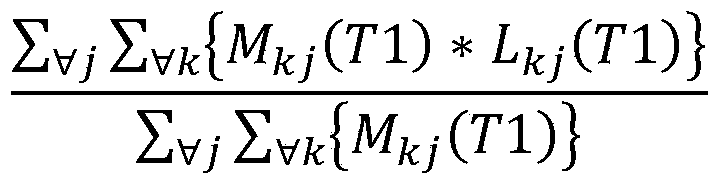
- the average value of the number of MIMO layers corresponding to the first period can be expressed as formula 1:
- j is the sampling moment in the first period.
- the numerators of the above formulas 1 and 2 can be understood as first calculating the sum of the products of the PRBs used corresponding to each sampling moment and the respective MIMO layer numbers, which is recorded as the first sum value here, and then the first period The sum of the first sum values at all sampling instants within is summed.
- the denominator of the above formula 1 can be understood as the sum of the number of PRBs used at all sampling moments in the first period (when a certain PRB is multiplexed n times, the count of the PRB is correspondingly n), the above formula 2
- the denominator of can be understood as the sum of the available PRB numbers at all sampling moments in the first period.
- the available PRBs at a certain sampling time include PRB1, PRB2, and PRB3, and the MIMO layers corresponding to PRB1, PRB2, and PRB3 are 4, 2, and 0 respectively, then the corresponding use of The number of PRBs is 2, and the number of available PRBs corresponding to this sampling moment is 3.
- the above formula 1, compared with formula 2, can more accurately reflect the actual transmission capability of the PRB because it excludes unused PRBs.
- the layer number factor ⁇ is determined based on the average value of the MIMO layers obtained by formula 1 The space division multiplexing situation of the cell can be reflected more accurately, and thus the resource utilization rate obtained through statistics can be more accurate.
- the average number of MIMO layers can be further described as:
- T1 is the first period
- j is the sampling moment in the first period
- a is the UE serial number
- k is the category of MIMO layers
- M kj (T1) is the first At the j sampling moment, the number of PRBs transmitted with the kth type of MIMO layer number
- L kj (T1) is the jth sampling moment in the first cycle, the number of MIMO layers corresponding to the kth type of MIMO layer number
- M aj (T1) is the number of PRBs allocated to the a-th UE at the j-th sampling moment in the first period
- L aj (T1) is the j-th PRB of the a-th UE in the first period
- the first of the above two calculation manners is to determine the average value of the number of MIMO layers corresponding to the first period from the perspective of the type of the number of MIMO layers.
- the category of MIMO layers that is, the value of k
- the category of MIMO layers can be globally pre-defined, that is, the number of MIMO layers that may exist globally can be pre-defined, and all possible values of k can be pre-defined globally
- the defined value of L kj (T1) is the same at all sampling instants.
- the value of k can also be redefined based on the actual situation at each sampling moment.
- the first period includes five sampling moments, which are respectively sampling moment 1 (slot0), sampling moment 2 (slot1), sampling moment 3 (slot2), sampling moment 4 (slot3) and sampling moment 5 (slot4).
- M 1j (T1) represents the number of PRBs transmitted with 0 streams at the j-th sampling time
- M 11 (T1) 0
- the second of the above two calculation methods is to determine the average value of the number of MIMO layers corresponding to the first period from the perspective of the UE.
- Step 2 Determine the maximum value of the average value of the number of MIMO layers in the N sampling time intervals.
- Each sampling time interval performs the process of step 1, and the average value of the MIMO layer number corresponding to each sampling time interval can be obtained, and the maximum value of the N MIMO layer number average values is determined as the layer number factor ⁇ , which can be specifically Expressed as follows:
- the second determination method is to determine the layer number factor ⁇ according to the average value of the maximum value of the MIMO layer number.
- Step 1 Calculate the maximum value of the number of MIMO layers corresponding to each sampling time interval.
- the maximum number of MIMO layers corresponding to the first period is the largest number of MIMO layers at at least one sampling moment in the first period.
- the first cycle includes 5 sampling moments, namely, sampling moment 1 (slot0), sampling moment 2 (slot1), sampling moment 3 (slot2), Sampling time 4 (slot3) and sampling time 5 (slot4). Then the maximum number of MIMO layers corresponding to the first period is 5.
- Step 2 Determine the average value of the maximum value of the number of MIMO layers in N sampling time intervals.
- step 1 The process of step 1 is performed for each sampling time interval, and the maximum value of the MIMO layer number corresponding to each sampling time interval can be obtained, and the maximum value of the N MIMO layer numbers is averaged, and the average value can be determined as the number of layers Factor beta.
- the average value of each maximum value is taken instead of selecting the maximum value from the maximum value of the MIMO layer number, which can avoid overestimating the actual value of the cell.
- the used PRB resources further improve the accuracy of resource utilization determination.
- the determination of the layer number factor ⁇ may also include the following two methods:
- the layer number factor ⁇ is determined according to the average value of the MIMO layer number average.
- the maximum value of the number of MIMO layers corresponding to each sampling time interval is calculated first, and then the maximum value among the maximum values of the number of MIMO layers corresponding to N sampling time intervals is determined as the layer number factor ⁇ .
- this confirmation method reference may be made to the relevant descriptions of the above-mentioned confirmation method 1 and confirmation method 2, and details are not repeated here to avoid repetition.
- the time interval in which resource utilization needs to be determined currently is defined as a second period, denoted as T2 here, and the second period includes at least one sampling moment.
- the second period is the same as the first period.
- the resource utilization rate of the time interval is calculated in real time by using the PRB usage data of the current time period, and the real-time performance of the calculation of the resource utilization rate is stronger, so that the load condition of the cell evaluated based on the resource utilization rate is more accurate.
- the second period is different from the first period, and may be a time period after the first period. In this way, by using the PRB usage data of the first period to calculate the resource utilization rate of the subsequent time period, the calculation amount can be reduced and the network configuration can be simplified.
- the determination of the resource utilization rate may be performed according to the following process:
- Step 1 Determine the number of PRBs actually occupied by the cell.
- the number of PRBs actually occupied by a cell is not necessarily equal to the sum of the number of PRBs occupied by UEs in the cell.
- the number of PRBs actually occupied by a UE in a cell at a sampling moment may be the product of the number of PRBs occupied by the UE and the actual number of space-offloaded traffic of the UE, that is, the number of PRBs used by the UE and the actual number of PRBs of the UE
- the product of the number of MIMO layers is denoted as the second product here.
- the number of PRBs actually occupied by the cell may be the sum of the second products of all UEs in the cell at all sampling moments in the second period. Specifically, it can be expressed as:
- i is a sampling moment in the second period
- a is a UE sequence number
- Step 2 Determine the total number of PRBs corrected by the layer number factor ⁇ .
- the total number of PRBs corrected by the layer number factor ⁇ is: a product of the layer number factor and the total number of available PRBs.
- the total number of available PRBs is used to represent the sum of the actual number of PRBs available at all sampling moments in the second period.
- the total number of available PRBs is: 1) in the second period, the product of the number of sampling moments and the number of PRBs available at one of the sampling moments; or, 2) in the second period, all sampling moments are available The sum of the number of PRBs.
- the number of PRBs available at one sampling moment may be the number of available PRBs corresponding to any sampling moment in the second period, or the number of PRBs with the largest number of available PRBs in the second period.
- the number of available PRBs corresponding to the sampling time, but the total number of available PRBs determined in this way may be an extreme case, which may cause the corrected total number of PRBs to be too large, specifically determine which sampling time in the second cycle corresponds to the number of available PRBs , can be determined according to the actual situation, and is not specifically limited here.
- the calculated total number of available PRBs is more accurate.
- Step 3 calculating the cell resource utilization rate.
- the resource utilization rate of the cell the number of PRBs actually occupied by the cell/the total number of PRBs corrected by the number of layers factor ⁇ , wherein the number of PRBs actually occupied by the cell is obtained in step 1, and the total number of PRBs corrected by the number of layers factor ⁇ Obtained from step two.
- the resource utilization rate of the cell can be expressed as:
- the maximum average number of MIMO layers refers to the maximum value among the average values of the numbers of MIMO layers.
- the resource utilization rate of the cell can be expressed as:
- the average maximum number of MIMO layers refers to an average value of the maximum values of the numbers of MIMO layers.
- Step 1 Determine the number of PRBs actually occupied by the cell.
- the number of PRBs actually occupied by the a UE in the ith sampling is denoted as Mai (T2), and the ith sampling of the a UE
- the actual number of MIMO layers is denoted as Lai (T2).
- the number of PRBs actually occupied by the cell can be expressed as:
- Step 2 Determine the total number of PRBs corrected by the layer number factor ⁇ .
- the layer factor can be expressed as:
- N(T2) The number of sampling moments in the second period (T2) is denoted as N(T2)
- P(T2) the number of available PRBs corresponding to a selected sampling moment
- P i (T2) the number of available PRBs corresponding to the i-th sampling moment
- the total number of PRBs corrected by the layer number factor ⁇ can be expressed as:
- Step 3 calculating the cell resource utilization rate.
- the resource utilization can be expressed as:
- the above formula Indicates that it is rounded up, and the value range of resource utilization in the above formula is 0 to 100. It can be understood that the value of the resource utilization rate is not limited thereto, and may also be determined by a percentage, that is, 100 in the expression is replaced by a percentage, but rounding up is not required. The specific description method used for the resource utilization rate may be determined according to the actual situation, and is not specifically limited here.
- the average value of each MIMO layer number or the maximum value of each MIMO layer number can be calculated first, and then the layer number factor ⁇ is calculated, and then the resource utilization rate can be calculated, or the resource utilization can be calculated directly using the formula G
- the resource utilization rate can be calculated according to the actual situation, which is not limited here.
- the steps of the resource utilization statistics method provided by the embodiment of the present application may all be performed by the first network node (base station), or the first network node may determine some parameters, and then send the part parameters to to a second network node (such as a network manager), and then the layer number factor ⁇ is calculated by the second network node. Afterwards, the second network node sends the layer number factor ⁇ to the first network node, and the first network node corrects the total number of PRBs according to the layer number factor ⁇ , and calculates resource utilization.
- a second network node such as a network manager
- FIG. 3 is a structural diagram of a resource utilization statistics device provided by an embodiment of the present application.
- the resource utilization statistics device 300 includes:
- the calculation module 301 is configured to calculate the resource utilization rate by using the total number of PRBs corrected by the number of layers factor, the number of layers factor is determined according to the PRB usage information of at least one sampling moment, and the PRB usage information of the at least one sampling moment is at least Including the number of multiple-input multiple-output MIMO layers used by the PRB during data transmission.
- the layer number factor is:
- the maximum value of the elements in the first set, the first set includes at least one MIMO layer average value, and the MIMO layer number average value is the PRB used or all PRBs used during data transmission in the corresponding first period Average number of MIMO layers;
- the average value of the elements in the second set, the second set includes at least one maximum value of the number of MIMO layers, the maximum value of the number of MIMO layers is the PRB used or all PRBs used during data transmission in the corresponding first period The maximum number of MIMO layers.
- the average number of MIMO layers is:
- T1 is the first period
- j is the sampling moment in the first period
- a is the serial number of the user equipment UE
- k is the type of MIMO layers
- M kj (T1) is At the jth sampling moment of , the number of PRBs transmitted with the number of MIMO layers of the kth type
- L kj (T1) is the number of MIMO layers corresponding to the number of MIMO layers of the kth type at the jth sampling moment in the first cycle
- M aj (T1) is the j-th sampling moment in the first cycle, the number of PRBs allocated to the a-th UE
- L aj (T1) is the j-th UE in the first cycle
- the total number of PRBs corrected by the layer number factor is: the product of the layer number factor and the total number of available PRBs.
- the total number of available PRBs is:
- the second period is the same as the first period.
- the resource utilization rate statistics device 300 can realize each process of the method embodiment in FIG. 1 in the embodiment of the present application, and achieve the same beneficial effect. To avoid repetition, details are not repeated here.
- FIG. 4 is one of the structural diagrams of the network side equipment provided by the embodiment of the present application. As shown in FIG. device 405 and memory 406.
- Processor 405 configured to calculate the resource utilization rate by using the total number of PRBs corrected by the layer number factor ⁇ , the layer number factor ⁇ is determined according to the PRB usage information at least one sampling moment, and the PRB usage at the at least one sampling moment
- the information includes at least the number of multiple-input multiple-output MIMO layers used by the PRB during data transmission.
- the network side device can implement each process in the method embodiment shown in FIG. 1 , and has the same beneficial effect. To avoid repetition, details are not repeated here.
- the embodiment of the present application also provides a communication device.
- the communication device may include a processing 501 , a memory 502 and a program 5021 stored in the memory 502 and executable on the processor 501 .
- any steps in the method embodiment corresponding to FIG. 1 can be implemented and the same beneficial effect can be achieved, and details are not repeated here.
- the storage medium is, for example, a read-only memory (Read-Only Memory, ROM), a random access memory (Random Access Memory, RAM), a magnetic disk or an optical disk, and the like.
- ROM Read-Only Memory
- RAM Random Access Memory
- magnetic disk or an optical disk and the like.
Landscapes
- Engineering & Computer Science (AREA)
- Signal Processing (AREA)
- Computer Networks & Wireless Communication (AREA)
- Radio Transmission System (AREA)
- Mobile Radio Communication Systems (AREA)
Abstract
Description




Claims (11)
- 一种资源利用率统计方法,用于网络侧设备,所述资源利用率统计方法包括:利用由层数因子修正的物理资源块PRB总数计算资源利用率,所述层数因子根据至少一个采样时刻的PRB使用信息确定,所述至少一个采样时刻的PRB使用信息至少包括PRB在数据传输时使用的多入多出MIMO层数。
- 根据权利要求1所述的资源利用率统计方法,其中,在所述至少一个采样时刻,PRB在数据传输时使用的MIMO层数越大,所述层数因子越大。
- 根据权利要求1所述的资源利用率统计方法,其中,所述层数因子为:第一集合中元素的最大值,所述第一集合包括至少一个MIMO层数平均值,所述MIMO层数平均值为对应的第一周期内,使用的PRB或者全部PRB在数据传输时使用的MIMO层数的平均值;或者,第二集合中元素的平均值,所述第二集合包括至少一个MIMO层数最大值,所述MIMO层数最大值为对应的第一周期内,使用的PRB或者全部PRB在数据传输时使用的MIMO层数的最大值。
- 根据权利要求3所述的资源利用率统计方法,其中,所述MIMO层数平均值为:
 或者,
或者, 其中,T1为所述第一周期,j为所述第一周期内的采样时刻,a为用户设备UE序号,k为MIMO层数的类别,M kj(T1)为在所述第一周期内的第j个采样时刻,以第k类MIMO层数传输的PRB数量,L kj(T1)为在所述第一周期内的第j个采样时刻,第k类MIMO层数对应的MIMO层数;M aj(T1)为所述第一周期内的第j个采样时刻,分配给第a个UE的PRB数量,L aj(T1)为第a个UE在所述第一周期内的第j个采样时刻使用的MIMO层数。
 - 根据权利要求1-4中任意一项所述的资源利用率统计方法,其中,所述层数因子修正的PRB总数为:所述层数因子和可用的PRB总数的乘积。
- 根据权利要求5所述的资源利用率统计方法,其中,所述可用的PRB总数为:第二周期内,采样时刻的数量与其中一个采样时刻可用的PRB数的乘积;或者,所述第二周期内,所有采样时刻可用的PRB数之和。
- 根据权利要求6所述的资源利用率统计方法,其中,所述第二周期和第一周期相同。
- 一种资源利用率统计装置,所述资源利用率统计装置包括:计算模块,用于利用由层数因子修正的物理资源块PRB总数计算资源利用率,所述层数因子根据至少一个采样时刻的PRB使用信息确定,所述至少一个采样时刻的PRB使用信息至少包括PRB在数据传输时使用的多入多出MIMO层数。
- 一种网络侧设备,包括:处理器,用于利用由层数因子修正的物理资源块PRB总数计算资源利用率,所述层数因子根据至少一个采样时刻的PRB使用信息确定,所述至少一个采样时刻的PRB使用信息至少包括PRB在数据传输时使用的多入多出MIMO层数。
- 一种通信设备,包括处理器、存储器及存储在所述存储器上并可在所述处理器上运行的计算机程序,所述计算机程序被所述处理器执行时实现如权利要求1至7中任一项所述的资源利用率统计方法中的步骤。
- 一种计算机可读存储介质,所述计算机可读存储介质上存储有计算机程序,所述计算机程序被处理器执行时,实现如权利要求1至7中任一项所述的资源利用率统计方法中的步骤。
Priority Applications (3)
| Application Number | Priority Date | Filing Date | Title |
|---|---|---|---|
| JP2024519804A JP7719298B2 (ja) | 2021-09-29 | 2022-09-28 | リソース利用率の統計方法、装置及び関連デバイス |
| US18/697,100 US12452737B2 (en) | 2021-09-29 | 2022-09-28 | Method for determining resource utilization rate, communication device and storage medium |
| EP22875013.9A EP4412320A4 (en) | 2021-09-29 | 2022-09-28 | METHOD AND APPARATUS FOR COUNTING RESOURCE UTILIZATION RATE, AND ASSOCIATED DEVICE |
Applications Claiming Priority (2)
| Application Number | Priority Date | Filing Date | Title |
|---|---|---|---|
| CN202111151553.3A CN115942381A (zh) | 2021-09-29 | 2021-09-29 | 资源利用率统计方法、装置及相关设备 |
| CN202111151553.3 | 2021-09-29 |
Publications (1)
| Publication Number | Publication Date |
|---|---|
| WO2023051630A1 true WO2023051630A1 (zh) | 2023-04-06 |
Family
ID=85781338
Family Applications (1)
| Application Number | Title | Priority Date | Filing Date |
|---|---|---|---|
| PCT/CN2022/122216 Ceased WO2023051630A1 (zh) | 2021-09-29 | 2022-09-28 | 资源利用率统计方法、装置及相关设备 |
Country Status (5)
| Country | Link |
|---|---|
| US (1) | US12452737B2 (zh) |
| EP (1) | EP4412320A4 (zh) |
| JP (1) | JP7719298B2 (zh) |
| CN (1) | CN115942381A (zh) |
| WO (1) | WO2023051630A1 (zh) |
Families Citing this family (2)
| Publication number | Priority date | Publication date | Assignee | Title |
|---|---|---|---|---|
| CN115942381A (zh) | 2021-09-29 | 2023-04-07 | 中国移动通信有限公司研究院 | 资源利用率统计方法、装置及相关设备 |
| CN118102448B (zh) * | 2024-02-09 | 2025-10-03 | 中国移动通信集团设计院有限公司 | Pdcch信道负荷评估方法、装置及电子设备 |
Citations (3)
| Publication number | Priority date | Publication date | Assignee | Title |
|---|---|---|---|---|
| CN101820669A (zh) * | 2010-01-28 | 2010-09-01 | 北京邮电大学 | 一种pdcch资源分配的方法和装置 |
| CN104348580A (zh) * | 2013-08-06 | 2015-02-11 | 夏普株式会社 | 下行物理信道的发送和接收方法以及基站和用户设备 |
| CA3071984A1 (en) * | 2019-02-11 | 2020-08-11 | Comcast Cable Communications, Llc | Power control and retransmission |
Family Cites Families (2)
| Publication number | Priority date | Publication date | Assignee | Title |
|---|---|---|---|---|
| US12550133B2 (en) * | 2020-11-11 | 2026-02-10 | Telefonaktiebolaget Lm Ericsson (Publ) | Methods of calculating physical resource block utilization and related network nodes |
| CN115942381A (zh) | 2021-09-29 | 2023-04-07 | 中国移动通信有限公司研究院 | 资源利用率统计方法、装置及相关设备 |
-
2021
- 2021-09-29 CN CN202111151553.3A patent/CN115942381A/zh active Pending
-
2022
- 2022-09-28 WO PCT/CN2022/122216 patent/WO2023051630A1/zh not_active Ceased
- 2022-09-28 US US18/697,100 patent/US12452737B2/en active Active
- 2022-09-28 JP JP2024519804A patent/JP7719298B2/ja active Active
- 2022-09-28 EP EP22875013.9A patent/EP4412320A4/en active Pending
Patent Citations (3)
| Publication number | Priority date | Publication date | Assignee | Title |
|---|---|---|---|---|
| CN101820669A (zh) * | 2010-01-28 | 2010-09-01 | 北京邮电大学 | 一种pdcch资源分配的方法和装置 |
| CN104348580A (zh) * | 2013-08-06 | 2015-02-11 | 夏普株式会社 | 下行物理信道的发送和接收方法以及基站和用户设备 |
| CA3071984A1 (en) * | 2019-02-11 | 2020-08-11 | Comcast Cable Communications, Llc | Power control and retransmission |
Non-Patent Citations (2)
| Title |
|---|
| "3rd Generation Partnership Project; Technical Specification Group Radio Access Network; NR; Layer 2 Measurements; (Release 16)", 3GPP TS 38.314, no. V16.3.0, 29 March 2021 (2021-03-29), pages 1 - 20, XP052000120 * |
| See also references of EP4412320A4 * |
Also Published As
| Publication number | Publication date |
|---|---|
| US20240405809A1 (en) | 2024-12-05 |
| EP4412320A4 (en) | 2025-09-17 |
| EP4412320A1 (en) | 2024-08-07 |
| CN115942381A (zh) | 2023-04-07 |
| JP7719298B2 (ja) | 2025-08-05 |
| JP2024535478A (ja) | 2024-09-30 |
| US12452737B2 (en) | 2025-10-21 |
Similar Documents
| Publication | Publication Date | Title |
|---|---|---|
| US9894672B2 (en) | Method and access network device for interference coordination | |
| EP2416619A1 (en) | Method for reporting channel state information, channel estimating method, terminal and base station | |
| CN111741474B (zh) | 一种信道状态信息的测量方法、装置及网络侧设备 | |
| JP6604378B2 (ja) | 適応変調コーディングの方法および装置 | |
| CN103716828B (zh) | 一种干扰测量、控制方法和用户设备、调度方法和基站 | |
| CN102244930A (zh) | 放大转发中继网络的资源分配方法及设备 | |
| WO2023051630A1 (zh) | 资源利用率统计方法、装置及相关设备 | |
| CN102255685A (zh) | 反馈和获取csi的方法、ue及基站 | |
| CN102300326B (zh) | 多用户多输入多输出mimo通信系统的调度方法和基站 | |
| CN102325375A (zh) | 资源分配方法及装置 | |
| CN114124321B (zh) | Srs时域资源的动态选择方法和装置、存储介质及电子装置 | |
| CN104469798B (zh) | 一种基于马尔可夫链的通信网络负载状态信息预测方法 | |
| WO2018187973A1 (zh) | 调度用户的确定方法、装置及系统 | |
| CN106413108B (zh) | 资源调度方法和装置 | |
| WO2025167176A1 (zh) | 预编码矩阵信息的发送方法和接收方法、装置及存储介质 | |
| CN106060945A (zh) | 一种基于rb反馈的lte资源调度算法 | |
| WO2017088520A1 (zh) | 一种上行业务识别切换方法及装置、基站 | |
| CN108834214A (zh) | 一种基于上下行队列均衡的时隙资源分配方法及装置 | |
| HK40108024A (zh) | 资源利用率统计方法、装置及相关设备 | |
| CN108768939B (zh) | 一种基于动态上下行的系统共存帧结构构建方法 | |
| Liu et al. | Performance analysis of CoMP in ultra-dense networks with limited backhaul capacity | |
| US20240205958A1 (en) | Method performed by network node and network node | |
| CN105306185A (zh) | 一种基于协同调度传输下行数据的方法与设备 | |
| WO2025200489A1 (zh) | 信道状态信息的反馈方法、通信装置及存储介质 | |
| CN120529350A (zh) | 一种基于精确于扰分析的频谱共享网络效能评估方法 |
Legal Events
| Date | Code | Title | Description |
|---|---|---|---|
| 121 | Ep: the epo has been informed by wipo that ep was designated in this application |
Ref document number: 22875013 Country of ref document: EP Kind code of ref document: A1 |
|
| ENP | Entry into the national phase |
Ref document number: 2024519804 Country of ref document: JP Kind code of ref document: A |
|
| NENP | Non-entry into the national phase |
Ref country code: DE |
|
| ENP | Entry into the national phase |
Ref document number: 2022875013 Country of ref document: EP Effective date: 20240429 |
|
| WWG | Wipo information: grant in national office |
Ref document number: 18697100 Country of ref document: US |