WO2023055801A1 - Brandy replicas - Google Patents
Brandy replicas Download PDFInfo
- Publication number
- WO2023055801A1 WO2023055801A1 PCT/US2022/045041 US2022045041W WO2023055801A1 WO 2023055801 A1 WO2023055801 A1 WO 2023055801A1 US 2022045041 W US2022045041 W US 2022045041W WO 2023055801 A1 WO2023055801 A1 WO 2023055801A1
- Authority
- WO
- WIPO (PCT)
- Prior art keywords
- brandy
- replica
- added
- vocs
- acid
- Prior art date
- Legal status (The legal status is an assumption and is not a legal conclusion. Google has not performed a legal analysis and makes no representation as to the accuracy of the status listed.)
- Ceased
Links
Classifications
-
- C—CHEMISTRY; METALLURGY
- C12—BIOCHEMISTRY; BEER; SPIRITS; WINE; VINEGAR; MICROBIOLOGY; ENZYMOLOGY; MUTATION OR GENETIC ENGINEERING
- C12G—WINE; PREPARATION THEREOF; ALCOHOLIC BEVERAGES; PREPARATION OF ALCOHOLIC BEVERAGES NOT PROVIDED FOR IN SUBCLASSES C12C OR C12H
- C12G3/00—Preparation of other alcoholic beverages
- C12G3/04—Preparation of other alcoholic beverages by mixing, e.g. for preparation of liqueurs
- C12G3/06—Preparation of other alcoholic beverages by mixing, e.g. for preparation of liqueurs with flavouring ingredients
- C12G3/07—Flavouring with wood extracts, e.g. generated by contact with wood; Wood pretreatment therefor
-
- C—CHEMISTRY; METALLURGY
- C12—BIOCHEMISTRY; BEER; SPIRITS; WINE; VINEGAR; MICROBIOLOGY; ENZYMOLOGY; MUTATION OR GENETIC ENGINEERING
- C12G—WINE; PREPARATION THEREOF; ALCOHOLIC BEVERAGES; PREPARATION OF ALCOHOLIC BEVERAGES NOT PROVIDED FOR IN SUBCLASSES C12C OR C12H
- C12G3/00—Preparation of other alcoholic beverages
- C12G3/04—Preparation of other alcoholic beverages by mixing, e.g. for preparation of liqueurs
- C12G3/06—Preparation of other alcoholic beverages by mixing, e.g. for preparation of liqueurs with flavouring ingredients
Definitions
- Brandy typically is 40 to 50 percent alcohol by volume (ABV), although the alcohol content can vary depending on the type of brandy.
- Traditional methods for producing brandy can be lengthy and costly, involving the harvesting of particular crops, followed by processing, fermenting, distilling, and aging (usually in oak barrels).
- Each component of the traditional process for making brandy can have an inherent variability and risk, including climate, crop disease, and contamination, which can render such methods and their resulting products inconsistent from batch to batch and year to year. Going forward in this document, the term “brandy” refers to both “brandy” and “brandy” spirits.
- this document features an alcoholic beverage.
- the alcoholic beverage can be a brandy replica.
- the brandy replica can include (or consist essentially of or consist of) water, a grain neutral spirit, an oak extract, one or more tannins, or an oak extract and one or more tannins, fruit juice, and at least six added volatile compounds (VOCs), where the added VOCs include at least one ester, at least one additional alcohol, at least one aldehyde or ketone, and at least one terpene or i soprenoid, and where the added VOCs include about 0.001 wt% to about 0. 1 wt% of the brandy replica.
- VOCs volatile compounds
- the brandy replica can further include a traditional brandy, where the brandy replica includes no more than about 10 wt% of the traditional brandy.
- the at least one ester can include one or more of phenethyl acetate, ethyl laurate, ethyl acetate, tetrahydrofurfuryl acetate butyl isobutyrate, ethyl butyrate, hexyl 2-methylbutanoate, isobutyl isobutyrate, isobutyl propionate, and propyl acetate.
- the at least one ester can include one or more of ethyl acetate, ethyl laurate, phenethyl acetate, and tetrahydrofurfuryl acetate.
- the at least, one ester can include one or more of butyl isobutyrate, ethyl butyrate, hexyl 2-methylbutanoate, isobutyl isobutyrate, isobutyl propionate, and propyl acetate.
- the at least one aldehyde or ketone can include one or more of phenylacetaldehyde, 2,3-pentanedione, 2-heptanone, and methylcyclopentenolone.
- the at least one aldehyde or ketone can include 2,3- pentanedione.
- the at least one aldehyde or ketone can include 2-heptanone.
- the at least one additional alcohol can include one or both of isoamyl alcohol and phenethyl alcohol.
- the at least one additional alcohol can include phenethyl alcohol.
- the at least one additional alcohol can include isoamyl alcohol.
- the at least one terpene or isoprenoid can include linalool.
- the added VOCs further can include at least one furan, at least one acid, at least one phenol, or a combination thereof.
- the at least one furan can include 2- pentylfuran.
- the at least one acid can include butyric acid.
- the at least one phenol can include eugenol.
- the added VOCs can include at least one ester, at least one additional alcohol, at least one aldehyde or ketone, at least one terpene or isoprenoid, at least one phenol, and at least one furan.
- the added VOCs can include ethyl laurate, phenethyl alcohol, 2-pentylfuran, linalool, 2,3-pentanedione, eugenol, and ethyl acetate.
- the added VOCs can include at least one ester, at least one acid, at least one additional alcohol, at least one aldehyde or ketone, and at least one terpene or isoprenoid.
- the added VOCs can include propyl acetate, ethyl butyrate, isobutyl isobutyrate, hexyl 2-methylbutanoate, butyl isobutyrate, 2-heptanone, linalool, butyric acid, and isoamyl alcohol.
- the brandy replica can include at least one added non-volatile compound.
- the at least one added non-volatile compound can include a color compound.
- the at least one added non-volatile compound is selected from the group consisting of 2- mercapto-4,6-dimethylnicotinonitrile, 4,4-dihydroxybenzophenone, 4-methyl-2,3- dihydro-lh-pyrrolo[3,4-c]-quinoline, azobenzene, carnosine, choline, betaine, trigonelline, pyridoxal, nicotinic acid, furaneol, 2,3-isopropylidene-d-ribonolactone, 3- methylglutaric acid, homovanillic acid, fraxetin, coniferyl aldehyde, cyclohexyl thiourea, cyanazine, dimethyl phthalate, isophorone, 2,6-dimethyl-gamma-pyrone, vanillin, qui
- the at least one added non-volatile compound is selected from the group consisting of 3 -hydroxypyridine, mannitol, mannoheptulose, trehalose, 3-hydroxy-2-methylpyridine, di glycerol, 1 -(2-hydroxyethyl)- 2-imidazolidenethione, 2-mercapto-4,6-dimethylnicotinonitrile, 4,4- dihydroxybenzophenone, carnosine, choline, betaine, nicotinic acid, furaneol, 2,3- isopropylidene-D-ribonolactone, 3-methylglutaric acid, fraxetin, coniferyl aldehyde, dimethyl phthalate, isophorone, vanillin, and scopoletin.
- the at least one added non- volatile compound is selected from the group consisting of 3-hydroxypyridine, mannitol, mannoheptulose, trehalose, 3 -hydroxy-2-m ethylpyridine, diglycerol, l-(2-hydroxyethyl) ⁇ 2-imidazolidenethione, 4-methyl-2,3-dihydro-lH-pyrrolo[3,4-c]-quinoline, azobenzene, choline, betaine, nicotinic acid, furaneol, 2,3-isopropylidene-D-ribonolactone, homovanillic acid, coniferyl aldehyde, isophorone, and scopoletin.
- the at least one added non-volatile compound is selected from the group consisting of 3-hydroxypyridine, mannitol, mannoheptulose, trehalose, 3-hydroxy-2-methylpyridine, diglycerol, l-(2- hydroxyethyl)-2-imidazolidenethione, choline, betaine, nicotinic acid, furaneol, 2,3- isopropylidene-D-ribonolactone, coniferyl aldehyde, isophorone, and scopoletin.
- the brandy replica can include from about. 5 wt% to about 70 wt% water, from about 30 wt% to about 95 wt% grain neutral spirits, from about 0.5 wt% to about 10 wt% traditional brandy, from about 0.1 wt% to about 10 wt% oak extract, from about 0.1 wt% to about 10 wt% fruit, juice, from about 0.001 wt% to about 1 wt% tannins, from about 0.01 wt% to about 1 wt% color, and from about 0.001 wt% to about 0.1 wt% added VOCs.
- this document features a brandy replica that includes (or consists essentially of or consists of) water, a grain neutral spirit, an oak extract, one or more tannins, or an oak extract and one or more tannins, fruit juice, and at least six added VOCs, where the added VOCs include about 0.001 wt% to about 0.1 wt% of the brandy replica.
- the brandy replica can further include a traditional brandy, where the brandy replica includes no more than about 10 wt% of the traditional brandy.
- the added VOCs can include at.
- VOCs selected from the group consisting of tetrahydrofurfuryl acetate, isobutyl propionate, isobutyl isobutyrate, hexyl 2- methylbutanoate, butyl isobutyrate, and 2-pentylfuran.
- the added VOCs can include phenethyl alcohol, where the phenethyl alcohol is present in the brandy replica at a concentration less than about 1.28 mg/L.
- the added VOCs can include 2,3 -pentanedione, where the 2,3-pentanedione is present in the brandy replica at a concentration less than about 0.17 mg/L.
- the added VOCs can include butyric acid, where the butyric acid is present in the brandy replica at a concentration less than about 0.16 mg/L.
- the added VOCs can include propyl acetate, where the propyl acetate is present in the brandyreplica at a. concentration of at least about 0.75 mg/L.
- the added VOCs can include ethyl butyrate, where the ethyl butyrate is present in the brandy replica at a concentration of at least about 5 mg/L.
- the added VOCs can include 2-heptanone, where the 2-heptanone is present in the brandy replica at a concentration of at least about 0.03 mg/L.
- the added VOCs can include propyl acetate, where the brandy replica includes at least about 0.018% by mass of the propyl acetate.
- the added VOCs can include ethyl butyrate, where the brandy replica includes at least about 0.11% by mass of the ethyl butyrate.
- the added VOCs can include 2-heptanone, where the brandy replica includes at least about 0.00068% by mass of the 2-heptanone.
- the added VOCs can include eugenol, where the brandy replica includes at least about 0.007% by mass of the eugenol.
- the brandy replica can include an added non-volatile compound.
- the added non-volatile compound can include trehalose, where the trehalose is present in the brandy replica at a concentration less than about 6.67 mg/L.
- the added non-volatile compound can include 3 -hydroxy-2 -methylpyridine, where the 3 -hydroxy -2- methylpyridine is present in the brandy replica at a concentration of at least about. 0.18 mg/L.
- the added non-volatile compound can include 3-hydroxy-2-methylpyridine, where the brandy replica includes at least about 0.01% by mass of the 3-hydroxy-2- methylpyridine.
- the added non-volatile compound can include 4-methyl-2,3-dihydro-lH- pyrrolo[3,4-c]-quinoline, where the brandy replica includes at least about 0.00145% by mass of the 4-methyl-2,3-dihydro-lH-pyrrolo[3,4-c]-quinoline.
- the added non-volatile compound can include azobenzene, where the brandy replica includes at least about 0.04% by mass of the azobenzene.
- the added non-volatile compound can include furaneol, where the brandy replica includes at least about 0.07% by mass of the furaneol.
- the added non-volatile compound can include 2,3-isopropylidene-D-ribonolactone, where the brandy replica includes at least about 0.02% by mass of the 2,3- isopropylidene-D-ribonolactone.
- the added non-volatile compound can include homovanillic acid, where the brandy replica includes at least about 0.05% by mass of the homovanillic acid.
- this document features a method for making a brandy replica.
- the method for making a brandy replica can include (or consist essentially of or consist of) combining water, a grain neutral spirit, an oak extract, a tannin, or an oak extract and a tannin, a fruit juice, at least six VOCs, where the VOCs are provided as separate ingredients and include at least one ester, at least one additional alcohol, at least one aldehyde or ketone, at least one terpene or isoprenoid, and where the added VOCs include about 0.001 wt% to about 0.1 wt% of the brandy replica, and optionally, a traditional brandy, such that the brandy replica includes no more than about 10 wt% of the traditional brandy.
- the at least one ester can include one or more of phenethyl acetate, ethyl laurate, ethyl acetate, tetrahydrofurfuryl acetate butyl isobutyrate, ethyl butyrate, hexyl 2-methylbutanoate, isobutyl isobutyrate, isobutyl propionate, and propyl acetate.
- the at least one ester can include one or more of ethyl acetate, ethyl laurate, phenethyl acetate, and tetrahydrofurfuryl acetate.
- the at least one ester can include one or more of butyl isobutyrate, ethyl butyrate, hexyl 2-methylbutanoate, isobutyl isobutyrate, isobutyl propionate, and propyl acetate.
- the at least one aldehyde or ketone can include one or more of phenyl acetaldehyde, 2,3 -pentanedione, 2-heptanone, and methylcyclopentenolone.
- the at least one aldehyde or ketone can include 2,3- pentanedione.
- the at least one aldehyde or ketone can include 2-heptanone.
- the at least one additional alcohol can include one or both of isoamyl alcohol and phenethyl alcohol.
- the at least one additional alcohol can include phenethyl alcohol.
- the at least one additional alcohol can include isoamyl alcohol.
- the at least one terpene or isoprenoid can include linalool.
- the added VOCs can further include at least one furan, at least one acid, at least one phenol, or a combination thereof.
- the at least one furan can include 2- pentylfuran.
- the at least one acid can include butyric acid.
- the at least one phenol can include eugenol.
- the added VOCs can include at least one ester, at least one additional alcohol, at least one aldehyde or ketone, at least one terpene or isoprenoid, at least one phenol, and at least one furan.
- the added VOCs can include ethyl laurate, phenethyl alcohol, 2-pentylfuran, linalool, 2,3 -pentanedione, eugenol, and ethyl acetate.
- the added VOCs can include at least one ester, at least one acid, at least one additional alcohol, at least one aldehyde or ketone, and at least one terpene or isoprenoid.
- the added VOCs can include propyl acetate, ethyl butyrate, isobutyl isobutyrate, hexyl 2-methylbutanoate, butyl isobutyrate, 2-heptanone, linalool, butyric acid, and isoamyl alcohol.
- the method can further include combining at least one added non- volatile compound with the water, grain neutral spirit, oak extract and/or tannin, fruit juice, at least six VOCs, and optional traditional brandy.
- the at least one added non- volatile compound can include a color compound.
- the at least one added non-volatile compound can be selected from the group consisting of 2-mercapto-4,6- dimethylnicotinonitrile, 4,4-dihydroxybenzophenone, 4-methyl-2,3-dihydro-lh- pyrrolo[3,4-c]-quinoline, azobenzene, carnosine, choline, betaine, trigonelline, pyridoxal, nicotinic acid, furaneol, 2,3-isopropylidene-d-ribonolactone, 3 -methylglutaric acid, homovanillic acid, fraxetin, coniferyl aldehyde, cyclohexyl thiourea, cyanazine, dimethyl phthalate, isophorone, 2,6-dimethyl-gamma-pyrone, vanillin, quinic acid, gallic acid, isoferulic acid, scopoletin, ethyl paraben, 3-hydroxypyridine, mannito
- the at least one added non-volatile compound is selected from the group consisting of 3-hydroxypyridine, mannitol, mannoheptulose, trehalose, 3 -hydroxy-2-m ethylpyridine, diglycerol, l-(2-hydroxyethyl)- 2-imidazolidenethione, 2-mercapto-4,6-dimethylnicot.inonitrile, 4,4- dihydroxybenzophenone, carnosine, choline, betaine, nicotinic acid, furaneol, 2,3- isopropylidene-D-ribonolactone, 3 -methylglutaric acid, fraxetin, coniferyl aldehyde, dimethyl phthalate, isophorone, vanillin, and scopoletin.
- the at least one added non- volatile compound is selected from the group consisting of 3-hydroxypyridine, mannitol, mannoheptulose, trehalose, 3-hydroxy-2-methylpyridine, diglycerol, 1 -(2-hydroxyethyl)- 2-imidazolidenethione, 4-methyl-2,3-dihydro-lH-pyrrolo[3,4-c]-quinoline, azobenzene, choline, betaine, nicotinic acid, furaneol, 2,3-isopropylidene-D-ribonolactone, homovanillic acid, coniferyl aldehyde, isophorone, and scopoletin.
- the at least one added non-volatile compound can be selected from the group consisting of 3-hydroxypyridine, mannitol, mannoheptulose, trehalose, 3-hydroxy-2-methylpyridine, diglycerol, l-(2- hydroxyethyl)-2-imidazolidenethione, choline, betaine, nicotinic acid, furaneol, 2,3- isopropylidene-D-ribonolactone, coniferyl aldehyde, isophorone, and scopoletin.
- the brandy replica can further include from about 5 wt% to about 70 wt% water, from about 30 wt% to about 95 wt% grain neutral spirits, from about 0.5 wt% to about 10 wt% traditional brandy, from about 0.1 wt% to about 10 wt% oak extract, from about 0.1 wt% to about 10 wt% fruit juice, from about 0.001 wt% to about 1 wt% tannins, from about 0.01 wt% to about 1 wt% color, and from about 0.001 wt% to about 0.1 wt% added VOCs.
- this document features a method of making a brandy replica.
- the method for making a brandy replica can include (or consist essentially of or consist of) combining water, a grain neutral spirit, an oak extract, a tannin, or an oak extract and a tannin, a fruit juice, at least six VOCs, where the VOCs are provided as separate ingredients and make up about 0.001 wt% to about 0.1 wt% of the brandy replica, and optionally, a traditional brandy, where the brandy replica includes no more than about 10 wt% of the traditional brandy.
- the added VOCs can include at least one VOC selected from the group consisting of tetrahydrofurfuryl acetate, isobutyl propionate, isobutyl isobutyrate, hexyl 2-methylbutanoate, butyl isobutyrate, and 2- pentylfuran.
- the added VOCs can include phenethyl alcohol, where the phenethyl alcohol is present in the brandy replica at a concentration less than about 1.28 mg/L.
- the added VOCs can include 2, 3 -pentanedione, where the 2,3-pentanedione is present in the brandy replica at a concentration less than about 0.17 mg/L.
- the added VOCs can include butyric acid, where the butyric acid is present in the brandy replica at a concentration less than about 0.16 mg/L.
- the added VOCs can include propyl acetate, where the propyl acetate is present in the brandy replica at a concentration of at least about 0.75 mg/L.
- the added VOCs can include ethyl butyrate, where the ethyl butyrate is present in the brandy replica at a concentration of at least about 5 mg/L.
- the added VOCs can include 2- heptanone, where the 2-heptanone is present in the brandy replica at a concentration of at least about 0.03 mg/L.
- the added VOCs can include propyl acetate, where the brandy replica includes at least about 0.018% by mass of the propyl acetate.
- the added VOCs can include ethyl butyrate, where the brandy replica includes at least about 0.11% by mass of the ethyl butyrate.
- the added VOCs can include 2-heptanone, where the brandy replica includes at least about 0.00068% by mass of the 2-heptanone.
- the added VOCs can include eugenol, where the brandy replica includes at least about 0.007% by mass of the eugenol.
- method can include combining an added non-volatile compound with the water, grain neutral spirit, oak extract and/or tannin, fruit juice, at least six VOCs, and optional traditional brandy.
- the added non-volatile compound can include trehalose, where the trehalose is present in the brandy replica at a concentration less than about 6,67 mg/L,
- the added non-volatile compound can include 3-hydroxy-2- methylpyridine, where the 3-hydroxy-2-methylpyridine is present in the brandy replica at a concentration of at least about 0.18 mg/L,
- the added non-volatile compound can include 3 -by dr oxy-2-m ethylpyridine, where the brandy replica includes at least about 0.01% by mass of the 3-hydroxy ⁇ 2-methylpyridine.
- the added non-volatile compound can include 4-methyl-2,3-dihydro-1H-pyrrolo[3,4-c]-quinoline, where the brandy replica includes at least about 0.00145% by mass of the 4-methyl-2,3-dihydro-lH-pyrrolo[3,4-c]- quinoline.
- the added non-volatile compound can include azobenzene, wherein the brandy replica includes at least about 0.04% by mass of the azobenzene.
- the added non-volatile compound can include furaneol, where the brandy replica includes at least about. 0.07% by mass of the furaneol.
- the added non-volatile compound can include 2,3- isopropylidene-D-ribonolactone, where the brandy replica includes at least about 0.02% by mass of the 2,3-isopropylidene-D-ribonolactone.
- the added non-volatile compound can include homovanillic acid, wherein the brandy replica includes at least about 0.05% by mass of the homovanillic acid.
- this document features a brandy replica produced by any of the methods described herein.
- this document features a brandy -like alcoholic beverage concentrate that includes (or consists essentially of or consists of) an oak extract, fruit juice, a tannin, at least six added VOCs that include at least one ester, at least one additional alcohol, at least one aldehyde or ketone, and at least one terpene or isoprenoid, where at least one of the added VOCs is present in a concentration of at least about 2-fokl the concentration of the same VOC in a corresponding traditional brandy, and optionally, a traditional brandy, where the alcoholic beverage, after dilution to produce a final product, includes no more than about 10 wt% of the traditional brandy.
- At least one of the added VOCs can be present in the concentrate in a concentration of at least about 5-fold the concentration of the same VOCs in a corresponding traditional brandy. At least one of the added VOCs can be present in the concentrate in a concentration of at least about 10- fold the concentration of the same VOCs in a corresponding traditional brandy. At least one of the added VOCs can be present in the concentrate in a concentration of at least about 15-fold the concentration of the same VOCs in a corresponding traditional brandy. In some cases, upon dilution of the brandy-like beverage concentrate to a brandy-like alcoholic beverage, the brandy-like alcoholic beverage can be any of the brandy replicas described herein.
- this document features a method of making a brandy -like alcoholic beverage concentrate, where the method includes (or consists essentially of or consists of) combining an oak extract, fruit juice, a tannin, at least six added VOCs that include at least one ester, at least one additional alcohol, at least one aldehyde or ketone, and at least one terpene or isoprenoid, where at least one of the added VOCs is present in a concentration of at least about 2 -fold the concentration of the same VOC in a corresponding traditional brandy, and optionally, a traditional brandy, where the alcoholic beverage, after dilution to produce a final product, includes no more than about 10 wt% of the traditional brandy.
- At least one of the added VOCs can be present in the concentrate in a concentration of at least about 5-fold the concentration of the same VOCs in a corresponding traditional brandy. At least one of the added VOCs can be present in the concentrate in a concentration of at least about 10-fold the concentration of the same VOCs in a corresponding traditional brandy. At least one of the added VOCs can be present in the concentrate in a concentration of at least about 15-fold the concentration of the same VOCs in a corresponding traditional brandy. In some cases, upon dilution of the brandy-like beverage concentrate to a brandy-like alcoholic beverage, the brandy-like alcoholic beverage can be any of the brandy replicas described herein.
- the alcoholic beverage can comprise (or consist essentially of or consist of) water, a grain neutral spirit, a traditional brandy (where the alcoholic beverage contains no more than about 10 wt% of the traditional brandy), an oak extract, fruit juice, tannins, and at least six added volatile compounds (VOCs), wherein the added VOCs include at least one ester, at least one aldehyde, at least one furan, at least one additional alcohol, at least one terpene, and at least one ketone, and where the added VOCs make up about 0.001 wt% to about 0.1 wt% of the alcoholic beverage.
- VOCs volatile compounds
- the at least one ester can include one or more of phenethyl acetate, ethyl laurate, ethyl acetate, and tetrahydrofurfuryl acetate.
- the at least one aldehyde can include phenyl acetaldehyde.
- the at least one furan can include 2- pentylfuran.
- the at least one additional alcohol can include one or both of phenethyl alcohol and eugenol.
- the at least one terpene can include linalool.
- the at least one ketone can include one or both of 2,3-pentanedione and methylcyclopentenol one.
- the added VOCs can include vanillin erythro and threo-butan-2,3-diol acetal.
- the alcoholic beverage can further include a color compound.
- the added VOCs can include phenethyl acetate, ethyl laurate, ethyl acetate, tetrahydrofurfuryl acetate, phenylacetaldehyde, 2-pentylfuran, phenethyl alcohol, eugenol, linalool, 2,3- pentanedione, methylcyclopentenolone, and vanillin erythro and threo-butan-2,3-diol acetal.
- the alcoholic beverage can contain from about 5 wt% to about 70 wt% water, from about 30 wt% to about 95 wt% grain neutral spirits, not more than about 1 wt% brandy, from about 0.1 wt% to about 10 wt% oak extract, from about 0.1 wt% to about 10 wt% fruit juice, from about 0.001 wt% to about 1 wt% tannins, from about 0.01 wt% to about 1 wt% color, and from about 0.001 wt% to about 0.1 wt% added VOCs, where the added VOCs include phenethyl acetate, ethyl laurate, ethyl acetate, tetrahydrofurfuryl acetate, phenylacetaldehyde, 2-pentylfuran, phenethyl alcohol, eugenol, linalool, 2,3-pentanedione, methylcyclopenten
- the added VOCs can consist of phenethyl acetate, ethyl laurate, ethyl acetate, tetrahydrofurfuryl acetate, phenylacetaldehyde, 2- pentylfuran, phenethyl alcohol, eugenol, linalool, 2,3-pentanedione, methylcyclopentenolone, and vanillin erythro and threo-butan-2,3-diol acetal.
- this document features a method for making an alcoholic beverage.
- the method can comprise (or consist essentially of or consist of) combining water, a grain neutral spirit, a traditional brandy (where the alcoholic beverage contains no more than about 10 wt% of the traditional brandy), an oak extract, fruit juice, tannins, and at least six VOCs, where the VOCs are provided as separate ingredients and include at least one ester, at least one aldehyde, at least one furan, at least one additional alcohol, at least one terpene, and at least one ketone, and where the added VOCs make up about 0.001 wt% to about 0.1 wt% of the alcoholic beverage.
- the at least one ester can include one or more of phenethyl acetate, ethyl laurate, ethyl acetate, and tetrahydrofurfuryl acetate.
- the at least one aldehyde can include phenyl acetaldehyde.
- the at least one furan can include 2-pentylfuran.
- the at least one additional alcohol can include one or both of phenethyl alcohol and eugenol.
- the at least one terpene can include linalool.
- the at least one ketone can include one or both of 2,3 -pentanedi one and methylcyclopentenolone.
- the added VOCs can include vanillin erythro and threo-butan-2,3-diol acetal.
- the method can further include adding a color compound.
- the added VOCs can include (or consist essentially of or consist of) phenethyl acetate, ethyl laurate, ethyl acetate, tetrahydrofurfuryl acetate, phenyl acetaldehyde, 2-pentylfuran, phenethyl alcohol, eugenol, linalool, 2,3-pentanedione, methylcyclopentenolone, and vanillin erythro and threo-b utan-2, 3 -diol acetal .
- the alcoholic beverage produced by the method can contain from about 5 wt% to about 70 wt% water, from about 30 wt% to about 95 wt% grain neutral spirits, not more than about 1 wt% brandy, from about 0.1 wt% to about 10 wt% oak extract, from about 0.1 wt% to about 10 wt% fruit juice, from about 0.001 wt% to about 1 wt% tannins, from about 0.01 wt% to about 1 wt% color, and from about 0.001 wt% to about 0.1 wt% added VOCs, where the added VOCs include phenethyl acetate, ethyl laurate, ethyl acetate, tetrahydrofurfuryl acetate, phenylacetaldehyde, 2-pentylfuran, phenethyl alcohol, eugenol, linalool, 2,3-pentanedione,
- the added VOCs can consist of phenethyl acetate, ethyl laurate, ethyl acetate, tetrahydrofurfuryl acetate, phenylacetaldehyde, 2-pentylfuran, phenethyl alcohol, eugenol, linalool, 2,3- pentanedione, methylcyclopentenolone, and vanillin erythro and threo-butan-2,3-diol acetal.
- this document features art alcoholic beverage produced by a method that includes combining water, a grain neutral spirit, a traditional brandy (where the alcoholic beverage contains no more than about 10 wt% of the traditional brandy), an oak extract, fruit juice, tannins, and at least six VOCs, where the VOCs are provided as separate ingredients and include at least one ester, at least one aldehyde, at least one furan, at least one additional alcohol, at least one terpene, and at least one ketone, and where the added VOCs make up about 0.001 wt% to about 0.1 wt% of the alcoholic beverage.
- the at least one ester can include one or more of phenethyl acetate, ethyl laurate, ethyl acetate, and tetrahydrofurfuryl acetate.
- the at least one aldehyde can include phenylacetaldehyde.
- the at least one furan can include 2 -pentylfuran.
- the at least one additional alcohol can include one or both of phenethyl alcohol and eugenol.
- the at least one terpene can include linalool.
- the at least one ketone can include one or both of 2,3-pentanedione and methylcyclopentenolone.
- the added VOCs can include vanillin erythro and threo-butan-2,3-diol acetal.
- the method can further include adding a color compound.
- the added VOCs can include (or consist essentially of or consist of) phenethyl acetate, ethyl laurate, ethyl acetate, tetrahydrofurfuryl acetate, phenylacetaldehyde, 2-pentylfuran, phenethyl alcohol, eugenol, linalool, 2,3- pentanedione, methylcyclopentenol one, and vanillin erythro and threo-butan-2,3-diol acetal.
- the alcoholic beverage produced by the method can contain from about 5 wt% to about 70 wt% water, from about 30 wt% to about 95 wt% grain neutral spirits, not more than about 1 wt% brandy, from about 0.1 wt% to about 10 wt% oak extract, from about 0.1 wt% to about.
- VOCs include phenethyl acetate, ethyl laurate, ethyl acetate, tetrahydrofurfuryl acetate, phenylacetaldehyde, 2-pentylfuran, phenethyl alcohol, eugenol, linalool, 2,3-pentanedione, methylcyclopentenol one, and vanillin ery thro and threo-butan-2,3-diol acetal.
- the added VOCs can consist of phenethyl acetate, ethyl laurate, ethyl acetate, tetrahydrofurfuryl acetate, phenylacetaldehyde, 2-pentylfuran, phenethyl alcohol, eugenol, linalool, 2,3- pentanedione, methylcyclopentenolone, and vanillin erythro and threo-butan-2,3-diol acetal.
- the brandy-like alcoholic beverage concentrate can comprise (or consist essentially of or consist of) a traditional brandy (where the alcoholic beverage, after dilution to produce a final product, contains no more than about 10 wt% of the traditional brandy), an oak extract, fruit juice, tannins, and at least six added VOCs, where the added VOCs include at least one ester, at least one aldehyde, at least one furan, at least one additional alcohol, at least one terpene, and at least one ketone, and where at least one of the added VOCs is present in a concentration of at least about 2-fold the concentration of the same VOC in a corresponding traditional brandy.
- At least one of the added VOCs can be present in the concentrate in a concentration of at least about 5-fold the concentration of the same VOCs in a corresponding traditional brandy. At least one of the added VOCs can be present in the concentrate in a concentration of at least about 10-fold the concentration of the same VOCs in a corresponding traditional brandy. At least one of the added VOCs can be present in the concentrate in a concentration of at least about 15-fold the concentration of the same VOCs in a corresponding traditional brandy.
- the brandy- like alcoholic beverage can be an alcoholic beverage comprising (or consisting essentially of or consisting of) water, a grain neutral spirit, a traditional brandy (where the alcoholic beverage contains no more than about 10 wt% of the traditional brandy ), an oak extract, fruit juice, tannins, and at least six added VOCs, where the added VOCs include at least one ester, at least one aldehyde, at least one furan, at least one additional alcohol, at least one terpene, and at least one ketone, and where the added VOCs make up about 0.001 wi% to about 0.1 wt% of the alcoholic beverage.
- the at least one ester can include one or more of phenethyl acetate, ethyl laurate, ethyl acetate, and tetrahydrofurfuryl acetate.
- the at least one aldehyde can include phenylacetaldehyde.
- the at least one furan can include 2-pentylfuran.
- the at least one additional alcohol can include one or both of phenethyl alcohol and eugenol.
- the at least one terpene can include linalool.
- the at least one ketone can include one or both of 2,3-pentanedione and methylcyclopentenolone.
- the added VOCs can include vanillin erythro and threo-butan-2,3-diol acetal.
- the alcoholic beverage can further include a color compound.
- the added VOCs can include phenethyl acetate, ethyl laurate, ethyl acetate, tetrahydrofurfuryl acetate, phenylacetaldehyde, 2-pentylfuran, phenethyl alcohol, eugenol, linalool, 2,3- pentanedione, methylcyclopentenolone, and vanillin erythro and threo ⁇ butan-2,3-diol acetal.
- this document features a method of making a brandy-like alcoholic beverage concentrate.
- the method can include (or consist essentially of or consist of) combining a traditional brandy (where the alcoholic beverage, after dilution to produce a final product, contains no more than about 10 wt% of the traditional brandy ), an oak extract, fruit juice, tannins, and at least six added VOCs, where the added VOCs include at least one ester, at least one aldehyde, at least one furan, at least one additional alcohol, at least one terpene, and at least one ketone, and where at least one of the added VOCs is present in a concentration of at least about 2-fold the concentration of the same VOC in a corresponding traditional brandy.
- At least one of the added VOCs can be present in the concentrate in a concentration of at least about 5-fold the concentration of the same VOCs in a corresponding traditional brandy. At least one of the added VOCs can be present in the concentrate in a concentration of at least about 10-fold the concentration of the same VOCs in a corresponding traditional brandy . At least one of the added VOCs can be present in the concentrate in a concentration of at least about 15-fold the concentration of the same VOCs in a corresponding traditional brandy.
- the brandy- like alcoholic beverage can be an alcoholic beverage comprising (or consisting essentially of or consisting of) water, a grain neutral spirit, a traditional brandy (where the alcoholic beverage contains no more than about 10 wt% of the traditional brandy), an oak extract, fruit juice, tannins, and at least six added VOCs, where the added VOCs include at least one ester, at least one aldehyde, at least one furan, at least one additional alcohol, at least one terpene, and at least one ketone, and where the added VOCs make up about 0.001 wt% to about 0.1 wt% of the alcoholic beverage.
- the at least one ester can include one or more of phenethyl acetate, ethyl laurate, ethyl acetate, and tetrahydrofurfury 1 acetate.
- the at least one aldehyde can include phenylacetaldehyde.
- the at least one furan can include 2-pentylfuran.
- the at least one additional alcohol can include one or both of phenethyl alcohol and eugenol.
- the at least one terpene can include linalool.
- the at least one ketone can include one or both of 2,3-pentanedione and methylcyclopentenolone.
- the added VOCs can include vanillin ery thro and threo-butan-2,3-diol acetal.
- the alcoholic beverage can further include a color compound.
- the added VOCs can include phenethyl acetate, ethyl laurate, ethyl acetate, tetrahydrofur fund acetate, phenylacetaldehyde, 2-pentylfuran, phenethyl alcohol, eugenol, linalool, 2,3- pentanedione, methylcyclopentenolone, and vanillin erythro and threo-butan-2,3-diol acetal.
- brandy-like alcoholic beverages also referred to as “brandy replicas,” “brandy products,” and “flavored brandies”
- methods for making brandy-like alcoholic beverages by combining water and ethanol with individual VOCs are also referred to as “brandy replicas,” “brandy products,” and “flavored brandies”.
- brandy-like alcoholic beverages described herein have characteristics - including taste, aroma, mouthfeel, and appearance -• of traditionally produced brandies, and are meant to be consumed and enjoyed in the same manner as traditional brandies.
- traditional and “reference” brandy refer to brandy produced through standard fermenting and distilling processes.
- Class 1 neutral spirits or alcohol.
- “Neutral spirits” or “alcohol” are distilled spirits produced from any material at or above 190° proof, and, if bottled, bottled at not less than 80° proof.
- Brandy is an alcoholic distillate from the fermented juice, mash, or wine of fruit, or from the residue thereof, produced at less than 190° proof in such manner that the distillate possesses the taste, aroma, and characteristics generally attributed to the product, and bottled at not less than 80° proof. Brandy, or mixtures thereof, not conforming to any of the standards in paragraphs (d)(1) through (9) of this section shall be designated as “brandy,” and such designation shall be immediately followed by a truthful and adequate statement of composition.
- “Fruit brandy” is brandy distilled solely from the fermented juice or mash of whole, sound, ripe fruit, or from standard grape, citrus, or other fruit wine, with or without the addition of not more than 20 percent by weight of the pomace of such juice or wine, or 30 percent by volume of the lees of such wine, or both (calculated prior to the addition of water to facilitate fermentation or distillation).
- Fruit brandy shall include mixtures of such brandy with not more than 30 percent (calculated on a proof gallon basis) of lees brandy.
- Fruit brandy, derived from grapes shall be designated as “grape brandy” or “brandy”, except that in the case of brandy (other than neutral brandy, pomace brandy, marc brandy, grappa brandy, Pisco, Pisco Peru, or Pisco Chileno) distilled from the fermented juice, mash, or wine of grapes, or the residue thereof, which has been stored in oak containers for less than 2 years, the statement of class and type shall be immediately preceded, in the same size and kind of type, by the word “immature.”
- Fruit brandy, other than grape brandy, derived from one variety of fruit shall be designated by the word “brandy” qualified by the name of such fruit (for example, “peach brandy”). except that “apple brandy” may be designated “applejack.”
- Fruit brandy derived from more than one variety of fruit shall be designated as “fruit brandy” qualified by a truthful and adequate statement of composition.
- “Dried fruit brandy” is brandy that conforms to the standard for fruit brandy except that it has been derived from sound, dried fruit, or from the standard wane of such fruit. Brandy derived from raisins, or from raisin wine, shall be designated as “raisin brandy.” Other brandies shall be designated in the same manner as fruit brandy from the corresponding variety or varieties of fruit except that the name of the fruit shall be qualified by the word “dried.”
- Lees brandy is brandy distilled from the lees of standard grape, citrus, or other fruit wine, and shall be designated as “lees brandy,” qualified by the name of the faiit from which such lees are derived.
- “Pomace brandy” or “marc brandy” is brandy distilled from the skin and pulp of sound, ripe grapes, citrus or other fruit, after the withdrawal of the juice or wine therefrom, and shall be designated as “pomace brandy” or “marc brandy,” qualified by the name of the fruit from which derived. Grape pomace brandy may be designated as “grappa” or “grappa brandy.”
- “Residue brandy” is brandy distilled wholly or in part from the fermented residue of fruit or wine, and shall be designated as “residue brandy” qualified by the name of the fruit from which derived. Brandy distilled wholly or in part from residue materials which conforms to any of the standards set forth in paragraphs (d) (1), (3), (4), and (5) of this section may, regardless of such fact, be designated “residue brandy,” but the use of such designation shall be conclusive, precluding any later change of designation.
- “Neutral brandy” is brandy produced at more than 170° proof and shall be designated in accordance with the standards in this paragraph, except that the designation shall be qualified by the word “neutral;” for example, “neutral citrus residue brandy.”
- “Substandard brandy” shall bear as a part of its designation the word “substandard,” and shall include:
- Pisco Peru (or “Pisco Peru”) is Pisco manufactured in Peru in accordance with the law's and regulations of Pern governing the manufacture of Pisco for consumption in that country.
- Pisco Chileno (or “Chilean Pisco”) is Pisco manufactured in Chile in accordance with the laws and regulations of Chile governing the manufacture of Pisco for consumption in that country.
- the alcoholic beverages provided herein can include a traditional brandy, such that the beverages can be considered “spirits” as defined above.
- one or more traditional brandies can be included in a brandy replica in a total amount of no more than about 10 wt% of the brandy replica.
- one or more traditional brandies can make up no more than about 10 wt%, no more than about 5 wt%, no more than about 1 wt%, no more than about 0.5 wi%, no more than about 0.1 wt%, about 0.1 wt% to about 10 wt%, about 0.5 wt% to about 10 wt%, about 1 wt% to about 10 wt%, about 5 wt% to about 10 wt%, about 0.1 wt% to about 5 wt%, about 0.5 wt% to about 5 wt%, about 1 wt% to about 5 wt%, about 0.1 wt% to about 1 wt%, about 0.5 wl% to about 1 wt%, or about 0.
- about 1 percent to about 5 percent of the ethanol in a brandy replica, on a proof gallon basis can be from a traditional brandy.
- 1% to 5% (e.g., 1% to 2%, 2% to 3%, 3% to 4%, or 4% to 5%) of the ethanol in a brandy replica, on a proof gallon basis can be from a traditional brandy.
- a “proof gallon” is one liquid gallon of spirits that is 50% alcohol at 60°F.
- a distilled spirit bottled at 80 proof (40% alcohol) would be 0.8 proof gallons per gallon of liquid.
- An 80 proof spirit brandy replica containing 1% ethanol from a traditional brandy on a proof gallon basis therefore would contain 0.8 x 0.01 :::: 0.008 proof gallon from the traditional brandy.
- the brandy replicas described herein can contain particular volatile and, optionally, non-volatile organic compounds.
- the terms “contain,” “include,” “comprise” are used herein to indicate that a compound is present in a brandy replica in an amount that is detectable (e.g., using a mass spectrometry method, such as gas chromatography mass spectrometry).
- the terms “lacks,” “does not contain,” “does not include,” and “does not comprise” are used herein to indicate that a compound is not detectable in a brandy replica (e.g., using a mass spectrometry method, such as liquid chromatography mass spectrometry).
- the brandy replicas provided herein can be distinguished from traditional brandies based at least in part on the combination of VOCs and, in some cases, non- volatile organic compounds contained or not contained therein, and/or based on the amounts of particular VOCs or, in some cases, non-volatile organic compounds contained therein.
- a brandy replica can consist of the ingredients included in a particular list, or can have a VOC content (or non-volatile compound content) that consists of the VOCs (or non-volatile compounds) included in a particular list. Further, a brandy replica can consist essentially of the ingredients included in a particular list, or can have a VOC content (or non-volatile compound content) that, consists essentially of the VOCs (or non-volatile compounds) that are included in a particular list.
- brandy replica contains specified ingredients/VOCs/non-volatile compounds, and can contain additional ingredients/VOCs/non-volatile compounds that do not materially affect the basic and novel characteristics of the brandy.
- formulations for brandy replicas are described herein. In general, the brandy replicas include the following components, or classes of components:
- a source of ethanol e.g., a distilled or fermented ethanol, such as grain neutral spirits
- (c) optionally, a traditional brandy, where the traditional brandy makes up no more than about 10 wt% of the brandy replica;
- VOCs that is, one or more VOCs in addition to the ethanol and any volatile compounds that may be present in the traditional brandy, the fruit juice, and the tannins and/or oak extract
- one or more additional non-volatile compounds that is, one or more non- volatile compounds in addition to any non-volatile compounds that may be present in the traditional brandy, the fruit juice, and the tannins and/or oak extract.
- Water is the main component of the brandy replicas, acting as a solvent for the other ingredients.
- the ethanol component and the brandy component (if any) provide the alcoholic content.
- the one or more fruit juices, one or more tannins, and one or more added VOCs can provide both aroma and flavor, including fruity, floral, earthy, herbaceous, oak, yeast, spice, and/or mineral aromas and flavors.
- one or more non-volatile components can provide acidity, flavor, aftertaste, and mouthfeel perception of the brandy replicas.
- the brandy replicas provided herein can have a water content of about 5 to about 70 wt%.
- a brandy replica can have a water content of about 5 to 10 vrt%, about 10 to 20 wt%, about 20 to 30 wt%, about 30 to 40 wt%, about 40 to 45 wt%, about 45 to 50 wt%, about 50 to 55 wt%, about 55 to 60 wt%, about 60 to 65 wt%, or about 65 to 70 wt%.
- a brandy replica can include water, ethanol, a traditional brandy, one or more fruit juices, and (a) one or more additional VOCs (i.e., VOCs in addition to ethanol), where the one or more additional VOCs are not present in a corresponding reference brandy (also sometimes herein called a corresponding traditional brandy); (b) one or more additional VOCs, where the one or more additional VOCs do not include one or more VOCs that are present in a corresponding reference brandy; (c) one or more additional non-volatile compounds, where the one or more additional non- volatile compounds are not present in a corresponding reference brandy; (d) one or more additional non-volatile compounds, where the one or more additional non-volatile compounds do not include one or more non-volatile compounds that are present in a corresponding reference brandy; or (e) any combination of (a), (b), (c), and (d) [(a) and (b), (a) and (c); (a) any combination of (
- a “corresponding reference brandy” can be a single type, a single brand, or a single bottle of traditionally-produced brandy that a brandy replica as described herein is intended to replicate.
- a single type, single brand, or single bottle of traditionally-produced brandy can be a blend of two or more (e.g., two, three, four, or more than four) brandies. For example, if a brandy replica is meant to be the same as a Cognac, then a Cognac would be a corresponding reference brandy.
- the brandy replicas provided herein can have a total alcohol content (e.g., an ethanol content from grain neutral spirits and traditional brandy) content that ranges from about 30 wt% to about 95 wt%.
- a brandy replica can have an alcohol content of about 30 wt%, about 35 wt%, about 40 wt%, about 45 wt%, about 50 wt%, about 55 wt%, about 60 wt%, about 65 wt%, about 70 wt%, about 75 wt%, about 80 wt%, about 85 wt%, about 90 wt%, about 95 wt%, about 30 to 35 wt%, about 35 to 40 wt%, about 40 to 45 wd%, about 45 to 50 wd%, about 50 to 55 wd%, about 55 to 60 wt%, about 60 to 65 wt%, about 65 to 70 wt%, about 70 to 75 wt%, about 75 to 80 w
- the brandy replicas provided herein can contain about 30 wt% to about 95 wt% grain neutral spirits (e.g., about 30 wt%, about 35 wt%, about 40 wt%, about 45 wt%, about 50 wt%, about 55 wt%, about 60 wt%, about 65 wt%, about 70 wt%, about 75 wt%, about 80 wt%, about 85 wt%, about 90 wt%, about 95 wt%, about 30 to 35 wt%, about 35 to 40 wt%, about 40 to 45 wt%, about 45 to 50 wt%, about 50 to 55 wt%, about 55 to 60 wt%, about 60 to 65 wt%, about 65 to 70 wt%, about 70 to 75 wt%, about 75 to 80 wt%, about 80 to 85 wt%, about 85 to 90 wt%, or about 90 to 95 wt% grain neutral spirits)
- the brandy replicas provided herein can contain one or more (e.g., one, two, three, four, five, or more than five) types of fruit juices.
- a brandy replica can contain grape juice, apple juice, pear juice, apricot juice, peach juice, cherry?
- a juice can be added to a brandy replica as a concentrate or in non-concentrated form.
- the brandy replicas provided herein can contain about 0.1 wt% to about 10 wt% fruit juice.
- a brandy replica can contain fruit juice in an amount of about 0.1 wt%, about 0.5 wt%, about 1 wt%, about 1.5 wt%, about 2 vzt%, about 2.5 wt%, about 3 wt%, about 4 wt%, about 5 wt%, about 6 wt%, about 7 wt%, about 8 wt%, about 9 wt%, about 10 wt%, about 0.1 to 0.5 wt%, about 0.5 to 1 wt%, about 1 to 1.5 wt%, about 1.5 to 2 wt%, about 2 to 3 wt%, about 3 to 4 wt%, about 4 to 5 wt%, about 5 to 6 wt%, about 6 to 7 wt%, about 7 to 8 wt%, about 8 to 9 wt%, or about 9 to 10 wt%.
- the brandy replicas provided herein can contain an oak extract.
- the oak extract can be included in an amount from about 0.1 wt% to about 10 wt%.
- a brandy replica can contain about 0.1 wt%, about 0.5 wt%, about I wt%, about 1.5 wt%, about 2 wt%, about 2.5 wt%, about 3 wt%, about 4 wt%, about 5 wt%, about 6 wt%, about 7 wt%, about 8 wt%, about 9 wt%, about 10 wt%, about 0.1 to 0.5 wt%, about 0.5 to 1 wt%, about 1 to 1.5 wt%, about 1.5 to 2 wt%, about 2 to 3 wt%, about 3 to 4 wt%, about 4 to 5 wt%, about 5 to 6 wt%, about 6 to 7 wt%, about 7 to 8 wt%, about 8 to 9 wt%, or about 9 to 10 wt% oak extract.
- the brandy replicas provided herein can contain one or more tannins (e.g., one or more oak tannins or powdered oak tannins).
- the one or more tannins can be included in an amount of about 0.001 wt% to about 1 wt% (e.g., about 0.001 to 0.005 wt%, about 0.005 to 0.01 wt%, about 0.01 to 0.05 wt%, about 0.05 to about 0.1 wt%, about 0.1 to about 0.25 wt%, about 0.25 to 0.5 wt%, or about 0.5 to 1 wt%).
- the brandy replicas provided herein can contain one or more additional VOCs, where the additional VOCs were added to the replica on an individual basis (e.g., in pure or substantially pure form).
- the one or more added VOCs that are present in a brandy replica can include compounds that fall into any of several categories, including esters, acids, alcohols, aldehydes/ketones, terpenes/isoprenoids, phenols, and/or furans.
- a brandy replica can contain VOCs that include an ester, an alcohol in addition to the ethanol, an aldehyde and/or a ketone, a terpene, and a furan.
- Esters can contribute fruity and floral characteristics to an alcoholic beverage.
- esters that can be used in a brandy replica include, without limitation, phenethyl acetate, ethyl laurate, ethyl acetate, tetrahydrofurfuryl acetate, isobutyl propionate, propyl acetate, ethyl butyrate, isobutyl isobutyrate, hexyl 2-methylbutanoate, butyl isobutyrate, and any combination thereof.
- esters can be used (for example, 1 to 25, 1 to 10, 1 to 5, 5 to 25, 5 to 10, or 10 to 25 esters).
- the one or more esters can be present in a total amount of about 1.8 mg/L to about 400 mg/L (e.g., about 1.8 to about 3 mg/L, about 3 to about 10 mg/L, about 10 to about 20 mg/L, about 20 to about 50 mg/L, about 50 to about 100 mg/L, about 100 to about 200 mg/L, about 200 to about 300 mg/L, or about 300 to about 400 mg/L).
- the ester(s) can make up any suitable proportion of the additional VOC content.
- about 0.1% to about 99% e.g., about 0.1% to about 1%, about 1% to about 10%, about 10% to about 20%, about 20% to about 25%, about 25% to about 30%, about 30% to about 40%, about 40% to about 50%, about 50% to about 60%, about 60% to about 70%, about 70% to about 80%, about 80% to about 90%, or about 90% to about 95%) by mass of the additional VOCs can comprise one or more esters.
- the one or more esters can be present at any suitable amount within a brandy replica.
- added ester(s) can make up about 0.001 to about 0.1 wt% (e.g., about 0.001% to about 0.005 wt%, about 0.005 to about 0.01 wt%, about 0.01 to about 0.05 wt%, or about 0.05 to about 0.1 wt%) of a brandy replica.
- the additional VOCs can include no esters.
- Acids may contribute to “sour” or “fermented” aromas or flavors, which can be important to the general character of a brandy.
- An example of an acid that may be included in a brandy replica is butyric acid. Any appropriate number of acids can be used (for example, 1 to 25, 1 to 10, 1 to 5, 5 to 25, 5 to 10, or 10 to 25 acids). Acids can make up any suitable portion of the additional VOCs.
- the one or more acids can be present in a total amount of about 0.06 mg/L to about 11 mg/L (e.g., about 0.06 to about 0.
- the one or more acids can be present in a total amount of less than about 0.16 mg/L (e.g., less than about 0.15 mg/L, less than about 0. 13 mg/L, less than about 0.1 mg/L, or less than about 0.05 mg/L).
- the acid(s) can make up any suitable proportion of the additional VOC content.
- about 0.1% to about 99% e.g., about 0.1% to about 1 %, about 1% to about 10%, about 10% to about 20%, about 20% to about 25%, about 25% to about 30%, about 30% to about 40%, about 40% to about 50%, about 50% to about 60%, about 60% to about 70%, about 70% to about 80%, about 80% to about 90%, or about 90% to about 95%) by mass of the additional VOCs can comprise one or more acids.
- the one or more acids can be present at any suitable amount within a brandy replica.
- added acid(s) cart make up about 0.001 to about 0.1 wt% (e.g., about 0.001% to about 0.005 wt%, about 0.005 to about 0.01 wt%, about 0.01 to about 0.05 wt%, or about 0.05 to about 0.1 wt%) of a brandy replica.
- the one or more additional VOCs can include no acids.
- Alcohols in addition to the ethanol provided by the grain neutral spirit and the traditional brandy can provide various flavor components to alcoholic beverages, including banana, spice, grassiness, and oxidized characteristics. In some cases, higher alcohols also can add roundness to the general aroma of an alcoholic beverage, as well as some weight on the palate.
- Non-limiting examples of alcohols that can be present in the brandy replicas provided herein are phenethyl alcohol, isoamyl alcohol, and a combination thereof. Any appropriate number of alcohols in addition to the ethanol can be used (for example, 1 to 25, 1 to 10, 1 to 5, 5 to 25, 5 to 10, or 10 to 25 alcohols).
- the one or more added alcohols can be present in a total amount of about 0.5 tng/L to about 500 mg/L (e.g., about 0.5 to about 5 mg/L, about 5 to about 10 mg/L, about 10 to about 50 mg/L, about 50 to about 100 mg/L, about 100 to about 250 mg/L, or about 250 to about 500 mg/L). In some cases, the one or more added alcohols can be present in a total amount of less than about 22 mg/L (e.g., less than about 20 mg/L, less than about 17 mg/L, less than about 15 mg/L, or less than about 10 mg/L). The alcohol(s) can make up any suitable proportion of the additional VOC content. For example, about 0.
- 1% to about 99% e.g., about 0.1% to about 1%, about 1% to about 10%, about 10% to about 20%, about 20% to about 25%, about 25% to about 30%, about 30% to about 40%, about 40% to about 50%, about 50% to about 60%, about 60% to about 70%, about 70% to about 80%, about 80% to about 90%, or about. 90% to about 95%) by mass of the additional VOCs can comprise one or more alcohols.
- the one or more added alcohols can be present at any suitable amount within a brandy replica.
- added alcohol(s) can make up about 0.001 to about 0.1 wt% (e.g., about 0.001% to about 0.005 wt%, about 0.005 to about 0.01 wt%, about 0.01 to about 0.05 wt%, or about 0.05 to about 0.1 wt%) of a brandy replica.
- the additional VOCs can include no additional alcohols.
- Aldehydes and ketones also can provide flavors that add to the general character of an alcoholic beverage.
- aldehydes/ketones that can be used in the brandy replicas provided herein can include, without limitation, phenylacetaldehyde, 2,3- pentanedione, methylcyclopentenolone, 2-heptanone, and any combination thereof. Any appropriate number of aldehydes/ketones can be used (for example, 1 to 25, I to 10, 1 to 5, 5 to 25, 5 to 10, or 10 to 25 aldehydes/ketones). In some cases, the one or more added aldehydes/ketones can be present in a total amount of about 0.006 mg/L to about.
- the aldehyde(s)/ketone(s) can make up any suitable proportion of the additional VOC content.
- about 0.1% to about 99% e.g., about 0.1% to about 1%, about 1% to about 10%, about 10% to about 20%, about 20% to about 25%, about 25% to about 30%, about 30% to about 40%, about 40% to about 50%, about 50% to about 60%, about 60% to about 70%, about 70% to about 80%, about 80% to about 90%, or about 90% to about.
- the additional VOCs can comprise one or more aldehydes and/or ketones.
- the one or more aldehyde(s) and/or ketone(s) can be present at any suitable amount within a brandy replica.
- added aldehyde(s) and/or ketone(s) can make up about 0.001 to about 0.1 wt% (e.g., about 0.001% to about 0.005 wt%, about 0.005 to about 0.01 wt%, about 0.01 to about 0.05 wt%, or about 0.05 to about 0.1 wt%) of a brandy replica.
- the additional VOCs can include no aldehydes or ketones.
- Terpenes and isoprenoids can contribute various floral and green characteristics to an alcoholic beverage.
- Anon-limiting example of a terpene that can be included in the brandy replicas provided herein is linalool. Any appropriate number of terpenes/isoprenoids can be used (for example, 1 to 25, 1 to 10, 1 to 5, 5 to 25, 5 to 10, or 10 to 25 terpenes).
- the one or more added terpenes/isoprenoids can be present in a total amount of about 0.03 mg/L to about 1 .3 mg/L (e.g., about 0.03 to about 0.3 mg/L, about 0.3 to about 0.6 mg/L, about 0.6 to about 0.9 mg/L, or about 0.9 to about 1.3 mg/L).
- the terpene(s)/isoprenoid(s) can make up any suitable proportion of the additional VOC content.
- about 0.1% to about 99% e.g., about 0.1% to about 1%, about 1% to about 10%, about 10% to about 20%, about 20% to about 25%, about 25% to about 30%, about 30% to about 40%, about 40% to about 50%, about 50% to about 60%, about 60% to about 70%, about 70% to about 80%, about 80% to about 90%, or about 90% to about 95%) by mass of the additional VOCs can comprise one or more terpenes.
- the one or more terpenes/isoprenoids can be present at any suitable amount within a brandy replica.
- added terpene(s) can make up about 0.001 to about 0.1 wt% (e.g., about 0.001% to about 0.005 wt%, about 0.005 to about 0.01 wt%, about 0.01 to about 0.05 wt%, or about 0.05 to about. 0. 1 wt%) of a brandy replica.
- the additional VOCs can include no terpenes or isoprenoids.
- Furans can also contribute to the signature flavors of alcoholic beverages.
- a non- limiting example of a furan that can be included in the brandy replicas provided herein is 2-pentylfuran. Any appropriate number of furans can be used (for example, 1 to 25, 1 to 10, 1 to 5, 5 to 25, 5 to 10, or 10 to 25 furans).
- the one or more added furans can be present in a total amount of about 0.07 mg/L to about 0.14 mg/L (e.g., about 0.07 to about 0.08 mg/L, about 0.08 to about 0.1 mg/L, about 0.1 to about 0.12 mg/L, or about 0. 12 to about 0.14 mg/L).
- the furan(s) can make up any suitable proportion of the additional VOC content.
- about 0.1% to about 99% e.g., about 0.1% to about 1%, about 1% to about 10%, about 10% to about 20%, about 20% to about 25%, about 25% to about 30%, about 30% to about 40%, about 40% to about 50%, about 50% to about 60%, about 60% to about 70%, about 70% to about 80%, about 80% to about 90%, or about 90% to about 95%) by mass of the additional VOCs can comprise one or more furans.
- the one or more furans can be present at any suitable amount within a brandy replica.
- added furan(s) can make up about 0.001 to about 0.1 wt% (e.g., about 0.001% to about 0.005 wt%, about 0.005 to about 0.01 wt%, about 0.01 to about 0.05 wt%, or about 0.05 to about 0.1 wt%) of a brandy replica.
- the additional VOCs can include no furans.
- Acetals can also contribute to the signature flavors of alcoholic beverages.
- a non- limiting example of an acetal that can be included in the brandy replicas provided herein is vanillin erythro and threo-butan-2,3-diol acetal. Any appropriate number of acetals can be used (for example, 1 to 25, 1 to 10, 1 to 5, 5 to 25, 5 to 10, or 10 to 25 acetals).
- the acetal(s) can make up any suitable proportion of the additional VOC content.
- about 0.1% to about 99% e.g., about 0.1% to about 1%, about 1% to about 10%, about 10% to about 20%, about 20% to about 25%, about 25% to about 30%, about 30% to about 40%, about 40% to about 50%, about 50% to about 60%, about 60% to about 70%, about 70% to about 80%, about 80% to about 90%, or about 90% to about 95%) by mass of the additional VOCs can comprise one or more acetals.
- the one or more acetals can be present at any suitable amount within a brandy replica.
- added acetal(s) can make up about 0.001 to about 0.1 wt% (e.g., about 0.001% to about 0.005 wt%, about. 0.005 to about 0.01 wt%, about. 0.01 to about 0.05 wt%, or about 0.05 to about 0.1 wt%) of a brandy replica.
- the additional VOCs can include no acetals.
- Phenols can contribute smoky or earthy characteristics to a sake.
- a non-limiting example of a phenol that can be used in the brandy replicas described herein is eugenol. Any appropriate number of phenols can be used (for example, 1 to 10, 1 to 8, 1 to 5, 2 to 10, 2 to 8, 2 to 5, 3 to 5, 3 to 8, or 3 to 10 phenols). Phenols can make up any suitable portion of the additional VOCs.
- the one or more phenols can be present in a total amount of about 0.015 mg/L to about 0.37 mg/L (e.g., about 0.015 to about 0.05 mg/L, about 0.05 to about 0.1 mg/L, about 0.1 to about 0.2 mg/L, or about 0.2 to about 0.37 mg/L).
- about 0.00009% to about 0.006% by mass (e.g., about 0.00009% to about 0.0001%, about 0.00009% to about 0.0005%, about 0.0001% to about 0.0005%, about 0.0005% to about 0.001%, about 0.001% to about 0.005%, or about 0.001% to about 0.006% by mass) of the one or more additional VOCs can be the one or more phenols. In some embodiments, the one or more additional VOCs can include no phenols.
- a brandy replica can include one or more (e.g., one or more, two or more, three or more, four or more, five or more, six or more, seven or more, eight or more, nine or more, ten or more, eleven, or all twelve) additional VOCs selected from the group consisting of phenethyl acetate, phenylacetaldehyde, 2-pentyl furan, phenethyl alcohol, ethyl laurate, eugenol, ethyl acetate, linalool, 2,3 -pentanedione, tetrahydrofurfuryl acetate, methylcyclopentenolone, and vanillin erythro and threo-butan- 2, 3 -diol acetal.
- additional VOCs selected from the group consisting of phenethyl acetate, phenylacetaldehyde, 2-pentyl furan, phenethyl alcohol,
- VOCs and non-volatile compounds in traditional brandies and in brandy replicas is assessed using gas chromatography/mass spectrometry (GC-MS) and liquid chromatography/mass spectrometry (LC-MS) methods as described herein.
- GC-MS gas chromatography/mass spectrometry
- LC-MS liquid chromatography/mass spectrometry
- a volatile or non-volatile compound that is “not present” in a reference brandy is one that is not detected in the reference brandy using the methods set forth in Example 3.
- Limits of detection for various VOCs are disclosed in TABLES 2A and 2B herein, and limits of detection for various non-volatile compounds are disclosed in TABLE 6 herein.
- the brandy replicas provided herein can include one or more (e.g., one, two, three, four, five, six, seven eight, nine, ten, or more than ten) VOCs that are not present in a corresponding traditional brandy.
- Non-limiting examples of such compounds include tetrahydrofurfuryl acetate, isobutyl propionate, isobutyl isobutyrate, hexyl 2-methylbutanoate, butyl isobutyrate, and 2-pentylfuran.
- a brandy replica can include at least one (e.g., at least 1, at least 2, at least 3, at least 4, at least 5, or all 6) compounds selected from the group consisting of tetrahydrofurfuryl acetate, isobutyl propionate, isobutyl isobutyrate, hexyl 2-methylbutanoate, butyl isobutyrate, and 2-pentylfuran. It is surprising that the brandy replicas described herein include one or more VOCs not found in any tested traditional brandy, as it would be expected that to create a brandy replica, one would only think to use compounds found in one or more traditional brandies.
- 2-pentylfuran on its own, gives off an earthy, musty character.
- a brandy replica e.g., any of the brandy replicas provided herein
- it can provide an attractive caramellic, rum-like character.
- the additional VOCs can exclude one or more VOCs that are present in a corresponding traditional brandy.
- VOCs that can be excluded from the brandy replicas provided herein include, without limitation, (E)-f3- famesene, terpinene, 2 -methyl- 1 -butanol, 2 -methyl butyl acetate, isoamyl acetate, 1- decanol, 1-hexanol, 1 -octanol, 1 -tetradecanol, 2-carene, 5-methyl-furfural, 2 -methylbutyl octanoate, 2-nonanol, butyl ethanoate, hexyl acetate, n-octyl acetate, a-ionene, benzaldehyde, 1,2,3,5-tetramethyl-benzene, ethyl benzoate, diethyl succinate, cadalene, calamenene
- a brandy replica can exclude one or more (e.g., at least five, at least 10, at least 20, or at least 30) compounds selected from the group consisting of (E)- ⁇ -famesene, terpinene, 2-methyl-l- butanol, 2-methyl butyl acetate, isoamyl acetate, 1 -decanol, 1 -hexanol, 1 -octanol, 1- tetradecanol, 2-carene, 5-methyl-furfural, 2-methylbutyl octanoate, 2-nonanol, butyl ethanoate, hexyl acetate, n-octyl acetate, a-ionene, benzaldehyde, 1, 2,3,5 -tetram ethyl- benzene, ethyl benzoate, diethyl succinate, cadalene, calamenene, eth
- brandy replicas described herein lack one or more compounds found in every tested traditional brandy, as it would be expected that to create a brandy replica, one would believe that compounds present in every tested traditional brandy to be important to brandy flavor.
- a brandy replica can include any appropriate number of additional VOCs.
- a brandy replica can include 1 to 100 (e.g., at least 5, at least 10, at least 20, at least 30, at least 40, at least 50, 1 to 90, 1 to 80, 1 to 70, 1 to 60, 1 to 50, 1 to 40, 1 to 30, 1 to 20, 1 to 10, 1 to 5, 5 to 100, 5 to 90, 5 to 80, 5 to 70, 5 to 60, 5 to 40, 5 to 30, 5 to 20, 5 to 10, 10 to 100, 10 to 90, 10 to 90, 10 to 70, 10 to 60, 10 to 50, 10 to 40, 10 to 30, 10 to 20, 20 to 100, 20 to 90, 20 to 80, 20 to 70, 20 to 60, 20 to 50, 20 to 40, 20 to 30, 30 to 100, 30 to 90, 30 to 80, 30 to 70, 30 to 60, 30 to 50, 30 to 40, 40 to 100, 40 to 90, 40 to 80, 40 to 70, 40 to 60, 40 to 50, 50 to 100, 50 to 90, 50 to 80, 50 to 70, or 50 to 60) additional VOCs.
- 1 to 100
- a brandy replica can include 1 to 21 (e.g., one or more, two or more, three or more, four or more, five or more, six or more, seven or more, eight or more, nine or more, ten or more, 11 or more, 12 or more, 13 or more, 14 or more, 15 or more, 16 or more, 17 or more, 18 or more, 19 or more, 20 or more, 21, 1 to 5, 1 to 10, 1 to 15, 5 to 10, 5 to 15, 5 to 20, 10 to 15, 10 to 20, 15 to 20, or 18 to 21) compounds selected from the group consisting of phenethyl acetate, ethyl laurate, ethyl acetate, tetrahydrofurfuryl acetate, isobutyl propionate, propyl acetate, ethyl butyrate, isobutyl isobutyrate, hexyl 2-methylbutanoate, butyl isobutyrate, butyric acid, phenethyl acetate, e
- a brandy replica can include 1 to 9 (e.g., one or more, two or more, three or more, four or more, five or more, six or more, seven or more, eight or more, nine, 1 to 3, 2 to 4, 3 to 5, 4 to 6, 5 to 7, 6 to 8, or 7 to 9) compounds selected from the group consisting of phenethyl acetate, tetrahydrofurfuryl acetate, ethyl laurate, phenethyl alcohol, 2-pentylfuran, linalool, 2,3-pentanedione, eugenol, and ethyl acetate.
- 1 to 9 e.g., one or more, two or more, three or more, four or more, five or more, six or more, seven or more, eight or more, nine, 1 to 3, 2 to 4, 3 to 5, 4 to 6, 5 to 7, 6 to 8, or 7 to 9
- compounds selected from the group consisting of phenethyl acetate, te
- a brandy replica can include 1 to 10 (e.g., one or more, two or more, three or more, four or more, five or more, six or more, seven or more, eight or more, nine or more, ten, 1 to 3, 2 to 4, 3 to 5, 4 to 6, 5 to 7, 6 to 8, 7 to 9, or 8 to 10) compounds selected from the group consisting of isobutyl propionate, propyl acetate, ethyl butyrate, isobutyl isobutyrate, hexyl 2-methylbutanoate, butyl isobutyrate, 2-heptanone, linalool, butyric acid, and isoamyl alcohol.
- the number of VOCs in a brandy-like alcoholic beverage cart be less than the number of VOCs in a single corresponding reference brandy.
- the number of additional VOCs in a brandy replica can be fewer than the number of additional VOCs in a single corresponding reference brandy.
- the brandy replicas provided herein can lack one or more (e.g., one, two, three, four, five, ten, 15, 20, or more than 20) VOCs that are present in a corresponding traditional brandy.
- the overall population of additional (non-ethanol) VOCs in a brandy replica can have less than 95% identity to the VOCs in a corresponding reference brandy (e.g., in a single type of traditionally made brandy corresponding to the replica).
- the additional VOCs in a brandy replica can have less than 90%, less than 80%, less than 70%, less than 60%, less than 50%, less than 40%, less than 30%, less than 25%, less than 20%, or less than 15% identity to the population of VOCs in a corresponding reference brandy made by traditional methods.
- a percent identity can be calculated by dividing the number of shared additional VOCs by the number of additional VOCs in the corresponding reference brandy.
- Some brandy replicas may contain at least 3 (e.g., at least 5, at least 10 at least 15, at least 20, at least 25, at least 30, at least 35, at least 40, at least 45, or at least 50) VOCs that are not found in a single reference brandy.
- some brandy replicas may contain no more than 50 (e.g., no more than 45, 40, 35, 30, 25, 20, 15, or 10) VOCs that are present in a single reference brandy.
- a brandy replica can have at least n additional VOCs and wherein less than n (e.g., n-1, n-2, n-3, n-4, n-5, n-6, n-7, n-3, n-9, «-10, w-15, n-20, and the like, as applicable) of the additional VOCs are found in a single reference brandy; in some embodiments, n can be equal to 5, 6, 7, 8, 9, 10, 11, 12, 13, 14, 15, 16, 17, 18, 19, 20, 25, 30, 35, 40, 45, 50, 55, 60, 65, 70, 75, 80, or 85.
- the amounts of VOCs in reference brandies are measured using the GC-MS methods described herein.
- the amount of a particular VOC in a brandy replica can be an amount, based on concentration or percent composition, that is within a range 30% higher and lower than a measured amount for that. VOC in a corresponding reference brandy.
- a VOC can be present in a brandy replica in an amount that is 70 to 90%, 80 to 100%, 90 to 110%, 100 to 120%, 110 to 130%, 70 to 100%, 80 to 110%, 90 to 120%, or 100 to 130% of an amount measured for that VOC in a corresponding reference brandy.
- a percent composition of VOCs can be calculated by dividing the measured amount of a VOC of interest (e.g., in mg/L) by the total measured amount of VOCs (e.g., in mg/L). In some embodiments, the total measured amount of VOCs is based on the VOCs in TABLES 2A and 2B.
- the total measured amount of VOCs is based on the total measured amount of phenethyl acetate, ethyl laurate, ethyl acetate, tetrahydrofurfuryl acetate, isobutyl propionate, propyl acetate, ethyl butyrate, isobutyl isobutyrate, hexyl 2-methylbutanoate, butyl isobutyrate, butyric acid, phenethyl alcohol, isoamyl alcohol, phenylacetaldehyde, 2, 3 -pentanedione, methyl cyclopentenol one, 2-heptanone, linalool, 2-pentyl furan, eugenol, and vanillin erythro and threo-butan-2,3-diol acetal.
- the total measured amount of VOCs is based on the total measured amount of phenethyl acetate, tetrahydrofurfuryl acetate, ethyl laurate, phenethyl alcohol, 2-pentylfuran, linalool, 2, 3 -pentanedi one, eugenol, and ethyl acetate.
- the total measured amount of VOCs is based on the total measured amount of isobutyl propionate, propyl acetate, ethyl butyrate, isobutyl isobutyrate, hexyl 2-methylbutanoate, butyl isobutyrate, 2-heptanone, linalool, butyric acid, and isoamyl alcohol.
- the total amount of VOCs in a brandy replica can be less than the total amount of VOCs in a reference brandy.
- a brandy replica can have a total VOC content (in mg/L) that is less than 95% (e.g., less than 90%, 85%, 80%, 70%, 60%, 50% or 40%) of the total VOC content (in mg/L) of a corresponding reference brandy.
- the total amount of VOCs in a brandy replica can be less than the total amount of VOCs in a corresponding reference brandy. Further, the amount of any particular VOC in a brandy replica may be different than the amount of that VOC in a corresponding reference brandy. In some cases, the amount of a VOC in a brandy replica can be 75% or less (e.g., 70% or less, 60% or less, 50% or less, 40% or less, 30% or less, 20% or less, or 10% or less), by concentration or percent mass, than the amount of the same VOC in a corresponding reference brandy.
- the amount of a VOC in a brandy replica can be 125% or more (e.g., 150% or more, 200% or more, or 300% or more), by concentration or percent mass, than the amount of the same VOC in a corresponding reference brandy.
- phenethyl acetate can be present in an amount of about 0.03 mg/L to about 2 mg/L. and the one or more additional VOCs can include phenethyl acetate in an amount of at least about 0.17 mg/L.
- phenethyl acetate can be present in an amount of about 0.17 mg/L to about 2 mg/L (e.g., about 0.17 to about to about 0.5 mg/L, about 0.17 to about I mg/L, about 0.17 to about 1 .5 mg/L, or about 0.17 to about 2 mg/L); phenethyl acetate can be present in an amount of about 0.2 mg/L to about 2 mg/L (e.g., about 0.2 to about 0.5 mg/L, about 0.2 to about 1 mg/L, or about 0.2 to about 2 mg/L); phenethyl acetate can be present in an amount of about 0.4 mg/L to about 2 mg/L. (e.g.. about 0.4 to about 1 mg/L. or about 0.4 to about 2 mg/LL or ethyl butanoate can be present in an amount of about 1 mg/L to about 2 mg/L.
- a brandy-like alcoholic beverage can include two added VOCs, where the two added VOCs are selected from the group consisting of phenethyl acetate, ethyl laurate, ethyl acetate, tetrahydrofurfuryl acetate, isobutyl propionate, propyl acetate, ethyl butyrate, isobutyl isobutyrate, hexyl 2-m ethyl butanoate, butyl isobutyrate, butyric acid, phenethyl alcohol, isoamyl alcohol, phenylacetaldehyde, 2, 3 -pentanedione, methyl cyclopentenol one, 2-heptanone, linalool, 2-pentyl furan, and vanillin erythro and threo-butan-2,3-diol acetal.
- the two added VOCs cart be phenethyl acetate and phenylacetaldehyde, phenethyl acetate and 2-pentylfuran, phenethyl acetate and phenethyl alcohol, phenethyl acetate and ethyl laurate, phenethyl acetate and eugenol, phenethyl acetate and ethyl acetate, phenethyl acetate and linalool, phenethyl acetate and 2,3-pentanedione, phenethyl acetate and tetrahydrofurfuryl acetate, phenethyl acetate and methylcyclopentenolone, phenethyl acetate and vanillin erythro and threo-butan-2,3-diol acetal, phenylacetaldehyde and 2-pentylfuran,
- VOCs and non-volatile compounds can be detected in reference brandies and brandy replicas (and other alcoholic beverages) using any suitable methods, including gas chromatography/niass spectrometry (GC-MS) and liquid chromatography/mass spectrometry (LC-MS) methods,
- GC-MS gas chromatography/niass spectrometry
- LC-MS liquid chromatography/mass spectrometry
- the one or more additional VOCs in a brandy-like alcoholic beverage can include phenethyl acetate.
- the phenethyl acetate can be present in an amount of, for example, about 0.03 to about. 2 mg/L (e.g., about 0.03 to about 0.3 mg/L., about 0.3 to about 0.46 mg/L, about 0.46 to about 0.85 mg/L, about 0.46 to about 0.5 mg/L, about 0.5 to about 0.54 mg/L, about. 0.54 to about 0.58 mg/L, about.
- about 0.005% to about 5% by mass e.g., about 0.005% to about 0.05%, about 0.05% to about 0.5%, about 0.5% to about 1.0%, about 1.0% to about 1.3%, about 1.3% to about 2.5%, about 1.3% to about 1.5%, about 1.5% to about 1.7%, about 1.7% to about 1.9%, about 1.9% to about. 2.1%, about 2.1% to about. 2.3%, or about 2.3% to about 2.5%, about 2.5% to about 3%, about 3% to about 3.5%, about 3.5% to about 4%, about 4% to about 4.5%, or about 4.5% to about 5.0%, by mass) of the one or more additional VOCs can be phenethyl acetate. In some cases, the one or more additional VOCs can include no phenethyl acetate.
- the one or more additional VOCs in a brandy-like alcoholic beverage can include phenylacetaldehyde.
- the phenylacetaldehyde can be present in an amount of, for example, about 0.2 to about 0.8 mg/L (e.g., about 0.2 to about 0.36 mg/L, about 0.2 to about 0.22 mg/L, about 0.22 to about 0.24 mg/L, about 0.24 to about 0.26 mg/L. about 0.26 to about 0.28 mg/L. about 0.28 to about 0.3 mg/L.
- about 0.53% to about 1 .8% by mass e.g., about 0.53% to about 0.57%, about 0.57% to about 1.06% , about 0.57% to about 0.65%, about 0.65% to about 0.75%, about 0.75% to about 0.85%, about 0.85% to about 0.95%, about 0.95% to about 1.06%, about 1% to about 1 .2%, about 1.2% to about 1 .4%, about 1.4% to about 1.6%, or about 1.6% to about 1.8%, by mass
- the one or more additional VOCs can be phenyl acetaldehyde.
- the one or more additional VOCs can include no phenylacetaldehyde.
- the one or more additional VOCs in a brandy-like alcoholic beverage can include 2-pentylfuran .
- the 2-pentylfuran can be present in an amount of, for example, about 0.05 to about 0.85 mg/L (e.g., about 0.05 to about 0.1 mg/L, about 0.1 to about 0.25 mg/L, about 0.25 to about 0.46 mg/L, about.
- 0.46 to about 0.85 mg/L about 0.46 to about 0.5 mg/L, about 0.5 to about 0.54 mg/L, about 0.54 to about 0.58 mg/L, about 0.58 to about 0.62 mg/L, about 0.62 to about 0.66 mg/L, about 0.64 to about 0.68 mg/L, about 0.68 to about 0.72 mg/L, about 0.72 to about 0.76 mg/L, about 0.76 to about 0.8 mg/L, or about 0.8 to about 0.85 mg/L).
- about 0.25% to about 2.5% by mass e.g., about 0.25% to about 0.5%, about 0.5% to about 1 .0%, about 1.0% to about 1.3%, about 1.3% to about 2.5%, about 1.3% to about 1.7%, about 1.7% to about 1.9%, about 1.9% to about 2.1%, about 2.1% to about 2.3%, or about 2.3% to about 2.5%, by mass
- the one or more additional VOCs can be 2-pentylfuran.
- the one or more additional VOCs can include no 2-pentylfuran.
- the one or more additional VOCs in a brandy-like alcoholic beverage can include phenethyl alcohol.
- the phenethyl alcohol can be present in an amount of, for example, about 0.46 to about 50 mg/L (e.g., about 0.46 to about 0.85 mg/L, about 0.46 to about 0.5 mg/L, about 0.5 to about 0.54 mg/L, about 0.54 to about 0.58 mg/L, about 0.58 to about 0.62 mg/L, about 0.62 to about 0.66 mg/L, about 0.64 to about 0.68 mg/L. about 0.68 to about 0.72 mg/L. about 0.72 to about 0.76 mg/L.
- about 0.46 to about 50 mg/L e.g., about 0.46 to about 0.85 mg/L, about 0.46 to about 0.5 mg/L, about 0.5 to about 0.54 mg/L, about 0.54 to about 0.58 mg/L, about 0.58 to about 0.62 mg/L, about 0.62 to about 0.66 mg/L, about 0.64 to about 0.68 mg
- the phenethyl alcohol can be present in an amount of less than about 1.28 mg/L (e.g., less than about 1 .25 mg/L, less than about 1 .2 mg/L, less than about 1.1 mg/L, less than about 1 mg/L, less than about 0.9 mg/L, less than about 0.8 mg/L, less than about 0.7 mg/L, less than about 0.6 mg/L, less than about 0.5 mg/L, less than about 0.4 mg/L, less than about 0.3 mg/L, less than about 0.2 mg/L, or less than about 0. 1 mg/L).
- the phenethyl alcohol can be present in an amount of less than about 1.28 mg/L (e.g., less than about 1 .25 mg/L, less than about 1 .2 mg/L, less than about 1.1 mg/L, less than about 1 mg/L, less than about 0.9 mg/L, less than about 0.8 mg/L, less than about 0.7 mg/L, less than about 0.6 mg/
- about 0.26% to about 65% by mass e.g., about 0.26% to about 0.5%, about 0.5% to about 1.0%, about 1.0% to about 1.3%, about 1.3% to about 2.5%, about 1.3% to about 1.5%, about 1.5% to about 1.7%, about 1.7% to about 1.9%, about 1.9% to about 2.1%, about 2.1% to about 2.3%, about 2.3% to about 2.5%, about 2.5% to about 10.0%, about 10% to about 20% about 20% to about 30%, to about 40%, about 40% to about 50%, about 50% to about 60%, or about 60% to about 65%) of the one or more additional VOCs can be phenethyl alcohol. In some cases, the one or more additional VOCs can include no phenethyl alcohol.
- the one or more additional VOCs in a brandy-like alcoholic beverage can include ethyl laurate.
- the ethyl laurate can be present in an amount of, for example, about 0.05 to about 14 mg/L (e.g., about 0.05 to about 0.5 mg/L, about 0.5 to about 1.0 mg/L, about 1.0 to about 1.3 mg/L, about 1.3 to about 2.42 mg/L, about 1.3 to about 1.4 mg/L, about 1.4 to about 1.5 mg/L, about 1.5 to about 1.6 mg/L, about 1.6 to about 1.7 mg/L, about 1.7 to about 1.8 mg/L, about 1.8 to about 1.9 mg/L, about 1.9 to about 2 mg/L, about 2 to about 2.1 mg/L, about 2, 1 to about. 2.2 mg/L, about 2.2 to about
- 2.3 mg/L about 2.3 to about 2.42 mg/L, about 2.42 to about 14.0 mg/L (e.g., about 2.42 to about 5 mg/L, about 5 to about 10.0 mg/L, about 10.0 to about 14.0 mg/L).
- about 0.005% to about 27% by mass e.g., about 0.005% to about 0.05%, about 0.05% to about 0.5%, about 0.5% to about 1%, about 1% to about 2%, about 2% to about 3%, about 3% to about 3.8, about 3.8% to about 7.1%., about 3.8% to about 4.1%, about 4.
- the one or more additional VOCs in a brandy-like alcoholic beverage can include eugenol.
- the eugenol can be present in an amount of, for example, about 0.02 to about 0.97 mg/L (e.g., about 0.02 to about 0.2 mg/L, about 0.2 to about 0.3 mg/L, about 0.3 to about 0.4 mg/L, about 0.4 to about 0.5 mg/L, about.
- 0.52 to about 0.97 mg/L about 0.52 to about 0.57 mg/L, about 0.57 to about 0.61 mg/L, about 0.61 to about 0.65 mg/L, about 0.65 to about 0.69 mg/L, about 0.69 to about 0.73 mg/L, about 0.73 to about 0.77 mg/L, about 0.77 to about 0.81 mg/L, about 0.81 to about 0.85 mg/L, about 0.85 to about 0.89 mg/L, about 0.89 to about 0.93 mg/L, or about 0.93 to about 0.97 mg/L).
- greater than about 0.007% by mass (e.g., greater than about 0.008%, greater than about 0.01%, or greater than about 0.05%, by mass) of the one or more additional VOCs can be eugenol. In some cases, the one or more additional VOCs can include no eugenol.
- the one or more additional VOCs in a brandy-like alcoholic beverage can include ethyl acetate.
- the ethyl acetate can be present in an amount of, for example, about 0.2 to about 377 mg/L (e.g., about 0.2 to about.
- the one or more additional VOCs in a brandy-like alcoholic beverage can include linalool.
- the linalool can be present in an amount of, for example, about 0.03 to about 1.3 mg/L (e.g., about 0.03 to about 0.035 mg/L, about 0.035 to about 0.07 mg/L, about 0.07 to about 0.12 mg/L, about 0.07 to about 0.075 mg/L, about 0.075 to about 0.08 mg/L, about 0.08 to about 0.085 mg/L, about 0.085 to about 0.09 mg/L, about 0.09 to about 0.095 mg/L, about 0.095 to about 0.1 mg/L, about 0.1 to about 0.105 mg/L, about 0.105 to about 0.11 mg/L, about 0.11 to about 0.115 mg/L, about 0.
- the one or more additional VOCs can be linalool.
- the one or more additional VOCs can include no linalool.
- the one or more additional VOCs in a brandy-like alcoholic beverage can include 2,3 -pentanedione.
- the 2,3-pentanedione can be present in an amount of, for example, about 0.1 to about 1.21 mg/L (e.g., about 0.1 to about 0.3 mg/L, about 0.3 to about 0.6 mg/L, about 0.65 to about 1.21 mg/L, about 0.65 to about 0.75 mg/L, about 0.75 to about 0.85 mg/L, about 0.85 to about 0.9 mg/L, about 0.9 to about 0.95 mg/L, about 0.95 to about 1 mg/L, about 1 to about 1.1 mg/L, or about 1.1 to about 1.21 mg/L).
- about 0.1 to about 1.21 mg/L e.g., about 0.1 to about 0.3 mg/L, about 0.3 to about 0.6 mg/L, about 0.65 to about 1.21 mg/L, about 0.65 to about 0.75 mg/L, about 0.75 to about 0.85 mg/L, about 0.85 to about 0.9 mg/L, about 0.9 to about 0.95 mg/L, about 0.95 to about 1 mg/L, about 1
- the 2,3-pentanedione can be present in an amount of less than about 0.17 mg/L (e.g., less than about 0.16 mg/L, less than about 0.15 mg/L, less than about 0. 14 mg/L, less than about 0. 12 mg/L, less than about 0.1 mg/L, less than about 0.05 mg/L, or less than about 0.01 mg/L).
- about 0.03% to about 3.53% (e.g., about 0.03% to about 0.3%, about 0.3% to about 0.6%, about 0.6% to about 0.9%, about 0.9% to about 1 .3%, about 1.3% to about 1 .6%, about 1.6% to about 1 .9%, about 1.9% to about 3.53%, about 1.9% to about 2.1%, about 2.1% to about 2.3%, about 2.3% to about 2.5%, about 2.5% to about 2.7%, about 2.7% to about 2.9%, about. 2.9% to about 3.1%, about 3.1% to about 3.3%, or about 3.3% to about 3.53%, by mass) of the one or more additional VOCs can be 2,3-pentanedione. In some cases, the one or more additional VOCs can include no 2,3-pentanedione.
- the one or more additional VOCs in a brandy-like alcoholic beverage can include tetrahydrofurfuryl acetate.
- the tetrahydrofurfuryl acetate can be present in an amount of, for example, about 0.33 to about 0.68 mg/L (e.g., about 0.33 to about 0.61 mg/L, about 0.33 to about 0.36 mg/L, about 0.36 to about 0.39 mg/L, about 0.39 to about 0.42 mg/L, about 0.42 to about 0.45 mg/L, about 0.45 to about 0.48 mg/L, about 0.48 to about 0.51 mg/L, about 0.51 to about 0.54 mg/L, about 0.54 to about 0.57 mg/L, about 0.57 to about 0.61 mg/L, about 0.61 to about 0.64 mg/L, or about 0.64 to about 0.68 mg/L).
- the one or more additional VOCs in a brandy-like alcoholic beverage can include methylcyclopentenolone.
- the methylcyclopentenolone can be present in an amount of, for example, about 3.9 to about 7.3 mg/L (e.g., about 3.9 to about 4.2 mg/L, about 4.2 to about 4.5 mg/L, about 4.5 to about 4.8 mg/L, about 4.8 to about 5.1 mg/L, about 5.1 to about 5.4 mg/L, about 5.4 to about 5.7 mg/L, about 5.7 to about 6 mg/L, about 6 to about 6.3 mg/L, about 6.3 to about 6.6 mg/L, about 6.6 to about 6.9 mg/L, or about 6.9 to about 7.3 mg/L).
- about 11.4% to about 21.2% by mass (e.g., about 11.4% to about 13%, about 13% to about 15%, about 15% to about 17%, about 17% to about 19%, or about 19% to about 21.2%, by mass) of the one or more additional VOCs can be methyl cyclopentenol one.
- the one or more additional VOCs can include no methylcyclopentenolone.
- the one or more additional VOCs in a brandy-like alcoholic beverage can include vanillin erythro and threo-butan-2,3-diol acetal.
- the vanillin erythro and threo-butan-2,3-diol acetal can be present in an amount of, for example, about 2.6 to about 4.85 mg/L (e.g., about 2.6 to about 2.8 mg/L, about 2.8 to about 3 mg/L, about 3 to about 3.2 mg/L, about 3.2 to about 3.4 mg/L, about 3.4 to about 3.6 mg/L, about 3.6 to about.
- about 7.6% to about. 14.1% by mass e.g., about 7.6% to about 8%, about 8% to about 9%, about 9% to about 10%, about 10% to about 11%, about 11% to about 12%, about 12% to about 13%, or about 13% to about. 14.1%, by mass
- the one or more additional VOCs can include no vanillin erythro and threo-butan-2,3-diol acetal.
- the one or more additional VOCs in a brandy-like alcoholic beverage can include isobutyl propionate.
- the isobutyl propionate can be present in an amount of, for example, about 2.5 to about. 5.0 mg/L (e.g. about 2.5 to about 2.75 mg/L, about 2.75 to about 3.0 mg/L, about 3.0 to about 3.25 mg/L, about 3.25 to about 3.50 mg/L, about 3.50 to about 3.75 mg/L, about 3.75 to about 4.0 mg/L, about. 4.0 to about 4.25 mg/L, about 4.25 to about 4.50 mg/L, about 4.50 to about 4.75 mg/L, about or about 4.75 to about 5.0 mg/L).
- about 2.0% to about 4.5% by mass (e.g. about 2.0% to about 2.3%, about 2.3% to about 2.6%, about 2.6% to about 2.9%, about 3.2% to about 3.5%, about 3.5% to about 3.8%, about or about 4. 1% to about 4.5%, by mass) of the one or more additional VOCs can be isobutyl propionate. In some cases, the one or more additional VOCs can include no isobutyl propionate.
- the one or more additional VOCs in a brandy-like alcoholic beverage can include propyl acetate.
- the propyl acetate can be present in an amount of, for example, about. 0.03 to about 18 mg/L. (e.g. about 0.03 to about 1 mg/L, about 1 to about 5 mg/L, about 5 to about 10 mg/L, about 10 to about 15 mg/L, about 15 to about 18 mg/L).
- the propyl acetate can be present in an amount greater than about 0.75 mg/L (e.g., greater than about 0.8 mg/L, greater than about 0.9 mg/L, greater than about 1 mg/L, or greater than about 1.5 mg/L).
- about 0.005% to about 2% by mass (e.g. about 0.005% to about 0.05%, about 0.05% to about 0.5%, about. 0.5% to about 1.0%, about 1.0% to about 1.5%, or about 1.5% to about 2.0%, by mass) of the one or more additional VOCs can be propyl acetate.
- about 2% to about 7% by mass (e.g. about 2% to about 3%, about 3% to about 6%, about 6% to about 9%, about 9% to about 12%, or about 12% to about 15%, by mass) of the one or more additional VOCs can be propyl acetate.
- greater than about 0.018% by mass (e.g., greater than about 0.02%, greater than about 0.3%, greater than about 0.4%, or greater than about 0.5%, by mass) of the one or more additional VOCs can be propyl acetate. In some cases, the one or more additional VOCs can include no propyl acetate.
- the one or more additional VOCs in a brandy-like alcoholic beverage can include ethyl butyrate.
- the ethyl butyrate can be present in an amount of, for example, about 0.2 to about 1 mg/L (e.g. about 0.2 to about. 0.4 mg/L, about 0.4 to about 0.6 mg/L, about 0.6 to about 0.8 mg/L, or about 0.8 to about 1 .0 mg/L).
- the ethyl butyrate can be present in an amount of, for example, about 1.0 to about 15 mg/L (e.g. about 1.0 to about 5.0 mg/L, about 5.0 to about 10.0 mg/L, or about 10.0 to about 15.0 mg/L).
- the ethyl butyrate can be present in an amount of, for example, about 15.0 to about 26.5 mg/L (e.g. about 15.0 to about 20.0 mg/L, or about 20.0 to about 26.5 mg/L). In some cases, the ethyl butyrate can be present in an amount greater than about 5 mg/L (e.g., greater than about 5.5 mg/L, greater than about 6 mg/L, greater than about 8 mg/L, or greater than about 10 mg/L). In some cases, about 0.03% to about 1% by mass (e.g.
- about 0.03% to about 0.33%, 0.33% to about 0.63%, 0.63% to about 0.93%, or 0.93% to about 1%, by mass) of the one or more additional VOCs can be ethyl butyrate.
- about 1% to about 24% by mass (e.g. about 1% to about 5%, about 5% to about 10%, about. 10% to about 15%, about 15% to about 20%, or about 20% to about 24%, by mass) of the one or more additional VOCs can be ethyl butyrate.
- greater than about 0.1 1% by mass (e.g., greater than about 0.12%, greater than about 0.15%, greater than about 0.2%, or greater than about 0.25%, by mass ) of the one or more additional VOCs can be ethyl butyrate. In some cases, the one or more additional VOCs can include no ethyl butyrate.
- the one or more additional VOCs in a brandy-like alcoholic beverage can include isobutyl isobutyrate.
- the isobutyl isobutyrate can be present, in an amount of, for example, about 3 to about 7 mg/L (e.g. about 3 to about 3.5 mg/L, about 3.5 to about 4 mg/L, about. 4 to about 4.5 mg/L, about. 4.5 to about 5 mg/L, about 5 to about 5.5 mg/L, about 5.5 to about 6 mg/L, about 6 to about 6.5 mg/L, or about 6.5 to about 7 mg/L).
- about 3% to about 7% by mass e.g.
- the one or more additional VOCs can be isobutyl isobutyrate.
- the one or more additional VOCs can include no isobutyl isobutyrate.
- the one or more additional VOCs in a brandy-like alcoholic beverage can include hexyl 2-methylbutanoate.
- the hexyl 2-methylbutanoate can be present in an amount of, for example, about 2 to about 5 mg/L (e.g. about 2 to about 2.3 mg/L, about 2.3 to about 2.6 mg/L, about 2.6 to about 2.9 mg/L, about 2.9 to about 3.2 mg/L, about 3.2 to about 3.5 mg/L, about 3.5 to about 3.8 mg/L, about 3.8 to about 4.1 mg/L, about 4.1 to about 4.4 mg/L, or about 4.7 to about 5 mg/L).
- about 2% to about 4% by mass e.g.
- the one or more additional VOCs can be hexyl 2-methylbutanoate.
- the one or more additional VOCs can include no hexyl 2-methylbutanoate.
- the one or more additional VOCs in a brandy-like alcoholic beverage can include butyl isobutyrate.
- the butyl isobutyrate can be present in an amount of, for example, about 10 to about 19 mg/L (e.g. about 10 to about 11 mg/L, about 11 to about 12 mg/L, about 12 to about. 13 mg/L, about 13 to about 14 mg/L, about 14 to about 15 mg/L, about 15 to about 16, about 16 to about 17 mg/L, about 17 to about 18 mg/L, or about 18 to about 19 mg/L).
- about 9% to about 16% by mass e.g.
- the one or more additional VOCs can be butyl isobutyrate.
- the one or more additional VOCs can include no butyl isobutyrate.
- the one or more additional VOCs in a brandy-like alcoholic beverage can include 2-heptanone.
- the 2-heptanone can be present in an amount of, for example, about 0.0006 to about 1 mg/L (e.g. about 0.0006 to about 0.006 mg/L, about 0.006 to about 0.06 mg/L, about 0.06 to about 0.6 mg/L, or about 0.6 to about 1.000 mg/L).
- the 2-heptanone can be present in an amount greater than about 0.03 mg/L (e.g., greater than about 0.05 mg/L, greater than about 0.07 mg/L, greater than about 0.1 mg/L, or greater than about 0.3 mg/L).
- about 0.0009% to about 1% by mass (e.g. about 0.0009% to about 0.009%, about 0.009% to about 0.09%, about 0.09% to about 0.9%, about 0.9% to about 1%, by mass) of the one or more additional VOCs can be 2-heptanone.
- greater than about 0.00068% by mass (e.g., greater than about 0.0008%, greater than about 0.001%, greater than about 0.005%, by mass) of the one or more additional VOCs can be 2-heptanone.
- the one or more additional VOCs can include no 2-heptanone.
- the one or more additional VOCs in a brandy-like alcoholic beverage can include butyric acid.
- the butyric acid can be present in an amount of, for example, about 0.06 to about 11 mg/L (e.g. about 0.06 to about 0.66 mg/L, about 0.66 to about 1.26 mg/L, about 1.26 to about 1.86 mg/L, about 1.86 to about 2.46 mg/L, about 2.46 to about 3.06 mg/L, about 3.06 to about 3.66 mg/L, about 3.66 to about 4.26 mg/L, about 4.26 to about 4.86 mg/L, about 4.86 to about 5.46 mg/L, about 5.46 to about 6.06 mg/L, about 6.06 to about 6.66 mg/L, about 6.66 to about 7.26 mg/L, about 7.26 to about 7.86 mg/L.
- the butyric acid can be present in an amount of less than about 0. 16 mg/L (e.g., less than about 0.15 mg/L, less than about 0.14 mg/L, less than about 0.12 mg/L, less than about 0.1 mg/L, less than about 0.05 mg/L, or less than about 0.01 mg/L). In some cases, about. 0.03% to about 22% by mass (e.g.
- the one or more additional VOCs can be butyric acid.
- the one or more additional VOCs can include no butyric acid.
- the one or more additional VOCs in a brandy-like alcoholic beverage can include isoamyl alcohol.
- the isoamyl alcohol can be present in an amount of, for example, about 25 to about 75 mg/L (e.g. about 25 to about 35 mg/L, about 35 to about 45 mg/L, about 45 to about 55 mg/L, about 55 to about 65 mg/L, or about 65 to about 75 mg/L).
- the isoamyl alcohol can be present in an amount of, for example, about 75 to about 155 mg/L (e.g.
- the isoamyl alcohol can be present in an amount of, for example, about 150 to about
- 305mg/L (e.g. about 155 to about 165 mg/L, about 165 to about 175 mg/L, about 175 to about 185 mg/L, about 185 to about 195 mg/L, about 195 to about 205 mg/L, about 205 to about 215 mg/L, about 215 to about 225 mg/L, about 225 to about 235 mg/L, about 235 to about 245 mg/L, about 245 to about 255 mg/L, about 255 to about 265 mg/L, about 265 to about 275 mg/L, about 275 to about 285 mg/L, about 285 to about 295 mg/L, or about 295 to about 305 mg/L).
- the isoamyl alcohol can be present in an amount of, for example, about 305 to about 405 mg/L (e.g. about 305 to about 315 mg/L, about 315 to about 325 mg/L, about 325 to about 335 mg/L, about 335 to about 345 mg/L, about 345 to about 355 mg/L, about 355 to about 365 mg/L, about 365 to about 375 mg/L, about 375 to about 385 mg/L, about 385 to about 395 mg/L, about 395 to about 405 mg/L).
- about 305 to about 405 mg/L e.g. about 305 to about 315 mg/L, about 315 to about 325 mg/L, about 325 to about 335 mg/L, about 335 to about 345 mg/L, about 345 to about 355 mg/L, about 355 to about 365 mg/L, about 365 to about 375 mg/L, about 375 to about 385 mg/L, about 385 to about 3
- the isoamyl alcohol can be present in an amount of, for example, about 405 to about 505 mg/L (e.g., about 405 to about 415 mg/L, about 415 to about 425 mg/L, about 425 to about 435 mg/L, about 435 to about 445 mg/L, about 445 to about 455 mg/L. about 455 to about 465 mg/L. about 465 to about 475 mg/L, about 475 to about 485 mg/L, about 485 to about 495 mg/L, or about 495 to about 505 mg/L). In some cases, about 5% to about 50% by mass (e.g.
- VOCs can be isoamyl alcohol.
- about 50% to about 100% by mass (e.g., about 50% to about 55%>, about 55%> to about 60%, about 60% to about 65%, about 65% to about 70%, about 70% to about 75%, about 75% to about 80%, about 80% to about 85%, about 85% to about 90%, about 90% to about 95%, or about 95% to about 100%, by mass) of the one or more additional VOCs can be isoamyl alcohol. In some cases, the one or more additional VOCs can include no isoamyl alcohol.
- a brandy replica can include additional VOCs in any appropriate amount.
- the additional VOCs in a brandydike alcoholic beverage can be present in a total amount of about 15 to about 150 mg/L (e.g., about 15 to about 25 mg/L, about 24 to about 44 mg/L, about 24 to about 26 mg/L, about 25 to about 40 mg/L, about 26 to about 28 mg/L, about 28 to about 30 mg/L, about 30 to about 32 mg/L, about 34 to about 36 mg/L, about 36 to about 38 mg/L, about 38 to about 40 mg/L, about 40 to about 42 mg/L, about 40 to about 55 mg/L, about 42 to about 44 mg/L, about 55 to about 70 mg/L, about 70 to about 85 mg/L, about 85 to about 100 mg/L, about 100 to about 125 mg/L, or about 125 to about 150 mg/L).
- the total amount of additional (non-ethanol) VOCs in a brandy replica can be 50 mg/
- the brandy replicas provided herein can include one or more additional non-volatile compounds.
- a non-limiting example of an additional non-volatile compound that can be included in a brandy replica is a coloring agent (e.g., a caramel coloring agent, a Food, Drags and Cosmetics (FD&C) color, or a naturally-sourced color from a fruit or a vegetable).
- the additional non-volatile compound(s) can be present at any suitable amount within a brandy replica.
- added non- volatile compound(s) can make up about 0.001 to about 0.1 wt% (e.g., about 0.001% to about 0.005 wt%, about 0.005 to about 0.01 wt%, about 0.01 to about 0.05 wt%, or about 0.05 to about 0.1 wt%) of a brandy replica.
- the a brandy replica can include no added non-volatile compounds.
- non-volatile compounds examples include, without limitation, 2-mercapto-4,6- dimethylnicotinonitrile, 4,4-dihydroxybenzophenone, 4-methyl ⁇ 2, 3 -dihydro- Ih- pyrrolo[3,4-c]-quinohne, azobenzene, carnosine, choline, betaine, trigonelline, pyridoxal, nicotinic acid, furaneol, 2,3-isopropylidene-d-ribonolactone, 3 -methylglutaric acid, homovanillic acid, fraxetin, comferyl aldehyde, cyclohexyl thiourea, cyanazine, dimethyl phthalate, isophorone, 2,6-dimethyl-gamma-pyrone, vanillin, quinic acid, gallic acid, isoferulic acid, scopoletin, ethyl paraben,
- the additional non-volatile compounds in a brandy replica provided herein can include one or more non-volatile compounds that, are not present in a corresponding traditional brandy. It is surprising that the brandy-like alcoholic beverage replicas described herein include one or more compounds not found in any tested traditional brandy, as it would be expected that to create a brandy-like alcoholic beverage, one would only think to use compounds found in one or more traditional brandies. In some embodiments, the additional non-volatile compounds in a brandy replica provided herein can exclude one or more non-volatile compounds that are present in a corresponding traditional brandy.
- non-volatile compounds that can be excluded from the brandy replicas provided herein include, without limitation; (-)-corey lactone; ( ⁇ [(3S,4S,5R)-2,3,4-trihydroxy-5-(hydroxymethyl)tetrahydro-2- furanyl]methyl ⁇ amino)acetic acid ; ( ⁇ 6-[(hydroxymethyl)amino]-l,3,5-triazine-2,4- diyl ⁇ dinitrilo)tetramethanol; (+) -8-hydroxy-5,5-dimethylpeltogynan; (1,3- phenylenedioxy)diacetic acid; (lR,3S,4S,5R,7R)-4-(3-hydroxybutyl)-5-methyl-10- methylidene-8-oxatricyclo[5.3.0,03,5]decan-9-one; ( 1 R,9R.)-1 l-(propylsulfonyl)-5-[4- (trifluorome
- the additional non-volatile compounds present in a brandy-like alcoholic beverage can include compounds that fall into any of several categories, including sugars, sugar alcohols, or a combination thereof; amino acids, amino acid derivatives, or a combination thereof; pH-modifying salts, organic acids; nucleobases, nucleotides, or a combination thereof; nitrogen-containing heterocycles; phenolic compounds. Additional categories can include lipids, vitamins, other flavorants, colors, tannin components, salt (e.g., NaCl). It will be appreciated that any of these components can be provided in any appropriate form. For example, it will be appreciated that amino acids can be provided in the form of a salt (e.g., an HC1 salt). It will also be appreciated that any and all stereoisomers can be used when no stereochemistry' is specified.
- a salt e.g., an HC1 salt
- Non-volatile compounds can be detected in traditional brandies using any suitable method, including the LC-MS method described herein.
- a non-volatile compound that is “not present” in a reference brandy is one that is not detected in the reference brandy using the methods set forth in Example 3. Limits of detection for various non-volatile compounds are disclosed in TABLE 6 herein,
- a brandy-like alcoholic beverage can include any appropriate number of added non-volatile compounds.
- a brandy-like alcoholic beverage can include 1 to 100 (e.g., at least 5, at least 10, at least 20, at least 30, at least 40, at least 50, 1 to 90, 1 to 80, 1 to 70, 1 to 60, 1 to 50, 1 to 40, 1 to 30, 1 to 20, 1 to 10, 1 to 5, 5 to 100, 5 to 90, 5 to 80, 5 to 70, 5 to 60, 5 to 40, 5 to 30, 5 to 20, 5 to 10, 10 to 100, 10 to 90, 10 to 90, 10 to 70, 10 to 60, 10 to 50, 10 to 40, 10 to 30, 10 to 20, 20 to 100, 20 to 90, 20 to 80, 20 to 70, 20 to 60, 20 to 50, 20 to 40, 20 to 30, 30 to 100, 30 to 90, 30 to 80, 30 to 70, 30 to 60, 30 to 50, 30 to 40, 40 to 100, 40 to 90, 40 to 80, 40 to 70, 40 to 60, 40 to 50, 50 to 100,
- a brandy-like alcoholic beverage can include 1 to 35 (e.g., at least 5, at least 10, at least 20, at least 30, 1 to 5, 1 to 10, 1 to 20, 1 to 30, 5 to 10, 5 to 15, 5 to 20, 5 to 25, 5 to 30, 5 to 35, 10 to 15, 10 to 20, 10 to 25, 10 to 30, 10 to 35, 15 to 20, 15 to 25, 15 to 30, 15 to 35, 20 to 25, 20 to 30, 20 to 35, 25 to 30, 25 to 35, or 30 to 35) compounds selected from the group consisting of 2-mercapto-4,6-dimethylnicotinonitrile, 4,4-dihydroxybenzophenone, 4- methyl-2,3-dihydro-lh-pyrrolo[3,4-c]-quinoline, azobenzene, carnosine, choline, betaine, trigonelline, pyridoxal, nicotinic acid, furaneol, 2,3-isopropylidene-d-ribonolactone, 3- methylglutaric acid, homovan
- a brandy -like alcoholic beverage can include 1 to 22 (e.g., at least 3, at least 5, at least 10, at least 15, at least 20, 1 to 5, 1 to 10, 1 to 15, 1 to 20, 1 to 22, 5 to 10, 5 to 15, 5 to 20, 5 to 22, 10 to 15, 10 to 20, 10 to 22, 15 to 20, 15 to 22, or 20 to 22) compounds selected from the group consisting of 3-hydroxypyridine, mannitol, mannoheptulose, trehalose, 3-hydroxy-2- methylpyridine, diglycerol, 1 -(2-hydroxyethyl)-2-imidazolidenethione, 2-mercapto-4,6- dimethylnicotinonitrile, 4,4-dihydroxybenzophenone, carnosine, choline, betaine, nicotinic acid, furaneol, 2,3-isopropylidene-D-ribonolactone, 3-methylglutaric acid, fraxetin, coniferyl aldehyde, dimethyl phthal
- a brandy -like alcoholic beverage can include 1 to 18 (e.g., at least 5, at least 10, at least 15, 1 to 5, 1 to 10, 1 to 15, 1 to 18, 5 to 10, 5 to 15, 5 to 18, 10 to 15, 10 to 18, or 15 to 18) compounds selected from the group consisting of 3- hy dr oxy pyridine, mannitol, mannoheptulose, trehalose, 3-hydroxy-2-methylpyridine, diglycerol, l-(2-hydroxyethyl)-2-imidazolidenethione, 4-methyl-2,3-dihydro-lH- pyrrolo[3,4-c]-quinoline, azobenzene, choline, betaine, nicotinic acid, furaneol, 2,3- isopropylidene-D-ribonolactone, homovanillic acid, coniferyl aldehyde, isophorone, and scopoletin.
- 1 to 18 e.g., at least 5, at least
- a brandy-like alcoholic beverage can include 1 to 15 (e.g., at least 3, at least 5, at least 10, at least 12, 1 to 5, 1 to 10, I to 15, 5 to 10, 5 to 15, or 10 to 15) compounds selected from the group consisting of 3 -hydroxypyridine, mannitol, mannoheptulose, trehalose, 3-hydroxy-2-methylpyridine, diglycerol, l-(2- hydroxyethyl)-2-imidazolidenethione, choline, betaine, nicotinic acid, furaneol, 2,3- isopropylidene-D-ribonolactone, coniferyl aldehyde, isophorone, and scopoletin.
- the number of non-volatile compounds in a brandy-like alcoholic beverage can be less than the number of non-volatile compounds in a single corresponding reference brandy.
- the brandy-like alcoholic beverages provided herein can lack one or more (e.g., one, two, three, four, five, six, seven, eight, nine, ten, or more than ten) non-volatile compounds that are present in corresponding traditional brandies.
- the overall population of non-volatile compounds in a brandy-like alcoholic beverage can have less than 95% identity to the non-volatile compounds in a corresponding reference brandy (e.g., in a single type of traditionally made brandy corresponding to the replica).
- the non-volatile compounds in a brandy-like alcoholic beverage can have less than 90%, less than 80%, less than 70%, less than 60%, less than 50%, less than 40%, less than 30%, or less than 25% identity to the population of non-volatile compounds in a corresponding reference brandy.
- Some brandy-like alcoholic beverages may contain at least 1 (e.g., at least 2, at least 5, at least 10, at least 15, at least 20, at least 25, or at least 30) non-volatile compounds that are not found in a single reference brandy.
- some brandy-like alcoholic beverages may contain no more than 50 (e.g., no more than 45, 40, 35, 30, 25, 20, 15, or 10) non-volatile compounds that are present in a single reference brandy.
- a brandy-like alcoholic beverage can have at least m non-volatile compounds and less than m (e.g., w-1, m ⁇ 2, m-3, m-4, m-5, m-6, m-7, w-8, m-9, m-10. m- 15, m-20, and the like, as applicable) of the non-volatile compounds are found in a single reference brandy; in some embodiments, m can be equal to 5, 6, 7, 8, 9, 10, 11, 12, 13, 14, 15, 16, 17, 18, 19, 20, 25, 30, 35, 40, 45, 50, 55, or 60. As noted above, the amounts of non-volatile compounds in reference brandies are measured using the LC-MS methods described herein.
- the amount of a particular non-volatile compound in a brandy -like alcoholic beverage can be an amount, based on concentration or percent composition, that is within a range 30% higher and lower than a measured amount for that non-volatile compound in a corresponding reference brandy.
- a non-volatile compound can be present in a brandy-like alcoholic beverage in an amount that is 70 to 90%, 80 to 100%, 90 to 110%, 100 to 120%, 110 to 130%, 70 to 100%, 80 to 110%, 90 to 120%, or 100 to 130% of an amount measured for that non-volatile compound in a corresponding reference brandy.
- the amount of any particular non-volatile compound in a brandy- like alcoholic beverage may be different than the amount of that non-volatile compound in a corresponding reference brandy.
- the amount of a non-volatile compound in a brandy-like alcoholic beverage can be 75% or less (e.g., 70% or less, 60% or less, 50% or less, 40% or less, 30% or less, 20% or less, or 10% or less), by concentration or percent mass, than the amount of the same non-volatile compound in a corresponding reference brandy.
- the amount of a non-volatile compound in a brandy-like alcoholic beverage can be 125% or more (e.g., 150% or more, 200% or more, or 300% or more), by concentration or percent mass, than the amount of the same non-volatile compound in a corresponding reference brandy.
- the one or more additional non-volatile compounds in a brandy- like alcoholic beverage can include 2-mercapto-4,6-dimethylnicotinonitrile.
- the 2- mercapto-4,6-dimethylnicotinonitrile can be present in an amount of, for example, about 0.04 to about 0. 1 mg/L (e.g. about 0.04 to about 0.06, about 0.06 to about 0.08 mg/L, or about 0.08 to about 0.1 mg/L).
- about 0.004% to about 0.6% by mass (e.g., about 0.004% to about 0.04%, about 0.04% to about 0.4%, or about 0.4% to about 0.5%, by mass) of the one or more additional non-volatile compounds can be 2-mercapto-4,6- dimethylnicotinonitrile.
- the one or more additional non-volatile compounds can include no 2-mercapto-4,6-dimethylnicotinonitrile.
- the one or more additional non-volatile compounds in a brandy- like alcoholic beverage can include 4,4-dihydroxybenzophenone.
- the 4,4- dihydroxybenzophenone can be present in an amount of, for example, about 0.03 to about 0. 1 mg/L (e.g. about 0.03 to about 0.05 mg/L, about 0.05 to about 0.07 mg/L, or about 0.09 to about 0.1 mg/L).
- about 0.003% to about 0.6% by mass (e.g. about 0.003% to about 0.03%, about 0.03% to about 0.3%, or about 0.3% to about 0.6%, by mass) of the one or more additional non-volatile compounds can be 4,4- dihydroxybenzophenone.
- the one or more additional non-volatile compounds can include no 4,4-dihydroxybenzophenone.
- the one or more additional non-volatile compounds in a brandy- like alcoholic beverage can include 4-methyl-2,3-dihydro-lh-pyrrolo[3,4-c]-quinoline.
- the 4-methyl-2,3-dihydro-1h-pyrrolo[3,4-c]-quinoline can be present in an amount of, for example, about 0.008 to about 0.017 mg/L (e.g. about 0.008 to about 0.010 mg/L, about 0.008 to about 0.012 mg/L, about 0.012 to about 0.014 mg/L, or about 0.014 to about 0.017 mg/L).
- about 0.0006% to about 0.24% by mass e.g.
- the one or more additional non-volatile compounds can be 4-methyl- 2,3-dihydro-lh-pyrrolo[3,4-c]-quinoline.
- greater than about 0.00145% bymass (e.g., greater than about 0.002%, greater than about 0.005%, greater than about 0.01%, or greater than about 0.05%, by mass) of the one or more additional non-volatile compounds can be 4-methyl-2,3-dihydro-lh-pyrrolo[3,4-c]-quinoline.
- the one or more additional non-volatile compounds can include no 4-methyl-2,3-dihydro-lh- pyrrolo[3,4-c]-quinoline.
- the one or more additional non-volatile compounds in a brandy- like alcoholic beverage can include azobenzene.
- the azobenzene can be present in an amount of, for example, about 0.2 to about 0.4 mg/L (e.g. about 0.2 to about 0.3 mg/L, or about 0.3 to about 0.4 mg/L). In some cases, about 0.02% to about 7.0% by mass (e.g.
- greater than about 0.04% by mass (e.g., greater than about 0.05%, greater than about 0.075%, greater than about 0.1%, or greater than about 0.3%, by mass) of the one or more additional non-volatile compounds can be azobenzene.
- the one or more additional non-volatile compounds can include no azobenzene.
- the one or more additional non-volatile compounds in a brandy- like alcoholic beverage can include carnosine.
- the camosine can be present in an amount of, for example, about 0.4 to about 5.5 mg/L (e.g. about 0.4 to about 1.0 mg/L, about 1.0 to about 1.5 mg/L, about 1.5 to about 2.0 mg/L, about 2.0 to about 2.5 mg/L, about 2.5 to about 3.0 mg/L, about 3.0 to about 3.5 mg/L, about 3.5 to about 4.0 mg/L, about 4.0 to about 4.5 mg/L, about 4.5 to about 5.0 mg/L, or about 5.0 to about 5.5 mg/L).
- about 0.04% to about 24.66% by mass e.g.
- the one or more additional non-volatile compounds can be carnosine. In some cases, the one or more additional non-volatile compounds can include no carnosine.
- the one or more additional non-volatile compounds in a brandy- like alcoholic beverage can include choline.
- the choline can be present in an amount of, for example, about 0.6 to about 5.0 mg/L (e.g. about 0.6 to about 1 .0 mg/L, about 1.0 to about 1.5 mg/L, about 1.5 to about 2.0 mg/L, about 2.0 to about 2.5 mg/L, about 2.5 to about 3.0 mg/L, about 3.0 to about 3.5 mg/L, about 3.5 to about 4.0 mg/L, about 4.0 to about 4.5 mg/L, or about 4.5 to about 5.0 mg/L).
- about 0.005% to about 23.0% by mass e.g.
- the one or more additional non-volatile compounds can be choline.
- the one or more additional non-volatile compounds can include no choline.
- the one or more additional non-volatile compounds in a brandy- like alcoholic beverage can include betaine.
- the betaine can be present in an amount of, for example, about 0.001 to about 0.6 mg/L (e.g. about 0.001 to about 0.01 mg/L, about 0.01 to about 0.1 mg/L, about 0.1 to about 0.2 mg/L, about 0.2 to about 0.3 mg/L, about 0.3 to about 0.4 mg/L, about 0.4 to about. 0.5 mg/L, or about 0.6 to about 0.2 mg/L).
- about 0.0002% to about 3.5% by mass e.g.
- the one or more additional non-volatile compounds can be betaine.
- the one or more additional non- volatile compounds can include no betaine.
- the one or more additional non-volatile compounds in a brandy- like alcoholic beverage can include trigonelline.
- the trigonelline can be present in an amount of, for example, about 0.003 to about 2.5 mg/L (e.g. about 0.003 to about 0.03 mg/L, about 0.003 to about 0.03 mg/L, about 0.03 to about 0.3 mg/L, about 0.3 to about
- about 0.0002% to about 11.5% by mass e.g. about 0.0002% to about 0.002%, about 0.002% to about 0.02%, about 0.02% to about 0.2%, about 0.2% to about 1.0%, about 1.0% to about 1.5%, about 1.5% to about 2.0%, about 2.0% to about 2.5%, about 2.5% to about 3.0%, about 3.0% to about 3.5% about 4.0% to about 4.5%, about 4.5% to about 5.0%, about 5.0% to about 5.5%, about. 5.5% to about 6.0%, about.
- I I.0%, or about 11.0% to about 11.5%, by mass) of the one or more additional non- volatile compounds can be trigonelline.
- the one or more additional non- volatile compounds can include no trigonelline.
- the one or more additional non-volatile compounds in a brandy- like alcoholic beverage can include pyridoxal.
- the pyridoxal can be present in an amount of, for example, about 0.01 to about 0.07 mg/L (e.g. about 0.01 to about 0.02 mg/L, about 0.02 to about 0.03 mg/L, about 0.03 to about 0.04 mg/L, about 0.04 to about 0.05 mg/L, about 0.05 to about 0.06 mg/L, or about 0.06 to about 0.07 mg/L,).
- about 0.001% to about 0.4% by mass (e.g. about 0.001% to about 0.01%, about 0.01% to about 0.1%, about 0.1% to about. 0.2%, about 0.2% to about. 0.3%, or about 0.3% to about 0.4%, by mass) of the one or more additional non-volatile compounds can be pyridoxal.
- the one or more additional non-volatile compounds can include no pyridoxal.
- the one or more additional non-volatile compounds in a brandy- like alcoholic beverage can include nicotinic acid.
- the nicotinic acid can be present in an amount of, for example, about 0.01 to about 0.5 mg/L (e.g. about 0.01 to about 0.1 mg/L, about 0. 1 to about 0.2 mg/L, about 0.2 to about 0.3 mg/L, about 0.3 to about 0.4 mg/L, about 0.4 to about 0.5 mg/L). In some cases, about 0.001% to about 2.8% by mass (e.g. about 0.001% to about 0.01 %, about 0.01% to about 0.1%, about.
- 0.1% to about 1.0%, about 1.0% to about 1.5%, about 1.5% to about 2.0%, about 2.0% to about 2.5%, or about 2.5% to about 2.8%, by mass) of the one or more additional non-volatile compounds can be nicotinic acid.
- the one or more additional non-volatile compounds can include no nicotinic acid.
- the one or more additional non-volatile compounds in a brandy- like alcoholic beverage can include furaneol.
- the furaneol can be present in an amount of, for example, about 0.2 to about 1 .0 mg/L (e.g. about 0.2 to about 0.4 mg/L, about. 0.4 to about 0.6 mg/L, about 0.6 to about 0.8 mg/L, or about 0.8 to about 1.0 mg/L, about 0.2 to about 0.4 mg/L).
- about 0.02% to about 10.5% by mass e.g.
- greater than about 0.07% by mass (e.g., greater than about 0.08%, greater than about 0.1%, greater than about 0.3%, or greater than about 0.5%, by mass) of the one or more additional non-volatile compounds can be furaneol. In some cases, the one or more additional non-volatile compounds can include no furaneol.
- the one or more additional non-volatile compounds in a brandy- like alcoholic beverage can include 2,3-isopropylidene-d-ribonolactone.
- the 2,3- isopropylidene-d-ribonolactone can be present in an amount of, for example, about 0.09 to about 0.2 mg/L (e.g. about 0.09 to about 0.1 mg/L or about 0.1 to about 0.2 mg/L). In some cases, about 0.008% to about 3.0% by mass (e.g.
- the one or more additional non-volatile compounds can be 2,3-isopropylidene-d- ribonolactone.
- greater than about 0.02% by mass (e.g., greater than about 0.03%, greater than about 0.05%, greater than about 0. 1%, or greater than about 0.3%, by mass) of the one or more additional non-volatile compounds can be 2,3-isopropylidene-d- ribonolactone.
- the one or more additional non-volatile compounds can include no 2,3-isopropylidene-d-ribonolactone.
- the one or more additional non-volatile compounds in a brandy- like alcoholic beverage can include 3 -methyl glutaric acid.
- the 3-methylglutaric acid can be present in an amount of, for example, about 0.3 to about 0.8 mg/L (e.g. about 0.3 to about 0.4 mg/L, about 0.4 to about 0.5 mg/L, about 0.5 to about 0.6 mg/L, about 0.6 to about 0.7 mg/L, or about 0.7 to about 0.8 mg/L).
- about 0.03% to about 4.3% by mass e.g.
- the one or more additional non-volatile compounds can be 3- m ethylglutaric acid.
- the one or more additional non-volatile compounds can include no 3-methylglutaric acid.
- the one or more additional non-volatile compounds in a brandy- like alcoholic beverage can include homovanillic acid.
- the homovanillic acid can be present in an amount of, for example, about 0.2 to about 0.6 mg/L (e.g. about 0.2 to about 0.3 mg/L, about 0.3 to about 0.4 mg/L, about 0.4 to about 0.5 mg/L, or about 0.5 to about 0.6 mg/L). In some cases, about 0.02% to about 7% by mass (e.g.
- about 0.02% to about 0.2%, about 0.2% to about 1.0%, about 1.0% to about 1.5%, about 1.5% to about 2.0%, about 2.0% to about 2.5%, about 2.5% to about 3.0%, about 3.0% to about 3.5% about 4.0% to about 4.5%, about 4.5% to about 5.0%, about 5.0% to about 5.5%, about 5.5% to about 6.0%, about 6.0% to about 6.5%, or about 6.5% to about 7.0%, by mass) of the one or more additional non-volatile compounds can be homovanillic acid.
- greater than about 0.05% by mass (e.g., greater than about 0.07%, greater than about 0.1 %, greater than about 0.12%, or greater than about 0.15%, by mass) of the one or more additional non-volatile compounds can be homovanillic acid. In some cases, the one or more additional non-volatile compounds can include no homovanillic acid.
- the one or more additional non-volatile compounds in a brandy- like alcoholic beverage can include fraxetin.
- the fraxetin can be present in an amount, of, for example, about 0.06 to about 11 mg/L (e.g. about 0.6 to about 1.0 mg/L, about 1 .0 to about 2.0 mg/L, about 2.0 to about 3.0 mg/L, about 3.0 to about 4.0 mg/L, about 4.0 to about 5.0 mg/L, about 5.0 to about 6.0 mg/L, about 6.0 to about 7.0 mg/L, about 7.0 to about 8.0 mg/L, about 8.0 to about 9.0 mg/L, about 9.0 to about 10.0 mg/L, or about 10.0 to about 1 1.0 mg/L).
- about 0.006% to about 40% by mass e.g. about 0.006% to about 0.06%, about 0.06% to about 0.6%, about 0.6% to about 1%, about 1% to about 5%, about 5% to about. 10%, about. 10% to about 15%, about 15% to about 20%, about 20% to about 25%, about 25% to about 30%, about 30% to about 35%, or about 35% to about 40%, by mass
- the one or more additional non-volatile compounds can include no fraxetin.
- the one or more additional non-volatile compounds in a brandy- like alcoholic beverage can include coniferyl aldehyde.
- the coniferyl aldehyde can be present in an amount of, for example, about 0.02 to about 0.4 mg/L (e.g. about 0.02 to about 0.2 mg/L or about 0.2 to about 0.4 mg/L). In some cases, about 0.0007% to about 18.2% by mass (e.g.
- the one or more additional non- volatile compounds can be coniferyl aldehyde.
- the one or more additional non-volatile compounds can include no coniferyl aldehyde.
- the one or more additional non-volatile compounds in a brandy- like alcoholic beverage can include cyclohexyl thiourea.
- the cyclohexyl thiourea can be present in an amount of, for example, about 0.02 to about 0.4 mg/L (e.g. about 0.02 to about 0.2 mg/L or about 0.2 to about 0.4 mg/L). In some cases, about 0.002% to about. 2.0% by mass (e.g.
- the one or more additional non-volatile compounds can be cyclohexyl thiourea. In some cases, the one or more additional non-volatile compounds can include no cyclohexyl thiourea.
- the one or more additional non-volatile compounds in a brandy- like alcoholic beverage can include cyanazine.
- the cyanazine can be present in an amount of, for example, about 0.009 to about 0.16 mg/L (e.g. about 0.009 to about 0.09 mg/L, about 0.09 to about 0.9 mg/L, or about 0.9 to about 0.16 mg/L).
- about 0.0008% to about 0.9% by mass (e.g. about 0.0008% to about 0.008%, about 0.008% to about 0.08%, about 0.08% to about 0.8%, or about 0.8% to about 0.9%, by mass) of the one or more additional non-volatile compounds can be cyanazine.
- the one or more additional non-volatile compounds can include no cyanazine.
- the one or more additional non-volatile compounds in a brandy- like alcoholic beverage can include dimethyl phthalate.
- the dimethyl phthalate can be present in an amount of, for example, about 0.04 to about 0.09 mg/L (e.g. about 0.04 to about 0.06 mg/L or about 0.06 to about 0.09 mg/L).
- about 0.004% to about 0.5% by mass (e.g. about 0.004% to about 0.04%, about 0.04% to about 0.4%, or about 0.4% to about 0.5%, by mass) of the one or more additional non-volatile compounds can be dimethyl phthalate.
- the one or more additional non- volatile compounds can include no dimethyl phthalate.
- the one or more additional non-volatile compounds in a brandy- like alcoholic beverage can include isophorone.
- the isophorone can be present in an amount of, for example, about 0.04 to about 0.9 mg/L (e.g. about 0.04 to about 0.06 mg/L or about 0.06 to about 0.09 mg/L).
- about 0.003% to about 2% by mass (e.g. about 0.003% to about 0.03%, about 0.03% to about 0.3%, about 0.3% to about 0.5%, about 0.5% to about 0.7%, or about 0.7% to about 0.9%, by mass) of the one or more additional non-volatile compounds can be isophorone.
- the one or more additional non-volatile compounds can include no isophorone.
- the one or more additional non-volatile compounds in a brandy- like alcoholic beverage can include 2,6-dimethyl-gamma-pyrone.
- the 2,6-dimethyl- gamma-pyrone can be present in any appropriate amount.
- the one or more additional non-volatile compounds can include no 2,6-dimethyl-gamma-pyrone.
- the one or more additional non-volatile compounds in a brandy- like alcoholic beverage can include vanillin.
- the vanillin can be present in an amount of, for example, about 1 to about 77 mg/L (e.g. about 1 to about 5 mg/L, about 5 to about 10 mg/L, about 10 to about 15 mg/L, about 15 to about 20 mg/L, about 20 to about 25 mg/L, about 25 to about 30 mg/L, about 30 to about 35 mg/L, about 35 to about 40 mg/L, about 40 to about 45 mg/L, about.
- the one or more additional non-volatile compounds can be vanillin.
- the one or more additional non-volatile compounds can include no vanillin.
- the one or more additional non-volatile compounds in a brandy- like alcoholic beverage can include quinic acid.
- the quinic acid can be present in an amount of, for example, about 0.16 to about 8 mg/L (e.g. about 0.16 to about 1 mg/L, about 1 to about 3 mg/L, about 3 to about 5 mg/L, about 5 to about 7 mg/L, about 7 to about 8 mg/L).
- about 0.01% to about 33% by mass e.g. about 0.01% to about 0.
- the one or more additional non- volatile compounds can be quinic acid.
- the one or more additional non- volatile compounds can include no quinic acid.
- the one or more additional non-volatile compounds in a brandy- like alcoholic beverage can include gallic acid.
- the gallic acid can be present in an amount of, for example, about 0.2 to about 16 mg/L. (e.g. about 0.2 to about 2 mg/L, about 2 to about 4 mg/L, about 4 to about 6 mg/L, about 6 to about 8 mg/L, about 8 to about 10 mg/L, about 10 to about 12 mg/L, about 12 to about 14 mg/L, or about 14 to about 16 mg/L).
- about 0.02% to about 53% by mass e.g.
- the one or more additional non-volatile compounds can be gallic acid.
- the one or more additional non-volatile compounds can include no gallic acid.
- the one or more additional non-volatile compounds in a brandy- like alcoholic beverage can include isoferulic acid.
- the isoferulic acid can be present in any appropriate amount.
- the one or more additional non-volatile compounds can include no isoferulic acid.
- the one or more additional non-volatile compounds in a brandy- like alcoholic beverage can include scopoletin.
- the scopoletin can be present in an amount of, for example, about 0.003 to about 0.1 mg/L (e.g. about 0.003 to about 0.03 mg/L or about 0.03 to about 0.1 mg/L). In some cases, about 0.0003% to about 0.6% by mass (e.g.
- the one or more additional non-volatile compounds can be scopoletin.
- the one or more additional non-volatile compounds can include no scopoletin.
- the one or more additional non-volatile compounds in a brandy- like alcoholic beverage can include ethyl paraben.
- the ethyl paraben can be present in an amount of, for example, about 0.008 to about 0.1 mg/L (e.g. about 0.008 to about 0.08 mg/L, about 0.08 to about 0.8 mg/L, or about 0.8 to about 0.1 mg/L).
- about 0.0007% to about 0.8% by mass (e.g. about 0.0007% to about 0.007%, about. 0.007% to about 0.07%, or about 0.07% to about 0.8%, by mass) of the one or more additional non-volatile compounds can be ethyl paraben.
- the one or more additional non-volatile compounds can include no ethyl paraben.
- the one or more additional non-volatile compounds in a brandy- like alcoholic beverage can include 3-hydroxypyridine.
- the 3-hydroxypyridine can be present in an amount of, for example, about 0.0005 to about 0.4 mg/L (e.g. about 0.0005 to about 0.005 mg/L, about 0.005 to about 0.05 mg/L, or about 0.05 to about 0.4 mg/L). In some cases, about 0.00004% to about 2.0% by mass (e.g.
- the one or more additional non-volatile compounds can be 3-hydroxypyridine.
- the one or more additional non-volatile compounds can include no 3-hydroxypyridine.
- the one or more additional non-volatile compounds in a brandy- like alcoholic beverage can include mannitol.
- the mannitol can be present in an amount of, for example, about 0.3 to about 31 mg/L (e.g. about 0.3 to about 3 mg/L, about 3 to about 6.0 mg/L, about 6.0 to about 9.0 mg/L, about 9.0 to about 12.0 mg/L, about 12.0 to about 15.0 mg/L, about 15.0 to about 18.0 mg/L, about 18.0 to about 21.0 mg/L, about 21.0 to about 23.0 mg/L. about 23.0 to about 25.0 mg/L. or about 28.0 to about 31.0 mg/L).
- about 0.03% to about 75% by mass e.g. about 0.03% to about 0.3%, about 0.3% to about 3%, about 0.3% to about 3%, about 3% to about 5%, about 5% to about 10%, about 10% to about 15%, about 15% to about 20%, about 20% to about 25%, about 25% to about 30%, about 30% to about 35%, about 35% to about 40%, about 40% to about 45%, about 45% to about 50%, about 50% to about 55%, about 55% to about 60%, about 60% to about 65%, about 65% to about 70%, or about 70% to about 75%, by mass) of the one or more additional non-volatile compounds can be mannitol. In some cases, the one or more additional non-volatile compounds can include no mannitol.
- the one or more additional non-volatile compounds in a brandy- like alcoholic beverage can include mannoheptulose.
- the mannoheptulose can be present in an amount of, for example, about 0.06 to about 1 mg/L (e.g. about 0.06 to about 0.6 mg/L or about 0.6 to about. 1 mg/L). In some cases, about 0.008% to about 5% by mass (e.g. about 0.008% to about 0.08%, about 0.08% to about 0.8%, about 0.8% to about 1%, about 1% to about 3%, about.
- the one or more additional non-volatile compounds can be mannoheptulose. In some cases, the one or more additional non-volatile compounds can include no mannoheptulose.
- the one or more additional non-volatile compounds in a brandy- like alcoholic beverage can include trehalose.
- the trehalose can be present in an amount of, for example, about 1 to about 1295 mg/L (e.g. about 1 to about 50 mg/L, about 50 to about 100 mg/L, about 100 to about 150 mg/L, about 150 to about 200 mg/L, about 200 to about 250 mg/L, about 250 to about 300 mg/L, about 300 to about 350 mg/L, about 350 to about 400 mg/L, about 400 to about 450 mg/L, about 450 to about 500 mg/L, about 500 to about 550 mg/L, about 550 to about 600 mg/L, about 600 to about 650 mg/L, about 650 to about 700 mg/L, about 700 to about 750 mg/L, about 750 to about 800 mg/L, about 800 to about 850 mg/L, about 850 to about 900 mg/L, about 900 to about 950 mg/L, about 950 to about 1000 mg/L
- trehalose can be present in an amount less than about 6.67 mg/L (e.g., less than 6.6 mg/L, less than 6 mg/L, less than 5.5 mg/L, less than 5 mg/L, or less than 3 mg/L). In some cases, about 6.5% to about 100% by mass (e.g.
- the one or more additional non-volatile compounds can be trehalose.
- the one or more additional non-volatile compounds can include no trehalose.
- the one or more additional non-volatile compounds in a brandy- like alcoholic beverage can include 3-hydroxy-2-methylpyridine.
- the 3-hydroxy-2- methylpyridine can be present in an amount of, for example, about 0.002 to about 0.6 mg/L (e.g. about 0,002 to about 0.02 mg/L, about 0,02 to about 0.2 mg/L, about 0.2 to about 0.4 mg/L, or about 0.4 to about 0.6 mg/L).
- 3-hydroxy-2- methylpyridine can be present in an amount greater than about 0.18 mg/L (e.g., greater than about 0.19 mg/L, greater than about 0.2 mg/L, greater than about 0.25 mg/L, or greater than about 0.3 mg/L).
- about 0.0002% to about 5.6% by mass (e.g. about 0.0002% to about 0.002%, about 0.002% to about 0.02%, about 0.02% to about 0.2%. about 0.2% to about 2%, about 2% to about 4%. or about 4% to about 5.6%, bv mass) of the one or more additional non-volatile compounds can be 3-hydroxy-2- methylpyridine.
- greater than about 0.01% by mass (e.g., greater than about 0.02%, greater than about 0.05%, greater than about 0. 1%, or greater than about 0.5%, by mass) of the one or more additional non-volatile compounds can be 3-hydroxy-2- m ethylpyridine.
- the one or more additional non-volatile compounds can include no 3-hydroxy-2-methylpyridine.
- the one or more additional non-volatile compounds in a brandy- like alcoholic beverage can include diglycerol.
- the diglycerol can be present in an amount of, for example, about 0.001 to about 0.3 mgZL (e.g. about 0.001 to about 0.01 mg/L, about 0.01 to about 0.1 mg/L, or about 0.1 to about 0.3 mg/L).
- about 0.0001% to about 1.6% by mass e.g. about 0.0001% to about 0.001%, about 0.001% to about 0.01%, about 0.01% to about 0.1%, about 0.1% to about 1.0%, or about 1.0% to about 1.6%, by mass
- the one or more additional non-volatile compounds can include no diglycerol.
- the one or more additional non-volatile compounds in a brandy- like alcoholic beverage can include l-(2-hydroxyethyl)-2-imidazolidenethione.
- the l-(2- hydroxyethyl)-2-imidazolidenethione can be present in an amount of, for example, about 0.03 to about 0.1 mg/L (e.g. about 0.03 to about 0.05 mg/L or about 0.05 to about 0.1 mg/L). In some cases, about 0.003% to about 1 .2% by mass (e.g.
- the one or more additional non-volatile compounds can be l-(2-hydroxyethyl)-2-imidazolidenethione.
- the one or more additional non-volatile compounds can include no 1 -(2 -hydroxy ethyl)-2- imidazolidenethione.
- the one or more additional non-volatile compounds in a brandy- like alcoholic beverage can include 2-aminobenzothi azole.
- the 2-aminobenzothi azole can be present in an amount of, for example, about 0.01 to about 0. 1 mg/L (e.g. about 0.01 to about 0.05 mg/L or about 0.05 to about 0.1 mg/L).
- about 0.001% to about 0.1% by mass (e.g. about 0.001% to about 0.01% or about 0.01% to about 0.1%, by mass) of the one or more additional non-volatile compounds can be 2- aminobenzothiazole.
- the one or more additional non-volatile compounds can include no 2-aminobenzothiazole.
- the brandy-like alcoholic beverages provided herein typically lack contaminants and other detrimental compounds that sometimes are encountered in traditional brandies. These include, without limitation, organisms such as Escherichia colt, Salmonella sp., Brettanomyces sp., Lactobacillales, Saccharomyces sp. (which are often used by distillers and brewers), Acremonium strictum, Chrysonilia sitophila, Cladosporium oxysporum , Fusarium oxysporum, Mortierella alpina, Mucor plumbeus, Paecilomyces viridis, Penicillium chrysogenum, Penicilliiim.
- organisms such as Escherichia colt, Salmonella sp., Brettanomyces sp., Lactobacillales, Saccharomyces sp. (which are often used by distillers and brewers), Acremonium strictum, Chrysonilia sitophila, Cladosporium oxysporum
- This document also provides methods for making brandy replicas.
- the methods provided herein can be carried out by first mixing water with ethanol (e.g., a grain neutral spirit and a traditional brandy, where the traditional brandy is added in an amount such that it makes up about 10 wt% or less (e.g., about 1 wt% or less) of the brandy replica product), one or more fruit juices, and oak extract and/or one or more tannins, and then adding small quantities of diluted VOCs.
- ethanol e.g., a grain neutral spirit and a traditional brandy, where the traditional brandy is added in an amount such that it makes up about 10 wt% or less (e.g., about 1 wt% or less) of the brandy replica product)
- the traditional brandy is added in an amount such that it makes up about 10 wt% or less (e.g., about 1 wt% or less) of the brandy replica product)
- the traditional brandy is added in an amount such that it makes up about
- a method of making a brandy replica can include providing an aqueous solution and adding to the aqueous solution ingredients including ethanol (e.g., a grain neutral spirit and a traditional brandy, where the traditional brandy is added in an amount such that it makes up about 10 wt% or less (e.g., about 1 wt% or less) of the brandy replica product), one or more fruit juices, a source of a tannin and/or an oak extract, one or more nonvolatile compounds (e.g., coloring agents), and one or more (e.g., one, two, three, four, five, six, seven, eight, nine, 10, 11, 12, or more than 12) additional VOCs, where the added VOCs include an ester, an alcohol, an aldehyde and/or a ketone, a terpene, and a furan.
- ethanol e.g., a grain neutral spirit and a traditional brandy, where the traditional brandy is added in an amount such that it makes up about
- the added VOCs that are combined with the other ingredients can be selected from the group consisting of phenethyl acetate, phenylacetaldehyde, 2-pentylfuran, phenethyl alcohol, ethyl laurate, eugenol, ethyl acetate, linalool, 2,3 -pentanedione, tetrahydrofurfuryl acetate, methylcyclopentenolone, and vanillin erythro and threo-butan-2,3-diol acetal.
- This document also provides methods for generating concentrated versions of any brandy-like alcoholic beverage, where the concentrated versions include the traditional brandy, fruit juice, oak extract and/or tannin, added VOCs and non-volatile components (if any) of the final product, and optionally the traditional brandy, but without the full bulk of the ethanol and water (and in some cases, without the traditional brandy).
- concentrated versions include the traditional brandy, fruit juice, oak extract and/or tannin, added VOCs and non-volatile components (if any) of the final product, and optionally the traditional brandy, but without the full bulk of the ethanol and water (and in some cases, without the traditional brandy).
- Such concentrates can be manufactured and then shipped to a second location, where water and ethanol (e.g., grain neutral spirits and, optionally, traditional brandy) can be added at the appropriate ABV and volume to create a finished product.
- water and ethanol e.g., grain neutral spirits and, optionally, traditional brandy
- a concentrated brandy-like alcoholic beverage can include traditional brandy, fruit juice, oak extract, tannins, additional VOCs, and non-volatile components (if any) at concentrations that are at least 1.1-fold (e.g., 1.2-fold, 1.3-fold, 1.5-fold, 1.6-fold, 1.7- fold, 1.8-fold, 1.9-fold, 2-fold, 3-fold, 5-fold, 8-fold, 10-fold, 15-fold, or 20-fold) greater than their concentrations in the final product, such that they can be diluted by at least about 1.1-fold (e.g., 1.2-fold, 1.3-fold, 1.5-fold, 1.6-fold, 1.7-fold, 1.8-fold, 1.9-fold, 2- fold, 5-fold, 8-fold, 10-fold, 15-fold, or 20-fold), respectively, with water and ethanol to yield the final
- the concentrates provided herein can contain all of the formulaic components that are present in the final product.
- such concentrates can be prepared in much the same way as a non-concentrated brandy-like alcoholic beverage, by combining the desired amounts of ingredients but omitting the water and the bulk of the ethanol. It is noted that in some cases, some amount of ethanol can be included in the concentrate in order to facilitate dissolution of the added VOCs and. if anv, non-volatile compounds.
- Embodiment 1 is a brandy replica comprising water, a grain neutral spirit, an oak extract, one or more tannins, or an oak extract and one or more tannins, fruit juice, at least six added volatile compounds (VOCs), wherein the added VOCs comprise at least one ester, at least one additional alcohol, at least one aldehyde or ketone, and at least one terpene or isoprenoid, and wherein the added VOCs comprise about 0.001 wt% to about 0. 1 wt% of the brandy replica.
- VOCs volatile compounds
- Embodiment 2 is the brandy replica of embodiment 1, further comprising a traditional brandy, wherein the brandy replica comprises no more than about 10 wt% of the traditional brandy.
- Embodiment 3 is the brandy replica of embodiment 1 or embodiment 2, wherein the at least one ester comprises one or more of phenethyl acetate, ethyl laurate, ethyl acetate, tetrahydrofurfuryl acetate butyl isobutyrate, ethyl butyrate, hexyl 2- methylbutanoate, isobutyl isobutyrate, isobutyl propionate, and propyl acetate.
- Embodiment 4 is the brandy replica of embodiment I or embodiment 2, wherein the at least one ester comprises one or more of ethyl acetate, ethyl laurate, phenethyl acetate, and tetrahydrofurfuryl acetate.
- Embodiment 5 is the brandy replica of embodiment 1 or embodiment 2, wherein the at least one ester comprises one or more of butyl isobutyrate, ethyl butyrate, hexyl 2- methylbutanoate, isobutyl isobutyrate, isobutyl propionate, and propyl acetate.
- Embodiment 6 is the brandy replica of any one of embodiments 1 to 5, wherein the at least one aldehyde or ketone comprises one or more of phenylacetaldehyde, 2,3- pentanedione, 2-heptanone, and methylcyclopentenolone.
- Embodiment 7 is the brandy replica of any one of embodiments 1 to 5, wherein the at least one aldehyde or ketone comprises 2,3 -pentanedione.
- Embodiment 8 is the brandy replica of any one of embodiments 1 to 5, wherein the at least one aldehyde or ketone comprises 2-heptanone.
- Embodiment 9 is the brandy replica of any one of embodiments 1 to 8, wherein the at least one additional alcohol comprises one or both of isoamyl alcohol and phenethyl alcohol.
- Embodiment 10 is the brandy replica of any one of embodiments 1 to 8, wherein the at least one additional alcohol comprises phenethyl alcohol.
- Embodiment 11 is the brandy replica of any one of embodiments 1 to 8, wherein the at least one additional alcohol comprises isoamyl alcohol.
- Embodiment 12 is the brandy replica of any one of embodiments 1 to 11, wherein the at least one terpene or isoprenoid comprises linalool.
- Embodiment 13 is the brandy replica of any one of embodiments 1 to 12, wherein the added VOCs further comprise at least one furan, at least one acid, at least one phenol, or a combination thereof
- Embodiment 14 is the brandy replica of embodiment 13, wherein the at least one furan comprises 2 -pentylfuran.
- Embodiment 15 is the brandy replica of embodiment 13, wherein the at least one acid comprises butyric acid.
- Embodiment. 16 is the brandy replica of embodiment 13, wherein the at least one phenol comprises eugenol.
- Embodiment 17 is the brandy replica of embodiment 1 or embodiment 2, wherein the added VOCs comprise at least one ester, at least one additional alcohol, at least one aldehyde or ketone, at least one terpene or isoprenoid, at least one phenol, and at least one furan.
- the added VOCs comprise at least one ester, at least one additional alcohol, at least one aldehyde or ketone, at least one terpene or isoprenoid, at least one phenol, and at least one furan.
- Embodiment 18 is the brandy replica of embodiment 17, wherein the added VOCs comprise ethyl laurate, phenethyl alcohol, 2-pentylfuran, linalool, 2,3-pentanedione, eugenol, and ethyl acetate.
- Embodiment 19 is the brandy replica of embodiment 1 or embodiment 2, wherein the added VOCs comprise at least one ester, at least one acid, at least one additional alcohol, at least one aldehyde or ketone, and at least one terpene or isoprenoid.
- Embodiment 20 is the brandy replica of embodiment 19, wherein the added VOCs comprise propyl acetate, ethyl butyrate, isobutyl isobutyrate, hexyl 2-methylbutanoate, butyl isobutyrate, 2-heptanone, linalool, butyric acid, and isoamyl alcohol.
- Embodiment 21 is the brandy replica of any one of embodiments 1 to 20, further comprising at least one added non-volatile compound.
- Embodiment 22 is the brandy replica of embodiment 21, wherein the at least one added non-volatile compound comprises a color compound.
- Embodiment 23 is the brandy replica of embodiment 21, wherein the at least one added non-volatile compound is selected from the group consisting of 2-mercapto-4,6- dimethylnicotinonitrile, 4,4-dihydroxy benzophenone, 4-methyl-2,3-dihydro-lh- pyrrolo[3,4-c]-quinoline, azobenzene, carnosine, choline, betaine, trigonelline, pyridoxal, nicotinic acid, furaneol, 2,3-isopropylidene-d-ribonolactone, 3-methylglutaric acid, homovanillic acid, fraxetin, coniferyl aldehyde, cyclohexyl thiourea, cyanazine, dimethyl phthalate, isophorone, 2, 6-dimethyl -gamma-pyrone, vanillin, quinic acid, gallic acid, isoferulic acid, scopoletin, ethyl para
- Embodiment is the brandy replica of embodiment 21, wherein the at least one added non-volatile compound is selected from the group consisting of 3 -hydroxy pyridine, mannitol, mannoheptulose, trehalose, 3-hydroxy-2-methylpyridine, diglycerol, l-(2- hydroxyethyl)-2-imidazolidenethione, 2-mercapto-4,6-dimethylnicotinonitrile, 4,4- dihydroxybenzophenone, carnosine, choline, betaine, nicotinic acid, furaneol, 2,3- isopropylidene-D-ribonolactone, 3-methylglutaric acid, fraxetin, coniferyl aldehyde, dimethyl phthalate, isophorone, vanillin, and scopoletin.
- the at least one added non-volatile compound is selected from the group consisting of 3 -hydroxy pyridine, mannitol, mannoheptulose
- Embodiment 25 is the brandy replica of embodiment 21, wherein the at least one added non-volatile compound is selected from the group consisting of 3 -hydroxypyridine, mannitol, mannoheptulose, trehalose, 3 -hydroxy -2-m ethylpyridine, di glycerol, l-(2- hydroxyethyl)-2 ⁇ imidazolidenethione, 4-methyl-2,3-dihydro-lH ⁇ pyrrolo[3,4-c]- quinoline, azobenzene, choline, betaine, nicotinic acid, furaneol, 2,3-isopropylidene-D- ribonolactone, homovanillic acid, coniferyl aldehyde, isophorone, and scopoletin.
- the at least one added non-volatile compound is selected from the group consisting of 3 -hydroxypyridine, mannitol, mannoheptulose, trehalose
- Embodiment 26 is the brandy replica of embodiment 21, wherein the at least one added non-volatile compound is selected from the group consisting of 3 -hydroxypyridine, mannitol, mannoheptulose, trehalose, 3-hydroxy-2-methylpyridine, diglycerol, l -(2- hydroxyethyl)-2-imidazolidenethione, choline, betaine, nicotinic acid, furaneol, 2,3- isopropylidene-D-ribonolactone, conifeiyl aldehyde, isophorone, and scopoletin.
- the at least one added non-volatile compound is selected from the group consisting of 3 -hydroxypyridine, mannitol, mannoheptulose, trehalose, 3-hydroxy-2-methylpyridine, diglycerol, l -(2- hydroxyethyl)-2-imidazolidenethione, choline, betaine, nico
- Embodiment 27 is the brandy replica of any one of embodiments 1 to 26, comprising from about 5 wt% to about 70 wt% water, from about 30 wt% to about 95 wt% grain neutral spirits, from about 0,5 wt% to about 10 wt% traditional brandy, from about 0.1 wt% to about 10 wt% oak extract, from about 0. 1 wt% to about 10 wt% fruit juice, from about 0,001 wt% to about 1 wt% tannins, from about 0.01 wt% to about 1 wt% color, and from about 0.001 vri% to about 0.1 wt% added VOCs.
- Embodiment 28 is a brandy replica comprising water, a grain neutral spirit, an oak extract, one or more tannins, or an oak extract and one or more tannins, fruit juice, and at least six added VOCs, wherein the added VOCs comprise about. 0.001 wt% to about 0.1 wt% of the brandy replica.
- Embodiment 29 is the brandy replica of embodiment 28, further comprising a traditional brandy, wherein the brandy replica comprises no more than about 10 wt% of the traditional brandy.
- Embodiment 30 is the brandy replica of embodiment 28 or embodiment 29, wherein the added VOCs comprise at least one VOC selected from the group consisting of tetrahydrofurfuryl acetate, isobutyl propionate, isobutyl isobutyrate, hexyl 2- methylbutanoate, butyl isobutyrate, and 2-pentylfuran.
- Embodiment 31 is the brandy replica of any one of embodiments 28 to 30, wherein the added VOCs comprise phenethyl alcohol, and wherein the phenethyl alcohol is present in the brandy replica at a concentration less than about 1.28 mg/L.
- Embodiment 32 is the brandy replica of any one of embodiments 28 to 31, wherein the added VOCs comprise 2,3-pentanedione, and wherein the 2,3 -pentanedione is present in the brandy replica at a concentration less than about 0.17 mg/L.
- Embodiment 33 is the brandy replica of any one of embodiments 28 to 32, wherein the added VOCs comprise butyric acid, and wherein the butyric acid is present in the brandy replica at a concentration less than about 0.16 mg/L.
- Embodiment 34 is the brandy replica of any one of embodiments 28 to 33, wherein the added VOCs comprise propyl acetate, and wherein propyl acetate is present in the brandy replica at a concentration of at least about 0.75 mg/L.
- Embodiment 35 is the brandy replica of any one of embodiments 28 to 34, wherein the added VOCs comprise ethyl butyrate, and wherein the ethyl butyrate is present in the brandy replica at a concentration of at least about 5 mg/L.
- Embodiment 36 is the brandy replica of any one of embodiments 28 to 35, wherein the added VOCs comprise 2-heptanone, and wherein the 2-heptanone is present in the brandy replica at a concentration of at least about 0.03 mg/L.
- Embodiment 37 is the brandy replica of any one of embodiments 28 to 36, wherein the added VOCs comprise propyl acetate, and wherein the brandy replica comprises at least about 0.018% by mass of the propyl acetate.
- Embodiment 38 is the brandy replica of any one of embodiments 28 to 37, wherein the added VOCs comprise ethyl butyrate, and wherein the brandy replica comprises at least about 0.11% by mass of the ethyl butyrate.
- Embodiment 39 is the brandy replica of any one of embodiments 28 to 38, wherein the added VOCs comprise 2-heptanone, and wherein the brandy replica comprises at least about 0.00068% by mass of the 2-heptanone.
- Embodiment 40 is the brandy replica of any one of embodiments 28 to 39, wherein the added VOCs comprise eugenol, and wherein the brandy replica comprises at least about 0.007% by mass of the eugenol.
- Embodiment 41 is the brandy replica of any one of embodiments 28 to 40, further comprising an added non-volatile compound.
- Embodiment 42 is the brandy replica of embodiment 41, w'herein the added non- volatile compound comprises trehalose, and wherein the trehalose is present in the brandy replica at a concentration less than about 6.67 mg/L.
- Embodiment 43 is the brandy replica of embodiment 41 or embodiment 42, wherein the added non-volatile compound comprises 3 -hydroxy-2-m ethylpyridine, and wherein the 3-hydroxy-2-methylpyridine is present in the brandy replica at a concentration of at least about 0.18 mg/L.
- Embodiment 44 is the brandy replica of any one of embodiments 41 to 43, wherein the added non-volatile compound comprises 3-hydroxy-2-methylpyridine, and wherein the brandy replica comprises at least about 0.01% by mass of the 3-hydroxy-2 methylpyridine.
- Embodiment 45 is the brandy replica of any one of embodiments 41 to 44, wherein the added non-volatile compound comprises 4-methyl-2,3-dihydro-lH- pyrrolo[3,4-c]-quinoline, and wherein the brandy replica comprises at least about 0.00145% by mass of the 4-methyl-2,3-dihydro-lH-pyrrolo[3,4-c]-quinoline.
- Embodiment 46 is the brandy replica of any one of embodiments 41 to 45, wherein the added non-volatile compound comprises azobenzene, and wherein the brandy replica comprises at least about 0.04% by mass of the azobenzene.
- Embodiment 47 is the brandy replica of any one of embodiments 41 to 46, wherein the added non-volatile compound comprises furaneol, and wherein the brandy replica comprises at least about 0.07% by mass of the furaneol.
- Embodiment 48 is the brandy replica of any one of embodiments 41 to 47, wherein the added non-volatile compound comprises 2,3-isopropylidene-D- ribonolactone, and wherein the brandy replica comprises at least about 0.02% by mass of the 2,3-isopropylidene-D-ribonolactone.
- Embodiment 49 is the brandy replica of any one of embodiments 41 to 48, wherein the added non-volatile compound comprises homovanillic acid, and wherein the brandy replica comprises at least about 0.05% by mass of the homovanillic acid.
- Embodiment 50 is a method for making a brandy replica, wherein the method comprises combining water, a grain neutral spirit, an oak extract, a tannin, or an oak extract and a tannin, a fruit juice, at least six VOCs, wherein the VOCs are provided as separate ingredients and comprise at least one ester, at least one additional alcohol, at least one aldehyde or ketone, and at least one terpene or isoprenoid, and wherein the added VOCs comprise about 0.001 wt% to about.
- 0.1 wt% of the brandy replica optionally, a traditional brandy, such that the brandy replica comprises no more than about 10 wt% of the traditional brandy.
- Embodiment 51 is the method of embodiment 50, wherein the at least one ester comprises one or more of phenethyl acetate, ethyl laurate, ethyl acetate, tetrahydrofurfuryl acetate butyl isobutyrate, ethyl butyrate, hexyl 2-methylbutanoate, isobutyl isobutyrate, isobutyl propionate, and propyl acetate.
- Embodiment 52 is the method of embodiment 50, wherein the at least one ester comprises one or more of ethyl acetate, ethyl laurate, phenethyl acetate, and tetrahy drofurfury 1 acetate .
- Embodiment 53 is the method of embodiment 50, wherein the at least one ester comprises one or more of butyl isobutyrate, ethyl butyrate, hexyl 2-methylbutanoate, isobutyl isobutyrate, isobutyl propionate, and propyl acetate.
- Embodiment 54 is the method of any one of embodiments 50 to 53, wherein the at least one aldehyde or ketone comprises one or more of phenylacetaldehyde, 2,3- pentanedione, 2-heptanone, and methylcyclopentenolone.
- Embodiment 55 is the method of any one of embodiments 50 to 53, wherein the at least one aldehyde or ketone comprises 2,3-pentanedione.
- Embodiment 56 is the method of any one of embodiments 50 to 53, wherein the at least one aldehyde or ketone comprises 2-heptanone.
- Embodiment 57 is the method of any one of embodiments 50 to 56, wherein the at least one additional alcohol comprises one or both of isoamyl alcohol and phenethyl alcohol.
- Embodiment 58 is the method of any one of embodiments 50 to 56, wherein the at least one additional alcohol comprises phenethyl alcohol.
- Embodiment 59 is the method of any one of embodiments 50 to 56, wherein the at least one additional alcohol comprises isoamyl alcohol.
- Embodiment 60 is the method of any one of embodiments 50 to 59, wherein the at least one terpene or isoprenoid comprises linalool.
- Embodiment 61 is the method of any one of embodiments 50 to 60, wherein the added VOCs further comprise at least one furan, at least one acid, at least one phenol, or a combination thereof.
- Embodiment 62 is the method of embodiment 61 , wherein the at least one furan comprises 2-pentylfuran.
- Embodiment 63 is the method of embodiment 61, wherein the at least one acid comprises butyric acid.
- Embodiment 64 is the method of embodiment 61, wherein the at least one phenol comprises eugenol.
- Embodiment 65 is the method of embodiment 50, wherein the added VOCs comprise at least one ester, at least one additional alcohol, at least one aldehyde or ketone, at least one terpene or isoprenoid, at least one phenol, and at least one furan.
- Embodiment 66 is the method of embodiment 65, wherein the added VOCs comprise ethyl laurate, phenethyl alcohol, 2-pentylfuran, linalool, 2,3-pentanedione, eugenol, and ethyl acetate.
- Embodiment 67 is the method of embodiment 50, wherein the added VOCs comprise at least one ester, at least one acid, at least one additional alcohol, at least one aldehyde or ketone, and at least one terpene or isoprenoid.
- Embodiment 68 is the method of embodiment 67, wherein the added VOCs comprise propyl acetate, ethyl butyrate, isobutyl isobutyrate, hexyl 2-methylbutanoate, butyl isobutyrate, 2-heptanone, linalool, butyric acid, and isoamyl alcohol.
- Embodiment 69 is the method of any one of embodiments 50 to 68, further comprising combining at least one added non-volatile compound with the water, grain neutral spirit, oak extract and/or tannin, fruit juice, at least six VOCs, and optional traditional brandy.
- Embodiment 70 is the method of embodiment 69, wherein the at least one added non-volatile compound comprises a color compound.
- Embodiment 71 is the method of embodiment 69, wherein the at least one added non-volatile compound is selected from the group consisting of 2-mercapto-4,6- dimethylnicotinonitrile, 4,4-dihydroxybenzophenone, 4-methyl -2, 3 -dihydro- Ih- pyrrolo[3,4-c]-quinoline, azobenzene, carnosine, choline, betaine, trigonelline, pyridoxal, nicotinic acid, furaneol, 2,3-isopropylidene-d-ribonolactone, 3 -methylglutaric acid, homovanillic acid, fraxetin, coniferyl aldehyde, cyclohexyl thiourea, cyanazine, dimethyl phthalate, isophorone, 2,6-dimethyl-gamma-pyrone, vanillin, quinic acid, gallic acid, isoferulic acid, scopoletin,
- Embodiment 72 is the method of embodiment 69, wherein the at least one added non-volatile compound is selected from the group consisting of 3 -hydroxypyridine, mannitol, mannoheptulose, trehalose, 3-hydroxy-2-methylpyridine, diglycerol, l-(2- hydroxyethyl)-2-imidazolidenethione, 2-mercapto-4,6-dimethylnicotinonitrile, 4,4- dihydroxybenzophenone, carnosine, choline, betaine, nicotinic acid, furaneol, 2,3- isopropylidene-D-ribonolactone, 3-methylglutaric acid, fraxetin, coniferyl aldehyde, dimethyl phthalate, isophorone, vanillin, and scopoletin.
- the at least one added non-volatile compound is selected from the group consisting of 3 -hydroxypyridine, mannitol, mannoheptulose,
- Embodiment is the method of embodiment 69, wherein the at least one added non-volatile compound is selected from the group consisting of 3-hydroxypyridine, mannitol, mannoheptulose, trehalose, 3-hydroxy-2-methylpyridine, diglycerol, l-(2- hydroxyethyl)-2-imidazolidenethione, 4-methyl-2,3-dihydro-lH-pyrrolo[3,4-c]- quinoline, azobenzene, choline, betaine, nicotinic acid, furaneol, 2,3-isopropylidene-D- ribonolactone, homovanillic acid, coniferyl aldehyde, isophorone, and scopoletin.
- the at least one added non-volatile compound is selected from the group consisting of 3-hydroxypyridine, mannitol, mannoheptulose, trehalose, 3-hydroxy-2-methylpyridine, diglycerol,
- Embodiment is the method of embodiment 69, wherein the at least one added non-volatile compound is selected from the group consisting of 3-hydroxypyridine, mannitol, mannoheptulose, trehalose, 3 -hydroxy -2-m ethylpyridine, di glycerol, l-(2- hydroxyethyl)-2-imidazolidenethione, choline, betaine, nicotinic acid, furaneol, 2,3- isopropylidene-D-ribonolactone, coniferyl aldehyde, isophorone, and scopoletin.
- the at least one added non-volatile compound is selected from the group consisting of 3-hydroxypyridine, mannitol, mannoheptulose, trehalose, 3 -hydroxy -2-m ethylpyridine, di glycerol, l-(2- hydroxyethyl)-2-imidazolidenethione
- Embodiment 75 is the method of any one of embodiments 50 to 74, wherein the brandy replica comprises from about 5 wt% to about 70 wt% water, from about 30 wt% to about 95 wt.% grain neutral spirits, from about. 0.5 wt% to about 10 wt% traditional brandy, from about 0.1 wt% to about 10 wt% oak extract, from about 0.1 wt% to about 10 wt% fruit juice, from about 0.001 wt% to about. 1 wt% tannins, from about 0.01 wi% to about 1 wt% color, and from about 0.001 wt% to about 0.1 wt% added VOCs.
- the brandy replica comprises from about 5 wt% to about 70 wt% water, from about 30 wt% to about 95 wt.% grain neutral spirits, from about. 0.5 wt% to about 10 wt% traditional brandy, from about 0.1 wt% to about 10 wt% oak extract
- Embodiment 76 is a method for making a brandy replica, wherein the method comprises combining water, a grain neutral spirit, an oak extract, a tannin, or an oak extract and a tannin, a fruit juice, at least six VOCs, wherein the VOCs are provided as separate ingredients, and wherein the VOCs comprise about 0.001 wt.% to about 0.1 wt% of the brandy replica, and optionally, a traditional brandy, wherein the brandy replica comprises no more than about 10 wt% of the traditional brandy.
- Embodiment 77 is the method of embodiment 76, wherein the added VOCs comprise at least one VOC selected from the group consisting of tetrahydrofurfuryl acetate, isobutyl propionate, isobutyl isobutyrate, hexyl 2-methylbutanoate, butyl isobutyrate, and 2-pentylfuran.
- Embodiment 78 is the method of embodiment 76 or embodiment 77, wherein the added VOCs comprise phenethyl alcohol, and wherein the phenethyl alcohol is present in the brandy replica at a concentration less than about 1.28 mg/L.
- Embodiment 79 is the method of any one of embodiments 76 to 78, wherein the added VOCs comprise 2,3 -pentanedione, and wherein the 2, 3 -pentanedione is present in the brandy replica at a concentration less than about 0.17 mg/L.
- Embodiment 80 is the method of any one of embodiments 76 to 79, * wherein the added VOCs comprise butyric acid, and wherein the butyric acid is present in the brandy replica at a concentration less than about 0.16 mg/L.
- Embodiment 81 is the method of any one of embodiments 76 to 80, wherein the added VOCs comprise propyl acetate, and wherein propyl acetate is present in the brandy replica at a concentration of at least about 0.75 mg/L.
- Embodiment 82 is the method of any one of embodiments 76 to 81, wherein the added VOCs comprise ethyl butyrate, and wherein the ethyl butyrate is present in the brandy replica at a concentration of at least about 5 mg/L.
- Embodiment 83 is the method of any one of embodiments 76 to 82, * wherein the added VOCs comprise 2-heptanone, and wherein the 2-heptanone is present in the brandy replica at a concentration of at least about 0.03 mg/L.
- Embodiment 84 is the method of any one of embodiments 76 to 83, wherein the added VOCs comprise propyl acetate, and wherein the brandy replica comprises at least about 0.018% by mass of the propyl acetate.
- Embodiment 85 is the method of any one of embodiments 76 to 84, wherein the added VOCs comprise ethyl butyrate, and wherein the brandy replica comprises at least about 0.11% by mass of the ethyl butyrate.
- Embodiment 86 is the method of any one of embodiments 76 to 85, wherein the added VOCs comprise 2-heptanone, and wherein the brandy replica comprises at least about 0.00068% by mass of the 2-heptanone.
- Embodiment 87 is the method of any one of embodiments 76 to 86, wherein the added VOCs comprise eugenol, and wherein the brandy replica comprises at least about 0.007% by mass of the eugenol.
- Embodiment 88 is the method of any one of embodiments 76 to 87, further comprising combining an added non-volatile compound with the water, grain neutral spirit, an oak extract and/or tannin, fruit juice, at least six VOCs, and optional traditional brandy.
- Embodiment 89 is the method of embodiment 88, wherein the added non-volatile compound comprises trehalose, and wherein the trehalose is present in the brandy replica at a concentration less than about 6.67 mg/L.
- Embodiment 90 is the method of embodiment 88 or embodiment 89, wherein the added non-volatile compound comprises 3-hydroxy-2-methylpyridine, and wherein the 3- hydroxy-2-methylpyridine is present in the brandy replica at a concentration of at least about 0.18 mg/L.
- Embodiment 91 is the method of any one of embodiments 88 to 90, * wherein the added non-volatile compound comprises 3-hydroxy-2 ⁇ methylpyridine, and wherein the brandy replica comprises at least about 0.01% by mass of the 3-hydroxy-2- methylpyridine.
- Embodiment 92 is the method of any one of embodiments 88 to 91, * wherein the added non-volatile compound comprises 4-methyl -2, 3 -dihydro- lH-pyrrolo[3,4-c]- quinoline, and wherein the brandy replica comprises at least about 0.00145% by mass of the 4-methyl-2,3-dihydro-lH-pyrrolo[3,4-c]-quinoline.
- Embodiment 93 is the method of any one of embodiments 88 to 92, wherein the added non-volatile compound comprises azobenzene, and wherein the brandy replica comprises at least about 0.04% by mass of the azobenzene.
- Embodiment 94 is the method of any one of embodiments 88 to 93, wherein the added non-volatile compound comprises furaneol, and wherein the brandy replica comprises at least about 0.07% by mass of the furaneol.
- Embodiment 95 is the method of any one of embodiments 88 to 94, wherein the added non-volatile compound comprises 2,3-isopropylidene-D-ribonolactone, and wherein the brandy replica comprises at least about 0.02% by mass of the 2,3- i sopr opy 1 i den e-D-ri b onol acton e .
- Embodiment 96 is the method of any one of embodiments 88 to 95, wherein the added non-volatile compound comprises homovanillic acid, and wherein the brandy replica comprises at least about 0.05% by mass of the homovanillic acid.
- Embodiment 97 is a brandy replica produced by the method of any one of embodiments 50 to 96.
- Embodiment 98 is a brandy-like alcoholic beverage concentrate comprising an oak extract, fruit juice, tannins, at least six added VOCs, wherein the added VOCs comprise at least one ester, at least one additional alcohol, at least one aldehyde or ketone, and at least one terpene or isoprenoid, and wherein at least one of the added VOCs is present in a concentration of at least about 2 -fold the concentration of the same VOC in a corresponding traditional brandy, and optionally, a traditional brandy, wherein the alcoholic beverage, after dilution to produce a final product, comprises no more than about 10 wt% of the traditional brandy.
- Embodiment 99 is the brandy-like alcoholic beverage concentrate of embodiment 98, wherein at least one of the added VOCs is present in the concentrate in a concentration of at least about 5-fold the concentration of the same VOCs in a corresponding traditional brandy.
- Embodiment 100 is the brandy-like alcoholic beverage concentrate of embodiment 98, wherein at least one of the added VOCs is present in the concentrate in a concentration of at least about 10-fold the concentration of the same VOCs in a corresponding traditional brandy.
- Embodiment 101 is the brandy-like alcoholic beverage concentrate of embodiment 98, wherein at least one of the added VOCs is present in the concentrate in a concentration of at least about 15-fold the concentration of the same VOCs in a corresponding traditional brandy.
- Embodiment 102 is the brandy-like alcoholic beverage of any one of embodiments 98 to 101, wherein upon dilution of the brandy-like beverage concentrate to a brandy-like alcoholic beverage, the brandy-like alcoholic beverage is the brandy replica of any one of embodiments 1 to 49.
- Embodiment 103 is a method of making a brandy-like alcoholic beverage concentrate, the method comprising combining an oak extract, fruit juice, tannins, at least six added VOCs, wherein the added VOCs comprise at least one ester, at least one additional alcohol, at least one aldehyde or ketone, and at least one terpene or isoprenoid, and wherein at least one of the added VOCs is present in a concentration of at least about 2-fold the concentration of the same VOC in a corresponding traditional brandy, optionally, a traditional brandy, wherein the alcoholic beverage, after dilution to produce a final product, comprises no more than about 10 wt% of the traditional brandy.
- Embodiment 104 is the method of embodiment 103, wherein at least one of the added VOCs is present in the concentrate in a concentration of at least about 5-fold the concentration of the same VOCs in a corresponding traditional brandy.
- Embodiment 105 is the method of embodiment 103, wherein at least one of the added VOCs is present in the concentrate in a concentration of at least about 10-fold the concentration of the same VOCs in a corresponding traditional brandy.
- Embodiment 106 is the method of embodiment 103, wherein at least one of the added VOCs is present in the concentrate in a concentration of at least about 15-fold the concentration of the same VOCs in a corresponding traditional brandy.
- Embodiment 107 is the method of any one of embodiments 103 to 106, wherein upon dilution of the brandy-like beverage concentrate to a brandy-like alcoholic beverage, the brandy-like alcoholic beverage is the brandy replica of any one of embodiments 1 to 49.
- Embodiment 108 is an alcoholic beverage comprising (or consisting essentially of or consisting of) water, a grain neutral spirit, a traditional brandy (where the alcoholic beverage comprises no more than about 10 wt% of the traditional brandy ), an oak extract, fruit juice, tannins, and at least six added VOCs, where the added VOCs comprise at least one ester, at least one aldehyde, at least one furan, at least one additional alcohol, at least one terpene, and at least one ketone, and wherein the added VOCs comprise about 0.001 wt% to about 0. 1 wt% of the alcoholic beverage.
- Embodiment 109 is the alcoholic beverage of embodiment 108, wherein the at least one ester comprises one or more of phenethyl acetate, ethyl laurate, ethyl acetate, and tetrahydrofurfuryl acetate.
- Embodiment 110 is the alcoholic beverage of embodiment 108 or embodiment
- the at least one aldehyde comprises phenyl acetaldehyde.
- Embodiment 111 is the alcoholic beverage of any one of embodiments 108 to
- the at least one furan comprises 2 -pentylfuran.
- Embodiment 112 is the alcoholic beverage of any one of embodiments 108 to
- the at least one additional alcohol comprises one or both of phenethyl alcohol and eugenol.
- Embodiment 113 is the alcoholic beverage of any one of embodiments 108 to
- Embodiment 114 is the alcoholic beverage of any one of embodiments 108 to
- the at least one ketone comprises one or both of 2,3-pentanedione and m ethyl cy cl openten ol on e .
- Embodiment 115 is the alcoholic beverage of any one of embodiments 108 to
- VOCs comprise vanillin ery thro and threo-butan-2,3-diol acetal.
- Embodiment 116 is the alcoholic beverage of any one of embodiments 108 to
- Embodiment 117 is the alcoholic beverage of any one of embodiments 108 to
- VOCs comprise phenethyl acetate, ethyl laurate, ethyl acetate, tetrahydrofurfur ⁇ 4 acetate, phenylacetaldehyde, 2-pentylfuran, phenethyl alcohol, eugenol, linalool, 2,3-pentanedione, methylcyclopentenolone, and vanillin erythro and threo-butan-2,3 -diol acetal .
- Embodiment 118 is the alcoholic beverage of any one of embodiments 108 to
- 117 comprising from about 5 wt% to about 70 wt% water, from about 30 wt% to about 95 wt% grain neutral spirits, not more than about I wt% traditional brandy, from about 0. 1 wt% to about 10 wt% oak extract, from about 0.1 wt% to about 10 wt% fruit juice, from about 0.001 wt% to about 1 wt% tannins, from about 0.01 wt% to about 1 wt% color, and from about 0.001 wt% to about 0.
- VOCs 1 wt% added VOCs, where the added VOCs comprise phenethyl acetate, ethyl laurate, ethyl acetate, tetrahydrofurfuryl acetate, phenyl acetaldehyde, 2-pentylfuran, phenethyl alcohol, eugenol, linalool, 2,3- pentanedione, methylcyclopentenolone, and vanillin erythro and threo-butan-2,3-diol acetal.
- Embodiment 119 is the alcoholic beverage of embodiment 118, where the added VOCs consist of phenethyl acetate, ethyl laurate, ethyl acetate, tetrahydrofurfuryl acetate, phenylacetaldehyde, 2-pentylfuran, phenethyl alcohol, eugenol, linalool, 2,3- pentanedione, methylcyclopentenolone, and vanillin erythro and threo-butan-2,3-diol acetal.
- VOCs consist of phenethyl acetate, ethyl laurate, ethyl acetate, tetrahydrofurfuryl acetate, phenylacetaldehyde, 2-pentylfuran, phenethyl alcohol, eugenol, linalool, 2,3- pentanedione, methylcycl
- Embodiment 120 is a method for making an alcoholic beverage, where the method comprises combining water, a grain neutral spirit, a traditional brandy (where the alcoholic beverage comprises no more than about 10 wt% of the traditional brandy), an oak extract, fruit juice, tannins, and at least six VOCs, where the VOCs are provided as separate ingredients and comprise at least one ester, at least one aldehyde, at least one furan, at least one additional alcohol, at least one terpene, and at least one ketone, and wherein the added VOCs comprise about 0.001 wt% to about 0. 1 wt% of the alcoholic beverage.
- Embodiment 121 is the method of embodiment 120, wherein the at least one ester comprises one or more of phenethyl acetate, ethyl laurate, ethyl acetate, and tetrahydrofurfuryl acetate.
- Embodiment 122 is the method of embodiment 120 or embodiment 121, wherein the at least one aldehyde comprises phenylacetaldehyde.
- Embodiment 123 is the method of any one of embodiments 120 to 122, wherein the at least one furan comprises 2-pentylfuran.
- Embodiment 124 is the method of any one of embodiments 120 to 123 wherein the at least one additional alcohol comprises one or both of phenethyl alcohol and eugenol.
- Embodiment 125 is the method of any one of embodiments 120 to 124, wherein the at least one terpene comprises linalool.
- Embodiment 126 is the method of any one of embodiments 120 to 125, wherein the at least one ketone comprises one or both of 2,3-pentanedione and methylcyclopentenol one.
- Embodiment 127 is the method of any one of embodiments 120 to 126, wherein the added VOCs comprise vanillin erythro and threo-butan-2,3-diol acetal.
- Embodiment 128 is the method of any one of embodiments 120 to 127, further comprising adding a color compound.
- Embodiment 129 is the method of any one of embodiments 120 to 128, wherein the added VOCs comprise phenethyl acetate, ethyl laurate, ethyl acetate, tetrahydrofurfuryl acetate, phenylacetaldehyde, 2-pentylfuran, phenethyl alcohol, eugenol, linalool, 2,3-pentanedione, methylcyclopentenolone, and vanillin erythro and threo-butan-2,3-diol acetal.
- the added VOCs comprise phenethyl acetate, ethyl laurate, ethyl acetate, tetrahydrofurfuryl acetate, phenylacetaldehyde, 2-pentylfuran, phenethyl alcohol, eugenol, linalool, 2,3-pentanedione
- Embodiment 130 is the method of any one of embodiments 120 to 129, where the alcoholic beverage comprises from about 5 wt% to about 70 wt% water, from about 30 wt% to about 95 wt% grain neutral spirits, not more than about 1 wt% traditional brandy, from about 0.1 wt% to about 10 wt% oak extract, from about 0.1 wt% to about 10 wt% fruit juice, from about 0.001 wt% to about 1 wt% tannins, from about 0.01 wt% to about 1 wt% color, and from about 0.001 wt% to about 0.1 wt% added VOCs, where the added VOCs comprise phenethyl acetate, ethyl laurate, ethyl acetate, tetrahydrofurfuryl acetate, phenylacetaldehyde, 2-pentylfuran, phenethyl alcohol, eugenol, linalool
- Embodiment 131 is the method of embodiment 130, where the added VOCs consist of phenethyl acetate, ethyl laurate, ethyl acetate, tetrahydrofurfuryl acetate, phenylacetaldehyde, 2-pentylfuran, phenethyl alcohol, eugenol, linalool, 2,3- pentanedione, methylcyclopentenolone, and vanillin erythro and threo-butan-2,3-diol acetal.
- the added VOCs consist of phenethyl acetate, ethyl laurate, ethyl acetate, tetrahydrofurfuryl acetate, phenylacetaldehyde, 2-pentylfuran, phenethyl alcohol, eugenol, linalool, 2,3- pentanedione, methylcyclopen
- Embodiment 132 is an alcoholic beverage produced by the method of any one of embodiments 120 to 131.
- Embodiment 133 is a brandy-like alcoholic beverage concentrate comprising a traditional brandy (where the alcoholic beverage, after dilution to produce a final product, comprises no more than about 10 wt% of the traditional brandy), an oak extract, fruit juice, tannins, and at least six added VOCs, where the added VOCs comprise at least one ester, at least one aldehyde, at least one furan, at least one additional alcohol, at least one terpene, and at least one ketone, and where at least one of the added VOCs is present in a concentration of at least about 2-fold the concentration of the same VOC in a corresponding traditional brandy.
- Embodiment 134 is the brandy-like alcoholic beverage concentrate of embodiment 133, wherein at least one of the added VOCs is present in the concentrate in a concentration of at least about 5-fold the concentration of the same VOCs in a corresponding traditional brandy.
- Embodiment 135 is the brandy -like alcoholic beverage concentrate of embodiment 133, wherein at least one of the added VOCs is present in the concentrate in a concentration of at least about 10-fold the concentration of the same VOCs in a corresponding traditional brandy.
- Embodiment 136 is the brandy -like alcoholic beverage concentrate of embodiment 133, wherein at least one of the added VOCs is present in the concentrate in a concentration of at least about 15-fold the concentration of the same VOCs in a corresponding traditional brandy.
- Embodiment 137 is the brandy-like alcoholic beverage of any one of embodiments 133 to 136, wherein upon dilution of the brandy-like beverage concentrate to a brandy-like alcoholic beverage, the brandy-like alcoholic beverage is the alcoholic beverage of any one of embodiments 108-119.
- Embodiment 138 is a method of making a brandy-like alcoholic beverage concentrate, where the method comprises combining a traditional brandy (where the alcoholic beverage, after dilution to produce a final product, comprises no more than about 10 wt% of the traditional brandy), an oak extract, fruit juice, tannins, and at least six added VOCs, where the added VOCs comprise at least one ester, at least one aldehyde, at least one furan, at least one additional alcohol, at least one terpene, and at least one ketone, and where at least one of the added VOCs is present in a concentration of at least about 2-fold the concentration of the same VOC in a corresponding traditional brandy.
- Embodiment 139 is the method of embodiment 138, wherein at least one of the added VOCs is present in the concentrate in a concentration of at least about 5-fold the concentration of the same VOCs in a corresponding traditional brandy.
- Embodiment 140 is the method of embodiment 138, wherein at least one of the added VOCs is present in the concentrate in a concentration of at least about 10-fold the concentration of the same VOCs in a corresponding traditional brandy.
- Embodiment 141 is the method of embodiment 138, wherein at least one of the added VOCs is present in the concentrate in a concentration of at least about 15-fold the concentration of the same VOCs in a corresponding traditional brandy.
- Embodiment 142 is the method of any one of embodiments 138 to 141, wherein upon dilution of the brandy-like beverage concentrate to a brandy-like alcoholic beverage, the brandy-like alcoholic beverage is the alcoholic beverage of any one of embodiments 108-119.
- Example 1 Exemplary' flavored brandy-like alcoholic beverage
- the ingredients included the exemplary VOCs listed in TABLES 1B-1D.
- the ingredients were added to a mixing tank in no particular order, and were mixed for 15-20 minutes and then held until being placed into the desired containers (e.g., bottles or cans).
- the brandy replica had a final ABV of 40%, and was comparable to brandy crafted by traditional methods in terms of its flavor, aroma, fruit characteristics, mouthfeel and overall sensory experience.
- brandy replicas can include added VOCs and, in some cases, non-volatile compounds, the added compounds may react with one another to generate additional compounds, or to change the effective amount of one or more of the added compounds within the brandy replica formulation.
- Brandy replica concentrates are made in -100L test batches and held for a minimum of 8 weeks, with periodic sampling at 1, 2, 4, 6, and 8 weeks. Density measurements are taken each week, and three replicate bottles of brandy replicas are produced by adding 43% ABV neutral grain spirits prior to filtering through a 0.45 PVDF vacuum filter. Samples are then submitted for analytical testing versus a corresponding non-concentrated brandy replica, and versus each other, to assess volatile and non- volatile components. Organoleptic comparisons also are conducted. The concentrates are held in HDPE vessels, or in stainless steel at the highest concentration, to ensure that there are no changes in composition due to the storage material.
- V final product desired volume of finished product
- C concentrate concentration of the concentrate (5X, 10X, or 20X)
- Vconcentrate volume of concentrate to add to create finished product
- the injection volume was 1.0 ⁇ L. Liquid injections had a split ratio of 1:20, with a desorption temperature of 250°C.
- the column was a 30 m x 0.25 mm x 0.25 Agilent DB-WAX (ultra inert). Helium was used as the carrier gas at a constant flow rate of 1.3 mL/min.
- the MS ion source temperature and interface temperature were 250°C.
- the temperature program was as follows: initial temperature 40°C, held for 2 minutes, then increased to 210°C at a rate of 10°C/min, and held for 5 minutes, for a total run time of 24 minutes.
- GC-LECO-TOF-MS Conditions All analyses were performed using an Agilent 7890B GC interfaced with a 7820 LECO-TOF mass spectrometer and equipped with a PAL RSI 85 autosampler with HS-SPME attachment.
- the SPME fiber was a 1 cm, 50/30 gm DVB/CAR/PDMS fiber (Supelco; Bellefonte, PA).
- HS-SPME autosampler conditions were as follows: pre-incubation time of 5 minutes, incubation temperature of 60°C, extraction time of 15 minutes, and desorption time 5 minutes. Post-desorption fiber conditioning time was 30 minutes.
- SPME injections had a split ratio of 1 :20, with a desorption temperature of 250°C.
- the columns were a 29.69 m x 0.25 mm x 0.25 Agilent Rxi-5MS column attached to a 1.09 m x 0.25 mm x 0.25 Agilent Rxi-17 Sil MS column.
- Helium was used as the carrier gas at a constant flow rate of 1 mL/min.
- the MS ion source temperature and interface temperature were 250°C.
- the temperature program was as follows: initial temperature 40°C, held for 2 minutes, then increased to 90°C at a rate of 10°C/min and held for 2 min, then increased to 132°C at a rate of 10°C/min and held for 2 min, then increased to 145°C at a rate of 10°C/min and held for 2 min, and finally increased to 240°C at a rate of 10°C/min held for 5 minutes, for a total run time of 33 minutes.
- LC-MS was used to measure the levels of various non-volatile compounds in several reference brandy samples, according to the following method.
- Polarity positive or negative mode, as indicated for each method
- Retention times were pre-determined for each compound by running the analytical standard at a 20 pg/L dilution, and identifying the compound based on its accurate mass.
- a CIS column was used to assess all compounds. This method was run in both positive and negative modes (TABLE 4), depending on each compound and whether it ionizes better with a positive or negative charge, respectively.
- the mobile phases used for this method were A: H 2 O + 0.1% FA, and B: Methanol (TABLE 5), and the temperature of the column was held at 50°C.
- the column used was an Agilent Pursuit XRs, 5 C18, 4.6 x 150mm (Product # A6000150X046). TABLE 5: C18 positive/negative mode gradient conditions y y p Processing Setup program, where methods were made for each standard cassette for each LC method.
Landscapes
- Chemical & Material Sciences (AREA)
- Organic Chemistry (AREA)
- Engineering & Computer Science (AREA)
- Life Sciences & Earth Sciences (AREA)
- Wood Science & Technology (AREA)
- Health & Medical Sciences (AREA)
- Biochemistry (AREA)
- Bioinformatics & Cheminformatics (AREA)
- General Engineering & Computer Science (AREA)
- General Health & Medical Sciences (AREA)
- Genetics & Genomics (AREA)
- Zoology (AREA)
- Alcoholic Beverages (AREA)
Abstract
Description


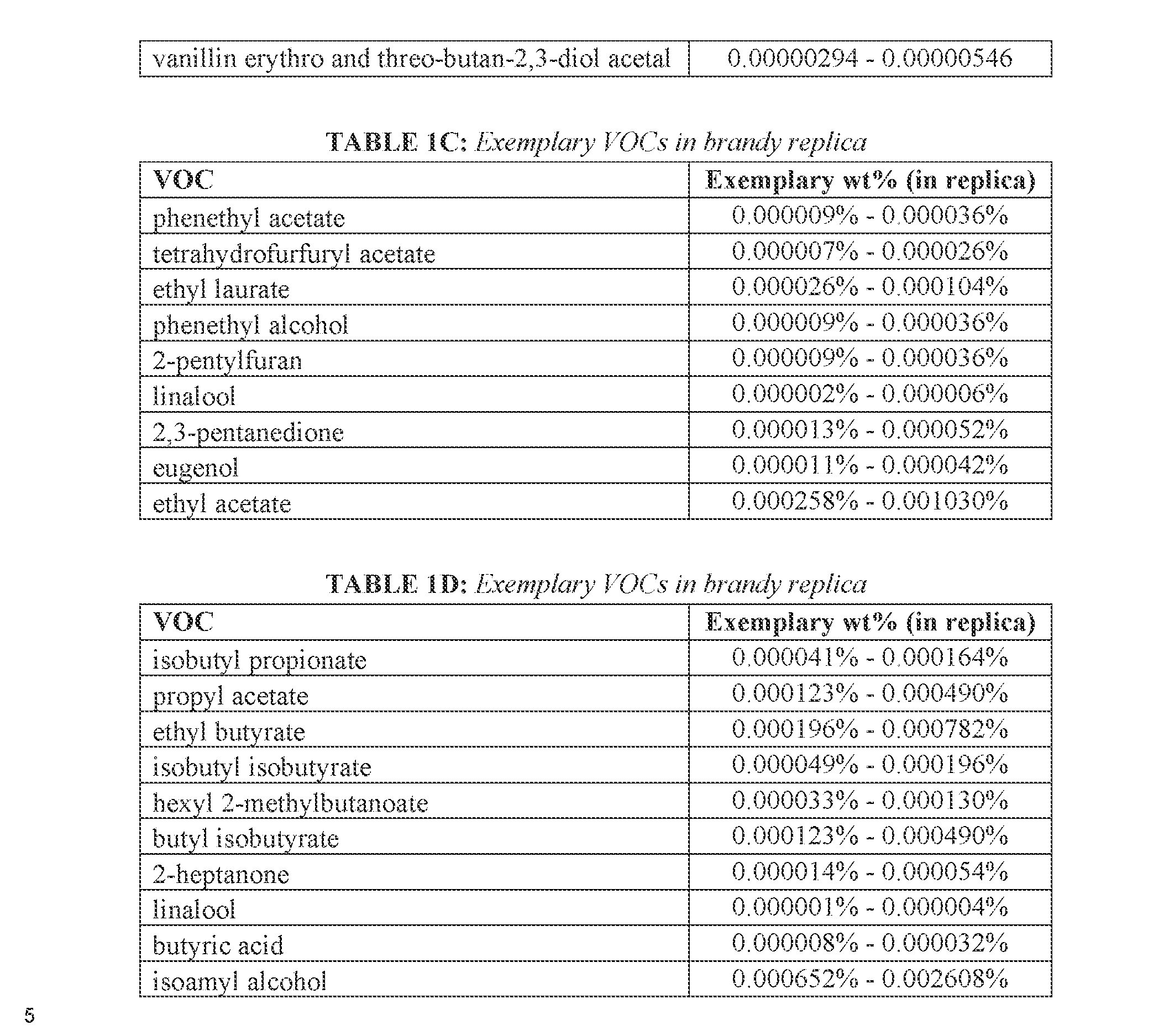


Claims
Priority Applications (6)
| Application Number | Priority Date | Filing Date | Title |
|---|---|---|---|
| MX2024003929A MX2024003929A (en) | 2021-09-28 | 2022-09-28 | Brandy replicas. |
| EP22877254.7A EP4408967A4 (en) | 2021-09-28 | 2022-09-28 | BRAND REPLICAS |
| AU2022357296A AU2022357296A1 (en) | 2021-09-28 | 2022-09-28 | Brandy replicas |
| CN202280078850.6A CN118339274A (en) | 2021-09-28 | 2022-09-28 | Brandy replica |
| CA3233657A CA3233657A1 (en) | 2021-09-28 | 2022-09-28 | Brandy replicas |
| US18/696,600 US20240392220A1 (en) | 2021-09-28 | 2022-09-28 | Brandy replicas |
Applications Claiming Priority (2)
| Application Number | Priority Date | Filing Date | Title |
|---|---|---|---|
| US202163249462P | 2021-09-28 | 2021-09-28 | |
| US63/249,462 | 2021-09-28 |
Publications (1)
| Publication Number | Publication Date |
|---|---|
| WO2023055801A1 true WO2023055801A1 (en) | 2023-04-06 |
Family
ID=85783478
Family Applications (1)
| Application Number | Title | Priority Date | Filing Date |
|---|---|---|---|
| PCT/US2022/045041 Ceased WO2023055801A1 (en) | 2021-09-28 | 2022-09-28 | Brandy replicas |
Country Status (7)
| Country | Link |
|---|---|
| US (1) | US20240392220A1 (en) |
| EP (1) | EP4408967A4 (en) |
| CN (1) | CN118339274A (en) |
| AU (1) | AU2022357296A1 (en) |
| CA (1) | CA3233657A1 (en) |
| MX (1) | MX2024003929A (en) |
| WO (1) | WO2023055801A1 (en) |
Families Citing this family (1)
| Publication number | Priority date | Publication date | Assignee | Title |
|---|---|---|---|---|
| JP2023110306A (en) * | 2022-01-28 | 2023-08-09 | サントリーホールディングス株式会社 | Beverages containing ingredients derived from wooden containers |
Citations (2)
| Publication number | Priority date | Publication date | Assignee | Title |
|---|---|---|---|---|
| GB958825A (en) * | 1962-07-27 | 1964-05-27 | Robert Baker Carroll | Alcoholic beverage and process of making same |
| US20210198603A1 (en) * | 2018-02-23 | 2021-07-01 | Ava Food Labs, Inc. | Alcoholic beverages produced from individual components |
Family Cites Families (4)
| Publication number | Priority date | Publication date | Assignee | Title |
|---|---|---|---|---|
| CN107987994A (en) * | 2017-12-06 | 2018-05-04 | 山东省葡萄研究院 | A kind of VS brandy fragrance formulations and preparation method thereof |
| CA3153244A1 (en) * | 2018-10-01 | 2020-04-09 | Ava Food Labs, Inc. | Bourbon replicas produced from individual components |
| US20210340474A1 (en) * | 2018-10-01 | 2021-11-04 | Ava Food Labs, Inc. | Whiskey replicas produced from individual components |
| AU2019355888A1 (en) * | 2018-10-01 | 2021-05-13 | Ava Food Labs, Inc. | Scotch replicas produced from individual components |
-
2022
- 2022-09-28 AU AU2022357296A patent/AU2022357296A1/en active Pending
- 2022-09-28 US US18/696,600 patent/US20240392220A1/en active Pending
- 2022-09-28 WO PCT/US2022/045041 patent/WO2023055801A1/en not_active Ceased
- 2022-09-28 EP EP22877254.7A patent/EP4408967A4/en active Pending
- 2022-09-28 CA CA3233657A patent/CA3233657A1/en active Pending
- 2022-09-28 CN CN202280078850.6A patent/CN118339274A/en active Pending
- 2022-09-28 MX MX2024003929A patent/MX2024003929A/en unknown
Patent Citations (2)
| Publication number | Priority date | Publication date | Assignee | Title |
|---|---|---|---|---|
| GB958825A (en) * | 1962-07-27 | 1964-05-27 | Robert Baker Carroll | Alcoholic beverage and process of making same |
| US20210198603A1 (en) * | 2018-02-23 | 2021-07-01 | Ava Food Labs, Inc. | Alcoholic beverages produced from individual components |
Non-Patent Citations (2)
| Title |
|---|
| ANONYMOUS: "Whiskey from Lab to Bottle: Can Glyph Make Better Spirits Using Molecules & Compounds?", ALCOHOL PROFESSOR, 9 August 2021 (2021-08-09), XP093060339, Retrieved from the Internet <URL:https://www.alcoholprofessor.com/blog-posts/molecular-spirits-glyph> [retrieved on 20230703] * |
| See also references of EP4408967A4 * |
Also Published As
| Publication number | Publication date |
|---|---|
| CN118339274A (en) | 2024-07-12 |
| MX2024003929A (en) | 2024-04-22 |
| EP4408967A1 (en) | 2024-08-07 |
| EP4408967A4 (en) | 2025-08-13 |
| US20240392220A1 (en) | 2024-11-28 |
| AU2022357296A1 (en) | 2024-04-11 |
| CA3233657A1 (en) | 2023-04-06 |
Similar Documents
| Publication | Publication Date | Title |
|---|---|---|
| Liguori et al. | Impact of dealcoholization on quality properties in white wine at various alcohol content levels | |
| Chira et al. | Chemical and sensory evaluation of wine matured in oak barrel: effect of oak species involved and toasting process | |
| Cutzach et al. | Study of the formation mechanisms of some volatile compounds during the aging of sweet fortified wines | |
| Loira et al. | Use of Schizosaccharomyces pombe and Torulaspora delbrueckii strains in mixed and sequential fermentations to improve red wine sensory quality | |
| Ivanova et al. | Volatile composition of Macedonian and Hungarian wines assessed by GC/MS | |
| Bailly et al. | Aroma extraction dilution analysis of Sauternes wines. Key role of polyfunctional thiols | |
| Schneider et al. | Volatile compounds involved in the aroma of sweet fortified wines (Vins Doux Naturels) from Grenache Noir | |
| Heras et al. | Changes in the volatile composition of red wines during aging in oak barrels due to microoxygenation treatment applied before malolactic fermentation | |
| Dušek et al. | Qualitative Determination of β‑Acids and Their Transformation Products in Beer and Hop Using HR/AM-LC-MS/MS | |
| Rodríguez-Bencomo et al. | Volatile compounds of red wines macerated with Spanish, American, and French oak chips | |
| Allamy et al. | Impact of harvest date on aroma compound composition of Merlot and Cabernet-Sauvignon must and wine in a context of climate change: A focus on cooked fruit molecular markers | |
| Corona et al. | Influence of pre-fermentative addition of aqueous solution tannins extracted from oak wood (Quercus petraea) on the composition of Grillo wines | |
| Marin et al. | Physico-chemical and sensory characterization of a fruit beer obtained with the addition of cv. Lambrusco grapes must. | |
| Cooke et al. | Quantification of several 4-alkyl substituted γ-lactones in Australian wines | |
| AU2022357296A1 (en) | Brandy replicas | |
| Felipe et al. | Synthesis and characterization of mead: from the past to the future and development of a new fermentative route | |
| Wang et al. | Molecular insights into the aroma difference between beer and wine: a meta-analysis-based sensory study using concentration leveling tests | |
| AU2019352612A1 (en) | Bourbon replicas produced from individual components | |
| JP6951071B2 (en) | Method for producing distilled liquor, mixed liquor, and distilled liquor | |
| HK40113873A (en) | Brandy replicas | |
| Asproudi et al. | Enhancing the volatile compounds and sensory profile of Nebbiolo wines through wood formats alternative to traditional barrels | |
| García-Llobodanin et al. | Pear distillates: influence of the raw material used on final quality | |
| WO2023086404A1 (en) | Agave spirit replicas | |
| Zea et al. | Changes in aroma profile of sherry wines during the oxidative ageing | |
| EP4430153A1 (en) | Gin replicas |
Legal Events
| Date | Code | Title | Description |
|---|---|---|---|
| 121 | Ep: the epo has been informed by wipo that ep was designated in this application |
Ref document number: 22877254 Country of ref document: EP Kind code of ref document: A1 |
|
| WWE | Wipo information: entry into national phase |
Ref document number: 2022357296 Country of ref document: AU Ref document number: 809447 Country of ref document: NZ Ref document number: AU2022357296 Country of ref document: AU |
|
| ENP | Entry into the national phase |
Ref document number: 3233657 Country of ref document: CA |
|
| WWE | Wipo information: entry into national phase |
Ref document number: 12024550773 Country of ref document: PH |
|
| REG | Reference to national code |
Ref country code: BR Ref legal event code: B01A Ref document number: 112024006060 Country of ref document: BR |
|
| ENP | Entry into the national phase |
Ref document number: 2022357296 Country of ref document: AU Date of ref document: 20220928 Kind code of ref document: A |
|
| WWE | Wipo information: entry into national phase |
Ref document number: 202417032418 Country of ref document: IN |
|
| NENP | Non-entry into the national phase |
Ref country code: DE |
|
| WWE | Wipo information: entry into national phase |
Ref document number: 11202402100Y Country of ref document: SG |
|
| ENP | Entry into the national phase |
Ref document number: 2022877254 Country of ref document: EP Effective date: 20240429 |
|
| WWE | Wipo information: entry into national phase |
Ref document number: 202280078850.6 Country of ref document: CN |
|
| ENP | Entry into the national phase |
Ref document number: 112024006060 Country of ref document: BR Kind code of ref document: A2 Effective date: 20240327 |