WO2023055927A1 - Fragrance compositions and uses thereof - Google Patents
Fragrance compositions and uses thereof Download PDFInfo
- Publication number
- WO2023055927A1 WO2023055927A1 PCT/US2022/045220 US2022045220W WO2023055927A1 WO 2023055927 A1 WO2023055927 A1 WO 2023055927A1 US 2022045220 W US2022045220 W US 2022045220W WO 2023055927 A1 WO2023055927 A1 WO 2023055927A1
- Authority
- WO
- WIPO (PCT)
- Prior art keywords
- fragrance
- composition
- present
- range
- component
- Prior art date
- Legal status (The legal status is an assumption and is not a legal conclusion. Google has not performed a legal analysis and makes no representation as to the accuracy of the status listed.)
- Ceased
Links
Classifications
-
- C—CHEMISTRY; METALLURGY
- C11—ANIMAL OR VEGETABLE OILS, FATS, FATTY SUBSTANCES OR WAXES; FATTY ACIDS THEREFROM; DETERGENTS; CANDLES
- C11B—PRODUCING, e.g. BY PRESSING RAW MATERIALS OR BY EXTRACTION FROM WASTE MATERIALS, REFINING OR PRESERVING FATS, FATTY SUBSTANCES, e.g. LANOLIN, FATTY OILS OR WAXES; ESSENTIAL OILS; PERFUMES
- C11B9/00—Essential oils; Perfumes
-
- A—HUMAN NECESSITIES
- A61—MEDICAL OR VETERINARY SCIENCE; HYGIENE
- A61K—PREPARATIONS FOR MEDICAL, DENTAL OR TOILETRY PURPOSES
- A61K8/00—Cosmetics or similar toiletry preparations
- A61K8/18—Cosmetics or similar toiletry preparations characterised by the composition
- A61K8/30—Cosmetics or similar toiletry preparations characterised by the composition containing organic compounds
- A61K8/33—Cosmetics or similar toiletry preparations characterised by the composition containing organic compounds containing oxygen
- A61K8/34—Alcohols
- A61K8/345—Alcohols containing more than one hydroxy group
-
- A—HUMAN NECESSITIES
- A61—MEDICAL OR VETERINARY SCIENCE; HYGIENE
- A61K—PREPARATIONS FOR MEDICAL, DENTAL OR TOILETRY PURPOSES
- A61K8/00—Cosmetics or similar toiletry preparations
- A61K8/18—Cosmetics or similar toiletry preparations characterised by the composition
- A61K8/72—Cosmetics or similar toiletry preparations characterised by the composition containing organic macromolecular compounds
- A61K8/84—Cosmetics or similar toiletry preparations characterised by the composition containing organic macromolecular compounds obtained by reactions otherwise than those involving only carbon-carbon unsaturated bonds
- A61K8/86—Polyethers
-
- A—HUMAN NECESSITIES
- A61—MEDICAL OR VETERINARY SCIENCE; HYGIENE
- A61L—METHODS OR APPARATUS FOR STERILISING MATERIALS OR OBJECTS IN GENERAL; DISINFECTION, STERILISATION OR DEODORISATION OF AIR; CHEMICAL ASPECTS OF BANDAGES, DRESSINGS, ABSORBENT PADS OR SURGICAL ARTICLES; MATERIALS FOR BANDAGES, DRESSINGS, ABSORBENT PADS OR SURGICAL ARTICLES
- A61L9/00—Disinfection, sterilisation or deodorisation of air
- A61L9/01—Deodorant compositions
-
- A—HUMAN NECESSITIES
- A61—MEDICAL OR VETERINARY SCIENCE; HYGIENE
- A61Q—SPECIFIC USE OF COSMETICS OR SIMILAR TOILETRY PREPARATIONS
- A61Q13/00—Formulations or additives for perfume preparations
Definitions
- compositions comprising fragrance materials and at least one substantially fragrance modulator for improving or enhancing the fidelity and/or longevity of the fragrance profile.
- the invention also relates to methods of making and using said compositions.
- Fragrances can include fragrance components that can be classified, in part, by their volatility. Accordingly these fragrance components may be referred to as a high-, moderate-, or low-volatility fragrance components. Different fragrances may be dominated by any one or more of these component such that the fragrance may be associated with different perceptions by a user.
- the volatility of the fragrance may result in a short timeframe in which the fragrance is perceived by a a panel of experts or professional evaluators or individual experts or professional evaluators or in a rapid loss of the initial character of the fragrance (e.g., citrus, aquatic, aromatic, floral, spicy, fresh, or a combination thereof) and becoming dominated by a heavy fragrance character (e.g., woody or musky).
- a heavy fragrance character e.g., woody or musky
- a fragrance composition can include a modulator component in a range of from about 0.1 wt% to about 30 wt% of the fragrance composition.
- a fragrance component is present in an amount in a range of from about 0.04 wt% to about 40 wt% of the fragrance composition, the fragrance component includes at least one low volatile fragrance material having a vapor pressure less than 0.001 Torr (0.000133 kPa) at 25 °C; at least one moderate volatile fragrance material having a vapor pressure in the range of 0.1 Torr to 0.001 Torr (0.0133 kPa to 0.000133 kPa) at 25 °C; and at least one high volatile fragrance material having a vapor pressure greater than 0.1 Torr (0.0133 kPa) at 25 °C.
- the characteristics of the composition can provide rules for objectively classifying fragrance materials according to their volatility using their vapor pressures defined at suitable temperature, instead of their characters.
- the objective rules operate irrespective of perfumers performing the classification.
- the rules classify the fragrance materials into low, moderate or high volatile fragrance materials for formulating into fragrance mixtures.
- the compositions can have improved fidelity to the perceived fragrance profile over time.
- pairing the fragrance components with a selective modulator can help to ensure that an initial fragrance impression is significantly consistent from its initial impression to the end.
- an initial impression of the fragrance can maintain its quality, as perceived by a panel of experts or professional evaluators or individual experts or professional evaluators, for a longer period of time relative to a corresponding fragrance that is free of any one of the modulators, or combinations thereof described herein or relative to the equivalent fragrance that has a traditional fragrance construction that includes a different modulator.
- compositions having improved longevity of the perceived fragrance profile can be present for long periods of time (e.g., greater than 30 mins, 1, 2, 4, 6, or even 8 hours).
- the improved longevity of the high volatile fragrances may result from the modulator slowing the evaporation of the high and moderate volatile fragrances from the composition.
- the perceived harshness of overdosing of the fragrance material is mitigated or absent, as compared to the same perception in a fragrance in the absence of the modulator.
- body splash means a body care formulation that is applied to the body. Typically, the body splash is applied to the body after bathing and provides a subtle hint of scent to the body. Body splashes are commonly used by consumers who prefer less strong fragrance compositions.
- a body splash may comprise an ethanol-free composition according to the present invention which comprises from 0.2-8 wt%, relative to the total weight of the composition, of a fragrance component.
- the body splash may further comprise alkyl polyglucosides as non-ionic surfactants.
- body spray means a formulation comprising fragrance materials intended to be applied to the body to prevent or mask body odor caused by the bacterial breakdown of perspiration on the body (e.g., armpits, feet, and other areas of the body).
- the body spray may also provide a fragrance expression to the a panel of experts or professional evaluators or individual experts or professional evaluators.
- body spray compositions are applied as an aerosol spray in an effective amount on the skin of a consumer.
- composition includes a fine fragrance composition intended for application to a body surface, such as for example, skin or hair, e.g., to impart a pleasant odor thereto, or cover a malodour thereof. They are generally in the form of perfume concentrates, perfumes, eau de perfumes, eau de toilettes, aftershaves, or colognes.
- the fine fragrance compositions may be an ethanol-based composition.
- composition may also include a cosmetic composition, which comprises a fragrance material for the purposes of delivering a pleasant smell to drive consumer acceptance of the cosmetic composition.
- composition may also include body splashes or body sprays.
- composition may also include cleaning compositions, such as fabric care composition or home care compositions, including air care compositions (e.g., air fresheners), for use on clothing or other substrates such as hard surfaces (e.g., dishes, floors, countertops).
- cleaning compositions such as fabric care composition or home care compositions, including air care compositions (e.g., air fresheners), for use on clothing or other substrates such as hard surfaces (e.g., dishes, floors, countertops).
- air care compositions e.g., air fresheners
- additional nonlimiting examples of “composition” may also include facial or body powder, deodorant, foundation, body/facial oil, mousse, creams (e.g., cold creams), waxes, sunscreens and blocks, bath and shower gels, lip balms, self-tanning compositions, masks and patches.
- the term “consumer” means both the user of the composition and the observer nearby or around the user.
- fragment material and “fragrance materials” relates to a perfume raw material (“PRM”), or a mixture of perfume raw materials (“PRMs”), that are used to impart an overall pleasant odor or fragrance profile to a composition.
- “Fragrance materials” can encompass any suitable perfume raw materials for fragrance uses, including materials such as, for example, alcohols, aldehydes, ketones, esters, ethers, acetates, nitriles, terpene hydrocarbons, nitrogenous or sulfurous heterocyclic compounds and essential oils.
- materials such as, for example, alcohols, aldehydes, ketones, esters, ethers, acetates, nitriles, terpene hydrocarbons, nitrogenous or sulfurous heterocyclic compounds and essential oils.
- naturally occurring plant and animal oils and exudates comprising complex mixtures of various chemical components are also known for use as “fragrance materials”.
- perfume raw materials which comprise a known natural oil can be found by reference to Journals commonly used by those skilled in the art such as “Perfume and Flavourist” or “Journal of Essential Oil Research”, or listed in reference texts such as the book by S. Arctander, Perfume and Flavor Chemicals, 1969, Montclair, New Jersey, USA and more recently re-published by Allured Publishing Corporation Illinois (1994). Additionally, some perfume raw materials are supplied by the fragrance houses (Firmenich, International Flavors & Fragrances, Givaudan, Symrise) as mixtures in the form of proprietary specialty accords.
- Non-limiting examples of the fragrance materials useful herein include pro-fragrances such as acetal pro-fragrances, ketal pro-fragrances, ester profragrances, hydrolyzable inorganic-organic pro-fragrances, and mixtures thereof.
- the fragrance materials may be released from the pro-fragrances in a number of ways.
- the fragrance may be released as a result of simple hydrolysis, or by a shift in an equilibrium reaction, or by a pH-change, or by enzymatic release.
- fragrance profile means the description of how the fragrance is perceived by the human nose at any moment in time.
- the fragrance profile may change over time. It is a result of the combination of the low, moderate and high volatile fragrance materials, if present, of a fragrance.
- a fragrance profile is composed of 2 characteristics: ‘intensity’ and ‘character’.
- the ‘intensity’ relates to the perceived strength whilst ‘character’ refers to the odor impression or quality of the perfume, e.g., fruity, floral, woody, etc.
- modulator and “fragrance modulator” are used interchangeably to designate an agent having the capacity to affect the fragrance profile, such as for example, by impacting the fragrance materials’ evaporation rate.
- the modulator may mediate its effect by lowering the vapor pressure of the fragrance materials and increasing their adherence to the substrate (skin and/or hair) thus ensuring a longer-lasting impression of the fragrance.
- the fragrance profile preferably the fragrance components composition attributable to the high and moderate volatile fragrance materials, alone or individually, of the composition can be perceived by a panel of experts or professional evaluators or individual experts or professional evaluators, over a longer period of time, or the perceived harshness of overdosing of the fragrance material is mitigated or absent, as compared to the same perception in the absence of the modulator.
- overdose can include overdosing a moderate volatile component or high volatile component in aggregate (e.g., greater than 30 wt% of the fragrance component).
- overdose can further include overdosing an individual component of the moderate volatile component or the high volatile component (e.g., if the high volatile component includes three oils at least one of the oils may account for a greater wt% of the high volatile component than would be present in a traditional fragrance or a fragrance that is free of the modulators described herein). Suitable examples of the modulator are provided herein below.
- the term “substantially non-odorous” means an agent that does not impart an odor of its own when added into a composition of the present invention.
- a “substantially non-odorous fragrance modulator” does not impart a new odor that alters the character of the fragrance profile of the composition to which it is added.
- the term “substantially non-odorous” also encompasses an agent that may impart a minimal or slight odor of its own when added into a composition of the present invention.
- the odor imparted by the “substantially non-odorous fragrance modulator” is generally undetectable or tends to not substantively alter the character of the fragrance profile of the composition to which it is added initially or preferably over time.
- the term “substantially non- odorous” also includes materials that are perceivable only by a minority of people or those materials deemed “anosmic” to the majority of people. Furthermore, the term “substantially non-odorous” also includes materials that may, from particular suppliers, contain an odor due to impurities, such as when the materials contain the impurities at not more than about 5 wt%, preferably not more than 1 wt%, often even not more than 1 part per million (ppm). These impurities maybe removed by purification techniques known in the art as required to make them suitable for use in fragrance compositions of the present invention.
- vapor pressure means the partial pressure in air at a defined temperature (e.g., 25 °C) and standard atmospheric pressure (760 mmHg) for a given chemical species. It defines a chemical species’ desire to be in the gas phase rather than the liquid or solid state. The higher the vapor pressure the greater the proportion of the material that will, at equilibrium, be found in a closed headspace. It is also related to the rate of evaporation of a fragrance material which is defined in an open environment where material is leaving the system. The vapor pressure is determined according to the reference program Advanced Chemistry Development (ACD/Labs) Software Version 14.02, or preferably the latest version update). It is understood that the test methods that are disclosed in the Test Methods Section of the present application must be used to determine the respective values of the parameters of Applicants’ inventions as described and claimed herein.
- ACD/Labs Advanced Chemistry Development
- compositions are by weight of the total composition, as evident by the context, unless specifically stated otherwise. All ratios are weight ratios, unless specifically stated otherwise, and all measurements are made at 25 °C, unless otherwise designated.
- fragrance compositions can include at least a fragrance component and modulator.
- the fragrance component can include a wide variety of fragrance materials.
- the fragrance materials can be grouped in terms of their volatility. Generally, the materials can be grouped as low volatile fragrance materials, moderate volatile fragrance materials, and high volatile fragrance materials. Each group of materials can be associated with various perceptions by a a panel of experts or professional evaluators or individual experts or professional evaluators. While not so limited, a high volatile fragrance may be associated with a citrus character; a moderate volatile fragrance may be associated with a spicy character; and a low volatile fragrance may be associated with a woody character.
- Each group of fragrance materials can include synthetic materials or natural materials. The volatility of the fragrance materials can be in reference to an individual fragrance material. Alternatively, in cases where a combination of materials produce a fragrance, for example a natural oil, the volatility may be in reference to that aggregation.
- this disclosure shows that longer lasting fragrance profiles or at least initial fragrance profiles, may be enhanced through the presence of certain modulators.
- the fragrance component can be present in an amount of from about 0.04 wt% to 40 wt%, 1 wt% to about 30 wt%, about 5 wt% to about 30 wt%, or less than, equal to, or greater than about 0.04 wt%, 0.5, 1, 1.5, 2, 2.5, 3, 3.5, 4, 4.5, 5,
- the modulator can be present in an amount of from about 0.1 wt% to about 30 wt%, about 0.1 wt% to about 27 wt%, about 0.5 wt% to about 20 wt%, or less than, equal to, or greater than about 0.1 wt%, 0.5, 1, 1.5, 2, 2.5, 3, 3.5, 4, 4.5, 5, 5.5, 6, 6.5, 7, 7.5, 8, 8.5, 9, 9.5, 10, 10.5, 11, 11.5, 12, 12.5, 13, 13.5, 14, 14.5, 15, 15.5, 16, 16.5, 17, 17.5, 18, 18.5, 19, 19.5, or about 20 wt% relative to the composition.
- the “fragrance materials” have been classified as low, moderate or high volatile fragrance materials according to their volatility by their vapor pressure.
- This method of classifying fragrance materials by their vapor pressure avoids the problem of different classifications for the same fragrance material according to the traditional approach that relies on their subjective characteristic character.
- the fragrance materials are a natural oil, extract or absolute, which comprises a mixture of several compounds
- the vapor pressure of the complete oil should be treated a mixture of the individual perfume raw material components using the reference program cited above.
- the individual components and their level, in any given natural oil or extract can be determined by direct injection of the oil into a GC-MS column for analysis as known by one skilled in the art.
- the vapor pressure should preferably be obtained from the supplier.
- bases so called ‘bases’
- the vapor pressure should preferably be obtained from the supplier.
- they can physically analyze the composition of a full fragrance oil available commercially to identity the fragrance raw materials and their levels using standard GC-MS techniques. This would be irrespective of whether they had been added to the fragrance oil as individual chemicals, as components of naturals or from proprietary bases.
- proprietary bases and naturals are included in our examples, when analyzing a commercially available fragrance via GC-MS one could simply identify the components of the base or natural oil as part of the overall fragrance mixture and their levels, without being able to identify which proprietary base or natural oil the fragrance had come from.
- a pH of the composition can be in a range of from about 4 to about 8, about 5 to about 7, less than, equal to, or greater than about 4, 5, 6, 7, or about 8.
- the ethanol concentration in any of the compositions described herein can be less than about 78 wt% ethanol, less than about 70 wt% ethanol, less than about 60 wt% ethanol, less than about 50 wt% ethanol, less than about 40 wt% ethanol, less than about 30 wt% ethanol, less than about 20 wt% ethanol, less than about 10 wt% ethanol, or free of ethanol.
- the fragrance component comprises at least one low volatile fragrance material.
- the composition can include at least 3 low volatile fragrance materials, or at least 4 low volatile fragrance materials, or at least 5 low volatile fragrance materials, or at least 7 low volatile fragrance materials.
- the ranges provided hereinabove cover the total of all the low volatile fragrance materials.
- suitable low volatile fragrances materials are provided in Table 1 A and IB below.
- the low volatile fragrance material is selected from at least 1 material, or at least 2 materials, or at least 3 materials, or at least 5 materials, at least 7, at least 8, at least 10, or at least 12 low volatile fragrance materials as disclosed in Table 1 A.
- Natural fragrance materials or oils having an aggregrate vapour pressure less than 0.001 Torr (0.000133 kPa) at 25 °C are provided in Table IB. Low Volatile Natural Oils.
- Non-limiting examples of alternative qualities from various suppliers can be purchased under the following tradenames: Kharismal® Super (IFF), Kharismal® (IFF), Hedione® (Firmenich), Hedione® HC (Firmenich), Paradisone (Firmenich), Cepionate (Zenon), Super cepionate (Zenon), Claigeon® (Zenon).
- the low volatile fragrance materials may be obtained from one or more of the following companies: Firmenich (Geneva, Switzerland), Symrise AG (Holzminden, Germany), Givaudan (Argenteuil, France), IFF (Hazlet, New Jersey), Bedoukian (Danbury, Connecticut), Sigma Aldrich (St. Louis, Missouri), Millennium Specialty Chemicals (Olympia Fields, Illinois), Polarone International (Jersey City, New Jersey), and Aroma & Flavor Specialties (Danbury, Connecticut).
- Exemplary low volatile fragrance materials selected from the group of Tables 1A or IB Low Volatile Fragrance Materials are preferred. However, it is understood by one skilled in the art that other low volatile fragrance materials, not recited in Tables 1 A or IB, would also fall within the scope of the present invention, so long as they have a vapor pressure less than 0.001 Torr (0.000133 kPa) at 25 °C.
- the fragrance component includes at least one moderate volatile fragrance material or aggregate of volatile fragrance materials having a vapor pressure in the range of 0.1 Torr to 0.001 Torr (0.0133 kPa to 0.000133 kPa) at 25 °C.
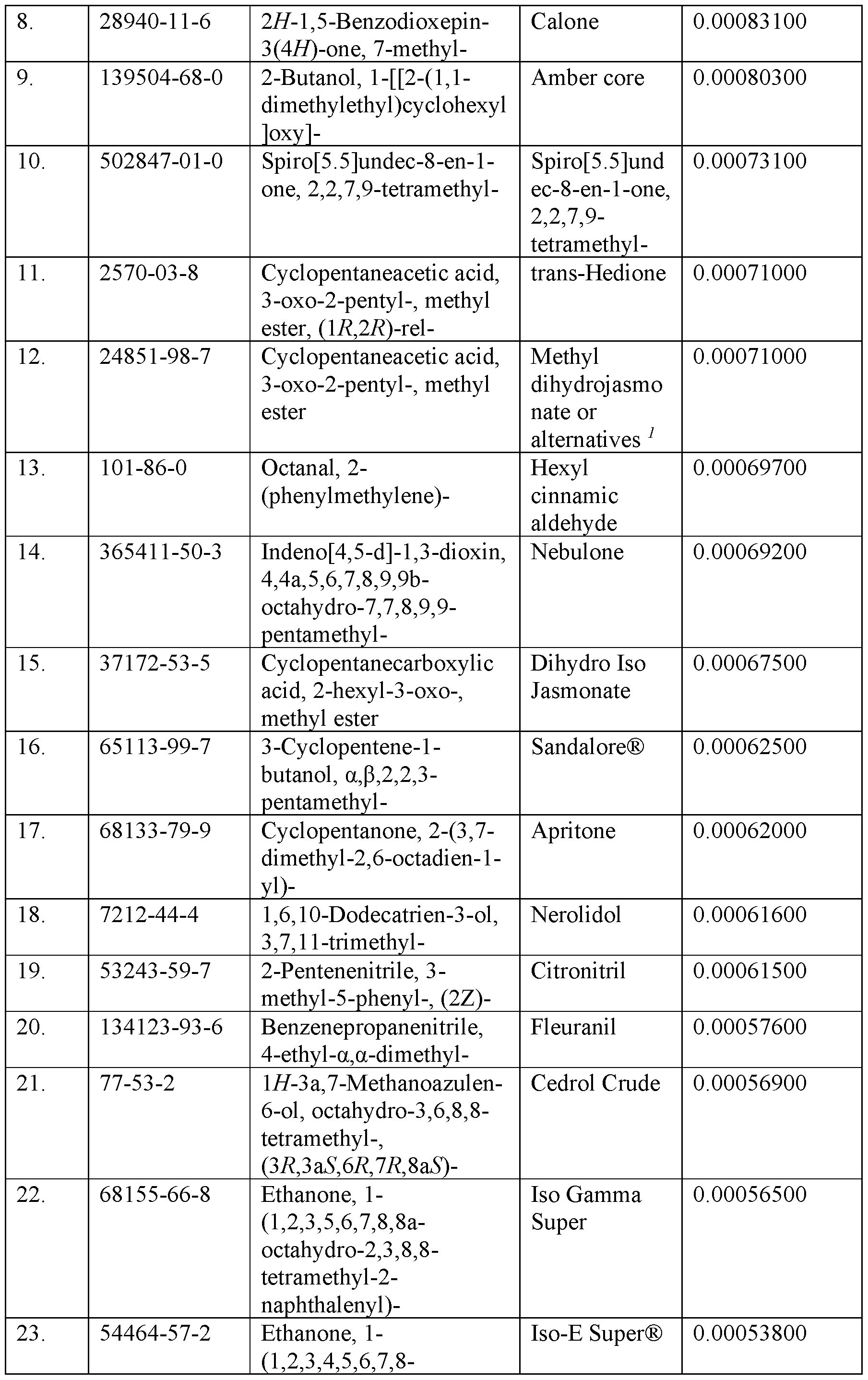
- the composition according to the present disclosure can include at least 3 moderate volatile fragrance materials, or at least 5 moderate volatile fragrance materials, or at least 7 moderate volatile fragrance materials. If there are more than one moderate volatile fragrance materials, then the ranges provided hereinabove cover the total of all of the moderate volatile fragrance materials. Suitable examples of moderate volatile fragrances materials are provided in Table 2A and 2B below.
- moderate volatile fragrance materials having a vapor pressure in the range of 0.1 Torr to 0.001 Torr (0.0133 kPa to 0.000133 kPa) at 25 °C are provided in Table 2A and 2B.
- the moderate volatile fragrance material is selected from at least 1 material, or at least 2 materials, or at least 3 materials, or at least 5 materials, or at least 7 moderate volatile fragrance materials as disclosed in Table 2A.
- Natural fragrance materials or oils having an aggregrate vapour pressure between 0.1 Torr to 0.001 Ton- (0.0133 kPa to 0.000133 kPa) at 25 °C are provided in Table 2B.
- Table 2B Moderate Volatile Natural Oils.
- Moderate volatile fragrance materials can eselected from the group of Tables 2A or 2B. However, it is understood by one skilled in the art that other moderate volatile fragrance materials, not recited in Tables 2A or 2B, would also fall within the scope of the present invention, so long as they have a vapor pressure of 0.1 to 0.001 Torr at 25 °C.
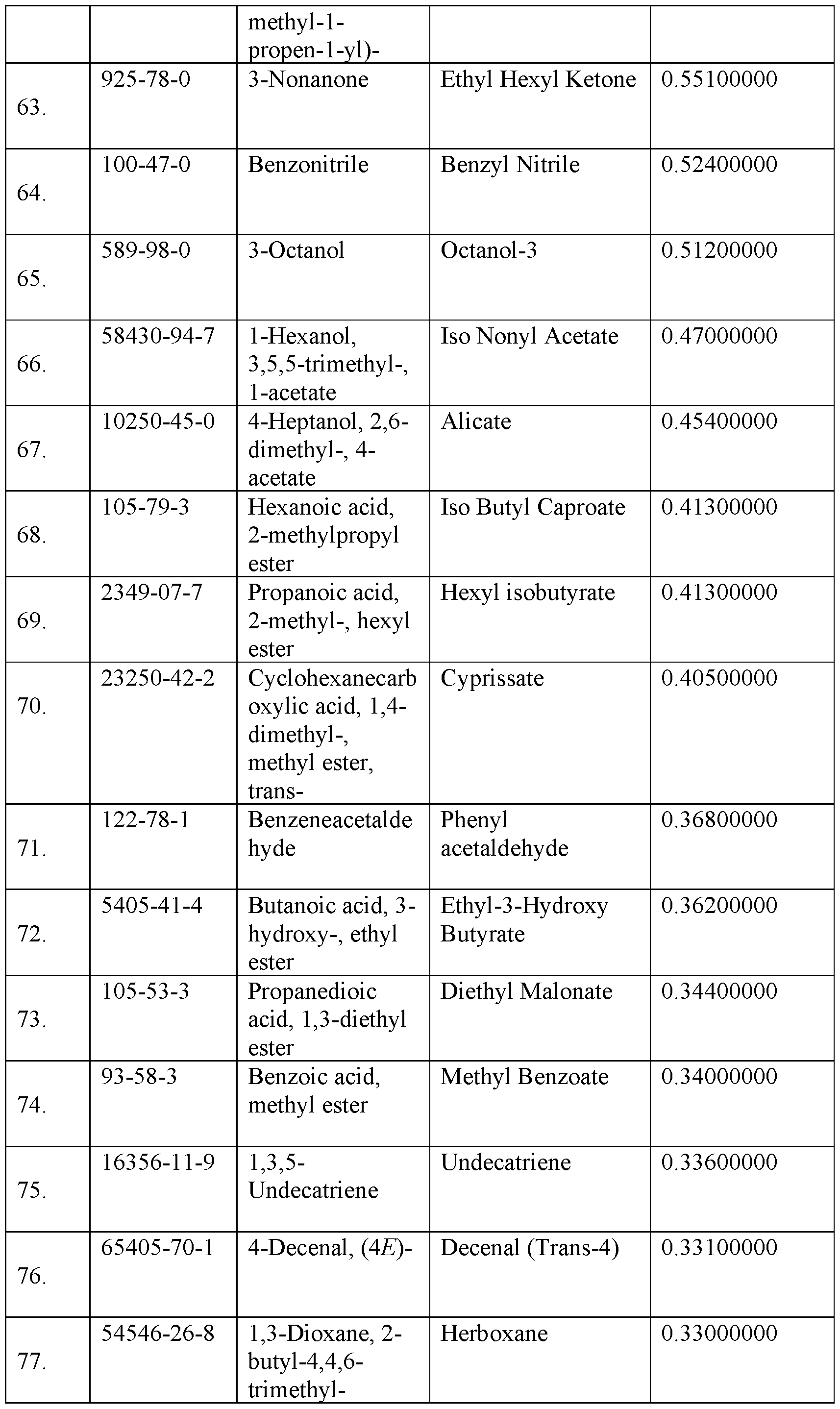
- the fragrance component includes at least one high volatile fragrance material having a vapor pressure greater than 0.1 Torr (0.0133 kPa) at 25 °C.
- the high volatile fragrance material can include at least 2 high volatile fragrance materials, 3 high volatile fragrance materials, or at least 5 high volatile fragrance materials, or at least 7 high volatile fragrance materials. If there are more than one high volatile fragrance materials, then the ranges provided hereinabove cover the total of all of the high volatile fragrance materials. Suitable examples of high volatile fragrances materials are provided in Tables 3 A and 3B below.
- the high volatile fragrance material is selected from at least 1 material, or at least 2 materials, or at least 3 materials, or at least 5 materials, at least 7 materials, or at least 9 high volatile fragrance materials as disclosed in Table 3A.
- Natural fragrance materials or oils having an aggregrate vapour pressure greater than 0.1 Torr (0.0133 kPa) at 25 °C are provided in Table 3B.
- Exemplary high volatile fragrance materials selected from the group of Tables 3 A or 3B are preferred. However, it is understood by one skilled in the art that other high volatile fragrance materials, not recited in Tables 3A or 3B, would also fall within the scope of the present invention, so long as they have a vapor pressure of greater than 0.1 Torr (0.0133 kPa) at 25 °C.
- the individual fragrance materials can be present in various concentrations of the fragrance component.
- the low volatile material can be present in a range of from about 0 wt% to about 30 wt% of the fragrance component, about 10 wt% to about 20 wt%, less than equal to or greater than about 0 wt%, 5, 10, 15, 20, 25, or 30 wt%;
- the moderate volatile component can be present in a range of from about 30 wt% to about 70 wt% of the fragrance component, about 40 wt% to about 60 wt%, less than, equal to, or greater than about 30 wt%, 35, 40, 45, 50, 55, 60, 65, or about 70 wt%;
- the high volatile fragrance component can be present in a 0 wt% to about 30 wt% of the fragrance component, about 10 wt% to about 20 wt%, less than equal to or greater than about 0 wt%, 5, 10, 15, 20, 25, or 30 wt%.
- the composition further comprises at least one modulator as described herein below.
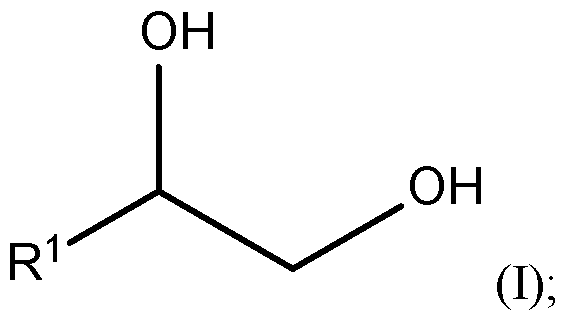
- Suitable examples of the fragrance modulators include: the compound according to Formula I: a polymer including a repeating unit derived from the compound according to Formula II: a mixture thereof.
- R 1 , R 2 , R 3 , R 4 , and R 5 are independently chosen from -H, -OH, or substituted or unsubstituted (Ci-C2o)hydrocarbyl.
- R 1 , R 2 , R 3 , R 4 , and R 5 are independently chosen from (Ci-C2o)alkyl, (C2-C2o)alkeneyl, (C3- C2o)cycloalkyl, (Ci-C2o)alkoxyl, (Ci-C2o)aryl, or a combination thereof.
- the modulator component includes pentylene glycol, polycitronellol, or a mixture thereof.
- the polycitronellol can include 2-8 repeating units and can have a weight-average-molecular weight in a range of from about 460 g/mol to about 1500 g/mol.
- the modulator component can include a mixture of pentylene glycol and polycitronellol and a molar ratio of pentylene glycol to polycitronellol is in a range of from about 5: 1 to about 1 :5, about 4: 1 to about 1 :4, about 3: 1 to about 1 :3, or about 2: 1 to about 1 :2, or about 1 : 1.
- the modulator component can include at least some PPG-20 methyl glucose ether mixed with any of the aforementioned modulators. Altemativly, the modulator component can be free of (include 0 wt%) PPG-20 methyl glucose.
- PPG-20 methyl glucose is present, it can be in range of from about 1 wt% to about 15 wt% of the modulator component, about 5 wt% to about 10 wt% of the modulator component, less than, equal to, or greater than about 1 wt%, 2, 3, 4, 5, 6, 7, 8, 9, 10, 11, 12, 13, 14, or about 15 wt%.
- the modulator component can include other modulators included in addition to pentylene glycol, polycitronellol, or a mixture thereof.
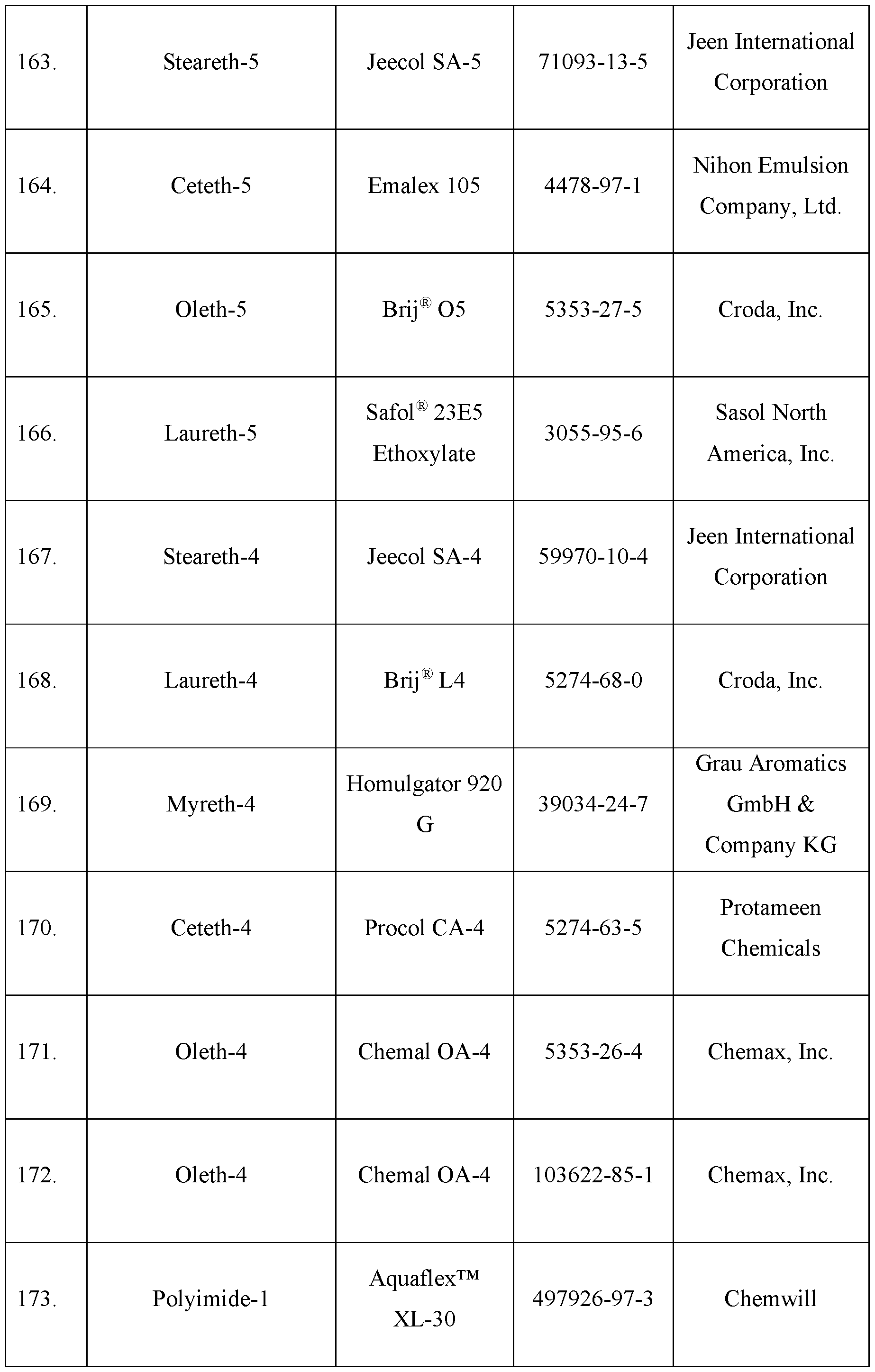
- additional modulators can include those listed herein below in Tables 4(a) and 4(b).
- Tables 4(a) and 4(b) provide lists of suitable non-odorous fragrance modulators.
- non-odorous fragrance modulator is selected from the group of materials disclosed in Table 4(b).
- the modulator(s) can be characterized as being “low odor”, “substantially non-odorous”, or non-odorous. In some examples, if the modulator is present at 1 wt% or less, no odor may be detected from the modulator.
- the fragrance modulator is biodegradable. This can make the fragrance composition to which it is included a “green” or environmentally friendly fragrance composition. Additionally, the stability of a fragrance composition that includes the substantially non-odorus fragrance modulator can be increased. The increase in stability can be shown by observing that the composition undergoes undesirable color formation (e.g., yellowing) at a slower rate.
- the fragrance modulator component can be present in an amount of from about 0.1 wt% to about 27 wt% relative to the total weight of the composition of the composition, about 0.5 wt% to about 18 wt%, about 2.5 wt% to about 15 wt%, or less than, equal to, or greater than about 0.1 wt%, 0.5, 1, 1.5, 2, 2.5, 3, 3.5, 4, 4.5, 5, 5.5, 6, 6.5, 7, 7.5, 8, 8.5, 9, 9.5, 10, 10.5, 11, 11.5, 12, 12.5, 13, 13.5, 14, 14.5, 15, 15.5, 16, 16.5, 17, 17.5, 18, 18.5, 19, 19.5, 20 wt%. If there are more than one fragrance modulators, then the ranges provided hereinabove cover the total of all of the fragrance modulators.
- the fragrance modulator can be a liquid at temperatures lower than 100 °C, such as at ambient temperature.
- the fragrance modulators may be fully miscible with the fragrance materials to form a single phase liquid.
- co-solvents e.g., dipropylene glycol (DPG), triethyl citrate, or others well known to those skilled in the art
- DPG dipropylene glycol
- triethyl citrate or others well known to those skilled in the art
- the effect of the fragrance modulator on the fragrance profile can be improved.
- improved it is meant that the fragrance profile of the composition, particular the components contributed by at least one of the high and moderate volatile fragrance materials, can be perceived by a panel of experts or professional evaluators or individual experts or professional evaluators at later time points such as, for example, 15 mins, 30 mins, 1 hour, 2 hours, 3 hours, 4 hours, 5 hours, 6 hours, 7 hours, 8 hours, 10 hours, and possibly all the way up to 24 hrs after application as compared to controls, e.g., lacking any of the disclosed non-odorous fragrance modulators such as pentylene glycol, polycitronellolor an equivalent traditional fragrance construction.
- “improved” it can mean that the perception, by a panel of experts or professional evaluators or individual experts or professional evaluators, of the fidelity of the fragrance profile contributed by the high and moderate volatile fragrance materials is markedly increased or enhanced as compared to the controls.
- “Increased” or “enhanced” means that a panel of experts or professional evaluators or individual experts or professional evaluators perceives the fragrance profile, preferably the characters attributable to the high and/or moderate volatile fragrance materials, of a composition as not changing from its initial impression or the changes are minimal from when the composition was first applied to when it dissipates. In other words, the fidelity of the perceived fragrance profile of the composition is maintained over time.
- the composition lacking any of the disclosed nom- odorous fragrance modulators or an equivelant traditional fragrance construction will undergo a rapid loss of the characters attributable to the high and/or moderate volatile fragrance materials.
- Such a solution as presented herein provides enhanced or improved fidelity and/or longevity of the fragrance profile, particularly amongst those composition formulated from volatile fragrance materials having moderate to high vapor pressure ranges (greater than or equal to 0.001 Torr (0.000133 kPa) at 25 °C), without having to rely on the presence or significant amounts of the low volatile fragrance materials, which has a tendency to overpower and alter the overall fragrance profile, particularly over time.
- the present disclosure provides the perfumer options to formulate compositions having new fragrance profiles not possible before.
- the perceived harshness of overdosing of the fragrance material is mitigated or absent, as compared to the same perception in a fragrance in the absence of the modulator.
- the composition according to the present invention can include a volatile solvent present in the amount of from about 20 wt% to about 99 wt% relative to the total weight of the composition, about 30 wt% to about 80 wt%, about 55 wt% to about 75 wt%, or less than, equal to, or greater than about 20 wt%, 25, 30, 35, 40, 45, 50, 55, 60, 65, 70, 75, 80, 85, 90, 95, or about 99 wt%, and wherein the solvent is a branch or unbranched Ci to Cio alkyl, akenyl or alkynyl group having at least one alcohol moiety, preferably ethanol, or isopropanol, or other alcohols (e.g., methanol, propanol, isopropanol, butanol, and mixtures thereof) commonly found in commercial fine fragrance products.
- a volatile solvent present in the amount of from about 20 wt% to about 99 wt% relative to the total weight of the composition,
- ethanol may be present in any of the compositions of the present invention, and more specifically, it will form from about 5 wt% to about 95 wt%, or even from about 10 wt% to about 80 wt%, 25 wt% to about 75 wt% of the composition, or combinations thereof, relative to the total weight of the composition.
- ethanol may be present in an amount of from about 10 wt% or 25 wt% to about 75 wt% or 80 wt%, relative to the total weight of the composition.
- the ethanol useful in the present invention may be any acceptable quality of ethanol, compatible and safe for the specific intended use of the composition such as, for example, topical applications of fine fragrance or cosmetic compositions.
- water may be present in any of the compositions of the present invention, and more specifically, it may not exceed about 95 wt% relative to the total weight of the composition, about 90 wt% or less, about 85 wt% or less, about 80 wt% or less, about 75 wt% or less, about 70 wt% or less, about 65 wt% or less, about 60 wt% or less, about 55 wt% or less, about 50 wt% or less, about 45 wt% or less, about 40 wt% or less, about 35 wt% or less, about 30 wt% or less, about 20 wt% or less, about 10 wt%, or less than, equal to, or greater than about 95 wt%, 90, 85, 80, 75, 70, 65, 60, 55, 50 ,45, 40, 30, 35, 30, 25, 20, 15, 10, or 5 wt%.
- water may be present in an amount of from about 5 wt% or about 95 wt%
- the level of water should not be so high that the product becomes cloudy thus negatively impacting the product aesthetics.
- the amount of water present in the composition may be from the water present in the volatile solvent (e.g., ethanol) used in the composition, as the case may be.
- the composition may comprise a non-volatile solvent or a mixture of non-volatile solvents.
- non-volatile solvents include benzyl benzoate, diethyl phthalate, isopropyl myristate, propylene glycol, dipropylene glycol, triethyl citrate, and mixtures thereof. These solvents often are introduced to the product via the perfume oil as many perfume raw materials may be purchased as a dilution in one of these solvents.
- non-volatile solvents are present, introduced either with the perfume materials or separately, then for the purposes of calculating the proportion of fragrance component having a vapor pressure of less than 0.001 Torr (0.000133 kPa) at 25 °C the total fragrance components does not include non-volatile solvents.
- non-volatile solvents are present, introduced either with the perfume materials or separately, then for the purposes of calculating the total level of fragrance component this does not include non-volatile solvents.
- the non-volatile solvent may be included at a weight ratio of the nonvolatile solvent to the cyclic oligosaccharide of less than 1 : 1, less than 1 :2, less than 1 : 10, or less than 1 : 100.
- compositions of the present invention can include an entrapment material at a level such that the weight ratio of the entrapment material to the fragrance materials is in the range of from about 1 :20 to about 20: 1.
- the composition may comprise an entrapment material present in the amount of from about 0.001 wt% to about 40 wt%, from about 0.1 wt% to about 25 wt%, from about 0.3 wt% to about 20 wt%, from about 0.5 wt% to about 10 wt%, or from about 0.75 wt% to about 5 wt%, relative to the total weight of the composition.
- compositions disclosed herein may include from 0.001 wt% to 40%, from 0.1 wt% to 25 wt%, from 0.3 wt% to 20 wt%, from 0.5 wt% to 10 wt% or from 0.75 wt% to 5 wt%, relative to the total weight of the composition, of a cyclic oligosaccharide.
- Suitable entrapment materials for use herein are selected from polymers; capsules, microcapsules and nanocapsules; liposomes, absorbents; cyclic oligosaccharides and mixtures thereof.
- Preferred are absorbents and cyclic oligosaccharides and mixtures thereof.
- Highly preferred are cyclic oligosaccharides (see PCT Publication Nos. W02000/67721 (Procter & Gamble); and W02000/67720 (Procter & Gamble); and U.S. Patent No. 6,893,647 (Procter & Gamble)).
- cyclic oligosaccharide means a cyclic structure comprising six or more saccharide units.
- Preferred for use herein are cyclic oligosaccharides having six, seven or eight saccharide units and mixtures thereof, more preferably six or seven saccharide units and even more preferably seven saccharide units. It is common in the art to abbreviate six, seven and eight membered cyclic oligosaccharides to a, P and y respectively.
- the cyclic oligosaccharide of the compositions used for the present invention may comprise any suitable saccharide or mixtures of saccharides.
- suitable saccharides include, but are not limited to, glucose, fructose, mannose, galactose, maltose and mixtures thereof.
- preferred for use herein are cyclic oligosaccharides of glucose.
- the preferred cyclic oligosaccharides for use herein are a-cyclodextrins or P-cyclodextrins, or mixtures thereof, and the most preferred cyclic oligosaccharides for use herein are P- cyclodextrins.
- the cyclic oligosaccharide, or mixture of cyclic oligosaccharides, for use herein may be substituted by any suitable substituent or mixture of substituents.
- the use of the term “mixture of substituents” means that two or more different suitable substituents can be substituted onto one cyclic oligosaccharide.
- the derivatives of cyclodextrins consist mainly of molecules wherein some of the OH groups have been substituted.
- Suitable substituents include, but are not limited to, alkyl groups; hydroxyalkyl groups; dihydroxyalkyl groups; (hydroxyalkyl)alkylenyl bridging groups such as cyclodextrin glycerol ethers; aryl groups; maltosyl groups; allyl groups; benzyl groups; alkanoyl groups; cationic cyclodextrins such as those containing 2-hydroxy-3 -(dimethylamino) propyl ether; quaternary ammonium groups; anionic cyclodextrins such as carboxyalkyl groups, sulphobutylether groups, sulphate groups, and succinylates; amphoteric cyclodextrins; and mixtures thereof.
- the substituents may be saturated or unsaturated, straight or branched chain.
- Preferred substituents include saturated and straight chain alkyl groups, hydroxyalkyl groups and mixtures thereof.
- Preferred alkyl and hydroxyalkyl substituents are selected from Ci-Cs alkyl or hydroxyalkyl groups or mixtures thereof, more preferred alkyl and hydroxyalkyl substituents are selected from Ci-Ce alkyl or hydroxyalkyl groups or mixtures thereof, even more preferred alkyl and hydroxyalkyl substituents are selected from C1-C4 alkyl or hydroxyalkyl groups and mixtures thereof.
- Especially preferred alkyl and hydroxyalkyl substituents are propyl, ethyl and methyl, more especially hydroxypropyl and methyl and even more preferably methyl.
- Suitable cyclic oligosaccharides for use in the present invention are unsubstituted, or are substituted by only saturated straight chain alkyl, or hydroxyalkyl substituents. Therefore, preferred examples of cyclic oligosaccharides for use herein are a-cyclodextrin, P- cyclodextrin, methyl -a-cyclodextrin, methyl-P-cyclodextrin, hydroxypropyl-a-cyclodextrin and hydroxypropyl-P-cyclodextrin. Most preferred examples of cyclic oligosaccharides for use herein are methyl-a-cyclodextrin and methyl-P-cyclodextrin. These are available from Wacker-Chemie GmbH Hanns-Seidel-Platz 4, Munchen, DE under the tradename Alpha W6 M and Beta W7 M respectively.
- the cyclic oligosaccharides of the compositions used for the present invention can be soluble in water, ethanol, or both water and ethanol.
- soluble means at least about 0.1 g of solute dissolves in 100 mL of solvent, at 25 °C and 1 standard atmospheric pressure (760 mmHg).
- the cyclic oligosaccharides for use herein have a solubility of at least about 1 g/100 mL, at 25 °C and 1 atm of pressure. In some examples, cyclic oligosaccharides are only present at levels up to their solubility limits in a given composition at room temperature.
- cyclic oligosaccharides used in the present invention will also be dependent on the components of the composition and their levels, for example the solvents used or the exact fragrance oils, or combination of fragrance oils, present in the composition. Therefore, although the limits stated for the entrapment material are preferred, they are not exhaustive.
- compositions described herein may include a propellant.
- propellants include compressed air, nitrogen, inert gases, carbon dioxide, and mixtures thereof.
- Propellants may also include gaseous hydrocarbons like propane, n-butane, isobutene, cyclopropane, and mixtures thereof.
- Halogenated hydrocarbons like 1,1- difluoroethane may also be used as propellants.
- propellants include 1,1,1,2,2-pentafhioroethane, 1,1, 1,2 -tetrafluoroethane, 1, 1,1, 2, 3,3,3- heptafluoropropane, trans-l,3,3,3-tetrafluoroprop-l-ene, dimethyl ether, dichlorodifluoromethane (propellant 12), 1,1 -di chi oro-1,1, 2, 2-tetrafluoroethane (propellant 114), l-chloro-l,l-difluoro-2,2-trifluoroethane (propellant 115), l-chloro-1,1- difluoroethylene (propellant 142B), 1,1 -difluoroethane (propellant 152 A), monochlorodifluoromethane, and mixtures thereof.
- propellant 12 1,1 -di chi oro-1,1, 2, 2-tetrafluoroethane
- propellants suitable for use include, but are not limited to, A-46 (a mixture of isobutane, butane and propane), A-31 (isobutane), A-17 (n-butane), A-108 (propane), AP70 (a mixture of propane, isobutane and n- butane), AP40 (a mixture of propane, isobutene and n-butane), AP30 (a mixture of propane, isobutane and n-butane), and 152A (1,1 diflouroethane).
- A-46 a mixture of isobutane, butane and propane
- A-31 isobutane
- A-17 n-butane
- A-108 propane
- AP70 a mixture of propane, isobutane and n- butane
- AP40 a mixture of propane, isobutene and n-butane
- AP30 a mixture of propane, isobutane and
- the propellant may have a concentration from about 15%, 25%, 30%, 32%, 34%, 35%, 36%, 38%, 40%, or 42% to about 70%, 65%, 60%, 54%, 52%, 50%, 48%, 46%, 44%, or 42% by weight of the total fill of materials stored within the container.
- compositions described herein may be free of, substantially free of, or may include an antiperspirant active (e.g., any substance, mixture, or other material having antiperspirant activity).
- antiperspirant actives include astringent metallic salts, like the inorganic and organic salts of aluminum, zirconium and zinc, as well as mixtures thereof.
- antiperspirant actives include, for example, the aluminum and zirconium salts, such as aluminum halides, aluminum hydroxyhalides, zirconyl oxyhalides, zirconyl hydroxyhalides, and mixtures thereof.
- the composition consists essentially of the recited ingredients but may contain small amounts (not more than about 10 wt%, preferably no more than 5 wt%, or preferably no more than 2 wt% thereof, relative to the total weight of the composition) of other ingredients that do not impact on the fragrance profile, particularly the evaporation rate and release of the fragrance materials.
- a fine fragrance composition may comprise stabilizing or anti-oxidant agents, UV filters or quenchers, or colouring agents, commonly used in perfumery.
- additional ingredients that are suitable for inclusion in the present compositions, particularly in compositions for cosmetic use.
- alcohol denaturants such as denatonium benzoate
- UV stabilizers such as benzophenone-2
- antioxidants such as tocopheryl acetate
- preservatives such as phenoxyethanol, benzyl alcohol, methyl paraben, and propyl paraben
- dyes pH adjusting agents such as lactic acid, citric acid, sodium citrate, succinic acid, phosphoric acid, sodium hydroxide, and sodium carbonate
- deodorants and anti-microbials such as farnesol and zinc phenol sulphonate
- humectants such as glycerine
- oils skin conditioning agents
- cooling agents such as trimethyl isopropyl butanamide and menthol
- silicones solvents such as hexylene glycol
- hair-hold polymers such as those described in PCT Publication No. WO94/08557 (Procter & Gamble); salts in general, such as potassium acetate and sodium chloride and mixtures thereof
- the composition of the present invention is a mixture of fragrance materials possibly together with other ingredients such as, for example, perfume carriers.
- perfume carrier it is meant to include materials which are practically neutral from a perfumery point of view, e.g., which does not significantly alter the organoleptic properties of perfuming components.
- the perfume carrier may be a compatible liquid or solid fillers, diluents, and the like.
- compatible means that the components of the compositions of this invention are capable of being combined with the primary actives of the present invention, and with each other, in a manner such that there is no interaction which would substantially reduce the efficacy of the composition under ordinary use situations.
- the type of carrier utilized in the present invention depends on the type of product desired and may comprise, but are not limited to, solutions, aerosols, emulsions (including oil-in-water or water-in-oil), gels, and liposomes.
- the carrier is a liquid and will be a solvent such as, for example, dipropyleneglycol, diethyl phthalate, isopropyl myristate, benzyl benzoate, 2-(2- ethoxyethoxy)-l-ethanol, or ethyl citrate (triethyl citrate).
- compositions for use in the present invention may take any form suitable for use, such as for perfumery or cosmetic use. These include, but are not limited to, vapor sprays, aerosols, emulsions, lotions, liquids, creams, gels, sticks, ointments, pastes, mousses, powders, granular products, substrates, cosmetics (e.g., semi-solid or liquid makeup, including foundations) and the like.
- the compositions for use in the present invention take the form of a vapor spray.
- Compositions of the present invention can be further added as an ingredient to other compositions, preferably fine fragrance or cosmetic compositions, in which they are compatible. As such they can be used within solid composition or applied substrates etc.
- Examples of products including the composition can include a fabric care product, an air care product, a home care product, a beauty care product, or a mixture thereof.
- Specific examples of products can include a perfume, an eau de toilette, an eau de perfume, a cologne, a body splash, a lotion, a cream, a shampoo, a conditioner, a hair mist, a body oil, a deodorant, a solid fragrance, or a body spray.
- the composition can be contacted with skin, hair, or a fabric.
- the composition may be included in an article of manufacture comprising a spray dispenser.
- the spray dispenser may comprise a vessel for containing the composition to be dispensed.
- the spray dispenser may comprise an aerosolized composition (e.g., a composition comprising a propellant) within the vessel as well.
- Other non-limiting examples of spray dispensers include non-aerosol dispensers (e.g., vapor sprays), manually activated dispensers, pump-spray dispensers, or any other suitable spray dispenser available in the art.
- composition of the present invention is a useful perfuming composition, which can be advantageously used as consumer products intended to perfume any suitable substrate.
- substrate means any surface to which the composition of the present invention may be applied to without causing any undue adverse effect.
- this can include a wide range of surfaces including human or animal skin or hair, paper (fragranced paper), air in a room (air freshener or aromatherapy composition), fabric, furnishings, dishes, hard surfaces and related materials.
- Preferred substrates include body surfaces such as, for example, hair and skin, most preferably skin.
- the composition of the present invention may be used in a conventional manner for fragrancing a substrate.
- An effective amount of the composition such as from about 1 pL to about 100 mL, preferably from about 10 pL to about 1,000 pL, more preferably from about 25 pL to about 500 pL, from about 50 pL to about 100 pL, from about 100 pL to about 20 mL, or combinations thereof, is applied to the suitable substrate.
- an effective amount of the composition of the present invention is less than, equal to, or greater than about 1 pL, 10 pL, 25 pL or 50 pL to about 100 pL, 500 pL, 1,000 pL, 10,000 pL, 10 mL, 20 mL, 25 mL, 30 mL, 40 mL, 50 mL, 60 mL, 70 mL, 80 mL, 90 mL, or 100 mL.
- the composition may be applied by hand or applied utilizing a delivery apparatus such as, for example, vaporizer or atomizer.
- the composition is allowed to dry after its application to the substrate.
- the scope of the present invention should be considered to cover one or more distinct applications of the composition or the continuous release of a composition via a vaporizer or other type of atomizer.
- the present disclosure provides a method for imparting, intensifying, or modifying an odor on human skin or human hair, comprising applying to human skin and/or human hair the composition of the present invention.
- notes or characters that can be enhanced include any of those of: citrus-type note, green-type note, watery-type notes, aromatic-type notes, herbal-type notes, mint-type notes, lavender-type notes, rosemary-type notes, spicy- type notes, cinnamon-type notes, clove-type notes, pepper-type notes, cumin-type notes, ginger-type notes, fougere-type note, patchouli -type notes, floral-type notes, investigating-type notes, sweet-type notes, vanilla-type notes, amber-type notes, woody-type notes, cedarwoodtype notes, sandalwood type notes, vetyver-type notes and mixtures thereof.
- the fragrance profile or character of the composition of the present invention is detectable by a a panel of experts or professional evaluators or individual experts or professional evaluators at later time points such as, for example, 15 mins, 30 mins, 1 hour, 2 hours, 3 hours, 4 hours, 5 hours, 6 hours, 7 hours, 8 hours, 10 hours, and possibly all the way up to 24 hours after application of the composition to a substrate as compared to controls (e.g., those without modulators).
- the present invention is also directed to a method of producing a consumer product comprising bringing into contact or mixing into the product an organoleptically active quantity of a composition of the present invention.
- the following test is carried out to demonstrate the improved or enhanced longevity of a fragrance profile of a composition vs. a control.
- the test measures the effect of a fragrance modulator on the evaporation rate of one or more fragrance materials formulated in a composition.
- the evaporation response of the fragrance materials to the modulator, as a function of time, is measured using gas chromatography ("GC").
- a test composition may comprise a fragrance modulator with either: (i) a fragrance material or (ii) a blend of fragrance materials.
- the test compositions also contain ethanol, and deionized water. All the ingredients are admixed until evenly distributed in the test compositions.
- a control composition to the test composition described in 1 above is made in a similar manner to Step 1, except that the modulator is replaced by GlucamTM P-20 (alternatively referred to a “glucam” a propoxylated methyl glucose ether) or water.
- GlucamTM P-20 alternatively referred to a “glucam” a propoxylated methyl glucose ether
- An internal standard is needed to correct for variations of the amount of composition dispensed in the evaporation test, as well as loss during the GC analysis.
- the type of internal standard, its concentration or the step at which it is added to the fragrance material or compositions (test and control) must be selected appropriately by someone skilled in the art. Suitable non-limiting examples of internal standards are triethyl citrate or denatonium benzoate. The resultant solution is used in subsequent steps.
- a hotplate is set to a temperature of 32 °C.
- An aluminum container such as TA Instruments T-ZeroTM pan, is placed on the hotplate.
- 20 pL of the test or control composition is introduced in the aluminum container using a micropipette.
- the aluminum container may be filled with the test or control composition to its full capacity.
- Multiple aluminum containers are prepared and left at the set temperature for pre-determined periods of time, such as for example 15 mins, 30 mins, 1 hr, 2 hrs, 3 hrs, 4 hrs, 5 hrs, 6 hrs, 8 hrs and up to 12 hrs.
- the aluminum container is removed from the hotplate at the end of the predetermined time and transferred by being inserted into a 4 mL glass vial already containing at least 2 mL of highly volatile solvent, such as high purity ethanol or hexane.
- highly volatile solvent such as high purity ethanol or hexane.
- the glass vial is mixed to extract the fragrance materials into the solvent phase. 1 mL of the resultant solution is transferred to a 2 mL GC vial.
- the GC vial is analysed on an Agilent GC system 7890 equipped with an autosampler, or equivalent.
- a GC column such as DB-5MS, DB-1MS models or equivalent phases, is used.
- Gas chromatography with flame ionization detection (“FID”) or with mass spectrometry (“MS”) can be used for the identification and quantification of fragrance material in the compositions.
- FID flame ionization detection
- MS mass spectrometry
- the peak area of the fragrance material and internal standard are recorded.
- the peak area ratio of the fragrance material and the internal standard is calculated at each time point for each sample composition.
- the constituents of the test compositions are shown in Table 6.
- the compositions referred to in Table 6 as “glucam”, “citropol”, and “hydrolyte 5” include performance data in Tables 7-16.
- GlucamTM P20 control composition and a pentylene glycol (“hydrolite 5”) test omposition, respectively.
- Tables 12-16 show the amount of certainfragrance materials in a fragrance mixture (containing at least dihydro mycenol, linalool, dimethyl benzyl carbionol, alpha-terpineol, and carvone) retained after various time points ( 0 minutes, 30 minutes, 60 minutes, 120 minutes, 180 minutes, and 360 minutes), in a GlucamTM P20 control composition and a Citropol F test composition , respectively.
- Aspect 1 provides a fragrance composition
- a fragrance composition comprising: a modulator component in a range of from about 0.1 wt% to about 30 wt% of the fragrance composition; and a fragrance component present in an amount in a range of from about 0.04 wt% to about 40 wt% of the fragrance composition, the fragrance component comprising at least one of: at least one low volatile fragrance material having a vapor pressure less than 0.001 Torr (0.000133 kPa) at 25 °C; at least one moderate volatile fragrance material having a vapor pressure in the range of 0.1 Torr to 0.001 Torr (0.0133 kPa to 0.000133 kPa) at 25 °C; and at least one high volatile fragrance material having a vapor pressure greater than 0.1 Torr (0.0133 kPa) at 25 °C.
- Aspect 2 provides the fragrance composition of Aspect 1, wherein the modulator component is present in a range of from about 0.1 wt% to about 27 wt%.
- Aspect 3 provides the fragrance composition of any one of Aspects 1 or 2, wherein the modulator component comprises: the compound according to Formula I: a repeating unit derived from the compound according to Formula II: a mixture thereof, wherein
- R 1 , R 2 , R 3 , R 4 , and R 5 are independently chosen from -H, -OH, or substituted or unsub stituted (C i-C2o)hy drocarbyl .
- Aspect 4 provides the fragrance composition of Aspect 3, wherein R 1 , R 2 , R 3 , R 4 , and R 5 , are independently chosen from (Ci-C2o)alkyl, (C2-C2o)alkeneyl, (C3-C2o)cycloalkyl, (Ci- C2o)alkoxyl, (Ci-C2o)aryl, or a combination thereof.
- Aspect 5 provides the fragrance composition of any one of Aspects 1-4, wherein the modulator component comprises pentylene glycol, polycitronellol, or a mixture thereof.
- Aspect 6 provides the fragrance composition of Aspect 5, wherein the modulator component comprises a mixture of pentylene glycol and polycitronellol and a molar ratio of pentylene glycol to poly citronellol is in a range of from about 5: 1 to about 1 :5.
- Aspect 7 provides the fragrance composition of any one of Aspects 5 or 6, wherein the modulator component comprises a mixture of pentylene glycol and polycitronellol and a molar ratio of pentylene glycol to polycitronellol is in a range of from about 2: 1 to about 1 :2.
- Aspect 8 provides the fragrance composition of any one of Aspects 5-7, wherein the modulator component further comprises about 1 wt% to about 15 wt% PPG-20 methyl glucose ether.
- Aspect 9 provides the fragrance composition of any one of Aspects 1-8, wherein the modulator component is free of PPG-20 methyl glucose ether.
- Aspect 10 provides the fragrance composition of any one of Aspects 1-9, wherein the modulator component is substantially non-odorous.
- Aspect 11 provides the fragrance composition of any one of Aspects 1-10, wherein a pH of the fragrance composition is in a range of from about 4 to about 8.
- Aspect 12 provides the fragrance composition of any one of Aspects 1-11, wherein a pH of the fragrance composition is in a range of from about 5 to about 7.
- Aspect 13 provides the fragrance composition of any one of Aspects 1-12, wherein the modulator component comprises pentylene glycol.
- Aspect 14 provides the fragrance composition of any one of Aspects 1-13, wherein the modulator component comprises poly citronellol.
- Aspect 15 provides the fragrance composition of any one of Aspects 1-14, wherein the fragrance composition comprises less than about 78 wt% ethanol.
- Aspect 16 provides the fragrance composition of any one of Aspects 1-15, wherein the fragrance composition comprises less than about 50 wt% ethanol.
- Aspect 17 provides the fragrance composition of any one of Aspects 1-16, wherein at least one low volatile fragrance material is present in a range of from about 0 wt% to about 30 wt% of the fragrance component; at least one moderate volatile fragrance material is present in a range of from about 30 wt% to about 70 wt% of the fragrance component; and at least one high volatile fragrance material is present in a range of from about 0 wt% to about 30 wt% of the fragrance component.
- Aspect 18 provides the fragrance composition of Aspect 17, wherein the at least one high volatile fragrance material is present in an amount of from 10 wt% to about 20 wt% relative to the total weight of the fragrance material.
- Aspect 19 provides the fragrance composition of any one of Aspects 17 or 18, wherein the at least one moderate volatile fragrance material is present in an amount of from about 40 wt% to about 60 wt% relative to the total weight of the fragrance material.
- Aspect 20 provides the fragrance composition of any one of Aspects 17-19, wherein the at least one low volatile fragrance material is present in an amount of from about 10 wt% to about 20 wt% relative to the total weight of the fragrance material.
- Aspect 21 provides the fragrance composition of any one of Aspects 1-20, wherein at least one low volatile fragrance material is present in a range of from about 30 wt% to about 70 wt% of the fragrance component; at least one moderate volatile fragrance material is present at greater than about 30 wt% of the fragrance component; and at least one high volatile fragrance material is present in a range of from about 0.1 wt% to about 30 wt% of the fragrance component.
- Aspect 22 provides the fragrance composition of Aspect 21, wherein the at least one low volatile fragrance material is present in an amount of from 31 wt% to about 60 wt% relative to the total weight of the fragrance material.
- Aspect 23 provides the fragrance composition of any one of Aspects 21 or 22, wherein the at least one moderate volatile fragrance material is present in an amount of from about 35 wt% to about 60 wt% relative to the total weight of the fragrance material.
- Aspect 24 provides the fragrance composition of any one of Aspects 21-23, wherein the at least one high volatile fragrance material is present in an amount of from about 1 wt% to about 30 wt% relative to the total weight of the fragrance material.
- Aspect 25 provides the fragrance composition of any one of Aspects 1-24, wherein at least one low volatile fragrance material is present in a range of from about 0.1 wt% to about 30 wt% of the fragrance component; at least one moderate volatile fragrance material is present in a range of from about 30 wt% to about 70 wt% of the fragrance component; and at least one high volatile fragrance material is present at greater than about 30 wt% of the fragrance component.
- Aspect 26 provides the fragrance composition of Aspect 25, wherein the at least one high volatile fragrance material is present in an amount of from 31 wt% to about 60 wt% relative to the total weight of the fragrance material.
- Aspect 27 provides the fragrance composition of any one of Aspects 25 or 26, wherein the at least one moderate volatile fragrance material is present in an amount of from about 35 wt% to about 60 wt% relative to the total weight of the fragrance material.
- Aspect 28 provides the fragrance composition of any one of Aspects 25-27, wherein the at least one low volatile fragrance material is present in an amount of from about 1 wt% to about 30 wt% relative to the total weight of the fragrance material.
- Aspect 29 provides the fragrance composition of any one of Aspects 1-28, wherein at least one low volatile fragrance material is present in a range of from about 30 wt% to about 35 wt% of the fragrance component; at least one moderate volatile fragrance material is present in a range of from about 30 wt% to about 35 wt% of the fragrance component; and at least one high volatile fragrance material is present in a range of from about 30 wt% to about 35 wt% of the fragrance component.
- Aspect 30 provides the fragrance composition of Aspect 29, wherein the at least one high volatile fragrance material is present in an amount of from about 32 wt% to about 34 wt% relative to the total weight of the fragrance material.
- Aspect 31 provides the fragrance composition of any one of Aspects 29 or 30, wherein the at least one moderate volatile fragrance material is present in an amount of from about 32 wt% to about 34 wt% relative to the total weight of the fragrance material.
- Aspect 32 provides the fragrance composition of any one of Aspects 29-31, wherein the at least one low volatile fragrance material is present in an amount of from about 32 wt% to about 34 wt% relative to the total weight of the fragrance material.
- Aspect 33 provides the fragrance composition of any one of Aspects 1-32, wherein at least one low volatile fragrance material is present in a range of from about 0 wt% to about 35 wt% of the fragrance component; at least one moderate volatile fragrance material is present in a range of from about 40 wt% to about 60 wt% of the fragrance component; and at least one high volatile fragrance material is present in a range of from about 0 wt% to about 30 wt% of the fragrance component.
- Aspect 34 provides the fragrance composition of any one of Aspects 1-32, wherein at least one low volatile fragrance material is present in a range of from about 25 wt% to about 50 wt% of the fragrance component; at least one moderate volatile fragrance material is present in a range of from about 0 wt% to about 35 wt% of the fragrance component; and at least one high volatile fragrance material is present in a range of from about 0.1 wt% to about 35 wt% of the fragrance component.
- Aspect 35 provides the fragrance composition of any one of Aspects 1-32, wherein at least one low volatile fragrance material is present in a range of from about 25 wt% to about 60 wt% of the fragrance component; at least one moderate volatile fragrance material is present in a range of from about 0 wt% to about 35 wt% of the fragrance component; and at least one high volatile fragrance material is present in a range of from about 25 wt% to about 60 wt% of the fragrance component.
- Aspect 36 provides the fragrance composition of any one of Aspects 1-32, wherein at least one low volatile fragrance material is present in a range of from about 25 wt% to about 60 wt% of the fragrance component; at least one moderate volatile fragrance material is present in a range of from about 25 wt% to about 60 wt% of the fragrance component; and at least one high volatile fragrance material is present in a range of from about 25 wt% to about 60 wt% of the fragrance component
- Aspect 37 provides the fragrance composition of any one of Aspects 1-36, wherein the high volatile fragrance material is chosen from any of the materials or combinations of materials listed in any one of Tables 3 A and 3B; the low volatile fragrance material is chosen from chosen from any of the materials or combinations of materials listed in any one of Tables 1A and IB; and the moderate volatile fragrance material is chosen from chosen from any of the materials or combinations of materials listed in any one of Tables 2A and 2B.
- Aspect 38 provides the fragrance composition of any one of Aspects 1-37, further comprising a carrier.
- Aspect 39 provides the fragrance composition of Aspect 38, wherein the carrier is an aqueous carrier or an organic carrier.
- Aspect 40 provides the fragrance composition of any one of Aspects 38 or 39, wherein the aqueous carrier is water.
- Aspect 41 provides the fragrance composition of any one of Aspects 38 or 40, wherein the organic carrier is ethanol, dipropylene glycol, benzyl benzoate, diethyl phthalate, isopropyl myristate, (Ci-C2o)alkyl, (Ci-C2o)alkenyl, (Ci-C2o)alkynyl, (Ci-C2o)hydroxyl, or mixtures thereof.
- the organic carrier is ethanol, dipropylene glycol, benzyl benzoate, diethyl phthalate, isopropyl myristate, (Ci-C2o)alkyl, (Ci-C2o)alkenyl, (Ci-C2o)alkynyl, (Ci-C2o)hydroxyl, or mixtures thereof.
- Aspect 42 provides the fragrance composition of any one of Aspects 38-41, further comprising; a chelator, a thickener, an antioxidant, an emulsifier, or a combination thereof.
Landscapes
- Health & Medical Sciences (AREA)
- Life Sciences & Earth Sciences (AREA)
- Animal Behavior & Ethology (AREA)
- General Health & Medical Sciences (AREA)
- Public Health (AREA)
- Veterinary Medicine (AREA)
- Epidemiology (AREA)
- Birds (AREA)
- Emergency Medicine (AREA)
- Chemical & Material Sciences (AREA)
- Engineering & Computer Science (AREA)
- Chemical Kinetics & Catalysis (AREA)
- Oil, Petroleum & Natural Gas (AREA)
- Wood Science & Technology (AREA)
- Organic Chemistry (AREA)
- Fats And Perfumes (AREA)
Abstract
Description








Claims


Priority Applications (3)
| Application Number | Priority Date | Filing Date | Title |
|---|---|---|---|
| CN202280075135.7A CN118234841A (en) | 2021-09-30 | 2022-09-29 | Fragrance composition and use thereof |
| EP22877329.7A EP4408966A4 (en) | 2021-09-30 | 2022-09-29 | Fragrance compositions and uses thereof |
| US18/696,049 US20250127694A1 (en) | 2021-09-30 | 2022-09-29 | Fragrance compositions and uses thereof |
Applications Claiming Priority (2)
| Application Number | Priority Date | Filing Date | Title |
|---|---|---|---|
| US202163250907P | 2021-09-30 | 2021-09-30 | |
| US63/250,907 | 2021-09-30 |
Publications (1)
| Publication Number | Publication Date |
|---|---|
| WO2023055927A1 true WO2023055927A1 (en) | 2023-04-06 |
Family
ID=85783518
Family Applications (1)
| Application Number | Title | Priority Date | Filing Date |
|---|---|---|---|
| PCT/US2022/045220 Ceased WO2023055927A1 (en) | 2021-09-30 | 2022-09-29 | Fragrance compositions and uses thereof |
Country Status (4)
| Country | Link |
|---|---|
| US (1) | US20250127694A1 (en) |
| EP (1) | EP4408966A4 (en) |
| CN (1) | CN118234841A (en) |
| WO (1) | WO2023055927A1 (en) |
Cited By (2)
| Publication number | Priority date | Publication date | Assignee | Title |
|---|---|---|---|---|
| NL2035897A (en) * | 2023-05-05 | 2024-11-21 | Coty Inc | Fragrance compositions |
| NL2037620A (en) * | 2023-05-05 | 2024-11-21 | Coty Inc | Fragrance compositions cross-reference to related application |
Citations (5)
| Publication number | Priority date | Publication date | Assignee | Title |
|---|---|---|---|---|
| US20170298290A1 (en) * | 2016-04-14 | 2017-10-19 | Chanel Inc | Perfume compositions |
| US20180180391A1 (en) * | 2015-06-12 | 2018-06-28 | The Procter & Gamble Company | Fragrance Compositions and Uses Thereof |
| WO2019156707A1 (en) * | 2018-02-07 | 2019-08-15 | Coty Inc. | Fragrance compositions and uses thereof |
| WO2019204097A1 (en) * | 2018-04-17 | 2019-10-24 | Hour 72 | Tissue bonding insect repellant |
| WO2021043585A1 (en) * | 2019-09-04 | 2021-03-11 | Symrise Ag | A perfume oil mixture |
Family Cites Families (2)
| Publication number | Priority date | Publication date | Assignee | Title |
|---|---|---|---|---|
| EP2158896A3 (en) * | 2009-11-02 | 2010-09-29 | Symrise GmbH & Co. KG | Materials containing aromas incorporating neopentyl glycol isononanoate |
| MX374621B (en) * | 2017-05-11 | 2025-03-06 | Firmenich & Cie | PERFUME COMPOSITION. |
-
2022
- 2022-09-29 CN CN202280075135.7A patent/CN118234841A/en active Pending
- 2022-09-29 EP EP22877329.7A patent/EP4408966A4/en active Pending
- 2022-09-29 WO PCT/US2022/045220 patent/WO2023055927A1/en not_active Ceased
- 2022-09-29 US US18/696,049 patent/US20250127694A1/en active Pending
Patent Citations (5)
| Publication number | Priority date | Publication date | Assignee | Title |
|---|---|---|---|---|
| US20180180391A1 (en) * | 2015-06-12 | 2018-06-28 | The Procter & Gamble Company | Fragrance Compositions and Uses Thereof |
| US20170298290A1 (en) * | 2016-04-14 | 2017-10-19 | Chanel Inc | Perfume compositions |
| WO2019156707A1 (en) * | 2018-02-07 | 2019-08-15 | Coty Inc. | Fragrance compositions and uses thereof |
| WO2019204097A1 (en) * | 2018-04-17 | 2019-10-24 | Hour 72 | Tissue bonding insect repellant |
| WO2021043585A1 (en) * | 2019-09-04 | 2021-03-11 | Symrise Ag | A perfume oil mixture |
Non-Patent Citations (1)
| Title |
|---|
| See also references of EP4408966A4 * |
Cited By (3)
| Publication number | Priority date | Publication date | Assignee | Title |
|---|---|---|---|---|
| NL2035897A (en) * | 2023-05-05 | 2024-11-21 | Coty Inc | Fragrance compositions |
| NL2037620A (en) * | 2023-05-05 | 2024-11-21 | Coty Inc | Fragrance compositions cross-reference to related application |
| WO2024233392A3 (en) * | 2023-05-05 | 2024-12-12 | Coty Inc. | Fragrance compositions |
Also Published As
| Publication number | Publication date |
|---|---|
| EP4408966A4 (en) | 2025-11-19 |
| EP4408966A1 (en) | 2024-08-07 |
| US20250127694A1 (en) | 2025-04-24 |
| CN118234841A (en) | 2024-06-21 |
Similar Documents
| Publication | Publication Date | Title |
|---|---|---|
| CN106061459B (en) | Fragrance compositions | |
| CN107708652B (en) | Fragrance compositions and uses thereof | |
| EP3743163A1 (en) | Fragrance compositions and uses thereof | |
| EP3307393B1 (en) | Fragrance composition | |
| BR0307541B1 (en) | Terpenoid and personal care compositions containing 4-substituted resorcinol derivative | |
| EP3746039A1 (en) | Fragrance compositions and uses thereof | |
| WO2023055927A1 (en) | Fragrance compositions and uses thereof | |
| CN107787217A (en) | Fragrance compositions and uses thereof | |
| EP4637702A1 (en) | Fragrance compositions and uses thereof | |
| EP3979979A1 (en) | Coating compositions | |
| NL2035897B1 (en) | Fragrance compositions | |
| WO2021247838A1 (en) | Fragrance composition comprising a fragrance component and a non-odorous fragrance modulator | |
| US20250127707A1 (en) | Fragrance formulation | |
| EP4704795A2 (en) | Fragrance compositions | |
| BR112020016075B1 (en) | FRAGRANCE COMPOSITIONS AND THEIR USES | |
| BR112020016094B1 (en) | FRAGRANCE COMPOSITIONS AND THEIR USES |
Legal Events
| Date | Code | Title | Description |
|---|---|---|---|
| 121 | Ep: the epo has been informed by wipo that ep was designated in this application |
Ref document number: 22877329 Country of ref document: EP Kind code of ref document: A1 |
|
| WWE | Wipo information: entry into national phase |
Ref document number: 18696049 Country of ref document: US |
|
| REG | Reference to national code |
Ref country code: BR Ref legal event code: B01A Ref document number: 112024006414 Country of ref document: BR |
|
| NENP | Non-entry into the national phase |
Ref country code: DE |
|
| ENP | Entry into the national phase |
Ref document number: 2022877329 Country of ref document: EP Effective date: 20240430 |
|
| WWE | Wipo information: entry into national phase |
Ref document number: 202280075135.7 Country of ref document: CN |
|
| REG | Reference to national code |
Ref country code: BR Ref legal event code: B01E Ref document number: 112024006414 Country of ref document: BR Free format text: APRESENTE NOVAS FOLHAS DO RELATORIO DESCRITIVO ADAPTADAS AO ART. 20 DA PORTARIA NO 14/2024, UMA VEZ QUE O CONTEUDO ENVIADO NA PETICAO NO 870240041443 DE 16/05/2024 ENCONTRA-SE FORA DA NORMA NO QUE SE REFERE A NUMERACAO DAS TABELAS, JA QUE NAO POSSUI NUMERACAO CONSECUTIVA. CUMPRE FRISAR QUE AS NOVAS FOLHAS DO RELATORIO DESCRITIVO JA DEVEM RESPEITAR NA INTEGRALIDADE AS NORMAS FORMAIS DA NOVA PORTARIA CITADA ACIMA. A EXIGENCIA DEVE SER RESPONDIDA EM ATE 60 (SESSENTA) DIAS DE SUA PUBLICACAO E DEVE SER REALIZADA POR MEIO DA PETICAO GRU CODIGO DE SERVICO 207. |
|
| ENP | Entry into the national phase |
Ref document number: 112024006414 Country of ref document: BR Kind code of ref document: A2 Effective date: 20240401 |
|
| WWP | Wipo information: published in national office |
Ref document number: 18696049 Country of ref document: US |