WO2023058637A1 - 改良型β-フルクトフラノシダーゼ - Google Patents
改良型β-フルクトフラノシダーゼ Download PDFInfo
- Publication number
- WO2023058637A1 WO2023058637A1 PCT/JP2022/037083 JP2022037083W WO2023058637A1 WO 2023058637 A1 WO2023058637 A1 WO 2023058637A1 JP 2022037083 W JP2022037083 W JP 2022037083W WO 2023058637 A1 WO2023058637 A1 WO 2023058637A1
- Authority
- WO
- WIPO (PCT)
- Prior art keywords
- fructofuranosidase
- amino acid
- improved
- acid sequence
- fos
- Prior art date
- Legal status (The legal status is an assumption and is not a legal conclusion. Google has not performed a legal analysis and makes no representation as to the accuracy of the status listed.)
- Ceased
Links
Images

Classifications
-
- C—CHEMISTRY; METALLURGY
- C12—BIOCHEMISTRY; BEER; SPIRITS; WINE; VINEGAR; MICROBIOLOGY; ENZYMOLOGY; MUTATION OR GENETIC ENGINEERING
- C12N—MICROORGANISMS OR ENZYMES; COMPOSITIONS THEREOF; PROPAGATING, PRESERVING, OR MAINTAINING MICROORGANISMS; MUTATION OR GENETIC ENGINEERING; CULTURE MEDIA
- C12N9/00—Enzymes; Proenzymes; Compositions thereof; Processes for preparing, activating, inhibiting, separating or purifying enzymes
- C12N9/14—Hydrolases (3)
- C12N9/24—Hydrolases (3) acting on glycosyl compounds (3.2)
- C12N9/2402—Hydrolases (3) acting on glycosyl compounds (3.2) hydrolysing O- and S- glycosyl compounds (3.2.1)
- C12N9/2405—Glucanases
- C12N9/2408—Glucanases acting on alpha -1,4-glucosidic bonds
- C12N9/2431—Beta-fructofuranosidase (3.2.1.26), i.e. invertase
-
- C—CHEMISTRY; METALLURGY
- C12—BIOCHEMISTRY; BEER; SPIRITS; WINE; VINEGAR; MICROBIOLOGY; ENZYMOLOGY; MUTATION OR GENETIC ENGINEERING
- C12N—MICROORGANISMS OR ENZYMES; COMPOSITIONS THEREOF; PROPAGATING, PRESERVING, OR MAINTAINING MICROORGANISMS; MUTATION OR GENETIC ENGINEERING; CULTURE MEDIA
- C12N15/00—Mutation or genetic engineering; DNA or RNA concerning genetic engineering, vectors, e.g. plasmids, or their isolation, preparation or purification; Use of hosts therefor
- C12N15/09—Recombinant DNA-technology
- C12N15/63—Introduction of foreign genetic material using vectors; Vectors; Use of hosts therefor; Regulation of expression
- C12N15/70—Vectors or expression systems specially adapted for E. coli
-
- C—CHEMISTRY; METALLURGY
- C12—BIOCHEMISTRY; BEER; SPIRITS; WINE; VINEGAR; MICROBIOLOGY; ENZYMOLOGY; MUTATION OR GENETIC ENGINEERING
- C12P—FERMENTATION OR ENZYME-USING PROCESSES TO SYNTHESISE A DESIRED CHEMICAL COMPOUND OR COMPOSITION OR TO SEPARATE OPTICAL ISOMERS FROM A RACEMIC MIXTURE
- C12P19/00—Preparation of compounds containing saccharide radicals
- C12P19/04—Polysaccharides, i.e. compounds containing more than five saccharide radicals attached to each other by glycosidic bonds
-
- C—CHEMISTRY; METALLURGY
- C12—BIOCHEMISTRY; BEER; SPIRITS; WINE; VINEGAR; MICROBIOLOGY; ENZYMOLOGY; MUTATION OR GENETIC ENGINEERING
- C12P—FERMENTATION OR ENZYME-USING PROCESSES TO SYNTHESISE A DESIRED CHEMICAL COMPOUND OR COMPOSITION OR TO SEPARATE OPTICAL ISOMERS FROM A RACEMIC MIXTURE
- C12P19/00—Preparation of compounds containing saccharide radicals
- C12P19/14—Preparation of compounds containing saccharide radicals produced by the action of a carbohydrase (EC 3.2.x), e.g. by alpha-amylase, e.g. by cellulase, hemicellulase
-
- C—CHEMISTRY; METALLURGY
- C12—BIOCHEMISTRY; BEER; SPIRITS; WINE; VINEGAR; MICROBIOLOGY; ENZYMOLOGY; MUTATION OR GENETIC ENGINEERING
- C12Y—ENZYMES
- C12Y302/00—Hydrolases acting on glycosyl compounds, i.e. glycosylases (3.2)
- C12Y302/01—Glycosidases, i.e. enzymes hydrolysing O- and S-glycosyl compounds (3.2.1)
- C12Y302/01026—Beta-fructofuranosidase (3.2.1.26), i.e. invertase
Definitions
- the present invention relates to improved ⁇ -fructofuranosidase.
- the present invention also relates to a polynucleotide encoding the improved ⁇ -fructofuranosidase, a vector comprising the polynucleotide, and a transformant obtained by introducing the polynucleotide or the vector into a host.
- the present invention further relates to a method for producing improved ⁇ -fructofuranosidase, a method for producing fructo-oligosaccharides, and a method for producing 1-kestose crystals.
- Prebiotics are indigestible food ingredients that selectively promote the growth and activity of specific beneficial microorganisms such as bifidobacteria that live in the intestinal environment. Unlike probiotics that alter the microbiota, it is known to be a more practical and efficient method for manipulating the intestinal microbiota because the target bacteria are already commensal in the gut (non-patented). Reference 1).
- Fructo-oligosaccharides have a high function as prebiotics, and among these, trisaccharide FOS, which is a combination of sucrose and one fructose, is particularly useful.
- Trisaccharide FOS is known to have a higher growth-promoting effect on bifidobacteria than FOS with tetrasaccharide or more, and short-chain FOS (with fewer bound fructose) is degraded by microorganisms living in the intestines. It is considered to be easy to use and suitable as a nutrient source, and as a result, contributes to a healthy composition of the intestinal flora (Non-Patent Document 2).
- FOS produced by ⁇ -fructofuranosidase can contain not only trisaccharide FOS but also tetrasaccharide FOS, mixtures containing multiple kinds of FOS (especially those containing tetrasaccharide or more FOS) mixture) has properties of poor crystallinity and high hygroscopicity. Therefore, it is required to increase the production ratio of a single type of FOS and improve the crystallinity. In addition, it is expected to increase the production ratio of trisaccharide FOS as a prebiotic with higher functionality. On the other hand, separating, removing and reducing tetrasaccharide or higher FOS from a mixture containing multiple types of FOS required a great deal of labor and time.
- An object of the present invention is to provide a novel improved ⁇ -fructofuranosidase to solve such problems.
- the present inventors have found that by substituting different amino acids for amino acids at specific positions in the amino acid sequence (SEQ ID NO: 1) of the wild-type ⁇ -fructofuranosidase from Aspergillus fijiensis , the trisaccharide FOS The inventors have found an improved ⁇ -fructofuranosidase having a high production ratio of FOS of tetrasaccharides or more and a low production ratio of FOS having four or more sugars. The present invention is based on this finding.
- ⁇ -fructofuranosidase has 60% or more sequence identity with the amino acid sequence of wild-type ⁇ -fructofuranosidase shown in SEQ ID NO: 1, and has ⁇ -fructofuranosidase activity
- the amino acid corresponding to the 81st position from the amino terminus is aspartic acid (D), glutamic acid (E), phenylalanine (F), histidine (H), isoleucine (I), lysine (K), leucine (L) ), methionine (M), asparagine (N), glutamine (Q), arginine (R), serine (S), valine (V), tryptophan (W) and tyrosine (Y).
- D aspartic acid
- E glutamic acid
- F histidine
- isoleucine (I) isoleucine
- K lysine
- L leucine
- M methionine
- N asparagine
- glutamine Q
- arginine R
- S serine
- V valine
- W tryptophan
- Y tyrosine
- the amino acid corresponding to the 141st position from the amino terminus is alanine (A), aspartic acid (D), phenylalanine (F), glycine (G), isoleucine (I), lysine (K), asparagine (N ), glutamine (Q), arginine (R), serine (S), threonine (T), tryptophan (W) and tyrosine (Y) substituted with an amino acid selected from the group consisting of [1] to [ 4], the improved ⁇ -fructofuranosidase according to any one of [6] A polypeptide comprising an enzymatically active portion of the amino acid sequence of the improved ⁇ -fructofuranosidase according to any one of [1] to [5] above and having ⁇ -fructofuranosidase activity.
- [7] A polynucleotide encoding the improved ⁇ -fructofuranosidase of any one of [1] to [5] above or the polypeptide of [6] above.
- An expression vector comprising the polynucleotide of [7] above.
- a transformant obtained by introducing the polynucleotide of [7] above or the expression vector of [8] above into a host.
- the transformant of [9] above, wherein the host is selected from the group consisting of bacteria, yeast, fungi and filamentous fungi.
- a method for producing improved ⁇ -fructofuranosidase comprising the step of obtaining improved ⁇ -fructofuranosidase from the culture of the transformant of [9] or [10] above.
- the improved ⁇ -fructofuranosidase of any one of [1] to [5] above, the polypeptide of [6] above, or the transformant of [9] or [10] above A method for producing fructo-oligosaccharides, comprising the step of contacting the culture of and sucrose.
- a method for producing 1-kestose crystals comprising the steps of producing fructooligosaccharides by carrying out the production method described in [12] above, and crystallizing the fructooligosaccharides.
- the improved ⁇ -fructofuranosidase of the present invention can suppress the production of FOS having tetrasaccharides or more, which is advantageous in that it can produce FOS with improved crystallinity and hygroscopicity.
- the improved ⁇ -fructofuranosidase of the present invention can produce 3-saccharide FOS while suppressing the production of 4- or more saccharide FOS, which is advantageous in that it can provide prebiotics with higher functionality. is.
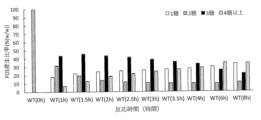
- FIG. 1 shows the production ratio of FOS at each reaction time by wild-type ⁇ -fructofuranosidase (WT) (monosaccharide: glucose and fructose, disaccharide: sucrose, trisaccharide: trisaccharide FOS, tetrasaccharide or more: tetrasaccharide above FOS).
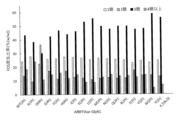
- FIG. 2 shows a mutant ⁇ -fructofurano in which glycine (Gly81), which is the 81st amino acid from the amino terminal (N-terminal) of the wild-type ⁇ -fructofuranosidase (WT) amino acid sequence (SEQ ID NO: 1), is mutated.
- Gly81 glycine
- the production ratio of FOS by sidase-Gly81 (AfBFFase-Gly81) (monosaccharide:glucose and fructose, disaccharide:sucrose, trisaccharide:trisaccharide FOS, tetrasaccharide or more:tetrasaccharide or more FOS) is shown.
- the letters on the horizontal axis indicate amino acids substituted for Gly81, and the parentheses indicate the reaction time (hours).
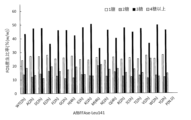
- FIG. 3 shows mutant ⁇ -fructofuranosidase (WT) amino acid sequence (SEQ ID NO: 1) 141 leucine (Leu141) from the amino terminus (N-terminus) mutated ⁇ -fructofuranosidase-Leu141
- Fig. 3 shows the production ratio of FOS by (AfBFFase-Leu141) (monosaccharide: glucose and fructose: disaccharide: sucrose, trisaccharide: trisaccharide FOS, tetrasaccharide or more: tetrasaccharide or more FOS).
- the alphabet on the horizontal axis indicates the amino acid substituted for Leu141, and the parenthesis indicates the reaction time (hour).
- FOS fructose
- FOS includes 1-kestose (sometimes referred to herein as "GF2" or “trisaccharide FOS”) in which one molecule of fructose is ⁇ -2,1-linked to the fructose residue of sucrose, Nystose in which two fructose molecules are ⁇ -2,1-linked (herein sometimes referred to as “GF3” or “tetrasaccharide FOS”), 1 in which three fructose molecules are ⁇ -2,1-linked to the fructose residue of sucrose -fructofuranosyl-D-nystose (sometimes referred to herein as “GF4" or "pentasaccharide FOS”).
- FOS is synthesized by ⁇ -fructofuranosidase.
- ⁇ -fructofuranosidase refers to the GH family (glycoside hydrolase family; a group of homologous proteins with high sequence similarity among enzymes that hydrolyze glycosidic bonds of sugars) of sucrose.
- An enzyme belonging to the GH32 family with hydrolytic activity The enzymatic reaction by ⁇ -fructofuranosidase starts with the entry of sucrose into the substrate-binding pocket to which sugar binds. A saccharolytic reaction occurs, and the glycosidic bond between glucose and fructose is cleaved at the central site of the catalyst, liberating glucose.
- the fructose moiety forms an acyl enzyme intermediate with the catalytic group of the active center moiety.
- fructose when water binds to the intermediate, fructose is released, but when the sugar concentration is high, transglycosylation activity takes precedence, and fructose forms a glycosidic bond with sucrose, which serves as an acceptor, to form a trisaccharide FOS, which binds to the substrate. Release from pocket. Also, when the sugar serving as the acceptor is trisaccharide FOS, it forms a glycosidic bond with fructose to form a tetrasaccharide FOS, which is released from the pocket. Via such an enzymatic reaction, FOS with various lengths such as 3-, 4-, and 5-saccharides are produced depending on the type of sugar that serves as an acceptor.
- ⁇ -fructofuranosidase includes “ ⁇ -fructofuranosidase”, “fructosyltransferase”, “fructosyltransferase”, “saccharase”, “ ⁇ -D-fructofuranosidase”, “ ⁇ - The terms “D-fructofuranosidase”, “invertase”, “invertase” or “invertin” are sometimes used interchangeably and are synonymous.
- the improved ⁇ -fructofuranosidase of the present invention is obtained from an amino acid sequence in which either or both of the amino acids at two specific positions are substituted with other amino acids in the amino acid sequence of the ⁇ -fructofuranosidase to be improved. It will be.
- the amino acid at a specific position to be substituted in the amino acid sequence of ⁇ -fructofuranosidase is obtained by appropriately aligning the amino acid sequence of ⁇ -fructofuranosidase to be improved with the amino acid sequence of SEQ ID NO: 1. can be specified.
- amino acid sequence of ⁇ -fructofuranosidase to be improved is aligned with the amino acid sequence of SEQ ID NO: 1 using the homology search software or program described later, and the amino acid sequence shown in SEQ ID NO: 1 is 81 from the amino terminus.
- the amino acid corresponding to the 1-th position and the amino acid corresponding to the 141-th position from the amino terminus of the amino acid sequence shown in SEQ ID NO: 1 can be used as the amino acid at the specific position to be substituted.
- the improved ⁇ -fructofuranosidase of the present invention comprises an amino acid corresponding to the 81st position from the amino terminus of the amino acid sequence shown in SEQ ID NO: 1 and SEQ ID NO: 1 in the amino acid sequence of the ⁇ -fructofuranosidase to be improved. It consists of an amino acid sequence in which one or both of the amino acids corresponding to the 141st position from the amino terminus of the amino acid sequence shown in 2 are substituted with amino acids different from the original amino acid.
- the amino acid at the 81st position from the amino terminus of the amino acid sequence shown in SEQ ID NO: 1 is glycine (G), and the amino acid at the 141st position from the amino terminus of the amino acid sequence shown in SEQ ID NO: 1 is leucine (L).
- the amino acid corresponding to the 81st position from the amino terminus of the amino acid sequence shown in SEQ ID NO: 1 is typically glycine (G), and corresponds to the 141st position from the amino terminus of the amino acid sequence shown in SEQ ID NO: 1.
- the amino acid is typically leucine (L).
- amino acid sequence of ⁇ -fructofuranosidase to be improved is the amino acid shown in SEQ ID NO: 1
- amino acid corresponding to the 81st position from the amino terminus is glycine (G)
- the 141st amino acid from the amino terminus is glycine (G)
- the amino acid corresponding to the th position is leucine (L).
- the amino acid corresponding to the 81st position from the amino terminus of the amino acid sequence shown in SEQ ID NO: 1 consists of 18 amino acids other than glycine (G) and cysteine (C) (alanine (A), aspartic acid (D), glutamic acid (E ), phenylalanine (F), histidine (H), isoleucine (I), lysine (K), leucine (L), methionine (M), asparagine (N), glutamine (Q), arginine (R), serine (S ), valine (V), tryptophan (W), tyrosine (Y), proline (P) and threonine (T)); -Glycine (G), cysteine (C), alanine (A), proline (P), and 15 amino acids other than threonine (T) (aspartic acid (D), glutamic acid (E), phenylalanine (F), histidine (H), isoleucine (
- Phenylalanine (F), histidine (H), isoleucine from the viewpoint of increasing the production ratio of 3-saccharide FOS and reducing the production ratio of tetra- or more FOS compared to the wild-type ⁇ -fructofuranosidase shown in SEQ ID NO: 1 (I), lysine (K), leucine (L), methionine (M), asparagine (N), glutamine (Q), arginine (R), serine (S), valine (V), tryptophan (W) and tyrosine It is more preferable to substitute with an amino acid selected from the group consisting of (Y), and from the viewpoint of increasing the production ratio of trisaccharide FOS to more than 50% and making the production ratio of tetrasaccharide or higher FOS to less than 10%, lysine ( K), leucine (L), tryptophan (W) and tyrosine (Y), which is more preferably substituted with an amino acid selected from the group
- the amino acid corresponding to the 141st position from the amino terminus of the amino acid sequence shown in SEQ ID NO: 1 includes 18 amino acids other than leucine (L) and cysteine (C) (alanine (A), aspartic acid (D), glutamic acid (E ), phenylalanine (F), glycine (G), histidine (H), isoleucine (I), lysine (K), methionine (M), asparagine (N), glutamine (Q), arginine (R), serine (S ), threonine (T), valine (V), tryptophan (W), tyrosine (Y) and proline (P)); - leucine (L), cysteine (C), glutamic acid (E), histidine (H), from the viewpoint of increasing the production ratio of 3-saccharide FOS or reducing the production ratio of tetra- or more FOS relative to fructofuranosidase, 13 amino acids other than methionine (
- alanine (A), aspartic acid (D), from the viewpoint of increasing the production ratio of trisaccharide FOS and reducing the production ratio of tetrasaccharide or more FOS compared to the wild-type ⁇ -fructofuranosidase shown in SEQ ID NO: 1, from phenylalanine (F), glycine (G), isoleucine (I), lysine (K), asparagine (N), arginine (R), serine (S), threonine (T), tryptophan (W) and tyrosine (Y) more preferably substituted with an amino acid selected from the group consisting of alanine (A), from the viewpoint of increasing the production ratio of trisaccharide FOS to more than 47% and reducing the production ratio of tetrasaccharide or more FOS to less than 16%; Substitution with an amino acid selected from the group consisting of aspartic acid (D), isoleucine (I), lysine (
- the ⁇ -fructofuranosidase to be improved has an amino acid sequence of 60% or more (preferably 65% or more, 70% or more, 75% or more, 80% or more) of the wild-type ⁇ -fructofuranosidase shown in SEQ ID NO: 1. , 85% or greater, 90% or greater, 93% or greater, 95% or greater, 98% or greater, or 99% or greater) sequence identity.
- identity is, for example, the degree of identity when the sequences to be compared are properly aligned (aligned), and means the occurrence rate (%) of exact amino acid matches between the sequences. .
- BLAST Basic local alignment search tool
- FASTA Altschul et al., J. Mol. Biol. 215:403-410 (1990)
- FASTA Altschul et al., Methods in Enzymology 183:63-69 (1990)
- Smith-Waterman Methodh. Enzym., 164, 765 (1988)
- the identity can be calculated using, for example, a publicly available homology search program such as those described above, for example, the homology algorithm BLAST (https: http://blast.ncbi.nlm.nih.gov/Blast.cgi) by using the default parameters.
- BLAST https: http://blast.ncbi.nlm.nih.gov/Blast.cgi
- the ⁇ -fructofuranosidase to be improved also has 60% or more sequence identity with the amino acid sequence of the wild-type ⁇ -fructofuranosidase shown in SEQ ID NO: 1, and amino acids having ⁇ -fructofuranosidase activity. It consists of arrays.
- "having ⁇ -fructofuranosidase activity” means that the amino acid sequence is a wild-type ⁇ -fructofuranosidase having the amino acid sequence shown in SEQ ID NO: 1 under conditions of temperature 50 to 55 ° C. and pH 5.5.
- ⁇ -fructofuranosidase activity can be measured, for example, by mixing a solution containing a protein or polypeptide to be measured and a solution containing sucrose, incubating the mixture, and measuring the amount of glucose produced by the enzymatic reaction by high-performance liquid chromatography (HPLC), thin layer chromatography (TLC), various glucose quantification kits, etc., and can be evaluated from the value obtained here and the amount of enzyme used in the reaction.
- HPLC high-performance liquid chromatography
- TLC thin layer chromatography
- various glucose quantification kits etc.
- the ⁇ -fructofuranosidase to be improved is typically a wild-type enzyme and can be derived from any organism, such as microorganisms, fungi, plants, etc., preferably belonging to the genus Aspergillus. It can be of microbial origin. However, this does not preclude the use of ⁇ -fructofuranosidase into which an artificial mutation has been introduced in the present invention.
- Examples of ⁇ -fructofuranosidases derived from microorganisms belonging to the genus Aspergillus include those shown in Table 1.
- Table 1 the amino acid sequence of ⁇ -fructofuranosidase shown in Table 1, the amino acid corresponding to the 81st position from the amino terminus of the amino acid sequence shown in SEQ ID NO: 1 and the amino acid sequence from the amino terminus of SEQ ID NO: 1 The presence of an amino acid corresponding to the 141st position was confirmed.
- a preferred embodiment of the present invention provides an improved ⁇ -fructofuranosidase consisting of the amino acid sequence of either a) or b) described in [3] above.
- the amino acids to be substituted in the amino acid sequence of a) and the types of amino acids after substitution are as described above.
- the amino acid sequence of b) has a modification selected from the group consisting of deletion, substitution, insertion and addition at one or more amino acids other than glycine (G) at position 81 and leucine (L) at position 141.
- the number of amino acids to be modified can be, for example, 1 to 65, 1 to 50, 1 to 40, 1 to 30 or 1 to 20, preferably 1 to 10, more preferably 1 to 6, particularly preferably 1 to several, 1 to 4, 1 to 3, 1 to 2 or 1.
- the number of amino acids to be modified can also be the number of mutations produced by known methods such as site mutagenesis, or the number of mutations produced naturally.
- the modification may also be multiple homologous modifications (e.g., multiple substitutions) or multiple heterologous modifications (e.g., a combination of one or more deletions and one or more substitutions), good too.
- the amino acid sequence of b) also has a sequence identity of 80% or more (preferably 85% or more, 90% or more, 93% or more, 95% or more, 98% or more or 99% or more) with the amino acid sequence of a) and having ⁇ -fructofuranosidase activity.
- having a modification selected from the group consisting of deletion, substitution, insertion and addition in one or more amino acids other than glycine (G) at position 81 and leucine (L) at position 141 Become.
- the amino acid alterations in the amino acid sequence of b) may be conservative alterations (eg, conservative mutations).
- a “conservative modification” or “conservative mutation” means modifying or mutating one or more amino acids so as not to substantially alter the function of the protein.
- the amino acid substitutions may also be conservative substitutions.
- a “conservative substitution” refers to the replacement of one or more amino acids with another amino acid and/or amino acid derivative that does not substantially alter the function of the protein.
- the substituted amino acid and the substituted amino acid are preferably similar in properties and/or functions, for example. Specifically, it is preferred that the indices of hydrophobicity and hydrophilicity, chemical properties such as polarity and charge, or physical properties such as secondary structure are similar.
- nonpolar amino acids include alanine, valine, isoleucine, leucine, proline, tryptophan, phenylalanine, methionine, and the like.
- Polar amino acids include glycine, serine, threonine, tyrosine, glutamine, asparagine, cysteine and the like.
- positively charged amino acids basic amino acids
- negatively charged amino acids acidic amino acids
- the amino acid sequence of b) also has modifications selected from the group consisting of deletions, substitutions, insertions and additions at one or more amino acids other than glycine (G) at position 81 and leucine (L) at position 141. and an amino acid sequence having ⁇ -fructofuranosidase activity.
- "having ⁇ -fructofuranosidase activity” means that the amino acid sequence is a ⁇ -fructofuranosidase consisting of the amino acid sequence of a) under conditions of a temperature of 50 to 55 ° C. and pH 5.5. It can be defined as having about 90% or more activity, about 95% or more activity, about 98% or more activity, or about 100% or more activity.
- ⁇ -fructofuranosidase activity can be measured in the same manner as described above.
- the improved ⁇ -fructofuranosidase of the present invention can be obtained, for example, by chemical synthesis or genetic recombination technology.
- the method of chemical synthesis for example, based on amino acid sequence information, the present invention is performed according to chemical synthesis methods such as Fmoc method (fluorenylmethyloxycarbonyl method), tBoc method (t-butyloxycarbonyl method), and cell-free protein synthesis method.
- Improved ⁇ -fructofuranosidases of the invention can be synthesized.
- the improved ⁇ -fructofuranosidase of the present invention can also be synthesized using a commercially available peptide synthesizer.
- the improved ⁇ -fructofuranosidase of the present invention can be produced by culturing genetically modified microorganisms capable of producing it.
- a polynucleotide encoding the improved ⁇ -fructofuranosidase of the present invention is introduced into a suitable host to obtain a transformant, the transformant is cultured, and the improved ⁇ -fructofuranosidase is extracted from the culture. It can be obtained by extracting furanosidase. Specifically, it can be obtained according to the description of Examples (for example, Example 1 (1) a and b) below.
- Polynucleotides encoding the improved ⁇ -fructofuranosidase of the present invention can be synthesized using various commercially available polynucleotide synthesizers, and as shown in Examples 1 and 2 below, It can also be obtained by site-directed mutagenesis using inverse polymerase chain reaction (PCR).
- PCR inverse polymerase chain reaction
- polynucleotide includes DNA and RNA, and further includes modified forms thereof and artificial nucleic acids, preferably DNA.
- DNA includes cDNA, genomic DNA and chemically synthesized DNA.
- the present invention provides a polypeptide comprising an enzymatically active portion of the amino acid sequence of the improved ⁇ -fructofuranosidase of the present invention and having ⁇ -fructofuranosidase activity.
- the amino acid sequence of the polypeptide of the present invention typically contains at least a site (region) having ⁇ -fructofuranosidase activity.
- the site having ⁇ -fructofuranosidase activity in the improved ⁇ -fructofuranosidase of the present invention includes, for example, the 20th to 654th positions from the amino terminus of the amino acid sequence shown in SEQ ID NO: 1 (including the signal sequence on the N-terminal side).
- polypeptide of the present invention can be obtained by a method similar to that for obtaining the improved ⁇ -fructofuranosidase of the present invention.
- a polynucleotide encoding improved ⁇ -fructofuranosidase etc. and vector containing the same>> According to the invention, there is provided a polynucleotide encoding an improved ⁇ -fructofuranosidase of the invention or a polypeptide of the invention.
- the polynucleotide of the present invention can be obtained using the polynucleotide synthesis method described in the method for obtaining the improved ⁇ -fructofuranosidase of the present invention.
- the present invention also provides a recombinant vector containing a polynucleotide encoding an improved ⁇ -fructofuranosidase.
- the recombinant vector of the present invention can be obtained by operably linking a polynucleotide encoding the improved ⁇ -fructofuranosidase of the present invention to the vector.
- Polynucleotides can be ligated to vectors according to conventional methods. It can be done by Examples of vectors include phage vectors, plasmid vectors, cosmids, phagemids, and the like, and can be appropriately selected according to the host, operability, and the like.
- the recombinant vector of the present invention also contains selectable marker genes for transformants such as drug resistance marker genes and auxotrophic marker genes; It may contain transcriptional control signals such as promoters, transcription initiation signals, ribosome binding sites, translation termination signals, transcription termination signals, translational control signals, and the like, which are necessary for the expression of type ⁇ -fructofuranosidase.
- transformants capable of producing the improved ⁇ -fructofuranosidase of the present invention or the polypeptide of the present invention are provided.
- the transformant of the present invention can be obtained by introducing the improved ⁇ -fructofuranosidase of the present invention, a polynucleotide encoding the polypeptide of the present invention, or the recombinant vector of the present invention into a host.
- the host include bacteria such as Escherichia coli and Bacillus subtilis, yeast, fungi, and filamentous fungi, and can be appropriately selected according to the type and operability of the recombinant vector.
- Introduction (transformation) of DNA or a recombinant vector into a host can be carried out according to a conventional method.
- a homologous recombination method or the like can be used to introduce the target DNA directly into the chromosome of the host.
- the transformant of the present invention is cultured in a medium suitable for culturing the transformant, and in some cases, the improved ⁇ -fructofuranosidase of the present invention is obtained from the culture obtained by culturing. Alternatively, it can be carried out by collecting the polypeptide.
- the medium used for culture is not particularly limited as long as it is a nutrient medium in which the transformed microorganism can grow and the improved ⁇ -fructofuranosidase of the present invention or the polypeptide of the present invention can be produced. Either In addition, culture conditions such as time and temperature can be selected as appropriate for the microorganisms to be cultured.
- the culture obtained by culturing the transformant may be directly obtained as the improved ⁇ -fructofuranosidase of the present invention or the polypeptide of the present invention.
- the improved ⁇ -fructofuranosidase or the polypeptide of the invention can also be isolated and purified.
- the expressed protein may be present on the cell surface or inside the cell of the transformant.
- the polynucleotide or recombinant vector is designed to be expressed, the culture is subjected to centrifugation to collect the transformant, which is directly used for the improved ⁇ -fructofuranosidase of the present invention or the polypeptide of the present invention.
- the recovered transformant can be disrupted to obtain the improved ⁇ -fructofuranosidase of the present invention or the polypeptide of the present invention.
- a polynucleotide or a recombinant agent is used so that the expressed protein is secreted to the outside of the transformant. It can be performed by designing a vector, subjecting the culture to centrifugation, and collecting the culture supernatant.
- the polynucleotide or recombinant vector is designed so that the expressed protein is expressed inside the transformant, the culture is subjected to centrifugation to collect the precipitated transformant, and this is placed in a buffer solution.
- the polypeptides of the invention can be purified.
- Other purification methods include heat treatment, salt precipitation, solvent precipitation, dialysis, ultrafiltration, gel filtration, SDS-polyacrylamide gel electrophoresis, ion-exchange chromatography, and affinity chromatography for the culture supernatant or crushed product. Examples include a method of subjecting it to photography, hydrophobic chromatography, reversed-phase chromatography, isoelectric focusing, and the like.
- a method for producing an improved fructo-oligosaccharide comprises a step of contacting the culture of the improved ⁇ -fructofuranosidase of the present invention, the polypeptide of the present invention or the transformant of the present invention with sucrose.
- the improved ⁇ -fructofuranosidase or the like of the present invention is contacted with sucrose, for example, by adding the improved ⁇ -fructofuranosidase or the like to a solution containing sucrose and incubating. It can be done by The incubation conditions are, for example, a temperature of 20 to 60° C., preferably 25 to 55° C., more preferably 30 to 50° C., still more preferably 40 to 50° C., and a time of 1 to 20 hours, preferably can be from 1 to 8 hours, more preferably from 2 to 4 hours.
- a culture obtained by culturing the transformant of the present invention may be brought into contact with sucrose in the same manner.
- the culture of the present invention can be processed by crushing, trituration, suspension in buffer, freeze-thaw, sonication, centrifugation, heat treatment, salt precipitation, solvent precipitation, dialysis, ultrafiltration, gel filtration, SDS.
- It may or may not be subjected to any treatment such as polyacrylamide gel electrophoresis, ion exchange chromatography, affinity chromatography, hydrophobic chromatography, reverse phase chromatography, isoelectric focusing.
- the method for producing fructo-oligosaccharides of the present invention can also include any additional steps, for example, a step of separating fructo-oligosaccharides by chromatography, a crystallization step, a drying step, a washing step, a filtration step, a sterilization step, and food addition. any or a combination of some or all of these.
- a method for producing 1-kestose crystals is provided.
- the method for producing 1-kestose of the present invention is characterized by using the fructo-oligosaccharide produced by the method for producing fructo-oligosaccharide of the present invention.
- the method for producing 1-kestose crystals of the present invention comprises bringing the improved ⁇ -fructofuranosidase of the present invention, the polypeptide of the present invention, or the culture of the transformant of the present invention into contact with sucrose to produce fructo-oligosaccharides. and crystallizing the fructooligosaccharide.
- the step of producing fructo-oligosaccharides can be carried out according to the descriptions of the improved ⁇ -fructofuranosidase of the present invention, the production method thereof, and the production method of fructo-oligosaccharides.
- the step of crystallizing fructo-oligosaccharides can be carried out according to a conventional method.
- Example 1 Study of wild-type ⁇ -fructofuranosidase
- wild-type ⁇ -fructofuranosidase was used to study FOS production.
- PCR A restriction enzyme site was added to the WT-AfBFFase gene using the PCR method.
- Table 3 shows the primers used
- Table 4 shows the PCR composition
- Table 5 shows the PCR conditions.
- the template DNA the amino acid sequence shown in SEQ ID NO: 1 from which the portion corresponding to the signal sequence (1st to 19th amino acids, underlined portion of the amino acid sequence shown in Table 2) was removed was used.
- the concentrate was plated on an LB medium plate (containing kanamycin (50 ⁇ g/mL)) and cultured overnight at 37°C. Colonies grown by transformation were inoculated into 2XYT liquid medium (containing kanamycin (50 ⁇ g/mL)) and cultured overnight. Plasmids were extracted from the culture medium using FastGene Plasmid Mini Kit (Nippon Genetics). The integration of the WT-AfBFFase gene into the pHFT2 vector was confirmed by DNA sequencing service (Eurofins).
- His Trap A buffer NaCl (500 mM), Tris-HCl (20 mM), imidazole (20 mM), pH 8.0
- His Trap B buffer imidazole (500 mM), NaCl (500 mM)
- Tris- HCl buffer 50 mM, pH 8.0
- the eluted protein solution of interest was concentrated to 2.5 mL at 4000 ⁇ g using a 50 kDa Vivaspin Turbo 30 centrifugal ultrafiltration filter.
- Example 2 Examination of improved ⁇ -fructofuranosidase (1)
- glycine (Gly81) which is the 81st amino acid from the amino terminal (N-terminus) of the amino acid sequence (SEQ ID NO: 1) of wild-type ⁇ -fructofuranosidase (WT-AfBFFase) of Example 1, and leucine at 141st (Leu141) respectively mutated ⁇ -fructofuranosidase-Gly81 (herein sometimes referred to as "AfBFFase-Gly81") and mutant ⁇ -fructofuranosidase-Leu141 (herein “AfBFFase- Leu141”) was used to examine the amount of FOS produced.
- Method a Preparation of improved ⁇ -fructofuranosidase plasmids AfBFFase-Gly81 and AfBFFase-Leu141 plasmids were prepared by the following procedure.
- PCR Inverse PCR was performed using the pHFT2_WT-AfBFFase prepared in Example 1 as a template.
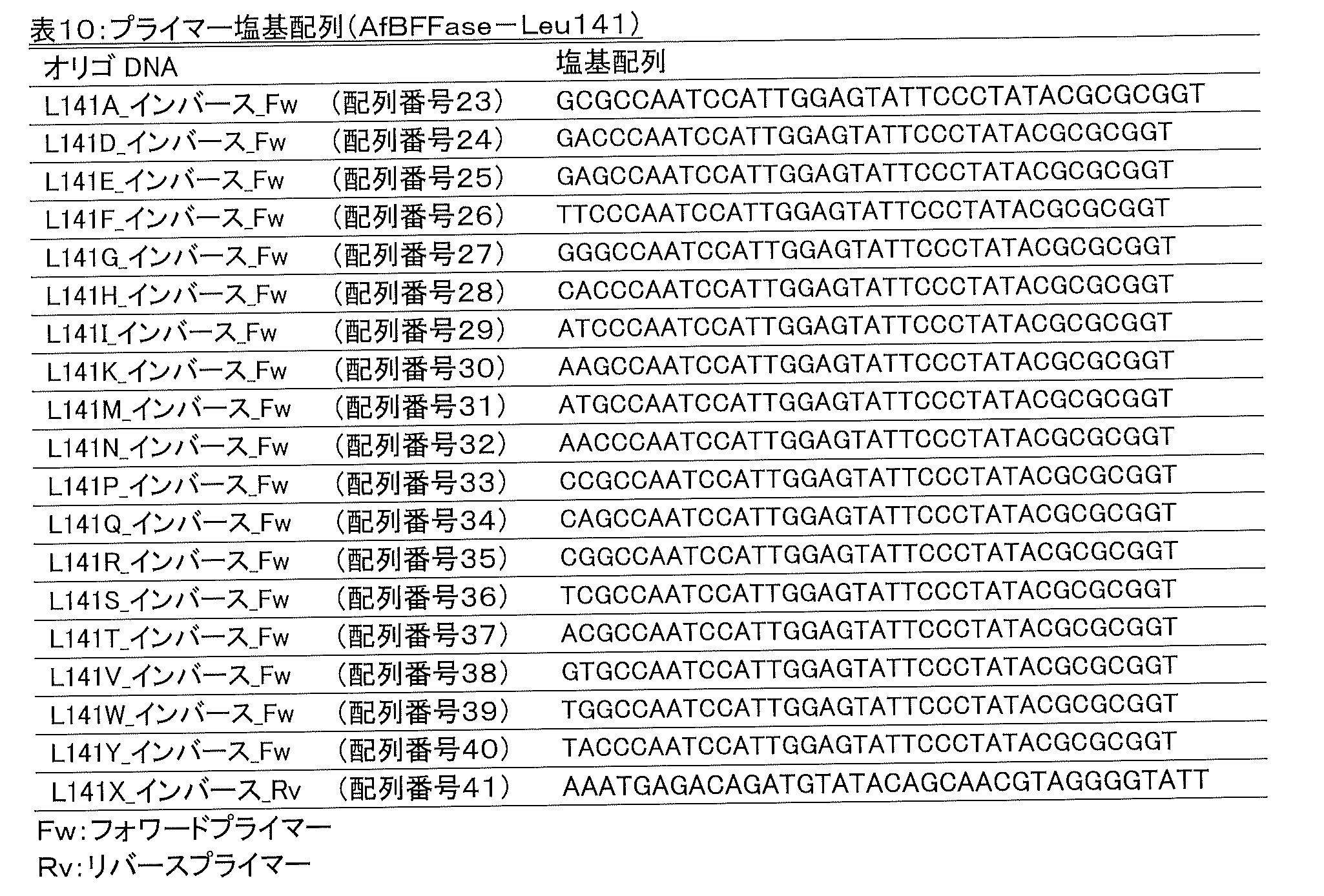
- Tables 9 and 10 show primer base sequences for substituting the 81st and 141st amino acids with different amino acids, respectively.
- the PCR composition and PCR conditions were the same as in Tables 4 and 5 of Example 1.
- AfBFFase-Gly81 replaces glycine (G) at position 81 with 18 amino acids other than glycine (G) and cysteine (C) (alanine (A), aspartic acid (D), glutamic acid (E), phenylalanine (F), histidine (H), isoleucine (I), lysine (K), leucine (L), methionine (M), asparagine (N), glutamine (Q), arginine (R), serine (S), valine (V), tryptophan (W), tyrosine (Y), proline (P) and threonine (T)), and the amount of FOS produced was measured.
- mutants 15 types of mutants excluding alanine (A), proline (P) and threonine (T) increased the production ratio of 3-sugar FOS or reduced the production ratio of tetra- or more FOS. A decrease was confirmed.
- phenylalanine (F) histidine (H), isoleucine (I), lysine (K), leucine (L), methionine (M), asparagine (N), glutamine (Q), arginine (R), serine (S ), valine (V), tryptophan (W) or tyrosine (Y)
- F phenylalanine
- H histidine
- I isoleucine
- K lysine
- M leucine
- M methionine
- N glutamine
- Q arginine
- S serine
- V valine
- W tryptophan
- Y tyrosine
- AfBFFase-Leu141 replaces leucine (L) at position 141 with 18 amino acids other than leucine (L) and cysteine (C) (alanine (A), aspartic acid (D), glutamic acid (E), phenylalanine (F), glycine (G), histidine (H), isoleucine (I), lysine (K), methionine (M), asparagine (N), glutamine (Q), arginine (R), serine (S), threonine (T), valine (V), tryptophan (W), tyrosine (Y), and proline (P)), and the amount of FOS produced was measured.
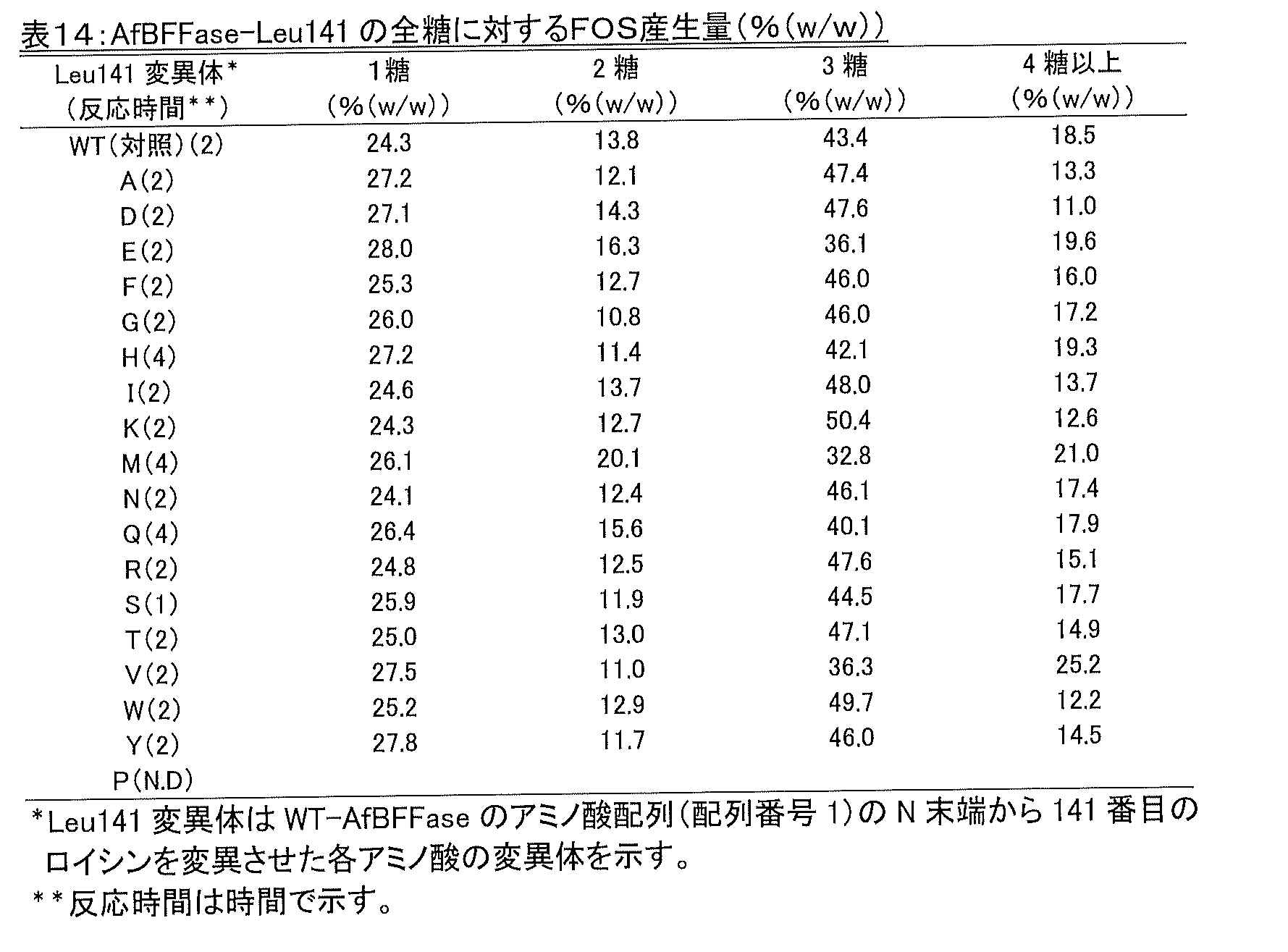
- mutants excluding glutamic acid (E), histidine (H), methionine (M), valine (V) and proline (P), showed a trisaccharide FOS to WT-AfBFFase. or a decrease in the production ratio of FOS with 4 or more sugars was confirmed.
- mutants with substitutions of alanine (A), aspartic acid (D), isoleucine (I), lysine (K), arginine (R), threonine (T), or tryptophan (W) produced trisaccharide FOS. The ratio was confirmed to exceed 47%. The ratio of trisaccharide FOS production was highest in the lysine (K) mutant (50.4%), followed by the tryptophan (W) mutant (49.7%).
- Example 3 Examination of improved ⁇ -fructofuranosidase (2)
- improved ⁇ -fructose by double mutation in which both the 81st glycine (Gly81) and the 141st leucine (Leu141) from the N-terminus of the WT-AfBFFase amino acid sequence (SEQ ID NO: 1) were mutated Furanosidase (which may be referred to herein as "AfBFFase-Gly81-Leu141”) was used to examine the amount of FOS produced.
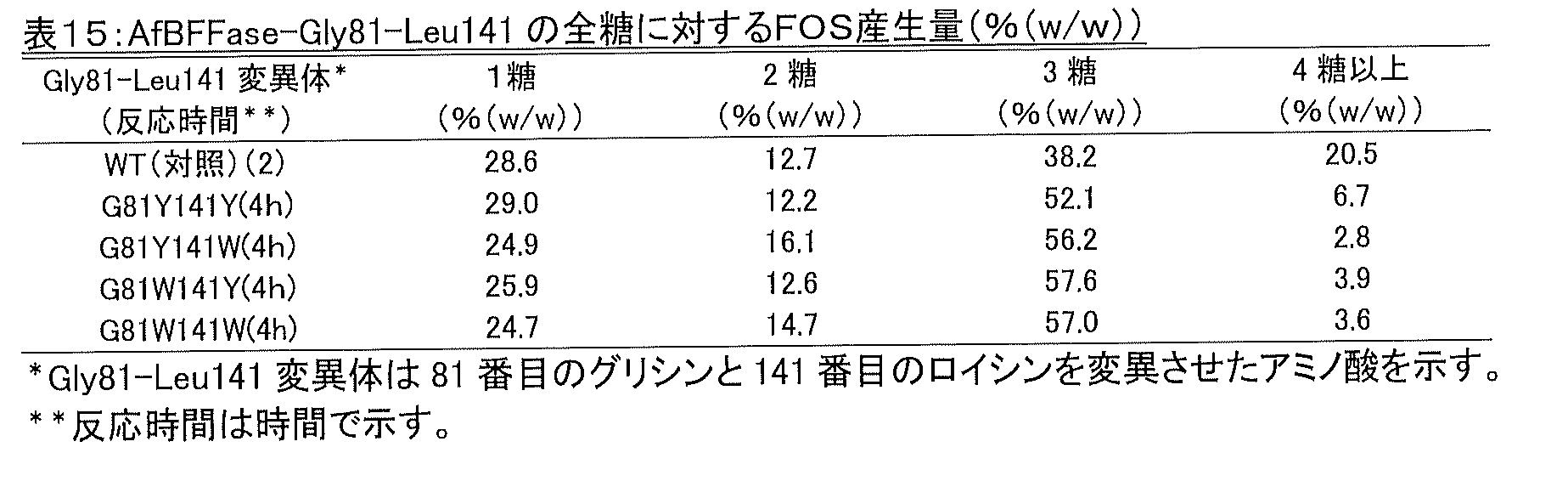
- AfBFFase-Gly81-Leu141 consumes a disaccharide compared to WT-AfBFFase when glycine (G) at position 81 and leucine (L) at position 141 are replaced with tyrosine (Y) or tryptophan (W), respectively.
- G glycine
- L leucine
- W tryptophan
Landscapes
- Chemical & Material Sciences (AREA)
- Organic Chemistry (AREA)
- Life Sciences & Earth Sciences (AREA)
- Engineering & Computer Science (AREA)
- Zoology (AREA)
- Wood Science & Technology (AREA)
- Health & Medical Sciences (AREA)
- Genetics & Genomics (AREA)
- Bioinformatics & Cheminformatics (AREA)
- General Engineering & Computer Science (AREA)
- General Health & Medical Sciences (AREA)
- Biochemistry (AREA)
- Biotechnology (AREA)
- Microbiology (AREA)
- General Chemical & Material Sciences (AREA)
- Chemical Kinetics & Catalysis (AREA)
- Biomedical Technology (AREA)
- Molecular Biology (AREA)
- Medicinal Chemistry (AREA)
- Physics & Mathematics (AREA)
- Biophysics (AREA)
- Plant Pathology (AREA)
- Enzymes And Modification Thereof (AREA)
- Micro-Organisms Or Cultivation Processes Thereof (AREA)
Abstract
Description
[1]β-フルクトフラノシダーゼのアミノ酸配列において、配列番号1に示すアミノ酸配列のアミノ末端から81番目の位置に相当するアミノ酸および141番目の位置に相当するアミノ酸のいずれかまたは両方が他のアミノ酸に置換されたアミノ酸配列からなる、改良型β-フルクトフラノシダーゼ。
[2]β-フルクトフラノシダーゼが、配列番号1に示す野生型β-フルクトフラノシダーゼのアミノ酸配列と60%以上の配列同一性を有し、かつ、β-フルクトフラノシダーゼ活性を有するアミノ酸配列からなる、上記[1]に記載の改良型β-フルクトフラノシダーゼ。
[3]下記a)およびb)のいずれかのアミノ酸配列からなる、上記[1]または[2]に記載の改良型β-フルクトフラノシダーゼ:
a)配列番号1に示すアミノ酸配列において、アミノ末端から81番目の位置に相当するアミノ酸(グリシン(G))および141番目の位置に相当するアミノ酸(ロイシン(L))のいずれかまたは両方が他のアミノ酸に置換されたアミノ酸配列
b)上記a)のアミノ酸配列において、81番目のグリシン(G)および141番目のロイシン(L)以外の1または複数個のアミノ酸が欠失、置換、挿入および/または付加されたアミノ酸配列からなり、かつ、β-フルクトフラノシダーゼ活性を有するアミノ酸配列。
[4]アミノ末端から81番目の位置に相当するアミノ酸が、アスパラギン酸(D)、グルタミン酸(E)、フェニルアラニン(F)、ヒスチジン(H)、イソロイシン(I)、リシン(K)、ロイシン(L)、メチオニン(M)、アスパラギン(N)、グルタミン(Q)、アルギニン(R)、セリン(S)、バリン(V)、トリプトファン(W)およびチロシン(Y)からなる群から選択されるアミノ酸に置換された、上記[1]~[3]のいずれかに記載の改良型β-フルクトフラノシダーゼ。
[5]アミノ末端から141番目の位置に相当するアミノ酸が、アラニン(A)、アスパラギン酸(D)、フェニルアラニン(F)、グリシン(G)、イソロイシン(I)、リシン(K)、アスパラギン(N)、グルタミン(Q)、アルギニン(R)、セリン(S)、トレオニン(T)、トリプトファン(W)およびチロシン(Y)からなる群から選択されるアミノ酸に置換された、上記[1]~[4]のいずれかに記載の改良型β-フルクトフラノシダーゼ。
[6]上記[1]~[5]のいずれかに記載の改良型β-フルクトフラノシダーゼのアミノ酸配列の酵素活性部分を含み、かつ、β-フルクトフラノシダーゼ活性を有する、ポリペプチド。
[7]上記[1]~[5]のいずれかに記載の改良型β-フルクトフラノシダーゼまたは上記[6]に記載のポリペプチドをコードする、ポリヌクレオチド。
[8]上記[7]に記載のポリヌクレオチドを含んでなる、発現ベクター。
[9]上記[7]に記載のポリヌクレオチドまたは上記[8]に記載の発現ベクターを宿主に導入してなる、形質転換体。
[10]宿主が細菌、酵母、カビおよび糸状菌からなる群から選択される、上記[9]に記載の形質転換体。
[11]上記[9]または[10]に記載の形質転換体の培養物から改良型β-フルクトフラノシダーゼを得る工程を含む、改良型β-フルクトフラノシダーゼの製造方法。
[12]上記[1]~[5]のいずれかに記載の改良型β-フルクトフラノシダーゼ、上記[6]に記載のポリペプチドまたは上記[9]もしくは[10]に記載の形質転換体の培養物と、スクロースとを接触させる工程を含む、フラクトオリゴ糖の製造方法。
[13]上記[12]に記載の製造方法を実施してフラクトオリゴ糖を製造する工程と、前記フラクトオリゴ糖を結晶化する工程とを含む、1-ケストース結晶の製造方法。
本発明において、「フラクトオリゴ糖(FOS;fructooligosaccharides、本明細書中「FOS」ということがある)」は、スクロースにフルクトースを1~3分子結合させたオリゴ糖をいう。FOSには、スクロースのフルクトース残基にフルクトース1分子がβ-2,1結合した1-ケストース(本明細書中「GF2」または「3糖FOS」ということがある)、スクロースのフルクトース残基にフルクトース2分子がβ-2,1結合したニストース(本明細書中「GF3」または「4糖FOS」ということがある)、スクロースのフルクトース残基にフルクトース3分子がβ-2,1結合した1-フラクトフラノシル-D-ニストース(本明細書中「GF4」または「5糖FOS」ということがある)がある。FOSは、β-フルクトフラノシダーゼによって合成される。
本発明の改良型β-フルクトフラノシダーゼは、改良対象のβ-フルクトフラノシダーゼのアミノ酸配列において、特定の2つの位置のアミノ酸のいずれかまたは両方が他のアミノ酸に置換されたアミノ酸配列からなるものである。β-フルクトフラノシダーゼのアミノ酸配列における置換対象となる特定位置のアミノ酸は、改良対象のβ-フルクトフラノシダーゼのアミノ酸配列を、配列番号1のアミノ酸配列と適切に整列(アライメント)させることにより特定することができる。すなわち、改良対象のβ-フルクトフラノシダーゼのアミノ酸配列を、後述の相同性検索ソフトウェアまたはプログラムなどを用いて配列番号1のアミノ酸配列と整列させ、配列番号1に示すアミノ酸配列のアミノ末端から81番目の位置に相当するアミノ酸および配列番号1に示すアミノ酸配列のアミノ末端から141番目の位置に相当するアミノ酸をそれぞれ置換対象となる特定位置のアミノ酸とすることができる。

本発明によれば、本発明の改良型β-フルクトフラノシダーゼのアミノ酸配列の酵素活性部分を含み、かつ、β-フルクトフラノシダーゼ活性を有するポリペプチドが提供される。本発明のポリペプチドのアミノ酸配列は、典型的には少なくともβ-フルクトフラノシダーゼ活性を有する部位(領域)を含むものである。本発明の改良型β-フルクトフラノシダーゼにおいてβ-フルクトフラノシダーゼ活性を有する部位としては、例えば、配列番号1に示すアミノ酸配列のアミノ末端から20~654番目(N末端側のシグナル配列を除いた領域)の位置に相当する部位、配列番号1に示すアミノ酸配列のアミノ末端から50~558番目(グリコシルヒドロラーゼファミリー32に属する酵素に特徴的な領域)の位置に相当する部位、配列番号1に示すアミノ酸配列のアミノ末端から59~428番目(グリコシルヒドロラーゼファミリー32に属する酵素のN末端側配列に特徴的な領域)の位置に相当する部位、配列番号1に示すアミノ酸配列のアミノ末端から60番目(触媒中心アミノ酸Asp60)の位置に相当する部位、配列番号1に示すアミノ酸配列のアミノ末端から191番目(触媒中心アミノ酸Asp191)の位置に相当する部位および配列番号1に示すアミノ酸配列のアミノ末端から292番目(触媒中心アミノ酸Glu292)の位置に相当する部位が挙げられる。本発明のポリペプチドは、本発明の改良型β-フルクトフラノシダーゼを得る方法と同様の方法により得ることができる。
本発明によれば、本発明の改良型β-フルクトフラノシダーゼまたは本発明のポリペプチドをコードするポリヌクレオチドが提供される。本発明のポリヌクレオチドは、本発明の改良型β-フルクトフラノシダーゼを得る方法に記載したポリヌクレオチドの合成方法などを用いて得ることができる。
本発明によれば、本発明の改良型β-フルクトフラノシダーゼまたは本発明のポリペプチドを産生することができる形質転換体が提供される。本発明の形質転換体は、本発明の改良型β-フルクトフラノシダーゼまたは本発明のポリペプチドをコードするポリヌクレオチドまたは本発明の組換えベクターを宿主に導入して得ることができる。ここで、宿主としては、例えば、大腸菌や枯草菌などの細菌、酵母、カビ、糸状菌などを挙げることができ、組換えベクターの種類や操作性などに応じて適宜選択することができる。DNAや組換えベクターの宿主への導入(形質転換)は常法に従って実施することができる。また、宿主の染色体に直接目的のDNAを導入するには、相同組換え法などを用いることができる。
本発明によれば、本発明の改良型β-フルクトフラノシダーゼまたは本発明のポリペプチドの製造方法が提供される。本発明の製造方法は、本発明の形質転換体を当該形質転換体の培養に適した培地で培養し、場合によっては培養して得られる培養物から本発明の改良型β-フルクトフラノシダーゼまたはポリペプチドを採取することにより実施することができる。培養に使用する培地は、形質転換微生物が生育でき、本発明の改良型β-フルクトフラノシダーゼまたは本発明のポリペプチドを産生しうる栄養培地であれば特に限定されず、合成培地および天然培地のいずれでもよい。また、時間、温度などの培養条件は、培養する微生物に適した条件を適宜選択することができる。
本発明によれば、改良型フラクトオリゴ糖の製造方法が提供される。本発明のフラクトオリゴ糖の製造方法は、本発明の改良型β-フルクトフラノシダーゼ、本発明のポリペプチドまたは本発明の形質転換体の培養物とスクロースとを接触させる工程を含んでなる。
本発明によれば、1-ケストース結晶の製造方法が提供される。本発明の1-ケストースの製造方法は、本発明のフラクトオリゴ糖の製造方法により製造されたフラクトオリゴ糖を用いることを特徴とする。本発明の1-ケストース結晶の製造方法は、本発明の改良型β-フルクトフラノシダーゼ、本発明のポリペプチド、または本発明の形質転換体の培養物と、スクロースとを接触させてフラクトオリゴ糖を製造する工程と、前記フラクトオリゴ糖を結晶化する工程とを含むものである。フラクトオリゴ糖を製造する工程は、本発明の改良型β-フルクトフラノシダーゼおよびその製造方法ならびにフラクトオリゴ糖の製造方法の記載に従って実施することができる。フラクトオリゴ糖を結晶化する工程は、常法に従って実施することができる。
例1では、野生型β-フラクトフラノシダーゼを用いてFOS産生量について検討した。
ア 野生型β-フルクトフラノシダーゼのプラスミド作製
アスペルギルス・フィジエンシス(Aspergillus fiijiensis ATCC20611)由来の野生型β-フルクトフラノシダーゼ(本明細書中「WT-AfBFFase」あるいは「WT」ということがある)の遺伝子を挿入したプラスミドの作製を次の手順で行った。WT-AfBFFaseのアミノ酸配列(配列番号1)は表2に示す。

PCR法を用いてにWT-AfBFFase遺伝子に制限酵素処理部位を付加した。表3は使用したプライマー、表4はPCR組成、表5はPCR条件をそれぞれ示す。なお、鋳型DNAには配列番号1に示すアミノ酸配列のうちシグナル配列(1~19番目のアミノ酸、表2に示すアミノ酸配列の下線部分)に対応する部位を除去したものを用いた。



上記(i)で増幅したPCR産物とMidori Green Direct(日本ジェネティクス)を5:1の割合で混合し、1%アガロースゲル(0.5×TAE緩衝液:Tris-HCl(20mM)、酢酸(10mM)、EDTA(0.5mM)、pH8.0)で電気泳動を行った。電気泳動後、緑色発光LEDをゲルに当て目的バンドを切り出した。そして、FastGene Gel/PCR Extraction Kit(日本ジェネティクス)を用いてDNAを抽出した。
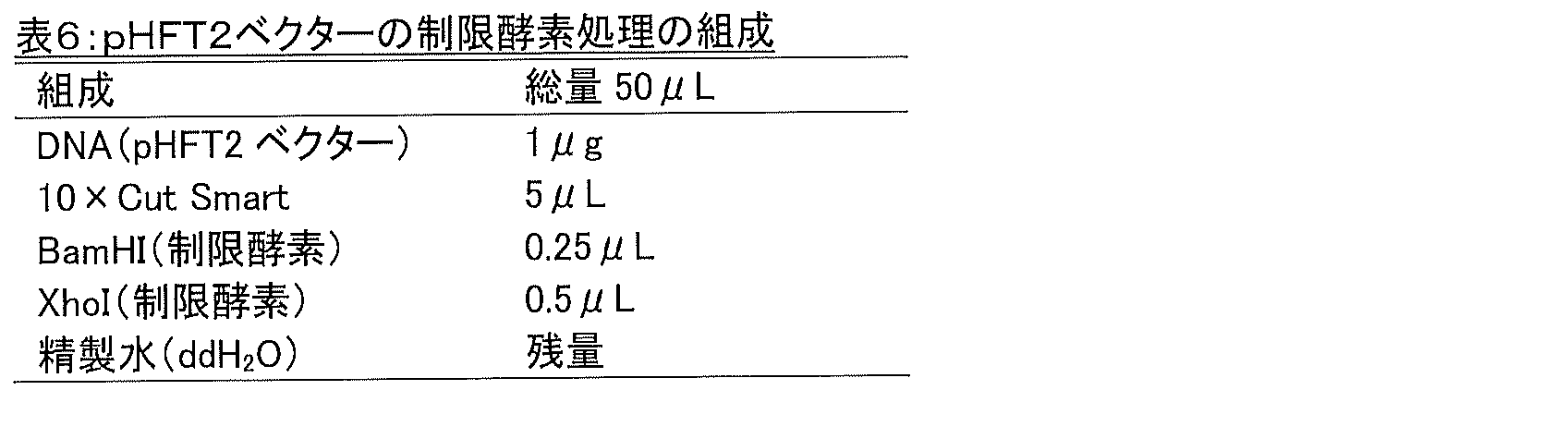
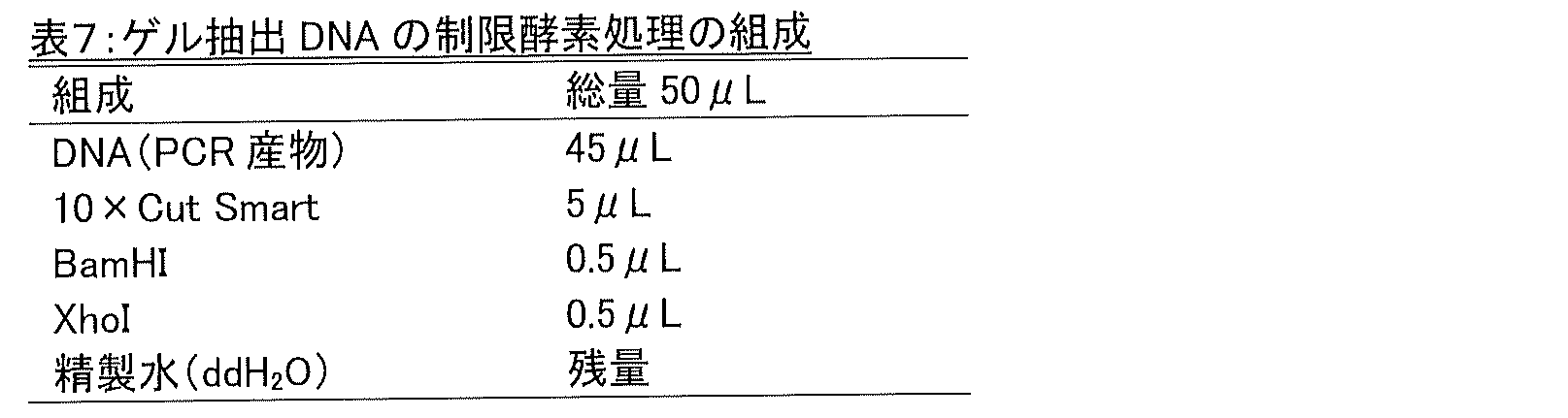
Gilbreth RN et al., Proc Natl Acad Sci U S A. 2011; 108(19): 7751-6.、Koide A et al., Proc Natl Acad Sci U S A. 2007; 104(16):6632-7.の記載に従って、pET28aベクター(Novagen)をもとにpHFT2ベクターを作製した。pHFT2ベクターはカナマイシン耐性であり、N末端配列には10×HisおよびTEVプロテアーゼ切断部位が付加されている。次に、pHFT2ベクターを表6に示す組成にて制限酵素処理した。また、上記(ii)でゲル抽出したDNAは表7に示す組成にて制限酵素処理した。制限酵素処理はいずれも37℃、1時間、静置の条件下で行った。
上記(iii)で制限酵素処理したベクターとインサートDNAは、上記(ii)の記載と同様にしてゲル抽出した。
上記(iv)で得られたベクターとインサートDNAのモル比が1:8となるように混合し、その混合液5μLにLigation-Convenience Kit(ニッポンジーン)5μLを加え、16℃、15分で反応させた。
上記(v)で反応させたライゲーション溶液10μLを大腸菌JM109(ニッポンジーン)(コンピテントセル)に加えて、氷上で静置した。その後、42℃で45~50秒インキュベートし、すぐに氷上に静置した。3分経過後、SOC培地を10培希釈になるように加え、37℃、120rpmで1時間回復培養を行った。培養後、培養液を5,000×gで30秒間遠心を行い、上清を取り除き、100μLにまで濃縮した。濃縮液をLB培地プレート(カナマイシン(50μg/mL)を含む)に播いて、37℃で一晩培養した。形質転換で生えたコロニーを2XYT液体培地(カナマイシン(50μg/mL)を含む)に植菌して、一晩培養した。培養液をFastGene Plasmid Mini Kit(日本ジェネティクス)を用いてプラスミド抽出をした。pHFT2ベクターにWT-AfBFFase遺伝子が組み込まれていることをDNAシーケンスサービス(Eurofins)により確認した。
(i)大腸菌BL21(DE3)の形質転換と培養
上記(1)アで作製したWT-AfBFFase遺伝子が組み込まれたプラスミド(本明細書中「pHFT2_WT-AfBFFase」ということがある)2μLを用いて、大腸菌BL21(DE3)の形質転換を行い、カナマイシンプレートに播いた。形質転換は、上記(1)ア(vi)の記載と同様にして行った。37℃で一晩培養後、プレート上のシングルコロニーを5mLのLB液体培地(カナマイシン(50μg/mL)を含む)に植菌し、37℃、120rpmで16時間培養した。そして、500mLの2XYT培地(カナマイシン(50μg/mL)を含む)に前培養液5mLを植菌し、濁度が0.3~0.5になるまで37℃で培養した。その後、IPTG(終濃度0.2mM)を添加して、18℃で16時間振盪培養した。培養液を8000gで10分遠心分離して集菌した。集菌後、菌体をNaCl(150mM)により懸濁して洗浄し、もう一度遠心分離を行い、沈殿した菌体を-30℃で冷凍保存した。
沈殿した菌体に対して15mLの破砕緩衝液(NaCl(500mM)、Tris-HCl(20mM)、イミダゾール(20mM)、pH8.0)で懸濁して、超音波破砕を行った。30秒間破砕を行った後、1分間の氷冷を1セットとして、これを計10セット行った。破砕溶液を1800×g、4℃で30分間遠心分離を行い、0.45μm滅菌フィルターで濾過することにより、無細胞抽出液を得た。終濃度20mMになるように抽出液にイミダゾールを加えて、His Trap HP カラムに供した。His TrapA緩衝液(NaCl(500mM)、Tris-HCl(20mM)、イミダゾール(20mM)、pH8.0)により洗浄し、続いて、His TrapB緩衝液(イミダゾール(500mM)、NaCl(500mM)、Tris-HCl緩衝液(50mM)、pH8.0)を4~100%の濃度勾配で溶出した。溶出した目的のタンパク質溶液を、50kDaのビバスピンターボ30遠心式限外ろ過フィルターを用いて、4000×gで2.5mLにまで濃縮した。
His Trap HP カラムで分離できなかった凝集物を除くため、ゲル濾過クロマトグラフィーによる精製を行った。ゲル濾過緩衝液(NaCl(150mM)、Tris-HCl(50mM)pH8.0)を使用し、HiLoad 16/60 Superdex 200 prep grad カラム(120mL、GEヘルスケア)にタンパク質溶液を供した。各タンパク質を含む画分を回収し、50kDaのビバスピンターボ3010遠心式限外ろ過フィルターを用いて濃縮し、精製溶液として4℃で保存した。精製溶液の濃度は吸光度280nmで測定した。また、WT-AfBFFaseの吸光度係数(Abs0.1%(=1g/L))は1.747である。
精製タンパク質溶液を作製した10%(w/v)ポリアクリルアミドゲルにアプライして電気泳動を行った。分子量マーカーは、Protein Molecular Weight Marker Broad(タカラバイオ)を用いた。これにより、目的タンパク質が精製されていることを確認した。
(i)酵素反応
反応は、基質溶液(1Mスクロース)と精製タンパク質溶液(分析緩衝液(50mMリン酸ナトリウム緩衝液、pH5.5)で調製した上記(1)イで得られたWT-AfBFFase(1μg)を含む)とを混合することにより開始した。サンプルを50℃で反応させて、0、1時間、1.5時間、2時間、2.5時間、3時間、3.5時間、4時間、6時間、8時間毎に回収し、15分間煮沸して反応を停止した。各反応時間で同じ操作を3回行った。反応後のサンプル液は-20℃で保存した。
単糖、二糖、およびFOSの産生量は、疎水性相互作用クロマトグラフィーによって分析した。HPLC(LC-20AD、島津製作所)のULTRON AF-HILIC-CD カラム(島津製作所)を使用して測定した。また、分析緩衝液には74.1%アセトニトリルを用いた。糖鎖が長くなるにつれて疎水性度が上がるため、保持時間が長くなる。この保持時間の違いを利用して示差屈折率検出器(RID)で検出した。糖の長さによって溶出される時間が異なり、ピーク面積から産生量を算出できるため、既知の糖を用いて検量線を作成した。この検量線を用いて、FOS産出量を算出した。
結果は、表8および図1に示す通りであった。酵素反応によって、反応前は2糖(スクロース)が全体の100%を占めているが、反応時間の経過とともに2糖が消費され全体を占める割合が減っていることが確認された。この結果と、産業利用上は、3糖FOSが多く存在し、4糖以上のFOSが少なく、かつ、2糖が効率よく消費される反応時間が望ましいことを考慮し、2糖が10~15%にまで消費された時点におけるFOS産生量でβ-フルクトフラノシダーゼの機能評価を行うことが妥当であると考えられた。そこで、例2以降の改良型β-フルクトフラノシダーゼの検討では、2糖が10~15%にまで消費された時点におけるFOS産生量で評価を行うこととした。

例2では、例1の野生型β-フラクトフラノシダーゼ(WT-AfBFFase)のアミノ酸配列(配列番号1)のアミノ末端(N末端)から81番目のアミノ酸であるグリシン(Gly81)および141番目のロイシン(Leu141)をそれぞれ変異させた変異型β-フラクトフラノシダーゼ-Gly81(本明細書中「AfBFFase-Gly81」ということがある)および変異型β-フラクトフラノシダーゼ-Leu141(本明細書中「AfBFFase-Leu141」ということがある)を用いてFOS産生量について検討した。
ア 改良型β-フルクトフラノシダーゼのプラスミド作製
AfBFFase-Gly81およびAfBFFase-Leu141の各プラスミド作製は次の手順で行った。
例1で作製したpHFT2_WT-AfBFFaseを鋳型としてインバースPCRを行った。表9および10に81番目のアミノ酸および141番目のアミノ酸をそれぞれ別のアミノ酸に置換させるためのプライマー塩基配列を示す。PCR組成およびPCRの条件は例1の表4と表5と同様とした。

大腸菌由来の鋳型DNAはメチル化されている一方で、PCRによって増幅したDNAはメチル化されていないため、DpnI(制限酵素)により鋳型DNAを分解し取り除くことができる。そこで、増幅した各PCR産物にDpnIを1μL加え、37℃、1時間、静置の条件下で制限酵素処理した。その後、例1(1)ア(iii)の記載と同様にゲル抽出を行った。
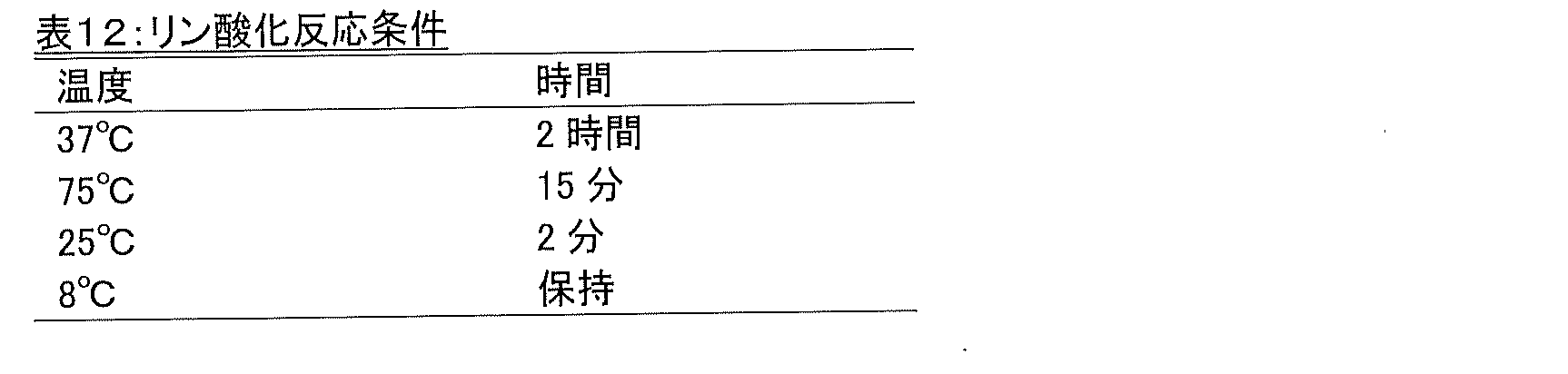
上記(ii)でゲル抽出したDNAの5’末端をリン酸化した。リン酸化の組成および条件は表11および12にそれぞれ示した。リン酸化後、FastGene Gel/PCR Extraction Kit(日本ジェネティクス)を用いて20μLでPCR産物の溶出を行った。

PCR産物の溶出液5μLに、同量のLigation-Convenience Kit(日本ジェネティクス)5μLを加え、16℃、15分で反応させた。
例1(1)ア(vi)の記載と同様に、上記(iv)で反応させたライゲーション溶液を用いて大腸菌JM109の形質転換を行い、プラスミドの目的の場所に変異が導入されていることをDNAシーケンスサービスにより確認した(本明細書中、このプラスミドを「pHFT2_AfBFFase-G81」ということがある)。
(i)大腸菌BL21(DE3)の形質転換と培養
例1(1)イ(i)の記載と同様に、pHFT2_AfBFFase-G81を用いて大腸菌BL21(DE3)の形質転換と培養を行った。
例1(1)イ(ii)の記載と同様に、アフィニティークロマトグラフィーによる精製を行った。
例1(1)イ(iii)の記載と同様に、ゲル濾過クロマトグラフィーによる精製を行った。
例1(1)イ(iv)の記載と同様に、SDSを行い、目的タンパク質が精製されていることを確認した。
(i)酵素反応
反応時間を0、1時間、2時間、4時間としたこと以外は、例1(1)ウ(i)の記載と同様に酵素反応を行った。
例1(1)ウ(ii)の記載と同様に、HPLC分析によりFOS産生量を算出した。
結果は、表13、表14、図2および図3に示す通りであった。

例3では、WT-AfBFFaseのアミノ酸配列(配列番号1)のN末端から81番目のグリシン(Gly81)と141番目のロイシン(Leu141)の双方を変異させた二重変異による改良型β-フルクトフラノシダーゼ(本明細書中「AfBFFase-Gly81-Leu141」ということがある)を用いてFOS産生量について検討した。
ア 改良型β-フルクトフラノシダーゼ(二重変異)のプラスミド作製
pHFT2_AfBFFase-G81YおよびpHFT2_AfBFFase-G81Wのプラスミドを鋳型とし、Leu141YおよびLeu141Wのプライマーを用いてインバースPCRを行い、pHFT2_AfBFFase-G81Y-L141Y、pHFT2_AfBFFase-G81Y-L141W、pHFT2_AfBFFase-G81W-Leu141Y、pHFT2_AfBFFase-G81W-L141Wの4つのプラスミドを作製した。PCRの組成や条件、制限酵素処理、リン酸化、大腸菌JM109の形質転換は、例2(1)アの記載と同様にして行った。
大腸菌BL21(DE3)の形質転換と培養、アフィニティークロマトグラフィーによる精製、ゲル濾過クロマトグラフィーによる精製は、例2(1)イの記載と同様にして行った。
酵素反応、HPLC分析は、例2(1)ウの記載と同様にして行った。
結果は、表15および図4に示す通りであった。
Claims (13)
- β-フルクトフラノシダーゼのアミノ酸配列において、配列番号1に示すアミノ酸配列のアミノ末端から81番目の位置に相当するアミノ酸および141番目の位置に相当するアミノ酸のいずれかまたは両方が他のアミノ酸に置換されたアミノ酸配列からなる、改良型β-フルクトフラノシダーゼ。
- β-フルクトフラノシダーゼが、配列番号1に示す野生型β-フルクトフラノシダーゼのアミノ酸配列と60%以上の配列同一性を有し、かつ、β-フルクトフラノシダーゼ活性を有するアミノ酸配列からなる、請求項1に記載の改良型β-フルクトフラノシダーゼ。
- 下記a)およびb)のいずれかのアミノ酸配列からなる、請求項1または2に記載の改良型β-フルクトフラノシダーゼ:
a)配列番号1に示すアミノ酸配列において、アミノ末端から81番目の位置に相当するアミノ酸(グリシン(G))および141番目の位置に相当するアミノ酸(ロイシン(L))のいずれかまたは両方が他のアミノ酸に置換されたアミノ酸配列
b)上記a)のアミノ酸配列において、81番目のグリシン(G)および141番目のロイシン(L)以外の1または複数個のアミノ酸が欠失、置換、挿入および/または付加されたアミノ酸配列からなり、かつ、β-フルクトフラノシダーゼ活性を有するアミノ酸配列。 - アミノ末端から81番目の位置に相当するアミノ酸が、アスパラギン酸(D)、グルタミン酸(E)、フェニルアラニン(F)、ヒスチジン(H)、イソロイシン(I)、リシン(K)、ロイシン(L)、メチオニン(M)、アスパラギン(N)、グルタミン(Q)、アルギニン(R)、セリン(S)、バリン(V)、トリプトファン(W)およびチロシン(Y)からなる群から選択されるアミノ酸に置換された、請求項1または2に記載の改良型β-フルクトフラノシダーゼ。
- アミノ末端から141番目の位置に相当するアミノ酸が、アラニン(A)、アスパラギン酸(D)、フェニルアラニン(F)、グリシン(G)、イソロイシン(I)、リシン(K)、アスパラギン(N)、グルタミン(Q)、アルギニン(R)、セリン(S)、トレオニン(T)、トリプトファン(W)およびチロシン(Y)からなる群から選択されるアミノ酸に置換された、請求項1または2に記載の改良型β-フルクトフラノシダーゼ。
- 請求項1または2に記載の改良型β-フルクトフラノシダーゼのアミノ酸配列の酵素活性部分を含み、かつ、β-フルクトフラノシダーゼ活性を有する、ポリペプチド。
- 請求項1または2に記載の改良型β-フルクトフラノシダーゼをコードする、ポリヌクレオチド。
- 請求項7に記載のポリヌクレオチドを含んでなる、発現ベクター。
- 請求項7に記載のポリヌクレオチドを宿主に導入してなる、形質転換体。
- 宿主が細菌、酵母、カビおよび糸状菌からなる群から選択される、請求項9に記載の形質転換体。
- 請求項9に記載の形質転換体の培養物から改良型β-フルクトフラノシダーゼを得る工程を含む、改良型β-フルクトフラノシダーゼの製造方法。
- 請求項1または2に記載の改良型β-フルクトフラノシダーゼと、スクロースとを接触させる工程を含む、フラクトオリゴ糖の製造方法。
- 請求項12に記載の製造方法を実施してフラクトオリゴ糖を製造する工程と、前記フラクトオリゴ糖を結晶化する工程とを含む、1-ケストース結晶の製造方法。
Priority Applications (4)
| Application Number | Priority Date | Filing Date | Title |
|---|---|---|---|
| EP22878505.1A EP4424831A4 (en) | 2021-10-04 | 2022-10-04 | IMPROVED BETA-FRUCTOFURANOSIDASE |
| CN202280067418.7A CN118076740A (zh) | 2021-10-04 | 2022-10-04 | 改良型β-呋喃果糖苷酶 |
| US18/692,604 US20240384317A1 (en) | 2021-10-04 | 2022-10-04 | IMPROVED ß-FRUCTOFURANOSIDASE |
| JP2023552891A JPWO2023058637A1 (ja) | 2021-10-04 | 2022-10-04 |
Applications Claiming Priority (2)
| Application Number | Priority Date | Filing Date | Title |
|---|---|---|---|
| JP2021-163489 | 2021-10-04 | ||
| JP2021163489 | 2021-10-04 |
Publications (1)
| Publication Number | Publication Date |
|---|---|
| WO2023058637A1 true WO2023058637A1 (ja) | 2023-04-13 |
Family
ID=85803485
Family Applications (1)
| Application Number | Title | Priority Date | Filing Date |
|---|---|---|---|
| PCT/JP2022/037083 Ceased WO2023058637A1 (ja) | 2021-10-04 | 2022-10-04 | 改良型β-フルクトフラノシダーゼ |
Country Status (5)
| Country | Link |
|---|---|
| US (1) | US20240384317A1 (ja) |
| EP (1) | EP4424831A4 (ja) |
| JP (1) | JPWO2023058637A1 (ja) |
| CN (1) | CN118076740A (ja) |
| WO (1) | WO2023058637A1 (ja) |
Citations (4)
| Publication number | Priority date | Publication date | Assignee | Title |
|---|---|---|---|---|
| WO2005085447A1 (ja) * | 2004-03-04 | 2005-09-15 | Meiji Seika Kaisha, Ltd. | β-フルクトフラノシダーゼ変異体 |
| JP2010273580A (ja) * | 2009-05-27 | 2010-12-09 | Meiji Seika Kaisha Ltd | 1−ケストースの結晶化母液の調製方法 |
| WO2015099166A1 (ja) | 2013-12-27 | 2015-07-02 | 物産フードサイエンス株式会社 | 改良型β-フルクトフラノシダーゼ |
| WO2016143873A1 (ja) | 2015-03-11 | 2016-09-15 | 物産フードサイエンス株式会社 | 改良型β-フルクトフラノシダーゼ |
-
2022
- 2022-10-04 CN CN202280067418.7A patent/CN118076740A/zh active Pending
- 2022-10-04 EP EP22878505.1A patent/EP4424831A4/en active Pending
- 2022-10-04 US US18/692,604 patent/US20240384317A1/en active Pending
- 2022-10-04 JP JP2023552891A patent/JPWO2023058637A1/ja active Pending
- 2022-10-04 WO PCT/JP2022/037083 patent/WO2023058637A1/ja not_active Ceased
Patent Citations (4)
| Publication number | Priority date | Publication date | Assignee | Title |
|---|---|---|---|---|
| WO2005085447A1 (ja) * | 2004-03-04 | 2005-09-15 | Meiji Seika Kaisha, Ltd. | β-フルクトフラノシダーゼ変異体 |
| JP2010273580A (ja) * | 2009-05-27 | 2010-12-09 | Meiji Seika Kaisha Ltd | 1−ケストースの結晶化母液の調製方法 |
| WO2015099166A1 (ja) | 2013-12-27 | 2015-07-02 | 物産フードサイエンス株式会社 | 改良型β-フルクトフラノシダーゼ |
| WO2016143873A1 (ja) | 2015-03-11 | 2016-09-15 | 物産フードサイエンス株式会社 | 改良型β-フルクトフラノシダーゼ |
Non-Patent Citations (14)
| Title |
|---|
| ALTSCHU ET AL., J. MOL. BIOL., vol. 215, 1990, pages 403 - 410 |
| DATABASE UniprotKB 12 August 2020 (2020-08-12), "Full=Glycosyl hydrolase family 32 C-terminal domain-containing protein {ECO:0000256|Google:ProtNLM}; GN ORFNames=ATNIH1004_007897 {ECO:0000313|EMBL:KAA8646464.1}", XP093055711, retrieved from Uniprot Database accession no. A0A5M9MM14 * |
| DATABASE UniprotKB 31 July 2019 (2019-07-31), ANONYMOUS : "Full=Glycosyl hydrolase family 32 N-terminal domain-containing protein {ECO:0000256|Google:ProtNLM}; GN ORFNames=EYZ11_000312 {ECO:0000313|EMBL:THD00262.1}", XP093055710, retrieved from Uniprot Database accession no. A0A4S3JXJ4 * |
| FUJII TADASHI, TOCHIO TAKUMI, HIRANO KATSUAKI, TAMURA KEISUKE, TONOZUKA TAKASHI: "Rapid evaluation of 1-kestose producing β-fructofuranosidases from Aspergillus species and enhancement of 1-kestose production using a PgsA surface-display system", BIOSCIENCE, BIOTECHNOLOGY, AND BIOCHEMISTRY, JAPAN SOCIETY FOR BIOSCIENCE, BIOTECHNOLOGY, AND AGROCHEMISTRY, JP, vol. 82, no. 9, 2 September 2018 (2018-09-02), JP , pages 1599 - 1605, XP093055707, ISSN: 0916-8451, DOI: 10.1080/09168451.2018.1480347 * |
| GIBSON GR ET AL., J NUTR., vol. 125, no. 6, 1995, pages 1401 - 1412 |
| GILBRETH RN ET AL., PROC NATL ACAD SCI USA., vol. 108, no. 19, 2011, pages 7751 - 6 |
| HIDAKA H ET AL., AGRIC BIOL CHEM, vol. 52, no. 5, 1988, pages 1181 - 1187 |
| KOIDE A ET AL., PROC NATL ACAD SCI USA., vol. 104, no. 16, 2007, pages 6632 - 7 |
| PEASRON ET AL., METHODS IN ENZYMOLOGY, vol. 183, 1990, pages 63 - 69 |
| See also references of EP4424831A4 |
| SMITH-WATERMAN, METH. ENZYM., vol. 164, 1988, pages 765 |
| TOCHIO T ET AL., FOODS, vol. 7, no. 9, 2018, pages 140 |
| WILBUR, NATL. ACAD. SCI. U.S.A., vol. 80, 1983, pages 726 - 730 |
| YANAI K ET AL., BIOSCI BIOTECHNOL BIOCHEM., vol. 65, no. 4, 2001, pages 766 - 773 |
Also Published As
| Publication number | Publication date |
|---|---|
| US20240384317A1 (en) | 2024-11-21 |
| EP4424831A1 (en) | 2024-09-04 |
| CN118076740A (zh) | 2024-05-24 |
| EP4424831A4 (en) | 2025-11-19 |
| JPWO2023058637A1 (ja) | 2023-04-13 |
Similar Documents
| Publication | Publication Date | Title |
|---|---|---|
| CN103201380B (zh) | 新岩藻糖基转移酶及它们的应用 | |
| US7264955B2 (en) | α1-6 fucosyltransferase | |
| JP2023506154A (ja) | アルロースエピマー化酵素変異体、その製造方法及びそれを利用したアルロースの製造方法 | |
| JP6657177B2 (ja) | 改良型β−フルクトフラノシダーゼ | |
| CN106604991A (zh) | 修饰型β‑半乳糖苷酶 | |
| JP7535192B2 (ja) | 熱安定性に優れたアルロースエピマー化酵素変異体、その製造方法およびこれを用いたアルロースの製造方法 | |
| JP6068671B2 (ja) | 改良型β−フルクトフラノシダーゼ | |
| US7655449B2 (en) | β-fructofuranosidase variants | |
| JP6023392B2 (ja) | 改良型β−フルクトフラノシダーゼ | |
| JP5660271B2 (ja) | グルコースデヒドロゲナーゼおよびその製造方法 | |
| WO2023058637A1 (ja) | 改良型β-フルクトフラノシダーゼ | |
| JPWO2020179714A1 (ja) | 3’,3’−cGAMPの実践的酵素合成法 | |
| CN118240791A (zh) | 糖基转移酶突变体及其在Reb D合成中的应用 | |
| KR20200072098A (ko) | 과당으로부터 타가토스로의 전환 활성이 향상된 헥수론산 c4-에피머화 효소 변이체 | |
| CN115044568B (zh) | 高稳定型的蔗糖磷酸化酶突变体及其应用 | |
| JP3487711B2 (ja) | 環状イソマルトオリゴ糖合成酵素、該酵素の遺伝子、組み換え体dna及び該酵素の製造法 | |
| JP3508871B2 (ja) | クレアチニンデイミナーゼ活性を有する蛋白質の遺伝情報を有するdna並びにクレアチニンデイミナーゼの製造法 | |
| CN102695793A (zh) | 具有改进的产品特异性的蔗糖变位酶 | |
| KR20180135425A (ko) | 글루코실글리세롤 생산 활성을 가지는 신규한 폴리펩티드 및 이를 이용한 글루코실글리세롤 제조방법 | |
| KR20050051055A (ko) | 더머스 칼도필러스 gk24 균주 유래의 알파-글루칸포스포릴라제, 재조합 균주를 이용한 상기 효소의제조방법 및 상기 효소를 이용한알파--디-포도당-1-인산염의 합성방법 | |
| WO2024154813A1 (ja) | フラクトシル化マルチトールおよびその製造方法 | |
| CN105112388A (zh) | 对胰蛋白酶抗性提高的β-1,4-内切木聚糖酶及其制备方法与用途 | |
| CN117683750A (zh) | 重组α-葡萄糖苷酶及其制备方法 | |
| CA2542576A1 (en) | Transgenic organisms with lower growth temperature | |
| JP2004024189A (ja) | 耐熱性ケラタナーゼをコードするdna |
Legal Events
| Date | Code | Title | Description |
|---|---|---|---|
| 121 | Ep: the epo has been informed by wipo that ep was designated in this application |
Ref document number: 22878505 Country of ref document: EP Kind code of ref document: A1 |
|
| WWE | Wipo information: entry into national phase |
Ref document number: 18692604 Country of ref document: US |
|
| WWE | Wipo information: entry into national phase |
Ref document number: 2023552891 Country of ref document: JP |
|
| WWE | Wipo information: entry into national phase |
Ref document number: 202280067418.7 Country of ref document: CN |
|
| WWE | Wipo information: entry into national phase |
Ref document number: 2022878505 Country of ref document: EP |
|
| NENP | Non-entry into the national phase |
Ref country code: DE |
|
| ENP | Entry into the national phase |
Ref document number: 2022878505 Country of ref document: EP Effective date: 20240506 |