WO2023059925A1 - Biobased polyglyceryl esters and compositions comprising the same - Google Patents
Biobased polyglyceryl esters and compositions comprising the same Download PDFInfo
- Publication number
- WO2023059925A1 WO2023059925A1 PCT/US2022/046130 US2022046130W WO2023059925A1 WO 2023059925 A1 WO2023059925 A1 WO 2023059925A1 US 2022046130 W US2022046130 W US 2022046130W WO 2023059925 A1 WO2023059925 A1 WO 2023059925A1
- Authority
- WO
- WIPO (PCT)
- Prior art keywords
- composition
- biobased
- polyglyceryl
- less
- product
- Prior art date
- Legal status (The legal status is an assumption and is not a legal conclusion. Google has not performed a legal analysis and makes no representation as to the accuracy of the status listed.)
- Ceased
Links
Classifications
-
- A—HUMAN NECESSITIES
- A61—MEDICAL OR VETERINARY SCIENCE; HYGIENE
- A61K—PREPARATIONS FOR MEDICAL, DENTAL OR TOILETRY PURPOSES
- A61K8/00—Cosmetics or similar toiletry preparations
- A61K8/18—Cosmetics or similar toiletry preparations characterised by the composition
- A61K8/30—Cosmetics or similar toiletry preparations characterised by the composition containing organic compounds
- A61K8/33—Cosmetics or similar toiletry preparations characterised by the composition containing organic compounds containing oxygen
- A61K8/39—Derivatives containing from 2 to 10 oxyalkylene groups
-
- A—HUMAN NECESSITIES
- A61—MEDICAL OR VETERINARY SCIENCE; HYGIENE
- A61K—PREPARATIONS FOR MEDICAL, DENTAL OR TOILETRY PURPOSES
- A61K8/00—Cosmetics or similar toiletry preparations
- A61K8/18—Cosmetics or similar toiletry preparations characterised by the composition
- A61K8/72—Cosmetics or similar toiletry preparations characterised by the composition containing organic macromolecular compounds
- A61K8/84—Cosmetics or similar toiletry preparations characterised by the composition containing organic macromolecular compounds obtained by reactions otherwise than those involving only carbon-carbon unsaturated bonds
- A61K8/85—Polyesters
-
- A—HUMAN NECESSITIES
- A61—MEDICAL OR VETERINARY SCIENCE; HYGIENE
- A61K—PREPARATIONS FOR MEDICAL, DENTAL OR TOILETRY PURPOSES
- A61K8/00—Cosmetics or similar toiletry preparations
- A61K8/02—Cosmetics or similar toiletry preparations characterised by special physical form
- A61K8/0291—Micelles
-
- A—HUMAN NECESSITIES
- A61—MEDICAL OR VETERINARY SCIENCE; HYGIENE
- A61K—PREPARATIONS FOR MEDICAL, DENTAL OR TOILETRY PURPOSES
- A61K8/00—Cosmetics or similar toiletry preparations
- A61K8/02—Cosmetics or similar toiletry preparations characterised by special physical form
- A61K8/04—Dispersions; Emulsions
- A61K8/06—Emulsions
- A61K8/062—Oil-in-water emulsions
-
- A—HUMAN NECESSITIES
- A61—MEDICAL OR VETERINARY SCIENCE; HYGIENE
- A61K—PREPARATIONS FOR MEDICAL, DENTAL OR TOILETRY PURPOSES
- A61K8/00—Cosmetics or similar toiletry preparations
- A61K8/18—Cosmetics or similar toiletry preparations characterised by the composition
- A61K8/30—Cosmetics or similar toiletry preparations characterised by the composition containing organic compounds
- A61K8/33—Cosmetics or similar toiletry preparations characterised by the composition containing organic compounds containing oxygen
- A61K8/34—Alcohols
- A61K8/345—Alcohols containing more than one hydroxy group
-
- A—HUMAN NECESSITIES
- A61—MEDICAL OR VETERINARY SCIENCE; HYGIENE
- A61K—PREPARATIONS FOR MEDICAL, DENTAL OR TOILETRY PURPOSES
- A61K8/00—Cosmetics or similar toiletry preparations
- A61K8/18—Cosmetics or similar toiletry preparations characterised by the composition
- A61K8/30—Cosmetics or similar toiletry preparations characterised by the composition containing organic compounds
- A61K8/33—Cosmetics or similar toiletry preparations characterised by the composition containing organic compounds containing oxygen
- A61K8/37—Esters of carboxylic acids
- A61K8/375—Esters of carboxylic acids the alcohol moiety containing more than one hydroxy group
-
- A—HUMAN NECESSITIES
- A61—MEDICAL OR VETERINARY SCIENCE; HYGIENE
- A61K—PREPARATIONS FOR MEDICAL, DENTAL OR TOILETRY PURPOSES
- A61K8/00—Cosmetics or similar toiletry preparations
- A61K8/18—Cosmetics or similar toiletry preparations characterised by the composition
- A61K8/30—Cosmetics or similar toiletry preparations characterised by the composition containing organic compounds
- A61K8/40—Cosmetics or similar toiletry preparations characterised by the composition containing organic compounds containing nitrogen
- A61K8/42—Amides
-
- A—HUMAN NECESSITIES
- A61—MEDICAL OR VETERINARY SCIENCE; HYGIENE
- A61K—PREPARATIONS FOR MEDICAL, DENTAL OR TOILETRY PURPOSES
- A61K8/00—Cosmetics or similar toiletry preparations
- A61K8/18—Cosmetics or similar toiletry preparations characterised by the composition
- A61K8/72—Cosmetics or similar toiletry preparations characterised by the composition containing organic macromolecular compounds
- A61K8/84—Cosmetics or similar toiletry preparations characterised by the composition containing organic macromolecular compounds obtained by reactions otherwise than those involving only carbon-carbon unsaturated bonds
- A61K8/86—Polyethers
-
- A—HUMAN NECESSITIES
- A61—MEDICAL OR VETERINARY SCIENCE; HYGIENE
- A61Q—SPECIFIC USE OF COSMETICS OR SIMILAR TOILETRY PREPARATIONS
- A61Q13/00—Formulations or additives for perfume preparations
-
- A—HUMAN NECESSITIES
- A61—MEDICAL OR VETERINARY SCIENCE; HYGIENE
- A61Q—SPECIFIC USE OF COSMETICS OR SIMILAR TOILETRY PREPARATIONS
- A61Q19/00—Preparations for care of the skin
-
- C—CHEMISTRY; METALLURGY
- C07—ORGANIC CHEMISTRY
- C07C—ACYCLIC OR CARBOCYCLIC COMPOUNDS
- C07C69/00—Esters of carboxylic acids; Esters of carbonic or haloformic acids
- C07C69/02—Esters of acyclic saturated monocarboxylic acids having the carboxyl group bound to an acyclic carbon atom or to hydrogen
- C07C69/22—Esters of acyclic saturated monocarboxylic acids having the carboxyl group bound to an acyclic carbon atom or to hydrogen having three or more carbon atoms in the acid moiety
- C07C69/28—Esters of acyclic saturated monocarboxylic acids having the carboxyl group bound to an acyclic carbon atom or to hydrogen having three or more carbon atoms in the acid moiety esterified with dihydroxylic compounds
-
- A—HUMAN NECESSITIES
- A61—MEDICAL OR VETERINARY SCIENCE; HYGIENE
- A61K—PREPARATIONS FOR MEDICAL, DENTAL OR TOILETRY PURPOSES
- A61K2800/00—Properties of cosmetic compositions or active ingredients thereof or formulation aids used therein and process related aspects
- A61K2800/10—General cosmetic use
-
- A—HUMAN NECESSITIES
- A61—MEDICAL OR VETERINARY SCIENCE; HYGIENE
- A61K—PREPARATIONS FOR MEDICAL, DENTAL OR TOILETRY PURPOSES
- A61K2800/00—Properties of cosmetic compositions or active ingredients thereof or formulation aids used therein and process related aspects
- A61K2800/20—Chemical, physico-chemical or functional or structural properties of the composition as a whole
- A61K2800/26—Optical properties
- A61K2800/262—Transparent; Translucent
-
- A—HUMAN NECESSITIES
- A61—MEDICAL OR VETERINARY SCIENCE; HYGIENE
- A61K—PREPARATIONS FOR MEDICAL, DENTAL OR TOILETRY PURPOSES
- A61K2800/00—Properties of cosmetic compositions or active ingredients thereof or formulation aids used therein and process related aspects
- A61K2800/40—Chemical, physico-chemical or functional or structural properties of particular ingredients
- A61K2800/52—Stabilizers
- A61K2800/524—Preservatives
Definitions
- the present invention relates to biobased polyglyceryl ester compounds and compositions, formulations containing the compounds and compositions, methods of making and using the compounds, compositions, and formulations, and applications thereof that include inter alia cosmetic applications.
- Polyglycerol is readily esterified with fatty acids to yield polyglyceryl esters (PGEs), a well-known class of nonionic surfactants and emulsifiers that are frequently employed as food ingredients and in the formulation of cosmetics and personal care products.
- PGEs comprised of hydrophilic PG groups linked to lipophilic/hydrophobic fatty acyl groups by ester bonds demonstrate surface and interfacial activity due to their amphiphilic structures.
- PGE structures are typically designed to elicit maximum surface and interfacial activity to provide optimal performance at functions such as emulsification, solubilization/microemulsification, detergency, foam generation, and foam stabilization.
- PGEs have the advantage of being synthesized in bulk without the need for solvents and provided as 100% active anhydrous materials that do not require preservation against microbial contamination.
- PGEs may be employed as surfactants for the solubilization or microemulsification of water-insoluble species in aqueous media to yield stable, clear, i.e. transparent, solutions. PGEs are useful for example to solubilize fragrances, essential oils, active ingredients, preservation components, and other ingredients with poor water solubility into clear aqueous formulations.
- Nonionic surfactants are known to have an inactivating effect on microbiostatic ingredients (ingredients that are intended to inhibit the growth of microorganisms) and on microbiocidal ingredients (ingredients that are intended to kill microorganisms).
- polyethoxylated sorbitan esters or polysorbates are nonionic surfactants that are known to inhibit the antimicrobial activity of cosmetic preservatives.
- nonionic surfactants that are capable of solubilizing or microemulsifying water-insoluble microbiostatic and microbiocidal ingredients to produce clear solutions without inhibiting the biological effects of such compounds.
- Such nonionic surfactants should be preferentially based on renewable carbon sources, i.e. plant-based carbon, due to the market demand for more sustainable ingredients and greater consumer appeal of so-called “natural” ingredients derived from renewable, biobased feedstocks.
- biobased polyglyceryl ester compositions as described herein possess a precise balance between the hydrophilic and lipophilic characteristics of the polyglyceryl ester, which enables them to form stable, transparent aqueous solutions that do not inhibit the activity of microbiostatic/microbiocidal compounds used in formulations, for example, for preservation against microbial contamination.
- the present invention is directed to biobased polyglyceryl ester composition.
- the composition comprises: a mixture including one or more compounds of Formula (I): wherein: PG is a polyglyceryl group comprising greater than 40% hexaglycerol and higher polyglycerols and less than 60% pentaglycerol and lower polyglycerols,
- the present invention is directed to a self-dispersing concentrate.
- the concentrate comprises the composition as in the preceding paragraph and a medium chain terminal diol.
- the concentrate comprises a medium chain alkylhydroxamic acid, a salt thereof, or combinations thereof.
- the concentrate comprises glycerin and/or a C 3 -C 4 diol.
- the present invention is directed to a self-dispersing concentrate.
- the concentrate comprises: from about 30% to about 90% biobased polyglyceryl ester, wherein biobased polyglyceryl ester is: a mixture including one or more compounds of Formula (I): wherein: PG is a polyglyceryl group comprising greater than 40% hexaglycerol and higher polyglycerols and less than 60% pentaglycerol and lower polyglycerols,
- the present invention is directed a formulation comprising the composition or concentrate as in any of the preceding paragraphs.
- the present invention is further directed a process for preparing a biobased polyglyceryl ester composition.
- the process comprises: mixing one or more compounds of Formula (I): wherein: PG is a polyglyceryl group comprising greater than 40% hexaglycerol and higher polyglycerols and less than 60% pentaglycerol and lower polyglycerols and,
- the present invention is further directed to another process for preparing a self-dispersing concentrate.
- the process comprises: preparing a biobased poly glyceryl ester by: mixing one or more compounds of Formula (I): wherein: PG is a polyglyceryl group comprising greater than 40% hexaglycerol and higher polyglycerols and less than 60% pentaglycerol and lower polyglycerols,
- the present invention is directed a process for preparing a formulation comprising the biobased polyglyceryl ester composition and/or self-dispersing concentrate as in any of the preceding paragraphs.
- FIG. 1 illustrates the Turbidity of SpectrastatTM G2 Natural (1%) in a 5% solution of Poly glyceryl-10 Heptanoate as a function of the degree of esterification (DE) of the Poly glyceryl-10 Heptanoate.
- FIG. 2A illustrates O/W microemulsion turbidity values as a function of oil load for Example 14, at time of preparation. Formulations with turbidity values > 100 NTU are considered thermodynamically unstable macroemulsions.
- FIG. 2B illustrates O/W microemulsion turbidity values as a function of oil load for Example 14, after 24 hr.
- % can refer to either a percent by weight or volume.
- Cosmetically acceptable means suitable for use in contact with the skin without undue toxicity, incompatibility, instability, irritation, allergic response, and the like.
- the present invention includes biobased compositions.
- Biobased or “natural” feedstocks must be used in the production of biobased compositions.
- An example of a biobased composition is one that is prepared from a bioderived feedstock (e.g., from current and sustainable agricultural activities, such as fermentation-, algae-, plant- or vegetable- derived; e.g., is derived from a vegetable source, preferably using a non-genetically modified organism, or biomass, and it is not petrochemically-derived (such as being derived from sustainable tree and plant farms active in the 21st century vs. fossil sources such as petroleum, natural gas, or coal).
- a bioderived feedstock e.g., from current and sustainable agricultural activities, such as fermentation-, algae-, plant- or vegetable- derived
- a vegetable source preferably using a non-genetically modified organism, or biomass
- it is not petrochemically-derived (such as being derived from sustainable tree and plant farms active in the 21st century vs. fossil sources
- feedstocks are referred to herein as “natural” and “renewable” (i.e., “sustainable”) and are known in the art as a non-petroleum-derived feedstock. Further, such materials are formed by “new” carbon and not from petroleum or other fossil fuel sources (“old” carbon). Such products are referred to herein as “natural” products and are known in the art as non- petrochemically-derived or “bio” products.
- sustainable refers to starting materials, reaction products, compositions, and/or formulations that are derived from renewable sources.
- renewable therefore is in contrast to “non-sustainable” starting materials, reaction products, compositions, and/or formulations that contain carbon from a limited natural resource, such as fossil fuel (e.g., petroleum or coal), natural gas, and the like.
- a natural or bio product is not petrochemically derived and/or is made from a source that is not petrochemically derived, but rather are sustainable and renewable.
- True natural products are formed using biomass (e.g., material stored from carbon cycle processes in living plants, roots, and the like, or released through animal respiration or refuse, or through decomposition).
- Bio-compounds herein are intended to include materials derived from the carbon of plant sources/biomass that exist(ed) recently and/or are sustainable, and explicitly excludes materials derived from fossil fuels.
- a composition and/or formulation of the present invention can be identified and distinguished from prior art compositions and/or formulations by its biobased carbon content.
- the biobased carbon content can be measured by radiocarbon dating to determine the relative age of materials comprised of organic (i.e., carbon-containing) matter.
- Radiocarbon is an unstable isotope of carbon, known as Carbon-14 (i.e., “ 14 C”).
- 14 C is an unstable isotope that emits radiation energy in the form of beta particles at a very consistent rate (i.e. a half- life for radiocarbon is 5730 years) and ultimately decays to the more stable Nitrogen-14 ( 14 N). Because, petroleum-based (i.e.
- radiocarbon i.e. 14 C
- ASTM International standards provide testing standards to determine the authenticity of a “bio-based compound” using radiocarbon, which may be found in ASTM D6866- 16. This standard distinguishes newer carbon from carbon derived from fossil-fuel, or petroleum- and petrochemically-derived sources, i.e., “old carbon”.
- the amount of 14 C in recent or current biomass is known, so a percentage of carbon from a renewable source can be estimated from a total organic carbon analysis, which provides the data necessary to determine if a compound is truly derived from a “natural” and/or “sustainable” (“renewable”) feedstock source or is derived conversely from a compound of “old” sequestration (i.e., a petrochemically-derived or petroleum- based source).
- the use of petroleum-based (also termed “fossil-based”) feedstocks is generally accepted as being non-sustainable, i.e., old carbon is a non-sustainable and not a renewable feedstock and furthermore is not considered “natural” and/or “sustainable” in the art.
- the formulations and/or compositions of the present invention comprise biobased carbon as substantially all of the carbon present in the mixtures of compounds, which can refer to a biobased carbon content of at least 90%, at least 95%, or at least 98%.
- compositions of the present invention comprise a 14 C content that is substantially equivalent to the present-day atmospheric 14 C content, as determined according to ASTM D6866. In some embodiments, the compositions of the present invention comprise a 14 C content that is at least about 90%, at least about 95%, at least about 98%, or at least about 99% of the present-day atmospheric 14 C content, as determined according to ASTM D6866.
- the compositions of the present invention comprise at least about 0.8 14 C atoms per 10 12 carbon atoms present in the composition, at least about 1.0 14 C atoms per 10 12 carbon atoms present in the composition, or at least about 1.2 14 C atoms per 10 12 carbon atoms present in the composition, as determined according to ASTM D6866.
- ASTM D6866 ASTM D6866.
- Stable isotope analysis is based on the principle of kinetic isotope effect. The latter effect is well-known to those in the art of chemical kinetics. In the broadest terms, heavy isotopes of a particular element react slower than their lighter equivalent (e.g., carbon-12 as opposed to carbon- 13). So, as plants incorporate carbon dioxide into their biomass, the ratio of carbon-12 to carbon- 13 will vary depending on the type of chemistry used in the plant to make biomass (e.g., whether the plant undergoes a C 3 or C 4 photosynthesis pathway). This is commonly reported as the ⁇ 13 C/ 12 C ratio (i.e., ⁇ 13 C), and is referenced to a current carbon dioxide standard.
- ⁇ 2 H/1H ratio i.e., ⁇ 2 H
- ⁇ 13 C and ⁇ 2 H ratios one familiar with in the relevant art is able to readily distinguish and validate the nature of the feedstock that was used to prepare the product being analyzed (i.e., whether it is petrochemically-derived or derived from recently living or living algae-, plant- or similar bio-sources).
- renewable sources By “sustainable” herein, the applicants refer to materials derived from renewable sources. In contrast “non-sustainable” refers to materials from a limited natural resource, such as a fossil fuel (e.g., petroleum, natural gas, coal, and the like). Introduction.
- a fossil fuel e.g., petroleum, natural gas, coal, and the like.
- the present invention relates to a biobased polyglyceryl ester (PGE) composition
- PGE polyglyceryl ester
- PG is a polyglyceryl group comprising greater than 40% hexaglycerol and higher polyglycerols and less than 60% pentaglycerol and lower polyglycerols;
- Inventive compositions possess a significant hydrophilic character, which is determined by the composition of the polyglyceryl moiety of the PGE.
- the inventive compositions also do not exceed a critical threshold of lipophilic character, which is determined by the carbon chain length of the fatty acyl moiety and the degree of esterification (DE) of the PGE composition.
- Polyglycerol having glyceryl repeat units In some embodiments, the present invention is directed to esterified polyglycerols.
- PG is a complex, polydisperse, low molecular weight polyether composed of repeat units that are based on dehydrated three-carbon glycerol groups, which can be linear, branched, or cyclic in nature. Examples of such glyceryl repeat units are found in G. Rokicki, G. et al. Green Chem.
- terminal-1,2 (T1,2) units shown attached to a polyglyceryl moiety PG) of the
- Individual PG molecules are described by the degree of glyceryl polymerization (DP PG ). That is, the PG molecules are described by the number of glyceryl repeat units present in the molecule, e.g., diglycerol has two glyceryl repeat units, triglycerol has three glyceryl repeat units, tetraglycerol has four glyceryl repeat units, and so forth.
- Polydisperse compositions comprised of various PG molecules are characterized by the distribution of PG molecules present in the composition, which may be defined in terms of the fractions of PG molecules having a particular DP PG .
- DP PG values may be determined and reported by any of the techniques known to those skilled in the art, including hydroxyl value determination, gas chromatography (GC), gas chromatography -mass spectroscopy (GC-MS), high performance liquid chromatography (HPLC), or HPLC with MS detection (HPLC-MS).
- Biobased PG is extremely hydrophilic due to the presence of many pendant hydroxyl groups in primary and secondary positions; however, the hydroxyl values and hydrophilicity of PG decreases with increasing cyclic repeat unit content, as each cyclic repeat unit formed effectively consumes one pendant hydroxyl group.
- Biobased PG may be produced via the direct condensation polymerization of glycerol (purified glycerin) with water as the byproduct, or via ring-opening polymerization of glyceryl carbonate (GC), a cyclic carbonate monomer synthesized from glycerol.
- PG is not derived via polymerization of glycidol or epichlorohydrin.
- the hydrophilic character of the PGE composition is characterized by the PG distribution of the starting PG material prior to esterification and by the Hydroxyl Value (OHV) of the PGE composition following esterification.
- the preferred PG distribution is comprised of not less than 40% hexaglycerol and higher polyglycerols and not greater than 60% pentaglycerol and lower polyglycerol s, where the OHV of the PGE composition are greater than about 500 mg KOH/g.
- the PG as in Formula (I) above is a polyglyceryl group comprising greater than 40% hexaglycerol and higher polyglycerols and less than 60% pentaglycerol and lower polyglycerols.
- the PG is a polyglyceryl group comprises greater than 40% hexaglycerol and higher polyglycerol s, e.g., greater than 45%, greater than 50%, greater than 55%, or greater than 60% hexaglycerol and higher polyglycerols. In some embodiments, the PG is a polyglyceryl group comprises less than 60% pentaglycerol and lower polyglycerol s, e.g., less than 55%, less than 50%, less than 45%, or less than 40% pentaglycerol and lower polyglycerols. [0041] As to the degree of esterification and distribution in the PGE compounds according to Formula (I), n equals from 1 to 3.
- n 1
- PGE compounds in the composition substituted with 2 or possibly more fatty acyl groups.
- a PGE composition that is on average a monoester of the starting polyglycerol may in fact comprise a distribution of unsubstituted polyglycerol, polyglyceryl monoesters, polyglycerol diesters, and even polyglycerol triesters.
- DE average degree of esterification
- the preferred lipophilic character of the PGE composition is achieved by using biobased fatty acids that do not exceed C 9 , preferably biobased fatty acids having from C 6 to C 8 , and maintaining a DE of less than about 15%.
- the PGE compositions of the present invention may be synthesized by any number of methods known to those skilled in the art.
- the preferred route is the direct esterification of biobased PG (derived from condensation polymerization of vegetable glycerol) with biobased C 6 to C 9 fatty acids.
- Preferred biobased fatty acids include n-hexanoic acid (caproic acid), n- heptanoic acid (enanthic acid), n-octanoic acid (caprylic acid), and n-nonanoic acid (pelargonic acid).
- the PG and fatty acids are charged to a reactor and heated to drive ester formation with removal of the resulting water of reaction as a condensation byproduct.
- the reaction is preferentially conducted at atmospheric pressure with an inert gas sparge, such as nitrogen sparge, although vacuum may be applied to the system to improve water removal if necessary.
- the PGE compositions may also be synthesized via transesterification of simple esters, e.g. methyl or ethyl esters, of biobased C 6 - C 9 fatty acids with removal of the alcohol byproduct of the reaction via heating, inert gas sparge, and/or application of vacuum.
- the reaction is ideally conducted to reach a conversion where all of the fatty acid or simple ester thereof is consumed and converted to polyglyceryl ester. Residual fatty acid content is quantified as Acid Value (AV), and the PGE compositions of the present invention have AVs of less than about 2.0 mg KOH/g.
- AV Acid Value
- the preferred PGE compositions of the present invention may be characterized by their dynamic surface activity in aqueous solution.
- Dynamic surface tension reduction i .e. surface tension reduction as a function of time, is measured by bubble pressure tensiometry using the maximum bubble pressure (MBP) method.
- MBP maximum bubble pressure
- K surface tension equilibration rate constant (STERC) in ms -1 .
- the STERC provides an indication of how rapidly a surface-active species adsorbs to an air-water interface to lower the surface tension of an aqueous solution. Compounds with lower STERC values adsorb more strongly at the air-water interface and tend to remain there once adsorbed compared to compounds with greater STERC values, the latter having a tendency to adsorb and desorb more readily over the time scale of surface creation in the MBP experiment.
- This adsorption-desorption phenomenon can also serve as a proxy for the tendency of surfactants to remain in a micellar state once the micelle has formed.
- Tests Methods include:
- Hydroxyl Value (OHV): AOCS Official Method Cd 13-60;
- CMC Critical Micelle Concentration
- Equilibrium surface tension values for determination of the CMC values were collected on each sample, at each concentration, by the Wilhelmy plate method using a standard 19.9 mm x 0.2 mm platinum plate on a high resolution Kruss K100 Tensiometer, calibrated to +/- 0.00001 g (+/-0.002 mN/m) with NIST standard weight, and to a pure distilled water standard surface tension of 72.50 mN/m +/- 0.05 mN/m. Dipping distance for the plate was set to 3.00 mm prior to return to the surface within +/- 0.01 mm for measurement of surface tension force.
- K surface tension equilibration rate constant (STERC) in ms -1 .
- compositions including biobased polyglyceryl esters may have a Surface Tension Equilibration Rate Constant (STERC) when measured at the critical micelle concentration (CMC) determined in deionized water at 22 °C, for example, of greater than about 2000 ms -1 .
- STERC Surface Tension Equilibration Rate Constant
- the STERC value of these biobased polyglyceryl ester compositions can, for example, be in a range from about 2000 ms -1 to about 4000 ms -1 , e.g., from about 2050 ms -1 to about 3500 ms -1 , or from about 2100 ms -1 to about 3250 ms -1 . In terms of lower limits, the STERC value of these biobased polyglyceryl ester compositions can be greater than about 2000 ms -1 , greater than about 2050 ms -1 , or greater than about 2100 ms -1 . In some embodiments, the biobased polyglyceryl ester composition have a STERC value of greater than about 2200 ms -1 .
- Turbidity via Nephelometric Turbidimetry. Clarity of solutions and formulations is reported as Aqueous Solution Turbidity (AST) or Formulation Turbidity (FT) measured in nephelometric turbidity units (NTU). Turbidity values were determined on an HF Scientific Micro 100 Benchtop Turbidity Meter operating at room temperature (23 °C ⁇ 2 °C). Aqueous Solution Turbidity is an inherent property of a PGE composition when measured as specified at 5% in deionized water at 23 ⁇ 2 °C.
- compositions including biobased polyglyceryl esters may have a low turbidity, such as an Aqueous Solution Turbidity (AST) as measured at 5% in deionized water at 23 ⁇ 2 °C, for example, of less than about 10 NTU.
- AST Aqueous Solution Turbidity
- the AST of the biobased polyglyceryl ester compositions herein should be as low as possible.
- the AST of these biobased polyglyceryl ester compositions can, for example, be in a range from about zero to about 10 NTU, e.g., from 0 NTU to 5 NTU, from 0 NTU to 2.5 NTU, from 0 NTU to 2 NTU, or from 0 NTU to 1 NTU. In terms of upper limits, the AST can be less than 10 NTU, e g., less than 5 NTU, less than 2.5 NTU, less than 2
- the biobased polyglyceryl ester composition has an AST when measured at 5% in deionized water at 23 ⁇ 2 °C of less than about 10 NTU. In some embodiments, the AST is zero or essentially zero, e g., below the limit of detection.
- MCT Microbiological challenge testing
- inventive PGE compositions are useful for the preparation of aqueous formulations, especially transparent or translucent formulations, comprising hydrophobic compounds that are either sparingly soluble or insoluble in water, such as fragrances, essential oils, active ingredients, preservation components, and other ingredients with poor water solubility in clear aqueous formulations.
- Formulations prepared with PGE compositions exhibit superior clarity and preservation efficacy against microbial contamination.
- Formulations comprising the PGE compositions herein can include additional components or ingredients such as include surfactants, including anionic, nonionic, cationic and zwitterionic surfactants, emollients, humectants, conditioning agents, active agents, beaching or whitening agents, fragrances, colorants, exfoliating agents, antioxidants, botanical ingredients, mica, smectite, rheology modifiers, thickeners, cannabinoids, oils, dyes, waxes, amino acids, nucleic acids, vitamins, hydrolyzed proteins and derivatives thereof, glycerin derivatives (e.g.
- surfactants including anionic, nonionic, cationic and zwitterionic surfactants, emollients, humectants, conditioning agents, active agents, beaching or whitening agents, fragrances, colorants, exfoliating agents, antioxidants, botanical ingredients, mica, smectite, rheology modifiers, thickeners, cannabinoids,
- glyceride esters include enzymes, anti-inflammatory and other medicaments, microbiocides, antifungals, antiseptics, antioxidants, UV absorbers, dyes and pigments, preservatives, sunscreen active agents, antiperspirant active agents, oxidizers, pH balancing agents, moisturizers, peptides and derivatives thereof, anti-aging actives, hair growth promoters, anti-cellulite actives, and combinations thereof
- the PGE composition or formulation is, or may be a component of, a personal care product, a home care product, a textile care product, an institutional care product, a pharmaceutical product, a veterinary product, a food product, or an industrial product.
- the compositions may be used in formulations, or may be a component of, a personal care product.
- Personal care products include a cosmetic product, a conditioner of hair, nails, skin or textiles, shampoo, a hair styling product, an oil or wax for grooming facial hair, a permanent wave liquid, a hair colorant, a face or body wash, a makeup removal product, a cleansing lotion, an emollient lotion or cream, a bar soap, a liquid soap, a shaving cream, foam, or gel, a sunscreen, a gel, lotion or cream for treating sunburn, a deodorant or anti-perspirant, a moisturizing gel, a shaving foam, a face powder, foundation, lipstick, blush, eyeliner, wrinkle or anti-aging cream, eye shadow, an eyebrow pencil, mascara, a mouthwash, a toothpaste, an oral care product, a skin cleansing product, a textile cleansing product, a dish cleaning product, a hair or fur cleansing product, and a skin lotion or moisturizer.
- the PGE compositions may be used directly in formulations, such as in a formulation for a personal care product.
- the amount of PGE composition can, for example, be present in a formulation in a range from about 0.01 wt% to about 33 wt% e.g., from 0.025 wt% to 25 wt%, from 0.1 wt% to 15 wt%, or from 0.2 wt% to 10 wt%. In terms of upper limits, the amount of PGE can be less than 33 wt%, e.g., less than 25 wt%, less than 15 wt%, or less than 10 wt%. In terms of lower limits, the amount of amount of PGE composition can be greater than 0.01 wt%, e g., greater than 0.025 wt%, greater than 0.1 wt%, or greater than 0.2 wt%.
- Formulations comprising PGE compositions have a lower Formulation Turbidity (FT) values when measured water at 23 ⁇ 2 °C, for example, of less than about 100 NTU.
- the FT of the formulations comprising PGE compositions herein should be as low as possible.
- the FT of these formulations can, for example, be in a range from about zero to about 100 NTU, e.g., from 0 NTU to 50 NTU, from 0 NTU to 25 NTU, from 0 NTU to 10 NTU, or from 0 NTU to 5 NTU.
- the FT can be less than 100 NTU, e.g., less than 50 NTU, less than 25 NTU, less than 10 NTU, less than 5 NTU, less than 2.5 NTU, or less than 1 NTU.
- the formulation comprising the PGE composition has a FT when measured at 5% in deionized water at 23 ⁇ 2 °C of less than about 10 NTU.
- the FT is zero or essentially zero, e.g. below the limit of detection.
- SDC Self-Dispersing Concentrate
- the PGE compositions of the present invention may also be used to make self-dispersing concentrates (SDCs) that are useful for preparing transparent or translucent oil-in-water (O/W) microemulsions of hydrophobic compounds that are either sparingly soluble or insoluble in water.
- SDCs self-dispersing concentrates
- O/W oil-in-water
- the SDCs exhibit exceptional clarity when dissolved in water, typically less than 10 NTU, and also form thermodynamically stable O/W microemulsions with good clarity, typically less than 100 NTU.
- inventive SDCs are useful for the preparation of transparent or translucent aqueous formulations comprising hydrophobic compounds that are either sparingly soluble or insoluble in water, such as fragrances, essential oils, active ingredients, preservation components, and other ingredients with poor water solubility in clear aqueous formulations.
- Formulations prepared with SDCs exhibit superior clarity and preservation efficacy against microbial contamination.
- the present invention is directed to SDCs including biobased polyglyceryl esters that may be used in formulations for various applications.
- the SDC composition or formulation is, or may be a component of, a personal care product, a home care product, a textile care product, an institutional care product, a pharmaceutical product, a veterinary product, a food product, or an industrial product.
- the compositions may be used in formulations, or may be a component of, a personal care product.
- Personal care products include a cosmetic product, a conditioner of hair, nails, skin or textiles, shampoo, a hair styling product, an oil or wax for grooming facial hair, a permanent wave liquid, a hair colorant, a face or body wash, a makeup removal product, a cleansing lotion, an emollient lotion or cream, a bar soap, a liquid soap, a shaving cream, foam, or gel, a sunscreen, a gel, lotion or cream for treating sunburn, a deodorant or anti-perspirant, a moisturizing gel, a shaving foam, a face powder, foundation, lipstick, blush, eyeliner, wrinkle or anti-aging cream, eye shadow, an eyebrow pencil, mascara, a mouthwash, a toothpaste, an oral care product, a skin cleansing product, a textile cleansing product, a dish cleaning product, a hair or fur cleansing product, and a skin lotion or moisturizer.
- SDCs as disclosed herein are suitable for use in formulations as a microemulsification system for water-insoluble ingredients or as a vehicle to introduce sparingly soluble or water- insoluble ingredient into a formulations.
- the formulation is a thermodynamically stable O/W microemulsion.
- SDCs may be useful for preparing formulation concentrates that are easily combined with other ingredients and diluted with water to yield finished formulations.
- SDCs have the benefit of being “cold-processable”, i.e. they do not require heat for dispersion in aqueous solutions.
- these SDCs may include biobased polyglyceryl ester compositions as described above and, additionally, medium chain terminal diols (MCTD’s).
- the biobased polyglyceryl esters of these embodiments may be compositions of Formula (I) as described above. These compositions may also be used in formulations, or may be a component of, a personal care product or other uses as described above.
- the biobased polyglyceryl esters can work synergistically with other ingredients, such as with MCTD’s.
- the most preferred diols for use in the concentrates or formulations described herein when used in cosmetic, toiletry and pharmaceutical applications are medium-chain length, linear vicinal diols that demonstrate microbiostatic and/or antimicrobial activity at relatively low use- levels.
- the medium chain length is from C 4 to C 10 for the diols.
- Such diols include 1,2-pentanediol, 1,2-hexanediol, 1,2-heptanediol, 1,2-octanediol (caprylyl glycol), and 1,2-decanediol.
- Other vicinal diols useful in the compositions described herein include molecules derived from glycerin.
- Glycerin can be substituted with other molecules at its 1- or 3-position, leaving two vicinal hydroxyl groups.
- glyceryl monoethers such as ethylhexylglycerin, available commercially as LexgardTM E from INOLEX, Inc., or methylheptylglycerin, available commercially as LexgardTM MHG Natural MB from INOLEX Inc., are useful liquid vicinal diols having antimicrobial properties.
- Glyceryl monoesters such as glyceryl monolaurate, glyceryl monocaprate, glyceryl monopelargonate, glyceryl monoheptanoate, or glyceryl monocaprylate, the latter of which is commercially available as LEXGARD® GMCY from INOLEX, Inc., Philadelphia, Pa., are also useful antimicrobial vicinal diols.
- the medium chain terminal diol is at least one of a glyceryl monoester, a glyceryl monoether, a 1,2-alkanediol, and combinations thereof.
- the medium chain terminal diol may be a glyceryl monoester selected from the group consisting of: glyceryl monolaurate, glyceryl monocaprate, glyceryl monopelargonate, glyceryl monocaprylate, glyceryl monoheptanoate, and glyceryl monoundecylenate.
- the medium chain terminal diol may be a glyceryl monoether selected from the group consisting of: ethylhexylglycerin, methylheptylglycerin, caprylyl glyceryl ether, heptylglycerin, hexylglycerin, or cyclohexylglycerin.
- the medium chain terminal diol may be a 1,2-alkanediol selected from the group consisting of: 1,2-pentanediol, 1,2-hexanediol, 1,2-heptanediol, 1,2-octanediol (caprylyl glycol), and 1,2-decanediol.
- compositions of these embodiments may also include a chelating agent.
- Chelating agents suitable for use with the present inventive compositions, formulations, products, and methods include, but are not limited to, C>> to C 10 alkylhydroxamic acids or alkylhydroxamate salts thereof, tetrasodium glutamate diacetate, phytic acid or salts thereof, gluconic acid or salts thereof, galacturonic acid or salts thereof, galactaric acid or salts thereof, and combinations thereof.
- the chelating agent is caprylhydroxamic acid, a hydroxamate salt of caprylhydroxamic acid, or a combination thereof In some embodiments, the chelating agent consists essentially of caprylhydroxamic acid, a hydroxamate salt of caprylhydroxamic acid, or a combination thereof. Adding a chelating agent, such as an alkylhydroxamc acid chelating agent, provides additional efficacy against fungi.
- the SDCs include at least the following ingredients: biobased polyglyceryl ester compositions as described above and medium chain terminal diols.
- the SDCs may include a medium chain alkylhydroxamic acid, a salt thereof, or combinations thereof.
- the SDCs may include glycerin and/or a C 3 -C 4 diol.
- optional C 3 -C 4 diols include propanediol, 1,2-propanediol (propylene glycol), 1,3 -propanediol, 1,2-butanediol, 1,3- butanediol, 2,3-butanediol, 1,4-butanediol, methylpropanediol, and combinations thereof.
- the SDCs may include from about 30% to about 90% biobased polyglyceryl ester compositions of Formula (I) and from about 5% to about 50% of medium chain terminal diol.
- the concentrate further includes from about 0.1% to about 20% medium chain alkylhydroxamic acid, a salt thereof, or combinations thereof.
- the concentrate additionally or alternatively includes from about 1% to about 75% glycerin and/or a C 3 -C 4 diol Other optional ingredients may be included in the SDCs as described below.
- the SDCs can include biobased polyglyceryl ester compositions of Formula (I), e.g., include the composition of Formula (I), in a range from about 30 wt% to about 90 wt%, e.g., from 40 wt% to 85 wt%, from 45 wt% to 80 wt%, or from 50 wt% to 75 wt%.
- the amount of the composition of Formula (I) can be less than 90 wt%, e.g., less than 85 wt%, less than 80 wt%, or less than 75 wt%.
- the amount of the composition of Formula (I) can be greater than 30 wt%, e g., greater than 40 wt%, greater than 45 wt%, or greater than 50 wt%.
- the SDCs include medium chain terminal diols in a range from about 5 wt% to about 50 wt% e.g., from 7.5 wt% to 40 wt%, from 10 wt% to 30 wt%, or from 10 wt% to 25 wt%.
- the amount of medium chain terminal diols can be less than 50 wt%, e.g., less than 40 wt%, less than 30 wt%, or less than 25 wt%.
- the amount of medium chain terminal diols can be greater than 5 wt%, e.g., greater than 7.5 wt%, or greater than 10 wt %.
- the ratio of polyglyceryl ester to medium chain terminal diol in the SDC is from about 1 :1 to about 10: 1, preferably from about 2:1 to about 8:1, and more preferably from about 2: 1 to about 7: 1.
- the SDCs include a medium chain alkylhydroxamic acid, a salt thereof, or combinations thereof in a range from about 0.1 wt% to about 20 wt% e.g., from 0.5 wt% to 17.5 wt%, from 1.0 wt% to 15 wt%, or from 2.0 wt% to 10 wt%.
- the amount of medium chain alkylhydroxamic acid, a salt thereof, or combinations thereof can be less than 20 wt%, e.g., less than 17.5 wt%, less than 15 wt%, or less than 10 wt%.
- the amount of medium chain terminal diols medium chain alkylhydroxamic acid, a salt thereof, or combinations thereof can be greater than 0.1 wt%, e.g., greater than 0.5 wt%, greater than 1.0 wt%, or greater than 2.0 wt%.
- the SDCs include glycerin and/or a C 3 -C 4 diol in a range from about 1.0 wt% to about 75 wt% e.g., from 2.5 wt% to 50 wt%, from 5 wt% to 50 wt%, or from 5 wt% to 25 wt%.
- the amount of glycerin and/or a C 3 -C 4 diol can be less than 75 wt%, e.g., less than 50 wt%, or less than 25 wt %. In terms of lower limits, the amount of glycerin and/or a C 3 - C 4 diol can be greater than 1.0 wt%, e.g., greater than 2.5 wt%, or greater than 5 wt %.
- the SDCs include additional components or ingredients such as an organic acids and/or a polyol.
- the SDCs may include an organic acid selected from the group consisting of: benzoic acid, sorbic acid, p-anisic acid, levulinic acid, salicylic acid, citric acid, lactic acid, succinic acid, malonic acid, malic acid, fumaric acid, anisic acid, glycolic acid, salts thereof, and combinations thereof.
- the SDCs may include a polyol selected from the group consisting of: sorbitol, sorbitan, isosorbide, and combinations thereof.
- the SDCs may include a medium chain ( C 6 - C 10 ) fatty amide of the amino acid glycine, e.g. capryloyl glycine, or a salt thereof.
- the SDC is substantially anhydrous, i.e. there is no water intentionally added to the SDC at the time of preparation, and the SDC contains less than about 2% water, e.g. adventitious moisture from processing or absorption from the atmosphere.
- compositions may expressly exclude one or more of the aforementioned ingredients in this section, e.g., via claim language.
- claim language may be modified to recite that the disclosed compositions, formulations, processes, etc., do not utilize or comprise one or more of the aforementioned optional ingredients.
- the SDCs can then be used in a subsequent formulation, such as in a formulation for a personal care product.
- the amount of SDC can, for example, be present in a formulation in a range from about 0.1 wt% to about 50 wt% e.g., from 0.25 wt% to 30 wt%, from 0.5 wt% to 15 wt%, or from 1.0 wt% to 10 wt%. In terms of upper limits, the amount of SDC can be less than 50 wt%, e.g., less than 30 wt%, less than 15 wt%, or less than 10 wt%. In terms of lower limits, the amount of amount of SDC can be greater than 0.1 wt%, e.g., greater than 0.25 wt%, greater than 0.5 wt%, or greater than 1.0 wt%.
- Formulations comprising SDCs including biobased polyglyceryl esters and medium chain terminal diols have a lower Formulation Turbidity (FT) values when measured water at 23 ⁇ 2 °C, for example, of less than about 100 NTU.
- the FT of the formulations comprising SDCs herein should be as low as possible.
- the FT of these SDC formulations can, for example, be in a range from about zero to about 100 NTU, e.g., from 0 NTU to 50 NTU, from 0 NTU to 25 NTU, from 0 NTU to 10 NTU, or from 0 NTU to 5 NTU.
- the FT can be less than 100 NTU, e.g., less than 50 NTU, less than 25 NTU, less than 10 NTU, less than 5 NTU, less than 2.5 NTU, or less than 1 NTU.
- the SDC has a FT when measured at 5% in deionized water at 23 ⁇ 2 °C of less than about 10 NTU.
- the FT is zero or essentially zero, e.g. below the limit of detection.
- formulations comprising the SDCs herein can include additional components or ingredients such as include surfactants, including anionic, nonionic, cationic and zwitterionic surfactants, emollients, humectants, conditioning agents, active agents, beaching or whitening agents, fragrances, colorants, exfoliating agents, antioxidants, botanical ingredients, mica, smectite, rheology modifiers, thickeners, cannabinoids, oils, dyes, waxes, amino acids, nucleic acids, vitamins, hydrolyzed proteins and derivatives thereof, glycerin derivatives (e.g.
- surfactants including anionic, nonionic, cationic and zwitterionic surfactants, emollients, humectants, conditioning agents, active agents, beaching or whitening agents, fragrances, colorants, exfoliating agents, antioxidants, botanical ingredients, mica, smectite, rheology modifiers, thickeners, cannabinoids, oils
- glyceride esters include enzymes, anti-inflammatory and other medicaments, microbiocides, antifungals, antiseptics, antioxidants, UV absorbers, dyes and pigments, preservatives, sunscreen active agents, antiperspirant active agents, oxidizers, pH balancing agents, moisturizers, peptides and derivatives thereof, anti-aging actives, hair growth promoters, anti-cellulite actives, and combinations thereof.
- compositions and concentrates including biobased polyglyceryl ester compositions.
- Processes of the present invention are directed to preparing biobased polyglyceryl ester compositions and self-dispersing concentrates, as well as formulations and/or components including biobased polyglyceryl ester compositions and self-dispersing concentrates.
- a process for preparing a biobased polyglyceryl ester composition includes mixing one or more compounds of Formula (I).
- Formula (I) has been described in detail above.
- the mixing may be performed in a flask, reactor, or other vessel as known in the art, and may include stirring.
- the mixing may include heating to a temperature of about 150 - 250 °C and may include using a nitrogen sparge. Condensed water is removed during the mixing.
- the mixing provides for the compounds to react until a desired conversion is achieved as indicated by an Acid Value.
- the mixing and reacting may include mixing for about 8 - 36 hr. In some embodiments, the conversion is achieved as indicate by an Acid Value of less than 2.0 mg KOH/g.
- R of Formula (I) may be a linear or branched C 5 -C 8 alkyl group. In some embodiments, R is a linear C 5 -C 8 alkyl group. In some embodiments, R is a linear C 6 alkyl group and RCO is derived from biobased n-heptanoic acid.
- the process may include where PG of Formula (I) may be a polyglyceryl group comprising greater than 60% hexaglycerol and higher polyglycerols and less than 40% pentaglycerol and lower polyglycerols.
- the process includes that the PG is a polyglyceryl group comprising greater than 60% hexaglycerol and higher polyglycerols and less than 40% pentaglycerol and lower polyglycerols.
- the process may include that the biobased polyglyceryl ester composition has a hydroxyl value of greater than 500 mg KOH/g and degree of esterification (DE) of less than about 15%.
- the process includes that the composition has an Acid Value (AV) of less than about 2 mg KOH/g.
- the process may include that the biobased polyglyceryl ester composition has a Surface Tension Equilibration Rate Constant (STERC) of greater than about 2000 ms -1 when measured at the critical micelle concentration (CMC) determined in deionized water at 22 °C.
- STERC Surface Tension Equilibration Rate Constant
- the process may include that the biobased polyglyceryl ester composition has an Aqueous Solution Turbidity of less than about 10 NTU when measured at 5% in deionized water at 23 ⁇ 2 °C.
- a process for preparing a self-dispersing concentrate including a biobased polyglyceryl ester composition may include mixing one or more compounds of Formula (I).
- the mixing and Formula (I) have been described in detail above.
- the process includes combining the biobased polyglyceryl ester with a medium chain terminal diol.
- R is a linear C 5 -C 8 alkyl group. In certain embodiments, R is a linear C 6 alkyl group and RCO is derived from biobased n-heptanoic acid.
- the PG can be a polyglyceryl group comprising greater than 60% hexaglycerol and higher polyglycerols and less than 40% pentaglycerol and lower polyglycerols.
- the combining includes from about 30% to about 90% of the biobased polyglyceryl ester and from about 5% to about 50% medium chain diol formulation.
- Combining in the process for preparing a self-dispersing concentrate may further include a medium chain alkylhydroxamic acid, a salt thereof, or combinations thereof. In some embodiments, the combining includes from about 0.1% to about 20% medium chain alkylhydroxamic acid, a salt thereof, or combinations thereof.
- Combining in the process for preparing a self-dispersing concentrate may further include glycerin and/or a C 3 -C 4 diol.
- the combining includes about 1 to about 75% of glycerin and/or a C 3 -C 4 diol.
- the process may include preparing a formulation from the biobased polyglyceryl ester composition and/or from the SDC. Yet additional ingredients as described above may be additionally combined depending upon the end-use formulation.
- the formulations or compositions may be a component of a personal care product, a home care product, a textile care product, an institutional care product, a pharmaceutical product, a veterinary product, a food product, or an industrial product.
- Personal care products producible by the process herein include a cosmetic product, a conditioner of hair, nails, skin or textiles, shampoo, a hair styling product, an oil or wax for grooming facial hair, a permanent wave liquid, a hair colorant, a face or body wash, a makeup removal product, a cleansing lotion, an emollient lotion or cream, a bar soap, a liquid soap, a shaving cream, foam, or gel, a sunscreen, a gel, lotion or cream for treating sunburn, a deodorant or anti-perspirant, a moisturizing gel, a shaving foam, a face powder, foundation, lipstick, blush, eyeliner, wrinkle or anti-aging cream, eye shadow, an eyebrow pencil, mascara, a mouthwash, a toothpaste, an oral care product, a skin cleansing product, a textile cleansing product, a dish cleaning product, a hair or fur cleansing product, and a skin lotion or moisturizer.
- EXAMPLE 1 Synthesis of Polyglyceryl-10 Heptanoate composition. A Polyglyceryl-
- Heptanoate PGE composition was synthesized as follows: To a 1-liter four-neck round bottom flask equipped with an overhead mechanical stirrer, heating mantle, temperature controller, condenser/receiver, and nitrogen sparge, were added biobased Polyglycerin-10 conforming to the specifications in Table 1 (Pure Vegetable Polyglycerine- 10, SpigaNord SpA, 598 g, 0.78 mol) and bio-heptanoic acid (Oleris® n-Heptanoic Acid, Arkema, 152 g, 1.17 mol).
- the contents of the flask were heated to 200 °C while stirring at moderate speed, and using a nitrogen sparge at a rate of 0.10 L/min.
- the reaction was held under these conditions to remove the condensation water.
- the reaction proceeded until desired conversion was achieved (as indicated by an Acid Value of ⁇ 2.0 mg KOH/g), which took approximately 18 hr.
- the reactor was then cooled to 80 °C and the contents discharged into an appropriate container for storage.
- EXAMPLE 7 Synthesis of Polyglyceryl-10 Hexanoate composition.
- a Polyglyceryl- 10 Hexanoate PGE composition was synthesized as follows: To a 1 -liter four-neck round bottom flask equipped with an overhead mechanical stirrer, heating mantle, temperature controller, condenser/receiver, and nitrogen sparge, were added biobased Polyglycerin- 10 conforming to the specifications in Table 1 (Pure Vegetable Polygly cerine- 10, Spiga Nord SpA, 607 g, 0.8 mol) and bio-hexanoic acid (Hexanoic Acid, Natural, >98%, Sigma Aldrich, 93 g, 0.8 mol).
- the contents of the flask were heated to 200 °C while stirring at moderate speed, and using a nitrogen sparge at a rate of 0.10 L/min.
- the reaction was held under these conditions to remove the condensation water.
- the reaction proceeded until desired conversion was achieved (as indicated by an Acid Value of ⁇ 2.0 mg KOH/g), which took approximately 20 hr.
- the reactor was then cooled to 80 °C and the contents discharged into an appropriate container for storage.
- EXAMPLE 8 Synthesis of Polyglyceryl-10 Caprylate composition. A Polyglyceryl-
- Caprylate PGE composition was synthesized as follows: To a 1 -liter four-neck round bottom flask equipped with an overhead mechanical stirrer, heating mantle, temperature controller, condenser/receiver, and nitrogen sparge, were added biobased Polyglycerin- 10 conforming to the specifications in Table 1 (Pure Vegetable Polygly cerine- 10, Spiga Nord SpA, 607 g, 0.8 mol) and bio-caprylic acid (Caprylic Acid, 99%, FA C0899, Unilever Oleochemical, 112 g, 0.8 mol). The contents of the flask were heated to 200 °C while stirring at moderate speed, and using a nitrogen sparge at a rate of 0.10 L/min.
- Comparative Example 1 Synthesis of Polyglyceryl-4 Heptanoate composition.
- a Polyglyceryl-4 Heptanoate PGE composition was synthesized according to the procedure of Example 1, only biobased Polyglycerin-4 conforming to the specifications in Table 3 (Pure Vegetable Polyglycerine-4, Spiga Nord SpA) was used in a 1 : 1 molar ratio with the bio- heptanoic acid.
- Comparative Example 2 Synthesis of Polyglyceryl-6 Heptanoate composition.
- a Polyglyceryl-6 Heptanoate PGE composition was synthesized according to the procedure of Example 1, only biobased Polyglycerin-6 conforming to the specifications in Table 1 (Pure Vegetable Polyglycerine-6, Spiga Nord SpA) was used in a 1 : 1 molar ratio with the bio- heptanoic acid.
- Comparative Example 3 Commercially available Polyglyceryl-10 Caprylate.
- a commercial sample of a Polyglyceryl-10 Caprylate PGE composition (SY-Glyster MCA-750, Decaglycerol monocaprylate) was obtained from Sakamoto Yakuhin Kogyo Co., Ltd. and used as received.
- Comparative Example 4 Commercially available Heptyl Glucoside.
- a commercial sample of Heptyl Glucoside, a C7 alkyl polyglucoside surfactant, (Sepiclear G7) was obtained from Seppic, Inc. and used as received. The material is provided as a 70-75% solution in water.
- Heptyl Glucoside is an alkyl polyglucoside (not a PGE) that is a highly effective solubilizer for the preparation of O/W microemulsions (see US 9,080,132) and is included herein as a comparative performance benchmark.
- Caprylate/Caprate A commercial sample of a Polyglyceryl-10 Caprylate/Caprate PGE composition (Polyaldo 10-1-CC K) was obtained from Arxada (formerly Lonza) and used as received.
- Example 1 - 8 demonstrate the importance of selecting a polyglycerin precursor comprised of not less than 40% hexaglycerol and higher polyglycerols and not greater than 60% pentaglycerol and lower polyglycerols to ensure solubility and clarity. Comparative Examples 3 - 4 formed clear solutions with low turbidity values.
- EXAMPLE 9 Determination of CMC and STERC values. Values of CMC and the STERC at the CMC were determined for several of the inventive PGE compositions (Examples 2, 4, and 6-8) and for the Comparative Examples. The results are reported in Table 4. STERC values for the inventive PGE compositions are greater than 2000 ms -1 , whereas the comparative PGE composition, Comparative Example 3 exhibits a STERC less than 2000 s -1 . Comparative Example 4, the commercial performance benchmark Heptyl Glucoside, exhibited a STERC of 3226 ms -1 .
- EXAMPLE 10 Solubilization of a multifunctional preservation system.
- SpectrastatTM G2 Natural is a 100% biobased multifunctional preservation system manufactured by INOLEX, Inc. and is comprised of Glyceryl Caprylate, Caprylhydroxamic Acid, and Glycerin. SpectrastatTM G2 Natural is not readily water-soluble and does not form transparent solutions.
- the solubilization performance of Examples 1 - 8 and Comparative Examples 3 - 4 was evaluated by determining the FT of 1% SpectrastatTM G2 Natural in an aqueous solution containing 5% solubilizer (note that Comparative Example 4 was used at 5% as supplied to provide ca. 3.5% active Heptyl Glucoside). The turbidity values are reported in Table 5.
- Example 7 did not form a transparent solution at 5%; however, when used at 7%, Example 7 produced a 1% formulation of SpectrastatTM G2 Natural with a turbidity of 6.54 NTU. The decreased efficiency of Example 7 is attributed to the shorter C 6 fatty ester of Polygly ceryl- 10
- the Polyglyceryl-10 Heptanoates of Examples 1 and 3 formed opaque emulsions and Comparative Example 3, the commercial Polyglyceryl- 10 Caprylate, formed a hazy translucent formulation with a turbidity of 57.1 NTU. Comparative Example 4, Heptyl Glucoside, exhibited the greatest clarity, with a turbidity value of 4.21 NTU.
- Figure 1 shows the turbidity of 1% formulations of SpectrastatTM G2 Natural when formulated with 5% of the various Poly glyceryl- 10 Heptanoates as a function of the DE for the series of Poly glyceryl-10 Heptanoate examples.
- ideal solubilization performance is achieved when the OHV of the PGE composition is greater than 528 mg KOH/g and the DE is between 8% - 11%.
- Example 8 Poly glyceryl-10 Caprylate, also exhibits OHV and DE values in this range and formed a transparent formulation with a FT of 5.04 NTU.
- Examples 1 and 3 are respectively too hydrophobic (low OHV, excessive DE) and too hydrophilic (insufficient DE) to perform well as O/W microemulsifiers for SpectrastatTM G2 Natural.
- EXAMPLE 11 Preservation efficacy of a solubilized multifunctional preservation system.
- the effect of various solubilizers on preservation efficacy was assessed by preparing the formulations shown in Table 6 using the following procedure: Water (95% of total water required for batch) was charged to an appropriately sized beaker of known tare weight equipped with overhead mechanical stirrer and anchor-type blade. Mixing was started at low- medium speed and the indicated solubilizer was added to the water and mixed until completely dissolved. SpectrastatTM G2 Natural was added to the batch and mixed until a uniformly mixed, homogenous solution was formed. The formulation pH was adjusted to pH to 6.6 ⁇ 0.2 using a 10% solution of citric acid. The remaining water was added in q.s. to reach 100%, and the batch was mixed until uniform and then discharged to an appropriate container for storage.
- Table 6 reports the turbidity values for the formulations as well data for the OHV, DE, and STERC for each solubilizer evaluated.
- Formulation A no solubilizer
- Formulation B using Comparative Example 4, the Heptyl Glucoside performance benchmark, and Formulation D using Example 2, Polyglyceryl-10 Heptanoate, both formed transparent solutions with turbidity values of 5.2 and 5.7, respectively.
- Formulation C using Comparative Example 3, the commercial Polyglyceryl-10 Caprylate, formed a hazy solution with a turbidity of 57.1.
- SDCs self-dispersing concentrates
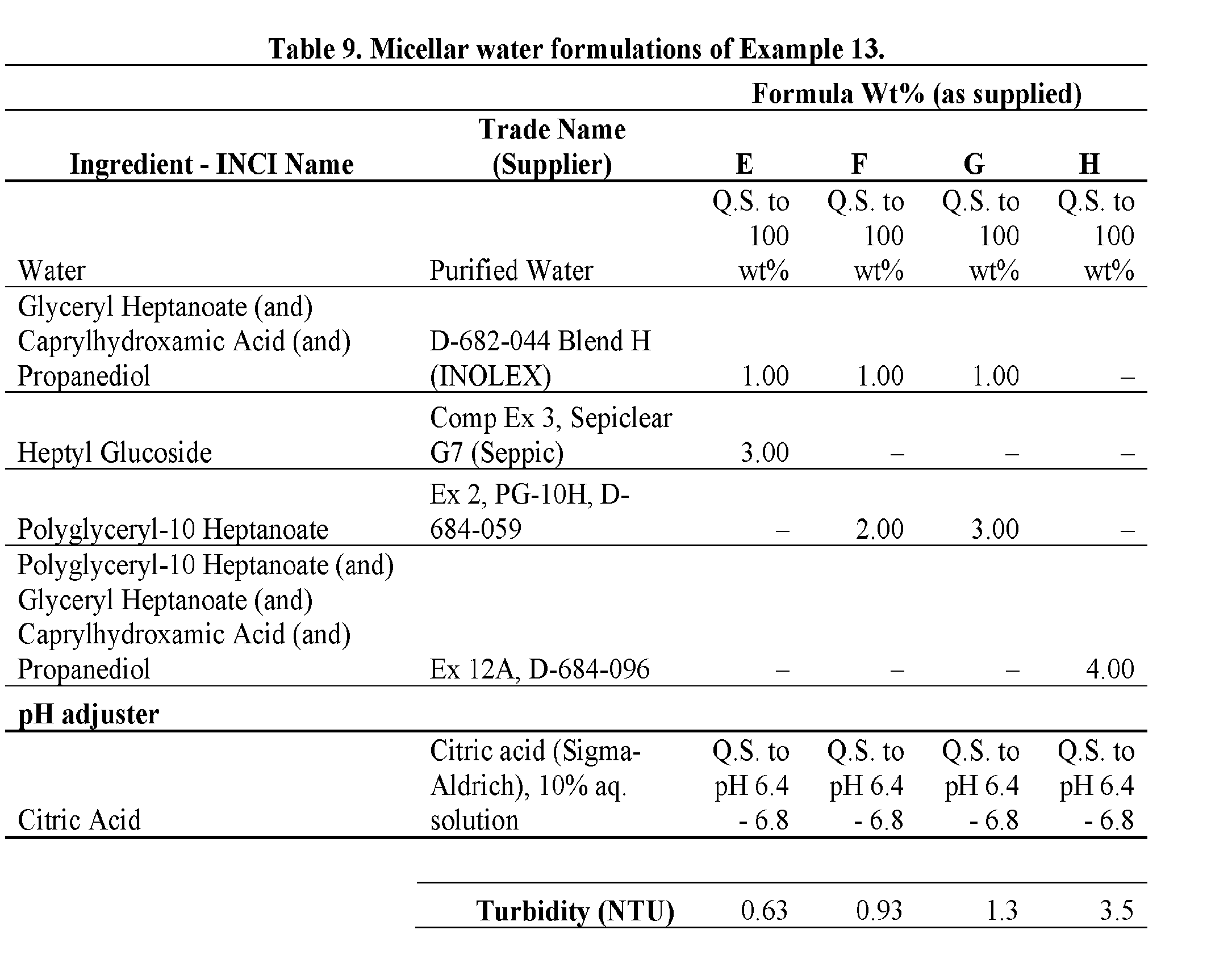
- EXAMPLE 13 Preservation efficacy of micellar water formulations.
- the effect of various solubilizers on preservation efficacy was assessed by preparing the micellar water formulations shown in Table 9 using the following procedure: Water (95% of total water required for batch) was charged to an appropriately sized beaker of known tare weight equipped with overhead mechanical stirrer and anchor-type blade. Mixing was started at low-medium speed and the indicated solubilizer was added to the water and mixed until completely dissolved. An multifunctional preservation system comprising glyceryl heptanoate (45%), caprylhydroxamic acid (10%), and propanediol (45%) was added to the batch and mixed until a uniformly mixed, homogenous solution was formed.
- Example 12D The formulation pH was adjusted to pH to 6.6 ⁇ 0.2 using a 10% solution of citric acid. The remaining water was added in q.s. to reach 100%, and the batch was mixed until uniform and then discharged to an appropriate container for storage.
- SCD of Example 12D was added to the batch instead of adding the multifunctional preservation system and solubilizer separately. All micellar waters were clear, transparent solutions with turbidity values less than 4.0 NTU (Table 9).
- micellar water formulations A MCT complying with the USP and PCPC compendial test methodologies was performed to determine the preservative efficacy of the micellar water formulations. The results are shown in Tables 10A - 10D. All formulations demonstrate good preservation efficacy, achieving strong reductions for the five microorganisms by Day 14 and meeting the success criteria for preservation efficacy according to the USP, PCPC, and EP compendial guidelines.
- Formulation H prepared with an inventive SDC (Example 12A), achieved a desirable combination of clarity and preservation efficacy, meeting the performance benchmark of Formulation E, prepared with Heptyl Glucoside (Comparative Example 3).
- EXAMPLE 14 Preparation of O/W microemulsions using SDCs
- SDCs of Examples 12B, 12C, and 12D were used to prepare the formulations shown in Table 11.
- the formulations were prepared on a 20 g scale by charging the appropriate amount of each ingredient to a 20 mL scintillation vial and then mixing on a vortex mixer until uniform.
- the microemulsions were allowed to settle until no bubbles were present in the solution and then the turbidity was measured. The turbidity measurement was repeated after the microemulsions were allowed to age for 24 hr. Solutions with turbidity values greater than 100 NTU at the time of preparation were considered thermodynamically unstable macroemulsions and were not evaluated further for turbidity at 24 hr. [00132]
- Example 12D The turbidity data for the formulations prepared using the SDCs as microemulsifiers is shown in Table 12.
- Table 12D As the ratio of Polyglyceryl-10 Heptanoate:Methylheptylglycerin increases from 5: 1 (Example 12B) to 7:1 (Example 12D), the oil solubilizing capacity of the systems is observed to increase, as evidenced by the maximum amount of orange oil the system can solubilize before the turbidity exceeds 100 NTU.
- SDC of Example 12D (7: 1) has the lowest oil solubilizing capacity of the series, it does yield O/W microemulsions with greater clarity, as indicated by the lower turbidity values at a given oil load.
- FIGS. 2A and 2B show O/W microemulsion turbidity as a function of oil load for the three different SDCs both at time of microemulsion preparation and after 24 hr. O/W microemulsion formulations with turbidity values less than 100 NTU were observed to remain stable and transparent for weeks after preparation, indicating the formation of thermodynamically stable microemulsion systems.
- micear water formulations comprising either an inventive PGE composition (Example 2) or a commercially available PGE composition (Comparative Example 5) were prepared and evaluated for formulation turbidity.
- inventive PGE composition bearing a heptanoate (C 7 ) ester functionality yields dramatically clearer formulations with turbidity values ⁇ 10 NTU compared to the commercially-available PGE composition bearing a mixture of caprylate (C 8 ) and caprate (C 10 ) ester functionalities.
- EXAMPLE 16 Solubilization of Essential Oils in Micellar Water Formulations
- Examples 16A-16H are micellar water formulations comprising essential oils and ZeastatTM, a multifunctional preservation ingredient comprised of caprylhydroxamic acid and propanediol. These examples demonstrate the utility of the inventive PGE composition of Example 2 for the preparation of clear micellar water formulations containing fragrant essential oils. In all cases, a minimum of 5.00% PGE composition was required to microemulsify 0.5% essential oil in the formulation, as indicated by FT value ⁇ 10 NTU.
Landscapes
- Health & Medical Sciences (AREA)
- Life Sciences & Earth Sciences (AREA)
- Public Health (AREA)
- Veterinary Medicine (AREA)
- Animal Behavior & Ethology (AREA)
- General Health & Medical Sciences (AREA)
- Epidemiology (AREA)
- Birds (AREA)
- Chemical & Material Sciences (AREA)
- Dermatology (AREA)
- Emergency Medicine (AREA)
- Organic Chemistry (AREA)
- Oil, Petroleum & Natural Gas (AREA)
- Dispersion Chemistry (AREA)
- Cosmetics (AREA)
- Organic Low-Molecular-Weight Compounds And Preparation Thereof (AREA)
- Pharmaceuticals Containing Other Organic And Inorganic Compounds (AREA)
- Coloring Foods And Improving Nutritive Qualities (AREA)
Abstract
Description




Claims


Priority Applications (6)
| Application Number | Priority Date | Filing Date | Title |
|---|---|---|---|
| AU2022360863A AU2022360863B2 (en) | 2021-10-08 | 2022-10-08 | Biobased polyglyceryl esters and compositions comprising the same |
| CN202280067688.8A CN118076580A (en) | 2021-10-08 | 2022-10-08 | Bio-based polyglycerol esters and compositions comprising the same |
| JP2024520675A JP2024537131A (en) | 2021-10-08 | 2022-10-08 | Bio-based polyglyceryl esters and compositions containing same |
| KR1020247014414A KR20240089195A (en) | 2021-10-08 | 2022-10-08 | Bio-based polyglyceryl ester and composition containing the same |
| CA3232245A CA3232245A1 (en) | 2021-10-08 | 2022-10-08 | Biobased polyglyceryl esters and compositions comprising the same |
| EP22879355.0A EP4412986A4 (en) | 2021-10-08 | 2022-10-08 | Biobased polyglyceryl esters and compositions comprising the same |
Applications Claiming Priority (2)
| Application Number | Priority Date | Filing Date | Title |
|---|---|---|---|
| US202163253662P | 2021-10-08 | 2021-10-08 | |
| US63/253,662 | 2021-10-08 |
Publications (1)
| Publication Number | Publication Date |
|---|---|
| WO2023059925A1 true WO2023059925A1 (en) | 2023-04-13 |
Family
ID=85797546
Family Applications (1)
| Application Number | Title | Priority Date | Filing Date |
|---|---|---|---|
| PCT/US2022/046130 Ceased WO2023059925A1 (en) | 2021-10-08 | 2022-10-08 | Biobased polyglyceryl esters and compositions comprising the same |
Country Status (8)
| Country | Link |
|---|---|
| US (2) | US12527732B2 (en) |
| EP (1) | EP4412986A4 (en) |
| JP (1) | JP2024537131A (en) |
| KR (1) | KR20240089195A (en) |
| CN (1) | CN118076580A (en) |
| AU (1) | AU2022360863B2 (en) |
| CA (1) | CA3232245A1 (en) |
| WO (1) | WO2023059925A1 (en) |
Cited By (1)
| Publication number | Priority date | Publication date | Assignee | Title |
|---|---|---|---|---|
| WO2026041513A1 (en) | 2024-08-23 | 2026-02-26 | Evonik Operations Gmbh | Polyglycerol partial esters of short-chain carboxylic acids |
Citations (6)
| Publication number | Priority date | Publication date | Assignee | Title |
|---|---|---|---|---|
| US5902590A (en) * | 1994-03-03 | 1999-05-11 | Henkel Kommanditgesellschaft Auf Aktien | Cosmetic and/or pharmaceutical formulations |
| US7629479B2 (en) * | 2004-10-12 | 2009-12-08 | Taiyo Kagaku Co., Ltd. | Polyglycerol fatty acid ester and composition containing same |
| US8227393B2 (en) * | 2010-12-21 | 2012-07-24 | Johnson & Johnson Consumer Companies, Inc. | Compositions comprising a polyglyceryl nonionic surfactant and a zwitterionic surfactant |
| WO2015013951A1 (en) * | 2013-08-01 | 2015-02-05 | L'oreal | An anhydrous composition comprising a polyglycerin ester, a polyhydric alcohol and a surfactant |
| US20170360035A1 (en) * | 2007-11-29 | 2017-12-21 | Inolex Investment Corporation | Preservatives for Cosmetic, Toiletry and Pharmaceutical Compositions |
| WO2020157433A1 (en) * | 2019-01-29 | 2020-08-06 | Arkema France | Lubricating base oil synthesized from polyol esters and biosourced fatty acids |
Family Cites Families (12)
| Publication number | Priority date | Publication date | Assignee | Title |
|---|---|---|---|---|
| DE4226174A1 (en) * | 1992-08-07 | 1994-02-10 | Solvay Fluor & Derivate | Polyglycerol fatty acid ester mixture |
| RU2125440C1 (en) * | 1992-10-28 | 1999-01-27 | Ден-Мэт Корпорейшн | Nonalcoholic antibacterial composition for mouth rinsing (variants), method of suppression of mouth cavity microorganisms (variants) and a method of elimination of mouth unpleasant odor (variants) |
| JP3729836B1 (en) * | 2004-07-06 | 2005-12-21 | 株式会社ファンケル | Oily liquid cleansing composition |
| DE102007036392A1 (en) | 2007-07-31 | 2009-02-05 | Henkel Ag & Co. Kgaa | Compositions containing perhydrolases and alkylene glycol diacetates |
| KR102059398B1 (en) * | 2012-06-15 | 2019-12-26 | 루브리졸 어드밴스드 머티어리얼스, 인코포레이티드 | Alkyl glycoside-based micellar thickeners for surfactant systems |
| US9861119B2 (en) | 2012-06-15 | 2018-01-09 | Arkema Inc. | Peroxide dispersions |
| KR102796446B1 (en) * | 2015-08-13 | 2025-04-15 | 아치 퍼스널 케어 프로덕츠, 엘.피. | Wet Wipe Concentrate |
| US10702475B2 (en) | 2017-09-05 | 2020-07-07 | Richard Rigg | Liposome containing compositions and their use in personal care and food products |
| CN111050741A (en) * | 2017-09-06 | 2020-04-21 | 赢创运营有限公司 | Composition containing quaternary ammonium compounds, especially for preparing care and cleaning formulations |
| JP7795862B2 (en) | 2020-02-21 | 2026-01-08 | ヌーリオン ケミカルズ インターナショナル ベスローテン フェノーツハップ | Biodegradable polyesters for water-resistant water-in-oil sun care formulations |
| CA3183245A1 (en) * | 2020-05-22 | 2021-11-25 | Inolex Investment Corporation | Biobased alkyl glyceryl ethers and methods of making and using the same |
| CN116456961B (en) | 2020-11-04 | 2026-01-30 | 伊诺莱克斯投资公司 | Bio-based glycerol heptaester compositions, their preparation methods and applications |
-
2022
- 2022-10-08 AU AU2022360863A patent/AU2022360863B2/en active Active
- 2022-10-08 CA CA3232245A patent/CA3232245A1/en active Pending
- 2022-10-08 CN CN202280067688.8A patent/CN118076580A/en active Pending
- 2022-10-08 WO PCT/US2022/046130 patent/WO2023059925A1/en not_active Ceased
- 2022-10-08 KR KR1020247014414A patent/KR20240089195A/en active Pending
- 2022-10-08 EP EP22879355.0A patent/EP4412986A4/en active Pending
- 2022-10-08 US US17/962,471 patent/US12527732B2/en active Active
- 2022-10-08 JP JP2024520675A patent/JP2024537131A/en active Pending
-
2025
- 2025-12-17 US US19/422,996 patent/US20260102329A1/en active Pending
Patent Citations (6)
| Publication number | Priority date | Publication date | Assignee | Title |
|---|---|---|---|---|
| US5902590A (en) * | 1994-03-03 | 1999-05-11 | Henkel Kommanditgesellschaft Auf Aktien | Cosmetic and/or pharmaceutical formulations |
| US7629479B2 (en) * | 2004-10-12 | 2009-12-08 | Taiyo Kagaku Co., Ltd. | Polyglycerol fatty acid ester and composition containing same |
| US20170360035A1 (en) * | 2007-11-29 | 2017-12-21 | Inolex Investment Corporation | Preservatives for Cosmetic, Toiletry and Pharmaceutical Compositions |
| US8227393B2 (en) * | 2010-12-21 | 2012-07-24 | Johnson & Johnson Consumer Companies, Inc. | Compositions comprising a polyglyceryl nonionic surfactant and a zwitterionic surfactant |
| WO2015013951A1 (en) * | 2013-08-01 | 2015-02-05 | L'oreal | An anhydrous composition comprising a polyglycerin ester, a polyhydric alcohol and a surfactant |
| WO2020157433A1 (en) * | 2019-01-29 | 2020-08-06 | Arkema France | Lubricating base oil synthesized from polyol esters and biosourced fatty acids |
Non-Patent Citations (3)
| Title |
|---|
| See also references of EP4412986A4 * |
| SHIKHALIEV KHIDMET S.; STOLPOVSKAYA NADEZHDA V.; KRYSIN MIKHAIL YU.; ZORINA ANNA V.; LYAPUN DENIS V.; ZUBKOV FEDOR I.; YANKINA KRI: "Production and Emulsifying Effect of Polyglycerol and Fatty Acid Esters with Varying Degrees of Esterification", JOURNAL OF THE AMERICAN OIL CHEMISTS SOCIETY, vol. 93, no. 10, 8 September 2016 (2016-09-08), DE , pages 1429 - 1440, XP036059920, ISSN: 0003-021X, DOI: 10.1007/s11746-016-2894-6 * |
| TOMOHARU KATO, TAKESHI NAKAMURA, MASATSUGU YAMASHITA, MASAMI KAWAGUCHI, TADAYA KATO, TAKAHITO ITOH: "Surfactant properties of purified polyglycerol monolaurates", JOURNAL OF SURFACTANTS AND DETERGENTS, vol. 6, no. 4, 1 October 2003 (2003-10-01), pages 331 - 337, XP001176158, ISSN: 1097-3958, DOI: 10.1007/s11743-003-0278-x * |
Cited By (1)
| Publication number | Priority date | Publication date | Assignee | Title |
|---|---|---|---|---|
| WO2026041513A1 (en) | 2024-08-23 | 2026-02-26 | Evonik Operations Gmbh | Polyglycerol partial esters of short-chain carboxylic acids |
Also Published As
| Publication number | Publication date |
|---|---|
| AU2022360863B2 (en) | 2025-08-14 |
| US20260102329A1 (en) | 2026-04-16 |
| JP2024537131A (en) | 2024-10-10 |
| US20230111214A1 (en) | 2023-04-13 |
| EP4412986A4 (en) | 2025-10-01 |
| KR20240089195A (en) | 2024-06-20 |
| CA3232245A1 (en) | 2023-04-13 |
| EP4412986A1 (en) | 2024-08-14 |
| CN118076580A (en) | 2024-05-24 |
| US12527732B2 (en) | 2026-01-20 |
| AU2022360863A1 (en) | 2024-03-21 |
Similar Documents
| Publication | Publication Date | Title |
|---|---|---|
| US12583808B2 (en) | Biobased alkyl glyceryl ethers and methods of making and using the same | |
| US12415904B2 (en) | Biobased glyceryl heptanoate ester compositions and methods of making and using the same | |
| CN104540494B (en) | N methyl Ns acyl glucamides as solubilizer purposes | |
| US20260102329A1 (en) | Biobased polyglyceryl esters and compositions comprising the same | |
| CN107011164A (en) | The polyglycerol ester of crosslinking | |
| CN1082802C (en) | Transparent booster device for foaming compositions containing nonionic and amphoteric surfactants | |
| JP5872838B2 (en) | Antibacterial composition | |
| KR102773621B1 (en) | Potassium hydrogen salt of alkyl hydroxamate and composition containing same | |
| ES2562958T3 (en) | Solubilizer Preparation | |
| JP5997517B2 (en) | Aqueous cosmetics | |
| US20230240972A1 (en) | Biobased Polyglyceryl Esters and Mouth Rinse Compositions Comprising the Same | |
| US12558304B2 (en) | Metal oxide particle ester dispersions including polyesters having a broad molecular weight distribution | |
| JP2014024788A (en) | Oily cleansing composition |
Legal Events
| Date | Code | Title | Description |
|---|---|---|---|
| 121 | Ep: the epo has been informed by wipo that ep was designated in this application |
Ref document number: 22879355 Country of ref document: EP Kind code of ref document: A1 |
|
| WWE | Wipo information: entry into national phase |
Ref document number: 2022360863 Country of ref document: AU Ref document number: AU2022360863 Country of ref document: AU |
|
| WWE | Wipo information: entry into national phase |
Ref document number: 3232245 Country of ref document: CA |
|
| REG | Reference to national code |
Ref country code: BR Ref legal event code: B01A Ref document number: 112024004667 Country of ref document: BR |
|
| ENP | Entry into the national phase |
Ref document number: 2022360863 Country of ref document: AU Date of ref document: 20221008 Kind code of ref document: A |
|
| ENP | Entry into the national phase |
Ref document number: 2024520675 Country of ref document: JP Kind code of ref document: A |
|
| WWE | Wipo information: entry into national phase |
Ref document number: 202280067688.8 Country of ref document: CN |
|
| ENP | Entry into the national phase |
Ref document number: 20247014414 Country of ref document: KR Kind code of ref document: A |
|
| WWE | Wipo information: entry into national phase |
Ref document number: 2022879355 Country of ref document: EP |
|
| NENP | Non-entry into the national phase |
Ref country code: DE |
|
| ENP | Entry into the national phase |
Ref document number: 2022879355 Country of ref document: EP Effective date: 20240508 |
|
| ENP | Entry into the national phase |
Ref document number: 112024004667 Country of ref document: BR Kind code of ref document: A2 Effective date: 20240308 |