WO2023067501A1 - Compositions and methods for treating mucositis - Google Patents

Compositions and methods for treating mucositis Download PDF

Info

Publication number
WO2023067501A1
WO2023067501A1 PCT/IB2022/060007 IB2022060007W WO2023067501A1 WO 2023067501 A1 WO2023067501 A1 WO 2023067501A1 IB 2022060007 W IB2022060007 W IB 2022060007W WO 2023067501 A1 WO2023067501 A1 WO 2023067501A1
Authority
WO
WIPO (PCT)
Prior art keywords
human subject
mucositis
treating
oral
effective amount
Prior art date
Legal status (The legal status is an assumption and is not a legal conclusion. Google has not performed a legal analysis and makes no representation as to the accuracy of the status listed.)
Ceased
Application number
PCT/IB2022/060007
Other languages
French (fr)
Inventor
Ki Young SOHN
Sun Young Yoon
Current Assignee (The listed assignees may be inaccurate. Google has not performed a legal analysis and makes no representation or warranty as to the accuracy of the list.)
Enzychem Lifesciences Corp
Original Assignee
Enzychem Lifesciences Corp
Priority date (The priority date is an assumption and is not a legal conclusion. Google has not performed a legal analysis and makes no representation as to the accuracy of the date listed.)
Filing date
Publication date
Application filed by Enzychem Lifesciences Corp filed Critical Enzychem Lifesciences Corp
Priority to JP2024523414A priority Critical patent/JP2024537906A/en
Priority to KR1020247016007A priority patent/KR20240089762A/en
Priority to EP22883068.3A priority patent/EP4419096A4/en
Priority to US18/702,478 priority patent/US20240415798A1/en
Publication of WO2023067501A1 publication Critical patent/WO2023067501A1/en
Anticipated expiration legal-status Critical
Ceased legal-status Critical Current

Links

Classifications

    • AHUMAN NECESSITIES
    • A61MEDICAL OR VETERINARY SCIENCE; HYGIENE
    • A61KPREPARATIONS FOR MEDICAL, DENTAL OR TOILETRY PURPOSES
    • A61K31/00Medicinal preparations containing organic active ingredients
    • A61K31/21Esters, e.g. nitroglycerine, selenocyanates
    • A61K31/215Esters, e.g. nitroglycerine, selenocyanates of carboxylic acids
    • A61K31/22Esters, e.g. nitroglycerine, selenocyanates of carboxylic acids of acyclic acids, e.g. pravastatin
    • A61K31/23Esters, e.g. nitroglycerine, selenocyanates of carboxylic acids of acyclic acids, e.g. pravastatin of acids having a carboxyl group bound to a chain of seven or more carbon atoms
    • A61K31/231Esters, e.g. nitroglycerine, selenocyanates of carboxylic acids of acyclic acids, e.g. pravastatin of acids having a carboxyl group bound to a chain of seven or more carbon atoms having one or two double bonds
    • AHUMAN NECESSITIES
    • A61MEDICAL OR VETERINARY SCIENCE; HYGIENE
    • A61KPREPARATIONS FOR MEDICAL, DENTAL OR TOILETRY PURPOSES
    • A61K31/00Medicinal preparations containing organic active ingredients
    • A61K31/13Amines
    • A61K31/155Amidines (), e.g. guanidine (H2N—C(=NH)—NH2), isourea (N=C(OH)—NH2), isothiourea (—N=C(SH)—NH2)
    • AHUMAN NECESSITIES
    • A61MEDICAL OR VETERINARY SCIENCE; HYGIENE
    • A61KPREPARATIONS FOR MEDICAL, DENTAL OR TOILETRY PURPOSES
    • A61K31/00Medicinal preparations containing organic active ingredients
    • A61K31/33Heterocyclic compounds
    • A61K31/335Heterocyclic compounds having oxygen as the only ring hetero atom, e.g. fungichromin
    • A61K31/35Heterocyclic compounds having oxygen as the only ring hetero atom, e.g. fungichromin having six-membered rings with one oxygen as the only ring hetero atom
    • A61K31/352Heterocyclic compounds having oxygen as the only ring hetero atom, e.g. fungichromin having six-membered rings with one oxygen as the only ring hetero atom condensed with carbocyclic rings, e.g. methantheline 
    • A61K31/3533,4-Dihydrobenzopyrans, e.g. chroman, catechin
    • A61K31/355Tocopherols, e.g. vitamin E
    • AHUMAN NECESSITIES
    • A61MEDICAL OR VETERINARY SCIENCE; HYGIENE
    • A61KPREPARATIONS FOR MEDICAL, DENTAL OR TOILETRY PURPOSES
    • A61K31/00Medicinal preparations containing organic active ingredients
    • A61K31/33Heterocyclic compounds
    • A61K31/395Heterocyclic compounds having nitrogen as a ring hetero atom, e.g. guanethidine or rifamycins
    • A61K31/495Heterocyclic compounds having nitrogen as a ring hetero atom, e.g. guanethidine or rifamycins having six-membered rings with two or more nitrogen atoms as the only ring heteroatoms, e.g. piperazine or tetrazines
    • A61K31/505Pyrimidines; Hydrogenated pyrimidines, e.g. trimethoprim
    • A61K31/519Pyrimidines; Hydrogenated pyrimidines, e.g. trimethoprim ortho- or peri-condensed with heterocyclic rings
    • A61K31/52Purines, e.g. adenine
    • A61K31/522Purines, e.g. adenine having oxo groups directly attached to the heterocyclic ring, e.g. hypoxanthine, guanine, acyclovir
    • AHUMAN NECESSITIES
    • A61MEDICAL OR VETERINARY SCIENCE; HYGIENE
    • A61KPREPARATIONS FOR MEDICAL, DENTAL OR TOILETRY PURPOSES
    • A61K31/00Medicinal preparations containing organic active ingredients
    • A61K31/70Carbohydrates; Sugars; Derivatives thereof
    • A61K31/715Polysaccharides, i.e. having more than five saccharide radicals attached to each other by glycosidic linkages; Derivatives thereof, e.g. ethers, esters
    • A61K31/726Glycosaminoglycans, i.e. mucopolysaccharides
    • A61K31/728Hyaluronic acid
    • AHUMAN NECESSITIES
    • A61MEDICAL OR VETERINARY SCIENCE; HYGIENE
    • A61KPREPARATIONS FOR MEDICAL, DENTAL OR TOILETRY PURPOSES
    • A61K33/00Medicinal preparations containing inorganic active ingredients
    • A61K33/24Heavy metals; Compounds thereof
    • A61K33/243Platinum; Compounds thereof
    • AHUMAN NECESSITIES
    • A61MEDICAL OR VETERINARY SCIENCE; HYGIENE
    • A61KPREPARATIONS FOR MEDICAL, DENTAL OR TOILETRY PURPOSES
    • A61K38/00Medicinal preparations containing peptides
    • A61K38/04Peptides having up to 20 amino acids in a fully defined sequence; Derivatives thereof
    • A61K38/08Peptides having 5 to 11 amino acids
    • AHUMAN NECESSITIES
    • A61MEDICAL OR VETERINARY SCIENCE; HYGIENE
    • A61KPREPARATIONS FOR MEDICAL, DENTAL OR TOILETRY PURPOSES
    • A61K38/00Medicinal preparations containing peptides
    • A61K38/16Peptides having more than 20 amino acids; Gastrins; Somatostatins; Melanotropins; Derivatives thereof
    • A61K38/17Peptides having more than 20 amino acids; Gastrins; Somatostatins; Melanotropins; Derivatives thereof from animals; from humans
    • A61K38/18Growth factors; Growth regulators
    • AHUMAN NECESSITIES
    • A61MEDICAL OR VETERINARY SCIENCE; HYGIENE
    • A61KPREPARATIONS FOR MEDICAL, DENTAL OR TOILETRY PURPOSES
    • A61K38/00Medicinal preparations containing peptides
    • A61K38/16Peptides having more than 20 amino acids; Gastrins; Somatostatins; Melanotropins; Derivatives thereof
    • A61K38/43Enzymes; Proenzymes; Derivatives thereof
    • A61K38/44Oxidoreductases (1)
    • A61K38/446Superoxide dismutase (1.15)
    • AHUMAN NECESSITIES
    • A61MEDICAL OR VETERINARY SCIENCE; HYGIENE
    • A61KPREPARATIONS FOR MEDICAL, DENTAL OR TOILETRY PURPOSES
    • A61K45/00Medicinal preparations containing active ingredients not provided for in groups A61K31/00 - A61K41/00
    • A61K45/06Mixtures of active ingredients without chemical characterisation, e.g. antiphlogistics and cardiaca
    • AHUMAN NECESSITIES
    • A61MEDICAL OR VETERINARY SCIENCE; HYGIENE
    • A61PSPECIFIC THERAPEUTIC ACTIVITY OF CHEMICAL COMPOUNDS OR MEDICINAL PREPARATIONS
    • A61P1/00Drugs for disorders of the alimentary tract or the digestive system
    • A61P1/02Stomatological preparations, e.g. drugs for caries, aphtae, periodontitis
    • AHUMAN NECESSITIES
    • A61MEDICAL OR VETERINARY SCIENCE; HYGIENE
    • A61PSPECIFIC THERAPEUTIC ACTIVITY OF CHEMICAL COMPOUNDS OR MEDICINAL PREPARATIONS
    • A61P35/00Antineoplastic agents
    • AHUMAN NECESSITIES
    • A61MEDICAL OR VETERINARY SCIENCE; HYGIENE
    • A61PSPECIFIC THERAPEUTIC ACTIVITY OF CHEMICAL COMPOUNDS OR MEDICINAL PREPARATIONS
    • A61P37/00Drugs for immunological or allergic disorders
    • A61P37/02Immunomodulators
    • A61P37/06Immunosuppressants, e.g. drugs for graft rejection
    • AHUMAN NECESSITIES
    • A61MEDICAL OR VETERINARY SCIENCE; HYGIENE
    • A61KPREPARATIONS FOR MEDICAL, DENTAL OR TOILETRY PURPOSES
    • A61K2300/00Mixtures or combinations of active ingredients, wherein at least one active ingredient is fully defined in groups A61K31/00 - A61K41/00

Definitions

  • methods, compositions and kits are provided for treating, preventing or reducing the occurrence or severity of mucositis in human subjects.
  • methods, compositions and kits are provided for treating, preventing or reducing the occurrence or severity of oral mucositis in human subjects.
  • methods, compositions and kits are provided for treating, preventing or reducing the occurrence or severity of chemoradiation-induced oral mucositis (CR1OM) in human subjects.
  • methods, compositions and kits are provided for treating, preventing or reducing the occurrence or severity of radiation-induced oral mucositis (RIOM).
  • Oral mucositis is a frequent and severe adverse event in patients undergoing chemoradiotherapy including head and neck cancers. Occurrence may result in drop-out from treatment, thereby reducing patient survival.
  • Oral mucositis has been characterized by painful ulcerative lesions of the oral mucosa observed in patients with cancer, who are treated with chemotherapy, and/or with radiation therapy.
  • Lalla et al. MASCC/ISOO clinical practice guidelines for the management of mucositis secondary to cancer therapy. Cancer. 2014;120:1453-1461. doi: 10.1002/cncr.28592; Kashiwazaki et al. Professional oral health care reduces oral mucositis and febrile neutropenia in patients treated with allogeneic bone marrow transplantation. Support. Care Cancer. 2012;20:367-373. doi: 10.1007/s00520-011-1116-x.
  • Grade 2 Patchy ulcerations or pseudomembranes
  • Grade 3 Confluent ulcerations or pseudomembranes
  • EC-18 is effective in treating human subjects that suffer or are susceptible to oral mucositis as occurring during the course of a chemo-radiation therapy for treatment of head or neck cancer.
  • the mucositis may be oral, gastrointestinal, or alimentary' mucositis. In another embodiment, the mucositis may be associated with cancer, chemotherapy, radiotherapy, or the combination of chemotherapy and radiotherapy.
  • methods are provided for treating severe mucositis including severe oral mucositis (SOM), which may include symptoms of extensive oral ulcerations.
  • SOM severe oral mucositis
  • EC-18 may be represented by a structure of the following Formula 1 :
  • the compound of Formula 1 is sometimes referred as “FLAG” or “EC- 18” in this disclosure.
  • EC- 18 may be used to treat a human subject suffering from or susceptible to mucositis, including oral mucositis such as may be associated with cancer, chemotherapy, radiotherapy, the combination of chemotherapy and radiotherapy. In a further embodiment, . Also, EC-18 may be used to treat a human subject suffering from or susceptible to mucositis (e.g., oral mucositis) in a human subject having or susceptible to mucositis in head and neck cancer.
  • mucositis e.g., oral mucositis
  • EC-18 may be used to treat a human subject suffering from or susceptible to mucositis (e.g., oral mucositis) in a human subject having or susceptible to mucositis in head and neck cancer associated with a human papillomavirus (HPV) or its infection.
  • mucositis e.g., oral mucositis
  • HPV human papillomavirus
  • a human patient may receive multiple doses of EC- 18 per day.
  • a human patient may receive EC-18 in oral form such as capsule or tablet.
  • a human patient may receive EC-18 in daily dosages of up to 500 mg, or up to 600, 700, 800, 900 or 1000 mg EC-18 per day, or up to 1100, 1200, 1300, 1400, 1500 mg EC-18 per day, or up to 1600, 1700, 180, 199 or 2000 mg EC-18 per day, or up to 2100, 2200, 2300, 2400, 2500 mg EC-18 per day, or high doses such as 2500, 300, 3500 or 4,000 or more mg EC-18 per day.
  • a human subject may be determined to have or be susceptible for treatment by undergoing chemical or radiation cancer therapy. Such subjects may display for example oral ulceration.
  • a human subject will be identified and selected for treatment as disclosed herein, and then EC-18 will be administered to the identified and selected subject.
  • a human patient may be identified as suffering or susceptible to oral mucositis and the identified patient will be selected for treatment and an effective amount of EC- 18 will be administered to the identified and selected patient.
  • a human patient also may be identified as suffering or susceptible to oral mucositis as well as being HPV positive and the identified patient will be selected for treatment and an effective amount of EC- 18 will be administered to the identified and selected patient.
  • EC-18 may be administered to a subject in combination or coordination with one or more therapeutic agents that are distinct from EC-18.
  • EC- 18 may be administered in combination with palifermin; pentoxifylline including with vitamin E; chlorhexidine gluconate (including oral rinse); hyaluronate including sodium hyaluronate; a superoxide dismutase mimetic such as superoxide dismutase mimetic M40403; and/or dusquetide or other innate defense regulator.
  • compositions comprising EC-18.
  • the compositions suitably may comprise one or more pharmaceutically acceptable carriers.
  • the compositions may be formulated or otherwise adapted for treatment of mucositis as disclosed herein.
  • the composition may be adapted for oral administration such as a tablet or capsule.
  • kits are provided for use to treat or prevent mucositis as disclosed herein.
  • Kits of the invention suitably may comprise 1) a therapeutically effective amount of EC-18; and 2) instructions for using the EC-18 for treating or preventing mucositis.
  • the instructions suitably may be in written form, including as a product label.
  • the human subject for treatment may be a male or female.
  • the human will be an adult (at least 16, 18 or 21 years of age).
  • the human will be a pediatric patient (less than 18, 16, 14, 12, 10, 8 or 6 years of age).
  • a method of treating or preventing oral mucositis associated with chemotherapy and/or radiotherapy may comprise administration of a composition comprising an effective amount of EC-18 to a human subject.
  • a method of treating or preventing alimentary tract mucositis such as may be associated with chemotherapy and/or radiotherapy may comprise administration of a comprising an effective amount of EC- 18 to a human subject.
  • a method of treating or preventing gastrointestinal tract mucositis associated with chemotherapy and/or radiotherapy may comprise administration of a composition comprising an effective amount of EC-18 to a human subject.
  • the method of treating or preventing mucositis associated with cancer may comprise administration of a composition comprising an effective amount of an EC-18 to a human subject.
  • a method of treating or preventing oral mucositis associated with cancer may comprise administration of a composition comprising an effective amount of EC-18 to a human subject.
  • a method of treating or preventing alimentary tract mucositis associated with cancer may comprise administration of a composition comprising an effective amount of EC- 18 to a human subject.
  • a method of treating or preventing gastrointestinal tract mucositis associated with cancer may comprise administration of a composition comprising an effective amount of EC-18 to a human subject.
  • the method of treating or preventing mucositis associated with hematopoietic stem cell transplant may comprise administration of a composition comprising an effective amount of EC-18 to a human subject.
  • a method of treating or preventing oral mucositis associated with hematopoietic stem cell transplant may comprise administration of a composition comprising an effective amount of EC-18 to a human subject.
  • a method of treating or preventing alimentary tract mucositis associated with hematopoietic stem cell transplant (HSCT) may comprise administration of a composition comprising an effective amount of EC-18 to a human subject.
  • a method of treating or preventing gastrointestinal tract mucositis associated with hematopoietic stem cell transplant may comprise administration of a composition comprising an effective amount of EC- 18 to a human subject.
  • a subject may have mucositis (e.g., oral mucositis or oral stomatitis) or may be at risk of developing mucositis (for example, a patient who is receiving or who is about to receive chemotherapy and/or radiation therapy).
  • a subject in need maybe a female subject who has AV(atrophic vaginitis) or vaginal mucositis or who is at risk of developing vaginal mucositis or AV (e.g., a woman who presents symptoms that may precede clinical manifestation of AV, such as vaginal dryness).
  • the method of treating or preventing mucositis associated with hematopoietic stem cell transplant may comprise administration of a composition comprising an effective amount of EC-18 to a human subject.
  • the subject may have a human papillomavirus (HPV) infection.
  • the subject may test positive for human papillomavirus (HPV), for example a positive HPV test via a cervical test.
  • HPV human papillomavirus
  • use of EC- 18 is provided including to treat a human subject suffering from or susceptible to a condition as disclosed herein, particularly oral mucositis as occurring during the course of a chemo-radiation therapy for treatment of head or neck cancer.
  • use of EC-18 is provided to prepare a medicament including to treat a human subject suffering from or susceptible to a condition as disclosed herein, particularly oral mucositis as occurring during the course of a chemo-radiation therapy for treatment of head or neck cancer.
  • FIG. 1 shows patients flowchart for both stages 1 and 2 with the definition of each patient population.
  • PP per protocol
  • STFU short-term follow-up
  • FIGS. 2A-2B shows duration of severe oral mucositis (SOM) at Primary endpoint.
  • SOM severe oral mucositis
  • FIGS. 3A-3B shows incidence of SOM at secondary efficacy endpoints.
  • the incidence of SOM from baseline through the active treatment period and STFU were reported less in EC-18 2000 mg group as compared with Placebo group (10 [45.5%] vs 14 [70.0%]
  • FIG. 4 shows cumulative SOM incidence at each week interval over 7 weeks of treatment.
  • the incidence of SOM from baseline through the active treatment period was reported less in EC- 18 2,000 mg group as compared with Placebo group [(36.4%) vs (65.0%) subjects]
  • FIGS. 5A-5B shows time to SOM onset at the secondary endpoints.
  • FIG. 6 (includes FIGS. 6A and 6B) shows time for Opioid use at the secondary endpoints.
  • FIG. 7 shows covariate analysis based on Cisplatin regimen and HPV status.
  • FIG. 8 shows TGF ⁇ level comparison between EC-18 and Placebo groups in total.
  • FIGS. 9A-9B show TGF ⁇ comparison between EC- 18 and Placebo groups with SOM (FIG. 9A) and without SOM (FIG. 9B).
  • FIGS. 10A-10B show TGF ⁇ level comparison between EC- 18 and Placebo groups with HPV+ (FIG. 10A) and without HPV (FIG. 10B).
  • FIGS. 11A-1 IB show TGF ⁇ level comparison between EC- 18 and Placebo groups treated with cisplatin weekly (FIG. 11A) and cisplatin tri-weekly (FIG. 1 IB).
  • FIG. 12 shows IL-ip level comparison between EC-18 and Placebo groups in total.
  • FIGS. 13A-13B show IL-ip comparison between EC-18 and Placebo groups with SOM (FIG. 13A) and without SOM (FIG. 13B).
  • FIGS. 14A-14B show IL-ip level comparison between EC-18 and Placebo groups with HPV+ (FIG. 14A) and HPV- (FIG. 14B).
  • FIGS. 15A-15B show IL-1 ⁇ level comparison between EC-18 and Placebo groups with cisplatin weekly (FIG. 15A) and cisplatin tri-weekly (FIG. 15B).
  • EC- 18 is highly effective to treat, reduce the severity and otherwise ameliorate mucositis in patients who have received chemotherapy and/or radiation therapy for treatment of cancer.
  • a human subject receiving treatment accordance with the present methods may be suffering from one or more types of cancer, including a solid tumor such as may be associated with head or neck cancer.
  • the human subject may be receiving chemotherapy for the cancer, such as with cyclophosphamide, doxorubicin, etoposide, ifosfamide, mesna, cisplatin, gemcitabine and/or tamoxifen, or one or more other chemotherapeutic agents.
  • EC-18 can be administered in combination such as to treat a subject including a human suffering from or susceptible to mucositis, or suffering from symptoms of mucositis.
  • the one or more distinct therapeutic agents that can be administered in combination include for example palifermin; pentoxifylline including with vitamin E; chlorhexidine gluconate (including oral rinse); hyaluronate including sodium hyaluronate; a superoxide dismutase mimetic such as superoxide dismutase mimetic M40403; dusquetide or other innate defense regulator.
  • the term “in combination” in the context of the administration of a therapy to a subject refers to the use of more than one therapy for therapeutic benefit.
  • the term “in combination” in the context of tire administration can also refer to the prophylactic use of a therapy to a subject when used with at least one additional therapy.
  • the use of the term “in combination” does not restrict the order in which the therapies (e.g., a first and second therapy) are administered to a subject.
  • a therapy can be administered prior to (e.g., 1 minute, 5 minutes, 15 minutes, 30 minutes, 45 minutes, 1 hour, 2 hours, 4 hours, 6 hours, 12 hours, 24 hours, 48 hours, 72 hours, 96 hours, 1 week, 2 weeks, 3 weeks, 4 weeks, 5 weeks, 6 weeks, 8 weeks, or 12 weeks before), concomitantly with, or subsequent to (e.g., 1 minute, 5 minutes, 15 minutes, 30 minutes, 45 minutes, 1 hour, 2 hours, 4 hours, 6 hours, 12 hours, 24 hours, 48 hours, 72 hours, 96 hours, 1 week, 2 weeks, 3 weeks, 4 weeks, 5 weeks, 6 weeks, 8 weeks, or 12 weeks after) the administration of a second therapy to a subject in need of treatment as disclosed herein .
  • the therapies are administered to a subject in a sequence and within a time interval such that the therapies can act together.
  • the therapies are administered to a subject in a sequence and within a time interval such that they provide an increased benefit than if they were administered otherwise. Any additional therapy can be administered in any order with the other additional therapy.
  • the administration of EC-18 and the one or more distinct therapeutic agents may be by suitable means that results in a concentration of the therapeutic that, combined with other components, is effective in ameliorating, reducing, or stabilizing symptoms of mucositis including the occurrence of symptoms of mucositis.
  • the EC- 18 and the one or more distinct therapeutic agents may be administered simultaneously or sequentially.
  • the one or more distinct therapeutic agents have been reported for use to treat mucositis.
  • one or more distinct therapeutic agents may be “coadministered”, i.e, administered together in a coordinated fashion to a subject, either as separate pharmaceutical compositions or admixed in a single pharmaceutical composition.
  • the one or more additional distinct therapeutic agents may also be administered simultaneously with EC-18, or be administered sequentially or separately (e.g. each agent being administered at least 5, 10, 30, 60, 120, 180, 240, 300, 360, 420 or 500 minutes apart) with EC-18, including at different times and with different frequencies.
  • the one or more distinct therapeutic agents may be administered by any appropriate route for the agent(s), such as orally, intravenously, subcutaneously, intramuscularly, nasally, and the like; and the therapeutic agent may also be administered by any conventional route. In at least certain embodiments, at the one or more distinct therapeutic agents may be administered orally.
  • EC- 18 and/or the one or more distinct therapeutic agents may be administered daily, e.g., every 24 hours, or, continuously or several times per day, e.g., every 1 hour, every 2 hours, every' 3 hours, every 4 hours, every 5 hours, every 6 hours, every 7 hours, every 8 hours, every 9 hours, every 10 hours, every 11 hours, or every 12 hours.
  • Exemplary effective daily doses of the distinct therapeutic agentfs include between 0.1 pg/kg and 100 pg/kg body weight, e.g., 0.1, 0.3, 0.5, 1, 5, 10, 15, 20, 25, 30, 35, 40, 45, 50, 55, 60, 65, 70, 75, 80, 85, 90, 95, or 99 pg/kg body weight.
  • the distinct therapeutic agent(s) are administered about once per week, e.g., about once every 7 days.
  • the distinct therapeutic agent(s) are administered twice per week, three times per week, four times per week, five times per week, six times per week, or seven times per week.
  • Exemplary effective weekly doses of the distinct therapeutic agentfs) include between 0.0001 mg/kg and 4 mg/kg body weight, e.g., 0.001, 0.003, 0.005, 0.01.
  • an effective weekly dose of the distinct therapeutic agent(s) is between 0.1 ⁇ g /kg body weight and 400 pg/kg body weight.
  • the pharmaceutical composition comprising EC-18 may include conventional pharmaceutically acceptable carriers, excipients, or diluents.
  • the amount of EC-18 can be widely varied without specific limitation, and is specifically 0.0001 to 100 weight%, preferably, 0.001 to 90 weight%, for example, EC- 18 may be contained in 70 to 80 weight%, with respect to the total amount of the composition.
  • Suitable dosages of EC-18 may suitably vary.
  • a dosage is provided that alleviates mucositis or reduces the likelihood of occurrence of mucositis in a human subject.
  • An exemplary daily dosages for a human patient in need of treatment of EC- 18 include between 0.0001 mg/kg and 4 mg/kg body weight, or between 0.01 mg/kg and 4 mg/kg body weight e.g., up to or about 0.001, 0.003, 0.005, 0.01.
  • an effective weekly dose of EC-18 may between 0.1 pg /kg body weight and 400 pg/kg body weight of the human patient in need thereof.
  • an oral formulation such as a tablet or capsule (e.g. soft gelatin capsule) that contains 250-1000 mg, e.g., 500 mg, of EC-18.
  • Optimal dosage amounts also can be determined empirically for particular patients or identified group of patients (e.g. other one or more other pre-existing conditions, for instance, patients with history of hypertension; patients with cancer; patients with HPV or its infection).
  • the pharmaceutical composition of the present invention may further include other active ingredients having a therapeutic effect.
  • the pharmaceutical composition may be formulated into solid, liquid, gel or suspension form for oral or non-oral administration, for example, tablet, bolus, powder, granule, capsule such as hard or soft gelatin capsule, emulsion, suspension, syrup, emulsifiable concentrate, sterilized aqueous solution, nonaqueous solution, freeze-dried formulation, and so on.
  • conventional excipients or diluents such as fillers, bulking agents, binders, wetting agents, disintegrating agents, and surfactants can be used.
  • the solid formulation for oral administration includes tablet, bolus, powder, granule, capsule and so on, and the solid formulation can be prepared by mixing one or more of the active components and at least one excipient such as starch, calcium carbonate, sucrose, lactose, gelatin, and so on. Besides the excipient, a lubricant such as Magnesium stearate and talc can also be used.
  • the liquid formulation for oral administration includes emulsion, suspension, syrup, and so on, and may include conventional diluents such as water and liquid paraffin or may include various excipients such as wetting agents, sweeting agents, flavoring agents, and preserving agents.
  • the formulation for non-oral administration includes sterilized aqueous solution, nonaqueous solution, freeze-dried formulation, suppository, and so on, and solvent for such solution may include propylene glycol, polyethylene glycol, vegetable oils such as olive oil, and ester for syringe injection such as ethyl oleate.
  • Base materials of the suppository may include witepsol, macrogol, tween 61, cacao butter, Laurin and glycerogelatin.
  • EC- 18 can be administered in a pharmaceutically effective amount.
  • pharmaceutically effective amount is used to refer to an amount that is sufficient to achieve a desired result in a medical treatment.
  • the “pharmaceutically effective amount” can be determined according to the subject’s category', age, sex, severity and type of disease, activity of drug, sensitivity to drug, administration time, administration route, excretion rate, and so forth.
  • the composition of the present invention can be administered alone or with other therapeutic agents sequentially or simultaneously.
  • the composition of the present invention can be administered once or multiple times.
  • the preferable amount of the composition of the present invention can be varied according to the condition and weight of patient, severity of disease, formulation type of drug, administration route and period of treatment.
  • An appropriate total amount of administration per 1 day can be determined by a physician and is generally about 0.001 to about 5,000 mg/kg, preferably about 0.05 to 1,000 mg/kg, twice a day or can be administered in divided doses multiple times daily.
  • administration means introducing the pharmaceutical composition of the present invention to a patient in need by any suitable method.
  • the route of administration may be any or a various routes, oral or non-oral, as long as the target tissue can be reached, for example, oral administration, intraperitoneal administration, transdermal administration(topical application, etc.), intravenous administration, intramuscular administration, subcutaneous administration, intradermal administration, intranasal administration, rectal administration, intranasal administration, intraperitoneal administration and the like may be used, but is not limited thereto. Oral administration is preferred.
  • EC-18 is administered to a human subject suffering from or susceptible to mucositis, including oral mucositis such as may be associated with cancer, chemotherapy, radiotherapy, the combination of chemotherapy and radiotherapy.
  • EC-18 is administered to a human subject suffering from or susceptible to oral mucositis that has head or neck cancer.
  • EC-18 may be used to treat a human subject suffering from or susceptible to mucositis (e.g., oral mucositis) in a human subject having or susceptible to mucositis in head and neck cancer associated with a human papillomavirus (HPV) or its infection.
  • mucositis e.g., oral mucositis
  • HPV human papillomavirus
  • the human subject being treated may have a human papillomavirus (HPV) infection.
  • the subject may test positive for human papillomavirus (HPV), for example a positive HPV test via a cervical test. See the results set forth in the Examples which follow, which demonstrate effective EC- 18 treatment of HPV positive human subjects.
  • a human subject may be determined to have or be susceptible for treatment by undergoing chemical or radiation cancer therapy. Such subjects may display for example oral ulceration.
  • a human subject may be identified and selected for treatment as disclosed herein, and then EC-18 will be administered to the identified and selected subject.
  • a human patient may be identified as suffering or susceptible to oral mucositis and the identified patient will be selected for treatment and an effective amount of EC-18 will be administered to the identified and selected patient.
  • a human patient also may be identified as suffering or susceptible to oral mucositis as well as being HPV positive and the identified patient will be selected for treatment and an effective amount of EC- 18 will be administered to the identified and selected patient.
  • a subject may have mucositis (e.g., oral mucositis or oral stomatitis) or may be at risk of developing mucositis (for example, a patient who is receiving or who is about to receive chemotherapy and/or radiation therapy).
  • mucositis e.g., oral mucositis or oral stomatitis
  • a subject may have mucositis (e.g., oral mucositis or oral stomatitis) or may be at risk of developing mucositis (for example, a patient who is receiving or who is about to receive chemotherapy and/or radiation therapy).
  • the method of treating or preventing mucositis associated with hematopoietic stem cell transplant may comprise administration of a composition comprising an effective amount of EC-18 to a human subject.
  • kits are provided for use to treat or prevent mucositis as disclosed herein.
  • Kits of the invention suitably may comprise 1) a therapeutically effective amount of EC- 18; and 2) instructions for using the EC- 18 for treating or preventing mucositis.
  • the instructions suitably may be in written form, including as a product label.
  • Example 1 Patient group and clinical study
  • Radiation fields to include at least two mucositis sites at risk (buccal mucosa, floor of mouth, ventral and lateral tongue, soft palate) in which both sites receive a miniminn cumulative dose of 55 Gy
  • EC- 18 was administered in varying patients of the treatment group up to 2000 mg/day.
  • Recommended therapy was 500 mg EC-18 capsule administered 4 times throughout the day (e.g., 2 capsules of 500mg EC-18 administered within 30 mins after taking breakfest and dinner) for a total daily dosage of 2000 mg EC-18 per day.
  • Treatment protocol lasted 7 weeks while radiation therapy and cisplatin therapy continued during the same time.
  • the EC-18 treatment group demonstrated clear therapeutics benefit overthe control group, including reduction of mucositis symptoms.
  • Stage 1 To Evaluate safety and MTD that can be used for Stage 2 iDSMB: Data and Safety Monitoring Board reviewed safety data every 2 weeks and approved for Stage 2 using MTD 2000mg
  • FIG. 1 (flow diagram) shows patient pool at the time of study start and factors leading to efficacy analysis population
  • Stage 1 we included Stage 1 placebo and 2000 mg patients to Stage 2 for efficacy analysis:
  • FIGS. 2A-2B summarize efficacy results. When measured Median of Duration and Incidence of SOM from the time when SOM develops to w-hen SOM has been resolved; we see very strong efficacy- results. With placebo group, we calculated median Duration of SOM almost 14 days compared to EC- 18 group which never developed SOM
  • FIGS. 3A-3B graph shows percentage of SOM incidence at each week interval. SOM does not begin until week 3 and peaks at w-eek 7 (by- then, cumulative radiation dose is 70Gy) and even at week 8 which is 1 week after the last radiation treatment. As can be seen in FIGS.
  • SOM incidence for EC-18 group is less than placebo group (PP Population or PP).
  • PP Population or PP oral mucositis
  • SOM oral mucositis
  • FIG. 4 the EC-18-treated group is shown on the right in each time period (each of Weeks 4, 5, 6 and 7), and the placebo shown on the left for each time period or alone in Week 3 .
  • FIGS. 5A-5B also show time to SOM onset at the secondary endpoints.
  • the SOM onset was 8 days delayed in EC- 18, 2,000 mg group compared with placebo group (51 days vs. 43 days).
  • FIG. 6 shows time for Opioid use at the secondary endpoints.
  • the mean value of 6.3 days was delayed in EC-18 2,000 mg group compared with placebo group (32.3 days in EC-18 groups vs. 26 days in placebo).
  • the median value of 11.5 days was delayed in EC-18 2,000 mg group compared with the placebo group (37 days in EC-18 groups vs. 25.5 days in placebo).
  • FIG. 7 shows covariate analysis based on Cisplatin regimen and HPV status.
  • the observed results for incidence of SOM in subjects were less in the EC-18 2000 mg group as compared to the Placebo group with weekly cisplatin (37.5% vs. 70.0%), and with tri-weekly cisplatin (66.7% and 70.0%), respectively.
  • the observed results for incidence of SOM in subjects with HPV+ were less in the EC-18 2000 mg group as compared to the Placebo group (35.3% vs. 66.7%). Whereas, there was no difference observed in the subjects with HPV- in the EC-18 2000 mg group as compared to the Placebo group (75% vs. 71.4%).
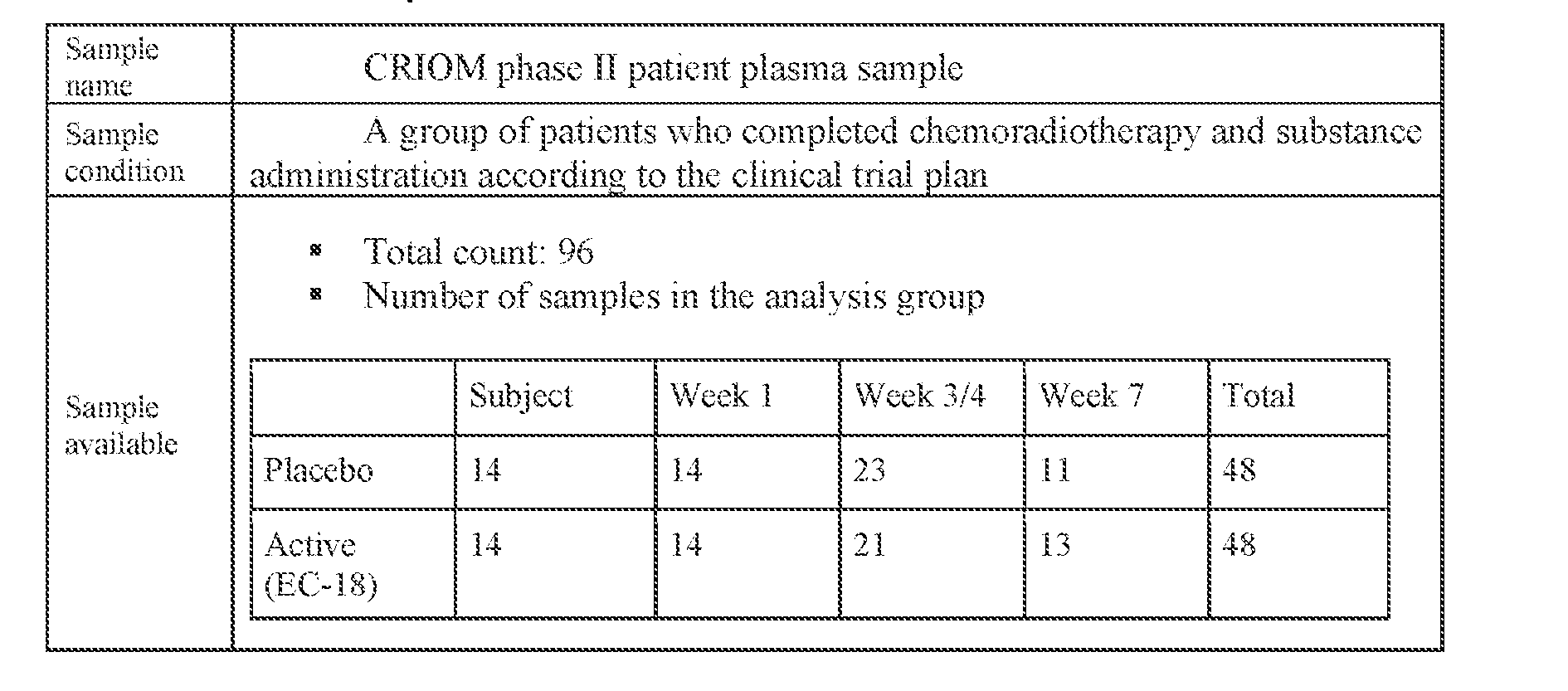
  • the plasma sample collected from the blood of patients listed in (Table 1 below) was thawed and centrifuged at 10,000 rpm at 4°C for 2 minutes, and the supernatant was used for analysis. The supernatant was serially diluted, and 50ul of the samples were dispensed to each well in a 96-well plate. 50ul of diluted Microparticle Cocktail (R&D systems) shown in Table 2 was added to each well containing samples and incubated for 2 hours at room temperature on a shaker at 800 rpm. The sample mixture was removed and washed with 100 ul of washing buffer three times.
  • R&D systems Microparticle Cocktail
  • the sample's resultant concentration value was calculated based on this standard curve.
  • Table 2 Luminex assay kit information TGF ⁇ level comparison between EC-18 and Placebo groups in total
  • the TGF- ⁇ concentration in the EC- 18 treated group was significantly higher than the placebo group at the 7 th week of chemoradiation therapy treatment. As show in FIG. 8, The TGF- ⁇ concentration in the EC-18 treated group was significantly higher than the placebo group at the 7th week of chemoradiation therapy treatment.
  • the EC- 18-treated group (active) is shown on the right in each time period, and the placebo shown on the left fbr each time period.
  • the TGF- ⁇ concentration in the EC-18 treated group was higher compared with the placebo group regardless of the incidence of SOM.
  • the TGF- ⁇ concentration in the EC- 18 treated group was higher compared with the placebo group regardless of the incidence of SOM.
  • the EC- 18-treated group (active) is shown on the right in each time period, and the placebo shown on the left for each time period.
  • the TGF- ⁇ concentration in the EC-18 was significantly higher compared with placebo.
  • the HPV-negative patients were too small to conclude the statistical significance of the difference of TGF ⁇
  • the TGF ⁇ level in the EC-18 group was similar to that in the placebo.
  • the TGF- ⁇ concentration in the EC-18 was significantly higher compared with the placebo.
  • the EC-18-treated group (active) is shown on the right in each time period, and the placebo shown on the left fbr each time period.
  • the TGF- ⁇ concentration in the EC-18 was significantly higher compared with placebo. However, TGF ⁇ concentration was not significantly different between EC- 18 group and placebo group treated with triweekly cisplatin.
  • FIGS. 11A-1 IB in the sub-population treated with cisplatin once a week, the TGF- ⁇ concentration in the EC-18 was significantly higher compared with placebo, but not in the EC- 18 group with tri-weekly cisplatin.
  • FIGS. 11A and 1 IB in the graph on the left, the EC- 18-treated group (active) is shown on the right in each time period, and the placebo shown on the left fbr each time period.
  • the IL-ip concentration in the EC-18 treated group was significantly lower than the placebo group throughout seven weeks treatment period.
  • the concentration of IL-1 p was decreased even under the detection limit at the 4th and 7th weeks of treatment.
  • FIG. 12 the IL-ip concentration in the EC-18 treated group was significantly lower than the placebo group throughout seven weeks treatment period.
  • the EC-18-treated group (active) is shown on the right in each time period, and the placebo shown on the left for each time period.
  • the IL-ip concentration in the EC-18 treated group was significantly lower compared with the placebo group regardless of the incidence of SOM. As shown in FIGS. 13A-13B, the
  • IL-1 ⁇ concentration in the EC- 18 treated group was significantly lower compared with the placebo group regardless of the incidence of SOM.
  • FIGS. 13A and 13B in the graph on the left, the EC-18-treated group (active) is shown on the right in each time period, and the placebo shown on the left for each time period.
  • the IL-1 ⁇ concentration in the EC-18 treated group was significantly lower compared with the placebo group regardless of HPV infection state. As shown in FIGS. 14A-14B, the
  • IL-1 ⁇ concentration in the EC-18 treated group was significantly lower compared with the placebo group regardless of HPV infection state.
  • FIGS. 14A and 14B in the graph on the left, the EC-18-treated group (active) is shown on the right in each time period, and the placebo shown on the left for each time period.
  • the IL-1 ⁇ concentration in the EC- 18 treated group was significantly lower than in the placebo group regardless of the weekly or tri-weekly cisplatin treatment.
  • the IL-1 ⁇ concentration in the EC-18 treated group was significantly lower than in the placebo group regardless of the weekly or tri-weekly cisplatin treatment.
  • the EC-18-treated group (active) is shown on the right in each time period, and the placebo shown on the left for each time period.

Landscapes

  • Health & Medical Sciences (AREA)
  • Life Sciences & Earth Sciences (AREA)
  • Veterinary Medicine (AREA)
  • General Health & Medical Sciences (AREA)
  • Chemical & Material Sciences (AREA)
  • Medicinal Chemistry (AREA)
  • Pharmacology & Pharmacy (AREA)
  • Public Health (AREA)
  • Animal Behavior & Ethology (AREA)
  • Epidemiology (AREA)
  • Engineering & Computer Science (AREA)
  • Bioinformatics & Cheminformatics (AREA)
  • Immunology (AREA)
  • Organic Chemistry (AREA)
  • Chemical Kinetics & Catalysis (AREA)
  • Nuclear Medicine, Radiotherapy & Molecular Imaging (AREA)
  • General Chemical & Material Sciences (AREA)
  • Proteomics, Peptides & Aminoacids (AREA)
  • Gastroenterology & Hepatology (AREA)
  • Emergency Medicine (AREA)
  • Inorganic Chemistry (AREA)
  • Transplantation (AREA)
  • Molecular Biology (AREA)
  • Dermatology (AREA)
  • Zoology (AREA)
  • Pharmaceuticals Containing Other Organic And Inorganic Compounds (AREA)
  • Medicines That Contain Protein Lipid Enzymes And Other Medicines (AREA)
  • Acyclic And Carbocyclic Compounds In Medicinal Compositions (AREA)

Abstract

In one aspect, methods are provided for treating a human subject having or susceptible to mucositis, comprising administering to the human subject an effective amount of EC-18, thereby treating or preventing the mucositis.

Description

COMPOSITIONS AND METHODS FOR TREATING MUCOSITIS
CROSS REFERENCE TO RELATED APPLICATION(S)
The present application claims the benefit of U.S. provisional application 63/257,099 filed October 18, 2021, which is incorporated by referenced herein in its entirety.
FIELD
In one aspect, methods, compositions and kits are provided for treating, preventing or reducing the occurrence or severity of mucositis in human subjects. In a further aspect, methods, compositions and kits are provided for treating, preventing or reducing the occurrence or severity of oral mucositis in human subjects. In a yet further aspect, methods, compositions and kits are provided for treating, preventing or reducing the occurrence or severity of chemoradiation-induced oral mucositis (CR1OM) in human subjects. In a still further aspect, methods, compositions and kits are provided for treating, preventing or reducing the occurrence or severity of radiation-induced oral mucositis (RIOM).
BACKGROUND
Oral mucositis is a frequent and severe adverse event in patients undergoing chemoradiotherapy including head and neck cancers. Occurrence may result in drop-out from treatment, thereby reducing patient survival.
Oral mucositis has been characterized by painful ulcerative lesions of the oral mucosa observed in patients with cancer, who are treated with chemotherapy, and/or with radiation therapy. Lalla et al., MASCC/ISOO clinical practice guidelines for the management of mucositis secondary to cancer therapy. Cancer. 2014;120:1453-1461. doi: 10.1002/cncr.28592; Kashiwazaki et al. Professional oral health care reduces oral mucositis and febrile neutropenia in patients treated with allogeneic bone marrow transplantation. Support. Care Cancer. 2012;20:367-373. doi: 10.1007/s00520-011-1116-x.
The National Cancer Institute (NCI) published Common Terminology Criteria for Adverse Events (CTCAE). It includes separate subjective and objective scales for mucositis: Grade 1 — Erythema of the mucosa; Grade 2 — Patchy ulcerations or pseudomembranes; Grade 3 — Confluent ulcerations or pseudomembranes; bleeding with minor trauma, Grade
4 — Tissue necrosis; significant spontaneous bleeding; life-threatening consequences, Grade
5 — Death. Efforts have been made to address chemoradiation-induced oral mucositis (CRIOM) and radiation-induced oral mucositis (RIOM). See, for example, Liu et al. Status of Treatment and Prophylaxis for Radiation-Induced Oral Mucositis in Patients With Head and Neck Cancer. Front. Oncol. 11:642575. doi: 10.3389/fonc.2021.642575. Current clinical approaches often have not been satisfactory.
It would be desirable have new therapies for treating, preventing or reducing the occurrence or severity of mucositis.
SUMMARY
We have now found that the compound EC-18 is effective in treating human subject that suffer or are susceptible to oral mucositis.
In particular, we have found that EC-18 is effective in treating human subjects that suffer or are susceptible to oral mucositis as occurring during the course of a chemo-radiation therapy for treatment of head or neck cancer.
EC-18 treatment for the present indications has been shown to effectively occur in a dose dependent manner.
In one embodiment, the mucositis may be oral, gastrointestinal, or alimentary' mucositis. In another embodiment, the mucositis may be associated with cancer, chemotherapy, radiotherapy, or the combination of chemotherapy and radiotherapy.
In one aspect, methods are provided for treating severe mucositis including severe oral mucositis (SOM), which may include symptoms of extensive oral ulcerations.
EC-18 may be represented by a structure of the following Formula 1 :
[Formula 1]
Figure imgf000003_0001
The compound of Formula 1 is sometimes referred as “FLAG” or “EC- 18” in this disclosure.
As discussed, EC- 18 may be used to treat a human subject suffering from or susceptible to mucositis, including oral mucositis such as may be associated with cancer, chemotherapy, radiotherapy, the combination of chemotherapy and radiotherapy. In a further embodiment, . Also, EC-18 may be used to treat a human subject suffering from or susceptible to mucositis (e.g., oral mucositis) in a human subject having or susceptible to mucositis in head and neck cancer. Also, EC-18 may be used to treat a human subject suffering from or susceptible to mucositis (e.g., oral mucositis) in a human subject having or susceptible to mucositis in head and neck cancer associated with a human papillomavirus (HPV) or its infection.
In certain preferred aspects, a human patient may receive multiple doses of EC- 18 per day.
In certain preferred aspects, a human patient may receive EC-18 in oral form such as capsule or tablet.
In certain preferred aspects, a human patient may receive EC-18 in daily dosages of up to 500 mg, or up to 600, 700, 800, 900 or 1000 mg EC-18 per day, or up to 1100, 1200, 1300, 1400, 1500 mg EC-18 per day, or up to 1600, 1700, 180, 199 or 2000 mg EC-18 per day, or up to 2100, 2200, 2300, 2400, 2500 mg EC-18 per day, or high doses such as 2500, 300, 3500 or 4,000 or more mg EC-18 per day.
A human subject may be determined to have or be susceptible for treatment by undergoing chemical or radiation cancer therapy. Such subjects may display for example oral ulceration.
In particular aspects, a human subject will be identified and selected for treatment as disclosed herein, and then EC-18 will be administered to the identified and selected subject. In particular, a human patient may be identified as suffering or susceptible to oral mucositis and the identified patient will be selected for treatment and an effective amount of EC- 18 will be administered to the identified and selected patient. A human patient also may be identified as suffering or susceptible to oral mucositis as well as being HPV positive and the identified patient will be selected for treatment and an effective amount of EC- 18 will be administered to the identified and selected patient.
In certain aspects, EC-18 may be administered to a subject in combination or coordination with one or more therapeutic agents that are distinct from EC-18. For instance, EC- 18 may be administered in combination with palifermin; pentoxifylline including with vitamin E; chlorhexidine gluconate (including oral rinse); hyaluronate including sodium hyaluronate; a superoxide dismutase mimetic such as superoxide dismutase mimetic M40403; and/or dusquetide or other innate defense regulator.
In a further aspect, pharmaceutical compositions are provided comprising EC-18. The compositions suitably may comprise one or more pharmaceutically acceptable carriers. In preferred embodiments, the compositions may be formulated or otherwise adapted for treatment of mucositis as disclosed herein. In preferred aspects, the composition may be adapted for oral administration such as a tablet or capsule.
In a yet further aspect, kits are provided for use to treat or prevent mucositis as disclosed herein. Kits of the invention suitably may comprise 1) a therapeutically effective amount of EC-18; and 2) instructions for using the EC-18 for treating or preventing mucositis. The instructions suitably may be in written form, including as a product label.
The human subject for treatment may be a male or female. In certain aspects, the human will be an adult (at least 16, 18 or 21 years of age). In certain aspects, the human will be a pediatric patient (less than 18, 16, 14, 12, 10, 8 or 6 years of age).
In one embodiment, a method of treating or preventing oral mucositis associated with chemotherapy and/or radiotherapy may comprise administration of a composition comprising an effective amount of EC-18 to a human subject. In another embodiment, a method of treating or preventing alimentary tract mucositis such as may be associated with chemotherapy and/or radiotherapy may comprise administration of a comprising an effective amount of EC- 18 to a human subject. In another embodiment, a method of treating or preventing gastrointestinal tract mucositis associated with chemotherapy and/or radiotherapy may comprise administration of a composition comprising an effective amount of EC-18 to a human subject.
In one embodiment, the method of treating or preventing mucositis associated with cancer may comprise administration of a composition comprising an effective amount of an EC-18 to a human subject. In another embodiment, a method of treating or preventing oral mucositis associated with cancer may comprise administration of a composition comprising an effective amount of EC-18 to a human subject. In another embodiment, a method of treating or preventing alimentary tract mucositis associated with cancer may comprise administration of a composition comprising an effective amount of EC- 18 to a human subject. In another embodiment, a method of treating or preventing gastrointestinal tract mucositis associated with cancer may comprise administration of a composition comprising an effective amount of EC-18 to a human subject.
In one embodiment, the method of treating or preventing mucositis associated with hematopoietic stem cell transplant (HSCT) may comprise administration of a composition comprising an effective amount of EC-18 to a human subject. In another embodiment, a method of treating or preventing oral mucositis associated with hematopoietic stem cell transplant (HSCT) may comprise administration of a composition comprising an effective amount of EC-18 to a human subject. In another embodiment, a method of treating or preventing alimentary tract mucositis associated with hematopoietic stem cell transplant (HSCT) may comprise administration of a composition comprising an effective amount of EC-18 to a human subject. In another embodiment, a method of treating or preventing gastrointestinal tract mucositis associated with hematopoietic stem cell transplant (HSCT) may comprise administration of a composition comprising an effective amount of EC- 18 to a human subject.
A subject may have mucositis (e.g., oral mucositis or oral stomatitis) or may be at risk of developing mucositis (for example, a patient who is receiving or who is about to receive chemotherapy and/or radiation therapy). By way of additional example, a subject in need maybe a female subject who has AV(atrophic vaginitis) or vaginal mucositis or who is at risk of developing vaginal mucositis or AV (e.g., a woman who presents symptoms that may precede clinical manifestation of AV, such as vaginal dryness).
In one embodiment, the method of treating or preventing mucositis associated with hematopoietic stem cell transplant (HSCT) may comprise administration of a composition comprising an effective amount of EC-18 to a human subject.
In one aspect, the subject may have a human papillomavirus (HPV) infection. In one aspect, the subject may test positive for human papillomavirus (HPV), for example a positive HPV test via a cervical test. We have surprisingly found that human subjects being treated for mucositis as disclosed herein who are also HPV positive exhibit particularly favorable therapeutic benefits from the EC- 18 treatment.
In further aspects, use of EC- 18 is provided including to treat a human subject suffering from or susceptible to a condition as disclosed herein, particularly oral mucositis as occurring during the course of a chemo-radiation therapy for treatment of head or neck cancer. In additional aspects, use of EC-18 is provided to prepare a medicament including to treat a human subject suffering from or susceptible to a condition as disclosed herein, particularly oral mucositis as occurring during the course of a chemo-radiation therapy for treatment of head or neck cancer.
Other aspects of the invention are disclosed infra.
BRIEF DESCRIPTION OF DRAWING
The patent or application file contains at least one drawing executed in color. Copies of this patent or patent application publication with color drawings will be provided by the Office upon request and payment of the necessary fee. FIG. 1 shows patients flowchart for both stages 1 and 2 with the definition of each patient population. To truly observe and analyze the efficacy analysis of EC-18 with the comparison of placebo, PP (per protocol) up to STFU (short-term follow-up) period (approximately 4-6 weeks after a 7-week active treatment period) was analyzed. The efficacy results addressed in the contents are based on placebo (Stage 1 n=2, Stage 2 n=18: Total: 20) and EC-18 group (Stage 1 n=5. Stage 2 n=17: Total: 22)
FIGS. 2A-2B shows duration of severe oral mucositis (SOM) at Primary endpoint. In the PP population (population used for supportive efficacy analyses), the median duration of SOM from baseline through the STFU period was shorter in EC-18 2000 mg group as compared with Placebo (0.0 days vs 13.5 days)
FIGS. 3A-3B shows incidence of SOM at secondary efficacy endpoints. In the PP population, the incidence of SOM from baseline through the active treatment period and STFU were reported less in EC-18 2000 mg group as compared with Placebo group (10 [45.5%] vs 14 [70.0%]
FIG. 4 shows cumulative SOM incidence at each week interval over 7 weeks of treatment. In the PP population, the incidence of SOM from baseline through the active treatment period was reported less in EC- 18 2,000 mg group as compared with Placebo group [(36.4%) vs (65.0%) subjects]
FIGS. 5A-5B shows time to SOM onset at the secondary endpoints.
FIG. 6 (includes FIGS. 6A and 6B) shows time for Opioid use at the secondary endpoints.
FIG. 7 shows covariate analysis based on Cisplatin regimen and HPV status.
FIG. 8 shows TGFβ level comparison between EC-18 and Placebo groups in total.
FIGS. 9A-9B show TGFβ comparison between EC- 18 and Placebo groups with SOM (FIG. 9A) and without SOM (FIG. 9B).
FIGS. 10A-10B show TGFβ level comparison between EC- 18 and Placebo groups with HPV+ (FIG. 10A) and without HPV (FIG. 10B).
FIGS. 11A-1 IB show TGFβ level comparison between EC- 18 and Placebo groups treated with cisplatin weekly (FIG. 11A) and cisplatin tri-weekly (FIG. 1 IB).
FIG. 12 shows IL-ip level comparison between EC-18 and Placebo groups in total.
FIGS. 13A-13B show IL-ip comparison between EC-18 and Placebo groups with SOM (FIG. 13A) and without SOM (FIG. 13B).
FIGS. 14A-14B show IL-ip level comparison between EC-18 and Placebo groups with HPV+ (FIG. 14A) and HPV- (FIG. 14B). FIGS. 15A-15B show IL-1β level comparison between EC-18 and Placebo groups with cisplatin weekly (FIG. 15A) and cisplatin tri-weekly (FIG. 15B).
DETAILED DESCRIPTION
We have now demonstrated in human clinical trials that EC- 18 is highly effective to treat, reduce the severity and otherwise ameliorate mucositis in patients who have received chemotherapy and/or radiation therapy for treatment of cancer.
In one aspect, a human subject receiving treatment accordance with the present methods may be suffering from one or more types of cancer, including a solid tumor such as may be associated with head or neck cancer. The human subject may be receiving chemotherapy for the cancer, such as with cyclophosphamide, doxorubicin, etoposide, ifosfamide, mesna, cisplatin, gemcitabine and/or tamoxifen, or one or more other chemotherapeutic agents.
Combination therapy
As discussed, EC-18 can be administered in combination such as to treat a subject including a human suffering from or susceptible to mucositis, or suffering from symptoms of mucositis. The one or more distinct therapeutic agents that can be administered in combination include for example palifermin; pentoxifylline including with vitamin E; chlorhexidine gluconate (including oral rinse); hyaluronate including sodium hyaluronate; a superoxide dismutase mimetic such as superoxide dismutase mimetic M40403; dusquetide or other innate defense regulator.
As used herein, the term “in combination” in the context of the administration of a therapy to a subject refers to the use of more than one therapy for therapeutic benefit. The term “in combination” in the context of tire administration can also refer to the prophylactic use of a therapy to a subject when used with at least one additional therapy. The use of the term “in combination” does not restrict the order in which the therapies (e.g., a first and second therapy) are administered to a subject. A therapy can be administered prior to (e.g., 1 minute, 5 minutes, 15 minutes, 30 minutes, 45 minutes, 1 hour, 2 hours, 4 hours, 6 hours, 12 hours, 24 hours, 48 hours, 72 hours, 96 hours, 1 week, 2 weeks, 3 weeks, 4 weeks, 5 weeks, 6 weeks, 8 weeks, or 12 weeks before), concomitantly with, or subsequent to (e.g., 1 minute, 5 minutes, 15 minutes, 30 minutes, 45 minutes, 1 hour, 2 hours, 4 hours, 6 hours, 12 hours, 24 hours, 48 hours, 72 hours, 96 hours, 1 week, 2 weeks, 3 weeks, 4 weeks, 5 weeks, 6 weeks, 8 weeks, or 12 weeks after) the administration of a second therapy to a subject in need of treatment as disclosed herein . The therapies are administered to a subject in a sequence and within a time interval such that the therapies can act together. In a particular embodiment, the therapies are administered to a subject in a sequence and within a time interval such that they provide an increased benefit than if they were administered otherwise. Any additional therapy can be administered in any order with the other additional therapy.
The administration of EC-18 and the one or more distinct therapeutic agents may be by suitable means that results in a concentration of the therapeutic that, combined with other components, is effective in ameliorating, reducing, or stabilizing symptoms of mucositis including the occurrence of symptoms of mucositis.
The EC- 18 and the one or more distinct therapeutic agents may be administered simultaneously or sequentially. In some embodiments, the one or more distinct therapeutic agents have been reported for use to treat mucositis.
As discussed, 1) EC-18 and 2) one or more distinct therapeutic agents may be “coadministered”, i.e, administered together in a coordinated fashion to a subject, either as separate pharmaceutical compositions or admixed in a single pharmaceutical composition. By “co-administered”, the one or more additional distinct therapeutic agents may also be administered simultaneously with EC-18, or be administered sequentially or separately (e.g. each agent being administered at least 5, 10, 30, 60, 120, 180, 240, 300, 360, 420 or 500 minutes apart) with EC-18, including at different times and with different frequencies. The one or more distinct therapeutic agents may be administered by any appropriate route for the agent(s), such as orally, intravenously, subcutaneously, intramuscularly, nasally, and the like; and the therapeutic agent may also be administered by any conventional route. In at least certain embodiments, at the one or more distinct therapeutic agents may be administered orally.
In some embodiments, EC- 18 and/or the one or more distinct therapeutic agents may be administered daily, e.g., every 24 hours, or, continuously or several times per day, e.g., every 1 hour, every 2 hours, every' 3 hours, every 4 hours, every 5 hours, every 6 hours, every 7 hours, every 8 hours, every 9 hours, every 10 hours, every 11 hours, or every 12 hours.
Exemplary effective daily doses of the distinct therapeutic agentfs) include between 0.1 pg/kg and 100 pg/kg body weight, e.g., 0.1, 0.3, 0.5, 1, 5, 10, 15, 20, 25, 30, 35, 40, 45, 50, 55, 60, 65, 70, 75, 80, 85, 90, 95, or 99 pg/kg body weight.
Alternatively, the distinct therapeutic agent(s) are administered about once per week, e.g., about once every 7 days. Or, the distinct therapeutic agent(s) are administered twice per week, three times per week, four times per week, five times per week, six times per week, or seven times per week. Exemplary effective weekly doses of the distinct therapeutic agentfs) include between 0.0001 mg/kg and 4 mg/kg body weight, e.g., 0.001, 0.003, 0.005, 0.01.
0.02, 0.03, 0.04, 0.05, 0.06, 0.07, 0.08, 0.09, 0.1, 0.2, 0.3, 0.4, 0.5, 0.6, 0.7, 0.8, 0.9, 1, 2, 3, or 4 mg/kg body weight. For example, an effective weekly dose of the distinct therapeutic agent(s) is between 0.1 μg /kg body weight and 400 pg/kg body weight.
Compositions and treatments
The pharmaceutical composition comprising EC-18 may include conventional pharmaceutically acceptable carriers, excipients, or diluents. The amount of EC-18 can be widely varied without specific limitation, and is specifically 0.0001 to 100 weight%, preferably, 0.001 to 90 weight%, for example, EC- 18 may be contained in 70 to 80 weight%, with respect to the total amount of the composition.
Suitable dosages of EC-18 may suitably vary. Preferably a dosage is provided that alleviates mucositis or reduces the likelihood of occurrence of mucositis in a human subject. An exemplary daily dosages for a human patient in need of treatment of EC- 18 include between 0.0001 mg/kg and 4 mg/kg body weight, or between 0.01 mg/kg and 4 mg/kg body weight e.g., up to or about 0.001, 0.003, 0.005, 0.01. 0.02, 0.03, 0.04, 0.05, 0.06, 0.07, 0.08, 0.09, 0.1, 0.2, 0.3, 0.4, 0.5, 0.6, 0.7, 0.8, .9, 1, 2, 3, 4, 5, 10, 20, 30, 40, 50, 60, 70, 80, 90 or 100 mg/kg body weight of the human subject. For example, in some embodiments, an effective weekly dose of EC-18 may between 0.1 pg /kg body weight and 400 pg/kg body weight of the human patient in need thereof. In preferred aspects, an oral formulation is utilized such as a tablet or capsule (e.g. soft gelatin capsule) that contains 250-1000 mg, e.g., 500 mg, of EC-18. Optimal dosage amounts also can be determined empirically for particular patients or identified group of patients (e.g. other one or more other pre-existing conditions, for instance, patients with history of hypertension; patients with cancer; patients with HPV or its infection).
The pharmaceutical composition of the present invention may further include other active ingredients having a therapeutic effect. The pharmaceutical composition may be formulated into solid, liquid, gel or suspension form for oral or non-oral administration, for example, tablet, bolus, powder, granule, capsule such as hard or soft gelatin capsule, emulsion, suspension, syrup, emulsifiable concentrate, sterilized aqueous solution, nonaqueous solution, freeze-dried formulation, and so on. In formulating the composition, conventional excipients or diluents such as fillers, bulking agents, binders, wetting agents, disintegrating agents, and surfactants can be used. The solid formulation for oral administration includes tablet, bolus, powder, granule, capsule and so on, and the solid formulation can be prepared by mixing one or more of the active components and at least one excipient such as starch, calcium carbonate, sucrose, lactose, gelatin, and so on. Besides the excipient, a lubricant such as Magnesium stearate and talc can also be used. The liquid formulation for oral administration includes emulsion, suspension, syrup, and so on, and may include conventional diluents such as water and liquid paraffin or may include various excipients such as wetting agents, sweeting agents, flavoring agents, and preserving agents. The formulation for non-oral administration includes sterilized aqueous solution, nonaqueous solution, freeze-dried formulation, suppository, and so on, and solvent for such solution may include propylene glycol, polyethylene glycol, vegetable oils such as olive oil, and ester for syringe injection such as ethyl oleate. Base materials of the suppository may include witepsol, macrogol, tween 61, cacao butter, Laurin and glycerogelatin.
EC- 18 can be administered in a pharmaceutically effective amount. The term ‘pharmaceutically effective amount” is used to refer to an amount that is sufficient to achieve a desired result in a medical treatment. The “pharmaceutically effective amount” can be determined according to the subject’s category', age, sex, severity and type of disease, activity of drug, sensitivity to drug, administration time, administration route, excretion rate, and so forth. The composition of the present invention can be administered alone or with other therapeutic agents sequentially or simultaneously. The composition of the present invention can be administered once or multiple times. The preferable amount of the composition of the present invention can be varied according to the condition and weight of patient, severity of disease, formulation type of drug, administration route and period of treatment. An appropriate total amount of administration per 1 day can be determined by a physician and is generally about 0.001 to about 5,000 mg/kg, preferably about 0.05 to 1,000 mg/kg, twice a day or can be administered in divided doses multiple times daily.
The term “administration” means introducing the pharmaceutical composition of the present invention to a patient in need by any suitable method. The route of administration may be any or a various routes, oral or non-oral, as long as the target tissue can be reached, for example, oral administration, intraperitoneal administration, transdermal administration(topical application, etc.), intravenous administration, intramuscular administration, subcutaneous administration, intradermal administration, intranasal administration, rectal administration, intranasal administration, intraperitoneal administration and the like may be used, but is not limited thereto. Oral administration is preferred.
As discussed, in the present therapies, EC-18 is administered to a human subject suffering from or susceptible to mucositis, including oral mucositis such as may be associated with cancer, chemotherapy, radiotherapy, the combination of chemotherapy and radiotherapy. In a particular therapy, EC-18 is administered to a human subject suffering from or susceptible to oral mucositis that has head or neck cancer.
Also, EC-18 may be used to treat a human subject suffering from or susceptible to mucositis (e.g., oral mucositis) in a human subject having or susceptible to mucositis in head and neck cancer associated with a human papillomavirus (HPV) or its infection.
As discussed, the human subject being treated may have a human papillomavirus (HPV) infection. In one aspect, the subject may test positive for human papillomavirus (HPV), for example a positive HPV test via a cervical test. See the results set forth in the Examples which follow, which demonstrate effective EC- 18 treatment of HPV positive human subjects.
A human subject may be determined to have or be susceptible for treatment by undergoing chemical or radiation cancer therapy. Such subjects may display for example oral ulceration.
As discussed, a human subject may be identified and selected for treatment as disclosed herein, and then EC-18 will be administered to the identified and selected subject. For instance, a human patient may be identified as suffering or susceptible to oral mucositis and the identified patient will be selected for treatment and an effective amount of EC-18 will be administered to the identified and selected patient. A human patient also may be identified as suffering or susceptible to oral mucositis as well as being HPV positive and the identified patient will be selected for treatment and an effective amount of EC- 18 will be administered to the identified and selected patient.
A subject may have mucositis (e.g., oral mucositis or oral stomatitis) or may be at risk of developing mucositis (for example, a patient who is receiving or who is about to receive chemotherapy and/or radiation therapy).
In one embodiment, the method of treating or preventing mucositis associated with hematopoietic stem cell transplant (HSCT) may comprise administration of a composition comprising an effective amount of EC-18 to a human subject.
In a yet further aspect, kits are provided for use to treat or prevent mucositis as disclosed herein. Kits of the invention suitably may comprise 1) a therapeutically effective amount of EC- 18; and 2) instructions for using the EC- 18 for treating or preventing mucositis. The instructions suitably may be in written form, including as a product label.
EXAMPLES The following examples are illustrative.
Example 1: Patient group and clinical study
Human patients of the following characteristics were enrolled:
• 18 years or older
• Diagnosis of squamous cell carcinoma of the mouth, oropharynx, hypopharynx or nasopharynx
• Planned to receive IMRT with daily fractions of 2.0 Gy to 2.2 Gy to a cumulative dose of at least 60 Gy and a maximum of 72 Gy
• Radiation fields to include at least two mucositis sites at risk (buccal mucosa, floor of mouth, ventral and lateral tongue, soft palate) in which both sites receive a miniminn cumulative dose of 55 Gy
• Planned to receive concomitant single agent chemotherapy with cisplatin
EC- 18 was administered in varying patients of the treatment group up to 2000 mg/day. Recommended therapy was 500 mg EC-18 capsule administered 4 times throughout the day (e.g., 2 capsules of 500mg EC-18 administered within 30 mins after taking breakfest and dinner) for a total daily dosage of 2000 mg EC-18 per day. Treatment protocol lasted 7 weeks while radiation therapy and cisplatin therapy continued during the same time.
The EC-18 treatment group demonstrated clear therapeutics benefit overthe control group, including reduction of mucositis symptoms.
For the study, 25 large institutions and hospitals experienced with head and neck cancer treatment were selected
Stage 1 : To Evaluate safety and MTD that can be used for Stage 2 iDSMB: Data and Safety Monitoring Board reviewed safety data every 2 weeks and approved for Stage 2 using MTD 2000mg
Stage 2". To Evaluate safety and efficacy
7 weeks Active and 4-6 weeks of STFU until OM is resolved
2.0-2.2Gy daily fraction (5 days a week for 7 weeks) and 1 week (40mg/m2) or every 3 weeks (100mg/m2) cisplatin
Minimum cumulative radiation dose of 55Gy
For Efficacy, measured duration of severe oral mucositis (SOM), Incidence of SOM during active treatment.
FIG. 1 (flow diagram) shows patient pool at the time of study start and factors leading to efficacy analysis population
In Stage 1, we included Stage 1 placebo and 2000 mg patients to Stage 2 for efficacy analysis:
Placebo group: Stage 1 n=2, Stage 2 n=18: Total: 20
EC-18 2000mg group: Stage 1 n=5, Stage 2 n=17: Total: 22
FIGS. 2A-2B summarize efficacy results. When measured Median of Duration and Incidence of SOM from the time when SOM develops to w-hen SOM has been resolved; we see very strong efficacy- results. With placebo group, we calculated median Duration of SOM almost 14 days compared to EC- 18 group which never developed SOM
This placebo group duration of SOM of 14 days is pretty- close to what other agents have reported which indicated we are analyzing the correct population.
Similarly for Incidence of SOM for placebo population, many journals and articles already reported that SOM will occur anywhere from 65% to 70%. Compared to placebo incidence of SOM, the EC-18 group incidence of SOM is at 45% which is over 35% reduction when compared to placebo population.
FIGS. 3A-3B graph shows percentage of SOM incidence at each week interval. SOM does not begin until week 3 and peaks at w-eek 7 (by- then, cumulative radiation dose is 70Gy) and even at week 8 which is 1 week after the last radiation treatment. As can be seen in FIGS.
3A-3B, SOM incidence for EC-18 group is less than placebo group (PP Population or PP). As shown in FIG. 4, oral mucositis (OM) rarely develops after 1 dose of radiation and SOM was seen as cumulative dose increase (after week 3 or 4 and thereafter) and some extends beyond 7 weeks. In FIG. 4, the EC-18-treated group is shown on the right in each time period (each of Weeks 4, 5, 6 and 7), and the placebo shown on the left for each time period or alone in Week 3 .
FIGS. 5A-5B also show time to SOM onset at the secondary endpoints. In the PP population, the SOM onset was 8 days delayed in EC- 18, 2,000 mg group compared with placebo group (51 days vs. 43 days).
FIG. 6 (includes FIGS. 6A and 6B) shows time for Opioid use at the secondary endpoints. In the PP population, the time to first use of opioid analgesics was delayed for evaluable subjects (those who were not taking opioids analgesic immediately prior to studystart or at baseline and those for whom data was available) among EC- 18 2000 mg group (n=8) vs. Placebo group (n=6). The mean value of 6.3 days was delayed in EC-18 2,000 mg group compared with placebo group (32.3 days in EC-18 groups vs. 26 days in placebo). The median value of 11.5 days was delayed in EC-18 2,000 mg group compared with the placebo group (37 days in EC-18 groups vs. 25.5 days in placebo). In FIG. 6B, in each time period (6.3 days or 11.5 days), the placebo is shown on the left (26 at 6.3 days and 25.5 at 11.5 days) and the EC-18 2000 mg is shown on the right (32.3 at 6.3 days an 37 at 11.5 days).
FIG. 7 shows covariate analysis based on Cisplatin regimen and HPV status. The observed results for incidence of SOM in subjects were less in the EC-18 2000 mg group as compared to the Placebo group with weekly cisplatin (37.5% vs. 70.0%), and with tri-weekly cisplatin (66.7% and 70.0%), respectively. The observed results for incidence of SOM in subjects with HPV+ were less in the EC-18 2000 mg group as compared to the Placebo group (35.3% vs. 66.7%). Whereas, there was no difference observed in the subjects with HPV- in the EC-18 2000 mg group as compared to the Placebo group (75% vs. 71.4%).
Safety results (e.g., serious adverse event (SAE)) shows no appreciable differences in SAEs were observed across the study arms. Moreover, all the reported AEs were attributable to chemoradiation treatment and not to EC-18. Stage 1 had 17 total SAEs from a total of 24 patients when Stage 2 had 31 total SAEs from a total of 81 patients. 020-018 patient was determined by investigator to be not related to study drug. Many SAEs occurred due to nausea and vomiting which is a normal symptom for chemo treatment Example 2: Cytokine profile from patient plasma samples in CRIOM Phase 2 Assay information: Luminex assay
The plasma sample collected from the blood of patients listed in (Table 1 below) was thawed and centrifuged at 10,000 rpm at 4°C for 2 minutes, and the supernatant was used for analysis. The supernatant was serially diluted, and 50ul of the samples were dispensed to each well in a 96-well plate. 50ul of diluted Microparticle Cocktail (R&D systems) shown in Table 2 was added to each well containing samples and incubated for 2 hours at room temperature on a shaker at 800 rpm. The sample mixture was removed and washed with 100 ul of washing buffer three times. Then, 50 μL of diluted Biotin-Antibody Cocktail (R&D systems) to each well and incubate for 1 hour at RT on the shaker at 800 rpm, followed by three times of washing with wash buffer. 50 μL of diluted Biotin- Antibody Cocktail (R&D systems) was added to each well and incubated for 30 minutes at RT on the shaker at 800 rpm . After washing with wash buffer three times, 100 ul of wash buffer was added to each well, and the sample’s fluorescence intensity was obtained using a Luminex analyzer (Luminex) within 90 mins.
Standard, control and the sample was quantitatively analyzed using the average value of the results obtained by duplicate test. The absolute value of each sample's mean fluorescence intensity (MFI) was obtained by comparing it to the standard curve. The value derived as an under-standard was marked as 0 because it is a trace value outside the detection range of the assay kit.
The standard curve was obtained by the best fit method in 'MasterPlex QT 2010 (MiraiBio, Hitachi, CA, USA)' to calculate the response measured value (MFI) for each standard concentration, which has the highest R square value among each calculation method (Highest value = 1.0). The sample's resultant concentration value was calculated based on this standard curve.
Table 1: Sample information
Figure imgf000016_0001
Table 2: Luminex assay kit information
Figure imgf000016_0002
TGFβ level comparison between EC-18 and Placebo groups in total
The TGF-β concentration in the EC- 18 treated group was significantly higher than the placebo group at the 7th week of chemoradiation therapy treatment. As show in FIG. 8, The TGF-β concentration in the EC-18 treated group was significantly higher than the placebo group at the 7th week of chemoradiation therapy treatment. In FIG. 8, in the graph on the left, the EC- 18-treated group (active) is shown on the right in each time period, and the placebo shown on the left fbr each time period. TGFβ cimparison between EC-18 and Placebo groups with SOM or without SOM
The TGF-β concentration in the EC-18 treated group was higher compared with the placebo group regardless of the incidence of SOM. As shown in FIGS. 9A-9B, the TGF-β concentration in the EC- 18 treated group was higher compared with the placebo group regardless of the incidence of SOM. In FIGS. 9A and 9B, in the graph on the left, the EC- 18-treated group (active) is shown on the right in each time period, and the placebo shown on the left for each time period. TGFβ level comparison between EC-18 and Placebo groups with HPV+/HPV-
In the population of HPV-positive, the TGF-β concentration in the EC-18 was significantly higher compared with placebo. Although the HPV-negative patients were too small to conclude the statistical significance of the difference of TGFβ, the TGFβ level in the EC-18 group was similar to that in the placebo. As shown in FIGS. 10A-10B, in the population of HPV-positive, the TGF-β concentration in the EC-18 was significantly higher compared with the placebo. In FIGS. 10A and 10B, in the graph on the left, the EC-18-treated group (active) is shown on the right in each time period, and the placebo shown on the left fbr each time period. TGFβ level comparison between EC-18 and Placebo groups treated with cisplatin weekly or cisplatin triweekly
In the sub-population treated with cisplatin once a week, the TGF-β concentration in the EC-18 was significantly higher compared with placebo. However, TGFβ concentration was not significantly different between EC- 18 group and placebo group treated with triweekly cisplatin. As shown in FIGS. 11A-1 IB, in the sub-population treated with cisplatin once a week, the TGF-β concentration in the EC-18 was significantly higher compared with placebo, but not in the EC- 18 group with tri-weekly cisplatin. In FIGS. 11A and 1 IB, in the graph on the left, the EC- 18-treated group (active) is shown on the right in each time period, and the placebo shown on the left fbr each time period.
IL-lp level comparison between EC-18 and Placebo groups in total.
The IL-ip concentration in the EC-18 treated group was significantly lower than the placebo group throughout seven weeks treatment period. The concentration of IL-1 p was decreased even under the detection limit at the 4th and 7th weeks of treatment. As shown in
FIG. 12, the IL-ip concentration in the EC-18 treated group was significantly lower than the placebo group throughout seven weeks treatment period. In FIG. 12, in the graph on the left, the EC-18-treated group (active) is shown on the right in each time period, and the placebo shown on the left for each time period.
IL-1β comparison between EC-18 and Placebo groups with SOM or without SOM
The IL-ip concentration in the EC-18 treated group was significantly lower compared with the placebo group regardless of the incidence of SOM. As shown in FIGS. 13A-13B, the
IL-1β concentration in the EC- 18 treated group was significantly lower compared with the placebo group regardless of the incidence of SOM. In FIGS. 13A and 13B, in the graph on the left, the EC-18-treated group (active) is shown on the right in each time period, and the placebo shown on the left for each time period.
IL-1β level comparison between EC-18 and Placebo groups with HPV+/HPV-
The IL-1β concentration in the EC-18 treated group was significantly lower compared with the placebo group regardless of HPV infection state. As shown in FIGS. 14A-14B, the
IL-1β concentration in the EC-18 treated group was significantly lower compared with the placebo group regardless of HPV infection state. In FIGS. 14A and 14B, in the graph on the left, the EC-18-treated group (active) is shown on the right in each time period, and the placebo shown on the left for each time period.
4. IL-1β level comparison between EC-18 and Placebo groups with cisplatin weekly or cisplatin tri-weekly
The IL-1β concentration in the EC- 18 treated group was significantly lower than in the placebo group regardless of the weekly or tri-weekly cisplatin treatment. As shown in FIGS. 15A-15B, the IL-1β concentration in the EC-18 treated group was significantly lower than in the placebo group regardless of the weekly or tri-weekly cisplatin treatment. In FIGS. 15A and 15B, in the graph on the left, the EC-18-treated group (active) is shown on the right in each time period, and the placebo shown on the left for each time period.
All documents mentioned herein are folly incorporated herein by reference.

Claims

What is claimed is:
1. A method for treating a human subject having or susceptible to mucositis, comprising administering to the human subject an effective amount of EC-18, thereby treating or preventing the mucositis.
2. A method for treating a human subject having or susceptible to oral mucositis, comprising administering to the human subject an effective amount of EC-18, thereby treating or preventing the oral mucositis.
3. A method for treating a human subject having or susceptible to mucositis associated with chemotherapy, comprising administering to the human subject an effective amount of EC-18, thereby treating or preventing the mucositis.
4. A method for treating a human subject having or susceptible to oral mucositis associated with chemotherapy, comprising administering to the human subject an effective amount of EC-18, thereby treating or preventing the oral mucositis.
5. A method for treating a human subject having or susceptible to mucositis associated with radiation therapy, comprising administering to the human subject an effective amount of EC-18, thereby treating or preventing the mucositis.
6. A method for treating a human subject having or susceptible to oral mucositis associated with radiation therapy, comprising administering to the human subject an effective amount of EC-18, thereby treating or preventing the oral mucositis.
7. The method of any one of claims 1 through 6 wherein the human subject has been diagnosed with head or neck cancer.
SUBSTITUTE SHEET (RULE 26)
8. The method of any one of claims 1 through 7 wherein the human patient is receiving treatment for cancer.
9. The method of claim 8 wherein the human subject is receiving cisplatin therapy.
10. The method of claim 8 or 9 wherein the human subject is receiving radiation therapy for cancer.
11. The method of any one of claims 1 through 10 wherein the human subject receives EC- 18 as an oral dosage form.
12. The method of any one of claims 1 through 11 wherein the human subject receives EC- 18 as multiple daily dosages.
13. The method of any one of claims 1 through 12 wherein the human subject receives EC- 18 daily for one week or more.
14. The method of any one of claims 1 through 12 wherein the human subject receives EC- 18 daily for multiple weeks.
15. The method of any one of claims 1 through 14 wherein the human subject received up to 500 mg of EC- 18 per day.
16. The method of any one of claims 1 through 14 wherein the human subject received up to 1000 mg of EC- 18 per day.
17. The method of any one of claims 1 through 14 wherein the human subject received up to 1500 mg of EC- 18 per day.
18. The method of any one of claims 1 through 14 wherein the human subject received up to 2000 mg or 4000 mg of EC- 18 per day.
SUBSTITUTE SHEET (RULE 26)
19. The method of any one of claims 1 through 18 wherein the human subject has been diagnosed as suffering from head or neck cancer.
20. The method of any one of claims 1 through 19 wherein the human subject has been diagnosed as suffering from one or more symptoms of mucositis.
21. The method of any one of claims 1 through 19 wherein the human subject has been diagnosed as suffering from oral ulceration.
22. The method of any one of claims 1 through 21 wherein EC- 18 is co-administered with one or more distinct agents for treatment of mucositis.
23. The method of any one of claims 11 through 22 wherein EC- 18 is co-administered with one or more of palifermin; pentoxifylline including with vitamin E; chlorhexidine gluconate (including oral rinse); hyaluronate including sodium hyaluronate; a superoxide dismutase mimetic such as superoxide dismutase mimetic M40403; dusquetide or other innate defense regulator.
24. A kit comprising:
(a) EC- 18;
(b) instructions for using EC- 18 to treat mucositis in a human subject.
25. A kit of claim 24 wherein the kit comprises a therapeutically effective amount of the compound of EC- 18.
26. A kit of claim 24 or 25 wherein the kit further comprises one or more therapeutic agents distinct from EC-18.
27. A kit of any one of claims 24 through 26 wherein the kit further comprises one or more anti-mucositis agents distinct from EC-18.
28. The kit of any one of claims 24 through 27 wherein the kit further comprises one or more of palifermin; pentoxifylline including with vitamin E; chlorhexidine gluconate (including oral rinse); hyaluronate including sodium hyaluronate; a superoxide
SUBSTITUTE SHEET (RULE 26) dismutase mimetic such as superoxide dismutase mimetic M40403; dusquetide or other innate defense regulator.
29. A kit of any one of claims 24 through 28 wherein the kit comprises written instructions for use of EC- 18 to treat mucositis in a human subj ect.
30. A kit of any one of claims 24 through 29 wherein the instructions are a product label.
31. A method for treating a human subject having or susceptible to mucositis with head and neck cancer so mucositis in head and neck cancer associated with HPV, comprising administering to the human subject an effective amount of EC-18, thereby treating or preventing the mucositis.
32. A method for treating a human subject 1) having or susceptible to mucositis and 2) HPV positive, comprising administering to the human subject an effective amount of EC-18, thereby treating or preventing the mucositis.
33. The method of claim 31 or 32 wherein the subject is identified as 1) suffering from mucositis and/or 2) testing positive for an HPV infection.
34. The method of claim 33 wherein an effective amount of EC-18 is administered to the identified subject.
35. The method of any one of claims 31 through 34 wherein the human subject receives EC- 18 as an oral dosage form.
36. The method of any one of claims 31 through 35 wherein the human subject receives EC- 18 as multiple daily dosages.
37. The method of any one of claims 31 through 36 wherein the human subject receives EC- 18 daily for one week or more.
SUBSTITUTE SHEET (RULE 26)
38. The method of any one of claims 31 through 37 wherein the human subject receives EC- 18 daily for multiple weeks.
39. The method of any one of claims 31 through 38 wherein the human subject received up to 500 mg, 1000 mg, 1500 mg, 2,000 mg or 4000 mg of EC- 18 per day.
40. The method of any one of claims 31 through 39 wherein the subject is suffering from oral mucositis.
41. The method of any one of claims 31 through 40 wherein the subject is suffering from oral mucositis associated with radiation therapy,
42. The method of any one of claims 31 through 41 wherein the human subject has been diagnosed with head or neck cancer.
43. The method of any one of claims 31 through 42 wherein the human subject is receiving treatment for cancer.
44. The method of claim 46wherein the human subject is receiving cisplatin therapy.
45. The method of claim 44wherein the human subject is receiving immuno therapy.
46. The method of any one of claims 31 through 45 wherein the human subject is receiving radiation therapy for cancer.
47. The method of any one of claims 31 through 46 wherein EC- 18 is co-administered with one or more distinct agents for treatment of mucositis.
48. The method of any one of claims 31 through 47 wherein EC-18 is co-administered with one or more of palifermin; pentoxifylline including with vitamin E; chlorhexidine gluconate (including oral rinse); hyaluronate including sodium hyaluronate; a superoxide dismutase mimetic such as superoxide dismutase mimetic M40403; dusquetide or other innate defense regulator.
SUBSTITUTE SHEET (RULE 26)
49. The method of any one of claims 1 through 21 or 31 through 48 wherein the human subject is female.
50. The method of any one of claims 1 through 21 or 31 through 48 wherein the human subject is male.
SUBSTITUTE SHEET (RULE 26)
PCT/IB2022/060007 2021-10-18 2022-10-18 Compositions and methods for treating mucositis Ceased WO2023067501A1 (en)

Priority Applications (4)

Application Number Priority Date Filing Date Title
JP2024523414A JP2024537906A (en) 2021-10-18 2022-10-18 Compositions and methods for treating mucositis
KR1020247016007A KR20240089762A (en) 2021-10-18 2022-10-18 Compositions and methods for treating mucositis
EP22883068.3A EP4419096A4 (en) 2021-10-18 2022-10-18 Compositions and methods for the treatment of mucositis
US18/702,478 US20240415798A1 (en) 2021-10-18 2022-10-18 Compositions and methods for treating mucositis

Applications Claiming Priority (2)

Application Number Priority Date Filing Date Title
US202163257099P 2021-10-18 2021-10-18
US63/257,099 2021-10-18

Publications (1)

Publication Number Publication Date
WO2023067501A1 true WO2023067501A1 (en) 2023-04-27

Family

ID=86057963

Family Applications (1)

Application Number Title Priority Date Filing Date
PCT/IB2022/060007 Ceased WO2023067501A1 (en) 2021-10-18 2022-10-18 Compositions and methods for treating mucositis

Country Status (5)

Country Link
US (1) US20240415798A1 (en)
EP (1) EP4419096A4 (en)
JP (1) JP2024537906A (en)
KR (1) KR20240089762A (en)
WO (1) WO2023067501A1 (en)

Citations (3)

* Cited by examiner, † Cited by third party
Publication number Priority date Publication date Assignee Title
US20100137435A1 (en) * 2004-04-24 2010-06-03 Kim Sang-Hee Monoacetyldiacylglycerol Derivative for the Treatment of Sepsis
US20100279959A1 (en) * 2001-04-18 2010-11-04 Lyne Gagnon Medium-Chain Length Fatty Acids, Glycerides and Analogues as Neutrophil Survival and Activation Factors
US20170128404A1 (en) * 2015-11-09 2017-05-11 Enzychem Lifesciences Corporation Method for treating mucositis

Family Cites Families (1)

* Cited by examiner, † Cited by third party
Publication number Priority date Publication date Assignee Title
IL274974B2 (en) * 2017-11-30 2025-03-01 Enzychem Lifesciences Corp Preparations for the prevention or treatment of acute radiation syndrome

Patent Citations (3)

* Cited by examiner, † Cited by third party
Publication number Priority date Publication date Assignee Title
US20100279959A1 (en) * 2001-04-18 2010-11-04 Lyne Gagnon Medium-Chain Length Fatty Acids, Glycerides and Analogues as Neutrophil Survival and Activation Factors
US20100137435A1 (en) * 2004-04-24 2010-06-03 Kim Sang-Hee Monoacetyldiacylglycerol Derivative for the Treatment of Sepsis
US20170128404A1 (en) * 2015-11-09 2017-05-11 Enzychem Lifesciences Corporation Method for treating mucositis

Non-Patent Citations (3)

* Cited by examiner, † Cited by third party
Title
ANONYMOUS: "EC-18 for Oral Mucositis in Patients With Concomitant Chemoirradiation", CLINICALTRIALS.GOV IDENTIFIER: NCT03200340, 19 November 2021 (2021-11-19), XP093058508, Retrieved from the Internet <URL:https://classic.clinicaltrials.gov/ct2/show/NCT03200340> [retrieved on 20230628] *
MYUNG-HWAN KIM, HEUNG MOON CHANG, TAE WON KIM, SUNG KOO LEE, JUNG-SUN PARK, YOUNG-HOON KIM, TAE YOON LEE, SE JIN JANG, CHUL-WON SU: "EC-18, a Synthetic Monoacetyldiacylglyceride, Inhibits Hematogenous Metastasis of KIGB-5 Biliary Cancer Cell in Hamster Model", JOURNAL OF KOREAN MEDICAL SCIENCES, SEOUL, KR, vol. 24, no. 3, 1 January 2009 (2009-01-01), SEOUL, KR , pages 474 - 480, XP055321285, ISSN: 1011-8934, DOI: 10.3346/jkms.2009.24.3.474 *
See also references of EP4419096A4 *

Also Published As

Publication number Publication date
US20240415798A1 (en) 2024-12-19
JP2024537906A (en) 2024-10-16
EP4419096A4 (en) 2026-04-15
EP4419096A1 (en) 2024-08-28
KR20240089762A (en) 2024-06-20

Similar Documents

Publication Publication Date Title
Pfaffenrath et al. Efficacy and tolerability of amitriptylinoxide in the treatment of chronic tension‐type headache: a multi‐centre controlled study
Sánchez-Aguilar et al. Effect of rosuvastatin on cytokines after traumatic head injury
Rastegarpanah et al. A randomized, double blinded, placebo-controlled clinical trial of silymarin in ulcerative colitis
JP2016188214A (en) Cytokine biomarkers as predictive biomarkers of clinical response for glatiramer acetate
US20160067317A1 (en) Methods of treating pulmonary sarcoidosis
AU2017279592A1 (en) Prophylactic or therapeutic agent for idiopathic inflammatory myopathies
KR102053208B1 (en) Compositions for muscle regeneration containing Ginsenoside Rb1 and Rb2 as active ingedients
EA034864B1 (en) Method of treating moderate to severe eosinophilic asthma
EP4342475A1 (en) Composition for treatment of covid-19 comprising taurodeoxycholic acid or pharmaceutically acceptable salt thereof as active ingredient
WO2021142030A1 (en) Methods of treating conditions related to the s1p1 receptor
US20240415798A1 (en) Compositions and methods for treating mucositis
Block et al. Vitamin C in alternative cancer treatment: historical background
EP3533450A1 (en) Pharmaceutical composition for preventing or treating ischemia-reperfusion injury, containing bile acid
Hinterberger The biochemistry of catecholamines in relation to Parkinson's disease
WO2012038590A1 (en) Improved dietary substitution for treating or preventing cancer
Apple et al. The syndrome of inappropriate antidiuretic hormone secretion in multiple sclerosis
Genovese et al. SAT0089 Safety and efficacy of LY3337641, a Bruton's tyrosine kinase inhibitor in patients with rheumatoid arthritis: a randomized, double-blind, placebo-controlled, 2-part phase 2 study
CN116549428B (en) New application of 4-hydroxyisoleucine
US9693982B2 (en) Composition for amelioration of hypoalbuminemia
Clifford et al. Dimethyl myleran therapy combined with abdominal aortic occlusion
CN109939223B (en) Application of interleukin 2 in preparation of medicine for treating pemphigus vulgaris oral erosion
CN114344328B (en) Composition for reducing gout occurrence risk of hypertensive patient
Mikhailova et al. Pharmacokinetics of Angiotensin-Converting Enzyme Inhibitors in Elderly Patients with Arterial Hypertension
Guo et al. Efficacy and Safety Analysis of Recombinant Human Interferon Alpha-2b Combined with Hydroxyurea Tablets in the Treatment of MPN
KR20240100781A (en) Composition for muscle regeneration containing crassicaulin A as an active ingredient

Legal Events

Date Code Title Description
121 Ep: the epo has been informed by wipo that ep was designated in this application

Ref document number: 22883068

Country of ref document: EP

Kind code of ref document: A1

ENP Entry into the national phase

Ref document number: 2024523414

Country of ref document: JP

Kind code of ref document: A

ENP Entry into the national phase

Ref document number: 20247016007

Country of ref document: KR

Kind code of ref document: A

WWE Wipo information: entry into national phase

Ref document number: 2022883068

Country of ref document: EP

NENP Non-entry into the national phase

Ref country code: DE

ENP Entry into the national phase

Ref document number: 2022883068

Country of ref document: EP

Effective date: 20240521