WO2023073697A1 - A process for the production of a unified granule of polyhalite and an n-fertilizer - Google Patents
A process for the production of a unified granule of polyhalite and an n-fertilizer Download PDFInfo
- Publication number
- WO2023073697A1 WO2023073697A1 PCT/IL2022/051126 IL2022051126W WO2023073697A1 WO 2023073697 A1 WO2023073697 A1 WO 2023073697A1 IL 2022051126 W IL2022051126 W IL 2022051126W WO 2023073697 A1 WO2023073697 A1 WO 2023073697A1
- Authority
- WO
- WIPO (PCT)
- Prior art keywords
- fertilizer
- polyhalite
- granule
- ammonium nitrate
- salts
- Prior art date
- Legal status (The legal status is an assumption and is not a legal conclusion. Google has not performed a legal analysis and makes no representation as to the accuracy of the status listed.)
- Ceased
Links
Classifications
-
- C—CHEMISTRY; METALLURGY
- C05—FERTILISERS; MANUFACTURE THEREOF
- C05C—NITROGENOUS FERTILISERS
- C05C9/00—Fertilisers containing urea or urea compounds
- C05C9/005—Post-treatment
-
- C—CHEMISTRY; METALLURGY
- C05—FERTILISERS; MANUFACTURE THEREOF
- C05C—NITROGENOUS FERTILISERS
- C05C1/00—Ammonium nitrate fertilisers
- C05C1/02—Granulation; Pelletisation; Stabilisation; Colouring
-
- C—CHEMISTRY; METALLURGY
- C05—FERTILISERS; MANUFACTURE THEREOF
- C05C—NITROGENOUS FERTILISERS
- C05C3/00—Fertilisers containing other salts of ammonia or ammonia itself, e.g. gas liquor
-
- C—CHEMISTRY; METALLURGY
- C05—FERTILISERS; MANUFACTURE THEREOF
- C05D—INORGANIC FERTILISERS NOT COVERED BY SUBCLASSES C05B, C05C; FERTILISERS PRODUCING CARBON DIOXIDE
- C05D1/00—Fertilisers containing potassium
-
- C—CHEMISTRY; METALLURGY
- C05—FERTILISERS; MANUFACTURE THEREOF
- C05D—INORGANIC FERTILISERS NOT COVERED BY SUBCLASSES C05B, C05C; FERTILISERS PRODUCING CARBON DIOXIDE
- C05D1/00—Fertilisers containing potassium
- C05D1/04—Fertilisers containing potassium from minerals or volcanic rocks
-
- C—CHEMISTRY; METALLURGY
- C05—FERTILISERS; MANUFACTURE THEREOF
- C05D—INORGANIC FERTILISERS NOT COVERED BY SUBCLASSES C05B, C05C; FERTILISERS PRODUCING CARBON DIOXIDE
- C05D3/00—Calcareous fertilisers
-
- C—CHEMISTRY; METALLURGY
- C05—FERTILISERS; MANUFACTURE THEREOF
- C05D—INORGANIC FERTILISERS NOT COVERED BY SUBCLASSES C05B, C05C; FERTILISERS PRODUCING CARBON DIOXIDE
- C05D5/00—Fertilisers containing magnesium
-
- C—CHEMISTRY; METALLURGY
- C05—FERTILISERS; MANUFACTURE THEREOF
- C05G—MIXTURES OF FERTILISERS COVERED INDIVIDUALLY BY DIFFERENT SUBCLASSES OF CLASS C05; MIXTURES OF ONE OR MORE FERTILISERS WITH MATERIALS NOT HAVING A SPECIFIC FERTILISING ACTIVITY, e.g. PESTICIDES, SOIL-CONDITIONERS, WETTING AGENTS; FERTILISERS CHARACTERISED BY THEIR FORM
- C05G5/00—Fertilisers characterised by their form
- C05G5/10—Solid or semi-solid fertilisers, e.g. powders
- C05G5/12—Granules or flakes
Definitions
- the present invention relates to the field of fertilizers, specifically to the production a fertilizer containing Polyhalite and an N-fertilizer.
- plants need nutrients (nitrogen, potassium, calcium, zinc, magnesium, iron, manganese, etc.) which normally can be found in the soil.
- nutrients nitrogen, potassium, calcium, zinc, magnesium, iron, manganese, etc.
- fertilizers are needed to achieve a desired plant growth as these can enhance the growth of plants.
- Fertilizers typically provide, in varying proportions, three main macronutrients:
- Potassium (K) Strong stem growth, movement of water in plants, promotion of flowering and fruiting; three secondary macronutrients: calcium (Ca), magnesium (Mg), and Sulphur (S); micronutrients: copper (Cu), iron (Fe), manganese (Mn), molybdenum (Mo), zinc (Zn), boron (B), and of occasional significance there are silicon (Si), cobalt (Co), and vanadium (V) plus rare mineral catalysts.
- the most reliable and effective way to make the availability of nutrients coincide with plant requirements is by controlling their release into the soil solution, using slow release or controlled release fertilizers.
- Solid fertilizers include granules, prills, crystals and powders.
- a prilled fertilizer is a type of granular fertilizer that is nearly spherical made by solidifying free-falling droplets in air or a fluid medium.
- Most controlled-release fertilizers (CRFs) used in commercial nurseries are prilled fertilizers that have been coated with sulfur or a polymer. These products have been developed to allow a slow release of nutrients into the root zone throughout crop development.
- Polyhalite is an evaporite mineral, a hydrated sulfate of potassium, calcium and magnesium with formula: K2Ca2Mg(SO4)4 2H2O. Polyhalite is used as a fertilizer since it contains four important nutrients and is low in chloride:
- Nitrogen is the essential soil mineral nutrient needed in the greatest quantity by plants and is a primary component of biological cycles. While N makes up 78% of the atmosphere, few plants (for instance, legumes) are adapted to convert or “fix” N directly from the atmosphere to satisfy their need for N. Thus, plants rely on available forms of N (ammonium; NH4 and nitrate; NO3) from mineralization of organic soil N or the application of fertilizer N to optimize their growth and development.
- N fertilizers removes soil nutrients when crop outputs such as grain, straw, tubers, etc., are removed at harvest.
- the primary forms of N found in N fertilizers are ammonium (NH4), nitrate (NO3), and urea (CO(NH2)2) or combinations thereof.
- Plant availability and recovery of N from NH4 or NP -forming fertilizers are reduced by N losses via leaching and runoff, denitrification, and ammonia (NH3) volatilization. Gaseous N loss via NH3 volatilization is a major potential pathway of loss. Therefore, NH3 volatilization can potentially reduce a grower’s economic return and have negative impacts on the environment.
- a process for the production of a unified fertilizer granule of Polyhalite and an N-fertilizer comprising adding Polyhalite to a fluidized bed reactor; adding said N-fertilizer to said reactor; and allowing the polyhalite and N-fertilizer to mix for 15-120 minutes; and wherein said N- fertilizer comprises at least one fertilizer selected from the group including: Urea, Ammonium Sulphate, Ammonium Nitrate, Calcium Ammonium Nitrate (CAN), Magnesium Ammonium Nitrate (MAN).
- said unified fertilizer granule comprises a uniformity index of at least 50, preferably at least 55.
- the N-fertilizer may preferably be Urea.
- the N-fertilizer may preferably be Calcium Ammonium Nitrate (CAN).
- the process may further include the step of adding Carbonate salts, sulphate salts Potassium salts, magnesium salts, micronutrients, and/or bentonite, before mixing the polyhalite and the N-fertilizer.
- a process for the production of a unified fertilizer granule of Polyhalite and an N-fertilizer comprising adding Polyhalite to and said N-fertilizer to a compactor; and allowing the polyhalite and N- fertilizer to be compacted for 15-120 minutes.
- a fertilizer granule including polyhalite and at least one compound selected from the group including ammonium nitrate (AN), calcium ammonium nitrate (CAN), and magnesium ammonium nitrate (MAN), wherein the ratio between Polyhalite and said at least one compound is between 30:70 to 70:30, respectively.
- AN ammonium nitrate
- CAN calcium ammonium nitrate
- MAN magnesium ammonium nitrate
- the Polyhalite and calcium ammonium nitrate may be in a ratio of 30:70 respectively.
- the granule may further include an additive selected from the group including Carbonate salts, sulphate salts Potassium salts, magnesium salts, micronutrients, and/or bentonite.
- a process for the production of a unified fertilizer granule of Polyhalite and an N-fertilizer comprising adding Polyhalite to a fluidized bed reactor; adding said N-fertilizer to said reactor; and allowing the polyhalite and N-fertilizer to mix for 15-120 minutes.
- the N-fertilizer may comprise at least one fertilizer selected from the group including: Urea, Ammonium Sulphate, Ammonium Nitrate, Calcium Ammonium Nitrate (CAN), Magnesium Ammonium Nitrate (MAN).
- the N-fertilizer may preferably be urea.
- a process for producing a unified granule of Polyhalite and an N-Fertilizer wherein said process includes subjecting the Polyhalite and N-fertilizer to a chemical reaction taking place in a mixing machine.
- unified or uniformed refers to having a uniformity index of at least 50, preferably at least 55.
- the N-fertilizer may be at least one fertilizer selected from the group including: Urea, Ammonium Sulphate, Ammonium Nitrate, Calcium Ammonium Nitrate (CAN), Magnesium Ammonium Nitrate (MAN).
- the N-fertilizer may be Urea.
- the mixing machine may be selected from the group including a fluidized bed reactor, a pan reactor, a drum reactor and/or any suitable compactor.
- the unique combination of Polyhalite and urea may be especially advantageous when the mixing machine is a fluidized bed reactor due to the enablement of a uniform particle mixing in the reactor.
- the complete mixing allowed by the reactor creates a uniform granule that can often be hard to achieve in other reactor designs.
- the elimination of radial and axial concentration gradients also allows for better fluid-solid contact, which is essential for reaction efficiency and quality, especially in the case of Polyhalite and urea, wherein Polyhalite has very low solubility.
- the use of a fluidized bed in the process of the present invention allows for uniform temperature gradients.
- the granule of the present invention may further include one or more additional fertilizers, for example, selected from the group including any material of natural or synthetic origin that is applied to soils or to plant tissues to supply one or more plant nutrients essential to the growth of plants, including, for example, Single nutrient ("straight") fertilizers such as Ammonium nitrate, Urea, calcium ammonium nitrate, superphosphate, e.g., "Single superphosphate” (SSP), phosphogypsum, Triple superphosphate (TSP) or a mixture thereof; Multinutrient fertilizers such as Binary (NP, NK, PK) fertilizers, e.g., monoammonium phosphate (MAP) and/or diammonium phosphate (DAP), NPK fertilizers which are three- component fertilizers providing nitrogen, phosphorus, and potassium; fertilizers which include one or more of the main micronutrients sources of iron, manganese, boron, molybdenum, zinc, and copper and the like;
- additional fertilizers
- the process of the present invention may take place in a continuous state.
- the fluidized bed reactor of the present invention may allow to introduce new reactants into the reaction.
- the process of the invention may include adding one or more phosphate fertilizers mixing the Polyhalite and N-fertilizer, for example, for providing a plant with N, P, K ,S, K, Mg, Ca, micronutrients.
- the process may include adding additional substances, for example, for absorbing water, such as lignite and/or substances to reduce ammonia emission like brown coal, thiosulphate salts, zinc salts; a binder like starch; silicate, geopolymers or lignite; one or more micronutrients like micronutrients: copper (Cu), iron (Fe), manganese (Mn), molybdenum (Mo), zinc (Zn), boron (B), and of occasional significance there are silicon (Si), cobalt (Co), and vanadium (V).
- additional substances for example, for absorbing water, such as lignite and/or substances to reduce ammonia emission like brown coal, thiosulphate salts, zinc salts; a binder like starch; silicate, geopolymers or lignite; one or more micronutrients like micronutrients: copper (Cu), iron (Fe), manganese (Mn), molybdenum (Mo), zinc (Zn), boron (B
- the process of the present invention may include adding herbicides, bacteriocidic and/or bacteriostatic substances.
- the process of the present invention may include one or more binders selected from the group including bentonite, lignosulfonates, molasses, hydrated lime, bitumen, Portland cement, clay, acids (nitric, hydrochloric, phosphoric, sulphuric), cellulose gum, sucrose, water, water glass, cements, Starch, activated starch, whether alone or in combination with potassium silicate; meta kaolin; potassium silicate; sodium silicate or a combination thereof.
- binders selected from the group including bentonite, lignosulfonates, molasses, hydrated lime, bitumen, Portland cement, clay, acids (nitric, hydrochloric, phosphoric, sulphuric), cellulose gum, sucrose, water, water glass, cements, Starch, activated starch, whether alone or in combination with potassium silicate; meta kaolin; potassium silicate; sodium silicate or a combination thereof.
- the process of the present invention may further include the step of coating.
- the process of the present invention may include additional materials like kieserite, langbeinite, kainite, potash and/or SOP which may be added in the same proportions as Polyhalite.
- the process of the present invention may include feeding Polyhalite together with solid urea (seed material) in the fluidized-bed granulator.
- a process for the production of a unified fertilizer granule of Polyhalite and an N-fertilizer comprising adding Polyhalite and said N-fertilizer to a compactor; and allowing the polyhalite and N- fertilizer to be compacted for 15-120 minutes.
- the combination of Polyhalite and an N-fertilizer is a complicated process since polyhalite and the N-fertilizer have substantially different ductility. As such, it is difficult to cause the adherence of Polyhalite and an N-fertilizer, especially, an N- fertilizer from the group including: Urea, Ammonium Sulphate, Ammonium Nitrate, Calcium Ammonium Nitrate (CAN), Magnesium Ammonium Nitrate (MAN).
- the process of the present invention may enable overcoming the challenge of adhering Polyhalite and an N-fertilizer in a single granule, for example, by using a fluidized bed to allow uniform temperature gradients.
- the process may further enhance the adherence between Polyhalite and an N-fertilizer in a single granule by using one or more material facilitating the adherence such as limestone or a binder.
- Adhering the polyhalite and the N-fertilizer may also result in a non-uniform granule, i.e., containing aggregations of Polyhalite and/or N-fertilizer in certain areas of the granule, and as such, for example, may cause a non-even dispersion or release of the fertilizers from the granule.
- the unique process of the present invention allows for the creation of a unified granule, including, for example, a uniformity index of 50 or above, preferably 55 or above.
- the uniformity index of at least 50 is achieved because the process of the present invention specifically uses a fluidized bed reactor.
- a fertilizer granule including polyhalite and ammonium nitrate (AN), in a ratio of between 30:70 to 70:30, respectively, preferably 50:50, most preferably 30:70.
- AN ammonium nitrate
- a fertilizer granule including polyhalite and calcium ammonium nitrate
- a fertilizer granule including polyhalite and ammonium nitrate
- a fertilizer granule including polyhalite and magnesium ammonium nitrate (MAN), in a ratio of between 30:70 to 70:30, respectively.
- MAN magnesium ammonium nitrate
- a fertilizer granule including a mixture of Polyhalite with AN, CAN and/or MAN.
- the granule of the present invention may have a controlled solubility, either by coating a Polyhalite granule with an N fertilizer or via formation of a Polyhalite granule containing an N fertilizer in a slow soluble matrix.
- a process for the granulation of Polyhalite with ammonium nitrate (AN), CAN, and MAN comprising: mixing a feed of Polyhalite with a feed of one or more of AN, CAN and/or MAN as solid or as a melt, to yield a mixture;
- Carbonate salts, sulphate salts Potassium salts, magnesium salts, micronutrients, and/or bentonite may be added to the mixture;
- the granule of the present invention may also include one or more micronutrients, including, for example, copper (Cu), iron (Fe), manganese (Mn), molybdenum (Mo), zinc (Zn), boron (B), and of occasional significance there are silicon (Si), cobalt (Co), and vanadium (V) plus rare mineral catalysts.
- micronutrients including, for example, copper (Cu), iron (Fe), manganese (Mn), molybdenum (Mo), zinc (Zn), boron (B), and of occasional significance there are silicon (Si), cobalt (Co), and vanadium (V) plus rare mineral catalysts.
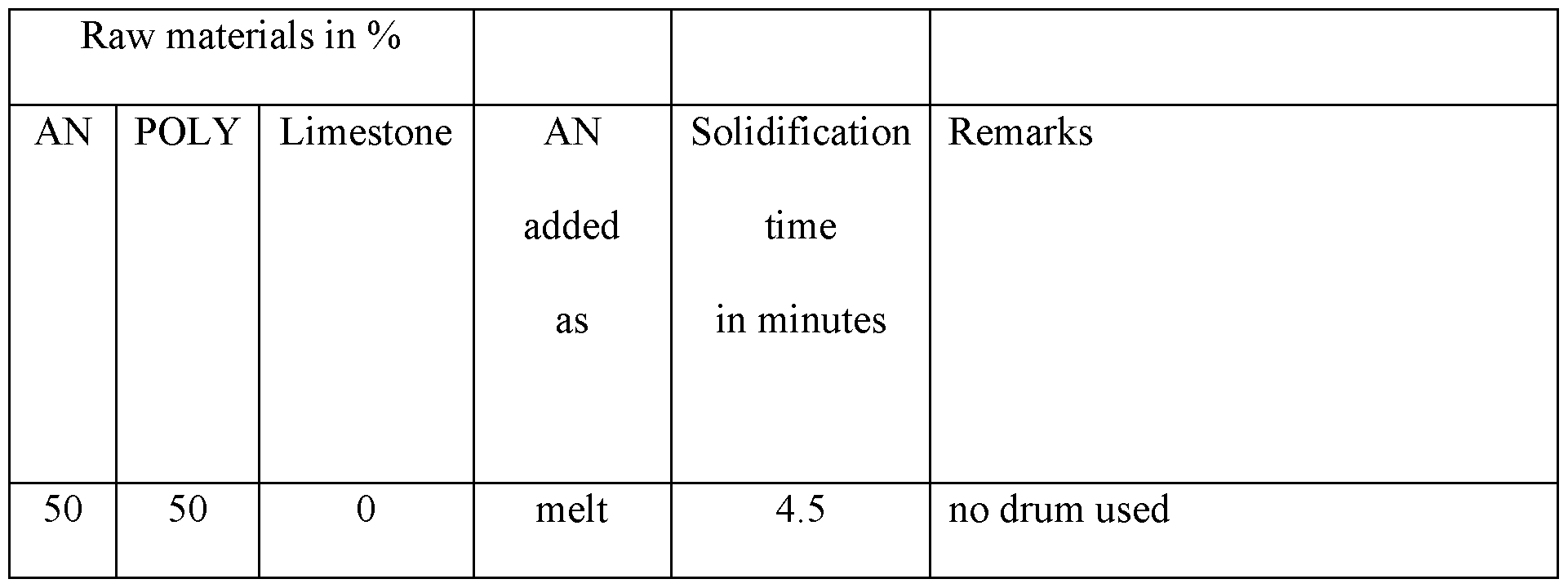
- Table 1 demonstrates the CRH at various proportion Poly/ AN Experiments set 1 -Laboratory scale
- Polyhalite and AN solution are fed into screw type feeder and discharged to rotary drum granulator, 41 cm diameter and 81 cm in length. From the rotary drum the material is discharged by gravity to a rotary cooler 31 cm diameter and 203 cm in length. The material is cooled with air flow
- the cooled material from the cooler is transferred to a second cooler 25 cm in diameter and 152 cm in length for cooling with air flow.
- the material is then fed to a screening system.
- the main objective of this experiment is to check the technical feasibility to obtain parameter for scale up of producing fertilizer containing polyhalite and urea in continuous pilot scale system.
- the moist granules from the granulator discharge gravimetry to cooler 31 cm diameter and 203 cm in length.
- the granules in the cooler dried with air flow.
- the material from the dryer discharge to rotary drum cooler 25 cm in diameter and 152 cm in length cooling was achieved by air flow.
- the material from the dryer transfer to screening system.
- the oversized > 5.16 mm mesh were transferred to a hammer mill and recycled to screening.
- the undersized ⁇ 2.36 mm were recycled back to the granulator. The product collected and was sent to further testing.
- the temperature of urea solution was 130 C degrees and concentration 92.9%
- the bed temperature in the granulator was 36 degrees
- Rotation velocity of the granulator was 22 rpm
- the material was discharged at 54 C degrees and after cooler 36 degree.
- the temperature of the urea solution was 128 C degrees and concentration 93.2%
- Example 5 As in example 4, but the oversize screen was changed to 5.16 screen
Landscapes
- Chemical & Material Sciences (AREA)
- Organic Chemistry (AREA)
- Chemical Kinetics & Catalysis (AREA)
- Inorganic Chemistry (AREA)
- Life Sciences & Earth Sciences (AREA)
- Pest Control & Pesticides (AREA)
- Environmental & Geological Engineering (AREA)
- General Life Sciences & Earth Sciences (AREA)
- Geochemistry & Mineralogy (AREA)
- Geology (AREA)
- Fertilizers (AREA)
Abstract
Description



Claims
Priority Applications (3)
| Application Number | Priority Date | Filing Date | Title |
|---|---|---|---|
| IL304915A IL304915A (en) | 2021-10-29 | 2022-10-25 | A process for creating a uniform granule of polyhalite and nitrogen fertilizer |
| US18/275,428 US20240109817A1 (en) | 2021-10-29 | 2022-10-25 | A process for the production of a unified granule of polyhalite and an n-fertilizer |
| EP22886312.2A EP4251592A4 (en) | 2021-10-29 | 2022-10-25 | PROCESS FOR PRODUCING A UNIFIED GRANULE MADE OF POLYHALITE AND A NITROGEN FERTILIZER |
Applications Claiming Priority (4)
| Application Number | Priority Date | Filing Date | Title |
|---|---|---|---|
| US202163273205P | 2021-10-29 | 2021-10-29 | |
| US63/273,205 | 2021-10-29 | ||
| US202163283796P | 2021-11-29 | 2021-11-29 | |
| US63/283,796 | 2021-11-29 |
Publications (1)
| Publication Number | Publication Date |
|---|---|
| WO2023073697A1 true WO2023073697A1 (en) | 2023-05-04 |
Family
ID=86159178
Family Applications (1)
| Application Number | Title | Priority Date | Filing Date |
|---|---|---|---|
| PCT/IL2022/051126 Ceased WO2023073697A1 (en) | 2021-10-29 | 2022-10-25 | A process for the production of a unified granule of polyhalite and an n-fertilizer |
Country Status (4)
| Country | Link |
|---|---|
| US (1) | US20240109817A1 (en) |
| EP (1) | EP4251592A4 (en) |
| IL (1) | IL304915A (en) |
| WO (1) | WO2023073697A1 (en) |
Cited By (3)
| Publication number | Priority date | Publication date | Assignee | Title |
|---|---|---|---|---|
| WO2024121763A1 (en) * | 2022-12-07 | 2024-06-13 | Anglo American Woodsmith Limited | Polyhalite granules containing nitrogen |
| WO2025141497A1 (en) * | 2023-12-27 | 2025-07-03 | SABIC Agri-Nutrients Company | Sustainable slow-release complex calcium, nitrogen, and sulfur fertilizer encapsulated with polyhalite |
| WO2025243232A1 (en) * | 2024-05-24 | 2025-11-27 | Anglo American Woodsmith Limited | A method for the production of a fertilizer granule |
Families Citing this family (1)
| Publication number | Priority date | Publication date | Assignee | Title |
|---|---|---|---|---|
| CN119569098B (en) * | 2025-01-26 | 2025-04-25 | 山东聚鑫新材料有限公司 | Method for synthesizing potassium sulfate calcium magnesium double salt |
Citations (3)
| Publication number | Priority date | Publication date | Assignee | Title |
|---|---|---|---|---|
| RU2106329C1 (en) * | 1996-06-05 | 1998-03-10 | Открытое акционерное общество "НИУИФ" | Method of producing phosphorus-containing complex fertilizers |
| WO2021033178A1 (en) * | 2019-08-22 | 2021-02-25 | Icl Europe Cooperatief U.A. | Granules of polyhalite, potash and ammonium sulphate and a compaction process for the production thereof |
| WO2021059261A1 (en) * | 2019-09-24 | 2021-04-01 | Icl Europe Cooperatief U.A. | Granules of polyhalite and urea |
Family Cites Families (3)
| Publication number | Priority date | Publication date | Assignee | Title |
|---|---|---|---|---|
| RU2289559C2 (en) * | 2004-04-07 | 2006-12-20 | Александр Иванович Серебряков | Method for production of nitrogen-potash fertilizer |
| CN109843834A (en) * | 2016-10-22 | 2019-06-04 | 死海工程有限公司 | Binder for fertilizer granulation |
| IL294086B1 (en) * | 2020-01-27 | 2026-04-01 | Icl Europe Coop Ua | Granules of polyhalite and urea and a compaction process for the production thereof |
-
2022
- 2022-10-25 WO PCT/IL2022/051126 patent/WO2023073697A1/en not_active Ceased
- 2022-10-25 US US18/275,428 patent/US20240109817A1/en active Pending
- 2022-10-25 EP EP22886312.2A patent/EP4251592A4/en active Pending
- 2022-10-25 IL IL304915A patent/IL304915A/en unknown
Patent Citations (3)
| Publication number | Priority date | Publication date | Assignee | Title |
|---|---|---|---|---|
| RU2106329C1 (en) * | 1996-06-05 | 1998-03-10 | Открытое акционерное общество "НИУИФ" | Method of producing phosphorus-containing complex fertilizers |
| WO2021033178A1 (en) * | 2019-08-22 | 2021-02-25 | Icl Europe Cooperatief U.A. | Granules of polyhalite, potash and ammonium sulphate and a compaction process for the production thereof |
| WO2021059261A1 (en) * | 2019-09-24 | 2021-04-01 | Icl Europe Cooperatief U.A. | Granules of polyhalite and urea |
Non-Patent Citations (1)
| Title |
|---|
| See also references of EP4251592A4 * |
Cited By (3)
| Publication number | Priority date | Publication date | Assignee | Title |
|---|---|---|---|---|
| WO2024121763A1 (en) * | 2022-12-07 | 2024-06-13 | Anglo American Woodsmith Limited | Polyhalite granules containing nitrogen |
| WO2025141497A1 (en) * | 2023-12-27 | 2025-07-03 | SABIC Agri-Nutrients Company | Sustainable slow-release complex calcium, nitrogen, and sulfur fertilizer encapsulated with polyhalite |
| WO2025243232A1 (en) * | 2024-05-24 | 2025-11-27 | Anglo American Woodsmith Limited | A method for the production of a fertilizer granule |
Also Published As
| Publication number | Publication date |
|---|---|
| EP4251592A4 (en) | 2024-10-30 |
| EP4251592A1 (en) | 2023-10-04 |
| IL304915A (en) | 2023-10-01 |
| US20240109817A1 (en) | 2024-04-04 |
Similar Documents
| Publication | Publication Date | Title |
|---|---|---|
| US10894749B2 (en) | Polyhalite granulation process | |
| US10934225B2 (en) | Compaction of polyhalite and potash mixture | |
| US11655196B2 (en) | Granules of polyhalite and urea | |
| WO2023073697A1 (en) | A process for the production of a unified granule of polyhalite and an n-fertilizer | |
| US20220162133A1 (en) | Polyhalite and potash granules | |
| EP3529226B1 (en) | Fertilizer composition comprising a binder | |
| US12195409B2 (en) | Compacted Polyhalite and a process for the production thereof | |
| EP4085038A1 (en) | A polyhalite and sop granule and a process for the production thereof | |
| EP4017622A1 (en) | Granules of polyhalite, potash and ammonium sulphate and a compaction process for the production thereof | |
| CN115551821A (en) | Fertilizer granules of polyhalite and molten urea and granulation process for their production | |
| EP4097067A1 (en) | Granules of polyhalite and urea and a compaction process for the production thereof | |
| WO2023067591A1 (en) | A granule of kieserite and a process for the production thereof | |
| EA044470B1 (en) | POLYHALITE AND POTASH GRANULES | |
| BR112022000967B1 (en) | COMPACTED GRANULES OF POLYHALITE, POTASSIUM SALT AND AMMONIUM SULFATE AS AN INORGANIC BINDER AND PROCESS FOR COMPACTION OF POLYHALITE WITH A POTASSIUM SALT TOGETHER WITH AMMONIUM SULFATE |
Legal Events
| Date | Code | Title | Description |
|---|---|---|---|
| 121 | Ep: the epo has been informed by wipo that ep was designated in this application |
Ref document number: 22886312 Country of ref document: EP Kind code of ref document: A1 |
|
| ENP | Entry into the national phase |
Ref document number: 2022886312 Country of ref document: EP Effective date: 20230629 |
|
| REG | Reference to national code |
Ref country code: BR Ref legal event code: B01A Ref document number: 112023013725 Country of ref document: BR |
|
| WWE | Wipo information: entry into national phase |
Ref document number: 304915 Country of ref document: IL |
|
| ENP | Entry into the national phase |
Ref document number: 112023013725 Country of ref document: BR Kind code of ref document: A2 Effective date: 20230707 |
|
| NENP | Non-entry into the national phase |
Ref country code: DE |