WO2023074096A1 - セラミド組成物 - Google Patents
セラミド組成物 Download PDFInfo
- Publication number
- WO2023074096A1 WO2023074096A1 PCT/JP2022/031631 JP2022031631W WO2023074096A1 WO 2023074096 A1 WO2023074096 A1 WO 2023074096A1 JP 2022031631 W JP2022031631 W JP 2022031631W WO 2023074096 A1 WO2023074096 A1 WO 2023074096A1
- Authority
- WO
- WIPO (PCT)
- Prior art keywords
- ceramide
- composition
- mass
- cells
- composition according
- Prior art date
- Legal status (The legal status is an assumption and is not a legal conclusion. Google has not performed a legal analysis and makes no representation as to the accuracy of the status listed.)
- Ceased
Links
Images



Classifications
-
- A—HUMAN NECESSITIES
- A61—MEDICAL OR VETERINARY SCIENCE; HYGIENE
- A61P—SPECIFIC THERAPEUTIC ACTIVITY OF CHEMICAL COMPOUNDS OR MEDICINAL PREPARATIONS
- A61P1/00—Drugs for disorders of the alimentary tract or the digestive system
-
- A—HUMAN NECESSITIES
- A23—FOODS OR FOODSTUFFS; TREATMENT THEREOF, NOT COVERED BY OTHER CLASSES
- A23L—FOODS, FOODSTUFFS OR NON-ALCOHOLIC BEVERAGES, NOT OTHERWISE PROVIDED FOR; PREPARATION OR TREATMENT THEREOF
- A23L33/00—Modifying nutritive qualities of foods; Dietetic products; Preparation or treatment thereof
- A23L33/10—Modifying nutritive qualities of foods; Dietetic products; Preparation or treatment thereof using additives
-
- A—HUMAN NECESSITIES
- A61—MEDICAL OR VETERINARY SCIENCE; HYGIENE
- A61K—PREPARATIONS FOR MEDICAL, DENTAL OR TOILETRY PURPOSES
- A61K31/00—Medicinal preparations containing organic active ingredients
- A61K31/16—Amides, e.g. hydroxamic acids
- A61K31/164—Amides, e.g. hydroxamic acids of a carboxylic acid with an aminoalcohol, e.g. ceramides
-
- A—HUMAN NECESSITIES
- A61—MEDICAL OR VETERINARY SCIENCE; HYGIENE
- A61K—PREPARATIONS FOR MEDICAL, DENTAL OR TOILETRY PURPOSES
- A61K35/00—Medicinal preparations containing materials or reaction products thereof with undetermined constitution
- A61K35/56—Materials from animals other than mammals
- A61K35/57—Birds; Materials from birds, e.g. eggs, feathers, egg white, egg yolk or endothelium corneum gigeriae galli
-
- A—HUMAN NECESSITIES
- A61—MEDICAL OR VETERINARY SCIENCE; HYGIENE
- A61K—PREPARATIONS FOR MEDICAL, DENTAL OR TOILETRY PURPOSES
- A61K8/00—Cosmetics or similar toiletry preparations
- A61K8/18—Cosmetics or similar toiletry preparations characterised by the composition
- A61K8/30—Cosmetics or similar toiletry preparations characterised by the composition containing organic compounds
- A61K8/68—Sphingolipids, e.g. ceramides, cerebrosides, gangliosides
-
- A—HUMAN NECESSITIES
- A61—MEDICAL OR VETERINARY SCIENCE; HYGIENE
- A61K—PREPARATIONS FOR MEDICAL, DENTAL OR TOILETRY PURPOSES
- A61K8/00—Cosmetics or similar toiletry preparations
- A61K8/18—Cosmetics or similar toiletry preparations characterised by the composition
- A61K8/96—Cosmetics or similar toiletry preparations characterised by the composition containing materials, or derivatives thereof of undetermined constitution
- A61K8/98—Cosmetics or similar toiletry preparations characterised by the composition containing materials, or derivatives thereof of undetermined constitution of animal origin
- A61K8/981—Cosmetics or similar toiletry preparations characterised by the composition containing materials, or derivatives thereof of undetermined constitution of animal origin of mammals or bird
-
- A—HUMAN NECESSITIES
- A61—MEDICAL OR VETERINARY SCIENCE; HYGIENE
- A61P—SPECIFIC THERAPEUTIC ACTIVITY OF CHEMICAL COMPOUNDS OR MEDICINAL PREPARATIONS
- A61P17/00—Drugs for dermatological disorders
-
- A—HUMAN NECESSITIES
- A61—MEDICAL OR VETERINARY SCIENCE; HYGIENE
- A61P—SPECIFIC THERAPEUTIC ACTIVITY OF CHEMICAL COMPOUNDS OR MEDICINAL PREPARATIONS
- A61P17/00—Drugs for dermatological disorders
- A61P17/16—Emollients or protectives, e.g. against radiation
-
- A—HUMAN NECESSITIES
- A61—MEDICAL OR VETERINARY SCIENCE; HYGIENE
- A61Q—SPECIFIC USE OF COSMETICS OR SIMILAR TOILETRY PREPARATIONS
- A61Q19/00—Preparations for care of the skin
-
- A—HUMAN NECESSITIES
- A61—MEDICAL OR VETERINARY SCIENCE; HYGIENE
- A61Q—SPECIFIC USE OF COSMETICS OR SIMILAR TOILETRY PREPARATIONS
- A61Q19/00—Preparations for care of the skin
- A61Q19/08—Anti-ageing preparations
-
- A—HUMAN NECESSITIES
- A23—FOODS OR FOODSTUFFS; TREATMENT THEREOF, NOT COVERED BY OTHER CLASSES
- A23V—INDEXING SCHEME RELATING TO FOODS, FOODSTUFFS OR NON-ALCOHOLIC BEVERAGES AND LACTIC OR PROPIONIC ACID BACTERIA USED IN FOODSTUFFS OR FOOD PREPARATION
- A23V2002/00—Food compositions, function of food ingredients or processes for food or foodstuffs
-
- A—HUMAN NECESSITIES
- A23—FOODS OR FOODSTUFFS; TREATMENT THEREOF, NOT COVERED BY OTHER CLASSES
- A23V—INDEXING SCHEME RELATING TO FOODS, FOODSTUFFS OR NON-ALCOHOLIC BEVERAGES AND LACTIC OR PROPIONIC ACID BACTERIA USED IN FOODSTUFFS OR FOOD PREPARATION
- A23V2200/00—Function of food ingredients
- A23V2200/30—Foods, ingredients or supplements having a functional effect on health
- A23V2200/318—Foods, ingredients or supplements having a functional effect on health having an effect on skin health and hair or coat
-
- A—HUMAN NECESSITIES
- A23—FOODS OR FOODSTUFFS; TREATMENT THEREOF, NOT COVERED BY OTHER CLASSES
- A23V—INDEXING SCHEME RELATING TO FOODS, FOODSTUFFS OR NON-ALCOHOLIC BEVERAGES AND LACTIC OR PROPIONIC ACID BACTERIA USED IN FOODSTUFFS OR FOOD PREPARATION
- A23V2250/00—Food ingredients
- A23V2250/20—Natural extracts
- A23V2250/204—Animal extracts
Definitions
- ceramide is the main component of intercellular lipids in the human epidermis, the market has been expanding as a functional cosmetic ingredient. It is known that keratin ceramide gradually decreases with aging, and therefore supplementation with topical ceramide is thought to be important for maintaining healthy skin. In addition, free ceramide, which exists as intercellular lipids in the stratum corneum, is free ceramide, and thus free ceramide is also attracting attention.
- Patent Documents 1 and 2 So far, research has also been conducted to efficiently prepare useful ceramides (for example, Patent Documents 1 and 2).
- the inventors proceeded with the study with the aim of discovering new functions of ceramide.
- the present inventors have discovered the possibility that a specific bio-derived ceramide composition can perform a specific function particularly efficiently. Furthermore, among bio-derived ceramide compositions, a ceramide-containing extract obtained by extracting from chicken legs with ethanol (chicken leg ethanol-extracted ceramide composition) can exhibit a particularly preferable effect of enhancing the epithelial barrier function. Found. Based on the above findings, further improvements were made.
- the disclosure includes, for example, subject matter described in the following sections. Section 1. A chicken leg ethanol-extracted ceramide composition. Item 2. Item 2. The composition according to Item 1, containing ⁇ -O-acylceramide. Item 3. Item 4.
- composition according to Item 2 wherein the ⁇ -O-acylceramide contained is of the EOS type and the terminal acyl group is a linoleic acid group.
- Item 4. The composition according to Item 2 or 3, wherein 0.1 to 2% by mass of the ceramide contained is ⁇ -O-acylceramide.
- Item 5. The composition according to any one of Items 1 to 4, which is for enhancing the epithelial barrier.
- Item 6. The composition according to any one of Items 1 to 5, which is for skin barrier enhancement or intestinal barrier enhancement.
- Item 7. Item 7.
- Item 8. Item 7.
- Item 10 Item 9. The composition according to any one of Items 1 to 8, wherein 90% by mass or more of the ceramide contained is ceramide NS.
- a novel bio-derived ceramide composition is provided.
- a ceramide-containing extract obtained by extracting chicken leg with ethanol (chicken leg ethanol-extracted ceramide composition) is provided.
- the ceramide composition can be preferably used particularly for strengthening the epithelial barrier.
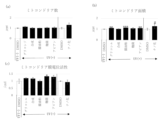
- HaCaT cells irradiated with 10 mJ/cm 2 of UVB were added with ceramide and cultured for 24 hours.
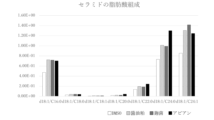
- the results of adding ceramide to HaCaT cells and culturing for 48 hours followed by analyzing the fatty acid composition of ceramide in HaCaT cells using LC-MS are shown.
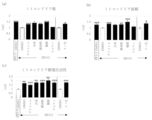
- the supernatant of Caco-2 cells treated with ceramide for 24 hours was added to HaCaT cells irradiated with 10 mJ/cm 2 of UVB. Measured results are shown.
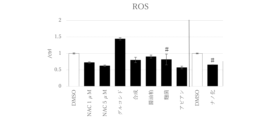
- HaCaT cells irradiated with 10 mJ/cm 2 of UVB were added with the supernatant of Caco-2 cells treated with ceramide for 24 hours, and after 48 hours, ROS was measured using IN Cell Analyzer 2200.
- the present disclosure preferably includes, but is not limited to, specific bio-derived ceramide compositions and uses thereof, and includes everything disclosed herein and recognized by a person skilled in the art.
- the ceramide composition encompassed by the present disclosure is a bio-derived ceramide composition, more specifically, a ceramide composition extracted from soy sauce cake, a ceramide composition extracted from Aspergillus oryzae, or a ceramide composition extracted from chicken leg.
- the ceramide composition means a composition containing ceramide.
- bio-derived ceramides are sometimes referred to as the ceramide composition of the present disclosure.
- chicken leg-extracted ceramide compositions are preferred, and among the chicken leg-extracted ceramide compositions, a ceramide-containing extract obtained by extracting chicken leg with ethanol (chicken leg ethanol-extracted ceramide composition). is particularly preferred.
- the toe portion is particularly preferable.
- Chicken legs to be subjected to ethanol extraction are preferably pre-dried, and particularly preferably dried and powdered.
- the ceramide composition of the present disclosure preferably exhibits the effect of enhancing the epithelial barrier function. Therefore, it can be preferably used for strengthening the epithelial barrier.
- the epithelial barrier a skin barrier (epidermal barrier) and an intestinal barrier (intestinal epithelium) barrier are particularly preferred.
- the ceramide composition of the present disclosure when used to strengthen the skin barrier, it can be preferably used particularly to prevent the effects of ultraviolet rays on the skin (care for damage). While not wishing to be bound by theory, it is believed that application of the ceramide composition of the present disclosure to the skin increases mitochondria (especially number, area, or membrane potential activity) can be recovered. It can be used as a prophylaxis for UV-damaged skin or as a treatment for UV-damaged skin.
- the ceramide composition of the present disclosure when used for the skin (for skin barrier enhancement), it can be used, for example, as an external composition or an oral composition (for example, an oral pharmaceutical composition or a food composition). It is preferably used as an external composition.
- the chicken leg ethanol-extracted ceramide composition can be preferably used as an intestinal barrier, and can be particularly preferably used for strengthening intestinal epithelial cell tight junctions.
- intestinal barrier can be particularly preferably used for strengthening intestinal epithelial cell tight junctions.
- claudins particularly claudin 3
- the defense function against pathogens in the intestinal tract can also be enhanced. When used for such strengthening of defense against infection, it can be used for prevention of infection or treatment after infection.
- Claudin is a major protein involved in the formation of tight junctions and plays a central role in intercellular barriers at tight junctions.
- the density and connectivity of tight junctions can be measured using the Trans Epithelial Electric Resistance (TER) as an index, and the ceramide composition of the present disclosure preferably has the TER value. can improve.
- TER Trans Epithelial Electric Resistance
- the ceramide composition of the present disclosure when used in the intestinal tract (used as an intestinal barrier), it can be used, for example, as an oral composition (for example, an oral pharmaceutical composition or a food composition) and a composition for intestinal administration. .
- an oral composition for example, an oral pharmaceutical composition or a food composition
- a composition for intestinal administration when used as a composition for intestinal administration, it can be administered directly into the intestine by surgical treatment, or can be administered through the anus.
- Ceramide is a compound having a structure (--NH--CO--) in which an amino group (--NH 2 ) of a sphingoid base is bonded to a carboxyl group (--COOH) of a fatty acid.
- the alcoholic hydroxyl group (--OH) of the sphingoid base of ceramide is further combined with a polar group such as sugar and phosphoric acid to form glycosphingolipids and phosphosphingolipids, respectively.
- a polar group such as sugar and phosphoric acid
- those bound with sugar are particularly called glycosylceramide, and particularly when the sugar is glucose, they are called glucosylceramide.
- a ceramide in which sugar and phosphoric acid are not bound is particularly called free ceramide.
- acylceramide when the fatty acid portion of ceramide is an ⁇ -hydroxy fatty acid, and the hydroxy terminal thereof is further ester-bonded with a fatty acid, it is particularly called acylceramide ( ⁇ -O-acylceramide).
- acylceramide means ⁇ -O-acylceramide.
- the ceramide composition of the present disclosure preferably contains acylceramide.
- examples of the fatty acid ester-bonded to the ⁇ -hydroxy terminal include stearic acid, oleic acid, linoleic acid, and linolenic acid. Although not particularly limited, it preferably contains acylceramide in which the fatty acid is linoleic acid.
- the sphingoid base constituting the free ceramide preferably has 2 or 3 hydroxyl groups, more preferably 3 hydroxyl groups.
- the sphingoid base preferably has 14 to 22 carbon atoms (14, 15, 16, 17, 18, 19, 20, 21, or 22), more preferably 16 to 20 carbon atoms. , and those having 18 or 20 carbon atoms are more preferable. Moreover, those having 0 or 1 carbon-carbon double bond are preferable. More specific preferred sphingoid bases include, for example, sphingosine, dihydrosphingosine, phytosphingosine and the like.
- Fatty acids constituting free ceramide preferably have 16 to 30 carbon atoms (16, 17, 18, 19, 20, 21, 22, 23, 24, 25, 26, 27, 28, 29, or 30). , C18-28 fatty acids are more preferred, C20-26 fatty acids are more preferred, and C22-26 fatty acids are even more preferred. Moreover, fatty acids having 0 or 1 carbon-carbon double bonds are preferred, and fatty acids having 0 carbon-carbon double bonds (that is, saturated fatty acids) are more preferred. Fatty acids having 0, 1, or 2 hydroxyl groups are also preferred. Although not particularly limited, if it has a hydroxyl group, it is preferably an ⁇ -hydroxyl group.
- the (sphingoid base)-(fatty acid) combination of the ceramide skeleton may be any combination of the above sphingoid bases and fatty acids.
- a particularly preferred combination is, for example, a combination of (sphingoid base having 2 or 3 (especially 3) hydroxyl groups)-(fatty acid having a hydroxyl group (especially having an ⁇ -hydroxyl group)).
- the number of hydroxyl groups of the fatty acid is preferably 0, 1, or 2.
- ceramide AS which is a combination of sphingosine (S) and a fatty acid with 1 hydroxyl group (A)
- ceramide NS which is a combination of sphingosine (S) and a fatty acid with 0 hydroxyl groups (N)
- S sphingosine
- N fatty acid with 0 hydroxyl groups
- ceramide AP which is a combination of phytosphingosine (P) and a fatty acid with 1 hydroxyl group (A)
- ceramide NP which is a combination of phytosphingosine (P) and a fatty acid with 0 hydroxyl groups (N)
- ceramide DP which is a combination of phytosphingosine (P) and a fatty acid having 2 hydroxyl groups (D)
- Ceramide AP and ceramide NP are commonly used terms, but ceramide DP is a term used in this specification and not a commonly used term. Specific examples of ceramide DP include dihydroxylignocellophytosphingosine and the like.
- a free ceramide (i) a ceramide skeleton (having 2 or 3 hydroxyl groups, 18 carbon atoms, and a sphingoid base having 0 or 1 carbon-carbon double bond)-(carbon number 16 to 34, 0 or 1 carbon-carbon double bond, 0, 1, or 2 hydroxyl groups), and (ii) a free ceramide that has a ceramide skeleton (2 hydroxyl groups or 3 sphingoid bases with 20 carbon atoms and no carbon-carbon double bonds)-(24 or 25 carbon atoms, 0 carbon-carbon double bonds, 0, 1, or 2 hydroxyl groups
- a free ceramide that is a combination of fatty acids having a fatty acid) is preferable, and the free ceramide of (i) is more preferable.
- the ceramide skeleton is (a sphingoid base having two hydroxyl groups, 18 carbon atoms and one carbon-carbon double bond)-(16 to 34 carbon atoms, carbon-carbon double bond Free ceramide, which is a combination of (fatty acid having 0 or 1 bond and 0 hydroxyl group), and (i-2) ceramide skeleton (having 3 hydroxyl groups, 18 carbon atoms, carbon-carbon double bond sphingoid base having 0)-(fatty acid having 20 to 26 carbon atoms, 0 carbon-carbon double bonds, and 0 hydroxyl group) combination is more preferable.
- the ceramide skeleton (having two hydroxyl groups, 18 carbon atoms and a sphingoid base having one carbon-carbon double bond)-(16 carbon atoms ⁇ 34, fatty acid having 0 carbon-carbon double bonds and 0 hydroxyl groups) is particularly preferred.
- chicken leg ethanol-extracted ceramide compositions contain acylceramide and are preferred. More specifically, the chicken leg ethanol-extracted ceramide composition contains d18:1-c28-36:0-18:2 (for example, d18:1-c28:0-18:2, d18:1-c30:0 -18:2, d18:1-c32:0-18:2, d18:1-c34:0-18:2, or d18:1-c36:0-18:2) containing acylceramide Among these, those containing 4 or 5 are particularly preferred.
- Ceramides constituting human stratum corneum intercellular lipids are classified into 7 types of free ceramides according to the type of long-chain fatty acid that forms an amide bond with a long-chain sphingoid base by Downing et al., and their compositions have also been reported (Robson. K.J. et al, J. lipid Res.35, 2060 (1994)).
- the acylceramide contained in the chicken leg ethanol-extracted ceramide composition is classified as ceramide EOS among the above seven types.
- ceramide EOP was the only acylceramide prepared by chemical synthesis. Therefore, the chicken leg ethanol-extracted ceramide composition is preferable from the viewpoint of containing ceramide EOS.
- Ceramide EOS is acylceramide whose sphingoid base portion is sphingosine
- ceramide EOP is acylceramide whose sphingoid base portion is phytosphingosine.
- the chicken leg ethanol-extracted ceramide composition may be one in which acylceramide is concentrated using a known method such as HPLC.
- the chicken leg ethanol-extracted ceramide composition also includes the acylamide concentrate of the chicken leg ethanol extract.
- the chicken leg ethanol-extracted ceramide composition preferably contains about 0.1 to 2% by mass of acylceramide among the ceramides contained.
- the upper or lower limit of the range (0.1 to 2% by mass) is, for example, 0.2, 0.3, 0.4, 0.5, 0.6, 0.7, 0.8, 0.9, 1, 1.1, 1.2, 1.3, 1.4, 1.5, 1.6, 1.7, 1.8, or 1.9 wt%.
- the range is more preferably 0.2 to 1.5% by mass, more preferably 0.3 to 1.2% by mass.
- the acylceramide content is a preferred example, and may vary, for example, when the acylceramide is concentrated as described above.
- the chicken leg ethanol-extracted ceramide composition contains acylceramide (preferably d18:1-c28-36:0-18:2 acylceramide), and is said to have extremely important functionality. Conceivable.
- the acylceramide contained in the chicken leg ethanol-extracted ceramide composition is a so-called EOS type in which the sphingoid base is sphingosine and the fatty acid is an esterified ⁇ fatty acid.
- the chain length of the ⁇ -hydroxy fatty acid moiety preferably includes 28 to 36 carbon atoms, and the center of the distribution is preferably 30 to 34 carbon atoms.
- acylceramide which has an ultra-long chain fatty acid group, plays a central role in the skin barrier function even in small amounts.
- a decrease in EOS-type acylceramide which is known to exist in human stratum corneum intercellular lipids, not only leads to a decrease in barrier function and moisturizing function, but also causes skin barrier dysfunction in atopic dermatitis and the like. It is known to be an aggravating factor for dry skin.
- the chicken leg ethanol-extracted ceramide composition 90% by mass or more of the ceramides contained is preferably ceramide NS, and 91, 92, 93, 94, 95, 96, 97, or 98% by mass or more. is more preferably ceramide NS.
- 90% by mass or more of the ceramide contained is preferably the ceramide (i-1) above. , or 98% by mass or more is more preferably the ceramide (i-1).
- the chicken leg ethanol-extracted ceramide composition 90% by mass or more of the ceramide contained is preferably the ceramide (i-1a) above, and 91, 92, 93, or 94% by mass or more is The ceramide (i-1a) above is more preferred.
- an example of a preferable chicken leg ethanol-extracted ceramide composition includes d18:1-20:0 in the highest amount, followed by d18:1-22:0 in the next highest amount, and d18 :1-26:0, and the next most preferred composition.
- d18:1-20:0 is about 25 to 35% by mass (more preferably 27 to 33% by mass)
- d18:1-22:0 is about 15 to
- a composition containing about 30% by mass (more preferably 17 to 28% by mass) and about 5 to 20% by mass (more preferably 7 to 18% by mass or 8 to 15% by mass) of d18:1-26:0 is preferred.
- d18:1-16:0 is preferably contained in an amount of 2 to 8% by mass, more preferably 3 to 7% by mass.
- d18:1-24:0 is preferably contained in an amount of 4 to 11% by mass, more preferably 5 to 10% by mass or 6 to 9% by mass.
- d18:1-28:0 is preferably contained in an amount of 2 to 8% by mass, more preferably 3 to 7% by mass.
- d18:1-18:0 is preferably contained in an amount of 2 to 6% by mass, more preferably 3 to 5% by mass.
- d18:1-26:1 is preferably contained in an amount of 0.2 to 3% by mass, more preferably 0.5 to 2% by mass.
- d18:1-30:0 is preferably contained in an amount of 1 to 4% by mass, more preferably 2 to 3.5% by mass.
- the ceramide composition of the present disclosure can also be nanoized (that is, used as a nanoized ceramide composition).
- a nano-sized ceramide composition can be obtained, for example, by subjecting a ceramide composition to high pressure treatment.
- the high-pressure treatment can be carried out using an ultrahigh-pressure wet-type atomization device (for example, Sugino Machine Co., Ltd.: Starburst).
- the high pressure is, for example, about 100 MPa or higher, preferably about 100 to 300 MPa, more preferably about 120 to 250 MPa.
- the ceramide composition of the present disclosure can be preferably used as an emulsified composition.
- a form in which an oil phase is dispersed in an aqueous phase for example, an oil-in-water (O/W) emulsion
- O/W oil-in-water
- fats and oils in addition to bio-extracted ceramide (especially chicken leg ethanol-extracted ceramide), fats and oils, nonionic surfactants, phospholipids, proteins, polysaccharides, pH adjusters, thickeners, fragrances, natural pigments, preservatives etc. can be included.
- the average particle size of oil droplets (that is, dispersed particles) containing ceramide is preferably 500 nm or less.
- the average particle size of the dispersed particles is preferably 300 nm or less, more preferably 200 nm or less, and even more preferably 150 nm or less.
- the lower limit of the average particle diameter of the dispersed particles is not particularly limited, but can be, for example, 1 nm or more, preferably 10, 20, or 50 nm or more.
- the average particle size of dispersed particles means the volume average particle size measured using a dynamic light scattering method.
- the volume average particle diameter of the dispersed particles can be measured, for example, using a dynamic light scattering method, Nanotrac WAVE II (Verder Scientific). can be measured.
- a sample separated from the ceramide dispersion composition of the present invention is diluted with pure water so that the concentration of ceramide contained in the sample is 0.1% by mass, and is measured using a quartz cell.
- 1.600 as the refractive index of the sample
- 1.333 pure water
- the viscosity of pure water as the viscosity of the dispersion medium
- the average particle size of the dispersed particles containing ceramide is determined by the conditions in the production method described below, such as high-pressure emulsification and dispersion conditions (number of passes, pressure, temperature), stirring conditions (shear force, temperature). It can also be adjusted by appropriately adjusting factors such as the ratio of the oil phase and the water phase.
- an oil phase component and an aqueous phase component may be mixed and pre-dispersed to obtain a coarse dispersion in advance.
- a means is not particularly limited, and a general stirring device can be used.
- stirring devices include magnetic stirrers, household mixers, paddle mixers, impeller mixers, homomixers, disper mixers, ultra mixers and the like.
- the time for the preliminary dispersion treatment is not particularly limited, and can be appropriately set according to the type of stirring device, the composition of the liquid before dispersion treatment, and the like.
- a coarse dispersion obtained by preliminary dispersion treatment (which may be further mixed with water or the like, if necessary) is subjected to dispersion treatment using an ultrasonic dispersion method (hereinafter referred to as ultrasonic dispersion treatment) or dispersion treatment using a high-pressure emulsification method (hereinafter referred to as high-pressure emulsification treatment).
- ultrasonic dispersion treatment an ultrasonic dispersion method
- high-pressure emulsification treatment high-pressure emulsification treatment
- a coarse dispersion containing the bio-extracted ceramide of the present invention (which may be further mixed with water or the like, if necessary) is subjected to dispersion treatment to obtain dispersed particles containing the bio-extracted ceramide.
- a fine particle ceramide dispersion composition can be obtained.
- the dispersion treatment in the main dispersion step is preferably carried out by high-pressure emulsification treatment.
- High-pressure emulsification treatment means dispersion treatment in which a shearing force of 10 MPa or more is applied to the material to be dispersed. From the viewpoint of miniaturization of dispersed particles, the shearing force applied to the material to be dispersed is preferably 50 or 100 MPa or more, more preferably 150 MPa or more. The upper limit is preferably, for example, 300 MPa or less from the viewpoint of temperature rise and pressure resistance.
- the means for high-pressure emulsification is not particularly limited, and a general high-pressure emulsification device can be used.
- High-pressure emulsifying devices include Starburst HJP-25005 (manufactured by Sugino Machine Co., Ltd.), Microfluidizer (manufactured by Microfluidic Co., Ltd.), Nanomizer (manufactured by Yoshida Kikai Kogyo Co., Ltd., Gorlin type homogenizer (manufactured by APV), and Ranier type.
- Homogenizer manufactured by Lanier
- high-pressure homogenizer manufactured by Niro Soavi
- homogenizer manufactured by Sanwa Machinery Co., Ltd.
- high-pressure homogenizer manufactured by Izumi Food Machinery Co., Ltd.
- ultra-high pressure homogenizer manufactured by Ika Co., Ltd.
- a high pressure homogenizer may be mentioned.
- the temperature during the high-pressure emulsification treatment is preferably set to 30°C to 80°C, more preferably set to 40°C to 70°C.
- the high-pressure emulsification treatment may be performed once, but in order to improve the uniformity of the entire liquid, it is preferable to perform the high-pressure emulsification treatment two or more times, more preferably two to five times. From the viewpoint of maintaining the particle size of the dispersed particles, it is preferable to cool the emulsified liquid, which is the emulsified and dispersed composition, through a certain cooler within 30 seconds, preferably within 3 seconds, immediately after passing through the chamber.
- steps may be included as necessary.
- Other steps include a heat sterilization step and the like.
- the emulsion may be dried to form a powdered composition.
- Powderization has many advantages, such as improved portability and reduced transportation costs, in addition to improved long-term storage stability due to the removal of moisture.
- Such powder compositions are also preferably included in the ceramide composition of the present disclosure.
- drying means known drying means can be used, and examples include natural drying, heat drying, hot air drying, high frequency drying, ultrasonic drying, reduced pressure drying, vacuum drying, freeze drying, spray drying, and the like. These means may be used alone, or two or more means may be used in combination.
- an entrapping agent may coexist.
- entrapping agents water-soluble polysaccharides and oligosaccharides are preferred.
- the saccharides used as the saccharide entrapping agent in the present invention are preferably saccharides composed of saccharide units as basic units, and the average degree of polymerization of the saccharide units (the number of saccharide units) is from the viewpoint of refining the particle size after rehydration. Therefore, it is generally preferably 60 or less, more preferably 2 to 50. Inulin, raffinose, stachyose, velpascose, and trehalose are preferable as such a sugar entrapping agent from the viewpoint of the effect of stabilizing coalescence of hydrophobic particles.
- the spray drying method is particularly preferable as the drying means from the viewpoint of achieving both production efficiency and quality.
- Spray drying is a type of convection hot air drying. A liquid emulsion is sprayed into hot air as fine particles of several hundred micrometers or less, and the fine particles fall through the tower while being dried, thereby being recovered as solid powder. The material is temporarily exposed to hot air, but because the exposure time is very short and the temperature does not rise much due to the latent heat of evaporation of water, thermal denaturation of the material is less likely to occur in the same way as freeze-drying, and recovery is possible. Changes due to water are also small. Cold air can be supplied instead of hot air for very heat sensitive materials. In that case, the drying capacity is lowered, but it is preferable in that milder drying can be achieved.
- spray dryer SD-1000 Tokyo Rika Kikai Co., Ltd.
- spray dryer L-8i Okawara Kakoki Co., Ltd.
- closed spray dryer CL-12 Okawara Kako Machine Co., Ltd.
- Spray Dryer ADL310 Yamato Scientific Co., Ltd.
- Mini Spray Dryer B-290 Buchi Co., Ltd.
- PJ-MiniMax Powdering Japan Co., Ltd.
- PHARMASD Niro Co., Ltd.
- fluidized bed granulator dryer MP-01 Panrex Co., Ltd.
- fluidized bed built-in spray dryer FSD Nelo Corporation
- the ceramide composition of the present disclosure can be used as a composition for external use, an oral composition, a composition for intestinal administration, etc., as described above. Moreover, it can be preferably used in the pharmaceutical field and the food field.
- the composition may consist of ceramide alone, or may be a composition containing ceramide and other components (various bases, carriers, additives, etc.), as described in detail below.
- the ceramide-containing biological tissue extract itself is also included in the composition. In other words, a ceramide-containing biological tissue extract (and one further blended with other ingredients as necessary) can also be used as the ceramide composition of the present disclosure.
- the composition is a biological extract It may consist of ceramide alone, or may be a pharmaceutical composition containing other ingredients.
- the active ingredient, ceramide may optionally be added with pharmaceutically acceptable bases, carriers, additives (e.g., excipients, binders, disintegrants, lubricants, agents, solvents, sweeteners, coloring agents, corrigents, corrigents, surfactants (especially emulsifiers), moisturizing agents, preservatives, pH adjusters, thickening agents, etc.).
- additives e.g., excipients, binders, disintegrants, lubricants, agents, solvents, sweeteners, coloring agents, corrigents, corrigents, surfactants (especially emulsifiers), moisturizing agents, preservatives, pH adjusters, thickening agents, etc.
- Such base materials, carriers, additives and the like are specifically described, for example, in Dictionary of Pharmaceutical Excipients 2016 (Yakuji Nippo Co., Ltd.), and for example, those described therein can be used.
- the formulation form is also not particularly limited, and the active ingredient and other ingredients are mixed by a conventional method. , suspensions, emulsions, jellies, chewables, soft tablets and the like.
- tablets may be manufactured by a tableting method. Either a direct compression method in which the mixed raw materials are tableted as they are, or a granule compression method in which the mixed raw materials are granulated and then tableted can be used.
- capsules may be soft capsules or hard capsules.
- it can also be used as a cream agent, milky lotion, gel agent, etc. as a composition for external use.
- a composition for intestinal administration it can be used, for example, as a foam agent.
- the amount of ceramide compounded in the pharmaceutical composition according to the present invention is not particularly limited as long as the anti-fatigue effect is exhibited, and can be appropriately set according to the subject. It is preferably 0.0005 to 100% by mass, more preferably 0.005 to 90% by mass, still more preferably 0.05 to 80% by mass. The lower limit may be approximately 10% by mass, 20% by mass, 30% by mass, 40% by mass, 50% by mass, 60% by mass, 70% by mass, or 80% by mass.
- Subjects to whom the pharmaceutical composition according to the present disclosure is administered include not only humans but also non-human mammals. Mammals exhibiting fatigue can be exemplified, and mammals raised as pets and livestock are particularly preferred. Specific examples include dogs, cats, monkeys, cows, horses, sheep, goats, pigs, rabbits, mice, rats, camels, and llamas. In mammals, as in humans, the pharmaceutical composition of the present invention can also be used prophylactically.
- the timing of administration of the pharmaceutical composition according to the present disclosure is not particularly limited, and it is possible to appropriately select the timing of administration in consideration of, for example, the formulation form, the age of the subject of administration, the degree of symptoms of the subject of administration, and the like.
- the dosage of the pharmaceutical composition according to the present disclosure can be appropriately selected according to the age of the subject of administration, the degree of symptoms of the subject of administration, other conditions, and the like.
- the amount of ceramide contained as a reference can be appropriately set within a range that does not impair the effects of the present invention. It can be administered once a day or in multiple doses (preferably 2 to 3 times). In the case of mammals as well, the dosage can be appropriately set with reference to the case of the person concerned.
- the composition (hereinafter sometimes referred to as "food composition according to the present disclosure") contains ceramide and food Hygiene-acceptable bases, carriers, additives, and other ingredients and materials that can be used as foods and drinks are appropriately blended.
- processed foods containing ceramide for improving or preventing fatigue, beverages, health foods (foods with nutrient function claims, foods for specified health use, etc.), supplements, food for sick people (hospital food, sick food, nursing care food, etc.), etc. can be exemplified.
- ceramide blended in the food composition is a biological tissue-extracted ceramide extracted from biological (especially animal or plant) tissue, for example, processed foods, health foods ( food with nutrient function claims, food for specified health use, etc.), supplements, food for the sick, and the like.
- ceramide is powdered, for example, and contained in various foods and drinks such as beverages (juices, etc.), confectionery, breads, soups (including powdered soups, etc.), and processed foods. may
- the food composition according to the present invention when preparing the food composition according to the present invention as a health food (food with nutrient function claims, food for specified health use, etc.) or supplement, for example, granules, capsules, tablets (chewable It is preferable to prepare it in the form of beverages (drinks), etc. Among them, capsules, tablets, and tablet forms are preferable from the viewpoint of ease of ingestion, but are not particularly limited to these. do not have.
- the food composition according to the present invention in the form of granules, capsules, tablets and the like can be appropriately prepared according to conventional methods using pharmaceutically and/or food hygienically acceptable carriers. Moreover, even when preparing other forms, conventional methods may be followed.
- the amount of ceramide compounded in the food composition according to the present disclosure is not particularly limited as long as the effect can be exhibited. , preferably 0.0005 to 100% by mass, more preferably 0.005 to 90% by mass, still more preferably 0.05 to 80% by mass.
- the lower limit may be approximately 10% by mass, 20% by mass, 30% by mass, 40% by mass, 50% by mass, 60% by mass, 70% by mass, or 80% by mass.
- the amount of intake, target of intake, etc. of the food composition according to the present disclosure are not particularly limited, it is preferably the same as the pharmaceutical composition according to the present invention described above, for example.
- hospital food is food provided when hospitalized
- sick food is food for sick people
- nursing care food is food for people receiving care.
- the preparation was performed as follows. That is, a dried product of compressed lees, which is a by-product of soy sauce produced by a conventional method, was subjected to ethanol extraction, and the resulting extract was subjected to solid-liquid separation using ethanol and water to obtain a solid portion. Further, the solid portion was washed with acetone, ethanol and water, dried and pulverized, washed with water, acetone and hexane, and extracted again with ethanol to obtain a solid portion as a ceramide composition.
- ⁇ Ceramide composition extracted from Aspergillus oryzae> The cells were collected from 300 liters of the koji mold culture solution and dried to obtain a solid. A 2.5-fold amount of ethanol/water mixture was added to the solid and mixed, and extraction was performed with stirring overnight at 40°C. A 1.2-fold amount of ethanol solution was added to the solid portion after collecting the extract, mixed, and extracted with stirring overnight at 40°C. The resulting extracts were combined and distilled under reduced pressure at 45° C. to obtain a concentrated extract. After the concentrated liquid extract was washed with acetone (further washed with ethanol, acetone, etc., if necessary), the obtained insoluble matter was used as an Aspergillus oryzae-extracted ceramide composition.
- the chicken leg-extracted ceramide composition can be more specifically called a chicken leg ethanol-extracted ceramide composition.
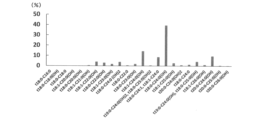
- FIG. 15 and Table 1 show the content ratio (% by mass) of various free ceramide species in the soy sauce cake-extracted ceramide composition.
- Table 2 shows the free ceramide molecular species of the koji mold-extracted ceramide composition.
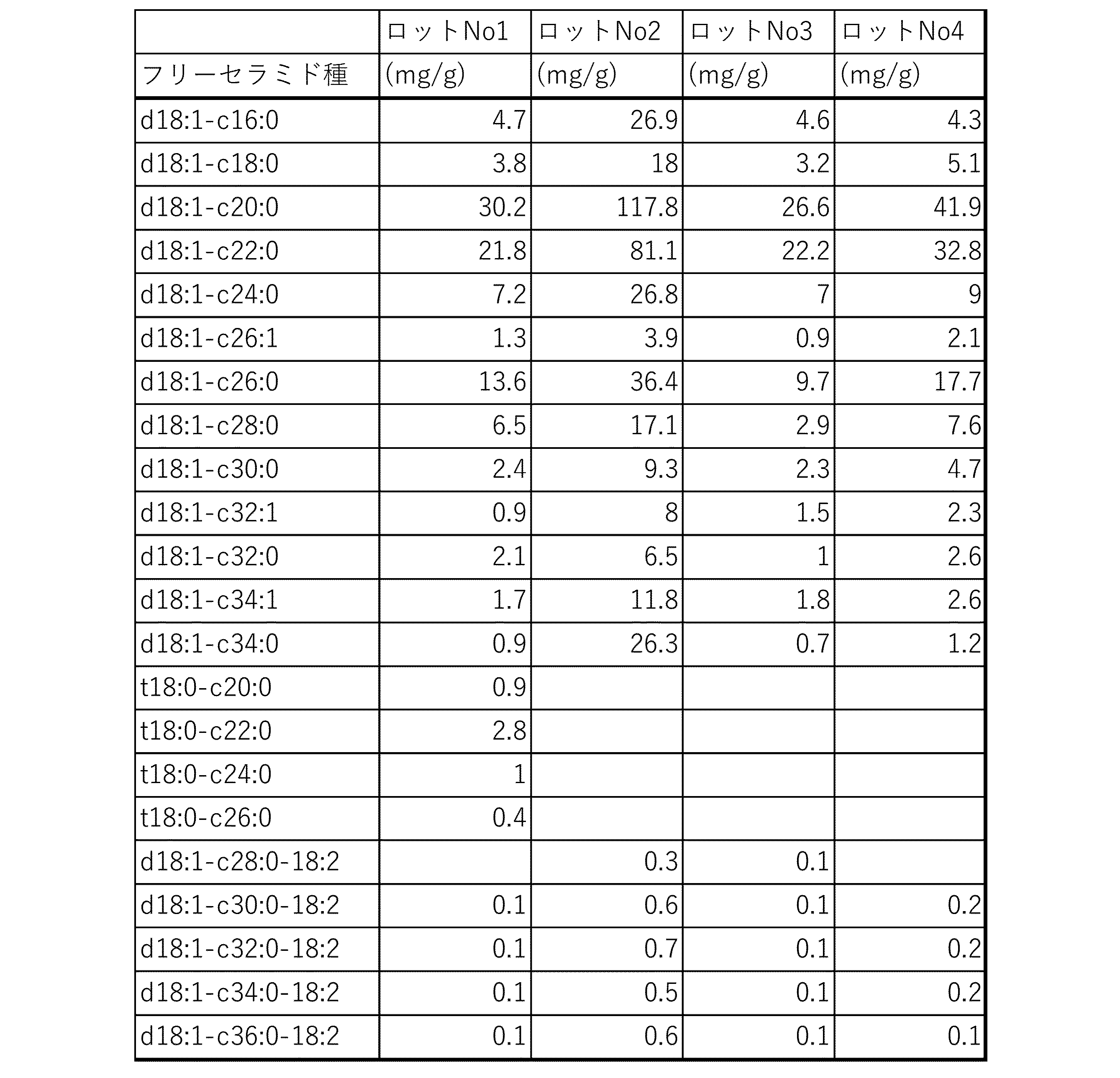
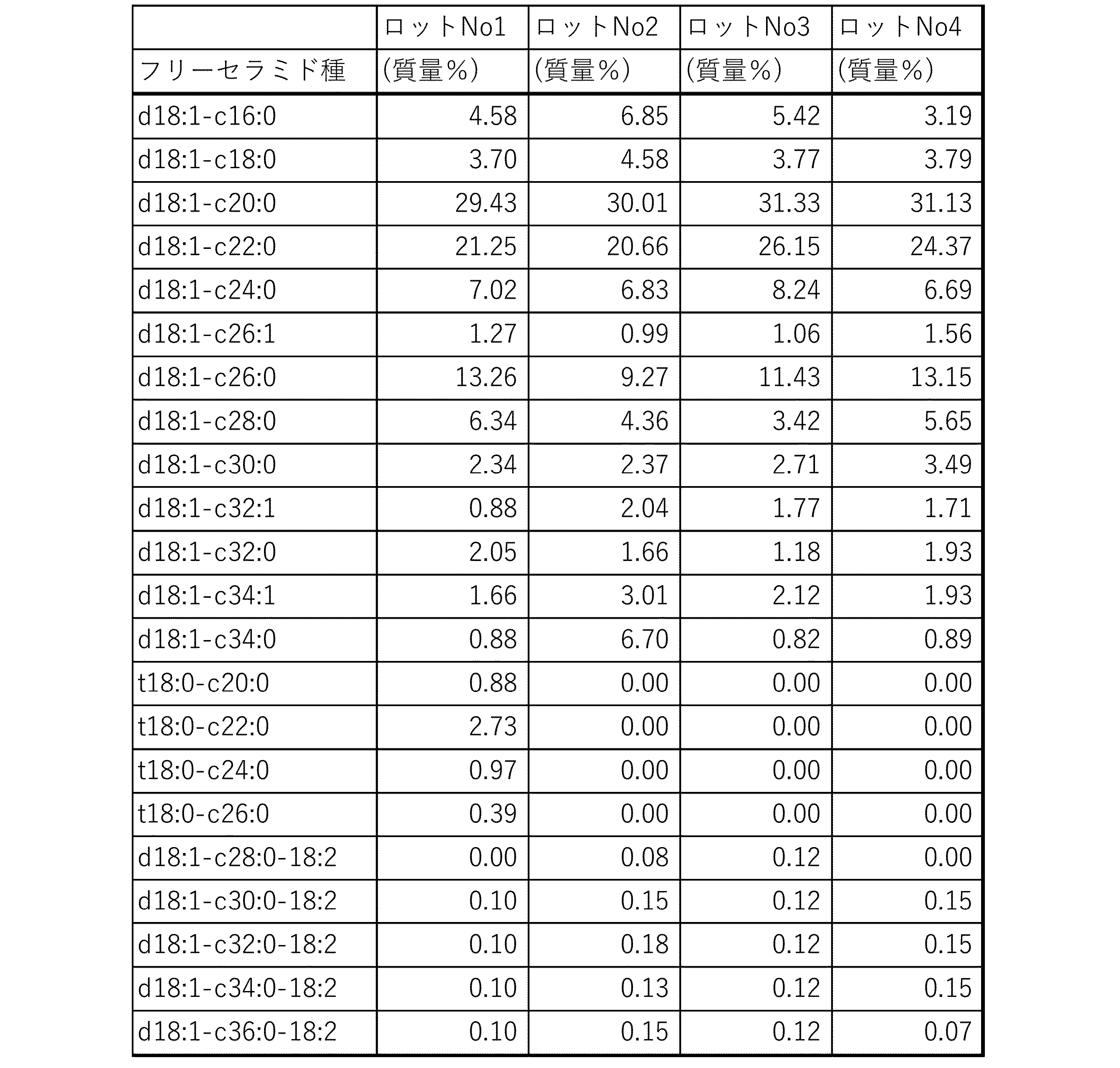
- Tables 3a and 3b show the content (mg/g) of various free ceramides, and Table 3b shows the content concentration (% by mass) of various free ceramides.
- Ceramide nano- glycols (other polyols, oils and fats may be added as necessary), an emulsifier, and a ceramide composition were mixed and heated to 100 to 150° C. (a temperature near the melting point of ceramide) to homogenize. Further, an aqueous lecithin dispersion, an aqueous polysaccharide solution, an aqueous water-soluble polymer solution, etc. are added to this and stirred and mixed. Ceramide was nanoized by high pressure treatment. Incidentally, lecithin was used in a mass ratio of about 2 to 5 times that of ceramide.
- the particle size containing ceramide was measured using a dynamic light scattering system, Nanotrac WAVE II (Verder Scientific). Specifically, the nano-ceramide composition (emulsion) was diluted with pure water so that the ceramide concentration was 0.1% by mass, and this was used as a measurement sample. Using 1.600 as the refractive index of the sample, 1.333 (pure water) as the refractive index of the dispersion medium, and the viscosity of pure water as the viscosity of the dispersion medium, the volume average particle diameter (Mv) was determined. In addition, the ceramide particle size was similarly measured for the ceramide composition before nanoization treatment. The volume average particle size of ceramide in the ceramide composition before nanoization treatment was 4857 nm, and the volume average particle size of ceramide in the nano ceramide composition was 124 nm.
- soy sauce cake-extracted ceramide composition was nanoized and used as the nanoized ceramide composition.
- ceramide composition (soy sauce cake-extracted ceramide composition, koji mold-extracted ceramide composition, chicken leg-extracted ceramide composition, nano-sized ceramide composition), glucosylceramide, and synthetic ceramide were used as ceramide samples.
- concentration of ceramide is the concentration of each ceramide sample.
- ⁇ extracted ceramide composition may be abbreviated as " ⁇ ceramide”.
- a ceramide composition extracted from soy sauce cake is sometimes referred to as soy sauce cake ceramide.
- the chicken leg extract ceramide composition is sometimes referred to as Avian.
- the glucoside ceramide is manufactured by Maruzen Pharmaceutical Co., Ltd.
- DMEM medium was prepared by dissolving 4.75 g of Dulbecco's Modified Eagle Medium (DMEM) medium "Nissui” (2) (Nissui Pharmaceutical, Tokyo, Japan) in 470 mL of Milli-Q water and adding 0.2 M L-glutamine (Fuji Film Wako Pure Chemical Industries, Osaka, Japan) 10 mL, 50,000 U/mL penicillin (Meiji Seika Pharma, Tokyo, Japan) 1 mL, 0.05 mg/mL streptomycin (Meiji Seika Pharma) 0.5 mL, 10% NaHCO 3 (Fuji Film Wako Pure Chemical Industries, Ltd.) was added to prepare.
- DMEM Dulbecco's Modified Eagle Medium
- NaHCO 3 Freptomycin
- HaCaT cells were seeded in a 96-well plate at a density of 6.0 ⁇ 10 4 cells/mL and precultured for 24 hours. After that, samples were added so that the final concentration of ceramide was 5 ⁇ M. After 24 hours, add 100 ⁇ L/well of MitoTracker Red (Invitrogen, USA) diluted to 2.5 ⁇ M with 10% FBS/DMEM to the plate after removing the medium, and incubate at 37°C, 5% CO 2 for 30 minutes. did.
- MitoTracker Red Invitrogen, USA
- MitoTracker Green (Invitrogen) diluted to 200 nM with 10% FBS/DMEM, and incubate at 37°C, 5% CO 2 for 30 minutes. did After that, 100 ⁇ L/well of 1 mg/mL Cellstain Hoechst 33342 solution (DOJINDO, Kumamoto, Japan) diluted 500 times with DMEM was added and incubated at 37°C, 5% CO 2 for 30 minutes. rice field. Thereafter, the diluted Hoechst 33345 solution was removed from the 96-well plate, 150 mL of PBS was added, and fluorescence was detected using IN Cell Analyzer 2200 (GE Healthcare). Mito Tracker Red, Mito Tracker Green, and Hoechst 33342 were measured to measure the activity, number, and area of intracellular mitochondria. Images were analyzed with IN Cell Investigator High-content image analysis software (GE Healthcare).
- ⁇ Evaluation of the effect of ceramide on HaCaT cells via Caco-2 cells Examination of barrier function in the intestinal tract> Human colon cancer-derived cell line CaCo -2 cells were used as a Caco-2 cell cultured human intestinal epithelial cell model. CaCo-2 cells were cultured in a cell culture dish (Greiner bio-one, Tokyo, Japan) at 37°C in the presence of 5% CO2.
- DMEM medium was prepared by dissolving 4.75 g of Dulbecco's Modified Eagle Medium (DMEM) medium "Nissui” (2) (Nissui Pharmaceutical Co., Ltd., Tokyo, Japan) in 470 mL of Milli-Q water and adding 0.2 M L-glutamine (Fuji Film Wako Pure Chemical, Osaka, Japan) 10 mL, 50,000 U/mL penicillin (Meiji Seika Pharma, Tokyo, Japan) 1 mL, 0.05 mg/mL streptomycin (Meiji Seika Pharma) 0.5 mL, 10% NaHCO 3 (Fuji Film Wako Pure Chemical Industries, Ltd.) was added to prepare.
- DMEM Dulbecco's Modified Eagle Medium
- Mitochondrial activity measurement using IN Cell Analyzer 2200 (Caco-2 cells ⁇ HaCaT cells) Caco-2 cells were seeded at 1.0 ⁇ 10 2 cells/mL in 24 well plates (Corning, NY, USA). After 24 hours, ceramide was added to a final concentration of 5 ⁇ M and cultured for 24 hours. HaCaT cells were seeded at 6.0 ⁇ 10 4 cells/mL in a 96-well plate and incubated for 24 hours. After 48 hours, the number and area of mitochondria and mitochondrial membrane potential activity of HaCaT cells were measured in the same manner as described in "Measurement of mitochondrial activity using IN Cell Analyzer 2200" above.
- UV damage recovery effect of ceramide on UVB-induced senescent cells Caco-2 cells ⁇ HaCaT cells
- Caco-2 cells were seeded at 1.0 ⁇ 10 2 cells/mL in 24 well plates (Corning, NY, USA). After 24 hours, ceramide was added to a final concentration of 5 ⁇ M and cultured for 24 hours.
- HaCaT cells in a subconfluent state were irradiated with UVB at 10 mJ/cm 2 and seeded in a 96-well plate at 6.0 ⁇ 10 4 cells/mL.
- 50 ⁇ L of the HaCaT cell culture medium was removed, and 50 ⁇ L of the Caco-2 cell culture medium was added thereto.
- the number and area of mitochondria and mitochondrial membrane potential activity of HaCaT cells were measured by the same method as described in "Recovery effect of ceramide on UVB-induced senescent cells”.
- a Cell Culture Insert (FALCON) was set in a 24-well plate for Transepithelial Electrical Resistance (TER) measurement .
- Caco-2 cells were seeded at 2.0 ⁇ 10 5 cells/well, and carnosine was added to 10 mM after 48 hours. It was added every 3 days and cultured for 2 weeks.
- Millicell ERS-2 (Japan Millipore, Tokyo) was used to measure transepithelial electrical resistance.
- the electrodes were set in Millicell ERS-2, sterilized by soaking the electrodes in a 70% ethanol solution for 10 minutes, and then dried and soaked in DMEM medium. Next, the measurement was performed by inserting electrodes inside and outside the Cell Culture Insert. Calculation of the measured value was performed with reference to the following formula.
- TER ( ⁇ cm 2 ) (measured value - blank) x (insert area)
- Mitochondrial activity recovery effect by IN Cell Analyzer 2200 Number and area of mitochondria per cell (Mitotracker Green) and mitochondrial membrane potential when HaCaT cells were irradiated with UVB at 10 mJ/cm 2 and treated with ceramide for 48 hours. Activity (Mitotracker Red) was measured using an IN Cell Analyzer 2200. ( Figure 3)
Landscapes
- Health & Medical Sciences (AREA)
- Life Sciences & Earth Sciences (AREA)
- Public Health (AREA)
- Veterinary Medicine (AREA)
- Animal Behavior & Ethology (AREA)
- General Health & Medical Sciences (AREA)
- Chemical & Material Sciences (AREA)
- Pharmacology & Pharmacy (AREA)
- Medicinal Chemistry (AREA)
- Epidemiology (AREA)
- Dermatology (AREA)
- Engineering & Computer Science (AREA)
- Organic Chemistry (AREA)
- Bioinformatics & Cheminformatics (AREA)
- Nuclear Medicine, Radiotherapy & Molecular Imaging (AREA)
- General Chemical & Material Sciences (AREA)
- Chemical Kinetics & Catalysis (AREA)
- Birds (AREA)
- Molecular Biology (AREA)
- Mycology (AREA)
- Biophysics (AREA)
- Polymers & Plastics (AREA)
- Food Science & Technology (AREA)
- Gerontology & Geriatric Medicine (AREA)
- Nutrition Science (AREA)
- Zoology (AREA)
- Toxicology (AREA)
- Acyclic And Carbocyclic Compounds In Medicinal Compositions (AREA)
- Medicines Containing Material From Animals Or Micro-Organisms (AREA)
- Medicines Containing Plant Substances (AREA)
- Coloring Foods And Improving Nutritive Qualities (AREA)
- Micro-Organisms Or Cultivation Processes Thereof (AREA)
- Cosmetics (AREA)
Abstract
Description
本開示は例えば以下の項に記載の主題を包含する。
項1.
鶏脚エタノール抽出セラミド組成物。
項2.
ω-O-アシルセラミドを含有する、項1に記載の組成物。
項3.
含有されるω-O-アシルセラミドがEOS型であり、かつ末端アシル基がリノール酸基である、項2に記載の組成物
項4.
含有されるセラミドのうち、0.1~2質量%がω-O-アシルセラミドである、項2又は3に記載の組成物。
項5.
上皮バリア強化用である、項1~4のいずれかに記載の組成物。
項6.
皮膚バリア強化用若しくは腸管バリア強化用である、項1~5のいずれかに記載の組成物。
項7.
紫外線による皮膚へのダメージをケアするための、項6に記載の皮膚バリア強化用組成物。
項8.
腸管上皮細胞タイトジャンクション強化のための、項6に記載の腸管バリア強化用組成物。
項9.
含有されるセラミドのうち、90質量%以上が、セラミド骨格が(ヒドロキシル基を2個有し、炭素数18で、炭素間二重結合を1個有するスフィンゴイド塩基)-(炭素数16~34、炭素間二重結合を0又は1個、ヒドロキシル基を0個有する脂肪酸)の組み合わせであるフリーセラミドである、項1~8のいずれかに記載の組成物。
項10.
含有されるセラミドのうち、90質量%以上がセラミドNSである、項1~8のいずれかに記載の組成物。
セラミド組成物の調製
<醤油粕抽出セラミド組成物>
特開2012-126910号公報に記載の方法を参考に、醤油の搾り粕をエタノール抽出し、溶媒分画して高純度フリーセラミドを精製して、セラミド組成物を得た。
麹菌培養液300リットルから菌体を集菌し乾燥して固形物を得た。当該固形物に2.5倍量のエタノール/水混合液を加えて混合し、40℃で一晩撹拌抽出を行った。抽出液回収後の固形部に1.2倍量のエタノール溶液を加えて混合し、40℃で一晩撹拌抽出を行った。得られた抽出液を合わせて45℃で減圧蒸留して、濃縮エキスを得た。当該濃縮液エキスをアセトンで洗浄した後、(必要に応じてエタノール、アセトン等によりさらに洗浄して)得られた不溶物を麹菌抽出セラミド組成物として用いた。
鶏乾燥物に2.5倍量の95%エタノールを加えて混合し、40℃で一晩撹拌抽出を行った。抽出液回収後の固形部に1.2倍量のエタノールを加えて混合し、40℃で一晩撹拌抽出を行った。得られた抽出液を合わせて45℃で減圧蒸留して、濃縮エキスを得た。当該濃縮液エキスをアセトンで洗浄した後、(必要に応じてエタノール、アセトン等によりさらに洗浄して)得られた不要物を鶏脚抽出セラミド組成物として用いた。なお、当該鶏脚抽出セラミド組成物は、より詳細には、鶏脚エタノール抽出セラミド組成物といえる。
各セラミド組成物をLC-MS(高速液体クロマトグラフ質量分析計)にて解析し、各セラミド組成物に含まれる各種フリーセラミド種について分析した。


グリコール類(必要に応じてその他ポリオール、油脂等を加えてもよい)、乳化剤、及びセラミド組成物を混合し、100~150℃(セラミド融点近傍温度)に加熱し均一にした。これにさらにレシチン水分散液、多糖類水溶液、水溶性ポリマー水溶液等を加えて撹拌混合し、得られた混合液を超高圧湿式微粒化装置((株)スギノマシン:スターバースト)により100MPa以上の高圧で処理することでセラミドをナノ化した。なお、レシチンは、セラミドに対して、質量比で2~5倍程度用いた。
<セラミドのHaCaT細胞におけるバリア機能増強評価>
HaCaT細胞培養
ヒト皮膚のモデル細胞として、ヒト表皮角化細胞株HaCaT細胞を用いた。細胞は非働化した10% Fetal bovine serum(FBS;Life Technologies, CA, USA)添加DMEM培地(Dulbecco’s Modified Eagle Medium;Nissui, Tokyo, Japan)を用いて、細胞培養ディッシュ(Greiner bio-one, Tokyo, Japan)にて、37℃、5% CO2存在下で継代培養した。DMEM培地は、470 mLのMilli-Q水に対してDulbecco’s Modified Eagle Medium(DMEM)培地「ニッスイ」(2)(日水製薬, Tokyo, Japan) 4.75 g を溶解し、0.2 M L-グルタミン (富士フィルム和光純薬, Osaka, Japan) 10 mL、5万U/mLペニシリン (Meiji Seika ファルマ, Tokyo, Japan) 1 mL、0.05 mg/mLストレプトマイシン(Meiji Seika ファルマ) 0.5 mL、10% NaHCO3 (富士フィルム和光純薬) 6 mLを添加し、作製した。
HaCaT細胞を6.0×10⁴ cells/ mLの密度で96 well plateに播種し、24時間前培養を行った。その後、セラミドを終濃度5 μMとなるようにサンプル添加を行った。24時間後、培地除去後のplateに10 % FBS/DMEMで2.5 μMに希釈したMitoTracker Red (Invitrogen, USA)を100 μL/ well添加し、37℃、5% CO2条件下で30分間インキュベートを行なった。30分後、MitoTracker Red入りの培地を除去し、10 % FBS/DMEMで200 nMに希釈したMitoTracker Green (Invitrogen)を100 μL/ well添加し、37℃、5% CO2条件下で30分間インキュベートを行なった。その後、1 mg/mLのCellstain Hoechst 33342溶液 (DOJINDO, Kumamoto, Japan)をDMEMで500倍に希釈した溶液を100 μL/ well添加し、37℃、5 % CO2条件下で30分間インキュベートを行なった。その後、希釈Hoechst 33345溶液を96 well plateから除去し、PBS 150 mLを添加してIN Cell Analyzer 2200 (GE Healthcare)を用いて蛍光の検出を行った。Mito Tracker Red及びMito Tracker Green、Hoechst 33342の蛍光量を測定することで細胞内のミトコンドリアの活性、数、及び面積を調べた。画像は、IN Cell Investigator High-content image analysis software (GE Healthcare)で解析した。
10 mL dishに播種したサブコンフルエント状態のHaCaT細胞を、UVクロスリンカー(CL-1000 Ultraviolet Crosslinker, UVP, Upland, CA,USA) 内でディッシュのフタを外した状態でUVB10 mJ/cm2により照射を行い、その後はすぐに10% FBS含有DMEM培地10 mLを入れて37℃、5% CO2存在下でインキュベートした。また、無処理の細胞にはUVBを照射せず培地の交換のみを行った。24時間後にNon-UVBとUVB照射の細胞の培養液を捨て、1×PBSにより洗浄し、トリプシンで細胞を剥がし、96ウェルプレートに3×10³cellsになるように播種した。4時間後セラミド処理し、24時間インキュベートした。その後、HaCaT細胞における細胞内ROSの産生を、BES-H2O2-AC(和光純薬工業)を用いて製造者のプロトコールに従って測定した。96ウェルプレート内の培養液を除去し、細胞を4-(2-ヒドロキシエチル)-1-ピペラジンエタンスルホン酸(HEPES)緩衝液(pH 7.4)で2回洗浄した。CellstainR-Hoechst 33342 solution(Dojindo)を1: 500の比率で1×PBSと混合して細胞にかけた後、室温で30分遮光静置した。その後、HEPES(pH 7.4)中の5 μM BES-H2O2-ACを1: 1000およびHoechst 33342(Dojindo)を1: 400の割合で混合し、細胞と共に37℃で60分間インキュベートし、プロトコールは「HaCaT_eGFP20190627」を使用し、IN Cell Analyzer 2200 (GE Healthcare)にて画像を取得した。画像は IN Cell Analyzer 2200 Workstation(GE Healthcare)にて解析し、ROSの発現量を調べた。
サブコンフルエント状態の細胞にUVBを10 mJ/cm2照射した細胞を用いて、上記「IN Cell Analyzer 2200を用いたミトコンドリア活性測定」と同様の実験を行った。
10 mL dishで培養したサブコンフルエント状態のHaCaT細胞にセラミドを終濃度5 μMとなるようにサンプル添加を行った。48時間後、培地を除去し、1×PBS 5mlで洗浄後、トリプシン1.5 mLを添加してディッシュ全体に浸透させ、除去した。37℃、5% CO2条件下で8分間インキュベートし、DMEMで細胞をはがし取り、15 mLチューブに細胞を集め、12000 rpmで3分間遠心することで細胞のペレットを集めた。LC-MSを用いてHaCaT細胞に含まれるセラミドの脂肪酸組成を解析した。
Caco-2細胞培養
ヒト腸管上皮細胞モデルとして、ヒト結腸癌由来細胞株CaCo-2細胞を用いた。CaCo-2細胞は、10%非働化 Fetal Bovine Serum(FBS)(56℃の恒温槽で35分間加熱することで補体を不活性化したもの)含有DMEM培地を用いて、細胞培養ディッシュ(Greiner bio-one, Tokyo, Japan)にて37℃、5 % CO2存在下で継代培養した。DMEM培地は、470 mLのMilli-Q水に対してDulbecco’s Modified Eagle Medium(DMEM)培地「ニッスイ」(2)(日水製薬, Tokyo, Japan) 4.75 gを溶解し、0.2 M L-グルタミン(富士フィルム和光純薬, Osaka, Japan) 10 mL、5万U/mLペニシリン(Meiji Seika ファルマ, Tokyo, Japan) 1 mL、0.05 mg/mLストレプトマイシン(Meiji Seika ファルマ) 0.5 mL、10% NaHCO3 (富士フィルム和光純薬) 6 mLを添加し、作製した。
Caco-2細胞を1.0×10² cells/mLで24 well plate(Corning, NY, USA)に播種した。24時間後、終濃度5 μMのセラミドを添加し、24時間培養した。6.0×10⁴ cells/mLで96 well plateに播種し、24時間インキュベートしたHaCaT細胞の培養液を50 μL除去し、そこにCaco-2細胞の培養液を50 μL添加した。その48時間後、上記「IN Cell Analyzer 2200を用いたミトコンドリア活性測定」に記載の方法と同様の方法でHaCaT細胞のミトコンドリア数・面積、ミトコンドリア膜電位活性を測定した。
Caco-2細胞を1.0×10² cells/mL で24 well plate(Corning, NY, USA)に播種した。24時間後、終濃度5 μMのセラミドを添加し、24時間培養した。6.0×10⁴ cells/mLで96 well plateに播種し、24時間インキュベートしたHaCaT細胞の培養液を50 μL除去し、そこにCaco-2細胞の培養液を50 μL添加した。その48時間後、上記「IN Cell Analyzer 2200を用いたROS測定」に記載の方法と同様の方法でHaCaT細胞のROSを測定した。
Caco-2細胞を1.0×10² cells/mLで24 well plate(Corning, NY, USA)に播種した。24時間後、終濃度5 μMのセラミドを添加し、24時間培養した。
サブコンフルエント状態のHaCaT細胞にUVBを10 mJ/cm2照射し、6.0×104 cells/mLで96 well plateに播種した。24時間後、HaCaT細胞の培養液を50 μL除去し、そこにCaco-2細胞の培養液を50 μL添加した。48時間後、「UVB誘導性老化細胞におけるセラミドのUV障害回復効果」に記載の方法と同様の方法でHaCaT細胞のミトコンドリア数・面積、ミトコンドリア膜電位活性を測定した。
24 wellプレートにCell Culture Insert (FALCON)をセットした。Caco-2細胞を2.0 × 10⁵ cells/wellで播種し、48時間後にカルノシンを10 mMとなるように添加した。3日間間隔で添加して、2週間培養を行なった。
経上皮電気抵抗値の測定にはMillicell ERS-2(日本ミリポア, 東京)を用いた。実験前にMillicell ERS-2に電極をセットし、70%エタノール溶液に電極を10分間浸して殺菌消毒をし、その後電極を乾燥させてDMEM培地に浸した。次に、Cell Culture Insertの内側と外側にそれぞれ電極を挿入して測定を行った。測定値の計算は以下の式を参考に行なった。
TER (Ω・cm2) = (測定値-blank)×(インサート面積)
IN Cell Analyzer 2200を用いたミトコンドリア活性測定
HaCaT細胞をセラミドで48時間処理した際の1細胞あたりのミトコンドリアの数、面積(Mitotracker Green)及びミトコンドリア膜電位活性(Mitotracker Red)をIN Cell Analyzer 2200を用いて測定した。グリコシルセラミド、合成セラミド、醤油粕セラミド、麹菌セラミド、アビアンセラミド、非ナノ化セラミドはHaCaTのミトコンドリア数を有意に増加させた。グリコシルセラミド、醤油粕セラミド、麹菌セラミド、アビアンセラミドがHaCaTのミトコンドリア面積を有意に増加させた。 (図1)
HaCaT細胞に10 mJ/cm2のUVB照射をしたのちに、セラミドで24時間処理した際のROSレベルをIN Cell Analyzer 2200を用いて測定した。その結果、麹菌セラミドのみがROSを有意に減少させた。(図2)
HaCaT細胞に10 mJ/cm2のUVB照射をしたのちに、セラミドで48時間処理した際の1細胞あたりのミトコンドリアの数・面積(Mitotracker Green)及びミトコンドリア膜電位活性(Mitotracker Red)をIN Cell Analyzer 2200を用いて測定した。 (図3)
サブコンフルエント状態のHaCaT細胞をセラミドで48時間処理し、LC-MSを用いてHaCaT細胞の脂肪酸組成を測定した。その結果、醤油粕セラミド、麹菌セラミド、アビアンセラミドを添加したHaCaT細胞において、炭素数24の長鎖脂肪酸を持つヒト型セラミドが有意に増加した。(図4)
Caco-2細胞をセラミドで24時間処理し、その上清をHaCaT細胞に添加し48時間処理した際の1細胞あたりのミトコンドリアの数・面積(Mitotracker Green)及びミトコンドリア膜電位活性(Mitotracker Red)をIN Cell Analyzer 2200を用いて測定した。 (図5)
Caco-2細胞をセラミドで24時間処理し、その上清を10 mJ/cm2のUVB照射をしたHaCaT細胞に添加し24時間処理した際のROSレベルをIN Cell Analyzer 2200を用いて測定した。その結果、麹菌セラミド、ナノ化セラミドがROSを有意に減少させた。(図6)
Caco-2細胞をセラミドで24時間処理し、その上清を10 mJ/cm2のUVB照射をしたHaCaT細胞に添加し24時間処理した際の1細胞あたりのミトコンドリアの数・面積(Mitotracker Green)及びミトコンドリア膜電位活(Mitotracker Red)をIN Cell Analyzer 2200を用いて測定した。 (図7)
内在性Claudin3発現量の測定(Caco-2細胞)
Caco-2細胞をセラミドで24時間処理した際の内在性Claudin3発現量を定量RT-PCRで測定した。その結果、グリコシルセラミド、アビアンセラミドを添加したCaco-2においてClaudin3が有意に増強された。(図8)
Claims (10)
- 鶏脚エタノール抽出セラミド組成物。
- ω-O-アシルセラミドを含有する、請求項1に記載の組成物。
- 含有されるω-O-アシルセラミドがEOS型であり、かつ末端アシル基がリノール酸基である、請求項2に記載の組成物。
- 含有されるセラミドのうち、0.1~2質量%がω-O-アシルセラミドである、請求項2又は3に記載の組成物。
- 上皮バリア強化用である、請求項1又は2に記載の組成物。
- 皮膚バリア強化用若しくは腸管バリア強化用である、請求項1又は2に記載の組成物。
- 紫外線による皮膚へのダメージをケアするための、請求項6に記載の皮膚バリア強化用組成物。
- 腸管上皮細胞タイトジャンクション強化のための、請求項6に記載の腸管バリア強化用組成物。
- 含有されるセラミドのうち、90質量%以上が、セラミド骨格が(ヒドロキシル基を2個有し、炭素数18で、炭素間二重結合を1個有するスフィンゴイド塩基)-(炭素数16~34、炭素間二重結合を0又は1個、ヒドロキシル基を0個有する脂肪酸)の組み合わせであるフリーセラミドである、請求項1又は2に記載の組成物。
- 含有されるセラミドのうち、90質量%以上がセラミドNSである、請求項1又は2に記載の組成物。
Priority Applications (4)
| Application Number | Priority Date | Filing Date | Title |
|---|---|---|---|
| JP2023556141A JPWO2023074096A1 (ja) | 2021-10-25 | 2022-08-22 | |
| KR1020247014040A KR20240089126A (ko) | 2021-10-25 | 2022-08-22 | 세라미드 조성물 |
| EP22886430.2A EP4424306A4 (en) | 2021-10-25 | 2022-08-22 | CERAMIDE COMPOSITION |
| CN202280071400.4A CN118159263A (zh) | 2021-10-25 | 2022-08-22 | 神经酰胺组合物 |
Applications Claiming Priority (2)
| Application Number | Priority Date | Filing Date | Title |
|---|---|---|---|
| JP2021174062 | 2021-10-25 | ||
| JP2021-174062 | 2021-10-25 |
Publications (1)
| Publication Number | Publication Date |
|---|---|
| WO2023074096A1 true WO2023074096A1 (ja) | 2023-05-04 |
Family
ID=86159343
Family Applications (1)
| Application Number | Title | Priority Date | Filing Date |
|---|---|---|---|
| PCT/JP2022/031631 Ceased WO2023074096A1 (ja) | 2021-10-25 | 2022-08-22 | セラミド組成物 |
Country Status (5)
| Country | Link |
|---|---|
| EP (1) | EP4424306A4 (ja) |
| JP (3) | JPWO2023074096A1 (ja) |
| KR (1) | KR20240089126A (ja) |
| CN (1) | CN118159263A (ja) |
| WO (1) | WO2023074096A1 (ja) |
Cited By (1)
| Publication number | Priority date | Publication date | Assignee | Title |
|---|---|---|---|---|
| JP2023064103A (ja) * | 2021-10-25 | 2023-05-10 | 株式会社ジェヌインR&D | セラミド組成物 |
Citations (4)
| Publication number | Priority date | Publication date | Assignee | Title |
|---|---|---|---|---|
| JP2012126910A (ja) | 2010-07-23 | 2012-07-05 | Miyanabe Masakatsu | 発酵粕由来スフィンゴ脂質 |
| KR101645917B1 (ko) * | 2016-02-02 | 2016-08-12 | 양형열 | 관절건강에 도움이 되는 한약재 및 그의 제조방법 |
| WO2019049964A1 (ja) * | 2017-09-07 | 2019-03-14 | 株式会社ジェヌインR&D | 抗疲労経口組成物 |
| JP2020097539A (ja) * | 2018-12-18 | 2020-06-25 | 株式会社ジェヌインR&D | セラミド分散組成物 |
Family Cites Families (5)
| Publication number | Priority date | Publication date | Assignee | Title |
|---|---|---|---|---|
| US20050196461A1 (en) * | 2004-01-14 | 2005-09-08 | Udell Ronald G. | Ceramide formulations suitable for oral administration |
| WO2011083853A1 (ja) * | 2010-01-08 | 2011-07-14 | 丸大食品株式会社 | 抗アトピー性皮膚炎剤 |
| JP6480839B2 (ja) * | 2015-09-25 | 2019-03-13 | 富士フイルム株式会社 | セラミド分散組成物 |
| US20190006027A1 (en) | 2017-06-30 | 2019-01-03 | Accenture Global Solutions Limited | Automatic identification and extraction of medical conditions and evidences from electronic health records |
| KR20240089126A (ko) * | 2021-10-25 | 2024-06-20 | 가부시키가이샤 제누인 알앤드디 | 세라미드 조성물 |
-
2022
- 2022-08-22 KR KR1020247014040A patent/KR20240089126A/ko active Pending
- 2022-08-22 JP JP2023556141A patent/JPWO2023074096A1/ja active Pending
- 2022-08-22 CN CN202280071400.4A patent/CN118159263A/zh active Pending
- 2022-08-22 EP EP22886430.2A patent/EP4424306A4/en active Pending
- 2022-08-22 WO PCT/JP2022/031631 patent/WO2023074096A1/ja not_active Ceased
-
2023
- 2023-01-27 JP JP2023011390A patent/JP2023064103A/ja active Pending
-
2026
- 2026-01-13 JP JP2026003590A patent/JP2026063083A/ja active Pending
Patent Citations (4)
| Publication number | Priority date | Publication date | Assignee | Title |
|---|---|---|---|---|
| JP2012126910A (ja) | 2010-07-23 | 2012-07-05 | Miyanabe Masakatsu | 発酵粕由来スフィンゴ脂質 |
| KR101645917B1 (ko) * | 2016-02-02 | 2016-08-12 | 양형열 | 관절건강에 도움이 되는 한약재 및 그의 제조방법 |
| WO2019049964A1 (ja) * | 2017-09-07 | 2019-03-14 | 株式会社ジェヌインR&D | 抗疲労経口組成物 |
| JP2020097539A (ja) * | 2018-12-18 | 2020-06-25 | 株式会社ジェヌインR&D | セラミド分散組成物 |
Non-Patent Citations (3)
| Title |
|---|
| FATYASARI NATA IRYANTI, IRAWAN CHAIRUL, RAMADHAN LAZUARDI, RIZKY RAMADHANI MUHAMMAD: "Influence of Soy Protein Isolate on Gelatin-based Edible Film Properties", MATEC WEB OF CONFERENCES, vol. 156, 1 January 2018 (2018-01-01), pages 01014, XP093060626, DOI: 10.1051/matecconf/201815601014 * |
| ROBSON K. J ET AL., J. LIPID RES, vol. 35, 1994, pages 2060 |
| See also references of EP4424306A4 |
Cited By (1)
| Publication number | Priority date | Publication date | Assignee | Title |
|---|---|---|---|---|
| JP2023064103A (ja) * | 2021-10-25 | 2023-05-10 | 株式会社ジェヌインR&D | セラミド組成物 |
Also Published As
| Publication number | Publication date |
|---|---|
| JPWO2023074096A1 (ja) | 2023-05-04 |
| EP4424306A1 (en) | 2024-09-04 |
| JP2023064103A (ja) | 2023-05-10 |
| EP4424306A4 (en) | 2025-10-08 |
| KR20240089126A (ko) | 2024-06-20 |
| JP2026063083A (ja) | 2026-04-10 |
| CN118159263A (zh) | 2024-06-07 |
Similar Documents
| Publication | Publication Date | Title |
|---|---|---|
| JP6896689B2 (ja) | 水棲動物軟骨抽出物 | |
| JP5996156B2 (ja) | 美肌用遺伝子発現促進剤並びにそれを用いた保湿用組成物及び美肌用組成物 | |
| TWI594766B (zh) | 膠原產生促進劑、玻尿酸產生促進劑、纖維母細胞增殖促進劑及抗皺紋劑 | |
| Kocic et al. | Favorable effect of creams with skimmed donkey milk encapsulated in nanoliposomes on skin physiology | |
| JP2026063083A (ja) | セラミド組成物 | |
| KR20130091761A (ko) | 기능성 식품 조성물 및 그 제조방법 | |
| Alshafei et al. | Red beet Peel-loaded Liposome's impact on metabolic syndrome rats and its use as fortifier in yoghurt powder | |
| JP2015027998A (ja) | 保湿剤、皮膚バリア機能改善剤、タイトジャンクション形成促進剤、trpv4発現上昇剤、細胞内カルシウム濃度上昇剤、細胞内カルシウム濃度上昇剤、脂質合成促進剤、血流改善剤及びクマ改善剤 | |
| JP2012036128A (ja) | コラーゲン産生促進剤及びそれを用いた美肌用組成物 | |
| JP6909569B2 (ja) | 肌質改善剤 | |
| Casula et al. | Comprehensive multi-technique analysis of raw cuttlefish ink and its shelf-stable food product derivative | |
| DK2872135T3 (en) | Process for making rose powder | |
| JP7164118B2 (ja) | 抗疲労経口組成物 | |
| JP5642924B2 (ja) | 皮膚バリア機能回復促進用水中油型乳化組成物 | |
| JP2010270021A (ja) | Ucp遺伝子発現促進剤 | |
| CN108042417A (zh) | 一种抗敏组合物 | |
| US20250288636A1 (en) | Agastache rugosa exosomes composition for enhancing skin barrier and anti-inflammation and method thereof | |
| Sermsathanaswadi et al. | Formation of rice bran glycosphingolipids microemulsion powders with vitamin B1, B2, B12, and Folate as additives for elderly food | |
| Ural et al. | Intestinal Permeability Targeted Rectal Enema Nutraceutical Intervention in Dogs with Cutaneous Adverse Food Reactions: Gut-Brain-Skin Axis Directed Pro-active Treatment | |
| Mahdi et al. | Bioactive compounds bioavailability of microencapsulated Foshou fruit effervescent tablets: In vitro simulated gastrointestinal | |
| Sari et al. | Formulation and The Hen's Egg Chorioallantoic Membrane (HET-CAM) Test to Predict Irritation Potential of FCEE and FCEA Facial Cleansing Gel | |
| KR101689700B1 (ko) | 이팝나무 종자 추출물을 유효성분으로 함유하는 피부 노화 관련 퇴행성 질환의 예방 및 치료용 화장료 조성물 | |
| US11207258B2 (en) | Capsule containing functional substance and method for manufacturing said capsule | |
| Abou Zaid et al. | Biochemical alterations of Chitosan on Liver function tests and Immunoglobulin in Experimental induced Non Alcoholic Fatty Liver Disease in Rats | |
| TW202537634A (zh) | 用於增強皮膚屏障及抗發炎的藿香外泌體組合物及其用途 |
Legal Events
| Date | Code | Title | Description |
|---|---|---|---|
| 121 | Ep: the epo has been informed by wipo that ep was designated in this application |
Ref document number: 22886430 Country of ref document: EP Kind code of ref document: A1 |
|
| WWE | Wipo information: entry into national phase |
Ref document number: 2023556141 Country of ref document: JP |
|
| WWE | Wipo information: entry into national phase |
Ref document number: 202280071400.4 Country of ref document: CN Ref document number: 18704320 Country of ref document: US |
|
| ENP | Entry into the national phase |
Ref document number: 20247014040 Country of ref document: KR Kind code of ref document: A |
|
| WWE | Wipo information: entry into national phase |
Ref document number: 2022886430 Country of ref document: EP |
|
| NENP | Non-entry into the national phase |
Ref country code: DE |
|
| ENP | Entry into the national phase |
Ref document number: 2022886430 Country of ref document: EP Effective date: 20240527 |