WO2023074543A1 - 長尺状医療機器およびその製造方法 - Google Patents
長尺状医療機器およびその製造方法 Download PDFInfo
- Publication number
- WO2023074543A1 WO2023074543A1 PCT/JP2022/039207 JP2022039207W WO2023074543A1 WO 2023074543 A1 WO2023074543 A1 WO 2023074543A1 JP 2022039207 W JP2022039207 W JP 2022039207W WO 2023074543 A1 WO2023074543 A1 WO 2023074543A1
- Authority
- WO
- WIPO (PCT)
- Prior art keywords
- polymer
- medical device
- elongated medical
- swollen gel
- gel film
- Prior art date
- Legal status (The legal status is an assumption and is not a legal conclusion. Google has not performed a legal analysis and makes no representation as to the accuracy of the status listed.)
- Ceased
Links
Images


Classifications
-
- A—HUMAN NECESSITIES
- A61—MEDICAL OR VETERINARY SCIENCE; HYGIENE
- A61L—METHODS OR APPARATUS FOR STERILISING MATERIALS OR OBJECTS IN GENERAL; DISINFECTION, STERILISATION OR DEODORISATION OF AIR; CHEMICAL ASPECTS OF BANDAGES, DRESSINGS, ABSORBENT PADS OR SURGICAL ARTICLES; MATERIALS FOR BANDAGES, DRESSINGS, ABSORBENT PADS OR SURGICAL ARTICLES
- A61L29/00—Materials for catheters, medical tubing, cannulae, or endoscopes or for coating catheters
- A61L29/08—Materials for coatings
- A61L29/085—Macromolecular materials
-
- A—HUMAN NECESSITIES
- A61—MEDICAL OR VETERINARY SCIENCE; HYGIENE
- A61M—DEVICES FOR INTRODUCING MEDIA INTO, OR ONTO, THE BODY; DEVICES FOR TRANSDUCING BODY MEDIA OR FOR TAKING MEDIA FROM THE BODY; DEVICES FOR PRODUCING OR ENDING SLEEP OR STUPOR
- A61M25/00—Catheters; Hollow probes
-
- A—HUMAN NECESSITIES
- A61—MEDICAL OR VETERINARY SCIENCE; HYGIENE
- A61L—METHODS OR APPARATUS FOR STERILISING MATERIALS OR OBJECTS IN GENERAL; DISINFECTION, STERILISATION OR DEODORISATION OF AIR; CHEMICAL ASPECTS OF BANDAGES, DRESSINGS, ABSORBENT PADS OR SURGICAL ARTICLES; MATERIALS FOR BANDAGES, DRESSINGS, ABSORBENT PADS OR SURGICAL ARTICLES
- A61L29/00—Materials for catheters, medical tubing, cannulae, or endoscopes or for coating catheters
- A61L29/14—Materials characterised by their function or physical properties, e.g. lubricating compositions
-
- A—HUMAN NECESSITIES
- A61—MEDICAL OR VETERINARY SCIENCE; HYGIENE
- A61L—METHODS OR APPARATUS FOR STERILISING MATERIALS OR OBJECTS IN GENERAL; DISINFECTION, STERILISATION OR DEODORISATION OF AIR; CHEMICAL ASPECTS OF BANDAGES, DRESSINGS, ABSORBENT PADS OR SURGICAL ARTICLES; MATERIALS FOR BANDAGES, DRESSINGS, ABSORBENT PADS OR SURGICAL ARTICLES
- A61L29/00—Materials for catheters, medical tubing, cannulae, or endoscopes or for coating catheters
- A61L29/14—Materials characterised by their function or physical properties, e.g. lubricating compositions
- A61L29/145—Hydrogels or hydrocolloids
-
- A—HUMAN NECESSITIES
- A61—MEDICAL OR VETERINARY SCIENCE; HYGIENE
- A61L—METHODS OR APPARATUS FOR STERILISING MATERIALS OR OBJECTS IN GENERAL; DISINFECTION, STERILISATION OR DEODORISATION OF AIR; CHEMICAL ASPECTS OF BANDAGES, DRESSINGS, ABSORBENT PADS OR SURGICAL ARTICLES; MATERIALS FOR BANDAGES, DRESSINGS, ABSORBENT PADS OR SURGICAL ARTICLES
- A61L31/00—Materials for other surgical articles, e.g. stents, stent-grafts, shunts, surgical drapes, guide wires, materials for adhesion prevention, occluding devices, surgical gloves, tissue fixation devices
- A61L31/08—Materials for coatings
- A61L31/10—Macromolecular materials
-
- A—HUMAN NECESSITIES
- A61—MEDICAL OR VETERINARY SCIENCE; HYGIENE
- A61L—METHODS OR APPARATUS FOR STERILISING MATERIALS OR OBJECTS IN GENERAL; DISINFECTION, STERILISATION OR DEODORISATION OF AIR; CHEMICAL ASPECTS OF BANDAGES, DRESSINGS, ABSORBENT PADS OR SURGICAL ARTICLES; MATERIALS FOR BANDAGES, DRESSINGS, ABSORBENT PADS OR SURGICAL ARTICLES
- A61L31/00—Materials for other surgical articles, e.g. stents, stent-grafts, shunts, surgical drapes, guide wires, materials for adhesion prevention, occluding devices, surgical gloves, tissue fixation devices
- A61L31/14—Materials characterised by their function or physical properties, e.g. injectable or lubricating compositions, shape-memory materials, surface modified materials
- A61L31/145—Hydrogels or hydrocolloids
-
- A—HUMAN NECESSITIES
- A61—MEDICAL OR VETERINARY SCIENCE; HYGIENE
- A61M—DEVICES FOR INTRODUCING MEDIA INTO, OR ONTO, THE BODY; DEVICES FOR TRANSDUCING BODY MEDIA OR FOR TAKING MEDIA FROM THE BODY; DEVICES FOR PRODUCING OR ENDING SLEEP OR STUPOR
- A61M25/00—Catheters; Hollow probes
- A61M25/01—Introducing, guiding, advancing, emplacing or holding catheters
- A61M25/09—Guide wires
-
- A—HUMAN NECESSITIES
- A61—MEDICAL OR VETERINARY SCIENCE; HYGIENE
- A61L—METHODS OR APPARATUS FOR STERILISING MATERIALS OR OBJECTS IN GENERAL; DISINFECTION, STERILISATION OR DEODORISATION OF AIR; CHEMICAL ASPECTS OF BANDAGES, DRESSINGS, ABSORBENT PADS OR SURGICAL ARTICLES; MATERIALS FOR BANDAGES, DRESSINGS, ABSORBENT PADS OR SURGICAL ARTICLES
- A61L2400/00—Materials characterised by their function or physical properties
- A61L2400/10—Materials for lubricating medical devices
-
- A—HUMAN NECESSITIES
- A61—MEDICAL OR VETERINARY SCIENCE; HYGIENE
- A61L—METHODS OR APPARATUS FOR STERILISING MATERIALS OR OBJECTS IN GENERAL; DISINFECTION, STERILISATION OR DEODORISATION OF AIR; CHEMICAL ASPECTS OF BANDAGES, DRESSINGS, ABSORBENT PADS OR SURGICAL ARTICLES; MATERIALS FOR BANDAGES, DRESSINGS, ABSORBENT PADS OR SURGICAL ARTICLES
- A61L2420/00—Materials or methods for coatings medical devices
- A61L2420/02—Methods for coating medical devices
-
- A—HUMAN NECESSITIES
- A61—MEDICAL OR VETERINARY SCIENCE; HYGIENE
- A61M—DEVICES FOR INTRODUCING MEDIA INTO, OR ONTO, THE BODY; DEVICES FOR TRANSDUCING BODY MEDIA OR FOR TAKING MEDIA FROM THE BODY; DEVICES FOR PRODUCING OR ENDING SLEEP OR STUPOR
- A61M25/00—Catheters; Hollow probes
- A61M25/0043—Catheters; Hollow probes characterised by structural features
- A61M25/0045—Catheters; Hollow probes characterised by structural features multi-layered, e.g. coated
- A61M2025/0046—Coatings for improving slidability
-
- A—HUMAN NECESSITIES
- A61—MEDICAL OR VETERINARY SCIENCE; HYGIENE
- A61M—DEVICES FOR INTRODUCING MEDIA INTO, OR ONTO, THE BODY; DEVICES FOR TRANSDUCING BODY MEDIA OR FOR TAKING MEDIA FROM THE BODY; DEVICES FOR PRODUCING OR ENDING SLEEP OR STUPOR
- A61M25/00—Catheters; Hollow probes
- A61M25/01—Introducing, guiding, advancing, emplacing or holding catheters
- A61M25/09—Guide wires
- A61M2025/09108—Methods for making a guide wire
-
- A—HUMAN NECESSITIES
- A61—MEDICAL OR VETERINARY SCIENCE; HYGIENE
- A61M—DEVICES FOR INTRODUCING MEDIA INTO, OR ONTO, THE BODY; DEVICES FOR TRANSDUCING BODY MEDIA OR FOR TAKING MEDIA FROM THE BODY; DEVICES FOR PRODUCING OR ENDING SLEEP OR STUPOR
- A61M25/00—Catheters; Hollow probes
- A61M25/01—Introducing, guiding, advancing, emplacing or holding catheters
- A61M25/09—Guide wires
- A61M2025/09133—Guide wires having specific material compositions or coatings; Materials with specific mechanical behaviours, e.g. stiffness, strength to transmit torque
-
- A—HUMAN NECESSITIES
- A61—MEDICAL OR VETERINARY SCIENCE; HYGIENE
- A61M—DEVICES FOR INTRODUCING MEDIA INTO, OR ONTO, THE BODY; DEVICES FOR TRANSDUCING BODY MEDIA OR FOR TAKING MEDIA FROM THE BODY; DEVICES FOR PRODUCING OR ENDING SLEEP OR STUPOR
- A61M25/00—Catheters; Hollow probes
- A61M25/0009—Making of catheters or other medical or surgical tubes
Definitions
- the technology disclosed in this specification relates to elongated medical devices and manufacturing methods thereof.
- the polymer composition to be coated onto the elongated medical device may include zwitterionic or polyalkylene glycol monomers, silicone or fluorocarbon monomers, or combinations thereof, or alkyl-substituted methacrylates, acrylates, acrylamides, or Surface-modifying additive compositions are known that include oligomeric or polymeric additives formed from two or more of vinyl monomers, or combinations thereof.
- the coating is performed by applying the surface-modifying additive composition onto the medical device, such as by dip coating.
- a carboxybetaine monomer has also been disclosed as one of the above zwitterionic monomers (see, for example, Patent Document 1).
- a hydrogel film with high biocompatibility may be formed on the surface.
- a method of adding a crosslinking agent or the like to a hydrophilic monomer to prepare a crosslinked hydrophilic polymer or a method of applying UV irradiation after coating the hydrophilic polymer.
- Methods involving cumbersome steps have been employed, such as methods of making crosslinked hydrophilic polymers.
- a step of removing unreacted cross-linking agent may be required in order to maintain performance aspects such as biocompatibility. Therefore, a method for forming a hydrogel film on the surface of an elongated medical device or the like, or an elongated medical device on which the hydrogel film is formed, by a simpler method without going through these complicated steps. was required to provide
- the problem of providing a method for forming a hydrogel film on the surface of a long medical device by a simpler method, and a long medical device on which the hydrogel film is formed, is to be solved in a body such as a blood vessel. This is a common problem not only for medical devices that are inserted into the body, but also for medical devices that require lubricity and other substrates in general.
- This specification discloses a technology capable of solving the above-described problems.
- the elongated medical device disclosed herein comprises a substrate and a swollen gel film covering the substrate.
- the swollen gel film contains a polymer (a1) containing polymerized units having a betaine structure and polymerized units having a carboxyl group (excluding the polymerized units having a betaine structure).
- a swollen gel film can be formed only by heating without using a cross-linking agent while having good lubricity.
- the polymerized units having a betaine structure may include polymerized units having an ester bond type betaine structure.
- the swelling gel film may have a swelling degree of 180% or more and 900% or less.
- the swelling gel film has a molar ratio of polymerized units having a betaine structure to polymerized units having a carboxyl group in the polymer (a1) of 80:20 to 60:40. A certain configuration may be used.
- the base material may be a guide wire or a catheter.
- the method for manufacturing an elongated medical device disclosed herein includes a coating step of applying a coating agent onto a substrate, and a forming step of heating the coating agent to form a swollen gel film.
- the coating agent comprises a polymer containing a polymerized unit having an ester-linked betaine structure, and a dispersion term ⁇ D of 10 to 24 MPa 1/2 and a polar term ⁇ P of 5 to 19 MPa in the Hansen solubility parameters at 25°C. 1/2 , an organic solvent having a hydrogen bond term ⁇ H of 3 to 17 MPa 1/2 and having a boiling point higher than 100° C., and water, and in the forming step, the ester bonds in the polymer are hydrolyzed.
- the coating agent contains a polymer containing a polymerized unit having an ester-bonded betaine structure, and an organic solvent that satisfies the Hansen solubility parameter and has a boiling point of more than 100°C. Therefore, a swollen gel film can be satisfactorily formed on the substrate without complicated steps.
- the organic solvent includes N-methyl-2-pyrrolidone (NMP), dimethylsulfoxide (DMSO), N,N-dimethylformamide (DMF), dimethylacetamide (DMA ), diacetone alcohol (DAOH), and diethylene glycol monoethyl ether (EDG).
- NMP N-methyl-2-pyrrolidone
- DMSO dimethylsulfoxide
- DMF N,N-dimethylformamide
- DMA dimethylacetamide
- DAOH diacetone alcohol
- EDG diethylene glycol monoethyl ether
- the base material is a guide wire or a catheter
- the hydrolysis rate of ester bonds in the polymer in the forming step is 20% or more and 40% or less. It is good also as a structure which is.
- the method for forming a swollen gel film since the degree of swelling can be adjusted to an appropriate degree, it is possible to form a swollen gel film having lubricity suitable for a guide wire or a catheter.
- Explanatory drawing schematically showing the configuration of a longitudinal section (YZ section) of the guide wire 100 in the present embodiment.
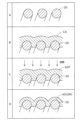
- Explanatory drawing conceptually showing a method of forming a swollen gel film GM in the present embodiment.
- Coating agent CA The coating agent CA of this embodiment contains a polymer PA represented by the following general formula (1) and an organic solvent HS.
- the polymer PA of the present embodiment contains a repeating unit of an ester-linked betaine structure (hereinafter referred to as "structural unit a1").
- structural unit a1 is a hydrogen atom or a methyl group
- R 2 is a linear or branched alkylene group having 1 to 6 carbon atoms
- R 3 and R 4 each independently an alkyl group of 1 or more and 4 or less
- R 5 is a linear or branched alkylene group having 1 or more and 4 or less carbon atoms
- Y is —COO — or —SO 3 —
- m is an integer of 1 or more
- the proportion of the structural unit a1 in the polymer PA is, for example, 10 to 100 mol %.
- repeating units of the ester-linked betaine structure include N-methacryloyloxyethyl-N,N-dimethylammonium- ⁇ -N-methylcarboxybetaine (GLBT) and 3- ⁇ [2-(methacryloyloxy)ethyl]. It is a repeating unit derived from dimethylammonio ⁇ propionate (CEBMA), 3- ⁇ [2-(methacryloyloxy)ethyl]dimethylammonio ⁇ propane-1-sulfonate (SPBMA), and the like. Among them, repeating units derived from N-methacryloyloxyethyl-N,N-dimethylammonium- ⁇ -N-methylcarboxybetaine (GLBT) are preferred.
- the polymer PA includes, in addition to the structural unit a1 represented by the above formula (1), a repeating unit derived from (meth)acrylic acid hydroxyalkyl ester (hereinafter referred to as “ (meth)acrylic acid hydroxyalkyl ester (hereinafter referred to as “structural unit a2").
- R 1 is a hydrogen atom or a methyl group
- R 2 is a linear or branched alkylene group having 1 to 6 carbon atoms
- R 3 and R 4 each independently an alkyl group of 1 to 4
- R 5 is a repeating unit that is a linear or branched alkylene group having 1 to 4 carbon atoms
- R 6 is a hydrogen atom or a methyl group
- R 7 is at least an alkyl group having 1 or more and 4 or less carbon atoms in which a hydroxyl group is bonded to one carbon atom
- Y is —COO — or —SO 3 —
- m and n are each independently an integer of 1 or more.
- the polymer PA may have, in addition to the structural unit a1 represented by the above formula (1), a repeating unit having a betaine structure other than an ester bond type (hereinafter referred to as "structural unit a4").
- structural unit a4 include repeating units represented by the following formula (3).
- R 1 is a hydrogen atom or a methyl group
- R 2 is a linear or branched alkylene group having 1 to 6 carbon atoms
- R 3 and R 4 each independently an alkyl group of 1 or more and 4 or less
- R 5 is a linear or branched alkylene group having 1 or more and 4 or less carbon atoms
- Y is —COO — or —SO 3 —
- m is 1 or more is an integer.
- the proportion of the structural unit a4 in the polymer PA is, for example, 0 to 90 mol %.
- repeating units of a betaine structure other than the ester bond type include 2- ⁇ dimethyl[3-(2-methylprop-2-enamido)-propyl]ammonio ⁇ acetate (MAMCMB), 3-[(3-methacryloylamino -propyl)-dimethyl-ammonio]-propionate (MAMCEB), 3-[(3-acryloylamino-propyl)-dimethyl-ammonio]propane-1-sulfonate (SPBAM), 3-[(3-methacryloylamino-propyl) -Dimethyl-ammonio]propane-1-sulfonate (SPBMAM) is a repeating unit derived from a monomer having an amide bond type betaine structure.
- MAMCMB 2- ⁇ dimethyl[3-(2-methylprop-2-enamido)-propyl]ammonio ⁇ acetate
- MAMCEB 3-[(3-methacryloylamino -propyl)
- the polymer PA may be a homopolymer having the structural unit a1 represented by the above formula (1) as a single repeating unit, or the structural unit a1 and the structural unit a1 represented by the above formula (2) It may be a copolymer having structural units a2 and, furthermore, a polymer having structural units based on other monomers.
- the polymer PA may be any of random copolymer, block copolymer, alternating copolymer and graft copolymer of structural unit a1 and structural unit a2.
- the polymer PA may further contain at least one structural unit having a hydrophilic structure from the viewpoint of easily improving the hydrophilicity and water-swellability of the formed film.
- Hydrophilic structures in structural units having a hydrophilic structure include amide structures (e.g., (meth)acrylamide structures, etc.), alkylene oxide structures, and lactam structures (e.g., ⁇ -lactam (three-membered ring), ⁇ -lactam ( at least one structure selected from the group consisting of four-membered ring), ⁇ -lactam (five-membered ring), ⁇ -lactam (six-membered ring), etc.).
- monomers having an amide structure include (meth)acrylamide and N,N-dimethyl(meth)acrylamide.
- Specific examples of monomers having an alkylene oxide structure include ethylene glycol and methoxyethylene glycol.
- Specific examples of monomers having a lactam structure include N-vinyl-2-caprolactam, N-vinylpyrrolidone, N-vinylpiperidone and the like.
- the ratio of the structural unit having a hydrophilic structure is the total structural units of the polymer PA from the viewpoint of easily improving the hydrophilicity and water-swellability of the formed film. is preferably 20 mol % or more, more preferably 30 mol % or more, and even more preferably 40 mol % or more.
- the ratio of the structural unit having a hydrophilic structure is the total structural units of the polymer PA from the viewpoint of easily improving the hydrophilicity and water-swellability of the formed film. is preferably 20 mol % or more, more preferably 30 mol % or more, and even more preferably 40 mol % or more.
- the total structural units of the polymer PA preferably 60 mol% or less, more preferably 55 mol% or less, still more preferably It is 50 mol % or less.
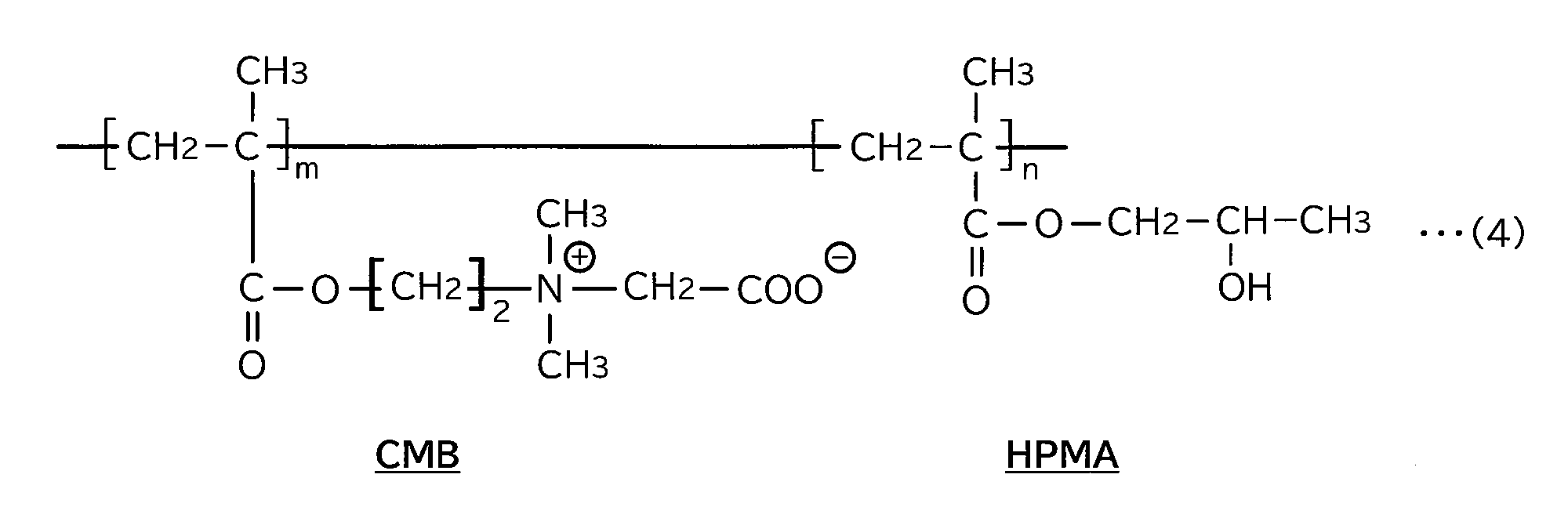
- the polymer PA is represented, for example, by the following formula (4).
- m and n are each independently an integer of 1 or more.
- the polymer PA contains, for example, a repeating unit derived from N-methacryloyloxyethyl-N,N-dimethylammonium- ⁇ -N-methylcarboxybetaine (CMB) as the structural unit a1, It is a random copolymer containing repeating units derived from 2-hydroxypropyl methacrylate (HPMA) as structural units a2.
- CMB N-methacryloyloxyethyl-N,N-dimethylammonium- ⁇ -N-methylcarboxybetaine
- HPMA 2-hydroxypropyl methacrylate
- the molar ratio of CMB and HPMA in polymer PA is, for example, 90:10 to 10:90, preferably 60:40 to 40:60.
- the molecular weight of the polymer PA is, for example, 10,000 or more and 2,000,000 or less, for example, about 100,000.
- the polymer PA contained in the coating agent CA of the present embodiment may contain 2-hydroxyethyl methacrylate (HEMA) instead of HPMA in the above formula (4). It may be a three-dimensional copolymer containing and. Moreover, the polymer PA may contain other repeating units in addition to the structural units a1 and a2. Other repeating units include, for example, polyethylene glycol (PEG), methoxyethyl acrylate (MEA), n-butyl methacrylate (BMA), 4-methacryloyloxybenzophenone (BEMA) and the like.
- PEG polyethylene glycol
- MEA methoxyethyl acrylate
- BMA n-butyl methacrylate
- BEMA 4-methacryloyloxybenzophenone
- Organic Solvent HS By dissolving the polymer PA in the organic solvent HS, it is possible to ensure the fluidity of the coating agent CA (specifically, the polymer PA) even in a high-temperature environment. can be formed into Details will be explained later.
- the organic solvent HS of the present embodiment has a dispersion term ⁇ D of 10 to 24 MPa 1/2 , a polar term ⁇ P of 5 to 19 MPa 1/2 , and a hydrogen bonding term ⁇ H of 3 to 17 MPa 1/2 in Hansen solubility parameters at 25°C. is.
- the hydrogen bonding term ⁇ H of the Hansen Solubility Parameter is greater than 17 MPa 1/2 , the solvent becomes less incompatible with the polymer PA, and in some cases becomes soluble, resulting in a gel structure formed from the polymer PA. become difficult. As a result, it becomes difficult to improve the water resistance and swelling properties of the resulting film.
- the polymer PA is a polymer containing the structural unit a1
- hydrolysis, which will be described later, of the polymer PA is less likely to occur, and as a result, a gel structure is less likely to occur.
- the hydrogen bonding term ⁇ H is less than 3 and when the polar term ⁇ P is less than 5, it does not exhibit adequate miscibility with water, and in some cases separates, so that a gel structure formed from the polymer PA is less likely to occur. Become.
- the dispersion term ⁇ D is 10 to 24 MPa 1/2 , preferably 12 to 20 MPa 1/2 , more preferably 15 to 19 MPa 1/2 .
- the polar term ⁇ P is 5 to 19 MPa 1/2 , preferably 8 to 17 MPa 1/2 , more preferably 10 to 15 MPa 1/2 .
- the hydrogen bonding term ⁇ H is 3 to 17 MPa 1/2 , preferably 5 to 14 MPa 1/2 , more preferably 7 to 13 MPa 1/2 .
- Hansen solubility parameter of the organic solvent HS the values recorded in the calculation software Hansen Solubility Parameter in Practice (HSPiP, manufacturer: Charles M. Hansen) may be used.
- HSPiP Hansen Solubility Parameter in Practice
- the Hansen solubility parameter of the organic solvent should be within the above range.
- two or more organic solvents are contained, at least one organic solvent among them should satisfy the above Hansen solubility parameters.
- the Hansen Solubility Parameters for an organic solvent HS whose dispersion term ⁇ D, polar term ⁇ P and hydrogen bonding term ⁇ H are: ⁇ (( ⁇ D ⁇ 17) 2 +( ⁇ P ⁇ 12) 2 +( ⁇ H ⁇ 10) 2 ) ⁇ 7 It is preferable to satisfy the relationship of The value calculated by the formula is preferably 7 or less.
- the organic solvent HS of the present embodiment has a high boiling point of higher than 100°C, more preferably 110°C or higher, still more preferably 115°C or higher, even more preferably 150°C or higher, and particularly preferably 180°C or higher. It is an organic solvent.
- the organic solvent HS of the present embodiment is more preferably a polar solvent, still more preferably an aprotic polar solvent.
- the boiling point of the organic solvent HS is preferably 205° C. or lower from the viewpoint of the manufacturability and availability of the water-swellable film to be obtained.
- at least one organic solvent may be an organic solvent having the above boiling point.
- the coating agent CA contains water in addition to the polymer PA and the organic solvent HS.
- the coating agent CA contains a mixed solvent of water and the organic solvent HS, and the polymer PA, and the concentration of the polymer PA with respect to the coating agent CA is, for example, , preferably 1 wt % or more, more preferably 2 wt % or more, and even more preferably 3 wt % or more. Also, it is preferably 20 wt % or less, more preferably 15 wt % or less, and even more preferably 10 wt % or less. More preferably, it should be about 5 wt %.
- the ratio of the organic solvent HS in the mixed solvent is, for example, preferably 5 wt % or more, more preferably 10 wt % or more, and even more preferably 15 wt % or more. Also, it is preferably 50 wt % or less, more preferably 45 wt % or less, and even more preferably 40 wt % or less. Even more preferably, it is about 15 wt%.
- the swollen gel film GM of this embodiment contains a polymer PB represented by the following general formula (5). More specifically, the swollen gel membrane GM is a hydrogel membrane swollen with water, and the degree of swelling is, for example, 180% or more and 900% or less, preferably 300% or more, 800% or less.
- the degree of swelling is d1, which is the film thickness when the swollen gel film GM is sufficiently dried (for example, dried to a water content of 0.1% by weight or less), and when the swollen gel film GM is sufficiently swollen. is calculated as d2/d1 ⁇ 100(%).
- the swollen gel film GM means a physically crosslinked gel.
- the polymer PB of the present embodiment includes the above structural unit a1 and a repeating unit derived from (meth)acrylic acid (hereinafter referred to as "structural unit a3").
- R 1 is a hydrogen atom or a methyl group
- R 2 is a linear or branched alkylene group having 1 to 6 carbon atoms
- R 3 and R 4 each independently an alkyl group having 1 to 4 carbon atoms
- R 5 is a linear or branched alkylene group having 1 to 4 carbon atoms
- Y is —COO — or —SO 3 —
- m and o are each independently is an integer of 1 or more.
- the polymer PB may contain the above structural unit a2 in addition to the structural unit a1 and the structural unit a3 represented by the above formula (5), as represented by the following general formula (6).
- R 1 is a hydrogen atom or a methyl group
- R 2 is a linear or branched alkylene group having 1 to 6 carbon atoms
- R 3 and R 4 each independently an alkyl group of 1 to 4
- R 5 is a repeating unit that is a linear or branched alkylene group having 1 to 4 carbon atoms
- R 6 is a hydrogen atom or a methyl group
- R 7 is at least an alkyl group having 1 or more and 4 or less carbon atoms in which a hydroxyl group is bonded to one carbon atom
- Y is -COO- or -SO 3 -
- m, n and o are each independently an integer of 1 or more; .
- the polymer PB may not contain the structural unit a1 as long as it contains a polymerized unit having a betaine structure.
- it may be a polymer containing the structural unit a4 and the structural unit a3 described above.
- a swollen gel film can be formed by interaction between the structural unit a4 and the structural unit a3.
- Such a polymer PB is obtained by using a polymer containing a structural unit a1 and a structural unit a4 as the polymer PA, and hydrolyzing all of the ester-linked betaine structures of the structural unit a1 to form the structural unit a3.
- it may be a polymer containing a structural unit a1, a structural unit a4, and a structural unit a3.
- the polymer PB included in the swollen gel film contains polymerized units having a betaine structure and polymerized units having a carboxyl group.
- the ratio of polymerized units having a betaine structure to polymerized units having a carboxyl group is preferably 90:10 to 10:90 (molar ratio), and preferably 80:20 to 60:40 (molar ratio). more preferred.
- the polymer PB may be a copolymer of the structural unit a1 and the structural unit a3 as represented by the above formula (5), or may be a copolymer of the structural unit a1 as represented by the above formula (6). , a structural unit a2, and a structural unit a3, or a polymer having a structure represented by the above formula (5) or formula (6) and further containing a structural unit a4, good too.
- it may be a copolymer of the structural unit a4 and the structural unit a3, or a copolymer of the structural unit a4, the structural unit a2 and the structural unit a3, which does not contain the structural unit a1.
- the polymer PB may be any of random copolymers, block copolymers, alternating copolymers, and graft copolymers containing the above structural units.
- the polymer PB is represented by the following formula (7), for example.
- m, n and o are each independently an integer of 1 or more.
- the polymer PB contains, for example, a repeating unit derived from N-methacryloyloxyethyl-N,N-dimethylammonium- ⁇ -N-methylcarboxybetaine (CMB) as the structural unit a1, It is a random copolymer containing a repeating unit derived from 2-hydroxypropyl methacrylate (HPMA) as a structural unit a2 and a repeating unit derived from methacrylic acid (MA) as a structural unit a3.
- CMB N-methacryloyloxyethyl-N,N-dimethylammonium- ⁇ -N-methylcarboxybetaine
- the molar ratio of CMB, HPMA and MA in the polymer PB is, for example, 47:50:3 to 40:50:10, more preferably 45:50:5 to 43:50:7 is.
- the molecular weight of the polymer PB is, for example, 10,000 or more and 2,000,000 or less.
- the polymer PB contained in the swollen gel film GM of the present embodiment may contain 2-hydroxyethyl methacrylate (HEMA) instead of HPMA in the above formula (7).
- HEMA 2-hydroxyethyl methacrylate
- a three-dimensional copolymer containing HEMA may also be used.
- the polymer PB may contain other repeating units in addition to the structural units a1, a2, and a3.
- Other repeating units include, for example, polyethylene glycol (PEG), methoxyethyl acrylate (MEA), n-butyl methacrylate (BMA), 4-methacryloyloxybenzophenone (BEMA), and the like.
- the proportion of the polymer PB in the swollen gel film GM is, for example, preferably 1 wt% or more and 30 wt% or less, more preferably 3 wt% or more and 20 wt% or less.
- FIG. 1 is an explanatory diagram schematically showing the configuration of a guidewire 100 according to this embodiment.
- FIG. 1 shows the configuration of a longitudinal section (YZ section) of the guidewire 100. As shown in FIG. 1, illustration of part of the guide wire 100 is omitted.
- the Z-axis positive direction side is the tip side (distal side) inserted into the body, and the Z-axis negative direction side is the proximal side (proximal side) operated by an operator such as a doctor.
- FIG. 1 shows the guide wire 100 as a whole in a straight line substantially parallel to the Z-axis direction, the guide wire 100 has flexibility to the extent that it can be curved.
- the guide wire 100 is an elongated medical device that is inserted into a blood vessel or the like in order to guide a catheter to a lesion (stenosis or occlusion) in the blood vessel or the like.
- the total length of the guide wire 100 is, for example, approximately 1500 mm to 3000 mm, and the outer diameter of the guide wire 100 is, for example, approximately 0.5 to 1.2 mm.
- the guide wire 100 includes a core shaft 10, a coil body 20, a distal joint portion 32, a proximal joint portion 34, and a resin portion 40 made of the above-described swollen gel film GM.
- At least one of the core shaft 10, the coil body 20, the distal joint 32, and the proximal joint 34 is an example of the base material in the claims.
- the core shaft 10 is an elongated member having a small diameter on the distal end side and a large diameter on the proximal end side. More specifically, the core shaft 10 includes a rod-shaped small-diameter portion 11, a rod-shaped large-diameter portion 13 located on the proximal end side of the small-diameter portion 11 and having a larger diameter than the small-diameter portion 11, The tapered portion 12 is positioned between the diameter portion 11 and the large diameter portion 13 and has a diameter gradually increasing from the boundary position with the small diameter portion 11 toward the boundary position with the large diameter portion 13 . .
- the cross section (XY section) at each position of the core shaft 10 may have any shape, such as a circular shape or a flat plate shape.
- the outer diameter of the large-diameter portion 13 is, for example, approximately 0.2 to 0.6 mm.
- a known material is used as a material for forming the core shaft 10.
- a metal material more specifically, stainless steel (SUS302, SUS304, SUS316, etc.), Ni--Ti alloy, piano wire, nickel-chromium system. Alloys, cobalt alloys, tungsten, etc. are used.
- the core shaft 10 may be made of the same material as a whole, or may be made of different materials for each part.
- the coil body 20 is a coil-shaped member formed in a hollow cylindrical shape by spirally winding a wire, and is arranged to surround the outer circumference of the core shaft 10 .
- a known material is used as a material for forming the coil body 20.
- a metal material more specifically, stainless steel (SUS302, SUS304, SUS316, etc.), Ni--Ti alloy, piano wire, nickel-chromium. alloys, cobalt alloys, tungsten, etc. are used.
- the distal end joint portion 32 is a member that joins the distal end of the core shaft 10 and the distal end of the coil body 20 . That is, the tip of the core shaft 10 and the tip of the coil body 20 are fixed so as to be embedded inside the tip-side joint portion 32 .
- An outer peripheral surface of the distal end side of the distal joint portion 32 is a smooth surface (for example, a substantially hemispherical surface).
- the base end joint portion 34 is a member that joins the core shaft 10 and the base end of the coil body 20 at a predetermined position between the base end and the tip end of the core shaft 10 along the axial direction. In other words, the proximal end of the coil body 20 is fixed so as to be embedded inside the proximal joint portion 34 .
- brazing materials aluminum alloy brazing, silver brazing, gold brazing, etc.
- metal solder Al—Sn alloy , Au—Sn alloy, etc.
- adhesives epoxy adhesives, etc.
- brazing material is used as a material for forming the distal joint portion 32 and the proximal joint portion 34 .
- the resin portion 40 is a coating member that is made of resin and covers the outer peripheral surfaces of the coil body 20, the distal joint portion 32, and the proximal joint portion .
- the resin portion 40 is composed of the above-described swollen gel film GM.
- the thickness of the resin portion 40 is, for example, approximately 0.01 to 0.1 mm.
- the resin portions 40 are arranged substantially uniformly on the outer peripheral surface of the coil body 20 along the shape of the outer peripheral surface of the wire.
- FIG. 2 is an explanatory diagram conceptually showing a method of forming a swollen gel film GM on a substrate.
- FIG. 2 shows the structure of a part of the guide wire as the base material.
- the method of forming the swollen gel membrane GM is part of the method of manufacturing the guidewire 100 .
- the coating agent CA described above is prepared. That is, the coating agent CA is composed of a polymer PA containing a structural unit a1 that is a repeating unit of an ester-linked betaine structure and a structural unit a2 that is a repeating unit derived from a (meth)acrylic acid hydroxyalkyl ester, and an organic solvent HS.
- a coating agent CA is applied to the outer peripheral surface of the prepared guidewire coil body 20 and the outer surfaces of the distal side joint portion 32 and the proximal side joint portion 34 (hereinafter also referred to as "guide wire surface") ( coating step, see FIG. 2(B)).
- a method for applying the coating agent CA is not particularly limited, and examples thereof include an immersion method (dip coating method) and an atomization method (spray method).
- the coating agent CA is heated to a temperature exceeding 100°C to form the swollen gel film GM (formation step, see Fig. 2(C)). More specifically, hydrolysis of the ester bonds in the polymer PA contained in the coating agent CA forms the swollen gel film GM. More specifically, for example, the guide wire coated with the coating agent CA is dried in a hot air circulating drying oven at a predetermined temperature for a predetermined time (for example, 120° C. for 3 hours) to remove the ester in the polymer PA. Hydrolyzes bonds.
- the hydrolysis rate of the ester bonds in the polymer PA is, for example, 20% or more and 40% or less from the viewpoint of obtaining a swollen gel film GM having both good water retention and good lubricity.
- the hydrolysis temperature in the forming step is, for example, 110° C. or higher, more preferably 115° C. or higher and 135° C. or lower, and the hydrolysis time is, for example, 30 minutes or more and 5 hours or less. can do.
- the organic solvent HS contained in the coating agent CA can be selected according to the hydrolysis temperature.
- the coating agent CA by using the coating agent CA, hydrolysis proceeds only by heating without using a cross-linking agent that is generally used in the hydrolysis reaction.
- a swollen gel membrane GM can be formed.
- the mechanism for forming the swollen gel film GM from the coating agent CA will be described below.
- a configuration in which the polymer PA contained in the coating agent CA has CMB as the structural unit a1 and HPMA as the structural unit a2 as represented by the above formula (4) will be described.
- the following mechanism is similarly applied to the polymer PA in which the structural unit a1 and the structural unit a2 are any of the repeating units described above, and the polymer PA that does not have the structural unit a2.
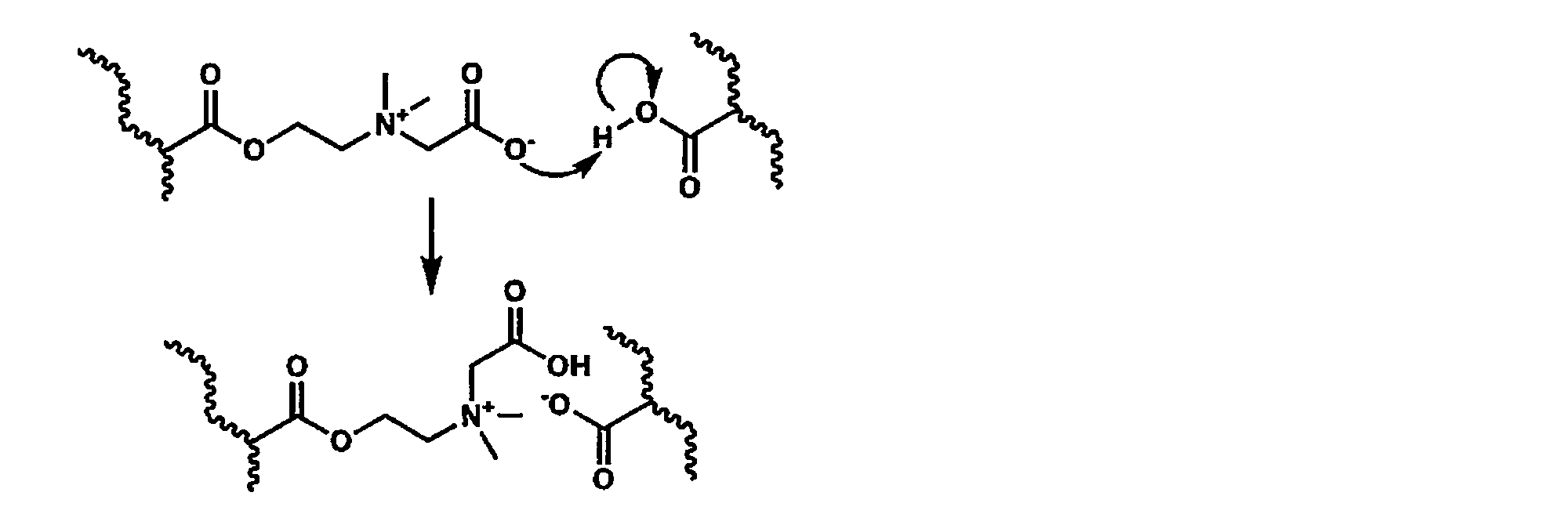
- Fig. 3 shows the hydrolysis reaction in the formation process described above.
- part of the repeating units of CMB constituting the polymer PA is hydrolyzed to produce the polymer PB having repeating units of MA. That is, by hydrolyzing the polymer PA, it is possible to produce a polymer PB containing, in one molecule, a positively charged CMB repeating unit and a negatively charged MA repeating unit.
- the carboxyl groups in the repeating units of MA are highly negatively charged. Therefore, a strong electrostatic interaction is favorably induced between the positively charged betaine structure and the highly negatively charged carboxyl group, and as a result, the polymer PB undergoes gelation within each molecule. It is thought that it was possible to
- betaine structural portion and the carboxyl group are at least partly ampholyzed by, for example, the reaction shown in the diagram below.
- a polymer containing a polymerized unit having an ester-linked betaine structure is treated in the presence of the specific organic solvent HS and water contained in the coating agent CA at a temperature above 100° C. such that the ester-linked portion is hydrolyzed, for example. It is believed that heating at a temperature causes the following interactions, forms a crosslinked structure derived from ampholite, and forms a water-swellable film.
- the coating agent CA contains the organic solvent HS
- the swollen gel film GM can be satisfactorily formed from the coating agent CA.
- Ester bonds in the polymer PA contained in the coating agent CA are favorably hydrolyzed in a high temperature environment (for example, 110° C. or higher). Therefore, the coating agent CA contains the organic solvent HS, so that the fluidity of the coating agent CA (specifically, the polymer PA) is maintained, and the ester bonds in the polymer PA can be favorably hydrolyzed.
- a high temperature environment can be realized. As a result, the hydrolysis can proceed uniformly inside and outside the molecule of the polymer PA.
- the coating agent CA can maintain the fluidity of the coating agent CA in a high-temperature environment, so that the flexibility of the molecular chains constituting the polymer PB can be ensured in the polymer PB produced through hydrolysis. can.
- the betaine structure and the carboxyl group in the polymer PB can approach to the extent that strong electrostatic interaction can be induced, and gelation can proceed within the molecule. Therefore, the inclusion of the organic solvent HS in the coating agent CA allows the hydrolysis of the polymer PA to proceed uniformly, thereby forming a swollen gel film GM with good lubricity.
- the amount of CMC to be added can be appropriately adjusted according to the thickness of the swollen gel film GM formed on the substrate. More specifically, CMC may not be added, or a low-viscosity agent may be added instead of CMC. Moreover, it may replace with CMC and may add another thickening agent.
- the above-described coating agent CA was applied by dip coating to the guide wire including the core shaft 10, the coil body 20, the distal joint portion 32, and the proximal joint portion . After that, hydrolysis was performed at a heating temperature of 120° C. for a heating time of 3 hours. Specifically, the swollen gel film GM (resin part 40) was formed on the guide wire by drying for 3 hours in a hot air circulating drying oven at 120° C. to prepare a sample S1.
- Samples S2 to S5 were prepared under the same conditions as for sample S1, except that the preparation conditions were changed as shown in Table 1 below.
- Table 1 shows the evaluation results of lubricity and film strength of samples S1 to S5.
- the lubricity was evaluated by immersing each of the samples S1 to S5 in a physiological saline solution and then rubbing the swollen gel film GM portion between fingertips. In the feel, a slippery state was defined as lubricity "A” (lubricity: high), and a rough state was defined as lubricity "B” (lubricity: low). Further, when the presence of the swollen gel film GM was not confirmed, the lubricity was rated as "C" (no swollen gel film). Also, the film strength was evaluated by measuring the resistance value. That is, the lower the resistance value, the higher the film strength.
- the resistance values were measured by sandwiching each of samples S1 to S5 between an upper urethane roller (manufactured by Misumi, AXFM-D25-L15-V8-N) and a lower stainless steel plate (SUS304, 30mm x 30mm). The weight of the roller was adjusted to 100 g, and the resistance load when the sample was pulled was measured with a force gauge while running water was flowed around it. Also, the initial resistance value and the 50-times resistance value were measured, and the durability was evaluated by comparing the two values. The initial resistance value is the resistance value obtained in the first measurement, and the 50th resistance value is the resistance value obtained in the 50th measurement when the same measurement is continuously performed 50 times.
- samples S1 to S3 were "A" (lubricity: high), while sample S4 was “B” (lubricity: low).
- the samples S1 to S3 are heated at a temperature of 120.degree. C., while the sample S4 is heated at a low temperature of 80.degree.
- the heating temperature for drying the swollen gel film GM was low, and therefore the polymer PA contained in the coating agent CA was not sufficiently hydrolyzed. .
- sample S4 had no MA-derived repeating unit (structural unit a3) in the polymer PB after hydrolysis, and as a result, , it was considered that the electrostatic interaction with the betaine structure was low in the polymer PB, and gelation did not proceed.
- sample S5 The lubricity evaluation result of sample S5 was "C" (no swollen gel film). That is, in sample S5, the presence of a swollen gel film on the guidewire was not confirmed. This is probably due to the fact that in sample S5, the coating agent did not contain the organic solvent HS, so a high-temperature environment in which the ester bonds in the polymer PA could be favorably hydrolyzed could not be achieved. rice field. That is, it was considered that the gelation of the polymer PB did not progress and the coating agent was washed away when immersed in the physiological saline.
- samples S1 to S3 in which a good swollen gel film GM was formed, had lower initial resistance values and 50th resistance values than samples S4 and S5. That is, it was confirmed that samples S1 to S3 had higher film strength than samples S4 and S5. Moreover, in the samples S1 to S3, even at the 50th resistance value, a resistance value equivalent to the initial resistance value could be obtained. In other words, the swollen gel membranes GM of samples S1 to S3 have good membrane strength and durability. Therefore, it was confirmed that the samples S1 to S3 had good film strength and durability while having good lubricity.
- the coating agent CA of the present embodiment includes a polymer PA containing a polymerized unit (structural unit a1) having an ester bond type betaine structure, and a dispersion term ⁇ D of 10 to 24 MPa in the Hansen solubility parameter at 25 ° C. 1/2 , a polar term ⁇ P of 5 to 19 MPa 1/2 , a hydrogen bonding term ⁇ H of 3 to 17 MPa 1/2 , and an organic solvent HS having a boiling point of over 100°C. Since the coating agent CA of the present embodiment contains the organic solvent HS, the swollen gel film GM can be satisfactorily formed from the coating agent CA.
- the ester bonds in the polymer PA contained in the coating agent CA are favorably hydrolyzed in a high temperature environment (for example, 110° C. or higher). Therefore, since the coating agent CA of the present embodiment contains the organic solvent HS, the fluidity of the coating agent CA (specifically, the polymer PA) is maintained and the ester bond in the polymer PA is good. It is possible to realize a high-temperature environment in which hydrolysis is possible. As a result, the hydrolysis can proceed uniformly inside and outside the molecule of the polymer PA. Further, in the coating agent CA of the present embodiment, the fluidity of the coating agent CA can be maintained in a high-temperature environment. can be secured.
- a high temperature environment for example, 110° C. or higher. Therefore, since the coating agent CA of the present embodiment contains the organic solvent HS, the fluidity of the coating agent CA (specifically, the polymer PA) is maintained and the ester bond in the polymer PA is good. It is possible to realize a high-temperature environment in which hydrolysis is possible.
- the polymer PB has, in one molecule, a polymerized unit (structural unit a1) having an ester-bonded betaine structure having a positive charge and a (meth)acrylic acid polymerized unit (structural unit a3) having a negative charge.
- the carboxyl group contained in the (meth)acrylic acid polymerization unit (structural unit a3) is highly negatively charged.
- the flexibility of the molecular chains constituting the polymer PB can be ensured, so that the positively charged betaine structure and the highly negatively charged carboxyl group can approach the extent to which it is possible to induce strong electrostatic interactions. Therefore, gelation can proceed within the molecule of the polymer PB.
- the coating agent CA of the present embodiment by including the organic solvent HS, the polymer PA can be formed by simply heating at a temperature exceeding 100° C. without a complicated process. Hydrolysis can proceed uniformly, and a swollen gel film GM with good lubricity can be formed.
- the coating agent CA of the present embodiment since it can be applied to the surface of the base material (the coil body 20 of the guidewire 100, etc.) in a state of relatively low viscosity, the complex surface of the guidewire 100, etc. can be coated. Even on the surface of a medical device having a shape, it is possible to form a swollen gel film GM whose detachment from the surface is suppressed.
- the organic solvent HS has a dispersion term ⁇ D of 10 to 24 MPa 1/2 , a polar term ⁇ P of 5 to 19 MPa 1/2 , and a hydrogen bonding term ⁇ H of 3 in Hansen solubility parameters at 25°C. ⁇ 17 MPa 1/2 and organic solvents with boiling points higher than 100°C, especially N-methyl-2-pyrrolidone (NMP), dimethylsulfoxide (DMSO), N,N-dimethylformamide (DMF), dimethyl At least one selected from acetamide (DMA), diacetone alcohol (DAOH), and diethylene glycol monoethyl ether (EDG).
- NMP N-methyl-2-pyrrolidone
- DMSO dimethylsulfoxide
- DMF N,N-dimethylformamide
- DMA acetamide
- DAOH diacetone alcohol
- EDG diethylene glycol monoethyl ether
- the solvent that is an aprotic polar solvent and has a relatively high boiling point (for example, 150° C. or higher) as the organic solvent HS By using the solvent that is an aprotic polar solvent and has a relatively high boiling point (for example, 150° C. or higher) as the organic solvent HS, the fluidity of the coating agent CA under the high-temperature environment is better maintained. can do. Therefore, according to the coating agent CA of the present embodiment, hydrolysis of the polymer PA can be progressed more effectively and uniformly, and a swollen gel film GM with good lubricity can be formed.
- the solvent that is an aprotic polar solvent and has a relatively high boiling point (for example, 150° C. or higher) as the organic solvent HS
- the swollen gel film GM of the present embodiment contains a polymer PB containing a polymerized unit (structural unit a1) having an ester bond type betaine structure and a (meth)acrylic acid polymerized unit (structural unit a2). That is, according to the swollen gel film GM of the present embodiment, the polymer PB contained in the swollen gel film GM includes, in one molecule, a polymerized unit (structural unit a1) having an ester-bonded betaine structure having a positive charge, and a (meth)acrylic acid polymerized unit (structural unit a3) having a negative charge.
- the carboxyl group contained in the (meth)acrylic acid polymerization unit (structural unit a3) is highly negatively charged.
- the swollen gel film GM of the present embodiment has a strong electrostatic interaction between the positively charged betaine structure and the highly negatively charged carboxyl group in each molecule constituting the polymer PB. is well induced, and as a result, the gelation state can be well maintained within each molecule.
- the guidewire 100 of this embodiment is coated with the above-described swollen gel film GM. Therefore, according to the guidewire 100 of the present embodiment, it is possible to provide the guidewire 100 having the swollen gel membrane GM in which a good gelation state is maintained in each molecule.
- the method of forming the swollen gel film GM of the present embodiment includes a coating step of applying the coating agent CA onto the base material, and a method of forming the swollen gel film GM by heating the coating agent CA at a temperature exceeding 100°C. and a step.
- the coating agent CA contains a polymer PA containing a polymerized unit (structural unit a1) having an ester-bonded betaine structure, and an organic solvent HS having a boiling point of over 100°C.
- the swollen gel membrane GM is formed by hydrolyzing the ester bonds in the polymer PA.
- the coating agent CA is composed of the polymer PA containing polymerized units (constituent unit a1) having an ester-bonded betaine structure and the organic solvent HS having a boiling point of more than 100°C. , the swollen gel film GM can be satisfactorily formed on the substrate without complicated steps.
- the base material is a guide wire.
- the hydrolysis rate of the ester bonds in the polymer PB is 20% or more and 40% or less. According to the method of forming the swollen gel membrane GM of the present embodiment, it is possible to adjust the degree of swelling to an appropriate level.
- each solvent shown in Table 2 was used, except for the synthesis of the polymer PA.
- Resin compositions 5-2 to 5-16 were obtained in the same manner. The insoluble film-forming properties, water resistance, and water swelling properties of these resin compositions were measured in the same manner as described above. Table 2 shows the results.
- the substrate coated with the swollen gel film GM may be a medical device other than the guidewire 100, or may be another substrate that requires good lubricity.
- a guide wire was used as an example of an elongated medical device, but the technology disclosed in this specification can be similarly applied to other elongated medical devices such as catheters. be.
- the elongated medical device will be described below.
- the elongated medical device of the present invention can be a medical device that is used by being inserted into the body.
- the elongated medical device of the present invention uses, as a base material, for example, an elongated medical device whose outer circumference is made of metal or an elongated medical device whose outer circumference is formed of a resin such as urethane,
- An elongated medical device can be formed by forming the previously described swelling gel film on the surface of the base material.
- Elongated medical devices of the present invention include, for example, guidewires or catheters as particularly suitable forms. Specifically, for example, a guide wire having a metal outer circumference, a catheter having a hollow shaft having an outer circumference made of a resin such as polyurethane, or the like can be used as the base material.
- the catheter of the present disclosure is not particularly limited, and any catheter such as a guiding catheter, a penetrating catheter, a microcatheter, a balloon catheter, a foreign body removal catheter, an imaging catheter, a bile duct catheter, a urethral catheter, an endoscope, and a dilator.
- the guidewire of the present disclosure is not particularly limited, and for example, a PCI guidewire for coronary artery treatment, a PTA guidewire for lower extremity vascular treatment, an IVR guidewire for peripheral vascular treatment, and an INR guidewire for cerebrovascular treatment. , CAG guidewires for imaging, or any other guidewire.
- the elongated medical device of the present embodiment can adopt various configurations such as those shown in (a) to (e) below.
- the swollen gel film in the following (a) to (e) is a swollen gel film containing the polymer (a1) containing a polymerized unit having a betaine structure and a polymerized unit having a carboxyl group, as described in this specification. be.
- resins are preferable as materials for forming the following coating layers and tubular members. etc.
- a guide wire comprising a linear core wire, a coating layer provided on at least part of the outer circumference of the core wire, and a swollen gel film formed on the surface of the coating layer.
- a guide wire comprising a linear core wire, a coil layer in which a wire is helically wound around at least a portion of the outer periphery of the core wire, and a swollen gel film formed on the surface of the coil layer.
- a linear core wire comprising: a formed gel film.
- a catheter comprising a tubular member and a swollen gel film formed on the surface of the tubular member.
- a catheter comprising a tubular member, a balloon arranged at one end of the tubular member, and a swollen gel film formed on the surface of the balloon.
- the elongated medical device of the present embodiment may have a configuration different from (a) to (e) described above, and may be an elongated medical device other than a guide wire or catheter. At least part of the surface of the long medical device may be provided with the above-described swelling gel film.
Landscapes
- Health & Medical Sciences (AREA)
- Life Sciences & Earth Sciences (AREA)
- Public Health (AREA)
- Veterinary Medicine (AREA)
- Animal Behavior & Ethology (AREA)
- General Health & Medical Sciences (AREA)
- Epidemiology (AREA)
- Heart & Thoracic Surgery (AREA)
- Dispersion Chemistry (AREA)
- Chemical & Material Sciences (AREA)
- Vascular Medicine (AREA)
- Surgery (AREA)
- Biophysics (AREA)
- Pulmonology (AREA)
- Engineering & Computer Science (AREA)
- Anesthesiology (AREA)
- Biomedical Technology (AREA)
- Hematology (AREA)
- Materials For Medical Uses (AREA)
- Media Introduction/Drainage Providing Device (AREA)
- Paints Or Removers (AREA)
Abstract
Description
A-1.コーティング剤CA:
本実施形態のコーティング剤CAは、下記一般式(1)で表されるポリマーPAと、有機溶媒HSとを含有する。
下記式(1)で表されるように、本実施形態のポリマーPAは、エステル結合型ベタイン構造の繰り返し単位(以下、「構成単位a1」とよぶ)を含んでいる。


ポリマーPAを有機溶媒HSに溶解させることにより、高温環境下においてもコーティング剤CA(具体的には、ポリマーPA)の流動性を確保することができ、この結果、後述の膨潤ゲル膜GMを良好に形成することができる。詳しくは、後で説明する。
√((δD-17)2+(δP-12)2+(δH-10)2)≦7
の関係を満たすことが好ましい。該式により算出される値は、好ましくは7以下である。上記の式は、分散項δD=17、極性項δP=12、水素結合項δH=10である中心値に対し、相互作用半径R=7.0であるハンセン球内に該有機溶媒が属していることを表す。
本実施形態の膨潤ゲル膜GMは、下記一般式(5)で表されるポリマーPBを含有する。より具体的には、膨潤ゲル膜GMは、水を含んで膨潤したハイドロゲル膜であり、その膨潤度は、例えば、膨潤度が180%以上、900%以下であり、好ましくは300%以上、800%以下である。なお、上記膨潤度は、膨潤ゲル膜GMを十分に乾燥(例えば、水含有量を0.1重量%以下に乾燥)した時の膜厚をd1、膨潤ゲル膜GMを十分に膨潤させた時の膜厚をd2としたとき、d2/d1×100(%)として算出される。また、本実施形態において、膨潤ゲル膜GMは、物理架橋ゲルを意味する。
下記式(5)で表されるように、本実施形態のポリマーPBは、上述の構成単位a1と、(メタ)アクリル酸に由来する繰り返し単位(以下、「構成単位a3」とよぶ)とを含んでいることが好ましい。


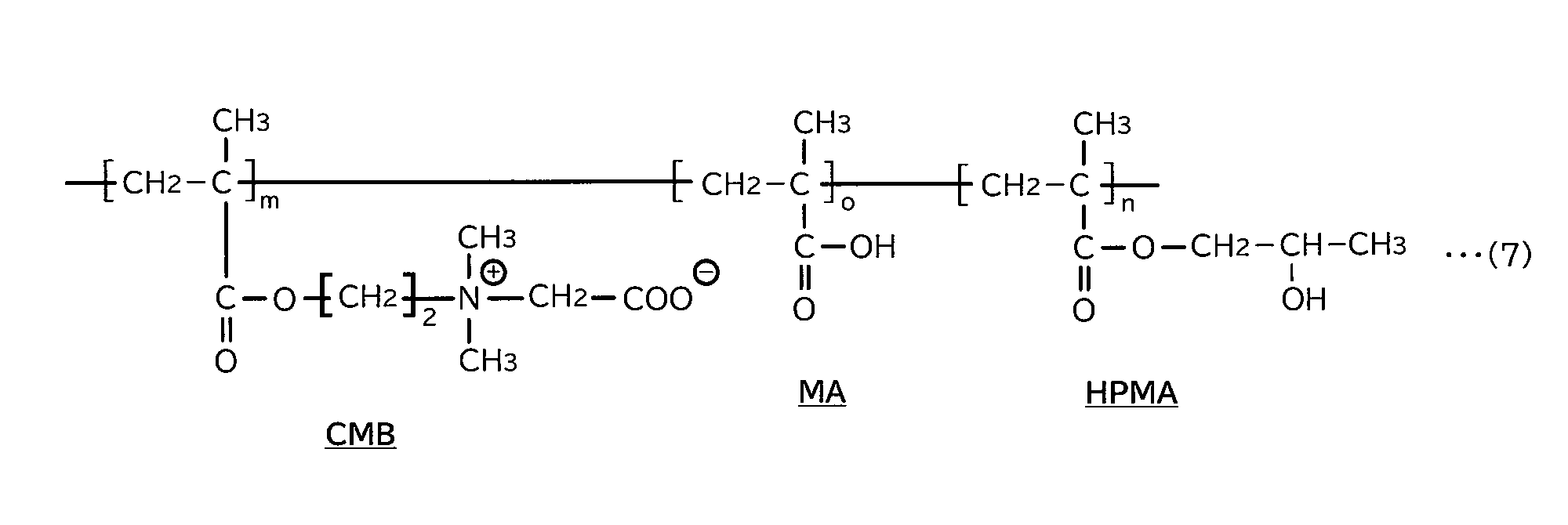
図1は、本実施形態におけるガイドワイヤ100の構成を概略的に示す説明図である。図1には、ガイドワイヤ100の縦断面(YZ断面)の構成が示されている。なお、図1では、ガイドワイヤ100の一部分の図示が省略されている。図1において、Z軸正方向側が、体内に挿入される先端側(遠位側)であり、Z軸負方向側が、医師等の手技者によって操作される基端側(近位側)である。図1では、ガイドワイヤ100が全体としてZ軸方向に略平行な直線状となった状態を示しているが、ガイドワイヤ100は湾曲させることができる程度の可撓性を有している。
次に、本実施形態の膨潤ゲル膜GMの形成方法の一例を説明する。図2は、基材上に膨潤ゲル膜GMを形成する方法を概念的に示す説明図である。なお、図2には、基材としてのガイドワイヤの一部分の構成が示されている。また、膨潤ゲル膜GMの形成方法は、ガイドワイヤ100の製造方法の一部である。

膨潤ゲル膜GM(樹脂部40)を備えたガイドワイヤ100について、以下の項目につき性能評価を行った。まず、サンプルS1~S5の作製方法について説明する。
(ポリマーPAの合成)
まず、CMB(大阪有機化学工業株式会社製、商品名:GLBT) 0.014molと、HPMA(富士フィルム和光純薬製、商品名:メタクリル酸ヒドロキシプロピル)0.014molとを、混合溶液(水:エタノール比 50:50) 20gに添加し、溶解させた。得られた溶液を撹拌しながら、過硫酸アンモニウム(東京化成工業株式会社製、商品名:APS) 0.00026molを更に添加し、溶解させた。得られた溶液を60℃の恒温槽で20時間撹拌しつつ反応させることにより、CMB-HPMA共重合体を含むポリマー溶液を得た。得られたポリマー溶液を、20倍量のアセトン溶液に滴下して再結晶させ、濾過後真空乾燥してポリマー固体(ポリマーPA)を得た。得られたポリマーPAの数平均分子量は、約10万であった。ポリマーPAの数平均分子量は、NMR(核磁気共鳴)およびGPC(ゲル浸透クロマトグラフィー)を用いて測定した。
有機溶媒HS(富士フィルム和光純薬製、商品名:1-メチル-2-ピロリドン(NMP))を含む混合溶液(蒸留水:NMP比 70:30)にポリマーPAを溶解させて、5wt%のポリマー溶液を調製した。本性能評価では、ポリマー溶液の粘度を上げるために、上記ポリマー溶液に、増粘剤としてカルボキシメチルセルロース(CMC、Sigma-Aldrich社製、商品名:CMC ultra high viscosity) 0.3wt%を添加し、撹拌してコーティング剤CAを調整した。なお、CMCの添加量は、基材上に形成する膨潤ゲル膜GMの厚みに応じて、適宜調整することができる。より具体的には、CMCを添加しなくてもよく、また、CMCに代えて、低粘剤を添加してもよい。また、CMCに代えて、他の増粘剤を添加してもよい。
コアシャフト10と、コイル体20と、先端側接合部32と、基端側接合部34と、を備えたガイドワイヤに対して、ディップコート法により、上述のコーティング剤CAを塗布した。その後、加熱温度120℃、加熱時間3時間で加水分解した。具体的には、120℃の熱風循環乾燥炉内で、3時間乾燥させて、ガイドワイヤ上に膨潤ゲル膜GM(樹脂部40)を形成し、サンプルS1を作製した。
分解率(%)=HCMB(mol)/ポリマー中の理論GLBT(mol)×100
調製条件を下記表1に示すように変更した以外は、サンプルS1と同様の条件でサンプルS2~S5を作製した。
下記表1には、サンプルS1~S5の潤滑性および膜強度についての評価結果が示されている。潤滑性は、サンプルS1~S5をそれぞれ生理食塩水に浸漬し、その後、指先で膨潤ゲル膜GM部分を挟んで擦過させた際の感触により評価した。当該感触において、ヌルヌルしている状態を潤滑性「A」(潤滑性:高)とし、ザラザラしている状態を潤滑性「B」(潤滑性:低)とした。また、膨潤ゲル膜GMの存在が確認されないときを潤滑性「C」(膨潤ゲル膜なし)とした。また、膜強度は、抵抗値の測定により評価した。すなわち、抵抗値が低いほど、膜強度が高いことを意味する。抵抗値の測定は、サンプルS1~S5をそれぞれ、上のウレタンローラー(ミスミ製、AXFM-D25-L15-V8-N)と下のステンレス板(SUS304、30mm×30mm)との間に挟み、ウレタンローラーが100gとなるように重量を調整した状態とし、その上で流水を周辺に流しながら、サンプルを引っ張った際の抵抗荷重をフォースゲージで測定することにより実施した。また、初期抵抗値および50回抵抗値を測定し、両者を比較することにより耐久性を評価した。初期抵抗値は、1回目の測定で得られた抵抗値であり、50回目抵抗値は、同様の測定を連続して50回行った際の50回目の測定で得られた抵抗値である。

以上説明したように、本実施形態のコーティング剤CAは、エステル結合型ベタイン構造を有する重合単位(構成単位a1)を含むポリマーPAと、25℃におけるハンセン溶解度パラメータにおいて、分散項δDが10~24MPa1/2、極性項δPが5~19MPa1/2、水素結合項δHが3~17MPa1/2であり、沸点が100℃超の有機溶媒である有機溶媒HSと、を含んでいる。本実施形態のコーティング剤CAが有機溶媒HSを含んでいることにより、コーティング剤CAから膨潤ゲル膜GMを良好に形成することができる。より具体的には、コーティング剤CAに含まれるポリマーPA中のエステル結合は、高温環境下(例えば、110℃以上)で良好に加水分解される。このため、本実施形態のコーティング剤CAでは、有機溶媒HSを含んでいることにより、コーティング剤CA(具体的には、ポリマーPA)の流動性を維持しつつ、ポリマーPA中のエステル結合が良好に加水分解可能な高温環境を実現することができる。この結果、ポリマーPAの分子内外において、均一に加水分解を進行させることができる。また、本実施形態のコーティング剤CAでは、高温環境下でのコーティング剤CAの流動性を維持できることにより、加水分解を経て生成されたポリマーPB中において、ポリマーPBを構成する分子鎖の柔軟性を確保することができる。ここで、ポリマーPBは、一分子内に、正電荷を有するエステル結合型ベタイン構造を有する重合単位(構成単位a1)と、負電荷を有する(メタ)アクリル酸重合単位(構成単位a3)とを有する。また、(メタ)アクリル酸重合単位(構成単位a3)に含まれるカルボキシル基は、高い負電荷を帯びている。上述の通り、本実施形態のコーティング剤CAでは、ポリマーPBを構成する分子鎖の柔軟性が確保できることにより、ポリマーPB中において、正電荷を帯びたベタイン構造と、高い負電荷を帯びたカルボキシル基とが、強い静電相互作用を誘発させることが可能な程度に近づくことができる。このため、ポリマーPBの分子内においてゲル化を進行させることができる。従って、本実施形態のコーティング剤CAによれば、有機溶媒HSを含んでいることにより、煩雑な工程を経ることなく、換言すれば、単に100℃超の温度で加熱することにより、ポリマーPAの加水分解を均一に進行させることができ、ひいては、潤滑性の良好な膨潤ゲル膜GMを形成することができる。また、本実施形態のコーティング剤CAによれば、比較的粘度の低い状態で基材(ガイドワイヤ100のコイル体20等)の表面に塗布することができるため、ガイドワイヤ100等の複雑な表面形状を有する医療機器の表面においても、当該表面からの離脱が抑制された、膨潤ゲル膜GMを形成することができる。
GLBT、HPMA、MAAをモル比が43:50:7、モノマー総濃度が10%になるように、水に溶解させた以外はポリマーPAの合成と同様に行うことで、ポリマーの溶液を得た。得られたポリマーの粘度平均分子量は100,000であった。このようにして得たポリマーの溶液とNMPとを1:0.15の質量比で混合し、樹脂組成物を得た。樹脂組成物における共重合体、有機溶媒、および水との質量比は、共重合体:有機溶媒:水=8.7:13.0:78.3であった。
樹脂組成物をテフロン(登録商標)コーティングされたトレイに広げた後、市販の温風乾燥機を用いて、85℃で3時間乾燥した。得られた共重合体固形物10部に90部の水を加え、室温で30分間撹拌した後、24時間静置し、溶液の状態を次の基準で評価した。
A:溶液が透明である
B:溶液中に溶け残りがある、又は溶液が白濁する
樹脂組成物2.5部をテフロン(登録商標)コーティングされたトレイ(10cm×10cm)に広げた後、125℃の雰囲気下で3時間放置し、硬化物を得た。硬化物をトレイから剥ぎ取り、剥ぎ取った硬化物2部を容器に入れ、水98部を加えて室温で24時間静置した後、溶液の状態を目視で確認し次の基準で評価した。なお、評価結果をカッコつきで示しているものは予測値を示す。後述の他の評価においても同様である。
A:硬化物が膨潤した状態で残留している。
B:硬化物が溶解している、あるいは、膨潤していない状態で残留している。
前述した耐水性と同様にして得られた硬化物2部を容器に入れ、水98部を加えて室温で24時間静置した後、溶液の状態を目視で確認し次の基準で評価した。
A:硬化物が膨潤した状態で残留している。
B:硬化物が溶解している、あるいは、膨潤していない状態で残留している。

上記実施形態において、膨潤ゲル膜GMを被膜する基材は、ガイドワイヤ100以外の医療機器であってもよく、良好な潤滑性が求められる他の基材であってもよい。
本発明の長尺状医療機器は、体内に挿入して用いる医療機器とすることができる。具体的には、本発明の長尺状医療機器は、例えば、外周が金属製の長尺状医療機器や、外周がウレタン等の樹脂で形成された長尺状医療機器を基材として用い、基材の表面に既述した膨潤ゲル膜を形成した長尺状医療機器とすることができる。本発明の長尺状医療機器としては、例えば、ガイドワイヤまたはカテーテルを、特に好適な形態として挙げることができる。具体的には、例えば、外周が金属製のガイドワイヤ、外周がポリウレタン等の樹脂製の中空シャフトを備えるカテーテル等を、基材として用いることができる。
(b)線状のコアワイヤと、該コアワイヤの外周の少なくとも一部に線材が螺旋状に巻回されたコイル層と、該コイル層の表面に形成された膨潤ゲル膜と、を備えるガイドワイヤ。
(c)線状のコアワイヤと、該コアワイヤの外周の少なくとも一部に線材が螺旋状に巻回されたコイル層と、該コイル層の外周に設けられた被覆層と、該被覆層の表面に形成されたゲル膜と、を備えるガイドワイヤ。
(d)管状部材と、該管状部材の表面に形成された膨潤ゲル膜と、を備えるカテーテル。
(e)管状部材と、該管状部材の片端に配置されたバルーンと、該バルーンの表面に形成された膨潤ゲル膜と、を備えるカテーテル。
Claims (8)
- 基材と、前記基材を被覆する膨潤ゲル膜と、を備える長尺状医療機器において、
前記膨潤ゲル膜は、ベタイン構造を有する重合単位と、カルボキシル基を有する重合単位(但し、前記ベタイン構造を有する重合単位を除く。)と、を含むポリマー(a1)を含む、
長尺状医療機器。 - 請求項1に記載の長尺状医療機器であって、
前記ベタイン構造を有する重合単位は、エステル結合型ベタイン構造を有する重合単位を含む、
長尺状医療機器。 - 請求項1または請求項2に記載の長尺状医療機器であって、
前記膨潤ゲル膜は、膨潤度が180%以上、900%以下である、
長尺状医療機器。 - 請求項1から請求項3までのいずれか一項に記載の長尺状医療機器であって、
前記膨潤ゲル膜は、前記ポリマー(a1)中のベタイン構造を有する重合単位:カルボキシル基を有する重合単位のモル比が、80:20~60:40である、
長尺状医療機器。 - 請求項1から請求項4までのいずれか一項に記載の長尺状医療機器であって、
前記基材は、ガイドワイヤまたはカテーテルである、
長尺状医療機器。 - 長尺状医療機器の製造方法であって、
コーティング剤を基材上に塗布する塗布工程と、
前記コーティング剤を加熱することにより、膨潤ゲル膜を形成させる形成工程と、を含み、
前記コーティング剤は、
エステル結合型ベタイン構造を有する重合単位を含むポリマーと、
25℃におけるハンセン溶解度パラメータにおいて、分散項δDが10~24MPa1/2、極性項δPが5~19MPa1/2、水素結合項δHが3~17MPa1/2であり、100℃より高い沸点を有する有機溶媒と、
水と、を含み、
前記形成工程では、前記ポリマー中のエステル結合が加水分解することにより、前記膨潤ゲル膜が形成される、
長尺状医療機器の製造方法。 - 請求項6に記載の長尺状医療機器の製造方法において、
前記有機溶媒は、N-メチル-2-ピロリドン(NMP)、ジメチルスルホキシド(DMSO)、N,N-ジメチルホルムアミド(DMF)、ジメチルアセトアミド(DMA)、ダイアセトンアルコール(DAOH)、および、ジエチレングリコールモノエチルエーテル(EDG)から選択される少なくとも一種である、
長尺状医療機器の製造方法。 - 請求項6または請求項7に記載の長尺状医療機器の製造方法であって、
前記基材は、ガイドワイヤまたはカテーテルであり、
前記形成工程において、前記ポリマー中のエステル結合の加水分解率は、20%以上、40%以下である、
長尺状医療機器の製造方法。
Priority Applications (3)
| Application Number | Priority Date | Filing Date | Title |
|---|---|---|---|
| EP22886870.9A EP4424334A4 (en) | 2021-10-29 | 2022-10-21 | Elongated medical instrument and its production process |
| CN202280071591.4A CN118159308A (zh) | 2021-10-29 | 2022-10-21 | 长条状医疗器械及其制造方法 |
| US18/645,416 US20240299631A1 (en) | 2021-10-29 | 2024-04-25 | Elongated medical instrument and method for producing same |
Applications Claiming Priority (2)
| Application Number | Priority Date | Filing Date | Title |
|---|---|---|---|
| JP2021177323A JP7822745B2 (ja) | 2021-10-29 | 2021-10-29 | 長尺状医療機器およびその製造方法 |
| JP2021-177323 | 2021-10-29 |
Related Child Applications (1)
| Application Number | Title | Priority Date | Filing Date |
|---|---|---|---|
| US18/645,416 Continuation US20240299631A1 (en) | 2021-10-29 | 2024-04-25 | Elongated medical instrument and method for producing same |
Publications (1)
| Publication Number | Publication Date |
|---|---|
| WO2023074543A1 true WO2023074543A1 (ja) | 2023-05-04 |
Family
ID=86159418
Family Applications (1)
| Application Number | Title | Priority Date | Filing Date |
|---|---|---|---|
| PCT/JP2022/039207 Ceased WO2023074543A1 (ja) | 2021-10-29 | 2022-10-21 | 長尺状医療機器およびその製造方法 |
Country Status (5)
| Country | Link |
|---|---|
| US (1) | US20240299631A1 (ja) |
| EP (1) | EP4424334A4 (ja) |
| JP (1) | JP7822745B2 (ja) |
| CN (1) | CN118159308A (ja) |
| WO (1) | WO2023074543A1 (ja) |
Families Citing this family (1)
| Publication number | Priority date | Publication date | Assignee | Title |
|---|---|---|---|---|
| CN115845151A (zh) * | 2021-09-24 | 2023-03-28 | 王浩 | 一种亲水超滑的医用导管 |
Citations (4)
| Publication number | Priority date | Publication date | Assignee | Title |
|---|---|---|---|---|
| JP2007130194A (ja) * | 2005-11-10 | 2007-05-31 | Osaka Organic Chem Ind Ltd | 医療用材料 |
| JP2013237737A (ja) * | 2012-05-12 | 2013-11-28 | Hokkaido Univ | 水性ゲル |
| WO2016052618A1 (ja) * | 2014-10-02 | 2016-04-07 | 旭化成メディカル株式会社 | 生体由来液処理フィルター及びフィルターデバイス |
| US20160355624A1 (en) * | 2014-07-24 | 2016-12-08 | Shenzhen University | Betaine-based shape memory polymer and preparation method thereof |
Family Cites Families (2)
| Publication number | Priority date | Publication date | Assignee | Title |
|---|---|---|---|---|
| US11912894B2 (en) * | 2018-11-26 | 2024-02-27 | Cornell University | Antimicrobial and antifouling conformal hydrogel coatings |
| CN114269403A (zh) * | 2019-08-21 | 2022-04-01 | 泰尔茂株式会社 | 医疗器械及其制造方法 |
-
2021
- 2021-10-29 JP JP2021177323A patent/JP7822745B2/ja active Active
-
2022
- 2022-10-21 WO PCT/JP2022/039207 patent/WO2023074543A1/ja not_active Ceased
- 2022-10-21 CN CN202280071591.4A patent/CN118159308A/zh active Pending
- 2022-10-21 EP EP22886870.9A patent/EP4424334A4/en active Pending
-
2024
- 2024-04-25 US US18/645,416 patent/US20240299631A1/en active Pending
Patent Citations (4)
| Publication number | Priority date | Publication date | Assignee | Title |
|---|---|---|---|---|
| JP2007130194A (ja) * | 2005-11-10 | 2007-05-31 | Osaka Organic Chem Ind Ltd | 医療用材料 |
| JP2013237737A (ja) * | 2012-05-12 | 2013-11-28 | Hokkaido Univ | 水性ゲル |
| US20160355624A1 (en) * | 2014-07-24 | 2016-12-08 | Shenzhen University | Betaine-based shape memory polymer and preparation method thereof |
| WO2016052618A1 (ja) * | 2014-10-02 | 2016-04-07 | 旭化成メディカル株式会社 | 生体由来液処理フィルター及びフィルターデバイス |
Non-Patent Citations (1)
| Title |
|---|
| See also references of EP4424334A4 |
Also Published As
| Publication number | Publication date |
|---|---|
| JP2023066631A (ja) | 2023-05-16 |
| EP4424334A4 (en) | 2025-10-29 |
| US20240299631A1 (en) | 2024-09-12 |
| EP4424334A1 (en) | 2024-09-04 |
| JP7822745B2 (ja) | 2026-03-03 |
| CN118159308A (zh) | 2024-06-07 |
Similar Documents
| Publication | Publication Date | Title |
|---|---|---|
| CN105073155B (zh) | 医疗器械及医疗器械的制造方法 | |
| CN106999636B (zh) | 医疗用具及其制造方法 | |
| JP5477071B2 (ja) | 湿潤時に潤滑性を有する医療用具 | |
| JP7773485B2 (ja) | 医療器具のための潤滑性で耐久性のコーティング | |
| JP2022518293A (ja) | コーティング | |
| JP2025087670A (ja) | 医療機器用uv硬化コーティング | |
| WO2023074543A1 (ja) | 長尺状医療機器およびその製造方法 | |
| CN104558667B (zh) | 介入导管表面处理方法及介入导管 | |
| WO2024190656A1 (ja) | 医療用具および医療用具の製造方法 | |
| CN116162405B (zh) | 单层亲水涂层及其配制体系和可植入医疗器材 | |
| JP2025517743A (ja) | 医療機器コーティングの製造および使用 | |
| JP2696053B2 (ja) | 潤滑性表面を有する医療用具、その製造法及びそのためのコーティング剤 | |
| CN112368309B (zh) | 亲水性共聚物及医疗器械 | |
| JP2013169283A (ja) | 医療用具の製造方法および医療用具 | |
| JP5805627B2 (ja) | 医療用器具及びその製造方法 | |
| CN116535722A (zh) | 一种鼻胃管表面双组份水凝胶润滑涂层的制备方法 | |
| CN116392645A (zh) | 亲水润滑涂层的制备方法 | |
| WO2025158984A1 (ja) | 医療材料およびその製造方法、ならびに医療用具 | |
| US20240399105A1 (en) | Testing device, testing method, and elongated medical body | |
| CN105593320B (zh) | 涂布层、涂布液、涂布层的形成方法和医疗用具的制造方法 | |
| JPH10248920A (ja) | 医療用具及びその製造方法 | |
| CN119285856A (zh) | 一种聚乙烯吡咯烷酮共聚物及其制备方法和应用 | |
| WO2025204207A1 (ja) | カテーテル | |
| WO2025204208A1 (ja) | 医療用具 | |
| WO2026034322A1 (ja) | 医療用具及び偏在測定方法 |
Legal Events
| Date | Code | Title | Description |
|---|---|---|---|
| 121 | Ep: the epo has been informed by wipo that ep was designated in this application |
Ref document number: 22886870 Country of ref document: EP Kind code of ref document: A1 |
|
| WWE | Wipo information: entry into national phase |
Ref document number: 202280071591.4 Country of ref document: CN |
|
| WWE | Wipo information: entry into national phase |
Ref document number: 2022886870 Country of ref document: EP |
|
| NENP | Non-entry into the national phase |
Ref country code: DE |
|
| ENP | Entry into the national phase |
Ref document number: 2022886870 Country of ref document: EP Effective date: 20240529 |