WO2023074608A1 - 炭酸カルシウム水スラリーおよび炭酸カルシウム水スラリーの製造方法 - Google Patents
炭酸カルシウム水スラリーおよび炭酸カルシウム水スラリーの製造方法 Download PDFInfo
- Publication number
- WO2023074608A1 WO2023074608A1 PCT/JP2022/039483 JP2022039483W WO2023074608A1 WO 2023074608 A1 WO2023074608 A1 WO 2023074608A1 JP 2022039483 W JP2022039483 W JP 2022039483W WO 2023074608 A1 WO2023074608 A1 WO 2023074608A1
- Authority
- WO
- WIPO (PCT)
- Prior art keywords
- calcium carbonate
- particle size
- slurry
- aqueous
- volume
- Prior art date
- Legal status (The legal status is an assumption and is not a legal conclusion. Google has not performed a legal analysis and makes no representation as to the accuracy of the status listed.)
- Ceased
Links
Images



Classifications
-
- C—CHEMISTRY; METALLURGY
- C01—INORGANIC CHEMISTRY
- C01F—COMPOUNDS OF THE METALS BERYLLIUM, MAGNESIUM, ALUMINIUM, CALCIUM, STRONTIUM, BARIUM, RADIUM, THORIUM, OR OF THE RARE-EARTH METALS
- C01F11/00—Compounds of calcium, strontium, or barium
- C01F11/18—Carbonates
-
- C—CHEMISTRY; METALLURGY
- C01—INORGANIC CHEMISTRY
- C01F—COMPOUNDS OF THE METALS BERYLLIUM, MAGNESIUM, ALUMINIUM, CALCIUM, STRONTIUM, BARIUM, RADIUM, THORIUM, OR OF THE RARE-EARTH METALS
- C01F11/00—Compounds of calcium, strontium, or barium
- C01F11/18—Carbonates
- C01F11/185—After-treatment, e.g. grinding, purification, conversion of crystal morphology
-
- C—CHEMISTRY; METALLURGY
- C09—DYES; PAINTS; POLISHES; NATURAL RESINS; ADHESIVES; COMPOSITIONS NOT OTHERWISE PROVIDED FOR; APPLICATIONS OF MATERIALS NOT OTHERWISE PROVIDED FOR
- C09C—TREATMENT OF INORGANIC MATERIALS, OTHER THAN FIBROUS FILLERS, TO ENHANCE THEIR PIGMENTING OR FILLING PROPERTIES ; PREPARATION OF CARBON BLACK ; PREPARATION OF INORGANIC MATERIALS WHICH ARE NO SINGLE CHEMICAL COMPOUNDS AND WHICH ARE MAINLY USED AS PIGMENTS OR FILLERS
- C09C1/00—Treatment of specific inorganic materials other than fibrous fillers; Preparation of carbon black
- C09C1/02—Compounds of alkaline earth metals or magnesium
- C09C1/021—Calcium carbonates
-
- D—TEXTILES; PAPER
- D21—PAPER-MAKING; PRODUCTION OF CELLULOSE
- D21H—PULP COMPOSITIONS; PREPARATION THEREOF NOT COVERED BY SUBCLASSES D21C OR D21D; IMPREGNATING OR COATING OF PAPER; TREATMENT OF FINISHED PAPER NOT COVERED BY CLASS B31 OR SUBCLASS D21G; PAPER NOT OTHERWISE PROVIDED FOR
- D21H19/00—Coated paper; Coating material
- D21H19/36—Coatings with pigments
- D21H19/38—Coatings with pigments characterised by the pigments
-
- C—CHEMISTRY; METALLURGY
- C01—INORGANIC CHEMISTRY
- C01P—INDEXING SCHEME RELATING TO STRUCTURAL AND PHYSICAL ASPECTS OF SOLID INORGANIC COMPOUNDS
- C01P2004/00—Particle morphology
- C01P2004/30—Particle morphology extending in three dimensions
- C01P2004/45—Aggregated particles or particles with an intergrown morphology
-
- C—CHEMISTRY; METALLURGY
- C01—INORGANIC CHEMISTRY
- C01P—INDEXING SCHEME RELATING TO STRUCTURAL AND PHYSICAL ASPECTS OF SOLID INORGANIC COMPOUNDS
- C01P2004/00—Particle morphology
- C01P2004/51—Particles with a specific particle size distribution
-
- C—CHEMISTRY; METALLURGY
- C01—INORGANIC CHEMISTRY
- C01P—INDEXING SCHEME RELATING TO STRUCTURAL AND PHYSICAL ASPECTS OF SOLID INORGANIC COMPOUNDS
- C01P2004/00—Particle morphology
- C01P2004/60—Particles characterised by their size
- C01P2004/61—Micrometer sized, i.e. from 1-100 micrometer
-
- C—CHEMISTRY; METALLURGY
- C01—INORGANIC CHEMISTRY
- C01P—INDEXING SCHEME RELATING TO STRUCTURAL AND PHYSICAL ASPECTS OF SOLID INORGANIC COMPOUNDS
- C01P2004/00—Particle morphology
- C01P2004/60—Particles characterised by their size
- C01P2004/62—Submicrometer sized, i.e. from 0.1-1 micrometer
-
- C—CHEMISTRY; METALLURGY
- C01—INORGANIC CHEMISTRY
- C01P—INDEXING SCHEME RELATING TO STRUCTURAL AND PHYSICAL ASPECTS OF SOLID INORGANIC COMPOUNDS
- C01P2006/00—Physical properties of inorganic compounds
- C01P2006/12—Surface area
-
- C—CHEMISTRY; METALLURGY
- C01—INORGANIC CHEMISTRY
- C01P—INDEXING SCHEME RELATING TO STRUCTURAL AND PHYSICAL ASPECTS OF SOLID INORGANIC COMPOUNDS
- C01P2006/00—Physical properties of inorganic compounds
- C01P2006/22—Rheological behaviour as dispersion, e.g. viscosity, sedimentation stability
-
- C—CHEMISTRY; METALLURGY
- C01—INORGANIC CHEMISTRY
- C01P—INDEXING SCHEME RELATING TO STRUCTURAL AND PHYSICAL ASPECTS OF SOLID INORGANIC COMPOUNDS
- C01P2006/00—Physical properties of inorganic compounds
- C01P2006/60—Optical properties, e.g. expressed in CIELAB-values
Definitions
- the present invention relates to an aqueous calcium carbonate slurry and a method for producing the same.
- the whiteness, opacity, white paper glossiness, printing glossiness and the like are particularly important for printing applications.
- Whiteness is related to contrast
- opacity is related to show-through
- glossiness is related to the quality of printed matter.
- lightly coated paper for which demand has been increasing in recent years, has become a subject of improvement in opacity as well as weight reduction in recent years.
- coating pigments for coated paper light calcium carbonate, heavy calcium carbonate, kaolin, talc, silica, titanium dioxide, etc. are generally used.
- the finer the particle diameter of the pigment the higher the glossiness, so the pigment is sometimes pulverized to reduce the particle diameter.
- the particle size is less than a certain particle diameter equal to or shorter than the wavelength in the visible light region, it will not contribute to the opacity.
- Even in a region where the average particle size of the pigment contributes to opacity excessive pulverization may occur depending on the pulverization method of the pigment, resulting in a broad particle size distribution and the presence of many fine particles that do not contribute to opacity. and the density of the coating layer increases.
- Patent Document 1 a low-concentration light calcium carbonate aqueous slurry is subjected to a concentration treatment or the like to produce a high-concentration slurry having a predetermined solid content concentration, a viscosity-lowering agent is added, the slurry is subjected to primary dispersion treatment in a mixer, and then the mixture is dispersed.
- a method for preparing an aqueous slurry of light calcium carbonate by performing a secondary dispersion treatment by sand grinding is disclosed.
- Patent Document 1 discloses that the light calcium carbonate in the aqueous slurry after the secondary dispersion treatment is spindle-shaped or scalenohedral calcium carbonate with a BET specific surface area of 5.0 to 20 m 2 /g.
- Patent Document 2 discloses a light calcium carbonate slurry obtained by wet pulverizing light calcium carbonate with a sand grinder, having a volume-based average primary particle size of 0.3 to 0.8 ⁇ m, and being softly aggregated. ing.
- the adjustment method of Patent Document 1 is characterized in that the dispersion treatment is performed twice, and each treatment is performed so that the BET specific surface area is increased by a predetermined amount.
- a mixer is used in the first step of coarse slurry dispersion, even if the dispersibility of light calcium carbonate is poor and a viscosity reducing agent is used, the dispersion of such a mixer cannot achieve 70% or more, which is the objective of the present patent. It is difficult to disperse at a high concentration of preferably 72%, more preferably 73% or more.
- the light calcium carbonate slurry of Patent Document 2 is characterized by a primary particle size of 0.3 to 0.8 ⁇ m and the presence of soft aggregates.
- a primary particle size of 0.3 to 0.8 ⁇ m
- the coated paper No technique is disclosed for obtaining a slurry of high concentration of calcium carbonate necessary to obtain high gloss on lightly coated paper.
- the engineered calcium carbonate of Patent Document 3 when used as a coating liquid, it can be expected to improve the opacity and whiteness of the coated paper. Therefore, in the examples, when preparing the coating liquid, fine kaolin is used together to obtain a high density color of 60%. In addition, considering that the BET specific surface area is improved by more than twice before and after the pulverization process, it is highly possible that the spindle shape of calcium carbonate has been lost, making it suitable for high-speed coating and high-quality coated paper. It is difficult to obtain a water slurry that can achieve both glossiness and opacity.
- an object of the present invention is to provide a high-concentration yet low-viscosity high-speed coating containing calcium carbonate having a BET specific surface area and an average particle size within a predetermined range and an aspect ratio of the primary particles within a predetermined range.
- the BET specific surface area of the primary particles is 3 to 15 m 2 /g
- the aspect ratio calculated from the image analysis of the electron microscope image is 2 to 10
- the laser diffraction particle diameter of the primary particles and/or aggregated particles An aqueous slurry of calcium carbonate having a measured volume-based average particle size of 0.3 to 1 ⁇ m
- the calcium carbonate has a solid content concentration of 70% by weight or more, a B-type viscosity (rotation speed: 60 rpm) of 2000 mPa s or less, and a high shear viscosity (rotation speed: 1100 rpm) of 80 mPa s or less.
- Calcium water slurry is 3 to 15 m 2 /g
- the aspect ratio calculated from the image analysis of the electron microscope image is 2 to 10
- the laser diffraction particle diameter of the primary particles and/or aggregated particles An aqueous slurry of calcium carbonate having a measured volume-based average particle size of 0.3 to 1
- the aqueous calcium carbonate slurry contains a polymeric dispersant selected from the group consisting of polycarboxylic acid, polyacrylic acid, naphthalenesulfonic acid formalin condensation, and polyethylene glycol, or an alkylsulfonic acid or quaternary ammonium dispersant. , and higher alcohol alkylene oxides.
- a polymeric dispersant selected from the group consisting of polycarboxylic acid, polyacrylic acid, naphthalenesulfonic acid formalin condensation, and polyethylene glycol, or an alkylsulfonic acid or quaternary ammonium dispersant. , and higher alcohol alkylene oxides.
- the present invention provides the following steps: charging the dispersing device with water, grinding media and dispersant; A step of adding calcium carbonate to the dispersing device in a plurality of times, stirring, and wet pulverizing to obtain an aqueous calcium carbonate slurry; including A method for producing an aqueous calcium carbonate slurry, comprising pulverizing the aqueous calcium carbonate slurry until the viscosity of the aqueous calcium carbonate slurry exhibits a minimum value or a substantially minimum value,
- the BET specific surface area of the primary particles of calcium carbonate contained in the aqueous calcium carbonate slurry is 3 to 15 m 2 /g, the aspect ratio calculated from image analysis of electron microscope images is 2 to 10, the primary particles and/or aggregates
- the particles have a volume-based average particle size of 0.3 to 1 ⁇ m by laser diffraction particle size measurement,
- the calcium carbonate aqueous slurry has a solid content concentration of 70% by weight or more,
- the integrated stirring output of the stirring is preferably 0.5 kW/kg or more.
- the volume-based average particle size of the calcium carbonate put into the dispersing device is 10 ⁇ m or less by laser diffraction particle size measurement, and the aspect ratio calculated from the image analysis of the electron microscope image of the primary particles is 2 to 10. Preferably.
- the calcium carbonate charged into the dispersing device is produced by a causticizing method.
- the present invention is a calcium carbonate aqueous slurry obtained by the production method of the present invention.
- the aqueous calcium carbonate slurry obtained by the production method of the present invention is particularly used as a coating pigment for coated paper, improving the whiteness, opacity and glossiness of the coated paper and maintaining its bulkiness. can be done.
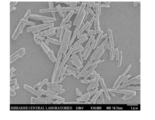
- FIG. 1 is an electron micrograph (magnification: 30000) of calcium carbonate contained in the aqueous calcium carbonate slurry produced in Example 1.
- FIG. FIG. 2 is an electron micrograph (magnification: 10000) of calcium carbonate contained in the aqueous calcium carbonate slurry produced in Example 2.
- FIG. 3 is an electron micrograph (magnification: 10000) of calcium carbonate contained in the aqueous calcium carbonate slurry produced in Example 3.
- FIG. 4 is an electron micrograph (magnification: 20000) of calcium carbonate contained in the aqueous calcium carbonate slurry produced in Comparative Example 1.
- FIG. 5 is an electron micrograph (magnification: 10000) of calcium carbonate contained in the aqueous calcium carbonate slurry produced in Comparative Example 2.
- FIG. 6 is an electron micrograph (magnification: 20000) of calcium carbonate contained in the aqueous calcium carbonate slurry produced in Comparative Example 3.
- FIG. 7 is an electron micrograph (magnification: 20000) of calcium carbonate contained in the aqueous calcium carbonate slurry produced in Comparative Example 4.
- FIG. FIG. 8 is a graph showing an example of the relationship between the viscosity of the calcium carbonate aqueous slurry and the pulverization time.
- the BET specific surface area of the primary particles is 3 to 15 m 2 /g
- the aspect ratio calculated from the image analysis of the electron microscope image is 2 to 10
- the primary particles and/or aggregated particles An aqueous slurry of calcium carbonate having a volume-based average particle size of 0.3 to 1 ⁇ m as measured by laser diffraction particle size measurement, wherein the calcium carbonate has a solid content concentration of 70% by weight or more, and has a B-type viscosity (rotational speed : 60 rpm) is 2000 mPa ⁇ s or less, and the high shear viscosity (rotational speed: 1100 rpm) is 80 mPa ⁇ s or less.
- aqueous slurry refers to a mixed suspension of water and solids. That is, the calcium carbonate aqueous slurry is an aqueous liquid in a suspended state in which calcium carbonate dissolved in water and calcium carbonate not dissolved in water coexist. Calcium carbonate dissolved and/or dispersed in the aqueous calcium carbonate slurry of the present embodiment has a BET specific surface area of primary particles of 3 to 15 m 2 /g, and an aspect ratio calculated from image analysis of an electron microscope image. 2 to 10, and the volume-based average particle size of primary particles and/or aggregated particles measured by laser diffraction particle size measurement is 0.3 to 1 ⁇ m.
- the BET specific surface area can be determined by allowing a substance to adsorb gas molecules (nitrogen or the like) whose adsorption area is known and measuring the amount.
- the BET specific surface area of calcium carbonate can be measured according to Japanese Industrial Standard JIS Z 8830 "Method for measuring specific surface area of powder (solid) by gas adsorption". In embodiments, it is preferred that the BET specific surface area is 3-15 m 2 /g, preferably 4-10 m 2 /g, more preferably 6-9 m 2 /g.
- the aspect ratio of calcium carbonate means the length-to-width ratio of calcium carbonate particles, and in the present embodiment, it means the ratio of the major axis to the minor axis of primary particles of calcium carbonate.
- the aspect ratio of calcium carbonate can be calculated by image analysis based on electron microscope observation.
- the aspect ratio dissolved and/or dispersed in the aqueous calcium carbonate slurry of the embodiment is 2-10, preferably 2.5-8, more preferably 3-7.
- the volume-based average particle size by laser diffraction particle size measurement is measured from the light intensity distribution pattern obtained by irradiating the particles with a laser beam and analyzing the diffracted light and scattered light emitted from the particles. volume-based average particle size.
- the volume-based average particle size measured for the calcium carbonate contained in the calcium carbonate aqueous slurry obtained in the embodiment is 0.3 to 1 ⁇ m, preferably 0.5 to 0.8 ⁇ m.
- the solid content concentration of calcium carbonate is 70% by weight or more, preferably 72% or more.
- the calcium carbonate aqueous slurry has a B-type viscosity (rotation speed: 60 rpm) of 2000 mPa s or less, preferably 1500 mPa s or less, and a high shear viscosity (rotation speed: 1100 rpm) of 80 mPa s or less, preferably 50 mPa s or less. is.
- the B-type viscosity can be measured according to Japanese Industrial Standard JIS Z 8803:2011.
- high shear viscosity (that is, viscosity at high shear) is measured by a device capable of measuring in a high shear rate range, such as a high shear viscometer DV-10 manufactured by HERCULES.
- the rotational speed of the rotational viscometer may be measured as 1100 rpm.
- the glossiness of the paper can be high, and the calender linear pressure can be lowered to achieve the target glossiness. Bulkyness also leads to further improvement in opacity.
- the high shear viscosity (high shear viscosity) measured with a rotational viscometer at a rotational speed of 1100 rpm is 80 mPa/s or less. is important.
- a water slurry containing calcium carbonate can be obtained by conventionally known various methods, and is not particularly limited.
- the second embodiment of the present invention is a method for producing an aqueous calcium carbonate slurry, and the aqueous calcium carbonate slurry according to one embodiment can be obtained by the method for producing an aqueous calcium carbonate slurry according to the second embodiment.
- a second embodiment includes the following steps: charging a dispersing device with water, grinding media and dispersing agent; obtaining a water slurry; and pulverizing the calcium carbonate water slurry until the viscosity of the calcium carbonate water slurry exhibits a minimum value or a substantially minimum value.
- an aqueous calcium carbonate slurry in which calcium carbonate aggregated by a strong cohesive force is suspended in water is pulverized to produce calcium carbonate having a desired BET specific surface area, aspect ratio, and average particle size.
- This is a method for obtaining an aqueous slurry of calcium carbonate in which particles are dispersed.
- the term “crushing” means breaking a high-order structure (for example, aggregates) of calcium carbonate into lower-order particles, that is, turning tertiary particles into secondary particles. , or when specifically explaining that secondary particles are changed to primary particles.
- pulverization refers to the application of energy to solid particles to reduce the size of the particles and create new surfaces.
- wet pulverization means that solids such as powders are present in a solvent together with pulverizing media, if necessary, and a shearing force is applied thereto to pulverize or pulverize the solids.
- all reductions in particle size, including "crushing" of calcium carbonate particles may be referred to as “pulverization”.
- pulverization all reductions in particle size, including "crushing" of calcium carbonate particles.
- the manufacturing method of the embodiment has a step of charging water, grinding media and dispersant into a dispersing device.
- a dispersing device is a device capable of stirring with a strong stirring power using grinding media in order to crush calcium carbonate aggregated by a strong cohesive force.
- devices such as colles, attritors, keddy mills, cone mills, sand grinders and ball mills can be used. Calcium carbonate can be pulverized by these devices alone.
- a multi-pass medium agitating type that is a general wet pulverization equipment is used. It can also be pulverized using a device such as a pulverizer, a sand grinder, a strong pulverizing rush-type Viscom mill, a cone mill, a vibration mill, or an attritor.
- a device such as a pulverizer, a sand grinder, a strong pulverizing rush-type Viscom mill, a cone mill, a vibration mill, or an attritor.
- Various devices such as ejector type, venturi type, obstacle collision type, rotary drum type, and rotary vane type can be used as the wet pulverizing device.
- grinding media examples include beads made of hard raw materials such as zirconia, glass, ceramics, and alumina.
- grinding media with a bead size of 0.1-10 mm, preferably 0.5-5 mm can be used.
- Wet milling can be carried out at a calcium carbonate solids concentration of 65-80%, preferably 70-78%. If the solid content concentration of calcium carbonate is too high, the slurry viscosity will increase, making uniform pulverization difficult. If the solid content concentration of calcium carbonate is too low (for example, 10% or less), the chances of collisions between calcium carbonate particles or between calcium carbonate particles and beads decrease, and it takes longer time for pulverization. In addition, for example, if it is 60% or less, a calcium carbonate slurry suitable for high-speed coating cannot be obtained.
- the dispersant is not particularly limited, but in addition to polycarboxylic acid-based, polyacrylic acid-based, naphthalenesulfonic acid formalin condensate-based, polyethylene glycol and other polymeric dispersants, alkylsulfonic acid-based, quaternary ammonium Common inorganic pigment dispersants such as surfactant-type dispersants such as higher alcohol alkylene oxide-based dispersants can be used alone or in combination. In the production method of the second embodiment, it is preferable to use a polycarboxylic acid-based dispersant. Also, the amount of the dispersant to be added can be selected to be an effective amount suitable for the concentration of calcium carbonate.
- the effective amount is an amount such that the increase in viscosity of the aqueous calcium carbonate slurry does not significantly reduce the pulverization efficiency, or an amount that does not impose an abnormal load on the dispersing device.
- the effective amount means a range of 0.1 to 5.0% by weight based on the solid weight of calcium carbonate in the aqueous slurry of calcium carbonate to be wet-milled. If the calcium carbonate aqueous slurry causes abnormal thickening due to a lack of a dispersant, it may not be possible to obtain an aqueous slurry containing calcium carbonate having the desired BET specific surface area, volume-based average particle size, and aspect ratio.
- the amount of the dispersing agent added is too large, the calcium carbonate aqueous slurry tends to foam, which may lead to problems such as deterioration in handling during production and transportation, and an increase in production costs.
- a dispersant commercially available polycarboxylic acid-based dispersants and polyacrylic acid-based dispersants such as Aron T series (Toagosei Co., Ltd.), Polity A series (Lion Corporation), Poise series (Kao Chemical Co., Ltd.) are used. can do.
- the calcium carbonate aqueous slurry of one embodiment produced by the production method of the second embodiment contains a dispersant due to the production method.
- the manufacturing method of the embodiment has a step of charging calcium carbonate into a dispersing device in a plurality of times, stirring, and wet pulverizing to obtain an aqueous calcium carbonate slurry.
- calcium carbonate generally exists in the form of aggregates in which primary particles are strongly aggregated.
- Such an aqueous slurry of aggregated calcium carbonate is pulverized to obtain calcium carbonate in a state of substantially only primary particles.
- Calcium carbonate can be obtained, for example, by mixing and reacting an aqueous calcium hydroxide slurry and an aqueous solution containing sodium carbonate to obtain an aqueous calcium carbonate slurry, followed by drying or the like (caustic method).
- calcium hydroxide is calcium hydroxide represented by the chemical formula Ca(OH) 2 and is generally called slaked lime.
- a water slurry in which calcium hydroxide is suspended in water is generally called milk of lime.
- Sodium carbonate is a sodium carbonate represented by the chemical formula Na2CO3 .
- As the sodium carbonate green liquor produced in the pulp manufacturing process of a paper mill, for example, can also be used.
- the calcium hydroxide aqueous slurry and the sodium carbonate aqueous solution can be mixed by mixing and stirring predetermined amounts of the calcium hydroxide aqueous slurry and the sodium carbonate aqueous solution.
- Calcium carbonate is a salt of calcium with the chemical formula CaCO3 .
- calcium carbonate is obtained by the carbon dioxide method in which calcium carbonate is calcined at a high temperature to decarboxylate to obtain calcium oxide, and then carbon dioxide is reacted with an aqueous calcium hydroxide slurry obtained by reacting calcium oxide with water.
- calcium carbonate can also be obtained by a solution method in which an aqueous solution of a soluble calcium salt such as calcium chloride and an aqueous solution of a soluble carbonate such as sodium carbonate are mixed and reacted.
- a soluble calcium salt such as calcium chloride
- a soluble carbonate such as sodium carbonate
- the calcium carbonate aqueous slurry obtained by any of the above methods is appropriately filtered, optionally washed with water, and then dried in a dryer to obtain dry powder of calcium carbonate.
- dryers include box dryers, vibration dryers, drum dryers, vacuum stirring dryers, shelf vacuum dryers, double cone dryers, vacuum filtration dryers, band-type ventilation dryers, spray dryers, rotary dryers, and flash dryers.
- General dryers such as can be used alone or in combination.
- the primary particles of the obtained dry powder of calcium carbonate may have any crystal form of calcium carbonate, such as calcite crystals, aragonite crystals, and vaterite crystals.
- the particles of calcium carbonate may have a shape such as a spherical shape, a substantially cubic shape, a spindle shape, a needle shape, a rosette shape, or the like.
- the powdery calcium carbonate obtained by drying the aqueous calcium carbonate slurry obtained by the production method of the second embodiment is preferably spindle-shaped calcite crystals or needle-shaped aragonite crystals.
- the volume-based average particle size of the calcium carbonate put into the dispersing device by laser diffraction particle size measurement is 10 ⁇ m or less, and the aspect is calculated from the image analysis of the electron microscope image of the primary particles. Preferably the ratio is 2-10.
- the volume-based average particle size measured by laser diffraction particle size measurement of calcium carbonate before wet pulverization includes not only primary particles of calcium carbonate, but also secondary particles, tertiary particles, coarse particles, etc., which are agglomerates of primary particles. represents the volume-based average particle size.
- an aqueous calcium carbonate slurry containing calcium carbonate which is generally agglomerated in many cases, is wet pulverized.
- the aspect ratio calculated from the image analysis of the electron microscope image of the primary particles of calcium carbonate before wet pulverization is preferably 2-10.
- the aspect ratio is the length-to-width ratio, and for calcium carbonate particles, it refers to the ratio of the major axis to the minor axis of the primary particles.
- the aspect ratio calculated from the image analysis of the electron microscope image of the primary particles of calcium carbonate before wet pulverization is preferably 2-10, preferably 2.5-8, more preferably 3-7.
- the BET specific surface area of calcium carbonate charged into the dispersing device in the production method of the second embodiment is 2 to 14 m 2 /g, preferably 2.6 to 9.5 m 2 /g, more preferably 4 to 8.6 m 2 . /g.
- Calcium carbonate may be added to the dispersing device so that the solid content concentration of calcium carbonate in the aqueous calcium carbonate slurry obtained by the manufacturing method of the second embodiment is finally 70% or more, preferably 72% or more. can. Calcium carbonate is charged into the dispersing device while the dispersing device is in operation, and the dispersing device continues to operate. Perform wet grinding. At this time, it is preferable to stir so that the integrated stirring output (meaning the integrated value of stirring capacity) is 0.5 kW/kg or more. Although it depends on the dispersing device used, stirring can be performed so that the integrated stirring output is 0.5 kW/kg or more and 20 kW/kg or less, preferably 1 kW/kg or more and 10 kW/kg or less.
- the integrated stirring output meaning the integrated value of stirring capacity
- the adjustment of the wet-grinding time is important in obtaining calcium carbonate with the desired particle size, particle size distribution and aspect ratio.
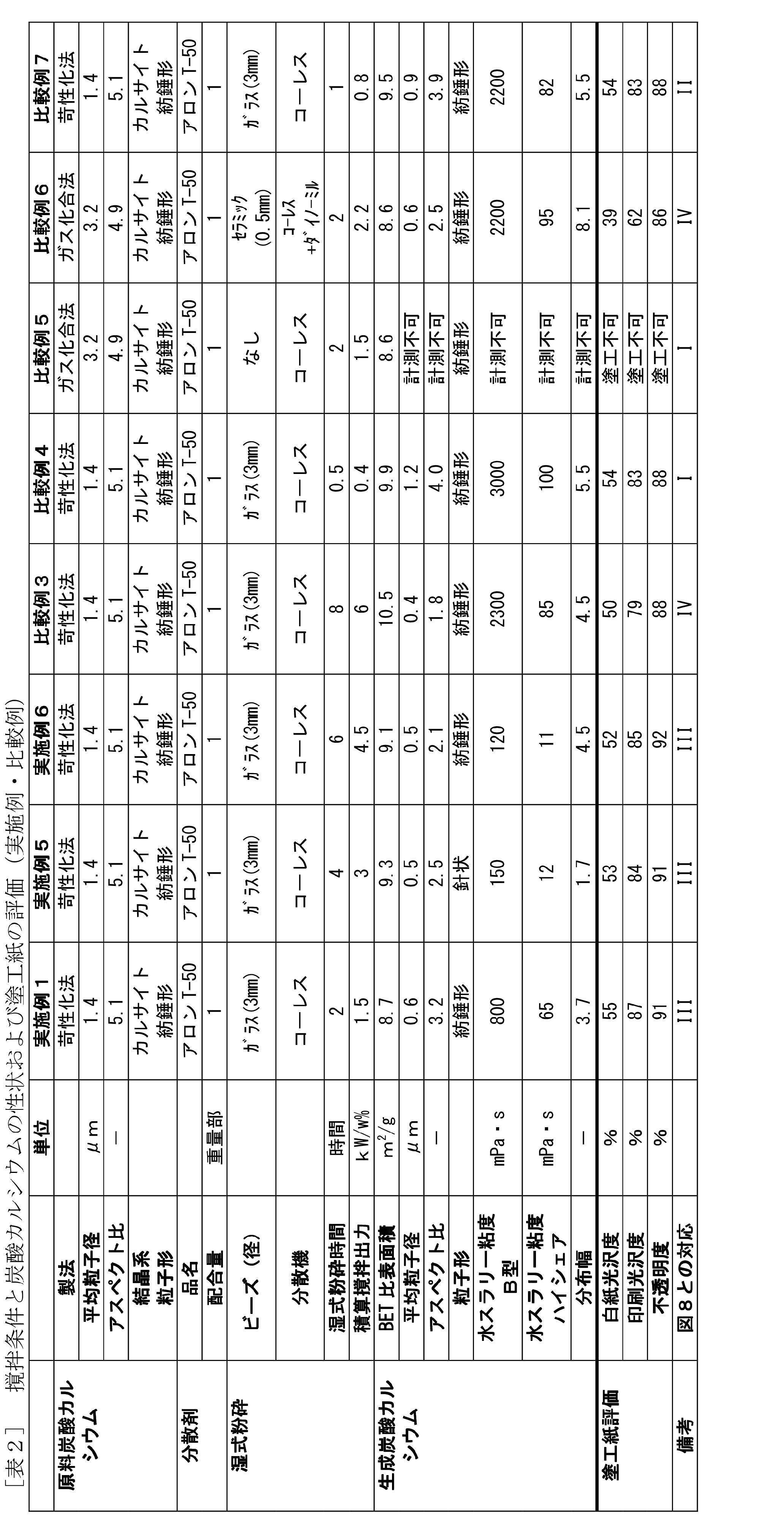
- the pulverization time can also be adjusted by the volume of the calcium carbonate water slurry to be pulverized. In general, drawing a pulverization curve (see FIG. 8) plotting the pulverization time on the horizontal axis and the viscosity of the calcium carbonate aqueous slurry on the vertical axis shows that the viscosity of the aqueous calcium carbonate slurry increases ( Region I), the viscosity drops sharply as wet milling progresses (Region II).
- the calcium carbonate water slurry viscosity shows a minimum value. It can be considered that the fact that the viscosity of the calcium carbonate aqueous slurry shows a minimum value means that almost all of the higher-order structure of calcium carbonate has been crushed and almost all of the calcium carbonate has become primary particles. If the wet pulverization is continued after the viscosity of the aqueous calcium carbonate slurry reaches a minimum value, the primary particles of calcium carbonate are pulverized to generate fine particles. As a result, the viscosity of the calcium carbonate aqueous slurry tends to increase.
- the substantially minimum value of the viscosity of the aqueous calcium carbonate slurry is a value slightly larger than the minimum value of the viscosity, for example, a value obtained by increasing the minimum value (absolute value) of the viscosity by 10%, preferably 5%. It shall mean an increased value, more preferably up to a 3% increased value.
- the range including the minimum value and the approximate minimum value of the aqueous calcium carbonate slurry is defined as the minimum region (region III), and the wet grinding time is preferably adjusted so that the viscosity of the aqueous calcium carbonate slurry reaches the minimum region.
- the pulverization time is too short, the agglomeration of the primary particles of calcium carbonate cannot be sufficiently crushed, so that the B-type viscosity of the calcium carbonate aqueous slurry increases, and the slurry may also have a high high shear viscosity (area II).
- the pulverization time is too long, the primary particles of calcium carbonate are destroyed and a large amount of finely divided calcium carbonate is generated, so that the viscosity of the aqueous calcium carbonate slurry rises above a substantially minimum value (Region IV).
- the aspect ratio of the calcium carbonate contained in the aqueous calcium carbonate slurry in this region is low, which lowers the opacity of the aqueous calcium carbonate slurry and has a great effect on the development of glossiness.
- Appropriate wet-grinding time may vary depending on various factors such as the capacity of the dispersing device and the amount of calcium carbonate aqueous slurry to be wet-grinded.
- An appropriate wet-grinding time can be determined by determining the relationship between the viscosity of the aqueous calcium carbonate slurry and the wet-grinding time, such as by operating with a small volume in advance and determining the approximate wet-grinding time. .
- the desired aqueous calcium carbonate slurry can be obtained by removing the grinding media from the aqueous calcium carbonate slurry obtained by wet grinding for an appropriate time by a known method such as filtration.
- Calcium carbonate dissolved and/or dispersed in the aqueous calcium carbonate slurry obtained by the production method of the second embodiment has a BET specific surface area of primary particles of 3 to 15 m 2 /g, and from image analysis of electron microscope images It is preferable that the calculated aspect ratio is 2 to 10, and the volume-based average particle size of the primary particles and/or aggregated particles measured by laser diffraction particle size measurement is 0.3 to 1 ⁇ m.
- the BET specific surface area of calcium carbonate dissolved and/or dispersed in the calcium carbonate aqueous slurry is 3 to 15 m 2 /g, preferably 4 to 10 m 2 /g, more preferably 6 to 9 m 2 /g. is preferred.
- the BET specific surface area of calcium carbonate dissolved or dispersed in the calcium carbonate aqueous slurry is obtained by sampling a predetermined amount of sample from the calcium carbonate aqueous slurry, filtering and drying it by ordinary means, and obtaining a powder.
- Solid calcium carbonate can be measured according to Japanese Industrial Standard JIS Z 8830 "Method for measuring specific surface area of powder (solid) by gas adsorption".
- the viscosity of the aqueous calcium carbonate slurry obtained by the production method of the second embodiment is such that the B-type viscosity (rotation speed: 60 rpm) is 2000 mPa s or less and the high shear viscosity (rotation speed: 1100 rpm) is 80 mPa s or less.
- the B-type viscosity rotation speed: 60 rpm
- the high shear viscosity rotation speed: 1100 rpm
- the aspect ratio of calcium carbonate dissolved and/or dispersed in the aqueous calcium carbonate slurry is 2-10, preferably 2.5-8, more preferably 3-7.
- the aspect ratio calculated from the image analysis of the electron microscope image of the primary particles of calcium carbonate before wet pulverization is 2 to 10, preferably 2.5 to 8, more preferably 3 to 7.
- An aqueous calcium carbonate slurry containing primary particles of calcium carbonate having such an aspect ratio is wet pulverized as described above so that the aspect ratio is 2 to 10, preferably 2.5 to 8, more preferably 3 to 7. is preferred. This means that the aspect ratio of the primary particles of calcium carbonate hardly changes during the wet pulverization process.
- Little change in the aspect ratio of the primary particles of calcium carbonate means that the primary particles of calcium carbonate were hardly pulverized in the wet pulverization step. That is, in the step of wet pulverization of the aqueous calcium carbonate slurry in the present embodiment, aggregates such as secondary particles and tertiary particles of calcium carbonate are pulverized, but primary particles are hardly pulverized. be. If the aspect ratio of calcium carbonate contained in the aqueous calcium carbonate slurry obtained in the embodiment is too large, the glossiness of coated paper and the fluidity of the aqueous calcium carbonate slurry may be impaired.
- the aspect ratio of calcium carbonate is too small, the faceted surfaces of the calcium carbonate particles in the coated paper that contribute to the reflection of visible light are reduced, and the opacity and glossiness of the coated paper may be impaired.
- the viscosity of the aqueous calcium carbonate slurry can be reduced. % or higher.
- the short diameter of calcium carbonate contained in the aqueous calcium carbonate slurry obtained in the embodiment is about 0.05 to 1 ⁇ m, preferably about 0.1 to 0.5 ⁇ m.
- the volume-based average particle size of the calcium carbonate contained in the calcium carbonate aqueous slurry obtained in the embodiment is very preferably 0.3 to 1 ⁇ m, preferably 0.5 to 0.8 ⁇ m. . If the volume-based average particle size of the calcium carbonate contained in the calcium carbonate aqueous slurry obtained in the embodiment is too large, it indicates that the crushing of the aggregates has not progressed, and the glossiness of the coated paper is impaired.
- the distribution width of the volume-based particle size of the contained calcium carbonate measured by laser diffraction particle size measurement is 5 or less.
- the calcium carbonate aqueous slurry of one embodiment and the calcium carbonate aqueous slurry obtained by the production method of the second embodiment can be used as a pigment for coated paper, and can also be used as a pigment for paint.
- a pigment for coated paper commonly used heavy calcium carbonate, light calcium carbonate, kaolin, clay, delaminated clay, talc, satin white, silica, barium sulfate, calcium sulfate, oxide
- Inorganic pigments such as zinc and titanium dioxide, organic pigments such as plastic pigments, and the like can be used in combination of one or more.
- % and parts mean % by weight and parts by weight, respectively, and numerical ranges include their endpoints.
- calcium carbonate simply refers to light calcium carbonate, ie, synthetic calcium carbonate, unless otherwise specified.
- the volume-based average particle size of the calcium carbonate contained in the calcium carbonate aqueous slurry was 0.6 ⁇ m when the calcium carbonate aqueous slurry was measured by laser diffraction using Mastersizer 3000 manufactured by Malvern.
- the aspect ratio of the calcium carbonate contained in the aqueous calcium carbonate slurry was calculated from an electron microscope photograph of the aqueous calcium carbonate slurry, and was found to be in the form of a spindle with an aspect ratio of 3.2.
- Example 2 An aqueous calcium carbonate slurry was obtained in the same manner as in Example 1, except that the solid content concentration of the aqueous calcium hydroxide slurry was changed to 15.0%.
- the calcium carbonate aqueous slurry thus obtained was dried and observed with an electron microscope to find that it had a needle-like shape (aspect ratio: 6.2).
- the obtained dry calcium carbonate was wet pulverized under the same conditions as in Example 1 to obtain an aqueous calcium carbonate slurry.
- the BET specific surface area of calcium carbonate contained in the aqueous calcium carbonate slurry after wet pulverization is 4.5 m 2 /g, and the volume-based average particle size (by laser diffraction particle size measurement) is 0.6 ⁇ m.
- the calculated aspect ratio was 4.8 and it had a needle-like shape.
- Example 3 A calcium carbonate aqueous slurry was obtained in the same manner as in Example 1, except that the sodium carbonate aqueous solution was adjusted to 70°C. The calcium carbonate aqueous slurry thus obtained was dried and observed with an electron microscope to find that it had a needle-like shape (aspect ratio: 11.5, volume-based average particle size: 6.9 ⁇ m). The obtained dry calcium carbonate was wet pulverized under the same conditions as in Example 1 to obtain an aqueous calcium carbonate slurry.
- the BET specific surface area of calcium carbonate contained in the aqueous calcium carbonate slurry after wet pulverization is 3.5 m 2 /g, and the volume-based average particle size (by laser diffraction particle size measurement) is 0.8 ⁇ m.
- the calculated aspect ratio was 9.2, and it had a needle-like shape.
- Example 4 Calcium carbonate was synthesized by a carbon dioxide method (a method in which the temperature of calcium hydroxide having a solid concentration of 10% was adjusted to 23° C. before the reaction, and carbon dioxide gas was introduced thereinto). Observation of the obtained aqueous calcium carbonate slurry with an electron microscope revealed spindle-shaped particles (aspect ratio: 4.9, volume-based average particle size: 3.2). The calcium carbonate aqueous slurry was filtered and dried. The obtained dry calcium carbonate was wet pulverized in the same manner as in Example 1 to obtain an aqueous calcium carbonate slurry.
- the BET specific surface area of calcium carbonate contained in the aqueous calcium carbonate slurry after wet pulverization is 8.6 m 2 /g, and the volume-based average particle size (by laser diffraction particle size measurement) is 0.6 ⁇ m.
- the calculated aspect ratio was 3.5, and the spindle shape was maintained.
- Example 5 Dry calcium carbonate was obtained in the same manner as in Example 1. Next, an aqueous calcium carbonate slurry was obtained in the same manner as in Example 1, except that the wet pulverization time in Example 1 was changed to 4 hours.
- the BET specific surface area of calcium carbonate contained in the aqueous calcium carbonate slurry after wet pulverization is 9.3 m 2 /g, and the volume-based average particle size (by laser diffraction particle size measurement) is 0.5 ⁇ m.
- the calculated aspect ratio was 2.5 and it had a spindle shape.
- Example 6 Dry calcium carbonate was obtained in the same manner as in Example 1. Next, an aqueous calcium carbonate slurry was obtained in the same manner as in Example 1, except that the wet pulverization time in Example 1 was changed to 6 hours.
- the BET specific surface area of calcium carbonate contained in the aqueous calcium carbonate slurry after wet pulverization is 9.1 m 2 /g, and the volume-based average particle size (by laser diffraction particle size measurement) is 0.5 ⁇ m.
- the calculated aspect ratio was 2.1 and it had a spindle shape.
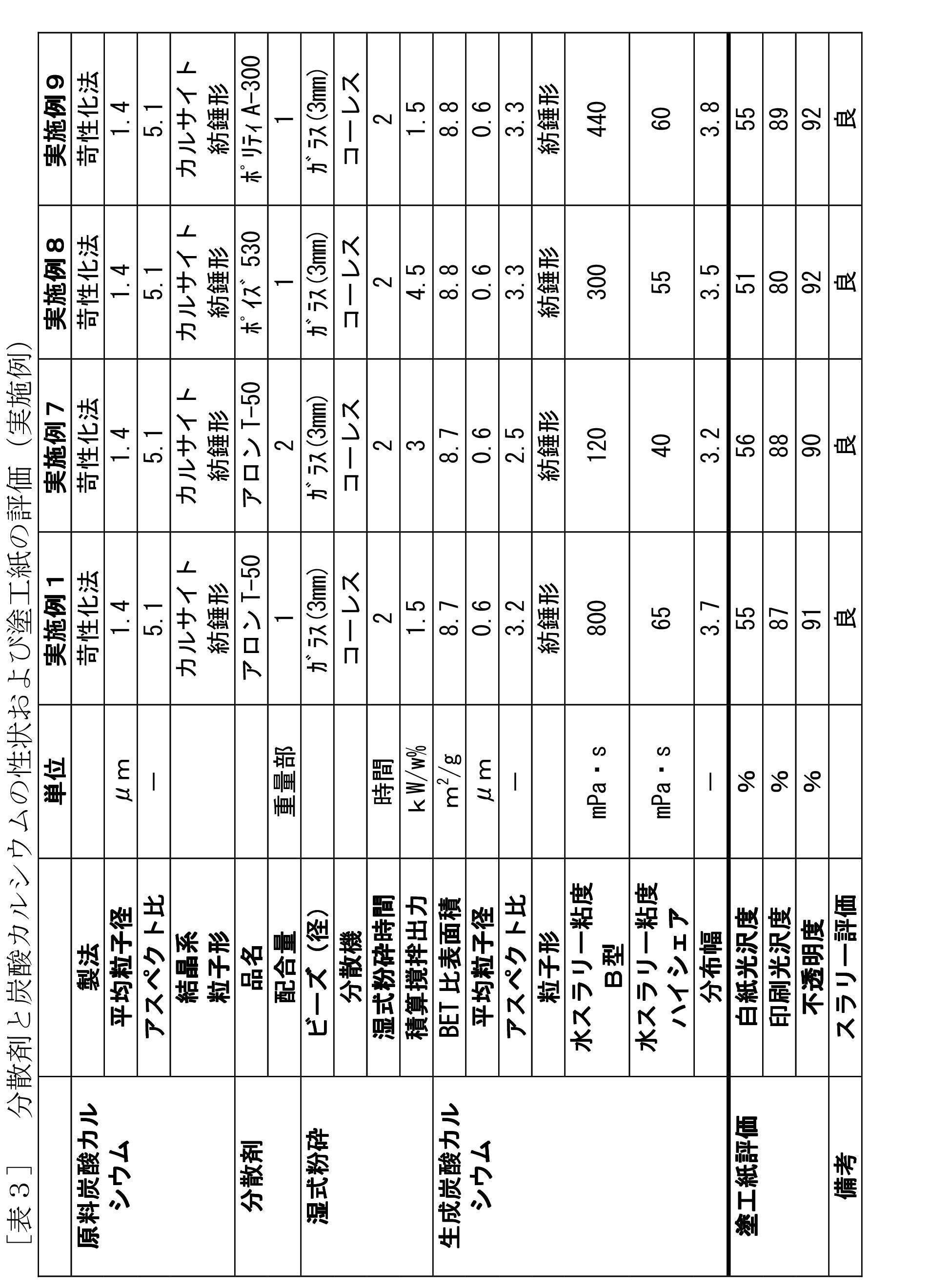
- Example 7 Dry calcium carbonate was obtained in the same manner as in Example 1. Next, an aqueous calcium carbonate slurry was obtained in the same manner as in Example 1, except that 2.0 parts of a polycarboxylic acid-based dispersant (trade name: Aron T-50, Toagosei Co., Ltd.) was added as a dispersant. .
- the BET specific surface area of calcium carbonate contained in the aqueous calcium carbonate slurry after wet pulverization is 8.7 m 2 /g, and the volume-based average particle size (by laser diffraction particle size measurement) is 0.6 ⁇ m.
- the calculated aspect ratio was 3.4 and it had a spindle shape.
- Example 8 Dry calcium carbonate was obtained in the same manner as in Example 1. Next, an aqueous calcium carbonate slurry was obtained in the same manner as in Example 1, except that 1.0 part of a polyacrylic acid-based dispersant (trade name: Poise 530, Kao Chemical Co., Ltd.) was added as a dispersant.
- the BET specific surface area of calcium carbonate contained in the aqueous calcium carbonate slurry after wet pulverization is 8.8 m 2 /g, and the volume-based average particle size (by laser diffraction particle size measurement) is 0.6 ⁇ m.
- the calculated aspect ratio was 3.3, and it had a spindle shape.
- Example 9 Dry calcium carbonate was obtained in the same manner as in Example 1. Next, an aqueous calcium carbonate slurry was obtained in the same manner as in Example 1, except that 1.0 part of a polycarboxylic acid-based dispersant (trade name: Polity A-300, Lion Corporation) was added as a dispersant.
- the BET specific surface area of calcium carbonate contained in the aqueous calcium carbonate slurry after wet pulverization is 8.8 m 2 /g, and the volume-based average particle size (by laser diffraction particle size measurement) is 0.6 ⁇ m.
- the calculated aspect ratio was 3.3, and it had a spindle shape.
- Example 1 Commercially available wet-type heavy calcium carbonate (SETACARB-HG, Bihoku Funka Kogyo Co., Ltd.) was prepared and observed with an electron microscope to find that it was amorphous. This calcium carbonate (aspect ratio: 1.5) was wet pulverized in the same manner as in Example 1 to obtain an aqueous calcium carbonate slurry.
- the BET specific surface area of calcium carbonate contained in the aqueous calcium carbonate slurry after wet pulverization is 9.5 m 2 /g, and the volume-based average particle size (by laser diffraction particle size measurement) is 0.7 ⁇ m.
- the calculated aspect ratio was 1.2.
- Example 2 An aqueous calcium carbonate slurry was obtained in the same manner as in Example 1, except that the sodium carbonate aqueous solution was added to the calcium hydroxide aqueous slurry for 10 minutes. When the resulting calcium carbonate was observed with an electron microscope, it was found to be aggregated particles containing a mixture of cubic shapes and the like. This calcium carbonate (aspect ratio: 1.3) was wet pulverized in the same manner as in Example 1 to obtain an aqueous calcium carbonate slurry.
- the BET specific surface area of calcium carbonate contained in the aqueous calcium carbonate slurry after wet pulverization is 16.1 m 2 /g
- the volume-based average particle size (by laser diffraction particle size measurement) is 2.3 ⁇ m
- the calcium carbonate is calculated from an electron microscope image.
- the resulting aspect ratio was 1.1.
- Example 3 an aqueous calcium carbonate slurry was obtained by changing the wet-grinding conditions to a grinding time of 8 hours.
- the BET specific surface area of calcium carbonate contained in the aqueous calcium carbonate slurry after wet pulverization is 10.5 m 2 /g
- the volume-based average particle size is 0.4 ⁇ m
- the resulting aspect ratio was 1.8.
- Example 4 In Example 1, the wet pulverization time was changed to 30 minutes to obtain an aqueous calcium carbonate slurry.
- the BET specific surface area of calcium carbonate contained in the aqueous calcium carbonate slurry after wet pulverization is 9.9 m 2 /g
- the volume-based average particle size (by laser diffraction particle size measurement) is 1.2 ⁇ m
- the calcium carbonate is calculated from an electron microscope image.
- the resulting aspect ratio was 4.0.
- the calcium carbonate aqueous slurry had a B-type viscosity (rotation speed: 60 rpm) of 3000 mPa ⁇ s and a high shear viscosity (rotation speed: 1100 rpm) of 100 mPa ⁇ s.
- Example 5 The spindle-shaped particles produced by the carbon dioxide gas method in Example 4 were wet pulverized without adding pulverizing media. The resulting calcium carbonate aqueous slurry was not in the measurable viscosity range, and the calcium carbonate contained therein was in the form of powder.
- Example 7 In Example 1, the wet pulverization time was changed to 1 hour to obtain an aqueous calcium carbonate slurry.
- the BET specific surface area of calcium carbonate contained in the aqueous calcium carbonate slurry after wet pulverization is 9.5 m 2 /g
- the volume-based average particle size (measured by laser diffraction particle size measurement) is 0.9 ⁇ m, and is calculated from an electron microscope image.
- the resulting aspect ratio was 3.9.
- the calcium carbonate aqueous slurry had a B-type viscosity (rotation speed: 60 rpm) of 2200 mPa ⁇ s and a high shear viscosity (rotation speed: 1100 rpm) of 85 mPa ⁇ s.
- Example 8 calcium carbonate water was added in the same manner as in Example 1, except that 0.1 part of a polycarboxylic acid-based dispersant (trade name: Aron T-50, Toagosei Co., Ltd.) was added as a dispersant. A slurry was obtained.
- the BET specific surface area of calcium carbonate contained in the calcium carbonate aqueous slurry after wet pulverization is 8.8 m 2 /g
- the volume-based average particle size (measured by laser diffraction particle size measurement) is 0.5 ⁇ m, and is calculated from an electron microscope image.
- the resulting aspect ratio was 3.3.
- the calcium carbonate aqueous slurry had a B-type viscosity (rotation speed: 60 rpm) of 2500 mPa ⁇ s and a high shear viscosity (rotation speed: 1100 rpm) of 100 mPa ⁇ s.
- Example 9 an aqueous calcium carbonate slurry was prepared in the same manner as in Example 1, except that 10 parts of a polycarboxylic acid-based dispersant (trade name: Aron T-50, Toagosei Co., Ltd.) was added as a dispersant. Obtained.
- the BET specific surface area of calcium carbonate contained in the aqueous calcium carbonate slurry after wet pulverization is 8.7 m 2 /g
- the volume-based average particle size (measured by laser diffraction particle size measurement) is 0.6 ⁇ m, and is calculated from an electron microscope image.
- the resulting aspect ratio was 3.4.
- the calcium carbonate aqueous slurry had a B-type viscosity (rotation speed: 60 rpm) of 200 mPa ⁇ s and a high shear viscosity (rotation speed: 1100 rpm) of 45 mPa ⁇ s.
- Example 10 an aqueous calcium carbonate slurry was prepared in the same manner as in Example 1, except that 0.1 part of a polycarboxylic acid-based dispersant (trade name: Poise 530, Kao Chemical Co., Ltd.) was added as a dispersant. Obtained.
- the BET specific surface area of calcium carbonate contained in the aqueous calcium carbonate slurry after wet pulverization is 8.7 m 2 /g
- the volume-based average particle size (measured by laser diffraction particle size measurement) is 0.6 ⁇ m, and is calculated from an electron microscope image.
- the resulting aspect ratio was 3.2.
- the calcium carbonate aqueous slurry had a B-type viscosity (rotation speed: 60 rpm) of 2300 mPa ⁇ s and a high shear viscosity (rotation speed: 1100 rpm) of 120 mPa ⁇ s.
- Example 11 An aqueous calcium carbonate slurry was obtained in the same manner as in Example 1, except that 10 parts of a polycarboxylic acid-based dispersant (trade name: Poise 530, Kao Chemical Co., Ltd.) was added as a dispersant. .
- the BET specific surface area of calcium carbonate contained in the aqueous calcium carbonate slurry after wet pulverization is 8.7 m 2 /g
- the volume-based average particle size (measured by laser diffraction particle size measurement) is 0.5 ⁇ m, and is calculated from an electron microscope image.
- the resulting aspect ratio was 3.3.
- the calcium carbonate aqueous slurry had a B-type viscosity (rotation speed: 60 rpm) of 220 mPa ⁇ s and a high shear viscosity (rotation speed: 1100 rpm) of 45 mPa ⁇ s.
- Example 12 An aqueous calcium carbonate slurry was prepared in the same manner as in Example 1, except that 0.1 part of a polycarboxylic acid-based dispersant (trade name: Polity A-300, Lion Corporation) was added as a dispersant in Example 1. got The BET specific surface area of calcium carbonate contained in the aqueous calcium carbonate slurry after wet pulverization is 8.7 m 2 /g, the volume-based average particle size (measured by laser diffraction particle size measurement) is 0.6 ⁇ m, and is calculated from an electron microscope image. The resulting aspect ratio was 3.4.
- a polycarboxylic acid-based dispersant trade name: Polity A-300, Lion Corporation
- the calcium carbonate aqueous slurry had a B-type viscosity (rotation speed: 60 rpm) of 2200 mPa ⁇ s and a high shear viscosity (rotation speed: 1100 rpm) of 120 mPa ⁇ s.
- Example 13 An aqueous calcium carbonate slurry was obtained in the same manner as in Example 1, except that 10 parts of a polycarboxylic acid-based dispersant (trade name: Polity A-300, Lion Corporation) was added as a dispersant. rice field.
- the BET specific surface area of calcium carbonate contained in the aqueous calcium carbonate slurry after wet pulverization is 8.7 m 2 /g
- the volume-based average particle size is 0.5 ⁇ m
- the resulting aspect ratio was 3.2.
- the calcium carbonate aqueous slurry had a B-type viscosity (rotation speed: 60 rpm) of 120 mPa ⁇ s and a high shear viscosity (rotation speed: 1100 rpm) of 40 mPa ⁇ s.
- Styrene-butadiene-based copolymer latex (trade name: SN-307, Nippon A&L Co., Ltd.) was added to 100 parts of the calcium carbonate solid content contained in the aqueous calcium carbonate slurries obtained in the above Examples and Comparative Examples. 13 parts and 3 parts of phosphate esterified starch (trade name: Nisshoku MS#4600, Nihon Shokuhin Kako Co., Ltd.) were mixed as adhesives to obtain a coating liquid having a solid concentration of 65%.
- the resulting coating solution was applied to one side of a base paper having a basis weight of 78 g/m 2 (Kinbishi: Mitsubishi Paper Mills Co., Ltd.) with a bar blade coater so as to give a coating weight of 12 g/m 2 .
- This was super calendered at a linear pressure of 60 kg/cm to obtain a coated paper.
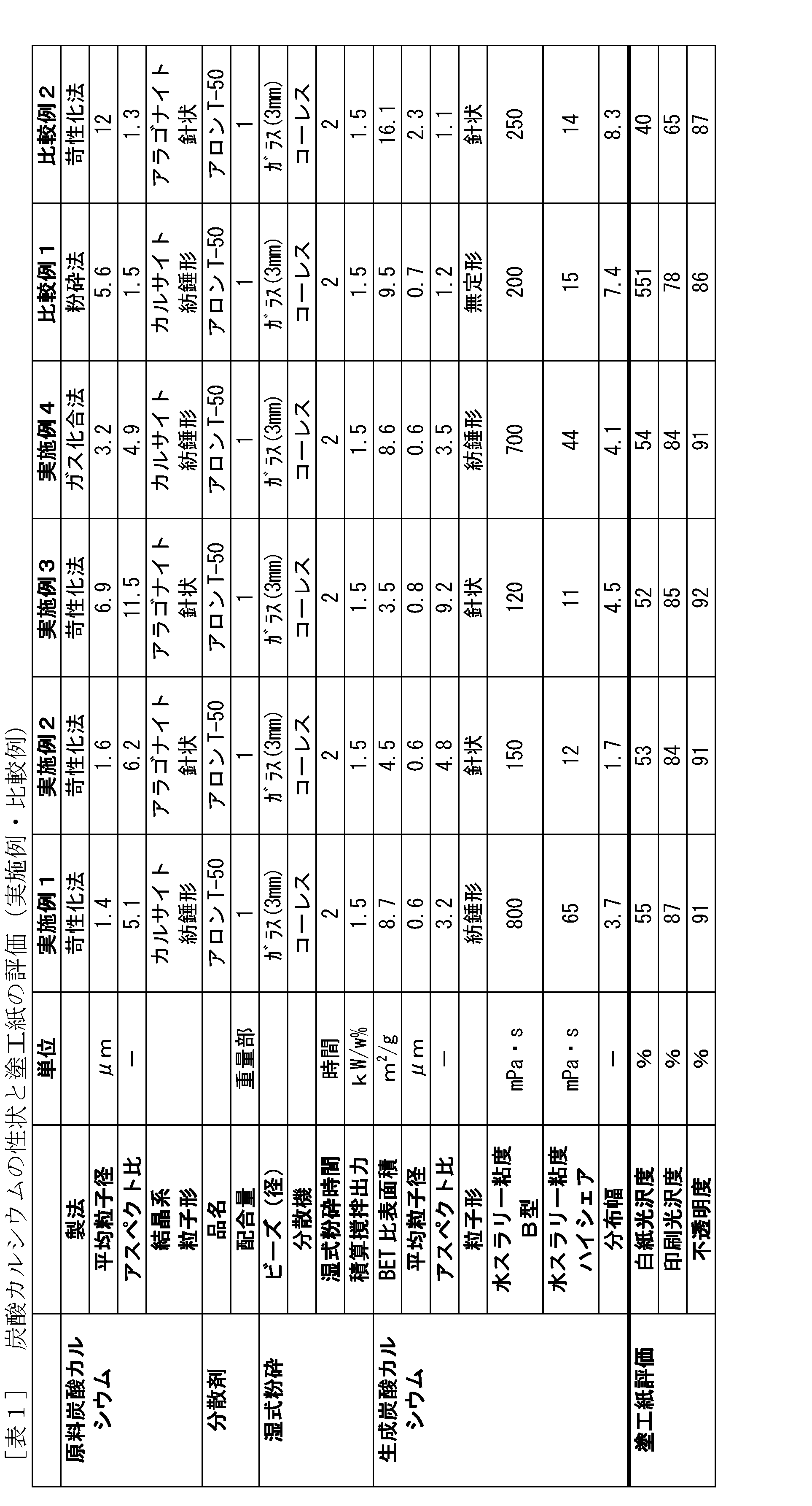
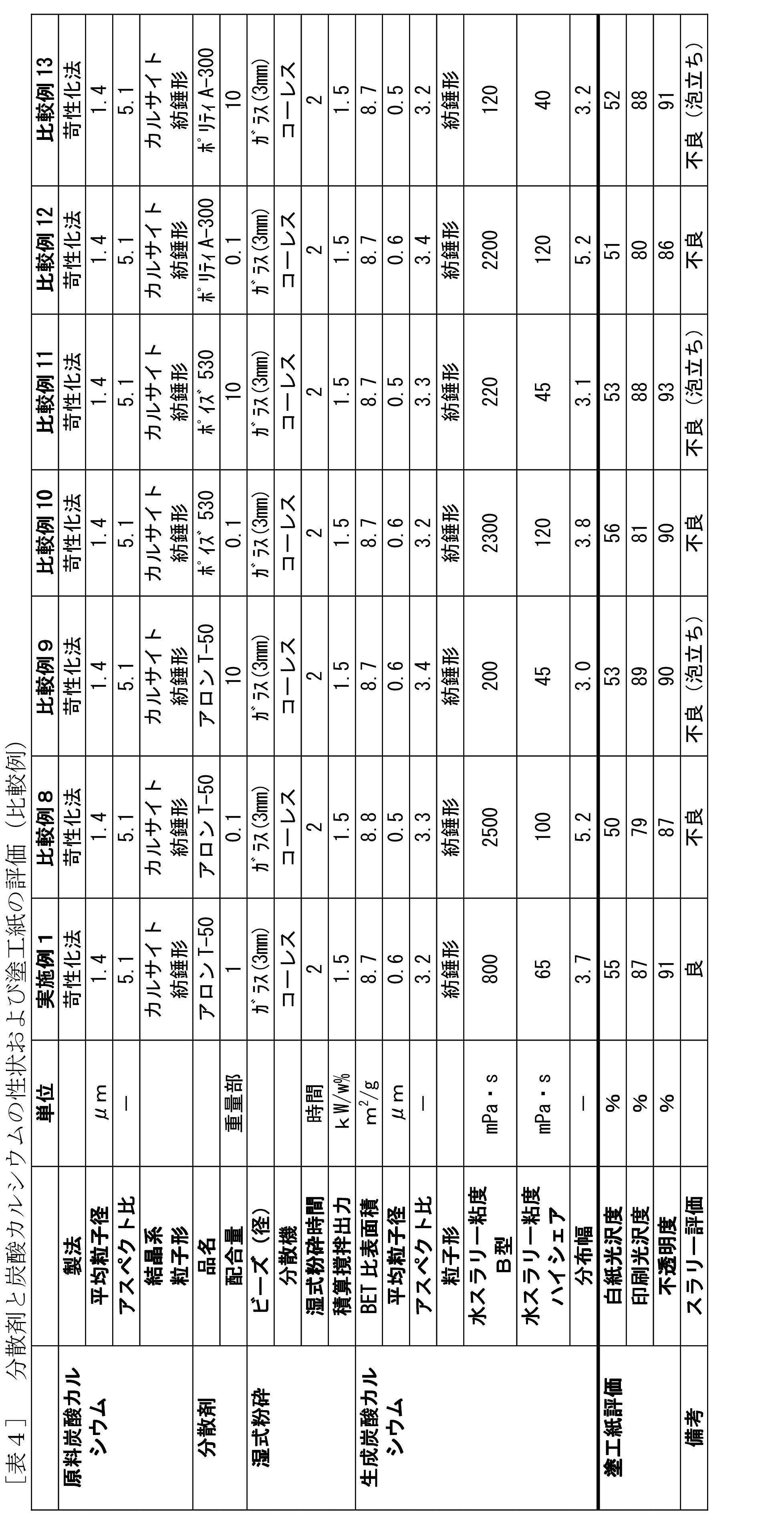
- Table 1 shows the evaluation results of each example and comparative example:
- the "average particle size” and “aspect ratio” of the raw material calcium carbonate are values measured for the calcium carbonate contained in the aqueous calcium carbonate slurry before wet pulverization.
- the "BET specific surface area”, “average particle size” and “aspect ratio” of the produced calcium carbonate are values measured for the calcium carbonate contained in the aqueous calcium carbonate slurry after wet pulverization.
- the method for measuring each of the above values is as described above.
- “Water slurry viscosity type B” represents the viscosity of the calcium carbonate water slurry after wet pulverization measured at a rotational speed of 60 rpm using a rotational viscometer (Toki Sangyo, Model BII viscometer).
- Water slurry viscosity high shear represents the viscosity of the calcium carbonate aqueous slurry after wet pulverization measured at a rotational speed of 1100 rpm using a rotational viscometer (Hercules high shear viscometer DV-10).
- aqueous calcium carbonate slurry according to the example of the present invention as a coating liquid, coated paper with high white paper glossiness, printing glossiness, and opacity could be produced.
- the calcium carbonate contained in the aqueous calcium carbonate slurry of Comparative Example 1 had a small aspect ratio, and lowered the white paper glossiness, printing glossiness and opacity of the coated paper using it.
- the calcium carbonate contained in the calcium carbonate aqueous slurry of Comparative Example 2 did not satisfy the scope of the present invention in any of the BET specific surface area, volume-based average particle size, and aspect ratio. The white paper glossiness, printing glossiness and opacity of the paper decreased.
- the calcium carbonate aqueous slurry of Comparative Example 3 in which the values of the BET specific surface area and the volume-based average particle size satisfy the ranges of the present invention but the value of the aspect ratio does not satisfy the range of the present invention, has a high viscosity.
- the calcium carbonate aqueous slurry containing calcium carbonate of Comparative Example 4 which has a large average particle size, generally has a high viscosity.
- the aqueous calcium carbonate slurry of Comparative Example 5 which was wet-pulverized without using a pulverizing medium, had a high viscosity and could not be used as a coating liquid.
- the calcium carbonate aqueous slurry of Comparative Example 7 obtained by using the same raw material calcium carbonate as in Example 1 and the like but halving the wet-grinding time was not pulverized and had a high viscosity.
Landscapes
- Chemical & Material Sciences (AREA)
- Organic Chemistry (AREA)
- Life Sciences & Earth Sciences (AREA)
- Geology (AREA)
- Inorganic Chemistry (AREA)
- Compounds Of Alkaline-Earth Elements, Aluminum Or Rare-Earth Metals (AREA)
- Paper (AREA)
Abstract
Description
ば、近年需要の伸びている微塗工紙は近年の軽量化とともに不透明度の向上が課題となっている。
シャープ度=(d30/d70)×100
[式中、d30は積算30重量%の粒子径であり、d70は積算70重量%の粒子径である]
で表される粒度分布のシャープ度が50以上であるエンジニアード炭酸カルシウムが得られることが開示されている。
該炭酸カルシウムの固形分濃度が70重量%以上であり、B型粘度(回転速度:60rpm)が2000mPa・s以下であり、およびハイシェア粘度(回転速度:1100rpm)が80mPa・s以下である、炭酸カルシウム水スラリーである。
分散装置に水、粉砕媒体および分散剤を投入する工程;
該分散装置に炭酸カルシウムを複数回にわけて投入し、撹拌し、湿式粉砕して、炭酸カルシウム水スラリーを得る工程;
を含み、
該炭酸カルシウム水スラリーの粘度が極小値または略極小値を示すまで、該炭酸カルシウム水スラリーを粉砕することを特徴とする、炭酸カルシウム水スラリーの製造方法であって、
該炭酸カルシウム水スラリーに含まれている炭酸カルシウムの一次粒子のBET比表面積が3~15m2/g、電子顕微鏡像の画像解析から算出されるアスペクト比が2~10、一次粒子および/または凝集粒子のレーザ回折式粒子径測定による体積基準平均粒子径が0.3~1μmであり、
該炭酸カルシウム水スラリーの固形分濃度が70重量%以上であり、
該炭酸カルシウム水スラリーの粘度が、B型粘度(回転速度:60rpm)が2000mPa・s以下、およびハイシェア粘度(回転速度:1100rpm)が80mPa・s以下である、炭酸カルシウム水スラリーの製造方法である。
[数1]
粒子径分布幅=([炭酸カルシウムのD90値]-[炭酸カルシウムのD10値])/炭酸カルシウムのレーザ回折式粒子径測定による体積基準平均粒子径
(式中、D90値は、レーザ回折式粒子径測定による体積基準粒子径累積分布において、炭酸カルシウムの累積体積が90%となる粒子径であり、D10値は、レーザ回折式粒子径測定による体積基準粒子径累積分布において、炭酸カルシウムの累積体積が10%となる粒子径である。)が、5以下であることが好ましい。
[数2]
粒子径分布幅=([炭酸カルシウムのD90値]-[炭酸カルシウムのD10値])/炭酸カルシウムのレーザ回折式粒子径測定による体積基準平均粒子径
(式中、D90値は、レーザ回折式粒子径測定による体積基準粒子径累積分布において、炭酸カルシウムの累積体積が90%となる粒子径であり、D10値は、レーザ回折式粒子径測定による体積基準粒子径累積分布において、炭酸カルシウムの累積体積が10%となる粒子径である。)で表される値である。体積基準粒子径の分布幅が5以下であることは、実施形態で得られる炭酸カルシウム水スラリーに含まれている炭酸カルシウムの凝集体がほぼないことを示す。
[実施例1]
固形分濃度13.2%の水酸化カルシウム水スラリーを撹拌しながら、濃度14.8%の炭酸ナトリウム水溶液を温度50℃で2時間かけて投入して混合撹拌し、炭酸カルシウムを含む水スラリーを得た。得られた炭酸カルシウムを電子顕微鏡にて観察したとところ、紡錘形状であった。得られた炭酸カルシウム水スラリーをろ過および洗浄した後、105℃の恒温乾燥機で乾燥した。
実施例1において、水酸化カルシウム水スラリーの固形分濃度を15.0%としたこと以外は実施例1と同様に炭酸カルシウム水スラリーを得た。得られた炭酸カルシウム水スラリーを乾燥させて電子顕微鏡にて観察したところ、針状形状をしていた(アスペクト比:6.2)。得られた乾燥炭酸カルシウムを実施例1と同じ条件にて湿式粉砕し、炭酸カルシウム水スラリーを得た。湿式粉砕後の炭酸カルシウム水スラリーに含まれている炭酸カルシウムのBET比表面積は4.5m2/グラム、体積基準平均粒子径(レーザ回折式粒子径測定による)は0.6μm、電子顕微鏡像から算出したアスペクト比は4.8であり、針状形状を有していた。
実施例1において、炭酸ナトリウム水溶液を70℃にしたこと以外は実施例1と同様に炭酸カルシウム水スラリーを得た。得られた炭酸カルシウム水スラリーを乾燥させて電子顕微鏡にて観察したところ、針状形状をしていた(アスペクト比:11.5、体積基準平均粒子径:6.9μm)。得られた乾燥炭酸カルシウムを実施例1と同じ条件にて湿式粉砕し、炭酸カルシウム水スラリーを得た。湿式粉砕後の炭酸カルシウム水スラリーに含まれている炭酸カルシウムのBET比表面積は3.5m2/グラム、体積基準平均粒子径(レーザ回折式粒子径測定による)は0.8μm、電子顕微鏡像から算出したアスペクト比は9.2であり、針状形状を有していた。
炭酸ガス法(固形分濃度10%の水酸化カルシウムを反応前の温度を23℃に調整し、そこに炭酸ガスを導入する方法)にて炭酸カルシウムを合成した。得られた炭酸カルシウム水スラリーを電子顕微鏡にて観察したところ紡錘形状粒子であった(アスペクト比:4.9、体積基準平均粒子径:3.2)。炭酸カルシウム水スラリーをろ過、乾燥させた。得られた乾燥炭酸カルシウムを実施例1と同様に湿式粉砕し、炭酸カルシウム水スラリーを得た。湿式粉砕後の炭酸カルシウム水スラリーに含まれている炭酸カルシウムのBET比表面積は8.6m2/グラム、体積基準平均粒子径(レーザ回折式粒子径測定による)は0.6μm、電子顕微鏡像から算出したアスペクト比は3.5であり、紡錘形状を保持していた。
実施例1と同様に乾燥炭酸カルシウムを得た。次いで実施例1における湿式粉砕時間を4時間としたこと以外は実施例1と同様に炭酸カルシウム水スラリーを得た。湿式粉砕後の炭酸カルシウム水スラリーに含まれている炭酸カルシウムのBET比表面積は9.3m2/グラム、体積基準平均粒子径(レーザ回折式粒子径測定による)は0.5μm、電子顕微鏡像から算出したアスペクト比は2.5であり、紡錘形状を有していた。
実施例1と同様に乾燥炭酸カルシウムを得た。次いで実施例1における湿式粉砕時間を6時間としたこと以外は実施例1と同様に炭酸カルシウム水スラリーを得た。湿式粉砕後の炭酸カルシウム水スラリーに含まれている炭酸カルシウムのBET比表面積は9.1m2/グラム、体積基準平均粒子径(レーザ回折式粒子径測定による)は0.5μm、電子顕微鏡像から算出したアスペクト比は2.1であり、紡錘形状を有していた。
実施例1と同様に乾燥炭酸カルシウムを得た。次いで分散剤として、ポリカルボン酸系の分散剤(商品名:アロンT-50、東亞合成株式会社)を2.0部添加追加したこと以外は実施例1と同様に炭酸カルシウム水スラリーを得た。湿式粉砕後の炭酸カルシウム水スラリーに含まれている炭酸カルシウムのBET比表面積は8.7m2/グラム、体積基準平均粒子径(レーザ回折式粒子径測定による)は0.6μm、電子顕微鏡像から算出したアスペクト比は3.4であり、紡錘形状を有していた。
実施例1と同様に乾燥炭酸カルシウムを得た。次いで分散剤として、ポリアクリル酸系の分散剤(商品名:ポイズ530、花王ケミカル株式会社)を1.0部添加追加したこと以外は実施例1と同様に炭酸カルシウム水スラリーを得た。湿式粉砕後の炭酸カルシウム水スラリーに含まれている炭酸カルシウムのBET比表面積は8.8m2/グラム、体積基準平均粒子径(レーザ回折式粒子径測定による)は0.6μm、電子顕微鏡像から算出したアスペクト比は3.3であり、紡錘形状を有していた。
実施例1と同様に乾燥炭酸カルシウムを得た。次いで分散剤として、ポリカルボン酸系の分散剤(商品名:ポリティA-300、ライオン株式会社)を1.0部添加追加したこと以外は実施例1と同様に炭酸カルシウム水スラリーを得た。湿式粉砕後の炭酸カルシウム水スラリーに含まれている炭酸カルシウムのBET比表面積は8.8m2/グラム、体積基準平均粒子径(レーザ回折式粒子径測定による)は0.6μm、電子顕微鏡像から算出したアスペクト比は3.3であり、紡錘形状を有していた。
市販の湿式重質炭酸カルシウム(SETACARB-HG、備北粉化工業株式会社)を用意し、電子顕微鏡にて観察したところ、無定形であった。この炭酸カルシウム(アスペクト比:1.5)を実施例1と同様に湿式粉砕し、炭酸カルシウム水スラリーを得た。湿式粉砕後の炭酸カルシウム水スラリーに含まれている炭酸カルシウムのBET比表面積は9.5m2/グラム、体積基準平均粒子径(レーザ回折式粒子径測定による)は0.7μm、電子顕微鏡像から算出したアスペクト比は1.2であった。
実施例1において、水酸化カルシウム水スラリーへの炭酸ナトリウム水溶液の投入時間を10分間としたこと以外は実施例1と同様に炭酸カルシウム水スラリーを得た。得られた炭酸カルシウムを電子顕微鏡にて観察したところ、立方体状などが混在した凝集粒子であった。この炭酸カルシウム(アスペクト比:1.3)を実施例1と同様に湿式粉砕し、炭酸カルシウム水スラリーを得た。湿式粉砕後の炭酸カルシウム水スラリーに含まれている炭酸カルシウムのBET比表面積は16.1m2/グラム、体積基準平均粒子径(レーザ回折式粒子径測定による)2.3μm、電子顕微鏡像から算出したアスペクト比は1.1であった。
実施例1において、湿式粉砕条件を粉砕時間8時間として、炭酸カルシウム水スラリーを得た。湿式粉砕後の炭酸カルシウム水スラリーに含まれている炭酸カルシウムのBET比表面積は10.5m2/グラム、体積基準平均粒子径(レーザ回折式粒子径測定による)0.4μm、電子顕微鏡像から算出したアスペクト比は1.8であった。
実施例1において、湿式粉砕時間を30分間として、炭酸カルシウム水スラリーを得た。湿式粉砕後の炭酸カルシウム水スラリーに含まれている炭酸カルシウムのBET比表面積は9.9m2/グラム、体積基準平均粒子径(レーザ回折式粒子径測定による)1.2μm、電子顕微鏡像から算出したアスペクト比は4.0であった。炭酸カルシウム水スラリーのB型粘度(回転速度:60rpm)は3000mPa・s、およびハイシェア粘度(回転速度:1100rpm)は100mPa・sであった。
実施例4で製造した炭酸ガス法による紡錘形状粒子を、粉砕媒体を投入せずに湿式粉砕した。得られた炭酸カルシウム水スラリーは、測定可能な粘度領域にはなく、これに含まれている炭酸カルシウムは、継粉状態であった。
実施例4で製造した炭酸ガス法による紡錘形状粒子を、固形分濃度70重量%となるように水を添加し、0.5mmのセラミックビーズ300gを用い、1時間湿式粉砕した。得られた炭酸カルシウム水スラリーをダイノーミルを用いてさらに1時間湿式粉砕した。
実施例1において、湿式粉砕時間を1時間として、炭酸カルシウム水スラリーを得た。湿式粉砕後の炭酸カルシウム水スラリーに含まれている炭酸カルシウムのBET比表面積は9.5m2/グラム、体積基準平均粒子径(レーザ回折式粒子径測定による)0.9μm、電子顕微鏡像から算出したアスペクト比は3.9であった。炭酸カルシウム水スラリーのB型粘度(回転速度:60rpm)は2200mPa・s、およびハイシェア粘度(回転速度:1100rpm)は85mPa・sであった。
実施例1において、分散剤として、ポリカルボン酸系の分散剤(商品名:アロンT-50、東亞合成株式会社)を0.1部添加追加したこと以外は実施例1と同様に炭酸カルシウム水スラリーを得た。湿式粉砕後の炭酸カルシウム水スラリーに含まれている炭酸カルシウムのBET比表面積は8.8m2/グラム、体積基準平均粒子径(レーザ回折式粒子径測定による)0.5μm、電子顕微鏡像から算出したアスペクト比は3.3であった。炭酸カルシウム水スラリーのB型粘度(回転速度:60rpm)は2500mPa・s、およびハイシェア粘度(回転速度:1100rpm)は100mPa・sであった。
実施例1において、分散剤として、ポリカルボン酸系の分散剤(商品名:アロンT-50、東亞合成株式会社)を10部添加追加したこと以外は実施例1と同様に炭酸カルシウム水スラリーを得た。湿式粉砕後の炭酸カルシウム水スラリーに含まれている炭酸カルシウムのBET比表面積は8.7m2/グラム、体積基準平均粒子径(レーザ回折式粒子径測定による)0.6μm、電子顕微鏡像から算出したアスペクト比は3.4であった。炭酸カルシウム水スラリーのB型粘度(回転速度:60rpm)は200mPa・s、およびハイシェア粘度(回転速度:1100rpm)は45mPa・sであった。
実施例1において、分散剤として、ポリカルボン酸系の分散剤(商品名:ポイズ530、花王ケミカル株式会社)を0.1部添加追加したこと以外は実施例1と同様に炭酸カルシウム水スラリーを得た。湿式粉砕後の炭酸カルシウム水スラリーに含まれている炭酸カルシウムのBET比表面積は8.7m2/グラム、体積基準平均粒子径(レーザ回折式粒子径測定による)0.6μm、電子顕微鏡像から算出したアスペクト比は3.2であった。炭酸カルシウム水スラリーのB型粘度(回転速度:60rpm)は2300mPa・s、およびハイシェア粘度(回転速度:1100rpm)は120mPa・sであった。
実施例1において、分散剤として、ポリカルボン酸系の分散剤(商品名:ポイズ530、花王ケミカル株式会社)を10部添加追加したこと以外は実施例1と同様に炭酸カルシウム水スラリーを得た。湿式粉砕後の炭酸カルシウム水スラリーに含まれている炭酸カルシウムのBET比表面積は8.7m2/グラム、体積基準平均粒子径(レーザ回折式粒子径測定による)0.5μm、電子顕微鏡像から算出したアスペクト比は3.3であった。炭酸カルシウム水スラリーのB型粘度(回転速度:60rpm)は220mPa・s、およびハイシェア粘度(回転速度:1100rpm)は45mPa・sであった。
実施例1において、分散剤として、ポリカルボン酸系の分散剤(商品名:ポリティA-300、ライオン株式会社)を0.1部添加追加したこと以外は実施例1と同様に炭酸カルシウム水スラリーを得た。湿式粉砕後の炭酸カルシウム水スラリーに含まれている炭酸カルシウムのBET比表面積は8.7m2/グラム、体積基準平均粒子径(レーザ回折式粒子径測定による)0.6μm、電子顕微鏡像から算出したアスペクト比は3.4であった。炭酸カルシウム水スラリーのB型粘度(回転速度:60rpm)は2200mPa・s、およびハイシェア粘度(回転速度:1100rpm)は120mPa・sであった。
実施例1において、分散剤として、ポリカルボン酸系の分散剤(商品名:ポリティA-300、ライオン株式会社)を10部添加追加したこと以外は実施例1と同様に炭酸カルシウム水スラリーを得た。湿式粉砕後の炭酸カルシウム水スラリーに含まれている炭酸カルシウムのBET比表面積は8.7m2/グラム、体積基準平均粒子径(レーザ回折式粒子径測定による)0.5μm、電子顕微鏡像から算出したアスペクト比は3.2であった。炭酸カルシウム水スラリーのB型粘度(回転速度:60rpm)は120mPa・s、およびハイシェア粘度(回転速度:1100rpm)は40mPa・sであった。
上記の実施例および比較例で得られた炭酸カルシウム水スラリーに含まれている炭酸カルシウム固形分100部に対してスチレン・ブタジエン系共重合体ラテックス(商品名:SN-307、日本エイアンドエル株式会社)13部、およびリン酸エステル化デンプン(商品名:日食MS#4600、日本食品化工株式会社)3部各々接着剤として配合し、固形分濃度65%の塗工液を得た。得られた塗工液を、坪量78g/m2の原紙(金菱:三菱製紙株式会社)の片面に12g/m2となるようにバーブレードコータで塗工した。これを線圧60kg/cmでスーパーカレンダー処理し、塗工紙を得た。
[白紙光沢度]
日本産業規格JIS P-8142(紙及び板紙-75度鏡面光沢度の測定方法)に従い、塗工紙の白色光沢度を測定した。
東洋インキ株式会社製TKネックス墨を使用し、印刷適性試験機RI型テスターを用いて一定のインキ量0.4mLで各塗工紙に印刷した。印刷した塗工紙の光沢度を光沢度計(GM-26D型、株式会社村上色彩研究所)を用いて角度75度で測定した。
[塗工紙の不透明度]
日本産業規格JIS-P-8138(紙及び板紙-不透明度試験方法)に準拠して測定した。
[数3]
粒子径分布幅=([炭酸カルシウムのD90値]-[炭酸カルシウムのD10値])/炭酸カルシウムのレーザ回折式粒子径測定による体積基準平均粒子径
で算出された値を表す。
Claims (10)
- 以下の工程:
分散装置に水、粉砕媒体および分散剤を投入する工程;
該分散装置に炭酸カルシウムを複数回にわけて投入し、撹拌し、湿式粉砕して、炭酸カルシウム水スラリーを得る工程;
を含み、
該炭酸カルシウム水スラリーの粘度が極小値または略極小値を示すまで、該炭酸カルシウム水スラリーを粉砕することを特徴とする、炭酸カルシウム水スラリーの製造方法であって、
該炭酸カルシウム水スラリーに含まれている炭酸カルシウムの一次粒子のBET比表面積が3~15m2/g、電子顕微鏡像の画像解析から算出されるアスペクト比が2~10、一次粒子および/または凝集粒子のレーザ回折式粒子径測定による体積基準平均粒子径が0.3~1μmであり、
該炭酸カルシウム水スラリーの固形分濃度が70重量%以上であり、
該炭酸カルシウム水スラリーの粘度が、B型粘度(回転速度:60rpm)が2000mPa・s以下、およびハイシェア粘度(回転速度:1100rpm)が80mPa・s以下である、炭酸カルシウム水スラリーの製造方法。 - 該撹拌の積算撹拌出力が、0.5kW/kg以上である、請求項1に記載の炭酸カルシウム水スラリーの製造方法。
- 該分散装置に投入する炭酸カルシウムのレーザ回折式粒子径測定による体積基準平均粒子径が10μm以下であり、かつ一次粒子の電子顕微鏡像の画像解析から算出されるアスペクト比が2~10である、請求項1または2に記載の炭酸カルシウム水スラリーの製造方法。
- 下記式で表される、該炭酸カルシウム水スラリーに含まれている炭酸カルシウムのレーザ回折式粒子径測定による体積基準粒子径の分布幅:
[数1]
粒子径分布幅=([炭酸カルシウムのD90値]-[炭酸カルシウムのD10値])/炭酸カルシウムのレーザ回折式粒子径測定による体積基準平均粒子径
(式中、D90値は、レーザ回折式粒子径測定による体積基準粒子径累積分布において、炭酸カルシウムの累積体積が90%となる粒子径であり、D10値は、レーザ回折式粒子径測定による体積基準粒子径累積分布において、炭酸カルシウムの累積体積が10%となる粒子径である。)が、5以下である、請求項1または2に記載の炭酸カルシウム水スラリーの製造方法。 - 下記式で表される、該炭酸カルシウム水スラリーに含まれている炭酸カルシウムのレーザ回折式粒子径測定による体積基準粒子径の分布幅:
[数2]
粒子径分布幅=([炭酸カルシウムのD90値]-[炭酸カルシウムのD10値])/炭酸カルシウムのレーザ回折式粒子径測定による体積基準平均粒子径
(式中、D90値は、レーザ回折式粒子径測定による体積基準粒子径累積分布において、炭酸カルシウムの累積体積が90%となる粒子径であり、D10値は、レーザ回折式粒子径測定による体積基準粒子径累積分布において、炭酸カルシウムの累積体積が10%となる粒子径である。)が、5以下である、請求項3に記載の炭酸カルシウム水スラリーの製造方法。 - 該分散装置に投入される炭酸カルシウムが苛性化法により製造したものである、請求項5に記載の炭酸カルシウム水スラリーの製造方法。
- 請求項1または2に記載の製造方法で製造された、炭酸カルシウム水スラリー。
- 請求項6に記載の製造方法で製造された、炭酸カルシウム水スラリー。
- 一次粒子のBET比表面積が3~15m2/g、電子顕微鏡像の画像解析から算出されるアスペクト比が2~10であり、一次粒子および/または凝集粒子のレーザ回折式粒子径測定による体積基準平均粒子径が0.3~1μmである炭酸カルシウムの水スラリーであって、
該炭酸カルシウムの固形分濃度が70重量%以上であり、B型粘度(回転速度:60rpm)が2000mPa・s以下であり、およびハイシェア粘度(回転速度:1100rpm)が80mPa・s以下である、炭酸カルシウム水スラリー。 - ポリカルボン酸系、ポリアクリル酸系、ナフタレンスルホン酸ホルマリン縮合系、およびポリエチレングリコールからなる群より選択される高分子型分散剤、または、アルキルスルホン酸系、四級アンモニウム系、および高級アルコールアルキレンオキサイドからなる群より選択される界面活性剤型分散剤を含む、請求項9に記載の炭酸カルシウム水スラリー。
Priority Applications (3)
| Application Number | Priority Date | Filing Date | Title |
|---|---|---|---|
| EP22886935.0A EP4424640A4 (en) | 2021-10-27 | 2022-10-24 | AQUEOUS SUSPENSION OF CALCIUM CARBONATE AND PROCESS FOR PRODUCING AQUEOUS SUSPENSION OF CALCIUM CARBONATE |
| US18/705,223 US20260159695A1 (en) | 2021-10-27 | 2022-10-24 | Calcium carbonate water slurry and method for producing calcium carbonate water slurry |
| JP2023550156A JP7441578B2 (ja) | 2021-10-27 | 2022-10-24 | 炭酸カルシウム水スラリーおよび炭酸カルシウム水スラリーの製造方法 |
Applications Claiming Priority (2)
| Application Number | Priority Date | Filing Date | Title |
|---|---|---|---|
| JP2021-175529 | 2021-10-27 | ||
| JP2021175529 | 2021-10-27 |
Publications (1)
| Publication Number | Publication Date |
|---|---|
| WO2023074608A1 true WO2023074608A1 (ja) | 2023-05-04 |
Family
ID=86158673
Family Applications (1)
| Application Number | Title | Priority Date | Filing Date |
|---|---|---|---|
| PCT/JP2022/039483 Ceased WO2023074608A1 (ja) | 2021-10-27 | 2022-10-24 | 炭酸カルシウム水スラリーおよび炭酸カルシウム水スラリーの製造方法 |
Country Status (4)
| Country | Link |
|---|---|
| US (1) | US20260159695A1 (ja) |
| EP (1) | EP4424640A4 (ja) |
| JP (1) | JP7441578B2 (ja) |
| WO (1) | WO2023074608A1 (ja) |
Cited By (1)
| Publication number | Priority date | Publication date | Assignee | Title |
|---|---|---|---|---|
| WO2025033279A1 (ja) * | 2023-08-10 | 2025-02-13 | 神島化学工業株式会社 | 無機質成形体 |
Citations (12)
| Publication number | Priority date | Publication date | Assignee | Title |
|---|---|---|---|---|
| JPS6428215A (en) * | 1987-04-13 | 1989-01-30 | Nippon Catalytic Chem Ind | Production of aqueous dispersion of calcium carbonate |
| JPH07197398A (ja) * | 1994-11-21 | 1995-08-01 | Okutama Kogyo Kk | 凝集炭酸カルシウム及び製紙用顔料 |
| JPH1077597A (ja) * | 1996-09-04 | 1998-03-24 | Kao Corp | 塗工紙用顔料分散剤 |
| JPH11335119A (ja) | 1998-05-26 | 1999-12-07 | Okutama Kogyo Co Ltd | 軽質炭酸カルシウム水性スラリーの調整方法 |
| JP2000110092A (ja) * | 1998-09-30 | 2000-04-18 | Nippon Paper Industries Co Ltd | オフセット印刷用塗被紙の製造方法 |
| JP2000355897A (ja) * | 1999-06-11 | 2000-12-26 | Shiraishi Kogyo Kaisha Ltd | 印刷用塗工紙及び塗工紙用塗料組成物 |
| JP2007152634A (ja) * | 2005-12-01 | 2007-06-21 | Mitsubishi Paper Mills Ltd | 圧着葉書用紙及びその製造方法 |
| JP2007161537A (ja) | 2005-12-14 | 2007-06-28 | Oji Paper Co Ltd | 軽質炭酸カルシウムスラリー |
| JP2008190071A (ja) * | 2007-02-02 | 2008-08-21 | Taoka Chem Co Ltd | 紙塗工用組成物 |
| JP2008238755A (ja) * | 2007-03-29 | 2008-10-09 | Oji Paper Co Ltd | 記録シート |
| JP2009234894A (ja) | 2008-03-28 | 2009-10-15 | Nippon Paper Industries Co Ltd | エンジニアード炭酸カルシウムの製造方法、および、それを用いた製紙用塗料 |
| CN113004716A (zh) * | 2019-12-19 | 2021-06-22 | 杭州如墨科技有限公司 | 一种碳酸钙粒子的表面修饰方法 |
Family Cites Families (3)
| Publication number | Priority date | Publication date | Assignee | Title |
|---|---|---|---|---|
| JP3995745B2 (ja) * | 1996-12-27 | 2007-10-24 | 奥多摩工業株式会社 | 軽質炭酸カルシウム・重質炭酸カルシウム混合水性スラリーの製造方法 |
| US6402824B1 (en) * | 2000-05-26 | 2002-06-11 | J. M. Huber Corporation | Processes for preparing precipitated calcium carbonate compositions and the products thereof |
| JP2002201022A (ja) * | 2000-12-28 | 2002-07-16 | Yahashi Kogyo Kk | 紡錘状軽質炭酸カルシウムスラリー及びその製造方法 |
-
2022
- 2022-10-24 EP EP22886935.0A patent/EP4424640A4/en active Pending
- 2022-10-24 WO PCT/JP2022/039483 patent/WO2023074608A1/ja not_active Ceased
- 2022-10-24 JP JP2023550156A patent/JP7441578B2/ja active Active
- 2022-10-24 US US18/705,223 patent/US20260159695A1/en active Pending
Patent Citations (12)
| Publication number | Priority date | Publication date | Assignee | Title |
|---|---|---|---|---|
| JPS6428215A (en) * | 1987-04-13 | 1989-01-30 | Nippon Catalytic Chem Ind | Production of aqueous dispersion of calcium carbonate |
| JPH07197398A (ja) * | 1994-11-21 | 1995-08-01 | Okutama Kogyo Kk | 凝集炭酸カルシウム及び製紙用顔料 |
| JPH1077597A (ja) * | 1996-09-04 | 1998-03-24 | Kao Corp | 塗工紙用顔料分散剤 |
| JPH11335119A (ja) | 1998-05-26 | 1999-12-07 | Okutama Kogyo Co Ltd | 軽質炭酸カルシウム水性スラリーの調整方法 |
| JP2000110092A (ja) * | 1998-09-30 | 2000-04-18 | Nippon Paper Industries Co Ltd | オフセット印刷用塗被紙の製造方法 |
| JP2000355897A (ja) * | 1999-06-11 | 2000-12-26 | Shiraishi Kogyo Kaisha Ltd | 印刷用塗工紙及び塗工紙用塗料組成物 |
| JP2007152634A (ja) * | 2005-12-01 | 2007-06-21 | Mitsubishi Paper Mills Ltd | 圧着葉書用紙及びその製造方法 |
| JP2007161537A (ja) | 2005-12-14 | 2007-06-28 | Oji Paper Co Ltd | 軽質炭酸カルシウムスラリー |
| JP2008190071A (ja) * | 2007-02-02 | 2008-08-21 | Taoka Chem Co Ltd | 紙塗工用組成物 |
| JP2008238755A (ja) * | 2007-03-29 | 2008-10-09 | Oji Paper Co Ltd | 記録シート |
| JP2009234894A (ja) | 2008-03-28 | 2009-10-15 | Nippon Paper Industries Co Ltd | エンジニアード炭酸カルシウムの製造方法、および、それを用いた製紙用塗料 |
| CN113004716A (zh) * | 2019-12-19 | 2021-06-22 | 杭州如墨科技有限公司 | 一种碳酸钙粒子的表面修饰方法 |
Non-Patent Citations (1)
| Title |
|---|
| See also references of EP4424640A4 |
Cited By (2)
| Publication number | Priority date | Publication date | Assignee | Title |
|---|---|---|---|---|
| WO2025033279A1 (ja) * | 2023-08-10 | 2025-02-13 | 神島化学工業株式会社 | 無機質成形体 |
| JP7662908B1 (ja) * | 2023-08-10 | 2025-04-15 | 神島化学工業株式会社 | 無機質成形体 |
Also Published As
| Publication number | Publication date |
|---|---|
| US20260159695A1 (en) | 2026-06-11 |
| EP4424640A4 (en) | 2026-04-22 |
| EP4424640A1 (en) | 2024-09-04 |
| JP7441578B2 (ja) | 2024-03-01 |
| JPWO2023074608A1 (ja) | 2023-05-04 |
Similar Documents
| Publication | Publication Date | Title |
|---|---|---|
| JP5778858B2 (ja) | 改善された明度を有するパルプ工場廃棄物由来の沈降炭酸カルシウム、この製造方法および使用 | |
| US6402824B1 (en) | Processes for preparing precipitated calcium carbonate compositions and the products thereof | |
| JP5513777B2 (ja) | 塗料用顔料組成物 | |
| AU659815B2 (en) | Aggregated composite mineral pigments | |
| EP0876433B1 (en) | Milled silicates and silicas used in ink jet printing | |
| KR101706396B1 (ko) | 흡착 특성이 향상된 입자 표면을 갖는 탄산칼슘 물질의 제조 방법 | |
| US5236989A (en) | Aggregated composite mineral pigments | |
| JPH09202617A (ja) | 紙コーティング顔料、その製造方法及びその使用 | |
| WO1990003330A2 (en) | High solids aqueous silica slurry | |
| CN107109078A (zh) | 获得具有高光散射性能和高固体含量的超细gcc的方法 | |
| CN101970563A (zh) | 具有磷酸盐化表面的无机微米颗粒与碱土金属碳酸盐纳米颗粒的复合物 | |
| JP7441578B2 (ja) | 炭酸カルシウム水スラリーおよび炭酸カルシウム水スラリーの製造方法 | |
| JP3879306B2 (ja) | 軽質炭酸カルシウムの粉砕方法 | |
| AU585942B2 (en) | Structured kaolin pigments | |
| JP4191285B2 (ja) | 紙塗工用スラリー、その製造方法、その紙塗工用スラリーを含有する塗工液組成物及びそれを塗被した塗工紙 | |
| CN1175936A (zh) | 生产低磨耗陶土颜料的方法 | |
| JP2007161537A (ja) | 軽質炭酸カルシウムスラリー | |
| JP2006152466A (ja) | 炭酸カルシウムの粉砕方法 | |
| JP2008239465A (ja) | 軽質炭酸カルシウム−シリカ複合物及びアルミニウム系水溶性無機化合物を含むスラリー | |
| JP4069516B2 (ja) | 軽質炭酸カルシウムの粉砕方法及び軽質炭酸カルシウム | |
| JP2002201022A (ja) | 紡錘状軽質炭酸カルシウムスラリー及びその製造方法 | |
| WO2025074747A1 (ja) | 樹脂組成物に用いる充填剤として好適なカルシウムチタン複酸化物粒子からなる粉体 | |
| EP4408799A1 (en) | Process for preparing a wet ground mineral material |
Legal Events
| Date | Code | Title | Description |
|---|---|---|---|
| 121 | Ep: the epo has been informed by wipo that ep was designated in this application |
Ref document number: 22886935 Country of ref document: EP Kind code of ref document: A1 |
|
| WWE | Wipo information: entry into national phase |
Ref document number: 2023550156 Country of ref document: JP |
|
| WWE | Wipo information: entry into national phase |
Ref document number: 18705223 Country of ref document: US |
|
| WWE | Wipo information: entry into national phase |
Ref document number: 2022886935 Country of ref document: EP |
|
| NENP | Non-entry into the national phase |
Ref country code: DE |
|
| ENP | Entry into the national phase |
Ref document number: 2022886935 Country of ref document: EP Effective date: 20240527 |
|
| WWP | Wipo information: published in national office |
Ref document number: 18705223 Country of ref document: US |