WO2023074620A1 - 活性エネルギー線硬化性組成物 - Google Patents
活性エネルギー線硬化性組成物 Download PDFInfo
- Publication number
- WO2023074620A1 WO2023074620A1 PCT/JP2022/039517 JP2022039517W WO2023074620A1 WO 2023074620 A1 WO2023074620 A1 WO 2023074620A1 JP 2022039517 W JP2022039517 W JP 2022039517W WO 2023074620 A1 WO2023074620 A1 WO 2023074620A1
- Authority
- WO
- WIPO (PCT)
- Prior art keywords
- active energy
- energy ray
- curable
- group
- curable composition
- Prior art date
- Legal status (The legal status is an assumption and is not a legal conclusion. Google has not performed a legal analysis and makes no representation as to the accuracy of the status listed.)
- Ceased
Links
Classifications
-
- C—CHEMISTRY; METALLURGY
- C08—ORGANIC MACROMOLECULAR COMPOUNDS; THEIR PREPARATION OR CHEMICAL WORKING-UP; COMPOSITIONS BASED THEREON
- C08F—MACROMOLECULAR COMPOUNDS OBTAINED BY REACTIONS ONLY INVOLVING CARBON-TO-CARBON UNSATURATED BONDS
- C08F220/00—Copolymers of compounds having one or more unsaturated aliphatic radicals, each having only one carbon-to-carbon double bond, and only one being terminated by only one carboxyl radical or a salt, anhydride ester, amide, imide or nitrile thereof
-
- C—CHEMISTRY; METALLURGY
- C09—DYES; PAINTS; POLISHES; NATURAL RESINS; ADHESIVES; COMPOSITIONS NOT OTHERWISE PROVIDED FOR; APPLICATIONS OF MATERIALS NOT OTHERWISE PROVIDED FOR
- C09D—COATING COMPOSITIONS, e.g. PAINTS, VARNISHES OR LACQUERS; FILLING PASTES; CHEMICAL PAINT OR INK REMOVERS; INKS; CORRECTING FLUIDS; WOODSTAINS; PASTES OR SOLIDS FOR COLOURING OR PRINTING; USE OF MATERIALS THEREFOR
- C09D7/00—Features of coating compositions, not provided for in group C09D5/00; Processes for incorporating ingredients in coating compositions
- C09D7/40—Additives
- C09D7/60—Additives non-macromolecular
- C09D7/63—Additives non-macromolecular organic
-
- C—CHEMISTRY; METALLURGY
- C08—ORGANIC MACROMOLECULAR COMPOUNDS; THEIR PREPARATION OR CHEMICAL WORKING-UP; COMPOSITIONS BASED THEREON
- C08F—MACROMOLECULAR COMPOUNDS OBTAINED BY REACTIONS ONLY INVOLVING CARBON-TO-CARBON UNSATURATED BONDS
- C08F212/00—Copolymers of compounds having one or more unsaturated aliphatic radicals, each having only one carbon-to-carbon double bond, and at least one being terminated by an aromatic carbocyclic ring
- C08F212/02—Monomers containing only one unsaturated aliphatic radical
- C08F212/04—Monomers containing only one unsaturated aliphatic radical containing one ring
- C08F212/14—Monomers containing only one unsaturated aliphatic radical containing one ring substituted by heteroatoms or groups containing heteroatoms
- C08F212/22—Oxygen
-
- A—HUMAN NECESSITIES
- A61—MEDICAL OR VETERINARY SCIENCE; HYGIENE
- A61K—PREPARATIONS FOR MEDICAL, DENTAL OR TOILETRY PURPOSES
- A61K6/00—Preparations for dentistry
- A61K6/60—Preparations for dentistry comprising organic or organo-metallic additives
- A61K6/62—Photochemical radical initiators
-
- A—HUMAN NECESSITIES
- A61—MEDICAL OR VETERINARY SCIENCE; HYGIENE
- A61K—PREPARATIONS FOR MEDICAL, DENTAL OR TOILETRY PURPOSES
- A61K6/00—Preparations for dentistry
- A61K6/80—Preparations for artificial teeth, for filling teeth or for capping teeth
- A61K6/884—Preparations for artificial teeth, for filling teeth or for capping teeth comprising natural or synthetic resins
- A61K6/891—Compounds obtained otherwise than by reactions only involving carbon-to-carbon unsaturated bonds
- A61K6/893—Polyurethanes
-
- A—HUMAN NECESSITIES
- A61—MEDICAL OR VETERINARY SCIENCE; HYGIENE
- A61K—PREPARATIONS FOR MEDICAL, DENTAL OR TOILETRY PURPOSES
- A61K8/00—Cosmetics or similar toiletry preparations
- A61K8/18—Cosmetics or similar toiletry preparations characterised by the composition
- A61K8/30—Cosmetics or similar toiletry preparations characterised by the composition containing organic compounds
- A61K8/33—Cosmetics or similar toiletry preparations characterised by the composition containing organic compounds containing oxygen
- A61K8/35—Ketones, e.g. benzophenone
-
- A—HUMAN NECESSITIES
- A61—MEDICAL OR VETERINARY SCIENCE; HYGIENE
- A61K—PREPARATIONS FOR MEDICAL, DENTAL OR TOILETRY PURPOSES
- A61K8/00—Cosmetics or similar toiletry preparations
- A61K8/18—Cosmetics or similar toiletry preparations characterised by the composition
- A61K8/72—Cosmetics or similar toiletry preparations characterised by the composition containing organic macromolecular compounds
- A61K8/84—Cosmetics or similar toiletry preparations characterised by the composition containing organic macromolecular compounds obtained by reactions otherwise than those involving only carbon-carbon unsaturated bonds
-
- A—HUMAN NECESSITIES
- A61—MEDICAL OR VETERINARY SCIENCE; HYGIENE
- A61K—PREPARATIONS FOR MEDICAL, DENTAL OR TOILETRY PURPOSES
- A61K8/00—Cosmetics or similar toiletry preparations
- A61K8/18—Cosmetics or similar toiletry preparations characterised by the composition
- A61K8/72—Cosmetics or similar toiletry preparations characterised by the composition containing organic macromolecular compounds
- A61K8/84—Cosmetics or similar toiletry preparations characterised by the composition containing organic macromolecular compounds obtained by reactions otherwise than those involving only carbon-carbon unsaturated bonds
- A61K8/87—Polyurethanes
-
- A—HUMAN NECESSITIES
- A61—MEDICAL OR VETERINARY SCIENCE; HYGIENE
- A61Q—SPECIFIC USE OF COSMETICS OR SIMILAR TOILETRY PREPARATIONS
- A61Q3/00—Manicure or pedicure preparations
- A61Q3/02—Nail coatings
-
- B—PERFORMING OPERATIONS; TRANSPORTING
- B33—ADDITIVE MANUFACTURING TECHNOLOGY
- B33Y—ADDITIVE MANUFACTURING, i.e. MANUFACTURING OF THREE-DIMENSIONAL [3D] OBJECTS BY ADDITIVE DEPOSITION, ADDITIVE AGGLOMERATION OR ADDITIVE LAYERING, e.g. BY 3D PRINTING, STEREOLITHOGRAPHY OR SELECTIVE LASER SINTERING
- B33Y70/00—Materials specially adapted for additive manufacturing
-
- B—PERFORMING OPERATIONS; TRANSPORTING
- B41—PRINTING; LINING MACHINES; TYPEWRITERS; STAMPS
- B41M—PRINTING, DUPLICATING, MARKING, OR COPYING PROCESSES; COLOUR PRINTING
- B41M5/00—Duplicating or marking methods; Sheet materials for use therein
-
- C—CHEMISTRY; METALLURGY
- C08—ORGANIC MACROMOLECULAR COMPOUNDS; THEIR PREPARATION OR CHEMICAL WORKING-UP; COMPOSITIONS BASED THEREON
- C08F—MACROMOLECULAR COMPOUNDS OBTAINED BY REACTIONS ONLY INVOLVING CARBON-TO-CARBON UNSATURATED BONDS
- C08F2/00—Processes of polymerisation
- C08F2/46—Polymerisation initiated by wave energy or particle radiation
- C08F2/48—Polymerisation initiated by wave energy or particle radiation by ultraviolet or visible light
-
- C—CHEMISTRY; METALLURGY
- C08—ORGANIC MACROMOLECULAR COMPOUNDS; THEIR PREPARATION OR CHEMICAL WORKING-UP; COMPOSITIONS BASED THEREON
- C08F—MACROMOLECULAR COMPOUNDS OBTAINED BY REACTIONS ONLY INVOLVING CARBON-TO-CARBON UNSATURATED BONDS
- C08F2/00—Processes of polymerisation
- C08F2/46—Polymerisation initiated by wave energy or particle radiation
- C08F2/48—Polymerisation initiated by wave energy or particle radiation by ultraviolet or visible light
- C08F2/50—Polymerisation initiated by wave energy or particle radiation by ultraviolet or visible light with sensitising agents
-
- C—CHEMISTRY; METALLURGY
- C08—ORGANIC MACROMOLECULAR COMPOUNDS; THEIR PREPARATION OR CHEMICAL WORKING-UP; COMPOSITIONS BASED THEREON
- C08F—MACROMOLECULAR COMPOUNDS OBTAINED BY REACTIONS ONLY INVOLVING CARBON-TO-CARBON UNSATURATED BONDS
- C08F212/00—Copolymers of compounds having one or more unsaturated aliphatic radicals, each having only one carbon-to-carbon double bond, and at least one being terminated by an aromatic carbocyclic ring
-
- C—CHEMISTRY; METALLURGY
- C08—ORGANIC MACROMOLECULAR COMPOUNDS; THEIR PREPARATION OR CHEMICAL WORKING-UP; COMPOSITIONS BASED THEREON
- C08F—MACROMOLECULAR COMPOUNDS OBTAINED BY REACTIONS ONLY INVOLVING CARBON-TO-CARBON UNSATURATED BONDS
- C08F220/00—Copolymers of compounds having one or more unsaturated aliphatic radicals, each having only one carbon-to-carbon double bond, and only one being terminated by only one carboxyl radical or a salt, anhydride ester, amide, imide or nitrile thereof
- C08F220/02—Monocarboxylic acids having less than ten carbon atoms; Derivatives thereof
- C08F220/10—Esters
- C08F220/12—Esters of monohydric alcohols or phenols
- C08F220/16—Esters of monohydric alcohols or phenols of phenols or of alcohols containing two or more carbon atoms
- C08F220/18—Esters of monohydric alcohols or phenols of phenols or of alcohols containing two or more carbon atoms with acrylic or methacrylic acids
- C08F220/1806—C6-(meth)acrylate, e.g. (cyclo)hexyl (meth)acrylate or phenyl (meth)acrylate
-
- C—CHEMISTRY; METALLURGY
- C08—ORGANIC MACROMOLECULAR COMPOUNDS; THEIR PREPARATION OR CHEMICAL WORKING-UP; COMPOSITIONS BASED THEREON
- C08F—MACROMOLECULAR COMPOUNDS OBTAINED BY REACTIONS ONLY INVOLVING CARBON-TO-CARBON UNSATURATED BONDS
- C08F220/00—Copolymers of compounds having one or more unsaturated aliphatic radicals, each having only one carbon-to-carbon double bond, and only one being terminated by only one carboxyl radical or a salt, anhydride ester, amide, imide or nitrile thereof
- C08F220/02—Monocarboxylic acids having less than ten carbon atoms; Derivatives thereof
- C08F220/10—Esters
- C08F220/26—Esters containing oxygen in addition to the carboxy oxygen
- C08F220/28—Esters containing oxygen in addition to the carboxy oxygen containing no aromatic rings in the alcohol moiety
- C08F220/281—Esters containing oxygen in addition to the carboxy oxygen containing no aromatic rings in the alcohol moiety and containing only one oxygen, e.g. furfuryl (meth)acrylate or 2-methoxyethyl (meth)acrylate
-
- C—CHEMISTRY; METALLURGY
- C08—ORGANIC MACROMOLECULAR COMPOUNDS; THEIR PREPARATION OR CHEMICAL WORKING-UP; COMPOSITIONS BASED THEREON
- C08F—MACROMOLECULAR COMPOUNDS OBTAINED BY REACTIONS ONLY INVOLVING CARBON-TO-CARBON UNSATURATED BONDS
- C08F220/00—Copolymers of compounds having one or more unsaturated aliphatic radicals, each having only one carbon-to-carbon double bond, and only one being terminated by only one carboxyl radical or a salt, anhydride ester, amide, imide or nitrile thereof
- C08F220/02—Monocarboxylic acids having less than ten carbon atoms; Derivatives thereof
- C08F220/10—Esters
- C08F220/34—Esters containing nitrogen, e.g. N,N-dimethylaminoethyl (meth)acrylate
- C08F220/36—Esters containing nitrogen, e.g. N,N-dimethylaminoethyl (meth)acrylate containing oxygen in addition to the carboxy oxygen, e.g. 2-N-morpholinoethyl (meth)acrylate or 2-isocyanatoethyl (meth)acrylate
-
- C—CHEMISTRY; METALLURGY
- C08—ORGANIC MACROMOLECULAR COMPOUNDS; THEIR PREPARATION OR CHEMICAL WORKING-UP; COMPOSITIONS BASED THEREON
- C08F—MACROMOLECULAR COMPOUNDS OBTAINED BY REACTIONS ONLY INVOLVING CARBON-TO-CARBON UNSATURATED BONDS
- C08F220/00—Copolymers of compounds having one or more unsaturated aliphatic radicals, each having only one carbon-to-carbon double bond, and only one being terminated by only one carboxyl radical or a salt, anhydride ester, amide, imide or nitrile thereof
- C08F220/02—Monocarboxylic acids having less than ten carbon atoms; Derivatives thereof
- C08F220/10—Esters
- C08F220/40—Esters of unsaturated alcohols, e.g. allyl (meth)acrylate
-
- C—CHEMISTRY; METALLURGY
- C08—ORGANIC MACROMOLECULAR COMPOUNDS; THEIR PREPARATION OR CHEMICAL WORKING-UP; COMPOSITIONS BASED THEREON
- C08F—MACROMOLECULAR COMPOUNDS OBTAINED BY REACTIONS ONLY INVOLVING CARBON-TO-CARBON UNSATURATED BONDS
- C08F220/00—Copolymers of compounds having one or more unsaturated aliphatic radicals, each having only one carbon-to-carbon double bond, and only one being terminated by only one carboxyl radical or a salt, anhydride ester, amide, imide or nitrile thereof
- C08F220/02—Monocarboxylic acids having less than ten carbon atoms; Derivatives thereof
- C08F220/52—Amides or imides
- C08F220/54—Amides, e.g. N,N-dimethylacrylamide or N-isopropylacrylamide
-
- C—CHEMISTRY; METALLURGY
- C08—ORGANIC MACROMOLECULAR COMPOUNDS; THEIR PREPARATION OR CHEMICAL WORKING-UP; COMPOSITIONS BASED THEREON
- C08F—MACROMOLECULAR COMPOUNDS OBTAINED BY REACTIONS ONLY INVOLVING CARBON-TO-CARBON UNSATURATED BONDS
- C08F220/00—Copolymers of compounds having one or more unsaturated aliphatic radicals, each having only one carbon-to-carbon double bond, and only one being terminated by only one carboxyl radical or a salt, anhydride ester, amide, imide or nitrile thereof
- C08F220/02—Monocarboxylic acids having less than ten carbon atoms; Derivatives thereof
- C08F220/52—Amides or imides
- C08F220/54—Amides, e.g. N,N-dimethylacrylamide or N-isopropylacrylamide
- C08F220/56—Acrylamide; Methacrylamide
-
- C—CHEMISTRY; METALLURGY
- C08—ORGANIC MACROMOLECULAR COMPOUNDS; THEIR PREPARATION OR CHEMICAL WORKING-UP; COMPOSITIONS BASED THEREON
- C08F—MACROMOLECULAR COMPOUNDS OBTAINED BY REACTIONS ONLY INVOLVING CARBON-TO-CARBON UNSATURATED BONDS
- C08F220/00—Copolymers of compounds having one or more unsaturated aliphatic radicals, each having only one carbon-to-carbon double bond, and only one being terminated by only one carboxyl radical or a salt, anhydride ester, amide, imide or nitrile thereof
- C08F220/02—Monocarboxylic acids having less than ten carbon atoms; Derivatives thereof
- C08F220/52—Amides or imides
- C08F220/54—Amides, e.g. N,N-dimethylacrylamide or N-isopropylacrylamide
- C08F220/58—Amides, e.g. N,N-dimethylacrylamide or N-isopropylacrylamide containing oxygen in addition to the carbonamido oxygen, e.g. N-methylolacrylamide, N-(meth)acryloylmorpholine
-
- C—CHEMISTRY; METALLURGY
- C08—ORGANIC MACROMOLECULAR COMPOUNDS; THEIR PREPARATION OR CHEMICAL WORKING-UP; COMPOSITIONS BASED THEREON
- C08F—MACROMOLECULAR COMPOUNDS OBTAINED BY REACTIONS ONLY INVOLVING CARBON-TO-CARBON UNSATURATED BONDS
- C08F222/00—Copolymers of compounds having one or more unsaturated aliphatic radicals, each having only one carbon-to-carbon double bond, and at least one being terminated by a carboxyl radical and containing at least one other carboxyl radical in the molecule; Salts, anhydrides, esters, amides, imides, or nitriles thereof
-
- C—CHEMISTRY; METALLURGY
- C08—ORGANIC MACROMOLECULAR COMPOUNDS; THEIR PREPARATION OR CHEMICAL WORKING-UP; COMPOSITIONS BASED THEREON
- C08F—MACROMOLECULAR COMPOUNDS OBTAINED BY REACTIONS ONLY INVOLVING CARBON-TO-CARBON UNSATURATED BONDS
- C08F222/00—Copolymers of compounds having one or more unsaturated aliphatic radicals, each having only one carbon-to-carbon double bond, and at least one being terminated by a carboxyl radical and containing at least one other carboxyl radical in the molecule; Salts, anhydrides, esters, amides, imides, or nitriles thereof
- C08F222/10—Esters
- C08F222/1006—Esters of polyhydric alcohols or polyhydric phenols
- C08F222/102—Esters of polyhydric alcohols or polyhydric phenols of dialcohols, e.g. ethylene glycol di(meth)acrylate or 1,4-butanediol dimethacrylate
-
- C—CHEMISTRY; METALLURGY
- C08—ORGANIC MACROMOLECULAR COMPOUNDS; THEIR PREPARATION OR CHEMICAL WORKING-UP; COMPOSITIONS BASED THEREON
- C08F—MACROMOLECULAR COMPOUNDS OBTAINED BY REACTIONS ONLY INVOLVING CARBON-TO-CARBON UNSATURATED BONDS
- C08F222/00—Copolymers of compounds having one or more unsaturated aliphatic radicals, each having only one carbon-to-carbon double bond, and at least one being terminated by a carboxyl radical and containing at least one other carboxyl radical in the molecule; Salts, anhydrides, esters, amides, imides, or nitriles thereof
- C08F222/10—Esters
- C08F222/1006—Esters of polyhydric alcohols or polyhydric phenols
- C08F222/105—Esters of polyhydric alcohols or polyhydric phenols of pentaalcohols
-
- C—CHEMISTRY; METALLURGY
- C08—ORGANIC MACROMOLECULAR COMPOUNDS; THEIR PREPARATION OR CHEMICAL WORKING-UP; COMPOSITIONS BASED THEREON
- C08F—MACROMOLECULAR COMPOUNDS OBTAINED BY REACTIONS ONLY INVOLVING CARBON-TO-CARBON UNSATURATED BONDS
- C08F222/00—Copolymers of compounds having one or more unsaturated aliphatic radicals, each having only one carbon-to-carbon double bond, and at least one being terminated by a carboxyl radical and containing at least one other carboxyl radical in the molecule; Salts, anhydrides, esters, amides, imides, or nitriles thereof
- C08F222/10—Esters
- C08F222/12—Esters of phenols or saturated alcohols
- C08F222/20—Esters containing oxygen in addition to the carboxy oxygen
-
- C—CHEMISTRY; METALLURGY
- C08—ORGANIC MACROMOLECULAR COMPOUNDS; THEIR PREPARATION OR CHEMICAL WORKING-UP; COMPOSITIONS BASED THEREON
- C08F—MACROMOLECULAR COMPOUNDS OBTAINED BY REACTIONS ONLY INVOLVING CARBON-TO-CARBON UNSATURATED BONDS
- C08F222/00—Copolymers of compounds having one or more unsaturated aliphatic radicals, each having only one carbon-to-carbon double bond, and at least one being terminated by a carboxyl radical and containing at least one other carboxyl radical in the molecule; Salts, anhydrides, esters, amides, imides, or nitriles thereof
- C08F222/10—Esters
- C08F222/12—Esters of phenols or saturated alcohols
- C08F222/22—Esters containing nitrogen
-
- C—CHEMISTRY; METALLURGY
- C08—ORGANIC MACROMOLECULAR COMPOUNDS; THEIR PREPARATION OR CHEMICAL WORKING-UP; COMPOSITIONS BASED THEREON
- C08F—MACROMOLECULAR COMPOUNDS OBTAINED BY REACTIONS ONLY INVOLVING CARBON-TO-CARBON UNSATURATED BONDS
- C08F222/00—Copolymers of compounds having one or more unsaturated aliphatic radicals, each having only one carbon-to-carbon double bond, and at least one being terminated by a carboxyl radical and containing at least one other carboxyl radical in the molecule; Salts, anhydrides, esters, amides, imides, or nitriles thereof
- C08F222/36—Amides or imides
- C08F222/38—Amides
- C08F222/385—Monomers containing two or more (meth)acrylamide groups, e.g. N,N'-methylenebisacrylamide
-
- C—CHEMISTRY; METALLURGY
- C08—ORGANIC MACROMOLECULAR COMPOUNDS; THEIR PREPARATION OR CHEMICAL WORKING-UP; COMPOSITIONS BASED THEREON
- C08F—MACROMOLECULAR COMPOUNDS OBTAINED BY REACTIONS ONLY INVOLVING CARBON-TO-CARBON UNSATURATED BONDS
- C08F222/00—Copolymers of compounds having one or more unsaturated aliphatic radicals, each having only one carbon-to-carbon double bond, and at least one being terminated by a carboxyl radical and containing at least one other carboxyl radical in the molecule; Salts, anhydrides, esters, amides, imides, or nitriles thereof
- C08F222/36—Amides or imides
- C08F222/40—Imides, e.g. cyclic imides
- C08F222/404—Imides, e.g. cyclic imides substituted imides comprising oxygen other than the carboxy oxygen
-
- C—CHEMISTRY; METALLURGY
- C08—ORGANIC MACROMOLECULAR COMPOUNDS; THEIR PREPARATION OR CHEMICAL WORKING-UP; COMPOSITIONS BASED THEREON
- C08J—WORKING-UP; GENERAL PROCESSES OF COMPOUNDING; AFTER-TREATMENT NOT COVERED BY SUBCLASSES C08B, C08C, C08F, C08G or C08H
- C08J5/00—Manufacture of articles or shaped materials containing macromolecular substances
- C08J5/18—Manufacture of films or sheets
-
- C—CHEMISTRY; METALLURGY
- C09—DYES; PAINTS; POLISHES; NATURAL RESINS; ADHESIVES; COMPOSITIONS NOT OTHERWISE PROVIDED FOR; APPLICATIONS OF MATERIALS NOT OTHERWISE PROVIDED FOR
- C09D—COATING COMPOSITIONS, e.g. PAINTS, VARNISHES OR LACQUERS; FILLING PASTES; CHEMICAL PAINT OR INK REMOVERS; INKS; CORRECTING FLUIDS; WOODSTAINS; PASTES OR SOLIDS FOR COLOURING OR PRINTING; USE OF MATERIALS THEREFOR
- C09D11/00—Inks
- C09D11/02—Printing inks
- C09D11/10—Printing inks based on artificial resins
- C09D11/101—Inks specially adapted for printing processes involving curing by wave energy or particle radiation, e.g. with UV-curing following the printing
-
- C—CHEMISTRY; METALLURGY
- C09—DYES; PAINTS; POLISHES; NATURAL RESINS; ADHESIVES; COMPOSITIONS NOT OTHERWISE PROVIDED FOR; APPLICATIONS OF MATERIALS NOT OTHERWISE PROVIDED FOR
- C09D—COATING COMPOSITIONS, e.g. PAINTS, VARNISHES OR LACQUERS; FILLING PASTES; CHEMICAL PAINT OR INK REMOVERS; INKS; CORRECTING FLUIDS; WOODSTAINS; PASTES OR SOLIDS FOR COLOURING OR PRINTING; USE OF MATERIALS THEREFOR
- C09D11/00—Inks
- C09D11/02—Printing inks
- C09D11/10—Printing inks based on artificial resins
- C09D11/106—Printing inks based on artificial resins containing macromolecular compounds obtained by reactions only involving carbon-to-carbon unsaturated bonds
- C09D11/107—Printing inks based on artificial resins containing macromolecular compounds obtained by reactions only involving carbon-to-carbon unsaturated bonds from unsaturated acids or derivatives thereof
-
- C—CHEMISTRY; METALLURGY
- C09—DYES; PAINTS; POLISHES; NATURAL RESINS; ADHESIVES; COMPOSITIONS NOT OTHERWISE PROVIDED FOR; APPLICATIONS OF MATERIALS NOT OTHERWISE PROVIDED FOR
- C09D—COATING COMPOSITIONS, e.g. PAINTS, VARNISHES OR LACQUERS; FILLING PASTES; CHEMICAL PAINT OR INK REMOVERS; INKS; CORRECTING FLUIDS; WOODSTAINS; PASTES OR SOLIDS FOR COLOURING OR PRINTING; USE OF MATERIALS THEREFOR
- C09D11/00—Inks
- C09D11/30—Inkjet printing inks
-
- C—CHEMISTRY; METALLURGY
- C09—DYES; PAINTS; POLISHES; NATURAL RESINS; ADHESIVES; COMPOSITIONS NOT OTHERWISE PROVIDED FOR; APPLICATIONS OF MATERIALS NOT OTHERWISE PROVIDED FOR
- C09D—COATING COMPOSITIONS, e.g. PAINTS, VARNISHES OR LACQUERS; FILLING PASTES; CHEMICAL PAINT OR INK REMOVERS; INKS; CORRECTING FLUIDS; WOODSTAINS; PASTES OR SOLIDS FOR COLOURING OR PRINTING; USE OF MATERIALS THEREFOR
- C09D11/00—Inks
- C09D11/30—Inkjet printing inks
- C09D11/38—Inkjet printing inks characterised by non-macromolecular additives other than solvents, pigments or dyes
-
- C—CHEMISTRY; METALLURGY
- C09—DYES; PAINTS; POLISHES; NATURAL RESINS; ADHESIVES; COMPOSITIONS NOT OTHERWISE PROVIDED FOR; APPLICATIONS OF MATERIALS NOT OTHERWISE PROVIDED FOR
- C09D—COATING COMPOSITIONS, e.g. PAINTS, VARNISHES OR LACQUERS; FILLING PASTES; CHEMICAL PAINT OR INK REMOVERS; INKS; CORRECTING FLUIDS; WOODSTAINS; PASTES OR SOLIDS FOR COLOURING OR PRINTING; USE OF MATERIALS THEREFOR
- C09D125/00—Coating compositions based on homopolymers or copolymers of compounds having one or more unsaturated aliphatic radicals, each having only one carbon-to-carbon double bond, and at least one being terminated by an aromatic carbocyclic ring; Coating compositions based on derivatives of such polymers
- C09D125/18—Homopolymers or copolymers of aromatic monomers containing elements other than carbon and hydrogen
-
- C—CHEMISTRY; METALLURGY
- C09—DYES; PAINTS; POLISHES; NATURAL RESINS; ADHESIVES; COMPOSITIONS NOT OTHERWISE PROVIDED FOR; APPLICATIONS OF MATERIALS NOT OTHERWISE PROVIDED FOR
- C09D—COATING COMPOSITIONS, e.g. PAINTS, VARNISHES OR LACQUERS; FILLING PASTES; CHEMICAL PAINT OR INK REMOVERS; INKS; CORRECTING FLUIDS; WOODSTAINS; PASTES OR SOLIDS FOR COLOURING OR PRINTING; USE OF MATERIALS THEREFOR
- C09D133/00—Coating compositions based on homopolymers or copolymers of compounds having one or more unsaturated aliphatic radicals, each having only one carbon-to-carbon double bond, and at least one being terminated by only one carboxyl radical, or of salts, anhydrides, esters, amides, imides, or nitriles thereof; Coating compositions based on derivatives of such polymers
- C09D133/04—Homopolymers or copolymers of esters
- C09D133/06—Homopolymers or copolymers of esters of esters containing only carbon, hydrogen and oxygen, the oxygen atom being present only as part of the carboxyl radical
- C09D133/062—Copolymers with monomers not covered by C09D133/06
-
- C—CHEMISTRY; METALLURGY
- C09—DYES; PAINTS; POLISHES; NATURAL RESINS; ADHESIVES; COMPOSITIONS NOT OTHERWISE PROVIDED FOR; APPLICATIONS OF MATERIALS NOT OTHERWISE PROVIDED FOR
- C09D—COATING COMPOSITIONS, e.g. PAINTS, VARNISHES OR LACQUERS; FILLING PASTES; CHEMICAL PAINT OR INK REMOVERS; INKS; CORRECTING FLUIDS; WOODSTAINS; PASTES OR SOLIDS FOR COLOURING OR PRINTING; USE OF MATERIALS THEREFOR
- C09D133/00—Coating compositions based on homopolymers or copolymers of compounds having one or more unsaturated aliphatic radicals, each having only one carbon-to-carbon double bond, and at least one being terminated by only one carboxyl radical, or of salts, anhydrides, esters, amides, imides, or nitriles thereof; Coating compositions based on derivatives of such polymers
- C09D133/04—Homopolymers or copolymers of esters
- C09D133/14—Homopolymers or copolymers of esters of esters containing halogen, nitrogen, sulfur or oxygen atoms in addition to the carboxy oxygen
-
- C—CHEMISTRY; METALLURGY
- C09—DYES; PAINTS; POLISHES; NATURAL RESINS; ADHESIVES; COMPOSITIONS NOT OTHERWISE PROVIDED FOR; APPLICATIONS OF MATERIALS NOT OTHERWISE PROVIDED FOR
- C09D—COATING COMPOSITIONS, e.g. PAINTS, VARNISHES OR LACQUERS; FILLING PASTES; CHEMICAL PAINT OR INK REMOVERS; INKS; CORRECTING FLUIDS; WOODSTAINS; PASTES OR SOLIDS FOR COLOURING OR PRINTING; USE OF MATERIALS THEREFOR
- C09D133/00—Coating compositions based on homopolymers or copolymers of compounds having one or more unsaturated aliphatic radicals, each having only one carbon-to-carbon double bond, and at least one being terminated by only one carboxyl radical, or of salts, anhydrides, esters, amides, imides, or nitriles thereof; Coating compositions based on derivatives of such polymers
- C09D133/24—Homopolymers or copolymers of amides or imides
- C09D133/26—Homopolymers or copolymers of acrylamide or methacrylamide
-
- C—CHEMISTRY; METALLURGY
- C09—DYES; PAINTS; POLISHES; NATURAL RESINS; ADHESIVES; COMPOSITIONS NOT OTHERWISE PROVIDED FOR; APPLICATIONS OF MATERIALS NOT OTHERWISE PROVIDED FOR
- C09D—COATING COMPOSITIONS, e.g. PAINTS, VARNISHES OR LACQUERS; FILLING PASTES; CHEMICAL PAINT OR INK REMOVERS; INKS; CORRECTING FLUIDS; WOODSTAINS; PASTES OR SOLIDS FOR COLOURING OR PRINTING; USE OF MATERIALS THEREFOR
- C09D135/00—Coating compositions based on homopolymers or copolymers of compounds having one or more unsaturated aliphatic radicals, each having only one carbon-to-carbon double bond, and at least one being terminated by a carboxyl radical, and containing at least another carboxyl radical in the molecule, or of salts, anhydrides, esters, amides, imides or nitriles thereof; Coating compositions based on derivatives of such polymers
- C09D135/02—Homopolymers or copolymers of esters
-
- C—CHEMISTRY; METALLURGY
- C09—DYES; PAINTS; POLISHES; NATURAL RESINS; ADHESIVES; COMPOSITIONS NOT OTHERWISE PROVIDED FOR; APPLICATIONS OF MATERIALS NOT OTHERWISE PROVIDED FOR
- C09D—COATING COMPOSITIONS, e.g. PAINTS, VARNISHES OR LACQUERS; FILLING PASTES; CHEMICAL PAINT OR INK REMOVERS; INKS; CORRECTING FLUIDS; WOODSTAINS; PASTES OR SOLIDS FOR COLOURING OR PRINTING; USE OF MATERIALS THEREFOR
- C09D4/00—Coating compositions, e.g. paints, varnishes or lacquers, based on organic non-macromolecular compounds having at least one polymerisable carbon-to-carbon unsaturated bond ; Coating compositions, based on monomers of macromolecular compounds of groups C09D183/00 - C09D183/16
-
- C—CHEMISTRY; METALLURGY
- C09—DYES; PAINTS; POLISHES; NATURAL RESINS; ADHESIVES; COMPOSITIONS NOT OTHERWISE PROVIDED FOR; APPLICATIONS OF MATERIALS NOT OTHERWISE PROVIDED FOR
- C09J—ADHESIVES; NON-MECHANICAL ASPECTS OF ADHESIVE PROCESSES IN GENERAL; ADHESIVE PROCESSES NOT PROVIDED FOR ELSEWHERE; USE OF MATERIALS AS ADHESIVES
- C09J125/00—Adhesives based on homopolymers or copolymers of compounds having one or more unsaturated aliphatic radicals, each having only one carbon-to-carbon double bond, and at least one being terminated by an aromatic carbocyclic ring; Adhesives based on derivatives of such polymers
- C09J125/18—Homopolymers or copolymers of aromatic monomers containing elements other than carbon and hydrogen
-
- C—CHEMISTRY; METALLURGY
- C09—DYES; PAINTS; POLISHES; NATURAL RESINS; ADHESIVES; COMPOSITIONS NOT OTHERWISE PROVIDED FOR; APPLICATIONS OF MATERIALS NOT OTHERWISE PROVIDED FOR
- C09J—ADHESIVES; NON-MECHANICAL ASPECTS OF ADHESIVE PROCESSES IN GENERAL; ADHESIVE PROCESSES NOT PROVIDED FOR ELSEWHERE; USE OF MATERIALS AS ADHESIVES
- C09J133/00—Adhesives based on homopolymers or copolymers of compounds having one or more unsaturated aliphatic radicals, each having only one carbon-to-carbon double bond, and at least one being terminated by only one carboxyl radical, or of salts, anhydrides, esters, amides, imides, or nitriles thereof; Adhesives based on derivatives of such polymers
- C09J133/04—Homopolymers or copolymers of esters
- C09J133/06—Homopolymers or copolymers of esters of esters containing only carbon, hydrogen and oxygen, the oxygen atom being present only as part of the carboxyl radical
- C09J133/062—Copolymers with monomers not covered by C09J133/06
-
- C—CHEMISTRY; METALLURGY
- C09—DYES; PAINTS; POLISHES; NATURAL RESINS; ADHESIVES; COMPOSITIONS NOT OTHERWISE PROVIDED FOR; APPLICATIONS OF MATERIALS NOT OTHERWISE PROVIDED FOR
- C09J—ADHESIVES; NON-MECHANICAL ASPECTS OF ADHESIVE PROCESSES IN GENERAL; ADHESIVE PROCESSES NOT PROVIDED FOR ELSEWHERE; USE OF MATERIALS AS ADHESIVES
- C09J133/00—Adhesives based on homopolymers or copolymers of compounds having one or more unsaturated aliphatic radicals, each having only one carbon-to-carbon double bond, and at least one being terminated by only one carboxyl radical, or of salts, anhydrides, esters, amides, imides, or nitriles thereof; Adhesives based on derivatives of such polymers
- C09J133/04—Homopolymers or copolymers of esters
- C09J133/14—Homopolymers or copolymers of esters of esters containing halogen, nitrogen, sulfur or oxygen atoms in addition to the carboxy oxygen
-
- C—CHEMISTRY; METALLURGY
- C09—DYES; PAINTS; POLISHES; NATURAL RESINS; ADHESIVES; COMPOSITIONS NOT OTHERWISE PROVIDED FOR; APPLICATIONS OF MATERIALS NOT OTHERWISE PROVIDED FOR
- C09J—ADHESIVES; NON-MECHANICAL ASPECTS OF ADHESIVE PROCESSES IN GENERAL; ADHESIVE PROCESSES NOT PROVIDED FOR ELSEWHERE; USE OF MATERIALS AS ADHESIVES
- C09J133/00—Adhesives based on homopolymers or copolymers of compounds having one or more unsaturated aliphatic radicals, each having only one carbon-to-carbon double bond, and at least one being terminated by only one carboxyl radical, or of salts, anhydrides, esters, amides, imides, or nitriles thereof; Adhesives based on derivatives of such polymers
- C09J133/24—Homopolymers or copolymers of amides or imides
- C09J133/26—Homopolymers or copolymers of acrylamide or methacrylamide
-
- C—CHEMISTRY; METALLURGY
- C09—DYES; PAINTS; POLISHES; NATURAL RESINS; ADHESIVES; COMPOSITIONS NOT OTHERWISE PROVIDED FOR; APPLICATIONS OF MATERIALS NOT OTHERWISE PROVIDED FOR
- C09J—ADHESIVES; NON-MECHANICAL ASPECTS OF ADHESIVE PROCESSES IN GENERAL; ADHESIVE PROCESSES NOT PROVIDED FOR ELSEWHERE; USE OF MATERIALS AS ADHESIVES
- C09J135/00—Adhesives based on homopolymers or copolymers of compounds having one or more unsaturated aliphatic radicals, each having only one carbon-to-carbon double bond, and at least one being terminated by a carboxyl radical, and containing at least another carboxyl radical in the molecule, or of salts, anhydrides, esters, amides, imides or nitriles thereof; Adhesives based on derivatives of such polymers
- C09J135/02—Homopolymers or copolymers of esters
-
- C—CHEMISTRY; METALLURGY
- C09—DYES; PAINTS; POLISHES; NATURAL RESINS; ADHESIVES; COMPOSITIONS NOT OTHERWISE PROVIDED FOR; APPLICATIONS OF MATERIALS NOT OTHERWISE PROVIDED FOR
- C09J—ADHESIVES; NON-MECHANICAL ASPECTS OF ADHESIVE PROCESSES IN GENERAL; ADHESIVE PROCESSES NOT PROVIDED FOR ELSEWHERE; USE OF MATERIALS AS ADHESIVES
- C09J4/00—Adhesives based on organic non-macromolecular compounds having at least one polymerisable carbon-to-carbon unsaturated bond ; adhesives, based on monomers of macromolecular compounds of groups C09J183/00 - C09J183/16
-
- C—CHEMISTRY; METALLURGY
- C09—DYES; PAINTS; POLISHES; NATURAL RESINS; ADHESIVES; COMPOSITIONS NOT OTHERWISE PROVIDED FOR; APPLICATIONS OF MATERIALS NOT OTHERWISE PROVIDED FOR
- C09J—ADHESIVES; NON-MECHANICAL ASPECTS OF ADHESIVE PROCESSES IN GENERAL; ADHESIVE PROCESSES NOT PROVIDED FOR ELSEWHERE; USE OF MATERIALS AS ADHESIVES
- C09J7/00—Adhesives in the form of films or foils
- C09J7/30—Adhesives in the form of films or foils characterised by the adhesive composition
- C09J7/38—Pressure-sensitive adhesives [PSA]
-
- C—CHEMISTRY; METALLURGY
- C09—DYES; PAINTS; POLISHES; NATURAL RESINS; ADHESIVES; COMPOSITIONS NOT OTHERWISE PROVIDED FOR; APPLICATIONS OF MATERIALS NOT OTHERWISE PROVIDED FOR
- C09J—ADHESIVES; NON-MECHANICAL ASPECTS OF ADHESIVE PROCESSES IN GENERAL; ADHESIVE PROCESSES NOT PROVIDED FOR ELSEWHERE; USE OF MATERIALS AS ADHESIVES
- C09J7/00—Adhesives in the form of films or foils
- C09J7/30—Adhesives in the form of films or foils characterised by the adhesive composition
- C09J7/38—Pressure-sensitive adhesives [PSA]
- C09J7/381—Pressure-sensitive adhesives [PSA] based on macromolecular compounds obtained by reactions involving only carbon-to-carbon unsaturated bonds
- C09J7/385—Acrylic polymers
-
- C—CHEMISTRY; METALLURGY
- C09—DYES; PAINTS; POLISHES; NATURAL RESINS; ADHESIVES; COMPOSITIONS NOT OTHERWISE PROVIDED FOR; APPLICATIONS OF MATERIALS NOT OTHERWISE PROVIDED FOR
- C09K—MATERIALS FOR MISCELLANEOUS APPLICATIONS, NOT PROVIDED FOR ELSEWHERE
- C09K3/00—Materials not provided for elsewhere
- C09K3/10—Materials in mouldable or extrudable form for sealing or packing joints or covers
-
- C—CHEMISTRY; METALLURGY
- C09—DYES; PAINTS; POLISHES; NATURAL RESINS; ADHESIVES; COMPOSITIONS NOT OTHERWISE PROVIDED FOR; APPLICATIONS OF MATERIALS NOT OTHERWISE PROVIDED FOR
- C09K—MATERIALS FOR MISCELLANEOUS APPLICATIONS, NOT PROVIDED FOR ELSEWHERE
- C09K3/00—Materials not provided for elsewhere
- C09K3/10—Materials in mouldable or extrudable form for sealing or packing joints or covers
- C09K3/1006—Materials in mouldable or extrudable form for sealing or packing joints or covers characterised by the chemical nature of one of its constituents
-
- A—HUMAN NECESSITIES
- A61—MEDICAL OR VETERINARY SCIENCE; HYGIENE
- A61K—PREPARATIONS FOR MEDICAL, DENTAL OR TOILETRY PURPOSES
- A61K2800/00—Properties of cosmetic compositions or active ingredients thereof or formulation aids used therein and process related aspects
- A61K2800/80—Process related aspects concerning the preparation of the cosmetic composition or the storage or application thereof
- A61K2800/81—Preparation or application process involves irradiation
-
- A—HUMAN NECESSITIES
- A61—MEDICAL OR VETERINARY SCIENCE; HYGIENE
- A61K—PREPARATIONS FOR MEDICAL, DENTAL OR TOILETRY PURPOSES
- A61K2800/00—Properties of cosmetic compositions or active ingredients thereof or formulation aids used therein and process related aspects
- A61K2800/80—Process related aspects concerning the preparation of the cosmetic composition or the storage or application thereof
- A61K2800/95—Involves in-situ formation or cross-linking of polymers
-
- C—CHEMISTRY; METALLURGY
- C08—ORGANIC MACROMOLECULAR COMPOUNDS; THEIR PREPARATION OR CHEMICAL WORKING-UP; COMPOSITIONS BASED THEREON
- C08F—MACROMOLECULAR COMPOUNDS OBTAINED BY REACTIONS ONLY INVOLVING CARBON-TO-CARBON UNSATURATED BONDS
- C08F2800/00—Copolymer characterised by the proportions of the comonomers expressed
- C08F2800/10—Copolymer characterised by the proportions of the comonomers expressed as molar percentages
-
- C—CHEMISTRY; METALLURGY
- C08—ORGANIC MACROMOLECULAR COMPOUNDS; THEIR PREPARATION OR CHEMICAL WORKING-UP; COMPOSITIONS BASED THEREON
- C08J—WORKING-UP; GENERAL PROCESSES OF COMPOUNDING; AFTER-TREATMENT NOT COVERED BY SUBCLASSES C08B, C08C, C08F, C08G or C08H
- C08J2325/00—Characterised by the use of homopolymers or copolymers of compounds having one or more unsaturated aliphatic radicals, each having only one carbon-to-carbon double bond, and at least one being terminated by an aromatic carbocyclic ring; Derivatives of such polymers
- C08J2325/18—Homopolymers or copolymers of aromatic monomers containing elements other than carbon and hydrogen
-
- C—CHEMISTRY; METALLURGY
- C08—ORGANIC MACROMOLECULAR COMPOUNDS; THEIR PREPARATION OR CHEMICAL WORKING-UP; COMPOSITIONS BASED THEREON
- C08J—WORKING-UP; GENERAL PROCESSES OF COMPOUNDING; AFTER-TREATMENT NOT COVERED BY SUBCLASSES C08B, C08C, C08F, C08G or C08H
- C08J2333/00—Characterised by the use of homopolymers or copolymers of compounds having one or more unsaturated aliphatic radicals, each having only one carbon-to-carbon double bond, and only one being terminated by only one carboxyl radical, or of salts, anhydrides, esters, amides, imides, or nitriles thereof; Derivatives of such polymers
- C08J2333/04—Characterised by the use of homopolymers or copolymers of compounds having one or more unsaturated aliphatic radicals, each having only one carbon-to-carbon double bond, and only one being terminated by only one carboxyl radical, or of salts, anhydrides, esters, amides, imides, or nitriles thereof; Derivatives of such polymers esters
- C08J2333/06—Characterised by the use of homopolymers or copolymers of compounds having one or more unsaturated aliphatic radicals, each having only one carbon-to-carbon double bond, and only one being terminated by only one carboxyl radical, or of salts, anhydrides, esters, amides, imides, or nitriles thereof; Derivatives of such polymers esters of esters containing only carbon, hydrogen, and oxygen, the oxygen atom being present only as part of the carboxyl radical
- C08J2333/10—Homopolymers or copolymers of methacrylic acid esters
-
- C—CHEMISTRY; METALLURGY
- C08—ORGANIC MACROMOLECULAR COMPOUNDS; THEIR PREPARATION OR CHEMICAL WORKING-UP; COMPOSITIONS BASED THEREON
- C08J—WORKING-UP; GENERAL PROCESSES OF COMPOUNDING; AFTER-TREATMENT NOT COVERED BY SUBCLASSES C08B, C08C, C08F, C08G or C08H
- C08J2333/00—Characterised by the use of homopolymers or copolymers of compounds having one or more unsaturated aliphatic radicals, each having only one carbon-to-carbon double bond, and only one being terminated by only one carboxyl radical, or of salts, anhydrides, esters, amides, imides, or nitriles thereof; Derivatives of such polymers
- C08J2333/04—Characterised by the use of homopolymers or copolymers of compounds having one or more unsaturated aliphatic radicals, each having only one carbon-to-carbon double bond, and only one being terminated by only one carboxyl radical, or of salts, anhydrides, esters, amides, imides, or nitriles thereof; Derivatives of such polymers esters
- C08J2333/14—Characterised by the use of homopolymers or copolymers of compounds having one or more unsaturated aliphatic radicals, each having only one carbon-to-carbon double bond, and only one being terminated by only one carboxyl radical, or of salts, anhydrides, esters, amides, imides, or nitriles thereof; Derivatives of such polymers esters of esters containing halogen, nitrogen, sulfur, or oxygen atoms in addition to the carboxy oxygen
-
- C—CHEMISTRY; METALLURGY
- C08—ORGANIC MACROMOLECULAR COMPOUNDS; THEIR PREPARATION OR CHEMICAL WORKING-UP; COMPOSITIONS BASED THEREON
- C08J—WORKING-UP; GENERAL PROCESSES OF COMPOUNDING; AFTER-TREATMENT NOT COVERED BY SUBCLASSES C08B, C08C, C08F, C08G or C08H
- C08J2333/00—Characterised by the use of homopolymers or copolymers of compounds having one or more unsaturated aliphatic radicals, each having only one carbon-to-carbon double bond, and only one being terminated by only one carboxyl radical, or of salts, anhydrides, esters, amides, imides, or nitriles thereof; Derivatives of such polymers
- C08J2333/24—Homopolymers or copolymers of amides or imides
- C08J2333/26—Homopolymers or copolymers of acrylamide or methacrylamide
-
- C—CHEMISTRY; METALLURGY
- C08—ORGANIC MACROMOLECULAR COMPOUNDS; THEIR PREPARATION OR CHEMICAL WORKING-UP; COMPOSITIONS BASED THEREON
- C08J—WORKING-UP; GENERAL PROCESSES OF COMPOUNDING; AFTER-TREATMENT NOT COVERED BY SUBCLASSES C08B, C08C, C08F, C08G or C08H
- C08J2335/00—Characterised by the use of homopolymers or copolymers of compounds having one or more unsaturated aliphatic radicals, each having only one carbon-to-carbon double bond, and at least one being terminated by a carboxyl radical, and containing at least one other carboxyl radical in the molecule, or of salts, anhydrides, esters, amides, imides or nitriles thereof; Derivatives of such polymers
- C08J2335/02—Characterised by the use of homopolymers or copolymers of esters
-
- C—CHEMISTRY; METALLURGY
- C09—DYES; PAINTS; POLISHES; NATURAL RESINS; ADHESIVES; COMPOSITIONS NOT OTHERWISE PROVIDED FOR; APPLICATIONS OF MATERIALS NOT OTHERWISE PROVIDED FOR
- C09K—MATERIALS FOR MISCELLANEOUS APPLICATIONS, NOT PROVIDED FOR ELSEWHERE
- C09K3/00—Materials not provided for elsewhere
- C09K3/10—Materials in mouldable or extrudable form for sealing or packing joints or covers
- C09K2003/1034—Materials or components characterised by specific properties
- C09K2003/1062—UV-curable materials
-
- C—CHEMISTRY; METALLURGY
- C09—DYES; PAINTS; POLISHES; NATURAL RESINS; ADHESIVES; COMPOSITIONS NOT OTHERWISE PROVIDED FOR; APPLICATIONS OF MATERIALS NOT OTHERWISE PROVIDED FOR
- C09K—MATERIALS FOR MISCELLANEOUS APPLICATIONS, NOT PROVIDED FOR ELSEWHERE
- C09K2200/00—Chemical nature of materials in mouldable or extrudable form for sealing or packing joints or covers
- C09K2200/06—Macromolecular organic compounds, e.g. prepolymers
- C09K2200/0615—Macromolecular organic compounds, e.g. prepolymers obtained by reactions only involving carbon-to-carbon unsaturated bonds
- C09K2200/0625—Polyacrylic esters or derivatives thereof
Definitions
- the present invention provides active energy ray-curable compositions, active energy ray-curable adhesives, adhesives, sealing materials, inks, paints, coating agents, dental materials, cosmetics, and curing them. It relates to a cured product.
- a photo-curing reaction using active energy rays such as ultraviolet rays (UV) generally generates radicals (radical system) or ions (cation system or anion system) by irradiating a composition to which a photopolymerization initiator is added.
- UV ultraviolet rays
- nail cosmetics such as gel nails
- 3D printers three-dimensional stereolithography
- photocurable resin compositions using radical photopolymerization initiators have high curability, and can be combined with general-purpose monofunctional or multifunctional (meth)acrylic monomers or oligomers or polymers into which (meth)acrylate groups are introduced. It is widely used because a wide range of physical properties can be realized by combining them.
- ultraviolet rays with a wavelength of 315 nm or less known as UV-B and UV-C, are considered to have an adverse effect on the human body.
- Radical photopolymerization initiators include intramolecular cleavage type and hydrogen abstraction type that generate radical active species upon light irradiation.
- Intramolecularly cleavable photopolymerization initiators have high initiation efficiency of photopolymerization, but have low stability against heat, so that there is a problem in the storage stability of the initiator and the resin composition containing it.
- unreacted initiators and residues after reaction remain in the cured product as low-molecular compounds, and these bleed out from the cured product over time, resulting in deterioration of physical properties and durability of the cured product. It causes deterioration of properties, generation of odor, and generation of contamination due to transfer or permeation to substrates that come into contact with it.
- Hydrogen-abstracting photopolymerization initiators have a diaryl ketone structure like benzophenone, which abstracts hydrogen from a hydrogen donor to generate radical active species. rising.
- hydrogen abstraction type photopolymerization initiators are usually highly stable against heat, they have low efficiency of photopolymerization initiation, and thus it is necessary to use them together with hydrogen donors such as amines and photosensitizers as additives.
- hydrogen donors such as amines and photosensitizers
- these additives contain many low molecular weight compounds, if they remain in the cured product, they may also cause problems such as deterioration of physical properties of the cured product due to bleeding out, deterioration of durability, generation of odor and contamination. Coloring problems can also occur.
- Patent Document 1 discloses benzophenone having a large number of perester structures in the molecule as a highly sensitive photopolymerization initiator. A derivative was synthesized. However, although we were able to increase the sensitivity by introducing a perester structure, it is known that the perester structure itself is easily decomposed by light or heat, and low-molecular-weight compounds are left as residues after the polymerization reaction by light irradiation. There was an issue that could arise.
- Patent Document 2 proposed a polymeric photopolymerization initiator having a benzophenone group as a photoactive moiety and an amine functional group or tertiary amino group acting as a co-initiator. According to Patent Document 2, the inclusion of an amino group reduces inhibition by oxygen and can improve the curing speed. However, both amine and amino groups are generally recognized as functional groups having an amine odor, and it is known that these functional groups are highly susceptible to coloration upon exposure to light. Furthermore, since the photopolymerization initiator of Patent Document 2 has a high molecular weight, it exhibits low mobility, and generally has the problem that both the efficiency of radical generation and the reactivity (curing speed) of photopolymerization decrease.
- a polymerizable compound in the active energy ray curing system, a polymerizable compound is used as an essential component.
- the polymerizable compound includes a monofunctional polymerizable compound having one polymerizable functional group per molecule and a polyfunctional polymerizable compound having two or more polymerizable functional groups per molecule. Most of the compounds are of low molecular weight, and unless completely reacted and fixed in the cured product, they remain in the cured product as low molecular weight components, causing odor and bleeding similar to decomposition products of the photoinitiator. It was the cause of deterioration in the durability of the cured product due to the out.
- Patent Document 3 a highly safe photopolymerization initiator having a benzophenone structure and an ethylenically unsaturated bond.
- Such a photopolymerization initiator does not produce low-molecular decomposition products by-products due to photoreaction, and can enter into the cured product via strong chemical bonds. This indicates that it is possible to solve the problem of the odor of the cured product caused by the decomposition of the agent and the problem of the bleed-out of the decomposed product of the initiator over time.
- the residue of the photopolymerization initiator after curing is certainly incorporated into the cured product as a structural unit, but the low content present in the cured product
- the total amount of the components is not stated and, in addition, as described in the examples ([0105]) of said document, the curability to long-wave, especially 405 nm, LED light is still not satisfactory.
- the present invention has high curability to active energy rays including long-wavelength LED rays, contains few unreacted substances and low-molecular decomposition products, does not cause odor or bleed-out problems, has excellent compatibility, and has a long wavelength of 350 nm or more.
- An active energy ray-curable composition that can be completely cured even with wavelength rays, an active energy ray-curable pressure-sensitive adhesive, an adhesive, a sealing material, an ink, a paint, a coating agent, a dental material, a cosmetic, and the like containing the same.
- the object is to provide a cured product obtained by curing the
- the polymerizable photoinitiator (A) of the composition has high photoinitiation efficiency, no by-production of low-molecular-weight decomposition products, and high safety, and the polymerizable compound (B) has high curability.
- the compatibility between the polymerizable photoinitiator (A) and the polymerizable compound (B) is good, and it is possible to obtain a highly transparent curable composition and a cured product that are applied to the optical field.
- the composition can be completely cured by light in a wide range of ultraviolet wavelengths including long wavelengths close to the visible light region, and the content of components having a molecular weight of less than 1000 in the cured product should be controlled to less than 10%.
- the present inventors have found that a cured product having low odor, high safety, and excellent water resistance, durability, strength, etc. can be obtained, leading to the present invention.
- the present invention (1) a polymerizable photoinitiator (A) having one or more benzophenone groups and one or more ethylenically unsaturated groups per molecule; An active energy ray-curable composition containing a polymerizable compound (B) (excluding A) having one or more ethylenically unsaturated groups per molecule, in a cured product of the active energy ray-curable composition An active energy ray-curable composition in which the content of components having a molecular weight of less than 1000 is less than 10%, (2) The active energy ray-curable according to (1) above, wherein the polymerizable photoinitiator (A) and/or the polymerizable compound (B) has a covalent bond between one or more heteroatoms and hydrogen atoms per molecule.
- the polymerizable photoinitiator (A) and/or the polymerizable compound (B) contain, as ethylenically unsaturated groups, a (meth)acrylamide group, a (meth)acrylate group, a vinyl group, a vinyl ether group, an alkyl vinyl ether group,
- the active energy ray-curable composition according to (1) or (2) above which has at least one group selected from an allyl group, a (meth)allyl ether group, a styryl group and a maleimide group
- the polymerizable photoinitiator (A) and/or the polymerizable compound (B) is a hydrogen atom using one or more atoms selected from oxygen, sulfur, nitrogen, phosphorus, boron and silicon as heteroatoms.
- the active energy ray-curable composition according to any one of (1) to (3), which forms a covalent bond with (5)
- the polymerizable photoinitiator (A) is characterized by having a (meth)acrylamide group as an ethylenically unsaturated group and having a urethane bond and/or a urea bond as a covalent bond between a hetero atom and a hydrogen atom.
- a polymerizable photoinitiator (A) having one or more benzophenone groups and one or more ethylenically unsaturated groups per molecule and one or more ethylenically unsaturated groups per molecule are
- the active energy ray-curable composition containing the polymerizable compound (B) having excellent photopolymerization initiation and photocurability can be completely cured by a highly safe long-wavelength light, and has a molecular weight in the cured product
- the content of the low molecular weight component of less than 1000 is less than 10%, neither odor nor bleeding out occurs, and a highly durable and highly safe cured product can be obtained.
- the active energy ray-curable composition of the present embodiment comprises a polymerizable photoinitiator (A) having one or more benzophenone groups and one or more ethylenically unsaturated groups per molecule, and one or more The polymerizable compound (B) (excluding A) having an ethylenically unsaturated group is contained, and the content of components having a molecular weight of less than 1000 in the cured product is less than 10%. Both the polymerizable photoinitiator (A) and the polymerizable compound (B) containing the curable composition are polymerizable compounds.
- both are fixed as structural units in the cured product via covalent bonds, and both the polymerizable photoinitiator (A) and the polymerizable compound (B) do not have decomposability to active energy rays and are decomposed during photopolymerization. Since there is no by-production of low-molecular-weight components such as solids, the low-molecular-weight components in the resulting cured product are low, and the cured product is characterized by being excellent in various performances.
- the content of components having a molecular weight of less than 1,000 in the cured product is preferably less than 10%, and the content of components having a molecular weight of less than 1,000 is preferably less than 5%. More preferably less than 2%, more preferably less than 2% of components with a molecular weight of less than 500.
- the polymerizable photoinitiator (A) contains one or more benzophenone groups and one or more ethylenically unsaturated groups per molecule. From the viewpoint of improving the polymerization initiation and curability with respect to long-wavelength light, and from the viewpoint of ensuring that the polymerizable photoinitiator (A) enters the cured product through a covalent bond during the polymerization reaction, the number of benzophenone groups per molecule The number is preferably 2 or more, and the number of ethylenically unsaturated groups is also preferably 2 or more.
- the number of benzophenone groups per molecule should not exceed 50, and the ethylenic Preferably, the number of unsaturated groups does not exceed 12.
- the number of benzophenone groups per molecule of the polymerizable photoinitiator (A) is preferably 2 to 30, and the number of ethylenically unsaturated groups is preferably 2 to 8. It is particularly preferred that the number of ethylenically unsaturated groups is 4 to 12, and the number of ethylenically unsaturated groups is 2 to 6.
- the ratio of the number of benzophenone groups and ethylenically unsaturated groups per molecule is preferably 1/10 to 10/1, more preferably 1/8 to 8/1, particularly 1/5 to 5/1. preferable.
- the ratio of the numbers is less than 0.1 (1/10) even if the polymerizable photoinitiator (A) completes the photopolymerization (curing) reaction, the structural units remain in the cured product via covalent bonds.
- the residue of A (unreacted portion) exists in the cured product in a free state, especially when the molecular weight of the polymerizable photoinitiator (A) is less than 1000, A is As a low-molecular-weight component, it tends to cause problems such as the odor of the cured product, bleed-out and coloration over time, and deterioration of durability.
- the ethylenically unsaturated group of the polymerizable photoinitiator (A) includes a (meth)acrylamide group, a (meth)acrylate group, a vinyl group, a vinyl ether group, a methyl vinyl ether group, an allyl group, a (meth)allyl ether group, and styryl. It is one or more bonds selected from the group consisting of groups and maleimide groups. Moreover, when the polymerizable photoinitiator (A) has two or more ethylenically unsaturated groups, they may be the same or different.
- a (meth)acrylamide group, a (meth)acrylate group, a vinyl group and an allyl group as an ethylenically unsaturated group, and either a (meth)acrylamide group or a (meth)acrylate group. It is more preferable to have at least one, and it is particularly preferable to have at least one (meth)acrylamide group.
- the carbonyl group of the (meth)acrylamide group or (meth)acrylate group absorbs light with a long wavelength, and as a result, the absorption wavelength of the polymerizable photoinitiator (A) shifts to the long wavelength side, which is dangerous at high energy.
- the benzophenone group having the polymerizable photoinitiator (A) has a diaryl ketone structure, is activated by active energy ray irradiation, abstracts a hydrogen atom from a hydrogen-donating functional group or compound, and abstracts the hydrogen atom.
- the functional group or compound becomes a free radical, the activity of the free radical is high, and it becomes the actual photopolymerization initiating radical.
- Such hydrogen-donating functional groups or compounds are referred to as coinitiators or polymerization synergists and are characterized by having hydrogen atoms covalently linked to heteroatoms or carbon atoms adjacent to heteroatoms ( ⁇ -positions). or ⁇ -position) has a hydrogen atom covalently linked thereto.
- the bond energy of the covalent bond between a heteroatom and a hydrogen atom is lower than the covalent bond between a carbon atom and a hydrogen atom, by having a covalent bond between a heteroatom and a hydrogen atom in the active energy ray-curable composition, a highly active free radical can be obtained. Radicals can be generated more easily, which is preferable.
- the co-initiator may be the polymerizable photoinitiator (A) itself, the polymerizable compound (B), or a compound other than A and B may be used.
- A can act as both an initiator and a coinitiator.
- the polymerizable photoinitiator (A) preferably has one or more covalent bonds between a heteroatom and a hydrogen atom per molecule, more preferably two or more.
- the polymerizable photoinitiator (A) can abstract hydrogen both intramolecularly and intermolecularly.
- the heteroatoms are preferably oxygen, sulfur, nitrogen, phosphorus, boron and silicon atoms.
- functional groups having the covalent bond include OH, NH, SH, SiH, COOH, CONH, CONH 2 , NHCOO, NHCONH, and SO 3 . H, PO 4 H 2 and the like. Further, in the functional group NHCOO (urethane bond) and the functional group NHCONH (urea bond), hydrogen is more easily extracted from the NH group due to the influence of the carbonyl group (CO), and the initiation efficiency of the polymerizable photoinitiator (A) is increased. Higher and preferred.
- These functional groups having the polymerizable photoinitiator (A) may be one, two or more, one or two or more selected from the above group.
- the number of heteroatom-containing functional groups per molecule of the polymerizable photoinitiator (A) is preferably 1-40. Having one or more heteroatom-containing functional groups is preferable because it can serve as a co-initiator derived from a heteroatom. On the other hand, when the number of heteroatom-containing functional groups exceeds 40, the hydrophilicity of the heteroatom-containing functional groups is high, and hydrogen bonds between the functional groups are likely to be formed.
- the polymerizable photoinitiator (A) The hydrophilicity of the polymerizable photoinitiator (A) is lowered, the solubility in organic solvents is lowered, and the water resistance and humidity resistance of the cured product of the curable composition containing the polymerizable photoinitiator (A) are lowered. From these points of view, the number of heteroatom-containing functional groups per molecule of the polymerizable photoinitiator (A) is more preferably 2-20, particularly preferably 4-10.
- the polymerizable photoinitiator (A) preferably further contains a structural unit derived from polyol or polyamine in the molecule.
- the benzophenone group of the polymerizable photoinitiator (A) has an aromatic planar structure and is highly hydrophobic. A highly transparent curable composition and its cured product may not be obtained depending on the composition.
- the rigidity and urethane structure or urea structure derived from the aromatic group of the polymerizable photoinitiator (A) It also has a toughness derived from the A highly transparent active energy ray-curable composition can be obtained by using the initiator (A).
- the method of introducing structural units derived from polyols or polyamines is not particularly limited.
- Structural units derived from polyols or polyamines can be introduced by using polyols or polyamines as raw materials, and polyols are not particularly limited as long as they are compounds having two or more hydroxyl groups in the molecule, and polyamines is not particularly limited as long as it is a compound having two or more primary or secondary amino groups.
- polyols include alkylene diols, alkylene polyols, polyether polyols, polyester polyols, polycarbonate polyols, polyolefin polyols, silicone polyols, and acrylic polyols.
- polyamines examples include alkylenediamines such as ethylenediamine, putrescine, cadaverine, triethylenediamine and hexamethylenediamine, ethambutol, phenylenediamine, isophoronediamine, norbornenediamine, dicyclohexylmethanediamine, diethylenetriamine, bis(hexamethylene)triamine, spermine, spermidine, polyether polyamine, polyamide polyamine, polyamine epichlorohydrin, polyethyleneimine and the like. These polyols and polyamines may be used singly or in combination of two or more. A polyol is more preferable because the resulting cured product is less likely to be colored.
- the polymerizable photoinitiator (A) can be produced using various known or commonly used synthetic methods. For example, a method of reacting a benzophenone having a hydroxyl group with a polymerizable compound having an isocyanate, carboxylic acid, or acid anhydride as a functional group; a benzophenone having a hydroxyl group, a polyisocyanate having two or more isocyanate groups in the molecule, and a hydroxyl group.
- a method of synthesizing a polymerizable compound by a sequential or batch urethanization reaction a sequential or batch urethanization and/or urea conversion of a benzophenone, polyisocyanate, polyol and/or polyamine having a hydroxyl group and a polymerizable compound having a hydroxyl group.
- Synthesis method by reaction using benzophenone having one or more carboxyl groups or acid anhydride functional groups as functional groups in the molecule such as benzophenone dicarboxylic acid, benzophenone tetracarboxylic acid, benzophenone tetracarboxylic dianhydride, etc.
- the molecular weight (number average) of the polymerizable photoinitiator (A) is preferably 1000 or more.
- the molecular weight of the polymerizable photoinitiator (A) is 1000 or more, even if the polymerizable photoinitiator (A) remains in the cured product in an unreacted state after the photopolymerization reaction (curing), hydrogen is Even if it exists in the cured product in the form of radicals formed by abstraction, it is not a low-molecular-weight component with a molecular weight of less than 1,000, which causes problems such as odor problems, bleeding out and coloring problems over time, and deterioration in durability of the cured product. never.
- the polymerizable photoinitiator (A) As the molecular weight of the polymerizable photoinitiator (A) increases, the liquid viscosity of the active energy ray-curable composition tends to increase, and from the viewpoint of expressing good operability, the polymerizable photoinitiator (A ) preferably has a number average molecular weight of 100,000 or less. Further, the number average molecular weight of the polymerizable photoinitiator (A) is more preferably 1,500 to 80,000, particularly preferably 2,000 to 50,000.
- the content of the polymerizable photoinitiator (A) is preferably 0.1 to 95% by mass with respect to the entire curable composition.
- the polymerizable photoinitiator (A) is contained within this range, the function of generating radicals by irradiation with active energy rays such as ultraviolet rays and the function of generating highly active free radicals by the subsequent hydrogen abstraction reaction are exhibited.
- a polymerizable photoinitiator ( The content of A) is preferably 0.5 to 90% by mass, more preferably 1.0 to 80% by mass, based on the total curable composition.
- the active energy ray-curable composition of the present embodiment contains a polymerizable compound (B) (excluding A) having one or more ethylenically unsaturated groups per molecule.
- the polymerizable compound (B) is a monofunctional unsaturated compound (b1) having one ethylenically unsaturated group per molecule and a covalent bond between one or more heteroatoms and hydrogen atoms, and two or more ethylenes per molecule.
- the ethylenically unsaturated group possessed by the polymerizable compound (B) includes a (meth)acrylamide group, a (meth)acrylate group, a vinyl group, a vinyl ether group, an alkyl vinyl ether group, an allyl group, a (meth)allyl ether group, and a styryl group.
- One or more groups selected from maleimide groups may be used singly or in combination of two or more.
- each of b1, b2 and b3 can be independently selected from the same type or different types of compounds, or a plurality of compounds can be used in any combination.
- the polymerizable compound (B) is preferably an unsaturated compound (b1) and/or (b2) having covalent bonds between one or more heteroatoms and hydrogen atoms per molecule.
- B can serve as both a curable component and a coinitiator in the active energy ray-curable composition.
- the polymerizable photoinitiator (A) extracts a hydrogen atom from the covalent bond between the heteroatom and the hydrogen atom of the polymerizable compound (B), the polymerizable compound (B) becomes a highly active free radical, and the polymerizable photoinitiator ( Radical polymerization of the ethylenically unsaturated groups of A) and polymerizable compound (B) can be initiated.
- the radical of the polymerizable compound (B) formed by abstracting a hydrogen atom has higher activity than the radical of the polymerizable photoinitiator (A) formed by abstracting a hydrogen atom
- the photopolymerization reaction i.e., the curing reaction of the active energy ray-curable composition
- the curing reaction can proceed at a higher rate and is safer, and the curing reaction can be completed even with low-energy long-wavelength light. It is possible to control the content of low-molecular-weight components in the resulting cured product to less than 10%.
- the polymerizable compound (B) ((b1) and/or (b2)) more preferably has covalent bonds of two or more heteroatoms and hydrogen atoms per molecule.
- the heteroatom is preferably one or more of an oxygen atom, a sulfur atom, a nitrogen atom, a phosphorus atom, a boron atom and a silicon atom.
- functional groups having the covalent bond include OH, NH, SH, SiH, COOH, CONH, CONH 2 , NHCOO, NHCONH, SO 3 H, PO 4 H 2 and the like.
- the functional group NHCOO (urethane bond) and the functional group NHCONH (urea bond) are more easily hydrogenated from the NH group due to the influence of the carbonyl group (CO), and the initiation efficiency of the polymerizable photoinitiator (A) is increased. Higher and preferred.
- one or more, or one or more of these functional groups having the polymerizable photoinitiator (A) may be selected from the above group.
- the monofunctional unsaturated compound (b1) having a covalent bond between a heteroatom and a hydrogen atom has a (meth)acrylate group as an ethylenically unsaturated group, it is specifically a linear or branched chain having 1 to 18 carbon atoms.
- hydroxyalkyl (meth)acrylates introduced with a cyclic hydroxyalkyl group, ethyl (meth)acrylate carboxylic acid composed of (meth)acrylic acid and hydroxyalkylcarboxylic acids, ethyl (meth)acrylate succinic acid, (meth)acryl Alkyl (meth)acrylate carboxylic acids such as ethyl phthalate, ethyl (meth)acrylate hexahydrophthalate, and (meth)acryl having a linear, branched, or cyclic alkylsulfonic acid group having 1 to 18 carbon atoms.
- Alkyl sulfonic acids (meth)acrylic acid alkyl phosphates into which linear, branched or cyclic alkyl phosphoric acid groups having 1 to 18 carbon atoms are introduced, amino alkyl phosphates into which amino alkyl groups having 1 to 18 carbon atoms are introduced (Meth)acrylates, N-alkylaminoalkyl (meth)acrylates introduced with an N-alkylaminoalkyl group consisting of an aminoalkyl group having 1 to 18 carbon atoms and an alkyl group having 1 to 18 carbon atoms, glycerin mono (Meth)acrylate and the like.
- hydroxyalkyl (meth)acrylates, alkyl (meth)acrylic acid carboxylic acids, and aminoalkyl (meth)acrylates are preferred as monomers having a covalent bond between a heteroatom and a hydrogen atom.
- the monofunctional unsaturated compound (b1) having a covalent bond between a heteroatom and a hydrogen atom has a (meth)acrylamide group as an ethylenically unsaturated group, it is specifically (meth)acrylamide having 1 to 18 carbon atoms.
- N-alkyl (meth)acrylamide introduced with a cyclic alkyl group, N-hydroxyalkyl (meth)acrylamide introduced with a hydroxyalkyl group having 1 to 18 carbon atoms, N,N-di( hydroxyalkyl)(meth)acrylamide, N-hydroxyalkyl-N-(4-hydroxyphenyl)(meth)acrylamide, N-(N- Alkyl-N-hydroxyalkyl (meth)acrylamide, N-alkyl-N-(4-hydroxyphenyl) (meth)acrylamide, 4-hydroxyphenyl (meth)acrylamide, N,N-di(4-hydroxyphenyl ) (meth)acrylamide, (meth)acrylamidoalkylcarboxylic acid into which an alkylcarboxyl group having 1 to 18 carbon atoms is introduced, an alkoxyalkyl group consisting of an alkoxy group having 1 to 18 carbon atoms and an alkylene group having 1 to
- N-isopropylacrylamide, N,N-dimethylaminopropylacrylamide, N-hydroxyethylacrylamide, and diacetoneacrylamide are preferable because they are easily available industrially.
- a monomer having a covalent bond between a hetero atom and a hydrogen atom Preferred are hydroxyalkyl(meth)acrylamide, (meth)acrylamidoalkylcarboxylic acid, aminoalkyl(meth)acrylamide, diacetoneacrylamide and the like.
- the monofunctional unsaturated compound (b1) having a covalent bond between a heteroatom and a hydrogen atom has a vinyl group as an ethylenically unsaturated group, specifically a carboxylic acid having 1 to 22 carbon atoms is introduced.
- maleic acid, fumaric acid, itaconic acid and the like are preferable because they are easily available industrially.
- the monofunctional unsaturated compound (b1) having a covalent bond between a heteroatom and a hydrogen atom has an allyl group as an ethylenically unsaturated group, specifically a carboxylic acid having 1 to 22 carbon atoms is introduced.
- a carboxylic acid having 1 to 22 carbon atoms examples include allyl ester, allylamine, and monoalkylallylamine into which a branched or cyclic alkyl group is introduced.
- the monofunctional unsaturated compound (b1) having a covalent bond between a heteroatom and a hydrogen atom has a styryl group as an ethylenically unsaturated group, it is specifically p-styrenesulfonic acid into which a sulfonic acid group is introduced. etc.
- the monofunctional unsaturated compound (b1) having a covalent bond between a hetero atom and a hydrogen atom has a maleimide group as an ethylenically unsaturated group, it is specifically a linear, branched or cyclic chain having 1 to 18 carbon atoms.
- the various monofunctional unsaturated compounds (b1) may be used singly or in combination of two or more.
- the polyfunctional unsaturated compound (b2) having a covalent bond between a heteroatom and a hydrogen atom is specifically a bifunctional unsaturated compound such as di(meth)acrylamide, diallylamine, divinylamine, allyl(meth)acrylamide, carbon number Alkyldiallylamines into which 1 to 18 alkyl groups have been introduced, bisphenol A diglycidyl ether acrylic acid adducts, polyurethane di(meth)acrylamides, and the like.
- These polyfunctional unsaturated compounds (b2) may be used singly or in combination of two or more.
- the monofunctional or polyfunctional unsaturated compound (b3) having no covalent bond between a heteroatom and a hydrogen atom has one (meth)acrylate group as an ethylenically unsaturated group in the molecule, specifically Alkyl (meth)acrylates into which a linear, branched, or cyclic alkyl group having 1 to 18 carbon atoms is introduced, or a functional group consisting of an alkyl group having 1 to 18 carbon atoms and an alkylene glycol group having 1 to 6 carbon atoms.
- alkoxyalkylene glycol (meth)acrylates, alkoxydialkyleneglycol (meth)acrylates, alkoxytrialkyleneglycol (meth)acrylates, alkoxypolyalkyleneglycol (meth)acrylates, and a phenoxy group and 1 to 6 carbon atoms Phenoxyalkylene glycol (meth) acrylates, phenoxydialkylene glycol (meth) acrylates, phenoxytrialkylene glycol (meth) acrylates, phenoxy polyalkylene glycol (meth) acrylates, carbon N,N-dialkylaminoalkyl (meth)acrylates introduced with an N,N-dialkylaminoalkyl group consisting of an aminoalkyl group having 1 to 18 carbon atoms and an alkyl group having 1 to 18 carbon atoms, and benzyl (meth)acrylate , Phenoxyethyl (meth)acrylate, Dicyclopentanyl (meth)acrylate
- the monofunctional or polyfunctional unsaturated compound (b3) having no covalent bond between a heteroatom and a hydrogen atom has one (meth)acrylamide group as an ethylenically unsaturated group in the molecule, specifically N,N-dialkyl (meth)acrylamides, (meth)acryloylmorpholine, alkoxy groups with 1 to 18 carbon atoms and 1 to 16 carbon atoms into which linear, branched or cyclic alkyl groups with 1 to 18 carbon atoms are introduced N,N-di(alkoxyalkyl) (meth)acrylamide introduced with an alkoxyalkyl group consisting of an alkylene group of, an alkoxyalkyl group consisting of an alkoxy group having 1 to 18 carbon atoms and an alkylene group having 1 to 18 carbon atoms, carbon N-alkyl-N-alkoxyalkyl (meth)acrylamide having 1 to 18 alkyl groups introduced, a dialkylaminoalkyl group consisting of an
- N,N-dimethylacrylamide, N,N-diethylacrylamide, N-methyl-N-[(dimethylamino)propyl]acrylamide, N-acryloylmorpholine and the like are preferable because of their industrial availability.
- the number of carbon atoms is specifically Alkyl vinyl ether into which 1 to 22 linear, branched or cyclic alkyl groups are introduced, vinyl chloride, N-vinylpyrrolidone, N-vinylcaprolactam, N-vinyloxazoline, maleic anhydride, itaconic anhydride, dialkyl maleate , maleic acid dialkylamide, maleic acid alkylimide, fumaric acid dialkyl ester, fumaric acid dialkylamide, itaconic acid dialkyl ester, itaconic acid dialkylamide, itaconic acid alkylimide, vinyl carboxylic acid and the like.
- N-vinylpyrrolidone, N-vinylcaprolactam, maleic anhydride and the like are preferable because of
- the number of carbon atoms is specifically Alkyl allyl ethers, phenyl allyl ethers, alkylphenyl allyl ethers into which 1 to 22 linear, branched or cyclic alkyl groups are introduced, dialkyl allyl amines into which branched or cyclic alkyl groups are introduced, and the like.
- the monofunctional or polyfunctional unsaturated compound (b3) having no covalent bond between a hetero atom and a hydrogen atom has one styryl group as an ethylenically unsaturated group in the molecule, specifically styrene , ⁇ -alkylstyrene having an alkyl group having 1 to 18 carbon atoms introduced at the ⁇ -position, ⁇ -methylstyrene dimer, o-alkylstyrene having an alkyl group having 1 to 18 carbon atoms introduced to the phenyl group, m-alkylstyrene, p-alkylstyrene, and the like.
- styrene, ⁇ -methylstyrene, and ⁇ -methylstyrene dimer are preferable because they are easily available industrially.
- the monofunctional or polyfunctional unsaturated compound (b3) having no covalent bond between a heteroatom and a hydrogen atom has two or more ethylenically unsaturated groups in the molecule, it is specifically di(meth)acrylate , divinyl compounds such as divinylbenzene, bismaleimide compounds, allyl (meth) acrylate, methyl (2-allyloxymethyl) acrylate, 2-(2-vinyloxyethoxy) ethyl acrylate, known inorganic acid anions or organic acid anions Onium salts, alkylene glycol di(meth)acrylates, and polyalkylene glycol di(meth)acrylates composed by combining at least one selected anion with a dialkyldiallylammonium cation introduced with an alkyl group having 1 to 18 carbon atoms.
- divinyl compounds such as divinylbenzene, bismaleimide compounds
- allyl (meth) acrylate methyl (2-allyloxymethyl) acrylate,
- alkoxylated bisphenol A diacrylates polyester di(meth)acrylates, polycarbonate di(meth)acrylates, polyurethane di(meth)acrylates, pentaerythritol tetra(meth)acrylate, trimethylolpropane tri(meth)acrylate , dipentaerythritol tri(meth)acrylate, ditrimethylolpropane tetra(meth)acrylate, dipentaerythritol hexa(meth)acrylate, tri(meth)acryloyloxyethoxytrimethylolpropane, ethylene oxide-modified dipentaerythritol hexa(meth)acrylate , ethylene oxide-modified pentaerythritol tetra(meth)acrylate, polyethoxy-modified trimethylolpropane tri(meth)acrylate, and the like.
- the various monofunctional or polyfunctional unsaturated compounds (b3) may be used
- the content of the polymerizable compound (B) is 5-99.9% by mass with respect to the entire curable composition.
- the polymerizable compound (B) is contained within this range, the curability to active energy rays such as ultraviolet rays is high, the curing reaction can be completed in a short time, and the amount remaining due to unreacted is extremely small.
- the content of low-molecular-weight components in the cured product can be kept low.
- the content of the polymerizable compound (B) is more preferably 10 to 99.5% by mass, particularly preferably 20 to 99% by mass.
- the content of the monofunctional unsaturated compound (b1) having a covalent bond between a hetero atom and a hydrogen atom as the polymerizable compound (B) is 0 to 98% by mass with respect to the entire active energy ray-curable composition. preferably 5 to 90% by mass, particularly preferably 10 to 80% by mass.
- the content of the polyfunctional unsaturated compound (b2) having a covalent bond between a heteroatom and a hydrogen atom is preferably 0 to 90% by mass with respect to the entire active energy ray-curable composition. It is more preferably 80 mass %, particularly preferably 5 to 70 mass %.
- the content of the monofunctional or polyfunctional unsaturated compound (b3) having no covalent bond between a heteroatom and a hydrogen atom is 0 to 90% by mass relative to the entire active energy ray-curable composition. preferably 2 to 75% by mass, particularly preferably 5 to 65% by mass.
- b1 and b2 are compounds having a covalent bond between a heteroatom and a hydrogen atom, and while being polymerizable compounds, they also function as hydrogen donors.
- the energy ray-curable composition can be completely cured by a highly safe long-wavelength ray. A safe cured product can be obtained, which is preferable. From the same point of view, the total content of b1 and b2 is more preferably 6% by mass or more.
- inks, inkjet inks and photocurable three-dimensional modeling inks, two-dimensional or three-dimensional modeling inks, dental materials, nail cosmetics, adhesives It can be suitably used for various applications such as adhesives, sealants, coating agents, self-repairing paints, vehicle coating agents, building material coating agents, and decorative films.
- the compatibility between the polymerizable photoinitiator (A) and b1 to b3 is good, and an active energy ray-curable composition having good transparency is obtained. It can be easily prepared, and can be suitably used for various applications in the optical field such as an optical pressure-sensitive adhesive sheet, an optical adhesive agent, and an optical sealing material.
- the monofunctional unsaturated compound (b1) having a covalent bond between a heteroatom and a hydrogen atom may be used singly or in combination of two or more.
- polyfunctional unsaturated compounds (b2) having covalent bonds between heteroatoms and hydrogen atoms may be used singly or in combination of two or more.
- the monofunctional or polyfunctional unsaturated compound (b3) having no covalent bond between a hetero atom and a hydrogen atom may be used singly or in combination of two or more.
- may b1 to b3 can be used in appropriate combination depending on the purpose.
- a (meth)acrylamide group as an ethylenically unsaturated group.
- the amide bond of the (meth)acrylamide group has good wettability and adhesion to various substrates, and the active energy ray-curable composition is suitably used for adhesives, paints, inks, and the like.
- the presence of an amide bond in the (meth)acrylamide group facilitates the formation of intramolecular and intermolecular hydrogen bonds, and the active energy ray-curable composition has a high cohesive strength, making it suitable as an adhesive and a sealing material. .
- the amide bond of the (meth)acrylamide group has higher acid resistance, alkyl resistance, and hydrolysis resistance than the ester bond of the (meth)acrylate group, and is used for 3D stereolithography inks, dental materials, vehicle coating agents, When used as a coating agent for building materials, these cured products have excellent durability.
- hydroxyalkyl (meth)acrylamide as the monofunctional unsaturated compound (b1) having a covalent bond between a heteroatom and a hydrogen atom and/or a polyfunctional unsaturated compound (b2) having a covalent bond between a heteroatom and a hydrogen atom ) using hydroxyalkyl (meth)acrylamide can ensure a high level of safety even if unreacted b1 or b2 remains. preferred. Furthermore, the use of methacrylamide groups tends to result in higher heat resistance, water resistance, and moist heat resistance than the use of acrylamide groups.
- a monofunctional unsaturated compound (b1) having a covalent bond between a (meth)acrylamide heteroatom and a hydrogen atom, a heteroatom and a hydrogen atom It is preferable to appropriately select and use a polyfunctional unsaturated compound (b2) having a covalent bond and a monofunctional or polyfunctional unsaturated compound (b3) having no covalent bond between a hetero atom and a hydrogen atom. .
- the active energy ray-curable composition in this embodiment can be used without containing an organic solvent.
- an organic solvent can be added as necessary to adjust the liquid viscosity.
- the added organic solvent may be removed prior to curing during the active energy ray curing, or may be cured while containing the organic solvent.
- the organic solvent may be removed after curing, and it can be appropriately selected according to the usage and purpose of the curable composition and the resulting cured product.
- the amount of the organic solvent added is not particularly limited, but from the viewpoint of reducing the energy and time required for removing the organic solvent, it is preferably 80% by mass or less, and 50% by mass or less, relative to the entire photocurable composition. is more preferable.
- Organic solvents used in the active energy ray-curable composition of the present embodiment include alcohols such as methanol, ethanol and isopropanol, ketones such as acetone, methyl ethyl ketone, methyl isobutyl ketone and cyclohexanone, ethyl acetate, propyl acetate and butyl acetate.
- esters such as methyl lactate and ethyl lactate, alkylene glycols such as ethylene glycol and propylene glycol, polyalkylene glycols such as polyethylene glycol and polypropylene glycol, glycol ethers such as ethoxydiethylene glycol and methoxypropylene glycol, propylene glycol acetate, etc.
- glycol esters such as tetrahydrofuran, methyltetrahydrofuran, cyclopentyl methyl ether, methyltetrahydropyran, methyl tert-butyl ether toluene, aromatic hydrocarbons such as xylene, hexane, aliphatic hydrocarbons such as cyclohexane, N, N'-dimethylformamide, amides such as dimethylacetamide, amide ethers such as ⁇ -methoxy-N,N-dimethylpropionamide, ⁇ -butoxy-N,N-dimethylpropionamide, 2-pyrrolidone, N-methylpyrrolidone piperidines such as N-methylpiperidine; halogenated hydrocarbons such as methylene chloride, chloroform and dichloroethane; and lysinones.
- aromatic hydrocarbons such as xylene, hexane, aliphatic hydrocarbons such as cyclohe
- the polymerizable photoinitiator (A) extracts hydrogen atoms from the constituent components of the curable composition upon irradiation to generate active radicals.
- the light is capable of Specifically, visible light, electron beam, ultraviolet rays (vacuum ultraviolet rays, far ultraviolet rays, near ultraviolet rays), infrared rays (near infrared rays, middle infrared rays, far infrared rays), laser light, infrared rays, X rays, ⁇ rays, ⁇ rays, ⁇ It is preferable to use ultraviolet light from the viewpoint of well-balanced generator, curing speed and safety.
- active energy ray sources include ultrahigh-pressure mercury lamps, high-pressure mercury lamps, low-pressure mercury lamps, mercury-xenon lamps, metal halide lamps, high-power metal halide lamps, xenon lamps, pulse emission xenon lamps, and deuterium lamps.
- fluorescent lamp Nd-YAG triple wave laser, He-Cd laser, nitrogen laser, Xe-Cl excimer laser, Xe-F excimer laser, semiconductor pumped solid-state laser, LED lamp, etc. be able to.
- LED light emitting diode
- the active energy ray-curable composition of the present embodiment is an active energy ray-curable adhesive composition used for an active energy ray-curable adhesive, and an active energy ray-curable adhesive used for an active energy ray-curable adhesive.
- Composition for active energy ray-curable self-healing materials transparent adhesive sheets, cushioning materials, packing, anti-vibration materials, sound-absorbing materials, printing plates, sealing materials, active energy used in materials for elastomers used in abrasives, etc. It can be suitably used for radiation-curable elastomer compositions, active-energy-ray-curable compositions for three-dimensional modeling such as model materials and support materials for 3D printers, and photocurable vehicle coating compositions such as automotive paints.
- the applications in which the active energy ray-curable composition can be used are not limited to these. When the active energy ray-curable composition is used for these applications, other components such as polymers and various additives may be mixed and adjusted according to the application, if necessary.
- Examples of the polymer added to the active energy ray-curable composition include polyurethane resins, polyester resins, polyamide resins, polyimide resins, polyether resins, polyvinyl acetate, epoxy resins, polyacrylamide, rosin, starch, carboxymethylcellulose, and the like. .
- natural resins such as rosin, starch, carboxymethylcellulose, rosin-modified phenolic resin, rosin-modified maleic acid resin, rosin-modified alkyd resin, rosin-modified petroleum resin, rosin ester resin, vegetable oil-modified alkyd resin, etc. or processed resins derived from natural raw materials It has a high degree of biomass and is preferred.
- the amount of the polymer to be added is not particularly limited as long as it does not adversely affect the properties of the active energy ray-curable composition and molded articles for various applications using the same. It is preferably 10% by mass or less, more preferably 5% by mass or less.
- Additives added to the active energy ray-curable composition include thermal polymerization inhibitors, antioxidants, ultraviolet sensitizers, preservatives, phosphate esters and other flame retardants, surfactants, antistatic agents, Pigments such as yellow pigments, magenta pigments, cyan pigments, black pigments, and white pigments, dyes, fragrances, antifoaming agents, fillers, silane coupling agents, surface tension modifiers (surface modifiers), plasticizers, surface lubricants , leveling agents, softening agents, organic fillers, inorganic fillers, silica particles, and the like. These additives may be used singly or in combination of two or more.
- the content of these additives is not particularly limited as long as it does not adversely affect the properties of the active energy ray-curable composition and molded articles for various applications using the same, but the active energy ray-curable composition It is preferably 30% by mass or less, more preferably 20% by mass or less, and particularly preferably 10% by mass or less with respect to the entire product.
- the sensitizer added to the active energy ray-curable composition is not particularly limited, it is preferably an anthracene-based sensitizer, a thioxanthone-based sensitizer, or the like.
- anthracene-based sensitizer preferably an anthracene-based sensitizer, a thioxanthone-based sensitizer, or the like.
- 2 4-diethylthioxanthone, 2-isopropylthioxanthone, and 4-isopropylthioxanthone.
- Representative examples of commercially available products include DBA and DEA (manufactured by Kawasaki Chemical Industries, Ltd.) as anthracene-based sensitizers, and DETX and ITX (manufactured by Lambson) as thioxanthone-based sensitizers.
- the content of the sensitizer is not particularly limited, it is preferably 0.5% by mass or more, more preferably 0.8% by mass or more, relative to the entire active energy ray-curable composition.
- the content of the sensitizer is preferably 5.0% by mass or less, more preferably 3.0% by mass or less, relative to the entire active energy ray-curable composition. When the content of the sensitizer is within these ranges, the curability of the active energy ray-curable composition is excellent, the content of low molecular weight components in the resulting cured product is low, and durability and yellowing resistance are improved. is good.
- Type and number of ethylenically unsaturated groups, number of benzophenone groups, molecular weight, etc. of polymerizable photoinitiators (A-1) to (A-18) used in Examples, and general-purpose photopolymerization initiators used in Comparative Examples (D-1) to (D-4) are shown in Table 1.
- (A-1) to (A-4) and (D-1) to (D-4) are commercially available products as described below, and (A-5) to (A-18) are Patent Document 3. Synthesized by the method described in .
- A-1 4-methacryloyloxybenzophenone
- A-2 2-hydroxy-4-(acryloyloxy)benzophenone
- A-3 2-hydroxy-4-(methacryloylamino)benzophenone
- A-4 2-hydroxy-4-[ 2-(Acryloylamino)ethoxy]benzophenone
- D-1 Benzophenone
- D-2 Acrylic acid (1,1-dimethyl-2-oxo-2-phenylethyl) ester
- D-3 Omnipol 910 (manufactured by IGM Resins, molecular weight 1039)
- D-4 Speed Cure 7005 (manufactured by Lambson, molecular weight 1300)
- Polymerizable compounds (B) and other components (C) used in Examples and Comparative Examples are shown below.
- ⁇ Polymerizable compound (B)> (1) a monofunctional unsaturated compound having a covalent bond between a heteroatom and a hydrogen atom (b1) b1-1: 2-Hydroxyethylacrylamide (manufactured by KJ Chemicals Co., Ltd., registered trademarks "Kohsylmer” and "HEAA”) b1-2: N-isopropylacrylamide (manufactured by KJ Chemicals Co., Ltd., registered trademarks "Kohsylmer” and “NIPAM”) b1-3: N-phenylacrylamide (manufactured by KJ Chemicals Co., Ltd., registered trademark "Kohsylmer”) b1-4: dopamine (meth)acrylamide (manufactured by KJ Chemicals Co., Ltd., registered trademark "Kohsylmer”) b1-5: 3-(
- Examples 1 to 24 and Comparative Examples 1 to 8 (Preparation and evaluation of active energy ray-curable composition) Using the polymerizable photoinitiator (A) or photopolymerization initiator (D) shown in Table 1, the polymerizable compound (B) and other components (C), various components are added in proportions shown in Tables 2 and 3. They were weighed and mixed at 25° C. for 30 minutes to obtain active energy ray-curable compositions of Examples 1-24 and Comparative Examples 1-8. Using each composition obtained, the compatibility, curability, content of low molecular weight components in the obtained cured product, and durability of the cured product were evaluated by the following methods, and the results are shown in Tables 2 and 3. shown in
- ⁇ Compatibility evaluation> The state of the prepared active energy ray-curable composition was visually observed, and the compatibility was evaluated by dividing it into three stages. ⁇ : Completely dissolved and transparent with no sediment or turbidity. ⁇ : Slight turbidity. x: Precipitates and turbidity are present.
- UVLED lamp wavelength 365 nm, illuminance 1000 mW/cm 2
- UVLED lamp wavelength 385 nm, illuminance 1000 mW/cm 2
- UVLED lamp wavelength 405 nm, illuminance 1000 mW/cm 2
- Tack disappears when the integrated light quantity is less than 1000 mJ/cm 2 .
- Tack disappears when the integrated amount of light is 3000 mJ/cm 2 or more and less than 20000 mJ/cm 2 .
- x Tack remains even at an integrated light amount of 20000 mJ/cm 2 .
- acetone and a cured film for evaluating the content of low-molecular-weight components in an ultraviolet-impermeable brown glass bottle seal the glass bottle, rotate the glass bottle at 30° C. for 48 hours, and extract the soluble components in the cured film. bottom. Thereafter, the acetone solution was filtered through a 0.45 ⁇ m filter, the content of low molecular weight components having a number average molecular weight of less than 1000 was quantified by high performance liquid chromatography (HPLC), and the content of low molecular weight components was calculated by the following formula. , was evaluated according to the following criteria.
- HPLC high performance liquid chromatography
- Content rate (%) (mass of extracted low molecular weight component/mass of cured film before extraction) x 100%
- a 75 ⁇ m thick heavy release PET film (polyester film E7001 manufactured by Toyobo Co., Ltd.) is adhered to a horizontally placed glass plate, a spacer with a thickness of 1 mm and an inside of 50 mm ⁇ 20 mm is installed, and each inside the spacer.
- a 50 ⁇ m thick light release PET film (manufactured by Toyobo Co., Ltd., polyester film E7002) is layered thereon and irradiated with ultraviolet rays ( UVLED lamp: wavelength 385 nm, integrated light quantity 10000 mJ/cm 2 ) to cure the active energy ray-curable composition.
- UVLED lamp wavelength 385 nm, integrated light quantity 10000 mJ/cm 2
- the cured product prepared by removing the peeled PET films on both sides was used as a test piece, and was left to stand for 168 hours in a constant temperature and humidity bath set at a temperature of 40 ° C. and a humidity of 50% RH, and bleed out on the surface of the test piece.
- the active energy ray-curable composition of each example has good compatibility, and has high curability to light rays of 365 nm, 385 nm, and 405 nm, and is safe. Even when curing is performed using a high UV LED lamp, the content of low-molecular-weight components in the cured product is extremely low, and a cured product that can provide both safety and durability can be obtained.
- Comparative Example 1 using a hydrogen-abstracting benzophenone (D-1) as a photopolymerization initiator and a photopolymerization initiator (D-2) having a polymerizable acrylate group and an intramolecularly cleaved acrylacetophenone group were used.
- D-1 and D-2 a hydrogen-abstracting benzophenone
- D-2 a photopolymerization initiator
- D-2 photopolymerization initiator having a polymerizable acrylate group and an intramolecularly cleaved acrylacetophenone group
- Comparative Example 2 using both D-1 and D-2 and in Comparative Example 3 using both D-1 and D-2, the curability to light rays of the above three wavelengths was adjusted to some extent by increasing the combination and content of the photopolymerization initiator.
- the curability to long wavelength light of 385 nm and 405 nm is unsatisfactory.
- the cured products obtained in Comparative Examples 1 to 3 all had a high content of low-molecular-weight components, and both the safety and durability of the cured products were low.
- the photopolymerization initiator (D-2) has an acrylate group as a polymerizable functional group, but since the same mole of decomposition product is generated at the same time as the generation of active radicals, the decomposition product is a low molecular weight component in the cured product. and the durability of the cured product was low.
- Comparative Examples 4 and 5 using an intramolecularly cleavable oligomer (D-3) as a photopolymerization initiator although curability at 365 nm is observed, when the content is small (Comparative Example 4) , 385 nm, and 405 nm, the curability is greatly reduced, and on the other hand, when the content is large (Comparative Example 5), the compatibility is reduced.
- the photopolymerization initiator (D-3) is a photopolymerization initiator having a molecular weight of 1000 or more, it is of an intramolecular cleavage type, and thus a low molecular weight component is generated as radicals are generated.
- Comparative Examples 6 and 7 using the hydrogen abstraction type polymer (D-4) as the photopolymerization initiator, the curability was low at all wavelengths of 365 nm, 385 nm and 405 nm, and the content of D-4 was increased.
- Comparative Example 7 in addition to no improvement in curability, the compatibility of the curable composition was poor, a large amount of low molecular weight components remained in the cured product, and the cured product had poor durability.
- Comparative Example 8 contains (A-1) as a polymerizable photoinitiator, but does not contain a polymerizable compound (B).
- Examples 25-36 and Comparative Examples 9-12 Preparation and evaluation of active energy ray-curable ink composition
- the active energy ray-curable composition obtained in Table 2 the polymerizable photoinitiator (A) or photopolymerization initiator (D) shown in Table 1, and other
- An ink composition was prepared by weighing the ingredients and mixing them uniformly at room temperature. Using the prepared ink composition, the viscosity was measured by the following method, and the pigment dispersibility was evaluated in the case of containing a pigment dispersion liquid.
- ⁇ Viscosity measurement and evaluation> The viscosity of the ink composition was measured according to JIS K5600-2-3 using a cone-plate viscometer (RE550 viscometer manufactured by Toki Sangyo Co., Ltd.). As an ink composition for inkjet printing, the viscosity was evaluated by dividing it into four stages as follows. ⁇ : 5 to less than 100 mPa s ⁇ : 100 to less than 500 mPa s ⁇ : 500 to less than 2000 mPa s ⁇ : 2000 mPa s or more
- ⁇ Pigment dispersibility evaluation> Using the prepared ink composition, the state of pigment aggregation and precipitation was visually observed immediately after preparation and after standing still for 2 months, and the pigment dispersibility was evaluated according to the following four grades. A: Neither immediately after preparation nor after standing for two months, no aggregation or precipitation of the pigment was observed. ⁇ : No precipitation was observed immediately after preparation, but slight precipitation of the pigment was observed after standing still for 2 months. ⁇ : Aggregation or sedimentation of the pigment was observed slightly immediately after preparation, and clearly observed after standing still for 2 months. x: Aggregation and sedimentation of the pigment were clearly observed immediately after preparation.
- the resulting ink composition was applied to a PET film having a thickness of 100 ⁇ m using a bar coater (RDS12) (film thickness after drying: 20 ⁇ m), and irradiated with ultraviolet rays (UVLED lamp: wavelength 385 nm, illuminance 1000 mW/ cm 2 ) to produce prints.
- RDS12 bar coater
- UVLED lamp wavelength 385 nm, illuminance 1000 mW/ cm 2
- ⁇ Surface drying property evaluation> The printed matter prepared by the above method was allowed to stand for 5 minutes in an environment with a room temperature of 23°C and a relative humidity of 50%. The degree of transfer was evaluated according to the following criteria. ⁇ : The ink was dried and there was no transfer to the paper. ⁇ : The ink was dried and slightly transferred to the paper. C: The ink was almost dried and there was some transfer to the paper. x: The ink was hardly dried, and there was much transfer to the paper.
- the prepared ink composition is filled into a commercially available inkjet printer (LuxelJet UV350GTW manufactured by Fuji Film Co., Ltd.), a solid image is printed using coated paper, and the printability of the ink is evaluated by the following method. evaluated.
- ⁇ Discharge stability evaluation> The printing state of the resulting printed material was visually observed and evaluated according to the following criteria. ⁇ : Good printing without missing nozzles. ⁇ : There is slight nozzle missing. ⁇ : Nozzle missing in a wide range. x: There is ejection failure.
- ⁇ Clearness evaluation> The image definition of the printed material obtained from the ink composition containing the pigment was visually observed and evaluated according to the following criteria. ⁇ : No ink bleeding was observed, and the image was clear. ⁇ : There was almost no ink bleeding, and the image was good. ⁇ : Slight bleeding of ink was observed. x: Remarkable ink bleeding was observed.
- the viscosity of the active energy ray-curable ink composition of the present invention can be arbitrarily adjusted according to various printing methods such as inkjet printing, offset printing, screen printing, and flexible printing.
- the liquid viscosity can be adjusted to be low as an ink composition for inkjet printing, and when a pigment is blended, it has high pigment dispersibility.
- the reason why such results are obtained is that the compatibility between the polymerizable photoinitiator (A) and the polymerizable compound (B) contained in the examples is extremely good, and the low-viscosity monofunctional unsaturated compound (b1) Or (b3) to the highly viscous polyfunctional unsaturated compound (b2) or (b3) can be easily combined.
- the ink compositions of the examples have high curability, and the resulting cured film contains only a small amount of low-molecular-weight components.
- the surface drying property was good, and the ejection stability of the ink and the clearness of the printed matter, which are the printability of the ink composition for inkjet, were good.
- the ink compositions of the comparative examples were all insufficient in one or more of viscosity, pigment dispersibility, curability, surface drying property, and ejection stability, and were unsatisfactory in inkjet printability.
- Examples 37-45 and Comparative Examples 13-15 Preparation and evaluation of active energy ray-curable ink composition for three-dimensional modeling
- the active energy ray-curable composition obtained in Table 2 the polymerizable photoinitiator (A) or photopolymerization initiator (D) shown in Table 1, and other
- the components were weighed and uniformly mixed at room temperature to prepare an ink composition for three-dimensional modeling.
- a three-dimensional model was produced by the following method, the curing shrinkage rate during modeling was evaluated, and the strength, heat resistance, water resistance, and modeling accuracy of the resulting cured product evaluated. These evaluation results are shown in Table 5.
- a 50 ⁇ m thick light release PET film manufactured by Toyobo Co., Ltd., polyester film E7002
- UV LED lamp wavelength 365 nm, illuminance 10 mW/cm 2 , cumulative light amount 5000 mJ/cm 2
- the release PET films on both sides were removed to obtain test pieces of cured products for Examples and cured products for Comparative Examples.
- tensile strength was measured under the conditions of a tensile speed of 10 mm / min and a distance between chucks of 50 mm in a temperature environment of 25 ° C. The strength was evaluated according to the criteria shown below.
- ⁇ Tensile strength 40 MPa or more
- ⁇ Tensile strength 30 MPa or more and less than 40 MPa
- ⁇ Tensile strength 20 MPa or more and less than 30 MPa
- ⁇ Tensile strength less than 20 MPa
- ⁇ Cure shrinkage resistance evaluation> The curing shrinkage rate was determined according to JIS K5600 2-4, from the density change before and after curing of the ink composition for three-dimensional modeling, as shown in the following formula (1).
- the density of the ink composition for three-dimensional modeling before and after curing was measured according to JIS K7112 using an electronic hydrometer (MDS-300 manufactured by Alpha Mirage Co., Ltd.).
- a cured product was prepared in the same manner as the test piece for the tensile test. The following evaluation was performed from the obtained cure shrinkage.
- (Cure shrinkage) (Ds-Dl)/Dl x 100 Formula (1) (In the formula, Ds is the density of the three-dimensional printing ink composition after curing, and Dl is the density of the three-dimensional printing ink composition before curing.) ⁇ : Curing shrinkage less than 6% ⁇ : Curing shrinkage 6% or more and less than 7% ⁇ : Curing shrinkage 7% or more and less than 8% ⁇ : Curing shrinkage 8% or more
- ⁇ Heat resistance evaluation> A cured product was prepared in the same manner as the test piece for the tensile test, and the glass transition temperature (Tg) of the cured product was measured with a differential scanning calorimeter (DSC-60plus manufactured by Shimadzu Corporation). Based on the measured value of the glass transition temperature (Tg) of the cured product, the heat resistance was evaluated according to the following criteria. ⁇ : Cured product Tg 60 ° C. or higher ⁇ : Cured product Tg 40 ° C. or higher and lower than 60 ° C. ⁇ : Cured product Tg lower than 40 ° C.
- a 75 ⁇ m thick heavy release PET film (polyester film E7001 manufactured by Toyobo Co., Ltd.) is placed in close contact with a horizontally placed glass plate, and a spacer with a thickness of 10 mm and an inside of 10 cm ⁇ 1 cm is placed, and 1 mm is placed inside the spacer.
- a thick layer of the ink composition for three-dimensional modeling obtained in each example and comparative example was filled, and the surface was smoothed by keeping the temperature at 60° C. for 30 seconds, and then irradiated with ultraviolet rays (UVLED lamp: wavelength 365 nm).
- Water absorption (%) (weight after immersion for 1 day - weight immediately after production) / weight immediately after production x 100% ⁇ : Water absorption is less than 2% ⁇ : Water absorption is 2% or more and less than 2.5% ⁇ : Water absorption is 2.5% or more and less than 3% ⁇ : Water absorption is 3% or more
- the ink composition for three-dimensional modeling was cured. Thereafter, the ink composition for three-dimensional modeling was filled with a thickness of 1 mm, and curing was repeated 10 times in total to obtain a cured product of 10 ⁇ 10 ⁇ 10 mm. The height of the obtained cured product was measured. Moreover, the side surface of the obtained cured product was visually observed. By combining these results, the modeling accuracy was evaluated according to the following criteria. A: The height is less than 10 mm ⁇ 0.1 mm, and the side surface has no unevenness.
- ⁇ Height 10 mm ⁇ 0.1 mm or more and less than ⁇ 0.2 mm, or slight unevenness on the side surface.
- ⁇ Height 10 mm ⁇ 0.2 mm or more and less than ⁇ 0.3 mm, or the side surface is slightly uneven.
- x Height of 10 mm ⁇ 0.3 mm or more, or obvious unevenness on the side surface.
- Examples 46-51 and Comparative Examples 16-18 Preparation and evaluation of active energy ray-curable nail cosmetic composition
- the active energy ray-curable composition obtained in Table 2 the active energy ray-curable composition obtained in Table 2, the polymerizable photoinitiator (A) or photopolymerization initiator (D) shown in Table 1, and other
- the ingredients were weighed and uniformly mixed at room temperature to prepare a nail cosmetic composition.
- the curability of the nail cosmetic composition, the adhesion to a nylon substrate, and the surface hardness and surface gloss of the resulting cured film were evaluated.
- Tack No tackiness in less than 1 minute.
- ⁇ Tack disappears in 1 minute or more and less than 3 minutes.
- ⁇ Tack disappears in 3 minutes or more and less than 10 minutes.
- x Tack does not disappear even after 10 minutes or more.
- the active energy ray-curable nail cosmetic composition of the example has excellent curability with respect to the commercially available UV lamp for gel nails, while the nylon base material (mainly protein) has excellent curability.
- the active energy ray-curable nail cosmetic composition of the comparative example had low curability and a large amount of low-molecular-weight components in the cured film, so that the cured film had low surface hardness and surface glossiness.
- Examples 52-59 and Comparative Examples 19-21 Preparation and evaluation of active energy ray-curable adhesive composition
- the active energy ray-curable composition obtained in Table 2 the polymerizable photoinitiator (A) or photopolymerization initiator (D) shown in Table 1, and other components were weighed and uniformly mixed at room temperature to prepare an adhesive composition.
- a pressure-sensitive adhesive sheet was prepared by the following method, and the curability of the pressure-sensitive adhesive composition, the adhesion to various substrates, and the transparency, adhesive strength, and stain resistance (rework resistance) of the obtained pressure-sensitive adhesive sheet. properties), durability and light yellowing resistance were evaluated, and the results are shown in Table 7.
- a 75 ⁇ m thick heavy release PET film (polyester film E7001 manufactured by Toyobo Co., Ltd.) is adhered to a flat glass plate, and a spacer with a thickness of 1 mm and an inside of 60 mm ⁇ 100 mm is placed and prepared inside the spacer.
- a 50 ⁇ m thick light release PET film (manufactured by Toyobo Co., Ltd., polyester film E7002) is further overlaid, wavelength 385 nm, output
- the pressure-sensitive adhesive composition was cured by irradiating with a UVLED lamp of 100 mW/cm 2 so that the cumulative amount of light was 3000 mJ/cm 2 .
- the peeled PET films on both sides were removed, and the resulting cured product was touched to evaluate the curability in three grades.
- ⁇ A cured product that maintains its shape is obtained, and tack is observed when the cured product is touched, but no liquid uncured material adheres.
- ⁇ A cured product that retains its shape is obtained, and tack is observed when the cured product is touched, but a liquid uncured product adheres.
- x Curing is insufficient, a cured product that retains its shape cannot be obtained, and a large amount of liquid residue adheres.
- ⁇ Adhesive sheet preparation and adhesion evaluation> The active energy ray-curable pressure-sensitive adhesive composition prepared above is coated on various plate-like or film-like substrates (substrates) shown below, and a light release separator (silicone-coated PET film) is used to prevent bubbles from being caught.
- a desktop roll-type laminator machine Royal Sovereign RSL-382S
- the adhesive layer is laminated so that the thickness is 50 ⁇ m, and irradiated with ultraviolet rays (UVLED lamp: wavelength 385 nm, illuminance 1000 mW / cm 2 , cumulative The amount of light was 2000 mJ/cm 2 ).
- a pressure-sensitive adhesive sheet was prepared in the same manner as described above, and the pressure-sensitive adhesive layer was transferred to an easy-adhesive PET film (Cosmo Shine A4160 manufactured by Toyobo Co., Ltd.) under conditions of a temperature of 23 ° C. and a relative humidity of 50%, and a pressure roller weighing 2 kg was used.
- the adhesive was applied under pressure by reciprocating twice, and left in the same atmosphere for 30 minutes. After that, using a tensile tester (device name: Tensilon RTA-100 manufactured by ORIENTEC), the 180° peel strength (N/25mm) was measured according to JIS Z0237 at a peel rate of 300mm/min, and evaluated according to the following criteria.
- a glass substrate pressure-sensitive adhesive sheet was prepared in the same manner as described above, set in a xenon fade meter (SC-700-WA: manufactured by Suga Test Instruments Co., Ltd.), and irradiated with ultraviolet rays having an intensity of 70 mW/cm 2 for 120 hours. Discoloration of the upper adhesive layer was visually observed and evaluated according to the following criteria. (double-circle): Yellowing cannot be visually confirmed at all. ⁇ : Very slight yellowing can be confirmed visually. ⁇ : Yellowing can be visually confirmed. x: Obvious yellowing can be visually confirmed.
- ⁇ Durability evaluation> A pressure-sensitive adhesive sheet on a glass substrate was prepared in the same manner as described above, and held for 100 hours under conditions of a temperature of 85° C. and a relative humidity of 85%. Evaluated by ⁇ : Transparent, no floating, no peeling, and no air bubbles. x: Cloudiness, floating, peeling, and air bubbles.
- the active energy ray-curable pressure-sensitive adhesive compositions of Examples have high curability, and the pressure-sensitive adhesive sheets obtained by curing thereof have high transparency and adherence to various materials. Both the property and the adhesiveness (adhesive strength) were good.
- the cured product (adhesive sheet) obtained from the active energy ray-curable adhesive composition of the present invention has a low content of low-molecular-weight components, and therefore exhibits adhesive residue resistance when the cured product is peeled off from the substrate. , the yellowing resistance and durability of the cured product were also good.
- Examples 60-64 and Comparative Examples 22-24 Preparation and evaluation of active energy ray-curable adhesive composition
- the active energy ray-curable composition obtained in Table 2 the polymerizable photoinitiator (A) or photopolymerization initiator (D) shown in Table 1, and other
- An adhesive composition was prepared by weighing the components and mixing them uniformly at room temperature. Using the adhesive composition, a laminated film bonded by the following method was prepared, and the curability of the adhesive composition, the adhesive strength to various substrates, and the durability of the obtained laminated film were evaluated, and the results are shown. 8.
- a PET film (Polyester film E5100, manufactured by Toyobo Co., Ltd.) was placed in close contact with a horizontally placed glass plate so that the corona-treated surface faced the surface, and the active energy ray-curable adhesive compositions of Examples and Comparative Examples were applied to a bar.
- Coater No. 12 a 20 ⁇ m-thick coating is applied, a 50 ⁇ m-thick light-release PET film (polyester film E7002 manufactured by Toyobo Co., Ltd.) is overlaid, and ultraviolet irradiation is performed with a UVLED lamp having a wavelength of 365 nm and an output of 50 mW/cm 2 to bond.
- the agent composition was cured. After that, the release PET film was removed, the presence or absence of tack on the surface of the cured film was confirmed, and the curability was evaluated according to the following criteria based on the cumulative amount of light required until the tack disappeared.
- ⁇ The tack disappeared when the integrated light quantity was less than 1000 mJ/cm 2 .
- ⁇ Tack disappeared at an integrated light amount of 1000 mJ/cm 2 or more and less than 2000 mJ/cm 2 .
- ⁇ Tack disappeared when the integrated light intensity was 2000 mJ/cm 2 or more and less than 5000 mJ/cm 2 .
- x Tack remained even when the cumulative amount of light was 5000 mJ/cm 2 or more.
- the active energy ray-curable adhesive composition prepared above was coated on various plate-like or film-like substrates (substrates) shown below, and air bubbles were chewed with E5100 (corona-treated surface) manufactured by Toyobo Co., Ltd.
- E5100 corona-treated surface
- the adhesive layer was laminated to a thickness of 20 ⁇ m, and irradiated with ultraviolet rays (wavelength: 365 nm, UV LED lamp output: 50 mW/cm 2 , Accumulated amount of light: 5000 mJ/cm 2 ) to prepare a laminated film.
- E5100 (corona-treated surface)/PET laminated film manufactured by Toyobo Co., Ltd. was prepared in the same manner as in the evaluation of the adhesive strength described above, and held at a temperature of 85°C and a relative humidity of 85% for 100 hours. , air bubbles, and cloudiness were visually observed, and the durability was evaluated according to the following criteria.
- ⁇ Transparent, no floating, no peeling, and no air bubbles.
- ⁇ Slight haze is observed, but no lifting, peeling, or air bubbles are generated.
- ⁇ Slight cloudiness, floating or peeling, and air bubbles.
- x Extreme cloudiness, floating, peeling, and air bubbles.
- the active energy ray-curable adhesive compositions of Examples have high curability, and the laminated films obtained by curing the same have excellent adhesion to various materials.
- the cured product (adhesive layer of the laminated film) obtained from the active energy ray-curable adhesive composition of the present invention has a low content of low-molecular-weight components, and therefore has good durability. It showed properties suitable for the material.
- the composition of the comparative example has low curability and does not fully cure, so the adhesion to the substrate is low, and low molecular weight components such as uncured components or decomposition products generated by ultraviolet irradiation are cured. Since a large amount remained in the product, the durability of the adhesive layer was also low.
- Examples 65-67 and Comparative Examples 25 and 26 Preparation and evaluation of active energy ray-curable coating composition
- the active energy ray-curable composition obtained in Table 2 the polymerizable photoinitiator (A) or photopolymerization initiator (D) shown in Table 1, and other
- the ingredients were weighed and uniformly mixed at room temperature to prepare a coating agent composition.
- a coat layer was prepared by the following method, and the curability of the coating agent composition and the adhesion, flex resistance, chemical resistance, scratch resistance, self-healing property, Durability was evaluated and the results are shown in Table 9.
- a PET film (E5100 manufactured by Toyobo Co., Ltd.) was adhered to a flat glass plate so that the corona-treated surface faced the surface. 6 to a thickness of 10 ⁇ m, and under a nitrogen atmosphere, ultraviolet irradiation with a metal halide lamp (equipment: eye graphics, inverter type conveyor device ECS-4011GX, metal halide lamp: eye graphics M04-L41, ultraviolet illumination 500 mW /cm 2 ) to cure the coating agent composition. After that, the presence or absence of tack on the surface of the cured film was confirmed, and the curability was evaluated as follows based on the cumulative amount of light required until the tack disappears.
- a metal halide lamp equipment: eye graphics, inverter type conveyor device ECS-4011GX, metal halide lamp: eye graphics M04-L41, ultraviolet illumination 500 mW /cm 2
- ⁇ The tack disappeared when the integrated light quantity was less than 1000 mJ/cm 2 .
- ⁇ Tack disappeared at an integrated light amount of 1000 mJ/cm 2 or more and less than 2000 mJ/cm 2 .
- ⁇ Tack disappeared when the integrated light intensity was 2000 mJ/cm 2 or more and less than 5000 mJ/cm 2 .
- x Tack remained even when the cumulative amount of light was 5000 mJ/cm 2 or more.
- a PET film (E5100 manufactured by Toyobo Co., Ltd.) was placed in close contact with the glass plate on which the active energy ray-curable coating agent composition prepared above was placed horizontally so that the corona-treated surface faced the surface.
- ⁇ Bend resistance evaluation of coat layer> A laminate consisting of a PET film and a coat layer was produced in the same manner as in the evaluation of adhesion, and a mandrel (10 mm ⁇ ), the coating layer was visually observed for cracks, and the bending resistance was evaluated according to the following criteria. (double-circle): A crack was not seen at all. ⁇ : Part of the bent portion was whitened. ⁇ : Partial cracking was observed at the bent portion. x: A crack was observed at the bent portion.
- ⁇ Chemical resistance evaluation of coat layer> A coat layer was prepared on the PET film in the same manner as in the adhesion evaluation, and oleic acid was applied to the surface of the coat layer so as to have a diameter of about 1 cm. , the state of the surface was observed, and the chemical resistance was evaluated according to the following criteria.
- ⁇ The part to which oleic acid was applied turned white, and swelling was observed on the surface.
- x The portion coated with oleic acid is sticky, and surface peeling is observed.
- a coat layer was prepared on the PET film in the same manner as in the adhesion evaluation, and the surface of the coat layer was rubbed 10 times with a brass brush under conditions of room temperature of 23 ° C. and humidity of 50% with a load of 100 g. was visually observed, and the self-healing property was evaluated according to the following criteria.
- ⁇ Scratches are restored within 30 minutes. or scratch free.
- ⁇ Scratches are observed after 30 minutes, but restored after 24 hours, or restored by holding at 60° C. for 8 hours.
- x Scratches were observed after 24 hours, and the scratches did not recover even after holding at 60°C for 8 hours.
- a coat layer was prepared on the PET film in the same manner as in the adhesion evaluation, and after holding for 100 hours under conditions of a temperature of 85 ° C. and a relative humidity of 85%, the presence or absence of floating or peeling of the adhesive layer, air bubbles, and white turbidity. It was visually observed, and the durability was evaluated according to the following criteria.
- ⁇ Transparent, no floating, no peeling, and no air bubbles.
- ⁇ Slight haze is observed, but no lifting, peeling, or air bubbles are generated.
- x Cloudiness, floating, peeling, and air bubbles.
- the active energy ray-curable coating agent compositions of Examples have high curability, and the coating layers obtained by curing thereof exhibit good adhesion. Has flex resistance and scratch resistance.
- the cured product (coating layer) obtained from the active energy ray-curable coating agent composition of the present invention has a low content of low molecular weight components, and therefore has good durability, and can be used for vehicles, indoors and outdoors. It showed excellent properties for agents. Furthermore, it exhibited self-repairing properties, and could be expected to be applied to self-repairing paints. It was also excellent in chemical resistance, so the result was that it could be used as a coating layer for decoration.
- compositions of Comparative Examples had low curability and did not sufficiently cure, resulting in low adhesion to the substrate, insufficient flex resistance and scratch resistance, and no self-healing properties. rice field. Furthermore, a large amount of low-molecular-weight components such as uncured components or decomposition products generated by ultraviolet irradiation remained in the cured product, resulting in low durability of the coating layer.
- Examples 68-70 and Comparative Examples 27 and 28 Preparation and evaluation of active energy ray-curable dental composition
- the active energy ray-curable composition obtained in Table 2 the polymerizable photoinitiator (A) or photopolymerization initiator (D) shown in Table 1, and other
- the components were weighed and uniformly mixed at room temperature to prepare an active energy ray-curable dental composition.
- the solubility or dispersibility of the dental composition was visually observed to evaluate the storage stability. Table 10 shows the results.
- a dental material was prepared by the following method, and the curability of the dental composition and the surface smoothness, hardness, and adhesive strength of the obtained dental material were evaluated, and the results are shown. 10.
- ⁇ Storage stability> The active energy ray-curable dental compositions obtained in Examples 68 to 70 and the active energy ray-curable compositions obtained in Comparative Examples 27 and 28 were placed in a light-shielding screw tube, closed with a lid, and heated at 40°C. It was stored under two conditions, 1 month and 2 weeks at 80°C. The dissolved or dispersed state of the composition after storage was confirmed to evaluate the storage stability.
- ⁇ There was no change in state after storage under both conditions of storage at 40° C. for 1 month and storage at 80° C. for 2 weeks.
- x Change in state after storage was confirmed under both conditions of 1 month at 40°C and 2 weeks at 80°C.
- ⁇ Surface smoothness> The surface of the cured product obtained in the curability evaluation was visually observed to confirm smoothness and glossiness.
- Knoop hardness is 200 KHN or more (equivalent to permanent tooth enamel).
- ⁇ Knoop hardness is 70 KHN or more and less than 200 KHN (equivalent to dentin).
- Knoop hardness is less than 70 KHN.
- Measurement could not be performed because it was not cured.
- ⁇ Adhesive strength (dentin adhesive strength)> The cow's lower forehead anterior tooth was polished with #1000 water-resistant abrasive paper under water injection, the flat adhesive dentin surface was scraped out, dried by blowing compressed air for 10 seconds, and a tape with a hole of 3 mm in diameter was attached. , set the adherend surface. After that, an adhesion test piece was prepared by a known method (see the method described in JP-A-2010-208964). After the adhesive test piece was immersed in water at 37°C for 24 hours, the tensile adhesive strength was measured using an Instron universal tester (crosshead speed: 2 mm/min).
- the adhesive strength of both enamel and dentin is 20 Mpa or more.
- the adhesive strength of only one of enamel and dentin is 20 Mpa or more.
- the adhesive strength of both enamel and dentin is 7 Mpa or more.
- Both adhesive strengths of enamel and dentin are less than 7 Mpa.
- the active energy ray-curable dental compositions of Examples have high solubility (or dispersibility), curability and storage stability, and can be cured by curing.
- the article exhibits good hardness and also has surface smoothness and adhesive strength.
- the cured product obtained from the active energy ray-curable dental composition of the present invention has a low content of low-molecular-weight components, and therefore has excellent safety.
- the composition of the comparative example has low solubility, curability, and storage stability, and does not fully cure, so the hardness and surface smoothness of the resulting cured product are low, and the adhesive strength is insufficient. Met.
- a large amount of low-molecular-weight components such as uncured components or decomposed products generated by ultraviolet irradiation remained in the cured product, resulting in low safety of the cured product.
- the active energy ray-curable composition containing the polymerizable photoinitiator (A) having a specific structure and the polymerizable compound (B) according to the present invention is , A with a UV-LED lamp with a wavelength of 365 nm to 405 nm, which exhibits good curability and does not contain short-wave ultraviolet rays such as UV-B and UV-C, due to the high initiation efficiency of A and the absence of by-products of low molecular weight components. Complete curing is possible even with long wavelength light.
- the compatibility between the polymerizable photoinitiator (A) and the polymerizable compound (B) is good, and a highly transparent curable composition and cured product that are applied to the optical field can be obtained. It is clear that the content of components having a molecular weight of less than 1,000 in the resulting cured product can be reduced to less than 10%, and that it has low odor, high safety, and excellent water resistance and durability.
- a curable composition that does not contain a polymerizable photoinitiator (A) or a polymerizable compound (B) does not exhibit sufficient curability, especially against long-wave light from a UV-LED lamp with a wavelength of 365 nm to 405 nm. Curability was low.
- the properties of the active energy ray-curable composition of the present invention and the cured product obtained therefrom are due to the interaction between the polymerizable photoinitiator (A) and the polymerizable compound (B) contained therein. can be confirmed.
- the active energy ray-curable composition of the present invention exhibits high curability and can be cured using a wide variety of light sources from metal halide lamps to UV LED lamps with a wavelength of 405 nm.
- there are few low-molecular-weight components in the cured product and the molded articles obtained by methods such as three-dimensional modeling have low odor, high safety, and high durability.
- the active energy ray-curable composition of the present invention can be used in various applications by further combining with various additives, and has high adhesion, adhesion, chemical resistance, tensile strength, elongation at break, and surface hardness. , durability, self-repairing property, etc.
- Active energy ray-curable ink composition active energy ray-curable inkjet ink composition, active energy ray-curable nail cosmetic composition active energy ray-curable dental material composition, active energy ray-curable adhesive composition, active energy ray-curable adhesive composition, active energy ray-curable sealant composition, active energy ray-curable coat agent composition, active energy ray-curable decorative sheet composition, active energy ray-curable self-healing material composition, active energy ray-curable elastomer composition, active energy ray-curable composition for three-dimensional modeling, active energy It can be suitably used as a radiation-curable coating agent composition for vehicles, an active energy radiation-curable architectural coating composition, and the like.
Landscapes
- Chemical & Material Sciences (AREA)
- Organic Chemistry (AREA)
- Health & Medical Sciences (AREA)
- Life Sciences & Earth Sciences (AREA)
- Chemical Kinetics & Catalysis (AREA)
- Engineering & Computer Science (AREA)
- Materials Engineering (AREA)
- Polymers & Plastics (AREA)
- Medicinal Chemistry (AREA)
- Wood Science & Technology (AREA)
- Animal Behavior & Ethology (AREA)
- General Health & Medical Sciences (AREA)
- Public Health (AREA)
- Veterinary Medicine (AREA)
- Epidemiology (AREA)
- Birds (AREA)
- Oral & Maxillofacial Surgery (AREA)
- Manufacturing & Machinery (AREA)
- Emergency Medicine (AREA)
- Plastic & Reconstructive Surgery (AREA)
- Biophysics (AREA)
- Polymerisation Methods In General (AREA)
- Addition Polymer Or Copolymer, Post-Treatments, Or Chemical Modifications (AREA)
- Dental Preparations (AREA)
- Cosmetics (AREA)
- Inks, Pencil-Leads, Or Crayons (AREA)
- Adhesives Or Adhesive Processes (AREA)
- Paints Or Removers (AREA)
- Ink Jet Recording Methods And Recording Media Thereof (AREA)
- Sealing Material Composition (AREA)
- Macromonomer-Based Addition Polymer (AREA)
Abstract
Description
(1)1分子当り1つ以上のベンゾフェノン基と1つ以上のエチレン性不飽和基を有する重合性光開始剤(A)と、
1分子当り1つ以上のエチレン性不飽和基を有する重合性化合物(B)(Aを除く)を含む活性エネルギー線硬化性組成物であって、該活性エネルギー線硬化性組成物の硬化物中の分子量1000未満の成分の含有率が10%未満である活性エネルギー線硬化性組成物、
(2)重合性光開始剤(A)及び/又は重合性化合物(B)は1分子当り1つ以上のヘテロ原子と水素原子の共有結合を有する前記(1)に記載の活性エネルギー線硬化性組成物、
(3)重合性光開始剤(A)及び/又は重合性化合物(B)はエチレン性不飽和基として、(メタ)アクリルアミド基、(メタ)アクリレート基、ビニル基、ビニルエーテル基、アルキルビニルエーテル基、アリル基、(メタ)アリルエーテル基、スチリル基とマレイミド基から選択される1種以上の基を有する前記(1)又は(2)に記載の活性エネルギー線硬化性組成物、
(4)重合性光開始剤(A)及び/又は重合性化合物(B)は、ヘテロ原子として酸素、硫黄、窒素、リン、ホウ素とケイ素から選択される1種以上の原子を用いて水素原子と共有結合を形成することを特徴とする前記(1)~(3)のいずれか一項に記載の活性エネルギー線硬化性組成物、
(5)重合性光開始剤(A)は、エチレン性不飽和基として(メタ)アクリルアミド基を有し、ヘテロ原子と水素原子の共有結合としてウレタン結合及び/又はウレア結合を有することを特徴とする前記(1)~(4)のいずれか一項に記載の活性エネルギー線硬化性組成物、
(6)前記(1)~(5)のいずれか一項に記載の活性エネルギー線硬化性組成物を含有する活性エネルギー線硬化性インク組成物、
(7)前記(1)~(5)のいずれか一項に記載の活性エネルギー線硬化性組成物を含有する活性エネルギー線硬化性インクジェット用インク組成物、
(8)前記(1)~(5)のいずれか一項に記載の活性エネルギー線硬化性組成物を含有する活性エネルギー線硬化性二次元又は三次元造形用インク組成物、
(9)前記(1)~(5)のいずれか一項に記載の活性エネルギー線硬化性組成物を含有する活性エネルギー線硬化性爪化粧料組成物、
(10)前記(1)~(5)のいずれか一項に記載の活性エネルギー線硬化性組成物を含有する活性エネルギー線硬化性粘着剤組成物、
(11)前記(1)~(5)のいずれか一項に記載の活性エネルギー線硬化性組成物を含有する活性エネルギー線硬化性接着剤組成物、
(12)前記(1)~(5)のいずれか一項に記載の活性エネルギー線硬化性組成物を含有する活性エネルギー線硬化性封止材組成物、
(13)前記(1)~(5)のいずれか一項に記載の活性エネルギー線硬化性組成物を含有する活性エネルギー線硬化性組コート剤組成物、
(14)前記(1)~(5)のいずれか一項に記載の活性エネルギー線硬化性組成物を含有する活性エネルギー線硬化性自己修復塗料、
(15)前記(1)~(5)のいずれか一項に記載の活性エネルギー線硬化性組成物を含有する活性エネルギー線硬化性歯科用組成物
を提供するものである。
本実施形態の活性エネルギー線硬化性組成物は1分子当り1つ以上のベンゾフェノン基と1つ以上のエチレン性不飽和基を有する重合性光開始剤(A)と、1分子当り1つ以上のエチレン性不飽和基を有する重合性化合物(B)(Aを除く)を含有し、その硬化物中の分子量1000未満の成分の含有率が10%未満である。硬化性組成物を含有する重合性光開始剤(A)と重合性化合物(B)はともに重合性化合物であり、活性エネルギー線照射で発生するラジカルにより光重合が進行に伴い、AとBがともに共有結合を介して硬化物中に構成単位として固定され、又重合性光開始剤(A)と重合性化合物(B)はともに活性エネルギー線に対する分解性を有さず、光重合に伴う分解物等の低分子量成分の副生がないため、得られる硬化物中の低分子量成分が低く、硬化物の各種性能に優れることが特徴である。得られる硬化物は硬化物中の分子量1000未満の成分の含有率が10%未満であり、又分子量1000未満の成分の含有率が5%未満であることが好ましく、分子量1000未満の成分の含有率が2%未満であることがより好ましく、更に分子量500未満の成分の含有率が2%未満であることが特に好ましい。
A-1:4-メタクリロイルオキシベンゾフェノン
A-2:2-ヒドロキシ-4-(アクリロイルオキシ)ベンゾフェノン
A-3:2-ヒドロキシ-4-(メタクリロイルアミノ)ベンゾフェノン
A-4:2-ヒドロキシ-4-[2-(アクリロイルアミノ)エトキシ]ベンゾフェノン
D-1:ベンゾフェノン
D-2:アクリル酸(1,1-ジメチル-2-オキソ-2-フェニルエチル)エステル
D-3:Omnipol 910(IGM Resins社製、分子量1039)
D-4:Speed Cure 7005(Lambson社製、分子量1300)

<重合性化合物(B)>
(1)ヘテロ原子と水素原子の共有結合を有する単官能性不飽和化合物(b1)
b1-1:2-ヒドロキシエチルアクリルアミド(KJケミカルズ株式会社製、登録商標「Kohshylmer」と「HEAA」)
b1-2:N-イソプロピルアクリルアミド(KJケミカルズ株式会社製、登録商標「Kohshylmer」と「NIPAM」)
b1-3:N-フェニルアクリルアミド(KJケミカルズ株式会社製、登録商標「Kohshylmer」)
b1-4:ドーパミン(メタ)アクリルアミド(KJケミカルズ株式会社製、登録商標「Kohshylmer」)
b1-5:3-(メタ)アクリルアミドフェニルボロン酸(KJケミカルズ株式会社製、登録商標「Kohshylmer」)
b1-6:3-ヒドロキシプロピルメタクリルアミド(KJケミカルズ株式会社製、登録商標「Kohshylmer」)
b1-7:ダイアセトンアクリルアミド(KJケミカルズ株式会社製、登録商標「Kohshylmer」)
b1-8:メタクリル酸
b1-9:ヒドロキシエチルアクリレート
b1-10:4-ヒドロキシブチルアクリレート
b1-11:N-メチルアクリルアミド(KJケミカルズ株式会社製、登録商標「Kohshylmer」)
b1-12:2-メタクロイロキシエチルアシッドホスフェート
(2)ヘテロ原子と水素原子の共有結合を有する多官能性不飽和化合物(b2)
b2-1:ジペンタエリスリトール ペンタアクリレート
b2-2:Quick Cure8100(UV硬化性ウレタンオリゴマー(登録商標「Quick Cure」、KJケミカルズ社製)
b2-3:ジアリルアミン
b2-4:Quick Cure7100(UV硬化性ウレタンオリゴマー(登録商標「Quick Cure」、KJケミカルズ社製)
b2-5:アリルメタクリルアミド
b2-6:UV-6640B(2官能ウレタンアクリレート、三菱ケミカル株式会社製)
b2-7:ビスフェノールA エポキシアクリレートオリゴマー(Miramer PE-210、MIWON社製)
b2-8:UV-3000B(2官能ウレタンアクリレート、三菱ケミカル株式会社製)
b2-9:1,3-ジアリルオキシ-2-プロパノール
b2-10:エチレンビスジアクリルアミド
(3)ヘテロ原子と水素原子の共有結合を有さない単官能性又は多官能性不飽和化合物(b3)
b3-1:ジエチルアクリルアミド(KJケミカルズ株式会社製、登録商標「Kohshylmer」と「DEAA」)
b3-2:アクリロイルモルフォリン(KJケミカルズ株式会社製、登録商標「Kohshylmer」と「ACMO」)
b3-3:ジメチルアクリルアミド(KJケミカルズ株式会社製、登録商標「Kohshylmer」と「DMAA」)
b3-4:4-t-ブチルシクロヘキシルアクリレート(KJケミカルズ株式会社製、登録商標「Kohshylmer」)
b3-5:イソボルニルアクリレート
b3-6:テトラヒドロフルフリルアクリレート
b3-7:ベンジルアクリレート
b3-8:エチルカルビトールアクリレート(SR256、サートマー社製)
b3-9:N-ビニルカプロラクタム
b3-10:ヘキサンジオールジアクリレート(共栄社化学株式会社製、ライトアクリレート1,6HX-A)
b3-11:エトキシ化(3)トリメチロールプロパントリアクリレート(SR454、サートマー社製)
<その他の成分(C))
C-1:不均化ロジン(ポリマー、バイオマス度100%、商品名:デヒドロアビエチン酸、富士フィルム和光純薬社製)
C-2:2,4-ジエチルチオキサントン(増感剤、Lambson社製)
C-3:BYK-331(レベリング剤、ポリエーテル変性ポリジメチルシロキサン、BYK Chemie社製)
C-4:NX-061グリーン(顔料分散液、大日精化工業株式会社製)
C-5:カーボンブラック分散液(三菱ケミカル株式会社製)
C-6:MEK-ST-40(コロイダイシリカ分散液、日産化学株式会社製)
C-7:VALIFAST BLUE1613(オリヱント化学工業株式会社製)
C-8:レオロシールQS-30(株式会社トクヤマ製)
C-9:無機系フィラー(酸化チタン)
表1に示す重合性光開始剤(A)又は光重合開始剤(D)、重合性化合物(B)とその他の成分(C)を用いて、表2と表3に示す比例で各種成分を秤量し、25℃で30分間混合し、実施例1~24及び比較例1~8の活性エネルギー線硬化性組成物を得た。得られた各組成物に用いて、相溶性、硬化性、得られた硬化物中の低分子量成分の含有率及び硬化物の耐久性を下記方法により評価を行い、結果を表2と表3に示す。
調製した活性エネルギー線硬化性組成物の状態を目視により観察し、相溶性を3段階に分けて評価した。
○:沈殿物や濁りがなく、完全に溶解した透明な状態である。
△:僅かに濁りがある。
×:沈殿物や濁りがある。
得られた活性エネルギー線硬化性組成物を厚さ100μmのPETフィルム(「コスモシャインA-4100」東洋紡製)易接着処理面上にバーコーターを用い、膜厚が30μmとなるように塗布した後、紫外線を照射して塗膜を硬化させ、硬化物に触れた際のタックがなくなる積算光量を求め、硬化性を4段階に分けて評価した。なお、紫外線照射用ランプは下記1)~3)の3種類を用いた。又、タックが無くなる(完全硬化)までに必要の積算光量が低い程、硬化性が高い。
1)UVLEDランプ:波長365nm、照度1000mW/cm2
2)UVLEDランプ:波長385nm、照度1000mW/cm2
3)UVLEDランプ:波長405nm、照度1000mW/cm2
◎:積算光量1000mJ/cm2未満でタックがなくなる。
○:積算光量1000mJ/cm2以上、3000mJ/cm2未満でタックがなくなる。
△:積算光量3000mJ/cm2以上、20000mJ/cm2未満でタックがなくなる。
×:積算光量20000mJ/cm2でもタックが残留する。
得られた活性エネルギー線硬化性組成物を用いて、重剥離セパレーター(シリコーンコートPETフィルム)に塗工し、軽剥離セパレーター(シリコーンコートPETフィルム)で気泡を噛まないように卓上型ロール式ラミネーター機(Royal Sovereign製 RSL-382S)を用いて、膜厚が100μmになるように貼り合わせ、紫外線を照射(UVLEDランプ:波長365nm、積算光量10000mJ/cm2)し、サイズ5cm2の試験片3枚を切り取り、90℃で2分間乾燥させて、低分子量成分含有率評価用硬化膜として秤量を行った。紫外線不透過性の褐色のガラス瓶の中に、アセトン25gと低分子量成分含有率評価用硬化膜を入れ、ガラス瓶を密閉し、30℃でガラス瓶を48時間回転させ、硬化膜中の可溶性成分を抽出した。その後、アセトン溶液を0.45μmのフィルターでろ過し、高速液体クロマトグラフ(HPLC)より数平均分子量1000未満の低分子量成分の含有量を定量し、下記式により低分子量成分の含有率を算出し、下記基準により評価した。
含有率(%)=(抽出された低分子量成分の質量/抽出前硬化膜の質量)×100%
◎:低分子量成分の含有率は2%未満である。
〇:低分子量成分の含有率は2%以上、かつ5%未満である。
△:低分子量成分の含有率は5%以上、かつ10%未満である。
×:低分子量成分の含有率は10%以上である。
水平に設置したガラス板上に厚さ75μmの重剥離PETフィルム(東洋紡株式会社製、ポリエステルフィルムE7001)を密着させ、厚さ1mm、内部が50mm×20mmのスペーサーを設置し、スペーサーの内側に各実施例と比較例で得られた活性エネルギー線硬化性組成物を充填した後、更にその上に厚さ50μmの軽剥離PETフィルム(東洋紡株式会社製、ポリエステルフィルムE7002)を重ね、紫外線を照射(UVLEDランプ:波長385nm、積算光量10000mJ/cm2)し、活性エネルギー線硬化性組成物を硬化させた。その後、両側の剥離PETフィルムを取り除いて作製した硬化物を試験片として用い、温度40℃、湿度50%RHに設定した恒温恒湿槽中に168時間静置し、試験片表面のブリードアウトと変形の有無を目視により観察し、下記基準により評価した。
◎:ブリードアウトも変形も全く認められない。
〇:ブリードアウトと変形のいずれかが僅かに認められる。
△:ブリードアウトと変形がともに若干認められ、或いはいずれかが激しく認められる。
×:硬化物が粘稠な液体となった。
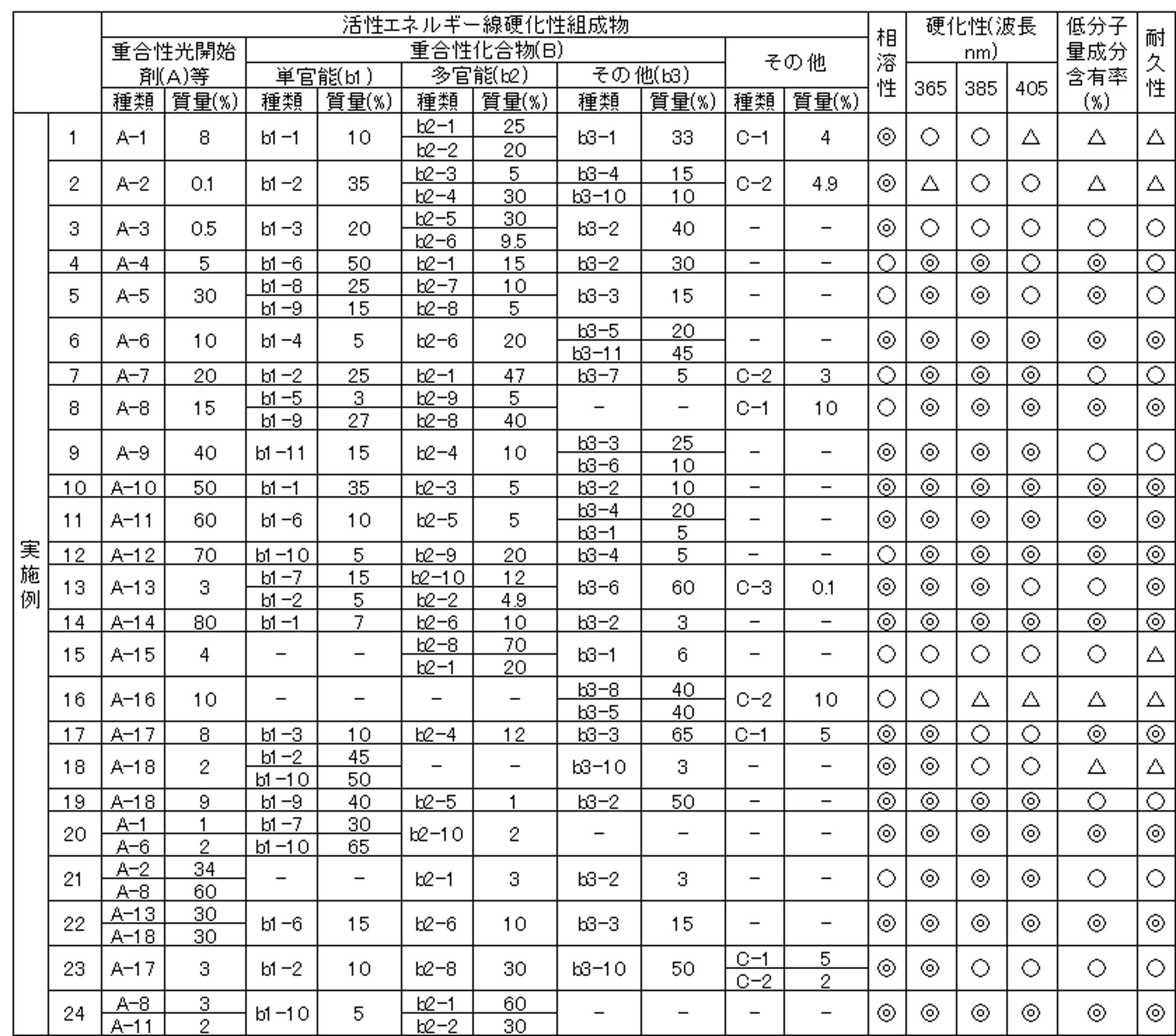
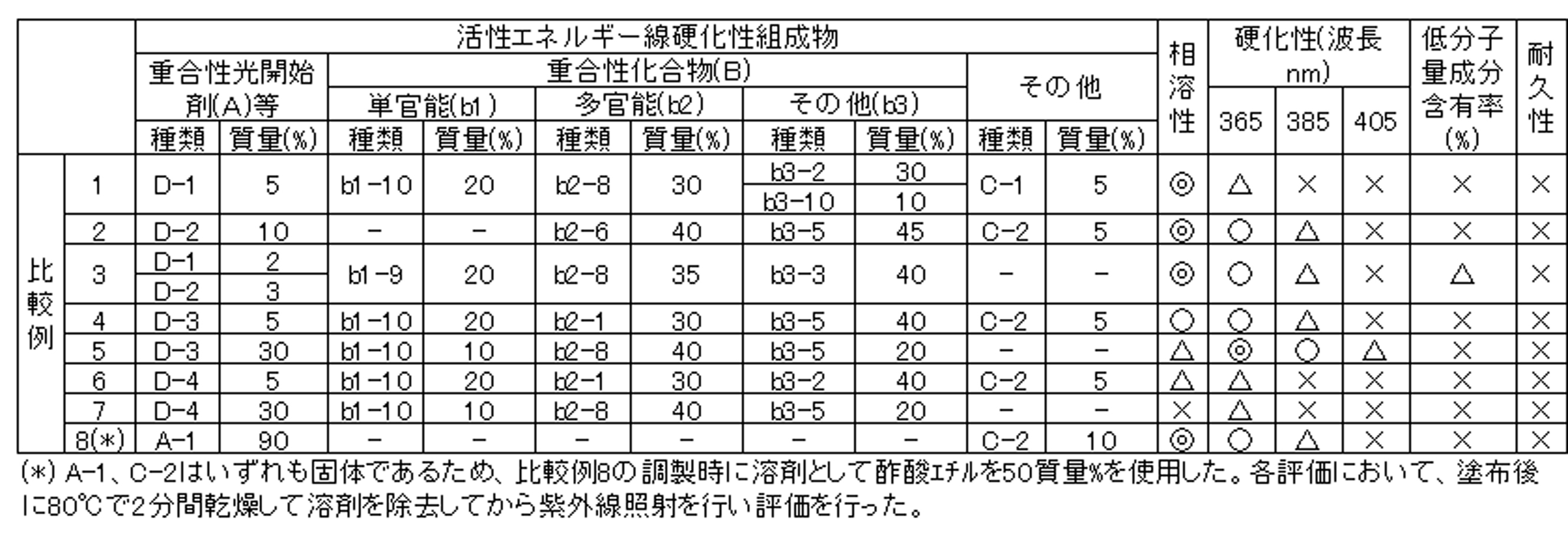
表4記載の比例に準じ(固形分換算)、表2で得られた活性エネルギー線硬化性組成物、表1で示す重合性光開始剤(A)又は光重合開始剤(D)、その他の成分を秤量し、室温にて均一に混合して、インク組成物を調製した。調製したインク組成物を用いて、下記方法により粘度測定を行い、又顔料分散液を含有する場合の顔料分散性評価を行った。インク組成物の活性エネルギー線硬化性と得られた硬化膜の表面乾燥性を評価し、更にインクジェット印刷を行い、印刷適性としてインク吐出安定性と印刷物の鮮明度の評価を行った。これらの評価の結果を表4に示した。
インク組成物の粘度をJIS K5600-2-3に準じて、コーンプレート型粘度計(東機産業(株)社製 RE550型粘度計)により測定した。インクジェット式印刷用のインク組成物として、粘度を下記通り4段階に分けて評価した。
◎:5~100mPa・s未満
○:100~500mPa・s未満
△:500~2000mPa・s未満
×:2000mPa・s以上
調製したインク組成物を用いて、調製直後及び2ヶ月静置後の顔料の凝集や沈殿状態を目視により観察し、顔料分散性を下記通り4段階に分けて評価した。
◎:調製直後も2ヶ月静置後も、顔料の凝集や沈殿は全く認められなかった。
〇:調製直後には全く認められなかったが、2ヶ月静置後、わずかに顔料の沈殿が認められた。
△:調製直後にはわずかに、2ヶ月静置後には顔料の凝集や沈殿が明瞭に認められた。
×:調製直後にも顔料の凝集や沈殿が明瞭に認められた。
得られたインク組成物を厚さ100μmのPETフィルムにバーコーター(RDS12)にて塗布し(乾燥後膜厚20μm)、紫外線照射(UVLEDランプ:波長385nm、照度1000mW/cm2)により硬化させ、印刷物を作製した。
上記方法にて印刷物を作製する際、インク組成物が完全硬化(べたつかない状態)するまでの積算光量を測定し、硬化性を下記基準により評価した。
◎:1000mJ/cm2で完全硬化
○:1000~2000mJ/cm2で完全硬化
△:2000~5000mJ/cm2で完全硬化
×:完全硬化までに5000mJ/cm2以上が必要
上記方法にて作製した印刷物を、室温23℃、相対湿度50%の環境に5分間静置し、印刷面に上質紙を重ね、荷重1kg/cm2の負荷を1分間かけ、紙へのインクの転写程度を、下記基準により評価した。
◎:インクが乾燥し、紙への転写が全くなかった。
○:インクが乾燥し、紙への転写がわずかにあった。
△:インクがほぼ乾燥し、紙への転写があった。
×:インクが殆ど乾燥せず、紙への転写が多かった。
調製したインク組成物を市販のインクジェットプリンター(富士フィルム社製 LuxelJet U V350GTW)に充填し、コート紙を用いて、ベタ画像を印刷し、インクの印刷適正を以下の方法にて評価した。
得られた印刷物の印刷状態を目視で観察し、下記基準により評価した。
◎:ノズル抜けなく、良好に印刷されている。
〇:わずかにノズル抜けがある。
△:広い範囲にてノズル抜けがある。
×:不吐出がある。
顔料を配合したインク組成物から得られた印刷物の画像鮮明度を目視で観察し、下記基準により評価した。
◎:インクにじみが全く見られなく、画像が鮮明であった。
○:インクにじみが殆どなく、画像が良好であった。
△:インクにじみが若干見られた。
×:インクにじみが著しくみられた。
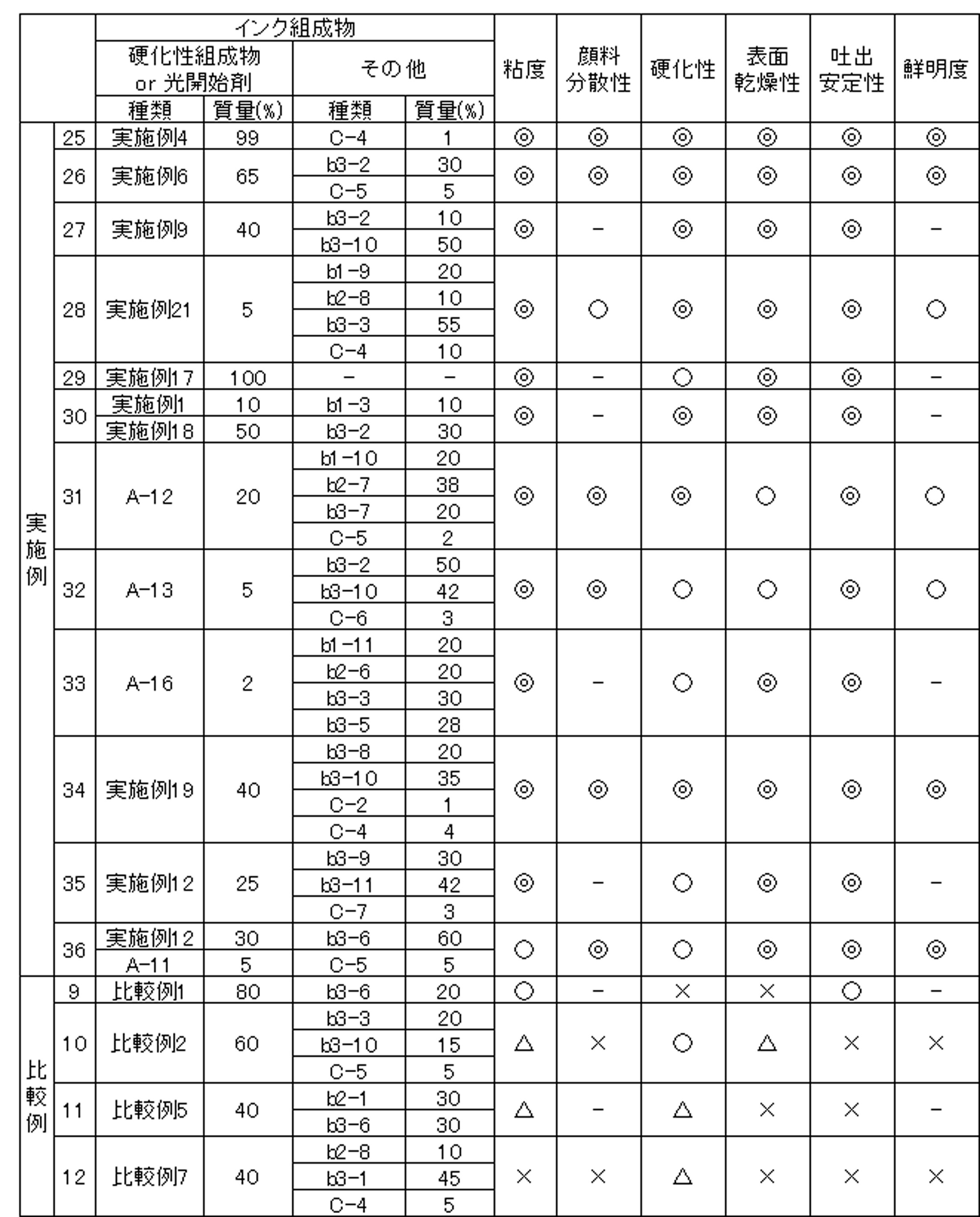
表5記載の比例に準じ(固形分換算)、表2で得られた活性エネルギー線硬化性組成物、表1で示す重合性光開始剤(A)又は光重合開始剤(D)、その他の成分を秤量し、室温にて均一に混合して、三次元造形用インク組成物を調製した。三次元造形用インク組成物を用いて、下記方法にて三次元造形物を作製し、造形時の硬化収縮率を評価し、又得られた硬化物の強度、耐熱性、耐水性、造形精度を評価した。これらの評価結果を表5に示す。
水平に設置したガラス板上に厚さ75μmの重剥離PETフィルム(東洋紡株式会社製、ポリエステルフィルムE7001)を密着させ、厚さ1mm、内部がJIS K6251に準拠した2号ダンベル型に打ち抜いたスペーサーを設置し、スペーサーの内側に各実施例と比較例で得られた三次元造形用インク組成物を各々充填した後、更にその上に厚さ50μmの軽剥離PETフィルム(東洋紡株式会社製、ポリエステルフィルムE7002)を重ね、紫外線を両面より照射(UVLEDランプ:波長365nm、照度10mW/cm2、積算光量5000mJ/cm2)し、三次元造形用インク組成物を硬化させた。その後、両側の剥離PETフィルムを取り除いて、実施例用の硬化物及び比較例用の硬化物の試験片を得た。JIS K7161に従って、卓上形精密万能試験機(株式会社島津製作所製 オートグラフAGS-X)を用い、25℃の温度環境下にて、引張速度10mm/分、チャック間距離50mmの条件で引張強度を測定し、以下に示す基準により強度の評価を行った。
◎:引張強度 40MPa以上
○:引張強度 30MPa以上、40MPa未満
△:引張強度 20MPa以上30MPa未満
×:引張強度 20MPa未満
硬化収縮率はJIS K5600 2-4に従って、下記計算式(1)に示すように三次元造形用インク組成物の硬化前後の密度変化によって求めた。三次元造形用インク組成物の硬化前後の密度に関しては、電子比重計(アルファーミラージュ株式会社製のMDS-300)により、JIS K7112に従って測定した。硬化物は前記引張試験用の試験片と同様に作製した。得られた硬化収縮率から以下の評価を行った。
(硬化収縮率)=(Ds-Dl)/Dl×100 ・・・計算式(1)
(式中、Dsは三次元造形用インク組成物の硬化後の密度であり、Dlは三次元造形用インク組成物の硬化前の密度である。)
◎:硬化収縮率 6%未満
○:硬化収縮率 6%以上7%未満
△:硬化収縮率 7%以上8%未満
×:硬化収縮率 8%以上
前記引張試験用の試験片と同様に硬化物を作製し、示差走査熱量計(株式会社島津製作所製のDSC-60plus)により硬化物のガラス転移温度(Tg)を測定した。硬化物のガラス転移温度(Tg)の測定値から耐熱性について、下記基準により評価した。
◎:硬化物Tg 60℃以上
○:硬化物Tg 40℃以上60℃未満
×:硬化物Tg 40℃未満
水平に設置したガラス板上に厚さ75μmの重剥離PETフィルム(東洋紡株式会社製、ポリエステルフィルムE7001)を密着させ、厚さ10mm、内部が10cm×1cmのスペーサーを設置し、スペーサーの内側に1mm厚分の各実施例と比較例で得られた三次元造形用インク組成物を各々充填し、60℃で30秒間保温することで表面を平滑にした後、紫外線を照射(UVLEDランプ:波長365nm、照度10mW/cm2、積算光量5000mJ/cm2)し、三次元造形用インク組成物を硬化させることで長さ10cm×巾1cm×厚さ1mmの硬化物を得た。得られた硬化物について、製造直後の重量を測定した後、100mlの水の入ったビーカーに浸漬し、1日後に浸漬後の重量を測定した。製造直後の重量と浸漬後の重量を下記式に代入して吸水率を測定し、以下に示す基準により耐水性の評価を行った。
吸水率(%)=(1日浸漬後の重量-製造直後の重量)/製造直後の重量×100%
◎:吸水率が2%未満
○:吸水率が2%以上、2.5%未満
△:吸水率が2.5%以上、3%未満
×:吸水率が3%以上
水平に設置したガラス板上に厚さ75μmの重剥離PETフィルム(東洋紡株式会社製、ポリエステルフィルムE7001)を密着させ、厚さ10mm、内部が10mm×10mmのスペーサーを設置し、スペーサーの内側に1mm厚分の各実施例と比較例で得られた三次元造形用インク組成物を各々充填した後、60℃で30秒間保温することで表面を平滑にした後、紫外線を照射(UVLEDランプ:波長365nm、照度10mW/cm2、積算光量1000mJ/cm2)し、三次元造形用インク組成物を硬化させた。その後、三次元造形用インク組成物を各々1mm厚で充填、硬化を計10回繰り返し、10×10×10mmの硬化物を得た。得られた硬化物の高さについて測定した。又、得られた硬化物の側面を目視観察した。これらの結果を組み合わせ、以下の基準により造形精度を評価した。
◎:高さ10mm±0.1mm未満、かつ、側面に凹凸がない。
○:高さ10mm±0.1mm以上 ±0.2mm未満、又は、側面に僅かな凹凸がある。
△:高さ10mm±0.2mm以上 ±0.3mm未満、又は、側面に若干凹凸がある。
×:高さ10mm±0.3mm以上、又は、側面に明らかな凹凸がある。
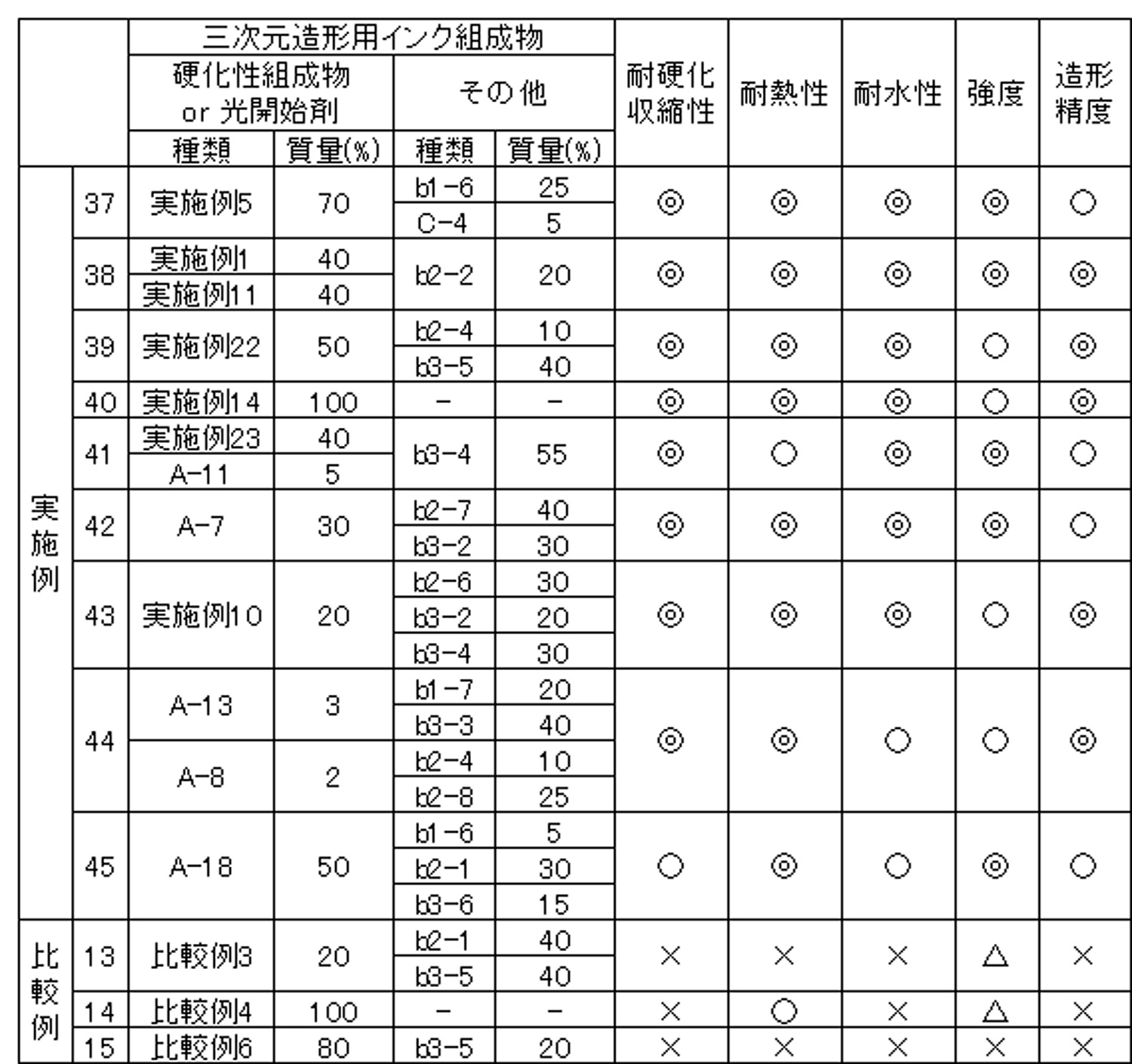
表6記載の比例に準じ(固形分換算)、表2で得られた活性エネルギー線硬化性組成物、表1に示す重合性光開始剤(A)又は光重合開始剤(D)、その他の成分を秤量し、室温にて均一に混合して、爪化粧料組成物を調製した。爪化粧料組成物の硬化性、ナイロン基材に対する密着性、得られる硬化膜の表面硬度と表面光沢性を評価し、結果を表6に示す。
実施例と比較例で調製した活性エネルギー線硬化性爪化粧料用組成物をナイロン6のテストピース(「SHT-N6(NC)」東レプラスチック精工株式会社製)上にセパレーターを用い、膜厚が100μmとなるように塗布し、その後、ジェルネイル専用UVLEDランプ(ビューティーネイラー製、波長405nm、48W)により紫外線照射を行い、硬化後に表面をティッシュペーパーにて拭き取りを行い、硬化膜を作製した。硬化膜の表面に触れた際のタックがなくなる時間を4段階に分けて評価した。タックがなくなるまでに必要の時間が短い程、硬化性が高い。
◎:1分未満でタックがなくなる。
○:1分以上、3分未満でタックがなくなる。
△:3分以上、10分未満でタックがなくなる。
×:10分以上でもタックがなくならない。
得られた各実施例、比較例の光硬化性爪化粧料用組成物を用いて、上記同様にナイロン6のテストピース上に塗布し、3分間の光照射により硬化膜を作製した。得られた硬化膜を用いて、JIS K 5600に準拠し、カッターナイフで1mm四方の碁盤目を100個作製し、市販のセロハンテープを貼りあわせた後に剥離した際のテストピース上に残った碁盤目の個数を4段階に分けて評価した結果を表6に示した。テストピース上に残る碁盤目の個数が多い程、密着性が高い。
◎:残存した碁盤目の個数が100個である。
○:残存した碁盤目の個数が90~99個である。
△:残存した碁盤目の個数が60~89個である。
×:残存した碁盤目の個数が60個未満である。
密着性評価で得られた各実施例、比較例の硬化膜を用い、膜の表面を硬度HBの鉛筆で750gの荷重を45°の角度で押し当てて引き、剥離の発生有無と引っかき傷の有無を目視により確認し、3段階に分けて評価し、結果を表6に示した。傷や剥離の発生が少ない程、表面硬度が高い。
○:傷も剥離も発生しなかった。表面硬度は鉛筆硬度HB以上を有する。
△:剥離は発生しなかったが、傷が発生した。
×:剥離が発生した。
密着性評価で得られた各実施例、比較例の硬化膜を用い、膜の表面の光沢を目視により観察し、下記基準により評価した。
○:光沢がある。
△:光の反射は確認できるが、曇りがみられる。
×:光の反射が確認できず、光沢がない。
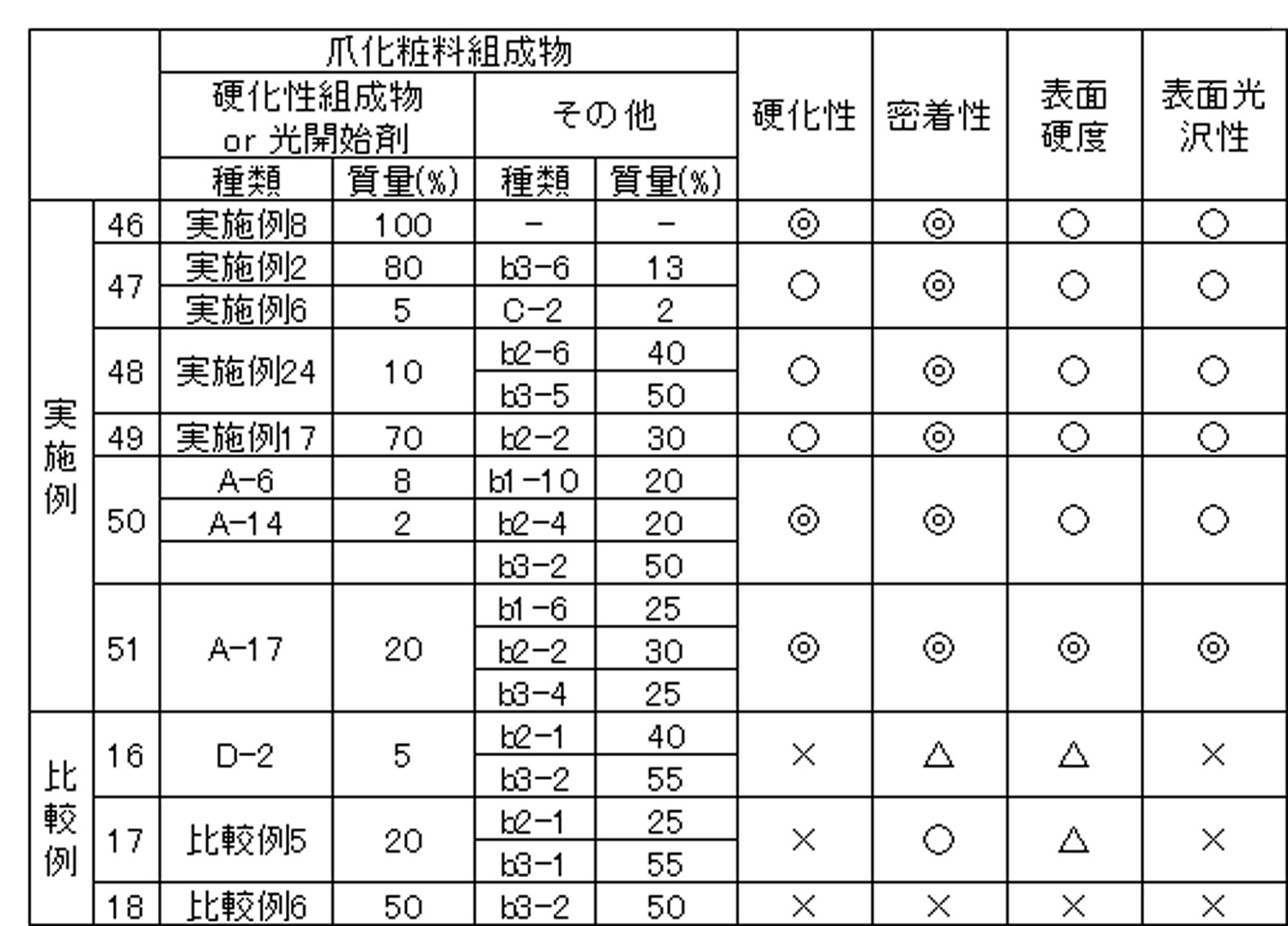
表7記載の比例に準じ(固形分換算)、表2で得られた活性エネルギー線硬化性組成物、表1示す重合性光開始剤(A)又は光重合開始剤(D)、その他の成分を秤量し、室温にて均一に混合して、粘着剤組成物を調製した。粘着剤組成物を用いて、下記方法により粘着シートを作製し、粘着剤組成物の硬化性、各種基材に対する密着性及び、得られた粘着シートの透明性、粘着力、耐汚染性(リワーク性)、耐久性と耐光黄変性を評価し、結果を表7に示した。
平に設置したガラス板上に厚さ75μmの重剥離PETフィルム(東洋紡株式会社製、ポリエステルフィルムE7001)を密着させ、厚さ1mm、内部が60mm×100mmのスペーサーを設置し、スペーサーの内側に調製した実施例、比較例の活性エネルギー線硬化性粘着剤組成物を充填した後、更にその上に厚さ50μmの軽剥離PETフィルム(東洋紡株式会社製、ポリエステルフィルムE7002)を重ね、波長385nm、出力100mW/cm2のUVLEDランプにより積算光量が3000mJ/cm2となるように照射を行い、粘着剤組成物を硬化させた。その後、両側の剥離PETフィルムを取り除いて得られた硬化物に触れて硬化性を3段階に分けて評価した。
○:形状を保てる硬化物が得られ、硬化物に触れた際にタックは見られるが、液状の未硬化物の付着がない状態である。
△:形状を保てる硬化物が得られ、硬化物に触れた際にタックは見られるが、液状の未硬化物の付着がある状態である。
×:硬化が不十分で、形状を保てる硬化物が得られず、液状の残留物の付着が多量にみられる状態である。
上記にて調製した活性エネルギー線硬化性粘着剤組成物を下記に示す板状又はフィルム状の各種基材(基板)上に塗工し、軽剥離セパレーター(シリコーンコートPETフィルム)で気泡を噛まないように卓上型ロール式ラミネーター機(Royal Sovereign製 RSL-382S)を用いて、粘着層が厚さ50μmになるように貼り合わせ、紫外線を照射(UVLEDランプ:波長385nm、照度1000mW/cm2、積算光量2000mJ/cm2)した。その後、軽剥離セパレーターを剥がして、粘着層と基材からなる粘着シートを得た。得られた粘着シートを用い、JIS K 5600に準拠して、1mm角のマス目を100個作製し、セロハンテープを貼り付け、一気に剥がした時に基材側に粘着層が残ったマス目の数を数えて、下記基準により密着性を評価した。
基材(基板)
PET:東洋紡株式会社製E5100(コロナ処理面)
PMMA:クラレ製コモグラスP
PC:タキロンシーアイ性PC1600
PVC:積水化成品工業製エスビロンプレートI-500
ガラス(GL):コーニング製イーグルXG
評価基準
◎:100個で剥離なし
〇:95~99個で剥離なし
△:70~94個で剥離なし
×:0~69個で剥離なし
前記同様に粘着シートを作製し、温度23℃、相対湿度50%の条件下、粘着層を易接着PETフィルム(東洋紡製コスモシャインA4160)易接着面に転写し、重さ2kgの圧着ローラーを用いて2往復することにより加圧貼付し、同雰囲気下で30分間放置した。その後、引っ張り試験機(装置名:テンシロンRTA-100 ORIENTEC社製)を用いて、JIS Z0237に準じて剥離速度300mm/分にて180°剥離強度(N/25mm)を測定し、下記基準により評価した。
◎:20(N/25mm)以上
○:10(N/25mm)以上、20(N/25mm)未満
△:5(N/25mm)以上、10(N/25mm)未満
×:5(N/25mm)未満
ヘイズメーター(日本電色工業社製、NDH-2000)を用いて、JIS K 7105に準拠し、ガラス基板の全光線透過率を測定した。前記同様にガラス基板の粘着シートを作製し、温度23℃、相対湿度50%の条件下、ガラス基板に粘着層を転写し、ガラス基板と粘着層の全光線透過率を測定した。その後、ガラス板の透過率を差し引き、粘着層自体の透過率を算出し、透明性を下記通り4段階分けて評価した。
◎:透過率は90%以上
○:透過率は85%以上、かつ90%未満
△:透過率は50%以上、かつ85%未満
×:透過率は50%未満
前記の粘着力の測定と同様に粘着シートを作製し、80℃、24時間放置した後、粘着シートを剥がした後の基材フィルム表面の汚染(粘着層(糊)の残り状態)を目視によって観察し、下記基準により評価した。
◎:汚染なし(糊残りがない)。
○:ごく僅かに汚染がある。
△:僅かに汚染がある。
×:汚染がある(糊残りがある)。
前記同様にガラス基板の粘着シートを作製し、キセノンフェードメーター(SC-700-WA:スガ試験機社製)にセットし、70mW/cm2の強度の紫外線を、120時間照射した後、粘着シート上の粘着層の変色を目視によって観察し、下記基準により評価した。
◎:黄変が目視で全く確認できない。
○:黄変が目視でごく僅かに確認できる。
△:黄変が目視で確認できる。
×:明らかな黄変が目視で確認できる。
前記同様にガラス基板の粘着シートを作製し、温度85℃、相対湿度85%の条件下で100時間保持した後、粘着層の浮きや剥がれ、気泡、白濁の発生有無を目視によって観察、下記基準により評価した。
◎:透明で、浮きや剥がれも気泡も発生しない。
×:曇り又は浮きや剥がれ、気泡がある。
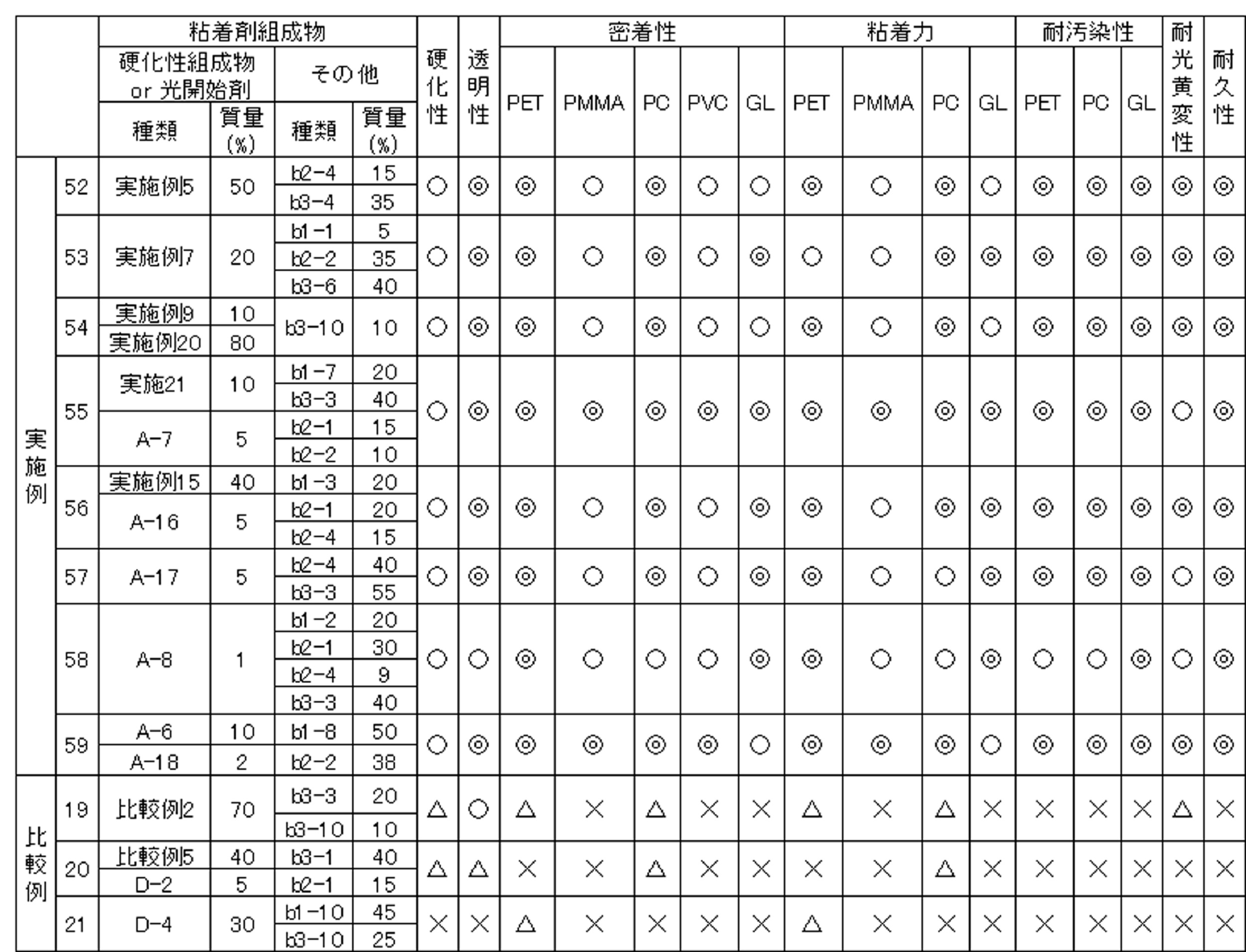
表8記載の比例に準じ(固形分換算)、表2で得られた活性エネルギー線硬化性組成物、表1に示す重合性光開始剤(A)又は光重合開始剤(D)、その他の成分を秤量し、室温にて均一に混合して、接着剤組成物を調製した。接着剤組成物を用いて、下記方法により接着した積層フィルムを作製し、接着剤組成物の硬化性、各種基材に対する接着力及び、得られた積層フィルムの耐久性を評価し、結果を表8に示した。
水平に設置したガラス板上にPETフィルム(東洋紡株式会社製、ポリエステルフィルムE5100)をコロナ処理面が表面に来るように密着させ、実施例、比較例の活性エネルギー線硬化性接着剤組成物をバーコーターNo.12にて厚さ20μmに塗工し、厚さ50μmの軽剥離PETフィルム(東洋紡株式会社製、ポリエステルフィルムE7002)を重ね、波長365nm、出力50mW/cm2のUVLEDランプにより紫外線照射を行い、接着剤組成物を硬化させた。その後、剥離PETフィルムを取り除いて、硬化膜表面のタックの有無を確認し、タックが消失するまでの必要な積算光量により硬化性を下記基準により評価した。
◎:積算光量1000mJ/cm2未満でタックが消失した。
○:積算光量1000mJ/cm2以上且つ2000mJ/cm2未満でタックが消失した。
△:積算光量2000mJ/cm2以上且つ5000mJ/cm2未満でタックが消失した。
×:積算光量5000mJ/cm2以上でもタックが残留した。
上記にて調製した活性エネルギー線硬化性接着剤組成物を下記に示す板状又はフィルム状の各種基材(基板)上に塗工し、東洋紡株式会社製E5100(コロナ処理面)で気泡を噛まないように卓上型ロール式ラミネーター機(Royal Sovereign製 RSL-382S)を用いて、接着層が厚さ20μmになるように貼り合わせ、紫外線を照射(波長365nm、のUVLEDランプ出力50mW/cm2、積算光量:5000mJ/cm2)し、積層フィルムを作製した。その後、引っ張り試験機(装置名:テンシロンRTA-100 ORIENTEC社製)を用いて、JIS Z0237に準じて剥離速度300mm/分にて180°剥離強度(N/25mm)を測定し、下記基準により接着力を評価した。
基材(基板)
PET(未):東洋紡株式会社製E5100(未処理面)
PMMA:クラレ製コモグラスP
PC:タキロンシーアイ製PC1600
評価基準
◎:20(N/25mm)以上
○:10(N/25mm)以上、20(N/25mm)未満
△:5(N/25mm)以上、10(N/25mm)未満
×:5(N/25mm)未満
前記の接着力評価と同様に東洋紡株式会社製E5100(コロナ処理面)/PET積層フィルムを作製し、温度85℃、相対湿度85%の条件下で100時間保持した後、接着層の浮きや剥がれ、気泡、白濁の発生有無を目視によって観察し、下記基準により耐久性を評価した。
◎:透明で、浮きや剥がれも気泡も発生しない。
○:ごく僅かな曇りがあるが、浮きや剥がれも気泡も発生しない。
△:僅かな曇り又は浮きや剥がれ、気泡がある。
×:極度な曇り又は浮きや剥がれ、気泡がある。
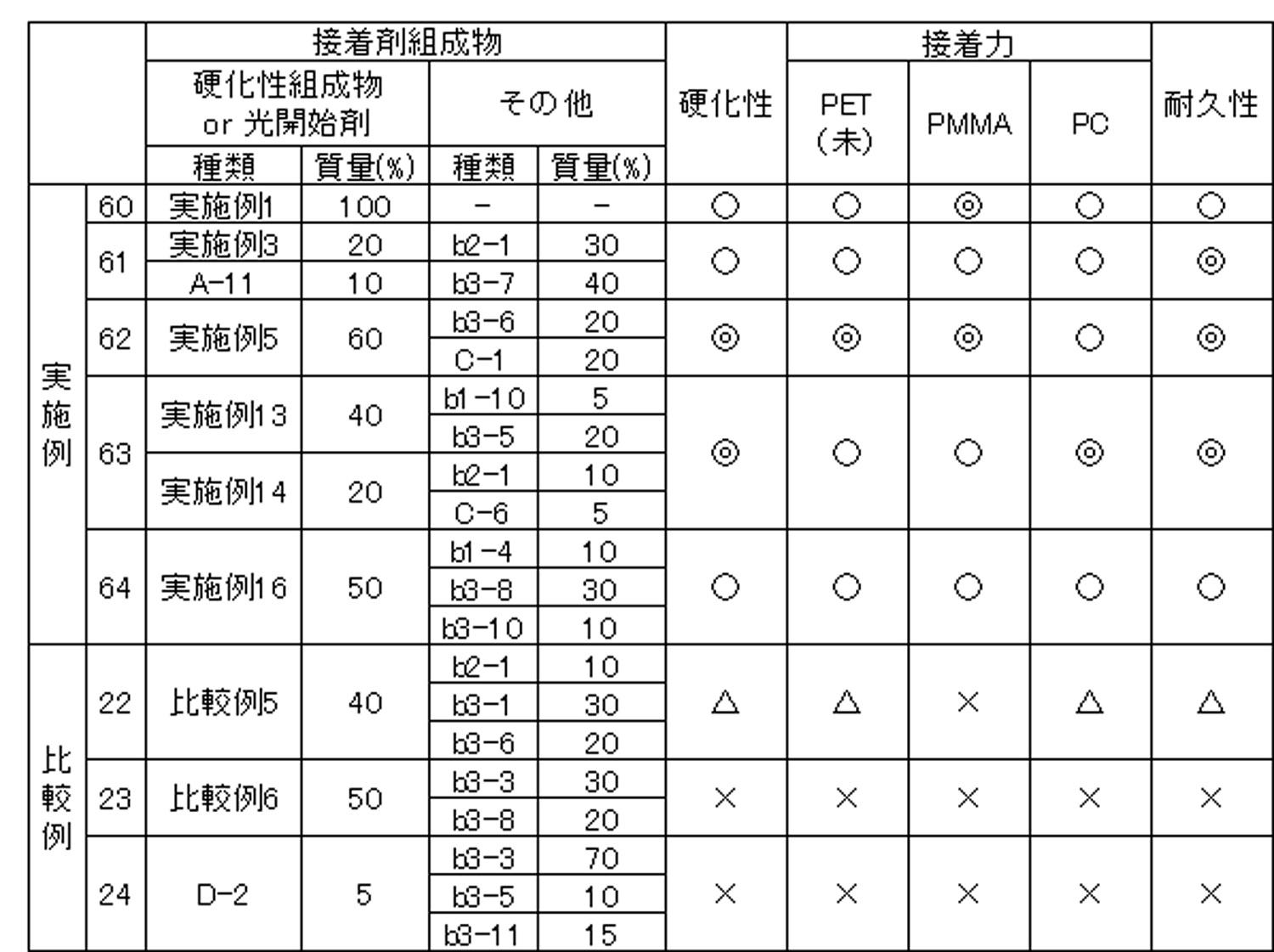
表9記載の比例に準じ(固形分換算)、表2で得られた活性エネルギー線硬化性組成物、表1に示す重合性光開始剤(A)又は光重合開始剤(D)、その他の成分を秤量し、室温にて均一に混合して、コート剤組成物を調製した。コート剤組成物を用いて、下記方法によりコート層を作製し、コート剤組成物の硬化性及び、得られたコート層の密着性、耐屈曲性、耐薬品性、耐傷性、自己修復性、耐久性を評価し、結果を表9に示した。
平に設置したガラス板上にPETフィルム(東洋紡株式会社製E5100)をコロナ処理面が表面に来るように密着させ、実施例、比較例の活性エネルギー線硬化性コート剤組成物をバーコーターNo.6にて厚さ10μmに塗工し、窒素雰囲気下、メタルハライドランプによる紫外線照射(装置:アイグラフィックス製、インバーター式コンベア装置ECS-4011GX、メタルハライドランプ:アイグラフィックス製M04-L41、紫外線照度500mW/cm2)を行い、コート剤組成物を硬化させた。その後、硬化膜表面のタックの有無を確認し、タックが消失するまでの必要な積算光量により硬化性を下記とおり評価した。
◎:積算光量1000mJ/cm2未満でタックが消失した。
○:積算光量1000mJ/cm2以上且つ2000mJ/cm2未満でタックが消失した。
△:積算光量2000mJ/cm2以上且つ5000mJ/cm2未満でタックが消失した。
×:積算光量5000mJ/cm2以上でもタックが残留した。
上記にて調製した活性エネルギー線硬化性コート剤組成物を水平に設置したガラス板上にPETフィルム(東洋紡株式会社製E5100)をコロナ処理面が表面に来るように密着させ、実施例、比較例の活性エネルギー線硬化性コート剤組成物をバーコーターNo.12にて厚さ20μmに塗工し、窒素雰囲気下、波長365nmのUVLEDランプにより照度500mW/cm2、積算光量5000mJ/cm2の紫外線照射を行い、PETフィルム上にコート層を作製した。その後、得られたコート層を用い、JIS K 5600に準拠して、1mm角のマス目を100個作製し、セロハンテープを貼り付け、一気に剥がした時に基材側に粘着層が残ったマス目の数を数えて、下記基準により密着性を評価した。
◎:100個で剥離なし
〇:95~99個で剥離なし
△:70~94個で剥離なし
×:0~69個で剥離なし
前記の密着性評価と同様に作製したPETフィルムとコート層からなる積層体を作製し、JIS K−5600に記載の円筒形マンドレル法に準じ、コート層が外側になるようにマンドレル(10mmφ)に接触させ屈曲させた後、コート層の割れの有無を目視にて観察し、下記基準により耐屈曲性を評価した。
◎:まったく割れが見られなかった。
○:折り曲げ部が一部白化した。
△:折り曲げ部において一部割れが見られた。
×:折り曲げ部において割れが見られた。
前記の密着性評価と同様にPETフィルム上にコート層を作製し、コート層表面にオレイン酸を直径1cm程度となるように塗布し、23℃にて1時間保持後、中性洗剤にて洗い流し、表面の状態を観察し、下記基準により耐薬品性を評価した。
◎:オレイン酸の跡はまったく見られなかった。
○:オレイン酸を塗布した部分にごく薄く白化した跡がわずかに見られる。
△:オレイン酸を塗布した部分が白化し、表面に膨潤がみられる。
×:オレイン酸を塗布した部分がべたつき、表面剥離がみられる。
前記の密着性評価と同様にPETフィルム上にコート層を作製し、コート層表面を室温23℃、湿度50%の条件下、#0000のスチールウールを加重100gにて10往復し、コート層表面を目視にて観察し、下記基準により耐傷性を評価した。
◎:コート層の剥離や傷の発生は認められない。
○:コート層の一部にわずかな細い傷が認められる。
△:コート層全体に筋上の傷が認められる。
×:コート層の剥離が認められる。
前記の密着性評価と同様にPETフィルム上にコート層を作製し、コート層表面を室温23℃、湿度50%の条件下、真鍮ブラシにより100gの荷重をかけて10往復擦ったときの表面状態を目視にて観察し、下記基準により自己修復性を評価した。
◎:傷が30分以内に復元する。または傷がつかない。
○:30分後に傷が認められるが、24時間後に復元または、60℃にて8時間保持することにより復元する。
×:24時間後に傷が認められ、60℃にて8時間保持しても傷が復元しない。
前記の密着性評価と同様にPETフィルム上にコート層を作製し、温度85℃、相対湿度85%の条件下で100時間保持した後、接着層の浮きや剥がれ、気泡、白濁の発生有無を目視によって観察し、下記基準により耐久性を評価した。
◎:透明で、浮きや剥がれも気泡も発生しない。
○:ごく僅かな曇りがあるが、浮きや剥がれも気泡も発生しない。
×:曇り又は浮きや剥がれ、気泡がある。
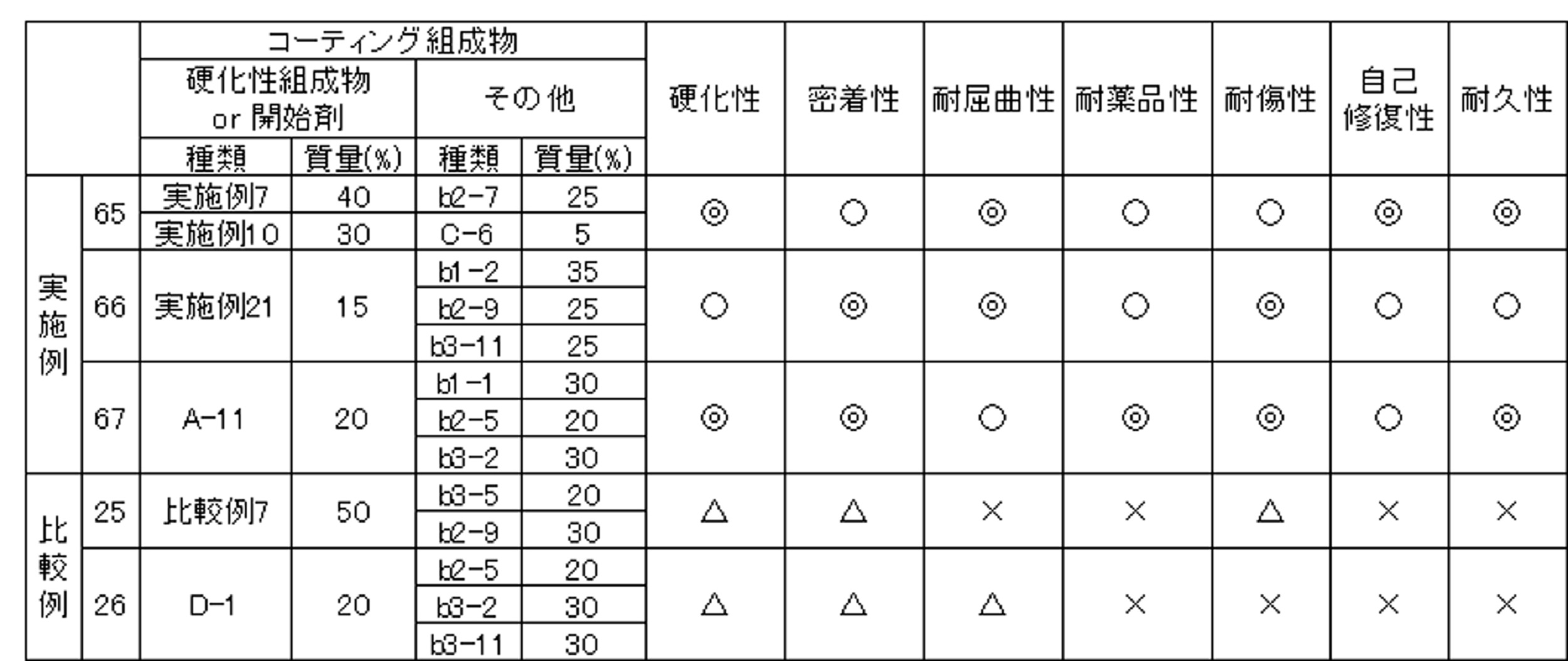
表10記載の比例に準じ(固形分換算)、表2で得られた活性エネルギー線硬化性組成物、表1に示す重合性光開始剤(A)又は光重合開始剤(D)、その他の成分を秤量し、室温にて均一に混合して、活性エネルギー線硬化性歯科用組成物を調製した。目視により歯科用組成物の溶解性又は分散性(不溶性無機系フィラーや顔料等を配合する場合)を観察し、保存安定性を評価し、それらの結果を表10に示す。又、歯科用組成物を用いて、下記方法により歯科用材料を作製し、歯科用組成物の硬化性、得られた歯科用材料の表面平滑性、硬度、接着強度を評価し、結果を表10に示す。
<溶解性(分散性)>
◎:得られた組成物は均一かつ透明なものであった。
〇:得られた組成物は均一であって、半透明なものであった。
△:得られた組成物は白濁し、均一性を判断し難いものであった。
×:得られた組成物は完全に混ざらないものであった。
実施例68~70で得られた活性エネルギー線硬化性歯科用組成物及び比較例27と28で得られた活性エネルギー線硬化性組成物を遮光性スクリュー管に入れ、蓋を閉め、40℃で1ヶ月及び80℃で2週間の二条件で保管した。保管後の組成物の溶解または分散状態を確認し、保存安定性を評価した。
○:40℃で1ヶ月及び80℃で2週間の二条件は共に保管後の状態変化がなかった。
△:40℃で1ヶ月又は80℃で2週間の何れか一条件において保管後の状態変化が確認された。
×:40℃で1ヶ月及び80℃で2週間の二条件は共に保管後の状態変が確認された。
実施例68~70で得られた活性エネルギー線硬化性歯科用組成物及び比較例27と28で得られた活性エネルギー線硬化性組成物を用い、中心に直径6mmの孔を有するポリテトラフルオロエチレン製のモールド(20mm×20mm×10mm)に組成物を充填し、ポリプロピレンフィルムで圧接し、歯科用光照射器(トクソーパワーライト、トクヤマデンタル社製、光出力密度700mW/cm2、照射面における光強度640〜650mW/cm2、光源はハロゲンランプ、照射口径8mm)をポリプロピレンフィルムに密着して30秒間照射し、ポリプロピレンフィルムを剥がして硬化体手で触って、べたつき、未硬化成分の有無を確認した。
◎:べたつきが全くない(完全硬化)。
○:若干のべたつきがあるが、表面に指の跡が残らない(ほぼ完全硬化、未硬化成分の拭き取りは不要である)。
△:べとつきがあり、表面に指の跡が残る(不完全硬化、未硬化成分の拭き取りが必要である)。
×:べとつきがひどく、表面に指が貼りつく(未硬化成分が多く残存し、硬化膜として使用できない)。
前記硬化性評価で得られた硬化物の表面を目視にて観察し、平滑性や光沢性を確認した。
◎:表面が平滑で、光沢がある。
○:表面がほぼ平滑で、うっすらと曇りまたは僅かな凹凸が見られる。
△:表面が全体的に曇っており、凹凸や粒状なものが多少確認される。
×:表面が全体的に曇って、粒状なものに覆われている。
前記硬化性評価で得られた硬化体の表面をバフ研磨したものを用い、松沢精機製微小硬度計で10g、20秒荷重でヌープ硬度を測定した。なお、測定温度は23℃であった。
◎:ヌープ硬度は200KHN以上(永久歯エナメル質相当)。
○:ヌープ硬度は70KHN以上、200KHN未満(象牙質相当)。
△:ヌープ硬度は70KHN未満。
×:硬化しなかったため、測定はできなかった。
牛下額前歯を注水下で#1000の耐水研磨紙で研磨し、平坦な接着用象牙質面を削り出し、圧縮空気を10秒間吹き付けて乾燥させ、直径3mmの穴の空いたテープを貼り付け、被着面を設定した。その後、公知の方法(特開2010-208964に記載方法を参考)により、接着試験片を作成した。接着試験片は37℃水中に24時間浸漬後、インストロン万能試験機(クロスヘッドスピード速度2mm/min)で引張接着強度を測定し、実施例1~10で得られた活性エネルギー線硬化性歯科用組成物及び比較例1~3で得られた活性エネルギー線硬化性組成物のエナメル質と象牙質への接着力とした。なお、引っ張り接着強度の値は5個の試験片の平均値である。
◎:エナメル質と象牙質の接着強度は共に20Mpa以上。
○:エナメル質と象牙質の接着強度はいずれか一つだけ20Mpa以上。
△:エナメル質と象牙質の接着強度は共に7Mpa以上。
×:エナメル質と象牙質の接着強度はいずれも7Mpa未満。

Claims (15)
- 1分子当り1つ以上のベンゾフェノン基と1つ以上のエチレン性不飽和基を有する重合性光開始剤(A)と、
1分子当り1つ以上のエチレン性不飽和基を有する重合性化合物(B)(Aを除く)を含む活性エネルギー線硬化性組成物であって、該活性エネルギー線硬化性組成物の硬化物中の分子量1000未満の成分の含有率が10%未満である活性エネルギー線硬化性組成物。 - 重合性光開始剤(A)及び/又は重合性化合物(B)は1分子当り1つ以上のヘテロ原子と水素原子の共有結合を有する請求項1に記載の活性エネルギー線硬化性組成物。
- 重合性光開始剤(A)及び/又は重合性化合物(B)はエチレン性不飽和基として、(メタ)アクリルアミド基、(メタ)アクリレート基、ビニル基、ビニルエーテル基、アルキルビニルエーテル基、アリル基、(メタ)アリルエーテル基、スチリル基とマレイミド基から選択される1種以上の基を有する請求項1又は2に記載の活性エネルギー線硬化性組成物。
- 重合性光開始剤(A)及び/又は重合性化合物(B)は、ヘテロ原子として酸素、硫黄、窒素、リン、ホウ素とケイ素から選択される1種以上の原子を用いて水素原子と共有結合を形成することを特徴とする請求項1~3のいずれか一項に記載の活性エネルギー線硬化性組成物。
- 重合性光開始剤(A)は、エチレン性不飽和基として(メタ)アクリルアミド基を有し、ヘテロ原子と水素原子の共有結合としてウレタン結合及び/又はウレア結合を有することを特徴とする請求項1~4のいずれか一項に記載の活性エネルギー線硬化性組成物。
- 請求項1~5のいずれか一項に記載の活性エネルギー線硬化性組成物を含有する活性エネルギー線硬化性インク組成物。
- 請求項1~5のいずれか一項に記載の活性エネルギー線硬化性組成物を含有する活性エネルギー線硬化性インクジェット用インク組成物。
- 請求項1~5のいずれか一項に記載の活性エネルギー線硬化性組成物を含有する活性エネルギー線硬化性二次元又は三次元造形用インク組成物。
- 請求項1~5のいずれか一項に記載の活性エネルギー線硬化性組成物を含有する活性エネルギー線硬化性爪化粧料組成物。
- 請求項1~5のいずれか一項に記載の活性エネルギー線硬化性組成物を含有する活性エネルギー線硬化性粘着剤組成物。
- 請求項1~5のいずれか一項に記載の活性エネルギー線硬化性組成物を含有する活性エネルギー線硬化性接着剤組成物。
- 請求項1~5のいずれか一項に記載の活性エネルギー線硬化性組成物を含有する活性エネルギー線硬化性封止材組成物。
- 請求項1~5のいずれか一項に記載の活性エネルギー線硬化性組成物を含有する活性エネルギー線硬化性組コート剤組成物。
- 請求項1~5のいずれか一項に記載の活性エネルギー線硬化性組成物を含有する活性エネルギー線硬化性自己修復塗料。
- 請求項1~5のいずれか一項に記載の活性エネルギー線硬化性組成物を含有する活性エネルギー線硬化性歯科用組成物。
Priority Applications (6)
| Application Number | Priority Date | Filing Date | Title |
|---|---|---|---|
| EP22886947.5A EP4424719A4 (en) | 2021-10-25 | 2022-10-24 | Composition hardens through active energy radiation |
| CN202280066711.1A CN118043361A (zh) | 2021-10-25 | 2022-10-24 | 活性能量线固化性组合物 |
| US18/695,024 US20240392049A1 (en) | 2021-10-25 | 2022-10-24 | Active energy ray curable composition |
| JP2023556426A JP7514048B2 (ja) | 2021-10-25 | 2022-10-24 | 活性エネルギー線硬化性組成物 |
| KR1020247012620A KR20240088890A (ko) | 2021-10-25 | 2022-10-24 | 활성 에너지선 경화성 조성물 |
| JP2024100529A JP2024120929A (ja) | 2021-10-25 | 2024-06-21 | 活性エネルギー線硬化性組成物 |
Applications Claiming Priority (4)
| Application Number | Priority Date | Filing Date | Title |
|---|---|---|---|
| JP2021174181 | 2021-10-25 | ||
| JP2021-174181 | 2021-10-25 | ||
| JP2022-061018 | 2022-03-31 | ||
| JP2022061018 | 2022-03-31 |
Publications (1)
| Publication Number | Publication Date |
|---|---|
| WO2023074620A1 true WO2023074620A1 (ja) | 2023-05-04 |
Family
ID=86157807
Family Applications (1)
| Application Number | Title | Priority Date | Filing Date |
|---|---|---|---|
| PCT/JP2022/039517 Ceased WO2023074620A1 (ja) | 2021-10-25 | 2022-10-24 | 活性エネルギー線硬化性組成物 |
Country Status (6)
| Country | Link |
|---|---|
| US (1) | US20240392049A1 (ja) |
| EP (1) | EP4424719A4 (ja) |
| JP (2) | JP7514048B2 (ja) |
| KR (1) | KR20240088890A (ja) |
| TW (1) | TW202328219A (ja) |
| WO (1) | WO2023074620A1 (ja) |
Cited By (4)
| Publication number | Priority date | Publication date | Assignee | Title |
|---|---|---|---|---|
| WO2024085227A1 (ja) * | 2022-10-21 | 2024-04-25 | Kjケミカルズ株式会社 | 光重合開始剤 |
| WO2025005274A1 (ja) | 2023-06-29 | 2025-01-02 | クラレノリタケデンタル株式会社 | 歯科用重合性組成物 |
| WO2025041652A1 (ja) * | 2023-08-22 | 2025-02-27 | スタンレー電気株式会社 | 活性エネルギー線硬化型防曇組成物及び樹脂成形体 |
| JP2025039507A (ja) * | 2023-09-08 | 2025-03-21 | artience株式会社 | 活性エネルギー線硬化型組成物 |
Citations (6)
| Publication number | Priority date | Publication date | Assignee | Title |
|---|---|---|---|---|
| JP2000159827A (ja) | 1998-11-30 | 2000-06-13 | Chisso Corp | 光重合開始剤および光重合性開始剤組成物 |
| JP2010208964A (ja) | 2009-03-09 | 2010-09-24 | Tokuyama Dental Corp | 歯科用光硬化性材料 |
| JP2013500303A (ja) | 2009-07-30 | 2013-01-07 | ビーエーエスエフ ソシエタス・ヨーロピア | 高分子光開始剤 |
| JP2013227368A (ja) * | 2012-04-24 | 2013-11-07 | San Apro Kk | 感活性エネルギー線性酸発生剤 |
| WO2021117880A1 (ja) | 2019-12-13 | 2021-06-17 | Kjケミカルズ株式会社 | 光重合開始剤 |
| JP2021095439A (ja) * | 2019-12-13 | 2021-06-24 | Kjケミカルズ株式会社 | 光重合開始性n−置換(メタ)アクリルアミド |
Family Cites Families (4)
| Publication number | Priority date | Publication date | Assignee | Title |
|---|---|---|---|---|
| JPH06102698B2 (ja) * | 1990-04-27 | 1994-12-14 | 積水化学工業株式会社 | 光重合性組成物 |
| JP4208187B2 (ja) | 2002-10-28 | 2009-01-14 | 日東電工株式会社 | 粘着型光学フィルム、粘着型光学フィルムの製造方法および画像表示装置 |
| KR100626436B1 (ko) | 2003-11-13 | 2006-09-20 | 주식회사 엘지화학 | 난연성이 개선된 점착제 |
| WO2012084811A1 (en) * | 2010-12-20 | 2012-06-28 | Agfa Graphics Nv | A curable jettable fluid for making a flexographic printing master |
-
2022
- 2022-10-24 TW TW111140150A patent/TW202328219A/zh unknown
- 2022-10-24 JP JP2023556426A patent/JP7514048B2/ja active Active
- 2022-10-24 WO PCT/JP2022/039517 patent/WO2023074620A1/ja not_active Ceased
- 2022-10-24 KR KR1020247012620A patent/KR20240088890A/ko active Pending
- 2022-10-24 US US18/695,024 patent/US20240392049A1/en active Pending
- 2022-10-24 EP EP22886947.5A patent/EP4424719A4/en active Pending
-
2024
- 2024-06-21 JP JP2024100529A patent/JP2024120929A/ja active Pending
Patent Citations (6)
| Publication number | Priority date | Publication date | Assignee | Title |
|---|---|---|---|---|
| JP2000159827A (ja) | 1998-11-30 | 2000-06-13 | Chisso Corp | 光重合開始剤および光重合性開始剤組成物 |
| JP2010208964A (ja) | 2009-03-09 | 2010-09-24 | Tokuyama Dental Corp | 歯科用光硬化性材料 |
| JP2013500303A (ja) | 2009-07-30 | 2013-01-07 | ビーエーエスエフ ソシエタス・ヨーロピア | 高分子光開始剤 |
| JP2013227368A (ja) * | 2012-04-24 | 2013-11-07 | San Apro Kk | 感活性エネルギー線性酸発生剤 |
| WO2021117880A1 (ja) | 2019-12-13 | 2021-06-17 | Kjケミカルズ株式会社 | 光重合開始剤 |
| JP2021095439A (ja) * | 2019-12-13 | 2021-06-24 | Kjケミカルズ株式会社 | 光重合開始性n−置換(メタ)アクリルアミド |
Non-Patent Citations (1)
| Title |
|---|
| See also references of EP4424719A4 |
Cited By (5)
| Publication number | Priority date | Publication date | Assignee | Title |
|---|---|---|---|---|
| WO2024085227A1 (ja) * | 2022-10-21 | 2024-04-25 | Kjケミカルズ株式会社 | 光重合開始剤 |
| WO2025005274A1 (ja) | 2023-06-29 | 2025-01-02 | クラレノリタケデンタル株式会社 | 歯科用重合性組成物 |
| WO2025041652A1 (ja) * | 2023-08-22 | 2025-02-27 | スタンレー電気株式会社 | 活性エネルギー線硬化型防曇組成物及び樹脂成形体 |
| JP2025039507A (ja) * | 2023-09-08 | 2025-03-21 | artience株式会社 | 活性エネルギー線硬化型組成物 |
| JP7805550B2 (ja) | 2023-09-08 | 2026-01-26 | artience株式会社 | 活性エネルギー線硬化型組成物 |
Also Published As
| Publication number | Publication date |
|---|---|
| EP4424719A1 (en) | 2024-09-04 |
| TW202328219A (zh) | 2023-07-16 |
| KR20240088890A (ko) | 2024-06-20 |
| JPWO2023074620A1 (ja) | 2023-05-04 |
| JP2024120929A (ja) | 2024-09-05 |
| EP4424719A4 (en) | 2025-11-19 |
| US20240392049A1 (en) | 2024-11-28 |
| JP7514048B2 (ja) | 2024-07-10 |
Similar Documents
| Publication | Publication Date | Title |
|---|---|---|
| JP7514048B2 (ja) | 活性エネルギー線硬化性組成物 | |
| JP6634556B2 (ja) | N−置換(メタ)アクリルアミドを用いた重合性組成物、その重合物及びそれらからなる成形品 | |
| ES2961372T3 (es) | Composiciones curables que comprenden acrilatos monofuncionales | |
| JP7391364B2 (ja) | 光重合開始性n-置換(メタ)アクリルアミド | |
| CN110025504B (zh) | 光固化性指甲化妆材料 | |
| JP2025109729A (ja) | 硬化性組成物とその硬化物 | |
| JP2025039585A (ja) | 活性エネルギー線硬化性組成物 | |
| JP2023024478A (ja) | t-ブチルシクロヘキシル(メタ)アクリレートを含有するインク組成物 | |
| CN118043361A (zh) | 活性能量线固化性组合物 | |
| JP2024082405A (ja) | 活性エネルギー線硬化型コーティング剤、及び積層体の製造方法 | |
| JP7668073B2 (ja) | ベンゾイルギ酸アミド誘導体 | |
| JP6861282B2 (ja) | 活性エネルギー線硬化型インキ、インキ硬化物の製造方法及び印刷物 | |
| JP7811041B2 (ja) | 光重合開始剤 | |
| CN118251428A (zh) | 活性能量线固化性组合物 | |
| JP2025079042A (ja) | 活性エネルギー線硬化型コーティング剤、及び積層体の製造方法 |
Legal Events
| Date | Code | Title | Description |
|---|---|---|---|
| 121 | Ep: the epo has been informed by wipo that ep was designated in this application |
Ref document number: 22886947 Country of ref document: EP Kind code of ref document: A1 |
|
| WWE | Wipo information: entry into national phase |
Ref document number: 2023556426 Country of ref document: JP |
|
| WWE | Wipo information: entry into national phase |
Ref document number: 18695024 Country of ref document: US |
|
| WWE | Wipo information: entry into national phase |
Ref document number: 202280066711.1 Country of ref document: CN |
|
| WWE | Wipo information: entry into national phase |
Ref document number: 2022886947 Country of ref document: EP |
|
| NENP | Non-entry into the national phase |
Ref country code: DE |
|
| ENP | Entry into the national phase |
Ref document number: 2022886947 Country of ref document: EP Effective date: 20240527 |