WO2023077001A1 - Dna-encoded and affinity-tagged masked-warhead compounds and use thereof in assembling libraries of small molecules enabled for late-stage purification and multiplexed screening of covalent ligands - Google Patents
Dna-encoded and affinity-tagged masked-warhead compounds and use thereof in assembling libraries of small molecules enabled for late-stage purification and multiplexed screening of covalent ligands Download PDFInfo
- Publication number
- WO2023077001A1 WO2023077001A1 PCT/US2022/078783 US2022078783W WO2023077001A1 WO 2023077001 A1 WO2023077001 A1 WO 2023077001A1 US 2022078783 W US2022078783 W US 2022078783W WO 2023077001 A1 WO2023077001 A1 WO 2023077001A1
- Authority
- WO
- WIPO (PCT)
- Prior art keywords
- alkyl
- chem
- warhead
- dna
- masked
- Prior art date
- Legal status (The legal status is an assumption and is not a legal conclusion. Google has not performed a legal analysis and makes no representation as to the accuracy of the status listed.)
- Ceased
Links
Classifications
-
- C—CHEMISTRY; METALLURGY
- C12—BIOCHEMISTRY; BEER; SPIRITS; WINE; VINEGAR; MICROBIOLOGY; ENZYMOLOGY; MUTATION OR GENETIC ENGINEERING
- C12N—MICROORGANISMS OR ENZYMES; COMPOSITIONS THEREOF; PROPAGATING, PRESERVING, OR MAINTAINING MICROORGANISMS; MUTATION OR GENETIC ENGINEERING; CULTURE MEDIA
- C12N15/00—Mutation or genetic engineering; DNA or RNA concerning genetic engineering, vectors, e.g. plasmids, or their isolation, preparation or purification; Use of hosts therefor
- C12N15/09—Recombinant DNA-technology
- C12N15/10—Processes for the isolation, preparation or purification of DNA or RNA
- C12N15/1034—Isolating an individual clone by screening libraries
- C12N15/1065—Preparation or screening of tagged libraries, e.g. tagged microorganisms by STM-mutagenesis, tagged polynucleotides, gene tags
-
- C—CHEMISTRY; METALLURGY
- C40—COMBINATORIAL TECHNOLOGY
- C40B—COMBINATORIAL CHEMISTRY; LIBRARIES, e.g. CHEMICAL LIBRARIES
- C40B50/00—Methods of creating libraries, e.g. combinatorial synthesis
- C40B50/14—Solid phase synthesis, i.e. wherein one or more library building blocks are bound to a solid support during library creation; Particular methods of cleavage from the solid support
- C40B50/16—Solid phase synthesis, i.e. wherein one or more library building blocks are bound to a solid support during library creation; Particular methods of cleavage from the solid support involving encoding steps
-
- C—CHEMISTRY; METALLURGY
- C07—ORGANIC CHEMISTRY
- C07H—SUGARS; DERIVATIVES THEREOF; NUCLEOSIDES; NUCLEOTIDES; NUCLEIC ACIDS
- C07H21/00—Compounds containing two or more mononucleotide units having separate phosphate or polyphosphate groups linked by saccharide radicals of nucleoside groups, e.g. nucleic acids
-
- C—CHEMISTRY; METALLURGY
- C07—ORGANIC CHEMISTRY
- C07K—PEPTIDES
- C07K14/00—Peptides having more than 20 amino acids; Gastrins; Somatostatins; Melanotropins; Derivatives thereof
- C07K14/001—Peptides having more than 20 amino acids; Gastrins; Somatostatins; Melanotropins; Derivatives thereof by chemical synthesis
-
- C—CHEMISTRY; METALLURGY
- C12—BIOCHEMISTRY; BEER; SPIRITS; WINE; VINEGAR; MICROBIOLOGY; ENZYMOLOGY; MUTATION OR GENETIC ENGINEERING
- C12N—MICROORGANISMS OR ENZYMES; COMPOSITIONS THEREOF; PROPAGATING, PRESERVING, OR MAINTAINING MICROORGANISMS; MUTATION OR GENETIC ENGINEERING; CULTURE MEDIA
- C12N15/00—Mutation or genetic engineering; DNA or RNA concerning genetic engineering, vectors, e.g. plasmids, or their isolation, preparation or purification; Use of hosts therefor
- C12N15/09—Recombinant DNA-technology
- C12N15/10—Processes for the isolation, preparation or purification of DNA or RNA
- C12N15/1034—Isolating an individual clone by screening libraries
- C12N15/1068—Template (nucleic acid) mediated chemical library synthesis, e.g. chemical and enzymatical DNA-templated organic molecule synthesis, libraries prepared by non ribosomal polypeptide synthesis [NRPS], DNA/RNA-polymerase mediated polypeptide synthesis
-
- C—CHEMISTRY; METALLURGY
- C12—BIOCHEMISTRY; BEER; SPIRITS; WINE; VINEGAR; MICROBIOLOGY; ENZYMOLOGY; MUTATION OR GENETIC ENGINEERING
- C12N—MICROORGANISMS OR ENZYMES; COMPOSITIONS THEREOF; PROPAGATING, PRESERVING, OR MAINTAINING MICROORGANISMS; MUTATION OR GENETIC ENGINEERING; CULTURE MEDIA
- C12N2320/00—Applications; Uses
- C12N2320/10—Applications; Uses in screening processes
- C12N2320/11—Applications; Uses in screening processes for the determination of target sites, i.e. of active nucleic acids
Definitions
- warhead reagents e.g., reactive olefins, acryloyl halides or equivalent synthons
- warhead reagents e.g., reactive olefins, acryloyl halides or equivalent synthons
- two levels of incompatibility first, at the level of the combinatorial chemistry routes optimized for the presence of DNA and water; and secondly, at the level of the in vitro selection workflows (e.g., one-round enrichment and background noise) (Guilinger et al., Bioorg. Med. Chem.42:116223 (2021); Zimmermann et al., Chem.- Eur. J.
- a first aspect of the present disclosure is directed to compounds represented by formula (I) or (II), or a pharmaceutical salt or stereoisomer thereof: or (II), wherein , R1 ’ , R1 ’’ , R2 ’ , R2 ’’ , R4 ’ , R4 ’’ and n are defined herein.
- R1 ’ , R1 ’’ , R2 ’ , R2 ’’ , R4 ’ , R4 ’’ and n are defined herein.
- Another aspect of the present disclosure is directed to methods of creating an electrophilic warhead-bearing DNA-Encoded Library (eDEL) comprising: coupling the compound of formula I or II with a DNA-Encoded Library (DEL) to generate a stable masked-warhead bearing DEL intermediate library (mwDEL); purifying the mwDEL intermediate library from unreacted and byproduct entities; unmasking the mwDEL intermediate to generate a warhead-bearing eDEL; and purifying the warhead-bearing eDEL.
- the stable masked-warhead bearing mwDEL intermediate comprises an arylsulfone comprising .
- the eDEL is used in an in vitro selection assay followed by DNA sequencing.
- the in vitro selection assay is used for screening protein ligands.
- the eDEL is used for screening ligands that covalently modify a residue of a protein (e.g., the thiol group of Cysteine, the amino group of Lysine, the imidazole group of Histidine, the hydroxyl groups of Serine, Threonine or Tyrosine, etc.).
- masked-warhead installation reagents that, upon unmasking afford acrylamide-class warheads attached to DEL (FIG. 1A-FIG. 1B), which altogether solve the myriad incompatibilities that have hindered the assembly, purification and screening of warhead-bearing DELs and covalent ligands in the past (FIG. 2A).
- the masked-warhead reagents can be coupled directly on DELs featuring traditional nucleophilic functional groups (e.g. primary or secondary amines, anilines, thiols, hydroxyls, phenols, etc.).
- the present disclosure can be implemented to solve the scarcity of warhead-bearing small molecule collections, resulting in structurally diverse libraries amenable for covalent ligand screening comprising both therapeutically validated and unexplored warhead classes (Goodnow et al., Nat. Rev. Drug Discov.16(2):131–147 (2017)).
- compositions/products are useful for solving the synthetic and the purification challenges associated with the incompatible circumstances of implementing reactive warheads (e.g., acrylamides) in the context of DNA- encoded combinatorial chemistry (Shi et al., RSC Adv.11(4):2359–2376 (2021)), which is a process requiring compatibility with split-and-pooled mixed library formats, in the presence of water and DNA, all the while promoting efficient conversion of warhead attachment onto the vastly different nucleophilic groups typically encountered in a DEL library (e.g., anilines, sterically hindered amines, hydroxyls, heterocyclic nitrogens, etc.) (Clark et al., Nat.
- FIG.1A illustrates highly desirable acrylamide-class warheads that are challenging to implement on DNA-Encoded Libraries of small molecules.
- FIG.1B illustrates the thought process behind the disclosure of the arylsulfone class of warhead-masking reagents, compared to other reactions that are deemed problematic and/or incompatible to implement warheads on DNA-Encoded Libraries of small molecules.
- FIG. 1C is an illustrative example of masked warhead reagents implemented on a generic secondary-amine DNA-encoded library (DEL) synthesized by 3 rounds of split-and- pool combinatorial synthesis (building blocks depicted as blue, green, and red spheres), followed by base pairing and DNA-templated amide bond formation with the masked warhead reagent.
- DEL generic secondary-amine DNA-encoded library
- FIG.2A shows the challenges associated with the implementation of acrylamide-class warheads on DNA-encoded libraries in the presence of DNA and water.
- FIG.2B shows masked warhead reagents offering versatility for the introduction of steric and reactivity-tuning substituents on the arylsulfone intermediate and the unmasked warhead of the eDEL.
- FIG.2C shows masked warhead reagents offering versatility for the use of many classes of arylsulfone moieties, including benzothiazole sulfones, pyridine sulfones, pyrimidine sulfones, alkyl- and phenyl-tetrazole sulfones, etc.
- alkyl refers to a saturated linear or branched-chain monovalent hydrocarbon radical.
- the alkyl radical is a C1-C18 group.
- the alkyl radical is a C 0 -C 6 , C 0 -C 5 , C 0 -C 3 , C 1 -C 12 , C 1 -C 8 , C 1 -C 6 , C 1 -C 5 , C 1 -C 4 or C 1 -C 3 group (wherein C 0 alkyl refers to a bond).
- alkyl groups include methyl, ethyl, 1-propyl, 2-propyl, i-propyl, 1-butyl, 2-methyl-1-propyl, 2-butyl, 2-methyl-2- propyl, 1-pentyl, n-pentyl, 2-pentyl, 3-pentyl, 2-methyl-2-butyl, 3-methyl-2-butyl, 3-methyl-1- butyl, 2-methyl-1-butyl, 1-hexyl, 2-hexyl, 3-hexyl, 2-methyl-2-pentyl, 3-methyl-2-pentyl, 4- methyl-2-pentyl, 3-methyl-3-pentyl, 2-methyl-3-pentyl, 2,3-dimethyl-2-butyl, 3,3-dimethyl-2- butyl, heptyl, octyl, nonyl, decyl, undecyl and dodecyl.
- an alkyl group is a C 1 -C 3 alkyl group.
- alkylene refers to a straight or branched divalent hydrocarbon chain linking the rest of the molecule to a radical group, consisting solely of carbon and hydrogen, containing no unsaturation and having from one to 12 carbon atoms, for example, methylene, ethylene, propylene, n-butylene, and the like.
- the alkylene chain may be attached to the rest of the molecule through a single bond and to the radical group through a single bond.
- the alkylene group contains one to 8 carbon atoms (C1-C8 alkylene).
- an alkylene group contains one to 5 carbon atoms (C1-C5 alkylene). In other embodiments, an alkylene group contains one to 4 carbon atoms (C1-C4 alkylene). In other embodiments, an alkylene contains one to three carbon atoms (C 1 -C 3 alkylene). In other embodiments, an alkylene group contains one to two carbon atoms (C 1 -C 2 alkylene). In other embodiments, an alkylene group contains one carbon atom (C1 alkylene). [25] As used herein, the term “alkenyl” refers to a linear or branched-chain monovalent hydrocarbon radical with at least one carbon-carbon double bond.
- alkenyl includes radicals having “cis” and “trans” orientations, or alternatively, “E” and “Z” orientations.
- the alkenyl radical is a C2-C18 group.
- the alkenyl radical is a C 2 -C 12 , C 2 -C 10 , C 2 -C 8 , C 2 -C 6 or C 2 -C 3 group.
- alkoxyl or “alkoxy” as used herein refer to an alkyl group, as defined above, having an oxygen radical attached thereto.
- alkoxyl groups include methoxy, ethoxy, propyloxy, tert-butoxy and the like.
- An “ether” is two hydrocarbyl groups covalently linked by an oxygen. Accordingly, the substituent of an alkyl that renders that alkyl an ether is or resembles an alkoxyl, such as can be represented by one of -O-alkyl, -O-alkenyl, and -O-alkynyl.
- alkoxylene refers to a saturated monovalent aliphatic radicals of the general formula (-O-C m H 2m -) where m represents an integer (e.g., 1, 2, 3, 4, 5, 6, or 7) and is inclusive of both straight-chain and branched-chain radicals.
- the alkoxylene chain may be attached to the rest of the molecule through a single bond and to the radical group through a single bond.
- the alkoxylene group contains one to 3 carbon atoms (-O-C1-C3 alkoxylene).
- an alkoxylene group contains one to 5 carbon atoms (-O-C1-C5 alkoxylene).
- cyclic group broadly refers to any group that used alone or as part of a larger moiety, contains a saturated, partially saturated or aromatic ring system e.g., carbocyclic (cycloalkyl, cycloalkenyl), heterocyclic (heterocycloalkyl, heterocycloalkenyl), aryl and heteroaryl groups. Cyclic groups may have one or more (e.g., fused) ring systems. Thus, for example, a cyclic group can contain one or more carbocyclic, heterocyclic, aryl or heteroaryl groups.
- carbocyclic refers to a group that used alone or as part of a larger moiety, contains a saturated, partially unsaturated, or aromatic ring system having 3 to 20 carbon atoms, that is alone or part of a larger moiety (e.g., an alkcarbocyclic group).
- carbocyclyl includes mono-, bi-, tri-, fused, bridged, and spiro- ring systems, and combinations thereof.
- carbocyclyl includes 3 to 15 carbon atoms (C3-C15).
- carbocyclyl includes 3 to 12 carbon atoms (C3- C 12 ).
- carbocyclyl includes C 3 -C 8 , C 3 -C 10 or C 5 -C 10 .
- carbocyclyl, as a monocycle includes C 3 -C 8 , C 3 -C 6 or C 5 -C 6 .
- carbocyclyl, as a bicycle includes C7-C12.
- carbocyclyl, as a spiro system includes C5-C12.
- monocyclic carbocyclyls include cyclopropyl, cyclobutyl, cyclopentyl, 1-cyclopent-1-enyl, 1-cyclopent-2-enyl, 1- cyclopent-3-enyl, cyclohexyl, perdeuteriocyclohexyl, 1-cyclohex-1-enyl, 1-cyclohex-2-enyl, 1-cyclohex-3-enyl, cyclohexadienyl, cycloheptyl, cyclooctyl, cyclononyl, cyclodecyl, cycloundecyl, phenyl, and cyclododecyl; bicyclic carbocyclyls having 7 to 12 ring atoms include [4,3], [4,4], [4,5], [5,5], [5,6] or [6,6] ring systems, such as for example bicyclo[2.2.1]heptane, bicyclo[2.2.2]
- spiro carbocyclyls include spiro[2.2]pentane, spiro[2.3]hexane, spiro[2.4]heptane, spiro[2.5]octane and spiro[4.5]decane.
- carbocyclyl includes aryl ring systems as defined herein.
- carbocycyl also includes cycloalkyl rings (e.g., saturated or partially unsaturated mono-, bi-, or spiro-carbocycles).
- carbocyclic group also includes a carbocyclic ring fused to one or more (e.g., 1, 2 or 3) different cyclic groups (e.g., aryl or heterocyclic rings), where the radical or point of attachment is on the carbocyclic ring.
- carbocyclic also embraces carbocyclylalkyl groups which as used herein refer to a group of the formula –R c -carbocyclyl where R c is an alkylene chain.
- carbocyclic also embraces carbocyclylalkoxy groups which as used herein refer to a group bonded through an oxygen atom of the formula –O–R c -carbocyclyl where R c is an alkylene chain.
- aryl used alone or as part of a larger moiety (e.g., “aralkyl”, wherein the terminal carbon atom on the alkyl group is the point of attachment, e.g., a benzyl group), “aralkoxy” wherein the oxygen atom is the point of attachment, or “aroxyalkyl” wherein the point of attachment is on the aryl group) refers to a group that includes monocyclic, bicyclic or tricyclic, carbon ring system, that includes fused rings, wherein at least one ring in the system is aromatic.
- the aralkoxy group is a benzoxy group.
- aryl may be used interchangeably with the term “aryl ring”.
- aryl includes groups having 6-18 carbon atoms.
- aryl includes groups having 6-10 carbon atoms.
- Examples of aryl groups include phenyl, naphthyl, anthracyl, biphenyl, phenanthrenyl, naphthacenyl, 1,2,3,4-tetrahydronaphthalenyl, 1H-indenyl, 2,3-dihydro-1H- indenyl, naphthyridinyl, and the like, which may be substituted or independently substituted by one or more substituents described herein.
- a particular aryl is phenyl.
- an aryl group includes an aryl ring fused to one or more (e.g., 1, 2 or 3) different cyclic groups (e.g., carbocyclic rings or heterocyclic rings), where the radical or point of attachment is on the aryl ring.
- cyclic groups e.g., carbocyclic rings or heterocyclic rings
- the structure of any aryl group that is capable of having double bonds positioned differently is considered so as to embrace any and all such resonance structures.
- aryl embraces aralkyl groups (e.g., benzyl) which as disclosed above refer to a group of the formula –R c -aryl where R c is an alkylene chain such as methylene or ethylene.
- the aralkyl group is an optionally substituted benzyl group.
- aryl also embraces aralkoxy groups which as used herein refer to a group bonded through an oxygen atom of the formula –O—R c –aryl where R c is an alkylene chain such as methylene or ethylene.
- heterocyclyl refers to a “carbocyclyl” that used alone or as part of a larger moiety, contains a saturated, partially unsaturated or aromatic ring system, wherein one or more (e.g., 1, 2, 3, or 4) carbon atoms have been replaced with a heteroatom (e.g., O, N, N(O), S, S(O), or S(O)2).
- heterocyclyl includes mono-, bi-, tri-, fused, bridged, and spiro-ring systems, and combinations thereof.
- a heterocyclyl refers to a 3 to 15 membered heterocyclyl ring system.
- a heterocyclyl refers to a 3 to 12 membered heterocyclyl ring system. In some embodiments, a heterocyclyl refers to a saturated ring system, such as a 3 to 12 membered saturated heterocyclyl ring system. In some embodiments, a heterocyclyl refers to a heteroaryl ring system, such as a 5 to 14 membered heteroaryl ring system.
- the term heterocyclyl also includes C3-C8 heterocycloalkyl, which is a saturated or partially unsaturated mono-, bi-, or spiro-ring system containing 3-8 carbons and one or more (1, 2, 3 or 4) heteroatoms.
- a heterocyclyl group includes 3-12 ring atoms and includes monocycles, bicycles, tricycles and spiro ring systems, wherein the ring atoms are carbon, and one to 5 ring atoms is a heteroatom such as nitrogen, sulfur or oxygen.
- heterocyclyl includes 3- to 7-membered monocycles having one or more heteroatoms selected from nitrogen, sulfur and oxygen.
- heterocyclyl includes 4- to 6- membered monocycles having one or more heteroatoms selected from nitrogen, sulfur and oxygen.
- heterocyclyl includes 3-membered monocycles.
- heterocyclyl includes 4-membered monocycles.
- heterocyclyl includes 5-6 membered monocycles. In some embodiments, the heterocyclyl group includes 0 to 3 double bonds. In any of the foregoing embodiments, heterocyclyl includes 1, 2, 3 or 4 heteroatoms. Any nitrogen or sulfur heteroatom may optionally be oxidized (e.g., NO, SO, SO2), and any nitrogen heteroatom may optionally be quaternized (e.g., [NR4] + Cl-, [NR 4 ] + OH-).
- heterocyclyls include oxiranyl, aziridinyl, thiiranyl, azetidinyl, oxetanyl, thietanyl, 1,2-dithietanyl, 1,3-dithietanyl, pyrrolidinyl, dihydro-1H- pyrrolyl, dihydrofuranyl, tetrahydropyranyl, dihydrothienyl, tetrahydrothienyl, imidazolidinyl, piperidinyl, piperazinyl, morpholinyl, thiomorpholinyl, 1,1-dioxo-thiomorpholinyl, dihydropyranyl, tetrahydropyranyl, hexahydrothiopyranyl, hexahydropyrimidinyl, oxazinanyl, thiazinanyl, thioxanyl, homopiperazinyl, homopiperidinyl, homo
- Examples of 5- membered heterocyclyls containing a sulfur or oxygen atom and one to three nitrogen atoms are thiazolyl, including thiazol-2-yl and thiazol-2-yl N-oxide, thiadiazolyl, including 1,3,4- thiadiazol-5-yl and 1,2,4-thiadiazol-5-yl, oxazolyl, for example oxazol-2-yl, and oxadiazolyl, such as 1,3,4-oxadiazol-5-yl, and 1,2,4-oxadiazol-5-yl.
- Example 5-membered ring heterocyclyls containing 2 to 4 nitrogen atoms include imidazolyl, such as imidazol-2-yl; triazolyl, such as 1,3,4-triazol-5-yl; 1,2,3-triazol-5-yl, 1,2,4-triazol-5-yl, and tetrazolyl, such as 1H-tetrazol-5-yl.
- imidazolyl such as imidazol-2-yl
- triazolyl such as 1,3,4-triazol-5-yl
- 1,2,3-triazol-5-yl 1,2,4-triazol-5-yl
- tetrazolyl such as 1H-tetrazol-5-yl.
- benzo-fused 5-membered heterocyclyls are benzoxazol-2-yl, benzthiazol-2-yl and benzimidazol-2-yl.
- Example 6-membered heterocyclyls contain one to three nitrogen atoms and optionally a sulfur or oxygen atom, for example pyridyl, such as pyrid-2-yl, pyrid-3-yl, and pyrid-4-yl; pyrimidyl, such as pyrimid-2-yl and pyrimid-4-yl; triazinyl, such as 1,3,4-triazin-2-yl and 1,3,5-triazin-4-yl; pyridazinyl, in particular pyridazin-3-yl, and pyrazinyl.
- pyridyl such as pyrid-2-yl, pyrid-3-yl, and pyrid-4-yl
- pyrimidyl such as pyrimid-2-yl and pyrimid-4-yl
- triazinyl such as 1,3,4-triazin-2-yl and 1,3,5-triazin-4-yl
- a heterocyclic group includes a heterocyclic ring fused to one or more (e.g., 1, 2 or 3) different cyclic groups (e.g., carbocyclic rings or heterocyclic rings), where the radical or point of attachment is on the heterocyclic ring, and in some embodiments wherein the point of attachment is a heteroatom contained in the heterocyclic ring.
- heterocyclic embraces N-heterocyclyl groups which as used herein refer to a heterocyclyl group containing at least one nitrogen and where the point of attachment of the heterocyclyl group to the rest of the molecule is through a nitrogen atom in the heterocyclyl group.
- Representative examples of N-heterocyclyl groups include 1-morpholinyl, 1- piperidinyl, 1-piperazinyl, 1-pyrrolidinyl, pyrazolidinyl, imidazolinyl and imidazolidinyl.
- heterocyclic also embraces C-heterocyclyl groups which as used herein refer to a heterocyclyl group containing at least one heteroatom and where the point of attachment of the heterocyclyl group to the rest of the molecule is through a carbon atom in the heterocyclyl group.
- Representative examples of C-heterocyclyl radicals include 2-morpholinyl, 2- or 3- or 4-piperidinyl, 2-piperazinyl, and 2- or 3-pyrrolidinyl.
- heterocyclic also embraces heterocyclylalkyl groups which as disclosed above refer to a group of the –R c -heterocyclyl where R c is an alkylene chain.
- heterocyclic also embraces heterocyclylalkoxy groups which as used herein refer to a radical bonded through an oxygen atom of the formula –O–R c - heterocyclyl where R c is an alkylene chain.
- heteroaryl used alone or as part of a larger moiety (e.g., “heteroarylalkyl” (also “heteroaralkyl”), or “heteroarylalkoxy” (also “heteroaralkoxy”), refers to a monocyclic, bicyclic or tricyclic ring system having 5 to 14 ring atoms, wherein at least one ring is aromatic and contains at least one heteroatom.
- heteroaryl includes 5-6 membered monocyclic aromatic groups where one or more ring atoms is nitrogen, sulfur or oxygen.
- Representative examples of heteroaryl groups include thienyl, furyl, imidazolyl, pyrazolyl, thiazolyl, isothiazolyl, oxazolyl, isoxazolyl, triazolyl, thiadiazolyl, oxadiazolyl, tetrazolyl, thiatriazolyl, oxatriazolyl, pyridyl, pyrimidyl, imidazopyridyl, pyrazinyl, pyridazinyl, triazinyl, tetrazinyl, tetrazolo[1,5-b]pyridazinyl, purinyl, deazapurinyl, benzoxazolyl, benzofuryl, benzothiazolyl, benzothiadiazolyl, benzotriazolyl,
- heteroaryl also includes groups in which a heteroaryl is fused to one or more cyclic (e.g., carbocyclyl, or heterocyclyl) rings, where the radical or point of attachment is on the heteroaryl ring.
- cyclic e.g., carbocyclyl, or heterocyclyl
- Nonlimiting examples include indolyl, indolizinyl, isoindolyl, benzothienyl, benzothiophenyl, methylenedioxyphenyl, benzofuranyl, dibenzofuranyl, indazolyl, benzimidazolyl, benzodioxazolyl, benzthiazolyl, quinolyl, isoquinolyl, cinnolinyl, phthalazinyl, quinazolinyl, quinoxalinyl, 4H-quinolizinyl, carbazolyl, acridinyl, phenazinyl, phenothiazinyl, phenoxazinyl, tetrahydroquinolinyl, tetrahydroisoquinolinyl and pyrido[2,3- b]-1,4-oxazin-3(4H)-one.
- a heteroaryl group may be mono-, bi- or tri-cyclic.
- a heteroaryl group includes a heteroaryl ring fused to one or more (e.g., 1, 2 or 3) different cyclic groups (e.g., carbocyclic rings or heterocyclic rings), where the radical or point of attachment is on the heteroaryl ring, and in some embodiments wherein the point of attachment is a heteroatom contained in the heterocyclic ring.
- the structure of any heteroaryl group that is capable of having double bonds positioned differently is considered to embrace any and all such resonance structures.
- heteroaryl embraces N-heteroaryl groups which as used herein refer to a heteroaryl group as defined above containing at least one nitrogen and where the point of attachment of the heteroaryl group to the rest of the molecule is through a nitrogen atom in the heteroaryl group.
- heteroaryl also embraces C-heteroaryl groups which as used herein refer to a heteroaryl group as defined above and where the point of attachment of the heteroaryl group to the rest of the molecule is through a carbon atom in the heteroaryl group.
- heteroaryl also embraces heteroarylalkyl groups which as disclosed above refer to a group of the formula –R c -heteroaryl, wherein R c is an alkylene chain as defined above.
- heteroaryl also embraces heteroaralkoxy (or heteroarylalkoxy) groups which as used herein refer to a group bonded through an oxygen atom of the formula –O–R c -heteroaryl, where R c is an alkylene group as defined above. [38] Unless stated otherwise, and to the extent not further defined for any particular group(s), any of the groups described herein may be substituted or unsubstituted.
- substituted broadly refers to all permissible substituents with the implicit proviso that such substitution is in accordance with permitted valence of the substituted atom and the substituent, and that the substitution results in a stable compound, i.e., a compound that does not spontaneously undergo transformation such as by rearrangement, cyclization, elimination, etc.
- substituents include halogens, hydroxyl groups, and any other organic groupings containing any number of carbon atoms, e.g., 1-14 carbon atoms, and which may include one or more (e.g., 1, 2, 3, or 4) heteroatoms such as oxygen, sulfur, and nitrogen grouped in a linear, branched, or cyclic structural format.
- substituents may thus include alkyl, substituted alkyl (e.g., C 1 -C 6 , C 1 -C 5 , C 1 -C 4 , C1-C3, C1-C2, C1), alkoxy (e.g., C1-C6, C1-C5, C1-C4, C1-C3, C1-C2, C1), substituted alkoxy (e.g., C 1 -C 6 , C 1 -C 5 , C 1 -C 4 , C 1 -C 3 , C 1 -C 2 , C 1 ), haloalkyl (e.g., CF 3 ), alkenyl (e.g., C 2 -C 6 , C 2 -C 5 , C 2 - C 4 , C 2 -C 3 , C 2 ), substituted alkenyl (e.g., C 2 -C 6 , C 2 -C 5 , C 2 - C 4 , C 2 -C
- oxygen protecting group also referred to herein as an “hydroxyl protecting group” or “–PG”.
- Oxygen protecting groups are well known in the art and include those described in detail in Protecting Groups in Organic Synthesis, T. W. Greene and P. G. M. Wuts, 3 rd edition, John Wiley & Sons, 1999, incorporated herein by reference.
- oxygen protecting groups include, but are not limited to, methyl, methoxylmethyl (MOM), methylthiomethyl (MTM), t-butylthiomethyl, (phenyldimethylsilyl)methoxymethyl (SMOM), benzyloxymethyl (BOM), p- methoxybenzyloxymethyl (PMBM), (4-methoxyphenoxy)methyl (p-AOM), guaiacolmethyl (GUM), t-butoxymethyl, 4-pentenyloxymethyl (POM), siloxymethyl, 2-methoxyethoxymethyl (MEM), 2,2,2-trichloroethoxymethyl, bis(2-chloroethoxy)methyl, 2- (trimethylsilyl)ethoxymethyl (SEMOR), tetrahydropyranyl (THP), 3-bromotetrahydropyranyl, tetrahydrothiopyranyl, 1-methoxycyclohexyl, 4-methoxytetrahydropyranyl (MTHP
- a “counterion” or “anionic counterion” is a negatively charged group associated with a positively charged group in order to maintain electronic neutrality.
- An anionic counterion may be monovalent (i.e., including one formal negative charge).
- An anionic counterion may also be multivalent (i.e., including more than one formal negative charge), such as divalent or trivalent.
- Exemplary counterions include halide ions (e.g., F – , Cl – , Br – , I – ), NO3 – , ClO4 – , OH – , H 2 PO 4 – , HCO 3 ⁇ , HSO 4 – , sulfonate ions (e.g., methansulfonate, trifluoromethanesulfonate, p– toluenesulfonate, benzenesulfonate, 10–camphor sulfonate, naphthalene–2–sulfonate, naphthalene–1–sulfonic acid–5–sulfonate, ethan–1–sulfonic acid–2–sulfonate, and the like), carboxylate ions (e.g., acetate, propanoate, benzoate, glycerate, lactate, tartrate, glycolate, gluconate, and the
- Exemplary counterions which may be multivalent include CO3 2 ⁇ , HPO4 2 ⁇ , PO4 3 ⁇ , B4O7 2 ⁇ , SO4 2 ⁇ , S2O3 2 ⁇ , carboxylate anions (e.g., tartrate, citrate, fumarate, maleate, malate, malonate, gluconate, succinate, glutarate, adipate, pimelate, suberate, azelate, sebacate, salicylate, phthalates, aspartate, glutamate, and the like), and carboranes.
- carboxylate anions e.g., tartrate, citrate, fumarate, maleate, malate, malonate, gluconate, succinate, glutarate, adipate, pimelate, suberate, azelate, sebacate, salicylate, phthalates, aspartate, glutamate, and the like
- carboranes carboranes.
- binding as it relates to interaction between targeted protein/s and a member of the eDEL collection, including the warhead, typically refering to an inter-molecular or a covalent interaction that is preferential (also referred to herein as “selective”) in that binding of the member of the eDEL collection, including the warhead, with other proteins present in the cell is substantially less and, in some cases, may be functionally insignificant.
- the compounds of the present disclosure are represented by formula (I) or a pharmaceutical salt or stereoisomer thereof: (I), wherein is an oligonucleotide tag represented by or an affinity tag; is a linker that covalently attaches to is , , , or , wherein is the connection to the sulfone group, * is the connection to the linker, R3’ is H, halogen, amino, hydroxyl, (C1-C6) alkyl, (C1-C6) hydroxyalkyl, (C1-C6) aminoalkyl, (C3-C6) carbocyclyl, 4- to 6-membered heterocyclyl, (C1-C6) alkyl-(C3-C6) carbocyclyl, or (C 1 -C 6 ) alkyl-4- to 6-membered heterocyclyl, wherein said alkyl, hydroxyalkyl, aminoalkyl, carbocyclyl, or heterocyclyl is further optionally substituted by
- the compounds of the present disclosure are represented by formula (II) or a pharmaceutical salt or stereoisomer thereof: (II), wherein is an oligonucleotide tag represented by or an affinity tag; is a linker that covalently attaches to ; is or wherein is the connection to the silyl group, is the connection to the linker, R3’ is H, halogen, amino, hydroxyl, (C1-C6) alkyl, (C1-C6) hydroxyalkyl, (C1-C6) aminoalkyl, (C3-C6) carbocyclyl, 4- to 6-membered heterocyclyl, (C1-C6) alkyl-(C3-C6) carbocyclyl, or (C 1 -C 6 ) alkyl-4- to 6-membered heterocyclyl, wherein said alkyl, hydroxyalkyl, aminoalkyl, carbocyclyl, or heterocyclyl is further optionally substituted by one or more, identical
- R4’ and R4’’ are each independently CH3, CH2CH3, CF3, propyl, isopropyl, butyl, isobutyl, alkyl, or phenyl.
- n is 0.
- PG is an acyl group (e.g., acetyl, benzoyl, chloroacetyl, dichloroacetyl, trichloroacetyl, trifluoroacetyl, methoxyacetyl, o-(dibromomethyl)benzoyl, etc.).
- PG is a carbonate group (e.g., methyl carbonate, 9-fluorenylmethyl carbonate, trichloroethyl carbonate (Troc), 2-(trimethylsilyl)ethyl carbonate (TMSEC), isobutyl carbonate, methyl dithiocarbonate, p-methoxybenzyl carbonate, etc.).
- PG is a carbamate group (e.g., methylamine carbamate, alkyl N-phenylcarbamate, etc.).
- PG is an ether group (e.g., methoxylmethyl (MOM), benzyl, p- methoxybenzyl, methylthiomethyl ether (MTM), tetrahydropyranyl (THP), etc.).
- MOM methoxylmethyl
- MTM methylthiomethyl ether
- THP tetrahydropyranyl
- PG is a silyl group (e.g., trimethylsilyl (TMS), triethylsilyl (TES), diethylisopropylsilyl (DEIPS), t-butyldimethylsilyl (TBDMS), diphenylmethylsilyl (DPMS), t-butyldimethylsilyl (TBS), etc.).
- TMS trimethylsilyl
- TES triethylsilyl
- DEIPS diethylisopropylsilyl
- TDMS t-butyldimethylsilyl
- DPMS diphenylmethylsilyl
- TBS t-butyldimethylsilyl
- R2 ’ and R2 ’’ are each independently H or F .
- the compound of formula I is represented by structure: ; or or a pharmaceutical salt or stereoisomer thereof.
- the compound of formula I is represented by structure:
- n is 1.
- R1’ and R1 are each independently H or CH2NMe2.
- R1’ and R1 are each independently H or ; or ; or [59] In some embodiments, R1’ and R1” are both H.
- R 2 ’ and R 2 ’’ are each independently H or acetate.
- the compound of formula I is represented by structure: or ; or (30), or a pharmaceutical salt or stereoisomer thereof.
- is and the compound of formula I is represented by structure:
- oligonucleotide tag e.g., deoxyribonucleic acid (DNA) or ribonucleic acid (RNA) tag
- phosphoramidite chemistry Roy & Caruthers, Molecules.
- oligonucleotide tag comprising natural or unnatural nucleobases; or oligonucleotides of unnatural backbone structures (e.g., phosphodiester backbone, peptide nucleic acid (PNA) backbone, triazole, phosphorothioate ester backbone, and sugar components including ribose, 2-deoxyribose, threose, glycol, fluoro- arabino, 1,5-anhydrohexitol, etc.) (Ochoa & Milam, Molecules.25(20):4659 (2020)).
- unnatural backbone structures e.g., phosphodiester backbone, peptide nucleic acid (PNA) backbone, triazole, phosphorothioate ester backbone, and sugar components including ribose, 2-deoxyribose, threose, glycol, fluoro- arabino, 1,5-anhydrohexitol, etc.
- the oligonucleotide tag is a 5’-O-modified DNA bound to the linker L. [68] In some embodiments, the oligonucleotide tag is a 3’-O-modified DNA bound to the linker L. [69] In some embodiments, the oligonucleotide tag is a DNA with a modified nucleobase bound to the linker L. [70] In some embodiments, the oligonucleotide tag is single-stranded. [71] In some embodiments, the oligonucleotide tag is double-stranded. [72] In some embodiments, the oligonucleotide tag has a length between 4 and 10 nucleotides.
- the oligonucleotide tag has a length between 10 and 20 nucleotides. [74] In some embodiments, the oligonucleotide tag has a length between 20 and 50 nucleotides. [75] In some embodiments, the oligonucleotide tag has a length between 50 and 100 nucleotides. [76] In some embodiments, the oligonucleotide tag has a length between 100 and 200 nucleotides. [77] In some embodiments, the oligonucleotide tag has a length between 200 and 500 nucleotides.
- the oligonucleotide tag has base-pairing complementarity to a DEL barcode as described in Gartner et al., Science 305:1601-1605 (2004), Tse et al., J. Am. Chem. Soc. 130:15611-15626 (2008), Usanov et al., Nat. Chem. 10(7):704–714 (2016), and International Patent Publication No. WO 2019/168654, which is incorporated by reference.
- n is 0.
- the halogen is F.
- n is 1.
- R 1 ’ and R 1 ” are each independently H or CH 2 NMe 2 .
- R1’ and R1 are each independently H or or or ; or
- R1’ and R1 are both H.
- is is an affinity tag, and the compound of formula I is represented by structures:
- the affinity tag is biotin or a biotin analog.
- the affinity tag is a peptide epitope for antibody-based affinity purification (e.g., Human influenza hemagglutinin (HA) tag, Myc tag, Flag tag, etc.).
- the affinity tag is a chloroalkyl group (also known as a Halo- tag).
- the affinity tag is a benzylated nucleobase analog (e.g., a SNAP- tag® or CLIP-tagTM).
- linker (L) provides a covalent attachment between and .
- the linker (L) is a branched or unbranched, linear or cyclic, substituted or unsubstituted, saturated or unsaturated, group having between 2 and 80 carbon atoms, and optionally having one or more heteroatoms selected from O, N, or S.
- a variety of linkers are known to one of skill in the art and may be used in the masked warhead compounds described herein.
- L comprises one or more optionally substituted groups selected from amino acids, polyether chains, aliphatic groups, and any combinations thereof.
- L consists of one or more optionally substituted groups selected from amino acids, polyether chains, aliphatic groups, and any combinations thereof. In certain embodiments, L consists of one or more groups selected from amino acids, polyether chains, aliphatic groups, and any combinations thereof.
- L is a covalent bond or a bivalent C1-30 saturated or unsaturated, straight or branched, hydrocarbon chain, wherein 1-10 methylene units of L are optionally and independently replaced by cyclopropylene, -N(H)-, -N(C 1-4 alkyl)-, -N(C 3-5 cycloalkyl)-, -O-, - C(O)-, -S-, -SO-, or -SO2-.
- L is a covalent bond.
- the linker is a bivalent C1-20 saturated or unsaturated, straight or branched, hydrocarbon chain, wherein 1-7 methylene units of L are optionally and independently replaced by -N(H)-, -N(C 1-4 alkyl)-, -O-, or -C(O)-.
- L is a bivalent C5-15 saturated or unsaturated, straight or branched, hydrocarbon chain, wherein 1- 7 methylene units of L are optionally and independently replaced by -N(H)-, -N(C 1-4 alkyl)-, - O-, or -C(O)-.
- the linker comprises a polymer defined as L1 having 1, 2, 3, 4, 5, 6, 7, 8, 9, 10, 11, or 12 homotypically- or heterotypically-repeating subunits selected among structures: , , , , , , wherein a dashed bond indicates a point of attachment to another polymer unit, to a saturated or unsaturated alkyl chain, to a linear or branched alkyl chain, to a methylene, to an amino acid, to an oligopeptide, to , to , or to the rest of the compound, and m is a number between 1 and 12.
- the linker (L) comprises a substituted “Click chemistry” product exemplified by any one of L 2 structures: , , , , , , , or that may be part of larger structures where H atoms are substituted with fluorine, alkyl, phenyl, and aryl groups, wherein a dashed bond indicates a point of attachment to an L 1 structure, to a saturated or unsaturated alkyl chain, to a linear or branched alkyl chain, to a methylene, to an amino acid, to a peptide, to or .
- the linker L is described by the formulas L 1 –L 2 , L 1 –L 2 –L 1 ’, L 1 –L 1 ’–L 2 , wherein L 1 and L 1 ’ are comprised of the same or of different polymer sub-unit arrangements.
- L comprises a polyethylene glycol chain ranging in size from about 1 to about 12 ethylene glycol units, from about 1 to about 10 ethylene glycol units, from about 2 to about 6 ethylene glycol units, from about 2 to about 5 ethylene glycol units, or from about 2 to about 4 ethylene glycol units.
- L is optionally substituted (poly)ethyleneglycol having between 1 and about 100 ethylene glycol units, between about 1 and about 50 ethylene glycol units, between 1 and about 25 ethylene glycol units, between about 1 and about 10 ethylene glycol units, between 1 and about 8 ethylene glycol units, between 1 and about 6 ethylene glycol units, between 2 and about 4 ethylene glycol units, or optionally substituted alkyl groups interdispersed with optionally substituted, O, N, S, P or Si atoms.
- L is substituted with an aryl, phenyl, benzyl, alkyl, alkylene, or heterocycle group.
- q is 1 to 2. In some embodiments, q is 1 to 5. In some embodiments, q is 1 to 10. In some embodiments, q is 1 to 20. In some embodiments, q is 1, 2, 3, 4, 5, 6, 7, 8, 9, 10, 11, 12, 13, 14, 15, 16, 17, 18, 19, or 20. In some embodiments, q is an integer from 1 to 100, 1 to 90, 1 to 80, 1 to 70, 1 to 60, 1 to 50, 1 to 40, or 1 to 30.
- L is a group of the formula: or wherein: the symbol “ ” indicates a point of attachment to or ; W L1 and W L2 are each independently a 4-8 membered ring with 0-4 heteroatoms, optionally substituted with R Q ; wherein each R Q is independently a H, halo, OH, CN, CF 3 , optionally substituted C 1 -C 6 alkyl, optionally substituted C 1 -C 6 alkoxy, or 2 R Q groups are taken together with the atom they are attached to, form a 4-8 membered ring system containing 0-4 heteroatoms; Y L1 is each independently a bond, optionally substituted C 1 -C 6 alkyl, or optionally substituted 2-8 membered heteroalkyl (e.g., C1-C6 alkoxy; and m is 0-10.
- L is a group of the formula: or wherein: the symbol “ ” indicates a point of attachment to or , W L1 and W L2 are each independently aryl, heteroaryl, cyclic, heterocyclic, C1-6 alkyl, bicyclic, biaryl, biheteroaryl,or biheterocyclic, each optionally substituted with R Q ; wherein each R Q is independently a H, halo, OH, CN, CF3, hydroxyl, nitro, C ⁇ CH, C2-6 alkenyl, C2-6 alkynyl, optionally substituted C1-C6 alkyl, optionally substituted C1-C6 alkoxy, optionally substituted O-C 1-3 alkyl (e.g., C 1-3 haloalkoxyl), OH, NH 2 , NR Y1 R Y2 , CN, or 2 R Q groups are taken together with the atom they are attached to, form a 4-8 membered
- L is selected from the group consisting of -NR(CH 2 ) m -(lower alkyl)-, -NR(CH 2 ) m -(lower alkoxyl)-, -NR(CH 2 ) m -(lower alkoxyl)-OCH 2 -, -NR(CH 2 ) m -(lower alkoxyl)-(lower alkyl)-OCH2-, -NR(CH2)m-(cycloalkyl)-(lower alkyl)-OCH2-, -NR(CH2)m- (hetero cycloalkyl)-, -NR(CH2CH2O)m-(lower alkyl)-O-CH2-, -NR(CH2CH2O)m-(hetero cycloalkyl)-O-CH2-, -NR(CH2CH2O)m-(hetero cycloalkyl)-O-CH2-, -NR(CH2CH2O)
- compositions disclosed herein may be in the form of a free acid or free base, or a pharmaceutically acceptable salt.
- pharmaceutically acceptable in the context of a salt refers to a salt of the compound that does not abrogate the biological activity or properties of the compound, and is relatively non-toxic, i.e., the compound in salt form may be administered to a subject without causing undesirable biological effects (such as dizziness or gastric upset) or interacting in a deleterious manner with any of the other components of the composition in which it is contained.
- pharmaceutically acceptable salt refers to a product obtained by reaction of the compound of the present disclosure with a suitable acid or a base.
- Examples of pharmaceutically acceptable salts of the compounds of this disclosure include those derived from suitable inorganic bases such as Li, Na, K, Ca, Mg, Fe, Cu, Al, Zn and Mn salts.
- suitable inorganic bases such as Li, Na, K, Ca, Mg, Fe, Cu, Al, Zn and Mn salts.
- Examples of pharmaceutically acceptable, nontoxic acid addition salts are salts of an amino group formed with inorganic acids such as hydrochloride, hydrobromide, hydroiodide, nitrate, sulfate, bisulfate, phosphate, isonicotinate, acetate, lactate, salicylate, citrate, tartrate, pantothenate, bitartrate, ascorbate, succinate, maleate, gentisinate, fumarate, gluconate, glucaronate, saccharate, formate, benzoate, glutamate, methanesulfonate, ethanesulfonate, benzenesulf
- Certain compounds of the disclosure can form pharmaceutically acceptable salts with various organic bases such as lysine, arginine, guanidine, diethanolamine or metformin.
- Compounds as disclosed herein may have at least one chiral center. Therefore, they may be in the form of a stereoisomer.
- stereoisomer embraces all isomers of individual compounds that differ only in the orientation of their atoms in space.
- stereoisomer includes mirror image isomers (enantiomers which include the (R-) or (S-) configurations of the compounds), mixtures of mirror image isomers (physical mixtures of the enantiomers, and racemates or racemic mixtures) of compounds, geometric (cis/trans or E/Z, R/S) isomers of compounds and isomers of compounds with more than one chiral center that are not mirror images of one another (diastereoisomers).
- the chiral centers of the compounds may undergo epimerization in vivo; thus, for these compounds, administration of the compound in its (R-) form is considered equivalent to administration of the compound in its (S-) form.
- a compound disclosed herein is an isotopic derivative in that it has at least one desired isotopic substitution of an atom, at an amount above the natural abundance of the isotope, i.e., enriched.
- the compound includes deuterium or multiple deuterium atoms. Substitution with heavier isotopes such as deuterium, i.e.
- compounds of the present disclosure embrace N-oxides, crystalline forms (also known as polymorphs), active metabolites of the compounds having the same type of activity, tautomers, and unsolvated as well as solvated and hydrated forms with pharmaceutically acceptable solvents such as water, ethanol, and the like, of the compounds.
- pharmaceutically acceptable solvents such as water, ethanol, and the like.
- the solvated forms of the conjugates presented herein are also considered to be disclosed herein.
- Methods of Synthesis [112] In some embodiments, the present disclosure is directed to methods for making a compound as disclosed herein or a pharmaceutically acceptable salts or stereoisomers thereof.
- inventive compounds or pharmaceutically-acceptable salts or stereoisomers thereof may be prepared by any process known to be applicable to the preparation of chemically related compounds.
- the compounds disclosed herein will be better understood in connection with the synthetic schemes described in various working examples that illustrate non-limiting methods by which the compounds of the disclosure may be prepared.
- the present disclosure is directed to methods of creating an electrophilic warhead-bearing DNA-Encoded Library (eDEL) comprising: coupling the compound of formula I or II with a DNA-Encoded Library to generate a stable masked-warhead DEL (mwDEL) intermediate; purifying the mwDEL intermediate; unmasking the mwDEL intermediate to generate an activated eDEL; and purifying the activated eDEL.
- eDEL electrophilic warhead-bearing DNA-Encoded Library
- the coupling of the compound of formula I with a DEL is achieved via an amide coupling reaction (Shi et al., RSC Adv.11(4):2359–2376 (2021), Gartner et al., Angew. Chem. Int. Ed., 41:1796-1800 (2002)).
- the coupling of the compound of formula I with a DEL is proceeded by base pairing interactions between the DEL barcode and an oligonucleotide tag as described in Gartner et al., Angew. Chem Int. Ed.
- the present disclosure is directed to a method in which the masked warhead-bearing DEL intermediate comprises an arylsulfone. [117] In some embodiments, the present disclosure is directed to a method in which the masked warhead-bearing DEL intermediate is a Julia-Kocienski reaction intermediate. [118] In some embodiments, the present disclosure is directed to a method in which the masked warhead-bearing DEL intermediate is a Julia-Kocienski reaction intermediate, wherein the hydroxyl group is available for elimination.
- the hydroxyl group is eliminated through a Smiles rearrangement (Levy et al., J. Chem. Soc., 1931, 3264-3269).
- the hydroxyl group is eliminated through a beta elimination reaction (Clayden J; Greeves N; Warren S Organic chemistry.2nd Edition ed.; Oxford University Press: New York, 201).
- the present disclosure is directed to a method in which the masked warhead-bearing DEL intermediate is a Julia-Kocienski reaction intermediate, wherein the hydroxyl group is attached to a Protecting Group (PG).
- the present disclosure is directed to a method in which the stable masked-warhead DEL intermediate is purified via gel electrophoresis purification.
- the present disclosure is directed to a purification method that involves polyacrylamide gel electrophoresis.
- the present disclosure is directed to a purification method that involves agarose gel electrophoresis.
- the present disclosure is directed to a purification method that involves capillary gel electrophoresis.
- the present disclosure is directed to a method in which the stable masked-warhead mwDEL intermediate is purified via chromatographic separation.
- the present disclosure is directed to a purification method that involves liquid chromatography (LC).
- LC liquid chromatography
- SEC size-exclusion chromatography
- the present disclosure is directed to a purification method that involves ion exchange chromatography (e.g., cation- or anion-exchange chromatography).
- ion exchange chromatography e.g., cation- or anion-exchange chromatography
- the present disclosure is directed to a method in which the stable masked-warhead DEL intermediate is purified via precipitation (e.g., ethanol precipitation).
- the present disclosure is directed to a method in which the stable masked-warhead DEL intermediate is purified via affinity-based methods.
- the present disclosure is directed to a purification method that involves an avidin protein.
- the present disclosure is directed to a purification method that involves oligonucleotide base-pairing.
- the present disclosure is directed to a purification method that involves antibodies (e.g. anti-HA, anti-Flag, anti-Myc, etc.).
- two or more purification methods are applied in series.
- Other purification methods that may be used are described in Usanov et al., Nat. Chem.
- the purified mwDEL intermediate is storable.
- the purified mwDEL intermediate is storable at a temperature between -150 °C and 25 °C.
- the purified mwDEL intermediate is storable at a temperature between 25 °C and 40 °C (room temperature).
- the purified mwDEL intermediate is storable at a temperature between 4 °C and room temperature.
- the purified mwDEL intermediate is storable at a temperature between 0 °C and 4 °C.
- the purified mwDEL intermediate is storable at a temperature between -20 °C and room 0 °C.
- the purified mwDEL intermediate is storable at a temperature between -40 °C and room -20 °C.
- the purified mwDEL intermediate is storable at a temperature between -78 °C and room -40 °C.
- the purified mwDEL intermediate is storable at a temperature between -82 °C and room -78 °C. [144] In some embodiments, the purified mwDEL intermediate is storable at a temperature between -150 °C and room -80 °C. [145] In some embodiments, the purified mwDEL intermediate is storable in the presence of oxygen. [146] In some embodiments, the purified mwDEL intermediate is storable in the presence of water. [147] In some embodiments, the purified mwDEL intermediate is storable in the presence of organic solvents.
- the purified mwDEL intermediate is storable in the presence of dimethyl sulfoxide. [149] In some embodiments, the purified mwDEL intermediate is storable for one day to up to two or more years. [150] In some embodiments, the purified mwDEL intermediate is storable for one day. [151] In some embodiments, the purified mwDEL intermediate is storable for two or more days. [152] In some embodiments, the purified mwDEL intermediate is storable for one week. [153] In some embodiments, the purified mwDEL intermediate is storable for two or more weeks.
- the purified mwDEL intermediate is storable for one month. [155] In some embodiments, the purified mwDEL intermediate is storable for two or more months. [156] In some embodiments, the purified mwDEL intermediate is storable for one year. [157] In some embodiments, the purified mwDEL intermediate is storable for two or more years. [158] In some embodiments, an amide coupling reagent activates the carboxylic acid group of formula (I) or II for amide bond formation with a DEL.
- the amide coupling reagent that activates the carboxylic acid group of formula I or II is 1-ethyl-3-(3′-dimethyl-aminopropyl)carbodiimide (EDC); N,N′- dicyclohexylcarbodiimide (DCC); N,N′-diisopropylcarbodiimide (DIC); 1- [bis(dimethylamino)methylene]-1H-1,2,3-triazolo[4,5-b]pyridinium 3-oxide hexafluorophosphate (HATU); 2-(1H-benzotriazole-1-yl)-1,1,3,3-tetramethyluronium hexafluorophosphate (HBTU); benzotriazol-1-yloxytripyrrolidinophosphonium hexafluorophosphate (PyBOP); bromo-tris-pyrrolidino-phosphonium hexafluorophosphate (PyBOP); bromo
- the mwDEL unmasking involves the use of an acidic aqueous solution.
- the mwDEL unmasking involves the use of a reducing aqueous solution.
- the mwDEL unmasking involves the use of an oxidizing aqueous solution.
- the mwDEL unmasking involves the use of an alkaline aqueous solution.
- the alkaline solution comprises Tris buffer, phosphate buffer, acetate buffer, ammonium hydroxide buffer, dimethylamine buffer, methylamine buffer, citrate buffer, N-(2-hydroxyethyl)piperazine-N'-(2-ethanesulfonic acid) (HEPES), 2-(N-Morpholino) ethanesulfonic acid (MES), 3-(N-Morpholino) propanesulfonic acid (MOPS), or N-tris hydroxymethyl methyl-3-aminopropanesulfonic acid (TAPS), 4-morpholinebutanesulfonic acid (MOBS), 3-morpholino-2-hydroxypropanesulfonic acid (MOPSO), (4-(2-hydroxyethyl)- 1-piperazineethanesulfonic acid) (HEPES), 3-[4-(2-hydroxyethyl)-1-piperazinyl propanesulfonic acid (EPPS or HEPPS), piperazine-N,
- the mwDEL unmasking involves the use of an inorganic hydroxide (OH – ) base, such as alkali hydroxides, (e.g., sodium hydroxide, potassium hydroxide), alkaline earth metal hydroxides, (e.g., barium hydroxide), or alkali metal or alkaline earth metal alkoxides, (e.g., sodium methoxide, potassium methoxide, sodium ethoxide, potassium ethoxide, potassium tert-butoxide, etc.).
- alkali hydroxides e.g., sodium hydroxide, potassium hydroxide
- alkaline earth metal hydroxides e.g., barium hydroxide
- alkali metal or alkaline earth metal alkoxides e.g., sodium methoxide, potassium methoxide, sodium ethoxide, potassium ethoxide, potassium tert-butoxide, etc.
- the mwDEL unmasking involves the use of an inorganic carbonate base, such as alkali metal carbonates (e.g., sodium carbonate, potassium carbonate or caesium carbonate) or alkaline earth metal carbonates (e.g., calcium carbonate, etc.).
- alkali metal carbonates e.g., sodium carbonate, potassium carbonate or caesium carbonate
- alkaline earth metal carbonates e.g., calcium carbonate, etc.
- the mwDEL unmasking involves the use of an organic base or amino base (trialkyl(C1-C6)amines), such as triethylamine, (dialkyl(C1-C6)amines), such as dimethylamnine, (alkyl(C1-C6)amines) such as methylamine, ammonia, hydrazines, phosphazenes, or heterocycles, such as 1,4-diazabicyclo[2.2.2]octane (DABCO), 1,8- diazabicyclo[5.4.0]undec-7-ene (DBU), 1,5-diazabicyclo[4.3.0]non-5-ene (DBN), pyridine, diaminopyridine, 4-dimethylaminopyridine (DMAP), methylpiperidine, or morpholine.
- an organic base or amino base such as triethylamine, (dialkyl(C1-C6)amines), such as dimethylamnine, (alkyl
- the mwDEL unmasking involves the use of a hydroxide (OH-) salt solution. [169] In some embodiments, the mwDEL unmasking involves the use of a base with pKa >14. [170] In some embodiments, the mwDEL unmasking reaction is promoted by a solution of pH less than 7. [171] In some embodiments, the mwDEL unmasking reaction is promoted by a solution of pH 7 to 8. [172] In some embodiments, the mwDEL unmasking reaction is promoted by a solution of pH 8 to 9. [173] In some embodiments, the mwDEL unmasking reaction is promoted by a solution of pH 9 to 10.
- the mwDEL unmasking reaction is promoted by a solution of pH 10 to 11. [175] In some embodiments, the mwDEL unmasking reaction is promoted by a solution of pH 11 to 12. [176] In some embodiments, the mwDEL unmasking reaction is promoted by a solution of pH more than 12. [177] In some embodiments, the activated eDEL comprises acrylamide moieties from the unmasking reaction. Methods of Use [178] In some aspects, the present disclosure is directed to an eDEL generated from the methods described above and methods of using the same. [179] In some embodiments, the eDEL is used in an in vitro selection assay followed by DNA sequencing.
- the in vitro selection assay comprises screening protein ligands. [180] In some embodiments, the in vitro selection assay comprises screening ligands that covalently modify a residue of a protein. [181] In some embodiments, the in vitro selection assay comprises screening ligands that covalently modify the thiol group of a Cysteine residue of a protein. [182] In some embodiments, the in vitro selection assay comprises screening ligands that covalently modify the imidazole ring of a Histidine residue of a protein. [183] In some embodiments, the in vitro selection assay comprises screening ligands that covalently modify the amino group of a Lysine residue of a protein.
- the in vitro selection assay comprises screening ligands that covalently modify the hydroxyl group of a Serine residue of a protein. [185] In some embodiments, the in vitro selection assay comprises screening ligands that covalently modify the hydroxyl group of a Threonine residue of a protein. [186] In some embodiments, the in vitro selection assay comprises screening ligands that covalently modify the phenolic hydroxyl of a Tyrosine residue of a protein. [187] In some embodiments, the in vitro selection assay comprises screening ligands that covalently modify a carboxylate group of a protein.
- the in vitro selection assay comprises screening ligands that covalently modify an amide group of a protein. [189] In some embodiments, the in vitro selection assay comprises screening ligands that covalently modify an amino group of a protein. [190] In some embodiments, the in vitro selection assay comprises screening ligands that covalently modify a residue in the active site of a protein. [191] In some embodiments, the in vitro selection assay comprises screening ligands that covalently modify a residue in a non-orthosteric site of a protein.
- the in vitro selection assay comprises screening ligands that covalently modify a residue in an allosteric site of a protein. [193] In some embodiments, the in vitro selection assay comprises screening ligands that covalently modify a residue in a non-catalytic domain of a protein. [194] The present disclosure also provides uses of the eDELs in the in vitro selection assays described herein.
- the active site is a pocket of a protein comprising amino acids that participate in the catalysis of a chemical reaction (e.g., by H-bonding, acid/base catalysis, transition-state stabilization, proximity, water activation, etc.), the binding interactions with an enzymatic cofactor (e.g., ATP, GTP, NADH, heme, vitamins, Zn, Mg, Ca, redox-active metals, etc.), or the binding interactions with a substrate (e.g., DNA, RNA, peptide, protein, metabolite, cofactor, vitamins, etc.) (Jacobson et al., Trends Biochem Sci 39(8):363-371 (2014); Izidoro et al., Bioinformatics 31(6):864–870 (2015); Feehan et al., Nat Commun.12(1):3712 (2021)).
- an enzymatic cofactor e.g., ATP, GTP, NADH, heme, vitamins,
- the active site comprises the binding pocket defined by nearby amino acids that are within at least about 2, 3, 5, 10, 15, or 20 ⁇ from those amino acids that participate in a chemical reaction, cofactor, or substrate binding.
- the non-orthosteric site is a region of a protein distinct from the active site, which has defined or undefined functions that are accessory or complementary to the active site (e.g., protein-protein interactions, homodimerization, heterodimerization, homo- oligomerization, hetero-oligomerization, protein-DNA interactions, subcellular localization, compartmentalization, protein stability, protein destabilization, acceptor for ubiquitination, acceptor for phosphorylation, acceptor for acetylation, modulation of ternary structure, domain-domain contacts, substrate recruitment, conformational changes, etc.).
- the non-orthosteric site comprises a binding pocket defined by amino acids that are at least about 5, 10, 15, or 20 ⁇ away from the amino acids that participate in a chemical reaction, cofactor, or substrate binding.
- non-orthosteric sites include pockets in domains such as SH2, PTB, SH3, WW, WD40, PDZ, PH, RING, HECT, UBA, Vietnamese, CHROMO, BROMO, BIR, TRAF, CARD, pseudokinases, kinase C-lobe, kinase N-lobe pockets, among others (Berdasco et al., Nat Rev Genet, 20(2):109–127 (2019); Scott et al., Nat Rev Drug Discov.15(8):533–550 (2016); Jin et al., Sci Signal., 2(98):ra76 (2009); Stanton et al., Science 359(6380):eaao5902 (2016)).
- the allosteric site is a type of non-orthosteric pocket that has defined or undefined functions that are accessory or complementary to the active site by imparting conformational changes to the protein upon the binding of a ligand, substrate, ion, protein partner, or cofactor (e.g., changes in secondary structure, changes in ternary structure, conformational activation, conformational inhibition, transition-state destabilization, change in substrate affinity, etc.) (Changeux et al., Nat Rev Mol Cell Biol, 14(12):819-829 (2013); Ubersax et al., Nat Rev Mol Cell Biol. 8(7):530-541 (2007)).
- conformational changes to the protein upon the binding of a ligand, substrate, ion, protein partner, or cofactor e.g., changes in secondary structure, changes in ternary structure, conformational activation, conformational inhibition, transition-state destabilization, change in substrate affinity, etc.
- the allosteric site imparts conformational changes within at least about 2, 3, 5, 10, 15, or 20 ⁇ from those amino acids that participate in a chemical reaction, cofactor, or substrate binding.
- the non-catalytic domain of a protein is distinct from the region comprising the active site (alternatively, the protein has no active site) and this domain has functions that do not immediately produce changes to the chemical structure or composition of a substrate (e.g., proline amide bond isomerization, phospholipid bilayer organization, membrane binding, membrane fusion, membrane translocation, force, movement, switch behavior, sensors, channels, transporters, antiporters, translocation, storage, proximity, recruitment, protein-protein interactions, protein-DNA interactions, homodimerization, heterodimerization, homo-oligomerization, hetero-oligomerization, subcellular localization, compartmentalization, scaffolding, protein stability, protein destabilization, acceptor for ubiquitination, acceptor for phosphorylation, acceptor for acetylation, modul
- non-catalytic domains and non-catalytic proteins include proline isomerases, pseudokinases, chaperones, ion channels, voltage-gated ion channels, scaffold proteins, SNAREs, motor proteins, amyloid fibrils, phospholipid flippases, GTPase exchange factors (GEFs), extracellular receptors, transcription factors, ATPases, epigenetic mark readers, and non-orthosteric domains exemplified above, among others (Berdasco et al., Nat Rev Genet, 20(2):109–127 (2019); Scott et al., Nat Rev Drug Discov.15(8):533–550 (2016); Jin et al., Sci Signal., 2(98):ra76 (2009)).
- Benzothiazole sulfone DNA-tagged masked-warhead reagents are synthesized as illustrated in the above scheme. The reactions are performed as described in Blakemore et al., The Julia-Kocienski Olefination, Organic Reactions, John Wiley & Sons, Inc.: Hoboken, NJ, USA, 2018, pp 1–261, Keri et al., European Journal of Medicinal Chemistry, 89:207–251 (2015), Kolb et al., Angew. Chem. Int. Ed., 40:2004-2021 (2001), Fantoni et al., Chem. Rev.
- Example 3 Synthesis of benzothiazole sulfone biotin-tagged masked-warhead reagents.
- Benzothiazole sulfone biotin-tagged masked-warhead reagents are synthesized as illustrated in the above scheme.
- Example 5 Synthesis of 1-alkyl-1H-tetrazole-5-yl sulfone DNA-tagged masked- warhead reagents.
- Alkytetrazole sulfone DNA-tagged masked-warhead reagents are synthesized as illustrated in the above scheme. The reactions are performed as described in Blakemore et al., The Julia-Kocienski Olefination, Organic Reactions, John Wiley & Sons, Inc.: Hoboken, NJ, USA, 2018, pp 1–261, Keri et al., European Journal of Medicinal Chemistry, 89:207–251 (2015), Kolb et al., Angew. Chem. Int. Ed., 40:2004-2021 (2001), Fantoni et al., Chem. Rev.
- Example 6 Synthesis of 1-phenyl-1H-tetrazole-5-yl sulfone DNA-tagged masked- warhead reagents.
- Phenyltetrazole sulfone DNA-tagged masked-warhead reagents are synthesized as illustrated in the above scheme.
- Example 7 Synthesis of pyrimidine-2-yl sulfone DNA-tagged masked-warhead reagents.
- Pyrimidyl sulfone DNA-tagged masked-warhead reagents are synthesized as illustrated in the above scheme.
- Example 8 Synthesis of 1-alkyl-1H-tetrazole-5-yl sulfone DNA-tagged masked- warhead reagents. [217] Alkytetrazole sulfone DNA-tagged masked-warhead reagents are synthesized as illustrated in the above scheme.
- Example 9 Synthesis of 1-phenyl-1H-tetrazole-5-yl sulfone DNA-tagged masked- warhead reagents.
- Phenyltetrazole sulfone DNA-tagged masked-warhead reagents are synthesized as illustrated in the above scheme.
- Example 10 Synthesis of pyrimidine-2-yl sulfone DNA-tagged masked-warhead reagents.
- Pyrimidyl sulfone DNA-tagged masked-warhead reagents are synthesized as illustrated in the above scheme.
- Example 11 Synthesis of benzothiazole sulfone DNA-tagged masked-warhead reagents.
- Benzothiazole sulfone DNA-tagged masked-warhead reagents are synthesized as illustrated in the above scheme.
- Example 12 Synthesis of benzothiazole sulfone DNA-tagged masked-warhead reagents.
- Benzothiazole sulfone DNA-tagged masked-warhead reagents are synthesized as illustrated in the above scheme.
- Example 13 Synthesis of benzothiazole sulfone biotin-tagged masked-warhead reagents.
- Benzothiazole sulfone biotin-tagged masked-warhead reagents are synthesized as illustrated in the above scheme.
- Example 14 Synthesis of benzothiazole sulfone biotin-tagged masked-warhead reagents.
- Benzothiazole sulfone biotin-tagged masked-warhead reagents are synthesized as illustrated in the above scheme.
- Example 15 Synthesis of 1-alkyl-1H-tetrazole-5-yl sulfone DNA-tagged masked- warhead reagents. [231] Alkytetrazole sulfone DNA-tagged masked-warhead reagents are synthesized as illustrated in the above scheme.
- Example 16 Synthesis of 1-phenyl-1H-tetrazole-5-yl sulfone DNA-tagged masked- warhead reagents. [233] Phenyltetrazole sulfone DNA-tagged masked-warhead reagents are synthesized as illustrated in the above scheme.
- Example 17 Synthesis of pyrimidine-2-yl sulfone DNA-tagged masked-warhead reagents.
- Pyrimidyl sulfone DNA-tagged masked-warhead reagents are synthesized as illustrated in the above scheme.
- Example 18 Synthesis of 1-alkyl-1H-tetrazole-5-yl sulfone DNA-tagged masked- warhead reagents. [237] Alkytetrazole sulfone DNA-tagged masked-warhead reagents are synthesized as illustrated in the above scheme.
- Phenyltetrazole sulfone DNA-tagged masked-warhead reagents are synthesized as illustrated in the above scheme. The reactions are performed as described in Blakemore et al., The Julia-Kocienski Olefination, Organic Reactions, John Wiley & Sons, Inc.: Hoboken, NJ, USA, 2018, pp 1–261, Keri et al., European Journal of Medicinal Chemistry, 89:207–251 (2015), Kolb et al., Angew. Chem. Int. Ed., 40:2004-2021 (2001), Fantoni et al., Chem. Rev.
- Example 20 Synthesis of pyrimidine-2-yl sulfone DNA-tagged masked-warhead reagents.
- Pyrimidyl sulfone DNA-tagged masked-warhead reagents are synthesized as illustrated in the above scheme.
- Example 21 Synthesis of benzothiazole sulfone DNA-tagged masked-warhead reagents.
- Benzothiazole sulfone DNA-tagged masked-warhead reagents are synthesized as illustrated in the above scheme.
- Example 22 Synthesis of benzothiazole sulfone biotin-tagged masked-warhead reagents.
- Example 23 Synthesis of 1-alkyl-1H-tetrazole-5-yl sulfone DNA-tagged masked- warhead reagents.
- Alkytetrazole sulfone DNA-tagged masked-warhead reagents are synthesized as illustrated in the above scheme.
- Example 24 Synthesis of 1-phenyl-1H-tetrazole-5-yl sulfone DNA-tagged masked- warhead reagents.
- Phenyltetrazole sulfone DNA-tagged masked-warhead reagents are synthesized as illustrated in the above scheme.
- Example 25 Synthesis of pyrimidine-2-yl sulfone DNA-tagged masked-warhead reagents.
- Pyrimidyl sulfone DNA-tagged masked-warhead reagents are synthesized as illustrated in the above scheme.
- Example 26 Synthesis of benzothiazole sulfone DNA-tagged masked-warhead reagents.
- Benzothiazole sulfone DNA-tagged masked-warhead reagents are synthesized as illustrated in the above scheme.
- Example 27 Synthesis of benzothiazole sulfone biotin-tagged masked-warhead reagents.
- Benzothiazole sulfone biotin-tagged masked-warhead reagents are synthesized as illustrated in the above scheme.
- Example 28 Synthesis of 1-alkyl-1H-tetrazole-5-yl sulfone DNA-tagged masked- warhead reagents.
- Alkytetrazole sulfone DNA-tagged masked-warhead reagents are synthesized as illustrated in the above scheme.
- Example 29 Synthesis of 1-phenyl-1H-tetrazole-5-yl sulfone DNA-tagged masked- warhead reagents.
- Phenyltetrazole sulfone DNA-tagged masked-warhead reagents are synthesized as illustrated in the above scheme.
- Example 30 Synthesis of pyrimidine-2-yl sulfone DNA-tagged masked-warhead reagents.
- Example 31 Synthesis of benzothiazole sulfone DNA-tagged masked-warhead reagents.
- Benzothiazole sulfone DNA-tagged masked-warhead reagents are synthesized as illustrated in the above scheme.
- Example 32 Synthesis of benzothiazole sulfone biotin-tagged masked-warhead reagents.
- Benzothiazole sulfone biotin-tagged masked-warhead reagents are synthesized as illustrated in the above scheme.
- Example 33 Synthesis of 1-alkyl-1H-tetrazole-5-yl sulfone DNA-tagged masked- warhead reagents.
- Alkytetrazole sulfone DNA-tagged masked-warhead reagents are synthesized as illustrated in the above scheme.
- Example 34 Synthesis of 1-phenyl-1H-tetrazole-5-yl sulfone DNA-tagged masked- warhead reagents.
- Phenyltetrazole sulfone DNA-tagged masked-warhead reagents are synthesized as illustrated in the above scheme.
- Example 35 Synthesis of pyrimidine-2-yl sulfone DNA-tagged masked-warhead reagents.
- Pyrimidyl sulfone DNA-tagged masked-warhead reagents are synthesized as illustrated in the above scheme.
- Example 36 Synthesis of arylsilyl DNA-tagged masked-warhead reagents.
- Arylsilyl DNA-tagged masked-warhead reagents are synthesized as illustrated in the above scheme. The reactions are performed as described in Bishop et al., J. Org. Chem. 56(17):5079-5091 (1991), Ager, D.J.
- Example 37 Synthesis of arylsilyl biotin-tagged masked-warhead reagents.
- Arylsilyl DNA-tagged masked-warhead reagents are synthesized as illustrated in the above scheme. The reactions are performed as described in Bishop et al., J. Org. Chem.
- Example 38 Synthesis of benzothiazole sulfone DNA-tagged masked-warhead reagents using a 3-bromo-pyruvate ester and an arylthiol synthetic intermediates.
- Arylsilyl DNA-tagged masked-warhead reagents are synthesized as illustrated in the above scheme. The reactions are performed as described in Blakemore et al., The Julia- Kocienski Olefination, Organic Reactions, John Wiley & Sons, Inc.: Hoboken, NJ, USA, 2018, pp 1–261, Keri et al., European Journal of Medicinal Chemistry, 89:207–251 (2015), Kolb et al., Angew. Chem. Int. Ed., 40:2004-2021 (2001), Fantoni et al., Chem.
- Example 39 Synthesis of benzothiazole sulfone DNA-tagged masked-warhead reagents, wherein a ketone reduction step mediates the release of the acrylamide eDEL.
- Arylsilyl DNA-tagged masked-warhead reagents are synthesized as illustrated in the above scheme.
- Example 40 Synthesis of benzothiazole sulfone DNA-tagged masked-warhead reagents using an epoxide and arylthiol synthetic intermediates. [281] Arylsilyl DNA-tagged masked-warhead reagents are synthesized as illustrated in the above scheme.
- Example 41 Synthesis of benzothiazole sulfone DNA-tagged masked-warhead reagents using a 2-chlorobenzothiazole intermediate and 2-acetoxy-3-mercaptopropanoic acid.
- Arylsilyl DNA-tagged masked-warhead reagents are synthesized as illustrated in the above scheme.
- Example 42 Synthesis of benzothiazole sulfone DNA-tagged masked-warhead reagents by acylation of a Click Chemistry handle onto a mercaptobenzothiazole intermediate.
- Arylsilyl DNA-tagged masked-warhead reagents are synthesized as illustrated in the above scheme. The reactions are performed as described in Blakemore et al., The Julia- Kocienski Olefination, Organic Reactions, John Wiley & Sons, Inc.: Hoboken, NJ, USA, 2018, pp 1–261, Keri et al., European Journal of Medicinal Chemistry, 89:207–251 (2015), Kolb et al., Angew. Chem. Int. Ed., 40:2004-2021 (2001), Fantoni et al., Chem.
- Example 43 Synthesis of benzothiazole sulfone biotin-tagged masked-warhead reagents by acylation of a biotinylated linker onto a mercaptobenzothiazole intermediate.
- Arylsilyl DNA-tagged masked-warhead reagents are synthesized as illustrated in the above scheme. The reactions are performed as described in Blakemore et al., The Julia- Kocienski Olefination, Organic Reactions, John Wiley & Sons, Inc.: Hoboken, NJ, USA, 2018, pp 1–261, Keri et al., European Journal of Medicinal Chemistry, 89:207–251 (2015), Kolb et al., Angew. Chem. Int. Ed., 40:2004-2021 (2001), Fantoni et al., Chem.
- Example 44 Synthesis of an analog of the covalent EGFR inhibitor “afatinib” using a biotin-tagged masked warhead reagent to install the acrylamide group.
- An advanced intermediate of “afatinib” is synthesized as illustrated in the above scheme. The reactions are performed as described in International Patent Publication No.
- the Examples comprise illustrative single- and multi-step functional group transformations that are well known in the art, as described in, for example, “Comprehensive Organic Synthesis” (B.M. Trost & I. Fleming, eds., 1991-1992) and that may be replaced or superseded by other known transformations and functional groups that nonetheless serve the broader purpose of producing the claimed structures.
- the modular synthetic routes illustrated in Scheme 1 to Scheme 44 can also be readily modified by one of skill in the art to provide additional substituted masked warheads, acrylamides, and related compounds by conducting functional group transformations on the intermediates and final compounds.
- Scheme 1 to Scheme 44 comprise a leaving group (LG) which is a covalently attached group that can be eliminated from the molecule during a chemical reaction (e.g., tosylate, mesylate, acetate, hydroxide, halogens, etc.) (B.M. Trost & I. Fleming, eds., 1991-1992).
- LG leaving group
- the present invention is not limited to any one combinatorial chemistry route or library size chosen to generate DELs, including drug-like small molecule chemical space (Reymond et al, Acc. Chem.
- the masked-warhead reagents described herein solve the challenges associated with library-format small-molecule DEL purification by connecting the temporary masking group to a DNA-tag and/or an affinity-tag that are useful to separate the desired warhead-connected eDEL away from non-acylated library members and byproducts, using either gel electrophoresis and/or affinity-based purification methods (Tse et al., J. Am. Chem. Soc. 130:15611-15626 (2008); Usanov et al., Nat. Chem.10(7):704–714 (2016)).
- warhead-masking reagents are useful due to their connection to a DNA-tag that enables DNA base-pairing to enforce the acylation reaction under high effective molarity (Gartner et al., Angew. Chem Int. Ed.42(12):1370-1375 (2003), Gartner et al., Science 305:1601-1605 (2004), Tse et al., J. Am. Chem. Soc. 130:15611-15626 (2008), and Usanov et al., Nat. Chem.
Landscapes
- Chemical & Material Sciences (AREA)
- Health & Medical Sciences (AREA)
- Life Sciences & Earth Sciences (AREA)
- Organic Chemistry (AREA)
- Genetics & Genomics (AREA)
- Engineering & Computer Science (AREA)
- Biochemistry (AREA)
- Molecular Biology (AREA)
- Biotechnology (AREA)
- Bioinformatics & Cheminformatics (AREA)
- General Engineering & Computer Science (AREA)
- General Health & Medical Sciences (AREA)
- Wood Science & Technology (AREA)
- Zoology (AREA)
- Biomedical Technology (AREA)
- Biophysics (AREA)
- Bioinformatics & Computational Biology (AREA)
- Physics & Mathematics (AREA)
- Crystallography & Structural Chemistry (AREA)
- Medicinal Chemistry (AREA)
- Plant Pathology (AREA)
- Microbiology (AREA)
- General Chemical & Material Sciences (AREA)
- Chemical Kinetics & Catalysis (AREA)
- Proteomics, Peptides & Aminoacids (AREA)
- Gastroenterology & Hepatology (AREA)
- Structural Engineering (AREA)
- Plural Heterocyclic Compounds (AREA)
Abstract
The present disclosure relates to DNA-encoded and affinity-tagged masked warhead installation compounds, including substituted and unsubstituted acrylamide warheads, which can be purified from unreacted library intermediates and byproducts. The warhead compounds are used in the synthesis/assembly of electrophilic warhead DNA-Encoded Libraries (eDEL), enabled for late-stage purification and multiplexed screening of covalent ligands.
Description
DNA-ENCODED AND AFFINITY-TAGGED MASKED-WARHEAD COMPOUNDS AND USE THEREOF IN ASSEMBLING LIBRARIES OF SMALL MOLECULES ENABLED FOR LATE-STAGE PURIFICATION AND MULTIPLEXED SCREENING OF COVALENT LIGANDS RELATED APPLICATIONS [1] This application claims the benefit of priority under 35 U.S.C. § 119(e) to U.S. Provisional Application No: 63/272,317, filed October 27, 2021, and U.S. Provisional Application No: 63/323,825, filed March 25, 2022, each of which is incorporated herein by reference in its entirety. BACKGROUND [2] Covalent mechanisms have the potential to massively expand the fraction of the proteome targeted by small-molecules, and by consequence expand the scope of biomedical problems that can be intervened. However, only a small fraction of all known and unknown pockets having reactive residues has ever been explored with covalent ligands. Across academia and the pharmaceutical sector, there is a scarcity of structurally diverse screening collections having appropriately validated warheads, and a lack of technologies to identify covalently targetable pockets in allosteric and non-catalytic domains. [3] The desirable balance of kinact / Ki parameters of highly selective covalent inhibitors that make them valuable commodities also obfuscates their discovery using conventional screening infrastructure and small-molecule collections devised for reversible ligands including DNA- encoded libraries (DEL), High-Throughput Screening (HTS), and Fragment-Based Screening (FBS) (Goodnow et al., Nat. Rev. Drug Discov. 16(2):131–147 (2017); Volochnyuk et al., Drug Discov. Today 24(2):390–402 (2019); Lu et al., RSC Chem. Biol.2(2):354–367 (2021); Parker et al., Cell 168(3):27-41.e29 (2017)). Complementary methods such as activity-based proteomics can rank-order the reactivity of protein residues using warhead scouting ligands, but pose significant hurdles for screening collections larger than a few thousand compounds (Hacker et al., Nat. Chem. 9(12):1181–1190 (2017); Kuljanin et al., Nat. Biotechnol. 39(5):630–641 (2021)). Implementing warhead reagents (e.g., reactive olefins, acryloyl halides or equivalent synthons) on established DEL collections has been hindered by two levels of incompatibility: first, at the level of the combinatorial chemistry routes optimized for the
presence of DNA and water; and secondly, at the level of the in vitro selection workflows (e.g., one-round enrichment and background noise) (Guilinger et al., Bioorg. Med. Chem.42:116223 (2021); Zimmermann et al., Chem.- Eur. J. 23(34): 8152–8155 (2017); Zambaldo et al., MedChemComm 7(7):1340–1351 (2016); Kuai et al., SLAS Discov. Adv. Sci. Drug Discov. 23(5):405–416 (2018); Zhu et al., SLAS Discov. Adv. Sci. Drug Discov. 24(2):169–174 (2019); Cochrane et al., ACS Comb. Sci. 21(5):425–435 (2019)). An additional hurdle previously observed when implementing warheads is that conventional DEL preparations generate inseparable mixtures (Clark et al., Nat. Chem. Biol.5(9):647–654 (2009); Shi et al., RSC Adv. 11(4):2359–2376 (2021)). Lack of purity can confound hit identification and screening outcomes because identical DNA barcodes are connected to unreacted intermediates and byproducts (Zambaldo et al., MedChemComm 7(7):1340–1351 (2016); Kuai et al., SLAS Discov. Adv. Sci. Drug Discov. 23(5):405–416 (2018); Zhu et al., SLAS Discov. Adv. Sci. Drug Discov.24(2):169–174 (2019)). SUMMARY [4] A first aspect of the present disclosure is directed to compounds represented by formula (I) or (II), or a pharmaceutical salt or stereoisomer thereof:
 or
or
 (II), wherein , R1’, R1’’, R2’, R2’’, R4’, R4’’and n are defined herein.
 [5] In another aspect of the present disclosure, methods of making the compounds are provided. [6] Another aspect of the present disclosure is directed to methods of creating an electrophilic warhead-bearing DNA-Encoded Library (eDEL) comprising: coupling the compound of formula I or II with a DNA-Encoded Library (DEL) to
generate a stable masked-warhead bearing DEL intermediate library (mwDEL); purifying the mwDEL intermediate library from unreacted and byproduct entities; unmasking the mwDEL intermediate to generate a warhead-bearing eDEL; and purifying the warhead-bearing eDEL. [7] In some embodiments, the stable masked-warhead bearing mwDEL intermediate comprises an arylsulfone comprising
[5] In another aspect of the present disclosure, methods of making the compounds are provided. [6] Another aspect of the present disclosure is directed to methods of creating an electrophilic warhead-bearing DNA-Encoded Library (eDEL) comprising: coupling the compound of formula I or II with a DNA-Encoded Library (DEL) to
generate a stable masked-warhead bearing DEL intermediate library (mwDEL); purifying the mwDEL intermediate library from unreacted and byproduct entities; unmasking the mwDEL intermediate to generate a warhead-bearing eDEL; and purifying the warhead-bearing eDEL. [7] In some embodiments, the stable masked-warhead bearing mwDEL intermediate comprises an arylsulfone comprising
 . [8] Another aspect of the present disclosure is directed to an eDEL, which is generated from the methods described herein. [9] In some embodiments, the eDEL is used in an in vitro selection assay followed by DNA sequencing. In some embodiments, the in vitro selection assay is used for screening protein ligands. In some embodiments, the eDEL is used for screening ligands that covalently modify a residue of a protein (e.g., the thiol group of Cysteine, the amino group of Lysine, the imidazole group of Histidine, the hydroxyl groups of Serine, Threonine or Tyrosine, etc.). [10] Disclosed are masked-warhead installation reagents that, upon unmasking afford acrylamide-class warheads attached to DEL (FIG. 1A-FIG. 1B), which altogether solve the myriad incompatibilities that have hindered the assembly, purification and screening of warhead-bearing DELs and covalent ligands in the past (FIG. 2A). The masked-warhead reagents can be coupled directly on DELs featuring traditional nucleophilic functional groups (e.g. primary or secondary amines, anilines, thiols, hydroxyls, phenols, etc.). The present disclosure can be implemented to solve the scarcity of warhead-bearing small molecule collections, resulting in structurally diverse libraries amenable for covalent ligand screening comprising both therapeutically validated and unexplored warhead classes (Goodnow et al., Nat. Rev. Drug Discov.16(2):131–147 (2017)). [11] The presently described methodologies and resultant compositions/products are useful for solving the synthetic and the purification challenges associated with the incompatible circumstances of implementing reactive warheads (e.g., acrylamides) in the context of DNA- encoded combinatorial chemistry (Shi et al., RSC Adv.11(4):2359–2376 (2021)), which is a process requiring compatibility with split-and-pooled mixed library formats, in the presence of water and DNA, all the while promoting efficient conversion of warhead attachment onto the vastly different nucleophilic groups typically encountered in a DEL library (e.g., anilines, sterically hindered amines, hydroxyls, heterocyclic nitrogens, etc.) (Clark et al., Nat. Chem. Biol. 5(9):647–654 (2009)). The masked-warhead reagents and methods of the present
disclosure are useful for installing the described acrylamide-type warheads on a panoply of small-molecule classes that can be generated by combinatorial chemistry with DNA barcodes (Shi et al., RSC Adv.11(4):2359–2376 (2021)). BRIEF DESCRIPTION OF THE DRAWINGS [12] FIG.1A illustrates highly desirable acrylamide-class warheads that are challenging to implement on DNA-Encoded Libraries of small molecules. [13] FIG.1B illustrates the thought process behind the disclosure of the arylsulfone class of warhead-masking reagents, compared to other reactions that are deemed problematic and/or incompatible to implement warheads on DNA-Encoded Libraries of small molecules. [14] FIG. 1C is an illustrative example of masked warhead reagents implemented on a generic secondary-amine DNA-encoded library (DEL) synthesized by 3 rounds of split-and- pool combinatorial synthesis (building blocks depicted as blue, green, and red spheres), followed by base pairing and DNA-templated amide bond formation with the masked warhead reagent. This amide coupling generates a stable masked-warhead DEL intermediate (mwDEL) that can be purified from capped-, unreacted-, and byproduct-DEL entities. Finally, an unmasking reaction (e.g., with base or alkaline buffer) liberates sulfur dioxide and removes the arylsulfone to afford the activated warhead-bearing eDEL. [15] FIG.2A shows the challenges associated with the implementation of acrylamide-class warheads on DNA-encoded libraries in the presence of DNA and water. [16] FIG. 2B shows masked warhead reagents offering versatility for the introduction of steric and reactivity-tuning substituents on the arylsulfone intermediate and the unmasked warhead of the eDEL. [17] FIG.2C shows masked warhead reagents offering versatility for the use of many classes of arylsulfone moieties, including benzothiazole sulfones, pyridine sulfones, pyrimidine sulfones, alkyl- and phenyl-tetrazole sulfones, etc. DETAILED DESCRIPTION [18] Unless defined otherwise, all technical and scientific terms used herein have the same meaning as is commonly understood by one of skill in art to which the subject matter herein belongs. As used in the specification and the appended claims, unless specified to the contrary, the following terms have the meaning indicated in order to facilitate the understanding of the
present disclosure. [19] As used in the description and the appended claims, the singular forms “a”, “an”, and “the” include plural referents unless the context clearly dictates otherwise. Thus, for example, reference to “a composition” includes mixtures of two or more such compositions, reference to “an inhibitor” includes mixtures of two or more such inhibitors, and the like. [20] Unless stated otherwise, the term “about” means within 10% (e.g., within 5%, 2% or 1%) of the particular value modified by the term “about.” [21] The transitional term “comprising,” which is synonymous with “including,” “containing,” or “characterized by,” is inclusive or open-ended and does not exclude additional, unrecited elements or method steps. By contrast, the transitional phrase “consisting of” excludes any element, step, or ingredient not specified in the claim. The transitional phrase “consisting essentially of” limits the scope of a claim to the specified materials or steps “and those that do not materially affect the basic and novel characteristic(s)” of the claimed invention. [22] With respect to the disclosed compounds, and to the extent the following terms are used herein to further describe them, the following definitions apply. [23] As used herein, the term “alkyl” refers to a saturated linear or branched-chain monovalent hydrocarbon radical. In one embodiment, the alkyl radical is a C1-C18 group. In other embodiments, the alkyl radical is a C0 -C6, C0-C5, C0-C3, C1-C12, C1-C8, C1-C6, C1-C5, C1-C4 or C1-C3 group (wherein C0 alkyl refers to a bond). Examples of alkyl groups include methyl, ethyl, 1-propyl, 2-propyl, i-propyl, 1-butyl, 2-methyl-1-propyl, 2-butyl, 2-methyl-2- propyl, 1-pentyl, n-pentyl, 2-pentyl, 3-pentyl, 2-methyl-2-butyl, 3-methyl-2-butyl, 3-methyl-1- butyl, 2-methyl-1-butyl, 1-hexyl, 2-hexyl, 3-hexyl, 2-methyl-2-pentyl, 3-methyl-2-pentyl, 4- methyl-2-pentyl, 3-methyl-3-pentyl, 2-methyl-3-pentyl, 2,3-dimethyl-2-butyl, 3,3-dimethyl-2- butyl, heptyl, octyl, nonyl, decyl, undecyl and dodecyl. In some embodiments, an alkyl group is a C1-C3 alkyl group. [24] As used herein, the term “alkylene” refers to a straight or branched divalent hydrocarbon chain linking the rest of the molecule to a radical group, consisting solely of carbon and hydrogen, containing no unsaturation and having from one to 12 carbon atoms, for example, methylene, ethylene, propylene, n-butylene, and the like. The alkylene chain may be attached to the rest of the molecule through a single bond and to the radical group through a single bond. In some embodiments, the alkylene group contains one to 8 carbon atoms (C1-C8
alkylene). In other embodiments, an alkylene group contains one to 5 carbon atoms (C1-C5 alkylene). In other embodiments, an alkylene group contains one to 4 carbon atoms (C1-C4 alkylene). In other embodiments, an alkylene contains one to three carbon atoms (C1-C3 alkylene). In other embodiments, an alkylene group contains one to two carbon atoms (C1-C2 alkylene). In other embodiments, an alkylene group contains one carbon atom (C1 alkylene). [25] As used herein, the term “alkenyl” refers to a linear or branched-chain monovalent hydrocarbon radical with at least one carbon-carbon double bond. An alkenyl includes radicals having “cis” and “trans” orientations, or alternatively, “E” and “Z” orientations. In one example, the alkenyl radical is a C2-C18 group. In other embodiments, the alkenyl radical is a C2-C12, C2-C10, C2-C8, C2-C6 or C2-C3 group. Examples include ethenyl or vinyl, prop-1-enyl, prop-2-enyl, 2-methylprop-1-enyl, but-1-enyl, but-2-enyl, but-3-enyl, buta-1,3-dienyl, 2- methylbuta-1,3-diene, hex-1-enyl, hex-2-enyl, hex-3-enyl, hex-4-enyl and hexa-1,3-dienyl. [26] The terms “alkoxyl” or “alkoxy” as used herein refer to an alkyl group, as defined above, having an oxygen radical attached thereto. Representative alkoxyl groups include methoxy, ethoxy, propyloxy, tert-butoxy and the like. An “ether” is two hydrocarbyl groups covalently linked by an oxygen. Accordingly, the substituent of an alkyl that renders that alkyl an ether is or resembles an alkoxyl, such as can be represented by one of -O-alkyl, -O-alkenyl, and -O-alkynyl. [27] As used herein, the term “alkoxylene” refers to a saturated monovalent aliphatic radicals of the general formula (-O-CmH2m-) where m represents an integer (e.g., 1, 2, 3, 4, 5, 6, or 7) and is inclusive of both straight-chain and branched-chain radicals. The alkoxylene chain may be attached to the rest of the molecule through a single bond and to the radical group through a single bond. In some embodiments, the alkoxylene group contains one to 3 carbon atoms (-O-C1-C3 alkoxylene). In other embodiments, an alkoxylene group contains one to 5 carbon atoms (-O-C1-C5 alkoxylene). [28] As used herein, the term “cyclic group” broadly refers to any group that used alone or as part of a larger moiety, contains a saturated, partially saturated or aromatic ring system e.g., carbocyclic (cycloalkyl, cycloalkenyl), heterocyclic (heterocycloalkyl, heterocycloalkenyl), aryl and heteroaryl groups. Cyclic groups may have one or more (e.g., fused) ring systems. Thus, for example, a cyclic group can contain one or more carbocyclic, heterocyclic, aryl or heteroaryl groups. [29] As used herein, the term “carbocyclic” (also “carbocyclyl”) refers to a group that used
alone or as part of a larger moiety, contains a saturated, partially unsaturated, or aromatic ring system having 3 to 20 carbon atoms, that is alone or part of a larger moiety (e.g., an alkcarbocyclic group). The term carbocyclyl includes mono-, bi-, tri-, fused, bridged, and spiro- ring systems, and combinations thereof. In one embodiment, carbocyclyl includes 3 to 15 carbon atoms (C3-C15). In one embodiment, carbocyclyl includes 3 to 12 carbon atoms (C3- C12). In another embodiment, carbocyclyl includes C3-C8, C3-C10 or C5-C10. In another embodiment, carbocyclyl, as a monocycle, includes C3-C8, C3-C6 or C5-C6. In some embodiments, carbocyclyl, as a bicycle, includes C7-C12. In another embodiment, carbocyclyl, as a spiro system, includes C5-C12. Representative examples of monocyclic carbocyclyls include cyclopropyl, cyclobutyl, cyclopentyl, 1-cyclopent-1-enyl, 1-cyclopent-2-enyl, 1- cyclopent-3-enyl, cyclohexyl, perdeuteriocyclohexyl, 1-cyclohex-1-enyl, 1-cyclohex-2-enyl, 1-cyclohex-3-enyl, cyclohexadienyl, cycloheptyl, cyclooctyl, cyclononyl, cyclodecyl, cycloundecyl, phenyl, and cyclododecyl; bicyclic carbocyclyls having 7 to 12 ring atoms include [4,3], [4,4], [4,5], [5,5], [5,6] or [6,6] ring systems, such as for example bicyclo[2.2.1]heptane, bicyclo[2.2.2]octane, naphthalene, and bicyclo[3.2.2]nonane. Representative examples of spiro carbocyclyls include spiro[2.2]pentane, spiro[2.3]hexane, spiro[2.4]heptane, spiro[2.5]octane and spiro[4.5]decane. The term carbocyclyl includes aryl ring systems as defined herein. The term carbocycyl also includes cycloalkyl rings (e.g., saturated or partially unsaturated mono-, bi-, or spiro-carbocycles). The term carbocyclic group also includes a carbocyclic ring fused to one or more (e.g., 1, 2 or 3) different cyclic groups (e.g., aryl or heterocyclic rings), where the radical or point of attachment is on the carbocyclic ring. [30] Thus, the term carbocyclic also embraces carbocyclylalkyl groups which as used herein refer to a group of the formula –Rc-carbocyclyl where Rc is an alkylene chain. The term carbocyclic also embraces carbocyclylalkoxy groups which as used herein refer to a group bonded through an oxygen atom of the formula –O–Rc-carbocyclyl where Rc is an alkylene chain. [31] As used herein, the term “aryl” used alone or as part of a larger moiety (e.g., “aralkyl”, wherein the terminal carbon atom on the alkyl group is the point of attachment, e.g., a benzyl group), “aralkoxy” wherein the oxygen atom is the point of attachment, or “aroxyalkyl” wherein the point of attachment is on the aryl group) refers to a group that includes monocyclic, bicyclic or tricyclic, carbon ring system, that includes fused rings, wherein at least one ring in
the system is aromatic. In some embodiments, the aralkoxy group is a benzoxy group. The term “aryl” may be used interchangeably with the term “aryl ring”. In one embodiment, aryl includes groups having 6-18 carbon atoms. In another embodiment, aryl includes groups having 6-10 carbon atoms. Examples of aryl groups include phenyl, naphthyl, anthracyl, biphenyl, phenanthrenyl, naphthacenyl, 1,2,3,4-tetrahydronaphthalenyl, 1H-indenyl, 2,3-dihydro-1H- indenyl, naphthyridinyl, and the like, which may be substituted or independently substituted by one or more substituents described herein. A particular aryl is phenyl. In some embodiments, an aryl group includes an aryl ring fused to one or more (e.g., 1, 2 or 3) different cyclic groups (e.g., carbocyclic rings or heterocyclic rings), where the radical or point of attachment is on the aryl ring. The structure of any aryl group that is capable of having double bonds positioned differently is considered so as to embrace any and all such resonance structures. [32] Thus, the term aryl embraces aralkyl groups (e.g., benzyl) which as disclosed above refer to a group of the formula –Rc-aryl where Rc is an alkylene chain such as methylene or ethylene. In some embodiments, the aralkyl group is an optionally substituted benzyl group. The term aryl also embraces aralkoxy groups which as used herein refer to a group bonded through an oxygen atom of the formula –O—Rc–aryl where Rc is an alkylene chain such as methylene or ethylene. [33] As used herein, the term “heterocyclyl” refers to a “carbocyclyl” that used alone or as part of a larger moiety, contains a saturated, partially unsaturated or aromatic ring system, wherein one or more (e.g., 1, 2, 3, or 4) carbon atoms have been replaced with a heteroatom (e.g., O, N, N(O), S, S(O), or S(O)2). The term heterocyclyl includes mono-, bi-, tri-, fused, bridged, and spiro-ring systems, and combinations thereof. In some embodiments, a heterocyclyl refers to a 3 to 15 membered heterocyclyl ring system. In some embodiments, a heterocyclyl refers to a 3 to 12 membered heterocyclyl ring system. In some embodiments, a heterocyclyl refers to a saturated ring system, such as a 3 to 12 membered saturated heterocyclyl ring system. In some embodiments, a heterocyclyl refers to a heteroaryl ring system, such as a 5 to 14 membered heteroaryl ring system. The term heterocyclyl also includes C3-C8 heterocycloalkyl, which is a saturated or partially unsaturated mono-, bi-, or spiro-ring system containing 3-8 carbons and one or more (1, 2, 3 or 4) heteroatoms. [34] In some embodiments, a heterocyclyl group includes 3-12 ring atoms and includes monocycles, bicycles, tricycles and spiro ring systems, wherein the ring atoms are carbon, and one to 5 ring atoms is a heteroatom such as nitrogen, sulfur or oxygen. In some embodiments,
heterocyclyl includes 3- to 7-membered monocycles having one or more heteroatoms selected from nitrogen, sulfur and oxygen. In some embodiments, heterocyclyl includes 4- to 6- membered monocycles having one or more heteroatoms selected from nitrogen, sulfur and oxygen. In some embodiments, heterocyclyl includes 3-membered monocycles. In some embodiments, heterocyclyl includes 4-membered monocycles. In some embodiments, heterocyclyl includes 5-6 membered monocycles. In some embodiments, the heterocyclyl group includes 0 to 3 double bonds. In any of the foregoing embodiments, heterocyclyl includes 1, 2, 3 or 4 heteroatoms. Any nitrogen or sulfur heteroatom may optionally be oxidized (e.g., NO, SO, SO2), and any nitrogen heteroatom may optionally be quaternized (e.g., [NR4]+Cl-, [NR4]+OH-). Representative examples of heterocyclyls include oxiranyl, aziridinyl, thiiranyl, azetidinyl, oxetanyl, thietanyl, 1,2-dithietanyl, 1,3-dithietanyl, pyrrolidinyl, dihydro-1H- pyrrolyl, dihydrofuranyl, tetrahydropyranyl, dihydrothienyl, tetrahydrothienyl, imidazolidinyl, piperidinyl, piperazinyl, morpholinyl, thiomorpholinyl, 1,1-dioxo-thiomorpholinyl, dihydropyranyl, tetrahydropyranyl, hexahydrothiopyranyl, hexahydropyrimidinyl, oxazinanyl, thiazinanyl, thioxanyl, homopiperazinyl, homopiperidinyl, azepanyl, oxepanyl, thiepanyl, oxazepinyl, oxazepanyl, diazepanyl, 1,4-diazepanyl, diazepinyl, thiazepinyl, thiazepanyl, tetrahydrothiopyranyl, oxazolidinyl, thiazolidinyl, isothiazolidinyl, 1,1- dioxoisothiazolidinonyl, oxazolidinonyl, imidazolidinonyl, 4,5,6,7-tetrahydro[2H]indazolyl, tetrahydrobenzoimidazolyl, 4,5,6,7-tetrahydrobenzo[d]imidazolyl, 1,6-dihydroimidazol[4,5- d]pyrrolo[2,3-b]pyridinyl, thiazinyl, thiophenyl, oxazinyl, thiadiazinyl, oxadiazinyl, dithiazinyl, dioxazinyl, oxathiazinyl, thiatriazinyl, oxatriazinyl, dithiadiazinyl, imidazolinyl, dihydropyrimidyl, tetrahydropyrimidyl, 1-pyrrolinyl, 2-pyrrolinyl, 3-pyrrolinyl, indolinyl, thiapyranyl, 2H-pyranyl, 4H-pyranyl, dioxanyl, 1,3-dioxolanyl, pyrazolinyl, pyrazolidinyl, dithianyl, dithiolanyl, pyrimidinonyl, pyrimidindionyl, pyrimidin-2,4-dionyl, piperazinonyl, piperazindionyl, pyrazolidinylimidazolinyl, 3-azabicyclo[3.1.0]hexanyl, 3,6- diazabicyclo[3.1.1]heptanyl, 6-azabicyclo[3.1.1]heptanyl, 3-azabicyclo[3.1.1]heptanyl, 3- azabicyclo[4.1.0]heptanyl, azabicyclo[2.2.2]hexanyl, 2-azabicyclo[3.2.1]octanyl, 8- azabicyclo[3.2.1]octanyl, 2-azabicyclo[2.2.2]octanyl, 8-azabicyclo[2.2.2]octanyl, 7- oxabicyclo[2.2.1]heptane, azaspiro[3.5]nonanyl, azaspiro[2.5]octanyl, azaspiro[4.5]decanyl, 1-azaspiro[4.5]decan-2-only, azaspiro[5.5]undecanyl, tetrahydroindolyl, octahydroindolyl, tetrahydroisoindolyl, tetrahydroindazolyl, 1,1-dioxohexahydrothiopyranyl. Examples of 5- membered heterocyclyls containing a sulfur or oxygen atom and one to three nitrogen atoms
are thiazolyl, including thiazol-2-yl and thiazol-2-yl N-oxide, thiadiazolyl, including 1,3,4- thiadiazol-5-yl and 1,2,4-thiadiazol-5-yl, oxazolyl, for example oxazol-2-yl, and oxadiazolyl, such as 1,3,4-oxadiazol-5-yl, and 1,2,4-oxadiazol-5-yl. Example 5-membered ring heterocyclyls containing 2 to 4 nitrogen atoms include imidazolyl, such as imidazol-2-yl; triazolyl, such as 1,3,4-triazol-5-yl; 1,2,3-triazol-5-yl, 1,2,4-triazol-5-yl, and tetrazolyl, such as 1H-tetrazol-5-yl. Representative examples of benzo-fused 5-membered heterocyclyls are benzoxazol-2-yl, benzthiazol-2-yl and benzimidazol-2-yl. Example 6-membered heterocyclyls contain one to three nitrogen atoms and optionally a sulfur or oxygen atom, for example pyridyl, such as pyrid-2-yl, pyrid-3-yl, and pyrid-4-yl; pyrimidyl, such as pyrimid-2-yl and pyrimid-4-yl; triazinyl, such as 1,3,4-triazin-2-yl and 1,3,5-triazin-4-yl; pyridazinyl, in particular pyridazin-3-yl, and pyrazinyl. The pyridine N-oxides and pyridazine N-oxides and the pyridyl, pyrimid-2-yl, pyrimid-4-yl, pyridazinyl and the 1,3,4-triazin-2-yl groups, are yet other examples of heterocyclyl groups. In some embodiments, a heterocyclic group includes a heterocyclic ring fused to one or more (e.g., 1, 2 or 3) different cyclic groups (e.g., carbocyclic rings or heterocyclic rings), where the radical or point of attachment is on the heterocyclic ring, and in some embodiments wherein the point of attachment is a heteroatom contained in the heterocyclic ring. [35] Thus, the term heterocyclic embraces N-heterocyclyl groups which as used herein refer to a heterocyclyl group containing at least one nitrogen and where the point of attachment of the heterocyclyl group to the rest of the molecule is through a nitrogen atom in the heterocyclyl group. Representative examples of N-heterocyclyl groups include 1-morpholinyl, 1- piperidinyl, 1-piperazinyl, 1-pyrrolidinyl, pyrazolidinyl, imidazolinyl and imidazolidinyl. The term heterocyclic also embraces C-heterocyclyl groups which as used herein refer to a heterocyclyl group containing at least one heteroatom and where the point of attachment of the heterocyclyl group to the rest of the molecule is through a carbon atom in the heterocyclyl group. Representative examples of C-heterocyclyl radicals include 2-morpholinyl, 2- or 3- or 4-piperidinyl, 2-piperazinyl, and 2- or 3-pyrrolidinyl. The term heterocyclic also embraces heterocyclylalkyl groups which as disclosed above refer to a group of the –Rc-heterocyclyl where Rc is an alkylene chain. The term heterocyclic also embraces heterocyclylalkoxy groups which as used herein refer to a radical bonded through an oxygen atom of the formula –O–Rc- heterocyclyl where Rc is an alkylene chain.
[36] As used herein, the term “heteroaryl” used alone or as part of a larger moiety (e.g., “heteroarylalkyl” (also “heteroaralkyl”), or “heteroarylalkoxy” (also “heteroaralkoxy”), refers to a monocyclic, bicyclic or tricyclic ring system having 5 to 14 ring atoms, wherein at least one ring is aromatic and contains at least one heteroatom. In one embodiment, heteroaryl includes 5-6 membered monocyclic aromatic groups where one or more ring atoms is nitrogen, sulfur or oxygen. Representative examples of heteroaryl groups include thienyl, furyl, imidazolyl, pyrazolyl, thiazolyl, isothiazolyl, oxazolyl, isoxazolyl, triazolyl, thiadiazolyl, oxadiazolyl, tetrazolyl, thiatriazolyl, oxatriazolyl, pyridyl, pyrimidyl, imidazopyridyl, pyrazinyl, pyridazinyl, triazinyl, tetrazinyl, tetrazolo[1,5-b]pyridazinyl, purinyl, deazapurinyl, benzoxazolyl, benzofuryl, benzothiazolyl, benzothiadiazolyl, benzotriazolyl, benzoimidazolyl, indolyl, 1,3-thiazol-2-yl, 1,3,4-triazol-5-yl, 1,3-oxazol-2-yl, 1,3,4-oxadiazol-5-yl, 1,2,4- oxadiazol-5-yl, 1,3,4-thiadiazol-5-yl, 1H-tetrazol-5-yl, 1,2,3-triazol-5-yl, and pyrid-2-yl N- oxide. The term “heteroaryl” also includes groups in which a heteroaryl is fused to one or more cyclic (e.g., carbocyclyl, or heterocyclyl) rings, where the radical or point of attachment is on the heteroaryl ring. Nonlimiting examples include indolyl, indolizinyl, isoindolyl, benzothienyl, benzothiophenyl, methylenedioxyphenyl, benzofuranyl, dibenzofuranyl, indazolyl, benzimidazolyl, benzodioxazolyl, benzthiazolyl, quinolyl, isoquinolyl, cinnolinyl, phthalazinyl, quinazolinyl, quinoxalinyl, 4H-quinolizinyl, carbazolyl, acridinyl, phenazinyl, phenothiazinyl, phenoxazinyl, tetrahydroquinolinyl, tetrahydroisoquinolinyl and pyrido[2,3- b]-1,4-oxazin-3(4H)-one. A heteroaryl group may be mono-, bi- or tri-cyclic. In some embodiments, a heteroaryl group includes a heteroaryl ring fused to one or more (e.g., 1, 2 or 3) different cyclic groups (e.g., carbocyclic rings or heterocyclic rings), where the radical or point of attachment is on the heteroaryl ring, and in some embodiments wherein the point of attachment is a heteroatom contained in the heterocyclic ring. The structure of any heteroaryl group that is capable of having double bonds positioned differently is considered to embrace any and all such resonance structures. [37] Thus, the term heteroaryl embraces N-heteroaryl groups which as used herein refer to a heteroaryl group as defined above containing at least one nitrogen and where the point of attachment of the heteroaryl group to the rest of the molecule is through a nitrogen atom in the heteroaryl group. The term heteroaryl also embraces C-heteroaryl groups which as used herein refer to a heteroaryl group as defined above and where the point of attachment of the heteroaryl group to the rest of the molecule is through a carbon atom in the heteroaryl group. The term
heteroaryl also embraces heteroarylalkyl groups which as disclosed above refer to a group of the formula –Rc-heteroaryl, wherein Rc is an alkylene chain as defined above. The term heteroaryl also embraces heteroaralkoxy (or heteroarylalkoxy) groups which as used herein refer to a group bonded through an oxygen atom of the formula –O–Rc-heteroaryl, where Rc is an alkylene group as defined above. [38] Unless stated otherwise, and to the extent not further defined for any particular group(s), any of the groups described herein may be substituted or unsubstituted. As used herein, the term “substituted” broadly refers to all permissible substituents with the implicit proviso that such substitution is in accordance with permitted valence of the substituted atom and the substituent, and that the substitution results in a stable compound, i.e., a compound that does not spontaneously undergo transformation such as by rearrangement, cyclization, elimination, etc. Representative substituents include halogens, hydroxyl groups, and any other organic groupings containing any number of carbon atoms, e.g., 1-14 carbon atoms, and which may include one or more (e.g., 1, 2, 3, or 4) heteroatoms such as oxygen, sulfur, and nitrogen grouped in a linear, branched, or cyclic structural format. [39] To the extent not disclosed otherwise for any particular group(s), representative examples of substituents may thus include alkyl, substituted alkyl (e.g., C1-C6, C1-C5, C1-C4, C1-C3, C1-C2, C1), alkoxy (e.g., C1-C6, C1-C5, C1-C4, C1-C3, C1-C2, C1), substituted alkoxy (e.g., C1-C6, C1-C5, C1-C4, C1-C3, C1-C2, C1), haloalkyl (e.g., CF3), alkenyl (e.g., C2-C6, C2-C5, C2- C4, C2-C3, C2), substituted alkenyl (e.g., C2-C6, C2-C5, C2-C4, C2-C3, C2), alkynyl (e.g., C2-C6, C2-C5, C2-C4, C2-C3, C2), substituted alkynyl (e.g., C2-C6, C2-C5, C2-C4, C2-C3, C2), cyclic (e.g., C3-C12, C5-C6), substituted cyclic (e.g., C3-C12, C5-C6), carbocyclic (e.g., C3-C12, C5-C6), substituted carbocyclic (e.g., C3-C12, C5-C6), heterocyclic (e.g., C3-C12, C5-C6), substituted heterocyclic (e.g., C3-C12, C5-C6), aryl (e.g., benzyl and phenyl), substituted aryl (e.g., substituted benzyl or phenyl), heteroaryl (e.g., pyridyl or pyrimidyl), substituted heteroaryl (e.g., substituted pyridyl or pyrimidyl), aralkyl (e.g., benzyl), substituted aralkyl (e.g., substituted benzyl), halo, hydroxyl, aryloxy (e.g., C6-C12, C6), substituted aryloxy (e.g., C6-C12, C6), alkylthio (e.g., C1-C6), substituted alkylthio (e.g., C1-C6), arylthio (e.g., C6-C12, C6), substituted arylthio (e.g., C6-C12, C6), cyano, carbonyl, substituted carbonyl, carboxyl, substituted carboxyl, amino, substituted amino, amido, substituted amido, thio, substituted thio, sulfinyl, substituted sulfinyl, sulfonyl, substituted sulfonyl, sulfinamide, substituted
sulfinamide, sulfonamide, substituted sulfonamide, urea, substituted urea, carbamate, substituted carbamate, amino acid, and peptide groups. [40] The substituent present on an oxygen atom is an oxygen protecting group (also referred to herein as an “hydroxyl protecting group” or “–PG”). Oxygen protecting groups include, but are not limited to, −Raa, −N(Rbb)2, −C(=O)SRaa, −C(=O)Raa, −CO2Raa, −C(=O)N(Rbb)2, −C(=NRbb)Raa, −C(=NRbb)ORaa, −C(=NRbb)N(Rbb)2, −S(=O)Raa, −SO2Raa, −Si(Raa)3, −P(Rcc)2, −P(Rcc)3 +X−, −P(ORcc)2, −P(ORcc)3 +X−, −P(=O)(Raa)2, −P(=O)(ORcc)2, and −P(=O)(N(Rbb) 2)2, wherein X−, Raa, Rbb, and Rcc, wherein: each instance of Raa is, independently, selected from C1-10 alkyl, C1-10 haloalkyl, C1-10 perhaloalkyl, C2-10 alkenyl, C2-10 alkynyl, heteroC1-10 alkyl, heteroC2-10alkenyl, heteroC2- 10alkynyl, C3-10 carbocyclyl, 3-14 membered heterocyclyl, C6-14 aryl, and 5-14 membered heteroaryl, or two Raa groups are joined to form a 3-14 membered heterocyclyl or 5-14 membered heteroaryl ring, wherein each alkyl, alkenyl, alkynyl, heteroalkyl, heteroalkenyl, heteroalkynyl, carbocyclyl, heterocyclyl, aryl, and heteroaryl is independently substituted with 0, 1, 2, 3, 4, or 5 Rdd groups; each instance of Rbb is, independently, selected from hydrogen, −OH, −ORaa, −N(Rcc)2, −CN, −C(=O)Raa, −C(=O)N(Rcc)2, −CO2Raa, −SO2Raa, −C(=NRcc)ORaa, −C(=NRcc)N(Rcc)2, −SO2N(Rcc)2, −SO2Rcc, −SO2ORcc, −SORaa, −C(=S)N(Rcc)2, −C(=O)SRcc, −C(=S)SRcc, −P(=O)(Raa)2, −P(=O)(ORcc)2, −P(=O)(N(Rcc)2)2, C1-10 alkyl, C1-10 haloalkyl, C1-10 perhaloalkyl, C2-10 alkenyl, C2-10 alkynyl, heteroC1-10alkyl, heteroC2-10alkenyl, heteroC2- 10alkynyl, C3-10 carbocyclyl, 3-14 membered heterocyclyl, C6-14 aryl, and 5-14 membered heteroaryl, or two Rbb groups are joined to form a 3-14 membered heterocyclyl or 5-14 membered heteroaryl ring, wherein each alkyl, alkenyl, alkynyl, heteroalkyl, heteroalkenyl, heteroalkynyl, carbocyclyl, heterocyclyl, aryl, and heteroaryl is independently substituted with 0, 1, 2, 3, 4, or 5 Rdd groups; wherein X− is a counterion; each instance of Rcc is, independently, selected from hydrogen, C1-10 alkyl, C1-10 haloalkyl, C1-10 perhaloalkyl, C2-10 alkenyl, C2-10 alkynyl, heteroC1-10 alkyl, heteroC2-10 alkenyl, heteroC2- 10 alkynyl, C3-10 carbocyclyl, 3-14 membered heterocyclyl, C6-14 aryl, and 5-14 membered heteroaryl, or two Rcc groups are joined to form a 3-14 membered heterocyclyl or 5-14 membered heteroaryl ring, wherein each alkyl, alkenyl, alkynyl, heteroalkyl, heteroalkenyl, heteroalkynyl, carbocyclyl, heterocyclyl, aryl, and heteroaryl is independently substituted with 0, 1, 2, 3, 4, or 5 Rdd groups;
each instance of Rdd is, independently, selected from halogen, −CN, −NO2, −N3, −SO2H, −SO3H, −OH, −ORee, −ON(Rff)2, −N(Rff)2, −N(Rff)3+X−, −N(ORee)Rff, −SH, −SRee, −SSRee, −C(=O)Ree, −CO2H, −CO2Ree, −OC(=O)Ree, −OCO2Ree, −C(=O)N(Rff)2, −OC(=O)N(Rff)2, −NRffC(=O)Ree, −NRffCO2Ree, −NRffC(=O)N(Rff)2, −C(=NRff)ORee, −OC(=NRff)Ree, −OC(=NRff)ORee, −C(=NRff)N(Rff)2, −OC(=NRff)N(Rff)2, −NRffC(=NRff)N(Rff)2, −NRffSO2Ree, −SO2N(Rff)2, −SO2Ree, −SO2ORee, −OSO2Ree, −S(=O)Ree, −Si(Ree)3, −OSi(Ree)3, −C(=S)N(Rff)2, −C(=O)SRee, −C(=S)SRee, −SC(=S)SRee, −P(=O)(ORee)2, −P(=O)(Ree)2, −OP(=O)(Ree)2, −OP(=O)(ORee)2, C1-6 alkyl, C1-6 haloalkyl, C1-6 perhaloalkyl,C2-6 alkenyl, C2-6 alkynyl, heteroC1-6alkyl, heteroC2-6alkenyl, heteroC2-6alkynyl, C3-10 carbocyclyl, 3-10 membered heterocyclyl, C6-10 aryl, 5-10 membered heteroaryl, wherein each alkyl, alkenyl, alkynyl, heteroalkyl, heteroalkenyl, heteroalkynyl, carbocyclyl, heterocyclyl, aryl, and heteroaryl is independently substituted with 0, 1, 2, 3, 4, or 5 Rgg groups, or two geminal Rdd substituents can be joined to form =O or =S; wherein X− is a counterion; each instance of Ree is, independently, selected from C1-6 alkyl, C1-6 haloalkyl, C1-6 perhaloalkyl, C2-6 alkenyl, C2-6 alkynyl, heteroC1-6 alkyl, heteroC2-6alkenyl, heteroC2-6 alkynyl, C3-10 carbocyclyl, C6-10 aryl, 3-10 membered heterocyclyl, and 3-10 membered heteroaryl, wherein each alkyl, alkenyl, alkynyl, heteroalkyl, heteroalkenyl, heteroalkynyl, carbocyclyl, heterocyclyl, aryl, and heteroaryl is independently substituted with 0, 1, 2, 3, 4, or 5 Rgg groups; each instance of Rff is, independently, selected from hydrogen, C1-6 alkyl, C1-6 haloalkyl, C1-6 perhaloalkyl, C2-6 alkenyl, C2-6 alkynyl, heteroC1-6alkyl, heteroC2-6alkenyl, heteroC2- 6alkynyl, C3-10 carbocyclyl, 3-10 membered heterocyclyl, C6-10 aryl, and 5-10 membered heteroaryl, or two Rff groups are joined to form a 3-10 membered heterocyclyl or 5-10 membered heteroaryl ring, wherein each alkyl, alkenyl, alkynyl, heteroalkyl, heteroalkenyl, heteroalkynyl, carbocyclyl, heterocyclyl, aryl, and heteroaryl is independently substituted with 0, 1, 2, 3, 4, or 5 Rgg groups; and each instance of Rgg is, independently, halogen, −CN, −NO2, −N3, −SO2H, −SO3H, −OH, −OC1-6 alkyl, −ON(C1-6 alkyl)2, −N(C1-6 alkyl)2, −N(C1-6 alkyl)3 +X−, −NH(C1-6 alkyl)2 +X−, −NH2(C1-6 alkyl) +X−, −NH3+X−, −N(OC1-6 alkyl)(C1-6 alkyl), −N(OH)(C1-6 alkyl), −NH(OH), −SH, −SC1-6 alkyl, −SS(C1-6 alkyl), −C(=O)(C1-6 alkyl), −CO2H, −CO2(C1-6 alkyl), −OC(=O)(C1-6 alkyl), −OCO2(C1-6 alkyl), −C(=O)NH2, −C(=O)N(C1-6 alkyl)2, −OC(=O)NH(C1-6 alkyl), −NHC(=O)( C1-6 alkyl), −N(C1-6 alkyl)C(=O)( C1-6 alkyl), −NHCO2(C1-6 alkyl), −NHC(=O)N(C1-6 alkyl)2, −NHC(=O)NH(C1-6 alkyl), −NHC(=O)NH2,
−C(=NH)O(C1-6 alkyl), −OC(=NH)(C1-6 alkyl), −OC(=NH)OC1-6 alkyl, −C(=NH)N(C1-6 alkyl)2, −C(=NH)NH(C1-6 alkyl), −C(=NH)NH2, −OC(=NH)N(C1-6 alkyl)2, −OC(NH)NH(C1- 6 alkyl), −OC(NH)NH2, −NHC(NH)N(C1-6 alkyl)2, −NHC(=NH)NH2, −NHSO2(C1-6 alkyl), −SO2N(C1-6 alkyl)2, −SO2NH(C1-6 alkyl), −SO2NH2, −SO2C1-6 alkyl, −SO2OC1-6 alkyl, −OSO2C1-6 alkyl, −SOC1-6 alkyl, −Si(C1-6 alkyl)3, −OSi(C1-6 alkyl)3 −C(=S)N(C1-6 alkyl)2, C(=S)NH(C1-6 alkyl), C(=S)NH2, −C(=O)S(C1-6 alkyl), −C(=S)SC1-6 alkyl, −SC(=S)SC1-6 alkyl, −P(=O)(OC1-6 alkyl)2, −P(=O)(C1-6 alkyl)2, −OP(=O)(C1-6 alkyl)2, −OP(=O)(OC1-6 alkyl)2, C1-6 alkyl, C1-6 haloalkyl, C1-6 perhaloalkyl, C2-6 alkenyl, C2-6 alkynyl, heteroC1-6alkyl, heteroC2-6alkenyl, heteroC2-6alkynyl, C3-10 carbocyclyl, C6-10 aryl, 3-10 membered heterocyclyl, 5-10 membered heteroaryl; or two geminal Rgg substituents can be joined to form =O or =S; wherein X− is a counterion. Oxygen protecting groups are well known in the art and include those described in detail in Protecting Groups in Organic Synthesis, T. W. Greene and P. G. M. Wuts, 3rd edition, John Wiley & Sons, 1999, incorporated herein by reference. [41] Exemplary oxygen protecting groups include, but are not limited to, methyl, methoxylmethyl (MOM), methylthiomethyl (MTM), t-butylthiomethyl, (phenyldimethylsilyl)methoxymethyl (SMOM), benzyloxymethyl (BOM), p- methoxybenzyloxymethyl (PMBM), (4-methoxyphenoxy)methyl (p-AOM), guaiacolmethyl (GUM), t-butoxymethyl, 4-pentenyloxymethyl (POM), siloxymethyl, 2-methoxyethoxymethyl (MEM), 2,2,2-trichloroethoxymethyl, bis(2-chloroethoxy)methyl, 2- (trimethylsilyl)ethoxymethyl (SEMOR), tetrahydropyranyl (THP), 3-bromotetrahydropyranyl, tetrahydrothiopyranyl, 1-methoxycyclohexyl, 4-methoxytetrahydropyranyl (MTHP), 4- methoxytetrahydrothiopyranyl, 4-methoxytetrahydrothiopyranyl S,S-dioxide, 1-[(2-chloro-4- methyl)phenyl]-4-methoxypiperidin-4-yl (CTMP), 1,4-dioxan-2-yl, tetrahydrofuranyl, tetrahydrothiofuranyl, 2,3,3a,4,5,6,7,7a-octahydro-7,8,8-trimethyl-4,7-methanobenzofuran-2- yl, 1-ethoxyethyl, 1-(2-chloroethoxy)ethyl, 1-methyl-1-methoxyethyl, 1-methyl-1- benzyloxyethyl, 1-methyl-1-benzyloxy-2-fluoroethyl, 2,2,2-trichloroethyl, 2- trimethylsilylethyl, 2-(phenylselenyl)ethyl, t-butyl, allyl, p-chlorophenyl, p-methoxyphenyl, 2,4-dinitrophenyl, benzyl (Bn), p-methoxybenzyl, 3,4-dimethoxybenzyl, o-nitrobenzyl, p- nitrobenzyl, p-halobenzyl, 2,6-dichlorobenzyl, p-cyanobenzyl, p-phenylbenzyl, 2-picolyl, 4- picolyl, 3-methyl-2-picolyl N-oxido, diphenylmethyl, p,p’-dinitrobenzhydryl, 5- dibenzosuberyl, triphenylmethyl, α-naphthyldiphenylmethyl, p- methoxyphenyldiphenylmethyl, di(p-methoxyphenyl)phenylmethyl, tri(p-
methoxyphenyl)methyl, 4-(4’-bromophenacyloxyphenyl)diphenylmethyl, 4,4′,4″-tris(4,5- dichlorophthalimidophenyl)methyl, 4,4′,4″-tris(levulinoyloxyphenyl)methyl, 4,4′,4″- tris(benzoyloxyphenyl)methyl, 3-(imidazol-1-yl)bis(4′,4″-dimethoxyphenyl)methyl, 1,1- bis(4-methoxyphenyl)-1′-pyrenylmethyl, 9-anthryl, 9-(9-phenyl)xanthenyl, 9-(9-phenyl-10- oxo)anthryl, 1,3-benzodithiolan-2-yl, benzisothiazolyl S,S-dioxido, trimethylsilyl (TMS), triethylsilyl (TES), triisopropylsilyl (TIPS), dimethylisopropylsilyl (IPDMS), diethylisopropylsilyl (DEIPS), dimethylthexylsilyl, t-butyldimethylsilyl (TBDMS), t- butyldiphenylsilyl (TBDPS), tribenzylsilyl, tri-p-xylylsilyl, triphenylsilyl, diphenylmethylsilyl (DPMS), t-butylmethoxyphenylsilyl (TBMPS), formate, benzoylformate, acetate, chloroacetate, dichloroacetate, trichloroacetate, trifluoroacetate, methoxyacetate, triphenylmethoxyacetate, phenoxyacetate, p-chlorophenoxyacetate, 3-phenylpropionate, 4- oxopentanoate (levulinate), 4,4-(ethylenedithio)pentanoate (levulinoyldithioacetal), pivaloate, adamantoate, crotonate, 4-methoxycrotonate, benzoate, p-phenylbenzoate, 2,4,6- trimethylbenzoate (mesitoate), methyl carbonate, 9-fluorenylmethyl carbonate (Fmoc), ethyl carbonate, 2,2,2-trichloroethyl carbonate (Troc), 2-(trimethylsilyl)ethyl carbonate (TMSEC), 2-(phenylsulfonyl) ethyl carbonate (Psec), 2-(triphenylphosphonio) ethyl carbonate (Peoc), isobutyl carbonate, vinyl carbonate, allyl carbonate, t-butyl carbonate (BOC or Boc), p- nitrophenyl carbonate, benzyl carbonate, p-methoxybenzyl carbonate, 3,4-dimethoxybenzyl carbonate, o-nitrobenzyl carbonate, p-nitrobenzyl carbonate, S-benzyl thiocarbonate, 4- ethoxy-1-napththyl carbonate, methyl dithiocarbonate, 2-iodobenzoate, 4-azidobutyrate, 4- nitro-4-methylpentanoate, o-(dibromomethyl)benzoate, 2-formylbenzenesulfonate, 2- (methylthiomethoxy)ethyl, 4-(methylthiomethoxy)butyrate, 2- (methylthiomethoxymethyl)benzoate, 2,6-dichloro-4-methylphenoxyacetate, 2,6-dichloro-4- (1,1,3,3-tetramethylbutyl)phenoxyacetate, 2,4-bis(1,1-dimethylpropyl)phenoxyacetate, chlorodiphenylacetate, isobutyrate, monosuccinoate, (E)-2-methyl-2-butenoate, o- (methoxyacyl)benzoate, α-naphthoate, nitrate, alkyl N,N,N’,N’- tetramethylphosphorodiamidate, alkyl N-phenylcarbamate, borate, dimethylphosphinothioyl, alkyl 2,4-dinitrophenylsulfenate, sulfate, methanesulfonate (mesylate), benzylsulfonate, and tosylate (Ts). [42] A “counterion” or “anionic counterion” is a negatively charged group associated with a positively charged group in order to maintain electronic neutrality. An anionic counterion may be monovalent (i.e., including one formal negative charge). An anionic counterion may
also be multivalent (i.e., including more than one formal negative charge), such as divalent or trivalent. Exemplary counterions include halide ions (e.g., F–, Cl–, Br–, I–), NO3–, ClO4–, OH–, H2PO4 –, HCO3 − , HSO4 –, sulfonate ions (e.g., methansulfonate, trifluoromethanesulfonate, p– toluenesulfonate, benzenesulfonate, 10–camphor sulfonate, naphthalene–2–sulfonate, naphthalene–1–sulfonic acid–5–sulfonate, ethan–1–sulfonic acid–2–sulfonate, and the like), carboxylate ions (e.g., acetate, propanoate, benzoate, glycerate, lactate, tartrate, glycolate, gluconate, and the like), BF4 −, PF4 –, PF6 –, AsF6 –, SbF6 –, B[3,5-(CF3)2C6H3]4]–, B(C6F5)4 −, BPh4–, Al(OC(CF3)3)4–, and carborane anions (e.g., CB11H12– or (HCB11Me5Br6)–). Exemplary counterions which may be multivalent include CO32−, HPO42−, PO43−, B4O72−, SO42−, S2O32−, carboxylate anions (e.g., tartrate, citrate, fumarate, maleate, malate, malonate, gluconate, succinate, glutarate, adipate, pimelate, suberate, azelate, sebacate, salicylate, phthalates, aspartate, glutamate, and the like), and carboranes. [43] The term “Click chemistry” has been applied to a collection of reliable and self-directed organic reactions (Kolb et al., Angew. Chem. Int. Ed., 40:2004-2021 (2001); Fantoni et al., Chem. Rev.121(12):7122–7154 (2021)). [44] The term “binding” as it relates to interaction between targeted protein/s and a member of the eDEL collection, including the warhead, typically refering to an inter-molecular or a covalent interaction that is preferential (also referred to herein as “selective”) in that binding of the member of the eDEL collection, including the warhead, with other proteins present in the cell is substantially less and, in some cases, may be functionally insignificant. [45] Broadly, the compounds of the present disclosure are represented by formula (I) or a pharmaceutical salt or stereoisomer thereof:
. [8] Another aspect of the present disclosure is directed to an eDEL, which is generated from the methods described herein. [9] In some embodiments, the eDEL is used in an in vitro selection assay followed by DNA sequencing. In some embodiments, the in vitro selection assay is used for screening protein ligands. In some embodiments, the eDEL is used for screening ligands that covalently modify a residue of a protein (e.g., the thiol group of Cysteine, the amino group of Lysine, the imidazole group of Histidine, the hydroxyl groups of Serine, Threonine or Tyrosine, etc.). [10] Disclosed are masked-warhead installation reagents that, upon unmasking afford acrylamide-class warheads attached to DEL (FIG. 1A-FIG. 1B), which altogether solve the myriad incompatibilities that have hindered the assembly, purification and screening of warhead-bearing DELs and covalent ligands in the past (FIG. 2A). The masked-warhead reagents can be coupled directly on DELs featuring traditional nucleophilic functional groups (e.g. primary or secondary amines, anilines, thiols, hydroxyls, phenols, etc.). The present disclosure can be implemented to solve the scarcity of warhead-bearing small molecule collections, resulting in structurally diverse libraries amenable for covalent ligand screening comprising both therapeutically validated and unexplored warhead classes (Goodnow et al., Nat. Rev. Drug Discov.16(2):131–147 (2017)). [11] The presently described methodologies and resultant compositions/products are useful for solving the synthetic and the purification challenges associated with the incompatible circumstances of implementing reactive warheads (e.g., acrylamides) in the context of DNA- encoded combinatorial chemistry (Shi et al., RSC Adv.11(4):2359–2376 (2021)), which is a process requiring compatibility with split-and-pooled mixed library formats, in the presence of water and DNA, all the while promoting efficient conversion of warhead attachment onto the vastly different nucleophilic groups typically encountered in a DEL library (e.g., anilines, sterically hindered amines, hydroxyls, heterocyclic nitrogens, etc.) (Clark et al., Nat. Chem. Biol. 5(9):647–654 (2009)). The masked-warhead reagents and methods of the present
disclosure are useful for installing the described acrylamide-type warheads on a panoply of small-molecule classes that can be generated by combinatorial chemistry with DNA barcodes (Shi et al., RSC Adv.11(4):2359–2376 (2021)). BRIEF DESCRIPTION OF THE DRAWINGS [12] FIG.1A illustrates highly desirable acrylamide-class warheads that are challenging to implement on DNA-Encoded Libraries of small molecules. [13] FIG.1B illustrates the thought process behind the disclosure of the arylsulfone class of warhead-masking reagents, compared to other reactions that are deemed problematic and/or incompatible to implement warheads on DNA-Encoded Libraries of small molecules. [14] FIG. 1C is an illustrative example of masked warhead reagents implemented on a generic secondary-amine DNA-encoded library (DEL) synthesized by 3 rounds of split-and- pool combinatorial synthesis (building blocks depicted as blue, green, and red spheres), followed by base pairing and DNA-templated amide bond formation with the masked warhead reagent. This amide coupling generates a stable masked-warhead DEL intermediate (mwDEL) that can be purified from capped-, unreacted-, and byproduct-DEL entities. Finally, an unmasking reaction (e.g., with base or alkaline buffer) liberates sulfur dioxide and removes the arylsulfone to afford the activated warhead-bearing eDEL. [15] FIG.2A shows the challenges associated with the implementation of acrylamide-class warheads on DNA-encoded libraries in the presence of DNA and water. [16] FIG. 2B shows masked warhead reagents offering versatility for the introduction of steric and reactivity-tuning substituents on the arylsulfone intermediate and the unmasked warhead of the eDEL. [17] FIG.2C shows masked warhead reagents offering versatility for the use of many classes of arylsulfone moieties, including benzothiazole sulfones, pyridine sulfones, pyrimidine sulfones, alkyl- and phenyl-tetrazole sulfones, etc. DETAILED DESCRIPTION [18] Unless defined otherwise, all technical and scientific terms used herein have the same meaning as is commonly understood by one of skill in art to which the subject matter herein belongs. As used in the specification and the appended claims, unless specified to the contrary, the following terms have the meaning indicated in order to facilitate the understanding of the
present disclosure. [19] As used in the description and the appended claims, the singular forms “a”, “an”, and “the” include plural referents unless the context clearly dictates otherwise. Thus, for example, reference to “a composition” includes mixtures of two or more such compositions, reference to “an inhibitor” includes mixtures of two or more such inhibitors, and the like. [20] Unless stated otherwise, the term “about” means within 10% (e.g., within 5%, 2% or 1%) of the particular value modified by the term “about.” [21] The transitional term “comprising,” which is synonymous with “including,” “containing,” or “characterized by,” is inclusive or open-ended and does not exclude additional, unrecited elements or method steps. By contrast, the transitional phrase “consisting of” excludes any element, step, or ingredient not specified in the claim. The transitional phrase “consisting essentially of” limits the scope of a claim to the specified materials or steps “and those that do not materially affect the basic and novel characteristic(s)” of the claimed invention. [22] With respect to the disclosed compounds, and to the extent the following terms are used herein to further describe them, the following definitions apply. [23] As used herein, the term “alkyl” refers to a saturated linear or branched-chain monovalent hydrocarbon radical. In one embodiment, the alkyl radical is a C1-C18 group. In other embodiments, the alkyl radical is a C0 -C6, C0-C5, C0-C3, C1-C12, C1-C8, C1-C6, C1-C5, C1-C4 or C1-C3 group (wherein C0 alkyl refers to a bond). Examples of alkyl groups include methyl, ethyl, 1-propyl, 2-propyl, i-propyl, 1-butyl, 2-methyl-1-propyl, 2-butyl, 2-methyl-2- propyl, 1-pentyl, n-pentyl, 2-pentyl, 3-pentyl, 2-methyl-2-butyl, 3-methyl-2-butyl, 3-methyl-1- butyl, 2-methyl-1-butyl, 1-hexyl, 2-hexyl, 3-hexyl, 2-methyl-2-pentyl, 3-methyl-2-pentyl, 4- methyl-2-pentyl, 3-methyl-3-pentyl, 2-methyl-3-pentyl, 2,3-dimethyl-2-butyl, 3,3-dimethyl-2- butyl, heptyl, octyl, nonyl, decyl, undecyl and dodecyl. In some embodiments, an alkyl group is a C1-C3 alkyl group. [24] As used herein, the term “alkylene” refers to a straight or branched divalent hydrocarbon chain linking the rest of the molecule to a radical group, consisting solely of carbon and hydrogen, containing no unsaturation and having from one to 12 carbon atoms, for example, methylene, ethylene, propylene, n-butylene, and the like. The alkylene chain may be attached to the rest of the molecule through a single bond and to the radical group through a single bond. In some embodiments, the alkylene group contains one to 8 carbon atoms (C1-C8
alkylene). In other embodiments, an alkylene group contains one to 5 carbon atoms (C1-C5 alkylene). In other embodiments, an alkylene group contains one to 4 carbon atoms (C1-C4 alkylene). In other embodiments, an alkylene contains one to three carbon atoms (C1-C3 alkylene). In other embodiments, an alkylene group contains one to two carbon atoms (C1-C2 alkylene). In other embodiments, an alkylene group contains one carbon atom (C1 alkylene). [25] As used herein, the term “alkenyl” refers to a linear or branched-chain monovalent hydrocarbon radical with at least one carbon-carbon double bond. An alkenyl includes radicals having “cis” and “trans” orientations, or alternatively, “E” and “Z” orientations. In one example, the alkenyl radical is a C2-C18 group. In other embodiments, the alkenyl radical is a C2-C12, C2-C10, C2-C8, C2-C6 or C2-C3 group. Examples include ethenyl or vinyl, prop-1-enyl, prop-2-enyl, 2-methylprop-1-enyl, but-1-enyl, but-2-enyl, but-3-enyl, buta-1,3-dienyl, 2- methylbuta-1,3-diene, hex-1-enyl, hex-2-enyl, hex-3-enyl, hex-4-enyl and hexa-1,3-dienyl. [26] The terms “alkoxyl” or “alkoxy” as used herein refer to an alkyl group, as defined above, having an oxygen radical attached thereto. Representative alkoxyl groups include methoxy, ethoxy, propyloxy, tert-butoxy and the like. An “ether” is two hydrocarbyl groups covalently linked by an oxygen. Accordingly, the substituent of an alkyl that renders that alkyl an ether is or resembles an alkoxyl, such as can be represented by one of -O-alkyl, -O-alkenyl, and -O-alkynyl. [27] As used herein, the term “alkoxylene” refers to a saturated monovalent aliphatic radicals of the general formula (-O-CmH2m-) where m represents an integer (e.g., 1, 2, 3, 4, 5, 6, or 7) and is inclusive of both straight-chain and branched-chain radicals. The alkoxylene chain may be attached to the rest of the molecule through a single bond and to the radical group through a single bond. In some embodiments, the alkoxylene group contains one to 3 carbon atoms (-O-C1-C3 alkoxylene). In other embodiments, an alkoxylene group contains one to 5 carbon atoms (-O-C1-C5 alkoxylene). [28] As used herein, the term “cyclic group” broadly refers to any group that used alone or as part of a larger moiety, contains a saturated, partially saturated or aromatic ring system e.g., carbocyclic (cycloalkyl, cycloalkenyl), heterocyclic (heterocycloalkyl, heterocycloalkenyl), aryl and heteroaryl groups. Cyclic groups may have one or more (e.g., fused) ring systems. Thus, for example, a cyclic group can contain one or more carbocyclic, heterocyclic, aryl or heteroaryl groups. [29] As used herein, the term “carbocyclic” (also “carbocyclyl”) refers to a group that used
alone or as part of a larger moiety, contains a saturated, partially unsaturated, or aromatic ring system having 3 to 20 carbon atoms, that is alone or part of a larger moiety (e.g., an alkcarbocyclic group). The term carbocyclyl includes mono-, bi-, tri-, fused, bridged, and spiro- ring systems, and combinations thereof. In one embodiment, carbocyclyl includes 3 to 15 carbon atoms (C3-C15). In one embodiment, carbocyclyl includes 3 to 12 carbon atoms (C3- C12). In another embodiment, carbocyclyl includes C3-C8, C3-C10 or C5-C10. In another embodiment, carbocyclyl, as a monocycle, includes C3-C8, C3-C6 or C5-C6. In some embodiments, carbocyclyl, as a bicycle, includes C7-C12. In another embodiment, carbocyclyl, as a spiro system, includes C5-C12. Representative examples of monocyclic carbocyclyls include cyclopropyl, cyclobutyl, cyclopentyl, 1-cyclopent-1-enyl, 1-cyclopent-2-enyl, 1- cyclopent-3-enyl, cyclohexyl, perdeuteriocyclohexyl, 1-cyclohex-1-enyl, 1-cyclohex-2-enyl, 1-cyclohex-3-enyl, cyclohexadienyl, cycloheptyl, cyclooctyl, cyclononyl, cyclodecyl, cycloundecyl, phenyl, and cyclododecyl; bicyclic carbocyclyls having 7 to 12 ring atoms include [4,3], [4,4], [4,5], [5,5], [5,6] or [6,6] ring systems, such as for example bicyclo[2.2.1]heptane, bicyclo[2.2.2]octane, naphthalene, and bicyclo[3.2.2]nonane. Representative examples of spiro carbocyclyls include spiro[2.2]pentane, spiro[2.3]hexane, spiro[2.4]heptane, spiro[2.5]octane and spiro[4.5]decane. The term carbocyclyl includes aryl ring systems as defined herein. The term carbocycyl also includes cycloalkyl rings (e.g., saturated or partially unsaturated mono-, bi-, or spiro-carbocycles). The term carbocyclic group also includes a carbocyclic ring fused to one or more (e.g., 1, 2 or 3) different cyclic groups (e.g., aryl or heterocyclic rings), where the radical or point of attachment is on the carbocyclic ring. [30] Thus, the term carbocyclic also embraces carbocyclylalkyl groups which as used herein refer to a group of the formula –Rc-carbocyclyl where Rc is an alkylene chain. The term carbocyclic also embraces carbocyclylalkoxy groups which as used herein refer to a group bonded through an oxygen atom of the formula –O–Rc-carbocyclyl where Rc is an alkylene chain. [31] As used herein, the term “aryl” used alone or as part of a larger moiety (e.g., “aralkyl”, wherein the terminal carbon atom on the alkyl group is the point of attachment, e.g., a benzyl group), “aralkoxy” wherein the oxygen atom is the point of attachment, or “aroxyalkyl” wherein the point of attachment is on the aryl group) refers to a group that includes monocyclic, bicyclic or tricyclic, carbon ring system, that includes fused rings, wherein at least one ring in
the system is aromatic. In some embodiments, the aralkoxy group is a benzoxy group. The term “aryl” may be used interchangeably with the term “aryl ring”. In one embodiment, aryl includes groups having 6-18 carbon atoms. In another embodiment, aryl includes groups having 6-10 carbon atoms. Examples of aryl groups include phenyl, naphthyl, anthracyl, biphenyl, phenanthrenyl, naphthacenyl, 1,2,3,4-tetrahydronaphthalenyl, 1H-indenyl, 2,3-dihydro-1H- indenyl, naphthyridinyl, and the like, which may be substituted or independently substituted by one or more substituents described herein. A particular aryl is phenyl. In some embodiments, an aryl group includes an aryl ring fused to one or more (e.g., 1, 2 or 3) different cyclic groups (e.g., carbocyclic rings or heterocyclic rings), where the radical or point of attachment is on the aryl ring. The structure of any aryl group that is capable of having double bonds positioned differently is considered so as to embrace any and all such resonance structures. [32] Thus, the term aryl embraces aralkyl groups (e.g., benzyl) which as disclosed above refer to a group of the formula –Rc-aryl where Rc is an alkylene chain such as methylene or ethylene. In some embodiments, the aralkyl group is an optionally substituted benzyl group. The term aryl also embraces aralkoxy groups which as used herein refer to a group bonded through an oxygen atom of the formula –O—Rc–aryl where Rc is an alkylene chain such as methylene or ethylene. [33] As used herein, the term “heterocyclyl” refers to a “carbocyclyl” that used alone or as part of a larger moiety, contains a saturated, partially unsaturated or aromatic ring system, wherein one or more (e.g., 1, 2, 3, or 4) carbon atoms have been replaced with a heteroatom (e.g., O, N, N(O), S, S(O), or S(O)2). The term heterocyclyl includes mono-, bi-, tri-, fused, bridged, and spiro-ring systems, and combinations thereof. In some embodiments, a heterocyclyl refers to a 3 to 15 membered heterocyclyl ring system. In some embodiments, a heterocyclyl refers to a 3 to 12 membered heterocyclyl ring system. In some embodiments, a heterocyclyl refers to a saturated ring system, such as a 3 to 12 membered saturated heterocyclyl ring system. In some embodiments, a heterocyclyl refers to a heteroaryl ring system, such as a 5 to 14 membered heteroaryl ring system. The term heterocyclyl also includes C3-C8 heterocycloalkyl, which is a saturated or partially unsaturated mono-, bi-, or spiro-ring system containing 3-8 carbons and one or more (1, 2, 3 or 4) heteroatoms. [34] In some embodiments, a heterocyclyl group includes 3-12 ring atoms and includes monocycles, bicycles, tricycles and spiro ring systems, wherein the ring atoms are carbon, and one to 5 ring atoms is a heteroatom such as nitrogen, sulfur or oxygen. In some embodiments,
heterocyclyl includes 3- to 7-membered monocycles having one or more heteroatoms selected from nitrogen, sulfur and oxygen. In some embodiments, heterocyclyl includes 4- to 6- membered monocycles having one or more heteroatoms selected from nitrogen, sulfur and oxygen. In some embodiments, heterocyclyl includes 3-membered monocycles. In some embodiments, heterocyclyl includes 4-membered monocycles. In some embodiments, heterocyclyl includes 5-6 membered monocycles. In some embodiments, the heterocyclyl group includes 0 to 3 double bonds. In any of the foregoing embodiments, heterocyclyl includes 1, 2, 3 or 4 heteroatoms. Any nitrogen or sulfur heteroatom may optionally be oxidized (e.g., NO, SO, SO2), and any nitrogen heteroatom may optionally be quaternized (e.g., [NR4]+Cl-, [NR4]+OH-). Representative examples of heterocyclyls include oxiranyl, aziridinyl, thiiranyl, azetidinyl, oxetanyl, thietanyl, 1,2-dithietanyl, 1,3-dithietanyl, pyrrolidinyl, dihydro-1H- pyrrolyl, dihydrofuranyl, tetrahydropyranyl, dihydrothienyl, tetrahydrothienyl, imidazolidinyl, piperidinyl, piperazinyl, morpholinyl, thiomorpholinyl, 1,1-dioxo-thiomorpholinyl, dihydropyranyl, tetrahydropyranyl, hexahydrothiopyranyl, hexahydropyrimidinyl, oxazinanyl, thiazinanyl, thioxanyl, homopiperazinyl, homopiperidinyl, azepanyl, oxepanyl, thiepanyl, oxazepinyl, oxazepanyl, diazepanyl, 1,4-diazepanyl, diazepinyl, thiazepinyl, thiazepanyl, tetrahydrothiopyranyl, oxazolidinyl, thiazolidinyl, isothiazolidinyl, 1,1- dioxoisothiazolidinonyl, oxazolidinonyl, imidazolidinonyl, 4,5,6,7-tetrahydro[2H]indazolyl, tetrahydrobenzoimidazolyl, 4,5,6,7-tetrahydrobenzo[d]imidazolyl, 1,6-dihydroimidazol[4,5- d]pyrrolo[2,3-b]pyridinyl, thiazinyl, thiophenyl, oxazinyl, thiadiazinyl, oxadiazinyl, dithiazinyl, dioxazinyl, oxathiazinyl, thiatriazinyl, oxatriazinyl, dithiadiazinyl, imidazolinyl, dihydropyrimidyl, tetrahydropyrimidyl, 1-pyrrolinyl, 2-pyrrolinyl, 3-pyrrolinyl, indolinyl, thiapyranyl, 2H-pyranyl, 4H-pyranyl, dioxanyl, 1,3-dioxolanyl, pyrazolinyl, pyrazolidinyl, dithianyl, dithiolanyl, pyrimidinonyl, pyrimidindionyl, pyrimidin-2,4-dionyl, piperazinonyl, piperazindionyl, pyrazolidinylimidazolinyl, 3-azabicyclo[3.1.0]hexanyl, 3,6- diazabicyclo[3.1.1]heptanyl, 6-azabicyclo[3.1.1]heptanyl, 3-azabicyclo[3.1.1]heptanyl, 3- azabicyclo[4.1.0]heptanyl, azabicyclo[2.2.2]hexanyl, 2-azabicyclo[3.2.1]octanyl, 8- azabicyclo[3.2.1]octanyl, 2-azabicyclo[2.2.2]octanyl, 8-azabicyclo[2.2.2]octanyl, 7- oxabicyclo[2.2.1]heptane, azaspiro[3.5]nonanyl, azaspiro[2.5]octanyl, azaspiro[4.5]decanyl, 1-azaspiro[4.5]decan-2-only, azaspiro[5.5]undecanyl, tetrahydroindolyl, octahydroindolyl, tetrahydroisoindolyl, tetrahydroindazolyl, 1,1-dioxohexahydrothiopyranyl. Examples of 5- membered heterocyclyls containing a sulfur or oxygen atom and one to three nitrogen atoms
are thiazolyl, including thiazol-2-yl and thiazol-2-yl N-oxide, thiadiazolyl, including 1,3,4- thiadiazol-5-yl and 1,2,4-thiadiazol-5-yl, oxazolyl, for example oxazol-2-yl, and oxadiazolyl, such as 1,3,4-oxadiazol-5-yl, and 1,2,4-oxadiazol-5-yl. Example 5-membered ring heterocyclyls containing 2 to 4 nitrogen atoms include imidazolyl, such as imidazol-2-yl; triazolyl, such as 1,3,4-triazol-5-yl; 1,2,3-triazol-5-yl, 1,2,4-triazol-5-yl, and tetrazolyl, such as 1H-tetrazol-5-yl. Representative examples of benzo-fused 5-membered heterocyclyls are benzoxazol-2-yl, benzthiazol-2-yl and benzimidazol-2-yl. Example 6-membered heterocyclyls contain one to three nitrogen atoms and optionally a sulfur or oxygen atom, for example pyridyl, such as pyrid-2-yl, pyrid-3-yl, and pyrid-4-yl; pyrimidyl, such as pyrimid-2-yl and pyrimid-4-yl; triazinyl, such as 1,3,4-triazin-2-yl and 1,3,5-triazin-4-yl; pyridazinyl, in particular pyridazin-3-yl, and pyrazinyl. The pyridine N-oxides and pyridazine N-oxides and the pyridyl, pyrimid-2-yl, pyrimid-4-yl, pyridazinyl and the 1,3,4-triazin-2-yl groups, are yet other examples of heterocyclyl groups. In some embodiments, a heterocyclic group includes a heterocyclic ring fused to one or more (e.g., 1, 2 or 3) different cyclic groups (e.g., carbocyclic rings or heterocyclic rings), where the radical or point of attachment is on the heterocyclic ring, and in some embodiments wherein the point of attachment is a heteroatom contained in the heterocyclic ring. [35] Thus, the term heterocyclic embraces N-heterocyclyl groups which as used herein refer to a heterocyclyl group containing at least one nitrogen and where the point of attachment of the heterocyclyl group to the rest of the molecule is through a nitrogen atom in the heterocyclyl group. Representative examples of N-heterocyclyl groups include 1-morpholinyl, 1- piperidinyl, 1-piperazinyl, 1-pyrrolidinyl, pyrazolidinyl, imidazolinyl and imidazolidinyl. The term heterocyclic also embraces C-heterocyclyl groups which as used herein refer to a heterocyclyl group containing at least one heteroatom and where the point of attachment of the heterocyclyl group to the rest of the molecule is through a carbon atom in the heterocyclyl group. Representative examples of C-heterocyclyl radicals include 2-morpholinyl, 2- or 3- or 4-piperidinyl, 2-piperazinyl, and 2- or 3-pyrrolidinyl. The term heterocyclic also embraces heterocyclylalkyl groups which as disclosed above refer to a group of the –Rc-heterocyclyl where Rc is an alkylene chain. The term heterocyclic also embraces heterocyclylalkoxy groups which as used herein refer to a radical bonded through an oxygen atom of the formula –O–Rc- heterocyclyl where Rc is an alkylene chain.
[36] As used herein, the term “heteroaryl” used alone or as part of a larger moiety (e.g., “heteroarylalkyl” (also “heteroaralkyl”), or “heteroarylalkoxy” (also “heteroaralkoxy”), refers to a monocyclic, bicyclic or tricyclic ring system having 5 to 14 ring atoms, wherein at least one ring is aromatic and contains at least one heteroatom. In one embodiment, heteroaryl includes 5-6 membered monocyclic aromatic groups where one or more ring atoms is nitrogen, sulfur or oxygen. Representative examples of heteroaryl groups include thienyl, furyl, imidazolyl, pyrazolyl, thiazolyl, isothiazolyl, oxazolyl, isoxazolyl, triazolyl, thiadiazolyl, oxadiazolyl, tetrazolyl, thiatriazolyl, oxatriazolyl, pyridyl, pyrimidyl, imidazopyridyl, pyrazinyl, pyridazinyl, triazinyl, tetrazinyl, tetrazolo[1,5-b]pyridazinyl, purinyl, deazapurinyl, benzoxazolyl, benzofuryl, benzothiazolyl, benzothiadiazolyl, benzotriazolyl, benzoimidazolyl, indolyl, 1,3-thiazol-2-yl, 1,3,4-triazol-5-yl, 1,3-oxazol-2-yl, 1,3,4-oxadiazol-5-yl, 1,2,4- oxadiazol-5-yl, 1,3,4-thiadiazol-5-yl, 1H-tetrazol-5-yl, 1,2,3-triazol-5-yl, and pyrid-2-yl N- oxide. The term “heteroaryl” also includes groups in which a heteroaryl is fused to one or more cyclic (e.g., carbocyclyl, or heterocyclyl) rings, where the radical or point of attachment is on the heteroaryl ring. Nonlimiting examples include indolyl, indolizinyl, isoindolyl, benzothienyl, benzothiophenyl, methylenedioxyphenyl, benzofuranyl, dibenzofuranyl, indazolyl, benzimidazolyl, benzodioxazolyl, benzthiazolyl, quinolyl, isoquinolyl, cinnolinyl, phthalazinyl, quinazolinyl, quinoxalinyl, 4H-quinolizinyl, carbazolyl, acridinyl, phenazinyl, phenothiazinyl, phenoxazinyl, tetrahydroquinolinyl, tetrahydroisoquinolinyl and pyrido[2,3- b]-1,4-oxazin-3(4H)-one. A heteroaryl group may be mono-, bi- or tri-cyclic. In some embodiments, a heteroaryl group includes a heteroaryl ring fused to one or more (e.g., 1, 2 or 3) different cyclic groups (e.g., carbocyclic rings or heterocyclic rings), where the radical or point of attachment is on the heteroaryl ring, and in some embodiments wherein the point of attachment is a heteroatom contained in the heterocyclic ring. The structure of any heteroaryl group that is capable of having double bonds positioned differently is considered to embrace any and all such resonance structures. [37] Thus, the term heteroaryl embraces N-heteroaryl groups which as used herein refer to a heteroaryl group as defined above containing at least one nitrogen and where the point of attachment of the heteroaryl group to the rest of the molecule is through a nitrogen atom in the heteroaryl group. The term heteroaryl also embraces C-heteroaryl groups which as used herein refer to a heteroaryl group as defined above and where the point of attachment of the heteroaryl group to the rest of the molecule is through a carbon atom in the heteroaryl group. The term
heteroaryl also embraces heteroarylalkyl groups which as disclosed above refer to a group of the formula –Rc-heteroaryl, wherein Rc is an alkylene chain as defined above. The term heteroaryl also embraces heteroaralkoxy (or heteroarylalkoxy) groups which as used herein refer to a group bonded through an oxygen atom of the formula –O–Rc-heteroaryl, where Rc is an alkylene group as defined above. [38] Unless stated otherwise, and to the extent not further defined for any particular group(s), any of the groups described herein may be substituted or unsubstituted. As used herein, the term “substituted” broadly refers to all permissible substituents with the implicit proviso that such substitution is in accordance with permitted valence of the substituted atom and the substituent, and that the substitution results in a stable compound, i.e., a compound that does not spontaneously undergo transformation such as by rearrangement, cyclization, elimination, etc. Representative substituents include halogens, hydroxyl groups, and any other organic groupings containing any number of carbon atoms, e.g., 1-14 carbon atoms, and which may include one or more (e.g., 1, 2, 3, or 4) heteroatoms such as oxygen, sulfur, and nitrogen grouped in a linear, branched, or cyclic structural format. [39] To the extent not disclosed otherwise for any particular group(s), representative examples of substituents may thus include alkyl, substituted alkyl (e.g., C1-C6, C1-C5, C1-C4, C1-C3, C1-C2, C1), alkoxy (e.g., C1-C6, C1-C5, C1-C4, C1-C3, C1-C2, C1), substituted alkoxy (e.g., C1-C6, C1-C5, C1-C4, C1-C3, C1-C2, C1), haloalkyl (e.g., CF3), alkenyl (e.g., C2-C6, C2-C5, C2- C4, C2-C3, C2), substituted alkenyl (e.g., C2-C6, C2-C5, C2-C4, C2-C3, C2), alkynyl (e.g., C2-C6, C2-C5, C2-C4, C2-C3, C2), substituted alkynyl (e.g., C2-C6, C2-C5, C2-C4, C2-C3, C2), cyclic (e.g., C3-C12, C5-C6), substituted cyclic (e.g., C3-C12, C5-C6), carbocyclic (e.g., C3-C12, C5-C6), substituted carbocyclic (e.g., C3-C12, C5-C6), heterocyclic (e.g., C3-C12, C5-C6), substituted heterocyclic (e.g., C3-C12, C5-C6), aryl (e.g., benzyl and phenyl), substituted aryl (e.g., substituted benzyl or phenyl), heteroaryl (e.g., pyridyl or pyrimidyl), substituted heteroaryl (e.g., substituted pyridyl or pyrimidyl), aralkyl (e.g., benzyl), substituted aralkyl (e.g., substituted benzyl), halo, hydroxyl, aryloxy (e.g., C6-C12, C6), substituted aryloxy (e.g., C6-C12, C6), alkylthio (e.g., C1-C6), substituted alkylthio (e.g., C1-C6), arylthio (e.g., C6-C12, C6), substituted arylthio (e.g., C6-C12, C6), cyano, carbonyl, substituted carbonyl, carboxyl, substituted carboxyl, amino, substituted amino, amido, substituted amido, thio, substituted thio, sulfinyl, substituted sulfinyl, sulfonyl, substituted sulfonyl, sulfinamide, substituted
sulfinamide, sulfonamide, substituted sulfonamide, urea, substituted urea, carbamate, substituted carbamate, amino acid, and peptide groups. [40] The substituent present on an oxygen atom is an oxygen protecting group (also referred to herein as an “hydroxyl protecting group” or “–PG”). Oxygen protecting groups include, but are not limited to, −Raa, −N(Rbb)2, −C(=O)SRaa, −C(=O)Raa, −CO2Raa, −C(=O)N(Rbb)2, −C(=NRbb)Raa, −C(=NRbb)ORaa, −C(=NRbb)N(Rbb)2, −S(=O)Raa, −SO2Raa, −Si(Raa)3, −P(Rcc)2, −P(Rcc)3 +X−, −P(ORcc)2, −P(ORcc)3 +X−, −P(=O)(Raa)2, −P(=O)(ORcc)2, and −P(=O)(N(Rbb) 2)2, wherein X−, Raa, Rbb, and Rcc, wherein: each instance of Raa is, independently, selected from C1-10 alkyl, C1-10 haloalkyl, C1-10 perhaloalkyl, C2-10 alkenyl, C2-10 alkynyl, heteroC1-10 alkyl, heteroC2-10alkenyl, heteroC2- 10alkynyl, C3-10 carbocyclyl, 3-14 membered heterocyclyl, C6-14 aryl, and 5-14 membered heteroaryl, or two Raa groups are joined to form a 3-14 membered heterocyclyl or 5-14 membered heteroaryl ring, wherein each alkyl, alkenyl, alkynyl, heteroalkyl, heteroalkenyl, heteroalkynyl, carbocyclyl, heterocyclyl, aryl, and heteroaryl is independently substituted with 0, 1, 2, 3, 4, or 5 Rdd groups; each instance of Rbb is, independently, selected from hydrogen, −OH, −ORaa, −N(Rcc)2, −CN, −C(=O)Raa, −C(=O)N(Rcc)2, −CO2Raa, −SO2Raa, −C(=NRcc)ORaa, −C(=NRcc)N(Rcc)2, −SO2N(Rcc)2, −SO2Rcc, −SO2ORcc, −SORaa, −C(=S)N(Rcc)2, −C(=O)SRcc, −C(=S)SRcc, −P(=O)(Raa)2, −P(=O)(ORcc)2, −P(=O)(N(Rcc)2)2, C1-10 alkyl, C1-10 haloalkyl, C1-10 perhaloalkyl, C2-10 alkenyl, C2-10 alkynyl, heteroC1-10alkyl, heteroC2-10alkenyl, heteroC2- 10alkynyl, C3-10 carbocyclyl, 3-14 membered heterocyclyl, C6-14 aryl, and 5-14 membered heteroaryl, or two Rbb groups are joined to form a 3-14 membered heterocyclyl or 5-14 membered heteroaryl ring, wherein each alkyl, alkenyl, alkynyl, heteroalkyl, heteroalkenyl, heteroalkynyl, carbocyclyl, heterocyclyl, aryl, and heteroaryl is independently substituted with 0, 1, 2, 3, 4, or 5 Rdd groups; wherein X− is a counterion; each instance of Rcc is, independently, selected from hydrogen, C1-10 alkyl, C1-10 haloalkyl, C1-10 perhaloalkyl, C2-10 alkenyl, C2-10 alkynyl, heteroC1-10 alkyl, heteroC2-10 alkenyl, heteroC2- 10 alkynyl, C3-10 carbocyclyl, 3-14 membered heterocyclyl, C6-14 aryl, and 5-14 membered heteroaryl, or two Rcc groups are joined to form a 3-14 membered heterocyclyl or 5-14 membered heteroaryl ring, wherein each alkyl, alkenyl, alkynyl, heteroalkyl, heteroalkenyl, heteroalkynyl, carbocyclyl, heterocyclyl, aryl, and heteroaryl is independently substituted with 0, 1, 2, 3, 4, or 5 Rdd groups;
each instance of Rdd is, independently, selected from halogen, −CN, −NO2, −N3, −SO2H, −SO3H, −OH, −ORee, −ON(Rff)2, −N(Rff)2, −N(Rff)3+X−, −N(ORee)Rff, −SH, −SRee, −SSRee, −C(=O)Ree, −CO2H, −CO2Ree, −OC(=O)Ree, −OCO2Ree, −C(=O)N(Rff)2, −OC(=O)N(Rff)2, −NRffC(=O)Ree, −NRffCO2Ree, −NRffC(=O)N(Rff)2, −C(=NRff)ORee, −OC(=NRff)Ree, −OC(=NRff)ORee, −C(=NRff)N(Rff)2, −OC(=NRff)N(Rff)2, −NRffC(=NRff)N(Rff)2, −NRffSO2Ree, −SO2N(Rff)2, −SO2Ree, −SO2ORee, −OSO2Ree, −S(=O)Ree, −Si(Ree)3, −OSi(Ree)3, −C(=S)N(Rff)2, −C(=O)SRee, −C(=S)SRee, −SC(=S)SRee, −P(=O)(ORee)2, −P(=O)(Ree)2, −OP(=O)(Ree)2, −OP(=O)(ORee)2, C1-6 alkyl, C1-6 haloalkyl, C1-6 perhaloalkyl,C2-6 alkenyl, C2-6 alkynyl, heteroC1-6alkyl, heteroC2-6alkenyl, heteroC2-6alkynyl, C3-10 carbocyclyl, 3-10 membered heterocyclyl, C6-10 aryl, 5-10 membered heteroaryl, wherein each alkyl, alkenyl, alkynyl, heteroalkyl, heteroalkenyl, heteroalkynyl, carbocyclyl, heterocyclyl, aryl, and heteroaryl is independently substituted with 0, 1, 2, 3, 4, or 5 Rgg groups, or two geminal Rdd substituents can be joined to form =O or =S; wherein X− is a counterion; each instance of Ree is, independently, selected from C1-6 alkyl, C1-6 haloalkyl, C1-6 perhaloalkyl, C2-6 alkenyl, C2-6 alkynyl, heteroC1-6 alkyl, heteroC2-6alkenyl, heteroC2-6 alkynyl, C3-10 carbocyclyl, C6-10 aryl, 3-10 membered heterocyclyl, and 3-10 membered heteroaryl, wherein each alkyl, alkenyl, alkynyl, heteroalkyl, heteroalkenyl, heteroalkynyl, carbocyclyl, heterocyclyl, aryl, and heteroaryl is independently substituted with 0, 1, 2, 3, 4, or 5 Rgg groups; each instance of Rff is, independently, selected from hydrogen, C1-6 alkyl, C1-6 haloalkyl, C1-6 perhaloalkyl, C2-6 alkenyl, C2-6 alkynyl, heteroC1-6alkyl, heteroC2-6alkenyl, heteroC2- 6alkynyl, C3-10 carbocyclyl, 3-10 membered heterocyclyl, C6-10 aryl, and 5-10 membered heteroaryl, or two Rff groups are joined to form a 3-10 membered heterocyclyl or 5-10 membered heteroaryl ring, wherein each alkyl, alkenyl, alkynyl, heteroalkyl, heteroalkenyl, heteroalkynyl, carbocyclyl, heterocyclyl, aryl, and heteroaryl is independently substituted with 0, 1, 2, 3, 4, or 5 Rgg groups; and each instance of Rgg is, independently, halogen, −CN, −NO2, −N3, −SO2H, −SO3H, −OH, −OC1-6 alkyl, −ON(C1-6 alkyl)2, −N(C1-6 alkyl)2, −N(C1-6 alkyl)3 +X−, −NH(C1-6 alkyl)2 +X−, −NH2(C1-6 alkyl) +X−, −NH3+X−, −N(OC1-6 alkyl)(C1-6 alkyl), −N(OH)(C1-6 alkyl), −NH(OH), −SH, −SC1-6 alkyl, −SS(C1-6 alkyl), −C(=O)(C1-6 alkyl), −CO2H, −CO2(C1-6 alkyl), −OC(=O)(C1-6 alkyl), −OCO2(C1-6 alkyl), −C(=O)NH2, −C(=O)N(C1-6 alkyl)2, −OC(=O)NH(C1-6 alkyl), −NHC(=O)( C1-6 alkyl), −N(C1-6 alkyl)C(=O)( C1-6 alkyl), −NHCO2(C1-6 alkyl), −NHC(=O)N(C1-6 alkyl)2, −NHC(=O)NH(C1-6 alkyl), −NHC(=O)NH2,
−C(=NH)O(C1-6 alkyl), −OC(=NH)(C1-6 alkyl), −OC(=NH)OC1-6 alkyl, −C(=NH)N(C1-6 alkyl)2, −C(=NH)NH(C1-6 alkyl), −C(=NH)NH2, −OC(=NH)N(C1-6 alkyl)2, −OC(NH)NH(C1- 6 alkyl), −OC(NH)NH2, −NHC(NH)N(C1-6 alkyl)2, −NHC(=NH)NH2, −NHSO2(C1-6 alkyl), −SO2N(C1-6 alkyl)2, −SO2NH(C1-6 alkyl), −SO2NH2, −SO2C1-6 alkyl, −SO2OC1-6 alkyl, −OSO2C1-6 alkyl, −SOC1-6 alkyl, −Si(C1-6 alkyl)3, −OSi(C1-6 alkyl)3 −C(=S)N(C1-6 alkyl)2, C(=S)NH(C1-6 alkyl), C(=S)NH2, −C(=O)S(C1-6 alkyl), −C(=S)SC1-6 alkyl, −SC(=S)SC1-6 alkyl, −P(=O)(OC1-6 alkyl)2, −P(=O)(C1-6 alkyl)2, −OP(=O)(C1-6 alkyl)2, −OP(=O)(OC1-6 alkyl)2, C1-6 alkyl, C1-6 haloalkyl, C1-6 perhaloalkyl, C2-6 alkenyl, C2-6 alkynyl, heteroC1-6alkyl, heteroC2-6alkenyl, heteroC2-6alkynyl, C3-10 carbocyclyl, C6-10 aryl, 3-10 membered heterocyclyl, 5-10 membered heteroaryl; or two geminal Rgg substituents can be joined to form =O or =S; wherein X− is a counterion. Oxygen protecting groups are well known in the art and include those described in detail in Protecting Groups in Organic Synthesis, T. W. Greene and P. G. M. Wuts, 3rd edition, John Wiley & Sons, 1999, incorporated herein by reference. [41] Exemplary oxygen protecting groups include, but are not limited to, methyl, methoxylmethyl (MOM), methylthiomethyl (MTM), t-butylthiomethyl, (phenyldimethylsilyl)methoxymethyl (SMOM), benzyloxymethyl (BOM), p- methoxybenzyloxymethyl (PMBM), (4-methoxyphenoxy)methyl (p-AOM), guaiacolmethyl (GUM), t-butoxymethyl, 4-pentenyloxymethyl (POM), siloxymethyl, 2-methoxyethoxymethyl (MEM), 2,2,2-trichloroethoxymethyl, bis(2-chloroethoxy)methyl, 2- (trimethylsilyl)ethoxymethyl (SEMOR), tetrahydropyranyl (THP), 3-bromotetrahydropyranyl, tetrahydrothiopyranyl, 1-methoxycyclohexyl, 4-methoxytetrahydropyranyl (MTHP), 4- methoxytetrahydrothiopyranyl, 4-methoxytetrahydrothiopyranyl S,S-dioxide, 1-[(2-chloro-4- methyl)phenyl]-4-methoxypiperidin-4-yl (CTMP), 1,4-dioxan-2-yl, tetrahydrofuranyl, tetrahydrothiofuranyl, 2,3,3a,4,5,6,7,7a-octahydro-7,8,8-trimethyl-4,7-methanobenzofuran-2- yl, 1-ethoxyethyl, 1-(2-chloroethoxy)ethyl, 1-methyl-1-methoxyethyl, 1-methyl-1- benzyloxyethyl, 1-methyl-1-benzyloxy-2-fluoroethyl, 2,2,2-trichloroethyl, 2- trimethylsilylethyl, 2-(phenylselenyl)ethyl, t-butyl, allyl, p-chlorophenyl, p-methoxyphenyl, 2,4-dinitrophenyl, benzyl (Bn), p-methoxybenzyl, 3,4-dimethoxybenzyl, o-nitrobenzyl, p- nitrobenzyl, p-halobenzyl, 2,6-dichlorobenzyl, p-cyanobenzyl, p-phenylbenzyl, 2-picolyl, 4- picolyl, 3-methyl-2-picolyl N-oxido, diphenylmethyl, p,p’-dinitrobenzhydryl, 5- dibenzosuberyl, triphenylmethyl, α-naphthyldiphenylmethyl, p- methoxyphenyldiphenylmethyl, di(p-methoxyphenyl)phenylmethyl, tri(p-
methoxyphenyl)methyl, 4-(4’-bromophenacyloxyphenyl)diphenylmethyl, 4,4′,4″-tris(4,5- dichlorophthalimidophenyl)methyl, 4,4′,4″-tris(levulinoyloxyphenyl)methyl, 4,4′,4″- tris(benzoyloxyphenyl)methyl, 3-(imidazol-1-yl)bis(4′,4″-dimethoxyphenyl)methyl, 1,1- bis(4-methoxyphenyl)-1′-pyrenylmethyl, 9-anthryl, 9-(9-phenyl)xanthenyl, 9-(9-phenyl-10- oxo)anthryl, 1,3-benzodithiolan-2-yl, benzisothiazolyl S,S-dioxido, trimethylsilyl (TMS), triethylsilyl (TES), triisopropylsilyl (TIPS), dimethylisopropylsilyl (IPDMS), diethylisopropylsilyl (DEIPS), dimethylthexylsilyl, t-butyldimethylsilyl (TBDMS), t- butyldiphenylsilyl (TBDPS), tribenzylsilyl, tri-p-xylylsilyl, triphenylsilyl, diphenylmethylsilyl (DPMS), t-butylmethoxyphenylsilyl (TBMPS), formate, benzoylformate, acetate, chloroacetate, dichloroacetate, trichloroacetate, trifluoroacetate, methoxyacetate, triphenylmethoxyacetate, phenoxyacetate, p-chlorophenoxyacetate, 3-phenylpropionate, 4- oxopentanoate (levulinate), 4,4-(ethylenedithio)pentanoate (levulinoyldithioacetal), pivaloate, adamantoate, crotonate, 4-methoxycrotonate, benzoate, p-phenylbenzoate, 2,4,6- trimethylbenzoate (mesitoate), methyl carbonate, 9-fluorenylmethyl carbonate (Fmoc), ethyl carbonate, 2,2,2-trichloroethyl carbonate (Troc), 2-(trimethylsilyl)ethyl carbonate (TMSEC), 2-(phenylsulfonyl) ethyl carbonate (Psec), 2-(triphenylphosphonio) ethyl carbonate (Peoc), isobutyl carbonate, vinyl carbonate, allyl carbonate, t-butyl carbonate (BOC or Boc), p- nitrophenyl carbonate, benzyl carbonate, p-methoxybenzyl carbonate, 3,4-dimethoxybenzyl carbonate, o-nitrobenzyl carbonate, p-nitrobenzyl carbonate, S-benzyl thiocarbonate, 4- ethoxy-1-napththyl carbonate, methyl dithiocarbonate, 2-iodobenzoate, 4-azidobutyrate, 4- nitro-4-methylpentanoate, o-(dibromomethyl)benzoate, 2-formylbenzenesulfonate, 2- (methylthiomethoxy)ethyl, 4-(methylthiomethoxy)butyrate, 2- (methylthiomethoxymethyl)benzoate, 2,6-dichloro-4-methylphenoxyacetate, 2,6-dichloro-4- (1,1,3,3-tetramethylbutyl)phenoxyacetate, 2,4-bis(1,1-dimethylpropyl)phenoxyacetate, chlorodiphenylacetate, isobutyrate, monosuccinoate, (E)-2-methyl-2-butenoate, o- (methoxyacyl)benzoate, α-naphthoate, nitrate, alkyl N,N,N’,N’- tetramethylphosphorodiamidate, alkyl N-phenylcarbamate, borate, dimethylphosphinothioyl, alkyl 2,4-dinitrophenylsulfenate, sulfate, methanesulfonate (mesylate), benzylsulfonate, and tosylate (Ts). [42] A “counterion” or “anionic counterion” is a negatively charged group associated with a positively charged group in order to maintain electronic neutrality. An anionic counterion may be monovalent (i.e., including one formal negative charge). An anionic counterion may
also be multivalent (i.e., including more than one formal negative charge), such as divalent or trivalent. Exemplary counterions include halide ions (e.g., F–, Cl–, Br–, I–), NO3–, ClO4–, OH–, H2PO4 –, HCO3 − , HSO4 –, sulfonate ions (e.g., methansulfonate, trifluoromethanesulfonate, p– toluenesulfonate, benzenesulfonate, 10–camphor sulfonate, naphthalene–2–sulfonate, naphthalene–1–sulfonic acid–5–sulfonate, ethan–1–sulfonic acid–2–sulfonate, and the like), carboxylate ions (e.g., acetate, propanoate, benzoate, glycerate, lactate, tartrate, glycolate, gluconate, and the like), BF4 −, PF4 –, PF6 –, AsF6 –, SbF6 –, B[3,5-(CF3)2C6H3]4]–, B(C6F5)4 −, BPh4–, Al(OC(CF3)3)4–, and carborane anions (e.g., CB11H12– or (HCB11Me5Br6)–). Exemplary counterions which may be multivalent include CO32−, HPO42−, PO43−, B4O72−, SO42−, S2O32−, carboxylate anions (e.g., tartrate, citrate, fumarate, maleate, malate, malonate, gluconate, succinate, glutarate, adipate, pimelate, suberate, azelate, sebacate, salicylate, phthalates, aspartate, glutamate, and the like), and carboranes. [43] The term “Click chemistry” has been applied to a collection of reliable and self-directed organic reactions (Kolb et al., Angew. Chem. Int. Ed., 40:2004-2021 (2001); Fantoni et al., Chem. Rev.121(12):7122–7154 (2021)). [44] The term “binding” as it relates to interaction between targeted protein/s and a member of the eDEL collection, including the warhead, typically refering to an inter-molecular or a covalent interaction that is preferential (also referred to herein as “selective”) in that binding of the member of the eDEL collection, including the warhead, with other proteins present in the cell is substantially less and, in some cases, may be functionally insignificant. [45] Broadly, the compounds of the present disclosure are represented by formula (I) or a pharmaceutical salt or stereoisomer thereof:
 (I), wherein
 is an oligonucleotide tag represented by
 or an affinity tag;
 is a linker that covalently attaches to


 is
is
 , , , or , wherein
 is the connection to the sulfone group, * is the connection to the linker, R3’ is H, halogen, amino, hydroxyl, (C1-C6) alkyl, (C1-C6) hydroxyalkyl, (C1-C6) aminoalkyl, (C3-C6) carbocyclyl, 4- to 6-membered heterocyclyl, (C1-C6) alkyl-(C3-C6) carbocyclyl, or (C1-C6) alkyl-4- to 6-membered heterocyclyl, wherein said alkyl, hydroxyalkyl, aminoalkyl, carbocyclyl, or heterocyclyl is further optionally substituted by one or more, identical or different R1a groups, wherein each R1a is independently (C1-C6) alkyl, (C1-C6) alkoxy, (C1-C6) alkyl-(C1-C3) alkoxy, halogen, amino, hydroxyl, (C1-C6) haloalkyl, NH-(C1- C6) alkyl, N((C1-C6)alkyl)2, (C3-C6) carbocyclyl, or 4- to 6-membered heterocyclyl, X is (C1-C6) alkyl, wherein said alkyl is further optionally substituted by one or more, identical or different R1a groups, wherein each R1a is independently (C1-C6) alkyl, (C1-C6) alkoxy, (C1-C6) alkyl-(C1-C3) alkoxy, halogen, amino, hydroxyl, (C1-C6) haloalkyl, NH-(C1- C6) alkyl, N((C1-C6)alkyl)2, (C3-C6) carbocyclyl, or 4- to 6-membered heterocyclyl, and Y and Y1 are each independently CH or N; R1 ’ and R1 ’’ are each independently H, CH3, CF3, halogen, CH2NMe2,
 ,
,
 , or
, or
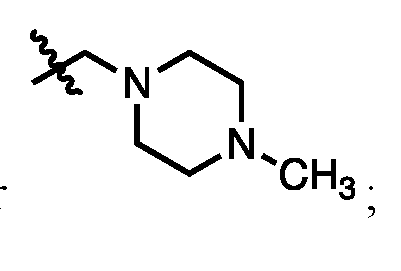 R2’ and R2’’ are each independently H, halogen, CF3, OH, OAc, CH2OH, CH(CH3)OH, C(CH3)2OH, CH2OAc, CH2OPG,

 , or , wherein PG is a protecting group, provided
 that both R2’ and R2” are not H, or R2’ and R2” can be joined to form =O; and n is 0 or 1. [46] In some embodiments, the compounds of the present disclosure are represented by formula (II) or a pharmaceutical salt or stereoisomer thereof:
 (II), wherein
 is an oligonucleotide tag represented by
 or an affinity tag;
 is a linker that covalently attaches
 to
to
 ;
;
 is or
is or
 wherein
 is the connection to the silyl group, is the connection to the linker, R3’ is H, halogen, amino, hydroxyl, (C1-C6) alkyl, (C1-C6) hydroxyalkyl, (C1-C6) aminoalkyl, (C3-C6) carbocyclyl, 4- to 6-membered heterocyclyl, (C1-C6) alkyl-(C3-C6) carbocyclyl, or (C1-C6) alkyl-4- to 6-membered heterocyclyl, wherein said alkyl, hydroxyalkyl, aminoalkyl, carbocyclyl, or heterocyclyl is further optionally substituted by one or more, identical or different R1a groups, wherein each R1a is independently (C1-C6) alkyl, (C1-C6) alkoxy, (C1-C6) alkyl-(C1-C3) alkoxy, halogen, amino, hydroxyl, (C1-C6) haloalkyl, NH-(C1- C6) alkyl, N((C1-C6)alkyl)2, (C3-C6) carbocyclyl, or 4- to 6-membered heterocyclyl, X is (C1-C6) alkyl, wherein said alkyl is further optionally substituted by one or more, identical or different R1a groups, wherein each R1a is independently (C1-C6) alkyl, (C1-C6) alkoxy, (C1-C6) alkyl-(C1-C3) alkoxy, halogen, amino, hydroxyl, (C1-C6) haloalkyl, NH-(C1- C6) alkyl, N((C1-C6)alkyl)2, (C3-C6) carbocyclyl, or 4- to 6-membered heterocyclyl, and Y and Y1 are each independently CH or N;
R1’ and R1’’ are each independently H, CH3, halogen, CH2NMe2,
is the connection to the silyl group, is the connection to the linker, R3’ is H, halogen, amino, hydroxyl, (C1-C6) alkyl, (C1-C6) hydroxyalkyl, (C1-C6) aminoalkyl, (C3-C6) carbocyclyl, 4- to 6-membered heterocyclyl, (C1-C6) alkyl-(C3-C6) carbocyclyl, or (C1-C6) alkyl-4- to 6-membered heterocyclyl, wherein said alkyl, hydroxyalkyl, aminoalkyl, carbocyclyl, or heterocyclyl is further optionally substituted by one or more, identical or different R1a groups, wherein each R1a is independently (C1-C6) alkyl, (C1-C6) alkoxy, (C1-C6) alkyl-(C1-C3) alkoxy, halogen, amino, hydroxyl, (C1-C6) haloalkyl, NH-(C1- C6) alkyl, N((C1-C6)alkyl)2, (C3-C6) carbocyclyl, or 4- to 6-membered heterocyclyl, X is (C1-C6) alkyl, wherein said alkyl is further optionally substituted by one or more, identical or different R1a groups, wherein each R1a is independently (C1-C6) alkyl, (C1-C6) alkoxy, (C1-C6) alkyl-(C1-C3) alkoxy, halogen, amino, hydroxyl, (C1-C6) haloalkyl, NH-(C1- C6) alkyl, N((C1-C6)alkyl)2, (C3-C6) carbocyclyl, or 4- to 6-membered heterocyclyl, and Y and Y1 are each independently CH or N;
R1’ and R1’’ are each independently H, CH3, halogen, CH2NMe2,

 , or
, or
 R2’ and R2’’ are each independently H, CF3, halogen, OH, OAc, CH2OH, CH(CH3)OH, C(CH3)2OH, CH2OAc, CH2OPG,
 , , , or
 wherein PG is a Protecting Group, provided that both R2’ and R2” are not H, or R2’ and R2” can be joined to form =O; R4’ and R4’’ are each independently alkyl or aryl; and n is 0 or 1. [47] In some embodiments, R4’ and R4’’ are each independently CH3, CH2CH3, CF3, propyl, isopropyl, butyl, isobutyl, alkyl, or phenyl. [48] In some embodiments,
 is
is
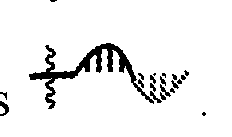 [49] In some embodiments, n is 0. [50] In some embodiments, R2’ and R2’’ are each independently H, CF3, halogen, CH2OAc, CH2OH, CH(CH3)OH, C(CH3)2OH, CH2OPG,
 or
or
 , or R2’ and R2” can be joined to form =O, and PG is a protecting group. In some embodiments, PG is an acyl group (e.g., acetyl, benzoyl, chloroacetyl, dichloroacetyl, trichloroacetyl, trifluoroacetyl, methoxyacetyl, o-(dibromomethyl)benzoyl, etc.). In some embodiments, PG is a carbonate group (e.g., methyl carbonate, 9-fluorenylmethyl carbonate, trichloroethyl carbonate (Troc), 2-(trimethylsilyl)ethyl carbonate (TMSEC), isobutyl carbonate, methyl dithiocarbonate, p-methoxybenzyl carbonate, etc.). In some embodiments, PG is a carbamate group (e.g., methylamine carbamate, alkyl N-phenylcarbamate, etc.). In some embodiments, PG is an ether group (e.g., methoxylmethyl (MOM), benzyl, p-
methoxybenzyl, methylthiomethyl ether (MTM), tetrahydropyranyl (THP), etc.). In some embodiments, PG is a silyl group (e.g., trimethylsilyl (TMS), triethylsilyl (TES), diethylisopropylsilyl (DEIPS), t-butyldimethylsilyl (TBDMS), diphenylmethylsilyl (DPMS), t-butyldimethylsilyl (TBS), etc.). [51] In some embodiments, R2’ and R2’’ are each independently H or F . [52] In some embodiments, is
, or R2’ and R2” can be joined to form =O, and PG is a protecting group. In some embodiments, PG is an acyl group (e.g., acetyl, benzoyl, chloroacetyl, dichloroacetyl, trichloroacetyl, trifluoroacetyl, methoxyacetyl, o-(dibromomethyl)benzoyl, etc.). In some embodiments, PG is a carbonate group (e.g., methyl carbonate, 9-fluorenylmethyl carbonate, trichloroethyl carbonate (Troc), 2-(trimethylsilyl)ethyl carbonate (TMSEC), isobutyl carbonate, methyl dithiocarbonate, p-methoxybenzyl carbonate, etc.). In some embodiments, PG is a carbamate group (e.g., methylamine carbamate, alkyl N-phenylcarbamate, etc.). In some embodiments, PG is an ether group (e.g., methoxylmethyl (MOM), benzyl, p-
methoxybenzyl, methylthiomethyl ether (MTM), tetrahydropyranyl (THP), etc.). In some embodiments, PG is a silyl group (e.g., trimethylsilyl (TMS), triethylsilyl (TES), diethylisopropylsilyl (DEIPS), t-butyldimethylsilyl (TBDMS), diphenylmethylsilyl (DPMS), t-butyldimethylsilyl (TBS), etc.). [51] In some embodiments, R2’ and R2’’ are each independently H or F . [52] In some embodiments, is
 , and the compound of formula I is
 represented by structure:

 ; or
; or
 or a pharmaceutical salt or stereoisomer thereof. [53] In some embodiments,
 is , and the compound of formula I is
 represented by structure:


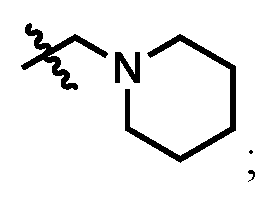






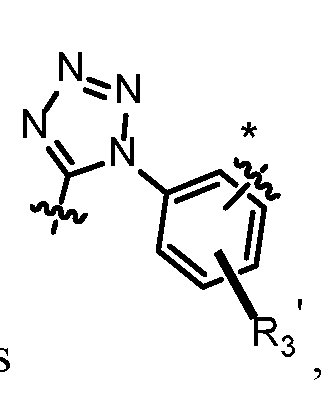
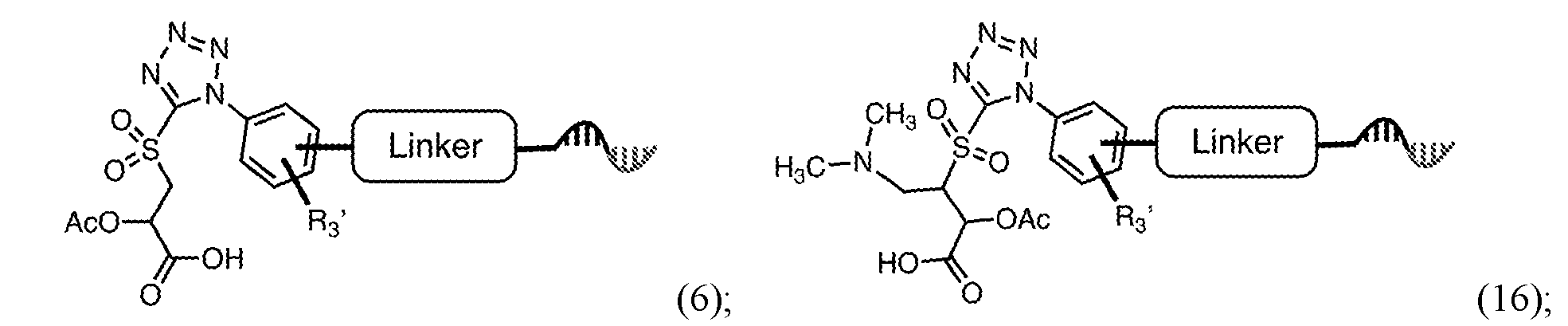


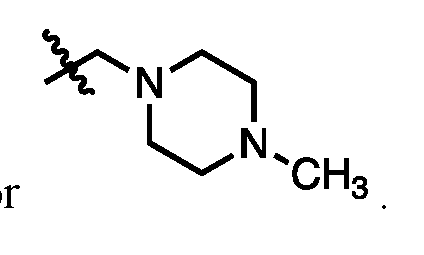





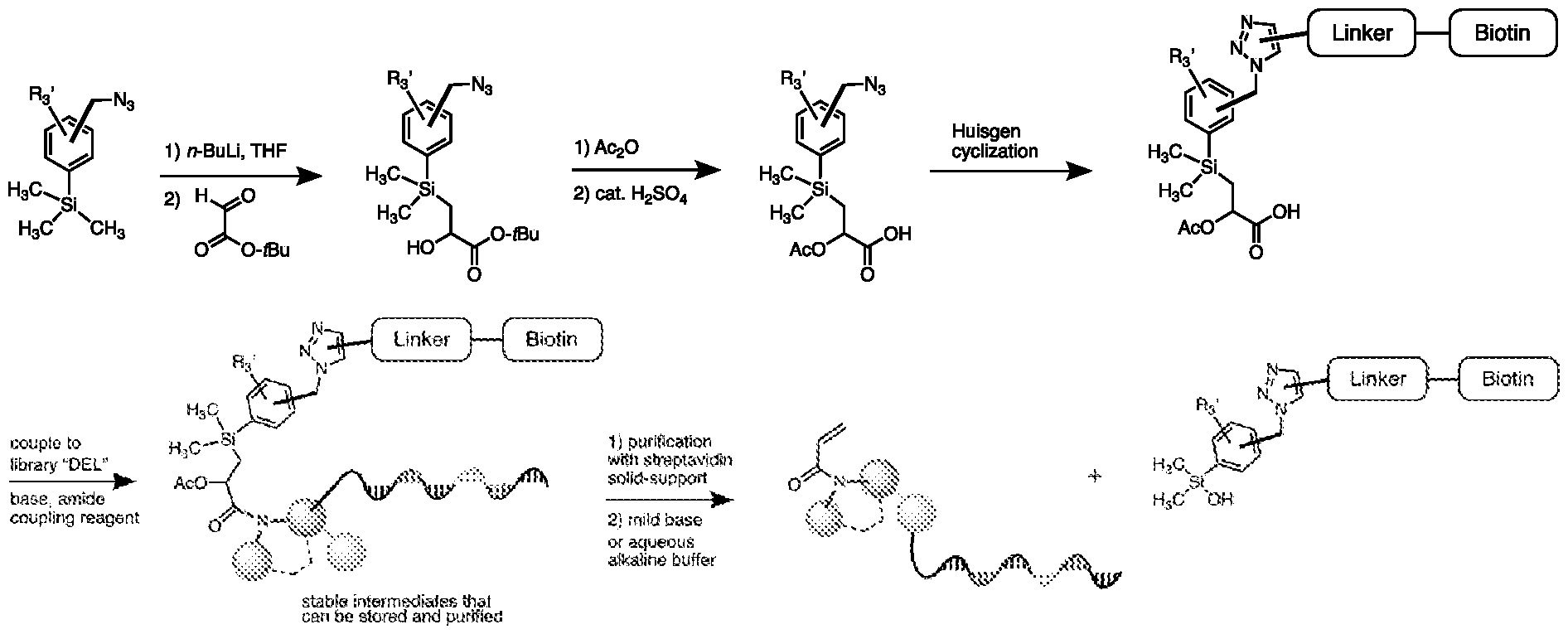


Claims
What is claimed is: 1. A compound represented by formula (I) or a pharmaceutical salt or stereoisomer thereof:
 (I), wherein is an oligonucleotide tag represented by
 or an affinity tag;
 is a linker that covalently attaches
 to
to
 ;
;
 is
is
 , or
, or
 , wherein is the connection to the sulfone group, is the connection to the linker, R3’ is H, halogen, amino, hydroxyl, (C1-C6) alkyl, (C1-C6) hydroxyalkyl, (C1-C6) aminoalkyl, (C3-C6) carbocyclyl, 4- to 6-membered heterocyclyl, (C1-C6) alkyl-(C3-C6) carbocyclyl, or (C1-C6) alkyl-4- to 6-membered heterocyclyl, wherein said alkyl, hydroxyalkyl, aminoalkyl, carbocyclyl, or heterocyclyl is further optionally substituted by one or more, identical or different R1a groups, wherein each R1a is independently (C1-C6) alkyl, (C1-C6) alkoxy, (C1-C6) alkyl-(C1-C3) alkoxy, halogen, amino, hydroxyl, (C1-C6) haloalkyl, NH-(C1- C6) alkyl, N((C1-C6)alkyl)2, (C3-C6) carbocyclyl, or 4- to 6-membered heterocyclyl, X is (C1-C6) alkyl, wherein said alkyl is further optionally substituted by one or more, identical or different R1a groups, wherein each R1a is independently (C1-C6) alkyl, (C1-C6) alkoxy, (C1-C6) alkyl-(C1-C3) alkoxy, halogen, amino, hydroxyl, (C1-C6) haloalkyl, NH-(C1- C6) alkyl, N((C1-C6)alkyl)2, (C3-C6) carbocyclyl, or 4- to 6-membered heterocyclyl, and
Y and Y1 are each independently CH or N; R1 ’ and R1 ’’ are each independently H, CH3, CF3, halogen, CH2NMe2,
, wherein is the connection to the sulfone group, is the connection to the linker, R3’ is H, halogen, amino, hydroxyl, (C1-C6) alkyl, (C1-C6) hydroxyalkyl, (C1-C6) aminoalkyl, (C3-C6) carbocyclyl, 4- to 6-membered heterocyclyl, (C1-C6) alkyl-(C3-C6) carbocyclyl, or (C1-C6) alkyl-4- to 6-membered heterocyclyl, wherein said alkyl, hydroxyalkyl, aminoalkyl, carbocyclyl, or heterocyclyl is further optionally substituted by one or more, identical or different R1a groups, wherein each R1a is independently (C1-C6) alkyl, (C1-C6) alkoxy, (C1-C6) alkyl-(C1-C3) alkoxy, halogen, amino, hydroxyl, (C1-C6) haloalkyl, NH-(C1- C6) alkyl, N((C1-C6)alkyl)2, (C3-C6) carbocyclyl, or 4- to 6-membered heterocyclyl, X is (C1-C6) alkyl, wherein said alkyl is further optionally substituted by one or more, identical or different R1a groups, wherein each R1a is independently (C1-C6) alkyl, (C1-C6) alkoxy, (C1-C6) alkyl-(C1-C3) alkoxy, halogen, amino, hydroxyl, (C1-C6) haloalkyl, NH-(C1- C6) alkyl, N((C1-C6)alkyl)2, (C3-C6) carbocyclyl, or 4- to 6-membered heterocyclyl, and
Y and Y1 are each independently CH or N; R1 ’ and R1 ’’ are each independently H, CH3, CF3, halogen, CH2NMe2,

 , or
, or
 ; R2’ and R2’’ are each independently H, halogen, CF3, OH, OAc, CH2OH, CH(CH3)OH, C(CH3)2OH, CH2OAc, CH2OPG, or
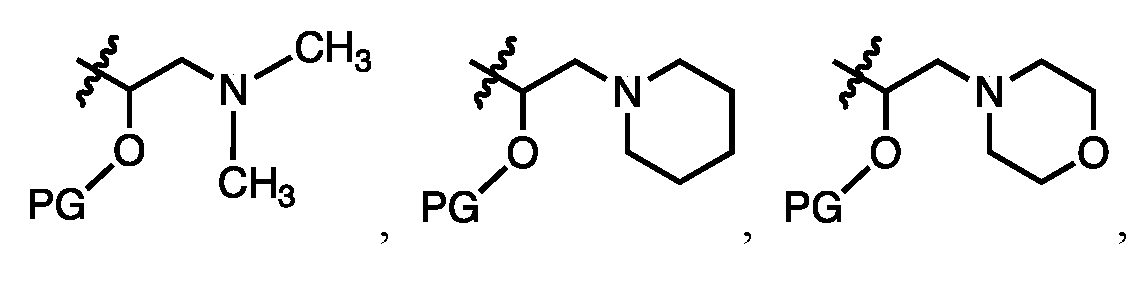
 wherein PG is a Protecting Group, provided that both R2’ and R2” are not H, or R2’ and R2” can be joined to form =O; and n is 0 or 1.
2. A method of creating an electrophilic warhead-bearing DNA-Encoded Library (eDEL) comprising: coupling the compound of claim 1 with a DNA-Encoded Library to generate a stable masked-warhead DEL (mwDEL) intermediate; purifying the mwDEL intermediate; unmasking the mwDEL intermediate to generate an activated eDEL; and purifying the activated eDEL.
3. An eDEL, which is generated from the method of claim 2.
4. The eDEL of claim 3, which is used in an in vitro selection assay followed by DNA sequencing.
5. The eDEL of claim 3 or 4, wherein the in vitro selection assay comprises screening protein ligands.
6. The eDEL of claim 3 or 4, wherein the in vitro selection assay comprises screening ligands that covalently modify a residue of a protein.
7. The eDEL of claim 6, wherein the in vitro selection assay comprises screening ligands that covalently modify the thiol group of a Cysteine residue, the imidazole ring of a Histidine residue, the amino group of a Lysine residue, the hydroxyl group of a Serine residue, the hydroxyl group of a Threonine residue, the phenolic hydroxyl of a Tyrosine residue, a carboxylate group, or an amide group of the protein.
8. The eDEL of claim 6, wherein the in vitro selection assay comprises for screening ligands that covalently modify a residue in the active site of the protein.
9. The eDEL of claim 6, wherein the in vitro selection assay comprises screening ligands that covalently modify a residue in a non-orthosteric site of the protein.
10. The eDEL of claim 6, wherein the in vitro selection assay comprises screening ligands that covalently modify a residue in an allosteric site of the protein.
11. The eDEL of claim 6, wherein the in vitro selection assay comprises screening ligands that covalently modify a residue in a non-catalytic domain of a protein.
12. A compound represented by formula (II) or a pharmaceutical salt or stereoisomer thereof:
 (II), wherein
 is an oligonucleotide tag represented by or an affinity tag;

 is a linker that covalently attaches
 to
to
 ;
;
 is or , wherein

 is the connection to the silyl group,
 is the connection to the linker, R3’ is H, halogen, amino, hydroxyl, (C1-C6) alkyl, (C1-C6) hydroxyalkyl, (C1-C6) aminoalkyl, (C3-C6) carbocyclyl, 4- to 6-membered heterocyclyl, (C1-C6) alkyl-(C3-C6) carbocyclyl, or (C1-C6) alkyl-4- to 6-membered heterocyclyl, wherein said alkyl, hydroxyalkyl, aminoalkyl, carbocyclyl, or heterocyclyl is further optionally substituted by one or more, identical or different R1a groups, wherein each R1a is independently (C1-C6) alkyl, (C1-C6) alkoxy, (C1-C6) alkyl-(C1-C3) alkoxy, halogen, amino, hydroxyl, (C1-C6) haloalkyl, NH-(C1- C6) alkyl, N((C1-C6)alkyl)2, (C3-C6) carbocyclyl, or 4- to 6-membered heterocyclyl, X is (C1-C6) alkyl, wherein said alkyl is further optionally substituted by one or more, identical or different R1a groups, wherein each R1a is independently (C1-C6) alkyl, (C1-C6) alkoxy, (C1-C6) alkyl-(C1-C3) alkoxy, halogen, amino, hydroxyl, (C1-C6) haloalkyl, NH-(C1- C6) alkyl, N((C1-C6)alkyl)2, (C3-C6) carbocyclyl, or 4- to 6-membered heterocyclyl, and Y and Y1 are each independently CH or N; R1 ’ and R1 ’’ are each independently H, CH3, CF3, halogen, CH2NMe2,
 , , or

 R2 ’ and R2 ’’ are each independently H, halogen, CF3, OH, OAc, CH2OH, CH(CH3)OH, C(CH3)2OH, CH2OAc, CH2OPG,
 , or
, or
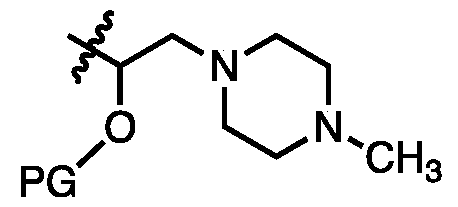 wherein PG is a Protecting Group, provided that both R2’ and R2” are not H, or R2’ and R2” can be joined to form =O; R4’ and R4’’ are each independently alkyl or aryl; and n is 0 or 1.
13. The compound of claim 12, wherein R4’ and R4’’ are each independently CH3, CH2CH3, CF3, propyl, isopropyl, butyl, isobutyl, alkyl, or phenyl.
14. A method of creating an electrophilic warhead-bearing DNA-Encoded Library (eDEL) comprising: coupling the compound of claim 12 with a DNA-Encoded Library to generate a stable masked-warhead DEL (mwDEL) intermediate; purifying the mwDEL intermediate; unmasking the mwDEL intermediate to generate an activated eDEL; and purifying the activated eDEL.
15. An eDEL, which is generated from the method of claim 14.
Priority Applications (2)
| Application Number | Priority Date | Filing Date | Title |
|---|---|---|---|
| EP22888494.6A EP4423103A4 (en) | 2021-10-27 | 2022-10-27 | DNA-coded and affinity-labeled masked counterhead compounds and their use in the assembly of small molecular libraries for the purification and multiplication of covalent ligands |
| US18/126,250 US20230407293A1 (en) | 2021-10-27 | 2023-03-24 | Dna-encoded and affinity-tagged masked-warhead compounds and use thereof in assembling libraries of small molecules enabled for late-stage purification and multiplexed screening of covalent ligands |
Applications Claiming Priority (4)
| Application Number | Priority Date | Filing Date | Title |
|---|---|---|---|
| US202163272317P | 2021-10-27 | 2021-10-27 | |
| US63/272,317 | 2021-10-27 | ||
| US202263323825P | 2022-03-25 | 2022-03-25 | |
| US63/323,825 | 2022-03-25 |
Related Child Applications (1)
| Application Number | Title | Priority Date | Filing Date |
|---|---|---|---|
| US18/126,250 Continuation-In-Part US20230407293A1 (en) | 2021-10-27 | 2023-03-24 | Dna-encoded and affinity-tagged masked-warhead compounds and use thereof in assembling libraries of small molecules enabled for late-stage purification and multiplexed screening of covalent ligands |
Publications (1)
| Publication Number | Publication Date |
|---|---|
| WO2023077001A1 true WO2023077001A1 (en) | 2023-05-04 |
Family
ID=86158730
Family Applications (1)
| Application Number | Title | Priority Date | Filing Date |
|---|---|---|---|
| PCT/US2022/078783 Ceased WO2023077001A1 (en) | 2021-10-27 | 2022-10-27 | Dna-encoded and affinity-tagged masked-warhead compounds and use thereof in assembling libraries of small molecules enabled for late-stage purification and multiplexed screening of covalent ligands |
Country Status (3)
| Country | Link |
|---|---|
| US (1) | US20230407293A1 (en) |
| EP (1) | EP4423103A4 (en) |
| WO (1) | WO2023077001A1 (en) |
Citations (3)
| Publication number | Priority date | Publication date | Assignee | Title |
|---|---|---|---|---|
| US20070042401A1 (en) * | 2003-12-17 | 2007-02-22 | Praecis Pharmaceuticals, Inc. | Methods for synthesis of encoded libraries |
| US20210002630A1 (en) * | 2011-09-07 | 2021-01-07 | X-Chem, Inc. | Methods for tagging dna-encoded libraries |
| US20210269863A1 (en) * | 2015-08-18 | 2021-09-02 | Purdue Research Foundation | Systems and methods for proteomic activity analysis using dna-encoded probes |
Family Cites Families (1)
| Publication number | Priority date | Publication date | Assignee | Title |
|---|---|---|---|---|
| JP2009513135A (en) * | 2005-10-28 | 2009-04-02 | プリーシス・ファーマシューティカルズ・インコーポレイテッド | Methods for identifying compounds of interest using encoded libraries |
-
2022
- 2022-10-27 EP EP22888494.6A patent/EP4423103A4/en active Pending
- 2022-10-27 WO PCT/US2022/078783 patent/WO2023077001A1/en not_active Ceased
-
2023
- 2023-03-24 US US18/126,250 patent/US20230407293A1/en active Pending
Patent Citations (3)
| Publication number | Priority date | Publication date | Assignee | Title |
|---|---|---|---|---|
| US20070042401A1 (en) * | 2003-12-17 | 2007-02-22 | Praecis Pharmaceuticals, Inc. | Methods for synthesis of encoded libraries |
| US20210002630A1 (en) * | 2011-09-07 | 2021-01-07 | X-Chem, Inc. | Methods for tagging dna-encoded libraries |
| US20210269863A1 (en) * | 2015-08-18 | 2021-09-02 | Purdue Research Foundation | Systems and methods for proteomic activity analysis using dna-encoded probes |
Non-Patent Citations (6)
| Title |
|---|
| DATABASE PUBCHEM COMPOUND ANONYMOUS : "(Benzothiazole-2-sulfonyl)-acetic acid", XP093066164, retrieved from PUBCHEM * |
| DATABASE PUBCHEM COMPOUND ANONYMOUS : "(Phenylsulfonyl)acetic acid", XP093066167, retrieved from PUBCHEM * |
| DATABASE PUBCHEM COMPOUND ANONYMOUS : "2-(Ethyldimethylsilyl)acetic acid", XP093066169, retrieved from PUBCHEM * |
| DATABASE PUBCHEM COMPOUND ANONYMOUS : "2-Pyrimidin-2-ylsulfonylacetic acid", XP093066166, retrieved from PUBCHEM * |
| DATABASE PUBCHEM COMPOUND ANONYMOUS : "3-(Phenyldimethylsilyl)propionic acid", XP093066172, retrieved from PUBCHEM * |
| See also references of EP4423103A4 * |
Also Published As
| Publication number | Publication date |
|---|---|
| EP4423103A1 (en) | 2024-09-04 |
| EP4423103A4 (en) | 2025-12-10 |
| US20230407293A1 (en) | 2023-12-21 |
Similar Documents
| Publication | Publication Date | Title |
|---|---|---|
| EP2822935B1 (en) | Inhibitors of c-jun-n-terminal kinase (jnk) | |
| CN108472295B (en) | Bivalent bromodomain inhibitors and uses thereof | |
| ES2718409T3 (en) | Synthesis of polycyclic carbomoylpyridone compounds | |
| ES2779225T3 (en) | Substituted merylformyl reagents and procedure for their use to modify physicochemical and / or pharmacokinetic properties of compounds | |
| ES2387707T3 (en) | Azaindolizines and use procedures | |
| JP2022543106A (en) | HDAC6 inhibitors and their uses | |
| JP2016512846A (en) | RAS inhibitors and uses thereof | |
| CN106793775B (en) | Dihydropyrazinone derivatives and uses thereof | |
| CN113444086A (en) | Ezh2 inhibitor and application thereof | |
| CA2918910A1 (en) | Inhibitors of transcription factors and uses thereof | |
| AU2014337044A1 (en) | Polycyclic inhibitors of cyclin-dependent kinase 7 (CDK7) | |
| US20110009406A1 (en) | Tetrahydro-1h-pyrrolo fused pyridones | |
| CN114174281A (en) | Degradation agent for cyclin dependent kinase 7(CDK7) and use thereof | |
| CN105026400A (en) | Processes and intermediates for the preparation of pharmaceuticals | |
| US11986471B2 (en) | Compounds and methods of use | |
| CN107586315B (en) | Chimeric molecule | |
| HK1256417A1 (en) | Cyano thienotriazolodiazepines and uses thereof | |
| CN113164477A (en) | Pyrazolopyridine inhibitors of C-JUN-N-terminal kinase and uses thereof | |
| US10844078B2 (en) | Methods of preparing cytotoxic benzodiazepine derivatives | |
| CN116964061A (en) | Tricyclic pyrimidines as cyclin-dependent kinase 7 (CDK7) inhibitors | |
| ES2529046T3 (en) | Preparation procedures for quinolone analogues | |
| WO2023077001A1 (en) | Dna-encoded and affinity-tagged masked-warhead compounds and use thereof in assembling libraries of small molecules enabled for late-stage purification and multiplexed screening of covalent ligands | |
| CN120322438A (en) | Camptothecin derivatives, pharmaceutical compositions, preparation methods and applications thereof | |
| US20240400534A1 (en) | Chemical tools for drug target identification and characterization | |
| US20200038371A1 (en) | Compound having anticancer activity and preparation method and application |
Legal Events
| Date | Code | Title | Description |
|---|---|---|---|
| 121 | Ep: the epo has been informed by wipo that ep was designated in this application |
Ref document number: 22888494 Country of ref document: EP Kind code of ref document: A1 |
|
| WWE | Wipo information: entry into national phase |
Ref document number: 2022888494 Country of ref document: EP |
|
| NENP | Non-entry into the national phase |
Ref country code: DE |
|
| ENP | Entry into the national phase |
Ref document number: 2022888494 Country of ref document: EP Effective date: 20240527 |