WO2023077094A1 - Treatment of major depressive disorder - Google Patents
Treatment of major depressive disorder Download PDFInfo
- Publication number
- WO2023077094A1 WO2023077094A1 PCT/US2022/078922 US2022078922W WO2023077094A1 WO 2023077094 A1 WO2023077094 A1 WO 2023077094A1 US 2022078922 W US2022078922 W US 2022078922W WO 2023077094 A1 WO2023077094 A1 WO 2023077094A1
- Authority
- WO
- WIPO (PCT)
- Prior art keywords
- cariprazine
- treatment
- major depressive
- total score
- patient
- Prior art date
- Legal status (The legal status is an assumption and is not a legal conclusion. Google has not performed a legal analysis and makes no representation as to the accuracy of the status listed.)
- Ceased
Links
Classifications
-
- A—HUMAN NECESSITIES
- A61—MEDICAL OR VETERINARY SCIENCE; HYGIENE
- A61P—SPECIFIC THERAPEUTIC ACTIVITY OF CHEMICAL COMPOUNDS OR MEDICINAL PREPARATIONS
- A61P25/00—Drugs for disorders of the nervous system
- A61P25/24—Antidepressants
-
- A—HUMAN NECESSITIES
- A61—MEDICAL OR VETERINARY SCIENCE; HYGIENE
- A61K—PREPARATIONS FOR MEDICAL, DENTAL OR TOILETRY PURPOSES
- A61K31/00—Medicinal preparations containing organic active ingredients
- A61K31/33—Heterocyclic compounds
- A61K31/395—Heterocyclic compounds having nitrogen as a ring hetero atom, e.g. guanethidine or rifamycins
- A61K31/495—Heterocyclic compounds having nitrogen as a ring hetero atom, e.g. guanethidine or rifamycins having six-membered rings with two or more nitrogen atoms as the only ring heteroatoms, e.g. piperazine or tetrazines
-
- A—HUMAN NECESSITIES
- A61—MEDICAL OR VETERINARY SCIENCE; HYGIENE
- A61K—PREPARATIONS FOR MEDICAL, DENTAL OR TOILETRY PURPOSES
- A61K31/00—Medicinal preparations containing organic active ingredients
- A61K31/33—Heterocyclic compounds
- A61K31/395—Heterocyclic compounds having nitrogen as a ring hetero atom, e.g. guanethidine or rifamycins
- A61K31/495—Heterocyclic compounds having nitrogen as a ring hetero atom, e.g. guanethidine or rifamycins having six-membered rings with two or more nitrogen atoms as the only ring heteroatoms, e.g. piperazine or tetrazines
- A61K31/496—Non-condensed piperazines containing further heterocyclic rings, e.g. rifampin, thiothixene or sparfloxacin
-
- A—HUMAN NECESSITIES
- A61—MEDICAL OR VETERINARY SCIENCE; HYGIENE
- A61K—PREPARATIONS FOR MEDICAL, DENTAL OR TOILETRY PURPOSES
- A61K45/00—Medicinal preparations containing active ingredients not provided for in groups A61K31/00 - A61K41/00
- A61K45/06—Mixtures of active ingredients without chemical characterisation, e.g. antiphlogistics and cardiaca
Definitions
- the present disclosure is related to medicaments and methods for treating major depressive disorder, and more specifically as adjunctive treatment to antidepressant therapy for major depressive disorder.
- ADTs Antidepressants
- aripiprazole aripiprazole, quetiapine fumarate, and brexipiprazole
- brexipiprazole aripiprazole, quetiapine fumarate, and brexipiprazole
- the present disclosure provides methods of treating major depressive disorder, involving administering cariprazine or a pharmaceutically acceptable salt thereof as an adjunct to antidepressant therapy in the treatment of subjects with major depressive disorder (MDD).
- MDD major depressive disorder
- the present disclosure provides methods of treating major depressive disorder, involving administering cariprazine or a pharmaceutically acceptable salt thereof in an amount of 1.5 mg/day in addition to ADT therapy or 3 mg/day in addition to ADT therapy, to a patient in need of treatment thereof.
- the present disclosure provides methods of treating major depressive disorder, involving administering cariprazine or a pharmaceutically acceptable salt thereof in an amount of 1.5 mg/day in addition to ADT therapy or 3 mg/day in addition to ADT therapy to a patient in need of treatment thereof for 6 weeks.
- the present disclosure provides methods of treating major depressive disorder comprising administering cariprazine or a pharmaceutically acceptable salt thereof in an amount of 1.5 mg/day or 3 mg/day to a patient in need of adjunctive therapy for major depressive disorder (MDD), wherein the administration of cariprazine achieves statistically significant change from baseline to Week 6 in the Montgomery Asberg Depression Rating Scale (MADRS) total score.
- MDD major depressive disorder
- a method comprises administering cariprazine or a pharmaceutically acceptable salt thereof in an amount of 1.5 mg/day or 3 mg/day to a patient in need of adjunctive therapy for MDD that meets Diagnostic and Statistical Manual of Mental Disorders, Fifth Edition (DSM-5) criteria for MDD based on Structured Clinical Interview for DSM-5 (SCID-5) and has a total score >22 on the Hamilton Depression Rating Scale- 17 (HAMD-17) prior to treatment.
- DSM-5 Diagnostic and Statistical Manual of Mental Disorders, Fifth Edition (DSM-5) criteria for MDD based on Structured Clinical Interview for DSM-5 (SCID-5) and has a total score >22 on the Hamilton Depression Rating Scale- 17 (HAMD-17) prior to treatment.
- the patient has a major depressive episode of at least 8 weeks to less than 24 months.
- the patient demonstrates inadequate response to 1 to 3 antidepressants of adequate dose and adequate duration as measured by Antidepressant Treatment Response Questionnaire (ATRQ).
- ATRQ Antidepressant Treatment Response Questionnaire
- a method of treating major depressive disorder comprises administering cariprazine or a pharmaceutically acceptable salt thereof in an amount of 1.5 mg/day as an adjunct to antidepressant therapy to a patient in need of treatment for major depressive disorder for 6 weeks.
- the administration of cariprazine or a pharmaceutically acceptable salt results in a statistically significant remission of the depressive episode as defined by less than 10 total score on MADRS total score.
- the statistically significant remission is achieved with less than 2% to no adverse events leading to discontinuation of therapy.
- cariprazine or a pharmaceutically acceptable salt is administered as cariprazine hydrochloride.
- a method of treating major depressive disorder comprises administering cariprazine or a pharmaceutically acceptable salt thereof in an amount of 3.0 mg/day as an adjunct to antidepressant therapy to a patient in need of treatment for major depressive disorder for 6 weeks.
- the administration of cariprazine or a pharmaceutically acceptable salt results in a statistically significant remission of the depressive episode as defined by less than 10 total score on MADRS total score.
- the statistically significant remission is achieved with less than 2% to no adverse events leading to discontinuation of therapy.
- cariprazine or a pharmaceutically acceptable salt is administered as cariprazine hydrochloride.
- the present disclosure provides a method of statistically significant treatment of major depressive disorder in patients who had inadequate responses to one or more antidepressants, comprising administering to each said patient cariprazine or a pharmaceutically acceptable salt thereof in an amount of 1.5 mg per day as an adjunctive therapy to one or more said antidepressants, and said treatment achieves statistically significant least square mean change in the MADRS total score in said patients from baseline to week 6 of said treatment as compared to placebo.
- the method of statistically significant treatment of major depressive disorder in patients who had inadequate responses to one or more antidepressants comprises administering to each said patient cariprazine or a pharmaceutically acceptable salt thereof in an amount of 1.5 mg per day as an adjunctive therapy to one or more said antidepressants, and said treatment achieves statistically significant least square mean change in the MADRS total score in said patients from baseline to week 6 of said treatment as compared to placebo, wherein said statistically significant least square mean change in the MADRS total score in said patients from baseline to week 6 of said treatment as compared to placebo is -2 points or exceeds said 2-points.
- Figure 1 shows a schematic of a clinical study conducted for evaluating the safety and efficacy of cariprazine administered as capsules once a day as an adjunct to antidepressant therapy.
- Figure 2 shows the LS Mean Change in MADRS Total Score change from Baseline (+/- SE) over time results by Weeks.
- Figure 3 shows the LS Mean Change in CGLS Score change from Baseline (+/- SE) over time results by Weeks.
- Figure 4 shows the full range of MADRS score improvement at end of week 6 (LOCF).
- the present disclosure provides methods for treating major depressive disorder in a patient in need thereof.
- the present disclosure provides methods for the treating patients suffering from major depressive disorder.
- the present disclosure provides methods for treating major depressive disorder comprising administering a therapeutically effective amount of cariprazine or a pharmaceutically acceptable salt thereof as an adjunct to antidepressant therapy (ADT).
- ADT antidepressant therapy
- Cariprazine can be administered as the hydrochloride salt of cariprazine, that is 4-[[2-[4-(2,3- dichlorophenyl)piperazin-l-yl]ethyl]carbamoyl]cyclohexan-lyl]-A,7V-dimethylamine hydrochloride or trans-4-[[2-[4-(2,3-dichlorophenyl)piperazin-l-yl]ethyl]carbamoyl]cyclohexan- lyl]-A,7V-dimethylamine hydrochloride or trans-N- ⁇ 4-[2-[4-(2,3-dichlorophenyl)piperazin-l- yl]ethyl]cyclohexyl ⁇ -N’,N’-dimethylurea hydrochloride.
- Preparation of cariprazine is described, for example, in US Patent No. 7,737,142, filed January 20, 2006, and related foreign counterpart patents.
- Treatment can reduce the frequency and intensity of symptoms associated with major depressive disorder.
- the methods can result in freedom from symptoms associated with major depressive disorder.
- the administration of cariprazine may provide for fewer symptoms or symptoms of reduced intensity.
- the symptoms of major depressive disorder may be reduced or eliminated.
- Symptom criteria for Major Depressive Episode/Disorder is outlined in “The Diagnostic and Statistical Manual of Mental Disorders,” 5 th edition (also known as the DSM-5). Factors may include: depressed mood; loss of interest in almost all activities; unintentional weight loss/gain or decrease/increase in appetite; sleep disturbances; psychomotor changes (e.g., agitation or retardation) severe enough to be observable by others; tiredness, fatigue or low energy, or decreased efficiency with which routine tasks are completed; a sense of worthlessness or excessive, inappropriate or delusional guilt; impaired ability to think concentrate, or make decisions; and recurrent thoughts of death, suicidal ideation or suicide attempts.
- the symptoms cause clinically significant distress or impairment in social, occupational, or other important areas of functioning.
- the symptoms are not due to the direct physiological effects of a substance (e.g., drug abuse, a prescribed medication’s side effects) or a medication condition (e.g. hypothyroidism).
- a substance e.g., drug abuse, a prescribed medication’s side effects
- a medication condition e.g. hypothyroidism
- a patient suffering from MDD has never had a manic episode or hypomanic episode. Their condition is not better explained by schizophrenia spectrum or other psychotic disorders.
- a patient in need of treatment may suffer symptoms as noted in the DSM-5 evaluation criteria for major depressive disorder.
- the present disclosure provides methods of treating major depressive disorder.
- the method comprising administering cariprazine or a pharmaceutically acceptable salt thereof in a therapeutically effective amount of 1.5 mg/day or 3 mg/day as an adjunct to antidepressant therapy to a patient in need of treatment for major depressive disorder, thereby treating said major depressive disorder.
- the present disclosure provides method of treating major depressive disorder, the method comprising administering cariprazine or a pharmaceutically acceptable salt thereof in an amount of 1.5 mg/day or 3 mg/day to a patient in need of adjunctive therapy for major depressive disorder (MDD), wherein the administration of cariprazine achieves statistically significant change from baseline to Week 6 in the Montgomery Asberg Depression Rating Scale (MADRS) total score.
- MDD major depressive disorder
- the patient in need of adjunctive therapy for MDD meets Diagnostic and Statistical Manual of Mental Disorders, Fifth Edition (DSM-5) criteria for MDD based on Structured Clinical Interview for DSM-5 (SCID-5) and has a total score >22 on the Hamilton Depression Rating Scale- 17 (HAMD-17) prior to treatment.
- DSM-5 Diagnostic and Statistical Manual of Mental Disorders, Fifth Edition
- SCID-5 Structured Clinical Interview for DSM-5
- HAMD-17 Hamilton Depression Rating Scale- 17
- the patient has a major depressive episode of at least 8 weeks to less than 24 months.
- the patient demonstrates inadequate response to 1 to 3 antidepressants of adequate dose and adequate duration as measured by Antidepressant Treatment Response Questionnaire (ATRQ).
- ATRQ Antidepressant Treatment Response Questionnaire
- the method of treating major depressive disorder comprises administering cariprazine or a pharmaceutically acceptable salt thereof in a therapeutically effective amount of 1.5 mg/day as an adjunct to antidepressant therapy to a patient in need of treatment for major depressive disorder for 6 weeks, thereby treating said major depressive disorder.
- administering results in a statistically significant remission of the depressive episode as defined by less than 10 total score on MADRS total score.
- the statistically significant remission is achieved with less than 2% to no adverse events.
- cariprazine or a pharmaceutically acceptable salt is administered as cariprazine hydrochloride.
- the method comprises administering cariprazine or a pharmaceutically acceptable salt thereof in a therapeutically effective amount of 3.0 mg/day as an adjunct to antidepressant therapy to a patient in need of treatment for major depressive disorder for 6 weeks, thereby treating said major depressive disorder.
- administration of cariprazine or a pharmaceutically acceptable salt in an amount of 3.0 mg/day in addition to antidepressant therapy results in a statistically significant remission of a major depressive episode as defined by less than 10 total score on MADRS total score.
- the present disclosure provides a method of statistically significant treatment of major depressive disorder in patients who had inadequate responses to one or more antidepressants, comprising administering to each said patient cariprazine or a pharmaceutically acceptable salt thereof in an amount of 1.5 mg per day as an adjunctive therapy to one or more said antidepressants, and said treatment achieves statistically significant least square mean change in the MADRS total score in said patients from baseline to week 6 of said treatment as compared to placebo.
- the method of statistically significant treatment of major depressive disorder in patients who had inadequate responses to one or more antidepressants comprises administering to each said patient cariprazine or a pharmaceutically acceptable salt thereof in an amount of 1.5 mg per day as an adjunctive therapy to one or more said antidepressants, and said treatment achieves statistically significant least square mean change in the MADRS total score in said patients from baseline to week 6 of said treatment as compared to placebo, wherein said statistically significant least square mean change in the MADRS total score in said patients from baseline to week 6 of said treatment as compared to placebo is -2 points or exceeds said 2-points.
- the present disclosure provides for improving or alleviating patient symptoms associated with major depressive disorder.
- Such patient symptom can be assessed or defined as an improvement in Patient Reported Outcomes or Clinician Reported Outcomes as further described herein. Improvements can affect patient symptoms of restlessness, fatigue, excessive anxiety and worry, increased muscle aches or soreness, impaired concentration, irritability, and difficulty sleeping, for example as outlined in the DSM-5.
- ADT ongoing antidepressant therapy
- MDD major depressive disorder
- Adequate dose was defined as a dose above the minimum labeled dose (per package insert).
- Adequate duration was defined as continuous ADT treatment for at least 6 weeks, with a minimum of 3 of 6 weeks above the minimal dose.
- the study schema is presented in Figure 1.
- the study population included patients meeting criteria for MDD with a current major depressive episode of at least 8 weeks to less than 24 months in duration and an inadequate response to ongoing antidepressant therapy on the current episode. Both male and female patients of 18 to 65 years of age qualified for the study. Patients met the DSM-5 criteria for MDD based on the SCID-5, with a current major depressive episode of at least 8 weeks to less than 24 months in duration at the time of patient screening. A diagnosis of MDD with psychotic features was considered acceptable.
- the study consisted of up to 14 days screening (with up to an additional 7 days of needed) and washout of prohibited medications followed by 6 weeks of double-blind (DB) treatment followed by a 4-week safety follow-up.
- patients meeting the entry criteria for the study were randomized (1 : 1 : 1) to 1 of 3 double-blind treatment groups.
- Study treatment groups were: cariprazine 1.5 mg/day + antidepressant therapy and cariprazine 3 mg/day + antidepressant therapy.
- the control group received matching placebo + antidepressant therapy.
- the primary and secondary efficacy parameters were change from baseline to week 6 in Montgomery-Asberg Depression Rating Scale (MADRS) total score and Clinical Global Impressions-Severity (CGI-S) score, respectively (screening, baseline, and weeks 1, 2, 4, and 6). Additional efficacy parameters (screening, baseline, and >1 double-blind visit) included: MADRS response (>50% MADRS total score reduction) and remission (MADRS total score ⁇ 10); change from baseline in HAMD-17 total score and Hamilton Anxiety Rating Scale (HAM-A) total score (32); and Clinical Global Impressions-Improvement (CGI-I) score and response (CGI-I score ⁇ 2). [0051] Of 1575 patients screened for eligibility, 759 were randomized to double-blind treatment, 757 were included in the safety population, and 751 were included in the mITT population.
- Mean (SD) MADRS scores at week 6 were 19.5 (10.3) for placebo, 17.4 (9.1) for cariprazine 1.5 mg/d, and 18.6 (8.9) for cariprazine 3 mg/d.
- Results of study participant response in MADRS total score and MADRS over time are shown in Tables 6 and 7, respectively. Analysis was conducted using mixed model for repeated measures (MMRM) method. Statistically significant least square mean change in the MADRS total score in patients from baseline to week 6 of treatment as compared to placebo was reported as least square mean difference (LSMD) versus placebo. A 2-point or more change in the LSMD in MADRS total score for treatment versus placebo has been commonly used to indicate a clinically relevant treatment effect. Table 8 summarizes the number of study participants who were MADRS responders or achieved MADRS remission (MADRS total score ⁇ 10). Results of change from baseline (+/- standard error (SE)) MADRS total score over time are shown in Figure 2. Table 6. Change from Baseline, MADRS Total Score at Week 6 (MMRM)
- Results of study participant response in Clinical Global Impressions-Severity (CGI-S) score at Week 6 and CGI-S score over time are shown in Tables 9 and 10, respectively.
- the number of Responders (Score ⁇ 2) on the Clinical Global Impress! ons-Improvem ent (CGI-I) scale are shown on Table 11 (A and B).
- Results of CGI-S score over time are shown in Figure 3.
- HAMD-17 Hamilton Depression Rating Scale -17 a Based on ANCOVA (analysis of covariance) model using observed cases, with treatment group, pooled country, and ADT failure category as factors and baseline HAMD-17 total score as a covariate for between-treatment-group comparisons at week 6.
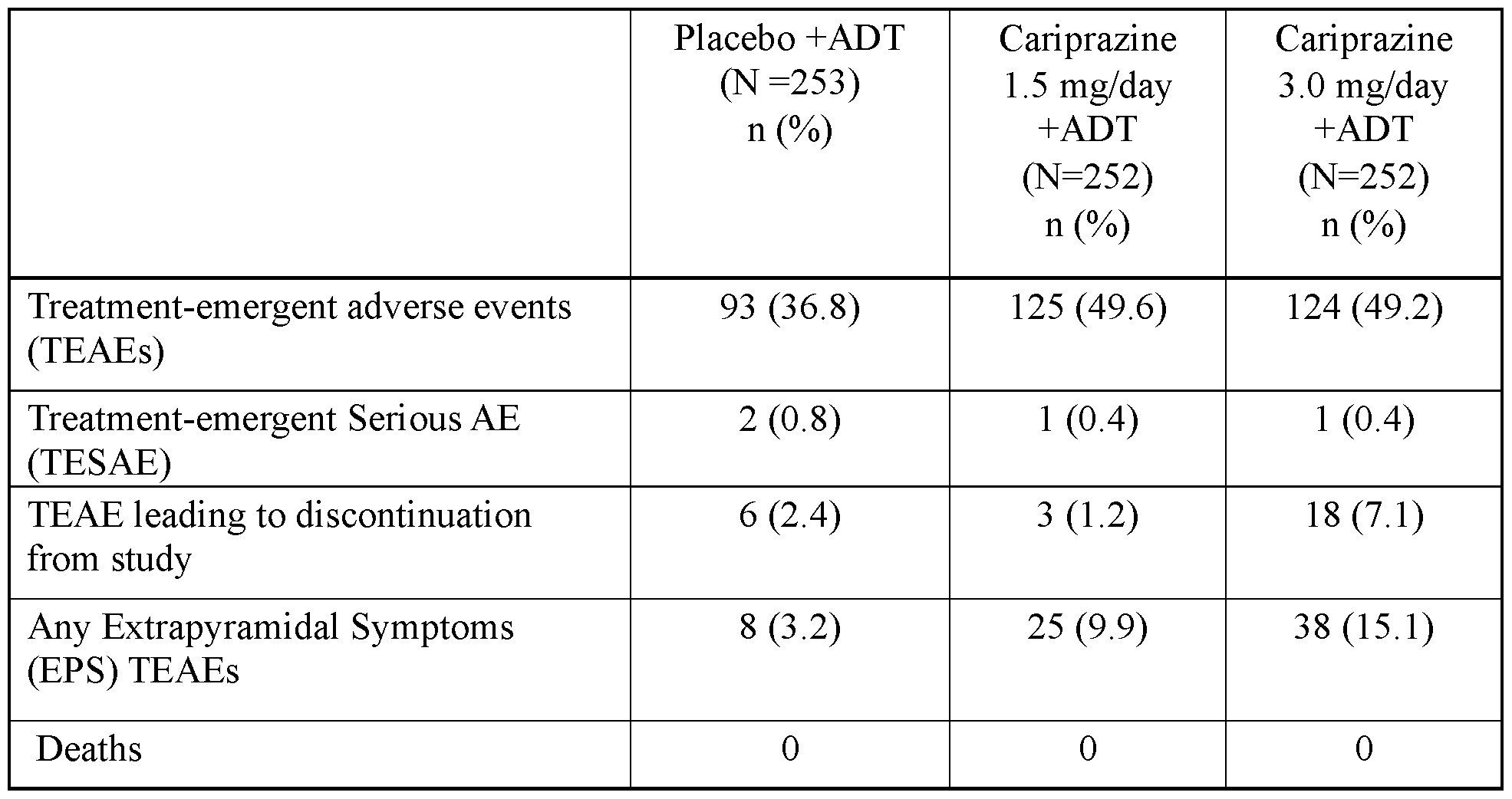
- Table 14 The number of participants (n) and percentage of participants ((%)) experiencing Adverse Events are shown in Table 14 below.
- Table 15 summarizes the most frequent TEAEs occurring in >5% in any treatment group, and Table 16 summarizes changes in weight.
- An AE was considered a treatment-emergent adverse event (TEAE) if the AE began or worsened (increased in severity or became serious) on or after the first dose of double-blinded investigational product.
- TEAE treatment-emergent adverse event
- the SCID-5 is a semi -structured interview guide for making the major DSM-5 diagnoses (formerly diagnosed on Axis I). This clinician-rated diagnostic assessment is administered by an investigator, subinvestigator, or rater who has extensive professional training and experience in the diagnosis of mental illness. The SCID-5 was considered a source document for the study.
- the ATRQ (Fava 2003) is a clinician-administered questionnaire that was used to determine whether the patient meets inclusion criteria for prior ADT treatment and response requirements.
- a modified ATRQ completed by a clinician at the study site who was certified in administration of the ATRQ, was used to assess prior antidepressant exposure and response within the current depressive episode.
- the clinician identified the antidepressants the patient had previously taken within the current episode; indicating the dose range and duration.
- the clinician then selected the level of response the patient had to the antidepressant which resulted in the greatest response.
- the MADRS (Montgomery and Asberg, 1979) is a 10-item, clinician-rated scale that evaluates the patient’s depressive symptomatology during the past week. Patients are rated on items assessing feelings of sadness, lassitude, pessimism, inner tension, suicidality, reduced sleep or appetite, difficulty in concentration, and lack of interest. Each item is scored on a 7-point scale with a score of 0 reflecting no symptoms and a score of 6 reflecting symptoms of maximum severity.
- the Hamilton Anxiety Rating Scale (HAM- A) (Hamilton 1959) is a clinician-rated scale which consists of 14 items, each rated on a 5-point scale ranging from 0 (not present) to 4 (very severe). The highest possible score is 56, which represents the most severe form of anxiety; the lowest possible score is 0, which represents an absence of anxiety. The instrument was administered by an experienced rater meeting the training requirements and qualifications set by the Sponsor.
- the HAM-A is a 14-item, clinician -reported measure used to quantify and categorize the subject’s anxiety over the past week. Items are rated on a 5-point Likert rating scale of “absent” (0; if symptoms are absent, insignificant, or clearly due to causes other than anxiety); “mild” (1; if symptom is infrequent, with no impairment and no more than mild distress); “moderate” (2; if symptom is more frequent, with moderate distress or limited interference with usual activities); “severe” (3; if symptom is severe and persistent or results in severe distress or marked impairment in functioning); “very severe” (4; if symptom is incapacitating).
- the HAM-A total score ranges from 0 to 56, with higher scores indicating greater anxiety severity.
- the HAM-A total score can further be divided into 7-item psychic anxiety cluster and somatic anxiety cluster scores ranging from 0 to 28 each; higher scores indicate greater anxiety severity.
- the HAM-A total score is used to stratify subjects by anxiety severity: 0 to 7 indicates no/minimal disease, 8 to 14 indicates mild disease, 15 to 23 indicates moderate disease, and > 24 indicates severe disease. [0072] Clinical Global Impressions-Severity
- the CGI-S (Guy 1976) is a clinician-rated scale that measures the overall severity of a patient’s illness in comparison with the severity in other patients the physician has observed. The patient is rated on a scale from 1 to 7 with 1 indicating a “normal state” and 7 indicating “among the most extremely ill patients”. The CGI-S was administered by an investigator, subinvestigator or rater with extensive professional training and experience in assessing mental illness.
- CGI-I scale (Guy 1976) is a clinicianrated scale that in this study was used to rate total improvement or worsening of mental illness from Visit 2, regardless of whether the investigator considered it to be a result of drug treatment or not. The patient was rated on a scale from 1 to 7, with 1 indicating that the patient was very much improved and 7 indicating that the patient was very much worse. The CGI-I was administered by an investigator, subinvestigator or rater with extensive professional training and experience in assessing mental illness.
- the HAMD-17 (Hamilton 1960; Hamilton 1967; Miller et al, 1985) is a clinician-rated, 17-item scale used to rate the patient’s depressive state based on feelings of depression, guilt, suicidality, anxiety, agitation, level of insight, patterns of insomnia, loss of interest in work and other activities, weight loss, hypochondriasis, and degree of psychomotor retardation. It also can be used to identify genital and somatic symptoms. This instrument was administered by an experienced rater meeting the training requirements and qualifications set by the Sponsor.
- the HAMD-17 is a 17-item, clinician-reported measure used to quantify and categorize the subject’s depression over the past week. Items are rated on varying numeric rating scales, ranging from 0 to 2 or 0 to 4. Each numeric rating is associated with a unique verbal anchor.
- the HAMD-17 total score ranges from 0 to 52 with higher scores indicating greater depression severity.
- the HAMD-17 total score is used to stratify subjects by depression severity: 0 to 7 indicates no/minimal disease, 8 to 13 indicates mild disease, 14 to 18 indicates moderate disease, 19 to 22 indicates severe disease, and > 23 indicates very severe disease.
- Hamilton M. The assessment of anxiety states by rating. Br J Med Psychol. 1959; 32(l):50-55. Hamilton M., A rating scale for depression. J Neurol Neurosurg Psychiatry 1960; 23:56-62. Hamilton M., Development of a rating scale for primary depressive illness. Br J Soc Clin Psychol. 1967; 6(4):278-296.
Landscapes
- Health & Medical Sciences (AREA)
- Chemical & Material Sciences (AREA)
- Medicinal Chemistry (AREA)
- Pharmacology & Pharmacy (AREA)
- Life Sciences & Earth Sciences (AREA)
- Animal Behavior & Ethology (AREA)
- General Health & Medical Sciences (AREA)
- Public Health (AREA)
- Veterinary Medicine (AREA)
- Epidemiology (AREA)
- Pain & Pain Management (AREA)
- Psychiatry (AREA)
- Engineering & Computer Science (AREA)
- Bioinformatics & Cheminformatics (AREA)
- Biomedical Technology (AREA)
- Neurology (AREA)
- Neurosurgery (AREA)
- Chemical Kinetics & Catalysis (AREA)
- General Chemical & Material Sciences (AREA)
- Nuclear Medicine, Radiotherapy & Molecular Imaging (AREA)
- Organic Chemistry (AREA)
- Pharmaceuticals Containing Other Organic And Inorganic Compounds (AREA)
Abstract
Description




Claims
Priority Applications (7)
| Application Number | Priority Date | Filing Date | Title |
|---|---|---|---|
| JP2024525395A JP2024537491A (en) | 2021-10-28 | 2022-10-28 | Treatment of major depressive disorder |
| EP22888547.1A EP4422629A4 (en) | 2021-10-28 | 2022-10-28 | TREATMENT OF SEVERE DEPRESSION |
| AU2022375808A AU2022375808A1 (en) | 2021-10-28 | 2022-10-28 | Treatment of major depressive disorder |
| MX2024005256A MX2024005256A (en) | 2021-10-28 | 2022-10-28 | TREATMENT OF MAJOR DEPRESSIVE DISORDER. |
| IL312456A IL312456A (en) | 2021-10-28 | 2022-10-28 | Treatment of major depressive disorder |
| JOJO/P/2024/0101A JOP20240101A1 (en) | 2021-10-28 | 2024-04-28 | Treatment of major depressive disorder |
| ZA2024/04183A ZA202404183B (en) | 2021-10-28 | 2024-05-28 | Treatment of major depressive disorder |
Applications Claiming Priority (4)
| Application Number | Priority Date | Filing Date | Title |
|---|---|---|---|
| US202163263213P | 2021-10-28 | 2021-10-28 | |
| US63/263,213 | 2021-10-28 | ||
| US202263362446P | 2022-04-04 | 2022-04-04 | |
| US63/362,446 | 2022-04-04 |
Publications (1)
| Publication Number | Publication Date |
|---|---|
| WO2023077094A1 true WO2023077094A1 (en) | 2023-05-04 |
Family
ID=86158814
Family Applications (1)
| Application Number | Title | Priority Date | Filing Date |
|---|---|---|---|
| PCT/US2022/078922 Ceased WO2023077094A1 (en) | 2021-10-28 | 2022-10-28 | Treatment of major depressive disorder |
Country Status (10)
| Country | Link |
|---|---|
| US (2) | US20230149392A1 (en) |
| EP (1) | EP4422629A4 (en) |
| JP (1) | JP2024537491A (en) |
| AU (1) | AU2022375808A1 (en) |
| GE (1) | GEAP202416526A (en) |
| IL (1) | IL312456A (en) |
| JO (1) | JOP20240101A1 (en) |
| MX (1) | MX2024005256A (en) |
| WO (1) | WO2023077094A1 (en) |
| ZA (1) | ZA202404183B (en) |
Citations (1)
| Publication number | Priority date | Publication date | Assignee | Title |
|---|---|---|---|---|
| US20200155546A1 (en) * | 2018-11-20 | 2020-05-21 | Ankit Anand KHARIA | Stable cariprazine formulations for oral use |
Family Cites Families (2)
| Publication number | Priority date | Publication date | Assignee | Title |
|---|---|---|---|---|
| HU230748B1 (en) * | 2007-05-11 | 2018-02-28 | Richter Gedeon Nyrt | New piperazine salt and process for its preparation |
| CN101815519B (en) * | 2007-08-03 | 2013-08-21 | 吉瑞工厂 | Pharmaceutical compositions comprising dopamine receptor ligands and methods of treatment using dopamine receptor ligands |
-
2022
- 2022-10-28 MX MX2024005256A patent/MX2024005256A/en unknown
- 2022-10-28 US US18/050,907 patent/US20230149392A1/en not_active Abandoned
- 2022-10-28 GE GEAP202416526A patent/GEAP202416526A/en unknown
- 2022-10-28 IL IL312456A patent/IL312456A/en unknown
- 2022-10-28 AU AU2022375808A patent/AU2022375808A1/en active Pending
- 2022-10-28 WO PCT/US2022/078922 patent/WO2023077094A1/en not_active Ceased
- 2022-10-28 EP EP22888547.1A patent/EP4422629A4/en active Pending
- 2022-10-28 JP JP2024525395A patent/JP2024537491A/en active Pending
-
2024
- 2024-02-09 US US18/437,732 patent/US20240398787A1/en not_active Abandoned
- 2024-04-28 JO JOJO/P/2024/0101A patent/JOP20240101A1/en unknown
- 2024-05-28 ZA ZA2024/04183A patent/ZA202404183B/en unknown
Patent Citations (1)
| Publication number | Priority date | Publication date | Assignee | Title |
|---|---|---|---|---|
| US20200155546A1 (en) * | 2018-11-20 | 2020-05-21 | Ankit Anand KHARIA | Stable cariprazine formulations for oral use |
Non-Patent Citations (8)
| Title |
|---|
| ABBVIE: "U.S. FDA Approves VRAYLAR® (cariprazine) as an Adjunctive Treatment for Major, Depressive Disorder", INTERNET CITATION, pages 1 - 5, XP093066221, Retrieved from the Internet <URL:https://news.abbvie.com/article_print.cfm?article_id=12543> [retrieved on 20230721] * |
| ANONYMOUS: "Highlights of Changes from DSM-IV-TR to DSM-5", AMERICAN PSYCHIATRIC ASSOCIATION, pages 1 - 19, XP093066198, Retrieved from the Internet <URL:https://practicumsupport-psych.sites.olt.ubc.ca/files/2013/05/Summary-of-DSM-V-Changes.pdf> [retrieved on 20230721] * |
| EARLEY WILLIE R, GUO HUA, NÉMETH GYÖRGY, HARSÁNYI JUDIT, THASE MICHAEL E: "Cariprazine Augmentation to Antidepressant Therapy in Major Depressive Disorder: Results of a Randomized, Double-Blind, Placebo-Controlled Trial", PSYCHOPHARMACOLOGY BULLETIN, MEDWORKS MEDIA GLOBAL, UNITED STATES, United States, pages 62 - 80, XP093066211, Retrieved from the Internet <URL:https://www.ncbi.nlm.nih.gov/pmc/articles/PMC6294423> [retrieved on 20230721] * |
| FAVA MAURIZIO, DURGAM SURESH, EARLEY WILLIE, LU KAIFENG, HAYES ROBERT, LASZLOVSZKY ISTVÁN, NÉMETH GYÖRGY: "Efficacy of adjunctive low-dose cariprazine in major depressive disorder : a randomized, double-blind, placebo-controlled trial", INTERNATIONAL CLINICAL PSYCHOPHARMACOLOGY., CLINICAL NEUROSCIENCE PUBLISHERS, LONDON., GB, vol. 33, no. 6, 1 November 2018 (2018-11-01), GB , pages 312 - 321, XP093066204, ISSN: 0268-1315, DOI: 10.1097/YIC.0000000000000235 * |
| LEUCHT STEFAN; FENNEMA HEIN; ENGEL ROLF R.; KASPERS-JANSSEN MARION; SZEGEDI ARMIN: "Translating the HAM-D into the MADRS and vice versa with equipercentile linking", JOURNAL OF AFFECTIVE DISORDERS., ELSEVIER BIOCHEMICAL PRESS, AMSTERDAM., NL, vol. 226, 1 January 1900 (1900-01-01), NL , pages 326 - 331, XP085276710, ISSN: 0165-0327, DOI: 10.1016/j.jad.2017.09.042 * |
| See also references of EP4422629A4 * |
| SURESH DURGAM, WILLIE EARLEY, HUA GUO, DAYONG LI, GYÖRGY NÉMETH, ISTVÁN LASZLOVSZKY, MAURIZIO FAVA, STUART A. MONTGOMERY: "Efficacy and safety of adjunctive cariprazine in inadequate responders to antidepressants: a randomized, double-blind, placebo-controlled study in adult patients with major depressive disorde", JOURNAL OF CLINICAL PSYCHIATRY, vol. 77, no. 3, 1 March 2016 (2016-03-01), US , pages 371 - 378, XP009546423, ISSN: 0160-6689, DOI: 10.4088/JCP.15m10070 * |
| VIETA EDUARD ET AL: "Long-term safety and tolerability of cariprazine as adjunctive therapy in major depressive disorder", INTERNATIONAL CLINICAL PSYCHOPHARMACOLOGY., CLINICAL NEUROSCIENCE PUBLISHERS, LONDON., GB, vol. 34, no. 2, 1 March 2019 (2019-03-01), GB , pages 76 - 83, XP093066213, ISSN: 0268-1315, DOI: 10.1097/YIC.0000000000000246 * |
Also Published As
| Publication number | Publication date |
|---|---|
| JP2024537491A (en) | 2024-10-10 |
| EP4422629A4 (en) | 2025-09-03 |
| MX2024005256A (en) | 2024-09-06 |
| IL312456A (en) | 2024-06-01 |
| ZA202404183B (en) | 2025-11-26 |
| US20230149392A1 (en) | 2023-05-18 |
| US20240398787A1 (en) | 2024-12-05 |
| GEAP202416526A (en) | 2024-09-25 |
| EP4422629A1 (en) | 2024-09-04 |
| JOP20240101A1 (en) | 2024-04-28 |
| AU2022375808A1 (en) | 2024-06-13 |
Similar Documents
| Publication | Publication Date | Title |
|---|---|---|
| Farrell et al. | Efficacy and tolerability of once-daily venlafaxine extended release (XR) in outpatients with major depression | |
| Hollander et al. | A double-blind, placebo-controlled trial of clonazepam in obsessive-compulsive disorder | |
| US6541523B2 (en) | Methods for treating or preventing fibromyalgia using very low doses of cyclobenzaprine | |
| US11033543B2 (en) | Methods of providing weight loss therapy in patients with major depression | |
| Cohn et al. | Double-blind comparison of buspirone and clorazepate in anxious outpatients | |
| Puigdemont et al. | Ziprasidone in the treatment of borderline personality disorder: a double-blind, placebo-controlled, randomized study | |
| JP2023514559A (en) | Hallucinogenic Treatment of Headache Disorders | |
| CN108135865A (en) | Treatment of Lennox-Gastaut Syndrome with Fenfluramine | |
| Arnold et al. | A randomized, placebo-controlled, double-blinded trial of duloxetine in the treatment of general fatigue in patients with chronic fatigue syndrome | |
| KR20180015158A (en) | Therapeutic Uses of L-4-Chloroquinolenine | |
| Lindsay et al. | Use of modafinil for the treatment of attention deficit/hyperactivity disorder | |
| Abad et al. | Pharmacological treatment of sleep disorders and its relationship with neuroplasticity | |
| Valentino et al. | A systematic review of anti-suicidal effects of sedative-hypnotics and cognitive behavioral therapy for insomnia | |
| KR20240093852A (en) | Treatment of hypersensitivity in subjects with autism spectrum disorder with moderate to severe anxiety and/or social avoidance | |
| EP2432319A1 (en) | Method of treatment of obsessive compulsive disorder with ondansetron | |
| US20240398787A1 (en) | Treatment of major depressive disorder | |
| JPWO2020106927A5 (en) | ||
| TW202428284A (en) | Method of providing ecopipam therapy to a patient | |
| Liester et al. | Transdermal scopolamine for treatment-resistant major depressive disorder | |
| AU2006240324B2 (en) | Use of selective chloride channel modulators to treat alcohol and/or stimulant substance abuse | |
| Papp | Pharmacological approach to the management of stress and anxiety disorders | |
| TWI752282B (en) | Benzoic acid or a salt and derivative thereof for use in preventing or treating depression | |
| Sheider et al. | Is methotrexate an effective treatment for patients with fibromyalgia? | |
| Gelenberg | Antidepressants in the general hospital | |
| Depression | Academic Highlights |
Legal Events
| Date | Code | Title | Description |
|---|---|---|---|
| 121 | Ep: the epo has been informed by wipo that ep was designated in this application |
Ref document number: 22888547 Country of ref document: EP Kind code of ref document: A1 |
|
| ENP | Entry into the national phase |
Ref document number: 2024525395 Country of ref document: JP Kind code of ref document: A |
|
| WWE | Wipo information: entry into national phase |
Ref document number: 12024551023 Country of ref document: PH Ref document number: MX/A/2024/005256 Country of ref document: MX |
|
| WWE | Wipo information: entry into national phase |
Ref document number: 312456 Country of ref document: IL |
|
| REG | Reference to national code |
Ref country code: BR Ref legal event code: B01A Ref document number: 112024008397 Country of ref document: BR |
|
| WWE | Wipo information: entry into national phase |
Ref document number: DZP2024000418 Country of ref document: DZ |
|
| WWE | Wipo information: entry into national phase |
Ref document number: 2022375808 Country of ref document: AU Ref document number: AU2022375808 Country of ref document: AU |
|
| ENP | Entry into the national phase |
Ref document number: 16526 Country of ref document: GE |
|
| WWE | Wipo information: entry into national phase |
Ref document number: 2022888547 Country of ref document: EP Ref document number: 0024000043 Country of ref document: IQ |
|
| NENP | Non-entry into the national phase |
Ref country code: DE |
|
| WWE | Wipo information: entry into national phase |
Ref document number: 11202402899P Country of ref document: SG |
|
| ENP | Entry into the national phase |
Ref document number: 2022888547 Country of ref document: EP Effective date: 20240528 |
|
| ENP | Entry into the national phase |
Ref document number: 2022375808 Country of ref document: AU Date of ref document: 20221028 Kind code of ref document: A |
|
| ENP | Entry into the national phase |
Ref document number: 112024008397 Country of ref document: BR Kind code of ref document: A2 Effective date: 20240429 |