WO2023083023A1 - 数据传输方法及装置、存储介质、程序产品 - Google Patents
数据传输方法及装置、存储介质、程序产品 Download PDFInfo
- Publication number
- WO2023083023A1 WO2023083023A1 PCT/CN2022/128317 CN2022128317W WO2023083023A1 WO 2023083023 A1 WO2023083023 A1 WO 2023083023A1 CN 2022128317 W CN2022128317 W CN 2022128317W WO 2023083023 A1 WO2023083023 A1 WO 2023083023A1
- Authority
- WO
- WIPO (PCT)
- Prior art keywords
- station
- frame
- duration
- intra
- field
- Prior art date
- Legal status (The legal status is an assumption and is not a legal conclusion. Google has not performed a legal analysis and makes no representation as to the accuracy of the status listed.)
- Ceased
Links
Images




Classifications
-
- H—ELECTRICITY
- H04—ELECTRIC COMMUNICATION TECHNIQUE
- H04W—WIRELESS COMMUNICATION NETWORKS
- H04W74/00—Wireless channel access
- H04W74/002—Transmission of channel access control information
-
- H—ELECTRICITY
- H04—ELECTRIC COMMUNICATION TECHNIQUE
- H04W—WIRELESS COMMUNICATION NETWORKS
- H04W74/00—Wireless channel access
- H04W74/002—Transmission of channel access control information
- H04W74/006—Transmission of channel access control information in the downlink, i.e. towards the terminal
-
- H—ELECTRICITY
- H04—ELECTRIC COMMUNICATION TECHNIQUE
- H04W—WIRELESS COMMUNICATION NETWORKS
- H04W74/00—Wireless channel access
- H04W74/08—Non-scheduled access, e.g. ALOHA
- H04W74/0808—Non-scheduled access, e.g. ALOHA using carrier sensing, e.g. carrier sense multiple access [CSMA]
-
- H—ELECTRICITY
- H04—ELECTRIC COMMUNICATION TECHNIQUE
- H04W—WIRELESS COMMUNICATION NETWORKS
- H04W74/00—Wireless channel access
- H04W74/08—Non-scheduled access, e.g. ALOHA
- H04W74/0808—Non-scheduled access, e.g. ALOHA using carrier sensing, e.g. carrier sense multiple access [CSMA]
- H04W74/0816—Non-scheduled access, e.g. ALOHA using carrier sensing, e.g. carrier sense multiple access [CSMA] with collision avoidance
-
- H—ELECTRICITY
- H04—ELECTRIC COMMUNICATION TECHNIQUE
- H04W—WIRELESS COMMUNICATION NETWORKS
- H04W84/00—Network topologies
- H04W84/02—Hierarchically pre-organised networks, e.g. paging networks, cellular networks, WLAN [Wireless Local Area Network] or WLL [Wireless Local Loop]
- H04W84/10—Small scale networks; Flat hierarchical networks
- H04W84/12—WLAN [Wireless Local Area Networks]
Definitions
- the present application relates to the technical field of communications, and in particular to a data transmission method and device, a storage medium, and a program product.
- wireless local area network wireless local area network
- WLAN wireless local area network
- the present application provides a data transmission method and device, a storage medium, and a program product, so as to improve the efficiency and reliability of channel competition.
- a data transmission method comprising: a first station receiving a first frame sent by a second station, where the first frame is used to indicate that the first station is allowed to be at the second station accessing in a shared transmission opportunity; in response to the first frame, the first station sends a first response frame; and the first station competes for a channel in the transmission opportunity.
- the first station can perform channel competition in the transmission opportunity shared by the second station, and perform channel competition in the transmission opportunity after sending the first response frame, which improves the efficiency and reliability of channel competition.
- a data transmission method includes: a second station sends a first frame, and the first frame is used to indicate that the first station is allowed to access in the transmission opportunity shared by the second station ; and the second station receives the first response frame sent by the first station.
- the second station after the second station competes for the channel, it can instruct the first station to allow access in its shared transmission opportunity, which improves the efficiency and reliability of the first station's channel competition.
- the first frame is a multi-user transmission request-transmission opportunity sharing MU-RTS TXS trigger frame
- the first frame includes a first field
- the first field is the first value
- the first frame is a new type of MU-RTS TXS trigger frame.
- the value of the first field in the MU-RTS TXS trigger frame is the first value, it is used in this application to indicate that the first station is allowed to access in the above transmission opportunity.
- the first field is a transmission opportunity sharing mode field.
- the first frame further includes a second field; the second field includes at least one of the following: the scheduled The identifier of the first station, the identifier of the scheduled station group, information about services allowed to be transmitted in the transmission opportunity, and an indication of whether to allow point-to-point transmission in the transmission opportunity.
- the first station can accurately determine itself, the station group it is in through the second field, or when it contains a certain service, it can access in the above transmission opportunity, which improves the flexibility and accuracy of scheduling .
- the information about services allowed to be transmitted in the transmission opportunity includes at least one of the following: The identifier of the service to be transmitted, and the tolerable delay threshold of the service that is allowed to be transmitted in the transmission opportunity.
- stricter requirements are imposed on the delay characteristics of some services, such as online games, virtual reality, and industrial sites. For these specific services, they may be allowed to be preferentially transmitted in the above transmission opportunities.
- This second field may therefore also include information on the services allowed to be transmitted in said transmission opportunity.
- the first station and the second station may pre-store the correspondence between service identifiers and services, the first station receives the first frame, and parses the identifier of the service allowed to be transmitted in the transmission opportunity in the second field , then it can be determined whether to allow the service access.
- the first station analyzes the tolerable delay threshold of the services allowed to be transmitted in the transmission opportunity in the second field, and determines which services in the ongoing services of the first station have tolerable delay thresholds. When the time is less than or equal to the tolerable delay threshold, when the data of the service is to be transmitted, channel competition can be performed in the transmission opportunity.
- the method further includes: the first station setting the value of the network allocation vector intra-BSS NAV in the basic service set to 0.
- the first station can set the value of its own intra-BSS NAV to 0, so as to compete for the channel in the transmission opportunity shared by the second station.
- the responding to the first frame, the first station sending a first response frame includes: the first station receiving The first response frame is sent after a short interframe space after the first frame.
- the method further includes: the first station receives a second response frame sent by a third station, and does not set based on the second response frame The intra-BSS NAV; and the first station performing channel competition in the transmission opportunity, including: when the first station detects that the channel is idle and the value of the basic NAV is 0, in the Channel contention among transmission opportunities.
- the first station scheduled by the first frame may have correctly parsed the first frame, but cannot reply the first response frame because the channel is busy or the value of basic NAV is not 0.
- the first station may receive CTS frames sent by other stations. The first station does not set the intra-BSS NAV based on the second response frame, that is, still makes the value of the intra-BSS NAV 0.
- the first station performing channel competition in the transmission opportunity includes: the first station starting a first timer, and the first timing The initial value of the timer is the first duration indicated by the Duration field of the first frame; and the first station performs channel competition when the value of the first timer is not equal to 0, and in the When the value of the first timer is 0, the transmission is stopped.
- the first station can perform channel competition when the value of the first timer is not equal to 0 (that is, the first timer has not timed out), and when the value of the first timer is 0 (that is, the first When the timer expires), the transmission stops.
- the purpose of stopping the transmission is to enable the first station to compete for channels with other stations that cannot participate in the shared transmission opportunity after the first time period ends, so as to ensure channel access fairness between the first station and others.
- the method further includes: the first station performs channel competition within a second time period, and stops transmission before the end of the second time period ; Wherein, the duration Duartion field of the first frame is also used to indicate the second duration; or the first frame further includes a third field, and the third field is used to indicate the second duration.
- the first station competes for the channel within the second time period, and stops transmission before the second time period ends. Further, after the second time period ends, the first station and the third station are not allowed to compete for channels, so as to give the first station priority to restore the channel usage right.
- the first frame further includes a third field and a Duration field
- the third field is used to indicate the The second duration of channel competition in the transmission opportunity
- the Duration field is used to indicate the first duration
- the first duration is the duration corresponding to the transmission opportunity shared by the second station
- the first The duration is greater than or equal to the second duration
- the method further includes: the first station starts a second timer, the initial value of the second timer is equal to the first duration, and sets the intra-BSS The NAV is set to 0; and the first station is not allowed to initiate channel competition when the second time period ends and the value of the second counter is not equal to 0.
- the first station performs channel competition within the second duration, and stops transmission before the end of the second duration, after the end of the second duration, and the value of the second counter is not equal to 0 (that is, the second timer In the case of no timeout), the first site and the third site need to resume intra-BSS NAV, that is, channel competition is not allowed to be initiated. Therefore, the efficiency and reliability of channel competition are improved.
- the first station performing channel competition in the transmission opportunity includes: in the transmission opportunity allocated to the first station During the second period of channel competition, if the values of the basic NAV and intra-BSS TXS NAV are both equal to 0, and the channel detection result is idle, the first station is allowed to perform channel competition, and the intra-BSS TXS NAV is different from the intra-BSS NAV; wherein, the Duartion field is also used to indicate the second duration; or the first frame further includes a third field, and the third field is used to indicate the second duration Two hours.
- the second station after the second station competes for the channel, it can instruct the first station to allow access in its shared transmission opportunity, the first station reserves its own intra-BSS NAV, and transmits data at other scheduled stations When transmitting, set intra-BSS TXS NAV to avoid channel conflicts. Therefore, the efficiency and reliability of channel competition are improved.
- the method further includes: the first station starts an intra-BSS TXS NAV timer after receiving the first frame, so The intra-BSS TXS NAV timer is initialized to 0; and if the first station receives the intra-BSS PPDU within the second duration, and the duration indicated by the Duration field of the intra-BSS PPDU is longer than the intra-BSS The duration of the TXS NAV, then use the value of the Duration field of the intra-BSS PPDU to update the intra-BSS TXS NAV.
- the method further includes: the first station receives a second response frame sent by a third station, and does not set based on the second response frame The intra-BSS TXS NAV; and the first station performing channel competition in the transmission opportunity, including: the first station detects that the channel is idle, and the basic NAV and the intra-BSS TXS NAV When the values of are all 0, channel contention is performed in the transmission opportunity.
- the second station competes for the channel, it may instruct the first station to allow access in its shared transmission opportunity.
- the first station receives the response frame replied by other stations dispatched by the second station, and does not set ntra-BSS TXS NAV based on the response frame. Therefore, the first station can perform channel competition after detecting that the channel is idle and the value of the basic NAV is 0. Therefore, the efficiency and reliability of channel competition are improved.
- a data transmission device in a third aspect, can implement the data transmission method in the first aspect above.
- the data transmission device may be a chip or a device.
- the above method can be realized by software, hardware, or by executing corresponding software by hardware.
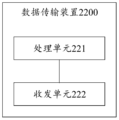
- the apparatus includes: a transceiver unit and a processing unit; wherein the transceiver unit is configured to receive a first frame sent by a second station, and the first frame is used to indicate that the The data transmission device accesses in the transmission opportunity shared by the second station; the transceiver unit is further configured to send a first response frame in response to the first frame; and the processing unit is configured to transmit a first response frame in response to the first frame; Channel contention among transmission opportunities.
- the first frame is a multi-user transmission request-transmission opportunity sharing MU-RTS TXS trigger frame
- the first frame includes a first field, and when the first field is a first value, it is used to indicate permission The data transmission device is accessed in the transmission opportunity.
- the first field is a transmission opportunity sharing mode field.
- the first frame further includes a second field; the second field includes at least one of the following: the identifier of the scheduled data transmission device, the identifier of the scheduled station group, and the Information about the service transmitted in the opportunity, and an indication of whether to allow point-to-point transmission in the transmission opportunity.
- the information about the service allowed to be transmitted in the transmission opportunity includes at least one of the following: an identification of the service allowed to be transmitted in the transmission opportunity, a tolerable value of the service allowed to be transmitted in the transmission opportunity Latency threshold.
- processing unit is further configured to set the value of the network allocation vector intra-BSS NAV in the basic service set to 0.
- the transceiving unit is further configured to send the first response frame after a short inter-frame space after receiving the first frame.
- the transceiving unit is further configured to receive a second response frame sent by a third station, and the processing unit is further configured to not set the intra-BSS NAV based on the second response frame; and the The processing unit is further configured to perform channel competition in the transmission opportunity when it is detected that the channel is idle and the value of the basic NAV is 0.
- the processing unit is further configured to start a first timer, and the initial value of the first timer is the first duration indicated by the duration field of the first frame; and the processing unit is also configured to When the value of the first timer is not equal to 0, perform channel competition, and when the value of the first timer is 0, stop transmission.
- the processing unit is further configured to perform channel competition within a second duration, and stop transmission before the end of the second duration; wherein, the duration Duartion field of the first frame is also used to indicate the the second duration; or the first frame further includes a third field, where the third field is used to indicate the second duration.
- the first frame further includes a third field and a Duration field
- the third field is used to indicate a second duration allocated to the data transmission device for channel contention in the transmission opportunity
- the The Duration field is used to indicate a first duration
- the first duration is the duration corresponding to the transmission opportunity shared by the second station, the first duration is greater than or equal to the second duration
- the processing unit It is also used to start a second timer, the initial value of the second timer is equal to the first duration, and the intra-BSS NAV is set to 0; and the processing unit is also used to After the two-time period expires, and when the value of the second counter is not equal to 0, channel contention is not allowed to be initiated.
- the processing unit is further configured to, within the second duration of channel contention in the transmission opportunity allocated to the data transmission device, if the values of the basic NAV and the intra-BSS TXS NAV are both equal to 0, and the channel detection result is idle, allowing the data transmission device to perform channel competition, the intra-BSS TXS NAV is different from the intra-BSS NAV; wherein, the Duartion field is also used to indicate the first Two durations; or the first frame further includes a third field, where the third field is used to indicate the second duration.
- the processing unit is further configured to start an intra-BSS TXS NAV timer after the transceiver unit receives the first frame, and the intra-BSS TXS NAV timer is initialized to 0; and the The processing unit is further configured to if the data transmission device receives an intra-BSS PPDU within the second duration, and the duration indicated by the Duration field of the intra-BSS PPDU is greater than the duration of the intra-BSS TXS NAV, then The intra-BSS TXS NAV is updated with the value of the Duration field of the intra-BSS PPDU.
- the transceiving unit is further configured to receive a second response frame sent by a third station, and the processing unit is further configured to not set the intra-BSS TXS NAV based on the second response frame; and the The processing unit is further configured to perform channel competition in the transmission opportunity when it is detected that the channel is idle, and the values of the basic NAV and the intra-BSS TXS NAV are both 0.
- the data transmission device is configured to execute the method in the foregoing first aspect and various possible implementations thereof.
- a data transmission device in a fourth aspect, can implement the data transmission method in the second aspect above.
- the data transmission device may be a chip or a device.
- the above method can be realized by software, hardware, or by executing corresponding software by hardware.
- the device includes: a transceiver unit; wherein the transceiver unit is configured to send a first frame, and the first frame is used to indicate that the first station is allowed to share in the data transmission device Access during transmission opportunities; and the transceiver unit is further configured to receive the first response frame sent by the first station.
- the first frame is a multi-user transmission request-transmission opportunity sharing MU-RTS TXS trigger frame
- the first frame includes a first field, and when the first field is a first value, it is used to indicate permission The first station accesses in the transmission opportunity.
- the first field is a transmission opportunity sharing mode field.
- the first frame further includes a second field; the second field includes at least one of the following: an identifier of the first station to be scheduled, an identifier of a station group to be scheduled, and an identifier allowed in the transmission Information about the service transmitted in the opportunity, and an indication of whether to allow point-to-point transmission in the transmission opportunity.
- the information about the service allowed to be transmitted in the transmission opportunity includes at least one of the following: an identification of the service allowed to be transmitted in the transmission opportunity, a tolerable value of the service allowed to be transmitted in the transmission opportunity Latency threshold.
- the data transmission device is configured to execute the method in the above second aspect and various possible implementations thereof.
- the data transmission device in the third aspect or the fourth aspect above includes a processor coupled to a memory; the processor is configured to support the device to perform the corresponding Function.
- the memory is used to couple with the processor, which holds the necessary computer programs (or computer-executable instructions) and/or data of the device.
- the data transmission device may further include a communication interface for supporting communication between the device and other network elements, such as sending or receiving data and/or signals.
- the communication interface may be a transceiver, a circuit, a bus, a module or other types of communication interfaces.
- the memory can be located inside the data transmission device and integrated with the processor; it can also be located outside the data transmission device.
- the data transmission device in the third or fourth aspect above includes a processor and a transceiver device, the processor is coupled to the transceiver device, and the processor is used to execute a computer program or Instructions to control the transceiver device to receive and send information; when the processor executes the computer program or instructions, the processor is also used to implement the above method through logic circuits or code instructions.
- the transceiver device may be a transceiver, a transceiver circuit or an input-output interface, which is used to receive signals from other data transmission devices other than the data transmission device and transmit them to the processor or transfer signals from the processor The signal is sent to other data transmission devices other than the data transmission device.
- the transceiver device is a transceiver circuit or an input-output interface.
- the sending unit may be an output unit, such as an output circuit or a communication interface; the receiving unit may be an input unit, such as an input circuit or a communication interface.
- the sending unit may be a transmitter or a transmitter; the receiving unit may be a receiver or a receiver.
- a communication system in the fifth aspect, includes the data transmission device as described in the third aspect or any one of the third aspect, and at least one of the fourth aspect or any one of the fourth aspect A kind of realization described data transmission device.
- a sixth aspect provides a computer-readable storage medium, on which a computer program or instruction is stored, and when the program or instruction is executed by a processor, the method described in the first aspect or any one of the first aspect is implemented be executed, or to implement the method described in the second aspect or any one of the implementations of the second aspect is executed.
- a computer program product which, when executed on a computing device, causes the method described in any one of the first aspect or the first aspect to be executed, or the method described in the second aspect or the second The method described in any implementation of the aspect is performed.
- FIG. 1 is a schematic structural diagram of a communication system applicable to an embodiment of the present application
- FIG. 2 is a schematic diagram of virtual carrier sensing and setting network allocation vectors provided by the embodiment of the present application
- FIG. 3 is a schematic diagram of triggered transmission opportunity sharing provided by an embodiment of the present application.
- FIG. 4 is a schematic flow diagram of a data transmission method provided by an embodiment of the present application.
- FIG. 5 is a schematic structural diagram of a basic frame provided by an embodiment of the present application.
- FIG. 6 shows possible values of the transmission opportunity sharing mode field provided by the embodiment of the present application.
- FIG. 7 is a schematic diagram of the format of a second field provided by the embodiment of the present application.
- Fig. 8a is a schematic diagram of the format of another second field provided by the embodiment of the present application.
- Fig. 8b is a schematic diagram of the format of another second field provided by the embodiment of the present application.
- FIG. 9 is a schematic diagram of the format of another second field provided by the embodiment of the present application.
- FIG. 10 is a schematic flowchart of another data transmission method provided in the embodiment of the present application.
- FIG. 11 is a schematic diagram of data transmission in an example embodiment of the present application.
- FIG. 12 is a schematic flowchart of another data transmission method provided by the embodiment of the present application.
- FIG. 13 is another schematic diagram of data transmission example in the embodiment of the present application.
- FIG. 14 is another schematic diagram of data transmission in the example of the embodiment of the present application.
- FIG. 15 is a schematic flowchart of another data transmission method provided by the embodiment of the present application.
- FIG. 16 is another schematic diagram of data transmission example in the embodiment of the present application.
- FIG. 17 is a schematic flowchart of another data transmission method provided by the embodiment of the present application.
- FIG. 18 is another schematic diagram of data transmission in the example of the embodiment of the present application.
- FIG. 19 is a schematic flowchart of another data transmission method provided by the embodiment of the present application.
- FIG. 20 is another schematic diagram of data transmission example in the embodiment of the present application.
- FIG. 21 is a schematic flowchart of another data transmission method provided by the embodiment of the present application.
- FIG. 22 is a schematic structural diagram of a data transmission device provided by an embodiment of the present application.
- FIG. 23 is a schematic structural diagram of another data transmission device provided by the embodiment of the present application.
- FIG. 24 is a schematic structural diagram of another data transmission device provided by the embodiment of the present application.
- FIG. 25 is a schematic structural diagram of another data transmission device provided by an embodiment of the present application.
- WLAN has gone through standards such as IEEE 802.11a/b/g/n/ac/ax, and the standard version of 802.11be, which is currently under discussion, continues to evolve and develop.
- 802.11n high throughput
- HT high throughput
- VHT very high throughput
- HE high efficiency
- HE high efficient
- EHT extreme high throughput
- Non-HT non-high throughput
- a WLAN communication system includes an access point (access point, AP) and a workstation (station, STA), and the workstation may also be called a station or a non-access point (non-AP) station.
- the involved wireless communication scenarios may include: communication between APs and STAs, communication between APs and APs, and communication between STAs and so on.
- This embodiment of the present application uses communication between an AP and STA as an example for illustration. As shown in FIG. 1 , AP1 can perform wireless communication with STA1 and STA2, and AP2 can also perform wireless communication with STA1 and STA2.
- the uplink and downlink communication between the AP and its associated STA can be performed through the IEEE802.11 protocol, and of course other protocols can also be used for communication, which is not limited in this application.
- AP1 and AP2 can access the data network in a wired or wireless manner. It should be understood that the method described in the embodiment of the present application is also applicable to communication between APs, communication between STAs, and the like.
- the AP and the STA in the embodiment of the present application may structurally include: a media access control layer (media access control, MAC) and a physical layer (physical, PHY).
- AP and STA can transmit PPDU through physical layer protocol data unit (PHY protocol data unit, PPDU), and when the wireless communication protocol used by AP and STA is different, the frame structure of PPDU will also be different.
- PHY protocol data unit PHY protocol data unit
- FIG. 2 it is a schematic diagram of the virtual carrier sense and NAV setting provided by the embodiment of the present application.
- the duration (Duration) of its media access control (media access control, MAC) layer signaling ) field will carry a duration T, which means that STA 1 expects to continue sending or receiving within the future duration T after the end of the frame, so as to realize the protection of channel resources.
- media access control media access control, MAC
- Any other STA (such as STA 2) parses out the 802.11 frame sent by STA 1 and parses out that the Duration value is T, and STA 2 is not the destination address of the 802.11 frame, and the current NAV of STA2 is not set or is set If the end time of is earlier than the end time corresponding to the duration, then the NAV needs to be set to T, and the backoff process is not allowed to attempt transmission within the future duration T.
- the transmission opportunity (transmission opportunity, TXOP) mechanism is extended, that is, one as the TXOP holder (holder) AP can issue a special trigger frame (called multi-user request to send (MU-RTS) transmission opportunity sharing (TXOP sharing, TXS) trigger frame, or simply called TXS trigger frame) , allocate a part of the time resources in the reserved TXOP (that is, the first time period in Figure 3) to STA1, and STA1 can send data to the AP in the uplink within the allocated time or perform point-to-point (point-to-point) with STA2 , P2P) transmission.
- TXOP transmission opportunity
- TXOP sharing transmission opportunity sharing
- P2P point-to-point
- P2P link used for P2P transmission here is established by two non-AP STAs through tunneled direct link setup (tunneled direct link setup, TDLS) or other P2P protocols.
- P2P may also be called device-to-device (device-to-device, D2D) or TDLS in other technical introductions, which are essentially the same and are not limited in this application.
- This application provides a data transmission scheme. After the second station competes for the channel, it can instruct the first station to allow access in the transmission opportunity shared by it, and the first station can perform channel competition in the transmission opportunity shared by the second station. , and perform channel competition in the transmission opportunity after sending the first response frame, which improves the efficiency and reliability of channel competition.
- FIG. 4 it is a schematic flowchart of a data transmission method provided in the embodiment of the present application.
- the method may include the following steps:
- the second station sends the first frame.
- the first frame is used to indicate that the first station is allowed to access in the transmission opportunity shared by the second station.
- the first station receives the first frame sent by the second station.
- the second station competes for the channel through an enhanced distributed channel access (EDCA) mechanism, and occupies the channel in one transmission opportunity.
- the second station may share the transmission opportunity with other stations associated with it. Accordingly, the second station may send the first frame to one or more stations indicating that the one or more stations are allowed access in the transmission opportunity shared by the second station.
- the one or more stations are stations scheduled by the second station. In this embodiment, take the scheduled station as the first station as an example. Of course, this application does not limit the number of stations to be scheduled.
- the foregoing second station may be an AP, and the first station may be a STA associated with the AP. Certainly, both the first station and the second station may be STAs.
- the first frame may be a MU-RTS TXS trigger frame.
- a schematic diagram of the format of a basic frame (basic frame) provided by the embodiment of the present application when the basic frame is used as the MU-RTS TXS trigger frame, the gray marked field in the basic frame is reserved, And the GI and high efficiency long training field (HE-LTF) type fields are multiplexed into the TXOP sharing mode (TXOP sharing mode) field in the MU-RTS TXS trigger frame.
- HE-LTF high efficiency long training field
- the MU-RTS TXS trigger frame includes a frame header, a common information (common information) field, and a user information list (user information list) field, and may also include a padding (padding) field and a frame check sequence (frame check sequence, FCS) field wait.
- the frame header includes a frame control (frame control) field, a duration (Duration) field, a receiving address (RA) and a transmission address (TA).
- the public information field and the user information list field are divided into HE type and EHT type, and Fig. 5 shows the public information field and user information list field of the HE type.
- the public information field includes public information that all STAs need to read.
- the user information list field includes one or more user information fields. Each user information field corresponds to information that an STA needs to read.
- the first frame includes a first field, and the first field may be the TXOP sharing mode field in the above public information field.
- the first field is the first value, it is used to indicate that the first station is allowed to access in the transmission opportunity.
- the meaningful values of the TXOP sharing mode field are 0, 1, and 2, and the value 3 is reserved.
- the value of this field is 0, it means that the MU-RTS is not used to start the MU-RTS TXOP sharing procedure (MU-RTS that does not initiate MU-RTS TXOP sharing procedure); when the value of this field is 1, it means that the MU-RTS that does not initiate MU-RTS TXOP sharing procedure MU-RTS is used to start the MU-RTS TXOP sharing procedure where the scheduled STA can only transmit PPDU to its associated AP (MU-RTS that initiates MU-RTS TXOP sharing procedure where in a scheduled STA can only transmit PPDU(s )addressed to its associated AP); when the value of this field is 2, it means that the MU-RTS is used to start the MU-RTS TXOP sharing process, in which
- a value of 3 in this field will not be reserved, but indicates that the MU-RTS is used to allow access in a shared transmission opportunity.
- the above-mentioned first value may be 3.
- the meanings of the TXOP sharing mode field in FIG. 6 when the values are 0, 1, and 2 are quoted here from the original text of the IEEE802.11be standard, and the modified positions in this embodiment are marked with strikethrough and underline.
- the first frame also includes a second field.
- the second field is used to indicate the scheduled station.
- the second field includes the identifier of the scheduled first station.
- This implementation fully reuses the format of the user information field of the MU-RTS TXS trigger frame shown in Figure 5, without additional modification.
- the second field is an association identification (association identification 12, AID12) field, which is used to indicate the identification of the first site. After receiving the first frame, the first station parses out the second field, and if the association identifier in the second field corresponds to the identifier of the first station, the first station can determine that it is scheduled by the second station.
- the second field is used to indicate the scheduled traffic in the first site.
- the second field includes at least one of the following items: an identifier of the scheduled first station, and information about services allowed to be transmitted in the transmission opportunity.
- any reserved field in the user information field as shown in FIG. 5 may be used to bear the information of the service allowed to be transmitted in the transmission opportunity.
- the first station After receiving the first frame, the first station parses out the second field, and if the association identifier in the second field corresponds to the identifier of the first station, the first station can determine that it is scheduled by the second station. Further, the first station analyzes the information of the services allowed to be transmitted in the transmission opportunity contained in the second field, if the information of the services transmitted in the first station is consistent with the information of the services allowed to be transmitted in the transmission opportunity contained in the second field If the service information corresponds, the first station can determine that the service can be accessed in the transmission opportunity shared by the second station.
- the second field may also include an indication of whether to allow point-to-point transmission (P2P enable) in the transmission opportunity, that is, whether to allow the first station to perform point-to-point transmission with other stations associated with the second station in the above-mentioned transmission opportunity.
- P2P enable point-to-point transmission
- Any reserved field in the user information fields shown in FIG. 5 may be used to carry an indication of whether the first station is allowed to perform point-to-point transmission with other stations associated with the second station in the transmission opportunity.
- the information about the traffic allowed to be transmitted in the transmission opportunity includes at least one of the following: an identifier (traffic identifier) of the traffic allowed to be transmitted in the transmission opportunity, a tolerable delay threshold of the traffic allowed to be transmitted in the transmission opportunity (tolerable delay). Therefore, the field format in FIG. 7 may be specifically shown in FIG. 8a or FIG. 8b respectively.
- the second field includes at least one of the following: the identifier of the scheduled first station, the identifier of the service allowed to be transmitted in the transmission opportunity, and an indication of whether to allow point-to-point transmission in the transmission opportunity .
- the first site and the second site may pre-store the correspondence between service identifiers and services. Assuming that they pre-store the correspondence between 8 service identifiers and services, then 3 bits can be used to represent the identifiers of the services allowed to be transmitted in the transmission opportunity.
- the identifier of the service allowed to be transmitted in the transmission opportunity may also be a bitmap (bitmap). Assuming that there are 8 services that may be transmitted between the first site and the second site, the bitmap includes 8 bits.
- the second field includes at least one of the following items: the identifier of the first station to be scheduled, the tolerable delay threshold of the service that is allowed to be transmitted in the transmission opportunity, whether point-to-point transmission is allowed in the transmission opportunity instructions.
- the tolerable delay threshold of the service that is allowed to be transmitted in the transmission opportunity refers to the maximum value of the tolerable delay of the service that is allowed to be transmitted in the transmission opportunity, that is, the tolerable delay of the service in the first site is less than or equal to
- the tolerable delay threshold that is, the service has high requirements on the delay characteristic, allows the service to be accessed in the transmission opportunity.
- the first station After the first station receives the first frame, it analyzes the tolerable delay threshold of the services allowed to be transmitted in the transmission opportunity in the second field, and determines which services in the ongoing services of the first station have a tolerable delay less than or equal to With the tolerable delay threshold, when the data of the service is to be transmitted, channel competition can be performed in the transmission opportunity.
- this second field is used to indicate the scheduled station group.
- the second field includes at least one of the following: an identifier of the scheduled station group, information about services allowed to be transmitted in the transmission opportunity, and an indication of whether to allow point-to-point transmission in the transmission opportunity.
- the user information field includes the second field
- the second field is used for which group of STAs are scheduled. For the station group, the information of the services allowed to be transmitted in the transmission opportunity and the indication of whether point-to-point transmission is allowed in the transmission opportunity are for each STA in the station group.
- the information about the services allowed to be transmitted in the transmission opportunity includes at least one of the following: an identifier of the service allowed to be transmitted in the transmission opportunity, and a tolerable delay threshold of the service allowed to be transmitted in the transmission opportunity.
- an identifier of the service allowed to be transmitted in the transmission opportunity includes at least one of the following: a tolerable delay threshold of the service allowed to be transmitted in the transmission opportunity.
- a single STA may be scheduled by using the second field in some of the user information fields, and a station group may also be scheduled by using the second field in another part of the user information fields.
- the first station In response to the first frame, the first station sends a first response frame.
- the second station receives the first response frame sent by the first station.
- the first station After receiving the first frame, the first station parses the first frame to indicate that the first station is allowed to access in the transmission opportunity shared by the second station, and then sends the first response frame to the second station.
- the first response frame may be used to indicate that the first frame is received.
- the first station competes for a channel in the above transmission opportunity.
- the first station competes for a channel in the transmission opportunity shared by the second station.
- the second station can share the transmission opportunity with the first station and more stations, and the first station can perform channel competition through random access such as EDCA.
- the second station after the second station competes for the channel, it can indicate that the first station is allowed to access in the transmission opportunity shared by it, and the first station can use the transmission opportunity shared by the second station
- the channel competition is performed in the transmission opportunity after sending the first response frame, which improves the efficiency and reliability of the channel competition.
- the above method supports access in shared transmission opportunities on the basis of the existing MU-RTS TXS trigger frame, and has good backward compatibility.
- FIG. 10 it is a schematic flowchart of another data transmission method provided in the embodiment of the present application.
- the method may include the following steps:
- the second station sends the first frame.
- the first frame is used to indicate that the first station is allowed to access in the transmission opportunity shared by the second station.
- the first station receives the first frame sent by the second station.
- step S401 For specific implementation of this step, reference may be made to step S401 in the foregoing embodiments.
- the first station sets the value of the network allocation vector (intra-BSS NAV) in the basic service set to 0.
- the value of the intra-BSS NAV is set to 0, so that the first station can perform channel competition.
- the first station sets the intra-BSS NAV to 0, so that it uses the transmission opportunity for channel competition.
- the value of intra-BSS NAV is 0. At this time, the first station does not need to perform the operation of setting the value of the intra-BSS NAV to 0.
- the first station sends a first response frame after receiving the first frame after a short inter frame space (short inter frame space, SIFS).
- SIFS short inter frame space
- the second station receives the first response frame sent by the first station.
- the first station sets the intra-BSS NAV value to 0 when receiving the first frame, and sends the first response frame after receiving the first frame after SIFS interval.
- the first response frame is a response to the first frame, and may be used to indicate that the first frame is received.
- the first response frame may be a clear to send (clear to send, CTS) frame.
- the CTS frame is a non-HT frame, which can be parsed by any version of the STA, so that it is beneficial to implement the access of the scheduled station or service in the shared transmission opportunity in this embodiment.
- the first station when the first station detects that the channel is idle and the value of the basic network allocation vector (basic NAV) is 0, it sends the first response frame after receiving the first frame after an interval of SIFS.
- basic NAV basic network allocation vector
- the first station may detect whether the channel is idle through physical carrier sensing.
- the basic NAV is a counter updated based on the received PPDU (i.e. Inter-BSS PPDU) from the neighboring cell.
- the value of basic NAV being 0 means that there are currently no stations in neighboring cells using the channel, and the first station does not need to delay channel access in order to avoid the transmission of stations in neighboring cells.
- the first station when the first station receives the first frame and sets the value of its own intra-BSS NAV to 0, if it detects that the channel is busy, or the value of basic NAV is not 0, the first station may not execute Step S1003, but since the first station has set the value of its own intra-BSS NAV to 0, the first station can still perform step S1004, that is, channel competition can be performed.
- the first station performs channel competition in the above transmission opportunity.
- step S403 For the specific implementation of this step, reference may be made to step S403 in the embodiment.
- FIG. 11 is an example of data transmission based on the method shown in FIG. 10 .
- the second station is an AP
- the AP allows the first station and the third station associated with the AP to access in its shared transmission opportunity, wherein the first station and the third station may have time synchronization Sites with requirements such as delay characteristics.
- the first station and the third station may be EHT STAs.
- the AP sends the first frame, and when the first station and the third station receive the first frame, set the value of intra-BSS NAV to 0, and send a CTS frame after receiving the first frame after SIFS. Then, the first station and the third station compete for channels through random access methods such as EDCA.
- the first station competes for the channel first, and then the first station can send a PPDU to the AP at an interval of xIFS after replying a CTS frame (where xIFS>SIFS), or perform P2P transmission with other STAs.
- the first station after the first station competes for the channel, it sends a PPDU to the AP, and releases the channel after receiving a block acknowledgment (BA) sent by the AP.
- BA block acknowledgment
- the third station can send PPDUs to the AP through this channel, and can also perform P2P transmission with other STAs.
- EHT STAs that do not have the capability of this application EHT STAs that are not scheduled by the AP, or non-EHT STAs (non-EHT STAs) need to set their own NAV, and prohibit contention for channels within the first period of time.
- the first duration is indicated by the Duration field in the frame header of the first frame. The first duration is used to indicate the duration for triggering the scheduled station to perform channel access.
- the first timer may be started, and the initial value of the first timer is the above-mentioned first duration. Then the first station can perform channel competition when the value of the first timer is not equal to 0 (that is, the first timer has not timed out), and when the value of the first timer is 0 (that is, the first timer has timed out) , stop the transmission.
- the purpose of stopping the transmission is to enable the first station to compete for channels with other stations that cannot participate in the shared transmission opportunity after the first time period ends, so as to ensure channel access fairness between the first station and others.
- the second station after the second station competes for the channel, it can indicate that the first station is allowed to access in its shared transmission opportunity, and the first station can use the intra-BSS NAV of its own
- the value is set to 0 to perform channel competition in the transmission opportunity shared by the second station, and perform channel competition in the transmission opportunity after sending the first response frame, which improves the efficiency and reliability of channel competition.
- FIG. 12 it is a schematic flowchart of another data transmission method provided by the embodiment of the present application.
- the method may include the following steps:
- the second station sends the first frame.
- the first frame is used to indicate that the first station is allowed to access in the transmission opportunity shared by the second station.
- the first station receives the first frame sent by the second station.
- step S401 For specific implementation of this step, reference may be made to step S401 in the foregoing embodiments.
- the second station schedules the first station and the third station to access in their shared transmission opportunity.
- the first station sets the value of the intra-BSS NAV to 0.
- the first station When receiving the first frame, the first station sets the intra-BSS NAV value to 0, so that the first station can perform channel competition.
- the third station sends a second response frame.
- the first station receives the second response frame sent by the third station.
- the third station Since the second station also schedules the third station to access in its shared transmission opportunity, the third station sends the second response frame after receiving the first frame at an interval of SIFS.
- the second response frame may be a CTS frame.
- the third station broadcasts the second response frame, and the first station receives the second response frame sent by the third station.
- the first station does not set the intra-BSS NAV based on the second response frame.
- the first station scheduled by the first frame may have correctly parsed the first frame, but cannot reply the first response frame because it detects that the channel is busy, or the value of basic NAV is not 0. However, the first station may receive CTS frames sent by other stations.
- the first station when the first station receives a CTS frame sent by other stations, the CTS frame includes intra-BSS NAV, and the first station needs to set its own intra-BSS NAV based on the CTS frame. However, if so set, the first station cannot participate in the channel contention within the transmission opportunity. Therefore, in this embodiment, the first station does not set the intra-BSS NAV based on the second response frame, that is, the value of the intra-BSS NAV is still set to 0.
- the first station performs channel competition in the above transmission opportunity.
- step S403 or S1004 In the embodiment,
- FIG. 13 is an example of data transmission based on the method shown in FIG. 12 .
- the second station schedules the first station and the third station to perform access in their shared transmission opportunity, and sends the first frame to the first station and the third station.
- the first station and the third station set the value of intra-BSS NAV to 0 when receiving the first frame.
- the third station detects that the channel is idle and the value of basic NAV is 0, and then sends CTS after SIFS after receiving the first frame.
- the first station detects that the channel is busy or is set to basic NAV (that is, the value of basic NAV is not 0) when performing carrier sense after receiving the first frame, according to the agreement, the first station is not allowed to send a message to the second station.
- the first station receives the CTS frame replied by the third station.
- the first station may not update the intra-BSS NAV based on the CTS broadcast by the third station (that is, still make the value of the intra-BSS NAV 0). Therefore, when the first station detects that the channel is idle and the value of the basic NAV is 0, it can perform channel competition.
- the first timer may be started, and the initial value of the first timer is the above-mentioned first duration. Then the first station can perform channel competition when the value of the first timer is not equal to 0 (that is, the first timer has not timed out), and when the value of the first timer is 0 (that is, the first timer has timed out) , stop the transmission.
- the purpose of stopping the transmission is to enable the first station to compete for channels with other stations that cannot participate in the shared transmission opportunity after the first time period ends, so as to ensure channel access fairness between the first station and others.
- the second station may instruct the first station to allow access in its shared transmission opportunity.
- the first station receives the first frame, the channel is busy or the value of basic NAV is not 0, set the value of intra-BSS NAV to 0, and the first station receives the response from other stations scheduled by the second station frame, the value of intra-BSS NAV is still set to 0. Therefore, when the first station detects that the channel is idle and the value of the basic NAV is 0, it can perform channel competition. Therefore, the efficiency and reliability of channel competition are improved.
- the second station (here, the AP) still has data to send within the first duration
- the data can be started at an interval of SIFS after the first station replies with a CTS frame. Sending, because the first station needs to wait for DIFS or AIFS after sending the CTS frame before starting backoff, and DIFS>SIFS, AIFS>SIFS. Therefore, the AP has the priority to seize the channel. After the AP finishes using the channel, the first station can compete for the channel according to the traditional IEEE802.11 channel competition mechanism.
- FIG. 15 it is a schematic flowchart of another data transmission method provided in the embodiment of the present application.
- the method may include the following steps:
- the second station sends the first frame.
- the first frame is used to indicate that the first station is allowed to access in the transmission opportunity shared by the second station.
- the first station receives the first frame sent by the second station.
- the first frame also includes a second duration.
- the second duration is used to indicate that the first station is allowed to perform channel contention within the second duration, and stop transmission before the end of the second duration.
- the second duration may also be referred to as allocated time (allocated time).
- the Duration field of the first frame may be used to indicate the second duration. At this time, the Duration field may be multiplexed to indicate the first duration and the second duration. Yet another implementation is that the first frame further includes a third field, where the third field is used to indicate the second duration.
- the third field can be any reserved field in the MU-RTS TXS trigger frame.
- the first station sets the value of the intra-BSS NAV to 0.
- step S1002 For the specific implementation of this step, reference may be made to step S1002 in the foregoing embodiment.
- the first station sends a first response frame after receiving the first frame after a short inter-frame space.
- the second station receives the first response frame sent by the first station.
- step S1003 For the specific implementation of this step, reference may be made to step S1003 in the foregoing embodiment.
- the first station competes for the channel within the second time period, and stops transmission before the end of the second time period.
- the start time of the second duration may be when the first station receives the first frame, then the first station may perform channel competition after an interval of SIFS after replying the first response frame.
- the first station competes for the channel within the second time period, and stops transmission before the end of the second time period. Stopping transmission includes stopping sending PPDUs to the AP or other stations, and stopping receiving BAs sent by the AP or other stations.
- the first station is not allowed to perform channel contention after the second time period.
- FIG. 16 is an example of data transmission based on the method shown in FIG. 15 .
- the second station is an AP
- the AP allows the first station and the third station associated with the AP to access in its shared transmission opportunity, wherein the first station and the third station may have time synchronization Sites with requirements such as delay characteristics.
- the first station and the third station may be EHT STAs.
- the AP sends the first frame, and the Duration field in the first frame is used to indicate the first duration and the second duration, or the Duration field in the first frame is used to indicate the first duration, and the third field in the first frame It is used to indicate the second duration, where the second duration ⁇ the first duration.
- the first station and the third station When the first station and the third station receive the first frame, set the value of intra-BSS NAV to 0, and send the CTS frame after receiving the first frame after SIFS interval. Then, within the second time period, the first station and the third station compete for channels through random access such as EDCA. In Figure 16, the first station competes for the channel first, then the first station can send a PPDU to the AP at an interval of xIFS after replying a CTS frame (where xIFS>SIFS), or perform P2P transmission with other STAs. In Figure 16, after the first station competes for the channel, it sends a PPDU to the AP, and releases the channel after receiving the BA sent by the AP.
- the third station can send PPDUs to the AP through this channel, and can also perform P2P transmission with other STAs.
- the first station and the third station compete for the channel within the second time period, and stop transmission before the end of the second time period. After the second time period ends, the first station and the third station are not allowed to compete for channels.
- EHT STAs that do not have the capability of this application, EHT STAs that are not scheduled by the AP, or non-EHT STAs (non-EHT STAs) need to set their own NAV, and prohibit contention for channels within the first period of time.
- the second station after the second station competes for the channel, it can indicate that the first station is allowed to access in its shared transmission opportunity, and the first station can use the intra-BSS NAV of its own
- the value is set to 0 to perform channel contention in the transmission opportunity shared by the second station, and to perform channel contention in this transmission opportunity after sending the first response frame.
- the first station performs channel competition within the second time period, and stops transmission before the end of the second time period. After the end of the second time period, the first station and the third station are not allowed to conduct channel competition, so as to give the first station priority Right to restore the right to use the channel. Therefore, the efficiency and reliability of channel competition are improved.
- FIG. 17 it is a schematic flowchart of another data transmission method provided by the embodiment of the present application.
- the method may include the following steps:
- the second station sends the first frame.
- the first frame is used to indicate that the first station is allowed to access in the transmission opportunity shared by the second station.
- the first station receives the first frame sent by the second station.
- the first frame further includes a Duration field and a third field.
- the Duration field is used to indicate the first duration.
- the third field is used to indicate the second duration.
- the third field can be any reserved field in the MU-RTS TXS trigger frame. Among them, the first duration is greater than or equal to the second duration
- the first station sets the value of the intra-BSS NAV to 0.
- step S1002 For the specific implementation of this step, reference may be made to step S1002 in the foregoing embodiment.
- the first station starts the second timer.
- the first station When receiving the first frame, the first station starts the second timer.
- the initial value of the second timer is equal to the above-mentioned first duration.
- the first station sends a first response frame after receiving the first frame after a short inter-frame space.
- the second station receives the first response frame sent by the first station.
- step S1003 For the specific implementation of this step, reference may be made to step S1003 in the foregoing embodiment.
- the first station competes for the channel within the second time period, and stops transmission before the end of the second time period.
- step S1504 For a specific implementation of this step, reference may be made to step S1504 in the foregoing embodiment.
- the first station is not allowed to initiate channel competition after the second time period ends and the value of the second counter is not equal to 0.
- the first station and the third station need to restore the intra-BSS NAV means that channel competition is not allowed.
- FIG. 18 is an example of data transmission based on the method shown in FIG. 17 .
- the difference between Figure 18 and Figure 16 is that when the first station and the second station receive the first frame, set the value of intra-BSS NAV to 0, and at the same time start the second timer, that is, record the time of intra-BSS NAV End Time.
- the initial value of the second timer is the first duration. After the second duration ends, and the value of the second counter is not equal to 0 (that is, the second timer has not timed out), the first station and the third station need to resume intra-BSS NAV, that is, channel competition is not allowed to be initiated.
- the recovered intra-BSS NAV coincides with the end time of the recorded intra-BSS NAV.
- the second station after the second station competes for the channel, it can indicate that the first station is allowed to access in its shared transmission opportunity, and the first station can use the intra-BSS NAV of its own
- the value is set to 0 to perform channel contention in the transmission opportunity shared by the second station, and to perform channel contention in this transmission opportunity after sending the first response frame.
- the first station performs channel competition within the second duration, and stops transmission before the end of the second duration, after the end of the second duration, and the value of the second counter is not equal to 0 (that is, the second timer has not timed out)
- the first site and the third site need to restore the intra-BSS NAV, that is, channel competition is not allowed. Therefore, the efficiency and reliability of channel competition are improved.
- FIG. 19 it is a schematic flowchart of another data transmission method provided by the embodiment of the present application.
- the method may include the following steps:
- the second station sends the first frame.
- the first frame is used to indicate that the first station is allowed to access in the transmission opportunity shared by the second station.
- the first station receives the first frame sent by the second station.
- the first frame also includes a second duration.
- the second duration is used to indicate that the first station is allowed to perform channel contention within the second duration, and stop transmission before the end of the second duration.
- the second duration can also be referred to as allocation time.
- the Duration field of the first frame may be used to indicate the second duration. At this time, the Duration field may be multiplexed to indicate the first duration and the second duration. Yet another implementation is that the first frame further includes a third field, where the third field is used to indicate the second duration.
- the third field can be any reserved field in the MU-RTS TXS trigger frame.
- the first station reserves the intra-BSS NAV (that is, the value of the intra-BSS NAV is no longer set to 0).
- this embodiment allows the first station to still access the transmission opportunity shared by the second station while retaining the intra-BSS NAV.
- the first station starts the intra-BSS TXS NAV timer.
- the first station starts the intra-BSS TXS NAV timer when receiving the first frame, and the initial value of the intra-BSS TXS NAV timer is 0.
- the intra-BSS TXS NAV is different from the intra-BSS NAV. This application does not limit the name of the intra-BSS TXS NAV itself, and can be replaced by other names.
- This step is optional and is indicated by a dotted line in the figure.
- the first station sends a first response frame after receiving the first frame.
- the second station receives the first response frame sent by the first station.
- step S402 or S1003 for the specific implementation of this step, reference may be made to step S402 or S1003 in the foregoing embodiment.
- the random access of the first site may not be limited by its own intra-BSS NAV, but needs to be limited by the intra-BSS TXS NAV and basic NAV. Therefore, after the first station replies to the first response frame, if the values of basic NAV and intra-BSS TXS NAV are both equal to 0, and the channel detection result is idle, the first station is allowed to compete for the channel. Among them, intra-BSS TXS NAV works within the second duration.
- the first station sends a PPDU
- the third station receives the PPDU sent by the first station, because both the first station and the third station are associated stations of the second station, so the first station will be sent
- the PPDU sent by the station is identified as an intra-BSS PPDU, and based on the intra-BSS PPDU, its own intra-BSS TXS NAV is updated. Before the intra-BSS TXS NAV value of the third station is not 0, the third station stops competing.
- the third station sends the intra-BSS PPDU within the second duration.
- the first station receives the intra-BSS PPDU sent by the third station.
- the channel After the transmission of the first station is completed, the channel is released.
- the third station sends a PPDU after competing for the channel, and the first station receives the PPDU sent by the third station. Because both the first station and the third station are associated stations of the second station, it will recognize the PPDU sent by the third station as intra-BSS PPDU, and update the intra-BSS TXS NAV based on the intra-BSS PPDU according to the method of S1906.
- the intra-BSS PPDU sent by the third station includes the Duration field. If the duration indicated by the Duration field of the intra-BSS PPDU is longer than the duration of the intra-BSS TXS NAV, update the intra-BSS TXS NAV with the value of the Duration field of the intra-BSS PPDU to ensure the data transmission of the third station. If the end time indicated by the Duration field of the intra-BSS PPDU is earlier than or equal to the end time of the intra-BSS TXS NAV of the first station, the first station does not update its own intra-BSS TXS NAV.
- the first station updates the intra-BSS of the first station according to the value of the Duration field of the intra-BSS PPDU NAV. If the end time indicated by the Duration field of the intra-BSS PPDU is earlier than or equal to the end time of the intra-BSS NAV of the first station, the first station does not update its own intra-BSS NAV.
- the intra-BSS TXS NAV is not updated.
- the first station needs to be updated according to the value of the Duration field of the received intra-BSS PPDU
- the intra-BSS NAV of the STA, and the intra-BSS TXS NAV of the first site is invalid this time, so the random access of the scheduled STA is limited by its own intra-BSS NAV and basic NAV.
- FIG. 20 is an example of data transmission based on the method shown in FIG. 19 .
- the second station schedules the first station and the third station to access in their shared transmission opportunities.
- the first station and the third station receive the first frame, they respectively reserve their own intra-BSS NAV.
- the scheduled first station and the third station are allowed to compete for channels under the condition that the intra-BSS NAV is set.
- the scheduled first station and the third station respectively set a new NAV: intra-BSS TXS NAV.
- the first station and the third station reply with a CTS frame after SIFS after receiving the first frame, and start the intra-BSS TXS NAV timer.
- the initial value of the intra-BSS TXS NAV timer is zero.
- the first station competes for the channel first, and the first station sends a PPDU to the AP.
- the PPDU is recognized by the third station as an intra-BSS PPDU, and the duration indicated by the Duration field of the intra-BSS PPDU is longer than the duration of the intra-BSS TXS NAV , the third station updates its own intra-BSS TXS NAV according to the value of the Duration field of the intra-BSS PPDU to ensure the data transmission of the first station. After the transmission of the first station is completed, the channel is released. The third station competes for the channel.
- the first station sets the intra-BSS TXS NAV according to the intra-BSS PPDU sent by the third station.
- intra-BSS NAV is still valid, and at this time the first station and the third station cannot initiate random competition.
- the second station after the second station competes for the channel, it can indicate that the first station is allowed to access in its shared transmission opportunity, the first station reserves its own intra-BSS NAV, and When other scheduled stations perform data transmission, set intra-BSS TXS NAV to avoid channel conflicts. Therefore, the efficiency and reliability of channel competition are improved.
- FIG. 21 it is a schematic flowchart of another data transmission method provided by the embodiment of the present application.
- the method may include the following steps:
- the second station sends the first frame.
- the first frame is used to indicate that the first station is allowed to access in the transmission opportunity shared by the second station.
- the first station receives the first frame sent by the second station.
- the first frame also includes a second duration.
- the second duration is used to indicate that the first station is allowed to perform channel contention within the second duration, and stop transmission before the end of the second duration.
- the second duration can also be referred to as allocation time.
- the Duration field of the first frame may be used to indicate the second duration. At this time, the Duration field may be multiplexed to indicate the first duration and the second duration. Yet another implementation is that the first frame further includes a third field, where the third field is used to indicate the second duration.
- the third field can be any reserved field in the MU-RTS TXS trigger frame.
- the third station sends a second response frame.
- the first station receives the second response frame sent by the third station.
- step S1203 For specific implementation of this step, reference may be made to step S1203 in the foregoing embodiments.
- the first station does not set the intra-BSS TXS NAV based on the second response frame.
- the random access of the first site may not be limited by its own intra-BSS NAV, but needs to be limited by the intra-BSS TXS NAV and basic NAV.
- the first station when the first station receives a CTS frame sent by other stations, the CTS frame is an intra-BSS PPDU, and the first station needs to update its own intra-BSS TXS NAV based on the CTS frame. However, if so set, the first station cannot participate in the channel contention within the transmission opportunity. Therefore, in this embodiment, the first station does not update the intra-BSS TXS NAV based on the second response frame.
- step S1205 For the specific implementation of this step, reference may be made to step S1205 in the foregoing embodiments.
- the second station may instruct the first station to allow access in its shared transmission opportunity.
- the first station does not set intra-BSS TXS NAV based on the response frame received by other stations scheduled by the second station. Therefore, the first station can perform channel competition after detecting that the channel is idle and the value of the basic NAV is 0. Therefore, the efficiency and reliability of channel competition are improved.
- the data transmission device (for example, it may be the above first station or the second station) includes the corresponding hardware structure and/or software modules.
- the present application can be implemented in the form of hardware or a combination of hardware and computer software in combination with the units and algorithm steps of each example described in the embodiments disclosed herein. Whether a certain function is executed by hardware or computer software drives hardware depends on the specific application and design constraints of the technical solution. Those skilled in the art may use different methods to implement the described functions for each specific application, but such implementation should not be regarded as exceeding the scope of the present application.
- the embodiments of the present application may divide the functional modules of the data transmission device according to the above method example, for example, each functional module may be divided corresponding to each function, or two or more functions may be integrated into one processing module.
- the above-mentioned functional modules can be implemented in the form of hardware or in the form of software functional modules. It should be noted that the division of modules in the embodiment of the present application is schematic, and is only a logical function division, and there may be other division methods in actual implementation. The following uses the corresponding function to divide each functional module as an example to illustrate:
- the data transmission device may be the above-mentioned first station.
- a possible structural diagram of the data transmission device is shown in FIG. 22 .
- the data transmission device 2200 includes: a processing unit 221 and a transceiver unit 222 . in:
- the transceiver unit 222 is configured to receive a first frame sent by the second station, and the first frame is used to indicate that the data transmission device is allowed to access in the transmission opportunity shared by the second station; the transceiver unit 222, further configured to send a first response frame in response to the first frame; and the processing unit 221, configured to perform channel competition in the transmission opportunity.
- the first frame is a multi-user transmission request-transmission opportunity sharing MU-RTS TXS trigger frame
- the first frame includes a first field, and when the first field is a first value, it is used to indicate permission The data transmission device is accessed in the transmission opportunity.
- the first field is a transmission opportunity sharing mode field.
- the first frame further includes a second field; the second field includes at least one of the following: the identifier of the scheduled data transmission device, the identifier of the scheduled station group, and the Information about the service transmitted in the opportunity, and an indication of whether to allow point-to-point transmission in the transmission opportunity.
- the information about the service allowed to be transmitted in the transmission opportunity includes at least one of the following: an identification of the service allowed to be transmitted in the transmission opportunity, a tolerable value of the service allowed to be transmitted in the transmission opportunity Latency threshold.
- processing unit 221 is further configured to set the value of the network allocation vector intra-BSS NAV in the basic service set to 0.
- the transceiving unit 222 is further configured to send the first response frame after a short inter-frame interval after receiving the first frame.
- the transceiving unit 222 is further configured to receive a second response frame sent by the third station, and the processing unit 221 is further configured not to set the intra-BSS NAV based on the second response frame; and The processing unit 221 is further configured to perform channel competition in the transmission opportunity when it is detected that the channel is idle and the value of the basic NAV is 0.
- the processing unit 221 is further configured to start a first timer, where the initial value of the first timer is the first duration indicated by the duration field of the first frame; and the processing unit 221, It is also used for performing channel competition when the value of the first timer is not equal to 0, and stopping transmission when the value of the first timer is 0.
- the processing unit 221 is further configured to perform channel competition within a second duration, and stop transmission before the end of the second duration; wherein, the duration Duartion field of the first frame is also used to indicate the the second duration; or the first frame further includes a third field, where the third field is used to indicate the second duration.
- the first frame further includes a third field and a Duration field
- the third field is used to indicate a second duration allocated to the data transmission device for channel contention in the transmission opportunity
- the The Duration field is used to indicate a first duration
- the first duration is the duration corresponding to the transmission opportunity shared by the second station, the first duration is greater than or equal to the second duration
- the processing unit 221 is also used to start a second timer, the initial value of the second timer is equal to the first duration, and the intra-BSS NAV is set to 0; and the processing unit 221 is also used to After the second time period ends and the value of the second counter is not equal to 0, channel competition is not allowed to be initiated.
- the processing unit 221 is further configured to, within the second duration of channel contention in the transmission opportunity allocated to the data transmission device, if the values of the basic NAV and intra-BSS TXS NAV are all equal to 0, and the channel sensing result is idle, allowing the data transmission device to perform channel competition, the intra-BSS TXS NAV is different from the intra-BSS NAV; wherein, the Duartion field is also used to indicate the the second duration; or the first frame further includes a third field, where the third field is used to indicate the second duration.
- the processing unit 221 is further configured to start an intra-BSS TXS NAV timer after the transceiver unit receives the first frame, and the intra-BSS TXS NAV timer is initialized to 0; and The processing unit 221 is further configured to if the data transmission device receives the intra-BSS PPDU within the second duration, and the duration indicated by the Duration field of the intra-BSS PPDU is longer than the duration of the intra-BSS TXS NAV , then use the value of the Duration field of the intra-BSS PPDU to update the intra-BSS TXS NAV.
- the transceiving unit 222 is further configured to receive a second response frame sent by the third station, and the processing unit 221 is further configured not to set the intra-BSS TXS NAV based on the second response frame; And the processing unit 221 is further configured to perform channel competition in the transmission opportunity when it is detected that the channel is idle, and the values of the basic NAV and the intra-BSS TXS NAV are both 0.
- the data transmission device may be the above-mentioned second station.
- a possible structural diagram of the data transmission device is shown in FIG. 23 .
- the data transmission device 2300 includes: a transceiver unit 231 . in:
- the transceiver unit 231 is configured to send a first frame, and the first frame is used to indicate that the first station is allowed to access in the transmission opportunity shared by the data transmission device; and the transceiver unit 231 is also configured to receive The first response frame sent by the first station.
- the first frame is a multi-user transmission request-transmission opportunity sharing MU-RTS TXS trigger frame
- the first frame includes a first field, and when the first field is a first value, it is used to indicate permission The first station accesses in the transmission opportunity.
- the first field is a transmission opportunity sharing mode field.
- the first frame further includes a second field; the second field includes at least one of the following: an identifier of the first station to be scheduled, an identifier of a station group to be scheduled, and an identifier allowed in the transmission Information about the service transmitted in the opportunity, and an indication of whether to allow point-to-point transmission in the transmission opportunity.
- the information about the service allowed to be transmitted in the transmission opportunity includes at least one of the following: an identification of the service allowed to be transmitted in the transmission opportunity, a tolerable value of the service allowed to be transmitted in the transmission opportunity Latency threshold.
- FIG. 24 is a structural diagram of a possible product form of the data transmission device described in the embodiment of the present application.
- the data transmission device 2400 includes a processor 242 and a transceiver 243 .
- the processor 242 is configured to execute the function of the processing unit 221 in the above embodiment
- the transceiver 243 is configured to execute the function of the transceiver unit 222 in the above embodiment.
- the data transmission apparatus 2400 may further include a memory 241 .
- the data transmission device 2400 is also implemented by a general-purpose processor, that is, commonly known as a chip.
- the general processor includes: a processing circuit 242 and a communication interface 243 ; optionally, the general processor may also include a storage medium 241 .
- the processing circuit 242 is configured to execute the functions of the processing unit 221 in the above embodiments; the communication interface 243 is configured to execute the functions of the transceiver unit 222 in the above embodiments.
- the above-mentioned data transmission device can also be realized by using the following: one or more field programmable gate arrays (field programmable gate array, FPGA), programmable logic device (programmble logic device, PLD) , controllers, state machines, gate logic, discrete hardware components, any other suitable circuitry, or any combination of circuitry capable of performing the various functions described throughout this application.
- field programmable gate array field programmable gate array, FPGA
- programmable logic device programmble logic device
- controllers state machines, gate logic, discrete hardware components, any other suitable circuitry, or any combination of circuitry capable of performing the various functions described throughout this application.
- the above-mentioned processor 242 may be a central processing unit, a general purpose processor, a digital signal processor, an application specific integrated circuit, a field programmable gate array or other programmable logic devices, transistor logic devices, hardware components or any combination thereof. It can implement or execute the various illustrative logical blocks, modules and circuits described in connection with the present disclosure.
- the processor may also be a combination that implements computing functions, such as a combination of one or more microprocessors, a combination of a digital signal processor and a microprocessor, and the like.
- the bus 244 may be a peripheral component interconnect standard (peripheral component interconnect, PCI) bus or an extended industry standard architecture (extended industry standard architecture, EISA) bus or the like.
- PCI peripheral component interconnect
- EISA extended industry standard architecture
- FIG. 25 is a structural diagram of a possible product form of the data transmission device described in the embodiment of the present application.
- the data transmission device 2500 includes a processor 252 and a transceiver 253 . in,
- the transceiver 253 is configured to implement the functions of the transceiver unit 231 in the above-mentioned embodiments.
- the data transmission device may further include a memory 251 .
- the data transmission device 2500 is also implemented by a general-purpose processor, that is, commonly known as a chip.
- the general processor includes: a processing circuit 252 and a communication interface 253 ; optionally, the general processor may also include a storage medium 251 .
- the communication interface 253 is configured to implement the function of the transceiver unit 231 in the above embodiment.
- the above-mentioned data transmission device can also be implemented using the following: one or more FPGAs, PLDs, controllers, state machines, gate logic, discrete hardware components, any other suitable circuits, or capable of Any combination of circuits to perform the various functions described throughout this application.
- the above-mentioned processor 252 may be a central processing unit, a general processor, a digital signal processor, an application specific integrated circuit, a field programmable gate array or other programmable logic devices, transistor logic devices, hardware components or any combination thereof. It can implement or execute the various illustrative logical blocks, modules and circuits described in connection with the present disclosure.
- the processor may also be a combination that implements computing functions, such as a combination of one or more microprocessors, a combination of a digital signal processor and a microprocessor, and the like.
- the bus 254 may be a PCI bus, an EISA bus, or the like. The bus can be divided into address bus, data bus, control bus and so on. For ease of representation, only one thick line is used in FIG. 25 , but it does not mean that there is only one bus or one type of bus.
- the embodiment of the present application also provides a readable storage medium in which computer-executable instructions are stored.
- a device which can be a single-chip microcomputer, chip, controller, etc. steps in a communication method.
- the embodiment of the present application also provides a computer program product, the computer program product includes computer-executable instructions, and the computer-executable instructions are stored in a computer-readable storage medium; the processor of the device can read from the computer-readable storage medium The computer executes the instructions, and the processor executes the computer-executed instructions to make the device execute the steps in the communication method provided in this application.
- the disclosed systems, devices and methods may be implemented in other ways.
- the division of this unit is only a logical function division, and there may be other division methods in actual implementation, for example, multiple units or components can be combined or integrated into another system, or some features can be ignored, or not implement.
- the mutual coupling, or direct coupling, or communication connection shown or discussed may be through some interfaces, and the indirect coupling or communication connection of devices or units may be in electrical, mechanical or other forms.
- a unit described as a separate component may or may not be physically separated, and a component displayed as a unit may or may not be a physical unit, that is, it may be located in one place, or may be distributed to multiple network units. Part or all of the units can be selected according to actual needs to achieve the purpose of the solution of this embodiment.
- all or part of them may be implemented by software, hardware, firmware or any combination thereof.
- software When implemented using software, it may be implemented in whole or in part in the form of a computer program product.
- the computer program product includes one or more computer instructions. When the computer program instructions are loaded and executed on the computer, the processes or functions according to the embodiments of the present application will be generated in whole or in part.
- the computer can be a general purpose computer, a special purpose computer, a computer network, or other programmable device.
- the computer instructions may be stored in or transmitted over a computer-readable storage medium.
- the computer instructions can be sent from one website site, computer, server, or data center to another by wired (such as coaxial cable, optical fiber, digital subscriber line (DSL)) or wireless (such as infrared, wireless, microwave, etc.)
- wired such as coaxial cable, optical fiber, digital subscriber line (DSL)
- wireless such as infrared, wireless, microwave, etc.
- the computer-readable storage medium may be any available medium that can be accessed by a computer, or a data storage device such as a server or a data center integrated with one or more available media.
- the available medium may be a read-only memory (ROM), or a random access memory (RAM), or a magnetic medium, such as a floppy disk, a hard disk, a magnetic tape, a magnetic disk, or an optical medium, such as, A digital versatile disc (digital versatile disc, DVD), or a semiconductor medium, for example, a solid state disk (solid state disk, SSD), etc.
- ROM read-only memory
- RAM random access memory
- magnetic medium such as a floppy disk, a hard disk, a magnetic tape, a magnetic disk, or an optical medium, such as, A digital versatile disc (digital versatile disc, DVD), or a semiconductor medium, for example, a solid state disk (solid state disk, SSD), etc.
Landscapes
- Engineering & Computer Science (AREA)
- Computer Networks & Wireless Communication (AREA)
- Signal Processing (AREA)
- Mobile Radio Communication Systems (AREA)
- Container Filling Or Packaging Operations (AREA)
Abstract
本申请公开了一种数据传输方法及装置、存储介质、程序产品。该方法包括:第二站点向第一站点发送第一帧,该第一帧用于指示允许第一站点在第二站点共享的传输机会中接入;第一站点接收该第一帧,并响应于第一帧,发送第一响应帧;以及第一站点在传输机会中进行信道竞争。采用本申请的方案,第二站点在竞争到信道后,可以指示允许第一站点在其共享的传输机会中接入,第一站点可以在第二站点共享的传输机会中进行信道竞争,并在发送第一响应帧后在该传输机会中进行信道竞争,提高了信道竞争的效率和可靠性。
Description
本申请要求于2021年11月12日提交中国国家知识产权局、申请号为202111345545.2、发明名称为“数据传输方法及装置、存储介质、程序产品”的中国专利申请的优先权,其全部内容通过引用结合在本申请中。
本申请涉及通信技术领域,尤其涉及一种数据传输方法及装置、存储介质、程序产品。
目前,无线局域网(wireless local area network,WLAN)中,任一站点要传输数据,需要自身进行信道侦听。在检测到信道空闲时才能传输数据。然而,信道侦听机制无法解决隐藏终端导致的碰撞问题,侦听和竞争效率低下。
发明内容
本申请提供一种数据传输方法及装置、存储介质、程序产品,以提高信道竞争的效率和可靠性。
第一方面,提供了一种数据传输方法,所述方法包括:第一站点接收第二站点发送的第一帧,所述第一帧用于指示允许所述第一站点在所述第二站点共享的传输机会中接入;响应于所述第一帧,所述第一站点发送第一响应帧;以及所述第一站点在所述传输机会中进行信道竞争。在该方面中,第一站点可以在第二站点共享的传输机会中进行信道竞争,并在发送第一响应帧后在该传输机会中进行信道竞争,提高了信道竞争的效率和可靠性。
第二方面,提供了一种数据传输方法,所述方法包括:第二站点发送第一帧,所述第一帧用于指示允许第一站点在所述第二站点共享的传输机会中接入;以及所述第二站点接收所述第一站点发送的第一响应帧。在该方面中,第二站点在竞争到信道后,可以指示允许第一站点在其共享的传输机会中接入,提高了第一站点进行信道竞争的效率和可靠性。
结合第一方面或第二方面,在一种可能的实现中,所述第一帧为多用户发送请求-传输机会共享MU-RTS TXS触发帧,所述第一帧包括第一字段,所述第一字段为第一值时,用于指示允许所述第一站点在所述传输机会中接入。在该实现中,第一帧为MU-RTS TXS触发帧的一种新的类型。当MU-RTS TXS触发帧中的第一字段的取值为第一值时,在本申请中用于指示允许第一站点在上述传输机会中接入。
结合第一方面或第二方面或其可能的实现,在又一种可能的实现中,所述第一字段为传输机会共享模式字段。
结合第一方面或第二方面或其可能的实现,在又一种可能的实现中,所述第一帧还包括第二字段;所述第二字段包括以下至少一项:被调度的所述第一站点的标识、被调度的站点组的标识、允许在所述传输机会中传输的业务的信息、是否允许在所述传输机会中进行点到点传输的指示。在该实现中,第一站点可以通过第二字段准确地确定自身、自身所在的站点组或者当自身含有某个业务时,可以在上述传输机会中接入,提高了调度的灵活性和准确性。
结合第一方面或第二方面或其可能的实现,在又一种可能的实现中,所述允许在所述传输机会中传输的业务的信息包括以下至少一项:允许在所述传输机会中传输的业务的标识、允许在所述传输机会中传输的业务的可容忍延时阈值。在该实现中,对一些业务的延时特性等提出了较为严苛的要求,例如在线游戏、虚拟现实、工业现场等。对于这些特定的业务, 可以允许其优先在上述传输机会中传输。因此该第二字段还可以包括允许在所述传输机会中传输的业务的信息。示例性地,第一站点和第二站点可以预先存储业务的标识与业务的对应关系,第一站点接收到第一帧,解析第二字段中的允许在所述传输机会中传输的业务的标识,则可以确定是否允许该业务接入。示例性地,第一站点接收到第一帧后,解析第二字段中的允许在传输机会中传输的业务的可容忍延时阈值,判断第一站点正在进行的业务中哪些业务的可容忍延时小于或等于该可容忍延时阈值,则在待传输该业务的数据时,可以在该传输机会中进行信道竞争。
结合第一方面或其可能的实现,在又一种可能的实现中,所述方法还包括:所述第一站点将基本服务集内的网络分配矢量intra-BSS NAV的数值设置为0。在该实现中,第一站点可以将自身的intra-BSS NAV的数值设置为0,以在第二站点共享的传输机会中进行信道竞争。
结合第一方面或其可能的实现,在又一种可能的实现中,所述响应于所述第一帧,所述第一站点发送第一响应帧,包括:所述第一站点在接收到所述第一帧后间隔短帧间间隔后发送所述第一响应帧。
结合第一方面或其可能的实现,在又一种可能的实现中,所述方法还包括:所述第一站点接收第三站点发送的第二响应帧,不基于所述第二响应帧设置所述intra-BSS NAV;以及所述第一站点在所述传输机会中进行信道竞争,包括:所述第一站点在检测到信道空闲,且所述basic NAV的数值为0时,在所述传输机会中进行信道竞争。在该实现中,被第一帧调度的第一站点可能已经正确解析了第一帧,但是由于检测到信道忙,或basic NAV的数值不为0,而无法回复第一响应帧。而第一站点可能接收到其它站点发送的CTS帧。第一站点不基于第二响应帧设置intra-BSS NAV,即仍然使得intra-BSS NAV的数值为0。
结合第一方面或其可能的实现,在又一种可能的实现中,所述第一站点在所述传输机会中进行信道竞争,包括:所述第一站点启动第一计时器,第一计时器的初始值为所述第一帧的时长Duration字段所指示的第一时长;以及所述第一站点在所述第一计时器的数值不等于0的情况下,进行信道竞争,且在所述第一计时器的数值为0时,停止传输。在该实现中,第一站点在第一计时器的数值不等于0(即第一计时器未超时)的情况下,可以进行信道竞争,且在第一计时器的数值为0(即第一计时器超时)时,停止传输。停止传输的目的是为了在第一时长结束之后,第一站点和其它不能参与该共享传输机会的站点一起进行信道竞争,保证第一站点和其它之间的信道接入公平性。
结合第一方面或其可能的实现,在又一种可能的实现中,所述方法还包括:所述第一站点在第二时长内进行信道竞争,且在所述第二时长结束之前停止传输;其中,所述第一帧的时长Duartion字段还用于指示所述第二时长;或所述第一帧还包括第三字段,所述第三字段用于指示所述第二时长。在该实现中,第一站点在第二时长内进行信道竞争,且在第二时长结束之前停止传输。进一步地,在该第二时长结束后,第一站点和第三站点不允许进行信道竞争,以便给第一站点以优先权恢复信道使用权。
结合第一方面或其可能的实现,在又一种可能的实现中,所述第一帧还包括第三字段和时长Duration字段,所述第三字段用于指示分配给所述第一站点的在所述传输机会中进行信道竞争的第二时长,所述Duration字段用于指示第一时长,所述第一时长为所述第二站点共享的所述传输机会对应的时长,所述第一时长大于或等于所述第二时长,所述方法还包括:所述第一站点启动第二计时器,所述第二计时器的初始值等于所述第一时长,并将所述intra-BSS NAV设置为0;以及所述第一站点在所述第二时长结束后,且所述第二计数器的数值不等于0的情况下,不允许发起信道竞争。在该实现中,第一站点在第二时长内进行信道 竞争,且在第二时长结束之前停止传输,在该第二时长结束后,且第二计数器的数值不等于0(即第二计时器未超时)的情况下,第一站点和第三站点需要恢复intra-BSS NAV,即不允许发起信道竞争。从而提高了信道竞争的效率和可靠性。
结合第一方面或其可能的实现,在又一种可能的实现中,所述第一站点在所述传输机会中进行信道竞争,包括:在分配给所述第一站点的在所述传输机会中进行信道竞争的第二时长内,若所述basic NAV和intra-BSS TXS NAV的数值都等于0,且信道侦听结果为空闲,允许所述第一站点进行信道竞争,所述intra-BSS TXS NAV与所述intra-BSS NAV不同;其中,所述Duartion字段还用于指示所述第二时长;或所述第一帧还包括第三字段,所述第三字段用于指示所述第二时长。在该实现中,第二站点在竞争到信道后,可以指示允许第一站点在其共享的传输机会中接入,第一站点保留自身的intra-BSS NAV,并在其它被调度的站点进行数据传输时,设置intra-BSS TXS NAV,以避免信道冲突。从而提高了信道竞争的效率和可靠性。
结合第一方面或其可能的实现,在又一种可能的实现中,所述方法还包括:所述第一站点在接收到所述第一帧之后,启动intra-BSS TXS NAV计时器,所述intra-BSS TXS NAV计时器初始化为0;以及如果所述第一站点在所述第二时长内接收到intra-BSS PPDU,且所述intra-BSS PPDU的Duration字段指示的时长大于intra-BSS TXS NAV的时长,则使用所述intra-BSS PPDU的Duration字段的数值更新intra-BSS TXS NAV。
结合第一方面或其可能的实现,在又一种可能的实现中,所述方法还包括:所述第一站点接收第三站点发送的第二响应帧,不基于所述第二响应帧设置所述intra-BSS TXS NAV;以及所述第一站点在所述传输机会中进行信道竞争,包括:所述第一站点在检测到信道空闲,且所述basic NAV和所述intra-BSS TXS NAV的数值均为0时,在所述传输机会中进行信道竞争。在该实现中,第二站点在竞争到信道后,可以指示允许第一站点在其共享的传输机会中接入。第一站点接收到被第二站点调度的其它站点回复的响应帧,不基于该响应帧设置ntra-BSS TXS NAV。从而第一站点可以在检测到信道空闲,且basic NAV的数值为0后,进行信道竞争。从而提高了信道竞争的效率和可靠性。
第三方面,提供了一种数据传输装置,所述装置可以实现上述第一方面中的数据传输方法。例如所述数据传输装置可以芯片或者设备。可以通过软件、硬件、者通过硬件执行相应的软件实现上述方法。
在一种可能的实现方式中,所述装置包括:收发单元和处理单元;其中,所述收发单元,用于接收第二站点发送的第一帧,所述第一帧用于指示允许所述数据传输装置在所述第二站点共享的传输机会中接入;所述收发单元,还用于响应于所述第一帧,发送第一响应帧;以及所述处理单元,用于在所述传输机会中进行信道竞争。
可选地,所述第一帧为多用户发送请求-传输机会共享MU-RTS TXS触发帧,所述第一帧包括第一字段,所述第一字段为第一值时,用于指示允许所述数据传输装置在所述传输机会中接入。
可选地,所述第一字段为传输机会共享模式字段。
可选地,所述第一帧还包括第二字段;所述第二字段包括以下至少一项:被调度的所述数据传输装置的标识、被调度的站点组的标识、允许在所述传输机会中传输的业务的信息、是否允许在所述传输机会中进行点到点传输的指示。
可选地,所述允许在所述传输机会中传输的业务的信息包括以下至少一项:允许在所述传输机会中传输的业务的标识、允许在所述传输机会中传输的业务的可容忍延时阈值。
可选地,所述处理单元,还用于将基本服务集内的网络分配矢量intra-BSS NAV的数值设置为0。
可选地,所述收发单元,还用于在接收到所述第一帧后间隔短帧间间隔后发送所述第一响应帧。
可选地,所述收发单元,还用于接收第三站点发送的第二响应帧,所述处理单元,还用于不基于所述第二响应帧设置所述intra-BSS NAV;以及所述处理单元,还用于在检测到信道空闲,且所述basic NAV的数值为0时,在所述传输机会中进行信道竞争。
可选地,所述处理单元,还用于启动第一计时器,第一计时器的初始值为所述第一帧的时长Duration字段所指示的第一时长;以及所述处理单元,还用于在所述第一计时器的数值不等于0的情况下,进行信道竞争,且在所述第一计时器的数值为0时,停止传输。
可选地,所述处理单元,还用于在第二时长内进行信道竞争,且在所述第二时长结束之前停止传输;其中,所述第一帧的时长Duartion字段还用于指示所述第二时长;或所述第一帧还包括第三字段,所述第三字段用于指示所述第二时长。
可选地,所述第一帧还包括第三字段和时长Duration字段,所述第三字段用于指示分配给所述数据传输装置的在所述传输机会中进行信道竞争的第二时长,所述Duration字段用于指示第一时长,所述第一时长为所述第二站点共享的所述传输机会对应的时长,所述第一时长大于或等于所述第二时长,所述处理单元,还用于启动第二计时器,所述第二计时器的初始值等于所述第一时长,并将所述intra-BSS NAV设置为0;以及所述处理单元,还用于在所述第二时长结束后,且所述第二计数器的数值不等于0的情况下,不允许发起信道竞争。
可选地,所述处理单元,还用于在分配给所述数据传输装置的在所述传输机会中进行信道竞争的第二时长内,若所述basic NAV和intra-BSS TXS NAV的数值都等于0,且信道侦听结果为空闲,允许所述数据传输装置进行信道竞争,所述intra-BSS TXS NAV与所述intra-BSS NAV不同;其中,所述Duartion字段还用于指示所述第二时长;或所述第一帧还包括第三字段,所述第三字段用于指示所述第二时长。
可选地,所述处理单元,还用于在所述收发单元接收到所述第一帧之后,启动intra-BSS TXS NAV计时器,所述intra-BSS TXS NAV计时器初始化为0;以及所述处理单元,还用于如果所述数据传输装置在所述第二时长内接收到intra-BSS PPDU,且所述intra-BSS PPDU的Duration字段指示的时长大于intra-BSS TXS NAV的时长,则使用所述intra-BSS PPDU的Duration字段的数值更新intra-BSS TXS NAV。
可选地,所述收发单元,还用于接收第三站点发送的第二响应帧,所述处理单元,还用于不基于所述第二响应帧设置所述intra-BSS TXS NAV;以及所述处理单元,还用于在检测到信道空闲,且所述basic NAV和所述intra-BSS TXS NAV的数值均为0时,在所述传输机会中进行信道竞争。
在另一种可能的实现方式中,该数据传输装置用于执行上述第一方面及其各种可能的实现中的方法。
第四方面,提供了一种数据传输装置,所述数据传输装置可以实现上述第二方面中的数据传输方法。例如所述数据传输装置可以芯片或者设备。可以通过软件、硬件、者通过硬件执行相应的软件实现上述方法。
在一种可能的实现中,所述装置包括:收发单元;其中,所述收发单元,用于发送第一帧,所述第一帧用于指示允许第一站点在所述数据传输装置共享的传输机会中接入;以及所述收发单元,还用于接收所述第一站点发送的第一响应帧。
可选地,所述第一帧为多用户发送请求-传输机会共享MU-RTS TXS触发帧,所述第一帧包括第一字段,所述第一字段为第一值时,用于指示允许所述第一站点在所述传输机会中接入。
可选地,所述第一字段为传输机会共享模式字段。
可选地,所述第一帧还包括第二字段;所述第二字段包括以下至少一项:被调度的所述第一站点的标识、被调度的站点组的标识、允许在所述传输机会中传输的业务的信息、是否允许在所述传输机会中进行点到点传输的指示。
可选地,所述允许在所述传输机会中传输的业务的信息包括以下至少一项:允许在所述传输机会中传输的业务的标识、允许在所述传输机会中传输的业务的可容忍延时阈值。
在另一种可能的实现方式中,该数据传输装置用于执行上述第二方面及其各种可能的实现中的方法。
在又一种可能的实现方式中,上述第三方面或第四方面中的数据传输装置包括与存储器耦合的处理器;所述处理器被配置为支持所述装置执行上述数据传输方法中相应的功能。存储器用于与处理器耦合,其保存所述装置必要的计算机程序(或计算机可执行指令)和/或数据。可选的,所述数据传输装置还可以包括通信接口用于支持所述装置与其他网元之间的通信,例如数据和/或信号的发送或接收。示例性的,通信接口可以是收发器、电路、总线、模块或其它类型的通信接口。可选的,该存储器可以位于该数据传输装置内部,和处理器集成在一起;也可以位于该数据传输装置外部。
在又一种可能的实现方式中,上述第三方面或第四方面中的数据传输装置包括处理器和收发装置,所述处理器与所述收发装置耦合,所述处理器用于执行计算机程序或指令,以控制所述收发装置进行信息的接收和发送;当所述处理器执行所述计算机程序或指令时,所述处理器还用于通过逻辑电路或执行代码指令实现上述方法。其中,所述收发装置可以为收发器、收发电路或输入输出接口,用于接收来自所述数据传输装置之外的其它数据传输装置的信号并传输至所述处理器或将来自所述处理器的信号发送给所述数据传输装置之外的其它数据传输装置。当所述数据传输装置为芯片时,所述收发装置为收发电路或输入输出接口。
当上述第三方面或第四方面中的数据传输装置为芯片时,发送单元可以是输出单元,比如输出电路或者通信接口;接收单元可以是输入单元,比如输入电路或者通信接口。当所述数据传输装置为终端时,发送单元可以是发射器或发射机;接收单元可以是接收器或接收机。
第五方面,提供了一种通信系统,所述通信系统包括如第三方面或第三方面的任一种实现所述的数据传输装置、以及至少一个如第四方面或第四方面的任一种实现所述的数据传输装置。
第六方面,提供了一种计算机可读存储介质,其上存储有计算机程序或指令,该程序或指令被处理器执行时,如第一方面或第一方面的任一种实现所述的方法被执行,或者,实现如第二方面或第二方面的任一种实现所述的方法被执行。
第七方面,提供了一种计算机程序产品,当其在计算设备上执行时,使得如第一方面或第一方面的任一种实现所述的方法被执行,或者如第二方面或第二方面的任一种实现所述的方法被执行。
图1为本申请实施例适用的一种通信系统的结构示意图;
图2为本申请实施例提供的虚拟载波侦听与设置网络分配矢量的示意图;
图3为本申请实施例提供的被触发的传输机会共享的示意图;
图4为本申请实施例提供的一种数据传输方法的流程示意图;
图5为本申请实施例提供的一种基本帧的结构示意图;
图6为本申请实施例提供的传输机会共享模式字段的可能的取值;
图7为本申请实施例提供的一种第二字段的格式示意图;
图8a为本申请实施例提供的又一种第二字段的格式示意图;
图8b为本申请实施例提供的又一种第二字段的格式示意图;
图9为本申请实施例提供的又一种第二字段的格式示意图;
图10为本申请实施例提供的又一种数据传输方法的流程示意图;
图11为本申请实施例示例的一种数据传输示意图;
图12为本申请实施例提供的又一种数据传输方法的流程示意图;
图13为本申请实施例示例的又一种数据传输示意图;
图14为本申请实施例示例的又一种数据传输示意图;
图15为本申请实施例提供的又一种数据传输方法的流程示意图;
图16为本申请实施例示例的又一种数据传输示意图;
图17为本申请实施例提供的又一种数据传输方法的流程示意图;
图18为本申请实施例示例的又一种数据传输示意图;
图19为本申请实施例提供的又一种数据传输方法的流程示意图;
图20为本申请实施例示例的又一种数据传输示意图;
图21为本申请实施例提供的又一种数据传输方法的流程示意图;
图22为本申请实施例提供的一种数据传输装置的结构示意图;
图23为本申请实施例提供的又一种数据传输装置的结构示意图;
图24为本申请实施例提供的又一种数据传输装置的结构示意图;
图25为本申请实施例提供的又一种数据传输装置的结构示意图。
下面结合本申请实施例中的附图对本申请实施例进行描述。
应理解,本申请实施例可应用于WLAN通信。WLAN经历了IEEE 802.11a/b/g/n/ac/ax等标准,到现在正在讨论中的802.11be,其标准版本持续得到演进和发展。其中802.11n标准的名称又叫做高吞吐率(high throughput,HT),802.11ac标准叫做非常高吞吐率(very high throughput,VHT),802.11ax叫做高效(high efficient,HE),802.11be叫做极高吞吐率(extremely high throughput,EHT),而对于HT之前的标准,如802.11a/b/g等统称叫做非高吞吐率(Non-HT)。
WLAN通信系统包括接入点(access point,AP)和工作站(station,STA),工作站也可称为站点或非接入点(non-AP)站点。涉及的无线通信场景可以包括:AP与STA之间的通信、AP与AP之间的通信、以及STA与STA之间的通信等。本申请实施例以AP与STA之间的通信为例进行说明,如图1所示,AP1可以与STA1和STA2之间进行无线通信,AP2也可以与STA1和STA2之间进行无线通信。例如,AP与其关联的STA之间可以通过IEEE802.11协议进行上行和下行的通信,当然也可以通过其它协议进行通信,本申请对此不作限制。AP1、AP2可以通过有线或无线的方式接入数据网络。应当理解,本申请实施例所述的方法同样适用于AP与AP之间的通信、以及STA与STA之间的通信等。
其中,本申请实施例中的AP和STA在结构上可以包括:介质访问控制层(media access control,MAC)和物理层(physical,PHY)。AP与STA可以通过物理层协议数据单元(PHY protocol data unit,PPDU)进行PPDU传输,且当AP与STA使用的无线通信协议不同时,PPDU的帧结构也会有所不同。
下面描述本申请实施例可能涉及的几个概念:
虚拟载波侦听与网络分配矢量(network allocation vector,NAV)
如图2所示,为本申请实施例提供的虚拟载波侦听与设置NAV的示意图,假设STA 1发出一个802.11帧,其媒介接入控制(media access control,MAC)层信令的时长(Duration)字段会携带时长T,该值代表STA 1预期在该帧结束后的未来时长T内持续执行发送或接收,从而实现对信道资源的保护。其他任何一个STA(例如STA 2)解析出STA 1发出的802.11帧并解析出来其中的Duration取值为T,且STA 2不是该802.11帧的目的地址,并且STA2的当前NAV没有被设置或者被设置的结束时间早于时长所对应的结束时间,则需要将NAV设置为T,在未来时长T内不允许执行退避过程尝试传输。
被触发的传输机会共享(triggered transmission opportunity sharing)
如图3所示,为本申请实施例提供的被触发的传输机会共享的示意图,在IEEE802.11be标准中,对传输机会(transmission opportunity,TXOP)机制进行了扩展,即一个作为TXOP持有者(holder)的AP可以发出一个特殊的触发帧(称为多用户发送请求(multi-user request to send,MU-RTS)传输机会共享(TXOP sharing,TXS)触发帧,或简称为TXS触发帧),将预留的TXOP内的一部分时间资源(即图3中的第一时间段)分配给STA1,STA1在被分配的时间内可以上行给AP发送数据或者与STA2进行点到点(point to point,P2P)传输。该机制目前被称为被触发的传输机会共享(triggered TXOP sharing)。通过这种机制可以减少STA1竞争信道带来的碰撞,提高系统效率。这里P2P传输所用的P2P链路是两个non-AP STA通过通道直接链路建立(tunneled direct link setup,TDLS)或者其它P2P协议建立起来的。P2P在其它技术介绍中也可能采用设备到设备(device-to-device,D2D),或者TDLS等叫法,其本质都是相同的,本申请中不作限定。
本申请提供一种数据传输方案,第二站点在竞争到信道后,可以指示允许第一站点在其共享的传输机会中接入,第一站点可以在第二站点共享的传输机会中进行信道竞争,并在发送第一响应帧后在该传输机会中进行信道竞争,提高了信道竞争的效率和可靠性。
如图4所示,为本申请实施例提供的一种数据传输方法的流程示意图,该方法可以包括以下步骤:
S401.第二站点发送第一帧。该第一帧用于指示允许第一站点在第二站点共享的传输机会中接入。
相应地,第一站点接收第二站点发送的上述第一帧。
第二站点通过增强的分布式信道接入(enhanced distributed channel access,EDCA)机制竞争到信道,在一个传输机会中占用该信道。第二站点可以将该传输机会共享给与其关联的其它站点。因此,第二站点可以向一个或多个站点发送第一帧,以指示允许该一个或多个站点在第二站点共享的传输机会中接入。该一个或多个站点是被第二站点调度的站点。本实施例中,以被调度的站点为第一站点为例。当然,本申请对被调度的站点的数量不作限制。
上述第二站点可以是AP,第一站点可以是与AP关联的STA。当然,第一站点、第二站点均可以是STA。
其中,该第一帧可以是MU-RTS TXS触发帧。如图5所示,为本申请实施例提供的一种 基本帧(basic frame)的格式示意图,当该基本帧作为MU-RTS TXS触发帧时,该基本帧中的灰色标记的字段被保留,且GI和高效长训练序列(high efficiency long training field,HE-LTF)类型字段在MU-RTS TXS触发帧中被复用成了TXOP共享模式(TXOP sharing mode)字段。
该MU-RTS TXS触发帧包括帧头、公共信息(common information)字段和用户信息列表(user information list)字段,还可以包括填充(padding)字段和帧校验序列(frame check sequece,FCS)字段等。其中,帧头包括帧控制(frame control)字段、时长(Duration)字段、接收地址(receving address,RA)和发送地址(transmission address,TA)。其中,公共信息字段和用户信息列表字段均分为HE类型和EHT类型,图5给出的是HE类型的公共信息字段和用户信息列表字段。该公共信息字段包括所有STA都需要读取的公共信息。而该用户信息列表字段包括一个或多个用户信息字段。每个用户信息字段对应一个STA需要读取的信息。
该第一帧包括第一字段,该第一字段可以是上述公共信息字段中的TXOP共享模式字段。该第一字段为第一值时,用于指示允许第一站点在上述传输机会中接入。
具体地,如图6所示,为TXOP共享模式字段可能的取值。目前TXOP共享模式字段的有意义的取值为0、1、2,而取值3被预留。其中,该字段取值为0时,表示该MU-RTS不用于启动MU-RTS TXOP共享流程(MU-RTS that does not initiate MU-RTS TXOP sharing procedure);该字段取值为1时,表示该MU-RTS用于启动MU-RTS TXOP共享流程,其中,被调度的STA仅能发送PPDU到其关联的AP(MU-RTS that initiates MU-RTS TXOP sharing procedure wherein a scheduled STA can only transmist PPDU(s)addressed to its associated AP);该字段取值为2时,表示该MU-RTS用于启动MU-RTS TXOP共享流程,其中,被调度的STA能发送PPDU到其关联的AP或发送PPDU到另一个STA(MU-RTS that initiates MU-RTS TXOP sharing procedure wherein a scheduled STA can transmist PPDU(s)addressed to its associated AP or addressed to another STA)。在本实施例中,该字段取值为3将不再预留,而是表示该MU-RTS用于允许在共享的传输机会中接入。示例性地,上述第一值可以为3。换言之,当TXOP共享模式字段取值为3时,此时该触发帧为本实施例中的第一帧。为了准确起见,图6中的TXOP共享模式字段取值为0、1、2时的含义此处引用IEEE802.11be标准的原文,本实施例改动的位置用删除线和下划线进行标识。
为了准确地调度站点或业务,该第一帧还包括第二字段。
在一个实现中,该第二字段用于指示被调度的站点。该第二字段包括被调度的第一站点的标识。该实现完全复用如图5所示的MU-RTS TXS触发帧的用户信息字段的格式,不需要额外修改。具体地,该第二字段为关联标识(association identification 12,AID12)字段,用于表示第一站点的标识。第一站点接收到第一帧后,解析出该第二字段,若该第二字段中的关联标识对应第一站点的标识,则第一站点可以确定其被第二站点调度。
目前,对一些业务的延时特性等提出了较为严苛的要求,例如在线游戏、虚拟现实、工业现场等。对于这些特定的业务,可以允许其优先在上述传输机会中传输。因此,在又一个实现中,该第二字段用于指示被调度的第一站点中的业务。如图7所示,该第二字段包括以下至少一项:被调度的第一站点的标识、允许在传输机会中传输的业务的信息。其中,可以使用如图5所示的用户信息字段中的任一预留的字段来承载上述允许在传输机会中传输的业务的信息。第一站点接收到第一帧后,解析出该第二字段,若该第二字段中的关联标识对应第一站点的标识,则第一站点可以确定其被第二站点调度。进一步地,第一站点解析该第二字段中包含的允许在传输机会中传输的业务的信息,若第一站点中传输的业务的信息与该第 二字段中包含的允许在传输机会中传输的业务的信息对应,则第一站点可以确定该业务可以在第二站点共享的传输机会中接入。此外,第二字段还可以包括是否允许在传输机会中进行点到点传输(P2P enable)的指示,即是否允许第一站点在上述传输机会中与第二站点关联的其它站点进行点对点传输。可以使用如图5所示的用户信息字段中的任一预留的字段来承载是否允许第一站点在上述传输机会中与第二站点关联的其它站点进行点对点传输的指示。
具体地,允许在所述传输机会中传输的业务的信息包括以下至少一项:允许在传输机会中传输的业务的标识(traffic identifier)、允许在传输机会中传输的业务的可容忍延时阈值(tolerable delay)。因此,图7的字段格式具体又可以分别如图8a或图8b所示。
其中,在图8a中,该第二字段包括以下至少一项:被调度的第一站点的标识、允许在传输机会中传输的业务的标识、是否允许在传输机会中进行点到点传输的指示。示例性地,第一站点和第二站点可以预先存储业务的标识与业务的对应关系。假设它们预先存储了8个业务的标识与业务的对应关系,则可以使用3个比特来表示允许在传输机会中传输的业务的标识。示例性地,该允许在传输机会中传输的业务的标识也可以是一个比特位图(bitmap)。假设第一站点和第二站点之间可能进行传输的业务有8个,则该比特位图包括8个比特位,当某一比特位取“1”时,表示允许该比特位对应的业务在该传输机会中接入;当某一比特位取“0”时,表示不允许该比特位对应的业务在该传输机会中接入。例如,当该比特位图为“10010000”时,表示允许第一业务和第四业务在该传输机会中接入。
在图8b中,该第二字段包括以下至少一项:被调度的第一站点的标识、允许在传输机会中传输的业务的可容忍延时阈值、是否允许在传输机会中进行点到点传输的指示。其中,允许在传输机会中传输的业务的可容忍延时阈值是指允许在传输机会中传输的业务的可容忍延时的最大值,即第一站点中的业务的可容忍延时小于或等于该可容忍延时阈值,即该业务对延时特性要求较高,则允许在业务在该传输机会中接入。第一站点接收到第一帧后,解析第二字段中的允许在传输机会中传输的业务的可容忍延时阈值,判断第一站点正在进行的业务中哪些业务的可容忍延时小于或等于该可容忍延时阈值,则在待传输该业务的数据时,可以在该传输机会中进行信道竞争。
在又一个实现中,也可以一次性调度多个STA。因此,该第二字段用于指示被调度的站点组。如图9所示,该第二字段包括以下至少一项:被调度的站点组的标识、允许在传输机会中传输的业务的信息、是否允许在传输机会中进行点到点传输的指示。当用户信息字段中包括该第二字段时,该用户信息字段还包括一种特殊的AID12,例如,可以设置AID12=2047。该第二字段用于被调度的是哪一个组的STA。对于该站点组,允许在传输机会中传输的业务的信息和是否允许在传输机会中进行点到点传输的指示是针对该站点组中的每一个STA而言的。其中,上述允许在所述传输机会中传输的业务的信息包括以下至少一项:允许在传输机会中传输的业务的标识、允许在传输机会中传输的业务的可容忍延时阈值。具体可以参考上述实现。
在又一个实现中,可以采用部分用户信息字段中的第二字段来调度单个STA,还可以采用另一部分用户信息字段中的第二字段来调度一个站点组。
S402.响应于第一帧,第一站点发送第一响应帧。
相应地,第二站点接收第一站点发送的第一响应帧。
第一站点在接收到第一帧后,解析出该第一帧用于指示允许第一站点在第二站点共享的传输机会中接入,则向第二站点发送第一响应帧。该第一响应帧可以用于指示接收到第一帧。
S403.第一站点在上述传输机会中进行信道竞争。
第一站点在第二站点共享的传输机会中进行信道竞争。第二站点可向第一站点及其它更多的站点共享该传输机会,第一站点可以通过EDCA等随机接入的方式进行信道竞争。
根据本申请实施例提供的一种数据传输方法,第二站点在竞争到信道后,可以指示允许第一站点在其共享的传输机会中接入,第一站点可以在第二站点共享的传输机会中进行信道竞争,并在发送第一响应帧后在该传输机会中进行信道竞争,提高了信道竞争的效率和可靠性。
且上述方法是在已有的MU-RTS TXS触发帧的基础上支持在共享的传输机会中接入,具有良好的向后兼容性。
如图10所示,为本申请实施例提供的又一种数据传输方法的流程示意图,该方法可以包括以下步骤:
S1001.第二站点发送第一帧。该第一帧用于指示允许第一站点在第二站点共享的传输机会中接入。
相应地,第一站点接收第二站点发送的上述第一帧。
该步骤的具体实现可参考上述实施例中的步骤S401。
S1002.第一站点将基本服务集内的网络分配矢量(intra-BSS NAV)的数值设置为0。
第一站点接收到第一帧时,将intra-BSS NAV的数值设置为0,使得第一站点可以进行信道竞争。
具体地,一种情况为,intra-BSS NAV的数值不为0,则第一站点将intra-BSS NAV设置为0,以使得自身利用该传输机会进行信道竞争。
又一种情况为,intra-BSS NAV的数值为0。此时,第一站点可以不需要执行设置intra-BSS NAV的数值为0的操作。
S1003.第一站点在接收到第一帧后间隔短帧间间隔(short inter frame space,SIFS)后发送第一响应帧。
相应地,第二站点接收第一站点发送的第一响应帧。
第一站点在接收到第一帧的同时将intra-BSS NAV的数值设置为0,则在接收到第一帧后间隔SIFS后发送第一响应帧。该第一响应帧为对第一帧的响应,可以用于指示收到第一帧。示例性地,该第一响应帧可以为清除发送(clear to send,CTS)帧。该CTS帧是一个non-HT帧,任一版本的STA均可以解析,从而有利于实现本实施例的被调度的站点或业务在共享的传输机会中接入。
进一步地,第一站点检测到信道空闲,且基本的网络分配矢量(basic NAV)的数值为0时,则在接收到第一帧后间隔SIFS后发送第一响应帧。
其中,第一站点可以通过物理载波侦听,检测信道是否空闲。
其中,basic NAV是基于接收到的来自邻小区的PPDU(即Inter-BSS PPDU)而更新的一个计数器。basic NAV的数值为0是指当前没有邻小区的站点正在使用信道,第一站点无需为了避让邻小区的站点的传输而延迟信道接入。
可以理解的是,第一站点接收到第一帧且将自身的intra-BSS NAV的数值设置为0时,若检测到信道忙,或basic NAV的数值不为0,则第一站点可以不执行步骤S1003,但由于第一站点已将自身的intra-BSS NAV的数值设置为0,则第一站点仍可以执行步骤S1004,即可以进行信道竞争。
S1004.第一站点在上述传输机会中进行信道竞争。
该步骤的具体实现可参考实施例中的步骤S403。
图11为基于图10所示的方法的一种数据传输的示例。如图11所示,第二站点为AP,AP允许与该AP关联的第一站点和第三站点在其共享的传输机会中接入,其中,第一站点和第三站点可以是含有对时延特性等有要求的站点。另外,第一站点和第三站点可以是EHT STA。AP发送第一帧,第一站点和第三站点接收到第一帧时,将intra-BSS NAV的数值设置为0,并且在接收到第一帧后间隔SIFS后发送CTS帧。然后,第一站点和第三站点通过EDCA等随机接入的方式进行信道竞争。在图11中,第一站点先竞争到信道,第一站点可以则回复CTS帧后间隔xIFS后(其中,xIFS﹥SIFS)向AP发送PPDU,也可以与其它STA进行P2P传输。在图11中,第一站点竞争到信道后,向AP发送PPDU,并且在接收到AP发送的块确认(block acknowledgement,BA)后释放信道。第三站点可以通过该信道向AP发送PPDU,也可以与其它STA进行P2P传输。而在本示例中,不具备本申请能力的EHT STA、没有被AP调度的EHT STA或者非EHT STA(non-EHT STA)需要设置自身的NAV,在第一时长内禁止竞争信道。其中,第一时长是第一帧的帧头中的Duration字段指示的。第一时长用于指示触发被调度的站点进行信道接入的时长。
进一步地,在第一站点接收到第一帧时,可以启动第一计时器,该第一计时器的初始值为上述第一时长。则第一站点在第一计时器的数值不等于0(即第一计时器未超时)的情况下,可以进行信道竞争,且在第一计时器的数值为0(即第一计时器超时)时,停止传输。停止传输的目的是为了在第一时长结束之后,第一站点和其它不能参与该共享传输机会的站点一起进行信道竞争,保证第一站点和其它之间的信道接入公平性。
根据本申请实施例提供的一种数据传输方法,第二站点在竞争到信道后,可以指示允许第一站点在其共享的传输机会中接入,第一站点可以将自身的intra-BSS NAV的数值设置为0,以在第二站点共享的传输机会中进行信道竞争,并在发送第一响应帧后在该传输机会中进行信道竞争,提高了信道竞争的效率和可靠性。
如图12所示,为本申请实施例提供的又一种数据传输方法的流程示意图,该方法可以包括以下步骤:
S1201.第二站点发送第一帧。该第一帧用于指示允许第一站点在第二站点共享的传输机会中接入。
相应地,第一站点接收第二站点发送的上述第一帧。
该步骤的具体实现可参考上述实施例中的步骤S401。
在本实施例中,假设第二站点调度第一站点和第三站点在其共享的传输机会中接入。
S1202.第一站点将intra-BSS NAV的数值设置为0。
第一站点在接收到第一帧时,将intra-BSS NAV的数值设置为0,以使得第一站点可以进行信道竞争。
S1203.第三站点发送第二响应帧。
相应地,第一站点接收到第三站点发送的第二响应帧。
由于第二站点还调度了第三站点在其共享的传输机会中接入,第三站点在接收到第一帧后间隔SIFS后发送第二响应帧。该第二响应帧可以为CTS帧。
具体地,第三站点广播该第二响应帧,第一站点接收到第三站点发送的第二响应帧。
S1204.第一站点不基于第二响应帧设置intra-BSS NAV。
被第一帧调度的第一站点可能已经正确解析了第一帧,但是由于检测到信道忙,或basic NAV的数值不为0,而无法回复第一响应帧。而第一站点可能接收到其它站点发送的CTS帧。
在现有的技术中,第一站点接收到其它站点发送的CTS帧时,该CTS帧包括intra-BSS NAV,第一站点需要基于该CTS帧设置自身的intra-BSS NAV。然而,如果是这样设置,则第一站点无法参与该传输机会内的信道竞争。因此,本实施例中,第一站点不基于第二响应帧设置intra-BSS NAV,即仍然使得intra-BSS NAV的数值为0。
S1205.第一站点在上述传输机会中进行信道竞争。
第一站点在检测到信道空闲,且basic NAV的数值为0时,可以在上述传输机会中进行信道竞争。该步骤的具体实现可参考实施例中的步骤S403或S1004。
图13是基于图12所示的方法的一个数据传输的示例。在图13中,第二站点调度第一站点和第三站点在其共享的传输机会中进行接入,向第一站点和第三站点发送第一帧。第一站点和第三站点接收到第一帧时设置intra-BSS NAV的数值为0。第三站点检测到信道空闲且basic NAV的数值为0,则在接收到第一帧后SIFS后发送CTS。而第一站点在收到第一帧后做载波侦听时检测到信道忙或被设置了basic NAV(即basic NAV的数值不为0),根据协议规定,第一站点不允许向第二站点回复CTS帧。接下来,第一站点接收到第三站点回复的CTS帧。在本示例中,第一站点可以不基于第三站点广播的CTS来更新intra-BSS NAV(即仍然使得intra-BSS NAV的数值为0)。从而,第一站点在检测到信道空闲,且basic NAV的数值为0时,可以进行信道竞争。
进一步地,在第一站点接收到第一帧时,可以启动第一计时器,该第一计时器的初始值为上述第一时长。则第一站点在第一计时器的数值不等于0(即第一计时器未超时)的情况下,可以进行信道竞争,且在第一计时器的数值为0(即第一计时器超时)时,停止传输。停止传输的目的是为了在第一时长结束之后,第一站点和其它不能参与该共享传输机会的站点一起进行信道竞争,保证第一站点和其它之间的信道接入公平性。
根据本申请实施例提供的一种数据传输方法,第二站点在竞争到信道后,可以指示允许第一站点在其共享的传输机会中接入。而如果第一站点在接收到第一帧时信道忙或basic NAV的数值不为0,设置intra-BSS NAV的数值为0,且第一站点接收到被第二站点调度的其它站点回复的响应帧时,仍然使得intra-BSS NAV的数值为0。从而第一站点可以在检测到信道空闲,且basic NAV的数值为0时,进行信道竞争。从而提高了信道竞争的效率和可靠性。
在另外的实施例中,如图14所示,如果第二站点(这里是AP)在第一时长内还有想要发送的数据,则可以在第一站点回复CTS帧之后间隔SIFS就开始数据发送,由于第一站点需要在发送CTS帧之后等待DIFS或者AIFS方可开始退避,而DIFS>SIFS,AIFS>SIFS。从而AP具有抢占信道的优先权。AP在完成信道使用之后,第一站点可以依照传统的IEEE802.11信道竞争机制来竞争信道。
如图15所示,为本申请实施例提供的又一种数据传输方法的流程示意图,该方法可以包括以下步骤:
S1501.第二站点发送第一帧。该第一帧用于指示允许第一站点在第二站点共享的传输机会中接入。
相应地,第一站点接收第二站点发送的上述第一帧。
该步骤的具体实现可参考上述实施例中的步骤S401。所不同的是,该第一帧还包括第二时长。该第二时长用于指示允许第一站点在第二时长内进行信道竞争,且在第二时长结束之前停止传输。该第二时长又可以称为分配时间(allocated time)。
一种实现为,第一帧的Duration字段可以用于指示第二时长。此时,Duration字段可以复用用于指示上述第一时长和该第二时长。又一种实现为,第一帧还包括第三字段,该第三字段用于指示第二时长。第三字段可以是MU-RTS TXS触发帧中的任一预留字段。
S1502.第一站点将intra-BSS NAV的数值设置为0。
该步骤的具体实现可参考上述实施例的步骤S1002。
S1503.第一站点在接收到第一帧后间隔短帧间间隔后发送第一响应帧。
相应地,第二站点接收第一站点发送的第一响应帧。
该步骤的具体实现可参考上述实施例的步骤S1003。
S1504.第一站点在第二时长内进行信道竞争,且在第二时长结束之前停止传输。
第二时长的起始时间可以为第一站点接收到第一帧时,则第一站点在回复第一响应帧后间隔SIFS后可以进行信道竞争。第一站点在第二时长内进行信道竞争,且在第二时长结束之前停止传输。停止传输包括停止向AP或其它站点发送PPDU、以及停止接收AP或其它站点发送的BA。第一站点在第二时长后不允许进行信道竞争。
图16为基于图15所示的方法的一个数据传输的示例。如图16所示,第二站点为AP,AP允许与该AP关联的第一站点和第三站点在其共享的传输机会中接入,其中,第一站点和第三站点可以是含有对时延特性等有要求的站点。另外,第一站点和第三站点可以是EHT STA。AP发送第一帧,该第一帧中的Duration字段用于指示第一时长和第二时长,或者该第一帧中的Duration字段用于指示第一时长、该第一帧中的第三字段用于指示第二时长,其中,第二时长≤第一时长。第一站点和第三站点接收到第一帧时,将intra-BSS NAV的数值设置为0,并且在接收到第一帧后间隔SIFS后发送CTS帧。然后,在第二时长内,第一站点和第三站点通过EDCA等随机接入的方式进行信道竞争。在图16中,第一站点先竞争到信道,第一站点可以则回复CTS帧后间隔xIFS后(其中,xIFS﹥SIFS)向AP发送PPDU,也可以与其它STA进行P2P传输。在图16中,第一站点竞争到信道后,向AP发送PPDU,并且在接收到AP发送的BA后释放信道。第三站点可以通过该信道向AP发送PPDU,也可以与其它STA进行P2P传输。并且,第一站点和第三站点在第二时长内进行信道竞争,且在第二时长结束之前停止传输。在该第二时长结束后,第一站点和第三站点不允许进行信道竞争。而在本示例中,不具备本申请能力的EHT STA、没有被AP调度的EHT STA或者非EHT STA(non-EHT STA)需要设置自身的NAV,在第一时长内禁止竞争信道。
根据本申请实施例提供的一种数据传输方法,第二站点在竞争到信道后,可以指示允许第一站点在其共享的传输机会中接入,第一站点可以将自身的intra-BSS NAV的数值设置为0,以在第二站点共享的传输机会中进行信道竞争,并在发送第一响应帧后在该传输机会中进行信道竞争。第一站点在第二时长内进行信道竞争,且在第二时长结束之前停止传输,在该第二时长结束后,第一站点和第三站点不允许进行信道竞争,以便给第一站点以优先权恢复信道使用权。从而提高了信道竞争的效率和可靠性。
如图17所示,为本申请实施例提供的又一种数据传输方法的流程示意图,该方法可以包括以下步骤:
S1701.第二站点发送第一帧。该第一帧用于指示允许第一站点在第二站点共享的传输机会中接入。
相应地,第一站点接收第二站点发送的上述第一帧。
该步骤的具体实现可参考上述实施例中的步骤S1501。在本实施例中,第一帧还包括Duration字段和第三字段。该Duration字段用于指示第一时长。该第三字段用于指示第二时长。第三字段可以是MU-RTS TXS触发帧中的任一预留字段。其中,第一时长大于或等于第二时长
S1702.第一站点将intra-BSS NAV的数值设置为0。
该步骤的具体实现可参考上述实施例的步骤S1002。
S1703.第一站点启动第二计时器。
第一站点在接收到第一帧时,启动第二计时器。该第二计时器的初始值等于上述第一时长。
S1704.第一站点在接收到第一帧后间隔短帧间间隔后发送第一响应帧。
相应地,第二站点接收第一站点发送的第一响应帧。
该步骤的具体实现可参考上述实施例的步骤S1003。
S1705.第一站点在第二时长内进行信道竞争,且在第二时长结束之前停止传输。
该步骤的具体实现可参考上述实施例的步骤S1504。
S1706.第一站点在第二时长结束后,且第二计数器的数值不等于0的情况下,不允许发起信道竞争。
在本实施例中,第一站点在第二时长结束后,且第二计数器的数值不等于0(即第二计时器未超时)的情况下,第一站点和第三站点需要恢复intra-BSS NAV,即不允许发起信道竞争。
图18为基于图17所示的方法的一个数据传输的示例。图18与图16不同的是,第一站点和第二站点在接收到第一帧时,设置intra-BSS NAV的数值为0的同时,需要启动第二计时器,即记录intra-BSS NAV的结束时间。第二计时器的初始值为第一时长。在第二时长结束后,且第二计数器的数值不等于0(即第二计时器未超时)的情况下,第一站点和第三站点需要恢复intra-BSS NAV,即不允许发起信道竞争。恢复的intra-BSS NAV与记录的intra-BSS NAV的结束时间一致。
根据本申请实施例提供的一种数据传输方法,第二站点在竞争到信道后,可以指示允许第一站点在其共享的传输机会中接入,第一站点可以将自身的intra-BSS NAV的数值设置为0,以在第二站点共享的传输机会中进行信道竞争,并在发送第一响应帧后在该传输机会中进行信道竞争。第一站点在第二时长内进行信道竞争,且在第二时长结束之前停止传输,在该第二时长结束后,且第二计数器的数值不等于0(即第二计时器未超时)的情况下,第一站点和第三站点需要恢复intra-BSS NAV,即不允许发起信道竞争。从而提高了信道竞争的效率和可靠性。
如图19所示,为本申请实施例提供的又一种数据传输方法的流程示意图,该方法可以包括以下步骤:
S1901.第二站点发送第一帧。该第一帧用于指示允许第一站点在第二站点共享的传输机会中接入。
相应地,第一站点接收第二站点发送的上述第一帧。
该步骤的具体实现可参考上述实施例中的步骤S401。所不同的是,该第一帧还包括第二时长。该第二时长用于指示允许第一站点在第二时长内进行信道竞争,且在第二时长结束之前停止传输。该第二时长又可以称为分配时间。
一种实现为,第一帧的Duration字段可以用于指示第二时长。此时,Duration字段可以复用用于指示上述第一时长和该第二时长。又一种实现为,第一帧还包括第三字段,该第三字段用于指示第二时长。第三字段可以是MU-RTS TXS触发帧中的任一预留字段。
另外,与上述实施例不同的是,第一站点保留intra-BSS NAV(即不再设置intra-BSS NAV的数值为0)。然而,本实施例允许第一站点在保留intra-BSS NAV的情况下,依然可以在第二站点共享的传输机会中进行接入。
S1902.第一站点启动intra-BSS TXS NAV计时器。
示例性地,第一站点在接收到第一帧时,启动intra-BSS TXS NAV计时器,intra-BSS TXS NAV计时器的初始值为0。该intra-BSS TXS NAV与intra-BSS NAV不同。本申请对该intra-BSS TXS NAV的名字本身不作限定,可以替换为其它名字。
该步骤为可选的,图中以虚线表示。
S1903.第一站点在接收到第一帧后发送第一响应帧。
相应地,第二站点接收第一站点发送的第一响应帧。
该步骤的具体实现可参考上述实施例的步骤S402或S1003。
S1904.在分配给第一站点的在传输机会中进行信道竞争的第二时长内,若basic NAV和intra-BSS TXS NAV的数值都等于0,且信道侦听结果为空闲,则允许第一站点进行信道竞争。
在第二时长内,第一站点的随机接入可以不受自身的intra-BSS NAV的限制,但是需要受到intra-BSS TXS NAV和basic NAV的限制。因此,第一站点在回复第一响应帧后,若basic NAV和intra-BSS TXS NAV的数值都等于0,且信道侦听结果为空闲,则允许第一站点进行信道竞争。其中,intra-BSS TXS NAV在第二时长内起作用。
假设第一站点先竞争到信道,第一站点发送PPDU,第三站点接收到第一站点发送的PPDU,因为第一站点和第三站点都是第二站点的关联站点,因此将会把第一站点发送的PPDU识别为intra-BSS PPDU,并基于该intra-BSS PPDU更新自身的intra-BSS TXS NAV。在第三站点的intra-BSS TXS NAV的数值不为0之前,第三站点停止竞争。
S1905.第三站点在第二时长内发送intra-BSS PPDU。
相应地,第一站点接收第三站点发送的intra-BSS PPDU。
第一站点传输完毕后,释放信道。第三站点竞争到信道后发送PPDU,第一站点接收第三站点发送的PPDU,因为第一站点和第三站点都是第二站点的关联站点,因此将会把第三站点发送的PPDU识别为intra-BSS PPDU,并基于该intra-BSS PPDU按照S1906的方法来更新intra-BSS TXS NAV。
S1906.如果intra-BSS PPDU的Duration字段指示的时长大于intra-BSS TXS NAV的时长,则使用intra-BSS PPDU的Duration字段的数值更新intra-BSS TXS NAV。
第三站点发送的intra-BSS PPDU包括Duration字段。如果intra-BSS PPDU的Duration字段指示的时长大于intra-BSS TXS NAV的时长,则使用intra-BSS PPDU的Duration字段的数值更新intra-BSS TXS NAV,以保证第三站点的数据传输。如果intra-BSS PPDU的Duration字段指示的结束时间早于或等于第一站点的intra-BSS TXS NAV的结束时间,则第一站点不更新自身的intra-BSS TXS NAV。
另外,如果intra-BSS PPDU的Duration字段指示的结束时间晚于第一站点的intra-BSS NAV的结束时间,则第一站点根据intra-BSS PPDU的Duration字段的数值更新第一站点的intra-BSS NAV。如果intra-BSS PPDU的Duration字段指示的结束时间早于或等于第一站点的intra-BSS NAV的结束时间,则第一站点不更新自身的intra-BSS NAV。
或者,如果该intra-BSS PPDU的Duration字段指示的结束时间早于或等于第一站点的intra-BSS NAV的结束时间。进一步判断,如果该intra-BSS PPDU的Duration字段指示的结束时间晚于第一站点的intra-BSS TXS NAV对应的结束时间,那么按照该intra-BSS PPDU的Duration字段的数值来更新intra-BSS TXS NAV;否则,如果该intra-BSS PPDU的Duration字段指示的结束时间早于或等于第一站点的intra-BSS TXS NAV对应的结束时间,则不更新intra-BSS TXS NAV。
或者,如果该intra-BSS PPDU的Duration字段指示的结束时间晚于第一站点的intra-BSS NAV的结束时间,那么需要按照该收到的intra-BSS PPDU的Duration字段的数值来更新第一站点的intra-BSS NAV,并且本次第一站点的intra-BSS TXS NAV失效,从而被调度的STA的随机接入受到自身的intra-BSS NAV和basic NAV的限制。
图20为基于图19所示的方法的一种数据传输的示例。如图20所示,第二站点调度第一站点和第三站点在其共享的传输机会中接入。第一站点和第三站点接收到第一帧时,分别保留自身的intra-BSS NAV。在该示例中,允许被调度的第一站点和第三站点在被设置了intra-BSS NAV的情况下进行信道竞争。具体是被调度的第一站点和第三站点分别设置一个新的NAV:intra-BSS TXS NAV。在该示例中,第一站点和第三站点在接收到第一帧后间隔SIFS后回复CTS帧,并启动intra-BSS TXS NAV计时器。该intra-BSS TXS NAV计时器的初始值为0。然而,第一站点先竞争到信道,第一站点向AP发送PPDU,该PPDU被第三站点识别为intra-BSS PPDU,该intra-BSS PPDU的Duration字段指示的时长大于intra-BSS TXS NAV的时长,则第三站点根据intra-BSS PPDU的Duration字段的数值更新自身的intra-BSS TXS NAV,以保证第一站点的数据传输。第一站点传输完毕后,释放信道。第三站点竞争到信道,同样地,第一站点根据第三站点发送的intra-BSS PPDU来设置intra-BSS TXS NAV。另外,在第二时长结束之后,intra-BSS NAV仍然有效,此时第一站点和第三站点不能发起随机竞争。
根据本申请实施例提供的一种数据传输方法,第二站点在竞争到信道后,可以指示允许第一站点在其共享的传输机会中接入,第一站点保留自身的intra-BSS NAV,并在其它被调度的站点进行数据传输时,设置intra-BSS TXS NAV,以避免信道冲突。从而提高了信道竞争的效率和可靠性。
如图21所示,为本申请实施例提供的又一种数据传输方法的流程示意图,该方法可以包括以下步骤:
S2101.第二站点发送第一帧。该第一帧用于指示允许第一站点在第二站点共享的传输机会中接入。
相应地,第一站点接收第二站点发送的上述第一帧。
该步骤的具体实现可参考上述实施例中的步骤S1201。所不同的是,该第一帧还包括第二时长。该第二时长用于指示允许第一站点在第二时长内进行信道竞争,且在第二时长结束之前停止传输。该第二时长又可以称为分配时间。
一种实现为,第一帧的Duration字段可以用于指示第二时长。此时,Duration字段可以复用用于指示上述第一时长和该第二时长。又一种实现为,第一帧还包括第三字段,该第三字段用于指示第二时长。第三字段可以是MU-RTS TXS触发帧中的任一预留字段。
S2102.第三站点发送第二响应帧。
相应地,第一站点接收到第三站点发送的第二响应帧。
该步骤的具体实现可参考上述实施例中的步骤S1203。
S2103.第一站点不基于第二响应帧设置intra-BSS TXS NAV。
在第二时长内,第一站点的随机接入可以不受自身的intra-BSS NAV的限制,但是需要受到intra-BSS TXS NAV和basic NAV的限制。
在现有的技术中,第一站点接收到其它站点发送的CTS帧时,该CTS帧为intra-BSS PPDU,第一站点需要基于该CTS帧更新自身的intra-BSS TXS NAV。然而,如果是这样设置,则第一站点无法参与该传输机会内的信道竞争。因此,本实施例中,第一站点不基于第二响应帧更新intra-BSS TXS NAV。
S2104.第一站点在检测到信道空闲,且basic NAV和intra-BSS TXS NAV的数值为0时,在上述传输机会中进行信道竞争。
该步骤的具体实现可参考上述实施例中的步骤S1205。
根据本申请实施例提供的一种数据传输方法,第二站点在竞争到信道后,可以指示允许第一站点在其共享的传输机会中接入。第一站点接收到被第二站点调度的其它站点回复的响应帧,不基于该响应帧设置intra-BSS TXS NAV。从而第一站点可以在检测到信道空闲,且basic NAV的数值为0后,进行信道竞争。从而提高了信道竞争的效率和可靠性。
上述对本申请实施例提供的方案进行了介绍,可以理解的是,为了实现上述功能,数据传输装置(例如可以是上述第一站点或第二站点)包含了执行各个功能相应的硬件结构和/或软件模块。本领域技术人员应该很容易意识到,结合本文中所公开的实施例描述的各示例的单元及算法步骤,本申请能够以硬件或硬件和计算机软件的结合形式来实现。某个功能究竟以硬件还是计算机软件驱动硬件的方式来执行,取决于技术方案的特定应用和设计约束条件。专业技术人员可以对每个特定的应用来使用不同方法来实现所描述的功能,但是这种实现不应认为超出本申请的范围。
本申请实施例可以根据上述方法示例对数据传输装置进行功能模块的划分,例如,可以对应各个功能划分各个功能模块,也可以将两个或两个以上的功能集成在一个处理模块中。上述功能模块既可以采用硬件的形式实现,也可以采用软件功能模块的形式实现。需要说明的是,本申请实施例中对模块的划分是示意性的,仅仅为一种逻辑功能划分,实际实现时可以有另外的划分方式。下面以采用对应功能划分各个功能模块为例进行说明:
数据传输装置可以为上述第一站点,该数据传输装置的一种可能的结构示意图如图22所示,数据传输装置2200包括:处理单元221和收发单元222。其中:
所述收发单元222,用于接收第二站点发送的第一帧,所述第一帧用于指示允许所述数据传输装置在所述第二站点共享的传输机会中接入;所述收发单元222,还用于响应于所述第一帧,发送第一响应帧;以及所述处理单元221,用于在所述传输机会中进行信道竞争。
可选地,所述第一帧为多用户发送请求-传输机会共享MU-RTS TXS触发帧,所述第一帧包括第一字段,所述第一字段为第一值时,用于指示允许所述数据传输装置在所述传输机会中接入。
可选地,所述第一字段为传输机会共享模式字段。
可选地,所述第一帧还包括第二字段;所述第二字段包括以下至少一项:被调度的所述数据传输装置的标识、被调度的站点组的标识、允许在所述传输机会中传输的业务的信息、是否允许在所述传输机会中进行点到点传输的指示。
可选地,所述允许在所述传输机会中传输的业务的信息包括以下至少一项:允许在所述传输机会中传输的业务的标识、允许在所述传输机会中传输的业务的可容忍延时阈值。
可选地,所述处理单元221,还用于将基本服务集内的网络分配矢量intra-BSS NAV的数值设置为0。
可选地,所述收发单元222,还用于在接收到所述第一帧后间隔短帧间间隔后发送所述第一响应帧。
可选地,所述收发单元222,还用于接收第三站点发送的第二响应帧,所述处理单元221,还用于不基于所述第二响应帧设置所述intra-BSS NAV;以及所述处理单元221,还用于在检测到信道空闲,且所述basic NAV的数值为0时,在所述传输机会中进行信道竞争。
可选地,所述处理单元221,还用于启动第一计时器,第一计时器的初始值为所述第一 帧的时长Duration字段所指示的第一时长;以及所述处理单元221,还用于在所述第一计时器的数值不等于0的情况下,进行信道竞争,且在所述第一计时器的数值为0时,停止传输。
可选地,所述处理单元221,还用于在第二时长内进行信道竞争,且在所述第二时长结束之前停止传输;其中,所述第一帧的时长Duartion字段还用于指示所述第二时长;或所述第一帧还包括第三字段,所述第三字段用于指示所述第二时长。
可选地,所述第一帧还包括第三字段和时长Duration字段,所述第三字段用于指示分配给所述数据传输装置的在所述传输机会中进行信道竞争的第二时长,所述Duration字段用于指示第一时长,所述第一时长为所述第二站点共享的所述传输机会对应的时长,所述第一时长大于或等于所述第二时长,所述处理单元221,还用于启动第二计时器,所述第二计时器的初始值等于所述第一时长,并将所述intra-BSS NAV设置为0;以及所述处理单元221,还用于在所述第二时长结束后,且所述第二计数器的数值不等于0的情况下,不允许发起信道竞争。
可选地,所述处理单元221,还用于在分配给所述数据传输装置的在所述传输机会中进行信道竞争的第二时长内,若所述basic NAV和intra-BSS TXS NAV的数值都等于0,且信道侦听结果为空闲,允许所述数据传输装置进行信道竞争,所述intra-BSS TXS NAV与所述intra-BSS NAV不同;其中,所述Duartion字段还用于指示所述第二时长;或所述第一帧还包括第三字段,所述第三字段用于指示所述第二时长。
可选地,所述处理单元221,还用于在所述收发单元接收到所述第一帧之后,启动intra-BSS TXS NAV计时器,所述intra-BSS TXS NAV计时器初始化为0;以及所述处理单元221,还用于如果所述数据传输装置在所述第二时长内接收到intra-BSS PPDU,且所述intra-BSS PPDU的Duration字段指示的时长大于intra-BSS TXS NAV的时长,则使用所述intra-BSS PPDU的Duration字段的数值更新intra-BSS TXS NAV。
可选地,所述收发单元222,还用于接收第三站点发送的第二响应帧,所述处理单元221,还用于不基于所述第二响应帧设置所述intra-BSS TXS NAV;以及所述处理单元221,还用于在检测到信道空闲,且所述basic NAV和所述intra-BSS TXS NAV的数值均为0时,在所述传输机会中进行信道竞争。
数据传输装置可以为上述第二站点,该数据传输装置的一种可能的结构示意图如图23所示,数据传输装置2300包括:收发单元231。其中:
所述收发单元231,用于发送第一帧,所述第一帧用于指示允许第一站点在所述数据传输装置共享的传输机会中接入;以及所述收发单元231,还用于接收所述第一站点发送的第一响应帧。
可选地,所述第一帧为多用户发送请求-传输机会共享MU-RTS TXS触发帧,所述第一帧包括第一字段,所述第一字段为第一值时,用于指示允许所述第一站点在所述传输机会中接入。
可选地,所述第一字段为传输机会共享模式字段。
可选地,所述第一帧还包括第二字段;所述第二字段包括以下至少一项:被调度的所述第一站点的标识、被调度的站点组的标识、允许在所述传输机会中传输的业务的信息、是否允许在所述传输机会中进行点到点传输的指示。
可选地,所述允许在所述传输机会中传输的业务的信息包括以下至少一项:允许在所述传输机会中传输的业务的标识、允许在所述传输机会中传输的业务的可容忍延时阈值。
上述方法实施例涉及的各步骤的所有相关内容均可以援引到对应功能模块的功能描述, 在此不再赘述。
图24为本申请实施例所述的数据传输装置可能的产品形态的结构图。
作为一种可能的产品形态,数据传输装置2400包括处理器242和收发器243。其中,所述处理器242,用于执行上述实施例中的处理单元221的功能;所述收发器243,用于执行上述实施例中的收发单元222的功能。
可选地,所述数据传输装置2400还可以包括存储器241。
作为另一种可能的产品形态,数据传输装置2400也由通用处理器来实现,即俗称的芯片来实现。该通用处理器包括:处理电路242和通信接口243;可选地,该通用处理器还可以包括存储介质241。
处理电路242,用于执行上述实施例中的处理单元221的功能;通信接口243,用于执行上述实施例中的收发单元222的功能。
作为另一种可能的产品形态,上述数据传输装置也可以使用下述来实现:一个或多个现场可编程门阵列(field programmable gate array,FPGA)、可编程逻辑器件(programmble logic device,PLD)、控制器、状态机、门逻辑、分立硬件部件、任何其它适合的电路、或者能够执行本申请通篇所描述的各种功能的电路的任意组合。
上述处理器242可以是中央处理器单元,通用处理器,数字信号处理器,专用集成电路,现场可编程门阵列或者其他可编程逻辑器件、晶体管逻辑器件、硬件部件或者其任意组合。其可以实现或执行结合本申请公开内容所描述的各种示例性的逻辑方框,模块和电路。所述处理器也可以是实现计算功能的组合,例如包含一个或多个微处理器组合,数字信号处理器和微处理器的组合等等。总线244可以是外设部件互连标准(peripheral component interconnect,PCI)总线或扩展工业标准结构(extended industry standard architecture,EISA)总线等。所述总线可以分为地址总线、数据总线、控制总线等。为便于表示,图24中仅用一条粗线表示,但并不表示仅有一根总线或一种类型的总线。
图25为本申请实施例所述的数据传输装置可能的产品形态的结构图。
作为一种可能的产品形态,数据传输装置2500包括处理器252和收发器253。其中,
所述收发器253,用于执行上述实施例中的收发单元231的功能。
可选地,所述数据传输装置还可以包括存储器251。
作为另一种可能的产品形态,数据传输装置2500也由通用处理器来实现,即俗称的芯片来实现。该通用处理器包括:处理电路252和通信接口253;可选地,该通用处理器还可以包括存储介质251。
通信接口253,用于执行上述实施例中的收发单元231的功能。
作为另一种可能的产品形态,上述数据传输装置也可以使用下述来实现:一个或多个FPGA、PLD、控制器、状态机、门逻辑、分立硬件部件、任何其它适合的电路、或者能够执行本申请通篇所描述的各种功能的电路的任意组合。
上述处理器252可以是中央处理器单元,通用处理器,数字信号处理器,专用集成电路,现场可编程门阵列或者其他可编程逻辑器件、晶体管逻辑器件、硬件部件或者其任意组合。其可以实现或执行结合本申请公开内容所描述的各种示例性的逻辑方框,模块和电路。所述处理器也可以是实现计算功能的组合,例如包含一个或多个微处理器组合,数字信号处理器和微处理器的组合等等。总线254可以是PCI总线或EISA总线等。所述总线可以分为地址总线、数据总线、控制总线等。为便于表示,图25中仅用一条粗线表示,但并不表示仅有一根总线或一种类型的总线。
本领域普通技术人员可以理解:实现上述方法实施例的全部或部分步骤可以通过程序指令相关的硬件来完成,前述的程序指令可以存储于一计算机可读取存储介质中,该程序指令在执行时,执行包括上述方法实施例的步骤;而前述的存储介质包括:U盘、移动硬盘、ROM、RAM、磁碟或者光盘等各种可以存储程序代码的介质。
一方面,本申请实施例还提供一种可读存储介质,可读存储介质中存储有计算机执行指令,当一个设备(可以是单片机,芯片、控制器等)或者处理器执行本申请所提供的通信方法中的步骤。
一方面,本申请实施例还提供一种计算机程序产品,该计算机程序产品包括计算机执行指令,该计算机执行指令存储在计算机可读存储介质中;设备的处理器可以从计算机可读存储介质读取该计算机执行指令,处理器执行该计算机执行指令使得设备执行本申请所提供的通信方法中的步骤。
所属领域的技术人员可以清楚地了解到,为描述的方便和简洁,上述描述的系统、装置和单元的具体工作过程,可以参考前述方法实施例中的对应过程,在此不再赘述。
在本申请所提供的几个实施例中,应该理解到,所揭露的系统、装置和方法,可以通过其它的方式实现。例如,该单元的划分,仅仅为一种逻辑功能划分,实际实现时可以有另外的划分方式,例如,多个单元或组件可以结合或者可以集成到另一个系统,或一些特征可以忽略,或不执行。所显示或讨论的相互之间的耦合、或直接耦合、或通信连接可以是通过一些接口,装置或单元的间接耦合或通信连接,可以是电性,机械或其它的形式。
作为分离部件说明的单元可以是或者也可以不是物理上分开的,作为单元显示的部件可以是或者也可以不是物理单元,即可以位于一个地方,或者也可以分布到多个网络单元上。可以根据实际的需要选择其中的部分或者全部单元来实现本实施例方案的目的。
在上述实施例中,可以全部或部分地通过软件、硬件、固件或者其任意组合来实现。当使用软件实现时,可以全部或部分地以计算机程序产品的形式实现。该计算机程序产品包括一个或多个计算机指令。在计算机上加载和执行该计算机程序指令时,全部或部分地产生按照本申请实施例的流程或功能。该计算机可以是通用计算机、专用计算机、计算机网络、或者其他可编程装置。该计算机指令可以存储在计算机可读存储介质中,或者通过该计算机可读存储介质进行传输。该计算机指令可以从一个网站站点、计算机、服务器或数据中心通过有线(例如同轴电缆、光纤、数字用户线(digital subscriber line,DSL))或无线(例如红外、无线、微波等)方式向另一个网站站点、计算机、服务器或数据中心进行传输。该计算机可读存储介质可以是计算机能够存取的任何可用介质或者是包含一个或多个可用介质集成的服务器、数据中心等数据存储设备。该可用介质可以是只读存储器(read-only memory,ROM),或随机存储存储器(random access memory,RAM),或磁性介质,例如,软盘、硬盘、磁带、磁碟、或光介质,例如,数字通用光盘(digital versatile disc,DVD)、或者半导体介质,例如,固态硬盘(solid state disk,SSD)等。
Claims (19)
- 一种数据传输方法,其特征在于,所述方法包括:第一站点接收第二站点发送的第一帧,所述第一帧用于指示允许所述第一站点在所述第二站点共享的传输机会中接入;响应于所述第一帧,所述第一站点发送第一响应帧;所述第一站点在所述传输机会中进行信道竞争。
- 一种数据传输方法,其特征在于,所述方法包括:第二站点发送第一帧,所述第一帧用于指示允许第一站点在所述第二站点共享的传输机会中接入;所述第二站点接收所述第一站点发送的第一响应帧。
- 根据权利要求1或2所述的方法,其特征在于,所述第一帧为多用户发送请求-传输机会共享MU-RTS TXS触发帧,所述第一帧包括第一字段,所述第一字段为第一值时,用于指示允许所述第一站点在所述传输机会中接入。
- 根据权利要求3所述的方法,其特征在于,所述第一字段为传输机会共享模式字段。
- 根据权利要求1-4中任一所述的方法,其特征在于,所述第一帧还包括第二字段;所述第二字段包括以下至少一项:被调度的所述第一站点的标识、被调度的站点组的标识、允许在所述传输机会中传输的业务的信息、是否允许在所述传输机会中进行点到点传输的指示。
- 根据权利要求5所述的方法,其特征在于,所述允许在所述传输机会中传输的业务的信息包括以下至少一项:允许在所述传输机会中传输的业务的标识、允许在所述传输机会中传输的业务的可容忍延时阈值。
- 根据权利要求1、3-6中任一所述的方法,其特征在于,所述方法还包括:所述第一站点将基本服务集内的网络分配矢量intra-BSS NAV的数值设置为0。
- 根据权利要求7所述的方法,其特征在于,所述响应于所述第一帧,所述第一站点发送第一响应帧,包括:所述第一站点在接收到所述第一帧后间隔短帧间间隔后发送所述第一响应帧。
- 根据权利要求7所述的方法,其特征在于,所述方法还包括:所述第一站点接收第三站点发送的第二响应帧,不基于所述第二响应帧设置所述intra-BSS NAV;所述第一站点在所述传输机会中进行信道竞争,包括:所述第一站点在检测到信道空闲,且所述basic NAV的数值为0时,在所述传输机会中 进行信道竞争。
- 根据权利要求8所述的方法,其特征在于,所述第一站点在所述传输机会中进行信道竞争,包括:所述第一站点启动第一计时器,第一计时器的初始值为所述第一帧的时长Duration字段所指示的第一时长;所述第一站点在所述第一计时器的数值不等于0的情况下,进行信道竞争,且在所述第一计时器的数值为0时,停止传输。
- 根据权利要求1、3-9中任一所述的方法,其特征在于,所述方法还包括:所述第一站点在第二时长内进行信道竞争,且在所述第二时长结束之前停止传输;其中,所述第一帧的时长Duartion字段还用于指示所述第二时长;或所述第一帧还包括第三字段,所述第三字段用于指示所述第二时长。
- 根据权利要求1、3-9、11中任一所述的方法,其特征在于,所述第一帧还包括第三字段和时长Duration字段,所述第三字段用于指示分配给所述第一站点的在所述传输机会中进行信道竞争的第二时长,所述Duration字段用于指示第一时长,所述第一时长为所述第二站点共享的所述传输机会对应的时长,所述第一时长大于或等于所述第二时长,所述方法还包括:所述第一站点启动第二计时器,所述第二计时器的初始值等于所述第一时长,并将所述intra-BSS NAV设置为0;所述第一站点在所述第二时长结束后,且所述第二计数器的数值不等于0的情况下,不允许发起信道竞争。
- 根据权利要求1所述的方法,其特征在于,所述第一站点在所述传输机会中进行信道竞争,包括:在分配给所述第一站点的在所述传输机会中进行信道竞争的第二时长内,若所述basic NAV和intra-BSS TXS NAV的数值都等于0,且信道侦听结果为空闲,允许所述第一站点进行信道竞争,所述intra-BSS TXS NAV与所述intra-BSS NAV不同;其中,所述Duartion字段还用于指示所述第二时长;或所述第一帧还包括第三字段,所述第三字段用于指示所述第二时长。
- 根据权利要求13所述的方法,其特征在于,所述方法还包括:所述第一站点在接收到所述第一帧之后,启动intra-BSS TXS NAV计时器,所述intra-BSS TXS NAV计时器初始化为0;如果所述第一站点在所述第二时长内接收到intra-BSS PPDU,且所述intra-BSS PPDU的Duration字段指示的时长大于intra-BSS TXS NAV的时长,则使用所述intra-BSS PPDU的Duration字段的数值更新intra-BSS TXS NAV。
- 根据权利要求14所述的方法,其特征在于,所述方法还包括:所述第一站点接收第三站点发送的第二响应帧,且不基于所述第二响应帧设置所述 intra-BSS TXS NAV;所述第一站点在所述传输机会中进行信道竞争,包括:所述第一站点在检测到信道空闲,且所述basic NAV和所述intra-BSS TXS NAV的数值均为0时,在所述传输机会中进行信道竞争。
- 一种数据传输装置,其特征在于,所述装置用于实现如权利要求1、3-15中任一所述的方法,或所述装置用于实现如权利要求2-6中任一所述的方法。
- 一种数据传输装置,其特征在于,包括处理器,所述处理器与存储器耦合,所述处理器用于读取所述存储器中的指令,以实现如权利要求1、3-15中任一项所述的方法,或者,实现如权利要求2-6中任一项所述的方法。
- 一种计算机可读存储介质,其上存储有计算机程序,其特征在于,该程序被处理器执行时实现如权利要求1、3-15中任一项所述的方法、或者,实现如权利要求2-6中任一项所述的方法。
- 一种计算机程序产品,其特征在于,用于当在计算设备上执行时,执行如权利要求1、3-15中任一项所述的方法、或者,执行如权利要求2-6中任一项所述的方法。
Priority Applications (1)
| Application Number | Priority Date | Filing Date | Title |
|---|---|---|---|
| EP22891819.9A EP4408113A4 (en) | 2021-11-12 | 2022-10-28 | Data transmission method and apparatus, storage medium, and program product |
Applications Claiming Priority (2)
| Application Number | Priority Date | Filing Date | Title |
|---|---|---|---|
| CN202111345545.2A CN116133147A (zh) | 2021-11-12 | 2021-11-12 | 数据传输方法及装置、存储介质、程序产品 |
| CN202111345545.2 | 2021-11-12 |
Publications (1)
| Publication Number | Publication Date |
|---|---|
| WO2023083023A1 true WO2023083023A1 (zh) | 2023-05-19 |
Family
ID=86304991
Family Applications (1)
| Application Number | Title | Priority Date | Filing Date |
|---|---|---|---|
| PCT/CN2022/128317 Ceased WO2023083023A1 (zh) | 2021-11-12 | 2022-10-28 | 数据传输方法及装置、存储介质、程序产品 |
Country Status (4)
| Country | Link |
|---|---|
| EP (1) | EP4408113A4 (zh) |
| CN (1) | CN116133147A (zh) |
| TW (1) | TWI817816B (zh) |
| WO (1) | WO2023083023A1 (zh) |
Cited By (1)
| Publication number | Priority date | Publication date | Assignee | Title |
|---|---|---|---|---|
| CN119052891A (zh) * | 2024-07-14 | 2024-11-29 | 西北工业大学 | 一种无线局域网中非主信道接入方法及相关装置 |
Families Citing this family (9)
| Publication number | Priority date | Publication date | Assignee | Title |
|---|---|---|---|---|
| WO2025015568A1 (zh) * | 2023-07-19 | 2025-01-23 | Oppo广东移动通信有限公司 | 无线通信的方法以及通信设备 |
| CN121359529A (zh) * | 2023-07-19 | 2026-01-16 | Oppo广东移动通信有限公司 | 接入点省电方法、装置、设备及存储介质 |
| KR20260048252A (ko) * | 2023-08-07 | 2026-04-09 | 엘지전자 주식회사 | 무선랜 시스템에서 multi-ap 통신에서 txop 홀더를 전환시켜 c-tdma 동작을 위해 txop를 공유하는 방법 및 장치 |
| CN119485511A (zh) * | 2023-08-09 | 2025-02-18 | 华为技术有限公司 | 一种数据传输方法及装置 |
| CN120113289A (zh) * | 2023-08-24 | 2025-06-06 | 北京小米移动软件有限公司 | 通信方法、接入点设备及通信系统 |
| CN121128297A (zh) * | 2023-08-31 | 2025-12-12 | Oppo广东移动通信有限公司 | 通信方法和通信装置 |
| WO2025260324A1 (zh) * | 2024-06-20 | 2025-12-26 | Oppo广东移动通信有限公司 | 抢占传输机会的指示方法、装置、设备、介质和程序产品 |
| WO2026036291A1 (zh) * | 2024-08-14 | 2026-02-19 | Oppo广东移动通信有限公司 | 通信方法、装置、设备、介质和程序产品 |
| CN121619659A (zh) * | 2024-08-27 | 2026-03-06 | 华为技术有限公司 | 通信方法和通信装置 |
Citations (5)
| Publication number | Priority date | Publication date | Assignee | Title |
|---|---|---|---|---|
| CN103476130A (zh) * | 2012-06-08 | 2013-12-25 | 中兴通讯股份有限公司 | 一种竞争接入方法及站点设备 |
| CN105144824A (zh) * | 2013-09-27 | 2015-12-09 | 华为技术有限公司 | 信道接入方法及设备 |
| CN105578423A (zh) * | 2014-10-24 | 2016-05-11 | 中兴通讯股份有限公司 | 无线局域网络站点共享资源的方法及装置 |
| CN112492682A (zh) * | 2020-06-01 | 2021-03-12 | 中兴通讯股份有限公司 | 数据发送方法及装置、数据接收方法及装置 |
| US20210315009A1 (en) * | 2020-04-01 | 2021-10-07 | Sony Corporation | Coordinated wifi stations with shared txop in time domain |
Family Cites Families (3)
| Publication number | Priority date | Publication date | Assignee | Title |
|---|---|---|---|---|
| CN107046730B (zh) * | 2016-02-05 | 2021-01-22 | 中兴通讯股份有限公司 | 一种数据传输方法和装置 |
| US10863539B2 (en) * | 2016-09-22 | 2020-12-08 | Qualcomm Incorporated | Transmission opportunity truncation |
| US10772113B2 (en) * | 2017-02-06 | 2020-09-08 | Qualcomm Incorporated | Autonomous uplink transmission techniques using shared radio frequency spectrum |
-
2021
- 2021-11-12 CN CN202111345545.2A patent/CN116133147A/zh active Pending
-
2022
- 2022-10-28 EP EP22891819.9A patent/EP4408113A4/en active Pending
- 2022-10-28 WO PCT/CN2022/128317 patent/WO2023083023A1/zh not_active Ceased
- 2022-11-08 TW TW111142561A patent/TWI817816B/zh active
Patent Citations (5)
| Publication number | Priority date | Publication date | Assignee | Title |
|---|---|---|---|---|
| CN103476130A (zh) * | 2012-06-08 | 2013-12-25 | 中兴通讯股份有限公司 | 一种竞争接入方法及站点设备 |
| CN105144824A (zh) * | 2013-09-27 | 2015-12-09 | 华为技术有限公司 | 信道接入方法及设备 |
| CN105578423A (zh) * | 2014-10-24 | 2016-05-11 | 中兴通讯股份有限公司 | 无线局域网络站点共享资源的方法及装置 |
| US20210315009A1 (en) * | 2020-04-01 | 2021-10-07 | Sony Corporation | Coordinated wifi stations with shared txop in time domain |
| CN112492682A (zh) * | 2020-06-01 | 2021-03-12 | 中兴通讯股份有限公司 | 数据发送方法及装置、数据接收方法及装置 |
Cited By (1)
| Publication number | Priority date | Publication date | Assignee | Title |
|---|---|---|---|---|
| CN119052891A (zh) * | 2024-07-14 | 2024-11-29 | 西北工业大学 | 一种无线局域网中非主信道接入方法及相关装置 |
Also Published As
| Publication number | Publication date |
|---|---|
| EP4408113A4 (en) | 2025-01-01 |
| TWI817816B (zh) | 2023-10-01 |
| TW202320580A (zh) | 2023-05-16 |
| EP4408113A1 (en) | 2024-07-31 |
| CN116133147A (zh) | 2023-05-16 |
Similar Documents
| Publication | Publication Date | Title |
|---|---|---|
| WO2023083023A1 (zh) | 数据传输方法及装置、存储介质、程序产品 | |
| US10880874B2 (en) | Method for transmitting a response request frame and a response frame in a multi-user based wireless communication system | |
| CN106470090B (zh) | 操作无线设备的方法、无线通信的方法、装置及无线设备 | |
| US10581582B2 (en) | Wireless communication method and wireless communication device for configuring broadband link | |
| CN103002544B (zh) | 一种传输信息的方法和装置 | |
| CN103718600B (zh) | 用于在免许可频带上竞争的蜂窝簇的信令和进程设计 | |
| JP2026012381A (ja) | 優先トラフィックに対応する通信装置および通信方法 | |
| WO2021008502A1 (zh) | 多链路通信方法和装置 | |
| KR102129283B1 (ko) | 다중 사용자 상향 전송을 위한 무선 통신 단말 및 무선 통신 방법 | |
| EP3427521A1 (en) | Dynamic broadcast time to wake service period allocation | |
| US20190082466A1 (en) | Channel Contention Method and Apparatus | |
| CN104995949B (zh) | 响应帧类型指示的系统和方法 | |
| US20250039921A1 (en) | Wireless communication method for saving power and wireless communication terminal using same | |
| CN115702597A (zh) | 无线局域网系统中的直接通信的方法和装置 | |
| KR20230116722A (ko) | Emlsr 동작을 지원하는 무선랜에서 저지연 통신을 위한 방법 및 장치 | |
| US11184890B2 (en) | Low-latency Wi-Fi MAC-layer protocol | |
| CN104219017B (zh) | 一种物理层数据包传输方法以及接入节点 | |
| CN107295567A (zh) | 一种基于帧结构的无限资源冲突检测方法 | |
| US20240089785A1 (en) | Method and device for receiving downlink traffic in communication system supporting multiple links | |
| WO2017084503A1 (zh) | 传输机会持有者变更方法及装置 | |
| CN106488580B (zh) | 竞争接入方法、竞争接入装置、站点及竞争接入系统 | |
| WO2017114033A1 (zh) | 一种传输机会确定方法及接入点 | |
| CN107211453B (zh) | 一种信道接入方法及信道接入装置 | |
| CN121620960A (zh) | 通信方法、通信设备及通信系统 | |
| WO2025102269A1 (zh) | 通信方法、通信设备及通信系统 |
Legal Events
| Date | Code | Title | Description |
|---|---|---|---|
| 121 | Ep: the epo has been informed by wipo that ep was designated in this application |
Ref document number: 22891819 Country of ref document: EP Kind code of ref document: A1 |
|
| ENP | Entry into the national phase |
Ref document number: 2022891819 Country of ref document: EP Effective date: 20240424 |
|
| WWE | Wipo information: entry into national phase |
Ref document number: 11202402695R Country of ref document: SG |
|
| NENP | Non-entry into the national phase |
Ref country code: DE |