WO2023100812A1 - ケラチン物質又は頭飾製品用繊維の処理方法 - Google Patents
ケラチン物質又は頭飾製品用繊維の処理方法 Download PDFInfo
- Publication number
- WO2023100812A1 WO2023100812A1 PCT/JP2022/043784 JP2022043784W WO2023100812A1 WO 2023100812 A1 WO2023100812 A1 WO 2023100812A1 JP 2022043784 W JP2022043784 W JP 2022043784W WO 2023100812 A1 WO2023100812 A1 WO 2023100812A1
- Authority
- WO
- WIPO (PCT)
- Prior art keywords
- mass
- group
- component
- less
- composition
- Prior art date
- Legal status (The legal status is an assumption and is not a legal conclusion. Google has not performed a legal analysis and makes no representation as to the accuracy of the status listed.)
- Ceased
Links
Classifications
-
- A—HUMAN NECESSITIES
- A61—MEDICAL OR VETERINARY SCIENCE; HYGIENE
- A61K—PREPARATIONS FOR MEDICAL, DENTAL OR TOILETRY PURPOSES
- A61K8/00—Cosmetics or similar toiletry preparations
- A61K8/18—Cosmetics or similar toiletry preparations characterised by the composition
- A61K8/72—Cosmetics or similar toiletry preparations characterised by the composition containing organic macromolecular compounds
- A61K8/84—Cosmetics or similar toiletry preparations characterised by the composition containing organic macromolecular compounds obtained by reactions otherwise than those involving only carbon-carbon unsaturated bonds
- A61K8/89—Polysiloxanes
- A61K8/891—Polysiloxanes saturated, e.g. dimethicone, phenyl trimethicone, C24-C28 methicone or stearyl dimethicone
-
- A—HUMAN NECESSITIES
- A61—MEDICAL OR VETERINARY SCIENCE; HYGIENE
- A61K—PREPARATIONS FOR MEDICAL, DENTAL OR TOILETRY PURPOSES
- A61K8/00—Cosmetics or similar toiletry preparations
- A61K8/18—Cosmetics or similar toiletry preparations characterised by the composition
- A61K8/30—Cosmetics or similar toiletry preparations characterised by the composition containing organic compounds
- A61K8/58—Cosmetics or similar toiletry preparations characterised by the composition containing organic compounds containing atoms other than carbon, hydrogen, halogen, oxygen, nitrogen, sulfur or phosphorus
- A61K8/585—Organosilicon compounds
-
- A—HUMAN NECESSITIES
- A61—MEDICAL OR VETERINARY SCIENCE; HYGIENE
- A61Q—SPECIFIC USE OF COSMETICS OR SIMILAR TOILETRY PREPARATIONS
- A61Q5/00—Preparations for care of the hair
-
- A—HUMAN NECESSITIES
- A61—MEDICAL OR VETERINARY SCIENCE; HYGIENE
- A61Q—SPECIFIC USE OF COSMETICS OR SIMILAR TOILETRY PREPARATIONS
- A61Q5/00—Preparations for care of the hair
- A61Q5/004—Preparations used to protect coloured hair
-
- A—HUMAN NECESSITIES
- A61—MEDICAL OR VETERINARY SCIENCE; HYGIENE
- A61Q—SPECIFIC USE OF COSMETICS OR SIMILAR TOILETRY PREPARATIONS
- A61Q5/00—Preparations for care of the hair
- A61Q5/10—Preparations for permanently dyeing the hair
-
- A—HUMAN NECESSITIES
- A41—WEARING APPAREL
- A41G—ARTIFICIAL FLOWERS; WIGS; MASKS; FEATHERS
- A41G3/00—Wigs
-
- A—HUMAN NECESSITIES
- A61—MEDICAL OR VETERINARY SCIENCE; HYGIENE
- A61K—PREPARATIONS FOR MEDICAL, DENTAL OR TOILETRY PURPOSES
- A61K2800/00—Properties of cosmetic compositions or active ingredients thereof or formulation aids used therein and process related aspects
- A61K2800/10—General cosmetic use
-
- A—HUMAN NECESSITIES
- A61—MEDICAL OR VETERINARY SCIENCE; HYGIENE
- A61K—PREPARATIONS FOR MEDICAL, DENTAL OR TOILETRY PURPOSES
- A61K2800/00—Properties of cosmetic compositions or active ingredients thereof or formulation aids used therein and process related aspects
- A61K2800/40—Chemical, physico-chemical or functional or structural properties of particular ingredients
- A61K2800/59—Mixtures
- A61K2800/592—Mixtures of compounds complementing their respective functions
-
- A—HUMAN NECESSITIES
- A61—MEDICAL OR VETERINARY SCIENCE; HYGIENE
- A61K—PREPARATIONS FOR MEDICAL, DENTAL OR TOILETRY PURPOSES
- A61K2800/00—Properties of cosmetic compositions or active ingredients thereof or formulation aids used therein and process related aspects
- A61K2800/80—Process related aspects concerning the preparation of the cosmetic composition or the storage or application thereof
- A61K2800/95—Involves in-situ formation or cross-linking of polymers
-
- A—HUMAN NECESSITIES
- A61—MEDICAL OR VETERINARY SCIENCE; HYGIENE
- A61Q—SPECIFIC USE OF COSMETICS OR SIMILAR TOILETRY PREPARATIONS
- A61Q3/00—Manicure or pedicure preparations
- A61Q3/02—Nail coatings
-
- A—HUMAN NECESSITIES
- A63—SPORTS; GAMES; AMUSEMENTS
- A63H—TOYS, e.g. TOPS, DOLLS, HOOPS OR BUILDING BLOCKS
- A63H3/00—Dolls
- A63H3/36—Details; Accessories
- A63H3/44—Dolls' hair or wigs; Eyelashes; Eyebrows
Definitions
- the present invention relates to a method for treating keratin substances or fibers for headdress products.
- Keratin substances are sometimes colored or bleached by artificial means for the purpose of improving fashion, such as dyeing hair with hair dyes, bleaching hair with bleaching agents, and coloring nails with manicure.
- the coloring or decoloring effect may be lost due to friction caused by daily living activities, discoloration over time, or one-time washing. We are looking into ways to keep it going.
- Patent Document 1 describes a method for improving color retention in artificially colored hair, in which a hydrophobic particle substance having a predetermined particle size and a silicone-based hydrophobic A composition comprising a volatile film-forming agent and a medium containing a volatile hydrocarbon or silicone solution and having a content of non-volatile, water-soluble or water-dispersible organic components below a predetermined value is artificially
- a method is disclosed which comprises applying to colored hair.
- the present invention relates to the following.
- a method of treating an artificially colored or bleached keratin substance or headdress fiber with a composition comprising applying said composition to said keratin substance or headdress fiber.
- the composition comprises the following component (A) and component (B): (A) A silicone film-forming agent (B) containing an organopolysiloxane having a degree of polymerization of 100 or more, the ratio of the content mass of component (A) to the total mass content of component (A) and component (B) [(A)/ A method wherein ⁇ (A)+(B) ⁇ ] is 10% or more.
- A) Silicone film-forming agent (B) Organopolysiloxane having a degree of polymerization of 100 or more
- Patent Document 1 describes applying a composition to colored hair (wet hair or dry hair) after every shampooing.
- a composition to colored hair (wet hair or dry hair) after every shampooing.
- it is necessary to apply the composition to the hair each time the hair is shampooed and there is room for improvement in the durability of the coloring effect.
- the keratin substance after treatment can be imparted with resistance to dirt (stain resistance).
- Patent Document 1 does not consider imparting antifouling properties to keratin substances.
- the present invention is a method for treating artificially colored or decolorized keratinous substances or fibers for headdresses, which can improve the color retention of the keratinous substances or fibers for headdresses even with a single treatment. and further to a method capable of imparting an effect of preventing adhesion of dirt.
- the present inventors treated artificially colored or decolored keratinous substances or headdress fibers with a composition containing a silicone film-forming agent and an organopolysiloxane having a degree of polymerization of 100 or more in a predetermined weight ratio.
- the inventors have found that the above problems can be solved by doing so, and have completed the present invention.
- the present invention even with a single treatment, it is possible to improve the color retention of artificially colored or decolored keratin substances or fibers for headdress products, and to impart an effect of preventing adhesion of dirt. can be done.
- Polymer means a compound corresponding to the repetition of one or more units (these units are derived from compounds known as monomers). This or these units are repeated at least twice, preferably at least three times.
- keratinous substance refers to, for example, the skin of animals such as humans, eyebrows, eyelashes, hair, nails, etc., as well as artificially produced keratinous substances (excluding fibers for head ornaments). ) etc. are also included.
- “Hair” means human hair on the head, but also includes hair that has been cut off from the human head.
- Headdress product as used herein means, for example, hair wigs, wigs, weaving, hair extensions, braided hair, hair accessories, doll hair and the like.
- Headdress fiber as used herein means a fiber used in said headdress product.
- Hydrophobic as used herein, means that a substance has a solubility in water of less than 1% by weight at 25°C.
- Fanm-forming as used herein, means leaving a solid film on the substrate to which it is applied.
- Volatile as used herein, means having a boiling point of 260° C. or less at atmospheric pressure.
- Method for treating keratin substances or fibers for headdress products is a method of treating an artificially colored or decolored keratin substance or headdress fiber with a composition.
- the composition comprises the following component (A) and component (B):
- (A) Silicone film-forming agent (B) Contains an organopolysiloxane having a degree of polymerization of 100 or more, and the ratio of the content mass of component (A) to the total mass content of component (A) and component (B) [(A)/ ⁇ (A)+(B) ⁇ ] is 10% or more.
- the method of the present invention is a method for preserving the color of artificially colored or bleached keratinous substances or fibers for headdresses, and a method for preserving the color of artificially colored or bleached keratinous substances or fibers for headdresses. It relates to a method for imparting an anti-fouling effect to a film.
- single treatment means that the composition is applied once.
- the method of the present invention is not limited to treating the artificially colored or bleached keratin substance or fiber for headdress products only once, and may be treated multiple times.
- composition used in the treatment method of the present invention forms a hydrophobic film on the surface of artificially colored or decolored keratin substances or fibers for headdresses by containing component (A) and component (B). be able to.
- Component (A) is a hydrophobic film-forming agent, and can maintain the strength and durability of the film, so it is thought that color change of keratin substances or fibers for headdress products due to rubbing, washing, etc., can be suppressed.
- the component (B) is considered to exist mostly on the film surface side (air side) in the formed film, and by having a degree of polymerization of a predetermined value or more, it can be used as a keratin substance or a fiber for headdress products. It is thought that the surface protection function and the effect of preventing adhesion of dirt can be imparted. Since component (A) and component (B) have compatibility, due to their synergistic effect, when applied to the artificially colored or decolored keratin substance or the fiber surface for headdress products, the color persistence is improved, It is thought that the effect of preventing adhesion of dirt can also be imparted.
- the ratio [(A)/ ⁇ (A)+(B) ⁇ ] of the content of component (A) to the total content of components (A) and (B) in the composition is 10% or more. Therefore, it is considered that a film having higher durability against cleaning and the like can be formed. Therefore, it is considered that the artificially colored or decolored keratin substance or fibers for headdress products were able to retain their color and prevent stains from adhering even with a single treatment. It should be noted that the action mechanism of the present invention is not limited to the above.
- Keratin substances to which the method of the present invention is applied preferably include skin, eyebrows, eyelashes, hair, nails and the like.
- skin, eyebrows, eyelashes, or hair are more preferred, and hair is even more preferred, from the viewpoint of the effect of improving color durability.
- Fibers for headdress products to which the method of the present invention is applied may be either naturally derived fibers or synthetic fibers, but naturally derived fibers are preferred.
- Naturally-derived fibers refer to fibers collected from natural animals and plants (excluding human hair), or fibers artificially produced using proteins, polysaccharides, and the like as raw materials.
- animal hair, or keratin, collagen, casein, proteins such as proteins derived from soybeans, peanuts, corn, silk, etc., or artificially produced fibers using polysaccharides as raw materials are preferable.
- Regenerated protein fibers made from collagen, casein, soybean protein, peanut protein, corn protein, silk protein (for example, silk fibroin), etc.
- regenerated collagen fibers made from collagen and regenerated silk fibers made from silk fibroin are more preferred, and regenerated collagen fibers made from collagen and regenerated silk fibers made from silk fibroin are more preferable. More preferred are regenerated protein fibers such as, and more preferred are regenerated collagen fibers.
- Regenerated collagen fibers can be produced by known techniques. The composition of the regenerated collagen fibers does not need to be 100% collagen, and may contain natural polymers, synthetic polymers, additives, etc. for quality improvement. Furthermore, the regenerated collagen fibers may be post-treated. A filament is preferable as the form of the regenerated collagen fiber. The filament is generally taken from bobbins or boxes. In addition, the filaments coming out of the drying process in the manufacturing process of regenerated collagen fibers can also be used directly.
- Synthetic fibers include fibers containing synthetic resin as a main component.
- the synthetic resin is preferably a thermoplastic resin, more preferably a polyester resin, a polyamide resin, a polyimide resin, a polyamideimide resin, or a chloride resin, from the viewpoints of facilitating the production of synthetic fibers and obtaining a texture similar to that of hair.
- One or more selected from the group consisting of vinyl resins, polycarbonate resins, polyphenylene sulfide resins, and modacrylic resins (copolymers of acrylonitrile and vinyl chloride) can be used.
- main component means that the content in the synthetic fiber is preferably 50% by mass or more, more preferably 60% by mass or more, still more preferably 70% by mass or more, and even more preferably 80% by mass or more. Even more preferably, it means a component of 90% by mass or more and 100% by mass or less.
- Synthetic fibers in addition to the above synthetic resins, further include flame retardants, flame retardant aids, light or heat stabilizers, fluorescent agents, antioxidants, antistatic agents, and ultraviolet absorbers, as long as they do not impair the effects of the present invention. It can contain various components such as
- “Artificially colored keratinous substances or fibers for headdresses” means keratinous substances or fibers for headdresses that have been colored with coloring agents such as pigments and dyes.
- the coloring agent is preferably one or more selected from the group consisting of pigments, direct dyes, and oxidation dyes, more preferably one selected from the group consisting of pigments and direct dyes, from the viewpoint of improving color durability. As described above, pigments are more preferable from the viewpoints of improvement in color durability, ease of application during coloring treatment, and less damage caused by coloring treatment.
- the pigment may be any pigment that is commonly used in make-up cosmetics, hair dye compositions, and the like.
- examples include white inorganic pigments such as titanium oxide, zinc oxide, cerium oxide, and barium sulfate; Colored inorganic pigments such as iron oxide, red iron oxide, carbon black, chromium oxide, chromium hydroxide, Prussian blue, ultramarine blue, etc.; Bright powders such as titanium, carmine-treated titanium mica, bismuth oxychloride, fish scale foil; No., Yellow No. 401, etc.; Red No. 3, Red No. 104, Red No. 106, Orange No. 205, Yellow No. 4, Yellow No. 5, Green No. 3, Blue No. 1, etc.
- Zirconium, barium or aluminum lakes, etc. lake pigments such as fine particle titanium oxide-coated mica titanium, fine particle zinc oxide-coated mica titanium, barium sulfate-coated mica titanium, titanium oxide-containing silicon dioxide, zinc oxide-containing silicon dioxide; Or 2 or more types can be used.
- the surface of these pigments may be treated with various surface treatment agents.
- the surface treatment is not particularly limited, and various surface treatments such as fluorine compound treatment, silicone treatment, silicone resin treatment, pendant treatment, silane coupling agent treatment, titanium coupling agent treatment, oil treatment, metal soap treatment, Surface treatment can be performed in advance by N-acylated lysine treatment, polyethylene glycol treatment, PVA treatment, polyacrylic acid treatment, hyaluronic acid treatment, alginic acid treatment, inorganic compound treatment, plasma treatment, mechanochemical treatment, or the like.
- Direct dyes include acid dyes, nitro dyes, disperse dyes, basic dyes, direct dyes described in JP-A-2003-342139, and the like.
- Acid dyes include Blue No. 1, Purple No. 401, Black No. 401, Orange No. 205, Red No. 227, Red No. 106, Yellow No. 203, Acid Orange 3 and the like.
- Nitro dyes include 2-nitroparaphenylenediamine, 2-amino-6-chloro-4-nitrophenol, 3-nitro-p-hydroxyethylaminophenol, 4-nitroorthophenylenediamine, 4-amino-3-nitro Phenol, 4-hydroxypropylamino-3-nitrophenol, HC blue 2, HC orange 1, HC red 1, HC yellow 2, HC yellow 4, HC yellow 5, HC red 3, N,N-bis-(2- hydroxyethyl)-2-nitroparaphenylenediamine and the like.
- Disperse dyes include disperse purple 1, disperse blue 1, disperse black 9, and the like.
- Basic dyes include Basic Blue 99, Basic Brown 16, Basic Brown 17, Basic Red 76, Basic Red 51, Basic Yellow 57, Basic Yellow 87, Basic Orange 31, and the like. One or more of these direct dyes can be used.
- Oxidation dyes include dyes composed of precursors and couplers.
- Precursors for oxidation dyes include, for example, paraphenylenediamine, toluene-2,5-diamine, 2-chloro-paraphenylenediamine, N-methoxyethyl paraphenylenediamine, N,N-bis(2-hydroxyethyl)paraphenylene.
- Articles for headdress products include keratin substances or fibers for headdress products that have been artificially bleached with a bleaching agent.
- the object of application of the method of the present invention is preferably artificially colored or bleached skin, eyebrows, eyelashes, hair, nails or fibers for headdresses, more preferably artificially colored or bleached hair. or fibers for headdresses, more preferably artificially colored or bleached hair, still more preferably artificially colored hair, such as hair dyed with a hair dye.
- the hair dye is preferably a colorant, more preferably one or more selected from the group consisting of pigments, direct dyes, and oxidation dyes, more preferably the group consisting of pigments and direct dyes, from the viewpoint of improving color durability.
- hair dye containing one or more selected from, and from the viewpoint of improving color durability, easiness of application during coloring treatment, and less damage due to coloring treatment, more preferably contains a pigment It is a hair dye.
- Hair to be colored may be white hair, bleached hair, or colored hair.
- composition used in the present invention comprises the following component (A) and component (B):
- (A) Silicone film-forming agent (B) Contains an organopolysiloxane having a degree of polymerization of 100 or more, and the ratio of the content mass of component (A) to the total mass content of component (A) and component (B) [(A)/ ⁇ (A)+(B) ⁇ ] is 10% or more.
- composition contains a silicone film former as component (A).
- component (A) when applied to the keratin substance or the fiber for headdress products, the color of the artificially colored or decolored keratin substance or fiber for headdress products has high durability against rubbing, washing, etc.
- a hydrophobic film can be formed that can improve durability.
- Component (A) can be a silicone film-forming agent that is commonly used in cosmetics, but one that is solid at 25°C is preferred. From the viewpoint of improving film formability and color durability, component (A) is preferably one or more selected from the group consisting of component (A1) and component (A2) below.
- (A1) average formula (R 1 ) m SiO (4-m)/2 In the formula, R 1 represents an optionally fluorine-substituted hydrocarbon group having 1 to 12 carbon atoms or a hydroxyl group. A plurality of R 1 may be the same or different. m is the average number.
- a silicone polymer comprising a portion consisting of a non-silicone organic chain
- the component (A1) preferably includes one or more selected from the group consisting of the following component (A1-1) and component (A1-2).
- A1-1) a silicone resin (A1-2) represented by the above average formula containing T units represented by R 1 SiO 3/2 and substantially free of Q units represented by SiO 4/2 Silicone resin represented by the average formula and containing Q units represented by SiO 4/2 and M units represented by (R 1 ) 3 SiO 1/2
- the component (A2) the following component (A2- 1)
- One or more selected from the group consisting of (A2-4) is preferably included.
- Component (A1) has the average formula (R 1 ) m SiO (4-m)/2 (In the formula, R 1 represents an optionally fluorine-substituted hydrocarbon group having 1 to 12 carbon atoms or a hydroxy group. A plurality of R 1 may be the same or different. m is the average number and is a number greater than 0 and less than 3.) and containing one or more units selected from the group consisting of T units represented by R 1 SiO 3/2 and Q units represented by SiO 4/2 .
- Component (A1) is represented by the above average formula and contains one or more units selected from the group consisting of the above T unit and Q unit, and therefore has a crosslinked structure in the molecule. It is believed that having this structure enables the formation of a coating with higher durability.
- Component (A1) does not contain polyorganosiloxane cured powder which is infusible, has no softening point, and is generally insoluble in organic solvents.
- R 1 is an optionally fluorine-substituted hydrocarbon group having 1 to 12 carbon atoms or a hydroxy group.
- the number of carbon atoms in the hydrocarbon group is 1 or more, preferably 9 or less, more preferably 6 or less, and still more preferably 4 or less, from the viewpoint of improving the film formability and durability.
- the hydrocarbon group may be either an aliphatic group or an aromatic group, and examples thereof include alkyl groups, alkenyl groups, aryl groups and aralkyl groups. Alkyl and alkenyl groups may be straight or branched.
- the hydrocarbon group is preferably an alkyl group, an aryl group, or an aralkyl group.
- alkyl group examples include methyl group, ethyl group, n-propyl group, isopropyl group, various butyl groups, various pentyl groups, various hexyl groups, various heptyl groups, various octyl groups, various nonyl groups, various decyl groups, and various undecyl groups. groups and various dodecyl groups.
- the "various” means straight-chain or branched hydrocarbon groups.
- “various butyl groups” include "n-butyl group, sec-butyl group, including "base”.
- aryl group examples include a phenyl group, a toluyl group, a dimethylphenyl group, a naphthyl group, and the like, preferably a phenyl group.
- aralkyl group examples include a benzyl group, a phenylethyl group, a phenylpropyl group, a phenylbutyl group and the like, preferably a phenylpropyl group.
- R 1 is fluorine-substituted
- at least one hydrogen atom in the hydrocarbon group may be substituted with a fluorine atom.
- R 1 is an optionally fluorine-substituted alkyl group having 1 to 12 carbon atoms, an aryl group having 6 to 12 carbon atoms, or 7 to 12 carbon atoms, from the viewpoint of improving film-forming properties and color durability.
- An alkyl group or a phenyl group is more preferable.
- the fluorine-substituted alkyl group is preferably a group represented by CF 3 —R— (wherein R is an alkylene group having 2 to 7 carbon atoms, preferably 2 to 5 carbon atoms).
- R 1 is more preferably a trifluoropropyl group, an alkyl group having 1 to 4 carbon atoms, or a phenyl group, a trifluoropropyl group, a methyl group, an ethyl group, an n-propyl group, an isopropyl group, or More preferably, it is an n-butyl group, even more preferably a trifluoropropyl group, a methyl group or an n-propyl group, and even more preferably a methyl group.
- Component (A1) may contain at least one unit selected from the group consisting of T units represented by R 1 SiO 3/2 and Q units represented by SiO 4/2 , From the viewpoint of improving color durability, further one selected from the group consisting of M units represented by (R 1 ) 3 SiO 1/2 and D units represented by (R 1 ) 2 SiO 2/2 It is preferable to include the above units.
- R1 is the same as above.
- the component (A1) is preferably represented by the above average formula, contains a T unit represented by R 1 SiO 3/2 , and is represented by SiO 4/2 .
- a Q unit represented by SiO 4/2 represented by the average formula and M represented by (R 1 ) 3 SiO 1/2 One or more selected from the group consisting of silicone resins (A1-2) containing units.
- a silicone resin (A1-1) represented by the above average formula, containing T units represented by R 1 SiO 3/2 and substantially free of Q units represented by SiO 4/2 (hereinafter referred to as “component ( A1-1)”) is a silicone resin containing T units and optionally containing M units or D units, preferably [R 1 SiO 3/2 ] a [(R 1 ) 3 SiO 1/2 ] b (a and b are the average number of repeating units, a > 0, b ⁇ 0.)
- a silicone resin containing T units and optionally containing M units be. Note that “substantially free” means that the composition ratio in the silicone resin is less than 1 mol %.
- R 1 is the same as above, preferably an alkyl group having 1 to 4 carbon atoms or a phenyl group, more preferably a methyl group, an ethyl group, an n-propyl group, or an isopropyl group; more preferably a group, an n-propyl group, or an isopropyl group.
- Component (A1-1) includes polysilsesquioxane such as polymethylsilsesquioxane, polypropylsilsesquioxane, polyphenylsilsesquioxane, polymethylphenylsilsesquioxane, and fluorine-modified alkyldimethylpolysilsesquioxane. Sesquioxanes may be mentioned, and one or more of these may be used. Examples of the fluorine-modified alkyldimethylpolysilsesquioxane include the INCI name "(Trifluoropropyldimethylsiloxy/Trimethylsiloxy Silsesquioxane)".
- the component (A1-1) is preferably one or more selected from the group consisting of polymethylsilsesquioxane and polypropylsilsesquioxane. Oxane is more preferred.
- component (A1-1) Commercially available products of component (A1-1) include SilForm Flexible Resin (polymethylsilsesquioxane), SilForm FR-5 (polydimethylsiloxane solution of (trifluoropropyldimethylsiloxy/trimethylsiloxy)silsesquioxane) ( Above, manufactured by Momentive Performance Materials), DOWSIL 680 ID Fluid (75% by mass of polypropylsilsesquioxane-isododecane solution) (above, manufactured by Dow Toray), SR-21 (polyphenylsilsesquioxane oxane), SR-23 (polyphenylsilsesquioxane), SR-33 (polymethylphenylsilsesquioxane) (manufactured by Konishi Chemical Industry Co., Ltd.), and the like.
- SilForm Flexible Resin polymethylsilsesquioxane
- SilForm FR-5 polydimethyl
- a silicone resin (A1-2) represented by the average formula and containing a Q unit represented by SiO 4/2 and an M unit represented by (R 1 ) 3 SiO 1/2 (hereinafter “component (A1-2 )”) is a silicone resin comprising substantially Q and M units and optionally comprising D or T units, preferably [SiO 4/2 ] c [(R 1 ) 3 SiO 1/2 ] d (c and d are the average numbers of repeating units, c>0 and d>0).
- R 1 is the same as described above, and is preferably an optionally fluorine-substituted alkyl group having 1 to 6 carbon atoms or a phenyl group, a trifluoropropyl group, an alkyl group having 1 to 4 carbon atoms, or a phenyl group, more preferably a trifluoropropyl group, a methyl group, an ethyl group, an n-propyl group, or an isopropyl group, and even more preferably a trifluoropropyl group or a methyl group. , a methyl group.
- component (A1-2) examples include trimethylsiloxysilicate, phenylpropyldimethylsiloxysilicate, fluorine-modified alkyldimethylsiloxysilicate, and crosspolymers obtained by cross-linking these siloxysilicates with dimethiconol or the like.
- a species or two or more species can be used.
- Fluorine-modified alkyldimethylsiloxysilicates include trifluoroalkyldimethyltrimethylsiloxysilicates, such as trifluoropropyldimethyltrimethylsiloxysilicate, with the INCI name "Trifluoropropyldimethyl/Trimethylsiloxysilicate.” are mentioned.
- Crosspolymers obtained by cross-linking siloxysilicic acid with dimethiconol or the like include INCI name "(trimethylsiloxysilicic acid/dimethiconol) crosspolymer".
- the group consisting of trimethylsiloxysilicate, trifluoropropyldimethyltrimethylsiloxysilicate and (trimethylsiloxysilicate/dimethiconol) crosspolymer as the component (A1-2) from the viewpoint of improving film-forming properties and color durability.
- One or more selected from are preferred, one or more selected from the group consisting of trimethylsiloxysilicate and trifluoropropyldimethyltrimethylsiloxysilicate are more preferred, and trimethylsiloxysilicate is even more preferred.
- commercial products of trimethylsiloxysilicate include KF-7312J (50% by mass-decamethylcyclopentasiloxane solution), KF-9021 (50% by mass-decamethylcyclopentasiloxane solution), X-21-5249 (50% by mass-decamethylcyclopentasiloxane solution), X-21-5595 (60% by mass-isododecane solution), X-21-5616 (60% by mass-isododecane solution) (above, Shin-Etsu Chemical Kogyo Co., Ltd.), SS4267 (35% by mass-dimethylpolysiloxane solution), SR1000, SS4230 (45% by mass-cyclopentasiloxane solution), SS4267 (35% by mass-dimethylpolysiloxane solution), Silsoft74 (75% by mass -Isododecane solution) (manufactured by Momentive Performance Materials), BY1
- phenylpropyldimethylsiloxysilicate examples include SilShine 151 (manufactured by Momentive Performance Materials).
- fluorine-modified alkyldimethylsiloxysilicates include XS66-B8226 (50% by weight-cyclopentasiloxane solution), XS66-C1191 under the INCI name "Trifluoropropyldimethyl/Trimethylsiloxysilicate" , XS66-B8636 (50% by mass-dimethicone solution) (manufactured by Momentive Performance Materials) and the like.
- trimethylsiloxysilicate crosspolymers include DOWSIL FC-5001 CM Resin Gum (40% by mass of (trimethylsiloxysilicate/dimethiconol) crosspolymer-cyclopentasiloxane solution), DOWSIL FC-5002 IDD Resin Gum ( (40% by weight of (trimethylsiloxysilicate/dimethiconol) crosspolymer-isododecane solution), DOWSIL FC-5004 DM (1.5 cSt) Silicone Resin Gum (40% by weight of (trimethylsiloxysilicate/dimethiconol) crosspolymer-dimethicone solution ) (manufactured by Dow Toray Industries, Inc.).
- DOWSIL MQ-1640 Flake Resin a mixture of trimethylsiloxysilicate and polypropylsilsesquioxane, manufactured by Dow Toray Industries, Inc.
- Component (A2) is a silicone polymer comprising polysiloxane moieties and moieties consisting of non-silicone organic chains.
- the non-silicone organic monomers constituting the non-silicone organic chain portion are preferably radically polymerizable ethylenically unsaturated monomers, polycondensation-polymerizable monomers (e.g., polyamide , polyesters or polyurethanes), and ring-opening monomers (eg of the oxazoline or caprolactone type).
- the component (A2) preferably includes one or more selected from the group consisting of the following components (A2-1) to (A2-4), and more preferably includes the component (A2-1).
- the acrylic silicone polymer that is the component (A2-1) includes an acrylic polymer having a carbosiloxane dendrimer structure in the side chain, an acrylic-silicone graft copolymer, a structural unit composed of a polysiloxane group, and an unsaturated monomer. Graft-type copolymers or alternating block-type copolymers in which constitutional units composed of the polymer are linked via sulfide bonds.
- acrylic polymer having a carbosiloxane dendrimer structure in the side chain examples include silicone dendrimer-acrylic copolymers, and the like, which are described in, for example, JP-A-11-1530 and JP-A-2000-63225. It can be manufactured according to the manufacturing method.
- the INCI name "(Acrylates/Polytrimethylsiloxymethacrylate Copolymer)" is preferable.
- DOWSIL FA 4001 cm SILICONE ACRYLALATE (30 % mass -decamethyl cyclopenta -tailoxan solution)
- DOWSIL FA 4002 ID SILICONE ACRYLATE DOWSIL FA 4003 DM SILICONE ACRYLALATE (40 % by mass -dimethicone solution)
- DOWSIL FA 4004 ID Silicone Acrylate (40% by mass-isododecane solution)
- DOWSIL FA 4103 Silicone Acrylate Emulsion (30% by mass-aqueous solution) (manufactured by Dow Toray Industries, Inc.).
- Acryl-silicone graft copolymers include radical polymers of organopolysiloxane compounds having a radically polymerizable group at one end of the molecular chain and radically polymerizable monomers mainly composed of acrylate and/or methacrylate.
- a radical polymer of an organopolysiloxane compound having a radically polymerizable group at one end of the molecular chain and a radically polymerizable monomer mainly composed of acrylate and/or methacrylate is disclosed, for example, in JP-A-2-25411 and JP-A-2002-25411. -132141 and the acrylic-silicone graft copolymers described in JP-A-3-162442 and JP-A-2003-104825.
- the INCI name "(Acrylates/Dimethicone Copolymer)" is preferable.
- Commercially available products include KP-545 (30% by mass decamethylcyclopentasiloxane solution), KP-549 (40% by mass-methyltrimethicone solution), KP-550 (40% by mass-isododecane solution) (Shin-Etsu manufactured by Kagaku Kogyo Co., Ltd.) and the like.
- JP-A-6-92825 examples thereof include graft type copolymers and alternating block type copolymers described in JP-A-2003-211010.
- the component (A2-1) is selected from the group consisting of an acrylic polymer having a carbosiloxane dendrimer structure in the side chain and an acrylic-silicone graft copolymer.
- One or more selected are preferred, one or more selected from the group consisting of (acrylates/polytrimethylsiloxy methacrylate) copolymers and (acrylates/dimethicone) copolymers are more preferred, and (acrylates/dimethicone) copolymers are even more preferred.
- silicone-modified alicyclic structure-containing polymer examples include silicone-modified cyclic polyolefins, and preferred examples include silicone-modified polynorbornene represented by the following general formula (A2-2-1).
- R 2 is each independently an alkyl group having 1 to 12 carbon atoms;
- X is a group represented by the following formula (i);
- a1 is an integer of 1 to 3;
- b1; c1 is the number of repeating units, each independently an integer of 1 or more.
- R 3 is each independently a hydrocarbon group having 1 to 12 carbon atoms, and
- d1 is an integer of 1 to 5.
- R 2 is preferably a methyl group, an ethyl group, an n-propyl group, a butyl group, or a pentyl group, more preferably a methyl group.
- X is a group represented by the above formula (i), and in formula (i), each R 3 is independently a hydrocarbon group having 1 to 12 carbon atoms.
- R 3 is preferably an alkyl group having 1 to 12 carbon atoms or a phenyl group, more preferably an alkyl group having 1 to 3 carbon atoms, and even more preferably a methyl group.
- the ratio of b1 and c1 can be determined by 1 H-NMR measurement.
- silicone-modified polynorbornene represented by the following formula (A2-2-2) is more preferable. (In the formula, b1 and c1 are the same as above.)
- the silicone-modified polynorbornene represented by formula (A2-2-2) is a compound represented by the INCI name "(norbornene/tris(trimethylsiloxy)silylnorbornene) copolymer (NORBORNENE/TRIS (TRIMETHYLSILOXY) SILYLNORBONENE COPOLYMER)". are mentioned.
- Examples of commercially available silicone-modified polynorbornenes include NBN-30-ID (isododecane solution of (norbornene/tris(trimethylsiloxy)silylnorbornene) copolymer) (Shin-Etsu Chemical Co., Ltd.).
- silicone-modified pullulan examples include pullulan having a silicone structure in the side chain. Specifically, at least part of the hydrogen atoms of the OH groups in pullulan are substituted with groups represented by the following general formula (ii).
- a silicone-modified pullulan is preferred.
- R4 is a single bond or a divalent organic group.
- R 2 , X, and a1 are the same as above, and X is preferably a trimethylsiloxy group and a1 is preferably 3 from the viewpoint of versatility.
- R4 is preferably a divalent organic group, more preferably a divalent group represented by the following general formula (iii) or (iv), and the following general formula (iv)
- the represented divalent groups are more preferred.
- R5 is an alkylene group having 1 to 10 carbon atoms, and examples thereof include methylene, ethylene, trimethylene, propylene and butylene groups. Among these, an ethylene group, a trimethylene group and a propylene group are preferable, and a trimethylene group and a propylene group are more preferable.
- silicones modified pullulan include TSPL-30-ID (isododecane solution of tri(trimethylsiloxy)silylpropylcarbamate pullulan), TSPL-30-D5 (cyclopentasiloxane of tri(trimethylsiloxy)silylpropylcarbamate pullulan) solution) (above, manufactured by Shin-Etsu Chemical Co., Ltd.) and the like.
- Polyurea/urethane silicone (A2-4) Component (A2-4) polyurea/urethane silicones include polysiloxane/polyurea/polyurethane block terpolymers. For example, dimethylpolysiloxane/urea copolymers under the INCI name "Polyurea Dimethicone". The polymer can be obtained by copolymerizing an ⁇ , ⁇ -aminosilicone and a diisocyanate.
- Commercially available polyurea/urethane silicones include, for example, Wacker-Belsil UD 60, Wacker-Belsil UD 80, Wacker-Belsil UD 140 and Wacker-Belsil UD 200 (manufactured by Wacker).
- Component (A) can be used alone or in combination of two or more.
- it contains one or more selected from the group consisting of component (A1) and component (A2-1), and from the group consisting of component (A1-2) and component (A2-1)
- both the component (A1) and the component (A2) may be contained as the component (A).
- component (A) preferably contains component (A1) and one or more selected from the group consisting of component (A2-1) and component (A2-2), and component (A1-2) and component (A2-1) are more preferably included.
- trimethylsiloxysilicate, phenylpropyldimethylsiloxysilicate, trifluoropropyldimethyltrimethylsiloxysilicate, and trifluoropropyldimethyltrimethylsiloxysilicate are used as the component (A) from the viewpoint of film-forming properties, color durability, and improvement in the antifouling effect.
- Component (B) Organopolysiloxane having a degree of polymerization of 100 or more>
- the composition contains an organopolysiloxane having a degree of polymerization of 100 or more as component (B). It is believed that the antifouling effect can be imparted by performing the step of applying the composition containing the component (B) to artificially colored or bleached keratin substances or fibers for headdresses.
- the degree of polymerization of the component (B) is 100 or more, preferably 150 or more, more preferably 250 or more, still more preferably 300 or more, and even more preferably, from the viewpoint of color durability and improvement of stain adhesion prevention effect. 320 or more, more preferably 350 or more. In addition, from the viewpoints of color durability, improvement of stain adhesion prevention effect, and availability, it is preferably 4,300 or less, more preferably 4,200 or less, even more preferably 4,000 or less, and still more preferably 3 , 800 or less, more preferably 3,700 or less, and even more preferably 3,650 or less.
- the degree of polymerization of component (B) is 100 or more, preferably 100 or more and 4,300 or less, more preferably 150 or more and 4,200 or less, still more preferably 250 or more and 4,200 or less, still more preferably 300 4,000 or less, more preferably 320 or more and 3,800 or less, still more preferably 320 or more and 3,700 or less, still more preferably 350 or more and 3,650 or less.
- component (B) is preferably an organopolysiloxane represented by the following general formula (1).
- R 11 each independently represents a hydrocarbon group having 1 to 6 carbon atoms
- R 12 each independently represents a hydroxy group, an alkoxy group having 1 to 6 carbon atoms, or a
- the following hydrocarbon groups are represented:
- R 13 represents a hydrocarbon group having 1 to 6 carbon atoms, or a primary to tertiary amino group-containing group, n represents the degree of polymerization, and is a number of 100 or more .n R 13 may be the same or different.
- the hydrocarbon group for R 11 may be either an aliphatic group or an aromatic group, and examples thereof include alkyl groups, alkenyl groups, and phenyl groups. Alkyl and alkenyl groups may be straight or branched.
- R 11 is preferably an alkyl group having 1 to 6 carbon atoms or a phenyl group, more preferably an alkyl group having 1 to 3 carbon atoms or a phenyl group, still more preferably a methyl group or a phenyl group. is a group, more preferably a methyl group.
- each R 12 independently represents a hydroxy group, an alkoxy group having 1 to 6 carbon atoms, or a hydrocarbon group having 1 to 6 carbon atoms.
- the alkoxy group for R 12 includes methoxy, ethoxy, propoxy, butoxy and the like.
- the hydrocarbon group for R 12 is the same as R 11 , preferably an alkyl group having 1 to 6 carbon atoms or a phenyl group, more preferably an alkyl group having 1 to 3 carbon atoms or a phenyl group, A methyl group or a phenyl group is more preferred, and a methyl group is even more preferred.
- R 12 is preferably a hydroxy group, an alkyl group having 1 to 6 carbon atoms, or a phenyl group, more preferably a hydroxy group, or an alkyl group having 1 to 3 carbon atoms, from the viewpoint of improving the stain adhesion prevention effect. , or a phenyl group, more preferably a hydroxy group, a methyl group, or a phenyl group, and even more preferably a methyl group.
- R 13 represents a hydrocarbon group having 1 to 6 carbon atoms or a primary to tertiary amino group-containing group.
- the hydrocarbon group for R 13 is the same as R 11 , preferably an alkyl group having 1 to 6 carbon atoms or a phenyl group, more preferably an alkyl group having 1 to 3 carbon atoms or a phenyl group, A methyl group or a phenyl group is more preferred, and a methyl group is even more preferred.
- a primary to tertiary amino group-containing group (hereinafter also simply referred to as "amino group-containing group”) for R 13 is —N(R 14 ) 2 , —NR 14 (CH 2 ) p N(R 14 ) 2 or a group represented by —NR 14 (CH 2 ) p N(R 15 )CO—R 16 is preferred.
- R 14 represents a hydrogen atom or a monovalent hydrocarbon group having 1 to 4 carbon atoms, preferably a hydrogen atom, a methyl group or an ethyl group.
- R 15 represents a monovalent hydrocarbon group having 1 to 4 carbon atoms, preferably a methyl group or an ethyl group.
- R 16 represents a monovalent hydrocarbon group having 1 to 4 carbon atoms.
- p represents a number of 2 or more and 6 or less, preferably 2 or more and 4 or less.
- Preferred amino group-containing groups for R 13 are -(CH 2 ) 3 -NH 2 , -(CH 2 ) 3 -N(CH 3 ) 2 , -(CH 2 ) 3 -NH-(CH 2 ) 2 -NH 2 or -(CH 2 ) 2 -NH-(CH 2 ) 2 -N(CH 3 ) 2 , more preferably -(CH 2 ) 3 -NH 2 .
- R 13 is preferably a hydrocarbon group having 1 to 6 carbon atoms, more preferably an alkyl group or a phenyl group having 1 to 6 carbon atoms, and even more preferably, from the viewpoint of improving the effect of preventing adhesion of dirt. It is an alkyl group having 1 to 3 carbon atoms or a phenyl group, more preferably a methyl group or a phenyl group, and even more preferably a methyl group.
- n indicates the degree of polymerization, and is a number of 100 or more, preferably 150 or more, more preferably 250 or more, and still more preferably 300, from the viewpoint of improving color durability and stain adhesion prevention effect. Above, more preferably 320 or more, still more preferably 350 or more. In addition, from the viewpoints of color durability, improvement of stain adhesion prevention effect, and availability, it is preferably 4,300 or less, more preferably 4,200 or less, even more preferably 4,000 or less, and still more preferably 3 , 800 or less, more preferably 3,700 or less, and even more preferably 3,650 or less.
- n in the general formula (1) is 100 or more, preferably 100 or more and 4,300 or less, more preferably 150 or more and 4,200 or less, still more preferably 250 or more and 4,200 or less, still more preferably 300 or more and 4,000 or less, more preferably 320 or more and 3,800 or less, still more preferably 320 or more and 3,700 or less, still more preferably 350 or more and 3,650 or less.
- the viscosity of the component (B) at 25° C. is preferably 120 mm 2 /s or more, more preferably 200 mm 2 /s or more, and still more preferably 500 mm 2 /s, from the viewpoint of color durability and improvement of stain adhesion prevention effect. Above, more preferably 700 mm 2 /s or more, still more preferably 800 mm 2 /s or more, still more preferably 1,000 mm 2 /s or more.
- it is preferably 100,000,000 mm 2 /s or less, more preferably 80,000,000 mm 2 /s or less, and still more preferably 50 million mm 2 /s or less, more preferably 40 million mm 2 /s or less, still more preferably 35 million mm 2 /s or less, still more preferably 30 million mm 2 /s Below, more preferably below 25,000,000 mm 2 /s.
- mm 2 /s or more and 10,000,000 mm 2 /s or less is preferably 120 mm 2 /s or more and 10,000,000 mm 2 /s or less, more preferably 200 mm 2 /s or more, 80,000,000 mm 2 /s or less, and even more preferably is 500 mm 2 /s or more and 80 million mm 2 /s or less, more preferably 700 mm 2 /s or more and 80 million mm 2 /s or less, still more preferably 700 mm 2 /s or more and 50 million mm 2 /s or less, more preferably 800 mm 2 /s or more and 40 million mm 2 /s or less, still more preferably 800 mm 2 /s or more and 35 million mm 2 /s or less, still more preferably 800 mm 2 /s 30 million mm 2 /s or more, and more preferably 1,000 mm 2 /s or more and 25 million mm 2 /s or less.
- the above viscosity is a value measured at 25 ° C. based on JIS Z8803: 2011 "Method for measuring viscosity of liquids", and an appropriate one from capillary viscometer, falling ball viscometer, rotary viscometer, and vibration viscometer. You can choose to measure. Moreover, when it exceeds the usual measurement range of a viscometer, it can be obtained from a diluted solution of component (B) by the following method. A toluene solution of component (B) with a concentration of 1 g/100 mL is prepared, and the specific viscosity ⁇ sp (25° C.) is determined by the following formula (1).
- dimethylpolysiloxane used as component (B) include KF-96-1,000 cs (viscosity 1,000 mm 2 /s), KF-96H-10,000 cs (viscosity 10,000 mm 2 /s), KF-96H-100,000 cs (viscosity 100,000 mm 2 /s), KF-96H-300,000 cs (viscosity 300,000 mm 2 /s), KF-96H-500,000 cs (viscosity 500,000 mm 2 /s) , X-21-5686 (viscosity 3,000,000 mm 2 /s), X-25-9074 (viscosity 3,000,000 mm 2 /s) (manufactured by Shin-Etsu Chemical Co., Ltd.), Silsoft B3020 (viscosity 2, 0,000,000 mm 2 /s) (manufactured by Momentive Performance Materials, Inc.).
- aminopropylmethylpolysiloxane used as component (B) include KF-8017 (10% by mass-low viscosity dimethylpolysiloxane solution), KF-8018 (10% by mass-cyclopentasiloxane solution), KF- 8020 (20% by mass-low viscosity dimethylpolysiloxane solution) (manufactured by Shin-Etsu Chemical Co., Ltd.) and the like.
- dimethiconol used as component (B) include X-21-5613 (20% by mass-low viscosity dimethylpolysiloxane solution), X-21-5666 (30% by mass-cyclopentasiloxane solution), X- 21-5847, X-21-5849 (manufactured by Shin-Etsu Chemical Co., Ltd.) and the like.
- Component (B) is preferably selected from the group consisting of dimethylpolysiloxane, methylphenylpolysiloxane, aminopropylmethylpolysiloxane, and dimethiconol, each having a degree of polymerization within the above range, from the viewpoint of improving the antifouling effect. More preferably, it is a dimethylpolysiloxane having a degree of polymerization within the above range.
- the content of component (A) in the composition is preferably 0.1% by mass or more, more preferably 0.5% by mass or more, from the viewpoint of improving film-forming properties, color durability, and anti-fouling effects. , More preferably 1% by mass or more, still more preferably 2% by mass or more, still more preferably 3% by mass or more, and from the viewpoint of improving color durability, preferably 30% by mass or less, more preferably 25% by mass It is less than mass %, more preferably 20 mass % or less, still more preferably 15 mass % or less.
- the content of component (A) in the composition is preferably 0.1% by mass or more and 30% by mass or less, more preferably 0.5% by mass or more and less than 25% by mass, and still more preferably 1% by mass or more and 20% by mass. % by mass or less, more preferably 2% by mass or more and 15% by mass or less, and even more preferably 3% by mass or more and 15% by mass or less.
- the content of component (B) in the composition is preferably 0.1% by mass or more, more preferably 0.3% by mass or more, from the viewpoint of improving film-forming properties, color durability, and anti-fouling effects. , more preferably 0.5% by mass or more, and from the viewpoint of improving the stain adhesion prevention effect, preferably 30% by mass or less, more preferably 25% by mass or less, even more preferably 20% by mass or less, and even more It is preferably 15% by mass or less, more preferably 10% by mass or less.
- the content of component (B) in the composition is preferably 0.1% by mass or more and 30% by mass or less, more preferably 0.3% by mass or more and 25% by mass or less, and still more preferably 0.5% by mass. 20% by mass or less, more preferably 0.5% by mass or more and 15% by mass or less, and even more preferably 0.5% by mass or more and 10% by mass or less.
- the total content of component (A) and component (B) in the composition is preferably 0.2% by mass or more, more preferably 0.2% by mass or more, from the viewpoint of improving film-forming properties, color durability, and antifouling effect. 0.5% by mass or more, more preferably 1% by mass or more, even more preferably 2% by mass or more, even more preferably 3% by mass or more, still more preferably 3.5% by mass or more, still more preferably 5% by mass % or more.
- it is preferably 50% by mass or less, more preferably 45% by mass or less, even more preferably 40% by mass or less, even more preferably 35% by mass or less, and even more preferably 25% by mass.
- the total content of component (A) and component (B) in the composition is preferably 0.2% by mass or more and 50% by mass or less, more preferably 0.5% by mass or more and 45% by mass or less, and still more preferably is 1% by mass or more and 40% by mass or less, more preferably 1% by mass or more and 35% by mass or less, even more preferably 2% by mass or more and 35% by mass or less, even more preferably 2% by mass or more and 25% by mass or less, more It is more preferably 3% by mass or more and 25% by mass or less, even more preferably 3.5% by mass or more and 25% by mass or less, and even more preferably 5% by mass or more and 20% by mass or less.
- the ratio of the content mass of component (A) to the total mass content of component (A) and component (B) in the composition [(A)/ ⁇ (A) + (B) ⁇ ] is the film-forming property, From the viewpoint of color persistence and improvement of stain adhesion prevention effect, it is 10% or more, preferably 20% or more, more preferably 30% or more, still more preferably 40% or more, and even more preferably 50% or more. . From the viewpoint of improving color durability, it is preferably 98% or less, more preferably 95% or less. The ratio of the content mass of component (A) to the total mass content of component (A) and component (B) in the composition [(A)/ ⁇ (A)+(B) ⁇ ] is 10% or more.
- Component (C) Organopolysiloxane other than Component (A) and Component (B) having a polyalkylene oxide moiety and a cationic group
- the composition further includes, as component (C), an organo It can contain polysiloxane.
- component (C) is highly adsorbed to negatively charged keratin substances or fibers for headdresses, so that it is unevenly distributed on the side of the keratin substances or fibers for headdresses in the formed film, forming a film on the surface thereof. It is thought that the adhesive is strongly adhered and the effect of preventing peeling of the film is enhanced.
- the cationic group possessed by component (C) refers to a cationic group or a group that can be ionized to become a cationic group.
- Specific examples include primary amino groups, secondary amino groups, tertiary amino groups, and quaternary ammonium groups. It is preferably one or more selected from the group consisting of primary amino groups, secondary amino groups and tertiary amino groups.
- the number of carbon atoms in the alkylene oxide constituting the polyalkylene oxide portion of the component (C) may be 1 or more, and from the viewpoint of availability, it is preferably 2 or more, preferably 6 or less, and more preferably 4 or less. , more preferably 3 or less.
- the alkylene oxide constituting the polyalkylene oxide moiety may be of one type or two or more types. Specific examples of the alkylene oxide are one or more selected from the group consisting of ethylene oxide, propylene oxide, trimethylene oxide, butylene oxide, tetramethylene oxide, pentamethylene oxide, and hexamethylene oxide.
- the alkylene oxide constituting the polyalkylene oxide moiety is preferably one or more selected from the group consisting of ethylene oxide, propylene oxide, trimethylene oxide, butylene oxide, and tetramethylene oxide. , more preferably one or more selected from the group consisting of ethylene oxide, propylene oxide, and trimethylene oxide, more preferably one or more selected from the group consisting of ethylene oxide and propylene oxide, in the formed film Ethylene oxide is more preferable from the viewpoint of unevenly distributing the component (C) on the keratin substance or headdress fiber side.
- the average number of moles of alkylene oxide added to the polyalkylene oxide moiety is not particularly limited, it is preferably 2 or more, more preferably 4 or more, and still more preferably 10 or more. From the viewpoint of availability, it is preferably 100 or less, more preferably 80 or less, and even more preferably 50 or less.
- the polyalkylene oxide portion and the cationic group may be present on the organosiloxane main chain or may be present on the side chain portion.
- Component (C) more specifically has an aminopolyether-modified silicone (C1) having a repeating unit represented by general formula (2) shown below and a repeating unit represented by general formula (3). It is more preferably one or more selected from the group consisting of aminopolyether-modified silicones (C2).
- the aminopolyether-modified silicone (C1) having a repeating unit represented by general formula (2) is referred to as “component (C1)”
- the aminopolyether having a repeating unit represented by general formula (3) is referred to as "component (C2)”.
- Component (C1) is an aminopolyether-modified silicone having a repeating unit represented by the following general formula (2).
- R 21 represents a monovalent hydrocarbon group having 1 to 6 carbon atoms.
- R22 represents either R21 or E1 .
- E 1 is represented by -R 23 -Z 1 (R 23 represents a divalent hydrocarbon group having 1 to 6 carbon atoms, and Z 1 represents a primary to tertiary amino group-containing group). indicates a monovalent group.
- R 24 represents a divalent hydrocarbon group having 1 to 6 carbon atoms, and R 25 represents a hydrogen atom or a monovalent hydrocarbon group having 1 to 4 carbon atoms.
- e is a number of 1 or more and 50 or less
- f is a number of 1 or more and 50 or less
- g is a number of 1 or more and 50 or less
- h is a number of 1 or more
- j is a number of 2 or more and 100 or less.
- p represents a number of 2 or more and 10 or less.
- the order of bonding between structural units in parentheses does not matter, and the form of bonding may be block or random.
- the j OC p H 2p may be the same or different.
- a plurality of R 21 , R 22 , R 24 , R 25 and E 1 may be the same or different.
- R 21 is a monovalent hydrocarbon group having 1 to 6 carbon atoms, preferably an alkyl group having 1 to 6 carbon atoms or a phenyl group, a methyl group or an ethyl group is more preferred, and a methyl group is even more preferred.
- R22 represents either R21 or E1 , preferably R21 .
- E 1 is —R 23 —Z 1
- R 23 represents a divalent hydrocarbon group having 1 to 6 carbon atoms
- Z 1 is a primary to tertiary amino group-containing group represents a monovalent group represented by R 23 is preferably a divalent hydrocarbon group having 2 to 4 carbon atoms, more preferably an ethylene group, a trimethylene group, a propylene group, or a tetramethylene group.
- Z 1 is a primary to tertiary amino group-containing group, -N(R 26 ) 2 , -NR 26 (CH 2 ) q N(R 26 ) 2 , or -NR 26 (CH 2 ) q N (R 27 ) is preferably a group represented by CO—R 28 .
- R 26 represents a hydrogen atom or a monovalent hydrocarbon group having 1 to 4 carbon atoms, preferably a hydrogen atom, a methyl group or an ethyl group.
- R 27 represents a monovalent hydrocarbon group having 1 to 4 carbon atoms, preferably a methyl group or an ethyl group.
- R 28 represents a monovalent hydrocarbon group having 1 to 4 carbon atoms.
- q represents a number of 2 or more and 6 or less, preferably 2 or more and 4 or less.
- preferred E 1 groups are —(CH 2 ) 3 —NH 2 , —(CH 2 ) 3 —N(CH 3 ) 2 , —(CH 2 ) 3 —NH—(CH 2 ) 2 -NH 2 or -(CH 2 ) 2 -NH-(CH 2 ) 2 -N(CH 3 ) 2 , more preferably -(CH 2 ) 3 -NH 2 or -(CH 2 ) 3 —NH—(CH 2 ) 2 —NH 2 .
- R 24 represents a divalent hydrocarbon group having 1 to 6 carbon atoms, preferably a divalent hydrocarbon group having 2 to 4 carbon atoms, ethylene group, trimethylene group, propylene group , or a tetramethylene group is more preferred.
- R 25 represents a hydrogen atom or a monovalent hydrocarbon group having 1 to 4 carbon atoms, preferably a methyl group or an ethyl group.
- e is a number of 1 or more and 50 or less
- f is a number of 1 or more and 50 or less
- g is a number of 1 or more and 50 or less
- h is a number of 1 or more
- j is a number of 2 or more and 100 or less.
- p represents a number of 2 or more and 10 or less, preferably 2 or more and 6 or less, more preferably 2 or more and 4 or less.
- the component (C1) is more preferably represented by the following general formula (2-1).
- E 1 , R 24 , R 25 , e, f and g are the same as above.
- R 29 represents a monovalent hydrocarbon group having 1 to 4 carbon atoms or a trimethylsilyl group.
- k is a number of 1 or more and 50 or less
- l is a number of 0 or more and 50 or less, preferably 1 or more and 50 or less.
- R 29 is preferably a methyl group, an ethyl group or a trimethylsilyl group, more preferably a trimethylsilyl group.
- Component (C1) can be used alone or in combination of two or more.
- a commercially available aminopolyether-modified silicone can also be used as component (C1). Examples thereof include ABIL Soft AF100 (aminopolyether-modified silicone represented by general formula (2-1) (methoxy PEG/PPG-7/3 aminopropyl dimethicone)) (Evonik).
- Component (C2) is an aminopolyether-modified silicone having a repeating unit represented by the following general formula (3).
- R 31 represents a monovalent hydrocarbon group having 1 to 6 carbon atoms.
- R32 represents either R31 or E2 .
- E 2 represents -R 33 -Z 2 (R 33 represents a single bond or a divalent hydrocarbon group having 1 to 20 carbon atoms, and Z 2 represents a primary to tertiary amino group-containing group. ) represents a monovalent group.
- Y represents a single bond or a divalent group having 1 to 12 carbon atoms. When all R32 are R31 , at least one Y is a divalent group containing an amino group.
- R32 is E2 .
- r is a number of 1 or more
- s is a number of 1 or more
- t is a number of 2 or more and 100 or less
- u is a number of 1 or more.
- p is the same as above and represents a number of 2 or more and 10 or less.
- the order of bonding between structural units in parentheses does not matter, and the form of bonding may be block or random.
- t C p H 2p O may be the same or different.
- a plurality of R 31 , R 32 , E 2 and Y may be the same or different.
- R 31 is a monovalent hydrocarbon group having 1 to 6 carbon atoms, each independently preferably being an alkyl group having 1 to 6 carbon atoms or a phenyl group, methyl or an ethyl group, more preferably a methyl group.
- R32 represents either R31 or E2 .
- E 2 represents a monovalent group represented by —R 33 —Z 2 (R 33 represents a single bond or a divalent hydrocarbon group having 1 to 20 carbon atoms).
- R 33 is preferably a divalent hydrocarbon group having 1 to 20 carbon atoms, more preferably an alkylene group having 1 to 20 carbon atoms, and a linear or branched chain having 1 to 6 carbon atoms. is more preferably an alkylene group, more preferably a methylene group, an ethylene group, a trimethylene group, a propylene group, a tetramethylene group, or a hexamethylene group, and even more preferably a trimethylene group or a propylene group .
- Z 2 is a primary to tertiary amino group-containing group and is —N(R 34 ) 2 , —NR 34 (CH 2 ) q N(R 34 ) 2 , or —NR 34 (CH 2 ) q N (R 35 ) is preferably an amino group-containing group represented by CO—R 36 .
- R 34 and R 35 each independently represent a hydrogen atom or an alkyl group having 1 to 3 carbon atoms, preferably a hydrogen atom or a methyl group.
- R 36 represents an alkyl group having 1 to 3 carbon atoms.
- q represents a number of 1 or more and 6 or less, preferably 2 or more and 4 or less.
- preferred E 2 groups are -(CH 2 ) 3 -NH 2 , -(CH 2 ) 3 -N(CH 3 ) 2 , -(CH 2 ) 3 -NH-(CH 2 ) 2 -NH 2 or -(CH 2 ) 2 -NH-(CH 2 ) 2 -N(CH 3 ) 2 , more preferably -(CH 2 ) 3 -NH 2 or -(CH 2 ) 3- NH-( CH2 ) 2 - NH2 .
- Y is a single bond or a divalent group having 1 to 12 carbon atoms
- the divalent group having 1 to 12 carbon atoms is an alkylene group having 1 to 6 carbon atoms.
- an alkyleneoxy group having 1 to 6 carbon atoms, or a divalent group containing an amino group —R 37 —O—CH 2 —CH(OH)—CH 2 —N(R 38 )—R 39
- R 37 and R 39 each independently represent an alkylene group having 1 to 6 carbon atoms, preferably an alkylene group having 2 to 4 carbon atoms, more preferably a propylene group.
- R 38 represents a hydrogen atom or an alkyl group having 1 to 3 carbon atoms.
- the alkylene group having 1 to 6 carbon atoms and the alkylene group in the alkyleneoxy group having 1 to 6 carbon atoms include an ethylene group, a propylene group, a trimethylene group, and an n-butylene group ( tetramethylene group) or isobutylene group is preferred, and n-butylene group or isobutylene group is more preferred.
- the isobutylene groups referred to herein include -CH(CH 3 )CH 2 CH 2 -, -CH 2 CH(CH 3 )CH 2 -, and -CH 2 CH 2 CH(CH 3 )-.
- r is a number of 1 or more
- s is a number of 1 or more
- t is a number of 2 or more and 100 or less
- u is a number of 1 or more.
- r is preferably a number of 1 or more and 1000 or less, more preferably a number of 2 or more and 200 or less.
- s is preferably a number of 1 or more and 100 or less
- t is preferably a number of 4 or more and 80 or less, more preferably a number of 10 or more and 50 or less
- u is preferably a number of 1 or more and 300 or less, more preferably It is a number of 1 or more and 150 or less.
- p represents a number of 2 or more and 10 or less, preferably 2 or more and 6 or less, more preferably 2 or more and 4 or less.
- Component (C2) is a group consisting of an aminopolyether-modified silicone having a structure represented by the following general formula (3-1) and an aminopolyether-modified silicone having a structure represented by the following general formula (3-2). It is more preferably one or more selected from.
- r, s, t and u are the same as above.
- R 38 , r, s and u are the same as above.
- v represents a number of 0 or more and 50 or less, preferably 2 or more and 50 or less
- w represents a number of 2 or more and 100 or less.
- v+w is a number of 2 or more and 100 or less, preferably a number of 4 or more and 80 or less, more preferably a number of 10 or more and 50 or less.
- Component (C2) can be used alone or in combination of two or more.
- a commercially available aminopolyether-modified silicone can also be used as component (C2).
- DOWSIL SS-3588 Fluid 80% by mass of (bisisobutyl PEG-15/amodimethicone) copolymer-ethanol solution) is used as an aminopolyether-modified silicone having a structure represented by general formula (3-1).
- SILSTYLE 104 ((bis-isobutyl PEG-14/amodimethicone) copolymer), DOWSIL SILSTYLE 201 ((bis-isobutyl PEG-14/amodimethicone) copolymer), DOWSIL SILSTYLE 401 ((bis-isobutyl PEG/PPG-20/35/amodimethicone) ) copolymer) (manufactured by Dow Toray Industries, Inc.).
- silica As an aminopolyether-modified silicone having a structure represented by general formula (3-2), Silsoft A+ (PEG-40/PPG-8 methylaminopropyl/hydroxypropyl dimethicone copolymer) (manufactured by Momentive Performance Materials) ) and the like.
- the component (C) is preferably an aminopolyether-modified silicone (C2) having a repeating unit represented by the general formula (3). More preferably, the group consisting of aminopolyether-modified silicone having a structure represented by the general formula (3-1) and aminopolyether-modified silicone having a structure represented by the general formula (3-2) is one or more selected from, more preferably an aminopolyether-modified silicone having a structure represented by the general formula (3-1), even more preferably represented by the general formula (3-1) It is an aminopolyether-modified silicone consisting of a structure.
- the content of the component (C) in the composition increases the effect of preventing peeling of the film by improving the adsorption to the surface of the keratin substance or the fiber for headdress products, and the color retention.
- it is preferably 0.01% by mass or more, more preferably 0.1% by mass or more, still more preferably 0.5% by mass or more, and even more preferably 0.6% by mass.
- more preferably 0.7% by mass or more preferably 25% by mass or less, more preferably 15% by mass or less, even more preferably 12% by mass or less, still more preferably 10% by mass or less, and more More preferably, it is 5% by mass or less.
- the content of component (C) in the composition is preferably 0.01% by mass or more and 25% by mass or less, more preferably 0.1% by mass or more and 15% by mass or less, and still more preferably 0.5% by mass. 12% by mass or less, more preferably 0.6% by mass or more and 10% by mass or less, and even more preferably 0.7% by mass or more and 5% by mass or less.
- Component (D) solvent
- the composition further contains component (D ) preferably contains a solvent.
- a liquid organic solvent is preferable from the viewpoint of ease of handling, and examples thereof include alcohol solvents, ether solvents, ketone solvents, ester solvents, hydrocarbon solvents, silicone solvents, etc. can be selected as appropriate.
- a volatile solvent from the viewpoint of improving the usability after drying.
- volatile solvents alcohol solvents such as ethanol, 1-propanol, 2-propanol, 1-butanol, 2-butanol, and benzyl alcohol
- ether solvents such as diethyl ether, tetrahydrofuran, and ketone solvents.
- Examples include acetone, methyl ethyl ketone, etc.
- Ester solvents include methyl acetate, ethyl acetate, butyl acetate, isobutyl acetate, etc.
- Hydrocarbon solvents include light liquid isoparaffin (isoparaffin having 8 to 16 pentane, isopentane, hexane, isohexane, heptane, isoheptane, decane, isodecane, dodecane, isododecane, tridecane, isotridecane, tetradecane, isotetradecane, etc.
- silicone solvents include cyclic silicones such as decamethylcyclopentasiloxane; Examples include dimethylpolysiloxane having a viscosity of 4 mm 2 /s or less at °C, alkyltrimethicone such as methyltrimethicone, and the like, and one or
- component (D) includes dimethylpolysiloxane having a viscosity of 4 mm 2 /s or less at 25° C., methyltrimethicone, pentane, isopentane, hexane, and isohexane. , heptane, isoheptane, decane, isodecane, dodecane, isododecane, tridecane, isotridecan, tetradecane, isotetradecane, and light liquid isoparaffin, and has a viscosity at 25° C. of 4 mm 2 /s or less. dimethylpolysiloxane, methyltrimethicone, isodecane, isododecane, isotetradecane and light liquid isoparaffin. It is more preferable to include one or more of the
- component (D) its content is preferably 40% by mass or more in the composition from the viewpoint of dissolving or dispersing the component (A), component (B) and other components, It is more preferably 50% by mass or more, still more preferably 60% by mass or more, and from the viewpoint of adjusting the viscosity of the composition to be easily applied to keratin substances or fibers for headdresses, it is preferably 99% by mass or less, more preferably 98% by mass. % by mass or less.
- the content of component (D) in the composition is preferably 40% by mass or more and 99% by mass or less, more preferably 50% by mass or more and 99% by mass or less, and still more preferably 60% by mass or more and 98% by mass or less. be.
- the composition contains components that are usually used in cosmetic compositions, such as functional powders, oils other than the above components, antioxidants, fragrances, pigments, dyes, and preservatives. agents, thickeners, pH adjusters, blood circulation promoters, cooling agents, antiperspirants, bactericides, skin activators, moisturizing agents, cooling agents, and the like.
- the method for producing the composition is not particularly limited, and the composition can be produced according to a conventional method.
- the composition has a low water content from the viewpoint of improving the durability of the color and the effect of preventing the adhesion of dirt. Its content is preferably 10% by mass or less, more preferably less than 5% by mass, and still more preferably less than 2% by mass in the composition.
- the composition preferably has a low content of polysilicone-polyamide copolymer from the viewpoint of color durability and improvement of stain adhesion prevention effect. Its content in the composition is preferably less than 5% by mass, more preferably less than 2% by mass, even more preferably less than 1% by mass, even more preferably less than 0.5% by mass, and even more preferably 0.1% by mass. % by mass, and more preferably 0% by mass.
- the composition has a low solid oil content from the viewpoint of improving the durability of the color and the effect of preventing the adhesion of dirt.
- Solid oils are oils that are solid at 25° C., and include paraffin waxes such as solid paraffin, polyolefin waxes such as polyethylene wax, and beeswax. Its content in the composition is preferably less than 50% by mass, more preferably less than 20% by mass, even more preferably less than 10% by mass, even more preferably less than 5% by mass, and even more preferably less than 1% by mass. be.
- the composition preferably contains a small amount of non-volatile liquid oil other than the components (B) and (C).
- a non-volatile liquid oil agent is an oil agent that has a boiling point of over 260°C at normal pressure and is liquid at 25°C.
- non-volatile liquid silicone non-volatile liquid silicone
- glyceryl trioctanoate glyceryl tri-2-ethylhexanoate, tri(caprylic/capric) glyceryl, avocado oil, olive oil, sesame oil, rice bran oil, safflower oil, soybean oil, corn oil, rapeseed oil, Triglycerides such as castor oil, cottonseed oil, mink oil
- fatty acids such as oleic acid and isostearic acid
- composition is preferably less than 50% by mass, more preferably less than 40% by mass, still more preferably less than 30% by mass, even more preferably less than 20% by mass, and even more preferably less than 10% by mass. be.
- the composition preferably has a low content of volatile cyclic silicones such as decamethylcyclopentasiloxane. This is because volatile cyclic silicones tend to have a slower evaporation time than other volatile oils and take longer to dry after application to keratinous materials or headdress fabrics.
- the content of volatile cyclic silicones in the composition is preferably less than 5% by weight, more preferably less than 2% by weight, even more preferably less than 1% by weight, and even more preferably less than 0.5% by weight. , more preferably less than 0.1% by mass, and even more preferably 0% by mass.
- the composition preferably has a low content of polyhydric alcohol from the viewpoint of improving color durability and anti-fouling effect.
- the polyhydric alcohol include polyhydric alcohols having a boiling point of over 260° C. at normal pressure, such as propylene glycol and glycerin. Its content in the composition is preferably less than 5% by mass, more preferably less than 2% by mass, even more preferably less than 1% by mass, even more preferably less than 0.5% by mass, and even more preferably 0.1% by mass. It is less than % by mass.
- the dosage form of the composition is not particularly limited, and may be liquid, paste, cream, gel, foam, spray, wax, or the like, depending on the product form.
- the composition is preferably a non-aqueous composition.
- a non-aqueous composition means a composition having a water content of less than 1% by mass, preferably less than 0.5% by mass, more preferably less than 0.1% by mass.
- the dosage form of the composition may be an aerosol type.
- Aerosol formulations include formulations in which an aerosol undiluted composition and a propellant are filled in an aerosol container.
- the composition and preferred range of the composition as the aerosol stock solution are the same as above.
- propellants used in aerosol formulations include liquefied petroleum gas (LPG), which is ethane, propane, normal butane, isobutane, isopentane, and mixtures thereof; ethers such as dimethyl ether; compressed gases such as nitrogen and carbon dioxide; and one or more of these can be used.
- LPG liquefied petroleum gas
- the mass ratio of the composition, which is an aerosol stock solution, to the propellant varies depending on the type of propellant, but from the viewpoint of aerosol performance, the mass ratio of the composition to the propellant is preferably 1:1. It ranges from 0.01 to 1:10, more preferably from 1:0.05 to 1:7.5.
- the mass ratio of the composition to LPG is more preferably 1:0.5 to 1:5, and when the propellant is dimethyl ether, the mass ratio of the composition to dimethyl ether is , more preferably 1:0.1 to 1:5, and when the propellant is carbon dioxide, the mass ratio of the composition to carbon dioxide is more preferably 1:0.1 to 1:0.5 is.
- Aerosol containers used for aerosol-type preparations include known pressure-resistant containers made of metal, plastic, etc., and double-structured containers in which an inner bag is housed inside the pressure-resistant container. In the double structure container, it is preferable to fill the inner bag with the aerosol stock solution and fill the gap between the pressure-resistant container and the inner bag with the propellant.
- the type of composition is preferably a cosmetic composition, and examples thereof include a skin cosmetic composition, eyebrow or eyelash cosmetic composition, hair cosmetic composition, and nail cosmetic composition.
- the hair cosmetic composition can also be applied to fibers for headdresses.
- Skin cosmetic compositions include various skin cosmetic compositions for make-up, sunscreen, and the like.
- Cosmetic compositions for eyebrows or eyelashes include mascara topcoats, mascara topcoats for eyebrows, and the like.
- Hair cosmetic compositions include conditioning agent compositions, treatment agent compositions (including leave-in type), styling agent compositions and the like.
- Nail cosmetic compositions include nail polishes and nail topcoats.
- the cosmetic composition is preferably a hair cosmetic composition, more preferably a conditioning agent composition, a treatment agent composition, or a styling agent composition.
- the composition is preferably a so-called leave-on formulation that is used without being washed off after being applied to the keratin substance or fibers for headdress products by coating or the like.
- the keratin substance or headdress fiber to which the composition is applied may be in either a dry state or a wet state. is preferably applied.
- the application method of the composition can be appropriately selected depending on the dosage form and the like, and examples thereof include coating, casting, spraying, and the like. From the viewpoint of uniform application, it is preferable to temporarily dissolve or disperse the composition before applying it to the keratin substance or the fiber for headdress products, and then apply it to the surface of the keratin substance or the fiber for headdress products.
- Temporarily compatible or dispersible means include thermodynamic means such as heating, physical means such as mechanically applying shear stress, and chemical means such as adding a compatible solvent. can be used. From the viewpoint of user's convenience, it is preferable to uniformly dissolve or disperse them by physical means such as stirring or shaking.
- the amount of the composition applied to the keratin substance or the fiber for headdress products is not particularly limited, but when applied to the skin or nails, it is usually 0.1 mg or more and 1000 mg or less per 1 cm 2 of the skin or nails. Range. In the case of fibers for eyebrows, eyelashes, hair or headdresses, the amount is usually in the range of 0.005 to 1g per 1g of fibers for eyebrows, eyelashes, hair or headdresses.
- ⁇ Drying process> In the method of the present invention, after applying the composition to the artificially colored or decolored keratin substance or fiber for headdress products, it is preferable to air-dry it from the viewpoint of forming a film with the composition. Moreover, it is preferable not to wash off the composition after natural drying.
- the drying time at this time is not particularly limited as long as a film is substantially formed on the surface of the keratin substance or the fiber for headdress products after application of the composition, and it is appropriately adjusted depending on the application amount and application area. , preferably 4 minutes or less, more preferably 2 minutes or less.
- the composition is applied to the fibers for hair or headdresses, followed by a hood, a hair dryer, and a straightener.
- a step of drying using a device such as the like may be performed. From the point of view of prolonging the treatment effect, it is preferred that the composition is applied to hair or headdress fabrics, preferably in a dry state, and then dried and not washed off.
- the device from the viewpoint of suppressing thermal damage to the hair or headdress product fibers, it is preferable to apply a temperature of 40° C. or higher and 220° C. or lower for drying.
- Drying with a hood or a hair dryer is more preferable, and the drying temperature is preferably 40° C. or higher and 110° C. or lower, more preferably 50° C. or higher and 90° C. or lower.
- the drying time with the device is not particularly limited as long as the film is substantially formed on the surface of the hair or headdress fiber, and is appropriately adjusted depending on the amount and quality of the hair or headdress fiber. It can be done in the range of seconds to 120 minutes. After drying, brushing or the like may be performed in order to disperse the hair or headdress product fibers.
- the present invention contains a first agent containing one or more selected from the group consisting of coloring agents and decolorizing agents, and the following components (A) and (B), wherein component (A) and component (B) A keratin substance or a fiber for headdress products, provided with a second agent in which the ratio of the content of component (A) to the total content of [(A)/ ⁇ (A)+(B) ⁇ ] is 10% or more Provide treatment kits.
- the kit of the present invention is preferably a cosmetic kit, and more preferably a fiber treatment for skin, eyebrows, eyelashes, hair, nails or headdresses. More preferably, it is a cosmetic kit for treating fibers for hair or headdress products.
- the first agent is a composition for treating keratin substances or headdress fibers for artificially coloring or decolorizing keratin substances or headdress fibers, and is selected from the group consisting of coloring agents and bleaching agents. Contains more than seeds.
- coloring agent examples include pigments, dyes, and the like. From the viewpoint of improving color durability, it is preferably one or more selected from the group consisting of pigments, direct dyes, and oxidation dyes. It is preferably one or more selected from the group consisting of pigments and direct dyes, and from the viewpoints of improving color durability, easiness of application during coloring treatment, and less damage due to coloring treatment, more preferably pigments. be. Coloring agents and their details are the same as the coloring agents described under "Artificially Colored Keratin Substances or Fibers for Headdresses".
- the content of the coloring agent in the first agent is preferably 0.01% by mass or more, more preferably 0.1% by mass, from the viewpoint of imparting desired coloring properties. Above, more preferably 0.2% by mass or more, still more preferably 0.3% by mass or more, from the viewpoint of dispersibility and economy in the first agent, and from the viewpoint of maintaining a good feel to the touch. is 50% by mass or less, more preferably 30% by mass or less.
- the content of the coloring agent in the first agent is preferably 0.01% by mass or more and 50% by mass or less, more preferably 0.1% by mass or more and 50% by mass or less, and still more preferably 0.2% by mass or more. 30 mass % or less, more preferably 0.3 mass % or more and 30 mass % or less.
- the decolorizing agent used in the first agent includes an oxidizing agent such as hydrogen peroxide.
- the content of the decolorizing agent in the first agent is preferably 0.01% by mass or more, more preferably 0.1% by mass, from the viewpoint of imparting desired bleaching properties. Above, more preferably 0.2% by mass or more, still more preferably 0.3% by mass or more, from the viewpoint of suppressing deterioration of keratin substances or fibers for headdresses, preferably 50% by mass or less, more preferably 50% by mass or less, more preferably It is 30% by mass or less.
- the content of the decolorizing agent in the first agent is preferably 0.01% by mass or more and 50% by mass or less, more preferably 0.1% by mass or more and 50% by mass or less, and still more preferably 0.2% by mass or more. 30 mass % or less, more preferably 0.3 mass % or more and 30 mass % or less.
- the first agent includes, in addition to the colorant and decolorant, ingredients that are usually used in cosmetic compositions, such as polymers, functional powders other than colorants, solvents, non-volatile oils, antioxidants, perfumes, pigments, Preservatives, thickeners, pH adjusters, blood circulation promoters, cooling agents, antiperspirants, bactericides, skin activators, moisturizing agents, cooling agents and the like can be contained.
- ingredients that are usually used in cosmetic compositions, such as polymers, functional powders other than colorants, solvents, non-volatile oils, antioxidants, perfumes, pigments, Preservatives, thickeners, pH adjusters, blood circulation promoters, cooling agents, antiperspirants, bactericides, skin activators, moisturizing agents, cooling agents and the like can be contained.
- the type of the first agent containing a coloring agent is preferably a cosmetic composition, for example, a skin cosmetic composition, a cosmetic composition for eyebrows or eyelashes, a cosmetic composition for hair, and a cosmetic composition for nails.
- the skin cosmetic composition include various skin cosmetic compositions containing a coloring agent, such as those for make-up and foundation.
- Cosmetic compositions for eyebrows or eyelashes include various colorant-containing cosmetic compositions for eyebrows or eyelashes, such as mascara, mascara base, and mascara for eyebrows.
- hair cosmetic compositions include hair dye compositions.
- the hair cosmetic composition can also be applied to fibers for headdresses.
- Nail cosmetic compositions include nail cosmetic compositions containing colorants, such as nail polishes and base coats for nails.
- the first agent containing a bleaching agent include hair bleaching agents and the like.
- the first agent is preferably a cosmetic composition containing a coloring agent, more preferably a hair cosmetic composition, and still more preferably a hair dye composition.
- the first agent may consist of two or more compositions. These compositions can be mixed prior to use to form a first part and applied to keratinous materials or headdress fabrics.
- the second agent contains component (A) and component (B), and the ratio of the content mass of component (A) to the total content mass of component (A) and component (B) [(A) / ⁇ (A) +(B) ⁇ ] is 10% or more, and is a composition for treating fibers for keratin substances or headdress products.
- the second agent and its preferred embodiment are the same as the composition of the present invention.
- the second agent may also consist of two or more compositions. These compositions can be mixed before use to prepare a second agent, which can be used by applying it to keratin materials or fibers for headdresses.
- the kit of the present invention may comprise at least the first agent and the second agent, and may further comprise a formulation that does not correspond to either the first agent or the second agent.
- the method of using the kit of the present invention is not particularly limited as long as the first agent and the second agent are applied in order to the keratin substance or headdress fiber.
- the first part is first applied to the keratinous material or headdress fabric to artificially color or decolorize it, and then the second part is applied.
- the method of applying the first agent and the second agent can be appropriately selected according to the type of keratin substance or headdress fiber to be applied, the dosage form of the first agent and the second agent, and the like.
- the method for applying the second agent and its preferred mode are the same as for the composition used in the method of the present invention.
- a method of treating an artificially colored or bleached keratinous material or headdress fabric with a composition comprising applying said composition to said keratinous material or headdress fabric,
- the composition comprises the following component (A) and component (B): (A) A silicone film-forming agent (B) containing an organopolysiloxane having a degree of polymerization of 100 or more, the ratio of the content mass of component (A) to the total mass content of component (A) and component (B) [(A)/ A method wherein ⁇ (A)+(B) ⁇ ] is 10% or more.
- keratin substance is preferably one or more selected from the group consisting of skin, eyebrows, eyelashes, hair, or nails, more preferably hair.
- the headdress product is one or more selected from the group consisting of hair wigs, wigs, weaving, hair extensions, braided hair, hair accessories, and doll hair.
- the keratin substance or headdress fiber is preferably one or more selected from the group consisting of skin, eyebrows, eyelashes, hair, nails, and headdress fiber, more preferably from the group consisting of hair and headdress fiber.
- the artificially colored keratin substance or headdress fiber is a colorant, preferably one or more selected from the group consisting of pigments, direct dyes and oxidation dyes, more preferably from the group consisting of pigments and direct dyes.
- ⁇ 6> Any one of ⁇ 1> to ⁇ 4>, wherein the artificially bleached keratin substance or headdress fiber is a keratin substance or headdress fiber artificially bleached with a bleaching agent. The method described in .
- ⁇ 7> Preferably artificially colored or bleached skin, eyebrows, eyelashes, hair, nails or fibers for headdresses, more preferably artificially colored or bleached fibers for hair or headdresses, even more preferably artificial A method of treating naturally colored or bleached hair, more preferably artificially colored hair, still more preferably hair dyed with a hair dye, with a composition, ⁇ 1> to ⁇ 6>
- the hair dye is preferably a colorant, more preferably one or more selected from the group consisting of pigments, direct dyes, and oxidation dyes, more preferably one or more selected from the group consisting of pigments and direct dyes, and more
- the method according to ⁇ 7> which is more preferably a hair dye containing a pigment.
- component (A) is one or more selected from the group consisting of the following components (A1) and (A2).
- Component (A1) average formula (R 1 ) m SiO (4-m)/2 (In the formula, R 1 represents an optionally fluorine-substituted hydrocarbon group having 1 to 12 carbon atoms or a hydroxyl group. A plurality of R 1 may be the same or different. m is the average number.
- (A1-1) a silicone resin (A1-2) represented by the above average formula containing T units represented by R 1 SiO 3/2 and substantially free of Q units represented by SiO 4/2 Silicone resin represented by the average formula and containing Q units represented by SiO 4/2 and M units represented by (R 1 ) 3 SiO 1/2
- the component (A1-1) is preferably polysilsesquioxanes, more preferably polymethylsilsesquioxane, polypropylsilsesquioxane, polyphenylsilsesquioxane, polymethylphenylsilsesquioxane, and One or more selected from the group consisting of fluorine-modified alkyldimethylpolysilsesquioxanes, more preferably one or more selected from the group consisting of polymethylsilsesquioxane and polypropylsilsesquioxane, still more preferably polymethyl
- the component (A1-2) is preferably one or more selected from the group consisting of trimethylsiloxysilicate, trifluoropropyldimethyltrimethylsiloxysilicate and (trimethylsiloxysilicate/dimethiconol) crosspolymer, more preferably trimethylsiloxy
- the acrylic silicone polymer which is the component (A2-1), is an acrylic polymer having a carbosiloxane dendrimer structure in the side chain, an acrylic-silicone graft copolymer, and a structural unit consisting of a polysiloxane group and an unsaturated mono
- the component (A) preferably contains one or more selected from the group consisting of component (A1), component (A2-1) and component (A2-2), more preferably component (A1) and component (A2 -1), more preferably one or more selected from the group consisting of component (A1-2) and component (A2-1), still more preferably component (A1 -2), the method according to any one of ⁇ 11> to ⁇ 14>.
- the component (A) contains component (A1) and one or more selected from the group consisting of component (A2-1) and component (A2-2), preferably component (A1-2) and component ( A2-1) and the method according to ⁇ 16>.
- Component (A) is trimethylsiloxysilicate, phenylpropyldimethylsiloxysilicate, trifluoropropyldimethyltrimethylsiloxysilicate, (trimethylsiloxysilicate/dimethiconol) crosspolymer, polymethylsilsesquioxane, polypropylsilsesquioxane , (acrylates/polytrimethylsiloxy methacrylate) copolymer, (acrylates/dimethicone) copolymer and (norbornene/tris(trimethylsiloxy)silylnorbornene) copolymer, preferably trimethylsiloxysilicic acid, Phenylpropyldimethylsiloxysilicate,
- component (B) is an organopolysiloxane represented by the following general formula (1).
- each R 11 independently represents a hydrocarbon group having 1 to 6 carbon atoms
- each R 12 independently represents a hydroxy group, an alkoxy group having 1 to 6 carbon atoms, or a
- the following hydrocarbon groups are represented:
- R 13 represents a hydrocarbon group having 1 to 6 carbon atoms, or a primary to tertiary amino group-containing group, n represents the degree of polymerization, and is a number of 100 or more .n R 13 may be the same or different.
- the viscosity of the component (B) at 25° C. is preferably 120 mm 2 /s or more and 100 million mm 2 /s or less, more preferably 200 mm 2 /s or more and 80 million mm 2 /s or less, still more preferably 500 mm 2 /s or more and 80 million mm 2 /s or less, more preferably 700 mm 2 /s or more and 80 million mm 2 /s or less, still more preferably 700 mm 2 /s or more and 50 million mm 2 / s s or less, more preferably 800 mm 2 /s or more and 40 million mm 2 /s or less, still more preferably 800 mm 2 /s or more and 35 million mm 2 /s or less, still more preferably 800 mm 2 /s or more
- component (B) is one or more selected from the group consisting of dimethylpolysiloxane, methylphenylpolysiloxane, aminopropylmethylpolysiloxane, and dimethiconol, more preferably dimethylpolysiloxane.
- the content of component (A) in the composition is preferably 0.1% by mass or more and 30% by mass or less, more preferably 0.5% by mass or more and less than 25% by mass, still more preferably 1% by mass or more and 20% by mass.
- the content of component (B) in the composition is preferably 0.1% by mass or more and 30% by mass or less, more preferably 0.3% by mass or more and 25% by mass or less, and still more preferably 0.5% by mass or more. Any one of ⁇ 1> to ⁇ 23>, which is 20% by mass or less, more preferably 0.5% by mass or more and 15% by mass or less, and even more preferably 0.5% by mass or more and 10% by mass or less the method of.
- the total content of component (A) and component (B) in the composition is preferably 0.2% by mass or more and 50% by mass or less, more preferably 0.5% by mass or more and 45% by mass or less, still more preferably 1% by mass or more and 40% by mass or less, more preferably 1% by mass or more and 35% by mass or less, even more preferably 2% by mass or more and 35% by mass or less, still more preferably 2% by mass or more and 25% by mass or less, still more Any of ⁇ 1> to ⁇ 24>, preferably 3% by mass or more and 25% by mass or less, more preferably 3.5% by mass or more and 25% by mass or less, still more preferably 5% by mass or more and 20% by mass or less 1.
- the ratio of the content mass of component (A) to the total content mass of component (A) and component (B) in the composition [(A)/ ⁇ (A)+(B) ⁇ ] is preferably 10% or more. 98% or less, more preferably 10% or more and 95% or less, still more preferably 20% or more and 95% or less, even more preferably 30% or more and 95% or less, still more preferably 40% or more and 95% or less, still more preferably
- composition further contains, as component (C), an organopolysiloxane other than component (A) and component (B), which has a polyalkylene oxide moiety and a cationic group.
- component (C) an organopolysiloxane other than component (A) and component (B), which has a polyalkylene oxide moiety and a cationic group.
- the cationic group of the component (C) is a cationic group or a group that can be ionized to become a cationic group, preferably a primary amino group, a secondary amino group, a tertiary amino group, and One or more selected from the group consisting of quaternary ammonium groups, more preferably one or more selected from the group consisting of primary amino groups, secondary amino groups, and tertiary amino groups, ⁇ 27 > method described in.
- the alkylene oxide constituting the polyalkylene oxide moiety is preferably one or more selected from the group consisting of ethylene oxide, propylene oxide, trimethylene oxide, butylene oxide, and tetramethylene oxide, more preferably ethylene oxide, propylene oxide, and trimethylene oxide, more preferably one or more selected from the group consisting of ethylene oxide and propylene oxide, and even more preferably ethylene oxide, ⁇ 27> or ⁇ 28>
- the average number of moles of alkylene oxide added to the polyalkylene oxide moiety is preferably 2 or more, more preferably 4 or more, and still more preferably 10 or more.
- the method according to any one of ⁇ 27> to ⁇ 29> which is preferably 100 or less, more preferably 80 or less, and still more preferably 50 or less from the viewpoint of availability.
- the component (C) is an aminopolyether-modified silicone (C1) having a repeating unit represented by the general formula (2) shown below and an aminopolyether-modified silicone having a repeating unit represented by the general formula (3).
- R 21 represents a monovalent hydrocarbon group having 1 to 6 carbon atoms.
- R22 represents either R21 or E1 .
- E 1 is represented by -R 23 -Z 1 (R 23 represents a divalent hydrocarbon group having 1 to 6 carbon atoms, and Z 1 represents a primary to tertiary amino group-containing group). indicates a monovalent group.
- R 24 represents a divalent hydrocarbon group having 1 to 6 carbon atoms
- R 25 represents a hydrogen atom or a monovalent hydrocarbon group having 1 to 4 carbon atoms.
- e is a number of 1 or more and 50 or less
- f is a number of 1 or more and 50 or less
- g is a number of 1 or more and 50 or less
- h is a number of 1 or more
- j is a number of 2 or more and 100 or less
- p represents a number of 2 or more and 10 or less.
- the order of bonding between structural units in parentheses does not matter, and the form of bonding may be block or random.
- the j OC p H 2p may be the same or different.
- R 31 represents a monovalent hydrocarbon group having 1 to 6 carbon atoms.
- R32 represents either R31 or E2 .
- E 2 represents -R 33 -Z 2 (R 33 represents a single bond or a divalent hydrocarbon group having 1 to 20 carbon atoms, and Z 2 represents a primary to tertiary amino group-containing group. ) represents a monovalent group.
- Y represents a single bond or a divalent group having 1 to 12 carbon atoms. When all R32 are R31 , at least one Y is a divalent group containing an amino group.
- R32 is E2 .
- r is a number of 1 or more
- s is a number of 1 or more
- t is a number of 2 or more and 100 or less
- u is a number of 1 or more.
- p is the same as above and represents a number of 2 or more and 10 or less.
- the order of bonding between structural units in parentheses does not matter, and the form of bonding may be block or random.
- t C p H 2p O may be the same or different.
- a plurality of R 31 , R 32 , E 2 and Y may be the same or different.
- ⁇ 32> The method according to ⁇ 31>, wherein the component (C1) is represented by the following general formula (2-1).
- E 1 , R 24 , R 25 , e, f and g are the same as above.
- R 29 represents a monovalent hydrocarbon group having 1 to 4 carbon atoms or a trimethylsilyl group.
- k is a number of 1 or more and 50 or less
- l is a number of 0 or more and 50 or less, preferably 1 or more and 50 or less.
- the component (C2) consists of an aminopolyether-modified silicone having a structure represented by the following general formula (3-1) and an aminopolyether-modified silicone having a structure represented by the following general formula (3-2).
- r, s, t and u are the same as above.
- R 38 , r, s and u are the same as above.
- v represents a number of 0 or more and 50 or less, preferably 2 or more and 50 or less
- w represents a number of 2 or more and 100 or less.
- v+w is a number of 2 or more and 100 or less, preferably a number of 4 or more and 80 or less, more preferably a number of 10 or more and 50 or less.
- the component (C) is preferably an aminopolyether-modified silicone (C2) having a repeating unit represented by the general formula (3), more preferably a structure represented by the general formula (3-1). and one or more selected from the group consisting of an aminopolyether-modified silicone having a structure represented by the general formula (3-2), more preferably the general formula (3-1 ⁇ 31> to ⁇ 33>, which is an aminopolyether-modified silicone having a structure represented by ), and more preferably an aminopolyether-modified silicone having a structure represented by the general formula (3-1).
- the content of component (C) in the composition is preferably 0.01% by mass or more and 25% by mass or less, more preferably 0.1% by mass or more and 15% by mass or less, and still more preferably 0.5% by mass or more.
- ⁇ 36> The method according to any one of ⁇ 1> to ⁇ 35>, wherein the composition further contains a solvent as component (D).
- the component (D) is dimethylpolysiloxane having a viscosity of 4 mm 2 /s or less at 25° C., methyltrimethicone, pentane, isopentane, hexane, isohexane, heptane, isoheptane, decane, isodecane, dodecane, isododecane, tridecane, isotoridecane, Dimethylpolysiloxane, methyltrimethicone, isodecane, isododecane, isotetradecane and light fluid containing one or more selected from the group consisting of tetradecane, isotetradecane and light fluid isoparaffin, preferably having a viscosity of 4 mm 2 /s or less at 25°C
- the method according to ⁇ 36> comprising one or more selected from the group consisting of isoparaffins, more preferably one or more selected from the
- the content of component (D) in the composition is preferably 40% by mass or more and 99% by mass or less, more preferably 50% by mass or more and 99% by mass or less, and still more preferably 60% by mass or more and 98% by mass or less.
- the content of polysilicone-polyamide copolymer in the composition is preferably less than 5% by weight, more preferably less than 2% by weight, even more preferably less than 1% by weight, even more preferably less than 0.5% by weight, and more
- composition is a cosmetic composition, preferably a hair cosmetic composition, more preferably a conditioning agent composition, a treatment agent composition, or a styling agent composition.
- composition is a leave-on formulation.
- composition is applied to a dry keratin substance or headdress fiber.
- the coloring agent in the first agent is a pigment or dye, preferably one or more selected from the group consisting of pigments, direct dyes, and oxidation dyes, more preferably one selected from the group consisting of pigments and direct dyes
- the kit according to ⁇ 44> which is at least one species, more preferably a pigment.
- the content of the coloring agent in the first agent is preferably 0.01% by mass or more and 50% by mass or less, more preferably 0.1% by mass or more and 50% by mass or less, and still more preferably 0.2% by mass or more and 30% by mass.
- the kit according to ⁇ 44> or ⁇ 45> which is 0.3% by mass or more and 30% by mass or less, more preferably 0.3% by mass or more and 30% by mass or less.
- the first agent is preferably a cosmetic composition containing a coloring agent, more preferably a hair cosmetic composition, and still more preferably a hair dye composition.
- the total content of component (A) and component (B) in the second agent is preferably 0.2% by mass or more and 50% by mass or less, more preferably 0.5% by mass or more and 45% by mass or less, and even more preferably is 1% by mass or more and 40% by mass or less, more preferably 2% by mass or more and 35% by mass or less, even more preferably 3% by mass or more and 25% by mass or less, still more preferably 5% by mass or more and 20% by mass or less, more
- the ratio of the content mass of component (A) to the total content mass of component (A) and component (B) in the second agent [(A)/ ⁇ (A)+(B) ⁇ ] is preferably 10%. 98% or less, more preferably 10% or more and 95% or less, still more preferably 20% or more and 95% or less, still more preferably 30% or more and 95% or less, still more preferably 40% or more and 95% or less, still more preferably is 50% or more and 95% or less, the kit according to any one of ⁇ 44> to ⁇ 48>.
- ⁇ Hair treatment method> A bundle of white human hair (100%) (manufactured by Beaulux Co., Ltd., length 10 cm, weight 1 g) was washed with a plain shampoo having the following composition, rinsed with hot water at 40°C, and dried thoroughly. To this hair tress, 0.30 g of a hair dye composition (isododecane dispersion of carbon black (1% by mass)) having the following composition was applied and then dried with a drier (artificial coloring). Further, 0.20 g of the hair cosmetic composition of each example was applied, followed by drying with a dryer for hair treatment.
- a hair dye composition isododecane dispersion of carbon black (1% by mass) having the following composition was applied and then dried with a drier (artificial coloring).
- composition of plain shampoo Ingredient (% by mass) Polyoxyethylene (2) sodium lauryl ether sulfate (*1) 15.5 Lauric acid diethanolamide (*2) 1.5 Edetic acid tetrasodium salt 0.3 Sodium benzoate 1.43 Remaining amount of purified water Total 100.0 * 1: 57.4% by mass as Emal 227 (manufactured by Kao Corporation, active ingredient 27% by mass) *2: Aminone L-02 (manufactured by Kao Corporation)
- composition of hair dye composition Ingredient (% by mass) Carbon black (*1) 1.0 Isododecane (*2) Remainder Total 100.0 *1: ISD-CB2, manufactured by Daito Kasei Kogyo Co., Ltd., isododecane solution of carbon black (15% by mass) *2: MARKASOL R, manufactured by Maruzen Petrochemical Co., Ltd., isododecane
- L * , a * , and b * were measured at 6 different points on the hair bundle (one point each on the front and back of each area obtained by dividing the hair bundle into three equal parts in the length direction), and the average value was calculated. .
- L 0 * , a 0 * , b 0 * measured values of the hair bundle before washing L 1 * , a 1 * , b 1 * : measured values of the hair bundle after washing 7 times ⁇ E * If ⁇ 17, It can be judged that the hair tresses after treatment have good resistance to shampooing and are excellent in color retention. Also, ⁇ E * ⁇ 15 is better, ⁇ E * ⁇ 10 is even better, and ⁇ E * ⁇ 5 is even better.
- ⁇ Difficulty in adhesion of dirt> 20 ⁇ L of the hair cosmetic composition of each example was dropped onto a commercially available PET film (manufactured by Toray Industries, Inc.; Lumirror film T60-A4-100 ⁇ m), spread with a bar coater (manufactured by AS ONE, No. 3), and allowed to dry naturally. After forming a coating film, the coating film-formed portion was cut into a size of 3 cm x 3 cm to prepare a test film. Let the mass of this film be F 0 [g]. A zirconia bead (“YTZ ball” manufactured by Nikkato Co., Ltd., ⁇ 1 mm) was used as a model of physical contamination.
- Attachment rate of beads [%] (F 1 - F 0 [g]) ⁇ (mass of beads covering 100% of the test film area [g]) x 100
- the above test was performed twice, and the average values are shown in the table. It can be said that when the adhesion rate is 25% or less, staining is difficult, when it is 20% or less, it is more difficult, when it is 15% or less, it is much less likely, and when it is 5% or less, it is much more difficult.
- Example 20 Using regenerated collagen fiber "Nextion Crystal XXL 30" (color number: 30 (white), shape: straight) manufactured by Kaneka Co., Ltd. as a fiber for head ornament products, a length of 10 cm, a width of 1.5 cm, and a weight of 1 g A bundle of artificial hair was produced.
- artificial coloring and hair treatment were performed in the same manner as in Example 1, except that the above artificial hair bundle was used in place of the human white hair (100%) hair bundle, and the above evaluation was performed. did Table 5 shows the results.
- the present invention even with a single treatment, it is possible to improve the color retention of artificially colored or decolored keratin substances or fibers for headdress products, and to impart an effect of preventing adhesion of dirt. can be done.
Landscapes
- Health & Medical Sciences (AREA)
- Life Sciences & Earth Sciences (AREA)
- Animal Behavior & Ethology (AREA)
- General Health & Medical Sciences (AREA)
- Public Health (AREA)
- Veterinary Medicine (AREA)
- Birds (AREA)
- Epidemiology (AREA)
- Cosmetics (AREA)
- Engineering & Computer Science (AREA)
- Textile Engineering (AREA)
Abstract
Description
[1]人工的に着色又は脱色された、ケラチン物質又は頭飾製品用繊維を組成物で処理する方法であって、前記方法は、前記組成物を前記ケラチン物質又は頭飾製品用繊維に適用する工程を含み、
前記組成物は、下記成分(A)及び成分(B):
(A)シリコーン皮膜形成剤
(B)重合度100以上のオルガノポリシロキサン
を含有し、成分(A)及び成分(B)の合計含有質量に対する成分(A)の含有質量の割合[(A)/{(A)+(B)}]が10%以上である、方法。
[2]着色剤及び脱色剤からなる群から選ばれる1種以上を含有する第1剤、並びに、下記成分(A)及び成分(B)を含有し、成分(A)及び成分(B)の合計含有質量に対する成分(A)の含有質量の割合[(A)/{(A)+(B)}]が10%以上である第2剤、を備えた、ケラチン物質又は頭飾製品用繊維処理用キット。
(A)シリコーン皮膜形成剤
(B)重合度100以上のオルガノポリシロキサン
また、着色されたケラチン物質の洗浄回数を少なくして色持続性をより向上させる観点で、処理後のケラチン物質に汚れの付着し難さ(防汚性)を付与できることが好ましい。しかしながら、ケラチン物質への防汚性付与については特許文献1では検討されていない。
「ポリマー」は、本明細書で用いる場合、1種又は複数の単位(これらの単位は、モノマーとして知られる化合物から誘導される)の繰返しに相当する化合物を意味する。この又はこれらの単位は、少なくとも2回、好ましくは少なくとも3回繰り返される。
「ケラチン物質」は、本明細書で用いる場合、例えば、人等の動物の皮膚、眉毛、睫毛、毛髪、爪等の他、人工的に製造されたケラチン物質(但し、頭飾製品用繊維は除く)等も包含する。
「毛髪」は、本明細書で用いる場合、ヒトの頭髪を意味するが、ヒトの頭部から切り離された毛髪も包含する。
「頭飾製品」は、本明細書で用いる場合、例えば、ヘアーウィッグ、かつら、ウィービング、ヘアーエクステンション、ブレードヘアー、ヘアーアクセサリー、ドールヘアー等を意味する。
「頭飾製品用繊維」は、本明細書で用いる場合、前記頭飾製品に用いられる繊維を意味する。
「疎水性」は、本明細書で用いる場合、ある物質の水中溶解度が、25℃で1質量%未満であることを意味する。
「皮膜形成」は、本明細書で用いる場合、それを適用した基材上に固体の膜を残すことを意味する。
「揮発性」は、本明細書で用いる場合、常圧で260℃以下の沸点を有するものを意味する。
本発明のケラチン物質又は頭飾製品用繊維の処理方法(以下「本発明の方法」ともいう)は、人工的に着色又は脱色された、ケラチン物質又は頭飾製品用繊維を組成物で処理する方法であって、前記方法は、前記組成物を前記ケラチン物質又は頭飾製品用繊維に適用する工程を含み、
前記組成物は、下記成分(A)及び成分(B):
(A)シリコーン皮膜形成剤
(B)重合度100以上のオルガノポリシロキサン
を含有し、成分(A)及び成分(B)の合計含有質量に対する成分(A)の含有質量の割合[(A)/{(A)+(B)}]が10%以上である。
本発明は上記構成とすることにより、1回の処理によっても、人工的に着色又は脱色された、ケラチン物質又は頭飾製品用繊維の色持続性を向上させることができ、さらに汚れの付着防止効果を付与することができる。すなわち本発明の方法は、人工的に着色又は脱色された、ケラチン物質又は頭飾製品用繊維の色を保護するための方法、及び、人工的に着色又は脱色された、ケラチン物質又は頭飾製品用繊維に汚れの付着防止効果を付与するための方法に関する。
ここでいう「1回の処理」とは、組成物の適用回数が1回であることを意味する。但し、本発明の方法では、人工的に着色又は脱色された、ケラチン物質又は頭飾製品用繊維を1回のみ処理することに限られず、複数回処理してもよい。
本発明の処理方法に用いる組成物は、成分(A)及び成分(B)を含有することにより、人工的に着色又は脱色された、ケラチン物質又は頭飾製品用繊維表面に疎水性皮膜を形成することができる。成分(A)は疎水性の皮膜形成剤であり、皮膜の強度及び耐久性を保持できるので、摩擦、洗浄等によるケラチン物質又は頭飾製品用繊維の色変化を抑制できると考えられる。一方で成分(B)は、形成される皮膜中では皮膜表面側(空気側)に多く存在していると考えられ、所定値以上の重合度を有することで、ケラチン物質又は頭飾製品用繊維の表面保護機能を担うとともに、汚れの付着防止効果を付与できると考えられる。成分(A)及び成分(B)は相溶性を有するため、これらの相乗効果により、人工的に着色又は脱色された、ケラチン物質又は頭飾製品用繊維表面に適用すると、色持続性を向上させ、汚れの付着防止効果も付与できると考えられる。
そして、組成物中の成分(A)及び成分(B)の合計含有質量に対する成分(A)の含有質量の割合[(A)/{(A)+(B)}]が10%以上であることで、より洗浄等への耐久性が高い皮膜を形成できると考えられる。そのため、1回の処理によっても、人工的に着色又は脱色された、ケラチン物質又は頭飾製品用繊維の色持続性及び汚れの付着防止効果が得られたと考えられる。
なお、本発明の作用メカニズムは上記に限定されるものではない。
本発明の方法の適用対象となるケラチン物質としては、好ましくは、皮膚、眉毛、睫毛、毛髪、爪等が挙げられる。色持続性を向上させる効果の観点から、これらの中でも皮膚、眉毛、睫毛又は毛髪がより好ましく、毛髪が更に好ましい。
再生コラーゲン繊維は、公知の技術で製造することができる。再生コラーゲン繊維の組成はコラーゲン100%である必要はなく、品質改良のための天然ポリマー、合成ポリマー、添加剤等が含まれていてもよい。更には、再生コラーゲン繊維は後処理されたものであってもよい。
再生コラーゲン繊維の形態としてはフィラメントが好ましい。フィラメントは一般にボビン巻きしたものや箱詰めした状態から取り出される。また、再生コラーゲン繊維の製造工程で乾燥工程から出てきたフィラメントを直接利用することもできる。
合成繊維は、上記合成樹脂以外に、本発明の効果を阻害しない範囲で、更に難燃剤、難燃助剤、光又は熱安定剤、蛍光剤、酸化防止剤、静電防止剤、紫外線吸収剤等の各種成分を含有することができる。
また、これらの顔料の表面が各種表面処理剤で処理されたものを用いてもよい。表面処理としては、特に限定されず、種々の表面処理、例えば、フッ素化合物処理、シリコーン処理、シリコーン樹脂処理、ペンダント処理、シランカップリング剤処理、チタンカップリング剤処理、油剤処理、金属石鹸処理、N-アシル化リジン処理、ポリエチレングリコール処理、PVA処理、ポリアクリル酸処理、ヒアルロン酸処理、アルギン酸処理、無機化合物処理、プラズマ処理、メカノケミカル処理等によって事前に表面処理を行うことができる。
酸性染料としては、青色1号、紫色401号、黒色401号、だいだい色205号、赤色227号、赤色106号、黄色203号、酸性橙3等が挙げられる。ニトロ染料としては、2-ニトロパラフェニレンジアミン、2-アミノ-6-クロロ-4-ニトロフェノール、3-ニトロ-p-ヒドロキシエチルアミノフェノール、4-ニトロオルトフェニレンジアミン、4-アミノ-3-ニトロフェノール、4-ヒドロキシプロピルアミノ-3-ニトロフェノール、HC青2、HC橙1、HC赤1、HC黄2、HC黄4、HC黄5、HC赤3、N,N-ビス-(2-ヒドロキシエチル)-2-ニトロパラフェニレンジアミン等が挙げられる。分散染料としては、分散紫1、分散青1、分散黒9等が挙げられる。塩基性染料としては、塩基性青99、塩基性茶16、塩基性茶17、塩基性赤76、塩基性赤51、塩基性黄57、塩基性黄87、塩基性橙31等が挙げられる。これらの直接染料は1種又は2種以上を用いることができる。
酸化染料におけるプレカーサーとしては、例えば、パラフェニレンジアミン、トルエン-2,5-ジアミン、2-クロロ-パラフェニレンジアミン、N-メトキシエチルパラフェニレンジアミン、N,N-ビス(2-ヒドロキシエチル)パラフェニレンジアミン、2-(2-ヒドロキシエチル)パラフェニレンジアミン、2,6-ジメチルパラフェニレンジアミン、4,4’-ジアミノジフェニルアミン、1,3-ビス(N-(2-ヒドロキシエチル)-N-(4-アミノフェニル)アミノ)-2-プロパノール、PEG-3,3,2’-パラフェニレンジアミン、パラアミノフェノール、パラメチルアミノフェノール、3-メチル-4-アミノフェノール[=4-アミノメタクレゾール]、2-アミノメチル-4-アミノフェノール、2-(2-ヒドロキシエチルアミノメチル)-4-アミノフェノール、オルトアミノフェノール、2-アミノ-5-メチルフェノール、2-アミノ-6-メチルフェノール、2-アミノ-5-アセタミドフェノール、3,4-ジアミノ安息香酸、5-アミノサリチル酸、2,4,5,6-テトラアミノピリミジン、2,5,6-トリアミノ-4-ヒドロキシピリミジン、4,5-ジアミノ-1-(4’-クロロベンジル)ピラゾール、1-ヒドロキシエチル-4,5-ジアミノピラゾール、並びにこれらの塩からなる群から選ばれる1種又は2種以上が挙げられる。
また着色対象である毛髪は、白髪、ブリーチ毛、有色毛のいずれでもよい。
本発明に用いる組成物は、下記成分(A)及び成分(B):
(A)シリコーン皮膜形成剤
(B)重合度100以上のオルガノポリシロキサン
を含有し、成分(A)及び成分(B)の合計含有質量に対する成分(A)の含有質量の割合[(A)/{(A)+(B)}]が10%以上である。
組成物は、成分(A)としてシリコーン皮膜形成剤を含有する。成分(A)を含有することにより、ケラチン物質又は頭飾製品用繊維に適用すると、摩擦、洗浄等への耐久性が高く、人工的に着色又は脱色された、ケラチン物質又は頭飾製品用繊維の色持続性を向上し得る疎水性皮膜を形成できる。
皮膜形成性及び色持続性向上の観点から、成分(A)は、下記成分(A1)及び成分(A2)からなる群から選ばれる1種以上であることが好ましい。
(A1)平均式(R1)mSiO(4-m)/2
(式中、R1はフッ素置換されていてもよい炭素数1以上12以下の炭化水素基又は水酸基を示す。複数のR1は互いに同一でもよく、異なっていてもよい。mは平均数であって0超3未満の数である。)
で表され、R1SiO3/2で表されるT単位及びSiO4/2で表されるQ単位からなる群から選ばれる1種以上の単位を含むシリコーン樹脂
(A2)ポリシロキサン部分と、非シリコーン有機鎖からなる部分とを含むシリコーンポリマー
(A1-1)前記平均式で表され、R1SiO3/2で表されるT単位を含み、SiO4/2で表されるQ単位を実質的に含まないシリコーン樹脂
(A1-2)前記平均式で表され、SiO4/2で表されるQ単位及び(R1)3SiO1/2で表されるM単位を含むシリコーン樹脂
前記成分(A2)としては、下記成分(A2-1)~(A2-4)からなる群から選ばれる1種以上を含むものが好ましく挙げられる。
(A2-1)アクリルシリコーンポリマー
(A2-2)シリコーン変性脂環構造含有ポリマー
(A2-3)シリコーン変性プルラン
(A2-4)ポリウレア/ウレタンシリコーン
成分(A1)は、平均式(R1)mSiO(4-m)/2
(式中、R1はフッ素置換されていてもよい炭素数1以上12以下の炭化水素基又はヒドロキシ基を示す。複数のR1は互いに同一でもよく、異なっていてもよい。mは平均数であって0超3未満の数である。)
で表され、R1SiO3/2で表されるT単位及びSiO4/2で表されるQ単位からなる群から選ばれる1種以上の単位を含むシリコーン樹脂である。
成分(A1)は前記平均式で表され、かつ前記T単位及びQ単位からなる群から選ばれる1種以上の単位を含むため分子中に架橋構造を有している。この構造を有することで、より高い耐久性を有する皮膜を形成することができると考えられる。なお、成分(A1)には、不融で軟化点がなく、一般に有機溶剤に不溶性のポリオルガノシロキサン硬化物粉末は含まない。
当該炭化水素基は、脂肪族基、芳香族基のいずれでもよく、例えば、アルキル基、アルケニル基、アリール基、アラルキル基等が挙げられる。アルキル基及びアルケニル基は、直鎖又は分岐鎖のいずれでもよい。
上記の中でも、入手性及び安定性の観点から、前記炭化水素基としてはアルキル基、アリール基、又はアラルキル基が好ましい。
前記アリール基としては、フェニル基、トルイル基、ジメチルフェニル基、ナフチル基等が挙げられ、好ましくはフェニル基である。
前記アラルキル基としては、ベンジル基、フェニルエチル基、フェニルプロピル基、フェニルブチル基等が挙げられ、好ましくはフェニルプロピル基である。
R1は、トリフルオロプロピル基、炭素数1以上4以下のアルキル基、又はフェニル基であることがより更に好ましく、トリフルオロプロピル基、メチル基、エチル基、n-プロピル基、イソプロピル基、又はn-ブチル基であることがより更に好ましく、トリフルオロプロピル基、メチル基又はn-プロピル基であることがより更に好ましく、メチル基であることがより更に好ましい。
皮膜形成性及び色持続性向上の観点から、成分(A1)は、好ましくは前記平均式で表され、R1SiO3/2で表されるT単位を含み、SiO4/2で表されるQ単位を実質的に含まないシリコーン樹脂(A1-1)、並びに、前記平均式で表され、SiO4/2で表されるQ単位及び(R1)3SiO1/2で表されるM単位を含むシリコーン樹脂(A1-2)からなる群から選ばれる1種以上である。
前記平均式で表され、R1SiO3/2で表されるT単位を含み、SiO4/2で表されるQ単位を実質的に含まないシリコーン樹脂(A1-1)(以下「成分(A1-1)」ともいう)は、T単位を含み、且つM単位又はD単位を含んでいてもよいシリコーン樹脂であり、好ましくは[R1SiO3/2]a[(R1)3SiO1/2]b(a、bは平均繰り返し単位数であり、a>0、b≧0である。)で表される、T単位を含み、且つM単位を含んでいてもよいシリコーン樹脂である。なお、実質的に含まないとは、シリコーン樹脂中の構成比が、1モル%未満であることを意味する。
R1は前記と同じであり、炭素数1以上4以下のアルキル基、又はフェニル基であることが好ましく、メチル基、エチル基、n-プロピル基、又はイソプロピル基であることがより好ましく、メチル基、n-プロピル基、又はイソプロピル基であることが更に好ましい。
中でも、皮膜形成性及び色持続性向上の観点から、成分(A1-1)としてはポリメチルシルセスキオキサン及びポリプロピルシルセスキオキサンからなる群から選ばれる1種以上が好ましく、ポリメチルシルセスキオキサンがより好ましい。
前記平均式で表され、SiO4/2で表されるQ単位及び(R1)3SiO1/2で表されるM単位を含むシリコーン樹脂(A1-2)(以下「成分(A1-2)」ともいう)は、実質的にQ単位及びM単位を含み、且つD単位又はT単位を含んでいてもよいシリコーン樹脂であり、好ましくは[SiO4/2]c[(R1)3SiO1/2]d(c、dは平均繰り返し単位数であり、c>0、d>0である。)で表されるシリコーン樹脂である。
R1は前記と同じであり、フッ素置換されていてもよい炭素数1以上6以下のアルキル基、又はフェニル基であることが好ましく、トリフルオロプロピル基、炭素数1以上4以下のアルキル基、又はフェニル基であることがより好ましく、トリフルオロプロピル基、メチル基、エチル基、n-プロピル基、又はイソプロピル基であることが更に好ましく、トリフルオロプロピル基又はメチル基であることがより更に好ましく、メチル基であることがより更に好ましい。
中でも、皮膜形成性及び色持続性向上の観点からは、成分(A1-2)としてはトリメチルシロキシケイ酸、トリフルオロプロピルジメチルトリメチルシロキシケイ酸及び(トリメチルシロキシケイ酸/ジメチコノール)クロスポリマーからなる群から選ばれる1種以上が好ましく、トリメチルシロキシケイ酸及びトリフルオロプロピルジメチルトリメチルシロキシケイ酸からなる群から選ばれる1種以上がより好ましく、トリメチルシロキシケイ酸が更に好ましい。
フェニルプロピルジメチルシロキシケイ酸の市販品としては、SilShine 151(モメンティブ・パフォーマンス・マテリアルズ社製)等が挙げられる。
フッ素変性アルキルジメチルシロキシケイ酸の市販品としては、INCI名「トリフルオロプロピルジメチル/トリメチルシロキシシリケート(Trifluoropropyldimethyl/Trimethylsiloxysilicate)」である、XS66-B8226(50質量%-シクロペンタシロキサン溶液)、XS66-C1191、XS66-B8636(50質量%-ジメチコン溶液)(以上、モメンティブ・パフォーマンス・マテリアルズ社製)等が挙げられる。
トリメチルシロキシケイ酸のクロスポリマーの市販品としては、DOWSIL FC-5001 CM Resin Gum((トリメチルシロキシケイ酸/ジメチコノール)クロスポリマーの40質量%-シクロペンタシロキサン溶液)、DOWSIL FC-5002 IDD Resin Gum((トリメチルシロキシケイ酸/ジメチコノール)クロスポリマーの40質量%-イソドデカン溶液)、DOWSIL FC-5004 DM (1.5cSt) Silicone Resin Gum((トリメチルシロキシケイ酸/ジメチコノール)クロスポリマーの40質量%-ジメチコン溶液)(以上、ダウ・東レ(株)製)等が挙げられる。
成分(A2)は、ポリシロキサン部分と、非シリコーン有機鎖からなる部分とを含むシリコーンポリマーである。非シリコーン有機鎖からなる部分を構成する非シリコーン有機モノマーは、市場での入手のしやすさの観点から、好ましくはラジカル重合性のエチレン性不飽和モノマー、重縮合-重合性モノマー(例えば、ポリアミド、ポリエステル又はポリウレタンを生成するもの)、及び開環性モノマー(例えば、オキサゾリン又はカプロラクトン型のもの)から選択され得るものである。
前記成分(A2)としては、下記成分(A2-1)~(A2-4)からなる群から選ばれる1種以上を含むものが好ましく挙げられ、成分(A2-1)を含むことがより好ましい。
(A2-1)アクリルシリコーンポリマー
(A2-2)シリコーン変性脂環構造含有ポリマー
(A2-3)シリコーン変性プルラン
(A2-4)ポリウレア/ウレタンシリコーン
成分(A2-1)であるアクリルシリコーンポリマーとしては、カルボシロキサンデンドリマー構造を側鎖に有するアクリル系重合体、アクリル-シリコーン系グラフト共重合体、ポリシロキサン基よりなる構成単位及び不飽和単量体の重合体よりなる構成単位がスルフィド結合を介して結合された、グラフト型共重合体又は交互ブロック型共重合体等が挙げられる。
カルボシロキサンデンドリマー構造を側鎖に有するアクリル系重合体としては、シリコーンデンドリマー・アクリル共重合体等が挙げられ、例えば、特開平11-1530号公報、特開2000-63225号公報等に記載された製造方法に従って製造できるものである。
分子鎖の片末端にラジカル重合性基を有するオルガノポリシロキサン化合物とアクリレート及び/又はメタクリレートを主体とするラジカル重合性モノマーとのラジカル重合体は、例えば、特開平2-25411号公報、特開平2-132141号公報等に記載されているものや、特開平3-162442号公報、特開2003-104825号公報等に記載のアクリル-シリコーン系グラフト共重合体を使用することができる。
シリコーン変性脂環構造含有ポリマーとしては、例えば、シリコーン変性された環状ポリオレフィンが挙げられ、下記一般式(A2-2-1)で表されるシリコーン変性ポリノルボルネンが好ましいものとして挙げられる。

(式中、R2はそれぞれ独立に炭素数1以上12以下のアルキル基であり、Xは下記式(i)で表される基である。a1は1以上3以下の整数である。b1、c1は繰り返し単位数であり、それぞれ独立に1以上の整数である。)
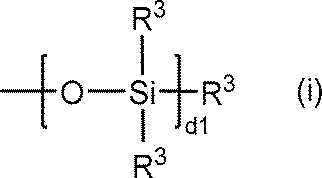
(式中、R3はそれぞれ独立に炭素数1以上12以下の炭化水素基であり、d1は1以上5以下の整数である。)
前記一般式(A2-2-1)中、R2はメチル基、エチル基、n-プロピル基、ブチル基、又はペンチル基が好ましく、メチル基がより好ましい。
Xは前記式(i)で表される基であり、式(i)中、R3はそれぞれ独立に炭素数1以上12以下の炭化水素基である。R3は好ましくは炭素数1以上12以下のアルキル基又はフェニル基であり、より好ましくは炭素数1以上3以下のアルキル基、より更に好ましくはメチル基である。d1は1以上5以下の整数であり、汎用性の観点から、d1=1が好ましい。すなわちXは、好ましくはトリメチルシロキシ基である。
a1は1以上3以下の整数であり、例えばa1=2の繰り返し単位とa1=3の繰り返し単位が混合して存在する重合体であってよい。汎用性の観点から、a1は3であることが好ましい。
前記一般式(A2-2-1)中のb1とc1の割合は、好ましくはb1/c1=20/80~90/10(mol/mol)、より好ましくは30/70~80/20(mol/mol)であり、更に好ましくは50/50~70/30(mol/mol)である。b1とc1の割合は、1H-NMR測定により求めることができる。
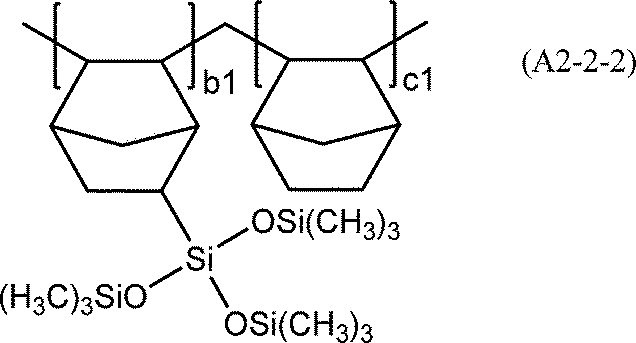
(式中、b1、c1は前記と同じである。)
市販のシリコーン変性ポリノルボルネンとしては、NBN-30-ID((ノルボルネン/トリス(トリメチルシロキシ)シリルノルボルネン)コポリマーのイソドデカン溶液)(信越化学工業(株))等が挙げられる。
シリコーン変性プルランとしては、側鎖にシリコーン構造を有するプルランが挙げられ、具体的には、プルラン中のOH基の水素原子の少なくとも一部が下記一般式(ii)で表される基で置換されたシリコーン変性プルランが好ましい。

式中、R4は単結合又は2価の有機基である。R2、X、a1は前記と同じであり、汎用性の観点から、Xは好ましくはトリメチルシロキシ基、a1は好ましくは3である。
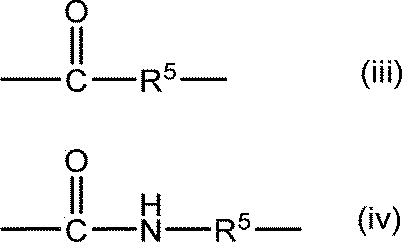
式中、R5は炭素数1以上10以下のアルキレン基であり、メチレン基、エチレン基、トリメチレン基、プロピレン基、ブチレン基等が例示される。これらの中でもエチレン基、トリメチレン基、プロピレン基が好ましく、トリメチレン基又はプロピレン基がより好ましい。
成分(A2-4)であるポリウレア/ウレタンシリコーンとしては、ポリシロキサン/ポリ尿素/ポリウレタンブロックターポリマーが挙げられる。例えば、INCI名「ポリ尿素ジメチコーン」の、ジメチルポリシロキサン/尿素コポリマー等である。
該ポリマーは、α,ω-アミノシリコーンとジイソシアネートとの共重合により得ることができる。市販のポリウレア/ウレタンシリコーンとしては、例えば、Wacker-Belsil UD 60、Wacker-Belsil UD 80、Wacker-Belsil UD 140及びWacker-Belsil UD 200(以上、Wacker社製)等が挙げられる。
また、成分(A)として成分(A1)及び成分(A2)を共に含有してもよい。この場合、成分(A)は、成分(A1)と、成分(A2-1)及び成分(A2-2)からなる群から選ばれる1種以上とを含むことが好ましく、成分(A1-2)と成分(A2-1)とを含むことが更に好ましい。
組成物は、成分(B)として重合度100以上のオルガノポリシロキサンを含有する。人工的に着色又は脱色された、ケラチン物質又は頭飾製品用繊維に成分(B)を含有する組成物を適用する工程を行うことにより、汚れの付着防止効果を付与できると考えられる。
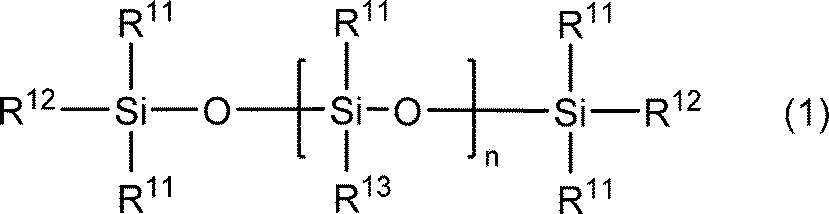
(式中、R11はそれぞれ独立に、炭素数1以上6以下の炭化水素基を示し、R12はそれぞれ独立に、ヒドロキシ基、炭素数1以上6以下のアルコキシ基、又は炭素数1以上6以下の炭化水素基を示す。R13は炭素数1以上6以下の炭化水素基、又は第一級~第三級アミノ基含有基を示す。nは重合度を示し、100以上の数である。n個のR13は互いに同一でもよく、異なっていてもよい。)
上記の中でも、R11は、好ましくは炭素数1以上6以下のアルキル基又はフェニル基であり、より好ましくは炭素数1以上3以下のアルキル基又はフェニル基であり、更に好ましくはメチル基又はフェニル基であり、より更に好ましくはメチル基である。
R12におけるアルコキシ基としては、メトキシ基、エトキシ基、プロポキシ基、ブトキシ基等が挙げられる。
R12における炭化水素基は、R11と同じであり、好ましくは炭素数1以上6以下のアルキル基又はフェニル基であり、より好ましくは炭素数1以上3以下のアルキル基又はフェニル基であり、更に好ましくはメチル基又はフェニル基であり、より更に好ましくはメチル基である。
R12は、汚れの付着防止効果向上の観点から、好ましくはヒドロキシ基、炭素数1以上6以下のアルキル基、又はフェニル基であり、より好ましくはヒドロキシ基、炭素数1以上3以下のアルキル基、又はフェニル基であり、更に好ましくはヒドロキシ基、メチル基、又はフェニル基であり、より更に好ましくはメチル基である。
R13における炭化水素基は、R11と同じであり、好ましくは炭素数1以上6以下のアルキル基又はフェニル基であり、より好ましくは炭素数1以上3以下のアルキル基又はフェニル基であり、更に好ましくはメチル基又はフェニル基であり、より更に好ましくはメチル基である。
R13における第一級~第三級アミノ基含有基(以下、単に「アミノ基含有基」ともいう)は、-N(R14)2、-NR14(CH2)pN(R14)2、又は-NR14(CH2)pN(R15)CO-R16で示される基であることが好ましい。ここで、R14は水素原子又は炭素数1以上4以下の1価の炭化水素基を示し、好ましくは水素原子、メチル基又はエチル基である。R15は炭素数1以上4以下の1価の炭化水素基を示し、好ましくはメチル基又はエチル基である。R16は炭素数1以上4以下の1価の炭化水素基を示す。pは2以上6以下の数を示し、好ましくは2以上4以下の数である。
R13における好ましいアミノ基含有基は、-(CH2)3-NH2、-(CH2)3-N(CH3)2、-(CH2)3-NH-(CH2)2-NH2、又は-(CH2)2-NH-(CH2)2-N(CH3)2であり、より好ましくは-(CH2)3-NH2である。
そして、成分(B)の25℃における粘度は、好ましくは120mm2/s以上10,000万mm2/s以下、より好ましくは200mm2/s以上8,000万mm2/s以下、更に好ましくは500mm2/s以上8,000万mm2/s以下、より更に好ましくは700mm2/s以上8,000万mm2/s以下、より更に好ましくは700mm2/s以上5,000万mm2/s以下、より更に好ましくは800mm2/s以上4,000万mm2/s以下、より更に好ましくは800mm2/s以上3,500万mm2/s以下、より更に好ましくは800mm2/s以上3,000万mm2/s以下、より更に好ましくは1,000mm2/s以上2,500万mm2/s以下である。
上記粘度は、JIS Z8803:2011「液体の粘度測定方法」に基づき、25℃において測定した値であり、細管粘度計、落球式粘度計、回転式粘度計、振動式粘度計から適切なものを選択して測定することができる。また、粘度計の常用測定範囲を超える場合には、下記の方法により、成分(B)の希釈溶液から求めることができる。
1g/100mL濃度の成分(B)のトルエン溶液を調製し、下記数式(1)により比粘度ηsp(25℃)を求める。次に下記数式(2)に示すHugginsの関係式に代入し、固有粘度〔η〕を求める。さらに〔η〕を下記数式(3)に示すA.Kolorlovの式に代入し、分子量Mを求める。最後に、Mを下記数式(4)に示すA.J.Barryの式に代入し、成分(B)の粘度ηを求めることができる(例えば、信越化学工業(株)、シリコーンオイルKF-96性能試験結果4.2参照)。
ηsp=(η/η0)-1 (1)
(但し、η0:トルエンの粘度、η:溶液の粘度)
ηsp=〔η〕+K’〔η〕2 (2)
(但し、K’:Huggins定数は、中牟田、日化、77588[1956]に記載のものを用いる。)
〔η〕=0.215×10⁻⁴M0.65 (3)
logη=1.00+0.0123M0.5(4)
成分(B)として用いられるアミノプロピルメチルポリシロキサンの市販品としては、KF-8017(10質量%-低粘度ジメチルポリシロキサン溶液)、KF-8018(10質量%-シクロペンタシロキサン溶液)、KF-8020(20質量%-低粘度ジメチルポリシロキサン溶液)(以上、信越化学工業(株)製)等が挙げられる。
成分(B)として用いられるジメチコノールの市販品としては、X-21-5613(20質量%-低粘度ジメチルポリシロキサン溶液)、X-21-5666(30質量%-シクロペンタシロキサン溶液)、X-21-5847、X-21-5849(以上、信越化学工業(株)製)等が挙げられる。
組成物中の成分(A)の含有量は、皮膜形成性、色持続性、及び汚れの付着防止効果向上の観点から、好ましくは0.1質量%以上、より好ましくは0.5質量%以上、更に好ましくは1質量%以上、より更に好ましくは2質量%以上、より更に好ましくは3質量%以上であり、また、色持続性向上の観点から、好ましくは30質量%以下、より好ましくは25質量%未満、更に好ましくは20質量%以下、より更に好ましくは15質量%以下である。そして、組成物中の成分(A)の含有量は、好ましくは0.1質量%以上30質量%以下、より好ましくは0.5質量%以上25質量%未満、更に好ましくは1質量%以上20質量%以下、より更に好ましくは2質量%以上15質量%以下、より更に好ましくは3質量%以上15質量%以下である。
組成物は、色持続性、及び汚れの付着防止効果向上の観点から、さらに、成分(C)として、ポリアルキレンオキシド部位及びカチオン性基を有する、成分(A)及び成分(B)以外のオルガノポリシロキサンを含有することができる。成分(C)は、負電荷を有するケラチン物質又は頭飾製品用繊維への吸着性が高いことから、形成される皮膜中でケラチン物質又は頭飾製品用繊維側に偏在して、その表面に皮膜を強固に接着させ、皮膜の剥離防止効果を高めると考えられる。
ポリアルキレンオキシド部位を構成するアルキレンオキシドは、1種でもよく、2種以上でもよい。
該アルキレンオキシドの具体例としては、エチレンオキシド、プロピレンオキシド、トリメチレンオキシド、ブチレンオキシド、テトラメチレンオキシド、ペンタメチレンオキシド、及びヘキサメチレンオキシドからなる群から選ばれる1種以上である。これらの中でも、入手性の観点から、ポリアルキレンオキシド部位を構成するアルキレンオキシドは、好ましくはエチレンオキシド、プロピレンオキシド、トリメチレンオキシド、ブチレンオキシド、及びテトラメチレンオキシドからなる群から選ばれる1種以上であり、より好ましくはエチレンオキシド、プロピレンオキシド、及びトリメチレンオキシドからなる群から選ばれる1種以上であり、更に好ましくはエチレンオキシド及びプロピレンオキシドからなる群から選ばれる1種以上であり、形成される皮膜中で成分(C)をケラチン物質又は頭飾製品用繊維側に偏在させる観点から、より更に好ましくはエチレンオキシドである。
以下の記載において、一般式(2)で表される繰り返し単位を有するアミノポリエーテル変性シリコーン(C1)を「成分(C1)」、一般式(3)で表される繰り返し単位を有するアミノポリエーテル変性シリコーン(C2)を「成分(C2)」ともいう。
成分(C1)は下記一般式(2)で表される繰り返し単位を有するアミノポリエーテル変性シリコーンである。
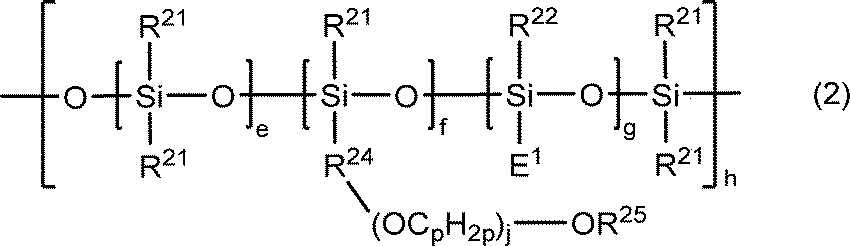
式(2)中、R21は炭素数1以上6以下の1価の炭化水素基を示す。R22はR21又はE1のいずれかを示す。E1は-R23-Z1(R23は炭素数1以上6以下の2価の炭化水素基を示し、Z1は第一級~第三級アミノ基含有基を示す。)で表される1価の基を示す。R24は炭素数1以上6以下の2価の炭化水素基を示し、R25は水素原子又は炭素数1以上4以下の1価の炭化水素基を示す。
eは1以上50以下の数、fは1以上50以下の数、gは1以上50以下の数、hは1以上の数、jは2以上100以下の数を示す。pは2以上10以下の数を示す。括弧内の構造単位同士の結合順序は問わず、結合形態はブロック状でもランダム状でもよい。j個のOCpH2pは同一でも異なっていてもよい。また、複数個のR21、R22、R24、R25及びE1は同一でも異なっていてもよい。
Z1は第一級~第三級アミノ基含有基であり、-N(R26)2、-NR26(CH2)qN(R26)2、又は-NR26(CH2)qN(R27)CO-R28で示される基であることが好ましい。ここで、R26は水素原子又は炭素数1以上4以下の1価の炭化水素基を示し、好ましくは水素原子、メチル基又はエチル基である。R27は炭素数1以上4以下の1価の炭化水素基を示し、好ましくはメチル基又はエチル基である。R28は炭素数1以上4以下の1価の炭化水素基を示す。qは2以上6以下の数を示し、好ましくは2以上4以下の数である。
R25は水素原子又は炭素数1以上4以下の1価の炭化水素基を示し、メチル基又はエチル基が好ましい。
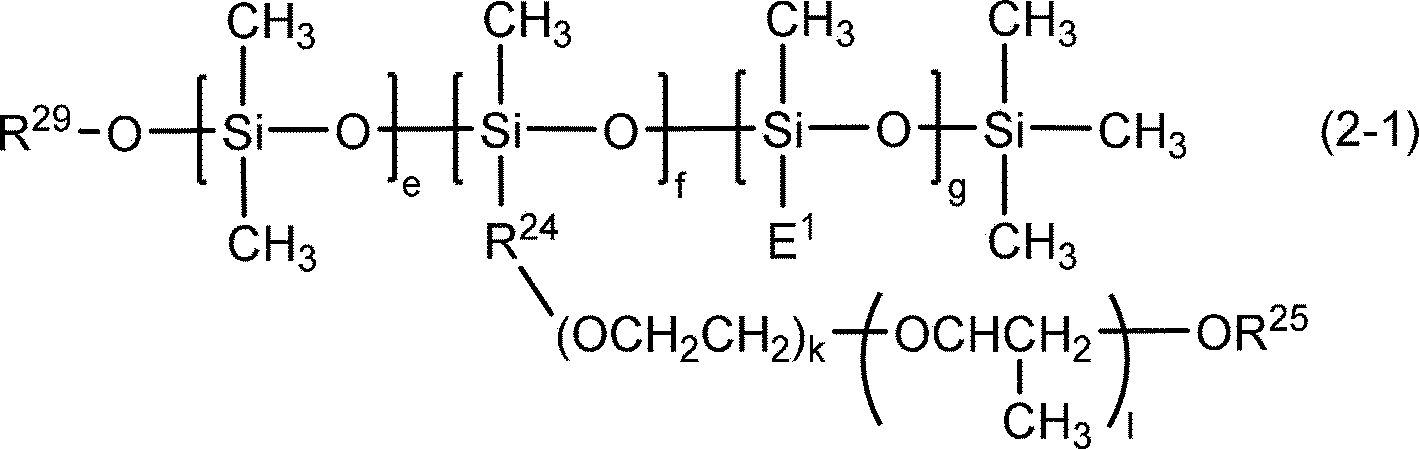
式(2-1)中、E1、R24、R25、e、f、gは前記と同じである。R29は炭素数1以上4以下の1価の炭化水素基又はトリメチルシリル基を示す。kは1以上50以下の数、lは0以上50以下、好ましくは1以上50以下の数を示す。
R29は、メチル基、エチル基又はトリメチルシリル基が好ましく、トリメチルシリル基がより好ましい。
成分(C1)として、市販のアミノポリエーテル変性シリコーンを用いることもできる。例えば、ABIL Soft AF100(一般式(2-1)で表されるアミノポリエーテル変性シリコーン(メトキシPEG/PPG-7/3 アミノプロピルジメチコン))(Evonik社製)等が挙げられる。
成分(C2)は下記一般式(3)で表される繰り返し単位を有するアミノポリエーテル変性シリコーンである。
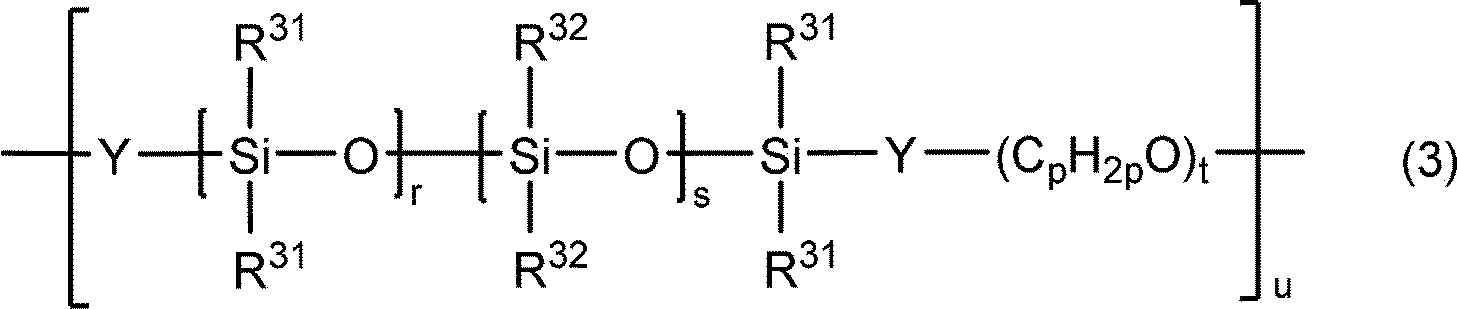
式(3)中、R31は炭素数1以上6以下の1価の炭化水素基を示す。R32はR31又はE2のいずれかを示す。E2は-R33-Z2(R33は単結合、又は炭素数1以上20以下の2価の炭化水素基を示し、Z2は第一級~第三級アミノ基含有基を示す。)で表される1価の基を示す。Yは単結合、又は炭素数1以上12以下の2価の基を示す。すべてのR32がR31である場合、少なくとも1つのYはアミノ基を含有する2価の基である。すべてのYがアミノ基を含有しない2価の基である場合、少なくとも1つのR32はE2である。
rは1以上の数、sは1以上の数、tは2以上100以下の数、uは1以上の数を示す。pは前記と同じであり、2以上10以下の数を示す。括弧内の構造単位同士の結合順序は問わず、結合形態はブロック状でもランダム状でもよい。t個のCpH2pOは同一でも異なっていてもよい。また、複数個のR31、R32、E2及びYは同一でも異なっていてもよい。
R33は炭素数1以上20以下の2価の炭化水素基であることが好ましく、炭素数1以上20以下のアルキレン基であることがより好ましく、炭素数1以上6以下の直鎖又は分岐鎖のアルキレン基であることが更に好ましく、メチレン基、エチレン基、トリメチレン基、プロピレン基、テトラメチレン基、又はヘキサメチレン基であることがより更に好ましく、トリメチレン基又はプロピレン基であることがより更に好ましい。

式(3-1)中、r、s、t、uは前記と同じである。

式(3-2)中、R38、r、s、uは前記と同じである。vは0以上50以下、好ましくは2以上50以下の数を示し、wは2以上100以下の数を示す。v+wは2以上100以下の数であり、好ましくは4以上80以下の数、より好ましくは10以上50以下の数である。
成分(C2)として、市販のアミノポリエーテル変性シリコーンを用いることもできる。例えば、一般式(3-1)で表される構造を有するアミノポリエーテル変性シリコーンとして、DOWSIL SS-3588 Fluid((ビスイソブチルPEG-15/アモジメチコン)コポリマーの80質量%-エタノール溶液)、DOWSIL SILSTYLE 104((ビスイソブチルPEG-14/アモジメチコン)コポリマー)、DOWSIL SILSTYLE 201((ビスイソブチルPEG-14/アモジメチコン)コポリマー)、DOWSIL SILSTYLE 401((ビスイソブチルPEG/PPG-20/35/アモジメチコン)コポリマー)(以上、ダウ・東レ(株)製)等が挙げられる。また一般式(3-2)で表される構造を有するアミノポリエーテル変性シリコーンとして、Silsoft A+(PEG-40/PPG-8 メチルアミノプロピル/ヒドロキシプロピルジメチコンコポリマー)(モメンティブ・パフォーマンス・マテリアルズ社製)等が挙げられる。
組成物は、前記成分(A)、成分(B)、及びその他の成分を溶解又は分散させる観点、並びに、ケラチン物質又は頭飾製品用繊維に適用しやすい粘度に調整する観点から、さらに成分(D)として、溶剤を含有することが好ましい。
溶剤としては、取り扱いのしやすさの点から液体の有機溶剤が好ましく、アルコール系溶剤、エーテル系溶剤、ケトン系溶剤、エステル系溶剤、炭化水素系溶剤、シリコーン系溶剤等が挙げられ、剤型に応じて適宜選択することができる。これらのうち、乾燥後の使用感を良好にする観点から、揮発性の溶剤を含むことが好ましい。
揮発性の溶剤のうち、アルコール系溶剤としては、エタノール、1-プロパノール、2-プロパノール、1-ブタノール、2-ブタノール、ベンジルアルコール等、エーテル系溶剤としては、ジエチルエーテル、テトラヒドロフラン等、ケトン系溶剤としては、アセトン、メチルエチルケトン等、エステル系溶剤としては、酢酸メチル、酢酸エチル、酢酸ブチル、酢酸イソブチル等、炭化水素系溶剤としては、軽質流動イソパラフィン(炭素数8~16のイソパラフィンを主成分とするもの)、ペンタン、イソペンタン、ヘキサン、イソヘキサン、ヘプタン、イソヘプタン、デカン、イソデカン、ドデカン、イソドデカン、トリデカン、イソトリデカン、テトラデカン、イソテトラデカン等、シリコーン系溶剤としては、デカメチルシクロペンタシロキサン等の環状シリコーン、25℃における粘度が4mm2/s以下のジメチルポリシロキサン、メチルトリメチコン等のアルキルトリメチコン等を挙げることができ、これらのうち1種又は2種以上を用いることができる。
前記成分(A)及び成分(B)の溶解性の観点から、成分(D)としては、25℃における粘度が4mm2/s以下のジメチルポリシロキサン、メチルトリメチコン、ペンタン、イソペンタン、ヘキサン、イソヘキサン、ヘプタン、イソヘプタン、デカン、イソデカン、ドデカン、イソドデカン、トリデカン、イソトリデカン、テトラデカン、イソテトラデカン及び軽質流動イソパラフィンからなる群から選ばれる1種以上を含むことが好ましく、25℃における粘度が4mm2/s以下のジメチルポリシロキサン、メチルトリメチコン、イソデカン、イソドデカン、イソテトラデカン及び軽質流動イソパラフィンからなる群から選ばれる1種以上を含むことがより好ましく、イソデカン、イソドデカン、イソテトラデカン及び軽質流動イソパラフィンからなる群から選ばれる1種以上を含むことが更に好ましい。
組成物の製造方法は特に制限されず、常法に従って製造することができる。
組成物の剤型は特に限定されず、製品形態に応じて、液体、ペースト、クリーム、ジェル、フォーム、スプレー、ワックス等の剤型にすることができる。また、組成物は非水系の組成物であることが好ましい。ここで、非水系の組成物とは水の含有量が1質量%未満、好ましくは0.5質量%未満、より好ましくは0.1質量%未満の組成物を意味する。
エアゾール製剤において、エアゾール原液である組成物と、噴射剤との量比は、噴射剤の種類によっても異なるが、エアゾール性能の観点から、組成物と噴射剤との質量比として、好ましくは1:0.01~1:10、より好ましくは1:0.05~1:7.5の範囲である。
噴射剤がLPGである場合、組成物とLPGとの質量比は、更に好ましくは1:0.5~1:5であり、噴射剤がジメチルエーテルである場合、組成物とジメチルエーテルとの質量比は、更に好ましくは1:0.1~1:5であり、噴射剤が二酸化炭素である場合、組成物と二酸化炭素との質量比は、更に好ましくは1:0.1~1:0.5である。
皮膚化粧料組成物としては、メイクアップ用、日焼け止め用等の、各種皮膚化粧料組成物が挙げられる。
眉毛又は睫毛用化粧料組成物としては、マスカラトップコート、眉用マスカラトップコート等が挙げられる。
毛髪化粧料組成物としては、コンディショニング剤組成物、トリートメント剤組成物(洗い流さないタイプを含む)、スタイリング剤組成物等が挙げられる。
爪用化粧料組成物としては、マニキュア、爪用トップコート等が挙げられる。
上記の中でも、皮膜形成を行う観点から、化粧料組成物は、好ましくは毛髪化粧料組成物であり、より好ましくはコンディショニング剤組成物、トリートメント剤組成物、又はスタイリング剤組成物である。
組成物を適用する際のケラチン物質又は頭飾製品用繊維は、乾燥状態、湿潤状態のいずれでもよいが、本発明の効果を得る観点からは、乾燥状態のケラチン物質又は頭飾製品用繊維に組成物を適用することが好ましい。組成物の適用方法は、剤型等により適宜選択することができ、例えば、塗布、流延、噴霧等が挙げられる。
組成物は、均一塗布性の観点から、ケラチン物質又は頭飾製品用繊維への適用前に一時的に相溶又は分散させてからケラチン物質又は頭飾製品用繊維表面に適用することが好ましい。一時的に相溶又は分散させる手段としては、加熱などの熱力学的手段、機械的に剪断応力を加えるなどの物理的手段又は相溶性のある溶剤を添加するなどの化学的手段等を任意に利用することができる。使用者の利便性の観点から、好ましくは攪拌、振盪等の物理的手段によって均一に相溶又は分散させておくことが好ましい。
本発明の方法では、人工的に着色又は脱色された、ケラチン物質又は頭飾製品用繊維に組成物を適用した後、該組成物により皮膜を形成する観点から、自然乾燥させることが好ましい。また、自然乾燥後は該組成物を洗い流さないことが好ましい。この際の乾燥時間は、組成物の適用後、皮膜がケラチン物質又は頭飾製品用繊維表面に実質的に形成される範囲であれば特に制限されず、適用量や適用面積により適宜調整されるが、好ましくは4分以下、より好ましくは2分以下である。
前記デバイスを使用する場合には、毛髪又は頭飾製品用繊維の熱ダメージを抑える観点から、40℃以上220℃以下の温度をかけて乾燥することが好ましい。より好ましくはフード又はヘアドライヤーによる乾燥であり、その乾燥温度は、好ましくは40℃以上110℃以下、より好ましくは50℃以上90℃以下である。
デバイスによる乾燥時間は、皮膜が毛髪又は頭飾製品用繊維表面に実質的に形成される範囲であれば特に制限されず、毛髪又は頭飾製品用繊維の量及び質により適宜調整されるが、例えば10秒から120分の範囲で行うことができる。
乾燥後は毛髪又は頭飾製品用繊維をばらけさせるためにブラッシング等を行ってもよい。
本発明は、着色剤及び脱色剤からなる群から選ばれる1種以上を含有する第1剤、並びに、下記成分(A)及び成分(B)を含有し、成分(A)及び成分(B)の合計含有質量に対する成分(A)の含有質量の割合[(A)/{(A)+(B)}]が10%以上である第2剤、を備えた、ケラチン物質又は頭飾製品用繊維処理用キットを提供する。
(A)シリコーン皮膜形成剤
(B)重合度100以上のオルガノポリシロキサン
本発明のキットは、好ましくは化粧料キットであり、より好ましくは皮膚、眉毛、睫毛、毛髪、爪又は頭飾製品用繊維処理用化粧料キットであり、更に好ましくは毛髪又は頭飾製品用繊維処理用化粧料キットである。
第1剤は、ケラチン物質又は頭飾製品用繊維を人工的に着色又は脱色するための、ケラチン物質又は頭飾製品用繊維処理用の組成物であり、着色剤及び脱色剤からなる群から選ばれる1種以上を含有する。
第1剤に用いられる着色剤としては、顔料、染料等が挙げられ、色持続性向上の観点から、好ましくは顔料、直接染料、及び酸化染料からなる群から選ばれる1種以上であり、より好ましくは顔料及び直接染料からなる群から選ばれる1種以上であり、色持続性向上、着色処理の際の施術の容易さ、及び着色処理によるダメージの少なさの観点から、更に好ましくは顔料である。
着色剤及びその詳細は、「人工的に着色されたケラチン物質又は頭飾製品用繊維」において記載した着色剤と同様である。
第1剤に用いられる脱色剤としては、過酸化水素等の酸化剤が挙げられる。第1剤が脱色剤を含有する場合、第1剤中の脱色剤の含有量は、所望のブリーチ性を付与する観点から、好ましくは0.01質量%以上、より好ましくは0.1質量%以上、更に好ましくは0.2質量%以上、より更に好ましくは0.3質量%以上であり、ケラチン物質又は頭飾製品用繊維の劣化を抑制する観点から、好ましくは50質量%以下、より好ましくは30質量%以下である。そして、第1剤中の脱色剤の含有量は、好ましくは0.01質量%以上50質量%以下、より好ましくは0.1質量%以上50質量%以下、更に好ましくは0.2質量%以上30質量%以下、より更に好ましくは0.3質量%以上30質量%以下である。
皮膚化粧料組成物としては、メイクアップ用、下地用等の、着色剤を含有する各種皮膚化粧料組成物が挙げられる。
眉毛又は睫毛用化粧料組成物としては、マスカラ、マスカラ下地、眉用マスカラ等の、着色剤を含有する各種眉毛又は睫毛用化粧料組成物が挙げられる。
毛髪化粧料組成物としては、染毛剤組成物等が挙げられる。毛髪化粧料組成物は、頭飾製品用繊維にも適用できる。
爪用化粧料組成物としては、マニキュア、爪用ベースコート等の、着色剤を含有する爪用化粧料組成物が挙げられる。
脱色剤を含有する第1剤の種類としては、毛髪用のブリーチ剤等が挙げられる。
上記の中でも、第1剤は、好ましくは着色剤を含有する化粧料組成物であり、より好ましくは毛髪化粧料組成物、更に好ましくは染毛剤組成物である。
第2剤は、成分(A)及び成分(B)を含有し、成分(A)及び成分(B)の合計含有質量に対する成分(A)の含有質量の割合[(A)/{(A)+(B)}]が10%以上である、ケラチン物質又は頭飾製品用繊維処理用の組成物である。第2剤及びその好適態様は、前記本発明の組成物と同じである。
なお第2剤も、2以上の組成物から構成されていてもよい。これら組成物を使用前に混合して第2剤を調製し、ケラチン物質又は頭飾製品用繊維に適用して用いることができる。
<1>
人工的に着色又は脱色された、ケラチン物質又は頭飾製品用繊維を組成物で処理する方法であって、前記方法は、前記組成物を前記ケラチン物質又は頭飾製品用繊維に適用する工程を含み、
前記組成物は、下記成分(A)及び成分(B):
(A)シリコーン皮膜形成剤
(B)重合度100以上のオルガノポリシロキサン
を含有し、成分(A)及び成分(B)の合計含有質量に対する成分(A)の含有質量の割合[(A)/{(A)+(B)}]が10%以上である、方法。
<2>
前記ケラチン物質が、好ましくは皮膚、眉毛、睫毛、毛髪、又は爪からなる群から選ばれる1種以上、より好ましくは毛髪である、<1>に記載の方法。
<3>
前記頭飾製品が、ヘアーウィッグ、かつら、ウィービング、ヘアーエクステンション、ブレードヘアー、ヘアーアクセサリー、及びドールヘアーからなる群から選ばれる1種以上である、<1>又は<2>に記載の方法。
<4>
前記ケラチン物質又は頭飾製品用繊維が、好ましくは皮膚、眉毛、睫毛、毛髪、爪、及び頭飾製品用繊維からなる群から選ばれる1種以上、より好ましくは毛髪及び頭飾製品用繊維からなる群から選ばれる1種以上、更に好ましくは毛髪である、<1>~<3>のいずれか1に記載の方法。
<5>
前記人工的に着色されたケラチン物質又は頭飾製品用繊維が、着色剤、好ましくは顔料、直接染料、及び酸化染料からなる群から選ばれる1種以上、より好ましくは顔料及び直接染料からなる群から選ばれる1種以上、更に好ましくは顔料を用いて着色処理が施された、ケラチン物質又は頭飾製品用繊維である、<1>~<4>のいずれか1に記載の方法。
<6>
前記人工的に脱色されたケラチン物質又は頭飾製品用繊維が、ブリーチ剤により人工的にブリーチ処理が施された、ケラチン物質又は頭飾製品用繊維である、<1>~<4>のいずれか1に記載の方法。
<7>
好ましくは人工的に着色又は脱色された、皮膚、眉毛、睫毛、毛髪、爪、又は頭飾製品用繊維、より好ましくは人工的に着色又は脱色された、毛髪又は頭飾製品用繊維、更に好ましくは人工的に着色又は脱色された毛髪、より更に好ましくは人工的に着色された毛髪、より更に好ましくは染毛剤により染色された毛髪を組成物で処理する方法である、<1>~<6>のいずれか1に記載の方法。
<8>
前記染毛剤が、好ましくは着色剤、より好ましくは顔料、直接染料、及び酸化染料からなる群から選ばれる1種以上、更に好ましくは顔料及び直接染料からなる群から選ばれる1種以上、より更に好ましくは顔料を含有する染毛剤である、<7>に記載の方法。
<9>
前記成分(A)が、下記成分(A1)及び(A2)からなる群から選ばれる1種以上である、<1>~<8>のいずれか1に記載の方法。
成分(A1):平均式(R1)mSiO(4-m)/2
(式中、R1はフッ素置換されていてもよい炭素数1以上12以下の炭化水素基又は水酸基を示す。複数のR1は互いに同一でもよく、異なっていてもよい。mは平均数であって0超3未満の数である。)
で表され、R1SiO3/2で表されるT単位及びSiO4/2で表されるQ単位からなる群から選ばれる1種以上の単位を含むシリコーン樹脂
成分(A2):ポリシロキサン部分と、非シリコーン有機鎖からなる部分とを含むシリコーンポリマー
<10>
前記成分(A1)が、下記成分(A1-1)及び成分(A1-2)からなる群から選ばれる1種以上を含む、<9>に記載の方法。
(A1-1)前記平均式で表され、R1SiO3/2で表されるT単位を含み、SiO4/2で表されるQ単位を実質的に含まないシリコーン樹脂
(A1-2)前記平均式で表され、SiO4/2で表されるQ単位及び(R1)3SiO1/2で表されるM単位を含むシリコーン樹脂
前記成分(A2)が、好ましくは下記成分(A2-1)~(A2-4)からなる群から選ばれる1種以上を含み、より好ましくは成分(A2-1)を含む、<9>又は<10>に記載の方法。
(A2-1)アクリルシリコーンポリマー
(A2-2)シリコーン変性脂環構造含有ポリマー
(A2-3)シリコーン変性プルラン
(A2-4)ポリウレア/ウレタンシリコーン
<12>
前記成分(A1-1)が、好ましくはポリシルセスキオキサン類、より好ましくはポリメチルシルセスキオキサン、ポリプロピルシルセスキオキサン、ポリフェニルシルセスキオキサン、ポリメチルフェニルシルセスキオキサン、及びフッ素変性アルキルジメチルポリシルセスキオキサンからなる群から選ばれる1種以上、更に好ましくはポリメチルシルセスキオキサン及びポリプロピルシルセスキオキサンからなる群から選ばれる1種以上、より更に好ましくはポリメチルシルセスキオキサンである、<10>又は<11>に記載の方法。
<13>
前記成分(A1-2)が、好ましくはトリメチルシロキシケイ酸、トリフルオロプロピルジメチルトリメチルシロキシケイ酸及び(トリメチルシロキシケイ酸/ジメチコノール)クロスポリマーからなる群から選ばれる1種以上、より好ましくはトリメチルシロキシケイ酸及びトリフルオロプロピルジメチルトリメチルシロキシケイ酸からなる群から選ばれる1種以上、更に好ましくはトリメチルシロキシケイ酸である、<10>又は<11>に記載の方法。
<14>
前記成分(A2-1)であるアクリルシリコーンポリマーが、カルボシロキサンデンドリマー構造を側鎖に有するアクリル系重合体、アクリル-シリコーン系グラフト共重合体、及び、ポリシロキサン基よりなる構成単位及び不飽和単量体の重合体よりなる構成単位がスルフィド結合を介して結合された、グラフト型共重合体又は交互ブロック型共重合体からなる群から選ばれる1種以上、好ましくは、カルボシロキサンデンドリマー構造を側鎖に有するアクリル系重合体及びアクリル-シリコーン系グラフト共重合体からなる群から選ばれる1種以上、より好ましくは(アクリレーツ/メタクリル酸ポリトリメチルシロキシ)コポリマー及び(アクリレーツ/ジメチコン)コポリマーからなる群から選ばれる1種以上、更に好ましくは(アクリレーツ/ジメチコン)コポリマーである、<11>~<13>のいずれか1に記載の方法。
<15>
前記成分(A)が、好ましくは成分(A1)、成分(A2-1)及び成分(A2-2)からなる群から選ばれる1種以上を含み、より好ましくは成分(A1)及び成分(A2-1)からなる群から選ばれる1種以上を含み、更に好ましくは成分(A1-2)及び成分(A2-1)からなる群から選ばれる1種以上を含み、より更に好ましくは成分(A1-2)を含む、<11>~<14>のいずれか1に記載の方法。
<16>
前記成分(A)が成分(A1)及び成分(A2)を共に含有する、<9>~<15>のいずれか1に記載の方法。
<17>
前記成分(A)が、成分(A1)と、成分(A2-1)及び成分(A2-2)からなる群から選ばれる1種以上とを含み、好ましくは成分(A1-2)と成分(A2-1)とを含む、<16>に記載の方法。
<18>
前記成分(A)がトリメチルシロキシケイ酸、フェニルプロピルジメチルシロキシケイ酸、トリフルオロプロピルジメチルトリメチルシロキシケイ酸、(トリメチルシロキシケイ酸/ジメチコノール)クロスポリマー、ポリメチルシルセスキオキサン、ポリプロピルシルセスキオキサン、(アクリレーツ/メタクリル酸ポリトリメチルシロキシ)コポリマー、(アクリレーツ/ジメチコン)コポリマー及び(ノルボルネン/トリス(トリメチルシロキシ)シリルノルボルネン)コポリマーからなる群から選ばれる1種以上を含み、好ましくはトリメチルシロキシケイ酸、フェニルプロピルジメチルシロキシケイ酸、トリフルオロプロピルジメチルトリメチルシロキシケイ酸、(トリメチルシロキシケイ酸/ジメチコノール)クロスポリマー、ポリメチルシルセスキオキサン、ポリプロピルシルセスキオキサン、(アクリレーツ/メタクリル酸ポリトリメチルシロキシ)コポリマー及び(アクリレーツ/ジメチコン)コポリマーからなる群から選ばれる1種以上を含み、より好ましくはトリメチルシロキシケイ酸、ポリメチルシルセスキオキサン、及び(アクリレーツ/ジメチコン)コポリマーからなる群から選ばれる1種以上を含み、更に好ましくはトリメチルシロキシケイ酸を含み、より更に好ましくはトリメチルシロキシケイ酸である、<1>~<17>のいずれか1に記載の方法。
<19>
前記成分(B)の重合度が、好ましくは100以上4,300以下、より好ましくは150以上4,200以下、更に好ましくは250以上4,200以下、より更に好ましくは300以上4,000以下、より更に好ましくは320以上3,800以下、より更に好ましくは320以上3,700以下、より更に好ましくは350以上3,650以下である、<1>~<18>のいずれか1に記載の方法。
<20>
前記成分(B)が下記一般式(1)で表されるオルガノポリシロキサンである、<1>~<19>のいずれか1に記載の方法。
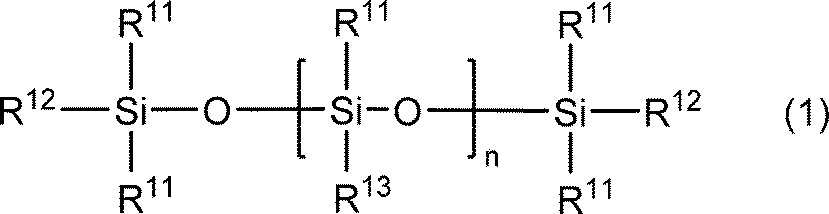
(式中、R11はそれぞれ独立に、炭素数1以上6以下の炭化水素基を示し、R12はそれぞれ独立に、ヒドロキシ基、炭素数1以上6以下のアルコキシ基、又は炭素数1以上6以下の炭化水素基を示す。R13は炭素数1以上6以下の炭化水素基、又は第一級~第三級アミノ基含有基を示す。nは重合度を示し、100以上の数である。n個のR13は互いに同一でもよく、異なっていてもよい。)
前記成分(B)の25℃における粘度が、好ましくは120mm2/s以上10,000万mm2/s以下、より好ましくは200mm2/s以上8,000万mm2/s以下、更に好ましくは500mm2/s以上8,000万mm2/s以下、より更に好ましくは700mm2/s以上8,000万mm2/s以下、より更に好ましくは700mm2/s以上5,000万mm2/s以下、より更に好ましくは800mm2/s以上4,000万mm2/s以下、より更に好ましくは800mm2/s以上3,500万mm2/s以下、より更に好ましくは800mm2/s以上3,000万mm2/s以下、より更に好ましくは1,000mm2/s以上2,500万mm2/s以下である、<1>~<20>のいずれか1に記載の方法。
<22>
前記成分(B)がジメチルポリシロキサン、メチルフェニルポリシロキサン、アミノプロピルメチルポリシロキサン、及びジメチコノールからなる群から選ばれる1種以上、より好ましくはジメチルポリシロキサンである、<1>~<21>のいずれか1に記載の方法。
<23>
前記組成物中の成分(A)の含有量が、好ましくは0.1質量%以上30質量%以下、より好ましくは0.5質量%以上25質量%未満、更に好ましくは1質量%以上20質量%以下、より更に好ましくは2質量%以上15質量%以下、より更に好ましくは3質量%以上15質量%以下である、<1>~<22>のいずれか1に記載の方法。
<24>
前記組成物中の成分(B)の含有量が、好ましくは0.1質量%以上30質量%以下、より好ましくは0.3質量%以上25質量%以下、更に好ましくは0.5質量%以上20質量%以下、より更に好ましくは0.5質量%以上15質量%以下、より更に好ましくは0.5質量%以上10質量%以下である、<1>~<23>のいずれか1に記載の方法。
<25>
前記組成物中の成分(A)及び成分(B)の合計含有量が、好ましくは0.2質量%以上50質量%以下、より好ましくは0.5質量%以上45質量%以下、更に好ましくは1質量%以上40質量%以下、より更に好ましくは1質量%以上35質量%以下、より更に好ましくは2質量%以上35質量%以下、より更に好ましくは2質量%以上25質量%以下、より更に好ましくは3質量%以上25質量%以下、より更に好ましくは3.5質量%以上25質量%以下、より更に好ましくは5質量%以上20質量%以下である、<1>~<24>のいずれか1に記載の方法。
<26>
前記組成物中の成分(A)及び成分(B)の合計含有質量に対する成分(A)の含有質量の割合[(A)/{(A)+(B)}]が、好ましくは10%以上98%以下、より好ましくは10%以上95%以下、更に好ましくは20%以上95%以下、より更に好ましくは30%以上95%以下、より更に好ましくは40%以上95%以下、より更に好ましくは50%以上95%以下である、<1>~<25>のいずれか1に記載の方法。
<27>
前記組成物が、さらに、成分(C)として、ポリアルキレンオキシド部位及びカチオン性基を有する、成分(A)及び成分(B)以外のオルガノポリシロキサンを含有する、<1>~<26>のいずれか1に記載の方法。
<28>
前記成分(C)が有するカチオン性基が、カチオン基、又は、イオン化されてカチオン基になり得る基であり、好ましくは第一級アミノ基、第二級アミノ基、第三級アミノ基、及び第四級アンモニウム基からなる群から選ばれる1種以上、より好ましくは第一級アミノ基、第二級アミノ基、及び第三級アミノ基からなる群から選ばれる1種以上である、<27>に記載の方法。
<29>
前記ポリアルキレンオキシド部位を構成するアルキレンオキシドが、好ましくはエチレンオキシド、プロピレンオキシド、トリメチレンオキシド、ブチレンオキシド、及びテトラメチレンオキシドからなる群から選ばれる1種以上であり、より好ましくはエチレンオキシド、プロピレンオキシド、及びトリメチレンオキシドからなる群から選ばれる1種以上であり、更に好ましくはエチレンオキシド及びプロピレンオキシドからなる群から選ばれる1種以上であり、より更に好ましくはエチレンオキシドである、<27>又は<28>に記載の方法。
<30>
前記ポリアルキレンオキシド部位におけるアルキレンオキシドの平均付加モル数が、好ましくは2以上、より好ましくは4以上、更に好ましくは10以上である。また入手性の観点からは、好ましくは100以下、より好ましくは80以下、更に好ましくは50以下である、<27>~<29>のいずれか1に記載の方法。
前記成分(C)が、以下に示す一般式(2)で表される繰り返し単位を有するアミノポリエーテル変性シリコーン(C1)及び一般式(3)で表される繰り返し単位を有するアミノポリエーテル変性シリコーン(C2)からなる群から選ばれる1種以上である、<27>~<30>のいずれか1に記載の方法。
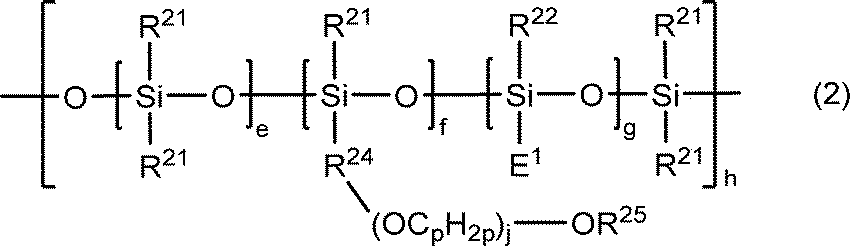
式(2)中、R21は炭素数1以上6以下の1価の炭化水素基を示す。R22はR21又はE1のいずれかを示す。E1は-R23-Z1(R23は炭素数1以上6以下の2価の炭化水素基を示し、Z1は第一級~第三級アミノ基含有基を示す。)で表される1価の基を示す。R24は炭素数1以上6以下の2価の炭化水素基を示し、R25は水素原子又は炭素数1以上4以下の1価の炭化水素基を示す。
eは1以上50以下の数、fは1以上50以下の数、gは1以上50以下の数、hは1以上の数、jは2以上100以下の数を示す。pは2以上10以下の数を示す。括弧内の構造単位同士の結合順序は問わず、結合形態はブロック状でもランダム状でもよい。j個のOCpH2pは同一でも異なっていてもよい。また、複数個のR21、R22、R24、R25及びE1は同一でも異なっていてもよい。
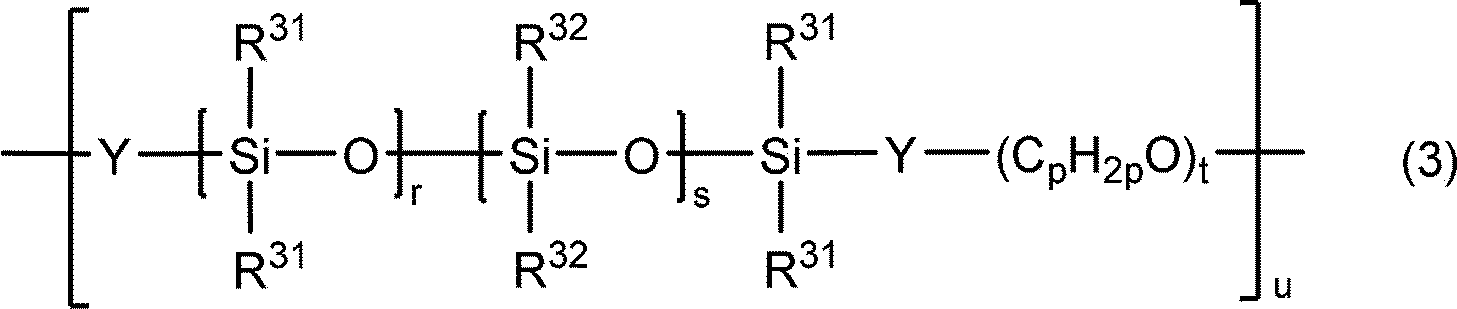
式(3)中、R31は炭素数1以上6以下の1価の炭化水素基を示す。R32はR31又はE2のいずれかを示す。E2は-R33-Z2(R33は単結合、又は炭素数1以上20以下の2価の炭化水素基を示し、Z2は第一級~第三級アミノ基含有基を示す。)で表される1価の基を示す。Yは単結合、又は炭素数1以上12以下の2価の基を示す。すべてのR32がR31である場合、少なくとも1つのYはアミノ基を含有する2価の基である。すべてのYがアミノ基を含有しない2価の基である場合、少なくとも1つのR32はE2である。
rは1以上の数、sは1以上の数、tは2以上100以下の数、uは1以上の数を示す。pは前記と同じであり、2以上10以下の数を示す。括弧内の構造単位同士の結合順序は問わず、結合形態はブロック状でもランダム状でもよい。t個のCpH2pOは同一でも異なっていてもよい。また、複数個のR31、R32、E2及びYは同一でも異なっていてもよい。
<32>
前記成分(C1)が下記一般式(2-1)で表されるものである、<31>に記載の方法。
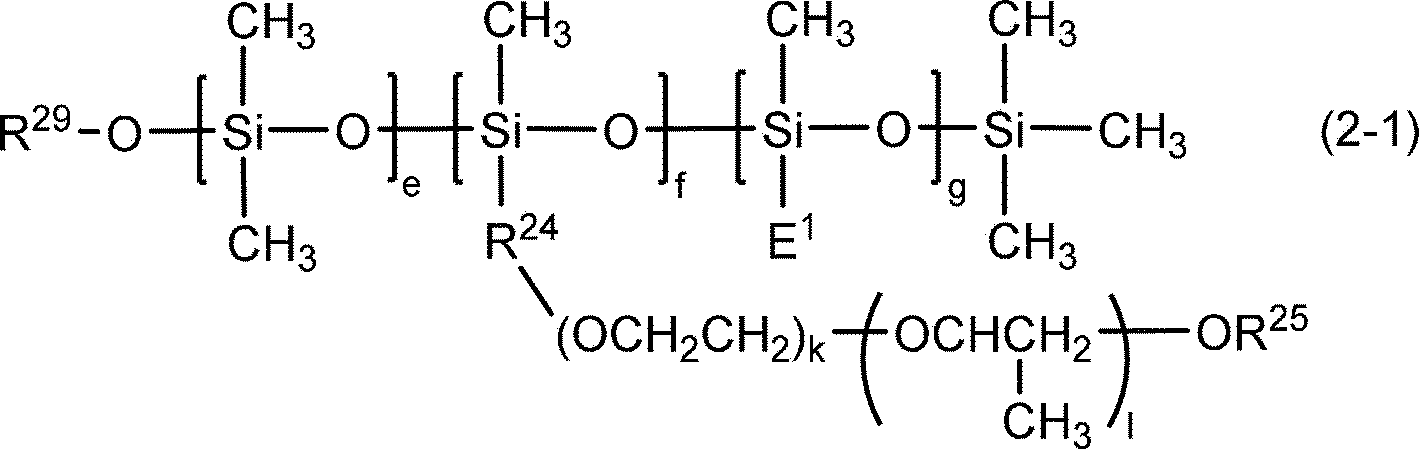
式(2-1)中、E1、R24、R25、e、f、gは前記と同じである。R29は炭素数1以上4以下の1価の炭化水素基又はトリメチルシリル基を示す。kは1以上50以下の数、lは0以上50以下、好ましくは1以上50以下の数を示す。
<33>
前記成分(C2)が、下記一般式(3-1)で表される構造を有するアミノポリエーテル変性シリコーン及び下記一般式(3-2)で表される構造を有するアミノポリエーテル変性シリコーンからなる群から選ばれる1種以上である、<31>又は<32>に記載の方法。

式(3-1)中、r、s、t、uは前記と同じである。

式(3-2)中、R38、r、s、uは前記と同じである。vは0以上50以下、好ましくは2以上50以下の数を示し、wは2以上100以下の数を示す。v+wは2以上100以下の数であり、好ましくは4以上80以下の数、より好ましくは10以上50以下の数である。
<34>
前記成分(C)が、好ましくは前記一般式(3)で表される繰り返し単位を有するアミノポリエーテル変性シリコーン(C2)であり、より好ましくは前記一般式(3-1)で表される構造を有するアミノポリエーテル変性シリコーン及び前記一般式(3-2)で表される構造を有するアミノポリエーテル変性シリコーンからなる群から選ばれる1種以上であり、更に好ましくは前記一般式(3-1)で表される構造を有するアミノポリエーテル変性シリコーンであり、より更に好ましくは前記一般式(3-1)で表される構造からなるアミノポリエーテル変性シリコーンである、<31>~<33>のいずれか1に記載の方法。
<35>
前記組成物中の成分(C)の含有量が、好ましくは0.01質量%以上25質量%以下、より好ましくは0.1質量%以上15質量%以下、更に好ましくは0.5質量%以上12質量%以下、より更に好ましくは0.6質量%以上10質量%以下、より更に好ましくは0.7質量%以上5質量%以下である、<27>~<34>のいずれか1に記載の方法。
<36>
前記組成物が、さらに成分(D)として溶剤を含有する、<1>~<35>のいずれか1に記載の方法。
<37>
前記成分(D)が、25℃における粘度が4mm2/s以下のジメチルポリシロキサン、メチルトリメチコン、ペンタン、イソペンタン、ヘキサン、イソヘキサン、ヘプタン、イソヘプタン、デカン、イソデカン、ドデカン、イソドデカン、トリデカン、イソトリデカン、テトラデカン、イソテトラデカン及び軽質流動イソパラフィンからなる群から選ばれる1種以上を含み、好ましくは25℃における粘度が4mm2/s以下のジメチルポリシロキサン、メチルトリメチコン、イソデカン、イソドデカン、イソテトラデカン及び軽質流動イソパラフィンからなる群から選ばれる1種以上を含み、より好ましくはイソデカン、イソドデカン、イソテトラデカン及び軽質流動イソパラフィンからなる群から選ばれる1種以上を含む、<36>に記載の方法。
<38>
前記組成物中の成分(D)の含有量が、好ましくは40質量%以上99質量%以下、より好ましくは50質量%以上99質量%以下、更に好ましくは60質量%以上98質量%以下である、<36>又は<37>に記載の方法。
<39>
前記組成物中の水の含有量が、好ましくは10質量%以下であり、より好ましくは5質量%未満、更に好ましくは2質量%未満である、<1>~<38>のいずれか1に記載の方法。
<40>
前記組成物中のポリシリコーン-ポリアミドコポリマーの含有量が、好ましくは5質量%未満、より好ましくは2質量%未満、更に好ましくは1質量%未満、より更に好ましくは0.5質量%未満、より更に好ましくは0.1質量%未満であり、より更に好ましくは0質量%である、<1>~<39>のいずれか1に記載の方法。
前記組成物が化粧料組成物、好ましくは毛髪化粧料組成物であり、より好ましくはコンディショニング剤組成物、トリートメント剤組成物、又はスタイリング剤組成物である、<1>~<40>のいずれか1に記載の方法。
<42>
前記組成物がリーブオン製剤である、<1>~<41>のいずれか1に記載の方法。
<43>
前記組成物を乾燥状態のケラチン物質又は頭飾製品用繊維に適用する、<1>~<42>のいずれか1に記載の方法。
<44>
着色剤及び脱色剤からなる群から選ばれる1種以上を含有する第1剤、並びに、下記成分(A)及び成分(B)を含有し、成分(A)及び成分(B)の合計含有質量に対する成分(A)の含有質量の割合[(A)/{(A)+(B)}]が10%以上である第2剤、を備えた、ケラチン物質又は頭飾製品用繊維処理用キット。
(A)シリコーン皮膜形成剤
(B)重合度100以上のオルガノポリシロキサン
<45>
前記第1剤中の着色剤が、顔料又は染料、好ましくは顔料、直接染料、及び酸化染料からなる群から選ばれる1種以上であり、より好ましくは顔料及び直接染料からなる群から選ばれる1種以上であり、更に好ましくは顔料である、<44>に記載のキット。
<46>
前記第1剤中の着色剤の含有量が、好ましくは0.01質量%以上50質量%以下、より好ましくは0.1質量%以上50質量%以下、更に好ましくは0.2質量%以上30質量%以下、より更に好ましくは0.3質量%以上30質量%以下である、<44>又は<45>に記載のキット。
<47>
前記第1剤が、好ましくは着色剤を含有する化粧料組成物であり、より好ましくは毛髪化粧料組成物、更に好ましくは染毛剤組成物である、<44>~<46>のいずれか1に記載のキット。
<48>
前記第2剤中の成分(A)及び成分(B)の合計含有量が、好ましくは0.2質量%以上50質量%以下、より好ましくは0.5質量%以上45質量%以下、更に好ましくは1質量%以上40質量%以下、より更に好ましくは2質量%以上35質量%以下、より更に好ましくは3質量%以上25質量%以下、より更に好ましくは5質量%以上20質量%以下、より更に好ましくは5質量%以上15質量%以下である、<44>~<47>のいずれか1に記載のキット。
<49>
前記第2剤中の成分(A)及び成分(B)の合計含有質量に対する成分(A)の含有質量の割合[(A)/{(A)+(B)}]が、好ましくは10%以上98%以下、より好ましくは10%以上95%以下、更に好ましくは20%以上95%以下、より更に好ましくは30%以上95%以下、より更に好ましくは40%以上95%以下、より更に好ましくは50%以上95%以下である、<44>~<48>のいずれか1に記載のキット。
人毛白髪(100%)毛束((株)ビューラックス製、長さ10cm、質量1g)を下記組成のプレーンシャンプーで洗浄後、40℃の温水ですすぎ、十分に乾燥させた。この毛束に、下記組成の染毛剤組成物(カーボンブラック(1質量%)のイソドデカン分散液)を0.30g塗布し、次いでドライヤー乾燥させた(人工的着色)。さらに、各例の毛髪化粧料組成物を0.20g塗布し、次いでドライヤー乾燥させて、毛髪処理を行った。
成分 (質量%)
ポリオキシエチレン(2)ラウリルエーテル硫酸ナトリウム
(*1) 15.5
ラウリン酸ジエタノールアミド(*2) 1.5
エデト酸4ナトリウム塩 0.3
安息香酸ナトリウム 1.43
精製水 残 量
計 100.0
*1:エマール227(花王(株)製、有効成分27質量%)として57.4質量%
*2:アミノーンL-02(花王(株)製)
成分 (質量%)
カーボンブラック(*1) 1.0
イソドデカン(*2) 残 量
計 100.0
*1:ISD-CB2、大東化成工業(株)製、カーボンブラック(15質量%)のイソドデカン溶液
*2:マルカゾールR、丸善石油化学(株)製、イソドデカン
前記処理後の毛束を、色彩色差計(コニカミノルタ(株)製、CR-400)のD65光源を用いてCIE表色系(L*,a*,b*)で測色した後、40℃の温水で前記組成のプレーンシャンプーを用いて洗浄し、乾燥する工程を7回行った。7回洗髪し、乾燥した後の毛束を同様に色彩色差計で測色し、下式に従い、洗髪前の毛束との色差(ΔE*)を算出した。L*,a*,b*の計測は、毛束上の異なる6点(毛束を長さ方向に3等分した各領域の中央部を表裏1点ずつ)において行い、平均値を算出した。

L0 *、a0 *、b0 *:洗髪前の毛束の計測値
L1 *、a1 *、b1 *:7回洗髪後の毛束の計測値
ΔE*<17であれば、処理後の毛束の耐洗髪性が良好であり、色持続性に優れると判断できる。また、ΔE*<15であればより良好であり、ΔE*<10であればさらに良好であり、ΔE*<5であればさらにより良好である。
市販のPETフィルム(東レ(株)製;ルミラーフィルムT60-A4-100μm)に各例の毛髪化粧料組成物を20μL滴下し、バーコーター(アズワン社製、No.3)で伸ばし、自然乾燥させて塗膜を形成したのち、塗膜形成部分を3cm×3cmの大きさに切り出して試験用フィルムを作製した。このフィルムの質量をF0[g]とする。
物理的な汚れのモデルとして、ジルコニアビーズ((株)ニッカトー製「YTZボール」、Φ=1mm)を用いた。バランスディッシュ(アズワン社製、BD-2)にジルコニアビーズを10.4g入れて平らにならし、この上に3cm×3cmの大きさに切り出したフィルムの塗膜面を接触させた。次いで、該フィルム上にバランスディッシュを重ね、その上に規格瓶(アズワン社製、No.11)に水道水を入れて重さ200gとした重りを30秒のせた後、重りを取り除いて、ビーズが付着したフィルムの質量(F1[g]とする)を測定した。
ビーズへの接触前後のフィルムの質量変化から、下記式によりビーズの付着率を算出した。なお3cm×3cmの試験用フィルム面積を100%カバーするビーズの質量は、2.68g(2回測定の平均値)を用いた。
ビーズの付着率[%]=(F1-F0[g])÷(試験用フィルム面積を100%カバーするビーズの質量[g])×100
上記試験を2回行い、その平均値を表に示した。付着率が25%以下の場合は汚れが付き難く、20%以下ではより付き難く、15%以下ではよりさらに付き難く、5%以下ではよりさらに汚れが付き難いといえる。
表1~4に示す各成分を、各表に記載の配合割合にて配合し、均一になるまで混合して、毛髪化粧料組成物を調製した。得られた毛髪化粧料組成物を用いて、前記方法で評価を行った。結果を表1~4に示す。
なお、表に記載の配合量(質量%)は、いずれも有効成分量である。


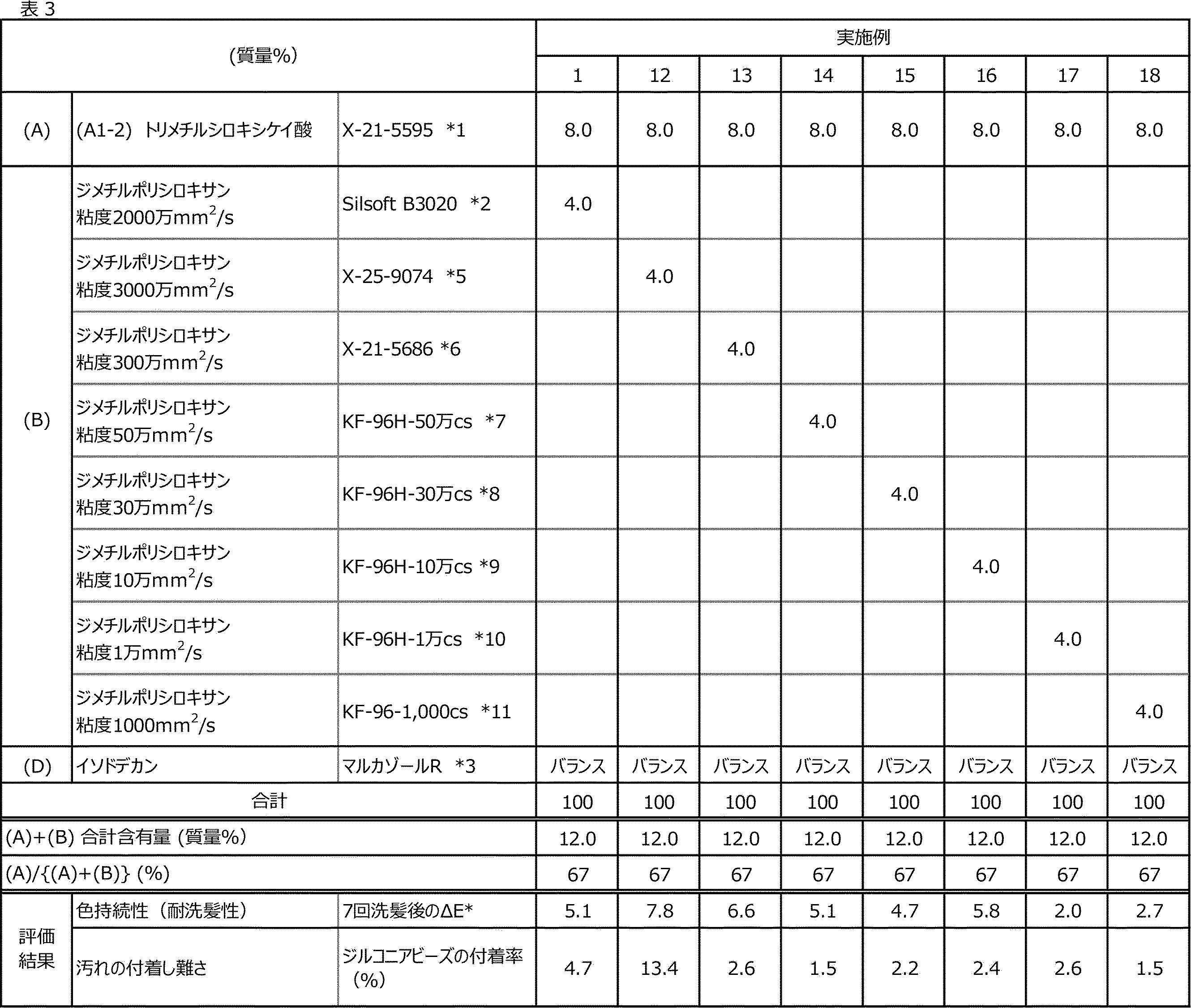

頭飾製品用繊維として(株)カネカ製の再生コラーゲン繊維「ネクステンションクリスタル XXL 30」(色番:30(ホワイト)、形状:ストレート)を用いて、長さ10cm、幅1.5cm、質量1gの人工毛の毛束を作製した。
実施例1において、人毛白髪(100%)の毛束に替えて上記人工毛の毛束を使用したこと以外は、実施例1と同様の方法で人工的着色及び毛髪処理を行い、前記評価を行った。結果を表5に示す。

*1:X-21-5595、信越化学工業(株)製、トリメチルシロキシケイ酸(60質量%)のイソドデカン溶液
*2:Silsoft B3020、モメンティブ・パフォーマンス・マテリアルズ社製、ジメチルポリシロキサン、25℃における粘度;2,000万mm2/s(重合度3,546)
*3:マルカゾールR、丸善石油化学(株)製、イソドデカン
*4:SR1000、モメンティブ・パフォーマンス・マテリアルズ社製、トリメチルシロキシケイ酸
*5:X-25-9074、信越化学工業(株)製、ジメチルポリシロキサン、25℃における粘度;3,000万mm2/s(重合度3,747)
*6:X-21-5686、信越化学工業(株)製、ジメチルポリシロキサン、25℃における粘度;300万mm2/s(重合度2,680)
*7:KF-96H-50万cs、信越化学工業(株)製、ジメチルポリシロキサン、25℃における粘度;50万mm2/s(重合度1,972)
*8:KF-96H-30万cs、信越化学工業(株)製、ジメチルポリシロキサン、25℃における粘度;30万mm2/s(重合度1,790)
*9:KF-96H-10万cs、信越化学工業(株)製、ジメチルポリシロキサン、25℃における粘度;10万mm2/s(重合度1,429)
*10:KF-96H-1万cs、信越化学工業(株)製、ジメチルポリシロキサン、25℃における粘度;1万mm2/s(重合度804)
*11:KF-96-1,000cs、信越化学工業(株)製、ジメチルポリシロキサン、25℃における粘度;1,000mm2/s(重合度357)
*12:KP-550、信越化学工業(株)製、(アクリレーツ/ジメチコン)コポリマー(40質量%)のイソドデカン溶液
P=M/74 (5)
また表5より、本発明の処理方法によれば、毛髪に替えて頭飾製品用繊維である再生コラーゲン繊維を用いた場合にも良好な色持続性及び汚れの付着防止効果が得られることがわかる。
Claims (6)
- 人工的に着色又は脱色された、ケラチン物質又は頭飾製品用繊維を組成物で処理する方法であって、前記方法は、前記組成物を前記ケラチン物質又は頭飾製品用繊維に適用する工程を含み、
前記組成物は、下記成分(A)及び成分(B):
(A)シリコーン皮膜形成剤
(B)重合度100以上のオルガノポリシロキサン
を含有し、成分(A)及び成分(B)の合計含有質量に対する成分(A)の含有質量の割合[(A)/{(A)+(B)}]が10%以上である、方法。 - 前記組成物中の前記成分(A)の含有量が25質量%未満である、請求項1に記載の方法。
- 前記成分(B)の25℃における粘度が120mm2/s以上10,000万mm2/s以下である、請求項1又は2に記載の方法。
- 前記成分(A)が下記成分(A1)及び成分(A2)からなる群から選ばれる1種以上である、請求項1~3のいずれか1項に記載の方法。
(A1)平均式(R1)mSiO(4-m)/2
(式中、R1はフッ素置換されていてもよい炭素数1以上12以下の炭化水素基又はヒドロキシ基を示す。複数のR1は互いに同一でもよく、異なっていてもよい。mは平均数であって0超3未満の数である。)
で表され、R1SiO3/2で表されるT単位及びSiO4/2で表されるQ単位からなる群から選ばれる1種以上の単位を含むシリコーン樹脂
(A2)ポリシロキサン部分と、非シリコーン有機鎖からなる部分とを含むシリコーンポリマー - 前記組成物を乾燥状態のケラチン物質又は頭飾製品用繊維に適用する、請求項1~4のいずれか1項に記載の方法。
- 着色剤及び脱色剤からなる群から選ばれる1種以上を含有する第1剤、並びに、下記成分(A)及び成分(B)を含有し、成分(A)及び成分(B)の合計含有質量に対する成分(A)の含有質量の割合[(A)/{(A)+(B)}]が10%以上である第2剤、を備えた、ケラチン物質又は頭飾製品用繊維処理用キット。
(A)シリコーン皮膜形成剤
(B)重合度100以上のオルガノポリシロキサン
Priority Applications (4)
| Application Number | Priority Date | Filing Date | Title |
|---|---|---|---|
| US18/713,556 US20250025405A1 (en) | 2021-11-30 | 2022-11-28 | Method for treating keratin substance or fiber for head ornamental product |
| EP22901244.8A EP4442247A4 (en) | 2021-11-30 | 2022-11-28 | METHOD FOR THE TREATMENT OF KERATIN SUBSTANCE OR FIBER FOR HEAD FINGERING |
| KR1020247017706A KR20240116725A (ko) | 2021-11-30 | 2022-11-28 | 케라틴 물질 또는 머리 장식 제품용 섬유의 처리 방법 |
| CN202280077928.2A CN118302150A (zh) | 2021-11-30 | 2022-11-28 | 角蛋白物质或头饰制品用纤维的处理方法 |
Applications Claiming Priority (2)
| Application Number | Priority Date | Filing Date | Title |
|---|---|---|---|
| JP2021-194587 | 2021-11-30 | ||
| JP2021194587 | 2021-11-30 |
Publications (1)
| Publication Number | Publication Date |
|---|---|
| WO2023100812A1 true WO2023100812A1 (ja) | 2023-06-08 |
Family
ID=86612200
Family Applications (1)
| Application Number | Title | Priority Date | Filing Date |
|---|---|---|---|
| PCT/JP2022/043784 Ceased WO2023100812A1 (ja) | 2021-11-30 | 2022-11-28 | ケラチン物質又は頭飾製品用繊維の処理方法 |
Country Status (7)
| Country | Link |
|---|---|
| US (1) | US20250025405A1 (ja) |
| EP (1) | EP4442247A4 (ja) |
| JP (1) | JP2023081341A (ja) |
| KR (1) | KR20240116725A (ja) |
| CN (1) | CN118302150A (ja) |
| TW (1) | TW202339702A (ja) |
| WO (1) | WO2023100812A1 (ja) |
Families Citing this family (3)
| Publication number | Priority date | Publication date | Assignee | Title |
|---|---|---|---|---|
| JP2019072124A (ja) * | 2017-10-13 | 2019-05-16 | 株式会社三洋物産 | 遊技機 |
| JP2019072122A (ja) * | 2017-10-13 | 2019-05-16 | 株式会社三洋物産 | 遊技機 |
| JP7473060B2 (ja) * | 2021-12-18 | 2024-04-23 | 株式会社三洋物産 | 遊技機 |
Citations (11)
| Publication number | Priority date | Publication date | Assignee | Title |
|---|---|---|---|---|
| JPH0225411A (ja) | 1988-07-12 | 1990-01-26 | Kobayashi Kose Co Ltd | 化粧料 |
| JPH02132141A (ja) | 1988-07-12 | 1990-05-21 | Kobayashi Kose Co Ltd | ゲル組成物並びにこれを含有する化粧料 |
| JPH03162442A (ja) | 1989-11-21 | 1991-07-12 | Kobayashi Kose Co Ltd | ゲル組成物及びこれを含有する化粧料 |
| JPH0692825A (ja) | 1992-07-28 | 1994-04-05 | Mitsubishi Petrochem Co Ltd | 毛髪化粧料組成物 |
| JPH111530A (ja) | 1997-06-12 | 1999-01-06 | Toray Dow Corning Silicone Co Ltd | シリコーン含有有機重合体およびその製造方法 |
| JP2000063225A (ja) | 1998-06-12 | 2000-02-29 | Dow Corning Toray Silicone Co Ltd | 化粧品原料、化粧品および化粧品の製造方法 |
| JP2003104825A (ja) | 2001-09-28 | 2003-04-09 | Kose Corp | 化粧料並びに化粧料用組成物 |
| JP2003342139A (ja) | 2002-05-28 | 2003-12-03 | Kao Corp | 染毛剤組成物 |
| US20090074702A1 (en) * | 2007-09-14 | 2009-03-19 | L'oreal S.A. | Methods of preserving artificial coloring on keratin materials |
| JP2011519853A (ja) * | 2008-04-30 | 2011-07-14 | エイボン プロダクツ インコーポレーテッド | 毛髪用組成物 |
| JP2013541585A (ja) | 2010-11-02 | 2013-11-14 | エイボン プロダクツ インコーポレーテッド | 人工的に着色された毛における色の保持の改善方法 |
Family Cites Families (9)
| Publication number | Priority date | Publication date | Assignee | Title |
|---|---|---|---|---|
| GB2105754B (en) * | 1981-09-03 | 1985-09-04 | Unilever Plc | Hair dyeing compositions |
| JP4564711B2 (ja) * | 2002-11-28 | 2010-10-20 | 花王株式会社 | 毛髪用脱色又は染色処理剤組成物 |
| US7611544B2 (en) * | 2007-09-14 | 2009-11-03 | L'oreal S.A. | Methods of artificially coloring hair |
| FR2924939B1 (fr) * | 2007-12-13 | 2010-02-26 | Oreal | Procede de coloration des cheveux a partir d'une composition comprenant un polymere filmogene hydrophobe, un pigment et un solvant volatil |
| US20100233114A1 (en) * | 2009-03-16 | 2010-09-16 | L'ORéAL S.A. | Methods of styling hair |
| US20130177516A1 (en) * | 2010-07-30 | 2013-07-11 | Dow Corning Toray Co., Ltd. | Cosmetic For Hair Containing Sugar Alcohol-Modified Silicone |
| US12064505B2 (en) * | 2020-06-01 | 2024-08-20 | Kao Corporation | Cosmetic composition |
| WO2021246272A1 (ja) * | 2020-06-01 | 2021-12-09 | 花王株式会社 | 化粧料組成物 |
| WO2021246274A1 (ja) * | 2020-06-01 | 2021-12-09 | 花王株式会社 | 化粧料組成物 |
-
2022
- 2022-11-28 US US18/713,556 patent/US20250025405A1/en active Pending
- 2022-11-28 JP JP2022189367A patent/JP2023081341A/ja active Pending
- 2022-11-28 EP EP22901244.8A patent/EP4442247A4/en active Pending
- 2022-11-28 WO PCT/JP2022/043784 patent/WO2023100812A1/ja not_active Ceased
- 2022-11-28 KR KR1020247017706A patent/KR20240116725A/ko active Pending
- 2022-11-28 CN CN202280077928.2A patent/CN118302150A/zh active Pending
- 2022-11-30 TW TW111145891A patent/TW202339702A/zh unknown
Patent Citations (11)
| Publication number | Priority date | Publication date | Assignee | Title |
|---|---|---|---|---|
| JPH0225411A (ja) | 1988-07-12 | 1990-01-26 | Kobayashi Kose Co Ltd | 化粧料 |
| JPH02132141A (ja) | 1988-07-12 | 1990-05-21 | Kobayashi Kose Co Ltd | ゲル組成物並びにこれを含有する化粧料 |
| JPH03162442A (ja) | 1989-11-21 | 1991-07-12 | Kobayashi Kose Co Ltd | ゲル組成物及びこれを含有する化粧料 |
| JPH0692825A (ja) | 1992-07-28 | 1994-04-05 | Mitsubishi Petrochem Co Ltd | 毛髪化粧料組成物 |
| JPH111530A (ja) | 1997-06-12 | 1999-01-06 | Toray Dow Corning Silicone Co Ltd | シリコーン含有有機重合体およびその製造方法 |
| JP2000063225A (ja) | 1998-06-12 | 2000-02-29 | Dow Corning Toray Silicone Co Ltd | 化粧品原料、化粧品および化粧品の製造方法 |
| JP2003104825A (ja) | 2001-09-28 | 2003-04-09 | Kose Corp | 化粧料並びに化粧料用組成物 |
| JP2003342139A (ja) | 2002-05-28 | 2003-12-03 | Kao Corp | 染毛剤組成物 |
| US20090074702A1 (en) * | 2007-09-14 | 2009-03-19 | L'oreal S.A. | Methods of preserving artificial coloring on keratin materials |
| JP2011519853A (ja) * | 2008-04-30 | 2011-07-14 | エイボン プロダクツ インコーポレーテッド | 毛髪用組成物 |
| JP2013541585A (ja) | 2010-11-02 | 2013-11-14 | エイボン プロダクツ インコーポレーテッド | 人工的に着色された毛における色の保持の改善方法 |
Non-Patent Citations (1)
| Title |
|---|
| See also references of EP4442247A4 |
Also Published As
| Publication number | Publication date |
|---|---|
| KR20240116725A (ko) | 2024-07-30 |
| EP4442247A1 (en) | 2024-10-09 |
| TW202339702A (zh) | 2023-10-16 |
| EP4442247A4 (en) | 2025-12-17 |
| US20250025405A1 (en) | 2025-01-23 |
| JP2023081341A (ja) | 2023-06-09 |
| CN118302150A (zh) | 2024-07-05 |
Similar Documents
| Publication | Publication Date | Title |
|---|---|---|
| CN103997930B (zh) | 包含基于疏水性成膜聚合物及挥发性溶剂的组合物的涂抹装置以及使用其护理角蛋白纤维的方法 | |
| JP2023081341A (ja) | ケラチン物質又は頭飾製品用繊維の処理方法 | |
| JP7724638B2 (ja) | 化粧料組成物 | |
| JP7725238B2 (ja) | 化粧料組成物 | |
| WO2023100810A1 (ja) | ケラチン物質又は頭飾製品用繊維の処理方法 | |
| MX2013004988A (es) | Metodo para mejorar la retencion del color en el cabello coloreado artificialmente. | |
| JP2026015547A (ja) | 化粧料組成物 | |
| JP7724639B2 (ja) | 化粧料組成物 | |
| GB2571170A (en) | Cosmetic composition for treatment of keratinous fibres | |
| WO2026029048A1 (ja) | 化粧料組成物又は頭飾製品用繊維処理組成物 | |
| JP2023021938A (ja) | 化粧料組成物 |
Legal Events
| Date | Code | Title | Description |
|---|---|---|---|
| 121 | Ep: the epo has been informed by wipo that ep was designated in this application |
Ref document number: 22901244 Country of ref document: EP Kind code of ref document: A1 |
|
| WWE | Wipo information: entry into national phase |
Ref document number: 202280077928.2 Country of ref document: CN |
|
| WWE | Wipo information: entry into national phase |
Ref document number: 18713556 Country of ref document: US |
|
| NENP | Non-entry into the national phase |
Ref country code: DE |
|
| ENP | Entry into the national phase |
Ref document number: 2022901244 Country of ref document: EP Effective date: 20240701 |