WO2023112364A1 - タイヤ用ゴム組成物、トレッドゴム及びタイヤ - Google Patents
タイヤ用ゴム組成物、トレッドゴム及びタイヤ Download PDFInfo
- Publication number
- WO2023112364A1 WO2023112364A1 PCT/JP2022/026638 JP2022026638W WO2023112364A1 WO 2023112364 A1 WO2023112364 A1 WO 2023112364A1 JP 2022026638 W JP2022026638 W JP 2022026638W WO 2023112364 A1 WO2023112364 A1 WO 2023112364A1
- Authority
- WO
- WIPO (PCT)
- Prior art keywords
- rubber
- mass
- group
- carbon atoms
- styrene
- Prior art date
- Legal status (The legal status is an assumption and is not a legal conclusion. Google has not performed a legal analysis and makes no representation as to the accuracy of the status listed.)
- Ceased
Links
Classifications
-
- C—CHEMISTRY; METALLURGY
- C08—ORGANIC MACROMOLECULAR COMPOUNDS; THEIR PREPARATION OR CHEMICAL WORKING-UP; COMPOSITIONS BASED THEREON
- C08C—TREATMENT OR CHEMICAL MODIFICATION OF RUBBERS
- C08C19/00—Chemical modification of rubber
- C08C19/22—Incorporating nitrogen atoms into the molecule
-
- C—CHEMISTRY; METALLURGY
- C08—ORGANIC MACROMOLECULAR COMPOUNDS; THEIR PREPARATION OR CHEMICAL WORKING-UP; COMPOSITIONS BASED THEREON
- C08L—COMPOSITIONS OF MACROMOLECULAR COMPOUNDS
- C08L9/00—Compositions of homopolymers or copolymers of conjugated diene hydrocarbons
- C08L9/06—Copolymers with styrene
-
- B—PERFORMING OPERATIONS; TRANSPORTING
- B60—VEHICLES IN GENERAL
- B60C—VEHICLE TYRES; TYRE INFLATION; TYRE CHANGING; CONNECTING VALVES TO INFLATABLE ELASTIC BODIES IN GENERAL; DEVICES OR ARRANGEMENTS RELATED TO TYRES
- B60C1/00—Tyres characterised by the chemical composition or the physical arrangement or mixture of the composition
-
- B—PERFORMING OPERATIONS; TRANSPORTING
- B60—VEHICLES IN GENERAL
- B60C—VEHICLE TYRES; TYRE INFLATION; TYRE CHANGING; CONNECTING VALVES TO INFLATABLE ELASTIC BODIES IN GENERAL; DEVICES OR ARRANGEMENTS RELATED TO TYRES
- B60C1/00—Tyres characterised by the chemical composition or the physical arrangement or mixture of the composition
- B60C1/0016—Compositions of the tread
-
- C—CHEMISTRY; METALLURGY
- C08—ORGANIC MACROMOLECULAR COMPOUNDS; THEIR PREPARATION OR CHEMICAL WORKING-UP; COMPOSITIONS BASED THEREON
- C08C—TREATMENT OR CHEMICAL MODIFICATION OF RUBBERS
- C08C19/00—Chemical modification of rubber
- C08C19/25—Incorporating silicon atoms into the molecule
-
- C—CHEMISTRY; METALLURGY
- C08—ORGANIC MACROMOLECULAR COMPOUNDS; THEIR PREPARATION OR CHEMICAL WORKING-UP; COMPOSITIONS BASED THEREON
- C08C—TREATMENT OR CHEMICAL MODIFICATION OF RUBBERS
- C08C19/00—Chemical modification of rubber
- C08C19/30—Addition of a reagent which reacts with a hetero atom or a group containing hetero atoms of the macromolecule
- C08C19/42—Addition of a reagent which reacts with a hetero atom or a group containing hetero atoms of the macromolecule reacting with metals or metal-containing groups
- C08C19/44—Addition of a reagent which reacts with a hetero atom or a group containing hetero atoms of the macromolecule reacting with metals or metal-containing groups of polymers containing metal atoms exclusively at one or both ends of the skeleton
-
- C—CHEMISTRY; METALLURGY
- C08—ORGANIC MACROMOLECULAR COMPOUNDS; THEIR PREPARATION OR CHEMICAL WORKING-UP; COMPOSITIONS BASED THEREON
- C08K—Use of inorganic or non-macromolecular organic substances as compounding ingredients
- C08K3/00—Use of inorganic substances as compounding ingredients
- C08K3/34—Silicon-containing compounds
- C08K3/36—Silica
-
- C—CHEMISTRY; METALLURGY
- C08—ORGANIC MACROMOLECULAR COMPOUNDS; THEIR PREPARATION OR CHEMICAL WORKING-UP; COMPOSITIONS BASED THEREON
- C08L—COMPOSITIONS OF MACROMOLECULAR COMPOUNDS
- C08L2201/00—Properties
- C08L2201/52—Aqueous emulsion or latex, e.g. containing polymers of a glass transition temperature (Tg) below 20°C
-
- C—CHEMISTRY; METALLURGY
- C08—ORGANIC MACROMOLECULAR COMPOUNDS; THEIR PREPARATION OR CHEMICAL WORKING-UP; COMPOSITIONS BASED THEREON
- C08L—COMPOSITIONS OF MACROMOLECULAR COMPOUNDS
- C08L2205/00—Polymer mixtures characterised by other features
- C08L2205/02—Polymer mixtures characterised by other features containing two or more polymers of the same C08L -group
- C08L2205/025—Polymer mixtures characterised by other features containing two or more polymers of the same C08L -group containing two or more polymers of the same hierarchy C08L, and differing only in parameters such as density, comonomer content, molecular weight, structure
-
- Y—GENERAL TAGGING OF NEW TECHNOLOGICAL DEVELOPMENTS; GENERAL TAGGING OF CROSS-SECTIONAL TECHNOLOGIES SPANNING OVER SEVERAL SECTIONS OF THE IPC; TECHNICAL SUBJECTS COVERED BY FORMER USPC CROSS-REFERENCE ART COLLECTIONS [XRACs] AND DIGESTS
- Y02—TECHNOLOGIES OR APPLICATIONS FOR MITIGATION OR ADAPTATION AGAINST CLIMATE CHANGE
- Y02T—CLIMATE CHANGE MITIGATION TECHNOLOGIES RELATED TO TRANSPORTATION
- Y02T10/00—Road transport of goods or passengers
- Y02T10/80—Technologies aiming to reduce greenhouse gasses emissions common to all road transportation technologies
- Y02T10/86—Optimisation of rolling resistance, e.g. weight reduction
Definitions
- the present invention relates to a rubber composition for tires, tread rubber and tires.
- wet grip performance Conventionally, from the standpoint of improving vehicle safety, various studies have been made to improve braking performance on wet road surfaces (hereinafter abbreviated as “wet grip performance”.
- Patent Document 1 a rubber composition obtained by blending a rubber component containing 70% by mass or more of natural rubber with a thermoplastic resin and a filler containing silica is applied to the tread rubber of a tire. This is disclosed to improve the tire's braking performance on both dry and wet road surfaces.
- wet grip performance not only dense-grained asphalt pavement, which is commonly used in general areas, but also wet grip performance is required for porous asphalt pavement, such as that found in snowy and cold regions.
- Patent Document 1 the rubber composition described in Patent Document 1 has room for further improvement in terms of achieving a high level of both wet grip properties for dense-grained asphalt pavement and porous asphalt pavement. I found out.
- the present invention solves the above-mentioned problems of the conventional technology, and is a tire that can obtain a tire with high road surface robustness that is excellent in both wet grip on dense-grained asphalt pavement and wet grip on porous asphalt pavement.
- An object of the present invention is to provide a rubber composition and a tread rubber comprising such a rubber composition.
- Another object of the present invention is to provide a tire with high road surface robustness that is excellent in both wet grip on dense-grained asphalt pavement and wet grip on porous asphalt pavement.
- the gist and configuration of the present invention for solving the above problems is as follows.
- the ratio of the isoprene-based rubber (A) in 100 parts by mass of the rubber component is 15 parts by mass or more and less than 50 parts by mass
- the resin component (C) is at least partially hydrogenated and has an SP value difference of 1.40 (cal/cm 3 ) 1/2 or less from the isoprene rubber (A)
- the composition parameter P1 calculated from is 1000 or more, Formula (I-2) below:
- Composition parameter P2 ⁇ (parts by mass of resin component (C))/(parts by mass of iso
- a tread rubber comprising the tire rubber composition according to any one of [1] to [5].
- a rubber composition for a tire that is excellent in both wet grip on dense-grained asphalt pavement and wet grip on porous asphalt pavement, and that enables obtaining a tire with high road surface robustness, and such a rubber composition. It is possible to provide a tread rubber consisting of Moreover, according to the present invention, it is possible to provide a tire with high road surface robustness that is excellent in both wet grip on dense-grained asphalt pavement and wet grip on porous asphalt pavement.
- the compounds described herein may be partially or wholly derived from fossil sources, biological sources such as plant sources, or recycled resources such as used tires. may It may also be derived from a mixture of any two or more of fossil resources, biological resources, and recycled resources.
- the rubber composition for tires of the present invention contains a rubber component, a reinforcing filler (B), and a resin component (C). Further, in the rubber composition for tires of the present invention, the rubber component contains an isoprene rubber (A) having a glass transition temperature of ⁇ 50° C. or less, and the isoprene rubber ( The ratio of A) is 15 parts by mass or more and less than 50 parts by mass, the resin component (C) is at least partially hydrogenated, and the SP value difference from the isoprene rubber is 1.
- composition parameter P1 (parts by mass of isoprene rubber (A))) ⁇ (parts by mass of resin component (C)) (I-1)
- composition parameter P2 ( ⁇ (parts by mass of resin component (C))/(parts by mass of isoprene-based rubber (A)) ⁇ (mass fraction of reinforcing filler (B) in rubber composition) (I-2)
- a composition parameter P2 calculated from the above is 0.25 or more.
- the glass transition temperature of a rubber component such as isoprene rubber (A) is measured by recording a DSC curve while increasing the temperature in a predetermined temperature range according to ISO 22768:2006, and measuring the peak top of the DSC differential curve. (Inflection point). Further, in this specification, the SP value (solubility parameter) of the rubber component such as the isoprene-based rubber (A) and the resin component (C) is calculated according to the Fedors method.
- the rubber composition for a tire of the present invention is at least partially hydrogenated, and has a difference in SP value from the isoprene rubber (A) of 1.40 (cal/cm 3 ) 1/2 or less.
- the basic wet grip performance of the tire can be improved.
- the ratio of parts by mass between the resin component (C) and the isoprene-based rubber (A) contributes to the road surface followability for all road surfaces including dense-grained asphalt pavement and porous asphalt pavement. was confirmed. It was also confirmed that the product of the parts by mass of the resin component (C) and the isoprene rubber (A) contributes to wet grip performance.
- the reinforcing filler (B) contributes to the suppression of block deformation and thus to the braking force. Therefore, the present inventor paid attention to the correlation between the composition of these components and road surface robustness, and conducted extensive studies. As a result, the above-mentioned "composition parameter P1" and “composition parameter P2" are established, and the composition parameter P1 is 1000 or more, and the composition parameter P2 is 0.25 or more.
- the composition parameter P1 is 1000 or more
- the composition parameter P2 is 0.25 or more.
- the value of the mass fraction in the rubber composition is used instead of the number of parts by mass with respect to 100 parts by mass of the rubber component. That is, it should be noted that this value is also affected by the contents of various components such as vulcanizing agents and vulcanization accelerators that can be blended in addition to the rubber component and resin component (C). .
- the composition parameter P1 calculated from the above formula (I-1) is preferably 1200 or more, more preferably 1350 or more, from the viewpoint of further improving wet grip performance. More preferably, it is 1500 or more.
- the composition parameter P1 calculated from the above formula (I-1) can be set to 2200 or less from the viewpoint of sufficiently maintaining other performance such as wear resistance and fuel efficiency.
- the rubber composition for tires of the present invention preferably has a composition parameter P2 calculated from the above formula (I-2) of 0.35 or more, and preferably 0.40. It is more preferably 0.45 or more, and still more preferably 0.45 or more.
- the composition parameter P2 calculated from the above formula (I-2) can be set to 0.80 or less from the viewpoint of sufficiently maintaining other performance such as wear resistance and fuel efficiency.
- the rubber composition for a tire of the present invention contains a rubber component, and the rubber component includes an isoprene-based rubber (A) having a glass transition temperature of ⁇ 50° C. or lower and a rubber other than the isoprene-based rubber (A).
- a rubber component (hereinafter sometimes simply referred to as "another rubber component") is also used.
- the isoprene-based rubber (A) is a rubber having isoprene units as a main skeleton, and specific examples thereof include natural rubber (NR), synthetic isoprene rubber (IR), and the like. By including the isoprene-based rubber (A) in the rubber component, the breaking strength of the rubber composition can be increased. Further, the isoprene-based rubber (A) has a glass transition temperature of ⁇ 50° C. or lower. The isoprene-based rubber (A) may be used singly or in combination of two or more.
- the ratio of isoprene-based rubber (A) in 100 parts by mass of the rubber component is 15 parts by mass or more and less than 50 parts by mass. If the above proportion is less than 15 parts by mass or 50 parts by mass or more, wet grip on dense-grained asphalt road surfaces and/or wet grip on porous asphalt pavements will be insufficient, resulting in poor road surface robustness. From the viewpoint of further improving road surface robustness, the proportion of isoprene-based rubber (A) in 100 parts by mass of the rubber component is preferably 25 parts by mass or more, and preferably 45 parts by mass or less. , 40 parts by mass or less.
- -Other rubber components Other rubber components than isoprene rubber (A) include isoprene rubber having a glass transition temperature higher than ⁇ 50° C., styrene-butadiene rubber (SBR), butadiene rubber (BR), chloroprene rubber (CR), butyl rubber ( IIR), halogenated butyl rubber, ethylene-propylene rubber (EPR, EPDM), fluororubber, silicone rubber, urethane rubber and the like.
- diene rubbers such as styrene-butadiene rubber, butadiene rubber and chloroprene rubber are preferable as the other rubber component, and styrene-butadiene rubber is more preferable.
- These rubber components other than the isoprene-based rubber (A) may be used singly or in combination of two or more. Further, rubber components other than the isoprene-based rubber (A) may be unmodified or modified.
- the glass transition temperature of the other rubber component is preferably less than -30°C, more preferably less than -40°C, more preferably -45°C or less, still more preferably -50°C or less, and preferably -90°C. taller than. If the other rubber component has a glass transition temperature of less than ⁇ 30° C., the fuel economy performance and wear resistance performance of the tire to which the rubber composition is applied can be improved. Also, a rubber component having a glass transition temperature higher than -90°C is easy to synthesize.
- the difference in SP value between the isoprene-based rubber (A) and the other rubber components is preferably 0.3 (cal/cm 3 ) 1/2 or more, more preferably 0.35 (cal/cm 3 ) 1/2 It is more preferable to be above.
- the SP value difference between the isoprene rubber (A) and the other rubber components is 0.3 (cal/cm 3 ) 1/2 or more, the isoprene rubber (A) and the other rubber components are incompatible. easy to become
- the styrene-butadiene rubber When styrene-butadiene rubber is used as another rubber component, the styrene-butadiene rubber preferably has a bound styrene content of less than 15% by mass.
- the bound styrene content of the styrene-butadiene rubber means the proportion of styrene units contained in the styrene-butadiene rubber. If the bound styrene content of the styrene-butadiene rubber is less than 15% by mass, the glass transition temperature tends to be low.
- the bound styrene content of the styrene-butadiene rubber is more preferably 14% by mass or less, more preferably 13% by mass or less, and even more preferably 12% by mass or less.
- the bound styrene content of the styrene-butadiene rubber is preferably 5% by mass or more, more preferably 7% by mass or more, and 8% by mass, from the viewpoint of the wear resistance performance of the tire to which the rubber composition is applied. % or more is more preferable.
- the amount of bound styrene in the styrene-butadiene rubber can be adjusted by adjusting the amount of monomers used for polymerization of the styrene-butadiene rubber, the degree of polymerization, and the like.
- the styrene-butadiene rubber is preferably modified with a modifier having a nitrogen atom-containing functional group and an alkoxy group.
- the styrene-butadiene rubber is modified with a modifier having a functional group containing a nitrogen atom and an alkoxy group, the wet grip performance of the tire to which the rubber composition is applied, the fuel efficiency performance, and the wear resistance performance are balanced. is improved, and in particular, fuel economy performance and wear resistance performance can be further improved.
- the modifier having a functional group containing a nitrogen atom and an alkoxy group is a general term for modifiers having at least one functional group containing a nitrogen atom and at least one alkoxy group.
- the functional group containing a nitrogen atom is preferably selected from the following.
- a monovalent hydrocarbon group having 1 to 30 carbon atoms including a linear, branched, alicyclic or aromatic ring having a group, or at least one heteroatom selected from an oxygen atom, a sulfur atom and a phosphorus atom
- a monovalent hydrocarbon group having 1 to 30 carbon atoms containing a linear, branched, alicyclic or aromatic ring which may contain
- the styrene-butadiene rubber (SBR) is preferably modified with an aminoalkoxysilane compound, and from the viewpoint of having a high affinity for the reinforcing filler (B), the end is modified with an aminoalkoxysilane compound. More preferably.
- the terminal of the styrene-butadiene rubber is modified with an aminoalkoxysilane compound, the interaction between the modified styrene-butadiene rubber and the reinforcing filler (B) (especially silica) is particularly large.
- the modified site of the styrene-butadiene rubber may be the molecular terminal as described above, or may be the main chain.
- a styrene-butadiene rubber having a modified molecular end can be prepared, for example, according to the methods described in International Publication No. WO 2003/046020 and JP-A-2007-217562. It can be produced by reacting the modifier of In one preferred embodiment, the molecular end-modified styrene-butadiene rubber has a cis-1,4 bond content of 75% according to the method described in WO 2003/046020 and JP-A-2007-217562.
- It can be produced by reacting the terminal of the styrene-butadiene copolymer having the above active terminal with an aminoalkoxysilane compound and then reacting it with a carboxylic acid partial ester of a polyhydric alcohol for stabilization.
- the carboxylic acid partial ester of a polyhydric alcohol is an ester of a polyhydric alcohol and a carboxylic acid and means a partial ester having one or more hydroxyl groups.
- esters of saccharides or modified saccharides having 4 or more carbon atoms and fatty acids are preferably used.
- This ester is more preferably (1) a fatty acid partial ester of a polyhydric alcohol, particularly a partial ester (monoester, diester, triester) of a saturated higher fatty acid or unsaturated higher fatty acid having 10 to 20 carbon atoms and a polyhydric alcohol.
- Polyhydric alcohols used as starting materials for partial esters are preferably sugars having 5 or 6 carbon atoms and having at least three hydroxyl groups (which may or may not be hydrogenated), glycols and polyhydroxy alcohols.
- a compound or the like is used.
- the raw fatty acid is preferably a saturated or unsaturated fatty acid having 10 to 20 carbon atoms, such as stearic acid, lauric acid, and palmitic acid.
- sorbitan fatty acid esters are preferred, and specific examples include sorbitan monolaurate, sorbitan monopalmitate, sorbitan monostearate, sorbitan tristearate, and sorbitan monooleate. , sorbitan trioleate and the like.
- aminoalkoxysilane compound is not particularly limited, an aminoalkoxysilane compound represented by the following general formula (i) is preferable.
- R 11 and R 12 each independently represent a monovalent aliphatic hydrocarbon group having 1 to 20 carbon atoms or a monovalent aromatic hydrocarbon group having 6 to 18 carbon atoms, and R At least one of 11 and R 12 is substituted with an amino group, a is an integer of 0 to 2, and when there are multiple OR 12 , each OR 12 may be the same or different, and the molecule It does not contain active protons.
- aminoalkoxysilane compound an aminoalkoxysilane compound represented by the following general formula (ii) is also preferable.
- a 1 is a saturated cyclic tertiary amine compound residue, an unsaturated cyclic tertiary amine compound residue, a ketimine residue, a nitrile group, a (thio)isocyanate group, an isocyanurate trihydrocarbyl ester group, a nitrile group, a pyridine group, It is at least one functional group selected from a (thio)ketone group, an amide group, and a primary or secondary amino group having a hydrolyzable group.
- a 1 may be the same or different, and A 1 may be a divalent group that forms a cyclic structure by bonding with Si.
- R 21 is a monovalent aliphatic or alicyclic hydrocarbon group having 1 to 20 carbon atoms or a monovalent aromatic hydrocarbon group having 6 to 18 carbon atoms; can be different.
- R 22 is a monovalent aliphatic or alicyclic hydrocarbon group having 1 to 20 carbon atoms or a monovalent aromatic hydrocarbon group having 6 to 18 carbon atoms, both of which contain a nitrogen atom and/or a silicon atom; may contain.
- R 22 may be the same or different, or may together form a ring.
- R 23 is a monovalent aliphatic or alicyclic hydrocarbon group having 1 to 20 carbon atoms, a monovalent aromatic hydrocarbon group having 6 to 18 carbon atoms or a halogen atom, and when n3 is 2 or more, may be the same or different.
- R 24 is a divalent aliphatic or alicyclic hydrocarbon group having 1 to 20 carbon atoms or a divalent aromatic hydrocarbon group having 6 to 18 carbon atoms; can be different.
- the hydrolyzable group in the primary or secondary amino group having a hydrolyzable group is preferably a trimethylsilyl group or a tert-butyldimethylsilyl group, particularly preferably a trimethylsilyl group.
- aminoalkoxysilane compound represented by the above general formula (ii) is preferably an aminoalkoxysilane compound represented by the following general formula (iii).
- p1+p2+p3 2 (where p2 is an integer of 1 to 2, and p1 and p3 are integers of 0 to 1).
- A2 is NRa (Ra is a monovalent hydrocarbon group, hydrolyzable group or nitrogen-containing organic group).
- R 25 is a monovalent aliphatic or alicyclic hydrocarbon group having 1 to 20 carbon atoms or a monovalent aromatic hydrocarbon group having 6 to 18 carbon atoms.
- R 26 is a monovalent aliphatic or alicyclic hydrocarbon group having 1 to 20 carbon atoms, a monovalent aromatic hydrocarbon group having 6 to 18 carbon atoms or a nitrogen-containing organic group, both of which are nitrogen atoms and / or may contain silicon atoms. When p2 is 2, R 26 may be the same or different, or may be joined together to form a ring.
- R 27 is a monovalent aliphatic or alicyclic hydrocarbon group having 1 to 20 carbon atoms, a monovalent aromatic hydrocarbon group having 6 to 18 carbon atoms or a halogen atom.
- R 28 is a divalent aliphatic or alicyclic hydrocarbon group having 1 to 20 carbon atoms or a divalent aromatic hydrocarbon group having 6 to 18 carbon atoms.
- the hydrolyzable group is preferably a trimethylsilyl group or a tert-butyldimethylsilyl group, particularly preferably a trimethylsilyl group.
- aminoalkoxysilane compound represented by general formula (ii) above is also preferably an aminoalkoxysilane compound represented by general formula (iv) or general formula (v) below.
- R 31 is a divalent aliphatic or alicyclic hydrocarbon group having 1 to 20 carbon atoms or a divalent aromatic hydrocarbon group having 6 to 18 carbon atoms.
- R 32 and R 33 are each independently a hydrolyzable group, a monovalent aliphatic or alicyclic hydrocarbon group having 1 to 20 carbon atoms, or a monovalent aromatic hydrocarbon group having 6 to 18 carbon atoms is.
- R 34 is a monovalent aliphatic or alicyclic hydrocarbon group having 1 to 20 carbon atoms or a monovalent aromatic hydrocarbon group having 6 to 18 carbon atoms; may be R 35 is a monovalent aliphatic or alicyclic hydrocarbon group having 1 to 20 carbon atoms or a monovalent aromatic hydrocarbon group having 6 to 18 carbon atoms; can be different.
- R 36 is a divalent aliphatic or alicyclic hydrocarbon group having 1 to 20 carbon atoms or a divalent aromatic hydrocarbon group having 6 to 18 carbon atoms.
- R 37 is a dimethylaminomethyl group, dimethylaminoethyl group, diethylaminomethyl group, diethylaminoethyl group, methylsilyl(methyl)aminomethyl group, methylsilyl(methyl)aminoethyl group, methylsilyl(ethyl)aminomethyl group, methylsilyl(ethyl) an aminoethyl group, a dimethylsilylaminomethyl group, a dimethylsilylaminoethyl group, a monovalent aliphatic or alicyclic hydrocarbon group having 1 to 20 carbon atoms, or a monovalent aromatic hydrocarbon group having 6 to 18 carbon atoms; Yes, and when r1 is 2 or more, they may be the same or different.
- R 38 is a hydrocarbyloxy group having 1 to 20 carbon atoms, a monovalent aliphatic or alicyclic hydrocarbon group having 1 to 20 carbon atoms or a monovalent aromatic hydrocarbon group having 6 to 18 carbon atoms; When r2 is 2, they may be the same or different.
- Specific examples of aminoalkoxysilane compounds represented by general formula (v) include N-(1,3-dimethylbutylidene)-3-triethoxysilyl-1-propanamine.
- aminoalkoxysilane compound represented by general formula (ii) above is also preferably an aminoalkoxysilane compound represented by general formula (vi) or (vii) below.
- R 40 is a trimethylsilyl group, a monovalent aliphatic or alicyclic hydrocarbon group having 1 to 20 carbon atoms, or a monovalent aromatic hydrocarbon group having 6 to 18 carbon atoms.
- R 41 is a hydrocarbyloxy group having 1 to 20 carbon atoms, a monovalent aliphatic or alicyclic hydrocarbon group having 1 to 20 carbon atoms, or a monovalent aromatic hydrocarbon group having 6 to 18 carbon atoms.
- R 42 is a divalent aliphatic or alicyclic hydrocarbon group having 1 to 20 carbon atoms or a divalent aromatic hydrocarbon group having 6 to 18 carbon atoms.
- TMS represents a trimethylsilyl group (same below).
- R 43 and R 44 each independently represent a divalent aliphatic or alicyclic hydrocarbon group having 1 to 20 carbon atoms or a divalent aromatic hydrocarbon group having 6 to 18 carbon atoms. is the base.
- R 45 is a monovalent aliphatic or alicyclic hydrocarbon group having 1 to 20 carbon atoms or a monovalent aromatic hydrocarbon group having 6 to 18 carbon atoms, and each R 45 may be the same or different. good too.
- aminoalkoxysilane compound represented by general formula (ii) above is also preferably an aminoalkoxysilane compound represented by general formula (viii) or (ix) below.
- R 46 is a divalent aliphatic or alicyclic hydrocarbon group having 1 to 20 carbon atoms or a divalent aromatic hydrocarbon group having 6 to 18 carbon atoms.
- R 47 and R 48 are each independently a monovalent aliphatic or alicyclic hydrocarbon group having 1 to 20 carbon atoms or a monovalent aromatic hydrocarbon group having 6 to 18 carbon atoms.
- Plural R 47 or R 48 may be the same or different.
- X is a halogen atom.
- R 49 is a divalent aliphatic or alicyclic hydrocarbon group having 1 to 20 carbon atoms or a divalent aromatic hydrocarbon group having 6 to 18 carbon atoms.
- R 50 and R 51 are each independently a hydrolyzable group, a monovalent aliphatic or alicyclic hydrocarbon group having 1 to 20 carbon atoms, or a monovalent aromatic hydrocarbon group having 6 to 18 carbon atoms; or R 50 and R 51 are joined to form a divalent organic group.
- R 52 and R 53 each independently represent a halogen atom, a hydrocarbyloxy group, a monovalent aliphatic or alicyclic hydrocarbon group having 1 to 20 carbon atoms or a monovalent aromatic hydrocarbon having 6 to 18 carbon atoms is the base.
- R 50 and R 51 are preferably hydrolyzable groups. As hydrolyzable groups, trimethylsilyl group and tert-butyldimethylsilyl group are preferred, and trimethylsilyl group is particularly preferred.
- the aminoalkoxysilane compound represented by the general formula (ii) is an aminoalkoxysilane represented by the following general formula (x), the following general formula (xi), the following general formula (xii), or the following general formula (xiii). Compounds are also preferred.
- R 54 to 92 in general formulas (x) to (xiii) may be the same or different and are monovalent or divalent aliphatic or alicyclic hydrocarbon groups having 1 to 20 carbon atoms, or It is a 6-18 monovalent or divalent aromatic hydrocarbon group.
- ⁇ and ⁇ in general formula (xiii) are integers of 0-5.
- N1,N1,N7,N7-tetramethyl-4-((trimethoxysilyl)methyl)heptane-1 ,7-diamine 2-((hexyl-dimethoxysilyl)methyl)-N1,N1,N3,N3-2-pentamethylpropane-1,3-diamine, N1-(3-(dimethylamino)propyl)-N3 , N3-dimethyl-N1-(3-(trimethoxysilyl)propyl)propane-1,3-diamine
- 4-(3-(dimethylamino)propyl)-N1,N1,N7,N7-tetramethyl-4- ((Trimethoxysilyl)methyl)heptane-1,7-diamine is preferred.
- N,N-dimethyl-2-(3-(dimethoxymethylsilyl)propoxy)ethanamine, N,N-bis(trimethylsilyl)-2-(3-( trimethoxysilyl)propoxy)ethanamine, N,N-dimethyl-2-(3-(trimethoxysilyl)propoxy)ethanamine, N,N-dimethyl-3-(3-(trimethoxysilyl)propoxy)propane-1- Amines are preferred.
- SBR styrene-butadiene rubber
- a coupling agent represented by the following general formula (I) In this case, the fuel economy performance and wear resistance performance of the tire to which the rubber composition is applied can be further improved.
- R 1 , R 2 and R 3 each independently represent a single bond or an alkylene group having 1 to 20 carbon atoms.
- R 4 , R 5 , R 6 , R 7 and R 9 each independently represent an alkyl group having 1 to 20 carbon atoms.
- R 8 and R 11 each independently represent an alkylene group having 1 to 20 carbon atoms.
- R 10 represents an alkyl or trialkylsilyl group having 1 to 20 carbon atoms.
- m represents an integer of 1 to 3
- p represents 1 or 2; When a plurality of R 1 to R 11 , m and p are present, they are each independent.
- i, j and k each independently represents an integer of 0 to 6; However, (i+j+k) is an integer of 3-10.
- A is a hydrocarbon group having 1 to 20 carbon atoms, or at least one atom selected from the group consisting of an oxygen atom, a nitrogen atom, a silicon atom, a sulfur atom and a phosphorus atom, and has no active hydrogen. Indicates an organic group.
- the hydrocarbon group represented by A includes saturated, unsaturated, aliphatic and aromatic hydrocarbon groups.
- organic groups having no active hydrogen examples include active hydrogens such as hydroxyl groups (--OH), secondary amino groups (>NH), primary amino groups (--NH 2 ), and sulfhydryl groups (--SH). and organic groups that do not have functional groups.
- the styrene-butadiene rubber modified with the coupling agent represented by the general formula (I) has a weight average molecular weight (Mw) of 20 ⁇ 10 4 to 300 ⁇ 10 4 , and the modified styrene-butadiene rubber It preferably contains 0.25 to 30% by mass of a modified styrene-butadiene rubber having a molecular weight of 200 ⁇ 10 4 to 500 ⁇ 10 4 with respect to the total amount and has a shrinkage factor (g′) of less than 0.64. .
- a branched polymer tends to have a smaller molecular size than a linear polymer with the same absolute molecular weight, and the shrinkage factor (g′) is assumed to be the same. is an index of the ratio of the size occupied by a molecule to a linear polymer, which is the absolute molecular weight of . That is, as the degree of branching of the polymer increases, the shrinkage factor (g') tends to decrease.
- the intrinsic viscosity is used as an index of the molecular size
- the shrinkage factor (g') at each absolute molecular weight of the modified styrene-butadiene rubber was calculated, and the average value of the shrinkage factor (g') at absolute molecular weights of 100 ⁇ 10 4 to 200 ⁇ 10 4 was calculated as the modified styrene-butadiene rubber.
- Shrinkage factor (g') of styrene-butadiene rubber is formed by direct or indirect bonding of another polymer to one polymer.
- the "degree of branching" is the number of polymers that are directly or indirectly linked to each other for one branch.
- the degree of branching is 5 when five styrene-butadiene copolymer chains described below are indirectly linked to each other via coupling residues described below.
- the coupling residue is a structural unit of the modified styrene-butadiene rubber that is bonded to the styrene-butadiene copolymer chain.
- the styrene-butadiene copolymer described below is reacted with the coupling agent. is a structural unit derived from a coupling agent.
- the styrene-butadiene copolymer chain is a structural unit of the modified styrene-butadiene rubber. It is a structural unit of origin.
- the shrinkage factor (g′) is preferably less than 0.64, more preferably 0.63 or less, more preferably 0.60 or less, still more preferably 0.59 or less, and even more preferably It is preferably 0.57 or less.
- the lower limit of the shrinkage factor (g') is not particularly limited, and may be the detection limit value or less, preferably 0.30 or more, more preferably 0.33 or more, and still more preferably It is 0.35 or more, and more preferably 0.45 or more.
- the use of a modified styrene-butadiene rubber having a shrinkage factor (g') within this range improves the processability of the rubber composition.
- the contraction factor (g') tends to depend on the degree of branching, for example, the contraction factor (g') can be controlled using the degree of branching as an index. Specifically, when a modified styrene-butadiene rubber having a branching degree of 6 is used, the shrinkage factor (g′) tends to be 0.59 or more and 0.63 or less, and the branching degree is 8. When modified styrene-butadiene rubber is used, the shrinkage factor (g') tends to be 0.45 or more and 0.59 or less.
- the styrene-butadiene rubber modified with the coupling agent represented by the general formula (I) has branches, and the degree of branching is preferably 5 or more. Further, the modified styrene-butadiene rubber has one or more coupling residues and a styrene-butadiene copolymer chain bonded to the coupling residues, and further, the branch is one of the coupling residues. It is more preferred to include branches in which 5 or more of the styrene-butadiene copolymer chains are attached to the ring residue.
- the contraction factor (g') can be more reliably set to less than 0.64.
- the number of styrene-butadiene copolymer chains bound to one coupling residue can be confirmed from the value of the shrinkage factor (g').
- the modified styrene-butadiene rubber preferably has branches and the degree of branching is 6 or more.
- the modified styrene-butadiene rubber has one or more coupling residues and a styrene-butadiene copolymer chain bonded to the coupling residues, and further, the branch is one of the coupling residues. It is even more preferred to include branches in which 6 or more of the styrene-butadiene copolymer chains are attached to the ring residue.
- the structure of the modified styrene-butadiene rubber so that the degree of branching is 6 or more, and the branching includes branches in which 6 or more styrene-butadiene copolymer chains are attached to one coupling residue.
- the contraction factor (g') can be made 0.63 or less.
- the modified styrene-butadiene rubber has branches, and the degree of branching is more preferably 7 or more, and even more preferably 8 or more. Although the upper limit of the degree of branching is not particularly limited, it is preferably 18 or less. Further, the modified styrene-butadiene rubber has one or more coupling residues and a styrene-butadiene copolymer chain bonded to the coupling residues, and further, the branch is one of the coupling residues.
- branches connecting 7 or more of the styrene-butadiene copolymer chains to a ring residue, and 8 or more of the styrene-butadiene copolymer chains to 1 of the coupling residues. It is particularly preferred to include branches to which polymer chains are attached.
- the contraction factor (g') can be made 0.59 or less.
- At least one end of the styrene-butadiene copolymer chain is preferably bonded to the silicon atom of each coupling residue.
- a plurality of styrene-butadiene copolymer chain ends may be bonded to one silicon atom.
- the terminal of the styrene-butadiene copolymer chain and the alkoxy group or hydroxyl group having 1 to 20 carbon atoms are bonded to one silicon atom, and as a result, the one silicon atom is an alkoxy group having 1 to 20 carbon atoms. It may constitute a silyl group or a silanol group.
- the modified styrene-butadiene rubber can be an oil-extended rubber added with extender oil.
- the modified styrene-butadiene rubber may be non-oil-extended or oil-extended, but from the viewpoint of wear resistance performance, it is preferred that the Mooney viscosity measured at 100° C. is 20 or more and 100 or less. It is preferably 30 or more and 80 or less.
- the weight average molecular weight (Mw) of the modified styrene-butadiene rubber is preferably 20 ⁇ 10 4 or more and 300 ⁇ 10 4 or less, more preferably 50 ⁇ 10 4 or more, and more preferably 64 ⁇ 10 4 or more. and more preferably 80 ⁇ 10 4 or more. Also, the weight average molecular weight is preferably 250 ⁇ 10 4 or less, more preferably 180 ⁇ 10 4 or less, and more preferably 150 ⁇ 10 4 or less. When the weight average molecular weight is 20 ⁇ 10 4 or more, the low-loss property and wear resistance of the rubber composition can be sufficiently improved. Further, when the weight average molecular weight is 300 ⁇ 10 4 or less, the processability of the rubber composition is improved.
- the modified styrene-butadiene rubber has a molecular weight of 200 ⁇ 10 4 or more and 500 ⁇ 10 4 or less with respect to the total amount (100% by mass) of the modified styrene-butadiene rubber (hereinafter referred to as “specific (also referred to as “high molecular weight component”) is preferably contained in an amount of 0.25% by mass or more and 30% by mass or less.
- specific high molecular weight component is 0.25% by mass or more and 30% by mass or less, it is possible to sufficiently improve the low-loss properties and abrasion resistance of the rubber composition.
- the modified styrene-butadiene rubber preferably contains 1.0% by mass or more, more preferably 1.4% by mass or more, and still more preferably 1.75% by mass or more of the specific high molecular weight component.
- the content is preferably 2.0% by mass or more, particularly preferably 2.15% by mass or more, and extremely preferably 2.5% by mass or more.
- the modified styrene-butadiene rubber preferably contains 28% by mass or less, more preferably 25% by mass or less, still more preferably 20% by mass or less, and even more preferably 18% by mass of the specific high molecular weight component.
- the "molecular weight" of a rubber component is a standard polystyrene conversion molecular weight obtained by GPC (gel permeation chromatography).
- GPC gel permeation chromatography
- the molecular weight distribution (Mw/Mn) represented by the ratio of the weight average molecular weight (Mw) to the number average molecular weight (Mn) is preferably 1.6 or more and 3.0 or less. If the molecular weight distribution of the modified styrene-butadiene rubber is within this range, the processability of the rubber composition will be good.
- the method for producing the modified styrene-butadiene rubber is not particularly limited, but a polymerization step of obtaining a styrene-butadiene copolymer by copolymerizing butadiene and styrene using an organic monolithium compound as a polymerization initiator. and a reaction step of reacting the reactive terminal of the styrene-butadiene copolymer with a pentafunctional or higher reactive compound (hereinafter also referred to as “coupling agent”).
- a pentafunctional or higher reactive compound hereinafter also referred to as “coupling agent”.
- the polymerization step is preferably polymerization by a growth reaction by a living anion polymerization reaction, whereby a styrene-butadiene copolymer having an active terminal can be obtained, and a modified styrene-butadiene rubber with a high degree of modification can be obtained.
- the styrene-butadiene copolymer is obtained by copolymerizing 1,3-butadiene and styrene.
- the amount of the organic monolithium compound used as a polymerization initiator is preferably determined according to the target molecular weight of the styrene-butadiene copolymer or modified styrene-butadiene rubber.
- the amount of monomers such as 1,3-butadiene and styrene used relative to the amount of polymerization initiator used is related to the degree of polymerization, that is, to the number average molecular weight and/or weight average molecular weight. Therefore, in order to increase the molecular weight, the amount of the polymerization initiator should be decreased, and in order to decrease the molecular weight, the amount of the polymerization initiator should be increased.
- the organic monolithium compound is preferably an alkyllithium compound from the viewpoint of industrial availability and ease of control of the polymerization reaction.
- a styrene-butadiene copolymer having an alkyl group at the polymerization initiation terminal is obtained.
- Alkyllithium compounds include, for example, n-butyllithium, sec-butyllithium, tert-butyllithium, n-hexyllithium, benzyllithium, phenyllithium, and stilbenelithium.
- As the alkyllithium compound n-butyllithium and sec-butyllithium are preferable from the viewpoint of industrial availability and ease of control of the polymerization reaction.
- These organic monolithium compounds may be used singly or in combination of two or more.
- the polymerization reaction mode includes, for example, a batchwise polymerization reaction mode and a continuous polymerization reaction mode.
- continuous mode one or more connected reactors can be used.
- the continuous reactor for example, a tank-type or tubular-type reactor equipped with a stirrer is used.
- the monomer, inert solvent, and polymerization initiator are preferably continuously fed to the reactor, a polymer solution containing the polymer is obtained in the reactor, and the polymerization is continuously performed. The combined solution is discharged.
- a batch type reactor for example, a tank type reactor equipped with a stirrer is used.
- the monomer, inert solvent, and polymerization initiator are preferably fed, and if necessary, the monomer is added continuously or intermittently during the polymerization, and the polymer is produced in the reactor.
- a polymer solution is obtained containing the polymer, and the polymer solution is discharged after completion of the polymerization.
- a continuous system is preferred, in which the polymer can be discharged continuously and subjected to the next reaction in a short time.
- the polymerization step is preferably carried out in an inert solvent.
- the solvent include hydrocarbon solvents such as saturated hydrocarbons and aromatic hydrocarbons.
- Specific hydrocarbon solvents include, but are not limited to, aliphatic hydrocarbons such as butane, pentane, hexane, and heptane; Hydrocarbons; aromatic hydrocarbons such as benzene, toluene and xylene, and hydrocarbons composed of mixtures thereof.
- a polar compound may be added in the polymerization step.
- the addition of the polar compound allows random copolymerization of styrene with 1,3-butadiene, and the polar compound also serves as a vinylating agent to control the microstructure of the 1,3-butadiene moiety. tend to be available.
- polar compound examples include ethers such as tetrahydrofuran, diethyl ether, dioxane, ethylene glycol dimethyl ether, ethylene glycol dibutyl ether, diethylene glycol dimethyl ether, diethylene glycol dibutyl ether, dimethoxybenzene, 2,2-bis(2-oxolanyl)propane; tertiary amine compounds such as tetramethylethylenediamine, dipiperidinoethane, trimethylamine, triethylamine, pyridine, quinuclidine; alkali metals such as potassium-tert-amylate, potassium-tert-butylate, sodium-tert-butylate, sodium amylate Alkoxide compounds; phosphine compounds such as triphenylphosphine and the like can be used. These polar compounds may be used singly or in combination of two or more.
- the polymerization temperature is preferably 0°C or higher, more preferably 120°C or lower, and particularly preferably 50°C or higher and 100°C or lower. Within such a range, there is a tendency that a sufficient reaction amount of the coupling agent with respect to the active terminal after the completion of polymerization can be ensured.
- the amount of bound butadiene in the styrene-butadiene copolymer or modified styrene-butadiene rubber is not particularly limited, but is preferably 40% by mass or more and 100% by mass or less, and 55% by mass or more and 80% by mass or less. is more preferred.
- the amount of bound styrene in the styrene-butadiene copolymer or modified styrene-butadiene rubber is not particularly limited, but is preferably more than 0% by mass and 60% by mass or less, and 20% by mass or more and 45% by mass or less.
- the amount of bound butadiene and the amount of bound styrene are within the above ranges, the low-loss property and abrasion resistance of the rubber composition can be further improved.
- the amount of bound styrene can be measured by ultraviolet absorption of the phenyl group, and the amount of bound butadiene can also be obtained from this.
- the vinyl bond content in the butadiene bond unit is not particularly limited, but is preferably 10 mol% or more and 75 mol% or less, and 20 mol% or more and 65 mol. % or less.
- the vinyl bond content is within the above range, the low-loss property and wear resistance of the rubber composition can be further improved.
- modified styrene-butadiene rubber Hampton's method [R. R. Hampton, Analytical Chemistry, 21, 923 (1949)]
- the vinyl bond content (1,2-bond content) in the butadiene bond unit can be determined.
- the alkoxysilyl group of the coupling agent represented by the above general formula (I) reacts with, for example, the active terminal of the styrene-butadiene copolymer to dissociate the alkoxylithium, forming a styrene-butadiene copolymer chain. and the silicon of the coupling residue.
- the number of alkoxysilyl groups possessed by the coupling residue is obtained by subtracting the number of SiORs reduced by the reaction from the total number of SiOR possessed by one molecule of the coupling agent.
- the azasilacycle group possessed by the coupling agent forms a >N—Li bond and a bond between the terminal of the styrene-butadiene copolymer and the silicon of the coupling residue.
- the >N--Li bond tends to easily become >NH and LiOH with water or the like during finishing.
- the unreacted alkoxysilyl group tends to easily become a silanol (Si—OH group) with water or the like during finishing.
- the reaction temperature in the reaction step is preferably the same temperature as the polymerization temperature of the styrene-butadiene copolymer, more preferably 0° C. or higher and 120° C. or lower, still more preferably 50° C. or higher and 100° C. or lower.
- the temperature change from after the polymerization step until the coupling agent is added is preferably 10° C. or less, more preferably 5° C. or less.
- the reaction time in the reaction step is preferably 10 seconds or longer, more preferably 30 seconds or longer. From the viewpoint of the coupling rate, the time from the end of the polymerization step to the start of the reaction step is preferably as short as possible, but is more preferably within 5 minutes.
- the reaction step may be mechanical stirring, stirring with a static mixer, or the like.
- the reaction process is also preferably continuous.
- the reactor used in the reaction step is, for example, a vessel-type vessel equipped with a stirrer or a tubular type.
- the coupling agent may be diluted with an inert solvent and fed continuously to the reactor.
- the reaction process may be carried out by charging the coupling agent into the polymerization reactor or transferring it to another reactor.
- A is preferably represented by any one of the following general formulas (II) to (V).
- A is represented by any one of the general formulas (II) to (V)
- a modified styrene-butadiene rubber having better performance can be obtained.
- B 1 represents a single bond or a hydrocarbon group having 1-20 carbon atoms, and a represents an integer of 1-10. B 1 when there is more than one is independent.
- B 2 represents a single bond or a hydrocarbon group having 1 to 20 carbon atoms
- B 3 represents an alkyl group having 1 to 20 carbon atoms
- a is an integer of 1 to 10. indicate.
- Each of B2 and B3 when a plurality of each exists is independent.
- B4 represents a single bond or a hydrocarbon group having 1-20 carbon atoms, and a represents an integer of 1-10. B 4 when there are more than one is independent.
- B 5 represents a single bond or a hydrocarbon group having 1-20 carbon atoms, and a represents an integer of 1-10. B5 when there is more than one is independent.
- examples of hydrocarbon groups having 1 to 20 carbon atoms include alkylene groups having 1 to 20 carbon atoms.
- A is represented by the general formula (II) or (III), and k represents 0. More preferably, in the general formula (I), A is represented by the general formula (II) or (III), k represents 0, and in the general formula (II) or (III), a is , represents an integer from 2 to 10. Even more preferably, in the general formula (I), A is represented by the general formula (II), k represents 0, and in the general formula (II), a is an integer of 2 to 10 show.
- Such coupling agents include, for example, bis(3-trimethoxysilylpropyl)-[3-(2,2-dimethoxy-1-aza-2-silacyclopentane)propyl]amine, tris(3-trimethoxysilyl propyl)amine, tris(3-triethoxysilylpropyl)amine, tris(3-trimethoxysilylpropyl)-[3-(2,2-dimethoxy-1-aza-2-silacyclopentane)propyl]-1, 3-propanediamine, tetrakis[3-(2,2-dimethoxy-1-aza-2-silacyclopentane)propyl]-1,3-propanediamine, tetrakis(3-trimethoxysilylpropyl)-1,3- Propanediamine, Tetrakis(3-trimethoxysilylpropyl)-1,3-bisaminomethylcyclohexane, Tris(3
- the added amount of the compound represented by the general formula (I) as the coupling agent is such that the number of moles of the styrene-butadiene copolymer and the number of moles of the coupling agent are reacted at the desired stoichiometric ratio. can be adjusted, which tends to achieve the desired degree of branching.
- the number of moles of the polymerization initiator is preferably 5.0 times or more, more preferably 6.0 times or more, with respect to the number of moles of the coupling agent.
- the number of functional groups of the coupling agent ((m ⁇ 1) ⁇ i+p ⁇ j+k) is preferably an integer of 5 to 10, more preferably an integer of 6 to 10. preferable.
- the molecular weight distribution (Mw/Mn) of the styrene-butadiene copolymer is preferably 1.5 or more and 2.5 or less, more preferably 1 .8 or more and 2.2 or less. Further, it is preferable that the obtained modified styrene-butadiene rubber is one in which a single peak is detected in the molecular weight curve by GPC.
- the modification rate of the modified styrene-butadiene rubber is preferably 30% by mass or more, more preferably 50% by mass or more, and still more preferably 70% by mass or more. When the modification rate is 30% by mass or more, it is possible to further improve the low-loss property and wear resistance of the rubber composition.
- a deactivator a neutralizer, or the like may be added to the copolymer solution.
- deactivators include, but are not limited to, water; alcohols such as methanol, ethanol, isopropanol, and the like.
- neutralizing agents include, but are not limited to, carboxylic acids such as stearic acid, oleic acid, and versatic acid (mixture of highly branched carboxylic acids containing 9 to 11 carbon atoms, mainly 10 carbon atoms).
- Acid aqueous solution of inorganic acid, carbon dioxide gas, and the like.
- the modified styrene-butadiene rubber is, for example, 2,6-di-tert-butyl-4-hydroxytoluene (BHT ), n-octadecyl-3-(4′-hydroxy-3′,5′-di-tert-butylphenol) propinate, 2-methyl-4,6-bis[(octylthio)methyl]phenol and other antioxidants addition is preferred.
- BHT 2,6-di-tert-butyl-4-hydroxytoluene
- n-octadecyl-3-(4′-hydroxy-3′,5′-di-tert-butylphenol) propinate 2-methyl-4,6-bis[(octylthio)methyl]phenol and other antioxidants addition is preferred.
- a known method can be used as a method for obtaining the modified styrene-butadiene rubber from the polymer solution. For example, after separating the solvent by steam stripping or the like, the polymer is separated by filtration, dehydrated and dried to obtain the polymer, concentrated in a flushing tank, and further vented extruder. and a method of directly devolatilizing with a drum dryer or the like.
- the modified styrene-butadiene rubber obtained by reacting the coupling agent represented by the general formula (I) with the styrene-butadiene copolymer is represented, for example, by the following general formula (VI).
- D represents a styrene-butadiene copolymer chain
- the styrene-butadiene copolymer chain preferably has a weight average molecular weight of 10 ⁇ 10 4 to 100 ⁇ 10 4 .
- the styrene-butadiene copolymer chain is a structural unit of a modified styrene-butadiene rubber, for example, a structure derived from a styrene-butadiene copolymer produced by reacting a styrene-butadiene copolymer with a coupling agent. Units.
- R 12 , R 13 and R 14 each independently represent a single bond or an alkylene group having 1 to 20 carbon atoms.
- R 15 and R 18 each independently represent an alkyl group having 1 to 20 carbon atoms.
- R 16 , R 19 and R 20 each independently represent a hydrogen atom or an alkyl group having 1 to 20 carbon atoms.
- R 17 and R 21 each independently represent an alkylene group having 1 to 20 carbon atoms.
- R 22 represents a hydrogen atom or an alkyl group having 1 to 20 carbon atoms.
- m and x represent an integer of 1 to 3, x ⁇ m, p represents 1 or 2
- y represents an integer of 1 to 3, y ⁇ (p + 1), z is 1 or an integer of 2.
- D, R 12 to R 22 , m, p, x, y, and z when there are a plurality of each are each independent and may be the same or different.
- i represents an integer of 0 to 6
- j represents an integer of 0 to 6
- k represents an integer of 0 to 6
- (i + j + k) is an integer of 3 to 10
- ((x x i )+(y ⁇ j)+(z ⁇ k)) is an integer from 5 to 30.
- A is a hydrocarbon group having 1 to 20 carbon atoms, or has at least one atom selected from the group consisting of an oxygen atom, a nitrogen atom, a silicon atom, a sulfur atom, and a phosphorus atom, and has active hydrogen; indicates an organic group that does not have
- the hydrocarbon group represented by A includes saturated, unsaturated, aliphatic and aromatic hydrocarbon groups.
- Examples of the organic group having no active hydrogen include hydroxyl group (--OH), secondary amino group (>NH), primary amino group (--NH 2 ), sulfhydryl group (--SH) and other active hydrogen groups.
- A is preferably represented by any one of general formulas (II) to (V) above.
- A is represented by any one of the general formulas (II) to (V)
- the low loss property and wear resistance of the rubber composition can be further improved.
- SBR styrene-butadiene rubber
- the rubber component a styrene-butadiene rubber modified with a modifier containing a compound represented by the general formula (1) containing an oligosiloxane serving as a filler-affinity functional group and a tertiary amino group, silica It is possible to increase the dispersibility of fillers such as As a result, since the rubber composition of the present invention has improved filler dispersibility, the loss reduction property is greatly improved, the rolling resistance of the tire to which the rubber composition is applied can be reduced, and the fuel efficiency can be improved. can be improved.
- R 1 to R 8 are each independently alkyl groups having 1 to 20 carbon atoms; L 1 and L 2 are each independently alkylene having 1 to 20 carbon atoms. is a group; n is an integer of 2-4.
- R 1 to R 4 may each independently be a substituted or unsubstituted alkyl group having 1 to 20 carbon atoms, and R 1 to R 4 may be substituted. are independently alkyl groups having 1 to 10 carbon atoms, cycloalkyl groups having 3 to 10 carbon atoms, alkoxy groups having 1 to 10 carbon atoms, cycloalkoxy groups having 4 to 10 carbon atoms, and 6 to 12 carbon atoms.
- aryl group an aryloxy group having 6 to 12 carbon atoms, an alkanoyloxy group having 2 to 12 carbon atoms (Ra-COO-, where Ra is an alkyl group having 1 to 9 carbon atoms), 7 to It may be substituted with one or more substituents selected from the group consisting of 13 aralkyloxy groups, arylalkyl groups having 7 to 13 carbon atoms, and alkylaryl groups having 7 to 13 carbon atoms. More specifically, R 1 to R 4 may be substituted or unsubstituted alkyl groups having 1 to 10 carbon atoms, and more specifically, R 1 to R 4 are each independently may be a substituted or unsubstituted alkyl group having 1 to 6 carbon atoms.
- R 5 to R 8 are each independently a substituted or unsubstituted alkyl group having 1 to 20 carbon atoms, specifically, a substituted or unsubstituted alkyl group having 1 to 10 carbon atoms. More specifically, it may be a substituted or unsubstituted alkyl group having 1 to 6 carbon atoms, and when substituted, substituted with substituents as described above for R 1 to R 4 can be When R 5 to R 8 are not alkyl groups but hydrolyzable substituents, the bonds of NR 5 R 6 and NR 7 R 8 are hydrolyzed to NH in the presence of water. , can adversely affect the processability of the polymer.
- R 1 to R 4 are methyl groups or ethyl groups
- R 5 to R 8 are alkyl groups having 1 to 10 carbon atoms. be able to.
- the amino groups in the compound represented by formula (1) are preferably tertiary amino groups.
- the tertiary amino group allows the compound of formula (1) to have better processability when used as a modifier.
- a protective group for protecting an amino group is bonded to R 5 to R 8 or hydrogen is bonded to the R 5 to R 8 , it may be difficult to realize the effect of the compound represented by the formula (1). have a nature.
- hydrogen bonds the anion reacts with hydrogen during the modification process and loses reactivity, making the modification reaction itself impossible. are deprotected by hydrolysis during post-processing to become primary or secondary amino groups, and the deprotected primary or secondary amino groups cause a thickening of the formulation during subsequent formulation. , may cause deterioration of workability.
- L 1 and L 2 in the compound represented by formula (1) are each independently a substituted or unsubstituted alkylene group having 1 to 20 carbon atoms. More specifically, L 1 and L 2 are each independently an alkylene group having 1 to 10 carbon atoms, more specifically an alkylene group having 1 to 6 carbon atoms such as a methylene group, an ethylene group or a propylene group. can be based.
- L 1 and L 2 are each independently a C 1-3 group such as a methylene group, an ethylene group or a propylene group. is more preferably an alkylene group, more specifically a propylene group. Also, L 1 and L 2 can be substituted with substituents as described above for R 1 to R 4 .
- the compound represented by the formula (1) is preferably, for example, any one of the compounds represented by the following structural formulas (1-1) to (1-5). This is because more excellent low-loss property can be realized.
- the alkoxysilane structure is bonded to the active terminal of the styrene-butadiene copolymer, while the Si—O—Si structure and three or more amino groups bonded to the terminal are silica.
- the styrene-butadiene copolymer has a uniform degree of binding of the active terminals, and observation of changes in molecular weight distribution before and after coupling reveals that the molecular weight distribution after coupling is not larger than before and is constant.
- the physical properties of the modified styrene-butadiene rubber itself do not deteriorate, the aggregation of the filler in the rubber composition can be prevented, and the dispersibility of the filler can be improved, so that the processability of the rubber composition can be improved. .
- These effects make it possible to improve fuel economy performance and wet grip performance in a well-balanced manner, particularly when the rubber composition is applied to tires.
- the compound represented by the formula (1) can be produced through a condensation reaction represented by the following reaction scheme.
- R 1 to R 8 , L 1 and L 2 , and n are the same as defined in formula (1) above, and R′ and R′′ affect the condensation reaction.
- R′ and R′′ can each independently be the same as any one of R 1 to R 4 .
- the reaction of the reaction scheme proceeds in the presence of an acid, and the acid can be used without limitation as long as it is generally used for condensation reactions.
- the acid can be used without limitation as long as it is generally used for condensation reactions.
- One skilled in the art can select the optimum acid for various process variables such as the type of reactor in which the reaction is run, starting materials, reaction temperature, and the like.
- the styrene-butadiene rubber modified with a modifier containing the compound represented by the formula (1) has a narrow molecular weight distribution (Mw/Mn, "polydispersity index (PDI)" of 1.1 to 3.0). Also called.). If the modified styrene-butadiene rubber has a molecular weight distribution of more than 3.0 or less than 1.1, the tensile properties and viscoelasticity of the rubber composition may deteriorate. Considering the remarkable effect of improving tensile properties and viscoelasticity by controlling the molecular weight distribution of the modified styrene-butadiene rubber, the molecular weight distribution of the modified styrene-butadiene rubber is preferably in the range of 1.3 to 2.0. . By using the modifier, the modified styrene-butadiene rubber has a molecular weight distribution similar to that of the styrene-butadiene copolymer before modification.
- Mw/Mn polydispers
- the molecular weight distribution of the modified styrene-butadiene rubber can be calculated from the ratio (Mw/Mn) of weight average molecular weight (Mw) to number average molecular weight (Mn).
- Mw weight average molecular weight
- Mn number average molecular weight
- Mw average molecular weight
- Mw describes the molecular weight distribution of the polymeric composition.
- Overall molecular weight averages can be expressed in grams per mole (g/mol).
- the weight average molecular weight and number average molecular weight are polystyrene equivalent molecular weights analyzed by gel permeation chromatography (GPC).
- the modified styrene-butadiene rubber satisfies the above-described molecular weight distribution conditions and has a number average molecular weight (Mn) of 50,000 g/mol to 2,000,000 g/mol. can be from 200,000 g/mol to 800,000 g/mol.
- the modified styrene-butadiene rubber has a weight average molecular weight (Mw) of 100,000 g/mol to 4,000,000 g/mol, more specifically 300,000 g/mol to 1,500,000 g/mol.
- the weight average molecular weight (Mw) of the modified styrene-butadiene rubber is less than 100,000 g/mol or the number average molecular weight (Mn) is less than 50,000 g/mol
- the tensile strength when applied to the rubber composition There is a risk of deterioration in characteristics.
- the weight average molecular weight (Mw) exceeds 4,000,000 g/mol or the number average molecular weight (Mn) exceeds 2,000,000 g/mol
- the processability of the modified styrene-butadiene rubber Due to the decrease, the workability of the rubber composition deteriorates, kneading becomes difficult, and it may become difficult to sufficiently improve the physical properties of the rubber composition.
- the modified styrene-butadiene rubber satisfies the conditions of the weight average molecular weight (Mw) and the number average molecular weight (Mn) as well as the molecular weight distribution, it is applied to the rubber composition. , the viscoelasticity and workability of the rubber composition can be improved in a well-balanced manner.
- the modified styrene-butadiene rubber preferably has a vinyl bond content in the butadiene portion of 5% or more, more preferably 10% or more, and preferably 60% or less.
- the glass transition temperature can be adjusted to an appropriate range.
- the modified styrene-butadiene rubber may have a Mooney viscosity (MV) at 100° C. of 40-140, specifically 60-100. When the Mooney viscosity is within the above range, better processability may be exhibited.
- the Mooney viscosity can be measured with a Mooney viscometer, for example, Monsanto MV2000E, at 100° C., a rotor speed of 2 ⁇ 0.02 rpm, using a large rotor. The sample used at this time is allowed to stand at room temperature (23 ⁇ 3° C.) for 30 minutes or more, then 27 ⁇ 3 g is sampled, filled in the die cavity, and the platen can be operated and measured. .
- the modified styrene-butadiene rubber is preferably modified with a modifier containing a compound represented by the above general formula (1) at one end, and the other end is modified with the following general formula (2 ) is preferably further modified with a modifying agent containing a compound represented by .
- R 9 to R 11 are each independently hydrogen; an alkyl group having 1 to 30 carbon atoms; an alkenyl group having 2 to 30 carbon atoms; an alkynyl group having 2 to 30 carbon atoms; heteroalkyl group having 1 to 30 carbon atoms, heteroalkenyl group having 2 to 30 carbon atoms; heteroalkynyl group having 2 to 30 carbon atoms; cycloalkyl group having 5 to 30 carbon atoms; aryl group having 6 to 30 carbon atoms; It is a heterocyclic group of number 3-30.
- R 12 is a single bond; an alkylene group having 1 to 20 carbon atoms substituted or unsubstituted by a substituent; a cycloalkylene group having 5 to 20 carbon atoms and substituted or unsubstituted by a substituent; or an arylene group having 5 to 20 carbon atoms substituted or unsubstituted with a substituent, wherein the substituent is an alkyl group having 1 to 10 carbon atoms, a cycloalkyl group having 5 to 10 carbon atoms, or a cycloalkyl group having 5 to 10 carbon atoms 6 to 20 aryl groups.
- R 13 is an alkyl group having 1 to 30 carbon atoms; an alkenyl group having 2 to 30 carbon atoms; an alkynyl group having 2 to 30 carbon atoms; a heteroalkyl group having 1 to 30 carbon atoms; heteroalkenyl group having 2 to 30 carbon atoms; heteroalkynyl group having 2 to 30 carbon atoms; cycloalkyl group having 5 to 30 carbon atoms; aryl group having 6 to 30 carbon atoms;
- a functional group represented by the general formula (2a) or general formula (2b) m is an integer of 1 to 5, and at least one of R 13 is the following general formula (2a) or general formula (2b) ), and when m is an integer of 2 to 5, a plurality of R 13 may be the same or different.
- R 14 is a substituted or unsubstituted C 1-20 alkylene group; a substituted or unsubstituted C 5-20 cycloalkylene group; or a substituent is an arylene group having 6 to 20 carbon atoms substituted or unsubstituted with, wherein the substituent is an alkyl group having 1 to 10 carbon atoms, a cycloalkyl group having 5 to 10 carbon atoms, or a 6 to 20 carbon atom is an aryl group of
- R 15 and R 16 are each independently substituted with an alkyl group having 1 to 10 carbon atoms, a cycloalkyl group having 5 to 10 carbon atoms, or an aryl group having 6 to 20 carbon atoms, or It is an unsubstituted alkylene group having 1 to 20 carbon atoms.
- R 17 is hydrogen; an alkyl group having 1 to 30 carbon atoms; an alkenyl group having 2 to 30 carbon atoms; an alkynyl group having 2 to 30 carbon atoms; a heteroalkenyl group having 2 to 30 carbon atoms; a heteroalkynyl group having 2 to 30 carbon atoms; a cycloalkyl group having 5 to 30 carbon atoms; an aryl group having 6 to 30 carbon atoms; and X is an N, O or S atom with the proviso that when X is O or S, R 17 is absent.
- R 18 is a substituted or unsubstituted C 1-20 alkylene group; a substituted or unsubstituted C 5-20 cycloalkylene group; or a substituent is an arylene group having 6 to 20 carbon atoms substituted or unsubstituted with, wherein the substituent is an alkyl group having 1 to 10 carbon atoms, a cycloalkyl group having 5 to 10 carbon atoms, or a 6 to 20 carbon atom is an aryl group of
- R 19 and R 20 are each independently an alkyl group having 1 to 30 carbon atoms; an alkenyl group having 2 to 30 carbon atoms; an alkynyl group having 2 to 30 carbon atoms; 30 heteroalkyl groups; heteroalkenyl groups having 2 to 30 carbon atoms; heteroalkynyl groups having 2 to 30 carbon atoms; cycloalkyl groups having 5 to 30 carbon atoms; aryl groups having 6 to
- R 9 to R 11 are each independently hydrogen; an alkyl group having 1 to 10 carbon atoms; an alkenyl group having 2 to 10 carbon atoms; 1 to 10 alkynyl groups, R 12 is a single bond; or an unsubstituted alkylene group having 1 to 10 carbon atoms, R 13 is an alkyl group having 1 to 10 carbon atoms; alkenyl having 2 to 10 carbon atoms group; an alkynyl group having 2 to 10 carbon atoms; or a functional group represented by the above general formula (2a) or general formula (2b), and in the above general formula (2a), R 14 is an unsubstituted carbon number an alkylene group having 1 to 10 carbon atoms, R 15 and R 16 being independently unsubstituted alkylene groups having 1 to 10 carbon atoms, R 17 being an alkyl group having 1 to 10 carbon atoms; a cycloalkyl group having 20 carbon atoms; an aryl group having
- the compound represented by the general formula (2) can be a compound represented by the following structural formulas (2-1) to (2-3).
- the modifying agent containing the compound represented by the formula (2) is used to initiate modification.
- used as an agent for example, in a hydrocarbon solvent, in the presence of a modifier containing the compound represented by formula (2), by polymerizing a butadiene monomer and a styrene monomer, the formula (2 ) can be imparted to the styrene-butadiene copolymer.
- the rubber composition for tires of the present invention contains a reinforcing filler (B).
- a reinforcing filler (B) By containing the reinforcing filler (B), the reinforcing properties of the rubber composition are improved.
- the reinforcing filler (B) include silica, carbon black, clay, talc, calcium carbonate, aluminum hydroxide and the like.
- the reinforcing filler (B) may be used singly or in combination of two or more.
- the content of the reinforcing filler (B) in the rubber composition is not particularly limited as long as the composition parameter P2 calculated from the formula (I-2) is at least a predetermined value.
- the content of the reinforcing filler (B) in the rubber composition is preferably 40 parts by mass or more and 125 parts by mass or less with respect to 100 parts by mass of the rubber component.
- wet grip properties, particularly wet grip properties on porous asphalt pavement can be further improved.
- the content of the reinforcing filler (B) with respect to 100 parts by mass of the rubber component is more preferably 55 parts by mass or more, more preferably 65 parts by mass or more, and more preferably 70 parts by mass or more. more preferably 75 parts by mass or more, particularly preferably 80 parts by mass or more, more preferably 105 parts by mass or less, more preferably 100 parts by mass or less preferable.
- the reinforcing filler (B) preferably contains silica.
- silica includes, for example, wet silica (hydrous silicic acid), dry silica (anhydrous silicic acid), calcium silicate, aluminum silicate, etc. Among these, wet silica is preferred. These silicas may be used individually by 1 type, and may be used in combination of 2 or more types.
- the silica has a nitrogen adsorption specific surface area (BET method) of 80 m 2 /g or more and less than 330 m 2 /g.
- BET method nitrogen adsorption specific surface area
- the tire to which the rubber composition is applied can be sufficiently reinforced, and the rolling resistance of the tire can be lowered.
- the nitrogen adsorption specific surface area (BET method) of silica is less than 330 m 2 /g, deterioration of wet grip performance on various road surfaces of tires to which the rubber composition is applied can be more sufficiently suppressed.
- the nitrogen adsorption specific surface area (BET method) of silica is preferably 110 m 2 /g or more, preferably 130 m 2 /g or more, preferably 150 m 2 /g or more, More preferably, it is 180 m 2 /g or more.
- the nitrogen adsorption specific surface area (BET method) of silica is preferably 300 m 2 /g or less, more preferably 280 m 2 /g or less, and 270 m 2 /g or less. 2 /g or less is more preferable.
- the rubber composition for tires of the present invention contains a resin component (C).
- the resin component (C) is at least partially hydrogenated, and has an SP value difference of 1.40 (cal/cm 3 ) 1/2 or less from the isoprene rubber (A) described above. .
- the resin component (C) has high compatibility with the isoprene-based rubber (A), controls the mobility of the rubber component, and can improve the hysteresis loss (tan ⁇ ) in the low-temperature region. The basic wet grip performance of the applied tire is improved.
- the difference in SP value between the resin component (C) and the isoprene rubber (A) is preferably 1.35 (cal/cm 3 ) 1/2 or less from the viewpoint of further improving compatibility. It is more preferably 0.50 (cal/cm 3 ) 1/2 or less, still more preferably 0.45 (cal/cm 3 ) 1/2 or less, and 0.3 (cal/cm 3 ) 1 or less . /2 or less, and particularly preferably 0.25 (cal/cm 3 ) 1/2 or less.
- the content of the resin component (C) is not particularly limited as long as the composition parameter P1 calculated from the formula (I-1) and the composition parameter P2 calculated from the formula (I-2) are each a predetermined value or more. .
- the content of the resin component (C) in the rubber composition is preferably 35 parts by mass or more per 100 parts by mass of the rubber component.
- the content of the resin component (C) is 35 parts by mass or more relative to 100 parts by mass of the rubber component, wet grip properties, particularly wet grip properties on porous asphalt pavement, can be further improved.
- the content of the resin component (C) with respect to 100 parts by mass of the rubber component is more preferably more than 35 parts by mass, more preferably 45 parts by mass or more, and 50 parts by mass or more.
- the content of the resin component (C) with respect to 100 parts by mass of the rubber component is preferably 70 parts by mass or less. In this case, since the resin component (C) is less likely to precipitate from the tire, the effect of the resin component (C) can be fully exhibited, and deterioration of the tire appearance can be suppressed.
- the resin component (C) preferably has a softening point higher than 110°C and a polystyrene equivalent weight average molecular weight of 200 to 1600 g/mol.
- the softening point of the resin component (C) is higher than 110°C, the tire to which the rubber composition is applied can be sufficiently reinforced and the wear resistance performance can be improved.
- the softening point of the resin component (C) is more preferably 116° C. or higher, more preferably 120° C. or higher, more preferably 123° C. or higher, from the viewpoint of tire wear resistance performance. ° C. or more is more preferable.
- the softening point of the resin component (C) is preferably 160° C. or lower, more preferably 150° C. or lower, more preferably 145° C. or lower, and 141° C. or lower. and more preferably 136° C. or lower.
- the polystyrene-equivalent weight average molecular weight of the resin component (C) is 200 g/mol or more, the resin component (C) is less likely to precipitate from the tire, and the effects of the resin component (C) can be sufficiently exhibited. Moreover, when it is 1600 g/mol or less, the resin component (C) is easily compatible with the rubber component. From the viewpoint of suppressing precipitation of the resin component (C) from the tire and suppressing deterioration of the tire appearance, the polystyrene-equivalent weight average molecular weight of the resin component (C) is preferably 500 g/mol or more, and is preferably 550 g/mol.
- the polystyrene-equivalent weight average molecular weight of the resin component (C) is 1570 g/mol or less.
- more preferably 1530 g/mol or less more preferably 1500 g/mol or less, more preferably 1470 g/mol or less, more preferably 1430 g/mol or less, 1400 g /mol or less, more preferably 1370 g/mol or less, more preferably 1330 g/mol or less, more preferably 1300 g/mol or less, and 1200 g/mol or less.
- the ratio (Ts HR /Mw HR) of the softening point (Ts HR ) (unit: ° C.) of the resin component (C) to the polystyrene-equivalent weight average molecular weight (Mw HR ) (unit: g/mol) of the resin component ( C ) ) is preferably 0.07 or more, more preferably 0.083 or more, more preferably 0.095 or more, more preferably 0.104 or more, 0.14 or more and more preferably 0.141 or more.
- the ratio (Ts HR /Mw HR ) is preferably 0.25 or less, more preferably 0.24 or less, still more preferably 0.23 or less, and 0.19 or less. It is more preferably 0.18 or less, and particularly preferably 0.17 or less.
- the softening point of the resin component (C) is measured according to JIS-K2207-1996 (ring and ball method).
- the polystyrene equivalent weight average molecular weight of the resin component (C) is measured by gel permeation chromatography (GPC).
- the at least partially hydrogenated resin component (C) mentioned above means a resin obtained by reductively hydrogenating a resin.
- resins used as raw materials for the hydrogenated resin component (C) include C 5 based resins, C 5 -C 9 based resins, C 9 based resins, terpene based resins, dicyclopentadiene based resins, terpene-aromatic Compound-based resins and the like may be mentioned, and these resins may be used singly or in combination of two or more.
- C5 - based resins include aliphatic petroleum resins obtained by (co)polymerizing C5 fractions obtained by pyrolysis of naphtha in the petrochemical industry.
- the C5 fraction usually contains olefinic hydrocarbons such as 1-pentene, 2-pentene, 2-methyl-1-butene, 2-methyl-2-butene, 3-methyl-1-butene, 2-methyl- Diolefinic hydrocarbons such as 1,3-butadiene, 1,2-pentadiene, 1,3-pentadiene and 3-methyl-1,2-butadiene are included.
- a commercially available product can be used as the C5 - based resin.
- the C 5 -C 9 resin refers to a C 5 -C 9 synthetic petroleum resin, and examples of the C 5 -C 9 resin include petroleum-derived C 5 -C 11 fractions, AlCl 3 , BF Examples include solid polymers obtained by polymerization using a Friedel-Crafts catalyst such as No. 3. More specifically, copolymers mainly composed of styrene, vinyltoluene, ⁇ -methylstyrene, indene, etc. mentioned. As the C 5 -C 9 resin, a resin containing less C 9 or higher components is preferable from the viewpoint of compatibility with the rubber component.
- the phrase "lower amount of C9 or higher components” means that the C9 or higher components in the total amount of the resin are less than 50% by mass, preferably 40% by mass or less.
- a commercially available product can be used as the C 5 -C 9 based resin.
- the C9 resin refers to a C9 synthetic petroleum resin, and refers to a solid polymer obtained by polymerizing a C9 fraction using a Friedel-Crafts type catalyst such as AlCl3 or BF3 .
- Examples of C9 - based resins include copolymers mainly composed of indene, ⁇ -methylstyrene, vinyltoluene, and the like.
- the terpene resin is a solid resin obtained by blending turpentine oil obtained at the same time as rosin is obtained from Pinus genus or a polymer component separated from it, and polymerizing using a Friedel-Crafts type catalyst.
- a typical example of the terpene-aromatic compound resin is a terpene-phenol resin.
- This terpene-phenol resin can be obtained by a method of reacting a terpene compound with various phenols using a Friedel-Crafts type catalyst, or further by condensation with formalin.
- Terpenes as a raw material are not particularly limited, and monoterpene hydrocarbons such as ⁇ -pinene and limonene are preferable, those containing ⁇ -pinene are more preferable, and ⁇ -pinene is particularly preferable.
- monoterpene hydrocarbons such as ⁇ -pinene and limonene are preferable, those containing ⁇ -pinene are more preferable, and ⁇ -pinene is particularly preferable.
- styrene or the like may be contained in the skeleton.
- a dicyclopentadiene-based resin refers to a resin obtained by polymerizing dicyclopentadiene using a Friedel-Crafts-type catalyst such as AlCl 3 or BF 3 .
- the resin that is the raw material of the hydrogenated resin component (C) includes, for example, a resin (C 5 -DCPD resin) obtained by copolymerizing a C 5 fraction and dicyclopentadiene (DCPD). good too.
- a resin C 5 -DCPD resin obtained by copolymerizing a C 5 fraction and dicyclopentadiene (DCPD).
- DCPD dicyclopentadiene
- the C 5 -DCPD-based resin is included in the dicyclopentadiene-based resin.
- the C 5 -DCPD resin is included in the C 5 resin.
- the resin Component (C) is selected from the group consisting of hydrogenated C5 -based resins, hydrogenated C5 - C9 -based resins, hydrogenated dicyclopentadiene-based resins (hydrogenated DCPD-based resins), and hydrogenated terpene-based resins.
- the resin component (C) is preferably a resin having at least a hydrogenated DCPD structure or a hydrogenated cyclic structure in the monomer.
- the rubber composition for tires of the present invention may contain a styrenic thermoplastic elastomer (TPS).
- the styrenic thermoplastic elastomer (TPS) has a styrenic polymer block (hard segment) and a conjugated diene polymer block (soft segment), and the styrenic polymer portion forms physical crosslinks to form bridges. It becomes a hooking point, while the conjugated diene polymer block imparts rubber elasticity. Some or all of the double bonds of the conjugated diene-based polymer block (soft segment) may be hydrogenated.
- thermoplastic styrenic elastomer is thermoplastic, while the rubber component (preferably diene-based rubber) is not thermoplastic. Therefore, in this specification, thermoplastic styrenic elastomer (TPS) is not included in the rubber component.
- the content of the styrenic thermoplastic elastomer (TPS) is preferably in the range of 1 to 30 parts by mass with respect to 100 parts by mass of the rubber component.
- thermoplastic styrene elastomer examples include styrene/butadiene/styrene (SBS) block copolymers, styrene/isoprene/styrene (SIS) block copolymers, and styrene/butadiene/isoprene/styrene (SBIS) block copolymers.
- SBS styrene/butadiene/styrene
- SIS styrene/isoprene/styrene
- SBIS styrene/butadiene/isoprene/styrene
- SB styrene/butadiene
- SI styrene
- SI styrene/butadiene/isoprene
- SI styrene/butadiene/isoprene
- SI styrene/butadiene/isoprene
- SEBS styrene/ethylene/butylene/styrene
- SEPS styrene/ethylene/propylene/styrene
- SEEPS styrene/ethylene/ethylene/propylene/styrene
- SEB styrene/ethylene/butylene
- SEB styrene/rene/ Examples include ethylene/propylene (SEP) block copolymers, styrene/ethylene/ethylene/propylene (SEEP) block copolymers, and the like.
- the rubber composition for tires of the present invention comprises the rubber component, the reinforcing filler (B), the resin component (C), the styrenic thermoplastic elastomer and, if necessary, those commonly used in the rubber industry.
- Various components such as silane coupling agents, antioxidants, waxes, softeners, processing aids, stearic acid, zinc oxide (zinc white), vulcanization accelerators, vulcanizing agents, etc. It may be appropriately selected and contained within a range that does not cause harm. Commercially available products can be suitably used as these compounding agents.
- the rubber composition for tires of the present invention contains silica
- the rubber composition preferably contains a silane coupling agent in order to improve the effect of silica.
- the silane coupling agent include bis(3-triethoxysilylpropyl) tetrasulfide, bis(3-triethoxysilylpropyl) trisulfide, bis(3-triethoxysilylpropyl) disulfide, bis(2-triethoxysilyl).
- ethyl)tetrasulfide bis(3-trimethoxysilylpropyl)tetrasulfide, bis(2-trimethoxysilylethyl)tetrasulfide, 3-mercaptopropyltrimethoxysilane, 3-mercaptopropyltriethoxysilane, 2-mercaptoethyltri Methoxysilane, 2-mercaptoethyltriethoxysilane, 3-trimethoxysilylpropyl-N,N-dimethylthiocarbamoyl tetrasulfide, 3-triethoxysilylpropyl-N,N-dimethylthiocarbamoyl tetrasulfide, 2-triethoxysilyl ethyl-N,N-dimethylthiocarbamoyl tetrasulfide, 3-trimethoxysilylpropyl benzothiazolyl tetrasulf
- Antiaging agents include N-(1,3-dimethylbutyl)-N'-phenyl-p-phenylenediamine (6C), 2,2,4-trimethyl-1,2-dihydroquinoline polymer (TMDQ), 6-ethoxy-2,2,4-trimethyl-1,2-dihydroquinoline (AW), N,N'-diphenyl-p-phenylenediamine (DPPD) and the like.
- the content of the antioxidant is not particularly limited, and is preferably in the range of 0.1 to 5 parts by mass, more preferably 1 to 4 parts by mass, relative to 100 parts by mass of the rubber component.
- wax examples include paraffin wax and microcrystalline wax.
- the content of the wax is not particularly limited, and is preferably in the range of 0.1 to 5 parts by mass, more preferably 1 to 4 parts by mass, per 100 parts by mass of the rubber component.
- the content of zinc oxide (zinc oxide) is not particularly limited, and is preferably in the range of 0.1 to 10 parts by mass, more preferably 1 to 8 parts by mass, relative to 100 parts by mass of the rubber component.
- vulcanization accelerators examples include sulfenamide-based vulcanization accelerators, guanidine-based vulcanization accelerators, thiazole-based vulcanization accelerators, thiuram-based vulcanization accelerators, and dithiocarbamate-based vulcanization accelerators. These vulcanization accelerators may be used singly or in combination of two or more.
- the content of the vulcanization accelerator is not particularly limited, and is preferably in the range of 0.1 to 5 parts by mass, more preferably in the range of 0.2 to 4 parts by mass, based on 100 parts by mass of the rubber component.
- vulcanizing agents include sulfur.
- the content of the vulcanizing agent is preferably in the range of 0.1 to 10 parts by mass, more preferably in the range of 1 to 4 parts by mass in terms of sulfur content, per 100 parts by mass of the rubber component.
- the method for producing the rubber composition is not particularly limited. can be produced by blending, kneading, heating, extrusion, or the like. Further, vulcanized rubber can be obtained by vulcanizing the obtained rubber composition.
- the kneading conditions are not particularly limited, and various conditions such as the input volume of the kneading device, the rotation speed of the rotor, the ram pressure, the kneading temperature, the kneading time, the type of the kneading device, etc. It can be selected as appropriate.
- the kneading device include Banbury mixers, intermixes, kneaders, rolls, etc., which are usually used for kneading rubber compositions.
- heating conditions there are no particular restrictions on the heating conditions, and various conditions such as the heating temperature, heating time, and heating device can be appropriately selected according to the purpose.
- the heating device include a heating roll machine or the like which is usually used for heating the rubber composition.
- the extrusion conditions are also not particularly limited, and various conditions such as extrusion time, extrusion speed, extrusion equipment, and extrusion temperature can be appropriately selected according to the purpose.
- the extrusion device include an extruder or the like that is usually used for extrusion of a rubber composition.
- the extrusion temperature can be determined appropriately.
- a molding vulcanizer with a mold used for vulcanization of a rubber composition can be used.
- the temperature is, for example, about 100 to 190.degree.
- the tread rubber of the present invention is characterized by comprising the rubber composition for tires described above. Since the tread rubber of the present invention is made of the above rubber composition for tires, by applying it to a tire, the wet grip property of the tire on dense-grained asphalt pavement and the wet grip property on porous asphalt pavement are excellent, Road surface robustness can be enhanced.
- the tread rubber of the present invention may be applied to new tires or retreaded tires.
- a tire of the present invention is characterized by comprising the tread rubber described above. Since the tire of the present invention has the above tread rubber, it is excellent in both wet grip on dense-grained asphalt pavement and wet grip on porous asphalt pavement, and has high road surface robustness.
- the tire of the present invention may be obtained by vulcanizing after molding using an unvulcanized rubber composition, or using a semi-vulcanized rubber that has undergone a pre-vulcanization step or the like. After molding, it may be obtained by further vulcanization.
- the tire of the present invention is preferably a pneumatic tire, and the gas to be filled in the pneumatic tire may be normal air or oxygen partial pressure-adjusted air, or an inert gas such as nitrogen, argon, or helium. can be used.
- Glass transition temperature (Tg) Using a rubber component as a sample, a DSC curve was recorded using a DSC250 manufactured by TA Instruments under the flow of helium at 50 mL/min while increasing the temperature from -100°C to 20°C/min. ) was taken as the glass transition temperature.
- Softening Point The softening point of the resin component was measured according to JIS-K2207-1996 (ring and ball method).
- Modified SBR2 Modified styrene-butadiene obtained by modifying the terminal of styrene-butadiene rubber obtained by using butyllithium as an initiator with N-(1,3-dimethylbutylidene)-3-triethoxysilyl-1-propanamine.
- B) Silica, manufactured by Tosoh Silica Co., Ltd., trade name “Nip Seal AQ” *5 Resin component
- the rubber compositions of the examples according to the present invention are excellent in both wet grip properties on dense-grained asphalt pavement and wet grip properties on porous asphalt pavement, and can improve road surface robustness of tires.
- the rubber compositions of the comparative examples do not satisfy at least the requirements of the composition parameters (P1, P2) at the same time, so it can be seen that the wet grip performance is inferior.
- a rubber composition for a tire that is excellent in both wet grip on dense-grained asphalt pavement and wet grip on porous asphalt pavement, and that enables obtaining a tire with high road surface robustness, and such a rubber composition. It is possible to provide a tread rubber consisting of. Moreover, according to the present invention, it is possible to provide a tire with high road surface robustness that is excellent in both wet grip on dense-grained asphalt pavement and wet grip on porous asphalt pavement.
Landscapes
- Chemical & Material Sciences (AREA)
- Health & Medical Sciences (AREA)
- Chemical Kinetics & Catalysis (AREA)
- Medicinal Chemistry (AREA)
- Polymers & Plastics (AREA)
- Organic Chemistry (AREA)
- Engineering & Computer Science (AREA)
- Mechanical Engineering (AREA)
- General Chemical & Material Sciences (AREA)
- Compositions Of Macromolecular Compounds (AREA)
Abstract
Description
また、本発明は、密粒度アスファルト舗装におけるウェットグリップ性及びポーラスアスファルト舗装におけるウェットグリップ性の双方に優れる、路面ロバスト性の高いタイヤを提供することを更なる課題とする。
ゴム成分100質量部中の前記イソプレン系ゴム(A)の割合が、15質量部以上50質量部未満であり、
前記樹脂成分(C)は、少なくとも部分的に水素添加されており、且つ、前記イソプレン系ゴム(A)とのSP値の差が1.40(cal/cm3)1/2以下であり、
ジエン系ゴム成分を100質量部としたときに、下記式(I-1):
組成パラメータP1=(イソプレン系ゴム(A)の質量部数))×(樹脂成分(C)の質量部数) ・・・(I-1)
より算出される組成パラメータP1が1000以上であり、
下記式(I-2):
組成パラメータP2={(樹脂成分(C)の質量部数)/(イソプレン系ゴム(A)の質量部数)}×(ゴム組成物中の補強性充填剤(B)の質量分率) ・・・(I-2)
より算出される組成パラメータP2が0.25以上である、ことを特徴とする、タイヤ用ゴム組成物。
また、本発明によれば、密粒度アスファルト舗装におけるウェットグリップ性及びポーラスアスファルト舗装におけるウェットグリップ性の双方に優れる、路面ロバスト性の高いタイヤを提供することができる。
本明細書に記載されている化合物は、部分的に、又は全てが化石資源由来であってもよく、植物資源等の生物資源由来であってもよく、使用済タイヤ等の再生資源由来であってもよい。また、化石資源、生物資源、再生資源のいずれか2つ以上の混合物由来であってもよい。
本発明のタイヤ用ゴム組成物は、ゴム成分と、補強性充填剤(B)と、樹脂成分(C)と、を含有する。そして、本発明のタイヤ用ゴム組成物においては、前記ゴム成分が、ガラス転移温度が-50℃以下であるイソプレン系ゴム(A)を含むこと、ゴム成分100質量部中の前記イソプレン系ゴム(A)の割合が、15質量部以上50質量部未満であること、前記樹脂成分(C)は、少なくとも部分的に水素添加されており、且つ、前記イソプレン系ゴムとのSP値の差が1.40(cal/cm3)1/2以下であること、ジエン系ゴム成分を100質量部としたときに、下記式(I-1):
組成パラメータP1=(イソプレン系ゴム(A)の質量部数))×(樹脂成分(C)の質量部数) ・・・(I-1)
より算出される組成パラメータP1が1000以上であること、並びに、下記式(I-2):
組成パラメータP2={(樹脂成分(C)の質量部数)/(イソプレン系ゴム(A)の質量部数)}×(ゴム組成物中の補強性充填剤(B)の質量分率) ・・・(I-2)
より算出される組成パラメータP2が0.25以上であること、を特徴とする。
また、本明細書において、イソプレン系ゴム(A)等のゴム成分、及び樹脂成分(C)のSP値(溶解度パラメータ)は、Fedors法に従って、算出する。
本発明のタイヤ用ゴム組成物は、ゴム成分を含有し、該ゴム成分としては、ガラス転移温度が-50℃以下であるイソプレン系ゴム(A)と、イソプレン系ゴム(A)以外の他のゴム成分(以下、単に「他のゴム成分」と称することがある。)とが併用される。
イソプレン系ゴム(A)は、イソプレン単位を主たる骨格とするゴムであり、具体的には、天然ゴム(NR)、合成イソプレンゴム(IR)等が挙げられる。ゴム成分がイソプレン系ゴム(A)を含むことで、ゴム組成物の破壊強度を高めることができる。また、イソプレン系ゴム(A)は、ガラス転移温度が-50℃以下である。イソプレン系ゴム(A)は、1種単独で用いてもよいし、2種以上を組み合わせて用いてもよい。
イソプレン系ゴム(A)以外の他のゴム成分としては、ガラス転移温度が-50℃より高いイソプレン系ゴム、スチレン-ブタジエンゴム(SBR)、ブタジエンゴム(BR)、クロロプレンゴム(CR)、ブチルゴム(IIR)、ハロゲン化ブチルゴム、エチレン-プロピレンゴム(EPR,EPDM)、フッ素ゴム、シリコーンゴム、ウレタンゴム等が挙げられる。これらの中でも、他のゴム成分としては、スチレン-ブタジエンゴム、ブタジエンゴム、クロロプレンゴム等のジエン系ゴムが好ましく、スチレン-ブタジエンゴムがより好ましい。これらイソプレン系ゴム(A)以外の他のゴム成分は、1種単独で用いてもよいし、2種以上を組み合わせて用いてもよい。また、イソプレン系ゴム(A)以外の他のゴム成分は、無変性であってもよく、変性されていてもよい。
前記スチレン-ブタジエンゴムの結合スチレン量は、スチレン-ブタジエンゴムの重合に用いる単量体の量、重合度等により調整することができる。
前記窒素原子を含む官能基とアルコキシ基とを有する変性剤とは、少なくとも1つの窒素原子を含む官能基と少なくとも1つのアルコキシ基を有する変性剤の総称である。
窒素原子を含む官能基は、下記から選択されることが好ましい。
第一アミノ基、加水分解可能な保護基で保護された第一アミノ基、第一アミンのオニウム塩残基、イソシアネート基、チオイソシアネート基、イミン基、イミン残基、アミド基、加水分解可能な保護基で保護された第二アミノ基、環状第二アミノ基、環状第二アミンのオニウム塩残基、非環状第二アミノ基、非環状第二アミンのオニウム塩残基、イソシアヌル酸トリエステル残基、環状第三アミノ基、非環状第三アミノ基、ニトリル基、ピリジン残基、環状第三アミンのオニウム塩残基及び非環状第三アミンのオニウム塩残基からなる群から選択される官能基を有し、直鎖、分枝、脂環若しくは芳香族環を含む炭素数1~30の1価の炭化水素基、又は酸素原子、硫黄原子及びリン原子から選ばれる少なくとも1種のヘテロ原子を含んでいても良い、直鎖、分枝、脂環又は芳香族環を含む炭素数1~30の1価の炭化水素基である。
前記スチレン-ブタジエンゴム(SBR)は、アミノアルコキシシラン化合物で変性されていることが好ましく、補強性充填剤(B)に対して高い親和性を有する観点から、末端がアミノアルコキシシラン化合物で変性されていることが更に好ましい。スチレン-ブタジエンゴムの末端がアミノアルコキシシラン化合物で変性されている場合、変性スチレン-ブタジエンゴムと補強性充填剤(B)(特には、シリカ)との相互作用が特に大きくなる。
分子末端が変性されたスチレン-ブタジエンゴムは、例えば、国際公開第2003/046020号、特開2007-217562号公報に記載の方法に従って、活性末端を有するスチレン-ブタジエン共重合体の末端に、種々の変性剤を反応させることで製造できる。
一好適態様においては、該分子末端が変性されたスチレン-ブタジエンゴムは、国際公開第2003/046020号、特開2007-217562号公報に記載の方法に従って、シス-1,4結合量が75%以上の活性末端を有するスチレン-ブタジエン共重合体の末端に、アミノアルコキシシラン化合物を反応させた後、多価アルコールのカルボン酸部分エステルと反応させて安定化を行うことで製造することができる。
部分エステルの原料に用いられる多価アルコールとしては、好ましくは少なくとも三つの水酸基を有する炭素数5又は6の糖類(水素添加されていても、水素添加されていなくてもよい)、グリコールやポリヒドロキシ化合物等が用いられる。また、原料脂肪酸としては、好ましくは炭素数10~20の飽和又は不飽和脂肪酸であり、例えば、ステアリン酸、ラウリン酸、パルミチン酸が用いられる。
多価アルコールの脂肪酸部分エステルの中では、ソルビタン脂肪酸エステルが好ましく、具体的には、ソルビタンモノラウリン酸エステル、ソルビタンモノパルミチン酸エステル、ソルビタンモノステアリン酸エステル、ソルビタントリステアリン酸エステル、ソルビタンモノオレイン酸エステル、ソルビタントリオレイン酸エステル等が挙げられる。
R11 a-Si-(OR12)4-a ・・・ (i)

A1は、飽和環状3級アミン化合物残基、不飽和環状3級アミン化合物残基、ケチミン残基、ニトリル基、(チオ)イソシアナート基、イソシアヌル酸トリヒドロカルビルエステル基、ニトリル基、ピリジン基、(チオ)ケトン基、アミド基、並びに加水分解性基を有する第一若しくは第二アミノ基の中から選択される少なくとも1種の官能基である。n4が2以上の場合には、A1は、同一でも異なっていてもよく、A1は、Siと結合して環状構造を形成する二価の基であってもよい。
R21は、炭素数1~20の一価の脂肪族若しくは脂環式炭化水素基又は炭素数6~18の一価の芳香族炭化水素基であり、n1が2以上の場合には同一でも異なっていてもよい。
R22は、炭素数1~20の一価の脂肪族若しくは脂環式炭化水素基又は炭素数6~18の一価の芳香族炭化水素基であり、いずれも窒素原子及び/又はケイ素原子を含有していてもよい。n2が2以上の場合には、R22は、互いに同一若しくは異なっていてもよいし、或いは、一緒になって環を形成してもよい。
R23は、炭素数1~20の一価の脂肪族若しくは脂環式炭化水素基、炭素数6~18の一価の芳香族炭化水素基又はハロゲン原子であり、n3が2以上の場合には同一でも異なっていてもよい。
R24は、炭素数1~20の二価の脂肪族若しくは脂環式炭化水素基又は炭素数6~18の二価の芳香族炭化水素基であり、n4が2以上の場合には同一でも異なっていてもよい。
加水分解性基を有する第一若しくは第二アミノ基における加水分解性基としては、トリメチルシリル基又はtert-ブチルジメチルシリル基が好ましく、トリメチルシリル基が特に好ましい。
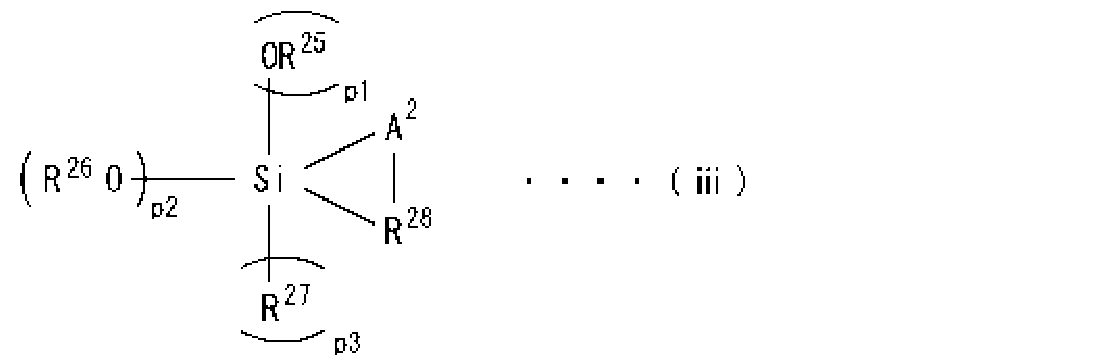
A2は、NRa(Raは、一価の炭化水素基、加水分解性基又は含窒素有機基である)である。
R25は、炭素数1~20の一価の脂肪族若しくは脂環式炭化水素基又は炭素数6~18の一価の芳香族炭化水素基である。
R26は、炭素数1~20の一価の脂肪族若しくは脂環式炭化水素基、炭素数6~18の一価の芳香族炭化水素基又は含窒素有機基であり、いずれも窒素原子及び/又はケイ素原子を含有していてもよい。p2が2の場合には、R26は、互いに同一でも異なっていてもよいし、或いは、一緒になって環を形成していてもよい。
R27は、炭素数1~20の一価の脂肪族若しくは脂環式炭化水素基、炭素数6~18の一価の芳香族炭化水素基又はハロゲン原子である。
R28は、炭素数1~20の二価の脂肪族若しくは脂環式炭化水素基又は炭素数6~18の二価の芳香族炭化水素基である。
加水分解性基としては、トリメチルシリル基又はtert-ブチルジメチルシリル基が好ましく、トリメチルシリル基が特に好ましい。

R31は、炭素数1~20の二価の脂肪族若しくは脂環式炭化水素基又は炭素数6~18の二価の芳香族炭化水素基である。
R32及びR33は、それぞれ独立して、加水分解性基、炭素数1~20の一価の脂肪族若しくは脂環式炭化水素基又は炭素数6~18の一価の芳香族炭化水素基である。
R34は、炭素数1~20の一価の脂肪族若しくは脂環式炭化水素基又は炭素数6~18の一価の芳香族炭化水素基であり、q1が2の場合には同一でも異なっていてもよい。
R35は、炭素数1~20の一価の脂肪族若しくは脂環式炭化水素基又は炭素数6~18の一価の芳香族炭化水素基であり、q2が2以上の場合には同一でも異なっていてもよい。
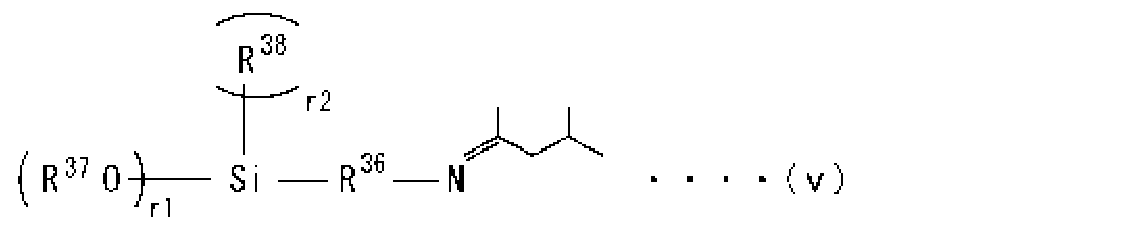
R36は、炭素数1~20の二価の脂肪族若しくは脂環式炭化水素基又は炭素数6~18の二価の芳香族炭化水素基である。
R37は、ジメチルアミノメチル基、ジメチルアミノエチル基、ジエチルアミノメチル基、ジエチルアミノエチル基、メチルシリル(メチル)アミノメチル基、メチルシリル(メチル)アミノエチル基、メチルシリル(エチル)アミノメチル基、メチルシリル(エチル)アミノエチル基、ジメチルシリルアミノメチル基、ジメチルシリルアミノエチル基、炭素数1~20の一価の脂肪族若しくは脂環式炭化水素基又は炭素数6~18の一価の芳香族炭化水素基であり、r1が2以上の場合には同一でも異なっていてもよい。
R38は、炭素数1~20のヒドロカルビルオキシ基、炭素数1~20の一価の脂肪族若しくは脂環式炭化水素基又は炭素数6~18の一価の芳香族炭化水素基であり、r2が2の場合には同一でも異なっていてもよい。
一般式(v)で表されるアミノアルコキシシラン化合物の具体例としては、N-(1,3-ジメチルブチリデン)-3-トリエトキシシリル-1-プロパンアミンが挙げられる。
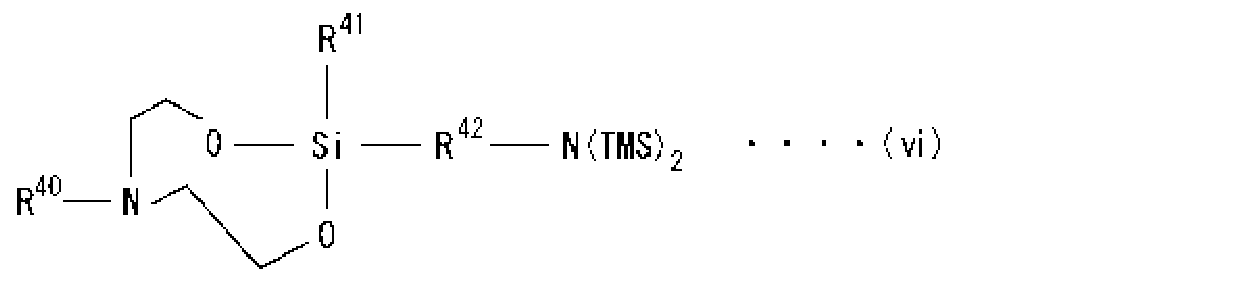
R41は、炭素数1~20のヒドロカルビルオキシ基、炭素数1~20の一価の脂肪族若しくは脂環式炭化水素基又は炭素数6~18の一価の芳香族炭化水素基である。
R42は、炭素数1~20の二価の脂肪族若しくは脂環式炭化水素基又は炭素数6~18の二価の芳香族炭化水素基である。
ここで、TMSは、トリメチルシリル基を示す(以下、同じ。)。

R45は、炭素数1~20の一価の脂肪族若しくは脂環式炭化水素基又は炭素数6~18の一価の芳香族炭化水素基であり、各R45は、同一でも異なっていてもよい。
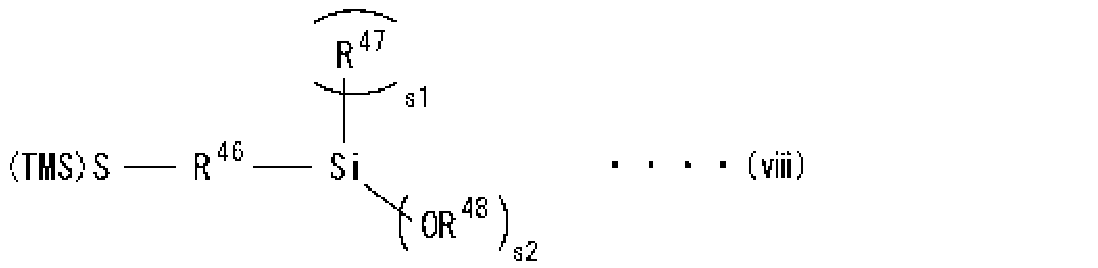
R46は、炭素数1~20の二価の脂肪族若しくは脂環式炭化水素基又は炭素数6~18の二価の芳香族炭化水素基である。
R47及びR48は、それぞれ独立して炭素数1~20の一価の脂肪族若しくは脂環式炭化水素基又は炭素数6~18の一価の芳香族炭化水素基である。複数のR47又はR48は、同一でも異なっていてもよい。
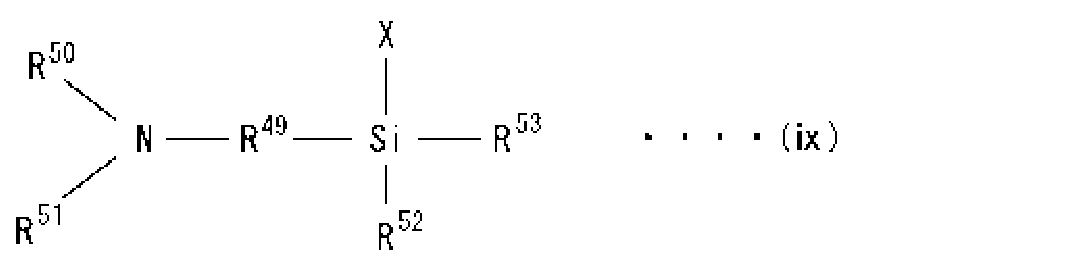
R49は、炭素数1~20の二価の脂肪族若しくは脂環式炭化水素基又は炭素数6~18の二価の芳香族炭化水素基である。
R50及びR51は、それぞれ独立して加水分解性基、炭素数1~20の一価の脂肪族若しくは脂環式炭化水素基又は炭素数6~18の一価の芳香族炭化水素基であるか、或いは、R50及びR51は結合して二価の有機基を形成している。
R52及びR53は、それぞれ独立してハロゲン原子、ヒドロカルビルオキシ基、炭素数1~20の一価の脂肪族若しくは脂環式炭化水素基又は炭素数6~18の一価の芳香族炭化水素基である。
R50及びR51としては、加水分解性基が好ましく、加水分解性基として、トリメチルシリル基、tert-ブチルジメチルシリル基が好ましく、トリメチルシリル基が特に好ましい。
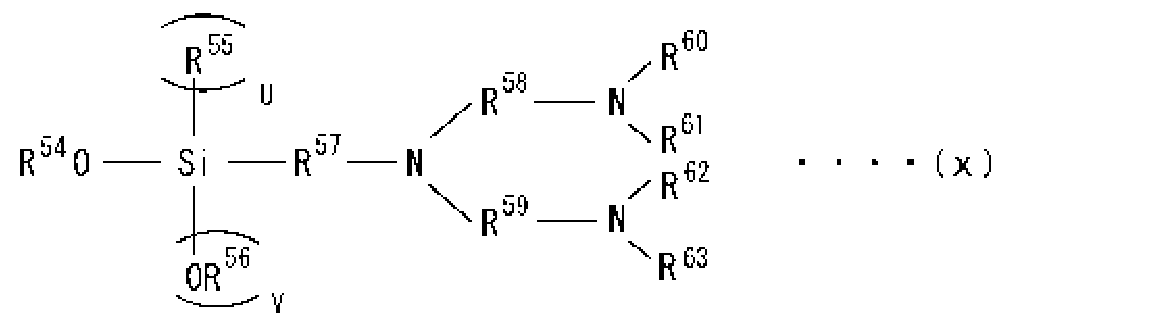
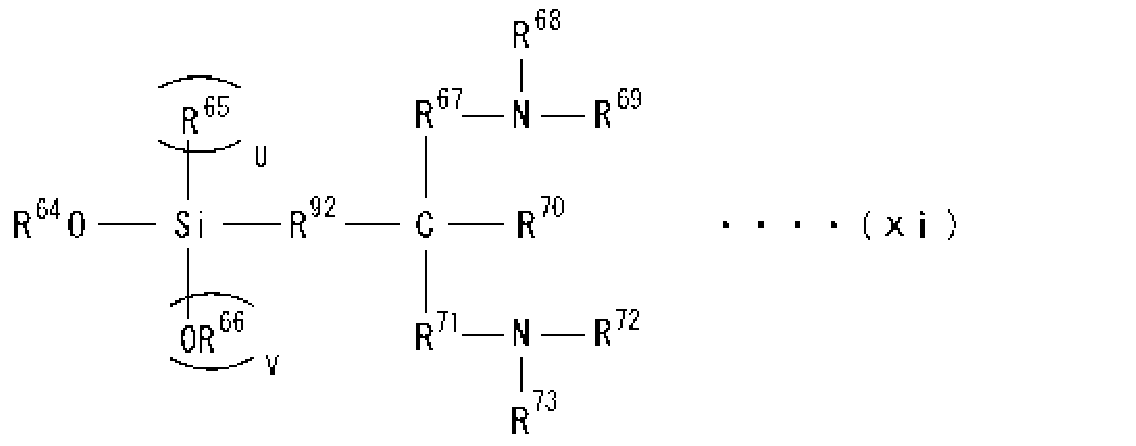
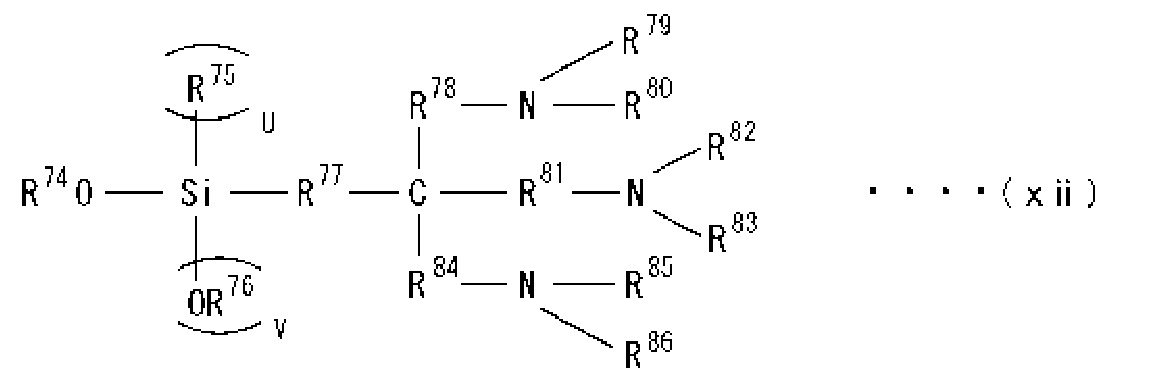

一般式(x)~(xiii)中のR54~92は、同一でも異なっていてもよく、炭素数1~20の一価若しくは二価の脂肪族又は脂環式炭化水素基、或いは炭素数6~18の一価若しくは二価の芳香族炭化水素基である。
一般式(xiii)中のα及びβは、0~5の整数である。
また、一般式(xiii)を満たす化合物の中でも、特に、N,N-ジメチル-2-(3-(ジメトキシメチルシリル)プロポキシ)エタンアミン、N,N-ビス(トリメチルシリル)-2-(3-(トリメトキシシリル)プロポキシ)エタンアミン、N,N-ジメチル-2-(3-(トリメトキシシリル)プロポキシ)エタンアミン、N,N-ジメチル-3-(3-(トリメトキシシリル)プロポキシ)プロパン-1-アミンが好ましい。
前記スチレン-ブタジエンゴム(SBR)は、下記一般式(I)で表されるカップリング剤によって変性されていることも好ましい。この場合、ゴム組成物を適用したタイヤの低燃費性能と耐摩耗性能とを更に向上させることができる。
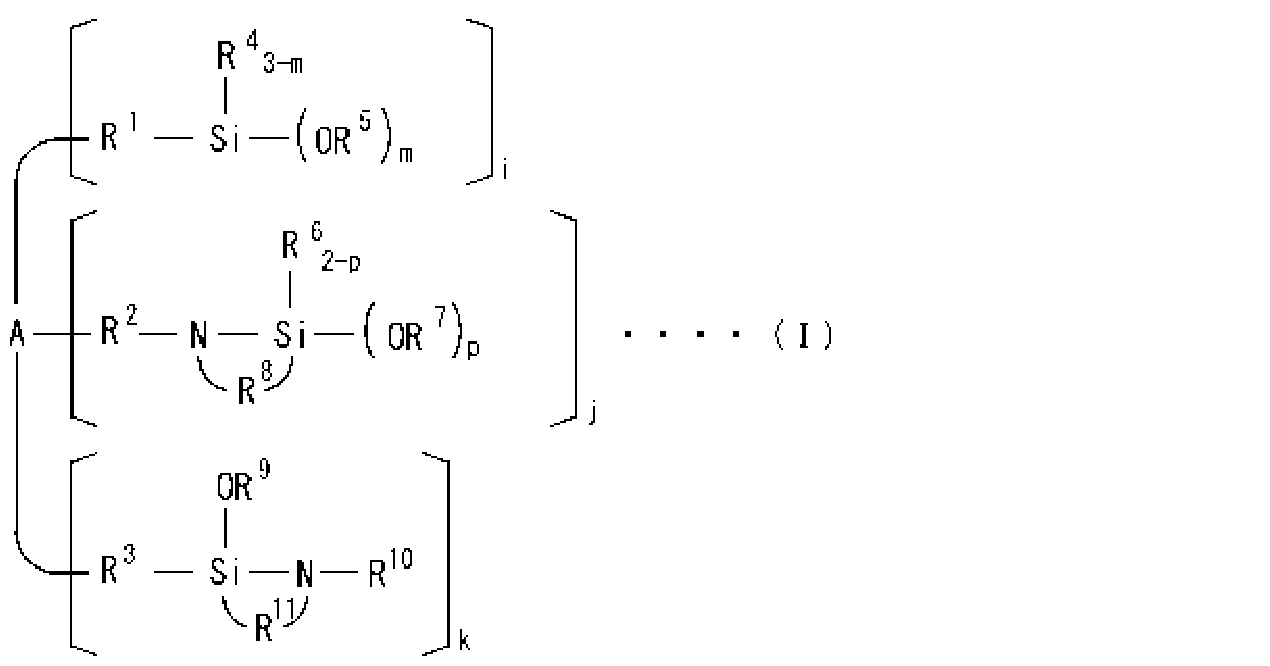
R4、R5、R6、R7及びR9は、それぞれ独立して炭素数1~20のアルキル基を示す。
R8及びR11は、それぞれ独立して炭素数1~20のアルキレン基を示す。
R10は、炭素数1~20の、アルキル基又はトリアルキルシリル基を示す。
mは、1~3の整数を示し、pは、1又は2を示す。
R1~R11、m及びpは、複数存在する場合、それぞれ独立している。
i、j及びkは、それぞれ独立して0~6の整数を示す。但し、(i+j+k)は、3~10の整数である。
Aは、炭素数1~20の、炭化水素基、又は、酸素原子、窒素原子、ケイ素原子、硫黄原子及びリン原子からなる群から選択される少なくとも一種の原子を有し、活性水素を有しない有機基を示す。
ここで、一般式(I)中、Aが示す炭化水素基は、飽和、不飽和、脂肪族、及び芳香族の炭化水素基を包含する。活性水素を有しない有機基としては、例えば、水酸基(-OH)、第2級アミノ基(>NH)、第1級アミノ基(-NH2)、スルフヒドリル基(-SH)等の活性水素を有する官能基、を有しない有機基が挙げられる。
前記収縮因子(g’)は、好ましくは0.64未満であり、より好ましくは0.63以下であり、より好ましくは0.60以下であり、更に好ましくは0.59以下であり、より一層好ましくは0.57以下である。また、収縮因子(g’)の下限は、特に限定されず、検出限界値以下であってもよいが、好ましくは0.30以上であり、より好ましくは0.33以上であり、更に好ましくは0.35以上であり、より一層好ましくは0.45以上である。収縮因子(g’)がこの範囲である変性スチレン-ブタジエンゴムを使用することで、ゴム組成物の加工性が向上する。
収縮因子(g’)は分岐度に依存する傾向にあるため、例えば、分岐度を指標として収縮因子(g’)を制御することができる。具体的には、分岐度が6である変性スチレン-ブタジエンゴムとした場合には、その収縮因子(g’)は0.59以上0.63以下となる傾向にあり、分岐度が8である変性スチレン-ブタジエンゴムとした場合には、その収縮因子(g’)は0.45以上0.59以下となる傾向にある。
また、前記変性スチレン-ブタジエンゴムは、分岐を有し、分岐度が6以上であることがより好ましい。また、変性スチレン-ブタジエンゴムは、1以上のカップリング残基と、該カップリング残基に対して結合するスチレン-ブタジエン共重合体鎖とを有し、更に、上記分岐が、1の当該カップリング残基に対して6以上の当該スチレン-ブタジエン共重合体鎖が結合している分岐を含むことが、更に好ましい。分岐度が6以上であること、及び、分岐が、1のカップリング残基に対して6以上のスチレン-ブタジエン共重合体鎖が結合している分岐を含むよう、変性スチレン-ブタジエンゴムの構造を特定することにより、収縮因子(g’)を0.63以下にすることができる。
更に、前記変性スチレン-ブタジエンゴムは、分岐を有し、分岐度が7以上であることが更に好ましく、分岐度が8以上であることがより一層好ましい。分岐度の上限は、特に限定されないが、18以下であることが好ましい。また、変性スチレン-ブタジエンゴムは、1以上のカップリング残基と、該カップリング残基に対して結合するスチレン-ブタジエン共重合体鎖とを有し、更に、上記分岐が、1の当該カップリング残基に対して7以上の当該スチレン-ブタジエン共重合体鎖が結合している分岐を含むことが、より一層好ましく、1の当該カップリング残基に対して8以上の当該スチレン-ブタジエン共重合体鎖が結合している分岐を含むことが、特に好ましい。分岐度が8以上であること、及び、分岐が、1のカップリング残基に対して8以上のスチレン-ブタジエン共重合体鎖が結合している分岐を含むよう、変性スチレン-ブタジエンゴムの構造を特定することにより、収縮因子(g’)を0.59以下にすることができる。
なお、本明細書において、ゴム成分の「分子量」とは、GPC(ゲルパーミエーションクロマトグラフィー)によって得られる、標準ポリスチレン換算分子量である。特定の高分子量成分の含有量がこのような範囲にある変性スチレン-ブタジエンゴムを得るためには、後述する重合工程と反応工程とにおける反応条件を制御することが好ましい。例えば、重合工程においては、後述する有機モノリチウム化合物の重合開始剤としての使用量を調整すればよい。また、重合工程において、連続式、及び回分式のいずれの重合様式においても、滞留時間分布を有する方法を用いる、即ち、成長反応の時間分布を広げるとよい。
前記スチレン-ブタジエン共重合体は、1,3-ブタジエンとスチレンを共重合して得られる。
前記有機モノリチウム化合物は、工業的入手の容易さ及び重合反応のコントロールの容易さの観点から、好ましくは、アルキルリチウム化合物である。この場合、重合開始末端にアルキル基を有する、スチレン-ブタジエン共重合体が得られる。アルキルリチウム化合物としては、例えば、n-ブチルリチウム、sec-ブチルリチウム、tert-ブチルリチウム、n-ヘキシルリチウム、ベンジルリチウム、フェニルリチウム、及びスチルベンリチウムが挙げられる。アルキルリチウム化合物としては、工業的入手の容易さ及び重合反応のコントロールの容易さの観点から、n-ブチルリチウム、及びsec-ブチルリチウムが好ましい。これらの有機モノリチウム化合物は、1種単独で用いてもよいし、2種以上を組み合わせて用いてもよい。
前記極性化合物としては、例えば、テトラヒドロフラン、ジエチルエーテル、ジオキサン、エチレングリコールジメチルエーテル、エチレングリコールジブチルエーテル、ジエチレングリコールジメチルエーテル、ジエチレングリコールジブチルエーテル、ジメトキシベンゼン、2,2-ビス(2-オキソラニル)プロパン等のエーテル類;テトラメチルエチレンジアミン、ジピペリジノエタン、トリメチルアミン、トリエチルアミン、ピリジン、キヌクリジン等の第3級アミン化合物;カリウム-tert-アミラート、カリウム-tert-ブチラート、ナトリウム-tert-ブチラート、ナトリウムアミラート等のアルカリ金属アルコキシド化合物;トリフェニルホスフィン等のホスフィン化合物等を用いることができる。これらの極性化合物は、1種単独で用いてもよいし、2種以上を組み合わせて用いてもよい。
また、前記スチレン-ブタジエン共重合体又は変性スチレン-ブタジエンゴム中の結合スチレン量は、特に限定されないが、0質量%超60質量%以下であることが好ましく、20質量%以上45質量%以下であることがより好ましい。
前記結合ブタジエン量及び結合スチレン量が上記範囲であると、ゴム組成物の低ロス性と耐摩耗性能とを更に向上させることができる。
なお、結合スチレン量は、フェニル基の紫外吸光によって測定でき、ここから結合ブタジエン量も求めることができる。
なお、変性スチレン-ブタジエンゴムについては、ハンプトンの方法[R.R.Hampton,Analytical Chemistry,21,923(1949)]により、ブタジエン結合単位中のビニル結合量(1,2-結合量)を求めることができる。
前記反応工程における反応時間は、好ましくは10秒以上であり、より好ましくは30秒以上である。重合工程の終了時から反応工程の開始時までの時間は、カップリング率の観点から、より短い方が好ましいが、より好ましくは5分以内である。
反応工程における混合は、機械的な攪拌、スタティックミキサーによる攪拌等のいずれでもよい。重合工程が連続式である場合は、反応工程も連続式であることが好ましい。反応工程における反応器は、例えば、撹拌機付きの槽型、管型のものが用いられる。カップリング剤は、不活性溶媒により希釈して反応器に連続的に供給してもよい。重合工程が回分式の場合は、重合反応器にカップリング剤を投入する方法でも、別の反応器に移送して反応工程を行ってもよい。

前記一般式(II)中、B1は、単結合又は炭素数1~20の炭化水素基を示し、aは、1~10の整数を示す。複数存在する場合のB1は、各々独立している。


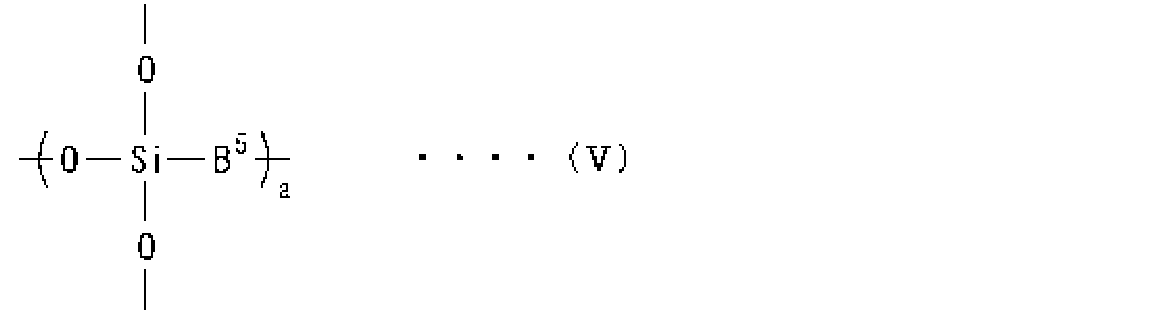
より好ましくは、前記一般式(I)において、Aは、前記一般式(II)又は(III)で表され、kは、0を示し、前記一般式(II)又は(III)において、aは、2~10の整数を示す。
より一層好ましくは、前記一般式(I)において、Aは、前記一般式(II)で表され、kは、0を示し、前記一般式(II)において、aは、2~10の整数を示す。
かかるカップリング剤としては、例えば、ビス(3-トリメトキシシリルプロピル)-[3-(2,2-ジメトキシ-1-アザ-2-シラシクロペンタン)プロピル]アミン、トリス(3-トリメトキシシリルプロピル)アミン、トリス(3-トリエトキシシリルプロピル)アミン、トリス(3-トリメトキシシリルプロピル)-[3-(2,2-ジメトキシ-1-アザ-2-シラシクロペンタン)プロピル]-1,3-プロパンジアミン、テトラキス[3-(2,2-ジメトキシ-1-アザ-2-シラシクロペンタン)プロピル]-1,3-プロパンジアミン、テトラキス(3-トリメトキシシリルプロピル)-1,3-プロパンジアミン、テトラキス(3-トリメトキシシリルプロピル)-1,3-ビスアミノメチルシクロヘキサン、トリス(3-トリメトキシシリルプロピル)-メチル-1,3-プロパンジアミン、ビス[3-(2,2-ジメトキシ-1-アザ-2-シラシクロペンタン)プロピル]-(3-トリスメトキシシリルプロピル)-メチル-1,3-プロパンジアミン等が挙げられ、これらの中でも、テトラキス(3-トリメトキシシリルプロピル)-1,3-プロパンジアミン、テトラキス(3-トリメトキシシリルプロピル)-1,3-ビスアミノメチルシクロヘキサンが特に好ましい。
前記変性スチレン-ブタジエンゴムのGPCによるピーク分子量をMp1、スチレン-ブタジエン共重合体のピーク分子量をMp2とした場合、以下の式が成り立つことが好ましい。
(Mp1/Mp2)<1.8×10-12×(Mp2-120×104)2+2
Mp2は、20×104以上80×104以下、Mp1は30×104以上150×104以下がより好ましい。Mp1及びMp2は、後述する実施例に記載の方法により求める。
また、前記変性スチレン-ブタジエンゴムは、重合後のゲル生成を防止する観点、及び加工時の安定性を向上させる観点から、例えば、2,6-ジ-tert-ブチル-4-ヒドロキシトルエン(BHT)、n-オクタデシル-3-(4’-ヒドロキシ-3’,5’-ジ-tert-ブチルフェノール)プロピネート、2-メチル-4,6-ビス[(オクチルチオ)メチル]フェノール等の酸化防止剤を添加することが好ましい。
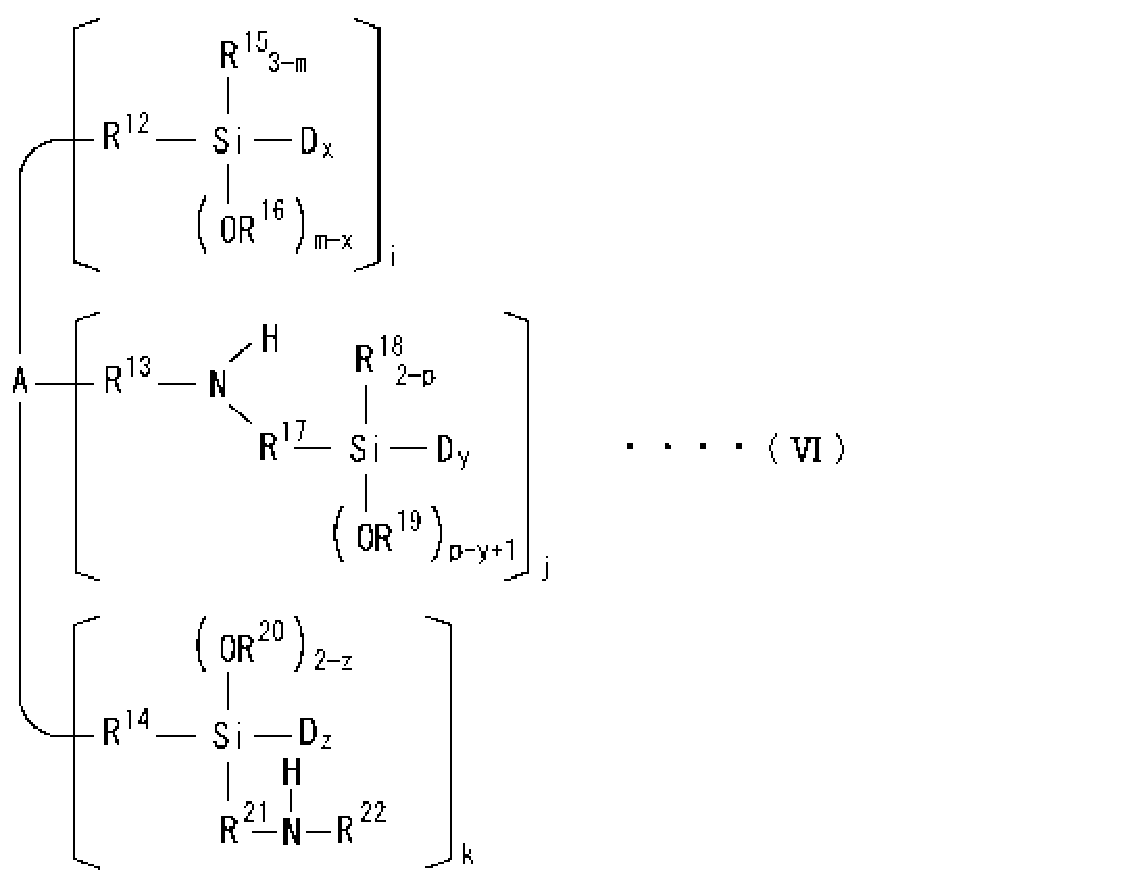
R12、R13及びR14は、各々独立に、単結合又は炭素数1~20のアルキレン基を示す。
R15及びR18は、各々独立に、炭素数1~20のアルキル基を示す。
R16、R19、及びR20は、各々独立に、水素原子又は炭素数1~20のアルキル基を示す。
R17及びR21は、各々独立に、炭素数1~20のアルキレン基を示す。
R22は、水素原子又は炭素数1~20のアルキル基を示す。
m及びxは、1~3の整数を示し、x≦mであり、pは、1又は2を示し、yは1~3の整数を示し、y≦(p+1)であり、zは、1又は2の整数を示す。
それぞれ複数存在する場合のD、R12~R22、m、p、x、y、及びzは、各々独立しており、同じであっても異なっていてもよい。
また、iは、0~6の整数を示し、jは0~6の整数を示し、kは0~6の整数を示し、(i+j+k)は3~10の整数であり、((x×i)+(y×j)+(z×k))は、5~30の整数である。
Aは、炭素数1~20の炭化水素基、又は、酸素原子、窒素原子、ケイ素原子、硫黄原子、及びリン原子からなる群より選ばれる少なくとも1種の原子を有し、かつ、活性水素を有しない有機基を示す。Aが示す炭化水素基は、飽和、不飽和、脂肪族、及び芳香族の炭化水素基を包含する。上記活性水素を有しない有機基としては、例えば、水酸基(-OH)、第2級アミノ基(>NH)、第1級アミノ基(-NH2)、スルフヒドリル基(-SH)等の活性水素を有する官能基、を有しない有機基が挙げられる。
前記スチレン-ブタジエンゴム(SBR)は、少なくとも一方の末端が以下の一般式(1)で表される化合物(アルコキシシラン)を含む変性剤で変性されていることも好ましい。
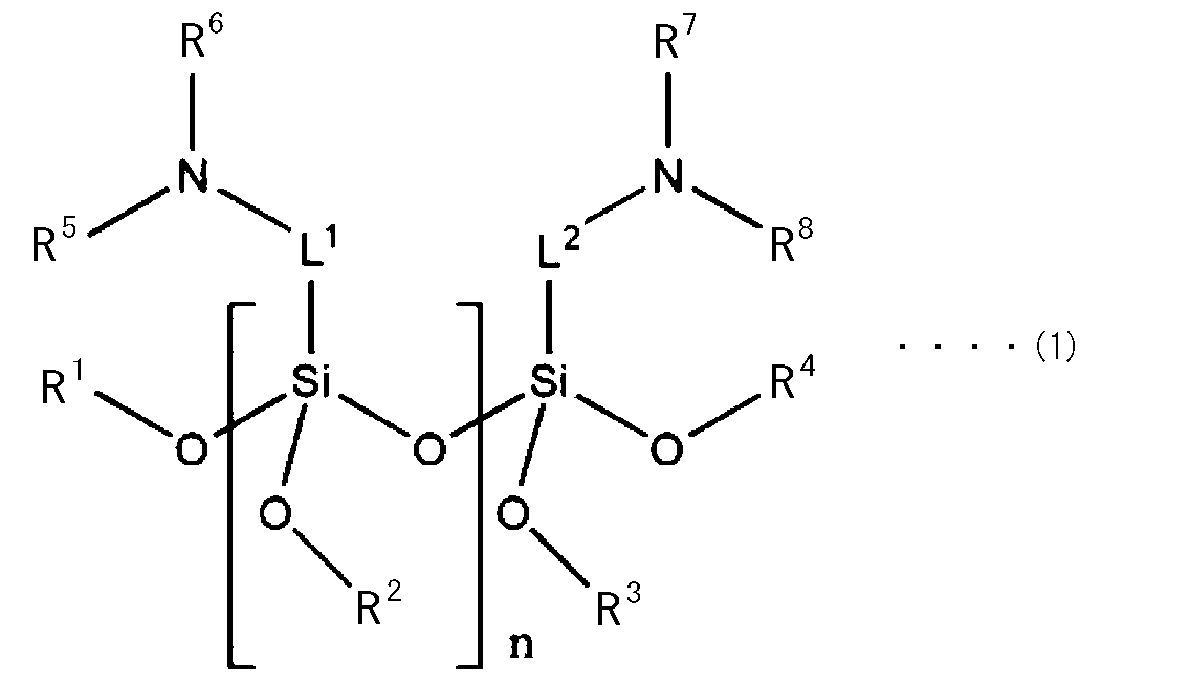
より具体的には、前記R1~R4は、置換又は非置換の炭素数1~10のアルキル基であってもよく、さらに具体的には、前記R1~R4は、それぞれ独立して置換又は非置換の、炭素数1~6のアルキル基であってもよい。
なお、前記R5~R8がアルキル基ではなく、加水分解可能な置換基の場合、N-R5R6及びN-R7R8の結合が水分存在下でN-Hに加水分解され、重合体の加工性に悪影響を及ぼし得る。
なお、前記R5~R8にアミノ基を保護するための保護基が結合するか、又は、水素が結合する場合には、前記式(1)で表される化合物による効果の具現が難しい可能性がある。水素が結合する場合、変性過程で陰イオンが水素と反応して反応性を失うようになって変性反応自体が不可能となり、保護基が結合する場合、変性反応が行われるが、重合体末端に結合した状態で後加工時に加水分解によって脱保護されて1級又は2級アミノ基になり、脱保護された1級又は2級アミノ基は、その後の配合時に配合物の高粘度化を引き起こし、加工性低下の原因になるおそれがある。
より具体的には、L1及びL2は、それぞれ独立して炭素数1~10のアルキレン基、更に具体的には、メチレン基、エチレン基又はプロピレン基のような炭素数1~6のアルキレン基とすることができる。
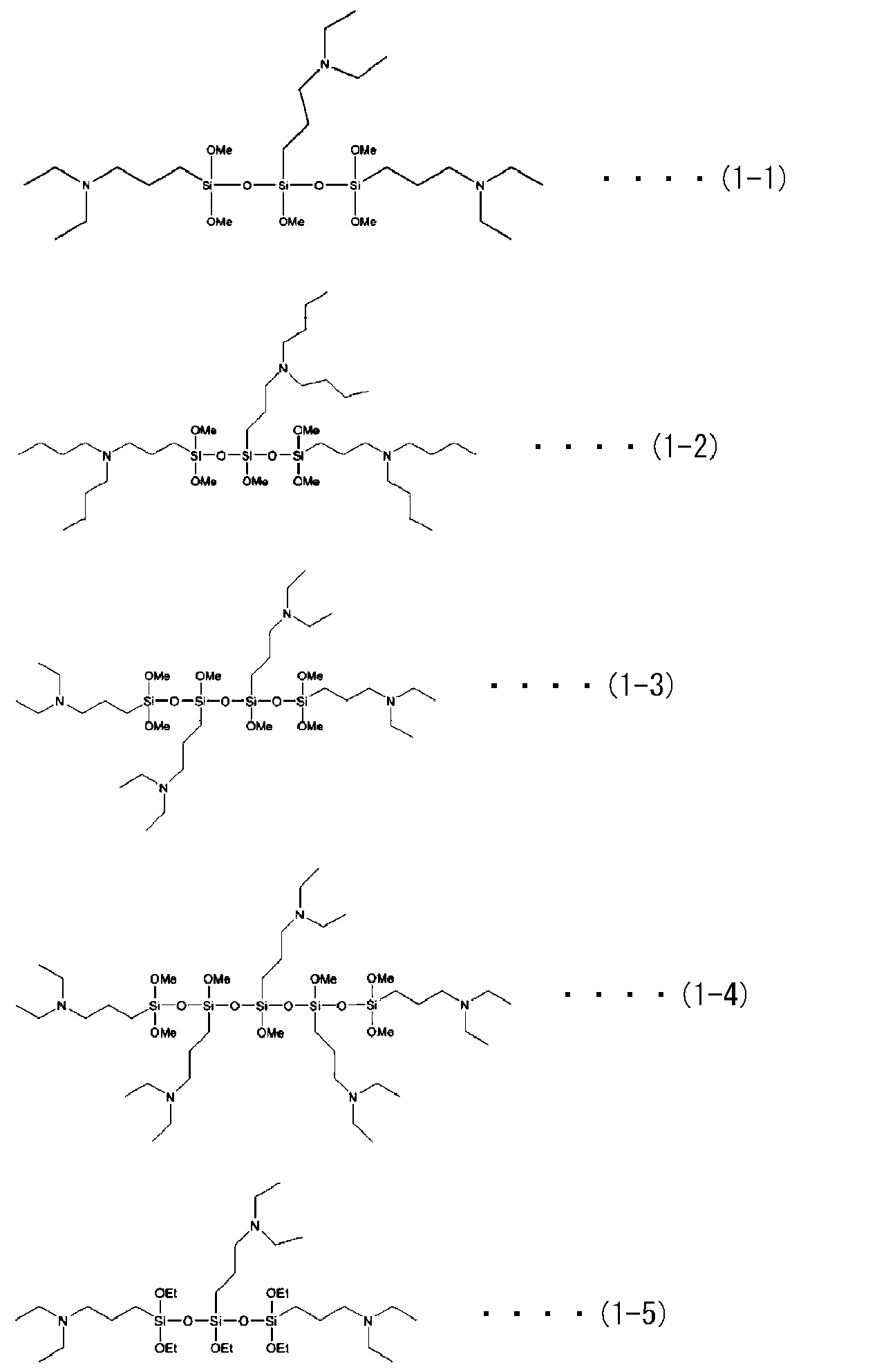

また、前記重量平均分子量及び数平均分子量は、それぞれゲル透過型クロマトグラフィ(GPC)で分析されるポリスチレン換算分子量である。
前記変性スチレン-ブタジエンゴムの重量平均分子量(Mw)が100,000g/mol未満であるか、又は数平均分子量(Mn)が50,000g/mol未満の場合、ゴム組成物に適用する際の引張特性の低下のおそれがある。また、重量平均分子量(Mw)が4,000,000g/molを超えているか、数平均分子量(Mn)が2,000,000g/molを超える場合には、変性スチレン-ブタジエンゴムの加工性の低下によりゴム組成物の作業性が悪化し、混練が困難となり、また、ゴム組成物の物性を十分に向上させることが難しくなることがある。
より具体的には、前記変性スチレン-ブタジエンゴムは、前記分子量分布とともに、重量平均分子量(Mw)及び数平均分子量(Mn)の条件を同時に満たしている場合には、ゴム組成物に適用した場合、ゴム組成物の粘弾性と加工性をバランスよく改善させることができる。
前記ムーニー粘度は、ムーニー粘度計、例えば、Monsanto社のMV2000Eで、100℃、ローター速度2±0.02rpmで、大ローターを使って測定することができる。このとき用いられた試料は、室温(23±3℃)で30分以上放置した後、27±3gを採取して、ダイキャビティの内部に満たしておき、プラテンを作動させて測定することができる。

また、式(2)において、R12は、単結合;置換基で置換又は非置換の炭素数1~20のアルキレン基;置換基で置換又は非置換の炭素数5~20のシクロアルキレン基;又は置換基で置換又は非置換の炭素数5~20のアリーレン基であり、ここで、上記置換基は、炭素数1~10のアルキル基、炭素数5~10のシクロアルキル基、又は炭素数6~20のアリール基である。
また、式(2)において、R13は、炭素数1~30のアルキル基;炭素数2~30のアルケニル基;炭素数2~30のアルキニル基;炭素数1~30のヘテロアルキル基;炭素数2~30のヘテロアルケニル基;炭素数2~30のヘテロアルキニル基;炭素数5~30のシクロアルキル基;炭素数6~30のアリール基;炭素数3~30の複素環基;又は下記一般式(2a)若しくは一般式(2b)で表される作用基であり、mは1~5の整数であり、R13のうち少なくとも1つは、下記一般式(2a)若しくは一般式(2b)で表される作用基であり、mが2~5の整数の場合、複数のR13は、互いに同一であっても、異なってもよい。
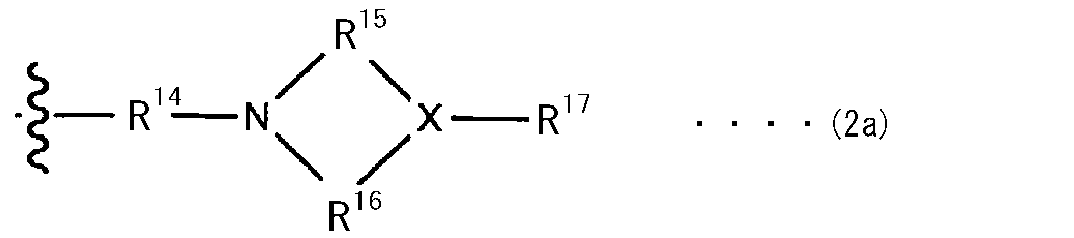
また、式(2a)において、R15及びR16は、互いに独立に、炭素数1~10のアルキル基、炭素数5~10のシクロアルキル基、又は炭素数6~20のアリール基で置換又は非置換の炭素数1~20のアルキレン基である。
また、式(2a)において、R17は、水素;炭素数1~30のアルキル基;炭素数2~30のアルケニル基;炭素数2~30のアルキニル基;炭素数1~30のヘテロアルキル基;炭素数2~30のヘテロアルケニル基;炭素数2~30のヘテロアルキニル基;炭素数5~30のシクロアルキル基;炭素数6~30のアリール基;炭素数3~30の複素環基であり、Xは、N、O又はS原子であり、但し、XがO又はSである場合、R17は存在しない。
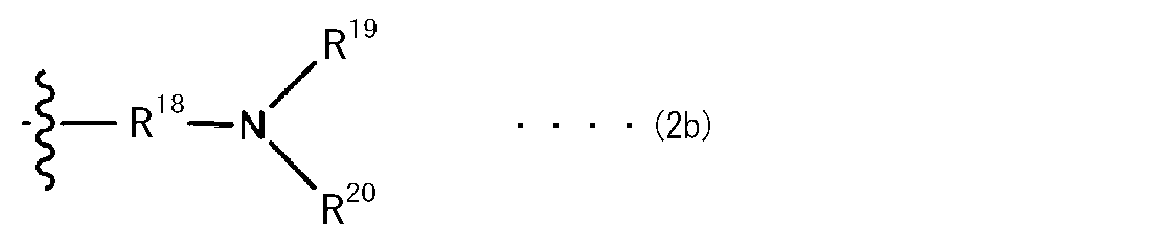
また、式(2b)において、R19及びR20は、互いに独立に、炭素数1~30のアルキル基;炭素数2~30のアルケニル基;炭素数2~30のアルキニル基;炭素数1~30のヘテロアルキル基;炭素数2~30のヘテロアルケニル基;炭素数2~30のヘテロアルキニル基;炭素数5~30のシクロアルキル基;炭素数6~30のアリール基;炭素数3~30の複素環基である。
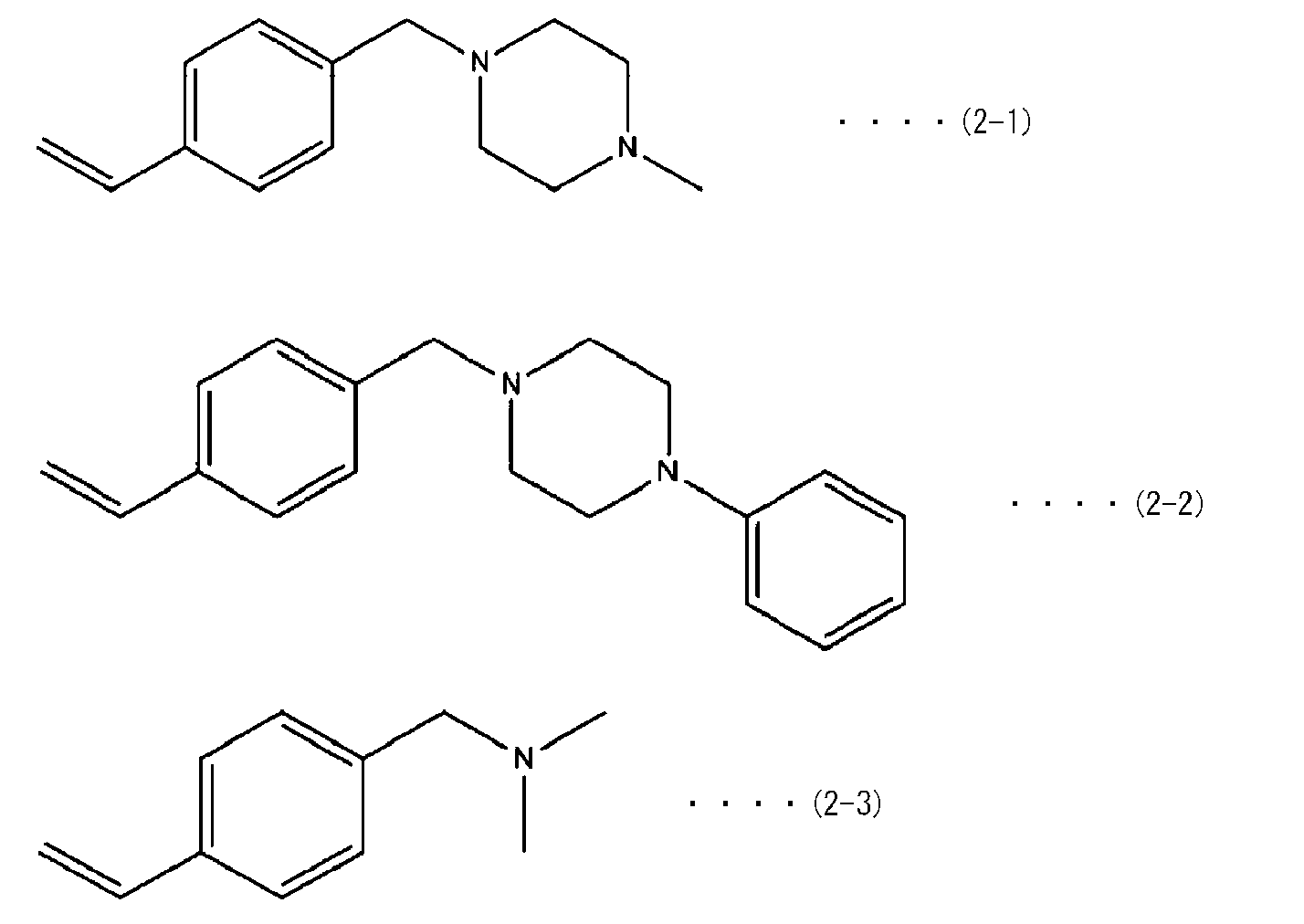
具体的には、例えば、炭化水素溶媒中で、式(2)で表される化合物を含む変性剤の存在下にて、ブタジエン単量体及びスチレン単量体を重合させることで、式(2)で表される化合物由来の変性基を、前記スチレン-ブタジエン共重体に付与することができる。
本発明のタイヤ用ゴム組成物は、補強性充填剤(B)を含有する。補強性充填剤(B)を含有することで、ゴム組成物の補強性が向上する。補強性充填剤(B)としては、例えば、シリカ、カーボンブラック、クレー、タルク、炭酸カルシウム、水酸化アルミニウム等が挙げられる。補強性充填剤(B)は、1種単独で用いてもよいし、2種以上を組み合わせて用いてもよい。
本発明のタイヤ用ゴム組成物は、樹脂成分(C)を含有する。該樹脂成分(C)は、少なくとも部分的に水素添加されており、且つ、上述したイソプレン系ゴム(A)とのSP値の差が1.40(cal/cm3)1/2以下である。かかる樹脂成分(C)は、イソプレン系ゴム(A)に対する相溶性が高くなり、ゴム成分の運動性が制御され、低温領域のヒステリシスロス(tanδ)を向上させることができるため、ゴム組成物を適用したタイヤの基本的なウェットグリップ性能が向上する。なお、樹脂成分(C)とイソプレン系ゴム(A)とのSP値の差は、相溶性をより向上させる観点から、1.35(cal/cm3)1/2以下であることが好ましく、0.50(cal/cm3)1/2以下であることがより好ましく、0.45(cal/cm3)1/2以下であることが更に好ましく、0.3(cal/cm3)1/2以下であることが一層好ましく、0.25(cal/cm3)1/2以下であることが特に好ましい。
水素添加されている樹脂成分(C)の原料となる樹脂としては、C5系樹脂、C5-C9系樹脂、C9系樹脂、テルペン系樹脂、ジシクロペンタジエン系樹脂、テルペン-芳香族化合物系樹脂等が挙げられ、これら樹脂は、1種単独で用いてもよいし、2種以上を組み合わせて用いてもよい。
C5留分には、通常1-ペンテン、2-ペンテン、2-メチル-1-ブテン、2-メチル-2-ブテン、3-メチル-1-ブテン等のオレフィン系炭化水素、2-メチル-1,3-ブタジエン、1,2-ペンタジエン、1,3-ペンタジエン、3-メチル-1,2-ブタジエン等のジオレフィン系炭化水素等が含まれる。なお、C5系樹脂は、市販品を利用することができる。
C5-C9系樹脂としては、C9以上の成分の少ない樹脂が、ゴム成分との相溶性の観点から好ましい。ここで、「C9以上の成分が少ない」とは、樹脂全量中のC9以上の成分が50質量%未満、好ましくは40質量%以下であることを言うものとする。C5-C9系樹脂は、市販品を利用することができる。
C9系樹脂としては、例えば、インデン、α-メチルスチレン、ビニルトルエン等を主成分とする共重合体等が挙げられる。
ここで、樹脂全量中のジシクロペンタジエン由来成分が50質量%以上の場合、C5-DCPD系樹脂はジシクロペンタジエン系樹脂に含まれるものとする。樹脂全量中のジシクロペンタジエン由来成分が50質量%未満の場合、C5-DCPD系樹脂はC5系樹脂に含まれるものとする。更に第三成分等が少量含まれる場合でも同様である。
なお、スチレン系熱可塑性エラストマー(TPS)は、熱可塑性である一方、前記ゴム成分(好ましくは、ジエン系ゴム)は、熱可塑性ではない。そのため、本明細書においては、スチレン系熱可塑性エラストマー(TPS)は、前記ゴム成分に含めないものとする。スチレン系熱可塑性エラストマー(TPS)の含有量は、前記ゴム成分100質量部に対して1~30質量部の範囲が好ましい。
本発明のタイヤ用ゴム組成物は、既述のゴム成分、補強性充填剤(B)、樹脂成分(C)、スチレン系熱可塑性エラストマーのほか、必要に応じて、ゴム工業界で通常使用される各種成分、例えば、シランカップリング剤、老化防止剤、ワックス、軟化剤、加工助剤、ステアリン酸、酸化亜鉛(亜鉛華)、加硫促進剤、加硫剤等を、本発明の目的を害しない範囲内で適宜選択して含有していてもよい。これら配合剤としては、市販品を好適に使用することができる。
前記ゴム組成物の製造方法は、特に限定されるものではないが、例えば、既述のゴム成分、補強性充填剤(B)及び樹脂成分(C)に、必要に応じて適宜選択した各種成分を配合して、混練り、熱入れ、押出等することにより製造することができる。また、得られたゴム組成物を加硫することで、加硫ゴムとすることができる。
本発明のトレッドゴムは、上記のタイヤ用ゴム組成物からなることを特徴とする。かかる本発明のトレッドゴムは、上記のタイヤ用ゴム組成物からなるため、タイヤに適用することで、タイヤの密粒度アスファルト舗装におけるウェットグリップ性及びポーラスアスファルト舗装におけるウェットグリップ性を優れたものとし、路面ロバスト性を高めることができる。
なお、本発明のトレッドゴムは、新品タイヤに適用してもよいし、更生タイヤに適用してもよい。
本発明のタイヤは、上記のトレッドゴムを備えることを特徴とする。かかる本発明のタイヤは、上記のトレッドゴムを備えるため、密粒度アスファルト舗装におけるウェットグリップ性及びポーラスアスファルト舗装におけるウェットグリップ性の双方に優れ、路面ロバスト性が高い。
ゴム成分のガラス転移温度(Tg)及びスチレン-ブタジエンゴムの結合スチレン量は、以下の方法で測定した。また、天然ゴム(イソプレン系ゴム(A))及びスチレン-ブタジエンゴムのSP値(溶解度パラメータ)は、Fedors法に従って、算出した。
ゴム成分を試料として、TAインスツルメンツ社製DSC250を用い、ヘリウム50mL/分の流通下、-100℃から20℃/分で昇温しながらDSC曲線を記録し、DSC微分曲線のピークトップ(Inflection point)をガラス転移温度とした。
合成したスチレン-ブタジエンゴムを試料として、試料100mgを、クロロホルムで100mLにメスアップし、溶解して測定サンプルとした。スチレンのフェニル基による紫外線吸収波長(254nm付近)の吸収量により、試料100質量%に対しての結合スチレン量(質量%)を測定した。なお、測定装置として、島津製作所社製の分光光度計「UV-2450」を用いた。
樹脂成分の軟化点、重量平均分子量は、以下の方法で測定した。また、樹脂成分のSP値(溶解度パラメータ)は、Fedors法に従って、算出した。
樹脂成分の軟化点は、JIS-K2207-1996(環球法)に準拠して測定した。
以下の条件で、ゲル透過クロマトグラフィー(GPC)により、水添樹脂の平均分子量を測定し、ポリスチレン換算の重量平均分子量を算出した。
・カラム温度:40℃
・注入量:50μL
・キャリアー及び流速:テトラヒドロフラン 0.6mL/min
・サンプル調製:樹脂成分約2.5mgをテトラヒドロフラン10mLに溶解
表1に示す配合処方に従って、各成分を配合して混練し、実施例及び比較例のゴム組成物を調製した。
得られた実施例及び比較例のゴム組成物を加硫し、加硫ゴム試験片を得た。得られた加硫ゴム試験片に対して、以下の方法で、ウェットグリップ性能を評価した。
ポータブル・フリクション・テスターを用いて、密粒度アスファルト舗装及びポーラスアスファルト舗装に対する試験片の摩擦係数をそれぞれ測定した。評価結果は、比較例1の密粒度アスファルト舗装に対する摩擦係数を100として、指数表示した。また、各例において、密粒度アスファルト舗装の摩擦係数の指数値、及びポーラスアスファルト舗装の摩擦係数の指数値の和を、ウェットグリップ性能の総合指数とした。指数値が大きい程、摩擦係数が大きく、ウェットグリップ性能に優れることを示す。

*2 変性SBR1: 下記の方法で合成したヒドロカルビルオキシシラン化合物変性スチレン-ブタジエンゴム、Tg=-65℃、SP値=8.65(cal/cm3)1/2
*3 変性SBR2:ブチルリチウムを開始剤として得られるスチレン-ブタジエンゴムの末端をN-(1,3-ジメチルブチリデン)-3-トリエトキシシリル-1-プロパンアミンで変性した、変性スチレン-ブタジエンゴム、結合スチレン量=35質量%、Tg=-38℃、SP値=8.95(cal/cm3)1/2
*4 補強性充填剤(B): シリカ、東ソーシリカ株式会社製、商品名「ニップシールAQ」
*5 樹脂成分(C): 水添C5系樹脂、Eastman社製、商品名「登録商標Impera E1780」、軟化点=130℃、重量平均分子量(Mw)=909g/mol、SP値=8.35(cal/cm3)1/2
*6 シランカップリング剤: エボニックデグッサ社製、商品名「Si75」
*7 老化防止剤: 大内新興化学工業株式会社製、商品名「ノクラック6C」
*8 ワックス: 日本精蝋株式会社製、商品名「オゾエース0701」
*9 加硫促進剤1: 大内新興化学工業株式会社製、商品名「ノクセラーDM-P」
*10 加硫促進剤2: 三新化学工業株式会社製、商品名「サンセラーNS-G」
乾燥し、窒素置換した800mLの耐圧ガラス容器に、1,3-ブタジエンのシクロヘキサン溶液及びスチレンのシクロヘキサン溶液を、1,3-ブタジエン67.5g及びスチレン7.5gになるように加え、2,2-ジテトラヒドロフリルプロパン0.09mmolを加え、0.7mmolのn-ブチルリチウムを加えた後、50℃で1.5時間重合を行った。この際の重合転化率がほぼ100%となった重合反応系に対し、変性剤としてN,N-ビス(トリメチルシリル)-3-[ジエトキシ(メチル)シリル]プロピルアミンを0.63mmol添加し、50℃で30分間変性反応を行った。その後、2,6-ジ-t-ブチル-p-クレゾール(BHT)のイソプロパノール5質量%溶液2mLを加えて反応を停止させ、常法に従い乾燥して変性SBR1を得た。
得られた変性SBR1のミクロ構造を測定した結果、結合スチレン量が10質量%であり、また、ガラス転移温度(Tg)は、-65℃であった。
一方、比較例のゴム組成物は、少なくとも、組成パラメータ(P1、P2)の要件を同時に満たしていないため、ウェットグリップ性能が劣ることが分かる。
また、本発明によれば、密粒度アスファルト舗装におけるウェットグリップ性及びポーラスアスファルト舗装におけるウェットグリップ性の双方に優れる、路面ロバスト性の高いタイヤを提供することができる。
Claims (7)
- ガラス転移温度が-50℃以下であるイソプレン系ゴム(A)を含むゴム成分と、補強性充填剤(B)と、樹脂成分(C)と、を含有するタイヤ用ゴム組成物であって、
ゴム成分100質量部中の前記イソプレン系ゴム(A)の割合が、15質量部以上50質量部未満であり、
前記樹脂成分(C)は、少なくとも部分的に水素添加されており、且つ、前記イソプレン系ゴム(A)とのSP値の差が1.40(cal/cm3)1/2以下であり、
ジエン系ゴム成分を100質量部としたときに、下記式(I-1):
組成パラメータP1=(イソプレン系ゴム(A)の質量部数))×(樹脂成分(C)の質量部数) ・・・(I-1)
より算出される組成パラメータP1が1000以上であり、
下記式(I-2):
組成パラメータP2={(樹脂成分(C)の質量部数)/(イソプレン系ゴム(A)の質量部数)}×(ゴム組成物中の補強性充填剤(B)の質量分率) ・・・(I-2)
より算出される組成パラメータP2が0.25以上である、ことを特徴とする、タイヤ用ゴム組成物。 - 前記樹脂成分(C)と前記イソプレン系ゴム(A)とのSP値の差が、0.50(cal/cm3)1/2以下である、請求項1に記載のタイヤ用ゴム組成物。
- 前記補強性充填剤(B)が、シリカを含む、請求項1又は2に記載のタイヤ用ゴム組成物。
- 前記樹脂成分(C)は、軟化点が110℃より高く、ポリスチレン換算の重量平均分子量が200~1600g/molである、請求項1~3のいずれかに記載のタイヤ用ゴム組成物。
- 前記樹脂成分(C)の含有量が、ゴム成分100質量部に対して35質量部以上である、請求項1~4のいずれかに記載のタイヤ用ゴム組成物。
- 請求項1~5のいずれかに記載のタイヤ用ゴム組成物からなることを特徴とする、トレッドゴム。
- 請求項6に記載のトレッドゴムを備えることを特徴とする、タイヤ。
Priority Applications (4)
| Application Number | Priority Date | Filing Date | Title |
|---|---|---|---|
| US18/712,468 US20250034372A1 (en) | 2021-12-14 | 2022-07-04 | Rubber composition for tire, tread rubber, and tire |
| EP22906901.8A EP4450552A4 (en) | 2021-12-14 | 2022-07-04 | TIRE RUBBER COMPOSITION, TREAD RUBBER AND TIRES |
| CN202280082253.0A CN118382666A (zh) | 2021-12-14 | 2022-07-04 | 轮胎用橡胶组合物、胎面橡胶和轮胎 |
| JP2023567525A JP7847155B2 (ja) | 2021-12-14 | 2022-07-04 | タイヤ用ゴム組成物、トレッドゴム及びタイヤ |
Applications Claiming Priority (2)
| Application Number | Priority Date | Filing Date | Title |
|---|---|---|---|
| JP2021202841 | 2021-12-14 | ||
| JP2021-202841 | 2021-12-14 |
Publications (1)
| Publication Number | Publication Date |
|---|---|
| WO2023112364A1 true WO2023112364A1 (ja) | 2023-06-22 |
Family
ID=86774159
Family Applications (1)
| Application Number | Title | Priority Date | Filing Date |
|---|---|---|---|
| PCT/JP2022/026638 Ceased WO2023112364A1 (ja) | 2021-12-14 | 2022-07-04 | タイヤ用ゴム組成物、トレッドゴム及びタイヤ |
Country Status (5)
| Country | Link |
|---|---|
| US (1) | US20250034372A1 (ja) |
| EP (1) | EP4450552A4 (ja) |
| JP (1) | JP7847155B2 (ja) |
| CN (1) | CN118382666A (ja) |
| WO (1) | WO2023112364A1 (ja) |
Cited By (2)
| Publication number | Priority date | Publication date | Assignee | Title |
|---|---|---|---|---|
| WO2025109830A1 (ja) * | 2023-11-24 | 2025-05-30 | 株式会社ブリヂストン | タイヤ用ゴム組成物、タイヤ用トレッドゴム、及びタイヤ |
| WO2025142169A1 (ja) * | 2023-12-26 | 2025-07-03 | 株式会社ブリヂストン | トレッド用ゴム組成物、トレッドゴム、及びタイヤ |
Citations (6)
| Publication number | Priority date | Publication date | Assignee | Title |
|---|---|---|---|---|
| WO2003046020A1 (fr) | 2001-11-27 | 2003-06-05 | Bridgestone Corporation | Polymere dienique conjugue, procede de fabrication et compositions elastomeres contenant ce polymere |
| JP2007177209A (ja) * | 2005-11-29 | 2007-07-12 | Sumitomo Rubber Ind Ltd | ゴム組成物およびそれを用いた空気入りタイヤ |
| JP2007217562A (ja) | 2006-02-16 | 2007-08-30 | Bridgestone Corp | ゴム組成物及びこれを用いたタイヤ |
| WO2016104144A1 (ja) * | 2014-12-24 | 2016-06-30 | 住友ゴム工業株式会社 | 空気入りタイヤ |
| JP2017214493A (ja) * | 2016-05-31 | 2017-12-07 | 株式会社クラレ | ゴム組成物及びタイヤ |
| WO2021125242A1 (ja) * | 2019-12-19 | 2021-06-24 | 株式会社ブリヂストン | ゴム組成物及びタイヤ |
Family Cites Families (6)
| Publication number | Priority date | Publication date | Assignee | Title |
|---|---|---|---|---|
| JP5913188B2 (ja) * | 2013-04-30 | 2016-04-27 | 住友ゴム工業株式会社 | タイヤ用ゴム組成物及び空気入りタイヤ |
| JP6798141B2 (ja) * | 2016-05-11 | 2020-12-09 | 住友ゴム工業株式会社 | 冬用タイヤ |
| JP7331332B2 (ja) * | 2018-01-29 | 2023-08-23 | 住友ゴム工業株式会社 | タイヤ用ゴム組成物およびタイヤ |
| CN117396550A (zh) * | 2021-05-28 | 2024-01-12 | 株式会社普利司通 | 轮胎用橡胶组合物、胎面橡胶和轮胎 |
| JPWO2022249763A1 (ja) * | 2021-05-28 | 2022-12-01 | ||
| JPWO2022249764A1 (ja) * | 2021-05-28 | 2022-12-01 |
-
2022
- 2022-07-04 CN CN202280082253.0A patent/CN118382666A/zh active Pending
- 2022-07-04 WO PCT/JP2022/026638 patent/WO2023112364A1/ja not_active Ceased
- 2022-07-04 JP JP2023567525A patent/JP7847155B2/ja active Active
- 2022-07-04 EP EP22906901.8A patent/EP4450552A4/en active Pending
- 2022-07-04 US US18/712,468 patent/US20250034372A1/en active Pending
Patent Citations (6)
| Publication number | Priority date | Publication date | Assignee | Title |
|---|---|---|---|---|
| WO2003046020A1 (fr) | 2001-11-27 | 2003-06-05 | Bridgestone Corporation | Polymere dienique conjugue, procede de fabrication et compositions elastomeres contenant ce polymere |
| JP2007177209A (ja) * | 2005-11-29 | 2007-07-12 | Sumitomo Rubber Ind Ltd | ゴム組成物およびそれを用いた空気入りタイヤ |
| JP2007217562A (ja) | 2006-02-16 | 2007-08-30 | Bridgestone Corp | ゴム組成物及びこれを用いたタイヤ |
| WO2016104144A1 (ja) * | 2014-12-24 | 2016-06-30 | 住友ゴム工業株式会社 | 空気入りタイヤ |
| JP2017214493A (ja) * | 2016-05-31 | 2017-12-07 | 株式会社クラレ | ゴム組成物及びタイヤ |
| WO2021125242A1 (ja) * | 2019-12-19 | 2021-06-24 | 株式会社ブリヂストン | ゴム組成物及びタイヤ |
Non-Patent Citations (2)
| Title |
|---|
| R.R. HAMPTON, ANALYTICAL CHEMISTRY, vol. 21, 1949, pages 923 |
| See also references of EP4450552A4 |
Cited By (2)
| Publication number | Priority date | Publication date | Assignee | Title |
|---|---|---|---|---|
| WO2025109830A1 (ja) * | 2023-11-24 | 2025-05-30 | 株式会社ブリヂストン | タイヤ用ゴム組成物、タイヤ用トレッドゴム、及びタイヤ |
| WO2025142169A1 (ja) * | 2023-12-26 | 2025-07-03 | 株式会社ブリヂストン | トレッド用ゴム組成物、トレッドゴム、及びタイヤ |
Also Published As
| Publication number | Publication date |
|---|---|
| JPWO2023112364A1 (ja) | 2023-06-22 |
| CN118382666A (zh) | 2024-07-23 |
| EP4450552A1 (en) | 2024-10-23 |
| US20250034372A1 (en) | 2025-01-30 |
| EP4450552A4 (en) | 2025-04-09 |
| JP7847155B2 (ja) | 2026-04-16 |
Similar Documents
| Publication | Publication Date | Title |
|---|---|---|
| JP7478754B2 (ja) | タイヤ | |
| WO2022249763A1 (ja) | タイヤ用ゴム組成物、トレッドゴム及びタイヤ | |
| JP7837960B2 (ja) | タイヤ用ゴム組成物、トレッドゴム及びタイヤ | |
| JP7802783B2 (ja) | タイヤ用ゴム組成物、トレッドゴム及びタイヤ | |
| JP7847155B2 (ja) | タイヤ用ゴム組成物、トレッドゴム及びタイヤ | |
| JP7733011B2 (ja) | ゴム組成物、ゴム組成物の製造方法及びタイヤ | |
| JP7796735B2 (ja) | タイヤ用ゴム組成物、トレッドゴム及びタイヤ | |
| EP4349616B1 (en) | Rubber composition for tire, tread rubber, and tire | |
| WO2022249764A1 (ja) | タイヤ用ゴム組成物、トレッドゴム及びタイヤ | |
| JP2021098765A (ja) | タイヤ | |
| JP7558198B2 (ja) | タイヤ | |
| CN113518787B (zh) | 改性共轭二烯类聚合物、制备该聚合物的方法和包含该聚合物的橡胶组合物 | |
| WO2025109830A1 (ja) | タイヤ用ゴム組成物、タイヤ用トレッドゴム、及びタイヤ | |
| WO2024111599A1 (ja) | タイヤ用ゴム組成物、トレッドゴム及びタイヤ | |
| WO2024111601A1 (ja) | タイヤ用ゴム組成物、トレッドゴム及びタイヤ | |
| EP4624199A1 (en) | Tire | |
| WO2024224673A1 (ja) | タイヤ用ゴム組成物、トレッドゴム及びタイヤ | |
| WO2025104968A1 (ja) | タイヤ用ゴム組成物、タイヤ用トレッドゴム、及びタイヤ |
Legal Events
| Date | Code | Title | Description |
|---|---|---|---|
| 121 | Ep: the epo has been informed by wipo that ep was designated in this application |
Ref document number: 22906901 Country of ref document: EP Kind code of ref document: A1 |
|
| ENP | Entry into the national phase |
Ref document number: 2023567525 Country of ref document: JP Kind code of ref document: A |
|
| WWE | Wipo information: entry into national phase |
Ref document number: 18712468 Country of ref document: US |
|
| WWE | Wipo information: entry into national phase |
Ref document number: 202280082253.0 Country of ref document: CN |
|
| WWE | Wipo information: entry into national phase |
Ref document number: 2022906901 Country of ref document: EP |
|
| NENP | Non-entry into the national phase |
Ref country code: DE |
|
| ENP | Entry into the national phase |
Ref document number: 2022906901 Country of ref document: EP Effective date: 20240715 |