WO2023116519A1 - 电池soc的估算方法及相关装置 - Google Patents
电池soc的估算方法及相关装置 Download PDFInfo
- Publication number
- WO2023116519A1 WO2023116519A1 PCT/CN2022/138886 CN2022138886W WO2023116519A1 WO 2023116519 A1 WO2023116519 A1 WO 2023116519A1 CN 2022138886 W CN2022138886 W CN 2022138886W WO 2023116519 A1 WO2023116519 A1 WO 2023116519A1
- Authority
- WO
- WIPO (PCT)
- Prior art keywords
- soc
- value
- error
- current
- battery
- Prior art date
- Legal status (The legal status is an assumption and is not a legal conclusion. Google has not performed a legal analysis and makes no representation as to the accuracy of the status listed.)
- Ceased
Links
Classifications
-
- G—PHYSICS
- G01—MEASURING; TESTING
- G01R—MEASURING ELECTRIC VARIABLES; MEASURING MAGNETIC VARIABLES
- G01R31/00—Arrangements for testing electric properties; Arrangements for locating electric faults; Arrangements for electrical testing characterised by what is being tested not provided for elsewhere
- G01R31/36—Arrangements for testing, measuring or monitoring the electrical condition of accumulators or electric batteries, e.g. capacity or state of charge [SoC]
- G01R31/385—Arrangements for measuring battery or accumulator variables
- G01R31/387—Determining ampere-hour charge capacity or SoC
-
- G—PHYSICS
- G01—MEASURING; TESTING
- G01R—MEASURING ELECTRIC VARIABLES; MEASURING MAGNETIC VARIABLES
- G01R31/00—Arrangements for testing electric properties; Arrangements for locating electric faults; Arrangements for electrical testing characterised by what is being tested not provided for elsewhere
- G01R31/36—Arrangements for testing, measuring or monitoring the electrical condition of accumulators or electric batteries, e.g. capacity or state of charge [SoC]
- G01R31/367—Software therefor, e.g. for battery testing using modelling or look-up tables
-
- G—PHYSICS
- G01—MEASURING; TESTING
- G01R—MEASURING ELECTRIC VARIABLES; MEASURING MAGNETIC VARIABLES
- G01R31/00—Arrangements for testing electric properties; Arrangements for locating electric faults; Arrangements for electrical testing characterised by what is being tested not provided for elsewhere
- G01R31/36—Arrangements for testing, measuring or monitoring the electrical condition of accumulators or electric batteries, e.g. capacity or state of charge [SoC]
- G01R31/382—Arrangements for monitoring battery or accumulator variables, e.g. SoC
- G01R31/3842—Arrangements for monitoring battery or accumulator variables, e.g. SoC combining voltage and current measurements
-
- G—PHYSICS
- G01—MEASURING; TESTING
- G01R—MEASURING ELECTRIC VARIABLES; MEASURING MAGNETIC VARIABLES
- G01R31/00—Arrangements for testing electric properties; Arrangements for locating electric faults; Arrangements for electrical testing characterised by what is being tested not provided for elsewhere
- G01R31/36—Arrangements for testing, measuring or monitoring the electrical condition of accumulators or electric batteries, e.g. capacity or state of charge [SoC]
- G01R31/382—Arrangements for monitoring battery or accumulator variables, e.g. SoC
- G01R31/3828—Arrangements for monitoring battery or accumulator variables, e.g. SoC using current integration
-
- G—PHYSICS
- G01—MEASURING; TESTING
- G01R—MEASURING ELECTRIC VARIABLES; MEASURING MAGNETIC VARIABLES
- G01R31/00—Arrangements for testing electric properties; Arrangements for locating electric faults; Arrangements for electrical testing characterised by what is being tested not provided for elsewhere
- G01R31/36—Arrangements for testing, measuring or monitoring the electrical condition of accumulators or electric batteries, e.g. capacity or state of charge [SoC]
- G01R31/382—Arrangements for monitoring battery or accumulator variables, e.g. SoC
- G01R31/3835—Arrangements for monitoring battery or accumulator variables, e.g. SoC involving only voltage measurements
Definitions
- the present application belongs to the technical field of batteries, and in particular relates to a battery SOC estimation method and a related device.
- SOC State Of Charge, battery state of charge, also known as state of charge or remaining power
- SOC state Of Charge, battery state of charge, also known as state of charge or remaining power
- the general correction method of the power ratio (usually expressed as a percentage) is static OCV (Open Circuit Voltage, open circuit voltage) correction and full correction.
- OCV Open Circuit Voltage, open circuit voltage
- the open circuit voltage OCV of the battery during operation can be determined according to the DC resistance of the battery, and then the corresponding SOC target value can be found through the OCV-SOC table.
- the CCV (Closed Circuit Voltage)-SOC table is used to query the corresponding SOC target value.
- various errors often exist in the SOC calculation process, such as sampling errors of measuring devices and table lookup errors. If the SOC target value is completely used to correct the battery SOC, there will be problems of over-correction and frequent repeated corrections, resulting in SOC jitter.
- the present application provides a battery SOC estimation method and a related device to solve the problem of SOC jitter caused by errors in the SOC calculation process in the prior art.
- the present application provides a method for estimating battery SOC, including:
- the current SOC value is corrected according to the magnitude relationship between the SOC error range and the current SOC value.
- the calculating the SOC target value corresponding to the battery under the current measurement voltage includes:
- the calculating the SOC target value corresponding to the battery under the current measurement voltage includes:
- the battery If the battery is in a charging state, then determine the corresponding SOC target value under the current measurement voltage according to a preset CCV-SOC table, and the preset CCV-SOC table includes a corresponding relationship between the measurement voltage and the SOC value.
- the acquiring the correction error of the SOC target value includes:
- the difference between the historical SOC target value of the battery under the measurement voltage and the actual SOC value is used as the error value corresponding to the measurement voltage;
- the error values corresponding to each measured voltage are averaged to obtain the corrected error.
- the acquiring the correction error of the SOC target value includes:
- the target measurement voltage is a measurement voltage corresponding to a preset SOC value
- the correction error of the SOC target value is determined according to the error range of the preset SOC value and the preset SOC value.
- the acquiring the correction error of the SOC target value includes:
- the difference between the historical SOC target value of the battery under the measurement voltage and the actual SOC value is used as the error value corresponding to the measurement voltage;
- the target measurement voltage is a measurement voltage corresponding to a preset SOC value
- the SOC error range includes an error upper limit and an error lower limit
- the modifying the current SOC value according to the size relationship between the SOC error range and the current SOC value includes:
- the current SOC value is within the SOC error range, the current SOC value is not corrected.
- the present application also provides a device for estimating battery SOC, including:
- the current SOC value obtaining module is configured to obtain the current SOC value of the battery
- a measured voltage acquisition module configured to sample the voltage of the battery to obtain the current measured voltage of the battery
- an SOC target value calculation module configured to calculate the SOC target value corresponding to the battery under the current measurement voltage
- an SOC error range determination module configured to obtain a correction error of the SOC target value, and determine an SOC error range based on the correction error and the SOC target value;
- the SOC correction module is configured to correct the current SOC value according to the magnitude relationship between the SOC error range and the current SOC value.
- the present application provides an electronic device, including a memory, a processor, and a computer program stored in the memory and operable on the processor.
- the processor executes the computer program, the above Steps in the method described in any possible implementation manner of the first aspect.
- the embodiment of the present application provides a non-volatile computer-readable storage medium, the computer-readable storage medium stores a computer program, and when the computer program is executed by a processor, any one of the above first aspects can be realized. Steps of the method described in a possible implementation manner.
- the present application provides an automobile, which includes the electronic device described in the third aspect above.
- Embodiments of the present application provide a battery SOC estimation method, device, equipment, medium, and automobile, which first obtain the current SOC value of the battery; then sample the voltage of the battery to obtain the current measured voltage of the battery; calculate The SOC target value corresponding to the battery under the current measurement voltage; then obtain the correction error of the SOC target value, and determine the SOC error range based on the correction error and the SOC target value; finally according to the SOC The magnitude relationship between the error range and the current SOC value is used to correct the current SOC value.
- the present application can consider the correction error in the SOC calculation process when correcting the SOC, and expand the non-correction range of the current SOC value based on the correction error, thereby avoiding the SOC jitter problem caused by frequent repeated corrections and ensuring the estimation of the SOC precision.
- FIG. 1 is an implementation flow chart of a battery SOC estimation method provided in an embodiment of the present application
- Figure 2 is a schematic diagram of the curves of the charging current, charging voltage and SOC true value obtained by off-line calibration of the battery provided by the embodiment of the present application;
- FIG. 3 is a schematic diagram of the demarcation of the SOC error range provided by the embodiment of the present application.
- FIG. 4 is a schematic structural diagram of a device for estimating battery SOC provided in an embodiment of the present application.
- Fig. 5 is a schematic diagram of an electronic device provided by an embodiment of the present application.
- FIG. 1 shows a flow chart of the implementation of the battery SOC estimation method provided by the embodiment of the present application, which is described in detail as follows:
- the execution subject (electronic device) of this embodiment may be a battery management system.
- S102 Sampling the voltage of the battery to obtain the current measured voltage of the battery.
- the battery management system uses a voltage measuring device to measure the voltage of the battery to obtain the current measured voltage; the battery management system may also use a current measuring device to measure the current of the battery to obtain the current measured current.
- S103 Calculate an SOC target value corresponding to the battery at the current measured voltage.
- the battery management system will calculate and update the current SOC value of the battery in real time during battery operation. There is an error in the SOC value, and the battery management system needs to correct the SOC value from time to time. Since the conventional static OCV correction method needs to detect the open circuit voltage when the battery is static, the lithium battery that has been in operation for a long time will Accumulate large errors.
- this embodiment can adopt two SOC calculation methods during battery operation, which are described in detail as follows:
- the first implementation process of S103 includes:
- the SOC value corresponding to the open circuit voltage is determined, and the SOC value is used as the SOC target value.
- the battery management system can use the DC internal resistance DCR to calculate the current measured current and the open circuit voltage U ocv corresponding to the current measured voltage, and then determine the SOC value corresponding to the current open circuit voltage U ocv by looking up the table , so as to realize SOC correction during battery operation.
- the OCV-SOC correspondence can be a two-dimensional graph with the SOC value on the abscissa and U ocv on the ordinate, or a table including the SOC value, U ocv and their correspondence.
- the OCV-SOC table includes the corresponding relationship between the open circuit voltage and the SOC value at a certain temperature.
- the battery management system can first obtain the current temperature of the battery, and then lock the OCV-SOC table corresponding to the battery at the current temperature, and determine the SOC target value corresponding to the current open circuit voltage by querying the OCV-SOC table.
- the second implementation process of S103 includes:
- the battery If the battery is in a charging state, then determine the corresponding SOC target value under the current measurement voltage according to a preset CCV-SOC table, and the preset CCV-SOC table includes a corresponding relationship between the measurement voltage and the SOC value.
- the preset CCV-SOC table includes the corresponding relationship between the measured voltage and the SOC value at a certain temperature and at a certain current rate.
- the battery management system can first obtain the current temperature of the battery, and then lock the CCV-SOC table corresponding to the battery at the current temperature, and determine the SOC target value corresponding to the current measured voltage by querying the CCV-SOC table.
- this embodiment can select a CCV-SOC table corresponding to a current ratio of 0.1C with better accuracy for table lookup operation.
- CCV-SOC tables corresponding to the current rate can also be selected, and there is no specific limitation on this.
- S104 Acquire a correction error of the SOC target value, and determine an SOC error range based on the correction error and the SOC target value.
- the SOC error range can be determined by obtaining the correction error between the SOC target value and the SOC actual value.
- the specific implementation process of obtaining the correction error of the SOC target value in S104 includes:
- the difference between the historical SOC target value of the battery under the measurement voltage and the actual SOC value is used as the error value corresponding to the measurement voltage;
- the error values corresponding to each measured voltage are averaged to obtain the corrected error.
- Another error in the SOC calculation process is the error of the CCV-SOC table/OCV-SOC table.
- the CCV-SOC table or OCV-SOC table is the data provided by the cell factory. The difference in current multiplier results in certain errors.
- the staff can periodically calibrate the battery offline to determine the relationship between the voltage, current and the true value of the SOC of the battery throughout the charging cycle.
- Figure 2 shows the comparison curves of charging current, charging voltage and SOC true value
- the uppermost curve in Figure 2 is the curve corresponding to the charging current, the abscissa is time, and the ordinate is charging current
- the middle The curve is the curve corresponding to the charging voltage, the abscissa is time, and the ordinate is the charging voltage
- the bottom curve is the curve corresponding to the real value of SOC
- the abscissa is time
- the ordinate is the real value of SOC.
- the battery management system is also used to store the SOC target values corresponding to different measurement voltages in the first N charge-discharge cycles at the current moment, and then can randomly select the SOC target values corresponding to different measurement voltages in a charge-discharge cycle, by searching the same measurement voltage
- the actual SOC value and the SOC target value below can determine the error value between the actual SOC value and the SOC target value corresponding to each measured voltage, and then average all the error values to obtain the corrected error.
- another implementation procedure for obtaining the correction error of the SOC target value in S104 includes:
- the target measurement voltage is a measurement voltage corresponding to a preset SOC value
- the correction error of the SOC target value is determined according to the error range of the preset SOC value and the preset SOC value.
- the sampling error of the measurement device is also an important factor causing the SOC correction error, so this embodiment can determine the correction error to be considered based on the sampling error of the measurement device, and the process is described in detail as follows:
- the battery management system can randomly take an SOC value as a reference, and use the correction error of this SOC as the correction error of all SOCs. After determining the preset SOC value and its corresponding target measurement voltage, the battery management system subtracts the sampling error from the target measurement voltage to obtain the lower limit of the voltage error in the voltage error range, and adds the sampling error to the target measurement voltage to obtain the voltage error range The upper limit of the voltage error, and then by checking the CCV-SOC table to obtain the upper limit of the SOC corresponding to the upper limit of the voltage error, and the lower limit of the SOC corresponding to the lower limit of the voltage error, so as to determine the error range of the preset SOC value.
- the SOC upper limit value is used to subtract the preset SOC value to obtain the first SOC error
- the preset SOC value is used to subtract the SOC lower limit value to obtain the second SOC error
- the comparison between the first SOC error and the second SOC error is taken.
- the larger value is used as the correction error corresponding to the SOC target value.
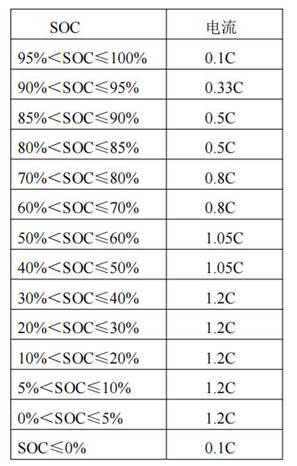
- Table 1 shows the current rate of different SOC sections. It can be seen from Table 1 that the SOC is between 95%-100% In the interval, the current is 0.1C. Since the CCV table lookup method usually uses the CCV-SOC table corresponding to 0.1C, any SOC value in the 95%-100% interval is selected as the preset SOC value in the embodiment of the present application.
- another implementation procedure for obtaining the correction error of the SOC target value in S104 includes:
- the difference between the historical SOC target value of the battery under the measurement voltage and the actual SOC value is used as the error value corresponding to the measurement voltage;
- the target measurement voltage is a measurement voltage corresponding to a preset SOC value
- this embodiment can obtain the maximum value of the error in the SOC calculation process through the above method, thereby further expanding the non-correction range of the current SOC value through the maximum value of the error, avoiding the SOC jitter problem caused by frequent repeated corrections, and ensuring the SOC. Estimation accuracy.
- the specific implementation process of S104 also includes:
- FIG. 3 shows a schematic diagram of the division of the SOC error range provided by this embodiment.
- the SOC target value is defined as the SOC error with the SOC target value as the center of the circle and the correction error as the radius. scope. If the current SOC value is within the SOC error range, it means that the current SOC value is calculated correctly and does not need to be corrected, otherwise it needs to be corrected.
- S105 Correct the current SOC value according to the magnitude relationship between the SOC error range and the current SOC value.
- the SOC error range includes an error upper limit and an error lower limit;
- the specific implementation process of S105 includes:
- the current SOC value is within the SOC error range, the current SOC value is not corrected.
- the current SOC value exceeds the SOC error range, and the current SOC value is greater than the SOC error upper limit, and the difference between the current SOC value and the error upper limit is greater than the second preset error difference, that is, the current SOC estimated value
- the difference between the upper limit of the SOC error and the upper limit of the SOC error is large, and the correction of the current SOC value to the upper limit of the SOC error is forcibly corrected, and the SOC value will jump, so the average value of the current SOC value and the upper limit of the error can be calculated. And use the average value to correct the current SOC value.
- the current SOC value exceeds the SOC error range, and the current SOC value is less than the error lower limit, and the difference between the current SOC value and the error lower limit is greater than the first preset error difference, that is, the current SOC value and the error lower limit
- the difference between the limit values is large, and the correction to forcibly correct the current SOC value to the lower limit of the error is relatively large, and the SOC value may jump. Therefore, the average value of the current SOC value and the lower limit of the error can be calculated, and Use this average value to correct the current SOC value.
- the difference between the current SOC value and the error lower limit is greater than the first preset error difference, or the difference between the current SOC value and the error upper limit is greater than the second preset error difference, then Shorten the duration of the last N sampling periods of the current sampling period, and gently correct the SOC value to the SOC target range by increasing the number of corrections to avoid jumps and jitters in the SOC value.
- N is a natural number greater than zero.
- the embodiment of the present application first obtains the current SOC value of the battery; then samples the voltage of the battery to obtain the current measured voltage of the battery; calculates the corresponding SOC value of the battery under the current measured voltage SOC target value; then obtain the correction error of the SOC target value, and determine the SOC error range based on the correction error and the SOC target value; finally, according to the size relationship between the SOC error range and the current SOC value, Correcting the current SOC value.
- the present application can consider the correction error in the SOC calculation process when correcting the SOC, and expand the non-correction range of the current SOC value based on the correction error, thereby avoiding the SOC jitter problem caused by frequent repeated corrections and ensuring the estimation of the SOC precision.
- Fig. 4 shows a schematic structural diagram of the battery SOC estimation device 100 provided by the embodiment of the present application. For the convenience of description, only the parts related to the embodiment of the present application are shown, and the details are as follows:
- the battery SOC estimating device 100 includes:
- the current SOC value acquisition module 110 is configured to acquire the current SOC value of the battery
- the measured voltage acquisition module 120 is configured to sample the voltage of the battery to obtain the current measured voltage of the battery;
- the SOC target value calculation module 130 is configured to calculate the SOC target value corresponding to the battery under the current measurement voltage
- the SOC error range determination module 140 is configured to obtain a correction error of the SOC target value, and determine an SOC error range based on the correction error and the SOC target value;
- the SOC correction module 150 is configured to correct the current SOC value according to the magnitude relationship between the SOC error range and the current SOC value.
- the SOC target value calculation module 130 is specifically configured to:
- the SOC target value calculation module 130 is specifically configured to:
- the battery If the battery is in a charging state, then determine the corresponding SOC target value under the current measurement voltage according to a preset CCV-SOC table, and the preset CCV-SOC table includes a corresponding relationship between the measurement voltage and the SOC value.
- the SOC error range determination module 140 includes a first correction error acquisition unit, and the first correction error acquisition unit is configured to:
- the difference between the historical SOC target value of the battery under the measurement voltage and the actual SOC value is used as the error value corresponding to the measurement voltage;
- the error values corresponding to each measured voltage are averaged to obtain the corrected error.
- the SOC error range determination module 140 includes a second correction error acquisition unit, and the second correction error acquisition unit is configured to:
- the target measurement voltage is a measurement voltage corresponding to a preset SOC value
- the correction error of the SOC target value is determined according to the error range of the preset SOC value and the preset SOC value.
- the SOC error range determination module 140 includes a third correction error acquisition unit, and the third correction error acquisition unit is configured to:
- the difference between the historical SOC target value of the battery under the measurement voltage and the actual SOC value is used as the error value corresponding to the measurement voltage;
- the target measurement voltage is a measurement voltage corresponding to a preset SOC value
- the SOC error range includes an error upper limit and an error lower limit;
- the SOC correction module 150 is specifically configured as:
- the current SOC value is within the SOC error range, the current SOC value is not corrected.
- the embodiment of the present application first obtains the current SOC value of the battery; then samples the voltage of the battery to obtain the current measured voltage of the battery; calculates the corresponding SOC value of the battery under the current measured voltage SOC target value; then obtain the correction error of the SOC target value, and determine the SOC error range based on the correction error and the SOC target value; finally, according to the size relationship between the SOC error range and the current SOC value, Correcting the current SOC value.
- the present application can consider the correction error in the SOC calculation process when correcting the SOC, and expand the non-correction range of the current SOC value based on the correction error, thereby avoiding the SOC jitter problem caused by frequent repeated corrections and ensuring the estimation of the SOC precision.
- the embodiment of the present application also provides a computer program product, which has a program code, and the program code executes any one of the battery SOC estimation method embodiments described above when running in a corresponding processor, controller, computing device or electronic device. steps, such as steps 101 to 105 shown in FIG. 1 .
- Special purpose processors may include Application Specific Integrated Circuits (ASICs), Reduced Instruction Set Computers (RISCs), and/or Field Programmable Gate Arrays (FPGAs).
- ASICs Application Specific Integrated Circuits
- RISCs Reduced Instruction Set Computers
- FPGAs Field Programmable Gate Arrays
- the proposed methods and devices are preferably implemented as a combination of hardware and software.
- the software is preferably installed as an application program on the program storage device. It is typically a computer platform based machine having hardware, such as one or more central processing units (CPUs), random access memory (RAM), and one or more input/output (I/O) interfaces.
- An operating system is also typically installed on the computer platform. Various procedures and functions described herein may be part of the application program, or a part thereof may be executed by the operating system.
- Fig. 5 is a schematic diagram of an electronic device provided by an embodiment of the present application.
- the electronic device 5 of this embodiment includes: a processor 50 , a memory 51 , and a computer program 52 stored in the memory 51 and operable on the processor 50 .
- the processor 50 executes the computer program 52
- the steps in the embodiments of the battery SOC estimation method described above are realized, for example, steps 101 to 105 shown in FIG. 1 .
- the processor 50 executes the computer program 52, it realizes the functions of the modules/units in the above-mentioned device embodiments, such as the functions of the modules 110 to 150 shown in FIG. 4 .
- the computer program 52 can be divided into one or more modules/units, and the one or more modules/units are stored in the memory 51 and executed by the processor 50 to complete / Implement the scheme provided by this application.
- the one or more modules/units may be a series of computer program instruction segments capable of accomplishing specific functions, and the instruction segments are used to describe the execution process of the computer program 52 in the electronic device 5 .
- the computer program 52 may be divided into modules 110 to 150 shown in FIG. 4 .
- the electronic device 5 may include, but not limited to, a processor 50 and a memory 51 .
- FIG. 5 is only an example of the electronic device 5, and does not constitute a limitation to the electronic device 5. It may include more or less components than those shown in the figure, or combine certain components, or different components. , for example, the electronic device may also include an input and output device, a network access device, a bus, and the like.
- the so-called processor 50 may be a central processing unit (Central Processing Unit, CPU), can also be other general-purpose processors, digital signal processors (Digital Signal Processor, DSP), application specific integrated circuits (Application Specific Integrated Circuit, ASIC), field programmable gate array (Field-Programmable Gate Array, FPGA) or other programmable logic devices, discrete gate or transistor logic devices, discrete hardware components, etc.
- a general-purpose processor may be a microprocessor, or the processor may be any conventional processor, or the like.
- the storage 51 may be an internal storage unit of the electronic device 5 , such as a hard disk or memory of the electronic device 5 .
- the memory 51 can also be an external storage device of the electronic device 5, such as a plug-in hard disk equipped on the electronic device 5, a smart memory card (Smart Media Card, SMC), a secure digital (Secure Digital, SD) card, flash memory card (Flash Card), etc.
- the memory 51 may also include both an internal storage unit of the electronic device 5 and an external storage device.
- the memory 51 is used to store the computer program and other programs and data required by the electronic device.
- the memory 51 can also be used to temporarily store data that has been output or will be output.
- This embodiment also provides an automobile, which includes the above-mentioned electronic equipment.
- the disclosed device/electronic equipment and method can be implemented in other ways.
- the device/electronic device embodiments described above are only illustrative.
- the division of the modules or units is only a logical function division.
- the mutual coupling or direct coupling or communication connection shown or discussed may be through some interfaces, and the indirect coupling or communication connection of devices or units may be in electrical, mechanical or other forms.
- the units described as separate components may or may not be physically separated, and the components shown as units may or may not be physical units, that is, they may be located in one place, or may be distributed to multiple network units. Part or all of the units can be selected according to actual needs to achieve the purpose of the solution of this embodiment.
- each functional unit in each embodiment of the present application may be integrated into one processing unit, each unit may exist separately physically, or two or more units may be integrated into one unit.
- the above-mentioned integrated units can be implemented in the form of hardware or in the form of software functional units.
- the integrated module/unit is realized in the form of a software function unit and sold or used as an independent product, it can be stored in a computer-readable storage medium. Based on such an understanding, all or part of the processes in the methods of the above-mentioned embodiments in the present application can also be completed by instructing related hardware through computer programs, and the computer programs can be stored in a non-volatile computer-readable storage medium In this example, when the computer program is executed by the processor, the steps of the above embodiments of the method for estimating the battery SOC can be realized.
- the computer program includes computer program code, and the computer program code may be in the form of source code, object code, executable file or some intermediate form.
- the computer-readable storage medium may include: any entity or device capable of carrying the computer program code, recording medium, U disk, removable hard disk, magnetic disk, optical disk, computer memory, read-only memory (Read-Only Memory, ROM) ), random access memory (Random Access Memory, RAM), electric carrier signal, telecommunication signal and software distribution medium, etc. It should be noted that the content contained in the computer-readable storage medium can be appropriately increased or decreased according to the requirements of legislation and patent practice in the jurisdiction. For example, in some jurisdictions, according to legislation and patent practice, computer-readable Storage media do not include electrical carrier signals and telecommunication signals.
Landscapes
- Physics & Mathematics (AREA)
- General Physics & Mathematics (AREA)
- Secondary Cells (AREA)
- Charge And Discharge Circuits For Batteries Or The Like (AREA)
Abstract
一种电池SOC的估算方法及相关装置,该方法包括:获取电池的当前SOC值(S101);对电池的电压进行采样,得到电池的当前测量电压;计算电池在当前测量电压下对应的SOC目标值;获取SOC目标值的修正误差,并基于修正误差和SOC目标值,确定SOC误差范围(S104);根据SOC误差范围和当前SOC值的大小关系,对当前SOC值进行修正(S105)。本方法可以在对SOC进行修正时考虑SOC计算过程中的修正误差,基于修正误差扩大当前SOC值的不修正范围,从而避免因频繁重复修正导致的SOC抖动问题,保证SOC的估算精度。
Description
本专利申请要求于2021年12月24日提交的中国专利申请No.CN202111602389.3的优先权。在先申请的公开内容通过整体引用并入本申请。
本申请属于电池技术领域,尤其涉及一种电池SOC的估算方法及相关装置。
在电池管理系统中,SOC(State Of Charge,电池荷电状态,也可以称为充电状态或剩余电量,指的是电池使用一段时间或长时间保持后,剩余的可放电电量与电池充满电的电量之比,通常用百分比表示)的通用修正方法为静置OCV(Open Circuit Voltage,开路电压)修正和充满修正。但是如果电池长期不静置、不充满会导致SOC长期无法修正,累积极大的误差。因此,电池充放电运行过程中SOC的修正就显的格外重要。
目前,为了计算电池在充放电运行过程中的SOC值,可以根据电池直流电阻确定电池在运行过程中的开路电压OCV,然后通过OCV-SOC表查找对应的SOC目标值,也可以在电池充电过程中采用CCV(Closed Circuit Voltage,闭路电压)-SOC表查询对应的SOC目标值,但是,由于SOC计算过程中往往存在各种误差,例如测量器件的采样误差、查表误差等。如果完全采用SOC目标值修正电池SOC,会存在过修及频繁重复修正的问题,从而导致SOC抖动。
本申请提供了一种电池SOC的估算方法及相关装置,以解决现有技术中因SOC计算过程中的误差导致的SOC抖动的问题。
第一方面,本申请提供了一种电池SOC的估算方法,包括:
获取电池的当前SOC值;
对所述电池的电压进行采样,得到所述电池的当前测量电压;
计算所述电池在所述当前测量电压下对应的SOC目标值;
获取所述SOC目标值的修正误差,并基于所述修正误差和所述SOC目标值,确定SOC误差范围;
根据所述SOC误差范围和所述当前SOC值的大小关系,对所述当前SOC值进行修正。
在一种可能的实现方式中,所述计算所述电池在所述当前测量电压下对应的SOC目标值,包括:
根据公式
U
ocv
=
U
c
+
i*
DCR,计算所述电池的开路电压,其中,
U
ocv
表示所述开路电压,
U
c
表示所述当前测量电压,
i表示所述电池的当前测量电流,
DCR表示所述电池的直流内阻;
基于所述OCV-SOC对应关系,确定所述开路电压对应的SOC值,并将该SOC值作为SOC目标值。
在一种可能的实现方式中,所述计算所述电池在所述当前测量电压下对应的SOC目标值,包括:
若所述电池处于充电状态,则根据预设CCV-SOC表确定所述当前测量电压下对应的SOC目标值,所述预设CCV-SOC表包括测量电压和SOC值的对应关系。
在一种可能的实现方式中,所述获取所述SOC目标值的修正误差,包括:
获取所述电池经过离线标定得到的不同测量电压下的真实SOC值;
获取所述电池在历史充放电周期中不同测量电压下对应的历史SOC目标值;
针对任一测量电压,将该测量电压下电池的历史SOC目标值与SOC真实值的差值作为该测量电压对应的误差值;
对各个测量电压对应的误差值求平均,得到所述修正误差。
在一种可能的实现方式中,所述获取所述SOC目标值的修正误差,包括:
获取电压测量器件的采样误差;
基于所述采样误差确定目标测量电压的电压误差范围;所述目标测量电压为预设SOC值对应的测量电压;
基于所述电压误差范围确定所述预设SOC值对应的误差范围;
根据所述预设SOC值的误差范围和所述预设SOC值确定所述SOC目标值的修正误差。
在一种可能的实现方式中,所述获取所述SOC目标值的修正误差,包括:
获取所述电池经过离线标定得到的不同测量电压下的真实SOC值;
获取所述电池在历史充放电周期中不同测量电压下对应的历史SOC目标值;
针对任一测量电压,将该测量电压下电池的历史SOC目标值与SOC真实值的差值作为该测量电压对应的误差值;
对各个测量电压对应的误差值求平均,得到第一修正误差;
获取电压测量器件的采样误差;
基于所述采样误差确定目标测量电压的电压误差范围;所述目标测量电压为预设SOC值对应的测量电压;
基于所述电压误差范围确定所述预设SOC值对应的误差范围;
根据所述预设SOC值的误差范围和所述预设SOC值确定第二修正误差;
选取所述第一修正误差和所述第二修正误差中的较大值,并将该较大值作为所述SOC目标值的修正误差。
在一种可能的实现方式中,所述SOC误差范围包括误差上限值和误差下限值;
所述根据所述SOC误差范围和所述当前SOC值的大小关系,对所述当前SOC值进行修正,包括:
若所述当前SOC值超出所述SOC误差范围,且所述当前SOC值小于所述误差下限值,则将所述当前SOC值修正至所述误差下限值;
若所述当前SOC值超出所述SOC误差范围,且所述当前SOC值大于所述误差上限值,则将所述当前SOC值修正至所述误差上限值;
若所述当前SOC值处于所述SOC误差范围内,则不修正所述当前SOC值。
第二方面,本申请还提供了一种电池SOC的估算装置,包括:
当前SOC值获取模块,被配置为获取电池的当前SOC值;
测量电压获取模块,被配置为对所述电池的电压进行采样,得到所述电池的当前测量电压;
SOC目标值计算模块,被配置为计算所述电池在所述当前测量电压下对应的SOC目标值;
SOC误差范围确定模块,被配置为获取所述SOC目标值的修正误差,并基于所述修正误差和所述SOC目标值,确定SOC误差范围;
SOC修正模块,被配置为根据所述SOC误差范围和所述当前SOC值的大小关系,对所述当前SOC值进行修正。
第三方面,本申请提供了一种电子设备,包括存储器、处理器以及存储在所述存储器中并可在所述处理器上运行的计算机程序,所述处理器执行所述计算机程序时实现如上第一方面任一种可能的实现方式所述方法的步骤。
第四方面,本申请实施例提供了一种非易失性计算机可读存储介质,所述计算机可读存储介质存储有计算机程序,所述计算机程序被处理器执行时实现如上第一方面任一种可能的实现方式所述方法的步骤。
第五方面,本申请提供了一种汽车,其包括如上第三方面所述的电子设备。
本申请实施例提供一种电池SOC的估算方法、装置、设备、介质及汽车,其首先获取电池的当前SOC值;然后对所述电池的电压进行采样,得到所述电池的当前测量电压;计算所述电池在所述当前测量电压下对应的SOC目标值;接着获取所述SOC目标值的修正误差,并基于所述修正误差和所述SOC目标值,确定SOC误差范围;最后根据所述SOC误差范围和所述当前SOC值的大小关系,对所述当前SOC值进行修正。通过上述方案,本申请可以在对SOC进行修正时考虑SOC计算过程中的修正误差,基于修正误差扩大当前SOC值的不修正范围,从而避免因频繁重复修正导致的SOC抖动问题,保证SOC的估算精度。
为了更清楚地说明本申请实施例中的技术方案,下面将对实施例或现有技术描述中所需要使用的附图作简单地介绍,显而易见地,下面描述中的附图仅仅是本申请的一些实施例,对于本领域普通技术人员来讲,在不付出创造性劳动性的前提下,还可以根据这些附图获得其他的附图。
图1是本申请实施例提供的电池SOC的估算方法的实现流程图;
图2是本申请实施例提供的电池经离线标定得到的充电电流、充电电压和SOC真实值的曲线示意图;
图3是本申请实施例提供的SOC误差范围的划定示意图;
图4是本申请实施例提供的电池SOC的估算装置的结构示意图;
图5是本申请实施例提供的电子设备的示意图。
以下描述中,为了说明而不是为了限定,提出了诸如特定系统结构、技术之类的具体细节,以便透彻理解本申请实施例。然而,本领域的技术人员应当清楚,在没有这些具体细节的其它实施例中也可以实现本申请。在其它情况中,省略对众所周知的系统、装置、电路以及方法的详细说明,以免不必要的细节妨碍本申请的描述。
为使本申请的目的、技术方案和优点更加清楚,下面将结合附图通过具体实施例来进行说明。
参见图1,其示出了本申请实施例提供的电池SOC的估算方法的实现流程图,详述如下:
S101:获取电池的当前SOC值。
本实施例的执行主体(电子设备)可以为电池管理系统。
S102:对所述电池的电压进行采样,得到所述电池的当前测量电压。
在本实施例中,电池管理系统采用电压测量器件对电池的电压进行测量,得到当前测量电压;电池管理系统还可以采用电流测量器件对电池的电流进行测量,得到当前测量电流。
S103:计算所述电池在所述当前测量电压下对应的SOC目标值。
电池管理系统在电池运行过程中会实时地计算及更新电池的当前SOC值。该SOC值是存在误差的,需要电池管理系统不定时地对SOC值进行修正,由于常规的静置OCV修正方法需要在电池静置时才能检测到开路电压,因此长期处于工作状态的锂电池会累积较大的误差。
为了解决上述问题,本实施例在电池运行过程中可以采用两种SOC计算方法,详述如下:
在一种可能的实施例中,S103的第一种实现流程包括:
根据公式
U
ocv
=
U
c
+
i*
DCR,计算电池的开路电压,其中,
U
ocv
表示开路电压,
U
c
表示当前测量电压,
i表示当前测量电流,
DCR表示电池的直流内阻;
基于OCV-SOC对应关系,确定开路电压对应的SOC值,并将该SOC值作为SOC目标值。
具体地,当电池处于运行过程中时,电池管理系统可以采用直流内阻DCR计算当前测量电流和当前测量电压对应的开路电压
U
ocv
,然后通过查表确定当前的开路电压
U
ocv
对应的SOC值,从而实现电池运行过程中的SOC修正。
在本实施例中,OCV-SOC对应关系可以为横坐标为SOC值,纵坐标为
U
ocv
的二维曲线图,也可以为包括SOC值、
U
ocv
及两者对应关系的表格。
具体地,OCV-SOC表包括某一温度下开路电压和SOC值的对应关系。在进行查表前,电池管理系统可以首先获取电池的当前温度,然后锁定电池在当前温度下对应的OCV-SOC表,通过查询该OCV-SOC表确定当前开路电压对应的SOC目标值。
在一种可能的实施例中,S103的第二种实现流程包括:
若所述电池处于充电状态,则根据预设CCV-SOC表确定所述当前测量电压下对应的SOC目标值,所述预设CCV-SOC表包括测量电压和SOC值的对应关系。
具体地,预设CCV-SOC表包括某一温度下、某一电流倍率下测量电压和SOC值的对应关系。在进行查表前,电池管理系统可以首先获取电池的当前温度,然后锁定电池在当前温度下对应的CCV-SOC表,通过查询该CCV-SOC表确定当前测量电压对应的SOC目标值。
例如,由于电芯厂仅能提供几种电流倍率的CCV-SOC表,因此本实施例可以选取准确性更好的电流倍率为0.1C对应的CCV-SOC表进行查表操作。当然,还可以选择其他的电流倍率所对应的CCV-SOC表,对此不做具体限制。
S104:获取所述SOC目标值的修正误差,并基于所述修正误差和所述SOC目标值,确定SOC误差范围。
具体地,本实施例可以通过获取SOC目标值和SOC真实值的修正误差,来确定SOC误差范围。
在一种可能的实现方式中,S104中获取SOC目标值的修正误差的具体实现流程包括:
获取电池经过离线标定得到的不同测量电压下的真实SOC值;
获取电池在历史充放电周期中不同测量电压下对应的历史SOC目标值;
针对任一测量电压,将该测量电压下电池的历史SOC目标值与SOC真实值的差值作为该测量电压对应的误差值;
对各个测量电压对应的误差值求平均,得到修正误差。
具体地,在SOC计算过程中,可能会在多个环节存在误差,其中一个就是DCR误差,由于电池的直流内阻DCR为电芯厂提供的值,该值在实际应用过程中往往存在一定的误差,因此完全采用电芯厂提供的DCR计算的SOC目标值修正当前SOC值可能存在过修或频繁修正导致的SOC抖动问题。
SOC计算过程中的另一个误差就是CCV-SOC表/OCV-SOC表误差,CCV-SOC表或OCV-SOC表为电芯厂提供的数据,其在应用过程中可能会由于电池实际温度及实际电流倍率的不同导致一定的误差。
为了避免上述误差,工作人员可以定期地对电池进行离线标定,确定电池在整个充电周期的电压、电流和SOC真实值的关系。如图2所示,图2示出了充电电流、充电电压和SOC真实值的对照曲线,图2中最上端曲线为充电电流对应的曲线,其横坐标为时间,纵坐标为充电电流;中间曲线为充电电压对应的曲线,其横坐标为时间,纵坐标为充电电压;最下端曲线为SOC真实值对应的曲线,其横坐标为时间,纵坐标为SOC真实值。通过图2可知,离线标定可以确定电池在每个充电电压下对应的SOC真实值。
电池管理系统还用于存储当前时刻的前N个充放电周期中不同测量电压下对应的SOC目标值,然后可以任取一个充放电周期不同测量电压下对应的SOC目标值,通过查找同一测量电压下的SOC真实值与SOC目标值,能够确定各个测量电压对应的SOC真实值与SOC目标值之间的误差值,然后对所有误差值求平均,得到修正误差。
在一种可能的实现方式中,S104中获取SOC目标值的修正误差的另一实现流程包括:
获取电压测量器件的采样误差;
基于所述采样误差确定目标测量电压的电压误差范围;所述目标测量电压为预设SOC值对应的测量电压;
基于所述电压误差范围确定所述预设SOC值对应的误差范围;
根据所述预设SOC值的误差范围和所述预设SOC值确定所述SOC目标值的修正误差。
在本实施例中,在SOC计算过程中,测量器件的采样误差也是造成SOC修正误差的重要因素,因此本实施例可以基于测量器件的采样误差确定需要考虑的修正误差,其过程详述如下:
首先,电池管理系统可以任取一个SOC值作为基准,并将该SOC的修正误差作为所有SOC的修正误差。在确定预设SOC值及其对应的目标测量电压后,电池管理系统将目标测量电压减去采样误差,得到电压误差范围中的电压误差下限,将目标测量电压加上采样误差,得到电压误差范围中的电压误差上限,然后通过查CCV-SOC表得到电压误差上限对应的SOC上限值,以及电压误差下限对应的SOC下限值,从而确定预设SOC值的误差范围。最后采用SOC上限值减去预设SOC值,得到第一SOC误差,采用预设SOC值减去SOC下限值,得到第二SOC误差,取第一SOC误差和第二SOC误差中的较大值作为SOC目标值对应的修正误差。
具体地,由于电池在充电过程中,不同SOC区段的电流不同,如表1所示,表1示出了不同SOC区间的电流倍率,由表1可以看出,SOC在95%-100%区间时,其电流为0.1C,由于CCV查表方法通常采用0.1C对应的CCV-SOC表,因此本申请实施例选取95%-100%区间内的任一SOC值作为预设SOC值。
表1
在一种可能的实现方式中,S104中获取SOC目标值的修正误差的另一实现流程包括:
获取所述电池经过离线标定得到的不同测量电压下的真实SOC值;
获取所述电池在历史充放电周期中不同测量电压下对应的历史SOC目标值;
针对任一测量电压,将该测量电压下电池的历史SOC目标值与SOC真实值的差值作为该测量电压对应的误差值;
对各个测量电压对应的误差值求平均,得到第一修正误差;
获取电压测量器件的采样误差;
基于所述采样误差确定目标测量电压的电压误差范围;所述目标测量电压为预设SOC值对应的测量电压;
基于所述电压误差范围确定所述预设SOC值对应的误差范围;
根据所述预设SOC值的误差范围和所述预设SOC值确定第二修正误差;
选取所述第一修正误差和所述第二修正误差中的较大值,并将该较大值作为所述SOC目标值的修正误差。
具体地,本实施例通过上述方法能够得到SOC计算过程中的误差最大值,从而通过该误差最大值进一步扩大当前SOC值的不修正范围,避免因频繁重复修正导致的SOC抖动问题,保证SOC的估算精度。
在一种可能的实现方式中,S104的具体实现流程还包括:
将SOC目标值减去修正误差,得到SOC误差范围的误差下限值;
将SOC目标值与修正误差相加,得到SOC误差范围的误差上限值。
在本实施例中,图3示出了本实施例提供的SOC误差范围的划分示意图,如图3所示,以SOC目标值为圆心,以修正误差为半径,划定SOC目标值的SOC误差范围。若当前SOC值在SOC误差范围内,则说明当前SOC值计算正确,不需要对其进行修正,否则需要对其进行修正。
S105:根据SOC误差范围和当前SOC值的大小关系,对当前SOC值进行修正。
在一种可能的实现方式中,SOC误差范围包括误差上限值和误差下限值;S105的具体实现流程包括:
若当前SOC值超出SOC误差范围,且当前SOC值小于误差下限值,则将当前SOC值修正至误差下限值;
若当前SOC值超出SOC误差范围,且当前SOC值大于误差上限值,则将当前SOC值修正至误差上限值;
若当前SOC值处于SOC误差范围内,则不修正当前SOC值。
在本实施例中,若当前SOC值超出SOC误差范围,且当前SOC值大于SOC误差上限,且当前SOC值与误差上限值的差值大于第二预设误差差值,即当前SOC估算值与SOC误差上限的差值较大,强行将当前SOC值修正至SOC误差上限的修正力度较大,SOC值会存在跳变的情况,因此可以计算当前SOC值与误差上限值的平均值,并采用该平均值修正当前SOC值。
相应地,若当前SOC值超出SOC误差范围,且当前SOC值小于误差下限值,且当前SOC值与误差下限值的差值大于第一预设误差差值,即当前SOC值与误差下限值的差值较大,强行将当前SOC值修正至误差下限值的修正力度较大,SOC值会存在跳变的情况,因此可以计算当前SOC值与误差下限值的平均值,并采用该平均值修正当前SOC值。
在本实施例中,若当前SOC值与误差下限值的差值大于第一预设误差差值,或当前SOC值与误差上限值的差值大于第二预设误差差值时,则缩短当前采样周期的后N个采样周期的时长,以采用增加修正次数的方式将SOC值平缓地修正至SOC目标范围内,避免SOC值出现跳变及抖动的情况。其中,N为大于零的自然数。
从上述实施例可知,本申请实施例首先获取电池的当前SOC值;然后对所述电池的电压进行采样,得到所述电池的当前测量电压;计算所述电池在所述当前测量电压下对应的SOC目标值;接着获取所述SOC目标值的修正误差,并基于所述修正误差和所述SOC目标值,确定SOC误差范围;最后根据所述SOC误差范围和所述当前SOC值的大小关系,对所述当前SOC值进行修正。通过上述方案,本申请可以在对SOC进行修正时考虑SOC计算过程中的修正误差,基于修正误差扩大当前SOC值的不修正范围,从而避免因频繁重复修正导致的SOC抖动问题,保证SOC的估算精度。
应理解,上述实施例中各步骤的序号的大小并不意味着执行顺序的先后,各过程的执行顺序应以其功能和内在逻辑确定,而不应对本申请实施例的实施过程构成任何限定。
以下为本申请的装置实施例,对于其中未详尽描述的细节,可以参考上述对应的方法实施例。
图4示出了本申请实施例提供的电池SOC的估算装置100的结构示意图,为了便于说明,仅示出了与本申请实施例相关的部分,详述如下:
如图4所示,电池SOC的估算装置100包括:
当前SOC值获取模块110,被配置为获取电池的当前SOC值;
测量电压获取模块120,被配置为对所述电池的电压进行采样,得到所述电池的当前测量电压;
SOC目标值计算模块130,被配置为计算所述电池在所述当前测量电压下对应的SOC目标值;
SOC误差范围确定模块140,被配置为获取所述SOC目标值的修正误差,并基于所述修正误差和所述SOC目标值,确定SOC误差范围;
SOC修正模块150,被配置为根据所述SOC误差范围和所述当前SOC值的大小关系,对所述当前SOC值进行修正。
在一个可能的实施例中,SOC目标值计算模块130具体被配置为:
根据公式
U
ocv
=
U
c
+
i*
DCR,计算所述电池的开路电压,其中,
U
ocv
表示所述开路电压,
U
c
表示所述当前测量电压,
i表示所述电池的当前测量电流,
DCR表示所述电池的直流内阻;
基于所述OCV-SOC对应关系,确定所述开路电压对应的SOC值,并将该SOC值作为SOC目标值。
在一个可能的实施例中,SOC目标值计算模块130具体被配置为:
若所述电池处于充电状态,则根据预设CCV-SOC表确定所述当前测量电压下对应的SOC目标值,所述预设CCV-SOC表包括测量电压和SOC值的对应关系。
在一个可能的实施例中,SOC误差范围确定模块140包括第一修正误差获取单元,第一修正误差获取单元被配置为:
获取所述电池经过离线标定得到的不同测量电压下的真实SOC值;
获取所述电池在历史充放电周期中不同测量电压下对应的历史SOC目标值;
针对任一测量电压,将该测量电压下电池的历史SOC目标值与SOC真实值的差值作为该测量电压对应的误差值;
对各个测量电压对应的误差值求平均,得到所述修正误差。
在一个可能的实施例中,SOC误差范围确定模块140包括第二修正误差获取单元,第二修正误差获取单元被配置为:
获取电压测量器件的采样误差;
基于所述采样误差确定目标测量电压的电压误差范围;所述目标测量电压为预设SOC值对应的测量电压;
基于所述电压误差范围确定所述预设SOC值对应的误差范围;
根据所述预设SOC值的误差范围和所述预设SOC值确定所述SOC目标值的修正误差。
在一个可能的实施例中,SOC误差范围确定模块140包括第三修正误差获取单元,第三修正误差获取单元被配置为:
获取所述电池经过离线标定得到的不同测量电压下的真实SOC值;
获取所述电池在历史充放电周期中不同测量电压下对应的历史SOC目标值;
针对任一测量电压,将该测量电压下电池的历史SOC目标值与SOC真实值的差值作为该测量电压对应的误差值;
对各个测量电压对应的误差值求平均,得到第一修正误差;
获取电压测量器件的采样误差;
基于所述采样误差确定目标测量电压的电压误差范围;所述目标测量电压为预设SOC值对应的测量电压;
基于所述电压误差范围确定所述预设SOC值对应的误差范围;
根据所述预设SOC值的误差范围和所述预设SOC值确定第二修正误差;
选取所述第一修正误差和所述第二修正误差中的较大值,并将该较大值作为所述SOC目标值的修正误差。
在一个可能的实施例中,所述SOC误差范围包括误差上限值和误差下限值;SOC修正模块150,具体被配置为:
若所述当前SOC值超出所述SOC误差范围,且所述当前SOC值小于所述误差下限值,则将所述当前SOC值修正至所述误差下限值;
若所述当前SOC值超出所述SOC误差范围,且所述当前SOC值大于所述误差上限值,则将所述当前SOC值修正至所述误差上限值;
若所述当前SOC值处于所述SOC误差范围内,则不修正所述当前SOC值。
需要说明的是,本申请装置实施例中未详细说明的技术手段及技术效果,可以参考本申请方法实施例中对应的技术手段及技术效果,应当认为在此说明之后,本申请装置实施例已经明确记载了未详细说明的内容。
从上述实施例可知,本申请实施例首先获取电池的当前SOC值;然后对所述电池的电压进行采样,得到所述电池的当前测量电压;计算所述电池在所述当前测量电压下对应的SOC目标值;接着获取所述SOC目标值的修正误差,并基于所述修正误差和所述SOC目标值,确定SOC误差范围;最后根据所述SOC误差范围和所述当前SOC值的大小关系,对所述当前SOC值进行修正。通过上述方案,本申请可以在对SOC进行修正时考虑SOC计算过程中的修正误差,基于修正误差扩大当前SOC值的不修正范围,从而避免因频繁重复修正导致的SOC抖动问题,保证SOC的估算精度。
本申请实施例还提供了一种计算机程序产品,其具有程序代码,该程序代码在相应的处理器、控制器、计算装置或电子设备中运行时执行上述任一个电池SOC的估算方法实施例中的步骤,例如图1所示的步骤101至步骤105。本领域技术人员应当理解,可以以硬件、软件、固件、专用处理器或其组合的各种形式来实现本申请实施例所提出的方法和所属的设备。专用处理器可以包括专用集成电路(ASIC)、精简指令集计算机(RISC)和/或现场可编程门阵列(FPGA)。所提出的方法和设备优选地被实现为硬件和软件的组合。该软件优选地作为应用程序安装在程序存储设备上。其典型地是基于具有硬件的计算机平台的机器,例如一个或多个中央处理器(CPU)、随机存取存储器(RAM)和一个或多个输入/输出(I/O)接口。操作系统典型地也安装在所述计算机平台上。这里描述的各种过程和功能可以是应用程序的一部分,或者其一部分可以通过操作系统执行。
图5是本申请实施例提供的电子设备的示意图。如图5所示,该实施例的电子设备5包括:处理器50、存储器51以及存储在所述存储器51中并可在所述处理器50上运行的计算机程序52。所述处理器50执行所述计算机程序52时实现上述各个电池SOC的估算方法实施例中的步骤,例如图1所示的步骤101至步骤105。或者,所述处理器50执行所述计算机程序52时实现上述各装置实施例中各模块/单元的功能,例如图4所示模块110至150的功能。
示例性的,所述计算机程序52可以被分割成一个或多个模块/单元,所述一个或者多个模块/单元被存储在所述存储器51中,并由所述处理器50执行,以完成/实施本申请所提供的方案。所述一个或多个模块/单元可以是能够完成特定功能的一系列计算机程序指令段,该指令段用于描述所述计算机程序52在所述电子设备5中的执行过程。例如,所述计算机程序52可以被分割成图4所示的模块110至150。
所述电子设备5可包括,但不仅限于,处理器50、存储器51。本领域技术人员可以理解,图5仅仅是电子设备5的示例,并不构成对电子设备5的限定,可以包括比图示更多或更少的部件,或者组合某些部件,或者不同的部件,例如所述电子设备还可以包括输入输出设备、网络接入设备、总线等。
所称处理器50可以是中央处理单元(Central
Processing Unit,CPU),还可以是其他通用处理器、数字信号处理器 (Digital Signal Processor,DSP)、专用集成电路 (Application Specific Integrated Circuit,ASIC)、现场可编程门阵列
(Field-Programmable Gate Array,FPGA) 或者其他可编程逻辑器件、分立门或者晶体管逻辑器件、分立硬件组件等。通用处理器可以是微处理器或者该处理器也可以是任何常规的处理器等。
所述存储器51可以是所述电子设备5的内部存储单元,例如电子设备5的硬盘或内存。所述存储器51也可以是所述电子设备5的外部存储设备,例如所述电子设备5上配备的插接式硬盘,智能存储卡(Smart Media Card,SMC),安全数字(Secure Digital,SD)卡,闪存卡(Flash Card)等。进一步地,所述存储器51还可以既包括所述电子设备5的内部存储单元也包括外部存储设备。所述存储器51用于存储所述计算机程序以及所述电子设备所需的其他程序和数据。所述存储器51还可以用于暂时地存储已经输出或者将要输出的数据。
所属领域的技术人员可以清楚地了解到,为了描述的方便和简洁,仅以上述各功能单元、模块的划分进行举例说明,实际应用中,可以根据需要而将上述功能分配由不同的功能单元、模块完成,即将所述装置的内部结构划分成不同的功能单元或模块,以完成以上描述的全部或者部分功能。实施例中的各功能单元、模块可以集成在一个处理单元中,也可以是各个单元单独物理存在,也可以两个或两个以上单元集成在一个单元中,上述集成的单元既可以采用硬件的形式实现,也可以采用软件功能单元的形式实现。另外,各功能单元、模块的具体名称也只是为了便于相互区分,并不用于限制本申请的保护范围。上述系统中单元、模块的具体工作过程,可以参考前述方法实施例中的对应过程,在此不再赘述。
在上述实施例中,对各个实施例的描述都各有侧重,某个实施例中没有详述或记载的部分,可以参见其它实施例的相关描述。
本实施例还提供了一种汽车,其包括如上所述的电子设备。
本领域普通技术人员可以意识到,结合本文中所公开的实施例描述的各示例的单元及算法步骤,能够以电子硬件、或者计算机软件和电子硬件的结合来实现。这些功能究竟以硬件还是软件方式来执行,取决于技术方案的特定应用和设计约束条件。专业技术人员可以对每个特定的应用来使用不同方法来实现所描述的功能,但是这种实现不应认为超出本申请的范围。
在本申请所提供的实施例中,应该理解到,所揭露的装置/电子设备和方法,可以通过其它的方式实现。例如,以上所描述的装置/电子设备实施例仅仅是示意性的,例如,所述模块或单元的划分,仅仅为一种逻辑功能划分,实际实现时可以有另外的划分方式,例如多个单元或组件可以结合或者可以集成到另一个系统,或一些特征可以忽略,或不执行。另一点,所显示或讨论的相互之间的耦合或直接耦合或通讯连接可以是通过一些接口,装置或单元的间接耦合或通讯连接,可以是电性,机械或其它的形式。
所述作为分离部件说明的单元可以是或者也可以不是物理上分开的,作为单元显示的部件可以是或者也可以不是物理单元,即可以位于一个地方,或者也可以分布到多个网络单元上。可以根据实际的需要选择其中的部分或者全部单元来实现本实施例方案的目的。
另外,在本申请各个实施例中的各功能单元可以集成在一个处理单元中,也可以是各个单元单独物理存在,也可以两个或两个以上单元集成在一个单元中。上述集成的单元既可以采用硬件的形式实现,也可以采用软件功能单元的形式实现。
所述集成的模块/单元如果以软件功能单元的形式实现并作为独立的产品销售或使用时,可以存储在一个计算机可读取存储介质中。基于这样的理解,本申请实现上述实施例方法中的全部或部分流程,也可以通过计算机程序来指令相关的硬件来完成,所述的计算机程序可存储于一非易失性计算机可读存储介质中,该计算机程序在被处理器执行时,可实现上述各个电池SOC的估算方法实施例的步骤。其中,所述计算机程序包括计算机程序代码,所述计算机程序代码可以为源代码形式、对象代码形式、可执行文件或某些中间形式等。所述计算机可读存储介质可以包括:能够携带所述计算机程序代码的任何实体或装置、记录介质、U盘、移动硬盘、磁碟、光盘、计算机存储器、只读存储器(Read-Only Memory,ROM)、随机存取存储器(Random Access Memory,RAM)、电载波信号、电信信号以及软件分发介质等。需要说明的是,所述计算机可读存储介质包含的内容可以根据司法管辖区内立法和专利实践的要求进行适当的增减,例如在某些司法管辖区,根据立法和专利实践,计算机可读存储介质不包括是电载波信号和电信信号。
此外,本申请附图中示出的实施例或本说明书中提到的各种实施例的特征不必理解为彼此独立的实施例。而是,可以将一个实施例的其中一个示例中描述的每个特征与来自其他实施例的个或多个其他期望的特征组合,从而产生未用文字或参考附图描述的其他实施例。
以上所述实施例仅用以说明本申请的技术方案,而非对其限制;尽管参照前述实施例对本申请进行了详细的说明,本领域的普通技术人员应当理解:其依然可以对前述各实施例所记载的技术方案进行修改,或者对其中部分技术特征进行等同替换;而这些修改或者替换,并不使相应技术方案的本质脱离本申请各实施例技术方案的精神和范围,均应包含在本申请的保护范围之内。
Claims (20)
- 一种电池SOC的估算方法,其特征在于,包括:获取电池的当前SOC值;对所述电池的电压进行采样,得到所述电池的当前测量电压;计算所述电池在所述当前测量电压下对应的SOC目标值;获取所述SOC目标值的修正误差,并基于所述修正误差和所述SOC目标值,确定SOC误差范围;根据所述SOC误差范围和所述当前SOC值的大小关系,对所述当前SOC值进行修正。
- 根据权利要求1所述的电池SOC的估算方法,其特征在于,所述计算所述电池在所述当前测量电压下对应的SOC目标值,包括:根据公式 U ocv = U c + i* DCR,计算所述电池的开路电压,其中, U ocv 表示所述开路电压, U c 表示所述当前测量电压, i表示所述电池的当前测量电流, DCR表示所述电池的直流内阻;基于OCV-SOC对应关系,确定所述开路电压对应的SOC值,并将该SOC值作为所述SOC目标值。
- 根据权利要求1所述的电池SOC的估算方法,其特征在于,所述计算所述电池在所述当前测量电压下对应的SOC目标值,包括:若所述电池处于充电状态,则根据预设CCV-SOC表确定所述当前测量电压下对应的SOC目标值,所述预设CCV-SOC表包括测量电压和SOC值的对应关系。
- 根据权利要求1所述的电池SOC的估算方法,其特征在于,所述获取所述SOC目标值的修正误差,包括:获取所述电池经过离线标定得到的不同测量电压下的真实SOC值;获取所述电池在历史充放电周期中不同测量电压下对应的历史SOC目标值;针对任一测量电压,将该测量电压下电池的历史SOC目标值与SOC真实值的差值作为该测量电压对应的误差值;对各个测量电压对应的误差值求平均,得到所述SOC目标值的修正误差。
- 根据权利要求1所述的电池SOC的估算方法,其特征在于,所述获取所述SOC目标值的修正误差,包括:获取电压测量器件的采样误差;基于所述采样误差确定目标测量电压的电压误差范围;所述目标测量电压为预设SOC值对应的测量电压;基于所述电压误差范围确定所述预设SOC值对应的误差范围;根据所述预设SOC值的误差范围和所述预设SOC值确定所述SOC目标值的修正误差。
- 根据权利要求1所述的电池SOC的估算方法,其特征在于,所述获取所述SOC目标值的修正误差,包括:获取所述电池经过离线标定得到的不同测量电压下的真实SOC值;获取所述电池在历史充放电周期中不同测量电压下对应的历史SOC目标值;针对任一测量电压,将该测量电压下电池的历史SOC目标值与SOC真实值的差值作为该测量电压对应的误差值;对各个测量电压对应的误差值求平均,得到第一修正误差;获取电压测量器件的采样误差;基于所述采样误差确定目标测量电压的电压误差范围;所述目标测量电压为预设SOC值对应的测量电压;基于所述电压误差范围确定所述预设SOC值对应的误差范围;根据所述预设SOC值的误差范围和所述预设SOC值确定第二修正误差;选取所述第一修正误差和所述第二修正误差中的较大值,并将该较大值作为所述SOC目标值的修正误差。
- 根据权利要求1、4、5、6任一项所述的电池SOC的估算方法,其特征在于,所述确定SOC误差范围,包括:将所述SOC目标值减去所述修正误差,得到所述SOC误差范围的误差下限值;将所述SOC目标值加上所述修正误差,得到所述SOC误差范围的误差上限值。
- 根据权利要求1所述的电池SOC的估算方法,其特征在于,所述SOC误差范围包括误差上限值和误差下限值;所述根据所述SOC误差范围和所述当前SOC值的大小关系,对所述当前SOC值进行修正,包括:若所述当前SOC值超出所述SOC误差范围,且所述当前SOC值小于所述误差下限值,则将所述当前SOC值修正至所述误差下限值;若所述当前SOC值超出所述SOC误差范围,且所述当前SOC值大于所述误差上限值,则将所述当前SOC值修正至所述误差上限值;若所述当前SOC值处于所述SOC误差范围内,则不修正所述当前SOC值。
- 根据权利要求8所述的电池SOC的估算方法,其特征在于,所述根据所述SOC误差范围和所述当前SOC值的大小关系,对所述当前SOC值进行修正,还包括:若所述当前SOC值超出所述SOC误差范围,所述当前SOC值小于所述误差下限值,且所述当前SOC值与所述误差下限值的差值大于第一预设误差差值,则计算所述当前SOC值与所述误差下限值的平均值,并采用该平均值修正所述当前SOC值;若所述当前SOC值超出所述SOC误差范围,所述当前SOC值大于所述误差上限值,且所述当前SOC值与所述误差上限值的差值大于第二预设误差差值,则计算所述当前SOC值与所述误差上限值的平均值,并采用该平均值修正所述当前SOC值。
- 根据权利要求9所述的电池SOC的估算方法,其特征在于,所述根据所述SOC误差范围和所述当前SOC值的大小关系,对所述当前SOC值进行修正,还包括:若所述当前SOC值与所述误差下限值的差值大于所述第一预设误差差值,或者,若所述当前SOC值与所述误差上限值的差值大于所述第二预设误差差值,则缩短当前采样周期的后N个采样周期的时长,其中,N为大于零的自然数。
- 一种电池SOC的估算装置,其特征在于,包括:当前SOC值获取模块,被配置为获取电池的当前SOC值;测量电压获取模块,被配置为对所述电池的电压进行采样,得到所述电池的当前测量电压;SOC目标值计算模块,被配置为计算所述电池在所述当前测量电压下对应的SOC目标值;SOC误差范围确定模块,被配置为获取所述SOC目标值的修正误差,并基于所述修正误差和所述SOC目标值,确定SOC误差范围;SOC修正模块,被配置为根据所述SOC误差范围和所述当前SOC值的大小关系,对所述当前SOC值进行修正。
- 根据权利要求11所述的电池SOC的估算装置,其特征在于,所述SOC目标值计算模块具体被配置为:根据公式 U ocv = U c + i* DCR,计算所述电池的开路电压,其中, U ocv 表示所述开路电压, U c 表示所述当前测量电压, i表示所述电池的当前测量电流, DCR表示所述电池的直流内阻;基于OCV-SOC对应关系,确定所述开路电压对应的SOC值,并将该SOC值作为所述SOC目标值。
- 根据权利要求11所述的电池SOC的估算装置,其特征在于,所述SOC目标值计算模块具体被配置为:若所述电池处于充电状态,则根据预设CCV-SOC表确定所述当前测量电压下对应的SOC目标值,所述预设CCV-SOC表包括测量电压和SOC值的对应关系。
- 根据权利要求11所述的电池SOC的估算装置,其特征在于,所述SOC误差范围确定模块包括第一修正误差获取单元,所述第一修正误差获取单元被配置为:获取所述电池经过离线标定得到的不同测量电压下的真实SOC值;获取所述电池在历史充放电周期中不同测量电压下对应的历史SOC目标值;针对任一测量电压,将该测量电压下电池的历史SOC目标值与SOC真实值的差值作为该测量电压对应的误差值;对各个测量电压对应的误差值求平均,得到所述SOC目标值的修正误差。
- 根据权利要求11所述的电池SOC的估算装置,其特征在于,所述SOC误差范围确定模块包括第二修正误差获取单元,所述第二修正误差获取单元被配置为:获取电压测量器件的采样误差;基于所述采样误差确定目标测量电压的电压误差范围;所述目标测量电压为预设SOC值对应的测量电压;基于所述电压误差范围确定所述预设SOC值对应的误差范围;根据所述预设SOC值的误差范围和所述预设SOC值确定所述SOC目标值的修正误差。
- 根据权利要求11所述的电池SOC的估算装置,其特征在于,所述SOC误差范围确定模块包括第三修正误差获取单元,所述第三修正误差获取单元被配置为:获取所述电池经过离线标定得到的不同测量电压下的真实SOC值;获取所述电池在历史充放电周期中不同测量电压下对应的历史SOC目标值;针对任一测量电压,将该测量电压下电池的历史SOC目标值与SOC真实值的差值作为该测量电压对应的误差值;对各个测量电压对应的误差值求平均,得到第一修正误差;获取电压测量器件的采样误差;基于所述采样误差确定目标测量电压的电压误差范围;所述目标测量电压为预设SOC值对应的测量电压;基于所述电压误差范围确定所述预设SOC值对应的误差范围;根据所述预设SOC值的误差范围和所述预设SOC值确定第二修正误差;选取所述第一修正误差和所述第二修正误差中的较大值,并将该较大值作为所述SOC目标值的修正误差。
- 根据权利要求11所述的电池SOC的估算装置,其特征在于,所述SOC误差范围包括误差上限值和误差下限值;所述SOC修正模块具体被配置为:若所述当前SOC值超出所述SOC误差范围,且所述当前SOC值小于所述误差下限值,则将所述当前SOC值修正至所述误差下限值;若所述当前SOC值超出所述SOC误差范围,且所述当前SOC值大于所述误差上限值,则将所述当前SOC值修正至所述误差上限值;若所述当前SOC值处于所述SOC误差范围内,则不修正所述当前SOC值。
- 一种电子设备,包括存储器、处理器以及存储在所述存储器中并可在所述处理器上运行的计算机程序,其特征在于,所述处理器执行所述计算机程序时实现如上的权利要求1至10中任一项所述电池SOC的估算方法的步骤。
- 一种非易失性计算机可读存储介质,所述计算机可读存储介质存储有计算机程序,其特征在于,所述计算机程序被处理器执行时实现如上的权利要求1至10中任一项所述电池SOC的估算方法的步骤。
- 一种汽车,其特征在于,包括如权利要求18所述的电子设备。
Priority Applications (1)
| Application Number | Priority Date | Filing Date | Title |
|---|---|---|---|
| EP22909833.0A EP4455696A4 (en) | 2021-12-24 | 2022-12-14 | BATTERY SOC ESTIMATION METHOD AND ASSOCIATED DEVICE |
Applications Claiming Priority (2)
| Application Number | Priority Date | Filing Date | Title |
|---|---|---|---|
| CN202111602389.3A CN115113069B (zh) | 2021-12-24 | 2021-12-24 | 电池soc的估算方法及相关装置 |
| CN202111602389.3 | 2021-12-24 |
Publications (1)
| Publication Number | Publication Date |
|---|---|
| WO2023116519A1 true WO2023116519A1 (zh) | 2023-06-29 |
Family
ID=83325288
Family Applications (1)
| Application Number | Title | Priority Date | Filing Date |
|---|---|---|---|
| PCT/CN2022/138886 Ceased WO2023116519A1 (zh) | 2021-12-24 | 2022-12-14 | 电池soc的估算方法及相关装置 |
Country Status (3)
| Country | Link |
|---|---|
| EP (1) | EP4455696A4 (zh) |
| CN (1) | CN115113069B (zh) |
| WO (1) | WO2023116519A1 (zh) |
Cited By (7)
| Publication number | Priority date | Publication date | Assignee | Title |
|---|---|---|---|---|
| CN117110975A (zh) * | 2023-10-23 | 2023-11-24 | 石家庄科林电力设计院有限公司 | 一种多路电能计量装置的失准检测方法及装置 |
| CN117154268A (zh) * | 2023-09-14 | 2023-12-01 | 上海融和元储能源有限公司 | 一种基于水系钠离子储能电池柜的soc校正方法、装置、设备及存储介质 |
| CN117824876A (zh) * | 2024-03-05 | 2024-04-05 | 浙江正泰电器股份有限公司 | 端子过温预警方法、装置、表箱设备及存储介质 |
| CN118465573A (zh) * | 2024-04-29 | 2024-08-09 | 欣捷安汽车电子有限公司 | 一种荷电状态误差在线估算方法和系统 |
| CN120428115A (zh) * | 2025-07-07 | 2025-08-05 | 湖南行必达网联科技有限公司 | 电池soc估计方法、装置、设备及介质 |
| WO2025161046A1 (zh) * | 2024-01-31 | 2025-08-07 | 重庆长安汽车股份有限公司 | 确定混合动力车辆的动力电池的目标soc的方法和装置 |
| WO2025184972A1 (zh) * | 2024-03-04 | 2025-09-12 | 北京海博思创科技股份有限公司 | 电池soc评估方法、装置、设备和介质 |
Families Citing this family (2)
| Publication number | Priority date | Publication date | Assignee | Title |
|---|---|---|---|---|
| CN115113069B (zh) * | 2021-12-24 | 2024-12-27 | 长城汽车股份有限公司 | 电池soc的估算方法及相关装置 |
| CN116224087B (zh) * | 2023-05-10 | 2023-08-08 | 江苏阿诗特能源科技有限公司 | 一种电池储能系统及其soc估算方法和装置 |
Citations (14)
| Publication number | Priority date | Publication date | Assignee | Title |
|---|---|---|---|---|
| US20130275067A1 (en) * | 2012-04-11 | 2013-10-17 | Qualcomm Innovation Center, Inc. | State of charge error correction systems and methods |
| US20140303915A1 (en) * | 2012-10-26 | 2014-10-09 | Lg Chem, Ltd. | Apparatus and method for estimating state of charge of battery |
| JP2014220236A (ja) * | 2013-04-11 | 2014-11-20 | 株式会社東芝 | 二次電池装置 |
| JP2015025686A (ja) * | 2013-07-24 | 2015-02-05 | ローム株式会社 | 二次電池パックの管理方法および電源管理システム、電子機器 |
| CN104714181A (zh) * | 2013-12-11 | 2015-06-17 | 广州汽车集团股份有限公司 | 一种获取电压与电池荷电状态关系的方法和系统 |
| CN106597307A (zh) * | 2016-12-16 | 2017-04-26 | 东莞新能德科技有限公司 | 一种修正电池剩余电量估算值的方法及装置 |
| CN106646265A (zh) * | 2017-01-22 | 2017-05-10 | 华南理工大学 | 一种锂电池soc估计方法 |
| CN106707187A (zh) * | 2016-12-26 | 2017-05-24 | 宁德时代新能源科技股份有限公司 | 一种电池目标soc的确定方法及装置 |
| CN109613432A (zh) * | 2019-01-08 | 2019-04-12 | 广州小鹏汽车科技有限公司 | 估算电池荷电状态的方法、设备及计算机可读存储介质 |
| CN109669131A (zh) * | 2018-12-30 | 2019-04-23 | 浙江零跑科技有限公司 | 一种工况环境下动力电池soc估算方法 |
| CN110861534A (zh) * | 2019-11-27 | 2020-03-06 | 安徽江淮汽车集团股份有限公司 | 电动汽车修正方法、装置、设备及存储介质 |
| CN110967636A (zh) * | 2019-06-24 | 2020-04-07 | 宁德时代新能源科技股份有限公司 | 电池的荷电状态修正方法、装置、系统和存储介质 |
| CN112946496A (zh) * | 2019-06-24 | 2021-06-11 | 宁德时代新能源科技股份有限公司 | 电池荷电状态确定方法、装置、管理系统以及存储介质 |
| CN115113069A (zh) * | 2021-12-24 | 2022-09-27 | 长城汽车股份有限公司 | 电池soc的估算方法及相关装置 |
Family Cites Families (11)
| Publication number | Priority date | Publication date | Assignee | Title |
|---|---|---|---|---|
| JP4587299B2 (ja) * | 2005-02-14 | 2010-11-24 | 株式会社デンソー | 車両用蓄電装置の内部状態検出方式 |
| CN102472801B (zh) * | 2010-02-24 | 2014-11-05 | 三菱重工业株式会社 | 充电率运算系统 |
| US8645088B2 (en) * | 2011-05-13 | 2014-02-04 | GM Global Technology Operations LLC | Systems and methods for determining the state of charge of a battery utilizing confidence values |
| JP5699870B2 (ja) * | 2011-09-07 | 2015-04-15 | 株式会社Gsユアサ | 電池管理装置、電池パック、電池管理プログラム、及び、soc推定方法 |
| JP6221237B2 (ja) * | 2013-01-21 | 2017-11-01 | 株式会社豊田自動織機 | 充電率推定装置および充電率推定方法 |
| KR20150023091A (ko) * | 2013-08-22 | 2015-03-05 | 현대모비스 주식회사 | 배터리관리시스템 및 그 운용방법 |
| JP6930572B2 (ja) * | 2016-01-15 | 2021-09-01 | 株式会社Gsユアサ | 蓄電素子管理装置、蓄電素子モジュール、車両および蓄電素子管理方法 |
| CN106154168B (zh) * | 2016-04-01 | 2019-03-05 | 储盈新能源科技(上海)有限公司 | 数据驱动的动力电池荷电状态估计方法 |
| US11422196B2 (en) * | 2018-12-21 | 2022-08-23 | Lg Energy Solution, Ltd. | Device for estimating state of charge of battery |
| CN112952225B (zh) * | 2019-12-11 | 2023-05-23 | 中车时代电动汽车股份有限公司 | 一种电池系统的soc修正方法及其装置 |
| CN112034366B (zh) * | 2020-08-25 | 2023-07-14 | 惠州市蓝微电子有限公司 | 一种soc动态补偿方法及电子系统 |
-
2021
- 2021-12-24 CN CN202111602389.3A patent/CN115113069B/zh active Active
-
2022
- 2022-12-14 EP EP22909833.0A patent/EP4455696A4/en active Pending
- 2022-12-14 WO PCT/CN2022/138886 patent/WO2023116519A1/zh not_active Ceased
Patent Citations (14)
| Publication number | Priority date | Publication date | Assignee | Title |
|---|---|---|---|---|
| US20130275067A1 (en) * | 2012-04-11 | 2013-10-17 | Qualcomm Innovation Center, Inc. | State of charge error correction systems and methods |
| US20140303915A1 (en) * | 2012-10-26 | 2014-10-09 | Lg Chem, Ltd. | Apparatus and method for estimating state of charge of battery |
| JP2014220236A (ja) * | 2013-04-11 | 2014-11-20 | 株式会社東芝 | 二次電池装置 |
| JP2015025686A (ja) * | 2013-07-24 | 2015-02-05 | ローム株式会社 | 二次電池パックの管理方法および電源管理システム、電子機器 |
| CN104714181A (zh) * | 2013-12-11 | 2015-06-17 | 广州汽车集团股份有限公司 | 一种获取电压与电池荷电状态关系的方法和系统 |
| CN106597307A (zh) * | 2016-12-16 | 2017-04-26 | 东莞新能德科技有限公司 | 一种修正电池剩余电量估算值的方法及装置 |
| CN106707187A (zh) * | 2016-12-26 | 2017-05-24 | 宁德时代新能源科技股份有限公司 | 一种电池目标soc的确定方法及装置 |
| CN106646265A (zh) * | 2017-01-22 | 2017-05-10 | 华南理工大学 | 一种锂电池soc估计方法 |
| CN109669131A (zh) * | 2018-12-30 | 2019-04-23 | 浙江零跑科技有限公司 | 一种工况环境下动力电池soc估算方法 |
| CN109613432A (zh) * | 2019-01-08 | 2019-04-12 | 广州小鹏汽车科技有限公司 | 估算电池荷电状态的方法、设备及计算机可读存储介质 |
| CN110967636A (zh) * | 2019-06-24 | 2020-04-07 | 宁德时代新能源科技股份有限公司 | 电池的荷电状态修正方法、装置、系统和存储介质 |
| CN112946496A (zh) * | 2019-06-24 | 2021-06-11 | 宁德时代新能源科技股份有限公司 | 电池荷电状态确定方法、装置、管理系统以及存储介质 |
| CN110861534A (zh) * | 2019-11-27 | 2020-03-06 | 安徽江淮汽车集团股份有限公司 | 电动汽车修正方法、装置、设备及存储介质 |
| CN115113069A (zh) * | 2021-12-24 | 2022-09-27 | 长城汽车股份有限公司 | 电池soc的估算方法及相关装置 |
Non-Patent Citations (1)
| Title |
|---|
| See also references of EP4455696A4 |
Cited By (9)
| Publication number | Priority date | Publication date | Assignee | Title |
|---|---|---|---|---|
| CN117154268A (zh) * | 2023-09-14 | 2023-12-01 | 上海融和元储能源有限公司 | 一种基于水系钠离子储能电池柜的soc校正方法、装置、设备及存储介质 |
| CN117110975A (zh) * | 2023-10-23 | 2023-11-24 | 石家庄科林电力设计院有限公司 | 一种多路电能计量装置的失准检测方法及装置 |
| CN117110975B (zh) * | 2023-10-23 | 2024-02-09 | 石家庄科林电力设计院有限公司 | 一种多路电能计量装置的失准检测方法及装置 |
| WO2025161046A1 (zh) * | 2024-01-31 | 2025-08-07 | 重庆长安汽车股份有限公司 | 确定混合动力车辆的动力电池的目标soc的方法和装置 |
| WO2025184972A1 (zh) * | 2024-03-04 | 2025-09-12 | 北京海博思创科技股份有限公司 | 电池soc评估方法、装置、设备和介质 |
| CN117824876A (zh) * | 2024-03-05 | 2024-04-05 | 浙江正泰电器股份有限公司 | 端子过温预警方法、装置、表箱设备及存储介质 |
| CN118465573A (zh) * | 2024-04-29 | 2024-08-09 | 欣捷安汽车电子有限公司 | 一种荷电状态误差在线估算方法和系统 |
| WO2025227802A1 (zh) * | 2024-04-29 | 2025-11-06 | 欣捷安汽车电子有限公司 | 一种荷电状态误差在线估算方法和系统 |
| CN120428115A (zh) * | 2025-07-07 | 2025-08-05 | 湖南行必达网联科技有限公司 | 电池soc估计方法、装置、设备及介质 |
Also Published As
| Publication number | Publication date |
|---|---|
| EP4455696A1 (en) | 2024-10-30 |
| CN115113069B (zh) | 2024-12-27 |
| CN115113069A (zh) | 2022-09-27 |
| EP4455696A4 (en) | 2025-04-23 |
Similar Documents
| Publication | Publication Date | Title |
|---|---|---|
| EP4455696A1 (en) | Battery soc estimation method and related apparatus | |
| WO2020259008A1 (zh) | 电池的荷电状态修正方法、装置、系统和存储介质 | |
| WO2023116524A1 (zh) | 电池soc的估算方法及相关装置 | |
| CN109904542B (zh) | 锂离子电池包的容量更新方法、装置及终端设备 | |
| WO2022148221A1 (zh) | 电池的soc修正方法及装置、电池管理系统 | |
| CN112415410A (zh) | 估算电池soc的方法和装置、存储介质和车辆 | |
| WO2020108638A1 (zh) | 剩余充电时间估算方法、装置、系统和存储介质 | |
| WO2023000254A1 (zh) | 确定电池包的满充容量和健康状况的方法、系统及装置 | |
| CN114636936B (zh) | 一种铅酸电池充电阶段soc预测曲线的修正方法及装置 | |
| WO2022183459A1 (zh) | 一种估算电池包soc的方法、装置及电池管理系统 | |
| CN115808638B (zh) | 一种荷电状态计算方法、装置、存储介质及电池管理系统 | |
| WO2024120502A1 (zh) | 一种电池的健康度检测方法、设备和存储介质 | |
| CN110244236B (zh) | 一种锂离子电池包soc估计方法、装置及终端设备 | |
| CN118858997B (zh) | Ocv-soc曲线的更新方法、装置、电子设备及可读介质 | |
| WO2025227802A1 (zh) | 一种荷电状态误差在线估算方法和系统 | |
| CN108594117A (zh) | 确定电池容量的方法、装置、终端设备及计算机存储介质 | |
| CN113933710A (zh) | 电池功率状态的在线预测方法及终端设备 | |
| CN114859250B (zh) | 电池的荷电状态信息确定方法、装置及电子设备 | |
| CN114935722B (zh) | 基于数字孪生的锂电池边端协同管理方法 | |
| CN114966453B (zh) | 锂电池剩余可用能量的获取方法及相关装置 | |
| WO2023116531A1 (zh) | 确定电池soc初始值的方法及相关装置 | |
| CN120214626A (zh) | 荷电状态校准方法、电子设备、存储介质和车辆 | |
| CN115079072A (zh) | 一种电池的电流传感器的校正方法、装置、设备及介质 | |
| CN119001477B (zh) | 电池的显示soc的校准方法、装置、电子设备及可读介质 | |
| CN120490869A (zh) | 电池荷电状态校准方法、装置、计算机设备和存储介质 |
Legal Events
| Date | Code | Title | Description |
|---|---|---|---|
| 121 | Ep: the epo has been informed by wipo that ep was designated in this application |
Ref document number: 22909833 Country of ref document: EP Kind code of ref document: A1 |
|
| NENP | Non-entry into the national phase |
Ref country code: DE |
|
| ENP | Entry into the national phase |
Ref document number: 2022909833 Country of ref document: EP Effective date: 20240724 |