WO2023120543A1 - ヘッドピン - Google Patents
ヘッドピン Download PDFInfo
- Publication number
- WO2023120543A1 WO2023120543A1 PCT/JP2022/046974 JP2022046974W WO2023120543A1 WO 2023120543 A1 WO2023120543 A1 WO 2023120543A1 JP 2022046974 W JP2022046974 W JP 2022046974W WO 2023120543 A1 WO2023120543 A1 WO 2023120543A1
- Authority
- WO
- WIPO (PCT)
- Prior art keywords
- reinforced plastic
- fiber reinforced
- head pin
- tip
- head
- Prior art date
- Legal status (The legal status is an assumption and is not a legal conclusion. Google has not performed a legal analysis and makes no representation as to the accuracy of the status listed.)
- Ceased
Links
Images





Classifications
-
- A—HUMAN NECESSITIES
- A61—MEDICAL OR VETERINARY SCIENCE; HYGIENE
- A61B—DIAGNOSIS; SURGERY; IDENTIFICATION
- A61B17/00—Surgical instruments, devices or methods
- A61B17/56—Surgical instruments or methods for treatment of bones or joints; Devices specially adapted therefor
- A61B17/58—Surgical instruments or methods for treatment of bones or joints; Devices specially adapted therefor for osteosynthesis, e.g. bone plates, screws or setting implements
- A61B17/60—Surgical instruments or methods for treatment of bones or joints; Devices specially adapted therefor for osteosynthesis, e.g. bone plates, screws or setting implements for external osteosynthesis, e.g. distractors, contractors
- A61B17/64—Devices extending alongside the bones to be positioned
- A61B17/6433—Devices extending alongside the bones to be positioned specially adapted for use on body parts other than limbs, e.g. trunk or head
-
- A—HUMAN NECESSITIES
- A61—MEDICAL OR VETERINARY SCIENCE; HYGIENE
- A61B—DIAGNOSIS; SURGERY; IDENTIFICATION
- A61B90/00—Instruments, implements or accessories specially adapted for surgery or diagnosis and not covered by any of the groups A61B1/00 - A61B50/00, e.g. for luxation treatment or for protecting wound edges
- A61B90/10—Instruments, implements or accessories specially adapted for surgery or diagnosis and not covered by any of the groups A61B1/00 - A61B50/00, e.g. for luxation treatment or for protecting wound edges for stereotaxic surgery, e.g. frame-based stereotaxis
- A61B90/14—Fixators for body parts, e.g. skull clamps; Constructional details of fixators, e.g. pins
-
- C—CHEMISTRY; METALLURGY
- C08—ORGANIC MACROMOLECULAR COMPOUNDS; THEIR PREPARATION OR CHEMICAL WORKING-UP; COMPOSITIONS BASED THEREON
- C08J—WORKING-UP; GENERAL PROCESSES OF COMPOUNDING; AFTER-TREATMENT NOT COVERED BY SUBCLASSES C08B, C08C, C08F, C08G or C08H
- C08J5/00—Manufacture of articles or shaped materials containing macromolecular substances
- C08J5/04—Reinforcing macromolecular compounds with loose or coherent fibrous material
-
- C—CHEMISTRY; METALLURGY
- C08—ORGANIC MACROMOLECULAR COMPOUNDS; THEIR PREPARATION OR CHEMICAL WORKING-UP; COMPOSITIONS BASED THEREON
- C08J—WORKING-UP; GENERAL PROCESSES OF COMPOUNDING; AFTER-TREATMENT NOT COVERED BY SUBCLASSES C08B, C08C, C08F, C08G or C08H
- C08J5/00—Manufacture of articles or shaped materials containing macromolecular substances
- C08J5/04—Reinforcing macromolecular compounds with loose or coherent fibrous material
- C08J5/0405—Reinforcing macromolecular compounds with loose or coherent fibrous material with inorganic fibres
- C08J5/042—Reinforcing macromolecular compounds with loose or coherent fibrous material with inorganic fibres with carbon fibres
-
- A—HUMAN NECESSITIES
- A61—MEDICAL OR VETERINARY SCIENCE; HYGIENE
- A61B—DIAGNOSIS; SURGERY; IDENTIFICATION
- A61B17/00—Surgical instruments, devices or methods
- A61B2017/00831—Material properties
- A61B2017/00955—Material properties thermoplastic
-
- C—CHEMISTRY; METALLURGY
- C08—ORGANIC MACROMOLECULAR COMPOUNDS; THEIR PREPARATION OR CHEMICAL WORKING-UP; COMPOSITIONS BASED THEREON
- C08J—WORKING-UP; GENERAL PROCESSES OF COMPOUNDING; AFTER-TREATMENT NOT COVERED BY SUBCLASSES C08B, C08C, C08F, C08G or C08H
- C08J2363/00—Characterised by the use of epoxy resins; Derivatives of epoxy resins
-
- C—CHEMISTRY; METALLURGY
- C08—ORGANIC MACROMOLECULAR COMPOUNDS; THEIR PREPARATION OR CHEMICAL WORKING-UP; COMPOSITIONS BASED THEREON
- C08J—WORKING-UP; GENERAL PROCESSES OF COMPOUNDING; AFTER-TREATMENT NOT COVERED BY SUBCLASSES C08B, C08C, C08F, C08G or C08H
- C08J2367/00—Characterised by the use of polyesters obtained by reactions forming a carboxylic ester link in the main chain; Derivatives of such polymers
Definitions
- the present invention relates to a head pin that can fix the head of an animal.
- a head pin In order to fix the head of an animal (particularly a human) in surgery in fields such as neurosurgery, a head pin has been developed that includes a tip that pierces the head (see Patent Document 1).
- a head pin in order to maintain the strength to fix the head, a head pin has been proposed that is almost entirely made of metal (stainless steel, etc.) and has a sapphire tip. Also, in order to keep the tip of the head pin that invades the living body sanitary, a head pin has been proposed in which a cap made of metal or the like is attached to and detached from the tip.
- the head pin which is almost entirely made of metal (stainless steel, etc.), causes artifacts when capturing medical images of the head, and interferes with performing surgery while confirming medical images.
- the sapphire head pin is not suitable as a disposable head pin because it cannot reduce artifacts and is expensive.
- a cap made of metal or the like that can be attached and detached to the distal end has excellent disposability, it is necessary to widely cover the invasive site, so artifacts caused by the cap made of metal or the like cannot be reduced.
- the headpin of the present invention is a headpin capable of fixing the head of an animal, and comprises a first reinforcing fiber of 30% to 70% by weight and a first resin of 30% to 70% by weight. a body portion of the head pin having a reinforced plastic; and a head pin fixed to the tip of the body portion, contactable with the head portion, and including at least one of metal, ceramics, cermet, and a second reinforced plastic. and a tip.
- FIG. 10 is a diagram representing the generation of internal cavities;
- FIG. 4 is a diagram showing an example of tip shape and size; It is a figure which shows the experimental result which stuck the head pin into the simulated bone.
- FIG. 11 illustrates conventional headpin artifacts; It is a figure which shows the artifact of the head pin of this embodiment.
- FIG. 10 is a table evaluating headpin artifacts; FIG. It is the side view, the front view, and the perspective view of the head pin of other this embodiment.
- the inventor found a composition ratio of reinforcing fibers and resin that achieves both appropriate compressive strength and low artifacts in a head pin that can fix an animal's head.
- the inventor uses a high-strength material for the tip of the head pin, which particularly requires strength, to achieve both the certainty of fixing the head by the tip and low artifacts. At least one of the material, shape and size of the tip has been found.
- the head pin according to the present embodiment is mainly composed of reinforcing fibers and resin, it can be easily mass-produced by injection molding using a mold, providing a low-cost head pin with excellent disposability. can do.
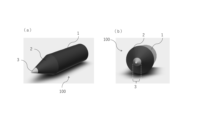
- FIG. 1 is a side view and a front view of the head pin of this embodiment.
- FIG. 2 is a perspective view of the head pin of this embodiment.
- the head pin 100 includes a body portion 10 (a shaft portion 1 and a tapered portion 2) and a tip portion 3.
- the distal end portion 3 is fixed to the distal end of the body portion 10 .
- FIG. 3 is a table showing experimental results of compressive strength and the presence or absence of internal cavities when the composition ratio (% by weight) of reinforcing fibers (1 mm carbon fiber) and resin (vinyl ester) of the body 10 is changed. . Since the body part 10 is composed mainly of reinforcing fibers and resin, it is possible to achieve low artifacts, but it requires adequate compressive strength.
- Experiment Nos. 3 and 4 had sufficient compressive strengths of 2700 N and 3000 N or more, respectively, and no internal cavities were generated. A composition ratio of (first reinforcing fibers) is required.
- the composition ratio of the reinforcing fibers is 30% by weight or more and the composition ratio of the resin is 70% by weight or less, it is possible to increase the compressive strength while preventing internal cavities in the body 10.
- the composition ratio of the resin was less than 30% by weight, the viscosity was insufficient when the body part 10 was injection molded, and the injection molding could not be performed well.
- the composition ratio of the body 10 that can obtain sufficient compressive strength of the body 10 and is suitable for injection molding is 30% to 70% by weight of the first reinforcing fiber and 30% by weight of the resin. to 70% by weight. Since reinforcing fibers are more expensive than resin, the composition ratio of the body portion 10 is preferably 30% to 50% by weight of the first reinforcing fibers in order to provide a head pin that is less expensive and has excellent disposability. and 50% to 70% by weight of the resin.
- the body 10 has a first reinforced plastic comprising 30% to 70% by weight of the first reinforcing fiber and 30% to 70% by weight of the first resin.
- the first reinforced plastic is preferably carbon fiber reinforced plastic, but glass fiber reinforced plastic, carbon fiber reinforced plastic, boron fiber reinforced plastic, aramid fiber reinforced plastic, Kepra fiber reinforced plastic, Dyneema fiber reinforced plastic, and Zylon fiber reinforced plastic.
- Sufficient compressive strength of the body 10 can be obtained even with at least one of Further, since the internal cavity and the viscosity at the time of injection molding depend on the composition ratio of the resin, even with these reinforcing fibers, the composition ratio of the body portion 10 is the same as that of the carbon fiber. In general, the strength increases as the length of the reinforcing fiber that is the composition increases. In the experiment of FIG. 3, 1 mm carbon fiber was used, but it is known that sufficient strength can be obtained by using 0.5 mm to 5 mm carbon fiber.
- the tip 3 is contactable with the animal's head, and is preferably pierceable into the animal's head in order to provide a head pin that securely fixes the head. Since force is particularly applied to the distal end portion 3, a compressive strength higher than that of the body portion 10 is required. In this case, the compressive strength higher than that of body 10 depends on at least one of material, shape and size of tip 3 .
- Artifacts caused by the tip 3 also depend on at least one of the material, shape, and size of the tip 3 .
- the material of the tip 3 is reinforced fiber, low artifacts can be achieved regardless of the shape and size. Artifacts are likely to occur when the material of the tip 3 is metal, but by selecting an appropriate shape and size, low artifacts can be achieved.
- the material of the tip portion 3 is a material containing at least one of metal, ceramics, cermet, and second reinforced plastic.
- the material of the tip 3 is preferably at least one of metal, ceramics, and cermet. Further, in order to reduce artifacts, the material of the tip portion 3 is preferably reinforced plastic.
- the shape and size of the distal end portion 3 is a shape including at least one shape of approximately cone, approximately frustum, and approximately revolution.
- a size with a maximum value of 1.5 mm to 3 mm is preferred.
- the size of the tip portion 3 is set based on metal, which tends to generate artifacts, and artifacts are further reduced with other materials.
- FIG. 5 is a diagram showing an example of the shape and size of the tip.
- the material is metal (titanium).
- the distal end portions 3-1, 3-2, 3-3 include substantially conical bodies (substantially rotating bodies) 30-1, 30-2, 30-3, and substantially conical bodies (substantially rotating bodies) 30
- the bottom lengths of -1, 30-2, and 30-3 are 1 mm, 2 mm, and 3 mm, respectively.
- distal end portions 3-1, 3-2, 3-3 include protrusions 31-1, 31-2, 31-3 extending toward the body 10, and the protrusions 31-1, 31-2, 31-3 is embedded in the body 10 so that the tips 30-1, 30-2 and 30-3 can be fixed to the body 10.
- FIG. 1 the distal end portions 3-1, 3-2, 3-3 include protrusions 31-1, 31-2, 31-3 extending toward the body 10, and the protrusions 31-1, 31-2, 31-3 is embedded in the body 10 so that the tips 30-1, 30-2 and 30-3 can be fixed to the body 10.
- the projections 31-1, 31-2, and 31-3 in FIG. 5 are cylindrical, but in order to increase the fixing strength to be fixed to the body 10, the projections 31 may be tapered, screw-shaped, flange-shaped, and It may include at least one arrowhead shape.
- the protrusion 31 has a flange shape in order to increase the strength of fixing to the body 10 .
- the projection 31 is preferably screw-shaped.
- the buried hole (not shown) of the body part 10 has a shape to be screwed with the screw-shaped projection part 31 .
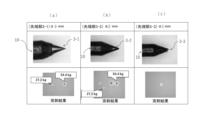
- FIG. 6 is a diagram showing the results of an experiment in which head pins each having tips 30-1, 30-2, and 30-3 (made of titanium) shown in FIG. 5 were pierced into simulated bones. Projections (not shown) of the distal ends 30-1, 30-2, and 30-3 extend toward the body 10 and are buried in the body 10. As shown in FIG. FIG. 6 shows the results of applying a force of 27.2 kg (60 lbs) and 54.4 kg (120 lbs) to the head pin and penetrating the tip 3 into the simulated bone.
- FIG. 6(a) is a diagram showing the results of an experiment in which a head pin having a tip portion 30-1 was pierced into a simulated bone. At both loadings, the tip 30-1 penetrated the simulated bone and exhibited sufficient compressive strength and fixation strength.
- FIG. 6(b) is a diagram showing the results of an experiment in which a head pin having a tip portion 30-2 was pierced into a simulated bone. At both loadings, tip 30-2 penetrated the simulated bone and exhibited sufficient compressive and anchoring strength.
- FIG. 6(c) is a diagram showing the results of an experiment in which a head pin having a tip portion 30-3 was pierced into a simulated bone. Before reaching a load of 27.2 kg (60 pounds), the tip of tip 30-2 bent and failed to exhibit sufficient compressive and anchoring strength.
- the tip portion 3 includes a substantially conical body (substantially rotating body), and the bottom surface of the substantially conical body (substantially rotating body) has a length of 1.5 mm.
- the tip portion 30-2 penetrated the simulated bone under both loads, and exhibited sufficient compressive strength and fixation strength.
- the length of the bottom surface of the substantially conical body is 1.5 mm or more.
- FIG. 7 is a diagram showing artifacts of a conventional headpin.
- FIG. 8 is a diagram showing artifacts of the headpin of this embodiment.
- a CT image (cone-beam CT image) was taken by fixing each head pin to a phantom imitating an animal's head at three points.
- FIG. 7(a) is a diagram showing an artifact of a stainless steel head pin.
- FIG. 7(b) shows a sapphire headpin artifact.
- FIG. 7(c) is a diagram showing an artifact of a head pin with a stainless steel cap attached to the tip.
- FIG. 8(a) is a diagram showing an artifact caused by a head pin having a base length of 1 mm in a substantially conical body (substantially rotating body) included in the distal end portion 3.
- FIG. 8(b) is a diagram showing an artifact caused by a head pin having a bottom surface length of 1.5 mm of a substantially conical body (substantially rotating body) included in the distal end portion 3.
- FIG. 8(c) is a diagram showing an artifact caused by a head pin having a bottom surface length of 2 mm of a substantially conical body (substantially rotating body) included in the distal end portion 3.
- FIG. FIG. 8(d) is a diagram showing an artifact caused by a head pin having a bottom surface length of 3 mm in a substantially conical body (substantially rotating body) included in the distal end portion 3.
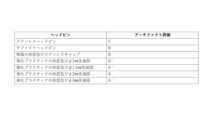
- FIG. 9 shows a table evaluating the artifacts of each headpin.
- artifacts were generated radially from the tip of the head pin, and the evaluation was as low as C and B.
- the length of the bottom surface of the substantially cone (substantially rotating body) included in the distal end portion 3 is 1.5 mm or more, and considering the low artifact, It is appropriate that the length of the bottom surface of the substantially conical body (substantially rotating body) included in the distal end portion 3 is 3 mm or less. Considering both sufficient compressive strength and fixing strength of the tip portion 3 and low artifacts, the length of the bottom surface of the substantially conical body (substantially rotating body) included in the tip portion 3 is 1.5 mm or more and 2.5 mm or less. is preferred. Furthermore, it is preferable that the length of the bottom surface of the substantially conical body (substantially rotating body) included in the distal end portion 3 is 1.5 mm or more and 2 mm or less.
- the tip portion 3 may contain at least one of stainless steel, iron, nickel, cobalt, and cemented carbide as a metal.
- the second reinforced plastic is a reinforced plastic containing 30% to 70% by weight of the second reinforcing fiber and 30% to 70% by weight of the second resin.
- the second reinforced plastic is preferably a reinforced plastic having a compression strength higher than that of the first reinforced fiber. Therefore, the second reinforced plastic is preferably a reinforced plastic containing 50% to 70% by weight of the second reinforcing fiber and 30% to 50% by weight of the second resin.
- the second reinforced plastic is preferably carbon fiber reinforced plastic, but may be another reinforced plastic.
- the resin includes at least one of a thermosetting resin and a thermoplastic resin.
- the resin may be selected from epoxy-based, phenolic-based, and unsaturated polyester-based resins.
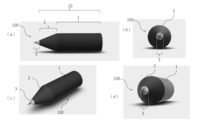
- the tip portion 3 may have a shape as shown in FIG. This shape is also included in the substantially cone shape.
- the present invention is useful as a headpin that has excellent disposability and can reduce artifacts.
Landscapes
- Health & Medical Sciences (AREA)
- Chemical & Material Sciences (AREA)
- Surgery (AREA)
- Life Sciences & Earth Sciences (AREA)
- Orthopedic Medicine & Surgery (AREA)
- Engineering & Computer Science (AREA)
- General Health & Medical Sciences (AREA)
- Public Health (AREA)
- Veterinary Medicine (AREA)
- Animal Behavior & Ethology (AREA)
- Molecular Biology (AREA)
- Nuclear Medicine, Radiotherapy & Molecular Imaging (AREA)
- Medical Informatics (AREA)
- Heart & Thoracic Surgery (AREA)
- Biomedical Technology (AREA)
- Manufacturing & Machinery (AREA)
- Chemical Kinetics & Catalysis (AREA)
- Polymers & Plastics (AREA)
- Materials Engineering (AREA)
- Medicinal Chemistry (AREA)
- Organic Chemistry (AREA)
- Oral & Maxillofacial Surgery (AREA)
- Neurosurgery (AREA)
- Pathology (AREA)
- Inorganic Chemistry (AREA)
- Materials For Medical Uses (AREA)
- Fishing Rods (AREA)
- Surgical Instruments (AREA)
- Prostheses (AREA)
Abstract
Description
2…テーパー部
3,30…先端部
10…体部
31…突起部
100…ヘッドピン
Claims (10)
- 動物の頭部を固定可能なヘッドピンであって、
30重量%乃至70重量%の第1の強化繊維と30重量%乃至70重量%の第1の樹脂を含む第1の強化プラスチックを有する前記ヘッドピンの体部と、
前記体部の先端に固定され、前記頭部と接触可能であり、金属、セラミックス、サーメット、及び第2の強化プラスチックの少なくとも1つを含む前記ヘッドピンの先端部と、
を備えることを特徴とするヘッドピン。 - 前記第2の強化プラスチックは、30重量%乃至70重量%の第2の強化繊維と30重量%乃至70重量%の第2の樹脂を含む強化プラスチックであることを特徴とする請求項1に記載のヘッドピン。
- 前記強化プラスチックは、炭素繊維強化プラスチック、ガラス繊維強化プラスチック、カーボン繊維強化プラスチック、ボロン繊維強化プラスチック、アラミド繊維強化プラスチック、ケプラ繊維強化プラスチック、ダイニーマ繊維強化プラスチック、及びザイロン繊維強化プラスチックの少なくとも1つであることを特徴とする請求項1又は請求項2に記載のヘッドピン。
- 前記樹脂は、熱硬化性樹脂及び熱可塑性樹脂の少なくとも1つを含むことを特徴とする請求項1乃至請求項3の何れか1項に記載のヘッドピン。
- 前記強化繊維は、長さが0.5mm乃至5mmの炭素繊維であることを特徴とする請求項1乃至請求項4の何れか1項に記載のヘッドピン。
- 前記先端部は、ステンレス、チタン、鉄、ニッケル、コバルト、及び超硬合金の少なくとも1つを前記金属として含み、略錐体、略錐台、及び略回転体の少なくとも1つの形状を含み、前記形状の底面の長さの最大値が1.5mm乃至3mmであることを特徴とする請求項1乃至5の何れか1項に記載のヘッドピン。
- 前記先端部は、ジルコニア、アルミナ、炭化ケイ素、チッ化ケイ素、サイアロン、コーディエライト、フェライト、チタン酸バリウム、チタン酸ジルコン酸鉛、フォルステライト、ジルコン、ムライト、ステアタイト、及び窒化アルミニウムの少なくとも1つを前記セラミックスとして含み、略錐体及び略錐台の少なくとも1つの形状を含み、前記略錐体及び前記略錐台の少なくとも1つの底面の長さの最大値が1.5mm乃至3mmであることを特徴とする請求項1乃至請求項6の何れか1項に記載のヘッドピン。
- 前記先端部は、炭素繊維強化プラスチック、ガラス繊維強化プラスチック、カーボン繊維強化プラスチック、ボロン繊維強化プラスチック、アラミド繊維強化プラスチック、ケプラ繊維強化プラスチック、ダイニーマ繊維強化プラスチック、及びザイロン繊維強化プラスチックの少なくとも1つを前記第2の強化プラスチックとして含み、略錐体、略錐台、及び略回転体の少なくとも1つの形状を含み、前記略錐体、前記略錐台、及び前記略回転体の少なくとも1つの底面の長さの最大値が1.5mm乃至3mmであることを特徴とする請求項1乃至請求項7の何れか1項に記載のヘッドピン。
- 前記先端部は、前記体部側に延伸する突起部を含み、
前記突起部は、前記体部に埋没することにより、前記先端部を前記体部に固定可能とすることを特徴とする請求項1乃至請求項8の何れか1項に記載のヘッドピン。 - 前記突起部は、円柱形状、テーパー形状、ネジ形状、フランジ形状、及び矢じり形状の少なくとも1つを含むことを特徴とする請求項1乃至請求項9の何れか1項に記載のヘッドピン。
Priority Applications (4)
| Application Number | Priority Date | Filing Date | Title |
|---|---|---|---|
| CN202280083402.5A CN118434382A (zh) | 2021-12-20 | 2022-12-20 | 头针 |
| EP22911245.3A EP4454596A4 (en) | 2021-12-20 | 2022-12-20 | HEAD SPINDLE |
| KR1020247020661A KR20240115852A (ko) | 2021-12-20 | 2022-12-20 | 헤드 핀 |
| US18/748,374 US20240341811A1 (en) | 2021-12-20 | 2024-06-20 | Skull pin |
Applications Claiming Priority (2)
| Application Number | Priority Date | Filing Date | Title |
|---|---|---|---|
| JP2021-206525 | 2021-12-20 | ||
| JP2021206525A JP7854148B2 (ja) | 2021-12-20 | ヘッドピン |
Related Child Applications (1)
| Application Number | Title | Priority Date | Filing Date |
|---|---|---|---|
| US18/748,374 Continuation US20240341811A1 (en) | 2021-12-20 | 2024-06-20 | Skull pin |
Publications (1)
| Publication Number | Publication Date |
|---|---|
| WO2023120543A1 true WO2023120543A1 (ja) | 2023-06-29 |
Family
ID=86902551
Family Applications (1)
| Application Number | Title | Priority Date | Filing Date |
|---|---|---|---|
| PCT/JP2022/046974 Ceased WO2023120543A1 (ja) | 2021-12-20 | 2022-12-20 | ヘッドピン |
Country Status (5)
| Country | Link |
|---|---|
| US (1) | US20240341811A1 (ja) |
| EP (1) | EP4454596A4 (ja) |
| KR (1) | KR20240115852A (ja) |
| CN (1) | CN118434382A (ja) |
| WO (1) | WO2023120543A1 (ja) |
Citations (5)
| Publication number | Priority date | Publication date | Assignee | Title |
|---|---|---|---|---|
| JPH05111472A (ja) * | 1991-10-18 | 1993-05-07 | Tokai Rika Co Ltd | 医療用頭蓋固定枠 |
| JP2004089456A (ja) * | 2002-08-30 | 2004-03-25 | Mizuho Co Ltd | ヘッドピン、及びそのヘッドピンを利用した頭部固定用器具 |
| JP2005342335A (ja) | 2004-06-04 | 2005-12-15 | Mizuho Co Ltd | 頭部固定装置 |
| JP2007268262A (ja) * | 2006-03-31 | 2007-10-18 | Stryker Trauma Sa | 外部固定具要素 |
| US20080251086A1 (en) * | 2007-04-13 | 2008-10-16 | Dinkler Charles E | Limited artifact skull pin |
Family Cites Families (9)
| Publication number | Priority date | Publication date | Assignee | Title |
|---|---|---|---|---|
| US5122132A (en) * | 1991-08-01 | 1992-06-16 | Bremer Medical, Inc. | Skull pin with enhanced shear resistance |
| DE4434519A1 (de) * | 1994-09-27 | 1996-03-28 | Brainlab Med Computersyst Gmbh | Fixationsstift zum Fixieren eines Referenzsystems an knöchernen Strukturen |
| EP2014251B1 (de) * | 2007-07-10 | 2012-05-30 | BrainLAB AG | Befestigungsmittel zur Lagefixierung eines Körpers für medizinische Zwecke aus Polyphenylen und Befestigungsmittel zur Lagefixierung eines Körpers für medizinische Zwecke aus einer Siliziumnitrid-Keramik |
| US8623029B2 (en) * | 2008-03-12 | 2014-01-07 | Neurologica Corp. | Composite skull pins with reduced X-ray signature |
| US9833289B2 (en) * | 2009-02-26 | 2017-12-05 | pro med instruments, GmbH | Method and apparatus for a radiolucent and MRI compatible cranial stabilization pin |
| WO2010097702A2 (en) * | 2009-02-26 | 2010-09-02 | Schuele, Christian, P. | Method and apparatus for a radiolucent and mri compatible cranial stabilization pin |
| US8915914B2 (en) * | 2012-07-25 | 2014-12-23 | Orthofix S.R.L. | Method for treating a fracture of a bone having a medullary canal |
| KR20180078188A (ko) * | 2018-05-17 | 2018-07-09 | 주식회사 카본티씨지 | 탄소복합재 스컬핀 |
| KR20240027859A (ko) * | 2019-03-11 | 2024-03-04 | 니코벤처스 트레이딩 리미티드 | 에어로졸 제공 디바이스 |
-
2022
- 2022-12-20 KR KR1020247020661A patent/KR20240115852A/ko active Pending
- 2022-12-20 WO PCT/JP2022/046974 patent/WO2023120543A1/ja not_active Ceased
- 2022-12-20 EP EP22911245.3A patent/EP4454596A4/en active Pending
- 2022-12-20 CN CN202280083402.5A patent/CN118434382A/zh active Pending
-
2024
- 2024-06-20 US US18/748,374 patent/US20240341811A1/en active Pending
Patent Citations (5)
| Publication number | Priority date | Publication date | Assignee | Title |
|---|---|---|---|---|
| JPH05111472A (ja) * | 1991-10-18 | 1993-05-07 | Tokai Rika Co Ltd | 医療用頭蓋固定枠 |
| JP2004089456A (ja) * | 2002-08-30 | 2004-03-25 | Mizuho Co Ltd | ヘッドピン、及びそのヘッドピンを利用した頭部固定用器具 |
| JP2005342335A (ja) | 2004-06-04 | 2005-12-15 | Mizuho Co Ltd | 頭部固定装置 |
| JP2007268262A (ja) * | 2006-03-31 | 2007-10-18 | Stryker Trauma Sa | 外部固定具要素 |
| US20080251086A1 (en) * | 2007-04-13 | 2008-10-16 | Dinkler Charles E | Limited artifact skull pin |
Non-Patent Citations (1)
| Title |
|---|
| See also references of EP4454596A4 |
Also Published As
| Publication number | Publication date |
|---|---|
| US20240341811A1 (en) | 2024-10-17 |
| CN118434382A (zh) | 2024-08-02 |
| EP4454596A1 (en) | 2024-10-30 |
| KR20240115852A (ko) | 2024-07-26 |
| JP2023091663A (ja) | 2023-06-30 |
| EP4454596A4 (en) | 2025-12-31 |
Similar Documents
| Publication | Publication Date | Title |
|---|---|---|
| JP5696053B2 (ja) | 骨を安定化するためのインプラントシステム | |
| CA2004569C (en) | Implantable fixing means for extraoral applications | |
| EP0913131A3 (en) | Intra-articular tendon sling fixation screw | |
| EP2967539B1 (en) | Fenestrated locking suture anchor assembly | |
| EP3597119A3 (en) | Permanent attachment means for curved tip of component of surgical stapling instrument | |
| US9078679B2 (en) | Method and apparatus for a radiolucent and MRI compatible cranial stabilization pin | |
| EP3363384A3 (en) | Surgical stapler with cooperating distal tip features on anvil and staple cartridge | |
| WO2003103733A8 (fr) | Fil chirurgical </= aptos >/= pour operations de chirurgie esthetique | |
| JP2012511980A (ja) | 骨ネジ | |
| CA2467180A1 (en) | Suture anchor with improved drive head | |
| IL152356A0 (en) | Implant | |
| EP3040047A1 (en) | Attachment for plate denture | |
| US20190183613A1 (en) | Dental prosthesis system | |
| JP2011234924A (ja) | 環椎軸椎固定器具 | |
| FI59919C (fi) | Kroekt benspik | |
| WO2023120543A1 (ja) | ヘッドピン | |
| EP3415107A1 (en) | Bone anchor | |
| JP7854148B2 (ja) | ヘッドピン | |
| US9833289B2 (en) | Method and apparatus for a radiolucent and MRI compatible cranial stabilization pin | |
| CN109171921B (zh) | 新型易拧入骨钉设计与制造 | |
| JP2018535759A (ja) | 二重にねじ山を付けられた骨ねじ | |
| US20220000528A1 (en) | Modular Head Compression Screw System and Device | |
| EP4302735A3 (en) | Ultrasonic surgical aspiration needle assembly with molded hub | |
| US20140073840A1 (en) | Implantable Receptacle for a Hearing Aid Component | |
| CN214907498U (zh) | 一种医用锚钉 |
Legal Events
| Date | Code | Title | Description |
|---|---|---|---|
| 121 | Ep: the epo has been informed by wipo that ep was designated in this application |
Ref document number: 22911245 Country of ref document: EP Kind code of ref document: A1 |
|
| WWE | Wipo information: entry into national phase |
Ref document number: 202280083402.5 Country of ref document: CN |
|
| ENP | Entry into the national phase |
Ref document number: 20247020661 Country of ref document: KR Kind code of ref document: A |
|
| WWE | Wipo information: entry into national phase |
Ref document number: 1020247020661 Country of ref document: KR |
|
| NENP | Non-entry into the national phase |
Ref country code: DE |
|
| ENP | Entry into the national phase |
Ref document number: 2022911245 Country of ref document: EP Effective date: 20240722 |