WO2023120724A1 - リン-炭素複合材料、リン-炭素複合材料の製造方法、負極活物質、リチウム二次電池用負極及びリチウム二次電池 - Google Patents
リン-炭素複合材料、リン-炭素複合材料の製造方法、負極活物質、リチウム二次電池用負極及びリチウム二次電池 Download PDFInfo
- Publication number
- WO2023120724A1 WO2023120724A1 PCT/JP2022/047738 JP2022047738W WO2023120724A1 WO 2023120724 A1 WO2023120724 A1 WO 2023120724A1 JP 2022047738 W JP2022047738 W JP 2022047738W WO 2023120724 A1 WO2023120724 A1 WO 2023120724A1
- Authority
- WO
- WIPO (PCT)
- Prior art keywords
- phosphorus
- carbon
- composite material
- carbon composite
- negative electrode
- Prior art date
- Legal status (The legal status is an assumption and is not a legal conclusion. Google has not performed a legal analysis and makes no representation as to the accuracy of the status listed.)
- Ceased
Links
Images


Classifications
-
- H—ELECTRICITY
- H01—ELECTRIC ELEMENTS
- H01M—PROCESSES OR MEANS, e.g. BATTERIES, FOR THE DIRECT CONVERSION OF CHEMICAL ENERGY INTO ELECTRICAL ENERGY
- H01M4/00—Electrodes
- H01M4/02—Electrodes composed of, or comprising, active material
- H01M4/36—Selection of substances as active materials, active masses, active liquids
- H01M4/362—Composites
- H01M4/366—Composites as layered products
-
- H—ELECTRICITY
- H01—ELECTRIC ELEMENTS
- H01M—PROCESSES OR MEANS, e.g. BATTERIES, FOR THE DIRECT CONVERSION OF CHEMICAL ENERGY INTO ELECTRICAL ENERGY
- H01M4/00—Electrodes
- H01M4/02—Electrodes composed of, or comprising, active material
- H01M4/13—Electrodes for accumulators with non-aqueous electrolyte, e.g. for lithium-accumulators; Processes of manufacture thereof
- H01M4/133—Electrodes based on carbonaceous material, e.g. graphite-intercalation compounds or CFx
-
- C—CHEMISTRY; METALLURGY
- C01—INORGANIC CHEMISTRY
- C01B—NON-METALLIC ELEMENTS; COMPOUNDS THEREOF; METALLOIDS OR COMPOUNDS THEREOF NOT COVERED BY SUBCLASS C01C
- C01B25/00—Phosphorus; Compounds thereof
-
- C—CHEMISTRY; METALLURGY
- C01—INORGANIC CHEMISTRY
- C01B—NON-METALLIC ELEMENTS; COMPOUNDS THEREOF; METALLOIDS OR COMPOUNDS THEREOF NOT COVERED BY SUBCLASS C01C
- C01B25/00—Phosphorus; Compounds thereof
- C01B25/02—Preparation of phosphorus
-
- H—ELECTRICITY
- H01—ELECTRIC ELEMENTS
- H01M—PROCESSES OR MEANS, e.g. BATTERIES, FOR THE DIRECT CONVERSION OF CHEMICAL ENERGY INTO ELECTRICAL ENERGY
- H01M10/00—Secondary cells; Manufacture thereof
- H01M10/05—Accumulators with non-aqueous electrolyte
- H01M10/052—Li-accumulators
-
- H—ELECTRICITY
- H01—ELECTRIC ELEMENTS
- H01M—PROCESSES OR MEANS, e.g. BATTERIES, FOR THE DIRECT CONVERSION OF CHEMICAL ENERGY INTO ELECTRICAL ENERGY
- H01M10/00—Secondary cells; Manufacture thereof
- H01M10/05—Accumulators with non-aqueous electrolyte
- H01M10/052—Li-accumulators
- H01M10/0525—Rocking-chair batteries, i.e. batteries with lithium insertion or intercalation in both electrodes; Lithium-ion batteries
-
- H—ELECTRICITY
- H01—ELECTRIC ELEMENTS
- H01M—PROCESSES OR MEANS, e.g. BATTERIES, FOR THE DIRECT CONVERSION OF CHEMICAL ENERGY INTO ELECTRICAL ENERGY
- H01M4/00—Electrodes
- H01M4/02—Electrodes composed of, or comprising, active material
- H01M4/13—Electrodes for accumulators with non-aqueous electrolyte, e.g. for lithium-accumulators; Processes of manufacture thereof
- H01M4/136—Electrodes based on inorganic compounds other than oxides or hydroxides, e.g. sulfides, selenides, tellurides, halogenides or LiCoFy
-
- H—ELECTRICITY
- H01—ELECTRIC ELEMENTS
- H01M—PROCESSES OR MEANS, e.g. BATTERIES, FOR THE DIRECT CONVERSION OF CHEMICAL ENERGY INTO ELECTRICAL ENERGY
- H01M4/00—Electrodes
- H01M4/02—Electrodes composed of, or comprising, active material
- H01M4/36—Selection of substances as active materials, active masses, active liquids
- H01M4/362—Composites
-
- H—ELECTRICITY
- H01—ELECTRIC ELEMENTS
- H01M—PROCESSES OR MEANS, e.g. BATTERIES, FOR THE DIRECT CONVERSION OF CHEMICAL ENERGY INTO ELECTRICAL ENERGY
- H01M4/00—Electrodes
- H01M4/02—Electrodes composed of, or comprising, active material
- H01M4/36—Selection of substances as active materials, active masses, active liquids
- H01M4/38—Selection of substances as active materials, active masses, active liquids of elements or alloys
-
- H—ELECTRICITY
- H01—ELECTRIC ELEMENTS
- H01M—PROCESSES OR MEANS, e.g. BATTERIES, FOR THE DIRECT CONVERSION OF CHEMICAL ENERGY INTO ELECTRICAL ENERGY
- H01M4/00—Electrodes
- H01M4/02—Electrodes composed of, or comprising, active material
- H01M4/36—Selection of substances as active materials, active masses, active liquids
- H01M4/58—Selection of substances as active materials, active masses, active liquids of inorganic compounds other than oxides or hydroxides, e.g. sulfides, selenides, tellurides, halogenides or LiCoFy; of polyanionic structures, e.g. phosphates, silicates or borates
- H01M4/583—Carbonaceous material, e.g. graphite-intercalation compounds or CFx
-
- H—ELECTRICITY
- H01—ELECTRIC ELEMENTS
- H01M—PROCESSES OR MEANS, e.g. BATTERIES, FOR THE DIRECT CONVERSION OF CHEMICAL ENERGY INTO ELECTRICAL ENERGY
- H01M4/00—Electrodes
- H01M4/02—Electrodes composed of, or comprising, active material
- H01M4/36—Selection of substances as active materials, active masses, active liquids
- H01M4/58—Selection of substances as active materials, active masses, active liquids of inorganic compounds other than oxides or hydroxides, e.g. sulfides, selenides, tellurides, halogenides or LiCoFy; of polyanionic structures, e.g. phosphates, silicates or borates
- H01M4/583—Carbonaceous material, e.g. graphite-intercalation compounds or CFx
- H01M4/587—Carbonaceous material, e.g. graphite-intercalation compounds or CFx for inserting or intercalating light metals
-
- H—ELECTRICITY
- H01—ELECTRIC ELEMENTS
- H01M—PROCESSES OR MEANS, e.g. BATTERIES, FOR THE DIRECT CONVERSION OF CHEMICAL ENERGY INTO ELECTRICAL ENERGY
- H01M4/00—Electrodes
- H01M4/02—Electrodes composed of, or comprising, active material
- H01M2004/021—Physical characteristics, e.g. porosity, surface area
-
- H—ELECTRICITY
- H01—ELECTRIC ELEMENTS
- H01M—PROCESSES OR MEANS, e.g. BATTERIES, FOR THE DIRECT CONVERSION OF CHEMICAL ENERGY INTO ELECTRICAL ENERGY
- H01M4/00—Electrodes
- H01M4/02—Electrodes composed of, or comprising, active material
- H01M2004/026—Electrodes composed of, or comprising, active material characterised by the polarity
- H01M2004/027—Negative electrodes
-
- Y—GENERAL TAGGING OF NEW TECHNOLOGICAL DEVELOPMENTS; GENERAL TAGGING OF CROSS-SECTIONAL TECHNOLOGIES SPANNING OVER SEVERAL SECTIONS OF THE IPC; TECHNICAL SUBJECTS COVERED BY FORMER USPC CROSS-REFERENCE ART COLLECTIONS [XRACs] AND DIGESTS
- Y02—TECHNOLOGIES OR APPLICATIONS FOR MITIGATION OR ADAPTATION AGAINST CLIMATE CHANGE
- Y02E—REDUCTION OF GREENHOUSE GAS [GHG] EMISSIONS, RELATED TO ENERGY GENERATION, TRANSMISSION OR DISTRIBUTION
- Y02E60/00—Enabling technologies; Technologies with a potential or indirect contribution to GHG emissions mitigation
- Y02E60/10—Energy storage using batteries
Definitions
- the present invention relates to a phosphorus-carbon composite material, a method for producing a phosphorus-carbon composite material, a negative electrode active material, a negative electrode for a lithium secondary battery, and a lithium secondary battery.
- Lithium secondary batteries are used as power sources for small electronic devices such as mobile phones and laptop computers. In recent years, lithium secondary batteries have been put to practical use even in medium-sized or large-sized power sources such as automobile applications and power storage applications.
- Carbon materials are known as negative electrode active materials for lithium secondary batteries.
- a negative electrode active material in which a carbon material further contains phosphorus (see, for example, Patent Document 1).
- the carbon material-containing negative electrode active material further contains phosphorus, so that the negative electrode can have excellent charge/discharge capacity.
- the negative electrode active material In order to obtain a highly reliable and high-performance lithium secondary battery, the negative electrode active material is required to have excellent durability as well as charge/discharge capacity. Conventional negative electrode active materials still have room for improvement in order to improve the performance of lithium secondary batteries.
- the present invention has been made in view of such circumstances, and an object of the present invention is to provide a novel phosphorus-carbon composite material containing phosphorus and carbon. Another object of the present invention is to provide a method for producing a phosphorus-carbon composite material that enables the production of such a novel phosphorus-carbon composite material. A further object of the present invention is to provide a negative electrode active material, a negative electrode for a lithium secondary battery, and a lithium secondary battery containing such a novel phosphorus-carbon composite material.
- one aspect of the present invention includes the following aspects.
- thermogravimetry 10 mg of phosphorus-carbon composite material is precisely weighed as a sample, and a thermogravimetric measurement device is used to measure the weight change when heated from 50 ° C. to 780 ° C. at a temperature increase rate of 10 ° C./min under a nitrogen stream. .
- Weight reduction rate The ratio of the weight of the sample at the measurement temperature to the weight of the precisely weighed sample is defined as the weight reduction rate (% by weight) at the measurement temperature.
- a method for producing a phosphorus-carbon composite material comprising a step of combining a carbon material and phosphorus by mixing and pulverizing with compression.
- a method for producing a phosphorus-carbon composite material comprising the step of ball-mill mixing a carbon material and phosphorus.
- the carbon material is selected from the group consisting of amorphous carbon, graphite, porous carbon, mesocarbon microbeads, fullerene, carbon nanotube, graphene, graphene oxide, carbon nitrite ( C3N4 ) and laminated carbon nanofibers .
- a negative electrode active material comprising the phosphorus-carbon composite material according to any one of [1] to [5].
- a negative electrode for a lithium secondary battery comprising the negative electrode active material according to [10].
- a lithium secondary battery comprising the negative electrode for a lithium secondary battery according to [11].
- a novel phosphorus-carbon composite material containing phosphorus and carbon can be provided.
- a method for producing a phosphorus-carbon composite material that can suitably produce such a novel phosphorus-carbon composite material can be provided.
- a negative electrode active material, a negative electrode for a lithium secondary battery, and a lithium secondary battery containing such a novel phosphorus-carbon composite material can be provided.
- FIG. 1 is a graph showing the results of thermogravimetric measurements for PC materials and PC mixtures.
- FIG. 2 is the XPS spectra of the PC material and PC mixture.
- FIG. 3 is a transmission electron microscope (TEM) photograph of the PC material.
- FIG. 4 is the XRD profile of the PC material and PC mixture.
- FIG. 5 is a schematic diagram showing an example of a lithium secondary battery.
- FIG. 6 is a schematic diagram showing an example of an all-solid lithium secondary battery.
- 7 is a graph showing the results of thermogravimetric measurements of the PC materials prepared in Examples 1 and 4-7 and the PC mixture prepared in Comparative Example 2.
- FIG. 8 shows XPS spectra of the PC materials produced in Examples 1-5 and 7.
- FIG. 9 shows XRD profiles of the PC materials produced in Examples 1-7 and the PC mixtures produced in Comparative Examples 1 and 2.
- FIG. 10 is a graph showing the discharge capacity up to 100 cycles of lithium secondary batteries using the PC materials of Examples 1 to 7 and Comparative
- FIG. 1 A method for producing a phosphorus-carbon composite material, a negative electrode active material, a negative electrode for a lithium secondary battery, and a lithium secondary battery according to the present embodiment will be described below with reference to FIGS. 1 to 6.
- FIG. 1 A method for producing a phosphorus-carbon composite material, a negative electrode active material, a negative electrode for a lithium secondary battery, and a lithium secondary battery according to the present embodiment will be described below with reference to FIGS. 1 to 6.
- FIG. in all the drawings below, the dimensions and ratios of the constituent elements are appropriately changed in order to make the drawings easier to see.
- Phosphorus-carbon composite material contains phosphorus atoms and carbon atoms.
- phosphorus-carbon composite material may be simply abbreviated as "PC material”.
- the PC material has a phosphorus atom content of 10% by mass or more and 95% by mass or less. Also, the content of carbon atoms in the PC material is 5% by mass or more and 90% by mass or less. In the present specification, "the content of a certain atom in the PC material” means “the content of a certain atom (% by mass) when the entire PC material is 100% by mass”. When the PC material consists of phosphorus atoms and carbon atoms, the sum of the carbon atom content and the phosphorus atom content in the PC material is 100% by mass. Even when the PC material is composed of carbon atoms and phosphorus atoms, impurities that are unavoidably mixed from the raw material of the PC material and the manufacturing process are allowed.
- the PC material is composed of phosphorus atoms and carbon atoms in 60 mass % or more of the whole, and may further contain elements other than phosphorus atoms and carbon atoms.
- Elements other than phosphorus atoms and carbon atoms contained in PC materials include lithium, silicon, germanium, tin, aluminum, zinc, magnesium, transition metals, nitrogen, oxygen, fluorine, silicon, titanium, niobium, sulfur, and chlorine. is mentioned.
- raw materials for the PC material include metal oxides, composite metal oxides, metal fluorides, metal sulfides, metal chlorides, silicon oxides, and silicic acids of these elements. Salts, titanates, aluminates are available.
- the content of phosphorus atoms, the content of carbon atoms, and the content of other atoms that may be contained in the PC material can be determined by known ICP analysis.
- the phosphorus atom content is preferably 20% by mass or more, more preferably 30% by mass or more, and still more preferably 50% by mass or more.
- the higher the phosphorus content the higher the initial charge/discharge capacity of the PC material.
- the phosphorus atom content is preferably 90% by mass or less, more preferably 80% by mass or less, and even more preferably 75% by mass or less. This is because if the content of phosphorus atoms is too high, the cycle characteristics of the PC material deteriorate.
- the upper limit and lower limit of the phosphorus atom content can be combined arbitrarily.
- the carbon atom content is preferably 10% by mass or more, more preferably 20% by mass or more, and still more preferably 25% by mass or more.
- the carbon atom content is preferably 80% by mass or less, more preferably 70% by mass or less, and still more preferably 50% by mass or less. This is because if the carbon atom content is too high, the initial charge/discharge capacity of the PC material will decrease.
- the upper limit and lower limit of the carbon atom content can be combined arbitrarily.
- the PC material can be produced by mixing phosphorus and a carbon material in a ball mill.
- the inventors analyzed and studied the obtained PC material in detail, and found that the PC material is not a mixture of a raw material phosphorus and a carbon material, but a mixture of phosphorus atoms and carbon atoms. are chemically bonded (covalently bonded) to form a novel material having physical properties different from those of the raw material phosphorus and carbon materials.
- PC mixture the mixture of phosphorus and carbon material
- an example of a PC material is compared with an example of a mixture in which the same raw materials as the PC material are mixed in a mortar.
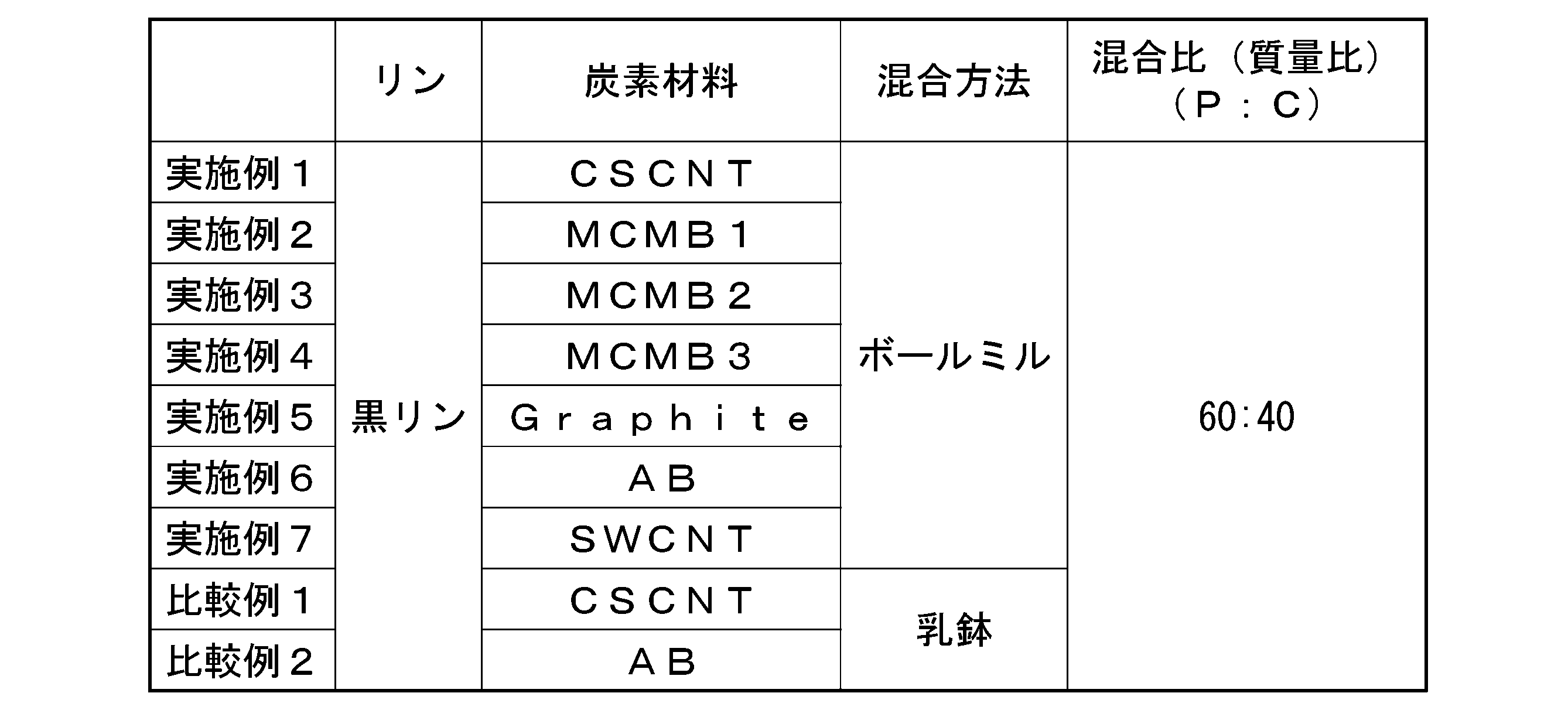
- the starting material for the PC material and the starting material for the PC mixture both contain black phosphorus and a carbon material at a ratio of 6:4 (mass ratio).
- CSCNTs cup stacked carbon nanotubes
- Carbon materials other than CSCNT that can be used as raw materials for PC materials will be described later.
- the ratio WL 620 /WL 780 between the weight loss rate WL 620 at the measurement temperature of 620 ° C. and the weight loss rate WL 780 at the measurement temperature of 780 ° C. which is obtained by thermogravimetry under the following conditions, is 0.1. 0.9 or less.
- thermogravimetry 10 mg of phosphorus-carbon composite material is precisely weighed as a sample, and a thermogravimetric measurement device is used to measure the weight change when heated from 50 ° C. to 800 ° C. at a heating rate of 10 ° C./min under a nitrogen stream. .
- Weight reduction rate The ratio of the weight of the sample at the measurement temperature to the weight of the precisely weighed sample is defined as the weight reduction rate (% by weight) at the measurement temperature. Specifically, the ratio of weight loss of the sample from the initial weight to each measurement temperature to the weight of the precisely weighed sample (initial weight) is defined as the weight loss rate (% by weight) at the measurement temperature.
- FIG. 1 is a graph showing the results of the above thermogravimetric measurements for PC materials and PC mixtures.
- the horizontal axis indicates the heating temperature (° C.)
- the vertical axis indicates the weight reduction rate (% by weight) relative to the weight of the sample.
- symbol A indicates the behavior of the PC material
- symbol X indicates the behavior of the PC mixture.
- the weight loss rate WL 620 at the measurement temperature of 620 ° C. (indicated by symbol X1 in FIG. 1) and the weight loss rate WL 780 at the measurement temperature of 780 ° C. (in FIG. 1, indicated by symbol X2) are both less than 58%.
- the PC mixture shows a steep weight loss at a measurement temperature of 350°C to 450°C, and at 620°C, about 60% of the initial weight of the sample is lost. Further, after the steep weight loss from the measurement temperature of 350° C. to 450° C., almost no weight loss is observed. As a result, the ratio WL 620 /WL 780 between WL 620 and WL 780 exceeds 0.9 in the PC mixture.
- thermogravimetric measurement of the PC mixture corresponds to the weight of the raw material, black phosphorus.
- black phosphorus contained in the PC mixture was lost by heating. It is known that black phosphorus changes into allotrope red phosphorus by heating to 125°C. Also, red phosphorus is known to sublime at 416° C. under normal pressure.
- the PC material continues to lose weight from around 350° C. until it reaches 800° C., which is the upper limit of the measurement temperature range. Weight reduction is also observed between the measurement temperature of 620°C and the measurement temperature of 780°C. As a result, the ratio WL 620 between the weight loss rate WL 620 at the measurement temperature of 620° C. (indicated by symbol A1 in FIG. 1) and the weight loss rate WL 780 at the measurement temperature of 780° C. (indicated by symbol A2 in FIG. 1). /WL 780 is included in the range of 0.1 to 0.9.
- the PC material has a weight loss rate WL 300 (indicated by symbol A3 in FIG. 1) at a measurement temperature of 300 ° C. obtained by the above thermogravimetry, and a weight loss rate WL 600 at a measurement temperature of 600 ° C. (FIG. 1
- the ratio WL 300 /WL 600 to (indicated by symbol A4 in the middle) is preferably within -0.1 or more and 0.1 or less.
- the PC material hardly loses weight up to a measurement temperature of 300°C and is thermally stable at the measurement temperature of 300°C. Therefore, WL 300 becomes extremely small, and WL 300 /WL 600 also becomes -0.1 or more and 0.1 or less, which is a value near zero.
- WL 620 /WL 780 is preferably 0.1 or more, more preferably 0.3 or more, and still more preferably 0.5 or more. Also, WL 620 /WL 780 is preferably 0.9 or less, more preferably 0.8 or less. The upper and lower limits of WL 620 /WL 780 can be combined arbitrarily.
- WL 300 /WL 600 is preferably ⁇ 0.1 or more, more preferably ⁇ 0.08 or more. Also, WL 300 /WL 600 is preferably 0.1 or less, more preferably 0.08 or less. The upper and lower limits of WL300 / WL600 can be combined arbitrarily.
- PC bond [Presence or absence of PC bond]
- the PC material has peaks in the XPS spectrum that indicate bonding between phosphorus and carbon atoms. It is known that the "peak indicating the bond between the phosphorus atom and the carbon atom" appears in the range of 132-136 eV in the XPS spectrum. In the following description, the bond between the phosphorus atom and the carbon atom may be simply referred to as "PC bond”.
- Figure 2 is the XPS spectrum of the PC material and the PC mixture.
- the horizontal axis indicates binding energy (eV), and the vertical axis indicates the number of detected photoelectrons (cps (count per second)).
- symbol A indicates a PC material and symbol X indicates a PC mixture.
- XPS spectrum measurement conditions XPS spectra are measured under the following measurement conditions. ⁇ Measuring equipment: XPS device, ESCA-3400 (manufactured by Shimadzu Corporation) ⁇ Radiation source: Mg K ⁇ rays (20 mA, 10 kV) If a peak is detected in the range of 132-136 eV, it is judged to have a PC bond. The XPS spectra obtained may contain noise in the analysis. Therefore, in the present embodiment, a line connecting two adjacent minimum values in the XPS spectrum is used as a baseline, and a local curve including a maximum value sandwiched between the two minimum values has a half-value width of 0.5 eV or less. If so, judge the curve as "noise". When determining the presence or absence of a PC bond using an XPS spectrum, the presence or absence of a peak in the range of 132 to 136 eV is confirmed after excluding "noise" as defined above.
- the PC material has core particles containing phosphorus atoms and a carbon coating covering the surface of the core particles.
- FIG. 3 is a transmission electron microscope (TEM) photograph of the PC material.
- the PC material particle 50 has a core-shell structure in which the surface of the core particle 51 containing phosphorus atoms is covered with the carbon film 52 .
- the core particle 51 has a core-shell structure in which the core particle 51 contains phosphorus atoms and is covered with the carbon film 52 containing carbon atoms.
- Imaging conditions for TEM photograph A TEM photograph is taken under the following imaging conditions.
- ⁇ TEM device Transmission electron microscope H-9000NAR (manufactured by Hitachi, Ltd.) - Field of view: Maximum 500 nm x 500 nm.
- a photograph is taken with at least a portion of the particles of the PC material within the field of view.
- the PC material preferably has the above-mentioned core-shell structure in addition to satisfying the requirements for [thermal behavior] described above.
- FIG. 4 is the XRD profile of the PC material and PC mixture.
- the horizontal axis indicates the diffraction angle (2 ⁇ ,°) and the vertical axis indicates the diffraction X-ray intensity (a.u.).
- the XRD profile with symbol A indicates the PC material
- the XRD profile with symbol X indicates the PC mixture.
- XRD profile measurement conditions The XRD profile is measured under the following measurement conditions.
- ⁇ Measurement equipment Horizontal sample multipurpose X-ray diffractometer Ultima IV (manufactured by Rigaku Co., Ltd.)
- ⁇ Radiation source Cu K ⁇ ray ⁇ Measurement range (2 ⁇ ): 10° to 90° ⁇ Scanning speed: 4°/min ⁇ Sampling: 0.02° ⁇ Voltage 40kV, current 40mA
- the carbon material and black phosphorus each have a certain degree of crystallinity and exhibit diffraction peaks.
- the diffraction peak seen in the PC mixture was not observed, and only noise could be confirmed in the entire measurement range. That is, from the results shown in FIG. 4, in the PC material, the crystallinity of the carbon material used as the raw material is lost and it is amorphous, or it is considered that the carbon material is so fine that the crystal state cannot be confirmed. .
- P represented by the above formula (2) is the difference between the intensity I 40 at the reference point and the intensity I 26.3 at the position where the peak of the carbon material exists, and indicates the difference in the peak from the reference point. .
- the ratio of the baseline intensity and the peak intensity from the reference point is obtained from the ratio of the absolute values of P and B (
- is 2 or more, it indicates the presence of a carbon material peak.
- the PC material satisfies the above-described relational expressions (1) to (3) in addition to satisfying the above-described requirements for [behavior to heat].
- the PC material is different from the mixture of the raw material phosphorus (black phosphorus in FIGS. It is a new substance that is different from each other.
- the PC material can be produced by a production method having a step of compounding the carbon material and phosphorus by mixing and pulverizing with compression.
- the raw carbon materials include amorphous carbon, graphite, porous carbon, mesocarbon microbeads (MCMB), fullerene, carbon nanotubes, graphene, graphene oxide, carbon nitrite (C 3 N 4 )
- MCMB mesocarbon microbeads
- Fullerene carbon nanotubes
- graphene graphene oxide
- carbon nitrite carbon nitrite
- At least one selected from the group consisting of laminated carbon nanofibers (Carbon nanfibers platelets) can be used. All of these carbon materials have a graphite structure.
- amorphous carbon examples include carbon black (CB), acetylene black (AB), ketjen black, hard carbon, and soft carbon.
- Fullerenes include C 60 , C 72 , C 84 and the like.
- carbon nanotubes examples include single-wall carbon nanotubes (SWCNT), multi-wall carbon nanotubes (MWCNT), cup-stacked carbon nanotubes (CSCNT), and carbon nanofibers VGCF (vapor grown carbon fiber). They have a structure extending in one axis (one-dimensional structure).
- Graphene, graphene oxide, carbon nitrite (C 3 N 4 ), and laminated carbon nanofibers platelets have a structure (two-dimensional structure) extending in the plane direction.
- conjugation of the sp 2 hybridized orbitals is interrupted at the ends (edge sites) of the graphite structure, and the activity is higher than at locations other than the edge sites. Therefore, it is assumed that most of the PC bonds are formed at the edge sites of the carbon material. Therefore, from the viewpoint of facilitating the formation of PC bonds, it is considered preferable that the carbon material to be used should have many edge sites.
- Carbon materials with many edge sites include CSCNT, graphite, mesocarbon microbeads (MCMB), graphene, graphene oxide, carbon nitrite ( C3N4 ), and laminated carbon nanofibers.
- CSCNT is preferable as the carbon material.
- any known phosphorus allotrope can be used as the raw material, phosphorus.
- Phosphorus is preferably black phosphorus, which is the most chemically stable phosphorus allotrope and is a good conductor of electricity.
- the "mixing and pulverizing process accompanied by compression” is a process of applying a compressive force to multiple types of powder raw materials to mix and pulverize the raw materials.
- a mixed pulverization process accompanied by compression By subjecting the carbon material and phosphorus to a mixed pulverization process accompanied by compression, by applying a strong impact force to the carbon material and phosphorus, the raw material powder is mixed and pulverized, and at the same time, a chemical change that cannot be obtained with a normal mixture occurs. it is conceivable that.
- a PC material is obtained as a product in which PC bonds that are not present in the starting material are formed and the crystalline state observed in the starting material is not observed.
- the "mixing pulverization process with compression” should be performed until the peak derived from the raw material disappears in the XRD profile of the mixed material. Alternatively, the XPS spectrum of the mixed material should be continued until it can be confirmed that a PC bond has occurred.
- Processing equipment that can perform mixed crushing with compression includes roller mills, jet mills, hammer mills, pin mills, disk mills, rod mills, ball mills, vibration mills, attritors, and bead mills.
- roller mills jet mills, hammer mills, pin mills, disk mills, rod mills, ball mills, vibration mills, attritors, and bead mills.
- agitating pulverizer equipped with a pulverizing container and a rotating body, particularly in that mixing and pulverizing can be performed simultaneously.
- Agitation grinders include pin mills, disc mills, rod mills, ball mills, vibrating mills, attritors, and bead mills.
- a medium agitating pulverizer is preferable because it can mix and pulverize the raw material powders and simultaneously apply a strong impact force to the carbon material and phosphorus.
- a ball mill, a vibration mill, an attritor, and a bead mill can be used as the medium agitating pulverizer.
- a ball mill is particularly preferable as a pulverizer from the viewpoint of being able to easily control the property conditions.
- the core particles containing phosphorus atoms are compounded while forming the above-mentioned carbon film around them to obtain a PC material.
- the production conditions can be controlled by adjusting the rotation speed of the ball mill device, the amount of media (balls) to the raw material (Ball powder ratio), and the mixing time. That is, by adjusting conditions such as increasing the rotational speed of the ball mill device, increasing the amount of media with respect to the raw material, and lengthening the mixing time, the mixing of phosphorus and the carbon material is promoted, making it easier to obtain a PC material. .
- the formation of PC bonds is facilitated, and a PC material satisfying WL 620 /WL 780 of 0.1 or more and 0.9 or less is easily produced.
- a ball is a grinding medium for grinding metal materials.
- the ball diameter is the average particle size of the balls.
- the balls flow in the crushing container at high speed due to the rotation of the crushing container itself of the crusher and collide with the powder raw material containing the carbon material and phosphorus, thereby crushing into particles with a smaller average particle size.
- the grinding vessel and beads do not wear excessively. Therefore, the shape of the ball is preferably spherical or ellipsoidal.
- the diameter of the balls is preferably larger than the average particle size of the PC material after pulverization.
- a large amount of pulverization energy can be applied to the metal material, so that metal particles can be efficiently obtained in a short time.
- the diameter of the balls is too large, it promotes reagglomeration of the PC material and produces a PC material with a wide particle size distribution.
- the diameter of the ball is preferably 0.1-10 mm, more preferably 1-10 mm. When the ball diameter is within this range, it is possible to promote the formation of PC bonds and suppress reaggregation.
- the diameter of the balls placed in the grinding vessel may be uniform or may vary.
- Ball materials include glass, agate, alumina, zirconia, stainless steel, chrome steel, tungsten carbide, silicon carbide, and silicon nitride.
- zirconia is preferably used because it has a relatively high hardness and is therefore less likely to be worn, and because it has a relatively high specific gravity and a large amount of pulverization energy can be obtained.
- raw powder of PC material can be pulverized efficiently.
- the weight ratio between the ball and the raw material powder of the PC material (the weight of the ball when the weight of the raw material powder of the PC material is 1) is defined as the ball powder ratio.
- the ball powder ratio is preferably 0.5-500, more preferably 1-200, still more preferably 10-200.
- the balls are separated from the PC material using a filter or the like.
- the fact that the above-mentioned PC material is obtained by ball mill mixing can be confirmed by measuring the XRD profile of the mixed material and confirming that the peak derived from the raw material has disappeared as shown in FIG.
- the duration of the ball mill mixing is preferably determined by performing a preliminary experiment on the relationship between the mixing time and the disappearance of the peak derived from the raw materials. In other words, the ball mill mixing is preferably performed until the peak derived from the raw material disappears in the XRD profile of the mixed material.
- the duration of ball mill mixing should be determined by conducting a preliminary experiment on the relationship between the mixing time and the formation of the PC bond. In other words, the ball-mill mixing should be continued until the XPS spectrum of the mixed material confirms the occurrence of PC bonds.
- the above-described PC material can be easily manufactured by performing a mixed pulverization process involving compression on the carbon material and phosphorus.
- the above-described PC material can be easily manufactured by a simple method of mixing the carbon material and phosphorus in a ball mill.
- the negative electrode active material includes the PC material described above.
- the negative electrode active material may use the above-described PC material alone, or may contain a known material used as a negative electrode active material in addition to the PC material.
- a known material used as a negative electrode active material include (i) carbon materials capable of intercalating and deintercalating lithium ions, (ii) alloy-based negative electrode active materials accompanied by the formation of a lithium alloy phase, (iii) decomposition and regeneration reaction with lithium ions ( conversion reaction), and (iv) an oxide or composite oxide having activity as a negative electrode material active material.
- Carbon materials include graphite, hard carbon, soft carbon, and carbon nanotubes.
- Alloy-based negative electrode active materials include metals such as silicon, germanium, tin, aluminum, zinc, and magnesium, or alloys thereof.
- Transition metal oxides include manganese oxide, iron oxide, cobalt oxide, nickel oxide, copper oxide, and magnesium oxide. These oxides may be composite metal oxides further containing other metals (eg, lithium).
- oxides or composite oxides examples include titanium oxide, lithium titanate, and silicon oxide.
- a negative electrode for a lithium secondary battery contains the negative electrode active material described above.
- a negative electrode for a lithium secondary battery includes, in addition to a negative electrode active material, a current collector and a binder for binding the negative electrode active material to the current collector.
- a known structure can be adopted for the current collector and the binder.
- Copper or a copper alloy can be suitably used as the material for the current collector.
- PVdF polyvinylidene fluoride
- a lithium secondary battery includes the aforementioned negative electrode for lithium secondary battery (hereinafter referred to as negative electrode).
- An example of a lithium secondary battery suitable for using the negative electrode active material described above has a positive electrode and a negative electrode, a separator sandwiched between the positive electrode and the negative electrode, and an electrolytic solution placed between the positive electrode and the negative electrode.
- An example of a lithium secondary battery has a positive electrode and a negative electrode, a separator sandwiched between the positive electrode and the negative electrode, and an electrolytic solution placed between the positive electrode and the negative electrode.
- FIG. 5 is a schematic diagram showing an example of a lithium secondary battery.
- Cylindrical lithium secondary battery 10 is manufactured as follows.
- a pair of strip-shaped separators 1, a strip-shaped positive electrode 2 having a positive electrode lead 21 at one end, and a strip-shaped negative electrode 3 having a negative electrode lead 31 at one end are arranged as follows: 1 and the negative electrode 3 are stacked in this order and wound to form an electrode group 4 .
- the can bottom is sealed, the electrode group 4 is impregnated with the electrolytic solution 6, and the electrolyte is arranged between the positive electrode 2 and the negative electrode 3. . Further, by sealing the upper portion of the battery can 5 with the top insulator 7 and the sealing member 8, the lithium secondary battery 10 can be manufactured.
- the shape of the electrode group 4 is, for example, a columnar shape such that the cross-sectional shape of the electrode group 4 cut in the direction perpendicular to the winding axis is a circle, an ellipse, a rectangle, or a rectangle with rounded corners. can be mentioned.
- a shape defined by IEC60086 which is a standard for batteries defined by the International Electrotechnical Commission (IEC), or JIS C 8500 can be adopted.
- IEC60086 which is a standard for batteries defined by the International Electrotechnical Commission (IEC), or JIS C 8500
- a shape such as a cylindrical shape or a rectangular shape can be mentioned.
- the lithium secondary battery is not limited to the wound type configuration described above, and may have a layered configuration in which a layered structure of a positive electrode, a separator, a negative electrode, and a separator is repeatedly stacked.
- laminated lithium secondary batteries include so-called coin-type batteries, button-type batteries, and paper-type (or sheet-type) batteries.
- the positive electrode can be manufactured by preparing a positive electrode mixture containing a positive electrode active material, a conductive material, and a binder, and supporting the positive electrode mixture on a positive electrode current collector.
- lithium-containing compound or other metal compound can be used for the positive electrode active material.
- lithium-containing compounds include lithium-cobalt composite oxides having a layered structure, lithium-nickel composite oxides having a layered structure, lithium-manganese composite oxides having a spinel structure, and lithium iron phosphate having an olivine structure. .
- metal compounds include, for example, oxides such as titanium oxide, vanadium oxide or manganese dioxide, or sulfides such as titanium sulfide or molybdenum sulfide.
- a carbon material can be used as the conductive material of the positive electrode.
- Examples of carbon materials include graphite powder, carbon black (eg, acetylene black), and fibrous carbon materials.
- the ratio of the conductive material in the positive electrode mixture is preferably 5-20 parts by mass with respect to 100 parts by mass of the positive electrode active material.
- thermoplastic resin can be used as the binder of the positive electrode.
- thermoplastic resin include polyimide resin; fluorine resin such as polyvinylidene fluoride (PVdF) and polytetrafluoroethylene; polyolefin resin such as polyethylene and polypropylene; and resins described in WO2019/098384A1 or US2020/0274158A1. .
- a strip-shaped member made of a metal material such as Al, Ni, or stainless steel can be used as the positive electrode current collector of the positive electrode.
- the positive electrode mixture As a method for supporting the positive electrode mixture on the positive electrode current collector, the positive electrode mixture is made into a paste using an organic solvent, the obtained positive electrode mixture paste is applied to at least one side of the positive electrode current collector and dried, A method of fixing by performing an electrode pressing process can be mentioned.
- organic solvents examples include N-methyl-2-pyrrolidone (hereinafter sometimes referred to as NMP).
- Examples of the method for applying the positive electrode mixture paste to the positive electrode current collector include a slit die coating method, a screen coating method, a curtain coating method, a knife coating method, a gravure coating method, and an electrostatic spray method.
- a positive electrode can be manufactured by the method mentioned above.
- negative electrode As the negative electrode that the lithium secondary battery has, the negative electrode for the lithium secondary battery described above is used.
- separator of the lithium secondary battery for example, a material having the form of a porous film, nonwoven fabric, or woven fabric made of a material such as a polyolefin resin such as polyethylene and polypropylene, a fluororesin, or a nitrogen-containing aromatic polymer is used. can be used. Moreover, the separator may be formed using two or more of these materials, or the separator may be formed by laminating these materials. Also, the separator described in JP-A-2000-030686 or US2009/0111025A1 may be used.
- Electrode An electrolytic solution that a lithium secondary battery has contains an electrolyte and an organic solvent.
- Electrolytes contained in the electrolytic solution include LiClO 4 , LiPF 6 , LiAsF 6 , LiSbF 6 , LiBF 4 , LiCF 3 SO 3 , LiN(SO 2 CF 3 ) 2 , LiN(SO 2 C 2 F 5 ) 2 , LiN ( SO2CF3 ) ( COCF3 ), Li ( C4F9SO3 ), LiC ( SO2CF3 ) 3 , Li2B10Cl10 , LiBOB (where BOB is bis (oxalato) borate ), LiFSI (where FSI is bis(fluorosulfonyl)imide), lower aliphatic carboxylic acid lithium salts and lithium salts such as LiAlCl4 , mixtures of two or more thereof may be used.
- the electrolyte is at least selected from the group consisting of LiPF6 , LiAsF6 , LiSbF6 , LiBF4 , LiCF3SO3 , LiN( SO2CF3 ) 2 and LiC( SO2CF3 ) 3 containing fluorine . It is preferred to use one containing one.
- organic solvent contained in the electrolytic solution examples include propylene carbonate, ethylene carbonate, dimethyl carbonate, diethyl carbonate, ethylmethyl carbonate, 4-trifluoromethyl-1,3-dioxolan-2-one and 1,2-dioxolan-2-one.
- Carbonates such as (methoxycarbonyloxy)ethane; 1,2-dimethoxyethane, 1,3-dimethoxypropane, pentafluoropropylmethyl ether, 2,2,3,3-tetrafluoropropyldifluoromethyl ether, tetrahydrofuran and 2- ethers such as methyltetrahydrofuran; esters such as methyl formate, methyl acetate, propyl propionate and ⁇ -butyrolactone; nitriles such as acetonitrile and butyronitrile; amides such as N,N-dimethylformamide and N,N-dimethylacetamide.
- Carbamates such as 3-methyl-2-oxazolidone; Sulfur-containing compounds such as sulfolane, dimethyl sulfoxide and 1,3-propanesultone, or those obtained by further introducing a fluoro group into these organic solvents (hydrogen contained in organic solvents one or more atoms of which are substituted with fluorine atoms) can be used.
- the electrolyte may contain additives such as tris (trimethylsilyl) phosphate and tris (trimethylsilyl) borate.
- the organic solvent it is preferable to use a mixture of two or more of these.
- a mixed solvent containing carbonates is preferable, and a mixed solvent of a cyclic carbonate and a non-cyclic carbonate and a mixed solvent of a cyclic carbonate and an ether are more preferable.
- the electrolytic solution it is preferable to use an electrolytic solution containing a fluorine-containing lithium salt such as LiPF 6 and an organic solvent having a fluorine substituent, since the safety of the obtained lithium secondary battery is enhanced.
- a fluorine-containing lithium salt such as LiPF 6
- an organic solvent having a fluorine substituent since the safety of the obtained lithium secondary battery is enhanced.
- the electrolyte and organic solvent contained in the electrolytic solution the electrolyte and organic solvent described in WO2019/098384A1 or US2020/0274158A1 may be used.
- FIG. 6 is a schematic diagram showing an example of an all-solid lithium secondary battery.
- the all-solid lithium secondary battery (lithium secondary battery) 1000 shown in FIG. 6 includes a laminate 100 having a positive electrode 110, a negative electrode 120, and a solid electrolyte layer 130; have Moreover, the all-solid lithium secondary battery 1000 may have a bipolar structure in which a positive electrode active material and a negative electrode active material are arranged on both sides of a current collector. Specific examples of bipolar structures include structures described in JP-A-2004-95400. The material forming each member will be described later.
- the laminate 100 may have an external terminal 113 connected to the positive electrode current collector 112 and an external terminal 123 connected to the negative electrode current collector 122 .
- all-solid lithium secondary battery 1000 may have a separator between positive electrode 110 and negative electrode 120 .
- the all-solid lithium secondary battery 1000 further has an insulator (not shown) for insulating the laminate 100 and the exterior body 200 and a sealing body (not shown) for sealing the opening 200 a of the exterior body 200 .
- a container molded from a highly corrosion-resistant metal material such as aluminum, stainless steel, or nickel-plated steel can be used.
- a container in which a laminated film having at least one surface subjected to corrosion-resistant processing is processed into a bag shape can also be used.
- Examples of the shape of the all-solid lithium secondary battery 1000 include coin-shaped, button-shaped, paper-shaped (or sheet-shaped), cylindrical, rectangular, and laminated (pouch-shaped).
- the all-solid-state lithium secondary battery 1000 is illustrated as having one laminate 100 as an example, but is not limited to this.
- the all-solid-state lithium secondary battery 1000 may have a configuration in which the laminate 100 is used as a unit cell and a plurality of unit cells (laminate 100 ) are sealed inside the exterior body 200 .
- the positive electrode 110 has a positive electrode active material layer 111 and a positive electrode current collector 112 .
- the positive electrode active material layer 111 contains a positive electrode active material and a solid electrolyte. Moreover, the positive electrode active material layer 111 may contain a conductive material and a binder.
- solid electrolyte As the solid electrolyte contained in the positive electrode active material layer 111, a solid electrolyte having lithium ion conductivity and used in known all-solid lithium secondary batteries can be employed.
- solid electrolytes include inorganic electrolytes and organic electrolytes.
- inorganic electrolytes include oxide-based solid electrolytes, sulfide-based solid electrolytes, and hydride-based solid electrolytes.
- organic electrolytes include polymer-based solid electrolytes.
- each electrolyte include compounds described in WO2020/208872A1, US2016/0233510A1, US2012/0251871A1, and US2018/0159169A1, and examples thereof include the following compounds.
- oxide-based solid electrolytes examples include perovskite-type oxides, NASICON-type oxides, LISICON-type oxides, and garnet-type oxides. Specific examples of each oxide include compounds described in WO2020/208872A1, US2016/0233510A1, and US2020/0259213A1, and examples thereof include the following compounds.
- Perovskite oxides include Li—La—Ti-based oxides such as Li a La 1-a TiO 3 (0 ⁇ a ⁇ 1), Li b La 1-b TaO 3 (0 ⁇ b ⁇ 1) and the like. Examples thereof include Li—La—Ta-based oxides and Li—La—Nb-based oxides such as Li c La 1-c NbO 3 (0 ⁇ c ⁇ 1).
- NASICON-type oxides examples include Li 1+d Al d Ti 2-d (PO 4 ) 3 (0 ⁇ d ⁇ 1).
- the NASICON-type oxide is Li m M 1 n M 2 o P p O q (where M 1 is selected from the group consisting of B, Al, Ga, In, C, Si, Ge, Sn, Sb and Se).
- M 1 is selected from the group consisting of B, Al, Ga, In, C, Si, Ge, Sn, Sb and Se).
- M2 is one or more elements selected from the group consisting of Ti, Zr, Ge, In, Ga, Sn and Al m, n, o, p and q is an arbitrary positive number).
- Li 4 M 3 O 4 —Li 3 M 4 O 4 (M 3 is one or more elements selected from the group consisting of Si, Ge, and Ti.
- M 4 is P is one or more elements selected from the group consisting of , As and V).
- Garnet-type oxides include Li—La—Zr-based oxides such as Li 7 La 3 Zr 2 O 12 (also referred to as LLZ).
- the oxide-based solid electrolyte may be a crystalline material or an amorphous material.
- sulfide-based solid electrolyte examples include Li 2 SP 2 S 5 based compounds, Li 2 S—SiS 2 based compounds, Li 2 S —GeS 2 based compounds, Li 2 S—B 2 S 3 based compounds, LiI- Si 2 SP 2 S 5 based compounds, LiI-Li 2 SP 2 O 5 based compounds, LiI-Li 3 PO 4 -P 2 S 5 based compounds and Li 10 GeP 2 S 12 based compounds, etc. can be done.
- based compound that refers to a sulfide-based solid electrolyte refers to a solid electrolyte that mainly contains raw materials such as "Li 2 S" and "P 2 S 5 " described before "based compound".
- Li 2 SP 2 S 5 based compounds include solid electrolytes that mainly contain Li 2 S and P 2 S 5 and further contain other raw materials.
- the ratio of Li 2 S contained in the Li 2 SP 2 S 5 based compound is, for example, 50 to 90% by mass with respect to the entire Li 2 SP 2 S 5 based compound.
- the ratio of P 2 S 5 contained in the Li 2 SP 2 S 5 based compound is, for example, 10 to 50% by mass with respect to the entire Li 2 SP 2 S 5 based compound.
- the ratio of other raw materials contained in the Li 2 SP 2 S 5 compound is, for example, 0 to 30% by mass with respect to the entire Li 2 SP 2 S 5 compound.
- the Li 2 SP 2 S 5 -based compound also includes solid electrolytes in which the mixing ratio of Li 2 S and P 2 S 5 is varied.
- Li 2 SP 2 S 5 compounds include Li 2 SP 2 S 5 , Li 2 SP 2 S 5 -LiI, Li 2 SP 2 S 5 -LiCl, Li 2 SP 2 S5 - LiBr , Li2SP2S5 - LiI - LiBr , Li2SP2S5 - Li2O , Li2SP2S5 - Li2O -LiI and Li2S- P 2 S 5 -Z m S n (m and n are positive numbers, Z is Ge, Zn or Ga).
- Li 2 S—SiS 2 compounds include Li 2 S—SiS 2 , Li 2 S—SiS 2 —LiI, Li 2 S—SiS 2 —LiBr, Li 2 S—SiS 2 —LiCl, and Li 2 S—SiS.
- Li 2 S—GeS 2 based compounds examples include Li 2 S—GeS 2 and Li 2 S—GeS 2 —P 2 S 5 .
- the sulfide-based solid electrolyte may be a crystalline material or an amorphous material.
- hydride solid electrolyte materials include LiBH 4 , LiBH 4 -3KI, LiBH 4 -PI 2 , LiBH 4 -P 2 S 5 , LiBH 4 -LiNH 2 , 3LiBH 4 -LiI, LiNH 2 , Li 2 AlH 6 , Li( NH2 ) 2I , Li2NH , LiGd( BH4 ) 3Cl , Li2 ( BH4 )( NH2 ), Li3 ( NH2 )I and Li4 ( BH4 )( NH2 ) 3 etc. can be mentioned.
- polymer solid electrolyte examples include organic polymer electrolytes such as polyethylene oxide-based polymer compounds and polymer compounds containing one or more selected from the group consisting of polyorganosiloxane chains and polyoxyalkylene chains. .
- organic polymer electrolytes such as polyethylene oxide-based polymer compounds and polymer compounds containing one or more selected from the group consisting of polyorganosiloxane chains and polyoxyalkylene chains.
- a so-called gel type in which a non-aqueous electrolyte is held in a polymer compound can also be used.
- Two or more kinds of solid electrolytes can be used together as long as the effects of the invention are not impaired.
- (Conductive material and binder) As the conductive material included in the positive electrode active material layer 111, the materials described in (Conductive material) can be used. Also, the ratio described in the above (Conductive material) can be similarly applied to the ratio of the conductive material in the positive electrode mixture. Further, as the binder contained in the positive electrode, the materials described in the above (Binder) can be used.
- a mixture of the positive electrode active material, the solid electrolyte, the conductive material, and the binder is pasted using an organic solvent to form a positive electrode mixture, and the obtained positive electrode mixture is applied to at least one surface of the positive electrode current collector 112 and dried.
- the positive electrode current collector 112 may carry the positive electrode active material layer 111 by pressing and fixing.
- a mixture of the positive electrode active material, the solid electrolyte, and the conductive material is pasted using an organic solvent to form a positive electrode mixture, and the obtained positive electrode mixture is applied to at least one surface of the positive electrode current collector 112, dried, and baked.
- the positive electrode current collector 112 may support the positive electrode active material layer 111 .
- the same positive electrode active material as described in the above (positive electrode active material) can be used.
- the organic solvent that can be used for the positive electrode mixture the same organic solvent that can be used when the positive electrode mixture is made into a paste as described in (Positive electrode current collector) can be used.
- Examples of the method of applying the positive electrode mixture to the positive electrode current collector 112 include the methods described above in (Positive electrode current collector).
- the positive electrode 110 can be manufactured by the method described above. Specific combinations of materials used for the positive electrode 110 include positive electrode active materials and combinations listed in Table 1.
- the negative electrode 120 has a negative electrode active material layer 121 and a negative electrode current collector 122 .
- the negative electrode active material layer 121 contains the negative electrode active material of this embodiment.
- the solid electrolyte layer 130 has the solid electrolyte described above.
- the solid electrolyte layer 130 As an example of a method for manufacturing the solid electrolyte layer 130, a solid electrolyte of an inorganic material is sputtered on the surface of the positive electrode active material layer 111 of the positive electrode 110 described above, or a paste mixture containing a solid electrolyte is applied and dried. method.
- the solid electrolyte layer 130 may be formed by press-molding after drying and further pressing by cold isostatic pressing (CIP).
- Laminate 100 is obtained by laminating negative electrode 120 on solid electrolyte layer 130 provided on positive electrode 110 as described above, using a known method, in such a manner that negative electrode active material layer 121 is in contact with the surface of solid electrolyte layer 130 . It can be manufactured by
- the lithium battery since the negative electrode active material containing the PC material described above is used for the negative electrode, the lithium battery has a high capacity and excellent cycle characteristics.
- the present invention also includes the following aspects.
- a phosphorus-carbon composite material containing phosphorus atoms and carbon atoms The content of phosphorus atoms in the phosphorus-carbon composite material is 10% by mass or more and 95% by mass or less, The phosphorus-carbon composite material has a carbon atom content of 5% by mass or more and 90% by mass or less, A phosphorus-carbon composite material having a peak in an XPS spectrum indicating a bond between a phosphorus atom and a carbon atom.
- a phosphorus-carbon composite material containing phosphorus atoms and carbon atoms The content of phosphorus atoms in the phosphorus-carbon composite material is 10% by mass or more and 95% by mass or less, The phosphorus-carbon composite material has a carbon atom content of 5% by mass or more and 90% by mass or less,
- P I26.3 - I40 (2)
- B ( I20 - I40 ) ⁇ (26.3-40)/(20-40) (3)
- a phosphorus-carbon composite material containing phosphorus atoms and carbon atoms The content of phosphorus atoms in the phosphorus-carbon composite material is 10% by mass or more and 95% by mass or less,
- the phosphorus-carbon composite material has a carbon atom content of 5% by mass or more and 90% by mass or less, a core particle containing phosphorus atoms; and a carbon film covering the surface of the core particles.
- thermogravimetric measurement device 10 mg of phosphorus-carbon composite material is precisely weighed as a sample, and a thermogravimetric measurement device is used to measure the weight change when heated from 50 ° C. to 780 ° C. at a temperature increase rate of 10 ° C./min under a nitrogen stream. .
- CSCNT (carbon material)
- CSCNT GSI Creos MCMB1: MG10
- China Steel Chemical MCMB2 MG11
- China Steel Chemical MCMB3 MG12
- China Steel Chemical graphite SNO15
- SEC Carbon AB Denka Black HS100 , Denka Co., Ltd.
- Examples 1 to 7 Black phosphorus and a carbon material were weighed at the ratio shown in Table 4 (total amount: 0.5 g) and mixed using a ball mill under the following conditions to obtain a PC material. (Ball mill mixing conditions) Apparatus: Retsch PM-100 Container: ZrO2 50mL container Media: ZrO2 5mm ⁇ ball, 60g Atmosphere: argon gas filled Sample amount: 0.5 g as a mixture of raw materials Ball/powder ratio: 120 (weight ratio) Mixing time: 12 hours
- An agate mortar was used to knead the above mixture and a solvent (NMP (N-methyl-2-pyrrolidone)) to prepare a negative electrode slurry.
- NMP N-methyl-2-pyrrolidone
- the slurry concentration was adjusted so that the content of the negative electrode active material (the total of the PC material or PC mixture, the conductive material and the binder) in the negative electrode slurry was 30 to 60% by mass.
- the negative electrode slurry was applied to a copper foil current collector using a doctor blade, and then air dried at 120°C for 1 hour to remove the solvent and obtain a laminate.
- the laminate thus obtained was pressed at 10 mPa for 10 seconds, and then vacuum-dried at 120° C. for 12 hours to obtain a negative electrode.
- a lithium ion secondary battery (coin battery R2032) was produced by combining the negative electrode, counter electrode, electrolytic solution and separator produced in (1). The battery was assembled in an argon atmosphere glove box.
- a metallic lithium foil was used as the counter electrode.
- an electrolytic solution a mixed solution obtained by adding 10% by mass of fluoroethylene carbonate (FEC) to a LiPF 6 solution (manufactured by Kishida Chemical Co., Ltd.) was used.
- FEC fluoroethylene carbonate
- LiPF 6 LiPF 6 was added to a mixed solvent of ethylene carbonate (EC), diethyl carbonate (DEC), and ethyl methyl carbonate (EMC) at a volume ratio of 30:35:35, respectively, so that the concentration of LiPF 6 was 1 mol/L.
- EC ethylene carbonate
- DEC diethyl carbonate
- EMC ethyl methyl carbonate
- a laminated film separator (16 ⁇ m thick) was used in which a heat-resistant porous layer was laminated on a polyethylene porous film.
- FIG. 7 is a graph showing the results of thermogravimetric measurements of the PC materials prepared in Examples 1 and 4-7 and the PC mixture prepared in Comparative Example 2.
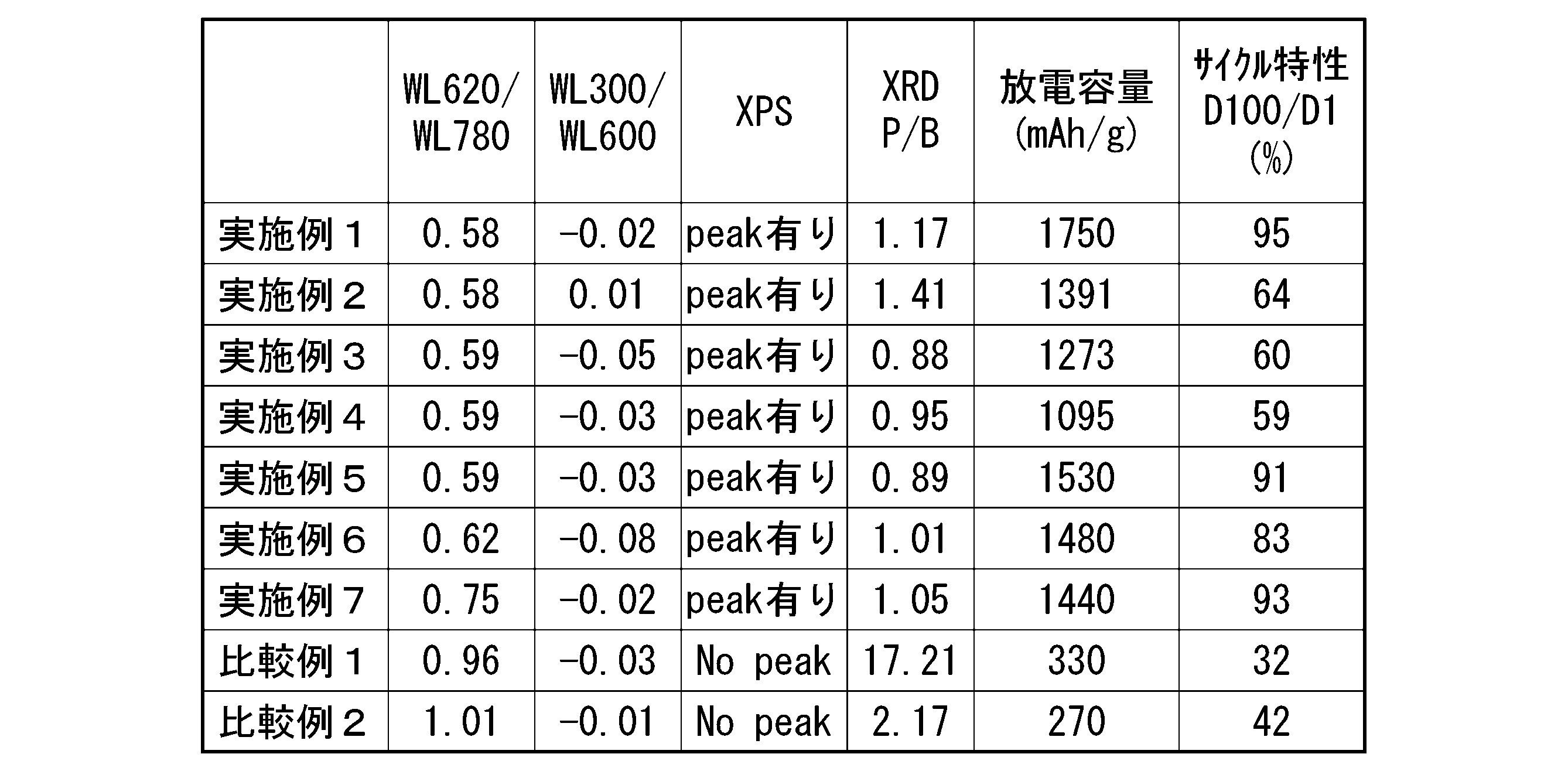
- FIG. 7 As shown in FIG. 7, all of the PC materials satisfied WL 620 /WL 780 of 0.1 or more and 0.9 or less.
- the PC material of Example 7 had WL 620 /WL 780 of 0.75, which was larger than the PC materials of other examples.
- SWCNT which is the carbon material used in Example 7, is considered to have a smaller amount of edge sites relative to the amount of carbon atoms than other carbon materials. It is considered that the amount of PC bonds generated in a carbon material with a small number of edge sites is smaller than that in a carbon material with a large number of edge sites. It is believed that such a difference in the amount of PC bonds appeared in the difference in the results of thermogravimetry between the PC material of Example 7 and the PC materials of other Examples.
- the PC mixtures of Comparative Examples 1 and 2 have a WL 620 /WL 780 greater than 0.9, exhibit a sharp weight loss at a measurement temperature of 350°C to 450°C, and a temperature of 500°C or higher. Almost no weight loss was observed. Therefore, it can be said that the PC mixtures of Comparative Examples 1 and 2 are in a state of a mixture of the raw material phosphorus and the carbon material without forming new bonds that can withstand a high temperature of 620° C. or higher.
- WL 300 /WL 600 all measurement samples satisfied ⁇ 0.1 or more and 0.1 or less.
- FIG. 8 is the XPS spectra of the PC materials produced in Examples 1-5 and 7. As shown in FIG. 8, any PC material has a peak in the range of 132 to 136 eV, confirming the formation of a PC bond. A peak in the range of 132 to 136 eV was confirmed for the PC material of Example 6 as well.
- FIG. 10 is a graph showing the discharge capacity up to 100 cycles of lithium secondary batteries using the PC materials of Examples 1 to 7 and Comparative Example 2. Evaluation of battery performance revealed that the PC materials of Examples 1 to 7 had high discharge capacity and excellent cycle characteristics when used as negative electrode active materials. On the other hand, in the PC mixture of Comparative Example 2, a sufficient discharge capacity could not be obtained, and the cycle characteristics were extremely low compared to those of Examples.
Landscapes
- Chemical & Material Sciences (AREA)
- Chemical Kinetics & Catalysis (AREA)
- Electrochemistry (AREA)
- General Chemical & Material Sciences (AREA)
- Engineering & Computer Science (AREA)
- Inorganic Chemistry (AREA)
- Composite Materials (AREA)
- Materials Engineering (AREA)
- Organic Chemistry (AREA)
- Manufacturing & Machinery (AREA)
- Battery Electrode And Active Subsutance (AREA)
Abstract
Description
本願は、2021年12月24日に出願された日本国特願2021-211116号に基づき優先権を主張し、その内容をここに援用する。
(熱重量測定)
10mgのリン-炭素複合材料を精秤して試料とし、熱重量測定装置を用い、窒素気流下で50℃から780℃まで10℃/分の昇温速度で加熱したときの重量変化を測定する。
(重量減少率)
精秤した試料の重量に対する、測定温度における試料の重量の割合を、測定温度における重量減少率(重量%)とする。
|P|/|B|<2 …(1)
P=I26.3-I40 …(2)
B=(I20-I40)×(26.3-40)/(20-40) …(3)
リン-炭素複合材料は、リン原子と、炭素原子とを含む。以下の説明においては「リン-炭素複合材料」を単に「P-C材料」と略称することがある。
P-C材料が含むリン原子と炭素原子以外の元素としては、リチウム、シリコン、ゲルマニウム、スズ、アルミニウム、亜鉛、マグネシウム、遷移金属類、窒素、酸素、フッ素、ケイ素、チタン、ニオブ、硫黄、塩素が挙げられる。P-C材料がこれらの元素を含む場合、P-C材料の原料として、これらの元素の金属酸化物、複合金属酸化物、金属フッ化物、金属硫化物、金属塩化物、酸化ケイ素、ケイ酸塩、チタン酸塩、アルミン酸塩を利用できる。
P-C材料は、下記条件の熱重量測定で求められる測定温度620℃における重量減少率WL620と、測定温度780℃における重量減少率WL780との比WL620/WL780が、0.1以上0.9以下である。
(熱重量測定)
10mgのリン-炭素複合材料を精秤して試料とし、熱重量測定装置を用い、窒素気流下で50℃から800℃まで10℃/分の昇温速度で加熱したときの重量変化を測定する。
(重量減少率)
精秤した試料の重量に対する、測定温度における試料の重量の割合を、測定温度における重量減少率(重量%)とする。詳しくは、精秤した試料の重量(初期重量)に対する、初期重量から各測定温度までの試料の減少重量の割合を、測定温度における重量減少率(重量%)とする。
P-C材料は、XPSスペクトルにおいて、リン原子と炭素原子との結合を示すピークを有している。「リン原子と炭素原子との結合を示すピーク」は、XPSスペクトルにおいて132~136eVの範囲に現れることが知られている。なお、以下の説明では、リン原子と炭素原子との結合を、単に「P-C結合」と称することがある。
XPSスペクトルは、以下の測定条件にて測定する。
・測定機器:XPS装置、ESCA-3400(島津製作所社製)
・線源 :Mg Kα線(20mA、10kV)
132~136eVの範囲にピークが検出された場合、P-C結合を有すると判断する。
得られたXPSスペクトルには、分析におけるノイズが含まれることがある。そのため、本実施形態では、XPSスペクトルにおいて隣り合う2つの極小値を結ぶ線をベースラインとし、2つの極小値に挟まれる極大値とを含む局所的なカーブについて、半値幅が0.5eV以下である場合、そのカーブを「ノイズ」と判断する。XPSスペクトルを用いてP-C結合の有無を判断する場合、上記定義による「ノイズ」を除外した上で132~136eVの範囲のピークの有無を確認する。
P-C材料は、リン原子を含むコア粒子と、前記コア粒子の表面を覆う炭素皮膜と、を有する。
TEM写真は、以下の撮像条件にて撮像する。
・TEM装置:透過電子顕微鏡H-9000NAR(日立製作所社製)
・視野範囲 :最大500nm×500nm。視野範囲の中にP-C材料の粒子の少なくとも一部を入れて撮影する。
図4は、P-C材料及びP-C混合物のXRDプロファイルである。図4は、横軸が回折角度(2θ、°)、縦軸が回折X線強度(a.u.)を示す。図4中、符号AのXRDプロファイルがP-C材料を示し、符号XのXRDプロファイルがP-C混合物を示す。
XRDプロファイルは、以下の測定条件にて測定する。
・測定機器:試料水平型多目的X線回折装置 Ultima IV(株式会社リガク製)
・線源 :Cu Kα線
・測定範囲(2θ):10°~90°
・スキャン速度:4°/分
・サンプリング:0.02°
・電圧40kV、電流40mA
|P|/|B|<2 …(1)
P=I26.3-I40 …(2)
B=(I20-I40)×(26.3-40)/(20-40) …(3)
上述したように、P-C材料は、炭素材料と、リンとを、圧縮を伴う混合粉砕処理により複合化する工程を有する製造方法により製造することができる。
負極活物質は、上述したP-C材料を含む。
リチウム二次電池用負極は、上述した負極活物質を含む。リチウム二次電池用負極は、負極活物質の他、集電体、集電体に負極活物質を繋ぎ止めるためのバインダーを有する。集電体、バインダーは、公知の構成を採用することができる。
リチウム二次電池は、上述のリチウム二次電池用負極(以下、負極)を含む。
正極は、正極活物質、導電材及びバインダーを含む正極合剤を調製し、正極合剤を正極集電体に担持させることで製造することができる。
正極活物質には、リチウム含有化合物又は他の金属化合物を用いることができる。リチウム含有化合物としては、例えば、層状構造を有するリチウムコバルト複合酸化物、層状構造を有するリチウムニッケル複合酸化物、スピネル構造を有するリチウムマンガン複合酸化物及びオリビン型構造を有するリン酸鉄リチウムが挙げられる。
正極が有する導電材としては、炭素材料を用いることができる。炭素材料として黒鉛粉末、カーボンブラック(例えばアセチレンブラック)及び繊維状炭素材料などを挙げることができる。
正極が有するバインダーとしては、熱可塑性樹脂を用いることができる。この熱可塑性樹脂としては、ポリイミド樹脂;ポリフッ化ビニリデン(PVdF)、ポリテトラフルオロエチレンなどのフッ素樹脂;ポリエチレン及びポリプロピレンなどのポリオレフィン樹脂、WO2019/098384A1またはUS2020/0274158A1に記載の樹脂を挙げることができる。
正極が有する正極集電体としては、Al、Ni又はステンレスなどの金属材料を形成材料とする帯状の部材を用いることができる。
以上に挙げられた方法により、正極を製造することができる。
リチウム二次電池が有する負極は、上述したリチウム二次電池用負極を用いる。
リチウム二次電池が有するセパレータとしては、例えば、ポリエチレン及びポリプロピレンなどのポリオレフィン樹脂、フッ素樹脂又は含窒素芳香族重合体などの材質からなる、多孔質膜、不織布又は織布などの形態を有する材料を用いることができる。また、これらの材質を2種以上用いてセパレータを形成してもよいし、これらの材料を積層してセパレータを形成してもよい。また、JP-A-2000-030686又はUS2009/0111025A1に記載のセパレータを用いてもよい。
リチウム二次電池が有する電解液は、電解質及び有機溶媒を含有する。
次いで、全固体リチウム二次電池の構成を説明しながら、上述の負極を有する全固体リチウム二次電池について説明する。
正極110は、正極活物質層111と正極集電体112とを有している。
正極活物質層111に含まれる固体電解質としては、リチウムイオン伝導性を有し、公知の全固体リチウム二次電池に用いられる固体電解質を採用することができる。このような固体電解質としては、無機電解質及び有機電解質を挙げることができる。無機電解質としては、酸化物系固体電解質、硫化物系固体電解質及び水素化物系固体電解質を挙げることができる。有機電解質としては、ポリマー系固体電解質を挙げることができる。各電解質としては、WO2020/208872A1、US2016/0233510A1、US2012/0251871A1、US2018/0159169A1に記載の化合物が挙げられ、例えば、以下の化合物が挙げられる。
酸化物系固体電解質としては、例えば、ペロブスカイト型酸化物、NASICON型酸化物、LISICON型酸化物及びガーネット型酸化物などが挙げられる。各酸化物の具体例は、WO2020/208872A1、US2016/0233510A1、US2020/0259213A1に記載の化合物が挙げられ、例えば、以下の化合物が挙げられる。
硫化物系固体電解質としては、Li2S-P2S5系化合物、Li2S-SiS2系化合物、Li2S-GeS2系化合物、Li2S-B2S3系化合物、LiI-Si2S-P2S5系化合物、LiI-Li2S-P2O5系化合物、LiI-Li3PO4-P2S5系化合物及びLi10GeP2S12系化合物などを挙げることができる。
水素化物系固体電解質材料としては、LiBH4、LiBH4-3KI、LiBH4-PI2、LiBH4-P2S5、LiBH4-LiNH2、3LiBH4-LiI、LiNH2、Li2AlH6、Li(NH2)2I、Li2NH、LiGd(BH4)3Cl、Li2(BH4)(NH2)、Li3(NH2)I及びLi4(BH4)(NH2)3などを挙げることができる。
ポリマー系固体電解質として、例えばポリエチレンオキサイド系の高分子化合物及びポリオルガノシロキサン鎖及びポリオキシアルキレン鎖からなる群から選ばれる1種以上を含む高分子化合物などの有機系高分子電解質を挙げることができる。また、高分子化合物に非水電解液を保持させた、いわゆるゲルタイプのものを用いることもできる。
正極活物質層111が有する導電材としては、上述の(導電材)で説明した材料を用いることができる。また、正極合剤中の導電材の割合についても同様に上述の(導電材)で説明した割合を適用することができる。また、正極が有するバインダーとしては、上述の(バインダー)で説明した材料を用いることができる。
正極110が有する正極集電体112としては、上述の(正極集電体)で説明した材料を用いることができる。


負極120は、負極活物質層121と負極集電体122とを有している。負極活物質層121は、本実施形態の負極活物質を含む。
固体電解質層130は、上述の固体電解質を有している。
前記リン-炭素複合材料におけるリン原子の含有率が、10質量%以上95質量%以下であり、
前記リン-炭素複合材料における炭素原子の含有率が、5質量%以上90質量%以下であり、
XPSスペクトルにおいて、リン原子と炭素原子との結合を示すピークを有するリン-炭素複合材料。
前記リン-炭素複合材料におけるリン原子の含有率が、10質量%以上95質量%以下であり、
前記リン-炭素複合材料における炭素原子の含有率が、5質量%以上90質量%以下であり、
CuKα線を用いて測定したXRDプロファイルにおいて、2θ=20°の強度I20、2θ=26.3°の強度I26.3、及び2θ=40°の強度I40が、以下の式(1)~(3)を満たすリン-炭素複合材料。
|P|/|B|<2 …(1)
P=I26.3-I40 …(2)
B=(I20-I40)×(26.3-40)/(20-40) …(3)
前記リン-炭素複合材料におけるリン原子の含有率が、10質量%以上95質量%以下であり、
前記リン-炭素複合材料における炭素原子の含有率が、5質量%以上90質量%以下であり、
リン原子を含むコア粒子と、
前記コア粒子の表面を覆う炭素皮膜と、を有するリン-炭素複合材料。
10mgのリン-炭素複合材料を精秤して試料とし、熱重量測定装置を用い、窒素気流下で50℃から780℃まで10℃/分の昇温速度で加熱したときの重量変化を測定する。
上述の(XPSスペクトル測定条件)に従って測定した。
上述の(Ramanスペクトル測定条件)に従って測定した。
上述の(TEM写真の撮像条件)に従って撮像した。
上述の(XRDプロファイル測定条件)に従って測定した。
実施例及び比較例においては、以下の材料を用いた。
ラサ工業製の黒リン
CSCNT:GSIクレオス社製
MCMB1:MG10、China Steel Chemical社製
MCMB2:MG11、China Steel Chemical社製
MCMB3:MG12、China Steel Chemical社製
グラファイト:SNO15、SECカーボン社製
AB:デンカブラックHS100、デンカ株式会社社製
SWCNT:GSIクレオス社製
黒リンと、炭素材料とを、表4に記載の比率で秤量し(合計量0.5g)、ボールミルを用い下記条件で混合して、P-C材料を得た。
(ボールミル混合条件)
装置 :Retsch PM-100
容器 :ZrO2製50mL容器
メディア :ZrO2製5mmφボール、60g
雰囲気 :アルゴンガス封入
サンプル量 :原料の混合物として0.5g
ボール/粉末比:120(重量比)
混合時間 :12時間
黒リンと、炭素材料とを、表4に記載の比率で秤量し(合計量0.5g)、乳鉢を用いて混合して、P-C混合物を得た。
得られた材料を用いて、以下の方法で評価用電池を作製し、評価を行った。評価結果を表5に示す。
(1)負極の作製
P-C材料又はP-C混合物、導電材、バインダーを秤量し、[P-C材料又はP-C混合物]:[導電材]:[バインダー]=80:10:10(質量比)の混合物とした。用いた材料は以下の通りである。
バインダー:フッ化ビニリデンPVdF クレハKFポリマー#1100(クレハ社製)
導電材 :アセチレンブラック、デンカブラックHS100(デンカ社製)
(1)で作製した負極、対極、電解液、セパレータを組み合わせてリチウムイオン二次電池(コイン型電池R2032)を作製した。電池の組み立てはアルゴン雰囲気のグローブボックス内で行った。
上記評価用電池を用いて、25℃保持下、以下に示す条件で充放電試験を実施した。ここで、リンの理論容量を2600mAh/gとして、電極容量を1時間で充電又は放電する1C電流を2600mA/gとした。充放電試験においては、負極に含まれるリンの質量から、1C電流を計算した。実施例における1Cの定義については、以下同様とする。
充電最小電圧:0.005V
充電電流 :0.1C (1C=2600mA/g)
放電最大電圧:2.0V
放電電流 :0.1C (1C=2600mA/g)
上記評価用電池を用いて、25℃保持下、以下に示す条件で充放電を繰り返してサイクル特性を評価した。1Cレート電流における100サイクル目の放電容量D100と、1サイクル目の充電容量D1との比(D100/D1)を用いて、サイクル特性を評価した。D100/D1が大きいほど、サイクルに伴う放電容量の維持率が高いことを示すことから、負極活物質として優れると判断することができる。
充電最小電圧:0.005V
充電電流 :1C (1C=2600mA/g)
放電最大電圧:2.0V
放電電流 :1C (1C=2600mA/g)
Claims (12)
- リン原子と、炭素原子とを含むリン-炭素複合材料であって、
前記リン-炭素複合材料におけるリン原子の含有率が、10質量%以上95質量%以下であり、
前記リン-炭素複合材料における炭素原子の含有率が、5質量%以上90質量%以下であり、
下記条件の熱重量測定で求められる測定温度620℃における重量減少率WL620と、測定温度780℃における重量減少率WL780との比WL620/WL780が、0.1以上0.9以下であるリン-炭素複合材料。
(熱重量測定)
10mgのリン-炭素複合材料を精秤して試料とし、熱重量測定装置を用い、窒素気流下で50℃から780℃まで10℃/分の昇温速度で加熱したときの重量変化を測定する。
(重量減少率)
精秤した試料の重量に対する、測定温度における試料の重量の割合を、測定温度における重量減少率(重量%)とする。 - 上記熱重量測定で求められる測定温度300℃における重量減少率WL300と、測定温度600℃における重量減少率WL600との比WL300/WL600が、-0.1以上0.1以下である請求項1に記載のリン-炭素複合材料。
- XPSスペクトルにおいて、リン原子と炭素原子との結合を示すピークを有する請求項1又は2に記載のリン-炭素複合材料。
- CuKα線を用いて測定したXRDプロファイルにおいて、2θ=20°の強度I20、2θ=26.3°の強度I26.3、及び2θ=40°の強度I40が、以下の式(1)~(3)を満たす請求項1から3のいずれか1項に記載のリン-炭素複合材料。
|P|/|B|<2 …(1)
P=I26.3-I40 …(2)
B=(I20-I40)×(26.3-40)/(20-40) …(3) - リン原子を含むコア粒子と、
前記コア粒子の表面を覆う炭素皮膜と、を有する請求項1から4のいずれか1項に記載のリン-炭素複合材料。 - 炭素材料と、リンとを圧縮を伴う混合粉砕処理により複合化する工程を有するリン-炭素複合材料の製造方法。
- 炭素材料と、リンとをボールミル混合する工程を有するリン-炭素複合材料の製造方法。
- 前記炭素材料が、アモルファスカーボン、黒鉛、多孔性カーボン、メソカーボンマイクロビーズ、フラーレン、カーボンナノチューブ、グラフェン、グラフェンオキサイド、カーボンナイトライト(C3N4)及び積層カーボンナノファイバーからなる群から選ばれる少なくとも1種である請求項6又は7に記載のリン-炭素複合材料の製造方法。
- 前記リンが黒リンである請求項6から8のいずれか1項に記載のリン-炭素複合材料の製造方法。
- 請求項1から5のいずれか1項に記載のリン-炭素複合材料を含む負極活物質。
- 請求項10に記載の負極活物質を含むリチウム二次電池用負極。
- 請求項11に記載のリチウム二次電池用負極を含むリチウム二次電池。
Priority Applications (4)
| Application Number | Priority Date | Filing Date | Title |
|---|---|---|---|
| CN202280084539.2A CN118679120A (zh) | 2021-12-24 | 2022-12-23 | 磷-碳复合材料、磷-碳复合材料的制造方法、负极活性物质、锂二次电池用负极以及锂二次电池 |
| EP22911425.1A EP4455080A4 (en) | 2021-12-24 | 2022-12-23 | Phosphorus-carbon composite material, method for producing phosphorus-carbon composite material, active negative electrode material, negative electrode for lithium secondary battery, and lithium secondary battery |
| US18/723,340 US20250158030A1 (en) | 2021-12-24 | 2022-12-23 | Phosphorus-carbon composite material, phosphorus-carbon composite material production method, negative electrode active material, negative electrode for lithium secondary battery, and lithium secondary battery |
| KR1020247020914A KR20240123803A (ko) | 2021-12-24 | 2022-12-23 | 인-탄소 복합 재료, 인-탄소 복합 재료의 제조 방법, 부극 활물질, 리튬 이차 전지용 부극 및 리튬 이차 전지 |
Applications Claiming Priority (2)
| Application Number | Priority Date | Filing Date | Title |
|---|---|---|---|
| JP2021211116A JP2023095306A (ja) | 2021-12-24 | 2021-12-24 | リン-炭素複合材料、リン-炭素複合材料の製造方法、負極活物質、リチウム二次電池用負極及びリチウム二次電池 |
| JP2021-211116 | 2021-12-24 |
Publications (1)
| Publication Number | Publication Date |
|---|---|
| WO2023120724A1 true WO2023120724A1 (ja) | 2023-06-29 |
Family
ID=86902877
Family Applications (1)
| Application Number | Title | Priority Date | Filing Date |
|---|---|---|---|
| PCT/JP2022/047738 Ceased WO2023120724A1 (ja) | 2021-12-24 | 2022-12-23 | リン-炭素複合材料、リン-炭素複合材料の製造方法、負極活物質、リチウム二次電池用負極及びリチウム二次電池 |
Country Status (6)
| Country | Link |
|---|---|
| US (1) | US20250158030A1 (ja) |
| EP (1) | EP4455080A4 (ja) |
| JP (2) | JP2023095306A (ja) |
| KR (1) | KR20240123803A (ja) |
| CN (1) | CN118679120A (ja) |
| WO (1) | WO2023120724A1 (ja) |
Cited By (3)
| Publication number | Priority date | Publication date | Assignee | Title |
|---|---|---|---|---|
| WO2025163981A1 (ja) * | 2024-01-31 | 2025-08-07 | 住友化学株式会社 | 負極組成物、リチウム二次電池用負極及びリチウム二次電池 |
| WO2025182281A1 (ja) * | 2024-02-27 | 2025-09-04 | 住友化学株式会社 | リチウム二次電池用負極及びリチウム二次電池 |
| WO2026005024A1 (ja) * | 2024-06-28 | 2026-01-02 | 住友化学株式会社 | 組成物、負極活物質、リチウム二次電池用負極、リチウム二次電池及び組成物の製造方法 |
Families Citing this family (6)
| Publication number | Priority date | Publication date | Assignee | Title |
|---|---|---|---|---|
| CN115621445B (zh) * | 2022-10-25 | 2024-11-12 | 湖北三峡实验室 | 一种基于红磷的磷碳负极材料及制备方法 |
| WO2025033290A1 (ja) * | 2023-08-04 | 2025-02-13 | 住友化学株式会社 | 電池、負極材料及び積層体 |
| WO2025033314A1 (ja) * | 2023-08-04 | 2025-02-13 | 住友化学株式会社 | リン-炭素複合負極材料、負極活物質、リチウム二次電池用負極及びリチウム二次電池 |
| KR20260042222A (ko) * | 2023-08-04 | 2026-03-30 | 스미또모 가가꾸 가부시키가이샤 | 인-탄소 복합 부극 재료, 부극 활물질, 리튬 이차 전지용 부극, 리튬 이차 전지 및 인-탄소 복합 부극 재료의 제조 방법 |
| WO2026005013A1 (ja) * | 2024-06-28 | 2026-01-02 | 住友化学株式会社 | リン-炭素複合負極材料、負極活物質、リチウム二次電池用負極、リチウム二次電池及びリン-炭素複合負極材料の製造方法 |
| CN119993987A (zh) * | 2025-03-06 | 2025-05-13 | 中国科学技术大学 | 负极片及其制备方法、锂离子二次电池 |
Citations (11)
| Publication number | Priority date | Publication date | Assignee | Title |
|---|---|---|---|---|
| JPH1167207A (ja) | 1997-08-12 | 1999-03-09 | Toyota Central Res & Dev Lab Inc | リチウム二次電池用負極 |
| JP2000030686A (ja) | 1998-04-27 | 2000-01-28 | Sumitomo Chem Co Ltd | 非水電解質電池セパレ―タ―とリチウム二次電池 |
| JP2004095400A (ja) | 2002-08-30 | 2004-03-25 | Nissan Motor Co Ltd | バイポーラ電池とその制御方法 |
| US20090111025A1 (en) | 2004-12-22 | 2009-04-30 | Lg Chem, Ltd. | Organic/inorganic composite microporous membrane and electrochemical device prepared thereby |
| US20120251871A1 (en) | 2011-03-29 | 2012-10-04 | Tohoku University | All-solid-state battery |
| US20160233510A1 (en) | 2013-11-08 | 2016-08-11 | Hitachi, Ltd. | All-solid state battery, electrode for all-solid state battery, and method of manufacturing the same |
| US20180159169A1 (en) | 2015-10-30 | 2018-06-07 | Lg Chem, Ltd. | Polymer electrolyte having multi-layer structure, and all-solid battery comprising same |
| WO2019098384A1 (ja) | 2017-11-20 | 2019-05-23 | 住友化学株式会社 | リチウム二次電池用正極活物質、リチウム二次電池用正極及びリチウム二次電池 |
| US20200259213A1 (en) | 2017-11-13 | 2020-08-13 | Murata Manufacturing Co., Ltd. | All-solid-state battery |
| WO2020208872A1 (ja) | 2019-04-12 | 2020-10-15 | 住友化学株式会社 | リチウム金属複合酸化物粉末及びリチウム二次電池用正極活物質 |
| CN112018363A (zh) * | 2020-08-31 | 2020-12-01 | 中国科学技术大学 | 黑磷基复合负极材料、其制备方法及在金属二次电池中的应用 |
-
2021
- 2021-12-24 JP JP2021211116A patent/JP2023095306A/ja active Pending
-
2022
- 2022-12-23 US US18/723,340 patent/US20250158030A1/en active Pending
- 2022-12-23 CN CN202280084539.2A patent/CN118679120A/zh active Pending
- 2022-12-23 WO PCT/JP2022/047738 patent/WO2023120724A1/ja not_active Ceased
- 2022-12-23 EP EP22911425.1A patent/EP4455080A4/en active Pending
- 2022-12-23 KR KR1020247020914A patent/KR20240123803A/ko active Pending
-
2024
- 2024-09-24 JP JP2024164964A patent/JP2024173980A/ja active Pending
Patent Citations (12)
| Publication number | Priority date | Publication date | Assignee | Title |
|---|---|---|---|---|
| JPH1167207A (ja) | 1997-08-12 | 1999-03-09 | Toyota Central Res & Dev Lab Inc | リチウム二次電池用負極 |
| JP2000030686A (ja) | 1998-04-27 | 2000-01-28 | Sumitomo Chem Co Ltd | 非水電解質電池セパレ―タ―とリチウム二次電池 |
| JP2004095400A (ja) | 2002-08-30 | 2004-03-25 | Nissan Motor Co Ltd | バイポーラ電池とその制御方法 |
| US20090111025A1 (en) | 2004-12-22 | 2009-04-30 | Lg Chem, Ltd. | Organic/inorganic composite microporous membrane and electrochemical device prepared thereby |
| US20120251871A1 (en) | 2011-03-29 | 2012-10-04 | Tohoku University | All-solid-state battery |
| US20160233510A1 (en) | 2013-11-08 | 2016-08-11 | Hitachi, Ltd. | All-solid state battery, electrode for all-solid state battery, and method of manufacturing the same |
| US20180159169A1 (en) | 2015-10-30 | 2018-06-07 | Lg Chem, Ltd. | Polymer electrolyte having multi-layer structure, and all-solid battery comprising same |
| US20200259213A1 (en) | 2017-11-13 | 2020-08-13 | Murata Manufacturing Co., Ltd. | All-solid-state battery |
| WO2019098384A1 (ja) | 2017-11-20 | 2019-05-23 | 住友化学株式会社 | リチウム二次電池用正極活物質、リチウム二次電池用正極及びリチウム二次電池 |
| US20200274158A1 (en) | 2017-11-20 | 2020-08-27 | Sumitomo Chemical Company, Limited | Positive-electrode active material for lithium secondary battery, positive electrode for lithium secondary battery, and lithium secondary battery |
| WO2020208872A1 (ja) | 2019-04-12 | 2020-10-15 | 住友化学株式会社 | リチウム金属複合酸化物粉末及びリチウム二次電池用正極活物質 |
| CN112018363A (zh) * | 2020-08-31 | 2020-12-01 | 中国科学技术大学 | 黑磷基复合负极材料、其制备方法及在金属二次电池中的应用 |
Non-Patent Citations (4)
| Title |
|---|
| JIE SUN, ZHENG GUANGYUAN, LEE HYUN-WOOK, LIU NIAN, WANG HAOTIAN, YAO HONGBIN, YANG WENSHENG, CUI YI: "Formation of Stable Phosphorus–Carbon Bond for Enhanced Performance in Black Phosphorus Nanoparticle–Graphite Composite Battery Anodes", NANO LETTERS, AMERICAN CHEMICAL SOCIETY, US, vol. 14, no. 8, 14 July 2014 (2014-07-14), US , pages 4573 - 4580, XP055547016, ISSN: 1530-6984, DOI: 10.1021/nl501617j * |
| See also references of EP4455080A4 |
| SHI YANG, YI ZHIBIN, KUANG YANPING, GUO HANYU, LI YINGZHI, LIU CHEN, LU ZHOUGUANG: "Constructing stable covalent bonding in black phosphorus/reduced graphene oxide for lithium ion battery anodes", CHEMICAL COMMUNICATIONS, ROYAL SOCIETY OF CHEMISTRY, UK, vol. 56, no. 78, 1 October 2020 (2020-10-01), UK , pages 11613 - 11616, XP093073675, ISSN: 1359-7345, DOI: 10.1039/D0CC03698F * |
| YANG J., MO F., HUANG L., LIANG H., SUN G., PENG S.: "Building a C-P bond to unlock the reversible and fast lithium storage performance of black phosphorus in all-solid-state lithium-ion batteries", MATERIALS TODAY ENERGY, vol. 20, 1 June 2021 (2021-06-01), pages 100662, XP093073672, ISSN: 2468-6069, DOI: 10.1016/j.mtener.2021.100662 * |
Cited By (3)
| Publication number | Priority date | Publication date | Assignee | Title |
|---|---|---|---|---|
| WO2025163981A1 (ja) * | 2024-01-31 | 2025-08-07 | 住友化学株式会社 | 負極組成物、リチウム二次電池用負極及びリチウム二次電池 |
| WO2025182281A1 (ja) * | 2024-02-27 | 2025-09-04 | 住友化学株式会社 | リチウム二次電池用負極及びリチウム二次電池 |
| WO2026005024A1 (ja) * | 2024-06-28 | 2026-01-02 | 住友化学株式会社 | 組成物、負極活物質、リチウム二次電池用負極、リチウム二次電池及び組成物の製造方法 |
Also Published As
| Publication number | Publication date |
|---|---|
| JP2023095306A (ja) | 2023-07-06 |
| CN118679120A (zh) | 2024-09-20 |
| JP2024173980A (ja) | 2024-12-13 |
| EP4455080A4 (en) | 2026-02-18 |
| KR20240123803A (ko) | 2024-08-14 |
| EP4455080A1 (en) | 2024-10-30 |
| US20250158030A1 (en) | 2025-05-15 |
Similar Documents
| Publication | Publication Date | Title |
|---|---|---|
| WO2023120724A1 (ja) | リン-炭素複合材料、リン-炭素複合材料の製造方法、負極活物質、リチウム二次電池用負極及びリチウム二次電池 | |
| US10586980B2 (en) | Composite cathode active material, method of preparing the composite cathode active material, and cathode and lithium battery each including the composite cathode active material | |
| CN107408686B (zh) | 用于锂离子二次电池的阴极活性物质、其制造方法及包含其的锂离子二次电池 | |
| US20230163278A1 (en) | Anode active material including low-defect turbostratic carbon | |
| EP2960971B1 (en) | Composite active material for lithium secondary battery and method for producing same | |
| CN108292748B (zh) | 负极活性物质、锂离子二次电池及其制造方法、混合负极活性物质材料、负极 | |
| WO2020208872A1 (ja) | リチウム金属複合酸化物粉末及びリチウム二次電池用正極活物質 | |
| CN114744183B (zh) | 负极活性物质及制造方法、混合负极活性物质材料、负极、锂离子二次电池及制造方法 | |
| JPWO2015182665A1 (ja) | リチウム二次電池用正極活物質、リチウム二次電池用正極及びリチウム二次電池 | |
| JP2008135379A (ja) | リチウム二次電池 | |
| JP2018097961A (ja) | リチウムイオン二次電池用正極及びリチウムイオン二次電池 | |
| JP2023015403A (ja) | 非水電解質二次電池 | |
| WO2014129096A1 (ja) | リチウムイオン二次電池及びその製造方法 | |
| JP2023079218A (ja) | 複合正極活物質、それを採用した正極とリチウム電池、及びその製造方法 | |
| JP2023021918A (ja) | ペースト、固体電解質層又は電極合剤層、及び固体電池 | |
| JP7040832B1 (ja) | リチウムイオン二次電池用負極活物質、その製造方法、及びリチウムイオン二次電池用負極電極 | |
| JPWO2019053861A1 (ja) | 電極及び非水電解質電池 | |
| JP7781906B2 (ja) | 非水電解質二次電池用の電極、非水電解質二次電池、及び電池パック | |
| JP6980053B2 (ja) | リチウム二次電池用正極活物質前駆体、リチウム二次電池用正極活物質前駆体の製造方法及びリチウム二次電池用正極活物質の製造方法 | |
| JP7235650B2 (ja) | リチウム遷移金属複合酸化物粉末、ニッケル含有遷移金属複合水酸化物粉末、リチウム二次電池用正極活物質、リチウム二次電池用正極及びリチウム二次電池 | |
| WO2018021480A1 (ja) | リチウムイオン二次電池用正極活物質、リチウムイオン二次電池用正極およびこれを用いたリチウムイオン二次電池 | |
| WO2024117146A1 (ja) | 固体電解質、正極用固体電解質、複合体、蓄電素子用正極及び蓄電素子 | |
| JP2008084825A (ja) | 正極活物質粉末 | |
| JP7755049B2 (ja) | 負極活物質、その製造方法およびこれを含むリチウム二次電池 | |
| WO2025163981A1 (ja) | 負極組成物、リチウム二次電池用負極及びリチウム二次電池 |
Legal Events
| Date | Code | Title | Description |
|---|---|---|---|
| 121 | Ep: the epo has been informed by wipo that ep was designated in this application |
Ref document number: 22911425 Country of ref document: EP Kind code of ref document: A1 |
|
| WWE | Wipo information: entry into national phase |
Ref document number: 202280084539.2 Country of ref document: CN |
|
| WWE | Wipo information: entry into national phase |
Ref document number: 18723340 Country of ref document: US |
|
| ENP | Entry into the national phase |
Ref document number: 20247020914 Country of ref document: KR Kind code of ref document: A |
|
| NENP | Non-entry into the national phase |
Ref country code: DE |
|
| ENP | Entry into the national phase |
Ref document number: 2022911425 Country of ref document: EP Effective date: 20240724 |
|
| WWP | Wipo information: published in national office |
Ref document number: 18723340 Country of ref document: US |