WO2023127343A1 - 熱可塑性ポリエステル樹脂組成物、熱可塑性ポリエステル樹脂組成物の製造方法、および成形品 - Google Patents
熱可塑性ポリエステル樹脂組成物、熱可塑性ポリエステル樹脂組成物の製造方法、および成形品 Download PDFInfo
- Publication number
- WO2023127343A1 WO2023127343A1 PCT/JP2022/042832 JP2022042832W WO2023127343A1 WO 2023127343 A1 WO2023127343 A1 WO 2023127343A1 JP 2022042832 W JP2022042832 W JP 2022042832W WO 2023127343 A1 WO2023127343 A1 WO 2023127343A1
- Authority
- WO
- WIPO (PCT)
- Prior art keywords
- polyester resin
- resin composition
- thermoplastic polyester
- parts
- weight
- Prior art date
- Legal status (The legal status is an assumption and is not a legal conclusion. Google has not performed a legal analysis and makes no representation as to the accuracy of the status listed.)
- Ceased
Links
Images
Classifications
-
- C—CHEMISTRY; METALLURGY
- C08—ORGANIC MACROMOLECULAR COMPOUNDS; THEIR PREPARATION OR CHEMICAL WORKING-UP; COMPOSITIONS BASED THEREON
- C08L—COMPOSITIONS OF MACROMOLECULAR COMPOUNDS
- C08L67/00—Compositions of polyesters obtained by reactions forming a carboxylic ester link in the main chain; Compositions of derivatives of such polymers
- C08L67/02—Polyesters derived from dicarboxylic acids and dihydroxy compounds
-
- C—CHEMISTRY; METALLURGY
- C08—ORGANIC MACROMOLECULAR COMPOUNDS; THEIR PREPARATION OR CHEMICAL WORKING-UP; COMPOSITIONS BASED THEREON
- C08G—MACROMOLECULAR COMPOUNDS OBTAINED OTHERWISE THAN BY REACTIONS ONLY INVOLVING UNSATURATED CARBON-TO-CARBON BONDS
- C08G63/00—Macromolecular compounds obtained by reactions forming a carboxylic ester link in the main chain of the macromolecule
- C08G63/02—Polyesters derived from hydroxycarboxylic acids or from polycarboxylic acids and polyhydroxy compounds
- C08G63/12—Polyesters derived from hydroxycarboxylic acids or from polycarboxylic acids and polyhydroxy compounds derived from polycarboxylic acids and polyhydroxy compounds
- C08G63/16—Dicarboxylic acids and dihydroxy compounds
- C08G63/18—Dicarboxylic acids and dihydroxy compounds the acids or hydroxy compounds containing carbocyclic rings
- C08G63/181—Acids containing aromatic rings
- C08G63/183—Terephthalic acids
-
- C—CHEMISTRY; METALLURGY
- C08—ORGANIC MACROMOLECULAR COMPOUNDS; THEIR PREPARATION OR CHEMICAL WORKING-UP; COMPOSITIONS BASED THEREON
- C08G—MACROMOLECULAR COMPOUNDS OBTAINED OTHERWISE THAN BY REACTIONS ONLY INVOLVING UNSATURATED CARBON-TO-CARBON BONDS
- C08G63/00—Macromolecular compounds obtained by reactions forming a carboxylic ester link in the main chain of the macromolecule
- C08G63/02—Polyesters derived from hydroxycarboxylic acids or from polycarboxylic acids and polyhydroxy compounds
- C08G63/12—Polyesters derived from hydroxycarboxylic acids or from polycarboxylic acids and polyhydroxy compounds derived from polycarboxylic acids and polyhydroxy compounds
- C08G63/16—Dicarboxylic acids and dihydroxy compounds
- C08G63/18—Dicarboxylic acids and dihydroxy compounds the acids or hydroxy compounds containing carbocyclic rings
- C08G63/199—Acids or hydroxy compounds containing cycloaliphatic rings
-
- C—CHEMISTRY; METALLURGY
- C08—ORGANIC MACROMOLECULAR COMPOUNDS; THEIR PREPARATION OR CHEMICAL WORKING-UP; COMPOSITIONS BASED THEREON
- C08J—WORKING-UP; GENERAL PROCESSES OF COMPOUNDING; AFTER-TREATMENT NOT COVERED BY SUBCLASSES C08B, C08C, C08F, C08G or C08H
- C08J3/00—Processes of treating or compounding macromolecular substances
- C08J3/20—Compounding polymers with additives, e.g. colouring
-
- C—CHEMISTRY; METALLURGY
- C08—ORGANIC MACROMOLECULAR COMPOUNDS; THEIR PREPARATION OR CHEMICAL WORKING-UP; COMPOSITIONS BASED THEREON
- C08J—WORKING-UP; GENERAL PROCESSES OF COMPOUNDING; AFTER-TREATMENT NOT COVERED BY SUBCLASSES C08B, C08C, C08F, C08G or C08H
- C08J3/00—Processes of treating or compounding macromolecular substances
- C08J3/20—Compounding polymers with additives, e.g. colouring
- C08J3/203—Solid polymers with solid and/or liquid additives
-
- C—CHEMISTRY; METALLURGY
- C08—ORGANIC MACROMOLECULAR COMPOUNDS; THEIR PREPARATION OR CHEMICAL WORKING-UP; COMPOSITIONS BASED THEREON
- C08J—WORKING-UP; GENERAL PROCESSES OF COMPOUNDING; AFTER-TREATMENT NOT COVERED BY SUBCLASSES C08B, C08C, C08F, C08G or C08H
- C08J3/00—Processes of treating or compounding macromolecular substances
- C08J3/20—Compounding polymers with additives, e.g. colouring
- C08J3/205—Compounding polymers with additives, e.g. colouring in the presence of a continuous liquid phase
- C08J3/21—Compounding polymers with additives, e.g. colouring in the presence of a continuous liquid phase the polymer being premixed with a liquid phase
- C08J3/215—Compounding polymers with additives, e.g. colouring in the presence of a continuous liquid phase the polymer being premixed with a liquid phase at least one additive being also premixed with a liquid phase
-
- C—CHEMISTRY; METALLURGY
- C08—ORGANIC MACROMOLECULAR COMPOUNDS; THEIR PREPARATION OR CHEMICAL WORKING-UP; COMPOSITIONS BASED THEREON
- C08K—Use of inorganic or non-macromolecular organic substances as compounding ingredients
- C08K3/00—Use of inorganic substances as compounding ingredients
- C08K3/34—Silicon-containing compounds
-
- C—CHEMISTRY; METALLURGY
- C08—ORGANIC MACROMOLECULAR COMPOUNDS; THEIR PREPARATION OR CHEMICAL WORKING-UP; COMPOSITIONS BASED THEREON
- C08K—Use of inorganic or non-macromolecular organic substances as compounding ingredients
- C08K5/00—Use of organic ingredients
- C08K5/04—Oxygen-containing compounds
- C08K5/15—Heterocyclic compounds having oxygen in the ring
- C08K5/151—Heterocyclic compounds having oxygen in the ring having one oxygen atom in the ring
- C08K5/1515—Three-membered rings
-
- C—CHEMISTRY; METALLURGY
- C08—ORGANIC MACROMOLECULAR COMPOUNDS; THEIR PREPARATION OR CHEMICAL WORKING-UP; COMPOSITIONS BASED THEREON
- C08K—Use of inorganic or non-macromolecular organic substances as compounding ingredients
- C08K7/00—Use of ingredients characterised by shape
- C08K7/02—Fibres or whiskers
- C08K7/04—Fibres or whiskers inorganic
- C08K7/14—Glass
-
- C—CHEMISTRY; METALLURGY
- C08—ORGANIC MACROMOLECULAR COMPOUNDS; THEIR PREPARATION OR CHEMICAL WORKING-UP; COMPOSITIONS BASED THEREON
- C08L—COMPOSITIONS OF MACROMOLECULAR COMPOUNDS
- C08L63/00—Compositions of epoxy resins; Compositions of derivatives of epoxy resins
-
- C—CHEMISTRY; METALLURGY
- C08—ORGANIC MACROMOLECULAR COMPOUNDS; THEIR PREPARATION OR CHEMICAL WORKING-UP; COMPOSITIONS BASED THEREON
- C08J—WORKING-UP; GENERAL PROCESSES OF COMPOUNDING; AFTER-TREATMENT NOT COVERED BY SUBCLASSES C08B, C08C, C08F, C08G or C08H
- C08J2367/00—Characterised by the use of polyesters obtained by reactions forming a carboxylic ester link in the main chain; Derivatives of such polymers
- C08J2367/02—Polyesters derived from dicarboxylic acids and dihydroxy compounds
-
- C—CHEMISTRY; METALLURGY
- C08—ORGANIC MACROMOLECULAR COMPOUNDS; THEIR PREPARATION OR CHEMICAL WORKING-UP; COMPOSITIONS BASED THEREON
- C08J—WORKING-UP; GENERAL PROCESSES OF COMPOUNDING; AFTER-TREATMENT NOT COVERED BY SUBCLASSES C08B, C08C, C08F, C08G or C08H
- C08J2463/00—Characterised by the use of epoxy resins; Derivatives of epoxy resins
- C08J2463/04—Epoxynovolacs
-
- C—CHEMISTRY; METALLURGY
- C08—ORGANIC MACROMOLECULAR COMPOUNDS; THEIR PREPARATION OR CHEMICAL WORKING-UP; COMPOSITIONS BASED THEREON
- C08J—WORKING-UP; GENERAL PROCESSES OF COMPOUNDING; AFTER-TREATMENT NOT COVERED BY SUBCLASSES C08B, C08C, C08F, C08G or C08H
- C08J2467/00—Characterised by the use of polyesters obtained by reactions forming a carboxylic ester link in the main chain; Derivatives of such polymers
- C08J2467/02—Polyesters derived from dicarboxylic acids and dihydroxy compounds
-
- C—CHEMISTRY; METALLURGY
- C08—ORGANIC MACROMOLECULAR COMPOUNDS; THEIR PREPARATION OR CHEMICAL WORKING-UP; COMPOSITIONS BASED THEREON
- C08K—Use of inorganic or non-macromolecular organic substances as compounding ingredients
- C08K3/00—Use of inorganic substances as compounding ingredients
- C08K3/34—Silicon-containing compounds
- C08K2003/343—Peroxyhydrates, peroxyacids or salts thereof
-
- C—CHEMISTRY; METALLURGY
- C08—ORGANIC MACROMOLECULAR COMPOUNDS; THEIR PREPARATION OR CHEMICAL WORKING-UP; COMPOSITIONS BASED THEREON
- C08L—COMPOSITIONS OF MACROMOLECULAR COMPOUNDS
- C08L2203/00—Applications
- C08L2203/30—Applications used for thermoforming
-
- C—CHEMISTRY; METALLURGY
- C08—ORGANIC MACROMOLECULAR COMPOUNDS; THEIR PREPARATION OR CHEMICAL WORKING-UP; COMPOSITIONS BASED THEREON
- C08L—COMPOSITIONS OF MACROMOLECULAR COMPOUNDS
- C08L2205/00—Polymer mixtures characterised by other features
- C08L2205/02—Polymer mixtures characterised by other features containing two or more polymers of the same C08L -group
- C08L2205/025—Polymer mixtures characterised by other features containing two or more polymers of the same C08L -group containing two or more polymers of the same hierarchy C08L, and differing only in parameters such as density, comonomer content, molecular weight, structure
-
- C—CHEMISTRY; METALLURGY
- C08—ORGANIC MACROMOLECULAR COMPOUNDS; THEIR PREPARATION OR CHEMICAL WORKING-UP; COMPOSITIONS BASED THEREON
- C08L—COMPOSITIONS OF MACROMOLECULAR COMPOUNDS
- C08L2205/00—Polymer mixtures characterised by other features
- C08L2205/03—Polymer mixtures characterised by other features containing three or more polymers in a blend
-
- C—CHEMISTRY; METALLURGY
- C08—ORGANIC MACROMOLECULAR COMPOUNDS; THEIR PREPARATION OR CHEMICAL WORKING-UP; COMPOSITIONS BASED THEREON
- C08L—COMPOSITIONS OF MACROMOLECULAR COMPOUNDS
- C08L2205/00—Polymer mixtures characterised by other features
- C08L2205/24—Crystallisation aids
Definitions
- the present invention relates to a thermoplastic polyester resin composition, a method for producing a thermoplastic polyester resin composition, and a molded product.
- Thermoplastic polyester resins especially polybutylene terephthalate resins, are used for machine parts, electrical/communication parts, automobile parts, etc., utilizing their excellent injection moldability, mechanical properties, heat resistance, electrical properties, chemical resistance, etc. It is widely used as an injection molded product in various fields.
- the molding efficiency of injection-molded products is good, there are restrictions on the shape of products that can be molded in terms of flow characteristics and mold structure, and it is difficult to mold very complicated products.
- Laser welding which is one of external heat welding, is a method of irradiating superimposed resin moldings with laser light, allowing one side to pass through and the other side to absorb it, thereby melting and fusing the resin. This method is spreading to a wide range of fields, taking advantage of its advantages such as the possibility of non-contact processing and no burr generation.
- Polybutylene terephthalate resin which is widely used for various purposes due to its high dimensional stability and low water absorption, has very low laser transmittance compared to polyamide resin. Therefore, when using a polybutylene terephthalate resin as a molded product on the laser beam transmission side and applying the laser welding method, the thickness of the molded product is very severely restricted, and the thickness of the molded product must be reduced to improve the laser transmittance. was required, and the degree of freedom in product design was small.
- Thermoplastic polyester resins are degraded by hydrolysis, but in order to be used as industrial materials such as machine parts, electrical/communication parts, and automobile parts, in addition to mechanical properties and laser transparency, long-term durability is required. It is also required to have hydrolyzability.
- Patent Document 1 discloses a method of adding an alkali metal salt of an aliphatic carboxylic acid to a polyester resin in order to improve laser transmittance.
- Patent Document 2 a resin composition obtained by blending a polyester resin in which repeating units in which a terephthalic acid residue and a 1,4-cyclohexanedimethanol residue are bonded accounts for 25 mol% or more of the polyester resin. It discloses how to obtain
- Patent Document 1 Although the variation in laser transmittance is small and the laser transmittance is good, since the alkali metal salt is added, the polyester resin is thermally decomposed during the production process of the thermoplastic molding material, and the carboxyl group terminal is There was a problem that the strength and hydrolysis resistance decreased due to the increase.
- Patent Document 2 although the laser transmittance is high, the polyester resin is blended as an amorphous resin, so there are parts where the crystallization is insufficient during molding, and the laser transmittance varies greatly, so the laser welding method is applied. When trying to do so, it was necessary to adjust the laser output depending on the part of the molded product. In addition, there is a problem that the dimensions of the molded product change during welding, that is, it is difficult to apply the welding method due to the low dimensional stability. Moreover, the heat resistance and hydrolysis resistance of the molded article were also insufficient.
- an object of the present invention is to provide a thermoplastic polyester resin composition that has excellent laser transmittance, mechanical strength, heat resistance, hydrolysis resistance, and dimensional stability while suppressing variations in laser transmittance, and a molded article thereof. is to provide
- the present invention consists of the following configurations.
- A Per 100 parts by weight of polybutylene terephthalate-based resin, 10 polyester resins containing 50 to 90 mol% of (B) a structure in which terephthalic acid residues and 1,4-cyclohexanedimethanol residues are bonded
- a thermoplastic polyester resin composition containing parts by weight or more and 80 parts by weight or less, which has a melting point of 222° C. or more and 230° C. or less when measured with a differential scanning calorimeter at a heating rate of 20° C./min. and a thermoplastic polyester resin composition having a cooling crystallization temperature of 170° C. or higher and 200° C.
- thermoplastic polyester resin composition according to [1] wherein the average diameter of the spherulites of (A) the polybutylene terephthalate-based resin observed with a transmission electron microscope is 200 nm or more and 800 nm or less. .
- thermoplastic polyester resin composition according to any one of the above.
- A Any group selected from the group consisting of two or more epoxy groups, isocyanate groups, carbodiimide groups, oxazoline groups, and acid anhydride groups is added to 100 parts by weight of the polybutylene terephthalate-based resin.
- D The thermoplastic polyester resin composition according to any one of [1] to [4], which contains 0.1 to 5 parts by weight of a chain linking agent.
- thermoplastic according to any one of [1] to [5], wherein (A) 100 parts by weight of polybutylene terephthalate-based resin is blended with (E) 1 to 100 parts by weight of a fibrous reinforcing material. Polyester resin composition.
- the polybutylene terephthalate-based resin (A) contains a monohydric aliphatic alcohol having 10 to 50 carbon atoms, with respect to 100 mol% of structural units derived from terephthalic acid, 0.1 to 2.0.
- thermoplastic polyester resin composition according to any one of [1] to [7], which is a polybutylene terephthalate resin compounded by mol %.
- [10] A molded article made of the thermoplastic polyester resin composition according to any one of [1] to [8].
- thermoplastic polyester resin composition of the present invention By using the thermoplastic polyester resin composition of the present invention, a molded article having high laser transmittance while suppressing variations in laser transmittance and having excellent mechanical strength, hydrolysis resistance, and dimensional stability can be obtained. Obtainable. Therefore, the thermoplastic polyester resin composition of the present invention is particularly useful as a molded article on the laser transmission side when resin molded articles for various uses are laser-welded.
- thermoplastic polyester resin composition of the present invention contains (B) a terephthalic acid residue and 1,4 - A thermoplastic polyester containing 10 parts by weight or more and 80 parts by weight or less of a polyester resin containing 50 to 90 mol% of a structure in which cyclohexanedimethanol residues are bonded (hereinafter sometimes referred to as "component (B)") It is a resin composition. Furthermore, the melting point measured under the conditions of a heating rate of 20° C./min using a differential scanning calorimeter by the method described later is 222° C. or higher and 230° C. or lower, and the cooling crystallization temperature measured under the same conditions is 170° C. or higher and 200° C. or lower.
- the crystals of (A) polybutylene terephthalate-based resin can be uniformly refined, and while reducing the variation in laser transmittance in the molded product, excellent laser transmittance, mechanical properties, and heat resistance can be achieved. properties, hydrolysis resistance, and dimensional stability, and achieve the effects of the present invention.
- the terephthalic acid residue refers to a terephthaloyl structure (—CO—Ph—CO—, where Ph is a paraphenylene group)
- the 1,4-cyclohexanedimethanol residue refers to oxymethylene. -1,4-cyclohexylenemethyleneoxy structure.
- the thermoplastic polyester resin composition of the present invention contains a reactant obtained by reacting components (A) and (B), and the reactant includes the main chain of (A) the polybutylene terephthalate resin and (B ) It is produced by a complex reaction such as an ester exchange reaction with a polyester resin containing 50 to 90 mol% of a structure in which a terephthalic acid residue and a 1,4-cyclohexanedimethanol residue are bonded, and the structure is There are circumstances in which it is impractical to specify. Therefore, the present invention specifies the invention by the components to be blended.
- (A) polybutylene terephthalate-based resin may be either polybutylene terephthalate or polybutylene terephthalate copolymer, or may be used in combination.
- Polybutylene terephthalate is a polymer obtained by a polycondensation reaction between terephthalic acid (or its ester-forming derivative such as dimethyl terephthalate) and 1,4-butanediol (or its ester-forming derivative).
- Polybutylene terephthalate copolymers are composed of terephthalic acid (or its ester-forming derivatives such as dimethyl terephthalate) and 1,4-butanediol (or its ester-forming derivatives) and other dicarboxylic acids (or ester-forming derivatives thereof) or other glycols (or ester-forming derivatives thereof).
- copolymerizable dicarboxylic acids include isophthalic acid, orthophthalic acid, 2,6-naphthalenedicarboxylic acid, cyclohexanedicarboxylic acid, oxalic acid, malonic acid, succinic acid, itaconic acid, adipic acid, sebacic acid, and azelaic acid. , dodecanedioic acid, dimer acid, or ester-forming derivatives thereof, etc., but not limited to these, as long as they can be copolymerized, can be used. Also, more than one kind can be used simultaneously.
- the ratio of copolymerizable dicarboxylic acid is preferably in the range of 3 to 30 mol %, more preferably in the range of 3 to 20 mol %, based on the total dicarboxylic acid component, from the viewpoint of moldability.
- examples of copolymerizable glycols include ethylene glycol, propylene glycol, nonanediol, neopentyl glycol, tetramethylcyclobutanediol, isosorbide, dimer diol, polyethylene glycol, polytetramethylene glycol, 2,2-bis(4 -hydroxyphenyl)propane, hydroquinone, resorcinol, 1,1-bis(4-hydroxyphenyl)cyclohexane, 2,2-bis(3-methyl-4-hydroxyphenyl)propane, etc. Any material can be used as long as it can be copolymerized. Also, more than one kind can be used simultaneously.
- the ratio of the copolymerizable glycol other than 1,4-butanediol is preferably in the range of 3 to 30 mol% in the total glycol component, and preferably in the range of 3 to 20 mol% in terms of moldability. is more preferred.
- copolymerizable components include trimellitic acid, pyromellitic acid, glycerin, trimethylolpropane, pentaerythritol, p-hydroxybenzoic acid, ⁇ -caprolactone, and ⁇ -butyrolactone.
- the (A) polybutylene terephthalate-based resin used in the present invention contains 0.1 to 2.0% of a monohydric aliphatic alcohol having 10 to 50 carbon atoms per 100 mol% of structural units derived from terephthalic acid. It is preferably a polybutylene terephthalate resin with 0 mol % of the compound.
- the amount of the aliphatic alcohol to be combined is preferably 0.5 mol% or more, and 0.7 mol% with respect to 100 mol% of structural units derived from terephthalic acid.
- the above is more preferable.
- 1.8 mol% or less is preferable and 1.6 mol% or less is more preferable.
- the above aliphatic alcohol having 10 to 50 carbon atoms is a monofunctional alcohol compound having a main skeleton composed of a hydrocarbon consisting of carbon atoms and hydrogen atoms and having one hydroxyl group, and the carbon atoms are linked in a chain. It may have a linear or branched structure, or a cyclic structure.
- Examples thereof include a decyl group (C10), an undecyl group (C11), a dodecyl group (C12), a tridecyl group (C13), a tetradecyl group (C14), a pentadecyl group (C15), a hexadecyl group (C16), a heptadecyl group (C17 ), octadecyl group (C18), nonadecyl group (C19), icosyl group (C20), henicosyl group (C21), docosyl group (C22), tricosyl group (C23), tetracosyl group (C24), pentacosyl group (C25), alcohol compounds having linear saturated aliphatic groups such as hexacosyl group (C26), heptacosyl group (C27), octacosyl group (C28), triacontyl group (C30), tetracontyl group (
- the number after "C” represents the number of carbon atoms in the group.
- a linear or branched saturated aliphatic group is preferable from the viewpoint of color tone, and a branched saturated aliphatic group is preferable from the viewpoint of improving laser transmittance and dimensional stability.
- the lower limit of the number of carbon atoms is preferably 16 or more, preferably 20 or more, in that the fluidity can be further improved. More preferred.
- the upper limit of the number of carbon atoms is preferably 36 or less, more preferably 30 or less.
- the polybutylene terephthalate-based resin (A) used in the present invention is a terminal-modified polybutylene terephthalate-based resin having a branched saturated aliphatic group having 16 to 36 carbon atoms at the molecular end.
- the functional group concentration is 0.005 mmol/g or more and less than 0.20 mmol/g. If the functional group concentration of the saturated aliphatic group is 0.005 mmol/g or more, the fluidity can be improved, which is preferable. It is more preferably 0.010 mmol/g or more, still more preferably 0.020 mmol/g or more.
- the functional group concentration of the saturated aliphatic group is less than 0.20 mmol/g, mechanical properties and heat resistance can be improved, which is preferable. It is more preferably less than 0.18 mmol/g, still more preferably less than 0.15 mmol/g.
- the functional group concentration of the aliphatic group present at the molecular terminal is a value obtained from the integral ratio of the peak derived from the terminal group measured by 1 H-NMR using heavy hexafluoroisopropanol as a solvent.
- the carboxyl group concentration of (A) the polybutylene terephthalate-based resin used in the present invention is from the viewpoint of suppressing a decrease in the melting point and cooling crystallization temperature due to transesterification with the component (B) and suppressing variations in laser transmittance. Therefore, it is preferably 35 eq/t or less. It is more preferably 30 eq/t or less, still more preferably 20 eq/t or less.
- the lower limit of the carboxyl group concentration is 0 eq/t.
- the (A) polybutylene terephthalate-based resin used in the present invention preferably has a weight average molecular weight (Mw) of 8,000 or more in order to further improve mechanical properties. Moreover, when the weight average molecular weight (Mw) is 500,000 or less, the fluidity can be improved, which is preferable. It is more preferably 300,000 or less, still more preferably 250,000 or less.
- the weight average molecular weight (Mw) of the (A) thermoplastic polyester resin is a value converted to polymethyl methacrylate (PMMA) measured by gel permeation chromatography (GPC) using hexafluoroisopropanol as a solvent. .
- the intrinsic viscosity of the (A) polybutylene terephthalate-based resin used in the present invention is 0.36 dl/g or more when the o-chlorophenol solution is measured at 25° C. in order to further improve the mechanical properties. is preferably 0.50 dl/g or more. Moreover, it is preferably 1.60 dl/g or less, more preferably 1.50 dl/g or less, from the viewpoint of improving fluidity.
- the (A) polybutylene terephthalate-based resin used in the present invention can be produced by a known polycondensation method, ring-opening polymerization method, or the like.
- the production method may be either batch polymerization or continuous polymerization, and can be applied to either transesterification or direct polymerization. From the viewpoint of productivity, continuous polymerization is preferred, and direct polymerization is preferred. It is used more preferably.
- the (A) polybutylene terephthalate-based resin used in the present invention is a polymer or copolymer obtained by condensation reaction of a dicarboxylic acid or an ester-forming derivative thereof and a diol or an ester-forming derivative thereof as main components.
- dicarboxylic acids or ester-forming derivatives thereof and diols or ester-forming derivatives thereof can be produced by subjecting them to an esterification reaction or transesterification reaction, followed by a polycondensation reaction.
- the polymerization reaction catalyst include titanic acid methyl ester, tetra-n-propyl ester, tetra-n-butyl ester, tetraisopropyl ester, tetraisobutyl ester, tetra-tert-butyl ester, cyclohexyl ester, phenyl ester, organic titanium compounds such as benzyl esters, tolyl esters or mixed esters thereof, dibutyltin oxide, methylphenyltin oxide, tetraethyltin, hexaethyldistin oxide, cyclohexahexyldistin oxide, didodecyltin oxide, triethyltin hydroxide, Triphenyltin hydroxide, triisobutyltin
- polymerization reaction catalysts organic titanium compounds and tin compounds are preferred, and tetra-n-butyl titanate is more preferably used.
- the amount of the polymerization reaction catalyst to be added is preferably in the range of 0.01 parts by weight or more and 0.2 parts by weight or less with respect to 100 parts by weight of the polybutylene terephthalate resin (A).
- the (B) polyester resin containing 50 to 90 mol % of a structure in which a terephthalic acid residue and a 1,4-cyclohexanedimethanol residue are bonded which is used in the present invention, includes terephthalic acid or an ester-forming derivative thereof and 1 terephthalic acid or its ester-forming derivative, 1,4-cyclohexanedimethanol or its ester-forming ability so that the residue content of ,4-cyclohexanedimethanol or its ester-forming derivative is 50 to 90 mol %. It is a copolymer obtained by copolymerizing a derivative and a monomer copolymerizable therewith.
- the compatibility with (A) the polybutylene terephthalate resin decreases.
- (A) Crystals of the polybutylene terephthalate-based resin cannot be refined, resulting in insufficient laser transmittance.
- the total amount of residues of terephthalic acid or its ester-forming derivative and residues of 1,4-cyclohexanedimethanol or its ester-forming derivative is preferably 60 mol% or more from the viewpoint of improving hydrolysis resistance. More preferably, it is 65 mol % or more.
- the molar fraction of 1,4-cyclohexanedimethanol in the diol component is the entire structural unit in which terephthalic acid and diol are bonded. It is the molar fraction of the structure in which the terephthalic acid residue and the 1,4-cyclohexanedimethanol residue are combined.
- the (B) polyester resin containing 50 to 90 mol% of a structure in which a terephthalic acid residue and a 1,4-cyclohexanedimethanol residue are bonded excludes the use of a dicarboxylic acid component other than terephthalic acid. Of course, it is not something to do.
- the component (B) is the molar ratio of the terephthalic acid residue to the total dicarboxylic acid residue (the number of moles of the terephthalic acid residue/the number of moles of the total dicarboxylic acid residue) and the total 0.5 to 0.9 as the product of the molar ratio of 1,4-cyclohexanedimethanol residues to diol residues (moles of 1,4-cyclohexanedimethanol residues/moles of total diol residues); It can also be said that it is preferably 0.6 to 0.8.
- the monomers that can be copolymerized with the component (B) are the same as the components exemplified in the description of the polybutylene terephthalate resin (A). Among them, ethylene glycol, tetramethyl A copolymer with either cyclobutanediol or isosorbide is preferred, and a copolymer with ethylene glycol is more preferred.
- the component (B) can be produced by conducting an esterification reaction or a transesterification reaction in the same manner as the polybutylene terephthalate resin (A), followed by a polycondensation reaction.
- the blending amount of component (B) is 10 to 80 parts by weight per 100 parts by weight of (A) polybutylene terephthalate resin. If it is less than 10 parts by weight, the laser transmittance will be insufficient, and if it exceeds 80 parts by weight, the heat resistance will be insufficient. Furthermore, the lower limit of the amount of component (B) is preferably 20 parts by weight or more, more preferably 30 parts by weight or more. On the other hand, the upper limit of the amount of component (B) is preferably 70 parts by weight or less, more preferably 60 parts by weight or less.
- thermoplastic polyester resin composition of the present invention in terms of reducing variations in laser transmittance, (C) nuclei having an average particle size of 10 ⁇ m or less are added to 100 parts by weight of (A) polybutylene terephthalate resin. It is preferable to blend 0.01 to 0.8 parts by weight of the agent.
- the lower limit of the blending amount of (C) is 0.05 parts by weight or more with respect to 100 parts by weight of polybutylene terephthalate resin (A) in terms of further reducing variations in laser transmittance and improving heat resistance.
- 0.08 parts by weight or more is more preferable.
- the upper limit of the amount of (C) is more preferably 0.5 parts by weight or less with respect to 100 parts by weight of the polybutylene terephthalate-based resin (A), from the viewpoint of improving hydrolysis resistance, and 0.3. Part by weight or less is more preferable.
- inorganic particles such as mica, talc, kaolin, and metal oxides, and organic particles having a melting point of 280°C or higher are preferable, and talc is more preferable.
- the average particle size of the nucleating agent is preferably 10 ⁇ m or less, more preferably 5 ⁇ m or less, and even more preferably 4 ⁇ m or less, in terms of improving laser transmittance.
- the lower limit is not particularly limited, it is preferably 0.1 ⁇ m or more from the viewpoint of improving hydrolysis resistance.
- the average particle size is the particle size value at 50% accumulation in the volume-based cumulative distribution obtained by particle size measurement using a laser particle size distribution meter SALD-2000 manufactured by Shimadzu Corporation.
- the alkali metal salt used as a nucleating agent in Patent Document 1 and the like excessively promotes the transesterification reaction between the polybutylene terephthalate-based resin (A) and the component (B), resulting in variations in laser transmittance. Therefore, the thermoplastic polyester resin composition of the present invention should contain less than 0.03 parts by weight of the alkali metal salt per 100 parts by weight of the polybutylene terephthalate-based resin (A). preferably.
- thermoplastic polyester resin composition of the present invention the terminal groups of the polybutylene terephthalate resin (A) and the component (B) are linked by a reaction to increase compatibility and suppress excessive transesterification. , the laser transmittance can be improved while reducing variations in the laser transmittance.
- (A) polybutylene terephthalate-based resin any one selected from the group consisting of two or more epoxy groups, isocyanate groups, carbodiimide groups, oxazoline groups, and acid anhydride groups It is preferable to blend 0.1 to 5 parts by weight of (D) chain linking agent having this group.
- the lower limit of the amount of the (D) chain linking agent is more preferably 0.5 parts by weight or more, more preferably 1 part by weight or more, relative to 100 parts by weight of the polybutylene terephthalate-based resin (A).
- the upper limit of the amount of the chain linking agent (D) is more preferably 4 parts by weight or less, more preferably 3 parts by weight or less, relative to 100 parts by weight of the polybutylene terephthalate-based resin (A).
- chain linking agents examples include difunctional or higher epoxy compounds, isocyanate compounds, carbodiimide compounds, oxazoline compounds, and acid anhydride group-containing compounds. You may use 2 or more types of these.
- epoxy compounds include glycidyl ether type epoxy resins, glycidyl ester type epoxy resins, glycidyl amine type epoxy resins, alicyclic epoxy resins, heterocyclic epoxy resins, glycidyl group-containing vinyl polymers, and the like.
- Glycidyl ether type epoxy resins include epoxy resins produced from epichlorohydrin and bisphenol A; epoxy resins produced from epichlorohydrin and bisphenol F; Epoxy resin, cresol novolak type epoxy resin, naphthol novolak type resin, glycerol triglycidyl ether, trimethylolpropane triglycidyl ether, pentaerythritol polyglycidyl ether, dicyclopentadiene type epoxy resin, biphenyldimethylene type epoxy resin, etc. .
- Glycidyl ester type epoxy resins include epichlorohydrin and any one selected from phthalic acid, tetrahydrophthalic acid, p-oxybenzoic acid and dimer acid, epoxy resins produced from, trimesic acid triglycidyl ester, tri Examples include triglycidyl mellitic acid and tetraglycidyl pyromellitic acid.
- the glycidylamine type epoxy resin is produced from epichlorohydrin and any one selected from aniline, diaminodiphenylmethane, p-aminophenol, metaxylylenediamine and 1,3-bis(aminomethyl)cyclohexane.
- Epoxy resin tetraglycidylaminodiphenylmethane, triglycidyl-para-aminophenol, triglycidyl-meta-aminophenol, tetraglycidyl-meta-xylenediamine, tetraglycidylbisaminomethylcyclohexane, triglycidyl cyanurate, triglycidyl isocyanurate, naphthalene, etc. .
- Examples of alicyclic epoxy resins include compounds having a cyclohexene oxide group, tricyclodecene oxide group, and cyclopentene oxide group.
- heterocyclic epoxy resins include epoxy resins produced from epichlorohydrin and hydantoin or isocyanuric acid.
- Examples of glycidyl group-containing vinyl-based polymers include those obtained by radical polymerization of raw material monomers that form glycidyl group-containing vinyl-based units.
- Specific examples of raw material monomers that form glycidyl group-containing vinyl units include glycidyl esters of unsaturated monocarboxylic acids such as glycidyl (meth)acrylate and glycidyl p-styrylcarboxylate, and unsaturated monocarboxylic acids such as maleic acid and itaconic acid.
- Examples include monoglycidyl esters or polyglycidyl esters of polycarboxylic acids, unsaturated glycidyl ethers such as allyl glycidyl ether, 2-methylallyl glycidyl ether, and styrene-4-glycidyl ether.
- Carbodiimide compounds include dicarbodiimides such as N,N'-diisopropylcarbodiimide, N,N'-dicyclohexylcarbodiimide, N,N'-di-2,6-diisopropylphenylcarbodiimide, poly(1,6-hexamethylenecarbodiimide ), poly(4,4′-methylenebiscyclohexylcarbodiimide), poly(1,3-cyclohexylenecarbodiimide), poly(1,4-cyclohexylenecarbodiimide), poly(4,4′-dicyclohexylmethanecarbodiimide), poly (4,4′-diphenylmethanecarbodiimide), poly(3,3′-dimethyl-4,4′-diphenylmethanecarbodiimide), poly(naphthalenecarbodiimide), poly(p-phenylenecarbodiimide), poly(m-phenylenecarbodiimi
- oxazoline compounds 2,2'-bis(2-oxazoline), 2,2'-ethylene-bis(4,4'-dimethyl-2-oxazoline), 2,2'-p-phenylene-bis(2- oxazoline), compounds having an oxazoline group such as bis(2-oxazolinylcyclohexane)sulfide, and polymers containing an oxazoline group.
- diphenylmethane diisocyanate (MDI), tolylene diisocyanate (TDI), xylene diisocyanate (XDI), isophorone diisocyanate (IPDI), naphthylene diisocyanate (NDI), tolidine diisocyanate (TPDI), hexamethylene diisocyanate (HDI), dicyclohexyl Methane diisocyanate (HMDI), trimethylhexamethylene diisocyanate (TMHDI) and the like are included.
- MDI diphenylmethane diisocyanate
- TDI tolylene diisocyanate
- XDI xylene diisocyanate
- IPDI isophorone diisocyanate
- NDI naphthylene diisocyanate
- TPDI tolidine diisocyanate
- HDI hexamethylene diisocyanate
- HMDI dicyclohexyl Methane
- Acid anhydride group-containing compounds include 1,1-bis(2,3-dicarboxyphenyl)ethane dianhydride, bis(2,3-dicarboxyphenyl)methane dianhydride, bis(3,4-dicarboxy phenyl)methane dianhydride, 3,3′,4,4′-biphenyltetracarboxylic dianhydride, 2,2-bis(3,4-dicarboxyphenyl)propane dianhydride, 2,2-bis( 2,3-dicarboxyphenyl)propane dianhydride, bis(3,4-dicarboxyphenyl)ether dianhydride, bis(2,3-dicarboxyphenyl)ether dianhydride, 3,3′,4, 4'-benzophenonetetracarboxylic dianhydride, 2,2',3,3'-benzophenonetetracarboxylic dianhydride, 4,4'-oxydiphthalic dianhydride, 4,4-(p-phen
- the thermoplastic polyester resin composition of the present invention preferably contains (E) a fibrous reinforcing material.
- E By blending the fibrous reinforcing material, it is possible to improve the mechanical strength of the molded product while improving the laser transmittance.
- the fibrous reinforcing material include glass fiber, aramid fiber, carbon fiber, alumina fiber, silicon carbide fiber, cellulose fiber, etc. Among them, glass fiber can be preferably used.
- the cross section of the fibrous reinforcing material may be circular or flat, but from the viewpoint of suppressing deformation, reducing warpage, stable laser transmission, etc., it is preferable that the cross section is flat. preferable.
- the fibers are oriented in the flow direction during molding, so the molding shrinkage rate (percentage of dimensional difference between the resin molded product and the mold) is highly anisotropic. deformation and warping increase.
- the cross-sectional shape is flat, the anisotropy of the molding shrinkage ratio becomes small, and deformation and warpage are easily improved.
- the (E) fibrous reinforcing material used in the present invention has a ratio of the major axis (the longest linear distance in the cross section) and the minor axis (the longest linear distance in the direction perpendicular to the major axis) in a cross section cut perpendicular to the length direction. It is preferable that the expressed flatness is greater than 1 and 10 or less.
- the lower limit of the oblateness is preferably 1.3 or more, more preferably 1.5 or more.
- the upper limit is preferably 5 or less, more preferably 2.5 or less, and most preferably 2 or less.
- Specific shapes may be cocoon-shaped, oval, elliptical, semi-circular, arc-shaped, rectangular, or similar shapes, but oval is particularly preferred in terms of fluidity and low warpage.
- the cross-sectional area of the (E) fibrous reinforcing material in the present invention is preferably 2 ⁇ 10 ⁇ 5 to 8 ⁇ 10 ⁇ 3 mm 2 , more preferably 8 ⁇ 10 ⁇ 5 to 8 ⁇ 10 ⁇ 3 mm 2 , and 8 ⁇ More preferably 10 ⁇ 5 to 8 ⁇ 10 ⁇ 4 mm 2 .
- the fiber length of the fibrous reinforcing material is not particularly limited, but it is preferable that it is short in order to reduce the amount of deformation of the molded product, considering the balance between the mechanical properties of the molded product and the suppression of deformation.
- the fiber length is preferably 30 ⁇ m or more, preferably 50 to 1000 ⁇ m depending on the required performance.
- a sizing agent or a surface treatment agent as necessary.
- Functional compounds such as epoxy-based compounds, isocyanate-based compounds, silane-based compounds, and titanate-based compounds are used as sizing agents or surface-treating agents. These compounds may be used after being subjected to surface treatment or focusing treatment in advance, or may be added at the same time during material preparation.
- the amount of the fibrous reinforcing material (E) used in the present invention is preferably 1 part by weight or more and 100 parts by weight or less with respect to 100 parts by weight of the thermoplastic polyester resin (A).
- the blending amount of the fibrous reinforcing material is 1 part by weight or more, the mechanical strength of the molded product can be improved. 10 parts by weight or more is more preferable, and 20 parts by weight or more is even more preferable. Further, if the blending amount of (E) the fibrous reinforcing material is 100 parts by weight or less, a decrease in laser transmittance can be suppressed. 80 parts by weight or less is more preferable, and 50 parts by weight or less is even more preferable.
- the thermoplastic polyester resin composition of the present invention has a melting point of 222° C. or higher and 230° C. or lower as measured using a differential scanning calorimeter at a heating and cooling rate of 20° C./min, and a cooling crystallization temperature measured under the same conditions. It is 170° C. or more and 200° C. or less.
- the melting point of the thermoplastic polyester resin composition is less than 222° C., the transesterification reaction between (A) the polybutylene terephthalate-based resin and the component (B) is excessive, and the crystallinity of the (A) polybutylene terephthalate-based resin As a result, the dispersion of laser transmittance increases and the heat resistance is insufficient.
- the melting point of the thermoplastic polyester resin composition exceeds 230° C., the crystals of the component (B) are coarse, resulting in insufficient laser transmittance.
- the melting point of the thermoplastic polyester resin composition is preferably 223° C. or higher in terms of reducing variations in laser transmittance and further improving heat resistance.
- the melting point of the thermoplastic polyester resin composition is preferably 229° C. or lower, more preferably 228° C. or lower, in terms of improving the laser transmittance.
- thermoplastic polyester resin composition of the present invention if the cooling crystallization temperature is less than 170 ° C., the crystallization rate of (A) the polybutylene terephthalate resin is too slow, and the crystallinity during melt processing , resulting in an increase in laser transmittance variation.
- the cooling crystallization temperature of the thermoplastic polyester resin composition exceeds 200°C, the crystallization rate of (A) the polybutylene terephthalate-based resin is too fast, and the crystals of the (A) polybutylene terephthalate-based resin are coarse.
- the cooling crystallization temperature described above is preferably 172° C. or higher, more preferably 180° C. or higher, in terms of reducing variations in laser transmittance, and on the other hand, in terms of improving laser transmittance. , preferably 197° C. or lower, more preferably 195° C. or lower.
- Means for increasing the melting point of the thermoplastic polyester resin composition to 222° C. or higher are not limited to the following methods, but from the viewpoint of suppressing the transesterification reaction, for example, (A) the amount of carboxyl groups in the polybutylene terephthalate-based resin is 35 eq / t or less, the carboxyl group content of the thermoplastic polyester resin composition is 30 eq / t or less, the (D) chain linking agent is used in combination, and the discharge part temperature during melt kneading 315° C. or lower, and the like.
- thermoplastic polyester resin composition As means for adjusting the melting point of the thermoplastic polyester resin composition to 230° C. or less, for example, from the viewpoint of suppressing crystallization of component (B), component (B) terephthalic acid or its ester-forming derivative and 1,4-
- the content of residues of cyclohexanedimethanol or ester-forming derivatives thereof may be 50 to 90 mol %.
- Means for increasing the temperature-lowering crystallization temperature of the thermoplastic polyester resin composition to 170° C. or higher are not limited to the methods described below, but from the viewpoint of controlling the crystallization rate, for example, the above-mentioned (C) nucleating agent is blended. and from the viewpoint of suppressing the transesterification reaction, manufacturing by a manufacturing method in which the discharge part temperature during melt-kneading is 315° C. or less.
- the cooling crystallization temperature As a means for adjusting the cooling crystallization temperature to 200° C. or less, for example, from the viewpoint of enhancing the compatibility between the (A) polybutylene terephthalate resin and the (B) component, terephthalic acid or an ester-forming derivative thereof as the component (B) is used. and 1,4-cyclohexanedimethanol or its ester-forming derivative residue content of 50 to 90 mol %.
- the average diameter of spherulites of (A) polybutylene terephthalate resin observed with a transmission electron microscope is preferably 200 nm or more and 800 nm or less.
- the polybutylene terephthalate-based resin have an average diameter of spherulites of 200 nm or more, and the average More preferably, the diameter is 300 nm or more.
- the average diameter of the spherulites of the polybutylene terephthalate-based resin (A) is 800 nm or less, excessive crystallization of the polybutylene terephthalate-based resin is suppressed and the laser transmittance is further improved, which is preferable. More preferably, the average diameter is 700 nm or less.
- the method of quantifying the average diameter of the spherulites of the polybutylene terephthalate resin is to cut an ultra-thin section from the thermoplastic polyester molded product, appropriately dye the sample, and observe it with a transmission electron microscope, and take a photograph of the spherulites. After photographing, it can be obtained by calculating the number average of the diameter of the spherulites using an image analyzer or the like. The details are as described in the section of Examples.
- the thermoplastic polyester resin composition of the present invention preferably has a carboxyl group concentration of 0 eq/t or more and 30 eq/t or less. If it is 30 eq/t or less, the transesterification reaction between the polybutylene terephthalate-based resin (A) and the component (B) during melt processing is suppressed, the melting point does not decrease, and variations in laser transmittance can be reduced.
- the carboxyl group concentration is more preferably 25 eq/t or less, even more preferably 20 eq/t or less.
- thermoplastic polyester resin composition of the present invention may contain other thermoplastic resins other than the components (A) and (B) within a range that does not impair the object of the present invention. , molding shrinkage and toughness can be improved.
- thermoplastic resins other than components (A) and (B) include vinyl resins, polyamide resins, polyacetal resins, polyurethane resins, aromatic or aliphatic polyketone resins, polyphenylene sulfide resins, polyether ether ketone resins, Examples include polyimide resins, thermoplastic starch resins, aromatic polycarbonate resins, polyarylate resins, polysulfone resins, polyethersulfone resins, phenoxy resins, polyphenylene ether resins, polyetherimide resins, cellulose acetate resins, polyvinyl alcohol resins, and the like. .
- thermoplastic polyester resin composition of the present invention other components such as processing stabilizers, weathering agents (resorcinol-based, salicylate-based, benzophenone-based, etc.), lubricants (montanic acid and esters thereof, half esters thereof, stearyl alcohol, polyethylene wax, etc.), pigments, dyes, plasticizers, antistatic agents, flame retardants, anticoloring agents, other polymers, and the like.
- weathering agents resorcinol-based, salicylate-based, benzophenone-based, etc.
- lubricants montanic acid and esters thereof, half esters thereof, stearyl alcohol, polyethylene wax, etc.
- pigments dyes
- plasticizers antistatic agents
- flame retardants anticoloring agents
- thermoplastic polyester resin composition of the present invention can be obtained, for example, by melt-kneading the components (A) and (B) and, if necessary, other components.
- melt-kneading for example, a method of pre-mixing the components (A), (B), various additives, etc., and supplying the mixture to an extruder or the like and sufficiently melt-kneading it, or a method of quantifying using a weight feeder or the like.
- a feeder is used to supply a predetermined amount of each component to an extruder or the like, and the components are sufficiently melted and kneaded.
- the fibrous reinforcing material may be added by installing a side feeder in the middle of the main loading section and the vent section of a multi-screw extruder such as a twin-screw extruder.
- a method of installing a liquid addition nozzle in the middle of the main loading part and the vent part of a multi-screw extruder such as a twin screw extruder and adding it using a plunger pump, or A method of supplying from a unit or the like with a metering pump may also be used.
- the molten resin temperature at the discharge part is set to 315° C. or less. is preferred. It is more preferably 310° C. or lower, and still more preferably 305° C. or lower.
- the molten resin temperature at the discharge part refers to the temperature indicated by pressing the thermocouple against the molten resin at the discharge part at the tip of the extrusion die for 30 seconds using a thermocouple thermometer.
- thermoplastic polyester resin composition of the present invention is preferably molded after being pelletized.
- each component constituting the thermoplastic polyester resin composition is subjected to, for example, a single-screw extruder equipped with a "unimelt” or “dulmage” type screw, a twin-screw extruder, a tri-screw extruder, or a conical extrusion. and a kneader-type kneader or the like to discharge it into strands and cut them with a strand cutter.
- thermoplastic polyester resin composition of the present invention By melt-molding the thermoplastic polyester resin composition of the present invention, it is possible to obtain films, fibers, and other molded articles of various shapes.
- melt molding method include injection molding, extrusion molding and blow molding, and injection molding is particularly preferably used.
- Gas-assist molding, two-color molding, sandwich molding, in-mold molding, insert molding, injection press molding, etc. are known as injection molding methods in addition to ordinary injection molding methods, but any molding method is applicable. can.
- the molded article of the present invention can be used for various applications such as mechanical parts, electric parts, electronic parts, and automobile parts that take advantage of its excellent mechanical properties and hydrolysis resistance. Furthermore, since laser welding is possible due to its high laser transmittance, it is suitable for automobile parts and electric/electronic parts to be laser welded.
- machine mechanism parts include breakers, electromagnetic switches, focus cases, flyback transformers, moldings for fixing machines of copiers and printers, general household appliances, and office automation equipment.
- Equipment housings variable capacitor case parts, various terminal boards, transformers, printed wiring boards, housings, terminal blocks, coil bobbins, connectors, relays, disk drive chassis, switch parts, outlet parts, motor parts, sockets, plugs, capacitors , various cases, resistors, electrical and electronic parts with metal terminals and conductors, computer-related parts, audio parts such as audio parts, lighting parts, telegraph equipment-related parts, telephone equipment-related parts, air-conditioner parts, VTRs and televisions etc., parts for copiers, parts for facsimiles, parts for optical equipment, parts for automobile ignition devices, automobile connectors, and various automobile electrical components.
- A Polybutylene terephthalate-based resin
- A-1 Polybutylene terephthalate (carboxyl group concentration (CV) 18 eq/t, intrinsic viscosity measured at 25° C. using o-chlorophenol solution as solvent 0.80 dL/g).
- A-2 Polybutylene terephthalate (carboxyl group concentration (CV) of 25 eq/t, intrinsic viscosity of 0.80 dL/g measured at 25° C. using an o-chlorophenol solution as a solvent).
- A-3 Polybutylene terephthalate (carboxyl group concentration (CV) 38 eq/t, intrinsic viscosity 0.80 dL/g measured at 25° C.
- A-4 Polybutylene terephthalate (carboxyl group concentration (CV) 35 eq / t, o-chlorophenol solution as a solvent) combined with a monohydric aliphatic alcohol obtained by the following production example Intrinsic viscosity measured at 25 ° C. 0.80 dL/g).
- the molar ratio of the diol component to the dicarboxylic acid component (diol component/dicarboxylic acid component) in the esterification reaction was set to 1.5, 2000 g of terephthalic acid as the dicarboxylic acid component, 1627 g of 1,4-butanediol as the diol component, and branched 2-hexyl-1-dodecanol as a saturated aliphatic alcohol having: 49 g (1.5 mol% with respect to 100 mol% of terephthalic acid), tetra-n-butoxytitanium (TBT) as an esterification reaction catalyst: Polybutylene produced 7.5 ⁇ 10 -5 mol per 100 g of terephthalate (0.025 parts by weight per 100 parts by weight of polybutylene terephthalate to be produced) was charged into a reactor equipped with a rectifying column, and the temperature was 160 ° C.
- (B) PCTG resin in the table) B-1: Eastman Chemical Co., Ltd., "EASTAR" DN011 (EG/CHDM 29/71 mol%)
- Fibrous reinforcing material E-1 Round cross-section chopped strand type glass fiber (fiber diameter 13 ⁇ m).
- thermoplastic Polyester Resin Composition About 2 g of the thermoplastic polyester resin composition was dissolved in 50 mL of a chloroform/o-cresol (1/2 vol) adjustment solution. After adding an appropriate amount of bromothymol blue/ethanol solution to this solution, it was calculated by titration with 0.02N KOH ethanol solution (unit: eq/t).
- thermoplastic polyester resin composition About 10 mg of the thermoplastic polyester resin composition was sampled and measured using a differential scanning calorimeter DSC7 manufactured by Perkin Elmer Co., Ltd. under a nitrogen atmosphere. After heating the thermoplastic polyester resin composition to 250 ° C. at a temperature increase rate of 20 ° C./min to make it a molten state, the exothermic peak observed when the temperature is decreased to 30 ° C. at a temperature decrease rate of 20 ° C./min. The apex temperature was defined as the cooling crystallization temperature, and the apex temperature of the endothermic peak observed when the temperature was subsequently increased at a rate of 20° C./min was determined as the melting point.
- the magnitude of variation in laser transmittance was indicated by the absolute value of the difference in transmittance between points B and C, and the magnitude of laser transmittance was evaluated by the average value of the transmittances at points B and C.
- the transmittance was expressed as a percentage of the amount of transmitted light and the amount of incident light. If the variation in laser transmittance exceeds 30%, it is judged to be inferior. % or less was judged to be even better. In addition, when the laser transmittance is less than 20%, it is judged to be inferior. When the laser transmittance is larger, it is judged to be excellent. When it is 30% or more, it is judged to be excellent. I decided there was.
- a material with a tensile strength retention rate of less than 50% was judged to be inferior in hydrolysis resistance, and a material with a high tensile strength retention rate was judged to be excellent.
- a tensile strength retention of 60% or more was judged to be superior, and a tensile strength retention of 70% or more was judged to be even more excellent.
- Examples 1 to 4 Comparative Examples 1 to 4
- a co-rotating vented twin-screw extruder with a screw diameter of 57 mm and an L/D of 35 (A) a polybutylene terephthalate resin, (B) a terephthalic acid residue and a 1,4-cyclohexanedimethanol residue were combined.
- a polyester resin containing 50 to 90 mol % of the structure and other raw materials were mixed according to the compositions shown in Tables 1 and 3 and added from the main loading section of the twin-screw extruder. Melt-kneading was performed under the extrusion conditions of a kneading temperature of 250° C.
- thermocouple thermometer K type manufactured by A&D Co., Ltd. was used, and the thermocouple was pressed against the molten resin at the discharge part at the tip of the extrusion die for 30 seconds. The temperature was taken as the molten resin temperature at the discharge part.
- the obtained pellets were dried in a hot air dryer at a temperature of 110°C for 6 hours and then evaluated by the method described above. Tables 1 and 3 show the results.
- Examples 5 to 22, Comparative Examples 5 to 10 Using a co-rotating vented twin-screw extruder with a screw diameter of 57 mm and an L/D of 35, (A) a polybutylene terephthalate resin, (B) a terephthalic acid residue and a 1,4-cyclohexanedimethanol residue were combined. A polyester resin containing 50 to 90 mol % of the structure and other raw materials were mixed according to the compositions shown in Tables 1 to 3 and added from the main loading section of the twin-screw extruder. The (E) fibrous reinforcing material was added by installing a side feeder between the main loading portion and the vent portion.
- Melt-kneading was performed under extrusion conditions of a kneading temperature of 250° C. and a screw rotation of 200 rpm, and the resin composition was discharged at a discharge rate of 300 kg/hr, discharged in a strand, passed through a cooling bath, and pelletized with a strand cutter.
- a digital thermocouple thermometer K type manufactured by A&D Co., Ltd. was used, and the thermocouple was pressed against the molten resin at the discharge part at the tip of the extrusion die for 30 seconds. The temperature was taken as the molten resin temperature at the discharge part.
- the obtained pellets were dried in a hot air dryer at a temperature of 110°C for 6 hours and then evaluated by the method described above. Tables 1 to 3 show the results.
- Example 23 Under the melt-kneading conditions of Comparative Example 5, the screw rotation was set to 150 rpm in order to suppress the resin temperature rise due to shear heat generation, and the discharge rate of the resin composition was set to 200 kg/hr. , Table 2 shows the results.
- Example 24 Under the melt-kneading conditions of Example 7, the screw rotation was set to 150 rpm in order to suppress the resin temperature rise due to shear heat generation, and the discharge rate of the resin composition was set to 200 kg/hr. , Table 2 shows the results.
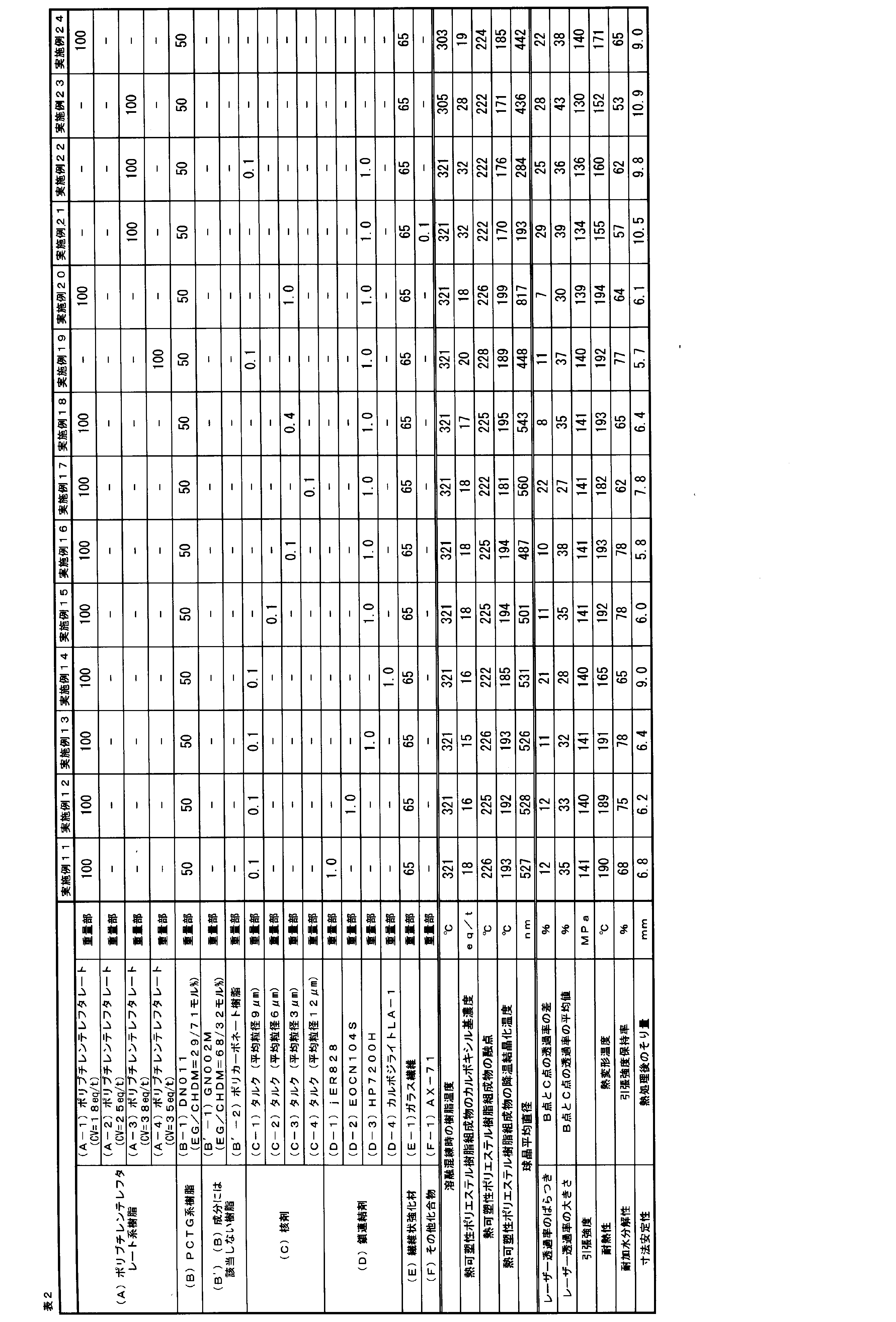
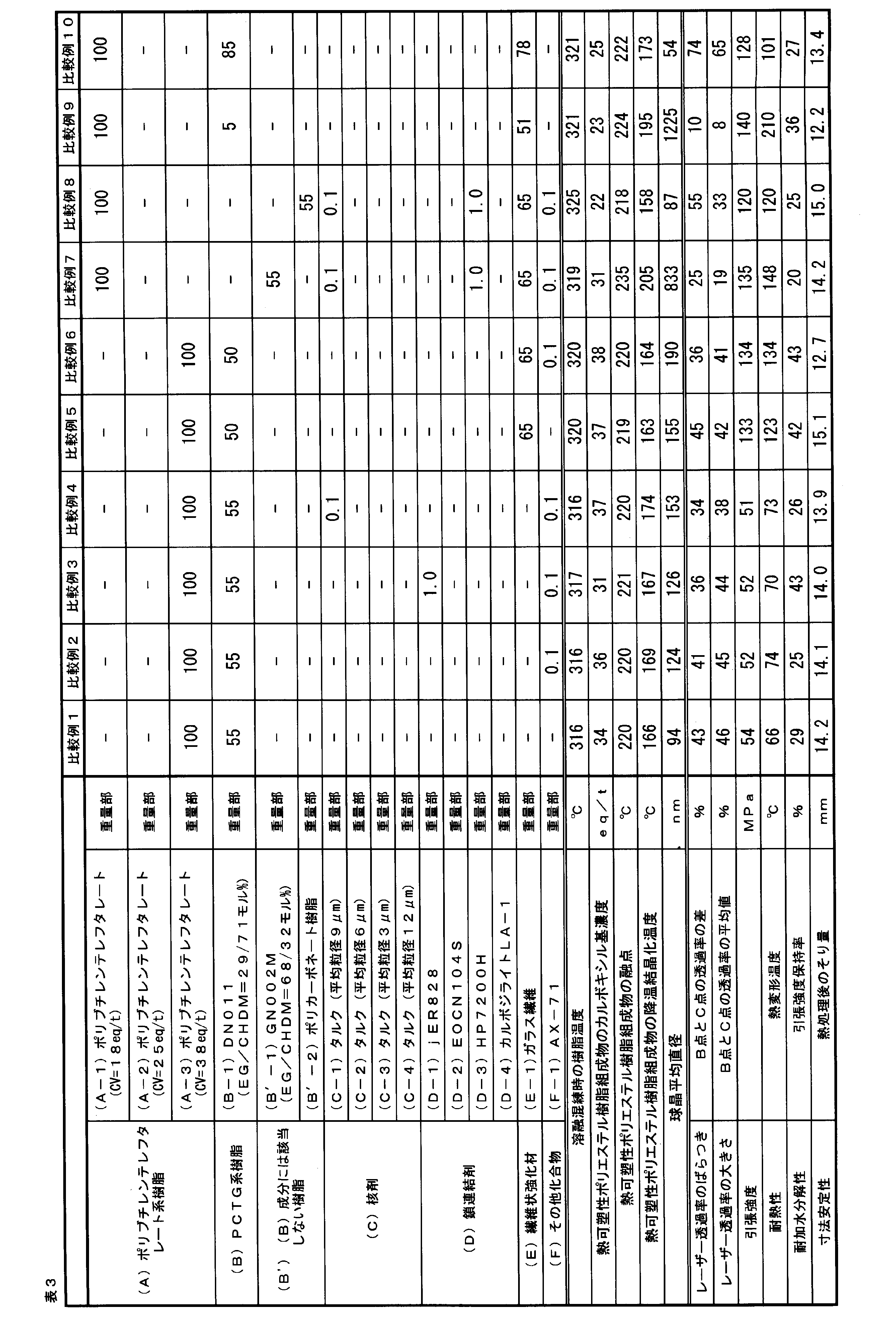
- thermoplastic polyester resin composition By comparing Examples 1 to 4 with Comparative Examples 1 to 4 and comparing Examples 5 to 8 with Comparative Examples 5, 6, 9 and 10, (A) for 100 parts by weight of polybutylene terephthalate resin, (B) Blending 10 parts by weight or more and 80 parts by weight or less of a polyester resin containing 50 to 90 mol% of a structure in which a terephthalic acid residue and a 1,4-cyclohexanedimethanol residue are bonded, and a differential scanning calorimeter is used.
- the melting point measured under the conditions of a temperature rising/falling rate of 20 ° C./min is 222 ° C. or higher and 230 ° C. or lower, and the cooling crystallization temperature measured under the same conditions is 170 ° C. or higher and 200 ° C. or lower. It was possible to obtain a thermoplastic polyester resin composition with little variation in laser transmittance, high laser transmittance, and excellent mechanical strength, heat resistance, hydrolysis resistance, and dimensional stability.
- thermoplastic polyester resin composition having an even better balance between laser transmittance and suppression of variations in laser transmittance was obtained.
- thermoplastic polyester resin composition capable of suppressing variation in laser transmittance while maintaining high laser transmittance, and having excellent heat resistance and dimensional stability.
- Example 4 A comparison between Example 4 and Example 1, a comparison between Example 9 and Example 7, and a comparison with Examples 13, 15 to 18, and 20 showed that (C) nucleating agent having an average particle size of 10 ⁇ m or less By blending 0.01 to 0.8 parts by weight, it was possible to further suppress variations in laser transmittance while maintaining high laser transmittance, and it was possible to obtain a thermoplastic polyester resin composition excellent in heat resistance. .
- (D) a chain linking agent having any group selected from the group consisting of groups, oxazoline groups, and acid anhydride groups By blending 0.1 to 5 parts by weight of (D) a chain linking agent having any group selected from the group consisting of groups, oxazoline groups, and acid anhydride groups, while maintaining high laser transmittance It was possible to obtain a thermoplastic polyester resin composition which can further suppress variations in laser transmittance and which is excellent in heat resistance, hydrolysis resistance and dimensional stability.
- thermoplastic polyester resin composition having superior strength and heat resistance can be obtained. rice field.
- the chain linking agent (D) was a cresol novolac type epoxy resin or a dicyclopentadiene type epoxy resin, so that the laser transmission was excellent while the laser transmission was excellent. It was possible to suppress the variation in the ratio and obtain a thermoplastic polyester resin composition which is more excellent in hydrolysis resistance, hydrolysis resistance, and dimensional stability.
- Example 19 A comparison between Example 19 and Example 13 shows that the polybutylene terephthalate-based resin (A) is compounded with a specific aliphatic alcohol, so that it is excellent in terms of laser transmittance variation, heat resistance, and hydrolysis resistance. It was possible to obtain a thermoplastic polyester resin composition which maintains the properties and is more excellent in laser transmittance and dimensional stability.
- thermoplastic polyester resin composition comprising a step of melt-kneading while controlling the molten resin temperature of the discharge part to 315 ° C. or less
Landscapes
- Chemical & Material Sciences (AREA)
- Health & Medical Sciences (AREA)
- Chemical Kinetics & Catalysis (AREA)
- Medicinal Chemistry (AREA)
- Polymers & Plastics (AREA)
- Organic Chemistry (AREA)
- Compositions Of Macromolecular Compounds (AREA)
- Processes Of Treating Macromolecular Substances (AREA)
Abstract
Description
[1](A)ポリブチレンテレフタレート系樹脂100重量部に対し、(B)テレフタル酸残基と1,4-シクロヘキサンジメタノール残基が結合した構造を50~90モル%含有するポリエステル樹脂を10重量部以上80重量部以下配合してなる熱可塑性ポリエステル樹脂組成物であって、示差走査熱量計を用いて昇降温速度20℃/minの条件で測定した融点が222℃以上230℃以下であり、同条件で測定した降温結晶化温度が170℃以上200℃以下である熱可塑性ポリエステル樹脂組成物。
[2]透過型電子顕微鏡にて観察される(A)ポリブチレンテレフタレート系樹脂の球晶の平均直径が200nm以上800nm以下であることを特徴とする[1]に記載の熱可塑性ポリエステル樹脂組成物。
[3]o-クレゾール/クロロホルム溶媒(混合体積比=2/1)に溶解させた後、エタノール性水酸化カリウムにより滴定することで求めたカルボキシル基量が30eq/t以下である[1]または[2]に記載の熱可塑性ポリエステル樹脂組成物。
[4](A)ポリブチレンテレフタレート系樹脂100重量部に対し、さらに平均粒子径が10μm以下の(C)核剤0.01~0.8重量部を配合してなる[1]~[3]のいずれかに記載の熱可塑性ポリエステル樹脂組成物。
[5](A)ポリブチレンテレフタレート系樹脂100重量部に対し、さらに二つ以上のエポキシ基、イソシアネート基、カルボジイミド基、オキサゾリン基、酸無水物基からなる群から選択されるいずれかの基を有する(D)鎖連結剤0.1~5重量部を配合してなる[1]~[4]のいずれかに記載の熱可塑性ポリエステル樹脂組成物。
[6](A)ポリブチレンテレフタレート系樹脂100重量部に対し、さらに(E)繊維状強化材1~100重量部を配合してなる[1]~[5]のいずれかに記載の熱可塑性ポリエステル樹脂組成物。
[7]前記(D)鎖連結剤がクレゾールノボラック型エポキシ樹脂、またはジシクロペンタジエン型エポキシ樹脂である[5]または[6]に記載の熱可塑性ポリエステル樹脂組成物。
[8]前記(A)ポリブチレンテレフタレート系樹脂が、炭素数が10以上50以下の一価の脂肪族アルコールが、テレフタル酸由来の構造単位100モル%に対して、0.1~2.0モル%化合されたポリブチレンテレフタレート樹脂であることを特徴とする[1]~[7]のいずれかに記載の熱可塑性ポリエステル樹脂組成物。
[9](A)ポリブチレンテレフタレート系樹脂、および、(B)テレフタル酸残基と1,4-シクロヘキサンジメタノール残基が結合した構造を50~90モル%含有するポリエステル樹脂、ならびに、必要に応じてこれらに添加する成分を準備する工程、これらの樹脂および添加物を吐出部の溶融樹脂温度を315℃以下に制御し溶融混練する工程を含む、[1]~[8]のいずれかに記載の熱可塑性ポリエステル樹脂組成物の製造方法。
[10][1]~[8]のいずれかに記載の熱可塑性ポリエステル樹脂組成物からなる成形品。
A-1:ポリブチレンテレフタレート(カルボキシル基濃度(CV)18eq/t、o-クロロフェノール溶液を溶媒として25℃で測定した固有粘度が0.80dL/g)。
A-2:ポリブチレンテレフタレート(カルボキシル基濃度(CV)25eq/t、o-クロロフェノール溶液を溶媒として25℃で測定した固有粘度が0.80dL/g)。
A-3:ポリブチレンテレフタレート(カルボキシル基濃度(CV)38eq/t、o-クロロフェノール溶液を溶媒として25℃で測定した固有粘度0.80dL/g)。
A-4:以下の製造例により得られた一価の脂肪族アルコールが化合するポリブチレンテレフタレート(カルボキシル基濃度(CV)35eq/t、o-クロロフェノール溶液を溶媒として25℃で測定した固有粘度0.80dL/g)。
エステル化反応におけるジオール成分とジカルボン酸成分のモル比(ジオール成分/ジカルボン酸成分)を1.5とし、ジカルボン酸成分としてテレフタル酸:2000g、ジオール成分として1,4-ブタンジオール:1627g、分岐を有する飽和脂肪族アルコールとして2-ヘキシル-1-ドデカノール:49g(テレフタル酸100モル%に対して1.5モル%)、エステル化反応触媒としてテトラ-n-ブトキシチタン(TBT):生成するポリブチレンテレフタレート100gに対して7.5×10-5モル(生成するポリブチレンテレフタレート100重量部に対して0.025重量部)を、精留塔の付いた反応器に仕込み、温度160℃、窒素気流下にてエステル化反応を開始した。その後、徐々に昇温し、最終的に温度225℃の条件下でエステル化反応を行った。留出液の状態などによりエステル化反応の終了を確認し、エステル化反応の反応時間を220分間とした。得られた反応物に、重縮合反応触媒としてTBT:生成するポリブチレンテレフタレート100gに対して7.5×10-5モル(熱可塑性樹脂100重量部に対して0.025重量部)を添加し、温度260℃、圧力100Paの条件で重縮合反応を行った。反応物の粘度などにより重縮合反応の終了を確認し、ポリブチレンテレフタレートを得るための重縮合反応の反応時間を140分間とし、合計360分間反応を実施し、ポリブチレンテレフタレート(A-4)を得た。
B-1:Eastman Chemical(株)製、“EASTAR” DN011(EG/CHDM=29/71モル%)
(B’)(B)テレフタル酸残基と1,4-シクロヘキサンジメタノール残基が結合した構造を50~90モル%含有するポリエステル樹脂に該当しない樹脂
B’-1:Eastman Chemical(株)製、“EASTAR” GN002M(EG/CHDM=68/32モル%)
B’-2:ポリカーボネート樹脂(出光興産(株)製、“タフロン” A1900)
(C)核剤
C-1:タルク、竹原化学工業(株)製、Pタルク(平均粒子径9μm)
C-2:タルク、竹原化学工業(株)製、ハイトロン(平均粒子径6μm)
C-3:タルク、竹原化学工業(株)製、ハイトロンA(平均粒子径3μm)
C-4:タルク、福岡タルク工業所製、FT-96(平均粒子径12μm)
(D)鎖連結剤
D-1:ビスフェノールAとエピクロロヒドリンから製造されるエポキシ化合物(三菱化学(株)製、jER828)
D-2:クレゾールノボラック型エポキシ樹脂(日本化薬(株)製、EOCN104S)
D-3:ジシクロペンタジエン型エポキシ樹脂(DIC(株)製、HP7200H)
D-4:ポリカルボジイミド化合物(日清紡ケミカル(株)製、カルボジライトLA-1)。
E-1:丸形断面チョップドストランドタイプガラス繊維(繊維径13μm)。
F-1:リン系安定剤((株)ADEKA製、“アデカスタブ”AX―71)
また、実施例および比較例に用いた評価方法を以下にまとめて示す。
熱可塑性ポリエステル樹脂組成物約2gをクロロホルム/o-クレゾール(1/2vol)調整液50mLに溶解した。この溶液にブロモチモールブルー/エタノール溶液を適量添加の後、0.02規定のKOHエタノール溶液にて滴定することにより算出した(単位:eq/t)。
熱可塑性ポリエステル樹脂組成物を約10mg採取し、窒素雰囲気下、株式会社パーキンエルマー製示差走査熱量計DSC7を用いて測定した。熱可塑性ポリエステル樹脂組成物を20℃/分の昇温速度で250℃まで昇温して溶融状態とした後、20℃/分の降温速度で30℃まで降温したときに観測される発熱ピークの頂点の温度を降温結晶化温度とし、その後20℃/分の昇温速度で昇温したときに観測される吸熱ピークの頂点の温度を融点として求めた。
日精樹脂工業(株)製NEX1000射出成形機と0.8mmtフィルムゲートおよび幅80mm×長さ80mm×厚さ1mmtキャビティからなる金型を用いて、成形温度を280℃、金型温度80℃の温度条件、50mm/sの射出速度条件で、射出時間と保圧時間は合わせて10秒、冷却時間10秒の成形サイクル条件で、幅80mm×長さ80mm×厚さ1mmtの角板成形品を成形した。角板成形品の中央部からウルトラミクロトームを用いて超薄切片を切り出し、四酸化ルテニウムを用いて染色して観察試料を用意した。これを(株)日立製作所社製H-7100型透過型電子顕微鏡を用いて1,000~5,000倍に拡大し観察を行った。得られた写真から球晶の像を任意に10点選択し、算術平均値で求めた。なお、個々の球晶の直径は、ScionCorporation社製画像解析ソフト「Scion Image」を使用して、電子顕微鏡写真中に存在する球晶の長径および短径の平均値を算出することで求めた。
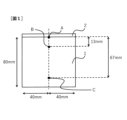
日精樹脂工業(株)製NEX1000射出成形機を用いて、(3)項の角板成形品と同一の成形条件で、幅80mm×長さ80mm×厚さ1mmtのレーザー光線透過性評価試験片を成形した。(株)島津製作所製の紫外近赤外分光光度計(UV-3150)を用い、図1に示すとおり試験片1のゲート部2に接する辺のゲート側中央部をA点として、ゲート部とは反対方向に13mm移動した点をB点、67mm移動した点をC点とした。B点およびC点において、近赤外線である波長940nmのレーザー透過率をそれぞれ測定した。レーザー透過率のばらつきの大きさはB点とC点の透過率の差の絶対値で示し、レーザー透過率の大きさはB点とC点の透過率の平均値で評価した。透過率は透過光量と入射光量の比を百分率で表した。レーザー透過率のばらつきの大きさは30%を超えると劣ると判断し、レーザー透過率のばらつきの大きさは小さいほど優れていると判断し、特に25%以下が優れていると判断し、20%以下がさらに優れていると判断した。また、レーザー透過率の大きさは20%未満で劣ると判断し、レーザー透過率は大きいほど優れていると判断し、30%以上がより優れていると判断し、40%以上がさらに優れていると判断した。
日精樹脂工業(株)製NEX1000射出成形機を用いて、成形温度を250℃、金型温度80℃の温度条件で、50mm/sの射出速度条件で、射出時間と保圧時間は合わせて10秒、冷却時間10秒の成形サイクル条件で、試験片厚み4mmtのISO-1Aダンベルの引張物性評価用試験片を得た。また、得られた引張物性評価用試験片について、ISO527-1,2(2012年)に従い、(株)島津製作所製の引張試験機(オートグラフAG-50kNXPlus)を用い、引張最大点強度(引張強度)を測定した。値は3本の測定値の平均値とした。引張強度の値が大きい材料を機械特性に優れると判断した。
日精樹脂工業(株)製NEX1000射出成形機を用いて、(5)項の引張物性と同一の射出成形条件で、試験片長さ80mm、幅10mm、厚み4mmの熱変形温度評価用試験片を得た。得られた熱変形温度評価用試験片を用い、ISO75(2013年)に従い、(E)繊維状強化材を配合していない場合は測定荷重0.45MPaの条件で熱変形温度を測定した。(E)繊維状強化材を配合している場合は測定荷重1.8MPaの条件で熱変形温度を測定した。どちらの場合も値は3本の測定値の平均値とした。(E)繊維状強化材を配合していない材料では80℃未満だと劣ると判断し、(E)繊維状強化材を配合している材料では特に150℃未満だと劣ると判断した。熱変形温度が高い材料ほど耐熱性に優れると判断し、(E)繊維状強化材を配合していない材料では100℃以上だとより優れていると判断し、(E)繊維状強化材を配合している材料では170℃以上だとより優れていると判断した。
日精樹脂工業(株)製NEX1000射出成形機を用いて、(5)項の引張物性と同一の射出成形条件で、試験片厚み4mmtのISO-1Aダンベルの引張物性評価用試験片を得た。得られたISOダンベルダンベルを121℃×100%RHの温度と湿度に設定されたエスペック(株)社製高度加速寿命試験装置EHS-411に50時間投入し湿熱処理を行った。湿熱処理後の成形品を(5)項の引張試験と同一の条件で引張最大点強度を測定し、3本の測定値を平均値とした。湿熱処理未処理の引張最大点強度に対する湿熱処理後の引張最大点強度の値を百分率で表した値を、引張強度保持率とした((湿熱処理後の引張最大点強度/湿熱処理未処理の引張最大点強度)×100=引張強度保持率(%))。
日精樹脂工業(株)製NEX1000射出成形機を用いて、(3)項で得た幅80mm×長さ80mm×厚さ1mmtの角板成形品をエスペック(株)製熱風乾燥機PVH222で150℃の温度条件で3時間熱処理した後に、角板のいずれか一点の角を定盤上で押さえた際の、対角の浮き上がり量をそり量として評価した。熱処理後のそり量が12.0mmを超えると寸法安定性に劣ると判断し、小さいほど寸法安定性に優れるとした。熱処理後のそり量が10.0mm以下だとより寸法安定性に優れると判断し、8.0mm以下だとさらに優れると判断した。
スクリュー径57mm、L/D35の同方向回転ベント付き二軸押出機を用いて、(A)ポリブチレンテレフタレート系樹脂、(B)テレフタル酸残基と1,4-シクロヘキサンジメタノール残基が結合した構造を50~90モル%含有するポリエステル樹脂、およびその他の原料を表1および表3に示した組成で混合し、二軸押出機の元込め部から添加した。混練温度250℃、スクリュー回転200rpmの押出条件で溶融混練を行い、樹脂組成物の吐出量を500kg/hrに設定し、ストランド状に吐出し、冷却バスを通し、ストランドカッターによりペレット化した。吐出部の溶融樹脂温度については、(株)エー・アンド・デイ製デジタル熱電対温度計(Kタイプ)を用い、熱電対を押出ダイ先端吐出部の溶融樹脂に30秒押し当て、指示された温度を吐出部の溶融樹脂温度とした。
スクリュー径57mm、L/D35の同方向回転ベント付き二軸押出機を用いて、(A)ポリブチレンテレフタレート系樹脂、(B)テレフタル酸残基と1,4-シクロヘキサンジメタノール残基が結合した構造を50~90モル%含有するポリエステル樹脂、およびその他の原料を表1~表3に示した組成で混合し、二軸押出機の元込め部から添加した。なお、(E)繊維状強化材は、元込め部とベント部の途中にサイドフィーダーを設置して添加した。混練温度250℃、スクリュー回転200rpmの押出条件で溶融混練を行い、樹脂組成物の吐出量を300kg/hrに設定し、ストランド状に吐出し、冷却バスを通し、ストランドカッターによりペレット化した。吐出部の溶融樹脂温度については、(株)エー・アンド・デイ製デジタル熱電対温度計(Kタイプ)を用い、熱電対を押出ダイ先端吐出部の溶融樹脂に30秒押し当て、指示された温度を吐出部の溶融樹脂温度とした。
比較例5の溶融混練条件において、せん断発熱による樹脂温上昇を抑えるためスクリュー回転150rpmとし、樹脂組成物の吐出量を200kg/hrに設定した以外に同様の方法で溶融混練し、評価した結果を、表2にその結果を示した。
実施例7の溶融混練条件において、せん断発熱による樹脂温上昇を抑えるためスクリュー回転150rpmとし、樹脂組成物の吐出量を200kg/hrに設定した以外に同様の方法で溶融混練し、評価した結果を、表2にその結果を示した。

2 ゲート部
Claims (10)
- (A)ポリブチレンテレフタレート系樹脂100重量部に対し、(B)テレフタル酸残基と1,4-シクロヘキサンジメタノール残基が結合した構造を50~90モル%含有するポリエステル樹脂を10重量部以上80重量部以下配合してなる熱可塑性ポリエステル樹脂組成物であって、示差走査熱量計を用いて昇降温速度20℃/minの条件で測定した融点が222℃以上230℃以下であり、同条件で測定した降温結晶化温度が170℃以上200℃以下である熱可塑性ポリエステル樹脂組成物。
- 透過型電子顕微鏡にて観察される(A)ポリブチレンテレフタレート系樹脂の球晶の平均直径が200nm以上800nm以下であることを特徴とする請求項1に記載の熱可塑性ポリエステル樹脂組成物。
- o-クレゾール/クロロホルム溶媒(混合体積比=2/1)に溶解させた後、エタノール性水酸化カリウムにより滴定することで求めたカルボキシル基量が30eq/t以下である請求項1または2に記載の熱可塑性ポリエステル樹脂組成物。
- (A)ポリブチレンテレフタレート系樹脂100重量部に対し、さらに平均粒子径が10μm以下の(C)核剤0.01~0.8重量部を配合してなる請求項1~3のいずれかに記載の熱可塑性ポリエステル樹脂組成物。
- (A)ポリブチレンテレフタレート系樹脂100重量部に対し、さらに二つ以上のエポキシ基、イソシアネート基、カルボジイミド基、オキサゾリン基、および酸無水物基からなる群から選択されるいずれかの基を有する(D)鎖連結剤0.1~5重量部を配合してなる請求項1~4のいずれかに記載の熱可塑性ポリエステル樹脂組成物。
- (A)ポリブチレンテレフタレート系樹脂100重量部に対し、さらに(E)繊維状強化材1~100重量部を配合してなる請求項1~5のいずれかに記載の熱可塑性ポリエステル樹脂組成物。
- 前記(D)鎖連結剤がクレゾールノボラック型エポキシ樹脂、またはジシクロペンタジエン型エポキシ樹脂である請求項5または6に記載の熱可塑性ポリエステル樹脂組成物。
- 前記(A)ポリブチレンテレフタレート系樹脂が、炭素数が10以上50以下の一価の脂肪族アルコールが、テレフタル酸由来の構造単位100モル%に対して、0.1~2.0モル%化合されたポリブチレンテレフタレート樹脂である請求項1~7のいずれかに記載の熱可塑性ポリエステル樹脂組成物。
- (A)ポリブチレンテレフタレート系樹脂、および、(B)テレフタル酸残基と1,4-シクロヘキサンジメタノール残基が結合した構造を50~90モル%含有するポリエステル樹脂、ならびに、必要に応じてこれらに添加する成分を準備する工程、これらの樹脂および添加物を吐出部の溶融樹脂温度を315℃以下に制御して溶融混練する工程を含む、請求項1~8のいずれかに記載の熱可塑性ポリエステル樹脂組成物の製造方法。
- 請求項1~8のいずれかに記載の熱可塑性ポリエステル樹脂組成物からなる成形品。
Priority Applications (5)
| Application Number | Priority Date | Filing Date | Title |
|---|---|---|---|
| EP22915574.2A EP4458903B1 (en) | 2021-12-27 | 2022-11-18 | Thermoplastic polyester resin composition, method for producing thermoplastic polyester resin composition, and molded article |
| US18/721,593 US20250115757A1 (en) | 2021-12-27 | 2022-11-18 | Thermoplastic polyester resin composition, method of producing thermoplastic polyester resin composition, and molded product |
| CN202280082681.3A CN118434807A (zh) | 2021-12-27 | 2022-11-18 | 热塑性聚酯树脂组合物、热塑性聚酯树脂组合物的制造方法及成型品 |
| JP2022573669A JP7347694B1 (ja) | 2021-12-27 | 2022-11-18 | 熱可塑性ポリエステル樹脂組成物、熱可塑性ポリエステル樹脂組成物の製造方法、および成形品 |
| KR1020247013197A KR20240122422A (ko) | 2021-12-27 | 2022-11-18 | 열가소성 폴리에스테르 수지 조성물, 열가소성 폴리에스테르 수지 조성물의 제조 방법, 및 성형품 |
Applications Claiming Priority (4)
| Application Number | Priority Date | Filing Date | Title |
|---|---|---|---|
| JP2021212186 | 2021-12-27 | ||
| JP2021-212186 | 2021-12-27 | ||
| JP2022-098610 | 2022-06-20 | ||
| JP2022098610 | 2022-06-20 |
Publications (1)
| Publication Number | Publication Date |
|---|---|
| WO2023127343A1 true WO2023127343A1 (ja) | 2023-07-06 |
Family
ID=86998830
Family Applications (1)
| Application Number | Title | Priority Date | Filing Date |
|---|---|---|---|
| PCT/JP2022/042832 Ceased WO2023127343A1 (ja) | 2021-12-27 | 2022-11-18 | 熱可塑性ポリエステル樹脂組成物、熱可塑性ポリエステル樹脂組成物の製造方法、および成形品 |
Country Status (5)
| Country | Link |
|---|---|
| US (1) | US20250115757A1 (ja) |
| EP (1) | EP4458903B1 (ja) |
| JP (1) | JP7347694B1 (ja) |
| KR (1) | KR20240122422A (ja) |
| WO (1) | WO2023127343A1 (ja) |
Citations (3)
| Publication number | Priority date | Publication date | Assignee | Title |
|---|---|---|---|---|
| JP2008106217A (ja) | 2006-09-27 | 2008-05-08 | Toray Ind Inc | レーザー溶着用ポリエステル樹脂組成物および複合成形体 |
| JP2009132861A (ja) * | 2007-06-07 | 2009-06-18 | Toray Ind Inc | レーザー溶着用熱可塑性樹脂組成物およびそれからなる成形品ならびに複合成形体 |
| JP2016216530A (ja) * | 2015-05-14 | 2016-12-22 | 三菱エンジニアリングプラスチックス株式会社 | レーザー溶着用樹脂組成物及びその溶着体 |
Family Cites Families (4)
| Publication number | Priority date | Publication date | Assignee | Title |
|---|---|---|---|---|
| JP2001279070A (ja) * | 2000-03-30 | 2001-10-10 | Toray Ind Inc | ポリエステル樹脂組成物 |
| JP4910256B2 (ja) * | 2001-07-12 | 2012-04-04 | 東レ株式会社 | ポリエステル樹脂組成物 |
| JP5868435B2 (ja) | 2011-03-08 | 2016-02-24 | ビーエーエスエフ ソシエタス・ヨーロピアBasf Se | カルボン酸塩を有するレーザー透過性のポリエステル |
| WO2021013115A1 (zh) * | 2019-07-22 | 2021-01-28 | 东丽先端材料研究开发(中国)有限公司 | 一种聚酯树脂组合物及其成型品 |
-
2022
- 2022-11-18 WO PCT/JP2022/042832 patent/WO2023127343A1/ja not_active Ceased
- 2022-11-18 JP JP2022573669A patent/JP7347694B1/ja active Active
- 2022-11-18 EP EP22915574.2A patent/EP4458903B1/en active Active
- 2022-11-18 US US18/721,593 patent/US20250115757A1/en active Pending
- 2022-11-18 KR KR1020247013197A patent/KR20240122422A/ko active Pending
Patent Citations (3)
| Publication number | Priority date | Publication date | Assignee | Title |
|---|---|---|---|---|
| JP2008106217A (ja) | 2006-09-27 | 2008-05-08 | Toray Ind Inc | レーザー溶着用ポリエステル樹脂組成物および複合成形体 |
| JP2009132861A (ja) * | 2007-06-07 | 2009-06-18 | Toray Ind Inc | レーザー溶着用熱可塑性樹脂組成物およびそれからなる成形品ならびに複合成形体 |
| JP2016216530A (ja) * | 2015-05-14 | 2016-12-22 | 三菱エンジニアリングプラスチックス株式会社 | レーザー溶着用樹脂組成物及びその溶着体 |
Non-Patent Citations (1)
| Title |
|---|
| See also references of EP4458903A4 |
Also Published As
| Publication number | Publication date |
|---|---|
| US20250115757A1 (en) | 2025-04-10 |
| KR20240122422A (ko) | 2024-08-12 |
| EP4458903A4 (en) | 2025-04-30 |
| JP7347694B1 (ja) | 2023-09-20 |
| EP4458903A1 (en) | 2024-11-06 |
| EP4458903B1 (en) | 2026-02-25 |
| JPWO2023127343A1 (ja) | 2023-07-06 |
Similar Documents
| Publication | Publication Date | Title |
|---|---|---|
| JP7548009B2 (ja) | 熱可塑性ポリエステル樹脂、熱可塑ポリエステル樹脂組成物、および成形品 | |
| KR102267208B1 (ko) | 폴리에스테르계 수지 조성물, 상기 폴리에스테르계 수지 조성물의 제조 방법, 및 상기 폴리에스테르계 수지 조성물을 이용한 성형품 | |
| CN116568744B (zh) | 树脂组合物、粒料、成型品和树脂组合物的制造方法 | |
| KR20110052615A (ko) | 폴리뷰틸렌 테레프탈레이트 수지 혼합물 및 필름 | |
| JP7755375B2 (ja) | 樹脂成形体の製造方法 | |
| WO2014076971A1 (ja) | ポリエステル樹脂組成物とその製造方法、それを含むカメラモジュール | |
| CN105579527A (zh) | 聚酯树脂组合物及使用其得到的成型体 | |
| JP2006104363A (ja) | ポリブチレンテレフタレート樹脂組成物 | |
| US6646060B1 (en) | Resin composition containing crystalline polyimide | |
| JP6252146B2 (ja) | 炭素繊維強化熱可塑性樹脂組成物、それを成形してなるペレットおよび薄肉成形品 | |
| JP7347694B1 (ja) | 熱可塑性ポリエステル樹脂組成物、熱可塑性ポリエステル樹脂組成物の製造方法、および成形品 | |
| JP2015129073A (ja) | 表面処理ガラス繊維およびそれを用いたガラス繊維強化熱可塑性樹脂組成物 | |
| JP5297912B2 (ja) | セルロース繊維強化ポリブチレンテレフタレート樹脂組成物 | |
| CN118434807A (zh) | 热塑性聚酯树脂组合物、热塑性聚酯树脂组合物的制造方法及成型品 | |
| JP2004231910A (ja) | 繊維含有熱可塑性樹脂組成物及びその利用 | |
| JP2022098607A (ja) | ポリエステル樹脂組成物および成形品 | |
| CN112020539B (zh) | 热塑性聚酯树脂组合物及成型品 | |
| JP7444336B1 (ja) | 熱可塑性ポリエステル樹脂組成物およびそれを用いた成形品 | |
| JP2020026449A (ja) | 熱可塑性樹脂組成物およびそれからなる成形品 | |
| JP2026031234A (ja) | 樹脂組成物、ペレット、成形品、外観向上方法、および、外観向上剤 | |
| CN120842810A (zh) | 一种pbt复合材料及其制备方法与应用 | |
| WO2025173776A1 (ja) | 樹脂組成物、ペレット、および、成形品 | |
| JP4379151B2 (ja) | ポリエステル系樹脂組成物及びその利用 | |
| JP2024140630A (ja) | 樹脂組成物、ペレット、成形品および樹脂組成物の製造方法 | |
| JPH04114058A (ja) | ポリエステル系樹脂組成物 |
Legal Events
| Date | Code | Title | Description |
|---|---|---|---|
| WWE | Wipo information: entry into national phase |
Ref document number: 2022573669 Country of ref document: JP |
|
| 121 | Ep: the epo has been informed by wipo that ep was designated in this application |
Ref document number: 22915574 Country of ref document: EP Kind code of ref document: A1 |
|
| WWE | Wipo information: entry into national phase |
Ref document number: 202280082681.3 Country of ref document: CN |
|
| WWE | Wipo information: entry into national phase |
Ref document number: 18721593 Country of ref document: US |
|
| WWE | Wipo information: entry into national phase |
Ref document number: 2401004114 Country of ref document: TH |
|
| NENP | Non-entry into the national phase |
Ref country code: DE |
|
| ENP | Entry into the national phase |
Ref document number: 2022915574 Country of ref document: EP Effective date: 20240729 |
|
| WWP | Wipo information: published in national office |
Ref document number: 18721593 Country of ref document: US |
|
| WWG | Wipo information: grant in national office |
Ref document number: 2022915574 Country of ref document: EP |