WO2023127942A1 - 膜形成用組成物、および基板の製造方法 - Google Patents
膜形成用組成物、および基板の製造方法 Download PDFInfo
- Publication number
- WO2023127942A1 WO2023127942A1 PCT/JP2022/048486 JP2022048486W WO2023127942A1 WO 2023127942 A1 WO2023127942 A1 WO 2023127942A1 JP 2022048486 W JP2022048486 W JP 2022048486W WO 2023127942 A1 WO2023127942 A1 WO 2023127942A1
- Authority
- WO
- WIPO (PCT)
- Prior art keywords
- film
- forming composition
- group
- mass
- substrate
- Prior art date
- Legal status (The legal status is an assumption and is not a legal conclusion. Google has not performed a legal analysis and makes no representation as to the accuracy of the status listed.)
- Ceased
Links
Images


Classifications
-
- C—CHEMISTRY; METALLURGY
- C09—DYES; PAINTS; POLISHES; NATURAL RESINS; ADHESIVES; COMPOSITIONS NOT OTHERWISE PROVIDED FOR; APPLICATIONS OF MATERIALS NOT OTHERWISE PROVIDED FOR
- C09K—MATERIALS FOR MISCELLANEOUS APPLICATIONS, NOT PROVIDED FOR ELSEWHERE
- C09K3/00—Materials not provided for elsewhere
- C09K3/18—Materials not provided for elsewhere for application to surfaces to minimize adherence of ice, mist or water thereto; Thawing or antifreeze materials for application to surfaces
-
- C—CHEMISTRY; METALLURGY
- C09—DYES; PAINTS; POLISHES; NATURAL RESINS; ADHESIVES; COMPOSITIONS NOT OTHERWISE PROVIDED FOR; APPLICATIONS OF MATERIALS NOT OTHERWISE PROVIDED FOR
- C09D—COATING COMPOSITIONS, e.g. PAINTS, VARNISHES OR LACQUERS; FILLING PASTES; CHEMICAL PAINT OR INK REMOVERS; INKS; CORRECTING FLUIDS; WOODSTAINS; PASTES OR SOLIDS FOR COLOURING OR PRINTING; USE OF MATERIALS THEREFOR
- C09D5/00—Coating compositions, e.g. paints, varnishes or lacquers, characterised by their physical nature or the effects produced; Filling pastes
- C09D5/16—Antifouling paints; Underwater paints
- C09D5/1656—Antifouling paints; Underwater paints characterised by the film-forming substance
- C09D5/1662—Synthetic film-forming substance
- C09D5/1675—Polyorganosiloxane-containing compositions
-
- C—CHEMISTRY; METALLURGY
- C08—ORGANIC MACROMOLECULAR COMPOUNDS; THEIR PREPARATION OR CHEMICAL WORKING-UP; COMPOSITIONS BASED THEREON
- C08G—MACROMOLECULAR COMPOUNDS OBTAINED OTHERWISE THAN BY REACTIONS ONLY INVOLVING UNSATURATED CARBON-TO-CARBON BONDS
- C08G77/00—Macromolecular compounds obtained by reactions forming a linkage containing silicon with or without sulfur, nitrogen, oxygen or carbon in the main chain of the macromolecule
- C08G77/04—Polysiloxanes
- C08G77/06—Preparatory processes
- C08G77/08—Preparatory processes characterised by the catalysts used
-
- C—CHEMISTRY; METALLURGY
- C08—ORGANIC MACROMOLECULAR COMPOUNDS; THEIR PREPARATION OR CHEMICAL WORKING-UP; COMPOSITIONS BASED THEREON
- C08G—MACROMOLECULAR COMPOUNDS OBTAINED OTHERWISE THAN BY REACTIONS ONLY INVOLVING UNSATURATED CARBON-TO-CARBON BONDS
- C08G77/00—Macromolecular compounds obtained by reactions forming a linkage containing silicon with or without sulfur, nitrogen, oxygen or carbon in the main chain of the macromolecule
- C08G77/04—Polysiloxanes
- C08G77/22—Polysiloxanes containing silicon bound to organic groups containing atoms other than carbon, hydrogen and oxygen
- C08G77/24—Polysiloxanes containing silicon bound to organic groups containing atoms other than carbon, hydrogen and oxygen halogen-containing groups
-
- C—CHEMISTRY; METALLURGY
- C08—ORGANIC MACROMOLECULAR COMPOUNDS; THEIR PREPARATION OR CHEMICAL WORKING-UP; COMPOSITIONS BASED THEREON
- C08G—MACROMOLECULAR COMPOUNDS OBTAINED OTHERWISE THAN BY REACTIONS ONLY INVOLVING UNSATURATED CARBON-TO-CARBON BONDS
- C08G77/00—Macromolecular compounds obtained by reactions forming a linkage containing silicon with or without sulfur, nitrogen, oxygen or carbon in the main chain of the macromolecule
- C08G77/04—Polysiloxanes
- C08G77/22—Polysiloxanes containing silicon bound to organic groups containing atoms other than carbon, hydrogen and oxygen
- C08G77/26—Polysiloxanes containing silicon bound to organic groups containing atoms other than carbon, hydrogen and oxygen nitrogen-containing groups
-
- C—CHEMISTRY; METALLURGY
- C08—ORGANIC MACROMOLECULAR COMPOUNDS; THEIR PREPARATION OR CHEMICAL WORKING-UP; COMPOSITIONS BASED THEREON
- C08G—MACROMOLECULAR COMPOUNDS OBTAINED OTHERWISE THAN BY REACTIONS ONLY INVOLVING UNSATURATED CARBON-TO-CARBON BONDS
- C08G77/00—Macromolecular compounds obtained by reactions forming a linkage containing silicon with or without sulfur, nitrogen, oxygen or carbon in the main chain of the macromolecule
- C08G77/60—Macromolecular compounds obtained by reactions forming a linkage containing silicon with or without sulfur, nitrogen, oxygen or carbon in the main chain of the macromolecule in which all the silicon atoms are connected by linkages other than oxygen atoms
- C08G77/62—Nitrogen atoms
-
- C—CHEMISTRY; METALLURGY
- C09—DYES; PAINTS; POLISHES; NATURAL RESINS; ADHESIVES; COMPOSITIONS NOT OTHERWISE PROVIDED FOR; APPLICATIONS OF MATERIALS NOT OTHERWISE PROVIDED FOR
- C09D—COATING COMPOSITIONS, e.g. PAINTS, VARNISHES OR LACQUERS; FILLING PASTES; CHEMICAL PAINT OR INK REMOVERS; INKS; CORRECTING FLUIDS; WOODSTAINS; PASTES OR SOLIDS FOR COLOURING OR PRINTING; USE OF MATERIALS THEREFOR
- C09D183/00—Coating compositions based on macromolecular compounds obtained by reactions forming in the main chain of the macromolecule a linkage containing silicon, with or without sulfur, nitrogen, oxygen, or carbon only; Coating compositions based on derivatives of such polymers
- C09D183/04—Polysiloxanes
-
- C—CHEMISTRY; METALLURGY
- C09—DYES; PAINTS; POLISHES; NATURAL RESINS; ADHESIVES; COMPOSITIONS NOT OTHERWISE PROVIDED FOR; APPLICATIONS OF MATERIALS NOT OTHERWISE PROVIDED FOR
- C09D—COATING COMPOSITIONS, e.g. PAINTS, VARNISHES OR LACQUERS; FILLING PASTES; CHEMICAL PAINT OR INK REMOVERS; INKS; CORRECTING FLUIDS; WOODSTAINS; PASTES OR SOLIDS FOR COLOURING OR PRINTING; USE OF MATERIALS THEREFOR
- C09D183/00—Coating compositions based on macromolecular compounds obtained by reactions forming in the main chain of the macromolecule a linkage containing silicon, with or without sulfur, nitrogen, oxygen, or carbon only; Coating compositions based on derivatives of such polymers
- C09D183/04—Polysiloxanes
- C09D183/08—Polysiloxanes containing silicon bound to organic groups containing atoms other than carbon, hydrogen, and oxygen
-
- C—CHEMISTRY; METALLURGY
- C09—DYES; PAINTS; POLISHES; NATURAL RESINS; ADHESIVES; COMPOSITIONS NOT OTHERWISE PROVIDED FOR; APPLICATIONS OF MATERIALS NOT OTHERWISE PROVIDED FOR
- C09D—COATING COMPOSITIONS, e.g. PAINTS, VARNISHES OR LACQUERS; FILLING PASTES; CHEMICAL PAINT OR INK REMOVERS; INKS; CORRECTING FLUIDS; WOODSTAINS; PASTES OR SOLIDS FOR COLOURING OR PRINTING; USE OF MATERIALS THEREFOR
- C09D183/00—Coating compositions based on macromolecular compounds obtained by reactions forming in the main chain of the macromolecule a linkage containing silicon, with or without sulfur, nitrogen, oxygen, or carbon only; Coating compositions based on derivatives of such polymers
- C09D183/14—Coating compositions based on macromolecular compounds obtained by reactions forming in the main chain of the macromolecule a linkage containing silicon, with or without sulfur, nitrogen, oxygen, or carbon only; Coating compositions based on derivatives of such polymers in which at least two but not all the silicon atoms are connected by linkages other than oxygen atoms
-
- C—CHEMISTRY; METALLURGY
- C09—DYES; PAINTS; POLISHES; NATURAL RESINS; ADHESIVES; COMPOSITIONS NOT OTHERWISE PROVIDED FOR; APPLICATIONS OF MATERIALS NOT OTHERWISE PROVIDED FOR
- C09D—COATING COMPOSITIONS, e.g. PAINTS, VARNISHES OR LACQUERS; FILLING PASTES; CHEMICAL PAINT OR INK REMOVERS; INKS; CORRECTING FLUIDS; WOODSTAINS; PASTES OR SOLIDS FOR COLOURING OR PRINTING; USE OF MATERIALS THEREFOR
- C09D7/00—Features of coating compositions, not provided for in group C09D5/00; Processes for incorporating ingredients in coating compositions
- C09D7/40—Additives
- C09D7/60—Additives non-macromolecular
- C09D7/63—Additives non-macromolecular organic
-
- H—ELECTRICITY
- H10—SEMICONDUCTOR DEVICES; ELECTRIC SOLID-STATE DEVICES NOT OTHERWISE PROVIDED FOR
- H10P—GENERIC PROCESSES OR APPARATUS FOR THE MANUFACTURE OR TREATMENT OF DEVICES COVERED BY CLASS H10
- H10P70/00—Cleaning of wafers, substrates or parts of devices
- H10P70/20—Cleaning during device manufacture
-
- H—ELECTRICITY
- H10—SEMICONDUCTOR DEVICES; ELECTRIC SOLID-STATE DEVICES NOT OTHERWISE PROVIDED FOR
- H10P—GENERIC PROCESSES OR APPARATUS FOR THE MANUFACTURE OR TREATMENT OF DEVICES COVERED BY CLASS H10
- H10P95/00—Generic processes or apparatus for manufacture or treatments not covered by the other groups of this subclass
Definitions
- the present disclosure relates to a film-forming composition and a method for manufacturing a substrate.
- this pattern collapse is caused by the surface tension of the cleaning liquid when the cleaning liquid dries in the cleaning process after pattern formation. That is, when the cleaning liquid is removed in the drying process, stress based on the surface tension of the cleaning liquid acts between the patterns, resulting in pattern collapse.
- Patent Document 1 for the purpose of preventing pattern collapse of an inorganic pattern or a resin pattern provided on a substrate, a surface prepared by preparing a silylating agent and a nitrogen-containing heterocyclic compound containing no silicon atom.
- a technique for imparting water repellency by surface-treating an object to be treated (a pattern on the substrate) with a treating agent has been disclosed.
- the pattern surface is treated with a surface treatment agent to make it hydrophobic, and then the pattern surface is washed (paragraph 0076).
- Paragraph 0078 There is a disclosure that it is possible to prevent falling.
- the substrate after surface treatment was washed with isopropyl alcohol (2-propanol) and then washed with ion-exchanged distilled water.
- a film-forming composition containing a silylating agent and a catalytic compound that promotes a silylation reaction is used to leave a liquid film or droplets of a protic liquid (hereinafter referred to as , sometimes referred to as "liquid heaped"), when forming a water-repellent film on the substrate surface covered with the protic liquid, the content of the catalytic compound in the film-forming composition
- a protic liquid hereinafter referred to as , sometimes referred to as "liquid heaped”
- the following film-forming composition and substrate manufacturing method are provided.
- a film-forming composition for use in forming a water-repellent film on at least part of the surface of a substrate coated with a protic liquid comprising: a silylating agent for silylating the surface of the substrate; a catalytic compound that promotes the silylation reaction by the silylating agent; an aprotic solvent; The content of the catalytic compound is 1.0% by mass or more in 100% by mass of the film-forming composition.
- Film-forming composition 2. 1. The film-forming composition according to A film-forming composition having a water contact angle CA2 of 80° or more when 2% by mass of 2-propanol is added, as measured by the following coupon test.
- a silicon wafer having no uneven pattern on the surface and having a silicon oxide film with a thickness of 1 ⁇ m on the surface was cut to prepare coupons made of silicon substrates having length, width and thickness dimensions of 4 cm, 1 cm and 0.75 mm. do.
- the coupon is immersed in 1 wt% hydrofluoric acid at room temperature, then repeatedly immersed in water at room temperature four times, then repeatedly immersed in 2-propanol at room temperature twice, and propylene glycol monomethyl ether at room temperature. Wash by 2 repeated dips in acetate.
- An evaluation solution obtained by mixing the film-forming composition with 2% by mass or 5% by mass of 2-propanol with respect to 100% by mass of the film-forming composition is prepared and washed.
- the coupon is then immersed in the evaluation solution at room temperature. After washing the coupon taken out from the evaluation solution by repeatedly immersing it in 2-propanol at room temperature three times, the surface of the coupon is dried with nitrogen gas. With the dried coupon placed on a horizontal surface, 2 ⁇ l of pure water is placed at room temperature on the surface of the coupon on which the silicon oxide film is formed, and the water contact angle (°) is measured according to JIS R 3257: 1999. Measure.
- CA2 and CA5 are the water contact angles of the evaluation solution when 2% by mass or 5% by mass of 2-propanol is added, respectively. 3.
- each R 1 is an organic group containing a hydrocarbon group having 1 to 18 carbon atoms, in which some or all of the hydrogen atoms may be replaced by fluorine atoms, independently of each other.
- X are each independently a monovalent organic group in which the atoms bonded to the Si atom are nitrogen, oxygen, carbon, or halogen, a is an integer of 1 to 3, b is 0 to 2 is an integer, and the sum of a and b is 1 to 3.) 7. 1. ⁇ 6.
- the film-forming composition according to any one of The catalytic compound includes trimethylsilyltrifluoroacetate, trimethylsilyltrifluoromethanesulfonate, dimethylsilyltrifluoroacetate, dimethylsilyltrifluoromethanesulfonate, butyldimethylsilyltrifluoroacetate, butyldimethylsilyltrifluoromethanesulfonate, hexyldimethylsilyltrifluoroacetate, hexyl for film formation, containing one or more selected from the group consisting of dimethylsilyltrifluoromethanesulfonate, octyldimethylsilyltrifluoroacetate, octyldimethylsilyltrifluoromethanesulfonate, decyldimethylsilyltrifluoroacetate, and decyldimethylsilyltrifluoromethanesulfonate Composition.
- the film-forming composition according to any one of The catalytic compound is selected from the group consisting of trimethylsilyltrifluoroacetate, dimethylsilyltrifluoroacetate, butyldimethylsilyltrifluoroacetate, hexyldimethylsilyltrifluoroacetate, octyldimethylsilyltrifluoroacetate, and decyldimethylsilyltrifluoroacetate.
- a film-forming composition comprising one or more of 9. 1. ⁇ 6.
- the film-forming composition according to any one of The catalytic compound is selected from the group consisting of trimethylsilyltrifluoromethanesulfonate, dimethylsilyltrifluoromethanesulfonate, butyldimethylsilyltrifluoromethanesulfonate, hexyldimethylsilyltrifluoromethanesulfonate, octyldimethylsilyltrifluoromethanesulfonate, and decyldimethylsilyltrifluoromethanesulfonate.
- a film-forming composition comprising one or more of 10. 1. ⁇ 6.
- the catalytic compound contains one or more selected from the group consisting of a compound having a guanidine skeleton, a silicon-free nitrogen-containing heterocyclic compound, and a silylated heterocyclic compound. 11. 1. ⁇ 10. The film-forming composition according to any one of A film-forming composition, wherein the total content of the silylating agent and the catalytic compound contained in 100% by mass of the film-forming composition is 8% by mass or more. 12.
- the film-forming composition is a silylating agent for silylating the surface of the substrate; a catalytic compound that promotes the silylation reaction by the silylating agent; an aprotic solvent; The content of the catalytic compound is 1.0% by mass or more in 100% by mass of the film-forming composition.
- a method for manufacturing the substrate according to The step of forming the water-repellent film has a step of forming a mixed liquid in which the protic liquid held on the substrate and the film-forming composition supplied to the substrate are mixed. Production method.
- a film-forming composition that has an excellent water repellency-imparting effect when in contact with or mixed with a protic liquid, and a method for producing a substrate using the composition are provided.
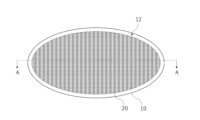
- FIG. 1 is a perspective view schematically showing an example of the configuration of the main surface side of a substrate
- FIG. 2 is a cross-sectional view schematically showing a part of the cross section of the substrate in FIG. 1 taken along line AA.
- It is process sectional drawing which shows an example of the manufacturing process of a board
- It is process sectional drawing which shows an example of the manufacturing process of a board
- the film-forming composition of the present embodiment is a chemical liquid used for forming a water-repellent film on at least part of the substrate surface by supplying it to a substrate whose surface is covered with a protic liquid.
- the film-forming composition contains a silylating agent for silylating the surface of the substrate, a catalytic compound for promoting the silylation reaction by the silylating agent, and an aprotic solvent, and contains the catalytic compound.
- the amount is 1.0% by mass or more in 100% by mass of the film-forming composition.
- the former case in which a chemical solution containing a silylating agent is supplied to the surface of a substrate in a dry state for water repellent treatment
- a protic liquid such as 2-propanol
- the water contact angle in the latter case is It turns out that the angles are several degrees or more smaller than in the former case.
- the protic liquid is supplied to the substrate surface in the cleaning process, and then, as in the latter case, the chemical solution is supplied to the substrate surface on which the protic liquid is deposited. be.
- chemicals are required to have a superior water repellency imparting effect in order to suppress pattern collapse of substrates.
- an example of the water repellency imparting effect was evaluated using a test in a form closer to the actual process. That is, after a protic liquid is supplied to the center of the surface of a wafer (substrate) and spin-treated, a chemical solution is supplied and spin-treated to form a water-repellent film on the substrate surface. A test was conducted to measure the water contact angle at predetermined intervals from the center to the edge of the substrate. As a result, in the chemical solution (film-forming composition) containing a silylating agent and a catalytic compound that promotes the silylation reaction, the content of the catalytic compound is set to a predetermined value or more, whereby the maximum water contact angle can be obtained. It was found that the difference between the value and the minimum value can be reduced, and the uniformity of the water contact angle within the substrate surface can be improved at a certain level.
- the film-forming composition of the present embodiment By using the film-forming composition of the present embodiment, the variation in the water contact angle within the substrate surface (from the center of the substrate to the edge of the substrate) that can be caused by mixing and replacement with the protic liquid heaped up on the substrate surface. It is possible to suppress the increase in the difference between the maximum value and the minimum value of the water contact angle in the region. It can be said that when the variation is small, the in-plane uniformity of the water contact angle is high. Moreover, by using the film-forming composition of the present embodiment, in addition to the in-plane uniformity of the water contact angle, it is possible to suppress a decrease in the water contact angle when the concentration of the protic liquid increases. By using such a film-forming composition excellent in the effect of imparting water repellency, it is possible to enhance the effect of suppressing the pattern collapse of the substrate.
- the lower limit of the content of the catalytic compound is 1.0% by mass or more, preferably 1.5% by mass or more, more preferably 2.0% by mass or more, and still more preferably 2% by mass in 100% by mass of the film-forming composition. .5% by mass or more.
- the upper limit of the content of the catalytic compound may be, for example, 30% by mass or less, preferably 20% by mass or less, more preferably 15% by mass or less in 100% by mass of the film-forming composition. This makes it easy to suppress changes in components that occur during storage of the film-forming composition.
- the lower limit of the concentration of the silylating agent is, for example, 1% by mass or more, preferably 2% by mass or more, more preferably 5% by mass or more, and still more preferably 7% by mass or more in 100% by mass of the film-forming composition. good. As a result, even after the film-forming composition comes into contact with the protic liquid, the decrease in the water repellency-imparting effect can be further suppressed.
- the upper limit may be, for example, 90% by mass or less, preferably 50% by mass or less, and more preferably 30% by mass or less. As a result, the replacement of the film-forming composition with the protic liquid heaped up on the substrate surface can be facilitated.
- the lower limit of the total content of the silylating agent and the catalytic compound contained in 100% by mass of the film-forming composition is, for example, 8% by mass or more, preferably 9% by mass or more, and more preferably 10% by mass or more. good too. This makes it easier to improve the water contact angle CA5 when 5% by mass of 2-propanol is added, which is measured by the coupon test described above.
- the upper limit of the total content of the silylating agent and the catalytic compound may be, for example, 95% by mass or less, preferably 50% by mass or less, and more preferably 30% by mass or less. As a result, the replacement of the film-forming composition with the protic liquid heaped up on the substrate surface can be facilitated.
- the film-forming composition is such that X and Y are 1. .0 ⁇ X/Y ⁇ 20.
- the lower limit of X/Y may be, for example, greater than 1.0, preferably 2.0 or more, more preferably 2.5 or more.
- X/Y When X/Y is 2.0 or more or 2.5 or more, there is a tendency to reduce the decrease in water contact angle CA5 when 5% by mass of 2-propanol is added.
- the upper limit of X/Y may be, for example, 20 or less, preferably 14 or less, more preferably 10 or less. As a result, even when surface treatment is performed with the same flow rate and a shorter supply time, it is easy to suppress a decrease in the water contact angle.
- the water contact angle CA2 when 2% by mass of 2-propanol is added which is measured by the following coupon test, may be, for example, 80° or more, preferably 82° or more, more preferably 85° or more.
- the water contact angle CA5 when 5% by mass of 2-propanol is added may be, for example, 80° or more, preferably 82° or more, more preferably 85° or more.
- Both CA2 and CA5 are preferably 80° or more, more preferably 85° or more.
- CA5 is 80° or more and CA2-CA5 is 4° or less, and more preferably CA2-CA5 is 3° or less.
- An evaluation solution obtained by mixing the film-forming composition with 2% by mass or 5% by mass of 2-propanol with respect to 100% by mass of the film-forming composition is prepared and washed.
- the coupon is then immersed in the evaluation solution at room temperature.
- the immersion time in the evaluation solution was 20 seconds.
- the surface of the coupon is dried with nitrogen gas.
- 2 ⁇ l of pure water is placed at room temperature on the surface of the coupon on which the silicon oxide film is formed, and the water contact angle (°) is measured according to JIS R 3257: 1999.
- CA2 and CA5 are the water contact angles of the evaluation solution when 2% by mass or 5% by mass of 2-propanol is added, respectively.
- An example of the above substrate manufacturing method includes a preparation step of preparing a substrate having an uneven pattern on its surface, a holding step of supplying a protic liquid to the surface of the substrate, and a composition for forming a film on the surface holding the protic liquid. and a surface treatment step of supplying an object and forming a water-repellent film on at least part of the surface.
- FIG. 1 is a schematic perspective view of the main surface 12 side of the substrate 10.
- FIG. 2 is a part of a schematic cross-sectional view of the substrate 10 in FIG. 1 taken along line AA.
- 3 and 4 are cross-sectional schematic diagrams showing the manufacturing process.
- the above-mentioned "principal surface” refers to the substrate surface on the side having the concave-convex pattern.
- a substrate 10 having a pattern (unevenness structure 20) formed on its main surface 12 is prepared.
- the following method which is an example of a method of forming the uneven structure 20 on the surface of the substrate 10, may be used.
- the wafer surface is coated with a resist, then the resist is exposed through a resist mask, and the exposed or unexposed resist is removed to form a resist having a desired uneven pattern.
- a resist having an uneven pattern can also be obtained by pressing a mold having a pattern against the resist.
- the wafer is then etched. At this time, the substrate surface corresponding to the concave portions of the resist pattern is selectively etched. Finally, the resist is removed to obtain a wafer (substrate 10) having an uneven structure 20 on its surface.
- a general semiconductor substrate is used as the substrate 10, but the wafer on which the concave-convex structure 20 is formed and the material of the concave-convex structure 20 are not particularly limited.
- the wafer material various wafers such as a silicon wafer, a silicon carbide wafer, a wafer composed of a plurality of components including silicon atoms, a sapphire wafer, and various compound semiconductor wafers can be used.
- the material of the uneven structure 20 is selected from the group consisting of Si, Ti, Ge, W, and Ru, and oxides, nitrides, nitrogen oxides, carbonitrides, and carbide oxides containing one or more of these. One or more may be included.
- the material of the uneven structure 20 may be silicon oxide, silicon nitride, silicon carbide, polycrystalline silicon, single crystal silicon, silicon germanium, silicon-based materials such as low-k materials, titanium nitride, tungsten, ruthenium, tantalum nitride, tin.
- metal-based materials such as metal-based materials, materials in which these materials are combined, resist (photoresist) materials, and the like can be used.
- the region where the water-repellent film is to be formed, especially the surface of the concave-convex structure 20, has a material with which the silylating agent easily forms a bond or easily adsorbs.
- Silicon-based materials having Si atoms are preferable as the material with which the silylating agent easily forms a bond or is easily adsorbed. and at least one of low-k materials, with silicon oxide being particularly preferred.
- one or two or more other elements may be contained in the above silicon-based material, if necessary.
- the substrate 10 has a pattern forming region in which a pattern (concavo-convex structure 20) is formed on the main surface 12, and if necessary, a non-pattern forming region in which a pattern is not formed is formed around the pattern forming region. It may have a region. One or more cut regions for dicing may be formed in the patterned region and/or between the patterned region and the non-patterned region.
- the substrate 10 may have a notch formed in a part of the periphery. The notch may be formed with a linear cut called an orientation flat indicating the direction of the crystal axis or a V-shaped cut called a notch for positioning in an exposure apparatus or the like.
- a bevel region may be formed on at least a portion of the edge of the substrate 10 .
- the substrate 10 in the bevel region has an inclined surface (bevel) formed at least on the main surface 12 side. Specifically, the top edge, upper bevel, front shoulder, end surface, and lower bevel are continuously formed.
- the pattern formation area is an area in which one or more uneven structures 20 are formed when viewed from the direction perpendicular to the main surface 12, that is, when viewed from above.
- the pattern formation regions may include device formation regions in which one or more semiconductor devices are formed.
- the uneven structure 20 is, for example, one or two or more structures arranged along the vertical direction of the main surface 12 and/or one or two or more structures arranged along the horizontal direction perpendicular to the vertical direction. It may consist of a three-dimensional structure with a body.
- An example of such a three-dimensional structure may comprise at least part of a logic or memory device, such as a FinFET, nanowire FET, nanosheet FET, or other multi-gate FET, three-dimensional memory. A cell etc. are mentioned.
- the pattern dimension of the uneven structure 20 can be defined as at least one dimension in the width direction in the in-plane direction of the major surface 12 and/or at least one dimension in the height direction in the direction perpendicular to the major surface 12 .
- the width At least one or more pattern dimensions of (length in the X-axis direction), height (length in the Y-axis direction), and depth (length in the Z-axis direction) may be, for example, 30 nm or less, or 20 nm or less. , 10 nm or less. This may be the spacing between patterns. Even when the substrate 10 having such a fine uneven structure 20 is used, the film-forming composition of the present embodiment can be applied.
- Such a film-forming composition is suitable, for example, for surface treatment of a substrate 10 having an uneven structure 20 with a pattern dimension of 30 nm or less, preferably 20 nm or less.
- the aspect ratio of the projections 22 may be, for example, 3 or more, 5 or more, or 10 or more. Pattern collapse can be suppressed even in the uneven structure 20 having the convex portion 22 with a fragile structure.
- the aspect ratio of the projections 22 is not particularly limited, but may be 100 or less.
- the aspect ratio of the convex portion 22 is represented by the value obtained by dividing the height of the convex portion 22 by the width of the convex portion 22 .
- protic liquid 30 is supplied to main surface 12 of substrate 10, as shown in FIG.
- An example of the holding step is performed by a washing step using the protic liquid 30, which will be described later.
- the protic liquid 30 may be used in the cleaning process that is performed immediately before the surface treatment process. Further, the cleaning process may be performed multiple times, and the cleaning process using the protic liquid 30 may be performed after the cleaning process using the cleaning liquid other than the protic liquid 30 . It is sufficient that the protic liquid 30 is held on the main surface 12 of the substrate 10 immediately before the next surface treatment step. may be retained.
- the protic liquid 30 means a liquid containing groups in which hydrogen atoms are bonded to oxygen atoms or nitrogen atoms, such as hydroxyl groups and amino groups. Specific examples include water, alcohols, organic acids, inorganic acids, organic bases, inorganic bases, mixtures thereof, and the like.
- the cleaning process described above is performed for the purpose of removing impurities and unnecessary residues from the main surface 12 of the substrate 10 using the cleaning liquid, and replacing the liquid in contact with the main surface 12 with the cleaning liquid.
- the cleaning step may be performed once or twice or more before the surface treatment step, and other steps may be included between a plurality of cleaning steps, between the cleaning step and the surface treatment step. .
- the cleaning liquid examples include water, an organic solvent, a mixture thereof, or a mixture thereof with at least one of acid, alkali, surfactant, and oxidizing agent.
- the protic liquid 30 described above may be used. Specific examples include water, an aqueous ammonium hydroxide solution, an aqueous tetramethylammonium solution, an aqueous hydrochloric acid solution, an aqueous hydrogen peroxide solution, an aqueous sulfuric acid solution, and a mixture of an organic solvent and water. These aqueous cleaning liquids may be used alone or in combination of two or more.
- organic solvents include hydrocarbons, esters, ethers, ketones, halogen atom-containing solvents, sulfoxide solvents, alcohols, polyhydric alcohol derivatives, and nitrogen atom-containing solvents.
- the main surface 12 (surface) of the substrate 10 holding the protic liquid 30 is brought into contact with the film-forming composition 60 of the present embodiment.
- a water-repellent film 70 is formed on at least part of the main surface 12 .
- the film-forming composition 60 is supplied while the protic liquid 30 is retained on the main surface 12 . That is, by substituting the film-forming composition 60 for the protic liquid 30, the surface treatment step is performed before the surface of the uneven structure 20 on the main surface 12 of the substrate 10 becomes dry. At this time, the protic liquid 30 on the major surface 12 is believed to be displaced so as to be extruded into the film-forming composition 60, but at least a portion of the retained protic liquid 30 and the supplied film-forming composition It is assumed that the composition 60 mixes to form a mixed liquid.
- One of the preferred embodiments of the present invention is capable of maintaining the effect of imparting water repellency even when the mixed liquid as described above is produced.
- the method of supplying the film-forming composition 60 known means can be used.
- a single-wafer method typified by a spin method (spin coating method) in which the protic liquid 30 held in the uneven pattern is replaced and the composition is filled is preferred.
- a batch method or the like may be used in which the protic liquid 30 retained in the uneven pattern of the wafer is replaced and the composition is filled.
- the film-forming composition 60 is, for example, vaporized, supplied to the surface to be processed of the wafer, and aggregated on the surface to be processed to be in a liquid state, so that the film-forming composition 60 is held in the uneven pattern of the wafer. It is also possible to replace the protic liquid 30 in the
- the film-forming composition 60 on the main surface 12 may be subjected to known means such as heating treatment, depressurization treatment, and drying treatment to promote the formation of the water-repellent film 70. .
- the main surface 12 on which the water-repellent film 70 is formed may be brought into contact with a cleaning liquid (post-cleaning step), if necessary.
- a cleaning liquid post-cleaning step
- those exemplified for the cleaning liquid used in the above-described cleaning process can be used.
- the film-forming composition 60 When preparing the film-forming composition 60 in the surface treatment step, it is preferable to prepare the film-forming composition 60 under a dry atmosphere or an inert atmosphere in order to improve the effect of imparting water repellency to the film-forming composition 60. preferable.
- the film-forming composition 60 When the film-forming composition 60 is supplied to the substrate 10 in the surface treatment step, the inside of the manufacturing apparatus is set to a dry atmosphere or an inert atmosphere, or the main surface 12 of the substrate 10 or the vicinity of the main surface 12 is supplied with a dry gas. or an inert gas is preferably supplied. Further, the same operations may be performed for all the surface treatment steps, the above-described holding step, washing step, post-washing step, drying step, removing step, and the like, which will be described later.
- the film-forming composition 60 which is one of the preferred embodiments of the present disclosure, has excellent water repellency imparting effects even when in contact with a protic liquid, so it is included in dry atmospheres and inert atmospheres.
- the criteria for moisture and the like may be relaxed, and the dry atmosphere, inert atmosphere, dry gas, and inert gas may contain moisture and the like to the extent that the performance of the film-forming composition 60 is not significantly impaired. .
- the post-cleaning step may be performed once or twice or more after the surface treatment step. Other steps may be included between the multiple post-cleaning steps, between the surface treatment step and the post-cleaning step.
- a drying process for drying the main surface 12 of the substrate 10 may be performed as necessary.
- the drying process can remove liquid present on the major surface 12 of the substrate 10 .
- known means such as spin drying, IPA (2-propanol) vapor drying, Marangoni drying, heat drying, hot air drying, and vacuum drying may be used.
- the drying process may be performed once or twice or more, for example, after the surface treatment process or after the post-cleaning process.
- the drying process and the post-cleaning process may be alternately repeated.
- the water-repellent film 70 on the main surface 12 of the substrate 10 may be removed (removal step).
- removing means include heating, UV irradiation, ozone exposure, plasma irradiation, corona discharge, and the like.
- treatment with a concentrated fluid such as a supercritical fluid (which may contain an acid, a base, or an oxidizing agent) or steam treatment may be performed. These may be used alone or in combination of two or more. These treatments may be performed under atmospheric pressure or reduced pressure.
- a semiconductor substrate (substrate 10) is obtained by the substrate manufacturing method using the film-forming composition of the present embodiment.
- the manufacturing method shown in FIG. 3 is intended for wafer patterns, the present disclosure is not limited thereto.
- the method for manufacturing a semiconductor substrate the main surface of the semiconductor substrate is subjected to pattern formation, a cleaning step including a holding step, a surface treatment step using a film-forming composition, a post-cleaning step, a drying step, and a water-repellent film forming step. removal, and the like.
- the resist pattern is targeted, and the film-forming composition of the present disclosure is used in the cleaning and drying steps, so that collapse of the resist pattern can be suppressed.
- the above-described surface treatment process has been described as a manufacturing method performed after the cleaning process, it is not limited to this, and may be performed after various treatments performed on the concave-convex structure 20 .
- the substrate manufacturing method may use one or a combination of two or more known treatments.
- surface treatment such as plasma treatment may be performed after the removal step described above.
- Another form of film-forming composition can be used to form a selective protective film.
- a selective protective film refers to a protective film that selectively protects the surface of a specific material in a substrate having a plurality of materials on its surface.
- the concave-convex structure 20 may be composed of a plurality of types of materials, or the concave-convex structure 20 and the pattern non-formation region may be made of different materials. In addition, regions made of different materials may also exist in the pattern non-formation region.
- the non-protected region may be selectively etched or cleaned, or an arbitrary film may be selectively formed on the region where the protective film is formed.
- the above-mentioned "selectively protect” means that the contact angle of water on the first surface and the contact angle of water on the second surface are made different.
- the water-repellent film 70 is formed on the first surface. , and the water-repellent film 70 may not be formed on the second surface.
- the first surface may be a surface containing Si
- the second surface may be a surface containing no Si but containing a metal.
- At least one selected from the group consisting of silicon oxide, silicon nitride, silicon carbide, polycrystalline silicon, single crystal silicon, silicon germanium, and low-k materials is preferably used as the first surface.
- silylating agent The film-forming composition of this embodiment contains a silylating agent.
- a known silylating agent can be used as the silylating agent.
- the silylating agent for example, a silicon compound represented by the following general formula [1] may be used. These may be used alone or in combination of two or more.
- R 1 is each independently an organic group containing a hydrocarbon group having 1 to 18 carbon atoms in which some or all of the hydrogen atoms may be replaced by fluorine atoms.
- each X is independently of each other a monovalent organic group in which the atom bonded to the Si atom is nitrogen, oxygen, carbon, or halogen, a is an integer of 1 to 3, and b is an integer of 0 to 2. It is an integer and the sum of a and b is 1-3.
- R 1 in general formula [1] contains a silicon atom, it may have the structure of general formula [1-1] shown below.
- R 1 (wherein R 1 does not contain a silicon atom) and X are the same as in general formula [1] above, and m is an integer of 1 to 2.
- n is an integer of 0 to 1
- the sum of m and n is 1 to 2
- the monovalent organic group in which the atom bonded to the Si atom is nitrogen, oxygen or carbon includes not only hydrogen, carbon, nitrogen and oxygen atoms, but also silicon, sulfur and halogen atoms. etc. may be included.
- R 6 is each independently a hydrogen group, —C ⁇ N group , —NO 2 groups, and hydrocarbon groups in which some or all of the hydrogen atoms may be replaced with fluorine atoms, and the hydrocarbon groups may have oxygen atoms and/or nitrogen atoms.
- R a1 represents a hydrogen atom or a saturated or unsaturated alkyl group
- R a2 represents a saturated or unsaturated alkyl group
- a saturated or unsaturated cyclo represents an alkyl group or a saturated or unsaturated heterocycloalkyl group.
- R a1 and R a2 may combine with each other to form a saturated or unsaturated heterocycloalkyl group having a nitrogen atom.
- —N(R a3 )—Si(R a4 )(R a5 )(R a6 ) (where R a3 represents a hydrogen atom, a hydrocarbon group having 1 to 4 carbon atoms, a trimethylsilyl group, or a dimethylsilyl group; a4 , R a5 and R a6 each independently represent a hydrogen atom or an organic group, and the total number of carbon atoms contained in R a4 , R a5 and R a6 is 1 or more.), -N (R a7 )—C( ⁇ O)R a8 (here, R a7 represents a hydrogen atom, a methyl group, a trimethylsilyl group, or a dimethylsilyl group, and R a8 represents a hydrogen atom, a saturated or
- Examples of the silylating agent in which X in the above general formula [1] is a monovalent organic group in which the atom bonded to the Si atom is nitrogen are CH 3 Si(NH 2 ) 3 and C 2 H 5 Si.
- R 5 is as described above.
- -N C (NR 6 2 ) 2
- —N ⁇ C(NR 6 2 )R 6 R 6 is as described above.
- X in the general formula [1] is a monovalent organic group in which the atom bonded to the Si atom is oxygen
- Examples of the silylating agent in which X in the general formula [1] is a monovalent organic group in which the atom bonded to the Si atom is oxygen include hexamethyldisiloxane, 1,3-diphenyl-1 ,3-dimethyldisiloxane, 1,1,3,3-tetramethyldisiloxane, 1,1,1-triethyl-3,3-dimethyldisiloxane, 1,1,3,3-tetra-n-octyldimethyl Disiloxane, bis(nonafluorohexyl)tetramethyldisiloxane, 1,3-bis(trifluoropropyl)tetramethyldisiloxane, 1,3-di-n-butyltetramethyldisiloxane, 1,3-di-n -octyltetramethyldisiloxane, 1,3-diethyltetramethyldisiloxane, 1,3
- X in the general formula [1] is a monovalent organic group in which the atom bonded to the Si atom is carbon
- X in the general formula [1] is a monovalent organic group in which the atom bonded to the Si atom is carbon
- Examples of the silylating agent in which X in the general formula [1] is a monovalent organic group in which the atom bonded to the Si atom is a halogen include the amino group (—NH 2 group) of the above aminosilane. is replaced with a chloro group, a bromo group, or an iodo group (eg, chlorotrimethylsilane, bromotrimethylsilane, etc.).
- b is preferably 0.
- X is more preferably a monovalent organic group in which the atom bonded to the Si atom is nitrogen or oxygen.
- R 1 is preferably a methyl group.
- a silazane compound can be included as the silylating agent.
- the silazane compounds include hexamethyldisilazane, heptamethyldisilazane, tetramethyldisilazane, diethyltetramethyldisilazane, dipropyltetramethyldisilazane, dibutyltetramethyldisilazane, dihexyltetramethyldisilazane, and dioctyltetramethyldisilazane.
- Acyclic disilazane compounds such as silazane and didecyltetramethyldisilazane, 2,2,5,5-tetramethyl-2,5-disila-1-azacyclopentane, 2,2,6,6-tetramethyl-2 Cyclic disilazane compounds such as ,6-disila-1-azacyclohexane; 2,2,4,4,6,6-hexamethylcyclotrisilazane, 2,4,6-trimethyl-2,4,6-trivinylcyclo cyclic trisilazane compounds such as trisilazane; cyclic tetrasilazane compounds such as 2,2,4,4,6,6,8,8-octamethylcyclotetrasilazane; and the like.
- silylating agent examples include hexamethyldisilazane, heptamethyldisilazane, N-(trimethylsilyl)dimethylamine, bis(dimethylamino)dimethylsilane, bis(trimethylsilyl)trifluoroacetamide, N-methyl- N-trimethylsilyltrifluoroacetamide, N-trimethylsilylacetamide, N-trimethylsilylimidazole, trimethylsilyltriazole, bistrimethylsilylsulfate, 2,2,5,5-tetramethyl-2,5-disila-1-azacyclopentane, 2, One or more selected from the group consisting of 2,4,4,6,6-hexamethylcyclotrisilazane, hexamethyldisiloxane, trimethylsilyltrifluoroacetate, trimethylsilyltrifluoromethanesulfonate, trimethylsilylbenzenesulfonate, and
- the film-forming composition contains, in addition to the silylating agent, a catalytic compound that promotes the silylation reaction by the silylating agent, and an aprotic solvent, which will be described later.
- a catalytic compound one or more selected from the group consisting of compound A, an acid imidide, a compound having a guanidine skeleton, a silicon atom-free nitrogen-containing heterocyclic compound, and a silylated heterocyclic compound, which will be described later. is preferred.
- the catalytic compound is a compound capable of promoting the reaction between the main surface and the silylating agent or enhancing the liquid-repellent performance of the formed water-repellent film. It may constitute a part of the water-repellent film.
- the compound A is a group consisting of a carboxylic acid represented by the following general formula [16], an anhydride of the carboxylic acid, a salt of the carboxylic acid, and a carboxylic acid derivative represented by the following general formula [17].
- R 29′ is a monovalent hydrocarbon group having 1 to 8 carbon atoms in which some or all of the hydrogen atoms may be replaced by fluorine atoms
- R 30 is , each independently of each other, at least one group selected from monovalent hydrocarbon groups having 1 to 18 carbon atoms in which some or all of the hydrogen atoms may be replaced by fluorine atoms
- h is It is an integer from 1 to 3.
- R 8′ is a monovalent hydrocarbon group having 1 to 8 carbon atoms in which some or all of the hydrogen atoms may be replaced by fluorine atoms
- R 9 is , each independently of each other, at least one group selected from monovalent hydrocarbon groups having 1 to 18 carbon atoms in which some or all of the hydrogen atoms may be replaced by fluorine atoms
- r is It is an integer from 1 to 3.
- the above compound A includes a sulfonic acid ester represented by the following general formula [5], a sulfonimide represented by the following general formulas [6] and [7], and a compound represented by the following general formulas [8] and [9].
- a sulfonic acid ester represented by the following general formula [5] a sulfonimide represented by the following general formulas [6] and [7]
- R 12 is each independently a monovalent hydrocarbon group having 1 to 8 carbon atoms, in which some or all of the hydrogen atoms may be replaced by fluorine atoms; and a group selected from the group consisting of fluorine atoms.
- R 13 is a divalent hydrocarbon group having 1 to 8 carbon atoms in which some or all of the hydrogen atoms may be replaced by fluorine atoms.
- R 14 each independently represents a monovalent hydrocarbon group having 1 to 8 carbon atoms in which some or all of the hydrogen atoms may be replaced by fluorine atoms; and a group selected from the group consisting of a fluorine atom, and each R 15 is independently of each other a monovalent carbon number of 1 to 18 in which some or all of the hydrogen atoms may be replaced with fluorine atoms.
- s is an integer of 1 to 3
- t is an integer of 0 to 2
- the sum of s and t is 3 or less.
- R 16 is each independently a divalent hydrocarbon group having 1 to 8 carbon atoms in which some or all of the hydrogen atoms may be replaced by fluorine atoms; and each R 17 is independently a monovalent hydrocarbon group having 1 to 18 carbon atoms in which some or all of the hydrogen atoms may be replaced by fluorine atoms, and u is 1 to An integer of 3, v is an integer of 0 to 2, and the sum of u and v is 3 or less.
- each R 18 is independently a monovalent hydrocarbon group having 1 to 8 carbon atoms in which some or all of the hydrogen atoms may be replaced by fluorine atoms, and a group selected from the group consisting of fluorine atoms.
- R 19 is each independently a monovalent hydrocarbon group having 1 to 8 carbon atoms, in which some or all of the hydrogen atoms may be replaced by fluorine atoms, and a group selected from the group consisting of fluorine atoms
- each R 20 is a monovalent group having 1 to 18 carbon atoms in which some or all of the hydrogen atoms may be replaced by fluorine atoms independently of each other.
- w is an integer of 1 to 3
- x is an integer of 0 to 2
- the sum of w and x is 3 or less.
- the compound A include trimethylsilyltrifluoroacetate, trimethylsilyltrifluoromethanesulfonate, dimethylsilyltrifluoroacetate, dimethylsilyltrifluoromethanesulfonate, butyldimethylsilyltrifluoroacetate, butyldimethylsilyltrifluoromethanesulfonate, hexyldimethylsilyl trifluoroacetate, hexyldimethylsilyltrifluoromethanesulfonate, octyldimethylsilyltrifluoroacetate, octyldimethylsilyltrifluoromethanesulfonate, decyldimethylsilyltrifluoroacetate, and decyldimethylsilyltrifluoromethanesulfonate, and selected among them
- One or more can be included. These may be used alone or in combination of two or more.
- compound A More preferred specific examples of compound A include trimethylsilyltrifluoroacetate, dimethylsilyltrifluoroacetate, butyldimethylsilyltrifluoroacetate, hexyldimethylsilyltrifluoroacetate, octyldimethylsilyltrifluoroacetate, and decyldimethylsilyl It may contain one or more selected from the group consisting of trifluoroacetate.
- compound A More preferred specific examples of compound A include trimethylsilyltrifluoromethanesulfonate, dimethylsilyltrifluoromethanesulfonate, butyldimethylsilyltrifluoromethanesulfonate, hexyldimethylsilyltrifluoromethanesulfonate, octyldimethylsilyltrifluoromethanesulfonate, and decyldimethylsilyltrifluoromethanesulfonate. It may contain one or more selected from the group consisting of romethanesulfonate.
- the above compounds A correspond to the above silylating agents, when used as a catalytic compound, it means that they are used in combination with other silylating agents other than compound A.
- the concentration of compound A it is preferable to set the concentration of compound A to be equal to or less than the concentration of the other silylating agent, since it becomes more likely to act as a catalytic compound.
- the compound A is a silicon compound represented by the following general formula [2], and one or more acetic acids selected from the group consisting of trifluoroacetic acid, trifluoroacetic anhydride, trifluoromethanesulfonic acid, and trifluoromethanesulfonic anhydride, or It may be obtained by reacting with sulfonic acid.
- the surplus silicon compound represented by the following general formula [2] that remains unconsumed in this reaction can be used as the silylating agent together with the compound A obtained in the reaction.
- the silicon compound represented by the following general formula [2] has a molar ratio of, for example, 0.2 to 100,000 times, preferably 0.5 to 50,000 times, more preferably 1 to 10,000 times that of the acetic acid or sulfonic acid.
- the reaction may be doubled.
- R 2 is the same as R 1 above
- X is the same as general formula [1] above
- c is an integer of 1 to 3
- d is 0 to 2. and the sum of c and d is 1-3.
- R 2 c (H) d Si— examples include (CH 3 ) 3 Si—, (CH 3 ) 2 (H) Si—, (C 4 H 9 )( CH 3 ) 2 Si—, (C 6 H 13 )(CH 3 ) 2 Si—, (C 8 H 17 )(CH 3 ) 2 Si—, (C 10 H 21 )(CH 3 ) 2 Si—, etc. mentioned.
- Examples of the acid imidized product include compounds having a chemical structure obtained by imidating an acid such as carboxylic acid or phosphoric acid.
- the catalytic compound may include one or more selected from the group consisting of compounds having a guanidine skeleton, nitrogen-containing heterocyclic compounds containing no silicon atoms, and silylated heterocyclic compounds.
- R 21 -N ⁇ C(NR 22 2 ) 2 [12] R 21 -N ⁇ C(NR 22 2 )R 22 [13] [In the above general formulas [12] and [13], R 21 is a hydrogen group, a —C ⁇ N group, a —NO 2 group, an alkylsilyl group, and some or all of the hydrogen atoms are replaced with fluorine atoms.
- the hydrocarbon group may have an oxygen atom and/or a nitrogen atom, and if it contains a nitrogen atom, it should have an acyclic structure.
- each R 22 is independently selected from a hydrogen group, a —C ⁇ N group, a —NO 2 group, and a hydrocarbon group in which some or all of the hydrogen atoms may be replaced by fluorine atoms;
- the above hydrocarbon group may have an oxygen atom and/or a nitrogen atom, but when it contains a nitrogen atom, it assumes an acyclic structure.
- Examples of the compound having a guanidine skeleton include guanidine, 1,1,3,3-tetramethylguanidine, 2-tert-butyl-1,1,3,3-tetramethylguanidine, 1,3- diphenylguanidine, 1,2,3-triphenylguanidine, N,N'-diphenylformamidine, 2,2,3,3,3-pentafluoropropylamidine and the like.
- R 23 and R 24 are each independently a divalent organic group consisting of a carbon atom and/or a nitrogen atom and a hydrogen atom, and the total number of carbon atoms and nitrogen atoms is It is 1 to 9, and when there are 2 or more, carbon atoms that do not form a ring may be present.
- R 25 is an alkyl group having 1 to 6 carbon atoms in which some or all of the hydrogen atoms may be replaced by fluorine atoms, and some or all of the hydrogen atoms are fluorine atoms.
- a cycloalkyl group having 3 to 8 carbon atoms which may be substituted with a trialkylsilyl group having an alkyl group having 1 to 8 carbon atoms which may be partially or entirely substituted with fluorine atoms , an alkenyl group having 2 to 6 carbon atoms in which some or all of the hydrogen atoms may be replaced by fluorine atoms, and a carbon number of 1 to 6 in which some or all of the hydrogen atoms may be replaced by fluorine atoms Alkoxy group of 6, cycloalkyloxy group having 3 to 8 carbon atoms which may be partially or entirely replaced with fluorine atoms, even if partially or entirely replaced with fluorine atoms an aliphatic acyl group having 2 to 7 carbon atoms, an aryl group having 6 to 20 carbon atoms in which some or all of the hydrogen atoms may be replaced with fluorine atoms, and some or all of the hydrogen atoms being fluorine atoms an aralky
- R 26 , R 27 and R 28 each independently have a number of carbon atoms in which some or all of the hydrogen atoms may be replaced with fluorine atoms; is 1 to 6 alkyl groups or hydrogen groups.
- R 25 described above is preferably an alkyl group having 1 to 6 carbon atoms in which some or all of the hydrogen atoms may be replaced by fluorine atoms, or an alkyl group in which some or all of the hydrogen atoms are replaced by fluorine atoms.
- the number of carbon atoms in the alkyl group having 1 to 6 carbon atoms in R 25 is preferably 1 to 4, more preferably 1 or 2.
- Specific examples of the alkyl group include methyl group, ethyl group, n-propyl group, isopropyl group, n-butyl group, isobutyl group, sec-butyl group, tert-butyl group, n-pentyl group and n-hexyl. and the like. Among these, a methyl group and an ethyl group are preferred, and a methyl group is more preferred. It may also contain halogen atoms such as chlorine, bromine, and iodine atoms.
- the number of carbon atoms in the cycloalkyl group having 3 to 8 carbon atoms in R 25 is preferably 3 to 7, more preferably 4 to 6.
- Specific examples of the cycloalkyl group include cyclopropyl group, cyclobutyl group, cyclopentyl group, cyclohexyl group, cycloheptyl group, cyclooctyl group and the like.
- the number of carbon atoms in the trialkylsilyl group having an alkyl group of 1 to 8 carbon atoms in R 25 is preferably 2 to 8, more preferably 3 to 6.
- Specific examples of the trialkylsilyl group include a trimethylsilyl group, a propyldimethylsilyl group, a butyldimethylsilyl group, and the like.
- the number of carbon atoms in the alkenyl group having 2 to 6 carbon atoms in R 25 is preferably 2 to 4, more preferably 2 to 3.
- Specific examples of the alkenyl group include vinyl group, 1-propenyl group, and 2-propenyl group.
- the number of carbon atoms in the alkoxy group having 1 to 6 carbon atoms in R 25 is preferably 1 to 4, more preferably 1 or 2.
- Specific examples of the alkoxy group include methoxy, ethoxy, n-propyloxy, isopropyloxy, n-butyloxy, isobutyloxy, sec-butyloxy, tert-butyloxy, n-pentyloxy, and n-hexyloxy group and the like. Among these, a methoxy group and an ethoxy group are preferred, and a methoxy group is more preferred.
- the number of carbon atoms in the cycloalkyloxy group having 3 to 8 carbon atoms in R 25 is preferably 3 to 7, more preferably 4 to 6.
- Specific examples of the cycloalkyloxy group include cyclopropyloxy group, cyclobutyloxy group, cyclopentyloxy group, cyclohexyloxy group, cycloheptyloxy group, cyclooctyloxy group and the like.
- the number of carbon atoms in the aliphatic acyl group having 2 to 7 carbon atoms in R 25 is preferably 2 to 5, more preferably 2 or 3.
- Specific examples of the aliphatic acyl group include acetyl group, propionyl group, butanoyl group, pentanoyl group, hexanoyl group, heptanoyl group and the like. Among these, an acetyl group and a propanoyl group are preferred, and an acetyl group is more preferred. It may also contain halogen atoms such as chlorine, bromine, and iodine atoms.
- the number of carbon atoms in the aryl group having 6 to 20 carbon atoms in R 25 described above is preferably 6 to 12.
- Specific examples of the aryl group include a phenyl group, ⁇ -naphthyl group, ⁇ -naphthyl group, biphenyl-4-yl group, biphenyl-3-yl group, biphenyl-2-yl group, anthracen-1-yl group, Anthracen-2-yl group, anthracen-9-yl group, phenanthren-1-yl group, phenanthren-2-yl group, phenanthren-3-yl group, phenanthren-4-yl group, and phenanthren-9-yl group mentioned.
- phenyl group ⁇ -naphthyl group, ⁇ -naphthyl group, biphenyl-4-yl group, biphenyl-3-yl group, biphenyl-2-yl group and the like are preferred, and phenyl group is more preferred.
- the aralkyl group having 7 to 20 carbon atoms in R 25 described above preferably has 7 to 12 carbon atoms.
- Specific examples of the aralkyl group include benzyl group, phenethyl group, 3-phenyl-n-propyl group, 4-phenyl-n-butyl group, ⁇ -naphthylmethyl group, ⁇ -naphthylmethyl group, 2-( ⁇ - naphthyl)ethyl group, 2-( ⁇ -naphthyl)ethyl group and the like.
- a benzyl group and a phenethyl group are preferred, and a benzyl group is more preferred.
- the number of carbon atoms in the arylcarbonyl group having 7 to 20 carbon atoms in R 25 described above is preferably 7 to 13.
- Specific examples of the arylcarbonyl group include benzoyl group, ⁇ -naphthoyl group, ⁇ -naphthoyl group and the like.
- the number of carbon atoms in the carboxyalkyl group having 2 to 7 carbon atoms in R 25 is preferably 2 to 5, more preferably 2 or 3.
- Specific examples of the carboxyalkyl group include a carboxymethyl group, 2-carboxyethyl group, 3-carboxy-n-propyl group, 4-carboxy-n-butyl group, 5-carboxy-n-pentyl group, and 6- A carboxy-n-hexyl group can be mentioned. Among these, a carboxymethyl group is preferred.
- alkyl group included in the monoalkylamino group containing an alkyl group having 1 to 6 carbon atoms and the dialkylamino group containing an alkyl group having 1 to 6 carbon atoms in R 25 described above are the specific alkyl groups described above. Same as example.
- Specific examples of the monoalkylamino group are preferably an ethylamino group and a methylamino group, more preferably a methylamino group.
- dialkylamino group a diethylamino group and a dimethylamino group are preferable, and a dimethylamino group is more preferable.
- the number of carbon atoms in the aminoalkyl group having 1 to 6 carbon atoms in R 25 described above is preferably 2 to 4.
- Specific examples of the aminoalkyl group include 2-aminoethyl group and 3-aminopropyl group.
- the number of carbon atoms in the alkylthio group having 1 to 6 carbon atoms in R 25 is preferably 1 to 4, more preferably 1 or 2.
- Specific examples of the alkylthio group include methylthio, ethylthio, n-propylthio, isopropylthio, n-butylthio, isobutylthio, sec-butylthio, tert-butylthio, n-pentylthio, and n -hexylthio group and the like.
- a methylthio group and an ethylthio group are preferred, and a methylthio group is more preferred.
- the above nitrogen-containing heterocyclic compound containing no silicon atom may contain a heteroatom other than a nitrogen atom such as an oxygen atom or a sulfur atom in the ring, may have aromaticity, and may have two or more Compounds in which a plurality of rings are bonded via a single bond or a divalent or higher polyvalent linking group may also be used. Moreover, you may have a substituent.
- a divalent linking group is preferable because steric hindrance between rings is small.
- the number of rings contained in the compound in which two or more rings are bonded via a polyvalent linking group is preferably 4 or less, more preferably 3 or less, from the viewpoint of facilitating the preparation of a uniform film-forming composition. is most preferred. Note that the number of rings is two for a condensed ring such as a naphthalene ring.
- silicon-free nitrogen-containing heterocyclic compounds include pyridine, pyridazine, pyrazine, pyrimidine, triazine, tetrazine, pyrrole, pyrazole, imidazole, triazole, tetrazole, oxazole, isoxazole, thiazole, isothiazole, and oxadiazole.
- thiadiazole quinoline, isoquinoline, cinnoline, phthalazine, quinoxaline, quinazoline, indole, indazole, benzimidazole, benzotriazole, benzoxazole, benzoisoxazole, benzothiazole, benzoisothiazole, benzoxadiazole, benzothiadiazole, saccharin, pyrrolidine , and piperidine.
- pyrrole pyrazole
- imidazole triazole, tetrazole, oxazole, isoxazole, thiazole, isothiazole, oxadiazole, thiadiazole, indole, indazole, benzimidazole, benzotriazole, benzoxazole, benzisoxazole, benzothiazole , benzoisothiazole, benzoxadiazole, benzothiadiazole and saccharin are preferred, imidazole, triazole, tetrazole, benzotriazole and pyrazole are more preferred.
- the silylated heterocyclic compound includes a silylated imidazole compound and a silylated triazole compound.
- silylated heterocyclic compounds include monomethylsilylimidazole, dimethylsilylimidazole, trimethylsilylimidazole, monomethylsilyltriazole, dimethylsilyltriazole, trimethylsilyltriazole and the like.
- Some of the above-mentioned silylated heterocyclic compounds correspond to the above-mentioned silylating agents, but when they are used as catalytic compounds, they are used in combination with other silylating agents other than the silylated heterocyclic compounds. .
- the film-forming composition contains an aprotic solvent.
- the aprotic solvent mentioned above refers to a solvent that does not contain a group in which a hydrogen atom is bonded to an oxygen atom or a nitrogen atom, such as a hydroxyl group or an amino group.
- the aprotic solvent is not particularly limited as long as it dissolves the silylating agent and the catalytic compound.
- Examples of aprotic solvents include hydrocarbons, esters, ethers, ketones, halogen atom-containing solvents, sulfoxide solvents, carbonate solvents, derivatives of polyhydric alcohols that do not have an OH group, N
- An organic solvent such as a nitrogen atom-containing solvent having no —H group or a silicone solvent is used.
- hydrocarbons examples include hydrocarbons, esters, ethers, halogen atom-containing solvents, sulfoxide solvents, and derivatives of polyhydric alcohols, those having no OH group are preferred.
- aprotic solvents may be used alone or in combination of two or more.
- hydrocarbons examples include linear, branched, or cyclic hydrocarbon solvents, aromatic hydrocarbon solvents, terpene solvents, etc., n-hexane, n-heptane, n-octane, , n-nonane, n-decane, n-undecane, n-dodecane, n-tetradecane, n-hexadecane, n-octadecane, n-icosane, and branched hydrocarbons corresponding to their carbon numbers (e.g., isododecane , isocetane, etc.), cyclohexane, methylcyclohexane, decalin, benzene, toluene, xylene, (ortho-, meta-, or para-)diethylbenzene, 1,3,5-trimethylbenzene, butylbenzene, naphthalene,
- esters examples include ethyl acetate, n-propyl acetate, i-propyl acetate, n-butyl acetate, i-butyl acetate, n-pentyl acetate, i-pentyl acetate, n-hexyl acetate, n-heptyl acetate.
- n-octyl acetate n-pentyl formate, n-butyl propionate, ethyl butyrate, n-propyl butyrate, i-propyl butyrate, n-butyl butyrate, methyl n-octanoate, methyl decanoate, methyl pyruvate, pyruvate ethyl acetate, n-propyl pyruvate, methyl acetoacetate, ethyl acetoacetate, ethyl 2-oxobutanoate, dimethyl adipate, methyl 3-methoxypropionate, ethyl 3-methoxypropionate, methyl 3-ethoxypropionate, 3- Examples include ethyl ethoxypropionate and ethyl ethoxyacetate.
- lactone compounds examples include ⁇ -propiolactone, ⁇ -butyrolactone, ⁇ -valerolactone, ⁇ -hexanolactone, ⁇ -heptanolactone, ⁇ -octanolactone, ⁇ -nonanolactone, ⁇ -decanolactone, ⁇ - Undecanolactone, ⁇ -Dodecanolactone, ⁇ -Valerolactone, ⁇ -Hexanolactone, ⁇ -Octanolactone, ⁇ -Nonanolactone, ⁇ -Decanolactone, ⁇ -Undecanolactone, ⁇ -Dodecanolactone, ⁇ -Hexa Nolactone, etc.
- ethers examples include di-n-propyl ether, ethyl-n-butyl ether, di-n-butyl ether, ethyl-n-amyl ether, di-n-amyl ether, ethyl-n-hexyl ether, di- n-hexyl ether, di-n-octyl ether, and ethers having branched hydrocarbon groups such as diisopropyl ether and diisoamyl ether corresponding to their carbon numbers, dimethyl ether, diethyl ether, methyl ethyl ether, methyl cyclopentyl ether , diphenyl ether, tetrahydrofuran, dioxane, and the like.
- ketones examples include acetone, acetylacetone, methyl ethyl ketone, methyl propyl ketone, methyl butyl ketone, 2-heptanone, 3-heptanone, cyclohexanone, and isophorone.
- halogen atom-containing solvent examples include perfluorocarbons such as perfluorooctane, perfluorononane, perfluorocyclopentane, perfluorocyclohexane, and hexafluorobenzene; 1,1,1,3,3-pentafluorobutane; Hydrofluorocarbons such as fluorocyclopentane, 2,3-dihydrodecafluoropentane, Zeorora H (manufactured by Nippon Zeon Co., Ltd.), methyl perfluoropropyl ether, methyl perfluoroisobutyl ether, methyl perfluorobutyl ether, ethyl perfluorobutyl ether, Ethyl perfluoroisobutyl ether, methyl perfluorohexyl ether, ethyl perfluorohexyl ether, Asahiklin AE-3000 (manufactured by A
- Examples of the sulfoxide solvent include dimethyl sulfoxide.
- Examples of the carbonate-based solvent include dimethyl carbonate, ethylmethyl carbonate, diethyl carbonate, and propylene carbonate.
- Examples of derivatives of the above polyhydric alcohols having no OH group include ethylene glycol dimethyl ether, ethylene glycol diethyl ether, ethylene glycol dibutyl ether, ethylene glycol monomethyl ether acetate, ethylene glycol monoethyl ether acetate, ethylene glycol monobutyl ether acetate, Ethylene glycol diacetate, diethylene glycol dimethyl ether, diethylene glycol ethyl methyl ether, diethylene glycol diethyl ether, diethylene glycol butyl methyl ether, diethylene glycol dibutyl ether, diethylene glycol monomethyl ether acetate, diethylene glycol monoethyl ether acetate, diethylene glycol monobutyl ether acetate, diethylene glycol diacetate, triethylene glycol dimethyl ether , triethylene glycol diethyl ether, triethylene glycol dibutyl ether, triethylene glycol butyl methyl ether, triethylene glycol
- nitrogen atom-containing solvent having no NH group examples include N,N-dimethylacetamide, N-methyl-2-pyrrolidone, N-ethyl-2-pyrrolidone, N-propyl-2-pyrrolidone, 1, 3-dimethyl-2-imidazolidinone, 1,3-diethyl-2-imidazolidinone, 1,3-diisopropyl-2-imidazolidinone, triethylamine, pyridine and the like.
- silicone solvent examples include hexamethyldisiloxane, octamethyltrisiloxane, decamethyltetrasiloxane, and dodecamethylpentasiloxane.
- polyhydric alcohol derivatives are preferred, such as diethylene glycol monoethyl ether acetate, ethylene glycol monomethyl ether acetate, propylene glycol monomethyl ether acetate, and diethylene glycol.
- propylene carbonate linear or branched hydrocarbon solvents having 6 to 12 carbon atoms, p-menthane, diphenylmenthane, limonene, terpinene, bornane, norbornane, pinane, and the like.
- aprotic solvent to be combined with the above-mentioned preferable specific examples of the silylating agent include propylene carbonate, linear hydrocarbon solvents having 7 to 10 carbon atoms, menthane, pinane, ⁇ -butyrolactone, One or more selected from the group consisting of propylene glycol monomethyl ether acetate and 3-methoxy-3-methyl-1-butyl acetate can be mentioned.
- the film-forming composition of the present disclosure further comprises a catalytic compound as described above.
- the film-forming composition does not substantially contain water.
- a substantially water-free film-forming composition obtained by not adding water during the preparation of the film-forming composition, or by using a raw material for each component that does not contain water or has a low water content. is more preferred.
- the film-forming composition can contain components other than the components described above within a range that does not impede the purpose of the present disclosure.
- Other components include, for example, oxidizing agents such as hydrogen peroxide and ozone, surfactants, and antioxidants such as BHT.
- the above-mentioned film-forming composition it is preferable that it is a composition that generates a highly reactive by-product upon contact with the protic liquid. If the above-mentioned by-products are highly reactive with the protic liquid, it is presumed that the decomposition of the silylating agent and the catalytic compound by the protic liquid is difficult to proceed, resulting in a decrease in the water contact angle of the water-repellent film. can be easily suppressed. By-products that readily react with the base material and contribute to the water repellency-imparting effect through the reaction with the base material are also preferred. Examples of such highly reactive by-products include trialkylsilylamines and dialkylsilylamines.
- the film-forming composition of the present embodiment is obtained by mixing and dissolving the components described above.
- the resulting mixture ie, solution
- each component may be purified in advance by distillation, or may be purified using an adsorbent, filter, or the like.
- Film-forming composition 1 By dissolving 1,1,1,3,3,3-hexamethyldisilazane (raw material 1) and trifluoroacetic acid (raw material 2) in propylene glycol monomethyl ether acetate (solvent), A film-forming composition 1 containing a silylating agent and a catalytic compound was obtained.
- Film-forming compositions 2 to 45 were prepared in the same manner as film-forming composition 1 except that the raw materials and mixing ratios shown in Table 1 were used.
- the obtained film-forming composition was evaluated for the following evaluation items.
- the cleaned silicon wafer was rotated at 500 rpm with the surface of the thermal oxide film facing up, and while nitrogen gas was blown almost vertically to the center of the wafer at a flow rate of 10 L/min (converted to the standard state), it was directed toward the center of the wafer.
- 2-propanol was fed at a flow rate of 150 mL/min for 30 seconds. Thereafter, while maintaining the rotation and blowing of nitrogen gas, the supply of 2-propanol was stopped, and the film-forming composition was supplied toward the center of the wafer at a flow rate of 70 mL/min for 15 seconds.
- Evaluation solution 1 was used as evaluation solution 1 as it was.
- Evaluation solution 2 was prepared by mixing each film-forming composition and 2-propanol at a mass ratio of 100:2 for 10 seconds.
- Evaluation solution 3 was prepared by mixing each film-forming composition and 2-propanol at a mass ratio of 100:5 for 10 seconds. Using each of the evaluation solutions 1 to 3, the water contact angle on the coupon surface was measured as follows.
- a silicon wafer having no uneven pattern on the surface and having a silicon oxide film of 1 ⁇ m thickness on the surface is cut into coupons made of silicon substrates having length, width and thickness dimensions of 4 cm, 1 cm and 0.75 mm.
- a plurality of (test pieces) were prepared.
- the surface on which the silicon oxide film was formed was regarded as the "main surface", and the following evaluation was performed.
- the resulting coupon is immersed in 1% by mass hydrofluoric acid at room temperature for 10 minutes, then immersed in deionized water at room temperature for 20 seconds, which is repeated four times, and then in 2-propanol at room temperature for 20 seconds.
- the angle (water contact angle) formed was measured with a contact angle meter (manufactured by Kyowa Interface Science: CA-X type).
- Table 2 shows the water contact angles of the evaluation solutions 1 to 3 as CA0, CA2 and CA5, respectively.
- CA0 indicates the effect of imparting water repellency when a silicon substrate, the surface of which is not covered with a protic liquid, is treated with the film-forming composition. It is possible to evaluate the effect of imparting water repellency when the silicon substrate is treated with the film-forming composition.
- the film-forming compositions of Examples 1 to 35 have smaller variations in water contact angle than Comparative Examples 1 to 10, in which the content of the catalytic compound in the film-forming composition is small. Due to the excellent in-plane uniformity of the corners, it is possible to suppress the decrease in the water contact angle of the water-repellent film when it is supplied to a substrate whose surface is covered with a protic liquid (excellent water-repellent effect )showed that. In all of Examples 1 to 35 and Comparative Examples 1 to 10, the water contact angle at the farthest measurement point from the center of the silicon wafer was the lowest.
- the water contact angle of CA2 is 80° or more, and even when 2% by mass of protic liquid (2-propanol; IPA) is added externally, the decrease in water contact angle is suppressed. showed possible results.
- CA5 is 85° or more and CA2-CA5 is 4° or less, and even if the amount of IPA added increases to some extent, the initial , and the decrease in the water contact angle was suppressed until the limit amount of addition was exceeded.
- highly reactive by-products eg, TMS-NH 2 when the catalytic compound is TMSTFA, TMSTFSA, DMSTFA, etc.
- the film-forming composition of each example described above can be expected to suppress pattern collapse on the substrate surface covered with the protic liquid, it can be suitably used as a chemical solution for suppressing pattern collapse on the substrate surface. can.
- Example 1 Using the film-forming composition of Example 1 above, using a silicon wafer having a "silicon oxide film” and a “tungsten film” on the surface in ⁇ Evaluation of water contact angle by coupon test>, The water contact angle (°) at CA0 was measured under the conditions of As a result, it was found that the water contact angle of the "silicon oxide film” was larger than that of the "tungsten film”. These results suggested that the film-forming composition of each example can also be suitably used to form a selective protective film.
Landscapes
- Chemical & Material Sciences (AREA)
- Organic Chemistry (AREA)
- Engineering & Computer Science (AREA)
- Chemical Kinetics & Catalysis (AREA)
- Materials Engineering (AREA)
- Life Sciences & Earth Sciences (AREA)
- Wood Science & Technology (AREA)
- Health & Medical Sciences (AREA)
- Medicinal Chemistry (AREA)
- Polymers & Plastics (AREA)
- Combustion & Propulsion (AREA)
- Materials Applied To Surfaces To Minimize Adherence Of Mist Or Water (AREA)
- Paints Or Removers (AREA)
Abstract
Description
また、特許文献1には、パターン表面を表面処理剤で処理し疎水化した後、パターンの表面を洗浄することにより(段落0076)、洗浄時にパターン間に働く力を低減することができ、パターン倒れを防止することができる(段落0078)、という開示がある。なお、特許文献1の実施例には、表面処理後の基板を、イソプロピルアルコール(2-プロパノール)で洗浄した後、イオン交換蒸留水による洗浄を行ったと記載されている。
このような事情から、上記特許文献1において、2-プロパノールや水などのプロトン性液体で洗浄した後、この液体が残存した状態のパターン表面に対して、シリル化剤を含む表面処理剤を暴露することにより、基板に撥水処理する方法について十分に検討されていない。
このような知見に基づきさらに鋭意研究したところ、シリル化剤およびシリル化反応を促進する触媒性化合物を含む膜形成用組成物を用いて、プロトン性液体の液膜や液滴が残存する(以下、「液盛りされた」と記載することもある)ことでプロトン性液体によって覆われた状態の基板表面に、撥水性膜を形成するとき、膜形成用組成物中の触媒性化合物の含有量を適切にすることにより、かかる撥水性膜の水接触角の低下を抑制でき撥水性付与効果に優れた撥水性膜を実現できることを見出し、本発明を完成するに至った。
前記基板の表面をシリル化する、シリル化剤と、
前記シリル化剤によるシリル化反応を促進する触媒性化合物と、
非プロトン性溶媒と、を含み、
前記触媒性化合物の含有量が、当該膜形成用組成物100質量%中、1.0質量%以上である、
膜形成用組成物。
2. 1.に記載の膜形成用組成物であって、
下記のクーポン試験により測定される、2-プロパノールを2質量%添加時の水接触角CA2が、80°以上である、膜形成用組成物。
(クーポン試験の手順)
表面に凹凸パターンがなく、表面に厚さ1μmのシリコン酸化膜を有するシリコンウェハを切断して、長さ、幅、厚みの寸法が4cm、1cm、0.75mmとなるシリコン基板からなるクーポンを準備する。
前記クーポンを、室温で1質量%のフッ化水素酸に浸漬し、次いで、室温で水に4回繰り返し浸漬し、次いで、室温で2-プロパノールに2回繰り返し浸漬し、室温でプロピレングリコールモノメチルエーテルアセテートに2回繰り返し浸漬して洗浄する。
当該膜形成用組成物と、当該膜形成用組成物100質量%に対して質量換算で2質量%、または5質量%の2-プロパノールと、を混合して得られる評価溶液を準備し、洗浄したクーポンを、室温で評価溶液に浸漬する。
前記評価溶液から取り出したクーポンを、室温で2-プロパノールに3回繰り返し浸漬して洗浄した後、窒素ガスによりクーポンの表面を乾燥させる。
乾燥したクーポンを水平面に置いた状態で、シリコン酸化膜が形成されたクーポンの表面に、室温下、2μlの純水を置き、JIS R 3257:1999に準拠して、水接触角(°)を測定する。
2-プロパノールを2質量%、または5質量%添加したときの評価溶液の水接触角を、それぞれ、CA2、CA5とする。
3. 2.に記載の膜形成用組成物であって、
上記のクーポン試験により測定される、2-プロパノールを5質量%添加時の水接触角CA5が、80°以上である、膜形成用組成物。
4. 1.~3.のいずれか一つに記載の膜形成用組成物であって、
当該膜形成用組成物100質量%中における、質量換算での前記シリル化剤の含有量をXとし、前記触媒性化合物の含有量をYとしたとき、X,Yが、1.0<X/Y≦20である、膜形成用組成物。
5. 1.~4.のいずれか一つに記載の膜形成用組成物であって、
前記触媒性化合物の含有量が、当該膜形成用組成物100質量%中、30質量%以下である、膜形成用組成物。
6. 1.~5.のいずれか一つに記載の膜形成用組成物であって、
前記シリル化剤は、下記の一般式[1]で表されるケイ素化合物を含む、膜形成用組成物。
R1 aSi(H)bX4-a-b [1]
(上記一般式[1]中、R1は、それぞれ互いに独立して、一部又はすべての水素原子がフッ素原子に置き換えられていても良い炭素数が1~18の炭化水素基を含む有機基であり、Xは、それぞれ互いに独立して、Si原子に結合する原子が窒素、酸素、炭素、又はハロゲンである1価の有機基であり、aは1~3の整数、bは0~2の整数であり、aとbの合計は1~3である。)
7. 1.~6.のいずれか一つに記載の膜形成用組成物であって、
前記触媒性化合物は、トリメチルシリルトリフルオロアセテート、トリメチルシリルトリフルオロメタンスルホネート、ジメチルシリルトリフルオロアセテート、ジメチルシリルトリフルオロメタンスルホネート、ブチルジメチルシリルトリフルオロアセテート、ブチルジメチルシリルトリフルオロメタンスルホネート、ヘキシルジメチルシリルトリフルオロアセテート、ヘキシルジメチルシリルトリフルオロメタンスルホネート、オクチルジメチルシリルトリフルオロアセテート、オクチルジメチルシリルトリフルオロメタンスルホネート、デシルジメチルシリルトリフルオロアセテート、及びデシルジメチルシリルトリフルオロメタンスルホネートからなる群から選ばれる一または二以上を含む、膜形成用組成物。
8. 1.~6.のいずれか一つに記載の膜形成用組成物であって、
前記触媒性化合物は、トリメチルシリルトリフルオロアセテート、ジメチルシリルトリフルオロアセテート、ブチルジメチルシリルトリフルオロアセテート、ヘキシルジメチルシリルトリフルオロアセテート、オクチルジメチルシリルトリフルオロアセテート、及びデシルジメチルシリルトリフルオロアセテートからなる群から選ばれる一または二以上を含む、膜形成用組成物。
9. 1.~6.のいずれか一つに記載の膜形成用組成物であって、
前記触媒性化合物は、トリメチルシリルトリフルオロメタンスルホネート、ジメチルシリルトリフルオロメタンスルホネート、ブチルジメチルシリルトリフルオロメタンスルホネート、ヘキシルジメチルシリルトリフルオロメタンスルホネート、オクチルジメチルシリルトリフルオロメタンスルホネート、及びデシルジメチルシリルトリフルオロメタンスルホネートからなる群から選ばれる一または二以上を含む、膜形成用組成物。
10. 1.~6.のいずれか一つに記載の膜形成用組成物であって、
前記触媒性化合物は、グアニジン骨格を有する化合物、ケイ素原子を含まない含窒素複素環化合物、及びシリル化複素環化合物からなる群から選ばれる一または二以上を含む、膜形成用組成物。
11. 1.~10.のいずれか一つに記載の膜形成用組成物であって、
当該膜形成用組成物100質量%中に含まれる前記シリル化剤と前記触媒性化合物との合計含有量が、8質量%以上である、膜形成用組成物。
12. 表面に凹凸パターンを有する基板を準備する工程と、
前記基板の前記表面にプロトン性液体を供給する工程と、
前記プロトン性液体を保持した前記表面に膜形成用組成物を供給し、前記表面の少なくとも一部に撥水性膜を形成する工程と、を含む、基板の製造方法であって、
前記膜形成用組成物が、
前記基板の表面をシリル化する、シリル化剤と、
前記シリル化剤によるシリル化反応を促進する触媒性化合物と、
非プロトン性溶媒と、を含み、
前記触媒性化合物の含有量が、当該膜形成用組成物100質量%中、1.0質量%以上である、
基板の製造方法。
13. 12.に記載の基板の製造方法であって、
前記撥水性膜を形成する工程は、前記基板上に保持された前記プロトン性液体と、前記基板に供給された前記膜形成用組成物とを混合した混合液体を形成する工程を有する、基板の製造方法。
この膜形成用組成物は、基板の表面をシリル化する、シリル化剤と、シリル化剤によるシリル化反応を促進する触媒性化合物と、非プロトン性溶媒と、を含み、触媒性化合物の含有量が、当該膜形成用組成物100質量%中、1.0質量%以上となるように構成される。
実際の半導体基板の製造プロセスに置き換えて考えると、洗浄工程で基板表面にプロトン性液体が供給され、その後、後者の場合のように、プロトン性液体が液盛りされた基板表面に薬液が供給される。
また、昨今のパターンの微細化・高アスペクト比化、基板の大型化等に伴い、基板のパターン倒れの抑制には、より優れた撥水性付与効果を有することが薬液に求められている。
このため、代わりに、後述のクーポン試験を用いて、薬液とプロトン性液体である2-プロパノールとの混合液を、前記「混合状態の液」に見立てて、当該混合液で基板を表面処理して水接触角を測定して、撥水性付与効果の一例を評価した。
その結果、薬液として、シリル化剤およびシリル化反応を促進する触媒性化合物を含む薬液(膜形成用組成物)において、触媒性化合物の含有量を所定以上とすること等により、2-プロパノールを低濃度で添加したときの水接触角の低下を抑制でき、水接触角の低下が一定のレベルで抑制できることが判明した。さらに、触媒性化合物の種類やシリル化剤の含有量を適切に選択すること等により、2-プロパノールの濃度を所定濃度まで高めた高濃度の場合でも、水接触角の低下を抑制できることが判明した。
また、より実プロセスに近い形での試験を用いて撥水性付与効果の一例を評価した。すなわち、ウェハ(基板)の表面中心にプロトン性液体を供給してスピン処理した後に、薬液を供給してスピン処理することにより基板表面に撥水性膜を形成し、その撥水成膜について、基板中心から基板エッジまでの間の所定間隔毎の水接触角を測定する試験を行った。その結果、薬液として、シリル化剤およびシリル化反応を促進する触媒性化合物を含む薬液(膜形成用組成物)において、触媒性化合物の含有量を所定以上とすることにより、水接触角の最大値と最小値との差分を小さくすることができ、基板面内における水接触角の均一性を一定のレベルで向上できることが判明した。
また、本実施形態の膜形成用組成物を用いることにより、上記の水接触角の面内均一性に加えて、プロトン性液体の濃度増加時における水接触角の低下を抑制することができる。
このような撥水性付与効果に優れた膜形成用組成物を用いることによって、基板のパターン倒れの抑制効果を高めることが可能になる。
上記のシリル化剤と触媒性化合物との合計含有量の上限は、例えば、95質量%以下、好ましくは50質量%以下、より好ましくは30質量%以下としてもよい。これにより、基板表面に液盛りされたプロトン性液体と膜形成用組成物との置換を進みやすくすることができる。
X/Yの下限は、例えば、1.0超、好ましくは2.0以上、より好ましくは2.5以上としてもよい。X/Yが1.0超の場合、同じ流量で供給時間を短くして表面処理した時でも、水接触角の面内均一性の低下を抑制しやすい。X/Yが2.0以上または2.5以上の場合、2-プロパノールを5質量%添加時の水接触角CA5の低下を低減しやすい傾向がある。
X/Yの上限は、例えば、20以下、好ましくは14以下、より好ましくは10以下としてもよい。これにより、同じ流量で供給時間を短くして表面処理した時でも、水接触角の低下を抑制しやすい。
また、CA5が80°以上であり、かつCA2-CA5が4°以下であることがより好ましく、さらに好ましくはCA2-CA5が3°以下としてもよい。これにより、基板表面において接触するプロトン性液体の量や混合されるプロトン性液体の量が5質量%を超えて少量増えた場合でも、撥水性付与効果の著しい減少を抑制しやすい。
表面に凹凸パターンがなく、表面に厚さ1μmのシリコン酸化膜を有するシリコンウェハを切断して、長さ、幅、厚みの寸法が4cm、1cm、0.75mmとなるシリコン基板からなるクーポンを準備する。なお、上記のシリコン酸化膜が形成された面を主面に見立てて、以下の試験を行うものとする。
前記クーポンを、室温で1質量%のフッ化水素酸に浸漬し、次いで、室温で水に4回繰り返し浸漬し、次いで、室温で2-プロパノールに2回繰り返し浸漬し、次いで、室温でプロピレングリコールモノメチルエーテルアセテートに2回繰り返し浸漬して洗浄する。なお、本明細書において、「室温」とは23℃±2℃を指すものとする。
当該膜形成用組成物と、当該膜形成用組成物100質量%に対して質量換算で2質量%、または5質量%の2-プロパノールと、を混合して得られる評価溶液を準備し、洗浄したクーポンを、室温で評価溶液に浸漬する。なお、評価溶液への浸漬時間は20秒とした。
前記評価溶液から取り出したクーポンを、室温で2-プロパノールに3回繰り返し浸漬して洗浄した後、窒素ガスによりクーポンの表面を乾燥させる。
乾燥したクーポンを水平面に置いた状態で、シリコン酸化膜が形成されたクーポンの表面に、室温下、2μlの純水を置き、JIS R 3257:1999に準拠して、水接触角(°)を測定する。
2-プロパノールを2質量%、または5質量%添加したときの評価溶液の水接触角を、それぞれ、CA2、CA5とする。
以下、本実施形態の膜形成用組成物を用いた基板の製造方法について説明する。
図1は、基板10の主面12側における斜視模式図である。図2は、図1の基板10のA-A矢視における断面模式図の一部である。図3、4は、製造工程を示す断面模式図である。なお、上記「主面」とは、凹凸パターンを有する側の基板面を指すものとする。
まず、ウェハ表面にレジストを塗布したのち、レジストマスクを介してレジストに露光し、露光されたレジスト、または、露光されなかったレジストを除去することによって所望の凹凸パターンを有するレジストを作製する。また、レジストにパターンを有するモールドを押し当てることでも、凹凸パターンを有するレジストを得ることができる。次に、ウェハをエッチングする。このとき、レジストパターンの凹の部分に対応する基板表面が選択的にエッチングされる。最後に、レジストを剥離すると、表面に凹凸構造20を有するウェハ(基板10)が得られる。
ウェハの材質としては、シリコンウェハ、シリコンカーバイドウェハ、シリコン原子を含む複数の成分から構成されたウェハ、サファイアウェハ、各種化合物半導体ウェハなど各種のウェハを用いることができる。
シリル化剤が結合を形成しやすい材質や吸着しやすい材質としては、Si原子を有するシリコン系材料が好ましく、例えば、酸化ケイ素、窒化ケイ素、炭化ケイ素、多結晶シリコン、単結晶シリコン、シリコンゲルマニウム、及びlow-k材料からなる少なくとも1種が挙げられ、特に酸化ケイ素が好ましい。また、上記のシリコン系材料に必要に応じて他の元素(C、N、その他金属元素等)が1種類又は2種類以上含有されていてもよい。
また、凹凸構造20の表面にSi-OH基を有するものも好ましく、Si-OH基を有する領域とSi-OH基を持たない領域とが混合していてもよい。上記のケイ素元素を含む材質を表面処理することによって、表面にSi-OH基を形成させたものでも良い。
パターン形成領域中に、及び/又はパターン形成領域とパターン非形成領域との間に、ダイシングのためのカット領域が1又は2以上形成されてもよい。
基板10は、周縁部の一部に切欠部が形成されてもよい。切欠部は、露光装置などにおける位置決めのために、オリフラ(Orientation Flat)と呼ばれる結晶軸の方向を示す直線の切れ込みやノッチ(notch)と呼ばれるV字型の切れ込みが形成されていてもよい。
基板10には、端部の少なくとも一部に、ベベル領域が形成されてもよい。ベベル領域における基板10には、少なくとも主面12側に傾斜面(ベベル)が形成されており、具体的には、トップエッジ、上ベベル、フロントショルダー、端面、及び下ベベルが連続的に形成されてもよい。
凹凸構造20のパターンにおける(基板厚み方向の)断面構造において、その幅及び高さの少なくとも一以上のパターン寸法、又は凹凸構造20のパターンにおける三次元構造(XYZの3次元座標)において、その幅(X軸方向の長さ)、高さ(Y軸方向の長さ)、及び奥行き(Z軸方向の長さ)の少なくとも一以上のパターン寸法が、例えば、30nm以下でもよく、20nm以下でもよく、10nm以下でもよい。これはパターン同士の間隔であってもよい。このような微細な凹凸構造20を有する基板10を用いた場合においても、本実施形態の膜形成用組成物を適用できる。
一方、凸部22のアスペクト比は、特に限定されないが、100以下でもよい。
凸部22のアスペクト比は、凸部22の高さを凸部22の幅で除した値で表される。
保持工程の一例は、プロトン性液体30を用いた、後述の洗浄工程により実施される。具体的には、表面処理工程の直前に実施される洗浄工程において、プロトン性液体30を使用すればよい。また、洗浄工程は複数回行ってもよく、プロトン性液体30以外の洗浄液を使用した洗浄工程の後、プロトン性液体30を使用した洗浄工程を実施してもよい。
次の表面処理工程の直前の基板10の主面12にプロトン性液体30が保持されていればよく、例えば、凹凸構造20の凹部24の一部又は全部を充填するようにプロトン性液体30が保持されていてもよい。
具体的には、水、水酸化アンモニウム水溶液、テトラメチルアンモニウム水溶液、塩酸水溶液、過酸化水素水溶液、硫酸水溶液、及び有機溶媒と水とを混合したもの等が挙げられる。これら水性洗浄液を単独で用いても2種以上を組み合わせて用いてもよい。
また、有機溶媒の具体例として、炭化水素類、エステル類、エーテル類、ケトン類、ハロゲン原子含有溶媒、スルホキシド系溶媒、アルコール類、多価アルコールの誘導体、窒素原子含有溶媒等が挙げられる。この中でも、有機溶媒として、メタノール、1-プロパノール、及び2-プロパノール(イソプロパノール)等の炭素数3以下のアルコールから選ばれる少なくとも1種を用いることが好ましい。
この時、主面12上のプロトン性液体30は膜形成用組成物60に押し出されるように置換すると考えられるが、少なくとも一部は、保持されたプロトン性液体30と、供給された膜形成用組成物60とが混合し、混合液体を形成すると推測される。本発明の好適な実施形態の一つは、上記のような混合液体を生じても、撥水性付与効果を維持することが可能である。また、前記の混合液体は、質量比で、膜形成用組成物:プロトン性液体=100:5以下となるのが好ましく、より好ましくは100:2以下としてもよい。
液体である膜形成用組成物60を、基板10の表面に形成された凹凸構造20に供給することが好ましい。このとき、凹凸構造20の凹部24の一部又は全部を充填するように供給してもよい。
この時の洗浄液としては、前記の洗浄工程で用いられる洗浄液に例示したものを用いることができる。
なお、本開示における好適な実施形態の一つである膜形成用組成物60は、プロトン性液体と接触しても優れた撥水性付与効果を有することから、乾燥雰囲気や不活性雰囲気に含まれる水分等の基準を緩やかにしてもよく、上記乾燥雰囲気や不活性雰囲気、又は乾燥気体や不活性気体は、膜形成用組成物60の性能を大きく損なわない程度に水分等を含んでいてもよい。
乾燥工程により、基板10の主面12上に存在する液体を除去できる。
乾燥手段としては、例えば、スピン乾燥法、IPA(2-プロパノール)蒸気乾燥、マランゴニ乾燥、加熱乾燥、温風乾燥、真空乾燥などの公知の手段を用いてもよい。
除去手段としては、加熱、UV照射、オゾン暴露、プラズマ照射、コロナ放電等が挙げられる。また、超臨界流体等の濃縮流体(酸、塩基、酸化剤を含んでもよい)による処理、蒸気処理を行ってもよい。これらを単独で用いても2種以上を組み合わせて用いてもよい。これらの処理は、大気圧下又は減圧下で行ってもよい。
半導体基板の製造方法の一例としては、半導体基板の主面に対して、パターン形成、保持工程を含む洗浄工程、膜形成用組成物による表面処理工程、後洗浄工程、乾燥工程、撥水性膜の除去、等を行う方法が挙げられる。
本実施形態の基板の製造方法は、レジストパターンを対象として、その洗浄・乾燥工程において本開示の膜形成用組成物を用いることでレジストパターンの倒れを抑制することも可能である。
基板の製造方法は、上記の工程以外にも、公知の処理を一または二以上組み合わせて用いてもよい。例えば、上記の除去工程の後に、プラズマ処理などの表面処理を行ってもよい。
上記の「選択的に保護」とは、第1表面における水接触角と第2表面の水接触角とを異ならせるものであればよく、好ましくは、第1表面に撥水性膜70を形成し、かつ第2表面に撥水性膜70を形成しないとしてもよい。
本実施形態の膜形成用組成物は、シリル化剤を含む。
上記シリル化剤は、公知のシリル化剤を用いることができる。シリル化剤としては、例えば、下記の一般式[1]で表されるケイ素化合物を用いてもよい。これらを単独で用いても2種以上を組み合わせて用いてもよい。
また、上記一般式[1]中のR1には、不飽和結合や芳香環や環状構造が含まれていてもよい。
上記一般式[1]中のR1として、それぞれ互いに独立して、CeH2e+1(e=1~18)、および、CfF2f+1CH2CH2(f=1~8)から選ばれる少なくとも1つの基が挙げられる。この中でも、トリアルキルシリル基を有するケイ素化合物を用いることができる。
R1 mX3-m-n(H)nSi-(CH2)p-Si(H)nX3-m-nR1 m [1-1]
なお、上記一般式[1-1]において、R1(ただしこのR1中にはケイ素原子を含まない)およびXは、上記一般式[1]と同様であり、mは1~2の整数、nは0~1の整数であり、mとnの合計は1~2であり、pは1~18の整数であり、-(CH2)p-で表されるメチレン鎖はハロゲン置換されていてもよい。


F17CH2CH2Si(CH3)2OCH3、CF3CH2CH2Si(CH3)(H)OCH3等のフルオロアルキルメトキシシラン、あるいは、上記メトキシシランのメトキシ基のメチル基部分を、一部又は全ての水素原子がフッ素原子に置き換えられていても良い炭素数が2~18の1価の炭化水素基に置き換えた化合物等。)、-O-S(=O)2-Ra17(ここで、上記Ra17は、炭素数が1~6のアルキル基、パーフルオロアルキル基、フェニル基、トリル基、-O-Si(CH3)3基を示す。例えば、トリメチルシリルスルホネート、トリメチルシリルベンゼンスルホネート、トリメチルシリルトルエンスルホネート、トリメチルシリルトリフルオロメタンスルホネート、トリメチルシリルパーフルオロブタンスルホネート、ビストリメチルシリルスルフェート等)、-O-P(-O-Si(CH3)3)2(例えば、トリストリメチルシリルホスファイト等)に置き換えたものなどが挙げられる。
上記シラザン化合物としては、ヘキサメチルジシラザン、ヘプタメチルジシラザン、テトラメチルジシラザン、ジエチルテトラメチルジシラザン、ジプロピルテトラメチルジシラザン、ジブチルテトラメチルジシラザン、ジヘキシルテトラメチルジシラザン、ジオクチルテトラメチルジシラザン、ジデシルテトラメチルジシラザン等の非環状ジシラザン化合物、2,2,5,5-テトラメチル-2,5-ジシラ-1-アザシクロペンタン、2,2,6,6-テトラメチル-2,6-ジシラ-1-アザシクロヘキサン等の環状ジシラザン化合物;2,2,4,4,6,6-ヘキサメチルシクロトリシラザン、2,4,6-トリメチル-2,4,6-トリビニルシクロトリシラザン等の環状トリシラザン化合物;2,2,4,4,6,6,8,8-オクタメチルシクロテトラシラザン等の環状テトラシラザン化合物;等が挙げられる。
上記膜形成用組成物は、上記シリル化剤に加えて、シリル化剤によるシリル化反応を促進する触媒性化合物、及び後述する非プロトン性溶媒を含む。触媒性化合物としては、後述の化合物A、酸イミド化物、グアニジン骨格を有する化合物、ケイ素原子を含まない含窒素複素環化合物、およびシリル化複素環化合物からなる群から選択される一種以上を用いることが好ましい。
ここで、触媒性化合物とは、上記の主面とシリル化剤との反応を促進したり、形成される撥水性膜の撥液性能を高めたりできるものであって、それ自身又は変性物が撥水性膜の一部を構成してもよい。
R29-C(=O)OH [16]
[上記一般式[16]中、R29は、一部又は全ての水素原子がフッ素原子に置き換えられていても良い炭素数が1~8の1価の炭化水素基からなる群から選ばれる基である。]
R29'-C(=O)O-Si(H)3-h(R30)h [17]
[上記一般式[17]中、R29'は、一部又は全ての水素原子がフッ素原子に置き換えられていても良い炭素数が1~8の1価の炭化水素基であり、R30は、それぞれ互いに独立して、一部又は全ての水素原子がフッ素原子に置き換えられていても良い炭素数が1~18の1価の炭化水素基から選ばれる少なくとも1つの基であり、hは、1~3の整数である。]
R8-S(=O)2OH [3]
[上記一般式[3]中、R8は、一部又は全ての水素原子がフッ素原子に置き換えられていても良い炭素数が1~8の1価の炭化水素基、及び、水酸基からなる群から選ばれる基である。]
R8'-S(=O)2O-Si(H)3-r(R9)r [4]
[上記一般式[4]中、R8'は、一部又は全ての水素原子がフッ素原子に置き換えられていても良い炭素数が1~8の1価の炭化水素基であり、R9は、それぞれ互いに独立して、一部又は全ての水素原子がフッ素原子に置き換えられていても良い炭素数が1~18の1価の炭化水素基から選ばれる少なくとも1つの基であり、rは、1~3の整数である。]
R10-S(=O)2OR11 [5]
[上記一般式[5]中、R10は、一部又は全ての水素原子がフッ素原子に置き換えられていても良い炭素数が1~8の1価の炭化水素基、及び、フッ素原子からなる群から選ばれる基であり、R11は、炭素数が1~18の1価のアルキル基である。]
(R12-S(=O)2)2NH [6]
[上記一般式[6]中、R12は、それぞれ互いに独立して、一部又は全ての水素原子がフッ素原子に置き換えられていても良い炭素数が1~8の1価の炭化水素基、及び、フッ素原子からなる群から選ばれる基である。]

((R14-S(=O)2)2N)sSi(H)t(R15)4-s-t [8]
[上記一般式[8]中、R14は、それぞれ互いに独立して、一部又は全ての水素原子がフッ素原子に置き換えられていても良い炭素数が1~8の1価の炭化水素基、及び、フッ素原子からなる群から選ばれる基であり、R15は、それぞれ互いに独立して、一部又は全ての水素原子がフッ素原子に置き換えられていても良い炭素数が1~18の1価の炭化水素基であり、sは、1~3の整数、tは0~2の整数であり、sとtの合計は3以下である。]

(R18-S(=O)2)3CH [10]
[上記一般式[10]中、R18は、それぞれ互いに独立して、一部又は全ての水素原子がフッ素原子に置き換えられていても良い炭素数が1~8の1価の炭化水素基、及び、フッ素原子からなる群から選ばれる基である。]
((R19-S(=O)2)3C)wSi(H)x(R20)4-w-x [11]
[上記一般式[11]中、R19は、それぞれ互いに独立して、一部又は全ての水素原子がフッ素原子に置き換えられていても良い炭素数が1~8の1価の炭化水素基、及び、フッ素原子からなる群から選ばれる基であり、R20は、それぞれ互いに独立して、一部又は全ての水素原子がフッ素原子に置き換えられていても良い炭素数が1~18の1価の炭化水素基であり、wは、1~3の整数、xは0~2の整数であり、wとxの合計は3以下である。]
この反応で消費されずに残存した余剰の下記一般式[2]で表されるケイ素化合物は、上記シリル化剤として、反応で得られた化合物Aとともに使用することができる。下記一般式[2]で表されるケイ素化合物は、上記酢酸またはスルホン酸に対して、例えば、モル比で0.2~100000倍、好ましくは0.5~50000倍、より好ましくは1~10000倍で反応させてもよい。
[上記一般式[2]中、R2は、上記R1と同様であり、Xは、上記一般式[1]と同様であり、cは1~3の整数であり、dは0~2の整数であり、cとdの合計は1~3である。]
R21-N=C(NR22 2)2 [12]
R21-N=C(NR22 2)R22 [13]
[上記一般式[12]、[13]中、R21は、水素基、-C≡N基、-NO2基、アルキルシリル基、及び、一部又は全ての水素原子がフッ素原子に置き換えられていても良い炭化水素基から選択され、上記炭化水素基は酸素原子及び/又は窒素原子を有していてもよいが、窒素原子を含む場合は、非環状構造を取るものとする。R22は、それぞれ互いに独立して、水素基、-C≡N基、-NO2基、及び、一部又は全ての水素原子がフッ素原子に置き換えられていても良い炭化水素基から選択され、上記炭化水素基は酸素原子及び/又は窒素原子を有していてもよいが、窒素原子を含む場合は、非環状構造を取るものとする。]
また、上記のグアニジン骨格を有する化合物としては、例えば、グアニジン、1,1,3,3-テトラメチルグアニジン、2-tert-ブチル-1,1,3,3-テトラメチルグアニジン、1,3-ジフェニルグアニジン、1,2,3-トリフェニルグアニジン、N,N'-ジフェニルホルムアミジン、2,2,3,3,3-ペンタフルオロプロピルアミジン等が挙げられる。


2以上の複数の環が多価の連結基により結合した化合物に含まれる環の数は、均一な膜形成用組成物を調製しやすい点から、4以下が好ましく、3以下がより好ましく、2が最も好ましい。なお、例えばナフタレン環のような縮合環については、環の数を2とする。
これらの中では、ピロール、ピラゾール、イミダゾール、トリアゾール、テトラゾール、オキサゾール、イソオキサゾール、チアゾール、イソチアゾール、オキサジアゾール、チアジアゾール、インドール、インダゾール、ベンゾイミダゾール、ベンゾトリアゾール、ベンゾオキサゾール、ベンゾイソオキサゾール、ベンゾチアゾール、ベンゾイソチアゾール、ベンゾオキサジアゾール、ベンゾチアジアゾール、及びサッカリンが好ましく、イミダゾール、トリアゾール、テトラゾール、ベンゾトリアゾール、及びピラゾールがより好ましい。
なお、上記のシリル化複素環化合物は上述のシリル化剤に該当するものもあるが、触媒性化合物として用いる場合は、シリル化複素環化合物以外のその他のシリル化剤と併用することを意味する。
膜形成用組成物は、非プロトン性溶媒を含む。
非プロトン性溶媒は、これらを単独で用いても2種以上を組み合わせて用いてもよい。
上記のような高反応性の副生物としては、例えばトリアルキルシリルアミン、ジアルキルシリルアミン等を挙げることが可能である。
(膜形成用組成物1)
1,1,1,3,3,3-ヘキサメチルジシラザン(原料1)と、トリフルオロ酢酸(原料2)を、プロピレングリコールモノメチルエーテルアセテート(溶媒)に溶解することで、表1に記載のシリル化剤および触媒性化合物を含む膜形成用組成物1を得た。
表1に記載の原料および混合比を用いた以外は、上記の膜形成用組成物1と同様の方法で調製を行って、膜形成用組成物2~45を調製した。

4-MeIm:4-メチルイミダゾール
5-MeTet:5-メチルテトラゾール
AIm:1-アリルイミダゾール
BDMADMS:ビス(ジメチルアミノ)ジメチルシラン
BSTFA:N,O-ビス(トリメチルシリル)トリフルオロアセトアミド
BSMA:ヘプタメチルジシラザン
DMSTFA:ジメチルシリルトリフルオロアセテート
HMDS:1,1,1,3,3,3-ヘキサメチルジシラザン
iAE:イソアミルエーテル
Im:イミダゾール
MSA:メタンスルホン酸
MSTFA:N-メチル-N-トリメチルシリルトリフルオロアセトアミド
N-MeIm:N-メチルイミダゾール
PGMEA:プロピレングリコールモノメチルエーテルアセテート
TDACP:2,2,5,5-テトラメチル-2,5-ジシラ-1-アザシクロペンタン
Tet:1H-テトラゾール
TFA:トリフルオロ酢酸
TFAA:トリフルオロ酢酸無水物
TFAcIm:1-(トリフルオロアセチル)イミダゾール
TFSA:トリフルオロメタンスルホン酸
TFSAA:トリフルオロメタンスルホン酸無水物
TMS-Im:トリメチルシリルイミダゾール
TMSDMA:N-(トリメチルシリル)ジメチルアミン
TMSDFA:トリメチルシリルジフルオロプロピオネート
TMSMSA:トリメチルシリルメタンスルホナート
TMSTFA:トリメチルシリルトリフルオロアセテート
TMSTSFA:トリメチルシリルトリフルオロメタンスルホネート
Tri:1,2,4-トリアゾール
膜形成用組成物中のシリル化剤及び触媒性化合物の含有量は、以下の方法で得た値を使用した。
本願の実施例や比較例で用いる膜形成用組成物は調製時に原料が反応し、得られる膜形成用組成物の組成が原料の配合比と異なる場合がある。そのため、まずガスクロマトグラフィー(株式会社島津製作所製、GC-2010ガスクロマトグラフィー、FID検出器を取り付けたもの)を用いて、得られた膜形成用組成物のクロマトグラフィーを得た。
次に、測定したクロマトグラフィーにおける、シリル化剤と触媒性化合物の面積分率を、膜形成用組成物中の各成分の含有量に換算した。面積分率を含有量に換算するための係数は、シリル化剤又は触媒性化合物を膜形成用組成物の溶媒に溶解させた、含有量既知の溶液をガスクロマトグラフィーで測定して算出した。
得られた膜形成用組成物を用いて、次のようにして、プロトン性液体を表面に保持されたシリコンウェハをスピン処理した際の、中心から端部(エッジ)までの水接触角を所定間隔毎に測定した。
まず、直径200mm、厚み0.75mmで、表面に熱酸化膜(シリコン酸化膜)が1μmの厚さで形成された円形のシリコンウェハを準備した。なお、上記の熱酸化膜が形成された面を「主面」に見立てて以下評価を行った。
シリコンウェハを、室温で1質量%のフッ化水素酸に浸漬して洗浄した。
洗浄したシリコンウェハを、熱酸化膜表面を上にして500rpmで回転させた状態で、ウェハ中央に窒素ガスを10L/分(標準状態換算)の流量で略垂直に吹き付けながら、ウェハ中央へ向けて2-プロパノールを150mL/分の流量で30秒間供給した。
その後、回転と窒素ガスの吹き付けは保ったまま、2-プロパノールの供給を停止し、ウェハ中央へ向けて上記の膜形成用組成物を70mL/分の流量で15秒間供給した。
その後、回転と窒素ガスの吹き付けは保ったまま、膜形成用組成物の供給を停止し、ウェハ中央へ向けて2-プロパノールを150mL/分の流量で60秒間供給した。
その後、窒素ガスの吹き付けは保ったまま、2-プロパノールの供給を停止して、回転を1000rpmに変更してから60秒保持した。
その後、窒素ガスの吹き付けと回転を止めた。
シリコンウェハの中央からエッジに向かって、距離2cm、4cm、6cm、8cmの点それぞれ4点で水接触角を測定し、各距離のデータを平均して半径方向の水接触角の分布を得た。4点中の最大値と最小値の差を水接触角のばらつきとした。
結果を表2に示す。
(評価溶液の準備)
得られた各膜形成用組成物をそのまま評価溶液1として使用した。
各膜形成用組成物と2-プロパノールとを、質量比100:2で、10秒間混合して、評価溶液2を調製した。
各膜形成用組成物と2-プロパノールとを、質量比100:5で、10秒間混合して、評価溶液3を調製した。
評価溶液1~3のそれぞれを用いて、次のようにして、クーポン表面における水接触角を測定した。
まず、表面に凹凸パターンがなく、表面に厚さ1μmのシリコン酸化膜を有するシリコンウェハを切断して、長さ、幅、厚みの寸法が4cm、1cm、0.75mmとなるシリコン基板からなるクーポン(試験片)を複数個準備した。なお、上記のシリコン酸化膜が形成された面を「主面」に見立てて、以下の評価を行った。
得られたクーポンを、室温で1質量%のフッ化水素酸に10分浸漬し、次いで、室温でイオン交換水に20秒浸漬するのを4回繰り返し、次いで、室温で2-プロパノールに20秒浸漬するのを2回繰り返し、次いで、室温でプロピレングリコールモノメチルエーテルアセテートに20秒浸漬するのを2回繰り返すことで洗浄した。
洗浄したクーポンを、室温で、上記で準備した評価溶液1~3のいずれかに20秒浸漬した。
評価溶液1~3から取り出した各クーポンを、室温で2-プロパノールに20秒浸漬するのを3回繰り返して洗浄した後、窒素ガスにより各クーポンの表面を乾燥させた。
乾燥した各クーポンを水平面に置いた状態で、シリコン酸化膜が形成された各クーポンの表面に、室温下、2μlの純水を置き、JIS R 3257:1999に準拠して、水滴とクーポン表面とのなす角(水接触角)を接触角計(協和界面科学製:CA-X型)で測定した。
評価溶液1~3の水接触角を、それぞれ、CA0、CA2、CA5とし、その値を表2に示す。
なお、CA0により、表面がプロトン性液体に覆われていないシリコン基板を膜形成用組成物で処理した場合の撥水性付与効果を、CA2およびCA5により、表面が所定量のプロトン性液体に覆われたシリコン基板を膜形成用組成物で処理したように見立てた場合の撥水性付与効果を、評価することができる。
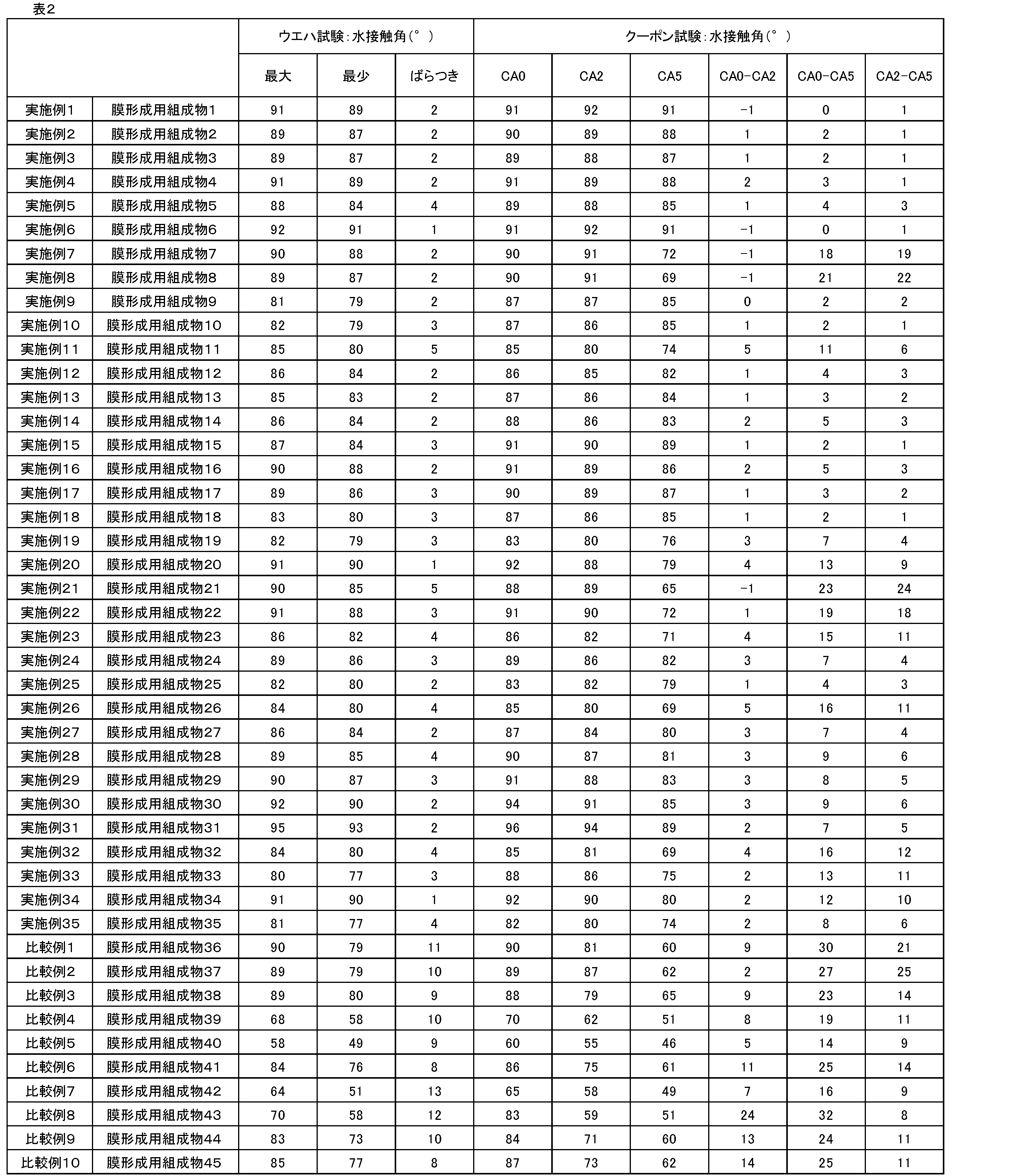
また、実施例1~6、9、10、15~18ではいずれもCA5が85°以上、かつCA2-CA5が4°以下であり、添加するIPAがある程度増加しても、IPA無添加の初期の水接触角を維持し、添加の限界量を超えるまで水接触角の低下が抑制されていた。このような挙動の理由の詳細は不明だが、膜形成用組成物内に高反応性の副生成物(例えば、触媒性化合物がTMSTFA、TMSTFSA、DMSTFAの場合はTMS-NH2等)が生成され、IPAによるシリル化剤や触媒性化合物の分解が進みにくくなる為だと推定される。また、特に上記実施例1~6、15~17では、触媒性化合物のTMSTFAがIPAで分解したとしても、分解されたTMSTFAが副生物と反応してTMSTFAに戻り得ることも、一因と考えられる。
このような結果から、各実施例の膜形成用組成物は、選択性保護膜を形成するためにも好適に用いることが可能であることが示唆された。
12 主面
20 凹凸構造
22 凸部
24 凹部
30 プロトン性液体
60 膜形成用組成物
70 撥水性膜
Claims (13)
- 表面がプロトン性液体に覆われた状態の基板に供給して、その表面の少なくとも一部に撥水性膜を形成するために用いる膜形成用組成物であって、
前記基板の表面をシリル化する、シリル化剤と、
前記シリル化剤によるシリル化反応を促進する触媒性化合物と、
非プロトン性溶媒と、を含み、
前記触媒性化合物の含有量が、当該膜形成用組成物100質量%中、1.0質量%以上である、
膜形成用組成物。 - 請求項1に記載の膜形成用組成物であって、
下記のクーポン試験により測定される、2-プロパノールを2質量%添加時の水接触角CA2が、80°以上である、膜形成用組成物。
(クーポン試験の手順)
表面に凹凸パターンがなく、表面に厚さ1μmのシリコン酸化膜を有するシリコンウェハを切断して、長さ、幅、厚みの寸法が4cm、1cm、0.75mmとなるシリコン基板からなるクーポンを準備する。
前記クーポンを、室温で1質量%のフッ化水素酸に浸漬し、次いで、室温で水に4回繰り返し浸漬し、次いで、室温で2-プロパノールに2回繰り返し浸漬し、室温でプロピレングリコールモノメチルエーテルアセテートに2回繰り返し浸漬して洗浄する。
当該膜形成用組成物と、当該膜形成用組成物100質量%に対して質量換算で2質量%、または5質量%の2-プロパノールと、を混合して得られる評価溶液を準備し、洗浄したクーポンを、室温で評価溶液に浸漬する。
前記評価溶液から取り出したクーポンを、室温で2-プロパノールに3回繰り返し浸漬して洗浄した後、窒素ガスによりクーポンの表面を乾燥させる。
乾燥したクーポンを水平面に置いた状態で、シリコン酸化膜が形成されたクーポンの表面に、室温下、2μlの純水を置き、JIS R 3257:1999に準拠して、水接触角(°)を測定する。
2-プロパノールを2質量%、または5質量%添加したときの評価溶液の水接触角を、それぞれ、CA2、CA5とする。 - 請求項2に記載の膜形成用組成物であって、
上記のクーポン試験により測定される、2-プロパノールを5質量%添加時の水接触角CA5が、80°以上である、膜形成用組成物。 - 請求項1~3のいずれか一項に記載の膜形成用組成物であって、
当該膜形成用組成物100質量%中における、質量換算での前記シリル化剤の含有量をXとし、前記触媒性化合物の含有量をYとしたとき、X,Yが、1.0<X/Y≦20である、膜形成用組成物。 - 請求項1~4のいずれか一項に記載の膜形成用組成物であって、
前記触媒性化合物の含有量が、当該膜形成用組成物100質量%中、30質量%以下である、膜形成用組成物。 - 請求項1~5のいずれか一項に記載の膜形成用組成物であって、
前記シリル化剤は、下記の一般式[1]で表されるケイ素化合物を含む、膜形成用組成物。
R1 aSi(H)bX4-a-b [1]
(上記一般式[1]中、R1は、それぞれ互いに独立して、一部又はすべての水素原子がフッ素原子に置き換えられていても良い炭素数が1~18の炭化水素基を含む有機基であり、Xは、それぞれ互いに独立して、Si原子に結合する原子が窒素、酸素、炭素、又はハロゲンである1価の有機基であり、aは1~3の整数、bは0~2の整数であり、aとbの合計は1~3である。) - 請求項1~6のいずれか一項に記載の膜形成用組成物であって、
前記触媒性化合物は、トリメチルシリルトリフルオロアセテート、トリメチルシリルトリフルオロメタンスルホネート、ジメチルシリルトリフルオロアセテート、ジメチルシリルトリフルオロメタンスルホネート、ブチルジメチルシリルトリフルオロアセテート、ブチルジメチルシリルトリフルオロメタンスルホネート、ヘキシルジメチルシリルトリフルオロアセテート、ヘキシルジメチルシリルトリフルオロメタンスルホネート、オクチルジメチルシリルトリフルオロアセテート、オクチルジメチルシリルトリフルオロメタンスルホネート、デシルジメチルシリルトリフルオロアセテート、及びデシルジメチルシリルトリフルオロメタンスルホネートからなる群から選ばれる一または二以上を含む、膜形成用組成物。 - 請求項1~6のいずれか一項に記載の膜形成用組成物であって、
前記触媒性化合物は、トリメチルシリルトリフルオロアセテート、ジメチルシリルトリフルオロアセテート、ブチルジメチルシリルトリフルオロアセテート、ヘキシルジメチルシリルトリフルオロアセテート、オクチルジメチルシリルトリフルオロアセテート、及びデシルジメチルシリルトリフルオロアセテートからなる群から選ばれる一または二以上を含む、膜形成用組成物。 - 請求項1~6のいずれか一項に記載の膜形成用組成物であって、
前記触媒性化合物は、トリメチルシリルトリフルオロメタンスルホネート、ジメチルシリルトリフルオロメタンスルホネート、ブチルジメチルシリルトリフルオロメタンスルホネート、ヘキシルジメチルシリルトリフルオロメタンスルホネート、オクチルジメチルシリルトリフルオロメタンスルホネート、及びデシルジメチルシリルトリフルオロメタンスルホネートからなる群から選ばれる一または二以上を含む、膜形成用組成物。 - 請求項1~6のいずれか一項に記載の膜形成用組成物であって、
前記触媒性化合物は、グアニジン骨格を有する化合物、ケイ素原子を含まない含窒素複素環化合物、及びシリル化複素環化合物からなる群から選ばれる一または二以上を含む、膜形成用組成物。 - 請求項1~10のいずれか一項に記載の膜形成用組成物であって、
当該膜形成用組成物100質量%中に含まれる前記シリル化剤と前記触媒性化合物との合計含有量が、8質量%以上である、膜形成用組成物。 - 表面に凹凸パターンを有する基板を準備する工程と、
前記基板の前記表面にプロトン性液体を供給する工程と、
前記プロトン性液体を保持した前記表面に膜形成用組成物を供給し、前記表面の少なくとも一部に撥水性膜を形成する工程と、を含む、基板の製造方法であって、
前記膜形成用組成物が、
前記基板の表面をシリル化する、シリル化剤と、
前記シリル化剤によるシリル化反応を促進する触媒性化合物と、
非プロトン性溶媒と、を含み、
前記触媒性化合物の含有量が、当該膜形成用組成物100質量%中、1.0質量%以上である、
基板の製造方法。 - 請求項12に記載の基板の製造方法であって、
前記撥水性膜を形成する工程は、前記基板上に保持された前記プロトン性液体と、前記基板に供給された前記膜形成用組成物とを混合した混合液体を形成する工程を有する、基板の製造方法。
Priority Applications (5)
| Application Number | Priority Date | Filing Date | Title |
|---|---|---|---|
| JP2023571095A JPWO2023127942A1 (ja) | 2021-12-28 | 2022-12-28 | |
| US18/724,487 US20250066621A1 (en) | 2021-12-28 | 2022-12-28 | Composition for film formation and method for manufacturing substrate |
| CN202280086237.9A CN118451534A (zh) | 2021-12-28 | 2022-12-28 | 膜形成用组合物和基板的制造方法 |
| KR1020247021004A KR20240131340A (ko) | 2021-12-28 | 2022-12-28 | 막 형성용 조성물, 및 기판의 제조 방법 |
| EP22916164.1A EP4459666A4 (en) | 2021-12-28 | 2022-12-28 | FILM FORMING COMPOSITION AND SUBSTRATE PRODUCTION METHOD |
Applications Claiming Priority (2)
| Application Number | Priority Date | Filing Date | Title |
|---|---|---|---|
| JP2021213908 | 2021-12-28 | ||
| JP2021-213908 | 2021-12-28 |
Publications (1)
| Publication Number | Publication Date |
|---|---|
| WO2023127942A1 true WO2023127942A1 (ja) | 2023-07-06 |
Family
ID=86999214
Family Applications (1)
| Application Number | Title | Priority Date | Filing Date |
|---|---|---|---|
| PCT/JP2022/048486 Ceased WO2023127942A1 (ja) | 2021-12-28 | 2022-12-28 | 膜形成用組成物、および基板の製造方法 |
Country Status (7)
| Country | Link |
|---|---|
| US (1) | US20250066621A1 (ja) |
| EP (1) | EP4459666A4 (ja) |
| JP (1) | JPWO2023127942A1 (ja) |
| KR (1) | KR20240131340A (ja) |
| CN (1) | CN118451534A (ja) |
| TW (1) | TW202330895A (ja) |
| WO (1) | WO2023127942A1 (ja) |
Cited By (2)
| Publication number | Priority date | Publication date | Assignee | Title |
|---|---|---|---|---|
| WO2024143097A1 (ja) * | 2022-12-28 | 2024-07-04 | セントラル硝子株式会社 | 基材の処理方法および基材の製造方法 |
| WO2025158917A1 (ja) * | 2024-01-26 | 2025-07-31 | セントラル硝子株式会社 | 撥水性膜形成用薬液、薬液入り容器、保管方法、および撥水性膜形成用薬液の製造方法 |
Citations (5)
| Publication number | Priority date | Publication date | Assignee | Title |
|---|---|---|---|---|
| JP2017063179A (ja) | 2015-09-24 | 2017-03-30 | 東京応化工業株式会社 | 表面処理剤及び表面処理方法 |
| WO2019138870A1 (ja) * | 2018-01-15 | 2019-07-18 | セントラル硝子株式会社 | 撥水性保護膜形成用薬液、及びウェハの表面処理方法 |
| WO2019159748A1 (ja) * | 2018-02-13 | 2019-08-22 | セントラル硝子株式会社 | 撥水性保護膜形成用薬液、その調製方法、及び表面処理体の製造方法 |
| JP2020038333A (ja) * | 2017-12-22 | 2020-03-12 | セントラル硝子株式会社 | 表面処理剤及び表面処理体の製造方法 |
| JP2021027304A (ja) * | 2019-08-09 | 2021-02-22 | セントラル硝子株式会社 | 撥水性保護膜形成用薬液及びウェハの表面処理方法 |
Family Cites Families (1)
| Publication number | Priority date | Publication date | Assignee | Title |
|---|---|---|---|---|
| WO2019124264A1 (ja) * | 2017-12-22 | 2019-06-27 | セントラル硝子株式会社 | 表面処理剤及び表面処理体の製造方法 |
-
2022
- 2022-12-28 JP JP2023571095A patent/JPWO2023127942A1/ja active Pending
- 2022-12-28 WO PCT/JP2022/048486 patent/WO2023127942A1/ja not_active Ceased
- 2022-12-28 EP EP22916164.1A patent/EP4459666A4/en active Pending
- 2022-12-28 US US18/724,487 patent/US20250066621A1/en active Pending
- 2022-12-28 KR KR1020247021004A patent/KR20240131340A/ko active Pending
- 2022-12-28 TW TW111150325A patent/TW202330895A/zh unknown
- 2022-12-28 CN CN202280086237.9A patent/CN118451534A/zh active Pending
Patent Citations (5)
| Publication number | Priority date | Publication date | Assignee | Title |
|---|---|---|---|---|
| JP2017063179A (ja) | 2015-09-24 | 2017-03-30 | 東京応化工業株式会社 | 表面処理剤及び表面処理方法 |
| JP2020038333A (ja) * | 2017-12-22 | 2020-03-12 | セントラル硝子株式会社 | 表面処理剤及び表面処理体の製造方法 |
| WO2019138870A1 (ja) * | 2018-01-15 | 2019-07-18 | セントラル硝子株式会社 | 撥水性保護膜形成用薬液、及びウェハの表面処理方法 |
| WO2019159748A1 (ja) * | 2018-02-13 | 2019-08-22 | セントラル硝子株式会社 | 撥水性保護膜形成用薬液、その調製方法、及び表面処理体の製造方法 |
| JP2021027304A (ja) * | 2019-08-09 | 2021-02-22 | セントラル硝子株式会社 | 撥水性保護膜形成用薬液及びウェハの表面処理方法 |
Non-Patent Citations (1)
| Title |
|---|
| See also references of EP4459666A4 |
Cited By (2)
| Publication number | Priority date | Publication date | Assignee | Title |
|---|---|---|---|---|
| WO2024143097A1 (ja) * | 2022-12-28 | 2024-07-04 | セントラル硝子株式会社 | 基材の処理方法および基材の製造方法 |
| WO2025158917A1 (ja) * | 2024-01-26 | 2025-07-31 | セントラル硝子株式会社 | 撥水性膜形成用薬液、薬液入り容器、保管方法、および撥水性膜形成用薬液の製造方法 |
Also Published As
| Publication number | Publication date |
|---|---|
| KR20240131340A (ko) | 2024-08-30 |
| EP4459666A1 (en) | 2024-11-06 |
| EP4459666A4 (en) | 2025-12-24 |
| US20250066621A1 (en) | 2025-02-27 |
| TW202330895A (zh) | 2023-08-01 |
| CN118451534A (zh) | 2024-08-06 |
| JPWO2023127942A1 (ja) | 2023-07-06 |
Similar Documents
| Publication | Publication Date | Title |
|---|---|---|
| EP4535406A1 (en) | Substrate processing method, and substrate manufacturing method | |
| WO2023127942A1 (ja) | 膜形成用組成物、および基板の製造方法 | |
| JP7727202B2 (ja) | 半導体基板の表面処理方法、及び表面処理剤組成物 | |
| EP4535405A1 (en) | Substrate processing method and substrate production method | |
| JP7727203B2 (ja) | 半導体基板の表面処理方法、及び表面処理剤組成物 | |
| US11817310B2 (en) | Bevel portion treatment agent composition and method of manufacturing wafer | |
| CN121153104A (zh) | 膜形成用组合物、基板的制造方法及膜形成用组合物的制造方法 | |
| WO2026063320A1 (ja) | ウェハの製造方法、加熱蒸散用の表面処理組成物、表面処理組成物の使用方法、蒸気組成物および蒸気組成物の製造方法 | |
| KR20250132506A (ko) | 기재의 처리 방법 및 기재의 제조 방법 | |
| TWI918655B (zh) | 半導體基板的表面處理方法 | |
| TWI918656B (zh) | 半導體基板的表面處理方法 | |
| WO2026014135A1 (ja) | 半導体装置の製造方法、基材、およびシリル化組成物 | |
| WO2025182440A1 (ja) | 基材の製造方法、および含Ge酸化物用エッチング液 |
Legal Events
| Date | Code | Title | Description |
|---|---|---|---|
| 121 | Ep: the epo has been informed by wipo that ep was designated in this application |
Ref document number: 22916164 Country of ref document: EP Kind code of ref document: A1 |
|
| WWE | Wipo information: entry into national phase |
Ref document number: 2023571095 Country of ref document: JP |
|
| WWE | Wipo information: entry into national phase |
Ref document number: 18724487 Country of ref document: US Ref document number: 202280086237.9 Country of ref document: CN |
|
| NENP | Non-entry into the national phase |
Ref country code: DE |
|
| WWE | Wipo information: entry into national phase |
Ref document number: 11202404469Y Country of ref document: SG |
|
| ENP | Entry into the national phase |
Ref document number: 2022916164 Country of ref document: EP Effective date: 20240729 |
|
| WWP | Wipo information: published in national office |
Ref document number: 18724487 Country of ref document: US |