WO2023132307A1 - 複合材およびその製造方法 - Google Patents
複合材およびその製造方法 Download PDFInfo
- Publication number
- WO2023132307A1 WO2023132307A1 PCT/JP2022/048289 JP2022048289W WO2023132307A1 WO 2023132307 A1 WO2023132307 A1 WO 2023132307A1 JP 2022048289 W JP2022048289 W JP 2022048289W WO 2023132307 A1 WO2023132307 A1 WO 2023132307A1
- Authority
- WO
- WIPO (PCT)
- Prior art keywords
- fabric
- thermoplastic elastomer
- elastomer resin
- composite material
- composite
- Prior art date
- Legal status (The legal status is an assumption and is not a legal conclusion. Google has not performed a legal analysis and makes no representation as to the accuracy of the status listed.)
- Ceased
Links
Images







Classifications
-
- B—PERFORMING OPERATIONS; TRANSPORTING
- B29—WORKING OF PLASTICS; WORKING OF SUBSTANCES IN A PLASTIC STATE IN GENERAL
- B29C—SHAPING OR JOINING OF PLASTICS; SHAPING OF MATERIAL IN A PLASTIC STATE, NOT OTHERWISE PROVIDED FOR; AFTER-TREATMENT OF THE SHAPED PRODUCTS, e.g. REPAIRING
- B29C70/00—Shaping composites, i.e. plastics material comprising reinforcements, fillers or preformed parts, e.g. inserts
- B29C70/04—Shaping composites, i.e. plastics material comprising reinforcements, fillers or preformed parts, e.g. inserts comprising reinforcements only, e.g. self-reinforcing plastics
- B29C70/06—Fibrous reinforcements only
- B29C70/10—Fibrous reinforcements only characterised by the structure of fibrous reinforcements, e.g. hollow fibres
- B29C70/16—Fibrous reinforcements only characterised by the structure of fibrous reinforcements, e.g. hollow fibres using fibres of substantial or continuous length
- B29C70/22—Fibrous reinforcements only characterised by the structure of fibrous reinforcements, e.g. hollow fibres using fibres of substantial or continuous length oriented in at least two directions forming a two-dimensional [2D] structure
-
- B—PERFORMING OPERATIONS; TRANSPORTING
- B29—WORKING OF PLASTICS; WORKING OF SUBSTANCES IN A PLASTIC STATE IN GENERAL
- B29B—PREPARATION OR PRETREATMENT OF THE MATERIAL TO BE SHAPED; MAKING GRANULES OR PREFORMS; RECOVERY OF PLASTICS OR OTHER CONSTITUENTS OF WASTE MATERIAL CONTAINING PLASTICS
- B29B11/00—Making preforms
- B29B11/14—Making preforms characterised by structure or composition
- B29B11/16—Making preforms characterised by structure or composition comprising fillers or reinforcement
-
- D—TEXTILES; PAPER
- D03—WEAVING
- D03D—WOVEN FABRICS; METHODS OF WEAVING; LOOMS
- D03D1/00—Woven fabrics designed to make specified articles
-
- B—PERFORMING OPERATIONS; TRANSPORTING
- B29—WORKING OF PLASTICS; WORKING OF SUBSTANCES IN A PLASTIC STATE IN GENERAL
- B29B—PREPARATION OR PRETREATMENT OF THE MATERIAL TO BE SHAPED; MAKING GRANULES OR PREFORMS; RECOVERY OF PLASTICS OR OTHER CONSTITUENTS OF WASTE MATERIAL CONTAINING PLASTICS
- B29B15/00—Pretreatment of the material to be shaped, not covered by groups B29B7/00 - B29B13/00
- B29B15/08—Pretreatment of the material to be shaped, not covered by groups B29B7/00 - B29B13/00 of reinforcements or fillers
- B29B15/10—Coating or impregnating independently of the moulding or shaping step
-
- D—TEXTILES; PAPER
- D03—WEAVING
- D03D—WOVEN FABRICS; METHODS OF WEAVING; LOOMS
- D03D13/00—Woven fabrics characterised by the special disposition of the warp or weft threads, e.g. with curved weft threads, with discontinuous warp threads, with diagonal warp or weft
- D03D13/008—Woven fabrics characterised by the special disposition of the warp or weft threads, e.g. with curved weft threads, with discontinuous warp threads, with diagonal warp or weft characterised by weave density or surface weight
-
- D—TEXTILES; PAPER
- D03—WEAVING
- D03D—WOVEN FABRICS; METHODS OF WEAVING; LOOMS
- D03D15/00—Woven fabrics characterised by the material, structure or properties of the fibres, filaments, yarns, threads or other warp or weft elements used
- D03D15/20—Woven fabrics characterised by the material, structure or properties of the fibres, filaments, yarns, threads or other warp or weft elements used characterised by the material of the fibres or filaments constituting the yarns or threads
- D03D15/283—Woven fabrics characterised by the material, structure or properties of the fibres, filaments, yarns, threads or other warp or weft elements used characterised by the material of the fibres or filaments constituting the yarns or threads synthetic polymer-based, e.g. polyamide or polyester fibres
-
- D—TEXTILES; PAPER
- D03—WEAVING
- D03D—WOVEN FABRICS; METHODS OF WEAVING; LOOMS
- D03D15/00—Woven fabrics characterised by the material, structure or properties of the fibres, filaments, yarns, threads or other warp or weft elements used
- D03D15/20—Woven fabrics characterised by the material, structure or properties of the fibres, filaments, yarns, threads or other warp or weft elements used characterised by the material of the fibres or filaments constituting the yarns or threads
- D03D15/292—Conjugate, i.e. bi- or multicomponent, fibres or filaments
-
- D—TEXTILES; PAPER
- D03—WEAVING
- D03D—WOVEN FABRICS; METHODS OF WEAVING; LOOMS
- D03D15/00—Woven fabrics characterised by the material, structure or properties of the fibres, filaments, yarns, threads or other warp or weft elements used
- D03D15/50—Woven fabrics characterised by the material, structure or properties of the fibres, filaments, yarns, threads or other warp or weft elements used characterised by the properties of the yarns or threads
- D03D15/56—Woven fabrics characterised by the material, structure or properties of the fibres, filaments, yarns, threads or other warp or weft elements used characterised by the properties of the yarns or threads elastic
-
- B—PERFORMING OPERATIONS; TRANSPORTING
- B29—WORKING OF PLASTICS; WORKING OF SUBSTANCES IN A PLASTIC STATE IN GENERAL
- B29K—INDEXING SCHEME ASSOCIATED WITH SUBCLASSES B29B, B29C OR B29D, RELATING TO MOULDING MATERIALS OR TO MATERIALS FOR MOULDS, REINFORCEMENTS, FILLERS OR PREFORMED PARTS, e.g. INSERTS
- B29K2021/00—Use of unspecified rubbers as moulding material
- B29K2021/003—Thermoplastic elastomers
-
- B—PERFORMING OPERATIONS; TRANSPORTING
- B29—WORKING OF PLASTICS; WORKING OF SUBSTANCES IN A PLASTIC STATE IN GENERAL
- B29K—INDEXING SCHEME ASSOCIATED WITH SUBCLASSES B29B, B29C OR B29D, RELATING TO MOULDING MATERIALS OR TO MATERIALS FOR MOULDS, REINFORCEMENTS, FILLERS OR PREFORMED PARTS, e.g. INSERTS
- B29K2105/00—Condition, form or state of moulded material or of the material to be shaped
- B29K2105/06—Condition, form or state of moulded material or of the material to be shaped containing reinforcements, fillers or inserts
- B29K2105/08—Condition, form or state of moulded material or of the material to be shaped containing reinforcements, fillers or inserts of continuous length, e.g. cords, rovings, mats, fabrics, strands or yarns
- B29K2105/0809—Fabrics
- B29K2105/0845—Woven fabrics
-
- B—PERFORMING OPERATIONS; TRANSPORTING
- B29—WORKING OF PLASTICS; WORKING OF SUBSTANCES IN A PLASTIC STATE IN GENERAL
- B29K—INDEXING SCHEME ASSOCIATED WITH SUBCLASSES B29B, B29C OR B29D, RELATING TO MOULDING MATERIALS OR TO MATERIALS FOR MOULDS, REINFORCEMENTS, FILLERS OR PREFORMED PARTS, e.g. INSERTS
- B29K2267/00—Use of polyesters or derivatives thereof as reinforcement
-
- B—PERFORMING OPERATIONS; TRANSPORTING
- B29—WORKING OF PLASTICS; WORKING OF SUBSTANCES IN A PLASTIC STATE IN GENERAL
- B29K—INDEXING SCHEME ASSOCIATED WITH SUBCLASSES B29B, B29C OR B29D, RELATING TO MOULDING MATERIALS OR TO MATERIALS FOR MOULDS, REINFORCEMENTS, FILLERS OR PREFORMED PARTS, e.g. INSERTS
- B29K2995/00—Properties of moulding materials, reinforcements, fillers, preformed parts or moulds
- B29K2995/0037—Other properties
- B29K2995/0077—Yield strength; Tensile strength
-
- B—PERFORMING OPERATIONS; TRANSPORTING
- B29—WORKING OF PLASTICS; WORKING OF SUBSTANCES IN A PLASTIC STATE IN GENERAL
- B29K—INDEXING SCHEME ASSOCIATED WITH SUBCLASSES B29B, B29C OR B29D, RELATING TO MOULDING MATERIALS OR TO MATERIALS FOR MOULDS, REINFORCEMENTS, FILLERS OR PREFORMED PARTS, e.g. INSERTS
- B29K2995/00—Properties of moulding materials, reinforcements, fillers, preformed parts or moulds
- B29K2995/0037—Other properties
- B29K2995/0094—Geometrical properties
- B29K2995/0097—Thickness
-
- D—TEXTILES; PAPER
- D10—INDEXING SCHEME ASSOCIATED WITH SUBLASSES OF SECTION D, RELATING TO TEXTILES
- D10B—INDEXING SCHEME ASSOCIATED WITH SUBLASSES OF SECTION D, RELATING TO TEXTILES
- D10B2331/00—Fibres made from polymers obtained otherwise than by reactions only involving carbon-to-carbon unsaturated bonds, e.g. polycondensation products
- D10B2331/02—Fibres made from polymers obtained otherwise than by reactions only involving carbon-to-carbon unsaturated bonds, e.g. polycondensation products polyamides
- D10B2331/021—Fibres made from polymers obtained otherwise than by reactions only involving carbon-to-carbon unsaturated bonds, e.g. polycondensation products polyamides aromatic polyamides, e.g. aramides
-
- D—TEXTILES; PAPER
- D10—INDEXING SCHEME ASSOCIATED WITH SUBLASSES OF SECTION D, RELATING TO TEXTILES
- D10B—INDEXING SCHEME ASSOCIATED WITH SUBLASSES OF SECTION D, RELATING TO TEXTILES
- D10B2331/00—Fibres made from polymers obtained otherwise than by reactions only involving carbon-to-carbon unsaturated bonds, e.g. polycondensation products
- D10B2331/04—Fibres made from polymers obtained otherwise than by reactions only involving carbon-to-carbon unsaturated bonds, e.g. polycondensation products polyesters, e.g. polyethylene terephthalate [PET]
-
- D—TEXTILES; PAPER
- D10—INDEXING SCHEME ASSOCIATED WITH SUBLASSES OF SECTION D, RELATING TO TEXTILES
- D10B—INDEXING SCHEME ASSOCIATED WITH SUBLASSES OF SECTION D, RELATING TO TEXTILES
- D10B2401/00—Physical properties
- D10B2401/04—Heat-responsive characteristics
- D10B2401/041—Heat-responsive characteristics thermoplastic; thermosetting
-
- D—TEXTILES; PAPER
- D10—INDEXING SCHEME ASSOCIATED WITH SUBLASSES OF SECTION D, RELATING TO TEXTILES
- D10B—INDEXING SCHEME ASSOCIATED WITH SUBLASSES OF SECTION D, RELATING TO TEXTILES
- D10B2401/00—Physical properties
- D10B2401/06—Load-responsive characteristics
- D10B2401/061—Load-responsive characteristics elastic
-
- D—TEXTILES; PAPER
- D10—INDEXING SCHEME ASSOCIATED WITH SUBLASSES OF SECTION D, RELATING TO TEXTILES
- D10B—INDEXING SCHEME ASSOCIATED WITH SUBLASSES OF SECTION D, RELATING TO TEXTILES
- D10B2505/00—Industrial
- D10B2505/02—Reinforcing materials; Prepregs
Definitions
- the present invention relates to a composite material containing at least a woven fabric of high modulus fibers and a thermoplastic elastomer resin.
- Patent Document 1 International Publication No. 2020/085246 describes a composite sheet that is lightweight and high in strength, yet has excellent flexibility and high bending resistance.
- a composite sheet coated on both sides with a coating material containing a thermoplastic resin the tensile strength of the composite sheet in the warp direction of the fabric is 300 N / cm or more, and the thermoplasticity with respect to the mass of the fabric Composite sheets are disclosed in which the weight percentage of resin is between 5 and 25% by weight.
- Patent Document 2 Japanese Patent Laid-Open No. 2017-205917 discloses a knitted and woven sheet having a texture and a thermoplastic elastomer layer covering the front and back of the knitted and woven sheet.
- the textile sheet is made of polymer yarn having a melting point or softening point of 200° C. or higher and a tensile strength of 3.8 to 20.3 cN/dtex.
- Patent Document 1 only discloses that a liquid coating material is impregnated or applied to a fabric made of liquid crystalline polyester fibers, and the coating material thinly coats the fiber surface of the fabric. I just exist. In such a case, the coating material cannot exert a sufficient anchoring effect on the fabric. Furthermore, Patent Document 1 discloses coating a fabric with a resin, and bonding a composite sheet to another member via a hot-melt adhesive by utilizing the adhesiveness between the coating agent and the hot-melt adhesive. However, it does not disclose directly adhering the composite sheet to another member.
- the woven and knitted sheets are integrated by sandwiching the thermoplastic elastomer layers between the metal rolls.
- the elastomer layer cannot pass through the openings from one side of the fabric to the other.
- the anchoring effect caused by penetration of the thermoplastic elastomer cannot be expected.
- an object of the present invention is to provide a composite material that can improve the integrity between the fabric of high elastic modulus fibers and the thermoplastic elastomer resin (and other members that are arranged as necessary).
- openings in the fabric are formed by forming a fabric with high elastic modulus fibers and combining the fabric with a thermoplastic elastomer resin sheet. Focusing on the effect on the thermoplastic elastomer resin, for example, (i) when the high modulus fiber is a multifilament, the thermoplastic elastomer resin extruded toward the opening of the fabric passes through the opening and is exposed on the other side. and (ii) when the high modulus fiber is a monofilament, the weave density and open area ratio of the woven fabric.
- thermoplastic elastomer resin extruded toward the opening of the fabric passes through the opening and is exposed on the other side, the monofilament in the fabric is efficiently entangled and the thermoplastic elastomer resin exerts an anchoring action.
- the anchor effect of the resin can be exhibited, the high elastic modulus fiber fabric and the thermoplastic elastomer resin (and other members disposed as necessary) The inventors have found that the integration can be improved, and completed the present invention.
- a composite material comprising at least a woven fabric containing multifilaments having a tensile modulus of 20 GPa or more (preferably 30 GPa or more) as weaving yarn, and a thermoplastic elastomer resin,
- the thermoplastic elastomer resin penetrates from one surface of the fabric through openings in the fabric and is exposed to the other surface,
- the exposed area ratio of the thermoplastic elastomer resin is 10% or more (preferably 15 to 100%, more preferably 18 to 99%, still more preferably 25 to 95%, still more preferably 25 to 85%), the composite.
- the fabric has a weave density of 110/inch or more (preferably 130/inch or more) and an open area rate of 70% or less (for example, 20 to 70%, preferably 30% to 68%, more preferably 40% to 65%). %) and A composite material in which the thermoplastic elastomer resin penetrates from one surface of the fabric through openings in the fabric and is exposed to the other surface.
- [Aspect 12] a step of laminating a woven fabric containing fibers having a tensile modulus of 20 GPa or more as weaving yarns and having openings, a thermoplastic elastomer resin sheet, and, if necessary, another member in this order; a step of softening the thermoplastic elastomer resin sheet under heating and extruding the resin of the thermoplastic elastomer resin sheet into the openings of the fabric from one side of the fabric;
- the thermoplastic elastomer resin sheet has a thickness (/sheet) of 10 to 200 ⁇ m (preferably 20 to 190 ⁇ m, more preferably 30 to 180 ⁇ m).
- the "exposed area ratio" in the present invention is the ratio of the thermoplastic elastomer resin penetrating from the opening on one side of the fabric and exposed on the other side to the predetermined area of the fabric.
- high elastic modulus fibers are used for the yarn of the fabric, and a thermoplastic elastomer resin sheet is extruded from one side of the fabric, the resin is penetrated through the openings of the fabric, and the other side of the fabric is covered with a thermoplastic elastomer resin sheet. Since the anchor effect of the resin can be exerted by exposing, the integration between the woven fabric and the thermoplastic elastomer resin (and other members arranged as necessary) can be improved.
- FIG. 1 is a schematic plan view for explaining a woven fabric used for a composite material according to one embodiment of the present invention
- FIG. 1B is a schematic bottom view of a composite using the fabric of FIG. 1A
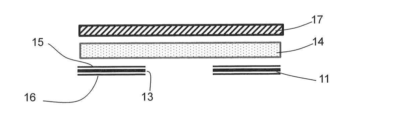
- FIG. 4 is a schematic exploded cross-sectional view for explaining a step of penetrating a thermoplastic elastomer resin through a woven fabric in manufacturing a composite material according to an embodiment of the present invention.
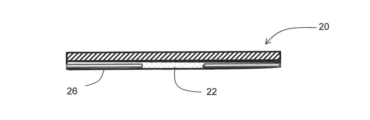
- FIG. 1 is a schematic cross-sectional view for explaining a state in which a thermoplastic elastomer resin has penetrated through openings in a fabric in a composite material according to an embodiment of the present invention
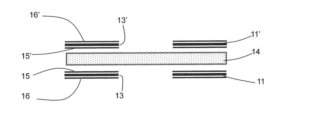
- FIG. FIG. 4 is a schematic exploded cross-sectional view for explaining a step of penetrating the thermoplastic elastomer resin into the woven fabric in manufacturing the composite material according to another embodiment of the present invention.
- FIG. 10 is a schematic cross-sectional view for explaining a state in which a thermoplastic elastomer resin penetrates openings in a fabric in a composite material according to another embodiment of the present invention
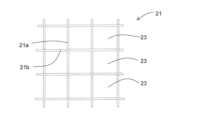
- FIG. 4 is a schematic plan view for explaining a woven fabric used for a composite material according to another embodiment of the invention;
- FIG. 4 is a schematic exploded cross-sectional view for explaining a step of penetrating the thermoplastic elastomer resin into the woven fabric in manufacturing the composite material according to another embodiment of the present invention.
- FIG. 10 is a schematic cross-sectional view for explaining a state in which a thermoplastic elastomer resin penetrates openings in a fabric in a composite material according to another embodiment of the present invention;
- FIG. 4 is a schematic exploded cross-sectional view for explaining a step of penetrating the thermoplastic elastomer resin into the woven fabric in manufacturing the composite material according to another embodiment of the present invention.
- FIG. 10 is a schematic cross-sectional view for explaining a state in which a thermoplastic elastomer resin penetrates openings in a fabric in a composite material according to another embodiment of the present invention.
- FIG. 4 is a schematic exploded cross-sectional view for explaining a step of penetrating the thermoplastic elastomer resin into the woven fabric in manufacturing
- FIG. 10 is a schematic cross-sectional view for explaining a state in which a thermoplastic elastomer resin penetrates openings in a fabric in a composite material according to another embodiment of the present invention
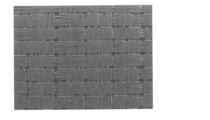
- 4 is a photograph showing a binarized state of the exposed area of the composite material in Example 1 of the present invention.
- 4 is a photograph showing a binarized state of the exposed area of the composite material in Comparative Example 1 of the present invention.
- a composite material according to an embodiment of the present invention is a composite material including at least a woven fabric containing fibers having a tensile modulus of 20 GPa or more as weaving yarn, and a thermoplastic elastomer resin, wherein the thermoplastic elastomer resin is the The composite material penetrates from one surface of the woven fabric through an opening in the woven fabric, and the resin spreads from the opening to the surrounding area and is exposed to the other surface.
- FIG. 1A is a schematic plan view of a fabric 11 used in a composite 10 according to one embodiment of the invention
- FIG. 1B is a schematic bottom view of the composite 10 using the fabric 11 of FIG. 1A
- FIG. 2A is a schematic exploded cross-sectional view for explaining the step of penetrating the thermoplastic elastomer resin 12 through the openings 13 of the fabric 11 in manufacturing the composite material 10
- FIG. 4 is a schematic cross-sectional view for explaining a state in which thermoplastic elastomer resin 12 penetrates through openings 13 of fabric 11 and is exposed on the other side.
- FIG. 1A shows a fabric 11 containing multifilaments with a tensile modulus of 20 GPa or more as weaving yarns (warp yarns 11a and weft yarns 11b).
- the fabric 11 has openings 13 for the thermoplastic elastomer resin 12 to pass through.
- FIG. 1B shows the composite material 10 in which the thermoplastic elastomer resin 12 passes through the openings 13 from one surface (upper surface) of the fabric 11 and is exposed to the other surface (lower surface) of the fabric 11.
- Fig. 3 shows a view from the side;
- composite material 10 includes at least fabric 11 and thermoplastic elastomer resin 12, and part of thermoplastic elastomer resin 12 is exposed on the lower surface of fabric 11.
- FIG. 1B shows a fabric 11 containing multifilaments with a tensile modulus of 20 GPa or more as weaving yarns (warp yarns 11a and weft yarns 11b).
- the fabric 11 has openings 13 for the thermoplastic e
- the fabric 11, the thermoplastic elastomer resin sheet 14, and the other member 17 are arranged in this order. Then, the thermoplastic elastomer resin sheet 14 is extruded through the openings 13 of the fabric 1 from one side 15 of the fabric 11 toward the other side 16 with a predetermined pressure, thereby forming the openings 13 as shown in FIG. 2B.
- the thermoplastic elastomer resin 12 penetrates the fabric 11 through the opening, and the thermoplastic elastomer resin 12 is exposed on the other surface 16 of the fabric 11 .
- the composite material 10 may or may not include other members 17.
- another member 17 having releasability may be peeled off from the thermoplastic elastomer resin sheet 14 .
- the fabric 11 and the thermoplastic elastomer resin sheet 14 are simply arranged, and the thermoplastic elastomer resin sheet is applied from one side 15 of the fabric 11 to the other side 16 with a predetermined pressure. 14 may be extruded through apertures 13 of fabric 11 .
- a composite material as a reinforcing member in manufacturing the reinforcing member, it may be used in combination with another member 17, and on one side 15 of the fabric 11, a thermoplastic elastomer resin sheet 14, and another member 17 are arranged in this order, and the other member 17 and the thermoplastic elastomer resin sheet 14 are pushed toward the fabric 11 from one side 15 of the fabric 11 toward the other side 16 with a predetermined pressure. It may be thermocompression bonded.
- thermoplastic elastomer resin sheet 14 by extruding the thermoplastic elastomer resin sheet 14 through the openings 13 of the fabric 11 in contact with the other member 17 , the other member 17 and the thermoplastic elastomer resin 12 are in close contact with each other, and heat is applied through the openings 13 .
- a composite can be formed in which the thermoplastic elastomer resin 12 penetrates the fabric 11 and exposes the thermoplastic elastomer resin 12 on the other side 16 of the fabric 11 .
- thermoplastic elastomer resin sheet 14 a composite material obtained by extruding a thermoplastic elastomer resin sheet 14 from one side 15 of the fabric 11, penetrating it through the openings 13 of the fabric 11, and exposing it to the other side 16 of the fabric 11 with a predetermined exposed area ratio.
- the thermoplastic elastomer resin 12 existing on the surface 16 side of the fabric 11 works like an anchor, and the integration between the fabric 11 and the thermoplastic elastomer resin 12 can be improved.
- the separation resistance between the other member 17 and the thermoplastic elastomer resin 12 can be improved. It is considered that the separation resistance between the other member 17 and the thermoplastic elastomer resin 12 can be improved when peeling off from the member.
- the other member 17 can be appropriately selected according to the application of the composite material.
- the other member 17 may be a fabric containing multifilament or monofilament having a tensile modulus of 20 GPa or more as weaving yarn.
- FIGS. 3A and 3B show an example of manufacturing a composite material using a woven fabric 11 ′ containing multifilaments with a tensile modulus of 20 GPa or more as weaving yarns (warp yarns 11 a and weft yarns 11 b ) as other members 17 .
- a thermoplastic elastomer resin sheet 14 is arranged between fabric 11 and fabric 11'.
- the thermoplastic elastomer resin sheet 14 is extruded from the openings 13 of the fabric 11 with a predetermined pressure from one side 15 of the fabric 11 toward the other side 16, the thermoplastic elastomer resin sheet 14 is pushed through the openings of the fabric 11'.
- 13' is similarly extruded from one side 15' to the other side 16' of fabric 11'.
- thermoplastic elastomer resin 12 penetrates through the fabrics 11 and 11' through the openings 13 and 13' and the other surfaces 16 and 16 of the fabrics 11 and 11', respectively.
- a composite material is formed in which the thermoplastic elastomer resin 12 is exposed at '.
- fabrics containing high-modulus fibers are arranged in double layers, and the strength as a reinforcing member can be improved.
- the woven fabric 11 and the woven fabric 11' may be the same or different. Also, the weaving threads of the woven fabric 11 and the woven fabric 11' may be parallel or non-parallel to each other. For example, from the standpoint of improving isotropy, the mutual wefts and/or warps of fabric 11 and fabric 11' may have a crossing angle in the range of 30-60°. Also, the openings 13 and 13' of the woven fabrics 11 and 11' may be located at the same positions or different positions in the planar direction, as shown in FIG. 3B.
- thermoplastic elastomer resin 12 exposed to the outside from the woven fabric containing the high elastic modulus fiber, the adhesiveness is poor and the high Even fabrics containing modulus fibers can have improved adhesion to another member.
- FIG. 4 is a schematic enlarged plan view of a fabric 21 used in a composite material 20 according to another embodiment of the present invention.
- FIG. 5A is a schematic exploded cross-sectional view for explaining the step of penetrating the thermoplastic elastomer resin 22 through the fabric 21 in manufacturing the composite material 20, and
- FIG. 4 is a schematic cross-sectional view for explaining a state in which resin 22 penetrates through openings 23 of fabric 21 and is exposed on the other surface.
- FIG. 5A is a schematic exploded cross-sectional view for explaining the step of penetrating the thermoplastic elastomer resin 22 through the fabric 21 in manufacturing the composite material 20
- FIG. 4 is a schematic cross-sectional view for explaining a state in which resin 22 penetrates through openings 23 of fabric 21 and is exposed on the other surface.
- FIG. 4 shows a woven fabric 21 containing monofilaments having a tensile modulus of 20 GPa or more as weaving yarns (warp 21a, weft 21b).
- the thermoplastic elastomer resin sheet 24 and another member 27 are arranged in this order. Then, the thermoplastic elastomer resin sheet 24 is extruded through the openings 23 of the fabric 21 from one side 25 of the fabric 21 toward the other side 26 with a predetermined pressure. As a result, as shown in FIG. 5B, the thermoplastic elastomer resin 22 penetrates the fabric 21 through the openings 23, and the thermoplastic elastomer resin 22 is exposed on the other surface 26 of the fabric 21. As shown in FIG.
- the composite material 20 may or may not include other members 27.
- another member 27 having releasability may be peeled off from the thermoplastic elastomer resin sheet 24 .
- the fabric 21 and the thermoplastic elastomer resin sheet 24 are simply disposed, and the thermoplastic elastomer resin sheet is pressed from one side 25 of the fabric 21 toward the other side 26 with a predetermined pressure. 24 may be extruded through openings 23 of fabric 21 .
- a composite material as a reinforcing member in manufacturing the reinforcing member, it may be used in combination with another member 27, and one surface 25 of the fabric 21 is provided with a thermoplastic elastomer resin sheet 24, and another member 17 are arranged in this order, and the other member 27 and the thermoplastic elastomer resin sheet 24 are pushed toward the fabric 21 from one surface 25 of the fabric 21 toward the other surface 26 with a predetermined pressure. It may be thermocompression bonded.
- thermoplastic elastomer resin sheet 24 by extruding the thermoplastic elastomer resin sheet 24 through the openings 23 of the fabric 21 in contact with the other member 27 , the other member 27 and the thermoplastic elastomer resin 22 are in close contact with each other, and heat is generated through the openings 23 .
- a composite can be formed in which the thermoplastic elastomer resin 22 penetrates the fabric 21 and exposes the thermoplastic elastomer resin 22 on the other side 26 of the fabric 21 .
- thermoplastic elastomer resin 22 penetrating through the openings 23 of the fabric 21 entangles with the weaving threads 21 (21a, 21b), the thermoplastic elastomer resin 22 works like an anchor, and the thermoplastic elastomer resin 22 and the weaving threads 21 (21a , 21b) can be improved.
- the separation resistance between the other member 27 and the thermoplastic elastomer resin 22 can be improved. It is considered that the peeling resistance between the other member 27 and the thermoplastic elastomer resin 22 can be improved when peeling off from it.
- the woven fabric 21 has a specific weave density and open area ratio, the integration between the high elastic modulus monofilament and the thermoplastic elastomer resin constituting the woven fabric is enhanced, and the reinforcement and durability of the composite material can be improved. It is possible.
- the other member 27 can be appropriately selected according to the application of the composite material.
- the other member 27 may be a fabric containing monofilament or multifilament having a tensile modulus of 20 GPa or more as weaving yarn.
- FIGS. 6A and 6B show an example of manufacturing a composite material using, as another member 27, a fabric 21' containing monofilaments having a tensile modulus of 20 GPa or more as weaving yarns (warp yarns 21a and weft yarns 21b).
- a thermoplastic elastomer resin sheet 24 is arranged between fabric 21 and fabric 21'.
- the thermoplastic elastomer resin sheet 24 is extruded from the openings 23 of the fabric 21 with a predetermined pressure from one side 25 of the fabric 21 toward the other side 26, the thermoplastic elastomer resin sheet 24 is pushed out from the openings of the fabric 21'.
- 23' is similarly extruded from one side 25' to the other side 26' of fabric 11'.
- thermoplastic elastomer resin 22 penetrates through the fabrics 21 and 21' through the openings 23 and 23', and the other surfaces 26 and 26 of the fabrics 21 and 21', respectively.
- a composite material is formed in which the thermoplastic elastomer resin 22 is exposed at '.
- fabrics containing high-modulus fibers are arranged in double layers, and the strength as a reinforcing member can be improved.
- the woven fabric 21 and the woven fabric 21' may be the same or different. Also, the yarns of the woven fabric 21 and the woven fabric 21' may be parallel or non-parallel to each other. For example, from the standpoint of improving isotropy, the mutual wefts and/or warps of fabric 21 and fabric 21' may have a crossing angle in the range of 30-60°. Also, the openings 23 and 23' of the woven fabric 21 and woven fabric 21' may be at the same positions or different positions in the planar direction, as shown in FIG. 6B.
- thermoplastic elastomer resin 22 exposed to the outside from the fabric containing the high elastic modulus fiber, it is Even fabrics containing modulus fibers can have improved adhesion to another member.
- thermoplastic elastomer resin in the manufacturing process of the composite material, by extruding the thermoplastic elastomer resin from one side (the side where the resin sheet is arranged), the resin spreads from the opening to the surroundings on the other side (the side where the resin is exposed). , the shape of the fibers that make up the fabric can be easily confirmed.
- the resin insertion side (one side) is usually The resin on the exposed side (the other side) of the resin is thicker than the resin on the other side. good.
- the exposed area ratio can be adjusted by the thermal fluidity and amount of the thermoplastic elastomer resin in the composite material, the opening ratio of the fabric, the manufacturing process, etc. For example, the higher the thermal fluidity of the thermoplastic elastomer resin and the larger the amount of the thermoplastic elastomer resin, the larger the exposed area ratio tends to be. Also, the higher the open area ratio of the fabric, the larger the exposed area ratio tends to be.
- the exposed area can also be adjusted by the temperature and pressure during thermocompression bonding in the manufacturing process, the cooling process after thermocompression bonding, and the like.
- the thermoplastic elastomer resin is exposed in a predetermined area on the other side of the fabric.
- the exposed area ratio may be, for example, 10% or more as an index showing the spread of the resin. If the exposed area ratio of the resin is high, the anchor effect can be easily exhibited, so the exposed area ratio of the resin is preferably 15% or more (15 to 100%), more preferably 18% or more, and still more preferably 25% or more. There may be. On the other hand, the exposed area ratio of the resin may be 100% or less, for example, 99% or less, preferably 95% or less, more preferably 85% or less. When the exposed area ratio of the resin is low, the flexibility of the composite can be improved.
- the percentage obtained by subtracting the opening ratio of the fabric from the exposed area ratio of the resin exposed on the multifilament fabric may be, for example, 1% or more, preferably 7% or more, and more preferably 10% or more. . Although the upper limit is not particularly limited, it may be 90% or less, more preferably 80% or less.
- the resin exposed area ratio may be, for example, 50 to 100%, preferably 70 to 100%, and more preferably 90 to 100%.
- the exposed area ratio of the resin is a value measured by the method described in Examples below.
- the percentage obtained by subtracting the opening ratio of the fabric from the exposed area ratio of the resin exposed on the monofilament fabric may be, for example, 15% or more, preferably 20% or more, more preferably 30% or more. There may be. Although the upper limit is not particularly limited, it may be 80% or less, more preferably 70% or less.
- the method for producing a composite material of the present invention comprises fabrics containing fibers having a tensile modulus of 20 GPa or more as weaving yarns and having openings, thermoplastic elastomer resin sheets, and other members as necessary, in this order. a step of superimposing; a step of softening the thermoplastic elastomer resin sheet under heating, extruding the resin of the thermoplastic elastomer resin sheet from one side of the fabric into the openings of the fabric, and exposing it to the other side of the fabric; It has
- Woven fabrics contain high modulus fibers as yarns.
- the high modulus fibers used as yarns may be monofilaments or multifilaments, depending on the fabric structure, one monofilament and one multifilament being each a yarn. configure.
- Textile yarns include warp yarns and weft yarns, and the woven fabric used in the present invention contains high modulus fibers as warp yarns and/or weft yarns.
- the warp and/or weft may consist of one or more weaving yarns.
- the single filament fineness may be, for example, 1 to 100 dtex, preferably 5 to 80 dtex, and more preferably 8 to 60 dtex.
- the single filament fineness may be, for example, 0.1 to 20 dtex, preferably 1 to 10 dtex, more preferably 1 to 15 dtex, and the total fineness may be, for example, 10 to 10,000 dtex. It may be from 10 to 5,000 dtex, more preferably from 50 to 3,000 dtex.
- the number of multifilaments per weaving yarn may be, for example, 3 or more from the viewpoint of allowing the resin to penetrate into the gaps between the multifilaments at the same time when the thermoplastic elastomer resin penetrates the openings of the fabric. , preferably 5 or more, more preferably 15 or more, still more preferably 25 or more.
- the number of filaments can be appropriately set according to the single filament fineness, but the number of filaments may be 300 or less, more preferably 200 or less, from the viewpoint of thinning.
- the multifilament may be loosely twisted (eg, 10 to 300 twists per meter), but is preferably substantially untwisted (eg, less than 10 twists per meter). Furthermore, if necessary, the multifilament may be subjected to an opening treatment and/or a smoothing treatment.
- the high modulus fiber is not particularly limited as long as it has a tensile modulus of 20 GPa or more.
- Vectran HT (trademark) manufactured by Kuraray Co., Ltd., Siberus (trademark) manufactured by Toray Industries, Inc., and Zexion (trademark) manufactured by KB Seiren Co., Ltd.
- fibers made of ultra-high molecular weight polyethylene Izanus (trademark) manufactured by Toyobo Co., Ltd., DSM Dyneema (trademark) manufactured by Toray DuPont Co., Ltd., Twaron (trademark) manufactured by Teijin Ltd., Technora (trademark) manufactured by Teijin Ltd., etc.
- poly(paraphenylene benzobis oxazole) such as Zylon (trademark) manufactured by Toyobo Co., Ltd.
- the liquid crystalline polyester fiber is preferable from the viewpoint of being less susceptible to change due to moisture absorption and improving the elastic modulus of the composite material
- a liquid crystalline polyester fiber can be produced by, for example, melt spinning a liquid crystalline polyester and, if necessary, solid-phase polymerizing the spun yarn.
- Liquid crystalline polyester is a polyester that exhibits optical anisotropy (liquid crystallinity) in the molten phase. For example, it can be identified by placing a sample on a hot stage, heating it in a nitrogen atmosphere, and observing the transmitted light through the sample with a polarizing microscope.
- the liquid crystalline polyester is composed of repeating structural units derived from, for example, an aromatic diol, an aromatic dicarboxylic acid, an aromatic hydroxycarboxylic acid, or the like. It is not particularly limited.
- the liquid crystalline polyester may contain structural units derived from aromatic diamines, aromatic hydroxyamines or aromatic aminocarboxylic acids to the extent that the effects of the present invention are not impaired.
- Y is present in numbers ranging from 1 to the maximum substitutable number in the aromatic ring, each independently hydrogen atom, halogen atom (e.g., fluorine atom, chlorine atom, bromine atom, iodine atom, etc.) , an alkyl group (e.g., a methyl group, an ethyl group, an isopropyl group, an alkyl group having 1 to 4 carbon atoms such as a t-butyl group, etc.), an alkoxy group (e.g., a methoxy group, an ethoxy group, an isopropoxy group, n-butoxy groups, etc.), aryl groups (e.g., phenyl group, naphthyl group, etc.), aralkyl groups [benzyl group (phenylmethyl group), phenethyl group (phenylethyl group), etc.], aryloxy groups (e.
- halogen atom e.g.,
- More preferable structural units include structural units described in Examples (1) to (18) shown in Tables 2, 3 and 4 below.
- the structural unit in the formula is a structural unit capable of exhibiting multiple structures, two or more of such structural units may be combined and used as the structural unit constituting the polymer.
- n is an integer of 1 or 2
- Y 1 and Y 2 are , each independently, a hydrogen atom, a halogen atom (e.g., fluorine atom, chlorine atom, bromine atom, iodine atom, etc.), an alkyl group (e.g., methyl group, ethyl group, isopropyl group, t-butyl group, etc.) 1 to 4 alkyl groups, etc.), alkoxy groups (e.g., methoxy group, ethoxy group, isopropoxy group, n-butoxy group, etc.), aryl groups (e.g., phenyl group, naphthyl group, etc.), aralkyl groups [benzyl group ( phenylmethyl group), phenethyl group (phenylethyl group), etc.], aryloxy group (
- a preferred liquid crystalline polyester preferably has two or more naphthalene skeletons as structural units.
- the liquid crystalline polyester contains both structural units (A) derived from hydroxybenzoic acid and structural units (B) derived from hydroxynaphthoic acid.
- the structural unit (A) includes the following formula (A)
- the structural unit (B) includes the following formula (B).
- the structural unit (A) and The ratio of the structural units (B) may preferably range from 9/1 to 1/1, more preferably from 7/1 to 1/1, even more preferably from 5/1 to 1/1.
- the sum of the structural units (A) and the structural units (B) may be, for example, 65 mol% or more, more preferably 70 mol% or more, and still more preferably 80 mol% of all structural units. or more.
- Liquid crystalline polyesters containing 4 to 45 mol % of the constituent units of (B) in the polymer are particularly preferred.
- the melting point of the liquid crystalline polyester suitably used in the present invention is preferably 250 to 360°C, more preferably 260 to 320°C.
- the melting point is the main absorption peak temperature measured and observed with a differential scanning calorimeter (DSC; "TA3000” manufactured by Mettler) in accordance with JIS K7121 test method. Specifically, 10 to 20 mg of a sample is taken in the DSC device and sealed in an aluminum pan, nitrogen as a carrier gas is passed at 100 cc / min, and the endothermic peak when the temperature is raised at 20 ° C. / min. Measure.
- the DSC measurement does not show a clear peak at 1 strand due to the type of polymer, raise the temperature to 50°C higher than the expected flow temperature at a heating rate of 50°C/min and hold at that temperature for 3 minutes. After the mixture is completely melted, it is cooled to 50° C. at a temperature decrease rate of ⁇ 80° C./min, and then the endothermic peak is measured at a temperature increase rate of 20° C./min.
- thermoplastic polymers such as polyethylene terephthalate, modified polyethylene terephthalate, polyolefin, polycarbonate, polyamide, polyphenylene sulfide, polyether ether ketone, and fluororesin are added to the liquid crystalline polyester within a range that does not impair the effects of the present invention.
- additives such as inorganic substances such as titanium oxide, kaolin, silica and barium oxide, colorants such as carbon black, dyes and pigments, antioxidants, ultraviolet absorbers and light stabilizers may also be added.
- the high modulus fibers may be non-composite fibers or composite fibers.
- the cross-sectional shape of the high-modulus fiber is not particularly limited, and it may be a normal fiber having a round cross section (including eyebrow shape), or a fiber having an irregular cross section other than a round cross section. good.
- the cross-sectional shape may be, for example, square, polygonal, triangular, hollow, flat, multilobed, cross, dogbone, T-shaped, V-shaped, etc. may Modified cross-section fibers are often non-composite fibers.
- Composite fibers include core-sheath type composite fibers composed of a sheath component and a core component, sea-island type composite fibers composed of a sea component and an island component, side-by-side type composite fibers composed of each side component, and bicomponent fibers. and split fibers with a large surface area. Furthermore, these components may further have a sea-island structure, if desired.
- the conjugate fiber may be any one of its constituent components, as long as it uses a high elastic modulus resin capable of forming a conjugate fiber, and preferred resins include liquid crystal polyester, aramid, and ultra-high molecular weight polyethylene. Liquid crystalline polyester and aramid are more preferred from the viewpoint of heat resistance and adhesiveness to thermoplastic elastomer resins.
- the conjugate fibers are preferably used in fabrics having monofilaments as weaving yarns.
- the conjugate fiber enables the interface directly contacting the thermoplastic elastomer resin to be a resin having good adhesion to the thermoplastic elastomer resin, and as a result, the anchoring effect of the thermoplastic elastomer resin can be improved.
- Preferred conjugate fibers include a core-sheath type conjugate fiber in which the core component is a liquid crystal polyester and the sheath component is a flexible thermoplastic resin;
- the sea-island structure a hybrid composite fiber in which the sea component is a flexible thermoplastic resin and the island component is a liquid crystalline polyester is exemplified.
- flexible thermoplastic resins include resins having no aromatic rings on the main chain, or resins having aromatic rings on the main chain and having 4 or more atoms on the main chain between the aromatic rings.
- PPS polyphenylene sulfide
- polyester such as polyethylene terephthalate, modified polyethylene terephthalate, amorphous polyarylate, polyethylene naphthalate (abbreviation: PEN); Ether ketone; fluorine resin and the like.
- These flexible thermoplastic resins may be used alone or in combination of two or more.
- thermoplastic resin e.g., accounting for 80% by weight or more
- PPS and PEN are preferred as main thermoplastic resins.
- Beckley (trademark) manufactured by Kuraray Co., Ltd. can be used as a hybrid composite fiber using liquid crystal polyester as the core component, PEN as the sea component of the sheath component, and liquid crystal polyester as the island component.
- the tensile modulus of the high-modulus fibers may be 20 GPa or more, preferably 30 GPa or more. Although the upper limit is not particularly limited, from the viewpoint of fatigue resistance, for example, the tensile modulus may be 300 GPa or less, preferably 200 GPa or less, more preferably 100 GPa or less. The tensile modulus is a value measured by the method described in Examples below.
- the weave structure of the woven fabric is not particularly limited as long as it can form openings through which the thermoplastic elastomer resin can pass, and can be selected from plain weave, satin weave, twill weave, and the like. Among these, the plain weave is preferable from the viewpoint of easy manufacturing process.
- the woven fabric can be produced by using a high modulus fiber as weaving yarn and weaving by a conventional method.
- the yarns containing the high modulus fibers may be the weft, the warp, or both.
- the length/width ratio of the openings is as uniform as possible. , preferably 0.6 to 1.8.
- the warp direction is the longest value of the apertures parallel to the longitudinal direction of the fabric and the cross direction is the longest value of the apertures perpendicular to the warp direction.
- the length of the opening, whichever is longer, in the vertical direction or the horizontal direction may be, for example, 0.04 mm or longer, preferably 0.05 mm or longer, and more preferably 0.08 mm or longer.
- the upper limit may be, for example, about 0.2 mm.
- the average area per opening in the woven fabric may be, for example, 0.0010 mm 2 or more, preferably 0.0020 mm 2 or more, from the viewpoint of enhancing the anchoring force of the resin.
- the upper limit may be, for example, 0.030 mm 2 or less.
- the upper limit may be, for example, 0.30 mm 2 or less.
- inch means 2.54 cm below.
- the open area ratio of the woven fabric having monofilament yarns may be 70% or less, for example, 20% to 70%, preferably 30% to 68%, more preferably 40% to 65%. If the open area ratio is too high, the thermoplastic elastomer resin and the weaving yarn are difficult to entwine, resulting in a decrease in the integrity of the thermoplastic elastomer resin and the woven fabric.
- the opening area per square inch of the fabric having monofilament yarns may be, for example, 200 mm 2 /inch 2 or more, preferably 220 mm 2 /inch 2 or more, more preferably 250 mm 2 /inch 2 or more.
- the upper limit is not particularly limited, but may be 450 mm 2 /inch 2 or less.
- the number of openings per square inch of the fabric having monofilament yarns may be, for example, 10,000 openings/inch 2 or more, preferably 15,000 openings/inch 2 or more. Although the upper limit of the number of openings is not particularly limited, it may be, for example, 100000/inch 2 .
- the thickness of the fabric having monofilament yarns may be, for example, 10-100 ⁇ m, preferably 20-80 ⁇ m, more preferably 30-60 ⁇ m.
- the thickness of the woven fabric is large, even if the size of the opening is small, there is a tendency for the resin to easily penetrate the opening. On the other hand, if the thickness is too thick, the exposure of the resin may be insufficient.
- the basis weight of the fabric having monofilament yarns may be, for example, 8 g/m 2 or more, preferably 9 g/m 2 or more, more preferably 10 g/m 2 or more. Moreover, although the upper limit is not particularly limited, it may be 30 g/m 2 or less.
- the weaving density (warp density or weft density) of the fabric having monofilament yarns may be 110 threads/inch or more, preferably 130 threads/inch or more.
- the weaving density is low, the thermoplastic elastomer resin and the weaving yarn are difficult to entangle, and as a result, the integrity between the thermoplastic elastomer resin and the fabric is reduced.
- the upper limit is not particularly limited, but may be 400 lines/inch or less.
- the weaving yarn density in one direction and the weaving yarn density in the other direction in the woven fabric may be the same or different.
- the open area ratio of a fabric having multifilament yarns may be, for example, 5% or more, preferably 6% or more, and more preferably 7% or more. Also, the upper limit is not particularly limited, but may be 20% or less.
- the opening area per square inch of the fabric having multifilament yarns may be, for example, 3 mm 2 /inch 2 or more, preferably 10 mm 2 /inch 2 or more, more preferably 12 mm. 2 /inch 2 or more, more preferably 13 mm 2 /inch 2 or more, and particularly preferably 14 mm 2 /inch 2 or more.
- the upper limit is not particularly limited, but may be 200 mm 2 /inch 2 or less.
- the thickness of the fabric having multifilament yarns can be selected according to the state of openings in the fabric, for example, it may be 40-400 ⁇ m, preferably 45-300 ⁇ m, more preferably 50-200 ⁇ m may be When the thickness of the woven fabric is large, even if the size of the opening is small, there is a tendency for the resin to easily penetrate the opening. On the other hand, if the thickness is too thick, the exposure of the resin may be insufficient.
- the basis weight of the fabric having multifilament yarns may be, for example, 20 g/m 2 or more, preferably 30 g/m 2 or more, more preferably 40 g/m 2 or more. Moreover, although the upper limit is not particularly limited, it may be 100 g/m 2 or less.
- the weaving density (warp density or weft density) of the fabric having multifilament weaving yarns is appropriately selected depending on the fineness and opening ratio of the weaving yarns. /inch or more, more preferably 40/inch or more. Moreover, although the upper limit is not particularly limited, it may be 200 lines/inch or less.
- the yarn may be sized during weaving.
- the sizing treatment makes it difficult for troubles such as yarn breakage to occur even when weaving at a high speed, thereby improving the weaving efficiency.
- a sizing treatment can bring the fibers together to form desired openings.
- the adhesive used in the sizing process include adhesives containing polyvinyl alcohol resins and acrylic acid ester resins. If the sizing agent inhibits adhesion between the thermoplastic elastomer resin and the fabric, it is preferable to remove the glue component by applying a general relaxation treatment.
- the sizing agent When sizing is performed, it is preferable to remove the sizing agent from the viewpoint of preventing clogging of the openings of the fabric.
- a method for removing the sizing agent a general removing method can be adopted, and the sizing agent can be removed, for example, by washing with water, a caustic soda solution, a detergent, or the like.
- the woven fabric may be subjected to thinning treatment before the compositing process, as long as the woven fabric becomes dense and the openings of the woven fabric do not become small.
- thinning treatment include (1) a method of tensioning the fabric between rotating rollers or between heating rollers, and (2) a method of pressurizing the fabric between a heating roller and a nip roller (e.g., calendering method).
- the weaving yarn of the fabric is formed of high elastic modulus fibers, the structure of the fabric does not substantially change before and after compounding, even when it is combined with a thermoplastic elastomer resin.
- the fabric in the composite may have the open area ratio, open length, and open area of the fabric measured prior to the step of combining with the thermoplastic elastomer resin.
- the opening ratio, opening length, and opening area of the fabric in the composite may be confirmed using CT or a microscope after being composited with the resin.
- the woven fabric remaining after dissolving and removing the thermoplastic elastomer resin with a solvent may be used for confirmation.
- thermoplastic elastomer resin examples include polyolefin elastomer resins, ethylene-vinyl ester copolymers, polyvinyl chloride elastomer resins, polyurethane elastomer resins, polystyrene elastomer resins, polyester elastomer resins, and polyacrylic elastomer resins. and polyamide-based elastomer resins, polydiene-based elastomer resins, chlorinated polyethylene-based elastomer resins, fluororesin-based elastomer resins, and the like. These may be used individually by 1 type, and may use 2 or more types together. In the present invention, among these thermoplastic elastomers, polyurethane-based thermoplastic elastomers are particularly preferred from the viewpoint of the balance between physical properties and workability.
- Polyolefin-based elastomer resin is a polyolefin-based elastomer composed of polyethylene or polypropylene as a hard segment and ethylene/propylene copolymer as a soft segment; polyisobutylene, ethylene-propylene copolymer, ethylene-propylene-diene terpolymer.
- Ethylene-vinyl ester copolymers include ethylenically unsaturated monomers (e.g., ethylene, propylene, n-butene, isobutylene, ⁇ -olefins such as 1-hexene) and vinyl esters (e.g., vinyl formate, acetic acid vinyl, vinyl propionate, vinyl butyrate, vinyl isobutyrate, vinyl pivalate, vinyl versatate, vinyl caproate, vinyl caprylate, vinyl laurate, vinyl palmitate, vinyl stearate, vinyl oleate, vinyl benzoate, etc.)
- vinyl esters e.g., vinyl formate, acetic acid vinyl, vinyl propionate, vinyl butyrate, vinyl isobutyrate, vinyl pivalate, vinyl versatate, vinyl caproate, vinyl caprylate, vinyl laurate, vinyl palmitate, vinyl stearate, vinyl oleate, vinyl benzoate, etc.
- vinyl esters e.g., vinyl format
- Examples of commercially available ethylene-vinyl acetate copolymers include “Evaflex (trademark)” manufactured by Mitsui DuPont Polychemicals, “Ultrasen (trademark)” manufactured by Tosoh Corporation, and “UBE” manufactured by Ube Industries, Ltd. Polyethylene", “Suntec (trademark)” manufactured by Asahi Kasei Chemicals Corporation, “Ethylene Vinyl Acetate Copolymer NUC” manufactured by NUC Co., Ltd., “Evaflex EV45LX” manufactured by Mitsui-Dow Polychemicals Co., Ltd., "Ultrasen 634" manufactured by Tosoh Corporation etc.
- Polyvinyl chloride elastomer resin is composed of crystalline polyvinyl chloride as hard segments and amorphous polyvinyl chloride and acrylonitrile as soft segments.
- a polyurethane-based elastomer resin is composed of a hard segment composed of a low-molecular-weight glycol and diisocyanates, and a soft segment composed of a high-molecular-weight diol and a diisocyanate.
- Low-molecular-weight glycols include, for example, ethylene glycol, C 1-10 diols such as 1,4-butanediol and 1,6-hexanediol.
- Polymeric diols include poly(1,4-butylene adipate), poly(1,6-hexane adipate), polycaprolactone, polyethylene glycol, polypropylene glycol, polyoxytetramethylene glycol and the like.
- diisocyanate examples include tolylene diisocyanate, 4,4-diphenylmethane diisocyanate, hexamethylene diisocyanate and isophorone diisocyanate.
- a polyurethane-based elastomer resin "Eceran (trademark)” manufactured by Seedam Co., Ltd. is on the market.
- the polystyrene-based elastomer resin includes polystyrene as a hard segment and polybutadiene, polyisoprene, hydrogenated polybutadiene, polyethylene, polypropylene, etc. as a soft segment. styrene/isoprene/styrene block copolymer), SEBS (styrene/ethylene/butadiene/styrene block copolymer), SEPS (styrene/ethylene/propylene/styrene block copolymer), and the like.
- Specific examples of commercially available polyester-based elastomer resins include "Septon (trademark)" manufactured by Kuraray Co., Ltd. and "Hybler (trademark)” manufactured by Kuraray Co., Ltd.
- a polyester-based elastomer resin is composed of an aromatic polyester resin component as a hard segment and an aliphatic polyether or aliphatic polyester as a soft segment.
- polyester-based elastomer resins are marketed as "SKYPEL” manufactured by SK Chemical Co., Ltd., "Hytrel” manufactured by DuPont Toray, “Pelprene” manufactured by Toyobo Co., Ltd., and the like.
- the polyamide-based elastomer resin may be a polyether block polyamide, polyester block polyamide, or polyester ether block polyamide composed of a polyamide-based elastomer resin component as a hard segment and a polyether block or polyester block as a soft segment.
- the thermoplastic elastomer resin may have a Shore A hardness of 80 to 90, for example.
- the Shore D hardness may be 30-50.
- the thermoplastic elastomer resin may have an MFR measured according to ISO1183 of 0.3 to 80 g/10 min, preferably 0.5 to 60 g/10 min.
- the MFR is a value measured by the method described in Examples below.
- the thickness of the thermoplastic elastomer resin sheet is appropriately selected according to the thickness and opening ratio of the fabric, the thickness of the composite material, etc., and is, for example, 10 to 200 ⁇ m (preferably 20 to 190 ⁇ m, more preferably 30 to 180 ⁇ m). ) may be about.
- the other member is not particularly limited as long as it has adhesiveness with the thermoplastic elastomer resin and can form a composite material.
- examples include various plastics, metals, wood, rubber (natural rubber, silicone rubber etc.), leather, artificial leather, fabrics (woven or knitted fabrics, non-woven fabrics), materials or molded bodies formed from paper, and the like.
- the other member may be a molded body that has already been molded, or may be a material that requires further molding, such as a sheet-like material.
- thermoplastic elastomer resin sheet After the woven fabric, the thermoplastic elastomer resin sheet and, if necessary, other members are superimposed in this order, the thermoplastic elastomer resin sheet is softened under heating, and the opening of the woven fabric is opened from one side of the fabric. The resin of the thermoplastic elastomer resin sheet is extruded against the fabric to expose the resin on the other side of the fabric.
- the heating temperature may be, for example, (MP ⁇ 10) to (MP+50)° C. relative to the melting point MP° C. of the thermoplastic elastomer resin constituting the thermoplastic elastomer resin sheet, preferably (MP) to It may be (MP+40)°C.
- the press pressure when exposing the thermoplastic elastomer resin sheet to the other side of the fabric is not particularly limited as long as the resin can penetrate the fabric of the high-modulus fiber and be extruded to the other side.
- the pressure may preferably be about 0.1 to 5 MPa, more preferably about 0.2 to 2 MPa.
- thermoplastic elastomer resin sheet and, if necessary, other members By pressing at a predetermined temperature, that is, by thermocompression bonding, the thermoplastic elastomer resin sheet and, if necessary, other members can be integrated to produce a composite material. From the viewpoint of enhancing the penetration of the resin into the woven fabric of the high-elasticity-modulus fiber, it is preferable to press the thermoplastic elastomer resin sheet and the woven fabric as evenly as possible in the planar direction. If necessary, after thermocompression bonding, pressing may be performed under cooling in order to reduce the fluidity of the thermoplastic elastomer resin.
- the press pressure may be the same as the pressure during heating, or may be lower than the pressure during heating.
- the cooling temperature may be, for example, (MP-80) to (MP-0)° C. relative to the melting point MP of the thermoforming process.
- a first composite material of the present invention is a composite material comprising at least a woven fabric containing multifilaments having a tensile modulus of 20 GPa or more as weaving yarns and a thermoplastic elastomer resin,
- the thermoplastic elastomer resin penetrates from one surface of the fabric through openings in the fabric and is exposed to the other surface,
- the exposed area ratio of the thermoplastic elastomer resin is in the range of 19 to 100%.
- the second composite material of the present invention is a composite material containing at least a woven fabric containing monofilaments having a tensile modulus of elasticity of 20 GPa or more as weaving yarns, and a thermoplastic elastomer resin,
- the fabric has a weave density of 110 threads/inch or more and an opening ratio of 70% or less
- the thermoplastic elastomer resin is a composite material that penetrates from one surface of the fabric through openings in the fabric and is exposed to the other surface.
- thermoplastic elastomer resin By introducing a thermoplastic elastomer resin into the openings of a fabric made of high elastic modulus fibers and controlling the area ratio of the thermoplastic elastomer resin exposed from the openings on the side opposite to the introduction surface, the thermoplasticity of the exposed side is improved.
- the elastomer exerts an anchoring effect and can improve the integrity or thermal adhesiveness of the composite while maintaining the elastic modulus and flex resistance of the fabric.
- the tensile modulus of the composite may be, for example, 5 GPa or higher, preferably 7 GPa or higher. Although the upper limit is not particularly limited, it may be 25 GPa, for example.
- the tensile strength of the composite material may be, for example, 200 MPa or higher, preferably 250 MPa or higher, more preferably 300 MPa or higher, still more preferably 350 MPa or higher, even more preferably 370 MPa or higher, and particularly preferably 400 MPa or higher. good.
- the upper limit is not particularly limited, it may be, for example, 900 MPa.
- the tensile modulus and tensile strength of the composite material are values measured by the methods described in the examples below.
- the thickness of the entire composite material can be appropriately selected according to the thickness of other members, etc., but from the viewpoint of thinning, it may be, for example, 40 to 3500 ⁇ m, preferably 50 to 3000 ⁇ m. There may be.
- the thickness from the plane dividing the thickness in half to the resin exposed portion) may be 20 to 200 ⁇ m, preferably 30 to 180 ⁇ m. If this fabric side thickness is too small, it will be difficult to provide sufficient strength in the composite. On the other hand, if the thickness is too large, the flexibility of the composite material is difficult to develop, and processing tends to become difficult.
- the basis weight of the entire composite material is appropriately selected according to the basis weight of the fabric, but from the viewpoint of thinning, it may be, for example, 40 g/m 2 or more, preferably 60 g/m 2 or more, more preferably 80 g. /m 2 or more. Moreover, although the upper limit is not particularly limited, it may be 400 g/m 2 or less.
- the total basis weight with the resin portion) may be, for example, 20 g/m 2 or more, preferably 30 g/m 2 or more, and more preferably 40 g/m 2 or more.
- the upper limit is not particularly limited, it may be 200 g/m 2 or less.
- the fabric side basis weight may be measured by separating the composite material on the fabric side, and in that case, the fabric and other members are usually divided into two Separated in equal planes.
- the peel strength between the fabric and the other member may be, for example, 10 N/10 mm or more, preferably 15 N/10 mm or more, more preferably 20 N/ It may be 10 mm or more. Although the upper limit is not particularly limited, it may be, for example, 200 N/10 mm.
- the peel strength is a value measured by the method described in Examples below.
- the average single fiber diameter of the fibers may be, for example, 1 to 80 ⁇ m, preferably 2 to 50 ⁇ m, more preferably 5 to 40 ⁇ m. There may be.
- the average single fiber diameter of the fibers may be, for example, 20 to 200 ⁇ m, preferably 30 to 150 ⁇ m, more preferably 40 to 100 ⁇ m. may be The average single fiber diameter is a value measured by the method described in Examples below.
- the proportion of the thermoplastic elastomer resin introduced into the fabric may be, for example, 20% by mass or more, for example, more than 25% by mass, based on the total of the fabric and the thermoplastic elastomer resin introduced into the fabric. preferably 30% by mass or more, more preferably 60% by mass or more, and even more preferably 70% by mass or more.
- the thermoplastic elastomer resin introduced into the fabric refers to the resin existing on the fabric side of the composite material. , can be understood as the amount of resin present on the fabric side.
- the upper limit is not particularly limited, it may be about 90% by mass.
- the proportion of the thermoplastic elastomer resin introduced into the fabric may differ depending on whether the fabric has monofilaments as weaving yarns or multifilaments as weaving yarns. The higher the content of the thermoplastic elastomer resin, the better the heat-sealability and durability of the composite material. On the other hand, if the proportion of the thermoplastic elastomer resin is too high, it is disadvantageous in terms of thinning of the composite material.
- the proportion of the thermoplastic elastomer resin introduced into the fabric may be, for example, 60% by mass or more, preferably 65% by mass or more, and more preferably 70% by mass or more. may be Although the upper limit is not particularly limited, it may be about 90% by mass.
- the proportion of the thermoplastic elastomer resin introduced into the fabric may be, for example, 20% by mass or more, preferably more than 25% by mass, and more. It may be preferably 30% by mass or more, more preferably 70% by mass or more. Although the upper limit is not particularly limited, it may be about 80% by mass.
- Aperture area/piece Aperture area/inch 2 Using a digital microscope VHX-2000 manufactured by Keyence Corporation or a scanning electron microscope S-3400N manufactured by Hitachi High-Technologies Corporation, the length of the opening is measured in the vertical direction at a magnification that includes 9 to 16 openings in the fabric. and the average value measured in the horizontal direction was defined as the opening area/piece, and the product of the number of openings and the opening area/piece was calculated as the opening area/inch per square inch.
- the thickness of the composite material was measured using a thickness gauge according to the JIS L 1096 A method.
- the thickness up to the exposed resin portion) was evaluated as the thickness obtained by dividing the thickness of the entire composite material into two equal parts.
- the fabric-side thickness may be measured using a photomicrograph of the cross-sectional area of the composite material.
- thermoplastic elastomer resin sheet of the same size (Eselan SHM102 manufactured by Seedam Co., Ltd., basis weight 80.5 g/m 2 , thickness 70 ⁇ m) was superimposed, The fabric sandwiched the thermoplastic elastomer resin sheet.
- Example 2 A multifilament of 56 dtex/10 filaments was obtained by changing the spinning nozzle to a 10-hole type. This multifilament was heat treated in a nitrogen atmosphere at 280° C. for 20 hours to obtain a wholly aromatic polyester polymer filament (strength 23 cN/dtex). Using this multifilament, a composite material was produced and evaluated in the same manner as in Example 1 except that a wholly aromatic polyester fiber plain weave with a weft density of 110 / inch and a warp density of 110 / inch was produced. .
- Example 3 A composite material was produced and evaluated in the same manner as in Example 1, except that the plain weave fabric of Example 1 was passed through a hot calender roll (mirror surface) at a temperature of 170 ° C. under the pressure of the roll's own weight.
- Example 4 A composite material was produced and evaluated in the same manner as in Example 1 except that the wholly aromatic polyester fiber plain fabric of Example 1 was passed through a hot calender roll (mirror surface) at a temperature of 170 ° C. and a roll pressure of 0.05 MPa. did
- Example 5 The same as Example 4, except that the wholly aromatic polyester fiber plain weave of Example 1 was impregnated with PU resin and then passed through a hot calendar roll (mirror surface) at a temperature of 170 ° C. and a roll pressure of 0.05 MPa. Then, a composite material was produced and evaluated.
- thermoplastic elastomer resin sheet of the same size (Eselan SHM102 manufactured by Seedam Co., Ltd., basis weight 80.5 g/m 2 , thickness 70 ⁇ m) was superimposed, The fabric sandwiched the thermoplastic elastomer resin sheet.
- Example 7 Two 200 mm ⁇ 200 mm test pieces were cut out from the woven fabric obtained in Example 6, and thermoplastic elastomer resin sheets of the same size (Eselan SHM102 manufactured by Seedom Co., Ltd., weight per unit area: 80.5 g/m 2 , thickness: 70 ⁇ m). were superimposed, and the thermoplastic elastomer resin sheet was sandwiched by the fabric. With these sandwiched between a pair of release sheets, they were pressed at a pressure of 0.1 MPa for 5 minutes in a hot press molding machine preheated at a temperature of 120 degrees, and then further pressed at 0.1 MPa with a water-cooled cooling press. was pressed for 5 minutes at a pressure of .
- thermoplastic elastomer resin sheet of the same size (Eselan SHM102 manufactured by Seedam Co., Ltd., basis weight 80.5 g/m 2 , thickness 70 ⁇ m) was superimposed, The fabric sandwiched the thermoplastic elastomer resin sheet.
- Example 9 A composite material was produced and evaluated in the same manner as in Example 1, except that a plain weave with a mesh structure having a warp density of 200/inch was produced using the hybrid core-sheath composite monofilament.
- the hybrid core-sheath composite fiber was produced according to the following method.
- a molten anisotropic aromatic polyester having a molar ratio of structural units (P: HBA) and (Q: HNA) of 73/27 [melting point (Ma): 278°C , melt viscosity (MVa): 32.1 Pa ⁇ s].
- PEN melting point (Mb): 266.3°C, melt viscosity (MVb): 100 Pa s] was used as a flexible thermoplastic resin forming the sea component in the sheath component, and spinning was performed at a spinning temperature of 310°C. A monofilament of 30 dtex was obtained. The proportion of the island component in the sheath component was 30% by weight, and the sheath component ratio was 0.35 (65/35 as a core-sheath ratio (weight ratio)). This monofilament was heat-treated in a nitrogen atmosphere at 260° C. for 18 hours to obtain a hybrid composite fiber (strength 18 cN/dtex).
- Example 10 A composite material was produced and evaluated in the same manner as in Example 9 except that the composite monofilament of Example 9 was used to produce a plain weave with a mesh structure having a weft density of 200 / inch and a warp density of 200 / inch. rice field.
- Example 11 A composite material was produced and evaluated in the same manner as in Example 9 except that the composite monofilament of Example 9 was used to produce a plain weave with a mesh structure having a weft density of 150 / inch and a warp density of 150 / inch. rice field.
- Example 1 The plain woven fabric of Example 2 was passed through a hot calender roll (mirror surface) at a temperature of 170 ° C. and a roll pressure of 0.05 MPa in the same manner as in Example 1, except that a woven fabric with a low open area ratio was obtained. A composite material was produced and evaluated.
- thermoplastic resin-containing composition containing a polyurethane resin and a solvent was applied to the plain weave fabric of Example 2, and two dried resin-coated fabrics were produced.
- a composite material was produced and evaluated in the same manner as in Example 1, except that the resin-coated surfaces were overlapped.
- thermoplastic elastomer resin sheets of the same size (Eselan SHM102 manufactured by Seedom Co., Ltd., weight per unit area: 80.5 g/m 2 , thickness: 70 ⁇ m). were superimposed, and the thermoplastic elastomer resin sheet was sandwiched by the fabric. With these sandwiched between a pair of release sheets, they were pressed at a pressure of 2 MPa for 5 minutes in a hot press molding machine set at 20 ° C., and then pressed for 5 minutes at a pressure of 0.1 MPa with a water-cooled cooling press. After pressing for a minute, a composite material was obtained in which one fabric, the thermoplastic elastomer resin sheet, and the other fabric as another member were combined.
- Example 4 Composite in the same manner as in Example 1 except that a plain weave with a mesh structure having a warp density of 200 / inch (manufactured by Nippon Tokushu Textile Co., Ltd. SMARTMESH-P product number 79/200-48) was used as the fabric made of PET monofilament. A material was produced and evaluated. The woven fabric had a basis weight of 47.2 g/m 2 and a thickness of 70 ⁇ m.
- Example 5 A composite material was produced and evaluated in the same manner as in Example 9 except that the composite monofilament of Example 9 was used to produce a plain weave with a weft density of 100/inch and a warp density of 100/inch.
- Tables 5 and 6 show the physical properties of the resulting composite material.
- Comparative Example 4 in which the monofilament is used as the weaving yarn, has a small opening ratio and a high weaving density, so that the adhesiveness with other members is good. , resulting in low tensile modulus and tensile strength for composites.
- Comparative Example 5 in which monofilaments were used as weaving yarns, the weaving density was low and the open area ratio was too high, resulting in low cohesion with the resin and low peel strength.
- the composite material exhibited a high tensile modulus and tensile strength compared to Comparative Example 5, and compared to Comparative Example 5, the peel strength was high. Adhesion to members is good.
- the composite material of the present invention has excellent integrity, it can be It can be suitably used not only as a power cable insertion part, but also as a reinforcing member for smart watches, smart wear, wearable products such as head-mounted displays, robots, assist suits, and the like.
Landscapes
- Engineering & Computer Science (AREA)
- Textile Engineering (AREA)
- Mechanical Engineering (AREA)
- Chemical & Material Sciences (AREA)
- Composite Materials (AREA)
- Woven Fabrics (AREA)
Abstract
Description
〔態様1〕
引張弾性率が20GPa以上(好ましくは30GPa以上)のマルチフィラメントを織糸として含む織物と、熱可塑性エラストマー樹脂とを少なくとも含む複合材であって、
前記熱可塑性エラストマー樹脂が、前記織物の一方の表面から、織物の開口を介して貫通し、他方の表面へ露出しており、
前記他方の面において、前記熱可塑性エラストマー樹脂の露出面積率が、10%以上(好ましくは15~100%、より好ましくは18~99%、さらに好ましくは25~95%、更により好ましくは25~85%)である、複合材。
〔態様2〕
態様1に記載の複合材であって、織物の1平方インチあたりの開口面積が3mm2/inch2以上(好ましくは10mm2/inch2以上、より好ましくは12mm2/inch2以上、さらに好ましくは13mm2/inch2以上、さらにより好ましくは14mm2/inch2以上)である、複合材。
〔態様3〕
引張弾性率が20GPa以上(好ましくは30GPa以上)のモノフィラメントを織糸として含む織物と、熱可塑性エラストマー樹脂とを少なくとも含む複合材であって、
前記織物の織密度が110本/inch以上(好ましくは130本/inch以上)、開口率が70%以下(例えば、20~70%、好ましくは30%~68%、より好ましくは40%~65%)であり、
前記熱可塑性エラストマー樹脂が、前記織物の一方の表面から、織物の開口を介して貫通し、他方の表面へ露出している、複合材。
〔態様4〕
態様3に記載の複合材であって、織物の1平方インチあたりの開口面積が200mm2/inch2以上(好ましくは220mm2/inch2以上、より好ましくは250mm2/inch2以上)である、複合材。
〔態様5〕
態様1~4のいずれか一態様に記載の複合材であって、前記織物に導入された熱可塑性エラストマー樹脂の割合が、20質量%以上(例えば、25質量%を超えていてもよく、好ましくは30質量%以上、より好ましくは60質量%以上であってもよく、さらに好ましくは70質量%以上)である、複合材。
〔態様6〕
態様1~5のいずれか一態様に記載の複合材であって、引張弾性率が20GPa以上の繊維が、溶融液晶形成性全芳香族ポリエステル繊維である、複合材。
〔態様7〕
態様1~6のいずれか一態様に記載の複合材であって、引張弾性率が20GPa以上の繊維が、複合繊維である、複合材。
〔態様8〕
態様1~7のいずれか一態様に記載の複合材であって、開口の縦/横比は、0.5~2(好ましくは0.6~1.8)である、複合材。
〔態様9〕
態様1~8のいずれか一態様に記載の複合材であって、前記熱可塑性エラストマー樹脂が、前記織物の一方の表面から、織物の開口を介して貫通し、前記開口からその周囲へ樹脂が広がり、他方の表面へ露出し、開口1つ当たりの平均面積が、0.0010mm2以上(好ましくは0.0020mm2以上)である、複合材。
〔態様10〕
態様1~9のいずれか一態様に記載の複合材であって、さらに他の部材を含み、前記他の部材と、前記織物とが、前記熱可塑性エラストマー樹脂において接合している、複合材。
〔態様11〕
態様1~10のいずれか一態様に記載の複合材であって、補強部材(reinforcement)として用いられる、複合材。
〔態様12〕
引張弾性率が20GPa以上の繊維を織糸として含み、開口を有する織物と、熱可塑性エラストマー樹脂シートと、必要に応じて他の部材とを、この順序で重ね合わせる工程と、
前記熱可塑性エラストマー樹脂シートを加熱下で軟化させ、織物の一方の面から、前記織物の開口に前記熱可塑性エラストマー樹脂シートの樹脂を押し出す工程と、
を備える、態様1~11のいずれか一態様に記載の複合材を製造する方法。
〔態様13〕
態様12の製造方法であって、熱可塑性エラストマー樹脂シートのMFRが、0.3~80/10min(好ましくは0.5~60g/10min)である、製造方法。
〔態様14〕
態様12または13の製造方法であって、熱可塑性エラストマー樹脂シートの厚さ(/シート)が10~200μm(好ましくは20~190μm、より好ましくは30~180μm)である、製造方法。
本発明の複合材の製造方法は、引張弾性率が20GPa以上の繊維を織糸として含み、開口を有する織物と、熱可塑性エラストマー樹脂シートと、必要に応じて他の部材とを、この順序で重ね合わせる工程と、
前記熱可塑性エラストマー樹脂シートを加熱下で軟化させ、前記織物の一方の面から、前記織物の開口に前記熱可塑性エラストマー樹脂シートの樹脂を押し出し、織物の他方の面に露出させる工程と、
を備えている。
織物は、高弾性率繊維を織糸として含んでいる。織糸として用いられる高弾性率繊維は、織物構造に応じて、モノフィラメントであってもよく、マルチフィラメントであってもよく、1本のモノフィラメントおよび1本のマルチフィラメントが、それぞれ1本の織糸を構成する。織糸としては、経糸および緯糸などが挙げられ、本発明で用いられる織物は、高弾性率繊維を、経糸および/または緯糸として含んでいる。経糸および/または緯糸は、1本または複数本の織糸で構成されてもよい。
液晶ポリエステルは、溶融相において光学的異方性(液晶性)を示すポリエステルであり、例えば試料をホットステージに載せ窒素雰囲気下で加熱し、試料の透過光を偏光顕微鏡で観察することにより認定できる。また、液晶ポリエステルは、例えば芳香族ジオール、芳香族ジカルボン酸又は芳香族ヒドロキシカルボン酸等に由来する反復構成単位からなり、本発明の効果を損なわない限り、前記構成単位は、その化学的構成について特に限定されない。さらに、また、本発明の効果を阻害しない範囲で、液晶ポリエステルは、芳香族ジアミン、芳香族ヒドロキシアミン又は芳香族アミノカルボン酸に由来する構成単位を含んでもよい。


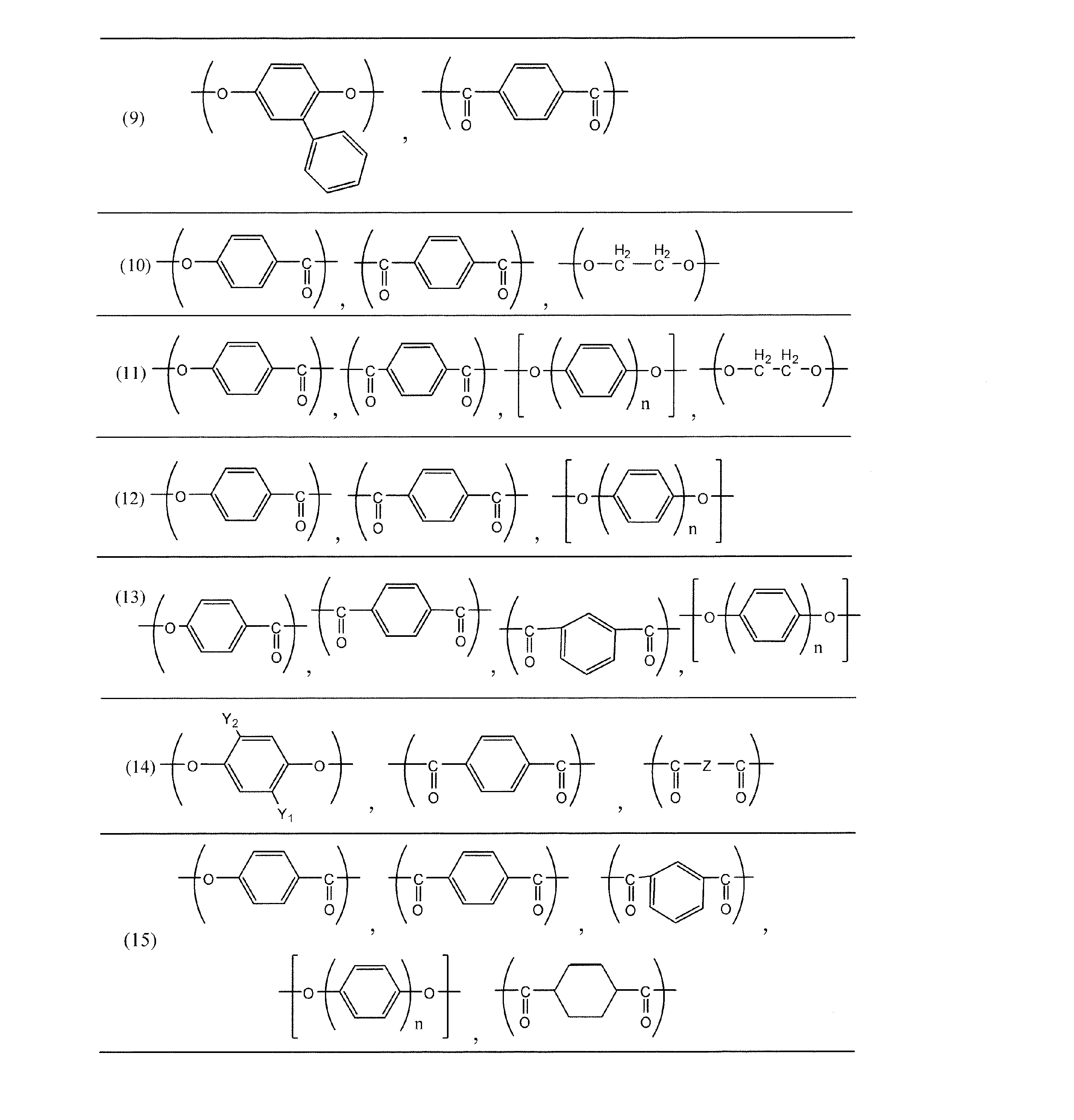
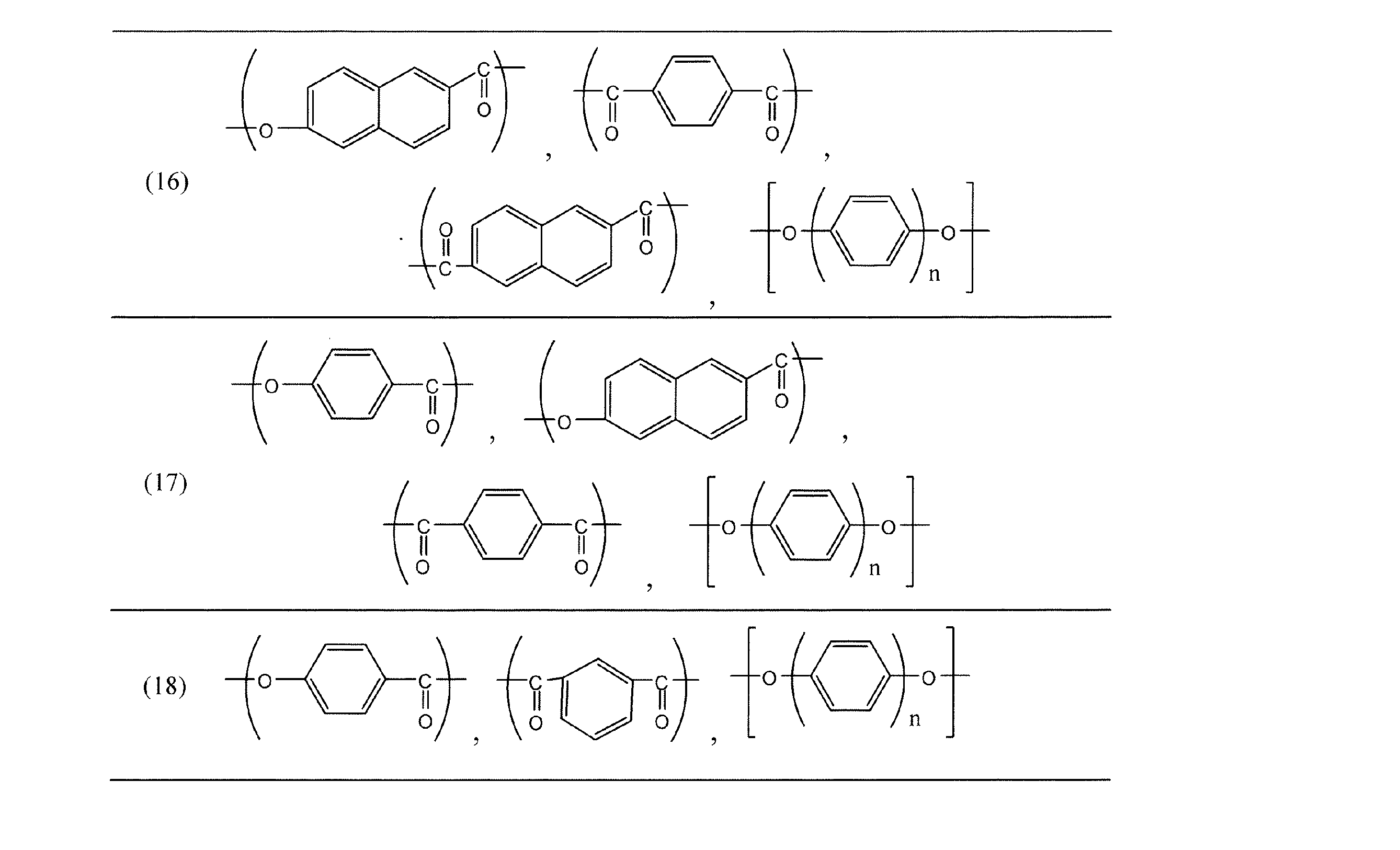
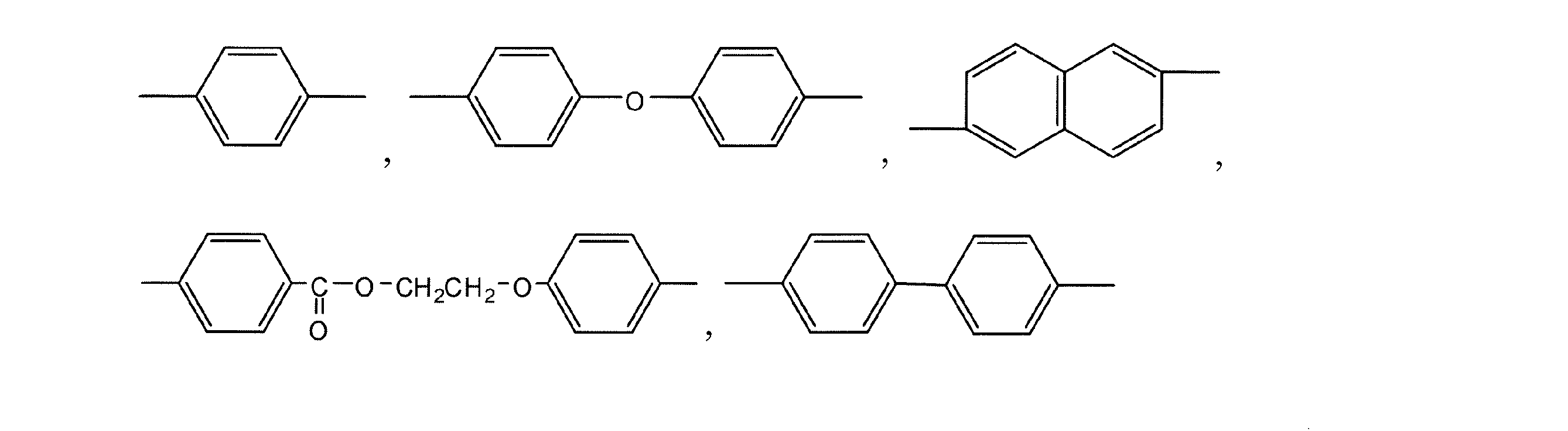

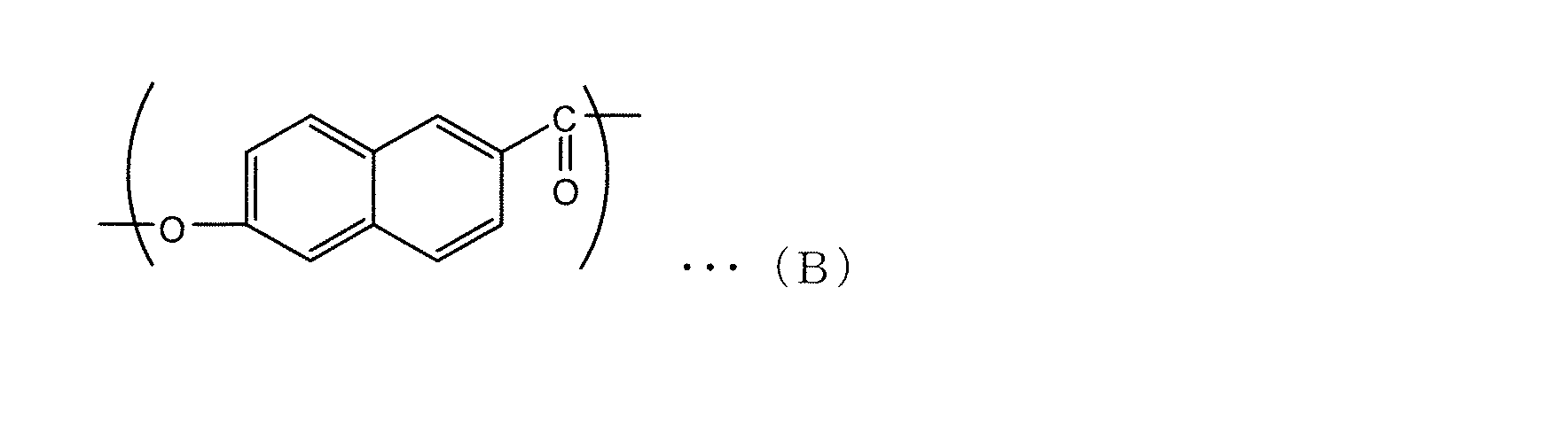
また、芯成分に液晶ポリエステルを用い、鞘成分の海成分としてPEN、島成分として液晶ポリエステルを用いたハイブリッド複合繊維としては、株式会社クラレ製ベックリー(商標)などが挙げられる。
また、縦方向および横方向のうち、いずれか長い方の開口長は、例えば、0.04mm以上であってもよく、好ましくは0.05mm以上、より好ましくは0.08mm以上であってもよい。また、上限は例えば、0.2mm程度であってもよい。
なお、織物がモノフィラメントを織糸として有する場合、上限は、例えば、0.030mm2以下であってもよい。また、織物がマルチフィラメントを織糸として有する場合、上限は、例えば、0.30mm2以下であってもよい。
熱可塑性エラストマー樹脂としては、例えば、ポリオレフィン系エラストマー樹脂、エチレン-ビニルエステル系共重合体、ポリ塩化ビニル系エラストマー樹脂、ポリウレタン系エラストマー樹脂、ポリスチレン系エラストマー樹脂、ポリエステル系エラストマー樹脂、ポリアクリル系エラストマー樹脂およびポリアミド系エラストマー樹脂、ポリジエン系エラストマー樹脂、塩素化ポリエチレン系エラストマー樹脂、フッ素樹脂系エラストマー樹脂等を挙げることができる。これらは1種を単独で用いてもよく、2種以上を併用してもよい。
本発明においては、これらの熱可塑性エラストマーの中でも、物性及び加工性のバランス等の観点から、特にポリウレタン系熱可塑性エラストマーが好ましい。
低分子グリコールとしては、例えば、エチレングリコール、1,4-ブタンジオール、1,6-ヘキサンジオールなどのC1-10ジオールなどが挙げられる。高分子ジオールとしては、ポリ(1,4-ブチレンアジペート)、ポリ(1,6-ヘキサンアジペート)、ポリカプロラクトン、ポリエチレングリコール、ポリプロレングリコール、ポリオキシテトラメチレングリコールなどが挙げられる。ジイソシアネートとしては、例えばトリレンジイソシアネート、4,4-ジフェニルメタンジイソシアネート、ヘキサメチレンジイソシアネート、イソホロンジイソシアネートなどが挙げられる。ポリウレタン系エラストマー樹脂としては、シーダム株式会社製「エセラン(商標)」などが上市されている。
なお、必要に応じて、熱圧着の後、引き続き、熱可塑性エラストマー樹脂の流動性を低減させるために冷却下でプレスを行ってもよい。プレス圧は、加熱時の圧力と同じであってもよいし、加熱時の圧力より低くてもよい。冷却温度は、加熱成形工程の融点MPに対して、例えば(MP-80)~(MP-0)℃で行われてもよい。
本発明の第1の複合材は、引張弾性率が20GPa以上のマルチフィラメントを織糸として含む織物と、熱可塑性エラストマー樹脂とを少なくとも含む複合材であって、
前記熱可塑性エラストマー樹脂が、前記織物の一方の表面から、織物の開口を介して貫通し、他方の表面へ露出しており、
前記他方の面において、前記熱可塑性エラストマー樹脂の露出面積率が、19~100%の範囲にある、複合材である。
前記織物の織密度が110本/inch以上、開口率が70%以下であり、
前記熱可塑性エラストマー樹脂が、前記織物の一方の表面から、織物の開口を介して貫通し、他方の表面へ露出している、複合材である。
複合材の引張強力は、例えば、200MPa以上であってもよく、好ましくは250MPa以上、より好ましくは300MPa以上、さらに好ましくは350MPa以上、さらにより好ましくは370MPa以上、特に好ましくは400MPa以上であってもよい。上限は特に限定されないが、例えば、900MPaであってもよい。
複合材の引張弾性率および引張強力は、後述する実施例に記載された方法により測定される値である。
複合材中の引張弾性率が20GPa以上の繊維がマルチフィラメントである場合、繊維の平均単繊維径は、例えば、20~200μmであってもよく、好ましくは30~150μm、より好ましくは40~100μmであってもよい。
平均単繊維径は、後述する実施例に記載された方法により測定される値である。
ここで織物に導入された熱可塑性エラストマー樹脂とは、複合材において織物側に存在している樹脂を指し、具体的には、複合材を織物の一方の面(導入面)で切断した場合の、織物側に存在する樹脂の量として把握することができる。上限は特に限定されないが、90質量%程度であってもよい。
日立ハイテクノロジーズ製走査電子顕微鏡S-3400Nを用いて、織物断面のヤーン直径を10点測定した平均値より算出した。
複合材を構成する織物を分解し、織物を構成する織糸(ヤーン)を得て、得られたヤーンについてJIS L 1013に基づいてヤーン繊度を測定した。また、単糸繊度は、ヤーンを構成するフィラメント数でヤーン繊度を除することにより算出した。
複合材を構成する織物を分解し、織物を構成するヤーンを得て、得られたヤーンについてJIS L 1013に基づいてヤーンの引張強さをヤーン強力(N)として測定するとともに、ヤーン伸度を測定した。また、強度―伸び曲線より伸び率0.25%と1.00%の2点を結ぶ直線の傾きを算出し、引張弾性率をヤーン弾性率(GPa)とした。
複合材を構成する織物についてJIS L 1096 C法にて5cmあたりの経糸および緯糸本数を、それぞれ実体顕微鏡で測定し、1インチ当たりの糸本数に換算し織密度(本/inch)とした。
複合材を構成する織物についてJIS L 1096 A法にて200mm×200mmの試験片2枚を採取し、それぞれの標準状態における質量(g)を量り、単位面積当たりの質量に換算し目付(g/m2)とした。
複合材を構成する織物についてJIS L 1096 A法にて厚さ測定器で測定した。
(株)キーエンス製デジタルマイクロスコープVHX-2000もしくは(株)日立ハイテクノロジーズ製走査電子顕微鏡S―3400Nを用いて、織物の開口部が25から100箇所含まれる倍率で画像を撮影し、Adobe Photo shop Elenens2021にて2値化して、開口部総面積(mm)を画像総面積(mm)で除して算出し、パーセント表示した。なお、織り目の粗さに応じて、織密度100本/inchを基準として、それよりも織り目の粗いものはマイクロスコープ、織り目の細かいものは走査電子顕微鏡で観察し、測定した。以下、同様である。
(株)キーエンス製デジタルマイクロスコープVHX-2000もしくは(株)日立ハイテクノロジーズ製走査電子顕微鏡S―3400Nを用いて、織物の開口部が9から16箇所含まれる倍率で開口部の長さを縦方向と横方向で測定した平均値を用いて、縦の開口長の平均値を横の開口長の平均値で除して算出した。
(株)キーエンス製デジタルマイクロスコープVHX-2000もしくは(株)日立ハイテクノロジーズ製走査電子顕微鏡S―3400Nを用いて、織物の開口部が9から16箇所含まれる倍率で開口部の長さをタテ方向とヨコ方向で測定した平均値の積を開口面積/個とし、開口部の個数と開口面積/個の積を1平方インチ当たりの開口面積/インチとして算出した。
JIS K 2101に準拠し宝工業株式会社製メルトインデクサーL244を用いて190℃、2.16kgf、オリフィス直径2.1mmより押出された樹脂の流出速度を測定した。
JIS K 7121に準拠し、示差走査熱量計(DSC;メトラー社製、「TA3000」)を用いて測定し、観察される主吸収ピーク温度を融点とした。具体的には、前記DSC装置に、試料を10~20mgをとりアルミ製パンへ封入した後、キャリヤーガスとして窒素を100mL/分の流量で流し、25℃から20℃/分で昇温したときの吸熱ピークを測定した。
複合材についてJIS L 1096 A法にて厚さ測定器で測定した。
また、この複合材は、実質的に織物2枚が互いに密接しているため、織物側厚さ(=織物の界面と他の部材の界面との間の厚さを2等分した面から、樹脂露出部分までの厚さ)に関しては、便宜上、複合材全体の厚さを2等分した厚さとして評価した。
なお、織物側厚さは、複合材の断面積の顕微鏡写真を利用して測定してもよい。
複合材についてJIS L 1096 A法にて200mm×200mmの試験片2枚を採取し、それぞれの標準状態における質量(g)を量り、単位面積当たりの質量に換算し目付(g/m2)とした。
また、この複合材は、実質的に織物2枚が互いに密接しているため、織物側目付(=織物部分と前記織物部分に導入された熱可塑性エラストマー樹脂部分との総目付)に関しては、便宜上、複合材全体の目付を2等分した目付として評価した。
なお、織物側目付は、複合材を織物側で分離して測定してもよい。
(株)キーエンス製デジタルマイクロスコープVHX-2000もしくは(株)日立ハイテクノロジーズ製走査電子顕微鏡S―3400Nを用いて、織物の開口部より露出した樹脂(アンカー)が25から100箇所含まれる倍率で画像を撮影し、Adobe Photo shop Elenens2021にて、露出した樹脂(アンカー)と織物の2値化して、露出した樹脂(アンカー)部総面積を画像総面積で除して算出し、パーセント表示した。
複合材についてJIS L 1096 A法に準拠して試験片の幅20mm長さ200mmの試験片3枚を採取し、つかみ間隔100mm、引張速度300mm/分で測定し平均値を算出した。
複合材についてJIS K 6256-1を参考に、試験片の幅10mm長さ200mmの試験片3枚を採取し、つかみ部の幅を約50mmとし、織物と織物との界面を剥離させて180度剥離用試験体とした。つかみ具の移動速度は50mm/分で測定し、試験片3枚それぞれについて、最初および最後の10%を除く、中央80%の部分にある全てのピークの最大値5点と最低値5点の平均値を剥離強さとした。
(織物の製造)
(1)構成単位(A)と(B)が73/27(モル比)である全芳香族ポリエステルポリマーを用いた。このポリマーの物性は、ηinh=4.6dl/g、融点Mp=280℃であった。このポリマーを通常の溶融紡糸装置、紡糸ノズルを20ホールタイプにて紡糸し、110dtex/20フィラメントのマルチフィラメントを得た。このマルチフィラメントを窒素雰囲気中で280℃、20時間熱処理し、全芳香族ポリエステルポリマーフィラメント(強度23cN/dtex)を得た。
(2)このマルチフィラメントを用いて、緯糸密度50本/インチ、経糸密度50本/インチの全芳香族ポリエステル繊維平織物を作製した。この織物の目付は、45.9g/m2であり、厚みは103μmであった。
(複合材の製造)
(3)この織物から200mm×200mmの試験片を2枚切り出し、同じサイズの熱可塑性エラストマー樹脂シート(シーダム(株)製エセランSHM102、目付80.5g/m2、厚さ70μm)を重ね合わせ、織物により熱可塑性エラストマー樹脂シートをサンドイッチした。これらを一対の離型シートの間に挟み込んだ状態で、120度の温度で予熱した熱プレス成形機において、2MPaの圧力で5分間プレスした後、さらに水冷式の冷却プレスで0.5MPaの圧力で5分間プレスして、一方の織物と、熱可塑性エラストマー樹脂シートと、他の部材としての他方の織物が複合化された複合材が得られた。
なお、この複合材では、実質的に織物が2枚用いられている状態であるため、便宜上、複合材中の樹脂の量を2で除した値を、織物に導入された熱可塑性エラストマー樹脂の値として、樹脂比率=織物に導入された樹脂/(織物+織物に導入された樹脂)×100として、算出した。
紡糸ノズルを10ホールタイプに変更して56dtex/10フィラメントのマルチフィラメントを得た。このマルチフィラメントを窒素雰囲気中で280℃、20時間熱処理し、全芳香族ポリエステルポリマーフィラメント(強度23cN/dtex)を得た。
このマルチフィラメントを用いて、緯糸密度110本/インチ、経糸密度110本/インチの全芳香族ポリエステル繊維平織物を作製したこと以外は実施例1と同様にして複合材を作製し評価を行った。
実施例1の平織物を熱カレンダーロール(鏡面)で170℃の温度で、ロール自重の圧力で通過させたこと以外は実施例1と同様にして複合材を作製し評価を行った。
実施例1の全芳香族ポリエステル繊維平織物を熱カレンダーロール(鏡面)で170℃の温度で、ロール圧力0.05MPaで通過させたこと以外は実施例1と同様にして複合材を作製し評価を行った。
実施例1の全芳香族ポリエステル繊維平織物を、PU樹脂含侵した後に、熱カレンダーロール(鏡面)で170℃の温度で、ロール圧力0.05MPaで通過させたこと以外は実施例4と同様にして複合材を作製し評価を行った。
(1)構成単位(A)と(B)が73/27(モル比)である全芳香族ポリエステルポリマーを用いた。このポリマーの物性は、ηinh=4.6dl/g、融点Mp=280℃であった。このポリマーを通常の溶融紡糸装置、紡糸ノズルを40ホールタイプにて紡糸し、220dtex/40フィラメントのマルチフィラメントを得た。このマルチフィラメントを窒素雰囲気中で280℃、20時間熱処理し、全芳香族ポリエステルポリマーフィラメント(強度23cN/dtex)を得た。
(2)このマルチフィラメントを用いて、緯糸密度35本/インチ、経糸密度35本/インチの全芳香族ポリエステル繊維平織物を作製した。この織物の目付は、62g/m2であり、厚みは113μmであった。
(3)この織物から200mm×200mmの試験片を2枚切り出し、同じサイズの熱可塑性エラストマー樹脂シート(シーダム(株)製エセランSHM102、目付80.5g/m2、厚さ70μm)を重ね合わせ、織物により熱可塑性エラストマー樹脂シートをサンドイッチした。これらを一対の離型シートの間に挟み込んだ状態で、120度の温度で予熱した熱プレス成形機において、圧力をかけない状態(0MPa)で5分間加熱して、その後室温にて放置することにより、一方の織物と、熱可塑性エラストマー樹脂シートと、他の部材としての他方の織物が複合化された複合材が得られた。
実施例6で得られた織物から、200mm×200mmの試験片を2枚切り出し、同じサイズの熱可塑性エラストマー樹脂シート(シーダム(株)製エセランSHM102、目付80.5g/m2、厚さ70μm)を重ね合わせ、織物により熱可塑性エラストマー樹脂シートをサンドイッチした。これらを一対の離型シートの間に挟み込んだ状態で、120度の温度で予熱した熱プレス成形機において、0.1MPaの圧力で5分間プレスした後、さらに水冷式の冷却プレスで0.1MPaの圧力で5分間プレスして、一方の織物と、熱可塑性エラストマー樹脂シートと、他の部材としての他方の織物が複合化された複合材が得られた。
(1)構成単位(A)と(B)が73/27(モル比)である全芳香族ポリエステルポリマーを用いた。このポリマーの物性は、ηinh=4.6dl/g、融点Mp=280℃であった。このポリマーを通常の溶融紡糸装置、紡糸ノズルを300ホールタイプにて紡糸し、1670dtex/300フィラメントのマルチフィラメントを得た。このマルチフィラメントを窒素雰囲気中で280℃、20時間熱処理し、全芳香族ポリエステルポリマーフィラメント(強度23cN/dtex)を得た。
(2)このマルチフィラメントを用いて、緯糸密度13本/インチ、経糸密度13本/インチの全芳香族ポリエステル繊維平織物を作製した。この織物の目付は、161.6g/m2であり、厚みは175μmであった。
(3)この織物から200mm×200mmの試験片を2枚切り出し、同じサイズの熱可塑性エラストマー樹脂シート(シーダム(株)製エセランSHM102、目付80.5g/m2、厚さ70μm)を重ね合わせ、織物により熱可塑性エラストマー樹脂シートをサンドイッチした。これらを一対の離型シートの間に挟み込んだ状態で、120度の温度で予熱した熱プレス成形機において、2MPaの圧力で5分間プレスした後、さらに水冷式の冷却プレスで0.5MPaの圧力で5分間プレスして、一方の織物と、熱可塑性エラストマー樹脂シートと、他の部材としての他方の織物が複合化された複合材が得られた。
ハイブリッド芯鞘複合モノフィラメントを用いて、経糸密度200本/インチのメッシュ構造の平織物を作製したこと以外は実施例1と同様にして複合材を作製し評価を行った。
なお、ハイブリッド芯鞘複合繊維は以下の方法に従って製造した。
芯成分および鞘成分中の島成分を形成する液晶ポリエステルとして構成単位(P:HBA)と(Q:HNA)のモル比が73/27である溶融異方性芳香族ポリエステル[融点(Ma):278℃、溶融粘度(MVa):32.1Pa・s]を用いた。また、鞘成分中の海成分を形成する屈曲性熱可塑性樹脂としてPEN[融点(Mb):266.3℃、溶融粘度(MVb):100Pa・s]を用い、紡糸温度310℃で紡糸し、30dtexのモノフィラメントを得た。なお、鞘成分中の島成分の割合は30重量%であり、鞘成分比が0.35(芯鞘比(重量比)として65/35)である。このモノフィラメントを窒素雰囲気中で260℃、18時間熱処理し、ハイブリッド複合繊維(強度18cN/dtex)を得た。
実施例9の複合モノフィラメントを用いて、緯糸密度200本/インチ、経糸密度200本/インチのメッシュ構造の平織物を作製したこと以外は実施例9と同様にして複合材を作製し評価を行った。
実施例9の複合モノフィラメントを用いて、緯糸密度150本/インチ、経糸密度150本/インチのメッシュ構造の平織物を作製したこと以外は実施例9と同様にして複合材を作製し評価を行った。
実施例2の平織物に対し、熱カレンダーロール(鏡面)で170℃の温度で、ロール圧力0.05MPaで通過させて、低開口率の織物を得たこと以外は実施例1と同様にして複合材を作製し評価を行った。
実施例2の平織物に対し、ポリウレタン樹脂および溶剤を含んでなる熱可塑性樹脂含有組成物を塗布し、乾燥した樹脂塗布織物を2枚作製し、熱可塑性エラストマー樹脂シートを用いることなく、これらの樹脂塗布面をそれぞれ重ね合わせた以外は実施例1と同様にして複合材を作製し評価を行った。
実施例6で得られた織物から、200mm×200mmの試験片を2枚切り出し、同じサイズの熱可塑性エラストマー樹脂シート(シーダム(株)製エセランSHM102、目付80.5g/m2、厚さ70μm)を重ね合わせ、織物により熱可塑性エラストマー樹脂シートをサンドイッチした。これらを一対の離型シートの間に挟み込んだ状態で、20℃に設定した熱プレス成形機において、2MPaの圧力で5分間プレスした後、さらに水冷式の冷却プレスで0.1MPaの圧力で5分間プレスして、一方の織物と、熱可塑性エラストマー樹脂シートと、他の部材としての他方の織物が複合化された複合材が得られた。
PETモノフィラメントからなる織物として、経糸密度200本/インチのメッシュ構造の平織物(日本特殊織物株式会社製 SMARTMESH-P品番79/200-48)を使用したこと以外は実施例1と同様にして複合材を作製し、評価を行った。なお、織物の目付は、47.2g/m2であり、厚みは70μmであった。
実施例9の複合モノフィラメントを用いて、緯糸密度100本/インチ、経糸密度100本/インチの平織物を作製したこと以外は実施例9と同様にして複合材を作製し評価を行った。
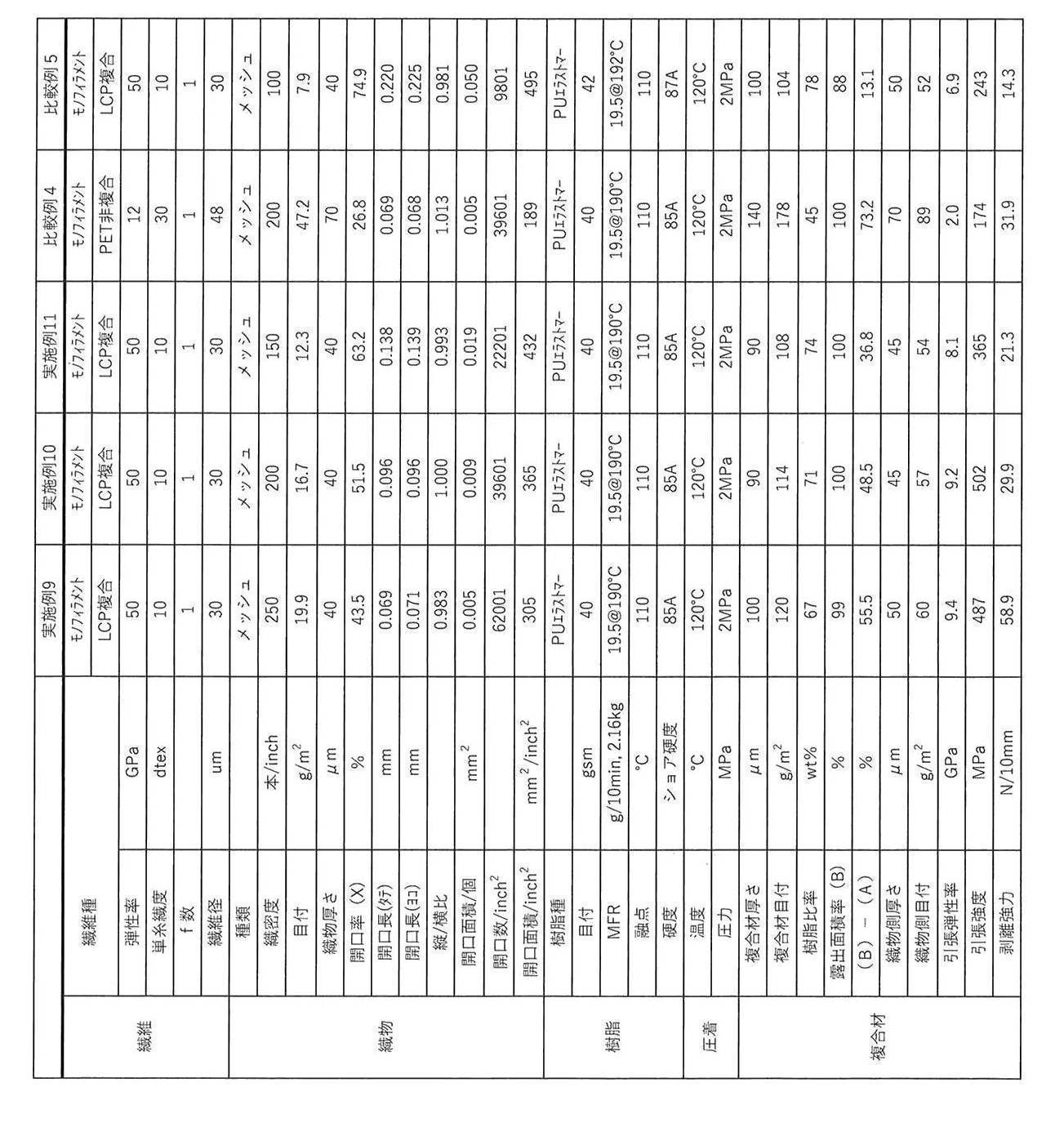
一方、マルチフィラメントを織糸としている実施例1~8は、樹脂の露出面積が大きいため、比較例1および2と比べて、いずれも剥離強力が高く、他部材との接着性が良好である。また、比較例3では、熱可塑性エラストマー樹脂が露出していないため、他部材との接着性が得られていない。
一方、モノフィラメントを織糸としている実施例9~11は、比較例5と比べると、複合材は高い引張弾性率および引張強度を示しており、比較例5と比べて、剥離強力が高く、他部材との接着性が良好である。
Claims (14)
- 引張弾性率が20GPa以上のマルチフィラメントを織糸として含む織物と、熱可塑性エラストマー樹脂とを少なくとも含む複合材であって、
前記熱可塑性エラストマー樹脂が、前記織物の一方の表面から、織物の開口を介して貫通し、他方の表面へ露出しており、
前記他方の面において、前記熱可塑性エラストマー樹脂の露出面積率が、10%以上である、複合材。 - 請求項1に記載の複合材であって、織物の1平方インチあたりの開口面積が3mm2/inch2以上である、複合材。
- 引張弾性率が20GPa以上のモノフィラメントを織糸として含む織物と、熱可塑性エラストマー樹脂とを少なくとも含む複合材であって、
前記織物の織密度が110本/inch以上、開口率が70%以下であり、
前記熱可塑性エラストマー樹脂が、前記織物の一方の表面から、織物の開口を介して貫通し、他方の表面へ露出している、複合材。 - 請求項3に記載の複合材であって、織物の1平方インチあたりの開口面積が200mm2/inch2以上である、複合材。
- 請求項1~4のいずれか一項に記載の複合材であって、前記織物に導入された熱可塑性エラストマー樹脂の割合が、20質量%以上である、複合材。
- 請求項1~5のいずれか一項に記載の複合材であって、引張弾性率が20GPa以上の繊維が、溶融液晶形成性全芳香族ポリエステル繊維である、複合材。
- 請求項1~6のいずれか一項に記載の複合材であって、引張弾性率が20GPa以上の繊維が、複合繊維である、複合材。
- 請求項1~7のいずれか一項に記載の複合材であって、開口の縦/横比は、0.5~2である、複合材。
- 請求項1~8のいずれか一項に記載の複合材であって、前記熱可塑性エラストマー樹脂が、前記織物の一方の表面から、織物の開口を介して貫通し、前記開口からその周囲へ樹脂が広がり、他方の表面へ露出し、開口1つ当たりの平均面積が、0.0010mm2以上である、複合材。
- 請求項1~9のいずれか一項に記載の複合材であって、さらに他の部材を含み、前記他の部材と、前記織物とが、前記熱可塑性エラストマー樹脂において接合している、複合材。
- 請求項1~10のいずれか一項に記載の複合材であって、補強部材として用いられる、複合材。
- 引張弾性率が20GPa以上の繊維を織糸として含み、開口を有する織物と、熱可塑性エラストマー樹脂シートと、必要に応じて他の部材とを、この順序で重ね合わせる工程と、
前記熱可塑性エラストマー樹脂シートを加熱下で軟化させ、織物の一方の面から、前記織物の開口に前記熱可塑性エラストマー樹脂シートの樹脂を押し出す工程と、
を備える、請求項1~11のいずれか一項に記載の複合材を製造する方法。 - 請求項12の製造方法であって、熱可塑性エラストマー樹脂シートのMFRが、0.3~80/10minである、製造方法。
- 請求項12または13の製造方法であって、熱可塑性エラストマー樹脂シートの厚さが10~200μmである、製造方法。
Priority Applications (5)
| Application Number | Priority Date | Filing Date | Title |
|---|---|---|---|
| KR1020247022548A KR20240132021A (ko) | 2022-01-05 | 2022-12-27 | 복합재 및 그 제조 방법 |
| EP22918890.9A EP4461495A4 (en) | 2022-01-05 | 2022-12-27 | Composite material and its manufacturing process |
| US18/726,591 US20250091255A1 (en) | 2022-01-05 | 2022-12-27 | Composite material and method of manufacturing the same |
| JP2023572459A JPWO2023132307A1 (ja) | 2022-01-05 | 2022-12-27 | |
| CN202280087900.7A CN118510640A (zh) | 2022-01-05 | 2022-12-27 | 复合材料及其制造方法 |
Applications Claiming Priority (2)
| Application Number | Priority Date | Filing Date | Title |
|---|---|---|---|
| JP2022000731 | 2022-01-05 | ||
| JP2022-000731 | 2022-01-05 |
Publications (1)
| Publication Number | Publication Date |
|---|---|
| WO2023132307A1 true WO2023132307A1 (ja) | 2023-07-13 |
Family
ID=87073655
Family Applications (1)
| Application Number | Title | Priority Date | Filing Date |
|---|---|---|---|
| PCT/JP2022/048289 Ceased WO2023132307A1 (ja) | 2022-01-05 | 2022-12-27 | 複合材およびその製造方法 |
Country Status (7)
| Country | Link |
|---|---|
| US (1) | US20250091255A1 (ja) |
| EP (1) | EP4461495A4 (ja) |
| JP (1) | JPWO2023132307A1 (ja) |
| KR (1) | KR20240132021A (ja) |
| CN (1) | CN118510640A (ja) |
| TW (1) | TW202333954A (ja) |
| WO (1) | WO2023132307A1 (ja) |
Cited By (1)
| Publication number | Priority date | Publication date | Assignee | Title |
|---|---|---|---|---|
| WO2026048452A1 (ja) * | 2024-08-29 | 2026-03-05 | 株式会社Nbcメッシュテック | 液晶ポリエステル糸のメッシュ織物 |
Citations (5)
| Publication number | Priority date | Publication date | Assignee | Title |
|---|---|---|---|---|
| WO2010035453A1 (ja) * | 2008-09-29 | 2010-04-01 | 株式会社クラレ | 耐衝撃性積層成形体およびその製造方法、ならびに耐衝撃材 |
| JP2017205917A (ja) | 2016-05-17 | 2017-11-24 | 株式会社イックス | 複合シート材及び同複合シート材の製造方法 |
| JP2019501996A (ja) * | 2015-12-14 | 2019-01-24 | ハバシット アクチエンゲゼルシャフト | シート材料及びそれを含むパンチングテープ |
| JP2019072912A (ja) * | 2017-10-16 | 2019-05-16 | ジェイサイエンテック株式会社 | 複合シート |
| WO2020085246A1 (ja) | 2018-10-23 | 2020-04-30 | 株式会社クラレ | 複合シート |
Family Cites Families (5)
| Publication number | Priority date | Publication date | Assignee | Title |
|---|---|---|---|---|
| US6846548B2 (en) * | 1999-02-19 | 2005-01-25 | Honeywell International Inc. | Flexible fabric from fibrous web and discontinuous domain matrix |
| ES2527168T3 (es) * | 2002-07-18 | 2015-01-21 | Mitsubishi Rayon Co., Ltd. | Preimpregnado y procedimientos para la producción de materiales compuestos reforzados con fibras |
| US7888274B2 (en) * | 2005-07-29 | 2011-02-15 | Toray Industries, Inc. | Reinforcing woven fabric and process for producing the same |
| JP5571963B2 (ja) * | 2008-01-25 | 2014-08-13 | 株式会社クラレ | 高強力・高弾性率シート状物 |
| SI2716435T1 (sl) * | 2012-10-02 | 2017-11-30 | Reifenhaeuser Gmbh & Co. Kg Maschinenfabrik | Postopek za izdelavo kompozitnega ulitka, zlasti vlaknenega kompozitnega ulitka in kompozitni ulitek, zlasti vlakneni kompozitni ulitek |
-
2022
- 2022-12-27 US US18/726,591 patent/US20250091255A1/en active Pending
- 2022-12-27 KR KR1020247022548A patent/KR20240132021A/ko active Pending
- 2022-12-27 CN CN202280087900.7A patent/CN118510640A/zh active Pending
- 2022-12-27 JP JP2023572459A patent/JPWO2023132307A1/ja active Pending
- 2022-12-27 EP EP22918890.9A patent/EP4461495A4/en active Pending
- 2022-12-27 WO PCT/JP2022/048289 patent/WO2023132307A1/ja not_active Ceased
- 2022-12-28 TW TW111150417A patent/TW202333954A/zh unknown
Patent Citations (6)
| Publication number | Priority date | Publication date | Assignee | Title |
|---|---|---|---|---|
| WO2010035453A1 (ja) * | 2008-09-29 | 2010-04-01 | 株式会社クラレ | 耐衝撃性積層成形体およびその製造方法、ならびに耐衝撃材 |
| JP2019501996A (ja) * | 2015-12-14 | 2019-01-24 | ハバシット アクチエンゲゼルシャフト | シート材料及びそれを含むパンチングテープ |
| JP2017205917A (ja) | 2016-05-17 | 2017-11-24 | 株式会社イックス | 複合シート材及び同複合シート材の製造方法 |
| JP2019072912A (ja) * | 2017-10-16 | 2019-05-16 | ジェイサイエンテック株式会社 | 複合シート |
| WO2020085246A1 (ja) | 2018-10-23 | 2020-04-30 | 株式会社クラレ | 複合シート |
| JP2020090089A (ja) * | 2018-10-23 | 2020-06-11 | 株式会社クラレ | 複合シート |
Non-Patent Citations (1)
| Title |
|---|
| See also references of EP4461495A4 |
Cited By (1)
| Publication number | Priority date | Publication date | Assignee | Title |
|---|---|---|---|---|
| WO2026048452A1 (ja) * | 2024-08-29 | 2026-03-05 | 株式会社Nbcメッシュテック | 液晶ポリエステル糸のメッシュ織物 |
Also Published As
| Publication number | Publication date |
|---|---|
| EP4461495A1 (en) | 2024-11-13 |
| JPWO2023132307A1 (ja) | 2023-07-13 |
| TW202333954A (zh) | 2023-09-01 |
| EP4461495A4 (en) | 2025-12-31 |
| KR20240132021A (ko) | 2024-09-02 |
| CN118510640A (zh) | 2024-08-16 |
| US20250091255A1 (en) | 2025-03-20 |
Similar Documents
| Publication | Publication Date | Title |
|---|---|---|
| EP1941089B1 (en) | Moldable fabric with variable constituents | |
| WO2010035453A1 (ja) | 耐衝撃性積層成形体およびその製造方法、ならびに耐衝撃材 | |
| WO2023132307A1 (ja) | 複合材およびその製造方法 | |
| CN101844385A (zh) | 制造聚合物制品的方法 | |
| KR20110128828A (ko) | 인공 피혁, 필라멘트 낙합 웹 및 그들의 제조 방법 | |
| US4801491A (en) | Water-resistant and high-strength laminate | |
| JP7333910B2 (ja) | 複合シート | |
| WO2013105586A1 (ja) | カイロ用不織布 | |
| JP2000239925A (ja) | 樹脂補強材及び複合体 | |
| EP4292808B1 (en) | Laminate and method for molding a laminate molded article | |
| JP6370328B2 (ja) | タフテッドカーペット用一次基布およびその製造方法 | |
| JP2001064845A (ja) | 基 布 | |
| JP4677786B2 (ja) | 収束性に優れた弾性複合糸 | |
| JP2722682B2 (ja) | 非通気性シート | |
| TWI902916B (zh) | 人工皮革及使用其構成之光穿透裝置 | |
| JP3419424B2 (ja) | 目止めテープ | |
| JP2018150633A (ja) | 樹脂補強用織物およびその織物を用いた樹脂成形物 | |
| JPH0588187B2 (ja) | ||
| WO2025110052A1 (ja) | 繊維積層構造体および防水透湿性衣料 | |
| JP2003326655A (ja) | 非ハロゲン系樹脂加工布 |
Legal Events
| Date | Code | Title | Description |
|---|---|---|---|
| 121 | Ep: the epo has been informed by wipo that ep was designated in this application |
Ref document number: 22918890 Country of ref document: EP Kind code of ref document: A1 |
|
| ENP | Entry into the national phase |
Ref document number: 2023572459 Country of ref document: JP Kind code of ref document: A |
|
| WWE | Wipo information: entry into national phase |
Ref document number: 18726591 Country of ref document: US |
|
| WWE | Wipo information: entry into national phase |
Ref document number: 2401004445 Country of ref document: TH |
|
| ENP | Entry into the national phase |
Ref document number: 20247022548 Country of ref document: KR Kind code of ref document: A |
|
| WWE | Wipo information: entry into national phase |
Ref document number: 202280087900.7 Country of ref document: CN |
|
| WWE | Wipo information: entry into national phase |
Ref document number: 2022918890 Country of ref document: EP |
|
| NENP | Non-entry into the national phase |
Ref country code: DE |
|
| ENP | Entry into the national phase |
Ref document number: 2022918890 Country of ref document: EP Effective date: 20240805 |
|
| WWP | Wipo information: published in national office |
Ref document number: 18726591 Country of ref document: US |