WO2023135902A1 - 人間拡張プラットフォーム装置及び身体能力拡張方法 - Google Patents
人間拡張プラットフォーム装置及び身体能力拡張方法 Download PDFInfo
- Publication number
- WO2023135902A1 WO2023135902A1 PCT/JP2022/040489 JP2022040489W WO2023135902A1 WO 2023135902 A1 WO2023135902 A1 WO 2023135902A1 JP 2022040489 W JP2022040489 W JP 2022040489W WO 2023135902 A1 WO2023135902 A1 WO 2023135902A1
- Authority
- WO
- WIPO (PCT)
- Prior art keywords
- data
- control data
- human
- physical
- platform device
- Prior art date
- Legal status (The legal status is an assumption and is not a legal conclusion. Google has not performed a legal analysis and makes no representation as to the accuracy of the status listed.)
- Ceased
Links
Images


Classifications
-
- A—HUMAN NECESSITIES
- A61—MEDICAL OR VETERINARY SCIENCE; HYGIENE
- A61B—DIAGNOSIS; SURGERY; IDENTIFICATION
- A61B5/00—Measuring for diagnostic purposes; Identification of persons
- A61B5/103—Measuring devices for testing the shape, pattern, colour, size or movement of the body or parts thereof, for diagnostic purposes
- A61B5/11—Measuring movement of the entire body or parts thereof, e.g. head or hand tremor or mobility of a limb
- A61B5/1121—Determining geometric values, e.g. centre of rotation or angular range of movement
- A61B5/1122—Determining geometric values, e.g. centre of rotation or angular range of movement of movement trajectories
-
- B—PERFORMING OPERATIONS; TRANSPORTING
- B25—HAND TOOLS; PORTABLE POWER-DRIVEN TOOLS; MANIPULATORS
- B25J—MANIPULATORS; CHAMBERS PROVIDED WITH MANIPULATION DEVICES
- B25J9/00—Program-controlled manipulators
- B25J9/16—Program controls
- B25J9/1694—Program controls characterised by use of sensors other than normal servo-feedback from position, speed or acceleration sensors, perception control, multi-sensor controlled systems, sensor fusion
-
- A—HUMAN NECESSITIES
- A61—MEDICAL OR VETERINARY SCIENCE; HYGIENE
- A61B—DIAGNOSIS; SURGERY; IDENTIFICATION
- A61B5/00—Measuring for diagnostic purposes; Identification of persons
- A61B5/24—Detecting, measuring or recording bioelectric or biomagnetic signals of the body or parts thereof
- A61B5/30—Input circuits therefor
- A61B5/307—Input circuits therefor specially adapted for particular uses
- A61B5/31—Input circuits therefor specially adapted for particular uses for electroencephalography [EEG]
-
- A—HUMAN NECESSITIES
- A61—MEDICAL OR VETERINARY SCIENCE; HYGIENE
- A61B—DIAGNOSIS; SURGERY; IDENTIFICATION
- A61B5/00—Measuring for diagnostic purposes; Identification of persons
- A61B5/24—Detecting, measuring or recording bioelectric or biomagnetic signals of the body or parts thereof
- A61B5/316—Modalities, i.e. specific diagnostic methods
- A61B5/389—Electromyography [EMG]
-
- A—HUMAN NECESSITIES
- A61—MEDICAL OR VETERINARY SCIENCE; HYGIENE
- A61H—PHYSICAL THERAPY APPARATUS, e.g. DEVICES FOR LOCATING OR STIMULATING REFLEX POINTS IN THE BODY; ARTIFICIAL RESPIRATION; MASSAGE; BATHING DEVICES FOR SPECIAL THERAPEUTIC OR HYGIENIC PURPOSES OR SPECIFIC PARTS OF THE BODY
- A61H1/00—Apparatus for passive exercising; Vibrating apparatus; Chiropractic devices, e.g. body impacting devices, external devices for briefly extending or aligning unbroken bones
- A61H1/02—Stretching or bending or torsioning apparatus for exercising
- A61H1/0237—Stretching or bending or torsioning apparatus for exercising for the lower limbs
-
- A—HUMAN NECESSITIES
- A61—MEDICAL OR VETERINARY SCIENCE; HYGIENE
- A61H—PHYSICAL THERAPY APPARATUS, e.g. DEVICES FOR LOCATING OR STIMULATING REFLEX POINTS IN THE BODY; ARTIFICIAL RESPIRATION; MASSAGE; BATHING DEVICES FOR SPECIAL THERAPEUTIC OR HYGIENIC PURPOSES OR SPECIFIC PARTS OF THE BODY
- A61H1/00—Apparatus for passive exercising; Vibrating apparatus; Chiropractic devices, e.g. body impacting devices, external devices for briefly extending or aligning unbroken bones
- A61H1/02—Stretching or bending or torsioning apparatus for exercising
- A61H1/0274—Stretching or bending or torsioning apparatus for exercising for the upper limbs
-
- A—HUMAN NECESSITIES
- A61—MEDICAL OR VETERINARY SCIENCE; HYGIENE
- A61H—PHYSICAL THERAPY APPARATUS, e.g. DEVICES FOR LOCATING OR STIMULATING REFLEX POINTS IN THE BODY; ARTIFICIAL RESPIRATION; MASSAGE; BATHING DEVICES FOR SPECIAL THERAPEUTIC OR HYGIENIC PURPOSES OR SPECIFIC PARTS OF THE BODY
- A61H3/00—Appliances for aiding patients or disabled persons to walk about
-
- B—PERFORMING OPERATIONS; TRANSPORTING
- B25—HAND TOOLS; PORTABLE POWER-DRIVEN TOOLS; MANIPULATORS
- B25J—MANIPULATORS; CHAMBERS PROVIDED WITH MANIPULATION DEVICES
- B25J13/00—Controls for manipulators
-
- B—PERFORMING OPERATIONS; TRANSPORTING
- B25—HAND TOOLS; PORTABLE POWER-DRIVEN TOOLS; MANIPULATORS
- B25J—MANIPULATORS; CHAMBERS PROVIDED WITH MANIPULATION DEVICES
- B25J13/00—Controls for manipulators
- B25J13/08—Controls for manipulators by means of sensing devices, e.g. viewing or touching devices
-
- B—PERFORMING OPERATIONS; TRANSPORTING
- B25—HAND TOOLS; PORTABLE POWER-DRIVEN TOOLS; MANIPULATORS
- B25J—MANIPULATORS; CHAMBERS PROVIDED WITH MANIPULATION DEVICES
- B25J9/00—Program-controlled manipulators
- B25J9/0006—Exoskeletons, i.e. resembling a human figure
-
- B—PERFORMING OPERATIONS; TRANSPORTING
- B25—HAND TOOLS; PORTABLE POWER-DRIVEN TOOLS; MANIPULATORS
- B25J—MANIPULATORS; CHAMBERS PROVIDED WITH MANIPULATION DEVICES
- B25J9/00—Program-controlled manipulators
- B25J9/16—Program controls
- B25J9/1679—Program controls characterised by the tasks executed
- B25J9/1689—Teleoperation
-
- A—HUMAN NECESSITIES
- A61—MEDICAL OR VETERINARY SCIENCE; HYGIENE
- A61B—DIAGNOSIS; SURGERY; IDENTIFICATION
- A61B5/00—Measuring for diagnostic purposes; Identification of persons
- A61B5/103—Measuring devices for testing the shape, pattern, colour, size or movement of the body or parts thereof, for diagnostic purposes
- A61B5/11—Measuring movement of the entire body or parts thereof, e.g. head or hand tremor or mobility of a limb
- A61B5/1124—Determining motor skills
-
- A—HUMAN NECESSITIES
- A61—MEDICAL OR VETERINARY SCIENCE; HYGIENE
- A61B—DIAGNOSIS; SURGERY; IDENTIFICATION
- A61B5/00—Measuring for diagnostic purposes; Identification of persons
- A61B5/72—Signal processing specially adapted for physiological signals or for diagnostic purposes
- A61B5/7235—Details of waveform analysis
- A61B5/7253—Details of waveform analysis characterised by using transforms
-
- A—HUMAN NECESSITIES
- A61—MEDICAL OR VETERINARY SCIENCE; HYGIENE
- A61F—FILTERS IMPLANTABLE INTO BLOOD VESSELS; PROSTHESES; DEVICES PROVIDING PATENCY TO, OR PREVENTING COLLAPSING OF, TUBULAR STRUCTURES OF THE BODY, e.g. STENTS; ORTHOPAEDIC, NURSING OR CONTRACEPTIVE DEVICES; FOMENTATION; TREATMENT OR PROTECTION OF EYES OR EARS; BANDAGES, DRESSINGS OR ABSORBENT PADS; FIRST-AID KITS
- A61F2/00—Filters implantable into blood vessels; Prostheses, i.e. artificial substitutes or replacements for parts of the body; Appliances for connecting them with the body; Devices providing patency to, or preventing collapsing of, tubular structures of the body, e.g. stents
- A61F2/50—Prostheses not implantable in the body
- A61F2/54—Artificial arms or hands or parts thereof
-
- A—HUMAN NECESSITIES
- A61—MEDICAL OR VETERINARY SCIENCE; HYGIENE
- A61F—FILTERS IMPLANTABLE INTO BLOOD VESSELS; PROSTHESES; DEVICES PROVIDING PATENCY TO, OR PREVENTING COLLAPSING OF, TUBULAR STRUCTURES OF THE BODY, e.g. STENTS; ORTHOPAEDIC, NURSING OR CONTRACEPTIVE DEVICES; FOMENTATION; TREATMENT OR PROTECTION OF EYES OR EARS; BANDAGES, DRESSINGS OR ABSORBENT PADS; FIRST-AID KITS
- A61F2/00—Filters implantable into blood vessels; Prostheses, i.e. artificial substitutes or replacements for parts of the body; Appliances for connecting them with the body; Devices providing patency to, or preventing collapsing of, tubular structures of the body, e.g. stents
- A61F2/50—Prostheses not implantable in the body
- A61F2/60—Artificial legs or feet or parts thereof
-
- A—HUMAN NECESSITIES
- A61—MEDICAL OR VETERINARY SCIENCE; HYGIENE
- A61F—FILTERS IMPLANTABLE INTO BLOOD VESSELS; PROSTHESES; DEVICES PROVIDING PATENCY TO, OR PREVENTING COLLAPSING OF, TUBULAR STRUCTURES OF THE BODY, e.g. STENTS; ORTHOPAEDIC, NURSING OR CONTRACEPTIVE DEVICES; FOMENTATION; TREATMENT OR PROTECTION OF EYES OR EARS; BANDAGES, DRESSINGS OR ABSORBENT PADS; FIRST-AID KITS
- A61F2/00—Filters implantable into blood vessels; Prostheses, i.e. artificial substitutes or replacements for parts of the body; Appliances for connecting them with the body; Devices providing patency to, or preventing collapsing of, tubular structures of the body, e.g. stents
- A61F2/50—Prostheses not implantable in the body
- A61F2/68—Operating or control means
- A61F2/70—Operating or control means electrical
- A61F2/72—Bioelectric control, e.g. myoelectric
-
- A—HUMAN NECESSITIES
- A61—MEDICAL OR VETERINARY SCIENCE; HYGIENE
- A61H—PHYSICAL THERAPY APPARATUS, e.g. DEVICES FOR LOCATING OR STIMULATING REFLEX POINTS IN THE BODY; ARTIFICIAL RESPIRATION; MASSAGE; BATHING DEVICES FOR SPECIAL THERAPEUTIC OR HYGIENIC PURPOSES OR SPECIFIC PARTS OF THE BODY
- A61H2201/00—Characteristics of apparatus not provided for in the preceding codes
- A61H2201/50—Control means thereof
- A61H2201/5007—Control means thereof computer controlled
-
- A—HUMAN NECESSITIES
- A61—MEDICAL OR VETERINARY SCIENCE; HYGIENE
- A61H—PHYSICAL THERAPY APPARATUS, e.g. DEVICES FOR LOCATING OR STIMULATING REFLEX POINTS IN THE BODY; ARTIFICIAL RESPIRATION; MASSAGE; BATHING DEVICES FOR SPECIAL THERAPEUTIC OR HYGIENIC PURPOSES OR SPECIFIC PARTS OF THE BODY
- A61H2201/00—Characteristics of apparatus not provided for in the preceding codes
- A61H2201/50—Control means thereof
- A61H2201/5058—Sensors or detectors
- A61H2201/5084—Acceleration sensors
-
- A—HUMAN NECESSITIES
- A61—MEDICAL OR VETERINARY SCIENCE; HYGIENE
- A61H—PHYSICAL THERAPY APPARATUS, e.g. DEVICES FOR LOCATING OR STIMULATING REFLEX POINTS IN THE BODY; ARTIFICIAL RESPIRATION; MASSAGE; BATHING DEVICES FOR SPECIAL THERAPEUTIC OR HYGIENIC PURPOSES OR SPECIFIC PARTS OF THE BODY
- A61H2230/00—Measuring physical parameters of the user
- A61H2230/08—Other bio-electrical signals
- A61H2230/10—Electroencephalographic signals
- A61H2230/105—Electroencephalographic signals used as a control parameter for the apparatus
-
- A—HUMAN NECESSITIES
- A61—MEDICAL OR VETERINARY SCIENCE; HYGIENE
- A61H—PHYSICAL THERAPY APPARATUS, e.g. DEVICES FOR LOCATING OR STIMULATING REFLEX POINTS IN THE BODY; ARTIFICIAL RESPIRATION; MASSAGE; BATHING DEVICES FOR SPECIAL THERAPEUTIC OR HYGIENIC PURPOSES OR SPECIFIC PARTS OF THE BODY
- A61H2230/00—Measuring physical parameters of the user
- A61H2230/60—Muscle strain, i.e. measured on the user, e.g. Electromyography [EMG]
- A61H2230/605—Muscle strain, i.e. measured on the user, e.g. Electromyography [EMG] used as a control parameter for the apparatus
Definitions
- the present invention relates to a human augmentation platform device and a method for augmenting human physical abilities.
- the 3rd Generation Partnership Project (3GPP) has specified the 5th generation mobile communication system (also called 5G, New Radio (NR) or Next Generation (NG)), and the next generation specification called Beyond 5G, 5G Evolution or 6G We are also proceeding with 5G, 5G Evolution or 6G We are also proceeding with 5G, 5G Evolution or 6G We are also proceeding with 5G, 5G Evolution or 6G We are also proceeding with 5G, 5G Evolution or 6G We are also proceeding with 5G, 5G Evolution or 6G
- Human augmentation is one of the technologies that should be noted in the 6G era. Human augmentation is roughly divided into “extension of physical ability”, “extension of existence”, “extension of perception” and “extension of cognitive ability”.
- Non-Patent Document 1 Non-Patent Document 1
- the following disclosure is made in view of this situation, and provides a human augmentation platform device and a physical ability augmentation method that can enhance mutual cooperation between the sensing side and the augmentation side (controlled side). aim.
- One aspect of the present disclosure includes a physical information acquisition unit (physical information acquisition unit 110) that acquires physical information indicating the physical abilities of the sensing side and the controlled side, and a motion data acquisition unit that acquires motion data on the sensing side ( Control for generating control data for the controlled side based on the motion data acquisition unit 120), the physical information acquired by the physical information acquisition unit, and the motion data acquired by the motion data acquisition unit A data generation unit (control data generation unit 150) and an actuation unit (actuation unit 160) that operates the body of the controlled side based on the control data, the control data generation unit A human augmented platform device (human augmented platform device 100) that generates the control data within the range of physical ability of the human side.
- a step of acquiring physical information indicating physical abilities of a sensing side and a controlled side a step of acquiring motion data of the sensing side, and based on the physical information and the motion data, generating control data of the controlled side; and actuating the body of the controlled side based on the control data.
- a physical performance enhancement method for generating said control data within a range a physical performance enhancement method for generating said control data within a range.
- FIG. 1 is an overall schematic configuration diagram of a human augmentation system 10 according to the first embodiment.
- FIG. 2 is a functional block configuration diagram of the human augmentation platform device 100 according to the first embodiment.
- FIG. 3 is a diagram showing a configuration example of a physical information DB according to the first embodiment.
- FIG. 4 is a diagram illustrating a configuration example of an action DB according to the first embodiment;
- FIG. 5 is a diagram schematically showing an operation example of the human augmentation platform device 100 according to the first embodiment.
- FIG. 6 is a diagram showing a schematic operation flow of the human augmentation platform device 100 according to the first embodiment.
- 7A and 7B are diagrams showing an example of a physical ability extension operation between the sensing side (body A) and the controlled side (body B) according to the first embodiment.
- FIG. 8 is a diagram showing a system configuration example including the human augmentation platform device 100 according to the second embodiment.
- FIG. 9 is a diagram showing an example of a designated pattern of sensing/actuation according to the second embodiment.
- FIG. 10 is a diagram showing a sequence example regarding account registration and service subscription according to the second embodiment.
- FIG. 11 is a diagram showing a sequence example (Part 1) relating to body data registration according to the second embodiment.
- FIG. 12A is a diagram showing a sequence example (part 2) relating to body data registration according to the second embodiment.
- FIG. 12B is a diagram showing a sequence example (part 3) relating to body data registration according to the second embodiment.
- FIG. 13 is a diagram showing an example of a real-time data transmission/reception sequence by the service management function and data linkage control function according to the second embodiment.
- FIG. 14 is a diagram showing a sequence example of skill data accumulation according to the second embodiment.
- FIG. 15 is a diagram illustrating a sequence example of service registration according to the second embodiment.
- FIG. 16 is a diagram showing a configuration example of data conversion elements by the data linkage control function according to the second embodiment.
- FIG. 17 is a diagram showing an example of option mapping according to the second embodiment.
- FIG. 18 is a diagram showing an example of the hardware configuration of the human augmentation platform device 100. As shown in FIG.
- FIG. 1 is an overall schematic configuration diagram of a human augmentation system 10 according to the present embodiment.
- the human augmentation system 10 has a sensing side composed of a plurality of sensor groups with different measurement targets, and an extension side (controlled side or actuation side) in which robots or humans (humans) are controlled objects. may be called) and
- the human augmentation platform device 100 is connected to the sensing side and the augmentation side.
- the human augmented platform device 100 may also be connected with the communication network 20 .
- the human augmentation platform device 100 is connected to the myoelectric sensor 40 and the electroencephalogram sensor 50.
- the human augmented platform device 100 is also connected to the robot 60 and myoelectric actuators 70 . Additionally, the human augmented platform device 100 may be connected with a tactile sensor 55 .
- the communication network 20 may include wired networks and wireless networks. Human augmented platform device 100 may be accessible to other systems, databases, application services, etc. via communications network 20 .
- the myoelectric sensor 40 is configured to be attached to at least one of the human limbs. Typically, the myoelectric sensor 40 can be attached to a human upper limb (arm) or lower limb (leg). However, the subject to which the myoelectric sensor 40 is worn is not necessarily limited to humans.
- the myoelectric sensor 40 is a sensor that detects electrical signals generated during muscle contraction, and a general myoelectric (myoelectric potential) sensor can be used.
- the electroencephalogram sensor 50 is worn on the human head.
- the electroencephalogram sensor 50 is a sensor that detects potential fluctuations generated from the human brain, and a general electroencephalogram sensor can be used.
- the tactile sensor 55 is a sensor that can digitize the tactile sensation of a contacting object that humans feel. Typically, the tactile sensor 55 can digitize the tactile sensation of a human hand or foot in contact with a target object.
- the robot 60 is a humanoid mechanical device that operates based on prescribed electrical signals.
- the robot 60 has at least one of upper limbs (arms) and lower limbs (legs), like humans. Also, the robot 60 is not limited to arms (legs), and may include parts such as fingers.
- the myoelectric actuator 70 is configured to be attached to at least one of the human limbs. Typically, the myoelectric actuator 70 can be attached to a human upper extremity (arm) or lower extremity (leg). However, similarly to the myoelectric sensor 40, the subject to which the myoelectric actuator 70 is attached need not necessarily be limited to humans.
- the myoelectric actuator 70 can generate electrical signals and contract muscles of a human finger, arm, or the like.
- the human augmentation platform device 100 is connected to the sensing side and the augmentation side (controlled side) to realize human augmentation. Specifically, the human augmentation platform device 100 achieves augmentation of physical capabilities.
- Physical ability expansion is an approach that mainly senses motion data such as electroencephalograms and myoelectrics from the human brain and muscles, and actuates the actual muscles and exoskeleton.
- the human augmentation platform device 100 acquires motion data of the body on the sensing side (referred to as body A) via the above-described sensor group.
- the human augmentation platform device 100 converts the acquired motion data into control data using a conversion algorithm.
- the human augmented platform device 100 actuates the body of the controlled side (referred to as body B) based on control data generated by transforming motion data.
- the motion of the body A can be reflected in the body B by the human augmented platform device 100 executing such processing.
- body B or body A is not limited to humans, and may include robots.
- the data (range) handled by the human augmentation platform device 100 is mainly myoelectric (myoelectric potential), but may also include electroencephalograms, biological sound waves, motion (images), and the like. Myoelectricity will be described below as an example.
- FIG. 2 is a functional block configuration diagram of the human augmentation platform device 100.
- the human augmentation platform device 100 includes a physical information acquisition unit 110, a motion data acquisition unit 120, a physical information DB 130, a motion DB 140, a control data generation unit 150, and an actuation unit 160.
- FIG. 2 shows only main functional blocks related to the description of the embodiment, and that the human augmentation platform device 100 has other functional blocks (for example, power supply section, etc.). Also, FIG. 2 shows the functional block configuration of the human augmentation platform device 100, and please refer to FIG. 8 for the hardware configuration.
- the physical information acquisition unit 110 acquires physical information indicating the physical abilities of the sensing side and the controlled side.
- the physical information acquisition unit 110 can acquire the movable range of the arm of the sensing side and the controlled side of the human (or robot) as the physical ability.
- the physical ability is not limited to arms, and fingers, legs, and the like may be targeted.
- the movable range may be controlled by the myoelectric actuator 70, and may be a range in which the joint can be bent and stretched or a range in which the joint can be twisted.
- the physical information acquisition unit 110 may acquire physical information via the communication network 20, or may acquire physical information directly input to the human augmentation platform device 100.
- the acquired physical information is stored in the physical information DB 130. FIG.
- the motion data acquisition unit 120 acquires motion data on the sensing side. Specifically, the motion data acquisition unit 120 acquires body motion on the sensing side via the myoelectric sensor 40 (the electroencephalogram sensor 50 may be used; the same shall apply hereinafter).
- the motion data acquisition unit 120 can acquire motion data of a human arm to which the myoelectric sensor 40 is attached (such as the bending and stretching range based on the joint). Specifically, the motion data acquisition unit 120 can generate motion data of the body part to which the myoelectric sensor 40 is attached, based on the electrical signal output from the myoelectric sensor 40 . The acquired motion data is stored in the motion DB 140 .
- the motion data acquisition unit 120 may use motion (image) instead of the myoelectric sensor 40 to generate motion data.
- the physical information DB 130 stores the physical information acquired by the physical information acquisition unit 110. Specifically, the physical information DB 130 can store physical information for each human (or robot) to be augmented.
- Fig. 3 shows a configuration example of the physical information DB.
- the ID is identification information for each human (or robot).
- the body information DB may be composed of parts of the body, range of motion, and the like. Note that FIG. 3 shows an example of the physical information DB, and physical abilities other than the range of motion, such as the weight that can be handled, may be included.
- the action DB 140 stores the action data acquired by the action data acquisition unit 120.
- the motion DB 140 can store motion data in which motions of humans (or robots) are digitized in time series.
- Fig. 4 shows a configuration example of the operation DB.
- the ID is identification information for each human (or robot), similar to the physical information DB.
- the motion DB may be composed of a body part, a motion range indicating the range of actual movement, and the like. Note that FIG. 4 shows an example of the motion DB, and information other than the motion range, such as motion speed, may be included.
- the control data generation unit 150 generates control data for the controlled side based on the physical information acquired by the physical information acquisition unit 110 and the motion data acquired by the motion data acquisition unit 120. Specifically, the control data generation unit 150 generates motion data based on the physical information of the sensing side and controlled side humans (or robots) and the motion data generated from the electrical signals acquired via the myoelectric sensor 40. Generate control data.
- control data generator 150 acquires the physical information of the body A on the sensing side and the body B on the controlled side from the physical information DB 130. In addition, the control data generator 150 acquires motion data of the body A from the motion DB 140 . The control data generation unit 150 can determine a conversion algorithm for generating control data based on the acquired physical information and motion data.
- control data generation unit 150 can generate control data within the range of physical ability of the controlled side (body B).
- proportional interpolation is performed between the range of movement of the body or the minimum and maximum values of the ability of the myoelectric actuator 70, etc., and control is performed within the range of allowable values (stopping at the maximum value). ), etc.
- control data generation unit 150 compares the physical ability range of the sensing side (body A) and the physical ability range of the controlled side (body B) to determine Control data proportional to the physical ability of the controlled side may be generated.
- Control data proportional to the physical ability of the controlled side may be generated.
- control data generation unit 150 may generate control data based on the allowable value of physical ability of the controlled side (body B).
- the maximum value of the movable range of the arm of body B may be defined as an allowable value, and control data that is equal to or less than the allowable value may be generated.
- the control data generation unit 150 converts the motion data of the part on the sensing side to the part on the controlled side. can be converted into motion data.
- the control data generation unit 150 can generate control data based on the physical information of the body A and the body B and the converted motion data.
- the human augmentation platform device 100 not only operates (actuates) the same body part, but also actuates a different body part (for example, an arm on the sensing side and a leg on the controlled side). control data may be generated that translates into motion of
- the control data generation unit 150 When the sensing side (body A) is a robot and the controlled side (body B) is a human, the control data generation unit 150 generates control data in which the movement speed goes through an acceleration state, a constant state, and a deceleration state. good too. Since the movements of robots (motors) are different from those of humans, the movement speed is changed according to the movements of humans.
- control data generation unit 150 assumes that the upper or lower limb of the sensing side (body A) is one of the left and right (for example, the right arm), and the upper or lower limb of the controlled side (body B) is the other of the left and right (for example, , left arm), the control data may be generated by converting the movable range on the sensing side into the movable range on the controlled side.
- control data for both arms of body B may be generated.
- the control data generation unit 150 determines that the left arm and the right arm It may be determined whether to contact or not. Further, when determining that the left arm and the right arm are in contact with each other, the control data generating section 150 may generate control data for avoiding the contact. The avoidance control data may simply stop the movement before contact, or may change the movement range or movement timing so as not to contact.
- the movable area on the controlled side may use the stored information, or may use the information on one arm (sensing side).
- the movable area and the movable area of the other arm (controlled side) may be regarded as the same and converted into control data for the other arm. Note that the same processing may be applied to both legs as well as arms.
- control data generation unit 150 execute real-time processing instead of retransmission control in order to deal with differences in resolution due to the capabilities of devices (robots, myoelectric actuators, etc.) or data loss due to communication errors.
- control data generation unit 150 acquires the base data of the device, determines a conversion algorithm for the device based on the acquired physical information, Control data for the device may be generated.
- the actuation unit 160 actuates the body of the controlled side (body B) based on the control data generated by the control data generation unit 150. Specifically, the actuation unit 160 controls the robot 60 or myoelectric actuator 70 (in the case of humans) based on the control data.
- the displacement, force, velocity, etc. indicated by the motion data acquired by the motion data acquisition unit 120 may be converted by applying arbitrary coefficients (such as multiples).
- actuation section 160 may perform calibration for each combination of a sensor device (eg, myoelectric sensor) and an actuation device (myoelectric actuator).
- a sensor device eg, myoelectric sensor
- an actuation device myoelectric actuator
- FIG. 5 schematically shows an operation example of the human augmented platform device 100.
- the sensing side (body A) is a human right arm
- the controlled side (body B) is a human right arm or a robot.
- FIG. 6 shows a schematic operation flow of the human augmented platform device 100.
- FIG. FIG. 7 shows an example of a physical ability extension operation between the sensing side (body A) and the controlled side (body B).
- the human augmented platform device 100 acquires physical information on the sensing side and the controlled side (S10). Specifically, the human augmented platform device 100 acquires body information of body A and body B.
- FIG. it is assumed that body A is given an ID of "001" and body B is given an ID of "002" (see FIG. 7).
- the human augmentation platform device 100 acquires the body information of body A and body B stored in the body information DB 130 (see FIG. 3).
- the human augmentation platform device 100 compares the physical information of body A (ID: 001) with the physical information of body B (ID: 002) (S20).
- the right arm of body A (ID: 001) can move from 0° to 90° (see Figure 3).
- the right arm of body B (ID: 002) can move in the range of 10° to 80° (see Figure 3).
- the human augmented platform device 100 compares such bodily information on the sensing side and bodily information on the controlled side.
- the human augmentation platform device 100 acquires motion data associated with body A (right arm) moving (S30). Specifically, the human augmentation platform device 100 acquires motion data indicating that the right arm of the body A to which the myoelectric sensor 40 is attached has moved within a range of 60° to 90° (see FIG. 7). Note that 0° may be the horizontal direction, and 90° may be the vertical (vertical) direction. Also, the process of S30 may be executed prior to the process of S20.
- the human augmented platform device 100 executes processing for manipulating body B on the controlled side (S40). Specifically, the human augmentation platform device 100 generates control data for manipulating the body B based on the result of comparison between the body information on the sensing side and the body information on the controlled side, and the motion data of the body A. Generate.
- the human augmentation platform device 100 collects the physical information of body A (movable in the range of 0° to 90°), the physical information of body B (movable in the range of 10° to 80°), and the physical information of body A (movable in the range of 10° to 80°). Generate control data for body B based on motion data indicating that the right arm has moved in the range of 60° to 90° (ie, 30°).
- control data for the body B may be control data for the myoelectric actuator 70 that moves the right arm of a human by 30°, or control data for a robot that moves the right arm of a robot by 30°.
- control data proportional to the physical ability of the controlled side may be generated. For example, since the motion range/movement range of body A is (90-60)/(90-0) ⁇ 0.33, the control data is generated to set the motion range of body B to (80-10)*0.33 ⁇ 23°. (see FIG. 7).
- the human augmented platform device 100 can generate the control data of the body B based on the body information of the sensing side (body A) and the controlled side (body B) and the movement data of the body A. At this time, the human augmented platform device 100 can generate control data within the range of the body B's physical capabilities.
- the extension side may be overloaded, and the extension side may not be able to handle the physical ability of the extension side. It is possible to greatly suppress the occurrence of problems such as not being able to fully utilize In other words, according to the human augmented platform device 100, it is possible to enhance mutual cooperation between the sensing side and the augmented side (controlled side).
- body B For example, if the movement data of body A is directly reflected in body B, there is a possibility that movements that exceed the allowable values of body B may be reflected due to differences in range of motion or ability, which may cause a large burden on body B. be. There may also be differences in the capabilities (performance) of the devices used for sensing and augmentation (control). According to the human augmentation platform device 100, even if there is such a difference in physical ability or a difference in device ability, appropriate control data can be generated, and smooth and appropriate physical ability augmentation can be realized.
- the human augmentation platform device 100 determines the physical ability range of the sensing side (body A) based on the result of comparison between the physical ability range of the sensing side (body A) and the physical ability range of the controlled side (body B). It is possible to generate control data in which the physical ability of the controlled side is proportional to . Therefore, even if there is a difference in physical ability between the sensing side and the controlled side, it is possible to realize a smooth and appropriate extension of physical ability.
- the human augmented platform device 100 can generate control data based on the allowable value of physical ability of the controlled side. Therefore, it is possible to expand the physical ability without imposing an unreasonable burden on the controlled side.
- the movement data of the part on the sensing side can be converted into the movement data of the part on the controlled side. For this reason, it is possible to achieve more flexible expansion of physical ability.
- the human augmented platform device 100 can generate control data in which the motion speed goes through an acceleration state, a constant state, and a deceleration state. For this reason, it is possible to realize extension of physical ability in accordance with human's actual movement.
- the functions of the basic human augmentation platform device 100 according to the first embodiment are further expanded, and the operation panel (user interface (UI)) is integrated with the human augmentation platform device 100 (human augmentation base server).
- the operation panel may be interpreted as a set of hardware and software for the user to specify sensing/actuation for data transmission and to start/stop data transmission.
- multiple data transmissions from sensing to actuation can be executed independently and simultaneously. You can also change the icon (device) displayed on the operation panel.
- service management and data linkage control functions are particularly enhanced.
- FIG. 8 shows a system configuration example including the human augmented platform device 100 according to this embodiment.
- the human augmentation platform device 100 is roughly divided into a service management function and a data linkage control function.
- the human augmentation platform device 100 is also connected with user A and user B corresponding service user interface (UI) and body applications.
- UI service user interface
- (1.1) Data linkage control function This is a part that handles human ubiquitous data. It has an interface with sensing/actuation, and can receive body data, receive sensor data from sensing devices, transmit to actuation devices, and so on. It also has the functions of storing and reproducing skill data, comparing bodies, and converting data.
- Body comparison In order to fill in the difference between the body on the sensing side and the body on the actuation side (controlled side), two body data are compared.
- a comparison method for example, calculation of the actuation side/sensing side ratio (B/A), or setting of an upper limit value that does not exceed the movable range of the body on the actuation side.
- the comparison method is provided with a mechanism that can be set according to the use case.
- Such body comparison can provide a fail-safe mechanism that considers the actuation side.
- the sensor data transmitted from the sensing side is subjected to magnification conversion, target part conversion (for example, from right hand to left hand), and the like.
- Data conversion processing is executed in the human augmented platform device 100, and the converted result is sent to the actuation side.
- the conversion method is provided with a mechanism that can be set according to the use case. As a result, it is possible to provide a mechanism in which the service provider can specify the magnification and conversion method of the information to be transmitted in consideration of the actuation side.
- Option Mapping In order to perform alternative selection (for example, 4 options or 8 options) by electroencephalogram, a mechanism is provided for mapping options and actions for the options. Along with presenting information (icon images, texts, etc.) related to the action of the sensing side, it converts the options (numbers) received from the sensing side into relevant skill data and sends it to the actuation side. This may provide a mechanism for mapping actions, for example, by selection by image.
- Service management function Apart from the data linkage control function, a service that can mutually combine, compare, and convert data, and its management function are provided. As a result, data handling and conversion specifications can be set for each service. In addition, services can handle data as mutually exclusive and independent services.
- the human augmentation platform device 100 can accumulate data for each user.
- a user identifier (account) is provided.
- Accounts belong to one of the categories of (1) platform administrator, (2) service administrator, and (3) general user, and access rights are managed.
- an account management function for creating, editing, and deleting accounts is provided.
- a device management function is provided to manage the types of devices permitted to connect to the human augmented platform apparatus 100 .
- a mechanism is provided to control whether or not to connect to the human augmentation platform apparatus 100 for each type of device. This allows only authorized devices to be connected to the human augmented platform apparatus 100 .
- each service has a UI and functions such as specifying sensing/actuation, setting body comparison method and data conversion method, setting skill data accumulation/playback, and instructing start/end of data transmission. be done. Thereby, the content of sensing/actuation can be set for each service to be provided.
- the human augmentation platform device 100 handles the following human-related data. Such data may be interpreted as the type of human data that can be communicated to the actuator.
- ⁇ Joint angles and lengths of each part of the body data of joint angles and lengths of each part
- the joint angles of the upper limbs, the joint angles of the trunk and lower limbs, and the length data of the upper and lower limbs may be expanded.
- ⁇ Grip force data of grip force when gripping hands and feet
- a definition of grip force of the foot may be added (used for walking, etc.).
- Haptic data definitions of hand and foot haptics may be provided to enable human haptics to be digitized and handled.
- SDKs An SDK (development kit) capable of reducing the difficulty of connection with the human augmentation platform device 100 is provided for device vendors. It is preferable that the SDK is obfuscated (encrypted) to increase the difficulty of analyzing the program contents in order to prevent diversion for other purposes or tampering.
- Test suite A test suite is provided as a test environment (verification of test scenarios and test results) in the development of device control applications.
- test sending the sensor data to the actuator by preparing sensor data in text format (JSON) in advance, it is possible to test sending the sensor data to the actuator. Testing for normal, quasi-normal, maxima, minima, outliers, etc. can be automated by sequentially testing different data sets. Evidence of the test results is output as a log, and by aggregating the logs, it is possible to determine the suitability of the developed device control application for the human augmented platform apparatus 100 .
- JSON text format
- the data linkage control function includes functions for receiving data from sensing devices, transmitting data to actuation devices, accumulating data received from sensing devices, and actuating devices for the accumulated data. may be provided with a playback function to
- the data linkage control function has a function to perform body comparison and data conversion on the data to be sent to the actuation device.
- the data linkage control function may send and receive (transmit) data according to instructions from the service. Instructions from the service may include specification of sensing/actuation required for data transmission, setting of body comparison method and data conversion method, setting of skill data accumulation/playback, and the like.
- the following methods may be provided as data transmission methods.
- Body comparison Two body data may be compared in order to fill in the body difference (physical difference) between the sensing side and the actuation side.
- the data comparison method may be configurable according to the use case.
- comparison method for example, you can select from “ratio calculation (B/A)" or "upper limit setting (does not exceed B)".
- A body data on the sensing side
- B body data on the actuation side.
- A body data on the sensing side
- B body data on the actuation side.
- Other body data comparison methods may be applied. Which comparison method to apply may be designated by the service.
- control data generation unit 150 of the human augmented platform device 100 can generate control data based on the ratio of physical information on the sensing side and physical information on the actuation side (controlled side). .
- the conversion of operation data (motion data) based on body comparison data may be performed in the human augmented platform device 100.
- An application program interface may be provided for registering the body data required for body comparison.
- Methods of inputting body data on the application side include numerical input by the user and input of data obtained from a sensing device.
- the entered body data is managed in the body DB for each user.
- the body DB can manage body IDs, users, body data, registration dates, etc.
- Table 1 shows an example of body DB configuration.
- ⁇ Scalar conversion Multiplier calculation for single element data
- ⁇ Matrix conversion Part conversion and multiplication calculation for multi-element data such as joint angle
- ⁇ Frequency characteristics conversion Fast Fourier transform for waveform data
- the service may be able to specify which transformation method to apply, which performs an emphasis calculation for a specific frequency band using transform (FFT), enhancement transform, and inverse fast Fourier transform (IFFT).
- FFT transform
- IFFT inverse fast Fourier transform
- Data transmitted from the sensing side may be accumulated, and skill data selected from the accumulated skill data may be transmitted to the actuation side.
- Data transmitted from the sensing side is managed in an operation DB 140 (which may also be called an operation DB) for each user.
- the action DB 140 may manage history IDs, body IDs, dates and times, and sensor data.
- a skill DB 180 is provided to manage the content of accumulated data (user, date, action content, device, etc.) as skill data.
- Table 2 shows an example of an action DB configuration.
- the skill DB 180 may manage skill IDs, users, dates and times, device IDs, operation details, body IDs, history IDs, etc. good), stored in the action DB 140, and IDs for data reference are managed in the skill DB 180).
- Table 3 shows an example of a skill DB configuration.
- Screens for registering, editing, and deleting skill data may be provided as functions on the service side.
- a method of inputting and registering the contents of the skill for accumulated sensor data and a method of obtaining the sensor data after inputting the contents of the skill may be provided.
- the human augmentation platform device 100 acquires skill data obtained by organizing motion data acquired by a motion data acquisition unit (a body application, a sensor device, or the like) based on predetermined characteristics.
- the control data generation unit 150 can generate control data for reproduction based on the skill data.
- Option Mapping In order to perform alternative selection (for example, 4 options or 8 options) by electroencephalogram, a mechanism is provided for mapping options and actions for the options. The action for the option may correspond to playing skill data and transitioning to another alternative.
- the information about mapping may include an alternative selection (number), action details corresponding to the option, and an image (icon) indicating the action details.
- Option mapping information may be returned in response to a request from the sensing side.
- an action according to the option may be executed. If the action is to play skill data, the corresponding sensor data is sent to the actuation side. If the action is a transition to another mapping, new mapping information may be sent back to the sensing side.
- the human augmented platform device 100 includes the option mapping unit 170 that presents options of control data to the user. Data can be identified. Also, the control data generation unit 150 can generate control data for reproduction based on the specified skill data.
- Service management/use case setting In service management, registration, editing, and deletion of services can be performed. Information about services is managed in the service DB. Table 4 shows an example of service DB configuration.
- Information about services may include service IDs, service names, information on users (service subscribers) who can use services, connectable device body applications, body comparison methods, and data conversion methods. Services may have independent UIs.
- each service On the UI of the service, functions such as specifying sensing/actuation, body comparison method, data conversion method and skill data accumulation/playback setting, and data transmission start/end may be provided. Also, each service can manage users who are connected to the service. When data transmission start is selected on the UI, the service instructs the data linkage control function according to the set use case (sensing/actuation, body comparison method, data conversion method, etc.).
- (2.7) Account Management In order to identify users when accessing the human augmented platform device 100, it is possible to register/edit/delete accounts.
- the account types may include (1) platform administrator, (2) service administrator, and (3) general user.
- Information about accounts is managed in the account DB.
- Information about accounts may include user IDs, user names, and account types.
- Table 5 shows an example of account DB configuration.
- Platform administrator and service administrator accounts can be registered, edited, and deleted by existing platform administrators on the administrator registration screen.
- General user accounts can be registered, edited, and deleted by the user himself/herself on the screen for general users. It can also be edited and deleted on the registration screen for administrators.
- accessing the human augmentation platform device 100 it is necessary to specify a registered account and log in.
- Device Management Device information can be registered/edited/deleted in order to identify devices that are permitted to access the human augmented platform device 100 (platform).
- a combination of device (hardware) and body app (software) may be registered. This is because there are multiple body applications with different functions even for the same device.
- Table 6 shows an example of device DB configuration.
- Device-related data may include device ID, device name, body application name, type (sensing or actuation), and API key.
- Device management may only be allowed for platform administrators.
- An API key may be issued when registering device information.
- the body app sets an API key when accessing the platform, and the platform recognizes that the device has been granted access by the API key.
- the platform administrator notifies the issued API key to the body application developer, and the body application developer sets the notified API key in the body application.
- Body data may be interpreted as data relating to the user's body that needs to be compared with other bodies.
- Sensor data may be interpreted as data for communicating the state of the user's body.
- the following human-related data may be defined as body data and sensor data.
- an SDK (development kit) that can reduce the difficulty of connecting with the human augmented platform device 100 may be provided.
- the SDK includes an API for accessing (connection, status notification, data transmission, data acquisition, etc.) from the body application to the human augmented platform device 100 .
- the SDK may provide a callback mechanism for the body app to receive notifications from the human augmented platform device 100.
- FIG. 9 shows examples of sensing/actuation designation patterns. As shown in FIG. 9, it may be assumed that the initiator of the actuation is the sensing side, the actuation side, or another operator.
- the sensing side may specify the delivery destination.
- the upper part of FIG. 9 is a use case of a piano classroom, showing a pattern in which the teacher selects student B who is in the classroom.
- FIG. 9 shows a use case of live distribution of skills or distribution of accumulated skill data, and shows a pattern in which user B selects data A.
- FIG. 9 shows a use case of the operation panel for demonstration, and shows a pattern in which the presenter starts data transfer by operating the panel.
- FIGS. 10 to 15 show sequence examples relating to the data linkage control function and service management function of the human augmented platform device 100 according to this embodiment.
- FIG. 10 shows a sequence example regarding account registration and service subscription.
- the service management function uses an account registration API to register account information in the account DB, and registers services used by the account in the service DB.
- FIG. 11 shows a sequence example (part 1) regarding body data registration.
- FIG. 12A shows a sequence example (part 2) relating to body data registration.
- FIG. 12B shows a sequence example (part 3) relating to body data registration.
- the service management function and data linkage control function acquire the general user's body data (physical information) via the WebUI and the control application, and register the acquired body data in the body DB.
- the service management function and data linkage control function allow the user to edit body data registered in the body data DB. As a result, the correspondence between the user's body data and the user ID (account DB) is performed.
- FIG. 13 shows an example of a real-time data transmission/reception sequence by the service management function and data linkage control function.
- the service management function and the data linkage control function can transfer real-time sensor data between the sensing side and the actuation side based on the service selected by the general user.
- FIG. 14 shows a sequence example of skill data accumulation.
- the service management function and the data linkage control function store sensor data acquired via the control application in the operation DB.
- the service management function can register sensor data as skill data in the skill DB.
- FIG. 15 shows a sequence example of service registration.
- the service management function registers account information in an account DB, and registers service information in a service DB.
- the service management function can also register updated service information (comparison method, conversion method, etc.) in the service DB.
- FIG. 16 shows a configuration example of data conversion elements by the data linkage control function.
- the human augmentation platform device 100 (control data generator 150) executes conversion processing of the sensor data and transmits it to the actuation side.
- any of the following conversion methods for sensor data may be applied depending on the use case or the format of the data to be handled.
- ⁇ Scalar conversion Magnification calculation for single element data
- ⁇ Matrix conversion Part conversion (right hand to left hand, etc.) or magnification calculation for multiple element data such as joint angle
- ⁇ Frequency characteristics conversion Tactile sensation
- For waveform data such as (speech data), FFT, enhancement transform, and IFFT are used to perform enhancement calculation of a specific frequency band.
- FIG. 17 shows an example of option mapping.
- the human augmentation platform device 100 performs mapping of options and actions for the options in order to perform alternative selection by electroencephalogram.
- a large classification may be presented at first, and more detailed content may be displayed according to the selected classification. Also, it may be possible to present hierarchical options.
- a mechanism may be provided to register the contents (table) of the option mapping via the service setting screen.
- body comparison and data conversion are executed by the data linkage control function and the service management function. It is possible to achieve a higher degree of interoperability between the sensing side and the actuation side (controlled side).
- past sensor data can be managed in the operation DB, so past data can be selected and played back along with the UI for selecting data from the operation DB. It can provide diverse and advanced human augmentation-related services.
- mapping options and actions for the options in order to perform alternative selection (for example, 4 options or 8 options) by electroencephalograms, a mechanism is provided for mapping options and actions for the options. For this reason, it is possible to convert the options (numbers) received from the sensing side into corresponding skill data and send it to the actuation side, enabling the provision of more diverse and advanced services related to human augmentation.
- the human augmentation platform device 100 is connected to the myoelectric sensor 40 and the electroencephalogram sensor 50, but the types of sensors are not limited to these, and sound waves (acoustic), images (video ), sensors, devices, etc. that detect (acquire) specific actions such as sports.
- the robot 60 and the myoelectric actuator 70 are connected to the human augmentation platform device 100, but the target of actuation is not limited to these, and is worn on a human to simulate specific actions such as sports. It may be a device or the like.
- each functional block may be implemented using one device physically or logically coupled, or directly or indirectly using two or more physically or logically separate devices (e.g. , wired, wireless, etc.) and may be implemented using these multiple devices.
- a functional block may be implemented by combining software in the one device or the plurality of devices.
- Functions include judging, determining, determining, calculating, calculating, processing, deriving, examining, searching, checking, receiving, transmitting, outputting, accessing, resolving, selecting, choosing, establishing, comparing, assuming, expecting, assuming, Broadcasting, notifying, communicating, forwarding, configuring, reconfiguring, allocating, mapping, assigning, etc.
- a functional block (component) that performs transmission is called a transmitting unit or transmitter. In either case, as described above, the implementation method is not particularly limited.
- FIG. 18 is a diagram showing an example of the hardware configuration of the human augmentation platform device 100.
- human augmented platform device 100 may be configured as a computing device including processor 1001, memory 1002, storage 1003, communication device 1004, input device 1005, output device 1006, bus 1007, and the like.
- the term "apparatus” can be read as a circuit, device, unit, or the like.
- the hardware configuration of the device may be configured to include one or more of each device shown in the figure, or may be configured without some of the devices.
- Each functional block of the device (see FIGS. 2 and 8) is realized by any hardware element of the computer device or a combination of the hardware elements.
- each function of the device is implemented by causing the processor 1001 to perform calculations, controlling communication by the communication device 1004, and controlling the It is realized by controlling at least one of data reading and writing in 1002 and storage 1003 .
- a processor 1001 operates an operating system and controls the entire computer.
- the processor 1001 may be configured by a central processing unit (CPU) including interfaces with peripheral devices, a control unit, an arithmetic unit, registers, and the like.
- CPU central processing unit
- the processor 1001 reads programs (program codes), software modules, data, etc. from at least one of the storage 1003 and the communication device 1004 to the memory 1002, and executes various processes according to them.
- programs program codes
- software modules software modules
- data etc.
- the various processes described above may be executed by one processor 1001, or may be executed by two or more processors 1001 simultaneously or sequentially.
- Processor 1001 may be implemented by one or more chips. Note that the program may be transmitted from a network via an electric communication line.
- the memory 1002 is a computer-readable recording medium, and is composed of at least one of Read Only Memory (ROM), Erasable Programmable ROM (EPROM), Electrically Erasable Programmable ROM (EEPROM), Random Access Memory (RAM), etc. may be
- ROM Read Only Memory
- EPROM Erasable Programmable ROM
- EEPROM Electrically Erasable Programmable ROM
- RAM Random Access Memory
- the memory 1002 may also be called a register, cache, main memory (main storage device), or the like.
- the memory 1002 can store programs (program code), software modules, etc. capable of executing a method according to an embodiment of the present disclosure.
- the storage 1003 is a computer-readable recording medium, for example, an optical disc such as a Compact Disc ROM (CD-ROM), a hard disk drive, a flexible disc, a magneto-optical disc (for example, a compact disc, a digital versatile disc, a Blu-ray disk), smart card, flash memory (eg, card, stick, key drive), floppy disk, magnetic strip, and/or the like.
- Storage 1003 may also be called an auxiliary storage device.
- the recording medium described above may be, for example, a database, server, or other suitable medium including at least one of memory 1002 and storage 1003 .
- the communication device 1004 is hardware (transmitting/receiving device) for communicating between computers via at least one of a wired network and a wireless network, and is also called a network device, a network controller, a network card, a communication module, or the like.
- the communication device 1004 includes a high-frequency switch, duplexer, filter, frequency synthesizer, etc., for realizing at least one of frequency division duplex (FDD) and time division duplex (TDD).
- FDD frequency division duplex
- TDD time division duplex
- the input device 1005 is an input device (for example, keyboard, mouse, microphone, switch, button, sensor, etc.) that receives input from the outside.
- the output device 1006 is an output device (eg, display, speaker, LED lamp, etc.) that outputs to the outside. Note that the input device 1005 and the output device 1006 may be integrated (for example, a touch panel).
- each device such as the processor 1001 and the memory 1002 is connected by a bus 1007 for communicating information.
- the bus 1007 may be configured using a single bus, or may be configured using different buses between devices.
- the device includes hardware such as a microprocessor, digital signal processor (DSP), application specific integrated circuit (ASIC), programmable logic device (PLD), field programmable gate array (FPGA), etc.
- DSP digital signal processor
- ASIC application specific integrated circuit
- PLD programmable logic device
- FPGA field programmable gate array
- LTE Long Term Evolution
- LTE-A LTE-Advanced
- SUPER 3G IMT-Advanced
- 4G 4th generation mobile communication system
- 5G 5th generation mobile communication system
- Future Radio Access FAA
- New Radio NR
- W-CDMA registered trademark
- GSM registered trademark
- CDMA2000 Code Division Multiple Access 2000
- UMB Ultra Mobile Broadband
- IEEE 802.11 Wi-Fi (registered trademark)
- IEEE 802.16 WiMAX®
- IEEE 802.20 Ultra-WideBand (UWB), Bluetooth®, other suitable systems, and/or next-generation systems enhanced therefrom.
- a plurality of systems may be applied in combination (for example, a combination of at least one of LTE and LTE-A and 5G).
- notification of predetermined information is not limited to being performed explicitly, but may be performed implicitly (for example, not notifying the predetermined information). good too.
- Software whether referred to as software, firmware, middleware, microcode, hardware description language or otherwise, includes instructions, instruction sets, code, code segments, program code, programs, subprograms, and software modules. , applications, software applications, software packages, routines, subroutines, objects, executables, threads of execution, procedures, functions, and the like.
- software, instructions, information, etc. may be transmitted and received via a transmission medium.
- the Software uses wired technology (coaxial cable, fiber optic cable, twisted pair, Digital Subscriber Line (DSL), etc.) and/or wireless technology (infrared, microwave, etc.) to access websites, Wired and/or wireless technologies are included within the definition of transmission medium when sent from a server or other remote source.
- wired technology coaxial cable, fiber optic cable, twisted pair, Digital Subscriber Line (DSL), etc.
- wireless technology infrared, microwave, etc.
- data, instructions, commands, information, signals, bits, symbols, chips, etc. may refer to voltages, currents, electromagnetic waves, magnetic fields or magnetic particles, light fields or photons, or any of these. may be represented by a combination of
- the channel and/or symbols may be signaling.
- a signal may also be a message.
- a component carrier may also be called a carrier frequency, a cell, a frequency carrier, or the like.
- system and “network” used in this disclosure are used interchangeably.
- information, parameters, etc. described in the present disclosure may be expressed using absolute values, may be expressed using relative values from a predetermined value, or may be expressed using other corresponding information.
- radio resources may be indexed.
- base station BS
- radio base station fixed station
- NodeB NodeB
- eNodeB eNodeB
- gNodeB gNodeB
- a base station may also be referred to by terms such as macrocell, small cell, femtocell, picocell, and the like.
- a base station can accommodate one or more (eg, three) cells (also called sectors). When a base station accommodates multiple cells, the overall coverage area of the base station can be partitioned into multiple smaller areas, each smaller area corresponding to a base station subsystem (e.g., a small indoor base station (Remote Radio)). Head: RRH) can also provide communication services.
- a base station subsystem e.g., a small indoor base station (Remote Radio)
- Head: RRH can also provide communication services.
- cell refers to part or all of the coverage area of at least one of a base station and base station subsystem that provides communication services in this coverage.
- MS Mobile Station
- UE User Equipment
- a mobile station is defined by those skilled in the art as subscriber station, mobile unit, subscriber unit, wireless unit, remote unit, mobile device, wireless device, wireless communication device, remote device, mobile subscriber station, access terminal, mobile terminal, wireless It may also be called a terminal, remote terminal, handset, user agent, mobile client, client, or some other suitable term.
- At least one of the base station and mobile station may be called a transmitting device, a receiving device, a communication device, or the like.
- At least one of the base station and the mobile station may be a device mounted on a mobile object, the mobile object itself, or the like.
- the mobile body may be a vehicle (e.g., car, airplane, etc.), an unmanned mobile body (e.g., drone, self-driving car, etc.), or a robot (manned or unmanned ).
- at least one of the base station and the mobile station includes devices that do not necessarily move during communication operations.
- at least one of the base station and mobile station may be an Internet of Things (IoT) device such as a sensor.
- IoT Internet of Things
- the base station in the present disclosure may be read as a mobile station (user terminal, hereinafter the same).
- communication between a base station and a mobile station is replaced with communication between multiple mobile stations (for example, Device-to-Device (D2D), Vehicle-to-Everything (V2X), etc.)
- the mobile station may have the functions that the base station has.
- words such as "up” and “down” may be replaced with words corresponding to inter-terminal communication (for example, "side”).
- uplink channel, downlink channel, etc. may be read as side channel (or side link).
- a mobile station in the present disclosure may be read as a base station.
- the base station may have the functions that the mobile station has.
- connection means any direct or indirect connection or coupling between two or more elements, It can include the presence of one or more intermediate elements between two elements being “connected” or “coupled.” Couplings or connections between elements may be physical, logical, or a combination thereof. For example, “connection” may be read as "access”.
- two elements are defined using at least one of one or more wires, cables and printed electrical connections and, as some non-limiting and non-exhaustive examples, in the radio frequency domain. , electromagnetic energy having wavelengths in the microwave and light (both visible and invisible) regions, and the like.
- the reference signal can also be abbreviated as Reference Signal (RS), and may also be called Pilot depending on the applicable standard.
- RS Reference Signal
- any reference to elements using the "first,” “second,” etc. designations used in this disclosure does not generally limit the quantity or order of those elements. These designations may be used in this disclosure as a convenient method of distinguishing between two or more elements. Thus, reference to a first and second element does not imply that only two elements can be employed therein or that the first element must precede the second element in any way.
- determining and “determining” used in this disclosure may encompass a wide variety of actions.
- “Judgement” and “determination” are, for example, judging, calculating, computing, processing, deriving, investigating, looking up, searching, inquiring (eg, lookup in a table, database, or other data structure);
- "judgment” and “determination” are used for receiving (e.g., receiving information), transmitting (e.g., transmitting information), input, output, access (accessing) (for example, accessing data in memory) may include deeming that a "judgment” or “decision” has been made.
- judgment and “decision” are considered to be “judgment” and “decision” by resolving, selecting, choosing, establishing, comparing, etc. can contain.
- judgment and “decision” may include considering that some action is “judgment” and “decision”.
- judgment (decision) may be read as “assuming”, “expecting”, “considering”, or the like.
- a and B are different may mean “A and B are different from each other.”
- the term may also mean that "A and B are different from C”.
- Terms such as “separate,” “coupled,” etc. may also be interpreted in the same manner as “different.”
- a first feature is obtained by a physical information acquisition unit that acquires physical information indicating physical abilities of a sensing side and a controlled side, a motion data acquisition unit that acquires motion data on the sensing side, and the physical information acquisition unit.
- a control data generation unit for generating control data for the controlled side based on the physical information obtained by the motion data acquisition unit and the motion data acquired by the motion data acquisition unit; and the controlled side based on the control data.
- the control data generator is a human augmented platform device that generates the control data within the physical ability of the controlled side.
- a second feature is based on the first feature, wherein the control data generation unit determines the physical ability range of the sensing side based on a comparison result between the range of physical ability of the sensing side and the range of physical ability of the controlled side.
- the control data is generated in which the physical ability of the controlled side is proportional to the physical ability.
- a third feature is that in the first or second feature, the control data generation unit generates the control data based on the allowable value of physical ability of the controlled side.
- a fourth feature is that in any one of the first to third features, the control data generator generates the control data based on a ratio of the physical information on the sensing side and the physical information on the controlled side. Generate.
- a fifth feature is that, in any one of the first to fourth features, the control data generating unit, when the part of the limb on the sensing side is different from the part of the limb on the controlled side, The motion data is converted into motion data of the part on the controlled side, and the control data is generated based on the physical information and the converted motion data.
- a sixth feature is, in any one of the first to fifth features, further comprising a skill data accumulation section for accumulating the action data acquired by the action data acquisition section as skill data arranged based on predetermined features,
- the data generator generates the control data for reproduction based on the skill data.
- a seventh feature is, in the first to sixth features, further comprising an option mapping unit for presenting options of the control data to the user, wherein the option mapping unit is associated with the option selected by the user.
- the skill data is specified, and the control data generation unit generates the control data for reproduction based on the specified skill data.
- An eighth feature is that in any one of the first to seventh features, when there are a plurality of parts of the limb on the controlled side, the control data generator overlaps the motion range based on the motion data of each of the parts. In this case, it is determined whether or not any of the parts will come into contact with the other parts, and if it is determined that they will come into contact, the control data for avoiding the contact is generated.
Landscapes
- Health & Medical Sciences (AREA)
- Engineering & Computer Science (AREA)
- Life Sciences & Earth Sciences (AREA)
- Animal Behavior & Ethology (AREA)
- Veterinary Medicine (AREA)
- Public Health (AREA)
- General Health & Medical Sciences (AREA)
- Robotics (AREA)
- Mechanical Engineering (AREA)
- Physics & Mathematics (AREA)
- Pain & Pain Management (AREA)
- Rehabilitation Therapy (AREA)
- Physical Education & Sports Medicine (AREA)
- Epidemiology (AREA)
- Medical Informatics (AREA)
- Biophysics (AREA)
- Pathology (AREA)
- Biomedical Technology (AREA)
- Heart & Thoracic Surgery (AREA)
- Molecular Biology (AREA)
- Surgery (AREA)
- Human Computer Interaction (AREA)
- Geometry (AREA)
- Physiology (AREA)
- Dentistry (AREA)
- Oral & Maxillofacial Surgery (AREA)
- Prostheses (AREA)
Abstract
Description
(1)人間拡張プラットフォーム装置の全体概略構成
図1は、本実施形態に係る人間拡張システム10の全体概略構成図である。図1に示すように、人間拡張システム10は、測定対象が異なる複数のセンサ群によって構成されるセンシング側と、ロボットまたは人間(ヒト)が制御対象となる拡張側(被制御側またはアクチュエーション側と呼ばれてもよい)とを含む。
図2は、人間拡張プラットフォーム装置100の機能ブロック構成図である。図2に示すように、人間拡張プラットフォーム装置100は、身体情報取得部110、動作データ取得部120、身体情報DB130、動作DB140、制御データ生成部150及びアクチュエーション部160を備える。
次に、人間拡張プラットフォーム装置100の動作例について説明する。図5は、人間拡張プラットフォーム装置100の動作例を模式的に示す。図5に示す動作例では、センシング側(身体A)は、ヒトの右腕であり、被制御側(身体B)は、ヒトの右腕またはロボットである。
上述した実施形態によれば、以下の作用効果が得られる。具体的には、人間拡張プラットフォーム装置100は、センシング側(身体A)及び被制御側(身体B)の身体情報と、身体Aの動作データとに基づいて、身体Bの制御データを生成できる。この際、人間拡張プラットフォーム装置100は、身体Bの身体能力の範囲内となる制御データを生成できる。
本実施形態では、第1実施形態に係る基本的な人間拡張プラットフォーム装置100の機能をさらに拡張し、操作パネル(ユーザインターフェイス(UI))を人間拡張プラットフォーム装置100(人間拡張基盤サーバ)により融合させる。ここで、操作パネルとは、ユーザがデータ伝送を行うセンシング/アクチュエーションの指定、及びデータ伝送の開始/停止の操作を行うハードウェア及びソフトウェアの集合と解釈されてよい。
図8は、本実施形態に係る人間拡張プラットフォーム装置100を含むシステム構成例を示す。図8に示すように、人間拡張プラットフォーム装置100は、サービス管理機能とデータ連携制御機能とに大別される。また、人間拡張プラットフォーム装置100は、ユーザA及びユーザBと対応するサービスユーザインタフェース(UI)及びボディアプリケーションと接続される。
人間(ヒト)のユビキタス化されたデータを扱う部分である。センシング/アクチュエーションとのインタフェースを有し、ボディデータの受信、センシングデバイスからのセンサデータの受信、アクチュエーションデバイスへの送信などを実行できる。また、スキルデータの蓄積再生、ボディ比較及びデータ変換の機能を有する。
センシング側のボディと、アクチュエーション側(被制御側)のボディとの差を埋めるため、2つのボディデータを比較する。比較方法としては、例えば、アクチュエーション側/センシング側の比率計算(B/A)、或いはアクチュエーション側のボディの可動範囲を超えないような上限値の設定が挙げられる。比較方法は、ユースケースに合わせて設定できる仕組みが設けられる。このようなボディ比較により、アクチュエーション側を考慮したフェイルセーフな仕組みを提供し得る。
センシング側から送信されたセンサデータに対して、倍率変換、対象部位の変換(例えば、右手から左手)などを実行する。データ変換処理は、人間拡張プラットフォーム装置100において実行し、変換した結果をアクチュエーション側に送出する。変換方法は、ユースケースに合わせて設定できる仕組みが設けられる。これにより、サービス提供者が、アクチュエーション側を考慮して伝える情報の倍率・変換方法を指定できる仕組みを提供し得る。
ユーザ毎のデータ管理によって、センサデータの蓄積・再生を取り扱えるようにする。過去のセンサデータを動作データベースにおいて管理し、データベースからデータを選択するUIとともに過去データを選択し再生できる機能を提供できるようにする。これにより、蓄積されたスキルの中から何れかを指定し、再生できる仕組みを提供し得る。
脳波による択一選択(例えば、4択または8択)を行うため、選択肢と、当該選択肢に対する動作のマッピングを行う仕組みが設けられる。センシング側の動作に関する情報(動作内容を示すアイコン画像、テキストなど)を提示するとともに、センシング側から受信した選択肢(番号)に基づいて該当するスキルデータに変換し、アクチュエーション側に送出する。これにより、例えば、画像による選択によって、動作をマッピングする仕組みを提供し得る。
データ連携制御機能とは別に、データを相互に結合、比較、変換できるサービスと、その管理機能が設けられる。これにより、サービス個々にデータの取り扱い、及び変換仕様を設定できる。また、サービス同士は、個々に排他、独立なものとして、データを取り扱うことができる。
人間拡張プラットフォーム装置100では、ユーザ毎にデータを蓄積できる。このため、ユーザの識別子(アカウント)が設けられる。アカウントは、(1)プラットフォーム管理者、(2)サービス管理者、(3)一般ユーザの何れかのカテゴリに属し、アクセス権が管理される。また、アカウントの作成、編集、削除を行うアカウント管理機能が設けられる。
人間拡張プラットフォーム装置100への接続を許可するデバイスの種類を管理するため、デバイス管理機能が設けられる。本機能では、デバイスの種類毎に人間拡張プラットフォーム装置100への接続可否を制御する仕組みが設けられる。これにより、許可したデバイスのみ人間拡張プラットフォーム装置100に接続させることが可能となる。
サービス毎にデータ転送方法(センシング/アクチュエーションの指定)、ボディ比較方法、及びデータ変換方法を設定する仕組みが設けられる。これにより、サービス毎に独立したデータ連携制御が可能となる。
サービスを利用できるユーザ、接続可能なデバイス、ボディアプリケーション(以下、アプリと適宜省略する)、ボディ比較方法、及びデータ変換方法について、サービス個別の設定を可能する。また、各サービスは、UIを有し、センシング/アクチュエーションの指定、ボディ比較方法、及びデータ変換方法の設定、スキルデータの蓄積再生の設定、データ伝送の開始/終了の指示などの機能が設けられる。これにより、提供したいサービス毎に、センシング/アクチュエーションの内容が設定できる。
人間拡張プラットフォーム装置100では、次のような人間に関するデータが取り扱われる。このようなデータは、アクチュエータに伝えることができる人間に関するデータの種類と解釈されてよい。
上肢の関節角度、体幹・下肢の関節角度、及び上肢・下肢の長さのデータが拡充されてよい。
足のグリップ力の定義が追加されてよい(歩行などで活用)。
手及び足の触覚のデータ定義が設けられてよい。
デバイスベンダ向けに人間拡張プラットフォーム装置100との接続の難易度を下げることが可能なSDK(開発キット)を提供する。SDKは、他目的への転用または改ざんを防止する目的ため、難読化(暗号化)され、プログラム内容の解析難易度が高められることが好ましい。
デバイスベンダにおけるデバイス制御アプリ開発の容易性を高めるため、SDKと結合するアプリの雛形をリファレンスコードとして同時に提供されてよい。デバイスベンダは、通常、当該リファレンスコードをベースにデバイスとのデータ送受信部分を追加することでデバイス制御アプリを作成できる。
デバイス制御アプリの開発におけるテスト環境(テストシナリオ及びテスト結果の検証)としてテストスイートが提供される。
次に、上述したデータ連携制御機能及びサービス管理機能(構成要素を含む)の詳細について説明する。
データ連携制御機能は、センシングデバイスからのデータの受信、及びアクチュエーションデバイスへのデータの送信機能、センシングデバイスから受信したデータの蓄積、蓄積したデータのアクチュエーションデバイスへの再生機能を備えてよい。
・スキルデータの蓄積(センシング側からデータを受信し保存)
・スキルデータの再生(蓄積済みデータを読み出してアクチュエーションへ送信)
データ連携制御機能では、複数のサービスが、同時に独立してデータの伝送を行える。サービス提供者は、アクチュエーション側を考慮して伝える情報の倍率、変換方法などを指定できる。
センシング側とアクチュエーション側のボディ差(体格差)を埋めるため、2つのボディデータが比較されてよい。データの比較方法は、ユースケースに合わせて設定可能とされてよい。
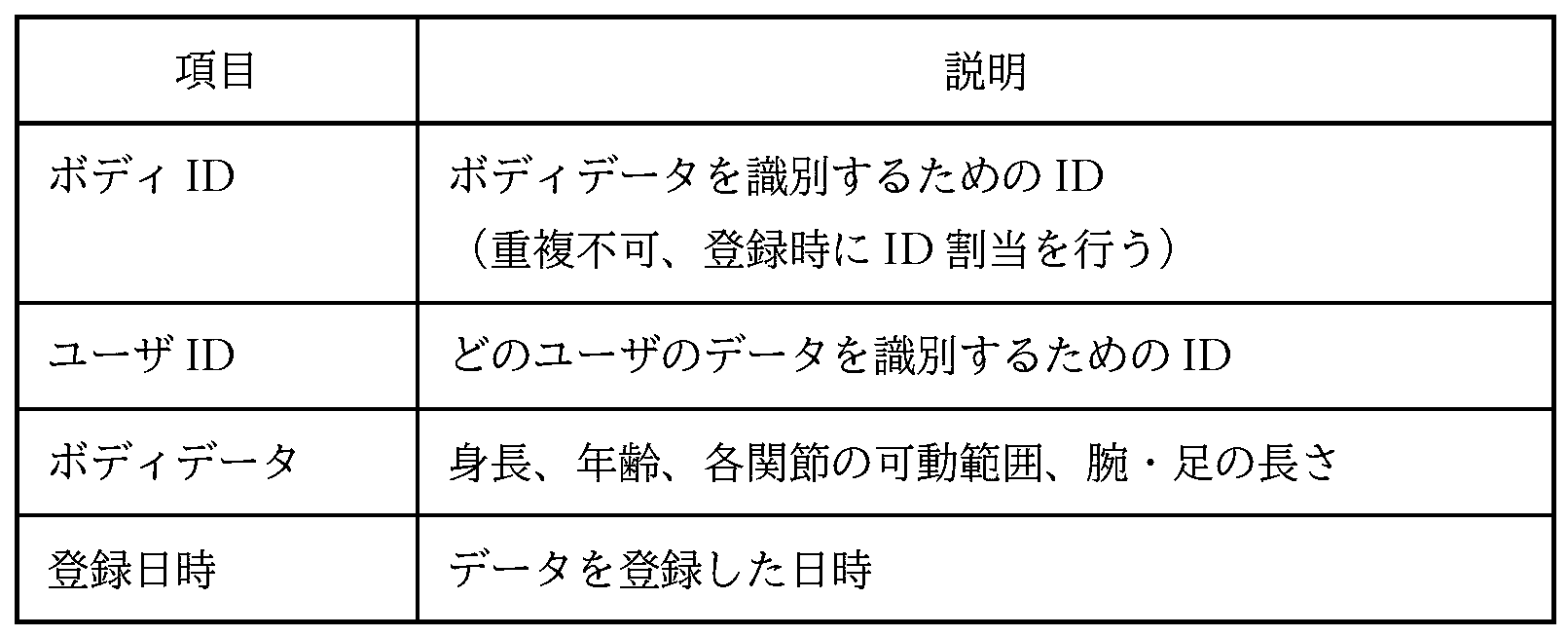
センサデータをアクチュエーション側に送信する前に、ユースケースに応じて変換処理が行われてよい。ユースケースまたは取り扱うデータの形式に応じて、次のような変換方法が設けられてよい。
・行列変換:関節角度など複数要素データに対して、部位の変換、倍率演算を行う
・周波数特性変換:波形データに対して、高速フーリエ変換(FFT)、強調変換、及び逆高速フーリエ変換(IFFT)を利用した特定周波数帯の強調演算を行う
何れの変換方法を適用するかについては、サービスから指定可能としてよい。
センシング側から送信されたデータを蓄積し、蓄積されたスキルデータの中から選択されたスキルデータがアクチュエーション側に送信されてよい。センシング側から送信されたデータは、ユーザ毎に動作DB140(操作DBとよばれてもよい)において管理される。

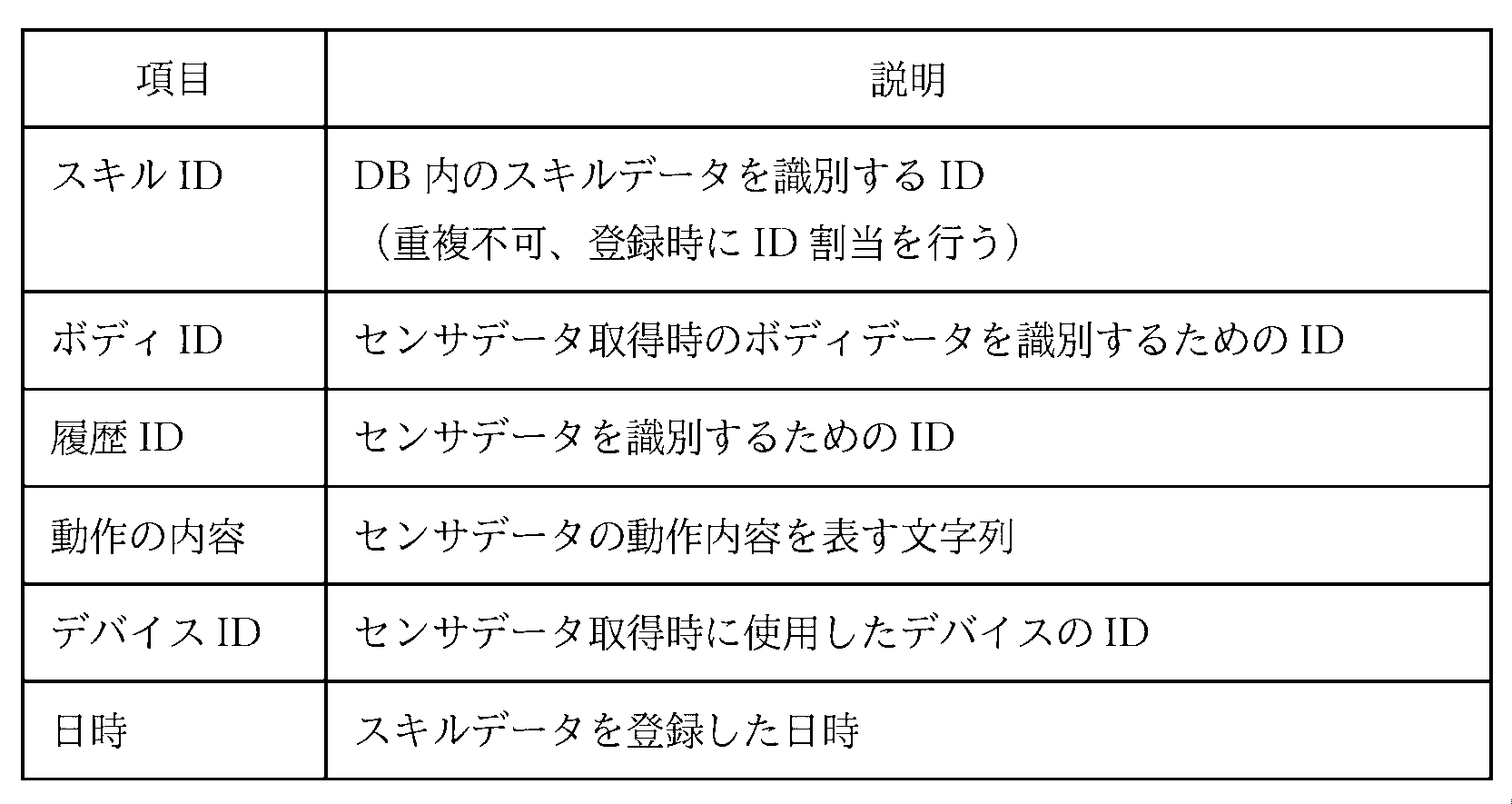
脳波による択一選択(例えば、4択または8択)を行うため、選択肢と、当該選択肢に対する動作のマッピングを行う仕組みが設けられる。選択肢に対する動作としては、スキルデータの再生と、別の択一選択への遷移とに対応してよい。
サービス管理では、サービスの登録・編集・削除が行える。サービスに関する情報は、サービスDBにおいて管理される。表4は、サービスDB構成の一例を示す。
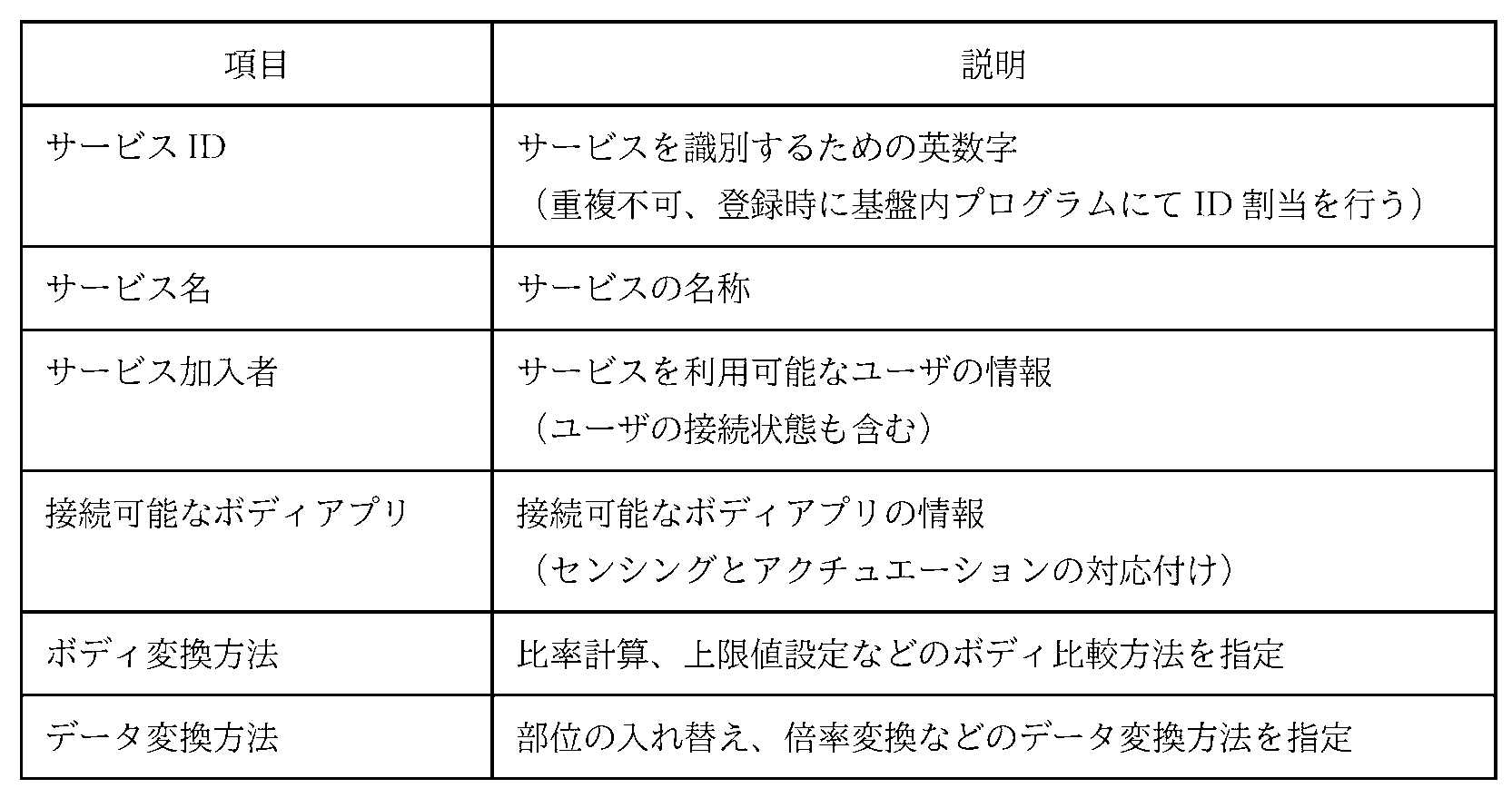
人間拡張プラットフォーム装置100にアクセスする際にユーザを識別するため、アカウントの登録・編集・削除が可能である。上述したように、アカウントの種別としては、(1)プラットフォーム管理者、(2)サービス管理者、(3)一般ユーザが設けられてよい。

人間拡張プラットフォーム装置100(プラットフォーム)へのアクセスを許可するデバイスの識別を行うため、デバイス情報の登録・編集・削除が可能である。デバイス(ハードウェア)とボディアプリ(ソフトウェア)との組み合わせで登録されてよい。同じデバイスであっても機能の異なるボディアプリが複数存在するためである。
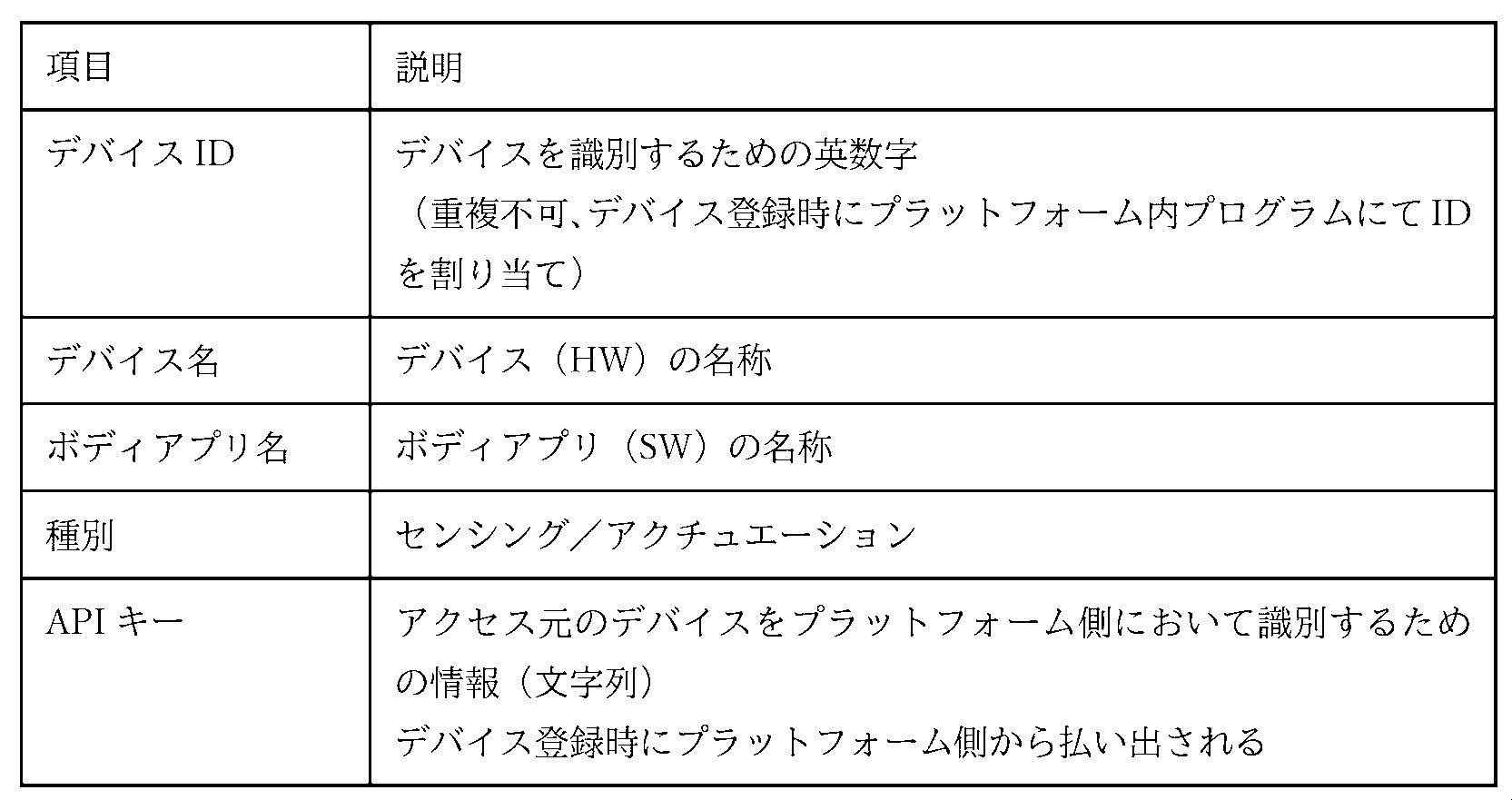
ボディデータとは、他のボディと比較が必要なユーザの身体に関するデータと解釈されてよい。センサデータとは、ユーザの身体の状態を伝達するためのデータと解釈されてよい。ボディデータ及びセンサデータとして、次のような人間に関するデータが定義されてよい。
・上肢・下肢の関節角度、上肢・下肢の部位の長さ
・手・足のグリップ力
・手、足の触覚
・感情(緊張度)
このようなデータは、アクチュエータに伝えることができる人間に関するデータの種類と解釈されてよい。
デバイス開発者向けとして、人間拡張プラットフォーム装置100との接続の難易度を下げることが可能なSDK(開発キット)が提供されてよい。SDKは、ボディアプリから人間拡張プラットフォーム装置100へのアクセス(接続、状態通知、データ送信、及びデータ取得など)するためのAPIを備える。SDKは、ボディアプリが人間拡張プラットフォーム装置100からの通知を受信するためのコールバックの仕組みを備えてもよい。
図9は、センシング/アクチュエーションの指定パターンの例を示す。図9に示すように、アクチュエーションの開始者が、センシング側、アクチュエーション側或いは別の操作者となるケースが想定されてよい。
図10~15は、本実施形態に係る人間拡張プラットフォーム装置100のデータ連携制御機能及びサービス管理機能に関するシーケンス例を示す。
図16は、データ連携制御機能によるデータ変換要素の構成例を示す。人間拡張プラットフォーム装置100(制御データ生成部150)は、センサデータの変換処理を実行し、アクチュエーション側に送信する。図16に示すように、センサデータの変換方法は、ユースケースまたは取り扱うデータの形式に応じて、次の何れかが適用されてよい。
・行列変換:関節角度など複数要素データに対して、部位の変換(右手から左手など)、または倍率演算を行う
・周波数特性変換:触覚(音声データ)など波形データに対して、FFT、強調変換、IFFTを利用した特定周波数帯の強調演算を行う
なお、取り扱うデータ種別が増えた場合、既存の変換方法から選択可能としてもよい。
図17は、選択肢マッピングの一例を示す。人間拡張プラットフォーム装置100は、脳波による択一選択を行うため、選択肢と、当該選択肢に対する動作のマッピングを行う。
本実施形態に係る人間拡張プラットフォーム装置100によれば、データ連携制御機能及びサービス管理機能によって、ボディ比較及びデータ変換(スカラ変換、行列変換・周波数特性変換)の処理を実行でき、センシング側とアクチュエーション側(被制御側)とのさらに高度な相互連携性を実現し得る。
以上、実施例に沿って本発明の内容を説明したが、本発明はこれらの記載に限定されるものではなく、種々の変形及び改良が可能であることは、当業者には自明である。
上述した開示は、以下のように表現されてもよい。
20 通信ネットワーク
40 筋電センサ
50 脳波センサ
55 触覚センサ
60 ロボット
70 筋電アクチュエータ
100 人間拡張プラットフォーム装置
110 身体情報取得部
120 動作データ取得部
130 身体情報DB
140 動作DB
150 制御データ生成部
160 アクチュエーション部
170 選択肢マッピング部
180 スキルDB
1001 プロセッサ
1002 メモリ
1003 ストレージ
1004 通信装置
1005 入力装置
1006 出力装置
1007 バス
Claims (10)
- センシング側及び被制御側の身体能力を示す身体情報を取得する身体情報取得部と、
前記センシング側の動作データを取得する動作データ取得部と、
前記身体情報取得部によって取得された前記身体情報と、前記動作データ取得部によって取得された前記動作データとに基づいて、前記被制御側の制御データを生成する制御データ生成部と、
前記制御データに基づいて前記被制御側の身体を作動させるアクチュエーション部と
を備え、
前記制御データ生成部は、前記被制御側の身体能力の範囲内となる前記制御データを生成する人間拡張プラットフォーム装置。 - 前記制御データ生成部は、前記センシング側の身体能力の範囲と、前記被制御側の身体能力の範囲との比較結果に基づいて、前記センシング側の身体能力に対して前記被制御側の身体能力が比例する前記制御データを生成する請求項1に記載の人間拡張プラットフォーム装置。
- 前記制御データ生成部は、前記被制御側の身体能力の許容値に基づいて、前記制御データを生成する請求項1に記載の人間拡張プラットフォーム装置。
- 前記制御データ生成部は、前記センシング側の前記身体情報と、前記被制御側の前記身体情報との比率に基づいて、前記制御データを生成する請求項1に記載の人間拡張プラットフォーム装置。
- 前記制御データ生成部は、
前記センシング側の肢体の部位と、前記被制御側の肢体の部位とが異なる場合、前記センシング側の部位の動作データを前記被制御側の部位の動作データに変換し、
前記身体情報と、変換した前記動作データとに基づいて前記制御データを生成する請求項1に記載の人間拡張プラットフォーム装置。 - 前記動作データ取得部によって取得された前記動作データを所定の特徴に基づいて整理したスキルデータとして蓄積するスキルデータ蓄積部を備え、
前記制御データ生成部は、前記スキルデータに基づいて、再生用の前記制御データを生成する請求項1に記載の人間拡張プラットフォーム装置。 - 前記制御データの選択肢をユーザに提示する選択肢マッピング部を備え、
前記選択肢マッピング部は、前記ユーザによって選択された前記選択肢と対応付けられた前記スキルデータを特定し、
前記制御データ生成部は、特定された前記スキルデータに基づいて、再生用の前記制御データを生成する請求項6に記載の人間拡張プラットフォーム装置。 - 前記制御データ生成部は、
前記被制御側の肢体の部位が複数存在する場合、それぞれの前記部位の前記動作データに基づく動作範囲が重複する場合、前記部位の何れかが他の前記部位と接触するか否かを判定し、
接触すると判定した場合、接触を回避する前記制御データを生成する請求項1に記載の人間拡張プラットフォーム装置。 - 前記制御データ生成部は、前記センシング側がロボットであり、前記被制御側がヒトである場合、動作速度が加速状態、一定状態、減速状態を経る前記制御データを生成する請求項1に記載の人間拡張プラットフォーム装置。
- センシング側及び被制御側の身体能力を示す身体情報を取得するステップと、
前記センシング側の動作データを取得するステップと、
前記身体情報と前記動作データとに基づいて、前記被制御側の制御データを生成するステップと、
前記制御データに基づいて前記被制御側の身体を作動させるステップと
を含み、
前記制御データを生成するステップでは、前記被制御側の身体能力の範囲内となる前記制御データを生成する身体能力拡張方法。
Priority Applications (3)
| Application Number | Priority Date | Filing Date | Title |
|---|---|---|---|
| JP2023573855A JP7656734B2 (ja) | 2022-01-14 | 2022-10-28 | 人間拡張プラットフォーム装置及び身体能力拡張方法 |
| US18/728,583 US20250345940A1 (en) | 2022-01-14 | 2022-10-28 | Human augmentation platform device and physical ability augmentation method |
| EP22920424.3A EP4462231A4 (en) | 2022-01-14 | 2022-10-28 | HUMAN AUGMENTATION PLATFORM DEVICE AND PHYSICAL CAPACITY AUGMENTATION METHOD |
Applications Claiming Priority (2)
| Application Number | Priority Date | Filing Date | Title |
|---|---|---|---|
| JP2022-004463 | 2022-01-14 | ||
| JP2022004463 | 2022-01-14 |
Publications (1)
| Publication Number | Publication Date |
|---|---|
| WO2023135902A1 true WO2023135902A1 (ja) | 2023-07-20 |
Family
ID=87278835
Family Applications (1)
| Application Number | Title | Priority Date | Filing Date |
|---|---|---|---|
| PCT/JP2022/040489 Ceased WO2023135902A1 (ja) | 2022-01-14 | 2022-10-28 | 人間拡張プラットフォーム装置及び身体能力拡張方法 |
Country Status (4)
| Country | Link |
|---|---|
| US (1) | US20250345940A1 (ja) |
| EP (1) | EP4462231A4 (ja) |
| JP (1) | JP7656734B2 (ja) |
| WO (1) | WO2023135902A1 (ja) |
Citations (6)
| Publication number | Priority date | Publication date | Assignee | Title |
|---|---|---|---|---|
| JP2009273551A (ja) * | 2008-05-13 | 2009-11-26 | Nippon Telegr & Teleph Corp <Ntt> | 運動学習支援装置 |
| JP2011139728A (ja) * | 2010-01-05 | 2011-07-21 | Nippon Telegr & Teleph Corp <Ntt> | 運動学習支援装置および方法 |
| JP2015089605A (ja) * | 2013-11-07 | 2015-05-11 | 学校法人立命館 | マスタスレーブシステム |
| JP2017023223A (ja) * | 2015-07-16 | 2017-02-02 | 国立大学法人埼玉大学 | 機能的電気刺激を用いた双方向遠隔制御システム |
| WO2017033381A1 (ja) * | 2015-08-25 | 2017-03-02 | 川崎重工業株式会社 | ロボットシステム |
| JP2017146115A (ja) * | 2016-02-15 | 2017-08-24 | オムロン株式会社 | 演算装置、演算方法及び演算プログラム |
Family Cites Families (4)
| Publication number | Priority date | Publication date | Assignee | Title |
|---|---|---|---|---|
| CN110049742B (zh) * | 2016-12-07 | 2023-01-03 | 皇家飞利浦有限公司 | 用于机器人控制的图像引导的运动缩放 |
| CN107914273A (zh) * | 2017-11-08 | 2018-04-17 | 浙江工业大学 | 基于手势控制的机械臂示教系统 |
| CN207888651U (zh) * | 2018-02-08 | 2018-09-21 | 华南理工大学 | 一种基于动作融合的机器人示教系统 |
| CN113618717B (zh) * | 2021-09-07 | 2023-01-24 | 浙江理工大学 | 人体上肢技能动作感测学习装置及方法 |
-
2022
- 2022-10-28 WO PCT/JP2022/040489 patent/WO2023135902A1/ja not_active Ceased
- 2022-10-28 EP EP22920424.3A patent/EP4462231A4/en active Pending
- 2022-10-28 JP JP2023573855A patent/JP7656734B2/ja active Active
- 2022-10-28 US US18/728,583 patent/US20250345940A1/en active Pending
Patent Citations (6)
| Publication number | Priority date | Publication date | Assignee | Title |
|---|---|---|---|---|
| JP2009273551A (ja) * | 2008-05-13 | 2009-11-26 | Nippon Telegr & Teleph Corp <Ntt> | 運動学習支援装置 |
| JP2011139728A (ja) * | 2010-01-05 | 2011-07-21 | Nippon Telegr & Teleph Corp <Ntt> | 運動学習支援装置および方法 |
| JP2015089605A (ja) * | 2013-11-07 | 2015-05-11 | 学校法人立命館 | マスタスレーブシステム |
| JP2017023223A (ja) * | 2015-07-16 | 2017-02-02 | 国立大学法人埼玉大学 | 機能的電気刺激を用いた双方向遠隔制御システム |
| WO2017033381A1 (ja) * | 2015-08-25 | 2017-03-02 | 川崎重工業株式会社 | ロボットシステム |
| JP2017146115A (ja) * | 2016-02-15 | 2017-08-24 | オムロン株式会社 | 演算装置、演算方法及び演算プログラム |
Non-Patent Citations (2)
| Title |
|---|
| NTT DOCOMO, DOCOMO 6G WHITE PAPER 4.0 EDITION, November 2021 (2021-11-01), Retrieved from the Internet <URL:https://www.nttdocomo.co.jp/binary/pdf/corporate/technology/whitepaper_6g/DOCOMO_6G_White_PaperJP_20211108.pdf> |
| See also references of EP4462231A4 |
Also Published As
| Publication number | Publication date |
|---|---|
| EP4462231A4 (en) | 2026-01-07 |
| JPWO2023135902A1 (ja) | 2023-07-20 |
| JP7656734B2 (ja) | 2025-04-03 |
| EP4462231A1 (en) | 2024-11-13 |
| US20250345940A1 (en) | 2025-11-13 |
Similar Documents
| Publication | Publication Date | Title |
|---|---|---|
| KR101687521B1 (ko) | 멀티-스크린 상호작용 방법, 장치, 및 시스템 | |
| US7984194B2 (en) | Dynamically configurable switch for distributed test lab | |
| CN109548178A (zh) | 一种通信方法和网络设备 | |
| US8069222B2 (en) | System and method to provide services based on network | |
| CN113204977B (zh) | 信息翻译方法、装置、设备和存储介质 | |
| JP7648799B2 (ja) | 5gms認識アプリケーションによるエッジ・サーバー発見およびインスタンス化のトリガーのための方法、装置および媒体 | |
| CN104168667A (zh) | 数据获取的方法、装置及系统 | |
| CN116367187A (zh) | Ai模型传输方法、装置、设备及存储介质 | |
| CN105187480A (zh) | 配置文件获取方法、装置及系统 | |
| CN103970279A (zh) | 一种云游戏控制方法及系统 | |
| Baek et al. | 5g k-simulator of flexible, open, modular (fom) structure and web-based 5g k-simplatform | |
| JP7656734B2 (ja) | 人間拡張プラットフォーム装置及び身体能力拡張方法 | |
| US11886325B2 (en) | Network status simulation for remote device infrastructure | |
| WO2024144758A1 (en) | Intent based optimization of ran and o-cloud resources in smo o-ran framework | |
| EP2930616B1 (en) | Device and method for generating application package | |
| Kobayashi | EMG/ECG acquisition system with online adjustable parameters using ZigBee wireless technology | |
| CN116208596A (zh) | 文件传输方法、装置、电子设备、存储介质和程序产品 | |
| CN111508484B (zh) | 语音数据的处理方法及装置 | |
| WO2023125934A1 (zh) | Ai网络信息传输方法、装置及通信设备 | |
| KR20210012258A (ko) | 학습자의 요구를 반영한 이러닝 학습콘텐츠 제공시스템 | |
| KR101355879B1 (ko) | 사용자 장비에 통신을 제공하기 위한 방법 및 디바이스 | |
| CN116954809B (zh) | 基于安卓设备的远程控制方法、装置、系统及电子设备 | |
| US20260128954A1 (en) | Systems and methods of a digital twin network for communicating with virtual world environments | |
| Danas et al. | Designing user-specific plug-n-play into body area networks | |
| KR102888331B1 (ko) | 영상에 포함된 객체에 대한 추론을 수행하는 방법 및 디바이스 |
Legal Events
| Date | Code | Title | Description |
|---|---|---|---|
| 121 | Ep: the epo has been informed by wipo that ep was designated in this application |
Ref document number: 22920424 Country of ref document: EP Kind code of ref document: A1 |
|
| ENP | Entry into the national phase |
Ref document number: 2023573855 Country of ref document: JP Kind code of ref document: A |
|
| WWE | Wipo information: entry into national phase |
Ref document number: 2022920424 Country of ref document: EP |
|
| ENP | Entry into the national phase |
Ref document number: 2022920424 Country of ref document: EP Effective date: 20240807 |
|
| NENP | Non-entry into the national phase |
Ref country code: DE |
|
| WWP | Wipo information: published in national office |
Ref document number: 18728583 Country of ref document: US |