WO2023140036A1 - シリコーン鎖含有重合体、シリコーン鎖含有重合体の製造方法、コーティング組成物、レジスト組成物及び物品 - Google Patents
シリコーン鎖含有重合体、シリコーン鎖含有重合体の製造方法、コーティング組成物、レジスト組成物及び物品 Download PDFInfo
- Publication number
- WO2023140036A1 WO2023140036A1 PCT/JP2022/047259 JP2022047259W WO2023140036A1 WO 2023140036 A1 WO2023140036 A1 WO 2023140036A1 JP 2022047259 W JP2022047259 W JP 2022047259W WO 2023140036 A1 WO2023140036 A1 WO 2023140036A1
- Authority
- WO
- WIPO (PCT)
- Prior art keywords
- group
- polymerizable monomer
- silicone chain
- carbon atoms
- containing polymer
- Prior art date
- Legal status (The legal status is an assumption and is not a legal conclusion. Google has not performed a legal analysis and makes no representation as to the accuracy of the status listed.)
- Ceased
Links
Classifications
-
- C—CHEMISTRY; METALLURGY
- C08—ORGANIC MACROMOLECULAR COMPOUNDS; THEIR PREPARATION OR CHEMICAL WORKING-UP; COMPOSITIONS BASED THEREON
- C08F—MACROMOLECULAR COMPOUNDS OBTAINED BY REACTIONS ONLY INVOLVING CARBON-TO-CARBON UNSATURATED BONDS
- C08F299/00—Macromolecular compounds obtained by interreacting polymers involving only carbon-to-carbon unsaturated bond reactions, in the absence of non-macromolecular monomers
- C08F299/02—Macromolecular compounds obtained by interreacting polymers involving only carbon-to-carbon unsaturated bond reactions, in the absence of non-macromolecular monomers from unsaturated polycondensates
- C08F299/08—Macromolecular compounds obtained by interreacting polymers involving only carbon-to-carbon unsaturated bond reactions, in the absence of non-macromolecular monomers from unsaturated polycondensates from polysiloxanes
-
- C—CHEMISTRY; METALLURGY
- C08—ORGANIC MACROMOLECULAR COMPOUNDS; THEIR PREPARATION OR CHEMICAL WORKING-UP; COMPOSITIONS BASED THEREON
- C08G—MACROMOLECULAR COMPOUNDS OBTAINED OTHERWISE THAN BY REACTIONS ONLY INVOLVING UNSATURATED CARBON-TO-CARBON BONDS
- C08G77/00—Macromolecular compounds obtained by reactions forming a linkage containing silicon with or without sulfur, nitrogen, oxygen or carbon in the main chain of the macromolecule
- C08G77/04—Polysiloxanes
- C08G77/14—Polysiloxanes containing silicon bound to oxygen-containing groups
- C08G77/18—Polysiloxanes containing silicon bound to oxygen-containing groups to alkoxy or aryloxy groups
-
- C—CHEMISTRY; METALLURGY
- C08—ORGANIC MACROMOLECULAR COMPOUNDS; THEIR PREPARATION OR CHEMICAL WORKING-UP; COMPOSITIONS BASED THEREON
- C08F—MACROMOLECULAR COMPOUNDS OBTAINED BY REACTIONS ONLY INVOLVING CARBON-TO-CARBON UNSATURATED BONDS
- C08F220/00—Copolymers of compounds having one or more unsaturated aliphatic radicals, each having only one carbon-to-carbon double bond, and only one being terminated by only one carboxyl radical or a salt, anhydride ester, amide, imide or nitrile thereof
- C08F220/02—Monocarboxylic acids having less than ten carbon atoms; Derivatives thereof
- C08F220/10—Esters
- C08F220/26—Esters containing oxygen in addition to the carboxy oxygen
- C08F220/28—Esters containing oxygen in addition to the carboxy oxygen containing no aromatic rings in the alcohol moiety
- C08F220/285—Esters containing oxygen in addition to the carboxy oxygen containing no aromatic rings in the alcohol moiety and containing a polyether chain in the alcohol moiety
-
- C—CHEMISTRY; METALLURGY
- C08—ORGANIC MACROMOLECULAR COMPOUNDS; THEIR PREPARATION OR CHEMICAL WORKING-UP; COMPOSITIONS BASED THEREON
- C08F—MACROMOLECULAR COMPOUNDS OBTAINED BY REACTIONS ONLY INVOLVING CARBON-TO-CARBON UNSATURATED BONDS
- C08F220/00—Copolymers of compounds having one or more unsaturated aliphatic radicals, each having only one carbon-to-carbon double bond, and only one being terminated by only one carboxyl radical or a salt, anhydride ester, amide, imide or nitrile thereof
- C08F220/02—Monocarboxylic acids having less than ten carbon atoms; Derivatives thereof
- C08F220/10—Esters
- C08F220/26—Esters containing oxygen in addition to the carboxy oxygen
- C08F220/28—Esters containing oxygen in addition to the carboxy oxygen containing no aromatic rings in the alcohol moiety
- C08F220/285—Esters containing oxygen in addition to the carboxy oxygen containing no aromatic rings in the alcohol moiety and containing a polyether chain in the alcohol moiety
- C08F220/287—Esters containing oxygen in addition to the carboxy oxygen containing no aromatic rings in the alcohol moiety and containing a polyether chain in the alcohol moiety and containing polypropylene oxide in the alcohol moiety
-
- C—CHEMISTRY; METALLURGY
- C08—ORGANIC MACROMOLECULAR COMPOUNDS; THEIR PREPARATION OR CHEMICAL WORKING-UP; COMPOSITIONS BASED THEREON
- C08F—MACROMOLECULAR COMPOUNDS OBTAINED BY REACTIONS ONLY INVOLVING CARBON-TO-CARBON UNSATURATED BONDS
- C08F290/00—Macromolecular compounds obtained by polymerising monomers on to polymers modified by introduction of aliphatic unsaturated end or side groups
- C08F290/02—Macromolecular compounds obtained by polymerising monomers on to polymers modified by introduction of aliphatic unsaturated end or side groups on to polymers modified by introduction of unsaturated end groups
- C08F290/06—Polymers provided for in subclass C08G
- C08F290/068—Polysiloxanes
-
- C—CHEMISTRY; METALLURGY
- C08—ORGANIC MACROMOLECULAR COMPOUNDS; THEIR PREPARATION OR CHEMICAL WORKING-UP; COMPOSITIONS BASED THEREON
- C08F—MACROMOLECULAR COMPOUNDS OBTAINED BY REACTIONS ONLY INVOLVING CARBON-TO-CARBON UNSATURATED BONDS
- C08F299/00—Macromolecular compounds obtained by interreacting polymers involving only carbon-to-carbon unsaturated bond reactions, in the absence of non-macromolecular monomers
- C08F299/02—Macromolecular compounds obtained by interreacting polymers involving only carbon-to-carbon unsaturated bond reactions, in the absence of non-macromolecular monomers from unsaturated polycondensates
- C08F299/022—Macromolecular compounds obtained by interreacting polymers involving only carbon-to-carbon unsaturated bond reactions, in the absence of non-macromolecular monomers from unsaturated polycondensates from polycondensates with side or terminal unsaturations
- C08F299/024—Macromolecular compounds obtained by interreacting polymers involving only carbon-to-carbon unsaturated bond reactions, in the absence of non-macromolecular monomers from unsaturated polycondensates from polycondensates with side or terminal unsaturations the unsaturation being in acrylic or methacrylic groups
-
- C—CHEMISTRY; METALLURGY
- C09—DYES; PAINTS; POLISHES; NATURAL RESINS; ADHESIVES; COMPOSITIONS NOT OTHERWISE PROVIDED FOR; APPLICATIONS OF MATERIALS NOT OTHERWISE PROVIDED FOR
- C09D—COATING COMPOSITIONS, e.g. PAINTS, VARNISHES OR LACQUERS; FILLING PASTES; CHEMICAL PAINT OR INK REMOVERS; INKS; CORRECTING FLUIDS; WOODSTAINS; PASTES OR SOLIDS FOR COLOURING OR PRINTING; USE OF MATERIALS THEREFOR
- C09D151/00—Coating compositions based on graft polymers in which the grafted component is obtained by reactions only involving carbon-to-carbon unsaturated bonds; Coating compositions based on derivatives of such polymers
- C09D151/08—Coating compositions based on graft polymers in which the grafted component is obtained by reactions only involving carbon-to-carbon unsaturated bonds; Coating compositions based on derivatives of such polymers grafted on to macromolecular compounds obtained otherwise than by reactions only involving carbon-to-carbon unsaturated bonds
- C09D151/085—Coating compositions based on graft polymers in which the grafted component is obtained by reactions only involving carbon-to-carbon unsaturated bonds; Coating compositions based on derivatives of such polymers grafted on to macromolecular compounds obtained otherwise than by reactions only involving carbon-to-carbon unsaturated bonds on to polysiloxanes
-
- C—CHEMISTRY; METALLURGY
- C09—DYES; PAINTS; POLISHES; NATURAL RESINS; ADHESIVES; COMPOSITIONS NOT OTHERWISE PROVIDED FOR; APPLICATIONS OF MATERIALS NOT OTHERWISE PROVIDED FOR
- C09D—COATING COMPOSITIONS, e.g. PAINTS, VARNISHES OR LACQUERS; FILLING PASTES; CHEMICAL PAINT OR INK REMOVERS; INKS; CORRECTING FLUIDS; WOODSTAINS; PASTES OR SOLIDS FOR COLOURING OR PRINTING; USE OF MATERIALS THEREFOR
- C09D155/00—Coating compositions based on homopolymers or copolymers, obtained by polymerisation reactions only involving carbon-to-carbon unsaturated bonds, not provided for in groups C09D123/00 - C09D153/00
-
- C—CHEMISTRY; METALLURGY
- C09—DYES; PAINTS; POLISHES; NATURAL RESINS; ADHESIVES; COMPOSITIONS NOT OTHERWISE PROVIDED FOR; APPLICATIONS OF MATERIALS NOT OTHERWISE PROVIDED FOR
- C09D—COATING COMPOSITIONS, e.g. PAINTS, VARNISHES OR LACQUERS; FILLING PASTES; CHEMICAL PAINT OR INK REMOVERS; INKS; CORRECTING FLUIDS; WOODSTAINS; PASTES OR SOLIDS FOR COLOURING OR PRINTING; USE OF MATERIALS THEREFOR
- C09D4/00—Coating compositions, e.g. paints, varnishes or lacquers, based on organic non-macromolecular compounds having at least one polymerisable carbon-to-carbon unsaturated bond ; Coating compositions, based on monomers of macromolecular compounds of groups C09D183/00 - C09D183/16
- C09D4/06—Organic non-macromolecular compounds having at least one polymerisable carbon-to-carbon unsaturated bond in combination with a macromolecular compound other than an unsaturated polymer of groups C09D159/00 - C09D187/00
-
- G—PHYSICS
- G02—OPTICS
- G02B—OPTICAL ELEMENTS, SYSTEMS OR APPARATUS
- G02B5/00—Optical elements other than lenses
- G02B5/20—Filters
-
- G—PHYSICS
- G03—PHOTOGRAPHY; CINEMATOGRAPHY; ANALOGOUS TECHNIQUES USING WAVES OTHER THAN OPTICAL WAVES; ELECTROGRAPHY; HOLOGRAPHY
- G03F—PHOTOMECHANICAL PRODUCTION OF TEXTURED OR PATTERNED SURFACES, e.g. FOR PRINTING, FOR PROCESSING OF SEMICONDUCTOR DEVICES; MATERIALS THEREFOR; ORIGINALS THEREFOR; APPARATUS SPECIALLY ADAPTED THEREFOR
- G03F7/00—Photomechanical, e.g. photolithographic, production of textured or patterned surfaces, e.g. printing surfaces; Materials therefor, e.g. comprising photoresists; Apparatus specially adapted therefor
- G03F7/004—Photosensitive materials
-
- G—PHYSICS
- G03—PHOTOGRAPHY; CINEMATOGRAPHY; ANALOGOUS TECHNIQUES USING WAVES OTHER THAN OPTICAL WAVES; ELECTROGRAPHY; HOLOGRAPHY
- G03F—PHOTOMECHANICAL PRODUCTION OF TEXTURED OR PATTERNED SURFACES, e.g. FOR PRINTING, FOR PROCESSING OF SEMICONDUCTOR DEVICES; MATERIALS THEREFOR; ORIGINALS THEREFOR; APPARATUS SPECIALLY ADAPTED THEREFOR
- G03F7/00—Photomechanical, e.g. photolithographic, production of textured or patterned surfaces, e.g. printing surfaces; Materials therefor, e.g. comprising photoresists; Apparatus specially adapted therefor
- G03F7/004—Photosensitive materials
- G03F7/075—Silicon-containing compounds
- G03F7/0757—Macromolecular compounds containing Si-O, Si-C or Si-N bonds
-
- C—CHEMISTRY; METALLURGY
- C08—ORGANIC MACROMOLECULAR COMPOUNDS; THEIR PREPARATION OR CHEMICAL WORKING-UP; COMPOSITIONS BASED THEREON
- C08G—MACROMOLECULAR COMPOUNDS OBTAINED OTHERWISE THAN BY REACTIONS ONLY INVOLVING UNSATURATED CARBON-TO-CARBON BONDS
- C08G2150/00—Compositions for coatings
Definitions
- the present invention relates to a silicone chain-containing polymer, a method for producing a silicone chain-containing polymer, a coating composition, a resist composition, and an article.
- a leveling agent is added to smooth the coating film obtained by applying a coating composition such as a coating composition or a resist composition. Specifically, by adding a leveling agent to the coating composition, the leveling agent is oriented on the surface of the coating film to lower the surface tension of the coating film, thereby smoothing the resulting coating film.
- a coating film having a smooth surface can improve repellency and unevenness.
- Leveling agents are used, for example, in automotive paints, and a coating composition containing a leveling agent can impart high smoothness to the resulting coating film surface and can impart gloss to the appearance of automobiles.
- a silicone-based leveling agent has been proposed, and a leveling agent having a relatively short silicone chain (for example, Patent Document 1) and a leveling agent having a relatively long silicone chain (for example, Patent Document 2) have also been proposed.
- leveling agents are diverse, and they are also used, for example, in color resist compositions used in the production of color filters for liquid crystal displays.
- the production of color filters generally includes the steps of applying a color resist composition onto a glass substrate by a coating method such as spin coating or slit coating, exposing the dried coating film to light using a mask, and then developing to form a colored pattern. At this time, when the smoothness of the coating film is not good and the film thickness is uneven, or when there is coating unevenness, cissing, etc., color unevenness may occur in the pixels.
- the smoothness of the resulting coating film is improved, and the surface of the red (R), green (G), and blue (B) pixels and the black matrix (BM) formed between these pixels can exhibit high smoothness, and a color filter with little color unevenness can be obtained.
- a coating film obtained by coating a substrate with a coating composition containing a leveling agent can exhibit high smoothness.
- the coating film is generally dried in a vacuum drying device to evaporate the solvent in the coating film, and the coating film on the substrate is dried in the drying device chamber supported by support pins.
- a temperature difference occurs between the portion where the support pins and the base material are in contact with each other and the other portion, and there is a problem that uneven drying occurs due to the difference in drying rate. This pin unevenness was difficult to solve even when a leveling agent was added.
- the problem to be solved by the present invention is to provide a silicone chain-containing polymer that functions as a leveling agent that imparts high smoothness to the coating film and an effect of suppressing uneven pinning.
- the inventors of the present invention have found that, with regard to a silicone chain-containing polymer containing a polymerizable monomer having a specific silicone chain as a polymerization component, by setting the ratio of the polymerizable monomer having a silicone chain in the polymerization component to a specific range and setting the weight average molecular weight of the silicone chain-containing polymer to a specific range, the silicone chain-containing polymer imparts high smoothness and an effect of suppressing uneven pinning to the coating film, and completed the present invention.
- the present invention provides a silicone chain-containing polymer comprising, as polymerization components, a polymerizable monomer (1) having a group containing a structure represented by the following general formula (A), and a polymerizable monomer (2) having at least one selected from an alkyl group having 1 to 18 carbon atoms, an aromatic group having 6 to 18 carbon atoms, and a group containing a polyoxyalkylene chain, wherein the proportion of the polymerizable monomer (1) in the polymerization components is 20% by weight or less, and the weight average molecular weight is 1. It relates to a silicone chain-containing polymer having a molecular weight of 5,000 or more.
- each R 11 is independently an alkyl group having 1 to 6 carbon atoms; x indicates the number of repetitions, and the number average value is 20 or more.
- silicone chain-containing polymer that functions as a leveling agent that imparts high smoothness and an anti-cratering effect to coating films.
- (meth)acrylic acid means one or both of acrylic acid and methacrylic acid.
- the silicone chain-containing polymer of the present invention (hereinafter sometimes simply referred to as "the polymer of the present invention") is a silicone chain-containing polymer comprising, as polymerization components, a polymerizable monomer (1) having a group containing a structure represented by the following general formula (A), and a polymerizable monomer (2) having at least one selected from an alkyl group having 1 to 18 carbon atoms, an aromatic group having 6 to 18 carbon atoms, and a group containing a polyoxyalkylene chain, wherein the polymerizable monomer (1) accounts for the polymerizable components. is 20% by weight or less, and the weight average molecular weight is 15,000 or more.
- each R 11 is independently an alkyl group having 1 to 6 carbon atoms; x indicates the number of repetitions, and the number average value is 20 or more.
- polymerizable monomer means a compound having a polymerizable unsaturated group
- C C-containing groups
- a (meth)acryloyl group and a (meth)acryloyloxy group are preferable because of the availability of raw materials and favorable polymerization reactivity.
- the number of polymerizable unsaturated groups possessed by the polymerizable monomer may be one, or two or more.
- polymerization component means a component that constitutes a polymer, and does not include solvents, polymerization initiators, etc. that do not constitute a polymer.
- the group containing the structure represented by the general formula (A) is preferably a group represented by the following general formula (A1).
- each R 11 is independently an alkyl group having 1 to 6 carbon atoms
- each R 12 is independently an alkyl group having 1 to 6 carbon atoms
- R 13 is an alkyl group having 1 to 6 carbon atoms
- x indicates the number of repetitions, and the number average value is 20 or more.
- R 11 , R 12 and R 13 are preferably methyl groups.
- the number average value of x in the polymer of the present invention is 20 or more, preferably in the range of 30 to 300, more preferably in the range of 40 to 200, still more preferably in the range of 50 to 150.
- the "number average value of x" means the average number of repeating units of siloxane bonds per polymerizable monomer (1) constituting the polymer of the present invention.
- the number average value of x in the polymer of the invention can be calculated from the number average molecular weight of the polymer of the invention.
- the polymer of the present invention by setting the lower limit of the number average value of x in the polymer of the present invention to 20 or more, even if the proportion of the polymerizable monomer (1) is 20% by weight or less, the polymer of the present invention can exhibit a high surface tension-reducing ability, uniformly evaporate the solvent contained in the coating liquid, and suppress uneven pinning.
- the polymerizable monomer (1) is preferably a compound represented by the following general formula (1-1).
- R 11 , R 12 , R 13 and x are respectively the same as R 11 , R 12 , R 13 and x in the general formulas (A) and (A1);
- R 15 is a hydrogen atom or a methyl group,
- L 1 is a divalent organic group.
- the divalent organic group of L 1 is preferably a single bond, an alkylene group having 1 to 50 carbon atoms or an alkyleneoxy group having 1 to 50 carbon atoms.
- alkylene group having 1 to 50 carbon atoms for L 1 examples include methylene group, ethylene group, n-propylene group, n-butylene group, n-pentylene group, n-hexylene group, n-heptylene group, n-octylene group, n-nonylene group, n-decylene group, n-dodecylene group, isopropylene group, 2-methylpropylene group, 2-methylhexylene group and tetramethylethylene group.
- the alkylene group having 1 to 50 carbon atoms of L 1 is preferably an alkylene group having 1 to 15 carbon atoms, more preferably an alkylene group having 1 to 5 carbon atoms, and still more preferably a methylene group, an ethylene group, an n-propylene group or an isopropylene group.
- the alkyleneoxy group having 1 to 50 carbon atoms in L 1 is, for example, a group in which one —CH 2 — in the alkylene group is substituted with —O—.
- the alkyleneoxy group having 1 to 50 carbon atoms in L 1 is preferably an alkyleneoxy group having 1 to 15 carbon atoms, more preferably an alkyleneoxy group having 1 to 8 carbon atoms, and still more preferably a methyleneoxy group, an ethyleneoxy group, a propyleneoxy group, an oxytrimethylene group, a butyleneoxy group, an oxytetramethylene group, a pentyleneoxy group, a heptyleneoxy group, or an octyleneoxy group.
- the divalent organic group of L 1 is an alkylene group having 1 to 50 carbon atoms or an alkyleneoxy group having 1 to 50 carbon atoms
- the polymerizable monomer (1) can be produced by a known method, and commercially available products may be used.
- the polymerizable monomer (2) having one or more selected from an alkyl group having 1 to 18 carbon atoms, an aromatic group having 6 to 18 carbon atoms, and a group containing a polyoxyalkylene chain, which is a polymerization component of the polymer of the present invention, has a function of ensuring compatibility, for example.
- the alkyl group having 1 to 18 carbon atoms possessed by the polymerizable monomer (2) may be any of a linear alkyl group, a branched alkyl group, and a cyclic alkyl group, and specific examples thereof include a methyl group, an ethyl group, a normal propyl group, an isopropyl group, an n-butyl group, a t-butyl group, an n-hexyl group, a cyclohexyl group, an n-octyl group, and a hexadecyl group.
- the alkyl group having 1 to 18 carbon atoms of the polymerizable monomer (2) may be substituted with one or more substituents such as hydroxyl group, phenyl group and phenoxy group.
- the alkyl group having 1 to 18 carbon atoms possessed by the polymerizable monomer (2) includes, for example, a hydroxyalkyl group having 1 to 18 carbon atoms, a phenylalkyl group having 7 to 18 carbon atoms, and a phenoxyalkyl group having 7 to 18 carbon atoms.
- the alkyl group having 1 to 18 carbon atoms possessed by the polymerizable monomer (2) is preferably an alkyl group having 1 to 8 carbon atoms.
- Examples of the aromatic group having 6 to 18 carbon atoms possessed by the polymerizable monomer (2) include phenyl group, naphthyl group, anthracen-1-yl group, phenanthren-1-yl group and the like.
- the aromatic group having 6 to 18 carbon atoms in the polymerizable monomer (2) may be further substituted with a substituent such as a hydroxyl group, an alkyl group, or an alkoxy group, and includes a phenyl group substituted with an alkyl group having 1 to 6 carbon atoms.
- the group containing a polyoxyalkylene chain possessed by the polymerizable monomer (2) is a monovalent group containing a repeating oxyalkylene moiety or a divalent linking group containing a repeating oxyalkylene moiety.
- the polymerizable monomer (2) may be one or more selected from, for example, a polymerizable monomer having an alkyl group having 1 to 18 carbon atoms, a polymerizable monomer having an aromatic group having 6 to 18 carbon atoms, and a polymerizable monomer having a group containing a polyoxyalkylene chain.
- the polymerizable monomer (2) essentially contains a polymerizable monomer having a group containing a polyoxyalkylene chain.
- Examples of the polymerizable monomer (2) having an alkyl group having 1 to 18 carbon atoms and having a (meth)acryloyl group as the polymerizable unsaturated group include methyl (meth) acrylate, ethyl (meth) acrylate, n-propyl (meth) acrylate, isopropyl (meth) acrylate, n-butyl (meth) acrylate, s-butyl (meth) acrylate, isobutyl (meth) acrylate, t-butyl (meth) acrylate, n-pentyl (meth) acrylate, n-hexyl (meth) acrylate, n- Heptyl (meth)acrylate, n-octyl (meth)acrylate, 2-ethylhexyl (meth)acrylate, decyl (meth)acrylate, dodecyl (meth)acrylate, steary
- Examples of the polymerizable monomer (2) having a hydroxyalkyl group having 1 to 18 carbon atoms and having a (meth)acryloyl group as the polymerizable unsaturated group include 2-hydroxyethyl (meth)acrylate, 2-hydroxypropyl (meth)acrylate, 2-hydroxybutyl (meth)acrylate, 4-hydroxy (meth)acrylate, 1,4-cyclohexanedimethanol mono(meth)acrylate, 2,3-dihydroxypropyl (meth)acrylate, and the like.
- Examples of the polymerizable monomer (2) having a phenylalkyl group having 7 to 18 carbon atoms or a phenoxyalkyl group having 7 to 18 carbon atoms and having a (meth)acryloyl group as the polymerizable unsaturated group include benzyl (meth)acrylate, 2-phenoxymethyl (meth)acrylate, 2-phenoxyethyl (meth)acrylate, and 2-hydroxy-3-phenoxypropyl (meth)acrylate.
- Examples of the polymerizable monomer (2) having a group containing a polyoxyalkylene chain and having a (meth)acryloyl group as the polymerizable unsaturated group include polypropylene glycol mono(meth)acrylate, polyethylene glycol mono(meth)acrylate, polytrimethylene glycol mono(meth)acrylate, polytetramethylene glycol mono(meth)acrylate, poly(ethylene glycol/propylene glycol) mono(meth)acrylate, polyethylene glycol/polypropylene glycol mono(meth)acrylate, poly(ethylene glycol/tetramethylene glycol) mono(meth)acrylate, polyethylene glycol/polytetramethylene glycol).
- poly(ethylene glycol/propylene glycol) means a random copolymer of ethylene glycol and propylene glycol
- polyethylene glycol/polypropylene glycol means a block copolymer of ethylene glycol and propylene glycol
- Examples of the polymerizable monomer (2) having an alkyl group having 1 to 18 carbon atoms and having a vinyl ether group as the polymerizable unsaturated group include methyl vinyl ether, ethyl vinyl ether, n-propyl vinyl ether, isopropyl vinyl ether, n-butyl vinyl ether, isobutyl vinyl ether, tert-butyl vinyl ether, n-pentyl vinyl ether, n-hexyl vinyl ether, n-octyl vinyl ether, n-dodecyl vinyl ether, 2-ethylhexyl vinyl ether, cyclohexyl vinyl ether, and the like.
- Examples of the polymerizable monomer (2) having an alkyl group having 1 to 18 carbon atoms and having an allyl group as the polymerizable unsaturated group include 2-hydroxyethyl allyl ether, 4-hydroxybutyl allyl ether, and glycerol monoallyl ether.
- Examples of the polymerizable monomer (2) having an aromatic group having 6 to 18 carbon atoms include styrene, ⁇ -methylstyrene, p-methylstyrene, p-methoxystyrene and the like.
- Examples of the polymerizable monomer (2) having an alkyl group having 1 to 18 carbon atoms and having a (meth)acryloylamino group as the polymerizable unsaturated group include N,N-dimethylacrylamide, N,N-diethylacrylamide, N-isopropylacrylamide, diacetoneacrylamide, and acryloylmorpholine.
- Examples of the polymerizable monomer (2) having an alkyl group having 1 to 18 carbon atoms and having a maleimide group as the polymerizable unsaturated group include methylmaleimide, ethylmaleimide, propylmaleimide, butylmaleimide, hexylmaleimide, octylmaleimide, dodecylmaleimide, stearylmaleimide, and cyclohexylmaleimide.
- the polymerizable monomer (2) is preferably a compound represented by the following general formula (2-1) and/or a compound represented by (2-2). These compounds can impart compatibility when the polymer of the present invention is used as a leveling agent.
- R 21 is an alkyl group having 1 to 18 carbon atoms
- R 22 is a hydrogen atom or a methyl group
- R 23 is a hydrogen atom or an alkyl group having 1 to 18 carbon atoms
- R 24 is a hydrogen atom or a methyl group
- n is an integer in the range 1-4 and m is an integer in the range 1-200.
- n in parenthesized C n H 2n O may be the same or different for each repeating unit. Moreover, when n is 2 or more types, 2 or more types of repeating units may be random polymerization or block polymerization.
- the alkyl group having 1 to 18 carbon atoms for R 21 and R 23 is preferably an alkyl group having 1 to 8 carbon atoms.
- m is preferably an integer in the range of 2-50, more preferably an integer in the range of 3-20.
- the polymerizable monomer (2) is preferably a compound represented by the following general formula (2-3).
- each R 25 is independently an alkyl group having 1 to 6 carbon atoms or an alkoxy group having 1 to 6 carbon atoms;
- R 26 is a hydrogen atom or a methyl group, l is an integer from 0 to 5;
- Polymerizable monomer (2) can be produced by a known method. Moreover, a commercial item may be used for the polymerizable monomer (2).
- commercially available polymerizable monomers (3-2) having a group containing a polyoxyalkylene chain and having a (meth)acryloyl group as the polymerizable unsaturated group include "NK Ester M-20G”, “NK Ester M-40G”, “NK Ester M-90G”, “NK Ester M-230G”, “NK Ester AM-90G”, “NK Ester AMP-10G”, and "NK” manufactured by Shin-Nakamura Chemical Co., Ltd.
- the polymer of the present invention may be any polymer containing the polymerizable monomer (1) and the polymerizable monomer (2) as polymerization components, and the polymerization method is not particularly limited.
- the polymer of the present invention may be a random copolymer of the polymerizable monomer (1) and the polymerizable monomer (2), or may be a block copolymer of the polymerizable monomer (1) and the polymerizable monomer (2), preferably a block copolymer of the polymerizable monomer (1) and the polymerizable monomer (2).
- the polymer of the present invention is a block copolymer of the polymerizable monomer (1) and the polymerizable monomer (2)
- the number and bonding order of the polymer block of the polymerizable monomer (1) and the polymer block of the polymerizable monomer (2) are not particularly limited.
- the polymerizable monomer (1) may be a single polymerizable monomer (1) or two or more polymerizable monomers (1) having different structures.
- the polymerizable monomer (2) in the polymerization component may be a single polymerizable monomer (2) or two or more polymerizable monomers (2) having different structures.
- the content of the polymerizable monomer (1) in the polymerizable component may be 20% by weight or less, preferably 18% by weight or less, more preferably 15% by weight or less, and still more preferably 12% by weight or less. When the content of the polymerizable monomer (1) in the polymerization component is within this range, excellent leveling properties can be obtained.
- the lower limit of the content of the polymerizable monomer (1) in the polymerization component is not particularly limited, it is, for example, 3% by weight or more, preferably 4% by weight or more, and more preferably 5% by weight or more.
- the content of the polymerizable monomer (1) can be adjusted by adjusting the raw material charging ratio of the polymerizable monomer (1) when producing the polymer of the present invention.
- the content ratio of the groups represented by general formula (A) in the polymer of the present invention is, for example, 3 to 20% by mass, preferably 3 to 18% by mass, more preferably 5 to 15% by mass, still more preferably 5 to 12% by mass, particularly preferably 7 to 10% by mass.
- the content ratio of the group represented by the general formula (A) can be adjusted by adjusting the raw material charging ratio of the polymerizable monomer (1) used when producing the polymer of the present invention.
- the polymerizable component may contain the polymerizable monomer (1) and the polymerizable monomer (2), may consist essentially of the polymerizable monomer (1) and the polymerizable monomer (2), or may consist only of the polymerizable monomer (1) and the polymerizable monomer (2).
- substantially means that the total content of the polymerizable monomer (1) and the polymerizable monomer (2) in the polymerization component is, for example, 80% by mass or more, 90% by mass or more, 95% by mass or more, or 98% by mass or more.
- the polymer of the present invention preferably does not contain fluorine atoms.
- the polymer of the present invention preferably does not contain fluorine atoms.
- the polymers of the invention preferably do not contain reactive functional groups.
- the "reactive functional group” is a functional group capable of forming a crosslinked structure or the like by reacting with another functional group, and examples thereof include an isocyanate group, an epoxy group, a carboxyl group, a carboxylic acid halide group, and a carboxylic acid anhydride group.
- the weight average molecular weight (Mw) of the polymer of the present invention is 15,000 or more, preferably 20,000 or more, more preferably 20,500 or more.
- the upper limit of the polymer average molecular weight (Mw) of the polymer of the present invention is not particularly limited, and is preferably 100,000 or less, 90,000 or less, 70,000 or less, and 50,000 or less, in that order.
- the value of the weight average molecular weight (Mw) of the polymer of the present invention is measured by the method described in Examples.
- the method for producing the polymer of the present invention is not particularly limited, and the polymer can be produced by a known method.
- the polymer of the present invention can be produced by a solution polymerization method, a bulk polymerization method, an emulsion polymerization method, or the like based on a polymerization mechanism such as a radical polymerization method, a cationic polymerization method, an anionic polymerization method, or the like.
- a radical polymerization method the polymer of the present invention can be produced by adding polymerization components to an organic solvent and adding a general-purpose radical polymerization initiator.
- the polymer obtained above is a random copolymer.
- Various polymerization initiators can be used, and examples thereof include peroxides such as t-butylperoxy-2-ethylhexanoate, benzoyl peroxide and diacyl peroxide, azo compounds such as azobisisobutyronitrile, dimethyl azobisisobutyrate, and phenylazotriphenylmethane, and metal chelate compounds such as Mn(acac) 3 .
- peroxides such as t-butylperoxy-2-ethylhexanoate
- benzoyl peroxide and diacyl peroxide azo compounds such as azobisisobutyronitrile, dimethyl azobisisobutyrate, and phenylazotriphenylmethane
- metal chelate compounds such as Mn(acac) 3 .
- a chain transfer agent such as lauryl mercaptan, 2-mercaptoethanol, ethylthioglycolic acid, octylthioglycolic acid, or a thiol compound having a coupling group such as ⁇ -mercaptopropyltrimethoxysilane may be used as an additive such as a chain transfer agent.
- organic solvent examples include alcohols such as ethanol, isopropyl alcohol, n-butanol, iso-butanol, and tert-butanol; ketones such as acetone, methyl ethyl ketone, methyl isobutyl ketone, and methyl amyl ketone; esters such as methyl acetate, ethyl acetate, butyl acetate, methyl lactate, ethyl lactate, and butyl lactate; monocarboxylic acid esters such as methyl phosphate, ethyl 2-methoxypropionate, propyl 2-methoxypropionate, and butyl 2-methoxypropionate; polar solvents such as dimethylformamide, dimethyl sulfoxide, and N-methylpyrrolidone; ethers such as methyl cellosolve, cellosolve, butyl cellosolve, butyl carbitol, and ethyl cellosolv
- the polymer of the present invention preferably starts adding the polymerizable monomer (1) to the reaction system, and after starting the addition of the polymerizable monomer (1), the polymerizable monomer (2) and a polymerization initiator are added to the reaction system to start polymerization, and the addition of the polymerizable monomer (1) is completed before the polymerizable monomer (2) and the polymerization initiator.
- the polymerizable monomer (1) may contain an impurity of a compound having a cyclic siloxane structure, and the compound having a cyclic siloxane structure should be removed by distilling the polymerizable monomer (1) before adding it to the reaction system, distilling the polymer after the reaction, or the like. Distillation can be carried out by known methods, such as thin film distillation.
- the polymer of the present invention can also be produced by subjecting polymerization components to living polymerization such as living radical polymerization and living anion polymerization.
- a dormant species whose active polymerization terminal is protected by an atom or an atomic group reversibly generates a radical and reacts with a monomer to proceed with the propagating reaction. Even if the first monomer is consumed, the propagating terminal does not lose activity and reacts with the sequentially added second monomer to obtain a block polymer.
- Examples of such living radical polymerization include atom transfer radical polymerization (ATRP), reversible addition-fragmentation radical polymerization (RAFT), nitroxide-mediated radical polymerization (NMP), radical polymerization using organotellurium (TERP), and the like.
- ATRP is preferred because of ease of control and the like.
- ATRP is polymerized using an organic halide, a sulfonyl halide compound, or the like as a polymerization initiator and a metal complex composed of a transition metal compound and a ligand as a catalyst.
- polymerization initiators that can be used in ATRP include 1-phenylethyl chloride, 1-phenylethyl bromide, chloroform, carbon tetrachloride, 2-chloropropionitrile, ⁇ , ⁇ '-dichloroxylene, ⁇ , ⁇ '-dibromoxylene, hexakis( ⁇ -bromomethyl)benzene, 2-halogenated carboxylic acids having 1 to 6 carbon atoms (e.g., 2-chloropropionic acid, 2-bromopropionic acid, 2-chloroisobutyric acid, 2-bromoisobutyric acid, etc.) and alkyl esters having 1 to 6 carbon atoms.
- alkyl esters having 1 to 6 carbon atoms of 2-halogenated carboxylic acids having 1 to 6 carbon atoms include methyl 2-chloropropionate, ethyl 2-chloropropionate, methyl 2-bromopropionate, and ethyl 2-bromoisobutyrate.
- Transition metal compounds that can be used in ATRP are those represented by Mn + Xn .
- the transition metal Mn+ of the transition metal compound represented by Mn + Xn includes Cu + , Cu2+, Fe2 + , Fe3+, Ru2+, Ru3+ , Cr2 + , Cr3+ , Mo0 , Mo + , Mo2+, Mo3 + , W2 +, W3+, Rh3+, R h4+, Co+, Co2+, Re2+, Re3+, Ni0, Ni+, Mn3+ , Mn4 + , V2 + , V3 + , Zn + , Zn2 + , Au +, Au2+ , Ag + and Ag2 + .
- X in the transition metal compound represented by M n+ X n is a halogen atom, an alkoxyl group having 1 to 6 carbon atoms, (SO 4 ) 1/2 , (PO 4 ) 1/3 , (HPO 4 ) 1/2 , (H 2 PO 4 ), triflate, hexafluorophosphate, methanesulfonate, arylsulfonate (preferably benzenesulfonate or toluenesulfonate), SeR 11 , CN and R 12 COO.
- R 11 represents an aryl group or a linear or branched alkyl group having 1 to 20 carbon atoms (preferably 1 to 10 carbon atoms)
- R 12 represents a hydrogen atom or a linear or branched alkyl group having 1 to 6 carbon atoms (preferably a methyl group) which may be substituted 1 to 5 times with halogen (preferably 1 to 3 times with fluorine or chlorine).
- halogen preferably 1 to 3 times with fluorine or chlorine
- Examples of ligand compounds of the above transition metal compounds capable of coordinating to the transition metal include compounds having ligands containing one or more nitrogen atoms, oxygen atoms, phosphorus atoms or sulfur atoms that can coordinate with the transition metal via ⁇ bonds, compounds containing ligands containing two or more carbon atoms that can coordinate with the transition metal via ⁇ bonds, and compounds having ligands that can coordinate with the transition metal via ⁇ bonds or ⁇ bonds.
- transition metal complex is not particularly limited, preferred ones are transition metal complexes of Groups 7, 8, 9, 10, and 11, and more preferred ones are zerovalent copper, monovalent copper, divalent ruthenium, divalent iron, and divalent nickel complexes.
- ligands such as 2,2'-bipyridyl and its derivatives, 1,10-phenanthroline and its derivatives
- polyamines such as tetramethylethylenediamine, pentamethyldiethylenetriamine, and hexamethyltris(2-aminoethyl)amine when the central metal is copper.
- Divalent ruthenium complexes include dichlorotris(triphenylphosphine)ruthenium, dichlorotris(tributylphosphine)ruthenium, dichloro(cyclooctadiene)ruthenium, dichlorobenzeneruthenium, dichlorop-cymeneruthenium, dichloro(norbornadiene)ruthenium, cis-dichlorobis(2,2'-bipyridine)ruthenium, dichlorotris(1,10-phenanthroline)ruthenium, carbonyl chlorohydrid tris(triphenylphosphine) ruthenium and the like.
- bivalent iron complexes include bistriphenylphosphine complexes and triazacyclononane complexes.
- a solvent is preferably used in the living radical polymerization.
- solvents used in living radical polymerization include ester solvents such as ethyl acetate, butyl acetate, and propylene glycol monomethyl ether acetate; ether solvents such as diisopropyl ether, dimethoxyethane, and diethylene glycol dimethyl ether; halogen solvents such as dichloromethane and dichloroethane; aromatic solvents such as toluene and xylene; aprotic polar solvents such as The above solvents may be used singly or in combination of two or more.
- Method 1 A method of subjecting polymerizable monomer (1) and polymerizable monomer (2) to living radical polymerization (preferably atom transfer radical polymerization) in the presence of a polymerization initiator, a transition metal compound, a ligand compound capable of coordinating with the transition metal, and a solvent.
- living radical polymerization preferably atom transfer radical polymerization
- Method 2 A method in which the polymerizable monomer (1) is subjected to living radical polymerization (preferably atom transfer radical polymerization) in the presence of a polymerization initiator, a transition metal compound, a ligand compound capable of coordinating with the transition metal, and a solvent to obtain a polymer block of the polymerizable monomer (1), and then the polymerizable monomer (2) is added to the reaction system, and the polymer block of the polymerizable monomer (1) is further subjected to living radical polymerization (preferably atom transfer radical polymerization) of the polymerizable monomer (2).
- living radical polymerization preferably atom transfer radical polymerization
- Method 3 A method in which the polymerizable monomer (2) is subjected to living radical polymerization (preferably atom transfer radical polymerization) in the presence of a polymerization initiator, a transition metal compound, a ligand compound capable of coordinating with the transition metal, and a solvent.
- living radical polymerization preferably atom transfer radical polymerization
- the polymerization temperature during the living radical polymerization is preferably in the range of room temperature to 120°C.
- metals derived from the transition metal compound used in the polymerization may remain in the resulting polymer. Metals remaining in the resulting polymer may be removed using activated alumina or the like after the completion of the polymerization.
- the polymer of the present invention can be suitably used as a leveling agent for coating compositions, and the coating composition of the present invention contains the polymer of the present invention. Since the polymer of the present invention can be used as a fluorine atom-free leveling agent that does not contain fluorine atoms, it is a leveling agent with low environmental load and low accumulation in the environment.
- the content of the polymer of the present invention contained in the coating composition of the present invention varies depending on the type of base resin, coating method, desired film thickness, etc., but is preferably 0.0001 to 10 parts by mass, more preferably 0.001 to 5 parts by mass, and even more preferably 0.01 to 2 parts by mass based on 100 parts by mass of the solid content (eg, base resin) of the coating composition. If the content of the polymer of the present invention is within the above range, the surface tension can be sufficiently lowered, the desired leveling property can be obtained, and the occurrence of defects such as foaming during coating can be suppressed.
- the application of the coating composition of the present invention is not particularly limited, and it can be used for any application that requires leveling properties.
- the coating composition of the present invention can be used, for example, as various coating compositions and photosensitive resin compositions.
- the paint composition of the present invention when used as a composition for paint, the paint composition, for example, paint using natural resin, such as petroleum resin paint, cellac paint, cellulose paint, rubber paint, lacquer paint, cashew the paint, and oil -based beigl paint; phenol. Resin paint, alquid resin paint, unsaturated polyester resin paint, amino resin paint, epoxy resin paint, vinyl resin paint, acrylic resin paint, polyurethane resin paint, silicone resin paint, fluorine resin paint, etc. It is listed. By adding the polymer of the present invention to the coating composition, smoothness can be imparted to the resulting coating film.
- natural resin such as petroleum resin paint, cellac paint, cellulose paint, rubber paint, lacquer paint, cashew the paint, and oil -based beigl paint
- Resin paint alquid resin paint, unsaturated polyester resin paint, amino resin paint, epoxy resin paint, vinyl resin paint, acrylic resin paint, polyurethane resin paint, silicone resin paint, fluorine resin paint, etc. It is listed.
- Coloring agents such as pigments, dyes, and carbon
- inorganic powders such as silica, titanium oxide, zinc oxide, aluminum oxide, zirconium oxide, calcium oxide, and calcium carbonate
- organic fine powders such as higher fatty acids, polyacrylic resins, and polyethylene
- any method can be used as long as it is a known and publicly used coating method.
- examples include methods such as slit coater, slit & spin coater, spin coater, roll coater, electrostatic coating, bar coater, gravure coater, die coater, knife coater, inkjet, dipping coating, spray coating, shower coating, screen printing, gravure printing, offset printing, and reverse coating.
- the photosensitive resin composition changes its physical properties such as solubility, viscosity, transparency, refractive index, conductivity and ion permeability when irradiated with light such as visible light or ultraviolet light.
- photosensitive resin compositions resist compositions (photoresist compositions, color resist compositions for color filters, etc.) are required to have high leveling properties.
- the resist composition is usually applied by spin coating to a thickness of about 1 to 2 ⁇ m on a silicon wafer or a glass substrate deposited with various metals. At this time, if the coating film thickness fluctuates or coating unevenness occurs, the linearity and reproducibility of the pattern are degraded, resulting in a problem that a resist pattern having the desired accuracy cannot be obtained.
- the coating composition of the present invention can form a uniform coating film (cured product) with the polymer of the present invention exhibiting a high leveling property, so that the above problems can be solved when used as a resist composition.
- the photoresist composition contains an alkali-soluble resin, a radiation-sensitive substance (photosensitive substance), a solvent, etc. in addition to the polymer of the present invention.
- the alkali-soluble resin contained in the photoresist composition is a resin that is soluble in an alkaline solution, which is a developer used when patterning the resist.
- Alkali-soluble resins include, for example, novolak resins obtained by condensing aromatic hydroxy compound derivatives such as phenol, cresol, xylenol, resorcinol, phlorogricinol and hydroquinone with aldehyde compounds such as formaldehyde, acetaldehyde and benzaldehyde; polymers or copolymers of vinylphenol compound derivatives such as o-vinylphenol, m-vinylphenol, p-vinylphenol and ⁇ -methylvinylphenol; (meth)acrylic acid polymers such as acrylic acid, methacrylic acid and hydroxyethyl (meth)acrylate.
- alkali-soluble resins may be used singly or in combination of two or more.
- the radiation-sensitive substance contained in the photoresist composition is a substance that changes the solubility of an alkali-soluble resin in a developer upon exposure to energy rays such as ultraviolet rays, deep ultraviolet rays, excimer laser light, X-rays, electron beams, ion beams, molecular beams, and gamma rays.
- energy rays such as ultraviolet rays, deep ultraviolet rays, excimer laser light, X-rays, electron beams, ion beams, molecular beams, and gamma rays.
- radiation-sensitive substances include quinonediazide compounds, diazo compounds, azide compounds, onium salt compounds, halogenated organic compounds, mixtures of halogenated organic compounds and organometallic compounds, organic acid ester compounds, organic acid amide compounds, organic acid imide compounds, poly(olefin sulfone) compounds, and the like.
- Examples of the quinonediazide compounds include 1,2-benzoquinonediazide-4-sulfonic acid ester, 1,2-naphthoquinonediazide-4-sulfonic acid ester, 1,2-naphthoquinonediazide-5-sulfonic acid ester, 2,1-naphthoquinonediazide-4-sulfonic acid ester, 2,1-naphthoquinonediazide-5-sulfonic acid ester, and other 1,2-benzoquinonediazide-4-sulfonic acid esters.
- quinonediazide derivatives such as chloride, 1,2-naphthoquinonediazide-4-sulfonic acid chloride, 1,2-naphthoquinonediazide-5-sulfonic acid chloride, 2,1-naphthoquinonediazide-4-sulfonic acid chloride, and 2,1-naphthoquinonediazide-5-sulfonic acid chloride.
- diazo-based compound examples include a salt of a condensate of p-diazodiphenylamine and formaldehyde or acetaldehyde, a diazo resin inorganic salt that is a reaction product between hexafluorophosphate, tetrafluoroborate, perchlorate or periodate and the condensate, and a diazo resin organic salt that is a reaction product of the condensate and sulfonic acids as described in USP 3,300,309.
- azide compounds examples include azido chalconic acid, diazidobenzalmethylcyclohexanones, azidocinnamylideneacetophenones, aromatic azide compounds, and aromatic diazide compounds.
- halogenated organic compound examples include halogen-containing oxadiazole-based compounds, halogen-containing triazine-based compounds, halogen-containing acetophenone-based compounds, halogen-containing benzophenone-based compounds, halogen-containing sulfoxide-based compounds, halogen-containing sulfone-based compounds, halogen-containing thiazole-based compounds, halogen-containing oxazole-based compounds, halogen-containing trizol-based compounds, halogen-containing 2-pyrone-based compounds, halogen-containing aliphatic hydrocarbon-based compounds, halogen-containing aromatic hydrocarbon-based compounds, halogen-containing heterocyclic compounds, and sulphenyl halide-based compounds.
- tris (2,3-dibromopropyl) phosphate tris (2,3-dibromo-3-chloropropyl) phosphate, chlorotetrabromomethane, hexachlorobenzene, hexabromobenzene, hexabromocyclododecane, hexabromobiphenyl, tribromophenyl allyl ether, tetrachlorobisphenol A, tetrabromobisphenol A, bis (bromoethyl ether) tetrabromobisphenol A, bis (chloroethyl ether) tetrachlorobisphenol A, tris (2,3-dibromopropyl) isocyanurate, 2 , 2-bis(4-hydroxy-3,5-dibromophenyl)propane, 2,2-bis(4-hydroxyethoxy-3,5-dibromophen
- organic acid esters include carboxylic acid esters and sulfonic acid esters.
- organic acid amides include carboxylic acid amides and sulfonic acid amides.
- organic acid imides include carboxylic acid imides, sulfonic acid imides, and the like.
- the radiation-sensitive substances may be used singly or in combination of two or more.
- the content of the radiation-sensitive substance is preferably in the range of 10 to 200 parts by mass, more preferably in the range of 50 to 150 parts by mass, with respect to 100 parts by mass of the alkali-soluble resin.
- solvents for photoresist compositions include ketones such as acetone, methyl ethyl ketone, cyclohexanone, cyclopentanone, cycloheptanone, 2-heptanone, methyl isobutyl ketone and butyrolactone; alcohols such as methanol, ethanol, n-propyl alcohol, iso-propyl alcohol, n-butyl alcohol, iso-butyl alcohol, tert-butyl alcohol, pentanol, heptanol, octanol, nonanol and decanol; ethylene glycol dimethyl ether and ethylene.
- ketones such as acetone, methyl ethyl ketone, cyclohexanone, cyclopentanone, cycloheptanone, 2-heptanone, methyl isobutyl ketone and butyrolactone
- alcohols such as methanol, ethanol, n-propy
- Ethers such as glycol diethyl ether and dioxane; Alcohol ethers such as ethylene glycol monomethyl ether, ethylene glycol monoethyl ether, ethylene glycol monopropyl ether, propylene glycol monomethyl ether, propylene glycol monoethyl ether, and propylene glycol monopropyl ether; monocarboxylic acid esters such as methyl 2-oxypropionate, ethyl 2-oxypropionate, propyl 2-oxypropionate, butyl 2-oxypropionate, methyl 2-methoxypropionate, ethyl 2-methoxypropionate, propyl 2-methoxypropionate, butyl 2-methoxypropionate; cellosolve acetate, methyl cellosolve acetate, ethyl cellosolve acetate, propyl cellosolve acetate, butyl Cellosolve esters such as cellosolve acetate; Propylene glycols such
- the coating composition of the present invention When the coating composition of the present invention is used as a color resist composition, the color resist composition contains an alkali-soluble resin, a polymerizable compound, a colorant, etc. in addition to the polymer of the present invention.
- the same alkali-soluble resin as contained in the photoresist composition can be used.
- the polymerizable compound contained in the color resist composition is, for example, a compound having a photopolymerizable functional group capable of polymerizing or cross-linking reaction upon exposure to active energy rays such as ultraviolet rays.
- the polymerizable compound include unsaturated carboxylic acids such as (meth)acrylic acid, esters of monohydroxy compounds and unsaturated carboxylic acids, esters of aliphatic polyhydroxy compounds and unsaturated carboxylic acids, esters of aromatic polyhydroxy compounds and unsaturated carboxylic acids, esters obtained by esterification reactions of unsaturated carboxylic acids with polyhydroxy compounds such as the above-mentioned aliphatic polyhydroxy compounds and aromatic polyhydroxy compounds, and esters obtained by reacting polyisocyanate compounds with (meth)acryloyl group-containing hydroxy compounds.
- a polymerizable compound having a urethane skeleton, a polymerizable compound having an acid group, and the like are included.
- a polymerizable compound may be used individually by
- esters of the aliphatic polyhydroxy compounds and unsaturated carboxylic acids include ethylene glycol di(meth)acrylate, triethylene glycol di(meth)acrylate, trimethylolpropane tri(meth)acrylate, trimethylolethane tri(meth)acrylate, pentaerythritol di(meth)acrylate, pentaerythritol tri(meth)acrylate, pentaerythritol tetra(meth)acrylate, dipentaerythritol tetra(meth)acrylate, dipentaerythritol penta(meth)acrylate, and dipentaerythritol.
- (Meth)acrylic acid esters such as tall hexa(meth)acrylate and glycerol (meth)acrylate can be mentioned.
- the (meth)acrylic acid portion of these acrylates may be replaced with itaconic acid esters, crotonic acid esters replaced with crotonic acid, or maleic acid esters replaced with maleic acid.
- esters of aromatic polyhydroxy compounds and unsaturated carboxylic acids include hydroquinone di(meth)acrylate, resorcinol di(meth)acrylate, pyrogallol tri(meth)acrylate and the like.
- the ester obtained by the esterification reaction of unsaturated carboxylic acid, polyvalent carboxylic acid and polyvalent hydroxy compound may be a single substance or a mixture.
- esters examples include esters obtained from (meth)acrylic acid, phthalic acid and ethylene glycol, esters obtained from (meth)acrylic acid, maleic acid and diethylene glycol, esters obtained from (meth)acrylic acid, terephthalic acid and pentaerythritol, and esters obtained from (meth)acrylic acid, adipic acid, butanediol and glycerin.
- the polymerizable compound having a urethane skeleton obtained by reacting the polyisocyanate compound with the (meth)acryloyl group-containing hydroxy compound includes aliphatic diisocyanates such as hexamethylene diisocyanate and trimethylhexamethylene diisocyanate; alicyclic diisocyanates such as cyclohexane diisocyanate and isophorone diisocyanate; aromatic diisocyanates such as tolylene diisocyanate and diphenylmethane diisocyanate; reaction products with hydroxy compounds having a (meth)acryloyl group such as yloxymethyl]propane;
- the polymerizable compound having an acid group is, for example, an ester of an aliphatic polyhydroxy compound and an unsaturated carboxylic acid, and is preferably a polyfunctional polymerizable compound having an acid group by reacting an unreacted hydroxyl group of the aliphatic polyhydroxy compound with a non-aromatic carboxylic acid anhydride. Pentaerythritol or dipentaerythritol is preferable as the aliphatic polyhydroxy compound used for preparing the polyfunctional polymerizable compound.
- the acid value of the polyfunctional polymerizable compound is preferably in the range of 0.1 to 40, and more preferably in the range of 5 to 30, because good developability, curability and the like are obtained.
- the acid value of the mixture of the polymerizable compounds is preferably within the above range.
- polymerizable compound having an acid group examples include a mixture containing dipentaerythritol hexaacrylate, dipentaerythritol pentaacrylate, and a succinic acid ester of dipentaerythritol pentaacrylate as a main component, and the mixture is commercially available as Aronix TO-1382 (manufactured by Toagosei Co., Ltd.).
- polymerizable compounds other than the above examples include (meth)acrylamides such as ethylenebis(meth)acrylamide; allyl esters such as diallyl phthalate; and compounds having a vinyl group such as divinyl phthalate.
- the content of the polymerizable compound is preferably in the range of 5 to 80% by mass, more preferably in the range of 10 to 70% by mass, and even more preferably in the range of 20 to 50% by mass, based on the total solid content of the color resist composition.
- the coloring agent for the color resist composition is not particularly limited as long as it can be colored, and may be, for example, a pigment or a dye.
- Either an organic pigment or an inorganic pigment can be used as the pigment.
- the organic pigments pigments of various hues such as red pigments, green pigments, blue pigments, yellow pigments, purple pigments, orange pigments and brown pigments can be used.
- Examples of chemical structures of organic pigments include azo-based, phthalocyanine-based, quinacridone-based, benzimidazolone-based, isoindolinone-based, dioxazine-based, indanthrene-based, and perylene-based pigments.
- the inorganic pigment include barium sulfate, lead sulfate, titanium oxide, yellow lead, red iron oxide, and chromium oxide.
- C.I means a color index.
- red pigment for example, C.I. I. Pigment Red 1, 2, 3, 4, 5, 6, 7, 8, 9, 12, 14, 15, 16, 17, 21, 22, 23, 31, 32, 37, 38, 41, 47, 48, 48:1, 48:2, 48:3, 48:4, 49, 49:1, 49:2, 50:1, 52:1, 52:2, 53, 53: 1,53:2,53:3,57,57:1,57:2,58:4,60,63,63:1,63:2,64,64:1,68,69,81,81:1,81:2,81:3,81:4,83,88,90:1,101,101:1,104,108,108:1,109,1 12, 113, 114, 122, 123, 144, 146, 147, 149, 151, 166, 168, 169, 170, 172, 173, 174, 175, 176, 177, 178, 179, 181, 184, 185, 187, 188, 190, 193, 194, 200, 202, 206, 207, 208, 209, 210
- C.I. I. Pigment Red 48:1, 122, 168, 177, 202, 206, 207, 209, 224, 242 or 254 is preferred, C.I. I. Pigment Red 177, 209, 224 or 254 is more preferred.
- C.I. I. Pigment Green 1 2, 4, 7, 8, 10, 13, 14, 15, 17, 18, 19, 26, 36, 45, 48, 50, 51, 54, 55, 58 and the like.
- C.I. I. Pigment Green 7, 36 or 58 are preferred.
- C.I. I. Pigment Blue 1 1:2, 9, 14, 15, 15:1, 15:2, 15:3, 15:4, 15:6, 16, 17, 19, 25, 27, 28, 29, 33, 35, 36, 56, 56:1, 60, 61, 61:1, 62, 63, 66, 67, 68, 71, 72, 73, 74, 75 , 76, 78, 79 and the like.
- C.I. I. Pigment Blue 15, 15:1, 15:2, 15:3, 15:4, or 15:6 is preferred, and C.I. I. Pigment Blue 15:6 is more preferred.
- C.I. I. Pigment Yellow 83, 117, 129, 138, 139, 150, 154, 155, 180 or 185 is preferred, and C.I. I. Pigment Yellow 83, 138, 139, 150 or 180 is more preferred.
- C.I. I. Pigment Violet 1 1:1, 2, 2:2, 3, 3:1, 3:3, 5, 5:1, 14, 15, 16, 19, 23, 25, 27, 29, 31, 32, 37, 39, 42, 44, 47, 49, 50 and the like.
- C.I. I. Pigment Violet 19 or 23 are preferred, C.I. I. Pigment Violet 23 is more preferred.
- C.I. I. Pigment Orange 1 2, 5, 13, 16, 17, 19, 20, 21, 22, 23, 24, 34, 36, 38, 39, 43, 46, 48, 49, 61, 62, 64, 65, 67, 68, 69, 70, 71, 72, 73, 74, 75, 77, 78, 79 and the like.
- C.I. I. Pigment Orange 38 or 71 are preferred.
- red (R), green (G), and blue (B) the red pigment, green pigment, and blue pigment are the main components, and for the purpose of improving color reproducibility, organic pigments of colors such as yellow, purple, and orange may be used for hue adjustment.
- the average particle size of the organic pigment is preferably 1 ⁇ m or less, more preferably 0.5 ⁇ m or less, and even more preferably 0.3 ⁇ m or less, in order to increase the luminance of color liquid crystal display devices and organic EL display devices. It is preferable to disperse and use the organic pigment so as to obtain these average particle diameters.
- the average primary particle size of the organic pigment is preferably 100 nm or less, more preferably 50 nm or less, still more preferably 40 nm or less, and particularly preferably in the range of 10 to 30 nm.
- the average particle size of the organic pigment is measured with a dynamic light scattering particle size distribution meter, for example, Nanotrac particle size distribution measuring device "UPA-EX150” and “UPA-EX250” manufactured by Nikkiso Co., Ltd. It can be measured.
- a dynamic light scattering particle size distribution meter for example, Nanotrac particle size distribution measuring device "UPA-EX150” and “UPA-EX250” manufactured by Nikkiso Co., Ltd. It can be measured.
- the colorant is not particularly limited as long as it is black, and examples thereof include carbon black, lamp black, acetylene black, bone black, thermal black, channel black, furnace black, graphite, iron black, and titanium black.
- carbon black and titanium black are preferable from the viewpoint of light shielding rate and image characteristics.
- two or more kinds of organic pigments may be mixed to obtain a black color by mixing the colors.
- Examples of commercially available carbon black products include MA7, MA8, MA11, MA100, MA100R, MA220, MA230, MA600, #5, #10, #20, #25, #30, #32, #33, #40, #44, #45, #47, #50, #52, #55, #650, #750, and #85 manufactured by Mitsubishi Chemical Corporation.
- resin-coated carbon black is preferable as it has a high optical density and a high surface resistivity required for the black matrix of color filters.
- titanium black products examples include titanium black 10S, 12S, 13R, 13M, 13M-C manufactured by Mitsubishi Materials Corporation.
- BM black matrix
- two or more organic pigments may be mixed to obtain black by color mixing, and a black pigment obtained by mixing red, green, and blue three-color pigments may be mentioned.
- Colorants that can be mixed to prepare black pigments include Victoria Pure Blue (CI 42595), Auramine O (CI 41000), Catilone Brilliant Flavin (Basic 13), Rhodamine 6GCP (CI 45160), Rhodamine B (CI 45170), Safranin OK 70:100 (CI 50240), Eriograu. Shin X (C.I. 42080), No.
- 120/Lionol Yellow (CI 21090), Lionol Yellow GRO (CI 21090), Shimla Fast Yellow 8GF (CI 21105), Benzidine Yellow 4T-564D (CI 21095), Shimla Fast Red 4015 (CI 12355), Lionor Red 7B4401 (CI 15850) , First Gen Blue TGR-L (CI 74160), Lionol Blue SM (CI 26150), Lionol Blue ES (CI Pigment Blue 15:6), Lionogen Red GD (CI Pigment Red 168), Lionor Green 2YS (CI Pigment Green 36) and the like.
- coloring materials that can be mixed to prepare black pigments include, for example, C.I. I. yellow pigments 20, 24, 86, 93, 109, 110, 117, 125, 137, 138, 147, 148, 153, 154, 166, C.I. I. orange pigments 36, 43, 51, 55, 59, 61, C.I. I. red pigment 9, 97, 122, 123, 149, 168, 177, 180, 192, 215, 216, 217, 220, 223, 224, 226, 227, 228, 240, C.I. I. violet pigments 19, 23, 29, 30, 37, 40, 50, C.I. I. blue pigment 15, 15:1, 15:4, 22, 60, 64, C.I. I. green pigment 7, C.I. I. brown pigments 23, 25, 26 and the like;
- the average primary particle size of carbon black is preferably in the range of 0.01 to 0.08 ⁇ m, more preferably in the range of 0.02 to 0.05 ⁇ m because of good developability.
- Carbon black has a particle shape different from that of organic pigments, and exists in a state called a structure in which primary particles are fused to each other, and fine pores may be formed on the particle surface by post-treatment. Therefore, in order to express the particle shape of carbon black, it is generally preferable to measure the DBP absorption (JIS K6221) and the specific surface area by the BET method (JIS K6217) in addition to the average particle diameter of the primary particles obtained by the same method as the organic pigment, and use them as indicators of the structure and pore volume.
- DBP absorption JIS K6221
- JIS K6217 BET method
- Carbon black absorbs dibutyl phthalate (hereinafter abbreviated as "DBP") preferably in the range of 40 to 100 cm 3 /100 g, more preferably in the range of 50 to 80 cm 3 /100 g because of good dispersibility and developability.
- the BET specific surface area of carbon black is preferably in the range of 50 to 120 m 2 /g, more preferably in the range of 60 to 95 m 2 /g because of good dispersion stability.
- dyes used as colorants in color resist compositions include azo dyes, anthraquinone dyes, phthalocyanine dyes, quinoneimine dyes, quinoline dyes, nitro dyes, carbonyl dyes, and methine dyes.
- azo dye for example, C.I. I. Acid Yellow 11, C.I. I. Acid Orange 7, C.I. I. Acid Red 37, C.I. I. Acid Red 180, C.I. I. Acid Blue 29, C.I. I. Direct Red 28, C.I. I. Direct Red 83, C.I. I. Direct Yellow 12, C.I. I. Direct Orange 26, C.I. I. Direct Green 28, C.I. I. Direct Green 59, C.I. I. Reactive Yellow 2, C.I. I. Reactive Red 17, C.I. I. Reactive Red 120, C.I. I. Reactive Black 5, C.I. I. Disperse Orange 5, C.I. I. disperse thread 58, C.I. I. Disperse Blue 165, C.I. I. Basic Blue 41, C.I. I. Basic Red 18, C.I. I. Mordan Tread 7, C.I. I. Mordant Yellow 5, C.I. I. mordant black 7 and the like.
- anthraquinone-based dyes examples include C.I. I. bat blue 4, C.I. I. Acid Blue 40, C.I. I. Acid Green 25, C.I. I. Reactive Blue 19, C.I. I. Reactive Blue 49, C.I. I. disperse thread 60, C.I. I. Disperse Blue 56, C.I. I. Disperse Blue 60 and the like can be mentioned.
- Examples of the phthalocyanine dyes include C.I. I. Pad Blue 5 and the like, and examples of the quinone imine dyes include C.I. I. Basic Blue 3, C.I. I. Basic Blue 9 and the like, and examples of the quinoline dye include C.I. I. Solvent Yellow 33, C.I. I. Acid Yellow 3, C.I. I. Disperse Yellow 64 and the like, and examples of the nitro-based dye include C.I. I. Acid Yellow 1, C.I. I. Acid Orange 3, C.I. I. Examples include Disperse Yellow 42 and the like.
- a pigment is preferably used as the colorant of the color resist composition because the resulting coating film has excellent light resistance, weather resistance, and fastness.
- a dye may be used in combination with the pigment as necessary to adjust the hue.
- the content of the colorant is preferably 1% by mass or more, more preferably in the range of 5 to 80% by mass, and even more preferably in the range of 5 to 70% by mass, based on the total solid content of the color resist composition.
- the content of the coloring agent in the color resist composition is preferably in the range of 5 to 60% by mass, more preferably in the range of 10 to 50% by mass, based on the total solid content of the color resist composition.
- the content of the colorant in the color resist composition is preferably in the range of 20 to 80% by mass, more preferably in the range of 30 to 70% by mass, based on the total solid content of the color resist composition.
- the colorant when it is a pigment, it is preferably used as a pigment dispersion prepared by dispersing the pigment in an organic solvent using a dispersant.
- the dispersant include surfactants; intermediates or derivatives of pigments; intermediates or derivatives of dyes; resin type dispersants such as polyamide resins, polyurethane resins, polyester resins and acrylic resins.
- resin type dispersants such as polyamide resins, polyurethane resins, polyester resins and acrylic resins.
- a nitrogen atom-containing graft copolymer, a nitrogen atom-containing acrylic block copolymer, a urethane resin dispersant, and the like are preferable.
- these dispersants have nitrogen atoms, the nitrogen atoms have an affinity for the pigment surface, and the portion other than the nitrogen atoms increases the affinity for the medium, thereby improving the dispersion stability.
- These dispersants may be used singly or in combination of two or more.
- organic solvent used in preparing the pigment dispersion examples include acetic acid ester solvents such as propylene glycol monomethyl ether acetate and propylene glycol monoethyl ether acetate; propionate solvents such as ethoxypropionate; aromatic solvents such as toluene, xylene and methoxybenzene; ether solvents such as butyl cellosolve, propylene glycol monomethyl ether, diethylene glycol ethyl ether and diethylene glycol dimethyl ether; Solvents; aliphatic hydrocarbon solvents such as hexane; nitrogen compound solvents such as N,N-dimethylformamide, ⁇ -butyrolactam and N-methyl-2-pyrrolidone; lactone solvents such as ⁇ -butyrolactone; These solvents may be used singly or in combination of two or more.
- acetic acid ester solvents such as propylene glycol monomethyl ether acetate and propylene glycol monoe
- Examples of the method for preparing the pigment dispersion include a method in which a colorant is kneaded and dispersed and a fine dispersion step, and a method in which only a fine dispersion step is performed.
- the colorant, part of the alkali-soluble resin, and, if necessary, the dispersant are mixed and kneaded.
- the colorant can be dispersed by using a kneader to disperse while applying a strong shearing force.
- Machines used for kneading include two rolls, three rolls, ball mills, tron mills, dispersers, kneaders, co-kneaders, homogenizers, blenders, single-screw or twin-screw extruders, and the like. It is preferable that the particle size of the coloring agent is made fine by salt milling or the like before kneading.
- a solvent is added to the composition containing the colorant obtained in the kneading and dispersion step, or a mixture of the colorant, the alkali-soluble resin, the solvent, and, if necessary, the dispersant is mixed and dispersed together with a dispersion medium for fine particles of glass, zirconia, or ceramic using a disperser, whereby the particles of the colorant can be dispersed to a fine state close to primary particles.
- the average particle size of the primary particles of the colorant is preferably 10 to 100 nm, more preferably 10 to 60 nm.
- the average particle diameter of the colorant is measured with a dynamic light scattering particle size distribution meter, and can be measured with, for example, Nanotrac particle size distribution measuring devices "UPA-EX150” and “UPA-EX250” manufactured by Nikkiso Co., Ltd.
- coating compositions As described above, coating compositions, photoresist compositions, and color resist compositions have been exemplified as coating compositions, but are not limited to these.
- coating composition of the present invention examples include anti-glare (AG) hard coating materials, anti-reflection (LR) coating materials, low refractive index layer coating materials, and high refractive index coating materials for various display screens such as liquid crystal displays (hereinafter abbreviated as “LCD”), plasma displays (hereinafter abbreviated as “PDP”), organic EL displays (hereinafter abbreviated as “OLED”), and quantum dot displays (hereinafter abbreviated as "QDD”).
- LCD liquid crystal displays
- PDP plasma displays
- OLED organic EL displays
- QDD quantum dot displays
- Layer coating materials clear hard coating materials, polymerizable liquid crystal coating materials; Color resists, inkjet inks, printing inks or paints for forming each pixel such as RGB of a color filter (hereinafter abbreviated as "CF") of LCDs, etc.; Black resists, inkjet inks, printing inks or paints for forming black matrixes, black column spacers, and black photospacers of CFs such as LCDs; Photospacer resin composition; LCD, PDP, OLED, QDD pixel partition resin composition, electrode-forming positive photoresist, protective film, insulating film, plastic housing, plastic housing paint, bezel (frame) ink; LCD backlight member prism sheet, light diffusion film; LCD liquid crystal TFT array organic insulating film paint; LCD internal polarizing plate surface protective coating material; QDD quantum dot ink, encapsulant, protective film; high refractive index lens, low refractive index encapsulation, LED pixel of micro (mini) LED display; positive photoresist,
- the polymer of the present invention Since the polymer of the present invention has an excellent ability to reduce surface tension, it can be expected to have not only leveling properties, but also wettability, penetrability, washability, water repellency, oil repellency, antifouling properties, lubricity, antiblocking properties, and releasability. Further, when the polymer of the present invention is blended in a paint or coating agent containing fine particles, it can be expected to improve the dispersibility of the fine particles and not only provide leveling properties but also function as a fine particle dispersant.
- the weight average molecular weight (Mw) and number average molecular weight (Mn) are polystyrene-equivalent values based on gel permeation chromatography (GPC) measurement.
- GPC gel permeation chromatography
- a glass flask equipped with a stirrer, a thermometer, a condenser, and a dropping device was charged with 200.0 g of butyl acetate as a solvent, and the temperature was raised to 90° C. while stirring under a nitrogen stream.
- Dropping of the mixed liquid A1 at 90° C. into the flask was started, and 5 minutes after the start of dropping of the mixed liquid A1, the dropping of the mixed liquid B1 and the mixed liquid C1 at 90° C. was started.
- Dropping of mixed liquid C1 was completed 120 minutes after the start of dropping, and dropping of mixed liquids A1 and B1 was completed 10 minutes after the completion of dropping of mixed liquid C1 (135 minutes after the start of dropping of mixed liquid A1).
- the mixture was stirred at 90°C for 10 hours.
- the solvent was distilled off to obtain a silicone chain-containing polymer (1).
- the molecular weight of the obtained silicone chain-containing polymer (1) was measured by GPC, and the weight average molecular weight (Mw) was 38,000. Moreover, the content ratio of the polymerizable unsaturated monomer having a silicone chain in the silicone chain-containing polymer (1) was 10% by mass based on the raw material charging ratio.
- a glass flask equipped with a stirrer, a thermometer, a condenser, and a dropping device was charged with 130.0 g of butyl acetate as a solvent, and the temperature was raised to 90° C. while stirring under a nitrogen stream.
- Dropping of the mixed liquid A2 at 90° C. into the flask was started, and 5 minutes after the start of dropping of the mixed liquid A2, the dropping of the mixed liquid B2 and the mixed liquid C2 at 90° C. was started.
- Dropping of mixed liquid C2 was completed 120 minutes after the start of dropping, and dropping of mixed liquids A2 and B2 was completed 30 minutes after the completion of dropping of mixed liquid C2 (155 minutes after the start of dropping of mixed liquid A2).
- the mixture was stirred at 90°C for 10 hours.
- the solvent was distilled off to obtain a silicone chain-containing polymer (2).
- the weight average molecular weight (Mw) of the resulting silicone chain-containing polymer (2) measured by GPC was 62,000.
- the content ratio of the polymerizable unsaturated monomer having a silicone chain in the silicone chain-containing polymer (2) was 10% by mass based on the raw material charging ratio.
- Synthesis Example 3 Synthesis of silicone chain-containing polymer (3)
- Mixture A3 was prepared by mixing 180.0 g of polypropylene glycol monomethacrylate (the average number of repetitions of propylene glycol is 4 to 6) and 61.4 g of butyl acetate as a solvent.
- Mixture B3 was prepared by mixing 6.0 g of initiator Perbutyl O (manufactured by NOF Corporation) and 50.0 g of butyl acetate as a solvent.
- a glass flask equipped with a stirrer, a thermometer, a condenser, and a dropping device was charged with 200.0 g of butyl acetate as a solvent, and the temperature was raised to 85° C. while stirring under a nitrogen stream.
- Dropping of the mixed liquid A3 at 90° C. into the flask was started, and 5 minutes after the start of dropping of the mixed liquid A3, the dropping of the mixed liquid B3 and the mixed liquid C3 at 90° C. was started.
- Dropping of mixed liquid C3 was completed 120 minutes after the start of dropping, and dropping of mixed liquids A3 and B3 was completed 30 minutes after the completion of dropping of mixed liquid C3 (155 minutes after the start of dropping of mixed liquid A3).
- the mixture was stirred at 95°C for 10 hours.
- the solvent was distilled off to obtain a silicone chain-containing polymer (3).
- the molecular weight of the obtained silicone chain-containing polymer (3) was measured by GPC, and the weight average molecular weight (Mw) was 62,000. Moreover, the content ratio of the polymerizable unsaturated monomer having a silicone chain in the silicone chain-containing polymer (3) was 10% by mass based on the raw material charging ratio.
- Synthesis Example 4 Synthesis of silicone chain-containing polymer (4)
- Mixture A1 was prepared by mixing 180.0 g of polypropylene glycol monomethacrylate (average repetition number of propylene glycol: 4 to 6) and 30.0 g of butyl acetate as a solvent.
- Mixture B4 was prepared by mixing 6.0 g of t-butyl peroxy-2-ethylhexanoate as an initiator and 20.0 g of butyl acetate as a solvent. .
- a glass flask equipped with a stirrer, a thermometer, a condenser, and a dropping device was charged with 130.0 g of butyl acetate as a solvent, and the temperature was raised to 95° C. while stirring under a nitrogen stream.
- Dropping of the mixed liquid A4 at 90° C. into the flask was started, and 5 minutes after the start of dropping of the mixed liquid A4, the dropping of the mixed liquids B4 and C4 at 90° C. was started.
- Dropping of the mixed liquid C4 was completed 120 minutes after the start of dropping, and the dropping of the mixed liquids A4 and B4 was completed 30 minutes after the completion of the dropping of the mixed liquid C4 (155 minutes after the start of dropping of the mixed liquid A4).
- the mixture was stirred at 95°C for 10 hours.
- the solvent was distilled off to obtain a silicone chain-containing polymer (4).
- the molecular weight of the obtained silicone chain-containing polymer (4) was measured by GPC, and the weight average molecular weight (Mw) was 51,000. Moreover, the content ratio of the polymerizable unsaturated monomer having a silicone chain in the silicone chain-containing polymer (4) was 10% by mass based on the ratio of raw materials charged.
- a glass flask equipped with a stirrer, a thermometer, a condenser, and a dropping device was charged with 200.0 g of PGMEA as a solvent, and the temperature was raised to 85° C. while stirring under a nitrogen stream.
- Dropping of the mixed liquid A5 at 85° C. into the flask was started, and 5 minutes after the start of dropping of the mixed liquid A5, the dropping of the mixed liquid B5 and the mixed liquid C5 at 85° C. was started.
- Dropping of the mixed liquid C5 was completed 120 minutes after the start of dropping, and the dropping of the mixed liquids A5 and B5 was completed 10 minutes after the completion of the dropping of the mixed liquid C5 (135 minutes after the start of dropping of the mixed liquid A5).
- the mixture was stirred at 85°C for 5 hours, and then stirred at 110°C for 1 hour.
- the solvent was distilled off to obtain a silicone chain-containing polymer (5).
- the molecular weight of the obtained silicone chain-containing polymer (5) was measured by GPC, and the weight average molecular weight (Mw) was 21,000. Moreover, the content ratio of the polymerizable unsaturated monomer having a silicone chain in the silicone chain-containing polymer (5) was 10% by mass based on the ratio of raw materials charged.
- a glass flask equipped with a stirrer, a thermometer, a condenser, and a dropping device was charged with 200.0 g of PGMEA as a solvent, and the temperature was raised to 85° C. while stirring under a nitrogen stream.
- the molecular weight of the obtained silicone chain-containing polymer (6) was measured by GPC, and the weight average molecular weight (Mw) was 21,000. Moreover, the content ratio of the polymerizable unsaturated monomer having a silicone chain in the silicone chain-containing polymer (6) was 20% by mass based on the raw material charging ratio.
- a glass flask equipped with a stirrer, a thermometer, a condenser, and a dropping device was charged with 200.0 g of butyl acetate as a solvent, and the temperature was raised to 85° C. while stirring under a nitrogen stream.
- Dropping of the mixed liquid A7 at 85° C. into the flask was started, and 5 minutes after the start of dropping of the mixed liquid A7, the dropping of the mixed liquid B7 and the mixed liquid C7 at 85° C. was started. Dropping of mixed liquid C7 was completed 120 minutes after the start of dropping, and dropping of mixed liquids A7 and B7 was completed 10 minutes after the completion of dropping of mixed liquid C7 (135 minutes after the start of dropping of mixed liquid A7). After completion of dropping, the mixture was stirred at 85°C for 5 hours, and then stirred at 110°C for 1 hour. After completion of the reaction, the solvent was distilled off to obtain a silicone chain-containing polymer (7).
- the molecular weight of the obtained silicone chain-containing polymer (7) was measured by GPC, and the weight average molecular weight (Mw) was 25,000. Moreover, the content ratio of the polymerizable unsaturated monomer having a silicone chain in the silicone chain-containing polymer (7) was found to be 10% by mass based on the raw material charging ratio.
- a glass flask equipped with a stirrer, a thermometer, a condenser, and a dropping device was charged with 100.0 g of PGMEA as a solvent, and the temperature was raised to 90° C. while stirring under a nitrogen stream.
- Dropping of the mixed liquid A8 at 90° C. into the flask was started, and 5 minutes after the start of dropping of the mixed liquid A8, the dropping of the mixed liquid B8 and the mixed liquid C8 at 90° C. was started.
- Dropping of the mixed liquid C8 was completed 120 minutes after the start of dropping, and the dropping of the mixed liquids A8 and B8 was completed 10 minutes after the completion of the dropping of the mixed liquid C8 (135 minutes after the start of dropping of the mixed liquid A8).
- the mixture was stirred at 90°C for 5 hours and then at 110°C for 1 hour.
- the solvent was distilled off to obtain a silicone chain-containing polymer (8).
- the molecular weight of the obtained silicone chain-containing polymer (8) was measured by GPC, and the weight average molecular weight (Mw) was 26,000. Moreover, the content ratio of the polymerizable unsaturated monomer having a silicone chain in the silicone chain-containing polymer (8) was 20% by mass based on the raw material charging ratio.
- a glass flask equipped with a stirrer, a thermometer, a condenser, and a dropping device was charged with 300 g of PGMEA as a solvent, and the temperature was raised to 100° C. while stirring under a nitrogen stream.
- the molecular weight of the obtained silicone chain-containing polymer (9) was measured by GPC, and the weight average molecular weight (Mw) was 35,000. Moreover, the content ratio of the polymerizable unsaturated monomer having a silicone chain in the silicone chain-containing polymer (9) was found to be 10% by mass based on the raw material charging ratio.
- a glass flask equipped with a stirrer, a thermometer, a condenser, and a dropping device was charged with 200.0 g of butyl acetate as a solvent, and the temperature was raised to 90° C. while stirring under a nitrogen stream. Dropping of the mixed liquid A1′ at 90° C. into the flask was started, and 5 minutes after the start of dropping of the mixed liquid A1′, the dropping of the mixed liquid B1′ and the mixed liquid C1′ at 90° C. were started.
- the weight-average molecular weight (Mw) of the resulting silicone chain-containing polymer (1') measured by GPC was 13,000. Moreover, the content ratio of the polymerizable unsaturated monomer having a silicone chain in the silicone chain-containing polymer (1′) was 20% by mass based on the ratio of raw materials charged.
- a glass flask equipped with a stirrer, a thermometer, a condenser, and a dropping device was charged with 200.0 g of butyl acetate as a solvent, and the temperature was raised to 90° C. while stirring under a nitrogen stream. Dropping of the mixed liquid A2′ at 90° C. into the flask was started, and 5 minutes after the start of dropping of the mixed liquid A2′, the dropping of the mixed liquid B2′ and the mixed liquid C2′ at 90° C. were started.
- the weight-average molecular weight (Mw) of the resulting silicone chain-containing polymer (2') measured by GPC was 34,000.
- the content ratio of the polymerizable unsaturated monomer having a silicone chain in the silicone chain-containing polymer (2') was 31.6% by mass based on the ratio of raw materials charged.
- a glass flask equipped with a stirrer, a thermometer, a condenser, and a dropping device was charged with 200.0 g of butyl acetate as a solvent, and the temperature was raised to 90° C. while stirring under a nitrogen stream. Dropping of the mixed liquid A3′ at 90° C. into the flask was started, and 5 minutes after the start of dropping of the mixed liquid A3′, dropping of the mixed liquid B3′ and the mixed liquid C3′ at 90° C. were started.
- the molecular weight of the obtained silicone chain-containing polymer (3′) was measured by GPC, and the weight average molecular weight (Mw) was 14,000. Moreover, the content ratio of the polymerizable unsaturated monomer having a silicone chain in the silicone chain-containing polymer (3′) was 31.6% by mass based on the ratio of raw materials charged.
- a mixed solution A4' obtained by mixing 180.0 g of polypropylene glycol-polybutylene glycol-monomethacrylate (180.0 g of propylene glycol with an average repeating number of 1, and 6 with an average repeating number of butylene glycol of 6) and 60.43 g of butyl acetate as a solvent, a mixed solution B4' obtained by mixing 2.0 g of t-butyl peroxy-2-ethylhexanoate as an initiator and 50.0 g of butyl acetate as a solvent, 20.0 g of a monomethacrylate compound having a polysiloxane bond represented by the following formula, and acetic acid as a solvent.
- a mixed solution C4' was prepared by mixing 60.0 g of butyl.
- a glass flask equipped with a stirrer, a thermometer, a condenser, and a dropping device was charged with 200.0 g of butyl acetate as a solvent, and the temperature was raised to 85° C. while stirring under a nitrogen stream. Dropping of the mixed liquid A4' at 85°C into the flask was started, and 5 minutes after the start of dropping of the mixed liquid A4', the dropping of the mixed liquid B4' and the mixed liquid C4' at 85°C was started.
- the molecular weight of the obtained silicone chain-containing polymer (4') was measured by GPC, and the weight average molecular weight (Mw) was 32,000. Moreover, the content ratio of the polymerizable unsaturated monomer having a silicone chain in the silicone chain-containing polymer (4′) was 10.0% by mass based on the ratio of raw materials charged.
- a glass flask equipped with a stirrer, a thermometer, a condenser, and a dropping device was charged with 100.0 g of PGMEA as a solvent, and the temperature was raised to 90° C. while stirring under a nitrogen stream.
- Dropping of the mixed liquid A5′ at 90° C. into the flask was started, and 5 minutes after the start of dropping of the mixed liquid A5′, dropwise addition of the mixed liquid B5′ and the mixed liquid C8 at 90° C. were started.
- Dropping of the mixed liquid C5' was completed 120 minutes after the start of dropping, and the dropping of the mixed liquids A5' and B5' was completed 10 minutes after the completion of dropping of the mixed liquid C8 (135 minutes after the start of dropping of the mixed liquid A5').
- the mixture was stirred at 90°C for 5 hours, and then stirred at 110°C for 1 hour.
- the solvent was distilled off to obtain a silicone chain-containing polymer (5').
- the molecular weight of the obtained silicone chain-containing polymer (5') was measured by GPC, and the weight average molecular weight (Mw) was 34,000. Moreover, the content ratio of the polymerizable unsaturated monomer having a silicone chain in the silicone chain-containing polymer (5′) was 20% by mass based on the ratio of raw materials charged.
- Example 1 Coating film formation and smoothness evaluation
- a coating film was formed as follows. 3.0 g of a 40% by mass resin solution of an alkali-soluble resin (Acrydic ZL-295, manufactured by DIC Corporation), 1.2 g of Aronix M-402 (mixture of dipentaerythritol pentaacrylate and dipentaerythritol hexaacrylate, manufactured by Toagosei Chemical Co., Ltd.), 0.0024 g of the silicone chain-containing polymer (1) in terms of solid content, and 6.23 g of propylene glycol monomethyl ether acetate (PGMEA) were mixed. , to prepare a resist composition. 3 ml of the resulting resist composition was dropped onto the central portion of a 10 cm ⁇ 10 cm chrome-plated glass substrate, spin-coated under the conditions of a rotation speed of 1000 rpm and a rotation time of 10 seconds.
- an alkali-soluble resin Alkali-soluble resin
- Aronix M-402 mixture
- Example 2-9 and Comparative Example 1-3 Evaluation was carried out in the same manner as in Example 1 except that the polymers produced in Synthesis Examples 2 to 9 and Synthesis Comparative Examples 1 to 3 were used instead of the silicone chain-containing polymer (1). Table 1 shows the results.
- the coating films of Examples 1 to 4 containing the silicone chain-containing polymer of the present invention as a leveling agent have excellent smoothness and no defects in the coating film.
- Comparative Example 1 in which the weight-average molecular weight of the silicone chain-containing polymer is small, coating film defects (repellency) occur.
- Comparative Example 2 which has a large amount of silicone chains, defects in the coating film also occur.
- Coating film defects also occur in Comparative Example 3, in which the weight average molecular weight of the silicone chain-containing polymer is small and the amount of silicone chains is large.
- Example 10-14 and Comparative Examples 4-5 Pin unevenness evaluation
- coating films were formed as follows. 3.0 g of a 40% by mass resin solution of an alkali-soluble resin (Acrydic ZL-295, manufactured by DIC Corporation), 1.2 g of Aronix M-402 (mixture of dipentaerythritol pentaacrylate and dipentaerythritol hexaacrylate, manufactured by Toagosei Chemical Co., Ltd.), 0.0024 g of a silicone chain-containing polymer in terms of solid content, and 6.23 g of propylene glycol monomethyl ether acetate (PGMEA) were mixed to form a resist composition.
- an alkali-soluble resin Alkali-soluble resin
- Aronix M-402 mixture of dipentaerythritol pentaacrylate and dipentaerythritol hexaacrylate, manufactured by Toagosei Chemical Co., Ltd.
- pin unevenness evaluation The coating film layer of the obtained laminate was visually observed, and pinpoint unevenness of the coating film layer was evaluated according to the following criteria. Table 2 shows the results.
- the term "pin unevenness” refers to film thickness unevenness (drying unevenness) that occurs around the portion where the support pins and the coating base material come into contact with each other. 1: Pin unevenness is hardly observed 2: Pin unevenness is observed
- the coating films of Examples 10 to 14 containing the silicone chain-containing polymer of the present invention as a leveling agent have almost no pinning unevenness.
- the coating film of Comparative Example 4-5 which contains a silicone chain-containing polymer with a small number of siloxane bond repeating units (short silicone chain) as a leveling agent, causes uneven pinning.
Landscapes
- Chemical & Material Sciences (AREA)
- Physics & Mathematics (AREA)
- Organic Chemistry (AREA)
- Chemical Kinetics & Catalysis (AREA)
- Polymers & Plastics (AREA)
- Medicinal Chemistry (AREA)
- Health & Medical Sciences (AREA)
- General Physics & Mathematics (AREA)
- Spectroscopy & Molecular Physics (AREA)
- Wood Science & Technology (AREA)
- Life Sciences & Earth Sciences (AREA)
- Materials Engineering (AREA)
- Engineering & Computer Science (AREA)
- Optics & Photonics (AREA)
- Addition Polymer Or Copolymer, Post-Treatments, Or Chemical Modifications (AREA)
- Macromonomer-Based Addition Polymer (AREA)
- Paints Or Removers (AREA)
- Silicon Polymers (AREA)
Abstract
Description
当該レベリング剤としては、シリコーン系レベリング剤が提案されており、比較的短いシリコーン鎖を有するレベリング剤(例えば特許文献1)や、比較的長いシリコーン鎖のレベリング剤(例えば特許文献2)も提案されている。
レベリング剤をカラーレジスト組成物に添加することで、得られる塗膜の平滑性を向上し、赤(R)、緑(G)、青(B)の画素、及び、これら画素間に形成されたブラックマトリックス(BM)の表面が高い平滑性を示すことができ、色ムラの少ないカラーフィルターとすることができる。
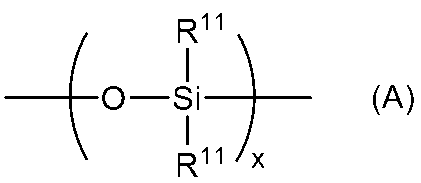
R11は、それぞれ独立に、炭素原子数1~6のアルキル基であり、
xは繰り返し数を示し、数平均値が20以上である。)
本願明細書において「(メタ)アクリル酸」とは、アクリル酸とメタクリル酸の一方又は両方を意味する。
本発明のシリコーン鎖含有重合体(以下、単に「本発明の重合体」という場合がある)は、下記一般式(A)で表される構造を含む基を有する重合性単量体(1)と、炭素原子数1~18のアルキル基、炭素原子数6~18の芳香族基及びポリオキシアルキレン鎖を含む基から選択される1以上を有する重合性単量体(2)とを重合成分とするシリコーン鎖含有重合体であって、前記重合成分に占める前記重合性単量体(1)の割合が20重量%以下であり、重量平均分子量が15,000以上である。
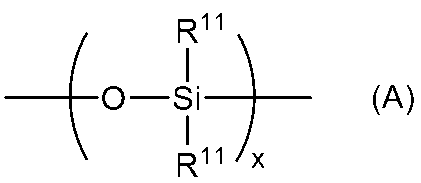
R11は、それぞれ独立に、炭素原子数1~6のアルキル基であり、
xは繰り返し数を示し、数平均値が20以上である。)
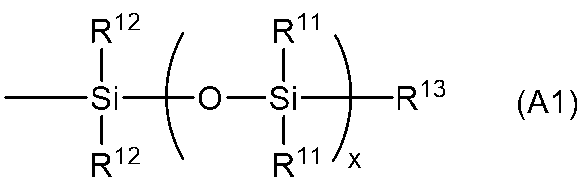
R11は、それぞれ独立に、炭素原子数1~6のアルキル基であり、
R12は、それぞれ独立に、炭素原子数1~6のアルキル基であり、
R13は、炭素原子数1~6のアルキル基であり、
xは繰り返し数を示し、数平均値が20以上である。)
尚、本発明において「xの数平均値」とは、本発明の重合体を構成する重合性単量体(1)について、重合性単量体1つ当たりのシロキサン結合の繰り返し単位の数の平均を意味する。
本発明の重合体中のxの数平均値は、本発明の重合体の数平均分子量から算出できる。
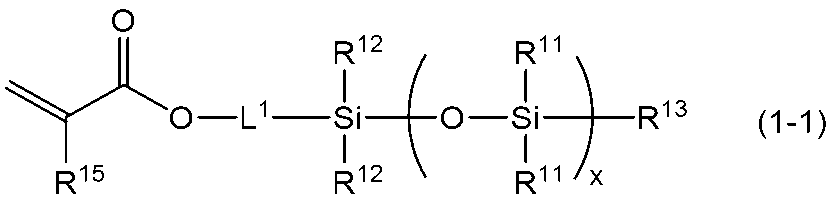
R11、R12、R13及びxは、それぞれ前記一般式(A)および(A1)のR11、R12、R13及びxと同じであり、
R15は水素原子又はメチル基であり、
L1は2価の有機基である。)
L1の炭素原子数1~50のアルキレンオキシ基は、好ましくは炭素原子数1~15のアルキレンオキシ基であり、より好ましくは炭素原子数1~8のアルキレンオキシ基であり、さらに好ましくはメチレンオキシ基、エチレンオキシ基、プロピレンオキシ基、オキシトリメチレン基、ブチレンオキシ基、オキシテトラメチレン基、ペンチレンオキシ基、ヘプチレンオキシ基又はオクチレンオキシ基である。
重合性単量体(2)が有する炭素原子数1~18のアルキル基は、例えば炭素原子数1~18のヒドロキシアルキル基、炭素原子数7~18のフェニルアルキル基、炭素原子数7~18のフェノキシアルキル基を含む。
重合性単量体(2)が有する炭素原子数1~18のアルキル基は、好ましくは炭素原子数1~8のアルキル基である。
重合性単量体(2)が有する炭素原子数6~18の芳香族基は、さらに水酸基、アルキル基、アルコキシ等の置換基が置換していてもよく、例えば炭素原子数1~6のアルキル基が置換したフェニル基を含む。
尚、上記「ポリ(エチレングリコール・プロピレングリコール)」は、エチレングリコールとプロピレングリコールとのランダム共重合物を意味し、「ポリエチレングリコール・ポリプロピレングリコール」は、エチレングリコールとプロピレングリコールとのブロック共重合物を意味する。
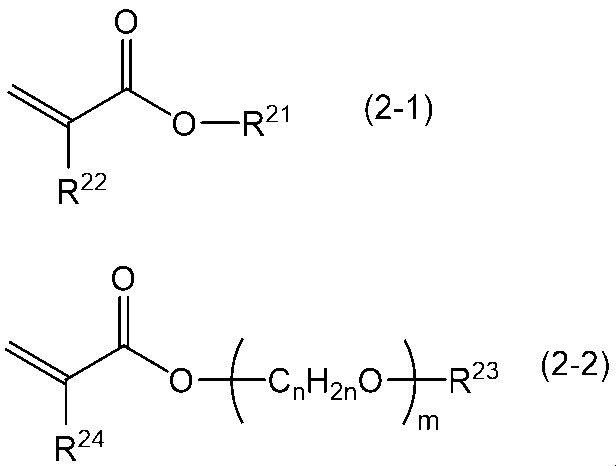
R21は炭素原子数1~18のアルキル基であり、
R22は水素原子又はメチル基であり、
R23は水素原子又は炭素原子数1~18のアルキル基であり、
R24は水素原子又はメチル基であり、
nは1~4の範囲の整数であり、mは1~200の範囲の整数である。)
前記一般式(2-2)において、mは好ましくは2~50の範囲の整数であり、より好ましくは3~20の範囲の整数である。
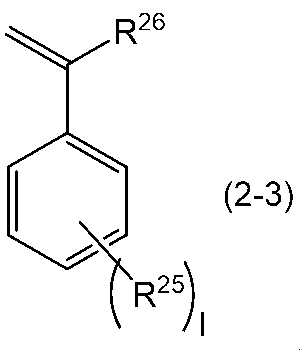
R25はそれぞれ独立に炭素原子数1~6のアルキル基又は炭素原子数1~6のアルコキシ基であり、
R26は水素原子又はメチル基であり、
lは0~5の整数である。)
また、重合性単量体(2)は、市販品を用いてもよい。例えばポリオキシアルキレン鎖を含む基を有し、重合性不飽和基が(メタ)アクリロイル基である重合性単量体(3-2)の市販品として、新中村化学工業株式会社製の「NKエステルM-20G」、「NKエステルM-40G」、「NKエステルM-90G」、「NKエステルM-230G」、「NKエステルAM-90G」、「NKエステルAMP-10G」、「NKエステルAMP-20G」、「NKエステルAMP-60G」、日油株式会社製の「ブレンマーPE-90」、「ブレンマーPE-200」、「ブレンマーPE-350」、「ブレンマーPME-100」、「ブレンマーPME-200」、「ブレンマーPME-400」、「ブレンマーPME-4000」、「ブレンマーPP-1000」、「ブレンマーPP-500」、「ブレンマーPP-800」、「ブレンマー70PEP-350B」、「ブレンマー55PET-800」、「ブレンマー50POEP-800B」、「ブレンマー10PPB-500B」、「ブレンマーNKH-5050」、「ブレンマーAP-400」、「ブレンマーAE-350」等が挙げられる。
本発明の重合体は、重合性単量体(1)と重合性単量体(2)のランダム共重合体でもよく、重合性単量体(1)と重合性単量体(2)のブロック共重合体でもよく、好ましくは重合性単量体(1)と重合性単量体(2)のブロック共重合体である。
本発明の重合体が重合性単量体(1)と重合性単量体(2)のブロック共重合体である場合、重合性単量体(1)の重合体ブロックと重合性単量体(2)の重合体ブロックの数および結合順序は特に限定されず、例えば重合性単量体(1)の重合体ブロックと重合性単量体(2)の重合体ブロックが結合したジブロック共重合体でもよい。
同様に、重合成分において重合性単量体(2)は、1種単独の重合性単量体(2)でもよく、互いに構造が異なる2種以上の重合性単量体(2)でもよい。
重合成分における重合性単量体(1)の含有割合の下限は特に限定されないが、例えば3重量%以上であり、好ましくは4重量%以上であり、より好ましくは5重量%以上である。
重合性単量体(1)の含有割合は、本発明の重合体を製造する際の重合性単量体(1)の原料仕込み比により調整できる。
前記一般式(A)で表される基の含有割合は、本発明の重合体を製造する際に用いる重合性単量体(1)の原料仕込み比により調整できる。
ここで「実質的になる」とは、重合成分における重合性単量体(1)と重合性単量体(2)の合計の含有割合が、例えば80質量%以上、90質量%以上、95質量%以上又は98質量%以上であることを意味する。
本発明において「反応性官能基」とは、他の官能基と反応して架橋構造等を形成しうる官能基であり、イソシアネート基、エポキシ基、カルボキシル基、カルボン酸ハライド基、カルボン酸無水物基等が挙げられる。
本発明の重合体の重合平均分子量(Mw)の上限は特に限定されず、100,000以下、90,000以下、70,000以下、50,000以下の順に好ましい。
本発明の重合体の重量平均分子量(Mw)の値は、実施例に記載の方法により測定する。
本発明の重合体の製造方法は特に限定されず、公知の方法により製造することができる。
本発明の重合体は、ラジカル重合法、カチオン重合法、アニオン重合法等の重合機構に基づき、重合成分を溶液重合法、塊状重合法、エマルジョン重合法等により製造できる。例えばラジカル重合法であれば、有機溶媒中に重合成分を仕込み、汎用のラジカル重合開始剤を添加することで、本発明の重合体を製造できる。
上記で得られる重合体は、ランダム共重合体である。
必要に応じて、ラウリルメルカプタン、2-メルカプトエタノール、エチルチオグリコール酸、オクチルチオグリコール酸等の連鎖移動剤や、γ-メルカプトプロピルトリメトキシシラン等のカップリング基を有するチオール化合物を連鎖移動剤等の添加剤として用いてもよい。
これら溶剤は、1種単独で用いることも2種以上併用することもできる。
このように本発明の重合体をこのように重合することで未反応のシリコーン鎖を限りなく少なくすることができ、それにより、塗工時に添加剤要因で懸念される塗膜欠点を抑えることができるためである。
炭素原子数1~6の2-ハロゲン化カルボン酸の炭素原子数1~6のアルキルエステルのより具体的な例としては、例えば、2-クロロプロピオン酸メチル、2-クロロプロピオン酸エチル、2-ブロモプロピオン酸メチル、2-ブロモイソ酪酸エチル等が挙げられる。
Mn+Xnで表される遷移金属化合物の遷移金属Mn+としては、Cu+、Cu2+、Fe2+、Fe3+、Ru2+、Ru3+、Cr2+、Cr3+、Mo0、Mo+、Mo2+、Mo3+、W2+、W3+、Rh3+、Rh4+、Co+、Co2+、Re2+、Re3+、Ni0、Ni+、Mn3+、Mn4+、V2+、V3+、Zn+、Zn2+、Au+、Au2+、Ag+及びAg2+からなる群から選択することができる。
Mn+Xnで表される遷移金属化合物のXは、ハロゲン原子、炭素原子数1~6のアルコキシル基、(SO4)1/2、(PO4)1/3、(HPO4)1/2、(H2PO4)、トリフラート、ヘキサフルオロホスフェート、メタンスルホネート、アリールスルホネート(好ましくはベンゼンスルホネート又はトルエンスルホネート)、SeR11、CN及びR12COOからなる群から選択することができる。ここで、R11は、アリール基、直鎖状又は分岐状の炭素原子数1~20(好ましくは炭素原子数1~10)のアルキル基を表し、R12は、水素原子、ハロゲンで1~5回(好適にはフッ素もしくは塩素で1~3回)置換されていてもよい直鎖状又は分岐状の炭素原子数1~6のアルキル基(好ましくはメチル基)を表す。
Mn+Xnで表される遷移金属化合物のnは、金属上の形式電荷を表し、0~7の整数である。
リビングラジカル重合で使用する溶媒としては、例えば、酢酸エチル、酢酸ブチル、プロピレングリコールモノメチルエーテルアセテート等のエステル系溶媒;ジイソプロピルエーテル、ジメトキシエタン、ジエチレングリコールジメチルエーテル等のエーテル系溶媒;ジクロロメタン、ジクロロエタン等のハロゲン系溶媒;トルエン、キシレン等の芳香族系溶媒;メチルエチルケトン、メチルイソブチルケトン、シクロヘキサノン等のケトン系溶剤;メタノール、エタノール、イソプロパノール等のアルコール系溶剤;ジメチルホルムアミド、ジメチルスルホキシド等の非プロトン性極性溶媒などが挙げられる。
上記溶媒は、1種単独で用いてもよく2種以上を併用してもよい。
方法1:重合開始剤、遷移金属化合物、該遷移金属と配位結合可能な配位子化合物及び溶媒の存在下で、重合性単量体(1)と重合性単量体(2)とをリビングラジカル重合(好ましくは原子移動ラジカル重合)させる方法。
方法2:重合開始剤、遷移金属化合物、該遷移金属と配位結合可能な配位子化合物及び溶媒の存在下で、重合性単量体(1)をリビングラジカル重合(好ましくは原子移動ラジカル重合)させ、重合性単量体(1)の重合体ブロックを得た後、重合性単量体(2)を反応系に加えて重合性単量体(1)の重合体ブロックにさらに重合性単量体(2)をリビングラジカル重合(好ましくは原子移動ラジカル重合)させる方法。
方法3:重合開始剤、遷移金属化合物、該遷移金属と配位結合可能な配位子化合物及び溶媒の存在下で、重合性単量体(2)をリビングラジカル重合(好ましくは原子移動ラジカル重合)させ、重合性単量体(2)の重合体ブロックを得た後、重合性単量体(1)を反応系に加えて重合性単量体(2)の重合体ブロックにさらに重合性単量体(1)をリビングラジカル重合(好ましくは原子移動ラジカル重合)させる方法。
本発明の重合体は、コーティング組成物のレベリング剤として好適に用いることができ、本発明のコーティング組成物は本発明の重合体を含む。本発明の重合体はフッ素原子を含まないフッ素原子フリーなレベリング剤とすることができるので、環境に対する蓄積性が低い環境負荷の小さいレベリング剤である。
上記塗料用組成物に本発明の重合体を添加することで、得らえれる塗膜に平滑性を付与することができる。
感光性樹脂組成物の中でも、レジスト組成物(フォトレジスト組成物、カラーフィルター用のカラーレジスト組成物等)は、高度なレベリング性が要求される。レジスト組成物は、通常、スピンコーティングによって、シリコンウェハー上又は各種金属を蒸着したガラス基板上に厚さが1~2μm程度になるように塗布される。この際、塗布膜厚が振れたり、塗布ムラが発生したりすると、パターンの直線性や再現性が低下し、目的とする精度を有するレジストパターンが得られないという問題が生じる。また、これら問題以外にも滴下跡、全体ムラ、中心部に比較しエッジ部が膜厚化するビード現象等の様々なレベリングに関与する問題もある。
本発明のコーティング組成物は、本発明の重合体が高度なレベリング性を発揮して均一な塗膜(硬化物)を形成することができるため、レジスト組成物として用いた場合に上記のような問題を解決することができる。
アルカリ可溶性樹脂としては、例えば、フェノール、クレゾール、キシレノール、レゾルシノール、フロログリシノール、ハイドロキノン等の芳香族ヒドロキシ化合物誘導体とホルムアルデヒド、アセトアルデヒド、ベンズアルデヒド等のアルデヒド化合物とを縮合して得られるノボラック樹脂;o-ビニルフェノール、m-ビニルフェノール、p-ビニルフェノール、α-メチルビニルフェノール等のビニルフェノール化合物誘導体の重合体又は共重合体;アクリル酸、メタクリル酸、ヒドロキシエチル(メタ)アクリレート等の(メタ)アクリル酸系重合体又は共重合体;ポリビニルアルコール;これら各種樹脂の水酸基の一部を介してキノンジアジド基、ナフトキノンアジド基、芳香族アジド基、芳香族シンナモイル基等の放射性線感応性基を導入した変性樹脂;分子中にカルボン酸、スルホン酸等の酸性基を含むウレタン樹脂等が挙げられる。
これらアルカリ可溶性樹脂は、1種単独で用いてもよく、2種以上を併用してもよい。
放射線感応性物質としては、例えば、キノンジアジド系化合物、ジアゾ系化合物、アジド系化合物、オニウム塩化合物、ハロゲン化有機化合物、ハロゲン化有機化合物と有機金属化合物との混合物、有機酸エステル化合物、有機酸アミド化合物、有機酸イミド化合物、ポリ(オレフィンスルホン)化合物等が挙げられる
上記の他、トリス(2,3-ジブロモプロピル)ホスフェート、トリス(2,3-ジブロモ-3-クロロプロピル)ホスフェート、クロロテトラブロモメタン、ヘキサクロロベンゼン、ヘキサブロモベンゼン、ヘキサブロモシクロドデカン、ヘキサブロモビフェニル、トリブロモフェニルアリルエーテル、テトラクロロビスフェノールA、テトラブロモビスフェノールA、ビス(ブロモエチルエーテル)テトラブロモビスフェノールA、ビス(クロロエチルエーテル)テトラクロロビスフェノールA、トリス(2,3-ジブロモプロピル)イソシアヌレート、2,2-ビス(4-ヒドロキシ-3,5-ジブロモフェニル)プロパン、2,2-ビス(4-ヒドロキシエトキシ-3,5-ジブロモフェニル)プロパン等のハロゲン系難燃剤として使用されている化合物、ジクロロフェニルトリクロロエタン等の有機クロロ系農薬として使用されている化合物等もハロゲン化有機化合物として例示される。
放射線感応性物質は、1種単独で用いてもよく2種以上を併用してもよい。
これらの溶剤は、1種単独で用いてもよく、2種以上を併用してもよい。
上記の重合性化合物としては、例えば、(メタ)アクリル酸等の不飽和カルボン酸、モノヒドロキシ化合物と不飽和カルボン酸とのエステル、脂肪族ポリヒドロキシ化合物と不飽和カルボン酸とのエステル、芳香族ポリヒドロキシ化合物と不飽和カルボン酸とのエステル、不飽和カルボン酸と多価カルボン酸及び前述の脂肪族ポリヒドロキシ化合物、芳香族ポリヒドロキシ化合物等の多価ヒドロキシ化合物とのエステル化反応により得られるエステル、ポリイソシアネート化合物と(メタ)アクリロイル基含有ヒドロキシ化合物とを反応させたウレタン骨格を有する重合性化合物、酸基を有する重合性化合物等が挙げられる。
重合性化合物は1種単独で用いてもよく、2種以上を併用してもよい。
また、これらアクリレートの(メタ)アクリル酸の部分を、イタコン酸に代えたイタコン酸エステル、クロトン酸に代えたクロトン酸エステル、或いは、マレイン酸に代えたマレイン酸エステル等も挙げられる。
不飽和カルボン酸、多価カルボン酸及び多価ヒドロキシ化合物のエステル化反応により得られるエステルは、単一物であっても、混合物であってもよい。このようなエステルとしては、例えば、(メタ)アクリル酸、フタル酸及びエチレングリコールから得られるエステル、(メタ)アクリル酸、マレイン酸及びジエチレングリコールから得られるエステル、(メタ)アクリル酸、テレフタル酸及びペンタエリスリトールから得られるエステル、(メタ)アクリル酸、アジピン酸、ブタンジオール及びグリセリンから得られるエステル等が挙げられる。
前記多官能重合性化合物の酸価は、現像性、硬化性等が良好となることから、0.1~40の範囲が好ましく、5~30の範囲がより好ましい。酸基を有する多官能重合性化合物を2種以上併用する場合、および酸基を有する多官能重合性化合物と酸基を有しない多官能重合性化合物を併用する場合には、重合性化合物の混合物の酸価が上記の範囲内になるようにすることが好ましい。
顔料は有機顔料、無機顔料のいずれであっても用いることができる。前記有機顔料としては、赤色顔料、緑色顔料、青色顔料、黄色顔料、紫色顔料、オレンジ顔料、ブラウン顔料等の各色相の顔料を使用することができる。また、有機顔料の化学構造としては、例えば、アゾ系、フタロシアニン系、キナクリドン系、ベンツイミダゾロン系、イソインドリノン系、ジオキサジン系、インダンスレン系、ペリレン系等が挙げられる。また、前記無機顔料としては、例えば、硫酸バリウム、硫酸鉛、酸化チタン、黄色鉛、ベンガラ、酸化クロム等が挙げられる。
尚、下記の「C.I.」は、カラーインデックスを意味する。
前記有機顔料の平均一次粒径は、100nm以下が好ましく、50nm以下がより好ましく、40nm以下がさらに好ましく、10~30nmの範囲が特に好ましい。
尚、有機顔料の平均粒径は、動的光散乱式の粒度分布計で測定したものであり、例えば、日機装株式会社製のナノトラック(Nanotrac)粒度分布測定装置「UPA-EX150」、「UPA-EX250」等で測定することができる。
また、2種以上の有機顔料を混合し、混色により黒色とした組み合わせでも構わない。
黒色顔料を調製するために混合使用可能な色材としては、ビクトリアピュアブルー(C.I.42595)、オーラミンO(C.I.41000)、カチロンブリリアントフラビン(ベーシック13)、ローダミン6GCP(C.I.45160)、ローダミンB(C.I.45170)、サフラニンOK70:100(C.I.50240)、エリオグラウシンX(C.I.42080)、No.120/リオノールイエロー(C.I.21090)、リオノールイエローGRO(C.I.21090)、シムラーファーストイエロー8GF(C.I.21105)、ベンジジンイエロー4T-564D(C.I.21095)、シムラーファーストレッド4015(C.I.12355)、リオノールレッド7B4401(C.I.15850)、ファーストゲンブルーTGR-L(C.I.74160)、リオノールブルーSM(C.I.26150)、リオノールブルーES(C.I.ピグメントブルー15:6)、リオノーゲンレッドGD(C.I.ピグメントレッド168)、リオノールグリーン2YS(C.I.ピグメントグリーン36)等が挙げられる。
カーボンブラックのジブチルフタル酸(以下、「DBP」と略記する。)吸収量は、40~100cm3/100gの範囲が好ましく、分散性・現像性が良好なことから50~80cm3/100gの範囲がより好ましい。カーボンブラックのBET法による比表面積は50~120m2/gの範囲が好ましく、分散安定性が良好なことから60~95m2/gの範囲がより好ましい。
前記分散剤としては、界面活性剤;顔料の中間体もしくは誘導体;染料の中間体もしくは誘導体;ポリアミド系樹脂、ポリウレタン系樹脂、ポリエステル系樹脂、アクリル系樹脂等の樹脂型分散剤等が挙げられる。これらの中でも、窒素原子を有するグラフト共重合体、窒素原子を有するアクリル系ブロック共重合体、ウレタン樹脂分散剤等が好ましい。これらの分散剤は、窒素原子を有しているため、窒素原子が顔料表面に対して親和性をもち、窒素原子以外の部分が媒質に対する親和性を高めることにより、分散安定性が向上する。
これら分散剤は、1種単独で用いてもよく、2種以上を併用してもよい。
これらの溶剤は、1種単独で用いてもよく、2種以上を併用してもよい。
混練に用いる機械としては、二本ロール、三本ロール、ボールミル、トロンミル、ディスパー、ニーダー、コニーダー、ホモジナイザー、ブレンダー、単軸もしくは二軸の押出機等が挙げられる。
着色剤は、上記の混練を行う前に、ソルトミリング法等によって粒子サイズを微細化しておくことが好ましい。
尚、本発明は下記実施例に限定されない。
GPCの測定条件は以下の通りである。
測定装置:東ソー株式会社製高速GPC装置「HLC-8320GPC」
カラム:東ソー株式会社製「TSK GUARDCOLUMN SuperHZ-L」+東ソー株式会社製「TSK gel SuperHZM-N」+東ソー株式会社製「TSK gel SuperHZM-N」+東ソー株式会社製「TSK gel SuperHZM-N」+東ソー株式会社製「TSK gel SuperHZM-N」
検出器:RI(示差屈折計)
データ処理:東ソー株式会社製「EcoSEC Data Analysis バージョン1.07」
カラム温度:40℃
展開溶媒:テトラヒドロフラン
流速:0.35mL/分
測定試料:試料7.5mgを10mlのテトラヒドロフランに溶解し、得られた溶液をマイクロフィルターでろ過したものを測定試料とした。
試料注入量:20μl
標準試料:前記「HLC-8320GPC」の測定マニュアルに準拠して、分子量が既知の下記の単分散ポリスチレンを用いた。
東ソー株式会社製「A-300」
東ソー株式会社製「A-500」
東ソー株式会社製「A-1000」
東ソー株式会社製「A-2500」
東ソー株式会社製「A-5000」
東ソー株式会社製「F-1」
東ソー株式会社製「F-2」
東ソー株式会社製「F-4」
東ソー株式会社製「F-10」
東ソー株式会社製「F-20」
東ソー株式会社製「F-40」
東ソー株式会社製「F-80」
東ソー株式会社製「F-128」
東ソー株式会社製「F-288」
ポリプロピレングリコール-ポリブチレングリコール-モノメタクリレート(プロピレングリコールの平均繰り返し数1、ブチレングリコールの平均繰り返し数6)180.0g及び溶媒として酢酸ブチル70.0gを混合した混合液A1、重合開始剤としてt-ブチルパーオキシ-2-エチルヘキサノエート3.0g及び溶媒として酢酸ブチル10.0gを混合した混合液B1、下記式で表されるポリシロキサン結合を有するモノメタクリレート化合物20.0g及び溶媒として酢酸ブチル20.0gを混合した混合液C1をそれぞれ調製した。
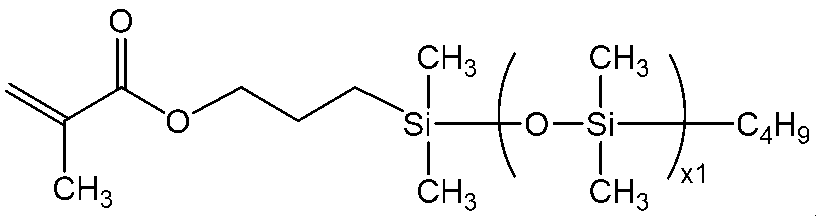
このフラスコに90℃の混合液A1の滴下を開始し、混合液A1滴下開始5分後に90℃の混合液B1及び混合液C1の滴下を開始した。混合液C1は滴下開始から120分で滴下を終了し、混合液A1及びB1は混合液C1の滴下終了後10分後(混合液A1の滴下開始から135分後)に滴下を終了した。滴下終了後、90℃で10時間撹拌した。反応終了後、溶媒を留去し、シリコーン鎖含有重合体(1)を得た。
また、原料仕込み比から、シリコーン鎖含有重合体(1)中のシリコーン鎖を有する重合性不飽和単量体の含有割合は10質量%であった。
ポリプロピレングリコール-ポリブチレングリコール-モノメタクリレート(プロピレングリコールの平均繰り返し数1、ブチレングリコールの平均繰り返し数6)180.0g及び溶媒として酢酸ブチル30.0gを混合した混合液A2、重合開始剤としてt-ブチルパーオキシ-2-エチルヘキサノエート6.0g及び溶媒として酢酸ブチル20.0gを混合した混合液B2、下記式で表されるポリシロキサン結合を有するモノメタクリレート化合物20.0g及び溶媒として酢酸ブチル20.0gを混合した混合液C2をそれぞれ調製した。

このフラスコに90℃の混合液A2の滴下を開始し、混合液A2滴下開始5分後に90℃の混合液B2及び混合液C2の滴下を開始した。混合液C2は滴下開始から120分で滴下を終了し、混合液A2及びB2は混合液C2の滴下終了後30分後(混合液A2の滴下開始から155分後)に滴下を終了した。滴下終了後、90℃で10時間撹拌した。反応終了後、溶媒を留去し、シリコーン鎖含有重合体(2)を得た。
また、原料仕込み比から、シリコーン鎖含有重合体(2)中のシリコーン鎖を有する重合性不飽和単量体の含有割合は10質量%であった。
ポリプロピレングリコールモノメタクリレート(プロピレングリコールの平均繰り返し数4~6)180.0g及び溶媒として酢酸ブチル61.4gを混合した混合液A3、開始剤パーブチルO(日油株式会社製)6.0g及び溶媒として酢酸ブチル50.0gを混合した混合液B3、合成実施例1と同じポリシロキサン結合を有するモノメタクリレート化合物20.0g及び溶媒として酢酸ブチル60.0gを混合した混合液C3をそれぞれ調製した。
このフラスコに90℃の混合液A3の滴下を開始し、混合液A3滴下開始5分後に90℃の混合液B3及び混合液C3の滴下を開始した。混合液C3は滴下開始から120分で滴下を終了し、混合液A3及びB3は混合液C3の滴下終了後30分後(混合液A3の滴下開始から155分後)に滴下を終了した。滴下終了後、95℃で10時間撹拌した。反応終了後、溶媒を留去し、シリコーン鎖含有重合体(3)を得た。
また、原料仕込み比から、シリコーン鎖含有重合体(3)中のシリコーン鎖を有する重合性不飽和単量体の含有割合は10質量%であった。
ポリプロピレングリコールモノメタクリレート(プロピレングリコールの平均繰り返し数4~6)180.0g及び溶媒として酢酸ブチル30.0gを混合した混合液A1、開始剤としてt-ブチルパーオキシ-2-エチルヘキサノエート6.0g及び溶媒として酢酸ブチル20.0gを混合した混合液B4、合成実施例2と同じポリシロキサン結合を有するモノメタクリレート化合物20.0g及び溶媒として酢酸ブチル20.0gを混合した混合液C4をそれぞれ調製した。
このフラスコに90℃の混合液A4の滴下を開始し、混合液A4滴下開始5分後に90℃の混合液B4及び混合液C4の滴下を開始した。混合液C4は滴下開始から120分で滴下を終了し、混合液A4及びB4は混合液C4の滴下終了後30分後(混合液A4の滴下開始から155分後)に滴下を終了した。滴下終了後、95℃で10時間撹拌した。反応終了後、溶媒を留去し、シリコーン鎖含有重合体(4)を得た。
また、原料仕込み比から、シリコーン鎖含有重合体(4)中のシリコーン鎖を有する重合性不飽和単量体の含有割合は10質量%であった。
ポリプロピレングリコール-ポリブチレングリコール-モノアクリレート(プロピレングリコールの平均繰り返し数1、ブチレングリコールの平均繰り返し数6)180.0g及び溶媒としてプロピレングリコールモノメチルエーテルアセテート(PGMEA)50.0gを混合した混合液A5、開始剤としてt-ブチルパーオキシ-2-エチルヘキサノエート2.0g及び溶媒としてPGMEA30.0gを混合した混合液B5、合成実施例1と同じポリシロキサン結合を有するモノメタクリレート化合物20.0g及び溶媒としてプロピレングリコールモノメチルエーテルアセテート(PGMEA)20.0gを混合した混合液C5をそれぞれ調製した。
このフラスコに85℃の混合液A5の滴下を開始し、混合液A5滴下開始5分後に85℃の混合液B5及び混合液C5の滴下を開始した。混合液C5は滴下開始から120分で滴下を終了し、混合液A5及びB5は混合液C5の滴下終了後10分後(混合液A5の滴下開始から135分後)に滴下を終了した。滴下終了後、85℃で5時間撹拌、その後110℃で1時間攪拌した。反応終了後、溶媒を留去し、シリコーン鎖含有重合体(5)を得た。
また、原料仕込み比から、シリコーン鎖含有重合体(5)中のシリコーン鎖を有する重合性不飽和単量体の含有割合は10質量%であった。
ポリプロピレングリコール-ポリブチレングリコール-モノアクリレート(プロピレングリコールの平均繰り返し数1、ブチレングリコールの平均繰り返し数6)160.0g及び溶媒としてPGMEA30.0gを混合した混合液A6、としてt-ブチルパーオキシ-2-エチルヘキサノエート2.0g及び溶媒としてPGMEA30.0gを混合した混合液B6、合成実施例1と同じポリシロキサン結合を有するモノメタクリレート化合物40.0g及び溶媒としてPGMEA40.0gを混合した混合液C6をそれぞれ調製した。
撹拌装置、温度計、冷却管、滴下装置を備えたガラスフラスコに、溶媒としてPGMEA200.0gを仕込み、窒素気流下にて攪拌しながら85℃に昇温した。
また、原料仕込み比から、シリコーン鎖含有重合体(6)中のシリコーン鎖を有する重合性不飽和単量体の含有割合は20質量%であった。
ポリプロピレングリコールモノアクリレート(プロピレングリコールの平均繰り返し数4~6)180.0g及び溶媒として酢酸ブチル60.43gを混合した混合液A7、開始剤としてt-ブチルパーオキシ-2-エチルヘキサノエート2.0g及び溶媒として酢酸ブチル50.0gを混合した混合液B7、合成実施例1と同じポリシロキサン結合を有するモノメタクリレート化合物20.0g及び溶媒として酢酸ブチル60.0gを混合した混合液C7をそれぞれ調製した。
このフラスコに85℃の混合液A7の滴下を開始し、混合液A7滴下開始5分後に85℃の混合液B7及び混合液C7の滴下を開始した。混合液C7は滴下開始から120分で滴下を終了し、混合液A7及びB7は混合液C7の滴下終了後10分後(混合液A7の滴下開始から135分後)に滴下を終了した。滴下終了後、85℃で5時間撹拌、その後110℃で1時間攪拌した。反応終了後、溶媒を留去し、シリコーン鎖含有重合体(7)を得た。
また、原料仕込み比から、シリコーン鎖含有重合体(7)中のシリコーン鎖を有する重合性不飽和単量体の含有割合は10質量%であった。
ポリプロピレングリコール-ポリブチレングリコール-モノアクリレート(プロピレングリコールの平均繰り返し数1、ブチレングリコールの平均繰り返し数6)75.0g、メタクリル酸5.0g及び溶媒としてプロピレングリコールモノメチルエーテルアセテート(PGMEA)35.71gを混合した混合液A8、開始剤としてt-ブチルパーオキシ-2-エチルヘキサノエート1.0g及び溶媒としてPGMEA30.0gを混合した混合液B8、合成実施例1と同じポリシロキサン結合を有するモノメタクリレート化合物20.0g及び溶媒としてPGMEA20.0gを混合した混合液C8をそれぞれ調製した。
このフラスコに90℃の混合液A8の滴下を開始し、混合液A8滴下開始5分後に90℃の混合液B8及び混合液C8の滴下を開始した。混合液C8は滴下開始から120分で滴下を終了し、混合液A8及びB8は混合液C8の滴下終了後10分後(混合液A8の滴下開始から135分後)に滴下を終了した。滴下終了後、90℃で5時間撹拌、その後110℃で1時間攪拌した。反応終了後、溶媒を留去し、シリコーン鎖含有重合体(8)を得た。
また、原料仕込み比から、シリコーン鎖含有重合体(8)中のシリコーン鎖を有する重合性不飽和単量体の含有割合は20質量%であった。
ポリエチレングリコール-ポリプロピレングリコール-モノアクリレート(ポリエチレングリコールの平均繰り返し数22、プロピレングリコールの平均繰り返し数22)245.45gを混合液A9、t-ブチルパーオキシ-2-エチルヘキサノエート11.25g及び溶媒としてPGMEA14.55gを混合した混合液B9、合成実施例1と同じポリシロキサン結合を有するモノメタクリレート化合物15g及び溶媒としてPGMEA25gを混合した混合液C9それぞれ調製した。
撹拌装置、温度計、冷却管、滴下装置を備えたガラスフラスコに、溶媒としてPGMEA300gを仕込み、窒素気流下にて攪拌しながら100℃に昇温した。
また、原料仕込み比から、シリコーン鎖含有重合体(9)中のシリコーン鎖を有する重合性不飽和単量体の含有割合は10質量%であった。
ポリプロピレングリコール-ポリブチレングリコール-モノメタクリレート(プロピレングリコールの平均繰り返し数1、ブチレングリコールの平均繰り返し数6)160.0g及び溶媒として酢酸ブチル70.0gを混合して混合液A1’、開始剤としてt-ブチルパーオキシ-2-エチルヘキサノエート3.0g及び溶媒として酢酸ブチル156.7gを混合した混合液B1’、合成実施例1と同じポリシロキサン結合を有するモノメタクリレート化合物40.0g及び溶媒として酢酸ブチル40.0gを混合した混合液C1’をそれぞれ調製した。
このフラスコに90℃の混合液A1’の滴下を開始し、混合液A1’滴下開始5分後に90℃の混合液B1’及び混合液C1’の滴下を開始した。混合液C1’は滴下開始から120分で滴下を終了し、混合液A1’及びB1’は混合液C1’の滴下終了後10分後(混合液A1’の滴下開始から135分後)に滴下を終了した。滴下終了後、90℃で10時間撹拌した。反応終了後、溶媒を留去し、シリコーン鎖含有重合体(1’)を得た。
また、原料仕込み比から、シリコーン鎖含有重合体(1’)中のシリコーン鎖を有する重合性不飽和単量体の含有割合は20質量%であった。
ポリプロピレングリコール-ポリブチレングリコール-モノメタクリレート(プロピレングリコールの平均繰り返し数1、ブチレングリコールの平均繰り返し数6)136.8g及び溶媒として酢酸ブチル50.0gを混合して混合液A2’、開始剤としてt-ブチルパーオキシ-2-エチルヘキサノエート3.0g及び溶媒として酢酸ブチル20.0gを混合した混合液B2’、合成実施例1と同じポリシロキサン結合を有するモノメタクリレート化合物63.2g及び溶媒として酢酸ブチル30.0gを混合した混合液C2’をそれぞれ調製した。
このフラスコに90℃の混合液A2’の滴下を開始し、混合液A2’滴下開始5分後に90℃の混合液B2’及び混合液C2’の滴下を開始した。混合液C2’は滴下開始から120分で滴下を終了し、混合液A2’及びB2’は混合液C2’の滴下終了後10分後(混合液A2’の滴下開始から135分後)に滴下を終了した。滴下終了後、90℃で10時間撹拌した。反応終了後、溶媒を留去し、シリコーン鎖含有重合体(2’)を得た。
また、原料仕込み比から、シリコーン鎖含有重合体(2’)中のシリコーン鎖を有する重合性不飽和単量体の含有割合は31.6質量%であった。
プロピレングリコール-ポリブチレングリコール-モノメタクリレート(プロピレングリコールの平均繰り返し数1、ブチレングリコールの平均繰り返し数6)136.8g及び溶媒として酢酸ブチル102.8gを混合した混合液A3’、開始剤としてt-ブチルパーオキシ-2-エチルヘキサノエート3.0g及び溶媒として酢酸ブチル100.0gを混合した混合液B3’、合成実施例1と同じポリシロキサン結合を有するモノメタクリレート化合物63.2g及び溶媒として酢酸ブチル63.2gを混合した混合液C3’をそれぞれ調製した。
このフラスコに90℃の混合液A3’の滴下を開始し、混合液A3’滴下開始5分後に90℃の混合液B3’及び混合液C3’の滴下を開始した。混合液C3’は滴下開始から120分で滴下を終了し、混合液A3’及びB3’は混合液C3’の滴下終了後10分後(混合液A3’の滴下開始から135分後)に滴下を終了した。滴下終了後、90℃で10時間撹拌した。反応終了後、溶媒を留去し、シリコーン鎖含有重合体(3’)を得た。
また、原料仕込み比から、シリコーン鎖含有重合体(3’)中のシリコーン鎖を有する重合性不飽和単量体の含有割合は31.6質量%であった。
ポリプロピレングリコール-ポリブチレングリコール-モノメタクリレート(プロピレングリコールの平均繰り返し数1、ブチレングリコールの平均繰り返し数6)180.0g及び溶媒として酢酸ブチル60.43gを混合した混合液A4’、開始剤としてt-ブチルパーオキシ-2-エチルヘキサノエート2.0g及び溶媒として酢酸ブチル50.0gを混合した混合液B4’、下記式で示されるポリシロキサン結合を有するモノメタクリレート化合物20.0g及び溶媒として酢酸ブチル60.0gを混合した混合液C4’をそれぞれ調製した。

このフラスコに85℃の混合液A4’の滴下を開始し、混合液A4’滴下開始5分後に85℃の混合液B4’及び混合液C4’の滴下を開始した。混合液C4’は滴下開始から120分で滴下を終了し、混合液A4’及びB4’は混合液C4’の滴下終了後10分後(混合液A4’の滴下開始から135分後)に滴下を終了した。滴下終了後、85℃で5時間撹拌後、110℃で1時間攪拌した。反応終了後、溶媒を留去し、シリコーン鎖含有重合体(4’)を得た。
また、原料仕込み比から、シリコーン鎖含有重合体(4’)中のシリコーン鎖を有する重合性不飽和単量体の含有割合は10.0質量%であった。
ポリプロピレングリコールモノメタクリレート(プロピレングリコールの平均繰り返し数4~6)80.0g及び溶媒としてプロピレングリコールモノメチルエーテルアセテート(PGMEA)35.71gを混合した混合液A5’、開始剤としてt-ブチルパーオキシ-2-エチルヘキサノエート1.0g及び溶媒としてPGMEA30.0gを混合した混合液B5’、合成比較例4と同じポリシロキサン結合を有するモノメタクリレート化合物20.0g及び溶媒としてPGMEA20.0gを混合した混合液C5’をそれぞれ調製した。
このフラスコに90℃の混合液A5‘の滴下を開始し、混合液A5’滴下開始5分後に90℃の混合液B5‘及び混合液C8の滴下を開始した。混合液C5’は滴下開始から120分で滴下を終了し、混合液A5‘及びB5’は混合液C8の滴下終了後10分後(混合液A5‘の滴下開始から135分後)に滴下を終了した。滴下終了後、90℃で5時間撹拌、その後110℃で1時間攪拌した。反応終了後、溶媒を留去し、シリコーン鎖含有重合体(5’)を得た。
また、原料仕込み比から、シリコーン鎖含有重合体(5’)中のシリコーン鎖を有する重合性不飽和単量体の含有割合は20質量%であった。
合成実施例1で製造したシリコーン鎖含有重合体(1)を用いて、以下のようにして塗膜を成膜した。
アルカリ可溶性樹脂40質量%樹脂溶液(アクリディック ZL-295、DIC株式会社製)を3.0g、アロニックスM-402(東亞合成化学株式会社製、ジペンタエリスリトールペンタアクリレートとジペンタエリスリトールヘキサアクリレートの混合物)1.2gと、シリコーン鎖含有重合体(1)を固形分換算で0.0024g、プロピレングリコールモノメチルエーテルアセテート(PGMEA)6.23gを混合して、レジスト組成物を調製した。
得られたレジスト組成物3mlを10cm×10cmのクロムメッキガラス基板の中央部分に滴下し、回転数1000rpm及び回転時間10秒の条件でスピンコ-ティングした後、ホットプレートで100℃で100秒間加熱乾燥させて塗膜層を有する積層体を作製した。
得られた積層体の塗膜層を目視で観察し、下記基準に従って塗膜層の平滑性とを評価した。
〇:塗膜ムラがほとんど観察されない。
△:塗膜ムラが一部観察される。
×:塗膜ムラが全体に観測される。
得られた積層体の塗膜層を目視で観察し、下記基準に従って塗膜層の塗膜欠陥も評価した。
1:塗膜欠陥がほとんど観察されない。
2:塗膜欠陥が数点観察される。
3:塗膜欠陥が数多く観測される。
シリコーン鎖含有重合体(1)の代わりに合成実施例2~9及び合成比較例1~3で製造した重合体をそれぞれ用いた他は実施例1と同様の評価を行った。結果を表1に示す。

合成実施例1-4および9並びに合成比較例4-5で製造したシリコーン鎖含有重合体をそれぞれ用いて、以下のようにして塗膜を成膜した。
アルカリ可溶性樹脂40質量%樹脂溶液(アクリディック ZL-295、DIC株式会社製)を3.0g、アロニックスM-402(東亞合成化学株式会社製、ジペンタエリスリトールペンタアクリレートとジペンタエリスリトールヘキサアクリレートの混合物)1.2gと、シリコーン鎖含有重合体を固形分換算で0.0024g、プロピレングリコールモノメチルエーテルアセテート(PGMEA)6.23gを混合して、レジスト組成物を調製した。
得られたレジスト組成物3mlを10cm×10cmのクロムメッキガラス基板の中央部分に滴下し、回転数1000rpm及び回転時間10秒の条件でスピンコ-ティングして塗布基材を得た。ホットプレート上にSUS製のピンを四隅に設け、得られた塗布基材を支持ピン上に乗せ、100℃で100秒間加熱乾燥させて塗膜層を有する積層体を作製した。
得られた積層体の塗膜層を目視で観察し、下記基準に従って塗膜層のピンムラを評価した。結果を表2に示す。尚「ピンムラ」とは、支持ピンと塗布基材とが当接する部分を中心に生じる膜厚ムラ(乾燥ムラ)を言う。
1:ピンムラがほとんど観察されない
2:ピンムラが観察される

Claims (10)
- 下記一般式(A)で表される構造を含む基を有する重合性単量体(1)と、炭素原子数1~18のアルキル基、炭素原子数6~18の芳香族基及びポリオキシアルキレン鎖を含む基から選択される1以上を有する重合性単量体(2)とを重合成分とするシリコーン鎖含有重合体であって、
前記重合成分に占める前記重合性単量体(1)の割合が20重量%以下であり、
重量平均分子量が15,000以上であるシリコーン鎖含有重合体。

R11は、それぞれ独立に、炭素原子数1~6のアルキル基であり、
xは繰り返し数を示し、数平均値が20以上である。) - 前記一般式(A)で表される構造を含む基が、下記一般式(A1)で表される基である請求項1に記載のシリコーン鎖含有重合体。
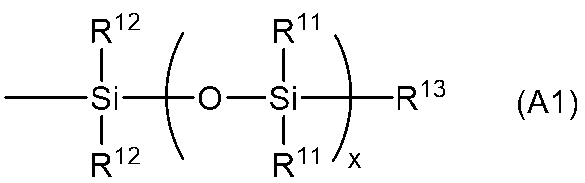
R11は、それぞれ独立に、炭素原子数1~6のアルキル基であり、
R12は、それぞれ独立に、炭素原子数1~6のアルキル基であり、
R13は、炭素原子数1~6のアルキル基であり、
xは繰り返し数を示し、数平均値が20以上である。) - 前記重合性単量体(1)が、下記一般式(1-1)で表される化合物である請求項1又は2に記載のシリコーン鎖含有重合体。
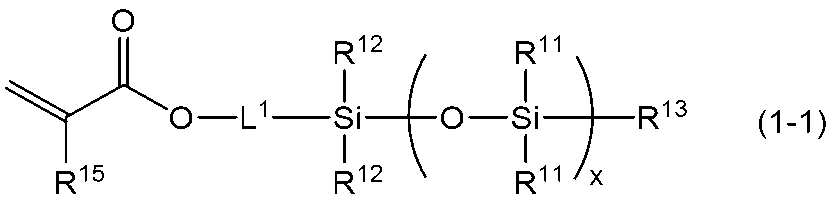
R11は、それぞれ独立に、炭素原子数1~6のアルキル基であり、
R12は、それぞれ独立に、炭素原子数1~6のアルキル基であり、
R13は、炭素原子数1~6のアルキル基であり、
xは繰り返し数を示し、数平均値が20以上であり、
R15は水素原子又はメチル基であり、
L1は2価の有機基である。) - 前記重合性単量体(2)が下記一般式(2-1)で表される化合物および/又は下記一般式(2-2)で表される化合物である請求項1~3のいずれかに記載のシリコーン鎖含有重合体。
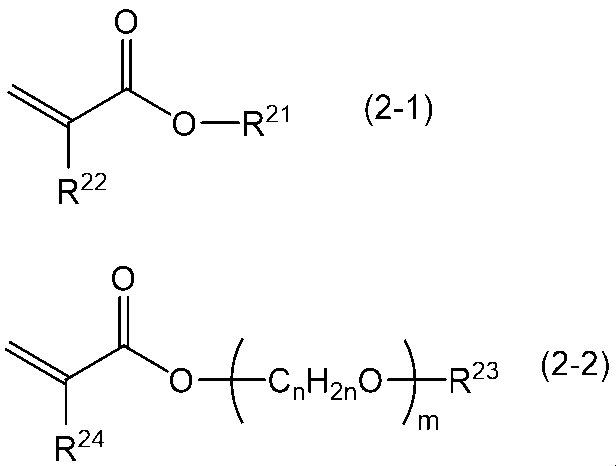
R21は炭素原子数1~18のアルキル基であり、
R22は水素原子又はメチル基であり、
R23は水素原子又は炭素原子数1~18のアルキル基であり、
R24は水素原子又はメチル基であり、
nは1~4の範囲の整数であり、mは1~200の範囲の整数である。) - 前記重合成分の80質量%以上が前記重合性単量体(1)及び前記重合性単量体(2)である請求項1~4のいずれかに記載のシリコーン鎖含有重合体。
- フッ素原子を含まない請求項1~5のいずれかに記載のシリコーン鎖含有重合体。
- 反応系に下記一般式(A)で表される構造を含む基を有する重合性単量体(1)の添加を開始し、
前記重合性単量体(1)の添加開始後に、炭素原子数1~18のアルキル基、炭素原子数6~18の芳香族基及びポリオキシアルキレン鎖を含む基から選択される1以上を有する重合性単量体(2)及び重合開始剤を反応系に添加して重合を開始し、
前記重合性単量体(1)の反応系への添加を前記重合性単量体(2)及び重合開始剤よりも先に終了するシリコーン鎖含有重合体の製造方法。
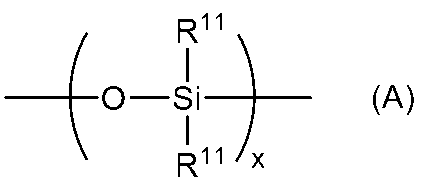
R11は、それぞれ独立に、炭素原子数1~6のアルキル基であり、
xは繰り返し数を示し、数平均値が20以上である。) - 請求項1~6のいずれかに記載のシリコーン鎖含有重合体を含むコーティング組成物。
- 請求項1~6のいずれかに記載のシリコーン鎖含有重合体を含むレジスト組成物。
- 請求項1~6のいずれかに記載のシリコーン鎖含有重合体を含む物品。
Priority Applications (5)
| Application Number | Priority Date | Filing Date | Title |
|---|---|---|---|
| KR1020247014350A KR20240131318A (ko) | 2022-01-18 | 2022-12-22 | 실리콘쇄 함유 중합체, 실리콘쇄 함유 중합체의 제조 방법, 코팅 조성물, 레지스트 조성물 및 물품 |
| JP2023571342A JP7609304B2 (ja) | 2022-01-18 | 2022-12-22 | シリコーン鎖含有重合体、シリコーン鎖含有重合体の製造方法、コーティング組成物、レジスト組成物及び物品 |
| US18/715,391 US20250109255A1 (en) | 2022-01-18 | 2022-12-22 | Silicone chain-containing polymer, method for producing silicone chain-containing polymer, coating composition, resist composition, and article |
| CN202280087468.1A CN118510818A (zh) | 2022-01-18 | 2022-12-22 | 含有机硅链聚合物、含有机硅链聚合物的制造方法、涂覆组合物、抗蚀剂组合物及物品 |
| EP22922186.6A EP4467581A4 (en) | 2022-01-18 | 2022-12-22 | Silicone chain-containing polymer, method for producing silicone chain-containing polymer, coating composition, resist composition, and article |
Applications Claiming Priority (2)
| Application Number | Priority Date | Filing Date | Title |
|---|---|---|---|
| JP2022005566 | 2022-01-18 | ||
| JP2022-005566 | 2022-01-18 |
Publications (1)
| Publication Number | Publication Date |
|---|---|
| WO2023140036A1 true WO2023140036A1 (ja) | 2023-07-27 |
Family
ID=87348207
Family Applications (1)
| Application Number | Title | Priority Date | Filing Date |
|---|---|---|---|
| PCT/JP2022/047259 Ceased WO2023140036A1 (ja) | 2022-01-18 | 2022-12-22 | シリコーン鎖含有重合体、シリコーン鎖含有重合体の製造方法、コーティング組成物、レジスト組成物及び物品 |
Country Status (7)
| Country | Link |
|---|---|
| US (1) | US20250109255A1 (ja) |
| EP (1) | EP4467581A4 (ja) |
| JP (1) | JP7609304B2 (ja) |
| KR (1) | KR20240131318A (ja) |
| CN (1) | CN118510818A (ja) |
| TW (1) | TW202337964A (ja) |
| WO (1) | WO2023140036A1 (ja) |
Cited By (3)
| Publication number | Priority date | Publication date | Assignee | Title |
|---|---|---|---|---|
| WO2025058077A1 (ja) * | 2023-09-15 | 2025-03-20 | 富士フイルム株式会社 | 化合物、組成物、機能性材料、ハロゲン化銀写真感光材料、及び、拡散転写型ハロゲン化銀写真感光材料 |
| WO2025089096A1 (ja) * | 2023-10-27 | 2025-05-01 | 信越化学工業株式会社 | 表面改質剤及び該表面改質剤を含む組成物 |
| WO2025204977A1 (ja) * | 2024-03-26 | 2025-10-02 | Dic株式会社 | ハードコート層形成用組成物、フィルム、積層体、偏光板および画像表示装置 |
Citations (10)
| Publication number | Priority date | Publication date | Assignee | Title |
|---|---|---|---|---|
| JP2001353817A (ja) * | 2000-06-14 | 2001-12-25 | Dainippon Ink & Chem Inc | 低摩耗構造体 |
| JP2003226834A (ja) | 2002-02-07 | 2003-08-15 | Kusumoto Kasei Kk | 非水塗料用平滑剤 |
| JP2008001896A (ja) * | 2006-05-25 | 2008-01-10 | Chugoku Marine Paints Ltd | 重合性基含有ポリエーテル変性シリコーンを含むオルガノポリシロキサンチオブロックビニル共重合体、その共重合体含有組成物、防汚塗料組成物、その塗膜および防汚方法 |
| JP2010085606A (ja) * | 2008-09-30 | 2010-04-15 | Dic Corp | 乳化剤、硬化性組成物及び懸濁粒子デバイス用フィルム |
| JP2017227883A (ja) * | 2016-06-17 | 2017-12-28 | キヤノン株式会社 | トナー粒子の製造方法並びに樹脂粒子の製造方法 |
| JP2018532824A (ja) | 2015-08-31 | 2018-11-08 | ビイク−ヒエミー ゲゼルシャフト ミツト ベシユレンクテル ハフツングBYK−Chemie GmbH | ポリシロキサンマクロモノマー単位を有するコポリマー、該コポリマーの製造方法、ならびに該コポリマーの、コーティング組成物およびポリマー成形コンパウンドにおける使用 |
| JP2018199765A (ja) * | 2017-05-26 | 2018-12-20 | 楠本化成株式会社 | 両親媒性ブロック共重合体を利用した塗料用レベリング剤 |
| WO2022059492A1 (ja) * | 2020-09-15 | 2022-03-24 | Dic株式会社 | シリコーン鎖含有重合体及び当該重合体を含むコーティング組成物 |
| WO2022130990A1 (ja) * | 2020-12-17 | 2022-06-23 | Dic株式会社 | 化合物、レベリング剤、コーティング組成物、レジスト組成物及び物品 |
| WO2022244586A1 (ja) * | 2021-05-18 | 2022-11-24 | Dic株式会社 | シリコーン鎖含有重合体、コーティング組成物、レジスト組成物及び物品 |
Family Cites Families (11)
| Publication number | Priority date | Publication date | Assignee | Title |
|---|---|---|---|---|
| JP2900408B2 (ja) * | 1989-06-27 | 1999-06-02 | 大日本インキ化学工業株式会社 | 低起泡性フッ素系界面活性剤 |
| JP3911790B2 (ja) * | 1997-09-29 | 2007-05-09 | 東洋インキ製造株式会社 | 剥離剤およびそれを使用した剥離ライナー |
| JP4936599B2 (ja) | 2001-02-16 | 2012-05-23 | 楠本化成株式会社 | 塗料・インキ用平滑剤 |
| JP4221964B2 (ja) * | 2002-07-15 | 2009-02-12 | 東洋インキ製造株式会社 | 隔壁用組成物、それを用いた画素形成用基板および画素の形成方法 |
| JP4379088B2 (ja) * | 2002-11-11 | 2009-12-09 | 東洋インキ製造株式会社 | 隔壁用組成物、それを用いた画素形成用基板および画素の形成方法 |
| JP2005060461A (ja) * | 2003-08-08 | 2005-03-10 | Toyo Ink Mfg Co Ltd | 水性塗料組成物 |
| JP5414493B2 (ja) | 2009-12-04 | 2014-02-12 | 楠本化成株式会社 | リコート時の付着性を損なわない塗料用レベリング剤 |
| JP2014034634A (ja) * | 2012-08-09 | 2014-02-24 | Sekisui Plastics Co Ltd | 樹脂及びその用途 |
| JP2016190993A (ja) * | 2015-03-31 | 2016-11-10 | アイカ工業株式会社 | 粘着剤組成物 |
| KR102876885B1 (ko) * | 2019-08-22 | 2025-10-24 | 닛토 가세이 가부시끼 가이샤 | 방오 도료 조성물 |
| JP2021084972A (ja) * | 2019-11-28 | 2021-06-03 | ナトコ株式会社 | コーティング組成物及び積層フィルム |
-
2022
- 2022-12-22 KR KR1020247014350A patent/KR20240131318A/ko active Pending
- 2022-12-22 JP JP2023571342A patent/JP7609304B2/ja active Active
- 2022-12-22 EP EP22922186.6A patent/EP4467581A4/en active Pending
- 2022-12-22 US US18/715,391 patent/US20250109255A1/en active Pending
- 2022-12-22 WO PCT/JP2022/047259 patent/WO2023140036A1/ja not_active Ceased
- 2022-12-22 CN CN202280087468.1A patent/CN118510818A/zh active Pending
-
2023
- 2023-01-11 TW TW112101135A patent/TW202337964A/zh unknown
Patent Citations (10)
| Publication number | Priority date | Publication date | Assignee | Title |
|---|---|---|---|---|
| JP2001353817A (ja) * | 2000-06-14 | 2001-12-25 | Dainippon Ink & Chem Inc | 低摩耗構造体 |
| JP2003226834A (ja) | 2002-02-07 | 2003-08-15 | Kusumoto Kasei Kk | 非水塗料用平滑剤 |
| JP2008001896A (ja) * | 2006-05-25 | 2008-01-10 | Chugoku Marine Paints Ltd | 重合性基含有ポリエーテル変性シリコーンを含むオルガノポリシロキサンチオブロックビニル共重合体、その共重合体含有組成物、防汚塗料組成物、その塗膜および防汚方法 |
| JP2010085606A (ja) * | 2008-09-30 | 2010-04-15 | Dic Corp | 乳化剤、硬化性組成物及び懸濁粒子デバイス用フィルム |
| JP2018532824A (ja) | 2015-08-31 | 2018-11-08 | ビイク−ヒエミー ゲゼルシャフト ミツト ベシユレンクテル ハフツングBYK−Chemie GmbH | ポリシロキサンマクロモノマー単位を有するコポリマー、該コポリマーの製造方法、ならびに該コポリマーの、コーティング組成物およびポリマー成形コンパウンドにおける使用 |
| JP2017227883A (ja) * | 2016-06-17 | 2017-12-28 | キヤノン株式会社 | トナー粒子の製造方法並びに樹脂粒子の製造方法 |
| JP2018199765A (ja) * | 2017-05-26 | 2018-12-20 | 楠本化成株式会社 | 両親媒性ブロック共重合体を利用した塗料用レベリング剤 |
| WO2022059492A1 (ja) * | 2020-09-15 | 2022-03-24 | Dic株式会社 | シリコーン鎖含有重合体及び当該重合体を含むコーティング組成物 |
| WO2022130990A1 (ja) * | 2020-12-17 | 2022-06-23 | Dic株式会社 | 化合物、レベリング剤、コーティング組成物、レジスト組成物及び物品 |
| WO2022244586A1 (ja) * | 2021-05-18 | 2022-11-24 | Dic株式会社 | シリコーン鎖含有重合体、コーティング組成物、レジスト組成物及び物品 |
Non-Patent Citations (1)
| Title |
|---|
| See also references of EP4467581A4 |
Cited By (4)
| Publication number | Priority date | Publication date | Assignee | Title |
|---|---|---|---|---|
| WO2025058077A1 (ja) * | 2023-09-15 | 2025-03-20 | 富士フイルム株式会社 | 化合物、組成物、機能性材料、ハロゲン化銀写真感光材料、及び、拡散転写型ハロゲン化銀写真感光材料 |
| WO2025089096A1 (ja) * | 2023-10-27 | 2025-05-01 | 信越化学工業株式会社 | 表面改質剤及び該表面改質剤を含む組成物 |
| WO2025204977A1 (ja) * | 2024-03-26 | 2025-10-02 | Dic株式会社 | ハードコート層形成用組成物、フィルム、積層体、偏光板および画像表示装置 |
| JPWO2025204977A1 (ja) * | 2024-03-26 | 2025-10-02 |
Also Published As
| Publication number | Publication date |
|---|---|
| JP7609304B2 (ja) | 2025-01-07 |
| EP4467581A1 (en) | 2024-11-27 |
| TW202337964A (zh) | 2023-10-01 |
| EP4467581A4 (en) | 2025-05-07 |
| JPWO2023140036A1 (ja) | 2023-07-27 |
| US20250109255A1 (en) | 2025-04-03 |
| KR20240131318A (ko) | 2024-08-30 |
| CN118510818A (zh) | 2024-08-16 |
Similar Documents
| Publication | Publication Date | Title |
|---|---|---|
| JP7151909B2 (ja) | 重合体及び当該重合体を含むコーティング組成物 | |
| JP7375983B2 (ja) | シリコーン鎖含有重合体、コーティング組成物、レジスト組成物及び物品 | |
| JP7288234B2 (ja) | 化合物、レベリング剤、コーティング組成物、レジスト組成物及び物品 | |
| JP7288171B2 (ja) | シリコーン鎖含有重合体及び当該重合体を含むコーティング組成物 | |
| JP7632531B2 (ja) | 重合体、コーティング組成物、レジスト組成物及び物品 | |
| JP7609304B2 (ja) | シリコーン鎖含有重合体、シリコーン鎖含有重合体の製造方法、コーティング組成物、レジスト組成物及び物品 | |
| JP7794338B2 (ja) | 共重合体および当該共重合体を含むコーティング組成物又はレジスト組成物 | |
| JP7626301B2 (ja) | ランダム共重合体、当該共重合体を含むコーティング組成物及びレジスト組成物 | |
| JP7544311B1 (ja) | レジスト組成物およびその硬化物 | |
| JP7563651B2 (ja) | 化合物、当該化合物の製造方法、レベリング剤、コーティング組成物、レジスト組成物及び物品 | |
| JP7582563B2 (ja) | レベリング剤、コーティング組成物、レジスト組成物、カラーフィルター及びレベリング剤の製造方法 | |
| JP7582562B2 (ja) | レベリング剤、コーティング組成物、レジスト組成物、カラーフィルター及びレベリング剤の製造方法 | |
| TWI914519B (zh) | 含矽酮鏈的聚合物、塗敷組成物、抗蝕劑組成物及物品 | |
| WO2025018168A1 (ja) | レベリング剤、レジスト組成物及び偏光板 |
Legal Events
| Date | Code | Title | Description |
|---|---|---|---|
| 121 | Ep: the epo has been informed by wipo that ep was designated in this application |
Ref document number: 22922186 Country of ref document: EP Kind code of ref document: A1 |
|
| WWE | Wipo information: entry into national phase |
Ref document number: 2023571342 Country of ref document: JP |
|
| WWE | Wipo information: entry into national phase |
Ref document number: 18715391 Country of ref document: US |
|
| WWE | Wipo information: entry into national phase |
Ref document number: 202280087468.1 Country of ref document: CN |
|
| WWE | Wipo information: entry into national phase |
Ref document number: 2022922186 Country of ref document: EP |
|
| NENP | Non-entry into the national phase |
Ref country code: DE |
|
| ENP | Entry into the national phase |
Ref document number: 2022922186 Country of ref document: EP Effective date: 20240819 |
|
| WWP | Wipo information: published in national office |
Ref document number: 18715391 Country of ref document: US |