WO2023145652A1 - 油展共役ジエン系重合体、ゴム組成物、ゴム架橋物、およびタイヤ - Google Patents
油展共役ジエン系重合体、ゴム組成物、ゴム架橋物、およびタイヤ Download PDFInfo
- Publication number
- WO2023145652A1 WO2023145652A1 PCT/JP2023/001758 JP2023001758W WO2023145652A1 WO 2023145652 A1 WO2023145652 A1 WO 2023145652A1 JP 2023001758 W JP2023001758 W JP 2023001758W WO 2023145652 A1 WO2023145652 A1 WO 2023145652A1
- Authority
- WO
- WIPO (PCT)
- Prior art keywords
- group
- oil
- conjugated diene
- rubber
- weight
- Prior art date
- Legal status (The legal status is an assumption and is not a legal conclusion. Google has not performed a legal analysis and makes no representation as to the accuracy of the status listed.)
- Ceased
Links
Classifications
-
- C—CHEMISTRY; METALLURGY
- C08—ORGANIC MACROMOLECULAR COMPOUNDS; THEIR PREPARATION OR CHEMICAL WORKING-UP; COMPOSITIONS BASED THEREON
- C08L—COMPOSITIONS OF MACROMOLECULAR COMPOUNDS
- C08L15/00—Compositions of rubber derivatives
-
- C—CHEMISTRY; METALLURGY
- C08—ORGANIC MACROMOLECULAR COMPOUNDS; THEIR PREPARATION OR CHEMICAL WORKING-UP; COMPOSITIONS BASED THEREON
- C08L—COMPOSITIONS OF MACROMOLECULAR COMPOUNDS
- C08L25/00—Compositions of, homopolymers or copolymers of compounds having one or more unsaturated aliphatic radicals, each having only one carbon-to-carbon double bond, and at least one being terminated by an aromatic carbocyclic ring; Compositions of derivatives of such polymers
- C08L25/02—Homopolymers or copolymers of hydrocarbons
- C08L25/04—Homopolymers or copolymers of styrene
- C08L25/08—Copolymers of styrene
- C08L25/10—Copolymers of styrene with conjugated dienes
-
- B—PERFORMING OPERATIONS; TRANSPORTING
- B60—VEHICLES IN GENERAL
- B60C—VEHICLE TYRES; TYRE INFLATION; TYRE CHANGING; CONNECTING VALVES TO INFLATABLE ELASTIC BODIES IN GENERAL; DEVICES OR ARRANGEMENTS RELATED TO TYRES
- B60C1/00—Tyres characterised by the chemical composition or the physical arrangement or mixture of the composition
-
- C—CHEMISTRY; METALLURGY
- C08—ORGANIC MACROMOLECULAR COMPOUNDS; THEIR PREPARATION OR CHEMICAL WORKING-UP; COMPOSITIONS BASED THEREON
- C08C—TREATMENT OR CHEMICAL MODIFICATION OF RUBBERS
- C08C19/00—Chemical modification of rubber
- C08C19/22—Incorporating nitrogen atoms into the molecule
-
- C—CHEMISTRY; METALLURGY
- C08—ORGANIC MACROMOLECULAR COMPOUNDS; THEIR PREPARATION OR CHEMICAL WORKING-UP; COMPOSITIONS BASED THEREON
- C08C—TREATMENT OR CHEMICAL MODIFICATION OF RUBBERS
- C08C19/00—Chemical modification of rubber
- C08C19/25—Incorporating silicon atoms into the molecule
-
- C—CHEMISTRY; METALLURGY
- C08—ORGANIC MACROMOLECULAR COMPOUNDS; THEIR PREPARATION OR CHEMICAL WORKING-UP; COMPOSITIONS BASED THEREON
- C08C—TREATMENT OR CHEMICAL MODIFICATION OF RUBBERS
- C08C19/00—Chemical modification of rubber
- C08C19/30—Addition of a reagent which reacts with a hetero atom or a group containing hetero atoms of the macromolecule
- C08C19/42—Addition of a reagent which reacts with a hetero atom or a group containing hetero atoms of the macromolecule reacting with metals or metal-containing groups
- C08C19/44—Addition of a reagent which reacts with a hetero atom or a group containing hetero atoms of the macromolecule reacting with metals or metal-containing groups of polymers containing metal atoms exclusively at one or both ends of the skeleton
-
- C—CHEMISTRY; METALLURGY
- C08—ORGANIC MACROMOLECULAR COMPOUNDS; THEIR PREPARATION OR CHEMICAL WORKING-UP; COMPOSITIONS BASED THEREON
- C08F—MACROMOLECULAR COMPOUNDS OBTAINED BY REACTIONS ONLY INVOLVING CARBON-TO-CARBON UNSATURATED BONDS
- C08F236/00—Copolymers of compounds having one or more unsaturated aliphatic radicals, at least one having two or more carbon-to-carbon double bonds
- C08F236/02—Copolymers of compounds having one or more unsaturated aliphatic radicals, at least one having two or more carbon-to-carbon double bonds the radical having only two carbon-to-carbon double bonds
- C08F236/04—Copolymers of compounds having one or more unsaturated aliphatic radicals, at least one having two or more carbon-to-carbon double bonds the radical having only two carbon-to-carbon double bonds conjugated
- C08F236/10—Copolymers of compounds having one or more unsaturated aliphatic radicals, at least one having two or more carbon-to-carbon double bonds the radical having only two carbon-to-carbon double bonds conjugated with vinyl-aromatic monomers
-
- C—CHEMISTRY; METALLURGY
- C08—ORGANIC MACROMOLECULAR COMPOUNDS; THEIR PREPARATION OR CHEMICAL WORKING-UP; COMPOSITIONS BASED THEREON
- C08G—MACROMOLECULAR COMPOUNDS OBTAINED OTHERWISE THAN BY REACTIONS ONLY INVOLVING UNSATURATED CARBON-TO-CARBON BONDS
- C08G77/00—Macromolecular compounds obtained by reactions forming a linkage containing silicon with or without sulfur, nitrogen, oxygen or carbon in the main chain of the macromolecule
- C08G77/42—Block-or graft-polymers containing polysiloxane sequences
- C08G77/442—Block-or graft-polymers containing polysiloxane sequences containing vinyl polymer sequences
-
- C—CHEMISTRY; METALLURGY
- C08—ORGANIC MACROMOLECULAR COMPOUNDS; THEIR PREPARATION OR CHEMICAL WORKING-UP; COMPOSITIONS BASED THEREON
- C08K—Use of inorganic or non-macromolecular organic substances as compounding ingredients
- C08K3/00—Use of inorganic substances as compounding ingredients
- C08K3/34—Silicon-containing compounds
- C08K3/36—Silica
-
- C—CHEMISTRY; METALLURGY
- C08—ORGANIC MACROMOLECULAR COMPOUNDS; THEIR PREPARATION OR CHEMICAL WORKING-UP; COMPOSITIONS BASED THEREON
- C08K—Use of inorganic or non-macromolecular organic substances as compounding ingredients
- C08K5/00—Use of organic ingredients
- C08K5/54—Silicon-containing compounds
-
- C—CHEMISTRY; METALLURGY
- C08—ORGANIC MACROMOLECULAR COMPOUNDS; THEIR PREPARATION OR CHEMICAL WORKING-UP; COMPOSITIONS BASED THEREON
- C08K—Use of inorganic or non-macromolecular organic substances as compounding ingredients
- C08K5/00—Use of organic ingredients
- C08K5/54—Silicon-containing compounds
- C08K5/548—Silicon-containing compounds containing sulfur
-
- C—CHEMISTRY; METALLURGY
- C08—ORGANIC MACROMOLECULAR COMPOUNDS; THEIR PREPARATION OR CHEMICAL WORKING-UP; COMPOSITIONS BASED THEREON
- C08L—COMPOSITIONS OF MACROMOLECULAR COMPOUNDS
- C08L9/00—Compositions of homopolymers or copolymers of conjugated diene hydrocarbons
- C08L9/06—Copolymers with styrene
-
- C—CHEMISTRY; METALLURGY
- C08—ORGANIC MACROMOLECULAR COMPOUNDS; THEIR PREPARATION OR CHEMICAL WORKING-UP; COMPOSITIONS BASED THEREON
- C08L—COMPOSITIONS OF MACROMOLECULAR COMPOUNDS
- C08L91/00—Compositions of oils, fats or waxes; Compositions of derivatives thereof
-
- C—CHEMISTRY; METALLURGY
- C08—ORGANIC MACROMOLECULAR COMPOUNDS; THEIR PREPARATION OR CHEMICAL WORKING-UP; COMPOSITIONS BASED THEREON
- C08L—COMPOSITIONS OF MACROMOLECULAR COMPOUNDS
- C08L2312/00—Crosslinking
Definitions
- the present invention relates to oil-extended conjugated diene-based polymers, rubber compositions, crosslinked rubbers, and tires.
- a tire obtained by using a rubber composition in which a conjugated diene polymer is compounded with silica as a filler has a lower heat generation than a tire obtained by using a rubber composition in which conventionally used carbon black is compounded. Since the performance is improved, the tire can be made more excellent in fuel efficiency.
- Patent Document 1 discloses a polymer block (A) mainly composed of isoprene monomer units and a polymer block (A) mainly composed of 1,3-butadiene monomer units.
- a conjugated diene rubber comprising a polymer block (B) of The weight average molecular weight (Mw) of the polymer block (A) is in the range of 1,000 to 30,000, and the total weight average molecular weight (Mw ) is in the range of 50,000 to 5,000,000.
- cross-linked rubbers obtained from oil-extended conjugated diene polymers are used in the production of automobile tires and the like.
- Such a cross-linked rubber product may have the problem of blooming (precipitation of components inside the cross-linked rubber product, mainly solid components, on the surface of the cross-linked rubber product) over time.
- an oil-extended conjugated diene polymer capable of suppressing the occurrence of such bloom.
- oil-extended conjugated diene-based polymers are required to be able to provide rubber cross-linked products having excellent low-temperature properties.
- the conjugated diene rubber obtained by the technique of Patent Document 1 can provide a cross-linked rubber having low heat build-up and excellent handling stability, but there is room for improvement in the low-temperature properties of the resulting cross-linked rubber. It was something.
- the present invention has been made in view of the above problems, and an object of the present invention is to provide an oil-extended conjugated diene-based polymer capable of giving a rubber crosslinked product excellent in low-temperature properties and bloom resistance.
- UV/RI detection area ratio [X UV /X RI ] is 10 or less
- T im-max ] of the heat of fusion peak on the highest temperature side described later is 23 ° C. or less.
- the inventors have found that the above object can be achieved by an oil-extended conjugated diene-based polymer formed by the above method, and have completed the present invention.
- the content of the oil (B) with respect to 100 parts by weight of the conjugated diene polymer (A) is 5 to 60 parts by weight
- the oil (B) is (1)
- the elution area derived from the oil (B) in the elution curve detected using the differential refractive index detector when performing gel permeation chromatography analysis using a differential refractive index detector and an ultraviolet absorption detector is the RI detection area [X RI ]
- the RI detection area [ The ratio [X UV /X RI ] of the UV detection area [X UV ] to X RI ] is 10 or less
- It has one or more heat of fusion peaks measured by differential scanning calorimetry, and is the highest of the heat of fusion peaks showing a heat quantity of 10% or more with respect to the total heat of fusion measured by differential scanning calorimetry
- the oil (B) has an iodine value of 150 or more.
- the Mooney viscosity (ML1+4, 100° C.) of the oil-extended conjugated diene-based polymer of the present invention is preferably 10-200.
- a rubber composition containing the oil-extended conjugated diene-based polymer and a filler.
- the rubber composition of the present invention preferably contains silica as the filler.
- the rubber composition of the present invention preferably further contains a silane coupling agent.
- a crosslinkable rubber composition containing the above rubber composition and a crosslinking agent.
- a crosslinked rubber obtained by crosslinking the above rubber composition, and a tire containing such a crosslinked rubber are provided.
- an oil-extended conjugated diene-based polymer capable of giving a rubber crosslinked product excellent in low-temperature properties and bloom resistance.
- the oil-extended conjugated diene-based polymer of the present invention is an oil-extended conjugated diene-based polymer obtained by extending a conjugated diene-based polymer (A) with an oil (B), wherein the conjugated diene-based polymer (A)
- the content of the oil (B) with respect to 100 parts by weight is 5 to 60 parts by weight, and the oil (B) has (1) a UV/RI detection area ratio [X UV /X RI ] as described later.
- the extrapolated melting start temperature [T im-max ] of the heat of fusion peak on the highest side is 23° C. or less.
- the conjugated diene polymer (A) used in the present invention contains at least conjugated diene monomer units.
- conjugated diene compounds for forming conjugated diene monomer units include 1,3-butadiene, isoprene, 2,3-dimethyl-1,3-butadiene, 2-chloro-1,3-butadiene, 1 , 3-pentadiene, and 1,3-hexadiene. Among these, 1,3-butadiene and isoprene are preferred, and 1,3-butadiene is more preferred.
- the content of the conjugated diene monomer unit in the conjugated diene polymer (A) is not particularly limited, but is preferably 30 to 100% by weight, more preferably 35 to 95% by weight, 40 to 90% by weight is more preferred, 45 to 85% by weight is particularly preferred, 45 to 80% by weight is particularly preferred, and 50 to 70% by weight is most preferred.
- the oil-extended conjugated diene-based polymer can be given a rubber cross-linked product that is excellent in processability, low-temperature properties, and bloom resistance. can be
- the amount of vinyl bonds in the conjugated diene monomer unit is preferably 1 to 90 mol%, more preferably 10 to 80 mol%, still more preferably 20 to 70 mol%, and further More preferably 25 to 65 mol %, particularly preferably 30 to 60 mol %, most preferably 30 to 44 mol %.
- the vinyl bond content in the conjugated diene monomer unit within the above range, the oil-extended conjugated diene polymer has excellent processability, low-temperature properties, and bloom resistance. It is possible to provide a more excellent cross-linked rubber product.
- the conjugated diene-based polymer (A) used in the present invention is preferably a copolymer having aromatic vinyl monomer units in addition to conjugated diene monomer units.
- aromatic vinyl monomers for forming aromatic vinyl monomer units include styrene, methylstyrene, ethylstyrene, t-butylstyrene, ⁇ -methylstyrene, ⁇ -methyl-p-methylstyrene, chlorostyrene, bromostyrene, methoxystyrene, dimethylaminomethylstyrene, dimethylaminoethylstyrene, diethylaminomethylstyrene, diethylaminoethylstyrene, cyanoethylstyrene, vinylnaphthalene and the like.
- styrene is preferred.
- the content of the aromatic vinyl monomer unit in the conjugated diene polymer (A) is not particularly limited, but is preferably 0 to 70% by weight, more preferably 5 to 65% by weight. , more preferably 10 to 60% by weight, even more preferably 15 to 55% by weight, particularly preferably 20 to 55% by weight, most preferably 30 to 50% by weight.
- the content of the aromatic vinyl monomer unit is not particularly limited, but is preferably 0 to 70% by weight, more preferably 5 to 65% by weight. , more preferably 10 to 60% by weight, even more preferably 15 to 55% by weight, particularly preferably 20 to 55% by weight, most preferably 30 to 50% by weight.
- conjugated diene polymer (A) used in the present invention contains conjugated diene monomer units and, in addition to aromatic vinyl monomer units that are optionally contained, functional groups capable of interacting with silica. It may contain units of vinyl compounds containing groups.
- a functional group capable of interacting with silica is used as the vinyl compound containing a functional group capable of interacting with silica for forming units of the vinyl compound containing a functional group capable of interacting with silica.
- the compound is not particularly limited as long as it contains a group and a vinyl group.
- the compound described in International Publication No. 2019/073828 can be used.
- the functional group capable of interacting with silica means that a covalent bond is formed between the functional group and the silica surface, or an intermolecular force weaker than a covalent bond (e.g., ion-dipole interaction, dipole-dipole interaction, hydrogen bond, van der Waals force, etc.).
- Such functional groups capable of interacting with silica include, but are not limited to, nitrogen atom-containing functional groups, silicon atom-containing functional groups, oxygen atom-containing functional groups, and the like. Silicon atom-containing functional groups are preferred from the viewpoint of high interaction.
- the vinyl compound containing a silicon atom-containing functional group is preferably, for example, a compound represented by the following general formula (1): can be used.
- X 1 represents a chemical single bond or a hydrocarbylene group
- X 2 , X 3 and X 4 each independently represent a substituted amino group, a hydrocarbyloxy group, or a substituted represents a hydrocarbyl group which may have a group.
- X 1 is a chemical single bond or a hydrocarbylene group, preferably a chemical single bond.
- the hydrocarbylene group includes an alkylene group, an alkenediyl group, an arylene group, or a group in which an arylene group and an alkylene group are bonded.
- the alkylene group includes methylene group, ethylene group, trimethylene group and the like. Examples of alkenediyl groups include vinylene groups and ethylene-1,1-diyl groups.
- the arylene group includes a phenylene group, a naphthylene group, a biphenylene group and the like.
- Groups in which an arylene group and an alkylene group are bonded include a group in which a phenylene group and a methylene group are bonded, a group in which a phenylene group and an ethylene group are bonded, and the like.
- X 1 is a hydrocarbylene group
- X 1 is preferably an arylene group, more preferably a phenylene group.
- X 2 , X 3 and X 4 each independently represent a substituted amino group, a hydrocarbyloxy group, or an optionally substituted hydrocarbyl group. At least one of X 2 , X 3 and X 4 is preferably a substituted amino group, and more preferably two of X 2 , X 3 and X 4 are substituted amino groups.
- R 1 and R 2 may or may not be bonded to each other, and when R 1 and R 2 are not bonded to each other, R 1 and R 2 each independently represents an optionally substituted hydrocarbyl group or trihydrocarbylsilyl group, and when R 1 and R 2 are bonded to each other, R 1 and R 2 represents a hydrocarbylene group optionally containing at least one selected from a nitrogen atom, an oxygen atom, a sulfur atom and a silicon atom.
- Hydrocarbyl groups that can constitute R 1 and R 2 include methyl group, ethyl group, n-propyl group, isopropyl group, n-butyl group, isobutyl group, sec-butyl group, tert-butyl group and n-pentyl group. , n-hexyl group and n-octyl group; cyclic alkyl groups such as cyclopentyl group and cyclohexyl group; aryl groups such as phenyl group, benzyl group and naphthyl group; Among these, a chain alkyl group is preferable, and a methyl group or an ethyl group is more preferable.
- hydrocarbyl group that can constitute R 1 and R 2 has a substituent
- it includes a hydrocarbyl group having a hydrocarbyloxy group as a substituent.
- hydrocarbyl groups having a hydrocarbyloxy group as a substituent include methoxy alkoxyalkyl groups such as methyl group, ethoxymethyl group, and methoxyethyl group; aryloxyalkyl groups such as phenoxymethyl group; and the like.
- trihydrocarbylsilyl groups that can constitute R 1 and R 2 include trialkylsilyl groups such as trimethylsilyl group, triethylsilyl group and tert-butyldimethylsilyl group.
- hydrocarbylene groups that can constitute R 1 and R 2 include trimethylene group, tetramethylene group, pentamethylene group, hexamethylene group, heptamethylene group, alkylene groups such as octamethylene group, decamethylene group, dodecamethylene group and 2,2,4-trimethylhexane-1,6-diyl group; alkenediyl groups such as pentane-2-ene-1,5-diyl group; is mentioned.
- the hydrocarbylene group that can constitute R 1 and R 2 contains at least one selected from nitrogen, oxygen, sulfur and silicon atoms, nitrogen, oxygen and sulfur atoms and the hydrocarbylene group containing at least one selected from silicon atoms
- a group represented by —CH 2 — and the like can be mentioned.
- R 1 and R 2 are preferably alkyl groups, or R 1 and R 2 are preferably bonded to each other to form an alkylene group, and R 1 and R 2 are more preferably alkyl groups.
- R 1 and R 2 are more preferably a methyl group or an ethyl group.
- R 1 and R 2 are hydrocarbyl groups in the general formula (2)
- R 1 and R 2 are hydrocarbyl groups in the general formula (2)
- a dimethylamino group a diethylamino group, an ethylmethylamino group
- Dialkylamino groups such as di-n-propylamino group, diisopropylamino group, di-n-butylamino group, diisobutylamino group, di-sec-butylamino group, di-tert-butylamino group; diarylamino group; and the like.
- a dialkylamino group is preferable, and a dimethylamino group, a diethylamino group and a di-n-butylamino group are more preferable.
- R 1 and R 2 are hydrocarbyl groups having a hydrocarbyloxy group as a substituent
- specific examples of the group represented by the general formula (2) include di(methoxy and di(alkoxyalkyl)amino groups such as a methyl)amino group and a di(ethoxymethyl)amino group.
- R 1 and R 2 are trihydrocarbylsilyl groups
- specific examples of the group represented by the general formula (2) include a bis(trimethylsilyl)amino group, bis( trialkylsilyl group-containing amino groups such as tert-butyldimethylsilyl)amino group and N-trimethylsilyl-N-methylamino group;
- R 1 and R 2 when R 1 and R 2 are bonded together to form a hydrocarbylene group, specific examples of the group represented by the general formula (2) include 1- trimethyleneimino group, 1-pyrrolidino group, 1-piperidino group, 1-hexamethyleneimino group, 1-heptamethyleneimino group, 1-octamethyleneimino group, 1-decamethyleneimino group, 1-dodecamethyleneimino group, etc. 1-alkyleneimino group of.
- the group represented by the general formula (2) is preferably a dialkylamino group or a 1-alkyleneimino group, more preferably a dialkylamino group, and more preferably a dimethylamino group, a diethylamino group or a di-n-butylamino group. .
- the hydrocarbyloxy groups that can constitute X 2 , X 3 and X 4 include methoxy, ethoxy, n-propoxy, isopropoxy, n-butoxy and sec-butoxy groups. , an alkoxy group such as a tert-butoxy group; an aryloxy group such as a phenoxy group and a benzyloxy group;
- the hydrocarbyl groups that can constitute X 2 , X 3 and X 4 include methyl group, ethyl group, n-propyl group, isopropyl group, n-butyl group, sec-butyl group, tert -alkyl group such as butyl group; aryl group such as phenyl group, 4-methyl-1-phenyl group and benzyl group;
- examples thereof include hydrocarbyl groups having hydrocarbyloxy groups as substituents, such as methoxymethyl group, ethoxymethyl group and ethoxyethyl group. and alkoxyalkyl groups such as
- X 1 is a chemical single bond
- one of X 2 , X 3 and X 4 is a substituted amino group, represented by the above general formula (1)
- vinyl compounds containing silicon atom-containing functional groups include (dimethylamino)dimethylvinylsilane, (ethylmethylamino)dimethylvinylsilane, (di-n-propylamino)dimethylvinylsilane, (diisopropylamino)dimethylvinylsilane, (dialkylamino)dialkylvinylsilanes such as dimethylamino)diethylvinylsilane, (ethylmethylamino)diethylvinylsilane, (di-n-propylamino)diethylvinylsilane, (diisopropylamino)diethylvinylsilane; [bis(trimethylsilyl)
- vinyl compounds containing atom-containing functional groups include (dimethylamino)dimethyl-4-vinylphenylsilane, (dimethylamino)dimethyl-3-vinylphenylsilane, (diethylamino)dimethyl-4-vinylphenylsilane, (Diethylamino)dimethyl-3-vinylphenylsilane, (di-n-propylamino)dimethyl-4-vinylphenylsilane, (di-n-propylamino)dimethyl-3-vinylphenylsilane, (di-n-butylamino ) dimethyl-4-vinylphenylsilane, (di-n-butylamino)dimethyl-3-
- X 1 is a chemical single bond
- two of X 2 , X 3 and X 4 are substituted amino groups, represented by the above general formula (1)
- vinyl compounds containing silicon atom-containing functional groups include bis(dimethylamino)methylvinylsilane, bis(diethylamino)methylvinylsilane, bis(di-n-propylamino)methylvinylsilane, bis(di-n-butyl Bis(dialkylamino)s such as amino)methylvinylsilane, bis(dimethylamino)ethylvinylsilane, bis(diethylamino)ethylvinylsilane, bis(di-n-propylamino)ethylvinylsilane, bis(di-n-butylamino)ethylvinylsilane Alkylvinylsilane; bis[bis(trimethylsilyl)amin
- vinyl compounds containing atom-containing functional groups include bis(dimethylamino)methyl-4-vinylphenylsilane, bis(dimethylamino)methyl-3-vinylphenylsilane, bis(diethylamino)methyl-4-vinyl phenylsilane, bis(diethylamino)methyl-3-vinylphenylsilane, bis(di-n-propylamino)methyl-4-vinylphenylsilane, bis(di-n-propylamino)methyl-3-vinylphenylsilane, bis (Di-n-butylamino)methyl-4-vinylphenylsilane, bis(di-n-butylamino)methyl-3-vinylphenylsilane
- X 1 is a chemical single bond
- three of X 2 , X 3 and X 4 are substituted amino groups, represented by the above general formula (1)
- Specific examples of vinyl compounds containing silicon atom-containing functional groups include tris(dimethylamino)vinylsilane, tris(diethylamino)vinylsilane, tris(di-n-propylamino)vinylsilane, and tris(di-n-butylamino)vinylsilane. and tris(dialkylamino)vinylsilane such as.
- Vinyl compounds containing atom-containing functional groups include tris(dimethylamino)-4-vinylphenylsilane, tris(dimethylamino)-3-vinylphenylsilane, tris(diethylamino)-4-vinylphenylsilane, Tris(diethylamino)-3-vinylphenylsilane, Tris(di-n-propylamino)-4-vinylphenylsilane, Tris(di-n-propylamino)-3-vinylphenylsilane, Tris(di-n-butyl and tris(dialkylamino)vinylphenylsilanes such as amino)-4-vinylphenylsilane and tris(di-n-n-
- Vinyl compounds containing atom-containing functional groups include trialkoxyvinylsilanes such as trimethoxyvinylsilane, triethoxyvinylsilane and tripropoxyvinylsilane; dialkoxyalkylvinylsilanes such as methyldimethoxyvinylsilane and methyldiethoxyvinylsilane; -pentoxy)phenylvinylsilane, di(tert-butoxy)phenylvinylsilane; monoalkoxydialkylvinylsilanes, such as dimethylmethoxyvinylsilane; monoalkoxydiarylvinylsilanes, such as tert-butoxydiphenylvinylsilane, tert-pentoxydiphenylvinylvinylvinylsilane, tert-pentoxydiphenylvinylvinylsilane, tert-pentoxydiphenylvinylviny
- bis(dimethylamino)methylvinylsilane, bis(diethylamino)methylvinylsilane, and bis(di-n-butylamino)methylvinylsilane are preferred, and bis(diethylamino)methylvinylsilane is preferred. Especially preferred.
- vinyl compounds containing a functional group capable of interacting with silica other than the compound represented by the general formula (1) include 4-N,N-bis(trimethylsilyl)aminostyrene, 3-N , N-bis(trimethylsilyl)aminostyrene, such as bis(trialkylsilyl)aminostyrene; 4-bis(trimethylsilyl)aminomethylstyrene, 3-bis(trimethylsilyl)aminomethylstyrene, 4-bis(trimethylsilyl)aminoethylstyrene, bis(trialkylsilyl)aminoalkylstyrene such as 3-bis(trimethylsilyl)aminoethylstyrene;
- the conjugated diene polymer (A) contains silica
- a unit represented by the following general formula (3) is introduced as a vinyl compound unit containing a functional group capable of interacting with .
- X 5 represents a chemical single bond or a hydrocarbylene group
- X 6 , X 7 and X 8 each independently represent a hydroxyl group, a substituted amino group, a hydrocarbyloxy group, or represents a hydrocarbyl group which may have a substituent.
- X 5 corresponds to X 1 in the compound represented by the general formula (1)
- X 6 , X 7 and X 8 respectively correspond to X 2 , X 3 and X 4 in the compound represented by the general formula (1). Therefore, in the unit represented by the general formula (3), X 5 , X 6 , X 7 and X 8 are X 1 , X 2 , X 3 and X 3 in the compound represented by the general formula (1). can be the same as X4 respectively.
- the substituted amino group , or a hydrocarbyloxy group can be hydrolyzed at any step and timing so that at least one of X 2 , X 3 and X 4 is a hydroxyl group.
- the content of vinyl compound units containing a functional group capable of interacting with silica is preferably 0.001 based on the total amount of all monomers being 100% by weight. 10.000% by weight, more preferably 0.001 to 3.000% by weight.
- the conjugated diene polymer (A) may contain monomer units other than the above monomer units.
- Other compounds constituting such other monomer units include linear olefin compounds such as ethylene, propylene and 1-butene; cyclic olefin compounds such as cyclopentene and 2-norbornene; 1,5-hexadiene, 1 ,6-heptadiene, 1,7-octadiene, dicyclopentadiene, and non-conjugated diene compounds such as 5-ethylidene-2-norbornene;
- the bonding pattern of each monomer unit in the conjugated diene polymer (A) can be various bonding patterns such as block, tapered, and random. is preferred. By making it random, it is possible to improve the fuel economy characteristics of the obtained crosslinked rubber.
- conjugated diene-based polymer (A) used in the present invention one containing a modifying group obtained by modifying the terminal of the polymer chain of the conjugated diene-based polymer with a modifying agent is preferable.
- the functional group capable of interacting with silica means that a covalent bond is formed between the functional group and the silica surface, or an intermolecular force weaker than a covalent bond (e.g., ion-dipole interaction, dipole-dipole interaction, hydrogen bond, van der Waals force, etc.).
- Such functional groups capable of interacting with silica include, but are not limited to, nitrogen atom-containing functional groups, silicon atom-containing functional groups, oxygen atom-containing functional groups, and the like.
- silicon-atom-containing modifiers having silicon-atom-containing functional groups and nitrogen-atom-containing modifiers having nitrogen-atom-containing functional groups are used from the viewpoint of high interaction with silica. is preferred, and silicon atom-containing modifiers are more preferred. Silicon atom-containing modifiers include, for example, siloxane compounds, hydrocarbyloxysilane compounds, and the like.
- Nitrogen-containing modifiers include, for example, dimethylaminoethylacrylamide, diethylaminoethylacrylamide, dimethylaminopropylacrylamide, diethylaminopropylacrylamide, dimethylaminobutylacrylamide, diethylaminobutylacrylamide, dimethylaminoethylmethacrylamide, diethylaminoethylmethacrylamide, dimethylamino N,N-disubstituted aminoalkyl (meth)acrylamides such as propylmethacrylamide, diethylaminopropylmethacrylamide, dimethylaminobutylmethacrylamide, diethylaminobutylmethacrylamide; [3-(dimethylamino)propyl]trimethoxysilane, [3 -(Diethylamino)propyl]trimethoxysilane, [3-(dimethylamino)propyl]trieth
- the siloxane compound is not particularly limited as long as it has a siloxane structure (--Si--O--) as a main chain structure.
- the polyorganosiloxanes represented are more preferred.
- R 3 to R 10 are alkyl groups having 1 to 6 carbon atoms or aryl groups having 6 to 12 carbon atoms, which may be the same or different.
- X 9 and X 12 consist of an alkyl group having 1 to 6 carbon atoms, an aryl group having 6 to 12 carbon atoms, an alkoxy group having 1 to 5 carbon atoms, and a group having 4 to 12 carbon atoms containing an epoxy group. It is any group selected from the group, and these may be the same or different from each other.
- X 10 is an alkoxy group having 1 to 5 carbon atoms or a group having 4 to 12 carbon atoms containing an epoxy group, and when there are multiple X 10 , they may be the same or different.
- X 11 is a group containing 2 to 20 alkylene glycol repeating units, and when there are a plurality of X 11 , they may be the same or different.
- m is an integer of 0 to 200
- n is an integer of 0 to 200
- k is an integer of 0 to 200
- m+n+k is 1 or more.
- examples of alkyl groups having 1 to 6 carbon atoms that can constitute R 3 to R 10 , X 9 and X 12 in the general formula (4) include: , methyl group, ethyl group, n-propyl group, isopropyl group, butyl group, pentyl group, hexyl group and cyclohexyl group.
- the aryl group having 6 to 12 carbon atoms includes, for example, a phenyl group and a methylphenyl group. Among these, a methyl group and an ethyl group are preferred from the viewpoint of ease of production of the polyorganosiloxane itself.
- examples of the alkoxy group having 1 to 5 carbon atoms that can constitute X 9 , X 10 and X 12 include a methoxy group, an ethoxy group and a propoxy group. , isopropoxy and butoxy groups. Among these, a methoxy group and an ethoxy group are preferred from the viewpoint of ease of production of the polyorganosiloxane itself.
- examples of the epoxy group-containing group having 4 to 12 carbon atoms that can constitute X 9 , X 10 and X 12 include the following general formula ( 5), and the like.
- -Z 1 -Z 2 -E 1 (5) In general formula (5) above, Z 1 is an alkylene group having 1 to 10 carbon atoms or an alkylarylene group, Z 2 is a methylene group, a sulfur atom, or an oxygen atom, and E 1 has an epoxy group. It is a hydrocarbon group having 2 to 10 carbon atoms.
- the group represented by the general formula (5) is preferably one in which Z 2 is an oxygen atom, more preferably one in which Z 2 is an oxygen atom and E 1 is a glycidyl group, and Z 1 is An alkylene group having 1 to 3 carbon atoms, Z 2 being an oxygen atom, and E 1 being a glycidyl group are particularly preferred.
- X 9 and X 12 are, among the above, a group having 4 to 12 carbon atoms containing an epoxy group, or a group having 1 to 6 carbon atoms. Alkyl groups are preferred.
- X 10 among the above, a group having 4 to 12 carbon atoms containing an epoxy group is preferable. More preferably, X 9 and X 12 are C 1-6 alkyl groups, and X 10 is a C 4-12 group containing an epoxy group.
- X 11 that is, the group containing 2 to 20 alkylene glycol repeating units, is preferably a group represented by the following general formula (6).
- a is an integer of 2 to 20
- X 13 is an alkylene group or alkylarylene group having 2 to 10 carbon atoms
- R 11 is a hydrogen atom or a methyl group
- X 14 is It is an alkoxy group or an aryloxy group having 1 to 10 carbon atoms.
- a is an integer of 2 to 8
- X 13 is an alkylene group having 3 carbon atoms
- R 11 is a hydrogen atom
- X 14 is a methoxy group are preferred.
- m is an integer of 0-200, preferably an integer of 20-150, more preferably an integer of 30-120.
- m is 200 or less, the polyorganosiloxane represented by the general formula (4) can be easily produced, and its viscosity does not become too high, making it easier to handle.
- n is an integer of 0-200, preferably an integer of 0-150, more preferably an integer of 0-120.
- k is an integer of 0-200, preferably an integer of 0-150, more preferably an integer of 0-130.
- the total number of m, n and k is 1 or more, preferably 2-400, more preferably 20-300, particularly preferably 30-250.
- the polyorganosiloxane represented by the general formula (4) and the active terminal of the conjugated diene polymer
- the polyorganosiloxane itself represented by the general formula (4) can be easily produced and its viscosity increases. It is not too large and can be easily handled.
- a nitrogen atom-containing modifier having a nitrogen atom-containing functional group may be used, for example, a nitrogen atom-containing hydrocarbyloxysilane compound may be used.
- a nitrogen atom-containing hydrocarbyloxysilane compound is a silicon-containing compound having at least one nitrogen atom-containing group and at least one hydrocarbyloxy group.
- compounds described in WO2019/189204 can be used.
- the nitrogen atom-containing hydrocarbyloxysilane compound for example, a compound represented by the following general formula (7) can be preferably used.
- R 3 is a hydrocarbyl group
- a 1 is a hydrocarbyloxy group
- a 2 is a group containing a nitrogen atom
- p is an integer of 0 to 2
- q is Integer from 1 to 3
- r is an integer from 1 to 3
- p+q+r 4
- the group containing a nitrogen atom represented by A2 may have a group containing a primary amino group having an active hydrogen atom and/or a secondary amino group having an active hydrogen atom. Alternatively, it may be a group containing a nitrogen atom other than these.
- a 3 is a hydrocarbyloxy group
- R 4 represents a hydrocarbon group which may have a substituent
- R 5 and R 6 each independently represent a substituent.
- a ring structure may be formed together with heteroatoms other than the nitrogen atoms to which these are bonded.
- s is an integer from 0 to 2;
- a nitrogen atom-containing carbonyl group-containing compound is a compound having at least one nitrogen atom-containing group and at least one carbonyl group, and such a nitrogen atom-containing carbonyl group-containing compound is not particularly limited.
- a compound represented by the following general formula (9) can be preferably used.
- R 8 and R 9 each independently represent a hydrocarbyl group which may have a substituent
- R 10 represents a hydrocarbylene group
- R 11 represents a substituent represents a hydrocarbyl group which may have or a hydrogen atom.
- a 4 represents a chemical single bond, an oxygen atom, or -NR 12 - (R 12 represents a hydrocarbyl group or a hydrogen atom).
- R 12 represents a hydrocarbyl group or a hydrogen atom.
- a part of R 8 and R 9 may combine with each other to form a hydrocarbylene group which may have a nitrogen atom and/or an oxygen atom.
- a part of R 11 is bound to a part of R 8 or R 9 to form a hydrocarbylene group optionally having a nitrogen atom and/or an oxygen atom; good too.
- the optionally substituted hydrocarbyl group for R 8 , R 9 and R 11 is a hydrocarbyl group or a substituted hydrocarbyl group.
- Substituted hydrocarbyl groups include, for example, hydrocarbyl groups substituted with hydrocarbyloxy groups, hydrocarbyl groups substituted with substituted amino groups, and the like.
- hydrocarbyl groups include alkyl groups, alkenyl groups, alkynyl groups, aryl groups, and aralkyl groups.
- the alkyl group is preferably an alkyl group having 1 to 12 carbon atoms, such as methyl group, ethyl group, n-propyl group, isopropyl group, n-butyl group, sec-butyl group, tert-butyl group, n- Pentyl group, n-hexyl group, n-octyl group, n-dodecyl group, cyclopentyl group, cyclohexyl group and the like can be mentioned.
- the alkenyl group is preferably an alkenyl group having 2 to 12 carbon atoms, such as vinyl, allyl, 1-propenyl and isopropenyl groups.
- the alkynyl group is preferably an alkynyl group having 2 to 12 carbon atoms, such as an ethynyl group and a 2-propynyl group.
- the aryl group is preferably an aryl group having 6 to 12 carbon atoms, such as phenyl, methylphenyl, ethylphenyl, benzyl, tolyl and xylyl groups.
- the aralkyl group is preferably an aralkyl group having 7 to 13 carbon atoms, such as a benzyl group.
- hydrocarbyl groups substituted with hydrocarbyloxy groups include alkoxyalkyl groups such as methoxymethyl groups, ethoxymethyl groups, and ethoxyethyl groups.
- Hydrocarbyl groups substituted with substituted amino groups include, for example, N,N-dimethylaminomethyl group, 2-(N,N-dimethylamino)ethyl group, 2-(N,N-diethylamino)ethyl group, 3- (N,N-dimethylamino)propyl group, (N,N-dialkylamino)alkyl group such as 3-(N,N-diethylamino)propyl group; 4-(N,N-dimethylamino)phenyl group, 3- (N,N-dimethylamino)phenyl group, 4-(N,N-diethylamino)phenyl group, 3-(N,N-diethylamino)phenyl group and other (N,N-dialkylamino)aryl groups; 4-( (N,N-dialkylamino)alkylaryl groups such as N,N-dimethylamino)methylphenyl group, 4-[2-(N,N-
- the hydrocarbylene group as R 10 includes, for example, an alkylene group, an alkenediyl group, an arylene group, an arylene-alkylene group, and the like.
- Alkylene groups include methylene, ethylene, propylene, tetramethylene, pentamethylene, hexamethylene, heptamethylene, octamethylene and 2,2,4-trimethylhexane-1,6-diyl groups. etc. can be mentioned.
- alkenediyl groups include pentane-2-ene-1,5-diyl groups.
- the arylene group includes a phenylene group, a naphthylene group, a biphenylene group and the like.
- Arylene-alkylene groups include phenylene-alkylene groups, naphthylene-alkylene groups, biphenylene-alkylene groups, and the like.
- a 4 is a chemical single bond, an oxygen atom, or —NR 12 — (R 12 represents a hydrocarbyl group or a hydrogen atom), A 4 is an oxygen atom, or a group represented by -NR 12 - (R 12 represents a hydrocarbylene group having 1 to 5 carbon atoms or a hydrogen atom), and is preferably represented by an oxygen atom or -NH- is more preferably a group represented by —NH—.
- Examples of the compound represented by the general formula (9) include compounds in which A4 is an oxygen atom, such as 2-(dimethylamino)ethyl acrylate, 2-(diethylamino)ethyl acrylate, and the like. ) ethyl acrylate; 3-(dihydrocarbylamino)propyl acrylate such as 3-(dimethylamino)propyl acrylate; 2-(dihydrocarbylamino)ethyl such as 2-(dimethylamino)ethyl methacrylate, 2-(diethylamino)ethyl methacrylate, etc. methacrylate; 3-(dihydrocarbylamino)propyl methacrylate such as 3-(dimethylamino)propyl methacrylate; and the like.
- the compound represented by the general formula (9) includes N-( 2 - dimethylaminoethyl ) acrylamide, N-(2-dihydrocarbylaminoethyl)acrylamide such as N-(2-diethylaminoethyl)acrylamide; (3-dihydrocarbylaminopropyl)acrylamide; N-(4-dihydrocarbylaminobutyl)acrylamide such as N-(4-dimethylaminobutyl)acrylamide, N-(4-diethylaminobutyl)acrylamide; N-(2-dimethyl) N-(2-dihydrocarbylaminoethyl)methacrylamide such as aminoethyl)methacrylamide, N-(2-diethylaminoethyl)methacrylamide; N-(3-dimethylaminopropyl)methacrylamide, N-(3-diethylaminopropyl) ) N-(3-di
- the weight average molecular weight (Mw) of the conjugated diene polymer (A) used in the present invention is not particularly limited, but is a value measured by gel permeation chromatography in terms of polystyrene, preferably 50,000 to 5,000, 000, more preferably 75,000 to 3,000,000, and particularly preferably 100,000 to 1,000,000.
- Mw weight average molecular weight
- the conjugated diene polymer (A) used in the present invention has a molecular weight distribution represented by the ratio (Mw/Mn) between the weight average molecular weight (Mw) and the number average molecular weight (Mn) of 1.1 to 3.0. preferably 1.2 to 2.5, particularly preferably 1.2 to 2.2.
- Mw/Mn molecular weight distribution
- the oil-extended conjugated diene-based polymer can be converted into a rubber having excellent processability, low-temperature properties, and bloom resistance. It can be one capable of giving a crosslinked product.
- the oil (B) used in the present invention is an extender oil for extending the conjugated diene polymer (A), and satisfies (1) below and (2) described later.
- the elution area derived from the oil (B) in the elution curve detected using the differential refractive index detector when performing gel permeation chromatography analysis using a differential refractive index detector and an ultraviolet absorption detector is the RI detection area [X RI ]
- the RI detection area [X UV /X RI ] of UV detection area [X UV ] to X RI ] (hereinafter sometimes referred to as "UV/RI detection area ratio [X UV /X RI ]") is 10 or less.
- Gel permeation chromatography analysis provides an elution curve showing the relationship between elution time (unit: sec) and detection intensity (unit: mV).
- the UV/RI detection area ratio [X UV /X RI ] can be measured by the method described in Examples.
- the elution area in the elution curve means the area (unit: mV ⁇ sec) of the portion surrounded by the elution curve and the baseline.
- UV/RI detection area ratio [X UV /X RI ] is more than 10, it will be difficult to provide a rubber cross-linked product with excellent low-temperature properties.
- UV detector ultraviolet absorption detector
- RI detector differential refractive index detector
- a component that can be contained in the oil and easily absorbs ultraviolet rays includes, for example, a component that has an unsaturated bond.
- the component containing an aromatic ring has the property of very easily absorbing ultraviolet rays. RI ] tends to be too large.
- the UV/RI detection area ratio [X UV /X RI ] of the oil (B) used in the present invention is not particularly limited as long as it is 10 or less, but is preferably in the range of 0 to 5. It is more preferably in the range of 0.01 to 3, more preferably in the range of 0.1 to 2, and particularly preferably in the range of 0.15 to 1.5.
- the oil (B) used in the present invention satisfies the following (2) in addition to the above (1).
- the extrapolated melting start temperature [T im-max ] of the heat of fusion peak having the peak temperature (hereinafter sometimes referred to as “the extrapolated melting start temperature of the heat of fusion peak on the highest temperature side [T im-max ]”) is 23°C or less.
- the extrapolated melting start temperature [T im-max ] of the heat of fusion peak on the highest temperature side is the temperature corresponding to the melting start temperature of the component with the highest melting point among the main components constituting the oil.
- the extrapolated melting initiation temperature [T im-max ] of the heat of fusion peak on the highest temperature side can be measured by the method described in Examples. In this specification, whether or not the heat of fusion peak shows a heat quantity of 10% or more with respect to the total heat of fusion is determined by the chart area corresponding to the heat quantity of the heat of fusion peak (the peak profile of the heat of fusion peak and the base area of the part surrounded by lines).
- the extrapolated melting start temperature [T im-max ] of the heat of fusion peak on the highest temperature side is not particularly limited as long as it is 23 ° C. or less, but it is preferably in the range of -50 ° C. to 10 ° C., and - It is more preferably within the range of 45°C to 5°C, further preferably within the range of -40°C to 0°C, and particularly preferably within the range of -35°C to -5°C.
- the oil (B) used in the present invention is not particularly limited as long as it satisfies the above (1) and (2). Vegetable oils are preferred.
- the oil (B) used in the present invention preferably contains triacylglycerol (a compound formed by ester-bonding one molecule of glycerin and three molecules of fatty acid) as a main component.
- the content of triacylglycerol in oil (B) is not particularly limited, but is preferably 30 to 100% by weight, more preferably 60 to 100% by weight, and even more preferably 90 to 100% by weight. Three fatty acid molecules constituting one triacylglycerol molecule may be the same or different.
- the oil (B) may contain a single triacylglycerol, or may contain a plurality of types of triacylglycerols.
- Fatty acids that form triacylglycerol include unsaturated fatty acids, saturated fatty acids, or mixtures thereof.
- oil (B) contains triacylglycerol
- the ratio of unsaturated fatty acids in all fatty acids forming triacylglycerol contained in oil (B) is not particularly limited, but is 60 to 100 wt. %, more preferably 85 to 99.9% by weight, even more preferably 90 to 99.5% by weight.
- the ratio of saturated fatty acids in all fatty acids forming the triacylglycerol is not particularly limited, but is preferably 0 to 40% by weight, more preferably 0.1 to 15% by weight, and 0.5 to 10% by weight. % by weight is more preferred.
- Examples of the oil (B) used in the present invention include linseed oil, paulownia oil, high linoleic safflower oil, grape oil, soybean oil, high oleic safflower oil, high linoleic sunflower oil, grapeseed oil, rapeseed oil, corn oil, and cottonseed oil.
- high oleic rapeseed oil high oleic sunflower oil, castor oil, olive oil, peanut oil, rice oil, sesame oil, palm olein, etc., and fractionated products and processed products from the above-mentioned oils, especially linseed oil, paulownia oil, High linoleic safflower oil, grape oil, soybean oil, high oleic safflower oil, high linoleic sunflower oil, grapeseed oil, rapeseed oil, corn oil, cottonseed oil are preferred, linseed oil, paulownia oil, high linoleic safflower oil, grape oil, soybean oil, High oleic safflower oil, high linoleic sunflower oil and grapeseed oil are more preferred, linseed oil, paulownia oil, high linoleic safflower oil and grape oil are more preferred, and linseed oil is particularly preferred.
- the iodine value of the oil (B) used in the present invention is not particularly limited, but is preferably 55 to 300gI 2 /100g, more preferably 80 to 280gI 2 /100g, and 110 to 260gI 2 /100g. is more preferred, 150-240 gI 2 /100 g is particularly preferred, and 170-220 g I 2 /100 g is most preferred.
- the oil (B) having an iodine value within the above range the resulting crosslinked rubber can be made more excellent in low-temperature properties and bloom resistance.
- the content of the oil (B) is 5 to 60 parts by weight with respect to 100 parts by weight of the conjugated diene polymer (A).
- the content of the oil (B) with respect to 100 parts by weight of the conjugated diene polymer (A) is not particularly limited, but is preferably 10 to 55 parts by weight, more preferably 15 to 50 parts by weight, and 20 parts by weight. It is more preferably up to 45 parts by weight, particularly preferably 25 to 45 parts by weight.
- the Mooney viscosity (ML1+4, 100°C) of the oil-extended conjugated diene-based polymer of the present invention is not particularly limited, but is preferably 10 to 200, more preferably 15 to 150, and 20 to 100. is more preferred, and 25-80 is particularly preferred.
- Mooney viscosity is measured according to JIS K6300.
- the oil-extended conjugated diene-based polymer of the present invention can be produced by extending the conjugated diene-based polymer (A) with the oil (B).
- the oil-extended conjugated diene-based polymer of the present invention is preferably obtained by preparing a solution of the conjugated diene-based polymer (A) and mixing the solution with the oil (B) by a solution polymerization method. It can be produced by removing volatile components from the mixed solution.
- the conjugated diene-based polymer (A) used in the present invention can be obtained, for example, by polymerizing a monomer mixture containing at least a conjugated diene compound in an inert solvent using a polymerization initiator.
- the conjugated diene-based polymer (A) is preferably polymerized by a solution polymerization method.
- Examples of the conjugated diene compound contained in the monomer mixture include the same ones as those exemplified as the conjugated diene compound that can be used to form the conjugated diene-based polymer (A) described above.
- the monomer mixture may contain the above-mentioned aromatic vinyl monomers, vinyl compounds containing functional groups capable of interacting with silica, and other monomers, if necessary.
- the inert solvent used for polymerization is one commonly used in solution polymerization, and is not particularly limited as long as it does not inhibit the polymerization reaction.
- specific examples of inert solvents include linear aliphatic hydrocarbons such as butane, pentane, hexane, heptane, and 2-butene; alicyclic hydrocarbons such as cyclopentane, cyclohexane, and cyclohexene; aromatic hydrocarbons; and the like. These inert solvents may be used singly or in combination of two or more.
- the amount of the inert solvent used is such that the monomer concentration is, for example, 1 to 50% by weight, preferably 10 to 40% by weight.
- the polymerization initiator used for polymerization is not particularly limited as long as it can polymerize a monomer mixture containing a conjugated diene compound.
- Specific examples thereof include polymerization initiators using organic alkali metal compounds, organic alkaline earth metal compounds, lanthanide series metal compounds, etc. as main catalysts.
- organic alkali metal compounds include organic lithium compounds, organic sodium compounds, organic potassium compounds, etc.
- Specific examples include n-butyllithium, sec-butyllithium, t-butyllithium, hexyllithium, and phenyllithium.
- organic monolithium compounds such as stilbene lithium
- organic polyvalent lithium compounds such as sodium naphthalene
- organic sodium compounds such as sodium naphthalene
- organic potassium compounds such as potassium naphthalene
- Examples of organic alkaline earth metal compounds include di-n-butylmagnesium, di-n-hexylmagnesium, diethoxycalcium, calcium distearate, di-t-butoxystrontium, diethoxybarium, and diisopropoxybarium.
- diethylmercaptobarium di-t-butoxybarium, diphenoxybarium, diethylaminobarium, barium distearate, diketylbarium and the like.
- polymerization initiators using lanthanum-based metal compounds as main catalysts include lanthanum-based metals such as lanthanum, cerium, praseodymium, neodymium, samarium, and gadolinium, and lanthanum-based metals composed of carboxylic acids, phosphorus-containing organic acids, and the like. and a polymerization initiator comprising a salt of the main catalyst and a co-catalyst such as an alkylaluminum compound, an organic aluminum hydride compound or an organic aluminum halide compound.
- lanthanum-based metals such as lanthanum, cerium, praseodymium, neodymium, samarium, and gadolinium
- lanthanum-based metals composed of carboxylic acids, phosphorus-containing organic acids, and the like.
- a polymerization initiator comprising a salt of the main catalyst and a co-catalyst such as an alkylalum
- organic monolithium compounds and organic polyvalent lithium compounds are preferably used, organic monolithium compounds are more preferably used, and n-butyllithium is particularly preferably used.
- the organic alkali metal compound is used as an organic alkali metal amide compound by reacting with a secondary amine compound such as dibutylamine, dihexylamine, dibenzylamine, pyrrolidine, piperidine, hexamethyleneimine, and heptamethyleneimine in advance. You may By using an organic alkali metal amide compound as a polymerization initiator, the resulting crosslinked rubber can be made more excellent in fuel efficiency and wear resistance.
- One of these polymerization initiators may be used alone, or two or more thereof may be used in combination.
- the amount of the polymerization initiator to be used may be determined according to the molecular weight distribution curve of the desired conjugated diene polymer (A). 20 millimoles, more preferably in the range of 2-15 millimoles.
- the polymerization initiator may be additionally added to the polymerization system to continue the polymerization.
- the timing of performing the additional addition operation of the polymerization initiator and the number of times of performing the additional addition operation of the polymerization initiator are not particularly limited, and may be determined according to the molecular weight distribution curve of the target conjugated diene polymer (A). However, the timing of the additional addition operation is preferably at the stage when the polymerization conversion reaches 10 to 90%, more preferably at the stage when the polymerization conversion reaches 30 to 70%.
- a vinyl compound containing a functional group capable of interacting with silica is preferably copolymerized after completion of the additional addition operation from the viewpoint of excellent workability.
- the amount of the polymerization initiator used per additional addition operation is not particularly limited, and may be determined according to the molecular weight distribution curve of the desired conjugated diene polymer (A). It is preferably 1 to 99 mol, more preferably 1.2 to 20 mol, per 1 mol of the initiator.
- the polymerization temperature is usually -80 to +150°C, preferably 0 to 100°C, more preferably 30 to 90°C.
- any mode such as a batch system or a continuous system can be adopted. is preferred.
- polar compounds include ether compounds such as dibutyl ether and tetrahydrofuran; tertiary amines such as tetramethylethylenediamine; alkali metal alkoxides; phosphine compounds; Among these, ether compounds and tertiary amines are preferred, tertiary amines are more preferred, and tetramethylethylenediamine is particularly preferred.
- polar compounds may be used individually by 1 type, and may be used in combination of 2 or more type.
- the amount of the polar compound used may be determined according to the desired vinyl bond content, and is preferably 0.001 to 100 mol, more preferably 0.01 to 10 mol, per 1 mol of the polymerization initiator. be. When the amount of the polar compound used is within this range, the vinyl bond content in the conjugated diene monomer unit can be easily adjusted, and problems due to deactivation of the polymerization initiator are less likely to occur.
- the conjugated diene-based polymer (A) used in the present invention is obtained by polymerizing a monomer (a1) containing isoprene in an inert solvent with a polymerization initiator to form a polymer block (A1) having an active terminal. step, the polymer block (A1) having an active terminal and the monomer (a2) containing 1,3-butadiene are mixed to continue the polymerization reaction to obtain a polymer block ( A1) and a polymer block (A2) containing 1,3-butadiene monomer units are formed in succession.
- a manufacturing method for example, the manufacturing method described in International Publication No. 2019/073828 can be adopted.
- the conjugated diene-based polymer (A) is obtained by dividing the polymer block (A1) containing isoprene monomer units and the polymer block containing 1,3-butadiene monomer units into (A2) may be formed in succession.
- the monomer (a1) for forming the polymer block (A1) may be any monomer as long as it contains isoprene. should be used.
- the polymer block (A1) is not particularly limited as long as it contains isoprene monomer units, and may consist of only isoprene monomer units, or may be composed of isoprene monomer units and , and monomer units other than isoprene monomer units.
- the monomer unit other than the isoprene monomer unit preferably includes an aromatic vinyl monomer unit
- the polymer block (A1) includes the isoprene monomer unit as well as the aromatic It is preferred that it also contains a vinyl monomer unit.
- the polymer block (A2) is not particularly limited as long as it contains 1,3-butadiene monomer units, and may consist of only 1,3-butadiene monomer units, Alternatively, it may consist of a 1,3-butadiene monomer unit and a monomer unit other than the 1,3-butadiene monomer unit.
- the monomer unit other than the 1,3-butadiene monomer unit is preferably an aromatic vinyl monomer unit
- the polymer block (A2) is a 1,3-butadiene monomer unit. It preferably contains aromatic vinyl monomer units in addition to the body units.
- At least one of the polymer block (A1) and the polymer block (A2) preferably contains units of a vinyl compound containing a functional group capable of interacting with silica, and at least the polymer block (A2 ) contains vinyl compound units containing functional groups capable of interacting with silica.
- the polymer block (A2) is produced by mixing the polymer block (A1) having an active terminal and the monomer (a2) containing 1,3-butadiene and allowing the polymerization reaction to continue. It is formed in series with the united block (A1). The formed polymer block (A2) has an active end. On the other hand, the active terminal disappears from the polymer block (A1).
- Weight ratio of the polymer block (A1) and the polymer block (A2) in the polymer chain having an active terminal (when there are multiple polymer blocks (A1) and polymer blocks (A2), the total weight of each The weight ratio based on ) is (weight of polymer block (A1))/(weight of polymer block (A2)), preferably 0.001 to 0.2, and 0.005 to 0 0.1 is more preferred, and 0.01 to 0.05 is particularly preferred.
- a conjugated diene polymer chain can be obtained in an inert solvent. Moreover, the conjugated diene-based polymer chain thus obtained usually has an active end.
- the coupling agent is not particularly limited, but is silicon tetrachloride, methyltrichlorosilane, dimethyldichlorosilane, trimethylchlorosilane, tin tetrachloride, methyltrichlorotin, dimethyldichlorotin, trimethylchlorotin, tetramethoxysilane, methyltrimethoxysilane.
- dimethoxydimethylsilane methyltriethoxysilane, ethyltrimethoxysilane, dimethoxydiethylsilane, diethoxydimethylsilane, tetraethoxysilane, ethyltriethoxysilane, diethoxydiethylsilane, bis(trichlorosilyl)methane, 1,2-bis (trichlorosilyl)ethane, 1,3-bis(trichlorosilyl)propane, 1,4-bis(trichlorosilyl)butane, 1,5-bis(trichlorosilyl)pentane, 1,6-bis(trichlorosilyl)hexane, etc.
- the coupling agent may be selected according to the molecular weight distribution curve of the target conjugated diene polymer (A), but it is preferable to use a tri- or higher functional coupling agent, and a tetra- or higher functional coupling agent. is more preferably used.
- the amount of the coupling agent used is not particularly limited, and may be selected according to the molecular weight distribution curve of the desired conjugated diene polymer (A). It is preferably 0.01 to 0.4 mol, more preferably 0.02 to 0.3 mol, per 1 mol in terms of the functional group of the coupling agent.
- a polymer chain having an active terminal undergoes a coupling reaction at the active terminal, and as a result, the active terminal of the polymer chain that has undergone the coupling reaction disappears, and the polymer chain does not have an active terminal.
- the polymer chains that have not undergone the coupling reaction retain their active ends.
- a conjugated diene polymer is formed by reacting a modifier with an active terminal contained in a conjugated diene polymer chain obtained by polymerization or an active terminal that may be contained in a conjugated diene polymer chain after a coupling reaction. It is preferable that the polymer (A) is a conjugated diene polymer having a modifying group.
- the modifier those mentioned above as modifiers for forming the modifying groups that the conjugated diene polymer (A) used in the present invention can contain can be used.
- the amount of the modifier used in reacting the active terminal of the conjugated diene polymer chain with the modifier is not particularly limited.
- the amount (when an organic alkali metal compound is used as the polymerization initiator, the amount of modifier per 1 mol of metal atoms in the organic alkali metal compound) is preferably 0.01 to 10.0 mol, It is more preferably 0.02 to 5.0 mol, particularly preferably 0.05 to 2.0 mol.
- the above-mentioned modifiers can be used as modifiers, each of them may be used alone or in combination of two or more kinds.
- the method of reacting the modifier with the active terminal of the conjugated diene polymer chain is not particularly limited. , a method of mixing, and the like.
- the solvent to be used at this time those exemplified as the solvent to be used for the polymerization of the conjugated diene polymer (A) can be used.
- the modifier may be dissolved in the inert solvent used for the polymerization and added to the polymerization system, and the concentration of the solution is preferably in the range of 1 to 50% by weight.
- the reaction temperature is not particularly limited, it is usually 0 to 120° C.
- the reaction time is not particularly limited, but is usually 1 minute to 1 hour.
- the timing of adding the modifier to the solution containing the polymer chain having an active terminal is not particularly limited, but the polymerization reaction is not completed and the solution containing the polymer chain having an active terminal does not decompose the monomer. Also containing, more specifically, a solution containing a polymer chain having an active end contains 100 ppm or more, more preferably 300 to 50,000 ppm of the monomer, this It may be desirable to add a denaturant to the solution. By adding the modifying agent in this manner, side reactions between the polymer chains having active terminals and impurities contained in the polymerization system can be suppressed, and the reaction can be controlled satisfactorily.
- Alcohols such as methanol and isopropanol or water are added to the active ends of the conjugated diene polymer chain obtained by polymerization, or to the active ends that may remain after reacting with a coupling agent or modifier as necessary. It is preferable to add a polymerization terminator to deactivate unreacted active terminals.
- anti-aging agents such as phenol-based stabilizers, phosphorus-based stabilizers, and sulfur-based stabilizers may be added to the solution of the conjugated diene-based polymer (A) obtained by the above method.
- the amount of the anti-aging agent to be added may be appropriately determined depending on the type of anti-aging agent.
- Methods for removing volatile components from the mixed solution include, for example, steam stripping or heating the mixed solution under reduced pressure.
- two or more conjugated diene-based polymers having different monomer compositions, molecular structures, molecular weight distribution curves, etc. may be mixed to obtain the conjugated diene-based polymer (A) used in the present invention.
- the two or more conjugated diene-based polymers may be mixed in a polymer solution state or in a solid state. It is preferable to mix at least one kind of conjugated diene-based polymer in the form of a solution. That is, it is more preferable to prepare solutions of two or more conjugated diene polymers to be mixed, and to mix the prepared solutions.
- the rubber composition of the present invention contains the oil-extended conjugated diene-based polymer of the present invention described above and a filler.
- the rubber composition of the present invention may contain polymers other than the conjugated diene polymer (A).
- Other polymers include, for example, natural rubber (epoxidized natural rubber (ENR), hydrogenated natural rubber (HNR), deproteinized natural rubber (DPNR), high-purity natural rubber (UPNR), grafted natural rubber, etc.).
- polyisoprene rubber polyisoprene rubber
- emulsion-polymerized styrene-butadiene copolymer rubber solution-polymerized styrene-butadiene copolymer rubber
- polybutadiene rubber high cis-BR, low cis-BR may be It may also be a polybutadiene rubber containing crystal fibers made of a 1,2-polybutadiene polymer.
- styrene-isoprene copolymer rubber butadiene-isoprene copolymer rubber
- styrene-isoprene-butadiene copolymer rubber acrylonitrile.
- -butadiene copolymer rubber acrylonitrile-styrene-butadiene copolymer rubber, butyl rubber (IIR), ethylene-propylene copolymer, chloroprene rubber, nitrile chloroprene rubber, nitrile isoprene rubber, etc. Anything other than (A).
- natural rubber, polyisoprene rubber, polybutadiene rubber, and solution-polymerized styrene-butadiene copolymer rubber are preferred, and polybutadiene rubber is more preferred.
- These polymers can be used alone or in combination of two or more such as natural rubber and polybutadiene rubber, natural rubber and styrene-butadiene copolymer rubber, and the like.
- the oil-extended conjugated diene polymer of the present invention preferably accounts for 10 to 100% by weight, particularly 50 to 100% by weight, of the polymer components in the rubber composition. preferable.
- the oil-extended conjugated diene-based polymer of the present invention in the polymer component in such a ratio, the rubber composition is converted into a rubber cross-linked product having excellent processability, low-temperature properties, and bloom resistance. can be given.
- Fillers include, for example, silica, calcium silicate, aluminum silicate, carbon black, calcium carbonate, talc, aluminum hydroxide, alumina, clay, and mica.
- carbon black and silica are preferred, and silica is more preferred, since the low-temperature properties and bloom resistance of the resulting crosslinked rubber product can be further enhanced.
- carbon black and silica can be used alone or in combination of two or more.
- carbon black and silica can be used together.
- silica examples include dry white carbon, wet white carbon, colloidal silica, precipitated silica, calcium silicate, and aluminum silicate. Among these, wet process white carbon containing hydrous silicic acid as a main component is preferable. A carbon-silica dual phase filler in which silica is supported on the surface of carbon black may also be used. These silicas can be used alone or in combination of two or more.
- the nitrogen adsorption specific surface area of the silica used is preferably 20 to 400 m 2 /g, more preferably 50 to 220 m 2 /g, particularly preferably 80 to 170 m 2 /g. is g. Further, the pH of silica is preferably 5-10.
- silica for example, various commercially available silicas can be used.
- Hi-Sil210 “Hi-Sil233”, and “Hi-Sil243LD” manufactured by PPG Industries
- Zeosil 1115MP Zero-sil 1165MP
- Zeosil 165GR manufactured by Solvay
- VN2 "ULTRASIL VN3”
- ULTRASIL 7000GR "ULTRASIL 9100GR”
- Tosoh Silica Corporation “NIPSIL VN3", “NIPSIL AQ”, “NIPSIL ER”, “NIPSIL RS-150”; .
- Carbon black includes, for example, furnace black, acetylene black, thermal black, channel black and graphite.
- Channel blacks include, for example, EPC, MPC, and CC.
- Furnace carbon blacks include, for example, SAF, ISAF, HAF, MAF, FEF, SRF, GPF, APF, FF, CF, SCF and ECF.
- Thermal blacks include, for example, FT and MT. Carbon black can be used alone or in combination of two or more.
- the amount of the filler compounded in the rubber composition of the present invention is preferably 10 to 250 parts by weight, more preferably 15 to 150 parts by weight, with respect to 100 parts by weight of the polymer component in the rubber composition. It is preferably 20 to 130 parts by weight.
- the rubber composition of the present invention may further contain a silane coupling agent from the viewpoint of further improving the properties of the crosslinked rubber obtained.
- the silane coupling agent is not particularly limited, and various silane coupling agents can be used. , thiocyanate-based, vinyl-based, amino-based, methacrylate-based, glycidoxy-based, nitro-based, epoxy-based or chloro-based silane coupling agents can be preferably used.
- Specific examples of silane coupling agents include bis(3-(triethoxysilyl)propyl)disulfide, bis(3-(triethoxysilyl)propyl)trisulfide, and bis(3-(triethoxysilyl)propyl)tetrasulfide.
- ⁇ -mercaptopropyltriethoxysilane 3-[ethoxybis(3,6,9,12,15-pentoxaoctacosan-1-yloxy)silyl]-1-propanethiol, 3-octanoylthio-1-propyl-tri Ethoxysilane, 3-trimethoxysilylpropyl-N,N-dimethylthiocarbamoyltetrasulfide, ⁇ -trimethoxysilylpropylbenzothiazyltetrasulfide, 3-thiocyanatopropyltriethoxysilane, vinyltriethoxysilane, N-( ⁇ - aminoethyl)- ⁇ -aminopropyltrimethoxysilane, 3-trimethoxysilylpropyl methacrylate monosulfide, ⁇ -glycidoxypropyltriethoxysilane, 3-nitropropyltrimethoxysilane,
- NXT-Z100, NXT-Z30, NXT-Z45, NXT-Z60, NXT manufactured by Momentive Performance Materials, Si69, Si75, VP Si363 manufactured by Evonik Degussa, etc. can also be used.
- These silane coupling agents can be used alone or in combination of two or more. Alternatively, one or more of these may be oligomerized in advance and used in the oligomerized state.
- the amount of the silane coupling agent compounded is preferably 0.1 to 30 parts by weight, more preferably 1 to 15 parts by weight, per 100 parts by weight of the filler.
- the rubber composition of the present invention can contain compounding agents such as antioxidants, activators, process oils, plasticizers, lubricants, and tackifiers in required amounts according to conventional methods.
- the oil-extended conjugated diene-based polymer of the present invention may be kneaded according to a conventional method.
- the kneading temperature is preferably 80 to 200°C, more preferably 120 to 180°C, and the kneading time is preferably 30 seconds to 30 minutes.
- the crosslinkable rubber composition of the present invention contains the rubber composition of the present invention described above and a crosslinker.
- cross-linking agents examples include sulfur-containing compounds such as sulfur and halogenated sulfur, organic peroxides, quinone dioximes, organic polyvalent amine compounds, alkylphenol resins having methylol groups, and the like. Among these, sulfur is preferably used.
- the amount of the cross-linking agent compounded is preferably 0.1 to 15 parts by weight, more preferably 0.5 to 5 parts by weight, and particularly preferably 1 to 4 parts by weight with respect to 100 parts by weight of the polymer component in the rubber composition. Department.
- the crosslinkable rubber composition of the present invention may contain a crosslinking accelerator, a crosslinking activator, an anti-aging agent, an activator, a process oil, a plasticizer, a lubricant, a tackifier, and other compounding agents can be compounded in required amounts.
- cross-linking accelerators include sulfenamide-based cross-linking accelerators; guanidine-based cross-linking accelerators; thiourea-based cross-linking accelerators; thiazole-based cross-linking accelerators; thiuram-based cross-linking accelerators; cross-linking accelerator; and the like.
- those containing a sulfenamide cross-linking accelerator are preferred.
- These cross-linking accelerators may be used alone or in combination of two or more.
- the amount of the cross-linking accelerator compounded is preferably 0.1 to 15 parts by weight, more preferably 0.5 to 5 parts by weight, particularly preferably 1 part by weight, per 100 parts by weight of the polymer component in the crosslinkable rubber composition. ⁇ 4 parts by weight.
- cross-linking activators examples include higher fatty acids such as stearic acid; zinc oxide; and the like. These cross-linking activators may be used alone or in combination of two or more.
- the amount of the crosslinking activator is preferably 0.05 to 20 parts by weight, particularly preferably 0.5 to 15 parts by weight, per 100 parts by weight of the polymer component in the crosslinkable rubber composition.
- each component may be kneaded according to a conventional method.
- the desired composition can be obtained by mixing heat-labile components such as a cross-linking agent and a cross-linking accelerator with the kneaded product.
- the temperature for kneading the components excluding the heat-unstable components, the oil-extended conjugated diene-based polymer, and the filler is preferably 80 to 200°C, more preferably 120 to 180°C, and the kneading time is preferably 30 seconds to 30 minutes.
- the kneaded product and the heat-labile component are mixed after cooling to 100° C. or lower, preferably 80° C. or lower.
- the rubber cross-linked product of the present invention is obtained by cross-linking the above-described cross-linkable rubber composition of the present invention.
- the cross-linked rubber product of the present invention is obtained by using the cross-linkable rubber composition of the present invention, for example, by molding with a molding machine corresponding to a desired shape, such as an extruder, an injection molding machine, a compressor, a roll, etc., followed by heating. By doing so, a cross-linking reaction is carried out, and the cross-linked rubber product can be produced by fixing the shape.
- the cross-linking may be performed after pre-molding, or the cross-linking may be performed at the same time as the molding.
- the molding temperature is usually 10-200°C, preferably 25-120°C.
- the crosslinking temperature is usually 100 to 200°C, preferably 130 to 190°C
- the crosslinking time is usually 1 minute to 24 hours, preferably 2 minutes to 12 hours, particularly preferably 3 minutes to 6 hours. .
- the inside may not be sufficiently cross-linked, so secondary cross-linking may be performed by further heating.
- a general method used for cross-linking rubber such as press heating, steam heating, oven heating, and hot air heating, may be appropriately selected.
- the rubber cross-linked product of the present invention thus obtained is obtained using the oil-extended conjugated diene-based polymer of the present invention described above, and therefore has excellent low-temperature properties and bloom resistance. Therefore, the cross-linked rubber product of the present invention can be used, for example, as a material for various parts of tires such as cap tread, base tread, carcass, sidewall, bead portion; It can be used for various purposes such as vibration rubber and other various industrial products; impact resistance improvers for resins; resin film cushioning agents; shoe soles; rubber shoes; golf balls; In particular, the cross-linked rubber product of the present invention is suitable for tire materials because of its excellent fuel efficiency and wear resistance.
- UV/RI detection area ratio [X UV /X RI ] was calculated.
- Specific measurement conditions for gel permeation chromatography were as follows. Measuring instrument: high-performance liquid chromatograph (manufactured by Tosoh Corporation, trade name “HLC-8320”) Column: Two polystyrene columns manufactured by Tosoh Corporation, trade name "GMH-HR-H” were connected in series. Detector: Differential Refractive Index (RI), Ultraviolet Absorption (UV) Eluent: Tetrahydrofuran Column temperature: 40°C
- the extrapolated melting start temperature [T im-max ] was determined for the heat of fusion peak having the highest peak temperature among the heat of fusion peaks showing a heat quantity of 10% or more with respect to the total heat of fusion.
- the extrapolated melting start temperature is the temperature corresponding to the intersection of the tangent line of the maximum slope and the baseline in the low temperature side region of the peak profile of the heat of fusion peak.
- the weight-average molecular weight of the conjugated diene-based polymer was determined based on the chart obtained by obtaining a chart based on the molecular weight in terms of polystyrene by gel permeation chromatography (GPC). Specific measurement conditions for gel permeation chromatography were as follows. Measuring instrument: high-performance liquid chromatograph (manufactured by Tosoh Corporation, trade name “HLC-8320”) Column: Two polystyrene columns manufactured by Tosoh Corporation, trade name "GMH-HR-H" were connected in series.
- Mooney viscosity of oil-extended conjugated diene polymer (ML1+4, 100°C) It was measured using a Mooney viscometer (manufactured by Shimadzu Corporation) according to JIS K6300.
- the index of the tan ⁇ peak temperature in each Example and Comparative Example when the tan ⁇ peak temperature (unit: ° C.) in Comparative Example 1 is 100 It was determined and used as the tan ⁇ peak temperature index. Further, for the results of Examples 4 to 5 and Comparative Example 5, the index of the tan ⁇ peak temperature in each of Examples and Comparative Examples was obtained when the tan ⁇ peak temperature (unit: ° C.) in Comparative Example 4 was set to 100. tan ⁇ peak temperature index.
- the tan ⁇ peak temperature in Comparative Examples 1 and 4 is less than 0° C., and the larger the tan ⁇ peak temperature index, the lower the tan ⁇ peak temperature. It can be judged that the higher the tan ⁇ peak temperature index, the better the low-temperature characteristics.
- n-hexane solution containing an amount of n-butyllithium (n-BuLi) necessary for neutralizing impurities contained in the system that inhibit polymerization is added into the polymerization reactor, and further n- An n-hexane solution containing 9.31 mmol of butyllithium (n-BuLi) was charged into the polymerization reactor, and the mixture was stirred at a stirring speed of 160 rpm and a temperature in the polymerization reactor of 40°C. After 30 minutes from the initiation of polymerization, the mixture was stirred while continuously supplying 864 g of 1,3-butadiene and 129 g of styrene to the mixture over 85 minutes and 70 minutes, respectively.
- n-BuLi n-butyllithium
- the resulting conjugated diene polymer A1 was measured according to the above method, and found to have a weight average molecular weight (Mw) of 717,000, a coupling ratio of 32.9%, a styrene unit content of 41.2% by weight, The vinyl bond content in the butadiene units was 32.5 mol %.
- n-hexane solution containing an amount of n-butyllithium (n-BuLi) necessary for neutralizing impurities contained in the system that inhibit polymerization is added into the polymerization reactor, and further n- An n-hexane solution containing 6.99 mmol of butyllithium (n-BuLi) was charged into the polymerization reactor, and the mixture was stirred at a stirring speed of 160 rpm and a temperature in the polymerization reactor of 45°C. After 7 minutes from the start of polymerization, 936 g of 1,3-butadiene and 59 g of styrene were continuously supplied to the mixture over 70 minutes while stirring the mixture to initiate polymerization.
- n-BuLi n-butyllithium
- conjugated diene polymer A2 10 g of the obtained polymerization solution a2 was sampled and dried under reduced pressure at 55°C for 12 hours to obtain a conjugated diene polymer A2.
- the resulting conjugated diene-based polymer A2 was measured according to the above method and found to have a weight average molecular weight (Mw) of 981,000, a coupling ratio of 49.2%, a styrene unit content of 14.5% by weight, The vinyl bond content in the butadiene units was 24.7 mol %.
- Oil B1 Vegetable oil “Delica Ace HOL” (manufactured by Nisshin OilliO, trade name: Delica Ace HOL, iodine value 66)
- Oil B2 vegetable oil "soybean oil” (manufactured by Nisshin OilliO, trade name: soybean oil, iodine value 130)
- Oil B3 vegetable oil "linseed oil” (manufactured by Nisshin Oillio, trade name: linseed oil, iodine value 190)
- Oil B4 Petroleum-based aroma oil "T-DAE” (manufactured by ENEOS, trade name: Aromax T-DAE, no melting peak)
- Oil B5 Plant-derived oil "Vivamax5000” (manufactured by H&R, trade name: Vivamax5000, no melting peak)
- Oil B6 vegetable oil "refined palm oil” (man
- Example 1 [oil-extended conjugated diene polymer P1]
- oil B1 75 g of oil B1 was added and stirred. , for 24 hours, and dried under reduced pressure at 55° C. for 12 hours to obtain an oil-extended conjugated diene polymer P1.
- the Mooney viscosity of the obtained oil-extended conjugated diene polymer P1 was measured. Table 1 shows the results.
- silica manufactured by Evonik, trade name: ULTRASIL 7000GR
- silane coupling agent manufactured by Evonik, trade name: Si75
- carbon black manufactured by Cabot Japan Co., Ltd., product name: N339
- zinc oxide manufactured by Seido Chemical Industry Co., Ltd., product name: zinc oxide type 2
- stearic acid Shin Nippon 2.0 parts by weight of 2.0 parts by weight of stearic acid 50S, manufactured by Rikasha
- N-phenyl-N'-(1,3-dimethylbutyl)-p-phenylenediamine manufactured by Ouchi Shinko Kagaku Kogyo Co., Ltd., trade name : 2.0 parts by weight of Nocrack 6C
- the indicated temperature of the lab plastomill was 160° C. when the rubber composition was discharged. After cooling the rubber composition after the primary kneading to room temperature, it was kneaded again for 3 minutes at 110° C. in the Brabender type mixer, and then the rubber composition after the secondary kneading was discharged from the Laboplastomill. Next, with an open roll at 50 ° C., 1.5 parts by weight of sulfur (manufactured by Tsurumi Chemical Industry Co., Ltd., trade name: Kinkain fine powder sulfur 200 mesh) and N-cyclohexyl-2-benzo are added to the rubber composition after secondary kneading.
- the resulting sheet-like crosslinkable rubber composition was press-crosslinked at 160° C. for 35 minutes to obtain a sheet-like crosslinked rubber product having a thickness of 2 mm.
- Using the obtained sheet-like rubber cross-linked product was prepared, and using this test piece, the low-temperature properties and bloom resistance were evaluated by the above method. Table 2 shows the results.
- Oil-extended conjugated diene-based polymers (P2 to P6) were obtained in the same manner as in Example 1, except that 75 g of oils (B2 to B6) of the types shown in Table 1 were added instead of oil B1. The Mooney viscosity of the obtained oil-extended conjugated diene polymer was measured. Table 1 shows the results. A sheet-like cross-linked rubber product was obtained in the same manner as in Example 1 except that the obtained oil-extended conjugated diene polymer was used, and measurements and evaluations were performed in the same manner as in Example 1. Table 2 shows the results.
- the UV/RI detection area ratio [X UV /X RI ] is 10 or less
- the highest temperature side The oil-extended conjugated diene polymer obtained by extending with 5 to 60 parts by weight of the oil (B) having an extrapolated melting start temperature [T im-max ] of the melting heat peak of 23 ° C. or less has low temperature properties and It was possible to provide a rubber cross-linked product excellent in bloom resistance (Examples 1 to 3).
- Example 4 [oil-extended conjugated diene polymer P7]
- the Mooney viscosity of the obtained oil-extended conjugated diene polymer P7 was measured.
- Table 3 shows the results.
- a sheet-like crosslinked rubber product was obtained in the same manner as in Example 1, except that 100 parts by weight of the obtained oil-extended conjugated diene polymer P7 (80 parts by weight as the rubber component) was used. Measurements and evaluations were carried out in the same manner as in Example 1.
- Table 4 shows the results.
- Oil-extended conjugated diene-based polymers (P8 to P10) were obtained in the same manner as in Example 2, except that 50 g of oils (B3, B4, B6) of the types listed in Table 3 were added instead of oil B2. .
- the Mooney viscosity of the obtained oil-extended conjugated diene polymer was measured.
- Table 3 shows the results.
- a sheet-like crosslinked rubber product was obtained in the same manner as in Example 1, except that 100 parts by weight of the obtained oil-extended conjugated diene polymer (80 parts by weight as the rubber component) was used. Measurement and evaluation were performed in the same manner as in 1. Table 4 shows the results.
- the UV/RI detection area ratio [X UV /X RI ] is 10 or less
- the highest temperature side The oil-extended conjugated diene polymer obtained by extending with 5 to 60 parts by weight of the oil (B) having an extrapolated melting start temperature [T im-max ] of the melting heat peak of 23 ° C. or less has low temperature properties and It was possible to provide a rubber cross-linked product excellent in bloom resistance (Examples 4 and 5).
Landscapes
- Chemical & Material Sciences (AREA)
- Health & Medical Sciences (AREA)
- Chemical Kinetics & Catalysis (AREA)
- Medicinal Chemistry (AREA)
- Polymers & Plastics (AREA)
- Organic Chemistry (AREA)
- Engineering & Computer Science (AREA)
- Mechanical Engineering (AREA)
- General Chemical & Material Sciences (AREA)
- Oil, Petroleum & Natural Gas (AREA)
- Compositions Of Macromolecular Compounds (AREA)
Abstract
Description
前記オイル(B)が、
(1)示差屈折率検出器および紫外吸光検出器を用いてゲルパーミエーションクロマトグラフィ分析を行う場合の、示差屈折率検出器を用いて検出される溶出曲線における、前記オイル(B)由来の溶出面積をRI検出面積[XRI]とし、紫外吸光検出器を用いて検出される溶出曲線における、前記オイル(B)由来の溶出面積をUV検出面積[XUV]とした場合における、RI検出面積[XRI]に対するUV検出面積[XUV]の比[XUV/XRI]が10以下であり、
(2)示差走査熱量測定により測定される融解熱ピークを1つ以上有し、示差走査熱量測定により測定される総融解熱量に対して10%以上の熱量を示す融解熱ピークのうち、最も高いピーク温度を有する融解熱ピークの補外融解開始温度[Tim-max]が23℃以下であること、
を特徴とする油展共役ジエン系重合体が提供される。
本発明の油展共役ジエン系重合体のムーニー粘度(ML1+4,100℃)は、10~200であることが好ましい。
本発明のゴム組成物は、前記充填剤として、シリカを含有することが好ましい。
本発明のゴム組成物は、さらにシランカップリング剤を含有することが好ましい。
さらに、本発明によれば、上記ゴム組成物と、架橋剤とを含有する架橋性ゴム組成物が提供される。
加えて、本発明によれば、上記ゴム組成物を架橋してなるゴム架橋物、およびこのようなゴム架橋物を含むタイヤが提供される。
本発明の油展共役ジエン系重合体は、共役ジエン系重合体(A)をオイル(B)で伸展してなる油展共役ジエン系重合体であって、前記共役ジエン系重合体(A)100重量部に対する前記オイル(B)の含有量が、5~60重量部であり、前記オイル(B)が、後述するとおり、(1)UV/RI検出面積比[XUV/XRI]が10以下であり、(2)最も高温側の融解熱ピークの補外融解開始温度[Tim-max]が23℃以下であることを特徴とするものである。
本発明で用いる共役ジエン系重合体(A)は、少なくとも共役ジエン単量体単位を含有する。共役ジエン単量体単位を形成するための共役ジエン化合物としては、たとえば、1,3-ブタジエン、イソプレン、2,3-ジメチル-1,3-ブタジエン、2-クロロ-1,3-ブタジエン、1,3-ペンタジエン、および1,3-ヘキサジエンなどが挙げられる。これらのなかでも、1,3-ブタジエン、イソプレンが好ましく、1,3-ブタジエンがより好ましい。
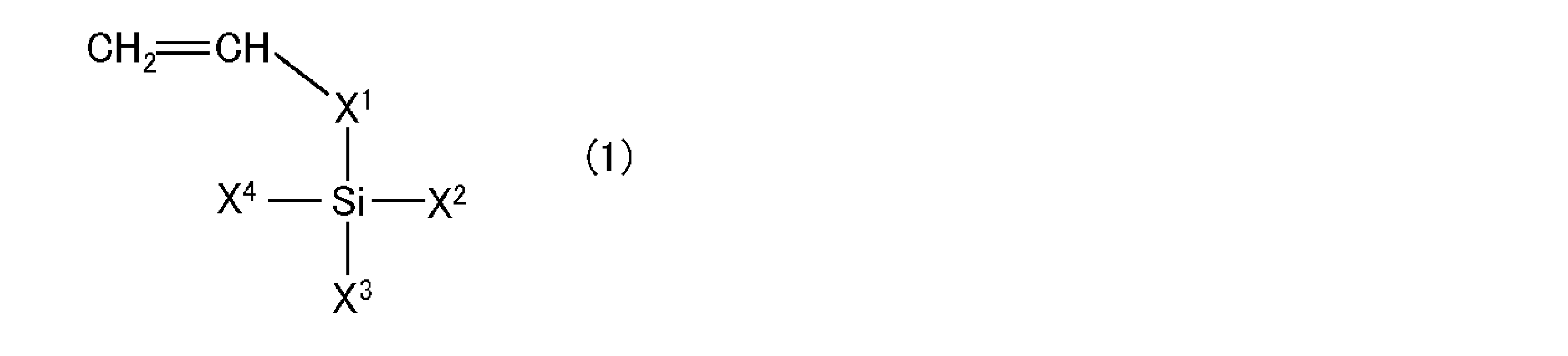
アルキレン基としては、メチレン基、エチレン基、トリメチレン基などが挙げられる。アルケンジイル基としては、ビニレン基、エチレン-1,1-ジイル基などが挙げられる。アリーレン基としては、フェニレン基、ナフチレン基、ビフェニレン基などが挙げられる。アリーレン基とアルキレン基とが結合した基としては、フェニレン基とメチレン基とが結合した基、フェニレン基とエチレン基とが結合した基などが挙げられる。X1がヒドロカルビレン基である場合には、X1は、アリーレン基であることが好ましく、フェニレン基であることがより好ましい。

R1およびR2を構成し得るヒドロカルビル基が、置換基を有する場合には、置換基としてヒドロカルビルオキシ基を有するヒドロカルビル基などが挙げられ、置換基としてヒドロカルビルオキシ基を有するヒドロカルビル基としては、メトキシメチル基、エトキシメチル基、メトキシエチル基などのアルコキシアルキル基;フェノキシメチル基などのアリールオキシアルキル基;などが挙げられる。
R1およびR2は、アルキル基であるか、あるいは、R1とR2とは互いに結合してアルキレン基となっていることが好ましく、R1およびR2は、アルキル基であることがより好ましく、R1およびR2は、メチル基またはエチル基であることがさらに好ましい。
X2、X3およびX4を構成し得るヒドロカルビル基が、置換基を有する場合には、置換基としてヒドロカルビルオキシ基を有するヒドロカルビル基などが挙げられ、メトキシメチル基、エトキシメチル基、エトキシエチル基などのアルコキシアルキル基などが挙げられる。
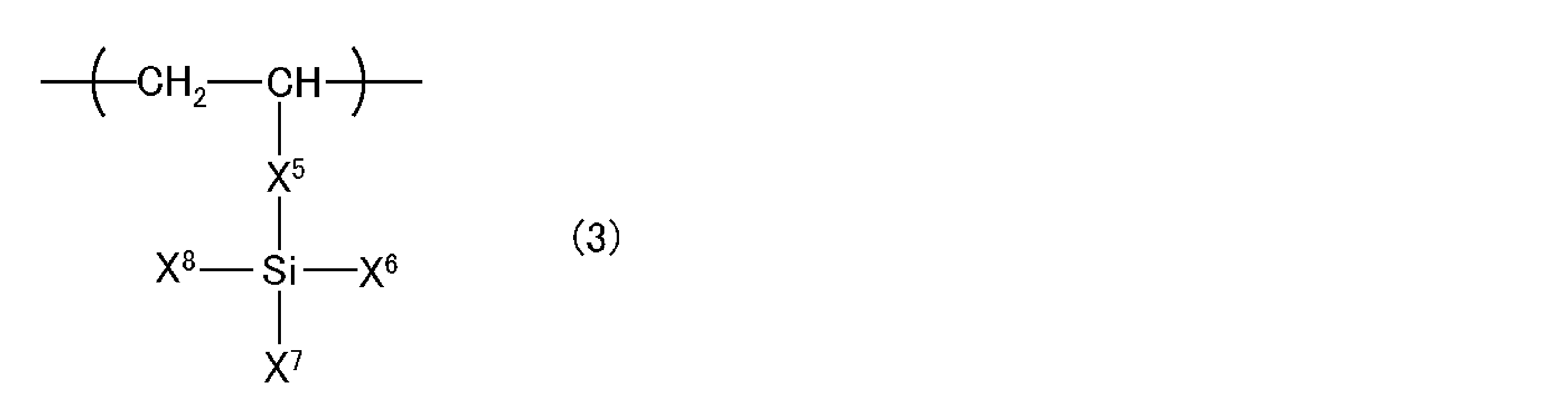

-Z1-Z2-E1 (5)
上記一般式(5)中、Z1は、炭素数1~10のアルキレン基、またはアルキルアリーレン基であり、Z2はメチレン基、硫黄原子、または酸素原子であり、E1はエポキシ基を有する炭素数2~10の炭化水素基である。


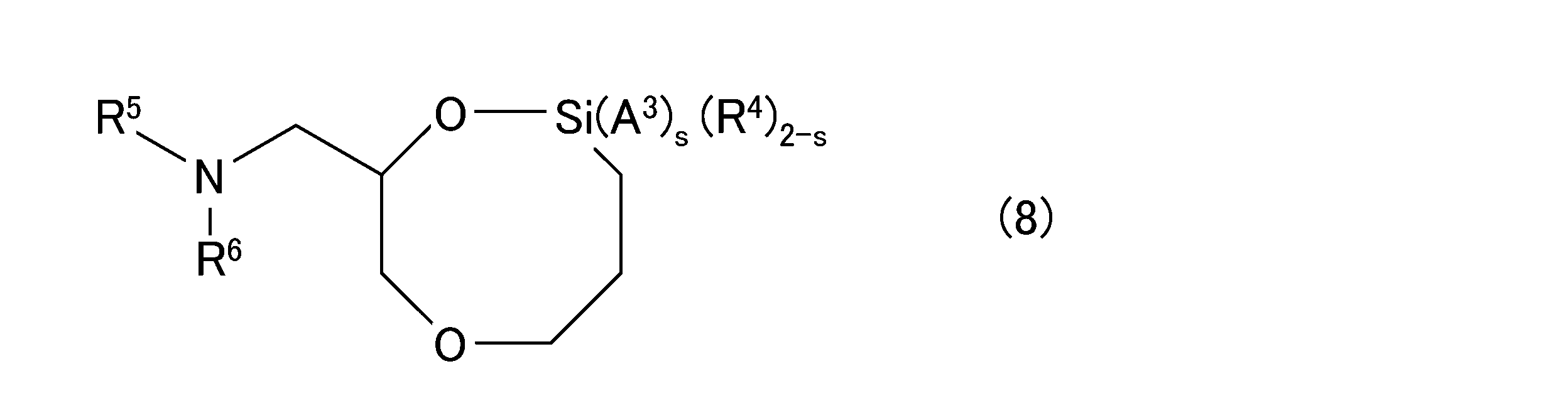
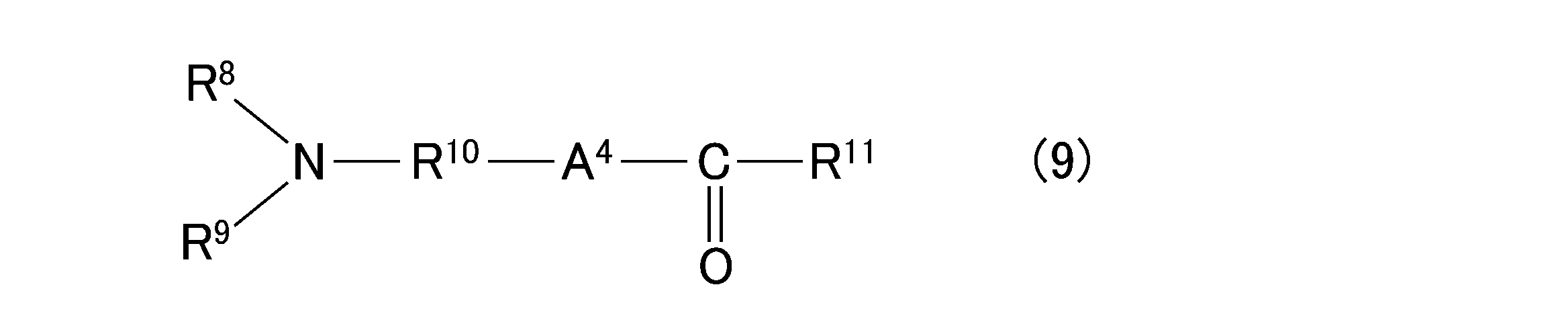
本発明の油展共役ジエン系重合体は、共役ジエン系重合体(A)をオイル(B)で伸展することにより製造することができる。
本発明のゴム組成物は、上述した本発明の油展共役ジエン系重合体と、充填剤とを含有する。
本発明の架橋性ゴム組成物は、上述した本発明のゴム組成物と、架橋剤とを含有する。
本発明のゴム架橋物は、上述した本発明の架橋性ゴム組成物を架橋してなるものである。
オイル(B)について、示差屈折率検出器を用いて、ゲルパーミエーションクロマトグラフィ(GPC)分析を行い、溶出曲線を得た。得られた溶出曲線における、オイル(B)由来の溶出面積(単位:mV×sec)を、RI検出面積[XRI]として求めた。また、示差屈折率検出器に代えて、紫外吸光検出器を用いた以外は、上記と同様にして溶出曲線を得て、得られた溶出曲線における、オイル(B)由来の溶出面積(単位:mV×sec)を、UV検出面積[XUV]として求めた。そして、UV検出面積[XUV]を、RI検出面積[XRI]で除することにより、UV/RI検出面積比[XUV/XRI]を算出した。ゲルパーミエーションクロマトグラフィの具体的な測定条件は、以下のとおりとした。
測定器:高速液体クロマトグラフ(東ソー社製、商品名「HLC-8320」)
カラム:東ソー社製ポリスチレン系カラム、商品名「GMH-HR-H」を二本直列に連結した。
検出器:示差屈折率(RI)、紫外吸光(UV)
溶離液:テトラヒドロフラン
カラム温度:40℃
オイル(B)について、示差走査熱量測定(DSC)を行い、得られたチャートを観察し、チャート中の融解熱ピークを特定した。チャート中に、融解熱ピークが複数観察される場合には、まず、各融解熱ピークの熱量に対応するチャート面積(各融解熱ピークのピークプロファイルと、ベースラインとで囲まれる部分の面積)を求め、次いで、各融解熱ピークの熱量に対応するチャート面積の総和を算出することで、総融解熱量に対応するチャート面積を求めた。そして、総融解熱量に対応するチャート面積に対して、任意の融解熱ピークの熱量に対応するチャート面積が10面積%以上である場合に、当該融解熱ピークを、総融解熱量に対して10%以上の熱量を示す融解熱ピークと特定した。そして、総融解熱量に対して10%以上の熱量を示す融解熱ピークのうち、最も高いピーク温度を有する融解熱ピークについて、補外融解開始温度[Tim-max]を求めた。ここで、本明細書において、補外融解開始温度は、融解熱ピークのピークプロファイル中の低温側領域において、最大勾配となる部分の接線と、ベースラインとの交点に対応する温度である。なお、チャート中に、融解熱ピークが1つのみ観察される場合には、当該融解熱ピークの補外融解開始温度を求めた。示差走査熱量測定の具体的な測定条件は、以下の通りとした。
測定器:示差走査熱量測定装置(PerkinElmer製、商品名「DSC8500」)
昇温速度:20℃/分
パージガス:ヘリウム
共役ジエン系重合体の重量平均分子量は、ゲルパーミエーションクロマトグラフィ(GPC)によりポリスチレン換算の分子量に基づくチャートを得て、得られたチャートに基づいて求めた。ゲルパーミエーションクロマトグラフィの具体的な測定条件は、以下のとおりとした。
測定器:高速液体クロマトグラフ(東ソー社製、商品名「HLC-8320」)
カラム:東ソー社製ポリスチレン系カラム、商品名「GMH-HR-H」を二本直列に連結した。
検出器:示差屈折率(RI)
溶離液:テトラヒドロフラン
カラム温度:40℃
なお、カップリング率は、上記の条件のゲルパーミエーションクロマトグラフィにより得られた溶出曲線において、最も小さいピークトップ分子量(カップリング反応前の重合体鎖に対応するピークトップ分子量)を有するピークを特定した後、当該ピークのピークトップ分子量の1.5倍以上のピークトップ分子量(カップリング重合体に対応するピークトップ分子量)を有する部分の溶出面積を求め、これを全溶出面積で除し、百分率に変換することにより求めた。
共役ジエン系重合体の芳香族ビニル単量体単位含有量、およびビニル結合含有量は、1H-NMRにより測定した。
JIS K6300に従い、ムーニー粘度計(島津製作所社製)を用いて測定した。
厚さ2mmのシート状のゴム架橋物から、長さ50mm、幅12.7mm、厚さ2mmの試験片を得た。得られた試験片に対して、ARES-G2(ティーエイインスツルメント社製)を用い、動的歪み0.5%、周波数10Hzの条件で-100℃から20℃におけるtanδを測定した。上記の条件で得られたチャートにおいて、最もtanδの値が高くなった時の温度(単位:℃)を求めた。そして、実施例1~3および比較例2~3の結果については、比較例1におけるtanδピーク温度(単位:℃)を100とした場合の、各実施例・比較例におけるtanδピーク温度の指数を求め、tanδピーク温度指数とした。また、実施例4~5および比較例5の結果については、比較例4におけるtanδピーク温度(単位:℃)を100とした場合の、各実施例・比較例におけるtanδピーク温度の指数を求め、tanδピーク温度指数とした。なお、比較例1および比較例4におけるtanδピーク温度は0℃未満であり、tanδピーク温度指数が大きいほど、tanδピーク温度が低いことを意味する。tanδピーク温度指数が大きいほど、低温特性に優れると判断できる。
各実施例・比較例で得られたシート状のゴム架橋物を、温度23℃、湿度50%の雰囲気で4週間保管し、ゴム架橋物表面のブルーム具合を目視にて観察した。ブルームが見られないものを〇、ブルームが見られるものを×とした。ブルームが見られないほど、耐ブルーム性に優れる。
内容積30Lの撹拌装置付きステンレス製重合反応器の中を、乾燥窒素で置換した。次に、工業用ヘキサン(住友化学社製、商品名:ヘキサン(一般品)、密度0.68g/mL)13.77kg、シクロヘキサン1.76kg、1,3-ブタジエン555g、スチレン900g、N,N,N’,N’-テトラメチルエチレンジアミン6.33mmol、を上記重合反応器内に投入した。次に、系内に含まれる重合を阻害する不純物の中和に必要な量のn-ブチルリチウム(n-BuLi)を含有するn-ヘキサン溶液を重合反応器内に添加し、さらに、n-ブチルリチウム(n-BuLi)を9.31mmolを含有するn-ヘキサン溶液を重合反応器内に投入し、撹拌速度160rpm、重合反応器内温度40℃の条件で混合液を撹拌した。重合を開始してから30分経過後、上記混合液に、1,3-ブタジエン864g、およびスチレン129gをそれぞれ85分、70分かけて連続的に供給しながら混合液の撹拌を行った。重合を開始してから135分経過後、上記混合液に、1,3-ブタジエン38gを3分かけて連続的に供給しながら混合液の撹拌を行い、さらに12分攪拌を行うことで重合溶液を得た。重合反応中の最高温度は70℃であった。次に、得られた重合溶液に、1,6-ビス(トリクロロシリル)ヘキサン0.22mmolを添加して15分間撹拌した後、下記式(10)で表されるポリオルガノシロキサンを、エポキシ基の含有量が0.34mmolとなるように添加し、20分間反応させた。その後、重合停止剤として、使用したn-ブチルリチウムの2倍モルに相当する量のメタノールを添加して、重合溶液を更に5分間撹拌した。次いで、この溶液に、老化防止剤として、2,4-ビス(オクチルチオメチル)-6-メチルフェノール(RIANOX社製、商品名:RIANOX1520)を、共役ジエン系ゴム100部に対して0.20部添加して攪拌することで、共役ジエン系重合体A1を含む重合溶液a1を得た。
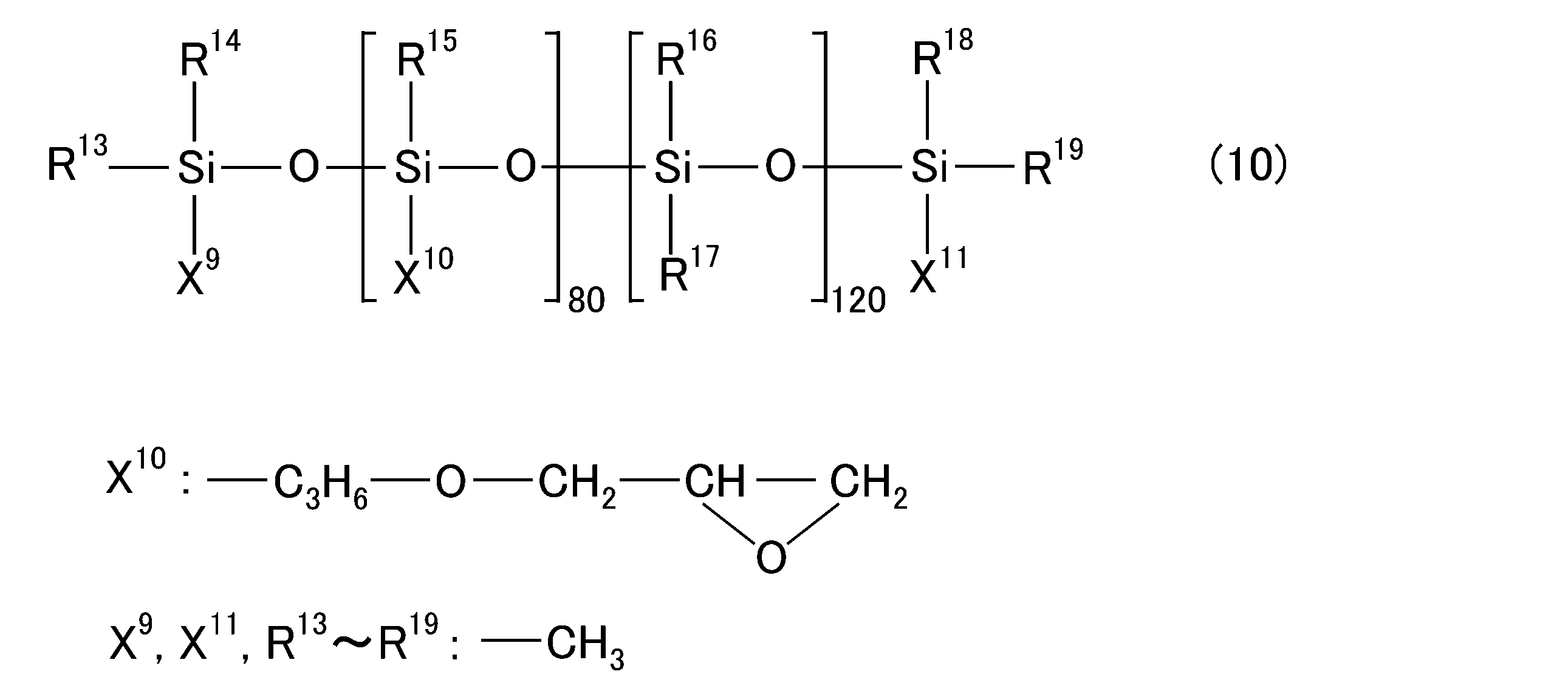
内容積20Lの撹拌装置付きステンレス製重合反応器の中を、乾燥窒素で置換した。次に、工業用ヘキサン(住友化学社製、商品名:ヘキサン(一般品)、密度0.68g/mL)8.84kg、テトラヒドロフラン6.95mL、エチレングリコールジブチルエーテル0.57mL、1,3-ブタジエン693g、スチレン228gを上記重合反応器内に投入した。次に、系内に含まれる重合を阻害する不純物の中和に必要な量のn-ブチルリチウム(n-BuLi)を含有するn-ヘキサン溶液を重合反応器内に添加し、さらに、n-ブチルリチウム(n-BuLi)を6.99mmolを含有するn-ヘキサン溶液を重合反応器内に投入し、撹拌速度160rpm、重合反応器内温度45℃の条件で混合液を撹拌した。重合を開始してから7分経過後、上記混合液に、1,3-ブタジエン936g、およびスチレン59gをそれぞれ70分かけて連続的に供給しながら混合液の撹拌を行い、重合を開始してから15分経過後には、上記混合液に、ビス(ジエチルアミノ)メチルビニルシラン3.72mmo1を重合反応器内に投入した。重合を開始してから90分経過後、テトラクロロシラン0.524mmolを添加して15分間撹拌した後、変性剤である[3-(ジエチルアミノ)プロピル]トリメトキシシラン8.11mmolを重合溶液に添加し、15分間撹拌した。次に、n-BuLiを12.17mmo1含有するn-ヘキサン溶液を重合溶液に添加し、15分間撹拌した。次いで、メタノールを1.2mL含有するヘキサン溶液20mLを重合反応器内に投入し、重合溶液を5分間撹拌した。重合反応中の最高温度は70℃であった。次いで、この溶液に、老化防止剤として、2,4-ビス(オクチルチオメチル)-6-メチルフェノール(RIANOX社製、商品名:RIANOX1520)を、共役ジエン系ゴム100部に対して0.20部添加して攪拌することで、共役ジエン系重合体A2を含む重合溶液a2を得た。
オイルB1:植物油『デリカエースHOL』(日清オイリオ社製、商品名:デリカエースHOL、ヨウ素価66)
オイルB2:植物油『大豆油』(日清オイリオ社製、商品名:大豆油、ヨウ素価130)
オイルB3:植物油『亜麻仁油』(日清オイリオ社製、商品名:亜麻仁油、ヨウ素価190)
オイルB4:石油系アロマオイル『T-DAE』(ENEOS社製、商品名:アロマックスT-DAE、融解ピーク無し)
オイルB5:植物由来オイル『Vivamax5000』(H&R社製、商品名:Vivamax5000、融解ピーク無し)
オイルB6:植物油『精製パーム油』(日清オイリオ社製、商品名:精製パーム油、ヨウ素価53)
重合例1で得られた、共役ジエン系重合体A1を200g含む重合溶液a1に対して、オイルB1を、75g添加して攪拌し、次いで、得られた重合溶液の揮発分の大部分を常温、24時間で蒸発させ、さらに、55℃で12時間減圧乾燥することで、油展共役ジエン系重合体P1を得た。得られた油展共役ジエン系重合体P1について、ムーニー粘度を測定した。結果を表1に示す。
の試験片を作製し、この試験片を用いて、上記の方法により、低温特性および耐ブルーム性の評価を行なった。結果を表2に示す。
オイルB1に代えて、表1に記載した種類のオイル(B2~B6)を75g添加した以外は、実施例1と同様にして油展共役ジエン系重合体(P2~P6)を得た。得られた油展共役ジエン系重合体について、ムーニー粘度を測定した。結果を表1に示す。また、得られた油展共役ジエン系重合体を用いた以外は、実施例1と同様にして、シート状のゴム架橋物を得て、実施例1と同様にして測定および評価を行った。結果を表2に示す。


重合例2で得られた、共役ジエン系重合体A2を200g含む重合溶液a2に対して、オイルB2を、50g添加して攪拌し、次いで、得られた重合溶液の揮発分の大部分を常温、24時間で蒸発させ、さらに、55℃で12時間減圧乾燥することで、油展共役ジエン系重合体P7を得た。得られた油展共役ジエン系重合体P7について、ムーニー粘度を測定した。結果を表3に示す。また、得られた油展共役ジエン系重合体P7を100重量部(ゴム成分としては80重量部)用いた以外は、実施例1と同様にして、シート状のゴム架橋物を得て、実施例1と同様にして測定および評価を行った。結果を表4に示す。
オイルB2に代えて、表3に記載した種類のオイル(B3,B4,B6)を50g添加した以外は、実施例2と同様にして油展共役ジエン系重合体(P8~P10)を得た。得られた油展共役ジエン系重合体について、ムーニー粘度を測定した。結果を表3に示す。また、得られた油展共役ジエン系重合体を100重量部(ゴム成分としては80重量部)用いた以外は、実施例1と同様にして、シート状のゴム架橋物を得て、実施例1と同様にして測定および評価を行った。結果を表4に示す。
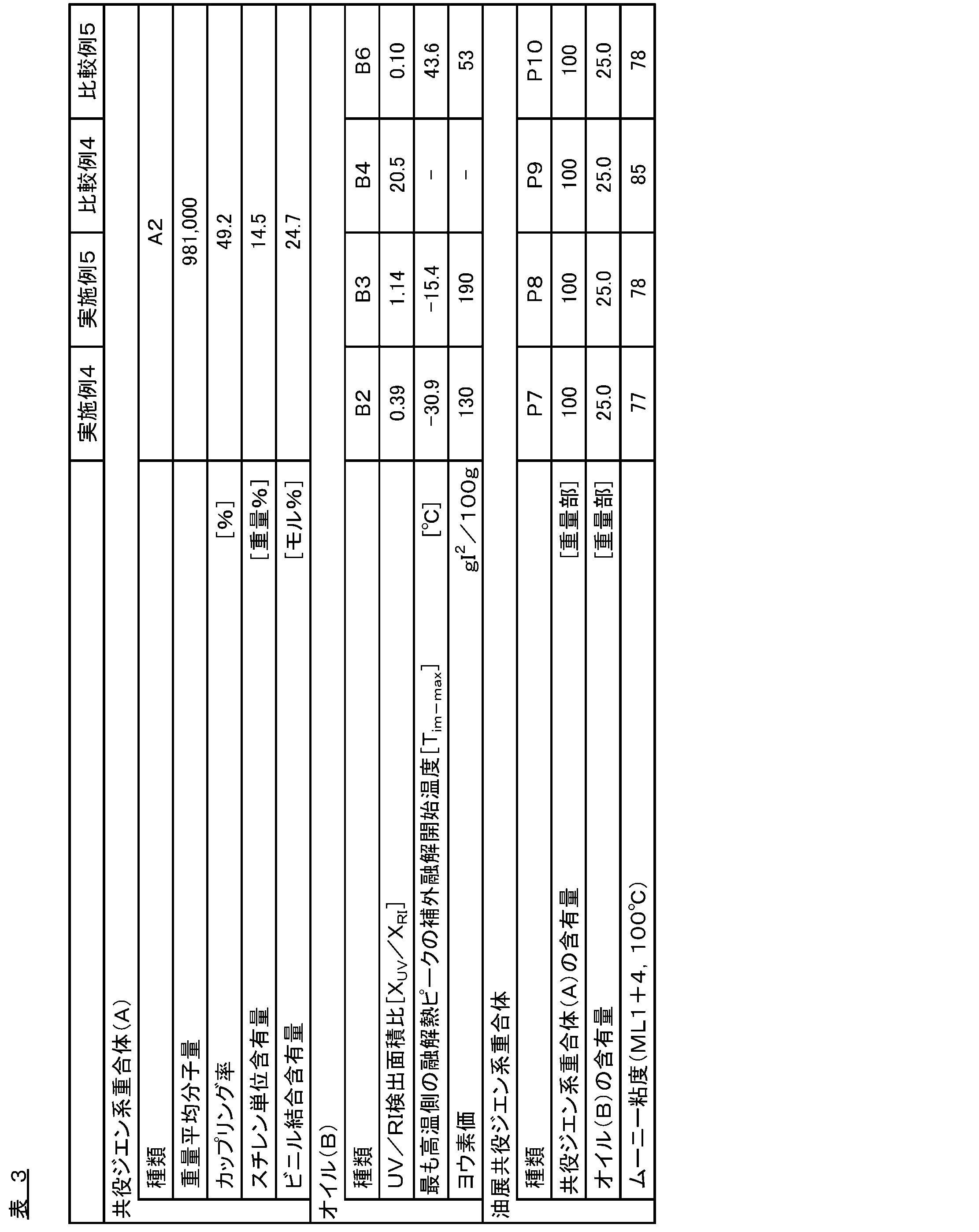
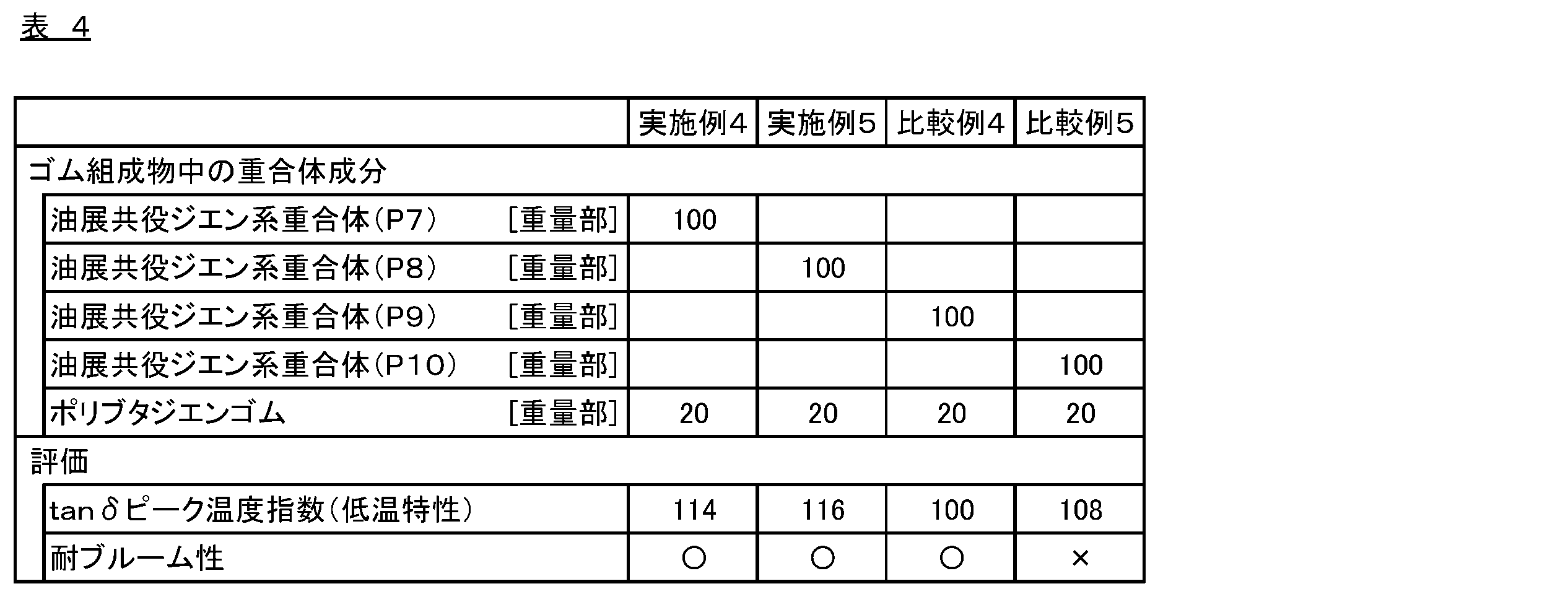
Claims (9)
- 共役ジエン系重合体(A)をオイル(B)で伸展してなる油展共役ジエン系重合体であって、
前記共役ジエン系重合体(A)100重量部に対する前記オイル(B)の含有量が、5~60重量部であり、
前記オイル(B)が、
(1)示差屈折率検出器および紫外吸光検出器を用いてゲルパーミエーションクロマトグラフィ分析を行う場合の、示差屈折率検出器を用いて検出される溶出曲線における、前記オイル(B)由来の溶出面積をRI検出面積[XRI]とし、紫外吸光検出器を用いて検出される溶出曲線における、前記オイル(B)由来の溶出面積をUV検出面積[XUV]とした場合における、RI検出面積[XRI]に対するUV検出面積[XUV]の比[XUV/XRI]が10以下であり、
(2)示差走査熱量測定により測定される融解熱ピークを1つ以上有し、示差走査熱量測定により測定される総融解熱量に対して10%以上の熱量を示す融解熱ピークのうち、最も高いピーク温度を有する融解熱ピークの補外融解開始温度[Tim-max]が23℃以下であること、
を特徴とする油展共役ジエン系重合体。 - 前記オイル(B)のヨウ素価が150以上である請求項1に記載の油展共役ジエン系重合体。
- ムーニー粘度(ML1+4,100℃)が10~200である請求項1または2に記載の油展共役ジエン系重合体。
- 請求項1~3のいずれかに記載の油展共役ジエン系重合体と、充填剤とを含有するゴム組成物。
- 前記充填剤として、シリカを含有する請求項4に記載のゴム組成物。
- さらにシランカップリング剤を含有する請求項4または5に記載のゴム組成物。
- 請求項4~6のいずれかに記載のゴム組成物と、架橋剤とを含有する架橋性ゴム組成物。
- 請求項7に記載の架橋性ゴム組成物を架橋してなるゴム架橋物。
- 請求項8に記載のゴム架橋物を含むタイヤ。
Priority Applications (5)
| Application Number | Priority Date | Filing Date | Title |
|---|---|---|---|
| JP2023576877A JPWO2023145652A1 (ja) | 2022-01-27 | 2023-01-20 | |
| CN202380017113.XA CN118541432A (zh) | 2022-01-27 | 2023-01-20 | 充油共轭二烯系聚合物、橡胶组合物、橡胶交联物和轮胎 |
| US18/730,064 US20250115746A1 (en) | 2022-01-27 | 2023-01-20 | Oil-extended conjugated diene-based polymer, rubber composition, crosslinked rubber product, and tire |
| KR1020247024544A KR20240135768A (ko) | 2022-01-27 | 2023-01-20 | 유전 공액 디엔계 중합체, 고무 조성물, 고무 가교물, 및 타이어 |
| EP23746865.7A EP4471084A4 (en) | 2022-01-27 | 2023-01-20 | OIL-EXTENDED CONJUGATED DIENE-BASED POLYMER, RUBBER COMPONENT, CROSS-CUT RUBBER PRODUCT AND TIRE |
Applications Claiming Priority (2)
| Application Number | Priority Date | Filing Date | Title |
|---|---|---|---|
| JP2022011244 | 2022-01-27 | ||
| JP2022-011244 | 2022-01-27 |
Publications (1)
| Publication Number | Publication Date |
|---|---|
| WO2023145652A1 true WO2023145652A1 (ja) | 2023-08-03 |
Family
ID=87471889
Family Applications (1)
| Application Number | Title | Priority Date | Filing Date |
|---|---|---|---|
| PCT/JP2023/001758 Ceased WO2023145652A1 (ja) | 2022-01-27 | 2023-01-20 | 油展共役ジエン系重合体、ゴム組成物、ゴム架橋物、およびタイヤ |
Country Status (7)
| Country | Link |
|---|---|
| US (1) | US20250115746A1 (ja) |
| EP (1) | EP4471084A4 (ja) |
| JP (1) | JPWO2023145652A1 (ja) |
| KR (1) | KR20240135768A (ja) |
| CN (1) | CN118541432A (ja) |
| TW (1) | TW202342634A (ja) |
| WO (1) | WO2023145652A1 (ja) |
Cited By (1)
| Publication number | Priority date | Publication date | Assignee | Title |
|---|---|---|---|---|
| JP2023118404A (ja) * | 2022-02-15 | 2023-08-25 | 横浜ゴム株式会社 | タイヤ用ゴム組成物 |
Citations (6)
| Publication number | Priority date | Publication date | Assignee | Title |
|---|---|---|---|---|
| JP2004352729A (ja) * | 2003-04-04 | 2004-12-16 | Riken Technos Corp | 軟化剤組成物、熱可塑性エラストマー組成物及び成形体 |
| WO2007074617A1 (ja) * | 2005-12-27 | 2007-07-05 | Sumitomo Rubber Industries, Ltd. | サイドウォール用ゴム組成物およびその製造方法 |
| JP2007291347A (ja) * | 2006-03-28 | 2007-11-08 | Sumitomo Rubber Ind Ltd | タイヤ用油展ゴムの製造方法、該タイヤ用油展ゴム、それを用いたゴム組成物およびタイヤ |
| JP2018138648A (ja) * | 2016-11-28 | 2018-09-06 | ザ・グッドイヤー・タイヤ・アンド・ラバー・カンパニー | 低不飽和大豆油で伸展されたスチレン/ブタジエンゴム及びその部品を有するタイヤ |
| WO2019073828A1 (ja) | 2017-10-13 | 2019-04-18 | 日本ゼオン株式会社 | 共役ジエン系ゴム |
| WO2019189204A1 (ja) | 2018-03-27 | 2019-10-03 | 日本ゼオン株式会社 | 共役ジエン系ゴムの製造方法 |
Family Cites Families (2)
| Publication number | Priority date | Publication date | Assignee | Title |
|---|---|---|---|---|
| EP1840161B1 (en) * | 2006-03-28 | 2009-01-14 | Sumitomo Rubber Industries, Ltd. | Preparation process of oil extended rubber for tire, oil extended rubber for tire, and rubber composition and tire using the same |
| JP6897366B2 (ja) * | 2017-06-29 | 2021-06-30 | 住友ゴム工業株式会社 | ゴム組成物及び空気入りタイヤ |
-
2023
- 2023-01-20 EP EP23746865.7A patent/EP4471084A4/en active Pending
- 2023-01-20 KR KR1020247024544A patent/KR20240135768A/ko active Pending
- 2023-01-20 JP JP2023576877A patent/JPWO2023145652A1/ja active Pending
- 2023-01-20 CN CN202380017113.XA patent/CN118541432A/zh active Pending
- 2023-01-20 US US18/730,064 patent/US20250115746A1/en active Pending
- 2023-01-20 WO PCT/JP2023/001758 patent/WO2023145652A1/ja not_active Ceased
- 2023-01-30 TW TW112103113A patent/TW202342634A/zh unknown
Patent Citations (6)
| Publication number | Priority date | Publication date | Assignee | Title |
|---|---|---|---|---|
| JP2004352729A (ja) * | 2003-04-04 | 2004-12-16 | Riken Technos Corp | 軟化剤組成物、熱可塑性エラストマー組成物及び成形体 |
| WO2007074617A1 (ja) * | 2005-12-27 | 2007-07-05 | Sumitomo Rubber Industries, Ltd. | サイドウォール用ゴム組成物およびその製造方法 |
| JP2007291347A (ja) * | 2006-03-28 | 2007-11-08 | Sumitomo Rubber Ind Ltd | タイヤ用油展ゴムの製造方法、該タイヤ用油展ゴム、それを用いたゴム組成物およびタイヤ |
| JP2018138648A (ja) * | 2016-11-28 | 2018-09-06 | ザ・グッドイヤー・タイヤ・アンド・ラバー・カンパニー | 低不飽和大豆油で伸展されたスチレン/ブタジエンゴム及びその部品を有するタイヤ |
| WO2019073828A1 (ja) | 2017-10-13 | 2019-04-18 | 日本ゼオン株式会社 | 共役ジエン系ゴム |
| WO2019189204A1 (ja) | 2018-03-27 | 2019-10-03 | 日本ゼオン株式会社 | 共役ジエン系ゴムの製造方法 |
Non-Patent Citations (1)
| Title |
|---|
| See also references of EP4471084A4 |
Cited By (1)
| Publication number | Priority date | Publication date | Assignee | Title |
|---|---|---|---|---|
| JP2023118404A (ja) * | 2022-02-15 | 2023-08-25 | 横浜ゴム株式会社 | タイヤ用ゴム組成物 |
Also Published As
| Publication number | Publication date |
|---|---|
| KR20240135768A (ko) | 2024-09-12 |
| JPWO2023145652A1 (ja) | 2023-08-03 |
| CN118541432A (zh) | 2024-08-23 |
| US20250115746A1 (en) | 2025-04-10 |
| EP4471084A1 (en) | 2024-12-04 |
| EP4471084A4 (en) | 2026-01-14 |
| TW202342634A (zh) | 2023-11-01 |
Similar Documents
| Publication | Publication Date | Title |
|---|---|---|
| US11873364B2 (en) | Method for producing conjugated diene rubber | |
| JP7301745B2 (ja) | 共役ジエン系ゴム | |
| US11566094B2 (en) | Modified conjugated diene rubber | |
| JP7823579B2 (ja) | 共役ジエン系重合体、ゴム組成物、ゴム架橋物、およびタイヤ | |
| WO2023145652A1 (ja) | 油展共役ジエン系重合体、ゴム組成物、ゴム架橋物、およびタイヤ | |
| JP7108460B2 (ja) | 共役ジエン系ゴムの製造方法 | |
| JP7838484B2 (ja) | 共役ジエン系重合体、ゴム組成物、ゴム架橋物、およびタイヤ | |
| TWI912515B (zh) | 共軛二烯系聚合物、橡膠組成物、橡膠交聯物及輪胎 | |
| JP7244244B2 (ja) | 共役ジエン系ゴムの製造方法 | |
| JP7647990B1 (ja) | 変性共役ジエン系重合体、ゴム組成物、ゴム架橋物およびタイヤの製造方法 | |
| KR102958232B1 (ko) | 공액 디엔계 중합체, 고무 조성물, 고무 가교물, 및 타이어 | |
| JP7142182B1 (ja) | ゴム組成物、ゴム架橋物、タイヤおよびゴム架橋物の製造方法 | |
| KR20250161540A (ko) | 안정화 공액 디엔계 중합체 |
Legal Events
| Date | Code | Title | Description |
|---|---|---|---|
| 121 | Ep: the epo has been informed by wipo that ep was designated in this application |
Ref document number: 23746865 Country of ref document: EP Kind code of ref document: A1 |
|
| ENP | Entry into the national phase |
Ref document number: 2023576877 Country of ref document: JP Kind code of ref document: A |
|
| WWE | Wipo information: entry into national phase |
Ref document number: 202380017113.X Country of ref document: CN |
|
| WWE | Wipo information: entry into national phase |
Ref document number: 18730064 Country of ref document: US |
|
| ENP | Entry into the national phase |
Ref document number: 20247024544 Country of ref document: KR Kind code of ref document: A |
|
| NENP | Non-entry into the national phase |
Ref country code: DE |
|
| ENP | Entry into the national phase |
Ref document number: 2023746865 Country of ref document: EP Effective date: 20240827 |
|
| WWP | Wipo information: published in national office |
Ref document number: 18730064 Country of ref document: US |