WO2023146809A1 - Plasma kallikrein inhibitors - Google Patents

Plasma kallikrein inhibitors Download PDF

Info

Publication number
WO2023146809A1
WO2023146809A1 PCT/US2023/011304 US2023011304W WO2023146809A1 WO 2023146809 A1 WO2023146809 A1 WO 2023146809A1 US 2023011304 W US2023011304 W US 2023011304W WO 2023146809 A1 WO2023146809 A1 WO 2023146809A1
Authority
WO
WIPO (PCT)
Prior art keywords
group
alkyl
halo
hydrogen
optionally substituted
Prior art date
Legal status (The legal status is an assumption and is not a legal conclusion. Google has not performed a legal analysis and makes no representation as to the accuracy of the status listed.)
Ceased
Application number
PCT/US2023/011304
Other languages
French (fr)
Other versions
WO2023146809A9 (en
Inventor
Anthony K. Ogawa
Christopher J. SINZ
Alan C. Cheng
Ying-Duo Gao
Song Yang
Jianming Bao
Rohan Rajiv MERCHANT
Natalija CERNAKA
Phillip Patrick SHARP
Jovan Alexander LOPEZ
Dong Xiao
Haiqun Tang
Maoqun TIAN
Mihir B. MANDAL
Jiafang He
Current Assignee (The listed assignees may be inaccurate. Google has not performed a legal analysis and makes no representation or warranty as to the accuracy of the list.)
Merck Sharp and Dohme LLC
Original Assignee
Merck Sharp and Dohme LLC
Priority date (The priority date is an assumption and is not a legal conclusion. Google has not performed a legal analysis and makes no representation as to the accuracy of the date listed.)
Filing date
Publication date
Application filed by Merck Sharp and Dohme LLC filed Critical Merck Sharp and Dohme LLC
Priority to JP2024543515A priority Critical patent/JP7794991B2/en
Priority to KR1020247028015A priority patent/KR20240144234A/en
Priority to MX2024009122A priority patent/MX2024009122A/en
Priority to US18/728,990 priority patent/US20250099478A1/en
Priority to CA3247957A priority patent/CA3247957A1/en
Priority to AU2023211555A priority patent/AU2023211555A1/en
Priority to CN202380018441.1A priority patent/CN118613483A/en
Priority to EP23747494.5A priority patent/EP4469458A4/en
Publication of WO2023146809A1 publication Critical patent/WO2023146809A1/en
Publication of WO2023146809A9 publication Critical patent/WO2023146809A9/en
Anticipated expiration legal-status Critical
Ceased legal-status Critical Current

Links

Classifications

    • AHUMAN NECESSITIES
    • A61MEDICAL OR VETERINARY SCIENCE; HYGIENE
    • A61KPREPARATIONS FOR MEDICAL, DENTAL OR TOILETRY PURPOSES
    • A61K31/00Medicinal preparations containing organic active ingredients
    • A61K31/33Heterocyclic compounds
    • A61K31/395Heterocyclic compounds having nitrogen as a ring hetero atom, e.g. guanethidine or rifamycins
    • A61K31/535Heterocyclic compounds having nitrogen as a ring hetero atom, e.g. guanethidine or rifamycins having six-membered rings with at least one nitrogen and one oxygen as the ring hetero atoms, e.g. 1,2-oxazines
    • A61K31/537Heterocyclic compounds having nitrogen as a ring hetero atom, e.g. guanethidine or rifamycins having six-membered rings with at least one nitrogen and one oxygen as the ring hetero atoms, e.g. 1,2-oxazines spiro-condensed or forming part of bridged ring systems
    • AHUMAN NECESSITIES
    • A61MEDICAL OR VETERINARY SCIENCE; HYGIENE
    • A61KPREPARATIONS FOR MEDICAL, DENTAL OR TOILETRY PURPOSES
    • A61K45/00Medicinal preparations containing active ingredients not provided for in groups A61K31/00 - A61K41/00
    • A61K45/06Mixtures of active ingredients without chemical characterisation, e.g. antiphlogistics and cardiaca
    • AHUMAN NECESSITIES
    • A61MEDICAL OR VETERINARY SCIENCE; HYGIENE
    • A61PSPECIFIC THERAPEUTIC ACTIVITY OF CHEMICAL COMPOUNDS OR MEDICINAL PREPARATIONS
    • A61P27/00Drugs for disorders of the senses
    • A61P27/02Ophthalmic agents
    • CCHEMISTRY; METALLURGY
    • C07ORGANIC CHEMISTRY
    • C07DHETEROCYCLIC COMPOUNDS
    • C07D498/00Heterocyclic compounds containing in the condensed system at least one hetero ring having nitrogen and oxygen atoms as the only ring hetero atoms
    • C07D498/02Heterocyclic compounds containing in the condensed system at least one hetero ring having nitrogen and oxygen atoms as the only ring hetero atoms in which the condensed system contains two hetero rings
    • C07D498/10Spiro-condensed systems
    • CCHEMISTRY; METALLURGY
    • C07ORGANIC CHEMISTRY
    • C07DHETEROCYCLIC COMPOUNDS
    • C07D519/00Heterocyclic compounds containing more than one system of two or more relevant hetero rings condensed among themselves or condensed with a common carbocyclic ring system not provided for in groups C07D453/00 or C07D455/00

Definitions

  • Plasma kallikrein is a zymogen of a trypsin-like serine protease and is present in plasma.
  • the gene structure is similar to that of factor XL
  • the amino acid sequence of plasma kallikrein has 58% homology to factor XI.
  • Proteolytic activation by factor Xlla at an internal I389-R390 bond yields a heavy chain (371 amino acids) and a light chain (248 amino acids).
  • the active site of plasma kallikrein is contained in the light chain.
  • the light chain of plasma kallikrein reacts wi th protease inhibitors, including alpha 2 macroglobulin and Cl- inhibitor.
  • HMWK high molecular weight kininogen
  • HAE hereditary angioedema
  • the plasma kallikrein-kinin system is abnormally abundant in patients diagnosed with advanced diabetic macular edema (DME).
  • DME advanced diabetic macular edema
  • Recent publications have shown that plasma kallikrein contributes to observed retinal vascular leakage and dysfunction in diabetic rodent models (A. Clermont, et al., Diabetes, 60: 1590 (2011)), and that treatment with a small molecule plasma kallikrein inhibitor ameliorated the observed retinal vascular permeability and other abnormalities related to retinal blood flow.
  • SUBSTITUTE SHEET ( RULE 26 ) utility to treat a wide range of disorders, including hereditary angioedema, diabetic macular edema and diabetic retinopathy.
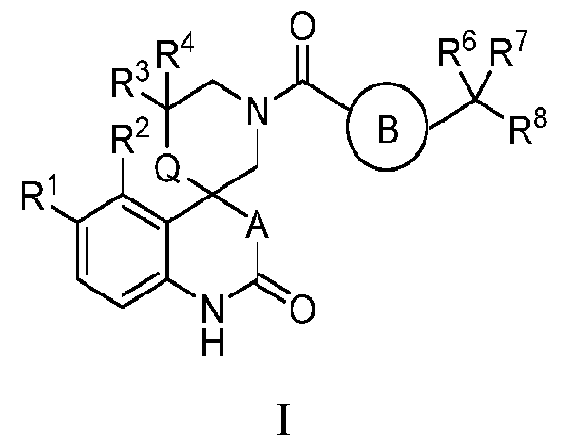
  • the present invention relates to compounds of Formula I: and pharmaceutically acceptable salts thereof.
  • the compounds of Formula I are inhibitors of plasma kallikrein, and as such may be useful in the treatment, inhibition or amelioration of one or more disease states that could benefit from inhibition of plasma kallikrein, including hereditary angioedema, uveitis, posterior uveitis, wet age-related macular degeneration, diabetic macular edema, diabetic retinopathy and retinal vein occlusion.
  • the compounds of this invention could further be used in combination with other therapeutically effective agents, including but not limited to, other drugs useful for the treatment of hereditary angioedema, uveitis, posterior uveitis, wet age-related macular degeneration, diabetic macular edema, diabetic retinopathy and retinal vein occlusion.
  • the invention furthermore relates to processes for preparing compounds of Formula I, and pharmaceutical compositions which comprise compounds of Formula I and pharmaceutically acceptable salts thereof.
  • the present invention relates to compounds of Formula I:
  • Q is -CH2- or absent
  • R 1 is selected from the group consisting of hydrogen, halo, hydroxy and C1-6 alkyl
  • R 2 is selected from the group consisting of hydrogen, halo, hydroxy and C1-6 alkyl
  • R 3 is selected from the group consisting of hydrogen, halo, hydroxy, C1-6 alkyl and C3-6 cycloalkyl;
  • R 4 is selected from the group consisting of hydrogen, halo, hydroxy and C1-6 alkyl
  • R 5 is hydrogen, halo or C1-6 alkyl, wherein said alkyl group is optionally substituted with one to three halo;
  • R 6 is independently selected from the group consisting of hydrogen, halo, hydroxy, cyclopropyl, C1-6 alkyl and (C1-6 alkyl)cyclopropyl, wherein said alkyl group is optionally substituted with one to three substituents independently selected from the group consisting of halo, phenyl and OR X , and said cyclopropyl groups are optionally substituted with OR X ;
  • R 7 is selected from the group consisting of hydrogen, halo, hydroxy and C 1-6 alkyl, wherein said alky l group is optionally substituted with one to three halo or hydroxy; or R 6 and R 7 can be taken together with the carbon atom to which they are attached to form a 3- to 6-membered cycloalkyl group, or a 5- to 6-membered heterocyclyl group;
  • R 9 is hydrogen or C1-3 alkyl
  • R 10 is hydrogen or C1-3 alkyl
  • R x is hydrogen or Ci-s alkyl, which is optionally substituted with one to three substituents selected from the group consisting of halo and hydroxy,
  • R y is heteroaryl, heterocyclyl or C3-6 cycloalkyl, wherein said heteroaryl group is optionally substituted with oxo or C 1-6 alkyl, said heterocyclyl group is optionally substituted with one or two oxo and said cycloalkyl group is optionally substituted with C1-6 alkyl; or a pharmaceutically acceptable salt thereof.
  • Q is -CH2-. In another embodiment of the invention, Q is absent
  • the present invention relates to compounds of the Formula la: the group consisting of hydrogen, halo, hydroxy and Ci-6 alkyl;
  • R 2 is selected from the group consisting of hydrogen, halo, hydroxy and Ci-6 alkyl
  • R 3 is selected from the group consisting of hydrogen, halo, hydroxy, Ci-6 alkyl and C3-6 cycloalkyl;
  • R 4 is selected from the group consisting of hydrogen, halo, hydroxy and C1-6 alkyl
  • R 5 is hydrogen, halo or C1-6 alkyl, wherein said alkyl group is optionally substituted with one to three halo;
  • R 6 is independently selected from the group consisting of hydrogen, halo, hydroxy, cyclopropyl, C1-6 alkyl and (C1-6 alkyl)cyclopropyl, wherein said alkyl group is optionally substituted with one to three substituents independently selected from the group consisting of halo, phenyl and OR X , and said cyclopropyl groups are optionally substituted with OR X ;
  • R 7 is selected from the group consisting of hydrogen, halo, hydroxy and C 1-6 alkyl, wherein said alkyd group is optionally substituted with one to three halo or hydroxy; or R 6 and R 7 can be taken together with the carbon atom to which they are attached to form a 3- to 6-membered cycloalkyl group, or a 5- to 6-membered heterocyclyl group;
  • R 8 is selected from the group consisting of phenyl or heteroaryl, which can be monocyclic or bicyclic; wherein said phenyl and heteroaryl groups are optionally substituted
  • R 9 is hydrogen or C1-3 alkyl
  • R 10 is hydrogen or C1-3 alkyl
  • R x is hydrogen or C1-6 alkyl, which is optionally substituted with one to three substituents selected from the group consisting of halo and hydroxy,
  • R y is heteroaryl, heterocyclyl or C3-6 cycloalkyl, wherein said heteroaryl group is optionally substituted with oxo or C 1-6 alkyl, said heterocyclyl group is optionally substituted with one or two oxo and said cycloalkyl group is optionally substituted with C1-6 alkyl; or a pharmaceutically acceptable salt thereof.
  • A is 0. In another embodiment of the invention, A is -CH 2 -.
  • the present invention relates to compounds of the Formula lb:
  • R 1 is selected from the group clonsisting of hydrogen, halo, hydroxy and C1-6 alkyl;
  • R 2 is selected from the group consisting of hydrogen, halo, hydroxy and C1-6 alkyl
  • R 5 is hydrogen, halo or C1-6 alkyl, wherein said alkyl group is optionally substituted with one to three halo;
  • R 6 is independently selected from the group consisting of hydrogen, halo, hydroxy, cyclopropyl, C1-6 alkyl and (C1-6 alkyl)cyclopropyl, wherein said alkyl group is optionally substituted with one to three substituents independently selected from the group consisting of halo, phenyl and OR X , and said cyclopropyl groups are optionally substituted with OR X ;
  • R 7 is selected from the group consisting of hydrogen, halo, hydroxy and C 1-6 alkyl, wherein
  • SUBSTITUTE SHEET ( RULE 26 ) said alkyd group is optionally substituted with one to three halo or hydroxy; or R 6 and R 7 can be taken together with the carbon atom to which they are attached to form a 3- to 6-membered cycloalkyl group, or a 5- to 6-membered heterocyclyl group;
  • R 9 is hydrogen or C1-3 alkyl
  • R 10 is hydrogen or Ci-s alkyl
  • R x is hydrogen or Ci-6 alkyl, which is optionally substituted with one to three substituents selected from the group consisting of halo and hydroxy,
  • R y is heteroaryl, heterocyclyl or C3-6 cycloalkyl, wherein said heteroaryl group is optionally substituted with oxo or C 1-6 alkyl, said heterocyclyl group is optionally substituted with one or two oxo and said cycloalkyl group is optionally substituted with C1-6 alkyl; or a pharmaceutically acceptable salt thereof.
  • (T) is L N In another embodiment of the invention, . In another embodiment of the invention, is In another embodiment of the invention, In another embodiment of the invention,
  • R 1 is halo. In a class of the embodiment, R 1 is chloro.
  • R 2 is halo. In a class of the embodiment invention, R 2 is fluoro.
  • R? is hydrogen or methyl.
  • R 3 is hydrogen.
  • R 3 is methyl.
  • R 4 is hydrogen or methyl. In a class of the embodiment, R 4 is hydrogen. In a class of the embodiment, R 4 is methyl.
  • R 5 is hydrogen or halo. In a class of the embodiment, R 5 is halo. In a subclass of the embodiment, R 5 is fluoro.
  • R 6 is hydrogen, hydroxyl, Ci-6-alkyl, and (C i- 6-alkyl)cyclopropyl, wherein said alkyl is optionally substituted with halo or OR X .
  • R 6 is hydrogen, hydroxyl, Ci-6-alkyl, and -CHricyclopropyl). wherein said alkyl is optionally substituted with halo or OR X .
  • R 6 is Ci-6-alky 1.
  • R 6 is methyl.
  • R 6 is ethyl.
  • R 6 is Ci-6-alkyl, which is substituted with OR X or halo. In a further subclass of the embodiment, R 6 is Ci-6-alkyl, which is substituted with fluoro, hydroxy or methoxy.
  • R 7 is hydrogen, hydroxyl or Ci-6-alkyl, which is optionally substituted with hydroxy or halo.
  • R 7 is hydrogen.
  • R 7 is hydroxyl.
  • R 7 is Ci-6- alkyl, which is optionally substituted with hydroxy or halo.
  • R 6 and R 7 are taken together with the carbon atom to which they are attached to form a six-membered heterocycle or a Cs/, cycloalkyl group.
  • R 8 is phenyl, which is substituted with fluoro or chloro.
  • R 8 is a monocyclic or bicyclic heteroaryl ring, which is optionally substituted with halo, Ci-6-alkyl, R x and NR’R 10 .
  • Specific embodiments of the present invention include, but are not limited to the compounds identified herein as Examples 1 to 138, or pharmaceutically acceptable salts thereof.
  • composition which is compnsed of a compound of Formula I or la as described above and a pharmaceutically acceptable carrier.
  • the invention is also contemplated to encompass a
  • SUBSTITUTE SHEET ( RULE 26 ) pharmaceutical composition which is comprised of a pharmaceutically acceptable carrier and any of the compounds specifically disclosed in the present application.
  • the invention includes compositions for treating diseases or condition in which plasma kallikrein activity is implicated. Accordingly the invention includes compositions for treating impaired visual activity, diabetic retinopathy, diabetic macular edema, retinal vein occlusion, hereditary angioedema, diabetes, pancreatitis, cerebral hemorrhage, nephropathy, cardiomyopathy, neuropathy, inflammatory bowel disease, arthritis, inflammation, septic shock, hypotension, cancer, adult respiratory distress syndrome, disseminated intravascular coagulation, blood coagulation during cardiopulmonary bypass surgery, and bleeding from postoperative surgery in a mammal, comprising a compound of the invention in a pharmaceutically acceptable carrier.
  • a class of the invention includes compositions for treating hereditary angioedema, uveitis, posterior uveitis, wet age-related macular degeneration, diabetic macular edema, diabetic retinopathy and retinal vein occlusion. These compositions may optionally include antiinflammatory agents, anti-VEGF agents, immunosuppressive agents, anticoagulants, antiplatelet agents, and thrombolytic agents. The compositions can be added to blood, blood products, or mammalian organs in order to effect the desired inhibitions.
  • the invention also includes compositions for preventing or treating retinal vascular permeability associated with diabetic retinopathy and diabetic macular edema in a mammal, comprising a compound of the invention in a pharmaceutically acceptable carrier.
  • compositions may optionally include anti-mflammatory agents, anti-VEGF agents, immunosuppressive agents, anticoagulants, antiplatelet agents, and thrombolytic agents
  • the invention also includes compositions for treating inflammatory' conditions of the eye, which includes, but is not limited to, uveitis, posterior uveitis, macular edema, acute macular degeneration, wet age-related macular degeneration, retinal detachments, retinal vein occlusion, ocular tumors, fungal infections, viral infections, multifocal choroiditis, diabetic uveitis, diabetic macular edema, diabetic retinopathy, proliferative vitreoretinopathy, sympathetic opthalmia, Vogt Koyanagi -Harada syndrome, histoplasmosis and uveal diffusion.
  • These compositions may optionally include anti-inflammatory agents, anti-VEGF agents, immunosuppressive agents, anticoagulants, antiplatelet agents, and thrombolytic agents
  • the invention also includes compositions treating posterior eye disease, which includes, but is not limited to, uveitis, posterior uveitis, wet age-related macular degeneration, diabetic macular edema, diabetic retinopathy and retinal vein occlusion.
  • These compositions may optionally include anti-inflammatory agents, anti-VEGF agents, immunosuppressive agents,
  • SUBSTITUTE SHEET ( RULE 26 ) anticoagulants, antiplatelet agents, and thrombolytic agents.
  • the invention is directed to the compounds of structural Formula I or la described herein, as well as the pharmaceutically acceptable salts of the compounds of structural Formula I or la and also salts that are not pharmaceutically acceptable when they are used as precursors to the free compounds or their pharmaceutically acceptable salts or in other synthetic manipulations.
  • the compounds of the present invention may be administered in the form of a pharmaceutically acceptable salt.
  • pharmaceutically acceptable salt refers to salts prepared from pharmaceutically acceptable non-toxic bases or acids including inorganic or organic bases and inorganic or organic acids. Salts of basic compounds encompassed within the term “pharmaceutically acceptable salt” refer to non-toxic salts of the compounds of this invention which are generally prepared by reacting the free base with a suitable organic or inorganic acid.
  • Representative salts of basic compounds of the present invention include, but are not limited to, the following: acetate, ascorbate, adipate, alginate, aspirate, benzenesulfonate, benzoate, bicarbonate, bisulfate, bitartrate, borate, bromide, butyrate, camphorate, camphorsulfonate, camsylate, carbonate, chloride, clavulanate, citrate, cyclopentane propionate, diethylacetic, digluconate, dihydrochloride, dodecylsulfanate, edetate, edisylate, estolate, esylate, ethanesulfonate, formic, fumarate, gluceptate, glucoheptanoate, gluconate, glutamate, glycerophosphate, glycollylarsanilate, hemisulfate, heptanoate, hexanoate, hexyl
  • suitable pharmaceutically acceptable salts thereof include, but are not limited to, salts derived from inorganic bases including aluminum, ammonium, calcium, copper, ferric, ferrous, lithium, magnesium, manganic, mangamous, potassium, sodium, zinc, and the like.
  • Salts derived from pharmaceutically acceptable organic non-toxic bases include salts of primary', secondary, and tertiary amines, cyclic amines, dicyclohexyl amines and basic ion-exchange resins, such as arginine, betaine, caffeine, choline, N,N-dibenzylethylenediamine, diethylamme, 2-diethylammoethanol, 2-dimethylaminoethanol,
  • SUBSTITUTE SHEET (RULE 26 ) ethanolamine, ethylamine, ethylenediamine, N-ethylmorpholine, N-ethylpiperidine, glucamine, glucosamine, histidine, hydrabamine, isopropylamine, lysine, methylglucamme, morpholine, piperazine, piperidine, polyamine resins, procaine, purines, theobromine, triethylamine, trimethylamine, tripropylamine, tromethamine, and the like.
  • basic nitrogencontaining groups which may be quatemized with such agents as lower alkyl halides, such as methyl, ethyl, propyl, and butyl chloride, bromides and iodides; dialkyl sulfates like dimethyl, diethyl, dibutyl; and diamyl sulfates, long chain halides such as decyl, lauryl, myristyl and stearyl chlorides, bromides and iodides, aralkyl halides like benzyl and phenethyl bromides and others.
  • lower alkyl halides such as methyl, ethyl, propyl, and butyl chloride, bromides and iodides
  • dialkyl sulfates like dimethyl, diethyl, dibutyl
  • diamyl sulfates long chain halides
  • salts can be obtained by known methods, for example, by mixing a compound of the present invention with an equivalent amount and a solution containing a desired acid, base, or the like, and then collecting the desired salt by filtering the salt or distilling off the solvent.
  • the compounds of the present invention and salts thereof may form solvates with a solvent such as water, ethanol, or glycerol.
  • the compounds of the present invention may form an acid addition salt and a salt with a base at the same time according to the type of substituent of the side chain.
  • the invention also includes, in addition to the salt forms mentioned, inner salts or betaines (zwitterions).
  • the present invention encompasses all stereoisomeric forms of the compounds of Formula I or la. Unless a specific stereochemistry is indicated, the present invention is meant to comprehend all such isomeric forms of these compounds.
  • Centers of asymmetry that are present in the compounds of Formula I or la can all independently of one another have (R) configuration or (S) configuration.
  • bonds to the chiral carbon are depicted as straight lines in the stmctural Formulas of the invention, it is understood that both the (R) and (S) configurations of the chiral carbon, and hence both each individual enantiomer and mixtures thereof, are embraced within the Formula.
  • that entantiomer either (R) or (S), at that center
  • enantiomers are a subject of the invention in enantiomerically pure form, both as levorotatory and as dextrorotatory antipodes, in the form of racemates and in the form of mixtures of the two enantiomers in all ratios.
  • the invention includes both the cis form and the trans form as well as mixtures of these forms in all ratios.
  • the preparation of individual stereoisomers can be carried out, if desired, by separation of a mixture by customary methods, for example by chromatography or crystallization, by the use of stereochemically uniform starting materials for the synthesis or by stereoselective synthesis.
  • a derivatization can be carried out before a separation of stereoisomers.
  • the separation of a mixture of stereoisomers can be carried out at an intermediate step during the synthesis of a compound of Formula I or la, or it can be done on a final racemic product.
  • Absolute stereochemistry may be determined by X-ray crystallography of crystalline products or crystalline intermediates which are derivatized, if necessary, with a reagent containing a stereogenic center of known configuration.
  • compounds of this invention are capable of tautomerization, all individual tautomers as well as mixtures thereof are included in the scope of this invention.
  • the present invention includes all such isomers, as well as salts, solvates (including hydrates) and solvated salts of such racemates, enantiomers, diastereomers and tautomers and mixtures thereof.
  • the atoms may exhibit their natural isotopic abundances, or one or more of the atoms may be artificially enriched in a particular isotope having the same atomic number, but an atomic mass or mass number different from the atomic mass or mass number predominantly found in nature.
  • the present invention is meant to include all suitable isotopic variations of the specifically and generically described compounds.
  • different isotopic forms of hydrogen (H) include protium (In) and deuterium (2n).
  • Protium is the predominant hydrogen isotope found in nature. Enriching for deuterium may afford certain therapeutic advantages, such as increasing in vivo half-life or reducing dosage requirements, or may provide a compound useful as a standard for characterization of biological samples.
  • Isotopically-enriched compounds can be prepared without undue experimentation by conventional techniques well known to those skilled in the art or by processes analogous to those described in the general process schemes and examples herein using appropriate isotopically- ennched reagents and/or intermediates.
  • one or more silicon (Si) atoms can be incorporated into the compounds of the instant invention in place of one or more carbon atoms by one of ordinary skill in the art to provide compounds that are chemically stable and that can be readily synthesized by techniques known in the art from readily available starting materials.
  • Carbon and silicon differ in their covalent radius leading to differences in bond distance and the steric arrangement when comparing analogous C-element and Si-element bonds. These differences lead to subtle changes in the size and shape of silicon-containing compounds when compared to carbon.
  • size and shape differences can lead to subtle or dramatic changes in potency, solubility, lack of off-target activity, packaging properties, and so on.
  • substituents and substitution patterns on the compounds of the instant invention can be selected by one of ordinary' skill in the art to provide compounds that are chemically stable and that can be readily synthesized by techniques known in the art, as well as those methods set forth below, from readily available starting materials. If a substituent is itself substituted with more than one group, it is understood that these multiple groups may be on the same carbon or on different carbons, so long as a stable structure results.
  • the phrase “optionally substituted” (with one or more substituents) should be understood as meaning that the group in question is either unsubstituted or may be substituted with one or more substituents.
  • compounds of the present invention may exist in amorphous form and/or one or more crystalline forms, and as such all amorphous and crystalline forms and mixtures thereof of the compounds of Formula I or la are intended to be included within the scope of the present invention.
  • some of the compounds of the instant invention may form solvates with water (i.e., a hydrate) or common organic solvents.
  • solvates and hydrates, particularly the pharmaceutically acceptable solvates and hydrates, of the instant compounds are likewise encompassed within the scope of this invention, along with un-solvated and anhydrous forms.
  • esters of carboxylic acid denvatives such as methyl, ethyl, or pivaloyloxymethyl
  • acyl derivatives of alcohols such as - 12 -
  • SUBSTITUTE SHEET ( RULE 26 ) (9-acetyl, (9-pivaloyl. O-benzoyl. and O-ammoacyl, can be employed. Included are those esters and acyl groups known in the art for modifying the solubility or hydrolysis characteristics for use as sustained-release or prodrug formulations.
  • esters can optionally be made by esterification of an available carboxylic acid group or by formation of an ester on an available hydroxy group in a compound.
  • labile amides can be made.
  • Pharmaceutically acceptable esters or amides of the compounds of this invention may be prepared to act as prodrugs which can be hydrolyzed back to an acid (or -COO- depending on the pH of the fluid or tissue where conversion takes place) or hydroxy form particularly in vivo and as such are encompassed within the scope of this invention.
  • Examples of pharmaceutically acceptable prodrug modifications include, but are not limited to, -C i-ealky 1 esters and -Ci-ealkyl substituted with phenyl esters.
  • the compounds within the generic structural formulas, embodiments and specific compounds described and claimed herein encompass salts, all possible stereoisomers and tautomers, physical forms (e.g., amorphous and crystalline forms), solvate and hydrate forms thereof and any combination of these forms, as well as the salts thereof, pro-drug forms thereof, and salts of pro-drug forms thereof, where such forms are possible unless specified otherwise.
  • alkyl and alkylene are intended to include both branched- and straight-chain saturated aliphatic hydrocarbon groups having the specified number of carbon atoms.
  • alkyl groups are used throughout the specification, e.g. methyl, may be represented by conventional abbreviations including “Me” or CH3 or a symbol that is an extended bond as the terminal group, e.g. , ethyl may be represented by “Ef ’ or CH2CH3, propyl may be represented by “Pr” or CH2CH2CH3, buty l may be represented by “Bu” or CH2CH2CH2CH3, etc.
  • CM alkyl (or “C1-C4 alkyl”) for example, means linear or branched chain alkyl groups, including all isomers, having the specified number of carbon atoms.
  • CM alkyl includes n-, iso-, sec- and t-butyl, n- and isopropyl, ethyl and methyl. If no number is specified, 1-4 carbon atoms are intended for linear or branched alkyl groups.
  • cycloalkyl means a monocyclic or bicyclic saturated aliphatic hydrocarbon group having the specified number of carbon atoms.
  • cycloalkyl includes cyclopropyl, cyclobutyl, cyclopentyl, cyclohexyl, and so on.
  • aryl represents a stable monocyclic or bicyclic ring system of up to 10 carbon atoms in each ring, wherein at least one ring is aromatic.
  • Bicyclic aryl ring systems include fused nng systems, where two rings share two atoms, and spiro ring systems, where two rings share one atom.
  • Aryl groups within the scope of this definition include, but are not limited to: phenyl, indene, isoindene, naphthalene, and tetralin.
  • heteroaryl represents a stable monocyclic or bicyclic nng system of up to 10 atoms in each ring, wherein at least one ring is aromatic, and at least one ring contains from 1 to 4 heteroatoms selected from the group consisting of 0, N and S.
  • Bicyclic heteroaryl ring systems include fused ring systems, where two rings share two atoms, and spiro ring systems, where two rings share one atom.
  • Heteroaryl groups within the scope of this definition include but are not limited to: azaindolyl, benzoimidazolyl, benzisoxazolyl, benzofuranyl, benzofurazanyl, benzopyrazolyl, benzotriazolyl, benzothiophenyl, benzoxazolyl, carbazolyl, carbolinyl, cinnolinyl, dihydroindenyl, furanyl, indolinyl, indolyl, indolazinyl, indazolyl, isobenzofuranyl, isoindolyl, isoquinolyl, isothiazolyl, isoxazolyl, naphthalenyl, naphthpyndinyl, oxadiazolyl, oxazolyl, oxazoline, isoxazoline, pyranyl, pyrazinyl, pyrazolyl, pyrazolopyrimidinyl,
  • heterocycle or “heterocyclyl” as used herein is intended to mean a stable nonaromatic monocyclic or bicyclic ring system of up to 10 atoms in each ring, unless otherwise specified, containing from 1 to 4 heteroatoms selected from the group consisting of 0, N, S, SO, or SO2.
  • Bicyclic heterocyclic ring systems include fused ring systems, where two rings - 14 -
  • SUBSTITUTE SHEET ( RULE 26 ) share two atoms, and spiro ring systems, where two rings share one atom.
  • “Heterocyclyl” therefore includes, but is not limited to the following: azaspirononanyl, azaspirooctanyl, azetidinyl, dioxanyl, isochromanyl, oxadiazaspirodecenyl, oxaspirooctanyl, oxazolidinonyl, piperazinyl, piperidinyl, pyrrolidinyl, morpholinyl, thiomorpholinyl, tetrahydrofumayl, tetrahydropyranyl, dihydropiperidinyl, tetrahydrothiophenyl and the like. If the heterocycle contains a nitrogen, it is understood that the corresponding N-oxides thereof are also encompassed by this definition.
  • halogen or “halo” means fluorine, chlorine, bromine or iodine.
  • Celite® (Fluka) diatomite is diatomaceous earth, and can be referred to as "celite”.
  • variable R shown in the above structure can be attached to any one of 6 bicyclic ring carbon atoms i, ii, iii, iv, v or vi.
  • bicyclic nng systems include fused ring systems, where two rings share two atoms, and spiro ring systems, where two rings share one atom.
  • the invention also relates to medicaments containing at least one compound of the Formula I or la and/or of a pharmaceutically acceptable salt of the compound of the Formula I or la and/or an optionally stereoisomeric form of the compound of the Formula I or la or a pharmaceutically acceptable salt of the stereoisomeric form of the compound of Formula I or la, together with a pharmaceutically suitable and pharmaceutically acceptable vehicle, additive and/or other active substances and auxiliaries.
  • patient used herein is taken to mean mammals such as pnmates, humans, sheep, horses, cattle, pigs, dogs, cats, rats, and mice.
  • the medicaments according to the invention can be administered by oral, inhalative, rectal or transdermal administration or by subcutaneous, intraarticular, intraperitoneal
  • SUBSTITUTE SHEET ( RULE 26 ) or intravenous injection. Oral administration is preferred. Coating of stents with compounds of the Formulas I and other surfaces which come into contact with blood in the body is possible.
  • the invention also relates to a process for the production of a medicament, which comprises bringing at least one compound of the Formula I or la into a suitable administration form using a pharmaceutically suitable and pharmaceutically acceptable carrier and optionally further suitable active substances, additives or auxiliaries.
  • Suitable solid or galenical preparation forms are, for example, granules, powders, coated tablets, tablets, (micro)capsules, suppositories, syrups, juices, suspensions, emulsions, drops or injectable solutions and preparations having prolonged release of active substance, in whose preparation customary excipients such as vehicles, dismtegrants, binders, coating agents, swelling agents, glidants or lubricants, flavorings, sweeteners and solubilizers are used.
  • auxiliaries which may be mentioned are magnesium carbonate, titanium dioxide, lactose, mannitol and other sugars, talc, lactose, gelatin, starch, cellulose and its derivatives, animal and plant oils such as cod liver oil, sunflower, peanut or sesame oil, polyethylene glycol and solvents such as, for example, sterile water and mono- or polyhydric alcohols such as glycerol.
  • the dosage regimen utilizing the plasma kallikrein inhibitors is selected in accordance with a variety of factors including type, species, age, weight, sex and medical condition of the patient; the severity of the condition to be treated; the route of administration; the renal and hepatic function of the patient; and the particular compound or salt thereof employed.
  • An ordinarily skilled physician or veterinarian can readily determine and prescribe the effective amount of the drug required to prevent, counter, or arrest the progress of the condition.
  • Oral dosages of the plasma kallikrein inhibitors when used for the indicated effects, will range between about 0.01 mg per kg of body weight per day (mg/kg/day) to about 30 mg/kg/day, preferably 0.025-7.5 mg/kg/day, more preferably 0.1-2.5 mg/kg/day, and most preferably 0. 1-0,5 mg/kg/day (unless specificed otherwise, amounts of active ingredients are on free base basis).
  • an 80 kg patient would receive between about 0.8 mg/day and 2.4 g/day, preferably 2-600 mg/day, more preferably 8-200 mg/day, and most preferably 8-40 mg/ day.
  • a suitably prepared medicament for once a day administration would thus contain between 0.8 mg and 2.4 g, preferably between 2 mg and 600 mg, more preferably between 8 mg and 200 mg, and most preferably 8 mg and 40 mg, e g., 8 mg, 10 mg, 20 mg and 40 mg.
  • the plasma kallikrein inhibitors may be administered in divided doses of two, three, or four times daily.
  • a suitably prepared medicament would contain between
  • SUBSTITUTE SHEET ( RULE 26 ) 0.4 mg and 4 g, preferably between 1 mg and 300 mg, more preferably between 4 mg and 100 mg, and most preferably 4 mg and 20 mg, e.g., 4 mg, 5 mg, 10 mg and 20 mg.
  • the patient would receive the active ingredient in quantities sufficient to deliver between 0.025-7.5 mg/kg/day, preferably 0. 1-2.5 mg/kg/day, and more preferably 0.1 -0.5 mg/kg/day.
  • Such quantities may be administered in a number of suitable ways, e g. large volumes of low concentrations of active ingredient during one extended period of time or several times a day, low volumes of high concentrations of active ingredient during a short period of time, e.g. once a day.
  • a conventional intravenous formulation may be prepared which contains a concentration of active ingredient of between about 0.01-1.0 mg/mL, e.g. 0.
  • an 80 kg patient receiving 8 mL twice a day of an intravenous formulation having a concentration of active ingredient of 0.5 mg/mL, receives 8 mg of active ingredient per day.
  • Glucuronic acid, L-lactic acid, acetic acid, citric acid or any pharmaceutically acceptable acid/conjugate base with reasonable buffering capacity in the pH range acceptable for intravenous administration may be used as buffers.
  • the choice of appropriate buffer and pH of a formulation, depending on solubility of the drug to be administered, is readily made by a person having ordinary skill in the art.
  • Compounds of Formula I or la can be administered both as a monotherapy and in combination with other therapeutic agents, including but not limited to anti-inflammatory agents, anti-VEGF agents, immunosuppressive agents, anticoagulants, antiplatelet agents, and thrombolytic agents.
  • an “anti-inflammatory agent” is any agent which is directly or indirectly effective in the reduction of inflammation when administered at a therapeutically effective level.
  • “Antiinflammatory agent”’ includes, but is not limited to steroidal anti-inflammatory agents and glucocorticoids. Suitable anti-inflammatory agents include, but are not limited to, cortisone, dexamethasone, hydrocortisone, methylprednisolone, prednisolone, prednisone and triamcinolone.
  • anti-VEGF agent is any agent which is directly or indirectly effective in inhibiting the activity of VEGF (V ascular Endothelial Growth Factor).
  • Suitable anti-VEGF agents include, but are not limited to, bevacizumab, ranibizumab, brolucizumab and aflibercept.
  • immunosuppressant agent is any agent which is directly or indirectly effective in suppressing, or reducing, the strength of the body’s immune system.
  • Suitable immunosuppressant agents include, but are not limited to, corticosteroids (for example, - 17 -
  • SUBSTITUTE SHEET prednisone, budesonide, prednisolone), j anus kinase inhibitors (for example, tofacitinib), calcineurin inhibitors (for example, cyclosporin, tacrolimus), mTOR inhibitors (for example, sirolimus, everolimus), IMDH inhibitors (for example, azathioprine, leflunomide, mycophenolate), biologies (for example, abatacept, adalimumab, anakinra, certolizumab, etanercept, golimumab, infliximab, ixekizumab, natalizumab, rituximab, secukinumab, tocilizumab, ustekinumab, vedolizumab), and monoclonal antibodies (for example, basiliximab, daclizumab).
  • calcineurin inhibitors for example,
  • Suitable anticoagulants include, but are not limited to, factor Xia inhibitors, thrombin inhibitors, thrombin receptor antagonists, factor Vila inhibitors, factor Xa inhibitors, factor IXa inhibitors, factor Xlla inhibitors, adenosine diphosphate antiplatelet agents (e.g., P2Y12 antagonists), fibrinogen receptor antagonists (e g. to treat or prevent unstable angina or to prevent reocclusion after angioplasty and restenosis), other anticoagulants such as aspirin, and thrombolytic agents such as plasminogen activators or streptokinase to achieve synergistic effects in the treatment of various vascular pathologies.
  • factor Xia inhibitors e.g., thrombin inhibitors, thrombin receptor antagonists, factor Vila inhibitors, factor Xa inhibitors, factor IXa inhibitors, factor Xlla inhibitors, adenosine diphosphate antiplatelet agents (e.g., P
  • Such anticoagulants include, for example, apixaban, dabigatran, cangrelor, ticagrelor, vorapaxar, clopidogrel, edoxaban, mipomersen, prasugrel, rivaroxaban, and semuloparin.
  • apixaban dabigatran
  • cangrelor cangrelor
  • ticagrelor vorapaxar
  • clopidogrel clopidogrel
  • edoxaban mipomersen
  • prasugrel rivaroxaban
  • semuloparin semuloparin
  • the anti-inflammatory agents, anti-VEGF agents, immunosuppressant agents, anticoagulants, antiplatelet agents, and thrombolytic agents described herein are employed in their conventional dosage ranges and regimens as reported in the art, including, for example, the dosages described in editions of the Physicians' Desk Reference, such as the 70th edition (2016) and earlier editions.
  • the antiinflammatory agents, anti-VEGF agents, immunosuppressant agents, anticoagulants, antiplatelet agents, and thrombolytic agents described herein are employed in lower than their conventional dosage ranges.
  • one or more additional pharmacologically active agents may be administered in combination with a compound of the invention.
  • the additional active agent (or agents) is intended to mean a pharmaceutically active agent (or agents) that is active in the body, including pro-drugs that convert to pharmaceutically active form after administration, which is different from the compound of the invention, and also includes free- acid, free-base and pharmaceutically acceptable salts of said additional active agents when such forms are sold commercially or are otherwise chemically possible.
  • any suitable additional active agent or agents including but not limited to anti-hypertensive agents, additional
  • anti-atherosclerotic agents such as a lipid modifying compound, anti-diabetic agents and/or anti-obesity agents may be used in any combination with the compound of the invention in a single dosage formulation (a fixed dose drug combination), or may be administered to the patient in one or more separate dosage formulations which allows for concurrent or sequential administration of the active agents (co-administration of the separate active agents).
  • angiotensin converting enzyme inhibitors e.g, alacepril, benazepril, captopril, ceronapril, cilazapril, delapril, enalapril, enalaprilat, fosinopril, imidapril, lisinopril, moveltipril, perindopril, quinapril, ramipril, spirapril, temocapril, or trandolapril); angiotensin II receptor antagonists also known as angiotensin receptor blockers or ARBs, which may be in free-base, free-acid, salt or pro-drug form, such as azilsartan, e.g., azilsartan medoxomil potassium (ED ARBI®), candesartan, e.g., candesartan cilexetil (ATACAND®),
  • angiotensin II receptor antagonists also known as an
  • calcium channel blockers e.g., amlodipine, nifedipine, verapamil, diltiazem, felodipine, gallopamil, niludipine, nimodipine, nicardipine
  • potassium channel activators e.g., nicorandil, pinacidil, cromakalim, minoxidil, aprilkalim, loprazolam
  • sympatholitics e.g., beta- adrenergic blocking drugs (e.g., acebutolol, atenolol, betaxolol, bisoprolol, carvedilol, metoprolol, metoprolol tartate, nadolol, propranolol, sotalol, timolol); alpha adrenergic blocking drugs (e.g., doxazosin, prazosin or alpha methyldopa); central alpha a
  • lipid lowering agents e.g., HMG-CoA reductase inhibitors such as simvastatin and lovastatin which are marketed as ZOCOR® and MEVACOR® in lactone pro-drug form and function as inhibitors after administration, and pharmaceutically acceptable salts of dihydroxy open ring acid HMG-CoA reductase inhibitors such as atorvastatin (particularly the calcium salt sold in LIPITOR®), rosuvastatin (particularly the calcium salt sold
  • SUBSTITUTE SHEET ( RULE 26 ) in CRESTOR®), pravastatin (particularly the sodium salt sold in PRAVACHOL®), and fluvastatin (particularly the sodium salt sold in LESCOL®); a cholesterol absorption inhibitor such as ezetimibe (ZETIA®), and ezetimibe in combination with any other lipid lowering agents such as the HMG-CoA reductase inhibitors noted above and particularly with simvastatin (VYTORIN®) or with atorvastatin calcium; niacin in immediate-release or controlled release forms, and particularly niacin in combination with a DP antagonist such as laropiprant and/or with an HMG-CoA reductase inhibitor; niacin receptor agonists such as acipimox and acifran, as well as niacin receptor partial agonists; metabolic altering agents including insulin sensitizing agents and related compounds for the treatment of diabetes such as biguanides (e.g., metformin),
  • Typical doses of the plasma kallikrein inhibitors of the invention in combination with other suitable agents may be the same as those doses of plasma kallikrein inhibitors administered without coadministration of additional agents, or may be substantially less that those doses of plasma kallikrein inhibitors administered without coadministration of additional agents, depending on a patient’s therapeutic needs.
  • the compounds are administered to a mammal in a therapeutically effective amount.
  • therapeutically effective amount it is meant an amount of a compound of the - 20 -
  • SUBSTITUTE SHEET ( RULE 26 ) present invention that, when administered alone or in combination with an additional therapeutic agent to a mammal, is effective to treat (i.e., prevent, inhibit or ameliorate) the disease condition or treat the progression of the disease in a host.
  • the compounds of the invention are preferably administered alone to a mammal in a therapeutically effective amount.
  • the compounds of the invention can also be administered in combination with an additional therapeutic agent, as defined below, to a mammal in a therapeutically effective amount.
  • the combination of compounds is preferably, but not necessarily, a synergistic combination.
  • Synergy as described for example by Chou and Talalay, Adv. Enzyme Regul. 1984, 22, 27-55, occurs when the effect (in this case, inhibition of the desired target) of the compounds when administered in combination is greater than the additive effect of each of the compounds when administered individually as a single agent.
  • a synergistic effect is most clearly demonstrated at suboptimal concentrations of the compounds.
  • Synergy can be in terms of lower cytotoxicity, increased anticoagulant effect, or some other beneficial effect of the combination compared with the individual components.
  • administered in combination or “combination therapy” it is meant that the compound of the present invention and one or more additional therapeutic agents are administered concurrently to the mammal being treated.
  • each component may be administered at the same time or sequentially in any order at different points in time.
  • each component may be administered separately but sufficiently closely in time so as to provide the desired therapeutic effect.
  • the administration of each component does not need to be via the same route of administration; for example, one component can be administered orally, and another can be delivered into the vitreous of the eye.
  • Coupling constants (J) are expressed in hertz (Hz), and spin multiplicities are given as s (singlet), d (doublet), dd (double doublet), t (triplet), m (multiplet), and br (broad).
  • Chiral resolutions can be performed on either Waters Thar 80 SFC or Berger MG II preparative SFC systems.
  • LC-MS data can be recorded on SHIMADAZU LC-MS-2020, SHIMADAZU LC-MS-2010, or Agilent 1100 series LC-MS, Agilent Prime-1260, or Waters Acquity LC-MS instruments using C18 columns employing a MeCN gradient in water containing 0.02 to 0.1% TFA. UV detections were at 220 and/or 254 nm and ESI ionization was used for MS detection.
  • UV ultraviolet
  • W watts
  • wt. % percentage by weight
  • x g times gravity
  • an is the specific rotation of polarized light at 589 nm
  • % w/v percentage in weight of the former agent relative to the volume of the latter agent
  • % v/v percentage in volume of the former agent relative to the volume of the latter agent
  • cpm counts per minute
  • 8H is chemical shift
  • a mass spectrum obtained by ES-MS may be denoted herein by “LC-MS”
  • m/z mass to charge ratio
  • n normal
  • nm is nanometer
  • nM is nanomolar.
  • Scheme A illustrates the synthetic sequence for preparation of substituted spirocarbamates such as A6 from Boc-protected aniline Al and ketones such as A2. Directed lithiation of aniline Al and addition into the heterocyclic ketone A2 occurs in the presence of Lewis acid (eg. LaCk). The tertiary alcohol undergoes in situ cyclization onto the carbamate to give spirocarbamate derivatives such as A3, which can be subjected to chiral separation, preferably using supercritical flow chromatography (SFC) to afford enantiomers A4 and A5. Deprotection of either enantiomer (A4, e.g.) gives the secondary amine A6 that can be carried on to compounds of this invention.
  • Scheme B illustrates the synthetic sequence for preparation of substituted spirocarbamates such as A6 from Boc-protected aniline Al and ketones such as A2. Directed lithiation of aniline Al and addition into the heterocyclic ketone A2 occurs in the presence of Lewis acid (e
  • Scheme B illustrates a synthetic sequence for the preparation of spirolactams such as B8.
  • Difluorophenylacetonitrile Bl is reacted with a bromoacetate input under basic conditions to afford the 3-cyano-3-arylpropionate B2 that is further reacted with methyl acrylate to afford mixed ester B3.
  • Cobalt-catalyzed reduction of the nitrile, and in situ cyclization affords a lactam (B4) that is reduced to the piperidine and benzy lated to afford ester B5.
  • Ester hydrolysis, followed by formation of the primary amide (B6) produces a synthon that can be further reacted to effect SNAT displacement of an ortho-fluorine to yield the spirolactam skeleton (B7).
  • This core structure can be further elaborated to afford the desired aryl ring functionality 7 (B8), and the two enantiomers can be separated by chiral chromatography that can be carried on to compounds of this invention.
  • R is any 2
  • X suitable alkyl X is a suitable leaving
  • C3 group such as Br, I or group, such as
  • Scheme C illustrates a synthetic sequence for the preparation of A-alkylpyrazoles such as C5.
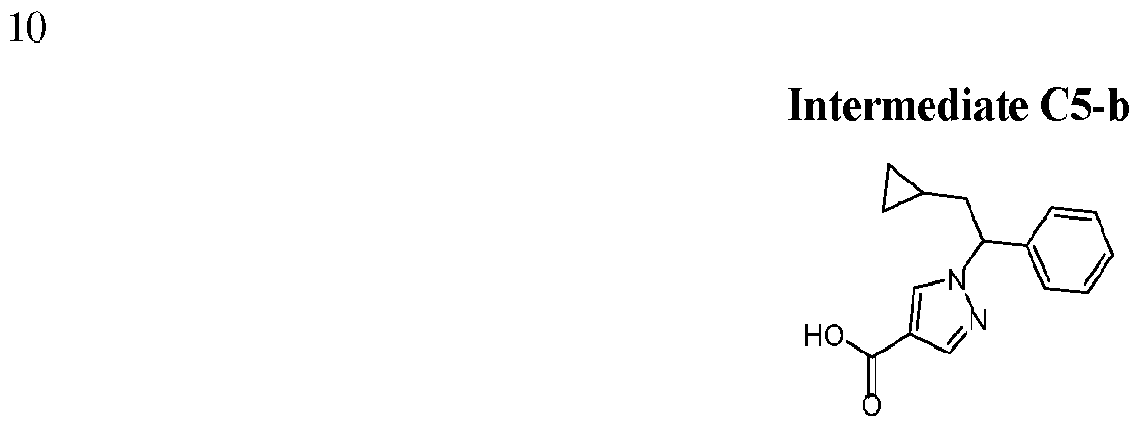
  • Pyrazole Cl can either be subjected to Mitsunobu reaction with alcohol C2, or reacted with alkyl halides C3 in the presence of a suitable weak base, such as CS2CO3, to afford N-alkylated esters of type C4 that can be deprotected under suitable reaction conditions to afford carboxylic acids (C5) that can be carried on to compounds of this invention.
  • a suitable weak base such as CS2CO3
  • R is a suitable group as defined in Formula I
  • Scheme D illustrates a synthetic sequence for the preparation of epoxides such as D5 from carboxylic acids of type DI.
  • Reaction of DI with methoxymethylamine in the presence of a suitable coupling agent, such as CDI can give a Weinreb-type amide D2.
  • This intermediate can be reacted with aryllithium reagents (D3), generated by in situ lithium-halogen exchange by treating the corresponding aryl bromide and «-butyl lithium at -78 °C, to give aryl ketones of type D4.
  • X is any suitable alkyl group, such as Me R is any suitable group, as defined in Formula I
  • R is a suitable group as defined in Formula I
  • Scheme F illustrates a synthetic sequence for the preparation of imidazole esters F4 and
  • R is a suitable group as defined in Formula I
  • Scheme G illustrates a synthetic sequence for the preparation of imidazophenones G4 from imidazolocarboxylates Gl.
  • Imidazole G1 can be protected with SEM chloride, which facilitates regiospecific acylation with suitable benzoyl chloride G3 inputs to afford the target imidazolophenones G4, which can be saponified to afford a carboxylic acid intermediate (G5) that can be carried on to compounds of this invention.
  • X is an ester, carboxylic acid or amide moiety as defined in Formula I
  • Scheme H illustrates a synthetic sequence for the preparation of imidazocarboxaldehyde H4.
  • Bromoimidazole Hl can be protected by treatment with a suitable reagent, such as SEM-C1, and coupled with vinyl potassium tetrafluoroborate salt, in the presence of a palladium catalyst, to yield vinylimidazole H3.
  • a suitable reagent such as SEM-C1
  • vinyl potassium tetrafluoroborate salt in the presence of a palladium catalyst
  • R is a suitable group as defined in Formula I
  • X is a suitable leaving group, such as Br, I or OMs, for example
  • Scheme I illustrates a synthetic sequence for the preparation of substituted phenylacetates 14 from a phenylacetic acid (11) starting material.
  • Treatment of II with a suitable base, such as LDA, followed by addition of a suitable alkylating reagent (12) can afford the desired mono- alkylated acid 13.
  • Esterification by a number of methods known to those skilled in the art reaction with TMS-CHN2, e.g.
  • TMS-CHN2 e.g.
  • R is a suitable group as defined in Formula I
  • X is a suitable leaving group, such as Br, I or OMs, for example
  • Scheme J illustrates a method for generating a-spirophenylacetates J3, where in this instance, an unsubstituted phenylacetate (JI) is reacted with a bifunctional alkylating agent (J2) in the presence of a suitable base, such as NaH, to afford the desired a, a -disubstituted phenylacetate (J3) that can be carried on to compounds of this invention.
  • a bifunctional alkylating agent such as NaH
  • R is a suitable group as defined in Formula I
  • Scheme K illustrates a synthetic sequence for the preparation of 1,2,4-triazoles K3 from esters, such as 14 or J3.
  • Reaction of 14 or J3 with hydrazine affords a hydrazide intermediate KI that is subsequently condensed with an imidate (K2) to give an aminocarbazone K3.
  • Thermal cyclization of K3 in the presence of a suitable drying agent, such as molecular sieves, can afford the desired 1,2,4-triazole ester K4 that can be carried on to compounds of this invention.
  • a suitable drying agent such as molecular sieves
  • Scheme L illustrates a synthetic sequence to convert benzyl-substituted heterocycles (LI) into phenone intermediates L2 that can be functionalized further at the benzylic carbon.
  • Benzylic oxidation of heterocycles of type LI with an appropriate oxidant, commonly potassium permanganate can directly give the aforementioned phenone intermediate L2.
  • Reaction of L2 in the presence of a fluorinating agent, such as DAST can yield a,a-ge»i-di fluorobenzylic heterocycles L3.
  • a fluorinating agent such as DAST
  • SUBSTITUTE SHEET (RULE 26 ) a 2-step process involving conversion of the hydroxyl to a reactive halide L4 (conversion to a chloride with thionyl chloride, e.g.) followed by reduction with suitable agent, such lithium aluminum hydride, can afford an a-trifluormethyl-substituted benzylic heterocycle L5 that can be carried on to compounds of this invention.
  • a reactive halide L4 conversion to a chloride with thionyl chloride, e.g.
  • suitable agent such lithium aluminum hydride
  • any intermediate examples of L2-L5, wherein X is defined to result in an ester functionality can be treated as described above to yield the corresponding carboxylic acids (not shown) that can likewise be carried on to compounds of this invention.
  • Scheme M illustrates a preferred method for generating desired intermediates such as triazolocarboxaldehyde (M5) from aminothi oxoacetate Ml.
  • M5 triazolocarboxaldehyde
  • Treatment with an appropriate nucleophile such as a Grignard reagent (M6a) or alkyllithium species (M6b), can give a 2°-alcohol M7 that can itself be carried on or reacted further in the presence of carbon tetrachloride and triphenylphosphine to afford a chloromethyl triazolecarboxylate M8 that can be carried on directly or saponified to the carboxylic acid M9, which can be carried on to compounds of this invention.
  • an appropriate nucleophile such as a Grignard reagent (M6a) or alkyllithium species (M6b)
  • Scheme N illustrates a method for converting secondary alcohol M6 to the corresponding alkylfluoride (Nl) by reacting M6 in the presence of DAST that can be carried on to compounds of this invention.
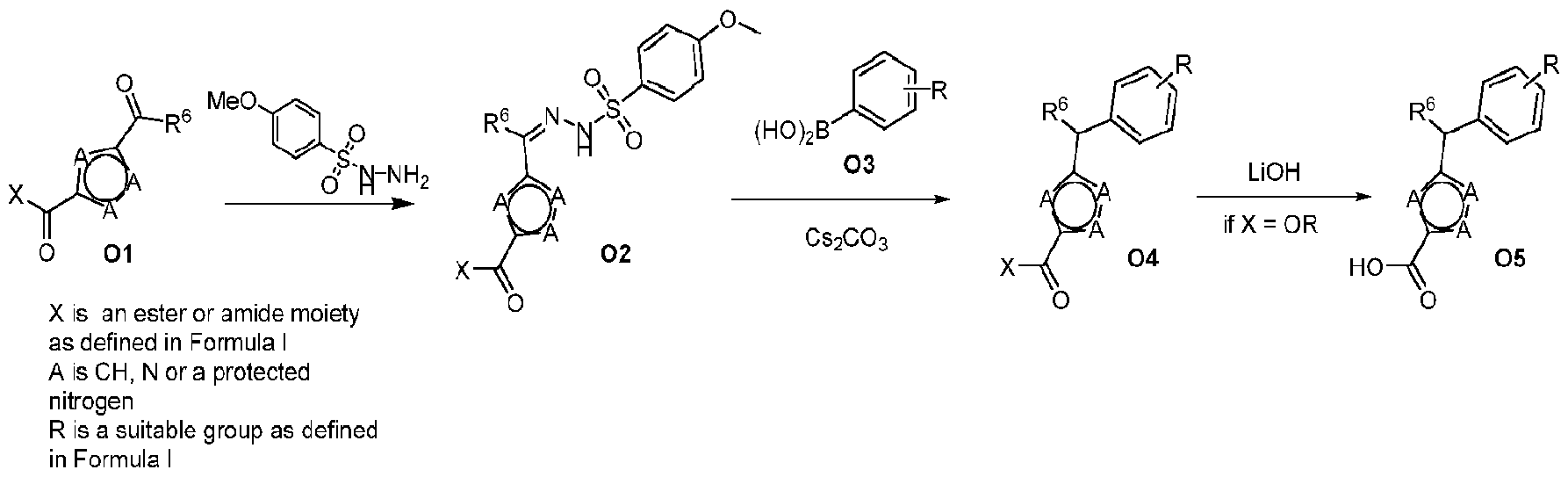
  • Scheme O illustrates a synthetic sequence for the conversion of heteroaryl ketones or aldehydes (01) to benzyl-substituted heterocycles 04 and 05.
  • Ketones or aldehydes, such as 01 can be condensed with arylsulfonylhydrzides to afford hydrazones 02, which can be subjected to Barluenga-type coupling with arylboronic acids (03), in the presence of an appropriate base, such as CS2CO3, to afford the desired benzyl-substituted heterocycles 04 that can be carried on directly or saponified to carboxylic acid 05 which can be carried on to compounds of this invention.
  • Scheme P illustrates a synthetic sequence for the conversion of heteroaryl ketones or aldehydes (01) to benzyl-substituted heterocycles 04 and 05.
  • R is a suitable group as defined in Formula I
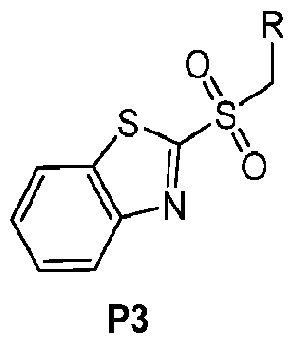
  • Scheme P illustrates a synthetic sequence for the preparation of sulfones such as P4 in a 2 step sequence from an alcohol starting material (Pl).
  • Alcohol Pl can be reacted with thiobenzothiazole under Mitsunobu conditions to give a thioether intermediate P2, which can subsequently be oxidized to afford substituted sulfones P3 that can be carried on to compounds of this invention.
  • SUBSTITUTE SHEET ( RULE 26 ) group such as Br, I or Ms. for example
  • Scheme Q illustrates a synthetic sequence for the preparation of A-alkylpy rrol idines, and piperidines such as Q3.
  • Heterocycle QI can be reacted with an appropriate alky l halide Q2 in the presence of a suitable, non-nucleophilic base, such as NaH or CS2CO3, to afford A-alkylated esters of type Q3 that can be carried on directly or saponified to the carboxylic acid Q4 which can be carried on to compounds of this invention.
  • a suitable, non-nucleophilic base such as NaH or CS2CO3
  • A is CH, N or a protected nitrogen Scheme R illustrates a synthetic sequence for the preparation of spirocarbamate amides R3 employing the corresponding ester R1 and spirocarbamate A6 synthons.
  • Ester R1 can be saponified to afford a carboxylic acid R2, which is subsequently reacted with spirocarbamate A6 in the presence of a suitable coupling agent, such as HATU or T3P, to afford R3, which represents compounds of this invention
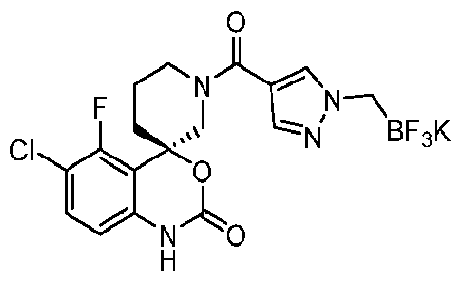
  • Scheme S illustrates a synthetic sequence for the preparation of a trifluoroborylalkyl-substituted
  • SUBSTITUTE SHEET ( RULE 26 ) pyrazole intermediate S2 from deprotected spirocarbamate synthon A6, which can undergo cross-coupling to produce S4.
  • Amide formation by reacting spirocarbamate A6 and 4- pyrazolecarboxylic acid under conditions described previously can afford a pyrazolyl amide precursor SI that can be further reacted in the presence of a suitable strong base, such as KHMDS, and potassium bromomethyltrifluoroborate to yield the alkyltrifluoroborate synthon S2 that can be cross-coupled with a suitable aryl halide (S3) in the presence of a palladium catalyst, like CbPd(dppf). to afford S4, which can be carried on to compounds of this invention.
  • a suitable strong base such as KHMDS
  • KHMDS potassium bromomethyltrifluoroborate
  • S3 aryl halide
  • Scheme T illustrates a synthetic sequence to convert heteroaryl aldehydes T1 into branched alkyl heteroaryl congeners T6, T8 and T9.
  • Reaction of a heteroaryl carboxaldehyde T1 with a suitable Grignard reagent (T2) yields a secondary alcohol T3 that can be oxidized to the corresponding ketone T4, under a variety of known methods, most preferably using manganese dioxide as an oxidant.
  • Ketone T4 can be reacted with a second Grignard reagent (T5) to a tertiary alcohol (T6), which can serve as a compound of this invention.
  • both tertiary alcohol T6 and ketone T4 can independently be converted to the corresponding vinyl heteroaryl amide T8.
  • elimination in the presence of a suitable acid or Lewis acid source can yield vinyl amide T8.
  • the olefin moiety can also be synthesized in a single step from ketone T4, by treatment with a sulfone reagent (04) under Julia-Kociensky conditions or using a Wittig olefmation reaction involving reaction with a phosphorus ylide reagent Reduction of the olefin moiety in T8 can be achieved using a variety of conditions, most notably reaction with catalytic Raney Nickel to afford amide T9 which
  • SUBSTITUTE SHEET ( RULE 26 ) represents a general compound of this invention.
  • Scheme U illustrates an alternate method for synthesizing compounds of this invention (U4).
  • Cross-coupling of a SEM-protected triazoloalkylchloride U1 with a suitable aryl bromide (U2) can be achieved using a Nickel-catalyzed reductive coupling procedure to afford a protected benzyltriazole U3.
  • SEM deprotection in the presence of a strong acid, such as TFA can give benzyl-substituted triazolyl amides such as U4.
  • Scheme V illustrates an alternate method for synthesizing compounds of this invention (V4).
  • Scheme W illustrates a method for synthesizing benzylic alcohol compounds of this invention (Wl).
  • reducing agents preferably, sodium borohydri de
  • intermediate ketones of type T4 can successfully reduce intermediate ketones of type T4.
  • chiral reagents and biocatalytic ketoreductases can be employed to effect asymmetric reduction of the ketone moiety. All of which can be carried on further, as necessary, to compounds of this invention.
  • Scheme X illustrates an alternative method for synthesizing compounds of this invention (X5).
  • the reaction mixture was allowed to stir at -78 °C for an additional 45 min, at which time, a solution of LaCh*2LiCl (22.5 mL of a 0.6 M THF solution, 13.5 mmol) and tert-butyl 3, 3 -dimethyl -5- oxopiperi dine- 1 -carboxylate (3.1 g, 13.5 mmol) was added at -78 °C over a period of 40 min. The reaction mixture was warmed to rt and stirred for 16 h. KO'Bu (5.3 mL of a 1.7 M THF solution, 9.0 mmol) was added to the reaction mixture, and the resulting mixture was heated to 60 °C for 3 h.
  • KO'Bu 5.3 mL of a 1.7 M THF solution, 9.0 mmol
  • Step 2 6-Chloro-5-fluoro-5'.5'-dimethylspiro[benzo[d
  • Step 1 tert-Butyl 3-cvano-3-(2.6-difluorophenyl)propanoate: A solution of 2-(2,6- difluorophenyl) acetonitrile (10.0 g, 65.3 mmol) in THF (15 mL) was added dropwise to a solution of KHMDS (65.3 mL of a 1 M THF solution, 65.3 mmol) at -78 °C. The resulting mixture was allowed to stir at -78 °C for 30 min, at which time, the reaction was warmed to 0 °C and allowed to stir for 30 min. A separate flask charged with tert-butyl 2-bromoacetate (12.7 g,
  • Step 2 1 -(tert-Butyl) 6-methyl 3-cyano-3-(2.6-difluorophenyl)hexanedioate: To a mixture of
  • Step 4 terf-Butyl 2-(l-benzyl-3-(2,6-difluorophenYl)piperidin-3-yl)acetate: To the solution of tert-butyl 2-(3-(2,6-difluorophenyl)-6-oxopiperidin-3-yl)acetate (11.0 g, 33.8 mmol) in THF (40 mL) at 0 °C was added borane-tetrahydrofuran complex (80 mL of a 1 M THF solution, 80 mmol), and the resulting mixture was warmed to rt and allowed to stir for 2 h. The reaction was cooled to 0 °C , and quenched with AcOH.
  • Step 6 /m-Butyl 5'-fluoro-2'-oxo-2'.3'-dihvdro-l'Z7-SDiro[piperidine-3.4'-quinoline1-l- carboxylate:
  • the crude 2-(l-Benzyl-3-(2,6-difluorophenyl)piperidin-3-yl)acetamide (14.0 mmol) was dissolved in DMF (12 mL), and NaH (2.79 g, 69.9 mmol) was added portion-wise.
  • the resulting mixture was heated to 130 °C for 30 min, at which time, the reaction was cooled to rt and neutralized with HC1.
  • the reaction was concentrated, suspended in MeOH and filtered.
  • Step 7 terf-Butyl 6'-chloro-5'-fluoro-2'-oxo-2'.3'-dihydro-r7 : 7-spiro[piperidine-3.4'-quinolinel-l- carboxylate: A-Chlorosuccimmide (359 mg, 2.69 mmol) was added to a solution of tert-butyl 5'- fluoro-2'-oxo-2',3'-dihydro-177-spiro[piperidine-3,4'-quinoline]-l-carboxylate (900 mg, 2.69 mmol) in DMF (6 mL), and the resulting mixture was heated to 80 °C.
  • Step 1 2-Cvclopropyl-l-phenylethanone: To a solution of phenylmagnesium bromide (2.70 mL of a 3.0 M THF solution, 8.01 mmol) in THF (5 mL) was added 2-cyclopropylacetomtrile (500 mg, 6.16 mmol) in THF (2 mL) at 0 °C. The resulting mixture was allowed to stir at 0 °C for 2 h, at which time, the reaction was quenched with 1 M HC1 and extracted with EtOAc. The combined organic fractions were washed with brine, dried (NarSOi). filtered and the solvent was evaporated under reduced pressure to give a crude residue that was purified by silica gel chromatography, (EtOAc/petroleum ether) to afford the title compound. 'H NMR (500 MHz,
  • Step 2 2-Cyclopropyl-l-phenylethanol: To a solution of 2-cyclopropyl-l-phenylethanone (100 mg, 0.624 mmol) in MeOH (5 mL) was added NaBH4 (35 mg, 0 94 mmol) at 0 °C. The reaction was allowed to stir at 0 °C for 1 h, at which time, the mixture was concentrated to give a residue that was suspended in water and extracted with EtOAc. The combined organic fractions were dried (Na2SO4), filtered, and the solvent was evaporated under reduced pressure to afford the crude title compound that was carried on without purification.
  • NaBH4 35 mg, 0 94 mmol
  • Step 3 Ethyl l-(2-cyclopropyl- l-phenylethyl)-177-pyrazole-4-carboxylate: Di-tert-butyl azodi carboxylate (170 mg, 0.740 mmol) was added to a stirred mixture of tnphenylphosphme (155 mg, 0.592 mmol), 2-cyclopropyl-l -phenyl ethanol (80 mg, 0.493 mmol), ethyl 177-pyrazole- 4-carboxylate (69 mg, 0,49 mmol) in toluene (2 mL), and the resulting mixture was heated 80 °C for 2 h.
  • Step 1 2-Cvclopropyl-A-methoxy-A-methylacetamide: To a mixture of 2-cyclopropylacetic acid (5.0 g, 49.9 mmol) in DCM (20.0 mL) was added GDI (9.00 g, 55.5 mmol) at rt under Ni. The mixture was stirred at rt for 1 h. Then N, O-di methylhydroxylamine hydrochloride (5.50 g, 56.4 mmol) was added. The mixture was stirred at rt for another 15 h. The reaction was quenched with 1 N HC1, and the aq. layer was extracted with DCM. The combined organic layer was washed with 50% satd. aq.
  • Step 2 2-Cvclopropyl-l-(4-fluorophenyl)ethenone: To a solution of l-bromo-4-fluorobenzene (4.89 g, 27.9 mmol) in anhydrous THF (20 mL) at -78 °C under N2 was added dropwise a solution of n-BuLi (11.2 mL, 27.9 mmol, 2.5 M in hexane). After stirring for 1 h at -78 °C, a solution of 2-cyclopropyl-A r -methoxy-A-methylacetamide (4.00 g, 27.9 mmol) in anhydrous THF (5 mL) was added dropwise.
  • Step 3 2-(Cyclopropylmethyl)-2-(4-fluorophenyl)oxirane: Trimethylsulfonium iodide (1.15 g, 5.61 mmol) was suspended added in THF (15 mL). The mixture was cooled to 0 °C, and potassium tert-butoxide (630 mg, 5.61 mmol) was added. The mixture was warmed to rt and stirred for 15 min. 2-Cyclopropyl-l-(4-fluorophenyl)ethanone (500 mg, 2.81 mmol) was added, and the resulting mixture continued stirring at rt for 30 h. The mixture was quenched with satd. aq.
  • Step 1 2-(4-Fluorophenyl)-A-hvdroxyacetimidamide: To a mixture of 2-(4- fluorophenyl)acetonitrile (1.0 g, 7.4 mmol) in MeOH (10 mL) was added hydroxylamine
  • Step 3 2-(4-Fluorobenzyl)-lff-imidazole-5-carboxylic acid.
  • the title compound was prepared following procedures similar to those described in Intermediate C5-b, Step 4.
  • Step 1 Methyl l-((2-(trimethylsilyl)ethoxy)methyl)-17f-imidazole-5-carboxylate: To a stirred solution of methyl IH-imidazole-5-carboxvlate (5.00 g, 39.6 mmol) and K2CO3 (11.0 g, 79.0 mmol) in ACN (50 mL) was added SEM-C1 (8.4 mL, 48 mmol), and the resulting mixture was allowed to stir at for 12 h. The reaction mixture was diluted with water and extracted with EtOAc.
  • Step 2 Methyl 2-(4-fluorobenzoyl)-l-((2-(trimethylsilyl)ethoxy)methvD-lH-imidazole-5- carboxylate.
  • 4-Fluorobenzoyl chloride (1.94 mL, 16.4 mmol) was added to a solution of methyl l-((2-(trimethylsilyl)ethoxy)methyl)-12F-imidazole-5-carboxylate (3.50 g, 13.7 mmol) and TEA (2.3 mL, 16 mmol) in ACN (30 mL) at 0 °C.
  • the resulting mixture was warmed to rt and allowed to stir for 12 h.
  • the reach on was concentrated to afford a crude residue that was
  • Step 3 2-(4-Fluorobenzoyl)-l-((2-(trimethylsilyl)ethoxy)methyl)-lK-imidazole-5-carboxylic acid.
  • the title compound was prepared following procedures similar to those described in
  • Step 1 Ethyl 4-bromo-l-((2-(trimethylsilyl)ethoxy)methyl)-17f-iinidazole-2-carboxylate.
  • ethyl 4-bromo- 17/-imidazole-2-carboxylate 3.00 g, 13.7 mmol
  • sodium hydride 657 mg, 16.4 mmol, 60% w/w dispersion in mineral spirits
  • (2-(Chloromethoxy)ethyl)trimethylsilane (3.43 g, 20.5 mmol) was added, and the resulting mixture was warmed to 30 °C for 10 h.
  • Step 2 Lithium 4-bromo-l -((2-(trimethylsilyl)ethoxy)methyl)-l ff-imidazole-2-carboxylate.
  • the title compound was prepared following procedures similar to those described in Intermediate C5-b, Step 4.
  • LCMS (acid) [M + H] + 321.0 (calcd. 321.0).
  • Step 3 (7?)- 1 '-(4-Bromo- 1 -((2-(trimethylsilyl)ethoxy)methy 1)- 177-imidazole-2-carbonyl)-6- chloro-5-fluorospiro[benzo[ ⁇ /
  • Step 4 (7?)-6-chloro-5-fluoro-lMl-((2-(trimethylsilyl)ethoxy)methyl)-4-vinyl-lff- imidazole-2- carbonyl)spiro[benzokf
  • Step 5 (7?)-2-(6-chloro-5-fluoro-2-oxo-1.2-dihvdrospiro(benzo oxazine-4.3'-piperidin1-r- ylcarbonyl)-l-((2-(trimethylsilyl)ethoxy)methyl)-l#-imidazole-4-carbaldehyde.
  • Step 1 Ethyl 4-bromo-l-((2-(trimethylsilyl)ethoxy)methyl)-lEf-iinidazole-2-carboxylate: To a solution of ethyl 4-bromo-l//-imidazole-2-carboxylate (1.00 g, 4.57 mmol) in DMF (8 mL) was
  • Step 2 Ethyl l-((2-(trimethylsilyl)ethoxy)methyl)-4-vinyl-l#-imidazole-2-carboxylate: To a solution of ethyl 4-bromo-l-((2-(tnmethylsilyl)ethoxy)methyl)-177-imidazole-2-carboxylate (1.10 g, 3.15 mmol) in EtOH (15 mL) was added potassium vinyltrifluoroborate (548 mg, 4.09 mmol), Pd(dppf)Ch (691 mg, 0,945 mmol) and TEA (1.3 mL, 9.5 mmol). The resulting mixture was heated to 90 °C for 12 h.
  • Step 3 Ethyl 4-formyl-l-((2-(trimethylsilyl)ethoxy)methyl)-lJ7-imidazole-2-carboxylate: To a solution of ethyl l-((2-(trimethylsilyl)ethoxy)methyl)-4-vinyl-17f-imidazole-2-carboxylate (600 mg, 2.02 mmol) in acetone (5 mL) and water (5 mL) was added potassium osmate(VI) dihydrate (32 mg, 0.086 mmol) at 0 °C.
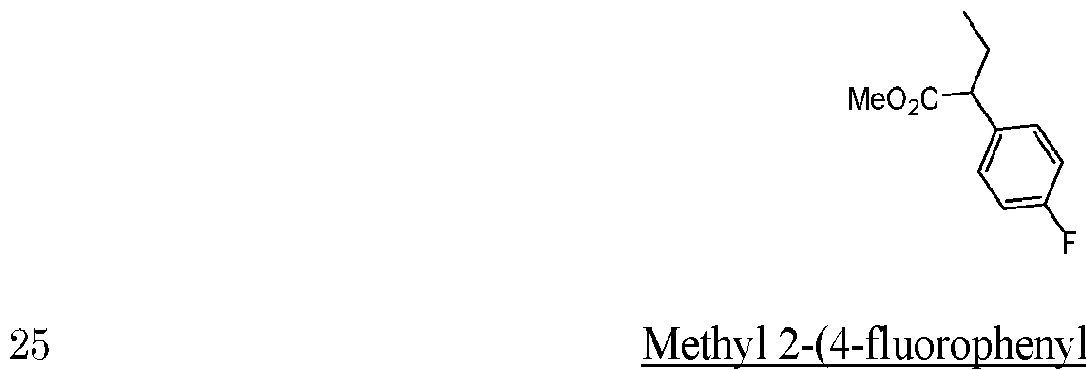
  • Step 1 2-(4-Fluorophenyl)butanoic acid: To a solution of 2-(4-fluorophenyl) acetic acid (1.00 g, 6.49 mmol) in THF (10 mL) was added LDA (7. 10 mL, 14.3 mmol, 2 M THF solution) at -78 °C. The resulting mixture was warmed to rt over 30 min, at which time, iodoethane (1.21 g, 7.79 mmol) was added in a single portion, and the reaction was stirred at rt for 4 h. The reaction was
  • Step 2 Methyl 2-(4-fluorophenyll butanoate.
  • (Diazomethyl)trimethylsilane (4.5 mL, 9.1 mmol, 2.0 M toluene solution) was added to a stirred solution of 2-(4-fluorophenyl)butanoic acid (1.1 g, 6.0 mmol) in DCM (7.5 mL) and MeOH (1.5 mL) at 0 °C , and the resulting mixture was stirred at 0 °C for 1 h.
  • the reaction was quenched by addition of 5% aq. AcOH, followed by neutralization by addition to satd. aq. NaHCOs.
  • Step 1 2-(4-Fluorophenyl)butanehydrazide: Hydrazine hydrate (781 mg, 15.3 mmol) was added
  • Step 2 (Z)-Ethyl 2-amino-2-(2-(2-(4-fluorophenyl)butanoyl)hydrazono)acetate.
  • Ethyl 2-ethoxy- 2-iminoacetate 148 mg, 1.02 mmol was added to a stirred solution of 2-(4- fluorophenyl)butanehydrazide (100 mg, 0.510 mmol) in EtOH (1 mL), and the resulting mixture was heated to 80 °C for 12 h. The reaction was cooled to rt and concentrated to afford the title compound that was carried on without further purification.
  • LCMS [M+H] + 296.2 (calcd. 296.1).
  • Step 3 Ethyl 5-(l-(4-fluorophenyl)propyl)-4Ef-L2.4-triazole-3-carboxylate.
  • 4A Molecular sieves were added to a stirred solution of (Z)-ethyl 2-amino-2-(2-(2-(4- fluorophenyl)butanoyl)hydrazono)acetate (110 mg, 0.372 mmol) in xylene (1.5 mL), and the resulting mixture was heated to 150 °C for 24 h. The reaction was cooled to rt and concentrated to afford a crude residue that was purified by preparative TLC (EtOAc/ petroleum ether) to give the title compound.
  • Step 6 5-(l-(4-Fluorophenyl)propyl)-477-1.2.4-triazole-3-carboxylic acid.
  • the title compound was prepared following procedures similar to those described above for Intermediate C5-b, Step 4.
  • LCMS [M+H] + 250.1 (calcd. 250.1).
  • Step 1 Ethyl 5-(4-fluorobenzoyl )-4//-1.2.4-triazole-3-carboxylate: Potassium permanganate (1.08 g, 6.82 mmol) was added to a stirred solution of ethyl 5-(4-fhiorobenzyl)-477-l,2,4- triazole-3-carboxylate (850 mg, 3.41 mmol) in DCM (15 mL), and the resulting mixture was allowed to stir at rt. After 12 h, the reaction was diluted with 1 M HC1 and extracted with EtOAc. The layers were separated, and the organic layer was concentrated to afford a crude
  • Step 2 5-(4-Fluorobenzoyl)-4H-1.2.4-triazole-3-carboxylic acid.
  • the title compound was prepared following procedures similar to those described above for Intermediate C5-b, Step 4.
  • LCMS [M + H] + 236.0 (calcd. 236.0).
  • Step 1 fert-Butyl 2-(2-ethoxy-l-imino-2-oxoethyl)hydrazine-l -carboxylate.
  • Boc-hydrazide (19.8 g, 150 mmol) was combined with ethyl 2-amino-2-thioxoacetate (20.0 g, 150 mmol) in EtOH (80 mL), and the resulting mixture was allowed to stir at rt. After 23 h, the reaction was filtered, and the filter cake was washed with EtOH and dried under vacuum to afford the title compound.
  • LCMS [M + H] + 232.15 (calcd. 232.3).
  • Step 2 Ethyl 5-((benzyloxy)methyl)-4Zf-1.2.4-triazole-3-carboxylate.
  • Step 3 Ethyl 5-(hvdroxymethyl)-4-((2-(trimethylsilyl)elhoxy)riiethyl)-4H- 1.2.4-triazole-3- carboxylate.
  • Sodium hydride (2.04 g, 50.9 mmol, 60% w/w dispersion in mineral spints) was added in several portions to a stirred solution that was maintained under positive N2 pressure of ethyl 5-((benzyloxy)methyl)-47f-l,2,4-triazole-3-carboxylate (12.1 g, 46.3 mmol) in THF (93 ml) at 0 °C .
  • Step 4 Ethyl 5-( l-hvdroxyDropyl)-4-((2-(trimethylsilyl)ethoxy)methyl )-47/-l ,2.4-triazole-3- carboxylate.
  • DMP (3.93 g, 9.26 mmol) was added to a stirred solution of ethyl 5- (hydroxymethyl)-4-((2-(trimethylsilyl)ethoxy)methyl)-477- 1 ,2,4-tnazole-3-carboxylate (1.86 g, 6. 17 mmol) in DCM (19 ml), and the resulting mixture was allowed to stir at rt. After 1.5 h, the reaction was quenched with satd. aq.
  • Step 6 3-(l-Chloropropyl)-l-((2-(trimethylsilyl)ethoxy)methyl)-lK-1.2.4-triazole-5-carboxylic acid.
  • Step 5 Ethyl 4-benzyl-l-((2-(tnmethylsilyl)ethoxy)methyl)-l#-imidazole-2-carboxylate: To a stirred mixture of (Z)-ethyl 4-((2-((4-methoxyphenyl)sulfonyl)hydrazono)methyl)-l-((2- (trimethylsilyl)ethoxy)methyl)-lK-imidazole-2-carboxylate (250 mg, 0.518 mmol) and
  • Step 1 2-((( 1 -Methoxy cvclooroDyl tmethyl )thio)benzo
  • thiazole: DEAD (930 pL. 5.87 mmol) was added to a solution of (1 -methoxy cy cl opropyl)methanol (300 mg, 2 94 mmol), benzo[c/]thiazole-2-thiol (590 mg, 3.52 mmol) and tnphenylphosphine (925 mg, 3 52 mmol) in THF (5 mL) at 0 °C. The mixture was stirred at 0 °C for 2 h, at which time, the reaction was diluted with water and extracted with EtOAc. The combined organic layers were concentrated, and purification by preparative TLC (EtOAc/petroleum ether) to give the title compound. LCMS [M + H] + 252.0 (calcd. 252.0).
  • Step 2 2-(((l -Methoxy cvcloDropyl)methyl)sulfonyl)benzolJ
  • thiazole: To a solution of 2-(((l- methoxycyclopropyl)methyl)thio)benzo[ ⁇ f]thiazole (350 mg, 1 39 mmol) in EtOH (5 mL) was added ammonium molybdate tetrahydrate (172 mg, 0.139 mmol) and H2O2 (5.7 mL, 56 mmol, 30% v/v aq. solution). The resulting mixture was allowed to stir at rt. The reaction was concentrated, and the resulting crude residue was purified by preparative TLC (EtOAc/petroleum ether) to give the title compound. LCMS [M + H] + 284.0 (calcd. 284.0).
  • Step 1 Methyl pyrrolidine-3-carboxylate hydrochloride: To a mixture of pyridin-2( 1 J7)-one (721 mg, 7.58 mmol) and TBAI (280 mg, 0.758 mmol) in THF (30 mL) was added NaH (303 mg, 7.58 mmol, 60% w/w dispersion in mineral spirits) at 0 °C. The resulting mixture was stirred at rt for 30 min, at which time, l,4-bis(bromomethyl)benzene (2.00 g, 7.58 mmol) was added. After 2 h, the reaction mixture was quenched with satd. aq. NHiCl and extracted with EtOAc.
  • Step 2 Methyl l-(4-((2-oxopyridin-l(2H)-yl)methyl)benzyl)pyrrolidine-3-carboxylate: To a mixture of methyl pyrrolidine-3-carboxylate hydrochloride (119 mg, 0.719 mmol) in DMF (2 mL) was added NaH (60 mg, 1.51 mmol, 60% wt dispersion in mineral spirits) at 0 °C.
  • Step 3 l-(4-((2-oxopyridin-l -yl)methyl)benzy4)pyrrolidme-3-carboxylic acid: To a mixture of methyl l-(4-((2-oxopyridin-l(2//)-yl)methyl)benzyl)pyrrolidme-3-carboxylate (300 mg, 0.643 mmol) in DMF (1 mL) was added lithium hydroxide hydrate (135 mg, 3.22 mmol) in water (0.2 mL), and the resulting mixture was stirred at rt for 2 h.
  • Step 1 -6-Chloro-5-fluoro-F-(lE7-pyrazole-4-carbonyl)spiro[benzolW1.31oxazine-4.3'- piperidinl -2( I H)-one.
  • HATU 743 mg, 1.95 mmol
  • l/f-pyrazole-4-carboxylic acid 192 mg, 1.71 mmol
  • DIEA 0.85 ml, 4.9 mmol
  • Step 2 Potassium (7?)-((4-(6-chloro-5-fluoro-2-oxo-1.2-dihydrospiro[benzo[t7][1.31oxazine-4.3'- piperidinl - 1 -ylcarbonyl)- 177-pyrazol - 1 -y l)methyl)trifluoroborate.
  • Step 1 (7?)-r-(4-Benzyl-l-((2-(trimethylsilyl)ethoxy)methyl)-177-imidazole-2-carbonyl)-6- chloro-5-fluorospiro[benzo [1.31oxazine-4.3'-piperidin1-2(lF/)-one.
  • Intermediate A6-d (105 mg, 0.284 mmol) was added to a solution of Intermediate 05-a (74 mg, 0.22 mmol) and EDC (84 mg, 0.44 mmol) in pyridine (4 mL) at 0 °C. The resulting mixture was warmed to 30 °C and allowed to stir for 16 h. The reaction was diluted with water and extracted with EtOAc.
  • Step 2 l'-(4-Benzyl-17f-imidazole-2-carbonyr)-6-chloro-5- lluorospiro
  • Trifluoroacetic acid (0.5 mL) was added to a solution of (7?)-l'-(4-benzyl-l-((2-(trimethylsilyl)ethoxy)methyl)-177-imidazole-2- carbonyl)-6-chloro-5-fluorospiro[benzo[ ⁇ 7][l,3]oxazine-4,3'-piperidin]-2(L77)-one (90 mg, 0.154 mmol) in DCM (3 mL). The reaction was allowed to stir at it for 11 h, at which time, the mixture was concentrated to afford a crude residue that was purified by reverse phase HPLC (ACN/water with 0.05% TFA modifier) to the title compound.
  • reverse phase HPLC ACN/water with 0.05% TFA modifier
  • Step 2 (7?)-r-(4-Benzoyl-l-((2-(trimethylsilyl)ethoxy)methyl)-177-imidazole-2-carbonyl)-6-
  • Step 3 (J?.Z)-6-Chl oro-5 -fluoro- 1'-(4-(2-( 1 -methoxy cyclopropyl)- 1 -phenylvinyl)- 1-((2- (trimethylsilyl)ethoxy)methyl)-l H-iniidazole-2-carbori ⁇ l)spiro
  • Step 4 -6-Chloro-5-fluoro-r-(4-(2-(l-methoxycyclopropyl)-l-phenylethyl)-l-((2- (tnmethylsilyl) ethoxylmethyl )- 1 /7-imidazole-2-carbonyl )soi rol benzo
  • Step 5 (3'7?)-5-Fluoro-T-(4-(2-(l-methoxycvclopropyl)-l-phenylethyl)-l-((2- (tnmethylsilyl)ethoxy) - 1 f/-imidazole-2-carbonyl )spi ro
  • Trifluoroacetic acid (0.3 mL) was added to a solution of (47?)-6-chloro-5- fluoro- T-(4-(2-(l -methoxy cyclopropyl)- 1 -phenylethyl)- 1 -((2-(trimethylsilyl)ethoxy)methyl)- 177- imidazole-2-carbonyl)spiro[benzo[i/][l,3]oxazine-4,3'-piperidin]-2(lFr)-one (10 mg, 0,015 mmol) in DCM (3 mL) at 0 °C. The resulting mixture was warmed to rt and allowed to stir for - 79 -
  • Step 2 -6-Chloro-5-fluoro-142-((4-fluorophenyl)(hydroxy)methyl)-l-((2- (tnmethylsilyl)ethoxy) ineth ⁇ l)- l7/-imidazole-5- l .3
  • Step 3 (37?)-6-Chloro-5-fluoro-T-(2-((4-fluorophenyl)(hvdroxy)methyl)-l#-imidazole-5- carbonyDspiro [benzofc/
  • the title compound was prepared as a stereochemical mixture following procedures similar to those described above in Examples 75, Step 5.
  • Step 1 -6-Chloro-5-fluoro-r-(2-(4-fluorobenzoyl)-l-((2-(trimethylsilyl)ethoxy)methyl)- 17f-imidazole-5-carbonyl)spiro[benzo[J][L3]oxazine-4,3'-piperidin1-2(177)-one.
  • the title compound was prepared following procedures similar to those described in Example 1. [M + H] + , 617.2, (calcd. 617.2).
  • Step 2 (37?)-6-Chloro-5-fluoro-lM2-(l-(4-fluorophenyl)-l-hvdroxypropyl)-l-((2- (trimethylsilyl)ethoxy) methyl )- 17/-imidazole-5-carbonyl )spi ro
  • Step 3 (A7r)-6-Chloro-5-fluoro- 1 '-(2-(l -(4-fluorophenyl)prop- 1 -en-l-yl)-l#-imidazole-5- carbonyl)spiro[benzo -one. BF 3. OEt? (0. 14 mL, 1.
  • Step 4 (3'A)-6-Chloro-5-fluoro-r-(2-(l-(4-fluorophenyl)propyl)-177-imidazole-5-carbonyl)spiro
  • Step 1 (3'R)-6-Chtoro-5-fluoro-r-(2-(l-(4-fluoroohenvf)-l-hvdroxypentyl)-l-((2- (tnmethylsilyl)ethoxy) methyl )- 1 //-imidazole-5-carbonyl )spi rol benzok/l [ 1.3]oxazine-4.3'- piperidinl -2( 177)-one.
  • Step 2 (37?)-6-Chloro-5-fluoro- l '-(2-( l-(4-nLiorophenyl )- l-hvdroxypentyl)- 177-imidazole-5- carbonyl) spiro
  • Step 1 (37?)-6-Chloro-5-fluoro- 1 '-(2-(2.2.2-trifluoro- 1 -(4-fluorophenyl)- 1 -hydroxy ethyl)- 1-((2- (trimethylsilyl)ethoxy)methyl)-lK-imidazole-5-carbonyl)spiro[benzo[d
  • Step 2 (3'A)-6-Chloro-r-(2-(l-chloro-2.2.2-trifluoro-l-(4-fluorophenyl)ethyl)-12f-imidazole-5- carbom l )-5-fluorospiio
  • Step 3 (37?)-6-Chloro-5-fluoro-lM2-(2.2.2-trifluoro-l-(4-fluorophenyl)ethyl)-n/-imidazole-5- carbonyl)spiro[benzo[ ⁇ f
  • Step 1 (3'7?)-6-Chloro-5-fluoro-l'-(5-(l-(4-fluorophenyl)propyl)-47/-1.2.4-triazole-3-
  • Step 1 (J?)-6-Chloro-l'-(3-((S)-l-chloropropyl)-l-((2-(trimethylsilyl)ethoxy)methyl)-l/f-L2.4- triazole-5-carbonyl)-5-fluorospiro[benzo[d
  • 1- Propanephosphonic anhydride (680 pl, 2.30 mmol) was added to a stirred solution of Intermediate M9-a (468 mg, 1.437 mmol), Intermediate A6-d (419 mg, 1.37 mmol) and TEA (600 pL 4.31 mmol) in DCM (9 mL) at rt.
  • Step 2 (47?)-6-Chloro-5-fluoro-T-(3-(l-(4-methyl-l/7-benzo[i/
  • Step 3 (4ffi-6-Chloro-5-fluoro-r-(3-(l-(4-methyl-17/-benzofcflimidazol-6-yl)propyl)-lff-1.2.4- triazole-5-carbonyl)spi ro
  • Step 1 (7?)-6-Chloro-5-fluoro-r-(5-(hYdroxymethyl)-4-((2-(trimethylsilYl)ethoxy)methyl)-4/f-
  • Step 2 -lV-((5-(6-chloro-5-fluoro-2-oxo-1.2-dihYdrospiro[benzo[J
  • Step 2 (7?)-5-(6-chloro-5-fluoro-2-oxo-1.2-dihvdrospiro[benzo [1.31oxazine-4.3'-pipendin1-r- ylcarbonyl)-l-((2-(trimethylsilYl)ethoxy)methyl)-l#-1.2.4-triazole-3-carbaldehvde.
  • the title compound was prepared in two steps following procedures similar to those described for
  • Step 3 (3'7?)-6-Chloro-5-fluoro-T-(3-((4-fluorophenyl)(hvdroxy)methyl)-l-((2- (trimethylsilyl)ethoxy) methyl)-lK-L2.4-triazole-5-carbonyl)spiro[benzo[d
  • Step 1 (3'7?)-6-Chloro-5-fluoro-T-(3-(l-fluoro-l-(4-fluorophenyl)propyl)-127-L2.4-triazole-5- carbonyl) spiro, benzok/l 1 1 .3
  • Step 1 (7?.Z)-6-Chloro-5-fluoro-l'-(3-(2-methoxy-l-phenylvinyl)-177-L2.4-triazole-5- carbonyDspiro I benzol c/
  • LHMDS (0.57 mL, 0.75 mmol, 1.4 M THF solution) was added to a stirred solution of (methoxymethyl)triphenylphosphonium chloride (219 mg, 0.638 mmol) in THF (5 mL) at -78 °C.
  • Step 2 6-Chloro-5-fluoro-r-(3-(2-methoxy-l-phenylethyl)-lH-1.2.4-triazole-5- carbonyDspirolbenzokfl H.31oxazine-4.3'-piperidin1-2( HD-one. Raney Ni (106 mg, 0.
  • Step 1 GS 1 )-6-Cliloro-5-nuoro- l'-( l -(4-((2-oxopyndm- l (2//
  • the effectiveness of a compound of the present invention as an inhibitor of Coagulation factor Xia can be determined using a relevant purified serine protease, and an appropriate synthetic substrate.
  • the rate of hydrolysis of the chromogenic or Anorogenic substrate by the relevant serine protease was measured both in the absence and presence of compounds of the present invention.
  • Assays were conducted at rt or at 37 °C. Hydrolysis of the substrate resulted in release of amino trifluoromethylcoumarin (AFC), which was monitored spectrofluorometrically by measuring the increase in emission at 510 nm with excitation at 405 nm. A decrease in the rate of fluorescence change in the presence of inhibitor is indicative of enzyme inhibition.
  • AFC amino trifluoromethylcoumarin
  • AFC amino trifluoromethylcoumarin
  • AFC amino trifluoromethylcoumarin
  • AFC amino trifluoromethylcoumarin
  • a decrease in the rate of fluorescence change in the presence of inhibitor is indicative of enzyme inhibition.
  • SUBSTITUTE SHEET ( RULE 26 ) parameters equation to determine the half-maximal inhibitory concentrations (IC50).
  • IC50 half-maximal inhibitory concentrations
  • Ki equilibrium inhibitory constants
  • the activities shown by this assay indicate that the compounds of the invention may be therapeutically useful for treating or preventing various cardiovascular and/or cerebrovascular thromboembolic conditions in patients suffering from unstable angina, acute coronary syndrome, refractory angina, myocardial infarction, transient ischemic attacks, atrial fibrillation, stroke such as thrombotic stroke or embolic stroke, venous thrombosis, coronary and cerebral arterial thrombosis, cerebral and pulmonary embolism, atherosclerosis, deep vein thrombosis, disseminated intravascular coagulation, and reocclusion or restenosis of recanalized vessels.
  • stroke such as thrombotic stroke or embolic stroke, venous thrombosis, coronary and cerebral arterial thrombosis, cerebral and pulmonary embolism, atherosclerosis, deep vein thrombosis, disseminated intravascular coagulation, and reocclusion or restenosis of recanalized vessels.
  • the effectiveness of a compound of the present invention as an inhibitor of plasma kallikrein can be determined using a relevant purified serine protease, and an appropriate synthetic substrate.
  • the rate of hydrolysis of the chromogenic or fluorogenic substrate by the relevant serine protease was measured both in the absence and presence of compounds of the present invention.
  • Assays were conducted at rt or at 37 °C. Hydrolysis of the substrate resulted in release of amino trifluoromethylcoumarin (AFC), which was monitored spectrofluorometrically by measuring the increase in emission at 510 nm with excitation at 405 nm. A decrease in the rate of fluorescence change in the presence of inhibitor is indicative of enzyme inhibition.
  • AFC amino trifluoromethylcoumarin
  • AFC amino trifluoromethylcoumarin
  • AFC amino trifluoromethylcoumarin
  • a decrease in the rate of fluorescence change in the presence of inhibitor is indicative of enzyme inhibition.
  • the results of this assay are expressed as the half- maximal
  • Plasma kallikrein determinations were made in 50 mM HEPES buffer at pH 7.4 containing 150 mMNaCl, 5 mM CaCh, and 0.1% PEG 8000 (polyethylene glycol; Fisher Scientific). Determinations were made using purified Human plasma kallikrein at a final concentration of 0.5 nM (Enzyme Research Laboratories) and the synthetic substrate, Acetyl-K- P-R-AFC (Sigma # C6608) at a concentration of 100 mM.
  • Activity assays were performed by diluting a stock solution of substrate at least tenfold to a final concentration ⁇ 0.2 Km into a solution containing enzyme or enzyme equilibrated with inhibitor. Times required to achieve equilibration between enzyme and inhibitor were determined in control experiments. The reactions were performed under linear progress curve conditions and fluorescence increase measured at 405 Ex/510 Em nm. Values were converted to percent inhibition of the control reaction (after subtracting 100% Inhibition value). IC50 was determined by inflection point from a four parameter logistic curve fit. Ki was
  • the activities shown by this assay indicate that the compounds of the invention may be therapeutically useful for treating or preventing various ophthalmic, cardiovascular and/or cerebrovascular thromboembolic conditions in patients suffering from unstable angina, acute coronary' syndrome, refractory angina, myocardial infarction, transient ischemic attacks, atrial fibrillation, stroke such as thrombotic stroke or embolic stroke, venous thrombosis, coronary and cerebral arterial thrombosis, cerebral and pulmonary embolism, atherosclerosis, deep vein thrombosis, disseminated intravascular coagulation, reocclusion or restenosis of recanalized vessels, hereditary angioedema, uveitis, postenor uveitis, wet age-related macular degeneration, diabetic macular edema, diabetic retinopathy and retinal vein occlusion.
  • Plasma Kallikrein (PKal) ICso (nM) and Factor Xia ICso (nM) for selected compounds are as follows:

Landscapes

  • Health & Medical Sciences (AREA)
  • Chemical & Material Sciences (AREA)
  • Organic Chemistry (AREA)
  • General Health & Medical Sciences (AREA)
  • Veterinary Medicine (AREA)
  • Pharmacology & Pharmacy (AREA)
  • Life Sciences & Earth Sciences (AREA)
  • Animal Behavior & Ethology (AREA)
  • Medicinal Chemistry (AREA)
  • Public Health (AREA)
  • Epidemiology (AREA)
  • Ophthalmology & Optometry (AREA)
  • Engineering & Computer Science (AREA)
  • Bioinformatics & Cheminformatics (AREA)
  • Chemical Kinetics & Catalysis (AREA)
  • General Chemical & Material Sciences (AREA)
  • Nuclear Medicine, Radiotherapy & Molecular Imaging (AREA)
  • Pharmaceuticals Containing Other Organic And Inorganic Compounds (AREA)
  • Medicines That Contain Protein Lipid Enzymes And Other Medicines (AREA)

Abstract

The present invention provides a compound of Formula (I) and pharmaceutical compositions comprising one or more said compounds, and methods for using said compounds for treating or preventing one or more disease states that could benefit from inhibition of plasma kallikrein, including hereditary angioedema, uveitis, posterior uveitis, wet age-related macular degeneration, diabetic macular edema, diabetic retinopathy and retinal vein occlusion. The compounds are selective inhibitors of plasma kallikrein.

Description

TITLE OF THE INVENTION
PLASMA KALLIKREIN INHIBITORS
BACKGROUND OF THE INVENTION
Plasma kallikrein is a zymogen of a trypsin-like serine protease and is present in plasma. The gene structure is similar to that of factor XL Overall, the amino acid sequence of plasma kallikrein has 58% homology to factor XI. Proteolytic activation by factor Xlla at an internal I389-R390 bond yields a heavy chain (371 amino acids) and a light chain (248 amino acids). The active site of plasma kallikrein is contained in the light chain. The light chain of plasma kallikrein reacts wi th protease inhibitors, including alpha 2 macroglobulin and Cl- inhibitor. Interestingly, heparin significantly accelerates the inhibition of plasma kallikrein by antithrombin III in the presence of high molecular weight kininogen (HMWK). In blood, the majority of plasma kallikrein circulates in complex with HMWK. Plasma kallikrein cleaves HMWK to liberate bradykinin. Bradykinin release results in increase of vascular permeability and vasodilation (for review, Coleman, R., "Contact Activation Pathway", Hemostasis and Thrombosis, pp. 103-122, Lippincott Williams & Wilkins (2001); Schmaier A.H., "Contact Activation", Thrombosis and Hemorrhage, pp. 105-128 (1998)).
Patients presenting genetic deficiency on Cl -inhibitor suffer from hereditary angioedema (HAE), a lifelong disease that results in intermittent swelling throughout the body, including the hands, feet, face, throat, genitals and gastrointestinal tract. Analysis of blisters arising from acute episodes have been shown to contain high levels of plasma kallikrein, and treatment with a protein-based reversible plasma kallikrein inhibitor, Ecallantide (Kalbitor), has been approved by the FDA for the treatment of acute attacks of HAE (Schneider, L, et al. , J. Allergy Clin Immunol., 120: p.416 (2007)). Recently, an oral plasma kallikrein inhibitor, Berotralstat, gained FDA approval for the prevention of HAE attacks (Zuraw, B , et al., J. Allergy Clin. Immunol. (2020).
Additionally, the plasma kallikrein-kinin system is abnormally abundant in patients diagnosed with advanced diabetic macular edema (DME). Recent publications have shown that plasma kallikrein contributes to observed retinal vascular leakage and dysfunction in diabetic rodent models (A. Clermont, et al., Diabetes, 60: 1590 (2011)), and that treatment with a small molecule plasma kallikrein inhibitor ameliorated the observed retinal vascular permeability and other abnormalities related to retinal blood flow.
It would be desirable in the art to develop plasma kallikrein inhibitors having
- 1 -
SUBSTITUTE SHEET ( RULE 26 ) utility to treat a wide range of disorders, including hereditary angioedema, diabetic macular edema and diabetic retinopathy.
SUMMARY OF THE INVENTION
The present invention relates to compounds of Formula I:
Figure imgf000003_0001
and pharmaceutically acceptable salts thereof. The compounds of Formula I are inhibitors of plasma kallikrein, and as such may be useful in the treatment, inhibition or amelioration of one or more disease states that could benefit from inhibition of plasma kallikrein, including hereditary angioedema, uveitis, posterior uveitis, wet age-related macular degeneration, diabetic macular edema, diabetic retinopathy and retinal vein occlusion. The compounds of this invention could further be used in combination with other therapeutically effective agents, including but not limited to, other drugs useful for the treatment of hereditary angioedema, uveitis, posterior uveitis, wet age-related macular degeneration, diabetic macular edema, diabetic retinopathy and retinal vein occlusion. The invention furthermore relates to processes for preparing compounds of Formula I, and pharmaceutical compositions which comprise compounds of Formula I and pharmaceutically acceptable salts thereof.
DETAILED DESCRIPTION OF THE INVENTION
The present invention relates to compounds of Formula I:
Figure imgf000003_0002
SUBSTITUTE SHEET ( RULE 26 )
Figure imgf000004_0001
Q is -CH2- or absent;
R1 is selected from the group consisting of hydrogen, halo, hydroxy and C1-6 alkyl;
R2is selected from the group consisting of hydrogen, halo, hydroxy and C1-6 alkyl;
R3is selected from the group consisting of hydrogen, halo, hydroxy, C1-6 alkyl and C3-6 cycloalkyl;
R4is selected from the group consisting of hydrogen, halo, hydroxy and C1-6 alkyl;
R5 is hydrogen, halo or C1-6 alkyl, wherein said alkyl group is optionally substituted with one to three halo;
R6is independently selected from the group consisting of hydrogen, halo, hydroxy, cyclopropyl, C1-6 alkyl and (C1-6 alkyl)cyclopropyl, wherein said alkyl group is optionally substituted with one to three substituents independently selected from the group consisting of halo, phenyl and ORX, and said cyclopropyl groups are optionally substituted with ORX;
R7 is selected from the group consisting of hydrogen, halo, hydroxy and C 1-6 alkyl, wherein said alky l group is optionally substituted with one to three halo or hydroxy; or R6 and R7 can be taken together with the carbon atom to which they are attached to form a 3- to 6-membered cycloalkyl group, or a 5- to 6-membered heterocyclyl group;
R8is selected from the group consisting of phenyl or heteroaryl, which can be monocyclic or bicyclic; wherein said phenyl and heteroaryl groups are optionally substituted with one to three substituents independently selected from the group consisting of oxo, halo, cyano, Rx, ORX, NR9R10, (C=O)ORX, OCH2(C=O)ORX, SO2RX, SO2NR9R10, Ry and CH2Ry;
R9is hydrogen or C1-3 alkyl;
R10is hydrogen or C1-3 alkyl;
Rxis hydrogen or Ci-s alkyl, which is optionally substituted with one to three substituents selected from the group consisting of halo and hydroxy,
Ry is heteroaryl, heterocyclyl or C3-6 cycloalkyl, wherein said heteroaryl group is optionally substituted with oxo or C 1-6 alkyl, said heterocyclyl group is optionally substituted with one or two oxo and said cycloalkyl group is optionally substituted with C1-6 alkyl; or a pharmaceutically acceptable salt thereof.
In an embodiment of the invention, Q is -CH2-. In another embodiment of the invention, Q is absent
- 3 -
SUBSTITUTE SHEET ( RULE 26 ) In an embodiment of the invention, the present invention relates to compounds of the Formula la:
Figure imgf000005_0001
Figure imgf000005_0002
the group consisting of hydrogen, halo, hydroxy and Ci-6 alkyl;
R2is selected from the group consisting of hydrogen, halo, hydroxy and Ci-6 alkyl;
R3is selected from the group consisting of hydrogen, halo, hydroxy, Ci-6 alkyl and C3-6 cycloalkyl;
R4is selected from the group consisting of hydrogen, halo, hydroxy and C1-6 alkyl;
R5 is hydrogen, halo or C1-6 alkyl, wherein said alkyl group is optionally substituted with one to three halo;
R6is independently selected from the group consisting of hydrogen, halo, hydroxy, cyclopropyl, C1-6 alkyl and (C1-6 alkyl)cyclopropyl, wherein said alkyl group is optionally substituted with one to three substituents independently selected from the group consisting of halo, phenyl and ORX, and said cyclopropyl groups are optionally substituted with ORX;
R7 is selected from the group consisting of hydrogen, halo, hydroxy and C 1-6 alkyl, wherein said alkyd group is optionally substituted with one to three halo or hydroxy; or R6 and R7 can be taken together with the carbon atom to which they are attached to form a 3- to 6-membered cycloalkyl group, or a 5- to 6-membered heterocyclyl group;
R8is selected from the group consisting of phenyl or heteroaryl, which can be monocyclic or bicyclic; wherein said phenyl and heteroaryl groups are optionally substituted
SUBSTITUTE SHEET ( RULE 26 ) with one to three substituents independently selected from the group consisting of oxo, halo, cyano, Rx, ORX, NR9R10, (C=O)ORX, OCH2(C=O)ORX, SChRx, SO2NR9R10, Ry and CH2R';
R9is hydrogen or C1-3 alkyl;
R10is hydrogen or C1-3 alkyl;
Rxis hydrogen or C1-6 alkyl, which is optionally substituted with one to three substituents selected from the group consisting of halo and hydroxy,
Ry is heteroaryl, heterocyclyl or C3-6 cycloalkyl, wherein said heteroaryl group is optionally substituted with oxo or C 1-6 alkyl, said heterocyclyl group is optionally substituted with one or two oxo and said cycloalkyl group is optionally substituted with C1-6 alkyl; or a pharmaceutically acceptable salt thereof.
In an embodiment of the invention, A is 0. In another embodiment of the invention, A is -CH2-.
In an embodiment of the invention, the present invention relates to compounds of the Formula lb:
Figure imgf000006_0001
R1 is selected from the group clonsisting of hydrogen, halo, hydroxy and C1-6 alkyl;
R2is selected from the group consisting of hydrogen, halo, hydroxy and C1-6 alkyl;
R5 is hydrogen, halo or C1-6 alkyl, wherein said alkyl group is optionally substituted with one to three halo;
R6is independently selected from the group consisting of hydrogen, halo, hydroxy, cyclopropyl, C1-6 alkyl and (C1-6 alkyl)cyclopropyl, wherein said alkyl group is optionally substituted with one to three substituents independently selected from the group consisting of halo, phenyl and ORX, and said cyclopropyl groups are optionally substituted with ORX;
R7 is selected from the group consisting of hydrogen, halo, hydroxy and C 1-6 alkyl, wherein
- 5 -
SUBSTITUTE SHEET ( RULE 26 ) said alkyd group is optionally substituted with one to three halo or hydroxy; or R6 and R7 can be taken together with the carbon atom to which they are attached to form a 3- to 6-membered cycloalkyl group, or a 5- to 6-membered heterocyclyl group;
R8is selected from the group consisting of phenyl or heteroaryl, which can be monocyclic or bicyclic; wherein said phenyl and heteroaiyl groups are optionally substituted with one to three substituents independently selected from the group consisting of oxo, halo, cyano, Rx, ORX, NR9R10, (C=O)ORX, OCH2(C=O)ORX, SO2RX, SO2NR9R10, R and CH2R:
R9is hydrogen or C1-3 alkyl;
R10is hydrogen or Ci-s alkyl;
Rxis hydrogen or Ci-6 alkyl, which is optionally substituted with one to three substituents selected from the group consisting of halo and hydroxy,
Ry is heteroaryl, heterocyclyl or C3-6 cycloalkyl, wherein said heteroaryl group is optionally substituted with oxo or C 1-6 alkyl, said heterocyclyl group is optionally substituted with one or two oxo and said cycloalkyl group is optionally substituted with C1-6 alkyl; or a pharmaceutically acceptable salt thereof.
In an embodiment of the invention,
Figure imgf000007_0001
in another embodiment (V)
Figure imgf000007_0002
anther embodiment of the invention, is
H
Figure imgf000007_0003
Figure imgf000007_0004
hr another embodiment of the invention, (T) is L N In another embodiment of the invention,
Figure imgf000007_0005
. In another embodiment of the invention,
Figure imgf000007_0006
is
Figure imgf000007_0008
In another embodiment of the invention,
Figure imgf000007_0007
In another embodiment of the invention,
Figure imgf000007_0009
In an embodiment of the invention, R1 is halo. In a class of the embodiment, R1 is chloro.
SUBSTITUTE SHEET ( RULE 26 ) In an embodiment of the invention, R2 is halo. In a class of the embodiment invention, R2 is fluoro.
In an embodiment of the invention, R? is hydrogen or methyl. In a class of the embodiment, R3 is hydrogen. In a class of the embodiment, R3 is methyl.
In an embodiment of the invention, R4 is hydrogen or methyl. In a class of the embodiment, R4 is hydrogen. In a class of the embodiment, R4 is methyl.
In an embodiment of the invention, R5 is hydrogen or halo. In a class of the embodiment, R5 is halo. In a subclass of the embodiment, R5 is fluoro.
In an embodiment of the invention, R6 is hydrogen, hydroxyl, Ci-6-alkyl, and (C i- 6-alkyl)cyclopropyl, wherein said alkyl is optionally substituted with halo or ORX. In a class of the embodiment, R6 is hydrogen, hydroxyl, Ci-6-alkyl, and -CHricyclopropyl). wherein said alkyl is optionally substituted with halo or ORX. In a subclass of the embodiment, R6 is Ci-6-alky 1. In a further subclass of the embodiment, R6 is methyl. In another further subclass of the embodiment, R6 is ethyl. In another subclass of the embodiment, R6 is Ci-6-alkyl, which is substituted with ORX or halo. In a further subclass of the embodiment, R6 is Ci-6-alkyl, which is substituted with fluoro, hydroxy or methoxy.
In an embodiment of the invention, R7 is hydrogen, hydroxyl or Ci-6-alkyl, which is optionally substituted with hydroxy or halo. In a class of the embodiment, R7 is hydrogen. In another class of the embodiment, R7 is hydroxyl. In another class of the embodiment, R7 is Ci-6- alkyl, which is optionally substituted with hydroxy or halo.
In an embodiment of the invention, R6 and R7 are taken together with the carbon atom to which they are attached to form a six-membered heterocycle or a Cs/, cycloalkyl group.
In an embodiment of the invention, R8 is phenyl, which is optionally substituted with oxo, halo, cyano, -OCH2(C=O)ORX, -SOiR'. and Ry. In a subclass of the embodiment, R8 is phenyl, which is substituted with fluoro or chloro. In another embodiment of the invention, R8 is a monocyclic or bicyclic heteroaryl ring, which is optionally substituted with halo, Ci-6-alkyl, Rx and NR’R10.
Reference to the preferred classes and subclasses set forth above is meant to include all combinations of particular and preferred groups unless stated otherwise.
Specific embodiments of the present invention include, but are not limited to the compounds identified herein as Examples 1 to 138, or pharmaceutically acceptable salts thereof.
Also included within the scope of the present invention is a pharmaceutical composition which is compnsed of a compound of Formula I or la as described above and a pharmaceutically acceptable carrier. The invention is also contemplated to encompass a
- 7 -
SUBSTITUTE SHEET ( RULE 26 ) pharmaceutical composition which is comprised of a pharmaceutically acceptable carrier and any of the compounds specifically disclosed in the present application. These and other aspects of the invention will be apparent from the teachings contained herein.
The invention includes compositions for treating diseases or condition in which plasma kallikrein activity is implicated. Accordingly the invention includes compositions for treating impaired visual activity, diabetic retinopathy, diabetic macular edema, retinal vein occlusion, hereditary angioedema, diabetes, pancreatitis, cerebral hemorrhage, nephropathy, cardiomyopathy, neuropathy, inflammatory bowel disease, arthritis, inflammation, septic shock, hypotension, cancer, adult respiratory distress syndrome, disseminated intravascular coagulation, blood coagulation during cardiopulmonary bypass surgery, and bleeding from postoperative surgery in a mammal, comprising a compound of the invention in a pharmaceutically acceptable carrier. A class of the invention includes compositions for treating hereditary angioedema, uveitis, posterior uveitis, wet age-related macular degeneration, diabetic macular edema, diabetic retinopathy and retinal vein occlusion. These compositions may optionally include antiinflammatory agents, anti-VEGF agents, immunosuppressive agents, anticoagulants, antiplatelet agents, and thrombolytic agents. The compositions can be added to blood, blood products, or mammalian organs in order to effect the desired inhibitions.
The invention also includes compositions for preventing or treating retinal vascular permeability associated with diabetic retinopathy and diabetic macular edema in a mammal, comprising a compound of the invention in a pharmaceutically acceptable carrier. These compositions may optionally include anti-mflammatory agents, anti-VEGF agents, immunosuppressive agents, anticoagulants, antiplatelet agents, and thrombolytic agents
The invention also includes compositions for treating inflammatory' conditions of the eye, which includes, but is not limited to, uveitis, posterior uveitis, macular edema, acute macular degeneration, wet age-related macular degeneration, retinal detachments, retinal vein occlusion, ocular tumors, fungal infections, viral infections, multifocal choroiditis, diabetic uveitis, diabetic macular edema, diabetic retinopathy, proliferative vitreoretinopathy, sympathetic opthalmia, Vogt Koyanagi -Harada syndrome, histoplasmosis and uveal diffusion. These compositions may optionally include anti-inflammatory agents, anti-VEGF agents, immunosuppressive agents, anticoagulants, antiplatelet agents, and thrombolytic agents
The invention also includes compositions treating posterior eye disease, which includes, but is not limited to, uveitis, posterior uveitis, wet age-related macular degeneration, diabetic macular edema, diabetic retinopathy and retinal vein occlusion. These compositions may optionally include anti-inflammatory agents, anti-VEGF agents, immunosuppressive agents,
- 8 -
SUBSTITUTE SHEET ( RULE 26 ) anticoagulants, antiplatelet agents, and thrombolytic agents.
It will be understood that the invention is directed to the compounds of structural Formula I or la described herein, as well as the pharmaceutically acceptable salts of the compounds of structural Formula I or la and also salts that are not pharmaceutically acceptable when they are used as precursors to the free compounds or their pharmaceutically acceptable salts or in other synthetic manipulations.
The compounds of the present invention may be administered in the form of a pharmaceutically acceptable salt. The term "pharmaceutically acceptable salt" refers to salts prepared from pharmaceutically acceptable non-toxic bases or acids including inorganic or organic bases and inorganic or organic acids. Salts of basic compounds encompassed within the term "pharmaceutically acceptable salt" refer to non-toxic salts of the compounds of this invention which are generally prepared by reacting the free base with a suitable organic or inorganic acid. Representative salts of basic compounds of the present invention include, but are not limited to, the following: acetate, ascorbate, adipate, alginate, aspirate, benzenesulfonate, benzoate, bicarbonate, bisulfate, bitartrate, borate, bromide, butyrate, camphorate, camphorsulfonate, camsylate, carbonate, chloride, clavulanate, citrate, cyclopentane propionate, diethylacetic, digluconate, dihydrochloride, dodecylsulfanate, edetate, edisylate, estolate, esylate, ethanesulfonate, formic, fumarate, gluceptate, glucoheptanoate, gluconate, glutamate, glycerophosphate, glycollylarsanilate, hemisulfate, heptanoate, hexanoate, hexylresorcinate, hydrabamine, hydrobromide, hydrochloride, 2-hydroxy ethanesulfonate, hydroxynaphthoate, iodide, isonicotinic, isothionate, lactate, lactobionate, laurate, malate, maleate, mandelate, mesylate, methylbromide, methylnitrate, methylsulfate, methanesulfonate, mucate, 2- naphthalenesulfonate, napsylate, nicotinate, nitrate, N-methylglucamine ammonium salt, oleate, oxalate, pamoate (embonate), palmitate, pantothenate, pectinate, persulfate, phosphate/diphosphate, pimelic, phenylpropionic, polygalacturonate, propionate, salicylate, stearate, sulfate, subacetate, succinate, tannate, tartrate, teoclate, thiocyanate, tosylate, triethiodide, trifluoroacetate, undeconate, valerate and the like. Furthermore, where the compounds of the invention carry an acidic moiety, suitable pharmaceutically acceptable salts thereof include, but are not limited to, salts derived from inorganic bases including aluminum, ammonium, calcium, copper, ferric, ferrous, lithium, magnesium, manganic, mangamous, potassium, sodium, zinc, and the like. Salts derived from pharmaceutically acceptable organic non-toxic bases include salts of primary', secondary, and tertiary amines, cyclic amines, dicyclohexyl amines and basic ion-exchange resins, such as arginine, betaine, caffeine, choline, N,N-dibenzylethylenediamine, diethylamme, 2-diethylammoethanol, 2-dimethylaminoethanol,
- 9 -
SUBSTITUTE SHEET ( RULE 26 ) ethanolamine, ethylamine, ethylenediamine, N-ethylmorpholine, N-ethylpiperidine, glucamine, glucosamine, histidine, hydrabamine, isopropylamine, lysine, methylglucamme, morpholine, piperazine, piperidine, polyamine resins, procaine, purines, theobromine, triethylamine, trimethylamine, tripropylamine, tromethamine, and the like. Also included are basic nitrogencontaining groups which may be quatemized with such agents as lower alkyl halides, such as methyl, ethyl, propyl, and butyl chloride, bromides and iodides; dialkyl sulfates like dimethyl, diethyl, dibutyl; and diamyl sulfates, long chain halides such as decyl, lauryl, myristyl and stearyl chlorides, bromides and iodides, aralkyl halides like benzyl and phenethyl bromides and others.
These salts can be obtained by known methods, for example, by mixing a compound of the present invention with an equivalent amount and a solution containing a desired acid, base, or the like, and then collecting the desired salt by filtering the salt or distilling off the solvent. The compounds of the present invention and salts thereof may form solvates with a solvent such as water, ethanol, or glycerol. The compounds of the present invention may form an acid addition salt and a salt with a base at the same time according to the type of substituent of the side chain.
If the compounds of Formula I or la simultaneously contain acidic and basic groups in the molecule the invention also includes, in addition to the salt forms mentioned, inner salts or betaines (zwitterions).
The present invention encompasses all stereoisomeric forms of the compounds of Formula I or la. Unless a specific stereochemistry is indicated, the present invention is meant to comprehend all such isomeric forms of these compounds. Centers of asymmetry that are present in the compounds of Formula I or la can all independently of one another have (R) configuration or (S) configuration. When bonds to the chiral carbon are depicted as straight lines in the stmctural Formulas of the invention, it is understood that both the (R) and (S) configurations of the chiral carbon, and hence both each individual enantiomer and mixtures thereof, are embraced within the Formula. When a particular configuration is depicted, that entantiomer (either (R) or (S), at that center) is intended. Similarly, when a compound name is recited without a chiral designation for a chiral carbon, it is understood that both the (R) and (S) configurations of the chiral carbon, and hence individual enantiomers and mixtures thereof, are embraced by the name. The production of specific stereoisomers or mixtures thereof may be identified in the Examples where such stereoisomers or mixtures were obtained, but this in no way limits the inclusion of all stereoisomers and mixtures thereof from being within the scope of this invention.
- 10 -
SUBSTITUTE SHEET ( RULE 26 ) Unless a specific enantionmer or diastereomer is indicated, the invention includes all possible enantiomers and diastereomers and mixtures of two or more stereoisomers, for example mixtures of enantiomers and/or diastereomers, in all ratios. Thus, enantiomers are a subject of the invention in enantiomerically pure form, both as levorotatory and as dextrorotatory antipodes, in the form of racemates and in the form of mixtures of the two enantiomers in all ratios. In the case of a cis/trans isomerism the invention includes both the cis form and the trans form as well as mixtures of these forms in all ratios. The preparation of individual stereoisomers can be carried out, if desired, by separation of a mixture by customary methods, for example by chromatography or crystallization, by the use of stereochemically uniform starting materials for the synthesis or by stereoselective synthesis. Optionally a derivatization can be carried out before a separation of stereoisomers. The separation of a mixture of stereoisomers can be carried out at an intermediate step during the synthesis of a compound of Formula I or la, or it can be done on a final racemic product. Absolute stereochemistry may be determined by X-ray crystallography of crystalline products or crystalline intermediates which are derivatized, if necessary, with a reagent containing a stereogenic center of known configuration. Where compounds of this invention are capable of tautomerization, all individual tautomers as well as mixtures thereof are included in the scope of this invention. The present invention includes all such isomers, as well as salts, solvates (including hydrates) and solvated salts of such racemates, enantiomers, diastereomers and tautomers and mixtures thereof.
In the compounds of the invention, the atoms may exhibit their natural isotopic abundances, or one or more of the atoms may be artificially enriched in a particular isotope having the same atomic number, but an atomic mass or mass number different from the atomic mass or mass number predominantly found in nature. The present invention is meant to include all suitable isotopic variations of the specifically and generically described compounds. For example, different isotopic forms of hydrogen (H) include protium (In) and deuterium (2n). Protium is the predominant hydrogen isotope found in nature. Enriching for deuterium may afford certain therapeutic advantages, such as increasing in vivo half-life or reducing dosage requirements, or may provide a compound useful as a standard for characterization of biological samples. Isotopically-enriched compounds can be prepared without undue experimentation by conventional techniques well known to those skilled in the art or by processes analogous to those described in the general process schemes and examples herein using appropriate isotopically- ennched reagents and/or intermediates.
When any variable (e.g. Rx, etc.) occurs more than one time in any constituent, its definition on each occurrence is independent at every other occurrence. Also, combinations of
- 11 -
SUBSTITUTE SHEET ( RULE 26 ) substituents and variables are permissible only if such combinations result in stable compounds. Lines drawn into the ring systems from substituents represent that the indicated bond may be attached to any of the substitutable ring atoms. If the ring system is bicyclic, it is intended that the bond be attached to any of the suitable atoms on either ring of the bicyclic moiety.
It is understood that one or more silicon (Si) atoms can be incorporated into the compounds of the instant invention in place of one or more carbon atoms by one of ordinary skill in the art to provide compounds that are chemically stable and that can be readily synthesized by techniques known in the art from readily available starting materials. Carbon and silicon differ in their covalent radius leading to differences in bond distance and the steric arrangement when comparing analogous C-element and Si-element bonds. These differences lead to subtle changes in the size and shape of silicon-containing compounds when compared to carbon. One of ordinary skill in the art would understand that size and shape differences can lead to subtle or dramatic changes in potency, solubility, lack of off-target activity, packaging properties, and so on. (Diass, J. 0. et al. Organometallics (2006) 5: 1188-1198; Showed, G A. et al. Bioorganic & Medicinal Chemistry Letters (2006) 16:2555-2558).
It is understood that substituents and substitution patterns on the compounds of the instant invention can be selected by one of ordinary' skill in the art to provide compounds that are chemically stable and that can be readily synthesized by techniques known in the art, as well as those methods set forth below, from readily available starting materials. If a substituent is itself substituted with more than one group, it is understood that these multiple groups may be on the same carbon or on different carbons, so long as a stable structure results. The phrase “optionally substituted” (with one or more substituents) should be understood as meaning that the group in question is either unsubstituted or may be substituted with one or more substituents.
Furthermore, compounds of the present invention may exist in amorphous form and/or one or more crystalline forms, and as such all amorphous and crystalline forms and mixtures thereof of the compounds of Formula I or la are intended to be included within the scope of the present invention. In addition, some of the compounds of the instant invention may form solvates with water (i.e., a hydrate) or common organic solvents. Such solvates and hydrates, particularly the pharmaceutically acceptable solvates and hydrates, of the instant compounds are likewise encompassed within the scope of this invention, along with un-solvated and anhydrous forms.
Also, in the case of a carboxylic acid (-COOH) or alcohol group being present in the compounds of the present invention, pharmaceutically acceptable esters of carboxylic acid denvatives, such as methyl, ethyl, or pivaloyloxymethyl, or acyl derivatives of alcohols, such as - 12 -
SUBSTITUTE SHEET ( RULE 26 ) (9-acetyl, (9-pivaloyl. O-benzoyl. and O-ammoacyl, can be employed. Included are those esters and acyl groups known in the art for modifying the solubility or hydrolysis characteristics for use as sustained-release or prodrug formulations.
Any pharmaceutically acceptable pro-drug modification of a compound of this invention which results in conversion in vivo to a compound within the scope of this invention is also within the scope of this invention. For example, esters can optionally be made by esterification of an available carboxylic acid group or by formation of an ester on an available hydroxy group in a compound. Similarly, labile amides can be made. Pharmaceutically acceptable esters or amides of the compounds of this invention may be prepared to act as prodrugs which can be hydrolyzed back to an acid (or -COO- depending on the pH of the fluid or tissue where conversion takes place) or hydroxy form particularly in vivo and as such are encompassed within the scope of this invention. Examples of pharmaceutically acceptable prodrug modifications include, but are not limited to, -C i-ealky 1 esters and -Ci-ealkyl substituted with phenyl esters.
Accordingly, the compounds within the generic structural formulas, embodiments and specific compounds described and claimed herein encompass salts, all possible stereoisomers and tautomers, physical forms (e.g., amorphous and crystalline forms), solvate and hydrate forms thereof and any combination of these forms, as well as the salts thereof, pro-drug forms thereof, and salts of pro-drug forms thereof, where such forms are possible unless specified otherwise.
Except where noted herein, the terms "alkyl" and “alkylene” are intended to include both branched- and straight-chain saturated aliphatic hydrocarbon groups having the specified number of carbon atoms. Commonly used abbreviations for alkyl groups are used throughout the specification, e.g. methyl, may be represented by conventional abbreviations including “Me” or CH3 or a symbol that is an extended bond as the terminal group, e.g.
Figure imgf000014_0001
, ethyl may be represented by “Ef ’ or CH2CH3, propyl may be represented by “Pr” or CH2CH2CH3, buty l may be represented by “Bu” or CH2CH2CH2CH3, etc. “CM alkyl” (or “C1-C4 alkyl”) for example, means linear or branched chain alkyl groups, including all isomers, having the specified number of carbon atoms. For example, the structures
Figure imgf000014_0002
have equivalent meanings. CM alkyl includes n-, iso-, sec- and t-butyl, n- and isopropyl, ethyl and methyl. If no number is specified, 1-4 carbon atoms are intended for linear or branched alkyl groups.
- 13 -
SUBSTITUTE SHEET ( RULE 26 ) Except where noted, the term “cycloalkyl” means a monocyclic or bicyclic saturated aliphatic hydrocarbon group having the specified number of carbon atoms. For example, “cycloalkyl” includes cyclopropyl, cyclobutyl, cyclopentyl, cyclohexyl, and so on.
Except where noted, the term “aryl”, as used herein, represents a stable monocyclic or bicyclic ring system of up to 10 carbon atoms in each ring, wherein at least one ring is aromatic. Bicyclic aryl ring systems include fused nng systems, where two rings share two atoms, and spiro ring systems, where two rings share one atom. Aryl groups within the scope of this definition include, but are not limited to: phenyl, indene, isoindene, naphthalene, and tetralin.
Except where noted, the term “heteroaryl”, as used herein, represents a stable monocyclic or bicyclic nng system of up to 10 atoms in each ring, wherein at least one ring is aromatic, and at least one ring contains from 1 to 4 heteroatoms selected from the group consisting of 0, N and S. Bicyclic heteroaryl ring systems include fused ring systems, where two rings share two atoms, and spiro ring systems, where two rings share one atom. Heteroaryl groups within the scope of this definition include but are not limited to: azaindolyl, benzoimidazolyl, benzisoxazolyl, benzofuranyl, benzofurazanyl, benzopyrazolyl, benzotriazolyl, benzothiophenyl, benzoxazolyl, carbazolyl, carbolinyl, cinnolinyl, dihydroindenyl, furanyl, indolinyl, indolyl, indolazinyl, indazolyl, isobenzofuranyl, isoindolyl, isoquinolyl, isothiazolyl, isoxazolyl, naphthalenyl, naphthpyndinyl, oxadiazolyl, oxazolyl, oxazoline, isoxazoline, pyranyl, pyrazinyl, pyrazolyl, pyrazolopyrimidinyl, pyridazinyl, pyridopyridinyl, pyridyl, pyrimidinyl, pyrrolyl, quinazolinyl, quinolyl, quinoxalinyl, tetrazolyl, tetrazolopyridyl, thiadiazolyl, thiazolyl, thienyl, tnazolyl, dihydrobenzoimidazolyl, dihydrobenzofuranyl, dihydrobenzothiophenyl, dihydrobenzoxazolyl, dihydroindolyl, dihydroquinolinyl, dihydrobenzodioxinyl, dihydropyrazoloxazinyl, dihydropyrazolyothiazinedioxidyl, methylenedioxybenzene, benzothiazolyl, benzothienyl, quinolinyl, isoquinolinyl, oxazolyl, tetra-hydroquinoline, sulfolanyl, 1,3-benzodioxolyl, 3-oxo- 3,4dihydro-2N-benzo[b][l,4]thiazine, imidazopyridinyl, 2-oxo-2,3-dihydroimidazolyl, 3,4- dihydrobenzoxazinyl, 2-oxo-2,3-dihydrooxazolyl, dihydroisobenzofuranyl, 1-oxoisoindolinyl, dioxido-2,3-dihydrobenzoisothiazolyl, and 2-oxopyridyl. If the heteroaryl contains nitrogen atoms, it is understood that the corresponding N-oxides thereof are also encompassed by this definition.
The term "heterocycle" or “heterocyclyl” as used herein is intended to mean a stable nonaromatic monocyclic or bicyclic ring system of up to 10 atoms in each ring, unless otherwise specified, containing from 1 to 4 heteroatoms selected from the group consisting of 0, N, S, SO, or SO2. Bicyclic heterocyclic ring systems include fused ring systems, where two rings - 14 -
SUBSTITUTE SHEET ( RULE 26 ) share two atoms, and spiro ring systems, where two rings share one atom. “Heterocyclyl” therefore includes, but is not limited to the following: azaspirononanyl, azaspirooctanyl, azetidinyl, dioxanyl, isochromanyl, oxadiazaspirodecenyl, oxaspirooctanyl, oxazolidinonyl, piperazinyl, piperidinyl, pyrrolidinyl, morpholinyl, thiomorpholinyl, tetrahydrofumayl, tetrahydropyranyl, dihydropiperidinyl, tetrahydrothiophenyl and the like. If the heterocycle contains a nitrogen, it is understood that the corresponding N-oxides thereof are also encompassed by this definition.
Except where noted, the term "halogen" or “halo” means fluorine, chlorine, bromine or iodine.
“Celite®” (Fluka) diatomite is diatomaceous earth, and can be referred to as "celite".
Except where noted herein, structures containing substituent variables such as vanable "R" below:
Figure imgf000016_0001
which are depicted as not being attached to any one particular bicyclic ring carbon atom, represent structures in which the variable can be optionally attached to any bicyclic ring carbon atom. For example, variable R shown in the above structure can be attached to any one of 6 bicyclic ring carbon atoms i, ii, iii, iv, v or vi.
Except where noted herein, bicyclic nng systems include fused ring systems, where two rings share two atoms, and spiro ring systems, where two rings share one atom.
The invention also relates to medicaments containing at least one compound of the Formula I or la and/or of a pharmaceutically acceptable salt of the compound of the Formula I or la and/or an optionally stereoisomeric form of the compound of the Formula I or la or a pharmaceutically acceptable salt of the stereoisomeric form of the compound of Formula I or la, together with a pharmaceutically suitable and pharmaceutically acceptable vehicle, additive and/or other active substances and auxiliaries.
The term “patient” used herein is taken to mean mammals such as pnmates, humans, sheep, horses, cattle, pigs, dogs, cats, rats, and mice.
The medicaments according to the invention can be administered by oral, inhalative, rectal or transdermal administration or by subcutaneous, intraarticular, intraperitoneal
- 15 -
SUBSTITUTE SHEET ( RULE 26 ) or intravenous injection. Oral administration is preferred. Coating of stents with compounds of the Formulas I and other surfaces which come into contact with blood in the body is possible.
The invention also relates to a process for the production of a medicament, which comprises bringing at least one compound of the Formula I or la into a suitable administration form using a pharmaceutically suitable and pharmaceutically acceptable carrier and optionally further suitable active substances, additives or auxiliaries.
Suitable solid or galenical preparation forms are, for example, granules, powders, coated tablets, tablets, (micro)capsules, suppositories, syrups, juices, suspensions, emulsions, drops or injectable solutions and preparations having prolonged release of active substance, in whose preparation customary excipients such as vehicles, dismtegrants, binders, coating agents, swelling agents, glidants or lubricants, flavorings, sweeteners and solubilizers are used. Frequently used auxiliaries which may be mentioned are magnesium carbonate, titanium dioxide, lactose, mannitol and other sugars, talc, lactose, gelatin, starch, cellulose and its derivatives, animal and plant oils such as cod liver oil, sunflower, peanut or sesame oil, polyethylene glycol and solvents such as, for example, sterile water and mono- or polyhydric alcohols such as glycerol.
The dosage regimen utilizing the plasma kallikrein inhibitors is selected in accordance with a variety of factors including type, species, age, weight, sex and medical condition of the patient; the severity of the condition to be treated; the route of administration; the renal and hepatic function of the patient; and the particular compound or salt thereof employed. An ordinarily skilled physician or veterinarian can readily determine and prescribe the effective amount of the drug required to prevent, counter, or arrest the progress of the condition.
Oral dosages of the plasma kallikrein inhibitors, when used for the indicated effects, will range between about 0.01 mg per kg of body weight per day (mg/kg/day) to about 30 mg/kg/day, preferably 0.025-7.5 mg/kg/day, more preferably 0.1-2.5 mg/kg/day, and most preferably 0. 1-0,5 mg/kg/day (unless specificed otherwise, amounts of active ingredients are on free base basis). For example, an 80 kg patient would receive between about 0.8 mg/day and 2.4 g/day, preferably 2-600 mg/day, more preferably 8-200 mg/day, and most preferably 8-40 mg/ day. A suitably prepared medicament for once a day administration would thus contain between 0.8 mg and 2.4 g, preferably between 2 mg and 600 mg, more preferably between 8 mg and 200 mg, and most preferably 8 mg and 40 mg, e g., 8 mg, 10 mg, 20 mg and 40 mg. Advantageously, the plasma kallikrein inhibitors may be administered in divided doses of two, three, or four times daily. For administration twice a day, a suitably prepared medicament would contain between
- 16 -
SUBSTITUTE SHEET ( RULE 26 ) 0.4 mg and 4 g, preferably between 1 mg and 300 mg, more preferably between 4 mg and 100 mg, and most preferably 4 mg and 20 mg, e.g., 4 mg, 5 mg, 10 mg and 20 mg.
Intravenously, the patient would receive the active ingredient in quantities sufficient to deliver between 0.025-7.5 mg/kg/day, preferably 0. 1-2.5 mg/kg/day, and more preferably 0.1 -0.5 mg/kg/day. Such quantities may be administered in a number of suitable ways, e g. large volumes of low concentrations of active ingredient during one extended period of time or several times a day, low volumes of high concentrations of active ingredient during a short period of time, e.g. once a day. Typically, a conventional intravenous formulation may be prepared which contains a concentration of active ingredient of between about 0.01-1.0 mg/mL, e.g. 0. 1 mg/mL, 0.3 mg/mL, and 0.6 mg/mL, and administered in amounts per day of between 0.01 mL/kg patient weight and 10.0 mL/kg patient weight, e.g. 0. 1 mL/kg, 0.2 mL/kg, 0.5 mL/kg. In one example, an 80 kg patient, receiving 8 mL twice a day of an intravenous formulation having a concentration of active ingredient of 0.5 mg/mL, receives 8 mg of active ingredient per day. Glucuronic acid, L-lactic acid, acetic acid, citric acid or any pharmaceutically acceptable acid/conjugate base with reasonable buffering capacity in the pH range acceptable for intravenous administration may be used as buffers. The choice of appropriate buffer and pH of a formulation, depending on solubility of the drug to be administered, is readily made by a person having ordinary skill in the art.
Compounds of Formula I or la can be administered both as a monotherapy and in combination with other therapeutic agents, including but not limited to anti-inflammatory agents, anti-VEGF agents, immunosuppressive agents, anticoagulants, antiplatelet agents, and thrombolytic agents.
An "anti-inflammatory agent" is any agent which is directly or indirectly effective in the reduction of inflammation when administered at a therapeutically effective level. “Antiinflammatory agent"’ includes, but is not limited to steroidal anti-inflammatory agents and glucocorticoids. Suitable anti-inflammatory agents include, but are not limited to, cortisone, dexamethasone, hydrocortisone, methylprednisolone, prednisolone, prednisone and triamcinolone.
An “anti-VEGF agent” is any agent which is directly or indirectly effective in inhibiting the activity of VEGF (V ascular Endothelial Growth Factor). Suitable anti-VEGF agents include, but are not limited to, bevacizumab, ranibizumab, brolucizumab and aflibercept.
An “immunosuppressant agent” is any agent which is directly or indirectly effective in suppressing, or reducing, the strength of the body’s immune system. Suitable immunosuppressant agents include, but are not limited to, corticosteroids (for example, - 17 -
SUBSTITUTE SHEET ( RULE 26 ) prednisone, budesonide, prednisolone), j anus kinase inhibitors (for example, tofacitinib), calcineurin inhibitors (for example, cyclosporin, tacrolimus), mTOR inhibitors (for example, sirolimus, everolimus), IMDH inhibitors (for example, azathioprine, leflunomide, mycophenolate), biologies (for example, abatacept, adalimumab, anakinra, certolizumab, etanercept, golimumab, infliximab, ixekizumab, natalizumab, rituximab, secukinumab, tocilizumab, ustekinumab, vedolizumab), and monoclonal antibodies (for example, basiliximab, daclizumab).
Suitable anticoagulants include, but are not limited to, factor Xia inhibitors, thrombin inhibitors, thrombin receptor antagonists, factor Vila inhibitors, factor Xa inhibitors, factor IXa inhibitors, factor Xlla inhibitors, adenosine diphosphate antiplatelet agents (e.g., P2Y12 antagonists), fibrinogen receptor antagonists (e g. to treat or prevent unstable angina or to prevent reocclusion after angioplasty and restenosis), other anticoagulants such as aspirin, and thrombolytic agents such as plasminogen activators or streptokinase to achieve synergistic effects in the treatment of various vascular pathologies. Such anticoagulants include, for example, apixaban, dabigatran, cangrelor, ticagrelor, vorapaxar, clopidogrel, edoxaban, mipomersen, prasugrel, rivaroxaban, and semuloparin. For example, patients suffering from coronary artery disease, and patients subjected to angioplasty procedures, would benefit from coadministration of fibrinogen receptor antagonists and thrombin inhibitors.
In certain embodiments the anti-inflammatory agents, anti-VEGF agents, immunosuppressant agents, anticoagulants, antiplatelet agents, and thrombolytic agents described herein are employed in their conventional dosage ranges and regimens as reported in the art, including, for example, the dosages described in editions of the Physicians' Desk Reference, such as the 70th edition (2016) and earlier editions. In other embodiments, the antiinflammatory agents, anti-VEGF agents, immunosuppressant agents, anticoagulants, antiplatelet agents, and thrombolytic agents described herein are employed in lower than their conventional dosage ranges.
Alternatively or additionally, one or more additional pharmacologically active agents may be administered in combination with a compound of the invention. The additional active agent (or agents) is intended to mean a pharmaceutically active agent (or agents) that is active in the body, including pro-drugs that convert to pharmaceutically active form after administration, which is different from the compound of the invention, and also includes free- acid, free-base and pharmaceutically acceptable salts of said additional active agents when such forms are sold commercially or are otherwise chemically possible. Generally, any suitable additional active agent or agents, including but not limited to anti-hypertensive agents, additional
- 18 -
SUBSTITUTE SHEET ( RULE 26 ) diuretics, anti-atherosclerotic agents such as a lipid modifying compound, anti-diabetic agents and/or anti-obesity agents may be used in any combination with the compound of the invention in a single dosage formulation (a fixed dose drug combination), or may be administered to the patient in one or more separate dosage formulations which allows for concurrent or sequential administration of the active agents (co-administration of the separate active agents). Examples of additional active agents which may be employed include but are not limited to angiotensin converting enzyme inhibitors (e.g, alacepril, benazepril, captopril, ceronapril, cilazapril, delapril, enalapril, enalaprilat, fosinopril, imidapril, lisinopril, moveltipril, perindopril, quinapril, ramipril, spirapril, temocapril, or trandolapril); angiotensin II receptor antagonists also known as angiotensin receptor blockers or ARBs, which may be in free-base, free-acid, salt or pro-drug form, such as azilsartan, e.g., azilsartan medoxomil potassium (ED ARBI®), candesartan, e.g., candesartan cilexetil (ATACAND®), eprosartan, e.g., eprosartan mesylate (TEVETAN®), irbesartan (AVAPRO®), losartan, e.g., losartan potassium (COZAAR®), olmesartan, e.g, olmesartan medoximil (BENICAR®), telmisartan (MICARDIS®), valsartan (DIOVAN®), and any of these drugs used in combination with a thiazide-like diuretic such as hydrochlorothiazide (e.g., HYZAAR®, DIOVAN HCT®, ATACAND HCT®), etc.); potassium sparing diuretics such as amiloride HC1, spironolactone, epleranone, triamterene, each with or without HCTZ; neutral endopeptidase inhibitors (e.g., thiorphan and phosphoramidon); aldosterone antagonists; aldosterone synthase inhibitors; renin inhibitors; enalkrein; RO 42-5892; A 65317; CP 80794; ES 1005; ES 8891; SQ 34017; aliskiren (2(S),4(S),5(S),7(S)-N-(2-carbamoyl-2-methylpropyl)-5- amino-4-hydroxy-2,7-diisopropyl-8-[4-methoxy-3-(3-methoxypropoxy)-phenyl]-octanamid hemifumarate) SPP600, SPP630 and SPP635); endothelin receptor antagonists; vasodilators (e.g. nitroprusside); calcium channel blockers (e.g., amlodipine, nifedipine, verapamil, diltiazem, felodipine, gallopamil, niludipine, nimodipine, nicardipine); potassium channel activators (e.g., nicorandil, pinacidil, cromakalim, minoxidil, aprilkalim, loprazolam); sympatholitics; beta- adrenergic blocking drugs (e.g., acebutolol, atenolol, betaxolol, bisoprolol, carvedilol, metoprolol, metoprolol tartate, nadolol, propranolol, sotalol, timolol); alpha adrenergic blocking drugs (e.g., doxazosin, prazosin or alpha methyldopa); central alpha adrenergic agonists; peripheral vasodilators (e.g. hydralazine); lipid lowering agents, e.g., HMG-CoA reductase inhibitors such as simvastatin and lovastatin which are marketed as ZOCOR® and MEVACOR® in lactone pro-drug form and function as inhibitors after administration, and pharmaceutically acceptable salts of dihydroxy open ring acid HMG-CoA reductase inhibitors such as atorvastatin (particularly the calcium salt sold in LIPITOR®), rosuvastatin (particularly the calcium salt sold
- 19 -
SUBSTITUTE SHEET ( RULE 26 ) in CRESTOR®), pravastatin (particularly the sodium salt sold in PRAVACHOL®), and fluvastatin (particularly the sodium salt sold in LESCOL®); a cholesterol absorption inhibitor such as ezetimibe (ZETIA®), and ezetimibe in combination with any other lipid lowering agents such as the HMG-CoA reductase inhibitors noted above and particularly with simvastatin (VYTORIN®) or with atorvastatin calcium; niacin in immediate-release or controlled release forms, and particularly niacin in combination with a DP antagonist such as laropiprant and/or with an HMG-CoA reductase inhibitor; niacin receptor agonists such as acipimox and acifran, as well as niacin receptor partial agonists; metabolic altering agents including insulin sensitizing agents and related compounds for the treatment of diabetes such as biguanides (e.g., metformin), meglitinides (e.g., repaglinide, nateglinide), sulfonylureas (e g., chlorpropamide, glimepiride, glipizide, glyburide, tolazamide, tolbutamide), thiazolidinediones also referred to as glitazones (e.g., pioghtazone, rosiglitazone), alpha glucosidase inhibitors (e.g., acarbose, miglitol), dipeptidyl peptidase inhibitors, (e.g., sitagliptin (JANUVIA®), alogliptin, vildagliptin, saxagliptin, tinagliptin, dutogliptm, gemigliptin), ergot alkaloids (e.g., bromocriptine), combination medications such as JANUMET® (sitagliptin with metformin), and injectable diabetes medications such as exenatide and pramlintide acetate; inhibitors of glucose uptake, such as sodium-glucose transporter (SGLT) inhibitors and its various isoforms, such as SGLT-1, SGLT-2 (e.g., ASP-1941, TS-071, BI-10773, tofogliflozin, LX-4211, canagliflozin, dapagliflozin, ertugliflozin, ipragliflozin, remogliflozin and sotagliflozin), and SGLT-3; or with other drugs beneficial for the prevention or the treatment of the above-mentioned diseases including but not limited to diazoxide; and including the free-acid, free-base, and pharmaceutically acceptable salt forms, pro-drug forms, e.g., esters, and salts of pro-drugs of the above medicinal agents, where chemically possible. Trademark names of pharmaceutical drugs noted above are provided for exemplification of the marketed form of the active agent(s); such pharmaceutical drugs could be used in a separate dosage form for concurrent or sequential administration with a compound of the invention, or the active agent(s) therein could be used in a fixed dose drug combination including a compound of the invention.
Typical doses of the plasma kallikrein inhibitors of the invention in combination with other suitable agents may be the same as those doses of plasma kallikrein inhibitors administered without coadministration of additional agents, or may be substantially less that those doses of plasma kallikrein inhibitors administered without coadministration of additional agents, depending on a patient’s therapeutic needs.
The compounds are administered to a mammal in a therapeutically effective amount. By “therapeutically effective amount” it is meant an amount of a compound of the - 20 -
SUBSTITUTE SHEET ( RULE 26 ) present invention that, when administered alone or in combination with an additional therapeutic agent to a mammal, is effective to treat (i.e., prevent, inhibit or ameliorate) the disease condition or treat the progression of the disease in a host.
The compounds of the invention are preferably administered alone to a mammal in a therapeutically effective amount. However, the compounds of the invention can also be administered in combination with an additional therapeutic agent, as defined below, to a mammal in a therapeutically effective amount. When administered in a combination, the combination of compounds is preferably, but not necessarily, a synergistic combination. Synergy, as described for example by Chou and Talalay, Adv. Enzyme Regul. 1984, 22, 27-55, occurs when the effect (in this case, inhibition of the desired target) of the compounds when administered in combination is greater than the additive effect of each of the compounds when administered individually as a single agent. In general, a synergistic effect is most clearly demonstrated at suboptimal concentrations of the compounds. Synergy can be in terms of lower cytotoxicity, increased anticoagulant effect, or some other beneficial effect of the combination compared with the individual components.
By “administered in combination” or “combination therapy” it is meant that the compound of the present invention and one or more additional therapeutic agents are administered concurrently to the mammal being treated. When administered in combination each component may be administered at the same time or sequentially in any order at different points in time. Thus, each component may be administered separately but sufficiently closely in time so as to provide the desired therapeutic effect. The administration of each component does not need to be via the same route of administration; for example, one component can be administered orally, and another can be delivered into the vitreous of the eye.
The present invention is not limited in scope by the specific embodiments disclosed in the examples which are intended as illustrations of a few aspects of the invention and any embodiments that are functionally equivalent are within the scope of this invention. Indeed, various modifications of the invention in addition to those shown and described herein will become apparent to those skilled in the relevant art and are intended to fall within the scope of the appended claims.
GENERAL METHODS
Compounds of the present invention may be prepared using conventional techniques or according to the methodology outlined in the following general synthetic schemes. One skilled in the art can vary the procedures and reagents shown to arrive at similar intermediates and/or final compounds.
- 21 -
SUBSTITUTE SHEET ( RULE 26 ) NMR spectra were measured on VARIAN or Bruker NMR Systems (400, 500 or 600 MHz). Chemical shifts are reported in ppm downfield and up field from tetramethylsilane (TMS) and referenced to either internal TMS or solvent resonances i 1 H NMR: 8 7.27 for CDCh, 8 2.50 for (CD3)(C77D2)SO, and 13C NMR: 8 77.02 for CDCh, 8 39.51 for (CD3)2SO. Coupling constants (J) are expressed in hertz (Hz), and spin multiplicities are given as s (singlet), d (doublet), dd (double doublet), t (triplet), m (multiplet), and br (broad). Chiral resolutions can be performed on either Waters Thar 80 SFC or Berger MG II preparative SFC systems. LC-MS data can be recorded on SHIMADAZU LC-MS-2020, SHIMADAZU LC-MS-2010, or Agilent 1100 series LC-MS, Agilent Prime-1260, or Waters Acquity LC-MS instruments using C18 columns employing a MeCN gradient in water containing 0.02 to 0.1% TFA. UV detections were at 220 and/or 254 nm and ESI ionization was used for MS detection.
When chiral resolution was achieved by chromatography using chiral columns, the chiral columns used for SFC chiral resolutions are listed in tables. Some of the chiral columns used were CHIRALPAK AD, CHIRALCEL OJ, CHIRALPAK AS, CHIRALPAK AY, CHIRALPAK IA, CHIRALPAK AD-H, and CHIRALPAK AS-H. Henceforth, they will be referred by their two or three letter abbreviations. As a convention, the fast-eluting isomer from a chiral resolution is always listed first in this table followed immediately by the slower-eluting isomer from the same resolution. If more than two isomers were separated, they will be always listed in the tables in order they were eluted, such as Peak 1 followed by Peak 2, Peak 3 and so on. A * symbol near a chiral center in a structure denotes that this chiral center was resolved by chiral resolution without its stereochemical configuration unambiguously determined.
Also. UV is ultraviolet; W is watts; wt. % is percentage by weight; x g is times gravity; an is the specific rotation of polarized light at 589 nm; % w/v is percentage in weight of the former agent relative to the volume of the latter agent; % v/v is percentage in volume of the former agent relative to the volume of the latter agent; cpm is counts per minute; 8H is chemical shift; and a mass spectrum obtained by ES-MS may be denoted herein by “LC-MS”; m/z is mass to charge ratio; n is normal; nm is nanometer; nM is nanomolar.
For purposes of this specification, the following abbreviations have the indicated meanings: Ac acetyl
ACN acetonitrile
AcOH oracetic acid
HOAc
- 22 -
SUBSTITUTE SHEET ( RULE 26 ) aq. aqueous
Ar aryl
Atm atmospheric pressure
Bn benzyl
Boc or BOC /c/7-butoxycarbonyl
Br broad wBu butyl
°C degrees Celsius calcd. calculated
CDI 1 J '-Carbonyldiimidazole
D day
A chemical shift
D doublet
DAST (diethylamino)sulfur trifluoride
DCM dichloromethane
Dd doublet of doublets
DEAD diethylazodicarboxylate
DIAD diisopropylazodicarboxylate
DIEA, DIPEAA,A-diisopropylethylamine orHiinig’s base
DIPA diisopropylamine
DMF dimethylformamide
DMI 1,3-dimethylimidazolodinone
DMP Dess-Martin periodinane (1,1,1- triacetoxy)-! , 1 -dihydro- 1 ,2-benziodoxol- 3(l//)-one
DMSO dimethyl sulfoxide
Dppf 1 , 1 '-bis(dipheny lphosphmo)ferrocene
Dq doublet of quartets
Dt doublet of triplets
DTBDP 2,6-di-tert-butylpyridine
- 23 -
SUBSTITUTE SHEET ( RULE 26 ) DTT dithiothreitol
EDC or EDCI 1 -ethyl-3-(3- dimethylaminopropyl)carbodiimide
EDTA ethylenediamine tetraacetic acid
Equiv equivalents
ESI electrospray ionization
Et ethyl
EtOH ethanol
EtOAc ethyl acetate
2 Grams
GST glutathione S-transferase h Hour
HATU A.A''.A,rLV-telramelhyl-G-(7- azabenzotriazol-1 -yl)uronium hexafluorophosphate
HMDS 1,1,1,3,3,3-hexamethyldisilazane
HOBt 1 -hydroxybenzotriazole
HPLC high-performance liquid chromatography
Hz Hertz
IC50 concentration at which 50% inhibition exists
IPA isopropanol zPr isopropyl
J coupling constant
KHMDS potasssium bis(trimethylsilyl)amide
L liters
LC liquid chromatography
LCMS liquid chromatography mass spectrometry
LDA lithium diisopropylamide
LED light emitting diode
LHMDS lithium bis(trimethylsilyl)amide
- 24 -
SUBSTITUTE SHEET ( RULE 26 ) M mass
M molar
M multiplet
Me methyl
MeOH methanol
Mg milligrams MHz megahertz Min minute pL Microliters mL Milliliters Mmol Millimoles MPLC medium pressure liquid chromatography MS mass spectrometiy Ms methanesulfonyl (mesyl) N normal NCS M-chlorosuccinimide NMR nuclear magnetic resonance spectroscopy P pentet pH pH to indicate the acidity or basicity of an aqueous solution
Ph phenyl
PMB 4-methoxy benzyl
Pr propyl
Psi pounds per square inch
Q quartet
Qd quartet of doublets
Rac racemic mixture
RT or rt room temperature (ambient, about 25 °C) s singlet satd. saturated
SEM 2-(trimethylsilyl)ethoxymethyl
- 25 -
SUBSTITUTE SHEET ( RULE 26 ) SFC supercritical fluid chromatography
SNAT nucleophilic aromatic substitution t triplet
TiP propylphosphonic anhydride
TBAD di -tert-butyl azodicarboxylate
TBAI tetrabutylammonium iodide fBu tert-butyl
Td triplet of doublets
TEA triethylamine (EtiN)
TFA trifluoroacetic acid
THF tetrahydrofuran
TLC thin layer chromatography
TMS trimethylsilyl
Tris tris(hydroxymethyl)aminomethane
General
Starting materials used were obtained from commercial sources or prepared in other examples, unless otherwisely noted.The methods used for the preparation of the compounds of this invention are illustrated by the following schemes. Unless specified otherwise, all starting materials used are commercially available.
Schemes
Scheme A.
SUBSTITUTE SHEET ( RULE 26 )
Figure imgf000028_0001
Scheme A illustrates the synthetic sequence for preparation of substituted spirocarbamates such as A6 from Boc-protected aniline Al and ketones such as A2. Directed lithiation of aniline Al and addition into the heterocyclic ketone A2 occurs in the presence of Lewis acid (eg. LaCk). The tertiary alcohol undergoes in situ cyclization onto the carbamate to give spirocarbamate derivatives such as A3, which can be subjected to chiral separation, preferably using supercritical flow chromatography (SFC) to afford enantiomers A4 and A5. Deprotection of either enantiomer (A4, e.g.) gives the secondary amine A6 that can be carried on to compounds of this invention. Scheme B.
Figure imgf000028_0002
SUBSTITUTE SHEET ( RULE 26 ) Scheme B illustrates a synthetic sequence for the preparation of spirolactams such as B8. Difluorophenylacetonitrile Bl is reacted with a bromoacetate input under basic conditions to afford the 3-cyano-3-arylpropionate B2 that is further reacted with methyl acrylate to afford mixed ester B3. Cobalt-catalyzed reduction of the nitrile, and in situ cyclization affords a lactam (B4) that is reduced to the piperidine and benzy lated to afford ester B5. Ester hydrolysis, followed by formation of the primary amide (B6) produces a synthon that can be further reacted to effect SNAT displacement of an ortho-fluorine to yield the spirolactam skeleton (B7). This core structure can be further elaborated to afford the desired aryl ring functionality7 (B8), and the two enantiomers can be separated by chiral chromatography that can be carried on to compounds of this invention.
Scheme C.
R1
Figure imgf000029_0001
)— R
R is any 2
X suitable alkyl X is a suitable leaving
C3 group, such as Br, I or group, such as
Me OMs
Scheme C illustrates a synthetic sequence for the preparation of A-alkylpyrazoles such as C5.
Pyrazole Cl can either be subjected to Mitsunobu reaction with alcohol C2, or reacted with alkyl halides C3 in the presence of a suitable weak base, such as CS2CO3, to afford N-alkylated esters of type C4 that can be deprotected under suitable reaction conditions to afford carboxylic acids (C5) that can be carried on to compounds of this invention.
Scheme D.
- 28 -
SUBSTITUTE SHEET ( RULE 26 )
Figure imgf000030_0001
R is a suitable group as defined in Formula I
Scheme D illustrates a synthetic sequence for the preparation of epoxides such as D5 from carboxylic acids of type DI. Reaction of DI with methoxymethylamine in the presence of a suitable coupling agent, such as CDI, can give a Weinreb-type amide D2. This intermediate can be reacted with aryllithium reagents (D3), generated by in situ lithium-halogen exchange by treating the corresponding aryl bromide and «-butyl lithium at -78 °C, to give aryl ketones of type D4. Further reaction of D4 with the sulfoxonium ylides, derived from trimethylsulfoxonium iodide and a strong base, can yield an epoxide (D5) that can be carried on to compounds of this invention. Scheme E.
Figure imgf000030_0002
X is any suitable alkyl group, such as Me R is any suitable group, as defined in Formula I
Scheme F.
Figure imgf000030_0003
R is a suitable group as defined in Formula I
Scheme F illustrates a synthetic sequence for the preparation of imidazole esters F4 and
- 29 -
SUBSTITUTE SHEET ( RULE 26 ) carboxylic acids F5 from nitriles (Fl). Nitriles such as Fl are treated with hydroxylamine hydrochloride to afford a hydroxyamidines of type F2. Heating the hydroxy amidine (F2) with an alkynoate (F3) affords the target imidazole esters (F4) that can be saponified to the corresponding carboxylic acid (F5), and subsequently, carried on to compounds of this invention.
Figure imgf000031_0001
R is a suitable group as defined in Formula I
Scheme G illustrates a synthetic sequence for the preparation of imidazophenones G4 from imidazolocarboxylates Gl. Imidazole G1 can be protected with SEM chloride, which facilitates regiospecific acylation with suitable benzoyl chloride G3 inputs to afford the target imidazolophenones G4, which can be saponified to afford a carboxylic acid intermediate (G5) that can be carried on to compounds of this invention.
Scheme H.
Figure imgf000031_0002
X is an ester, carboxylic acid or amide moiety as defined in Formula I
Scheme H illustrates a synthetic sequence for the preparation of imidazocarboxaldehyde H4. Bromoimidazole Hl can be protected by treatment with a suitable reagent, such as SEM-C1, and coupled with vinyl potassium tetrafluoroborate salt, in the presence of a palladium catalyst, to yield vinylimidazole H3. Oxidative cleavage of the olefin under Lemieux-Johnson conditions using sodium periodate and potassium osmate affords the desired imidazocarboxaldehyde H4 that can be carried on to compounds of this invention.
Scheme I.
- 30 -
SUBSTITUTE SHEET ( RULE 26 )
Figure imgf000032_0001
R is a suitable group as defined in Formula I
X is a suitable leaving group, such as Br, I or OMs, for example
Scheme I illustrates a synthetic sequence for the preparation of substituted phenylacetates 14 from a phenylacetic acid (11) starting material. Treatment of II with a suitable base, such as LDA, followed by addition of a suitable alkylating reagent (12) can afford the desired mono- alkylated acid 13. Esterification by a number of methods known to those skilled in the art (reaction with TMS-CHN2, e.g.) can yield the desired alkylated ester 14 that can be earned on to compounds of this invention.
Scheme J.
Figure imgf000032_0002
R is a suitable group as defined in Formula I
X is a suitable leaving group, such as Br, I or OMs, for example
Z is CH2, 0 or an appropriately substituted N atom Scheme J illustrates a method for generating a-spirophenylacetates J3, where in this instance, an unsubstituted phenylacetate (JI) is reacted with a bifunctional alkylating agent (J2) in the presence of a suitable base, such as NaH, to afford the desired a, a -disubstituted phenylacetate (J3) that can be carried on to compounds of this invention.
Scheme K.
- 31 -
SUBSTITUTE SHEET ( RULE 26 )
Figure imgf000033_0001
R is a suitable group as defined in Formula I
Figure imgf000033_0002
Scheme K illustrates a synthetic sequence for the preparation of 1,2,4-triazoles K3 from esters, such as 14 or J3. Reaction of 14 or J3 with hydrazine affords a hydrazide intermediate KI that is subsequently condensed with an imidate (K2) to give an aminocarbazone K3. Thermal cyclization of K3 in the presence of a suitable drying agent, such as molecular sieves, can afford the desired 1,2,4-triazole ester K4 that can be carried on to compounds of this invention.
Figure imgf000033_0003
defined in Formula I
Figure imgf000033_0004
Scheme L illustrates a synthetic sequence to convert benzyl-substituted heterocycles (LI) into phenone intermediates L2 that can be functionalized further at the benzylic carbon. Benzylic oxidation of heterocycles of type LI with an appropriate oxidant, commonly potassium permanganate, can directly give the aforementioned phenone intermediate L2. Reaction of L2 in the presence of a fluorinating agent, such as DAST, can yield a,a-ge»i-di fluorobenzylic heterocycles L3. Alternatively, treatment of L2 with trimethylsilyltrifluoromethane, followed by
-32 -
SUBSTITUTE SHEET ( RULE 26 ) a 2-step process involving conversion of the hydroxyl to a reactive halide L4 (conversion to a chloride with thionyl chloride, e.g.) followed by reduction with suitable agent, such lithium aluminum hydride, can afford an a-trifluormethyl-substituted benzylic heterocycle L5 that can be carried on to compounds of this invention. In addition, any intermediate examples of L2-L5, wherein X is defined to result in an ester functionality, can be treated as described above to yield the corresponding carboxylic acids (not shown) that can likewise be carried on to compounds of this invention.
Scheme M.
Figure imgf000034_0001
Scheme M illustrates a preferred method for generating desired intermediates such as triazolocarboxaldehyde (M5) from aminothi oxoacetate Ml. Reaction of Ml with Boc- hydrazine, followed by treatment with benzyloxyacetyl chloride and heating resulted in a 5- substituted-3-carboxytriazole (M3). SEM-protection (M4), followed by debenzylation and oxidation of the resultant hydroxyl moiety using methods known to those skilled in the art an afford a triazole carboxaldehyde MS. Treatment with an appropriate nucleophile, such as a Grignard reagent (M6a) or alkyllithium species (M6b), can give a 2°-alcohol M7 that can itself be carried on or reacted further in the presence of carbon tetrachloride and triphenylphosphine to afford a chloromethyl triazolecarboxylate M8 that can be carried on directly or saponified to the carboxylic acid M9, which can be carried on to compounds of this invention.
Scheme N.
Figure imgf000034_0002
Scheme N illustrates a method for converting secondary alcohol M6 to the corresponding alkylfluoride (Nl) by reacting M6 in the presence of DAST that can be carried on to compounds of this invention.
- 33 -
SUBSTITUTE SHEET ( RULE 26 ) Scheme O.
Figure imgf000035_0001
Scheme O illustrates a synthetic sequence for the conversion of heteroaryl ketones or aldehydes (01) to benzyl-substituted heterocycles 04 and 05. Ketones or aldehydes, such as 01, can be condensed with arylsulfonylhydrzides to afford hydrazones 02, which can be subjected to Barluenga-type coupling with arylboronic acids (03), in the presence of an appropriate base, such as CS2CO3, to afford the desired benzyl-substituted heterocycles 04 that can be carried on directly or saponified to carboxylic acid 05 which can be carried on to compounds of this invention. Scheme P.
Figure imgf000035_0003
Figure imgf000035_0002
R is a suitable group as defined in Formula I
Scheme P illustrates a synthetic sequence for the preparation of sulfones such as P4 in a 2 step sequence from an alcohol starting material (Pl). Alcohol Pl can be reacted with thiobenzothiazole under Mitsunobu conditions to give a thioether intermediate P2, which can subsequently be oxidized to afford substituted sulfones P3 that can be carried on to compounds of this invention.
Scheme Q
- 34 -
SUBSTITUTE SHEET ( RULE 26 )
Figure imgf000036_0003
group such as Br, I or Ms. for example
Scheme Q illustrates a synthetic sequence for the preparation of A-alkylpy rrol idines, and piperidines such as Q3. Heterocycle QI can be reacted with an appropriate alky l halide Q2 in the presence of a suitable, non-nucleophilic base, such as NaH or CS2CO3, to afford A-alkylated esters of type Q3 that can be carried on directly or saponified to the carboxylic acid Q4 which can be carried on to compounds of this invention.
Scheme R
Figure imgf000036_0001
A is CH, N or a protected nitrogen Scheme R illustrates a synthetic sequence for the preparation of spirocarbamate amides R3 employing the corresponding ester R1 and spirocarbamate A6 synthons. Ester R1 can be saponified to afford a carboxylic acid R2, which is subsequently reacted with spirocarbamate A6 in the presence of a suitable coupling agent, such as HATU or T3P, to afford R3, which represents compounds of this invention
Scheme S.
Figure imgf000036_0002
Scheme S illustrates a synthetic sequence for the preparation of a trifluoroborylalkyl-substituted
- 35 -
SUBSTITUTE SHEET ( RULE 26 ) pyrazole intermediate S2 from deprotected spirocarbamate synthon A6, which can undergo cross-coupling to produce S4. Amide formation by reacting spirocarbamate A6 and 4- pyrazolecarboxylic acid under conditions described previously can afford a pyrazolyl amide precursor SI that can be further reacted in the presence of a suitable strong base, such as KHMDS, and potassium bromomethyltrifluoroborate to yield the alkyltrifluoroborate synthon S2 that can be cross-coupled with a suitable aryl halide (S3) in the presence of a palladium catalyst, like CbPd(dppf). to afford S4, which can be carried on to compounds of this invention.
Scheme T
Figure imgf000037_0001
Scheme T illustrates a synthetic sequence to convert heteroaryl aldehydes T1 into branched alkyl heteroaryl congeners T6, T8 and T9. Reaction of a heteroaryl carboxaldehyde T1 with a suitable Grignard reagent (T2) yields a secondary alcohol T3 that can be oxidized to the corresponding ketone T4, under a variety of known methods, most preferably using manganese dioxide as an oxidant. Ketone T4 can be reacted with a second Grignard reagent (T5) to a tertiary alcohol (T6), which can serve as a compound of this invention. Alternatively, both tertiary alcohol T6 and ketone T4 can independently be converted to the corresponding vinyl heteroaryl amide T8. In the example of tertiary alcohol T6, elimination in the presence of a suitable acid or Lewis acid source can yield vinyl amide T8. The olefin moiety can also be synthesized in a single step from ketone T4, by treatment with a sulfone reagent (04) under Julia-Kociensky conditions or using a Wittig olefmation reaction involving reaction with a phosphorus ylide reagent Reduction of the olefin moiety in T8 can be achieved using a variety of conditions, most notably reaction with catalytic Raney Nickel to afford amide T9 which
- 36 -
SUBSTITUTE SHEET ( RULE 26 ) represents a general compound of this invention.
Scheme U.
Figure imgf000038_0001
Scheme U illustrates an alternate method for synthesizing compounds of this invention (U4). Cross-coupling of a SEM-protected triazoloalkylchloride U1 with a suitable aryl bromide (U2) can be achieved using a Nickel-catalyzed reductive coupling procedure to afford a protected benzyltriazole U3. SEM deprotection in the presence of a strong acid, such as TFA, can give benzyl-substituted triazolyl amides such as U4. Scheme V.
Figure imgf000038_0002
Scheme V illustrates an alternate method for synthesizing compounds of this invention (V4).
Direct coupling of a suitable aryl boronic acid (V2) with a SEM-protected triazolosulfonylhydrazone VI can be achieved in the presence of a suitable weak inorganic base, such as potassium carbonate, to afford a SEM-protected benzyltriazole V3 SEM deprotection as descibed above can give benzyltriazolyl amide V4.
Figure imgf000038_0003
SUBSTITUTE SHEET ( RULE 26 ) Scheme W illustrates a method for synthesizing benzylic alcohol compounds of this invention (Wl). A variety of reducing agents, preferably, sodium borohydri de, can successfully reduce intermediate ketones of type T4. In addition, a number of chiral reagents and biocatalytic ketoreductases can be employed to effect asymmetric reduction of the ketone moiety. All of which can be carried on further, as necessary, to compounds of this invention.
Scheme X.
Figure imgf000039_0001
Scheme X illustrates an alternative method for synthesizing compounds of this invention (X5).
Following procedures described above, amide coupling of A6 yields an intermediate XI that can be reacted as descnbed above in Scheme H to afford the tnazolylcarboxaldehyde (X2).
Reaction with an aryl Grignard (X3) or aryllithium (X4) reagent, the preparation which is known to those skilled in the art, gives a benzylic alcohol that can be carried on to compounds of this invention.
Intermediates
Intermediate A6-a
Figure imgf000039_0002
6-Chloro-5-fluoro-5'.5'- -one
Figure imgf000039_0003
Step 1 Butyl 6-chloro-5-fluoro-5',5'-dimethyl-2-oxo-L2- dihvdrosDiro[benzolW1.31oxazine-4.3'-piperidinel-r-carboxylate: THF (55 mL) was added to a
- 38 -
SUBSTITUTE SHEET ( RULE 26 ) round-bottom flask containing tert-butyl (4-chloro-3-fluorophenyl)carbamate (2.21 g, 9.00 mmol) under N2 atmosphere. The solution was cooled down to -78 °C. To the stirring solution, nBuLi (11 mL of a 2.5 M hexanes solution, 27.9 mmol) was added over 40 min. The reaction mixture was allowed to stir at -78 °C for an additional 45 min, at which time, a solution of LaCh*2LiCl (22.5 mL of a 0.6 M THF solution, 13.5 mmol) and tert-butyl 3, 3 -dimethyl -5- oxopiperi dine- 1 -carboxylate (3.1 g, 13.5 mmol) was added at -78 °C over a period of 40 min. The reaction mixture was warmed to rt and stirred for 16 h. KO'Bu (5.3 mL of a 1.7 M THF solution, 9.0 mmol) was added to the reaction mixture, and the resulting mixture was heated to 60 °C for 3 h. The mixture was cooled to rt, quenched with 1 M HC1 and diluted with EtOAc. The layers were separated and aq. phase extracted with EtOAc. The combined organic layers were dried over MgSOi. filtered and concentrated under reduced pressure. The crude residue was purified by silica gel chromatography (EtOAc/hexanes) to afford the title compound. LCMS [M+Na]+ = 421.1 (calcd. 421.1).
Step 2: 6-Chloro-5-fluoro-5'.5'-dimethylspiro[benzo[d|[1.31oxazine-4.3'-piperidin]-2(177)-one: HC1 (25 mL of a 4 M dioxane solution, 100 mmol) was added to a round-bottom flask containing a suspension of tert-butyl 6-chloro-5-fluoro-5',5'-dimethyl-2-oxo-l,2- dihydrospiro[benzo[<7][l,3]oxazme-4,3'-piperidme]-r-carboxylate (7.98 g, 20.0 mmol) in 1,4- dioxane (30 mL). The reaction mixture was heated to 90 °C and stirred vigourously for 12 h. The reaction was cooled to rt and concentrated under reduced pressure to give the crude title compound. The crude product was carried forward to the next step without further purification. LCMS [M+H]+ = 299.1 (calcd. 299.1).
The following compounds were prepared using procedures similar to those descnbed for above using the appropriate starting materials.
Figure imgf000040_0001
SUBSTITUTE SHEET ( RULE 26 )
Figure imgf000041_0002
Intermediate B8-a
Figure imgf000041_0001
/m-Butyl 6'-chloro-5'-fluoro-2'-oxo-2'.3'-dihydro-17/-spiro[piperidine-3.4'-quinoline]-l- carboxylate
Step 1. tert-Butyl 3-cvano-3-(2.6-difluorophenyl)propanoate: A solution of 2-(2,6- difluorophenyl) acetonitrile (10.0 g, 65.3 mmol) in THF (15 mL) was added dropwise to a solution of KHMDS (65.3 mL of a 1 M THF solution, 65.3 mmol) at -78 °C. The resulting mixture was allowed to stir at -78 °C for 30 min, at which time, the reaction was warmed to 0 °C and allowed to stir for 30 min. A separate flask charged with tert-butyl 2-bromoacetate (12.7 g,
65.3 mmol) in THF (50 mL) was cooled to -48 °C, and the above parent solution was added dropwise. The resulting mixture was slowly warmed up to 0 °C over 1 h, then quenched with satd. aq. NH4CI and extracted with EtOAc. The combined organics were washed with brine, dned (MgSOi). filtered and evaporated under reduced pressure. The crude residue was purified by silica gel chromatography (EtOAc/hexanes) to give the title compound. LCMS [M+H]+ =
268.3 (calcd. 268.1).
Step 2, 1 -(tert-Butyl) 6-methyl 3-cyano-3-(2.6-difluorophenyl)hexanedioate: To a mixture of
- 40 -
SUBSTITUTE SHEET ( RULE 26 ) te/7-butyl 3-cyano-3-(2,6-difluorophenyl)propanoate (15.0 g, 56.1 mmol) and methyl acrylate (4.83 g, 56.1 mmol) was added A.A.A-tnmeth\ l- l -phen\ lmethanaminium hydroxide (2.35 g, 5.61 mmol). The resulting mixture was stirred at rt for 10 min, at which time, the reaction was with EtOAc and washed with brine. The organic layer was dried (MgSCL), concentrated, and the resulting crude residue was purified by silica gel chromatography (EtOAc/hexanes) to give the title compound. LCMS [M+H]+ = 354.3 (calcd. 354.2).
Step 3 butyl 2-(3-(2.6-difluorophenyl)-6-oxopiperidin-3-yl)acetate: To a solution of 1- (tert-butyl) 6-methyl-3-cyano-3-(2,6-difluorophenyl)hexanedioate (18.0 g, 50.9 mmol) in MeOH (50 mL) was added cobalt(II) chloride hexahydrate (18.2 g, 76.0 mmol). The resulting mixture was allowed to stir at rt for 10 min, at which time, NaBEU (10.0 g, 264 mmol) was added in multiple portions. After 1.5 h, the reaction was diluted with water and extracted with EtOAc. The combined organics were dried (MgSCL) and concentrated to the title compound that was carried on without further purification. LCMS [M+H]+ = 326.3 (calcd. 326.2).
Step 4, terf-Butyl 2-(l-benzyl-3-(2,6-difluorophenYl)piperidin-3-yl)acetate: To the solution of tert-butyl 2-(3-(2,6-difluorophenyl)-6-oxopiperidin-3-yl)acetate (11.0 g, 33.8 mmol) in THF (40 mL) at 0 °C was added borane-tetrahydrofuran complex (80 mL of a 1 M THF solution, 80 mmol), and the resulting mixture was warmed to rt and allowed to stir for 2 h. The reaction was cooled to 0 °C , and quenched with AcOH. The resulting mixture was concentrated to afford a crude residue that was treated with ammonia (4.8 mL of a 7 M MeOH solution, 33.8 mmol). The mixture was concentrated, and the crude residue was diluted with THF (50 mL). AcOH (4.41 mL, 77 mmol) and benzaldehyde (5.86 mL, 57.8 mmol) were added, followed by sodium triacetoxyborohydride (12.3 g, 57.8 mmol), and the resulting mixture was stirred at rt. After 2 h, the reaction was diluted with EtOAc and washed with said. aq. NaHCOi. followed by brine. The organic layer was dried (MgSOr), evaporated, and the crude residue was purified by silica gel chromatography (EtOAc/hexanes) to give the title compound. LCMS [M+H]+ = 402.5 (calcd. 402.2).
Step 5, 2-(l-Benzyl-3-(2.6-difluorophenyl)piperidin-3-yl)acetamide: A mixture of tert-butyl 2- (l-benzyl-3-(2,6-difluorophenyl)piperidin-3-yl)acetate (5.61 g, 14.0 mmol) and HC1 (17.5 mL of a 4 M dioxane solution, 69.9 mmol) was stirred at rt. After 12 h, the reaction was concentrated, and the resulting crude residue was dissolved in DMF (50 mL). Ammonium chloride (1.64 g, 30.7 mmol) was added, followed by EtiN (4.3 mL, 31 mmol) and HATU (6.38 g, 16.8 mmol), and the resulting reaction was stirred at rt. After 2 h, the reaction was filtered and concentrated to give the title compound as a crude residue that was carried on without purification. LCMS - 41 -
SUBSTITUTE SHEET ( RULE 26 ) [M+H]+ = 345.4 (calcd. 345.2).
Step 6. /m-Butyl 5'-fluoro-2'-oxo-2'.3'-dihvdro-l'Z7-SDiro[piperidine-3.4'-quinoline1-l- carboxylate: The crude 2-(l-Benzyl-3-(2,6-difluorophenyl)piperidin-3-yl)acetamide (14.0 mmol) was dissolved in DMF (12 mL), and NaH (2.79 g, 69.9 mmol) was added portion-wise. The resulting mixture was heated to 130 °C for 30 min, at which time, the reaction was cooled to rt and neutralized with HC1. The reaction was concentrated, suspended in MeOH and filtered. To this filtrate was added Pd-C (1.49 g, 1.40 mmol), and the resulting mixture was degassed and stirred under an atmosphere of H2. After 30 min, the reaction mixture was filtered through a pad of Celite®, and the filtrate was concentrated to afford a crude intermediate product that was redissolved in DMF (5 mL). Di-tert-butyl dicarbonate (3.2 mL, 14 mmol) was added, and the reaction was allowed to stir at rt. After 3 h, the reaction was diluted with EtOAc, washed with satd. aq. NaHCOi and brine, dried (MgSOr). and concentrated. The crude residue was purified by silica gel chromatography (EtOAc/hexanes) to give the title compound. LCMS [M+H]+ =
335.4 (calcd. 335.2).
Step 7. terf-Butyl 6'-chloro-5'-fluoro-2'-oxo-2'.3'-dihydro-r7:7-spiro[piperidine-3.4'-quinolinel-l- carboxylate: A-Chlorosuccimmide (359 mg, 2.69 mmol) was added to a solution of tert-butyl 5'- fluoro-2'-oxo-2',3'-dihydro-177-spiro[piperidine-3,4'-quinoline]-l-carboxylate (900 mg, 2.69 mmol) in DMF (6 mL), and the resulting mixture was heated to 80 °C. After 10 min, the reaction was diluted with EtOAc and washed with 1:1 mixture of satd. aq. NaHCOs and brine. The organic layer was dried (MgSO4), concentrated, and the crude residue was purified by silica gel chromatography (EtOAc/hexanes) to give the title compound. LCMS [M+H]+ = 369.4 (calcd. 369.1).
The title compounds were separated by SFC (Instrument SFC-80 Method Column AS-H (250mm*21mm); Condition 35% EtOH Time (min); Flow Rate (mL/min) 50, Pressure (Bar) 120). The faster eluting isomer of the title compound was obtained (B8-al): LCMS [M+H]+ =
369.4 (calcd. 369.1). The slower eluting isomer of the title compound was obtained (B8-a2): LCMS [M+H]+ = 369.4 (calcd. 369.1).
Intermediate C4-a
Figure imgf000043_0001
Ethyl (rac)- 1 -(1 -(3 -chlorophenvDethyl)- 1 Ef-py razol e-4-carboxyl ate
- 42 -
SUBSTITUTE SHEET ( RULE 26 ) To a mixture of l-(l-bromoethyl)-3 -chlorobenzene (4.40 g, 20.0 mmol) and CS2CO3 (19.6 g, 60.1 mmol) in DMF (50 mL) was added ethyl 177-pyrazole-4-carboxylate (3.09 g, 22.1 mmol). The mixture was stirred at 60 °C for 3 h. The mixture was partitioned between EtOAc and water, the layers were separated, and the aq. layer was extracted with EtOAc. The combined organic layers were washed with brine, dried over anhydrous NaiSOu filtered and concentrated. The crude residue was purified by silica gel chromatography (EtOAc/petroleum ether) to give the title compound. LCMS [M + H]+ = 279.1, (calcd. 279.0). XH NMR (400 MHz, CDCh) 5 7.93 (d, J= 4.2 Hz, 2H), 7.26 (d, J= 4.5 Hz, 2H), 7.18 (s, 1H), 7.04-7.11 (m, 1H), 5.48 (q, J= 7.1 Hz, 1H), 4.27 (q, J= 7.1 Hz, 2H), 1.88 (d, J= 7.1 Hz, 3H), 1.32 (t, J= 7.1 Hz, 3H). The following compounds were prepared using procedures similar to those described for above using the appropriate starting materials.
Figure imgf000044_0001
SUBSTITUTE SHEET ( RULE 26 )
Figure imgf000045_0003
Intermediate C5-a
Figure imgf000045_0001
l-Benzyl-177-pyrazole-4-carboxylic acid
A 10 ml vial was charged with tert-butyl l-((2-(trifluoromethyl)pyridin-4-yl)methyl)-177- pyrazole-4-carboxylate (100 mg, 0.306 mmol) and TFA (230 pL. 39 mmol). The reaction was stirred at rt for 12 h. The crude reaction mixture was concentrated to dryness then triturated with ether to afford the title product, which was carried on without further purification. LCMS [M+H] + = 272.0, calcd. 272.2
Figure imgf000045_0002
l-(2-Cyclopropyl-l -phenyl ethyl)- 17f-pyrazole-4-carboxylic acid
Step 1: 2-Cvclopropyl-l-phenylethanone: To a solution of phenylmagnesium bromide (2.70 mL of a 3.0 M THF solution, 8.01 mmol) in THF (5 mL) was added 2-cyclopropylacetomtrile (500 mg, 6.16 mmol) in THF (2 mL) at 0 °C. The resulting mixture was allowed to stir at 0 °C for 2 h, at which time, the reaction was quenched with 1 M HC1 and extracted with EtOAc. The combined organic fractions were washed with brine, dried (NarSOi). filtered and the solvent was evaporated under reduced pressure to give a crude residue that was purified by silica gel chromatography, (EtOAc/petroleum ether) to afford the title compound. 'H NMR (500 MHz,
-44 -
SUBSTITUTE SHEET ( RULE 26 ) CDCh) 5 7.93-7.99 (m, 2H), 7.53-7.61 (m, 1H), 7.42-7.50 (m, 2H), 2.89 (d, J= 6.9 Hz, 2H), 1.10-1.26 (m, 1H), 0.55-0.66 (m, 2H), 0.15-0.25 (m, 2H).
Step 2: 2-Cyclopropyl-l-phenylethanol: To a solution of 2-cyclopropyl-l-phenylethanone (100 mg, 0.624 mmol) in MeOH (5 mL) was added NaBH4 (35 mg, 0 94 mmol) at 0 °C. The reaction was allowed to stir at 0 °C for 1 h, at which time, the mixture was concentrated to give a residue that was suspended in water and extracted with EtOAc. The combined organic fractions were dried (Na2SO4), filtered, and the solvent was evaporated under reduced pressure to afford the crude title compound that was carried on without purification. 1 H NMR (500 MHz, CDCh,) 5 7.22-7.30 (m, 4H), 7.18 (dt, J = 6.9, 2.2 Hz, 1H), 4.69 (t, J= 6.6 Hz, 1H), 1.97 (br s, 1H), 1.52- 1.64 (m, 2H), 0.57-0.67 (m, 1H), 0.27-0.43 (m, 2H), 0.03 (dq, J= 9.2, 4.7 Hz, 1H), -0.12-0.02 (m, 1H).
Step 3: Ethyl l-(2-cyclopropyl- l-phenylethyl)-177-pyrazole-4-carboxylate: Di-tert-butyl azodi carboxylate (170 mg, 0.740 mmol) was added to a stirred mixture of tnphenylphosphme (155 mg, 0.592 mmol), 2-cyclopropyl-l -phenyl ethanol (80 mg, 0.493 mmol), ethyl 177-pyrazole- 4-carboxylate (69 mg, 0,49 mmol) in toluene (2 mL), and the resulting mixture was heated 80 °C for 2 h. The reaction was cooled to rt, diluted with water and extracted with EtOAc. The combined organic fractions were washed with brine, dried (NaiSOr), filtered, and the solvent was evaporated under reduced pressure to give a crude residue that was purified by preparative TLC (EtOAc/petroleum ether) to afford the title compound. LCMS [M+H]+ = 285.2 (calcd. 285.2).
Step 4: 1 -(2-Cyclopropyl-l -phenylethyl)- l#-pyrazole-4-carboxylic acid: Lithium hydroxide hydrate (59 mg, 1.41 mmol) was added to a stirred solution of ethyl l-(2-cyclopropyl-l- phenylethyl)- 177-pyrazole-4-carboxylate (80 mg, 0.28 mmol) in MeOH (1 mL) and water (0.2 mL), and the reaction was heated 40 °C for 2 h. The reaction was cooled to rt and concentrated to give a crude residue that was suspended in water and acidified with 1 M HC1 to pH = 6. The mixture was extracted with EtOAc, and the combined organic layers were concentrated to afford the crude title compound that was carried on without further purification. LCMS [M+H]+ = 257.1 (calcd. 257.1).
Intermediate D5-a
Figure imgf000046_0001
SUBSTITUTE SHEET ( RULE 26 ) 2-(Cvclopropylmethyl)-2-(4-fluorophenyl)oxirane
Step 1: 2-Cvclopropyl-A-methoxy-A-methylacetamide: To a mixture of 2-cyclopropylacetic acid (5.0 g, 49.9 mmol) in DCM (20.0 mL) was added GDI (9.00 g, 55.5 mmol) at rt under Ni. The mixture was stirred at rt for 1 h. Then N, O-di methylhydroxylamine hydrochloride (5.50 g, 56.4 mmol) was added. The mixture was stirred at rt for another 15 h. The reaction was quenched with 1 N HC1, and the aq. layer was extracted with DCM. The combined organic layer was washed with 50% satd. aq. Na2CO3 and brine, dried with anhydrous Na2SO4, and concentrated to afford a crude residue that was purified by silica gel chromatography (EtOAc/petroleum ether) to give the title compound. LCMS [M + H]+ = 143.1. (calcd. 144.1). JH NMR (400 MHz, CDCh) 5 3.66 (d, J= 1.9 Hz, 3H), 3.19 (d, J= 1.9 Hz, 3H), 2.35 (br d, J= 6.9 Hz, 2H), 1.03-1.15 (m, 1H), 0.51-0.59 (m, 2H), 0.12-0.21 (m, 2H).
Step 2: 2-Cvclopropyl-l-(4-fluorophenyl)ethenone: To a solution of l-bromo-4-fluorobenzene (4.89 g, 27.9 mmol) in anhydrous THF (20 mL) at -78 °C under N2 was added dropwise a solution of n-BuLi (11.2 mL, 27.9 mmol, 2.5 M in hexane). After stirring for 1 h at -78 °C, a solution of 2-cyclopropyl-Ar-methoxy-A-methylacetamide (4.00 g, 27.9 mmol) in anhydrous THF (5 mL) was added dropwise. After addition, the reaction mixture was warmed to rt and stirred for 15 h. The reaction was quenched with satd. aq. NH4CI and extracted with EtOAc. The combined organic layers were washed with brine, dried overNa2S04, and concentrated to afford a crude residue that was purified by silica gel chromatography (EtOAc/petroleum ether) to give the title compound. LCMS [M + H]+ = 178.2 (calcd. 178.1). 'H NMR (400 MHz, CDCh) 5 8.00- 8.11 (m, 2H), 7.15-7.29 (m, 2H), 2.92 (d, J= 6.7 Hz, 2H), 1.03-1.19 (m, 1H), 0.49-0.62 (m, 2H), 0.10-0.26 (m, 2H).
Step 3: 2-(Cyclopropylmethyl)-2-(4-fluorophenyl)oxirane: Trimethylsulfonium iodide (1.15 g, 5.61 mmol) was suspended added in THF (15 mL). The mixture was cooled to 0 °C, and potassium tert-butoxide (630 mg, 5.61 mmol) was added. The mixture was warmed to rt and stirred for 15 min. 2-Cyclopropyl-l-(4-fluorophenyl)ethanone (500 mg, 2.81 mmol) was added, and the resulting mixture continued stirring at rt for 30 h. The mixture was quenched with satd. aq. NH4CI and extracted with EtOAc. The combined organic layers were washed with brine, dned with anhydrous Na2SO4, and concentrated to give the title compound, which was used without further purification. LCMS [M + H]+ = 192.2 (calcd. 193.1).
Intermediate E3-a
- 46 -
SUBSTITUTE SHEET ( RULE 26 ) Ethyl l-(2-hvdroxy-l-phenylethyl)-177-pyrazole-4-carboxylate
In a round bottom flask, to a mixture of ethyl IH-pyrazole-4-carboxylate (1.50 g, 10.7 mmol) in 2-phenyloxirane (1.29 g, 10.7 mmol) was added yttrium(III) nitrate hexahydrate (0.031 mL, 0.214 mmol), and the resulting mixture was stirred at rt for 12 h. The reaction mixture was purified directly by silica gel chromatography (EtOAc/petroleum ether) to give the title compound. LCMS [M + H]+ = 261.1, (calcd. 261.1). JHNMR (500 MHz, CDCk) 5 8.01 (s, 1H), 7.81-7.86 (m, 1H), 7.34-7.39 (m, 3H), 7.17-7.23 (m, 2H), 5.42 (dd, J= 8.4, 3.5 Hz, 1H), 4.45 (dd, J = 12.2, 8.2 Hz, 1H), 4.24-4.30 (m, 2H), 4.13-4.17 (m, 1H), 1.32 (t, J = 7.0 Hz, 3H). The following compounds were prepared using procedures similar to those descnbed for above using the appropriate starting materials.
Figure imgf000048_0001
Intermediate E4-a
- 47 -
SUBSTITUTE SHEET ( RULE 26 )
Figure imgf000049_0001
Ethyl l-( -2-methoxy-l-phenylpropyl)-17/-pyrazole-4-carboxylate
Figure imgf000049_0002
To ethyl l-((lS,27?)-2-hydroxy-l-phenylpropyl)-17/-pyrazole-4-carboxylate (79 mg, 0.29 mmol) in DMF (2 ml) at 0 °C was added sodium hydride (11.5 mg, 0.288 mmol), and the resulting mixture was stirred for 15 min at 0 °C. lodomethane (18 pl, 0.29 mmol) was added, and the reaction mixture was warmed to rt for 4 h. The reaction was quenched with satd. aq. NH4CI and extracted with EtOAc The combined organics were dried (MgSO 1) filtered and concentrated to afford a crude residue that was purified by silica gel chromatography (EtOAc/hexanes) to afford the title compound. LCMS [M+H]+ = 289.1 (calcd. 289.3). 'H NMR (500 MHz, CDCk) 5 7.97
Figure imgf000049_0003
2-(4-Fluorobenzyl)-lZf-imidazole-5-carboxyhc acid
Step 1: 2-(4-Fluorophenyl)-A-hvdroxyacetimidamide: To a mixture of 2-(4- fluorophenyl)acetonitrile (1.0 g, 7.4 mmol) in MeOH (10 mL) was added hydroxylamine
- 48 -
SUBSTITUTE SHEET ( RULE 26 ) hydrochloride (617 mg, 8.88 mmol) and DIEA (3.2 mL, 19 mmol), and the reaction mixture was heated to 60 °C and allowed to stir overnight. The reaction was cooled to rt, and concentrated to afford a crude residue that as purified purified by silica gel chromatography (MeOH/DCM) to afford the title compound. LCMS [M+Na]+ = 168.9 (calcd. 169.1)
Step 2: Ethyl 2-(4-fhiorobenzyl)-l#-imidazole-5-carboxylate: A solution of ethyl propiolate (660 pl, 6.54 mmol) and 2-(4-fluorophenyl)-Ar-hydroxyacetimidamide (1.00 g, 5.95 mmol) in EtOH was heated to 70 °C overnight. The reaction mixture was concentrated, at which time xylene was added, and the resulting mixture was heated to 200 °C for 30 min, and concentrated to afford a crude residue that was purified by silica gel chromatography (MeOH/DCM) to afford the title compound. LCMS [M + H]+ = 249, 1 (calcd. 249.3).
Step 3: 2-(4-Fluorobenzyl)-lff-imidazole-5-carboxylic acid. The title compound was prepared following procedures similar to those described in Intermediate C5-b, Step 4.
Intermediate G5-a
Figure imgf000050_0001
2-(4-Fluorobenzoyl)- l-((2-(tnmethylsilyl)ethoxy)methyl)- 1 K-imidazole-5-carboxylic acid
Step 1: Methyl l-((2-(trimethylsilyl)ethoxy)methyl)-17f-imidazole-5-carboxylate: To a stirred solution of methyl IH-imidazole-5-carboxvlate (5.00 g, 39.6 mmol) and K2CO3 (11.0 g, 79.0 mmol) in ACN (50 mL) was added SEM-C1 (8.4 mL, 48 mmol), and the resulting mixture was allowed to stir at for 12 h. The reaction mixture was diluted with water and extracted with EtOAc. The combined organic extracts were washed with brine, dried (Na2SO4), filtered and concentrated to afford a crude residue that was purified by silica gel chromatography (EtOAc/petroleum ether) to give the title compound. LCMS [M + H]+ = 257.1 (calcd. 257. 1).
Step 2: Methyl 2-(4-fluorobenzoyl)-l-((2-(trimethylsilyl)ethoxy)methvD-lH-imidazole-5- carboxylate. 4-Fluorobenzoyl chloride (1.94 mL, 16.4 mmol) was added to a solution of methyl l-((2-(trimethylsilyl)ethoxy)methyl)-12F-imidazole-5-carboxylate (3.50 g, 13.7 mmol) and TEA (2.3 mL, 16 mmol) in ACN (30 mL) at 0 °C. The resulting mixture was warmed to rt and allowed to stir for 12 h. The reach on was concentrated to afford a crude residue that was
- 49 -
SUBSTITUTE SHEET ( RULE 26 ) purified by silica gel chromatography (EtOAc/petroleum ether) to give the title compound. LCMS [M - 57]+ = 321.0 (calcd. 321.0).
Step 3: 2-(4-Fluorobenzoyl)-l-((2-(trimethylsilyl)ethoxy)methyl)-lK-imidazole-5-carboxylic acid. The title compound was prepared following procedures similar to those described in
Figure imgf000051_0001
CR)-2-(6-Chloro-5-fluoro-2-oxo-l,2-dihvdrospiro[benzolWL31oxazine-4,3'-piperidine]-l'- carbonyl)-l-((2-(trimethylsilyl)ethoxy)methyl)-17:7-imidazole-4-carbaldehyde
Step 1: Ethyl 4-bromo-l-((2-(trimethylsilyl)ethoxy)methyl)-17f-iinidazole-2-carboxylate. To a solution of ethyl 4-bromo- 17/-imidazole-2-carboxylate (3.00 g, 13.7 mmol) in DMF (40 mL) was added sodium hydride (657 mg, 16.4 mmol, 60% w/w dispersion in mineral spirits) at 0 °C for 30 min. (2-(Chloromethoxy)ethyl)trimethylsilane (3.43 g, 20.5 mmol) was added, and the resulting mixture was warmed to 30 °C for 10 h. The reaction was quenched with water and extracted with EtOAc The organic layers were concentrated to afford a crude residue that was purified by silica gel chromatography (EtOAc/petroleum ether) to give the title compound. LCMS [M + H]+ = 349.1 (calcd. 349.0).
Figure imgf000051_0002
\MR (CDCh, 400MHz) 5 7.26 (s, 1H), 5.77 (s, 2H), 4.43 (q, J= 7.1 Hz, 2H), 3.49-3.64 (m, 2H), 1.43 (t, J= 7.1 Hz, 3H), 0.91-0.98 (m, 2H), 0.00 (s, 9H).
Step 2: Lithium 4-bromo-l -((2-(trimethylsilyl)ethoxy)methyl)-l ff-imidazole-2-carboxylate. The title compound was prepared following procedures similar to those described in Intermediate C5-b, Step 4. LCMS (acid) [M + H]+ = 321.0 (calcd. 321.0).
Step 3 : (7?)- 1 '-(4-Bromo- 1 -((2-(trimethylsilyl)ethoxy)methy 1)- 177-imidazole-2-carbonyl)-6- chloro-5-fluorospiro[benzo[</||T.3]oxazine-4.3'-piperidin|-2(177)-one. In a round bottom flask, to a solution of lithium 4-bromo- 1 -( (2-(tnmethy Isily Ifethoxy (methyl)- 1 //-imidazole-2- carboxylate (1.88 g, 5.73 mmol) and EDCI (2.20 g, 11.5 mmol) in pyndine (8 mL) was added (7?)-6-chloro-5-fluorospiro[benzo[<7|[l,3]oxazine-4,3'-piperidin]-2(n7)-one (2.53 g, 6.88 mmol),
- 50 -
SUBSTITUTE SHEET ( RULE 26 ) and the reaction mixture was heated at 30 0C for 16 h. The reaction was quenched with water and extracted with EtOAc. The organic layers were washed with IM HC1 and concentrated to afford a crude residue that was purified by silica gel chromatography (EtOAc/petroleum ether) to give the title compound. LCMS [M + H]+ = 573,07 (calcd 573.0).
Step 4: (7?)-6-chloro-5-fluoro-lMl-((2-(trimethylsilyl)ethoxy)methyl)-4-vinyl-lff- imidazole-2- carbonyl)spiro[benzokf|[1.3]oxazme-4.3'-piperidin]-2(lE/)-one. To a solution of (R)- 1 '-(4- bromo-l-((2-(trimethylsilyl)ethoxy)methyl)-lK-imidazole-2-carbonyl)-6-chl oro-5-
(1 uorospiro| benzo| c/| 1 1.3 |oxazine-4.3'-piperidin |-2( l//)-one (2.00 g, 3.48 mmol) in EtOH (20 mL) was added potassium vinyltrifluoroborate (607 mg, 4.53 mmol), Pd(dppf)Ch (510 mg, 6.97 mmol) and TEA (1.46 mL, 10.5 mmol), and the mixture was stirred at 90 °C for 6 h. The reaction mixture was cooled to rt and partitioned between EtOAc and water. The layers were separated, and the organic layer was concentrated to afford a crude residue that was purified by silica gel chromatography (EtOAc/petroleum ether) to give the title compound. LCMS [M + H]+ = 521.2 (calcd. 521.3).
Step 5: (7?)-2-(6-chloro-5-fluoro-2-oxo-1.2-dihvdrospiro(benzo oxazine-4.3'-piperidin1-r-
Figure imgf000052_0001
ylcarbonyl)-l-((2-(trimethylsilyl)ethoxy)methyl)-l#-imidazole-4-carbaldehyde. To a solution of (7?)-6-chloro-5-fluoro-T-(l-((2-(trimethylsilyl)ethoxy)methyl)-4-vinyl-17f-imidazole-2- carbonyl)spiro[benzo[d|[l,3]oxazme-4,3'-piperidin]-2(177)-one (1.30 g, 2.50 mmol) in acetone (5 mL) and water (5 mL) was added potassium osmate(VI) dihydrate (37 mg, 0.10 mmol), and the resulting mixture was stirred at 0 °C for 10 min. Sodium periodate (2.14 g, 9.98 mmol) was added, and the reaction was stirred at rt for 12 h. The reaction mixture was purified directly by silica gel chromatography (EtOAc/petroleum ether) to give the title compound. LCMS [M + H]+ = 523.2 (calcd. 523.2).
Intermediate H4-a
Figure imgf000052_0002
Ethyl 4-formy 1- 1 -((2-(t ri metliy Isi ly I )eth o\y jinetby I )- 1 H-i m i d azol e-2-carboxy I ate
Step 1: Ethyl 4-bromo-l-((2-(trimethylsilyl)ethoxy)methyl)-lEf-iinidazole-2-carboxylate: To a solution of ethyl 4-bromo-l//-imidazole-2-carboxylate (1.00 g, 4.57 mmol) in DMF (8 mL) was
- 51 -
SUBSTITUTE SHEET ( RULE 26 ) added sodium hydride (219 mg, 5.48 mmol, 60% wt. dispersion in mineral spirits) in several portions at 0 °C . After 30 min, (2-(chloromethoxy)ethyl)trimethylsilane (1.14 g, 6.85 mmol) was added, the resulting mixture was allowed to warm to rt. The reaction was quenched with water and extracted with EtOAc. The combined organic layers were concentrated and purified by silica gel chromatography (EtOAc/petroleum ether) to afford the title compound. LCMS [M + H]+ = 348.9/350.9 (calcd. 349.1, 351.1).
Step 2: Ethyl l-((2-(trimethylsilyl)ethoxy)methyl)-4-vinyl-l#-imidazole-2-carboxylate: To a solution of ethyl 4-bromo-l-((2-(tnmethylsilyl)ethoxy)methyl)-177-imidazole-2-carboxylate (1.10 g, 3.15 mmol) in EtOH (15 mL) was added potassium vinyltrifluoroborate (548 mg, 4.09 mmol), Pd(dppf)Ch (691 mg, 0,945 mmol) and TEA (1.3 mL, 9.5 mmol). The resulting mixture was heated to 90 °C for 12 h. The reaction was cooled to rt, diluted with water, and extracted with EtOAc The combined organic layers were concentrated and purified by silica gel chromatography (EtOAc/petroleum ether) to afford the title compound. LCMS [M + H]+ = 297.2 (calcd. 297.2).
Step 3: Ethyl 4-formyl-l-((2-(trimethylsilyl)ethoxy)methyl)-lJ7-imidazole-2-carboxylate: To a solution of ethyl l-((2-(trimethylsilyl)ethoxy)methyl)-4-vinyl-17f-imidazole-2-carboxylate (600 mg, 2.02 mmol) in acetone (5 mL) and water (5 mL) was added potassium osmate(VI) dihydrate (32 mg, 0.086 mmol) at 0 °C. After 10 min, NalOi (864 mg, 4.04 mmol) was added, the resulting mixture was warmed to rt and allowed to stir overnight The reaction was diluted with water and extracted with EtOAc. The combined organics were concentrated and purified by silica gel chromatography (EtOAc/petroleum ether) to afford the title compound. LCMS [M + H]+ = 299.2 (calcd. 299.1).
Intermediate I4-a
Figure imgf000053_0001
l) butanoate
Step 1: 2-(4-Fluorophenyl)butanoic acid: To a solution of 2-(4-fluorophenyl) acetic acid (1.00 g, 6.49 mmol) in THF (10 mL) was added LDA (7. 10 mL, 14.3 mmol, 2 M THF solution) at -78 °C. The resulting mixture was warmed to rt over 30 min, at which time, iodoethane (1.21 g, 7.79 mmol) was added in a single portion, and the reaction was stirred at rt for 4 h. The reaction was
- 52 -
SUBSTITUTE SHEET ( RULE 26 ) concentrated, and the resulting crude residue was partitioned between EtOAc and water. The layers were separated, and the aq. layer was acidified by addition of 1 M HC1 and extracted with EtOAc. The combined organics were dried (Na2SO4) and concentrated to give the title compound that was carried on without further purification. rH NMR (500 MHz, CD3OD) 8 7.31
- 7.35 (m, 2H), 7.03 - 7.07 (m, 2H), 3.59 (s, 1H), 2.00 - 2.02 (m, 1H), 1.69 - 1.78 (m, 1H), 0.89 (t, J = 7.4 Hz, 3H).
Step 2: Methyl 2-(4-fluorophenyll butanoate. (Diazomethyl)trimethylsilane (4.5 mL, 9.1 mmol, 2.0 M toluene solution) was added to a stirred solution of 2-(4-fluorophenyl)butanoic acid (1.1 g, 6.0 mmol) in DCM (7.5 mL) and MeOH (1.5 mL) at 0 °C , and the resulting mixture was stirred at 0 °C for 1 h. The reaction was quenched by addition of 5% aq. AcOH, followed by neutralization by addition to satd. aq. NaHCOs. The mixture was extracted with DCM, and the combined organic fractions were washed with brine, dried ( NazSOi). filtered and concentrated to afford a crude residue that was purified by silica gel chromatography (EtOAc/petroleum ether) to give the title compound . 1 H NMR (400 MHz, CDCh) 6 7.27 - 7.29 (m, 1H), 7.24 - 7.27 (m, 3H), 3.36 - 3.50 (m, 1H), 2.03 - 2.12
Figure imgf000054_0002
F
Ethyl 5-(4-fluorobenzyl)-4K-1.2.4-triazole-3-carboxylate
The title compound was prepared following procedures similar to those described above for Intermediate K5-a, Steps 1-3. JHNMR (500MHz, CDiOD) 8 7.30 (dd, J= 8.5, 5.4 Hz, 2H), 6.99-7.10 (m, 2H), 4.41 (q, ./ = 7.1 Hz, 2H), 4.16 (s, 2H), 1.39 (t, 7= 7.2 Hz, 3H).
Intermediate K5-a
Figure imgf000054_0001
5 -(l-(4-Fluorophenyl)propyl)-4/7-1.2.4-triazole-3 -carboxylic acid
Step 1: 2-(4-Fluorophenyl)butanehydrazide: Hydrazine hydrate (781 mg, 15.3 mmol) was added
- 53 -
SUBSTITUTE SHEET ( RULE 26 ) to a stirred solution of methyl 2-(4-fluorophenyl)butanoate (300 mg, 1.53 mmol) in EtOH (3 mL), and the resulting mixture was heated to 80 °C for 12 h. The reaction was cooled to 0 °C, and filtered to afford the crude title compound that was carried on without further purification. LCMS [M+H]+ = 197.1 (calcd. 197.1).
Step 2: (Z)-Ethyl 2-amino-2-(2-(2-(4-fluorophenyl)butanoyl)hydrazono)acetate. Ethyl 2-ethoxy- 2-iminoacetate (148 mg, 1.02 mmol) was added to a stirred solution of 2-(4- fluorophenyl)butanehydrazide (100 mg, 0.510 mmol) in EtOH (1 mL), and the resulting mixture was heated to 80 °C for 12 h. The reaction was cooled to rt and concentrated to afford the title compound that was carried on without further purification. LCMS [M+H]+ = 296.2 (calcd. 296.1).
Step 3: Ethyl 5-(l-(4-fluorophenyl)propyl)-4Ef-L2.4-triazole-3-carboxylate. 4A Molecular sieves were added to a stirred solution of (Z)-ethyl 2-amino-2-(2-(2-(4- fluorophenyl)butanoyl)hydrazono)acetate (110 mg, 0.372 mmol) in xylene (1.5 mL), and the resulting mixture was heated to 150 °C for 24 h. The reaction was cooled to rt and concentrated to afford a crude residue that was purified by preparative TLC (EtOAc/ petroleum ether) to give the title compound. H NMR (500 MHz, CD3OD) 6 7.31 - 7.38 (m, 2H), 7.00 - 7.08 (m, 2H), 4.36 - 4.48 (m, 2H), 4.09 (br t, J= 7.9 Hz, 1H), 2.21 - 2.32 (m, 1H), 2.03 - 2.11 (m, 1H), 1.40 (t, J= 7.2 Hz, 3H), 0.83 - 0.95 (m, 3H). LCMS [M+H]+ = 278.2 (calcd. 278.1).
Step 6: 5-(l-(4-Fluorophenyl)propyl)-477-1.2.4-triazole-3-carboxylic acid. The title compound was prepared following procedures similar to those described above for Intermediate C5-b, Step 4. LCMS [M+H]+ = 250.1 (calcd. 250.1).
Intermediate L2-a
Figure imgf000055_0001
5-(4-Fluorobenzoyl)-4//-l .2,4-triazole-3-carboxylic acid
Step 1: Ethyl 5-(4-fluorobenzoyl )-4//-1.2.4-triazole-3-carboxylate: Potassium permanganate (1.08 g, 6.82 mmol) was added to a stirred solution of ethyl 5-(4-fhiorobenzyl)-477-l,2,4- triazole-3-carboxylate (850 mg, 3.41 mmol) in DCM (15 mL), and the resulting mixture was allowed to stir at rt. After 12 h, the reaction was diluted with 1 M HC1 and extracted with EtOAc. The layers were separated, and the organic layer was concentrated to afford a crude
- 54 -
SUBSTITUTE SHEET ( RULE 26 ) residue that was purified by silica gel chromatography (EtOAc/petroleum ether) to give the title compound. LCMS [M + H]+ = 264.1 (calcd. 264. 1).
Step 2: 5-(4-Fluorobenzoyl)-4H-1.2.4-triazole-3-carboxylic acid. The title compound was prepared following procedures similar to those described above for Intermediate C5-b, Step 4. LCMS [M + H]+ = 236.0 (calcd. 236.0).
Intermediate L2-b
Figure imgf000056_0001
5-Benzovl-4H- l .2.4-triazole-3-
Figure imgf000056_0002
ic acid. The title compound was prepared following procedures similar to those described above for Intermediate L2-a. LCMS [M + H]+ = 218.0
(calcd. 218.1).
Intermediate M9-a
Figure imgf000056_0003
3-( I -Chloropropyl)- l -((2-(trimeth\lsilyl)ethoxy)methyl)-lH-l.2, 4-tnazole-5-carbox\lic acid
Step 1: fert-Butyl 2-(2-ethoxy-l-imino-2-oxoethyl)hydrazine-l -carboxylate. Boc-hydrazide (19.8 g, 150 mmol) was combined with ethyl 2-amino-2-thioxoacetate (20.0 g, 150 mmol) in EtOH (80 mL), and the resulting mixture was allowed to stir at rt. After 23 h, the reaction was filtered, and the filter cake was washed with EtOH and dried under vacuum to afford the title compound. LCMS [M + H]+ = 232.15 (calcd. 232.3).
Step 2: Ethyl 5-((benzyloxy)methyl)-4Zf-1.2.4-triazole-3-carboxylate. A solution of tert-butyl 2- (2-ethoxy-l-imino-2-oxoethyl)hydrazine-l -carboxylate (45.0 g, 195 mmol) and benzyloxy acetyl chloride (9.3 ml, 59 mmol) in pyridine (100 ml) was heated to 105 °C . After 5 h, the reaction was cooled to rt, diluted with EtOAc and acidified with 1 M HC1. The mixture was neutralized by the addition of satd. aq. NaHCOi, and the layers were separated. The organic layer was dried (Na2SO4) and concentrated to afford a crude residue that was purified by silica gel
SUBSTITUTE SHEET ( RULE 26 ) chromatography (EtOAc/Hexanes) to give the title compound. LCMS [M + H]+ = 262.0 (calcd.
262.3).
Step 3: Ethyl 5-(hvdroxymethyl)-4-((2-(trimethylsilyl)elhoxy)riiethyl)-4H- 1.2.4-triazole-3- carboxylate. Sodium hydride (2.04 g, 50.9 mmol, 60% w/w dispersion in mineral spints) was added in several portions to a stirred solution that was maintained under positive N2 pressure of ethyl 5-((benzyloxy)methyl)-47f-l,2,4-triazole-3-carboxylate (12.1 g, 46.3 mmol) in THF (93 ml) at 0 °C . After 15 min, SEM-C1 (9.9 ml, 56 mmol) was added dropwise, and the resulting mixture was allowed to warm to rt and stirred overnight at rt. The reaction was quenched by the addition of ice in several portions, at which point, the mixture was diluted with water and extracted with EtOAc. The combined organic layers were dried (Na2SO4), filtered and concentrated to afford the crude product that was dissolved in EtOH (120 mL). The reaction vessel was evacuated and flushed three times with nitrogen, at which point, palladium hydroxide on carbon (51 g, 73 mmol) was added, and the mixture was degassed again, as described above, followed by a single degassing cycle that replaced the reaction atmosphere with hydrogen. The reaction mixture was allowed to stir under hydrogen (1 atm) at rt for 48 h, at which point, the reaction was filtered through Celite®, and the filtrate was concentrated to afford the crude title compound that was earned on without further purification. LCMS [M + H]+ = 302.1 (calcd.
302.4).
Step 4: Ethyl 5-( l-hvdroxyDropyl)-4-((2-(trimethylsilyl)ethoxy)methyl )-47/-l ,2.4-triazole-3- carboxylate. DMP (3.93 g, 9.26 mmol) was added to a stirred solution of ethyl 5- (hydroxymethyl)-4-((2-(trimethylsilyl)ethoxy)methyl)-477- 1 ,2,4-tnazole-3-carboxylate (1.86 g, 6. 17 mmol) in DCM (19 ml), and the resulting mixture was allowed to stir at rt. After 1.5 h, the reaction was quenched with satd. aq. NaHCCh and satd. aq. NacScOi. The layers were separated and the aq. layer was extracted with DCM. The combined organic layers were washed with satd. aq. NaHCOi, dried ( MgSOi) and concentrated to afford a crude residue that was dissolved in toluene (19 mL) and cooled to 0 °C . Diethylzinc (7.2 ml of a 15% toluene solution, 8.02 mmol) was added dropwise, and the reaction continued to stir at 0 °C. After 1 h, the reaction was quenched with satd. aq. NHiCl. warmed to rt, diluted with water and EtOAc and allowed to stir at rt overnight The layers were separated and the aq. layer was extracted with EtOAc. The combined organic layers were washed with brine, dried (MgSOi). filtered and concentrated to afford a crude residue that was purified by silica gel chromatography (EtOAc/hexanes) to give the title compound. LCMS [M + H]+ = 330.2 (calcd. 330.5).
SUBSTITUTE SHEET ( RULE 26 ) Step 5: Ethyl 5-(l-chloropropyl)-4-((2-(trimethylsilyl)ethoxy)methyl)-4ff-L2.4-triazole-3- carboxylate. Triphenylphosphine (3.50 g, 13.4 mmol) was added to a stirred solution of ethyl 5- ( 1 -hydroxy propy l)-4-((2-(tri methylsi lyl)ethoxy)methyl)-4#- 1 , 2, 4-triazole-3 -carboxy late (4.00 g, 12. 1 mmol) and carbon tetrachloride (18.7 g, 121 mmol) in DCM (40 rnL) at rt. After 4 h, the reaction was concentrated to afford a crude residue that was purified by silica gel chromatography (EtOAc/hexanes) to the title compound. LCMS [M + H]+ 348.2 (calcd. 348.2).
Step 6: 3-(l-Chloropropyl)-l-((2-(trimethylsilyl)ethoxy)methyl)-lK-1.2.4-triazole-5-carboxylic acid. The title compound was prepared following procedures similar to those described above for Intermediate C5-b, Step 4. [M-CCh+H]4 = 276.2 (calcd. 276.1). a
Figure imgf000058_0001
3-Bromo-l-((2-(trimethylsilyl)ethoxy)methyl)-177-1.2.4-triazole-5-carboxylic acid
The title compound was prepared from ethyl 3-bromo-l#-l,2,4-triazole-5-carboxylate following procedures similar to those described above for Intermediate M9-a, Step 3 and Intermediate
Figure imgf000058_0002
4-Benzyl-l-((2-(trimethylsilyl)ethoxy)methyl)-17:f-imidazole-2-carboxylic acid
Step 1: (Z)-Ethyl 4-((2-((4-methoxyphenyl)sulfonyl)hydrazono)methyl)-l-((2-(tnmethylsilyl) ethoxy)methyl)-177-imidazole-2-carboxylate: To a solution of Intermediate H4-a (400 mg, 1.340 mmol) in MeOH (6 mL) was added 4-methoxybenzenesulfonyl hydrazide (271 mg, 1.34 mmol). The reaction mixture stirred at rt for 2 h, and concentrated to afford the crude title compound that was carried on without purification. LCMS [M + H]+ = 483.1 (calcd. 483.2).
Step 5: Ethyl 4-benzyl-l-((2-(tnmethylsilyl)ethoxy)methyl)-l#-imidazole-2-carboxylate: To a stirred mixture of (Z)-ethyl 4-((2-((4-methoxyphenyl)sulfonyl)hydrazono)methyl)-l-((2- (trimethylsilyl)ethoxy)methyl)-lK-imidazole-2-carboxylate (250 mg, 0.518 mmol) and
- 57 -
SUBSTITUTE SHEET ( RULE 26 ) phenylboronic acid (95 mg, 0 78 mmol) in dioxane (5 mL) was added potassium carbonate (107 mg, 0.777 mmol). The reaction mixture was heated to 100 °C and allowed to stir at 100 °C for 12 h The mixture was cooled to rt and diluted with water and EtOAc. The combined organic layers were concentrated and purified by preparative TLC (EtOAc:petroleum ether) to afford the title compound. LCMS [M + H]+ = 361.3 (calcd. 361.2).
Step 6: 4-Benzyl-l-((2-(trimethylsilyl)ethoxy)methyl)-l/7-iinidazole-2-carboxylic acid: The title compound was prepared following procedures similar to those described in Intermediate C5-b, Step 4. LCMS [M + H]+ = 333.2 (calcd. 333.2).
Intermediate P3-a
Figure imgf000059_0001
2-( (( 1 -Methoxy cvclopropyl)methyl)sulfonyl)benzoMthiazole
Step 1: 2-((( 1 -Methoxy cvclooroDyl tmethyl )thio)benzo|<:/| thiazole: DEAD (930 pL. 5.87 mmol) was added to a solution of (1 -methoxy cy cl opropyl)methanol (300 mg, 2 94 mmol), benzo[c/]thiazole-2-thiol (590 mg, 3.52 mmol) and tnphenylphosphine (925 mg, 3 52 mmol) in THF (5 mL) at 0 °C. The mixture was stirred at 0 °C for 2 h, at which time, the reaction was diluted with water and extracted with EtOAc. The combined organic layers were concentrated, and purification by preparative TLC (EtOAc/petroleum ether) to give the title compound. LCMS [M + H]+ = 252.0 (calcd. 252.0).
Step 2: 2-(((l -Methoxy cvcloDropyl)methyl)sulfonyl)benzolJ|thiazole: To a solution of 2-(((l- methoxycyclopropyl)methyl)thio)benzo[<f]thiazole (350 mg, 1 39 mmol) in EtOH (5 mL) was added ammonium molybdate tetrahydrate (172 mg, 0.139 mmol) and H2O2 (5.7 mL, 56 mmol, 30% v/v aq. solution). The resulting mixture was allowed to stir at rt. The reaction was concentrated, and the resulting crude residue was purified by preparative TLC (EtOAc/petroleum ether) to give the title compound. LCMS [M + H]+ = 284.0 (calcd. 284.0).
Intermediate Q4-a
- 58 -
SUBSTITUTE SHEET ( RULE 26 )
Figure imgf000060_0001
l-(4-((2-Oxopyridm-l(27/)-yl)methyl)benzyl)pyrrolidine-3-carboxylic acid
Step 1: Methyl pyrrolidine-3-carboxylate hydrochloride: To a mixture of pyridin-2( 1 J7)-one (721 mg, 7.58 mmol) and TBAI (280 mg, 0.758 mmol) in THF (30 mL) was added NaH (303 mg, 7.58 mmol, 60% w/w dispersion in mineral spirits) at 0 °C. The resulting mixture was stirred at rt for 30 min, at which time, l,4-bis(bromomethyl)benzene (2.00 g, 7.58 mmol) was added. After 2 h, the reaction mixture was quenched with satd. aq. NHiCl and extracted with EtOAc. The combined organic layers were washed with brine, dried over Na2SO4, filtered, and concentrated to afford a crude residue that was by purified silica gel chromatography (EtOAc/hexane) to give the title compound. LCMS [M + H]+ = 278.0, (calcd. 278.0). JH NMR (400 MHz, CDCh): <57.42 -7.20 (m, 6H), 6.67-6.59 (m, 1H), 6.21 - 6.13 (m, 1H), 5.15 (s, 2H), 4.48 (s, 2H).
Step 2: Methyl l-(4-((2-oxopyridin-l(2H)-yl)methyl)benzyl)pyrrolidine-3-carboxylate: To a mixture of methyl pyrrolidine-3-carboxylate hydrochloride (119 mg, 0.719 mmol) in DMF (2 mL) was added NaH (60 mg, 1.51 mmol, 60% wt dispersion in mineral spirits) at 0 °C. The mixture was stirred warmed to rt for 30 min, at which time, a solution of l-(4- (bromomethyl)benzyl)pyridin-2(17/)-one (200 mg, 0.719 mmol) in DMF (0.2 mL) was added, and the resulting mixture was stirred at rt for 1 h. The reaction was quenched with satd. aq. NH4CI and extracted with EtOAc. The combined organic layers were washed with brine, dried over Na2SO4, filtered, and concentrated to give the crude title compound. LCMS [M + H]+ 327.3 (calcd. 327.16).
Step 3: l-(4-((2-oxopyridin-l -yl)methyl)benzy4)pyrrolidme-3-carboxylic acid: To a mixture
Figure imgf000060_0002
of methyl l-(4-((2-oxopyridin-l(2//)-yl)methyl)benzyl)pyrrolidme-3-carboxylate (300 mg, 0.643 mmol) in DMF (1 mL) was added lithium hydroxide hydrate (135 mg, 3.22 mmol) in water (0.2 mL), and the resulting mixture was stirred at rt for 2 h. The reaction was acidified to pH 5 via IM HC1 and purified by reverse phase HPLC (ACN/water with 0.05% TFA modifier) to give the title compound. LCMS [M + H]+ = 313.2, (calcd. 313.2). 1H-NMR (400 MHz, DMSO-iL): § 10.10 (s, 1H), 7.86 - 7.79 (m, 1H), 7.53 - 7.41 (m, 3H), 7.37 (d, J= 7.9 Hz, 2H), 6.44 (d, J= 9.1 Hz, 1H), 6.31 - 6.23 (m, 1H), 5.14 (s, 2H), 4.36 (d, J= 12.3 Hz, 2H), 3.41 (s, 2H), 3.18 (s, 2H), - 59 -
SUBSTITUTE SHEET ( RULE 26 ) 2.72-2.55 (m, 1H), 2.40-1.94 (m, 2H).
The following compounds were prepared using procedures similar to those described for above using the appropriate starting materials.
Figure imgf000061_0001
Intermediate S2-a
-60-
SUBSTITUTE SHEET (RULE 26)
Figure imgf000062_0001
Potassium (A)-((4-(6-chloro-5-fluoro-2-oxo-L2-dihydrospiro[benzo[J|[1.3]oxazine-4.3'- piperidinl- 1 '-ylcarbonyl)- 177-pyrazol- 1 -yl)methyl)tnfluoroborate
Step 1: -6-Chloro-5-fluoro-F-(lE7-pyrazole-4-carbonyl)spiro[benzolW1.31oxazine-4.3'- piperidinl -2( I H)-one. HATU (743 mg, 1.95 mmol) was added to a stirred solution of Intermediate A6-d (500 mg, 1.628 mmol), l/f-pyrazole-4-carboxylic acid (192 mg, 1.71 mmol) and DIEA (0.85 ml, 4.9 mmol) were mixed in DMF (16 ml), and the resulting mixture was stirred at rt overnight. The reaction was diluted with EtOAc and washed with water. The layers were separated, and the aq. layer was extracted with EtOAc. The combined organics were washed with brine, dried (MgSCL). filtered and concentrated under reduced pressure. The crude residue was purified by silica gel chromatography ((30% EtOH:EtOAc)/hexanes) to afford the title compound. LCMS [M+H]+ = 364.9 (calcd. 365.1).
Step 2: Potassium (7?)-((4-(6-chloro-5-fluoro-2-oxo-1.2-dihydrospiro[benzo[t7][1.31oxazine-4.3'- piperidinl - 1 -ylcarbonyl)- 177-pyrazol - 1 -y l)methyl)trifluoroborate. To a solution of (7?)-6-chloro- 5-fluoro-l'-(177-pyrazole-4-carbonyl)spiro[benzo[</|[l,3]oxazine-4,3l-piperidin]-2(177)-one (30 mg, 0.082 mmol) in THF (2 mL) was added potassium (bromomethyl)trifluoroborate (17 mg, 0.082 mmol) and KHMDS (16 mg, 0.082 mmol), and the resulting mixture was heated to 60 °C. After 2 h the reaction was cooled to rt, quenched by addition of MeOH, and concentrated to afford a crude residue that was purified by and purified by reverse phase HPLC (ACN/water with 0.05% TFA modifier) to the title compound. LCMS [M-39]+ = 445.1 (calcd. 445.1) JH NMR (500 MHz, DMSO- dd) 8 10.58 (br s, 1H), 7.76 (br s, 1H), 7.49-7.58 (m, 1H), 6.87-7.24 (m, 1H), 6.73 (br d, J= 8.6 Hz, 1H), 4.17-4.84 (m, 2H), 3.67-3.84 (m, 1H), 3.15-3.32 (m, 1H), 3.02 (br s, 2H), 2.24-2.35 (m, 1H), 2.19 (br s, 1H), 1.85 (br s, 1H), 1.61 (br d, J= 11.5 Hz, 1H).
Examples
Examples 1 and 2
SUBSTITUTE SHEET ( RULE 26 )
Figure imgf000063_0001
(/?)-6-Chloro-l '-( l -((.S)-2-cvcloDroDyl- l -phenylethyl)- I H-pyrazole-4-carbonyl)-5-fluorosDiro [benzo [JI [1,31 oxazme-4.3'-piperidml -2 ( 1 //)- on e and (/? )-6-Chloro- 1 '-( 1 -( -2-cv clopropy 1- 1 -
Figure imgf000063_0002
phenylethyl)-17/-pyrazole-4-carbonyl)-5-fluorospiro[benzo[J| [ 1.3]oxazine-4.3'-piperidin]-
5 2(177)-one
TEA (65 pL. 0.47 mmol) was added to a stirred mixture of Intermediate C5-b (60 mg, 023 mmol), Intermediate A6-d (104 mg, 0.280 mmol), HATU (134 mg, 0.351 mmol) in DCM (1 mL), and the reaction was allowed to stir at rt for 2 h. The reaction was filtered, and the filtrate was concentrated to afford a crude residue that was purified by preparative reverse phase HPLC0 (ACN/water + 0.05% TFA) to the title compound as a mixture of diastereomers. The title compounds were separated by SFC (Instmment SFC-17 Method Column DAICEL CHIRALCEL OJ-H (250mm*30mm,5um); Condition 0.1% NH3H2O EtOH Begin B 15%; End B 15% Gradient Time (mm); 100% B). The faster eluting isomer of the title compound was obtained (Example 1): 'H NMR (CDiOD, 500 MHz) 5 7.90-8.42 (m, 1H), 7.58-7.87 (m, 1H), 7.12-7.505 (m, 6H), 6.73 (br d, J= 12.1 Hz, 1H), 5.34-5.63 (m, 1H), 4.53-4.77 (m, 1H), 4.30 (br s, 1H), 2.94 (br s, 1H), 2.23-2.68 (m, 3H), 1.93-2.21 (m, 2H), 1.73 (br d. J - 11.7 Hz, 1H), 1.22-1.42 (m, 1H), 0.55 (br s, 1H), 0.39 (br s, 2H), 0.09 (br s, 2H). LCMS [M+H]+ = 509.1 (calcd. 509.2). The slower eluting isomer of the title compound was obtained (Example 2): 1 H NMR (CD3OD, 500 MHz) 5 7.81-8.23 (m, 1H), 7.49-7.79 (m, 1H), 7.03-7.40 (m, 6H), 6.60 (br s, 1H), 5.19-5.62 (m,0 1H), 4.51 (s, 1H), 4.22 (br s, 1H), 2.85 (br s, 1H), 2.13-2.54 (m, 3H), 1.82-2.11 (m, 2H), 1.63 (br d, J = 12.1 Hz, 1H), 1 06-1.32 (m, 1H), 0.11-0.55 (m, 3H), 0.00 (br s, 2H). LCMS [M+H]+ = 509.1 (calcd. 509.2).
Following procedures similar to those described above for Examples 1 and 2 and using appropriate starting materials, the following compounds were prepared: 5
Figure imgf000063_0003
- 62 -
SUBSTITUTE SHEET ( RULE 26 )
Figure imgf000064_0001
SUBSTITUTE SHEET (RULE 26)
Figure imgf000065_0001
SUBSTITUTE SHEET (RULE 26)
Figure imgf000066_0001
SUBSTITUTE SHEET (RULE 26)
Figure imgf000067_0001
SUBSTITUTE SHEET (RULE 26)
Figure imgf000068_0001
SUBSTITUTE SHEET (RULE 26)
Figure imgf000069_0001
SUBSTITUTE SHEET (RULE 26)
Figure imgf000070_0001
SUBSTITUTE SHEET (RULE 26)
Figure imgf000071_0001
SUBSTITUTE SHEET (RULE 26)
Figure imgf000072_0002
Figure imgf000072_0001
(/?)-2-Chloro-4-((4-(6-chloro-5-fluoro-2-oxo-l .2-dih\'drospirolbenzo|c/|| l,3|oxazine-4.3'- piperidine I- I '-carbonyl )- 1 //-Dyrazol-l-\'l)methyl)benzonitrile
4-Bromo-2-chlorobenzomtnle (5.0 mg, 0.023 mmol), CS2CO3 (30 mg, 0.092 mmol) and 1,1'- bis(diphenylphosphino)ferrocene-palladium (II) dichlonde dichloromethane complex (3 mg, 0.003 mmol) were added to a stirred solution of Intermediate S2-a (13 mg, 0.028 mmol) in dioxane (0.3 mL) and water (0. 1 mL). The resulting mixture was degassed via N2 stream, the reaction vessel was sealed, and the reaction mixture was heated to 90 °C and allowed to stir overnight. The reaction was cooled to rt, diluted with water and extracted with EtOAc. The combined organic phases were washed with brine, dried (MgSO4) and concentrated under reduced pressure to afford a crude residue that was purified by preparative TLC (MeOH/DCM) to give the title compound. 'H NMR (500 MHz, CDCh) 5 7.89 (s, 1H), 7.71 (s, 1H), 7 66 (d, J = 7.9 Hz, 1H), 7 37 (s, 1H), 7 33 (m, 1H), 7.23 (d, J = 8.0 Hz, 1H), 6 61 (d, J= 7.9 Hz, 1H), 5 33
(s, 2H), 4.80 (s, 1H), 4.37 (bs, 1H), 3.25 (s, 1H), 2.46 (s, 1H), 2.39 (s, 1H), 2.34 (d, J= 12.0 Hz, 1H), 1.72 (m, 1H), 1.24 (s, 1H). LCMS [M + H]+ = 514.0 (calcd. 514.1).
Following procedures similar to those described above for Example 47 and using appropriate starting materials, the following compounds were prepared:
- 71 -
SUBSTITUTE SHEET ( RULE 26 )
Figure imgf000073_0001
SUBSTITUTE SHEET (RULE 26)
Figure imgf000074_0001
SUBSTITUTE SHEET (RULE 26)
Figure imgf000075_0001
SUBSTITUTE SHEET (RULE 26)
Figure imgf000076_0001
SUBSTITUTE SHEET (RULE 26)
Figure imgf000077_0003
Example 65
Figure imgf000077_0001
CR)-r-(4-BenzYl-17/-imidazole-2-carbonyl)-6-chloro-5-fluorospiro[benzo|WL31oxazine-4,3'- piperidinl -2( lLZ)-one
Step 1: (7?)-r-(4-Benzyl-l-((2-(trimethylsilyl)ethoxy)methyl)-177-imidazole-2-carbonyl)-6- chloro-5-fluorospiro[benzo [1.31oxazine-4.3'-piperidin1-2(lF/)-one. Intermediate A6-d (105
Figure imgf000077_0002
mg, 0.284 mmol) was added to a solution of Intermediate 05-a (74 mg, 0.22 mmol) and EDC (84 mg, 0.44 mmol) in pyridine (4 mL) at 0 °C. The resulting mixture was warmed to 30 °C and allowed to stir for 16 h. The reaction was diluted with water and extracted with EtOAc. The combined organic extracts were washed with IM HC1 and concentrated to afford a crude residue that was purified by preparative TLC (EtOAc/petroleum ether) to give the title compound. LCMS [M + H]+ = 585.4 (calcd. 585.2).
Step 2: l'-(4-Benzyl-17f-imidazole-2-carbonyr)-6-chloro-5- lluorospiro|benzo|c/|| 1 ,3 |oxazine-4.3'-piperidin 1-2( 1771-one. Trifluoroacetic acid (0.5 mL) was added to a solution of (7?)-l'-(4-benzyl-l-((2-(trimethylsilyl)ethoxy)methyl)-177-imidazole-2- carbonyl)-6-chloro-5-fluorospiro[benzo[<7][l,3]oxazine-4,3'-piperidin]-2(L77)-one (90 mg, 0.154 mmol) in DCM (3 mL). The reaction was allowed to stir at it for 11 h, at which time, the mixture was concentrated to afford a crude residue that was purified by reverse phase HPLC (ACN/water with 0.05% TFA modifier) to the title compound. rH NMR (400 MHz, CDsOD) 5 7.11-7.59 (m, 7H), 6.63-6.88 (m, 1H), 4.47-4.70 (m, 1H), 3.87-4.33 (m, 3H), 3.47 (br d, J= 12.8 Hz, 1H), 2.97-3.27 (m, 0.5H), 2.57 (br s, 0.5H), 2.32 (br s, 2H), 2.01-2.22 (m, 1H), 1.77 (br d, J
- 76 -
SUBSTITUTE SHEET ( RULE 26 ) = 13.4 Hz. 1H). LCMS [M + H]+ = 455.2 (calcd. 455. 1).
Following procedures similar to those described above for Example 65 and using appropriate starting materials, the following compounds were prepared.
Figure imgf000078_0001
SUBSTITUTE SHEET ( RULE 26 )
Figure imgf000079_0002
Examples 75
Figure imgf000079_0001
(A)-6-Chloro-5-fluoro-r-(4-((A or .S)-2-(l -metho\\'cvclopropyl )-l-pheiwleth\ l )- 17/-imidazole- 2-carbonyl)spiro [benzo [d] [ 1.3] oxazine-4.3 '-piped din] -2( 17/)-one Step 1 : (3'A)-6-Chloro-5-fluoro-T-(4-(hvdroxy(phenyl)methyl)-l-((2-
(trimethylsilyl)ethoxy)methyl)-17f-imidazole-2-carbonyl)spiro[benzo[d|[1.31oxazine-4.3'- piperidin] -2(177)-one. To a stirred solution of (7?)-2-(6-chloro-5-fluoro-2-oxo-l,2- dihy drospiro [benzo [d] [ 1 ,3] oxazine-4, 3 ' -pip eridin] - 1 '-ylcarbony 1)- 1 -((2-
(tri methyl silyl)ethoxy )methyl)- 1 K-imidazole-4-carbaldehy de Intermediate H (580 mg, 1.11 mmol) in THF (8.0 mL) was added phenylmagnesium bromide (0.74 mL of a 3.0 M THF solution, 2.218 mmol) at -15 °C. The reaction was warmed to 0 °C and allowed to stir for 2 h. The reaction was quenched with satd. aq. NH4CI and extracted with EtOAc. The combined organic extracts were washed with brine, dried (Na2SO4), and concentrated to afford a crude residue that was purified by silica gel chromatography (EtOAc/petroleum ether) to give the title compound. LCMS [M + H]+ = 601.3 (calcd. 601.2).
Step 2: (7?)-r-(4-Benzoyl-l-((2-(trimethylsilyl)ethoxy)methyl)-177-imidazole-2-carbonyl)-6-
- 78 -
SUBSTITUTE SHEET ( RULE 26 ) chloro-5-fliiorospiro|benzo|<:/|| l.3 |oxazine-4.3'-piperidin|-2( l/7)-one. Manganese(IV) oxide (376 mg, 4.33 mmol) was added to a stirred solution of (37?)-6-chloro-5-fluoro-T-(4- (hydroxy(phenyl)methyl)-l-((2-(trimethylsilyl)ethoxy)methyl)-17/-imidazole-2- carbonyl)spiro[benzo[tf][l,3]oxazine-4,3'-piperidin]-2(177)-one (520 mg, 0,865 mmol) in DCM (3.0 mL), and the resulting mixture was allowed to stir at rt for 12 h. The reaction mixture was filtered and concentrated to afford a crude residue that was purified by silica gel chromatography (EtOAc/petroleum ether) to give the title compound. LCMS [M + H]+ = 599.1 (calcd. 599.2).
Step 3 : (J?.Z)-6-Chl oro-5 -fluoro- 1'-(4-(2-( 1 -methoxy cyclopropyl)- 1 -phenylvinyl)- 1-((2- (trimethylsilyl)ethoxy)methyl)-l H-iniidazole-2-carbori\ l)spiro|benzok/|| 1.3|oxazine-4.3'- piperidinl -2( ITQ-one. LHMDS (1.07 mL, 1.07 mmol, 1.0 M THF solution) was added to a solution of (7?)-T-(4-benzoyl-l-((2-(trimethylsilyl)ethoxy)methyl)-l//-imidazole-2-carbonyl)-6- chloro-5-fluorospiro[benzo [J|[l,3]oxazine-4,3'-piperidin]-2(l/7)-one (160 mg, 0.267 mmol) and 2-(((l-methoxycyclopropyl)methyl)sulfonyl)benzo[tf]thiazole (91 mg, 0 320 mmol) in THF (4 mL) in a glove box, and the resulting mixture was sealed and allowed to stir at rt for 16 h. The reaction was quenched by addition of sat. aq. NHrCl and water, and the resulting mixture was extracted with EtOAc The combined organic extracts were concentrated to afford a crude residue that was punfied by perparative TLC (EtOAc/ petroleum ether) to give the title compound. LCMS [M + H]+ = 667.1 (calcd. 667.2).
Step 4: -6-Chloro-5-fluoro-r-(4-(2-(l-methoxycyclopropyl)-l-phenylethyl)-l-((2- (tnmethylsilyl) ethoxylmethyl )- 1 /7-imidazole-2-carbonyl )soi rol benzo|c/| [ 1 ,31oxazine-4.3'- piperi din] -2( one. Raney Ni (0.4 mg, 0.007 mmol) was added to a stirred solution of i/?.Z)-
Figure imgf000080_0001
6-chloro-5-fluoro-r-(4-(2-(l-methoxycyclopropyl)-l-phenylvinyl)-l-((2- (tnmethylsilyl)ethoxy)methyl)-17f-imidazole-2-carbonyl) spiro|benzo|c/|[ l .3 |oxazine-4.3'- piperidin|-2( IH)-one (10 mg, 0.015 mmol) in THF (4 mL). The resulting mixture was allowed to stir at rt under H2 (balloon) for 16 h. The reaction mixture was filtered and concentrated to give the crude title compound that was carried on without purification. LCMS [M + H]+ = 635.2 (calcd. 635.3).
Step 5: (3'7?)-5-Fluoro-T-(4-(2-(l-methoxycvclopropyl)-l-phenylethyl)-l-((2- (tnmethylsilyl)ethoxy) - 1 f/-imidazole-2-carbonyl )spi ro| benzo|c/| [ 1.3]oxazine-4.3'-
Figure imgf000080_0002
piperi din] -2( I H)-one. Trifluoroacetic acid (0.3 mL) was added to a solution of (47?)-6-chloro-5- fluoro- T-(4-(2-(l -methoxy cyclopropyl)- 1 -phenylethyl)- 1 -((2-(trimethylsilyl)ethoxy)methyl)- 177- imidazole-2-carbonyl)spiro[benzo[i/][l,3]oxazine-4,3'-piperidin]-2(lFr)-one (10 mg, 0,015 mmol) in DCM (3 mL) at 0 °C. The resulting mixture was warmed to rt and allowed to stir for - 79 -
SUBSTITUTE SHEET ( RULE 26 ) 10 h The reaction was concentrated and purified by and purified by reverse phase HPLC (ACN/water with 0.05% TFA modifier) to give the title compound as a stereochemical mixture. LCMS [M + H]+ = 539.2 (calcd. 539.2).
The title compounds were resolved by SFC (Method Column DAICEL CHIRALCEL OJ- H(250mm*30mm,5um); Mobile Phase A: water (0.1% NH3H2O), Mobile Phase B: EtOH; Gradient: 25% B to 25% B). The faster eluting isomer of the title compound was obtained (Example 75): 1H NMR (400 MHz, CD3OD) 8 7.40-7.51 (m, 1H), 7.14-7.40 (m, 3H), 7.05 (br s, 1H), 6.83-7.00 (m, 1H), 6.75 (br t, J= 9.3 Hz, 1H), 6.20 (br d, J= 13.7 Hz, 1H), 4.51-4.78 (m, 1H), 4.12-4.44 (m, 1H), 3.60-3.90 (m, 1H), 3.12-3.30 (m, 3H), 2.94 (br t, J= 12.7 Hz, 1H), 1.89- 2.80 (m, 6H), 1.55-1.79 (m, 1H), 0.90 (br t, J = 6.6 Hz, 1H), 0.35-0.66 (m, 1H), -0.09-0.31 (m, 1H). LCMS [M + H]+ = 539.2 (calcd. 539.2).
Example 76
Figure imgf000081_0001
(7?)-6-Chloro-5-fluoro-r-(2-(4-fluorobenzyl)-177-imidazole-5- carbonyl)spiro[benzo[J][1.31oxazine-4.3'-piperidin1-2(17/)-one. The title compound was prepared following procedures similar to those described in Example 1. LCMS [M + H]+ = 473.0 (calcd. 473.1). !H NMR (600MHz, CDCh) 8 1H NMR (600 MHz, CDCh) 6 9.85 - 9.42 (br m, 1H), 8 18 (s, 1H), 7.43 (s, 1H), 7.29 (m, 3H), 7.15 (m, 1H), 6.89 (m, 1H), 6 76 - 6.54 (m, 1H), 5.06 (br m, 1H), 4.93 - 4.69 (m, 1H), 4.01 (br m, 1H), 2.65 - 2.42 (m, 1H), 2.41 - 2.10 (m, 2H), 1.80 - 1.61 (m, 1H), 1.40 - 1.21 (m, 2H).
Examples 77 and 78
Figure imgf000081_0002
(7?)-6-Chloro-5-fluoro-r-(2-((S)-(4-fluorophenyl)(hvdroxy)methyl)-l//-imidazole-5-carbonyl) spiro[benzo[J|[1.31oxazine-4.3'-piperidin1-2(177)-one and (/?)-6-Chloro-5-nuoro- l '-(2-((/?)-(4- nuorophenyl )(hvdroxy Imethyl )- 1 //-imidazcle-5-carbonyl ispirol benzolc/l 11 ,3]oxazine-4,3'- piperidinl -2( I //)-one
- 80 -
SUBSTITUTE SHEET ( RULE 26 ) Step 1 : -6-Chloro-5-fluoro-l'-(2-(4-fluorobenzoyl)-l-((2-(trimethylsilyl)ethoxy)methyl)-n7- imidazole-5-carbonyl) 4.3'-pipendin |-2( IH)-one. The title compound
Figure imgf000082_0001
was prepared following procedures similar to those described in Example 1. LCMS [M + H]+ =
617.2 (calcd. 617.2).
Step 2 -6-Chloro-5-fluoro-142-((4-fluorophenyl)(hydroxy)methyl)-l-((2- (tnmethylsilyl)ethoxy) ineth\ l)- l7/-imidazole-5- l .3 |o\a/ine-4.3'-
Figure imgf000082_0002
pi peridin I -2i I H)-one. Sodium borohydride (61 mg, 1.6 mmol) was added to a stirred mixture of (J?)-6-chloro-5-fluoro-T-(2-(4-fluorobenzoyl)-l-((2-(trimethylsilyl)ethoxy)methyl)-l/7- imidazole-5-carbonyl)spiro[benzo[rf|[l,3] oxazine-4,3 '-piperidin]-2(l//)-one (1.00 g, 1.62 mmol) in THF (10 mL) at 0 °C, and the resulting mixture continued stirring at 0 °C for 12 h. The reaction was concentrated, and the resulting crude residue was purified by silica gel chromatography (EtOAc/petroleum ether) to afford the title compound. LCMS [M + H]+ =
619.2 (calcd. 619.2).
Step 3: (37?)-6-Chloro-5-fluoro-T-(2-((4-fluorophenyl)(hvdroxy)methyl)-l#-imidazole-5- carbonyDspiro [benzofc/|[1.3]oxazine-4.3'-piperidin]-2(177)-one. The title compound was prepared as a stereochemical mixture following procedures similar to those described above in Examples 75, Step 5.
The title compounds were resolved by SFC (Column: DAICEL CHIRALPAK AD (250mm*30mm,10um); Mobile Phase A: CO2, Mobile Phase B: EtOH (0.1% NH3H2O); Flow rate: 60 mL/min; Gradient 45% B to 45% B). The faster eluting isomer of the title compound was obtained (Example 77): 1 H NMR (400MHz, CDsOD) 5 8.30-8.60 (m, 2H), 8.18 (br s, 1H), 7.93 (s, 1H), 7.66 (br d, J= 8.3 Hz, 1H), 7.60 (br s, 1H), 7.44-7.44 (m, 1H), 7.41 (br d, J= 8.3 Hz, 1H), 5.26 (s, 2H), 4.47-4.65 (m, 2H), 4.30-4.45 (m, 1H), 4.02-4.22 (m, 1H), 3.62-3.98 (m, 3H), 3.34-3.62 (m, 4H), 3.04-3.28 (m, 1H), 2.91 (br d, J= 7.6 Hz, 2H), 2.32-2.52 (m, 1H), 2.19- 2.30 (m, 2H), 1.82-2.18 (m, 5H), 1.34 (br d, J= 6.8 Hz, 2H), 1.19-1.31 (m, 1H). LCMS [M + H]+ = 489.1 (calcd. 489.1). The slower eluting isomer of the title compound was obtained (Example 78): 'H NMR (400MHZ, CD3OD) 5 8.30-8.60 (m, 2H), 8.18 (br s, 1H), 7.93 (s, 1H), 7.66 (br d, J= 8.3 Hz, 1H), 7.60 (br s, 1H), 7.44-7.44 (m, 1H), 7 41 (br d, J= 8.3 Hz, 1H), 5.26 (s, 2H), 4.47-4.65 (m, 2H), 4.30-4.45 (m, 1H), 4.02-4.22 (m, 1H), 3.62-3.98 (m, 3H), 3.34-3.62 (m, 4H), 3.04-3.28 (m, 1H), 2.91 (br d, J = 7.6 Hz, 2H), 2.32-2.52 (m, 1H), 2.19-2.30 (m, 2H), 1.82-2.18 (m, 5H), 1.34 (br d, J= 6.8 Hz, 2H), 1.19-1.31 (m, 1H). LCMS [M + H]+ = 489.1 (calcd. 489.1).
- 81 -
SUBSTITUTE SHEET ( RULE 26 ) Examples 79 and 80 7-imidazole-5-
Figure imgf000083_0001
carbonyl )spiro|benzo|c/|| 1.3 |oxazine-4.3'-piperidin|-2( l H)-one and (7?)-6-Chloro-5-fhioro-l'-(2- ( imidazole-5-carbon\ l)spiro|benzo|c/|| l ,3|oxazine-4.3'-
Figure imgf000083_0002
piperidinl -2( 17f)-one
Step 1 : -6-Chloro-5-fluoro-r-(2-(4-fluorobenzoyl)-l-((2-(trimethylsilyl)ethoxy)methyl)- 17f-imidazole-5-carbonyl)spiro[benzo[J][L3]oxazine-4,3'-piperidin1-2(177)-one. The title compound was prepared following procedures similar to those described in Example 1. [M + H]+, 617.2, (calcd. 617.2).
Step 2: (37?)-6-Chloro-5-fluoro-lM2-(l-(4-fluorophenyl)-l-hvdroxypropyl)-l-((2- (trimethylsilyl)ethoxy) methyl )- 17/-imidazole-5-carbonyl )spi ro| benzo|c/| [ 1 ,3]oxazine-4,3'- piperidin] -2( 1 //)-one. To a solution of (^)-6-chloro-5-fluoro-l'-(2-(4-fluorobenzoyl)-l-((2- (trimethylsilyl)ethoxy)methyl)-17f-imidazole-5-carbonyl)spiro[benzo[7][ l,3]oxazine-4,3'- pi peri din| -2( 1 W)-one (500 mg, 0.810 mmol) in THF (6 mL) was added ethylmagnesium bromide (0.324 mL, 0.972 mmol, 3 M THF solution), and the resulting mixture was allowed to stir at rt. After 1 h, the reaction was quenched with water and extracted with EtOAc. The combined organic layers were concentrated to afford a crude residue that was purified by silica gel chromatography (EtOAc/petroleum ether) to yield the title compound. LCMS [M+H]+ = 647.2, (calcd. 647.2).
Step 3 : (A7r)-6-Chloro-5-fluoro- 1 '-(2-(l -(4-fluorophenyl)prop- 1 -en-l-yl)-l#-imidazole-5- carbonyl)spiro[benzo -one. BF 3. OEt? (0. 14 mL, 1. 1 mmol)
Figure imgf000083_0003
was added to a stirred solution of (37?)-6-chloro-5-fluoro-l'-(2-(l -(4-fluorophenyl)-l- hydroxypropyl)-l-((2-(trimethylsilyl)ethoxy)methyl)-177-imidazole-5- carbonyl)spiro[benzo[<7][l,3]oxazine-4,3'-piperidin]-2(17T)-one (120 mg, 0.185 mmol) and triethylsilane (0.15 mL, 0.93 mmol) in CHCh (3 mL) at rt, and the resulting mixture was heated to 50 °C for 12 h. The reaction was cooled to rt, diluted with water and extracted with EtOAc. The combined organic layers were concentrated to afford the crude title compound that was carried on without further purification. LCMS [M+H]+ = 499.1, (calcd. 499.1).
Step 4: (3'A)-6-Chloro-5-fluoro-r-(2-(l-(4-fluorophenyl)propyl)-177-imidazole-5-carbonyl)spiro
- 82 -
SUBSTITUTE SHEET ( RULE 26 ) I benzok/l [ 1.3]oxazine-4,3 '-piperidin] -2( -one. Raney Ni (0.94 mg, 0.016 mmol) was added to a stirred solution of (7?,E)-6-chtoro-5-fhjoro-T-(2-(l-(4-fluorophenyl)prop-l-en-l-yl)-l#- imidazole-5-carbonyl)spiro[benzo[rf][l,3]oxazine-4,3'-piperidin]-2(177)-one (80 mg, 0.16 mmol) in THF (5 mL) at rt. The resulting mixture was allowed to stir at rt for 1 h, at which time, the reaction was filtered through a pad of Celite® and concentrated to afford a crude residue that was purified by and purified by reverse phase HPLC (ACN/water with 0.05% TFA modifier) to give the title compound as a stereochemical mixture. LCMS [M+H]+ = 501.2 (calcd. 501.14).
The title compounds were resolved by SFC (Column: DAICEL CHIRALPAK AD(250mm*30mm,10um); Mobile Phase A: CO2, Mobile Phase B: EtOH (0.1% NH3H2O);
Flow rate: 60 mL/min; Gradient 60% B to 60% B). The faster eluting isomer of the title compound was obtained (Example 79): 'H NMR (400 MHz, CD3OD) 5 7.34-7.63 (m, 4H), 6.98 (br s, 2H), 6.71 (br s, 1H), 5.79 (br s, 1H), 5.50 (br s, 0.5H), 4.70 (br s, 0.5H), 3.75 (br s, 0.5H), 2.93 (br s, 0 5H), 2.41-2.59 (m, 1H), 2.27 (br d, J= 13.2 Hz, 1H), 1.91-2.37 (m, 1H), 1.73 (br s, 1H), 1.20-1.41 (m, 1H). LCMS [M+H]+ = 501.2 (calcd. 501.1). The slower eluting isomer of the title compound was obtained (Example 80): !H NMR (400 MHz, CD3OD,) 6 7.66-8.04 (m, 1H), 7.22-7.57 (m, 3H), 7.10 (br s, 2H), 6.70 (br s, 1H), 4.63 (br s, 0.5H), 4.50 (br d, J= 8.1 Hz, 0.5H), 4.26 (br s, 0.5H), 4.07 (br s, 1H), 3.34-3.56 (m, 1H), 3.00 (br d, J= 18.1 Hz, 0.5H), 2.02- 2.63 (m, 5H), 1.74 (br d, J= 12.5 Hz, 1H), 0.93 (br s, 3H). LCMS [M+H]+ = 501.2 (calcd. 501.1).
Example 81
Figure imgf000084_0001
(3'7?)-6-Chloro-5-fluoro-r-(2-(l-(4-fluorophenyl)-l-hvdroxypentyl)-177-imidazole-5- carbonyl)spirorbenzo[c/iri,31oxazine-4,3'-pmeridin1-2(17D-one
Step 1 : (3'R)-6-Chtoro-5-fluoro-r-(2-(l-(4-fluoroohenvf)-l-hvdroxypentyl)-l-((2- (tnmethylsilyl)ethoxy) methyl )- 1 //-imidazole-5-carbonyl )spi rol benzok/l [ 1.3]oxazine-4.3'- piperidinl -2( 177)-one. w-Butyllithium (0.016 mL, 0.039 mmol, 2.5 M hexanes solution) was added to a stirred solution of (J?)-6-chloro-5-fluoro-r-(2-(4-fluorobenzoyl)-l-((2- (tnmethylsilyl)ethoxy)methyl)-lK-imidazole-5-carbonyl)spiro[benzo |c/|| l .3 |oxazme-4.3'- piperidin]-2(lF/)-one (11 LIL. 0.032 mmol) in THF (2 mL) at -78 °C. After 10 min, the reaction was warmed to rt and quenched with satd. aq. NH4CI. The mixture was extracted with EtOAc,
SUBSTITUTE SHEET ( RULE 26 ) and the combined organics were concentrated to afford the crude title compound that was carried on without further purification. LCMS [M+H]+ = 675.3 (calcd. 675.3).
Step 2: (37?)-6-Chloro-5-fluoro- l '-(2-( l-(4-nLiorophenyl )- l-hvdroxypentyl)- 177-imidazole-5- carbonyl) spiro|benzo|c/|| 1.3 |oxazine-4.3'-piperidin 1-2( 1 H)-one. To a solution of (37?)-6-chloro-
Figure imgf000085_0002
(/?)-6-chloro-5-fluoro-l '-(2-((7?)-2.2.2-tri fluoro- l-(4-fluorophen\ l)eth\ l )- l//-unidazole-5- carbonyl )spiro|benzok/| 1 1.3 |oxazinc-4.3'-pipendin |-2( l 7/)-one and (7?)-6-chloro-5-fluoro-r-(2- ((S)-2,2.2-trifluoro-l-(4-fluorophenyl)ethyl)-17/-imidazole-5- carbon\'l)spiro|benzok/|| 1.3 |oxazine-4.3'-piperidin 1-2 -one
Figure imgf000085_0001
Step 1 : (37?)-6-Chloro-5-fluoro- 1 '-(2-(2.2.2-trifluoro- 1 -(4-fluorophenyl)- 1 -hydroxy ethyl)- 1-((2- (trimethylsilyl)ethoxy)methyl)-lK-imidazole-5-carbonyl)spiro[benzo[d|[1.31oxazine-4.3'- piperidin] -2( I H)-one. To a solution of (7?)-6-chloro-5-fluoro-T-(2-(4-fluorobenzoyl)-l-((2- (tnmethylsilyl)elhoxy)methyl)- l //-imidazole-5-carbonyl)spiro|benzo|7|| L3|oxazme-4.3'- piperidin]-2(lH)-one (700 mg, 1.13 mmol) in THF (10 mL) was added trimethyl(trifluoromethyl)silane (194 mg, 1.36 mmol) and CsF (258 mg, 1.70 mmol) at rt, and the resulting mixture was stirred at rt for 1 h. The reaction was quenched with water and extracted with EtOAc The organic layers were concentrated to afford a crude residue that was purified by silica gel chromatography (EtOAc/petroleum ether) to give the title compound.
- 84 -
SUBSTITUTE SHEET ( RULE 26 ) LCMS [M -58]+ = 629.2 (calcd. 687.2).
Step 2: (3'A)-6-Chloro-r-(2-(l-chloro-2.2.2-trifluoro-l-(4-fluorophenyl)ethyl)-12f-imidazole-5- carbom l )-5-fluorospiio| benzol dll 1.3 |o\azine-4.3'-piperidin 1-2( 1 H)-one. To a solution of (3'R)- 6-chloro-5-fluoro-T-(2-(2,2,2-trifluoro-l-(4-fluorophenyl)-l-hydroxyethyl)-l-((2- (tnmethylsilyl)ethoxy)methyl)-17f-imidazole-5-carbonyl)spiro[benzo[J][ l,3]oxazine-4,3'- piperidin]-2(177)-one (180 mg, 0.262 mmol) in DCM (5 mL) was added SOCh (0.50 mL, 6.9 mmol) and the mixture was stirred at rt for 12 h. The reaction was concentrated to afford a crude product that was carried on without further purification. LCMS [M + H]+ = 575.1 (calcd. 575.1).
Step 3: (37?)-6-Chloro-5-fluoro-lM2-(2.2.2-trifluoro-l-(4-fluorophenyl)ethyl)-n/-imidazole-5- carbonyl)spiro[benzo[<f|[1.31oxazme-4.3'-piperidin1-2(17/)-one. To a solution of (37?)-6-chloro- T-(2-(l-chloro-2,2,2-trifluoro-l-(4-fluorophenyl)ethyl)-17f-imidazole-5-carbonyl)-5- fluorospiro[benzo[d][l,3]oxazine-4,3'-piperidin]-2(l/7)-one (15 mg, 0.026 mmol) in THF (1 mL) was added LiAlLL (1.5 mg, 0.039 mmol) at 0 °C. The resulting mixture was warmed to rt and allowed to stir for 12 h. The reaction was concentrated to afford a crude residue that was purified by reverse phase HPLC (ACN/water with 0.05% TFA modifier) to give the title compounds as a stereeochemical mixture. LCMS [M + H]+ = 541.1, (calcd. 541.1). The title compounds were resolved by SFC (Column: DAICEL CHIRALPAK AD (250rnm*30mm,10um); Mobile Phase A: CO2, Mobile Phase B: EtOH (0.1% NH3H2O); Flow rate: 60 mL/min; Gradient 50% B to 50% B). The faster eluting isomer was obtained (Example 82): LCMS [M + H]+ = 541.1, (calcd. 541.1). 'H NMR (400MHz, CD3OD) 5 7.34-7.78 (m, 4H), 6.86-7.21 (m, 2H), 6.51-6.83 (m, 1H), 6.11 (br d, J= 13.2 Hz, 0.5H), 5.26-5.54 (m, 0.5H), 4.99 (br s, 1H), 4.76 (br d, J= 10.3 Hz, 1H), 3.72 (br d, J= 142 Hz, 0.5H), 2.93 (br s, 0.5H), 2.45-2.60 (m, 1H), 1.87-2.40 (m, 3H), 1.74 (br d, J = 12.2 Hz, 1H). The slower eluting isomer of the title compound was obtained (Example 83): LCMS [M + H]+ = 541.1, (calcd. 541.1). 'l l NMR (400 MHz, CD3OD) 5 7.36-7.76 (m, 4H), 6.94-7.25 (m, 2H), 6.74 (br s, 1H), 5.71 (br d, J = 2.9 Hz, 0.5H), 5.12 (br s, 2H), 4.74 (br s, 0.5H), 3.76 (br s, 0.5H), 3.33-3.44 (m, 1H), 2.97 (br d, J= 16.9 Hz, 0.5H), 2.54 (br s, 1H), 2.16-2.37 (m, 2H), 1.75 (br d, J= 14.4 Hz, 1H).
Example 84 and 85
Figure imgf000086_0001
(7?)-6-Chloro-5-fluoro-r-(5-((6f)-l-(4-fluorophenyl)propyl)-477-L2.4-triazole-3-
- 85 -
SUBSTITUTE SHEET ( RULE 26 ) carbonyl)spiro[benzo[t/|[1.31oxazine-4.3'-piperidin1-2(177)-one and (7?)-6-Chloro-5-fluoro-r-(5- ( -l-(4-fluorophenyl)propyl)-477-1.2.4-triazole-3-carbonyl)spiro[benzo 1.3]oxazine-4.3'-
Figure imgf000087_0001
piperidin] -2(177)-one
Step 1: (3'7?)-6-Chloro-5-fluoro-l'-(5-(l-(4-fluorophenyl)propyl)-47/-1.2.4-triazole-3-
5 carbonyDspiro I benzo k/| [ 1.31oxazine-4.3'-piperidin1-2( H7)-one. The title compounds were prepared as a mixture following procedures similar to those descnbed in Example 1. LCMS [M+H]+ = 502.4 (calcd. 502.1). The title compounds were resolved by SFC (Column: DAICEL CHIRALCEL OJ-H (250mm*30mm,5um), (Condition Mobile Phase A: CO2, Mobile Phase B: 0. 1%NH3H2O EtOH, Begin B 20%, End B 20% Gradient Time min), 100%B Hold Time (min) 0 FlowRate (L/min)). The faster eluting isomer of the title compound was obtained (Example 84): 'H NMR (500 MHz, CD3OD) 5 7.41 - 7.49 (m, 1H), 7.37 (dd, J= 8.6, 5.4 Hz, 1H), 7.30 (br s, 1H), 7.05 (br s, 1H), 6.94 (br s, 1H), 6.64 - 6.79 (m, 1H), 4.90 (br s, 2H), 3.95 - 4.14 (m, 1H), 3.77 (br d, J= 14.8 Hz, 1H), 3.33 - 3.46 (m, 1H), 2.99 (br t, J= 12.7 Hz, 1H), 2.47 - 2.60 (m, 1H), 2.10 - 2.36 (m, 3H), 1.85 - 2.09 (m, 1H), 1.78 (br d, J= 14.3 Hz, 1H), 1.19 - 1.44 (m, 2H), 5 0.78 - 0.97 (m, 3H). LCMS [M+H]+ = 502.2 (calcd. 502.1). The slower eluting isomer of the title compound was obtained (Example 85): 'H NMR (500 MHz, CD3OD) 3 7.45 (br 1, J= 7.8 Hz, 1H), 7.37 (dd, <7 = 8.5, 5.5 Hz, 1H), 7.29 (br d, J= 5.3 Hz, 1H), 7.06 (br d, <7= 7.8 Hz, 1H), 6.92 (br s, 1H), 6.75 (br dd, J= 18.0, 8.5 Hz, 1H), 4.91 - 5.05 (m, 1H), 4.74 - 4.86 (m, 1H), 3.96 - 4.12 (m, 1H), 3.39 - 3.79 (m, 1H), 2.99 (br t, J= 11.9 Hz, 1H), 2.53 (br d, <7= 13.7 Hz, 1H), 0 2.11 - 2.35 (m, 3H), 1.93 - 2.10 (m, 1H), 1.68 - 1.82 (m, 1H), 0.79 - 0.95 (m, 3H). LCMS
[M+H]+ = 502.2 (calcd. 502.1).
Following procedures similar to those described above for Examples 84 and 85 and using appropriate starting materials, the following compounds were prepared.
Figure imgf000087_0002
SUBSTITUTE SHEET ( RULE 26 )
Figure imgf000088_0001
SUBSTITUTE SHEET (RULE 26)
Figure imgf000089_0001
SUBSTITUTE SHEET (RULE 26)
Figure imgf000090_0001
SUBSTITUTE SHEET (RULE 26)
Figure imgf000091_0001
SUBSTITUTE SHEET (RULE 26)
Figure imgf000092_0004
(/?)-6-Chloro-5-nuoro- l'-(3-((.S)- l-(4-niethyl-lH-benzo[J]imidazol-6-yl)propyl )- l//- 1 ,2,4- triazole-5-carbonyl)spiro[benzorJ|[1.31oxazine-4.3'-piperidin1-2 -one and (7?)-6-Chloro-5-
Figure imgf000092_0001
l)prop\T)- l7/-l .2.4-triazole-5-
Figure imgf000092_0002
carbonyl)spiro| benzol i/| 1 1 ,3 |cxazine-4,3'-piperi din 1-2 -one
Figure imgf000092_0003
Step 1: (J?)-6-Chloro-l'-(3-((S)-l-chloropropyl)-l-((2-(trimethylsilyl)ethoxy)methyl)-l/f-L2.4- triazole-5-carbonyl)-5-fluorospiro[benzo[d|[L31oxazine-4.3'-piperidin1-2(177)-one. 1- Propanephosphonic anhydride (680 pl, 2.30 mmol) was added to a stirred solution of Intermediate M9-a (468 mg, 1.437 mmol), Intermediate A6-d (419 mg, 1.37 mmol) and TEA (600 pL 4.31 mmol) in DCM (9 mL) at rt. After 1 h, the reaction mixture was diluted with DCM, quenched with water, and washed with satd. aq. NH+Cl. The separated organics were dried (Na2SO4) and concentrated to afford a crude residue that was purified by silica gel chromatography (EtOAc/hexanes) to give the title compound. LCMS [M + Na]+ = 594.1 (calcd. 594.1).
Step 2: (47?)-6-Chloro-5-fluoro-T-(3-(l-(4-methyl-l/7-benzo[i/|imidazol-6-yl)propyl)-l-((2- (trimethylsilyl)ethoxy)methyl)-lff-1.2.4-triazole-5-carbonyl)spiro[benzokn[1.31oxazine-4.3'- piperi dinl -2( 177)-one. In glove box, 6-bromo-4-methyl- 17/-benzo|c/|imidazole hydrochloride (65 mg, 0.26 mmol) and 4,4'-di-tert-butyl-2,2’-bypyridine (12 mg, 0.044 mmol), nickel(II) bromide ethylene glycol dimethyl ether complex (14 mg, 0.044 mmol) were added to a stirred solution of (47?)-6-chloro-T-(5-(l-chloropropyl)-4-((2-(trimethylsilyl)ethoxy)methyl)-4K-l,2,4- triazole-3-carbonyl)-5-fluorospiro [benzo[<7|[l,3]oxazine-4,3'-piperidin]-2(l//)-one (50 mg, 0.087 mmol) in DMI (0.9 mL) at rt. Zinc (17 mg, 0.26 mmol) was added, and the resulting
- 91 -
SUBSTITUTE SHEET ( RULE 26 ) mixture was heated to 50 °C for 1 h. A second portion of nickel(II) bromide ethylene glycol dimethyl ether complex (13.5 mg, 0.044 mmol) and zinc (17 mg, 0.26 mmol) were added, and the reaction continued stirring at 50 °C for 1 h. The reaction was cooled to rt, diluted with water, and extracted with EtOAc. The combined organic layers were washed with brine, dried (MgSOr), and concentrated to afford a crude residue that was purified by silica gel chromatography (EtOAc/hexanes) to give the title compound. LCMS [M +H]+ = 668.1 (calcd. 668.3).
Step 3: (4ffi-6-Chloro-5-fluoro-r-(3-(l-(4-methyl-17/-benzofcflimidazol-6-yl)propyl)-lff-1.2.4- triazole-5-carbonyl)spi ro|benzo|c/| [ 1.3 |oxazine-4.3'-piperidin |-2( -one. HC1 (60 pl, 0.24
Figure imgf000093_0001
mmol, 4 M dioxane solution) was added to a stirred solution of (4A>)-6-chloro-5-fl cioro- l '-(5-f 1 - (4-methy 1- lEf-benzo |t/| imidazol-6-yl)propyl)-4-((2-(trimethylsilyl)ethoxy )methyl)-4/f- 1 ,2,4- triazole-3-carbonyl)spiro[benzo[<7|[l,3]oxazine-4,3'-piperidin]-2(lf/)-one (20 mg, 0.030 mmol) in dioxane (0.5 ml) at rt. After 3 h, the reaction was concentrated, and the resulting crude residue was purified by preparative reverse phase HPLC (ACN/water + 0.05% TFA) to give the title compound as a stereochemical mixture. LCMS [M + H]+ = 538.4 (calcd. 538.0).
The title compounds were resolved by SFC (Column DAICEL CHIRALCEL AS- H(250mm*21mm), (Condition Mobile Phase A: CO2, Mobile Phase B: 0.2%DIPA EtOH, Begin B 35%, End 35%)). The faster eluting isomer of the title compound was obtained (Example 109): LCMS [M + H]+ = 537.9 (calcd. 538.0). 1H NMR (400 MHz, CD3OD) 8 8.09 (d, J= 9.Q Hz, 1H), 7.50 - 7.29 (m, 1H), 7.04 (d, J= 35.9 Hz, 1H), 6.70 (dd, J= 41.0, 8.6 Hz, 1H), 5.56 (d, J= 12.4 Hz, 1H), 4.17 - 4.01 (m, 1H), 3.79 (d, J = 14 Hz, 0.5H, rotomer 1), 3.40 (d, J= 14 Hz, 0.5H, rotomer 2), 3.08 - 2.90 (m, 1H), 2.49 (m, 3H), 2.39 - 1.97 (m, 2H), 1.81 - 1.64 (m, 1H), 1.63 - 1.46 (m, 1H), 1.28-1.23 (m, 3H), 1.16 (d, J= 6.2 Hz, 1H), 0.89 (m, 3H).
The slower eluting isomer of the title compound was obtained (Example 110): LCMS [M + H]+ = 537.9 (calcd. 538.0). 'H NMR (400 MHz, CD3OD) 8 8.09 (d, J= 9.0 Hz, 1H), 7.50 - 7.29 (m, 1H), 7.04 (d, J= 35.9 Hz, 1H), 6.70 (dd, J= 41.0, 8.6 Hz, 1H), 5.56 (d, J= 12.4 Hz, 1H), 4.17 - 4.01 (m, 1H), 3.79 (d, J= 14 Hz, 0.5H, rotomer 1), 3.40 (d, J= 14 Hz, 0.5H, rotomer 2), 3.08 - 2.90 (m, 1H), 2.49 (m, 3H), 2.39 - 1.97 (m, 2H), 1.81 - 1.64 (m, 1H), 1.63 - 1.46 (m, 1H), 1.28- 1.23 (m, 3H), 1.16 (d, J= 6.2 Hz, 1H), 0.89 (m, 3H).
Following procedures similar to those described above for Examples 109 and 110 and using appropriate starting matenals, the following compounds were prepared.
- 92 -
SUBSTITUTE SHEET ( RULE 26 )
Figure imgf000094_0003
Figure imgf000094_0001
(/?)-6-Chloro-l'-(3-(3-methylbenzyl)-l //- 1.2.4-tnazole-5-carbonyl)-5- fluorospiro [benzo [</] [ 1 ,3] oxazine-4.3 '-pi peri din] -2(17/)-one
5 Step 1 : (7?)-6-Chloro-5-fluoro-r-(5-(hYdroxymethyl)-4-((2-(trimethylsilYl)ethoxy)methyl)-4/f-
1.2,4-triazole-3-carbonyl)spiro[benzo[d][1.3]oxazine-4.3'-piperidin]-2 -one. The title
Figure imgf000094_0002
compound was prepared, in two steps, from ethyl 5-(hydroxymethyl)-4-((2- (trimethylsilyl)ethoxy)methyl)-4K-l,2,4-triazole-3-carboxylate (prepared as described above in Intermediate M9-a, Steps 1-3), which was treated under conditions similar to those described
10 above for Intermediate C5-b, Step 4, followed by treatment of the crude product therefrom with Intermediate A6-d under conditions similar to those described in Examples 1 and 2. LCMS [M + H]+ = 526.1 (calcd. 526.0).
Step 2: -lV-((5-(6-chloro-5-fluoro-2-oxo-1.2-dihYdrospiro[benzo[J|[1.3]oxazine-4.3'- piperidinel - 1 '-carbonyl )-4-((2-(lnmeth\ lsilyl )elhoxy )methyl )-4A/- 1 .2.4-tnazol-3-yl )methylene)-
15 4-methoxybenzene sulfonohydrazide. DMP (6.15 g, 14.5 mmol) was added to a stirred mixture of (/?)-6-chloro-5-fl noro- 1 '-(5-(hydroxymethy 1 )-4-((2-(trimethylsilyl)ethoxy (methyl )-47f- 1 ,2,4- triazole-3-carbonyl)spiro [benzo |c/| 1 1.31 oxazme-4.3'-piperidin | -2( I //)-one (6.93 g, 13.2 mmol), and NaHCCh (1.11 g, 13.2 mmol) in DCM (66 ml) at rt. After 12 h, the reaction was partitioned
- 93 -
SUBSTITUTE SHEET ( RULE 26 ) between sat. aq. NaHCO; and EtOAc, and the resulting mixture was filtered through Celite®. The layers were separated, and the organic layer was dried (Na2SOr), filtered and concentrated to afford a crude residue that was dissolved in MeOH (30 mL). To this solution, was added 4- methoxybenzenesulfonohydrazide (1.33 g, 6.57 mmol), and the resulting mixture was allowed to
5 stir at rt. After 12 h, the reaction was concentrated to dry ness, and the resulting crude residue was dissolved in EtOAc. The organics were washed with satd. aq. NHrCl, water, and brine, followed by drying (NarSOi), filtration and concentration to afford a crude residue that was purified by silica gel chromatography (EtOAc/hexanes) to give the title compound. LCMS [M + Na]+ = 730.1 (calcd. 730.2).
10 Step 3: (A)-6-Chloro-r-(3-(3-methylbenzyl)-17/-1.2.4-triazole-5-carbonyl)-5-fluorospiro[benzo
I <7| 11.31 oxazine-4.3'-piperidin1 -2( lEZ)-one. A mixture of (7?,£)-7V-((5-(6-chloro-5-fluoro-2-oxo- 1 ,2-dihy drospiro [benzo \d\ [ 1 ,3] oxazme-4,3'-piperidine] - l'-carbonyl)-4-((2- (trimethylsilyl)ethoxy)methyl)-4K-l,2,4-triazol-3-yl)methylene)-4-methoxybenzene sulfonohydrazide (71 mg, 0.10 mmol), (3-methyl)boronic acid (20 mg, 0.15 mmol) and
15 potassium carbonate (35 mg, 0.25 mmol) was suspended in dioxane (0.5 mL), and the resulting mixture was heated to 110 °C After 12 h, the reaction was cooled to rt, and an excess of HC1 (4 M dioxane solution) was added. The mixture was heated to 60 °C for 1 h, cooled to rt and concentrated to afford a crude residue that was purified by and purified by reverse phase HPLC (ACN/water with 0.05% TFA modifier) to give the title compound. JH NMR (500 MHz,
20 DMSO-Jfi) 6 10.67 (s, 0.5H), 10.57 (s, 0.5H), 7.55 (m, 1H), 7.21-6.98, (m, 3H), 6.78 (m, 1H), 4.79 (d, J= 15 Hz, 1H), 4.57 (d, J= 15 Hz, 1H), 4.07 (m, 1H), 3.97 (M, 1H), 3.77 (d, J= 15 Hz, 1H), 2.93 (m, 2H), 2.28 (s, 3H), 1.97-1.85 (m, 2H) 1.69 (m, 1H). LCMS [M + H]+ = 470.0 (calcd. 469.9).
Following procedures similar to those described above for Example 113 and using appropriate
25 starting materials, the following compounds were prepared.
Figure imgf000095_0001
- 94 -
SUBSTITUTE SHEET ( RULE 26 )
Figure imgf000096_0001
SUBSTITUTE SHEET (RULE 26)
Figure imgf000097_0003
Example 127
Figure imgf000097_0001
(47?)-6-Chloro-5-fluoro-r-(3-((4-fluorophenyl)(hvdroxy)methyl)-lJ/-1.2.4-triazole-5- carbonyl)spirorbenzo[d|ri.31oxazine-4.3'-piperidin1-2(177)-one Step 1: (7?)-r-(3-Bromo-l-((2-(trimethylsilyl)ethoxy)methyl)-lff-1.2,4-triazole-5-carbonyl)-6- chloro-5-fluorospiro|benzo|<:/|| l.3 |o\azine-4.3'-piperidin|-2( l//)-one. EDC (1.64 g, 8.57 mmol) was added to a stirred solution of Intermediate M-a (2.34 g, 7.14 mmol) and Intermediate A6- d (2.63 g, 7.14 mmol) in pyridine (25 mL), and the resulting mixture was allowed to stir at rt. After 12 h, the reaction was concentrated, and the resulting crude residue was purified by silica gel chromatography (silica, EtOAc:petroleum ether) to give the title compound LCMS [M-57]+ = 516.0 (calcd. M+H=574.1).
Step 2: (7?)-5-(6-chloro-5-fluoro-2-oxo-1.2-dihvdrospiro[benzo [1.31oxazine-4.3'-pipendin1-r-
Figure imgf000097_0002
ylcarbonyl)-l-((2-(trimethylsilYl)ethoxy)methyl)-l#-1.2.4-triazole-3-carbaldehvde. The title compound was prepared in two steps following procedures similar to those described for
- 96 -
SUBSTITUTE SHEET ( RULE 26 ) Intermediate H, Steps 4 and 5. LCMS [M + H]+ = 524.2 (calcd. 524.2).
Step 3: (3'7?)-6-Chloro-5-fluoro-T-(3-((4-fluorophenyl)(hvdroxy)methyl)-l-((2- (trimethylsilyl)ethoxy) methyl)-lK-L2.4-triazole-5-carbonyl)spiro[benzo[d|[L3]oxazine-4.3'- piperidinl -2( I H)-one. w-Butyllithium (820 pL, 2.06 mmol, 2.5 M hexanes solution) was added dropwise to a stirred solution of l-bromo-4-fluorobenzene (300 mg, 1.71 mmol) in THF (10 mL) at -78 °C. After 30 min, (7?)-5-(6-chloro-5-fluoro-2-oxo-l,2-dihydrospiro[benzo[tf][l,3]oxazine- 4, 3 '-piperi din] - 1 ’-ylcarbonyl)- 1 -((2-(trimethylsilyl)ethoxy)methyl)- \H- l,2,4-triazole-3- carbaldehyde (800 mg, 1.527 mmol) was added, and the resulting mixture was allowed to stir at - 78 °C for 1 h. The reaction was quenched by addition of satd. aq. NHrCl and extracted with
Figure imgf000098_0001
prepared following procedures similar to those described above in Examples 1 and 2. LCMS [M + H]+ = 488.1 (calcd. 488.1).
- 97 -
SUBSTITUTE SHEET ( RULE 26 ) Step 2: (3'7?)-6-Chloro-5-fluoro-r-(3-(l-(4-fluorophenyl)-l-hvdroxypropyl)-177-1.2.4-triazole-5- carbonyl) spiro, benzokd 1 1 .3 |oxazine-4.3'-piperidin |-2( I H)-one. Ethylmagnesium bromide (0.31 mL, 0.92 mmol, 3 M THF solution) was added to a stirred solution of (/l)-6-Chloro-5-fluoro-l '- (3-(4-fluorobenzoyl)-lK-l,2,4-triazole-5-carbonyl)spiro[benzo[r/][l,3] oxazine-4, 3'-piperidin]-
Figure imgf000099_0001
Step 1: (3'7?)-6-Chloro-5-fluoro-T-(3-(l-fluoro-l-(4-fluorophenyl)propyl)-127-L2.4-triazole-5- carbonyl) spiro, benzok/l 1 1 .3 |oxazine-4.3'-piperidin |-2f I H)-one. DAST (23 pL, 0.17 mmol) was added to a stirred mixture of (37?)-6-chloro-5-fluoro-T-(3-(l-(4-fluorophenyl)-l- hydroxypropyl)-177-l,2,4-triazole-5-carbonyl)spiro[benzo[</][l,3]oxazine-4,3l-piperidin]-2(12f)- one (30 mg, 0.058 mmol) in DCM (0.8 mL) at 0 °C. The resulting mixture was warmed to rt and allowed to stir for 12 h, at which time, the reaction was diluted with water and extracted with DCM. The combined organics were concentrated, and the resulting crude residue was purified by and purified by reverse phase HPLC (ACN/water with 0.05% TFA modifier) to give the title
- 98 -
SUBSTITUTE SHEET ( RULE 26 ) compound.
The title compounds were resolved by SFC (Column: DAICEL CHIRALCEL AD- H(250mm*30mm,5um), Mobile Phase A: CO2, Mobile Phase B: MeOH (0.1% NH3H2O): Flow rate: 60 mL/min; Gradient 20% B to 20% B). The faster eluting isomer of the title compound was obtained (Example 129): 'H NMR (400 MHz, CD3OD) 5 7.49-7.56 (m, 1H), 7.48-7.55 (m, 1H), 7.34-7.48 (m, 2H), 7.12 (t, J= 9.0 Hz, 1H), 6.92-7.04 (m, 1H), 6.64-6.81 (m, 1H), 5.48-5.67 (m, 0.5H), 5.00 (br d, 13.7 Hz, 1H), 4.77 (br d, J= 12.9 Hz, 0.5H), 3.75 (dd, J= 14.1, 4.7 Hz, 1H), 3.42 (d, J= 13.7 Hz, 0.5H), 2.93-3.05 (m, 0.5H), 2.43-2.65 (m, 2H), 2.07-2.38 (m, 3H), 1.69-1.83 (m, 1H), 0.92 (t, J= 7.4 Hz, 1H), 0.85 (q, J= 7.0 Hz, 2H). LCMS [M + H]+ = 520.2 (cal cd. 520.1).
Figure imgf000100_0001
(4A)-6-Chloro-5-fluoro-r-(3-(2-methoxy-l-phenylethyl)-lff-l,2,4-triazole-5- carbonyl)spiro|benzo|c/|| l .3|o\azine-4.3'-piperidin|-2(l //)-one
Step 1 : (7?.Z)-6-Chloro-5-fluoro-l'-(3-(2-methoxy-l-phenylvinyl)-177-L2.4-triazole-5- carbonyDspiro I benzol c/| f 1.31oxazine-4.3'-piperidin1-2( HD-one. LHMDS (0.57 mL, 0.75 mmol, 1.4 M THF solution) was added to a stirred solution of (methoxymethyl)triphenylphosphonium chloride (219 mg, 0.638 mmol) in THF (5 mL) at -78 °C. After 30 min (A)-l'-(3-benzoyl-lJ7- l,2,4-triazole-5-carbonyl)-6-chloro-5-fluorospiro[benzo[i/|[l,3]oxazine-4,3'-piperidin]-2(17r)- one (250 mg, 0.532 mmol) was added, and the resulting mixture was warmed to 0 °C and allowed to stir for 2 h. The reaction was quenched with satd. aq. NHrCl and extracted with EtOAc. The combined organic layers were concentrated to afford a crude residue that was purified by silica gel chromatography (MeOH/DCM) to give the title compound. LCMS [M + H]+ = 498.1 (calcd. 498.1).
Step 2: 6-Chloro-5-fluoro-r-(3-(2-methoxy-l-phenylethyl)-lH-1.2.4-triazole-5- carbonyDspirolbenzokfl H.31oxazine-4.3'-piperidin1-2( HD-one. Raney Ni (106 mg, 0. 181 mmol) was added to a stirred solution of (Z)-6-chloro-5-fluoro-l'-(3-(2-methoxy-l-phenylvinyl)- 127-1, 2, 4-triazole-5-carbonyl)spiro [benzo |<7|| l,3]oxazine-4,3'-piperidin]-2(177)-one (30 mg, 0.036 mmol) in THF (2 mL), and the resulting mixture was allowed to stir at rt for 12 h. The reaction mixture was filtered through a pad of Celite® and the filtrate was concentrated to afford - 99 -
SUBSTITUTE SHEET ( RULE 26 ) a crude residue that was purified by and purified by reverse phase HPLC (ACN/water with 0.05% TFA modifier) to give the title compound. 'H NMR (400MHz, CDiOD) 8 7.40-7.49 (m, 1H), 7.26-7.39 (m, 3H), 7.15-7.26 (m, 2H), 6.64-6.84 (m, 1H), 5.50-5.69 (m, 0.5H), 5.00 (br d, J = 14.2 Hz, 0.5H), 4.79 (br d, J= 13.0 Hz, 1H), 4.38-4.57 (m, 1H), 3.99-4.16 (m, 1H), 3,70-3.96 45- was
Figure imgf000101_0001
added to a stirred solution of Intermediate A6-d (100 mg, 0.326 mmol), potassium l-benzyl-3- fluoropyrrolidine-3 -carboxylate (100 mg, 0.383 mmol) and HATU (161 mg, 0.423 mmol) in DMF (2.5 ml), and the resulting mixture was allowed to stir at rt. After 12 h, the reaction was diluted with EtOAc, washed with water and brine. The organic layer was dried (MgSCh), filtered and then concentrated to afford a crude residue that purified by silica gel chromatography ((25% EtOH:EtOAc)/hexanes) to give the title compound as a mixture of isomers.
The title compound was resolved by SFC (Column OJ-H 50x250mm, Conditions: Mobile Phase A: CC>2, Mobile Phase B: 0.1% DIPA MeOH). The slower eluting isomer as the title compound was obtained (Example 131): 'H NMR (500 MHz, DMSO-Je) 6 10.62 (s, 1H), 7.55 (t, J= 8.2 Hz, 1H), 7.37 - 7.22 (m, 5H), 6.79 (t, J= 9.2 Hz, 1H), 4.14-4.66 (dd, 2H), 3.57 - 3.76 (m, 4H), 2.96 - 3.27 (m, 2H), 2.69 - 2.91 (m, 2H), 2.33 - 2.58 (m, 2H), 2.05 - 2.26 (m, 2H), 1.64 - 1.90 (m, 2H). TCMS [M+H]+ = 476. 1 (calcd. 476.2).
Example 132
SUBSTITUTE SHEET ( RULE 26 )
Figure imgf000102_0001
(5)-6-Chloro-5 -fluoro- 1'-( l-(4-((2-oxopyridin-l -yl)methyl)benzyl)- lH-pyrazole-4-
Figure imgf000102_0002
carbonyl)spiro[benzo[J][1.3]oxazine-4,3'-pyrrolidin]-2(l//)-one
Step 1 : GS1)-6-Cliloro-5-nuoro- l'-( l -(4-((2-oxopyndm- l (2//|-yl)mcthyl)bcnzyl)- I H-nyrazolc-4- carbonyl) spi rol benzol c/| 1 1.3 |oxazine-4.3'-pyrrolidin 1-2( 1 H)-one_ l-(4-((2-Oxopyridin-l(2#)- yl)methyl)benzyl)-l//-pyrazole-4-carboxylic acid (48 mg, 0.15 mmol) was added to a stirred solution of Intermediate A6-c (38 mg, 0.10 mmol) and DIEA (90 |iL, 0.51 mmol) in DMF (2 mL) HATU (59 mg, 0.15 mmol) was added, and the resulting mixture was allowed to stir at rt. After 2 h, the reaction was filtered and punfied by and punfied by reverse phase HPLC (ACN/water with 0.05% TFA modifier) to give the title compound. LCMS [M+H]+ = 548.1 (calcd. 548.2). ^NMR (600 MHz, DMSO-Je) 6 10.73 (d, J= 19.7 Hz, 1H), 8.41 (d, J= 35.2 Hz, 1H), 7.88 (s, 1H), 7.83 - 7.65 (m, 1H), 7.56 (t, J= 8.2 Hz, 1H), 7.41 (s, 1H), 7.23 (dd, J = 21.4, 10.2 Hz, 3H), 6.80 (t, 8.1 Hz, 1H), 6.39 (d, J = 8.2 Hz, 1H), 6.22 (d, 6.4 Hz, 1H),
5.32 (d, J= 31.3 Hz, 2H), 5.07 (d, J= 9.4 Hz, 2H), 4.21 (d, J= 15.0 Hz, 1H), 4.03 (t, J= 12.0 Hz, 1H), 4.00 - 3.88 (m, 1H), 3.80 (t, J= 10.1 Hz, 1H), 3.67 (d, J = 7.1 Hz, 1H), 2.72 - 2.57 (m, 1H).
Following procedures similar to those described above for Example 132 and using appropriate starting materials, the following compounds were prepared.
Figure imgf000102_0003
SUBSTITUTE SHEET ( RULE 26 )
Figure imgf000103_0001
Factor Xia assay
The effectiveness of a compound of the present invention as an inhibitor of Coagulation factor Xia can be determined using a relevant purified serine protease, and an appropriate synthetic substrate. The rate of hydrolysis of the chromogenic or Anorogenic substrate by the relevant serine protease was measured both in the absence and presence of compounds of the present invention. Assays were conducted at rt or at 37 °C. Hydrolysis of the substrate resulted in release of amino trifluoromethylcoumarin (AFC), which was monitored spectrofluorometrically by measuring the increase in emission at 510 nm with excitation at 405 nm. A decrease in the rate of fluorescence change in the presence of inhibitor is indicative of enzyme inhibition. Such methods are known to one skilled in the art. The results of this assay are expressed as the half-maximal inhibitory concentrations (ICso), or the inhibitory constant, Ki.
Compounds were pre-incubated for 30 min at 25 °C with human (0.04 nM) factor Xia in 50 mM HEPES buffer with 150 mM sodium chloride, 5 mM calcium chloride, 0.1% PEG 8000, pH 7.4. factor Xia enzymatic activity was determined by addition of the substrate glycine- proline-arginme-7-amido-4-trifluoromethylcoumarin (GPR-AFC) and measurement of the fluorescence at 400/505 nm after a 60 min incubation at 25 °C. The % inhibition for each data point was calculated from the data and analyzed using the log (inhibitor) vs. response four
- 102 -
SUBSTITUTE SHEET ( RULE 26 ) parameters equation to determine the half-maximal inhibitory concentrations (IC50). The IC50 were converted to equilibrium inhibitory constants (Ki) using the Cheng-Prusoff equation.
The activities shown by this assay indicate that the compounds of the invention may be therapeutically useful for treating or preventing various cardiovascular and/or cerebrovascular thromboembolic conditions in patients suffering from unstable angina, acute coronary syndrome, refractory angina, myocardial infarction, transient ischemic attacks, atrial fibrillation, stroke such as thrombotic stroke or embolic stroke, venous thrombosis, coronary and cerebral arterial thrombosis, cerebral and pulmonary embolism, atherosclerosis, deep vein thrombosis, disseminated intravascular coagulation, and reocclusion or restenosis of recanalized vessels.
Plasma Kallikrein assay
The effectiveness of a compound of the present invention as an inhibitor of plasma kallikrein can be determined using a relevant purified serine protease, and an appropriate synthetic substrate. The rate of hydrolysis of the chromogenic or fluorogenic substrate by the relevant serine protease was measured both in the absence and presence of compounds of the present invention. Assays were conducted at rt or at 37 °C. Hydrolysis of the substrate resulted in release of amino trifluoromethylcoumarin (AFC), which was monitored spectrofluorometrically by measuring the increase in emission at 510 nm with excitation at 405 nm. A decrease in the rate of fluorescence change in the presence of inhibitor is indicative of enzyme inhibition. Such methods are known to one skilled in the art. The results of this assay are expressed as the half- maximal inhibitory concentrations (IC50), or the inhibitory constant, Ki.
Plasma kallikrein determinations were made in 50 mM HEPES buffer at pH 7.4 containing 150 mMNaCl, 5 mM CaCh, and 0.1% PEG 8000 (polyethylene glycol; Fisher Scientific). Determinations were made using purified Human plasma kallikrein at a final concentration of 0.5 nM (Enzyme Research Laboratories) and the synthetic substrate, Acetyl-K- P-R-AFC (Sigma # C6608) at a concentration of 100 mM.
Activity assays were performed by diluting a stock solution of substrate at least tenfold to a final concentration < 0.2 Km into a solution containing enzyme or enzyme equilibrated with inhibitor. Times required to achieve equilibration between enzyme and inhibitor were determined in control experiments. The reactions were performed under linear progress curve conditions and fluorescence increase measured at 405 Ex/510 Em nm. Values were converted to percent inhibition of the control reaction (after subtracting 100% Inhibition value). IC50 was determined by inflection point from a four parameter logistic curve fit. Ki was
- 103 -
SUBSTITUTE SHEET ( RULE 26 ) calculated using the Cheng Prusoff equation, Ki = IC5o/(l+([S]/Km)).
The activities shown by this assay indicate that the compounds of the invention may be therapeutically useful for treating or preventing various ophthalmic, cardiovascular and/or cerebrovascular thromboembolic conditions in patients suffering from unstable angina, acute coronary' syndrome, refractory angina, myocardial infarction, transient ischemic attacks, atrial fibrillation, stroke such as thrombotic stroke or embolic stroke, venous thrombosis, coronary and cerebral arterial thrombosis, cerebral and pulmonary embolism, atherosclerosis, deep vein thrombosis, disseminated intravascular coagulation, reocclusion or restenosis of recanalized vessels, hereditary angioedema, uveitis, postenor uveitis, wet age-related macular degeneration, diabetic macular edema, diabetic retinopathy and retinal vein occlusion.
Plasma Kallikrein (PKal) ICso (nM) and Factor Xia ICso (nM) for selected compounds are as follows:
Figure imgf000105_0001
- 104 -
SUBSTITUTE SHEET ( RULE 26 )
Figure imgf000106_0001
-105-
SUBSTITUTE SHEET (RULE 26)
Figure imgf000107_0001
- 106 -
SUBSTITUTE SHEET (RULE 26)
Figure imgf000108_0001
SUBSTITUTE SHEET (RULE 26)

Claims

WHAT IS CLAIMED IS:
1. A compound ofthe Formula I:
Figure imgf000109_0001
Q is -CH2- or absent;
R1 is selected from the group consisting of hydrogen, halo, hydroxy and C1-6 alkyl;
R2is selected from the group consisting of hydrogen, halo, hydroxy and C1-6 alkyl;
R3is selected from the group consisting of hydrogen, halo, hydroxy, C1-6 alkyl and C3-6 cycloalkyl;
R4is selected from the group consisting of hydrogen, halo, hydroxy and C1-6 alkyl;
R5is hydrogen, halo or C1-6 alkyl, wherein said alkyl group is optionally substituted with one to three halo;
R6is independently selected from the group consisting of hydrogen, halo, hydroxy, cyclopropyl, C1-6 alkyl and (Ci-e alkyl)cyclopropyl, wherein said alkyl group is optionally substituted with one to three substituents independently selected from the group consisting of halo, phenyl and ORX, and said cyclopropyl groups are optionally substituted with ORX;
R7is selected from the group consisting of hydrogen, halo, hydroxy and C1-6 alkyl, wherein said alkyl group is optionally substituted with one to three halo or hydroxy; or R6 and R7 can be taken together with the carbon atom to which they are attached to form a 3 to 6 membered cycloalkyl group, or a 5 to 6 membered heterocyclyl group;
R8is selected from the group consisting of phenyl or heteroaryl, which can be monocyclic or bicyclic, wherein said phenyl and heteroaryl groups are optionally substituted with one to three substituents independently selected from the group consisting of oxo, halo,
- 108 -
SUBSTITUTE SHEET ( RULE 26 ) cyano, Rx, ORX, NR9R10, (C=O)ORS, OCH2(C=O)ORX, SO2RX, SO2NR9R10, R- and CFCR';
R9is hydrogen or C1-3 alkyl;
R10is hydrogen or C1-3 alkyl;
Rxis hydrogen or C1-6 alkyl, which is optionally substituted with one to three substituents selected from the group consisting of halo and hydroxy,
Ry is heteroaryl, heterocyclyl or C3-6 cycloalkyl, wherein said heteroaryl group is optionally substituted with oxo or C 1-6 alkyl, said heterocyclyl group is optionally substituted with one or two oxo and said cycloalkyl group is optionally substituted with Ci-e alkyl; or a pharmaceutically acceptable salt thereof.
2. The compound of Claim 1 wherein Q is -CH2-, or a pharmaceutically acceptable salt thereof.
3. The compound of Claims 1 or 2 of the Formula la:
Figure imgf000110_0001
R4S selected from the group consisting of hydrogen, halo, hydroxy and C1-6 alkyl;
R2is selected from the group consisting of hydrogen, halo, hydroxy and C1-6 alkyl;
R3is selected from the group consisting of hydrogen, halo, hydroxy, C1-6 alkyl and C3-6 cycloalkyl;
R4is selected from the group consisting of hydrogen, halo, hydroxy and C1-6 alkyl;
R5is hydrogen, halo or C1-6 alkyl, wherein said alkyl group is optionally substituted with
SUBSTITUTE SHEET ( RULE 26 ) one to three halo;
R6is independently selected from the group consisting of hydrogen, halo, hydroxy, cyclopropyl, Ci-6 alkyl and (Ci-6 alkyl)cyclopropyl, wherein said alkyl group is optionally substituted with one to three substituents independently selected from the group consisting of halo, phenyl and ORX, and said cyclopropyl groups are optionally substituted with ORX;
R7is selected from the group consisting of hydrogen, halo, hydroxy and Ci-6 alkyl, wherein said alkyl group is optionally substituted with one to three halo or hydroxy; or R6 and R7 can be taken together with the carbon atom to which they are attached to form a 3 to 6 membered cycloalkyl group, or a 5 to 6 membered heterocyclyl group;
R8is selected from the group consisting of phenyl or heteroaryl, which can be monocyclic or bicyclic; wherein said phenyl and heteroaryl groups are optionally substituted with one to three substituents independently selected from the group consisting of oxo, halo, cyano, Rx, ORX, NR9R10, (C=O)ORX, 0CH2(O0)0Rx, SO2RX, SO2NR9R10, R- and CH2RV
R9is hydrogen or C1-3 alkyl;
R10is hydrogen or C1-3 alkyl;
Rxis hydrogen or Ci-6 alkyl, which is optionally substituted with one to three substituents selected from the group consisting of halo and hydroxy,
Ry is heteroaryl, heterocyclyl or C3-6 cycloalkyl, wherein said heteroaryl group is optionally substituted with oxo or Ci-6 alkyl, said heterocyclyl group is optionally substituted with one or two oxo and said cycloalkyl group is optionally substituted with C1-6 alkyl; or a pharmaceutically acceptable salt thereof.
4. The compound of any of Claims 1 to 3 wherein A is 0, or a pharmaceutically acceptable salt thereof.
5. The compound of Claim 1 of the Formula lb:
Figure imgf000111_0001
- 110 -
SUBSTITUTE SHEET ( RULE 26 )
Figure imgf000112_0001
R1 is selected from the group consisting of hydrogen, halo, hydroxy and Ci-6 alkyl;
R2is selected from the group consisting of hydrogen, halo, hydroxy and Ci-6 alkyl;
R5is hydrogen, halo or Ci-6 alkyl, wherein said alkyl group is optionally substituted with one to three halo;
R6is independently selected from the group consisting of hydrogen, halo, hydroxy, cyclopropyl. Ci-6 alkyl and (Ci-6 alkyl)cyclopropyl, wherein said alkyl group is optionally substituted with one to three substituents independently selected from the group consisting of halo, phenyl and ORX, and said cyclopropyl groups are optionally substituted with ORX;
R7is selected from the group consisting of hydrogen, halo, hydroxy and Ci-6 alkyl, wherein said alkyl group is optionally substituted with one to three halo or hydroxy; or R6 and R7 can be taken together with the carbon atom to which they are attached to form a 3- to 6-membered cycloalkyl group, or a 5- to 6-membered heterocyclyl group;
R8is selected from the group consisting of phenyl or heteroaryl, which can be monocyclic or bicyclic; wherein said phenyl and heteroaryl groups are optionally substituted with one to three substituents independently selected from the group consisting of oxo, halo, cyano, Rx, ORX, NR9R10, (C=O)ORX, OCH2(C=O)ORX, SO2RX, SO2NR9R10, Ry and CH2Ry;
R9is hydrogen or C1-3 alkyl;
R10is hydrogen or C1-3 alkyl;
Rxis hydrogen or C1-6 alkyl, which is optionally substituted with one to three substituents selected from the group consisting of halo and hydroxy,
Ry is heteroaryl, heterocyclyl or C3-6 cycloalkyl, wherein said heteroaryl group is optionally substituted with oxo or C 1-6 alkyl, said heterocyclyl group is optionally substituted with one or two oxo and said cycloalkyl group is optionally substituted with C1-6 alkyl; or a pharmaceutically acceptable salt thereof.
6. The compound of any of Claims 1 to 5 wherein R1 is halo and R2 is halo, or a pharmaceutically acceptable salt thereof.
- 111 -
SUBSTITUTE SHEET ( RULE 26 )
7. The compound of any of Claims 1 to 6 wherein R3 is hydrogen or methyl, R4 is hydrogen or methyl, or a pharmaceutically acceptable salt thereof
8. The compound of any of Claims 1 to 7 wherein R5 is hydrogen or halo, or a pharmaceutically acceptable salt thereof.
9. The compound of any of Claims 1 to 8 wherein R8 is phenyl, which is optionally substituted with oxo, halo, cyano, -OCH2(C=O)ORX, -SChRA and Ry, or a pharmaceutically acceptable salt thereof.
10. The compound of Claim 1 selected from any one of compounds 1-138, or a pharmaceutically acceptable salt thereof.
11. A pharmaceutical composition comprising a compound of any one of Claims 1 to 9 or a pharmaceutically acceptable salt thereof and a pharmaceutically acceptable carrier.
12. A method for treating impaired visual activity, diabetic retinopathy, diabetic macular edema, retinal vein occlusion, hereditary angioedema, diabetes, pancreatitis, cerebral hemorrhage, nephropathy, cardiomyopathy, neuropathy, inflammatory bowel disease, arthritis, inflammation, septic shock, hypotension, cancer, adult respiratory distress syndrome, disseminated intravascular coagulation, blood coagulation during cardiopulmonary bypass surgery, or bleeding from postoperative surgery in a mammal, comprising administering a composition of Claim 11 to a mammal in need of thereof.
13. A method for treating uveitis, posterior uveitis, wet age-related macular degeneration, diabetic macular edema, diabetic retinopathy or retinal vein occlusion in a mammal comprising administering a composition of Claim 11 to a mammal in need thereof.
14. A method of treating diabetic retinopathy or diabetic macular edema in a mammal comprising administering a composition of Claim 11 to a mammal in need thereof.
15. A method of treating retinal vein occlusion in a mammal comprising administering a composition of Claim 11 to a mammal in need thereof.
- 112 -
SUBSTITUTE SHEET ( RULE 26 )
16. A compound according to any one of Claims 1 to 10, or a pharmaceutically acceptable salt thereof, for use in the manufacture of a medicament for treating uveitis, posterior uveitis, wet age-related macular degeneration, diabetic macular edema, diabetic retinopathy or retinal vein occlusion in a mammal in need thereof
17. The compound according to any one of Claims 1 to 10, or a pharmaceutically acceptable salt thereof, for use in therapy.
18. The composition of Claim 11 further comprising another agent selected from the group consisting of anti-inflammatory agents, anti-VEGF agents, immunosuppressive agents, anticoagulants, antiplatelet agents, and thrombolytic agents.
19. The method of Claim 12 further comprising another agent selected from the group consisting of anti-inflammatory agents, anti-VEGF agents, immunosuppressive agents, anticoagulants, antiplatelet agents, and thrombolytic agents.
- 113 -
SUBSTITUTE SHEET ( RULE 26 )
PCT/US2023/011304 2022-01-25 2023-01-23 Plasma kallikrein inhibitors Ceased WO2023146809A1 (en)

Priority Applications (8)

Application Number Priority Date Filing Date Title
JP2024543515A JP7794991B2 (en) 2022-01-25 2023-01-23 Plasma kallikrein inhibitors
KR1020247028015A KR20240144234A (en) 2022-01-25 2023-01-23 Plasma kallikrein inhibitor
MX2024009122A MX2024009122A (en) 2022-01-25 2023-01-23 PLASMA KALLIKERIN INHIBITORS.
US18/728,990 US20250099478A1 (en) 2022-01-25 2023-01-23 Plasma kallikrein inhibitors
CA3247957A CA3247957A1 (en) 2022-01-25 2023-01-23 Plasma kallikrein inhibitors
AU2023211555A AU2023211555A1 (en) 2022-01-25 2023-01-23 Plasma kallikrein inhibitors
CN202380018441.1A CN118613483A (en) 2022-01-25 2023-01-23 Plasma kallikrein inhibitors
EP23747494.5A EP4469458A4 (en) 2022-01-25 2023-01-23 PLASMA CALIKINERY INTAKER

Applications Claiming Priority (2)

Application Number Priority Date Filing Date Title
US202263302715P 2022-01-25 2022-01-25
US63/302,715 2022-01-25

Publications (2)

Publication Number Publication Date
WO2023146809A1 true WO2023146809A1 (en) 2023-08-03
WO2023146809A9 WO2023146809A9 (en) 2024-03-14

Family

ID=87472333

Family Applications (1)

Application Number Title Priority Date Filing Date
PCT/US2023/011304 Ceased WO2023146809A1 (en) 2022-01-25 2023-01-23 Plasma kallikrein inhibitors

Country Status (9)

Country Link
US (1) US20250099478A1 (en)
EP (1) EP4469458A4 (en)
JP (1) JP7794991B2 (en)
KR (1) KR20240144234A (en)
CN (1) CN118613483A (en)
AU (1) AU2023211555A1 (en)
CA (1) CA3247957A1 (en)
MX (1) MX2024009122A (en)
WO (1) WO2023146809A1 (en)

Families Citing this family (1)

* Cited by examiner, † Cited by third party
Publication number Priority date Publication date Assignee Title
EP4326274B1 (en) * 2021-04-22 2026-01-14 Merck Sharp & Dohme LLC Plasma kallikrein inhibitors

Citations (3)

* Cited by examiner, † Cited by third party
Publication number Priority date Publication date Assignee Title
US20170044183A1 (en) * 2014-04-22 2017-02-16 Merck Sharp & Dohme Corp. FACTOR XIa INHIBITORS
US20180311250A1 (en) * 2015-10-29 2018-11-01 Merck Sharp & Dohme Corp. Macrocyclic spirocarbamate derivatives as factor xia inhibitors, pharmaceutically acceptable compositions and their use
WO2022109161A1 (en) * 2020-11-19 2022-05-27 Merck Sharp & Dohme Corp. Plasma kallikrein inhibitors

Family Cites Families (2)

* Cited by examiner, † Cited by third party
Publication number Priority date Publication date Assignee Title
EP0944388A4 (en) 1996-04-03 2001-08-16 Merck & Co Inc FARNESYL PROTEIN TRANSFERASE INHIBITORS
EP3049435A4 (en) 2013-09-27 2017-03-29 Merck Sharp & Dohme Corp. Factor xia inhibitors

Patent Citations (3)

* Cited by examiner, † Cited by third party
Publication number Priority date Publication date Assignee Title
US20170044183A1 (en) * 2014-04-22 2017-02-16 Merck Sharp & Dohme Corp. FACTOR XIa INHIBITORS
US20180311250A1 (en) * 2015-10-29 2018-11-01 Merck Sharp & Dohme Corp. Macrocyclic spirocarbamate derivatives as factor xia inhibitors, pharmaceutically acceptable compositions and their use
WO2022109161A1 (en) * 2020-11-19 2022-05-27 Merck Sharp & Dohme Corp. Plasma kallikrein inhibitors

Non-Patent Citations (2)

* Cited by examiner, † Cited by third party
Title
DATABASE PUBCHEM SUBSTANCE ANONYMOUS : "SID 399795428", XP093083478, retrieved from PUBCHEM *
See also references of EP4469458A4 *

Also Published As

Publication number Publication date
CA3247957A1 (en) 2023-08-03
JP7794991B2 (en) 2026-01-06
EP4469458A1 (en) 2024-12-04
AU2023211555A1 (en) 2024-07-11
WO2023146809A9 (en) 2024-03-14
US20250099478A1 (en) 2025-03-27
MX2024009122A (en) 2024-08-06
KR20240144234A (en) 2024-10-02
JP2025503117A (en) 2025-01-30
EP4469458A4 (en) 2025-12-31
CN118613483A (en) 2024-09-06

Similar Documents

Publication Publication Date Title
EP3180327B1 (en) FACTOR XIa INHIBITORS
EP3180317B1 (en) FACTOR XIa INHIBITORS
WO2015047973A1 (en) FACTOR XIa INHIBITORS
US10344039B2 (en) Macrocyclic spirocarbamate derivatives as factor XIa inhibitors, pharmaceutically acceptable compositions and their use
JP7787890B2 (en) Plasma kallikrein inhibitors
EP3229801B1 (en) Factor ixa inhibitors
EP4210694A1 (en) Plasma kallikrein inhibitors
WO2023146809A1 (en) Plasma kallikrein inhibitors
EP4308125B1 (en) Plasma kallikrein inhibitors
EP4178620B1 (en) Plasma kallikrein inhibitors
RU2854493C2 (en) Plasma kallikrein inhibitors
EP4326274B1 (en) Plasma kallikrein inhibitors
RU2852935C1 (en) Plasma kallikrein inhibitors
WO2024173196A1 (en) Plasma kallikrein inhibitors
WO2026096331A1 (en) Plasma kallikrein inhibitors
CA3206548A1 (en) Factor xia inhibitors

Legal Events

Date Code Title Description
121 Ep: the epo has been informed by wipo that ep was designated in this application

Ref document number: 23747494

Country of ref document: EP

Kind code of ref document: A1

WWE Wipo information: entry into national phase

Ref document number: 2023211555

Country of ref document: AU

Ref document number: AU2023211555

Country of ref document: AU

WWE Wipo information: entry into national phase

Ref document number: 18728990

Country of ref document: US

WWE Wipo information: entry into national phase

Ref document number: 202417055809

Country of ref document: IN

WWE Wipo information: entry into national phase

Ref document number: 2024543515

Country of ref document: JP

Ref document number: 202380018441.1

Country of ref document: CN

Ref document number: MX/A/2024/009122

Country of ref document: MX

REG Reference to national code

Ref country code: BR

Ref legal event code: B01A

Ref document number: 112024014900

Country of ref document: BR

ENP Entry into the national phase

Ref document number: 20247028015

Country of ref document: KR

Kind code of ref document: A

WWE Wipo information: entry into national phase

Ref document number: 2024118067

Country of ref document: RU

NENP Non-entry into the national phase

Ref country code: DE

ENP Entry into the national phase

Ref document number: 2023747494

Country of ref document: EP

Effective date: 20240826

WWP Wipo information: published in national office

Ref document number: 2024118067

Country of ref document: RU

ENP Entry into the national phase

Ref document number: 112024014900

Country of ref document: BR

Kind code of ref document: A2

Effective date: 20240719

WWP Wipo information: published in national office

Ref document number: 18728990

Country of ref document: US

WWG Wipo information: grant in national office

Ref document number: 2024118067

Country of ref document: RU