WO2023148783A1 - Process for the preparation of nafamostat, camostat and their derivatives - Google Patents

Process for the preparation of nafamostat, camostat and their derivatives Download PDF

Info

Publication number
WO2023148783A1
WO2023148783A1 PCT/IN2023/050123 IN2023050123W WO2023148783A1 WO 2023148783 A1 WO2023148783 A1 WO 2023148783A1 IN 2023050123 W IN2023050123 W IN 2023050123W WO 2023148783 A1 WO2023148783 A1 WO 2023148783A1
Authority
WO
WIPO (PCT)
Prior art keywords
group
fragment
compound
mesylate
nafamostat
Prior art date
Legal status (The legal status is an assumption and is not a legal conclusion. Google has not performed a legal analysis and makes no representation as to the accuracy of the status listed.)
Ceased
Application number
PCT/IN2023/050123
Other languages
French (fr)
Inventor
Riyaz Ahmed
Gulshan Kumar
Sheena MAHAJAN
Praveen Kumar Verma
Pankaj Singh Cham
Amit Kumar
Qazi Naveed AHMED
Dumbala Srinivasa REDDY
Ravi Shankar
Parvinder Pal SINGH
Current Assignee (The listed assignees may be inaccurate. Google has not performed a legal analysis and makes no representation or warranty as to the accuracy of the list.)
Council of Scientific and Industrial Research CSIR
Original Assignee
Council of Scientific and Industrial Research CSIR
Priority date (The priority date is an assumption and is not a legal conclusion. Google has not performed a legal analysis and makes no representation as to the accuracy of the date listed.)
Filing date
Publication date
Application filed by Council of Scientific and Industrial Research CSIR filed Critical Council of Scientific and Industrial Research CSIR
Priority to EP23749463.8A priority Critical patent/EP4475835A4/en
Priority to US18/836,241 priority patent/US20250188022A1/en
Priority to JP2024547007A priority patent/JP2025505208A/en
Publication of WO2023148783A1 publication Critical patent/WO2023148783A1/en
Anticipated expiration legal-status Critical
Ceased legal-status Critical Current

Links

Classifications

    • AHUMAN NECESSITIES
    • A61MEDICAL OR VETERINARY SCIENCE; HYGIENE
    • A61PSPECIFIC THERAPEUTIC ACTIVITY OF CHEMICAL COMPOUNDS OR MEDICINAL PREPARATIONS
    • A61P1/00Drugs for disorders of the alimentary tract or the digestive system
    • A61P1/02Stomatological preparations, e.g. drugs for caries, aphtae, periodontitis
    • CCHEMISTRY; METALLURGY
    • C07ORGANIC CHEMISTRY
    • C07CACYCLIC OR CARBOCYCLIC COMPOUNDS
    • C07C277/00Preparation of guanidine or its derivatives, i.e. compounds containing the group, the singly-bound nitrogen atoms not being part of nitro or nitroso groups
    • C07C277/08Preparation of guanidine or its derivatives, i.e. compounds containing the group, the singly-bound nitrogen atoms not being part of nitro or nitroso groups of substituted guanidines

Definitions

  • the present invention provides a process for compound of general Formula (F), or a salt or an isomer thereof. More particularly the present invention provides an effective and economical method for the preparation of highly functionalized ester based drugs namely Nafamostat, Camostat and their derivatives.
  • Nafamostat mesylate also known as FUT-175 or 6'-amidino-2-naphthyl-4-guanidinobenzoate dihydrochloride
  • FUT-175 6'-amidino-2-naphthyl-4-guanidinobenzoate dihydrochloride
  • Fujii et al. Biochim Biophys Acta, 1981, 661, 342
  • Japan Tobacco in 1986 for the treatment of inflammatory-related diseases, such as pancreatitis (Surgery, 2001, 130, 175), disseminated intravascular coagulation (DIC), and systemic inflammatory response syndrome.
  • DIC disseminated intravascular coagulation
  • CN103012214A described the preparation method of a Nafamostat mesylate hydrochloride from amidino-/i-naphthol methane sulfonate and guanidine radicals benzoyl chloride hydrochloride salt at 0-5 °C in pyridine and then converted into Nafamostat mesylate in final step.
  • CN103641749B and CN103641749B in 2013 described the preparation method of Nafamostat mesylate from p-guanidinobenzoic acid hydrochloride, 6-amidino-/i-naphthol using 4,5-dicyano imidazole (DCI) as coupling agent in methylene dichloride mix, 0-5 °C is stirred 1 hour, then improve temperature to 18-22 °C, insulation reaction 8-12 h and then finally obtained as mesylate salt.
  • DCI 4,5-dicyano imidazole
  • KR101595747B 1 claimed the preparation method of Nafamostat mesylate from p-guanidinobenzoic acid hydrochloride and 6-amidino-2-naphthol methanesulfonate in the presence of N,N'- diisopropylcarbodiimide (DIC) and 4-dimethylaminopyridine (DMAP) in pyridine as coupling agent.
  • DIC N,N'- diisopropylcarbodiimide
  • DMAP 4-dimethylaminopyridine
  • EP0465913B1 describes a method for preparing diaminotrifluoromethylpyrimidine derivatives using condensation agents such as dicyclohexylcarbodiimide (DCC), A,A'-carbonyldiimidazole (CDI), 1- ethyl-3-(3-dimethylaminopropyl)carbodiimide (EDC).
  • DCC dicyclohexylcarbodiimide
  • CDI A,A'-carbonyldiimidazole
  • EDC 1- ethyl-3-(3-dimethylaminopropyl)carbodiimide
  • CN 113999145A describes method for the preparation of Nafamostat from p-chlorobenzoic acid and 6-amidino-2-naphthol hydrochloride utilizing carbodiimide based DCC as coupling reagent.
  • EP0048433B1 also describes a method for preparing Nafamostat mesylate wherein DCC is reacted with 4-guanidinobenzoic acid hydrochloride, and then coupled with 6-amidino-2-naphthol methanesulfonate.
  • guanidine analogue Camostat also synthesized by using hazardous chemical or coupling reagents such as DIC, EDC, DCC etc.
  • the present invention provides an alternate and effective method for the synthesis of Nafamostat and Camostat utilizing the trihalotriazine as inexpensive and effective coupling reagent which also provides the additional advantage towards the ease of operation regarding work up.
  • the objective of the invention is to provide a process for compound of general Formula (F).
  • Another objective of the invention is to provide a novel, practical and economical route for the preparation of Nafamostat and Camostat drugs and their derivatives.
  • Yet another objective of the invention is to explore trihalotriazine more preferably trichlorotriazine (TCT) as the novel and highly economical coupling agent for the preparation of esters and its application in synthesis of Nafamostat and Camostat drugs and their derivatives.
  • TCT trichlorotriazine
  • the present invention provides a process for the preparation of compound of general
  • Ring X and Y is aryl, heteroaryl, extended rings selected from group consisting of naphthalene, phenanthrene, quinoline, isoquinoline;
  • Ri is guanidinyl, amidinyl, 2-(dimethylamino)-2-oxoethyl acetyl, halogens, alkyl groups, amide group, cyano group, nitro group, amino group, methoxy group, O-benzyl esters, A-benzyl esters, hydroxyl group, aryl groups, heteroaryl groups;
  • R2 is guanidinyl, amidinyl, 2-(dimethylamino)-2-oxoethyl acetyl, halogens, alkyl groups, amide group, cyano group, nitro group, amino group, methoxy group, O-benzyl esters, A-benzyl esters, hydroxyl group, aryl groups, heteroaryl groups, substituted benzenes; wherein the said process comprises the steps; i. reacting 2,4,6-trihalo-l,3,5-triazine and base at 25-40 °C for 5 minutes to obtain activated complex; ii.
  • the representative compounds are selected from Nafamostat mesylate and Camostat mesylate.
  • the fragment A is prepared by reacting -aminobenzoic acid (1) with thiourea (4) in presence of base in ethanol.
  • the base is selected from the group consisting of pyridine (py), A-methylmorpholine (NMM) triethylamine (EtsN) Diazabicycloundecene (DBU), more preferably N-methylmorpholine (NMM).
  • the trihalotriazine is selected from the group consisting of trichlorotriazine, tribromotriazine, trifluorotriazine.
  • the base is selected from sodium carbonate, cesium carbonate, ammonium carbonate and more preferably potassium carbonate.
  • the yield of Nafamostat mesylate is 54 - 70 % and Camostat mesylate is 17 - 28 %
  • the representative compounds are selected from
  • the base is selected from the group consisting of pyridine (py), A-methylmorpholine (NMM) triethylamine (EtsN) Diazabicycloundecene (DBU), more preferably N-methylmorpholine (NMM).
  • the trihalotriazine is selected from the group consisting oftrichlorotriazine, tribromotriazine, trifluorotriazine.
  • Fig. 1 depicts the scheme for the process for preparation of Nafamostat, Camostat and their derivatives
  • Fig. 2 depicts X H-NMR of Nafamaostat mesylate.
  • Fig. 3 depicts 13 C-NMR of Nafamaostat mesylate.
  • Fig. 4 depicts DEPT of Nafamaostat mesylate.
  • Fig. 5 depicts X H-NMR of Camostat mesylate.
  • Fig. 6 depicts 13 C-NMR of Camostat mesylate.
  • Fig. 7 depicts DEPT of Camostat mesylate.
  • the main aspect of the present invention is to provide a process for compound of general Formula (F) comprising of;
  • Ring X and Y is aryl, heteroaryl, extended rings selected from the group consisting of naphthalene, phenanthrene, quinoline, isoquinoline;
  • Ri is guanidinyl, amidinyl, 2-(dimethylamino)-2-oxoethyl acetyl, halogens, alkyl groups, amide group, cyano group, nitro group, amino group, methoxy group, O-benzyl esters, /V-benzyl esters, hydroxyl group, aryl groups, heteroaryl groups;
  • R2 is guanidinyl, amidinyl, 2-(dimethylamino)-2-oxoethyl acetyl, halogens, alkyl groups, amide group, cyano group, nitro group, amino group, methoxy group, O-benzyl esters, /V-benzyl esters, hydroxyl group, aryl groups, heteroaryl groups, substituted benzenes; i. reacting 2,4,6-trihalo-l,3,5-triazine and base at 25-40 °C for 5 minutes to obtain activated complex; ii. reacting the activated complex as obtained in step-i with fragment A at 40-60 °C for 4 hours to obtain intermediate complex; iii.
  • the coupling agent trihalotriazine is selected from trichlorotriazine, tribromotriazine, trifluorotriazine, and more preferably inexpensive trichlorotriazine & base is selected from pyridine (py), /V-methyl morpholine (NMM) triethylamine (EtsN) Diazabicycloundecene (DBU), more preferably N-methylmorpholine (NMM).
  • the fragment A is prepared by reacting p- aminobenzoic acid (1) with thiourea (4) in presence of base in ethanol. o i) Trihalotriazine, EtOH, thiourea (4) ii) base, reflux
  • base is selected from the list of pyridine (py), N- methylmorpholine (NMM) triethylamine (EtsN) Diazabicycloundecene (DBU), more preferably N- methylmorpholine (NMM).
  • the present invention provides a process for the preparation of Nafamostat by the coupling of fragment Al namely p-guanidinobenzoic acid and fragment Bl namely 6-hydroxy-2-naphthimidamide using trichlorotriazine, tribromotriazine, trifluorotriazine, and more preferably inexpensive trichlorotriazine (TCT) as coupling reagent in the presence of base such as pyridine (py), A-methylmorpholine (NMM) triethylamine (EtsN) Diazabicycloundecene (DBU) and more preferably A-methyl morpholine (NMM).
  • base such as pyridine (py), A-methylmorpholine (NMM) triethylamine (EtsN) Diazabicycloundecene (DBU) and more preferably A-methyl morpholine (NMM).
  • base such as pyridine (py), A-methylmorpholine (N
  • the present invention provides a process for the preparation of Fragment Al by the reaction of -aminobenzoic acid 1 with thioureatrioxide 2 in presence of base selected from sodium carbonate, cesium carbonate, ammonium carbonate and more preferably potassium carbonate.
  • the present invention provides a process for the synthesis of thioureatrioxide 2 from thiourea 4 by oxidation using hydrogen peroxide/peracetic acid system.
  • the present invention provides a process for the synthesis of fragment Bl from compound 5 via acid catalysed conversion of cyano to amidine.
  • the present invention provides a process for the synthesis of compound 5 from compound 6 via conversion of bromo to cyano group.
  • the present invention provides a process for the synthesis of compound 6 from /i-napthol 7 via two step reactions.
  • the present invention provides a process for the preparation of Camostat by the coupling of fragment Al namely p-guanidinobenzoic acid and fragment Cl namely 2-(dimethylamino)-2-oxoethyl 2-(4-hydroxyphenyl)acetate using trichlorotriazine, tribromotriazine, trifluorotriazine, and more preferably inexpensive trichlorotriazine as coupling reagent in the presence of base such as pyridine (py), N-methylmorpholine (NMM) triethylamine (EI3N) Diazabicycloundecene (DBU), more preferably N-methylmorpholine (NMM).
  • base such as pyridine (py), N-methylmorpholine (NMM) triethylamine (EI3N) Diazabicycloundecene (DBU), more preferably N-methylmorpholine (NMM).
  • the Camostat (D2) was precipitated as
  • the present invention provides a process for the synthesis of fragment Cl by the coupling of 4-hydroxyphenyl acetic acid 8 with N,N- dimethylbromoacetamide 9.
  • the present invention provides a process for the synthesis of compound 9 from the coupling of bromoacetylbromide 10 with VV-dimethylamine hydrochloride.
  • the present invention provides a process for the synthesis of fragment A from the coupling of -aminobenzoic acid 1 with thiourea 4 using trichlorotriazine, tribromotriazine, trifluorotriazine, and more preferably inexpensive trichlorotriazine as coupling reagent.
  • ES1-MS and HRMS spectra were recorded on LC-MS/MS and HRMS-6540-UHD machines. Optical rotations were measured on a Perkin Elmer polarimeter. Column chromatography was carried out with silica gel (60-120, 230-400 mesh).
  • Trichlorotriazine (TCT) as coupling reagent being inexpensive and stable and its use provides cost effective route for the synthesis of Nafamostat, Camostat and their derivatives.
  • TCT as a coupling reagent make the preparation of Nafamostat or Camostat simple, high yielding, low impurities and suitable for industrial production.
  • Scheme for the synthesis of fragment Al, Bl, Cl and Nafamostat mesylate and Camostat mesylate are provided in examples.
  • Table 1 and Table 2 provide the reactants used and the reaction conditions with resulting products and yield thereof.
  • thiourea (4) (0.657 mol, 1 eq.) was added into 200 mL of hot water at 40 °C and thoroughly stirred to allow thiourea to dissolve completely.
  • the aqueous thiourea solution thus prepared was cooled and then 371.42 mL of hydrogen peroxide (concentration: 30%) (4.6 mol, 7eq.) was added slowly at a rate such that the solution temperature was held below 10 °C. Thereafter, the solution was cooled to 0 °C and stirred for about 30 minutes to allow crystals to be aged. After the crystal ageing, the solid-liquid mixture at 0 °C was immediately filtered and the fractionated crystals were dried at 50 °C.
  • /i-naphthol (7) 40 g (1 mole) and 100 ml of glacial acetic acid were taken in a round-bottom flask fitted with a dropping funnel and a reflux condenser. A solution of 88 g (2 mole) of bromine in 30 ml of acetic acid was added through the dropping funnel for a period of 15-30 minutes. The flask was shaken gently during the addition, /i-naphthol dissolves during this period, and heat was evolved; the mixture was cooled somewhat towards the end of the addition to avoid excessive loss of hydrogen bromide, 30 ml of water was then added, and the mixture was heated to boiling.
  • the reaction mixture was then cooled to 100 °C, 5 g of mossy tin is added and boiled until the metal is dissolved. A second portion of 5 g of tin was then added and dissolved by boiling, and finally a third portion of 32 g (a total of 42 g) of tin was introduced. The mixture was boiled for 3 h, cooled to 50 °C, and filtered with suction. The crystalline tin salts which were thus removed are washed on the funnel with 100 ml of cold acetic acid, the washings being added to the main portion of the filtrate.
  • Example 4 Synthesis of 6-carbamimidoylnaphthalen-2-yl 4-guanidinobenzoate dimesylate (Nafamostat mesylate): 2,4,6-trichloro-l,3,5-triazine (5 g, 26.88 mmol ) and 4-methylmorpholine (70 ml ) were taken in a round-bottom flask and stirred at room temperature for 5 minutes. To the reaction mixture 4- guanidinobenzoic acid, fragment Al (9.62 g, 53.76 mmol) was added and stirred at 40 °C for 4 hours.
  • TCT trichlorotriazine
  • the present invention also provides ease of operation during work up in contrary to prior art and avoid repeated washing and treatment with solvents.
  • TCT trichlorotriazine
  • TCT as a coupling reagent make the preparation of Nafamostat or Camostat simple, high yielding, low impurities and suitable for industrial production.

Landscapes

  • Organic Chemistry (AREA)
  • Chemical & Material Sciences (AREA)
  • Health & Medical Sciences (AREA)
  • Nuclear Medicine, Radiotherapy & Molecular Imaging (AREA)
  • Bioinformatics & Cheminformatics (AREA)
  • Chemical Kinetics & Catalysis (AREA)
  • General Chemical & Material Sciences (AREA)
  • Medicinal Chemistry (AREA)
  • Engineering & Computer Science (AREA)
  • Pharmacology & Pharmacy (AREA)
  • Life Sciences & Earth Sciences (AREA)
  • Animal Behavior & Ethology (AREA)
  • General Health & Medical Sciences (AREA)
  • Public Health (AREA)
  • Veterinary Medicine (AREA)
  • Organic Low-Molecular-Weight Compounds And Preparation Thereof (AREA)

Abstract

The invention provides a novel, economical and practical route for the synthesis of an ester from acid and alcoholic functionalities using Trihalotriazine as coupling agent. Specifically, the invention provides a novel, economical and practical route for the preparation of Nafamostat and Camostat. Synthesis of p-guanidinobenzoic acid (A1) was also achieved from thiourea and p-aminobenzoic acid by using trihalotriazine as coupling reagent.

Description

PROCESS FOR THE PREPARATION OF NAFAMOSTAT, CAMOSTAT AND THEIR DERIVATIVES
FIELD OF THE INVENTION
The present invention provides a process for compound of general Formula (F), or a salt or an isomer thereof. More particularly the present invention provides an effective and economical method for the preparation of highly functionalized ester based drugs namely Nafamostat, Camostat and their derivatives.
BACKGROUND OF THE INVENTION
Nafamostat mesylate, also known as FUT-175 or 6'-amidino-2-naphthyl-4-guanidinobenzoate dihydrochloride, is a broad-spectrum serine protease inhibitor synthesized by Fujii et al. (Biochim Biophys Acta, 1981, 661, 342) and placed in market by Japan Tobacco in 1986 for the treatment of inflammatory-related diseases, such as pancreatitis (Surgery, 2001, 130, 175), disseminated intravascular coagulation (DIC), and systemic inflammatory response syndrome.
Another guanidine analogue, Camostat, originally known as FOY-305, was first reported by Ono Pharmaceutical Co., Ltd. In 1977 and its mesylate salt was approved in Japan in 1985 for the treatment of reflux esophagitis and chronic pancreatitis (Org Process Res Dev, 2020, 24, 940; Digestion, 2004, 30, 171;
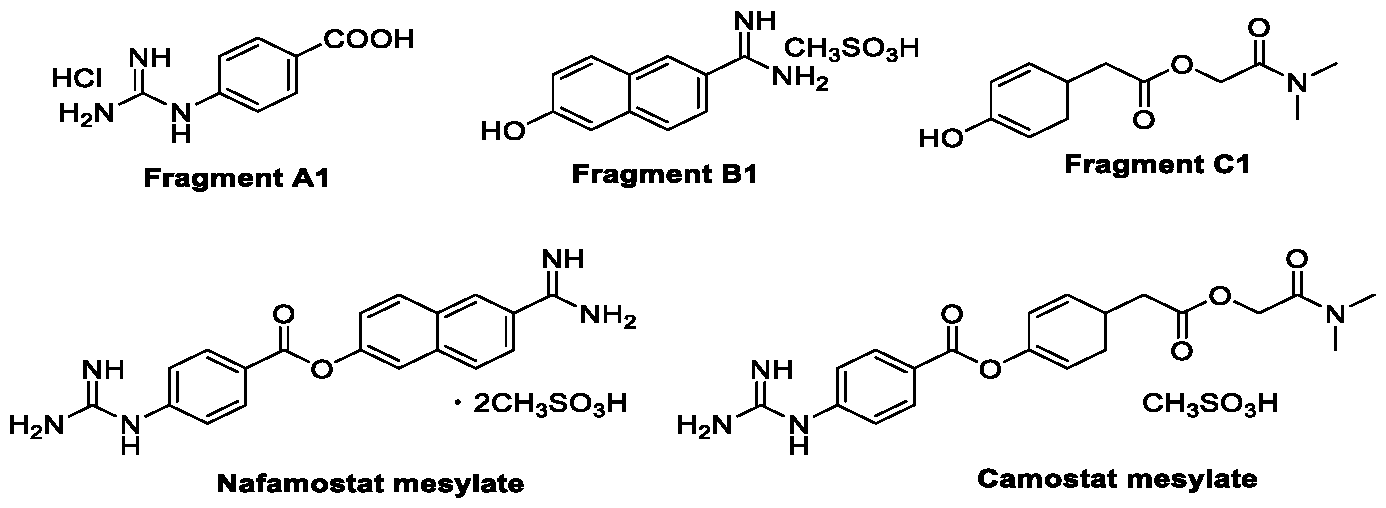
Several methods have been published for the synthesis of Nafamostat and Camostat. Major strategies for the synthesis of Nafamostat and Camostat has been based on the preparation of fragments such as fragment Al as p-guanidinobenzoic acid, fragment Bl as 6-hydroxy-2- naphthimidamide and fragment Cl as 2-(dimethylamino)-2-oxoethyl 2-(4-hydroxyphenyl)acetate and coupling of the two fragments (Al and Bl) for the preparation of Nafamostat and the coupling of two key fragments (Al and Cl) for the synthesis of Camostat.
Figure imgf000003_0001
Most of the process described earlier followed the similar basic path for the preparation of fragments Al and Bl. The preparation of Nafamostat from fragments Al and Bl require specific coupling agents.
CN103012214A described the preparation method of a Nafamostat mesylate hydrochloride from amidino-/i-naphthol methane sulfonate and guanidine radicals benzoyl chloride hydrochloride salt at 0-5 °C in pyridine and then converted into Nafamostat mesylate in final step.
CN103641749B and CN103641749B in 2013 described the preparation method of Nafamostat mesylate from p-guanidinobenzoic acid hydrochloride, 6-amidino-/i-naphthol using 4,5-dicyano imidazole (DCI) as coupling agent in methylene dichloride mix, 0-5 °C is stirred 1 hour, then improve temperature to 18-22 °C, insulation reaction 8-12 h and then finally obtained as mesylate salt.
KR101595747B 1 claimed the preparation method of Nafamostat mesylate from p-guanidinobenzoic acid hydrochloride and 6-amidino-2-naphthol methanesulfonate in the presence of N,N'- diisopropylcarbodiimide (DIC) and 4-dimethylaminopyridine (DMAP) in pyridine as coupling agent.
EP0465913B1 describes a method for preparing diaminotrifluoromethylpyrimidine derivatives using condensation agents such as dicyclohexylcarbodiimide (DCC), A,A'-carbonyldiimidazole (CDI), 1- ethyl-3-(3-dimethylaminopropyl)carbodiimide (EDC).
CN 113999145A describes method for the preparation of Nafamostat from p-chlorobenzoic acid and 6-amidino-2-naphthol hydrochloride utilizing carbodiimide based DCC as coupling reagent. EP0048433B1 also describes a method for preparing Nafamostat mesylate wherein DCC is reacted with 4-guanidinobenzoic acid hydrochloride, and then coupled with 6-amidino-2-naphthol methanesulfonate.
In the same way, another guanidine analogue Camostat also synthesized by using hazardous chemical or coupling reagents such as DIC, EDC, DCC etc.
Fuji et al. in 1977 has reported synthesis of Camostat mesylate in US4,021,472 by reacting the N,N- dimethylcarbamoylmethyl-p-hydroxybenzoate with the acid chloride derivative of p- guanidinobenzoic acid in pyridine at room temperature for 2 h. The crystals were produced by adding sodium bicarbonate solution, filtered and then dissolving in methanol and rendering it acidic with methanesulfonic acid. On adding diethyl ether Camostat mesylate precipitates out.
Most of the prior art methods regarding the synthesis of said molecules requires the coupling of fragment Al and fragment Bl (or fragment Cl) using carbodiimide based coupling reagent makes the process quite expensive and tedious work up.
Considering the importance of these drugs, effective coupling conditions with inexpensive and ease of operation is highly required. In this direction, the present invention provides an alternate and effective method for the synthesis of Nafamostat and Camostat utilizing the trihalotriazine as inexpensive and effective coupling reagent which also provides the additional advantage towards the ease of operation regarding work up.
OBJECTIVE OF THE INVENTION
The objective of the invention is to provide a process for compound of general Formula (F).
Another objective of the invention is to provide a novel, practical and economical route for the preparation of Nafamostat and Camostat drugs and their derivatives.
Yet another objective of the invention is to explore trihalotriazine more preferably trichlorotriazine (TCT) as the novel and highly economical coupling agent for the preparation of esters and its application in synthesis of Nafamostat and Camostat drugs and their derivatives.
SUMMARY OF THE INVENTION Accordingly, the present invention provides a process for the preparation of compound of general
Formula F
Figure imgf000005_0001
Formula F wherein Z is O, S, NH;
Ring X and Y is aryl, heteroaryl, extended rings selected from group consisting of naphthalene, phenanthrene, quinoline, isoquinoline;
Ri is guanidinyl, amidinyl, 2-(dimethylamino)-2-oxoethyl acetyl, halogens, alkyl groups, amide group, cyano group, nitro group, amino group, methoxy group, O-benzyl esters, A-benzyl esters, hydroxyl group, aryl groups, heteroaryl groups;
R2 is guanidinyl, amidinyl, 2-(dimethylamino)-2-oxoethyl acetyl, halogens, alkyl groups, amide group, cyano group, nitro group, amino group, methoxy group, O-benzyl esters, A-benzyl esters, hydroxyl group, aryl groups, heteroaryl groups, substituted benzenes; wherein the said process comprises the steps; i. reacting 2,4,6-trihalo-l,3,5-triazine and base at 25-40 °C for 5 minutes to obtain activated complex; ii. reacting the activated complex as obtained in step-i with fragment A at 40-60 °C for 4 hours to obtain intermediate complex; iii. reacting the intermediate compound as obtained in step-ii with fragment B in the ratio of ranging from 0 - 1 and with fragment C in the ratio of ranging from 0 - 1 to obtain compound D iv. treating the compound D as obtained in step-iii with aqueous sodium bicarbonate; v. optionally purifying the obtained bicarbonate salt of compound D as obtained in step-iv; vi. treating the compound D as obtained in step iv & v with methanesulfonic acid in presence of methanol to provide Formula F.
In an embodiment of present invention the representative compounds are selected from Nafamostat mesylate and Camostat mesylate.
Figure imgf000006_0001
In another embodiment of present invention the fragment A is prepared by reacting -aminobenzoic acid (1) with thiourea (4) in presence of base in ethanol.
In another embodiment of present invention the base is selected from the group consisting of pyridine (py), A-methylmorpholine (NMM) triethylamine (EtsN) Diazabicycloundecene (DBU), more preferably N-methylmorpholine (NMM).
In another embodiment of present invention the trihalotriazine is selected from the group consisting of trichlorotriazine, tribromotriazine, trifluorotriazine.
In another embodiment of present invention the base is selected from sodium carbonate, cesium carbonate, ammonium carbonate and more preferably potassium carbonate. In another embodiment of present invention the yield of Nafamostat mesylate is 54 - 70 % and Camostat mesylate is 17 - 28 %
In an embodiment of present invention the representative compounds are selected from
Figure imgf000006_0002
In another embodiment of present invention the base is selected from the group consisting of pyridine (py), A-methylmorpholine (NMM) triethylamine (EtsN) Diazabicycloundecene (DBU), more preferably N-methylmorpholine (NMM).
In another embodiment of present invention the trihalotriazine is selected from the group consisting oftrichlorotriazine, tribromotriazine, trifluorotriazine.
List of abbreviations used:
1) TCT- Trichlorotriazine 19) HC1 -Hydrochloric acid
2) NMM- 4-methylmorphine 20) CH3OH - Methanol
3) EtsN- Triethylamine 21) NH3 - Ammonia
4) DBU - Diazabicycloundecene 22) MSA - Methanesulfonic acid
5) Py - Pyridine 23) CH3CO3H - Peracetic acid
6) DCC- N,N-Dicyclohexylcarbodiimide 24) K2CO3 -Potassium carbonate
7) DIC- N,N-Diisopropylcarbodiimide 25) DCM - Dichloromethane
8) EDC- l-Ethyl-3-(3- 26) ACN -Acetonitrile dimethylaminopropyl)carbodiimide
27) EtOH -Ethanol
9) DCU-N,N- Dicyclohexylurea
28) DMSO-d6 -Deuterated
10) DMAP- Dimethylaminopyridine dimethylsulfoxide
11) CuCN- Copper cyanide 29) CDCI3 -Deuterated chloroform
12) DMF -Dimethyformamide 30) CD3OD- Deuterated methanol
13) H2O2- Hydrogen peroxide 31) NMR- Nuclear Magnetic Resonance
14) Br2 -Bromine 32) PPM- Parts Per Million 15) Sn -Tin 33) TLC- Thin Layer Chromatography
16) AcOH -Acetic acid 34) THF- Tetrahydrofuran
17) H2O -Water 35) Spectrometry
18) HBr - Hydrogen bromide 36) MHz- Megahertz
BRIEF DESCRIPTION OF DRAWINGS
Fig. 1 depicts the scheme for the process for preparation of Nafamostat, Camostat and their derivatives
Fig. 2 depicts XH-NMR of Nafamaostat mesylate. Fig. 3 depicts 13C-NMR of Nafamaostat mesylate.
Fig. 4 depicts DEPT of Nafamaostat mesylate.
Fig. 5 depicts XH-NMR of Camostat mesylate.
Fig. 6 depicts 13C-NMR of Camostat mesylate.
Fig. 7 depicts DEPT of Camostat mesylate. DETAILED DESCRIPTION OF THE INVENTION
The main aspect of the present invention is to provide a process for compound of general Formula (F) comprising of;
Figure imgf000008_0001
Formula (F) wherein Z is O, S, NH; Ring X and Y is aryl, heteroaryl, extended rings selected from the group consisting of naphthalene, phenanthrene, quinoline, isoquinoline;
Ri is guanidinyl, amidinyl, 2-(dimethylamino)-2-oxoethyl acetyl, halogens, alkyl groups, amide group, cyano group, nitro group, amino group, methoxy group, O-benzyl esters, /V-benzyl esters, hydroxyl group, aryl groups, heteroaryl groups;
R2 is guanidinyl, amidinyl, 2-(dimethylamino)-2-oxoethyl acetyl, halogens, alkyl groups, amide group, cyano group, nitro group, amino group, methoxy group, O-benzyl esters, /V-benzyl esters, hydroxyl group, aryl groups, heteroaryl groups, substituted benzenes; i. reacting 2,4,6-trihalo-l,3,5-triazine and base at 25-40 °C for 5 minutes to obtain activated complex; ii. reacting the activated complex as obtained in step-i with fragment A at 40-60 °C for 4 hours to obtain intermediate complex; iii. reacting the intermediate compound obtained in step-ii with fragment B in the ratio of ranging from 0 - 1 and with fragment C in the ratio of ranging from 0 - 1 to obtain compound D iv. treating the compound D as obtained in step-iii with aqueous sodium bicarbonate; v. optionally purifying the obtained bicarbonate salt of compound D as obtained in step-iv; vi. treating the compound D as obtained in step iv & v with methanesulfonic acid in presence of methanol to provide Formula F.
Within the context of this embodiment the coupling agent trihalotriazine is selected from trichlorotriazine, tribromotriazine, trifluorotriazine, and more preferably inexpensive trichlorotriazine & base is selected from pyridine (py), /V-methyl morpholine (NMM) triethylamine (EtsN) Diazabicycloundecene (DBU), more preferably N-methylmorpholine (NMM).
In an embodiment of present invention, the fragment A is prepared by reacting p- aminobenzoic acid (1) with thiourea (4) in presence of base in ethanol. o i) Trihalotriazine, EtOH, thiourea (4)
Figure imgf000010_0002
ii) base, reflux
Figure imgf000010_0001
Fragment A
Within the context of this embodiment base is selected from the list of pyridine (py), N- methylmorpholine (NMM) triethylamine (EtsN) Diazabicycloundecene (DBU), more preferably N- methylmorpholine (NMM).
In accordance with another embodiment, the present invention provides a process for the preparation of Nafamostat by the coupling of fragment Al namely p-guanidinobenzoic acid and fragment Bl namely 6-hydroxy-2-naphthimidamide using trichlorotriazine, tribromotriazine, trifluorotriazine, and more preferably inexpensive trichlorotriazine (TCT) as coupling reagent in the presence of base such as pyridine (py), A-methylmorpholine (NMM) triethylamine (EtsN) Diazabicycloundecene (DBU) and more preferably A-methyl morpholine (NMM). The Nafamostat (DI) was precipitated as carbonate salt after treating with bicarbonate salt, following by acidification with methanesulfonic acid (MSA) to obtained Nafamostat mesylate (F).
In accordance with another embodiment, the present invention provides a process for the preparation of Fragment Al by the reaction of -aminobenzoic acid 1 with thioureatrioxide 2 in presence of base selected from sodium carbonate, cesium carbonate, ammonium carbonate and more preferably potassium carbonate.
Figure imgf000010_0003
Fragment A1 Fragment B1 Nafamostat mesylate
Figure imgf000010_0004
In accordance with another embodiment, the present invention provides a process for the synthesis of thioureatrioxide 2 from thiourea 4 by oxidation using hydrogen peroxide/peracetic acid system.
Figure imgf000011_0001
In accordance with another embodiment, the present invention provides a process for the synthesis of fragment Bl from compound 5 via acid catalysed conversion of cyano to amidine.
Figure imgf000011_0002
Fragment B1
In accordance with another embodiment, the present invention provides a process for the synthesis of compound 5 from compound 6 via conversion of bromo to cyano group.
Figure imgf000011_0003
In accordance with another embodiment, the present invention provides a process for the synthesis of compound 6 from /i-napthol 7 via two step reactions.
Figure imgf000011_0004
In accordance with another embodiment, the present invention provides a process for the preparation of Camostat by the coupling of fragment Al namely p-guanidinobenzoic acid and fragment Cl namely 2-(dimethylamino)-2-oxoethyl 2-(4-hydroxyphenyl)acetate using trichlorotriazine, tribromotriazine, trifluorotriazine, and more preferably inexpensive trichlorotriazine as coupling reagent in the presence of base such as pyridine (py), N-methylmorpholine (NMM) triethylamine (EI3N) Diazabicycloundecene (DBU), more preferably N-methylmorpholine (NMM). The Camostat (D2) was precipitated as carbonate salt after treating with bicarbonate salt, following by acidification with methanesulfonic acid (MSA) to obtained Camostat mesylate (F).
Figure imgf000012_0001
In accordance with another embodiment, the present invention provides a process for the synthesis of fragment Cl by the coupling of 4-hydroxyphenyl acetic acid 8 with N,N- dimethylbromoacetamide 9.
Figure imgf000012_0002
In accordance with another embodiment, the present invention provides a process for the synthesis of compound 9 from the coupling of bromoacetylbromide 10 with VV-dimethylamine hydrochloride.
Figure imgf000012_0003
In accordance with another embodiment, the present invention provides a process for the synthesis of fragment A from the coupling of -aminobenzoic acid 1 with thiourea 4 using trichlorotriazine, tribromotriazine, trifluorotriazine, and more preferably inexpensive trichlorotriazine as coupling reagent.
O i) Trihalotriazine, EtOH, thiourea (4)
Figure imgf000012_0005
ii) base, reflux
Figure imgf000012_0004
Fragment A All the product mixtures were analysed by thin layer chromatography. UV inactive compounds were visualized in staining solution and UV active compounds were detected with UV lamp (X = 254 nm). All the reactions were performed under inert atmosphere wherever required. NMR spectra ( ’HNMR, 13C, DEPT) were recorded in 400 MHz spectrometer using CDCh and CD3OD solvent.
ES1-MS and HRMS spectra were recorded on LC-MS/MS and HRMS-6540-UHD machines. Optical rotations were measured on a Perkin Elmer polarimeter. Column chromatography was carried out with silica gel (60-120, 230-400 mesh).
Trichlorotriazine (TCT) as coupling reagent being inexpensive and stable and its use provides cost effective route for the synthesis of Nafamostat, Camostat and their derivatives.
Consumption of TCT as a coupling reagent make the preparation of Nafamostat or Camostat simple, high yielding, low impurities and suitable for industrial production. Scheme for the synthesis of fragment Al, Bl, Cl and Nafamostat mesylate and Camostat mesylate are provided in examples. Table 1 and Table 2 provide the reactants used and the reaction conditions with resulting products and yield thereof.
Table 1
Figure imgf000013_0001
Figure imgf000014_0001
Figure imgf000015_0002
Table 2
Figure imgf000015_0001
Figure imgf000016_0001
EXAMPLES
The following examples are given by way of illustration and therefore should not be construed to limit the scope of the present invention.
Example 1: Synthesis of fragment Al (p-guanidinobenzoic acid hydrochloride)
Figure imgf000017_0001
Fragment A1
STEP 1: Synthesis of thiourea dioxide (3) and thiourea trioxide (2):
Figure imgf000017_0002
50 g of thiourea (4) (0.657 mol, 1 eq.) was added into 200 mL of hot water at 40 °C and thoroughly stirred to allow thiourea to dissolve completely. The aqueous thiourea solution thus prepared was cooled and then 371.42 mL of hydrogen peroxide (concentration: 30%) (4.6 mol, 7eq.) was added slowly at a rate such that the solution temperature was held below 10 °C. Thereafter, the solution was cooled to 0 °C and stirred for about 30 minutes to allow crystals to be aged. After the crystal ageing, the solid-liquid mixture at 0 °C was immediately filtered and the fractionated crystals were dried at 50 °C. Further, washing of the reaction mixture has been done with ethanol to expel out the unreacted thiourea. The yield of the crystals thus obtained was 64% to yield 45 g of thiourea dioxide (3) respectively. Peracetic acid (48.54 mL, 0.664 mol) was stirred at 0 °C for 0.5 h followed by addition of thiourea dioxide (3) (18g, 0.664 mol) in water (100 mL), which was slowly warmed to room temperature and stirred overnight. The precipitate (2) (thiourea trioxide) was removed by filtration and the resulted solution was evaporated on rotavapor and further washed with ethanol to obtain the thiourea trioxide (2) (17 g, yield: 67%) respectively m.p.= 132-134 °C, MS (ESI+) m/z calcd. for CH5N2O3S, 125.01 (M+H); found 125.12.
STEP 2: Synthesis of 4- guanidinobenzoic acid (Al)
Figure imgf000018_0001
Reaction conditions: a): i) K2CO3/H20, 1.5 h, rt; ii) 1 N HCI in MeOH, 30 min, 83%
Potassium carbonate (6.01 g, 0.0435 mol) was added to 4-aminobenzoic acid (1) (6 g, 0.0435 mol) in water (40 ml). The mixture was stirred for 0.5 h at room temperature and then thiourea trioxide (2) (8.14 g, 0.0653 mol) was added slowly. White solid was precipitated and the mixture was stirred at room temperature for another 1 h. After filtration, the white solid was dissolved in the solution of 1 N hydrogen chloride in methanol (50 mL) and stirred for 0.5 h. The solvent was removed on rotavapor and the product was obtained as its hydrochloride (6.5 g, yield: 83%), m.p.= 280- 285 °C. ’ H NMR (400 MHz, DMSO-d6) d 11.16 (s, 1H), 10.19 (s, 1H), 7.97-7.99 (d, J= 8Hz, 2H), 7.70 (s, 3H), 7.33-7.35 (d, J= 8Hz, 2H), MS (ESI+) m/z calcd for C8HION302, 180.07 (M+H); found 180.18.
Example 2: Synthesis of fragment Bl (6-hydroxy-2-naphthimidamide methane sulfonate)
Figure imgf000018_0002
(Fragment B1)
STEP 1: Synthesis of 6-bromonaphthalen-2-ol (6):
Figure imgf000018_0003
Reaction conditions: a) i). Br2, AcOH, rt, 30 min, H2O, 120 °C, 1.5 h ; ii). Sn, reflux, 5 h, 91 %
/i-naphthol (7) 40 g (1 mole) and 100 ml of glacial acetic acid were taken in a round-bottom flask fitted with a dropping funnel and a reflux condenser. A solution of 88 g (2 mole) of bromine in 30 ml of acetic acid was added through the dropping funnel for a period of 15-30 minutes. The flask was shaken gently during the addition, /i-naphthol dissolves during this period, and heat was evolved; the mixture was cooled somewhat towards the end of the addition to avoid excessive loss of hydrogen bromide, 30 ml of water was then added, and the mixture was heated to boiling. The reaction mixture was then cooled to 100 °C, 5 g of mossy tin is added and boiled until the metal is dissolved. A second portion of 5 g of tin was then added and dissolved by boiling, and finally a third portion of 32 g (a total of 42 g) of tin was introduced. The mixture was boiled for 3 h, cooled to 50 °C, and filtered with suction. The crystalline tin salts which were thus removed are washed on the funnel with 100 ml of cold acetic acid, the washings being added to the main portion of the filtrate. This filtrate was stirred in cold water; the 6-bromo-2-naphthol (6) which was precipitated was filtered with suction, removed from the funnel, and washed by stirring with 100 ml of cold water. After filtering again and drying at 100 °C to obtain 6-bromo-2-naphthol (6) 60 g (yield 91%). This crude product melts at 123-127 °C contains some tin but is pure enough for most purposes. 1 H NMR (400 MHz, CDC13) 8 10.08 (s, 1H), 7.96 (s, 1H), 7.72-7.70 (d, 1H, J= 8 Hz), 7.62-7.60 (d, 1H, J = 8 Hz), 7.45-7.42 (m, 1H), 7.13-7.11 (m, 2H), MS (ESI+) m/z calcd for CioHsBrO, 222.97 (M+H); found 224.08.
STEP 2: Synthesis of 6-hydroxy-2-naphthonitrile (5):
Figure imgf000019_0001
Reaction conditions: a) CuCN, DMF, 160 °C, 8 h, 87%
A mixture of 30 g of 6-bromo-2-naphthol (6) and 15 g of CuCN in DMF was vigorously stirred at 150 °C for 5-6 h. After cooling to room temperature, the mixture was added 10% NaOH and stirred for 5 min. The reaction was filtered and the filtrate was washed with water. Then, 3 N HC1 was used to adjust pH to 2-3. The precipitate was collected by filtration to give 6-hydroxy-2-naphthonitrile (5) as a brown solid (20 g, 87%) m.p .= 165-170 °C. ’ H NMR (400 MHz, CDCI3) 8 10.05 (s, 1H), 8.50 (s, 1H), 8.07-8.05 (d, 1H, J = 8 Hz), 7.95 (m, 1H) 7.50-7.45 (m, 2H), 7.04-7.02 (m, 1H), MS (ESI+) m/z calcd for CnHsNO, 170.06 (M+H); found 170.19.
STEP 3: Synthesis of 6-hydroxy-2-naphthimidamide methane sulfonate (Bl):
Figure imgf000020_0001
Fragment B1
Reaction conditions: a); i) HCI, CH3OH, rt, overnight; ii) NH3, MeOH, 50 °C, 3h ; b) MSA, MeOH, 72 %
10 g (50 mmol) of 6-hydroxy-2-naphthonitrile (5) was added to a cooled saturated MeOH-HCl solution (50 ml) and the mixture was stirred overnight at room temperature and concentrated. The residue was dissolved in MeOH (50 ml) and gaseous NH3 was introduced into the solution at 50 °C for 3 h. The mixture was concentrated in vacuo and saturated NaHCOa solution was added to the residue with stirring. The precipitate was collected, washed with water and then with acetone, and a suspension of the precipitate in MeOH (10 ml) was treated with MSA (5.8 g, 60 mmol). EtaO was added to the solution and the precipitate was collected to give 6-hydroxy-2-naphthimidamide methane sulfonate (Bl) (9.2 g, 65%). Re-crystallization from EtOH afforded an analytical sample as a pale yellow powder: mp 227-228 °C. 1 H NMR (400 MHz, CDCI3) 8 9.20 (s, 2H), 8.95 (s, 2H), 8.37 (s, 1H), 7.92-7.90 (d, J= 8Hz 1H), 7.85-7.83(d, J= 8Hz, 1H), 7.72-7.70 (d, J= 8Hz, 1H), 7.23 (s, 2H), 2.49 (s,lH), 2.45 (s, 3H), MS (ESI+) m/z calcd for C11H11N2O, 187.08 (M+H); found 187.22.
Example 3: Synthesis of fragment Cl (2-(dimethylamino)-2-oxoethyl 2-(4- hydroxyphenyl)acetate)
Figure imgf000020_0002
Fragment C1
Step 1: Synthesis of 2-bromo-A^,A^-dimethylacetamide (9).
Figure imgf000020_0003
Reaction conditions: a) (CH3)2NH ■ HCI, DCM, 0°C to rt, overnight, 95% Bromoacetyl bromide (10) (1.52 mL, 17.28 mmol) was dissolved in CH2CI2 (20 mL), and dimethylammonium chloride (1 g, 12.34 mmol) was added at 0 °C. The reaction mixture was stirred overnight at rt. The reaction mixture was then subjected to work up with DCM and water. The organic layer was dried (Na2SO4) and concentrated in vacuum. The crude product (9) was obtained as a yellow oil (0.450 g, 54%) and can be used further without purification. 1 H NMR (400 MHz, DMSO-d6) d 4.34 (s, 2H), 3.04 (s, 3H), 2.89 (s, 3H), m/z = 164.97, MS (ESI+) m/z calcd for C4H9BrNO, 165.98 (M+H); found 167.02.
Step 2: Synthesis of 2-(dimethylamino)-2-oxoethyl 2-(4-hydroxyphenyl)acetate (Cl):
Figure imgf000021_0001
Reaction conditions: a) Et3N, ACN, 7h, reflux, 72%
2-Bromo-/V,/V-dimethylacetamide (9) (0.50 g, 3.01 mmol) and p-hydroxyphenylacetic acid (8) (0.450 g, 3.01mmol) were dissolved in 10 ml of acetonitrile, and triethylamine (0.425 g, 4.21 mmol) was added to the solution. The resulting mixture was refluxed for 7 h. Upon completion of reaction (checked by TLC), solvent was evaporated and fragment Cl was purified by column chromatography. TLC (Hexane/EtOAc, 2:8) Ry= 0.4; Yield (0.60 g, 81 %); white solid; m.p.: 103- 107 °C. ’ H NMR (400 MHz, DMSO-d6) d 9.39 (s, 1H), 7.10-7.08 (d, J= 8Hz, 2H), 6.74-6.72 (d, J = 8Hz, 2H), 4.75 (s, 2H), 3.61(s, 2H), 2.85(s, 3H), 2.79 (s, 3H), MS (ESI+) m/z calcd for C12H16NO4 238.10 (M+H); found 238.26.
Example 4: Synthesis of 6-carbamimidoylnaphthalen-2-yl 4-guanidinobenzoate dimesylate (Nafamostat mesylate):
Figure imgf000021_0002
2,4,6-trichloro-l,3,5-triazine (5 g, 26.88 mmol ) and 4-methylmorpholine (70 ml ) were taken in a round-bottom flask and stirred at room temperature for 5 minutes. To the reaction mixture 4- guanidinobenzoic acid, fragment Al (9.62 g, 53.76 mmol) was added and stirred at 40 °C for 4 hours. Then 6-hydroxy-2-naphthimidamide, fragment Bl (10 g, 53.76 mmol) was added and the reaction mixture was stirred overnight at room temperature. Upon completion of the reaction i.e, formation of product DI (monitored by TLC), bicarbonate solution was added to the reaction mixture and stirred for 10 minutes for the precipitation of the product. The precipitates were collected by filtration and subsequently washed with water, acetone and methanol. The precipitates were then dissolved in methanol and treated with methanesulfonic acid. On adding diethyl ether Nafamostat mesylate (F) precipitate out (13 g, yield 70 %) m.p.=257- 262 °C. !H NMR (400 MHz, DMSO-d6) 3 10.33 (s, 1H), 9.50 (s, 2H), 9.29 (s, 2H), 8.60 (s, 1H), 8.25-8.17 (m, 4H), 8.02-7.88 (m, 6H), 7.66-7.64 (d, J = 8 Hz,lH), 7.47-7.45 (d, J = 8Hz, 2H), 2.47 (s, 6H). 13C NMR (101 MHz, DMSO-d6) 5 166.0, 164.4, 155.8, 150.9, 142.1, 136.1, 132.0, 131.4, 130.2, 129.9, 128.9, 125.9, 125.3, 124.9, 123.8, 123.0, 119.4, MS (ESI+) m/z calcd for C19H18N5O2 348.14 (M+H); found 348.38.
Example 5: Synthesis of 6-carbamimidoylnaphthalen-2-yl 4-guanidinobenzoate dimesylate (Nafamostat mesylate):
Figure imgf000022_0001
Reaction conditions: a) TCT, pyridine, 40 °C, 4h, rt, overnight; b) Aq. NaHCO3, c) MSA, MeOH, 63 %
2,4,6-trichloro-l,3,5-triazine (5 g, 26.88 mmol ) and 4-methylmorpholine (70 ml ) were taken in a round-bottom flask and stirred at room temperature for 5 minutes. To the reaction mixture 4- guanidinobenzoic acid, fragment Al (9.62 g, 53.76 mmol) was added and stirred at 40 °C for 4 hours. Then 6-hydroxy-2-naphthimidamide, fragment Bl (10 g, 53.76 mmol) was added and the reaction mixture was stirred overnight at room temperature. Upon completion of the reaction i.e, formation of product DI (monitored by TLC), bicarbonate solution was added to the reaction mixture and stirred for 10 minutes for the precipitation of the product. The precipitates were collected by filtration and subsequently washed with water, acetone and methanol. The precipitates were then dissolved in methanol and treated with methanesulfonic acid. On adding diethyl ether Nafamostat mesylate (F) precipitate out (11.7 g, yield 63 %).
Example 6: Synthesis of 6-carbamimidoylnaphthalen-2-yl 4-guanidinobenzoate dimesylate (Nafamostat mesylate):
Figure imgf000023_0001
2,4,6-trichloro-l,3,5-triazine (5 g, 26.88 mmol ) and 4-methylmorpholine (70 ml ) were taken in a round-bottom flask and stirred at room temperature for 5 minutes. To the reaction mixture 4- guanidinobenzoic acid, fragment Al (9.62 g, 53.76 mmol) was added and stirred at 40 °C for 4 hours. Then 6-hydroxy-2-naphthimidamide, fragment Bl (10 g, 53.76 mmol) was added and the reaction mixture was stirred overnight at room temperature. Upon completion of the reaction i.e, formation of product DI (monitored by TLC), bicarbonate solution was added to the reaction mixture and stirred for 10 minutes for the precipitation of the product. The precipitates were collected by filtration and subsequently washed with water, acetone and methanol. The precipitates were then dissolved in methanol and treated with methanesulfonic acid. On adding diethyl ether Nafamostat mesylate (F) precipitate out (11 g, yield 60 %).
Example 7: Synthesis of 6-carbamimidoylnaphthalen-2-yl 4-guanidinobenzoate dimesylate (Nafamostat mesylate):
Figure imgf000023_0002
Reaction conditions: a) TCT, DBU, 40 °C, 4h, rt, overnight; b) Aq. NaHCO3, c) MSA, MeOH, 60 %
2,4,6-trichloro-l,3,5-triazine (5 g, 26.88 mmol ) and 4-methylmorpholine (70 ml ) were taken in a round-bottom flask and stirred at room temperature for 5 minutes. To the reaction mixture 4- guanidinobenzoic acid, fragment Al (9.62 g, 53.76 mmol) was added and stirred at 40 °C for 4 hours. Then 6-hydroxy-2-naphthimidamide, fragment Bl (10 g, 53.76 mmol) was added and the reaction mixture was stirred overnight at room temperature. Upon completion of the reaction i.e, formation of product DI (monitored by TLC), bicarbonate solution was added to the reaction mixture and stirred for 10 minutes for the precipitation of the product. The precipitates were collected by filtration and subsequently washed with water, acetone and methanol. The precipitates were then dissolved in methanol and treated with methanesulfonic acid. On adding diethyl ether Nafamostat mesylate (F) precipitate out (10 g, yield 54 %).
Example 8: Synthesis of 4-(2-(2-(dimethylamino)-2-oxoethoxy)-2-oxoethyl)phenyl 4- guanidinobenzoate methanesulfonate (Camostat mesylate):
Figure imgf000024_0001
Reaction conditions: a) TCT, NMM, 40 °C, 4h, rt, overnight; b) Aq. NaHCO3, c) MSA, MeOH, 28 %
2,4,6-Trichloro-l,3,5-triazine (TCT) (0.250 g, 1.39 mmol) and 4-methylmorpholine (20 ml) were added in a round bottom flask and stirred at room temperature for 5 minutes. To the reaction mixture 4-guanidinobenzoic acid Al (0.500 g, 2.79 mmol) was added and stirred at 40 °C for 4 hours. Then 2-(dimethylamino)-2-oxoethyl 2-(4-hydroxyphenyl)acetate Cl (0.662 g, 2.79 mmol) was added and the reaction mixture was stirred overnight at room temperature. Upon completion of the reaction i.e, formation of product D2 (checked by TLC), solvent was evaporated and purified by column chromatography. The product D2 was then dissolved in methanol and treated with methanesulfonic acid, upon adding diethyl ether Camostat mesylate (F) was precipitated. TLC (DCM/MeOH, 7:3) Rf = 0.6; (0.75 g, yield 28 %); white solid; m.p.: 153-158 °C. ’H NMR (400 MHz, DMSO-d6) d 8.28-8.26 9 (d, J = 8Hz, 2H), 7.48-7.43 (m, 4H), 7.21-7.19 (d, J = 8Hz, 2H), 4.87 (s, 2H), 3.85 (s, 2H), 3.02 (s, 3H), 2.97 (s, 3H), 2.72 (s, 3H). 13C{ XH} NMR (101 MHz,CD3OD) 5 171.4, 167.6, 164.2, 156.2, 149.9, 140.4, 131.9, 131.4, 130.4, 127.2, 123.4, 121.3, 61.3, 39.2, 38.0, 34.7, 34.4, MS (ESI+) m/z calcd for C20H23N4O5 399.16 (M+H); found 399.42. Example 9: Synthesis of 4-(2-(2-(dimethylamino)-2-oxoethoxy)-2-oxoethyl)phenyl 4- guanidinobenzoate methanesulfonate (Camostat mesylate):
Figure imgf000025_0001
Reaction conditions: a) TCT, pyridine, 40 °C, 4h, rt, overnight; b) Aq. NaHCO3, c) MSA, MeOH, 28 %
2,4,6-Trichloro-l,3,5-triazine (TCT) (0.250 g, 1.39 mmol) and 4-methylmorpholine (20 ml) were added in a round bottom flask and stirred at room temperature for 5 minutes. To the reaction mixture
4-guanidinobenzoic acid Al (0.500 g, 2.79 mmol) was added and stirred at 40 °C for 4 hours. Then 2-(dimethylamino)-2-oxoethyl 2-(4-hydroxyphenyl)acetate Cl (0.662 g, 2.79 mmol) was added and the reaction mixture was stirred overnight at room temperature. Upon completion of the reaction i.e, formation of product D2 (checked by TLC), solvent was evaporated and purified by column chromatography. The product D2 was then dissolved in methanol and treated with methanesulfonic acid, upon adding diethyl ether Camostat mesylate (F) was precipitated (0.20 g, yield 23 %).
Example 10: Synthesis of 4-(2-(2-(dimethylamino)-2-oxoethoxy)-2-oxoethyl)phenyl 4- guanidinobenzoate methanesulfonate (Camostat mesylate):
Figure imgf000025_0002
Reaction conditions: a) TCT, Et3N, 40 °C, 4h, rt, overnight; b) Aq. NaHCO3, c) MSA, MeOH, 28 %
2,4,6-Trichloro-l,3,5-triazine (TCT) (0.250 g, 1.39 mmol) and 4-methylmorpholine (20 ml) were added in a round bottom flask and stirred at room temperature for 5 minutes. To the reaction mixture 4-guanidinobenzoic acid Al (0.500 g, 2.79 mmol) was added and stirred at 40 °C for 4 hours. Then 2-(dimethylamino)-2-oxoethyl 2-(4-hydroxyphenyl)acetate Cl (0.662 g, 2.79 mmol) was added and the reaction mixture was stirred overnight at room temperature. Upon completion of the reaction i.e, formation of product D2 (checked by TLC), solvent was evaporated and purified by column chromatography. The product D2 was then dissolved in methanol and treated with methanesulfonic acid, upon adding diethyl ether Camostat mesylate (F) was precipitated (0.17 g, yield 20%).
Example 11: Synthesis of 4-(2-(2-(dimethylamino)-2-oxoethoxy)-2-oxoethyl)phenyl 4- guanidinobenzoate methanesulfonate (Camostat mesylate):
Figure imgf000026_0001
Reaction conditions: a) TCT, DBU, 40 °C, 4h, rt, overnight; b) Aq. NaHCO3, c) MSA, MeOH, 28 %
2,4,6-Trichloro-l,3,5-triazine (TCT) (0.250 g, 1.39 mmol) and 4-methylmorpholine (20 ml) were added in a round bottom flask and stirred at room temperature for 5 minutes. To the reaction mixture 4-guanidinobenzoic acid Al (0.500 g, 2.79 mmol) was added and stirred at 40 °C for 4 hours. Then 2-(dimethylamino)-2-oxoethyl 2-(4-hydroxyphenyl)acetate Cl (0.662 g, 2.79 mmol) was added and the reaction mixture was stirred overnight at room temperature. Upon completion of the reaction i.e, formation of product D2 (checked by TLC), solvent was evaporated and purified by column chromatography. The product D2 was then dissolved in methanol and treated with methanesulfonic acid, upon adding diethyl ether Camostat mesylate (F) was precipitated (0.15 g, yield 17 %).
EXAMPLE 12: Synthesis of p-guanidinobenzoic acid (A): i) Trihalotriazine, EtOH, thiourea (4)
Figure imgf000026_0003
ii) base, reflux
Figure imgf000026_0002
Fragment A
Thiourea (4) (12 g, 1 equiv.) and TCT (1 equiv.) in ethanol, were taken in a round bottom flask, and stirred for 2 hours, both reactants were consumed. Solvent was removed using rotary evaporator to obtain white solid. 1.5 g of the solid obtained was taken in a 10 mL round bottomed flask along with 0.699 g of p-aminobenzoic acid (1) and stirred for 15 min. In the reaction mixture, 3.56 mL N- methylmorpholine was added. After Ihour both the reactants were consumed (TLC analysis) with the formation of 4-guanidinobenzoic acid A along with some other spots. A-methylmorphol ine was removed under vacuum and product was isolated (0.15 g, yield 15%) using column chromatography.
ADVANTAGES OF PRESENT INVENTION
1.The use of trichlorotriazine (TCT) as coupling reagent being inexpensive and stable provide advantages over the ones used in the prior art.
2.The present invention also provides ease of operation during work up in contrary to prior art and avoid repeated washing and treatment with solvents.
3. The use of trichlorotriazine (TCT) also provides the cost effective route for the synthesis of Nafamostat, Camostat and their derivatives.
4.Consumption of TCT as a coupling reagent make the preparation of Nafamostat or Camostat simple, high yielding, low impurities and suitable for industrial production.

Claims

We claim.
1. A process for preparation of compound of Formula F,
Figure imgf000028_0001
wherein Z is O, S, NH;
Ring X and Y is aryl, heteroaryl, extended rings selected from group consisting of naphthalene, phenanthrene, quinoline, isoquinoline;
Ri is guanidinyl, amidinyl, 2-(dimethylamino)-2-oxoethyl acetyl, halogens, alkyl groups, amide group, cyano group, nitro group, amino group, methoxy group, O-benzyl esters, /V-benzyl esters, hydroxyl group, aryl groups, heteroaryl groups;
R2 is guanidinyl, amidinyl, 2-(dimethylamino)-2-oxoethyl acetyl, halogens, alkyl groups, amide group, cyano group, nitro group, amino group, methoxy group, O-benzyl esters, /V-benzyl esters, hydroxyl group, aryl groups, heteroaryl groups, substituted benzenes; wherein the process comprises the steps of: i. reacting 2,4,6-trihalo-l,3,5-triazine and a base at 25-40 °C for 5 minutes to obtain an activated complex; ii. reacting the activated complex obtained in step-i with fragment A at 40-60 °C for 4 hours to obtain an intermediate compound;
Figure imgf000028_0002
Fragment A iii. reacting the intermediate compound obtained in step-ii with fragment B in the ratio of ranging from 0 - 1 and with fragment C in the ratio of ranging from 0 - 1 to obtain a compound D;
Figure imgf000029_0001
iv. treating the compound D obtained in step-iii with aqueous sodium bicarbonate to produce a bicarbonate salt of the compound D; v. optionally purifying the bicarbonate salt of compound D obtained in step-iv; vi. treating the compound D as obtained in step iv & v with methanesulfonic acid in presence of methanol to provide the compounds of Formula F.
2. The process as claimed in claim 1, wherein the D compounds are selected from Nafamostat mesylate and Camostat mesylate.
Figure imgf000029_0002
3. The process, as claimed in claim 1, wherein fragment A is prepared by reacting -aminobenzoic acid (1) with thiourea (4) in presence of base in ethanol.
Figure imgf000029_0003
Fragment A
4. The process as claimed in claim 1, wherein the base is selected from the group consisting of pyridine (py), /V-methyl morpholine (NMM) triethylamine (EtsN) Diazabi cycloundecene (DBU), more preferably N-methylmorpholine (NMM).
5. The process as claimed in claim 1, wherein the trihalotriazine is selected from the group consisting of trichlorotriazine, tribromotriazine, trifluorotriazine.
6. The process as claimed in claim 1, wherein the base is selected from sodium carbonate, cesium carbonate, ammonium carbonate and more preferably potassium carbonate.
7. The process as claimed in claim 1, wherein the yield of Nafamostat mesylate is 54 - 70 % & Camostat mesylate is 17 - 28 %.
PCT/IN2023/050123 2022-02-07 2023-02-07 Process for the preparation of nafamostat, camostat and their derivatives Ceased WO2023148783A1 (en)

Priority Applications (3)

Application Number Priority Date Filing Date Title
EP23749463.8A EP4475835A4 (en) 2022-02-07 2023-02-07 METHOD FOR THE PREPARATION OF NAFAMOSTAT, CAMOSTAT AND THEIR DERIVATIVES
US18/836,241 US20250188022A1 (en) 2022-02-07 2023-02-07 Process for the preparation of nafamostat, camostat and their derivatives
JP2024547007A JP2025505208A (en) 2022-02-07 2023-02-07 Process for the production of nafamostat, camostat and their derivatives

Applications Claiming Priority (2)

Application Number Priority Date Filing Date Title
IN202211006599 2022-02-07

Publications (1)

Publication Number Publication Date
WO2023148783A1 true WO2023148783A1 (en) 2023-08-10

Family

ID=87553285

Family Applications (1)

Application Number Title Priority Date Filing Date
PCT/IN2023/050123 Ceased WO2023148783A1 (en) 2022-02-07 2023-02-07 Process for the preparation of nafamostat, camostat and their derivatives

Country Status (4)

Country Link
US (1) US20250188022A1 (en)
EP (1) EP4475835A4 (en)
JP (1) JP2025505208A (en)
WO (1) WO2023148783A1 (en)

Cited By (1)

* Cited by examiner, † Cited by third party
Publication number Priority date Publication date Assignee Title
CN117986161A (en) * 2024-02-01 2024-05-07 华仁医学研究(安徽)有限公司 A method for synthesizing high-purity anticoagulant drug

Citations (2)

* Cited by examiner, † Cited by third party
Publication number Priority date Publication date Assignee Title
JPH09309873A (en) * 1996-05-22 1997-12-02 Jiyunsei Kagaku Kk New production method of camostat mesylate
KR102314436B1 (en) * 2021-01-27 2021-10-19 (주)국전약품 Process for Preparing Nafamostat Mesilate and Intermediate Thereof

Family Cites Families (2)

* Cited by examiner, † Cited by third party
Publication number Priority date Publication date Assignee Title
AU527371B2 (en) * 1980-09-16 1983-03-03 Torii & Co., Ltd. Amidine
CN111574409A (en) * 2020-05-14 2020-08-25 河北省医疗器械与药品包装材料检验研究院(河北省医疗器械技术审评中心) A kind of recrystallization process method of nafamostat mesylate

Patent Citations (2)

* Cited by examiner, † Cited by third party
Publication number Priority date Publication date Assignee Title
JPH09309873A (en) * 1996-05-22 1997-12-02 Jiyunsei Kagaku Kk New production method of camostat mesylate
KR102314436B1 (en) * 2021-01-27 2021-10-19 (주)국전약품 Process for Preparing Nafamostat Mesilate and Intermediate Thereof

Non-Patent Citations (2)

* Cited by examiner, † Cited by third party
Title
See also references of EP4475835A4 *
VENKATARAMAN K.; WAGLE D.R.: "Cyanuric chloride : a useful reagent for converting carboxylic acids into chlorides, esters, amides and peptides", TETRAHEDRON LETTERS, ELSEVIER, AMSTERDAM , NL, vol. 20, no. 32, 1 January 1900 (1900-01-01), Amsterdam , NL , pages 3037 - 3040, XP085663861, ISSN: 0040-4039, DOI: 10.1016/S0040-4039(00)71006-9 *

Cited By (1)

* Cited by examiner, † Cited by third party
Publication number Priority date Publication date Assignee Title
CN117986161A (en) * 2024-02-01 2024-05-07 华仁医学研究(安徽)有限公司 A method for synthesizing high-purity anticoagulant drug

Also Published As

Publication number Publication date
JP2025505208A (en) 2025-02-21
EP4475835A4 (en) 2026-01-14
US20250188022A1 (en) 2025-06-12
EP4475835A1 (en) 2024-12-18

Similar Documents

Publication Publication Date Title
JP6811717B2 (en) Methods for the preparation of topiroxostat and its intermediates
TWI580675B (en) Preparation of 4- [5- (pyridin-4-yl) -1H-1,2,4-triazol-3-yl] pyridine-2-carbonitrile and intermediates
US7868207B2 (en) Process for producing 1-(3,4-dichlorobenzyl)-5-octylbiguanide or a salt thereof
WO2016008461A1 (en) A new form of sofosbuvir and a method of its preparation
WO2023148783A1 (en) Process for the preparation of nafamostat, camostat and their derivatives
CN113968815B (en) A method for synthesizing a thiazaspirocarboxylic acid compound, its intermediate, and the method for synthesizing it.
CN115745874A (en) Preparation method of o-pyrrolidinyl benzamide compound
CN1251574A (en) Process for preparing O-(3-amino-2-hydroxy-propyl)-hydroxymic acid halides
RU2193034C2 (en) Method of synthesis of derivatives of 2-aminothiazole carboxamide
CN115850258B (en) A synthetic method of masitinib
RU2852723C2 (en) Method for obtaining jactinibe dihydrochloride monohydrate
RU2825395C1 (en) Method of producing 2-(1,2,3-thiadiazol-4-yl)benzylamine hydrochloride
US4285878A (en) N-Phenyl-N'-cyano-O-phenylisoureas
JP5234856B2 (en) Crystal of compound having NPYY5 receptor antagonistic action
SU1657496A1 (en) Method for obtaining amide of 4-hydroxychinolone-2-carboxylic-3-acid
JP2025034981A (en) Method for producing intermediate for the production of cyclaniliprole
SU940471A1 (en) Process for preparing 4-haloalkyl derivatives of 3-imidazoline-3-oxide
US4321393A (en) Method for preparing 2-cyanamidobenzimidazoles or 2-cyanamidobenzoxazoles
EP0259140B1 (en) Cyanoguanidine derivative and process for preparation thereof
CN113979887A (en) Synthetic method of aromatic amine carboxylic acid derivative
WO2014158641A1 (en) Preparation of haloalkoxyarylhydrazines and intermediates therefrom
EP1930324A1 (en) Process for the preparation of atazanavir
WO2000029369A1 (en) Aminoacrylic acid derivatives and process for producing the same
CN121511233A (en) A DPP1 inhibitor intermediate, its preparation method, and its pharmaceutical applications
SU977453A1 (en) Process for producing 1,2-hydroxilaminooximes

Legal Events

Date Code Title Description
121 Ep: the epo has been informed by wipo that ep was designated in this application

Ref document number: 23749463

Country of ref document: EP

Kind code of ref document: A1

WWE Wipo information: entry into national phase

Ref document number: 18836241

Country of ref document: US

WWE Wipo information: entry into national phase

Ref document number: 2024547007

Country of ref document: JP

WWE Wipo information: entry into national phase

Ref document number: 2023749463

Country of ref document: EP

NENP Non-entry into the national phase

Ref country code: DE

ENP Entry into the national phase

Ref document number: 2023749463

Country of ref document: EP

Effective date: 20240909

WWP Wipo information: published in national office

Ref document number: 18836241

Country of ref document: US