WO2023157777A1 - 硬化性樹脂、その硬化物、樹脂組成物、及び硬化性樹脂の製造方法 - Google Patents
硬化性樹脂、その硬化物、樹脂組成物、及び硬化性樹脂の製造方法 Download PDFInfo
- Publication number
- WO2023157777A1 WO2023157777A1 PCT/JP2023/004674 JP2023004674W WO2023157777A1 WO 2023157777 A1 WO2023157777 A1 WO 2023157777A1 JP 2023004674 W JP2023004674 W JP 2023004674W WO 2023157777 A1 WO2023157777 A1 WO 2023157777A1
- Authority
- WO
- WIPO (PCT)
- Prior art keywords
- formula
- curable resin
- group
- structural unit
- resin composition
- Prior art date
- Legal status (The legal status is an assumption and is not a legal conclusion. Google has not performed a legal analysis and makes no representation as to the accuracy of the status listed.)
- Ceased
Links
Classifications
-
- C—CHEMISTRY; METALLURGY
- C08—ORGANIC MACROMOLECULAR COMPOUNDS; THEIR PREPARATION OR CHEMICAL WORKING-UP; COMPOSITIONS BASED THEREON
- C08G—MACROMOLECULAR COMPOUNDS OBTAINED OTHERWISE THAN BY REACTIONS ONLY INVOLVING UNSATURATED CARBON-TO-CARBON BONDS
- C08G64/00—Macromolecular compounds obtained by reactions forming a carbonic ester link in the main chain of the macromolecule
- C08G64/18—Block or graft polymers
-
- H—ELECTRICITY
- H05—ELECTRIC TECHNIQUES NOT OTHERWISE PROVIDED FOR
- H05K—PRINTED CIRCUITS; CASINGS OR CONSTRUCTIONAL DETAILS OF ELECTRIC APPARATUS; MANUFACTURE OF ASSEMBLAGES OF ELECTRICAL COMPONENTS
- H05K1/00—Printed circuits
- H05K1/02—Details
- H05K1/03—Use of materials for the substrate
-
- B—PERFORMING OPERATIONS; TRANSPORTING
- B32—LAYERED PRODUCTS
- B32B—LAYERED PRODUCTS, i.e. PRODUCTS BUILT-UP OF STRATA OF FLAT OR NON-FLAT, e.g. CELLULAR OR HONEYCOMB, FORM
- B32B27/00—Layered products comprising a layer of synthetic resin
- B32B27/36—Layered products comprising a layer of synthetic resin comprising polyesters
-
- C—CHEMISTRY; METALLURGY
- C08—ORGANIC MACROMOLECULAR COMPOUNDS; THEIR PREPARATION OR CHEMICAL WORKING-UP; COMPOSITIONS BASED THEREON
- C08G—MACROMOLECULAR COMPOUNDS OBTAINED OTHERWISE THAN BY REACTIONS ONLY INVOLVING UNSATURATED CARBON-TO-CARBON BONDS
- C08G63/00—Macromolecular compounds obtained by reactions forming a carboxylic ester link in the main chain of the macromolecule
- C08G63/02—Polyesters derived from hydroxycarboxylic acids or from polycarboxylic acids and polyhydroxy compounds
- C08G63/12—Polyesters derived from hydroxycarboxylic acids or from polycarboxylic acids and polyhydroxy compounds derived from polycarboxylic acids and polyhydroxy compounds
- C08G63/16—Dicarboxylic acids and dihydroxy compounds
- C08G63/18—Dicarboxylic acids and dihydroxy compounds the acids or hydroxy compounds containing carbocyclic rings
- C08G63/199—Acids or hydroxy compounds containing cycloaliphatic rings
-
- C—CHEMISTRY; METALLURGY
- C08—ORGANIC MACROMOLECULAR COMPOUNDS; THEIR PREPARATION OR CHEMICAL WORKING-UP; COMPOSITIONS BASED THEREON
- C08G—MACROMOLECULAR COMPOUNDS OBTAINED OTHERWISE THAN BY REACTIONS ONLY INVOLVING UNSATURATED CARBON-TO-CARBON BONDS
- C08G63/00—Macromolecular compounds obtained by reactions forming a carboxylic ester link in the main chain of the macromolecule
- C08G63/02—Polyesters derived from hydroxycarboxylic acids or from polycarboxylic acids and polyhydroxy compounds
- C08G63/12—Polyesters derived from hydroxycarboxylic acids or from polycarboxylic acids and polyhydroxy compounds derived from polycarboxylic acids and polyhydroxy compounds
- C08G63/52—Polycarboxylic acids or polyhydroxy compounds in which at least one of the two components contains aliphatic unsaturation
- C08G63/54—Polycarboxylic acids or polyhydroxy compounds in which at least one of the two components contains aliphatic unsaturation the acids or hydroxy compounds containing carbocyclic rings
-
- C—CHEMISTRY; METALLURGY
- C08—ORGANIC MACROMOLECULAR COMPOUNDS; THEIR PREPARATION OR CHEMICAL WORKING-UP; COMPOSITIONS BASED THEREON
- C08G—MACROMOLECULAR COMPOUNDS OBTAINED OTHERWISE THAN BY REACTIONS ONLY INVOLVING UNSATURATED CARBON-TO-CARBON BONDS
- C08G63/00—Macromolecular compounds obtained by reactions forming a carboxylic ester link in the main chain of the macromolecule
- C08G63/64—Polyesters containing both carboxylic ester groups and carbonate groups
-
- C—CHEMISTRY; METALLURGY
- C08—ORGANIC MACROMOLECULAR COMPOUNDS; THEIR PREPARATION OR CHEMICAL WORKING-UP; COMPOSITIONS BASED THEREON
- C08G—MACROMOLECULAR COMPOUNDS OBTAINED OTHERWISE THAN BY REACTIONS ONLY INVOLVING UNSATURATED CARBON-TO-CARBON BONDS
- C08G63/00—Macromolecular compounds obtained by reactions forming a carboxylic ester link in the main chain of the macromolecule
- C08G63/78—Preparation processes
-
- C—CHEMISTRY; METALLURGY
- C08—ORGANIC MACROMOLECULAR COMPOUNDS; THEIR PREPARATION OR CHEMICAL WORKING-UP; COMPOSITIONS BASED THEREON
- C08G—MACROMOLECULAR COMPOUNDS OBTAINED OTHERWISE THAN BY REACTIONS ONLY INVOLVING UNSATURATED CARBON-TO-CARBON BONDS
- C08G64/00—Macromolecular compounds obtained by reactions forming a carbonic ester link in the main chain of the macromolecule
- C08G64/20—General preparatory processes
- C08G64/30—General preparatory processes using carbonates
-
- C—CHEMISTRY; METALLURGY
- C08—ORGANIC MACROMOLECULAR COMPOUNDS; THEIR PREPARATION OR CHEMICAL WORKING-UP; COMPOSITIONS BASED THEREON
- C08G—MACROMOLECULAR COMPOUNDS OBTAINED OTHERWISE THAN BY REACTIONS ONLY INVOLVING UNSATURATED CARBON-TO-CARBON BONDS
- C08G64/00—Macromolecular compounds obtained by reactions forming a carbonic ester link in the main chain of the macromolecule
- C08G64/20—General preparatory processes
- C08G64/30—General preparatory processes using carbonates
- C08G64/305—General preparatory processes using carbonates and alcohols
-
- C—CHEMISTRY; METALLURGY
- C08—ORGANIC MACROMOLECULAR COMPOUNDS; THEIR PREPARATION OR CHEMICAL WORKING-UP; COMPOSITIONS BASED THEREON
- C08J—WORKING-UP; GENERAL PROCESSES OF COMPOUNDING; AFTER-TREATMENT NOT COVERED BY SUBCLASSES C08B, C08C, C08F, C08G or C08H
- C08J5/00—Manufacture of articles or shaped materials containing macromolecular substances
- C08J5/04—Reinforcing macromolecular compounds with loose or coherent fibrous material
-
- C—CHEMISTRY; METALLURGY
- C08—ORGANIC MACROMOLECULAR COMPOUNDS; THEIR PREPARATION OR CHEMICAL WORKING-UP; COMPOSITIONS BASED THEREON
- C08J—WORKING-UP; GENERAL PROCESSES OF COMPOUNDING; AFTER-TREATMENT NOT COVERED BY SUBCLASSES C08B, C08C, C08F, C08G or C08H
- C08J5/00—Manufacture of articles or shaped materials containing macromolecular substances
- C08J5/24—Impregnating materials with prepolymers which can be polymerised in situ, e.g. manufacture of prepregs
-
- C—CHEMISTRY; METALLURGY
- C08—ORGANIC MACROMOLECULAR COMPOUNDS; THEIR PREPARATION OR CHEMICAL WORKING-UP; COMPOSITIONS BASED THEREON
- C08J—WORKING-UP; GENERAL PROCESSES OF COMPOUNDING; AFTER-TREATMENT NOT COVERED BY SUBCLASSES C08B, C08C, C08F, C08G or C08H
- C08J5/00—Manufacture of articles or shaped materials containing macromolecular substances
- C08J5/24—Impregnating materials with prepolymers which can be polymerised in situ, e.g. manufacture of prepregs
- C08J5/241—Impregnating materials with prepolymers which can be polymerised in situ, e.g. manufacture of prepregs using inorganic fibres
- C08J5/244—Impregnating materials with prepolymers which can be polymerised in situ, e.g. manufacture of prepregs using inorganic fibres using glass fibres
-
- C—CHEMISTRY; METALLURGY
- C08—ORGANIC MACROMOLECULAR COMPOUNDS; THEIR PREPARATION OR CHEMICAL WORKING-UP; COMPOSITIONS BASED THEREON
- C08J—WORKING-UP; GENERAL PROCESSES OF COMPOUNDING; AFTER-TREATMENT NOT COVERED BY SUBCLASSES C08B, C08C, C08F, C08G or C08H
- C08J5/00—Manufacture of articles or shaped materials containing macromolecular substances
- C08J5/24—Impregnating materials with prepolymers which can be polymerised in situ, e.g. manufacture of prepregs
- C08J5/249—Impregnating materials with prepolymers which can be polymerised in situ, e.g. manufacture of prepregs characterised by the additives used in the prepolymer mixture
-
- C—CHEMISTRY; METALLURGY
- C08—ORGANIC MACROMOLECULAR COMPOUNDS; THEIR PREPARATION OR CHEMICAL WORKING-UP; COMPOSITIONS BASED THEREON
- C08L—COMPOSITIONS OF MACROMOLECULAR COMPOUNDS
- C08L67/00—Compositions of polyesters obtained by reactions forming a carboxylic ester link in the main chain; Compositions of derivatives of such polymers
-
- C—CHEMISTRY; METALLURGY
- C09—DYES; PAINTS; POLISHES; NATURAL RESINS; ADHESIVES; COMPOSITIONS NOT OTHERWISE PROVIDED FOR; APPLICATIONS OF MATERIALS NOT OTHERWISE PROVIDED FOR
- C09K—MATERIALS FOR MISCELLANEOUS APPLICATIONS, NOT PROVIDED FOR ELSEWHERE
- C09K3/00—Materials not provided for elsewhere
- C09K3/10—Materials in mouldable or extrudable form for sealing or packing joints or covers
-
- H—ELECTRICITY
- H10—SEMICONDUCTOR DEVICES; ELECTRIC SOLID-STATE DEVICES NOT OTHERWISE PROVIDED FOR
- H10W—GENERIC PACKAGES, INTERCONNECTIONS, CONNECTORS OR OTHER CONSTRUCTIONAL DETAILS OF DEVICES COVERED BY CLASS H10
- H10W74/00—Encapsulations, e.g. protective coatings
- H10W74/40—Encapsulations, e.g. protective coatings characterised by their materials
- H10W74/47—Encapsulations, e.g. protective coatings characterised by their materials comprising organic materials, e.g. plastics or resins
- H10W74/473—Encapsulations, e.g. protective coatings characterised by their materials comprising organic materials, e.g. plastics or resins containing a filler
-
- C—CHEMISTRY; METALLURGY
- C08—ORGANIC MACROMOLECULAR COMPOUNDS; THEIR PREPARATION OR CHEMICAL WORKING-UP; COMPOSITIONS BASED THEREON
- C08J—WORKING-UP; GENERAL PROCESSES OF COMPOUNDING; AFTER-TREATMENT NOT COVERED BY SUBCLASSES C08B, C08C, C08F, C08G or C08H
- C08J2369/00—Characterised by the use of polycarbonates; Derivatives of polycarbonates
-
- C—CHEMISTRY; METALLURGY
- C08—ORGANIC MACROMOLECULAR COMPOUNDS; THEIR PREPARATION OR CHEMICAL WORKING-UP; COMPOSITIONS BASED THEREON
- C08L—COMPOSITIONS OF MACROMOLECULAR COMPOUNDS
- C08L2203/00—Applications
- C08L2203/20—Applications use in electrical or conductive gadgets
-
- C—CHEMISTRY; METALLURGY
- C09—DYES; PAINTS; POLISHES; NATURAL RESINS; ADHESIVES; COMPOSITIONS NOT OTHERWISE PROVIDED FOR; APPLICATIONS OF MATERIALS NOT OTHERWISE PROVIDED FOR
- C09K—MATERIALS FOR MISCELLANEOUS APPLICATIONS, NOT PROVIDED FOR ELSEWHERE
- C09K2200/00—Chemical nature of materials in mouldable or extrudable form for sealing or packing joints or covers
- C09K2200/06—Macromolecular organic compounds, e.g. prepolymers
- C09K2200/0645—Macromolecular organic compounds, e.g. prepolymers obtained otherwise than by reactions involving carbon-to-carbon unsaturated bonds
- C09K2200/0655—Polyesters
Definitions
- the present invention relates to a curable resin, a cured product thereof, a resin composition, a method for producing a curable resin, and the like.
- polyester carbonate Because of its excellent mechanical strength, heat resistance, transparency, etc., polyester carbonate is used in a variety of applications, and various polyester carbonates and their production methods have been reported.
- Patent Document 1 discloses a polyester carbonate polyol having a norbornane skeleton.
- Patent Document 2 discloses a polyester carbonate resin having a 1,1'-binaphthalene structure and a fluorene structure. According to Patent Document 2, such a resin is said to exhibit excellent optical performance.
- Patent Document 3 discloses a method of producing a polyester carbonate resin by reacting a reactant containing a dihydroxy compound having a fluorene structure. According to Patent Document 3, such a method for producing a resin can produce a resin having excellent fluidity and/or tensile strength.
- an object of the present invention is to provide a curable resin or the like having excellent dielectric properties.
- a curable resin comprising a structural unit represented by the following formula (1), a structural unit represented by the following formula (2), and a structural unit represented by the following formula (3).
- R 1 is a divalent group having at least one of an ethylenic double bond and an acetylenic triple bond
- R 2 is an alicyclic is a divalent group having the formula structure.
- Structural units represented by the formula (1), structural units represented by the formula (2), and structural units represented by the formula (3) for all structural units constituting the curable resin The curable resin according to [1], wherein the molar ratio of the sum of the contents is 0.60 or more and 1.0 or less.
- the curable resin according to 1. Any one of [1] to [5], wherein the molar ratio of the structural unit represented by the formula (1) to the structural unit represented by the formula (2) is 0.010 or more and less than 1.0
- the curable resin according to 1. Any one of [1] to [6], wherein the molar ratio of the structural unit represented by the formula (3) to the structural unit represented by the formula (2) is 0.10 or more and 1.5 or less
- the curable resin according to any one of [1] to [7] which has a number average molecular weight of 5.00 ⁇ 10 2 or more and 3.00 ⁇ 10 4 or less.
- [9] [1] comprising a structural unit represented by the formula (1) and a polyester portion containing a structural unit represented by the formula (2) and not containing a structural unit represented by the formula (3); The curable resin according to any one of [8]. [10] The curable resin according to any one of [1] to [9], which has a dielectric loss tangent of 0.010 or less calculated according to the following measurement methods including (i) to (iii). (i) A cured product of the resin composition containing the curable resin is prepared, and the dielectric loss tangent of the cured product at 10 GHz is measured. (ii) A plurality of cured products obtained by changing the content of each component of the resin composition are subjected to the same measurement as in (i) above.
- At least one of a compound represented by the following formula (4) and a compound represented by the following formula (4′), a compound represented by the following formula (5), and a compound represented by the following formula (6) A method for producing a curable resin, comprising reacting (In the above formula (4), R 1 is a divalent group having at least one of an ethylenic double bond and an acetylenic triple bond, and R 3 and R 4 are each independently a hydrogen atom or is a monovalent hydrocarbon group having 1 to 7 carbon atoms, in the above formula (4'), R 1 has the same meaning as R 1 in the above formula (4), and in the above formula (5), R 2 is is a divalent group having an alicyclic structure, R 5 and R 6 are each independently a hydrogen atom or a monovalent hydrocarbon group having 1 to 7 carbon atoms, and in the above formula (6), R 7 and R 8 are each independently an optional substituent.) [15] The compound represented by the formula (5), the compound represented by the compound represented
- a fiber-reinforced composite material comprising the resin composition according to [12] or [13] and reinforcing fibers.
- a fiber-reinforced molded product which is a cured product of the fiber-reinforced composite material according to [18].
- a semiconductor encapsulating material comprising the resin composition according to [12] or [13] and an inorganic filler.
- a prepreg comprising a substrate and the resin composition according to [12] or [13] impregnated or applied to the substrate.
- a laminate comprising the prepreg according to [22].
- a circuit board comprising the laminate according to [23] and a metal foil disposed on one side or both sides of the laminate.
- a build-up film comprising a cured product of the resin composition according to [12] or [13] and a base film.
- this embodiment a mode for carrying out the present invention (hereinafter referred to as "this embodiment") will be described in detail, but the present invention is not limited to this, and various modifications can be made without departing from the scope of the invention. is possible.
- a bond cut by a wavy line in a chemical structural formula means a binding site to another structural unit in the structural unit represented by each chemical structural formula.
- the curable resin of the present embodiment includes a structural unit represented by the following formula (1) (hereinafter also referred to as a “dicarboxylic acid unit”), a structural unit represented by the following formula (2) (hereinafter also referred to as a “dihydroxy unit”); A structural unit represented by the following formula (3) (hereinafter also referred to as “carbonate unit”); including.
- R 1 is a divalent group having at least one of an ethylenic double bond and an acetylenic triple bond
- R 2 is It is a divalent group having an alicyclic structure.
- the curable resin of the present embodiment has at least one of an ethylenic double bond and an acetylenic triple bond in the above dicarboxylic acid unit, so that it can be crosslinked intramolecularly or intermolecularly, i.e. It can be cured by any suitable method.
- Conventional polyester carbonate does not have a point (functional group) that can crosslink with a curable resin, so when added to a curable resin with low compatibility, phase separation occurs or peeling occurs at the interface with the curable resin. etc.
- the curable resin of the present embodiment is a resin containing an ester bond and a carbonate bond, but has at least one of an ethylenic double bond and an acetylenic triple bond, so it is mixed with another curable resin. It is possible to crosslink by reacting with the functional groups of the other curable resin when it is allowed to react. As a result, the curable resin of the present embodiment can be cured alone, and even when mixed with another curable resin, phase separation and interfacial peeling are unlikely to occur.
- the curable resin of the present embodiment realizes a low dielectric constant and dielectric loss tangent due to the dihydroxy unit having an alicyclic structure, and exhibits excellent dielectric properties. It is presumed that this is because the dihydroxy unit has a large molar volume and because the alicyclic structure restricts the movement of the molecular chains of the resin molecules, but the factors are not limited to these.
- excellent dielectric properties means that both the dielectric constant and the dielectric loss tangent are low.
- the specific values of the dielectric constant and the dielectric loss tangent are not particularly limited, but for example, the dielectric constant (relative dielectric constant) of the cured product of the curable resin or resin composition prepared as in Examples is 2.7 or less. When the dielectric loss tangent is 0.010 or less, it can be said that the dielectric properties are excellent.
- the curable resin and resin composition of the present embodiment have a low dielectric constant and a low dielectric loss tangent even when cured.
- the dielectric constant and dielectric loss tangent of the curable resin alone of the present embodiment calculated according to the following measurement methods including (i) to (iii) are preferably 2.7 or less and 0.010 or less, respectively.
- a cured product of a resin composition containing a curable resin is prepared, and the dielectric loss tangent of the cured product at 10 GHz is measured.
- the same measurement as in (i) is performed on a plurality of cured products obtained by changing the content of each component of the resin composition.
- an organic solvent such as toluene, a (meth)acrylate such as tricyclodecanol acrylate, and an organic peroxide It may contain an initiator, such as an initiator.
- a cured product may be prepared as follows. The resin composition is placed in a vacuum dryer and dried at room temperature for 48 hours and at 60° C. for 3 hours to remove the solvent. After removal of the solvent, the resin composition is put into a mold having a thickness of 1 mm, sandwiched between Aflex film (manufactured by AGC Co., Ltd.) and a SUS plate, and put into a vacuum press heated to 200°C.
- the pressure is gradually pressed to 0.6 MPa, heated for 90 minutes, taken out, and slowly cooled.
- the cured product of the resin composition is extracted from the mold.
- a rod-shaped sample is prepared by cutting the extracted cured product into a width of 0.8 mm. The cut sample is dried in a vacuum dryer at 70° C. for one day.
- the resin composition in (i) contains an organic solvent such as toluene, a (meth)acrylate such as tricyclodecanol acrylate, and an organic peroxide-based
- an initiator such as an initiator
- the sample with the added amount of the initiator increased and decreased from the resin composition in (i), and the blending ratio of the (meth) acrylate to the curable resin
- a cured product may be prepared by curing at least a total of four samples, the sample with increased and the sample with decreased.
- the dielectric constant of the curable resin alone of the present embodiment calculated according to the above measuring method is more preferably 2.6 or less, still more preferably 2.5 or less, and even more preferably 2.4 or less. is.
- the lower limit of the dielectric constant is not particularly limited, and may be 1.5, 1.8, or 2.0, for example.
- the dielectric loss tangent of the curable resin alone of the present embodiment calculated according to the above measuring method is more preferably 0.008 or less, still more preferably 0.006 or less, and even more preferably 0.005 or less. is.
- the lower limit value of the dielectric loss tangent is not particularly limited, and may be 0.0005, 0.0003, or 0.0001, for example.
- Dielectric constant and dielectric loss tangent measured in the same manner as in Example 7 below of the cured product of the resin composition prepared in the same manner as in Example 7 below, containing the curable resin of the present embodiment are preferably are less than or equal to 2.7 and less than or equal to 0.010, respectively.
- the curable resin of this embodiment is a resin that cures in response to an appropriate stimulus or spontaneously.
- the curable resin of the present embodiment is, in one aspect, a thermosetting resin, in another aspect, a photocurable resin, and in another aspect, a heat or photocurable resin.
- R 1 in the dicarboxylic acid unit is a divalent group having at least one of an ethylenic double bond and an acetylenic triple bond.
- ethylenic double bond means a carbon-carbon double bond that does not form an aromatic ring.
- acetylenic triple bond means a carbon-carbon triple bond. Since the curable resin of the present embodiment has a carbon-carbon unsaturated bond that does not form an aromatic ring, it can be crosslinked alone or with a crosslinking agent.
- the number of carbon atoms in R 1 is not particularly limited, but is, for example, 2 or more and 8 or less, preferably 2 or more and 6 or less, more preferably 2 or more and 4 or less, and even more preferably 2 or more and 3 or less. .
- the total number of ethylenic double bonds and acetylenic triple bonds in R 1 is not particularly limited as long as it is 1 or more.
- R 1 above preferably has an ethylenic double bond.
- a preferred embodiment of R 1 is a divalent hydrocarbon group having 2 or more and 4 or less carbon atoms and having one ethylenic double bond. In this preferred embodiment, the number of ethylenic double bonds and the number of carbon atoms may be arbitrarily replaced within the above ranges.
- the isomer structure when the dicarboxylic acid unit has an ethylenic double bond is not particularly limited. That is, the dicarboxylic acid unit having an ethylenic double bond may be cis-configured or trans-configured.
- the dicarboxylic acid unit represented by the above formula (1) is preferably a structural unit represented by the following formula (1-1) or (1-2).
- each R 1A is independently a hydrogen atom, a methyl group, or an ethyl group.
- R 1A is preferably each independently a hydrogen atom or a methyl group.
- Particularly preferred dicarboxylic acid units are structural units derived from fumaric acid, maleic acid or maleic anhydride.
- R 1 in the above formula (1) is a divalent hydrocarbon group having 2 carbon atoms and having an ethylenic double bond. According to such an aspect, the dielectric properties of the curable resin tend to be more excellent.
- the curable resin of the present embodiment may contain only one kind of dicarboxylic acid unit, or may contain two or more kinds of dicarboxylic acid units. From the viewpoint of facilitating production and facilitating control of the properties of the resin, it is preferable that the curable resin contains one type of dicarboxylic acid unit.
- R2 in the dihydroxy unit is a divalent group having an alicyclic structure. Since R 2 is a divalent group having an alicyclic structure, it is presumed that the main chain of the curable resin of the present embodiment becomes rigid and the molar volume increases. It is presumed that this restricts the movement of the molecular chains of the entire resin molecule and improves the dielectric properties. However, the factor is not limited to this.
- the alicyclic structure may be on the main chain, on the side chains, or on the main chain and the side chains.
- R2 preferably has an alicyclic structure in its main chain. Also, R 2 has at least one alicyclic structure, but may have two or more alicyclic structures.
- the number of carbon atoms in R 2 is not particularly limited, but is, for example, 5 or more and 100 or less, preferably 6 or more and 20 or less, more preferably 7 or more and 18 or less, and even more preferably 8 or more and 17 or less. .
- the number of carbon atoms in R 2 may be 80 or less, 70 or less, 60 or less, 50 or less, 40 or less, or 30 or less within the above range.
- the ratio of the number of carbon atoms forming the alicyclic structure to the number of carbon atoms contained in R 2 is not particularly limited, and is, for example, 50% or more and 100% or less. The ratio is preferably 60% or more, more preferably 70% or more, and still more preferably 75% or more in the above range.
- the movement of the molecular chains in the dihydroxy units is further restricted, and the dielectric properties of the curable resin tend to be further improved.
- the upper limit of the ratio is not particularly limited, and may be, for example, 100%, 95%, 90%, or 85%.
- R 2 above may be a divalent saturated hydrocarbon group or a divalent unsaturated hydrocarbon group.
- the dihydroxy unit is preferably a structural unit derived from a dihydroxy compound containing at least one selected from the group consisting of a cycloalkane-based skeleton and a norbornane-based skeleton, and is selected from the group consisting of a cyclohexane-based skeleton and a norbornane-based skeleton. It is more preferably a structural unit derived from a dihydroxy compound containing at least one, more preferably a structural unit derived from a dihydroxy compound containing at least one selected from the group consisting of a cycloalkane skeleton and a norbornane skeleton, and cyclohexane.
- a structural unit derived from a dihydroxy compound containing at least one selected from the group consisting of a skeleton and a norbornane skeleton is more preferred.
- the dihydroxy unit may be a structural unit derived from a dihydroxy compound containing a norbornane skeleton, or a structural unit derived from a dihydroxy compound containing a norbornane skeleton. According to such an aspect, the dielectric properties of the curable resin tend to be further improved.
- norbornane-based skeleton is selected from the group consisting of a skeleton containing norbornane (bicyclo[2.2.1]heptane) and a skeleton in which a single bond in the skeleton is replaced with an unsaturated bond.
- norbornane-based skeletons include, for example, norbornane skeletons and norbornene skeletons.
- a “cycloalkane-based skeleton” means a skeleton selected from the group consisting of a skeleton containing a cycloalkane and a skeleton in which a single bond in the skeleton is replaced with an unsaturated bond.
- Cycloalkane-based skeletons include, for example, cycloalkane skeletons and cycloalkene skeletons.
- a “cyclohexane-based skeleton” means a skeleton selected from the group consisting of a skeleton containing cyclohexane and a skeleton in which a single bond in the skeleton is replaced with an unsaturated bond.
- a cyclohexane-based skeleton includes, for example, a cyclohexane skeleton and a cyclohexene skeleton.
- the dihydroxy unit represented by the above formula (2) is preferably a structural unit represented by the following formula (2-4), and the following formula (2-1), (2-2), or (2-3) ) is more preferable.
- it may be a structural unit containing a structure in which R2A and/or R2B and/or R2C and/or R2D are regularly or randomly repeated between terminal oxygen atoms.
- each R 2A is independently a single bond, a methylene group, or an ethylene group; , is a divalent alicyclic structure optionally having an alkyl group, and each R 2C may independently have a single bond or at least one of a methyl group and an ethyl group a methylene group or an ethylene group, each R 2D is independently a divalent aryl group, each R 2X is independently R 2A , R 2B , R 2C or R 2D ; n is an integer of 1 or more and 6 or less. However, in formula (2-4), at least one of n R 2X is R 2B .
- each R 2A is preferably independently a single bond or a methylene group.
- R 2B may be a monocyclo ring, bicyclo ring, tricyclo ring, or polycyclo ring optionally having an alkyl group.
- R 2B preferably contains a cycloalkane-based skeleton or a norbornane-based skeleton, more preferably a cyclohexane-based skeleton or a norbornane-based skeleton, more preferably a cyclohexane ring or a norbornane-based skeleton, a cyclohexane ring or a norbornane-based skeleton It is even more preferable to contain a cyclohexane ring or a decahydro-1,4:5,8-dimethanonaphthalene skeleton represented by the following formula (7).
- R 2B contains a cycloalkane skeleton, cyclohexane skeleton, cyclohexane ring, norbornane skeleton, norbornane skeleton and/or decahydro-1,4:5,8-dimethanonaphthalene skeleton
- the group that binds to R 2B is It may be attached to any portion of the backbone or ring, or may be attached to another cyclo ring that is further attached to the backbone.
- the alkyl group that R 2B may have is not particularly limited, but is preferably a methyl group or an ethyl group.
- R 2B may be a divalent alicyclic structure having no alkyl group.
- the alicyclic structure of R2B has 0 to 6, 0 to 4, 0 to 3, 0 to 2, or 0 to 1 alkyl groups. you can
- the methylene group optionally having at least one of a methyl group and an ethyl group, or the ethylene group of R 2C includes a methylene group, an ethylene group, a methylmethylene group, an ethylmethylene group, and a methylethylene group.
- R2D is preferably a benzene ring or naphthalene ring optionally having an alkyl group, more preferably a benzene ring optionally having an alkyl group.
- the alkyl group that R 2D may have is not particularly limited, but is preferably a methyl group or an ethyl group.
- R 2D may be a divalent aromatic ring having no alkyl group. the aromatic ring of R 2D has 0 to 6, 0 to 4, 0 to 3, 0 to 2, or 0 to 1 alkyl group; good.
- (R 2X ) n means a structure in which n R 2X groups independently selected from R 2A , R 2B , R 2C and R 2D , which are divalent groups, are bonded. Preferred embodiments of R 2A , R 2B , R 2C and R 2D in (R 2X ) n are the same as described above. (R 2X ) n is not particularly limited, but examples thereof include the following structures.
- R 2B included in (R 2X ) n may be 1 or more and 4 or less, preferably 1 or more and 3 or less, and more preferably 1 or 2.
- n is preferably 1 or more and 5 or less, more preferably 1 or more and 4 or less, and even more preferably 1 or more and 3 or less.
- the dihydroxy unit represented by the above formula (2) is derived from a dihydroxy compound having an alkylene group having 3 to 20 carbon atoms as a main chain and a group having an alicyclic structure attached to the side chain of the alkylene group. It can be a unit.
- the alicyclic structure in the group attached to the side chain may be, for example, a monocyclo ring, bicyclo ring, tricyclo ring, or polycyclo ring.
- the group attached to the side chain may be a cycloalkyl group such as a cyclohexyl group or a monovalent group derived from a norbornane-based skeleton.
- the number of carbon atoms in the dihydroxy unit may be 5 or more and 100 or less.
- Dihydroxy units include decahydro-1,4:5,8-dimethanonaphthalene-dimethanol (D-NDM), tricyclodecanedimethanol (for example, tricyclo[5.2.1 .0 2,6 ]decanedimethanol) (TCDDM), cyclohexanedimethanol, pentacyclopentadecanedimethanol (for example, pentacyclo[6.5.1.1 3,6.02 represented by formula (12) described later ) , 7.0 9,13 ]pentadecanedimethanol) (PCDDM), hydrogenated bisphenol A, and at least one selected from the group consisting of structural units derived from (trimethylcyclohexylidene)bisphenol (TMC) is particularly preferred.
- D-NDM decahydro-1,4:5,8-dimethanonaphthalene-dimethanol
- TCDDM tricyclodecanedimethanol
- cyclohexanedimethanol for example, pentacyclopentadecan
- the bonding position of the group that bonds to the alicyclic structure is not particularly limited.
- the positions at which the hydroxymethyl groups are bonded to the alicyclic structure are not particularly limited, and may be, for example, the 2- and 6-positions, or the 2- and 7-positions.
- the position at which the hydroxymethyl group is bonded to the cyclohexane ring is not particularly limited, and may be, for example, ortho-position, meta-position, or para-position.
- TMC the positions at which three methyl groups and two phenol groups are bonded to the cyclohexane ring are not particularly limited.
- TMC may be (3,3,5-trimethylcyclohexylidene) bisphenol. It may be 4,4′-(3,3,5-trimethylcyclohexylidene)bisphenol represented by formula (14).
- the curable resin of this embodiment may contain only one type of dihydroxy unit, or may contain two or more types of dihydroxy units. Also, each dihydroxy unit may consist of only one stereoisomer, or may contain multiple stereoisomers.
- the carbonate unit is preferably a structural unit derived from at least one selected from the group consisting of dialkyl carbonate, diaryl carbonate, and alkylaryl carbonate. Specific examples of dialkyl carbonates, diaryl carbonates, and alkylaryl carbonates are described later.
- the curable resin of this embodiment may contain further structural units in addition to the dicarboxylic acid units, dihydroxy units, and carbonate units described above. Further structural units are not particularly limited, but those that do not adversely affect the dielectric properties of the curable resin are preferred. Examples of further structural units include structural units derived from dicarboxylic acid compounds that do not fall under formula (1), structural units derived from dihydroxy compounds that do not fall under formula (2), and monohydroxy compounds having an ethylenic double bond. etc.
- dicarboxylic acid compounds include, but are not limited to, saturated aliphatic dicarboxylic acids, aromatic dicarboxylic acids, acid anhydrides thereof, and the like.
- saturated aliphatic dicarboxylic acids include cyclohexanedicarboxylic acid, cyclopentanedicarboxylic acid, adipic acid, succinic acid, sebacic acid, alkylsuccinic acid, cyclohexanediacetic acid, azelaic acid, malonic acid, dimethylmalonic acid, and oxalic acid. be done.
- aromatic dicarboxylic acids examples include terephthalic acid, isophthalic acid, 1,4-naphthalenedicarboxylic acid, 2,6-naphthalenedicarboxylic acid, 2,7-naphthalenedicarboxylic acid, biphenyldicarboxylic acid, 5-tert-butyl-1, 3-benzenedicarboxylic acid, 2,5-furandicarboxylic acid, 2,5-thiophenedicarboxylic acid and the like.
- dihydroxy compound as described above is not particularly limited, examples thereof include aliphatic dihydroxy compounds, aromatic dihydroxy compounds, and the like.
- aliphatic dihydroxy compounds include ethylene glycol, 1,2-propanediol, 1,3-propanediol, 1,2-butanediol, 1,3-butanediol, 1,4-butanediol, 2,3- butanediol, 1,4-butenediol, 2-methyl-1,3-propanediol, 1,5-pentanediol, neopentyl glycol, 2-ethyl-2-methylpropane-1,3-diol, 2-butyl -2-ethylpropane-1,3-diol, 1,6-hexanediol, 3-methyl-1,5-pentanediol, 2-ethyl-1,3-hexanediol, 2,4-dimethyl-1,
- aromatic dihydroxy compounds include hydroquinone, resorcinol, 4,4'-dihydroxybiphenyl, xylylene glycol, 4,4'-dihydroxydiphenylbenzophenone, and bisphenols.
- Bisphenols include 2,2-bis(4-hydroxyphenyl)propane, 2,2-bis(3-methyl-4-hydroxyphenyl)propane, 2,2-bis(4-hydroxy-3,5-dimethyl phenyl)propane, 2,2-bis(4-hydroxy-3,5-diethylphenyl)propane, 2,2-bis(4-hydroxy-(3-phenyl)phenyl)propane, 2,2-bis(4- Hydroxy-(3,5-diphenyl)phenyl)propane, 2,2-bis(4-hydroxy-3,5-dibromophenyl)propane, bis(4-hydroxyphenyl)methane, 1,1-bis(4-hydroxy phenyl)ethane, 2,2-bis(4-hydroxy
- aromatic dihydroxy compounds 2,2-bis(4-(2-hydroxyethoxy)phenyl)propane, 2,2-bis(4-(2-hydroxypropoxy)phenyl)propane, 1,3-bis( dihydroxy compounds having an ether group attached to an aromatic group such as 2-hydroxyethoxy)benzene, 4,4′-bis(2-hydroxyethoxy)biphenyl, and bis(4-(2-hydroxyethoxy)phenyl)sulfone; and 9,9-bis(4-(2-hydroxyethoxy)phenyl)fluorene, 9,9-bis(4-hydroxyphenyl)fluorene, 9,9-bis(4-hydroxy-3-methylphenyl)fluorene, 9,9-bis(4-(2-hydroxypropoxy)phenyl)fluorene, 9,9-bis(4-(2-hydroxyethoxy)-3-methylphenyl)fluorene, 9,9-bis(4-(2 -hydroxypropoxy)-3-methylphenyl)fluorene, 9,9-bis
- Examples of monohydroxy compounds having an ethylenic double bond include hydroxy group-containing (meth)acrylic acid esters, specifically 2-hydroxyethyl (meth)acrylate, 3-hydroxypropyl (meth)acrylate, 4-hydroxybutyl (meth)acrylate, trimethylolpropane di(meth)acrylate, pentaerythritol tri(meth)acrylate and the like.
- the curable resin may contain, as partial structures, a structure derived from silicone oil having a hydroxy group in its molecular structure, a structure derived from silicone oil having a carboxy group in its molecular structure, and the like.
- silicone oil having a hydroxy group in the molecular structure commercially available products can be used. 1600), "X-22-1821” having phenolic hydroxyl groups at both ends (functional group equivalent 1470) (manufactured by Shin-Etsu Chemical Co., Ltd.), “BY-16-752A” (functional group equivalent 1500) ( Above, Dow Corning Toray Co., Ltd.), "X-22-170BX” having a hydroxyl group at one end (functional group equivalent 2800), “X-22-170DX” (functional group equivalent 4670), “X-22 -176DX” (functional group equivalent 1600), “X-22-176F” (functional group equivalent 6300) (manufactured by Shin-Etsu Chemical Co., Ltd.), “X-22-4039” having a hydroxyl group in the side chain (functional Group equivalent 970) "X-22-4015” (functional group equivalent 1870) (manufactured by Shin-Etsu Chemical Co., Ltd.), "SF8427” having hydroxyl groups
- silicone oil having a carboxy group in the molecular structure a commercially available product can be used as the silicone oil having a carboxy group in the molecular structure.
- X-22-3710 having a carboxy group (functional group equivalent 1450)
- X-22-3701E having a carboxy group in the side chain (functional group equivalent 4000) (manufactured by Shin-Etsu Chemical Co., Ltd.), etc. is mentioned.
- properties such as flexibility, mechanical strength, heat resistance, flame resistance, color tone, and solvent solubility are improved. Or tend to be able to give.
- the terminal group in the curable resin of the present embodiment is not particularly limited, and may be, for example, a carboxy group and/or a hydroxy group. is. According to the aspect having a terminal blocking agent, the dielectric properties of the curable resin tend to be more excellent.
- the terminal carboxy group-capping agent is not particularly limited as long as it is a compound having a group that reacts with a carboxy group. Examples of terminal hydroxy group-capping agents include diphenyl carbonate and monocarboxylic acids.
- the curable resin of this embodiment contains dicarboxylic acid units, dihydroxy units, and carbonate units. Although the order of bonding of these units is not particularly limited, it is preferable that the dicarboxylic acid unit and the carbonate unit are adjacent to the dihydroxy unit.
- the oxygen atoms that these units have at both ends are shared with adjacent units. That is, for example, when a dihydroxy unit and a dicarboxylic acid unit are adjacent, the structure forms the following ester bond. Also, when the dihydroxy unit and the carbonate unit are adjacent, the structure forms the following carbonate bond.
- the curable resins of this embodiment may be random copolymers of dicarboxylic acid units, dihydroxy units, and carbonate units, copolymers of carbonate units and dihydroxy units linked to dicarboxylic acid units, Copolymers of dicarboxylic acid units and dihydroxy units may be copolymers linked to carbonate units.
- the curable resin of the present embodiment in one aspect, contains a polyester portion containing dihydroxy units and dicarboxylic acid units and no carbonate units.
- the curable resin is preferably a polyester carbonate in which a plurality of polyester moieties composed of dihydroxy units and dicarboxylic acid units are linked to a plurality of carbonate units. According to such an aspect, the dielectric properties of the curable resin tend to be further improved.
- the molar ratio N COOH /N OH of the dicarboxylic acid unit content N COOH to the dihydroxy unit content N OH is preferably 0.010 or more and less than 1.0, more preferably 0.025 or more and 0.50 or less. , more preferably 0.050 or more and 0.30 or less, and still more preferably 0.075 or more and 0.20 or less.
- the molar ratio N COOH /N OH can be measured by a nuclear magnetic resonance spectrometer (NMR).
- the molar ratio N OCOO /N OH of the carbonate unit content N OCOO to the dihydroxy unit content N OH is preferably 0.10 or more and 1.5 or less, more preferably 0.50 or more and 1.3 or less. more preferably 0.80 or more and 1.1 or less, and still more preferably 0.85 or more and 1.05 or less.
- the molar ratio N OCOO /N OH can be measured by a nuclear magnetic resonance spectrometer (NMR).
- the molar ratio of the sum of the contents of dihydroxy units, dicarboxylic acid units and carbonate units to all structural units N all constituting the curable resin of the present embodiment (N OH + N COOH + N OCOO )/N all is preferably 0. It is 0.60 or more, more preferably 0.70 or more, still more preferably 0.80 or more, and even more preferably 0.90 or more.
- the upper limit of the molar ratio (N OH +N COOH +N OCOO )/N all is not particularly limited, but may be, for example, 1.0, 0.98, or 0.96.
- the molar ratio (N OH + N COOH + N OCOO )/N all is 0.60 or more, the dielectric properties, solvent solubility, bleedout resistance, etc. of the curable resin of the present embodiment tend to be further improved. be.
- the molar ratio (N OH +N COOH +N OCOO )/N all can be measured by a nuclear magnetic resonance spectrometer (NMR).
- the unit ratio is preferably 0.60 or more, more preferably 0.70 or more, still more preferably 0.80 or more, and even more preferably 0.90 or more.
- the upper limit of the ratio is not particularly limited, it may be 1.0, 0.98, or 0.96, for example.
- the ratio of the structural unit represented by formula (2) to all the structural units derived from the dihydroxy compound in the curable resin is preferably 0.60 or more, more preferably 0.60.
- the proportion of structural units represented by formula (1) and the proportion of structural units represented by formula (2) can be measured by a nuclear magnetic resonance spectrometer (NMR).
- the content of structural units derived from each monomer can be controlled by adjusting the amount (used amount) of each monomer in the production of the curable resin. At that time, it is preferable to use a monomer that is easily evaporated and easily flowed out of the system in a larger amount than a monomer that is difficult to be evaporated in consideration of the outflow to the outside of the system.
- the number average molecular weight of the curable resin of the present embodiment is not particularly limited, it is preferably 5.00 ⁇ 10 2 or more and 3.00 ⁇ 10 4 or less, more preferably 1.00 ⁇ 10 3 or more and 2.00. ⁇ 10 4 or less, more preferably 1.50 ⁇ 10 3 or more and 1.50 ⁇ 10 4 or less, still more preferably 3.00 ⁇ 10 3 or more and 1.00 ⁇ 10 4 or less.
- the number average molecular weight is 3.00 ⁇ 10 4 or less, the solubility of the curable resin in solvents tends to be even better.
- the embodiment in which the number average molecular weight is 3.00 ⁇ 10 4 or less is suitable for applications such as impregnating fillers (for example, glass cloth) such as copper-clad laminates, and dissolving in solvents such as unsaturated polyesters. It can be suitably used for the intended use.
- the number average molecular weight of the curable resin is 3.00 ⁇ 10 4 or less, bleed-out (resin does not react uniformly) occurs when it is mixed with other curable resin such as maleimide resin and cured.
- the number average molecular weight of the curable resin is 5.00 ⁇ 10 2 or more, it tends to be possible to sufficiently incorporate dihydroxy units into the resin, which tends to further improve the dielectric properties.
- the number average molecular weight can be measured by gel permeation chromatography (GPC).
- the curable resin of the present embodiment includes all aspects of curable resins obtained by arbitrarily combining all aspects described above.
- the curable resin of the present embodiment can be produced by reacting the compound containing the dicarboxylic acid unit, the compound containing the dihydroxy unit, and the compound containing the carbonate unit.
- One embodiment of the present invention relates to a method for producing a curable resin.
- the method for producing a curable resin of the present embodiment includes a compound represented by the following formula (4) (hereinafter also referred to as a "dicarboxylic acid compound”) and a compound represented by the following formula (4') (hereinafter referred to as " Also referred to as "dicarboxylic anhydride”.)
- a compound represented by the following formula (5) hereinafter also referred to as a “dihydroxy compound”
- a compound represented by the following formula (6) hereinafter also referred to as a “carbonate compound”
- R 1 is a divalent group having at least one of an ethylenic double bond and an acetylenic triple bond
- R 3 and R 4 are each independently hydrogen an atom or a monovalent hydrocarbon group having 1 to 7 carbon atoms, in formula (4′) above,
- R 1 is a divalent group having at least one of an ethylenic double bond
- dicarboxylic acid units of the curable resin of the present embodiment are produced by reacting the dicarboxylic acid compound or the dicarboxylic anhydride and being incorporated into the resin. Similarly, the dihydroxy compound and the carbonate compound are reacted and incorporated into the resin to yield dihydroxy units and carbonate units, respectively, of the curable resins of the present embodiments. That is, the dicarboxylic acid unit, dihydroxy unit, and carbonate unit of the curable resin of the present embodiment are structural units derived from the dicarboxylic acid compound or dicarboxylic anhydride, dihydroxy compound, and carbonate compound, respectively.
- R 1 in the above formulas (4) and (4′) and R 2 in the above formula (5) are respectively synonymous with R 1 in the above formula (1) and R 2 in the above formula (2), and are preferred. Aspects are also as described above.
- R 3 , R 4 , R 5 and R 6 in the dicarboxylic acid compound and the dihydroxy compound are each independently a hydrogen atom or a monovalent hydrocarbon group having 1 to 7 carbon atoms.
- R 3 —OH, R 4 —OH, R 5 —OH, and R 6 corresponding to R 3 , R 4 , R 5 , and R 6 above, when the dicarboxylic acid compound or dihydroxy compound reacts and is incorporated into the resin. The reaction proceeds with elimination of —OH. Therefore, R 3 , R 4 , R 5 and R 6 are preferably groups with high stability of the hydroxylated compound. From the viewpoint of enhancing reactivity, R 3 , R 4 , R 5 and R 6 are preferably groups with little steric hindrance.
- R 3 , R 4 , R 5 and R 6 above each independently represent a hydrogen atom, a methyl group, an ethyl group, an n-propyl group, an isopropyl group, an n-butyl group, an isobutyl group, a phenyl group, or a benzyl group.
- a dicarboxylic acid anhydride is used, and a dihydroxy compound in which R 5 and R 6 are hydrogen atoms is used.
- a dicarboxylic acid compound in which R 3 and R 4 are hydrogen atoms or a dihydroxy compound in which R 5 and R 6 are hydrogen atoms is used. According to such an aspect, there is a tendency that the curable resin can be produced efficiently.
- R7 and R8 are each independently optional substituents.
- the reaction proceeds by elimination of R 7 —OH and R 8 —OH corresponding to R 7 and R 8 above. Therefore, R 7 and R 8 are preferably groups in which the hydroxide compound is highly stable. Also, R 7 and R 8 are preferably selected such that the carbonate compound is a stable compound.
- R 7 and R 8 are preferably an alkyl group or an aryl group, more preferably an alkyl group having 1 to 6 carbon atoms or an aryl group having 6 to 12 carbon atoms, and an alkyl group having 1 to 3 carbon atoms. or an aryl group having 6 carbon atoms (phenyl group), and even more preferably a phenyl group.
- carbonate compounds include, but are not limited to, diphenyl carbonate, ditolyl carbonate, dimethyl carbonate, diethyl carbonate, di-t-butyl carbonate, bis(chlorophenyl) carbonate, m-cresyl carbonate, and dicyclohexyl carbonate. be done.
- the carbonate compound is preferably diphenyl carbonate and/or alkyl group-substituted diphenyl carbonate.
- dicarboxylic acid compounds dicarboxylic anhydrides, dihydroxy compounds, and carbonate compounds may be used singly or in combination of two or more.
- the dicarboxylic acid compound represented by formula (4), the dicarboxylic anhydride represented by formula (4'), the dihydroxy compound represented by formula (5), and A monomer, oligomer or polymer other than the carbonate compound represented by Formula (6) may be added to the reaction system and incorporated into the curable resin.
- Such compounds include dicarboxylic acid compounds other than the dicarboxylic acid compound represented by formula (4) and their anhydrides, dihydroxy compounds other than the dihydroxy compound represented by formula (5), and ethylenic double bonds.
- the dicarboxylic acid compound, dicarboxylic anhydride, dihydroxy compound and carbonate compound are used in amounts such that the molar ratios N COOH /N OH and N OCOO /N OH in the curable resin of the present embodiment are within the above preferred ranges. Adjusting is preferred. That is, the total molar ratio of the dicarboxylic acid compound and the dicarboxylic anhydride to the amount of the dihydroxy compound used is preferably 0.010 or more and less than 1.0, more preferably 0.025 or more and 0.50. or less, more preferably 0.050 or more and 0.30 or less, and still more preferably 0.075 or more and 0.20 or less.
- the molar ratio of the amount of the carbonate compound used to the amount of the dihydroxy compound used is preferably 0.10 or more and 1.5 or less, more preferably 0.50 or more and 1.3 or less, and still more preferably 0.80. 1.1 or less, and more preferably 0.85 or more and 1.05 or less.
- the ease of vaporization of each compound for example, the saturated vapor pressure at the reaction temperature
- the amount of the compound that is more easily vaporized may be increased.
- the ratio of the sum of the amounts of dicarboxylic acid compound, dicarboxylic anhydride, dihydroxy compound and carbonate compound used is preferably 0.60 in terms of molar ratio. or more, more preferably 0.70 or more, still more preferably 0.80 or more, and even more preferably 0.90 or more.
- the upper limit of the ratio is not particularly limited, it may be 1.0, 0.98, or 0.96, for example.
- the ratio of the amount of the dicarboxylic acid compound represented by (4) or (4′) and the dicarboxylic anhydride used is preferably 0.60 or more, more preferably 0.70 or more, and still more preferably 0 0.80 or greater, and even more preferably 0.90 or greater.
- the upper limit of the ratio is not particularly limited, it may be 1.0, 0.98, or 0.96, for example.
- the ratio of the amount of the dihydroxy compound represented by formula (5) used is preferably 0.60 or more. , more preferably 0.70 or more, still more preferably 0.80 or more, and even more preferably 0.90 or more.
- the upper limit of the ratio is not particularly limited, it may be 1.0, 0.98, or 0.96, for example.
- the method for producing a curable resin of the present embodiment includes step 1A of reacting at least one of a dicarboxylic acid compound and a dicarboxylic acid anhydride with a dihydroxy compound, a product obtained in step 1A, and a carbonate compound. and step 1B of reacting with.
- the total amount of the dicarboxylic acid compound and dicarboxylic anhydride used is preferably less than the amount of the dihydroxy compound used in terms of moles.
- the polyol compound is produced in step 1A and tends to react favorably with the carbonate compound in step 1B.
- the amount of the carbonate compound used is preferably greater than the number of moles obtained by subtracting the total amount of the dicarboxylic acid compound and the dicarboxylic acid anhydride from the amount of the dihydroxy compound used. According to this aspect, since more carbonate compounds are used than the number of hydroxy groups in the product obtained in Step 1A, the amount of terminal hydroxy groups in the resulting curable resin can be reduced. As a result, there is a tendency to obtain a curable resin having more excellent dielectric properties.
- the method for producing a curable resin of the present embodiment includes step 2A of reacting a carbonate compound and a dihydroxy compound, and at least one of the product obtained in step 2A and a dicarboxylic acid compound or a dicarboxylic acid anhydride. and step 2B.
- step 2A the amount of the carbonate compound used is preferably less than the amount of the dihydroxy compound used in terms of mol.
- the polyol compound is produced in step 2A and tends to favorably react with the dicarboxylic acid compound and/or dicarboxylic acid anhydride in step 2B.
- the total amount of the dicarboxylic acid compound and dicarboxylic anhydride used is preferably about the same as the number of moles obtained by subtracting the amount of the carbonate compound from the amount of the dihydroxy compound used.
- the dicarboxylic acid compound and/or dicarboxylic acid anhydride having the same number of hydroxy groups as the product obtained in step 2A is used, so that the reaction completion rate in step 2B is suitable. There is a tendency.
- the reactions in steps 1A and 2B may be carried out by heating the reactants at atmospheric pressure.
- the reactions in steps 1A and 2B may be carried out by heating the reactants under normal pressure and then further heating under reduced pressure.
- the reaction temperature in Steps 1A and 2B is not particularly limited as long as the temperature is elevated, and is, for example, 80 to 290° C. (both values are included. The same shall apply in this specification unless otherwise specified.). , preferably 120 to 270°C, more preferably 150 to 250°C.
- the pressure in the system is not particularly limited as long as it is under reduced pressure conditions. is.
- the reactions in steps 1B and 2A may be carried out by heating the reactants at atmospheric pressure.
- the reactions in steps 1B and 2A may be carried out by heating the reactants at normal pressure and then further heating under reduced pressure.
- the reactions in steps 1B and 2A may be carried out by gradually increasing the temperature and reducing the pressure while finally maintaining the temperature at elevated temperature and reducing the pressure.
- the reaction temperature (final temperature) in steps 1B and 2A is not particularly limited as long as it is a temperature rising condition, and is, for example, 100 to 290°C, preferably 130 to 280°C, more preferably 160 to 260°C. be.
- the pressure in the system is not particularly limited as long as it is under reduced pressure conditions.
- Steps 1A, 1B, 2A, and 2B are preferably carried out in the presence of an inert gas.
- inert gases include nitrogen gas and argon gas.
- each reactant may be supplied as a solid when solid, may be supplied as a molten state after heating, or may be supplied as an aqueous solution. If it is a liquid, it may be supplied as a single liquid, or may be supplied as a mixture with a solvent.
- the form of the reaction may be batch type, continuous type, or a combination of batch type and continuous type.
- Steps 1A, 1B, 2A, and 2B are preferably carried out in the presence of a catalyst.
- Catalysts include, for example, catalysts commonly used in the synthesis of polycarbonates and polyesters. Specific examples include alkali metal compounds, alkaline earth metal compounds, nitrogen-containing compounds, and salts of titanium, tin, zinc, zirconium, and/or lead.
- a basic compound such as a basic boron compound or a basic phosphorus compound in combination with the alkali metal compound and/or the alkaline earth metal compound.
- alkali metal compounds include organic acid salts, inorganic salts, oxides, hydroxides, hydrides and alkoxides of alkali metals.
- alkaline earth metal compounds include organic acid salts, inorganic salts, oxides, hydroxides, hydrides and alkoxides of alkaline earth metal compounds.
- nitrogen-containing compounds include quaternary ammonium hydroxides and salts thereof, amines, and the like.
- quaternary ammonium hydroxides having an alkyl group and/or an aryl group such as tetramethylammonium hydroxide, tetraethylammonium hydroxide, tetrapropylammonium hydroxide, tetrabutylammonium hydroxide, trimethylbenzylammonium hydroxide, etc.
- tertiary amines such as triethylamine, dimethylbenzylamine and triphenylamine; secondary amines such as diethylamine and dibutylamine; primary amines such as propylamine and butylamine; 2-methylimidazole, 2-phenylimidazole, benzo imidazoles such as imidazole; or bases or basic salts such as ammonia, tetramethylammonium borohydride, tetrabutylammonium borohydride, tetrabutylammonium tetraphenylborate, tetraphenylammonium tetraphenylborate and the like.
- Titanium salts include, for example, tetramethyl titanate, tetrabutyl titanate, tetrapropyl titanate, tetraisopropyl titanate, tetraisobutyl titanate, and tetraphenyl titanate.
- Tin salts include, for example, tin(II) chloride, tin(IV) chloride, tin(II) acetate, tin(IV) acetate, dibutyltin oxide, dibutyltin dilaurate, dibutyltin dimethoxide, and dibutyltin diacetate.
- Zinc salts include, for example, zinc acetate, zinc benzoate, and zinc 2-ethylhexanoate.
- Zirconium salts include, for example, zirconium acetylacetonate, zirconium oxyacetate, and zirconium tetrabutoxide.
- Lead salts include, for example, lead (II) acetate and lead (IV) acetate.
- Basic boron compounds that can be used in combination with alkali metal compounds and/or alkaline earth metal compounds include, for example, tetramethylboron, tetraethylboron, tetrapropylboron, tetrabutylboron, trimethylethylboron, trimethylbenzylboron, trimethylphenyl Sodium salts, potassium salts, lithium, such as boron, triethylmethylboron, triethylbenzylboron, triethylphenylboron, tributylbenzylboron, tributylphenylboron, tetraphenylboron, benzyltriphenylboron, methyltriphenylboron, and butyltriphenylboron salts, calcium salts, barium salts, magnesium salts, strontium salts, and the like.
- Examples of basic phosphorus compounds include triethylphosphine, tri-n-propylphosphine, triisopropylphosphine, tri-n-butylphosphine, triphenylphosphine, tributylphosphine, and quaternary phosphonium salts.
- antimony compounds such as diantimony trioxide; germanium compounds such as germanium dioxide and germanium tetroxide; manganese compounds; 025,492, 4,136,089, 4,176,224, 4,238,593 and 4,208,527, and R.E. Wilfong, Journal of Polymer Science, 54, 385, (1961) and the like are also included.
- a titanium salt catalyst is preferably used in the production method of the present embodiment.
- the catalyst may be added in steps 1A and 2A, and it is not necessarily necessary to add a new catalyst in steps 1B and 2B.
- the reaction may be carried out under a catalyst only in some of the steps of the production method of the present embodiment.
- the amount of the catalyst used is not particularly limited, but is, for example, 0.1 to 500 ⁇ mol, preferably 0.5 to 100 ⁇ mol in terms of metal atom, per 1 mol of all the dihydroxy compounds used in the reaction. .
- the dicarboxylic acid compound represented by formula (4), the dicarboxylic anhydride represented by formula (4′), and the dicarboxylic anhydride represented by formula (5) and the above-described compounds other than the carbonate compound represented by the formula (6) are added to the reaction system and reacted together with the dicarboxylic acid compound, the dicarboxylic acid anhydride, the dihydroxy compound, and/or the carbonate compound.
- the method for producing a curable resin of the present embodiment includes a dicarboxylic acid compound represented by formula (4), a dicarboxylic anhydride represented by formula (4'), a dihydroxy compound represented by formula (5), and A step other than steps 1A, 1B, 2A, and 2B may be included in which the compounds described above other than the carbonate compound represented by formula (6) are exclusively reacted.
- the dicarboxylic acid compound and/or dicarboxylic acid anhydride, the dihydroxy compound, and the carbonate compound are reacted as described above, and then the resulting product is purified.
- a process may be included.
- the purification step may be a step of removing unreacted reactants and/or by-products and/or catalyst components incorporated in the curable resin. Examples of by-products include compounds produced by a condensation reaction of a dicarboxylic anhydride, a dihydroxy compound, and a carbonate compound.
- a method generally used as a method for purifying resins may be appropriately used.
- a reprecipitation method in which the resin is dissolved in a solvent and then dropped into a poor solvent or water and a liquid-liquid extraction method.
- a liquid-liquid extraction using toluene and an aqueous sodium carbonate solution may preferably be used.
- Such a purification step may be performed in the middle of each step (for example, between steps 1A and 2A or between steps 1B and 2B).
- the curable resin of the present embodiment may be produced by a method of reacting polycarbonate diol with at least one of a dicarboxylic acid compound and a dicarboxylic acid anhydride.
- the polycarbonate diol to be used is not particularly limited as long as it is a compound containing a carbonate bond and having hydroxyl groups at both ends, and conventionally known commercially available polycarbonate diols can be mentioned.
- a polycarbonate diol may be used in place of the dihydroxy compound represented by formula (5).
- the polycarbonate diol to be used is not particularly limited as long as it is a compound containing a carbonate bond and having hydroxyl groups at both ends, and conventionally known commercially available polycarbonate diols can be mentioned. According to such an aspect, it tends to be possible to obtain a curable resin containing a large amount of carbonate units.
- the method for producing a curable resin of the present embodiment includes all aspects of the method for producing a curable resin obtained by arbitrarily combining all the aspects described above.
- One embodiment of the present invention relates to a resin composition containing the curable resin of this embodiment.
- the resin composition of the present embodiment may further contain another component in addition to the curable resin of the present embodiment.
- Other components that the resin composition of the present embodiment may contain include, for example, epoxy resins, cyanate ester compounds, maleimide compounds, BT resins, compounds having polymerizable unsaturated groups, phenol groups and aromatic carboxylic acid groups. compounds having an ester structure derived from, modified silicone oils, heat stabilizers, antioxidants, curing agents and curing accelerators.
- the above components may be used singly or in combination of two or more.
- epoxy resins include phenol phenyl aralkyl novolac type epoxy resin, phenol biphenyl aralkyl type epoxy resin, naphthol aralkyl type epoxy resin, anthraquinone type epoxy resin, polyoxynaphthylene type epoxy resin, bisphenol A type epoxy resin, bisphenol F type epoxy resin.
- Resin phenol novolak type epoxy resin, cresol novolak type epoxy resin, bisphenol A novolak type epoxy resin, trifunctional phenol type epoxy resin, tetrafunctional phenol type epoxy resin, naphthalene type epoxy resin, biphenyl type epoxy resin, aralkyl novolak type epoxy resin , alicyclic epoxy resins, polyol-type epoxy resins, glycidylamine, glycidyl esters, compounds obtained by epoxidizing double bonds such as butadiene, compounds obtained by the reaction of hydroxyl-containing silicone resins and epichlorohydrin, and these Halides and the like can be mentioned. These may be used individually by 1 type, and may be used in combination of 2 or more type.
- cyanate ester compounds include naphthol aralkyl cyanate compounds, novolak cyanate esters, phenolbiphenyl aralkyl cyanate compounds, bis(3,5-dimethyl-4-cyanatophenyl)methane, bis(4- cyanatophenyl)methane, 1,3-dicyanatobenzene, 1,4-dicyanatobenzene, 1,3,5-tricyanatobenzene, 1,3-dicyanatonaphthalene, 1,4-dicyanatonaphthalene, 1, 6-dicyanatonaphthalene, 1,8-dicyanatonaphthalene, 2,6-dicyanatonaphthalene, 2,7-dicyanatonaphthalene, 1,3,6-tricyanatonaphthalene, 4,4′-dicyanatobiphenyl, bis (4-cyanatophenyl) ether, bis(4-cyanatophenyl) thioether, bis(4-cyanatophenyl) s
- maleimide compounds include N-phenylmaleimide, N-hydroxyphenylmaleimide, bis(4-maleimidophenyl)methane, 2,2-bis ⁇ 4-(4-maleimidophenoxy)-phenyl ⁇ propane, bis(3,5 -dimethyl-4-maleimidophenyl)methane, bis(3-ethyl-5-methyl-4-maleimidophenyl)methane, bis(3,5-diethyl-4-maleimidophenyl)methane, and prepolymers of these maleimide compounds, and prepolymers of maleimide compounds and amine compounds. These may be used individually by 1 type, and may be used in combination of 2 or more type.
- BT resin is a prepolymer obtained by dissolving a cyanate ester compound and a maleimide compound in a solvent-free or organic solvent such as methyl ethyl ketone, N-methylpyrrodrine, dimethylformamide, dimethylacetamide, toluene, and xylene, followed by heating and mixing.
- a solvent-free or organic solvent such as methyl ethyl ketone, N-methylpyrrodrine, dimethylformamide, dimethylacetamide, toluene, and xylene
- the compound having a polymerizable unsaturated group is not particularly limited, but examples include vinyl compounds such as ethylene, styrene, divinylbenzene, divinylbiphenyl; methyl (meth)acrylate, 2-hydroxyethyl (meth)acrylate, 2- Hydroxypropyl (meth)acrylate, tricyclodecanol (meth)acrylate, tricyclodecanol di(meth)acrylate, tricyclodecanol tri(meth)acrylate, polypropylene glycol di(meth)acrylate, trimethylolpropane di(meth)acrylate ) acrylates, trimethylolpropane tri(meth)acrylate, pentaerythritol tetra(meth)acrylate, dipentaerythritol hexa(meth)acrylates of monohydric or polyhydric alcohols (meth)acrylates; bisphenol A type epoxy (meth) Epoxy (meth)acrylates such as
- Compounds having an ester structure derived from a phenol group and an aromatic carboxylic acid group include, for example, a compound (a1) having one phenolic hydroxyl group, a compound (a2) having two or more phenolic hydroxyl groups, and an aromatic polycarboxylic acid. or an active ester resin (I) using a compound selected from acid halides thereof (a3) as a reaction raw material, a compound (b1) having two or more phenolic hydroxyl groups, an aromatic monocarboxylic acid or an acid halide thereof (b2 ) and an aromatic polycarboxylic acid or an acid halide thereof (b3) as a reaction raw material.
- Specific examples of these compounds can be referred to WO2020/003824. These may be used individually by 1 type, and may be used in combination of 2 or more type.
- Modified silicone oils include those that have a chain siloxane skeleton and have groups other than hydrogen or hydrocarbon groups in the molecular structure.
- modifying groups include epoxy groups, amino groups, hydroxyl groups, methacryl groups, mercapto groups, carboxy groups, alkoxy groups and silanol groups. These may be used individually by 1 type, and may be used in combination of 2 or more type.
- Thermal stabilizers include phosphorous acid, phosphoric acid, phosphonous acid, phosphonic acid and their esters. Specifically, for example, triphenylphosphite, tris(nonylphenyl)phosphite, tris(2,4-di-tert-butylphenyl)phosphite, tridecylphosphite, trioctylphosphite, trioctadecylphosphite, Didecylmonophenylphosphite, Dioctylmonophenylphosphite, Diisopropylmonophenylphosphite, Monobutyldiphenylphosphite, Monodecyldiphenylphosphite, Monooctyldiphenylphosphite, Bis(2,6-di-tert-butyl-4 -methylphenyl)pentaerythritol diphosphite
- antioxidants examples include pentaerythritol tetrakis (3-mercaptopropionate), pentaerythritol tetrakis (3-laurylthiopropionate), glycerol-3-stearylthiopropionate, triethylene glycol-bis[3- (3-tert-butyl-5-methyl-4-hydroxyphenyl)propionate], 1,6-hexanediol-bis[3-(3,5-di-tert-butyl-4-hydroxyphenyl)propionate], penta Erythritol-tetrakis[3-(3,5-di-tert-butyl-4-hydroxyphenyl)propionate], octadecyl-3-(3,5-di-tert-butyl-4-hydroxyphenyl)propionate, 1,3 ,5-trimethyl-2,4,6-tris(3,5-di-tert-butyl-4-hydroxybenzyl)
- curing agents examples include polyfunctional phenol compounds such as phenol novolak, cresol novolak, and aminotriazine novolak resins; amine compounds such as dicyandiamide, diaminodiphenylmethane and diaminodiphenylsulfone; phthalic anhydride, pyromellitic anhydride, maleic anhydride, and the like.
- curing accelerators include zinc naphthenate, cobalt naphthenate, tin octylate, cobalt octylate, bisacetylacetonate cobalt (II), trisacetylacetonate cobalt (III), zinc (II) acetylacetonate, Organometallic salts and complexes such as iron (III) acetylacetonate, imidazoles and their derivatives, organophosphorus compounds, secondary amines, tertiary amines, and quaternary ammonium salts. These may be used individually by 1 type, and may be used in combination of 2 or more type.
- the resin composition of the present embodiment preferably contains a component that reacts with the curable resin of the present embodiment and cures together.
- a component that reacts with the curable resin of the present embodiment and cures together examples include (meth)acrylates, isocyanurates, maleimide compounds, compounds having vinyl groups, compounds having allyl groups, and the like.
- the resin composition may further contain an initiator to initiate curing.
- the initiator include an organic peroxide initiator that initiates curing by heating and an ultraviolet initiator that initiates curing by light irradiation.
- organic peroxide initiators include ketone peroxides such as methyl ethyl ketone peroxide and acetylacetone peroxide; diacyl peroxides such as benzoyl peroxide; peroxyesters such as t-butyl peroxybenzoate; cumene hydroperoxide. hydroperoxides such as dicumyl peroxide; and dialkyl peroxides such as dicumyl peroxide.
- UV initiators include, for example, benzophenones such as benzophenone, benzyl, and methylorthobenzoyl benzoate; benzoin ethers such as benzoin alkyl ether; benzyl dimethyl ketal, 2,2-diethoxyacetophenone, 2-hydroxy-2-methylpropiophenone; , 4-isopropyl-2-hydroxy-2-methylpropiophenone and 1,1-dichloroacetophenone; thioxanthone such as 2-chlorothioxanthone, 2-methylthioxanthone and 2-isopropylthioxanthone;
- the resin composition may further contain a cross-linking agent other than the above.
- the curable resin of the present embodiment can also be cured alone without using a cross-linking agent due to having an ethylenic double bond and/or an acetylenic triple bond. Therefore, the resin composition of this embodiment may not contain a cross-linking agent.
- the content of the curable resin of the present embodiment contained in the resin composition is, for example, 1.0 parts by mass or more with respect to 100 parts by mass of the resin component (the resin and the component that cures together with the resin; synonymous with solid component). It's okay.
- the content of the curable resin of the present embodiment is, for example, 1.0 parts by mass with respect to 100 parts by mass of the resin component. 10 parts by mass or less, or 3.0 parts by mass or more and 5.0 parts by mass or less.
- the content of the curable resin of the present embodiment contained in the resin composition is, for 100 parts by mass of the resin component, for example, 10 parts by mass or more, 20 parts by mass or more, 30 parts by mass or more, 50 parts by mass or more, It may be 70 parts by mass or more, 80 parts by mass or more, 90 parts by mass or more, or 95 parts by mass or more.
- the content of the curable resin of the present embodiment is within the above range, it tends to be possible to obtain a resin composition with even more excellent dielectric properties.
- the cured product of such a resin composition tends to have a low degree of yellowness, that is, a good color tone.
- the upper limit of the content of the curable resin of the present embodiment contained in the resin composition is not particularly limited, and is 100 parts by mass, 99 parts by mass, 95 parts by mass, and 90 parts by mass with respect to 100 parts by mass of the resin component. , or 80 parts by mass.
- the content of components other than the curable resin of the present embodiment contained in the resin composition is adjusted as appropriate within the range in which the content of the curable resin of the present embodiment in the resin composition is within the above range. you can
- the resin composition may further contain fillers such as reinforcing base materials and inorganic fillers.
- the inorganic filler is not particularly limited as long as it is commonly used in the industry. Specifically, for example, silicas such as natural silica, fused silica, amorphous silica, hollow silica; metal hydroxides such as magnesium hydroxide and boehmite; nitride compounds such as aluminum nitride and boron nitride; molybdenum compounds such as molybdenum oxide and zinc molybdate; zinc borate, zinc stannate, alumina, clay, kaolin, Examples include talc, calcined clay, calcined kaolin, calcined talc, mica, short glass fibers (glass fine powders such as E glass and D glass), hollow glass, spherical glass, titanium oxide, silicone rubber, and silicone composite powder.
- reinforcing substrates include paper, glass cloth, glass nonwoven fabric, aramid paper
- the content of the filler contained in the resin composition is not particularly limited, and is, for example, 1 to 2000 parts by mass with respect to 100 parts by mass of the resin component.
- the content of the filler can be appropriately changed depending on the use of the resin composition.
- the resin composition may contain a silane coupling agent and a wetting and dispersing agent in addition to the filler. Inclusion of these components tends to improve the dispersibility of fillers, particularly inorganic fillers, and also to improve the adhesive strength between resins and fillers.
- the silane coupling agent is not particularly limited as long as it is a silane coupling agent generally used for surface treatment of inorganic substances. Specifically, for example, aminosilane-based silane coupling agents such as ⁇ -aminopropyltriethoxysilane and N- ⁇ -(aminoethyl)- ⁇ -aminopropyltrimethoxysilane; ⁇ -glycidoxypropyltrimethoxysilane and the like.
- epoxysilane-based silane coupling agents such as ⁇ -methacryloxypropyltrimethoxysilane; N- ⁇ -(N-vinylbenzylaminoethyl)- ⁇ -aminopropyltrimethoxysilane hydrochloride, etc.
- silane-based silane coupling agent cationic silane-based silane coupling agent
- phenylsilane-based silane coupling agent p-styryltrimethoxysilane, p-styryltriethoxysilane, p-styrylmethyldimethoxysilane, p-styrylmethyldiethoxysilane, N-( styrylsilane coupling agents such as vinylbenzyl)-2-aminoethyl-3-aminopropyltrimethoxysilane hydrochloride;
- the wetting and dispersing agent is not particularly limited as long as it is a dispersion stabilizer used for paints.
- wetting and dispersing agents such as Disperbyk-110, 111, 180, 161, BYK-W996, W9010 and W903 manufactured by Big Chemie Japan Co., Ltd. These silane coupling agents and wetting and dispersing agents may be used singly or in combination of two or more.
- the resin composition of the present embodiment may contain a solvent as necessary.
- the solvent is not particularly limited as long as it can dissolve at least one component in the resin composition. Specific examples include ketones such as acetone, methyl ethyl ketone and methyl cellosolve; aromatic hydrocarbons such as toluene and xylene; amides such as dimethylformamide; propylene glycol methyl ether and its acetate;
- a solvent may be used individually by 1 type, and may be used in combination of 2 or more type.
- One embodiment of the present invention relates to a cured product of the curable resin of the present embodiment and a cured product of the resin composition of the present embodiment. Since the cured product of the present embodiment contains the curable resin of the present embodiment, it has excellent dielectric properties. In addition, the cured product of the present embodiment tends to have good color tone.
- a method for curing the curable resin or resin composition of the present embodiment is not particularly limited, and may be appropriately selected according to the type of resin. Curing methods include, for example, heat curing and photocuring. When curing the resin composition, it is preferable to once dissolve the resin composition in a solvent, mix the components, and then cure the mixture after drying.
- [Use] Applications of the curable resin, resin composition, and cured products thereof of the present embodiment include, for example, electronic material applications. Specific examples include electronic members, semiconductor sealing materials, mold resins, rigid substrates, prepregs, laminates, resin-coated copper foils, circuit substrates, underfill materials, and build-up films. Other possible uses are fiber reinforced composites such as carbon fiber reinforced plastics and glass fiber reinforced plastics, together with additives such as unsaturated polyesters and epoxy resins, or alone.
- the fiber-reinforced composite material contains the resin composition of the present embodiment and reinforcing fibers, and can be cured to produce a fiber-reinforced molded article.
- Reinforcing fibers are not particularly limited, and include glass fibers, carbon fibers, boron fibers, aramid fibers, and the like.
- the semiconductor encapsulating material contains the resin composition of the present embodiment and an inorganic filler, and is used for manufacturing semiconductor devices. As the inorganic filler, those mentioned above can be used.
- a prepreg includes a base material and a resin composition impregnated or applied to the base material.
- a method for producing the prepreg is not particularly limited and can be carried out according to a conventional method. For example, after impregnating or applying the resin composition to the base material, it is semi-cured (B staged) by heating in a dryer at 100 to 200 ° C. for 1 to 30 minutes. can be done.
- the substrate is not particularly limited, and known substrates used in various printed wiring board materials can be appropriately selected and used depending on the intended use and performance.
- fibers constituting the base material are not particularly limited, but for example, glass fibers such as E glass, D glass, S glass, Q glass, spherical glass, NE glass, L glass, and T glass; inorganic fibers other than glass; Co., Ltd.) and other wholly aromatic polyamides; 2,6-hydroxynaphthoic acid/parahydroxybenzoic acid (Vectran (registered trademark), manufactured by Kuraray Co., Ltd.) and polyesters such as Zexion (registered trademark, manufactured by KB Seiren); Organic fibers such as polyparaphenylene benzoxazole (Zylon (registered trademark), manufactured by Toyobo Co., Ltd.) and polyimide can be used.
- glass fibers such as E glass, D glass, S glass, Q glass, spherical glass, NE glass, L glass, and T glass
- inorganic fibers other than glass Co., Ltd.
- inorganic fibers other than glass Co., Ltd.
- a laminate is a laminate containing at least prepreg.
- a laminate can be obtained, for example, by combining a prepreg and another layer and performing lamination molding.
- Other layers include, but are not limited to, a wiring board for an inner layer that is separately manufactured.
- a circuit board includes a laminate and a metal foil disposed on one side or both sides of the laminate.
- the circuit board is, for example, a copper foil-clad laminate obtained by laminating and curing the prepreg and copper foil.
- the copper foil to be used is not particularly limited as long as it is used for circuit boards, but known copper foils such as rolled copper foil and electrolytic copper foil are preferred.
- a build-up film includes a cured resin composition and a base film.
- the term “build-up” means to produce a printed wiring board having a multi-layer structure by laminating prepregs or resin sheets and repeating perforation processing, wiring formation, and the like for each layer.
- Further effects of the present embodiment are, for example, low thermal expansion, prevention of cracking, good color tone, solubility in solvents, and suppression of separation of resins during curing.
- curable resin A was obtained as described above.
- the number average molecular weight of curable resin A was 5,000.
- Example 2 A curable resin B was obtained in the same manner as in Example 1, except that the amount of diphenyl carbonate used was 160 g. The number average molecular weight of curable resin B was 5,000.
- Example 3 A curable resin C was obtained in the same manner as in Example 1 except that 219 g of D-NDM, 19 g of maleic anhydride, 0.018 g of tetra-n-butyl titanate and 181 g of diphenyl carbonate were used. The number average molecular weight of the curable resin C was 5,000.
- Example 4 216 g of TCDDM (tricyclodecanedimethanol represented by the following formula (10)), 9.8 g of maleic anhydride, and 0.020 g of tetra-n-butyl titanate were placed in a 500 ml separable flask and stirred under nitrogen flow. It was gradually heated to 165° C. while heating and maintained until no more distillate was produced. After that, the pressure was gradually reduced to 13 kPa, the pressure was maintained for 30 minutes, and the pressure was allowed to cool to room temperature. After that, 226 g of diphenyl carbonate was added, and the temperature was gradually raised and the pressure was reduced, and finally polymerization was carried out at 230° C. and 0.1 kPa or less.
- a curable resin D was obtained as described above. The number average molecular weight of curable resin D was 4,800.
- Example 5 175 g of D-NDM, 152 g of diphenyl carbonate, and 0.015 g of tetra-n-butyl titanate were placed in a 500 ml separable flask, and while being stirred under nitrogen flow, the temperature was gradually increased and the pressure was gradually increased until the temperature reached 230°C. Polymerization was carried out at 0.1 kPa or less. After standing to cool to room temperature, 7.7 g of maleic anhydride was added, the temperature was raised to 200° C., and the temperature was maintained until no more distillate was produced. After that, the pressure was gradually reduced to 13 kPa, and the curable resin E was obtained by maintaining the pressure for 30 minutes to perform polymerization. The number average molecular weight of curable resin E was 5,000.
- Example 6 137 g of 1,4-cyclohexanedimethanol, 183 g of diphenyl carbonate, and 0.0097 g of tetra-n-butyl titanate are placed in a 500 ml separable flask, and while stirring under nitrogen flow, the temperature is gradually raised and the pressure is reduced, and finally Polymerization was generally carried out at 230° C. and 0.1 kPa or less. After allowing to cool to room temperature, 9.3 g of maleic anhydride was added, the temperature was raised to 200° C., and the temperature was maintained until no more distillate was produced. After that, the pressure was gradually reduced to 13 kPa, and the curable resin H was obtained by holding the pressure for 30 minutes to perform polymerization. The number average molecular weight of the curable resin H was 5,000.
- Example 7 5.6 g of the curable resin A produced above, 1.9 g of tricyclodecanol acrylate, and 0.075 g of Perbutyl P (manufactured by NOF Corporation) were dissolved in toluene to obtain a 20 wt % solution. After that, it was put into a vacuum dryer and dried at normal temperature for 48 hours and at 60° C. for 3 hours to remove toluene. After removing toluene, the resin composition was placed in a 1 mm-thick mold, sandwiched between Aflex film (manufactured by AGC Co., Ltd.) and a SUS plate, and placed in a vacuum press heated to 200°C.
- Aflex film manufactured by AGC Co., Ltd.
- Example 8 to 17 Comparative Examples 3 to 5
- a rod-shaped sample was prepared in the same manner as in Example 7, except that the resin composition was blended in the amounts shown in Table 1 or Table 2.
- Tables 1 and 2 show the measurement results of dielectric constant and dielectric loss tangent.
- Example 18 From the results of Examples 7 and 10 to 13, the dielectric constant and dielectric loss tangent of curable resin A alone were calculated. Specifically, a proportional expression between the content of each component and the dielectric constant and dielectric loss tangent was calculated to obtain the dielectric constant and dielectric loss tangent of the curable resin A alone. The dielectric constant and dielectric loss tangent of curable resin A alone were calculated to be 2.4 and 0.003, respectively.
- curable resins I, J, and K were prepared according to Examples 19, 20, and 21 below, respectively.
- rod-shaped samples were prepared as cured products of resin compositions containing curable resins I, J, and K, respectively.
- the dielectric constant and dielectric loss tangent of the sample were measured at 10 GHz by a cavity resonator perturbation method (Agilent 8722ES, manufactured by Agilent Technologies).
- Example 19 44.7 g of PCDDM (pentacyclo[6.5.1.1 3,6 .0 2,7 .0 9,13 ]pentadecanedimethanol represented by the following formula (12)), 1.7 g of maleic anhydride, and 0.0030 g of tetra-n-butyl titanate was placed in a 500 ml separable flask and gradually heated to 200° C. with stirring under nitrogen flow until no more distillate was produced. After that, the pressure was gradually reduced to 13 kPa, the pressure was maintained for 30 minutes, and the pressure was allowed to cool to room temperature.
- PCDDM penentacyclo[6.5.1.1 3,6 .0 2,7 .0 9,13 ]pentadecanedimethanol represented by the following formula (12)
- curable resin I was obtained as described above.
- the number average molecular weight of curable resin I was 4,300.
- Example 20 Hydrogenated BisA (hydrogenated bisphenol A represented by the following formula (13)) 44.2 g, maleic anhydride 1.8 g, and tetra-n-butyl titanate 0.0030 g were placed in a 500 ml separable flask and nitrogen flow was carried out. The mixture was gradually heated to 200° C. while being stirred at the bottom and maintained until no more distillate was produced. After that, the pressure was gradually reduced to 13 kPa, the pressure was maintained for 30 minutes, and the pressure was allowed to cool to room temperature. After that, 38 g of diphenyl carbonate was added, and the temperature was gradually increased and the pressure was reduced, and finally polymerization was carried out at 230° C. and 0.1 kPa or less. A curable resin J was obtained as described above. The number average molecular weight of curable resin J was 2,000.
- TMC (4,4′-(3,3,5-trimethylcyclohexylidene)bisphenol represented by the following formula (14)) 44.2 g, maleic anhydride 1.8 g, and tetra-n-butyl titanate 0.2 g 0030 g was placed in a 500 ml separable flask and gradually heated to 200° C. while being stirred under nitrogen flow, and maintained until no more distillate was produced. After that, the pressure was gradually reduced to 13 kPa, the pressure was maintained for 30 minutes, and the pressure was allowed to cool to room temperature.
- a curable resin K was obtained as described above.
- the number average molecular weight of the curable resin K was 2,000.
- Example 22-24 A rod-shaped sample was prepared in the same manner as in Example 7, except that the resin composition was blended in the amounts shown in Table 3. Table 3 shows the measurement results of dielectric constant and dielectric loss tangent.
Landscapes
- Chemical & Material Sciences (AREA)
- Organic Chemistry (AREA)
- Health & Medical Sciences (AREA)
- Chemical Kinetics & Catalysis (AREA)
- Medicinal Chemistry (AREA)
- Polymers & Plastics (AREA)
- Engineering & Computer Science (AREA)
- Materials Engineering (AREA)
- Manufacturing & Machinery (AREA)
- Microelectronics & Electronic Packaging (AREA)
- Inorganic Chemistry (AREA)
- Polyesters Or Polycarbonates (AREA)
- Addition Polymer Or Copolymer, Post-Treatments, Or Chemical Modifications (AREA)
Abstract
Description
[1]
下記式(1)で表される構造単位と、下記式(2)で表される構造単位と、下記式(3)で表される構造単位と、を含む、硬化性樹脂。



(上記式(1)中、R1は、エチレン性二重結合及びアセチレン性三重結合の少なくとも一方を1つ以上有する2価の基であり、上記式(2)中、R2は、脂環式構造を有する2価の基である。)
[2]
前記硬化性樹脂を構成する全ての構造単位に対する、前記式(1)で表される構造単位、前記式(2)で表される構造単位、及び前記式(3)で表される構造単位の含有量の和のモル比が、0.60以上1.0以下である、[1]に記載の硬化性樹脂。
[3]
前記式(3)で表される構造単位は、ジアルキルカーボネート、ジアリールカーボネート、及びアルキルアリールカーボネートからなる群より選択される少なくとも1種に由来する、[1]又は[2]に記載の硬化性樹脂。
[4]
前記式(1)で表される構造単位が、フマル酸、マレイン酸及び無水マレイン酸からなる群より選択される少なくとも1種に由来する、[1]~[3]のいずれか1つに記載の硬化性樹脂。
[5]
前記式(2)で表される構造単位が、ノルボルナン系骨格、及びシクロヘキサン系骨格からなる群より選択される少なくとも1種を含むジヒドロキシ化合物に由来する、[1]~[4]のいずれか1つに記載の硬化性樹脂。
[6]
前記式(2)で表される構造単位に対する前記式(1)で表される構造単位のモル比が、0.010以上1.0未満である、[1]~[5]のいずれか1つに記載の硬化性樹脂。
[7]
前記式(2)で表される構造単位に対する前記式(3)で表される構造単位のモル比が、0.10以上1.5以下である、[1]~[6]のいずれか1つに記載の硬化性樹脂。
[8]
数平均分子量が、5.00×10²以上3.00×10⁴以下である、[1]~[7]のいずれか1つに記載の硬化性樹脂。
[9]
前記式(1)で表される構造単位、及び前記式(2)で表される構造単位を含み、かつ前記式(3)で表される構造単位を含まないポリエステル部分を含む、[1]~[8]のいずれか1つに記載の硬化性樹脂。
[10]
以下の(i)~(iii)を含む測定方法にしたがい算出される誘電正接が0.010以下である、[1]~[9]のいずれか1つに記載の硬化性樹脂。
(i)前記硬化性樹脂を含む樹脂組成物の硬化物を作製し、当該硬化物の10GHzの誘電正接を測定する。
(ii)前記樹脂組成物の各成分の含有量を変更した複数の硬化物について前記(i)と同様の測定を実施する。
(iii)前記(i)及び(ii)の測定結果を外挿して、前記硬化性樹脂単体の誘電正接を算出する。
[11]
[1]~[10]のいずれか1つに記載の硬化性樹脂の硬化物。
[12]
[1]~[10]のいずれか1つに記載の硬化性樹脂を含む、樹脂組成物。
[13]
前記硬化性樹脂の含有量が、樹脂成分100質量部に対して1.0質量部以上である、[12]に記載の樹脂組成物。
[14]
下記式(4)で表される化合物及び下記式(4’)で表される化合物の少なくとも一方と、下記式(5)で表される化合物と、下記式(6)で表される化合物と、を反応させることを含む、硬化性樹脂の製造方法。




(上記式(4)中、R1は、エチレン性二重結合及びアセチレン性三重結合の少なくとも一方を1つ以上有する2価の基であり、R3及びR4はそれぞれ独立して水素原子又は炭素数1~7の1価の炭化水素基であり、上記式(4’)中、R1は上記式(4)におけるR1と同義であり、上記式(5)中、R2は、脂環式構造を有する2価の基であり、R5及びR6はそれぞれ独立して水素原子又は炭素数1~7の1価の炭化水素基であり、上記式(6)中、R7及びR8はそれぞれ独立して任意の置換基である。)
[15]
前記式(5)で表される化合物と、前記式(5)で表される化合物より少ないモル当量の前記式(4)で表される化合物及び下記式(4’)で表される化合物の少なくとも一方とを反応させる工程と、
前記工程により得られる生成物と、前記式(6)で表される化合物とを反応させる工程と、
を含む、[14]に記載の製造方法。
[16]
電子材料用である、[12]又は[13]に記載の樹脂組成物。
[17]
[12]又は[13]に記載の樹脂組成物の硬化物を含む、電子部材。
[18]
[12]又は[13]に記載の樹脂組成物と強化繊維とを含有する、繊維強化複合材料。
[19]
[18]に記載の繊維強化複合材料の硬化物である、繊維強化成形品。
[20]
[12]又は[13]に記載の樹脂組成物と無機充填材とを含有する、半導体封止材料。
[21]
[20]に記載の半導体封止材料の硬化物を含有する、半導体デバイス。
[22]
基材と、該基材に含浸又は塗布された[12]又は[13]に記載の樹脂組成物とを含む、プリプレグ。
[23]
[22]に記載のプリプレグを含む、積層板。
[24]
[23]に記載の積層板と、該積層板の片面又は両面に配された金属箔とを含む、回路基板。
[25]
[12]又は[13]に記載の樹脂組成物の硬化物と、基材フィルムとを含む、ビルドアップフィルム。
本明細書中、化学構造式における波線で切断されている結合は、各化学構造式で表される構造単位における別の構造単位に対する結合部位であることを意味する。
本実施形態の硬化性樹脂は、下記式(1)で表される構造単位(以下、「ジカルボン酸単位」ともいう。)と、

下記式(2)で表される構造単位(以下、「ジヒドロキシ単位」ともいう。)と、

下記式(3)で表される構造単位(以下、「カーボネート単位」ともいう。)と、

を含む。
ここで、上記式(1)中、R1は、エチレン性二重結合及びアセチレン性三重結合の少なくとも一方を1つ以上有する2価の基であり、上記式(2)中、R2は、脂環式構造を有する2価の基である。
(i)硬化性樹脂を含む樹脂組成物の硬化物を作製し、当該硬化物の10GHzの誘電正接を測定する。
(ii)樹脂組成物の各成分の含有量を変更した複数の硬化物について(i)と同様の測定を実施する。
(iii)(i)及び(ii)の測定結果を外挿して、硬化性樹脂単体の誘電正接を算出する。
上記R1におけるエチレン性二重結合及びアセチレン性三重結合の合計数は、1以上であれば特に限定されないが、例えば1以上3以下、好ましくは1以上2以下、より好ましくは1である。上記R1は、エチレン性二重結合を有していることが好ましい。
上記R1の好ましい態様としては、例えばエチレン性二重結合を1つ有する、炭素数2以上4以下の2価の炭化水素基が挙げられる。この好ましい態様において、エチレン性二重結合の数、及び炭素数は上記の範囲に任意に置き換えてよい。
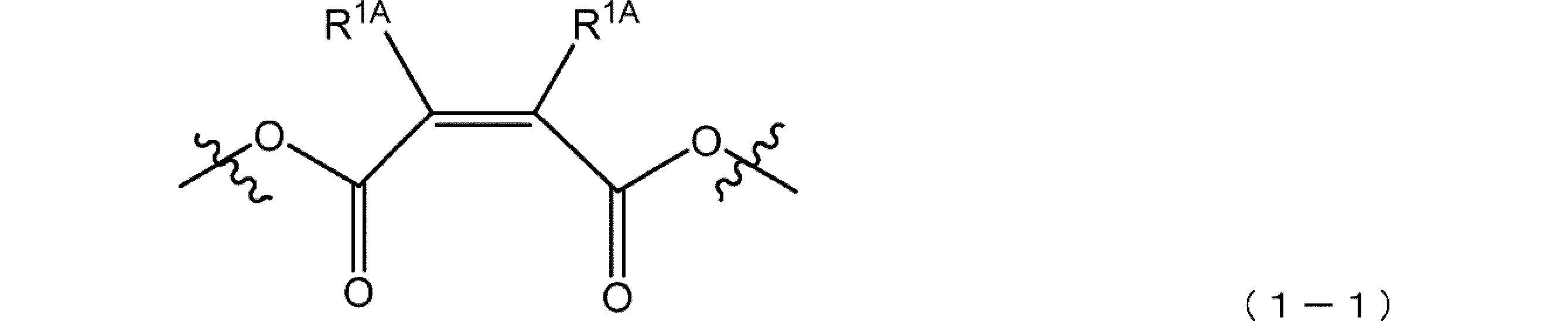

ここで、上記式(1-1)及び(1-2)中、R1Aは、それぞれ独立して水素原子、メチル基、又はエチル基である。R1Aは、好ましくは、それぞれ独立して、水素原子、又はメチル基である。
上記R2に含まれる炭素原子の数に対する脂環式構造を構成する炭素原子の数の割合は特に限定されず、例えば50%以上100%以下である。当該割合は、上記範囲において好ましくは60%以上であり、より好ましくは70%以上であり、さらに好ましくは75%以上である。このような態様によれば、ジヒドロキシ単位における分子鎖の運動が一層制限され、硬化性樹脂の誘電特性が一層向上する傾向にある。当該割合の上限値は特に限定されず、例えば100%、95%、90%、又は85%であってよい。
上記R2は、2価の飽和炭化水素基であってよく、2価の不飽和炭化水素基であってよい。

ここで、上記式中、R2Aは、それぞれ独立して、単結合、メチレン基、又はエチレン基であり、R2Bは、炭素数5以上30以下、5以上20以下、若しくは5以上15以下の、アルキル基を有していてもよい2価の脂環式構造であり、R2Cは、それぞれ独立して、単結合、又は、メチル基及びエチル基の少なくともいずれかを有していてもよいメチレン基、若しくはエチレン基であり、R2Dは、それぞれ独立して、2価のアリール基であり、R2Xは、それぞれ独立して、R2A、R2B、R2C、又はR2Dであり、nは1以上6以下の整数である。ただし、式(2-4)中、n個のR2Xのうちの少なくとも1つはR2Bである。
上記式中、R2Aは、好ましくは、それぞれ独立して、単結合、又はメチレン基である。

-R2B-
-R2B-R2C-
-R2B-R2D-
-R2D-R2B-R2D-
-R2B-R2A-R2B-
-R2B-R2C-R2B-
-R2B-R2D-R2B-
(R2X)nに含まれるR2Bの数は1以上4以下であってよく、1以上3以下であると好ましく、1又は2であるとより好ましい。nは1以上5以下であると好ましく、1以上4以下であるとより好ましく、1以上3以下であるとさらに好ましい。
上記化合物において、脂環式構造に対して結合する基の結合位置は特に限定されない。例えば、D-NDMにおいて、脂環式構造に対してヒドロキシメチル基が結合する位置は特に限定されず、例えば2位及び6位であってよく、2位及び7位であってよい。シクロヘキサンジメタノールにおいて、シクロヘキサン環に対してヒドロキシメチル基が結合する位置は特に限定されず、例えばオルト位、メタ位、又はパラ位であってよい。TMCにおいて、シクロヘキサン環に対して3つのメチル基及び2つのフェノール基が結合する位置は特に限定されず、例えばTMCは(3,3,5-トリメチルシクロヘキシリデン)ビスフェノールであってよく、後述の式(14)で表される4,4’-(3,3,5-トリメチルシクロヘキシリデン)ビスフェノールであってよい。
飽和脂肪族ジカルボン酸としては、例えばシクロヘキサンジカルボン酸、シクロペンタンジカルボン酸、アジピン酸、コハク酸、セバシン酸、アルキルコハク酸、シクロヘキサン二酢酸、アゼライン酸、マロン酸、ジメチルマロン酸、シュウ酸等が挙げられる。
芳香族ジカルボン酸としては、例えばテレフタル酸、イソフタル酸、1,4-ナフタレンジカルボン酸、2,6-ナフタレンジカルボン酸、2,7-ナフタレンジカルボン酸、ビフェニルジカルボン酸、5-tert-ブチル-1,3-ベンゼンジカルボン酸、2,5-フランジカルボン酸、2,5-チオフェンジカルボン酸等が挙げられる。
脂肪族ジヒドロキシ化合物としては、例えばエチレングリコール、1,2-プロパンジオール、1,3-プロパンジオール、1,2-ブタンジオール、1,3-ブタンジオール、1,4-ブタンジオール、2,3-ブタンジオール、1,4-ブテンジオール、2-メチル-1,3-プロパンジオール、1,5-ペンタンジオール、ネオペンチルグリコール、2-エチル-2-メチルプロパン-1,3-ジオール、2-ブチル-2-エチルプロパン-1,3-ジオール、1,6-ヘキサンジオール、3-メチル-1,5-ペンタンジオール、2-エチル-1,3-ヘキサンジオール、2,4-ジメチル-1,5-ペンタンジオール、2,2,4-トリメチル-1,3-ペンタンジオール、1,7-へプタンジオール、1,8-オクタンジオール、1,9-ノナンジオール、1,10-デカンジオール等が挙げられる。
末端カルボキシ基封止剤としては、カルボキシ基と反応する基を有する化合物であれば特に限定されないが、例えば、モノカルボジイミド及びポリカルボジイミド化合物等のカルボジイミド化合物、オキサゾリン化合物、片末端ジオール等が挙げられる。
末端ヒドロキシ基封止剤としては、ジフェニルカーボネート、モノカルボン酸等が挙げられる。

また、ジヒドロキシ単位とカーボネート単位が隣接している場合、その構造は以下のカーボネート結合を形成する。

同様の観点から、硬化性樹脂中のジヒドロキシ化合物に由来する全ての構造単位のうち、式(2)で表される構造単位の割合は、好ましくは0.60以上であり、より好ましくは0.70以上であり、さらに好ましくは0.80以上であり、さらにより好ましくは0.90以上である。当該割合の上限値は特に限定されないが、例えば、1.0、0.98、又は0.96としてもよい。
上記式(1)で表される構造単位の割合及び式(2)で表される構造単位の割合は、核磁気共鳴装置(NMR)によって測定することができる。
他方、硬化性樹脂の数平均分子量が5.00×10²以上であると、樹脂内にジヒドロキシ単位を十分に組み込むことができる傾向にあり、誘電特性が一層向上する傾向にある。上記数平均分子量は、ゲルろ過クロマトグラフィー(GPC)により測定することができる。
本発明の一実施形態は、硬化性樹脂の製造方法に関する。
本実施形態の硬化性樹脂の製造方法は、下記式(4)で表される化合物(以下、「ジカルボン酸化合物」ともいう。)及び下記式(4’)で表される化合物(以下、「ジカルボン酸無水物」ともいう。)の少なくとも一方と、

下記式(5)で表される化合物(以下、「ジヒドロキシ化合物」ともいう。)と、

下記式(6)で表される化合物(以下、「カーボネート化合物」ともいう。)と、

を反応させることを含む。
ここで、上記式(4)中、R1は、エチレン性二重結合及びアセチレン性三重結合の少なくとも一方を1つ以上有する2価の基であり、R3及びR4はそれぞれ独立して水素原子又は炭素数1~7の1価の炭化水素基であり、上記式(4’)中、R1は式(4)におけるR1と同義であり、上記式(5)中、R2は、脂環式構造を有する2価の基であり、R5及びR6はそれぞれ独立して水素原子又は炭素数1~7の1価の炭化水素基であり、上記式(6)中、R7及びR8はそれぞれ独立して任意の置換基である。
すなわち、ジヒドロキシ化合物の使用量に対するジカルボン酸化合物及びジカルボン酸無水物の使用量の合計は、モル比で、好ましくは0.010以上1.0未満であり、より好ましくは0.025以上0.50以下であり、さらに好ましくは0.050以上0.30以下であり、さらにより好ましくは0.075以上0.20以下である。
ジヒドロキシ化合物の使用量に対するカーボネート化合物の使用量は、モル比で、好ましくは0.10以上1.5以下であり、より好ましくは0.50以上1.3以下であり、さらに好ましくは0.80以上1.1以下であり、さらにより好ましくは0.85以上1.05以下である。なお、各化合物の使用量について、各化合物の蒸発のしやすさ(例えば反応温度における飽和蒸気圧)を指標として、より蒸発しやすい化合物の使用量を増加させてもよい。
同様の観点から、本実施形態の製造方法で使用する全てのヒドロキシ基を2つ有する化合物のうち、式(5)で表されるジヒドロキシ化合物の使用量の割合は、好ましくは0.60以上であり、より好ましくは0.70以上であり、さらに好ましくは0.80以上であり、さらにより好ましくは0.90以上である。当該割合の上限値は特に限定されないが、例えば、1.0、0.98、又は0.96としてもよい。
工程1Aにおいて、ジカルボン酸化合物及びジカルボン酸無水物の使用量の合計は、モル換算で、ジヒドロキシ化合物の使用量より少ないことが好ましい。このような態様によれば、工程1Aによりポリオール化合物が生成し、工程1Bにおいてカーボネート化合物と好適に反応する傾向にある。
工程1Bにおいて、カーボネート化合物の使用量は、モル換算で、ジヒドロキシ化合物の使用量からジカルボン酸化合物及びジカルボン酸無水物の使用量の合計を引いたモル数よりも多いことが好ましい。このような態様によれば、工程1Aにおいて得られた生成物のヒロドキシ基数よりも多くのカーボネート化合物を使用するため、得られる硬化性樹脂の末端ヒロドキシ基の量を減らすことができる。それにより、より誘電特性に優れる硬化性樹脂が得られる傾向にある。
工程2Aにおいて、カーボネート化合物の使用量は、モル換算で、ジヒドロキシ化合物の使用量より少ないことが好ましい。このような態様によれば、工程2Aによりポリオール化合物が生成し、工程2Bにおいてジカルボン酸化合物及び/又はジカルボン酸無水物と好適に反応する傾向にある。
工程2Bにおいて、ジカルボン酸化合物及びジカルボン酸無水物の使用量の合計は、モル換算で、ジヒドロキシ化合物の使用量からカーボネート化合物の使用量を引いたモル数と同程度であることが好ましい。このような態様によれば、工程2Aにおいて得られた生成物のヒロドキシ基数と同程度のジカルボン酸化合物及び/又はジカルボン酸無水物を使用するため、工程2Bにおける反応完了率が好適なものとなる傾向にある。
工程1A及び工程2Bにおける反応温度は、昇温条件であれば特に限定されないが、例えば80~290℃(両端値を含む。本明細書中、特に言及する場合を除き同様である。)であり、好ましくは120~270℃であり、より好ましくは150~250℃である。
工程1A及び工程2Bにおいて減圧下で反応を実施する場合、減圧条件であれば系内の圧力は特に限定されないが、例えば100kPa以下、好ましくは50kPa以下、より好ましくは30kPa以下、さらに好ましくは15kPa以下である。
工程1B及び工程2Aにおける反応温度(最終温度)は、昇温条件であれば特に限定されないが、例えば100~290℃であり、好ましくは130~280℃であり、より好ましくは160~260℃である。
工程1B及び工程2Aにおいて減圧下で反応を実施する場合、減圧条件であれば系内の圧力は特に限定されないが、例えば10kPa以下、好ましくは5kPa以下、より好ましくは1kPa以下である。
スズ塩としては、例えば塩化スズ(II)、塩化スズ(IV)、酢酸スズ(II)、酢酸スズ(IV)、ジブチルスズオキサイド、ジブチルスズジラウレート、ジブチルスズジメトキシド、及びジブチルスズジアセテートが挙げられる。
亜鉛塩としては、例えば酢酸亜鉛、安息香酸亜鉛、及び2-エチルヘキサン酸亜鉛が挙げられる。
ジルコニウム塩としては、例えばジルコニウムアセチルアセトナート、及びオキシ酢酸ジルコニウム、ジルコニウムテトラブトキシドが挙げられる。
鉛塩としては、例えば酢酸鉛(II)、及び酢酸鉛(IV)が挙げられる。
なお、触媒を用いる態様において、工程1A及び2Aにおいて触媒を添加すればよく、必ずしも工程1B及び2Bにおいて新たに触媒を添加する必要はない。あるいは、本実施形態の製造方法の各工程のうちの一部の工程のみにおいて、触媒下で反応を実施してもよい。
本実施形態の硬化性樹脂の製造方法は、式(4)で表されるジカルボン酸化合物、式(4’)で表されるジカルボン酸無水物、式(5)で表されるジヒドロキシ化合物、及び式(6)で表されるカーボネート化合物以外の上述した化合物を専ら反応させる上記工程1A、1B、2A、及び2B以外の別の工程を有していてもよい。
精製工程としては、一般的に樹脂の精製方法として用いられている方法を適宜用いてよい。具体的には、樹脂を溶媒へ溶解した後に、貧溶媒や水へ滴下する再沈殿法や、液液抽出法が挙げられる。精製工程としては、好ましくはトルエン及び炭酸ナトリウム水溶液を用いた液液抽出を用いてよい。このような方法は、油相として誘電率が低いトルエンを用いるため、精製後、誘電特性に一層優れる硬化性樹脂を得ることができる傾向にある。このような精製工程は、各工程の途中(例えば工程1A及び2Aの間や、工程1B及び2Bの間)に実施してもよい。
上述した製造方法に加えて、本実施形態の硬化性樹脂は、ポリカーボネートジオールにジカルボン酸化合物及びジカルボン酸無水物の少なくとも一方を反応させる方法によって製造してもよい。用いるポリカーボネートジオールとしては、カーボネート結合を含み、両末端がヒドロキシ基である化合物であれば特に限定されず、従来公知の市販のポリカーボネートジオールが挙げられる。反応条件及び用いてよい触媒は、上述の工程2Bと同じであってよい。
また、上記工程1A及び1Bを含む製造方法、及び上記工程2A及び2Bを含む製造方法において、式(5)で表されるジヒドロキシ化合物に代えてポリカーボネートジオールを用いてもよい。用いるポリカーボネートジオールとしては、カーボネート結合を含み、両末端がヒドロキシ基である化合物であれば特に限定されず、従来公知の市販のポリカーボネートジオールが挙げられる。そのような態様によれば、カーボネート単位を多く含む硬化性樹脂を得ることができる傾向にある。
本発明の一実施形態は、本実施形態の硬化性樹脂を含む樹脂組成物に関する。本実施形態の樹脂組成物は、本実施形態の硬化性樹脂に加えて、別の成分を更に含んでいてもよい。
本実施形態の樹脂組成物が含み得る別の成分としては、例えば、エポキシ樹脂、シアン酸エステル化合物、マレイミド化合物、BT樹脂、重合可能な不飽和基を有する化合物、フェノール基及び芳香族カルボン酸基に由来するエステル構造を有する化合物、変性シリコーンオイル、熱安定剤、酸化防止剤、硬化剤並びに硬化促進剤等が挙げられる。上記の成分は、1種単独で用いてよく、2種以上を組み合わせて用いてもよい。
硬化促進剤としては、例えば、ナフテン酸亜鉛、ナフテン酸コバルト、オクチル酸スズ、オクチル酸コバルト、ビスアセチルアセトナートコバルト(II)、トリスアセチルアセトナートコバルト(III)、亜鉛(II)アセチルアセトナート、鉄(III)アセチルアセトナート等の有機金属塩及び有機金属錯体、イミダゾール類及びその誘導体、有機リン系化合物、第二級アミン類、第三級アミン類、及び第四級アンモニウム塩が挙げられる。
これらは、1種単独で用いてよく、2種以上を組み合わせて用いてもよい。
有機過酸化物系開始剤としては、例えば、メチルエチルケトンパーオキサイド、アセチルアセトンパーオキサイド等のケトンパーオキサイド;ベンゾイルパーオキサイド等のジアシルパーオキサイド;t-ブチルパーオキシベンゾエート等のパーオキシエステル;クメンハイドロパーオキサイド等のハイドロパーオキサイド;ジクミルパーオキサイド等ジアルキルパーオキサイド等が挙げられる。
紫外線開始剤としては、例えば、ベンゾフェノン、ベンジル、メチルオルソベンゾイルベンゾエート等のベンゾフェノン;ベンゾインアルキルエーテル等のベンゾインエーテル;ベンジルジメチルケタール、2,2-ジエトキシアセトフェノン、2-ヒドロキシ-2-メチルプロピオフェノン、4-イソプロピル-2-ヒドロキシ-2-メチルプロピオフェノン、1,1-ジクロロアセトフェノン等のアセトフェノン;2-クロロチオキサントン、2-メチルチオキサントン、2-イソプロピルチオキサントン等のチオキサントン等が挙げられる。
例えば、本実施形態の硬化性樹脂が相溶化剤として樹脂組成物に添加される場合、本実施形態の硬化性樹脂の含有量は、樹脂成分100質量部に対して、例えば1.0質量部以上10質量部以下、又は3.0質量部以上5.0質量部以下であってよい。
樹脂組成物に含まれる本実施形態の硬化性樹脂の含有量の上限値は、特に限定されず、樹脂成分100質量部に対して、100質量部、99質量部、95質量部、90質量部、又は80質量部であってよい。
なお、樹脂組成物に含まれる本実施形態の硬化性樹脂以外の成分の含有量は、樹脂組成物中の本実施形態の硬化性樹脂の含有量が上記の範囲となる範囲において、適宜調整してよい。
無機充填材としては、当業界において通常用いられるものであれば特に限定されない。具体的には、例えば、天然シリカ、溶融シリカ、アモルファスシリカ、中空シリカ等のシリカ類;水酸化アルミニウム、水酸化アルミニウム加熱処理品(水酸化アルミニウムを加熱処理し、結晶水の一部を減じたもの)、水酸化マグネシウム、ベーマイト等の金属水酸化物;窒化アルミニウム、窒化ホウ素等の窒化化合物;酸化モリブデン、モリブデン酸亜鉛等のモリブデン化合物;ホウ酸亜鉛、錫酸亜鉛、アルミナ、クレー、カオリン、タルク、焼成クレー、焼成カオリン、焼成タルク、マイカ、ガラス短繊維(EガラスやDガラス等のガラス微粉末類)、中空ガラス、球状ガラス、酸化チタン、シリコーンゴム、シリコーン複合パウダー等が挙げられる。
補強基材としては、紙、ガラス布、ガラス不織布、アラミド紙、アラミド布、ガラスマット、ガラスロービング布等が挙げられる。
充填材は、1種単独で用いてよく、2種以上を組み合わせて用いてもよい。
シランカップリング剤としては、一般に無機物の表面処理に使用されるシランカップリング剤であれば、特に限定されない。具体的には、例えば、γ-アミノプロピルトリエトキシシラン、N-β-(アミノエチル)-γ-アミノプロピルトリメトキシシラン等のアミノシラン系シランカップリング剤;γ-グリシドキシプロピルトリメトキシシラン等のエポキシシラン系シランカップリング剤;γ-メタアクリロキシプロピルトリメトキシシラン等のビニルシラン系シランカップリング剤;N-β-(N-ビニルベンジルアミノエチル)-γ-アミノプロピルトリメトキシシラン塩酸塩等のカチオニックシラン系シランカップリング剤;フェニルシラン系シランカップリング剤;p-スチリルトリメトキシシラン、p-スチリルトリエトキシシラン、p-スチリルメチルジメトキシシラン、p-スチリルメチルジエトキシシラン、N-(ビニルベンジル)-2-アミノエチル-3-アミノプロピルトリメトキシシラン塩酸塩等のスチリルシラン系カップリング剤等が挙げられる。
湿潤分散剤としては、塗料用に使用されている分散安定剤であれば、特に限定されない。具体的には、例えばビッグケミー・ジャパン(株)製のDisperbyk-110、111、180、161、BYK-W996、W9010、W903等の湿潤分散剤が挙げられる。
これらのシランカップリング剤及び湿潤分散剤は、1種単独で用いてよく、2種以上を組み合わせて用いてもよい。
本発明の一実施形態は、本実施形態の硬化性樹脂の硬化物、及び本実施形態の樹脂組成物の硬化物に関する。本実施形態の硬化物は、本実施形態の硬化性樹脂を含む硬化物であるため、誘電特性に優れる。また、本実施形態の硬化物は色調が良好である傾向にある。
樹脂組成物を硬化させる場合、各成分が均一に混合されるよう、一度樹脂組成物を溶媒に溶解させ混合し、乾燥させたものを硬化することが好ましい。
本実施形態の硬化性樹脂、樹脂組成物、及びそれらの硬化物の用途としては、例えば、電子材料用途が挙げられる。具体的には、例えば電子部材、半導体封止材料、モールド樹脂、リジット基板、プリプレグ、積層板、樹脂付き銅箔、回路基板、アンダーフィル材料、及びビルドアップフィルムが挙げられる。他に、不飽和ポリエステルやエポキシ樹脂等の添加剤と共に、又は単独使用にて、炭素繊維強化プラスチック、及びガラス繊維強化プラスチックのような繊維強化複合材料としての使用が考えられる。
半導体封止材料は、本実施形態の樹脂組成物と無機充填材を含み、半導体デバイスの製造に用いられる。無機充填材としては、上述したものを用いることができる。
基材としては、特に限定されず、各種プリント配線板材料に用いられている公知のものを、目的とする用途や性能により適宜選択して使用することができる。基材を構成する繊維の具体例としては、特に限定されないが、例えば、Eガラス、Dガラス、Sガラス、Qガラス、球状ガラス、NEガラス、Lガラス、Tガラスなどのガラス繊維;クォーツなどのガラス以外の無機繊維;ポリパラフェニレンテレフタラミド(ケブラー(登録商標)、デュポン(株)製)、コポリパラフェニレン・3,4’オキシジフェニレン・テレフタラミド(テクノーラ(登録商標)、帝人テクノプロダクツ(株)製)などの全芳香族ポリアミド;2,6-ヒドロキシナフトエ酸・パラヒドロキシ安息香酸(ベクトラン(登録商標)、(株)クラレ製)、ゼクシオン(登録商標、KBセーレン製)などのポリエステル;ポリパラフェニレンベンズオキサゾール(ザイロン(登録商標)、東洋紡績(株)製)、ポリイミドなどの有機繊維が挙げられる。これら基材は、1種を単独で用いても、2種以上を併用してもよい。
樹脂濃度が0.2質量%になるように硬化性樹脂をテトラヒドロフランに溶解させ、ゲルろ過クロマトグラフィー(GPC)で測定した。標準ポリスチレンを用いて作成した検量線により、各硬化性樹脂の数平均分子量を算出した。GPCは東ソー株式会社製カラムTSKgel SuperHM-Mを用い、カラム温度40℃で測定した。溶離液はテトラヒドロフランを0.6ml/minの流速で流し、屈折率検出器で測定した。
[実施例1]
D-NDM(下記式(8)及び(9)で表されるデカヒドロ-1,4:5,8-ジメタノナフタレン-2,6(7)-ジメタノールの約1:1の混合物)175g、無水マレイン酸7.7g、及びテトラ-n-ブチルチタネート0.015gを、500mlセパラブルフラスコへ入れ、窒素フロー下で攪拌させながら、200℃へ徐々に加熱し、留出水が出なくなるまで保持した。その後、13kPaまで徐々に減圧させた後、30分保持し、常温まで放冷した。その後、ジフェニルカーボネート163gを添加し、昇温と減圧を徐々に行い、最終的に230℃、0.1kPa以下で重合を行った。以上により硬化性樹脂Aを得た。硬化性樹脂Aの数平均分子量は、5000であった。
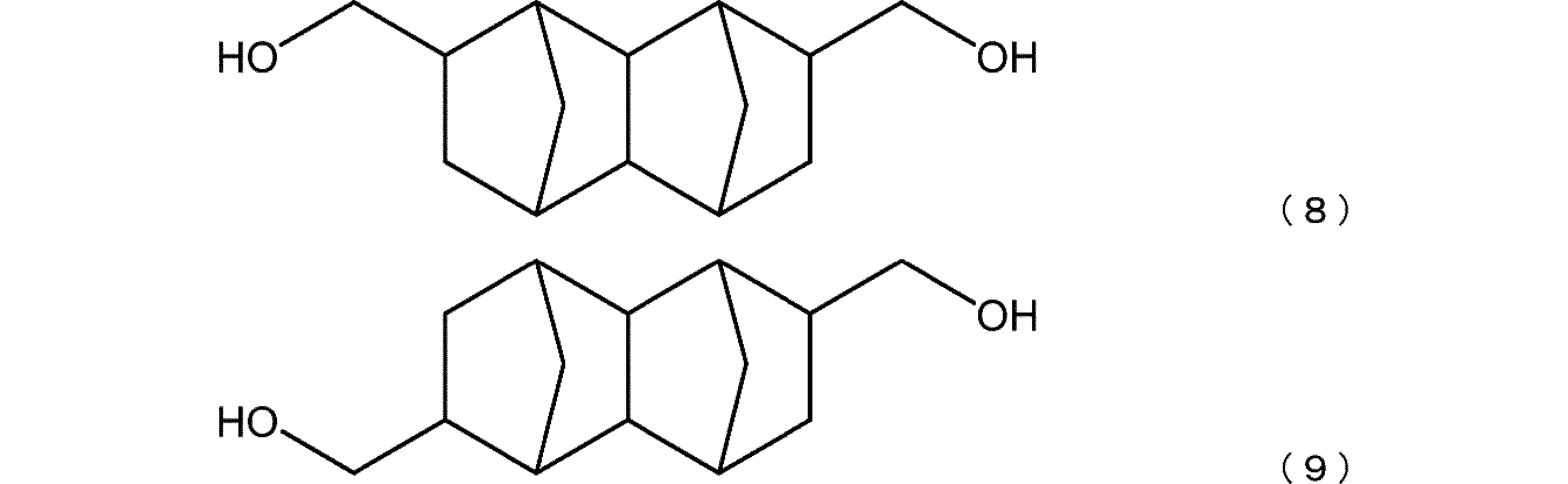
ジフェニルカーボネートの使用量を160gとしたこと以外は、実施例1と同様の方法により硬化性樹脂Bを得た。硬化性樹脂Bの数平均分子量は、5000であった。
D-NDM219g、無水マレイン酸19g、テトラ-n-ブチルチタネート0.018g、ジフェニルカーボネート181gを使用したこと以外は、実施例1と同様の方法により硬化性樹脂Cを得た。硬化性樹脂Cの数平均分子量は、5000であった。
TCDDM(下記式(10)で表されるトリシクロデカンジメタノール)216g、無水マレイン酸9.8g、及びテトラ-n-ブチルチタネート0.020gを、500mlセパラブルフラスコへ入れ、窒素フロー下で攪拌させながら、165℃へ徐々に加熱し、留出水が出なくなるまで保持した。その後、13kPaまで徐々に減圧させた後、30分保持し、常温まで放冷した。その後、ジフェニルカーボネート226gを添加し、昇温と減圧を徐々に行い、最終的に230℃、0.1kPa以下で重合を行った。以上により硬化性樹脂Dを得た。硬化性樹脂Dの数平均分子量は、4800であった。

D-NDM175g、ジフェニルカーボネート152g、及びテトラ-n-ブチルチタネート0.015gを、500mlセパラブルフラスコへ入れ、窒素フロー下で攪拌させながら、昇温と減圧を徐々に行い、最終的に230℃、0.1kPa以下で重合を行った。常温へ放冷後、無水マレイン酸7.7gを添加し、200℃まで昇温し、留出水が出なくなるまで保持した。その後、13kPaまで徐々に減圧させた後、30分保持して重合を行うことで、硬化性樹脂Eを得た。硬化性樹脂Eの数平均分子量は、5000であった。
1,4-シクロヘキサンジメタノール137g、ジフェニルカーボネート183g、及びテトラ-n-ブチルチタネート0.0097gを、500mlセパラブルフラスコへ入れ、窒素フロー下で攪拌させながら、昇温と減圧を徐々に行い、最終的に230℃、0.1kPa以下で重合を行った。常温へ放冷後、無水マレイン酸9.3gを添加し、200℃まで昇温し、留出水が出なくなるまで保持した。その後、13kPaまで徐々に減圧させた後、30分保持して重合を行うことで、硬化性樹脂Hを得た。硬化性樹脂Hの数平均分子量は、5000であった。
プロピレングリコール151g、無水マレイン酸93g、及び無水フタル酸140gを、500mlセパラブルフラスコへ入れ、窒素フロー下で攪拌させながら、200℃まで上昇し、留出水が出なくなるまで保持した。その後、徐々に13kPaまで減圧後、30分保持して、不飽和ポリエステル樹脂である硬化性樹脂Fを得た。
D-NHEs(デカヒドロ-1,4:5,8-ジメタノナフタレン-2-メトキシカルボニル-6(7)-メタノール)222g、無水マレイン酸9.0g、及びテトラ-n-ブチルチタネート0.020gを、500mlセパラブルフラスコへ入れた。窒素フロー下で攪拌させながら、昇温と減圧を徐々に行い、最終的に280℃、0.1kPa以下で重合を行うことで、硬化性樹脂Gを得た。
(誘電率・誘電正接測定方法)
以下の実施例7~17及び比較例3~5において、樹脂組成物の硬化物である棒状のサンプルを作製した。当該サンプルについて、空洞共振器摂動法(Agilent 8722ES,アジレントテクノロジー製)にて10GHzの誘電率及び誘電正接を測定した。
上記で製造した硬化性樹脂A5.6g、トリシクロデカノールアクリレート1.9g、及びパーブチルP(日油株式会社製)0.075gをトルエンへ溶解させ、20wt%の溶液を得た。その後、真空乾燥機に投入し、常温にて48時間、60℃にて3時間乾燥しトルエンを除去した。トルエン除去後の樹脂組成物を厚さ1mmの型へ投入し、アフレックスフィルム(AGC株式会社製)及びSUS板で挟み、200℃に加熱した真空プレス機へ投入した。10-2kPaまで減圧した後に、0.6MPaへ徐々に加圧プレスし、90分加熱後に取り出し、徐冷した。徐冷後に、樹脂組成物の硬化物を型から抜き出した。抜き出した硬化物を0.8mm幅に切り出して棒状のサンプルを作製した。切り出したサンプルを70℃の真空乾燥機で1日乾燥させた後に、誘電率及び誘電正接を測定した。結果を表1に示す。
表1又は表2に記載の成分配合量で樹脂組成物を配合したこと以外は、実施例7と同様にして棒状のサンプルを作製した。誘電率及び誘電正接の測定結果を表1及び2に示す。
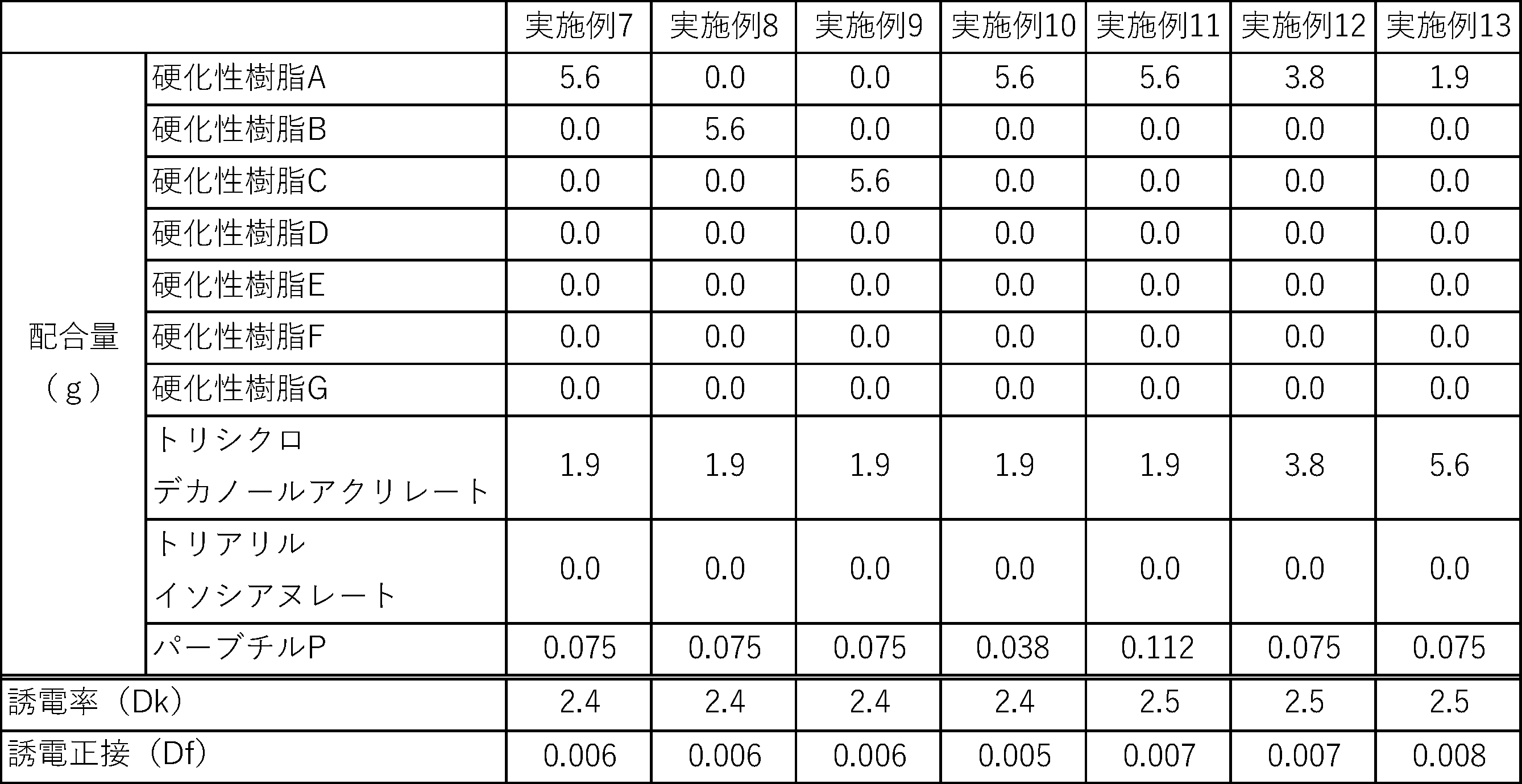
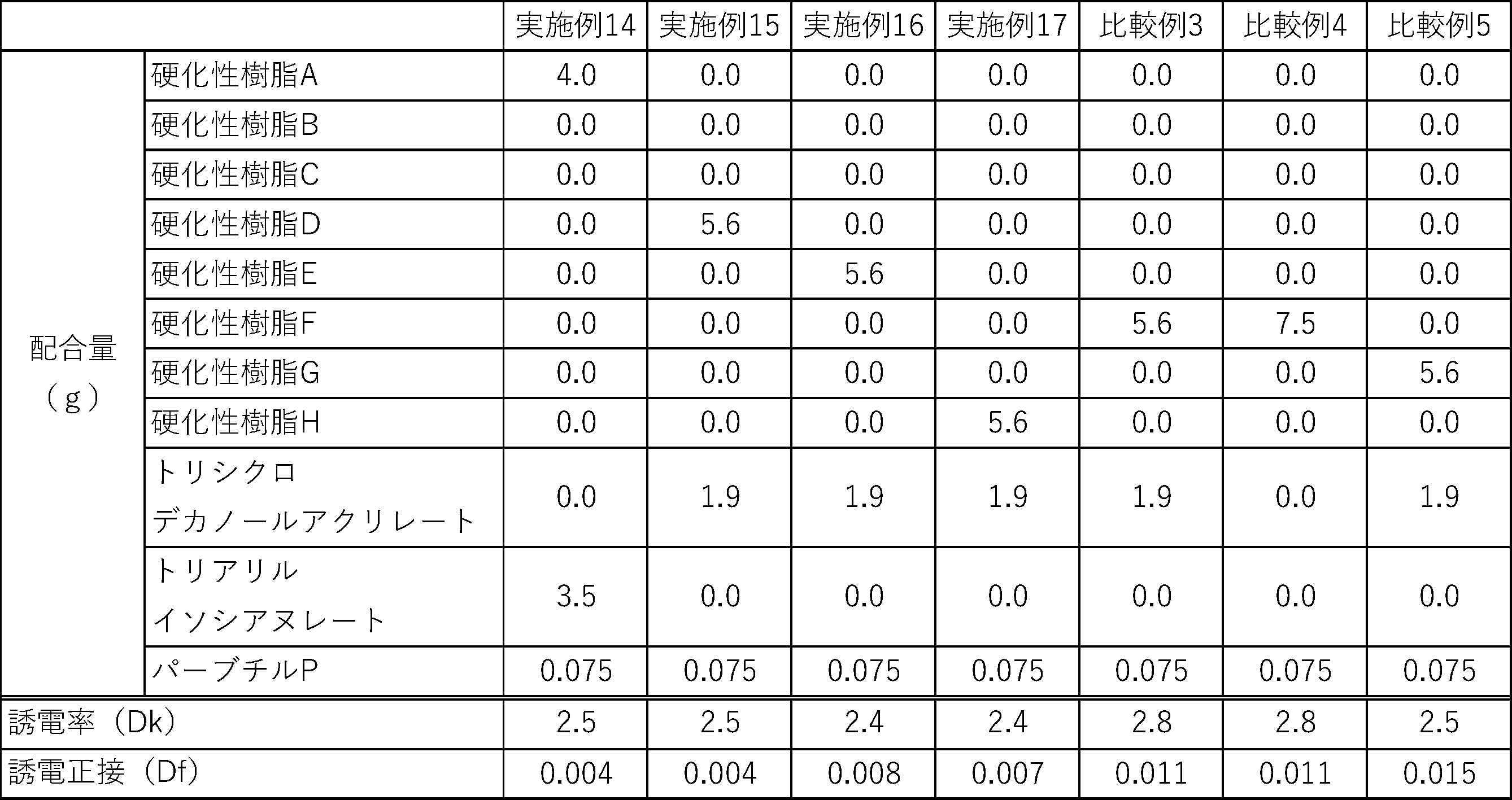
実施例7及び10~13の結果から硬化性樹脂A単独の誘電率及び誘電正接を算出した。具体的には、各成分の含有量と、誘電率及び誘電正接との比例式を算出し、硬化性樹脂A単独の誘電率及び誘電正接を求めた。硬化性樹脂A単独の誘電率及び誘電正接は、それぞれ2.4、及び0.003と算出された。
さらに以下の実施例19、20、及び21により、それぞれ硬化性樹脂I、J、及びKを製造した。また、実施例22、23、及び24において、それぞれ硬化性樹脂I、J、及びKを含む樹脂組成物の硬化物である棒状のサンプルを作製した。当該サンプルについて、空洞共振器摂動法(Agilent 8722ES,アジレントテクノロジー製)にて10GHzの誘電率及び誘電正接を測定した。
PCDDM(下記式(12)で表されるペンタシクロ[6.5.1.13,6.02,7.09,13]ペンタデカンジメタノール)44.7g、無水マレイン酸1.7g、及びテトラ-n-ブチルチタネート0.0030gを、500mlセパラブルフラスコへ入れ、窒素フロー下で攪拌させながら、200℃へ徐々に加熱し、留出水が出なくなるまで保持した。その後、13kPaまで徐々に減圧させた後、30分保持し、常温まで放冷した。その後、ジフェニルカーボネート35.1gを添加し、昇温と減圧を徐々に行い、最終的に230℃、0.1kPa以下で重合を行った。以上により硬化性樹脂Iを得た。硬化性樹脂Iの数平均分子量は、4300であった。

水添BisA(下記式(13)で表される水添ビスフェノールA)44.2g、無水マレイン酸1.8g、及びテトラ-n-ブチルチタネート0.0030gを、500mlセパラブルフラスコへ入れ、窒素フロー下で攪拌させながら、200℃へ徐々に加熱し、留出水が出なくなるまで保持した。その後、13kPaまで徐々に減圧させた後、30分保持し、常温まで放冷した。その後、ジフェニルカーボネート38gを添加し、昇温と減圧を徐々に行い、最終的に230℃、0.1kPa以下で重合を行った。以上により硬化性樹脂Jを得た。硬化性樹脂Jの数平均分子量は、2000であった。

TMC(下記式(14)で表される4,4’-(3,3,5-トリメチルシクロヘキシリデン)ビスフェノール)44.2g、無水マレイン酸1.8g、及びテトラ-n-ブチルチタネート0.0030gを、500mlセパラブルフラスコへ入れ、窒素フロー下で攪拌させながら、200℃へ徐々に加熱し、留出水が出なくなるまで保持した。その後、13kPaまで徐々に減圧させた後、30分保持し、常温まで放冷した。その後、ジフェニルカーボネート38gを添加し、昇温と減圧を徐々に行い、最終的に230℃、0.1kPa以下で重合を行った。以上により硬化性樹脂Kを得た。硬化性樹脂Kの数平均分子量は、2000であった。

表3に記載の成分配合量で樹脂組成物を配合したこと以外は、実施例7と同様にして棒状のサンプルを作製した。誘電率及び誘電正接の測定結果を表3に示す。
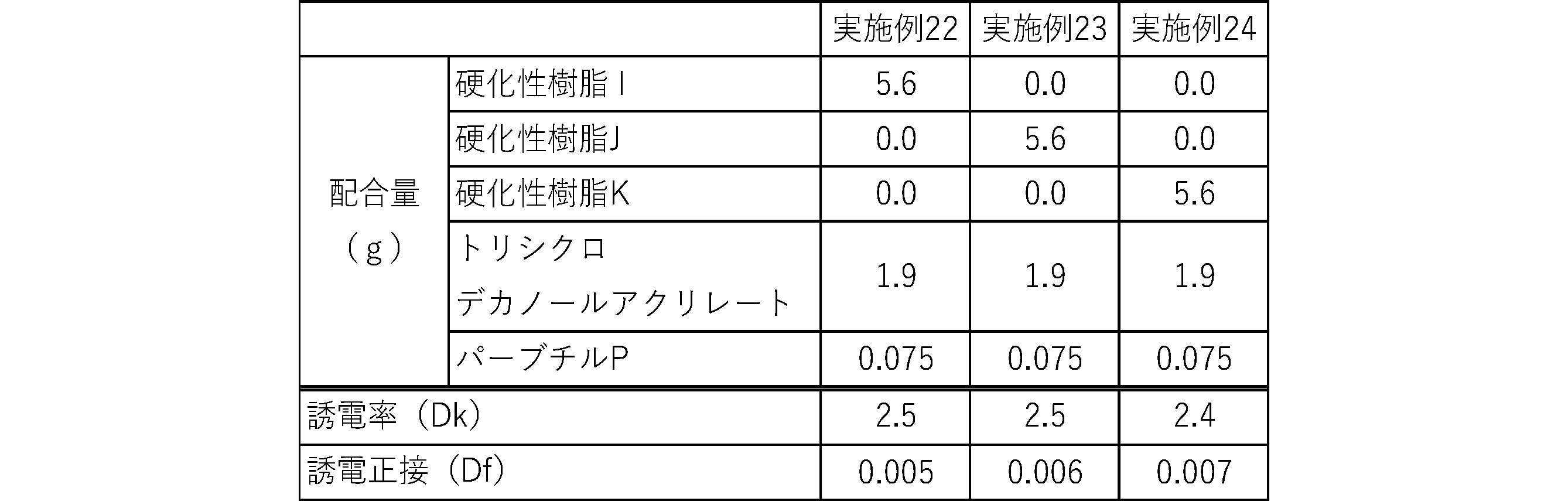
Claims (25)
- 下記式(1)で表される構造単位と、下記式(2)で表される構造単位と、下記式(3)で表される構造単位と、を含む、硬化性樹脂。



(上記式(1)中、R1は、エチレン性二重結合及びアセチレン性三重結合の少なくとも一方を1つ以上有する2価の基であり、上記式(2)中、R2は、脂環式構造を有する2価の基である。) - 前記硬化性樹脂を構成する全ての構造単位に対する、前記式(1)で表される構造単位、前記式(2)で表される構造単位、及び前記式(3)で表される構造単位の含有量の和のモル比が、0.60以上1.0以下である、請求項1に記載の硬化性樹脂。
- 前記式(3)で表される構造単位が、ジアルキルカーボネート、ジアリールカーボネート、及びアルキルアリールカーボネートからなる群より選択される少なくとも1種に由来する、請求項1に記載の硬化性樹脂。
- 前記式(1)で表される構造単位が、フマル酸、マレイン酸及び無水マレイン酸からなる群より選択される少なくとも1種に由来する、請求項1に記載の硬化性樹脂。
- 前記式(2)で表される構造単位が、ノルボルナン系骨格、及びシクロヘキサン系骨格からなる群より選択される少なくとも1種を含むジヒドロキシ化合物に由来する、請求項1に記載の硬化性樹脂。
- 前記式(2)で表される構造単位に対する前記式(1)で表される構造単位のモル比が、0.010以上1.0未満である、請求項1に記載の硬化性樹脂。
- 前記式(2)で表される構造単位に対する前記式(3)で表される構造単位のモル比が、0.10以上1.5以下である、請求項1に記載の硬化性樹脂。
- 数平均分子量が、5.00×10²以上3.00×10⁴以下である、請求項1に記載の硬化性樹脂。
- 前記式(1)で表される構造単位、及び前記式(2)で表される構造単位を含み、かつ前記式(3)で表される構造単位を含まないポリエステル部分を含む、請求項1に記載の硬化性樹脂。
- 以下の(i)~(iii)を含む測定方法にしたがい算出される誘電正接が0.010以下である、請求項1に記載の硬化性樹脂。
(i)前記硬化性樹脂を含む樹脂組成物の硬化物を作製し、当該硬化物の10GHzの誘電正接を測定する。
(ii)前記樹脂組成物の各成分の含有量を変更した複数の硬化物について前記(i)と同様の測定を実施する。
(iii)前記(i)及び(ii)の測定結果を外挿して、前記硬化性樹脂単体の誘電正接を算出する。 - 請求項1~10のいずれか1項に記載の硬化性樹脂の硬化物。
- 請求項1~10のいずれか1項に記載の硬化性樹脂を含む、樹脂組成物。
- 前記硬化性樹脂の含有量が、樹脂成分100質量部に対して1.0質量部以上である、請求項12に記載の樹脂組成物。
- 下記式(4)で表される化合物及び下記式(4’)で表される化合物の少なくとも一方と、下記式(5)で表される化合物と、下記式(6)で表される化合物と、を反応させることを含む、硬化性樹脂の製造方法。




(上記式(4)中、R1は、エチレン性二重結合及びアセチレン性三重結合の少なくとも一方を1つ以上有する2価の基であり、R3及びR4はそれぞれ独立して水素原子又は炭素数1~7の1価の炭化水素基であり、上記式(4’)中、R1は上記式(4)におけるR1と同義であり、上記式(5)中、R2は、脂環式構造を有する2価の基であり、R5及びR6はそれぞれ独立して水素原子又は炭素数1~7の1価の炭化水素基であり、上記式(6)中、R7及びR8はそれぞれ独立して任意の置換基である。) - 前記式(5)で表される化合物と、前記式(5)で表される化合物より少ないモル当量の前記式(4)で表される化合物及び下記式(4’)で表される化合物の少なくとも一方とを反応させる工程と、
前記工程により得られる生成物と、前記式(6)で表される化合物とを反応させる工程と、
を含む、請求項14に記載の製造方法。 - 電子材料用である、請求項12に記載の樹脂組成物。
- 請求項12に記載の樹脂組成物の硬化物を含む、電子部材。
- 請求項12に記載の樹脂組成物と強化繊維とを含有する、繊維強化複合材料。
- 請求項18に記載の繊維強化複合材料の硬化物である、繊維強化成形品。
- 請求項12に記載の樹脂組成物と無機充填材とを含有する、半導体封止材料。
- 請求項20に記載の半導体封止材料の硬化物を含有する、半導体デバイス。
- 基材と、該基材に含浸又は塗布された請求項12に記載の樹脂組成物とを含む、プリプレグ。
- 請求項22に記載のプリプレグを含む、積層板。
- 請求項23に記載の積層板と、該積層板の片面又は両面に配された金属箔とを含む、回路基板。
- 請求項12に記載の樹脂組成物の硬化物と、基材フィルムとを含む、ビルドアップフィルム。
Priority Applications (5)
| Application Number | Priority Date | Filing Date | Title |
|---|---|---|---|
| US18/837,636 US12583966B2 (en) | 2022-02-16 | 2023-02-13 | Curable resin, cured product thereof, resin composition, and method for producing curable resin |
| CN202380021054.3A CN118871500A (zh) | 2022-02-16 | 2023-02-13 | 固化性树脂、其固化物、树脂组合物和固化性树脂的制造方法 |
| EP23756302.8A EP4480985A4 (en) | 2022-02-16 | 2023-02-13 | HARDENABLE RESIN, ASSOCIATED HARDENED PRODUCT, RESIN COMPOSITION AND HARDENABLE RESIN PRODUCTION PROCESS |
| KR1020247022180A KR20240144893A (ko) | 2022-02-16 | 2023-02-13 | 경화성 수지, 그의 경화물, 수지 조성물, 및 경화성 수지의 제조방법 |
| JP2024501352A JPWO2023157777A1 (ja) | 2022-02-16 | 2023-02-13 |
Applications Claiming Priority (2)
| Application Number | Priority Date | Filing Date | Title |
|---|---|---|---|
| JP2022021941 | 2022-02-16 | ||
| JP2022-021941 | 2022-02-16 |
Publications (1)
| Publication Number | Publication Date |
|---|---|
| WO2023157777A1 true WO2023157777A1 (ja) | 2023-08-24 |
Family
ID=87578176
Family Applications (1)
| Application Number | Title | Priority Date | Filing Date |
|---|---|---|---|
| PCT/JP2023/004674 Ceased WO2023157777A1 (ja) | 2022-02-16 | 2023-02-13 | 硬化性樹脂、その硬化物、樹脂組成物、及び硬化性樹脂の製造方法 |
Country Status (6)
| Country | Link |
|---|---|
| US (1) | US12583966B2 (ja) |
| EP (1) | EP4480985A4 (ja) |
| JP (1) | JPWO2023157777A1 (ja) |
| KR (1) | KR20240144893A (ja) |
| CN (1) | CN118871500A (ja) |
| WO (1) | WO2023157777A1 (ja) |
Citations (13)
| Publication number | Priority date | Publication date | Assignee | Title |
|---|---|---|---|---|
| US4025492A (en) | 1974-06-28 | 1977-05-24 | Bayer Aktiengesellschaft | Thermoplastic copolyesters and a process for their production |
| US4136089A (en) | 1975-02-22 | 1979-01-23 | Bayer Aktiengesellschaft | Molded articles of crystalline poly (ethylene/alkylene) terephthalates which crystallize rapidly |
| US4176224A (en) | 1977-04-09 | 1979-11-27 | Bayer Aktiengesellschaft | Poly (ethylene/alkylene) terephthalates which crystallize rapidly |
| US4208527A (en) | 1978-03-18 | 1980-06-17 | Chemische Werke Huls, Aktiengesellschaft | Process for the manufacture of high molecular weight poly-(ethylene terephthalate) |
| US4238593A (en) | 1979-06-12 | 1980-12-09 | The Goodyear Tire & Rubber Company | Method for production of a high molecular weight polyester prepared from a prepolymer polyester having an optimal carboxyl content |
| JPH05105746A (ja) | 1991-10-15 | 1993-04-27 | Kuraray Co Ltd | ポリオール、硬化性樹脂およびそれを含む組成物 |
| JP2014210921A (ja) * | 2013-04-19 | 2014-11-13 | ウベ・ケミカル・ユーロップ・ソシエダッド・アノニマUbe Chemical Europe,S.A. | 不飽和ポリカーボネートジオール、そのような不飽和ポリカーボネートジオールの製造方法、及びその使用 |
| WO2015170691A1 (ja) | 2014-05-07 | 2015-11-12 | 三菱瓦斯化学株式会社 | 重縮合で製造された樹脂および樹脂組成物 |
| US20160060391A1 (en) * | 2014-08-29 | 2016-03-03 | National Cheng Kung University | Copolymer based on dimethyl carbonate and method of preparing the same |
| WO2016202914A1 (en) * | 2015-06-17 | 2016-12-22 | Ube Corporation Europe, S.A.U. | Cross-linked unsaturated polycarbonate resins |
| JP2017066358A (ja) * | 2015-10-01 | 2017-04-06 | 宇部興産株式会社 | ポリウレタン樹脂組成物及びその製造方法 |
| WO2017078074A1 (ja) | 2015-11-04 | 2017-05-11 | 三菱瓦斯化学株式会社 | 熱可塑性樹脂の製造方法 |
| WO2020003824A1 (ja) | 2018-06-27 | 2020-01-02 | Dic株式会社 | エポキシ樹脂組成物及びその硬化物 |
Family Cites Families (1)
| Publication number | Priority date | Publication date | Assignee | Title |
|---|---|---|---|---|
| DE1568342C3 (de) | 1966-10-14 | 1975-03-06 | Chemische Werke Huels Ag, 4370 Marl | Carbonatgruppen enthaltende Polyester |
-
2023
- 2023-02-13 EP EP23756302.8A patent/EP4480985A4/en active Pending
- 2023-02-13 JP JP2024501352A patent/JPWO2023157777A1/ja active Pending
- 2023-02-13 CN CN202380021054.3A patent/CN118871500A/zh active Pending
- 2023-02-13 WO PCT/JP2023/004674 patent/WO2023157777A1/ja not_active Ceased
- 2023-02-13 US US18/837,636 patent/US12583966B2/en active Active
- 2023-02-13 KR KR1020247022180A patent/KR20240144893A/ko active Pending
Patent Citations (14)
| Publication number | Priority date | Publication date | Assignee | Title |
|---|---|---|---|---|
| US4025492A (en) | 1974-06-28 | 1977-05-24 | Bayer Aktiengesellschaft | Thermoplastic copolyesters and a process for their production |
| US4136089A (en) | 1975-02-22 | 1979-01-23 | Bayer Aktiengesellschaft | Molded articles of crystalline poly (ethylene/alkylene) terephthalates which crystallize rapidly |
| US4176224A (en) | 1977-04-09 | 1979-11-27 | Bayer Aktiengesellschaft | Poly (ethylene/alkylene) terephthalates which crystallize rapidly |
| US4208527A (en) | 1978-03-18 | 1980-06-17 | Chemische Werke Huls, Aktiengesellschaft | Process for the manufacture of high molecular weight poly-(ethylene terephthalate) |
| US4238593B1 (en) | 1979-06-12 | 1994-03-22 | Goodyear Tire & Rubber | Method for production of a high molecular weight polyester prepared from a prepolymer polyester having an optional carboxyl content |
| US4238593A (en) | 1979-06-12 | 1980-12-09 | The Goodyear Tire & Rubber Company | Method for production of a high molecular weight polyester prepared from a prepolymer polyester having an optimal carboxyl content |
| JPH05105746A (ja) | 1991-10-15 | 1993-04-27 | Kuraray Co Ltd | ポリオール、硬化性樹脂およびそれを含む組成物 |
| JP2014210921A (ja) * | 2013-04-19 | 2014-11-13 | ウベ・ケミカル・ユーロップ・ソシエダッド・アノニマUbe Chemical Europe,S.A. | 不飽和ポリカーボネートジオール、そのような不飽和ポリカーボネートジオールの製造方法、及びその使用 |
| WO2015170691A1 (ja) | 2014-05-07 | 2015-11-12 | 三菱瓦斯化学株式会社 | 重縮合で製造された樹脂および樹脂組成物 |
| US20160060391A1 (en) * | 2014-08-29 | 2016-03-03 | National Cheng Kung University | Copolymer based on dimethyl carbonate and method of preparing the same |
| WO2016202914A1 (en) * | 2015-06-17 | 2016-12-22 | Ube Corporation Europe, S.A.U. | Cross-linked unsaturated polycarbonate resins |
| JP2017066358A (ja) * | 2015-10-01 | 2017-04-06 | 宇部興産株式会社 | ポリウレタン樹脂組成物及びその製造方法 |
| WO2017078074A1 (ja) | 2015-11-04 | 2017-05-11 | 三菱瓦斯化学株式会社 | 熱可塑性樹脂の製造方法 |
| WO2020003824A1 (ja) | 2018-06-27 | 2020-01-02 | Dic株式会社 | エポキシ樹脂組成物及びその硬化物 |
Non-Patent Citations (3)
| Title |
|---|
| EIICHIRO TAKIYAMA: "Polyester Resin Handbook", THE NIKKAN KOGYO SHIMBUN, LTD |
| R. E. WILFONG, JOURNAL OF POLYMER SCIENCE, vol. 54, 1961, pages 385 |
| See also references of EP4480985A4 |
Also Published As
| Publication number | Publication date |
|---|---|
| KR20240144893A (ko) | 2024-10-04 |
| JPWO2023157777A1 (ja) | 2023-08-24 |
| EP4480985A4 (en) | 2026-02-25 |
| CN118871500A (zh) | 2024-10-29 |
| US12583966B2 (en) | 2026-03-24 |
| EP4480985A1 (en) | 2024-12-25 |
| US20250136755A1 (en) | 2025-05-01 |
| TW202344557A (zh) | 2023-11-16 |
Similar Documents
| Publication | Publication Date | Title |
|---|---|---|
| CN103384674B (zh) | 寡聚的膦酸酯及包括所述寡聚的膦酸酯的组合物 | |
| CN116157270B (zh) | 硬化性树脂 | |
| JP7782984B2 (ja) | アリル基含有ポリカーボネート樹脂及び硬化性樹脂組成物 | |
| JP2019089967A (ja) | アリル基含有カーボネート樹脂、その製造方法、樹脂ワニス、および積層板の製造方法 | |
| JP2011116957A (ja) | 透明フィルム | |
| KR20140015586A (ko) | 함불소 중합성 단량체 및 그것을 사용한 고분자 화합물 | |
| JP6211875B2 (ja) | プリプレグおよびその製造方法 | |
| WO2023157780A1 (ja) | 硬化性樹脂の製造方法 | |
| US12583966B2 (en) | Curable resin, cured product thereof, resin composition, and method for producing curable resin | |
| TWI923882B (zh) | 硬化性樹脂、其硬化物、樹脂組成物、及硬化性樹脂之製造方法 | |
| JP2023180708A (ja) | 硬化性樹脂組成物及び硬化物 | |
| JP2024164612A (ja) | 硬化性樹脂、その硬化物、樹脂組成物、及び硬化性樹脂の製造方法 | |
| WO2023157778A1 (ja) | 硬化性樹脂及びその硬化物、並びに樹脂組成物 | |
| JP2012219155A (ja) | 透明樹脂複合材 | |
| JP2025008981A (ja) | 硬化性樹脂及びその硬化物、並びに樹脂組成物 | |
| JP2024005422A (ja) | エポキシ樹脂組成物、プリプレグ及びこれらを用いた繊維強化プラスチック | |
| JP2025088524A (ja) | 不飽和ポリエステル樹脂、不飽和ポリエステル樹脂の硬化物、樹脂組成物、及び不飽和ポリエステル樹脂の製造方法 | |
| WO2022209715A1 (ja) | エポキシ樹脂組成物、プリプレグ、及びこれらを用いた繊維強化プラスチック | |
| EP4053214A1 (en) | Composition, curable composition, and cured product | |
| US20250122320A1 (en) | Curable resin, curable resin composition, and cured article | |
| JP7646129B1 (ja) | シアン酸エステル化合物、樹脂組成物、硬化物、プリプレグ、封止用材料、繊維強化複合材料、及び接着剤 | |
| JP2012136580A (ja) | 透明フィルム | |
| JP4912617B2 (ja) | 芳香族エーテルスルホン骨格を有する重合体、その製造方法及び組成物 | |
| JP2023093999A (ja) | 硬化性樹脂組成物、硬化物及び物品 | |
| WO2022070849A1 (ja) | 現場重合型熱可塑性エポキシ樹脂用の前駆体混合物、エポキシ樹脂組成物、エポキシ樹脂組成物シート、プリプレグ、及びこれらを用いた現場重合型の熱可塑性繊維強化プラスチック |
Legal Events
| Date | Code | Title | Description |
|---|---|---|---|
| 121 | Ep: the epo has been informed by wipo that ep was designated in this application |
Ref document number: 23756302 Country of ref document: EP Kind code of ref document: A1 |
|
| ENP | Entry into the national phase |
Ref document number: 2024501352 Country of ref document: JP Kind code of ref document: A |
|
| WWE | Wipo information: entry into national phase |
Ref document number: 202380021054.3 Country of ref document: CN |
|
| WWE | Wipo information: entry into national phase |
Ref document number: 18837636 Country of ref document: US |
|
| WWE | Wipo information: entry into national phase |
Ref document number: 2023756302 Country of ref document: EP |
|
| NENP | Non-entry into the national phase |
Ref country code: DE |
|
| ENP | Entry into the national phase |
Ref document number: 2023756302 Country of ref document: EP Effective date: 20240916 |
|
| WWP | Wipo information: published in national office |
Ref document number: 18837636 Country of ref document: US |
|
| WWG | Wipo information: grant in national office |
Ref document number: 18837636 Country of ref document: US |