WO2023167628A1 - Recombinant spider silk proteins - Google Patents
Recombinant spider silk proteins Download PDFInfo
- Publication number
- WO2023167628A1 WO2023167628A1 PCT/SE2023/050191 SE2023050191W WO2023167628A1 WO 2023167628 A1 WO2023167628 A1 WO 2023167628A1 SE 2023050191 W SE2023050191 W SE 2023050191W WO 2023167628 A1 WO2023167628 A1 WO 2023167628A1
- Authority
- WO
- WIPO (PCT)
- Prior art keywords
- domain
- spider silk
- recombinant spider
- alanine
- silk protein
- Prior art date
- Legal status (The legal status is an assumption and is not a legal conclusion. Google has not performed a legal analysis and makes no representation as to the accuracy of the status listed.)
- Ceased
Links
Classifications
-
- C—CHEMISTRY; METALLURGY
- C07—ORGANIC CHEMISTRY
- C07K—PEPTIDES
- C07K14/00—Peptides having more than 20 amino acids; Gastrins; Somatostatins; Melanotropins; Derivatives thereof
- C07K14/435—Peptides having more than 20 amino acids; Gastrins; Somatostatins; Melanotropins; Derivatives thereof from animals; from humans
- C07K14/43504—Peptides having more than 20 amino acids; Gastrins; Somatostatins; Melanotropins; Derivatives thereof from animals; from humans from invertebrates
- C07K14/43513—Peptides having more than 20 amino acids; Gastrins; Somatostatins; Melanotropins; Derivatives thereof from animals; from humans from invertebrates from arachnidae
- C07K14/43518—Peptides having more than 20 amino acids; Gastrins; Somatostatins; Melanotropins; Derivatives thereof from animals; from humans from invertebrates from arachnidae from spiders
-
- C—CHEMISTRY; METALLURGY
- C12—BIOCHEMISTRY; BEER; SPIRITS; WINE; VINEGAR; MICROBIOLOGY; ENZYMOLOGY; MUTATION OR GENETIC ENGINEERING
- C12N—MICROORGANISMS OR ENZYMES; COMPOSITIONS THEREOF; PROPAGATING, PRESERVING, OR MAINTAINING MICROORGANISMS; MUTATION OR GENETIC ENGINEERING; CULTURE MEDIA
- C12N15/00—Mutation or genetic engineering; DNA or RNA concerning genetic engineering, vectors, e.g. plasmids, or their isolation, preparation or purification; Use of hosts therefor
- C12N15/09—Recombinant DNA-technology
- C12N15/63—Introduction of foreign genetic material using vectors; Vectors; Use of hosts therefor; Regulation of expression
- C12N15/70—Vectors or expression systems specially adapted for E. coli
-
- C—CHEMISTRY; METALLURGY
- C12—BIOCHEMISTRY; BEER; SPIRITS; WINE; VINEGAR; MICROBIOLOGY; ENZYMOLOGY; MUTATION OR GENETIC ENGINEERING
- C12P—FERMENTATION OR ENZYME-USING PROCESSES TO SYNTHESISE A DESIRED CHEMICAL COMPOUND OR COMPOSITION OR TO SEPARATE OPTICAL ISOMERS FROM A RACEMIC MIXTURE
- C12P21/00—Preparation of peptides or proteins
- C12P21/02—Preparation of peptides or proteins having a known sequence of two or more amino acids, e.g. glutathione
-
- D—TEXTILES; PAPER
- D01—NATURAL OR MAN-MADE THREADS OR FIBRES; SPINNING
- D01D—MECHANICAL METHODS OR APPARATUS IN THE MANUFACTURE OF ARTIFICIAL FILAMENTS, THREADS, FIBRES, BRISTLES OR RIBBONS
- D01D5/00—Formation of filaments, threads, or the like
- D01D5/06—Wet spinning methods
-
- C—CHEMISTRY; METALLURGY
- C07—ORGANIC CHEMISTRY
- C07K—PEPTIDES
- C07K2319/00—Fusion polypeptide
-
- C—CHEMISTRY; METALLURGY
- C12—BIOCHEMISTRY; BEER; SPIRITS; WINE; VINEGAR; MICROBIOLOGY; ENZYMOLOGY; MUTATION OR GENETIC ENGINEERING
- C12N—MICROORGANISMS OR ENZYMES; COMPOSITIONS THEREOF; PROPAGATING, PRESERVING, OR MAINTAINING MICROORGANISMS; MUTATION OR GENETIC ENGINEERING; CULTURE MEDIA
- C12N2800/00—Nucleic acids vectors
- C12N2800/10—Plasmid DNA
- C12N2800/101—Plasmid DNA for bacteria
-
- D—TEXTILES; PAPER
- D01—NATURAL OR MAN-MADE THREADS OR FIBRES; SPINNING
- D01F—CHEMICAL FEATURES IN THE MANUFACTURE OF ARTIFICIAL FILAMENTS, THREADS, FIBRES, BRISTLES OR RIBBONS; APPARATUS SPECIALLY ADAPTED FOR THE MANUFACTURE OF CARBON FILAMENTS
- D01F4/00—Monocomponent artificial filaments or the like of proteins; Manufacture thereof
- D01F4/02—Monocomponent artificial filaments or the like of proteins; Manufacture thereof from fibroin
Definitions
- the present invention generally relates to recombinant spider silk proteins, and in particular such recombinant spider silk proteins that can produce silk fibers having improved mechanical properties.
- BACKGROUND Spiders can spin seven types of silk, each with unique mechanical properties, produced in different glands; major ampullate, minor ampullate, flagelliform, tubuliform, aciniform, aggregate and piriform.
- silks are made of silk proteins that are named according to their primary gland of expression, major ampullate spider silk protein (MaSp), minor ampullate spider silk protein (MiSp), flagelliform spider silk protein (FlSp), tubuliform spider silk protein (TuSp), aciniform spider silk protein (AcSp), aggregate spider silk protein (AgSp) and piriform spider silk protein (PiSp), respectively.
- All spider silk proteins also referred to as spidroins in the art, have an N-terminal (NT) domain, an extensive repetitive region (REP), and a C-terminal (CT) domain.
- the mechanical properties are believed to be dictated by the REP domain (Guerette et al., Science 11: 112-115 (1996)).
- the most extensible fiber, the flagelliform silk is mainly made from spider silk proteins (FlSps) that carry a Pro-rich REP region, which is predicted to form spring- like structures.
- the strongest fiber, the major ampullate silk, also referred to as dragline, is mainly composed of spider silk proteins (MaSps) that carry a repeat region of iterated Gly-rich and poly-Ala repeats.
- the tensile strength of the major ampullate silk is derived from the MaSp poly-Ala blocks that form ⁇ -sheet crystals in the silk fiber, while the Gly-rich parts mediate the fiber’s extensibility (Bratzel et al., J Mech Behav Biomed Mater.7: 30-40 (2012); Liu et. al, Adv Funct Mater.26: 5534-5541 (2016); Keten et al., Nat Mater.9: 359–367 (2010)).
- the MaSp silk is the toughest natural fiber known (around 150 MJ/m 3 ) (Gosline et al., J Exp Biol 202: 3295-3303 (1999); Blackledge et al., J Exp Biol 209: 2452- 2461 (2006)).
- a recombinant spider silk protein having improved solubility in water and thereby allowing scalable production at high yields is known in the art as NT2RepCT (WO 2018/002216; Andersson et al., Nat Chem Biol 11: 309-315 (2017)).
- NT2RepCT contains a His6-tag, a NT domain from Euprosthenops australis MaSp1, two Gly-rich and poly-Ala tandem repeats from E.
- An aspect of the invention relates to a recombinant spider silk protein comprising an N-terminal (NT) domain, a repetitive region (REP) domain and a C-terminal (CT) domain.
- the REP domain comprises a set of domains according to the formula pA1-pG-pA2.
- pG represents a glycine-rich domain
- pA1 and pA2 represent alanine-rich domains.
- One of pA1 and pA2 is a poly-alanine domain and the other of pA1 and pA2 is a poly-alanine domain having every third or fourth alanine residue replaced by an isoleucine residue or a valine residue.
- FIG. 1 For further aspects of the invention relate to a silk fiber made of the recombinant spider silk protein according to above, a synthetic material comprising the silk fiber according to above, a nucleic acid molecule encoding the recombinant spider silk protein according to above, an expression vector comprising the nucleic acid molecule according to above, and a host cell comprising the expression vector according to above.
- An additional aspect of the invention relates to a method for producing a silk fiber. The method comprises extruding a spinning dope comprising the recombinant spider silk protein according to above into an aqueous buffer having an acidic pH to induce polymerization of the recombinant spider silk protein into a silk fiber. The method also comprises isolating the silk fiber from the aqueous buffer.
- the recombinant spider silk proteins of the invention can be spun into silk fibers having very high tensile strength and strain at break and a toughness equal to native dragline silks.
- the recombinant spider silk proteins of the invention can also be produced in high yields and concentrated to high concentration for producing spinning dopes that are suitable for production of silk fibers.
- A) NT2RepCT (A15-A14) is composed of an N-terminal domain (NT; PDB: 4FBS), a repeat region with two poly-Ala blocks, and a C-terminal domain (CT, PDB 3LR2). Both subunits of the soluble NT2RepCT dimer are shown (one is shaded).
- Bars show Rosetta energies for moving hexapeptides (indicated at the first residue of each hexapeptide), dark gray bars indicate Rosetta energies equal or below -23 kcal/mol (dashed line). Light gray bars indicate Rosetta energies above the threshold and are unlikely to form steric zippers (https://services.mbi.ucla.edu/zipperdb/).
- the C ⁇ /C ⁇ correlations of Ala and Ile in ⁇ -helical and ⁇ -sheet conformation are indicated.
- Figure 7. Mechanical properties of spinnable constructs continued. A) Zoom in on representative stress- strain curves. Full stress-strain curves can be found in Figure 4E. B) Young’s modulus and C) diameter of the fiber.
- Figure 8. Extrusion of A15-A14 or (A3I)3-A14 at 17 or 35 ⁇ l/min through a tapered metal nozzle with an orifice diameter of 150 ⁇ m.
- the present invention generally relates to recombinant spider silk proteins, and in particular such recombinant spider silk proteins that can produce silk fibers having improved mechanical properties.
- the spider silk proteins of the invention are recombinant or engineered spider silk proteins, i.e., are artificial and non-naturally occurring spider silk proteins.
- the recombinant spider silk proteins are preferably in the form of isolated recombinant spider silk proteins.
- the recombinant spider silk proteins of the invention can produce silk fibers having improved mechanical properties as compared to NT2RepCT (WO 2018/002216; Andersson et al., Nat Chem Biol 11: 309-315 (2017)).
- silk fibers produced from recombinant spider silk proteins have significantly higher strength, strain at break and toughness modulus as compared to NT2RepCT.
- recombinant spider silk proteins of the present invention can be produced at high yield and concentration. Such high yields and concentrations are advantageous when preparing a spinning dope that is used to spin silk fibers. Generally, such a spinning dope should contain a very high concentration of the spider silk protein in order to facilitate production of silk fibers.
- An aspect of the invention therefore relates to a recombinant spider silk protein comprising an N-terminal (NT) domain, a repetitive region (REP) domain and a C-terminal (CT) domain.
- the REP domain comprises a set of domains according to the formula pA1-pG-pA2.
- pG represents a glycine-rich (G-rich or Gly-rich) domain and pA1 and pA2 represent alanine-rich (A-rich or Ala-rich) domains.
- one of pA1 and pA2 is a poly-alanine domain and the other of pA1 and pA2 is a poly-alanine domain having every third or fourth alanine (A or Ala) residue replaced by an isoleucine (I or Ile) residue or a valine (V or Val) residue.
- Spider silk proteins also referred to as spidroins, are composed of an NT domain, a REP domain and a CT-domain.
- the terminal domains are important for the solubility of the spider silk proteins during storage and regulate the assembly of the spider silk proteins into a solid fiber.
- the REP domain of most major ampullate spidroins (MaSps) contains up to 100 tandem repeats of poly-alanine blocks and glycine-rich motifs.
- the spider silk proteins are mostly in random coil and helical conformations, whereas the solid silk fiber contains nano-sized crystals made up of stacked anti-parallel ⁇ -sheets embedded in amorphous structures. This heterogenous structure of the silk fiber is important as the ⁇ - sheet crystals confer the strength, while the amorphous structures confer extensibility to the fiber.
- the amorphous matrix containing ⁇ -turns and ordered structures with conformational similarities to collagen and poly-proline helices, are dominated by the glycine-rich regions.
- mini-spidroins composed of an NT-domain, a short REP domain generally consisting of two poly-alanine/glycine-rich domains and a CT-domain.
- mini-spidroins are extremely water-soluble and can be spun into silk fibers using biomimetic spinning set-ups.
- NT2RepCT one of these mini-spidroins, can be produced at a yield of 14.5 g/L in bioreactor cultivations, which vouch for economically feasible bulk production (Edlund et al., New Biotechnology 42: 12 (2016); Schmuck et al., Materials Today 50: 16 (2021)).
- Silk fibers spun from NT2RepCT are superior compared to previously published as-spun silk fibers, but still, the silk fibers only reach about 15% of the native silk fiber’s tensile strength (Gosline et al., Journal of Experimental Biology 202: 3295 (1999); Andersson et al., Nature Chemical Biology 13: 262 (2017)).
- NMR spectroscopy revealed that the two poly-alanine domains of the mini-spidroin are in an ⁇ -helical conformation in the soluble state and convert to ⁇ -sheet conformation in the as-spun wet fiber.
- the recombinant spider silk proteins of the present invention improve the mechanical properties of silk fibers by increasing the ⁇ -strand propensity and inter- ⁇ -sheet interactions of the poly-alanine domains.
- alanine residues have a low propensity to form ⁇ -strands
- more hydrophobic residues like valine, cysteine, isoleucine, and phenylalanine show a higher ⁇ -strand propensity, and, thus, could be considered better candidates for forming stable ⁇ -sheets in the silk fiber.
- the spider silk proteins need to pass through the translocon when produced by the gland epithelium.
- nascent polypeptide chain contains segments that are rich in valine, isoleucine, cysteine, or phenylalanine the translocon will mediate insertion into the endoplasmic reticulum (ER) membrane, and, thus, any spidroin segment rich in these amino acid residues would be trapped in the cell.
- alanine is the most hydrophobic residue that allows passage through the translocon, which suggests that the spider silk proteins have evolved to optimize hydrophobicity in their ⁇ -sheet forming segments to the extent possible for a secretory protein.
- Intracellular expression in prokaryotes will bypass the restrictions imposed by the secretory pathway that native spider silk proteins must adhere to since translation and accumulation of the target protein take place in the cytosol.
- the tensile strength of silk fibers is conferred by poly-alanine stretches that are zipped together by tight side chain packing in ⁇ -sheet crystals.
- Spider silk proteins are secreted so they must be void of long stretches of hydrophobic residues, since such segments get inserted into the ER membrane.
- hydrophobic residues have high ⁇ -strand propensity and can mediate tight inter- ⁇ -sheet interactions, features that are attractive for generation of strong artificial silks.
- the recombinant spider silk proteins of the invention are predicted to more avidly form stronger ⁇ -sheets than the wildtype protein by selective replacement of alanine residues by isoleucine or valine residues in one of the poly-alanine domains.
- replacement of alanine residues in alanine-rich domains with threonine (T) either do not express well or result in silk fibers with significantly less extensibility (strain at break) and toughness as compared to the spider silk proteins of the invention. This was true even though threonine is branched at the ⁇ -carbon and, hence, should favor ⁇ -strand conformation in the silk protein.
- experimental data as presented herein indicates that exchanging more than every third or fourth alanine residue, such as every second alanine residue or indeed every alanine residue, with an isoleucine or valine residue led to insoluble spider silk proteins or very low amounts of soluble spider silk proteins even if performed in only one of the two alanine-rich domains.
- exchanging every seventh alanine residue caused protein aggregation and could thereby not be spun into silk fibers.
- Experimental data herein further shows that replacing alanine residues in both alanine-rich domains, i.e., in both pA1 and pA2, led to very fragile silk fibers or silk fibers having inferior mechanical properties in terms of low strain at break and low toughness.
- one of the alanine-rich domains of the REP domain is a poly-alanine domain and the other of the alanine-rich domains of the REP domain is a poly-alanine domain having every third or fourth alanine residue replaced by an isoleucine residue or a valine residue.
- the alanine-rich domain that is a poly-alanine domain thereby comprises a plurality of alanine residues and these residues are not interposed by any other amino acid residues.
- this poly-alanine domain preferably consists only of alanine residues.
- the one of pA1 and pA2 comprises, preferably consists of, an amino acid sequence Am.
- one of the alanine-rich domains of the REP domain comprises, preferably consists of, a sequence of alanine residues, in more detail m such consecutive alanine residues.
- the length of this poly-alanine domain is from 7 up to 18 alanine residues and preferably from 10 up 17 alanine residues.
- the poly-alanine domain has a length from 14 up to 16 alanine residues, such as 14 alanine residues, 15 alanine residues or 16 alanine residues, and more preferably 14 or 15 alanine residues.
- the length of the other alanine-rich domain i.e., the poly-alanine domain having alanine residues replaced by isoleucine or valine residues, is preferably from 8 up to 18 amino acid residues, preferably from 10 up to 17 amino acid residues and more preferably from 14 up to 16 amino acid residues, such as 14 amino acid residues, 15 amino acid residues or 16 amino acid residues, and more preferably 14 or 15 amino acid residues.
- the other of pA1 and pA2 is a poly-alanine domain having every third or fourth alanine residue replaced by an isoleucine residue or a poly-alanine domain having every third or fourth alanine residue replaced by a valine residue.
- the other of pA1 and pA2 comprises, preferably consists of, alanine and isoleucine residues or comprises, preferably consists of, alanine and valine residues. It is, though, possible to have a poly-alanine domain comprising, preferably consisting of, alanine, isoleucine and valine residues.
- At least one of every third or fourth alanine residue of the poly-alanine domain is replaced by an isoleucine residue and at least one of every third or fourth alanine residue of the poly-alanine domain is replaced by a valine residue.
- the other of pA1 and pA2 is a poly-alanine domain having every fourth alanine residue replaced by an isoleucine residue or a valine residue.
- micear silk proteins having one of the alanine-rich domains in the form of a poly-alanine domain having every fourth alanine residue replaced by an isoleucine residue or a valine residue produced silk fibers with improved mechanical properties in terms of strength, strain at break and toughness as compared to recombinant spider silk proteins having one of the alanine-rich domains in the form of a poly-alanine domain having every third alanine residue replaced by an isoleucine residue or a valine residue.
- the other of pA1 and pA2 is a poly-alanine domain having every fourth alanine residue replaced by an isoleucine residue.
- the other of pA1 and pA2 is a poly-alanine domain having every third or fourth alanine residue replaced by an isoleucine residue, preferably every fourth alanine residue replaced by an isoleucine residue.
- the other of pA1 and pA2 comprises, preferably consists of, an amino acid sequence selected from the group consisting of (A3I)nAp, Ap(IA3)n, (A3V)nAp and Ap(VA3)n.
- n is an integer selected within an interval of from 2 up to 4
- p m – n
- m is an integer selected within an interval of from 8 up to 18.
- n is 3.
- m is an integer selected within an interval of from 10 up to 18, preferably within an interval of from 14 up to 16, and more preferably m is 14 or 15.
- preferred amino acid sequences of the other of pA1 and pA2 comprises, preferably consists of, AAAIAAAIAAAIAA (SEQ ID NO: 43), AAAIAAAIAAAIAAA (SEQ ID NO: 44), AAIAAAIAAAIAAA (SEQ ID NO: 45), AAAVAAAVAAAVAA (SEQ ID NO: 46), AAAVAAAVAAAVAAA (SEQ ID NO: 47), and AAVAAAVAAAVAAA (SEQ ID NO: 48).
- the other of pA1 and pA2 comprises, preferably consists of, an amino acid sequence selected from the group consisting of (A3I)nAp and Ap(IA3)n.
- the other of pA1 and pA2 comprises, preferably consists of, an amino acid sequence according to (A3I)nAp.
- AAAIAAAIAAAIAA SEQ ID NO: 43
- AAAIAAAIAAAIAAA SEQ ID NO: 44
- the REP domain comprises alternating glycine-rich domain(s) and alanine-rich domains.
- the REP domain comprises a set of domain according to a formula pA1-pG-pA2, pA1-pG1- pA2-pG2, pG1-pA1-pG2-pA2 or pG1-pA1-pG2-pA2-pG3.
- pG, pG1, pG2 and pG3 represent glycine-rich domains.
- the REP domain comprises, preferably consists of, two alanine-rich domains and one, two or three glycine-rich domains.
- the alanine-rich domains and the glycine-rich domain(s) are alternating domains in the REP domain.
- the REP domain comprises two alanine-rich domains, preferable consists of two-alanine-rich domains, and one or more, preferably one to three, and more preferably two or three, and even more preferably three glycine-rich domains.
- the REP domain comprises a set of domains according to a formula pA1- pG1-pA2-pG2, pG1-pA1-pG2-pA2 or pG1-pA1-pG2-pA2-pG3.
- the REP domain comprises, preferably consists of, two alanine-rich domains and two or three glycine-rich domains.
- the REP domain comprises a set of domains according to a formula pG1-pA1- pG2-pA2-pG3.
- the REP domain consists of pA1-pG-pA2, pA1-pG1-pA2-pG2, pG1-pA1-pG2-pA2 or pG1- pA1-pG2-pA2-pG3.
- the REP domain consists of pA1-pG1-pA2-pG2, pG1-pA1- pG2-pA2 or pG1-pA1-pG2-pA2-pG3.
- the REP domain consists of pG1-pA1-pG2- pA2-pG3.
- the REP domain comprises a set of domains according to a formula selected from the group consisting of (A 3 I) 3 A 3 -pG-A 14 , A 15 -pG-(A 3 I) 3 A 2 , (A 3 V) 3 A 3 -pG-A 14 , A 15 -pG-(A 3 V) 3 A 2 , (A 3 I) 3 A 3 -pG 1 - A14-pG2, A15-pG1-(A3I)3A2-pG2, pG1-(A3I)3A3-pG2-A14, pG1-A15-pG2-(A3I)3A2, pG1-(A3I)3A3-pG2-A14-pG3, pG1-A15-pG2-(A3I)3A2-pG3, (A3V)
- the REP domain comprises a set of domains according to a formula selected from the group consisting of (A3I)3A3-pG1-A14-pG2, A15-pG1-(A3I)3A2-pG2, pG1-(A3I)3A3-pG2-A14, pG1-A15- pG2-(A3I)3A2, pG1-(A3I)3A3-pG2-A14-pG3 and pG1-A15-pG2-(A3I)3A2-pG3.
- the REP domain comprises a set of domains according to a formula selected from the group consisting of pG1-(A3I)3A3-pG2-A14-pG3 and pG1-A15-pG2-(A3I)3A2-pG3.
- the REP domain comprises a set of domains according to a formula selected from the group consisting of pG1-(A3I)3A3-pG2-A14-pG3.
- each of pG, pG1, pG2 and pG3 comprises, preferably consists of, an amino acid sequence selected from the group consisting of GRGQGGYGQGSGGN (SEQ ID NO: 49), GQGGQGGYGRQSQGAGS (SEQ ID NO: 50) and GSGQGGYGGQGQGGYGQS (SEQ ID NO: 51).
- pG1 comprises, preferably consists, of an amino acid sequence according to SEQ ID NO: 49
- pG2 comprises, preferably consists, of an amino acid sequence according to SEQ ID NO: 50
- pG3 comprises, preferably consists, of an amino acid sequence according to SEQ ID NO: 51.
- the recombinant preferably has the general formula NT-REP-CT.
- the recombinant spider silk protein may also comprise other amino acid sequences than the NT, REP and CT domains, including optional N-terminal and/or C-terminal tags and/or optional linkers.
- the recombinant spider silk protein has the general formula (X)-NT-(L1)-REP-(L2)-CT-(Y).
- X represents an optional N-terminal tag
- Y represents an optional C-terminal tag
- L1 represents an optional first linker
- L2 represents an optional second linker.
- the recombinant spider silk proteins of the invention may contain additional amino acid sequences or domains in addition to the NT domain, the REP domain and CT domain.
- additional domains are then preferably attached to the N-terminus of the NT domain of the recombinant spider silk protein and/or to the C-terminus of the CT domain of the recombinant spider silk protein, i.e., X-NT-REP-CT, NT-REP-CT-Y or X-NT-REP-CT-Y, and/or could be provided between the NT and REP domains and/or between the REP and CT domains, i.e., NT-L1-REP-CT, NT-REP-L2-CT or NT-L1-REP- L2-CT.
- N-terminal and/or C-terminal tags, X, Y with linkers, such as X- NT-L1-REP-CT, X-NT-REP-L2-CT, X-NT-L1-REP-L2-CT, NT-L1-REP-CT-Y, NT-REP-L2-CT-Y, NT-L1- REP-L2-CT-Y, X-NT-L1-REP-CT-Y, X-NT-REP-L2-CT-Y or X-NT-L1-REP-L2-CT-Y.
- linkers such as X- NT-L1-REP-CT, X-NT-REP-L2-CT, X-NT-L1-REP-L2-CT, NT-L1-REP-CT-Y, X-NT-REP-L2-CT-Y or X-NT-L1-REP-L2-CT-Y.
- additional domains X, Y are affinity tags, solubilization tags, chromatography tags, epitope tags, fluorescence tags, signal peptides or sequences, etc.
- domains facilitating purification include various affinity tags, such as chitin binding protein (CBP), maltose binding protein (MBP), hemagglutinin tag, Strep-tag, glutathione-S-transferase (GST), and poly(His) tags, such as His6 tag; solubilization tags, such as thioredoxin (TRX) and poly(NANP); chromatography tags, such as FLAG-tag; epitope tags, such as ALFA-tag, V5-tag, Myc-tag, HA-tag, Spot- tag, T7-tag and NE-tag; and fluorescence tags, such as GFP.
- CBP chitin binding protein
- MBP maltose binding protein
- GST glutathione-S-transferase
- linkers that could be used between the NT and REP domains and/or between the REP and CT domain are various GS or GNS linkers and other peptide linkers. Such linkers may be beneficial to provide a short distance between the NT and REP domains and/or between the REP and CT domain and thereby reduce the risk of any steric hindrance between the linked domains.
- the optional linker may be very short, such as GS or GNS, or up to some tens of amino acids, preferably no more than 20 amino acids, and more preferably no more than 15 amino acids.
- the NT-domains of spider silk proteins are thought to improve the solubility of the spider silk protein and thereby enabling very high protein concentrations in the spinning dope.
- CT-domains of spider silk proteins do not exhibit a pH-sensitive solubility (Hedhammar et al., Biochemistry 47(11): 3407-3417 (2008)), but in general most CT-domains having several charged amino acid residues are in fact highly soluble and have a pH dependent solubility (Andersson et al., PLoS Biology 12(8): e1001921 (2014)).
- the recombinant spider silk protein of the invention could use various combinations of NT-domain and CT-domain together with the REP domain to form a recombinant spider silk protein that is spinnable into a silk fiber.
- NT-domains that could be used according to the present invention are listed in Table 2 in US 2019/0248847, the teaching of which regarding NT-domains is hereby incorporated by reference.
- the NT domain of the recombinant spider silk protein is derived from the NT domain of Euprosthenops australis MaSp1.
- the NT domain comprises, preferably consists of SEQ ID NO: 53.
- Illustrative, but non-limiting, examples of CT-domains that could be used according to the present invention are listed in Table 1 in US 2019/0248847, the teaching of which regarding CT-domains is hereby incorporated by reference.
- the CT domain of the recombinant spider silk protein is derived from the CT domain of Araneus ventricosus MiSp.
- the CT domain comprises, preferably consists of SEQ ID NO: 54.
- the recombinant spider silk protein comprises, preferably consists of, an NT domain comprising, preferably consisting of, SEQ ID NO: 53, a REP domain comprising, preferably consisting of, an amino acid sequence selected from the group consisting of SEQ ID NO: 8, 13, 14 and 52 and a CT domain comprising, preferably consisting of, SEQ ID NO: 54.
- the recombinant spider silk protein comprises, preferably consists of, an NT domain comprising, preferably consisting of, SEQ ID NO: 53, a REP domain comprising, preferably consisting of, SEQ ID NO: 13, and a CT domain comprising, preferably consisting of, SEQ ID NO: 54.
- a recombinant spider silk protein is presented in SEQ ID NO: 55, in SEQ ID NO: 56 with linkers between NT and REP domains and between REP and CT domains, in SEQ ID NO: 57 with an N-terminal His tag and in SEQ ID NO: 39 with His tag and linkers.
- recombinant spider silk protein of the present invention comprises, preferably consists of, an NT domain comprising, preferably consisting of SEQ ID NO: 53, a REP domain comprising, preferably consisting of SEQ ID NO: 14, and a CT domain comprising, preferably consisting of SEQ ID NO: 54.
- a recombinant spider silk protein is presented in SEQ ID NO: 58, in SEQ ID NO: 59 with linkers between NT and REP domains and between REP and CT domains, in SEQ ID NO: 60 with an N-terminal His tag and in SEQ ID NO: 40 with His tag and linkers.
- a further example of recombinant spider silk protein of the present invention comprises, preferably consists of, an NT domain comprising, preferably consisting of, SEQ ID NO: 53, a REP domain comprising, preferably consisting of, SEQ ID NO: 8, and a CT domain comprising, preferably consisting of, SEQ ID NO: 54.
- Such a recombinant spider silk protein is presented in SEQ ID NO: 61, in SEQ ID NO: 62 with linkers between NT and REP domains and between REP and CT domains, in SEQ ID NO: 63 with an N-terminal His tag and in SEQ ID NO: 34 with His tag and linkers.
- recombinant spider silk protein of the present invention comprises, preferably consists of, an NT domain comprising, preferably consisting of, SEQ ID NO: 53, a REP domain comprising, preferably consisting of, SEQ ID NO: 52, and a CT domain comprising, preferably consisting of, SEQ ID NO: 54.
- a recombinant spider silk protein is presented in SEQ ID NO: 64, in SEQ ID NO: 65 with linkers between NT and REP domains and between REP and CT domains, in SEQ ID NO: 66 with an N-terminal His tag and in SEQ ID NO: 67 with His tag and linkers.
- An embodiment relates to a recombinant spider silk protein comprising an NT domain, a REP domain and a CT domain.
- the REP domain comprises a set of domains according to the formula pA1-pG-pA2.
- pG represents a glycine-rich domain
- pA1 and pA2 represent alanine-rich domains.
- one of pA1 and pA2 is a poly-alanine domain and the other of pA1 and pA2 is a poly-alanine domain having from two up to four, preferably, three alanine residues replaced by a respective amino acid residue selected from the group consisting of isoleucine and valine.
- the recombinant spider silk protein has one poly-alanine domain preferably consisting of alanine residues and one poly-alanine domain that comprises two up to four, preferably, three amino acid residues individually selected among isoleucine and valine, in addition to alanine residues.
- the isoleucine and/or valine residues do not necessarily have to be every third or fourth residue in the other of pA1 and pA2.
- Another aspect of the invention relates to a silk fiber made of a recombinant spider silk protein according to the invention.
- this aspect relates to silk fiber, sometimes referred to as silk polymer, comprising a recombinant spider silk protein according to the invention.
- the silk fiber is then obtained by spinning a so called spinning dope comprising the recombinant spider silk protein according to the invention into the silk fiber, which is further described herein.
- Strength, strain at break, toughness modulus, diameter and other mechanical properties as referred to herein relate to average values of the mechanical properties as determined when testing a plurality of silk fibers.
- the silk fibers of the invention have an average strength of at least 50 MPa, preferably at least 60 MPa and more preferably at least 70 MPa, such as at least 80 MPa.
- the silk fibers of the invention have an average strain at break of at least 60 %, preferably at least 70 %, and more preferably at least 100 %, such as at least 125 %.
- the silk fibers of the invention have an average toughness modulus of at least 25 MJ/m 3 , preferably at least 35 MJ/m 3 , and more preferably at least 45 MJ/m 3 , such as at least 75 MJ/m 3 .
- the silk fiber could have an average diameter of from one or a few ⁇ m up to several tens of ⁇ m.
- the average diameter of the silk fiber is from 1 ⁇ m up to 100 ⁇ m, preferably from 5 ⁇ m up to 50 ⁇ m and more preferably from 7.5 up to 15 ⁇ m.
- the present invention also relates to a synthetic material comprising a silk fiber according to the invention.
- Illustrative examples of a synthetic material comprising, or made of, silk fibers of the invention include textile materials, such as filaments, yarns, ropes, and woven material. Such textile materials may benefit from the high tensile strength of the silk fiber.
- Other examples of synthetic materials include pliant energy absorbing materials, such as armor and bumpers.
- the silk fibers of the invention can also be used in medical applications, such as in sutures, compression bandages, etc. Additionally the silk fibers can be used in scaffolds and material in tissue engineering, implants and other cell scaffold-based materials.
- the present invention also relates to a nucleic acid molecule encoding a recombinant spider silk protein according to the invention.
- Nucleic acid molecule as used herein includes polynucleotide, oligonucleotide, and nucleic acid sequence, and generally means a polymer of DNA or RNA, which may be single-stranded or double- stranded, which may contain natural, non-natural or altered nucleotides, and which may contain a natural, non-natural or altered internucleotide linkage, such as a phosphoroamidate linkage or a phosphorothioate linkage, instead of the phosphodiester found between the nucleotides of an unmodified oligonucleotide.
- Nucleic acid molecule also includes complementary DNA (cDNA) and messenger RNA (mRNA).
- nucleic acid molecules are presented in SEQ ID NO: 68 for the recombinant spider silk protein in SEQ ID NO: 39, in SEQ ID NO: 69 for the recombinant spider silk protein in SEQ ID NO: 40 and in SEQ ID NO: 70 for the recombinant spider silk protein in SEQ ID NO: 34.
- the nucleic acid molecule is an isolated nucleic acid molecule.
- a further aspect of the invention relates to an expression vector comprising a nucleic acid molecule according to the invention.
- the expression vector comprises at least one nucleic acid molecule comprising coding sequences that can be expressed, such as transcribed and translated, in a cell, often denoted host cell, comprising the expression vector.
- the expression vector is in an embodiment selected among DNA molecules, RNA molecules, plasmids, episomal plasmids and virus vectors.
- the expression vector then comprises the nucleic acid molecule operatively coupled to a promoter to enable transcription thereof in a host cell.
- the promoter could be any promoter that is constitutively active or inducibly active in the host cell.
- An illustrative, but non-limiting, example of a promoter that could be used in Escherichia coli host cells is the T7 promoter.
- the expression vector is an isolated expression vector.
- a host cell comprising the expression vector according to the invention.
- the nucleic acid molecule or expression vector can then be transcribed in the host cell to produce the recombinant spider silk protein in the host cell.
- Various such host cells can be used according to the invention including, but not limited to, bacteria, yeast, mammalian cells, plant cells, and insect cells. It is currently preferred to produce the recombinant spider silk proteins of the invention in prokaryotic cells, preferably bacteria, such as E. coli.
- the recombinant spider silk protein can then be produced by the host cell, for instance, by culturing the host cell according to the invention in conditions allowing the production of the recombinant spider silk protein and isolating the spider silk protein from the culture.
- the spider silk protein is isolated from the cytosol of the host cells.
- the present invention also relates to a method for producing a silk fiber. The method comprises extruding a spinning dope comprising the recombinant spider silk protein of the present invention into an aqueous buffer having an acidic pH to induce polymerization of the recombinant spider silk protein into a silk fiber. The method also comprises isolating the silk fiber from the aqueous buffer.
- the spinning dope comprises at least 100 mg/ml of the recombinant spider silk protein, preferably at least 150 mg/ml and more preferably at least 200 mg/ml of the recombinant spider silk protein.
- the aqueous buffer is an acetate buffer having a pH equal to or below 6, preferably equal to or below 5.5.
- the aqueous buffer preferably also has a pH equal to or larger than 4, preferably equal to or larger than 4.5.
- the aqueous buffer has a pH of about 5.
- EXAMPLE 1 Engineered spider silk proteins for biomimetic spinning of fibers This Example involved usage of protein engineering to generate mini-spidroins produced at high yields in prokaryotic hosts and that were used to generate strong biomimetic artificial spider silk fibers.
- the Zipper database Goldschmidt et al., Proceedings of the National Academy of Sciences of the United States of America 107: 3487 (2010)) was used to screen a large panel of mini-spidroins with designed modifications of the poly-Ala blocks and candidates with low Rosetta energies were chosen for heterologous expression.
- Soluble target proteins were identified, characterized biochemically, and spun into fibers using a biomimetic spinning device.
- the mechanical performance of the fibers revealed that engineering of the repeat domain of mini-spidroins was possible and resulted in fibers with increased tensile strength.
- Ile (I) and Val (V) were chosen to design 13 different constructs with substitutions in the poly-Ala blocks of the original NT2RepCT sequence (referred to as A15-A14 to reflect the composition of the two poly-Ala blocks), ( Figure 1).
- Figure 1B shows the amino acid sequences of the repetitive regions from A15-A14 and engineered constructs with substitutions indicated. Substitutions were mainly introduced at every second position resulting in ⁇ -strands with mutated side chains on the same side.
- Mutations were introduced in either both, e.g., (AV)7-(AV)7 or only in one of the poly-Ala blocks, e.g., (AV)7-A14.
- the number of substitutions varied between 15, e.g., V15-A14, in which all Ala are replaced by Val in the first poly-Ala block, and 3, e.g. (A 3 V) 3 -A 14 , which contains Val substitution at every fourth position in the first poly-Ala block.
- FIG. 2A shows the Rosetta energies estimated for constructs A15-A14 and (A3I)3-A14 (corresponding profiles for all engineered mini-spidroins are summarized in Table 1 and Figure 2B).
- the hexapeptides in the poly-Ala region of the A15-A14 construct have low Rosetta energies (-24.6 kcal/mol) and, thus, should be able to form steric zippers (Figure 2C).
- All designed constructs contain at least one hexapeptide with a Rosetta energy lower than that of A15-A14 (Table 1), ranging from -24.9 to -29.4 kcal/mol. Generally, the effect on the Rosetta energies increased with an increasing number of hydrophobic replacements in the poly-Ala region. Table 1: Hexapeptides with lowest Rosetta energies and hydropathy of the engineered mini-spidroins.
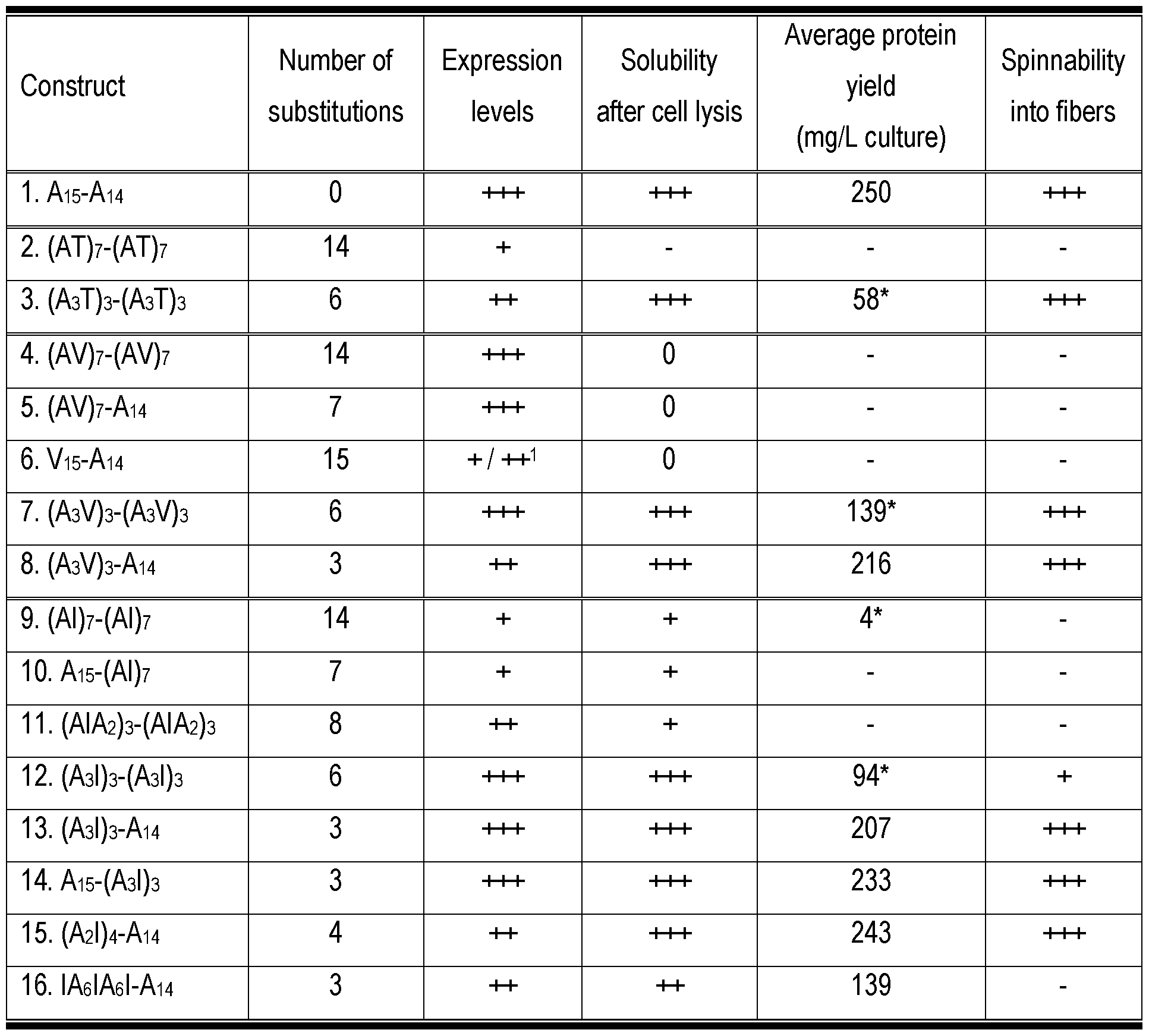
- (AV)7-(AV)7, (AV)7-A14 and V15-A14 expressed well but were insoluble after lysis, likely due to high hydrophobicity of the engineered segments.
- Expression and purification of the A15-(AI)7 and (AIA2)3-(AIA2)3 constructs did not result in enough soluble protein for further characterization.
- the constructs that showed intermediate to high expression levels but were insoluble after cell lysis were treated with 8 M urea but could not be solubilized to the extent needed for enabling purification of enough protein for fiber spinning (not shown).
- the position of the Ile replacements within one Ala block had an impact on the protein yield but whether these were located in the first or second poly-Ala block did not matter.
- (A3I)3-A14 and A15- (A3I)3 both have three Ile substitutions in the first and second poly-Ala block, respectively, and showed comparable yields.
- (A3I)3-A14 and IA6IA6I-A14 have the same number of Ile replacements in the first block, but their location differed as did the yield (207 vs 139 mg/L culture for (A3I)3-A14 and IA6IA6I- A14, respectively).
- Table 2 Summary of number of substitutions, expression levels, solubility after cell lysis, protein yield and spinnability into fibers of the engineered proteins.
- the dopes made from the eight constructs were transferred to syringes and extruded through a thin glass capillary into a low pH aqueous buffer according to a previously described biomimetic spinning procedure (Greco et al., Molecules 25: 3248 (2020); Andersson et al., Nature Chemical Biology 13: 262 (2017)). Seven engineered mini-spidroins could be spun into fibers, only the IA6IA6I-A14 protein aggregated prematurely in the syringe. One of the mini-spidroins, (A3I)3-(A3I)3, formed fibers that were too fragile to be retrieved.
- Fibers formed by (A3V)3-A14 and (A2I)4-A14 also reached a significantly higher toughness modulus than A15-A14 (50 and 37 MJ/m 3 , respectively, versus 18 MJ/m 3 ).
- ATR-FTIR Attenuated Total Reflection Fourier-transform infrared
- A15-A14 has been shown to express at very high levels ( ⁇ 21 g/L) in a bioreactor-based E. coli fed-batch culture (Schmuck et al., Materials Today 50: 16 (2021)). Following the same protocol, the expression level of (A3I)3-A14 amounted to 13 g/L and the final yield after purification using an automated purification protocol was 8.9 g/L. To our knowledge, these yields are the second highest reported for any recombinant spidroin produced in E. coli and line with what is required for economically viable bulk production. After purification, (A3I)3-A14 was concentrated to 300 mg/mL and could easily be spun into fibers.
- Engineered variants were designed that contained amino acid residue substitutions in the poly-Ala blocks of the repetitive region as described in the results section. Note that the constructs were named after their substitutions in the poly-Ala blocks but contained NT, CT and the glycine-rich regions as well, e.g., NT2RepCT is referred to as A15-A14. Amino acid sequences corresponding to the designed repeat regions were converted into gene sequences and codon optimized for expression in E. coli (Geneious), ordered from Eurofins Genomics, Germany, and subcloned between NT and CT (using EcoRI and BamHI restriction sites) of the existing NT2RepCT plasmid (Andersson et al., Nature Chemical Biology 13: 262 (2017)).
- the Zipper database calculates the Rosetta energy (Kuhlman and Baker, Proceedings of the National Academy of Sciences of the United States of America 97: 10383 (2000)) and evaluate self- complementary binding of moving hexapeptides (Nelson et al., Nature 435: 773 (2005); Sawaya et al., Nature 447: 453 (2007)).
- the Rosetta energy combines several free energy functions to model and analyze given protein structures, and energies equal or below -23 kcal/mol indicate high fibrillation propensity (Goldschmidt et al., Proceedings of the National Academy of Sciences of the United States of America 107: 3487 (2010)). Lower energies imply higher stability of two ⁇ -strands in a zipper conformation.
- the supernatant was purified by Ni-immobilized metal affinity column (IMAC), ( ⁇ kta start, GE Healthcare, USA or manual). After loading the supernatant on a HisPrepTM FF 16/10 or manual packed column (GE Healthcare, USA), the column was washed with 4-5 column volumes (CV) of 20 mM Tris-HCl followed by 4-5 CV of 2 mM imidazole in 20 mM Tris-HCl, pH 8. The protein was eluted with 200 mM imidazole in 20 mM Tris-HCl. After dialysis against 20 mM Tris-HCl, pH 8, the protein was analyzed by SDS-PAGE for quality control.
- IMAC Ni-immobilized metal affinity column
- the proteins were concentrated to 200-400 mg/mL with centrifugal concentrators (Vivaspin 20, 10 kDa MWCO, GE Healthcare, USA) and then frozen at -20 °C until further use.
- CD spectroscopy Protein concentrations of 10 ⁇ M in 20 mM phosphate buffer were measured in a 300 ⁇ l cuvette with a 1 mm path length using a J-1500 CD spectrometer (JASCO, USA). Temperature scans were performed between 20 to 90 °C at a heating rate of 1 °C min ⁇ 1 and spectra were recorded from 260 to 190 nm.
- Round-glass capillaries (G1, Narishige, UK, inner diameter of 0.6 mm) were pulled with a Micro Electrode Puller (Stoelting co.51217) to a diameter between 25 and 78 ⁇ m.
- a 1 mL syringe with Luer Lok tip (BD, USA) was filled with the concentrated proteins and connected to a 27 G steel needle (Braun, Germany). The needle was connected to the pulled-glass capillary via polyethylene tubing.
- the protein was ejected at a flow rate of 17 ⁇ l/min (neMESYS low-pressure syringe pump, Cetoni, Germany) into an 80 cm long bath containing spinning buffer (750 mM acetate buffer, 150 mM NaCl, pH 5.0) and rolled onto collection frames in air with minimal stretching of the fibers. Each construct was spun at least twice at different occasions. Mechanical testing of the fibers Fibers were mounted with tape on paper frames with a square window (1 cm ⁇ 1 cm) and the diameter of the fibers was measured with an optical microscope (Nikon, Japan) at 10 locations along each fiber and the average diameter was calculated.
- spinning buffer 750 mM acetate buffer, 150 mM NaCl, pH 5.0
- the frames were placed into a tensile tester (5943-Instron, USA equipped with a 5N load cell), cut and the fiber was pulled at a strain-rate of 6 mm/min. All the tests were performed at relative humidity lower than 35% to not affect the mechanical properties of the silk.
- the engineering strength was calculated by dividing the measured force by the area of the cross-section (calculated from the apparent/maximal diameter assuming a circular cross-section).
- the engineering strain was calculated by dividing the displacement by the gauge length.
- Toughness modulus was obtained by calculating the area under the stress-strain curve and the Young’s modulus was obtained from the slope at the initial linear elastic phase of the stress-strain curve.
- FTIR spectroscopy FTIR spectroscopy FTIR spectra of fiber bundles were recorded on a Vertex 70 instrument equipped with a diamond ATR unit (Platinum-ATR, Bruker, Germany) and a mercury cadmium telluride-detector (Bruker, Germany).
- the instrument was continuously purged with dried air and the spectra confirmed that water vapor correction was not necessary.1000 scans with a resolution of 2 cm -1 were recorded. Before every sample spectrum measurement, a background spectrum without a sample was recorded and used to calculate the absorbance spectrum. For each sample, 6 spectra were taken by pressing fiber bundles on the ATR crystal with 3 fiber bundles oriented perpendicular to the beam and 3 fiber bundles parallel to it. The “Kinetics” software, written by Erik Goormaghtigh (liable Libre de sheep, Belgium) was used to process the spectra.
- the 6 spectra of each sample were averaged and the baseline was subtracted (polynomial baseline with baseline points: 1740, 1730, 1580, and 1578 cm -1 ) from the amide I band (1705 – 1595 cm -1 ).
- the absorbance and second derivative spectra were co-fitted simultaneously to analyze the secondary structure content (Baldassarre et al., Molecules 20, 12599 (2015)).
- the component band fitted at a center peak position of ⁇ 1695 cm -1 was assigned to antiparallel ⁇ -sheets.
- the component band fitted at ⁇ 1651 cm -1 was assigned to ⁇ -helix/random structures.
- Bands at ⁇ 1633, ⁇ 1622, and ⁇ 1613 cm -1 were assigned to different types of ⁇ -sheets according to a study of Bombyx mori silk fibers (Carissimi et al., Polymers 12: 1 (2020)): the 1633 cm -1 band likely corresponds to distorted or twisted ⁇ - sheets, while the ⁇ 1622 and ⁇ 1613 cm -1 bands were assigned to more planar sheets and have previously been proposed to differ in their methyl group orientations in B.
- the areas of the component bands were divided by the total fitted area of all bands assigned to amide I vibrations (excluding the side chain band) to calculate the relative secondary structure content.
- NMR-spectroscopy The solid-state NMR spectra of uniformly 13 C, 15 N-labeled A15-A14 and (A3I)3-A14 fibers were recorded on a Bruker Avance III HD NMR spectrometer equipped with a 3.2 mm 1 H/ 13 C/ 15 N E-free magic-angle spinning (MAS) probe. The sample temperature was set to 277 K.
- the MAS frequency was 12.5 kHz.1D 1 H- 13 C cross-polarization (CP) and 2D dipolar assisted rotational resonance (DARR) experiments were acquired using a forward and back CP from 1 H to 13 C with a linear ramp from 49.0 to 61.2 kHz on 1 H and constant 13 C radiofrequency-field amplitude at 80.5 kHz as well as high-power heteronuclear decoupling at 83.3 kHz during acquisition.
- the CP contact time was 1 ms and the acquisition time was 10 ms.
- the 13 C chemical shifts were referenced externally relative to adamantane (at 38.48 ppm relative to TMS). Spectra were processed with Bruker Topspin 4.0.
- the pre-culture was used to inoculate (100-fold dilution) fresh 250 mL cultivation medium (50 ⁇ g/mL Kanamycin, 0.01% antifoam 204) as defined by da Silva and coworkers (da Silva et al., SpringerPlus 2: 1 (2013)).
- a Multifors 2 (Infors) equipped with a 0.5 L glass vessel was used to adjust the pH to 7, with 3 M H3PO4 and 25% NH3.
- the stirrer speed was adjusted automatically between 200 and 1200 rpm to obtain a dissolved relative oxygen level (pO2) of 30%. Initially the temperature was set to 28 °C, until the OD600 reached 50 (22 h after inoculation).
- the spidroin needs to be compatible with devices that have orifices with a variety of diameters but preferably between 30 to at least 200 ⁇ m.
- compatibility with metal extrusion devices exists if the tip is not blocked by the polymer by premature coagulation and if the spidroin solution can be continuously extruded as a fiber.
- the spinning dope was prepared with (A3I)3-A14 (300 mg/ml), and extruded through a glass capillary ⁇ 150 ⁇ m, then a continuous fiber was obtained without the occurrence of spontaneous clogging of the tip or the formation of blobs.
- this experiment was repeated but with a metal nozzle, that had an orifice diameter of 150 ⁇ m.
- the extrusion was tested with a flow rate of 17 ⁇ l/min and 35 ⁇ l/min.
- the recombinant spider silk protein (A3I)3-A14 of the invention has significant advantages over A15-A14 not only in mechanical properties as shown in Example 1 but also with respect to the potential for an industrial scale spinning method that relies on metal nozzles and spinnerets for extrusion.
- the silk fibers produced from recombinant spider silk proteins of the invention can be drawn following spinning.
- the syringe was mounted to a Micro-Mate® female Luer to hose end for 1/16 inch (1.5875 mm) to 3/32 inch (2.38125 mm) inner diameter (I.D.) tubing (Cadence Science, Cranston, USA) and connected to a male Luer lock to hose end, for tubing with an I.D. of 1/16 - 3/32 inch (Cadence Science, Cranston, USA) via ⁇ 5 cm of silicone tubing with an I.D. of 1.6 mm (667-8441, RS Pro, Gothenburg, Sweden).
- I.D. inner diameter
Landscapes
- Life Sciences & Earth Sciences (AREA)
- Health & Medical Sciences (AREA)
- Chemical & Material Sciences (AREA)
- Organic Chemistry (AREA)
- Genetics & Genomics (AREA)
- Engineering & Computer Science (AREA)
- Zoology (AREA)
- Wood Science & Technology (AREA)
- Molecular Biology (AREA)
- Biochemistry (AREA)
- General Health & Medical Sciences (AREA)
- Insects & Arthropods (AREA)
- Biotechnology (AREA)
- Bioinformatics & Cheminformatics (AREA)
- General Engineering & Computer Science (AREA)
- Proteomics, Peptides & Aminoacids (AREA)
- Biophysics (AREA)
- Microbiology (AREA)
- Biomedical Technology (AREA)
- Toxicology (AREA)
- Tropical Medicine & Parasitology (AREA)
- Gastroenterology & Hepatology (AREA)
- Medicinal Chemistry (AREA)
- Physics & Mathematics (AREA)
- Plant Pathology (AREA)
- General Chemical & Material Sciences (AREA)
- Chemical Kinetics & Catalysis (AREA)
- Mechanical Engineering (AREA)
- Textile Engineering (AREA)
- Peptides Or Proteins (AREA)
- Artificial Filaments (AREA)
- Micro-Organisms Or Cultivation Processes Thereof (AREA)
Abstract
Description



Claims
Priority Applications (4)
| Application Number | Priority Date | Filing Date | Title |
|---|---|---|---|
| JP2024552687A JP2025507991A (en) | 2022-03-04 | 2023-03-03 | Recombinant spider silk protein |
| EP23763793.9A EP4486762A4 (en) | 2022-03-04 | 2023-03-03 | RECOMBINANT SPIDER SILK PROTEINS |
| US18/843,384 US20250179128A1 (en) | 2022-03-04 | 2023-03-03 | Recombinant spider silk proteins |
| CN202380025294.0A CN118829650A (en) | 2022-03-04 | 2023-03-03 | Recombinant spider silk protein |
Applications Claiming Priority (2)
| Application Number | Priority Date | Filing Date | Title |
|---|---|---|---|
| SE2250294-2 | 2022-03-04 | ||
| SE2250294 | 2022-03-04 |
Publications (1)
| Publication Number | Publication Date |
|---|---|
| WO2023167628A1 true WO2023167628A1 (en) | 2023-09-07 |
Family
ID=87884114
Family Applications (1)
| Application Number | Title | Priority Date | Filing Date |
|---|---|---|---|
| PCT/SE2023/050191 Ceased WO2023167628A1 (en) | 2022-03-04 | 2023-03-03 | Recombinant spider silk proteins |
Country Status (5)
| Country | Link |
|---|---|
| US (1) | US20250179128A1 (en) |
| EP (1) | EP4486762A4 (en) |
| JP (1) | JP2025507991A (en) |
| CN (1) | CN118829650A (en) |
| WO (1) | WO2023167628A1 (en) |
Cited By (1)
| Publication number | Priority date | Publication date | Assignee | Title |
|---|---|---|---|---|
| WO2025198514A1 (en) | 2024-03-21 | 2025-09-25 | Anna Rising | Recombinant spider silk proteins |
Citations (6)
| Publication number | Priority date | Publication date | Assignee | Title |
|---|---|---|---|---|
| US5994099A (en) * | 1997-12-31 | 1999-11-30 | The University Of Wyoming | Extremely elastic spider silk protein and DNA coding therefor |
| WO2006008163A2 (en) * | 2004-07-22 | 2006-01-26 | Technische Universitaet Muenchen | Recombinant spider silk proteins |
| EP2243792A1 (en) * | 2009-04-22 | 2010-10-27 | Spiber Technologies AB | Methods of producing polymers of spider silk proteins |
| WO2017138002A1 (en) * | 2016-02-11 | 2017-08-17 | Seevix Material Sciences Ltd. | Composite materials comprising synthetic dragline spider silk |
| EP3263593A1 (en) * | 2016-07-01 | 2018-01-03 | Anna Rising | Engineered spider silk proteins and uses thereof |
| EP3748049A1 (en) * | 2018-01-31 | 2020-12-09 | Spiber Inc. | Method for manufacturing protein fiber |
-
2023
- 2023-03-03 EP EP23763793.9A patent/EP4486762A4/en active Pending
- 2023-03-03 WO PCT/SE2023/050191 patent/WO2023167628A1/en not_active Ceased
- 2023-03-03 US US18/843,384 patent/US20250179128A1/en active Pending
- 2023-03-03 JP JP2024552687A patent/JP2025507991A/en active Pending
- 2023-03-03 CN CN202380025294.0A patent/CN118829650A/en active Pending
Patent Citations (6)
| Publication number | Priority date | Publication date | Assignee | Title |
|---|---|---|---|---|
| US5994099A (en) * | 1997-12-31 | 1999-11-30 | The University Of Wyoming | Extremely elastic spider silk protein and DNA coding therefor |
| WO2006008163A2 (en) * | 2004-07-22 | 2006-01-26 | Technische Universitaet Muenchen | Recombinant spider silk proteins |
| EP2243792A1 (en) * | 2009-04-22 | 2010-10-27 | Spiber Technologies AB | Methods of producing polymers of spider silk proteins |
| WO2017138002A1 (en) * | 2016-02-11 | 2017-08-17 | Seevix Material Sciences Ltd. | Composite materials comprising synthetic dragline spider silk |
| EP3263593A1 (en) * | 2016-07-01 | 2018-01-03 | Anna Rising | Engineered spider silk proteins and uses thereof |
| EP3748049A1 (en) * | 2018-01-31 | 2020-12-09 | Spiber Inc. | Method for manufacturing protein fiber |
Non-Patent Citations (3)
| Title |
|---|
| ARNDT TINA, GRECO GABRIELE, SCHMUCK BENJAMIN, BUNZ JESSICA, SHILKOVA OLGA, FRANCIS JUANITA, PUGNO NICOLA M, JAUDZEMS KRISTAPS, BAR: "Engineered Spider Silk Proteins for Biomimetic Spinning of Fibers with Toughness Equal to Dragline Silks", ADVANCED FUNCTIONAL MATERIALS, vol. 32, no. 23, 1 June 2022 (2022-06-01), DE , pages 1 - 11, XP093013834, ISSN: 1616-301X, DOI: 10.1002/adfm.202200986 * |
| JOHANSSON JAN, RISING ANNA: "Doing What Spiders Cannot—A Road Map to Supreme Artificial Silk Fibers", ACS NANO, vol. 15, no. 2, 23 February 2021 (2021-02-23), US , pages 1952 - 1959, XP093089678, ISSN: 1936-0851, DOI: 10.1021/acsnano.0c08933 * |
| See also references of EP4486762A4 * |
Cited By (1)
| Publication number | Priority date | Publication date | Assignee | Title |
|---|---|---|---|---|
| WO2025198514A1 (en) | 2024-03-21 | 2025-09-25 | Anna Rising | Recombinant spider silk proteins |
Also Published As
| Publication number | Publication date |
|---|---|
| EP4486762A1 (en) | 2025-01-08 |
| JP2025507991A (en) | 2025-03-21 |
| CN118829650A (en) | 2024-10-22 |
| US20250179128A1 (en) | 2025-06-05 |
| EP4486762A4 (en) | 2026-03-11 |
Similar Documents
| Publication | Publication Date | Title |
|---|---|---|
| Arndt et al. | Engineered spider silk proteins for biomimetic spinning of fibers with toughness equal to dragline silks | |
| US9051453B2 (en) | Polypeptide solution, artificial polypeptide fiber production method and polypeptide purification method using same | |
| US20230070786A1 (en) | Engineered spider silk proteins and uses thereof | |
| EP2716798B1 (en) | Artificial polypeptide fiber and method for producing same | |
| JP5584932B2 (en) | Method for producing protein fiber | |
| JP5128943B2 (en) | Recombinant spider silk protein | |
| EP2899204B1 (en) | Support for cell culture comprising spider silk proteins and methods for producing the same | |
| Thamm et al. | Recombinant production, characterization, and fiber spinning of an engineered short major ampullate spidroin (MaSp1s) | |
| CN104936978B (en) | Polypeptide porous body and method for producing the same | |
| Zhu et al. | Tensile properties of synthetic pyriform spider silk fibers depend on the number of repetitive units as well as the presence of N-and C-terminal domains | |
| EP3334754B1 (en) | Compositions and methods for fabricating synthetic dragline spider silk | |
| CN111454370B (en) | Chimeric protein and preparation method and application thereof | |
| CN104936979A (en) | Polypeptide particle and method for producing same | |
| CN104936625A (en) | Polypeptide hydrogel and method for producing same | |
| US20250179128A1 (en) | Recombinant spider silk proteins | |
| JP5883271B2 (en) | Method for producing artificial polypeptide ultrafine fiber | |
| US8461301B2 (en) | Synthetic dragline spider silk-like proteins | |
| EP3765101B1 (en) | Beta-solenoid proteins and their application in textile production | |
| EP3281948B1 (en) | Polar solvent solution and production method thereof | |
| CN110101908B (en) | Degradable tissue repair material and preparation method thereof | |
| Lacombe et al. | Directed Functionalization of Recombinant Spider Silk Nonwoven Membranes with Antibodies Using Non‐Canonical Amino Acids | |
| Hekman | Production of Synthetic Spider Silk |
Legal Events
| Date | Code | Title | Description |
|---|---|---|---|
| 121 | Ep: the epo has been informed by wipo that ep was designated in this application |
Ref document number: 23763793 Country of ref document: EP Kind code of ref document: A1 |
|
| WWE | Wipo information: entry into national phase |
Ref document number: 18843384 Country of ref document: US Ref document number: 2024552687 Country of ref document: JP Ref document number: 202380025294.0 Country of ref document: CN |
|
| WWE | Wipo information: entry into national phase |
Ref document number: 2023763793 Country of ref document: EP |
|
| NENP | Non-entry into the national phase |
Ref country code: DE |
|
| ENP | Entry into the national phase |
Ref document number: 2023763793 Country of ref document: EP Effective date: 20241004 |
|
| WWP | Wipo information: published in national office |
Ref document number: 18843384 Country of ref document: US |