WO2023181494A1 - 評価装置、評価方法及び評価プログラム - Google Patents
評価装置、評価方法及び評価プログラム Download PDFInfo
- Publication number
- WO2023181494A1 WO2023181494A1 PCT/JP2022/042990 JP2022042990W WO2023181494A1 WO 2023181494 A1 WO2023181494 A1 WO 2023181494A1 JP 2022042990 W JP2022042990 W JP 2022042990W WO 2023181494 A1 WO2023181494 A1 WO 2023181494A1
- Authority
- WO
- WIPO (PCT)
- Prior art keywords
- gaze
- unit
- overall
- evaluation
- determination area
- Prior art date
- Legal status (The legal status is an assumption and is not a legal conclusion. Google has not performed a legal analysis and makes no representation as to the accuracy of the status listed.)
- Ceased
Links
Images



Classifications
-
- A—HUMAN NECESSITIES
- A61—MEDICAL OR VETERINARY SCIENCE; HYGIENE
- A61B—DIAGNOSIS; SURGERY; IDENTIFICATION
- A61B5/00—Measuring for diagnostic purposes; Identification of persons
- A61B5/40—Detecting, measuring or recording for evaluating the nervous system
- A61B5/4076—Diagnosing or monitoring particular conditions of the nervous system
-
- A—HUMAN NECESSITIES
- A61—MEDICAL OR VETERINARY SCIENCE; HYGIENE
- A61B—DIAGNOSIS; SURGERY; IDENTIFICATION
- A61B3/00—Apparatus for testing the eyes; Instruments for examining the eyes
- A61B3/10—Objective types, i.e. instruments for examining the eyes independent of the patients' perceptions or reactions
- A61B3/113—Objective types, i.e. instruments for examining the eyes independent of the patients' perceptions or reactions for determining or recording eye movement
-
- A—HUMAN NECESSITIES
- A61—MEDICAL OR VETERINARY SCIENCE; HYGIENE
- A61B—DIAGNOSIS; SURGERY; IDENTIFICATION
- A61B5/00—Measuring for diagnostic purposes; Identification of persons
- A61B5/16—Devices for psychotechnics; Testing reaction times ; Devices for evaluating the psychological state
- A61B5/163—Devices for psychotechnics; Testing reaction times ; Devices for evaluating the psychological state by tracking eye movement, gaze, or pupil change
-
- A—HUMAN NECESSITIES
- A61—MEDICAL OR VETERINARY SCIENCE; HYGIENE
- A61B—DIAGNOSIS; SURGERY; IDENTIFICATION
- A61B5/00—Measuring for diagnostic purposes; Identification of persons
- A61B5/16—Devices for psychotechnics; Testing reaction times ; Devices for evaluating the psychological state
- A61B5/168—Evaluating attention deficit, hyperactivity
Definitions
- the present disclosure relates to an evaluation device, an evaluation method, and an evaluation program.
- a method has been proposed to evaluate developmental disorders such as Autism Spectrum Disorder (ASD) by detecting the subject's gaze point when the subject is shown images of people, geometric patterns, etc. (For example, Patent Document 1).
- ASD Autism Spectrum Disorder
- Patent Document 1 The evaluation technique described in Patent Document 1 is required to more accurately evaluate characteristics specific to subjects with ASD.
- the present disclosure has been made in view of the above, and aims to provide an evaluation device, an evaluation method, and an evaluation program that can improve the accuracy of evaluation of characteristics specific to ASD subjects.
- An evaluation device includes a display unit, a gaze point detection unit that detects the position of a subject's gaze point, and a plurality of unit images including at least one of an object having specificity and an object having sensitivity.
- a display control unit that causes the task to be displayed on the display unit; an area setting unit that sets, for each task, a target object determination area corresponding to each of the target objects and an overall determination area corresponding to the entire display unit; a determination unit that determines whether the gaze point exists in each of the object determination area and the overall determination area based on the detected position of the gaze point, and the an object gazing rate indicating the proportion of the gazing point existing in the object determination area for each task; and an overall gazing rate indicating the proportion of the gazing point existing in the overall judgment area across all the tasks.
- the apparatus includes a calculation unit that calculates, and an evaluation unit that calculates a score based on the target object gaze rate and the overall gaze rate calculated by the calculation unit, and obtains evaluation data based on the calculated score.
- An evaluation method includes detecting the position of a subject's gaze point, and displaying a plurality of unit images including at least one of an object having specificity and an object having sensitivity on a display unit in different tasks. and setting an object determination area corresponding to each of the objects and an overall determination area corresponding to the entire display section for each task, based on the position of the detected point of gaze, Determining whether the gaze point exists in each of the object determination area and the overall determination area, and determining the proportion of the gaze point existing in the target object determination area for each task based on the determination result.
- a target gaze rate indicating a target gaze rate a target gaze rate
- an overall gaze rate indicating a proportion of the gaze point existing in the overall determination area across all the tasks
- the evaluation program includes a process of detecting the position of a subject's gaze point, and displaying a plurality of unit images including at least one of an object having specificity and an object having sensitivity on a display unit in different tasks. a process of setting an object determination area corresponding to each of the objects and an overall determination area corresponding to the entire display section for each task; and based on the detected position of the gaze point, A process of determining whether the gaze point exists in each of the target object determination area and the overall determination area, and a rate at which the gaze point exists in the target object determination area for each task based on the determination result.
- a computer is caused to perform a process of calculating a score based on the rate and obtaining evaluation data based on the calculated score.
- FIG. 1 is a diagram schematically showing an example of an evaluation device according to this embodiment.
- FIG. 2 is a functional block diagram showing an example of the evaluation device.
- FIG. 3 is a diagram showing an example of a unit image displayed on the display section.
- FIG. 4 is a flowchart illustrating an example of the evaluation method according to this embodiment.
- FIG. 1 is a diagram schematically showing an example of an evaluation device 100 according to the present embodiment.
- the evaluation device 100 detects the subject's line of sight and uses the detection results to evaluate autism spectrum disorder (hereinafter referred to as ASD).
- the evaluation device 100 can perform various methods such as a method of detecting the line of sight based on the position of the subject's pupil and the position of the corneal reflection image, or a method of detecting the line of sight based on the position of the inner corner of the subject's eye and the position of the iris. The method allows the subject's line of sight to be detected.
- the evaluation device 100 includes a display device 10, an image acquisition device 20, a computer system 30, an output device 40, an input device 50, and an input/output interface device 60.
- the display device 10, the image acquisition device 20, the computer system 30, the output device 40, and the input device 50 perform data communication via the input/output interface device 60.
- the display device 10 and the image acquisition device 20 each have a drive circuit (not shown).
- the display device 10 includes a flat panel display such as a liquid crystal display (LCD) or an organic electroluminescence display (OLED).
- the display device 10 includes a display section 11.
- the display unit 11 displays information such as images.
- the display section 11 is substantially parallel to the XY plane. In the XY plane, the X-axis direction is the left-right direction of the display section 11, the Y-axis direction is the up-down direction of the display section 11, and the Z-axis direction is the depth direction orthogonal to the display section 11.
- the display device 10 may be a head-mounted display device. If the display device 10 is a head-mounted display device, a configuration such as the image acquisition device 20 will be disposed within the head-mounted module.
- the image acquisition device 20 acquires image data of the left and right eyeballs EB of the subject, and transmits the acquired image data to the computer system 30.
- the image acquisition device 20 includes a photographing device 21 .
- the photographing device 21 acquires image data by photographing the left and right eyeballs EB of the subject.
- the photographing device 21 includes various cameras depending on the method of detecting the subject's line of sight. For example, in the case of a method of detecting the line of sight based on the position of the subject's pupil and the position of the corneal reflection image, the imaging device 21 has an infrared camera and is capable of transmitting near-infrared light with a wavelength of 850 [nm], for example.
- the photographing device 21 includes a visible light camera.
- the photographing device 21 outputs a frame synchronization signal.
- the period of the frame synchronization signal can be, for example, 20 [msec], but is not limited to this.
- the photographing device 21 can have, for example, a stereo camera configuration including a first camera 21A and a second camera 21B, but is not limited thereto.
- the image acquisition device 20 includes an illumination device 22 that illuminates the subject's eyeball EB.
- the lighting device 22 includes an LED (light emitting diode) light source, and is capable of emitting near-infrared light with a wavelength of 850 [nm], for example.
- the illumination device 22 may not be provided.
- the illumination device 22 emits detection light in synchronization with the frame synchronization signal of the photographing device 21.
- the illumination device 22 can have, for example, a first light source 22A and a second light source 22B, but is not limited thereto.
- the computer system 30 centrally controls the operation of the evaluation device 100.
- Computer system 30 includes an arithmetic processing unit 30A and a storage device 30B.
- the arithmetic processing device 30A includes a microprocessor such as a CPU (central processing unit).
- the storage device 30B includes memory or storage such as ROM (read only memory) and RAM (random access memory).
- the arithmetic processing device 30A performs arithmetic processing according to the computer program 30C stored in the storage device 30B.
- the output device 40 includes a display device such as a flat panel display. Note that the output device 40 may include a printing device.
- the input device 50 generates input data when operated. Input device 50 includes a keyboard or mouse for a computer system. Note that the input device 50 may include a touch sensor provided on the display section of the output device 40, which is a display device.
- evaluation device 100 the display device 10 and the computer system 30 are separate devices. Note that the display device 10 and the computer system 30 may be integrated.
- evaluation device 100 may include a tablet personal computer.
- the tablet personal computer may be equipped with a display device, an image acquisition device, a computer system, an input device, an output device, and the like.
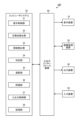
- FIG. 2 is a functional block diagram showing an example of the evaluation device 100.
- the computer system 30 includes a display control section 31, a gaze point detection section 32, an area setting section 33, a determination section 34, a calculation section 35, an evaluation section 36, and an input/output control section. 37 and a storage section 38.
- the functions of the computer system 30 are performed by an arithmetic processing unit 30A and a storage device 30B (see FIG. 1). Note that some functions of the computer system 30 may be provided outside the evaluation device 100.
- the display control unit 31 displays the evaluation image on the display unit 11.
- the evaluation images include objects with specificity (hereinafter referred to as specificity objects) such as people and objects, and objects with sensitivity such as figures and geometric patterns. It includes a plurality of unit images including at least one of objects (hereinafter referred to as sensitive objects).
- the unit image includes at least one of a still image and a moving image.
- Specificity objects are objects that subjects who are unlikely to have ASD tend to fixate on. Examples of such specificity objects include people, objects, and the like.
- Sensitive objects are objects that subjects who are likely to have ASD tend to gaze at. Examples of such sensitive objects include figures, geometric patterns, and the like.
- the display control unit 31 causes the display unit 11 to display one unit image as an evaluation image in one task.
- the display control unit 31 causes the display unit 11 to display a plurality of unit images prepared in advance in different tasks.
- the display control unit 31 can display the above evaluation image on the display unit 11, for example, as an evaluation video, but the display format is not limited to the evaluation video, and may be a still image.
- the gaze point detection unit 32 detects position data of the subject's gaze point.
- the gaze point detection unit 32 detects the subject's gaze vector defined in a three-dimensional global coordinate system based on image data of the subject's left and right eyeballs EB acquired by the image acquisition device 20.
- the gaze point detection unit 32 detects position data of the intersection of the detected visual line vector of the subject and the display unit 11 of the display device 10 as position data of the subject's gaze point. That is, in this embodiment, the position data of the gaze point is the position data of the intersection of the subject's line of sight vector defined in the three-dimensional global coordinate system and the display unit 11 of the display device 10.
- the gaze point detection unit 32 detects position data of the subject's gaze point at every prescribed sampling period. This sampling period can be, for example, the period of the frame synchronization signal output from the photographing device 21 (for example, every 20 [msec]).
- the area setting unit 33 sets, for each task, a target object determination area corresponding to each target object and an overall determination area corresponding to the entire display unit 11 in the display unit 11.
- each determination area set by the area setting section 33 is not displayed on the display section 11 in principle.
- each determination area may be displayed on the display section 11 under the control of the display control section 31, for example.
- the object determination area is included in the overall determination area.
- the determination unit 34 determines whether or not the gaze point exists in the determination area based on the position data of the gaze point, and outputs the determination result as determination data.
- the determination unit 34 determines whether or not the gaze point exists in the determination area at each prescribed determination period.
- the determination period can be, for example, the period of the frame synchronization signal output from the photographing device 21 (for example, every 20 [msec]). That is, the determination period of the determination section 34 is the same as the sampling period of the gaze point detection section 32.
- the determining unit 34 makes a determination regarding the point of interest every time the position of the point of interest is sampled by the point of interest detecting unit 32, and outputs determination data. When a plurality of determination areas are set, the determination unit 34 can determine whether or not a gaze point exists for each determination area and output determination data.
- the calculation unit 35 calculates the target object gaze rate and the overall gaze rate based on the determination result of the determination unit 34.
- the target object gaze rate indicates the rate at which the gaze point exists in the target object determination area for each task.
- the overall gaze rate indicates the rate at which the gaze point exists in the entire determination area across all tasks.
- the calculation unit 35 has a timer that detects the elapsed time since the evaluation video is displayed on the display unit 11, and a timer that detects the number of times the determination unit 34 determines that the gaze point exists in the object determination area and the overall determination area. and a counter for counting.
- the calculation unit 35 calculates the existence time data of the gaze point based on the determination data of the determination unit 34.
- the existence time data is data indicating the time during which the gaze point exists in the determination area. It can be estimated that the more times the determination unit 34 determines that the gaze point exists in the determination area, the longer the existence time that the gaze point has existed in the determination area. Therefore, the existence time data can be the number of times the determining unit 34 determines that the gaze point exists in the determination area.
- the calculation unit 35 determines whether the gaze point is in the target object determination area for each task based on, for example, the time from the start to the end of one task in the evaluation video and the existence time data in the target object determination area. Calculate the target object gaze rate, which indicates the percentage of objects present. Further, the calculation unit 35 calculates whether the gaze point is the same as that of all the tasks based on, for example, the time from the start of the first task to the end of the last task in the evaluation video and the existence time data in the overall determination area. The overall gaze rate is calculated, which indicates the percentage of the area that exists in the overall determination area.
- the evaluation unit 36 calculates a score for evaluating the subject based on the target object gaze rate and the overall gaze rate.
- the evaluation unit 36 obtains evaluation data of the subject based on the calculated score.
- the evaluation unit 36 may calculate the score by weighting the overall gaze rate more heavily than the target object gaze rate.
- the evaluation unit 36 calculates a correlation coefficient indicating the strength of the correlation between the reference data stored in the storage unit 38, which will be described later, and the object gaze rate and the overall gaze rate calculated by the calculation unit 35,
- the score may be calculated by weighting the target object gaze rate and the overall gaze rate based on the calculated correlation coefficient.
- the input/output control unit 37 acquires data (image data of the eyeball EB, input data, etc.) from at least one of the image acquisition device 20 and the input device 50. Further, the input/output control unit 37 outputs data to at least one of the display device 10 and the output device 40. The input/output control unit 37 may output the task for the subject from an output device 40 such as a speaker.
- the storage unit 38 stores each data such as the above-mentioned determination data, existence time data, reference data of the target object gaze rate and overall gaze rate, and evaluation data.
- the reference data for the object gaze rate and the overall gaze rate are the calculation results of the object gaze rate and the overall gaze rate for subjects diagnosed with ASD, and the target object gaze rate for subjects diagnosed not to have ASD.
- This data includes calculation results of the rate and the overall gaze rate.
- the storage unit 38 also performs a process of detecting the position of the subject's gaze point and a process of displaying a plurality of different images including objects corresponding to at least one of the specificity region and the sensitivity region on the display unit in different tasks. , a process of setting an object determination area corresponding to each target object and an overall determination area corresponding to the entire display section for each task, and determining whether the gaze point is an object based on the position of the detected gaze point. A process of determining for each task whether the object exists in each of the object determination areas and the overall determination area, and an object gaze rate that indicates the proportion of the gaze point existing in the target object determination area for each task based on the determination result of the determination unit.
- An evaluation program that causes a computer to execute a process of obtaining evaluation data based on the calculated score is stored.
- evaluation method Next, an evaluation method according to this embodiment will be explained.
- the evaluation device 100 described above is used to evaluate whether or not the test subject's evaluation data exceeds a predetermined threshold.
- FIG. 3 is a diagram showing an example of a unit image displayed on the display section 11.
- the display control unit 31 displays a unit image IM including at least one of the specificity target M1 and the sensitivity target M2 on the display unit 11 in one task.
- the specificity object M1 is, for example, a person
- the sensitivity object M2 is, for example, a figure.
- the display control unit 31 displays a different unit image IM for each task on the display unit 11.
- the unit image IM displayed in the first task is expressed as a unit image IM1
- the unit image displayed in the k-th task is expressed as a unit image IMk.
- the display control section 31 may cause the display section 11 to display, as the unit image IM, an image that includes only one of the specificity object M1 and the sensitivity object M2. In this case, it is possible to avoid diverging the subjects' interests.
- the area setting unit 33 sets object determination areas A1 and A2 corresponding to the specificity object M1 and the sensitivity object M2.
- the area setting unit 33 sets object determination areas A1 and A2 in ranges that do not overlap with each other.
- the object determination areas A1 and A2 are not displayed on the display unit 11. Further, the area setting unit 33 sets an entire determination area A3 corresponding to the entire display unit 11.
- the object determination areas A1 and A2 are part of the overall determination area A3, and are included in the overall determination area A3.
- the area setting unit 33 can set the target object determination areas A1 and A2 to two or less areas in one task. For example, if one unit image IM displayed in one task includes a specificity target M1 and a sensitivity target M2, one area is set for the specificity target M1 and one area is set for the sensitivity target M2. can do.
- the region setting unit 33 sets one region for the plurality of specificity objects M1 and summarizes one region for the plurality of sensitivity objects M2. It is possible to set one area for each area.
- the shapes of the object determination areas A1 and A2 may be, for example, rectangular, circular, elliptical, polygonal, etc., and are not limited.
- the sizes of the plurality of object determination areas A1 and A2 may be different.
- subjects who are likely to have ASD are more sensitive to sensitive objects such as shapes and geometric patterns than to specificity objects such as people, animals, and plants. People tend to have a strong interest in (commitment to)
- the inventor has found that subjects who are likely to have ASD tend to gaze at the display unit 11 at a lower rate throughout all tasks than subjects who are less likely to have ASD. I found it. Therefore, in this embodiment, after instructing the subject to view the evaluation video on the display unit 11, the subject's gaze point is detected, and evaluation data is obtained based on the detection result to perform the evaluation. be.
- the display control unit 31 displays the evaluation image on the display unit 11.
- the evaluation image includes multiple tasks in chronological order.
- one unit image IM is displayed on the display unit 11.
- the display control unit 31 may cause the display unit 11 to display an eye-catching video for moving the gaze point to a desired position at the beginning of one task.
- the area setting unit 33 sets an object determination area A1 corresponding to the specificity target object M1 and an object determination area A2 corresponding to the sensitivity target M2 in a state in which the unit image IM of the evaluation image is displayed. , the entire determination area A3 corresponding to the entire display section 11 is set.
- the display control unit 31 causes the display unit 11 to display another unit image in the next task.
- the area setting unit 33 sets the object determination areas A1 and A2 and the entire determination area A3 while other unit images are displayed. In this way, the display control section 31 displays a different unit image for each task on the display section 11. Further, the area setting unit 33 sets object determination areas A1 and A2 and the entire determination area A3 corresponding to the unit image for each task. Note that the display control unit 31 may set a task for displaying on the display unit 11 a unit image that is not used for detecting the target object gaze rate.
- the gaze point detection unit 32 detects the position of the subject's gaze point at every prescribed sampling period (for example, 20 [msec]) during the period in which the evaluation image is displayed.
- the determination unit 34 determines whether the subject's gaze point exists in the object determination areas A1, A2 and the entire determination area A3, and outputs determination data. Therefore, the determination unit 34 outputs determination data every time the position of the gaze point is sampled by the gaze point detection unit 32, and at the same determination cycle as the sampling cycle described above.
- the calculation unit 35 calculates the subject's gaze point data based on the determination data.
- the calculation unit 35 calculates existence time data as the gaze point data.
- the existence time data indicates the existence time during which the subject's gaze point existed in the object determination areas A1, A2 and the entire determination area A3.
- the more times the determining unit 34 determines that the gaze point exists in the object determination areas A1, A2 and the overall determination area A3, the more the gaze point is located in the target object determination areas A1, A2 and the overall determination area A3. can be estimated to have existed for a long time. Therefore, the existence time data can be the number of times the determination unit 34 determines that the gaze point exists in the object determination areas A1, A2 and the entire determination area A3.
- the calculation unit 35 calculates the specificity target object M1 based on the existence time data of the target object determination area A1 and the target object determination area A2 calculated for one task and the time from the start to the end of the one task.
- the target object gaze rate for M2 and the target object gaze rate for the sensitive target M2 are calculated.
- the calculation unit 35 calculates the target object gaze rate for each task.
- the calculation unit 35 calculates the target object gaze rate for three types of periods in one task, for example, the first 1 second of the task, the first 2 seconds, and the entire time of the task.
- the calculation unit 35 can use a value that is found to be correlated with reference data, which will be described later, among the three types of calculated object gaze rates.
- the period during which the eye-catching image is displayed can be excluded from the time range for calculating the target object gaze rate. For example, if the first 0.3 seconds of the task is the display period of the eye-catching image, the calculation unit 35 can calculate the object gaze rate starting from 0.3 seconds after the beginning of the task.
- calculation unit 35 calculates the entire area of the display unit 11 based on the existence time data of the overall determination area A3 calculated for each task and the time from the start of the first task to the end of the last task. Calculate the gaze rate.
- the evaluation unit 36 obtains an evaluation value based on the calculated target object gaze rate and overall gaze rate, and obtains evaluation data based on the evaluation value.
- C1 is a coefficient indicating the weight of the object gaze rate R1 for the specificity target M1
- C2 is a coefficient indicating the weight of the target gaze rate R2 for the sensitivity target M2
- C3 is the overall gaze rate. This is a coefficient indicating the weight of R3.
- k indicates the task number.
- m indicates the number of the specificity region within the task.
- n indicates the number of the sensitivity area within the task.
- Subjects who are unlikely to have ASD tend to have a higher object gaze rate R1 for the specificity target M1 and lower target gaze rate R2 for the sensitivity target M2 than subjects who are likely to have ASD. be. That is, subjects with a low possibility of having ASD tend to have high values indicating specificity and low values indicating sensitivity.
- subjects who are likely to have ASD have a higher object gaze rate R2 for the sensitivity object M2 and a lower object gaze rate R1 for the specificity object M1 than subjects who are less likely to have ASD. There is a tendency. That is, subjects who are likely to have ASD tend to have high values indicating sensitivity and low values indicating specificity.
- Subjects with a low possibility of having ASD tend to have a higher overall gaze rate R3 than subjects with a high possibility of having ASD.
- subjects who are likely to have ASD tend to have a lower overall gaze rate R3 than subjects who are less likely to have ASD. From this result, the overall gaze rate R3 can be used as a value indicating the tendency of specificity.
- the evaluation unit 36 can set the values of C1, C2, and C3 so that the overall gaze rate R3 is weighted more heavily than the target object gaze rates R1 and R2.
- the evaluation unit 36 also calculates a correlation coefficient indicating the strength of the correlation between the reference data stored in the storage unit 38 and the object gaze rates R1 and R2 calculated by the calculation unit 35, and The values of C1 and C2 can be set based on the relationship coefficient.
- the reference data includes, for example, each unit image included in the evaluation image for a subject diagnosed with a low possibility of ASD and a subject diagnosed with a high possibility of ASD.
- This is data in which the target object gazing rate and the overall gazing rate are calculated in advance.
- the evaluation unit 36 sets the reference value indicating the object gaze rate of subjects diagnosed as having a low possibility of having ASD to 0, and the target object gaze rate of subjects diagnosed as having a high possibility of having ASD, out of the reference data.
- the correlation coefficient can be calculated based on the reference value and the calculated value of the target object gaze rate of the subject to be evaluated. Note that as the reference value, an average value of target object gaze rates of a plurality of subjects can be used.
- the evaluation unit 36 can set the corresponding coefficients of C1 and C2 to 0. Furthermore, for example, when the correlation coefficient is 0.25 or more, the evaluation unit 36 can set the corresponding coefficients of C1 and C2 to 1.
- the method for setting the coefficients C1 and C2 is not limited to the above, and for example, the value of the correlation coefficient may be used as the value of the coefficients C1 and C2.
- the evaluation unit 36 sets, for example, the coefficient C1 of the object gaze rate R1 indicating the strength of specificity and the coefficient C3 of the overall gaze rate R3 as negative values, and the coefficient C2 of the target gaze rate R2 indicating the strength of sensitivity. Weighting with different signs can be set between the coefficients C1 and C3 and the coefficient C2, such as a positive value. In this case, the smaller the evaluation score TS, the stronger the specificity, and the larger the evaluation score TS, the stronger the sensitivity.
- the evaluation unit 36 may, for example, set a threshold value for the evaluation score TS, evaluate that the specificity is strong when the evaluation score TS is less than the threshold value, and evaluate that the sensitivity is strong when the evaluation score TS is equal to or higher than the threshold value. can.
- the input/output control unit 37 when the evaluation unit 36 outputs evaluation data, the input/output control unit 37 outputs, for example, text data such as “The subject seems to have a strong specificity” or “The subject is It is possible to cause the output device 40 to output character data such as "It seems that the sensitivity is high.”
- FIG. 4 is a flowchart illustrating an example of the evaluation method according to this embodiment.
- the display control unit 31 first displays a unit image IM related to the first task as an evaluation image on the display unit 11 (step S101).
- the area setting unit 33 sets object determination areas A1 and A2 corresponding to the specificity target M1 and sensitivity target M2 in the unit image IM, and an overall determination area A3 corresponding to the entire display unit 11. (Step S102).
- the gaze point detection unit 32 samples the position of the gaze point at a predetermined sampling period, and detects the position of the gaze point (step S103).
- the determination unit 34 determines whether or not the gaze point exists in the object determination areas A1, A2 and the entire determination area A3 based on the position of the gaze point each time the gaze point detection unit 32 samples the gaze point position. and outputs the determination data (step S104).
- the calculation unit 35 calculates the existence time in the target object determination areas A1, A2 and the entire determination area A3 based on the determination data (step S105).
- the calculation unit 35 determines whether the display time for the task has ended (step S106). If it is determined that the display time has not ended (No in step S106), the processes from step S103 onwards are repeated.
- step S106 the display control unit 31 determines whether all tasks have ended. If it is determined that all the tasks have not been completed (No in step S107), the display control unit 31 causes the display unit 11 to display the unit image IM related to the next task (step S108), and performs the processing from step S102 onwards. Have them do it repeatedly.
- step S107 If it is determined that all tasks have been completed (Yes in step S107), the calculation unit 35 calculates the target object gaze rate and the overall gaze rate based on the calculation results (step S109).
- the evaluation unit 36 calculates an evaluation score based on the calculation result of the calculation unit 35 (step S110), calculates evaluation data based on the calculated evaluation score (step S111), and ends the process.
- the evaluation device 100 includes the display unit 11, the gaze point detection unit 32 that detects the position of the subject's gaze point, and at least one of an object with specificity and an object with sensitivity.
- a display control unit 31 that displays a plurality of unit images including one unit image on the display unit 11 in different tasks, an object determination area corresponding to each target object, and an overall determination area corresponding to the entire display unit 11 for each task.
- a determination unit 34 that determines whether the gaze point exists in each of the object determination area and the entire determination area, based on the position of the detected gaze point; Based on the results, we calculate the object gazing rate, which indicates the proportion of gazing points in the target object determination area for each task, and the overall gazing rate, which indicates the proportion of gazing points in the overall judgment area across all tasks. It includes a calculation unit 35 that calculates, and an evaluation unit 36 that calculates a score based on the object gaze rate and the overall gaze rate calculated by the calculation unit 35, and obtains evaluation data based on the calculated score.
- the evaluation method includes detecting the position of the subject's gaze point, and displaying a plurality of unit images including at least one of an object having specificity and an object having sensitivity on the display unit 11 in different tasks. setting an object determination area corresponding to each target object and an overall determination area corresponding to the entire display unit 11 for each task; Determining whether the viewpoint exists in each of the target object determination area and the overall determination area; Based on the determination result, an object gaze rate indicating the rate at which the gaze point exists in the target object determination area for each task; Calculate the overall gaze rate that indicates the proportion of gaze points in the overall judgment area across all tasks, calculate the score based on the calculated object gaze rate and the overall gaze rate, and calculate the calculated score. Evaluation data indicating whether or not the threshold value is exceeded is obtained.
- the evaluation program includes a process of detecting the position of the subject's gaze point, and displaying a plurality of unit images including at least one of an object with specificity and an object with sensitivity on the display unit 11 in different tasks.
- the computer executes the process of obtaining evaluation data based on the information.
- the evaluation unit 36 calculates the score by weighting the overall gaze rate more heavily than the target object gaze rate. According to this configuration, it is possible to more strongly reflect the evaluation of the subject's overall gaze rate. Therefore, characteristics specific to a subject with ASD can be evaluated with higher accuracy.
- the evaluation device 100 further includes a storage unit 38 that stores reference data of the target object gaze rate and the overall gaze rate, and the evaluation unit 36 stores the reference data stored in the storage unit 38 and the calculation unit.
- a correlation coefficient indicating the strength of the correlation between the calculated object gaze rate and the overall gaze rate is calculated, and a score is set by weighting the target object gaze rate and the overall gaze rate based on the calculated correlation coefficient. Calculate.
- the object gaze rate and the overall gaze rate are weighted based on the reference data, it is possible to evaluate characteristics specific to a subject with ASD with higher accuracy.
- This disclosure includes matters that contribute to the realization of the SDGs of "Good health and well-being for all” and contribute to value creation through healthcare products and services.
- the evaluation device, evaluation method, and evaluation program according to the present disclosure can be used, for example, in a processing device such as a computer.
Landscapes
- Health & Medical Sciences (AREA)
- Life Sciences & Earth Sciences (AREA)
- Engineering & Computer Science (AREA)
- Veterinary Medicine (AREA)
- Molecular Biology (AREA)
- Public Health (AREA)
- General Health & Medical Sciences (AREA)
- Animal Behavior & Ethology (AREA)
- Physics & Mathematics (AREA)
- Surgery (AREA)
- Biophysics (AREA)
- Biomedical Technology (AREA)
- Heart & Thoracic Surgery (AREA)
- Medical Informatics (AREA)
- Pathology (AREA)
- Developmental Disabilities (AREA)
- Child & Adolescent Psychology (AREA)
- Educational Technology (AREA)
- Social Psychology (AREA)
- Psychology (AREA)
- Psychiatry (AREA)
- Hospice & Palliative Care (AREA)
- Neurology (AREA)
- Neurosurgery (AREA)
- Physiology (AREA)
- Human Computer Interaction (AREA)
- Ophthalmology & Optometry (AREA)
- Eye Examination Apparatus (AREA)
Abstract
Description
図1は、本実施形態に係る評価装置100の一例を模式的に示す図である。本実施形態に係る評価装置100は、被験者の視線を検出し、検出結果を用いることで自閉スペクトラム症(以下、ASDと表記する)についての評価を行う。評価装置100は、例えば被験者の瞳孔の位置と角膜反射像の位置とに基づいて視線を検出する方法、又は被験者の目頭の位置と虹彩の位置とに基づいて視線を検出する方法等、各種の方法により被験者の視線を検出することができる。
次に、本実施形態に係る評価方法について説明する。本実施形態に係る評価方法では、上記の評価装置100を用いることにより、被験者の評価データが所定の閾値を超えるか否かについて評価する。
TS=Σk(ΣmC1k,m・R1k,m+ΣnC2k,n・R2k,n)+C3・R3
とすることができる。ただし、C1は特異度対象物M1についての対象物注視率R1の重みを示す係数であり、C2は感度対象物M2についての対象物注視率R2の重みを示す係数であり、C3は全体注視率R3の重みを示す係数である。kはタスクの番号を示す。mはタスク内の特異度領域の番号を示す。nはタスク内の感度領域の番号を示す。
Claims (5)
- 表示部と、
被験者の注視点の位置を検出する注視点検出部と、
特異度を有する対象物及び感度を有する対象物の少なくとも一方を含む複数の単位画像を異なるタスクにおいて前記表示部に表示させる表示制御部と、
前記対象物それぞれに対応した対象物判定領域と、前記表示部の全体に対応した全体判定領域とを前記タスクごとに設定する領域設定部と、
検出された前記注視点の位置に基づいて、前記注視点が前記対象物判定領域及び前記全体判定領域のそれぞれに存在するかを判定する判定部と、
前記判定部の判定結果に基づいて、前記注視点が前記タスクごとに前記対象物判定領域に存在する割合を示す対象物注視率と、前記注視点が全ての前記タスクに亘って前記全体判定領域に存在する割合を示す全体注視率とを算出する演算部と、
前記演算部で算出された前記対象物注視率及び前記全体注視率に基づくスコアを算出し、算出した前記スコアに基づいて評価データを求める評価部と
を備える評価装置。 - 前記評価部は、前記対象物注視率よりも前記全体注視率の重みづけを重くして前記スコアを算出する
請求項1に記載の評価装置。 - 前記対象物注視率及び前記全体注視率の参照データを記憶する記憶部を更に備え、
前記評価部は、前記記憶部に記憶される前記参照データと、前記演算部で算出された前記対象物注視率及び前記全体注視率との相関の強さを示す相関係数を算出し、算出した前記相関係数に基づいて前記対象物注視率及び前記全体注視率に重みづけを設定して前記スコアを算出する
請求項1又は請求項2に記載の評価装置。 - 被験者の注視点の位置を検出することと、
特異度を有する対象物及び感度を有する対象物の少なくとも一方を含む複数の単位画像を異なるタスクにおいて表示部に表示させることと、
前記対象物それぞれに対応した対象物判定領域と、前記表示部の全体に対応した全体判定領域とを前記タスクごとに設定することと、
検出された前記注視点の位置に基づいて、前記注視点が前記対象物判定領域及び前記全体判定領域のそれぞれに存在するかを判定することと、
判定結果に基づいて、前記注視点が前記タスクごとに前記対象物判定領域に存在する割合を示す対象物注視率と、前記注視点が全ての前記タスクに亘って前記全体判定領域に存在する割合を示す全体注視率とを算出することと、
算出された前記対象物注視率及び前記全体注視率に基づくスコアを算出し、算出した前記スコアが閾値を超えるか否かを示す評価データを求めることと
を行う評価方法。 - 被験者の注視点の位置を検出する処理と、
特異度を有する対象物及び感度を有する対象物の少なくとも一方を含む複数の単位画像を異なるタスクにおいて表示部に表示させる処理と、
前記対象物それぞれに対応した対象物判定領域と、前記表示部の全体に対応した全体判定領域とを前記タスクごとに設定する処理と、
検出された前記注視点の位置に基づいて、前記注視点が前記対象物判定領域及び前記全体判定領域のそれぞれに存在するかを判定する処理と、
判定結果に基づいて、前記注視点が前記タスクごとに前記対象物判定領域に存在する割合を示す対象物注視率と、前記注視点が全ての前記タスクに亘って前記全体判定領域に存在する割合を示す全体注視率とを算出する処理と、
算出された前記対象物注視率及び前記全体注視率に基づくスコアを算出し、算出した前記スコアに基づいて評価データを求める処理と
をコンピュータに実行させる評価プログラム。
Priority Applications (2)
| Application Number | Priority Date | Filing Date | Title |
|---|---|---|---|
| EP22933624.3A EP4483816B1 (en) | 2022-03-24 | 2022-11-21 | Evaluation device and evaluation program |
| US18/889,452 US20250009283A1 (en) | 2022-03-24 | 2024-09-19 | Assessment device, assessment method, and computer-readable storage medium |
Applications Claiming Priority (2)
| Application Number | Priority Date | Filing Date | Title |
|---|---|---|---|
| JP2022048808A JP2023142110A (ja) | 2022-03-24 | 2022-03-24 | 評価装置、評価方法及び評価プログラム |
| JP2022-048808 | 2022-03-24 |
Related Child Applications (1)
| Application Number | Title | Priority Date | Filing Date |
|---|---|---|---|
| US18/889,452 Continuation US20250009283A1 (en) | 2022-03-24 | 2024-09-19 | Assessment device, assessment method, and computer-readable storage medium |
Publications (1)
| Publication Number | Publication Date |
|---|---|
| WO2023181494A1 true WO2023181494A1 (ja) | 2023-09-28 |
Family
ID=88100395
Family Applications (1)
| Application Number | Title | Priority Date | Filing Date |
|---|---|---|---|
| PCT/JP2022/042990 Ceased WO2023181494A1 (ja) | 2022-03-24 | 2022-11-21 | 評価装置、評価方法及び評価プログラム |
Country Status (4)
| Country | Link |
|---|---|
| US (1) | US20250009283A1 (ja) |
| EP (1) | EP4483816B1 (ja) |
| JP (1) | JP2023142110A (ja) |
| WO (1) | WO2023181494A1 (ja) |
Cited By (1)
| Publication number | Priority date | Publication date | Assignee | Title |
|---|---|---|---|---|
| JP7565656B1 (ja) | 2024-05-14 | 2024-10-11 | 株式会社ユニコーン | 発達障害の特性分析システム、プログラム及び記憶媒体 |
Families Citing this family (1)
| Publication number | Priority date | Publication date | Assignee | Title |
|---|---|---|---|---|
| WO2025150132A1 (ja) * | 2024-01-11 | 2025-07-17 | 富士通株式会社 | 表示制御方法および表示制御プログラム |
Citations (4)
| Publication number | Priority date | Publication date | Assignee | Title |
|---|---|---|---|---|
| WO2014208761A1 (ja) * | 2013-06-28 | 2014-12-31 | 株式会社Jvcケンウッド | 診断支援装置及び診断支援方法 |
| JP2017099513A (ja) | 2015-11-30 | 2017-06-08 | 株式会社Jvcケンウッド | 診断支援装置および診断支援方法 |
| WO2021039883A1 (ja) * | 2019-08-30 | 2021-03-04 | 国立研究開発法人国立成育医療研究センター | 予測方法及び予測装置 |
| CN113362961A (zh) * | 2020-03-05 | 2021-09-07 | 北京力泰克科技有限公司 | 自闭症快速筛查系统 |
Family Cites Families (4)
| Publication number | Priority date | Publication date | Assignee | Title |
|---|---|---|---|---|
| US9463132B2 (en) * | 2013-03-15 | 2016-10-11 | John Castle Simmons | Vision-based diagnosis and treatment |
| US20170188930A1 (en) * | 2014-09-10 | 2017-07-06 | Oregon Health & Science University | Animation-based autism spectrum disorder assessment |
| EP3711680B1 (en) * | 2017-11-14 | 2025-01-01 | Osaka University | Cognitive dysfunction diagnostic apparatus and cognitive dysfunction diagnostic program |
| JP7057483B2 (ja) * | 2018-12-14 | 2022-04-20 | 株式会社Jvcケンウッド | 評価装置、評価方法、及び評価プログラム |
-
2022
- 2022-03-24 JP JP2022048808A patent/JP2023142110A/ja active Pending
- 2022-11-21 EP EP22933624.3A patent/EP4483816B1/en active Active
- 2022-11-21 WO PCT/JP2022/042990 patent/WO2023181494A1/ja not_active Ceased
-
2024
- 2024-09-19 US US18/889,452 patent/US20250009283A1/en active Pending
Patent Citations (4)
| Publication number | Priority date | Publication date | Assignee | Title |
|---|---|---|---|---|
| WO2014208761A1 (ja) * | 2013-06-28 | 2014-12-31 | 株式会社Jvcケンウッド | 診断支援装置及び診断支援方法 |
| JP2017099513A (ja) | 2015-11-30 | 2017-06-08 | 株式会社Jvcケンウッド | 診断支援装置および診断支援方法 |
| WO2021039883A1 (ja) * | 2019-08-30 | 2021-03-04 | 国立研究開発法人国立成育医療研究センター | 予測方法及び予測装置 |
| CN113362961A (zh) * | 2020-03-05 | 2021-09-07 | 北京力泰克科技有限公司 | 自闭症快速筛查系统 |
Non-Patent Citations (2)
| Title |
|---|
| See also references of EP4483816A4 |
| TSUCHIYA KENJI J., HAKOSHIMA SHUJI, HARA TAKESHI, NINOMIYA MASARU, SAITO MANABU, FUJIOKA TORU, KOSAKA HIROTAKA, HIRANO YOSHIYUKI, : "Diagnosing Autism Spectrum Disorder Without Expertise: A Pilot Study of 5- to 17-Year-Old Individuals Using Gazefinder", FRONTIERS IN NEUROLOGY, vol. 11, XP093092124, DOI: 10.3389/fneur.2020.603085 * |
Cited By (2)
| Publication number | Priority date | Publication date | Assignee | Title |
|---|---|---|---|---|
| JP7565656B1 (ja) | 2024-05-14 | 2024-10-11 | 株式会社ユニコーン | 発達障害の特性分析システム、プログラム及び記憶媒体 |
| JP2025173059A (ja) * | 2024-05-14 | 2025-11-27 | 株式会社ユニコーン | 発達障害の特性分析システム、プログラム及び記憶媒体 |
Also Published As
| Publication number | Publication date |
|---|---|
| JP2023142110A (ja) | 2023-10-05 |
| EP4483816A4 (en) | 2025-05-21 |
| EP4483816B1 (en) | 2026-01-21 |
| US20250009283A1 (en) | 2025-01-09 |
| EP4483816A1 (en) | 2025-01-01 |
Similar Documents
| Publication | Publication Date | Title |
|---|---|---|
| US11925464B2 (en) | Evaluation apparatus, evaluation method, and non-transitory storage medium | |
| JP7268307B2 (ja) | 評価装置、評価装置の作動方法、及び評価プログラム | |
| US20250009283A1 (en) | Assessment device, assessment method, and computer-readable storage medium | |
| JP7239856B2 (ja) | 評価装置、評価方法、及び評価プログラム | |
| JP6747172B2 (ja) | 診断支援装置、診断支援方法、及びコンピュータプログラム | |
| US20210290133A1 (en) | Evaluation device, evaluation method, and non-transitory storage medium | |
| US11937928B2 (en) | Evaluation apparatus, evaluation method, and evaluation program | |
| JP7435694B2 (ja) | 評価装置、評価方法、及び評価プログラム | |
| US12220236B2 (en) | Evaluation device, evaluation method, and non-transitory computer-readable recording medium | |
| EP3970624B1 (en) | Evaluation device, evaluation method, and evaluation program | |
| US11653831B2 (en) | Visual performance examination device, visual performance examination method, and computer program | |
| JP7247690B2 (ja) | 評価装置、評価方法、及び評価プログラム | |
| JP7172787B2 (ja) | 評価装置、評価方法、及び評価プログラム | |
| WO2021010122A1 (ja) | 評価装置、評価方法、及び評価プログラム |
Legal Events
| Date | Code | Title | Description |
|---|---|---|---|
| 121 | Ep: the epo has been informed by wipo that ep was designated in this application |
Ref document number: 22933624 Country of ref document: EP Kind code of ref document: A1 |
|
| WWE | Wipo information: entry into national phase |
Ref document number: 2022933624 Country of ref document: EP |
|
| ENP | Entry into the national phase |
Ref document number: 2022933624 Country of ref document: EP Effective date: 20240923 |
|
| NENP | Non-entry into the national phase |
Ref country code: DE |
|
| WWG | Wipo information: grant in national office |
Ref document number: 2022933624 Country of ref document: EP |