WO2023181879A1 - ポリプロピレン系発泡粒子、および、ポリプロピレン系発泡成形体、並びにそれらの製造方法 - Google Patents
ポリプロピレン系発泡粒子、および、ポリプロピレン系発泡成形体、並びにそれらの製造方法 Download PDFInfo
- Publication number
- WO2023181879A1 WO2023181879A1 PCT/JP2023/008266 JP2023008266W WO2023181879A1 WO 2023181879 A1 WO2023181879 A1 WO 2023181879A1 JP 2023008266 W JP2023008266 W JP 2023008266W WO 2023181879 A1 WO2023181879 A1 WO 2023181879A1
- Authority
- WO
- WIPO (PCT)
- Prior art keywords
- polypropylene
- particles
- polypropylene resin
- resin
- weight
- Prior art date
- Legal status (The legal status is an assumption and is not a legal conclusion. Google has not performed a legal analysis and makes no representation as to the accuracy of the status listed.)
- Ceased
Links
Classifications
-
- C—CHEMISTRY; METALLURGY
- C08—ORGANIC MACROMOLECULAR COMPOUNDS; THEIR PREPARATION OR CHEMICAL WORKING-UP; COMPOSITIONS BASED THEREON
- C08J—WORKING-UP; GENERAL PROCESSES OF COMPOUNDING; AFTER-TREATMENT NOT COVERED BY SUBCLASSES C08B, C08C, C08F, C08G or C08H
- C08J9/00—Working-up of macromolecular substances to porous or cellular articles or materials; After-treatment thereof
- C08J9/0061—Working-up of macromolecular substances to porous or cellular articles or materials; After-treatment thereof characterized by the use of several polymeric components
-
- C—CHEMISTRY; METALLURGY
- C08—ORGANIC MACROMOLECULAR COMPOUNDS; THEIR PREPARATION OR CHEMICAL WORKING-UP; COMPOSITIONS BASED THEREON
- C08J—WORKING-UP; GENERAL PROCESSES OF COMPOUNDING; AFTER-TREATMENT NOT COVERED BY SUBCLASSES C08B, C08C, C08F, C08G or C08H
- C08J9/00—Working-up of macromolecular substances to porous or cellular articles or materials; After-treatment thereof
- C08J9/0014—Use of organic additives
- C08J9/0028—Use of organic additives containing nitrogen
-
- C—CHEMISTRY; METALLURGY
- C08—ORGANIC MACROMOLECULAR COMPOUNDS; THEIR PREPARATION OR CHEMICAL WORKING-UP; COMPOSITIONS BASED THEREON
- C08J—WORKING-UP; GENERAL PROCESSES OF COMPOUNDING; AFTER-TREATMENT NOT COVERED BY SUBCLASSES C08B, C08C, C08F, C08G or C08H
- C08J9/00—Working-up of macromolecular substances to porous or cellular articles or materials; After-treatment thereof
- C08J9/0014—Use of organic additives
- C08J9/0038—Use of organic additives containing phosphorus
-
- C—CHEMISTRY; METALLURGY
- C08—ORGANIC MACROMOLECULAR COMPOUNDS; THEIR PREPARATION OR CHEMICAL WORKING-UP; COMPOSITIONS BASED THEREON
- C08J—WORKING-UP; GENERAL PROCESSES OF COMPOUNDING; AFTER-TREATMENT NOT COVERED BY SUBCLASSES C08B, C08C, C08F, C08G or C08H
- C08J9/00—Working-up of macromolecular substances to porous or cellular articles or materials; After-treatment thereof
- C08J9/16—Making expandable particles
- C08J9/18—Making expandable particles by impregnating polymer particles with the blowing agent
-
- C—CHEMISTRY; METALLURGY
- C08—ORGANIC MACROMOLECULAR COMPOUNDS; THEIR PREPARATION OR CHEMICAL WORKING-UP; COMPOSITIONS BASED THEREON
- C08J—WORKING-UP; GENERAL PROCESSES OF COMPOUNDING; AFTER-TREATMENT NOT COVERED BY SUBCLASSES C08B, C08C, C08F, C08G or C08H
- C08J2203/00—Foams characterized by the expanding agent
- C08J2203/06—CO2, N2 or noble gases
-
- C—CHEMISTRY; METALLURGY
- C08—ORGANIC MACROMOLECULAR COMPOUNDS; THEIR PREPARATION OR CHEMICAL WORKING-UP; COMPOSITIONS BASED THEREON
- C08J—WORKING-UP; GENERAL PROCESSES OF COMPOUNDING; AFTER-TREATMENT NOT COVERED BY SUBCLASSES C08B, C08C, C08F, C08G or C08H
- C08J2323/00—Characterised by the use of homopolymers or copolymers of unsaturated aliphatic hydrocarbons having only one carbon-to-carbon double bond; Derivatives of such polymers
- C08J2323/02—Characterised by the use of homopolymers or copolymers of unsaturated aliphatic hydrocarbons having only one carbon-to-carbon double bond; Derivatives of such polymers not modified by chemical after treatment
- C08J2323/10—Homopolymers or copolymers of propene
- C08J2323/14—Copolymers of propene
-
- C—CHEMISTRY; METALLURGY
- C08—ORGANIC MACROMOLECULAR COMPOUNDS; THEIR PREPARATION OR CHEMICAL WORKING-UP; COMPOSITIONS BASED THEREON
- C08J—WORKING-UP; GENERAL PROCESSES OF COMPOUNDING; AFTER-TREATMENT NOT COVERED BY SUBCLASSES C08B, C08C, C08F, C08G or C08H
- C08J2423/00—Characterised by the use of homopolymers or copolymers of unsaturated aliphatic hydrocarbons having only one carbon-to-carbon double bond; Derivatives of such polymers
- C08J2423/02—Characterised by the use of homopolymers or copolymers of unsaturated aliphatic hydrocarbons having only one carbon-to-carbon double bond; Derivatives of such polymers not modified by chemical after treatment
- C08J2423/10—Homopolymers or copolymers of propene
- C08J2423/14—Copolymers of propene
-
- C—CHEMISTRY; METALLURGY
- C08—ORGANIC MACROMOLECULAR COMPOUNDS; THEIR PREPARATION OR CHEMICAL WORKING-UP; COMPOSITIONS BASED THEREON
- C08J—WORKING-UP; GENERAL PROCESSES OF COMPOUNDING; AFTER-TREATMENT NOT COVERED BY SUBCLASSES C08B, C08C, C08F, C08G or C08H
- C08J9/00—Working-up of macromolecular substances to porous or cellular articles or materials; After-treatment thereof
- C08J9/04—Working-up of macromolecular substances to porous or cellular articles or materials; After-treatment thereof using blowing gases generated by a previously added blowing agent
- C08J9/12—Working-up of macromolecular substances to porous or cellular articles or materials; After-treatment thereof using blowing gases generated by a previously added blowing agent by a physical blowing agent
- C08J9/122—Hydrogen, oxygen, CO2, nitrogen or noble gases
-
- C—CHEMISTRY; METALLURGY
- C08—ORGANIC MACROMOLECULAR COMPOUNDS; THEIR PREPARATION OR CHEMICAL WORKING-UP; COMPOSITIONS BASED THEREON
- C08J—WORKING-UP; GENERAL PROCESSES OF COMPOUNDING; AFTER-TREATMENT NOT COVERED BY SUBCLASSES C08B, C08C, C08F, C08G or C08H
- C08J9/00—Working-up of macromolecular substances to porous or cellular articles or materials; After-treatment thereof
- C08J9/22—After-treatment of expandable particles; Forming foamed products
- C08J9/228—Forming foamed products
- C08J9/232—Forming foamed products by sintering expandable particles
Definitions
- the present invention relates to polypropylene foam particles, polypropylene foam molded articles, and methods for producing them.
- Molded objects made from expanded polypropylene particles have traditionally been widely used as interior materials and cushioning materials for automobiles, and recently, with the shift to electric vehicles, they have been widely used as electrical components.
- polypropylene foam molded products There is an increasing demand for applying polypropylene foam molded products to peripheral members.
- Polypropylene foam molded bodies used as peripheral members for electrical components are required to have higher flame retardancy.
- a technique for imparting flame retardance to a polypropylene foam molded article has been proposed (for example, Patent Document 1).
- an object of an embodiment of the present invention is to provide foamed polypropylene particles that can provide a foamed polypropylene molded article with excellent flame retardancy.
- the polypropylene foam particles according to one embodiment of the present invention are made of a polypropylene resin (a ), a polypropylene resin (b) having an MI of 0.05 g/10 min to 3.00 g/10 min and a melting point of 135° C. to 155° C.; These are expanded polypropylene particles made by foaming polypropylene resin particles containing a flame retardant.
- the method for producing foamed polypropylene particles includes a dispersion step of dispersing polypropylene resin particles, an aqueous dispersion medium, and a blowing agent in a container, and a step of dispersing the foamed polypropylene particles obtained in the dispersion step. and a discharging step of discharging the dispersion liquid into an area having a lower pressure than the pressure inside the container, wherein the polypropylene resin particles have an MI of 4.00 g/10.00 min to 15.00 g/10 min.
- the composition includes a base resin containing a polypropylene resin (b), and an intumescent flame retardant.
- X unit a structural unit derived from an X monomer contained in a polymer or copolymer
- a copolymer containing as structural units X 1 unit, X 2 unit, ... and X n unit (n is an integer of 2 or more) is referred to as "X 1 /X 2 /.../X n copolymer".
- the polymerization mode of the X 1 /X 2 /.../X n copolymer is not particularly limited unless otherwise specified, and it may be a random copolymer or an alternating copolymer. It may be a block copolymer, or a graft copolymer.
- the expanded polypropylene particles according to one embodiment of the present invention are polypropylene resin (a ), a polypropylene resin (b) having an MI of 0.05 g/10 min to 3.00 g/10 min and a melting point of 135° C. to 155° C.; These are foamed particles made by foaming polypropylene resin particles containing a flame retardant.
- the present foamed particles have the above-mentioned structure, they have the advantage of being able to provide a polypropylene foam molded product with excellent flame retardancy.
- the foamed particles according to one embodiment of the present invention can also be said to be foamed particles made from the polypropylene resin particles according to one embodiment of the present invention.
- a polypropylene foam molded article can be provided by in-mold foam molding the polypropylene foam particles according to an embodiment of the present invention by a known method.
- polypropylene resin particles may be referred to as "resin particles”, and "polypropylene resin particles according to an embodiment of the present invention” may be referred to as “present resin particles”, and “polypropylene resin particles” may be referred to as “resin particles”.
- Polypropylene foamed particles may be referred to as “foamed particles”
- polypropylene foamed particles according to an embodiment of the present invention may be referred to as "present foamed particles”
- polypropylene foamed molded product may be referred to as "foamed polypropylene particles”.
- the present resin particles consist of a polypropylene resin (a) having an MI of 4.00 g/10 min to 15.00 g/10 min and a melting point of 135°C to 155°C, and an MI of 0.05 g/10 min. ⁇ 3.00 g/10 minutes and a polypropylene resin (b) having a melting point of 135°C to 155°C.
- base resin refers to a resin component that substantially constitutes the present resin particles.
- the base resin preferably contains 20% to 95% by weight, more preferably 30% to 90% by weight, and more preferably 35% to 75% by weight of polypropylene resin (a) based on 100% by weight of the base resin. It is more preferable to include % by weight. Expanded particles obtained by foaming resin particles containing a base resin satisfying the above configuration have the advantage of being able to provide a foamed molded article with excellent surface properties.
- the base resin preferably contains 5% to 80% by weight of the polypropylene resin (b), more preferably 10% to 70% by weight, and 25% to 65% by weight based on 100% by weight of the base resin. It is more preferable to include % by weight. It is said that the foamed particles obtained by foaming resin particles containing a base resin that satisfies the above structure can provide a foamed molded article with excellent flame retardancy that can meet the standards of the UL94V vertical combustion test, which is an indicator of high flame retardancy. has advantages.
- the present resin particles preferably contain 70.0% by weight or more of the base resin, more preferably 75.0% by weight or more, and 77.0% by weight or more of the base resin based on 100% by weight of the total amount of the resin particles. It is more preferable.
- the resin particles contain (i) 70.0% by weight or more of the base resin, it is possible to obtain a foamed molded article that is free from sink marks and has excellent strength (for example, compressive strength).
- the upper limit of the content of the base resin in the present foamed resin is not particularly limited, but for example, it is 89.0% by weight or less, preferably 85.0% by weight, based on 100% by weight of the total amount of resin particles. More preferably, it may be 80.0% by weight or less.
- the base resin contained in the resin particles includes two types of polypropylene resins (polypropylene resin (a) and polypropylene resin (b)).
- polypropylene resin polypropylene resin
- polypropylene resin polypropylene resin
- the description regarding "polypropylene resin” can be applied to both “polypropylene resin (a)” and “polypropylene resin (b)” unless otherwise specified.
- polypropylene resin refers to a resin containing 50 mol% or more of propylene units out of 100 mol% of all structural units constituting the polypropylene resin.
- a "structural unit derived from a propylene monomer” may be referred to as a "propylene unit.”
- the polypropylene resin may be (i) a homopolymer of propylene, or (ii) a block copolymer, alternating copolymer, random copolymer, or graft copolymer of propylene and a monomer other than propylene. It may be a combination, or (iii) a mixture of two or more of these.
- polypropylene resins have the advantage of being able to process resin particles and foamed particles at low heating temperatures in the foaming process and in-mold foam molding process, which will be described later. It is preferable that it is a random copolymer with.
- polypropylene resin (a) and/or polypropylene resin (b) are randomly selected. It is preferable that it is a copolymer, and it is more preferable that the polypropylene resin (a) and the polypropylene resin (b) are each random copolymers.
- the polypropylene resin may have one or more structural units derived from monomers other than propylene monomers, and may have one or more types of structural units.
- “Monomers other than propylene monomers” used in the production of polypropylene resins are sometimes referred to as “comonomers.”
- “Structural units derived from monomers other than propylene monomers” contained in polypropylene resins are sometimes referred to as “comonomer units.”
- Comonomers include ethylene, 1-butene, isobutene, 1-pentene, 3-methyl-1-butene, 1-hexene, 4-methyl-1-pentene, 3,4-dimethyl-1-butene, 1-heptene, Examples include ⁇ -olefins having 2 or 4 to 12 carbon atoms, such as 3-methyl-1-hexene, 1-octene, and 1-decene.
- polypropylene resins include polypropylene homopolymer, ethylene/propylene random copolymer, 1-butene/propylene random copolymer, 1-butene/ethylene/propylene random copolymer, and ethylene/propylene block copolymer.
- polypropylene resins include polypropylene homopolymer, ethylene/propylene random copolymer, 1-butene/propylene random copolymer, 1-butene/ethylene/propylene random copolymer, and ethylene/propylene block copolymer.
- Examples include 1-butene/propylene block copolymers, propylene/chlorinated vinyl copolymers, propylene/maleic anhydride copolymers, and styrene-modified polypropylene resins.
- the polypropylene resin one type from the above-mentioned specific examples may be used alone, or two or more types may be used in combination.
- the ethylene/propylene random copolymer and the 1-butene/ethylene/propylene random copolymer have the advantage that the resulting resin particles have good foamability, and the resulting foamed particles have good foamability. It is suitable because it has moldability.
- the ethylene content in the ethylene/propylene random copolymer is preferably 0.2% to 15.0% by weight, and 0.5% to 10.0% by weight based on 100% by weight of each copolymer. It is more preferably 0.5% to 4.0% by weight, and even more preferably 0.5% to 4.0% by weight.
- the ethylene content can also be said to be the content of structural units derived from ethylene (ethylene units).
- the content of ethylene units in the ethylene/propylene random copolymer is (i) 0.2% by weight or more, the expandability of the resin particles in the production of the present expanded particles and/or the molding of the obtained expanded particles (ii) When the amount is 15.0% by weight or less, there is no risk that the mechanical properties of the foamed molded article obtained from the foamed particles of the present invention will deteriorate.
- the melting point of the polypropylene resin (a) is preferably 135°C to 155°C, more preferably 136°C to 154°C, more preferably 137°C to 153°C, more preferably 138°C to 152°C, and 139°C to 151°C. C. is more preferred, and 140.degree. C. to 150.degree. C. is particularly preferred.
- the melting point of the polypropylene resin is (i) 135°C or higher, it tends to be easy to obtain a foamed molded product with excellent dimensional stability at high temperatures, and (ii) when it is 155°C or lower, it is possible to obtain a foam molded product with low steam pressure.
- the foam molded article can be foam-molded in a mold.
- the melting point of the polypropylene resin (b) is preferably 135°C to 155°C, more preferably 136°C to 154°C, more preferably 137°C to 153°C, more preferably 138°C to 152°C, and 139°C to 151°C. C. is more preferred, and 140.degree. C. to 150.degree. C. is particularly preferred.
- the melting point of the polypropylene resin (b) is (i) 135°C or higher, it tends to be easy to obtain a foamed molded product with excellent dimensional stability at high temperatures, and (ii) when it is 155°C or lower, the surface property A foam molded article with excellent properties can be foam-molded in a mold at low steam pressure.
- the present resin particles contain polypropylene resin (a) and polypropylene resin (b) with melting points of 135°C to 155°C as base resins, so that a foamed molded product with superior dimensional stability at high temperatures can be obtained.
- the foam molded article can be foam-molded in a mold at a lower water vapor pressure.
- the melting point of a polypropylene resin is a value determined by measurement by differential scanning calorimetry (hereinafter referred to as "DSC method").
- DSC method differential scanning calorimetry
- the temperature is raised from 40.0°C to 220.0°C at a heating rate of 1 minute.
- the temperature at the peak (melting peak) of the DSC curve of the polypropylene resin obtained during the second temperature increase can be determined as the melting point of the polypropylene resin.
- the temperature of the peak (melting peak) with the maximum heat of fusion is determined by the temperature of the polypropylene resin.
- the melting point of the resin As the differential scanning calorimeter, for example, DSC6200 model manufactured by Seiko Instruments Inc. can be used.
- the melt index (MI) of the polypropylene resin (a) at 230°C is 4.00 g/10 minutes to 15.00 g/10 minutes, and 5.00 g/10 minutes to 15.00 g/10 minutes. is preferable, 5.50 g/10 minutes to 12.00 g/10 minutes is more preferable, even more preferably 6.00 g/10 minutes to 10.00 g/10 minutes, 6.50 g/10 minutes to Even more preferably, it is 8.00 g/10 minutes.
- MI is sometimes referred to as "melt flow rate (MFR)".
- the MI of the polypropylene resin (a) When the MI of the polypropylene resin (a) is 4.00 g/10 minutes or more, the polypropylene resin has good fluidity during foaming and is easy to foam. Moreover, since the MI of the polypropylene resin (a) is 15.00 g/10 minutes or less, the polypropylene resin has appropriate fluidity, so that expanded particles with a high expansion ratio can be obtained. In particular, if the MI of the polypropylene resin (a) is 4.00 g/10 minutes to 8.00 g/10 minutes, foam particles that can suitably provide a relatively high-density foam molded article can be efficiently produced. This is preferable because it can be done.
- the melt index (MI) of the polypropylene resin (b) at 230°C is 0.05 g/10 minutes to 3.00 g/10 minutes, and 0.10 g/10 minutes to 2.00 g/10 minutes. is preferable, more preferably 0.30 g/10 minutes to 1.00 g/10 minutes, even more preferably 0.40 g/10 minutes to 0.60 g/10 minutes.
- the MI of the polypropylene resin (b) is 0.05 g/10 minutes or more, when it is kneaded with the polypropylene resin (a) in the granulation process described below, dispersion is less likely to occur and the mixture is more uniform. It has the advantage of being able to Further, when the MI of the polypropylene resin (b) is 3.00 g/10 minutes or less, foamed particles that can provide a foamed molded article with excellent flame retardance can be obtained. Note that the method for measuring MI of polypropylene resin is as described in Examples.
- the weight average molecular weight (Mw) of the polypropylene resin (a) is not particularly limited, but is preferably 1 ⁇ 10 4 or more and less than 80 ⁇ 10 4 , more preferably 5 ⁇ 10 4 to 75 ⁇ 10 4 . More preferably 10 ⁇ 10 4 to 50 ⁇ 10 4 .
- the weight average molecular weight (Mw) of the polypropylene resin (b) is not particularly limited, but is preferably 80 x 10 4 or more, more preferably 100 x 10 4 or more, and 110 x 10 4 or more. It is even more preferable.
- Mw weight average molecular weight
- the upper limit of Mw of the polypropylene resin (b) is not particularly limited, but may be, for example, 200 ⁇ 10 4 or less.
- the Mw of a polypropylene resin is a value measured as a polystyrene equivalent value by gel permeation chromatography (GPC).
- GPC gel permeation chromatography
- Sample pretreatment After completely dissolving 30 mg of the sample (polypropylene resin) in 20 mL of o-dichlorobenzene at 145°C, the solution was filtered through a sintered filter with a pore size of 1.0 ⁇ m, and the filtrate was used as the analytical sample. do.
- Measuring device Gel permeation chromatograph Alliance GPC 2000 model (manufactured by Waters) Analyzer: Data processing software Empower Professional (manufactured by Waters) Columns: 2 TSKgel GMH6-HT, 2 TSKgel GMH6-HTL (each column size is 7.5 mm inner diameter x 300 mm length, manufactured by Tosoh Corporation) Mobile phase: o-dichlorobenzene (containing 0.025% BHT) Column temperature: 140°C Detector: Differential refractometer Flow rate: 1.0 mL/min.
- the molecular structures of the polypropylene resin (a) and the polypropylene resin (b) are not particularly limited, and may be a linear structure or a branched structure. Among these, it is preferable that the polypropylene resin (b) has a linear structure, since it is possible to obtain a molded product with excellent surface properties with few grain gaps, and both the polypropylene resin (a) and the polypropylene resin (b) are preferred. is more preferably a linear structure.
- Polypropylene resin can be obtained by a known method. Furthermore, there are no particular limitations on the polymerization catalyst for synthesizing the polypropylene resin, and Ziegler catalysts, metallocene catalysts, and the like can be used.
- the resin particles contain an intumescent flame retardant.
- an intomescent flame retardant is a substance that contains phosphorus and nitrogen in its constituent components and can impart flame retardancy to an object (for example, a foam molded product) containing the intumescent flame retardant. intended.
- a foamed molded product containing an intumescent flame retardant is produced by heating the foamed molded product by combustion when the foamed molded product is combusted.
- the intomescent flame retardant can also be said to be a substance that has the effect of forming a foamed expansion layer consisting of such a foam-like film when a foamed molded article containing the intumescent flame retardant is burned.
- the present resin particles preferably contain an intumescent flame retardant of more than 4.0% by weight and 30.0% by weight or less, and preferably 6.0% to 25.0% by weight based on 100% by weight of the resin particles. It is more preferable that the content is 11.0% to 23.0% by weight, even more preferably 15.0% to 21.0% by weight.
- an intumescent flame retardant e.g., a foam molded article with excellent flame retardancy can be provided; (ii) when the resin particles contain 30.0% by weight or less, there is no sink mark; Moreover, a foamed molded article having excellent strength (for example, compressive strength) can be provided. Note that when a plurality of compounds are used in combination as an intomescent flame retardant, the content of the intomescent flame retardant in the present resin particles is the total amount of the plurality of compounds.
- the intumescent flame retardant according to one embodiment of the present invention refers to (i) a compound containing both a phosphorus atom and a nitrogen atom in the molecule; (ii) a combination of a compound containing a phosphorus atom in the molecule and a compound containing a nitrogen atom in the molecule; (iii) a combination of two or more of these.
- the present intumescent flame retardant is preferably a combination of a compound containing a phosphorus atom in its molecule and a compound containing a nitrogen atom in its molecule, since it has the advantage of being easily oxidized.
- Examples of compounds containing both a phosphorus atom and a nitrogen atom in the molecule that the resin particles may contain as an intomescent flame retardant include ammonium polyphosphate, melamine polyphosphate, melamine phosphate, and phosphoric acid ester amide.
- Acid salts include pyrophosphates such as piperazine pyrophosphate and melamine pyrophosphate. One type of these may be used alone, or two or more types may be used in combination.
- the present intumescent flame retardant is a combination of a compound containing a phosphorus atom in its molecule and a compound containing a nitrogen atom in its molecule
- examples of the compound containing a phosphorus atom include organic phosphorus compounds, red phosphorus, etc. can be mentioned.
- examples of compounds containing a nitrogen atom in the molecule include hindered amine, melamine, ammonium borate, ammonium carbonate, and the like.
- organic phosphorus is a compound containing a phosphorus atom because it has the advantage of being able to provide foamed molded products and foamed particles that have excellent surface beauty and productivity in addition to flame retardancy.
- a type compound is preferable, and a hindered amine is preferable as a compound containing a nitrogen atom in the molecule. That is, the resin particles preferably contain an organic phosphorus compound and a hindered amine as an intomescent flame retardant, and more preferably contain only an organic phosphorus compound and a hindered amine. Note that a compound containing a phosphorus atom and further containing a nitrogen atom is not regarded as a "compound containing a phosphorus atom" in this specification, and a compound containing a nitrogen atom and further containing a phosphorus atom is not considered as a "compound containing a phosphorus atom" in this specification. It is not considered to be a "compound containing a nitrogen atom" in the book.
- organic phosphorus compounds include phosphonates, organic phosphites, organic phosphinites, metal salts of phosphinic acids, metal salts of diphosphinic acids, phosphinates, and polyol phosphate alcohols.
- phosphonates are preferred because they can provide a foamed molded product with better ignitability and self-extinguishing properties.
- Phosphonate refers to two M-PO(OH) groups and/or two M-PO(OM 1 ) groups (where M is a monovalent hydrocarbon group (e.g., methyl group, benzyl group, aryl group, alkynyl group). , arenyl group, vinyl group or substituted vinyl group), and M 1 is a hydrocarbyl group (such as an alkyl group or an aryl group), and salts thereof. do.
- M is a monovalent hydrocarbon group (e.g., methyl group, benzyl group, aryl group, alkynyl group). , arenyl group, vinyl group or substituted vinyl group), and M 1 is a hydrocarbyl group (such as an alkyl group or an aryl group), and salts thereof. do.
- Phosphonates include alkylphosphonic acids and arylphosphonic acids, and esters thereof; mono-phosphonates; acyclic bisphosphonates; cyclic phosphonates; and the like.
- cyclic phosphonates are preferred, and cyclic bisphosphonates are particularly preferred.
- cyclic phosphonates include compounds represented by the following structural formula (i):
- R 1 and R 2 are independently a C 1-4 alkyl group
- R 3 is H or a C 1-4 alkyl group
- R 4 is a C 9- 22 alkyl group, C 9-22 cycloalkyl group, C 9-22 aryl group or C 9-22 aralkyl group
- n is 0 or 1.
- cyclic bisphosphonate which is a compound represented by the following structural formula (ii), such as pentaerythrityl diphosphonate, can also be suitably used:
- a 1 and A 2 are independently a C 1-10 alkyl group, a C 2-10 alkenyl group, a benzyl group, a phenylethyl group, a phenyl group, or a naphthyl group.
- Cyclic bisphosphonates are disclosed in more detail in US Pat. No. 4,174,343 and British Patent Application No. 1,515,223.
- pentaerythrityl diphosphonate represented by the following structural formula (iii) (for example, manufactured by Thor GmbH, AFLAMMIT (registered trademark ) PCO 900 (phosphorus content 24%)) is particularly preferred.
- AFLAMMIT registered trademark
- PCO 900 phosphorus content 24%)
- 3,9-dimethyl-2,4,8,10-tetraoxa-3,9-diphosphaspiro[5,5]undecane-3,9-dioxide is particularly preferred as pentaerythrityl diphosphonate.
- organic phosphorus compound it is also possible to use an organic phosphorus compound whose surface has been coated (for example, a phosphonate whose surface has been coated).
- hindered amine refers to a hindered amine having an OR group directly substituted on the N atom (where R is a saturated or unsaturated monovalent hydrocarbon group). (hereinafter sometimes referred to as N-substituted hindered amine).
- the hindered amine is not particularly limited as long as it has an OR group directly substituted on the N atom, and any known hindered amine may be used.
- the hindered amine one type of hindered amine may be used alone, or two or more types of hindered amine may be used in combination.
- hindered amines that do not have an OR group directly substituted on the N atom are not considered hindered amines.
- N-substituted hindered amine containing a triazine component (hereinafter sometimes referred to as "triazine skeleton-containing hindered amine”) is preferred as the hindered amine because it can exhibit flame retardant effects over a wide temperature range.
- the triazine skeleton-containing hindered amine is not particularly limited, but includes (i) a compound with CAS number 191680-81-6 ((i-1) peroxidized N-butyl-2,2,6,6,-tetramethyl- A product obtained by reacting a reaction product of 4-piperidine amine and 2,4,6-trichloro-1,3,5-triazine with cyclohexane, and N,N'-bis(3-aminopropyl) It is a reaction product with ethylenediamine and is (i-2)2,4-bis((1-cyclohexyloxy-2,2,6,6-tetramethylpiperidin-4-yl)butylamino)-6-chloro- It can be said that it is a reaction product of S-triazine and N,N'-bis(3-aminopropyl)ethylenediamine, and (i-3) N,N',N''-tris ⁇ 2,4-bis [(1-Hydrocar
- triazine skeleton-containing hindered amine commercially available products can also be suitably used.
- Commercially available triazine skeleton-containing hindered amines include FLAMSTAB (registered trademark) NOR116 manufactured by BASF (compound with CAS number 191680-81-6), HOSTAVIN (registered trademark) NOW XP manufactured by CLARIANT, and ADEKA STAB LA-81 manufactured by ADEKA. (bis(1-undecaneoxy-2,2,6,6-tetramethylpiperidin-4-yl)carbonate) and the like.
- the present resin particles contain an organic phosphorus compound and a hindered amine as an intomescent flame retardant
- the present resin particles contain 3.0% to 20.0% by weight of the organic phosphorus compound based on 100% by weight of the total amount of the resin particles. % by weight, preferably 5.0% to 19.0% by weight, more preferably 7.0% to 18.0% by weight, and 10.0% to 17.0% by weight. is more preferable, and even more preferably 13.0% to 16.0% by weight.
- the resin particles contain (i) 3.0% by weight or more of an organic phosphorus compound, a foamed molded article with excellent flame retardance can be stably provided, and (ii) when the resin particles contain 20.0% by weight or less, It is possible to provide a foamed molded article that has no sink marks and has excellent strength (for example, compressive strength).
- the present resin particles preferably contain 1.0% to 10.0% by weight, more preferably 2.0% to 8.0% by weight of hindered amine based on 100% by weight of the total amount of resin particles. , more preferably 2.5% to 7.0% by weight, even more preferably 3.0% to 6.0% by weight.
- the present resin particles contain (i) more than 1.0% by weight of hindered amine, a foamed molded article with excellent non-ignitability and self-extinguishing properties can be obtained, and (ii) when it contains 10.0% by weight or less, as described below. In the foaming step, coalescence (blocking) of resin particles can be suppressed.
- the present resin particles contain 3.0% to 20.0% by weight of organic phosphorus compounds and 1.0% to 10.0% by weight of hindered amines in 100% by weight of the total amount of resin particles. %.
- the resin particles may optionally contain other additives as long as they do not impair the effects of the present invention.
- Other additives include other flame retardants (other than intumescent flame retardants), UV inhibitors (for example, Tinuvin 622 manufactured by BASF), peroxide scavengers, nucleating agents, antistatic agents, and antioxidants. agents (for example, Irgafos 168, Irganox 1010, manufactured by BASF), light stabilizers, conductive agents, lubricants, fillers, carbon black, powdered activated carbon, and the like.
- flame retardants may include, for example, brominated flame retardants such as brominated bisphenol A flame retardant, brominated bisphenol S flame retardant, brominated butadiene-styrene block copolymer flame retardant, and brominated polyphenylene ether flame retardant
- brominated flame retardants such as brominated bisphenol A flame retardant, brominated bisphenol S flame retardant, brominated butadiene-styrene block copolymer flame retardant, and brominated polyphenylene ether flame retardant
- melamine flame retardants include melamine sulfate, melamine polyphosphate, melamine cyanurate, melamine pyrophosphate, and melamine hydrogen bromide. These other flame retardants may be used alone or in combination of two or more.
- the content of other flame retardants in the present resin particles is, for example, preferably more than 0% by weight to 1.00% by weight, and 0.05% to 0.75% by weight based on the total amount of 100% by weight of the polypropylene resin particles. is more preferable, and even more preferably 0.10% by weight to 0.50% by weight.
- the present resin particles contain an intumescent flame retardant as an essential component, it is possible to provide foamed particles that can provide a foamed molded article with excellent flame retardancy even without containing these other flame retardants. I can do it. That is, the content of other flame retardants in the present resin particles may be 0% by weight.
- the melting point of the resin particles is not particularly limited, but is preferably, for example, 122.0°C to 159.0°C.
- the average cell diameter of the expanded particles is not particularly limited, but is preferably from 100 ⁇ m to 600 ⁇ m, more preferably from 150 ⁇ m to 450 ⁇ m, even more preferably from 200 ⁇ m to 400 ⁇ m.
- the average cell diameter of the foamed particles is (i) 100 ⁇ m or more, a foamed molded product with excellent surface beauty can be obtained.
- (ii) when it is 600 ⁇ m or less the secondary foamability of the expanded particles during in-mold foam molding becomes good, and a foamed molded product with excellent surface beauty can be obtained.
- the average cell diameter of the foamed particles can also be said to be the cell diameter of the foamed particles.
- the method for measuring the average cell diameter of expanded particles is as described in Examples.
- the high temperature side heat of fusion of the foamed particles is preferably 5.0 J/g to 25.0 J/g, more preferably 8.0 J/g to 20.0 J/g, and 10.0 J/g. More preferably, it is 15.0 J/g.
- the heat of fusion on the high temperature side of the foamed particles is (i) 5.0 J/g or more, the resulting foamed molded product may have sink marks on the surface of the foamed molded product during in-mold foam molding, and dimensional changes may occur. If the shrinkage can be suppressed to 25.0 J/g or less, a foamed molded product with excellent internal fusion properties and a smooth surface can be obtained.
- the high temperature side melting heat amount can also be said to be the high temperature side melting peak heat amount.
- the method for measuring the high temperature side heat of fusion of expanded particles is as described in Examples.
- this foamed particle has the advantage of not producing sink marks or surface irregularities due to shrinkage, and can provide a foamed molded product with excellent surface properties.
- it has at least two melting peaks. That is, the present expanded particles have at least two melting peaks in a DSC curve obtained by measurement using differential scanning calorimetry, and have a high temperature side heat of fusion of 5.0 J/g to 25.0 J/g. , is preferable.
- the bulk density of the foamed particles is not particularly limited, but is preferably from 15 g/L to 400 g/L, more preferably from 60 g/L to 300 g/L, and from 70 g/L to It is more preferably 250 g/L, even more preferably 80 g/L to 250 g/L, and particularly preferably 90 g/L to 250 g/L.
- the bulk density of the foamed particles is (i) 15 g/L or more, there is an advantage that the internal pressure required for molding the foamed particles is low, and (ii) when it is 400 g/L or less, it is lightweight.
- This method has the advantage that a foamed molded article with excellent properties can be obtained.
- the method for measuring the bulk density of expanded particles is as described in Examples.
- the density of the expanded particle is intended to be the bulk density of the expanded particle before impregnating with air (before applying internal pressure). do.
- a method for producing expanded particles according to an embodiment of the present invention includes a dispersion step of dispersing polypropylene resin particles, an aqueous dispersion medium, and a blowing agent in a container, and a dispersion liquid obtained in the dispersion step. a discharge step of discharging into a pressure region lower than the pressure within the container, the polypropylene resin particles have an MI of 4.00 g/10.00 min to 15.00 g/10 min, and , a polypropylene resin (a) having a melting point of 135° C. to 155° C., and a polypropylene resin having an MI of 0.05 g/10 min to 3.00 g/10 min and a melting point of 135° C. to 155° C.
- a method including a base resin containing (b) and an intumescent flame retardant is preferred.
- the "method for manufacturing expanded particles according to an embodiment of the present invention” may be referred to as "the present manufacturing method”.
- This manufacturing method preferably includes a granulation step of preparing resin particles before the foaming step.
- the granulation step in this production method is not particularly limited as long as resin particles can be obtained, and any known method can be employed.
- An example of the granulation process is a method in which the following (S1) to (S3) are performed in order: (S1) Predetermined amounts of polypropylene resin (a), polypropylene resin (b), and intumescent flame retardant. and, if necessary, other additives, are melt-kneaded using an extruder to prepare a melt-kneaded product; (S2) The melt-kneaded product is extruded from a die provided in the extruder; (S3) The extruded melt-kneaded product is shredded into desired shapes (for example, cylindrical, spherical, etc.) to obtain resin particles.
- predetermined amounts of polypropylene resin (a), polypropylene resin (b), and intumescent flame retardant, and other additives as necessary, are blended in advance to form a blend.
- the blend may be subjected to an extruder and melt-kneaded to prepare a melt-kneaded product.
- the extruded melt-kneaded product may be cooled and solidified using a cooling medium such as water before the melt-kneaded product is shredded.
- the dispersion step can also be said to be a step of preparing a dispersion liquid in which the present resin particles, a blowing agent, and, if necessary, a dispersant and/or a dispersion aid are dispersed in an aqueous dispersion medium.
- the container used in the dispersion step is not particularly limited, but it is preferably a container that can withstand the foaming temperature and foaming pressure described below.
- a container for example, a pressure-resistant container is preferable, and an autoclave-type pressure-resistant container is more preferable.
- the container may include a stirrer within the container.
- the aqueous dispersion medium is not particularly limited as long as it can uniformly disperse resin particles, blowing agents, etc.
- aqueous dispersion medium examples include (a) a dispersion medium obtained by adding methanol, ethanol, ethylene glycol, glycerin, etc. to water, (b) water such as tap water and industrial water, and (c) chlorinated water.
- examples include solutions (aqueous solutions) containing salts such as sodium or sodium sulfate.
- blowing agent As a blowing agent, (a) (a-1) an inorganic gas such as nitrogen, carbon dioxide, or air (a mixture of oxygen, nitrogen, and carbon dioxide); and (a-2) an inorganic blowing agent such as water; (b) (b-1) Saturated hydrocarbons having 3 to 5 carbon atoms such as propane, normal butane, isobutane, normal pentane, isopentane, neopentane, etc. (b-2) Ethers such as dimethyl ether, diethyl ether, and methyl ethyl ether (b-3) Organic blowing agents such as halogenated hydrocarbons such as monochloromethane, chloroethane, and hydrofluoroolefins; and the like.
- the blowing agent is preferably water and/or carbon dioxide because they have a low environmental impact and are economical and safe.
- a dispersant for example, an inorganic substance such as tricalcium phosphate and kaolin
- a dispersion aid for example, an anionic surfactant such as sodium dodecylbenzenesulfonate
- one type of each may be used alone, or two or more types may be used in combination.
- This production method includes, after the dispersion step and before the discharge step, (i) a temperature-raising step of raising the temperature inside the container to a constant temperature and increasing the pressure inside the container to a constant pressure; It is preferable to further include (ii) a holding step of maintaining the temperature and pressure inside the container at a constant temperature and constant pressure.
- the holding step is preferably carried out after the temperature-raising step.
- the constant temperature in the temperature-raising-pressure step and the holding step may be referred to as the foaming temperature
- the constant pressure may be referred to as the foaming pressure.
- the foaming temperature varies depending on the type of base resin and intomescent flame retardant contained in the resin particles, the type of blowing agent, etc., it cannot be unconditionally defined.
- the foaming temperature ranges from melting point -20.0°C to melting point +20.0 of (i) (a) mixture of base resin and intumescent flame retardant, (b) polypropylene resin composition, or (c) resin particles. It is preferably -10.0°C to melting point of (ii) (a) mixture of base resin and intumescent flame retardant, (b) polypropylene resin composition, or (c) resin particles.
- the temperature is +15.0°C, and the melting point of (iii) (a) a mixture of a base resin and an intomescent flame retardant, (b) a polypropylene resin composition, or (c) resin particles is -5. More preferably, the temperature is 0°C to melting point +13.0°C.
- the foaming pressure is preferably 0.5 MPa (gauge pressure) to 10.0 MPa (gauge pressure), more preferably 0.6 MPa (gauge pressure) to 5.0 MPa (gauge pressure), and 0.6 MPa (gauge pressure) to 2 .5 MPa (gauge pressure) is more preferable.
- the foaming pressure is 0.5 MPa (gauge pressure) or higher, foamed particles with a suitable density can be obtained.
- the time (holding time) for holding the dispersion in the container near the foaming temperature and foaming pressure is not particularly limited.
- the holding time is preferably 10 minutes to 60 minutes, more preferably 12 minutes to 50 minutes, even more preferably 15 minutes to 40 minutes.
- the ejection step allows the resin particles to be foamed, resulting in expanded particles.
- the discharge step can also be said to be a step of releasing one end of the container and releasing the dispersion liquid in the container into a region (space) having a pressure lower than the foaming pressure (namely, the pressure inside the container).
- area with a pressure lower than the foaming pressure is intended to mean “an area under a pressure lower than the foaming pressure” or “a space under a pressure lower than the foaming pressure”, and "an atmosphere with a pressure lower than the foaming pressure”. It can also be said to be “lower”.
- the region of pressure lower than the foaming pressure is not particularly limited as long as it is lower than the foaming pressure, and may be, for example, a region under atmospheric pressure.
- foaming process The process from the dispersion process to the release process is sometimes referred to as a foaming process. Further, the process of manufacturing expanded particles from resin particles in this way is called a “single-stage foaming process”, and the obtained foamed particles are called “single-stage foamed particles”.
- the first-stage expanded beads obtained in the first-stage foaming step may be expanded again.
- the process of increasing the expansion ratio of the first-stage foamed particles is called a "two-stage foaming process", and the polypropylene foamed particles obtained by the two-stage foaming process are called “two-stage foamed particles”.
- the specific method of the two-stage foaming step is not particularly limited, and any known method can be employed.
- the polypropylene foam molded article according to one embodiment of the present invention is a foamed molded article obtained by molding (for example, in-mold foam molding) the present expanded particles.
- the polypropylene foam molded article according to one embodiment of the present invention may be referred to as "the present foam molded article”.
- This foamed molded article consists of a polypropylene resin (a) having an MI of 4.00 g/10 min to 15.00 g/10 min and a melting point of 135°C to 155°C, and an MI of 0.05 g/10 min.
- polypropylene resin (b) having a melting point of 135°C to 155°C, a base resin containing an intumescent flame retardant, and a polypropylene resin containing an intumescent flame retardant is a foam molded article formed by molding expanded polypropylene particles, which is formed by foaming particles.
- the present foamed molded article has the above structure, it has excellent flame retardancy.
- the flame retardancy of a foam molded article can be evaluated by UL94V "Vertical Burning Foam Material Test” (UL94V test).
- the test method and evaluation criteria for UL94V "Vertical Combustion Foam Material Test” are as described in the Examples.
- the present foamed molded article preferably satisfies at least standard V-2, more preferably satisfies standard V-1, and particularly preferably satisfies standard V-0.
- a foamed molded product that satisfies Criterion V-2 can be said to be a foamed molded product with superior flame retardancy compared to a foamed molded product that is NG, and a foamed molded product that satisfies Criterion V-1 is a foamed molded product that meets Standard V. It can be said that the foamed molded product has better flame retardancy than the foamed molded product that satisfies only V-2 and/or V-1. It can be said that this molded product has particularly excellent flame retardancy compared to foamed molded products that only satisfy the following conditions or are NG.
- a foamed molded article that satisfies standard V-0 in the UL94V test is one in which no sample continues to burn for more than 10 seconds during any flame contact, and no sample is placed below the test sample by fallen test sample particles. Absorbent cotton will not catch fire. In other words, in addition to further suppressing the combustion of the foam molded product, it also has self-extinguishing properties, which means that even if flammable particles are generated during combustion (molten dripping), they will be extinguished before reaching the absorbent cotton (combustible material). It can be said that it is an excellent foam molded product.
- the thickness of the test sample is one of the factors that influences the evaluation results. Even for test samples obtained from the same foam molded product, the thinner the test sample is, the higher the ratio of surface area to volume of the test sample is, that is, the ratio of burning area during combustion increases, etc. Therefore, the evaluation of flame retardancy tends to deteriorate.
- a foamed molded product that satisfies the criteria for excellent flame retardancy even when the test sample is thinner is a foamed molded product that has better flame retardancy. I can say it.
- this foam molded product satisfies standard V-0 in the UL94V test when the thickness of the test sample is 13 mm and 8 mm, It is preferable to satisfy standard V-2 when the thickness of the test sample is 5 mm, satisfy standard V-0 when the thickness of the test sample is 13 mm and 8 mm, and satisfy standard V-0 when the thickness of the test sample is 5 mm. It is more preferable to satisfy the criterion V-1, and it is particularly preferable to satisfy the criterion V-0 in all cases where the thickness of the test sample is 13 mm, 8 mm, and 5 mm.
- the flame retardancy of a foamed molded product can also be evaluated by the residual weight ratio of the foamed molded product after a UL94V test.
- the residual weight ratio of the foamed molded product is determined by measuring the weight (weight after combustion) of the test sample after the UL94V test (after the second combustion), and calculating the residual weight ratio of the foamed molded product based on the following formula.
- Residual weight ratio (%) of the foamed molded body (Weight of test sample after combustion (after UL94V test) / Weight of test sample before combustion (before UL94V test) ) ⁇ 100.
- the higher the residual weight ratio of the foamed molded product the more excellent the flame retardance of the foamed molded product.
- the residual weight ratio of the foamed molded product is affected by the thickness of the test sample, similar to the evaluation of the UL94V test. Even for test samples obtained from the same foam molded product, the thinner the test sample is, the lower the residual weight ratio tends to be.
- the residual weight ratio of the present foam molding is preferably 70% or more when (i) the test sample has a thickness of 13 mm; It is more preferably 80% or more, even more preferably 85% or more, even more preferably 90% or more, particularly preferably 95% or more, and (ii) the thickness of the test sample is 8 mm. If so, it is preferably 50% or more, more preferably 60% or more, further preferably 70% or more, even more preferably 75% or more, and even more preferably 80% or more.
- the thickness of the test sample is 5 mm, it is preferably 40% or more, more preferably 50% or more, even more preferably 60% or more, and even more preferably 70%. It is even more preferable that it is above, and particularly preferable that it is 75% or more.
- the density of the foamed molded product is also one of the factors that influences the test results of the UL94V test and the measurement results of the residual weight ratio.
- the lower the density of the foamed molded product the smaller the amount of components (base resin and flame retardant) derived from expanded particles contained in the foamed molded product, and the composition of these base resins and the use of the flame retardant.
- the evaluation of flame retardancy tends to deteriorate due to reasons such as making it difficult to enjoy the effect of improving flame retardancy due to. Therefore, it is not possible to simply compare the test results of the UL94V test and the measurement results of the residual weight ratio between foamed molded products having greatly different densities. Therefore, regarding the present foam molded product, "excellent flame retardancy" means that it has superior flame retardancy compared to a foam molded product having an equivalent density (a foam molded product that does not satisfy one embodiment of the present invention). intended to have sex.
- the density of the foamed molded product is preferably 15 g/L to 400 g/L, preferably 50 g/L to 300 g/L, and preferably 98 g/L to 200 g/L. If the density of the foamed molded product is 15 g/L or more, there is an advantage that the surface of the foamed molded product has no sink marks and is smooth, and a foamed molded product with better surface beauty can be obtained. If there is, a foamed molded product that is sufficiently light in weight can be obtained.
- the foam molding has superior flame retardancy that can satisfy the V-0 standard even when the test sample is 5 mm thick in the UL94V test. It is preferable because it can provide the body.
- the method for measuring the density of a foamed molded product is as described in Examples.
- the method for producing the present foamed molded product is not particularly limited in other aspects as long as the foamed particles can be molded (preferably in-mold foam molding) to obtain a foamed molded product, and any known method may be applied. I can do it.
- a method for manufacturing the present foamed molded product for example, the manufacturing method described in the section of ⁇ Method for manufacturing a foamed molded product> of International Publication WO2022/149538 can be suitably adopted.
- An embodiment of the present invention may include the following configuration.
- a polypropylene resin having an MI of 4.00 g/10 min to 15.00 g/10 min and a melting point of 135°C to 155°C, and an MI of 0.05 g/10 min to 3 .00g/10 minutes and foaming polypropylene resin particles containing a base resin containing a polypropylene resin (b) having a melting point of 135° C. to 155° C. and an intumescent flame retardant.
- Polypropylene foam particles having an MI of 4.00 g/10 min to 15.00 g/10 min and a melting point of 135°C to 155°C, and an MI of 0.05 g/10 min to 3 .00g/10 minutes and foaming polypropylene resin particles containing a base resin containing a polypropylene resin (b) having a melting point of 135° C. to 155° C. and an intumescent flame retardant.
- the polypropylene resin particles contain 3.0% to 20.0% by weight of an organic phosphorus compound and 1.0% to 10.0% by weight of a hindered amine based on 100% by weight of the polypropylene resin particles.
- the organic phosphorus compound is one or more selected from the group consisting of phosphonate, organic phosphite, organic phosphinite, metal salt of phosphinic acid, metal salt of diphosphinic acid, phosphinate, and polyolphosphate alcohol. , [4] or [5].
- polypropylene foam particles according to any one of [1] to [7], wherein the polypropylene resin (b) has a weight average molecular weight of 80 ⁇ 10 4 or more.
- a dispersion step in which polypropylene resin particles, an aqueous dispersion medium, and a blowing agent are dispersed in a container, and the dispersion obtained in the dispersion step is placed in a pressure region lower than the pressure inside the container. and a release step of releasing the polypropylene resin particles, wherein the polypropylene resin particles have an MI of 4.00 g/10.00 min to 15.00 g/10 min and a melting point of 135° C. to 155° C.
- the polypropylene resin particles contain 3.0% to 20.0% by weight of an organic phosphorus compound and 1.0% to 10.0% by weight of a hindered amine based on 100% by weight of the polypropylene resin particles.
- the organic phosphorus compound is one or more selected from the group consisting of phosphonate, organic phosphite, organic phosphinite, metal salt of phosphinic acid, metal salt of diphosphinic acid, phosphinate, and polyolphosphate alcohol. , [23] or [24].
- MI of polypropylene resin (polypropylene resin (a) and polypropylene resin (b))
- the MI of the polypropylene resin was measured using an MI measuring device described in JIS K7210:1999, with an orifice diameter of 2.0959 ⁇ 0.005 mm ⁇ , an orifice length of 8.000 ⁇ 0.025 mm, a load of 2160 g, and The temperature was measured at 230 ⁇ 0.2°C.
- the method for measuring the average cell diameter of the foamed particles was as follows (1) to (5): (1) Using a razor (high stainless steel double-edged blade made by Feather), cut the foam so that it passed through the center of the foamed particles.
- the heat of fusion on the high temperature side of the expanded beads was as follows (1) to (5): (1) Approximately 5 mg of expanded beads were weighed out; (2) The temperature of the weighed expanded beads was measured using a differential scanning calorimeter. (3) In the DSC curve of the expanded particles obtained in the process of (2) above, the foamed particles were melted by increasing the temperature from 10°C to 190°C at a heating rate of 10°C/min in the measurement by the method. , a baseline was created by connecting a point representing the temperature before the start of melting and a point representing the temperature after the end of melting with a straight line; (4) The melting peak on the high temperature side or the highest temperature melting peak and the adjacent melting peak. A straight line passing through the maximum point in between was drawn in the direction perpendicular to the X-axis; (5) The amount of heat (J/ g) was defined as the heat of fusion on the high temperature side of the expanded particles.
- the test method for the UL94V “vertical combustion test” was as follows (1) to (5): (1) From the foam molded product, specific dimensions (length 125 ⁇ 5 mm x width 13 ⁇ 0.5 mm) were measured.
- [V-1] There are no samples that continue to burn for more than 30 seconds after both the first and second flame contact.
- the total combustion time after a total of 10 flame contacts for the 5 samples is 250 seconds or less, There is no sample to burn up to the position of the fixing clamp, After the second flame contact, there is no sample for which the sum of the burning time and the glowing time is 250 seconds or more, and During any combustion, there are no samples in which the falling test sample particles ignite the cotton wool placed below the test sample;
- [V-0] There are no samples that continue to burn for more than 10 seconds after both the first and second flame contact.
- the total combustion time after a total of 10 flame contacts for the 5 samples is 50 seconds or less, There is no sample to burn up to the position of the fixing clamp, After the second flame contact, there are no samples for which the sum of the burning time and the glowing time is 30 seconds or more, and During any combustion, there were no samples in which the falling test sample particles ignited the absorbent cotton placed below the test sample.
- Residual weight ratio (%) of foamed molded article (weight of test sample after combustion (after UL94V test)/weight of test sample before combustion (before UL94V test)) x 100.
- Example 1 (Preparation of polypropylene resin particles) Out of 100% by weight of the blend, 29.6% by weight of polypropylene resin (a1) and 50.0% by weight of polypropylene resin (b1) as base resin; organic phosphorus as intomescent flame retardant. 15.0% by weight of the system compound, 5.0% by weight of hindered amine; Other additives include 0.1% by weight of talcan powder PK-S, a nucleating agent, and 0.133% of Irgafos 168, an antioxidant. Each component was dry blended so that Irganox 1010 was 0.067% by weight, and Tinuvin 622, an ultraviolet inhibitor, was 0.1% by weight (total of other additives was 0.4% by weight).
- the obtained blend was put into a twin-screw extruder [TEM26SX, manufactured by Shibaura Kikai] and melt-kneaded at a resin temperature of 200°C.
- the melt-kneaded polypropylene resin composition was extruded into a strand through a die having a circular hole attached to the tip of an extruder.
- the extruded polypropylene resin composition was cooled with water and then cut with a cutter to obtain resin particles (granulation step).
- the obtained foamed particles are placed in a pressure-tight airtight container, and air is introduced into the pressure-tight airtight container to impregnate the foamed particles in the pressure-tight airtight container with pressurized air, resulting in a pressure of 0.25 MPa (absolute pressure).
- a foamed particle internal pressure absolute pressure was applied to the foamed particles.
- the foamed particles impregnated with air were heated and molded with water vapor at 0.32 MPa (gauge pressure) using a molding machine (polypropylene in-mold foam molding machine manufactured by Daisen Corporation) to obtain a foamed molded product.
- the obtained foam molded product was left at room temperature for 1 hour, then cured and dried in a constant temperature room at 75° C. for 12 hours, and then left at room temperature again for 4 hours. Thereafter, the density, surface properties, flame retardance, and residual weight ratio of the obtained foamed molded product were measured and evaluated by the above-mentioned method. The results are shown in Table 1.
- Examples 2 to 12 Comparative Examples 1 to 8
- Resin particles, foamed particles, and foamed molded products were obtained in the same manner as in Example 1, except that the blending amount of each component and/or foaming conditions were changed as shown in Tables 1 to 4, and each physical property was measured. ,evaluated. The results are shown in Tables 1 to 4.
- Example 9 the obtained expanded particles were subjected to two-stage foaming based on the following procedure, and the obtained two-stage expanded particles were molded to obtain a foamed molded product.
- the obtained expanded particles had a melting point in the DSC curve obtained by differential scanning calorimetry (DSC method). It had two peaks.
- the foam molded product of Example 1 obtained by in-mold foam molding of the present foamed particles satisfies the standard V-0 even when t is 5 mm, and also satisfies the standard V-0 of Example 2. Even though the amount of added organic phosphorus compound in the foamed molded product is relatively small at 13% by weight, it satisfies standard V-2 even when t is 5 mm.
- the foam molded products of Example 1 and Example 2 both have a high residual weight ratio and have excellent flame retardancy; (2) Comparison of the foamed molded product of Example 3 and the foamed molded product of Comparative Example 2 shows that the foamed molded product of Comparative Example 2 will be evaluated as NG when the thickness (t) of the test sample is 5 mm.
- the foam molded product of Example 3 obtained by in-mold foam molding of the present foamed particles has a relatively lightweight molded product density of 167 g/L, but even when t is 5 mm, It can be seen that it satisfies the standard V-0, has a high residual weight ratio, and has excellent flame retardancy; (3) Comparison of the foam molded products of Examples 4 and 5 and the foam molded product of Comparative Example 3 shows that the foam molded product of Comparative Example 3 has an NG rating when t is 5 mm, whereas this The foam molded products of Examples 4 and 5 obtained by in-mold foam molding of foamed particles satisfied the standard V-2 or higher even when t was 5 mm, and also had a high residual weight ratio.
- a polypropylene foam molded article having excellent flame retardancy By performing in-mold foam molding of the polypropylene foam particles according to an embodiment of the present invention, a polypropylene foam molded article having excellent flame retardancy can be provided.
- Polypropylene foam moldings with excellent flame retardancy can be used in a variety of applications such as cushioning packaging materials, logistics materials, insulation materials, civil engineering and construction materials, and automobile components.In particular, they are used in transportation, buildings, structures, furniture, and electrical It can be suitably used in various fields that require meeting strict flame retardant standards, such as equipment and electronic equipment.
Landscapes
- Chemical & Material Sciences (AREA)
- Engineering & Computer Science (AREA)
- Materials Engineering (AREA)
- Health & Medical Sciences (AREA)
- Chemical Kinetics & Catalysis (AREA)
- Medicinal Chemistry (AREA)
- Polymers & Plastics (AREA)
- Organic Chemistry (AREA)
- Manufacture Of Porous Articles, And Recovery And Treatment Of Waste Products (AREA)
- Compositions Of Macromolecular Compounds (AREA)
Abstract
Description
本発明の一実施形態に係るポリプロピレン系発泡粒子は、MIが4.00g/10.00分~15.00g/10分であり、かつ、融点が135℃~155℃であるポリプロピレン系樹脂(a)と、MIが0.05g/10分~3.00g/10分であり、かつ、融点が135℃~155℃であるポリプロピレン系樹脂(b)と、を含む基材樹脂と、イントメッセント系難燃剤と、を含むポリプロピレン系樹脂粒子を発泡してなる発泡粒子である。
本樹脂粒子は、MIが4.00g/10分~15.00g/10分であり、かつ、融点が135℃~155℃であるポリプロピレン系樹脂(a)と、MIが0.05g/10分~3.00g/10分であり、かつ、融点が135℃~155℃であるポリプロピレン系樹脂(b)と、を含む基材樹脂を含む。本明細書において、「基材樹脂」とは、本樹脂粒子を実質的に構成している樹脂成分を意図する。
本樹脂粒子の含む基材樹脂は、2種類のポリプロピレン系樹脂(ポリプロピレン系樹脂(a)およびポリプロピレン系樹脂(b))を含む。以下の説明において、「ポリプロピレン系樹脂」に関する説明は、特記しない限り、「ポリプロピレン系樹脂(a)」および「ポリプロピレン系樹脂(b)」の何れにも適用することができる。
試料の前処理:試料(ポリプロピレン系樹脂)30mgを、145℃のo-ジクロロベンゼン20mLに完全に溶解した後、その溶液を孔径が1.0μmの焼結フィルターで濾過したろ液を分析試料とする。
測定装置 :ゲル浸透クロマトグラフ Alliance GPC 2000型(Waters社製)
解析装置 :データ処理ソフトEmpowerプロフェッショナル(Waters社製)カラム :TSKgel GMH6-HT 2本、TSKgel GMH6-HTL 2本(各カラムのサイズは何れも内径7.5mm×長さ300mm、東ソー株式会社製)移動相 :o-ジクロロベンゼン(0.025%BHT含有)
カラム温度:140℃
検出器 :示差屈折率計
流速 :1.0mL/min。
本樹脂粒子は、イントメッセント系難燃剤を含む。本明細書において、イントメッセント系難燃剤とは、構成成分中にリンおよび窒素を含み、かつ、該イントメッセント系難燃剤を含む物体(例えば発泡成形体)に難燃性を付与できる物質を意図する。イントメッセント系難燃剤を含む発泡成形体は、該発泡成形体を燃焼させた場合に、燃焼により該発泡成形体が加熱されるとともに、該発泡成形体の表面に泡状の被膜からなる発泡膨張層が形成されることによって、(i)発泡成形体表面の燃焼部からの熱が、発泡成形体の内部に伝わることを抑制し(断熱)、樹脂の熱分解を抑制するとともに、(ii)発泡膨張層の内部への酸素の供給を遮断して、酸化反応を抑制することにより、優れた難燃性を発揮することができる。イントメッセント系難燃剤とは、該イントメッセント系難燃剤を含む発泡成形体の燃焼時に、このような泡状の被膜からなる発泡膨張層を形成させる作用を有する物質であるとも言える。
有機リン系化合物としては、ホスホネート、有機亜リン酸エステル、有機ホスフィナイト、ホスフィン酸の金属塩、ジホスフィン酸の金属塩、ホスフィナートおよびポリオールホスフェートアルコールなどが挙げられる。
ホスホネートとは、M-PO(OH)2基および/またはM-PO(OM1)2基(ここで、Mは一価の炭化水素基(例えば、メチル基、ベンジル基、アリール基、アルキニル基、アレニル基、ビニル基または置換されたビニル基など)であり、M1はヒドロカルビル基(例えば、アルキル基またはアリール基など)である)を含有する、エステルおよび部分エステル、並びにこれらの塩を意図する。



本明細書において、「ヒンダードアミン」とは、N原子上に直接的に置換されたOR基(ここで、Rは飽和または不飽和の一価の炭化水素基である)を有しているヒンダードアミン(以下、N-置換型ヒンダードアミンと称する場合がある)を意図する。ヒンダードアミンとしては、N原子上に直接的に置換されたOR基を有しているヒンダードアミンである限り特に限定されず、公知のヒンダードアミンを使用し得る。ヒンダードアミンとしては、1種類のヒンダードアミンを単独で使用してもよく、2種類以上のヒンダードアミンを組み合わせて使用してもよい。
本樹脂粒子がイントメッセント系難燃剤として、有機リン系化合物およびヒンダードアミンを含む場合、本樹脂粒子は、樹脂粒子の全量100重量%中、有機リン系化合物を3.0重量%~20.0重量%含み、5.0重量%~19.0重量%含むことが好ましく、7.0重量%~18.0重量%含むことがより好ましく、10.0重量%~17.0重量%含むことがさらに好ましく、13.0重量%~16.0重量%含むことがよりさらに好ましい。樹脂粒子が有機リン系化合物を(i)3.0重量%以上含む場合、難燃性に優れる発泡成形体を安定的に提供することができ、(ii)20.0重量%以下含む場合、ひけが無く、かつ強度(例えば、圧縮強度)に優れる発泡成形体を提供することができる。
本樹脂粒子は、基材樹脂、および、イントメッセント系難燃剤の他に、本発明の効果を損なわない限り、任意でその他の添加剤を含んでいてもよい。その他の添加剤としては、その他の(イントメッセント系難燃剤以外の)難燃剤、紫外線防止材(例えば、BASF社製 Tinuvin622)、過酸化物捕捉剤、造核剤、帯電防止剤、酸化防止剤(例えば、BASF社製 Irgafos168、Irganox1010等)、光安定剤、導電剤、潤滑剤、フィラー、カーボンブラック、粉状活性炭等が挙げられる。
樹脂粒子の融点としては、特に限定されないが、例えば、122.0℃~159.0℃が好ましい。
(平均気泡径)
本発泡粒子の平均気泡径は、特に制限されないが、100μm~600μmであることが好ましく、150μm~450μm以下であることがより好ましく、200μm~400μm以下であることがさらに好ましい。本発泡粒子の平均気泡径が、(i)100μm以上である場合、表面美麗性に優れる発泡成形体を得ることができる。また、(ii)600μm以下である場合、発泡粒子の型内発泡成形時の2次発泡性が良好となり、表面美麗性に優れる発泡成形体を得ることができる。発泡粒子の平均気泡径は、発泡粒子のセル径であるとも言える。なお、本明細書において、発泡粒子の平均気泡径の測定方法は、実施例に記載の通りである。
本発泡粒子の高温側融解熱量は、5.0J/g~25.0J/gであることが好ましく、8.0J/g~20.0J/gであることがより好ましく、10.0J/g~15.0J/gであることがさらに好ましい。発泡粒子の高温側融解熱量が、(i)5.0J/g以上である場合、得られる発泡成形体の、型内発泡成形時における、発泡成形体表面でのヒケの発生、および、寸法の収縮を抑制でき、25.0J/g以下である場合、内部融着性に優れ、かつ、表面が平滑な発泡成形体を得ることができる。高温側融解熱量は、高温側融解ピーク熱量であるとも言える。なお、本明細書において、発泡粒子の高温側融解熱量の測定方法は実施例に記載の通りである。
本発泡粒子の嵩密度(発泡粒子嵩密度)は、特に限定されないが、15g/L~400g/Lであることが好ましく、60g/L~300g/Lであることがより好ましく、70g/L~250g/Lであることがさらに好ましく、80g/L~250g/Lであることがよりさらに好ましく、90g/L~250g/Lであることが特に好ましい。本発泡粒子の嵩密度が、(i)15g/L以上である場合、当該発泡粒子の成形に必要な内圧が低くなるという利点があり、また、(ii)400g/L以下である場合、軽量性に優れる発泡成形体を得ることができるという利点がある。なお、本明細書において、発泡粒子の嵩密度の測定方法は、実施例に記載の通りである。
本発明の一実施形態に係る発泡粒子の製造方法としては、ポリプロピレン系樹脂粒子と、水系分散媒と、発泡剤とを容器中に分散させる分散工程と、前記分散工程にて得られた分散液を、前記容器内の圧力よりも低圧の領域に放出する放出工程と、を含み、前記ポリプロピレン系樹脂粒子は、MIが4.00g/10.00分~15.00g/10分であり、かつ、融点が135℃~155℃であるポリプロピレン系樹脂(a)と、MIが0.05g/10分~3.00g/10分であり、かつ、融点が135℃~155℃であるポリプロピレン系樹脂(b)と、を含む基材樹脂と、イントメッセント系難燃剤と、を含む方法が好ましい。
本製造方法は、発泡工程の前に、樹脂粒子を調製する、造粒工程を含むことが好ましい。
分散工程は、水系分散媒中に、本樹脂粒子と、発泡剤と、必要に応じて分散剤および/または分散助剤とが分散している分散液を調製する工程ともいえる。
本製造方法は、分散工程の後であり、かつ放出工程の前に、(i)容器内温度を一定温度まで昇温し、かつ容器内圧力を一定圧力まで昇圧する昇温-昇圧工程と、(ii)容器内温度および圧力を一定温度かつ一定圧力で保持する保持工程とをさらに含むことが好ましい。保持工程は、昇温-昇圧工程後に実施されることが好ましい。本明細書において、昇温-昇圧工程および保持工程における(a)一定温度を発泡温度と称する場合があり、(b)一定圧力を発泡圧力と称する場合がある。
放出工程により、樹脂粒子を発泡させることができ、結果として発泡粒子が得られる。放出工程は、容器の一端を解放し、容器内の分散液を、発泡圧力(すなわち、容器内圧力)よりも低圧の領域(空間)に放出する工程、ともいえる。
分散工程から放出工程までの工程を発泡工程と称する場合がある。また、このように、樹脂粒子から発泡粒子を製造する工程を「1段発泡工程」と呼び、得られた発泡粒子を「1段発泡粒子」と呼ぶ。
発泡倍率の高い発泡粒子を得る為に、1段発泡工程で得られた1段発泡粒子を再度発泡させてもよい。1段発泡粒子の発泡倍率を高める工程を「2段発泡工程」と呼び、2段発泡工程によって得られたポリプロピレン系発泡粒子を「2段発泡粒子」と呼ぶ。2段発泡工程の具体的な方法は特に限定されず、公知の方法を採用できる。
本発明の一実施形態に係るポリプロピレン系発泡成形体は、本発泡粒子を成形(例えば、型内発泡成形)してなる発泡成形体である。本明細書において、「本発明の一実施形態に係るポリプロピレン系発泡成形体」を、「本発泡成形体」と称する場合がある。本発泡成形体は、MIが4.00g/10分~15.00g/10分であり、かつ、融点が135℃~155℃であるポリプロピレン系樹脂(a)と、MIが0.05g/10分~3.00g/10分であり、かつ、融点が135℃~155℃であるポリプロピレン系樹脂(b)と、を含む基材樹脂と、イントメッセント系難燃剤と、を含むポリプロピレン系樹脂粒子を発泡してなる、ポリプロピレン系発泡粒子を成形してなる発泡成形体であるとも言える。
本明細書において、発泡成形体の難燃性は、UL94V“垂直燃焼発泡材料試験”(UL94V試験)によって評価することができる。UL94V“垂直燃焼発泡材料試験”の試験方法および評価基準は実施例に記載の通りである。
本明細書において、発泡成形体の難燃性は、UL94V試験後の発泡成形体の残存重量比率によっても評価することができる。本明細書において、発泡成形体の残存重量比率は、UL94V試験後(2度目の燃焼後)の試験試料について、該試験試料の重量(燃焼後の重量)を測定し、下記式に基づき、発泡成形体の残存重量比率を算出できる値である:発泡成形体の残存重量比率(%)=(燃焼後(UL94V試験後)の試験試料の重量/燃焼前(UL94V試験前)の試験試料の重量)×100。
本発泡成形体の密度は、15g/L~400g/Lであることが好ましく、50g/L~300g/Lであることが好ましく、98g/L~200g/Lであることが好ましい。発泡成形体の密度が15g/L以上であれば、発泡成形体の表面にひけがなく、平滑であり、より表面美麗性に優れる発泡成形体を得られるという利点があり、400g/L以下であると、十分に軽量化された発泡成形体を得られる。また、特に、発泡成形体の密度が98g/L以上である場合、UL94V試験において、試験試料の厚みが5mmの場合でもV-0規格を充足し得る、より優れた難燃性を有する発泡成形体を提供し得るため、好ましい。なお、本明細書において、発泡成形体の密度の測定方法は、実施例に記載の通りである。
本発泡成形体の製造方法は、本発泡粒子を成形(好ましくは型内発泡成形)し、発泡成形体を得ることができる限り、その他の態様は特に限定されず、公知の方法を適用することができる。本発泡成形体の製造方法としては、例えば、国際公開公報WO2022/149538の<発泡成形体の製造方法>の項に記載の製造方法を好適に採用できる。
実施例および比較例で使用した物質を以下に示す。
(ポリプロピレン系樹脂(a))
ポリプロピレン(a1):直鎖状のエチレン/プロピレンランダム共重合体、MI=7.00g/10分、融点144℃、エチレン含有量3.2%、Mw=44×104
(ポリプロピレン系樹脂(b))
ポリプロピレン(b1):直鎖状のエチレン/プロピレンランダム共重合体、MI=0.48g/10分、融点142℃、エチレン含有量3.5%、Mw=121×104
ポリプロピレン(b2):直鎖状のエチレン/プロピレンランダム共重合体、MI=0.51g/10分、融点149℃、エチレン含有量2.5%、Mw=116×104
<イントメッセント系難燃剤>
(有機リン系化合物)
Thor GmbH社製 AFLAMMIT(登録商標)PCO900(サイクリックホスホネート)
(ヒンダードアミン)
BASF社製 FLAMESTAB(登録商標)NOR116(CAS番号191680-81-6の化合物)
<その他の添加剤>
(造核剤)
林化成社製 タルカンパウダーPK-S
(酸化防止剤)
BASF社製 Irgafos168
BASF社製 Irganox1010
(紫外線防止剤)
BASF社製 Tinuvin622
<発泡剤>
二酸化炭素:エア・ウォーター株式会社製
<分散剤>
BASF社製 カオリンASP-170
太平化学社製 第3リン酸カルシウム
<分散助剤>
花王社製DBS G-15
なお、分散剤および分散助剤は、後述する分散工程において、分散液、または耐圧密閉容器中に添加するため、樹脂粒子、および発泡粒子には残存しないか、またはごく微量残存するにすぎない。また、発泡剤として使用した二酸化炭素は、発泡粒子のガス透過性が高いため、得られる発泡粒子から放散される。
実施例および比較例において実施した評価方法に関して、以下に説明する。
ポリプロピレン系樹脂のMIは、JIS K7210:1999に記載のMI測定器を用い、オリフィスの直径が2.0959±0.005mmφ、オリフィスの長さが8.000±0.025mm、荷重が2160g、かつ、温度が230±0.2℃の条件下で測定した。
発泡粒子の平均気泡径の測定方法は、以下の(1)~(5)の通りであった:(1)カミソリ(フェザー社製ハイステンレス両刃)を用いて、発泡粒子の中心を通るように当該発泡粒子を切断した;(2)得られた発泡粒子の切断面を、光学顕微鏡(キーエンス社製VHX-5000)を用いて、倍率50倍にて観察した;(3)観察によって得られた画像において、当該発泡粒子の切断面の中心または略中心を通る直線を引いた;(4)(4-1)当該直線上に存在する気泡数nを測定し、(4-2)当該直線と当該発泡粒子表面との交点によって当該直線から切り取られた線分の長さを測定し、発泡粒子径Lとした;(5)以下の式により発泡粒子の平均気泡径を算出した:
平均気泡径(μm)=L/n。
発泡粒子の高温側融解熱量は以下の(1)~(5)の通りであった:(1)発泡粒子を約5mg量り取った;(2)量り取った発泡粒子の温度を示差走査熱量計法による測定において10℃/分の昇温速度にて10℃から190℃まで昇温して、当該発泡粒子を融解した;(3)前記(2)の過程で得られる発泡粒子のDSC曲線において、融解開始前の温度を表す点と融解終了後の温度を表す点とを直線で結びベースラインを作成した;(4)高温側の融解ピークまたは最も高温の融解ピークと隣の融解ピークとの間の極大点を通る直線を、X軸に対して垂直方向に引いた;(5)ベースラインと極大点を通る直線とDSC曲線とに囲まれる高温側の領域から算出される熱量(J/g)を、発泡粒子の高温側融解熱量とした。
発泡粒子の嵩密度の測定方法は、以下(1)~(3)の通りであった:(1)発泡粒子を、体積V(cm3)の容器へ、当該容器から前記発泡粒子があふれるまで入れた;(2)容器の粉面(上端)を擦切り、前記容器内の発泡粒子の重量W(g)を測定した;(3)以下の式により発泡粒子の嵩密度を算出した:発泡粒子の嵩密度(g/L)=発泡粒子の重量W(g)/{容器の体積V(cm3)/1000}。
発泡成形体の密度の測定方法は以下の(1)~(3)の通りであった;(1)発泡成形体の長さ方向(mm)、幅方向(mm)、および厚さ方向の長さ(mm)を測定し、発泡成形体の体積V(L)を算出した;(2)当該発泡成形体の重量W(g)を測定した;(3)下記の式に基づき、発泡成形体の密度を算出した:
発泡成形体の密度(g/L)=W/V。
得られた発泡成形体を目視で観察し、以下の基準にて、発泡成形体の表面性を評価した:
良好(〇):発泡成形体の全体に、粒間(発泡粒子間の粒間)がほとんどなく、表面に凹凸が目立たず、かつ、シワおよび収縮がない;
やや不良(△):発泡成形体の全体に、粒間、表面凹凸、シワおよび/または収縮が少し見られる;
不良(×):発泡成形体の全体に、明らかに粒間、表面凹凸、シワおよび/または収縮が多くある。
発泡成形体の難燃性を、UL94V“垂直燃焼試験”および残存重量比率によって、測定、および評価した。
UL94V“垂直燃焼試験”の試験方法は以下の(1)~(5)の通りであった:(1)発泡成形体から、特定の寸法(長さ125±5mm×幅13±0.5mm)で、かつ、特定の厚み(試験試料の厚み(t)=13mm、8mm、または5mm)を有する試験試料を切り取った;(2)切り取った試験試料の上部を固定用クランプによって固定して、試験試料を垂直に保持し、直下に脱脂綿を設置した;(2)保持した試験試料の下端に10秒間ガスバーナーの炎を接炎させ、燃焼させた(1度目の燃焼);(3)試験試料の燃焼時間、および赤熱時間を測定し、30秒以内に燃焼が止まった場合、再度試験試料の下端に10秒間ガスバーナーの炎を接炎させ、燃焼させた(2度目の燃焼);(4)試験試料の燃焼時間、および赤熱時間を再度測定した;(5)試験試料を変えて(1)~(4)の操作を合計5回繰り返し、以下の評価基準に従って、難燃性を評価した。
[NG(不合格)]:1度目の燃焼、あるいは2度目の燃焼時、試料が30秒以上燃焼を続ける、または、固定用クランプの位置まで燃焼する試料がある;
[V-2]:1度目の接炎の後、30秒以上燃焼を続ける試料がなく、
5個の試料に対する、計10回の接炎後の燃焼時間の合計が250秒以下であり、
固定用クランプの位置まで燃焼する試料がなく、
2回目の接炎の後、燃焼時間と赤熱時間の和が250秒以上となる試料がなく、かつ
燃焼の際に落下した試験試料の粒子によって、試験試料の下方に置かれた脱脂綿が発火する試料がある;
[V-1]:1度目および2度目のいずれの接炎の後も、30秒以上燃焼を続ける試料がなく、
5個の試料に対する、計10回の接炎後の燃焼時間の合計が250秒以下であり、
固定用クランプの位置まで燃焼する試料がなく、
2回目の接炎の後、燃焼時間と赤熱時間の和が250秒以上となる試料がなく、かつ、
いずれの燃焼の際にも、落下した試験試料の粒子によって、試験試料の下方に置かれた脱脂綿が発火する試料がない;
[V-0]:1度目および2度目のいずれの接炎の後も、10秒以上燃焼を続ける試料がなく、
5個の試料に対する、計10回の接炎後の燃焼時間の合計が50秒以下であり、
固定用クランプの位置まで燃焼する試料がなく、
2回目の接炎の後、燃焼時間と赤熱時間の和が30秒以上となる試料がなく、かつ、
いずれの燃焼の際にも、落下した試験試料の粒子によって、試験試料の下方に置かれた脱脂綿が発火する試料がない。
UL94V試験後(2度目の燃焼後)の試験試料について、該試験試料の重量(燃焼後の重量)を測定し、下記式に基づき、発泡成形体の残存重量比率を算出した:
発泡成形体の残存重量比率(%)=(燃焼後(UL94V試験後)の試験試料の重量/燃焼前(UL94V試験前)の試験試料の重量)×100。
(ポリプロピレン系樹脂粒子の作製)
ブレンド物100重量%中、基材樹脂として、ポリプロピレン系樹脂(a1)が、29.6重量%、ポリプロピレン系樹脂(b1)が、50.0重量%;イントメッセント系難燃剤として、有機リン系化合物が15.0重量%、ヒンダードアミンが5.0重量%;その他の添加剤として、造核剤であるタルカンパウダーPK-Sが0.1重量%、酸化防止剤であるIrgafos168が0.133重量%、Irganox1010が0.067重量%、および紫外線防止剤であるTinuvin622が0.1重量%(その他の添加剤が合計0.4重量%);となるよう、各成分をドライブレンドした。
得られた樹脂粒子100重量部と、純水442重量部と、分散剤として第3リン酸カルシウムを1.1重量部、ならびにカオリンASP-170を0.22重量部と、分散助剤として、DBSを0.027重量部と、を耐圧密閉容器に投入した。その後、耐圧密閉容器内の原料を攪拌しながら、発泡剤として二酸化炭素2.1重量部を前記耐圧密閉容器内に導入し、分散液を調製した(分散工程)。次いで、耐圧密閉容器内の温度を150.2℃の発泡温度に加熱した。その後、耐圧密閉容器内に二酸化炭素を追加圧入し、耐圧密閉容器内を1.1MPa(ゲージ圧)の発泡圧力まで昇圧した(昇温-昇圧工程)。次いで、耐圧密閉容器内を前記発泡温度、発泡圧力で20分間保持した後(保持工程)、密閉容器下部のバルブを開いて、分散液を、口径3.6mmのオリフィスを通じて、大気圧下の発泡筒に放出して発泡粒子を得た(放出工程)。この際、分散液の放出中は耐圧密閉容器内の圧力が発泡圧力から低下しないように、二酸化炭素を耐圧密閉容器内に追加圧入して、耐圧密閉容器内の圧力を1.1MPa(ゲージ圧)に保持した。得られた発泡粒子を60℃で6時間乾燥させた後、平均気泡径、高温側融解熱量、および、嵩密度(発泡粒子嵩密度)を測定した。結果を表1に示す。なお、得られた発泡粒子は、当該発泡粒子の全量100重量%に対して、有機リン系化合物を15.0重量%、ヒンダードアミンを5.0重量%含むものであった。
得られた発泡粒子を耐圧密閉容器内に投入し、耐圧密閉容器内に空気を導入することで、耐圧密閉容器内の発泡粒子に加圧空気を含浸させて、0.25MPa(絶対圧)の発泡粒子内圧(絶対圧)を発泡粒子に付与した。空気を含浸させた発泡粒子を、成形機(ダイセン株式会社製ポリプロピレン型内発泡成形機)を用いて、0.32MPa(ゲージ圧)の水蒸気で加熱成形することにより、発泡成形体を得た。得られた発泡成形体を室温で1時間放置した後、75℃の恒温室内で12時間養生乾燥を行い、再び室温で4時間放置した。その後、上述の方法により、得られた発泡成形体の密度、表面性、難燃性および残存重量比率を測定・評価した。結果を表1に示す。
各成分の配合量および/または発泡条件を表1~4に記載の通り変更したこと以外は実施例1と同様の方法により、樹脂粒子、発泡粒子、および発泡成形体を得、各物性を測定、評価した。結果を表1~4に示す。
得られた発泡粒子(1段発泡粒子)を60℃にて6時間乾燥させた後、耐圧密閉容器内に投入した。耐圧密閉容器内に空気を導入し、耐圧密閉容器内の1段発泡粒子に加圧空気を含浸させて、0.30MPa(絶対圧)の発泡粒子内圧(絶対圧)を1段発泡粒子に付与した。空気を含浸させた(発泡粒子内圧を付与した)1段発泡粒子約20Lを発泡機内へ投入した。次いで、30秒間、0.10MPa(ゲージ圧)の水蒸気で、発泡機内の1段発泡粒子を加熱することで、1段発泡粒子をさらに発泡(2段発泡)させ、発泡粒子(2段発泡粒子)を得た。得られた2段発泡粒子の密度を表3に示す。


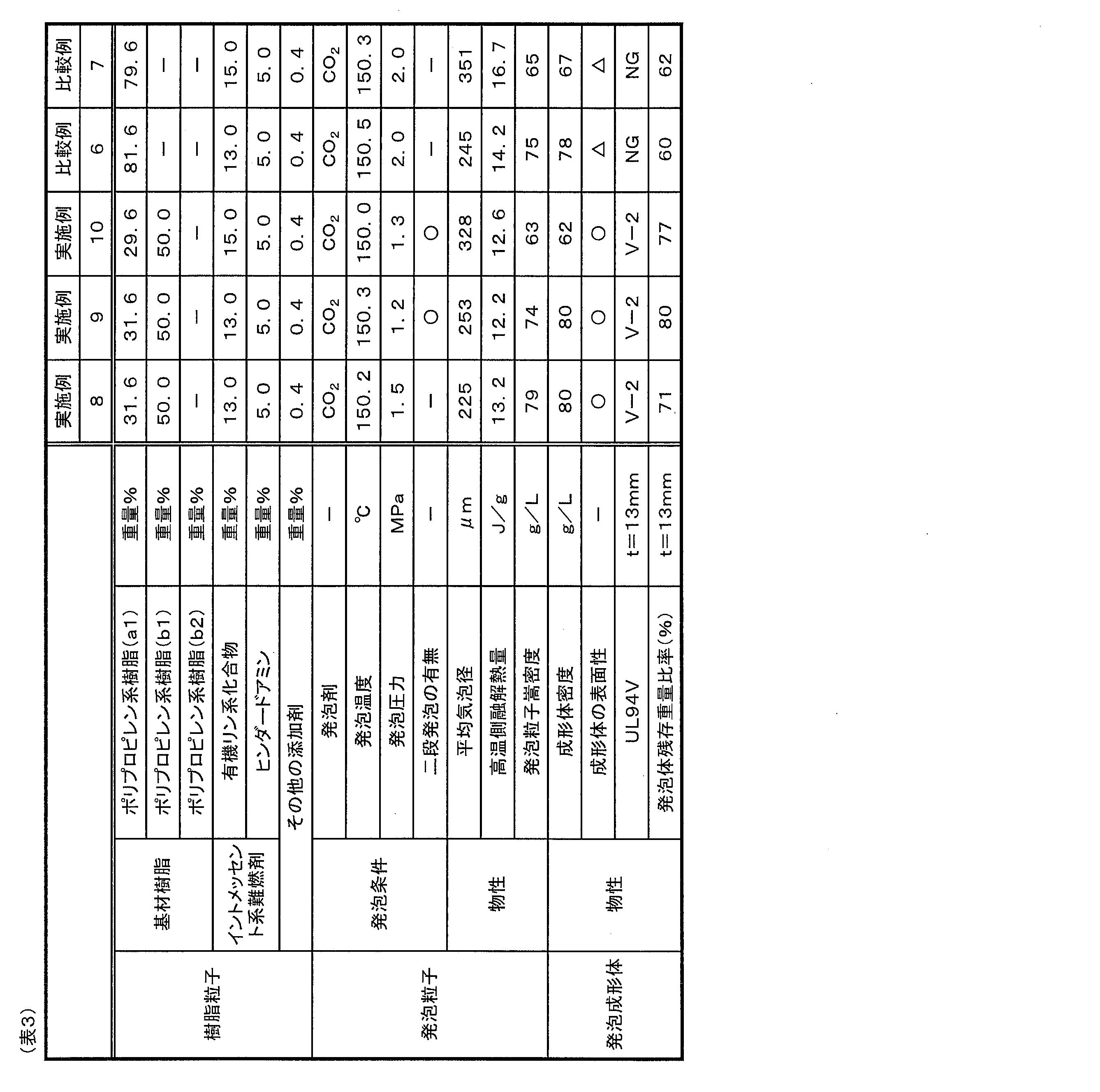

表1~4より、各実施例・比較例において、同等の密度を有する発泡成形体を比較することで、本発泡粒子を型内発泡成形してなる発泡成形体が、優れた難燃性を有することが分かる。具体的には以下の(1)~(4)の通りである:
(1)実施例1および2の発泡成形体と、比較例1の発泡成形体との比較より、比較例1の発泡成形体が、試験試料の厚み(t)が5mmの場合、NG評価となるのに対し、本発泡粒子を型内発泡成形してなる実施例1の発泡成形体はtが5mmの場合であっても、基準V-0を充足しており、また、実施例2の発泡成形体は有機リン系化合物の添加量が13重量%と比較的少ないにもかかわらず、tが5mmの場合であっても、基準V-2を充足している。さらに、実施例1および実施例2の発泡成形体は、ともに残存重量比率も高く、優れた難燃性を有することがわかる;
(2)実施例3の発泡成形体と、比較例2の発泡成形体との比較より、比較例2の発泡成形体が、試験試料の厚み(t)が5mmの場合、NG評価となるのに対し、本発泡粒子を型内発泡成形してなる実施例3の発泡成形体は、成形体密度が167g/Lと比較的軽量であるにもかかわらず、tが5mmの場合であっても、基準V-0を充足しており、また、残存重量比率も高く、優れた難燃性を有することがわかる;
(3)実施例4および5の発泡成形体と、比較例3の発泡成形体との比較より、比較例3の発泡成形体が、tが5mmの場合、NG評価となるのに対し、本発泡粒子を型内発泡成形してなる実施例4および5の発泡成形体は、tが5mmの場合であっても、基準V-2以上を充足しており、また、残存重量比率も高く、優れた難燃性を有することがわかる;
(4)実施例6および7の発泡成形体と、比較例4および5の発泡成形体との比較より、比較例4および5の発泡成形体は、tが13mm、8mmの場合には、V-2評価となり、tが5mmの場合、NG評価となるのに対し、本発泡粒子を型内発泡成形してなる実施例6および7の発泡成形体は、tが13mm、8mmの場合に、基準V-0以上を充足しており、また、残存重量比率も高く、優れた難燃性を有することがわかる;
(5)実施例8~10の発泡成形体と、比較例6および7の発泡成形体との比較より、比較例6および7の発泡成形体は、密度が低いため、tが13mmの場合にもNG評価となるのに対し、実施例8~10の発泡成形体は、密度が80g/L以下と比較的低いにも関わらず、tが13mmの場合に基準V-2を充足できている。このことから、本発泡粒子を型内発泡成形してなる発泡成形体は、通常難燃性を付与することが困難である、密度が比較的低い場合においても、難燃性を発揮できることが分かる。
Claims (15)
- MIが4.00g/10分~15.00g/10分であり、かつ、融点が135℃~155℃であるポリプロピレン系樹脂(a)と、
MIが0.05g/10分~3.00g/10分であり、かつ、融点が135℃~155℃であるポリプロピレン系樹脂(b)と、を含む基材樹脂と、
イントメッセント系難燃剤と、を含むポリプロピレン系樹脂粒子を発泡してなる、ポリプロピレン系発泡粒子。 - 前記ポリプロピレン系樹脂(a)および前記ポリプロピレン系樹脂(b)が、それぞれ、ランダム共重合体である、請求項1に記載のポリプロピレン系発泡粒子。
- 前記基材樹脂100重量%中、前記ポリプロピレン系樹脂(b)を5重量%~80重量%含む、請求項1または2に記載のポリプロピレン系発泡粒子。
- 前記イントメッセント系難燃剤として、有機リン系化合物およびヒンダードアミンを含む、請求項1~3の何れか1項に記載のポリプロピレン系発泡粒子。
- 前記ポリプロピレン系樹脂粒子は、前記ポリプロピレン系樹脂粒子100重量%中、
有機リン系化合物3.0重量%~20.0重量%と、
ヒンダードアミン1.0重量%~10.0重量%と、を含む、請求項4に記載のポリプロピレン系発泡粒子。 - 前記有機リン系化合物は、サイクリックホスホネートである、請求項4または5に記載のポリプロピレン系発泡粒子。
- 前記ポリプロピレン系樹脂(b)の重量平均分子量が、80×104以上である、請求項1~6の何れか1項に記載のポリプロピレン系発泡粒子。
- 前記ポリプロピレン系樹脂(b)が直鎖状のポリプロピレン系樹脂である、請求項1~7のいずれか1項に記載のポリプロピレン系発泡粒子。
- 嵩密度が15g/L~400g/Lである、請求項1~8のいずれか1項に記載のポリプロピレン系発泡粒子。
- 示差走査熱量計法による測定で得られるDSC曲線において、少なくとも2つの融解ピークを有し、かつ、高温側融解熱量が5.0J/g~25.0J/gである、請求項1~9のいずれか1項に記載のポリプロピレン系発泡粒子。
- 前記ポリプロピレン系樹脂(a)および/または前記ポリプロピレン系樹脂(b)がエチレン/プロピレンランダム共重合体である、請求項1~10のいずれか1項に記載のポリプロピレン系発泡粒子。
- 平均気泡径が100μm~600μmである、請求項1~11のいずれか1項に記載のポリプロピレン系発泡粒子。
- 請求項1~12のいずれか1項に記載のポリプロピレン系発泡粒子を型内発泡成形してなる、ポリプロピレン系発泡成形体。
- 嵩密度が15g/L~400g/Lである、請求項13に記載のポリプロピレン系発泡成形体。
- ポリプロピレン系樹脂粒子と、水系分散媒と、発泡剤とを容器中に分散させる分散工程と、
前記分散工程にて得られた分散液を、前記容器内の圧力よりも低圧の領域に放出する放出工程と、を含み、
前記ポリプロピレン系樹脂粒子は、
MIが4.00g/10.00分~15.00g/10分であり、かつ、融点が135℃~155℃であるポリプロピレン系樹脂(a)と、
MIが0.05g/10分~3.00g/10分であり、かつ、融点が135℃~155℃であるポリプロピレン系樹脂(b)と、を含む基材樹脂と、
イントメッセント系難燃剤と、を含む、ポリプロピレン系発泡粒子の製造方法。
Priority Applications (3)
| Application Number | Priority Date | Filing Date | Title |
|---|---|---|---|
| CN202380028484.8A CN118946619A (zh) | 2022-03-25 | 2023-03-06 | 聚丙烯系发泡颗粒和聚丙烯系发泡成型体、以及它们的制造方法 |
| EP23774478.4A EP4502025A4 (en) | 2022-03-25 | 2023-03-06 | POLYPROPYLENE FOAM PARTICLES, POLYPROPYLENE FOAM MOLDED BODY, METHOD FOR PRODUCING POLYPROPYLENE FOAM PARTICLES, AND METHOD FOR PRODUCING POLYPROPYLENE FOAM MOLDED BODY |
| JP2024509936A JPWO2023181879A1 (ja) | 2022-03-25 | 2023-03-06 |
Applications Claiming Priority (2)
| Application Number | Priority Date | Filing Date | Title |
|---|---|---|---|
| JP2022-050567 | 2022-03-25 | ||
| JP2022050567 | 2022-03-25 |
Publications (1)
| Publication Number | Publication Date |
|---|---|
| WO2023181879A1 true WO2023181879A1 (ja) | 2023-09-28 |
Family
ID=88100608
Family Applications (1)
| Application Number | Title | Priority Date | Filing Date |
|---|---|---|---|
| PCT/JP2023/008266 Ceased WO2023181879A1 (ja) | 2022-03-25 | 2023-03-06 | ポリプロピレン系発泡粒子、および、ポリプロピレン系発泡成形体、並びにそれらの製造方法 |
Country Status (4)
| Country | Link |
|---|---|
| EP (1) | EP4502025A4 (ja) |
| JP (1) | JPWO2023181879A1 (ja) |
| CN (1) | CN118946619A (ja) |
| WO (1) | WO2023181879A1 (ja) |
Cited By (2)
| Publication number | Priority date | Publication date | Assignee | Title |
|---|---|---|---|---|
| WO2025115815A1 (ja) * | 2023-11-30 | 2025-06-05 | ジェイエスピー インターナショナル エスエーアールエル | ポリオレフィン系樹脂発泡粒子、該発泡粒子を型内で成形してなる発泡粒子成形体、該発泡粒子の製造方法、及び該発泡粒子の難燃性の判定方法 |
| WO2025135088A1 (ja) * | 2023-12-21 | 2025-06-26 | 株式会社ジェイエスピー | ポリオレフィン系樹脂発泡粒子および発泡粒子成形体 |
Citations (9)
| Publication number | Priority date | Publication date | Assignee | Title |
|---|---|---|---|---|
| FR1503429A (fr) | 1965-12-14 | 1967-11-24 | Ciba Geigy | Procédé de préparation d'esters cycliques de l'acide phosphonique |
| GB1515223A (en) | 1975-07-15 | 1978-06-21 | Ciba Geigy Ag | Flame-proofing of polyester fibres |
| US4174343A (en) | 1978-05-05 | 1979-11-13 | American Cyanamid Company | Pentaerythrityl diphosphonate-ammonium polyphosphate combinations as flame retardants for olefin polymers |
| EP0889085A2 (en) | 1997-06-30 | 1999-01-07 | Ciba SC Holding AG | N,N',N'''-Tris(2,4-bis(1-hydrocarbyloxy-2,2,6,6,-tetramethylpiperidin-4-yl)alkylamino)-s-triazin-6-yl)-3,3'-ethylenediiminodipropylamines, their isomers and bridged derivatives and polymer compositions stabilized therewith |
| WO2010119670A1 (ja) * | 2009-04-15 | 2010-10-21 | 株式会社カネカ | ポリオレフィン系樹脂予備発泡粒子およびポリオレフィン系樹脂予備発泡粒子からなるポリオレフィン系樹脂型内発泡成形体 |
| WO2016052739A1 (ja) | 2014-10-03 | 2016-04-07 | カネカ ベルギー ナムローゼ フェンノートシャップ | ポリオレフィン系樹脂予備発泡粒子および型内発泡成形体、並びにそれらの製造方法 |
| JP2018053232A (ja) * | 2016-04-28 | 2018-04-05 | 中国石油化工股▲ふん▼有限公司 | 難燃性熱可塑性材及びその発泡ビーズ |
| WO2022149538A1 (ja) | 2021-01-08 | 2022-07-14 | 株式会社カネカ | ポリプロピレン系樹脂発泡粒子およびポリプロピレン系樹脂発泡成形体 |
| WO2022203035A1 (ja) * | 2021-03-26 | 2022-09-29 | 株式会社カネカ | ポリプロピレン系発泡粒子、および、ポリプロピレン系発泡成形体、並びにそれらの製造方法 |
Family Cites Families (1)
| Publication number | Priority date | Publication date | Assignee | Title |
|---|---|---|---|---|
| KR100916981B1 (ko) * | 2002-05-13 | 2009-09-14 | 가부시키가이샤 제이에스피 | 폴리프로필렌계 수지 발포 입자 및 이를 사용한 형내 성형체 |
-
2023
- 2023-03-06 JP JP2024509936A patent/JPWO2023181879A1/ja active Pending
- 2023-03-06 WO PCT/JP2023/008266 patent/WO2023181879A1/ja not_active Ceased
- 2023-03-06 EP EP23774478.4A patent/EP4502025A4/en active Pending
- 2023-03-06 CN CN202380028484.8A patent/CN118946619A/zh active Pending
Patent Citations (9)
| Publication number | Priority date | Publication date | Assignee | Title |
|---|---|---|---|---|
| FR1503429A (fr) | 1965-12-14 | 1967-11-24 | Ciba Geigy | Procédé de préparation d'esters cycliques de l'acide phosphonique |
| GB1515223A (en) | 1975-07-15 | 1978-06-21 | Ciba Geigy Ag | Flame-proofing of polyester fibres |
| US4174343A (en) | 1978-05-05 | 1979-11-13 | American Cyanamid Company | Pentaerythrityl diphosphonate-ammonium polyphosphate combinations as flame retardants for olefin polymers |
| EP0889085A2 (en) | 1997-06-30 | 1999-01-07 | Ciba SC Holding AG | N,N',N'''-Tris(2,4-bis(1-hydrocarbyloxy-2,2,6,6,-tetramethylpiperidin-4-yl)alkylamino)-s-triazin-6-yl)-3,3'-ethylenediiminodipropylamines, their isomers and bridged derivatives and polymer compositions stabilized therewith |
| WO2010119670A1 (ja) * | 2009-04-15 | 2010-10-21 | 株式会社カネカ | ポリオレフィン系樹脂予備発泡粒子およびポリオレフィン系樹脂予備発泡粒子からなるポリオレフィン系樹脂型内発泡成形体 |
| WO2016052739A1 (ja) | 2014-10-03 | 2016-04-07 | カネカ ベルギー ナムローゼ フェンノートシャップ | ポリオレフィン系樹脂予備発泡粒子および型内発泡成形体、並びにそれらの製造方法 |
| JP2018053232A (ja) * | 2016-04-28 | 2018-04-05 | 中国石油化工股▲ふん▼有限公司 | 難燃性熱可塑性材及びその発泡ビーズ |
| WO2022149538A1 (ja) | 2021-01-08 | 2022-07-14 | 株式会社カネカ | ポリプロピレン系樹脂発泡粒子およびポリプロピレン系樹脂発泡成形体 |
| WO2022203035A1 (ja) * | 2021-03-26 | 2022-09-29 | 株式会社カネカ | ポリプロピレン系発泡粒子、および、ポリプロピレン系発泡成形体、並びにそれらの製造方法 |
Non-Patent Citations (2)
| Title |
|---|
| no. 191680-81-6 |
| See also references of EP4502025A4 |
Cited By (2)
| Publication number | Priority date | Publication date | Assignee | Title |
|---|---|---|---|---|
| WO2025115815A1 (ja) * | 2023-11-30 | 2025-06-05 | ジェイエスピー インターナショナル エスエーアールエル | ポリオレフィン系樹脂発泡粒子、該発泡粒子を型内で成形してなる発泡粒子成形体、該発泡粒子の製造方法、及び該発泡粒子の難燃性の判定方法 |
| WO2025135088A1 (ja) * | 2023-12-21 | 2025-06-26 | 株式会社ジェイエスピー | ポリオレフィン系樹脂発泡粒子および発泡粒子成形体 |
Also Published As
| Publication number | Publication date |
|---|---|
| JPWO2023181879A1 (ja) | 2023-09-28 |
| EP4502025A1 (en) | 2025-02-05 |
| CN118946619A (zh) | 2024-11-12 |
| EP4502025A4 (en) | 2025-07-23 |
Similar Documents
| Publication | Publication Date | Title |
|---|---|---|
| CN107148441B (zh) | 聚烯烃系树脂预发泡粒子和模内发泡成型体以及它们的制造方法 | |
| EP2420533B1 (en) | Polyolefin resin pre-expanded particles and polyolefin resin in-mold expansion-molded article comprising polyolefin resin pre-expanded particles | |
| EP2743295B1 (en) | Polyolefin resin foam particles and in-mold foaming molded body of same | |
| JP5161663B2 (ja) | 難燃性ポリオレフィン系樹脂予備発泡粒子およびその型内発泡成形体 | |
| WO2023090311A1 (ja) | ポリプロピレン系発泡粒子、および、ポリプロピレン系発泡成形体、並びにそれらの製造方法 | |
| EP4317288B1 (en) | Polypropylene-based foamed particles and polypropylene-based foamed molded article and manufacturing method thereof | |
| WO2023181879A1 (ja) | ポリプロピレン系発泡粒子、および、ポリプロピレン系発泡成形体、並びにそれらの製造方法 | |
| JP5814687B2 (ja) | ポリオレフィン系樹脂発泡粒子とその型内発泡成形体 | |
| JP5080849B2 (ja) | カーボンブラック含有ポリプロピレン系樹脂発泡粒子および該カーボンブラック含有ポリプロピレン系樹脂発泡粒子からなる型内発泡成形体 | |
| JP7817933B2 (ja) | ポリオレフィン系樹脂発泡粒子及びそのポリオレフィン系樹脂発泡成形体 | |
| JP2026063159A (ja) | ポリプロピレン系樹脂発泡粒子、ポリプロピレン系樹脂発泡成形体、およびポリプロピレン系樹脂発泡粒子の製造方法 | |
| WO2024053584A1 (ja) | ポリオレフィン系発泡粒子、および、ポリオレフィン系発泡成形体、並びにそれらの製造方法 | |
| JP6816288B2 (ja) | ポリオレフィン系難燃性発泡体製造用樹脂組成物およびこれから形成された難燃性発泡体 | |
| JP7853280B2 (ja) | ポリプロピレン系発泡粒子、および、ポリプロピレン系発泡成形体、並びにそれらの製造方法 | |
| JP2024144291A (ja) | ポリオレフィン系樹脂発泡粒子およびその製造方法 | |
| JP2025099488A (ja) | ポリオレフィン系樹脂発泡粒子 |
Legal Events
| Date | Code | Title | Description |
|---|---|---|---|
| 121 | Ep: the epo has been informed by wipo that ep was designated in this application |
Ref document number: 23774478 Country of ref document: EP Kind code of ref document: A1 |
|
| ENP | Entry into the national phase |
Ref document number: 2024509936 Country of ref document: JP Kind code of ref document: A |
|
| WWE | Wipo information: entry into national phase |
Ref document number: 202380028484.8 Country of ref document: CN |
|
| WWE | Wipo information: entry into national phase |
Ref document number: 2023774478 Country of ref document: EP |
|
| NENP | Non-entry into the national phase |
Ref country code: DE |
|
| ENP | Entry into the national phase |
Ref document number: 2023774478 Country of ref document: EP Effective date: 20241025 |