WO2023188968A1 - 多官能(メタ)アクリル酸チオエステル組成物、硬化性組成物、硬化物、成形体、光学材料及び多官能(メタ)アクリル酸チオエステル組成物の製造方法 - Google Patents
多官能(メタ)アクリル酸チオエステル組成物、硬化性組成物、硬化物、成形体、光学材料及び多官能(メタ)アクリル酸チオエステル組成物の製造方法 Download PDFInfo
- Publication number
- WO2023188968A1 WO2023188968A1 PCT/JP2023/005701 JP2023005701W WO2023188968A1 WO 2023188968 A1 WO2023188968 A1 WO 2023188968A1 JP 2023005701 W JP2023005701 W JP 2023005701W WO 2023188968 A1 WO2023188968 A1 WO 2023188968A1
- Authority
- WO
- WIPO (PCT)
- Prior art keywords
- meth
- polyfunctional
- bis
- cured product
- curable composition
- Prior art date
- Legal status (The legal status is an assumption and is not a legal conclusion. Google has not performed a legal analysis and makes no representation as to the accuracy of the status listed.)
- Ceased
Links
Classifications
-
- C—CHEMISTRY; METALLURGY
- C08—ORGANIC MACROMOLECULAR COMPOUNDS; THEIR PREPARATION OR CHEMICAL WORKING-UP; COMPOSITIONS BASED THEREON
- C08F—MACROMOLECULAR COMPOUNDS OBTAINED BY REACTIONS ONLY INVOLVING CARBON-TO-CARBON UNSATURATED BONDS
- C08F28/00—Homopolymers and copolymers of compounds having one or more unsaturated aliphatic radicals, each having only one carbon-to-carbon double bond, and at least one being terminated by a bond to sulfur or by a heterocyclic ring containing sulfur
- C08F28/02—Homopolymers and copolymers of compounds having one or more unsaturated aliphatic radicals, each having only one carbon-to-carbon double bond, and at least one being terminated by a bond to sulfur or by a heterocyclic ring containing sulfur by a bond to sulfur
-
- B—PERFORMING OPERATIONS; TRANSPORTING
- B32—LAYERED PRODUCTS
- B32B—LAYERED PRODUCTS, i.e. PRODUCTS BUILT-UP OF STRATA OF FLAT OR NON-FLAT, e.g. CELLULAR OR HONEYCOMB, FORM
- B32B27/00—Layered products comprising a layer of synthetic resin
- B32B27/30—Layered products comprising a layer of synthetic resin comprising vinyl (co)polymers; comprising acrylic (co)polymers
-
- B—PERFORMING OPERATIONS; TRANSPORTING
- B32—LAYERED PRODUCTS
- B32B—LAYERED PRODUCTS, i.e. PRODUCTS BUILT-UP OF STRATA OF FLAT OR NON-FLAT, e.g. CELLULAR OR HONEYCOMB, FORM
- B32B17/00—Layered products essentially comprising sheet glass, or glass, slag, or like fibres
- B32B17/06—Layered products essentially comprising sheet glass, or glass, slag, or like fibres comprising glass as the main or only constituent of a layer, next to another layer of a specific material
- B32B17/10—Layered products essentially comprising sheet glass, or glass, slag, or like fibres comprising glass as the main or only constituent of a layer, next to another layer of a specific material of synthetic resin
-
- C—CHEMISTRY; METALLURGY
- C07—ORGANIC CHEMISTRY
- C07C—ACYCLIC OR CARBOCYCLIC COMPOUNDS
- C07C327/00—Thiocarboxylic acids
- C07C327/20—Esters of monothiocarboxylic acids
- C07C327/22—Esters of monothiocarboxylic acids having carbon atoms of esterified thiocarboxyl groups bound to hydrogen atoms or to acyclic carbon atoms
-
- C—CHEMISTRY; METALLURGY
- C08—ORGANIC MACROMOLECULAR COMPOUNDS; THEIR PREPARATION OR CHEMICAL WORKING-UP; COMPOSITIONS BASED THEREON
- C08F—MACROMOLECULAR COMPOUNDS OBTAINED BY REACTIONS ONLY INVOLVING CARBON-TO-CARBON UNSATURATED BONDS
- C08F222/00—Copolymers of compounds having one or more unsaturated aliphatic radicals, each having only one carbon-to-carbon double bond, and at least one being terminated by a carboxyl radical and containing at least one other carboxyl radical in the molecule; Salts, anhydrides, esters, amides, imides, or nitriles thereof
- C08F222/10—Esters
- C08F222/1006—Esters of polyhydric alcohols or polyhydric phenols
- C08F222/102—Esters of polyhydric alcohols or polyhydric phenols of dialcohols, e.g. ethylene glycol di(meth)acrylate or 1,4-butanediol dimethacrylate
- C08F222/1025—Esters of polyhydric alcohols or polyhydric phenols of dialcohols, e.g. ethylene glycol di(meth)acrylate or 1,4-butanediol dimethacrylate of aromatic dialcohols
-
- C—CHEMISTRY; METALLURGY
- C08—ORGANIC MACROMOLECULAR COMPOUNDS; THEIR PREPARATION OR CHEMICAL WORKING-UP; COMPOSITIONS BASED THEREON
- C08F—MACROMOLECULAR COMPOUNDS OBTAINED BY REACTIONS ONLY INVOLVING CARBON-TO-CARBON UNSATURATED BONDS
- C08F222/00—Copolymers of compounds having one or more unsaturated aliphatic radicals, each having only one carbon-to-carbon double bond, and at least one being terminated by a carboxyl radical and containing at least one other carboxyl radical in the molecule; Salts, anhydrides, esters, amides, imides, or nitriles thereof
- C08F222/10—Esters
- C08F222/12—Esters of phenols or saturated alcohols
- C08F222/24—Esters containing sulfur
-
- C—CHEMISTRY; METALLURGY
- C08—ORGANIC MACROMOLECULAR COMPOUNDS; THEIR PREPARATION OR CHEMICAL WORKING-UP; COMPOSITIONS BASED THEREON
- C08F—MACROMOLECULAR COMPOUNDS OBTAINED BY REACTIONS ONLY INVOLVING CARBON-TO-CARBON UNSATURATED BONDS
- C08F290/00—Macromolecular compounds obtained by polymerising monomers on to polymers modified by introduction of aliphatic unsaturated end or side groups
- C08F290/02—Macromolecular compounds obtained by polymerising monomers on to polymers modified by introduction of aliphatic unsaturated end or side groups on to polymers modified by introduction of unsaturated end groups
- C08F290/06—Polymers provided for in subclass C08G
-
- C—CHEMISTRY; METALLURGY
- C08—ORGANIC MACROMOLECULAR COMPOUNDS; THEIR PREPARATION OR CHEMICAL WORKING-UP; COMPOSITIONS BASED THEREON
- C08F—MACROMOLECULAR COMPOUNDS OBTAINED BY REACTIONS ONLY INVOLVING CARBON-TO-CARBON UNSATURATED BONDS
- C08F290/00—Macromolecular compounds obtained by polymerising monomers on to polymers modified by introduction of aliphatic unsaturated end or side groups
- C08F290/08—Macromolecular compounds obtained by polymerising monomers on to polymers modified by introduction of aliphatic unsaturated end or side groups on to polymers modified by introduction of unsaturated side groups
- C08F290/14—Polymers provided for in subclass C08G
-
- C—CHEMISTRY; METALLURGY
- C08—ORGANIC MACROMOLECULAR COMPOUNDS; THEIR PREPARATION OR CHEMICAL WORKING-UP; COMPOSITIONS BASED THEREON
- C08G—MACROMOLECULAR COMPOUNDS OBTAINED OTHERWISE THAN BY REACTIONS ONLY INVOLVING UNSATURATED CARBON-TO-CARBON BONDS
- C08G75/00—Macromolecular compounds obtained by reactions forming a linkage containing sulfur with or without nitrogen, oxygen, or carbon in the main chain of the macromolecule
- C08G75/02—Polythioethers
-
- C—CHEMISTRY; METALLURGY
- C08—ORGANIC MACROMOLECULAR COMPOUNDS; THEIR PREPARATION OR CHEMICAL WORKING-UP; COMPOSITIONS BASED THEREON
- C08G—MACROMOLECULAR COMPOUNDS OBTAINED OTHERWISE THAN BY REACTIONS ONLY INVOLVING UNSATURATED CARBON-TO-CARBON BONDS
- C08G75/00—Macromolecular compounds obtained by reactions forming a linkage containing sulfur with or without nitrogen, oxygen, or carbon in the main chain of the macromolecule
- C08G75/02—Polythioethers
- C08G75/04—Polythioethers from mercapto compounds or metallic derivatives thereof
- C08G75/045—Polythioethers from mercapto compounds or metallic derivatives thereof from mercapto compounds and unsaturated compounds
-
- C—CHEMISTRY; METALLURGY
- C08—ORGANIC MACROMOLECULAR COMPOUNDS; THEIR PREPARATION OR CHEMICAL WORKING-UP; COMPOSITIONS BASED THEREON
- C08G—MACROMOLECULAR COMPOUNDS OBTAINED OTHERWISE THAN BY REACTIONS ONLY INVOLVING UNSATURATED CARBON-TO-CARBON BONDS
- C08G75/00—Macromolecular compounds obtained by reactions forming a linkage containing sulfur with or without nitrogen, oxygen, or carbon in the main chain of the macromolecule
- C08G75/26—Polythioesters
-
- C—CHEMISTRY; METALLURGY
- C08—ORGANIC MACROMOLECULAR COMPOUNDS; THEIR PREPARATION OR CHEMICAL WORKING-UP; COMPOSITIONS BASED THEREON
- C08L—COMPOSITIONS OF MACROMOLECULAR COMPOUNDS
- C08L81/00—Compositions of macromolecular compounds obtained by reactions forming in the main chain of the macromolecule a linkage containing sulfur with or without nitrogen, oxygen or carbon only; Compositions of polysulfones; Compositions of derivatives of such polymers
- C08L81/02—Polythioethers; Polythioether-ethers
-
- G—PHYSICS
- G02—OPTICS
- G02B—OPTICAL ELEMENTS, SYSTEMS OR APPARATUS
- G02B1/00—Optical elements characterised by the material of which they are made; Optical coatings for optical elements
- G02B1/04—Optical elements characterised by the material of which they are made; Optical coatings for optical elements made of organic materials, e.g. plastics
-
- G—PHYSICS
- G02—OPTICS
- G02B—OPTICAL ELEMENTS, SYSTEMS OR APPARATUS
- G02B1/00—Optical elements characterised by the material of which they are made; Optical coatings for optical elements
- G02B1/04—Optical elements characterised by the material of which they are made; Optical coatings for optical elements made of organic materials, e.g. plastics
- G02B1/041—Lenses
-
- B—PERFORMING OPERATIONS; TRANSPORTING
- B32—LAYERED PRODUCTS
- B32B—LAYERED PRODUCTS, i.e. PRODUCTS BUILT-UP OF STRATA OF FLAT OR NON-FLAT, e.g. CELLULAR OR HONEYCOMB, FORM
- B32B2551/00—Optical elements
Definitions
- the present invention relates to a polyfunctional (meth)acrylic acid thioester composition, a curable composition, a cured product, a molded article, an optical material, and a method for producing a polyfunctional (meth)acrylic acid thioester composition.
- glass has been suitably used as an optical material because of its diverse refractive index and small fluctuations due to temperature and humidity.
- cured resin products have come to be used.
- wafer-level lenses are increasingly being used in camera lens modules installed in smartphones to reduce size and height.
- wafer level lenses there is a demand for cured resins that have a high refractive index and excellent heat resistance.
- hybrid wafer level lenses in which a resin lens is formed on a glass substrate, the curing shrinkage rate when the composition is cured is low in order to suppress peeling between the glass substrate and the resin lens due to residual stress. That is what is required.
- a method for obtaining a cured resin product with a higher refractive index a method using a transparent material obtained by photocuring a composition containing thio(meth)acrylate etc. is reported in Patent Document 1 and Patent Document 2. has been done.
- the present invention was made in view of the above circumstances, and provides a polyfunctional (meth)acrylic acid thioester composition and a polyfunctional (meth)acrylic acid thioester composition capable of obtaining a cured product with an improved performance balance of high refractive index, low curing shrinkage, and glass adhesion.
- the present invention provides a curable composition, and a cured product, molded product, and optical material that have an improved performance balance of high refractive index, low curing shrinkage, and glass adhesion.
- the present inventors have made extensive studies to solve the above problems. As a result, they discovered that by using a specific polyfunctional (meth)acrylic acid thioester compound, the performance balance of high refractive index, low curing shrinkage, and glass adhesion of the resulting cured product could be improved, and the present invention was completed.
- Ta the following polyfunctional (meth)acrylic acid thioester compositions, curable compositions, cured products, molded articles, optical materials, and methods for producing polyfunctional (meth)acrylic acid thioester compositions are provided. Ru.
- a polyfunctional (meth)acrylic acid thioester composition comprising a polyfunctional (meth)acrylic acid thioester compound (A) represented by the following formula (1).
- A polyfunctional (meth)acrylic acid thioester compound represented by the following formula (1).
- n is an integer of 5 or more, and X represents an alkylene group having 1 to 4 carbon atoms in which any methylene group may be substituted with a carbonyl group;
- the hydrogen atom of is substituted with the structure of formula (2) below, and R 1 and R 2 each independently represent a hydrogen atom or a methyl group.
- R 3 represents a hydrogen atom or a methyl group, each of the plurality of R 3s may be the same or different, and W represents an alkylene group having 1 to 4 carbon atoms, o is an integer greater than or equal to 1.
- the polyfunctional (meth)acrylic acid thioester compound (A) contains at least one selected from the group consisting of a compound represented by the following formula (3) and a compound represented by the following formula (4), [1] Or the polyfunctional (meth)acrylic acid thioester composition described in [2].
- m and n are each independently an integer of 2 or more
- X and Y are each independently a hydrogen atom substituted with the structure of formula (2) above. represents an alkylene group having 1 or more and 4 or less carbon atoms, which may be the same or different
- R 1 and R 2 each independently represent a hydrogen atom or a methyl group.
- a curable composition comprising the polyfunctional (meth)acrylic acid thioester composition according to any one of [1] to [3] above.
- Z 1 and Z 2 each independently represent an aromatic carbon ring or an alkylene group, and any hydrogen atom may be substituted with an alkyl group or an alkoxy group
- Z 3 and Z 4 each independently represents an aromatic carbocycle or an alkyl group, any hydrogen atom may be substituted with an alkyl group or an alkoxy group
- R 1 and R 3 each independently have 1 to 10 carbon atoms.
- curable composition represents an alkylene group
- R 2 and R 4 each independently represent a hydrogen atom or a methyl group
- R 5 and R 6 each independently represent an alkyl group
- m and n each independently represent 0 or more Indicates an integer
- o, p, q, and r are integers greater than or equal to 0 that satisfy the relationships o+q ⁇ 4 and p+r ⁇ 4, respectively.
- the specific gravity of the curable composition measured using a pycnometer in accordance with JIS Z 8804:2012 is d1
- the specific gravity of a 250 ⁇ m thick test piece made of a cured product of the curable composition is d2.
- the curable composition has a curing shrinkage rate of 9.0% or less, expressed as (1-d 1 /d 2 ) ⁇ 100.
- the test piece is heated in an oven set at 125°C in an air atmosphere for 168 hours, and when the light transmittance at a wavelength of 400 nm of the test piece after heat treatment is T 2 , (T 1 - T 2 )/T
- the refractive index (nD) of the test piece at the D line (589.3 nm) is 1.600 or more. Cured product described in Crab.
- a polyfunctional (meth)acrylic acid thioester composition and a curable composition capable of obtaining a cured product with an improved performance balance of high refractive index, low curing shrinkage, and glass adhesion, and a high It is possible to provide a cured product, molded product, and optical material with improved performance balance among refractive index, low curing shrinkage, and glass adhesion.
- the present invention will be described below based on embodiments.
- “A to B” indicating a numerical range represents a range from A to B, unless otherwise specified.
- the expression “(meth)acrylic” in this specification indicates at least one type selected from the group consisting of acrylic and methacryl, and includes similar compounds such as "thio(meth)acrylate” and "(meth)acrylate”. The same applies to notation.
- the polyfunctional (meth)acrylic acid thioester composition of the present invention comprises a polyfunctional (meth)acrylic acid thioester compound (A) represented by the following formula (1) (hereinafter also simply referred to as "compound (A)").
- A) polyfunctional (meth)acrylic acid thioester compound represented by the following formula (1)
- the polyfunctional (meth)acrylic acid thioester composition according to the present invention may contain only one type of polyfunctional (meth)acrylic acid thioester compound (A), or may contain two or more types of polyfunctional (meth)acrylic acid thioester compound (A). A) may also be included.
- polyfunctional (meth)acrylic acid thioester composition contains only one type of polyfunctional (meth)acrylic acid thioester compound (A), it is also referred to as a polyfunctional (meth)acrylic acid thioester composition. .
- n is an integer of 5 or more
- X represents an alkylene group having 1 to 4 carbon atoms in which any methylene group may be substituted with a carbonyl group
- a hydrogen atom is substituted with the structure of the following formula (2), and R 1 and R 2 each independently represent a hydrogen atom or a methyl group.
- R 3 represents a hydrogen atom or a methyl group, each of the plurality of R 3s may be the same or different, W represents an alkylene group having 1 to 4 carbon atoms, and o is an integer greater than or equal to 1.
- n is an integer of 5 or more, preferably an integer of 6 or more, more preferably an integer of 7 or more, and preferably an integer of 20 or less, more preferably an integer of 15 or less. , more preferably an integer of 12 or less, still more preferably an integer of 10 or less.
- X is an alkylene group having 1 to 4 carbon atoms, more preferably an alkylene group having 2 to 4 carbon atoms, and even more preferably an alkylene group having 1 to 4 carbon atoms, in which any methylene group may be substituted with a carbonyl group.
- the number of alkylene groups substituted with the structure of the formula (2) in X is preferably 1 or more and 4 or less, more preferably 1 or more and 3 or less, and even more preferably 1 or 2. , more preferably 2.
- the number of carbonyl groups in X is preferably 1 or more and 4 or less, more preferably 1 or more and 3 or less, and even more preferably 1 or 2.
- W is an alkylene group having 1 to 4 carbon atoms, preferably an alkylene group having 1 to 3 carbon atoms, more preferably an alkylene group having 1 or 2 carbon atoms, and even more preferably a carbon represents an alkylene group of the number 1, and o is an integer of 1 or more, preferably an integer of 1 or more and 4 or less, more preferably an integer of 1 or more and 3 or less, still more preferably 1 or 2, and even more preferably 1. .
- Compound (A) is a compound represented by the following formula (3) and a compound represented by the following formula (4) from the viewpoint of further improving the performance balance of high refractive index, low curing shrinkage, and glass adhesion of the obtained cured product. It is preferable to include at least one selected from the group consisting of compounds.
- m and n are each independently an integer of 2 or more
- X and Y are each independently any hydrogen atom substituted with the structure of the above formula (2).
- R 1 and R 2 each independently represent a hydrogen atom or a methyl group. .
- m and n are each independently an integer of 2 or more, preferably an integer of 2 or more and 6 or less, more preferably an integer of 2 or more and 5 or less, and even more preferably 2. It is an integer greater than or equal to 3 and less than or equal to 3, and more preferably 3.
- X and Y are each independently an alkylene group having 2 or more and 4 or less carbon atoms, in which any hydrogen atom may be substituted with the structure of the above formula (2). , preferably an alkylene group having 2 or more and 3 or less carbon atoms, in which any hydrogen atom may be substituted with the structure of formula (2) above, more preferably any hydrogen atom having the structure of formula (2) above.
- the number of alkylene groups substituted with the structure of the formula (2) in X and Y is preferably 1 or more and 4 or less, more preferably 1 or more and 3 or less, More preferably 1 or 2, still more preferably 2.
- compound (A) contains at least one selected from the group consisting of the following compounds, from the viewpoint of further improving the performance balance of high refractive index, low curing shrinkage, and glass adhesion of the obtained cured product. .
- the weight average molecular weight of the polyfunctional (meth)acrylic acid thioester composition according to the present invention is preferably 1000 from the viewpoint of further improving the performance balance of high refractive index, low cure shrinkage, and glass adhesion of the obtained cured product. Above, it is more preferably 1,500 or more, and preferably 100,000 or less, more preferably 50,000 or less, still more preferably 20,000 or less, still more preferably 10,000 or less, still more preferably 5,000 or less.
- the content of compound (A) in the polyfunctional (meth)acrylic acid thioester composition according to the present invention is determined in the cured product obtained when the entire polyfunctional (meth)acrylic acid thioester composition is 100% by mass. From the viewpoint of further improving the performance balance of high refractive index, low curing shrinkage, and glass adhesion, preferably 70% by mass or more, more preferably 80% by mass or more, still more preferably 90% by mass or more, and even more preferably 95% by mass. % or more, and preferably 100% by mass or less.
- polyfunctional (meth)acrylic acid thioester composition for example, 0.5 equivalent or more and 0.9 equivalent or less of thiol groups out of all the thiol groups in the polythiol compound are functional groups represented by the following structural formula. It can be produced by a production method including a step of converting the compound into a polyfunctional (meth)acrylic acid thioester compound, and then subjecting the obtained compound to a ⁇ -elimination reaction and an enethiol reaction to synthesize a polyfunctional (meth)acrylic acid thioester compound.
- the thiol group in the polythiol compound is represented by the following structural formula. can be converted into a functional group.
- the ⁇ -elimination reaction and the enethiol reaction can be carried out by known methods.
- X represents a fluorine atom, a chlorine atom, a bromine atom, or an iodine atom, preferably a chlorine atom
- R represents a hydrogen atom or a methyl group.
- the polyfunctional (meth)acrylic acid thioester composition according to the present invention can also be produced by a production method that includes a step of reacting a polythiol compound with a polythio(meth)acrylate compound by an enethiol reaction. More specifically, as in Synthesis Example 2 described below, a polyfunctional (meth)acrylic acid thioester composition can be obtained by reacting a polythio(meth)acrylate compound and a polythiol compound by an enethiol reaction. The enethiol reaction can be carried out by a known method.
- the curable composition according to the present invention includes the polyfunctional (meth)acrylic acid thioester composition according to the present invention described above. According to the curable composition according to the present invention, it is possible to obtain a cured product, a molded product, and an optical material that have an improved performance balance of high refractive index, low curing shrinkage, and glass adhesion.
- the polyfunctional (meth)acrylic acid thioester composition is the polyfunctional (meth)acrylic acid thioester composition according to the present invention described above.
- the content of the polyfunctional (meth)acrylic acid thioester composition in the curable composition according to the present invention is determined based on 100 parts by mass of the curable composition according to the present invention.
- the curable composition according to the present invention contains a compound (B) ( (hereinafter also simply referred to as “compound (B)").
- Z 1 and Z 2 each independently represent an aromatic carbocyclic ring or an alkylene group, and any hydrogen atom may be substituted with an alkyl group or an alkoxy group
- Z 3 and Z 4 each independently represents an aromatic carbocycle or an alkyl group, any hydrogen atom may be substituted with an alkyl group or an alkoxy group
- R 1 and R 3 each independently represent a carbon number of 1 to 10.
- R 2 and R 4 each independently represent a hydrogen atom or a methyl group
- R 5 and R 6 each independently represent an alkyl group
- m and n each independently represent an integer of 0 or more
- o, p, q, and r are integers of 0 or more that satisfy the relationships o+q ⁇ 4 and p+r ⁇ 4, respectively.
- Z 1 and Z 2 each independently represent an aromatic carbon ring or an alkylene group, and any hydrogen atom may be substituted with an alkyl group or an alkoxy group.
- Z 1 and Z 2 are each independently preferably a benzene ring, a naphthalene ring, or an alkylene group having 1 to 4 carbon atoms, more preferably a benzene ring or an alkylene group having 1 to 3 carbon atoms.
- Z 3 and Z 4 each independently represent an aromatic carbon ring or an alkyl group, and any hydrogen atom may be substituted with an alkyl group or an alkoxy group.
- Z 3 and Z 4 are each independently preferably an aromatic carbocyclic ring, more preferably a benzene ring or a naphthalene ring, and still more preferably a naphthalene ring.
- R 1 and R 3 each independently represent an alkylene group having 1 or more and 10 or less carbon atoms.
- R 1 and R 3 are each independently preferably an alkylene group having 1 to 4 carbon atoms, more preferably an alkylene group having 1 to 3 carbon atoms, still more preferably an alkylene group having 2 to 3 carbon atoms, More preferred is an alkylene group having 2 carbon atoms.
- R 2 and R 4 each independently represent a hydrogen atom or a methyl group.
- R 2 and R 4 are each independently preferably a hydrogen atom.
- R 5 and R 6 each independently represent an alkyl group.
- R 5 and R 6 are each independently preferably an alkyl group having 1 to 4 carbon atoms, more preferably an alkyl group having 1 or 2 carbon atoms, and still more preferably an alkyl group having 1 carbon number.
- m and n each independently represent an integer of 0 or more.
- m and n are each independently preferably an integer of 0 or more and 4 or less, more preferably an integer of 0 or more and 2 or less, still more preferably 0 or 1, and still more preferably 1.
- o, p, q, and r are integers of 0 or more that satisfy the relationships o+q ⁇ 4 and p+r ⁇ 4, respectively.
- q and r are each independently preferably an integer of 0 or more and 2 or less, more preferably 0 or 1, and even more preferably 0.
- o and p are each independently preferably an integer of 0 or more and 2 or less, more preferably 0 or 1, and even more preferably 0.
- the compound (B) is preferably Z 1 and Z 2 is a benzene ring, naphthalene ring, or alkylene group having 1 to 4 carbon atoms, Z 3 and Z 4 are benzene rings or naphthalene rings, R 1 and R 3 are alkylene groups having 1 to 4 carbon atoms, R 2 and A compound in which R 4 is a hydrogen atom or a methyl group, m and n are integers of 0 to 4, q and r are 0 or 1, and o and p are 0, more preferably a compound represented by the above formula (5)
- Z 1 and Z 2 are benzene rings or alkylene groups having 1 to 3 carbon atoms
- Z 3 and Z 4 are naphthalene rings
- R 1 and R 3 are alkylene groups having 1 to 3 carbon atoms
- 9,9-bis(4-(meth)acryloyloxyphenyl)fluorene is used from the viewpoint of further improving the performance balance of high refractive index, low curing shrinkage, and glass adhesion of the obtained cured product.
- the content of compound (B) in the curable composition according to the present invention is determined based on 100 parts by mass of the curable composition according to the present invention, and the resulting cured product has a high refractive index, a low Abbe number, and a low curing shrinkage.
- fluorene derivative diols examples include BPEF (bisphenoxyethanol fluorene) and BPF (bisphenol fluorene) manufactured by Osaka Gas Chemical Co., Ltd. Furthermore, 9,9-bis(2-(meth)acryloyloxyethyl)-2,7-bis(naphth-2-yl)fluorene (DNEOA) can be synthesized according to the following synthesis scheme.
- BPEF bisphenoxyethanol fluorene
- BPF bisphenol fluorene
- DNEOA 9,9-bis(2-(meth)acryloyloxyethyl)-2,7-bis(naphth-2-yl)fluorene
- the present invention is measured using an E-type viscometer at a rotation speed of 2.5 rpm.
- the viscosity of the curable composition at 25° C. is preferably 100 mPa ⁇ s or more, more preferably 500 mPa ⁇ s or more, still more preferably 1000 mPa ⁇ s or more, still more preferably 1500 mPa ⁇ s or more, and preferably 10000 mPa ⁇ s or more.
- s or less more preferably 8000 mPa ⁇ s or less, still more preferably 6500 mPa ⁇ s or less, still more preferably 5000 mPa ⁇ s or less, still more preferably 3500 mPa ⁇ s or less.
- the curable composition according to the present invention may contain components other than the polyfunctional (meth)acrylic acid thioester composition and compound (B).
- Other components include, for example, polymerization initiators, ultraviolet absorbers, resin modifiers, internal mold release agents, silane coupling agents, antioxidants, light stabilizers, processing stabilizers, bluing agents, and polymerized metals.
- Deactivating agent flame retardant, lubricant, antistatic agent, heat ray shielding agent, fluorescent dye (including optical brightener), pigment, light scattering agent, reinforcing filler, surfactant, antibacterial agent, plasticizer, compatibilizer agents, other resins, and elastomers.
- the curable composition according to the present invention preferably contains a polymerization initiator from the viewpoint of further improving curability. Moreover, the curable composition according to the present invention preferably further contains at least one selected from the group consisting of a silane coupling agent, an antioxidant, an ultraviolet absorber, and a light stabilizer.
- the curable composition according to the present invention preferably contains a polymerization initiator from the viewpoint of further improving the performance balance of high refractive index, low curing shrinkage, and glass adhesion of the resulting cured product.
- a polymerization initiator for example, a thermal radical polymerization initiator, a photoradical polymerization initiator, or a combination thereof can be used.
- thermal radical polymerization initiators include dicumyl peroxide, t-butylcumyl peroxide, 2,5-bis(t-butylperoxy)2,5-dimethylhexane, and 2,5-bis(t-butylperoxy).
- Dialkyl peroxides such as oxy)2,5-dimethylhexyne-3, di-t-butyl peroxide, isopropylcumyl-t-butyl peroxide, and bis( ⁇ -t-butylperoxyisopropyl)benzene; 1 , 1-bis(t-butylperoxy)cyclohexane, 1,1-bis(t-butylperoxy)3,3,5-trimethylcyclohexane, 1,1-bis(t-butylperoxy)cyclododecane, n -Butyl-4,4-bis(t-butylperoxy)valerate, Ethyl-3,3-bis(t-butylperoxy)butyrate, 3,3,6,6,9,9-hexamethyl-1,2 , 4,5-tetraoxycyclononane, and other peroxyketals; bis(t-butylperoxy)isophthalate, t-butylperoxybenzo
- photoradical polymerization initiator examples include benzoin alkyl ether, benzyl dimethyl ketal, 1-hydroxycyclohexylphenyl ketone, 2-hydroxy-2-methyl-1-phenylpropan-1-one, benzophenone, methylbenzoyl formate, and isopropyl.
- examples include thioxanthone and mixtures of two or more thereof.
- a sensitizer can also be used together with these photoradical polymerization initiators.
- the sensitizer examples include carbonyl compounds such as anthraquinone, 1,2-naphthoquinone, 1,4-naphthoquinone, benzanthrone, p,p'-tetramethyldiaminobenzophenone, and chloranil; nitrobenzene, p-dinitrobenzene, 2- Nitro compounds such as nitrofluorene; aromatic hydrocarbons such as anthracene and chrysene; sulfur compounds such as diphenyl disulfide; nitroaniline, 2-chloro-4-nitroaniline, 5-nitro-2-aminotoluene, tetracyanoethylene, etc. Examples include nitrogen compounds.
- the content of the polymerization initiator in the curable composition according to the present invention is 100 parts by mass of the total amount of the polyfunctional (meth)acrylic acid thioester composition and compound (B) in the curable composition according to the present invention.
- a 0.1 part by mass or more more preferably 0.5 part by mass or more, More preferably 1.0 parts by mass or more, still more preferably 1.5 parts by mass or more, still more preferably 2.0 parts by mass or more, even more preferably 2.5 parts by mass or more, and preferably 10 parts by mass or less, and more.
- it is 8.0 parts by mass or less, more preferably 5.0 parts by mass or less, still more preferably 4.0 parts by mass or less.
- the curable composition according to the present invention preferably contains a silane coupling agent from the viewpoint of further improving the performance balance of high refractive index, low curing shrinkage, and glass adhesion of the resulting cured product.
- the silane coupling agent include vinyltrimethoxysilane, vinyltriethoxysilane, 2-(3,4-epoxycyclohexyl)ethyltrimethoxysilane, 3-glycidoxypropylmethyldimethoxysilane, 3-glycidoxypropyl trimethoxysilane, 3-glycidoxypropylmethyldiethoxysilane, 3-glycidoxypropyltriethoxysilane, p-styryltrimethoxysilane, 3-methacryloxypropylmethyldimethoxysilane, 3-methacryloxypropyltrimethoxysilane, 3-methacryloxypropyltriethoxysilane, 3-acryloxypropyltrimethoxysilane, N-2-
- the content of the silane coupling agent in the curable composition according to the present invention is the total amount of the polyfunctional (meth)acrylic acid thioester composition and compound (B) in the curable composition according to the present invention.
- more preferably 0.1 parts by mass or more still more preferably 0.5 parts by mass or more, and preferably 10 parts by mass or less, more preferably 5.0 parts by mass or less, still more preferably 3.0 parts by mass or less, More preferably, it is 1.5 parts by mass or less.
- the curable composition according to the present invention preferably contains an ultraviolet absorber from the viewpoint of further improving ultraviolet resistance.
- the ultraviolet absorber include benzophenone ultraviolet absorbers, benzotriazole ultraviolet absorbers, triazine ultraviolet absorbers, and benzoxazine ultraviolet absorbers.
- benzophenone ultraviolet absorbers include 4-methoxy-2-hydroxybenzophenone (molecular weight 228), 4-methoxy-2-hydroxybenzophenone-5-sulfonic acid (molecular weight 308), and 2,4-dihydroxybenzophenone (molecular weight 214).
- examples of benzotriazole-based ultraviolet absorbers include 2-(2H-benzotriazol-2-yl)-p-cresol (molecular weight 225), 2-(2H-benzotriazol-2-yl)-4-6 -bis(1-methyl-1-phenylethyl)phenol (molecular weight 448), 2-[5-chloro(2H)-benzotriazol-2-yl]-4-methyl-6-(tert-butyl)phenol (molecular weight 316), 2,4-di-tert-butyl-6-(5-chloro-2H-1,2,3-benzotriazol-2-yl)phenol (molecular weight 358), 2-(2H-benzotriazol-2 -yl)-4,6-tert-pentylphenol (molecular weight 352), 2-(2H-benzotriazol-2-yl)-4-(1,1,3,3-tetramethylbutyl)phenol (molecular weight 323) , 2,2H-
- triazine-based ultraviolet absorbers include, for example, 2-(4,6-diphenyl-1,3,5-triazin-2-yl)-5-[(hexyl)oxy]-phenol (molecular weight 426), -[4,6-bis(2,4-dimethylphenyl)-1,3,5-triazin-2-yl]-5-(octyloxy)phenol (molecular weight 509), 2,4,6-tris (2-hydroxy-4-hexyloxy-3-methylphenyl)-1,3,5-triazine (molecular weight 700), 2-(4,6-diphenyl-1,3,5-triazin-2-yl)- 5-[2-(2-ethylhexanoyloxy)ethoxy]phenol (molecular weight 512), 1,6-hexanediamine, N,N'-bis(1,2,2,6,6-pentamethyl-4-piperidyl) ), polymers morpholine-2,4,6-trichloro-1,3,5
- examples of benzoxazine-based ultraviolet absorbers include 2,2'-(1,4-phenylene)bis(4H-3,1-benzoxazin-4-one) (molecular weight 368).
- tetra-ethyl-2,2-(1,4-phenylene-dimethylidene-bismalonic acid (molecular weight 418) has a malonic acid ester structure
- 2-ethyl,2'-ethoxy-oxamide molecular weight 312) has an oxalic acid anilide structure.
- the above-mentioned components can also be used in combination of two or more kinds.
- the content of the ultraviolet absorber in the curable composition according to the present invention is 100 parts by mass of the total amount of the polyfunctional (meth)acrylic acid thioester composition and compound (B) in the curable composition according to the present invention.
- the curable composition according to the present invention preferably contains an antioxidant from the viewpoint of further improving oxidation resistance.
- antioxidants include triethylene glycol-bis[3-(3-tert-butyl-5-methyl-4-hydroxyphenyl)propionate], 1,6-hexanediol-bis[3-(3,5 -di-tert-butyl-4-hydroxyphenyl)propionate], pentaerythritol-tetrakis[3-(3,5-di-tert-butyl-4-hydroxyphenyl)propionate], octadecyl-3-(3,5- Di-tert-butyl-4-hydroxyphenyl)propionate, 1,3,5-trimethyl-2,4,6-tris(3,5-di-tert-butyl-4-hydroxybenzyl)benzene, N,N- Hexamethylenebis(3,5-di-tert-butyl-4-hydroxy-hydrocinnamide), 3,5-di-
- the content of the antioxidant in the curable composition according to the present invention is 100 parts by mass of the total amount of the polyfunctional (meth)acrylic acid thioester composition and compound (B) in the curable composition according to the present invention. From the viewpoint of further improving the performance balance of high refractive index, low curing shrinkage, glass adhesion and oxidation resistance of the resulting cured product, preferably 0.01 parts by mass or more, more preferably 0.05 parts by mass.
- the amount is at least 0.1 parts by mass, more preferably at least 0.1 parts by mass, and preferably at most 5.0 parts by mass, more preferably at most 2.0 parts by mass, and still more preferably at most 1.0 parts by mass.
- the curable composition according to the present invention preferably contains a light stabilizer, more preferably a hindered amine light stabilizer.
- hindered amine light stabilizers include methacrylic acid (1,2,2,6,6-pentamethyl-piperidin-4-yl), bis(2,2,6,6-tetramethyl-1-decanedioate), (octyloxy)-4-piperidinyl) ester, consisting of 70% by weight of the reaction product of 1,1-dimethylethyl hydroperoxide and octane and 30% by weight of polypropylene, bis(1,2,2,6,6- pentamethyl-4-piperidyl) [[3,5-bis(1,1-dimethylethyl)-4-hydroxyphenyl]methyl]butylmalonate, bis(1,2,2,6,6-pentamethyl-4-piperidyl) ) sebacate and methyl-1,2,2,6,6-pentamethyl-4-piperid
- the content of the hindered amine light stabilizer in the curable composition according to the present invention is the total amount of the polyfunctional (meth)acrylic acid thioester composition and compound (B) in the curable composition according to the present invention.
- 100 parts by mass from the viewpoint of further improving the performance balance of high refractive index, low curing shrinkage, glass adhesion and weather resistance of the resulting cured product, preferably 0.01 parts by mass or more, more preferably 0. .03 parts by mass or more, more preferably 0.05 parts by mass or more, and preferably 5.0 parts by mass or less, more preferably 1.0 parts by mass or less, even more preferably 0.5 parts by mass or less, and even more preferably It is 0.2 part by mass or less.
- the specific gravity of the curable composition measured using a pycnometer in accordance with JIS Z 8804:2012 is d 1
- the cured product of the curable composition according to the present invention is When the specific gravity of a 250 ⁇ m thick test piece made of It is more preferably 8.0% or less, further preferably 7.0% or less, and even more preferably 6.5% or less.
- the lower limit of the curing shrinkage rate is not particularly limited, but is, for example, 0.1% or more, may be 1.0% or more, may be 3.0% or more, and may be 4.0% or more. It may be 5.0% or more.
- a test piece with a thickness of 250 ⁇ m made of a cured product of the curable composition according to the present invention is exposed to light at 365 nm, for example, with respect to a curable film made of the curable composition applied on a glass substrate. It can be obtained by irradiating ultraviolet rays so that the temperature becomes 1000 mJ/cm 2 , and then heating the obtained cured product at 80° C. for 30 minutes in a nitrogen gas atmosphere.
- the curable composition according to the present invention can be obtained by mixing compound (B) and other components, if necessary, with a polyfunctional (meth)acrylic acid thioester composition by a conventionally known method. can.
- the total content of the polyfunctional (meth)acrylic acid thioester composition and compound (B) in the curable composition according to the present invention is the cured product obtained when the total content of the curable composition is 100% by mass.
- the cured product according to the present invention is obtained by curing the curable composition according to the present invention.
- the cured product according to the present invention has an improved performance balance of high refractive index, low curing shrinkage, and glass adhesion, and therefore can be suitably used as an optical material.
- the light transmittance (T 1 ) of the test piece at a wavelength of 400 nm is determined from the viewpoint of further improving the transparency of the cured product. , preferably 81% or more, more preferably 83% or more, still more preferably 84% or more, even more preferably 85% or more.
- the upper limit value of the light transmittance (T 1 ) is not particularly limited, but is, for example, less than 100%, may be 99% or less, may be 95% or less, or may be 90% or less. .
- a test piece having a thickness of 250 ⁇ m made of the cured product according to this embodiment has an exposure amount of 1000 mJ/cm at 365 nm, for example, with respect to a curable film made of a curable composition applied on a glass substrate. It can be obtained by irradiating ultraviolet rays so that the temperature becomes 2 , and then heating the obtained cured product at 80° C. for 30 minutes in a nitrogen gas atmosphere.
- the cured product according to this embodiment is heat-treated by producing a test piece with a thickness of 250 ⁇ m using the cured product, heating the obtained test piece in an oven set at 125°C in an air atmosphere for 168 hours, and
- the rate of change in light transmittance after heating expressed as (T 1 - T 2 )/T 1 ⁇ 100, is preferably 7. It is 0% or less, more preferably 5.0% or less, even more preferably 4.0% or less, even more preferably 3.0% or less.
- the lower limit of the rate of change in light transmittance after heating is not particularly limited, but is, for example, 0.1% or more, may be 0.5% or more, or may be 0.8% or more. , 1.0% or more.
- the refractive index (nD) of the test piece at the D line (589.3 nm) improves the optical properties of the cured product. From the viewpoint of improving the It is more preferably 1.645 or more.
- the upper limit of the refractive index (nD) of the test piece at the D line (589.3 nm) is not particularly limited, but is, for example, 1.700 or less, may be 1.680 or less, or may be 1.655 or less. It may be 1.650 or less.
- the Abbe number ( ⁇ D) of the test piece measured in accordance with ASTM D542 is the optical property of the cured product. From the viewpoint of further improving the value, it is preferably 20 or more, more preferably 25 or more, even more preferably 28 or more, even more preferably 30 or more, still more preferably 32 or more, and still more preferably 33 or more.
- the upper limit of the Abbe number ( ⁇ D) of the test piece is not particularly limited, but is, for example, 45 or less, may be 42 or less, may be 40 or less, or may be 38 or less.
- the molded article according to the present invention is a molded article containing the cured product according to the present invention, and can be obtained, for example, by molding the curable composition according to the present invention into a predetermined shape while curing it. Since the molded article according to the present invention contains the cured product according to the present invention, the performance balance of high refractive index, low curing shrinkage, and glass adhesion is improved, and therefore it can be suitably used as an optical material.
- the content of the cured product according to the present invention in the molded article according to the present invention is 100% by mass as a whole, from the viewpoint of further improving the performance balance of high refractive index, low curing shrinkage, and glass adhesion.
- the optical material according to the present invention includes the molded article according to the present invention, and can be obtained, for example, by molding the curable composition according to the present invention into a predetermined shape while curing it. Since the optical material according to the present invention contains the cured product or molded article according to the present invention, the performance balance of high refractive index, low curing shrinkage, and glass adhesion is improved, so that it can be used, for example, as a lens for various sensors, Pick-up lenses, projector lenses, prisms, f-theta lenses, imaging lenses, camera lenses, light guide plates, head-mounted display lenses, plastic eyeglass lenses, goggles, vision correction eyeglass lenses, imaging equipment lenses, Fresnel lenses for LCD projectors , various optical lenses such as lenticular lenses and contact lenses, encapsulants for light emitting diodes (LEDs), optical waveguides, optical adhesives used for bonding wafer level optical components (WLO) and optical waveguides, reflections used for optical lenses, etc.
- LEDs light
- optical material according to the present invention has an improved performance balance of high refractive index, low curing shrinkage, and glass adhesion, and therefore can be more suitably used as various optical lenses. Furthermore, since the optical material according to the present invention has an improved performance balance of high refractive index, low curing shrinkage, and glass adhesion, it further includes a glass substrate, and the molded article according to the present invention and the glass substrate are laminated. Furthermore, it can be suitably used as a so-called hybrid optical lens in which a resin lens is formed on a glass substrate.
- Example 1> (Preparation of curable composition)
- the composition obtained in Synthesis Example 2 100 parts by weight) as a polyfunctional (meth)acrylic acid thioester composition, and Irg184 (1-hydroxycyclohexylphenyl ketone, manufactured by BASF, 3.0 parts by weight) as a polymerization initiator. (parts by weight) were added and mixed using a mixing rotor until the appearance became uniform to obtain a curable composition.
- the viscosity of the obtained curable composition at 25° C. was measured using an E-type viscometer (TVE-25L, manufactured by Toki Sangyo Co., Ltd.) at a rotation speed of 2.5 rpm.
- the material was heated at 80° C. for 30 minutes in a nitrogen gas atmosphere to obtain a cured film with a thickness of 250 ⁇ m.
- the refractive index and shrinkage rate during curing of the obtained cured film were measured by the methods shown below. The results obtained are shown in Table 1.
- the refractive index (nD) and Abbe number ( ⁇ D) were measured in accordance with ASTM D542 as follows.
- the refractive index (nD) of the cured film at the D line (589.3 nm) was measured using an Abbe refractometer (DR-M2, manufactured by Atago Co., Ltd.). Measurements were carried out using RE-3520 (D line, manufactured by Atago Co., Ltd.) as an interference filter, RE-1196 (monobromonaphthalene, manufactured by Atago Co., Ltd.) as an intermediate liquid, and the sample temperature was set at 25°C. Ta.
- the refractive index (nC) of the C-line (wavelength 656.3 nm) of the cured film was measured using an Abbe refractometer (DR-M2, manufactured by Atago Co., Ltd.) using an interference filter RE-3522 (C-line, manufactured by Atago Co., Ltd.).
- RE-1196 monobromonaphthalene, manufactured by Atago Co., Ltd. was used as the intermediate liquid, and the sample temperature was set at 25° C. for measurement.
- the refractive index (nF) of the F-line (wavelength 486.1 nm) of the cured film was measured using a refractometer (DR-M2, manufactured by Atago Co., Ltd.) using an interference filter RE-3521 (F-line, manufactured by Atago Co., Ltd.).
- RE-1196 monobromonaphthalene, manufactured by Atago Co., Ltd.
- the sample temperature was set at 25° C. for measurement.
- ⁇ Light transmittance> The light transmittance in the thickness direction of the obtained cured film was measured under the following conditions to obtain the light transmittance T1 . Note that the measurement was performed by pasting the cured film on an integrating sphere, and the light incident surface was an arbitrary surface.
- Measurement condition Measuring device: UH4150 (UV-visible near-infrared spectrophotometer manufactured by Hitachi High-Tech Science) Measurement method: Transmission method Measurement wavelength: 400nm Reference: Atmosphere Detector: Integrating sphere/photomultiplier tube (200nm to 850nm) Integrating sphere: PbS (850nm to 2600nm)
- Eagle-XG alkali-free glass substrate manufactured by CORNING, 70 x 70 x 0.7 mmT
- Examples 2 to 5 and Comparative Examples 1 to 2> Each evaluation was performed in the same manner as in Example 1, except that the composition of the curable composition was changed to the composition shown in Table 1.
- Table 1 shows the composition of the curable composition and various evaluation results.
- ⁇ A-BPEF fluorene-based acrylate monomer (9,9-bis(4-(2-acryloyloxyethoxy)phenyl)fluorene), manufactured by Shin-Nakamura Kagaku Co., Ltd., compound with the following structure
- ⁇ KBM-5103 Silane coupling agent (3-acryloxypropyltrimethoxysilane, manufactured by Shin-Etsu Chemical Co., Ltd., compound with the following structure)
- ⁇ AO-60 Antioxidant (pentaerythritol-tetrakis [3-(3,5-di-tert-butyl-4-hydroxyphenyl)propionate] manufactured by ADEKA Co., Ltd., compound with the following structure)
- ⁇ LA-82 Hindered amine light stabilizer (methacrylic acid (1,2,2,6,6-pentamethyl-piperidin-4-yl), manufactured by ADEKA Co., Ltd., compound with the following structure)
- ⁇ LA-46 UV absorber (2-(4,6-diphenyl-1,3,5-triazin-2-yl)-5-[2-(2-ethylhexanoyloxy)ethoxy]phenol, the following structure compound, manufactured by ADEKA Co., Ltd.)
- the obtained compound was charged into a four-necked flask equipped with a thermometer and a dropping funnel, and 4-methoxyphenol (150 mg) was added as a polymerization inhibitor, and dissolved with stirring at room temperature.
- 4-methoxyphenol 150 mg
- triethylamine 116.5 g, 1152 mmol
- 1M hydrochloric acid 300 mL was added, and the organic phase was separated by a liquid separation operation.
- the obtained organic phase was passed through silica gel (100 mL), 4-methoxyphenol (150 mg) was added as a polymerization inhibitor, and concentrated under reduced pressure to obtain a colorless and transparent compound (GSTA) with the following structure (110. 0g,) was obtained.
- GSTA colorless and transparent compound
- Mn number average molecular weight
- Mw weight average molecular weight
- the obtained organic phase was passed through silica gel (10 mL), 4-methoxyphenol (10 mg) was added as a polymerization inhibitor, and concentrated under reduced pressure to obtain a colorless and transparent polyfunctional (meth)acrylic acid containing the following compounds.
- a thioester composition (9.9 g) was obtained.
- Mn number average molecular weight
- Mw weight average molecular weight
- the obtained organic phase was washed twice with a saturated aqueous sodium hydrogen carbonate solution (100 mL), and a dichloromethane solution of a composition containing GST (the following compound group) in which some of the thiol groups of GST were esterified with 3-chloropropionic acid was prepared. I got it.
- the peak area ratio of 3-substituted product: 2-substituted product: 1-substituted product in high performance liquid chromatography (HPLC) measurement was 56:38:6.
- the obtained organic phase was passed through silica gel (100 mL), 4-methoxyphenol (150 mg) was added as a polymerization inhibitor, and concentrated under reduced pressure to obtain a colorless and transparent polyfunctional (meth)acrylic acid containing the following compounds.
- a thioester composition (132.5g) was obtained.
- Mn number average molecular weight
- Mw weight average molecular weight
- the obtained organic phase was passed through silica gel (100 mL), 4-methoxyphenol (150 mg) was added as a polymerization inhibitor, and concentrated under reduced pressure to obtain a colorless and transparent polyfunctional (meth)acrylic acid containing the following compounds.
- a thioester composition (121.5 g) was obtained.
- Mn number average molecular weight
- Mw weight average molecular weight
- the molecular weight of the sample was calculated based on a calibration curve prepared in advance.
- a standard sample prepared from monodisperse polystyrene manufactured by Agilent
- a standard sample prepared from monodisperse polystyrene manufactured by Agilent
- a standard sample prepared from monodisperse polystyrene manufactured by Agilent
- a standard sample prepared from monodisperse polystyrene manufactured by Agilent
Landscapes
- Chemical & Material Sciences (AREA)
- Organic Chemistry (AREA)
- Health & Medical Sciences (AREA)
- Chemical Kinetics & Catalysis (AREA)
- Medicinal Chemistry (AREA)
- Polymers & Plastics (AREA)
- Physics & Mathematics (AREA)
- General Physics & Mathematics (AREA)
- Optics & Photonics (AREA)
- Addition Polymer Or Copolymer, Post-Treatments, Or Chemical Modifications (AREA)
Abstract
Description
より屈折率が高い樹脂硬化物を得る方法として、チオ(メタ)アクリレート等を含有する組成物を光硬化させて得られる透明性を有する材料を用いる方法が、特許文献1や特許文献2に報告されている。
本発明によれば、以下に示す多官能(メタ)アクリル酸チオエステル組成物、硬化性組成物、硬化物、成形体、光学材料及び多官能(メタ)アクリル酸チオエステル組成物の製造方法が提供される。
下記式(1)で示される多官能(メタ)アクリル酸チオエステル化合物(A)を含む、多官能(メタ)アクリル酸チオエステル組成物。


[2]
前記多官能(メタ)アクリル酸チオエステル組成物の重量平均分子量が、1000以上100000以下である、前記[1]に記載の多官能(メタ)アクリル酸チオエステル組成物。
[3]
前記多官能(メタ)アクリル酸チオエステル化合物(A)は、下記式(3)で示される化合物及び下記式(4)で示される化合物からなる群から選択される少なくとも一種を含む、前記[1]又は[2]に記載の多官能(メタ)アクリル酸チオエステル組成物。


[4]
前記[1]~[3]のいずれかに記載の多官能(メタ)アクリル酸チオエステル組成物を含む硬化性組成物。
[5]
下記式(5)で示される化合物(B)を更に含む、前記[4]に記載の硬化性組成物。

[6]
E型粘度計を用いて回転数2.5rpmの条件で測定される、前記硬化性組成物の25℃における粘度が100mPa・s以上10000mPa・s以下である、前記[4]又は[5]に記載の硬化性組成物。
[7]
重合開始剤をさらに含む、前記[4]~[6]のいずれかに記載の硬化性組成物。
[8]
シランカップリング剤、酸化防止剤、紫外線吸収剤および光安定化剤からなる群から選択される少なくとも一種をさらに含む、前記[4]~[7]のいずれかに記載の硬化性組成物。
[9]
JIS Z 8804:2012に準拠して比重瓶を用いて測定される、前記硬化性組成物の比重をd1とし、前記硬化性組成物の硬化物からなる厚み250μmの試験片の比重をd2としたとき、(1-d1/d2)×100で表される、前記硬化性組成物の硬化収縮率が9.0%以下である、前記[4]~[8]のいずれかに記載の硬化性組成物。
[10]
光学材料に使用可能な、前記[4]~[9]のいずれかに記載の硬化性組成物。
[11]
前記[4]~[10]のいずれかに記載の硬化性組成物を硬化させてなる硬化物。
[12]
前記硬化物からなる厚み250μmの試験片を作製したとき、前記試験片の波長400nmにおける光線透過率(T1)が81%以上である、前記[11]に記載の硬化物。
[13]
前記試験片を空気雰囲気下125℃に設定したオーブン中で168時間加熱し、加熱処理後の前記試験片の波長400nmにおける光線透過率をT2としたとき、(T1-T2)/T1×100で表される、光線透過率の加熱後の変化率が7.0%以下である、前記[12]に記載の硬化物。
[14]
前記硬化物からなる厚み250μmの試験片を作製したとき、前記試験片のD線(589.3nm)の屈折率(nD)が1.600以上である、前記[11]~[13]のいずれかに記載の硬化物。
[15]
前記硬化物からなる厚み250μmの試験片を作製したとき、ASTM D542に準拠して測定される、前記試験片のアッベ数(νD)が20以上である、前記[11]~[14]のいずれかに記載の硬化物。
[16]
前記[11]~[15]のいずれかに記載の硬化物を含む成形体。
[17]
前記[16]に記載の成形体を含む光学材料。
[18]
ガラス基板を更に含み、
前記成形体と前記ガラス基板との積層体である、前記[17]に記載の光学材料。
[19]
光学レンズである、前記[17]又は[18]に記載の光学材料。
[20]
ポリチオール化合物中の全チオール基のうち0.5当量以上0.9当量以下のチオール基を下記構造式で表される官能基に変換し、次いで、得られた化合物に対してβ―脱離反応及びエンチオール反応をおこなうことによって多官能(メタ)アクリル酸チオエステル化合物を合成する工程を含む、前記[1]~[3]のいずれかに記載の多官能(メタ)アクリル酸チオエステル組成物の製造方法。

[21]
ポリチオ(メタ)アクリレート化合物に対し、ポリチオール化合物をエンチオール反応によって反応させる工程を含む、前記[1]~[3]のいずれかに記載の多官能(メタ)アクリル酸チオエステル組成物の製造方法。
本発明の多官能(メタ)アクリル酸チオエステル組成物は、下記式(1)で示される多官能(メタ)アクリル酸チオエステル化合物(A)(以下、単に「化合物(A)」ともいう。)を含む。本発明に係る多官能(メタ)アクリル酸チオエステル組成物は多官能(メタ)アクリル酸チオエステル化合物(A)を1種類のみ含んでもよいし、2種類以上の多官能(メタ)アクリル酸チオエステル化合物(A)を含んでもよい。なお、本発明に係る多官能(メタ)アクリル酸チオエステル組成物が多官能(メタ)アクリル酸チオエステル化合物(A)を1種類のみしか含まない場合も多官能(メタ)アクリル酸チオエステル組成物と呼ぶ。


前記式(1)中、Xは任意のメチレン基がカルボニル基で置換されていてもよい、炭素数1以上4以下のアルキレン基、より好ましくは炭素数2以上4以下のアルキレン基、更に好ましくは炭素数2以上3以下のアルキレン基を示し、前記アルキレン基中の任意の水素原子が前記式(2)の構造で置換されている。
前記式(1)中、Xにおいて、前記式(2)の構造で置換されたアルキレン基の数は、好ましくは1以上4以下であり、より好ましくは1以上3以下、更に好ましくは1又は2、更に好ましくは2である。
前記式(1)中、Xにおいて、前記カルボニル基の数は、好ましくは1以上4以下であり、より好ましくは1以上3以下、更に好ましくは1又は2である。


前記式(3)及び(4)中、X及びYはそれぞれ独立して任意の水素原子が前記式(2)の構造で置換されていてもよい炭素数2以上4以下のアルキレン基であるが、好ましくは任意の水素原子が前記式(2)の構造で置換されていてもよい炭素数2以上3以下のアルキレン基であり、より好ましくは任意の水素原子が前記式(2)の構造で置換されていてもよい炭素数2のアルキレン基である。
前記式(3)及び(4)中、X及びYにおいて、前記式(2)の構造で置換されたアルキレン基の数は、好ましくは1以上4以下であり、より好ましくは1以上3以下、更に好ましくは1又は2、更に好ましくは2である。
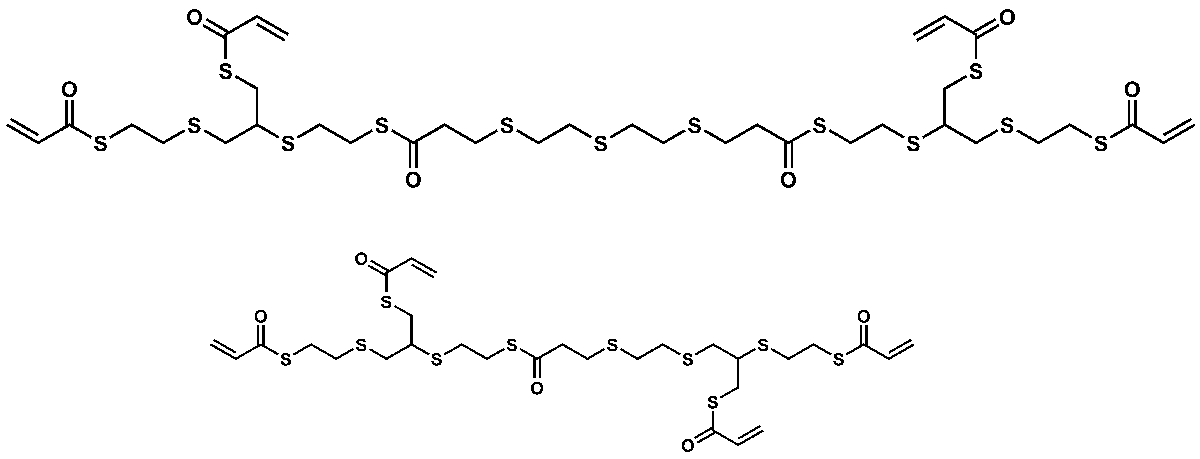
本発明に係る多官能(メタ)アクリル酸チオエステル組成物は、例えば、ポリチオール化合物中の全チオール基のうち0.5当量以上0.9当量以下のチオール基を下記構造式で表される官能基に変換し、次いで、得られた化合物に対してβ―脱離反応及びエンチオール反応をおこなうことによって多官能(メタ)アクリル酸チオエステル化合物を合成する工程を含む製造方法により製造することができる。
より具体的には、後述の合成例3のように、ポリチオール化合物と3-クロロプロピオニルクロリド等のハロゲン化アルキルカルボニルハライド化合物とを反応させることによって、ポリチオール化合物中のチオール基を下記構造式で表される官能基に変換することができる。β―脱離反応及びエンチオール反応は公知の方法によっておこなうことができる。

より具体的には、後述の合成例2のように、ポリチオ(メタ)アクリレート化合物とポリチオール化合物とをエンチオール反応によって反応させることによって多官能(メタ)アクリル酸チオエステル組成物を得ることができる。エンチオール反応は公知の方法によっておこなうことができる。
本発明に係る硬化性組成物は、前述した本発明に係る多官能(メタ)アクリル酸チオエステル組成物を含む。
本発明に係る硬化性組成物によれば、高屈折率、低硬化収縮性及びガラス接着性の性能バランスが向上した硬化物、成形体及び光学材料を得ることができる。
多官能(メタ)アクリル酸チオエステル組成物は、前述した本発明に係る多官能(メタ)アクリル酸チオエステル組成物である。
本発明に係る硬化性組成物中の多官能(メタ)アクリル酸チオエステル組成物の含有量は、本発明に係る硬化性組成物100質量部に対して、得られる硬化物の高屈折率、低硬化収縮性及びガラス接着性の性能バランスをより向上させる観点から、好ましくは30質量部以上、より好ましくは40質量部以上、更に好ましくは50質量部以上、更に好ましくは70質量部以上、更に好ましくは80質量部以上、更に好ましくは90質量部以上であり、そして、好ましくは100質量部以下、より好ましくは99質量部以下である。
本発明に係る硬化性組成物は、アッベ数をより低下させる観点、並びに、透明性、耐熱性及び加熱後安定性をより向上させる観点から、下記式(5)で示される化合物(B)(以下、単に「化合物(B)」ともいう。)を更に含むことができる。

前記式(5)中、Z3及びZ4はそれぞれ独立して芳香族炭素環又はアルキル基を示し、任意の水素原子がアルキル基又はアルコキシ基で置換されていてもよい。Z3及びZ4は、それぞれ独立して、好ましくは芳香族炭素環、より好ましくはベンゼン環又はナフタレン環であり、更に好ましくはナフタレン環である。
前記式(5)中、R1及びR3はそれぞれ独立して炭素数1以上10以下のアルキレン基を示す。R1及びR3は、それぞれ独立して、好ましくは炭素数1以上4以下のアルキレン基、より好ましくは炭素数1以上3以下のアルキレン基、更に好ましくは炭素数2以上3以下のアルキレン基、更に好ましくは炭素数2のアルキレン基である。
前記式(5)中、R2及びR4はそれぞれ独立して水素原子又はメチル基を示す。R2及びR4は、それぞれ独立して、好ましくは水素原子である。
前記式(5)中、R5及びR6はそれぞれ独立してアルキル基を示す。R5及びR6は、それぞれ独立して、好ましくは炭素数1以上4以下のアルキル基、より好ましくは炭素数1又は2のアルキル基、更に好ましくは炭素数1のアルキル基である。
前記式(5)中、m及びnはそれぞれ独立して0以上の整数を示す。m及びnは、それぞれ独立して、好ましくは0以上4以下の整数、より好ましくは0以上2以下の整数、更に好ましくは0又は1、更に好ましくは1である。
前記式(5)中、o、p、q及びrはそれぞれo+q≦4、p+r≦4の関係を満たす0以上の整数である。q及びrは、それぞれ独立して、好ましくは0以上2以下の整数、より好ましくは0又は1、更に好ましくは0である。o及びpは、それぞれ独立して、好ましくは0以上2以下の整数、より好ましくは0又は1、更に好ましくは0である。
化合物(B)としては、得られる硬化物の高屈折率、低硬化収縮性及びガラス接着性の性能バランスをより向上させる観点から、好ましくは、前記式(5)で示される化合物においてZ1及びZ2がベンゼン環、ナフタレン環又は炭素数1以上4以下のアルキレン基、Z3及びZ4がベンゼン環又はナフタレン環、R1及びR3が炭素数1以上4以下のアルキレン基、R2及びR4が水素原子又はメチル基、m及びnが0以上4以下の整数、q及びrが0又は1、o及びpが0である化合物であり、より好ましくは、前記式(5)で示される化合物においてZ1及びZ2がベンゼン環又は炭素数1以上3以下のアルキレン基、Z3及びZ4がナフタレン環、R1及びR3が炭素数1以上3以下のアルキレン基、R2及びR4が水素原子又はメチル基、m及びnが0又は1、q及びrが0又は1、o及びpが0である化合物である。
化合物(B)の市販品として、例えば、新中村科学工業株式会社製の2官能アクリレート「A-BPEF」や大阪ガスケミカル株式会社製の2官能アクリレート「OGSOL EA-0200」や「OGSOL EA-0300」等が挙げられる。
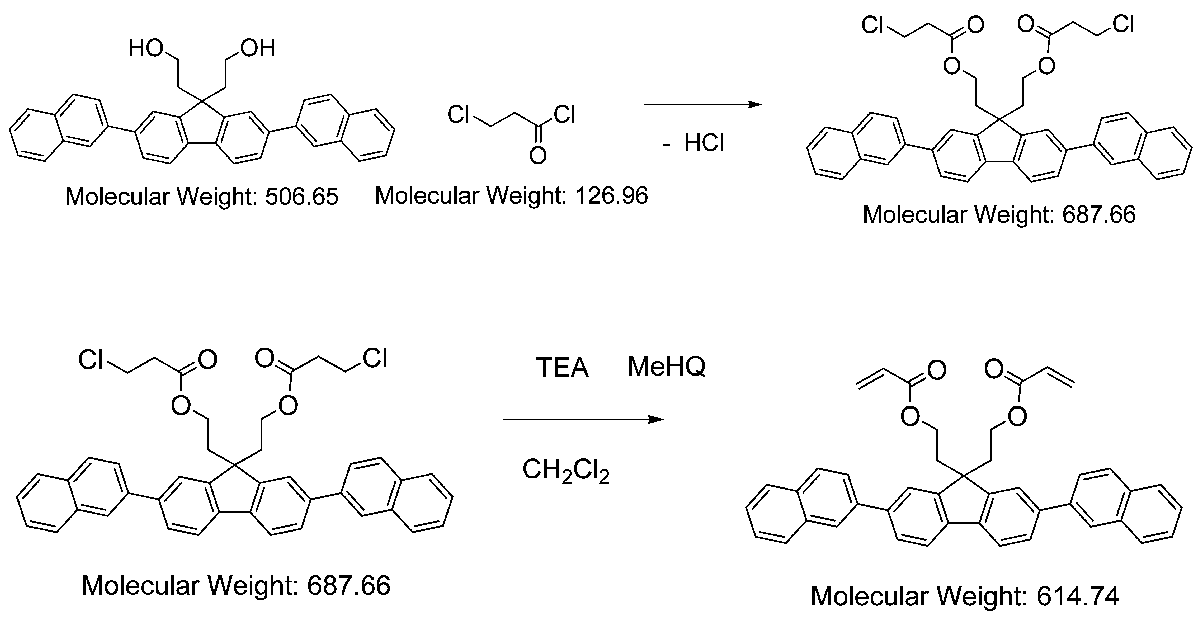
また、化合物(B)は、市販のフルオレン誘導体ジオールを、(メタ)アクリル酸無水物や(メタ)アクリロイルクロライド等を用いて、(メタ)アクリロイルエステル化することで合成することができる。
市販のフルオレン誘導体ジオールとして、例えば、大阪ガスケミカル株式会社製のBPEF(ビスフェノキシエタノールフルオレン)やBPF(ビスフェノールフルオレン)等が挙げられる。
また、下記の合成スキームによって9,9-ビス(2-(メタ)アクリロイルオキシエチル)-2,7-ビス(ナフト-2-イル)フルオレン(DNEOA)を合成することができる。
本発明に係る硬化性組成物は多官能(メタ)アクリル酸チオエステル組成物及び化合物(B)以外のその他の成分を含んでもよい。その他の成分としては、例えば、重合開始剤、紫外線吸収剤、樹脂改質剤、内部離型剤、シランカップリング剤、酸化防止剤、光安定化剤、加工安定剤、ブルーイング剤、重合金属不活性化剤、難燃剤、滑剤、帯電防止剤、熱線遮蔽剤、蛍光染料(蛍光増白剤含む)、顔料、光散乱剤、強化充填剤、界面活性剤、抗菌剤、可塑剤、相溶化剤、他の樹脂やエラストマー等が挙げられる。これらの中でも、本発明に係る硬化性組成物は、硬化性をより向上させる観点から、好ましくは重合開始剤を含む。また、本発明に係る硬化性組成物は、好ましくは、シランカップリング剤、酸化防止剤、紫外線吸収剤および光安定化剤からなる群から選択される少なくとも一種をさらに含む。
熱ラジカル重合開始剤として、例えば、ジクミルパーオキシド、t-ブチルクミルパーオキシド、2,5-ビス(t-ブチルパーオキシ)2,5-ジメチルヘキサン、2,5-ビス(t-ブチルパーオキシ)2,5-ジメチルヘキシン-3、ジ-t-ブチルパーオキシド、イソプロピルクミル-t-ブチルパーオキシド、ビス(α-t-ブチルパーオキシイソプロピル)ベンゼン等のジアルキルパーオキシド類;1,1-ビス(t-ブチルパーオキシ)シクロヘキサン、1,1-ビス(t-ブチルパーオキシ)3,3,5-トリメチルシクロヘキサン、1,1-ビス(t-ブチルパーオキシ)シクロドデカン、n-ブチル-4,4-ビス(t-ブチルパーオキシ)バレレート、エチル-3,3-ビス(t-ブチルパーオキシ)ブチレート、3,3,6,6,9,9-ヘキサメチル-1,2,4,5-テトラオキシシクロノナン等のパーオキシケタール類;ビス(t-ブチルパーオキシ)イソフタレート、t-ブチルパーオキシベンゾエート、t-ブチルパーオキシアセテート等のパーオキシエステル類;t-ブチルハイドロパーオキシド、t-ヘキシルハイドロパーオキシド、クミンハイドロパーオキシド、1,1,3,3-テトラメチルブチルハイドロパーオキシド、ジイソプロピルベンゼンハイドロパーオキシド、p-メンタンハイドロパーオキシド等のハイドロパーオキシド類;2,3-ジメチル-2,3-ジフェニルブタン等のビベンジル化合物類;3,3,5,7,7-ペンタメチル-1,2,4-トリオキセパン等が挙げられる。
また、ベンゾトリアゾール系紫外線吸収剤としては、例えば、2-(2H-ベンゾトリアゾール-2-イル)-p-クレゾール(分子量225)、2-(2H-ベンゾトリアゾール-2-イル)-4-6-ビス(1-メチル-1-フェニルエチル)フェノール(分子量448)、2-[5-クロロ(2H)-ベンゾトリアゾール-2-イル]-4-メチル-6-(tert-ブチル)フェノール(分子量316)、2,4-ジ-tert-ブチル-6-(5-クロロ-2H-1,2,3-ベンゾトリアゾール-2-イル)フェノール(分子量358)、2-(2H-ベンゾトリアゾール-2-イル)-4,6-tert-ペンチルフェノール(分子量352)、2-(2H-ベンゾトリアゾール-2-イル)-4-(1,1,3,3-テトラメチルブチル)フェノール(分子量323)、2,2'-メチレンビス[6-(2H-ベンゾトリアゾール-2-イル)-4-(1,1,3,3-テトラメチルブチル)フェノール](分子量659)、2-(2'-ヒドロキシ-3'-tert-ブチル-5'-メチルフェニル)-5-クロロベンゾトリアゾール、2-(2'-ヒドロキシ-3'5-ジ-tert-ブチル-フェニル)-5-クロロベンゾトリアゾール(分子量357)、2-(2'-ヒドロキシ-5'-メチルフェニル)ベンゾトリアゾール(分子量225)、2-(2-ヒドロキシ-5-オクチルフェニル)-ベンゾトリアゾ-ル(分子量323)等が挙げられる。
さらに、トリアジン系紫外線吸収剤としては、例えば、2-(4,6-ジフェニル-1,3,5-トリアジン-2-イル)-5-[(ヘキシル)オキシ]-フェノール(分子量426)、2-[4,6-ビス(2,4-ジメチルフェニル)―1,3,5-トリアジン-2-イル]-5-(オクチルオキシ)フェノ-ル(分子量509)、2,4,6-トリス(2-ヒドロキシ-4-ヘキシルオキシ-3-メチルフェニル)-1,3,5-トリアジン(分子量700)、2-(4,6-ジフェニル-1,3,5-トリアジン-2-イル)-5-[2-(2-エチルヘキサノイルオキシ)エトキシ]フェノール(分子量512)、1,6-ヘキサンジアミン,N,N'-ビス(1,2,2,6,6-ペンタメチル-4-ピペリジル)、ポリマーズモルホリン-2,4,6-トリクロロ-1,3,5-トリアジン等が挙げられる。
また、ベンズオキサジン系紫外線吸収剤としては、2,2'-(1,4-フェニレン)ビス(4H-3,1-ベンズオキサジン-4-オン)(分子量368)が挙げられる。その他、マロン酸エステル構造をもつテトラ-エチル-2,2-(1,4-フェニレン-ジメチリデン-ビスマロン酸(分子量418)、シュウ酸アニリド構造をもつ2エチル,2'-エトキシ-オキサミド(分子量312)等が挙げられる。上記した成分は、2種以上を混合して使用することもできる。
本実施形態において、本発明に係る硬化性組成物の硬化物からなる厚み250μmの試験片は、例えば、ガラス基板上に付与した硬化性組成物からなる硬化性膜に対して、365nmにおける露光量が1000mJ/cm2になるよう紫外線を照射し、次いで、得られた硬化物を窒素ガス雰囲気下、80℃で30分間加熱することにより得ることができる。
本発明に係る硬化性組成物は、多官能(メタ)アクリル酸チオエステル組成物に対し、必要に応じて、化合物(B)やその他の成分を、従来公知の方法で混合することにより得ることができる。
本発明に係る硬化物は、本発明に係る硬化性組成物を硬化させてなるものである。本発明に係る硬化物は高屈折率、低硬化収縮性及びガラス接着性の性能バランスが向上しているため、光学材料に好適に用いることができる。
本実施形態において、本実施形態に係る硬化物からなる厚み250μmの試験片は、例えば、ガラス基板上に付与した硬化性組成物からなる硬化性膜に対して、365nmにおける露光量が1000mJ/cm2になるよう紫外線を照射し、次いで、得られた硬化物を窒素ガス雰囲気下、80℃で30分間加熱することにより得ることができる。
本発明に係る成形体は、本発明に係る硬化物を含む成形体であり、例えば、本発明に係る硬化性組成物を硬化させながら、所定の形状に成形することにより得ることができる。
本発明に係る成形体は、本発明に係る硬化物を含むため、高屈折率、低硬化収縮性及びガラス接着性の性能バランスが向上しているため、光学材料に好適に用いることができる。
本発明に係る光学材料は、本発明に係る成形体を含むものであり、例えば、本発明に係る硬化性組成物を硬化させながら、所定の形状に成形することにより得ることができる。
本発明に係る光学材料は、本発明に係る硬化物や成形体を含むため、高屈折率、低硬化収縮性及びガラス接着性の性能バランスが向上しているため、例えば、各種センサー用レンズ、ピックアップレンズ、プロジェクタ用レンズ、プリズム、fθレンズ、撮像用レンズ、カメラレンズ、導光板、ヘッドマウントディスプレイ用レンズ、プラスチック眼鏡レンズ、ゴーグル、視力矯正用眼鏡レンズ、撮像機器用レンズ、液晶プロジェクター用フレネルレンズ、レンチキュラーレンズ、コンタクトレンズ等の各種光学レンズ、発光ダイオード(LED)用封止材、光導波路、ウェハレベル光学部品(WLO)や光導波路の接合に用いる光学用接着剤、光学レンズ等に用いる反射防止膜、液晶表示装置部材(基板、導光板、フィルム、シート等)に用いる透明性コーティング、車のフロントガラスやバイクのヘルメットに貼り付けるシートやフィルム、透明性基板等を挙げることができる。
本発明に係る光学材料は、高屈折率、低硬化収縮性及びガラス接着性の性能バランスが向上しているため、各種光学レンズとして、より好適に用いることができる。
さらに、本発明に係る光学材料は、高屈折率、低硬化収縮性及びガラス接着性の性能バランスが向上しているため、ガラス基板を更に含み、本発明に係る成形体とガラス基板との積層体として好適に用いることができ、さらに、ガラス基板上に樹脂レンズを形成する、いわゆるハイブリッド型の光学レンズとして好適に用いることができる。
また、本発明は前述の実施形態に限定されるものではなく、本発明の目的を達成できる範囲での変形、改良等は本発明に含まれるものである。
(硬化性組成物の調製)
サンプル瓶中に、多官能(メタ)アクリル酸チオエステル組成物として合成例2で得た組成物(100重量部)、重合開始剤としてIrg184(1-ヒドロキシシクロヘキシルフェニルケトン、BASF社製、3.0重量部)を加え、ミックスローターを用いて外観が均一になるまで混合し、硬化性組成物を得た。
E型粘度計(TVE-25L、東機産業株式会社製)を用いて回転数2.5rpmの条件で、得られた硬化性組成物の25℃における粘度を測定した。
Novec1720(3M社製フッ化シラン系コーティング剤)を用いて離型処理したEagle-XG(CORNING社製無アルカリガラス基板、70×70×0.7mmT)上に、0.5mLの硬化性組成物を塗布し、厚みが250μmのスペーサーを介してもう一枚の離型処理したガラス基板で挟み込み、端部をクリップで固定した。
得られた積層体の片面から無電極ランプ(Hバルブ)を用いて365nmにおける露光量が1000mJ/cm2になるよう紫外線を照射した後、硬化物をガラス基板から離型させ、得られた硬化物を窒素ガス雰囲気下、80℃で30分間加熱して、厚さ250μmの硬化膜を得た。
得られた硬化膜の屈折率と硬化時の収縮率を下記に示す方法で測定した。得られた結果を表1に示す。
屈折率(nD)およびアッベ数(νD)は、ASTM D542に準拠して、以下のように測定した。
硬化膜のD線(589.3nm)の屈折率(nD)を、アッベ屈折計(DR-M2、株式会社アタゴ製)を用いて測定した。干渉フィルターとしてRE-3520(D線、株式会社アタゴ製)、中間液としてRE-1196(モノブロモナフタレン、株式会社アタゴ製)を使用し、サンプル温度は25℃になるよう設定して測定を行なった。
また、硬化膜のC線(波長656.3nm)の屈折率(nC)を、アッベ屈折計(株式会社アタゴ製、DR-M2)により、干渉フィルターとしてRE-3522(C線、株式会社アタゴ製)、中間液としてRE-1196(モノブロモナフタレン、株式会社アタゴ製)を使用し、サンプル温度は25℃になるよう設定して測定を行なった。
また、硬化膜のF線(波長486.1nm)の屈折率(nF)を、屈折計(株式会社アタゴ製、DR-M2)により、干渉フィルターとしてRE-3521(F線、株式会社アタゴ製)、中間液としてRE-1196(モノブロモナフタレン、株式会社アタゴ製)を使用し、サンプル温度は25℃になるよう設定して測定を行なった。
そして、下記式に従って、硬化膜のアッベ数を算出した。
アッベ数=(nD-1)/(nF-nC)
得られた硬化膜の厚み方向の光線透過率を、以下の条件にて測定し、光線透過率T1を得た。なお、測定は硬化膜を積分球に貼り付けて行い、入光面は任意の面とした。
(測定条件)
測定装置:UH4150(日立ハイテクサイエンス社製 紫外可視近赤外分光光度計)
測定法:透過法
測定波長:400nm
リファレンス:大気
検出器:積分球/光電子増倍管(200nm~850nm)
積分球:PbS(850nm~2600nm)
まず、得られた硬化膜を空気雰囲気下125℃に設定したオーブン中で168時間加熱した。その後、上記条件で厚み方向の光線透過率を測定することで加熱後光線透過率T2を得、下記式により算出した。結果を表1に示す。
光線透過率の加熱後変化率(125℃168時間)(%)
=(T1-T2)/T1×100
硬化性組成物の比重d1を、比重瓶を用いて測定した(JIS Z 8804:2012)。また、硬化膜の比重d2をアルキメデス法(JIS Z 8807:2012)により測定した。これら比重の値を用い、下記式により硬化収縮率(%)を算出した。
式:硬化収縮率(%)=(1-d1/d2)×100
Novec1720(3M社製フッ化シラン系コーティング剤)を用いて離型処理したEagle-XG(CORNING社製無アルカリガラス基板、70×70×0.7mmT)上に、0.5mLの硬化性組成物を塗布し、厚みが250μmのスペーサーを介して離型処理を行っていないEagle-XG(CORNING社製無アルカリガラス基板、70×70×0.7mmT)で挟み込み、端部をクリップで固定した。
得られた積層体の片面から無電極ランプ(Hバルブ)を用いて365nmにおける露光量が1000mJ/cm2になるよう紫外線を照射した後、硬化物を離形処理ガラス基板から離型
させ、窒素ガス雰囲気下、80℃で30分間加熱して、樹脂硬化物/ガラス基板積層体を得た。
得られた積層体について、下記評価基準に基づいてガラス接着性の評価を行った。評価結果を表1に示す。
(評価基準)
PASS(良):樹脂/ガラス基板界面での剥離や、樹脂のクラックが観察されなかった。
FAIL(悪):樹脂/ガラス基板界面での剥離や、樹脂のクラックが観察された。
硬化性組成物の組成を表1に示す組成に変更した以外は、実施例1と同様にして各評価を行なった。硬化性組成物の組成、及び各種評価結果を表1に示す。

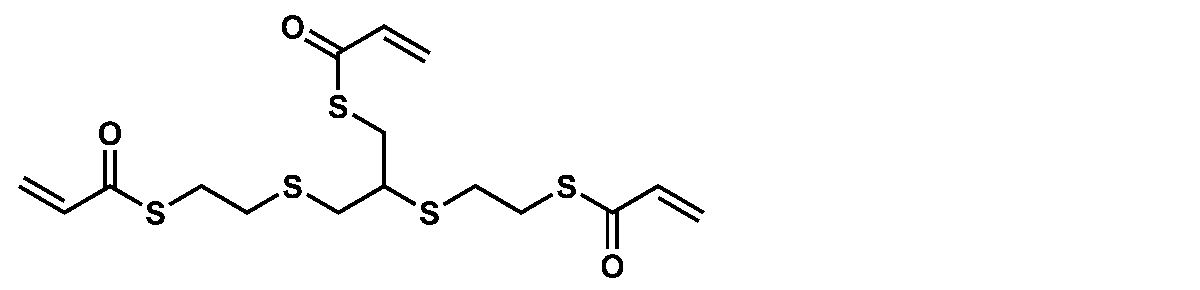
・GSTA:1、8-ビスアクリロイルチオ-(4-アクリロイルチオメチル-3,6-ジチアオクタン(下記合成例1に従って製造した)

・Irg184:重合開始剤(1-ヒドロキシシクロヘキシルフェニルケトン、BASF社製、下記構造の化合物)




撹拌機、温度計、窒素導入ライン及び滴下ロートを備え付けた4つ口フラスコに、4-メルカプトメチル-1,8-ジメルカプト-3,6-ジチアオクタン(GST、100.0g、383.9mmol)を装入し、ジクロロメタン(100mL)で希釈して撹拌を開始した。次いで、内温が40℃以下になるよう氷浴で反応液を冷却しながら、3-クロロプロピオニルクロリド(121.84g、959.7mmol)を滴下した。
反応液を室温で48時間撹拌した後、純水(100mL)を加え、分液操作によって有機相を分離した。得られた有機相を飽和炭酸水素ナトリウム水溶液(100mL)で2回洗浄し、溶剤をエバポレーターで留去することで下記構造の化合物(201.0g)を得た。

反応液を室温で1時間撹拌した後、1M塩酸(300mL)を加え、分液操作によって有機相を分離した。得られた有機相をシリカゲル(100mL)に通液し、重合禁止剤として4-メトキシフェノール(150mg)を加え、減圧濃縮を行うことで、無色透明な下記構造の化合物(GSTA)を(110.0g、)を得た。ゲル浸透クロマトグラフィー(GPC)で分子量を測定したところ、数平均分子量(Mn)=400、重量平均分子量(Mw)=440であった。
撹拌機、温度計、窒素導入ライン及び滴下ロートを備え付けた4つ口フラスコに、合成例1で得たGSTA(9.0g)及びビス(2-メルカプトエチル)スルフィド(1.0g)を装入した。次いで、内温が30℃以下になるよう氷浴で反応液を冷却しながらトリエチルアミン(10mg)を加えた。反応液を室温で24時間撹拌した後、1M塩酸(100mL)及びジクロロメタン(100mL)を加え、分液操作によって有機相を分離した。得られた有機相をシリカゲル(10mL)に通液し、重合禁止剤として4-メトキシフェノール(10mg)を加え、減圧濃縮を行うことで、下記化合物を含む無色透明な多官能(メタ)アクリル酸チオエステル組成物(9.9g)を得た。GPCで分子量を測定したところ、数平均分子量(Mn)=600、重量平均分子量(Mw)=3500であった。

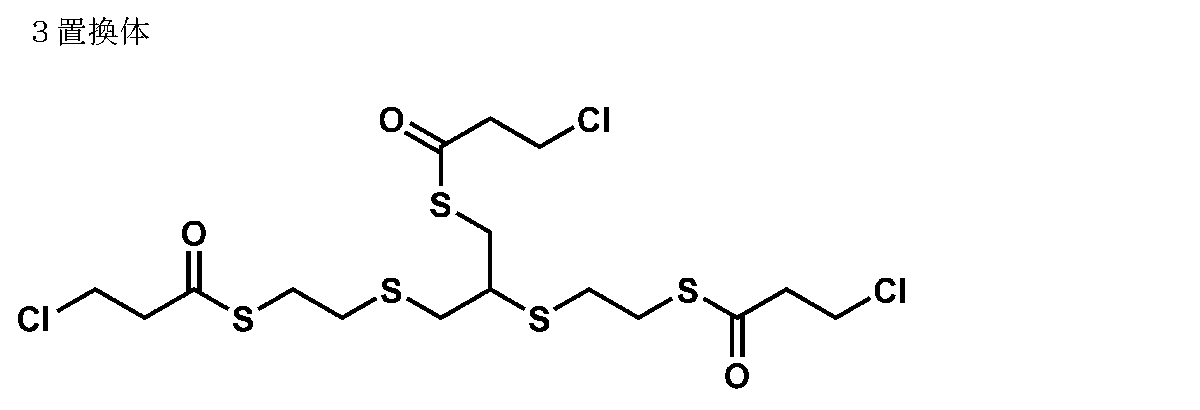
撹拌機、温度計、窒素導入ライン及び滴下ロートを備え付けた4つ口フラスコに、GST(トリチオール、100.0g、383.9mmol)を装入し、ジクロロメタン(100mL)で希釈して撹拌を開始した。次いで、内温が40℃以下になるよう氷浴で反応液を冷却しながら、3-クロロプロピオニルクロリド(121.84g、959.7mmol)を滴下した。
反応液を室温で48時間撹拌した後、純水(100mL)を加え、分液操作によって有機相を分離した。得られた有機相を飽和炭酸水素ナトリウム水溶液(100mL)で2回洗浄し、GSTのチオール基の一部が3-クロロプロピオン酸エステル化されたGST(下記化合物群)を含む組成物のジクロロメタン溶液を得た。高速液体クロマトグラフィー(HPLC)測定における3置換体:2置換体:1置換体のピーク面積比は56:38:6であった。


反応液を室温で1時間撹拌した後、1M塩酸(300mL)を加え、分液操作によって有機相を分離した。得られた有機相をシリカゲル(100mL)に通液し、重合禁止剤として4-メトキシフェノール(150mg)を加え、減圧濃縮を行うことで、下記化合物を含む無色透明な多官能(メタ)アクリル酸チオエステル組成物(132.5g)を得た。GPCで分子量を測定したところ、数平均分子量(Mn)=500、重量平均分子量(Mw)=1600であった。

撹拌機、温度計、窒素導入ライン及び滴下ロートを備え付けた4つ口フラスコに、MES(ビス(2-メルカプトエチル)スルフィド、100.0g、648.1mmol)を装入し、ジクロロメタン(100mL)で希釈して撹拌を開始した。次いで、内温が40℃以下になるよう氷浴で反応液を冷却しながら、3-クロロプロピオニルクロリド(123.42g、972.1mmol)を滴下した。
反応液を室温で48時間撹拌した後、純水(100mL)を加え、分液操作によって有機相を分離した。得られた有機相を飽和炭酸水素ナトリウム水溶液(100mL)で2回洗浄し、MESのチオール基の一部が3-クロロプロピオン酸エステル化されたMES(下記化合物群)を含む組成物のジクロロメタン溶液を得た。

反応液を室温で1時間撹拌した後、1M塩酸(300mL)を加え、分液操作によって有機相を分離した。得られた有機相をシリカゲル(100mL)に通液し、重合禁止剤として4-メトキシフェノール(150mg)を加え、減圧濃縮を行うことで、下記化合物を含む無色透明な多官能(メタ)アクリル酸チオエステル組成物(121.5g)を得た。GPCで分子量を測定したところ、数平均分子量(Mn)=700、重量平均分子量(Mw)=2000であった。

合成例1~4おける多官能(メタ)アクリル酸チオエステル組成物の数平均分子量(Mn)及び重量平均分子量(Mw)は、ゲル浸透クロマトグラフィー(GPC)によって以下の手順で測定した。
(1)試料溶液の調製
濃度が1g/100mLになるように、多官能(メタ)アクリル酸チオエステル組成物をテトラヒドロフランに溶解させた。ついで、この溶液をポアサイズ1μmのフィルター(Membrane Solutions社製、商品名:シリンジフィルターPTFE013100)を用いて濾過して不溶成分を除き、試料溶液とした。
(2)分子量測定
GPC測定装置(製品名:Alliance、WATERS社製)を用いて、溶離液としてテトラヒドロフラン(富士フイルム和光純薬株式会社製、高速液体クロマトグラフィー用)を、毎分1.0mLの流速で流し、40℃の恒温槽中で分析カラム(ゲル浸透カラム、Agilent社製、製品名:PLgel 5μmMixed-C)を3本直列に連結させた物を安定化させた。そこに試料溶液10μLを注入して測定を行った。検出器としては、示差屈折率(RI)検出器を用いた。試料の分子量は、あらかじめ作製した検量線に基づき算出した。このときの検量線には、数種類の分子量が既知の単分散ポリスチレン(Agilent社製)を標準試料として作成したものを用いた。
Claims (21)
- 下記式(1)で示される多官能(メタ)アクリル酸チオエステル化合物(A)を含む、多官能(メタ)アクリル酸チオエステル組成物。


- 前記多官能(メタ)アクリル酸チオエステル組成物の重量平均分子量が、1000以上100000以下である、請求項1に記載の多官能(メタ)アクリル酸チオエステル組成物。
- 前記多官能(メタ)アクリル酸チオエステル化合物(A)は、下記式(3)で示される化合物及び下記式(4)で示される化合物からなる群から選択される少なくとも一種を含む、請求項1又は2に記載の多官能(メタ)アクリル酸チオエステル組成物。


- 請求項1~3のいずれかに記載の多官能(メタ)アクリル酸チオエステル組成物を含む硬化性組成物。
- 下記式(5)で示される化合物(B)を更に含む、請求項4に記載の硬化性組成物。

- E型粘度計を用いて回転数2.5rpmの条件で測定される、前記硬化性組成物の25℃における粘度が100mPa・s以上10000mPa・s以下である、請求項4又は5に記載の硬化性組成物。
- 重合開始剤をさらに含む、請求項4~6のいずれかに記載の硬化性組成物。
- シランカップリング剤、酸化防止剤、紫外線吸収剤および光安定化剤からなる群から選択される少なくとも一種をさらに含む、請求項4~7のいずれかに記載の硬化性組成物。
- JIS Z 8804:2012に準拠して比重瓶を用いて測定される、前記硬化性組成物の比重をd1とし、前記硬化性組成物の硬化物からなる厚み250μmの試験片の比重をd2としたとき、(1-d1/d2)×100で表される、前記硬化性組成物の硬化収縮率が9.0%以下である、請求項4~8のいずれかに記載の硬化性組成物。
- 光学材料に使用可能な、請求項4~9のいずれかに記載の硬化性組成物。
- 請求項4~10のいずれかに記載の硬化性組成物を硬化させてなる硬化物。
- 前記硬化物からなる厚み250μmの試験片を作製したとき、前記試験片の波長400nmにおける光線透過率(T1)が81%以上である、請求項11に記載の硬化物。
- 前記試験片を空気雰囲気下125℃に設定したオーブン中で168時間加熱し、加熱処理後の前記試験片の波長400nmにおける光線透過率をT2としたとき、(T1-T2)/T1×100で表される、光線透過率の加熱後の変化率が7.0%以下である、請求項12に記載の硬化物。
- 前記硬化物からなる厚み250μmの試験片を作製したとき、前記試験片のD線(589.3nm)の屈折率(nD)が1.600以上である、請求項11~13のいずれかに記載の硬化物。
- 前記硬化物からなる厚み250μmの試験片を作製したとき、ASTM D542に準拠して測定される、前記試験片のアッベ数(νD)が20以上である、請求項11~14のいずれかに記載の硬化物。
- 請求項11~15のいずれかに記載の硬化物を含む成形体。
- 請求項16に記載の成形体を含む光学材料。
- ガラス基板を更に含み、
前記成形体と前記ガラス基板との積層体である、請求項17に記載の光学材料。 - 光学レンズである、請求項17又は18に記載の光学材料。
- ポリチオール化合物中の全チオール基のうち0.5当量以上0.9当量以下のチオール基を下記構造式で表される官能基に変換し、次いで、得られた化合物に対してβ―脱離反応及びエンチオール反応をおこなうことによって多官能(メタ)アクリル酸チオエステル化合物を合成する工程を含む、請求項1~3のいずれかに記載の多官能(メタ)アクリル酸チオエステル組成物の製造方法。

- ポリチオ(メタ)アクリレート化合物に対し、ポリチオール化合物をエンチオール反応によって反応させる工程を含む、請求項1~3のいずれかに記載の多官能(メタ)アクリル酸チオエステル組成物の製造方法。
Priority Applications (5)
| Application Number | Priority Date | Filing Date | Title |
|---|---|---|---|
| KR1020247023373A KR20240116549A (ko) | 2022-03-28 | 2023-02-17 | 다작용 (메트)아크릴산 싸이오에스터 조성물, 경화성 조성물, 경화물, 성형체, 광학 재료 및 다작용 (메트)아크릴산 싸이오에스터 조성물의 제조 방법 |
| US18/729,265 US20250115689A1 (en) | 2022-03-28 | 2023-02-17 | Polyfunctional (meth)acrylate thioester composition, curable composition, cured product, molded body, optical material, and method for producing polyfunctional (meth)acrylate thioester composition |
| CN202380017747.5A CN118591569A (zh) | 2022-03-28 | 2023-02-17 | 多官能(甲基)丙烯酸硫酯组合物、固化性组合物、固化物、成型体、光学材料及多官能(甲基)丙烯酸硫酯组合物的制造方法 |
| EP23778998.7A EP4501978A4 (en) | 2022-03-28 | 2023-02-17 | Composition of multifunctional (meth)acrylate thioester, hardenable composition, hardened product, molded body, optical material and process for producing a composition of multifunctional (meth)acrylate thioester |
| JP2024511419A JP7824405B2 (ja) | 2022-03-28 | 2023-02-17 | 硬化性組成物、硬化物、成形体、光学材料及び多官能(メタ)アクリル酸チオエステル組成物の製造方法 |
Applications Claiming Priority (2)
| Application Number | Priority Date | Filing Date | Title |
|---|---|---|---|
| JP2022052197 | 2022-03-28 | ||
| JP2022-052197 | 2022-03-28 |
Publications (1)
| Publication Number | Publication Date |
|---|---|
| WO2023188968A1 true WO2023188968A1 (ja) | 2023-10-05 |
Family
ID=88200354
Family Applications (1)
| Application Number | Title | Priority Date | Filing Date |
|---|---|---|---|
| PCT/JP2023/005701 Ceased WO2023188968A1 (ja) | 2022-03-28 | 2023-02-17 | 多官能(メタ)アクリル酸チオエステル組成物、硬化性組成物、硬化物、成形体、光学材料及び多官能(メタ)アクリル酸チオエステル組成物の製造方法 |
Country Status (7)
| Country | Link |
|---|---|
| US (1) | US20250115689A1 (ja) |
| EP (1) | EP4501978A4 (ja) |
| JP (1) | JP7824405B2 (ja) |
| KR (1) | KR20240116549A (ja) |
| CN (1) | CN118591569A (ja) |
| TW (1) | TW202402849A (ja) |
| WO (1) | WO2023188968A1 (ja) |
Cited By (1)
| Publication number | Priority date | Publication date | Assignee | Title |
|---|---|---|---|---|
| WO2024090339A1 (ja) * | 2022-10-25 | 2024-05-02 | デンカ株式会社 | 表示装置用光硬化性樹脂組成物及び表示装置 |
Citations (8)
| Publication number | Priority date | Publication date | Assignee | Title |
|---|---|---|---|---|
| JPH07252207A (ja) * | 1994-01-26 | 1995-10-03 | Mitsui Toatsu Chem Inc | 新規なポリチオール及びそれを用いた含硫ウレタン系プラスチックレンズ |
| JPH08325337A (ja) | 1995-05-31 | 1996-12-10 | Essilor Internatl (Cie Gen Opt) | チオ(メタ)アクリレートモノマーを基礎とする重合可能な組成物、該組成物から得られる黄色度の小さいポリマー、及び、該組成物、ポリマーを用いた目に着用するレンズ |
| WO1998024761A1 (en) | 1996-12-03 | 1998-06-11 | Sola International Holdings Ltd. | Acrylic thio monomers |
| JPH10204056A (ja) * | 1997-01-21 | 1998-08-04 | Mitsui Chem Inc | 光学樹脂用組成物及び光学樹脂 |
| JP2004002820A (ja) * | 2002-04-19 | 2004-01-08 | Mitsui Chemicals Inc | チオウレタン系光学材料 |
| JP2004176006A (ja) * | 2002-11-29 | 2004-06-24 | Sumitomo Seika Chem Co Ltd | 光硬化性組成物 |
| JP2011162610A (ja) * | 2010-02-05 | 2011-08-25 | Osaka Gas Chem Kk | 硬化性組成物及びその硬化物 |
| JP2022052197A (ja) | 2020-09-23 | 2022-04-04 | 住友電気工業株式会社 | 交通用検知装置および交通用検知方法 |
Family Cites Families (2)
| Publication number | Priority date | Publication date | Assignee | Title |
|---|---|---|---|---|
| JP2004536933A (ja) * | 2001-07-25 | 2004-12-09 | ピーピージー インダストリーズ オハイオ, インコーポレイテッド | 高屈折率光学樹脂組成物 |
| DE10342521A1 (de) * | 2003-09-12 | 2005-04-14 | Röhm GmbH & Co. KG | Mischungen zur Herstellung transparenter Kunststoffe, transparente Kunststoffe sowie Verfahren zu deren Herstellung und Verwendung |
-
2023
- 2023-02-17 JP JP2024511419A patent/JP7824405B2/ja active Active
- 2023-02-17 WO PCT/JP2023/005701 patent/WO2023188968A1/ja not_active Ceased
- 2023-02-17 KR KR1020247023373A patent/KR20240116549A/ko active Pending
- 2023-02-17 CN CN202380017747.5A patent/CN118591569A/zh active Pending
- 2023-02-17 US US18/729,265 patent/US20250115689A1/en active Pending
- 2023-02-17 EP EP23778998.7A patent/EP4501978A4/en active Pending
- 2023-02-23 TW TW112106709A patent/TW202402849A/zh unknown
Patent Citations (9)
| Publication number | Priority date | Publication date | Assignee | Title |
|---|---|---|---|---|
| JPH07252207A (ja) * | 1994-01-26 | 1995-10-03 | Mitsui Toatsu Chem Inc | 新規なポリチオール及びそれを用いた含硫ウレタン系プラスチックレンズ |
| JPH08325337A (ja) | 1995-05-31 | 1996-12-10 | Essilor Internatl (Cie Gen Opt) | チオ(メタ)アクリレートモノマーを基礎とする重合可能な組成物、該組成物から得られる黄色度の小さいポリマー、及び、該組成物、ポリマーを用いた目に着用するレンズ |
| WO1998024761A1 (en) | 1996-12-03 | 1998-06-11 | Sola International Holdings Ltd. | Acrylic thio monomers |
| US6172140B1 (en) * | 1996-12-03 | 2001-01-09 | Sola International Holdings Ltd | Acrylic thio monomers |
| JPH10204056A (ja) * | 1997-01-21 | 1998-08-04 | Mitsui Chem Inc | 光学樹脂用組成物及び光学樹脂 |
| JP2004002820A (ja) * | 2002-04-19 | 2004-01-08 | Mitsui Chemicals Inc | チオウレタン系光学材料 |
| JP2004176006A (ja) * | 2002-11-29 | 2004-06-24 | Sumitomo Seika Chem Co Ltd | 光硬化性組成物 |
| JP2011162610A (ja) * | 2010-02-05 | 2011-08-25 | Osaka Gas Chem Kk | 硬化性組成物及びその硬化物 |
| JP2022052197A (ja) | 2020-09-23 | 2022-04-04 | 住友電気工業株式会社 | 交通用検知装置および交通用検知方法 |
Non-Patent Citations (1)
| Title |
|---|
| See also references of EP4501978A4 |
Cited By (1)
| Publication number | Priority date | Publication date | Assignee | Title |
|---|---|---|---|---|
| WO2024090339A1 (ja) * | 2022-10-25 | 2024-05-02 | デンカ株式会社 | 表示装置用光硬化性樹脂組成物及び表示装置 |
Also Published As
| Publication number | Publication date |
|---|---|
| EP4501978A1 (en) | 2025-02-05 |
| EP4501978A4 (en) | 2026-04-08 |
| US20250115689A1 (en) | 2025-04-10 |
| JPWO2023188968A1 (ja) | 2023-10-05 |
| CN118591569A (zh) | 2024-09-03 |
| KR20240116549A (ko) | 2024-07-29 |
| JP7824405B2 (ja) | 2026-03-04 |
| TW202402849A (zh) | 2024-01-16 |
Similar Documents
| Publication | Publication Date | Title |
|---|---|---|
| JP7067724B2 (ja) | マトリックスに紫外線吸収能及び/又は高屈折率を付与するための添加剤とそれを用いた樹脂部材 | |
| US8604096B2 (en) | Photosensitive resin composition, photosensitive resin varnish, photosensitive resin film, and photosensitive resin cured product | |
| US8344094B2 (en) | Optical material and optical element | |
| US20200224025A1 (en) | Polycarbonate resin composition and optical lens using same | |
| JP2013181140A (ja) | 光学用樹脂組成物、硬化物、光学部品、半導体発光装置用封止剤、光学レンズ、光学用接着剤、光学用シール剤、光導波路 | |
| JP5570267B2 (ja) | ポリエン/ポリチオール系感光性樹脂組成物 | |
| US8953925B2 (en) | Optical waveguide | |
| WO2013183532A1 (ja) | 被覆材用樹脂組成物 | |
| JP7824405B2 (ja) | 硬化性組成物、硬化物、成形体、光学材料及び多官能(メタ)アクリル酸チオエステル組成物の製造方法 | |
| JP4164493B2 (ja) | 光重合性組成物およびその用途 | |
| JP5418602B2 (ja) | 硬化性樹脂組成物 | |
| JP7382313B2 (ja) | 光学樹脂組成物及び光学レンズ | |
| JP7836884B2 (ja) | 硬化物、成形体及び光学材料 | |
| CN117120485A (zh) | 固化性组合物、硬涂膜、具备硬涂膜的物品、图像显示装置及柔性显示器 | |
| JP5494671B2 (ja) | 硬化性樹脂組成物 | |
| WO2022196516A1 (ja) | 硬化性組成物、及び当該組成物から得られる光学材料 | |
| JPWO2019131258A1 (ja) | 色収差補正用光学樹脂材料 | |
| US20200271856A1 (en) | Polymer optical waveguide | |
| KR20210124274A (ko) | 광경화성 실리콘 수지 조성물 및 그것을 경화시킨 실리콘 수지 성형체, 및 상기 성형체의 제조 방법 | |
| JP4934278B2 (ja) | 金属含有(メタ)アクリル化合物およびその用途 | |
| JP2024134216A (ja) | 化合物、樹脂組成物、硬化物、成形体および光学材料 | |
| JP2016141731A (ja) | 樹脂組成物及び光学部材 |
Legal Events
| Date | Code | Title | Description |
|---|---|---|---|
| 121 | Ep: the epo has been informed by wipo that ep was designated in this application |
Ref document number: 23778998 Country of ref document: EP Kind code of ref document: A1 |
|
| ENP | Entry into the national phase |
Ref document number: 20247023373 Country of ref document: KR Kind code of ref document: A |
|
| WWE | Wipo information: entry into national phase |
Ref document number: 18729265 Country of ref document: US |
|
| ENP | Entry into the national phase |
Ref document number: 2024511419 Country of ref document: JP Kind code of ref document: A |
|
| WWE | Wipo information: entry into national phase |
Ref document number: 202380017747.5 Country of ref document: CN |
|
| WWE | Wipo information: entry into national phase |
Ref document number: 2023778998 Country of ref document: EP |
|
| NENP | Non-entry into the national phase |
Ref country code: DE |
|
| WWE | Wipo information: entry into national phase |
Ref document number: 11202404853X Country of ref document: SG |
|
| ENP | Entry into the national phase |
Ref document number: 2023778998 Country of ref document: EP Effective date: 20241028 |
|
| WWP | Wipo information: published in national office |
Ref document number: 18729265 Country of ref document: US |