WO2023190104A1 - 海洋分解性ポリエステル樹脂組成物、それからなる成形体及びその製造方法 - Google Patents
海洋分解性ポリエステル樹脂組成物、それからなる成形体及びその製造方法 Download PDFInfo
- Publication number
- WO2023190104A1 WO2023190104A1 PCT/JP2023/011698 JP2023011698W WO2023190104A1 WO 2023190104 A1 WO2023190104 A1 WO 2023190104A1 JP 2023011698 W JP2023011698 W JP 2023011698W WO 2023190104 A1 WO2023190104 A1 WO 2023190104A1
- Authority
- WO
- WIPO (PCT)
- Prior art keywords
- polyester resin
- resin composition
- marine
- molded article
- phosphite
- Prior art date
- Legal status (The legal status is an assumption and is not a legal conclusion. Google has not performed a legal analysis and makes no representation as to the accuracy of the status listed.)
- Ceased
Links
Classifications
-
- C—CHEMISTRY; METALLURGY
- C08—ORGANIC MACROMOLECULAR COMPOUNDS; THEIR PREPARATION OR CHEMICAL WORKING-UP; COMPOSITIONS BASED THEREON
- C08G—MACROMOLECULAR COMPOUNDS OBTAINED OTHERWISE THAN BY REACTIONS ONLY INVOLVING UNSATURATED CARBON-TO-CARBON BONDS
- C08G79/00—Macromolecular compounds obtained by reactions forming a linkage containing atoms other than silicon, sulfur, nitrogen, oxygen, and carbon with or without the latter elements in the main chain of the macromolecule
- C08G79/02—Macromolecular compounds obtained by reactions forming a linkage containing atoms other than silicon, sulfur, nitrogen, oxygen, and carbon with or without the latter elements in the main chain of the macromolecule a linkage containing phosphorus
- C08G79/04—Phosphorus linked to oxygen or to oxygen and carbon
-
- C—CHEMISTRY; METALLURGY
- C08—ORGANIC MACROMOLECULAR COMPOUNDS; THEIR PREPARATION OR CHEMICAL WORKING-UP; COMPOSITIONS BASED THEREON
- C08J—WORKING-UP; GENERAL PROCESSES OF COMPOUNDING; AFTER-TREATMENT NOT COVERED BY SUBCLASSES C08B, C08C, C08F, C08G or C08H
- C08J3/00—Processes of treating or compounding macromolecular substances
- C08J3/20—Compounding polymers with additives, e.g. colouring
- C08J3/22—Compounding polymers with additives, e.g. colouring using masterbatch techniques
- C08J3/226—Compounding polymers with additives, e.g. colouring using masterbatch techniques using a polymer as a carrier
-
- C—CHEMISTRY; METALLURGY
- C08—ORGANIC MACROMOLECULAR COMPOUNDS; THEIR PREPARATION OR CHEMICAL WORKING-UP; COMPOSITIONS BASED THEREON
- C08J—WORKING-UP; GENERAL PROCESSES OF COMPOUNDING; AFTER-TREATMENT NOT COVERED BY SUBCLASSES C08B, C08C, C08F, C08G or C08H
- C08J5/00—Manufacture of articles or shaped materials containing macromolecular substances
- C08J5/18—Manufacture of films or sheets
-
- C—CHEMISTRY; METALLURGY
- C08—ORGANIC MACROMOLECULAR COMPOUNDS; THEIR PREPARATION OR CHEMICAL WORKING-UP; COMPOSITIONS BASED THEREON
- C08K—Use of inorganic or non-macromolecular organic substances as compounding ingredients
- C08K5/00—Use of organic ingredients
- C08K5/0008—Organic ingredients according to more than one of the "one dot" groups of C08K5/01 - C08K5/59
- C08K5/0033—Additives activating the degradation of the macromolecular compound
-
- C—CHEMISTRY; METALLURGY
- C08—ORGANIC MACROMOLECULAR COMPOUNDS; THEIR PREPARATION OR CHEMICAL WORKING-UP; COMPOSITIONS BASED THEREON
- C08K—Use of inorganic or non-macromolecular organic substances as compounding ingredients
- C08K5/00—Use of organic ingredients
- C08K5/49—Phosphorus-containing compounds
- C08K5/51—Phosphorus bound to oxygen
- C08K5/52—Phosphorus bound to oxygen only
- C08K5/527—Cyclic esters
-
- C—CHEMISTRY; METALLURGY
- C08—ORGANIC MACROMOLECULAR COMPOUNDS; THEIR PREPARATION OR CHEMICAL WORKING-UP; COMPOSITIONS BASED THEREON
- C08L—COMPOSITIONS OF MACROMOLECULAR COMPOUNDS
- C08L85/00—Compositions of macromolecular compounds obtained by reactions forming a linkage in the main chain of the macromolecule containing atoms other than silicon, sulfur, nitrogen, oxygen and carbon; Compositions of derivatives of such polymers
- C08L85/02—Compositions of macromolecular compounds obtained by reactions forming a linkage in the main chain of the macromolecule containing atoms other than silicon, sulfur, nitrogen, oxygen and carbon; Compositions of derivatives of such polymers containing phosphorus
-
- D—TEXTILES; PAPER
- D01—NATURAL OR MAN-MADE THREADS OR FIBRES; SPINNING
- D01F—CHEMICAL FEATURES IN THE MANUFACTURE OF ARTIFICIAL FILAMENTS, THREADS, FIBRES, BRISTLES OR RIBBONS; APPARATUS SPECIALLY ADAPTED FOR THE MANUFACTURE OF CARBON FILAMENTS
- D01F6/00—Monocomponent artificial filaments or the like of synthetic polymers; Manufacture thereof
- D01F6/58—Monocomponent artificial filaments or the like of synthetic polymers; Manufacture thereof from homopolycondensation products
- D01F6/62—Monocomponent artificial filaments or the like of synthetic polymers; Manufacture thereof from homopolycondensation products from polyesters
-
- D—TEXTILES; PAPER
- D01—NATURAL OR MAN-MADE THREADS OR FIBRES; SPINNING
- D01F—CHEMICAL FEATURES IN THE MANUFACTURE OF ARTIFICIAL FILAMENTS, THREADS, FIBRES, BRISTLES OR RIBBONS; APPARATUS SPECIALLY ADAPTED FOR THE MANUFACTURE OF CARBON FILAMENTS
- D01F6/00—Monocomponent artificial filaments or the like of synthetic polymers; Manufacture thereof
- D01F6/88—Monocomponent artificial filaments or the like of synthetic polymers; Manufacture thereof from mixtures of polycondensation products as major constituent with other polymers or low-molecular-weight compounds
- D01F6/92—Monocomponent artificial filaments or the like of synthetic polymers; Manufacture thereof from mixtures of polycondensation products as major constituent with other polymers or low-molecular-weight compounds of polyesters
-
- C—CHEMISTRY; METALLURGY
- C08—ORGANIC MACROMOLECULAR COMPOUNDS; THEIR PREPARATION OR CHEMICAL WORKING-UP; COMPOSITIONS BASED THEREON
- C08J—WORKING-UP; GENERAL PROCESSES OF COMPOUNDING; AFTER-TREATMENT NOT COVERED BY SUBCLASSES C08B, C08C, C08F, C08G or C08H
- C08J2367/00—Characterised by the use of polyesters obtained by reactions forming a carboxylic ester link in the main chain; Derivatives of such polymers
- C08J2367/04—Polyesters derived from hydroxy carboxylic acids, e.g. lactones
Definitions
- the present invention relates to a marine degradable polyester resin composition and a molded article made from the same.
- polyester resin which has excellent physical properties and versatility and has been widely used for films, fibers, injection molded products, etc.
- polylactic acid which is a type of polyester resin
- an environmentally friendly polymer material that is degradable in soil because it is made from lactic acid or its derivatives obtained from plant-derived raw materials.
- polylactic acid especially its homopolymer
- polylactic acid has a high crystallinity and glass transition point, and is poorly degradable by water and enzymes, so there has been a problem that the decomposition rate in the natural environment is low.
- These aliphatic polyesters can be hydrolyzed relatively quickly in high-temperature environments such as compost.
- the polymer has a high molecular weight, it does not easily decompose in water or seawater at a low temperature of about 30°C.
- Patent Document 1 discloses a method of adding an organic carboxylic acid and an organic carboxylate to polylactic acid to promote decomposition.
- the decomposition rate improved in an environment of 80°C x 90% RH, the decomposition rate was insufficient in an environment where molecular weight reduction hardly occurred, such as in seawater at 30°C.
- Patent Document 2 proposes a composition in which a copolymer of malic acid or aspartic acid and polylactic acid is blended with polylactic acid.
- rapid weight loss was observed in a high-temperature alkaline environment, the effect was significantly reduced in a neutral environment with a pH of 7.4.
- the present invention solves the above-mentioned conventional problems and provides a marine degradable polyester resin composition that rapidly decomposes even in low-temperature seawater.
- the marine degradable polyester resin composition of the present invention is a resin composition mainly composed of polyester, and contains a phosphite-based decomposition accelerator, and the phosphite-based decomposition accelerator is represented by the following general formula (I). It is characterized by being a compound represented by
- R is an alkyl group, an aryl group, or a hydrogenated bisphenol A skeleton, and each may be the same or different.
- n is an integer in the range of 1 to 20.
- the phosphite-based decomposition accelerator is dialkyl pentaerythritol diphosphite
- the polyester resin composition is an aliphatic polyester, or the polyester resin composition has an optical purity of 90% or more.
- L-lactic acid or poly-D-lactic acid is preferred.
- the number average molecular weight of the resin composition is 50,000 or more
- the acid value of the resin composition is 300 eq/ton or less
- the content of the phosphite decomposition accelerator is 0.01 to 5 mass. % is preferable.
- Another polyester resin molded article of the present invention is characterized by being made of the above marine degradable polyester resin composition. Furthermore, the storage strength retention rate of the resin molded product after 5 months on land must be 60% or more, the shape of the polyester resin molded product must be fiber or film, and if the shape is fiber, it must be 60% or more. It is preferable that the initial strength is 1.5 cN/dtex or more.
- Another masterbatch of the polyester resin composition of the present invention is the marine degradable polyester resin composition described above, characterized in that the content of the phosphite decomposition accelerator is 5 to 20% by mass. shall be.
- the method for producing a polyester resin molded article is characterized in that this masterbatch is added to a polyester resin and melt-molded.
- the shape of the polyester resin molded article is fiber or film.
- the present invention provides a marine degradable polyester resin composition that rapidly decomposes even in low-temperature seawater.
- the marine degradable polyester resin composition of the present invention is a resin composition mainly consisting of polyester.
- "mainly” means that 50% by mass or more of the total is a constituent component, and furthermore, 70% by mass or more, particularly 90% by mass or more and 100% by mass or less of polyester resin as a main component. preferable.
- polyester resins include polymers or copolymers obtained by polycondensing one or more selected from dicarboxylic acids or ester-forming derivatives thereof, diols or ester-forming derivatives thereof, hydroxycarboxylic acids or ester-forming derivatives thereof, and lactones. etc. are exemplified.
- Preferred examples include polyesters made of hydroxycarboxylic acids or ester-forming derivatives thereof, and more preferred examples include aliphatic polyesters made of hydroxycarboxylic acids or ester-forming derivatives thereof.
- hydroxycarboxylic acids examples include glycolic acid, lactic acid, hydroxypropionic acid, hydroxybutyric acid, and hydroxyvaleric acid. , hydroxycaproic acid, hydroxybenzoic acid, p-hydroxybenzoic acid, 6-hydroxy-2-naphthoic acid, and ester-forming derivatives thereof.
- lactone examples include caprolactone, valerolactone, propiolactone, undecalactone, and 1,5-oxepan-2-one.
- preferable polymers containing aliphatic hydroxycarboxylic acids as main constituents include polycondensates or copolymers of glycolic acid, lactic acid, hydroxypropionic acid, hydroxybutyric acid, hydroxyvaleric acid, and hydroxycaproic acid. can.
- preferred examples include polyglycolic acid, polylactic acid, poly3-hydroxycarboxylic acid, poly4-polyhydroxybutyric acid, poly3-hydroxyhexanoic acid, polycaprolactone, and copolymers thereof.
- Particularly preferred are poly-L-lactic acid, poly-D-lactic acid, stereocomplex polylactic acid, racemic polylactic acid, and the like.
- the polyester of the present invention is an aliphatic polyester, and the aliphatic polyester is at least one selected from the group consisting of poly-L-lactic acid, poly-D-lactic acid, racemic polylactic acid, and polyglycolic acid. preferable.
- dicarboxylic acids or ester-forming derivatives thereof and diols or ester-forming derivatives thereof that can be used as constituent components of the polyester resin of the present invention will be supplemented below.
- dicarboxylic acids or ester-forming derivatives examples include aromatic dicarboxylic acids such as terephthalic acid, isophthalic acid, and 2,6-naphthalene dicarboxylic acid; aliphatic dicarboxylic acids such as oxalic acid, succinic acid, and adipic acid; - Alicyclic dicarboxylic acids such as cyclohexanedicarboxylic acid.
- ester-forming derivatives of these dicarboxylic acids are also preferable.
- examples of diols or their ester-forming derivatives include aliphatic glycols having 2 to 20 carbon atoms such as ethylene glycol and 1,3-propanediol, and polyethylene glycols and poly1,3-propylene glycols having molecular weights of 200 to 200. 100,000 long chain glycols, hydroquinone, bisphenol A, and other aromatic dioxy compounds. or ester-forming derivatives of these diols.
- polyester components can be used not only as main polyester components but also as secondary copolymer components.
- other copolymerization components other than the main polyester component are preferably in the range of 0 to 10 mol%, more preferably 0 to 5 mol%, particularly 0 to 5 mol%, based on all repeating units of the polyester. It is preferably in the range of ⁇ 2 mol%.
- the polyester of the present invention is mainly composed of the above-mentioned components, but from the viewpoint of controlling decomposition in low-temperature water, it is preferable to use a combination of two or more of these aliphatic polyesters.
- polylactic acid is the main component, and a combination of polylactic acid and polyglycolic acid is particularly preferable.
- polylactic acid as the main component preferably accounts for 50% or more of the total mass, and from the viewpoint of easy control of degradability, it preferably accounts for 70% by mass or more, particularly 80% by mass or more and 100% by mass.
- the main chain of polylactic acid is composed of lactic acid units, and the lactic acid monomer contributing to the structure preferably accounts for 90 to 100 mol% of the monomers constituting polylactic acid, and more preferably The proportion is preferably 95 to 100 mol%, more preferably 98 to 100 mol%.
- lactic acid units include L-lactic acid units and D-lactic acid units, which are mutually optical isomers, but when the main polyester of the present invention is polylactic acid, its main chain mainly consists of L-lactic acid units and D-lactic acid units. A combination of lactic acid units is preferred.
- a polylactic acid resin in which L-lactic acid units and D-lactic acid units coexist in this way it becomes possible to further improve decomposition properties at low temperatures.
- the ratio it is preferable that the other lactic acid unit is 20 mol % or less with respect to the main lactic acid unit. Further, it is preferably 0.1 to 15 mol%, more preferably 1 to 15 mol%.
- the decomposition in low-temperature water may decrease.
- the amount is too high, the crystallinity of polylactic acid may be lost, which may improve decomposition in low-temperature water, but on the other hand, it may become difficult to process it into fibers or various molded objects. .
- polylactic acid with a high ratio of L-lactic acid units.
- the content of main L-lactic acid or D-lactic acid in polylactic acid resin is called optical purity, and optical purity is 90% or more, more preferably 95% or more, and even 98 to 100%. It is preferable that the ratio is .
- the resin composition has a number average molecular weight of 50,000 or more.
- the number average molecular weight is preferably in the range of 60,000 to 120,000, particularly 6,5000 to 10,0000. By falling within this range, it has become possible to obtain a polyester resin composition that has high initial physical properties and is nevertheless highly degradable in the ocean.
- the number average molecular weight is a value obtained by measuring by gel permeation chromatography (GPC) and converting it into standard polystyrene.
- the weight average molecular weight of the polyester used is preferably 30,000 to 500,000 in order to achieve both mechanical properties and moldability of the final molded product.
- the range is more preferably from 50,000 to 350,000, particularly preferably from 100,000 to 250,000.
- the resin composition has an acid value of 300 eq/ton or less. Furthermore, it is preferable that the acid value of the resin composition is in the range of 10 to 250 eq/ton, particularly 20 to 200 eq/ton.
- the molded body has an acid value of 100 eq/ton or less. Furthermore, it is preferable that the acid value of the molded product is in the range of 10 to 75 eq/ton, particularly 15 to 50 eq/ton.
- the polyester resin composition of the present invention can be made into a polyester resin composition that has high initial physical properties and is nevertheless highly degradable in the ocean.
- Such a polyester can be produced by a conventionally known method.
- the polyester is polylactic acid, a method for producing it by ring-opening polymerization of L-lactide or D-lactide or a mixture thereof in the presence of a metal-containing catalyst, or a method for producing a low-molecular-weight polyester containing a metal-containing catalyst. It can be produced by solid phase polymerization of polylactic acid, direct polymerization by dehydration condensation of lactic acid, etc.
- the marine degradable polyester resin composition of the present invention contains a phosphite-based decomposition accelerator, and is a compound whose molecular formula is represented by the following general formula (1).
- R is an alkyl group, an aryl group, or a hydrogenated bisphenol A skeleton, and each may be the same or different.
- n is an integer in the range of 1 to 20.
- the phosphites which are such compounds are preferably compounds having a pentaerythritol diphosphite component, and dialkylpentaerythritol diphosphite is particularly preferred.
- distearyl pentaerythritol diphosphite diisodecyl pentaerythritol diphosphite, bis(2,4-di-t-butylphenyl) pentaerythritol diphosphite, bis(2,4-di-t -butyl-6-methylphenyl)pentaerythritol diphosphite, bis(2,6-di-t-butyl-4-methylphenyl)pentaerythritol diphosphite, bis(2,4,6-tri-t-butyl) phenyl) pentaerythritol diphosphite, and mixtures thereof.
- pentaerythritol diphosphite component examples include distearyl pentaerythritol diphosphite, bis(2,6-di-t-butyl-4-methylphenyl) pentaerythritol diphosphite, Examples include tetrakis(2,6-di-t-butylphenyl)4,4'-biphenylene phosphite and hydrogenated bisphenol A-pentaerythritol phosphite polymer.
- the phosphites used in the present invention need to have appropriate heat resistance, and among the above, dialkylpentaerythritol diphosphites are preferred.
- dialkylpentaerythritol diphosphites are preferred.
- compounds having a carbon number of 8 to 36 as the alkyl group are preferred.
- the carbon number is 10 to 24, and most preferably distearyl pentaerythritol diphosphite having 18 carbon atoms. If the number of carbon atoms in the alkyl group is too small, the phosphites tend to become liquid and have poor handling properties. From the viewpoint of ease of handling, solid phosphite esters are generally preferred.
- the heat resistance tends to decrease, for example, in the spinning process for making fibers. , yarn breakage, etc. tend to occur easily.
- phenolic components when included, heat resistance tends to improve, but marine degradability tends to be inhibited.
- phosphite esters containing bisphenol A-based and phenol-based components may be chronically toxic to the aqueous environment.
- the phosphite-based decomposition accelerator used in the present invention preferably has a thermal decomposition temperature of 170°C or higher.
- the preferred thermal decomposition temperature range is 400°C or less, more preferably 200 to 350°C.
- the thermal decomposition temperature is the temperature at which the weight decreases by 5% or more.
- the marine degradable polyester resin composition of the present invention is a resin composition mainly composed of polyester, and is characterized by containing the above-mentioned phosphite-based decomposition accelerator.
- the amount of the phosphite decomposition accelerator added is preferably 0.01% by mass or more, more preferably 0.01 to 5% by mass, in the resin composition.
- the range of 0.1 to 2% by weight is more preferably the range of 0.3 to 1% by weight. If the amount of these agents added is too small, the effect of increasing the decomposition rate will be low, and if it is too large, moldability or thermal stability will tend to deteriorate.
- the above-mentioned preferable addition amount can also be defined by the amount of phosphorus atoms, and it is preferable that the concentration of phosphorus atoms in the resin composition is 0.001% by mass or more, more preferably 0.01 to 1% by mass.
- a range of .0% by weight is preferred.
- the range of 0.02 to 0.4% by weight is particularly preferred, and the range of 0.03 to 0.2% by weight is particularly preferred. If the amount of these agents added is too small, the effect of increasing the decomposition rate will be low, and if it is too large, moldability or thermal stability will tend to deteriorate.
- any known additives and fillers can be added to the marine degradable polyester resin composition of the present invention as long as the effects of the invention are not lost.
- the marine degradable polyester resin composition of the present invention has excellent marine degradability at low temperatures, the monomer components and the like are unlikely to have an adverse effect on the marine ecosystem or other environmental aspects even when decomposed.
- the marine degradable polyester resin composition of the present invention has excellent hydrolyzability, especially when the polyester component is polylactic acid, the number average molecular weight of polylactic acid quickly and greatly decreases in the initial stage due to hydrolysis, and then Microbial decomposition of is accelerated.
- the decomposition mechanism of polylactic acid is different from that of other biodegradable plastics.
- the molecular weight decreases through hydrolysis, it is finally completely decomposed by microorganisms into carbon dioxide gas and water, which is a two-step/two-mode decomposition mechanism. known to progress. For example, by reducing the number average molecular weight of polylactic acid to 20,000 at an early stage, it is expected that microbial decomposition will be accelerated.
- Such a marine degradable polyester resin composition of the present invention is effectively decomposed even in the sea at low temperature and low oxygen concentration, other than under high temperature and high oxygen concentration conditions such as composting.
- the range of 0 to 50°C, and more preferably the range of 5 to 35°C is the region in which the effects of the present invention are significantly exhibited.
- the marine degradable polyester resin composition of the present invention should have an increase rate of main chain scission number of 5 (eq/ton/month) or more after 60 days of immersion in low-temperature seawater (30°C). is preferred. Further, it is preferably in the range of 8 to 100 (eq/ton/Month), and particularly preferably in the range of 10 to 50 (eq/ton/Month). (Here, Month (January) is the 30th.) Further, it is preferable that the storage strength retention rate of the present invention when used on land is high. More specifically, it is preferable that the storage strength retention rate on land is 60% or more after 5 months (150 days) in an environment with a room temperature of 25° C. and a humidity of 60%. Furthermore, it is preferable to have a strength retention rate of 80 to 100%, particularly 90 to 99%.
- Another polyester resin molded article of the present invention is made of such a marine degradable polyester resin composition of the present invention. Furthermore, it is preferable that the molding method is melt molding.
- melt molding method known methods such as injection molding, extrusion molding, vacuum molding, pressure molding, blow molding, etc. can be used.
- shape after molding include pellets, fibers, fabrics, fibrous structures, films, sheets, sheet nonwoven fabrics, and the like.
- process pellets, fibers, films, etc. by crushing, cutting, shredding, etc. and use them as powder.
- these molded bodies can be suitably used in electrical and electronic parts such as various housings, gears, and gears, architectural parts, civil engineering parts, agricultural materials, automobile parts (interior and exterior parts, etc.), and everyday parts. It is possible.
- this molded article is also preferable to form this molded article into a fiber shape, and it is possible to make it into a fiber or fiber structure by ordinary melt spinning and subsequent post-processing.
- the melting temperature is preferably in the range of 170 to 250°C, particularly preferably in the range of 190 to 230°C.
- the fibers can be produced by discharging them from a melt spinneret as monofilaments, multifilaments, etc., and can be made into circular, irregularly shaped, solid, hollow, etc. fibers.
- the single fiber fineness of the fibers at this time is preferably in the range of 1 to 10 dtex, more preferably 2 to 5 dtex.
- the method for producing the marine degradable polyester resin composition and molded products thereof of the present invention is to mix the main polyester resin composition and the phosphite decomposition accelerator as they are, and melt-knead them to form a resin.
- a composition it is also preferable to form a masterbatch in which the content of the phosphite decomposition accelerator is 5 to 20% by mass.
- another master batch of the polyester resin composition of the present invention is composed of the marine degradable polyester resin composition of the present invention described above, and the content of the phosphite decomposition accelerator is 5 to 20% by mass.
- This invention is characterized by the following.
- the acid value of the masterbatch is 300 eq/ton or less. Furthermore, it is preferable that the acid value of the masterbatch is in the range of 10 to 250 eq/ton, particularly 20 to 200 eq/ton.
- the polyester resin composition obtained from the masterbatch and the molded article made from the same can have an appropriate acid value. It has become possible to create a polyester resin composition that has high initial physical properties and is highly degradable in the ocean.
- the processing temperature during kneading is preferably low, and is preferably in the range of 160 to 230°C. More preferably, the temperature is in the range of 180 to 210°C. It becomes possible to suppress thermal deterioration during processing and a decrease in the molecular weight of the polymer.
- the drying temperature of the raw material polymer is preferably 80 to 120°C, and the drying time is preferably 4 to 12 hours. Further, the drying temperature is preferably in the range of 90 to 110°C, particularly 95 to 105°C. The drying treatment time is preferably in the range of 6 to 10 hours, particularly 7 to 9 hours.
- the drying temperature is preferably 60 to 100°C, and the drying time is preferably 4 to 10 hours. Further, the drying temperature is preferably in the range of 70 to 90°C, particularly 75 to 85°C. The drying treatment time is preferably in the range of 5 to 9 hours, particularly 6 to 8 hours.
- the water content of the raw material polymer or masterbatch is preferable to be adjusted to a range of 100 to 1000 ppm, more preferably 50 to 500 ppm. By processing under such optimal conditions, it becomes possible to more effectively suppress increases in acid values in raw materials and masterbatches.
- Examples of the kneading device used in the subsequent steps include known uniaxial or multi-shaft horizontal kneading devices, such as a ruder and a kneader.
- the kneading temperature is preferably low, and the rotation rate is preferably 600 rpm or less, more preferably in the range of 100 to 400 rpm. In order to reduce thermal deterioration, it is preferable to cool the discharged strand with water.
- the concentration of the decomposition accelerator in the masterbatch is preferably in the range of 5 to 20% by mass, more preferably 5 to 15% by mass, particularly preferably 5 to 10% by mass. If the concentration is too high, the decomposition accelerator may precipitate, depending on the solubility of the main component.
- the amount of phosphorus atoms in the masterbatch is preferably 0.1% by mass or more, more preferably from 0.2 to 2% by mass, particularly preferably from 0.3 to 1% by mass.
- One particularly preferred method for producing the polyester resin molded article of the present invention is to add a masterbatch such as the one described above to a polyester resin and melt-mold it.
- the shape of the obtained polyester-based resin molded article can take various shapes as described above, but among them, a fiber or film shape is preferable.
- Mn Number average molecular weight
- the following detector and column were used, and 10 ⁇ L of the sample solution was injected into the column using chloroform as an eluent at a temperature of 40° C. and a flow rate of 1.0 mL/min.
- the sample solution used was obtained by dissolving the sample in chloroform to a concentration of 2 mg/mL and then filtering it with a 0.45 ⁇ m PTFE membrane filter.
- P (phosphorus) concentration measurement The P (phosphorus) concentration in the sample was measured by the following method. 200 mg of the sample was weighed into a decomposition container, 7 mL of nitric acid was added thereto, the container was sealed, and decomposition treatment was performed using a wet decomposition device ("Multiwave 3000" manufactured by PerkinEimer, Inc.) at 700W for 60 minutes. . The P concentration of the solution after the decomposition treatment was measured using an ICP device ("5100ICP-OES" manufactured by Agilent Technologies, Inc.). The P concentration was determined from a calibration curve prepared using a commercially available phosphorus standard solution for ICP.
- the resin composition in the form of fibers 5 g of the resin composition in which the fibers were in the form of a cylinder and natural seawater (collected at Matsuyama Port, Ehime Prefecture) were placed in a 250 cc screw tube bottle, and the mixture was heated at 30°C and 100 rpm for 60 days. Shake. After 60 days, the resin composition was taken out and dried overnight in a vacuum dryer, the number average molecular weight was measured by GPC, and the rate of increase in the number of main chain breaks was determined using the following formulas 1 and 2 in the same manner as above.
- Fiber strength stored on land To evaluate the hydrolysis resistance on land, the fibers were stored for 5 months at a room temperature of 25° C. and a humidity of 60% RH, and the fiber strength was measured and evaluated as a retention rate from the initial fiber physical properties. In addition, the fiber strength at this time was determined by measuring the strength and elongation of the fiber under the conditions of a trial length (distance between chucks) of 250 mm and a tensile speed of 200 mm/min, and comparing the fiber strength at the beginning and after 5 months. The storage strength retention rate was taken as the storage strength retention rate.
- Moisture content measurement Moisture content was measured using a Karl Fischer moisture meter (MKC-610) manufactured by Kyoto Denshi Kogyo and a moisture vaporizer (APD-611) under vaporization conditions at 180°C for 20 minutes. The moisture content was determined.
- a resin composition was obtained by melt-kneading for 2 minutes at a set temperature of 190° C. and a rotational speed of 100 rpm using “HAAKE MiniCTW”.
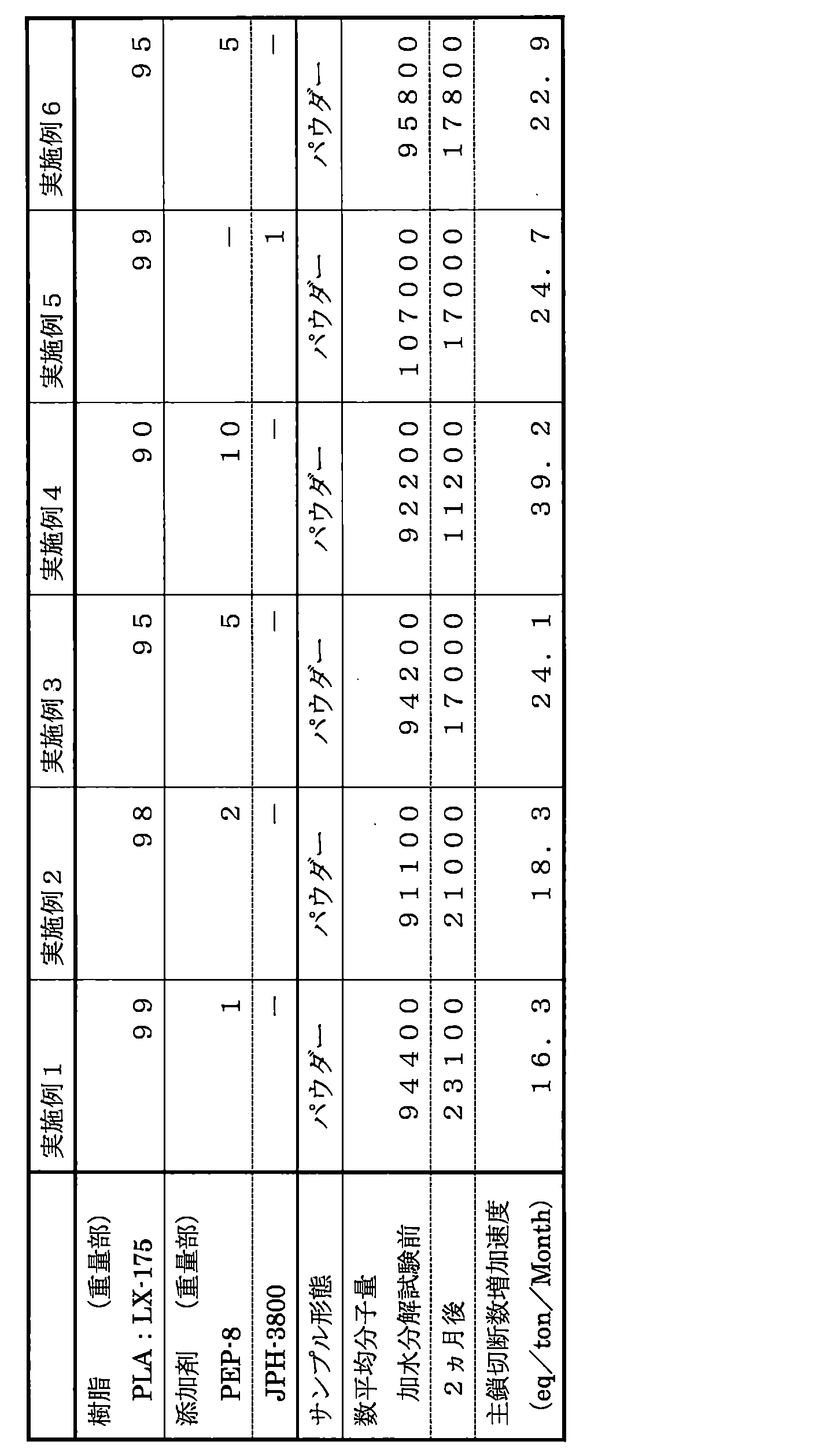
- the obtained resin composition was freeze-pulverized into a powder form, and its decomposition in low-temperature seawater was evaluated. The evaluation results are shown in Table 1.
- Example 2 to 4 A powdered resin composition was obtained in the same manner as in Example 1, except that the ratio of the polyester resin (PLA1) and the phosphorus decomposition promoter (PEP-8) in Example 1 was changed to the ratio listed in Table 1. Ta. The evaluation results are also shown in Table 1.
- Example 5 A powdery resin composition was obtained in the same manner as in Example 1 except that the phosphorus decomposition accelerator (PEP-8) in Example 1 was changed to "JPH-3800". The evaluation results are also shown in Table 1.
- Example 6 A polyester resin (PLA1) with a number average molecular weight of 120,000 was subjected to a drying treatment at 100° C. for 8 hours to obtain a polyester resin (PLA1) with a moisture content of 200 ppm.
- the obtained polyester resin (PLA1) and phosphorus-based decomposition accelerator (PEP-8) were mixed at a ratio of 95.0:5.0, and mixed in a microconical twin-screw compounder (“HAAKE” manufactured by Thermo Fisher Scientific Inc.).
- a resin composition was obtained by melt-kneading for 2 minutes at a set temperature of 190° C. and a rotational speed of 100 rpm. The acid value in this resin composition was 108 eq/ton.
- the obtained resin composition was freeze-pulverized into a powder form, and its decomposition in low-temperature seawater was evaluated.
- the number average molecular weight before the hydrolysis test was 95,800, whereas the number average molecular weight after two months of the hydrolysis test was 17,800, and the rate of increase in the number of main chain breaks was 22.9 eq/ton/month.
- Example 7 A polyester resin (PLA1) with a number average molecular weight of 120,000 and a phosphorus decomposition accelerator (PEP-8) were melted at 190°C and 200 rpm using a twin-screw extruder (manufactured by Technovel Co., Ltd.) at a ratio of 95:5. The mixture was kneaded to produce masterbatch pellets. The number average molecular weight of the obtained masterbatch pellets was 77,000, and the phosphorus concentration in the pellets was 0.37% by mass.
- PPA1 polyester resin
- PEP-8 phosphorus decomposition accelerator
- a pellet blend of a polyester resin (PLA1) with a number average molecular weight of 120,000 as a base polymer and the masterbatch pellets obtained above at a ratio of 90:10 was melt-spun at 195°C, and the single fiber fineness was 2.9 dtex.
- a fiber with 24 filaments was obtained, and its decomposition in low-temperature seawater was evaluated. The evaluation results are shown in Table 2.
- Example 8 Fibers with a single fiber fineness of 2.9 dtex and 24 filaments were prepared in the same manner as in Example 6, except that the mixing ratio of the masterbatch pellets and polyester resin (PLA1) in Example 6 was changed to the ratio listed in Table 1. Obtained. The evaluation results are also shown in Table 2.
- Example 10 to 12 Fibers with a single fiber fineness of 2.9 dtex and 24 filaments were obtained in the same manner as in Examples 6 to 8, except that the base polymer described in Example 6 was changed to a polyester resin (PLA2) with a number average molecular weight of 100,000. Ta. The evaluation results are also shown in Table 2.
- Example 13 A polyester resin (PLA1) having a number average molecular weight of 120,000 was subjected to a drying treatment at 100° C. for 8 hours to obtain a polyester resin (PLA1) having a moisture content of 200 ppm.
- the obtained polyester resin (PLA1) and phosphorus decomposition accelerator (PEP-8) were mixed in a ratio of 95.0:5.0 using a twin-screw extruder (manufactured by Technovel Co., Ltd.) at 190°C and 200 rpm.
- the mixture was melted and kneaded to produce masterbatch pellets.
- the number average molecular weight of the obtained masterbatch pellets was 88,000, and the phosphorus concentration in the pellets was 0.40% by mass.
- the acid value in the masterbatch was 113 eq/ton.
- a polyester resin (PLA1) with a number average molecular weight of 120,000 was separately dried at 100°C for 8 hours to obtain a polyester resin (PLA1) with a moisture content of 200 ppm.
- the masterbatch pellets obtained above were also dried at 80° C. for 6 hours to obtain masterbatch pellets with a moisture content of 100 ppm.
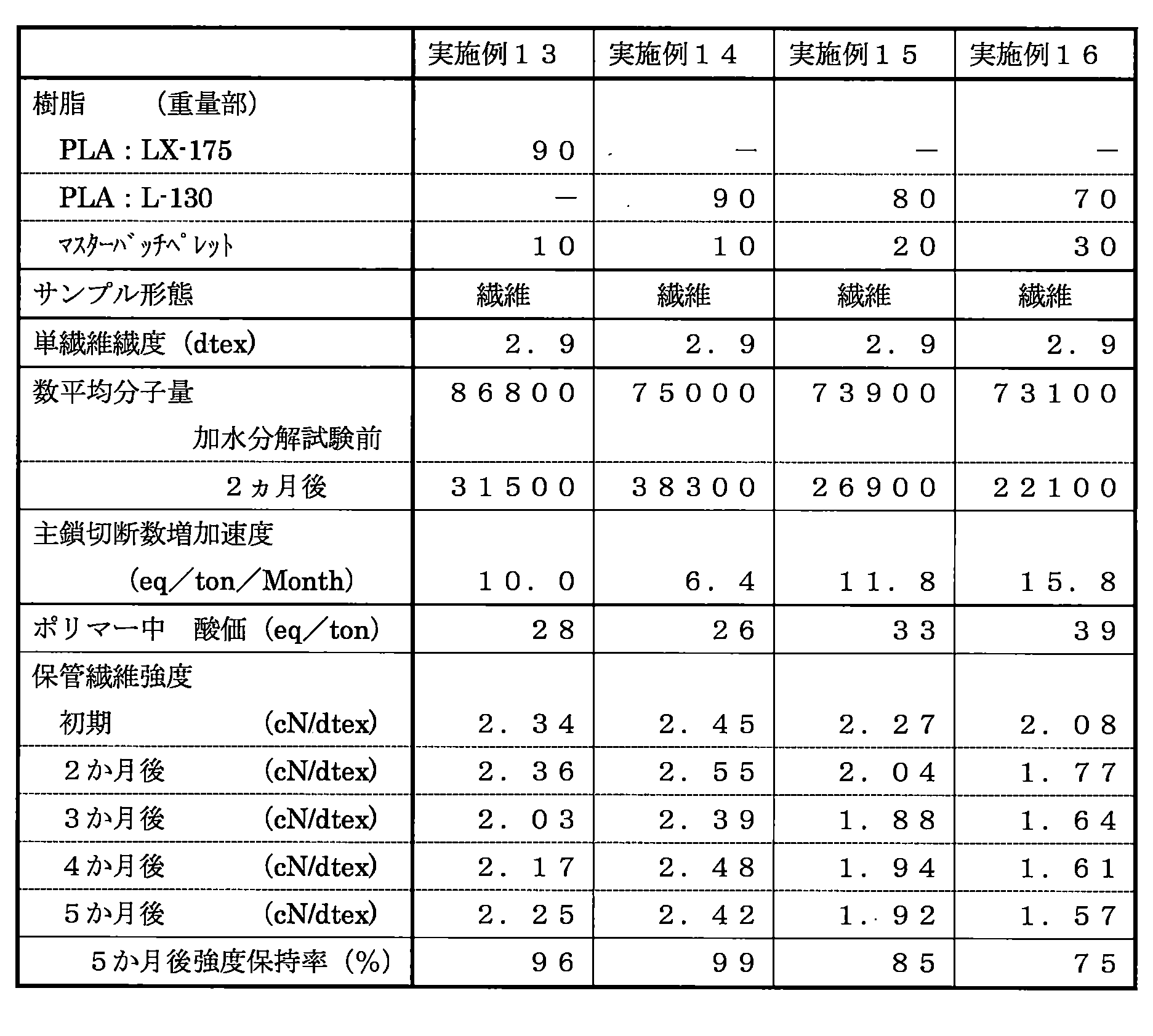
- a pellet blend of this base polymer and masterbatch pellets at a ratio of 90:10 was melt-spun at 195°C to obtain a fiber having a single fiber fineness of 2.9 dtex and 24 filaments. We evaluated the decomposition of this fiber in low-temperature seawater. The evaluation results are shown in Table 3.
- Example 14 to 16 In place of the base polymer of polyester resin (PLA1) with a number average molecular weight of 120,000 described in Example 13, a polyester resin (PLA2) with a number average molecular weight of 100,000 was used and dried at 100 ° C. for 8 hours to obtain a moisture content of 160 ppm. A fiber having a single fiber fineness of 2.9 dtex and 24 filaments was obtained in the same manner as in Example 13 except that the base polymer was changed to .
- polyester resin (PLA2) with a number average molecular weight of 100,000 was used and dried at 100 ° C. for 8 hours to obtain a moisture content of 160 ppm.
- a fiber having a single fiber fineness of 2.9 dtex and 24 filaments was obtained in the same manner as in Example 13 except that the base polymer was changed to .
- Example 1 A powdery resin composition was obtained in the same manner as in Example 1, except that the phosphorus decomposition accelerator (PEP-8) of Example 1 was not used and the ratio was changed to 100% polyester resin (PLA1). Ta. The evaluation results are also shown in Table 4.
Landscapes
- Chemical & Material Sciences (AREA)
- Chemical Kinetics & Catalysis (AREA)
- Polymers & Plastics (AREA)
- Organic Chemistry (AREA)
- Health & Medical Sciences (AREA)
- Medicinal Chemistry (AREA)
- Engineering & Computer Science (AREA)
- General Chemical & Material Sciences (AREA)
- Manufacturing & Machinery (AREA)
- Textile Engineering (AREA)
- Materials Engineering (AREA)
- Compositions Of Macromolecular Compounds (AREA)
- Biological Depolymerization Polymers (AREA)
- Artificial Filaments (AREA)
Abstract
Description

さらには、亜リン酸エステル系分解促進剤がジアルキルペンタエリスリトールジホスファイトであることや、ポリエステル樹脂組成物が脂肪族ポリエステルであること、またはポリエステル樹脂組成物の光学純度が90%以上のポリ-L-乳酸またはポリ-D-乳酸であることが好ましい。また、樹脂組成物の数平均分子量が50,000以上であることや、樹脂組成物の酸価が300eq/ton以下であること、亜リン酸エステル系分解促進剤の含有量が0.01~5質量%であることが好ましい。
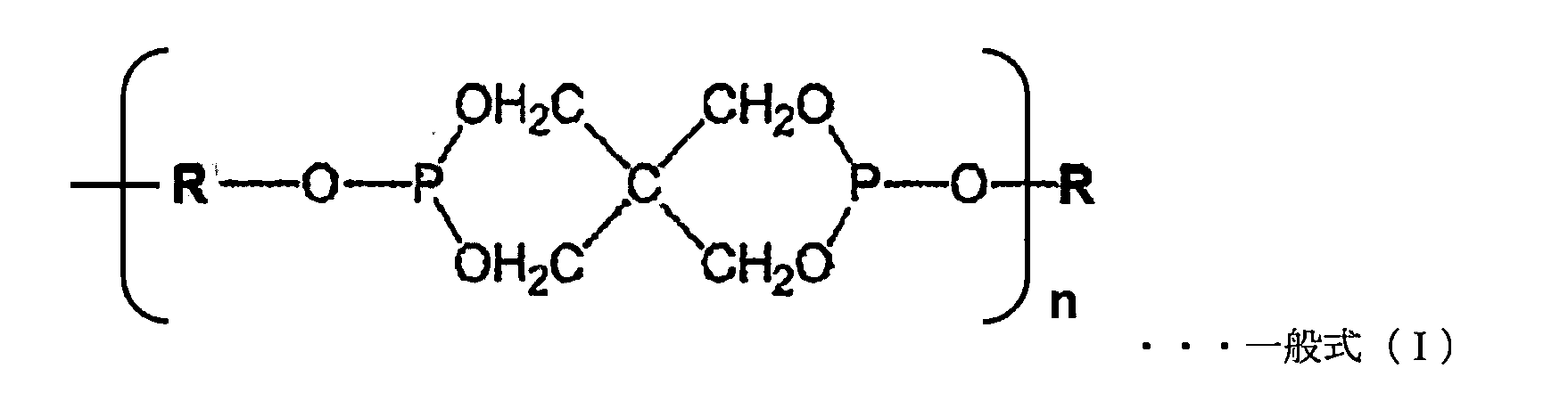
このような化合物である亜リン酸エステル類としては、ペンタエリスリトールジホスファイト成分を有する化合物であることが好ましく、中でもジアルキルペンタエリスリトールジホスファイトであることが好ましい。より具体的には、例えばジステアリルペンタエリスリトールジホスファイト、ジイソデシルペンタエリスリトールジホスファイト、ビス(2,4-ジ-t-ブチルフェニル)ペンタエリスリトールジホスファイト、ビス(2,4-ジ-t-ブチル-6-メチルフェニル)ペンタエリスリトールジホスファイト、ビス(2,6-ジ-t-ブチル-4-メチルフェニル)ペンタエリスリトールジホスファイト、ビス(2,4,6-トリ-t-ブチルフェニル)ペンタエリスリトールジホスファイト、およびそれらの混合物などが挙げられる。
また本発明の陸上で使用する際の保管強度保持率が高いことが好ましい。より具体的には室温25℃、湿度60%の環境下での5か月後(150日後)の、陸上での保管強度保持率が60%以上であることが好ましい。さらには80~100%、特には90~99%の強度保持率を有することが好ましい。
ポリマーの数平均分子量は、ゲルパーミエーションクロマトグラフィー(GPC)により測定し、標準ポリスチレンに換算した値とした。
サンプル中のP(リン)濃度は、次の方法により測定した。
サンプル200mgを分解容器に量り取り、そこへ硝酸7mLを添加した後、容器を密閉し、湿式分解装置(PerkinEimer,Inc.製「「Multiwave3000」)を用いて、700W60分の条件で分解処理をした。分解処理後の液をICP装置(AgilentAgilentTechnologies, Inc.製「5100ICP-OES」)を用いてP濃度を測定した。P濃度は市販のICP用リン標準液を用いて作成した検量線から求めた。
試料を精製o-クレゾールに窒素気流化で溶解した後、ブロモクレゾールブルーを指示薬として、0.05規定水酸化カリウムのエタノール溶液による中和滴定で求めた。それを試料1×10⁶g(1ton)中のポリマー由来のカルボキシル基および亜リン酸エステルの分解生成物である亜リン酸の総量の当量濃度の数値(eq/ton)として換算した。
パウダー形状の樹脂組成物に関しては、粉体化した樹脂組成物100mg及び天然海水(愛媛県松山港にて採取)100ccをスクリュー管瓶の中に入れ、アズワン製ミックスローター(型番:VMRC-5)を用いて、30℃、100rpmで60日間振盪させた。60日後、樹脂組成物を取り出し、ろ紙(JIS、P3801:1995、5種A規格)を用いてろ過を行い、ろ紙上に残る樹脂組成物を室温、133.3Pa以下の真空にて一晩乾燥させ、GPCにより数平均分子量を測定した。得られた数平均分子量を用い、樹脂組成物の主鎖切断数を測定し、下記数式1、2により主鎖切断数増加速度を求めた。


陸上における耐加水分解性の評価として、室温25℃、湿度60%RHの環境にて5か月保管し、繊維強度を測定して、初期繊維物性からの保持率として評価した。なお、この時の繊維強度は試長(チャック間距離)250mm、引張速度200mm/分の条件にて、繊維の強伸度を測定し、当初および5カ月経過後の繊維強度を比較し、陸上での保管強度保持率とした。
(6)水分率測定
水分率は、京都電子工業製カールフィッシャー水分計(MKC-610)および水分気化装置(APD-611)を用い、180℃で20分間の気化条件で水分量を定量し、水分率を求めた。
なお、下記の実施例では、「ポリエステル樹脂」及び「分解促進剤」として下記の化合物を用いた。
・PLA1;
TotalCorbion社製ポリ乳酸「LX-175」(光学純度;96%L体、数平均分子量 12万)
・PLA2;
TotalCorbion社製ポリ乳酸「L-130」(光学純度;99%L体、数平均分子量 10万)
<分解促進剤(リン系分解促進剤)>
(実施例)
・PEP-8;
ジステアリルペンタエリスリトールジホスファイト(株式会社ADEKA製「PEP-8」、リン濃度 7.6%、熱分解温度(5%重量減少温度):210℃)
・JPH-3800;
水添ビスフェノールA・ペンタエリスリトールホスファイトポリマー(城北化学工業株式会社製「JPH-3800」、数平均分子量 2000、熱分解温度(5%重量減少温度):180℃)
(比較例)
・JC-356;
ジエチル(3,5-ジ-t-ブチル-4-ヒドロキシベンジル)ホスホネート(城北化学工業株式会社製「JC-356」)
・JC-228;
ジエチルベンジルホスホネート(城北化学工業株式会社製「JC-228」)
・JC-390;
ジエチルオクタデシルホスホネート(城北化学工業株式会社製「JC-390」)
[実施例1]
数平均分子量12万のポリエステル樹脂(PLA1)とリン系分解促進剤(PEP-8)を99.0:1.0になるように混合し、マイクロコニカル二軸スクリューコンパウンダー(ThermoFisher Scientific Inc.製「HAAKE MiniCTW」)を使用して、設定温度190℃、回転数100rpmで2分溶融混練して樹脂組成物を得た。得られた樹脂組成物を凍結粉砕によりパウダー状とし、低温海水中での分解評価を行った。評価結果については表1に示した。
実施例1のポリエステル樹脂(PLA1)とリン系分解促進剤(PEP-8)の比率を表1記載の比率に変更した以外は、実施例1と同様にして、パウダー状の樹脂組成物を得た。評価結果について表1に併せて示した。
実施例1のリン系分解促進剤(PEP-8)を、「JPH-3800」に変更した以外は実施例1と同様にして、パウダー状の樹脂組成物を得た。評価結果について表1に併せて示した。
数平均分子量12万のポリエステル樹脂(PLA1)に対し、100℃で8時間の乾燥処理を施し水分率200ppmのポリエステル樹脂(PLA1)を得た。得られたポリエステル樹脂(PLA1)とリン系分解促進剤(PEP-8)を95.0:5.0になるように混合し、マイクロコニカル二軸スクリューコンパウンダー(Thermo Fisher Scientific Inc.製「HAAKE MiniCTW」)を使用して、設定温度190℃、回転数100rpmで2分溶融混練して樹脂組成物を得た。この樹脂組成物中の酸価は108eq/tonであった。得られた樹脂組成物を凍結粉砕によりパウダー状とし、低温海水中での分解評価を行った。加水分解試験前の数平均分子量が95800に対し、加水分解試験2カ月後の数平均分子量は17800であり、主鎖切断数増加速度は、22.9eq/ton/Monthであった。
数平均分子量12万のポリエステル樹脂(PLA1)とリン系分解促進剤(PEP-8)を95:5となるように二軸押し出し機(株式会社テクノベル製)を用いて、190℃、200rpmで溶融混練し、マスターバッチペレットを作製した。得られたマスターバッチペレットの数平均分子量は7万7千であり、ペレット中のリン濃度は0.37質量%であった。ベースポリマーとして数平均分子量12万のポリエステル樹脂(PLA1)と上記で得られたマスターバッチペレットを90:10になるようにペレットブレンドした物を195℃にて溶融紡糸し、単繊維繊度2.9dtex、フィラメント数24本の繊維を得て、低温海水中での分解評価を行った。評価結果については表2に示した。
実施例6のマスターバッチペレットとポリエステル樹脂(PLA1)の混合比率を表1記載の比率に変更した以外は、実施例6と同様にして、単繊維繊度2.9dtex、フィラメント数24本の繊維を得た。評価結果について表2に併せて示した。
実施例6で記載のベースポリマーを数平均分子量10万のポリエステル樹脂(PLA2)に変更した以外は実施例6~8と同様にして、単繊維繊度2.9dtex、フィラメント数24本の繊維を得た。評価結果について表2に併せて示した。

数平均分子量12万のポリエステル樹脂(PLA1)に対し、100℃で8時間乾燥処理を施し水分率200ppmのポリエステル樹脂(PLA1)を得た。得られたポリエステル樹脂(PLA1)とリン系分解促進剤(PEP-8)を95.0:5.0となるように二軸押し出し機(株式会社テクノベル製)を用いて、190℃、200rpmで溶融混練し、マスターバッチペレットを作製した。得られたマスターバッチペレットの数平均分子量は8万8千であり、ペレット中のリン濃度は0.40質量%であった。マスターバッチ中の酸価は113eq/tonであった。
実施例13で記載の数平均分子量12万のポリエステル樹脂(PLA1)のベースポリマーに代えて、数平均分子量10万のポリエステル樹脂(PLA2)を用い、100℃で8時間乾燥処理を施し水分率160ppmのベースポリマーに変更した以外は実施例13と同様にして、単繊維繊度2.9dtex、フィラメント数24本の繊維を得た。
実施例1のリン系分解促進剤(PEP-8)を使用せず、ポリエステル樹脂(PLA1)100%の比率に変更した以外は、実施例1と同様にして、パウダー状の樹脂組成物を得た。評価結果について表4に併せて示した。
実施例1のリン系分解促進剤(PEP-8)に代えて、「JC-356」(比較例2)、「JC-228」(比較例3)、「JC-390」(比較例4)に変更した以外は、実施例1と同様にして、パウダー状の樹脂組成物を得た。評価結果について表4に併せて示した。

Claims (14)
- 主としてポリエステルからなる樹脂組成物であって、亜リン酸エステル系分解促進剤を含有し、亜リン酸エステル系分解促進剤が下記一般式(I)で表される化合物であることを特徴とする海洋分解性ポリエステル樹脂組成物。

- 亜リン酸エステル系分解促進剤が、ジアルキルペンタエリスリトールジホスファイトである請求項1記載の海洋分解性ポリエステル樹脂組成物。
- ポリエステル樹脂組成物が脂肪族ポリエステルである請求項1記載の海洋分解性ポリエステル樹脂組成物。
- ポリエステル樹脂組成物が、光学純度が90%以上のポリ-L-乳酸またはポリ-D-乳酸である請求項1記載の海洋分解性ポリエステル樹脂組成物。
- 樹脂組成物の数平均分子量が50,000以上である請求項1記載の海洋分解性ポリエステル樹脂組成物。
- 樹脂組成物の酸価が300eq/ton以下である請求項1記載の海洋分解性ポリエステル樹脂組成物。
- 亜リン酸エステル系分解促進剤の含有量が0.01~5質量%である請求項1記載の海洋分解性ポリエステル樹脂組成物。
- 請求項1~7のいずれかに記載の海洋分解性ポリエステル樹脂組成物からなることを特徴とするポリエステル系樹脂成形体。
- 5か月後の陸上での保管強度保持率が60%以上である請求項8記載のポリエステル系樹脂成形体。
- ポリエステル樹脂成形体の形状が繊維またはフィルムである請求項8記載のポリエステル系樹脂成形体。
- 繊維の初期強度が1.5cN/dtex以上である請求項10記載のポリエステル系樹脂成形体。
- 請求項1~6のいずれかに記載の海洋分解性ポリエステル樹脂組成物であって、亜リン酸エステル系分解促進剤の含有量が5~20質量%であることを特徴とするポリエステル系樹脂組成物のマスターバッチ。
- 請求項12記載のマスターバッチをポリエステル系樹脂に添加し、溶融成形することを特徴とするポリエステル系樹脂成形体の製造方法。
- ポリエステル系樹脂成形体の形状が繊維またはフィルムである請求項13記載のポリエステル系樹脂成形体の製造方法。
Priority Applications (2)
| Application Number | Priority Date | Filing Date | Title |
|---|---|---|---|
| EP23780114.7A EP4502060A4 (en) | 2022-03-29 | 2023-03-24 | MARINE-DEGRADABLE POLYESTER RESIN COMPOSITION, MOLDED BODY MADE THEREFROM AND PROCESS FOR ITS PRODUCTION |
| JP2024512314A JP7860222B2 (ja) | 2022-03-29 | 2023-03-24 | 海洋分解性ポリエステル樹脂成形体及びその製造方法 |
Applications Claiming Priority (2)
| Application Number | Priority Date | Filing Date | Title |
|---|---|---|---|
| JP2022-053233 | 2022-03-29 | ||
| JP2022053233 | 2022-03-29 |
Publications (1)
| Publication Number | Publication Date |
|---|---|
| WO2023190104A1 true WO2023190104A1 (ja) | 2023-10-05 |
Family
ID=88202172
Family Applications (1)
| Application Number | Title | Priority Date | Filing Date |
|---|---|---|---|
| PCT/JP2023/011698 Ceased WO2023190104A1 (ja) | 2022-03-29 | 2023-03-24 | 海洋分解性ポリエステル樹脂組成物、それからなる成形体及びその製造方法 |
Country Status (3)
| Country | Link |
|---|---|
| EP (1) | EP4502060A4 (ja) |
| TW (1) | TW202402917A (ja) |
| WO (1) | WO2023190104A1 (ja) |
Cited By (1)
| Publication number | Priority date | Publication date | Assignee | Title |
|---|---|---|---|---|
| WO2026009731A1 (ja) * | 2024-07-05 | 2026-01-08 | 帝人フロンティア株式会社 | 生分解性ポリエステル不織布及びそれからなる不織布製品 |
Citations (5)
| Publication number | Priority date | Publication date | Assignee | Title |
|---|---|---|---|---|
| JP2000345432A (ja) * | 1999-06-04 | 2000-12-12 | Toyobo Co Ltd | 抗菌性詰め綿材およびそれを用いた布団 |
| JP2001049097A (ja) * | 1999-08-10 | 2001-02-20 | Mitsui Chemicals Inc | 脂肪族ポリエステル樹脂組成物及び成形体 |
| JP2005226183A (ja) * | 2004-02-12 | 2005-08-25 | Nisshinbo Ind Inc | 生分解性プラスチックを含む繊維製品 |
| WO2006118096A1 (ja) * | 2005-04-26 | 2006-11-09 | Unitika Ltd. | 生分解樹脂組成物、成形体及び製造方法 |
| WO2014112479A1 (ja) * | 2013-01-18 | 2014-07-24 | 株式会社クレハ | 坑井処理流体材料およびそれを含有する坑井処理流体 |
Family Cites Families (3)
| Publication number | Priority date | Publication date | Assignee | Title |
|---|---|---|---|---|
| JP2006249152A (ja) * | 2005-03-08 | 2006-09-21 | Unitika Ltd | 生分解性樹脂組成物、成形体及びその製造方法 |
| EP1932884A4 (en) * | 2005-10-05 | 2012-04-11 | Unitika Ltd | BIODEGRADABLE RESIN COMPOSITION, PROCESS FOR PRODUCING THE SAME, AND MOLDED ARTICLE USING SUCH COMPOSITION |
| DE102020205100A1 (de) * | 2020-04-22 | 2021-10-28 | Fraunhofer-Gesellschaft zur Förderung der angewandten Forschung eingetragener Verein | Additivzusammensetzung sowie deren verwendung, kondensationspolymerzusammensetzung, formmasse und hieraus hergestellte formmassen und formteile und deren verwendung |
-
2023
- 2023-03-24 EP EP23780114.7A patent/EP4502060A4/en active Pending
- 2023-03-24 WO PCT/JP2023/011698 patent/WO2023190104A1/ja not_active Ceased
- 2023-03-27 TW TW112111464A patent/TW202402917A/zh unknown
Patent Citations (5)
| Publication number | Priority date | Publication date | Assignee | Title |
|---|---|---|---|---|
| JP2000345432A (ja) * | 1999-06-04 | 2000-12-12 | Toyobo Co Ltd | 抗菌性詰め綿材およびそれを用いた布団 |
| JP2001049097A (ja) * | 1999-08-10 | 2001-02-20 | Mitsui Chemicals Inc | 脂肪族ポリエステル樹脂組成物及び成形体 |
| JP2005226183A (ja) * | 2004-02-12 | 2005-08-25 | Nisshinbo Ind Inc | 生分解性プラスチックを含む繊維製品 |
| WO2006118096A1 (ja) * | 2005-04-26 | 2006-11-09 | Unitika Ltd. | 生分解樹脂組成物、成形体及び製造方法 |
| WO2014112479A1 (ja) * | 2013-01-18 | 2014-07-24 | 株式会社クレハ | 坑井処理流体材料およびそれを含有する坑井処理流体 |
Non-Patent Citations (1)
| Title |
|---|
| See also references of EP4502060A4 * |
Cited By (1)
| Publication number | Priority date | Publication date | Assignee | Title |
|---|---|---|---|---|
| WO2026009731A1 (ja) * | 2024-07-05 | 2026-01-08 | 帝人フロンティア株式会社 | 生分解性ポリエステル不織布及びそれからなる不織布製品 |
Also Published As
| Publication number | Publication date |
|---|---|
| EP4502060A4 (en) | 2025-06-25 |
| EP4502060A1 (en) | 2025-02-05 |
| JPWO2023190104A1 (ja) | 2023-10-05 |
| TW202402917A (zh) | 2024-01-16 |
Similar Documents
| Publication | Publication Date | Title |
|---|---|---|
| JP4585749B2 (ja) | 黄変を抑えたカルボジイミド組成物、耐加水分解安定剤及び熱可塑性樹脂組成物 | |
| CN102070880B (zh) | 一种生物降解树脂组合物及其制品 | |
| JP5157035B2 (ja) | ポリ乳酸樹脂組成物、その製造方法および成形品 | |
| CN101328308B (zh) | 高韧性可全生物降解聚乳酸薄膜及其制备方法 | |
| JP2005082642A (ja) | エステル基を有する樹脂用の耐加水分解安定剤及び熱可塑性樹脂組成物 | |
| Sánchez-Safont et al. | Poly (3-hydroxybutyrate-co-3-hydroxyvalerate)/purified cellulose fiber composites by melt blending: characterization and degradation in composting conditions | |
| JP2004307528A (ja) | 射出成形体 | |
| EP1932884A1 (en) | Biodegradable resin composition, process for production of the same, and molded article using the same | |
| CN118591591A (zh) | 农业资材用热塑性树脂组合物及农业资材 | |
| WO2024171793A1 (ja) | ポリ(3-ヒドロキシアルカノエート)系成形加工用樹脂組成物およびその成形体 | |
| JP5823500B2 (ja) | 生分解性樹脂組成物及びその成形体 | |
| JP4634235B2 (ja) | 生分解性樹脂組成物及びフィルム | |
| JP4306258B2 (ja) | 樹脂組成物ならびにそれからなる成形品 | |
| TW202402917A (zh) | 海洋分解性聚酯樹脂組成物、由其而成之成形體及其製造方法 | |
| JP2004269720A (ja) | 熱可塑性樹脂組成物 | |
| JP2023146175A (ja) | ポリエステル系樹脂組成物およびそれからなる成形体の製造方法 | |
| JP4928157B2 (ja) | ポリ乳酸樹脂組成物および成形品 | |
| JP7860222B2 (ja) | 海洋分解性ポリエステル樹脂成形体及びその製造方法 | |
| JP2004143203A (ja) | 射出成形体 | |
| JP2022142501A (ja) | 脂肪族芳香族ポリエステル組成物および脂肪族芳香族ポリエステル組成物の製造方法 | |
| JP2008247956A (ja) | ポリエステル組成物 | |
| JP4186477B2 (ja) | 樹脂組成物ならびにそれからなる成形品 | |
| JP4587737B2 (ja) | ポリ乳酸組成物 | |
| JP2009079104A (ja) | ブロック共重合体組成物、その製造方法および樹脂組成物 | |
| Wang | Poly (lactic acid)(PLA), poly (ε-caprolactone)(PCL) and thermoplastic starch (TPS) blends for compostable packaging applications |
Legal Events
| Date | Code | Title | Description |
|---|---|---|---|
| 121 | Ep: the epo has been informed by wipo that ep was designated in this application |
Ref document number: 23780114 Country of ref document: EP Kind code of ref document: A1 |
|
| ENP | Entry into the national phase |
Ref document number: 2024512314 Country of ref document: JP Kind code of ref document: A |
|
| WWE | Wipo information: entry into national phase |
Ref document number: 2401006177 Country of ref document: TH |
|
| WWE | Wipo information: entry into national phase |
Ref document number: 2023780114 Country of ref document: EP |
|
| NENP | Non-entry into the national phase |
Ref country code: DE |
|
| ENP | Entry into the national phase |
Ref document number: 2023780114 Country of ref document: EP Effective date: 20241029 |