WO2023190814A1 - エチレン-ビニルアルコール系共重合体組成物及びその製造方法、それを用いた溶融成形用材料、ぺレット、並びに多層構造体及びその製造方法 - Google Patents
エチレン-ビニルアルコール系共重合体組成物及びその製造方法、それを用いた溶融成形用材料、ぺレット、並びに多層構造体及びその製造方法 Download PDFInfo
- Publication number
- WO2023190814A1 WO2023190814A1 PCT/JP2023/013063 JP2023013063W WO2023190814A1 WO 2023190814 A1 WO2023190814 A1 WO 2023190814A1 JP 2023013063 W JP2023013063 W JP 2023013063W WO 2023190814 A1 WO2023190814 A1 WO 2023190814A1
- Authority
- WO
- WIPO (PCT)
- Prior art keywords
- evoh resin
- resin composition
- ethylene
- present
- vinyl alcohol
- Prior art date
- Legal status (The legal status is an assumption and is not a legal conclusion. Google has not performed a legal analysis and makes no representation as to the accuracy of the status listed.)
- Ceased
Links
Classifications
-
- C—CHEMISTRY; METALLURGY
- C08—ORGANIC MACROMOLECULAR COMPOUNDS; THEIR PREPARATION OR CHEMICAL WORKING-UP; COMPOSITIONS BASED THEREON
- C08K—Use of inorganic or non-macromolecular organic substances as compounding ingredients
- C08K3/00—Use of inorganic substances as compounding ingredients
- C08K3/18—Oxygen-containing compounds, e.g. metal carbonyls
- C08K3/20—Oxides; Hydroxides
- C08K3/22—Oxides; Hydroxides of metals
-
- B—PERFORMING OPERATIONS; TRANSPORTING
- B32—LAYERED PRODUCTS
- B32B—LAYERED PRODUCTS, i.e. PRODUCTS BUILT-UP OF STRATA OF FLAT OR NON-FLAT, e.g. CELLULAR OR HONEYCOMB, FORM
- B32B27/00—Layered products comprising a layer of synthetic resin
- B32B27/18—Layered products comprising a layer of synthetic resin characterised by the use of special additives
-
- B—PERFORMING OPERATIONS; TRANSPORTING
- B32—LAYERED PRODUCTS
- B32B—LAYERED PRODUCTS, i.e. PRODUCTS BUILT-UP OF STRATA OF FLAT OR NON-FLAT, e.g. CELLULAR OR HONEYCOMB, FORM
- B32B27/00—Layered products comprising a layer of synthetic resin
- B32B27/28—Layered products comprising a layer of synthetic resin comprising synthetic resins not wholly covered by any one of the sub-groups B32B27/30 - B32B27/42
-
- B—PERFORMING OPERATIONS; TRANSPORTING
- B32—LAYERED PRODUCTS
- B32B—LAYERED PRODUCTS, i.e. PRODUCTS BUILT-UP OF STRATA OF FLAT OR NON-FLAT, e.g. CELLULAR OR HONEYCOMB, FORM
- B32B27/00—Layered products comprising a layer of synthetic resin
- B32B27/30—Layered products comprising a layer of synthetic resin comprising vinyl (co)polymers; comprising acrylic (co)polymers
-
- B—PERFORMING OPERATIONS; TRANSPORTING
- B65—CONVEYING; PACKING; STORING; HANDLING THIN OR FILAMENTARY MATERIAL
- B65D—CONTAINERS FOR STORAGE OR TRANSPORT OF ARTICLES OR MATERIALS, e.g. BAGS, BARRELS, BOTTLES, BOXES, CANS, CARTONS, CRATES, DRUMS, JARS, TANKS, HOPPERS, FORWARDING CONTAINERS; ACCESSORIES, CLOSURES, OR FITTINGS THEREFOR; PACKAGING ELEMENTS; PACKAGES
- B65D65/00—Wrappers or flexible covers; Packaging materials of special type or form
- B65D65/38—Packaging materials of special type or form
- B65D65/40—Applications of laminates for particular packaging purposes
-
- C—CHEMISTRY; METALLURGY
- C08—ORGANIC MACROMOLECULAR COMPOUNDS; THEIR PREPARATION OR CHEMICAL WORKING-UP; COMPOSITIONS BASED THEREON
- C08K—Use of inorganic or non-macromolecular organic substances as compounding ingredients
- C08K5/00—Use of organic ingredients
- C08K5/01—Hydrocarbons
-
- C—CHEMISTRY; METALLURGY
- C08—ORGANIC MACROMOLECULAR COMPOUNDS; THEIR PREPARATION OR CHEMICAL WORKING-UP; COMPOSITIONS BASED THEREON
- C08K—Use of inorganic or non-macromolecular organic substances as compounding ingredients
- C08K5/00—Use of organic ingredients
- C08K5/04—Oxygen-containing compounds
- C08K5/09—Carboxylic acids; Metal salts thereof; Anhydrides thereof
- C08K5/098—Metal salts of carboxylic acids
-
- C—CHEMISTRY; METALLURGY
- C08—ORGANIC MACROMOLECULAR COMPOUNDS; THEIR PREPARATION OR CHEMICAL WORKING-UP; COMPOSITIONS BASED THEREON
- C08L—COMPOSITIONS OF MACROMOLECULAR COMPOUNDS
- C08L23/00—Compositions of homopolymers or copolymers of unsaturated aliphatic hydrocarbons having only one carbon-to-carbon double bond; Compositions of derivatives of such polymers
-
- C—CHEMISTRY; METALLURGY
- C08—ORGANIC MACROMOLECULAR COMPOUNDS; THEIR PREPARATION OR CHEMICAL WORKING-UP; COMPOSITIONS BASED THEREON
- C08L—COMPOSITIONS OF MACROMOLECULAR COMPOUNDS
- C08L23/00—Compositions of homopolymers or copolymers of unsaturated aliphatic hydrocarbons having only one carbon-to-carbon double bond; Compositions of derivatives of such polymers
- C08L23/02—Compositions of homopolymers or copolymers of unsaturated aliphatic hydrocarbons having only one carbon-to-carbon double bond; Compositions of derivatives of such polymers not modified by chemical after-treatment
- C08L23/04—Homopolymers or copolymers of ethene
- C08L23/08—Copolymers of ethene
-
- C—CHEMISTRY; METALLURGY
- C08—ORGANIC MACROMOLECULAR COMPOUNDS; THEIR PREPARATION OR CHEMICAL WORKING-UP; COMPOSITIONS BASED THEREON
- C08L—COMPOSITIONS OF MACROMOLECULAR COMPOUNDS
- C08L23/00—Compositions of homopolymers or copolymers of unsaturated aliphatic hydrocarbons having only one carbon-to-carbon double bond; Compositions of derivatives of such polymers
- C08L23/02—Compositions of homopolymers or copolymers of unsaturated aliphatic hydrocarbons having only one carbon-to-carbon double bond; Compositions of derivatives of such polymers not modified by chemical after-treatment
- C08L23/04—Homopolymers or copolymers of ethene
- C08L23/08—Copolymers of ethene
- C08L23/0846—Copolymers of ethene with unsaturated hydrocarbons containing atoms other than carbon or hydrogen
- C08L23/0853—Ethylene vinyl acetate copolymers
- C08L23/0861—Saponified copolymers, e.g. ethylene vinyl alcohol copolymers
-
- C—CHEMISTRY; METALLURGY
- C08—ORGANIC MACROMOLECULAR COMPOUNDS; THEIR PREPARATION OR CHEMICAL WORKING-UP; COMPOSITIONS BASED THEREON
- C08L—COMPOSITIONS OF MACROMOLECULAR COMPOUNDS
- C08L23/00—Compositions of homopolymers or copolymers of unsaturated aliphatic hydrocarbons having only one carbon-to-carbon double bond; Compositions of derivatives of such polymers
- C08L23/02—Compositions of homopolymers or copolymers of unsaturated aliphatic hydrocarbons having only one carbon-to-carbon double bond; Compositions of derivatives of such polymers not modified by chemical after-treatment
- C08L23/10—Homopolymers or copolymers of propene
-
- C—CHEMISTRY; METALLURGY
- C08—ORGANIC MACROMOLECULAR COMPOUNDS; THEIR PREPARATION OR CHEMICAL WORKING-UP; COMPOSITIONS BASED THEREON
- C08L—COMPOSITIONS OF MACROMOLECULAR COMPOUNDS
- C08L23/00—Compositions of homopolymers or copolymers of unsaturated aliphatic hydrocarbons having only one carbon-to-carbon double bond; Compositions of derivatives of such polymers
- C08L23/02—Compositions of homopolymers or copolymers of unsaturated aliphatic hydrocarbons having only one carbon-to-carbon double bond; Compositions of derivatives of such polymers not modified by chemical after-treatment
- C08L23/10—Homopolymers or copolymers of propene
- C08L23/12—Polypropene
-
- C—CHEMISTRY; METALLURGY
- C08—ORGANIC MACROMOLECULAR COMPOUNDS; THEIR PREPARATION OR CHEMICAL WORKING-UP; COMPOSITIONS BASED THEREON
- C08L—COMPOSITIONS OF MACROMOLECULAR COMPOUNDS
- C08L23/00—Compositions of homopolymers or copolymers of unsaturated aliphatic hydrocarbons having only one carbon-to-carbon double bond; Compositions of derivatives of such polymers
- C08L23/26—Compositions of homopolymers or copolymers of unsaturated aliphatic hydrocarbons having only one carbon-to-carbon double bond; Compositions of derivatives of such polymers modified by chemical after-treatment
-
- C—CHEMISTRY; METALLURGY
- C08—ORGANIC MACROMOLECULAR COMPOUNDS; THEIR PREPARATION OR CHEMICAL WORKING-UP; COMPOSITIONS BASED THEREON
- C08L—COMPOSITIONS OF MACROMOLECULAR COMPOUNDS
- C08L29/00—Compositions of homopolymers or copolymers of compounds having one or more unsaturated aliphatic radicals, each having only one carbon-to-carbon double bond, and at least one being terminated by an alcohol, ether, aldehydo, ketonic, acetal or ketal radical; Compositions of hydrolysed polymers of esters of unsaturated alcohols with saturated carboxylic acids; Compositions of derivatives of such polymers
- C08L29/02—Homopolymers or copolymers of unsaturated alcohols
- C08L29/04—Polyvinyl alcohol; Partially hydrolysed homopolymers or copolymers of esters of unsaturated alcohols with saturated carboxylic acids
-
- C—CHEMISTRY; METALLURGY
- C08—ORGANIC MACROMOLECULAR COMPOUNDS; THEIR PREPARATION OR CHEMICAL WORKING-UP; COMPOSITIONS BASED THEREON
- C08L—COMPOSITIONS OF MACROMOLECULAR COMPOUNDS
- C08L77/00—Compositions of polyamides obtained by reactions forming a carboxylic amide link in the main chain; Compositions of derivatives of such polymers
-
- C—CHEMISTRY; METALLURGY
- C08—ORGANIC MACROMOLECULAR COMPOUNDS; THEIR PREPARATION OR CHEMICAL WORKING-UP; COMPOSITIONS BASED THEREON
- C08K—Use of inorganic or non-macromolecular organic substances as compounding ingredients
- C08K3/00—Use of inorganic substances as compounding ingredients
- C08K3/18—Oxygen-containing compounds, e.g. metal carbonyls
- C08K3/20—Oxides; Hydroxides
- C08K3/22—Oxides; Hydroxides of metals
- C08K2003/2237—Oxides; Hydroxides of metals of titanium
- C08K2003/2241—Titanium dioxide
-
- C—CHEMISTRY; METALLURGY
- C08—ORGANIC MACROMOLECULAR COMPOUNDS; THEIR PREPARATION OR CHEMICAL WORKING-UP; COMPOSITIONS BASED THEREON
- C08L—COMPOSITIONS OF MACROMOLECULAR COMPOUNDS
- C08L2203/00—Applications
- C08L2203/30—Applications used for thermoforming
-
- C—CHEMISTRY; METALLURGY
- C08—ORGANIC MACROMOLECULAR COMPOUNDS; THEIR PREPARATION OR CHEMICAL WORKING-UP; COMPOSITIONS BASED THEREON
- C08L—COMPOSITIONS OF MACROMOLECULAR COMPOUNDS
- C08L2205/00—Polymer mixtures characterised by other features
- C08L2205/02—Polymer mixtures characterised by other features containing two or more polymers of the same C08L -group
-
- C—CHEMISTRY; METALLURGY
- C08—ORGANIC MACROMOLECULAR COMPOUNDS; THEIR PREPARATION OR CHEMICAL WORKING-UP; COMPOSITIONS BASED THEREON
- C08L—COMPOSITIONS OF MACROMOLECULAR COMPOUNDS
- C08L2205/00—Polymer mixtures characterised by other features
- C08L2205/02—Polymer mixtures characterised by other features containing two or more polymers of the same C08L -group
- C08L2205/025—Polymer mixtures characterised by other features containing two or more polymers of the same C08L -group containing two or more polymers of the same hierarchy C08L, and differing only in parameters such as density, comonomer content, molecular weight, structure
-
- C—CHEMISTRY; METALLURGY
- C08—ORGANIC MACROMOLECULAR COMPOUNDS; THEIR PREPARATION OR CHEMICAL WORKING-UP; COMPOSITIONS BASED THEREON
- C08L—COMPOSITIONS OF MACROMOLECULAR COMPOUNDS
- C08L2205/00—Polymer mixtures characterised by other features
- C08L2205/03—Polymer mixtures characterised by other features containing three or more polymers in a blend
Definitions
- the present invention relates to an ethylene-vinyl alcohol copolymer (hereinafter sometimes referred to as "EVOH resin") composition, a method for producing the same, a melt molding material using the same, a pellet, a multilayer structure, and the production thereof. Regarding the method.
- EVOH resin ethylene-vinyl alcohol copolymer
- EVOH resin has excellent transparency, gas barrier properties against oxygen and other gases, aroma retention, solvent resistance, oil resistance, mechanical strength, etc., and can be molded into films, sheets, bottles, etc., and is used as food packaging materials, pharmaceutical packaging materials, It is widely used as a variety of packaging materials such as industrial drug packaging materials and pesticide packaging materials.
- EVOH resin has a relatively active hydroxyl group in its molecule, it tends to deteriorate easily due to heat, and coloring problems tend to occur during melt molding.
- Patent Document 1 discloses that an EVOH resin (A), acetic acid (B), magnesium acetate and/or calcium acetate (C) is contained, and the content of (B) is (A).
- a resin composition characterized in that the content of (C) is 0.05 parts by mass or less per 100 parts by mass, and the content of (C) is 0.001 to 0.02 parts by mass per 100 parts by mass of (A) in terms of metal. things are disclosed.
- this resin composition By using this resin composition, a molded product with excellent long-run properties during melt molding, less fish eyes, streaks, and coloring, and excellent appearance can be obtained, and furthermore, when the molded product is made into a laminate. It is also disclosed that the odor is reduced, and the interlayer adhesion of the laminate is also excellent even after secondary processing such as stretching and deep drawing.
- Patent Document 1 has excellent long-run properties during melt molding, and can produce molded products with less fish eyes, streaks, and coloring, and excellent appearance.
- molding equipment there has been a tendency for molding equipment to become more sophisticated due to the diversification of feedblock and die shapes in molding equipment, as well as demands for higher functionality such as thinner multilayer structures and increased number of layers in final products. be. Therefore, the resin tends to be thermally degraded in molding equipment that has become more complex due to higher functionality, resulting in a decrease in product productivity (long-run performance), and further improvements are required.
- the present invention provides an EVOH resin composition in which thermal deterioration of the EVOH resin during heating such as melt molding is suppressed.
- the present inventors added metal compounds (excluding titanium compounds) belonging to the 4th period d block of the long period periodic table (B1), polyolefin resins (B2), and olefin polymers (B3) to the EVOH resin. ), a polyamide resin (B4), and a styrene derivative having a substituent at the ⁇ -position (B5), and a specific trace amount of a titanium compound. It has been found that an EVOH resin composition can be obtained in which thermal deterioration of the EVOH resin during heating is suppressed.
- the olefin polymer (B2) is at least one selected from the group consisting of an olefin thermoplastic elastomer, an aliphatic rubber, and an ionomer, An ethylene-vinyl alcohol copolymer composition in which the content of the titanium compound (C) in terms of metal is 0.00005 ppm or more and less than 5 ppm per mass of the ethylene-vinyl alcohol copolymer composition.
- the content of the titanium compound (C) in terms of metal per total mass of the ethylene-vinyl alcohol copolymer (A) and the titanium compound (C) is 0.001 to 3 ppm [1] or [ 2].
- the metal content of the metal compound (B1) belonging to the fourth period d block of the long-period table is 0.1 to 500 ppm per mass of the ethylene-vinyl alcohol copolymer composition [1 ] to [3].
- the ethylene-vinyl alcohol copolymer composition according to any one of [3].
- a melt-molding material comprising the ethylene-vinyl alcohol copolymer composition according to any one of [1] to [10].
- a pellet comprising the ethylene-vinyl alcohol copolymer composition according to any one of [1] to [10].
- a multilayer structure comprising at least one layer made of the ethylene-vinyl alcohol copolymer composition according to any one of [1] to [10].
- the EVOH resin composition of the present invention has excellent thermal stability, it is possible to suppress thermal deterioration of the EVOH resin during melt molding.
- the EVOH resin composition of the present invention is characterized in that the component (B) is a metal compound (excluding titanium compounds) (B1) belonging to the fourth period d block of the long period periodic table; ) component is a polyolefin resin (B2), a "third embodiment” in which the component (B) is an olefin polymer (B3), a component (B) is a polyamide resin (B4); ), and the "fifth aspect” is that the component (B) is a styrene derivative (B5) having a substituent at the ⁇ -position.
- the EVOH resin composition according to one embodiment of the present invention contains an EVOH resin (A) as a main component, and contains a metal belonging to the fourth period d block of the long periodic table. It contains a compound (B1) and a specific trace amount of a titanium compound (C).
- the mass ratio of the metal equivalent content of the metal compound (B1) belonging to the fourth period d block of the long period periodic table to the metal equivalent content of the titanium compound (C) is 0.03 to 50000.
- the EVOH resin composition according to any one of [1-1] to [1-3], wherein the metal compound (B1) belonging to the d block of the fourth period of the long-period table is a zinc compound.
- the EVOH resin composition according to any one of [1-1] to [1-4], wherein the metal compound (B1) belonging to the 4th period d block of the long-period table is a carboxylic acid salt. .
- An EVOH resin composition for melt molding comprising the EVOH resin composition according to any one of [1-1] to [1-5].
- [1-8] A multilayer structure comprising at least one layer made of the EVOH resin composition according to any one of [1-1] to [1-5].
- [1-9] A method for producing the EVOH resin composition according to any one of [1-1] to [1-5], comprising: A method for producing an EVOH resin composition, comprising a step of melt-mixing composition raw materials containing the EVOH resin and a titanium compound.
- the base resin is EVOH resin (A)
- the content of EVOH resin (A) in the present EVOH resin composition is usually 70% by mass or more, preferably 80% by mass or more, and more.
- the content is preferably 90% by mass or more, particularly preferably 95% by mass or more.
- the EVOH resin (A) used in the present invention is usually a resin obtained by saponifying an ethylene-vinyl ester copolymer, which is a copolymer of ethylene and a vinyl ester monomer, and is a water-insoluble resin. It is a thermoplastic resin.
- vinyl ester monomer vinyl acetate is typically used because of its market availability and good efficiency in treating impurities during production.
- vinyl ester monomers other than vinyl acetate include vinyl formate, vinyl propionate, vinyl valerate, vinyl butyrate, vinyl isobutyrate, vinyl pivalate, vinyl caprate, vinyl laurate, vinyl stearate, and versatic acid.
- examples include aliphatic vinyl esters such as vinyl, aromatic vinyl esters such as vinyl benzoate, and aliphatic vinyls having usually 3 to 20 carbon atoms, preferably 4 to 10 carbon atoms, and particularly preferably 4 to 7 carbon atoms. Esters are used. These are usually used alone, but multiple types may be used simultaneously if necessary.
- the copolymerization method for copolymerizing ethylene and the vinyl ester monomer can be carried out using any known polymerization method, such as solution polymerization, suspension polymerization, emulsion polymerization, etc., but generally methanol is used. Solution polymerization using a solvent is used. Furthermore, the obtained ethylene-vinyl ester copolymer may be saponified by a known method.
- the EVOH resin (A) produced in this way mainly contains structural units derived from ethylene and vinyl alcohol structural units, and contains a small amount of vinyl ester structural units that remain without being saponified.
- the content of ethylene structural units in the EVOH resin (A) is usually 20 to 60 mol%, preferably 25 to 50 mol%, particularly preferably 25 to 35 mol%.
- the content of the ethylene structural unit can be controlled by the pressure of ethylene when copolymerizing the vinyl ester monomer and ethylene, and if this content is too low, the gas barrier property under high humidity, melt molding On the other hand, if it is too high, gas barrier properties tend to decrease. Note that the content of such ethylene structural units can be measured based on ISO14663.
- the saponification degree of the EVOH resin (A) is usually 90 to 100 mol%, preferably 95 to 100 mol%, particularly preferably 99 to 100 mol%.
- the degree of saponification can be controlled by the amount, temperature, time, etc. of the saponification catalyst (usually an alkaline catalyst such as sodium hydroxide is used) when saponifying the ethylene-vinyl ester copolymer. If the degree of oxidation is too low, gas barrier properties, thermal stability, moisture resistance, etc. tend to deteriorate.
- the degree of saponification of the EVOH resin (A) can be measured based on JIS K6726 (however, the EVOH resin is used as a solution uniformly dissolved in a water/methanol solvent).
- the melt flow rate (MFR) (210°C, load 2160 g) of the EVOH resin (A) is usually 0.5 to 100 g/10 minutes, preferably 1 to 50 g/10 minutes, particularly preferably 3 to 35 g/10 minutes. It's 10 minutes. If the MFR is too large, stability during film formation tends to be impaired, and if it is too small, the viscosity tends to become too high, making melt extrusion difficult.
- the MFR is an index of the degree of polymerization of the EVOH resin (A), and can be adjusted by adjusting the amount of polymerization initiator and the amount of solvent when copolymerizing ethylene and vinyl ester monomer.
- the EVOH resin (A) may further contain a structural unit derived from a comonomer shown below within a range that does not impede the effects of the present invention (for example, 10 mol% of the EVOH resin (A)). below).
- Examples of the comonomer include olefins such as propylene, 1-butene, and isobutene, 3-buten-1-ol, 3-buten-1,2-diol, 4-penten-1-ol, 5-hexene-1, Hydroxy group-containing ⁇ -olefins such as 2-diol, and derivatives thereof such as esters and acylated products; Hydroxyalkylvinylidenes such as 2-methylenepropane-1,3-diol and 3-methylenepentane-1,5-diol ; Hydroxyalkyl vinylidene diacetates such as 1,3-diacetoxy-2-methylenepropane, 1,3-dipropionyloxy-2-methylenepropane, 1,3-dibutyryloxy-2-methylenepropane; Acrylic acid, methacrylic Acid, unsaturated acids such as crotonic acid, phthalic acid (anhydride), maleic acid (anhydride), and ita
- hydroxy group-containing ⁇ -olefins are preferred, with 3-butene-1,2-diol and 5-hexene-1,2-diol being particularly preferred.
- the resulting EVOH resin will have a primary hydroxyl group in the side chain.
- the content of the structural unit derived from the monomer having the primary hydroxyl group is usually 0.1 to 20 mol of the EVOH resin (A). %, preferably 0.5 to 15 mol %, particularly preferably 1 to 10 mol %.
- EVOH resin (A) it is also possible to use an EVOH resin that has been "post-modified” such as esterification, urethanization, acetalization, cyanoethylation, or oxyalkylenation.
- the modification rate is usually 10 mol% or less, preferably 4 mol% or less. If the modification rate of the EVOH resin used is too high, it tends to be easily thermally degraded and its long run properties tend to decrease.
- the EVOH resin (A) may be a mixture of EVOH resins having different contents of ethylene structural units, degrees of saponification, degrees of polymerization, copolymerization components, etc.
- the metal compound (B1) (excluding titanium compounds, the same shall apply hereinafter) belonging to the fourth period d block of the long period periodic table (hereinafter sometimes referred to as "specific period d block") used in the present invention is Examples include scandium compounds, vanadium compounds, chromium compounds, manganese compounds, cobalt compounds, nickel compounds, copper compounds, zinc compounds, and the like.
- zinc compounds are preferred because the effects of the invention can be easily obtained.
- examples of the metal compound (B1) belonging to the d block include salts, oxides, hydroxides, etc. of metals belonging to the specific period d block.
- metal oxides and metal salts belonging to the specific periodic d block are preferred from the viewpoint of economy and dispersibility.
- metal salts belonging to the specific period d block are preferable in that the effects of the invention can be easily obtained.
- Examples of the metal salts belonging to the specific period d block include inorganic salts such as carbonates, hydrogen carbonates, phosphates, borates, sulfates, and chloride salts, and organic salts such as carboxylates. .
- inorganic salts such as carbonates, hydrogen carbonates, phosphates, borates, sulfates, and chloride salts
- organic salts such as carboxylates. .
- carboxylic acid salts are particularly preferred since the effects of the invention can be easily obtained.
- a saturated carboxylic acid salt is usually used in terms of market availability, but an unsaturated carboxylic acid salt may also be used.
- saturated carboxylate include acetate, butyrate, propionate, enanthate, caprylate, caprate, laurate, palmitate, stearate, 12-hydroxystearate,
- monovalent carboxylates such as behenate and montanate, divalent carboxylates such as oxalate, malonate, succinate, adipate, suberate, and sebacate. These can be used alone or in combination of two or more.
- linear carboxylates in terms of market availability, more preferred are monovalent carboxylates, and particularly preferred are butyrate, caproate, caprylate, caprate, and laurate. and stearate, particularly preferably caproate, caprylate, caprate, and laurate.
- the carbon number of the anion of the carboxylate salt is usually 2 to 25, preferably 2 to 22 from the viewpoint of productivity, particularly preferably 4 to 20, particularly preferably 6 to 18. It is.
- the metal compound (B1) belonging to the specific periodic d block is preferably a zinc compound, preferably a zinc carboxylate, more preferably a zinc carboxylate having an anion of 2 to 25 carbon atoms.
- a zinc carboxylate in which the anion has 2 to 22 carbon atoms
- the molecular weight of the metal compound (B1) belonging to the specific period d block is generally 100 to 10,000, preferably 150 to 1,000, particularly preferably 200 to 800, from the viewpoint of dispersibility and productivity in the EVOH resin composition. be. From the viewpoint of economy and dispersibility, it is preferable to exclude layered inorganic compounds such as montmorillonite and double salts such as hydrotalcite as the metal compound (B1) belonging to the specific periodic d block used in the present invention.
- the form of the metal compound (B1) belonging to the specific period d block is, for example, solid (powder, fine powder, flakes, etc.), semi-solid, liquid, paste, solution, emulsion (aqueous dispersion, etc.). ) with any properties can be used. Among these, a powder form is preferable because it is easy to handle.
- the metal compound (B1) belonging to the specific period d block can be used alone or in combination of two or more types, and when using multiple types of metal compounds belonging to the specific period d block, the content can be It is the sum of the contents of metal compounds belonging to the specific period d block of the species in terms of metal mass.
- the content of the metal compound (B1) belonging to the specific period d block in terms of metal mass is usually 0.1 to 500 ppm, preferably 1 to 300 ppm, more preferably 3 to 200 ppm, per the mass of the EVOH resin composition. Particularly preferably 8 to 150 ppm, more preferably 10 to 100 ppm, particularly preferably 15 to 80 ppm. If the content of the metal compound (B1) belonging to the specific period d block is too large, thermal stability may be impaired, and if it is too small, the effects of the invention may be insufficient.
- the EVOH resin composition that serves as the standard for the content ratio of the metal compound (B1) belonging to the specific period d block is EVOH resin (A), the metal compound (B1) belonging to the specific period d block, and the titanium compound (C).
- the content of the metal compound (B1) belonging to the specific period d block in the present EVOH resin composition can be determined by, for example, heating and incinerating the EVOH resin composition and acid-treating it with hydrochloric acid or the like. It can be determined by adding pure water to the resulting solution to make a constant volume and using it as a test solution, and measuring it with an atomic absorption spectrophotometer.
- titanium compound (C) examples include inorganic titanium compounds and organic titanium compounds. Note that the titanium compounds may be used alone or in combination of two or more. Among them, inorganic titanium compounds are preferred.
- Examples of the inorganic titanium compound include titanium oxide, titanium hydroxide, titanium chloride, and inorganic salts of titanium.
- examples of the titanium oxide include titanium (II) oxide, titanium (III) oxide, titanium (IV) oxide, and titanium suboxide.
- examples of the titanium hydroxide include titanous titanium hydroxide, titanium dihydroxide, and the like.
- examples of the titanium chloride include titanous titanium chloride and titanium chloride.
- examples of the inorganic salt of titanium include titanium phosphate and titanium sulfate. Among these, titanium oxide is preferred, titanium (IV) oxide is more preferred, and rutile type titanium (IV) oxide is particularly preferred.
- organic titanium compound examples include titanium carboxylates such as titanium acetate, titanium butyrate, and titanium stearate.
- the titanium compound (C) may exist in the EVOH resin composition not only as a titanium compound but also in an ionized state or in a complex state that interacts with the EVOH resin or other ligands. It's okay.
- the average particle size of the titanium compound (C) is usually 0.001 to 100 ⁇ m, preferably 0.01 to 50 ⁇ m, and more preferably 0.015 to 20 ⁇ m. When the average particle size of the titanium compound is within the above range, thermal stability tends to be further improved.
- the content of the titanium compound (C) in terms of metal is 0.001 ppm or more and less than 5 ppm per mass of the EVOH resin composition. It is preferably 0.01 to 3 ppm, more preferably 0.03 to 1 ppm, particularly preferably 0.05 to 0.5 ppm.
- the metal equivalent content of the titanium compound (C) is determined by weighing the present EVOH resin composition into a platinum crucible, sequentially incinerating it with a burner and an electric furnace, and heating and decomposing the ashed product with nitric acid and hydrofluoric acid. Titanium in a fixed volume solution obtained by treatment with a mixed acid of nitric acid and dilute hydrofluoric acid is measured by ICP mass spectrometry using an ICP mass spectrometer (manufactured by Agilent Technologies, Agilent 8800). It can be quantified by
- the mass ratio of the content of the metal compound (B1) belonging to the specific period d block to the metal equivalent content of the titanium compound (C) is usually 0.4 to 700,000, preferably 10 to 150,000, Particularly preferably 50 to 55,000.
- the mass ratio of the metal equivalent content of the metal compound (B1) belonging to the specific period d block to the metal equivalent content of the titanium compound (C) is preferably 0.03 to 50,000, more preferably 1. 10,000 to 10,000, particularly preferably 6 to 4,000, more preferably 10 to 1,000, particularly preferably 15 to 500.
- the mass ratio is within the range, there is a tendency that color change due to thermal deterioration can be further suppressed. Furthermore, if the mass ratio is too large, thermal stability tends to be impaired, and if it is too small, the molded product tends to be colored.
- EVOH resin deteriorates due to heat. This is because the EVOH resin deteriorates due to heat and radicals are generated, and the radicals cause a dehydration reaction in the hydroxyl groups of the EVOH resin, and a double bond structure is generated in the main chain of the EVOH resin. This is thought to be because this site becomes a reaction starting point and further causes a dehydration reaction, forming a polyene structure in the main chain of the EVOH resin.
- titanium is stable as a tetravalent ion, and even if it is in a small amount, it coordinates with the double bond in the main chain of EVOH resin and stabilizes it by forming a chelate. It is assumed that this suppresses the formation of It is presumed that the stabilizing effect of the titanium compound (C) is more effectively exerted by the coexistence of the metal compound (B1) belonging to the specific period d block with the titanium compound (C). On the other hand, if the content of the titanium compound (C) is too large, it is thought that thermal decomposition of the EVOH resin will occur due to the titanium compound (C), so in the present invention, the content of the titanium compound (C) is reduced to a specific trace amount. Limited.
- the present EVOH resin composition contains a thermoplastic resin other than the EVOH resin (A) within a range that does not impede the effects of the present invention (for example, usually 30% by mass or less, preferably 20% by mass or less, particularly 20% by mass or less of the present EVOH resin composition). (preferably 10% by mass or less).
- thermoplastic resins known thermoplastic resins can be used, such as polyester resins, polystyrene resins, polyvinyl chloride resins, polycarbonate resins, ionomers, polyvinylidene chloride, polyester elastomers, and polyurethane elastomers. , chlorinated polyethylene, chlorinated polypropylene, etc. These can be used alone or in combination of two or more.
- the present EVOH resin composition may contain additives that are generally blended into EVOH resins within a range that does not impede the effects of the present invention.
- the compounding agents include inorganic double salts (such as hydrotalcite), plasticizers (such as aliphatic polyhydric alcohols such as ethylene glycol, glycerin, and hexanediol), and oxygen absorbers [such as aluminum powder and potassium sulfite].
- Inorganic oxygen absorbers such as ascorbic acid, its fatty acid esters and metal salts, gallic acid, polyhydric phenols such as hydroxyl group-containing phenol aldehyde resin, terpene compounds, blends of tertiary hydrogen-containing resins and transition metals.
- thermally stable Contains additives, light stabilizers, ultraviolet absorbers, colorants, antistatic agents, surfactants (excluding those used as lubricants), antibacterial agents, anti-blocking agents, fillers (e.g. inorganic fillers, etc.). It's okay. These compounds can be used alone or in combination of two or more.
- This EVOH resin composition is prepared by blending the EVOH resin (A), a metal compound (B1) belonging to a specific periodic d block, and a titanium compound (C) using a known method such as a dry blending method, a melt mixing method, and a solution mixing method. , an impregnation method, etc.
- a known method such as a dry blending method, a melt mixing method, and a solution mixing method. , an impregnation method, etc.
- it is preferable to manufacture by including a step of melt-mixing composition raw materials containing the EVOH resin and a titanium compound.
- these manufacturing methods can also be combined arbitrarily.
- Examples of the dry blending method include (i) a method of dry blending pellet-shaped EVOH resin (A), a metal compound (B1) belonging to a specific period d block, and a titanium compound (C) using a tumbler or the like. can give.
- the melt mixing method includes, for example, (ii) melting a dry blend of pelletized EVOH resin (A) and a metal compound (B1) and/or a titanium compound (C) belonging to a specific periodic d block; (iii) Adding a metal compound (B1) and/or a titanium compound (C) belonging to a specific period d block to the molten EVOH resin (A) and melt-kneading the mixture to obtain pellets or molded products. , methods for obtaining pellets and molded products, etc.
- a solution is prepared using pelletized EVOH resin (A), and a metal compound (B1) and/or a titanium compound (C) belonging to a specific periodic d block is mixed therein.
- a homogeneous solution of EVOH resin water/ After the metal compound (B1) and/or the titanium compound (C) belonging to the specific period d block are contained in an alcohol solution, etc., the mixture is coagulated and formed into pellets, and then solid-liquid separation is performed by known means and dried. Examples include methods.
- pellet-shaped EVOH resin (A) is brought into contact with an aqueous solution containing a metal compound (B1) and/or a titanium compound (C) belonging to a specific periodic d block, and the EVOH resin (
- Examples include a method in which the metal compound (B1) and/or the titanium compound (C) belonging to the specific period d block is contained in A) and then dried.
- the aqueous solution containing the titanium compound (C) an aqueous solution of the titanium compound (C) or a titanium compound (C) obtained by immersing the titanium compound (C) in water containing various chemicals to elute titanium ions can be used. can. The same applies to the aqueous solution containing the metal compound (B1) belonging to the period d block.
- the content (metal equivalent) of the metal compound (B1) and titanium compound (C) belonging to the specific period d block is determined based on the content (metal equivalent) in the specific period d block in the aqueous solution in which the EVOH resin (A) is immersed. It is possible to control the concentration of the metal compound (B1) and titanium compound (C), the immersion temperature, the immersion time, etc.
- the immersion temperature and time are usually 0.5 to 48 hours, preferably 1 to 36 hours, and the immersion temperature is usually 10 to 40°C, preferably 20 to 35°C.
- drying methods can be employed as the drying method in each of the above manufacturing methods, and either stationary drying or fluidized drying may be used. Moreover, these can also be performed in combination.
- thermoplastic resins and other compounding agents may be compounded by a conventional method according to the above-mentioned manufacturing method.
- the shape of the EVOH resin composition obtained in this way is arbitrary, but pellets are preferable.
- the pellets include, for example, a spherical shape, an oval shape, a cylinder shape, a cubic shape, a rectangular parallelepiped shape, etc., but they are usually oval or cylindrical, and the size of the pellets depends on the convenience when later used as a molding material.
- the short axis is usually 1 to 10 mm, preferably 2 to 6 mm, more preferably 2.5 to 5.5 mm
- the long axis is usually 1.5 to 30 mm, preferably 3 ⁇ 20mm, more preferably 3.5 ⁇ 10mm.
- the diameter of the bottom surface is usually 1 to 6 mm, preferably 2 to 5 mm, and the length is usually 1 to 6 mm, preferably 2 to 5 mm.
- the shape and size of the pellet-shaped EVOH resin (A) used in each of the above manufacturing methods are also the same.
- a known lubricant when the present EVOH resin composition is in the form of pellets, it is preferable to attach a known lubricant to the surface of the pellets in order to stabilize the feedability during melt molding.
- Types of lubricants include, for example, higher fatty acids having 12 or more carbon atoms (for example, lauric acid, myristic acid, palmitic acid, stearic acid, behenic acid, oleic acid, etc.), higher fatty acid esters (higher fatty acid methyl esters, isopropyl esters, butyl ester, octyl ester, etc.), higher fatty acid amides (for example, saturated higher fatty acid amides such as lauric acid amide, myristic acid amide, palmitic acid amide, stearic acid amide, behenic acid amide, etc.); Saturated higher fatty acid amide, ethylene bis stearamide, ethylene bis oleic acid amide, ethylene bis
- the present EVOH resin composition suppresses thermal deterioration during melt molding, and the weight loss rate of the present EVOH resin composition is usually less than 1.2%, preferably 1.1% or less. , particularly preferably 1.0% or less.
- the water content of the EVOH resin composition is usually 0.01 to 0.5% by mass, preferably 0.05 to 0.35% by mass, particularly preferably 0.1 to 0.3% by mass. It is.
- the present EVOH resin composition is prepared in various forms such as pellets, powder, and liquid, and is provided as a molding material for various molded products.
- the material in particular, in the present invention, it is preferable to provide the material as a material for melt molding, since the effects of the present invention tend to be more efficiently obtained.
- the present EVOH resin composition also includes a resin composition obtained by mixing resins other than the EVOH resin (A) used in the present EVOH resin composition.
- Examples of the molded product include a single layer film molded from the present EVOH resin composition, and a multilayer structure having layers made of the present EVOH resin composition.
- a multilayer structure according to an embodiment of the present invention includes a layer made of the present EVOH resin composition.
- a layer made of the present EVOH resin composition (hereinafter simply referred to as “the present EVOH resin composition layer”) may be formed by using another base material (hereinafter referred to as a base material) containing a thermoplastic resin as a main component other than the present EVOH resin composition.
- This EVOH resin composition layer is sometimes abbreviated as "base resin") to provide further strength, protect the EVOH resin composition layer from the effects of moisture, and provide other functions. can do.
- the base resin examples include linear low density polyethylene, low density polyethylene, very low density polyethylene, medium density polyethylene, high density polyethylene, ethylene-propylene (block and random) copolymers, ethylene- ⁇ -olefin (Polethylene resins such as copolymers ( ⁇ -olefins having 4 to 20 carbon atoms), polypropylene, polypropylene resins such as propylene- ⁇ -olefin ( ⁇ -olefins having 4 to 20 carbon atoms) copolymers, polybutene, polypentene, (Unmodified) polyolefin resins such as polycyclic olefin resins (polymers with a cyclic olefin structure having at least one of a main chain and a side chain), and graft-modified polyolefins such as these polyolefins with unsaturated carboxylic acids or their esters.
- Polyethylene resins such as copolymers ( ⁇ -olefins having 4 to 20
- polyolefin resins including modified olefin resins such as unsaturated carboxylic acid modified polyolefin resins, ionomers, ethylene-vinyl acetate copolymers, ethylene-acrylic acid copolymers, ethylene-acrylic acid ester copolymers, polyesters resin, polyamide resin (including copolyamide polyamide), polyvinyl chloride, polyvinylidene chloride, acrylic resin, polystyrene resin, vinyl ester resin, polyester elastomer, polyurethane elastomer, polystyrene elastomer, chlorinated polyethylene , halogenated polyolefins such as chlorinated polypropylene, aromatic or aliphatic polyketones, and the like. These can be used alone or in combination of two or more.
- modified olefin resins such as unsaturated carboxylic acid modified polyolefin resins, ionomers, ethylene-vinyl acetate cop
- hydrophobic resins such as polyamide resins, polyolefin resins, polyester resins, and polystyrene resins are preferable, and polyethylene resins, polypropylene resins, polycyclic olefin resins, and unsaturated resins thereof are more preferable.
- Polyolefin resins such as carboxylic acid-modified polyolefin resins, particularly polycyclic olefin resins, are preferably used as hydrophobic resins.
- the layer structure of the present multilayer structure is a/b, where the present EVOH resin composition layer is a (a1, a2, ...) and the base resin layer is b (b1, b2, ). b/a/b, a/b/a, a1/a2/b, a/b1/b2, b2/b1/a/b1/b2, b2/b1/a/b1/a/b1/b2, etc., arbitrary A combination of these is possible.
- recycled products containing a mixture of the present EVOH resin composition and a thermoplastic resin other than the present EVOH resin composition obtained by remelting and molding the edges and defective products generated in the process of manufacturing the multilayer structure
- the layer is R, b/R/a, b/R/a/b, b/R/a/R/b, b/a/R/a/b, b/R/a/R/a /R/b etc.
- the total number of layers in the present multilayer structure is usually 2 to 15, preferably 3 to 10.
- an adhesive resin layer containing an adhesive resin may be interposed between each layer, if necessary.
- any known adhesive resin can be used, and it may be selected as appropriate depending on the type of thermoplastic resin used for the base resin layer "b".
- a typical example is a modified polyolefin polymer containing a carboxyl group obtained by chemically bonding an unsaturated carboxylic acid or its anhydride to a polyolefin resin by an addition reaction, a graft reaction, or the like.
- the modified polyolefin polymer containing a carboxyl group include maleic anhydride-grafted modified polyethylene, maleic anhydride-grafted modified polypropylene, maleic anhydride-grafted modified ethylene-propylene (block and random) copolymers, and maleic anhydride.
- Examples include graft-modified ethylene-ethyl acrylate copolymer, maleic anhydride graft-modified ethylene-vinyl acetate copolymer, maleic anhydride-modified polycyclic olefin resin, maleic anhydride graft-modified polyolefin resin, and the like. These may be used alone or in combination of two or more.
- the base resin and the adhesive resin may contain a conventionally known plasticizer within a range that does not impede the spirit of the present invention (for example, 30% by mass or less, preferably 10% by mass or less based on the entire resin). , fillers, clays (such as montmorillonite), colorants, antioxidants, antistatic agents, lubricants, core materials, antiblocking agents, waxes, and the like. These can be used alone or in combination of two or more.
- Lamination of the present EVOH resin composition layer and the base resin layer can be performed by a known method.
- a method of melt extrusion laminating a base resin on a film, sheet, etc. of the present EVOH resin composition a method of melt extrusion laminating the present EVOH resin composition on a base resin layer, a method of melt extrusion laminating the present EVOH resin composition and a base resin, A method of dry laminating the present EVOH resin composition (layer) and a base resin (layer) using a known adhesive such as an organic titanium compound, an isocyanate compound, a polyester compound, or a polyurethane compound.
- Examples include a method in which a solution of the present EVOH resin composition is applied onto the base resin and then the solvent is removed.
- a method in which a solution of the present EVOH resin composition is applied onto the base resin and then the solvent is removed is preferable.
- This multilayer structure may be subjected to (heating) stretching treatment if necessary.
- the stretching treatment may be either uniaxial stretching or biaxial stretching, and in the case of biaxial stretching, simultaneous stretching or sequential stretching may be performed.
- the stretching method a method with a high stretching ratio among roll stretching methods, tenter stretching methods, tubular stretching methods, stretch blowing methods, vacuum-pressure forming, etc. can be adopted.
- the stretching temperature is selected from the range of usually 40 to 170°C, preferably about 60 to 160°C, near the melting point of the multilayer structure. If the stretching temperature is too low, the stretchability will be poor, and if it is too high, it will be difficult to maintain a stable stretched state.
- the present multilayer structure after the stretching treatment may be heat-set for the purpose of imparting dimensional stability.
- Heat fixation can be carried out by well-known means.
- the stretched multilayer structure is heat-treated at a temperature of usually 80 to 180°C, preferably 100 to 165°C, for about 2 to 600 seconds while maintaining a tensioned state. conduct.
- the stretched multilayer structure is used as a shrink film, in order to impart heat shrinkability, the above heat setting is not performed, and the stretched multilayer structure is, for example, blown with cold air. Processing such as cooling and fixing may be performed.
- the thickness of the present multilayer structure (including the stretched one) and the thickness of the present EVOH resin composition layer, base resin layer, and adhesive resin layer that constitute the multilayer structure are determined by the layer structure and the type of base resin.
- the thickness of the present multilayer structure (including the stretched one) is usually 10 to 5000 ⁇ m, preferably 30 to 3000 ⁇ m, although it cannot be definitively stated depending on the type of adhesive resin, application, packaging form, required physical properties, etc. Particularly preferred is 50 to 2000 ⁇ m.
- the EVOH resin composition layer is usually 1 to 500 ⁇ m, preferably 3 to 300 ⁇ m, particularly preferably 5 to 200 ⁇ m, and the base resin layer is usually 5 to 3000 ⁇ m, preferably 10 to 2000 ⁇ m, particularly preferably 20 to 1000 ⁇ m.
- the adhesive resin layer has a thickness of usually 0.5 to 250 ⁇ m, preferably 1 to 150 ⁇ m, particularly preferably 3 to 100 ⁇ m.
- the thickness ratio of the present EVOH resin composition layer to the base resin layer is the thickness ratio between the thickest layers when there is a plurality of each layer.
- the ratio is usually 1/99 to 50/50, preferably 5/95 to 45/55, particularly preferably 10/90 to 40/60.
- the thickness ratio of the present EVOH resin composition layer to the adhesive resin layer in the present multilayer structure is the ratio of the thickest layers when there is a plurality of each layer.
- the ratio is usually 10/90 to 99/1, preferably 20/80 to 95/5, particularly preferably 50/50 to 90/10.
- a draw forming method is usually employed, and specific examples thereof include a vacuum forming method, a pressure forming method, a vacuum pressure forming method, a plug-assisted vacuum pressure forming method, and the like.
- a blow molding method is employed.
- extrusion blow molding methods double-head type, moving mold type, parison shift type, rotary type, accumulator type, horizontal parison type, etc.
- cold parison blow molding injection blow molding
- biaxial stretching Examples include blow molding methods (extrusion type cold parison biaxial stretch blow molding method, injection type cold parison biaxial stretch blow molding method, injection molding inline type biaxial stretch blow molding method, etc.).
- the obtained laminate may be subjected to heat treatment, cooling treatment, rolling treatment, printing treatment, dry lamination treatment, solution or melt coating treatment, bag making processing, deep drawing processing, box processing, tube processing, split processing, etc. as necessary. I can do it.
- Single-layer films molded from this EVOH resin composition and containers and lids made of bags, cups, trays, tubes, bottles, etc. made of this multilayer structure can be used for general foods, as well as mayonnaise, dressings, etc. It is useful as a variety of packaging materials for seasonings, fermented foods such as miso, oil and fat foods such as salad oil, beverages, cosmetics, pharmaceuticals, etc.
- EVOH resin has excellent transparency, gas barrier properties against oxygen and other gases, aroma retention, solvent resistance, oil resistance, mechanical strength, etc., and can be molded into films, sheets, bottles, etc., and is used as food packaging materials, pharmaceutical packaging materials, It is widely used as a variety of packaging materials such as industrial drug packaging materials and agricultural chemical packaging materials. Although such sheet-like or film-like packaging materials can be made from the EVOH resin alone, they are usually made using an adhesive layer to provide water resistance, strength, and other functions. Therefore, it is often used as a multilayer structure made by laminating polyolefin resins and the like.
- scraps such as scraps of molded products, unnecessary parts such as edges, and defective products generated after manufacturing molded products such as containers from the multilayer structure, and garbage after using the molded products for various purposes, can be removed.
- the material may be collected and melt-molded, and the collected material may be reused as a recycled layer (hereinafter sometimes referred to as a "regrind layer") in at least one layer of a multilayer structure.
- a recycled layer hereinafter sometimes referred to as a "regrind layer”
- Patent Document 1 Japanese Patent Application Laid-Open No. 8-311254
- Patent Document 1 Although the resin composition disclosed in Patent Document 1 has improved appearance defects to some extent, it tends to suffer thermal deterioration during heating during melt-kneading, melt-molding, etc., so improvements in long-run properties are required. ing. There is also a need for further quality improvements in molded products when the molded products are collected and reused.
- the present invention aims to provide an EVOH resin composition in which thermal deterioration of EVOH resin during heating during melt molding is suppressed, has excellent long-run properties, and is suitable for reuse.
- the present invention has the following aspects.
- An EVOH resin composition containing an EVOH resin (A), a polyolefin resin (B2), and a titanium compound (C) An EVOH resin composition in which the content of the titanium compound (C) in terms of metal is 0.00005 ppm or more and less than 0.5 ppm per mass of the EVOH resin composition.
- the metal equivalent content of the titanium compound (C) per total mass of the EVOH resin (A) and the titanium compound (C) is 0.001 to 3 ppm [2-1] or [2- 2] EVOH resin composition.
- [2-5] The EVOH resin composition according to [2-4], wherein the polyolefin resin (B2) is polypropylene.
- a multilayer structure comprising at least one layer made of the EVOH resin composition according to any one of [2-1] to [2-5].
- [2-7] A method for producing the EVOH resin composition according to any one of [2-1] to [2-5], comprising: A method for producing an EVOH resin composition, comprising a step of melt-mixing composition raw materials containing the EVOH resin and a titanium compound.
- the EVOH resin composition of the present invention has excellent thermal stability, it is possible to suppress thermal deterioration of the EVOH resin during heating during melt-kneading, melt-molding, and the like.
- those containing a polyolefin resin (B2) having a relatively high density and excellent mechanical strength are particularly suitable because they can yield particularly high quality molded products.
- the multilayer structure including the layer made of the resin composition of the present invention suppresses thermal deterioration of the EVOH resin during heating during melt-kneading and melt-molding, so it can be used for various molded products, such as foods, etc. It can be suitably used as a packaging material for medicines, agricultural chemicals, etc. Further, when obtaining a molded product intended for reuse or a molded product requiring relatively high mechanical strength, it is possible to provide a molded product of higher quality, which is suitable.
- the EVOH resin composition according to one embodiment of the present invention (hereinafter referred to as "this EVOH resin composition") comprises an EVOH resin (A), a specific polyolefin resin (B2), and a specific trace amount of a titanium compound ( C). Each component will be explained below.
- the EVOH resin (A) used in the present invention is usually a resin obtained by saponifying an ethylene-vinyl ester copolymer, which is a copolymer of ethylene and a vinyl ester monomer, and is a resin obtained by saponifying an ethylene-vinyl ester copolymer as described above.
- the same component as (A) explained in the embodiment can be used.
- the polyolefin resin (B2) used in the present invention is not particularly limited, and examples thereof include linear low density polyethylene (LLDPE), low density polyethylene (LDPE), very low density polyethylene (VLDPE), and medium density polyethylene.
- LLDPE linear low density polyethylene
- LDPE low density polyethylene
- VLDPE very low density polyethylene
- medium density polyethylene medium density polyethylene
- MDPE high density polyethylene
- HDPE high density polyethylene
- ionomer ethylene-propylene (block or random) copolymer
- ethylene-acrylic acid copolymer ethylene-methacrylic acid copolymer
- polypropylene (PP) propylene- ⁇ - Copolymers of olefins ( ⁇ -olefins having 4 to 20 carbon atoms)
- monopolymers or copolymers of olefins such as polybutene, polypentene, polymethylpentene, or monopolymers or copolymers of these olefins with unsaturated carboxylic acids or their Examples include polyolefin resins in a broad sense, such as those graft-modified with esters.
- polypropylene PP
- MDPE polyethylene
- HDPE high density polyethylene
- polypropylene is optimal in terms of effectiveness.
- the density of the polyolefin resin (B2) used in the present invention is usually 0.89 g/cm 3 or more, preferably 0.90 g/cm 3 or more and less than 0.98 g/cm 3 .
- the density of the polyolefin resin (B2) used in the present invention is usually 0.89 g/cm 3 or more, preferably 0.90 g/cm 3 or more and less than 0.98 g/cm 3 .
- it may be used to reinforce the mechanical strength of the EVOH resin composition.
- the mass content ratio (A)/(B2) of EVOH resin (A) to polyolefin resin (B2) is preferably 1/99 to 99/1, more preferably 2/98. ⁇ 75/25, more preferably 3/97 ⁇ 50/50, particularly preferably 4/96 ⁇ 25/75, particularly preferably 5/95 ⁇ 10/90.
- the mass content ratio of the EVOH resin (A) and the olefin polymer (B2) is within the above range, the effect of suppressing thermal deterioration will be more excellent.
- the total content of EVOH resin (A) and polyolefin resin (B2) in the present EVOH resin composition is usually 70% by mass or more, preferably 80% by mass or more, and more preferably 90% by mass. That's all.
- the upper limit of the total content of the EVOH resin (A) and the polyolefin resin (B2) is the total mass of the resin composition excluding the titanium compound (C).
- titanium compound (C) examples of the titanium compound (C) used in the present invention include inorganic titanium compounds and organic titanium compounds. Note that as the titanium compound, the same one as the component (C) explained in the first aspect can be used.
- the content of the titanium compound (C) in terms of metal is 0.00005 ppm or more and less than 0.5 ppm per mass of the EVOH resin composition. Preferably it is 0.0005 to 0.3 ppm, more preferably 0.0015 to 0.2 ppm, particularly preferably 0.005 to 0.1 ppm.
- the metal equivalent content of the titanium compound (C) is determined by weighing the present EVOH resin composition into a platinum crucible, sequentially incinerating it with a burner and an electric furnace, and heating and decomposing the ashed product with nitric acid and hydrofluoric acid. Titanium in a fixed volume solution obtained by treatment with a mixed acid of nitric acid and dilute hydrofluoric acid is measured by ICP mass spectrometry using an ICP mass spectrometer (manufactured by Agilent Technologies, Agilent 8800). It can be quantified by
- the metal equivalent content of the titanium compound (C) per the total mass of the EVOH resin (A) and the titanium compound (C) is preferably 0.001 to 3 ppm, more preferably 0.03 to 1 ppm.
- the content is particularly preferably 0.05 to 0.5 ppm. If the content of the titanium compound (C) is too low, the effect of suppressing thermal deterioration will be reduced, and if the content is too high, thermal decomposition of the EVOH resin (A) will easily occur and coloration will occur.
- the EVOH resin composition contains a titanium compound, it is thought that the EVOH resin composition will be colored by the titanium ions, so it is common general knowledge for those skilled in the art to avoid the use of titanium compounds.
- titanium is stable as a tetravalent ion, and even if it is in a small amount, it coordinates with the double bond in the main chain of EVOH resin and stabilizes it by forming a chelate. It is assumed that this suppresses the formation of In addition, when polyolefin resin coexists with titanium compounds, many double bond sites are distributed within the resin composition, which suppresses the formation of further double bonds and further improves thermal stability. Guessed. On the other hand, if the content of the titanium compound (C) is too large, it is thought that thermal decomposition of the EVOH resin will occur due to the titanium compound (C), so in the present invention, the content of the titanium compound (C) is reduced to a specific trace amount. Limited.
- the present EVOH resin composition may contain other thermoplastic resins as resin components within a range that does not impede the effects of the present invention (for example, the present EVOH resin composition). (usually 30% by mass or less, preferably 20% by mass or less, particularly preferably 10% by mass or less).
- thermoplastic resins known thermoplastic resins can be used, such as polyester resins, polystyrene resins, polyvinyl chloride resins, polycarbonate resins, polyvinylidene chloride, polyester elastomers, polyurethane elastomers, and chlorine.
- polyester resins polystyrene resins
- polyvinyl chloride resins polycarbonate resins
- polyvinylidene chloride polyvinylidene chloride
- polyester elastomers polyurethane elastomers
- chlorine chlorine.
- chlorinated polyethylene and chlorinated polypropylene These can be used alone or in combination of two or more.
- the present EVOH resin composition may contain additives that are generally blended into EVOH resins within a range that does not impede the effects of the present invention.
- the compounding agent the same compounding agent as explained in the first aspect can be used.
- the present EVOH resin composition is manufactured using the EVOH resin (A), polyolefin resin (B2), and titanium compound (C), which are the essential components, and each of the above-mentioned optional components as necessary.
- the method include known methods such as a dry blending method, a melt mixing method, a solution mixing method, and an impregnation method. It is preferable to manufacture by including a step of. Moreover, these manufacturing methods can also be combined arbitrarily.
- dry blending method examples include a method of dry blending (I) EVOH resin (A) pellets, polyolefin resin (B2), and titanium compound (C) using a tumbler or the like.
- melt mixing method for example, (II) a dry blend of EVOH resin (A) pellets, polyolefin resin (B2), and titanium compound (C) is melt-kneaded to obtain pellets or other molded products. and (III) a method of adding polyolefin resin (B2) and titanium compound (C) to molten EVOH resin (A) and melt-kneading them to obtain pellets or other molded products.
- a solution is prepared using EVOH resin (A) pellets, a polyolefin resin (B2) and/or a titanium compound (C) is blended therein, and the mixture is coagulated and molded.
- EVOH resin (A) a polyolefin resin
- B2 polyolefin resin
- C titanium compound
- the ethylene-vinyl ester copolymer solution before saponification and the EVOH resin (A) after saponification are used.
- Examples include a method in which the polyolefin resin (B2) and/or the titanium compound (C) are contained in a homogeneous solution (water/alcohol solution, etc.), then coagulated and formed into pellets, solid-liquid separated, and dried.
- a homogeneous solution water/alcohol solution, etc.
- (VI) EVOH resin (A) pellets are brought into contact with an aqueous solution containing a polyolefin resin (B2) and/or a titanium compound (C), and in the EVOH resin (A) pellets.
- aqueous solution containing a polyolefin resin (B2) and/or a titanium compound (C) examples include a method of impregnating a polyolefin resin (B2) and/or a titanium compound (C) and then drying it.
- EVOH resin (A) and/or polyolefin resin (B2) and titanium compound (C) are blended in advance in a predetermined ratio, and a composition with a high concentration of titanium compound (C) (master It is also possible to obtain a resin composition with a desired concentration by preparing a batch) and blending the composition (masterbatch) with the EVOH resin (A) or polyolefin resin (B2).
- melt-mixing method is preferred, and the method (II) is particularly preferred, since a resin composition with more remarkable productivity and the effects of the present invention can be obtained.
- the pellets of the resin composition obtained by each of the above methods and the pellets containing EVOH resin (A) and/or polyamide resin (B2) used in each of the above methods may have any shape, such as spherical, Any shape such as an oval shape, a cylindrical shape, a cubic shape, a rectangular parallelepiped shape, etc. can be adopted.
- the shape of the pellet is usually oval or cylindrical, and from the viewpoint of convenience when later used as a molding material, the diameter of the bottom of the cylindrical pellet is usually 1 to 6 mm, preferably 2 mm. 5 mm, and the length is usually 1 to 6 mm, preferably 2 to 5 mm.
- the major axis is usually 1.5 to 30 mm, preferably 3 to 20 mm, and more preferably 3.5 to 10 mm.
- the short axis is usually 1 to 10 mm, preferably 2 to 6 mm, particularly preferably 2.5 to 5.5 mm.
- the method for measuring the major axis and minor axis is, for example, by picking up a pellet, observing it, measuring the major axis using a measuring device such as a caliper, and then visually observing the position of the cross section that has the maximum area among the cross sections perpendicular to the major axis. Another method is to identify it by touch and similarly measure the short axis assuming such a cross section.
- a known lubricant when the present EVOH resin composition is in the form of pellets, it is preferable to attach a known lubricant to the surface of the pellets in order to stabilize the feedability during melt molding.
- Types of lubricants include, for example, higher fatty acids having 12 or more carbon atoms (for example, lauric acid, myristic acid, palmitic acid, stearic acid, behenic acid, oleic acid, etc.), higher fatty acid esters (higher fatty acid methyl esters, isopropyl esters, butyl ester, octyl ester, etc.), higher fatty acid amides (for example, saturated higher fatty acid amides such as lauric acid amide, myristic acid amide, palmitic acid amide, stearic acid amide, behenic acid amide, etc.); Saturated higher fatty acid amide, ethylene bis stearamide, ethylene bis oleic acid amide, ethylene bis
- the present EVOH resin composition obtained in this manner can suppress thermal deterioration during heating, and the weight loss rate of the present EVOH resin composition is usually 1.8% or less, preferably It is 1.6% or less, particularly preferably 1.5% or less.
- the lower the lower limit of the weight reduction rate the better. Note that the difference in weight reduction rate of 0.1% appears as a large difference in yield in actual production, so the difference is very large.
- the water content of the EVOH resin composition is usually 0.01 to 0.5% by mass, preferably 0.05 to 0.35% by mass, particularly preferably 0.1 to 0.3% by mass. It is.
- the present EVOH resin composition is prepared in various forms such as pellets, powder, and liquid, and is provided as a molding material for various molded products.
- the material in particular, in the present invention, it is preferable to provide the material as a material for melt molding, since the effects of the present invention tend to be more efficiently obtained.
- the present EVOH resin composition also includes a resin composition obtained by mixing resins other than the EVOH resin (A) and polyamide resin (B2) used in the present EVOH resin composition.
- Examples of the molded product include a single layer film molded from the present EVOH resin composition, and a multilayer structure having layers made of the present EVOH resin composition.
- a multilayer structure according to an embodiment of the present invention includes a layer made of the present EVOH resin composition.
- a layer made of the present EVOH resin composition (hereinafter simply referred to as “the present EVOH resin composition layer”) may be formed by using another base material (hereinafter referred to as a base material) containing a thermoplastic resin as a main component other than the present EVOH resin composition. (sometimes abbreviated as "base material resin”), the EVOH resin composition layer can be further strengthened, protected from the effects of moisture, etc., and provided with other functions. be able to.
- the base resin examples include linear low density polyethylene, low density polyethylene, very low density polyethylene, medium density polyethylene, high density polyethylene, ethylene-propylene (block and random) copolymers, and ethylene- ⁇ -olefin.
- Polyethylene resins such as ( ⁇ -olefin having 4 to 20 carbon atoms) copolymers, polypropylene, polypropylene resins such as propylene- ⁇ -olefin ( ⁇ -olefin having 4 to 20 carbon atoms) copolymers, polybutene, polypentene , (unmodified) polyolefin resins such as polycyclic olefin resins (polymers with a cyclic olefin structure having at least one of a main chain and a side chain), and graft modification of these polyolefins with unsaturated carboxylic acids or their esters.
- polyolefin resins including modified olefin resins such as unsaturated carboxylic acid-modified polyolefin resins, ionomers, ethylene-vinyl acetate copolymers, ethylene-acrylic acid copolymers, ethylene-acrylic acid ester copolymers, Polyester resin, polyamide resin (including copolyamide polyamide), polyvinyl chloride, polyvinylidene chloride, acrylic resin, polystyrene resin, vinyl ester resin, polyester elastomer, polyurethane elastomer, polystyrene elastomer, chlorinated Examples include halogenated polyolefins such as polyethylene and chlorinated polypropylene, aromatic or aliphatic polyketones, and the like. These can be used alone or in combination of two or more.
- hydrophobic resins such as polyamide resins, polyolefin resins, polyester resins, and polystyrene resins are preferable, and polyethylene resins, polypropylene resins, polycyclic olefin resins, and unsaturated resins thereof are more preferable.
- Polyolefin resins such as carboxylic acid-modified polyolefin resins, particularly polycyclic olefin resins, are preferably used as hydrophobic resins.
- the layer structure of the present multilayer structure is a/b, where the present EVOH resin composition layer is a (a1, a2, ...) and the base resin layer is b (b1, b2, ). b/a/b, a/b/a, a1/a2/b, a/b1/b2, b2/b1/a/b1/b2, b2/b1/a/b1/a/b1/b2, etc., arbitrary A combination of these is possible.
- recycled products containing a mixture of the present EVOH resin composition and a thermoplastic resin other than the present EVOH resin composition obtained by remelting and molding the edges and defective products generated in the process of manufacturing the multilayer structure
- the layer is R, b/R/a, b/R/a/b, b/R/a/R/b, b/a/R/a/b, b/R/a/R/a /R/b etc.
- the total number of layers in the present multilayer structure is usually 2 to 15, preferably 3 to 10.
- an adhesive resin layer containing an adhesive resin may be interposed between each layer, if necessary.
- any known adhesive resin can be used, and it may be selected as appropriate depending on the type of thermoplastic resin used for the base resin layer "b".
- a typical example is a modified polyolefin polymer containing a carboxyl group obtained by chemically bonding an unsaturated carboxylic acid or its anhydride to a polyolefin resin by an addition reaction, a graft reaction, or the like.
- the modified polyolefin polymer containing a carboxyl group include maleic anhydride-grafted modified polyethylene, maleic anhydride-grafted modified polypropylene, maleic anhydride-grafted modified ethylene-propylene (block and random) copolymers, and maleic anhydride.
- Examples include graft-modified ethylene-ethyl acrylate copolymer, maleic anhydride graft-modified ethylene-vinyl acetate copolymer, maleic anhydride-modified polycyclic olefin resin, maleic anhydride graft-modified polyolefin resin, and the like. These may be used alone or in combination of two or more.
- the base resin and the adhesive resin may contain a conventionally known plasticizer within a range that does not impede the spirit of the present invention (for example, 30% by mass or less, preferably 10% by mass or less based on the entire resin). , fillers, clays (such as montmorillonite), colorants, antioxidants, antistatic agents, lubricants, core materials, antiblocking agents, waxes, and the like. These can be used alone or in combination of two or more.
- Lamination of the present EVOH resin composition layer and the base resin layer can be performed by a known method.
- a method of melt extrusion laminating a base resin on a film, sheet, etc. of the present EVOH resin composition a method of melt extrusion laminating the present EVOH resin composition on a base resin layer, a method of melt extrusion laminating the present EVOH resin composition and a base resin, A method of dry laminating the present EVOH resin composition (layer) and a base resin (layer) using a known adhesive such as an organic titanium compound, an isocyanate compound, a polyester compound, or a polyurethane compound.
- Examples include a method in which a solution of the present EVOH resin composition is applied onto the base resin and then the solvent is removed.
- the present EVOH resin composition layer can be manufactured by including a step of melt molding. Specifically, a coextrusion method is preferred.
- This multilayer structure may be subjected to (heating) stretching treatment if necessary.
- the stretching treatment may be either uniaxial stretching or biaxial stretching, and in the case of biaxial stretching, simultaneous stretching or sequential stretching may be performed.
- the stretching method a method with a high stretching ratio among roll stretching methods, tenter stretching methods, tubular stretching methods, stretch blowing methods, vacuum-pressure forming, etc. can be adopted.
- the stretching temperature is selected from the range of usually 40 to 170°C, preferably about 60 to 160°C, near the melting point of the multilayer structure. If the stretching temperature is too low, the stretchability will be poor, and if it is too high, it will be difficult to maintain a stable stretched state.
- the present multilayer structure after the stretching treatment may be heat-set for the purpose of imparting dimensional stability.
- Heat fixation can be carried out by well-known means.
- the stretched multilayer structure is heat-treated at a temperature of usually 80 to 180°C, preferably 100 to 165°C, for about 2 to 600 seconds while maintaining a tensioned state. conduct.
- the stretched multilayer structure is used as a shrink film, in order to impart heat shrinkability, the above heat setting is not performed, and the stretched multilayer structure is, for example, blown with cold air. Processing such as cooling and fixing may be performed.
- the thickness of the present multilayer structure (including the stretched one) and the thickness of the present EVOH resin composition layer, base resin layer, and adhesive resin layer that constitute the multilayer structure are determined by the layer structure and the type of base resin.
- the thickness of the present multilayer structure (including the stretched one) is usually 10 to 5000 ⁇ m, preferably 30 to 3000 ⁇ m, although it cannot be definitively stated depending on the type of adhesive resin, application, packaging form, required physical properties, etc. Particularly preferred is 50 to 2000 ⁇ m.
- the EVOH resin composition layer is usually 1 to 500 ⁇ m, preferably 3 to 300 ⁇ m, particularly preferably 5 to 200 ⁇ m, and the base resin layer is usually 5 to 3000 ⁇ m, preferably 10 to 2000 ⁇ m, particularly preferably 20 to 1000 ⁇ m.
- the adhesive resin layer has a thickness of usually 0.5 to 250 ⁇ m, preferably 1 to 150 ⁇ m, particularly preferably 3 to 100 ⁇ m.
- the thickness ratio of the present EVOH resin composition layer to the base resin layer is the thickness ratio between the thickest layers when there is a plurality of each layer.
- the ratio is usually 1/99 to 50/50, preferably 5/95 to 45/55, particularly preferably 10/90 to 40/60.
- the thickness ratio of the present EVOH resin composition layer to the adhesive resin layer in the present multilayer structure is the ratio of the thickest layers when there is a plurality of each layer.
- the ratio is usually 10/90 to 99/1, preferably 20/80 to 95/5, particularly preferably 50/50 to 90/10.
- a draw forming method is usually employed, and specific examples thereof include a vacuum forming method, a pressure forming method, a vacuum pressure forming method, a plug-assisted vacuum pressure forming method, and the like.
- a blow molding method is employed.
- extrusion blow molding methods double-head type, moving mold type, parison shift type, rotary type, accumulator type, horizontal parison type, etc.
- cold parison blow molding injection blow molding
- biaxial stretching Examples include blow molding methods (extrusion type cold parison biaxial stretch blow molding method, injection type cold parison biaxial stretch blow molding method, injection molding inline type biaxial stretch blow molding method, etc.).
- the obtained laminate may be subjected to heat treatment, cooling treatment, rolling treatment, printing treatment, dry lamination treatment, solution or melt coating treatment, bag making processing, deep drawing processing, box processing, tube processing, split processing, etc. as necessary. I can do it.
- Bags made of films, sheets, and stretched films obtained using this multilayer structure, as well as containers and lids made of cups, trays, tubes, bottles, etc., can be used for general foods, seasonings such as mayonnaise, dressing, etc. It is useful as a variety of packaging material containers for fermented foods such as miso, oil and fat foods such as salad oil, beverages, cosmetics, pharmaceuticals, etc.
- the EVOH resin composition using a polyolefin resin (B2) with excellent mechanical strength is a molding resin material that has excellent mechanical strength and suppresses discoloration due to thermal deterioration. Therefore, it is particularly useful as a packaging material that requires high mechanical strength and a beautiful appearance. Furthermore, since it has excellent thermal stability even after being subjected to repeated thermal history, it is useful as a packaging material etc. that is intended to be reused.
- EVOH resin has excellent transparency, gas barrier properties against oxygen and other gases, aroma retention, solvent resistance, oil resistance, mechanical strength, etc., and can be molded into films, sheets, bottles, etc., and is used as food packaging materials, pharmaceutical packaging materials, It is widely used as a variety of packaging materials such as industrial drug packaging materials and agricultural chemical packaging materials.
- EVOH has excellent gas barrier properties, it has a disadvantage that it tends to be brittle and lacks flexibility because it has abundant hydroxyl groups in its molecular chain and has a high degree of crystallinity.
- EVOH molded products are generally blended with a soft resin in order to impart flexibility.
- Patent Document 1 it has flexibility that does not cause pinholes etc. even for specifications that are repeatedly bent and deformed over a long period of time, such as a bag-in-box.
- a resin composition with excellent molding stability a saponified ethylene-vinyl ester copolymer (A) with an ethylene content of 20 to 60 mol%, an olefin polymer (B3), and a carboxylic acid-modified olefin polymer (C) are used.
- a hydrocarbon resin (D) having a number average molecular weight of 100 to 3000 and a softening point of 60° C. or more and less than 170° C. has been proposed.
- Patent Document 2 aims to provide a resin composition with excellent extrusion process stability, and includes an ethylene-vinyl alcohol copolymer (A), an unmodified ethylene- ⁇ -olefin copolymer (B3), an acid It has been proposed to use a resin composition containing a modified ethylene- ⁇ -olefin copolymer (C) and an alkali metal salt (D) in a specific blending ratio.
- Patent Document 1 Japanese Patent Application Publication No. 2011-202147
- Patent Document 2 International Publication No. 2015/141610
- Patent Documents 1 and 2 have excellent flexibility, but they tend to undergo thermal deterioration during heating during melt kneading, melt molding, etc., and are not suitable for long runs. Improvements in gender are required.
- An object of the present invention is to provide an EVOH resin composition that has flexibility and suppresses thermal deterioration of the EVOH resin during heating such as melt molding.
- the present inventor has created an EVOH resin composition in which thermal deterioration of the EVOH resin during heating during melt molding etc. is suppressed by adding a specific olefin polymer and a specific trace amount of a titanium compound to the EVOH resin. It was found that it was possible to obtain
- An EVOH resin composition containing an EVOH resin (A), an olefin polymer (B3), and a titanium compound (C),
- the olefin polymer (B3) is at least one selected from the group consisting of an olefin thermoplastic elastomer, an aliphatic rubber, and an ionomer, and the metal equivalent content of the titanium compound (C) is the EVOH resin composition.
- An EVOH resin composition having a content of 0.0004 ppm or more and less than 4 ppm per mass of a substance.
- a liquid packaging material comprising the multilayer structure according to [3-5].
- the EVOH resin composition of the present invention has excellent thermal stability, it is possible to suppress thermal deterioration of the EVOH resin during heating during melt-kneading, melt-molding, and the like.
- melt-molding material made of the resin composition of the present invention suppresses thermal deterioration of EVOH resin during heating during melt-kneading and melt-molding. It can be suitably used as a material, particularly as a molding material for various molded products obtained via melt molding, such as liquid packaging materials.
- the multilayer structure including the layer made of the resin composition of the present invention suppresses thermal deterioration of the EVOH resin during heating during melt-kneading and melt-molding, so it can be used for various molded products, such as foods, etc. It can be suitably used as a packaging material for drugs, agricultural chemicals, etc., especially as a packaging material for liquids.
- the EVOH resin composition according to one embodiment of the present invention (hereinafter referred to as "this EVOH resin composition") comprises an EVOH resin (A), a specific olefin polymer (B3), and a specific trace amount of a titanium compound ( C). Each component will be explained below.
- the EVOH resin (A) used in the present invention is usually a resin obtained by saponifying an ethylene-vinyl ester copolymer, which is a copolymer of ethylene and a vinyl ester monomer, and is a resin obtained by saponifying an ethylene-vinyl ester copolymer as described above.
- the same component as (A) explained in the embodiment can be used.
- the olefinic polymer (B3) used in the present invention has an olefin as a main monomer, which is an aliphatic hydrocarbon monomer containing a carbon-carbon double bond, and is usually a polymer with a number average molecular weight of 10,000 or more, and has a main chain. refers to a lipophilic polymer composed only of carbon bonds, and specifically, it is at least one selected from the group consisting of olefinic thermoplastic elastomers, aliphatic rubbers, and ionomers.
- the olefin polymer (B3) used in the present invention will be explained in detail.
- the olefin-based thermoplastic elastomer is an elastomer resin exhibiting thermoplasticity using polyolefin (polyethylene or polypropylene, etc.) as a hard segment and the aliphatic rubber (EPDM, EPM, etc.) as a soft segment, Examples include those synthesized by compounding rubbers (compound type) or by introducing aliphatic rubber during olefin polymerization (reactor type). Compound types include simple blend products (non-crosslinked type) and dynamic crosslinked products (two types: fully crosslinked type and partially crosslinked type).
- the olefinic thermoplastic resin elastomer also includes a polyolefin having a certain degree of flexibility even if it does not contain a rubber component, and having a relatively low density or low crystallinity.
- polyolefins include, for example, homopolymers of olefin monomers such as ethylene, propylene, and butene, random copolymers and block copolymers of two or more types of olefin monomers.
- examples of the olefin homopolymer include polyethylene such as ultra-low density polyethylene and (linear) low-density polyethylene, polypropylene, polybutene, polymethylpentene, and the like.
- olefin block copolymers examples include ethylene- ⁇ -olefin copolymers such as ethylene-propylene copolymer, ethylene-butene copolymer, ethylene-hexene copolymer, and ethylene-octene copolymer; propylene-ethylene copolymer , propylene- ⁇ -olefin copolymers such as propylene-butene copolymers; butene- ⁇ -olefin copolymers such as butene-ethylene copolymers and butene-propylene copolymers.
- Olefin random copolymers are those obtained by randomly copolymerizing two or more of the above-mentioned olefin monomers, and exhibit low crystallinity. (Product name) etc.
- the aliphatic rubber is a copolymer of an olefin monomer and a diene monomer, or a hydrogenated product thereof, and is a polymer having rubber-like elasticity.
- Specific examples include synthetic rubbers such as ethylene-propylene rubber (EPM), ethylene-propylene-diene rubber (EPDM), isoprene rubber (IR), butadiene rubber (BR), and butyl rubber (IIR).
- the ionomer is a metal salt of an ethylene-unsaturated carboxylic acid copolymer, and the carboxy group in the ionomer is neutralized with a metal.
- the density of the olefin polymer (B3) is usually less than 0.890 g/cm 3 , especially 0.820 g/cm 3 or more and less than 0.890 g/cm 3 It is preferable.
- olefin polymers (B3) that satisfy these conditions include low-crystalline ethylene- ⁇ -olefin random copolymers, EPM, and EPDM.
- the glass transition temperature of the olefin polymer (B3) is usually -110 to 0°C, preferably -80 to -20°C, more preferably -70 to -40°C.
- the glass transition temperature of the olefinic polymer (B3) is in a much lower temperature range than room temperature, and its low crystallinity allows the resulting resin composition to be flexible over a wide temperature range from low temperatures to room temperature. It has excellent properties. Further, by blending the olefin polymer (B3) with the EVOH resin (A), it is possible to impart a high accumulated fatigue absorption effect.
- the glass transition temperature means the temperature at which the amorphous portion of the olefin polymer (B3) transitions from a glass state to a rubber state, and is usually measured using a differential scanning calorimeter according to JIS K 7121. It can be measured by
- melt flow rate (MFR) of the olefin polymer (B3) is usually 0.01 to 150 g/10 minutes, preferably 0.1 to 50 g/10 minutes, at 210° C. and under a load of 2160 g. , more preferably 1 to 25 g/10 minutes, still more preferably 2 to 10 g/10 minutes.
- the ratio of MFR values (EVOH resin (A)/olefin polymer (B3)) measured at 210° C. and under a load of 2160 g is usually 0.1 to 10, preferably 0.3 to 4. , more preferably 0.5 to 3.
- the olefin polymer (B3) can be blended with a highly crystalline EVOH resin (A) based on its characteristics such as low crystallinity or rubber property to obtain a resin composition imparted with flexibility. Therefore, it is possible to provide a composition with excellent bending resistance.
- the mass content ratio (A)/(B3) of EVOH resin (A) to olefin polymer (B3) is preferably 1/99 to 99/1, more preferably 25/
- the ratio is 75 to 98/2, more preferably 50/50 to 97/3, particularly preferably 65/35 to 96/4, particularly preferably 75/25 to 95/5.
- the mass content ratio of the EVOH resin (A) and the olefin polymer (B3) is within the above range, the effect of suppressing coloring will be more excellent.
- the total content of EVOH resin (A) and olefin polymer (B3) in the present EVOH resin composition is usually 70% by mass or more, preferably 80% by mass or more, and more preferably 90% by mass. That's all.
- the upper limit of the total content of the EVOH resin (A) and the olefin polymer (B3) is the total mass of the resin composition excluding the titanium compound (C).
- the olefin polymer (B3) used in the present invention may be an unmodified olefin polymer (B3-1) that does not contain a polar group in its structure, or a carboxylic acid-modified polymer that contains a carbonyl group in its structure. It may also be an olefin polymer (B3-2). Furthermore, the unmodified olefin polymer (B3-1) and the carboxylic acid-modified olefin polymer (B3-2) may be used in combination. When the unmodified olefin polymer (B3-1) and the carboxylic acid-modified olefin polymer (B3-2) are used together, the total is considered to be the olefin polymer (B3).
- the unmodified olefin polymer (B3-1) is an olefin polymer having the above-described structure and having no modifying group.
- the unmodified olefin polymer (B3-1) can be used alone or in combination of two or more. Among them, ethylene-butene random copolymer is preferably used.
- the density and MFR of the unmodified olefin polymer (B3-1) are the same as those of the olefin polymer (B3).
- unmodified olefin polymer (B3-1) commercially available products may be used.
- Commercially available products include, for example, ethylene polymers (Tafmer DF&H manufactured by Mitsui Chemicals), propylene polymers (Tafmer H and Tafmer XM manufactured by Mitsui Chemicals), and butene polymers (Tafmer BL manufactured by Mitsui Chemicals). can give.
- the carboxylic acid-modified olefin polymer (B3-2) is a polymer having a number average molecular weight of 10,000 or more, such as the olefin polymer, i.e., polyolefin, olefin thermoplastic elastomer, aliphatic rubber, ionomer, etc.
- a lipophilic polymer whose main chain is composed of only carbon bonds is modified with a carboxylic acid.
- the carboxylic acid-modified olefin polymer (B3-2) Since the carboxylic acid-modified olefin polymer (B3-2) has a carboxy group, it has an affinity with the EVOH resin (A) that has a hydroxyl group, which is a polar group, and furthermore, the carboxylic acid-modified olefin polymer (B3-2) The olefin polymer portion (B3-2) has an affinity with the unmodified olefin polymer (B3-1). Therefore, when a carboxylic acid-modified olefin polymer (B3-2) is used as the olefin polymer (B3), the mixing efficiency and reaction efficiency with the EVOH resin (A) tend to increase.
- the carboxylic acid-modified olefin polymer (B3-2) is the EVOH resin (A). and the unmodified olefin polymer (B3-1).
- the carboxylic acid modification is carried out by copolymerizing a part of the monomers constituting the olefin polymer with ⁇ , ⁇ -unsaturated carboxylic acid or its anhydride monomer, or by grafting reaction etc. This is carried out by introducing an ⁇ , ⁇ -unsaturated carboxylic acid or its anhydride monomer into a portion of the reaction mixture.
- Examples of the ⁇ , ⁇ -unsaturated carboxylic acid or anhydride thereof used in the carboxylic acid modification include maleic acid, acrylic acid, itaconic acid, crotonic acid, maleic anhydride, and itaconic anhydride. Among them, maleic anhydride is preferably used.
- the amount of modification (amount of carboxylic acid for modification) in the carboxylic acid-modified olefin polymer (B3-2) is usually 0.01 to 10% by mass, preferably 0.01 to 5% by mass of the base olefin polymer. , particularly preferably from 0.1 to 2% by weight, particularly preferably from 0.2 to 1% by weight. If the amount of modification is too small, the compatibility of the resulting resin composition will decrease, making it difficult to obtain the effects of the present invention, while if it is too large, the number of reaction points with the hydroxyl groups in the EVOH resin (A) will increase, During the melt-kneading process, highly polymerized products tend to be produced, resulting in a decrease in moldability, thermal stability, etc. during film molding.
- the density of the carboxylic acid-modified olefin polymer (B3-2) is usually 0.85 to 0.96 g/cm 3 , preferably 0.85 to 0.92 g/cm 3 , more preferably 0.85 to 0. .90g/cm 3 .
- the melt flow rate (MFR) of the carboxylic acid-modified olefin polymer (B3-2) is usually 0.01 to 150 g/10 minutes, preferably 0.1 to 150 g/10 minutes at 210°C and a load of 2160 g. 50 g/10 minutes, more preferably 1 to 25 g/10 minutes, even more preferably 1.5 to 10 g/10 minutes.
- MFR melt flow rate
- the ratio of MFR values (EVOH resin (A)/carboxylic acid-modified olefin polymer (B3-2)) measured at 210°C and a load of 2160 g is usually 0.1 to 10, preferably 0. .5 to 7.5.
- carboxylic acid-modified olefin polymer (B3-2) a commercially available product may be used.
- Commercially available carboxylic acid-modified olefin polymers (B3-2) include, for example, "Admer”, “Tafmer” M series (manufactured by Mitsui Chemicals), “Vynel”, “Fusabond” (manufactured by DuPont), and “Orevac”.
- '' manufactured by Arkema
- ⁇ Plexor'' manufactured by Lyondell Basell
- ⁇ Modic AP'' manufactured by Mitsubishi Chemical Corporation.
- the carboxylic acid contained in the carboxylic acid-modified olefin polymer (B3-2) component may be It may also be a modified polymer in which the components are partially post-modified with other compounds (for example, polyamide resins such as polyamide 6 and polyamide 6/12).
- mass content ratio when unmodified olefin polymer (B3-1) and carboxylic acid-modified olefin polymer (B3-2) are used together [carboxylic acid-modified olefin polymer (B3-2)] )/unmodified olefin polymer (B3-1)] is usually 0.01 to 100, preferably 0.1 to 10, although it depends on the modification rate of the carboxylic acid-modified olefin polymer (B3-2). , more preferably 0.3 to 5, particularly preferably 0.5 to 2.
- titanium compound (C) examples of the titanium compound (C) used in the present invention include inorganic titanium compounds and organic titanium compounds. Note that as the titanium compound, the same one as the component (C) explained in the first aspect can be used.
- the content of the titanium compound (C) in terms of metal is 0.0004 ppm or more and less than 4 ppm per mass of the EVOH resin composition. It is preferably 0.004 to 3 ppm, more preferably 0.0015 to 1 ppm, particularly preferably 0.025 to 0.5 ppm.
- the metal equivalent content of the titanium compound (C) is determined by weighing the present EVOH resin composition into a platinum crucible, sequentially incinerating it with a burner and an electric furnace, and heating and decomposing the ashed product with nitric acid and hydrofluoric acid. Titanium in a fixed volume solution obtained by treatment with a mixed acid of nitric acid and dilute hydrofluoric acid is measured by ICP mass spectrometry using an ICP mass spectrometer (manufactured by Agilent Technologies, Agilent 8800). It can be quantified by
- the metal equivalent content of the titanium compound (C) per the total mass of the EVOH resin (A) and the titanium compound (C) is preferably 0.01 to 3 ppm, more preferably 0.03 to 1 ppm.
- the content is particularly preferably 0.05 to 0.5 ppm. If the content of the titanium compound (C) is too low, the effect of suppressing thermal deterioration will be reduced, and if the content is too high, thermal decomposition of the EVOH resin (A) will easily occur and coloration will occur.
- the EVOH resin composition contains a titanium compound, it is thought that the EVOH resin composition will be colored by the titanium ions, so it is common general knowledge for those skilled in the art to avoid the use of titanium compounds.
- titanium is stable as a tetravalent ion, and even if it is in a small amount, it coordinates with the double bond in the main chain of EVOH resin and stabilizes it by forming a chelate. It is assumed that this suppresses the formation of In addition, the coexistence of the specific olefin polymer with the titanium compound results in a large number of double bond sites being distributed within the resin composition, which suppresses the formation of further double bonds and improves thermal stability. It is assumed that this will improve further.
- the content of the titanium compound (C) is too large, it is thought that thermal decomposition of the EVOH resin will occur due to the titanium compound (C), so in the present invention, the content of the titanium compound (C) is reduced to a specific trace amount. Limited.
- the present EVOH resin composition contains other thermoplastic resins as resin components within a range that does not impede the effects of the present invention (for example, the present EVOH resin (usually 30% by mass or less, preferably 20% by mass or less, particularly preferably 10% by mass or less) of the composition.
- thermoplastic resins known thermoplastic resins can be used, such as polyester resins, polystyrene resins, polyvinyl chloride resins, polycarbonate resins, polyvinylidene chloride, polyester elastomers, polyurethane elastomers, and chlorine.
- polyester resins polystyrene resins
- polyvinyl chloride resins polycarbonate resins
- polyvinylidene chloride polyvinylidene chloride
- polyester elastomers polyurethane elastomers
- chlorine chlorine.
- chlorinated polyethylene and chlorinated polypropylene These can be used alone or in combination of two or more.
- the present EVOH resin composition may contain additives that are generally blended into EVOH resins within a range that does not impede the effects of the present invention.
- the compounding agent the same compounding agent as explained in the first aspect can be used.
- the present EVOH resin composition is manufactured using the EVOH resin (A), the olefin polymer (B3), and the titanium compound (C), which are the essential components, and the optional components described above as needed.
- Examples of the method include known methods such as a dry blending method, a melt mixing method, a solution mixing method, and an impregnation method. It is preferable to manufacture by including a step of. Moreover, these manufacturing methods can also be combined arbitrarily.
- dry blending method examples include a method of dry blending (I) pellets containing the EVOH resin (A) and/or olefin polymer (B3) and the titanium compound (C) using a tumbler or the like. It will be done.
- melt mixing method for example, (II) a dry blend of pellets containing EVOH resin (A) and/or olefin polymer (B3) and titanium compound (C) is melt-kneaded to form pellets or other Methods for obtaining molded products and (III) Adding a titanium compound (C) to a melt of EVOH resin (A) and/or olefin polymer (B3) in a molten state and melt-kneading them to produce pellets or other molded products. For example, how to obtain .
- (IV) a solution is prepared using pellets containing the EVOH resin (A) and/or the olefin polymer (B3), the titanium compound (C) is blended therein, and the solution is solidified.
- an olefinic polymer examples include a method in which the solution of B3) and/or the titanium compound (C) is contained, then coagulated and formed into pellets, solid-liquid separated, and dried.
- (VI) pellets containing the EVOH resin (A) and/or olefin polymer (B3) are brought into contact with an aqueous solution containing the titanium compound (C), and titanium is added to the pellets.
- examples include a method of impregnating the compound (C) and then drying it.
- EVOH resin (A) and/or olefin polymer (B3) and titanium compound (C) are blended in advance in a predetermined ratio, and a composition (master) with a high concentration of titanium compound (C) is prepared. It is also possible to obtain a resin composition with a desired concentration by preparing a batch) and blending this composition (masterbatch) with the EVOH resin (A) or olefin polymer (B3).
- melt-mixing method is preferred, and the method (II) is particularly preferred, since a resin composition with more remarkable productivity and the effects of the present invention can be obtained.
- the pellets of the resin composition obtained by each of the above methods and the pellets containing EVOH resin (A) and/or polyamide resin (B3) used in each of the above methods may have any shape, such as spherical, Any shape such as an oval shape, a cylindrical shape, a cubic shape, a rectangular parallelepiped shape, etc. can be adopted.
- the shape of the pellet is usually oval or cylindrical, and from the viewpoint of convenience when later used as a molding material, the diameter of the bottom of the cylindrical pellet is usually 1 to 6 mm, preferably 2 mm. 5 mm, and the length is usually 1 to 6 mm, preferably 2 to 5 mm.
- the major axis is usually 1.5 to 30 mm, preferably 3 to 20 mm, and more preferably 3.5 to 10 mm.
- the short axis is usually 1 to 10 mm, preferably 2 to 6 mm, particularly preferably 2.5 to 5.5 mm.
- the method for measuring the major axis and minor axis is, for example, by picking up a pellet, observing it, measuring the major axis using a measuring device such as a caliper, and then visually observing the position of the cross section that has the maximum area among the cross sections perpendicular to the major axis. Another method is to identify it by touch and similarly measure the short axis assuming such a cross section.
- a known lubricant when the present EVOH resin composition is in the form of pellets, it is preferable to attach a known lubricant to the surface of the pellets in order to stabilize the feedability during melt molding.
- Types of lubricants include, for example, higher fatty acids having 12 or more carbon atoms (for example, lauric acid, myristic acid, palmitic acid, stearic acid, behenic acid, oleic acid, etc.), higher fatty acid esters (higher fatty acid methyl esters, isopropyl esters, butyl ester, octyl ester, etc.), higher fatty acid amides (for example, saturated higher fatty acid amides such as lauric acid amide, myristic acid amide, palmitic acid amide, stearic acid amide, behenic acid amide, etc.); Saturated higher fatty acid amide, ethylene bis stearamide, ethylene bis oleic acid amide, ethylene bis
- the present EVOH resin composition obtained in this manner can suppress thermal deterioration during heating, and the 5% weight loss temperature of the present EVOH resin composition is usually 355°C or higher, preferably The temperature is 357°C or higher, more preferably 358°C or higher.
- the upper limit of the 5% weight loss temperature is usually 450°C, although the higher the temperature, the better.
- the difference in weight loss temperature of 1° C. appears as a large difference in yield in actual production, so the difference is very large.
- the above-mentioned "5% weight loss temperature” means that 5 mg of the present EVOH resin composition was measured using a thermogravimeter (Pyris 1 TGA, manufactured by Perkin Elmer) under a nitrogen atmosphere, air flow rate: 20 mL/min, temperature increase rate. : 10°C/min, temperature range: 30 to 550°C, and means the temperature at which the weight decreases to 95% of the weight before measurement.
- the water content of the EVOH resin composition is usually 0.01 to 0.5% by mass, preferably 0.05 to 0.35% by mass, particularly preferably 0.1 to 0.3% by mass. It is.
- the present EVOH resin composition is prepared in various forms such as pellets, powder, and liquid, and is provided as a molding material for various molded products.
- the material in particular, in the present invention, it is preferable to provide the material as a material for melt molding, since the effects of the present invention tend to be more efficiently obtained.
- the present EVOH resin composition also includes a resin composition obtained by mixing resins other than the EVOH resin (A) and polyamide resin (B3) used in the present EVOH resin composition.
- Examples of the molded product include a single layer film molded from the present EVOH resin composition, and a multilayer structure having layers made of the present EVOH resin composition.
- a multilayer structure according to an embodiment of the present invention includes a layer made of the present EVOH resin composition.
- a layer made of the present EVOH resin composition (hereinafter simply referred to as “the present EVOH resin composition layer”) may be formed by using another base material (hereinafter referred to as a base material) containing a thermoplastic resin as a main component other than the present EVOH resin composition. (sometimes abbreviated as "base material resin”), the EVOH resin composition layer can be further strengthened, protected from the effects of moisture, etc., and provided with other functions. be able to.
- the base resin examples include linear low density polyethylene, low density polyethylene, very low density polyethylene, medium density polyethylene, high density polyethylene, ethylene-propylene (block and random) copolymers, and ethylene- ⁇ -olefin.
- Polyethylene resins such as ( ⁇ -olefin having 4 to 20 carbon atoms) copolymers, polypropylene, polypropylene resins such as propylene- ⁇ -olefin ( ⁇ -olefin having 4 to 20 carbon atoms) copolymers, polybutene, polypentene , (unmodified) polyolefin resins such as polycyclic olefin resins (polymers with a cyclic olefin structure having at least one of a main chain and a side chain), and graft modification of these polyolefins with unsaturated carboxylic acids or their esters.
- polyolefin resins including modified olefin resins such as unsaturated carboxylic acid-modified polyolefin resins, ionomers, ethylene-vinyl acetate copolymers, ethylene-acrylic acid copolymers, ethylene-acrylic acid ester copolymers, Polyester resin, polyamide resin (including copolyamide polyamide), polyvinyl chloride, polyvinylidene chloride, acrylic resin, polystyrene resin, vinyl ester resin, polyester elastomer, polyurethane elastomer, polystyrene elastomer, chlorinated Examples include halogenated polyolefins such as polyethylene and chlorinated polypropylene, aromatic or aliphatic polyketones, and the like. These can be used alone or in combination of two or more.
- hydrophobic resins such as polyamide resins, polyolefin resins, polyester resins, and polystyrene resins are preferable, and polyethylene resins, polypropylene resins, polycyclic olefin resins, and unsaturated resins thereof are more preferable.
- Polyolefin resins such as carboxylic acid-modified polyolefin resins, particularly polycyclic olefin resins, are preferably used as hydrophobic resins.
- the layer structure of the present multilayer structure is a/b, where the present EVOH resin composition layer is a (a1, a2, ...) and the base resin layer is b (b1, b2, ). b/a/b, a/b/a, a1/a2/b, a/b1/b2, b2/b1/a/b1/b2, b2/b1/a/b1/a/b1/b2, etc., arbitrary A combination of these is possible.
- recycled products containing a mixture of the present EVOH resin composition and a thermoplastic resin other than the present EVOH resin composition obtained by remelting and molding the edges and defective products generated in the process of manufacturing the multilayer structure
- the layer is R, b/R/a, b/R/a/b, b/R/a/R/b, b/a/R/a/b, b/R/a/R/a /R/b etc.
- the total number of layers in the present multilayer structure is usually 2 to 15, preferably 3 to 10.
- an adhesive resin layer containing an adhesive resin may be interposed between each layer, if necessary.
- any known adhesive resin can be used, and it may be selected as appropriate depending on the type of thermoplastic resin used for the base resin layer "b".
- a typical example is a modified polyolefin polymer containing a carboxyl group obtained by chemically bonding an unsaturated carboxylic acid or its anhydride to a polyolefin resin by an addition reaction, a graft reaction, or the like.
- the modified polyolefin polymer containing a carboxyl group include maleic anhydride-grafted modified polyethylene, maleic anhydride-grafted modified polypropylene, maleic anhydride-grafted modified ethylene-propylene (block and random) copolymers, and maleic anhydride.
- Examples include graft-modified ethylene-ethyl acrylate copolymer, maleic anhydride graft-modified ethylene-vinyl acetate copolymer, maleic anhydride-modified polycyclic olefin resin, maleic anhydride graft-modified polyolefin resin, and the like. These may be used alone or in combination of two or more.
- the base resin and the adhesive resin may contain a conventionally known plasticizer within a range that does not impede the spirit of the present invention (for example, 30% by mass or less, preferably 10% by mass or less based on the entire resin). , fillers, clays (such as montmorillonite), colorants, antioxidants, antistatic agents, lubricants, core materials, antiblocking agents, waxes, and the like. These can be used alone or in combination of two or more.
- Lamination of the present EVOH resin composition layer and the base resin layer can be performed by a known method.
- a method of melt extrusion laminating a base resin on a film, sheet, etc. of the present EVOH resin composition a method of melt extrusion laminating the present EVOH resin composition on a base resin layer, a method of melt extrusion laminating the present EVOH resin composition and a base resin, A method of dry laminating the present EVOH resin composition (layer) and a base resin (layer) using a known adhesive such as an organic titanium compound, an isocyanate compound, a polyester compound, or a polyurethane compound.
- Examples include a method in which a solution of the present EVOH resin composition is applied onto the base resin and then the solvent is removed.
- the present EVOH resin composition layer can be manufactured by including a step of melt molding. Specifically, a coextrusion method is preferred.
- This multilayer structure may be subjected to (heating) stretching treatment if necessary.
- the stretching treatment may be either uniaxial stretching or biaxial stretching, and in the case of biaxial stretching, simultaneous stretching or sequential stretching may be performed.
- the stretching method a method with a high stretching ratio among roll stretching methods, tenter stretching methods, tubular stretching methods, stretch blowing methods, vacuum-pressure forming, etc. can be adopted.
- the stretching temperature is selected from the range of usually 40 to 170°C, preferably about 60 to 160°C, near the melting point of the multilayer structure. If the stretching temperature is too low, the stretchability will be poor, and if it is too high, it will be difficult to maintain a stable stretched state.
- the present multilayer structure after the stretching treatment may be heat-set for the purpose of imparting dimensional stability.
- Heat fixation can be carried out by well-known means.
- the stretched multilayer structure is heat-treated at a temperature of usually 80 to 180°C, preferably 100 to 165°C, for about 2 to 600 seconds while maintaining a tensioned state. conduct.
- the stretched multilayer structure is used as a shrink film, in order to impart heat shrinkability, the above heat setting is not performed, and the stretched multilayer structure is, for example, blown with cold air. Processing such as cooling and fixing may be performed.
- the thickness of the present multilayer structure (including the stretched one) and the thickness of the present EVOH resin composition layer, base resin layer, and adhesive resin layer that constitute the multilayer structure are determined by the layer structure and the type of base resin.
- the thickness of the present multilayer structure (including the stretched one) is usually 10 to 5000 ⁇ m, preferably 30 to 3000 ⁇ m, although it cannot be definitively stated depending on the type of adhesive resin, application, packaging form, required physical properties, etc. Particularly preferred is 50 to 2000 ⁇ m.
- the EVOH resin composition layer is usually 1 to 500 ⁇ m, preferably 3 to 300 ⁇ m, particularly preferably 5 to 200 ⁇ m, and the base resin layer is usually 5 to 3000 ⁇ m, preferably 10 to 2000 ⁇ m, particularly preferably 20 to 1000 ⁇ m.
- the adhesive resin layer has a thickness of usually 0.5 to 250 ⁇ m, preferably 1 to 150 ⁇ m, particularly preferably 3 to 100 ⁇ m.
- the thickness ratio of the present EVOH resin composition layer to the base resin layer is the thickness ratio between the thickest layers when there is a plurality of each layer.
- the ratio is usually 1/99 to 50/50, preferably 5/95 to 45/55, particularly preferably 10/90 to 40/60.
- the thickness ratio of the present EVOH resin composition layer to the adhesive resin layer in the present multilayer structure is the ratio of the thickest layers when there is a plurality of each layer.
- the ratio is usually 10/90 to 99/1, preferably 20/80 to 95/5, particularly preferably 50/50 to 90/10.
- a draw forming method is usually employed, and specific examples thereof include a vacuum forming method, a pressure forming method, a vacuum pressure forming method, a plug-assisted vacuum pressure forming method, and the like.
- a blow molding method is employed.
- extrusion blow molding methods double-head type, moving mold type, parison shift type, rotary type, accumulator type, horizontal parison type, etc.
- cold parison blow molding injection blow molding
- biaxial stretching Examples include blow molding methods (extrusion type cold parison biaxial stretch blow molding method, injection type cold parison biaxial stretch blow molding method, injection molding inline type biaxial stretch blow molding method, etc.).
- the obtained laminate may be subjected to heat treatment, cooling treatment, rolling treatment, printing treatment, dry lamination treatment, solution or melt coating treatment, bag making processing, deep drawing processing, box processing, tube processing, split processing, etc. as necessary. I can do it.
- Bags made of films, sheets, and stretched films obtained using this multilayer structure can be used for general foods, seasonings such as mayonnaise, dressing, etc. It is useful as a variety of packaging material containers for fermented foods such as miso, oil and fat foods such as salad oil, beverages, cosmetics, pharmaceuticals, etc.
- the layer made of this EVOH resin composition has flexibility and coloring is suppressed, so this EVOH resin composition and this multilayer structure are suitable for liquid packaging such as water, food, medicine, agricultural chemicals, etc. It is particularly useful as a material (eg, bags for bag-in-boxes, inner bags for pouch dispensers, etc.).
- EVOH resin has excellent transparency, gas barrier properties against oxygen and other gases, aroma retention, solvent resistance, oil resistance, mechanical strength, etc., and can be molded into films, sheets, bottles, etc., and is used as food packaging materials, pharmaceutical packaging materials, It is widely used as a variety of packaging materials such as industrial drug packaging materials and agricultural chemical packaging materials.
- Patent Document 1 Japanese Patent Application Publication No. 2005-178324
- Patent Document 2 Japanese Patent Application Publication No. 2009-242591
- Patent Documents 1 and 2 Although the resin compositions containing EVOH resin and polyamide resin disclosed in Patent Documents 1 and 2 have excellent hot water treatment resistance, they tend to be thermally degraded by heating during melt kneading, melt molding, etc. Improvement is required.
- An object of the present invention is to provide an EVOH resin composition that has hot water treatment resistance and suppresses thermal deterioration of the EVOH resin during heating such as melt molding.
- the present inventors obtained an EVOH resin composition in which thermal deterioration of the EVOH resin during heating during melt molding etc. was suppressed by adding a polyamide resin and a specific trace amount of a titanium compound to the EVOH resin. I found out that it can be done.
- the present invention has the following aspects.
- the metal content of the titanium compound (C) per total mass of the EVOH resin (A) and the titanium compound (C) is 0.01 to 3 ppm [4-1] or [4- 2] EVOH resin composition.
- a melt-molding material comprising the EVOH resin composition according to any one of [4-1] to [4-3].
- a packaging material for hot water sterilization comprising the multilayer structure according to [4-5].
- [4-7] A method for producing the EVOH resin composition according to any one of [4-1] to [4-3], comprising: A method for producing an EVOH resin composition, comprising a step of melt-mixing composition raw materials containing the EVOH resin and a titanium compound.
- [4-8] A method for manufacturing the multilayer structure according to [4-5], comprising: A method for producing a multilayer structure, comprising the step of melt-molding a layer made of the EVOH resin composition.
- the EVOH resin composition of the present invention has excellent thermal stability, it is possible to suppress thermal deterioration of the EVOH resin during heating during melt-kneading, melt-molding, and the like.
- the melt-molding material made of the resin composition of the present invention has hot water treatment resistance, and furthermore, thermal deterioration of EVOH resin during heating during melt-kneading and melt-molding is suppressed, so that, for example, It can be suitably used as a molding material for various molded products obtained through melt molding, such as packaging materials for foods, medicines, agricultural chemicals, etc., especially packaging materials for hot water sterilization.
- the multilayer structure including the layer made of the resin composition of the present invention suppresses thermal deterioration of the EVOH resin during heating during melt-kneading and melt-molding, so it can be used for various molded products, such as foods, etc. It can be suitably used as a packaging material for drugs, agricultural chemicals, etc., especially as a packaging material for hot water sterilization.
- the EVOH resin composition according to one embodiment of the present invention (hereinafter referred to as "this EVOH resin composition") comprises an EVOH resin (A), a polyamide resin (B4), and a specific trace amount of a titanium compound (C). It contains. Each component will be explained below.
- the EVOH resin (A) used in the present invention is usually a resin obtained by saponifying an ethylene-vinyl ester copolymer, which is a copolymer of ethylene and a vinyl ester monomer, and is a resin obtained by saponifying an ethylene-vinyl ester copolymer as described above.
- the same component as (A) explained in the embodiment can be used.
- the content of the EVOH resin (A) in the present EVOH resin composition is usually 1% by mass or more, preferably 10% by mass or more, more preferably 50% by mass or more, and more preferably 60% by mass.
- the content is more preferably 70% by mass or more, particularly preferably 85% by mass or more.
- the upper limit of the content of EVOH resin (A) is usually 99% by mass. When this value is within the above range, the effects of the present invention tend to be more effectively obtained.
- the polyamide resin (B4) used in the present invention is a water-insoluble thermoplastic resin, and commonly known resins can be used.
- polyamide resin (B4) examples include polycapramide (nylon 6), poly- ⁇ -aminoheptanoic acid (nylon 7), poly- ⁇ -aminononanoic acid (nylon 9), polyundecaneamide (nylon 11), and polylauryl.
- examples include homopolymers such as lactam (nylon 12).
- Copolymerized polyamide resins include polyethylenediamine adipamide (nylon 26), polytetramethylene adipamide (nylon 46), polyhexamethylene adipamide (nylon 66), and polyhexamethylene sebacamide (nylon 610).
- polyhexamethylene dodecamide (nylon 612), polyoctamethylene adipamide (nylon 86), polydecamethylene adipamide (nylon 108), caprolactam/lauryllactam copolymer (nylon 6/12), caprolactam/ ⁇ - Aminononanoic acid copolymer (nylon 6/9), caprolactam/hexamethylene diammonium adipate copolymer (nylon 6/66), lauryl lactam/hexamethylene diammonium adipate copolymer (nylon 12/66), ethylenediamine azide Pamide/hexamethylene diammonium adipate copolymer (nylon 26/66), caprolactam/hexamethylene diammonium adipate/hexamethylene diammonium sebacate copolymer (nylon 66/610), ethylene ammonium adipate/hexamethylene diammonium Aliphatic polyamides such as a
- the polyamide resin (B4) tends to have a high bonding strength with a resin containing a polar group such as the EVOH resin (A). Therefore, a resin composition containing an EVOH resin (A) and a polyamide resin (B4) can improve the moisture resistance of a multilayer structure in which a layer made of this resin composition and a layer made of another thermoplastic resin are laminated. Preferably used.
- the ratio of amide bonds in the amide monomer units constituting the polyamide resin (B4) is the amide bond (-CONH-) in the amide monomer unit (for example, in the case of nylon 6, [-C 6 H 5 -CONH-] ) is preferably 20 to 60%, more preferably 30 to 50%, particularly preferably 35 to 45%. If the ratio of amide bonds is too low, the bonding strength at the interface with polar resins such as EVOH resin (A) tends to decrease; on the other hand, if it is too high, EVOH resins (A) etc. The reactivity with the polar resin is too strong, and when coextruded, it tends to cause poor appearance due to roughness of the adhesive interface.
- the melting point of the polyamide resin (B4) is preferably 160 to 270°C, more preferably 175 to 250°C, particularly preferably 190 to 230°C. If the melting point of the polyamide resin (B4) is too low, the heat resistance tends to decrease when a multilayer structure is formed. On the other hand, if the melting point of the polyamide resin (B4) is too high, in the case of a multilayer structure including other resin layers, the difference in melting point with the resin used in the other layers will become large. This means that when coextruded with other resins, layer disturbance occurs during merging, which tends to deteriorate the appearance of a multilayer structure. Furthermore, when coextruding with the EVOH resin (A), the die temperature is too high, which may accelerate discoloration due to thermal deterioration of the EVOH resin (A).
- the preferred polyamide resin (B4) has a melting point of 160 to 270°C, preferably 175 to 250°C, particularly preferably 190 to 230°C, and an amide bond ratio of 20 to 60%, preferably is 30 to 50%, particularly preferably 35 to 45%.
- nylon 6 melting point: about 225°C, ratio of amide bonds: 38%) and nylon 6/66 (melting point: about 195°C, ratio of amide bonds: 38%) are preferred.
- the degree of polymerization of the polyamide resin (B4) can generally be expressed by relative viscosity, and is usually preferably 1.5 to 6, more preferably 2.0 to 6, even more preferably 2.5 to 5. . If the relative viscosity is too small, the extruder will be in a high torque state during molding, making extrusion processing difficult; if it is too large, the thickness accuracy of the resulting film or sheet will tend to decrease. .
- the relative viscosity can be measured according to JIS K 6933 by completely dissolving 1 g of polyamide resin in 100 mL of 96% concentrated sulfuric acid and using a capillary viscometer at 25°C.
- the mass content ratio (A)/(B4) of the EVOH resin (A) to the polyamide resin (B4) is preferably 1/99 to 99/1, more preferably 10/ 90 to 99/1, more preferably 50/50 to 98/2, particularly preferably 60/40 to 95/5, particularly preferably 70/30 to 95/5, particularly preferably 75 /25 to 95/5. If the mass content ratio of the polyamide resin (B4) is too small, the blending effect (for example, hot water sterilization performance) of the polyamide resin (B4) tends to decrease in the resulting molded article, and conversely, if the mass content ratio is too large and gas barrier properties tend to decrease.
- the total content of EVOH resin (A) and polyamide resin (B4) in the present EVOH resin composition is usually 70% by mass or more, preferably 80% by mass or more, and more preferably 90% by mass. That's all.
- the upper limit of the total content of the EVOH resin (A) and the polyamide resin (B4) is the total mass of the resin composition excluding the content of the titanium compound (C).
- titanium compound (C) examples of the titanium compound (C) used in the present invention include inorganic titanium compounds and organic titanium compounds. Note that as the titanium compound, the same one as the component (C) explained in the first aspect can be used.
- the content of the titanium compound (C) in terms of metal is 0.001 ppm or more and less than 5 ppm per mass of the EVOH resin composition. It is preferably 0.01 to 3 ppm, more preferably 0.03 to 1 ppm, particularly preferably 0.05 to 0.5 ppm.
- the metal equivalent content of the titanium compound (C) is determined by weighing the present EVOH resin composition into a platinum crucible, sequentially incinerating it with a burner and an electric furnace, and heating and decomposing the ashed product with nitric acid and hydrofluoric acid. Titanium in a fixed volume solution obtained by treatment with a mixed acid of nitric acid and dilute hydrofluoric acid is measured by ICP mass spectrometry using an ICP mass spectrometer (manufactured by Agilent Technologies, Agilent 8800). It can be quantified by
- the metal equivalent content of the titanium compound (C) per the total mass of the EVOH resin (A) and the titanium compound (C) is preferably 0.01 to 3 ppm, more preferably 0.03 to 1 ppm.
- the content is particularly preferably 0.05 to 0.5 ppm. If the content of the titanium compound (C) is too low, the effect of suppressing thermal deterioration will be reduced, and if the content is too high, thermal decomposition of the EVOH resin (A) will easily occur and coloration will occur.
- the EVOH resin composition contains a titanium compound, it is thought that the EVOH resin composition will be colored by the titanium ions, so it is common general knowledge for those skilled in the art to avoid the use of titanium compounds.
- titanium is stable as a tetravalent ion, and even if it is in a small amount, it coordinates with the double bond in the main chain of EVOH resin and stabilizes it by forming a chelate. It is assumed that this suppresses the formation of In addition, it is assumed that the coexistence of the polyamide resin with the titanium compound suppresses the reaction that occurs between the polyamide resin and the EVOH resin composition, suppresses the tendency to increase viscosity, and improves thermal stability. Ru.
- the content of the titanium compound (C) is too large, it is thought that thermal decomposition of the EVOH resin will occur due to the titanium compound (C), so in the present invention, the content of the titanium compound (C) is reduced to a specific trace amount. Limited.
- the present EVOH resin composition may contain other thermoplastic resins as resin components within a range that does not impede the effects of the present invention (for example, the present EVOH resin composition). (usually 30% by mass or less, preferably 20% by mass or less, particularly preferably 10% by mass or less).
- thermoplastic resin known thermoplastic resins can be used, such as polyester resin, polystyrene resin, polyvinyl chloride resin, polycarbonate resin, ionomer, polyvinylidene chloride, polyester elastomer, and polyurethane.
- polyester resin polystyrene resin
- polyvinyl chloride resin polycarbonate resin
- ionomer polyvinylidene chloride
- polyester elastomer polyurethane
- examples include elastomers, chlorinated polyethylene, and chlorinated polypropylene. These can be used alone or in combination of two or more.
- the present EVOH resin composition may contain additives that are generally blended into EVOH resins within a range that does not impede the effects of the present invention.
- the compounding agent the same compounding agent as explained in the first aspect can be used.
- the present EVOH resin composition is manufactured using the EVOH resin (A), polyamide resin (B4), and titanium compound (C), and optional components that are blended as necessary.
- EVOH resin (A) EVOH resin
- polyamide resin (B4) polyamide resin
- titanium compound (C) titanium compound
- optional components such as a dry blending method, a melt mixing method, a solution mixing method, an impregnation method, etc.
- a step of melt mixing the composition raw materials containing the EVOH resin and a titanium compound It is preferable to manufacture by providing the following. Moreover, these manufacturing methods can also be combined arbitrarily.
- dry blending method examples include a method of dry blending (I) pellets containing the EVOH resin (A) and/or polyamide resin (B4) and the titanium compound (C) using a tumbler or the like. It will be done.
- melt mixing method for example, (II) a dry blend of pellets containing EVOH resin (A) and/or polyamide resin (B4) and titanium compound (C) is melt-kneaded to form pellets or other Methods for obtaining molded products and (III) Adding titanium compound (C) to the melted EVOH resin (A) and/or polyamide resin (B4) in a molten state and melt-kneading to produce pellets and other molded products.
- Examples include a method of preparing pellets and melt-molding such pellets.
- a solution is prepared using pellets containing a commercially available EVOH resin (A) and/or a polyamide resin (B4), and a titanium compound (C) is blended therein.
- EVOH resin (A) polyamide resin is added to a homogeneous solution (water/alcohol solution, etc.) of EVOH after saponification. Examples include a method of containing the solution of (B4) and/or the titanium compound (C), followed by solidification molding to form pellets, solid-liquid separation, and drying.
- a pellet containing the EVOH resin (A) and/or a polyamide resin (B4) is brought into contact with an aqueous solution containing the titanium compound (C), and titanium is added to the pellet in the pellet.
- examples include a method of impregnating the compound (C) and then drying it.
- EVOH resin (A) and/or polyamide resin (B4) and titanium compound (C) are blended in advance in a predetermined ratio, and a composition with a high concentration of titanium compound (C) (master It is also possible to obtain a resin composition with a desired concentration by preparing a batch) and blending this composition (masterbatch) with the EVOH resin (A) or polyamide resin (B4).
- melt-mixing method is preferred, and the method (II) is particularly preferred, since a resin composition with more remarkable productivity and the effects of the present invention can be obtained.
- each of the above-mentioned optional components when blended into the resin composition, they can be blended into the resin composition by a method similar to each of the above-mentioned manufacturing methods.
- the pellets of the resin composition obtained by each of the above methods and the pellets containing EVOH resin (A) and/or polyamide resin (B4) used in each of the above methods may have any shape, such as spherical, Any shape such as an oval shape, a cylindrical shape, a cubic shape, a rectangular parallelepiped shape, etc. can be adopted.
- the shape of the pellet is usually oval or cylindrical, and from the viewpoint of convenience when later used as a molding material, the diameter of the bottom of the cylindrical pellet is usually 1 to 6 mm, preferably 2 mm. 5 mm, and the length is usually 1 to 6 mm, preferably 2 to 5 mm.
- the major axis is usually 1.5 to 30 mm, preferably 3 to 20 mm, and more preferably 3.5 to 10 mm.
- the short axis is usually 1 to 10 mm, preferably 2 to 6 mm, particularly preferably 2.5 to 5.5 mm.
- the method for measuring the major axis and minor axis is, for example, by picking up a pellet, observing it, measuring the major axis using a measuring device such as a caliper, and then visually observing the position of the cross section that has the maximum area among the cross sections perpendicular to the major axis. Another method is to identify it by touch and similarly measure the short axis assuming such a cross section.
- a known lubricant when the present EVOH resin composition is in the form of pellets, it is preferable to attach a known lubricant to the surface of the pellets in order to stabilize the feedability during melt molding.
- Types of lubricants include, for example, higher fatty acids having 12 or more carbon atoms (for example, lauric acid, myristic acid, palmitic acid, stearic acid, behenic acid, oleic acid, etc.), higher fatty acid esters (higher fatty acid methyl esters, isopropyl esters, butyl ester, octyl ester, etc.), higher fatty acid amides (for example, saturated higher fatty acid amides such as lauric acid amide, myristic acid amide, palmitic acid amide, stearic acid amide, behenic acid amide, etc.); Saturated higher fatty acid amide, ethylene bis stearamide, ethylene bis oleic acid amide, ethylene bis
- the present EVOH resin composition obtained in this manner can suppress thermal deterioration during heating, and the 5% weight loss temperature of the present EVOH resin composition is usually 340°C or higher, preferably The temperature is 341°C or higher, particularly preferably 342°C or higher. Further, the 10% weight loss temperature of the present EVOH resin composition is usually 360°C or higher, preferably 361°C or higher, particularly preferably 362°C or higher. The upper limits of the 5% weight loss temperature and 10% weight loss temperature are usually 450°C, although the higher the better. The difference in weight loss temperature of 1° C. appears as a large difference in yield in actual production, so the difference is very large.
- 5% weight loss temperature and “10% weight loss temperature” mean that 5 mg of the present EVOH resin composition was measured at an air flow rate under a nitrogen atmosphere using a thermogravimetric measuring device (manufactured by Perkin Elmer, Pyris 1 TGA). : 20 mL/min, heating rate: 10°C/min, temperature range: 30 to 550°C, temperature at which the weight decreases to 95% of the weight before measurement (5% weight loss temperature), and weight It means the temperature at which the weight decreases to 90% of the weight before measurement (10% weight loss temperature).
- the water content of the EVOH resin composition is usually 0.01 to 0.5% by mass, preferably 0.05 to 0.35% by mass, particularly preferably 0.1 to 0.3% by mass. It is.
- the present EVOH resin composition is prepared in various forms such as pellets, powder, and liquid, and is provided as a molding material for various molded products.
- the material in particular, in the present invention, it is preferable to provide the material as a material for melt molding, since the effects of the present invention tend to be more efficiently obtained.
- the present EVOH resin composition also includes a resin composition obtained by mixing resins other than the EVOH resin (A) and polyamide resin (B4) used in the present EVOH resin composition.
- Examples of the molded product include a single layer film molded from the present EVOH resin composition, and a multilayer structure having layers made of the present EVOH resin composition.
- a multilayer structure according to an embodiment of the present invention includes a layer made of the present EVOH resin composition.
- a layer made of the present EVOH resin composition (hereinafter simply referred to as “the present EVOH resin composition layer”) may be formed by using another base material (hereinafter referred to as a base material) containing a thermoplastic resin as a main component other than the present EVOH resin composition.
- This EVOH resin composition layer is sometimes abbreviated as "base resin") to provide further strength, protect the EVOH resin composition layer from the effects of moisture, and provide other functions. can do.
- the base resin examples include linear low density polyethylene, low density polyethylene, very low density polyethylene, medium density polyethylene, high density polyethylene, ethylene-propylene (block and random) copolymers, and ethylene- ⁇ -olefin.
- Polyethylene resins such as ( ⁇ -olefin having 4 to 20 carbon atoms) copolymers, polypropylene, polypropylene resins such as propylene- ⁇ -olefin ( ⁇ -olefin having 4 to 20 carbon atoms) copolymers, polybutene, polypentene , (unmodified) polyolefin resins such as polycyclic olefin resins (polymers with a cyclic olefin structure having at least one of a main chain and a side chain), and graft modification of these polyolefins with unsaturated carboxylic acids or their esters.
- polyolefin resins including modified olefin resins such as unsaturated carboxylic acid-modified polyolefin resins, ionomers, ethylene-vinyl acetate copolymers, ethylene-acrylic acid copolymers, ethylene-acrylic acid ester copolymers, Polyester resin, polyamide resin (including copolyamide polyamide), polyvinyl chloride, polyvinylidene chloride, acrylic resin, polystyrene resin, vinyl ester resin, polyester elastomer, polyurethane elastomer, polystyrene elastomer, chlorinated Examples include halogenated polyolefins such as polyethylene and chlorinated polypropylene, aromatic or aliphatic polyketones, and the like. These can be used alone or in combination of two or more.
- hydrophobic resins such as polyamide resins, polyolefin resins, polyester resins, and polystyrene resins are preferable, and polyethylene resins, polypropylene resins, polycyclic olefin resins, and unsaturated resins thereof are more preferable.
- Polyolefin resins such as carboxylic acid-modified polyolefin resins, particularly polycyclic olefin resins, are preferably used as hydrophobic resins.
- the layer structure of the present multilayer structure is a/b, where the present EVOH resin composition layer is a (a1, a2, ...) and the base resin layer is b (b1, b2, ). b/a/b, a/b/a, a1/a2/b, a/b1/b2, b2/b1/a/b1/b2, b2/b1/a/b1/a/b1/b2, etc., arbitrary A combination of these is possible.
- recycled products containing a mixture of the present EVOH resin composition and a thermoplastic resin other than the present EVOH resin composition obtained by remelting and molding the edges and defective products generated in the process of manufacturing the multilayer structure
- the layer is R, b/R/a, b/R/a/b, b/R/a/R/b, b/a/R/a/b, b/R/a/R/a /R/b etc.
- the total number of layers in the present multilayer structure is usually 2 to 15, preferably 3 to 10.
- an adhesive resin layer containing an adhesive resin may be interposed between each layer, if necessary.
- any known adhesive resin can be used, and it may be selected as appropriate depending on the type of thermoplastic resin used for the base resin layer "b".
- a typical example is a modified polyolefin polymer containing a carboxyl group obtained by chemically bonding an unsaturated carboxylic acid or its anhydride to a polyolefin resin by an addition reaction, a graft reaction, or the like.
- the modified polyolefin polymer containing a carboxyl group include maleic anhydride-grafted modified polyethylene, maleic anhydride-grafted modified polypropylene, maleic anhydride-grafted modified ethylene-propylene (block and random) copolymers, and maleic anhydride.
- Examples include graft-modified ethylene-ethyl acrylate copolymer, maleic anhydride graft-modified ethylene-vinyl acetate copolymer, maleic anhydride-modified polycyclic olefin resin, maleic anhydride graft-modified polyolefin resin, and the like. These may be used alone or in combination of two or more.
- the base resin and the adhesive resin may contain a conventionally known plasticizer within a range that does not impede the spirit of the present invention (for example, 30% by mass or less, preferably 10% by mass or less based on the entire resin). , fillers, clays (such as montmorillonite), colorants, antioxidants, antistatic agents, lubricants, core materials, antiblocking agents, waxes, and the like. These can be used alone or in combination of two or more.
- Lamination of the present EVOH resin composition layer and the base resin layer can be performed by a known method.
- a method of melt extrusion laminating a base resin on a film, sheet, etc. of the present EVOH resin composition a method of melt extrusion laminating the present EVOH resin composition on a base resin layer, a method of melt extrusion laminating the present EVOH resin composition and a base resin, A method of dry laminating the present EVOH resin composition (layer) and a base resin (layer) using a known adhesive such as an organic titanium compound, an isocyanate compound, a polyester compound, or a polyurethane compound.
- Examples include a method in which a solution of the present EVOH resin composition is applied onto the base resin and then the solvent is removed.
- the present EVOH resin composition layer can be manufactured by including a step of melt molding. Specifically, a coextrusion method is preferred.
- This multilayer structure may be subjected to (heating) stretching treatment if necessary.
- the stretching treatment may be either uniaxial stretching or biaxial stretching, and in the case of biaxial stretching, simultaneous stretching or sequential stretching may be performed.
- the stretching method a method with a high stretching ratio among roll stretching methods, tenter stretching methods, tubular stretching methods, stretch blowing methods, vacuum-pressure forming, etc. can be adopted.
- the stretching temperature is selected from the range of usually 40 to 170°C, preferably about 60 to 160°C, near the melting point of the multilayer structure. If the stretching temperature is too low, the stretchability will be poor, and if it is too high, it will be difficult to maintain a stable stretched state.
- the present multilayer structure after the stretching treatment may be heat-set for the purpose of imparting dimensional stability.
- Heat fixation can be carried out by well-known means.
- the stretched multilayer structure is heat-treated at a temperature of usually 80 to 180°C, preferably 100 to 165°C, for about 2 to 600 seconds while maintaining a tensioned state. conduct.
- the stretched multilayer structure is used as a shrink film, in order to impart heat shrinkability, the above heat setting is not performed, and the stretched multilayer structure is, for example, blown with cold air. Processing such as cooling and fixing may be performed.
- the thickness of the present multilayer structure (including the stretched one) and the thickness of the present EVOH resin composition layer, base resin layer, and adhesive resin layer that constitute the multilayer structure are determined by the layer structure and the type of base resin.
- the thickness of the present multilayer structure (including the stretched one) is usually 10 to 5000 ⁇ m, preferably 30 to 3000 ⁇ m, although it cannot be definitively stated depending on the type of adhesive resin, application, packaging form, required physical properties, etc. Particularly preferred is 50 to 2000 ⁇ m.
- the EVOH resin composition layer is usually 1 to 500 ⁇ m, preferably 3 to 300 ⁇ m, particularly preferably 5 to 200 ⁇ m, and the base resin layer is usually 5 to 3000 ⁇ m, preferably 10 to 2000 ⁇ m, particularly preferably 20 to 1000 ⁇ m.
- the adhesive resin layer has a thickness of usually 0.5 to 250 ⁇ m, preferably 1 to 150 ⁇ m, particularly preferably 3 to 100 ⁇ m.
- the thickness ratio of the present EVOH resin composition layer to the base resin layer is the thickness ratio between the thickest layers when there is a plurality of each layer.
- the ratio is usually 1/99 to 50/50, preferably 5/95 to 45/55, particularly preferably 10/90 to 40/60.
- the thickness ratio of the present EVOH resin composition layer to the adhesive resin layer in the present multilayer structure is the ratio of the thickest layers when there is a plurality of each layer.
- the ratio is usually 10/90 to 99/1, preferably 20/80 to 95/5, particularly preferably 50/50 to 90/10.
- a draw forming method is usually employed, and specific examples thereof include a vacuum forming method, a pressure forming method, a vacuum pressure forming method, a plug-assisted vacuum pressure forming method, and the like.
- a blow molding method is employed.
- extrusion blow molding methods double-head type, moving mold type, parison shift type, rotary type, accumulator type, horizontal parison type, etc.
- cold parison blow molding injection blow molding
- biaxial stretching Examples include blow molding methods (extrusion type cold parison biaxial stretch blow molding method, injection type cold parison biaxial stretch blow molding method, injection molding inline type biaxial stretch blow molding method, etc.).
- the obtained laminate may be subjected to heat treatment, cooling treatment, rolling treatment, printing treatment, dry lamination treatment, solution or melt coating treatment, bag making processing, deep drawing processing, box processing, tube processing, split processing, etc. as necessary. I can do it.
- Single-layer films molded from this EVOH resin composition and containers and lids made of bags, cups, trays, tubes, bottles, etc. made of this multilayer structure can be used for general foods, as well as mayonnaise, dressings, etc. It is useful as a variety of packaging materials for seasonings, fermented foods such as miso, oil and fat foods such as salad oil, beverages, cosmetics, pharmaceuticals, etc.
- the present EVOH resin composition layer has excellent hot water treatment resistance and excellent thermal stability, so it is particularly useful as a packaging material for hot water sterilization of foods, medicines, agricultural chemicals, and the like.
- EVOH resin has excellent transparency, gas barrier properties against oxygen and other gases, aroma retention, solvent resistance, oil resistance, mechanical strength, etc., and can be molded into films, sheets, bottles, etc., and is used as food packaging materials, pharmaceutical packaging materials, It is widely used as a variety of packaging materials such as industrial drug packaging materials and agricultural chemical packaging materials.
- EVOH resin has a relatively active hydroxyl group in its molecule, it tends to deteriorate easily due to heat, and coloring problems tend to occur during melt molding.
- Patent Document 1 discloses that by containing an unsaturated aldehyde in EVOH resin, oxidative deterioration and coloring can be suppressed during melt molding of EVOH resin.
- Patent Document 1 International Publication No. 2013/146961
- An object of the present invention is to provide an EVOH resin composition in which thermal deterioration of the EVOH resin during heating such as melt molding is suppressed.
- an EVOH resin composition containing an EVOH resin (A), a styrene derivative (B5) having a substituent at the ⁇ -position, and a titanium compound (C), An EVOH resin composition in which the metal equivalent content of the titanium compound (C) is 0.001 ppm or more and less than 5 ppm per mass of the EVOH resin composition.
- [5-3] The mass ratio of the content of the styrene derivative (B5) having a substituent at the ⁇ -position to the metal equivalent content of the titanium compound (C) is 0.2 to 10,000,000 [5-1] Or the EVOH resin composition described in [5-2].
- [5-4] The EVOH resin composition according to any one of [5-1] to [5-3], wherein the styrene derivative (B5) having a substituent at the ⁇ -position is an ⁇ -methylstyrene derivative.
- [5-6] A multilayer structure comprising at least one layer made of the EVOH resin composition according to any one of [5-1] to [5-4].
- the EVOH resin composition of the present invention has excellent thermal stability, it is possible to suppress thermal deterioration of the EVOH resin during melt molding.
- the EVOH resin composition according to one embodiment of the present invention (hereinafter referred to as "this EVOH resin composition”) has an EVOH resin (A) as a main component, and a styrene derivative (B5) having a substituent at the ⁇ -position. It contains a specific trace amount of titanium compound (C). That is, in the present EVOH resin composition, the base resin is EVOH resin (A), and the content of EVOH resin (A) in the present EVOH resin composition is usually 70% by mass or more, preferably 80% by mass or more, and more. The content is preferably 90% by mass or more, particularly preferably 95% by mass or more. Each component will be explained below.
- the EVOH resin (A) used in the present invention is usually a resin obtained by saponifying an ethylene-vinyl ester copolymer, which is a copolymer of ethylene and a vinyl ester monomer, and is a resin obtained by saponifying an ethylene-vinyl ester copolymer as described above.
- the same component as (A) explained in the embodiment can be used.
- the styrene derivative having a substituent at the ⁇ -position (hereinafter sometimes referred to as "specific styrene derivative") (B5) used in the present invention is one of the aromatic compounds having the ability to resonance stabilize and capture radicals. , is a compound that has a styrene molecular structure as a molecular skeleton and has a substituent at the ⁇ position.
- Examples of the specific styrene derivative (B5) include ⁇ -methylstyrene derivatives, specifically ⁇ -methylstyrene, 4-t-butylstyrene, 4-methoxystyrene, 2-acetoxystyrene, 2,4 -diphenyl-4-methyl-1-pentene and the like.
- 2,4-diphenyl-4-methyl-1-pentene whose radicals are resonance stabilized by having a benzyl position, is preferable from the viewpoint of suppressing thermal deterioration, which is an effect of the present invention.
- the molecular weight of the specific styrene derivative (B5) is usually 100 to 100,000, preferably 100 to 10,000, particularly preferably 100 to 1,000, particularly preferably 130 to 300. When the molecular weight is within the above range, the effects of the present invention tend to be more effectively obtained.
- the content of the specific styrene derivative (B5) is preferably 1 to 10,000 ppm, more preferably 100 to 8,000 ppm, particularly preferably 300 to 5,000 ppm, even more preferably 500 to 4,000 ppm, especially Preferably it is 1000 to 3000 ppm. If it is too large, productivity tends to decrease, and if it is too small, thermal stability tends to decrease.
- the EVOH resin composition that serves as the basis for the content ratio of the specific styrene derivative (B5) includes the EVOH resin (A), the specific styrene derivative (B5), the titanium compound (C), and various compounds blended as necessary. This is an EVOH resin composition as a final product containing additives and the like.
- the content of the specific styrene derivative (B5) in the present EVOH resin composition is determined based on the following conditions using, for example, thermal extraction-cooling concentration introduction-gas chromatography mass spectrometry (TD-CI-GC/MS). can be measured.
- titanium compound (C) examples of the titanium compound (C) used in the present invention include inorganic titanium compounds and organic titanium compounds. Note that as the titanium compound, the same one as the component (C) explained in the first aspect can be used.
- the content of the titanium compound (C) in terms of metal is 0.001 ppm or more and less than 5 ppm per mass of the EVOH resin composition. It is preferably 0.01 to 3 ppm, more preferably 0.03 to 1 ppm, particularly preferably 0.05 to 0.5 ppm.
- the metal equivalent content of the titanium compound (C) is determined by weighing the present EVOH resin composition into a platinum crucible, sequentially incinerating it with a burner and an electric furnace, and heating and decomposing the ashed product with nitric acid and hydrofluoric acid. Titanium in a fixed volume solution obtained by treatment with a mixed acid of nitric acid and dilute hydrofluoric acid is measured by ICP mass spectrometry using an ICP mass spectrometer (manufactured by Agilent Technologies, Agilent 8800). It can be quantified by
- the mass ratio of the content of the specific styrene derivative (B5) to the metal equivalent content of the titanium compound (C) is preferably 0.2 to 1,000,000, more preferably 0.3 to 1,000,000, even more preferably 100 to 270,000, particularly preferably 600 to 100,000, particularly preferably 800 to 50,000, particularly preferably 1,000 to 30,000. If this value is too large, the UV absorption ability of the EVOH resin composition tends to decrease, and if it is too small, the thermal stability tends to decrease.
- EVOH resin deteriorates due to heat.
- This can be considered as follows. That is, the EVOH resin is degraded by heat and radicals are generated, and the radicals cause a dehydration reaction in the hydroxyl groups of the EVOH resin, and a double bond structure is generated in the main chain of the EVOH resin. This is thought to be because this site becomes a reaction starting point and further causes a dehydration reaction, forming a polyene structure in the main chain of the EVOH resin.
- titanium is stable as a tetravalent ion, and even if it is in a small amount, it coordinates with the double bond in the main chain of EVOH resin and stabilizes it by forming a chelate. It is assumed that this suppresses the formation of It is presumed that the coexistence of the specific styrene derivative (B5) with the titanium compound (C) allows the stabilizing effect of the titanium compound (C) to be more effectively exerted. On the other hand, if the content of the titanium compound (C) is too large, it is thought that thermal decomposition of the EVOH resin will occur due to the titanium compound (C), so in the present invention, the content of the titanium compound (C) is reduced to a specific trace amount. Limited.
- the present EVOH resin composition contains a thermoplastic resin other than the EVOH resin (A) within a range that does not impede the effects of the present invention (for example, usually 30% by mass or less, preferably 20% by mass or less, particularly 20% by mass or less of the present EVOH resin composition). (preferably 10% by mass or less).
- thermoplastic resins known thermoplastic resins can be used, such as polyester resins, polystyrene resins, polyvinyl chloride resins, polycarbonate resins, ionomers, polyvinylidene chloride, polyester elastomers, and polyurethane elastomers. , chlorinated polyethylene, chlorinated polypropylene, etc. These can be used alone or in combination of two or more.
- the present EVOH resin composition may contain additives that are generally blended into EVOH resins within a range that does not impede the effects of the present invention.
- the compounding agent the same compounding agent as explained in the first aspect can be used.
- the present EVOH resin composition is prepared by blending the EVOH resin (A), the specific styrene derivative (B5), and the titanium compound (C) by a known method such as a dry blending method, a melt mixing method, a solution mixing method, an impregnation method, etc. It can be manufactured by mixing, and among these, it is preferable to manufacture by including a step of melt-mixing composition raw materials containing the EVOH resin and a titanium compound. Moreover, these manufacturing methods can also be combined arbitrarily.
- Examples of the dry blending method include a method in which (i) pelletized EVOH resin (A), a specific styrene derivative (B5), and a titanium compound (C) are dry blended using a tumbler or the like.
- melt mixing method for example, (ii) a dry blend obtained by dry blending a pelletized EVOH resin (A), a specific styrene derivative (B5), and a titanium compound (C) is melt-kneaded to form pellets or molded products. and (iii) a method in which a specific styrene derivative (B5) and/or titanium compound (C) is added to the molten EVOH resin (A) and melt-kneaded to obtain pellets or molded products.
- a solution is prepared using pelletized EVOH resin (A), a specific styrene derivative (B5) and/or a titanium compound (C) is blended therein, and the solution is solidified and molded.
- a homogeneous solution water/alcohol solution, etc.
- examples include a method in which the specific styrene derivative (B5) and/or the titanium compound (C) is contained, and then solidified and formed into pellets, followed by solid-liquid separation and drying by known means.
- pellet-shaped EVOH resin (A) is brought into contact with an aqueous solution containing a specific styrene derivative (B5) and/or a titanium compound (C), and the Examples include a method of containing the specific styrene derivative (B5) and/or titanium compound (C) and then drying.
- aqueous solution containing the titanium compound (C) an aqueous solution of the titanium compound (C) or a titanium compound (C) obtained by immersing the titanium compound (C) in water containing various chemicals to elute titanium ions can be used. can. The same applies to the aqueous solution containing the specific styrene derivative (B5).
- the content (metal equivalent) of the specific styrene derivative (B5) and the titanium compound (C) in the aqueous solution in which the EVOH resin (A) is immersed It is possible to control the concentration of C), immersion temperature, immersion time, etc.
- the immersion time is usually 0.5 to 48 hours, preferably 1 to 36 hours, and the immersion temperature is usually 10 to 40°C, preferably 20 to 35°C.
- drying methods can be employed as the drying method in each of the above manufacturing methods, and either stationary drying or fluidized drying may be used. Moreover, these can also be performed in combination.
- thermoplastic resins and other compounding agents may be compounded by a conventional method according to the above-mentioned manufacturing method.
- the shape of the EVOH resin composition obtained in this way is arbitrary, but pellets are preferable.
- the pellets include, for example, a spherical shape, an oval shape, a cylinder shape, a cubic shape, a rectangular parallelepiped shape, etc., but they are usually oval or cylindrical, and the size of the pellets depends on the convenience when later used as a molding material.
- the short axis is usually 1 to 10 mm, preferably 2 to 6 mm, more preferably 2.5 to 5.5 mm
- the long axis is usually 1.5 to 30 mm, preferably 3 ⁇ 20mm, more preferably 3.5 ⁇ 10mm.
- the diameter of the bottom surface is usually 1 to 6 mm, preferably 2 to 5 mm, and the length is usually 1 to 6 mm, preferably 2 to 5 mm.
- the shape and size of the pellet-shaped EVOH resin (A) used in each of the above manufacturing methods are also the same.
- a known lubricant when the present EVOH resin composition is in the form of pellets, it is preferable to attach a known lubricant to the surface of the pellets in order to stabilize the feedability during melt molding.
- Types of lubricants include, for example, higher fatty acids having 12 or more carbon atoms (for example, lauric acid, myristic acid, palmitic acid, stearic acid, behenic acid, oleic acid, etc.), higher fatty acid esters (higher fatty acid methyl esters, isopropyl esters, butyl ester, octyl ester, etc.), higher fatty acid amides (for example, saturated higher fatty acid amides such as lauric acid amide, myristic acid amide, palmitic acid amide, stearic acid amide, behenic acid amide, etc.); Saturated higher fatty acid amide, ethylene bis stearamide, ethylene bis oleic acid amide, ethylene bis
- the present EVOH resin composition obtained in this way can suppress thermal deterioration during heating, and the 5% weight loss temperature of the present EVOH resin composition is usually 330°C or higher, preferably The temperature is 331°C or higher. Further, the 10% weight loss temperature of the EVOH resin composition is usually 351°C or higher, preferably 352°C or higher, particularly preferably 353°C or higher. The upper limits of the 5% weight loss temperature and 10% weight loss temperature are usually 450°C, although the higher the better. The difference in weight loss temperature of 1° C. appears as a large difference in yield in actual production, so the difference is very large.
- 5% weight loss temperature and “10% weight loss temperature” mean that 5 mg of the present EVOH resin composition was measured at an air flow rate under a nitrogen atmosphere using a thermogravimetric measuring device (manufactured by Perkin Elmer, Pyris 1 TGA). : 20 mL/min, heating rate: 10°C/min, temperature range: 30 to 550°C, temperature at which the weight decreases to 95% of the weight before measurement (5% weight loss temperature), and weight It means the temperature at which the weight decreases to 90% of the mass before measurement (10% weight loss temperature).
- the water content of the EVOH resin composition is usually 0.01 to 0.5% by mass, preferably 0.05 to 0.35% by mass, particularly preferably 0.1 to 0.3% by mass. It is.
- the present EVOH resin composition is prepared in various forms such as pellets, powder, and liquid, and is provided as a molding material for various molded products.
- the material in particular, in the present invention, it is preferable to provide the material as a material for melt molding, since the effects of the present invention tend to be more efficiently obtained.
- the present EVOH resin composition also includes a resin composition obtained by mixing resins other than the EVOH resin (A) used in the present EVOH resin composition.
- Examples of the molded product include a single layer film molded from the present EVOH resin composition, and a multilayer structure having layers made of the present EVOH resin composition.
- a multilayer structure according to an embodiment of the present invention includes a layer made of the present EVOH resin composition.
- a layer made of the present EVOH resin composition (hereinafter simply referred to as “the present EVOH resin composition layer”) may be formed by using another base material (hereinafter referred to as a base material) containing a thermoplastic resin as a main component other than the present EVOH resin composition.
- This EVOH resin composition layer is sometimes abbreviated as "base resin") to provide further strength, protect the EVOH resin composition layer from the effects of moisture, and provide other functions. can do.
- the base resin examples include linear low density polyethylene, low density polyethylene, very low density polyethylene, medium density polyethylene, high density polyethylene, ethylene-propylene (block and random) copolymers, and ethylene- ⁇ -olefin.
- Polyethylene resins such as ( ⁇ -olefin having 4 to 20 carbon atoms) copolymers, polypropylene, polypropylene resins such as propylene- ⁇ -olefin ( ⁇ -olefin having 4 to 20 carbon atoms) copolymers, polybutene, polypentene , (unmodified) polyolefin resins such as polycyclic olefin resins (polymers with a cyclic olefin structure having at least one of a main chain and a side chain), and graft modification of these polyolefins with unsaturated carboxylic acids or their esters.
- polyolefin resins including modified olefin resins such as unsaturated carboxylic acid-modified polyolefin resins, ionomers, ethylene-vinyl acetate copolymers, ethylene-acrylic acid copolymers, ethylene-acrylic acid ester copolymers, Polyester resin, polyamide resin (including copolyamide polyamide), polyvinyl chloride, polyvinylidene chloride, acrylic resin, polystyrene resin, vinyl ester resin, polyester elastomer, polyurethane elastomer, polystyrene elastomer, chlorinated Examples include halogenated polyolefins such as polyethylene and chlorinated polypropylene, aromatic or aliphatic polyketones, and the like.
- modified olefin resins such as unsaturated carboxylic acid-modified polyolefin resins, ionomers, ethylene-vinyl acetate copolymers, ethylene-acrylic
- hydrophobic resins such as polyamide resins, polyolefin resins, polyester resins, and polystyrene resins are preferable, and polyethylene resins, polypropylene resins, polycyclic olefin resins, and unsaturated resins thereof are more preferable.
- Polyolefin resins such as carboxylic acid-modified polyolefin resins, particularly polycyclic olefin resins, are preferably used as hydrophobic resins.
- the layer structure of the present multilayer structure is a/b, where the present EVOH resin composition layer is a (a1, a2, ...) and the base resin layer is b (b1, b2, ). b/a/b, a/b/a, a1/a2/b, a/b1/b2, b2/b1/a/b1/b2, b2/b1/a/b1/a/b1/b2, etc., arbitrary A combination of these is possible.
- recycled products containing a mixture of the present EVOH resin composition and a thermoplastic resin other than the present EVOH resin composition obtained by remelting and molding the edges and defective products generated in the process of manufacturing the multilayer structure
- the layer is R, b/R/a, b/R/a/b, b/R/a/R/b, b/a/R/a/b, b/R/a/R/a /R/b etc.
- the total number of layers in the present multilayer structure is usually 2 to 15, preferably 3 to 10.
- an adhesive resin layer containing an adhesive resin may be interposed between each layer, if necessary.
- any known adhesive resin can be used, and it may be selected as appropriate depending on the type of thermoplastic resin used for the base resin layer "b".
- a typical example is a modified polyolefin polymer containing a carboxyl group obtained by chemically bonding an unsaturated carboxylic acid or its anhydride to a polyolefin resin by an addition reaction, a graft reaction, or the like.
- the modified polyolefin polymer containing a carboxyl group include maleic anhydride-grafted modified polyethylene, maleic anhydride-grafted modified polypropylene, maleic anhydride-grafted modified ethylene-propylene (block and random) copolymers, and maleic anhydride.
- Examples include graft-modified ethylene-ethyl acrylate copolymer, maleic anhydride graft-modified ethylene-vinyl acetate copolymer, maleic anhydride-modified polycyclic olefin resin, maleic anhydride graft-modified polyolefin resin, and the like. These may be used alone or in combination of two or more.
- the base resin and the adhesive resin may contain a conventionally known plasticizer within a range that does not impede the spirit of the present invention (for example, 30% by mass or less, preferably 10% by mass or less based on the entire resin). , fillers, clays (such as montmorillonite), colorants, antioxidants, antistatic agents, lubricants, core materials, antiblocking agents, waxes, and the like. These can be used alone or in combination of two or more.
- Lamination of the present EVOH resin composition layer and the base resin layer can be performed by a known method.
- a method of melt extrusion laminating a base resin on a film, sheet, etc. of the present EVOH resin composition a method of melt extrusion laminating the present EVOH resin composition on a base resin layer, a method of melt extrusion laminating the present EVOH resin composition and a base resin, A method of dry laminating the present EVOH resin composition (layer) and a base resin (layer) using a known adhesive such as an organic titanium compound, an isocyanate compound, a polyester compound, or a polyurethane compound.
- Examples include a method in which a solution of the present EVOH resin composition is applied onto the base resin and then the solvent is removed.
- the present EVOH resin composition layer can be manufactured by including a step of melt molding. Specifically, a coextrusion method is preferred.
- This multilayer structure may be subjected to (heating) stretching treatment if necessary.
- the stretching treatment may be either uniaxial stretching or biaxial stretching, and in the case of biaxial stretching, simultaneous stretching or sequential stretching may be performed.
- the stretching method a method with a high stretching ratio among roll stretching methods, tenter stretching methods, tubular stretching methods, stretch blowing methods, vacuum-pressure forming, etc. can be adopted.
- the stretching temperature is selected from the range of usually 40 to 170°C, preferably about 60 to 160°C, near the melting point of the multilayer structure. If the stretching temperature is too low, the stretchability will be poor, and if it is too high, it will be difficult to maintain a stable stretched state.
- the present multilayer structure after the stretching treatment may be heat-set for the purpose of imparting dimensional stability.
- Heat fixation can be carried out by well-known means.
- the stretched multilayer structure is heat-treated at a temperature of usually 80 to 180°C, preferably 100 to 165°C, for about 2 to 600 seconds while maintaining a tensioned state. conduct.
- the stretched multilayer structure is used as a shrink film, in order to impart heat shrinkability, the above heat setting is not performed, and the stretched multilayer structure is, for example, blown with cold air. Processing such as cooling and fixing may be performed.
- the thickness of the present multilayer structure (including the stretched one) and the thickness of the present EVOH resin composition layer, base resin layer, and adhesive resin layer that constitute the multilayer structure are determined by the layer structure and the type of base resin.
- the thickness of the present multilayer structure (including the stretched one) is usually 10 to 5000 ⁇ m, preferably 30 to 3000 ⁇ m, although it cannot be definitively stated depending on the type of adhesive resin, application, packaging form, required physical properties, etc. Particularly preferred is 50 to 2000 ⁇ m.
- the EVOH resin composition layer is usually 1 to 500 ⁇ m, preferably 3 to 300 ⁇ m, particularly preferably 5 to 200 ⁇ m, and the base resin layer is usually 5 to 3000 ⁇ m, preferably 10 to 2000 ⁇ m, particularly preferably 20 to 1000 ⁇ m.
- the adhesive resin layer has a thickness of usually 0.5 to 250 ⁇ m, preferably 1 to 150 ⁇ m, particularly preferably 3 to 100 ⁇ m.
- the thickness ratio of the present EVOH resin composition layer to the base resin layer is the thickness ratio between the thickest layers when there is a plurality of each layer.
- the ratio is usually 1/99 to 50/50, preferably 5/95 to 45/55, particularly preferably 10/90 to 40/60.
- the thickness ratio of the present EVOH resin composition layer to the adhesive resin layer in the present multilayer structure is the ratio of the thickest layers when there is a plurality of each layer.
- the ratio is usually 10/90 to 99/1, preferably 20/80 to 95/5, particularly preferably 50/50 to 90/10.
- a draw forming method is usually employed, and specific examples thereof include a vacuum forming method, a pressure forming method, a vacuum pressure forming method, a plug-assisted vacuum pressure forming method, and the like.
- a blow molding method is employed.
- extrusion blow molding methods double-head type, moving mold type, parison shift type, rotary type, accumulator type, horizontal parison type, etc.
- cold parison blow molding injection blow molding
- biaxial stretching Examples include blow molding methods (extrusion type cold parison biaxial stretch blow molding method, injection type cold parison biaxial stretch blow molding method, injection molding inline type biaxial stretch blow molding method, etc.).
- the obtained laminate may be subjected to heat treatment, cooling treatment, rolling treatment, printing treatment, dry lamination treatment, solution or melt coating treatment, bag making processing, deep drawing processing, box processing, tube processing, split processing, etc. as necessary. I can do it.
- Single-layer films molded from this EVOH resin composition and containers and lids made of bags, cups, trays, tubes, bottles, etc. made of this multilayer structure can be used for general foods, as well as mayonnaise, dressings, etc. It is useful as a variety of packaging materials for seasonings, fermented foods such as miso, oil and fat foods such as salad oil, beverages, cosmetics, pharmaceuticals, etc.
- EVOH resin (A) pellets of an EVOH resin having an ethylene structural unit content of 29 mol %, a degree of saponification of 99.6 mol %, and an MFR of 4 g/10 minutes (210° C., load 2160 g) were used. Further, zinc stearate (manufactured by Nitto Kasei Kogyo Co., Ltd., Zn-St) was used as the metal compound (B1) belonging to the specific period d block, and titanium oxide (manufactured by Fuji Film Wako Pure Chemical Industries, Ltd.) was used as the titanium compound (C).
- the zinc stearate is contained in a metal equivalent content of 45 ppm per mass of the EVOH resin composition
- the titanium oxide is contained in a metal equivalent content of 0.1 ppm per mass of the EVOH resin composition.
- a mixture was obtained by dry blending. The mixture was then supplied to a twin-screw extruder (20 mm ⁇ ) equipped with a two-hole die, extruded under the following extrusion conditions, and the discharged strand was air-cooled and solidified on a belt conveyor. Next, the solidified strands were cut to obtain pellets of the EVOH resin composition.
- Example 1-2 Pellets of an EVOH resin composition were obtained in the same manner as in Example 1-1, except that the amount of titanium oxide was changed to 1 ppm per mass of the EVOH resin composition in terms of metal.
- Example 1-1 Pellets of an EVOH resin composition were obtained in the same manner as in Example 1-1, except that titanium oxide was not used in Example 1-1.
- the EVOH resin compositions of Examples 1-1 and 1-2 containing the metal compound (B1) belonging to the specific period d block and a specific trace amount of the titanium compound (C) have a titanium compound ( The weight loss rate is smaller than the EVOH resin composition of Comparative Example 1-1 which does not contain C) and the EVOH resin composition of Comparative Example 1-2 which contains titanium compound (C) in an amount larger than a specific range. It had excellent thermal stability. Further, the multilayer structures including layers made of the EVOH resin compositions of Examples 1-1 and 1-2 also have excellent thermal stability with suppressed thermal deterioration.
- EVOH resin (A) pellets of an EVOH resin having an ethylene structural unit content of 29 mol %, a degree of saponification of 99.6 mol %, and an MFR of 4 g/10 minutes (210° C., load 2160 g) were used.
- polypropylene manufactured by Nippon Polypro Co., Ltd., EA9, density: 0.90 g/cm 3
- titanium oxide manufactured by Fujifilm Wako Pure Chemical Industries, Ltd.
- Example 2-1 pellets of an EVOH resin composition were obtained in the same manner as in Example 2-1, except that the amount of titanium oxide was changed to 0.083 ppm per mass of the EVOH resin composition as a metal equivalent amount. Ta.
- Example 2-1 Pellets of an EVOH resin composition were obtained in the same manner as in Example 2-1, except that titanium oxide was not used in Example 2-1.
- Example 2-1 pellets of an EVOH resin composition were obtained in the same manner as in Example 2-1, except that the amount of titanium oxide was changed to 0.83 ppm per mass of the EVOH resin composition as a metal equivalent amount. Ta.
- the EVOH resin compositions of Examples 2-1 and 2-2 containing the polyolefin resin (B2) and a specific trace amount of the titanium compound (C) do not contain the titanium compound (C).
- the weight change is small and the thermal stability is excellent. I understand that.
- the multilayer structures including layers made of the EVOH resin compositions of Examples 2-1 and 2-2 also have excellent thermal stability with suppressed thermal deterioration.
- EVOH resin (A) pellets of an EVOH resin having an ethylene structural unit content of 29 mol %, a degree of saponification of 99.6 mol %, and an MFR of 4 g/10 minutes (210° C., load 2160 g) were used.
- olefin polymer (B3) ethylene-butene random copolymer (manufactured by Mitsui Chemicals, Tafmer A-4085S: density 0.885 g/cm 3 ) (B3-1) and acid-modified ethylene-butene copolymer Titanium oxide (manufactured by Fuji Film Wako Pure Chemical Industries, Ltd.) was used as the titanium compound (C).
- EVOH resin composition with 2400 parts of pellets of the EVOH resin (A), 300 parts of (B3-1) and 300 parts of (B3-2) as the olefin polymer (B3), and the titanium oxide as metal equivalent content. Dry blending was performed to obtain a mixture at a concentration of 0.13 ppm per mass of the product. The mixture was then supplied to a twin-screw extruder (20 mm ⁇ ) equipped with a two-hole die, extruded under the following extrusion conditions, and the extruded strand was cooled and solidified in a water tank. Next, water droplets on the surface of the strand were removed by blowing air onto the solidified strand, and then cut to obtain pellets of the EVOH resin composition.
- Example 3-1 pellets of an EVOH resin composition were obtained in the same manner as in Example 3-1, except that the amount of titanium oxide was changed to 1.3 ppm per mass of the EVOH resin composition as a metal equivalent amount. Ta.
- thermogravimetric analyzer Puls 1 TGA, manufactured by Perkin Elmer
- air flow rate 20 mL/min
- temperature range 30 to 550°C.
- the temperature at which the weight decreased to 95% of the weight before measurement was measured. The higher the temperature, the better the thermal stability.
- the EVOH resin compositions of Examples 3-1 and 3-2 containing a specific olefin polymer (B3) and a specific trace amount of a titanium compound (C) are Compared to the EVOH resin composition of Comparative Example 3-1 which does not contain titanium compound (C) and the EVOH resin composition of Comparative Example 3-2 which contains titanium compound (C) in an amount larger than the specific range, the 5% weight loss temperature is higher. It can be seen that it has excellent thermal stability. Further, the multilayer structure including the layer made of the EVOH resin composition of Examples 3-1 and 3-2 also has excellent thermal stability with suppressed thermal deterioration.
- EVOH resin (A) pellets of an EVOH resin having an ethylene structural unit content of 29 mol %, a degree of saponification of 99.6 mol %, and an MFR of 4 g/10 minutes (210° C., load 2160 g) were used. Further, nylon 6 (manufactured by DSM Japan Engineering Plastics Co., Ltd., Novamid 1028EN) was used as the polyamide resin (B4), and titanium oxide (manufactured by Fuji Film Wako Pure Chemical Industries, Ltd.) was used as the titanium compound (C).
- Example 4-2 Pellets of an EVOH resin composition were obtained in the same manner as in Example 4-1, except that the amount of titanium oxide was changed to 1 ppm per mass of the EVOH resin composition in metal terms.
- thermogravimetric analyzer manufactured by PerkinElmer, Pyris 1 TGA
- air flow rate 20 mL/min
- temperature range 30 to 550°C.
- the temperature at which the weight decreased to 95% of the weight before measurement 5% weight loss temperature
- the temperature at which the weight decreased to 90% of the weight before measurement 10% weight loss temperature
- the EVOH resin compositions of Examples 4-1 and 4-2 containing the polyamide resin (B4) and a specific trace amount of the titanium compound (C) do not contain the titanium compound (C).
- the temperature of the EVOH resin composition was 5% weight reduction and the weight reduction was 10%. It can be seen that both temperatures are high and the thermal stability is excellent.
- the multilayer structures including layers made of the EVOH resin compositions of Examples 4-1 and 4-2 also have excellent thermal stability with suppressed thermal deterioration.
- EVOH resin (A) pellets of an EVOH resin having an ethylene structural unit content of 29 mol %, a degree of saponification of 99.6 mol %, and an MFR of 4 g/10 minutes (210° C., load 2160 g) were used.
- 2,4-diphenyl-4-methyl-1-pentene manufactured by Fujifilm Wako Pure Chemical Industries, Ltd.
- titanium oxide manufactured by Fuji Film Wako Pure Chemical Industries, Ltd.
- the specific styrene derivative (B5) is 2000 ppm per mass of the EVOH resin composition, and the titanium oxide is 0.1 ppm per mass of the EVOH resin composition in terms of metal content.
- a mixture was obtained by dry blending. Then, the mixture was preheated at 230° C. for 5 minutes using Plastograph (manufactured by Brabender), and then melt-kneaded for 5 minutes to obtain an EVOH resin composition.
- the obtained EVOH resin composition was pulverized at 650 rpm using a pulverizer (manufactured by Sometani Sangyo Co., Ltd., SKR16-240) to obtain a pulverized product.
- Example 5-2> A pulverized EVOH resin composition was obtained in the same manner as in Example 5-1, except that the amount of titanium oxide was changed to 1 ppm per mass of the EVOH resin composition in metal terms. .
- Example 5-2> A pulverized EVOH resin composition was obtained in the same manner as in Example 5-1, except that the amount of titanium oxide was changed to 5 ppm per mass of the EVOH resin composition in terms of metal. .
- thermogravimetry device manufactured by PerkinElmer, Pyris 1 TGA
- the temperature at which the weight decreased to 95% of the weight before measurement (5% weight reduction temperature) and the temperature at which the weight decreased to 90% of the weight before measurement (10% weight reduction temperature) were measured. The higher the temperature, the better the thermal stability.
- the EVOH resin compositions of Examples 5-1 and 5-2 containing the specific styrene derivative (B5) and a specific trace amount of the titanium compound (C) do not contain the titanium compound (C).
- the temperature of the EVOH resin composition was 5% weight reduction and the weight reduction was 10%. It can be seen that both temperatures are high and the thermal stability is excellent.
- the multilayer structures including layers made of the EVOH resin compositions of Examples 5-1 and 5-2 also have excellent thermal stability with suppressed thermal deterioration.
- this modified EVOH resin composition suppresses thermal deterioration during melt molding, it can be used in various foods, seasonings such as mayonnaise and dressings, fermented foods such as miso, oil and fat foods such as salad oil, beverages, cosmetics, etc. It is useful as a variety of packaging materials for pharmaceuticals, etc.
Landscapes
- Chemical & Material Sciences (AREA)
- Health & Medical Sciences (AREA)
- Chemical Kinetics & Catalysis (AREA)
- Medicinal Chemistry (AREA)
- Polymers & Plastics (AREA)
- Organic Chemistry (AREA)
- General Chemical & Material Sciences (AREA)
- Engineering & Computer Science (AREA)
- Mechanical Engineering (AREA)
- Compositions Of Macromolecular Compounds (AREA)
- Processes Of Treating Macromolecular Substances (AREA)
Abstract
Description
[1] エチレン-ビニルアルコール系共重合体(A)と、長周期型周期表第4周期dブロックに属する金属化合物(チタン化合物を除く)(B1)、ポリオレフィン系樹脂(B2)、オレフィン系ポリマー(B3)、ポリアミド系樹脂(B4)、及びα位に置換基を有するスチレン誘導体(B5)からなる群から選ばれる少なくとも1種の化合物(B)と、チタン化合物(C)とを含有するエチレン-ビニルアルコール系共重合体組成物であって、
前記オレフィン系ポリマー(B2)が、オレフィン系熱可塑性エラストマー、脂肪族系ゴム、及びアイオノマーからなる群から選ばれる少なくとも1種であり、
前記チタン化合物(C)の金属換算含有量がエチレン-ビニルアルコール系共重合体組成物の質量あたり0.00005ppm以上5ppm未満であるエチレン-ビニルアルコール系共重合体組成物。
[2] 前記(B)成分に対するエチレン-ビニルアルコール系共重合体(A)の質量含有比率(A)/(B)が、1/99~99/1である[1]記載のエチレン-ビニルアルコール系共重合体組成物。
[3] 前記エチレン-ビニルアルコール系共重合体(A)とチタン化合物(C)の総和質量あたりのチタン化合物(C)の金属換算含有量が、0.001~3ppmである[1]又は[2]に記載のエチレン-ビニルアルコール系共重合体組成物。
[4] 前記長周期型周期表第4周期dブロックに属する金属化合物(B1)の金属換算含有量が、エチレン-ビニルアルコール系共重合体組成物の質量あたり0.1~500ppmである[1]~[3]のいずれかに記載のエチレン-ビニルアルコール系共重合体組成物。
[5] 前記長周期型周期表第4周期dブロックに属する金属化合物(B1)が、亜鉛化合物である[1]~[4]のいずれかに記載のエチレン-ビニルアルコール系共重合体組成物。
[6] 前記長周期型周期表第4周期dブロックに属する金属化合物(B1)が、カルボン酸塩である[1]~[5]のいずれかに記載のエチレン-ビニルアルコール系共重合体組成物。
[7] 前記ポリオレフィン系樹脂(B2)が、密度が0.89g/cm3以上のポリオレフィン系樹脂である[1]~[3]のいずれかに記載のエチレン-ビニルアルコール系共重合体組成物。
[8] 前記ポリオレフィン系樹脂(B2)が、ポリプロピレンである[1]~[3],[7]のいずれかに記載のエチレン-ビニルアルコール系共重合体組成物。
[9] 前記α位に置換基を有するスチレン誘導体(B5)の含有量が、エチレン-ビニルアルコール系共重合体組成物の質量あたり1~10000ppmである[1]~[3]のいずれかに記載のエチレン-ビニルアルコール系共重合体組成物。
[10] 前記α位に置換基を有するスチレン誘導体(B5)が、α-メチルスチレン誘導体である[1]~[3],[9]のいずれかに記載のエチレン-ビニルアルコール系共重合体組成物。
[11] [1]~[10]のいずれかに記載のエチレン-ビニルアルコール系共重合体組成物を製造する方法であって、前記(A)と前記(B)と前記(C)とを含有する組成物原料を溶融混合する工程を備える、エチレン-ビニルアルコール系共重合体組成物の製造方法。
[12] [1]~[10]のいずれかに記載のエチレン-ビニルアルコール系共重合体組成物からなる溶融成形用材料。
[13] [1]~[10]のいずれかに記載のエチレン-ビニルアルコール系共重合体組成物からなるペレット。
[14] [1]~[10]のいずれかに記載のエチレン-ビニルアルコール系共重合体組成物からなる層を少なくとも1層備える多層構造体。
[15] [14]記載の多層構造体の製造方法であって、前記エチレン-ビニルアルコール系共重合体組成物からなる層を溶融成形する工程を備える、多層構造体の製造方法。
なお、本発明において「X~Y」(X,Yは任意の数字)と表現する場合、特にことわらない限り「X以上Y以下」の意と共に、「好ましくはXより大きい」又は「好ましくはYより小さい」の意も包含する。
また、「X以上」(Xは任意の数字)又は「Y以下」(Yは任意の数字)と表現した場合、「Xより大きいことが好ましい」又は「Y未満であることが好ましい」旨の意も包含する。
なお、本発明において、「x及び/又はy(x,yは任意の構成又は成分)」とは、xのみ、yのみ、x及びy、という3通りの組合せを意味するものである。
<EVOH樹脂組成物>
本発明の一実施態様に係るEVOH樹脂組成物(以下、「本EVOH樹脂組成物」と称する)は、EVOH樹脂(A)を主成分とし、長周期型周期表第4周期dブロックに属する金属化合物(B1)と特定微量のチタン化合物(C)を含有するものである。
[1-1] EVOH樹脂(A)、長周期型周期表第4周期dブロックに属する金属化合物(チタン化合物を除く)(B1)、及びチタン化合物(C)を含有するEVOH樹脂組成物であって、
前記チタン化合物(C)の金属換算含有量がEVOH樹脂組成物の質量あたり0.001ppm以上5ppm未満であるEVOH樹脂組成物。
[1-2] 前記長周期型周期表第4周期dブロックに属する金属化合物(B1)の金属換算含有量が、EVOH樹脂組成物の質量あたり0.1~500ppmである[1-1]記載のEVOH樹脂組成物。
[1-3] 前記チタン化合物(C)の金属換算含有量に対する、前記長周期型周期表第4周期dブロックに属する金属化合物(B1)の金属換算含有量の質量比が0.03~50000である[1-1]又は[1-2]記載のEVOH樹脂組成物。
[1-4] 前記長周期型周期表第4周期dブロックに属する金属化合物(B1)が亜鉛化合物である[1-1]~[1-3]のいずれかに記載のEVOH樹脂組成物。
[1-5] 前記長周期型周期表第4周期dブロックに属する金属化合物(B1)がカルボン酸塩である[1-1]~[1-4]のいずれかに記載のEVOH樹脂組成物。
[1-6] [1-1]~[1-5]のいずれかに記載のEVOH樹脂組成物からなる溶融成形用EVOH樹脂組成物。
[1-7] [1-1]~[1-5]のいずれかに記載のEVOH樹脂組成物からなるペレット。
[1-8] [1-1]~[1-5]のいずれかに記載のEVOH樹脂組成物からなる層を少なくとも1層備える多層構造体。
[1-9] [1-1]~[1-5]のいずれかに記載のEVOH樹脂組成物を製造する方法であって、
前記EVOH樹脂とチタン化合物とを含有する組成物原料を溶融混合する工程を備える、EVOH樹脂組成物の製造方法。
[1-10] [1-8]記載の多層構造体を製造する方法であって、
前記EVOH樹脂組成物からなる層を溶融成形する工程を備える、多層構造体の製造方法。
以下、各成分について説明する。
本発明で用いるEVOH樹脂(A)は、通常、エチレンとビニルエステル系モノマーとの共重合体であるエチレン-ビニルエステル系共重合体をケン化させることにより得られる樹脂であり、非水溶性の熱可塑性樹脂である。
このようにして製造されるEVOH樹脂(A)は、エチレン由来の構造単位とビニルアルコール構造単位を主とし、ケン化されずに残存する若干量のビニルエステル構造単位を含むものである。
なお、かかるエチレン構造単位の含有量は、ISO14663に基づいて測定することができる。
かかるEVOH樹脂(A)のケン化度は、JIS K6726(但し、EVOH樹脂は水/メタノール溶媒に均一に溶解した溶液として用いる)に基づいて測定することができる。
前記MFRは、EVOH樹脂(A)の重合度の指標となるものであり、エチレンとビニルエステル系モノマーを共重合する際の重合開始剤の量や、溶媒の量によって調整することができる。
前記コモノマーとしては、例えばプロピレン、1-ブテン、イソブテン等のオレフィン類、3-ブテン-1-オール、3-ブテン-1,2-ジオール、4-ペンテン-1-オール、5-ヘキセン-1,2-ジオール等のヒドロキシ基含有α-オレフィン類やそのエステル化物、アシル化物等の誘導体;2-メチレンプロパン-1,3-ジオール、3-メチレンペンタン-1,5-ジオール等のヒドロキシアルキルビニリデン類;1,3-ジアセトキシ-2-メチレンプロパン、1,3-ジプロピオニルオキシ-2-メチレンプロパン、1,3-ジブチリルオキシ-2-メチレンプロパン等のヒドロキシアルキルビニリデンジアセテート類;アクリル酸、メタクリル酸、クロトン酸、(無水)フタル酸、(無水)マレイン酸、(無水)イタコン酸等の不飽和酸類あるいはその塩あるいはアルキル基の炭素数が1~18のモノ又はジアルキルエステル類;アクリルアミド、アルキル基の炭素数が1~18のN-アルキルアクリルアミド、N,N-ジメチルアクリルアミド、2-アクリルアミドプロパンスルホン酸あるいはその塩、アクリルアミドプロピルジメチルアミンあるいはその酸塩あるいはその4級塩等のアクリルアミド類;メタアクリルアミド、アルキル基の炭素数が1~18のN-アルキルメタクリルアミド、N,N-ジメチルメタクリルアミド、2-メタクリルアミドプロパンスルホン酸あるいはその塩、メタクリルアミドプロピルジメチルアミンあるいはその酸塩あるいはその4級塩等のメタクリルアミド類;N-ビニルピロリドン、N-ビニルホルムアミド、N-ビニルアセトアミド等のN-ビニルアミド類;アクリルニトリル、メタクリルニトリル等のシアン化ビニル類;アルキル基の炭素数が1~18のアルキルビニルエーテル、ヒドロキシアルキルビニルエーテル、アルコキシアルキルビニルエーテル等のビニルエーテル類;塩化ビニル、塩化ビニリデン、フッ化ビニル、フッ化ビニリデン、臭化ビニル等のハロゲン化ビニル化合物類;トリメトキシビニルシラン等のビニルシラン類;酢酸アリル、塩化アリル等のハロゲン化アリル化合物類;アリルアルコール、ジメトキシアリルアルコール等のアリルアルコール類;トリメチル-(3-アクリルアミド-3-ジメチルプロピル)-アンモニウムクロリド、アクリルアミド-2-メチルプロパンスルホン酸等のコモノマーがあげられる。これらは単独でもしくは2種以上併せて用いることができる。
本発明に用いられる、前記長周期型周期表第4周期dブロック(以下、「特定周期dブロック」と称することがある)に属する金属化合物(B1)(チタン化合物を除く、以下同じ)としては、例えば、スカンジウム化合物、バナジウム化合物、クロム化合物、マンガン化合物、コバルト化合物、ニッケル化合物、銅化合物、亜鉛化合物等があげられる。特に、発明の効果が得られやすいという点で、亜鉛化合物が好ましい。
なかでも発明の効果が得られやすいという点で、カルボン酸塩が特に好ましい。
なお、経済性や分散性の点から、本発明に用いる特定周期dブロックに属する金属化合物(B1)としては、モンモリロナイト等の層状無機化合物や、ハイドロタルサイト等の複塩を除くことが好ましい。
前記特定周期dブロックに属する金属化合物(B1)の含有量が多すぎる場合は熱安定性を妨げるおそれがあり、少なすぎる場合は発明の効果が不十分となるおそれがある。
本発明に用いられる、前記チタン化合物(C)としては、例えば無機チタン化合物、有機チタン化合物があげられる。なお、チタン化合物は単独でもしくは2種以上を併せて用いてもよい。なかでも無機チタン化合物が好ましい。
前記チタン酸化物としては、例えば酸化チタン(II)、酸化チタン(III)、酸化チタン(IV)、亜酸化チタン等があげられる。
前記チタン水酸化物としては、例えば水酸化第一チタン、水酸化第二チタン等があげられる。
前記チタン塩化物としては、例えば塩化第一チタン、塩化第二チタン等があげられる。
前記チタンの無機塩としては、例えばリン酸チタン、硫酸チタン等があげられる。
なかでも、チタン酸化物が好ましく、酸化チタン(IV)がより好ましく、ルチル型の酸化チタン(IV)が特に好ましい。
前記質量比が前記範囲内であると、熱劣化による着色変化をより抑制できる傾向がある。また、前記質量比が大きすぎる場合、熱安定性が妨げられる傾向があり、小さすぎる場合、成形物が着色する傾向がある。
一方で、チタン化合物(C)の含有量が多すぎると、チタン化合物(C)によりEVOH樹脂の熱分解が起こると考えられるため、本発明では、チタン化合物(C)の含有量を特定微量に限定している。
本EVOH樹脂組成物には、EVOH樹脂(A)以外の熱可塑性樹脂を、本発明の効果を阻害しない範囲(例えば本EVOH樹脂組成物の通常30質量%以下、好ましくは20質量%以下、特に好ましくは10質量%以下)にて含有することができる。
他の熱可塑性樹脂としては、公知の熱可塑性樹脂を用いることができ、例えば、ポリエステル系樹脂、ポリスチレン系樹脂、ポリ塩化ビニル系樹脂、ポリカーボネート系樹脂、アイオノマー、ポリ塩化ビニリデン、ポリエステルエラストマー、ポリウレタンエラストマー、塩素化ポリエチレン、塩素化ポリプロピレン等があげられる。これらは単独でもしくは2種以上併せて用いることができる。
また、本EVOH樹脂組成物には、本発明の効果を阻害しない範囲において、一般にEVOH樹脂に配合する配合剤が含有されていてもよい。前記配合剤としては、例えば、無機複塩(例えばハイドロタルサイト等)、可塑剤(例えばエチレングリコール、グリセリン、ヘキサンジオール等の脂肪族多価アルコール等)、酸素吸収剤[例えばアルミニウム粉、亜硫酸カリウム等の無機系酸素吸収剤;アスコルビン酸、さらにその脂肪酸エステルや金属塩等、没食子酸、水酸基含有フェノールアルデヒド樹脂等の多価フェノール類、テルペン化合物、三級水素含有樹脂と遷移金属とのブレンド物(例えば、ポリプロピレンとコバルトの組合せ)、炭素-炭素不飽和結合含有樹脂と遷移金属とのブレンド物(例えばポリブタジエンとコバルトの組合せ)、光酸化崩壊性樹脂(例えばポリケトン)、アントラキノン重合体(例えばポリビニルアントラキノン)等や、さらにこれらの配合物に光開始剤(ベンゾフェノン等)や、前記以外の酸化防止剤や消臭剤(活性炭等)を添加したもの等の高分子系酸素吸収剤]、熱安定剤、光安定剤、紫外線吸収剤、着色剤、帯電防止剤、界面活性剤(但し、滑剤として用いるものを除く)、抗菌剤、アンチブロッキング剤、充填材(例えば無機フィラー等)等を配合してもよい。これらの化合物は、単独でもしくは2種以上併せて用いることができる。
本EVOH樹脂組成物は、前記EVOH樹脂(A)、特定周期dブロックに属する金属化合物(B1)、及びチタン化合物(C)を、公知の方法、例えばドライブレンド法、溶融混合法、溶液混合法、含浸法等によって混合することにより製造でき、これらのなかでも、前記EVOH樹脂とチタン化合物とを含有する組成物原料を溶融混合する工程を備えることにより製造することが好ましい。また、これらの製造方法は、任意に組み合わせることも可能である。
前記チタン化合物(C)を含有する水溶液としては、チタン化合物(C)の水溶液や、チタン化合物(C)を、各種薬剤を含む水に浸漬することでチタンイオンを溶出させたものを用いることができる。前記周期dブロックに属する金属化合物(B1)を含有する水溶液についても同様である。
前記浸漬温度、浸漬時間としては、通常、0.5~48時間、好ましくは1~36時間であり、浸漬温度は通常10~40℃、好ましくは20~35℃である。
前記ペレットとしては、例えば、球形、オーバル形、円柱形、立方体形、直方体形等があるが、通常、オーバル形、又は円柱形であり、その大きさは、後に成形材料として用いる場合の利便性の観点から、オーバル形の場合は短径が通常1~10mm、好ましくは2~6mmであり、さらに好ましくは2.5~5.5mmであり、長径は通常1.5~30mm、好ましくは3~20mm、さらに好ましくは3.5~10mmである。また、円柱形の場合は底面の直径が通常1~6mm、好ましくは2~5mmであり、長さは通常1~6mm、好ましくは2~5mmである。
また、前記各製造方法で用いるペレット状のEVOH樹脂(A)の形状、大きさも同様であることが好ましい。
なお、前記重量減少率の0.1%の違いは、実際の製造において、大きな収率の差として現れることから、その差は非常に大きいものである。
<式>
重量減少率(%)=[(加熱前重量-加熱後重量)/加熱前重量]×100
本EVOH樹脂組成物の乾燥前質量(W1)を電子天秤にて秤量し、150℃の熱風乾燥機中で5時間乾燥させ、デシケーター中で30分間放冷後の質量(W2)を秤量し、下記の式より算出する。
<式>
含水率(質量%)=[(W1-W2)/W1]×100
なお、本EVOH樹脂組成物には、本EVOH樹脂組成物に用いられるEVOH樹脂(A)以外の樹脂を混合して得られる樹脂組成物も含まれる。
本発明の一実施形態に係る多層構造体(以下、「本多層構造体」と称する)は、本EVOH樹脂組成物からなる層を備えるものである。本EVOH樹脂組成物からなる層(以下、単に「本EVOH樹脂組成物層」という)は、本EVOH樹脂組成物以外の熱可塑性樹脂を主成分とする他の基材(以下、基材に用いられる樹脂を「基材樹脂」と略記することがある。)と積層することで、さらに強度を付与したり、本EVOH樹脂組成物層を水分等の影響から保護したり、他の機能を付与することができる。
EVOH樹脂は、透明性、酸素等のガスバリア性、保香性、耐溶剤性、耐油性、機械強度等に優れており、フィルム、シート、ボトル等に成形され、食品包装材料、医薬品包装材料、工業薬品包装材料、農薬包装材料等の各種包装材料として広く用いられている。そして、このようなシート状やフィルム状の包装材料は、前記EVOH樹脂単独で作製することが可能であるが、通常、耐水性や強度、他の機能を付与するために、接着剤層を介して、ポリオレフィン系樹脂等を積層した多層構造体として用いることが多い。
かかる外観不良等を改善するために、エチレン-酢酸ビニル共重合体のケン化物と熱可塑性樹脂、例えばポリオレフィン系樹脂の組成物に高級脂肪酸金属塩およびハイドロタルサイト等を配合した樹脂組成物が提案されている(特許文献1を参照)。
〔特許文献1〕特開平8-311254号公報
しかるに、本発明者はかかる事情に鑑み、EVOH樹脂にポリオレフィン系樹脂と特定微量のチタン化合物を加えることにより、溶融成形等の加熱時のEVOH樹脂の熱劣化が抑制されたEVOH樹脂組成物が得られることを見出した。
[2-1] EVOH樹脂(A)、ポリオレフィン系樹脂(B2)、及びチタン化合物(C)を含有するEVOH樹脂組成物であって、
前記チタン化合物(C)の金属換算含有量が、EVOH樹脂組成物の質量あたり0.00005ppm以上0.5ppm未満であるEVOH樹脂組成物。
[2-2] 前記ポリオレフィン系樹脂(B2)に対するEVOH樹脂(A)の質量含有比率(A)/(B2)が、1/99~99/1である[2-1]記載のEVOH樹脂組成物。
[2-3] 前記EVOH樹脂(A)とチタン化合物(C)の総和質量あたりのチタン化合物(C)の金属換算含有量が、0.001~3ppmである[2-1]又は[2-2]記載のEVOH樹脂組成物。
[2-4] 前記ポリオレフィン系樹脂(B2)が、密度が0.89g/cm3以上のポリオレフィン系樹脂である[2-1]~[2-3]のいずれかに記載のEVOH樹脂組成物。
[2-5] 前記ポリオレフィン系樹脂(B2)がポリプロピレンである[2-4]記載のEVOH樹脂組成物。
[2-6] [2-1]~[2-5]のいずれかに記載のEVOH樹脂組成物からなる層を少なくとも1層備える多層構造体。
[2-7] [2-1]~[2-5]のいずれかに記載のEVOH樹脂組成物を製造する方法であって、
前記EVOH樹脂とチタン化合物とを含有する組成物原料を溶融混合する工程を備える、EVOH樹脂組成物の製造方法。
[2-8] [2-6]記載の多層構造体を製造する方法であって、
前記EVOH樹脂組成物からなる層を溶融成形する工程を備える、多層構造体の製造方法。
本発明のEVOH樹脂組成物は、熱安定性に優れるため、溶融混練時や溶融成形時等の加熱時におけるEVOH樹脂の熱劣化を抑制することができる。特に、比較的高密度の、機械的強度に優れたポリオレフィン系樹脂(B2)を含むものは、とりわけ高品質の成形物を得ることができ好適である。
以下、本発明の実施形態例に基づいて本発明をより詳細に説明するが、本発明はこれらの実施形態に限定されない。
本発明の一実施態様に係るEVOH樹脂組成物(以下、「本EVOH樹脂組成物」と称する)は、EVOH樹脂(A)と、特定のポリオレフィン系樹脂(B2)と、特定微量のチタン化合物(C)とを含有するものである。
以下、各成分について説明する。
本発明で用いるEVOH樹脂(A)は、通常、エチレンとビニルエステル系モノマーとの共重合体であるエチレン-ビニルエステル系共重合体をケン化させることにより得られる樹脂であり、前記の第1の態様で説明した(A)成分と同様のものを用いることができる。
本発明に用いられるポリオレフィン系樹脂(B2)は、特に限定するものではなく、例えば、直鎖状低密度ポリエチレン(LLDPE)、低密度ポリエチレン(LDPE)、超低密度ポリエチレン(VLDPE)、中密度ポリエチレン(MDPE)、高密度ポリエチレン(HDPE)、アイオノマー、エチレン-プロピレン(ブロック又はランダム)共重合体、エチレン-アクリル酸共重合体、エチレン-メタクリル酸共重合体、ポリプロピレン(PP)、プロピレン-α-オレフィン(炭素数4~20のα-オレフィン)共重合体、ポリブテン、ポリペンテン、ポリメチルペンテン等のオレフィンの単独又は共重合体、あるいはこれらのオレフィンの単独又は共重合体を不飽和カルボン酸又はそのエステルでグラフト変性したもの等、広義のポリオレフィン系樹脂をあげることができる。これらは、単独でもしくは2種以上併せて用いることができ、なかでも、機械的強度に優れた成形物を得る上で、ポリプロピレン(PP)やポリエチレン(MDPE、HDPE)およびこれらのブレンド物が好ましい。とりわけ、ポリプロピレンが、効果の点で最適である。
本発明に用いられる、前記チタン化合物(C)としては、例えば無機チタン化合物、有機チタン化合物があげられる。なお、チタン化合物としては、前記の第1の態様で説明した(C)成分と同様のものを用いることができる。
チタン化合物(C)の含有量が少なすぎると、熱劣化を抑制する効果が低下し、含有量が多すぎるとEVOH樹脂(A)の熱分解が起こりやすくなり着色しやすくなる。
一方で、チタン化合物(C)の含有量が多すぎると、チタン化合物(C)によりEVOH樹脂の熱分解が起こると考えられるため、本発明では、チタン化合物(C)の含有量を特定微量に限定している。
本EVOH樹脂組成物には、EVOH樹脂(A)及びポリオレフィン系樹脂(B2)以外に、さらに樹脂成分として、他の熱可塑性樹脂を、本発明の効果を阻害しない範囲(例えば本EVOH樹脂組成物の通常30質量%以下、好ましくは20質量%以下、特に好ましくは10質量%以下)にて含有することができる。
また、本EVOH樹脂組成物には、本発明の効果を阻害しない範囲において、一般にEVOH樹脂に配合する配合剤が含有されていてもよい。前記配合剤としては、前記の第1の態様で説明した配合剤と同様のものを用いることができる。
本EVOH樹脂組成物は、前記必須成分であるEVOH樹脂(A)、ポリオレフィン系樹脂(B2)及びチタン化合物(C)と、必要に応じて前記の各任意成分を用いて製造されるが、製造方法としては、例えば、ドライブレンド法、溶融混合法、溶液混合法、含浸法等の公知の方法があげられ、これらのなかでも、前記EVOH樹脂とチタン化合物とを含有する組成物原料を溶融混合する工程を備えることにより製造することが好ましい。また、これらの製造方法は、任意に組み合わせることも可能である。
なお、前記重量減少率の0.1%の違いは、実際の製造において、大きな収率の差として現れることから、その差は非常に大きいものである。
<式>
重量減少率(%)=[(加熱前重量-加熱後重量)/加熱前重量]×100
本EVOH樹脂組成物の乾燥前質量(W1)を電子天秤にて秤量し、150℃の熱風乾燥機中で5時間乾燥させ、デシケーター中で30分間放冷後の質量(W2)を秤量し、下記の式より算出する。
<式>
含水率(質量%)=[(W1-W2)/W1]×100
なお、本EVOH樹脂組成物には、本EVOH樹脂組成物に用いられるEVOH樹脂(A)及びポリアミド系樹脂(B2)以外の樹脂を混合して得られる樹脂組成物も含まれる。
本発明の一実施形態に係る多層構造体(以下、「本多層構造体」と称する)は、本EVOH樹脂組成物からなる層を備えるものである。本EVOH樹脂組成物からなる層(以下、単に「本EVOH樹脂組成物層」という)は、本EVOH樹脂組成物以外の熱可塑性樹脂を主成分とする他の基材(以下、基材に用いられる樹脂を「基材樹脂」と略記することがある)と積層することで、さらに強度を付与したり、本EVOH樹脂組成物層を水分等の影響から保護したり、他の機能を付与することができる。
EVOH樹脂は、透明性、酸素等のガスバリア性、保香性、耐溶剤性、耐油性、機械強度等に優れており、フィルム、シート、ボトル等に成形され、食品包装材料、医薬品包装材料、工業薬品包装材料、農薬包装材料等の各種包装材料として広く用いられている。しかし、EVOHは、ガスバリア性に優れる反面、分子鎖に水酸基を豊富に有し結晶化度が高いため、脆い傾向にあり、柔軟性に欠けるという短所がある。
〔特許文献1〕特開2011-202147号公報
〔特許文献2〕国際公開第2015/141610号
しかるに、本発明者はかかる事情に鑑み、EVOH樹脂に特定のオレフィン系ポリマーと特定微量のチタン化合物を加えることにより、溶融成形等の加熱時のEVOH樹脂の熱劣化が抑制されたEVOH樹脂組成物が得られることを見出した。
[3-1] EVOH樹脂(A)、オレフィン系ポリマー(B3)、及びチタン化合物(C)を含有するEVOH樹脂組成物であって、
前記オレフィン系ポリマー(B3)が、オレフィン系熱可塑性エラストマー、脂肪族系ゴム、及びアイオノマーからなる群から選ばれる少なくとも1種であり、前記チタン化合物(C)の金属換算含有量が、EVOH樹脂組成物の質量あたり0.0004ppm以上4ppm未満であるEVOH樹脂組成物。
[3-2] 前記オレフィン系ポリマー(B3)に対するEVOH樹脂(A)の質量含有比率(A)/(B3)が、1/99~99/1である[3-1]記載のEVOH樹脂組成物。
[3-3] 前記EVOH樹脂(A)とチタン化合物(C)の総和質量あたりのチタン化合物(C)の金属換算含有量が、0.01~3ppmである[3-1]又は[3-2]記載のEVOH樹脂組成物。
[3-4] [3-1]~[3-3]のいずれかに記載のEVOH樹脂組成物からなる溶融成形用材料。
[3-5] [3-1]~[3-3]のいずれかに記載のEVOH樹脂組成物からなる層を少なくとも1層備える多層構造体。
[3-6] [3-5]記載の多層構造体からなる液体包装用材料。
[3-7] [3-1]~[3-3]のいずれかに記載のEVOH樹脂組成物を製造する方法であって、
前記EVOH樹脂とチタン化合物とを含有する組成物原料を溶融混合する工程を備える、EVOH樹脂組成物の製造方法。
[3-8] [3-5]記載の多層構造体を製造する方法であって、
前記EVOH樹脂組成物からなる層を溶融成形する工程を備える、多層構造体の製造方法。
本発明のEVOH樹脂組成物は、熱安定性に優れるため、溶融混練時や溶融成形時等の加熱時におけるEVOH樹脂の熱劣化を抑制することができる。
以下、本発明の実施形態例に基づいて本発明をより詳細に説明するが、本発明はこれらの実施形態に限定されない。
本発明の一実施態様に係るEVOH樹脂組成物(以下、「本EVOH樹脂組成物」と称する)は、EVOH樹脂(A)と、特定のオレフィン系ポリマー(B3)と、特定微量のチタン化合物(C)とを含有するものである。
以下、各成分について説明する。
本発明で用いるEVOH樹脂(A)は、通常、エチレンとビニルエステル系モノマーとの共重合体であるエチレン-ビニルエステル系共重合体をケン化させることにより得られる樹脂であり、前記の第1の態様で説明した(A)成分と同様のものを用いることができる。
本発明で用いられるオレフィン系ポリマー(B3)は、炭素-炭素二重結合を含有する脂肪族炭化水素モノマーであるオレフィンを主モノマーとし、通常、数平均分子量1万以上の高分子で、主鎖が炭素結合のみで構成される親油性ポリマーをいい、具体的には、オレフィン系熱可塑性エラストマー、脂肪族系ゴム、アイオノマーからなる群から選ばれる少なくとも1種である。
以下、本発明で用いるオレフィン系ポリマー(B3)について詳述する。
なお、未変性オレフィン系ポリマー(B3-1)の密度、MFRは、前記オレフィン系ポリマー(B3)と同じである。
市販品としては、例えば、エチレン系ポリマー(三井化学社製のタフマーDF&H)、プロピレン系ポリマー(三井化学社製のタフマーH、タフマーXM)、ブテン系ポリマー(三井化学社製のタフマーBL)等があげられる。
前記カルボン酸変性オレフィン系ポリマー(B3-2)は、前記オレフィン系ポリマー、すなわち、ポリオレフィン、オレフィン系熱可塑性エラストマー、脂肪族系ゴム、アイオノマー等の通常、数平均分子量1万以上の高分子で、主鎖が炭素結合のみで構成される親油性ポリマーが、カルボン酸によって変性されているものである。
EVOH樹脂(A)の溶融粘度とカルボン酸変性オレフィン系ポリマー(B3-2)との溶融粘度が近いほど、溶融混練が容易になり、耐屈曲性、透明性に優れた樹脂組成物が得られやすい。具体的には、210℃、荷重2160g条件下で測定したMFR値の比(EVOH樹脂(A)/カルボン酸変性オレフィン系ポリマー(B3-2))が、通常0.1~10、好ましくは0.5~7.5である。
また、本発明で用いられるカルボン酸変性オレフィン系ポリマー(B3-2)成分としては、本発明の効果を阻害しない範囲において、カルボン酸変性オレフィン系ポリマー(B3-2)成分に含有されるカルボン酸成分を部分的に他の化合物(例えば、ポリアミド6、ポリアミド6/12等のポリアミド樹脂)によって後変性した変性重合体であってもよい。
本発明に用いられる、前記チタン化合物(C)としては、例えば無機チタン化合物、有機チタン化合物があげられる。なお、チタン化合物としては、前記の第1の態様で説明した(C)成分と同様のものを用いることができる。
チタン化合物(C)の含有量が少なすぎると、熱劣化を抑制する効果が低下し、含有量が多すぎるとEVOH樹脂(A)の熱分解が起こりやすくなり着色しやすくなる。
一方で、チタン化合物(C)の含有量が多すぎると、チタン化合物(C)によりEVOH樹脂の熱分解が起こると考えられるため、本発明では、チタン化合物(C)の含有量を特定微量に限定している。
本EVOH樹脂組成物には、EVOH樹脂(A)及び特定のオレフィン系ポリマー(B3)以外に、さらに樹脂成分として、他の熱可塑性樹脂を、本発明の効果を阻害しない範囲(例えば本EVOH樹脂組成物の通常30質量%以下、好ましくは20質量%以下、特に好ましくは10質量%以下)にて含有することができる。
また、本EVOH樹脂組成物には、本発明の効果を阻害しない範囲において、一般にEVOH樹脂に配合する配合剤が含有されていてもよい。前記配合剤としては、前記の第1の態様で説明した配合剤と同様のものを用いることができる。
本EVOH樹脂組成物は、前記必須成分であるEVOH樹脂(A)、オレフィン系ポリマー(B3)及びチタン化合物(C)と、必要に応じて前記の各任意成分を用いて製造されるが、製造方法としては、例えば、ドライブレンド法、溶融混合法、溶液混合法、含浸法等の公知の方法があげられ、これらのなかでも、前記EVOH樹脂とチタン化合物とを含有する組成物原料を溶融混合する工程を備えることにより製造することが好ましい。また、これらの製造方法は、任意に組み合わせることも可能である。
前記5%重量減少温度の上限は、高ければ高い程よいが、通常450℃である。
前記重量減少温度の1℃の違いは、実際の製造において、大きな収率の差として現れることから、その差は非常に大きいものである。
本EVOH樹脂組成物の乾燥前質量(W1)を電子天秤にて秤量し、150℃の熱風乾燥機中で5時間乾燥させ、デシケーター中で30分間放冷後の質量(W2)を秤量し、下記の式より算出する。
<式>
含水率(質量%)=[(W1-W2)/W1]×100
なお、本EVOH樹脂組成物には、本EVOH樹脂組成物に用いられるEVOH樹脂(A)及びポリアミド系樹脂(B3)以外の樹脂を混合して得られる樹脂組成物も含まれる。
本発明の一実施形態に係る多層構造体(以下、「本多層構造体」と称する)は、本EVOH樹脂組成物からなる層を備えるものである。本EVOH樹脂組成物からなる層(以下、単に「本EVOH樹脂組成物層」という)は、本EVOH樹脂組成物以外の熱可塑性樹脂を主成分とする他の基材(以下、基材に用いられる樹脂を「基材樹脂」と略記することがある)と積層することで、さらに強度を付与したり、本EVOH樹脂組成物層を水分等の影響から保護したり、他の機能を付与することができる。
EVOH樹脂は、透明性、酸素等のガスバリア性、保香性、耐溶剤性、耐油性、機械強度等に優れており、フィルム、シート、ボトル等に成形され、食品包装材料、医薬品包装材料、工業薬品包装材料、農薬包装材料等の各種包装材料として広く用いられている。
〔特許文献1〕特開2005-178324号公報
〔特許文献2〕特開2009-242591号公報
しかるに、本発明者はかかる事情に鑑み、EVOH樹脂にポリアミド系樹脂と特定微量のチタン化合物を加えることにより、溶融成形等の加熱時のEVOH樹脂の熱劣化が抑制されたEVOH樹脂組成物が得られることを見出した。
[4-1] EVOH樹脂(A)、ポリアミド系樹脂(B4)、及びチタン化合物(C)を含有するEVOH樹脂組成物であって、
前記チタン化合物(C)の金属換算含有量がEVOH樹脂組成物の質量あたり0.001ppm以上5ppm未満であるEVOH樹脂組成物。
[4-2] 前記ポリアミド系樹脂(B4)に対するEVOH樹脂(A)の質量含有比率(A)/(B4)が、1/99~99/1である[4-1]記載のEVOH樹脂組成物。
[4-3] 前記EVOH樹脂(A)とチタン化合物(C)の総和質量あたりのチタン化合物(C)の金属換算含有量が、0.01~3ppmである[4-1]又は[4-2]記載のEVOH樹脂組成物。
[4-4] [4-1]~[4-3]のいずれかに記載のEVOH樹脂組成物からなる溶融成形用材料。
[4-5] [4-1]~[4-3]のいずれかに記載のEVOH樹脂組成物からなる層を少なくとも1層備える多層構造体。
[4-6] [4-5]記載の多層構造体からなる熱水殺菌用包装材料。
[4-7] [4-1]~[4-3]のいずれかに記載のEVOH樹脂組成物を製造する方法であって、
前記EVOH樹脂とチタン化合物とを含有する組成物原料を溶融混合する工程を備える、EVOH樹脂組成物の製造方法。
[4-8] [4-5]記載の多層構造体を製造する方法であって、
前記EVOH樹脂組成物からなる層を溶融成形する工程を備える、多層構造体の製造方法。
本発明のEVOH樹脂組成物は、熱安定性に優れるため、溶融混練時や溶融成形時等の加熱時におけるEVOH樹脂の熱劣化を抑制することができる。
以下、本発明の実施形態例に基づいて本発明をより詳細に説明するが、本発明はこれらの実施形態に限定されない。
本発明の一実施態様に係るEVOH樹脂組成物(以下、「本EVOH樹脂組成物」と称する)は、EVOH樹脂(A)と、ポリアミド系樹脂(B4)と、特定微量のチタン化合物(C)とを含有するものである。
以下、各成分について説明する。
本発明で用いるEVOH樹脂(A)は、通常、エチレンとビニルエステル系モノマーとの共重合体であるエチレン-ビニルエステル系共重合体をケン化させることにより得られる樹脂であり、前記の第1の態様で説明した(A)成分と同様のものを用いることができる。
本発明に用いられるポリアミド系樹脂(B4)は、非水溶性の熱可塑性樹脂であり、公知一般のものを用いることができる。
本発明に用いられる、前記チタン化合物(C)としては、例えば無機チタン化合物、有機チタン化合物があげられる。なお、チタン化合物としては、前記の第1の態様で説明した(C)成分と同様のものを用いることができる。
チタン化合物(C)の含有量が少なすぎると、熱劣化を抑制する効果が低下し、含有量が多すぎるとEVOH樹脂(A)の熱分解が起こりやすくなり着色しやすくなる。
一方で、チタン化合物(C)の含有量が多すぎると、チタン化合物(C)によりEVOH樹脂の熱分解が起こると考えられるため、本発明では、チタン化合物(C)の含有量を特定微量に限定している。
本EVOH樹脂組成物には、EVOH樹脂(A)及びポリアミド系樹脂(B4)以外に、さらに樹脂成分として、他の熱可塑性樹脂を、本発明の効果を阻害しない範囲(例えば本EVOH樹脂組成物の通常30質量%以下、好ましくは20質量%以下、特に好ましくは10質量%以下)にて含有することができる。
また、本EVOH樹脂組成物には、本発明の効果を阻害しない範囲において、一般にEVOH樹脂に配合する配合剤が含有されていてもよい。前記配合剤としては、前記の第1の態様で説明した配合剤と同様のものを用いることができる。
本EVOH樹脂組成物は、前記EVOH樹脂(A)、ポリアミド系樹脂(B4)、及びチタン化合物(C)と、必要に応じて配合される任意成分を用いて製造されるが、その製造方法としては、例えば、ドライブレンド法、溶融混合法、溶液混合法、含浸法等の公知の方法があげられ、これらのなかでも、前記EVOH樹脂とチタン化合物とを含有する組成物原料を溶融混合する工程を備えることにより製造することが好ましい。また、これらの製造方法は、任意に組み合わせることも可能である。
前記5%重量減少温度、10%重量減少温度の上限は、高ければ高い程よいが、通常450℃である。
前記重量減少温度の1℃の違いは、実際の製造において、大きな収率の差として現れることから、その差は非常に大きいものである。
本EVOH樹脂組成物の乾燥前質量(W1)を電子天秤にて秤量し、150℃の熱風乾燥機中で5時間乾燥させ、デシケーター中で30分間放冷後の質量(W2)を秤量し、下記の式より算出する。
<式>
含水率(質量%)=[(W1-W2)/W1]×100
なお、本EVOH樹脂組成物には、本EVOH樹脂組成物に用いられるEVOH樹脂(A)及びポリアミド系樹脂(B4)以外の樹脂を混合して得られる樹脂組成物も含まれる。
本発明の一実施形態に係る多層構造体(以下、「本多層構造体」と称する)は、本EVOH樹脂組成物からなる層を備えるものである。本EVOH樹脂組成物からなる層(以下、単に「本EVOH樹脂組成物層」という)は、本EVOH樹脂組成物以外の熱可塑性樹脂を主成分とする他の基材(以下、基材に用いられる樹脂を「基材樹脂」と略記することがある。)と積層することで、さらに強度を付与したり、本EVOH樹脂組成物層を水分等の影響から保護したり、他の機能を付与することができる。
EVOH樹脂は、透明性、酸素等のガスバリア性、保香性、耐溶剤性、耐油性、機械強度等に優れており、フィルム、シート、ボトル等に成形され、食品包装材料、医薬品包装材料、工業薬品包装材料、農薬包装材料等の各種包装材料として広く用いられている。
〔特許文献1〕国際公開第2013/146961号
しかるに、本発明者はかかる事情に鑑み、EVOH樹脂に、α位に置換基を有するスチレン誘導体と特定微量のチタン化合物を加えることにより、溶融成形等の加熱時のEVOH樹脂の熱劣化が抑制されたEVOH樹脂組成物が得られることを見出した。
[5-1] EVOH樹脂(A)、α位に置換基を有するスチレン誘導体(B5)、及びチタン化合物(C)を含有するEVOH樹脂組成物であって、
前記チタン化合物(C)の金属換算含有量がEVOH樹脂組成物の質量あたり0.001ppm以上5ppm未満であるEVOH樹脂組成物。
[5-2] 前記α位に置換基を有するスチレン誘導体(B5)の含有量が、EVOH樹脂組成物の質量あたり1~10000ppmである[5-1]記載のEVOH樹脂組成物。
[5-3] 前記チタン化合物(C)の金属換算含有量に対する、前記α位に置換基を有するスチレン誘導体(B5)の含有量の質量比が0.2~10000000である[5-1]又は[5-2]記載のEVOH樹脂組成物。
[5-4] 前記α位に置換基を有するスチレン誘導体(B5)がα-メチルスチレン誘導体である[5-1]~[5-3]のいずれかに記載のEVOH樹脂組成物。
[5-5] [5-1]~[5-4]のいずれかに記載のEVOH樹脂組成物からなるペレット。
[5-6] [5-1]~[5-4]のいずれかに記載のEVOH樹脂組成物からなる層を少なくとも1層備える多層構造体。
[5-7] [5-1]~[5-4]のいずれかに記載のEVOH樹脂組成物を製造する方法であって、
前記EVOH樹脂とチタン化合物とを含有する組成物原料を溶融混合する工程を備える、EVOH樹脂組成物の製造方法。
[5-8] [5-6]記載の多層構造体を製造する方法であって、
前記EVOH樹脂組成物からなる層を溶融成形する工程を備える、多層構造体の製造方法。
本発明のEVOH樹脂組成物は、熱安定性に優れるため、溶融成形時におけるEVOH樹脂の熱劣化を抑制することができる。
以下、本発明の実施形態例に基づいて本発明をより詳細に説明するが、本発明はこれらの実施形態に限定されない。
本発明の一実施態様に係るEVOH樹脂組成物(以下、「本EVOH樹脂組成物」と称する)は、EVOH樹脂(A)を主成分とし、α位に置換基を有するスチレン誘導体(B5)と特定微量のチタン化合物(C)を含有するものである。
すなわち、本EVOH樹脂組成物は、ベース樹脂がEVOH樹脂(A)であり、本EVOH樹脂組成物におけるEVOH樹脂(A)の含有量は、通常70質量%以上、好ましくは80質量%以上、より好ましくは90質量%以上、特に好ましくは95質量%以上である。
以下、各成分について説明する。
本発明で用いるEVOH樹脂(A)は、通常、エチレンとビニルエステル系モノマーとの共重合体であるエチレン-ビニルエステル系共重合体をケン化させることにより得られる樹脂であり、前記の第1の態様で説明した(A)成分と同様のものを用いることができる。
本発明に用いられる、前記α位に置換基を有するスチレン誘導体(以下、「特定スチレン誘導体」と称することがある)(B5)は、ラジカルを共鳴安定化し捕捉する能力を有する芳香族化合物のうち、分子骨格としてスチレン分子構造を有し、α位に置換基を有する化合物である。
(TDS部条件)
使用機器:TDS-2[GERSTEL社製]
Sample mode:standby cooling
Flow mode:splitless
Standby temp:20℃
Transfer temp:250℃
Initial temp:20℃
Initial time:4min
1st rate:60℃/min
1st final temp:200℃
1st final time:60min
(CIS部条件)
使用機器:CIS-4[GERSTEL社製]
Initial temp:-150℃
Initial time:1min
1st rate:12℃/sec
1st final temp:250℃
1st final time:5min
equilib. time:0.5min
(split rate:30:1)
(GC/MS部条件)
使用機器:7890A(GC)-5977(MS)四重極型[Agilent Technologies社製]
カラム:DB-WAX[Agilent Technologies社製]
長さ×内径×膜厚=30m×0.25mm×0.25μm
温度:OVEN40℃(5min hold)-Rate10℃/min-250℃(10min hold)
INJ250℃ AUX250℃
キャリアーガス:He(Flow 1mL/min、constant flow)
スプリット比:30:1
測定モード:SIM(m/z=91,119,236)
溶媒待ち時間:10min
本発明に用いられる、前記チタン化合物(C)としては、例えば無機チタン化合物、有機チタン化合物があげられる。なお、チタン化合物としては、前記の第1の態様で説明した(C)成分と同様のものを用いることができる。
かかる値が大きすぎる場合は、本EVOH樹脂組成物の紫外線吸収能が低下する傾向があり、小さすぎる場合は、熱安定性が低下する傾向がある。
一方で、チタン化合物(C)の含有量が多すぎると、チタン化合物(C)によりEVOH樹脂の熱分解が起こると考えられるため、本発明では、チタン化合物(C)の含有量を特定微量に限定している。
本EVOH樹脂組成物には、EVOH樹脂(A)以外の熱可塑性樹脂を、本発明の効果を阻害しない範囲(例えば本EVOH樹脂組成物の通常30質量%以下、好ましくは20質量%以下、特に好ましくは10質量%以下)にて含有することができる。
他の熱可塑性樹脂としては、公知の熱可塑性樹脂を用いることができ、例えば、ポリエステル系樹脂、ポリスチレン系樹脂、ポリ塩化ビニル系樹脂、ポリカーボネート系樹脂、アイオノマー、ポリ塩化ビニリデン、ポリエステルエラストマー、ポリウレタンエラストマー、塩素化ポリエチレン、塩素化ポリプロピレン等があげられる。これらは単独でもしくは2種以上併せて用いることができる。
また、本EVOH樹脂組成物には、本発明の効果を阻害しない範囲において、一般にEVOH樹脂に配合する配合剤が含有されていてもよい。前記配合剤としては、前記の第1の態様で説明した配合剤と同様のものを用いることができる。
本EVOH樹脂組成物は、前記EVOH樹脂(A)、特定スチレン誘導体(B5)、及びチタン化合物(C)を、公知の方法、例えばドライブレンド法、溶融混合法、溶液混合法、含浸法等によって混合することにより製造でき、これらのなかでも、前記EVOH樹脂とチタン化合物とを含有する組成物原料を溶融混合する工程を備えることにより製造することが好ましい。また、これらの製造方法は、任意に組み合わせることも可能である。
前記チタン化合物(C)を含有する水溶液としては、チタン化合物(C)の水溶液や、チタン化合物(C)を、各種薬剤を含む水に浸漬することでチタンイオンを溶出させたものを用いることができる。前記特定スチレン誘導体(B5)を含有する水溶液についても同様である。
前記浸漬時間としては、通常、0.5~48時間、好ましくは1~36時間であり、浸漬温度は通常10~40℃、好ましくは20~35℃である。
前記ペレットとしては、例えば、球形、オーバル形、円柱形、立方体形、直方体形等があるが、通常、オーバル形、又は円柱形であり、その大きさは、後に成形材料として用いる場合の利便性の観点から、オーバル形の場合は短径が通常1~10mm、好ましくは2~6mmであり、さらに好ましくは2.5~5.5mmであり、長径は通常1.5~30mm、好ましくは3~20mm、さらに好ましくは3.5~10mmである。また、円柱形の場合は底面の直径が通常1~6mm、好ましくは2~5mmであり、長さは通常1~6mm、好ましくは2~5mmである。
また、前記各製造方法で用いるペレット状のEVOH樹脂(A)の形状、大きさも同様であることが好ましい。
前記5%重量減少温度、10%重量減少温度の上限は、高ければ高い程よいが、通常450℃である。
前記重量減少温度の1℃の違いは、実際の製造において、大きな収率の差として現れることから、その差は非常に大きいものである。
本EVOH樹脂組成物の乾燥前質量(W1)を電子天秤にて秤量し、150℃の熱風乾燥機中で5時間乾燥させ、デシケーター中で30分間放冷後の質量(W2)を秤量し、下記の式より算出する。
<式>
含水率(質量%)=[(W1-W2)/W1]×100
なお、本EVOH樹脂組成物には、本EVOH樹脂組成物に用いられるEVOH樹脂(A)以外の樹脂を混合して得られる樹脂組成物も含まれる。
本発明の一実施形態に係る多層構造体(以下、「本多層構造体」と称する)は、本EVOH樹脂組成物からなる層を備えるものである。本EVOH樹脂組成物からなる層(以下、単に「本EVOH樹脂組成物層」という)は、本EVOH樹脂組成物以外の熱可塑性樹脂を主成分とする他の基材(以下、基材に用いられる樹脂を「基材樹脂」と略記することがある。)と積層することで、さらに強度を付与したり、本EVOH樹脂組成物層を水分等の影響から保護したり、他の機能を付与することができる。
<実施例1-1>
EVOH樹脂(A)として、エチレン構造単位の含有量29モル%、ケン化度99.6モル%、MFR4g/10分(210℃、荷重2160g)のEVOH樹脂のペレットを用いた。
また、特定周期dブロックに属する金属化合物(B1)としてステアリン酸亜鉛(日東化成工業社製、Zn-St)、チタン化合物(C)として酸化チタン(富士フイルム和光純薬社製)を用いた。
前記EVOH樹脂(A)のペレットに対し、前記ステアリン酸亜鉛をEVOH樹脂組成物の質量あたり金属換算含有量として45ppm、及び前記酸化チタンを金属換算含有量としてEVOH樹脂組成物の質量あたり0.1ppmとなるようにドライブレンドし、混合物を得た。そして、前記混合物を、二穴ダイを備えた二軸押出機(20mmφ)に供給し、下記の押出条件で押出、吐出されるストランドをベルトコンベア上にて空冷、固化させた。つぎに、固化させたストランドを切断することでEVOH樹脂組成物のペレットを得た。
押出機設定温度(℃):C1/C2/C3/C4/C5/C6
=150/200/210/210/210/210
実施例1-1において、酸化チタンの配合量を金属換算量としてEVOH樹脂組成物の質量あたり1ppmに変更した以外は、実施例1-1と同様にしてEVOH樹脂組成物のペレットを得た。
実施例1-1において、酸化チタンを用いなかった以外は、実施例1-1と同様にしてEVOH樹脂組成物のペレットを得た。
実施例1-1において、酸化チタンの配合量を金属換算量としてEVOH樹脂組成物の質量あたり10ppmに変更した以外は、実施例1-1と同様にしてEVOH樹脂組成物のペレットを得た。
得られたEVOH樹脂組成物のペレットを5mg用い、熱重量測定装置(PerkinElmer社製、Pyris 1 TGA)により、窒素雰囲気下、気流速度:20mL/分、温度:230℃、時間:1時間の条件下での重量を測定し、下記の式により重量減少率を求めた。かかる値が低いほど、樹脂組成物が分解していないことを意味しており、樹脂組成物の熱安定性に優れることを意味する。
<式>
重量減少率(%)=[(加熱前重量-加熱後重量)/加熱前重量]×100

また、実施例1-1、1-2のEVOH樹脂組成物からなる層を備える多層構造体も、熱劣化が抑制され熱安定性に優れるものである。
<実施例2-1>
EVOH樹脂(A)として、エチレン構造単位の含有量29モル%、ケン化度99.6モル%、MFR4g/10分(210℃、荷重2160g)のEVOH樹脂のペレットを用いた。
また、ポリオレフィン系樹脂(B2)として、ポリプロピレン(日本ポリプロ社製、EA9、密度:0.90g/cm3)を用い、チタン化合物(C)として酸化チタン(富士フイルム和光純薬社製)を用いた。
押出機設定温度(℃):C1/C2/C3/C4/C5/C6
=150/200/210/210/210/210
実施例2-1において、酸化チタンの配合量を金属換算量としてEVOH樹脂組成物の質量あたり0.083ppmに変更した以外は、実施例2-1と同様にしてEVOH樹脂組成物のペレットを得た。
実施例2-1において、酸化チタンを用いなかった以外は、実施例2-1と同様にしてEVOH樹脂組成物のペレットを得た。
実施例2-1において、酸化チタンの配合量を金属換算量としてEVOH樹脂組成物の質量あたり0.83ppmに変更した以外は、実施例2-1と同様にしてEVOH樹脂組成物のペレットを得た。
得られたEVOH樹脂組成物のペレットを5mg用い、熱重量測定装置(PerkinElmer社製、Pyris 1 TGA)により、窒素雰囲気下、気流速度:20mL/分、温度:230℃、時間:1時間の条件下での重量を測定し、下記の式により重量減少率を求めた。かかる値が低いほど、樹脂組成物が分解していないことを意味しており、樹脂組成物の熱安定性に優れることを意味する。
<式>
重量減少率(%)=[(加熱前重量-加熱後重量)/加熱前重量]×100
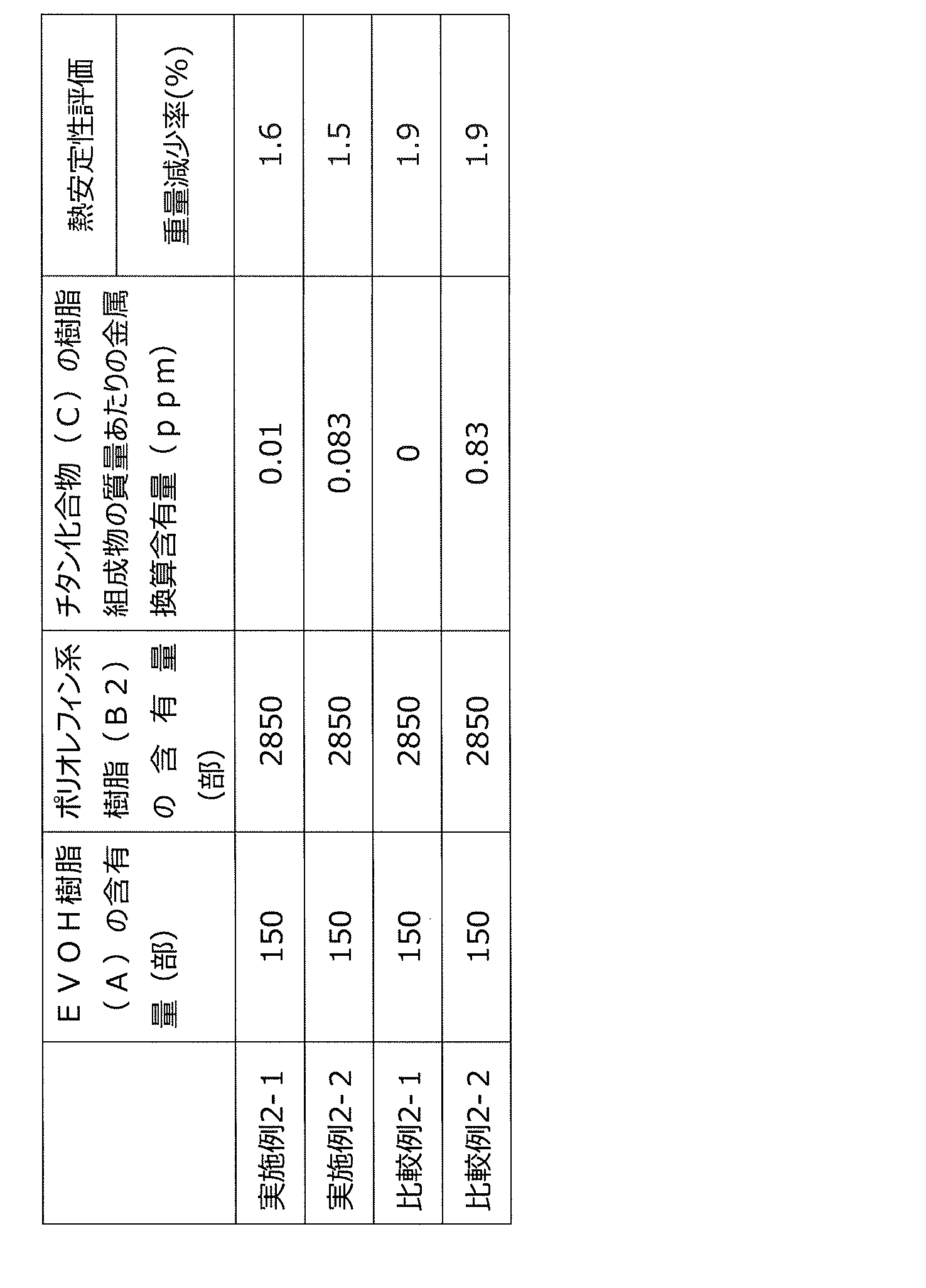
また、実施例2-1、2-2のEVOH樹脂組成物からなる層を備える多層構造体も、熱劣化が抑制され熱安定性に優れるものである。
<実施例3-1>
EVOH樹脂(A)として、エチレン構造単位の含有量29モル%、ケン化度99.6モル%、MFR4g/10分(210℃、荷重2160g)のEVOH樹脂のペレットを用いた。
また、オレフィン系ポリマー(B3)として、エチレン-ブテンランダム共重合体(三井化学社製、タフマーA-4085S:密度0.885g/cm3)(B3-1)と、酸変性エチレン-ブテン共重合体(三井化学社製、MA8510:密度0.885g/cm3)(B3-2)とを用い、チタン化合物(C)として酸化チタン(富士フイルム和光純薬社製)を用いた。
押出機設定温度(℃):C1/C2/C3/C4/C5/C6
=150/200/210/210/210/210
実施例3-1において、酸化チタンの配合量を金属換算量としてEVOH樹脂組成物の質量あたり1.3ppmに変更した以外は、実施例3-1と同様にしてEVOH樹脂組成物のペレットを得た。
実施例3-1において、酸化チタンを用いなかった以外は、実施例3-1と同様にしてEVOH樹脂組成物のペレットを得た。
実施例3-1において、酸化チタンの配合量を金属換算量としてEVOH樹脂組成物の質量あたり13ppmに変更した以外は、実施例3-1と同様にしてEVOH樹脂組成物のペレットを得た。
得られたEVOH樹脂組成物のペレットを5mg用い、熱重量測定装置(Perkin Elmer社製、Pyris 1 TGA)により、窒素雰囲気下、気流速度:20mL/分、温度範囲:30~550℃の条件にて、重量が測定前重量の95%に減少した時点の温度(5%重量減少温度)を測定した。かかる温度が高いほど、熱安定性に優れることを意味する。
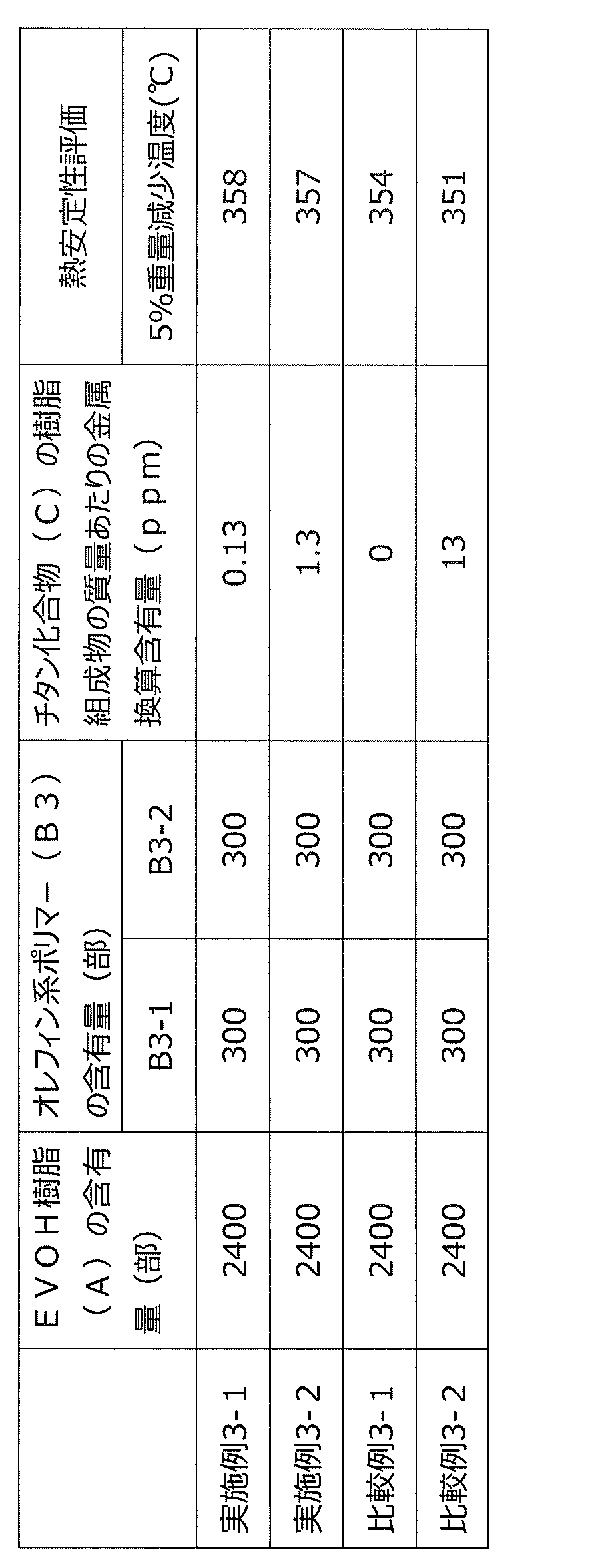
また、実施例3-1、3-2のEVOH樹脂組成物からなる層を備える多層構造体も、熱劣化が抑制され熱安定性に優れるものである。
<実施例4-1>
EVOH樹脂(A)として、エチレン構造単位の含有量29モル%、ケン化度99.6モル%、MFR4g/10分(210℃、荷重2160g)のEVOH樹脂のペレットを用いた。
また、ポリアミド系樹脂(B4)としてナイロン6(ディーエスエムジャパンエンジニアリングプラスチックス社製、Novamid 1028EN)、チタン化合物(C)として酸化チタン(富士フイルム和光純薬社製)を用いた。
前記EVOH樹脂(A)のペレット90部と、前記ポリアミド系樹脂(B4)10部と、前記酸化チタンを金属換算含有量としてEVOH樹脂組成物の質量あたり0.1ppmとなるようにドライブレンドし、混合物を得た。そして、前記混合物を、二穴ダイを備えた二軸押出機(20mmφ)に供給し、下記の押出条件で押出、吐出されるストランドを水槽にて冷却、固化させた。つぎに、固化させたストランドに空気を吹き付けることでストランド表面の水滴を除去した後、切断することでEVOH樹脂組成物のペレットを得た。
押出機設定温度(℃):C1/C2/C3/C4/C5/C6
=150/200/210/210/210/210
実施例4-1において、酸化チタンの配合量を金属換算量としてEVOH樹脂組成物の質量あたり1ppmに変更した以外は、実施例4-1と同様にしてEVOH樹脂組成物のペレットを得た。
実施例4-1において、酸化チタンを用いなかった以外は、実施例4-1と同様にしてEVOH樹脂組成物のペレットを得た。
実施例4-1において、酸化チタンの配合量を金属換算量としてEVOH樹脂組成物の質量あたり10ppmに変更した以外は、実施例4-1と同様にしてEVOH樹脂組成物のペレットを得た。
得られたEVOH樹脂組成物のペレットを5mg用い、熱重量測定装置(PerkinElmer社製、Pyris 1 TGA)により、窒素雰囲気下、気流速度:20mL/分、温度範囲:30~550℃の条件にて、重量が測定前重量の95%に減少した時点の温度(5%重量減少温度)、及び重量が測定前重量の90%に減少した時点の温度(10%重量減少温度)を測定した。かかる温度が高いほど、熱安定性に優れることを意味する。

また、実施例4-1、4-2のEVOH樹脂組成物からなる層を備える多層構造体も、熱劣化が抑制され熱安定性に優れるものである。
<実施例5-1>
EVOH樹脂(A)として、エチレン構造単位の含有量29モル%、ケン化度99.6モル%、MFR4g/10分(210℃、荷重2160g)のEVOH樹脂のペレットを用いた。
また、特定スチレン誘導体(B5)として2,4-ジフェニル-4-メチル-1-ペンテン(富士フイルム和光純薬社製)、チタン化合物(C)として酸化チタン(富士フイルム和光純薬社製)を用いた。
前記EVOH樹脂(A)のペレットに対し、前記特定スチレン誘導体(B5)をEVOH樹脂組成物の質量あたり2000ppm、及び前記酸化チタンを金属換算含有量としてEVOH樹脂組成物の質量あたり0.1ppmとなるようにドライブレンドし、混合物を得た。そして、前記混合物を、プラストグラフ(ブラベンダー社製)を用いて230℃で5分間予熱した後、5分間溶融混練することにより、EVOH樹脂組成物を得た。得られたEVOH樹脂組成物を、粉砕機(ソメタニ産業社製、SKR16-240)を用い、650rpmにて粉砕して粉砕物とした。
実施例5-1において、酸化チタンの配合量を金属換算量としてEVOH樹脂組成物の質量あたり1ppmに変更した以外は、実施例5-1と同様にしてEVOH樹脂組成物の粉砕物を得た。
実施例5-1において、酸化チタンを用いなかった以外は、実施例5-1と同様にしてEVOH樹脂組成物の粉砕物を得た。
実施例5-1において、酸化チタンの配合量を金属換算量としてEVOH樹脂組成物の質量あたり5ppmに変更した以外は、実施例5-1と同様にしてEVOH樹脂組成物の粉砕物を得た。
得られたEVOH樹脂組成物の粉砕物を5mg用い、熱重量測定装置(PerkinElmer社製、Pyris 1 TGA)により、窒素雰囲気下、気流速度:20mL/分、温度範囲:30~550℃の条件にて、重量が測定前重量の95%に減少した時点の温度(5%重量減少温度)、及び重量が測定前重量の90%に減少した時点の温度(10%重量減少温度)を測定した。かかる温度が高いほど、熱安定性に優れることを意味する。
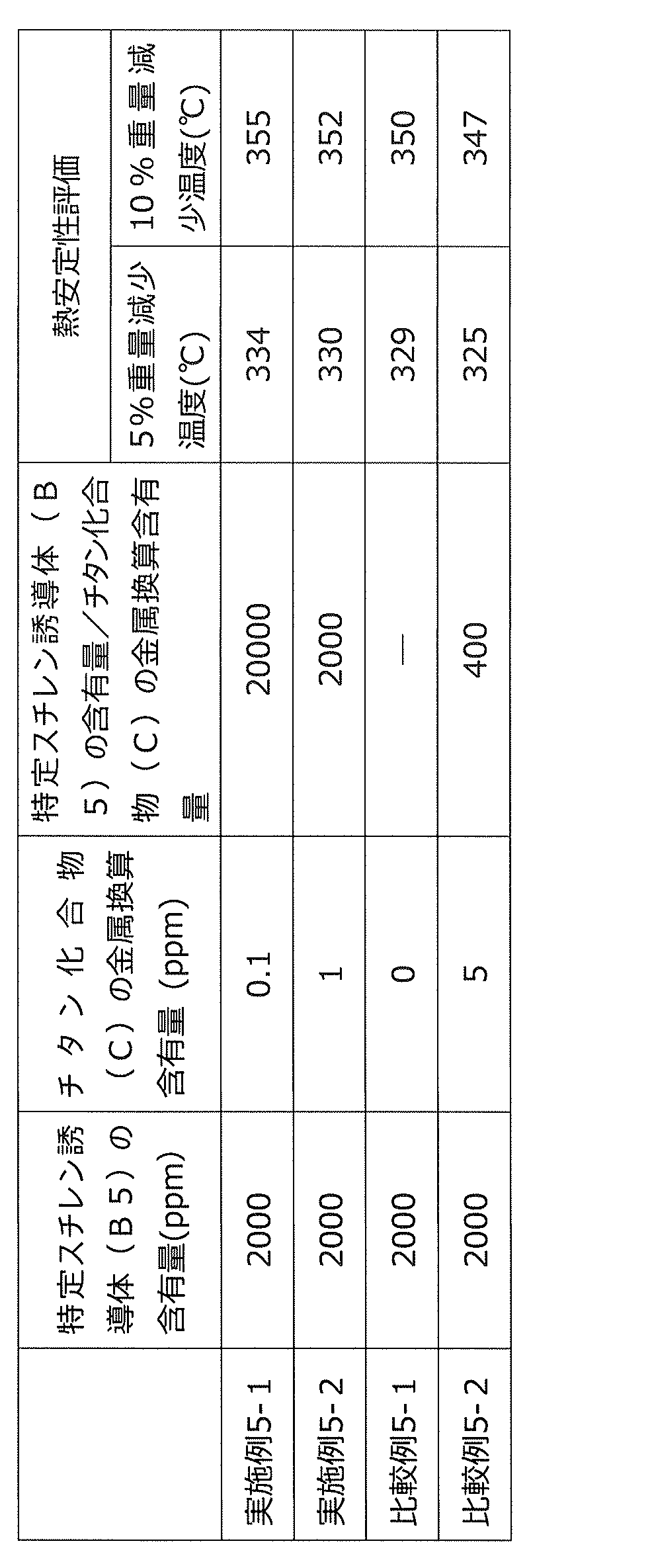
また、実施例5-1、5-2のEVOH樹脂組成物からなる層を備える多層構造体も、熱劣化が抑制され熱安定性に優れるものである。
Claims (15)
- エチレン-ビニルアルコール系共重合体(A)と、長周期型周期表第4周期dブロックに属する金属化合物(チタン化合物を除く)(B1)、ポリオレフィン系樹脂(B2)、オレフィン系ポリマー(B3)、ポリアミド系樹脂(B4)、及びα位に置換基を有するスチレン誘導体(B5)からなる群から選ばれる少なくとも1種の化合物(B)と、チタン化合物(C)とを含有するエチレン-ビニルアルコール系共重合体組成物であって、
前記オレフィン系ポリマー(B2)が、オレフィン系熱可塑性エラストマー、脂肪族系ゴム、及びアイオノマーからなる群から選ばれる少なくとも1種であり、
前記チタン化合物(C)の金属換算含有量がエチレン-ビニルアルコール系共重合体組成物の質量あたり0.00005ppm以上5ppm未満であるエチレン-ビニルアルコール系共重合体組成物。 - 前記(B)成分に対するエチレン-ビニルアルコール系共重合体(A)の質量含有比率(A)/(B)が、1/99~99/1である請求項1記載のエチレン-ビニルアルコール系共重合体組成物。
- 前記エチレン-ビニルアルコール系共重合体(A)とチタン化合物(C)の総和質量あたりのチタン化合物(C)の金属換算含有量が、0.001~3ppmである請求項1又は2に記載のエチレン-ビニルアルコール系共重合体組成物。
- 前記長周期型周期表第4周期dブロックに属する金属化合物(B1)の金属換算含有量が、エチレン-ビニルアルコール系共重合体組成物の質量あたり0.1~500ppmである請求項1~3のいずれか一項に記載のエチレン-ビニルアルコール系共重合体組成物。
- 前記長周期型周期表第4周期dブロックに属する金属化合物(B1)が、亜鉛化合物である請求項1~4のいずれか一項に記載のエチレン-ビニルアルコール系共重合体組成物。
- 前記長周期型周期表第4周期dブロックに属する金属化合物(B1)が、カルボン酸塩である請求項1~5のいずれか一項に記載のエチレン-ビニルアルコール系共重合体組成物。
- 前記ポリオレフィン系樹脂(B2)が、密度が0.89g/cm3以上のポリオレフィン系樹脂である請求項1~3のいずれか一項に記載のエチレン-ビニルアルコール系共重合体組成物。
- 前記ポリオレフィン系樹脂(B2)が、ポリプロピレンである請求項1~3,7のいずれか一項に記載のエチレン-ビニルアルコール系共重合体組成物。
- 前記α位に置換基を有するスチレン誘導体(B5)の含有量が、エチレン-ビニルアルコール系共重合体組成物の質量あたり1~10000ppmである請求項1~3のいずれか一項に記載のエチレン-ビニルアルコール系共重合体組成物。
- 前記α位に置換基を有するスチレン誘導体(B5)が、α-メチルスチレン誘導体である請求項1~3,9のいずれか一項に記載のエチレン-ビニルアルコール系共重合体組成物。
- 請求項1~10のいずれか一項に記載のエチレン-ビニルアルコール系共重合体組成物を製造する方法であって、前記(A)と前記(B)と前記(C)とを含有する組成物原料を溶融混合する工程を備える、エチレン-ビニルアルコール系共重合体組成物の製造方法。
- 請求項1~10のいずれか一項に記載のエチレン-ビニルアルコール系共重合体組成物からなる溶融成形用材料。
- 請求項1~10のいずれか一項に記載のエチレン-ビニルアルコール系共重合体組成物からなるペレット。
- 請求項1~10のいずれか一項に記載のエチレン-ビニルアルコール系共重合体組成物からなる層を少なくとも1層備える多層構造体。
- 請求項14記載の多層構造体の製造方法であって、前記エチレン-ビニルアルコール系共重合体組成物からなる層を溶融成形する工程を備える、多層構造体の製造方法。
Priority Applications (3)
| Application Number | Priority Date | Filing Date | Title |
|---|---|---|---|
| CN202380024609.XA CN118786175A (zh) | 2022-03-30 | 2023-03-30 | 乙烯-乙烯醇系共聚物组合物和其制造方法、使用其的熔融成型用材料、颗粒、以及多层结构体和其制造方法 |
| EP23780822.5A EP4502047B1 (en) | 2022-03-30 | 2023-03-30 | Ethylene-vinyl alcohol copolymer composition and method for producing same, melt-forming material and pellets using same, and multilayer structure and production method thereof |
| US18/795,784 US20240392124A1 (en) | 2022-03-30 | 2024-08-06 | Ethylene-vinyl alcohol copolymer composition and method for producing same, melt-forming material and pellets using same, and multilayer structure and production method thereof |
Applications Claiming Priority (10)
| Application Number | Priority Date | Filing Date | Title |
|---|---|---|---|
| JP2022057035 | 2022-03-30 | ||
| JP2022-057035 | 2022-03-30 | ||
| JP2022057034 | 2022-03-30 | ||
| JP2022057037 | 2022-03-30 | ||
| JP2022057036 | 2022-03-30 | ||
| JP2022-057038 | 2022-03-30 | ||
| JP2022057038 | 2022-03-30 | ||
| JP2022-057037 | 2022-03-30 | ||
| JP2022-057034 | 2022-03-30 | ||
| JP2022-057036 | 2022-03-30 |
Related Child Applications (1)
| Application Number | Title | Priority Date | Filing Date |
|---|---|---|---|
| US18/795,784 Continuation US20240392124A1 (en) | 2022-03-30 | 2024-08-06 | Ethylene-vinyl alcohol copolymer composition and method for producing same, melt-forming material and pellets using same, and multilayer structure and production method thereof |
Publications (1)
| Publication Number | Publication Date |
|---|---|
| WO2023190814A1 true WO2023190814A1 (ja) | 2023-10-05 |
Family
ID=88202737
Family Applications (1)
| Application Number | Title | Priority Date | Filing Date |
|---|---|---|---|
| PCT/JP2023/013063 Ceased WO2023190814A1 (ja) | 2022-03-30 | 2023-03-30 | エチレン-ビニルアルコール系共重合体組成物及びその製造方法、それを用いた溶融成形用材料、ぺレット、並びに多層構造体及びその製造方法 |
Country Status (4)
| Country | Link |
|---|---|
| US (1) | US20240392124A1 (ja) |
| EP (1) | EP4502047B1 (ja) |
| TW (1) | TW202402936A (ja) |
| WO (1) | WO2023190814A1 (ja) |
Cited By (2)
| Publication number | Priority date | Publication date | Assignee | Title |
|---|---|---|---|---|
| WO2025053124A1 (ja) * | 2023-09-08 | 2025-03-13 | 三菱ケミカル株式会社 | 組成物、多層構造体、成形体、包装材料容器、および組成物の製造方法 |
| WO2025164194A1 (ja) * | 2024-01-29 | 2025-08-07 | 三菱ケミカル株式会社 | 樹脂組成物、成形材料、多層構造体、成形体、食品包装体、樹脂組成物及び多層構造体の製造方法 |
Citations (12)
| Publication number | Priority date | Publication date | Assignee | Title |
|---|---|---|---|---|
| JPH08311254A (ja) | 1996-06-28 | 1996-11-26 | Kuraray Co Ltd | 樹脂組成物および成形物の製法 |
| JPH11106592A (ja) | 1997-10-02 | 1999-04-20 | Nippon Synthetic Chem Ind Co Ltd:The | 樹脂組成物およびその積層体 |
| JP2005178324A (ja) | 2003-12-24 | 2005-07-07 | Nippon Synthetic Chem Ind Co Ltd:The | 積層体 |
| JP2009242591A (ja) | 2008-03-31 | 2009-10-22 | Kuraray Co Ltd | 多層ペレットおよび樹脂成形品 |
| JP2011202147A (ja) | 2010-03-02 | 2011-10-13 | Nippon Synthetic Chem Ind Co Ltd:The | 樹脂組成物並びにこれを用いた成形品及び多層構造体 |
| WO2013146961A1 (ja) | 2012-03-28 | 2013-10-03 | 株式会社クラレ | エチレン-ビニルアルコール共重合体含有樹脂組成物 |
| WO2015141610A1 (ja) | 2014-03-17 | 2015-09-24 | 株式会社クラレ | 樹脂組成物、多層構造体、及びバッグインボックス用内容器 |
| JP2019163378A (ja) * | 2018-03-19 | 2019-09-26 | 三菱ケミカル株式会社 | 変性エチレン−ビニルアルコール系共重合体およびその製造方法 |
| WO2020213554A1 (ja) * | 2019-04-15 | 2020-10-22 | 株式会社クラレ | エチレン-ビニルアルコール共重合体及びそれを用いた水溶液 |
| JP6865334B1 (ja) * | 2019-10-16 | 2021-04-28 | 株式会社クラレ | 紙用コーティング剤及びそれを用いた塗工紙 |
| JP2021181548A (ja) * | 2020-05-20 | 2021-11-25 | 株式会社クラレ | 樹脂組成物、成形体及び多層パイプ |
| WO2022054887A1 (ja) * | 2020-09-10 | 2022-03-17 | 株式会社クラレ | 多層構造体、およびそれからなる包装容器 |
Family Cites Families (2)
| Publication number | Priority date | Publication date | Assignee | Title |
|---|---|---|---|---|
| JP3122745B2 (ja) * | 1996-02-05 | 2001-01-09 | 大日精化工業株式会社 | エチレン−ビニルアルコール系共重合樹脂及びその製造方法 |
| CN110662802B (zh) * | 2017-06-27 | 2022-10-21 | 三菱化学株式会社 | 熔融成形用乙烯-乙烯醇系共聚物组合物、粒料及多层结构体 |
-
2023
- 2023-03-30 WO PCT/JP2023/013063 patent/WO2023190814A1/ja not_active Ceased
- 2023-03-30 EP EP23780822.5A patent/EP4502047B1/en active Active
- 2023-03-30 TW TW112112136A patent/TW202402936A/zh unknown
-
2024
- 2024-08-06 US US18/795,784 patent/US20240392124A1/en active Pending
Patent Citations (12)
| Publication number | Priority date | Publication date | Assignee | Title |
|---|---|---|---|---|
| JPH08311254A (ja) | 1996-06-28 | 1996-11-26 | Kuraray Co Ltd | 樹脂組成物および成形物の製法 |
| JPH11106592A (ja) | 1997-10-02 | 1999-04-20 | Nippon Synthetic Chem Ind Co Ltd:The | 樹脂組成物およびその積層体 |
| JP2005178324A (ja) | 2003-12-24 | 2005-07-07 | Nippon Synthetic Chem Ind Co Ltd:The | 積層体 |
| JP2009242591A (ja) | 2008-03-31 | 2009-10-22 | Kuraray Co Ltd | 多層ペレットおよび樹脂成形品 |
| JP2011202147A (ja) | 2010-03-02 | 2011-10-13 | Nippon Synthetic Chem Ind Co Ltd:The | 樹脂組成物並びにこれを用いた成形品及び多層構造体 |
| WO2013146961A1 (ja) | 2012-03-28 | 2013-10-03 | 株式会社クラレ | エチレン-ビニルアルコール共重合体含有樹脂組成物 |
| WO2015141610A1 (ja) | 2014-03-17 | 2015-09-24 | 株式会社クラレ | 樹脂組成物、多層構造体、及びバッグインボックス用内容器 |
| JP2019163378A (ja) * | 2018-03-19 | 2019-09-26 | 三菱ケミカル株式会社 | 変性エチレン−ビニルアルコール系共重合体およびその製造方法 |
| WO2020213554A1 (ja) * | 2019-04-15 | 2020-10-22 | 株式会社クラレ | エチレン-ビニルアルコール共重合体及びそれを用いた水溶液 |
| JP6865334B1 (ja) * | 2019-10-16 | 2021-04-28 | 株式会社クラレ | 紙用コーティング剤及びそれを用いた塗工紙 |
| JP2021181548A (ja) * | 2020-05-20 | 2021-11-25 | 株式会社クラレ | 樹脂組成物、成形体及び多層パイプ |
| WO2022054887A1 (ja) * | 2020-09-10 | 2022-03-17 | 株式会社クラレ | 多層構造体、およびそれからなる包装容器 |
Non-Patent Citations (1)
| Title |
|---|
| See also references of EP4502047A4 |
Cited By (2)
| Publication number | Priority date | Publication date | Assignee | Title |
|---|---|---|---|---|
| WO2025053124A1 (ja) * | 2023-09-08 | 2025-03-13 | 三菱ケミカル株式会社 | 組成物、多層構造体、成形体、包装材料容器、および組成物の製造方法 |
| WO2025164194A1 (ja) * | 2024-01-29 | 2025-08-07 | 三菱ケミカル株式会社 | 樹脂組成物、成形材料、多層構造体、成形体、食品包装体、樹脂組成物及び多層構造体の製造方法 |
Also Published As
| Publication number | Publication date |
|---|---|
| EP4502047A4 (en) | 2025-07-09 |
| EP4502047A1 (en) | 2025-02-05 |
| US20240392124A1 (en) | 2024-11-28 |
| EP4502047B1 (en) | 2026-03-18 |
| TW202402936A (zh) | 2024-01-16 |
Similar Documents
| Publication | Publication Date | Title |
|---|---|---|
| CN110662802B (zh) | 熔融成形用乙烯-乙烯醇系共聚物组合物、粒料及多层结构体 | |
| JP7031590B2 (ja) | エチレン-ビニルアルコール系共重合体組成物、ペレット群および多層構造体 | |
| JPWO2019004256A1 (ja) | エチレン−ビニルアルコール系共重合体組成物、ペレットおよび多層構造体 | |
| JP3512362B2 (ja) | 樹脂組成物ペレットおよび成形物 | |
| US20240392124A1 (en) | Ethylene-vinyl alcohol copolymer composition and method for producing same, melt-forming material and pellets using same, and multilayer structure and production method thereof | |
| JP7070414B2 (ja) | エチレン-ビニルアルコール系共重合体組成物、溶融成形用エチレン-ビニルアルコール系共重合体組成物、ペレットおよび多層構造体 | |
| US11384184B2 (en) | Melt-formable ethylene-vinyl alcohol copolymer composition, pellets, and multilayer structure | |
| JP4642195B2 (ja) | 樹脂組成物ペレットおよび成形物 | |
| JP3907360B2 (ja) | 樹脂組成物および積層体 | |
| JP2001288323A (ja) | 樹脂組成物ペレットおよびその用途 | |
| JP7388184B2 (ja) | エチレン-ビニルアルコール系共重合体樹脂組成物、多層構造体および包装体 | |
| JP7425394B2 (ja) | 樹脂組成物、溶融成形用材料および多層構造体 | |
| JP2001081262A (ja) | 樹脂組成物および積層体 | |
| JP2023152998A (ja) | エチレン-ビニルアルコール系共重合体組成物、溶融成形用材料、多層構造体、液体包装用材料、エチレン-ビニルアルコール系共重合体組成物の製造方法、及び多層構造体の製造方法 | |
| JP2023152997A (ja) | エチレン-ビニルアルコール系共重合体組成物、多層構造体、エチレン-ビニルアルコール系共重合体組成物の製造方法、及び多層構造体の製造方法 | |
| CN118786175A (zh) | 乙烯-乙烯醇系共聚物组合物和其制造方法、使用其的熔融成型用材料、颗粒、以及多层结构体和其制造方法 | |
| JP2023152996A (ja) | エチレン-ビニルアルコール系共重合体組成物、溶融成形用エチレン-ビニルアルコール系共重合体組成物、ぺレット、多層構造体、エチレン-ビニルアルコール系共重合体組成物の製造方法、及び多層構造体の製造方法。 | |
| JP2023152999A (ja) | エチレン-ビニルアルコール系共重合体組成物、溶融成形用材料、多層構造体、熱水殺菌用包装材料、エチレン-ビニルアルコール系共重合体組成物の製造方法、及び多層構造体の製造方法 | |
| JP2001302710A (ja) | 樹脂組成物および積層体 | |
| JPWO2019004261A1 (ja) | エチレン−ビニルアルコール系共重合体組成物、ペレットおよび多層構造体 | |
| JP2018104625A (ja) | 樹脂組成物およびそれを用いた溶融成形品、ならびに多層構造体 | |
| JP2023152985A (ja) | エチレン-ビニルアルコール系共重合体組成物、ペレット、多層構造体、エチレン-ビニルアルコール系共重合体組成物の製造方法及び、多層構造体の製造方法 | |
| JP2023152992A (ja) | エチレン-ビニルアルコール系共重合体組成物、ペレット、多層構造体、エチレン-ビニルアルコール系共重合体組成物の製造方法及び、多層構造体の製造方法 | |
| JP2024166853A (ja) | エチレン-ビニルアルコール系共重合体組成物、溶融成形材料、および溶融成形品 | |
| JP2023152984A (ja) | エチレン-ビニルアルコール系共重合体組成物、ペレット、多層構造体、エチレン-ビニルアルコール系共重合体組成物の製造方法、及び層構造体の製造方法 |
Legal Events
| Date | Code | Title | Description |
|---|---|---|---|
| 121 | Ep: the epo has been informed by wipo that ep was designated in this application |
Ref document number: 23780822 Country of ref document: EP Kind code of ref document: A1 |
|
| WWE | Wipo information: entry into national phase |
Ref document number: 202380024609.X Country of ref document: CN |
|
| WWE | Wipo information: entry into national phase |
Ref document number: 2023780822 Country of ref document: EP |
|
| NENP | Non-entry into the national phase |
Ref country code: DE |
|
| ENP | Entry into the national phase |
Ref document number: 2023780822 Country of ref document: EP Effective date: 20241030 |
|
| WWE | Wipo information: entry into national phase |
Ref document number: 11202405504Y Country of ref document: SG |
|
| WWG | Wipo information: grant in national office |
Ref document number: 2023780822 Country of ref document: EP |