WO2023190879A1 - ネガ型感光性樹脂組成物、ドライフィルム、硬化物及び電子部品 - Google Patents
ネガ型感光性樹脂組成物、ドライフィルム、硬化物及び電子部品 Download PDFInfo
- Publication number
- WO2023190879A1 WO2023190879A1 PCT/JP2023/013199 JP2023013199W WO2023190879A1 WO 2023190879 A1 WO2023190879 A1 WO 2023190879A1 JP 2023013199 W JP2023013199 W JP 2023013199W WO 2023190879 A1 WO2023190879 A1 WO 2023190879A1
- Authority
- WO
- WIPO (PCT)
- Prior art keywords
- photosensitive resin
- resin composition
- compound
- negative photosensitive
- polyhydroxyamide
- Prior art date
- Legal status (The legal status is an assumption and is not a legal conclusion. Google has not performed a legal analysis and makes no representation as to the accuracy of the status listed.)
- Ceased
Links
Classifications
-
- G—PHYSICS
- G03—PHOTOGRAPHY; CINEMATOGRAPHY; ANALOGOUS TECHNIQUES USING WAVES OTHER THAN OPTICAL WAVES; ELECTROGRAPHY; HOLOGRAPHY
- G03F—PHOTOMECHANICAL PRODUCTION OF TEXTURED OR PATTERNED SURFACES, e.g. FOR PRINTING, FOR PROCESSING OF SEMICONDUCTOR DEVICES; MATERIALS THEREFOR; ORIGINALS THEREFOR; APPARATUS SPECIALLY ADAPTED THEREFOR
- G03F7/00—Photomechanical, e.g. photolithographic, production of textured or patterned surfaces, e.g. printing surfaces; Materials therefor, e.g. comprising photoresists; Apparatus specially adapted therefor
- G03F7/004—Photosensitive materials
- G03F7/038—Macromolecular compounds which are rendered insoluble or differentially wettable
-
- C—CHEMISTRY; METALLURGY
- C08—ORGANIC MACROMOLECULAR COMPOUNDS; THEIR PREPARATION OR CHEMICAL WORKING-UP; COMPOSITIONS BASED THEREON
- C08G—MACROMOLECULAR COMPOUNDS OBTAINED OTHERWISE THAN BY REACTIONS ONLY INVOLVING UNSATURATED CARBON-TO-CARBON BONDS
- C08G69/00—Macromolecular compounds obtained by reactions forming a carboxylic amide link in the main chain of the macromolecule
- C08G69/02—Polyamides derived from amino-carboxylic acids or from polyamines and polycarboxylic acids
- C08G69/26—Polyamides derived from amino-carboxylic acids or from polyamines and polycarboxylic acids derived from polyamines and polycarboxylic acids
-
- C—CHEMISTRY; METALLURGY
- C08—ORGANIC MACROMOLECULAR COMPOUNDS; THEIR PREPARATION OR CHEMICAL WORKING-UP; COMPOSITIONS BASED THEREON
- C08G—MACROMOLECULAR COMPOUNDS OBTAINED OTHERWISE THAN BY REACTIONS ONLY INVOLVING UNSATURATED CARBON-TO-CARBON BONDS
- C08G69/00—Macromolecular compounds obtained by reactions forming a carboxylic amide link in the main chain of the macromolecule
- C08G69/02—Polyamides derived from amino-carboxylic acids or from polyamines and polycarboxylic acids
- C08G69/26—Polyamides derived from amino-carboxylic acids or from polyamines and polycarboxylic acids derived from polyamines and polycarboxylic acids
- C08G69/32—Polyamides derived from amino-carboxylic acids or from polyamines and polycarboxylic acids derived from polyamines and polycarboxylic acids from aromatic diamines and aromatic dicarboxylic acids with both amino and carboxylic groups aromatically bound
-
- G—PHYSICS
- G03—PHOTOGRAPHY; CINEMATOGRAPHY; ANALOGOUS TECHNIQUES USING WAVES OTHER THAN OPTICAL WAVES; ELECTROGRAPHY; HOLOGRAPHY
- G03F—PHOTOMECHANICAL PRODUCTION OF TEXTURED OR PATTERNED SURFACES, e.g. FOR PRINTING, FOR PROCESSING OF SEMICONDUCTOR DEVICES; MATERIALS THEREFOR; ORIGINALS THEREFOR; APPARATUS SPECIALLY ADAPTED THEREFOR
- G03F7/00—Photomechanical, e.g. photolithographic, production of textured or patterned surfaces, e.g. printing surfaces; Materials therefor, e.g. comprising photoresists; Apparatus specially adapted therefor
- G03F7/004—Photosensitive materials
-
- G—PHYSICS
- G03—PHOTOGRAPHY; CINEMATOGRAPHY; ANALOGOUS TECHNIQUES USING WAVES OTHER THAN OPTICAL WAVES; ELECTROGRAPHY; HOLOGRAPHY
- G03F—PHOTOMECHANICAL PRODUCTION OF TEXTURED OR PATTERNED SURFACES, e.g. FOR PRINTING, FOR PROCESSING OF SEMICONDUCTOR DEVICES; MATERIALS THEREFOR; ORIGINALS THEREFOR; APPARATUS SPECIALLY ADAPTED THEREFOR
- G03F7/00—Photomechanical, e.g. photolithographic, production of textured or patterned surfaces, e.g. printing surfaces; Materials therefor, e.g. comprising photoresists; Apparatus specially adapted therefor
- G03F7/004—Photosensitive materials
- G03F7/0045—Photosensitive materials with organic non-macromolecular light-sensitive compounds not otherwise provided for, e.g. dissolution inhibitors
Definitions
- the present invention relates to a negative photosensitive resin composition, a dry film, a cured product, and an electronic component.
- Photosensitive resin compositions containing polyimide precursors exhibit excellent properties such as insulation, heat resistance, and mechanical strength, and are therefore widely used as insulating films in various fields such as semiconductors and electronic components.
- Patent Document 1 describes a negative photosensitive resin composition containing a specific polyamide derivative that is a photosensitive polybenzoxazole precursor, a compound that generates an acid upon irradiation with radiation, and a compound that can crosslink the specific polyamide derivative. Disclosed is the use of objects. According to the disclosure of Patent Document 1, a pattern with excellent sensitivity, resolution, and heat resistance, a good shape, and a highly reliable electronic component are provided.
- Patent Document 2 describes a polymer component consisting of two or more different types of heat-resistant polymers having reactive end groups, a compound that generates an acid when irradiated with actinic rays, a compound that can be crosslinked or polymerized by the action of the acid, It is disclosed that pattern formation with excellent sensitivity and resolution is possible by using a negative photosensitive resin composition containing.
- Patent Document 1 Using the negative photosensitive resin composition of Patent Document 1, it is possible to form a pattern with a resolution of 5 to 8 ⁇ m, and using the negative photosensitive resin composition of Patent Document 2, it is possible to form a pattern with a resolution of 5 to 6 ⁇ m. Formation is possible. However, there is a possibility that a sufficiently highly integrated circuit cannot be formed at the level of resolution obtained when these negative photosensitive resin compositions are used. Furthermore, none of the patent documents includes evaluation of insulation reliability, and there is a possibility that sufficient insulation reliability may not be obtained.
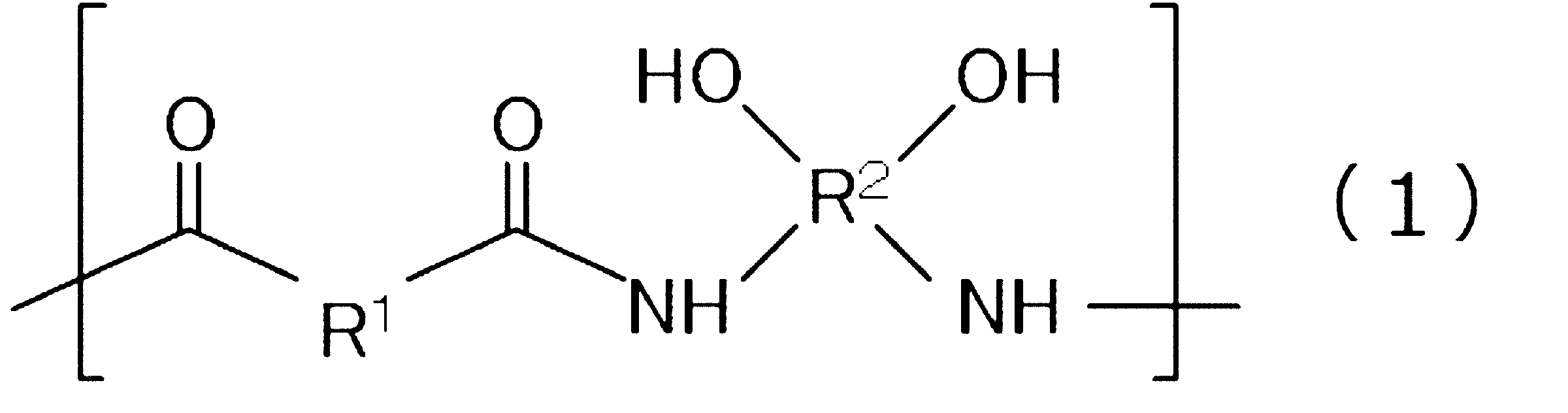
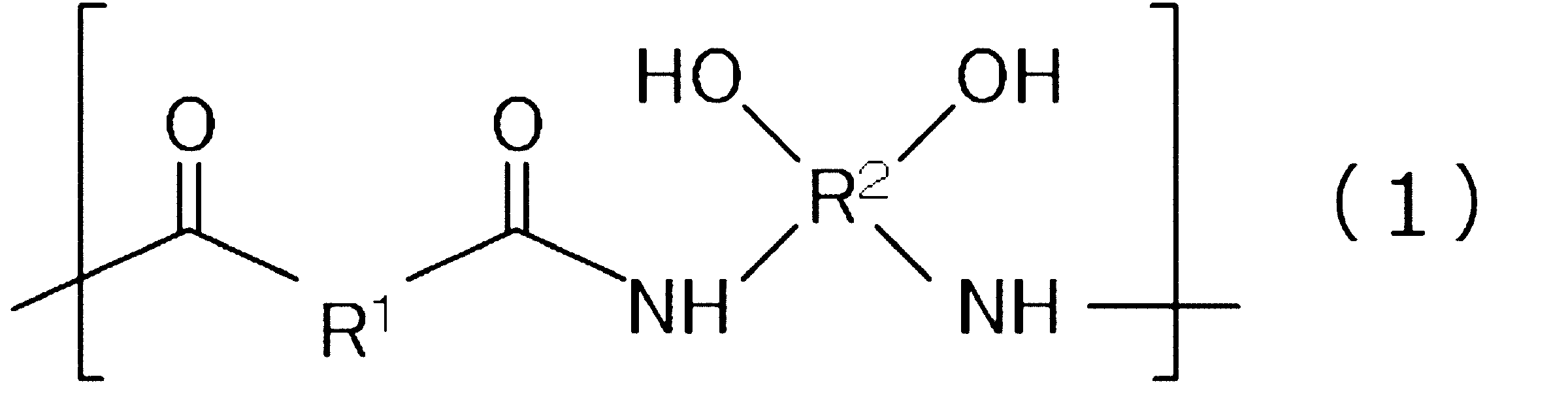
- the present inventors have discovered that the above problem can be solved by combining a specific polyhydroxyamide compound, a specific oxime sulfonate compound, and a specific crosslinking agent, and have completed the present invention. That is, according to one aspect of the disclosed technology, (A) a polyhydroxyamide compound containing a structural unit represented by the following formula (1); (B) an oxime sulfonate compound; (C) a crosslinking agent; including; The weight average molecular weight of the polyhydroxyamide compound (A) is 2,000 to 20,000, The polyhydroxyamide compound (A) does not contain a carboxyl group or has a carboxyl group equivalent of 1,500 g/eq or more, A negative photosensitive resin composition can be provided in which the crosslinking agent (C) contains a plurality of methoxymethyl groups and/or methylol groups.
- R 1 is a divalent organic group
- R 2 is a tetravalent organic group.
- the polyhydroxyamide compound (A) preferably has a carboxyl group or a phenolic hydroxyl group at the end.
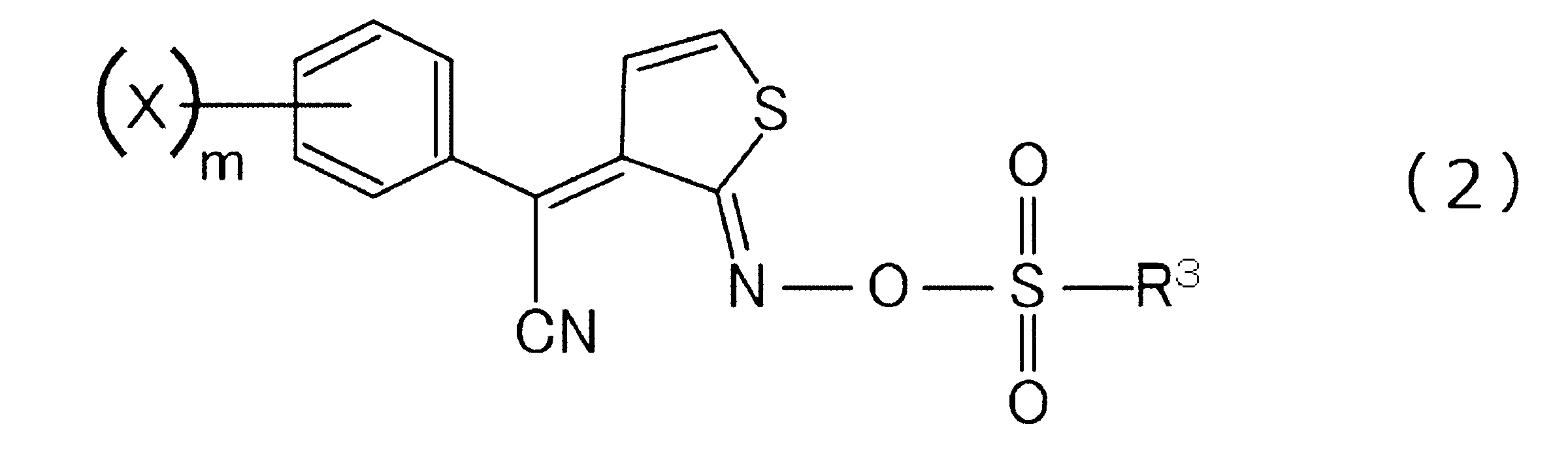
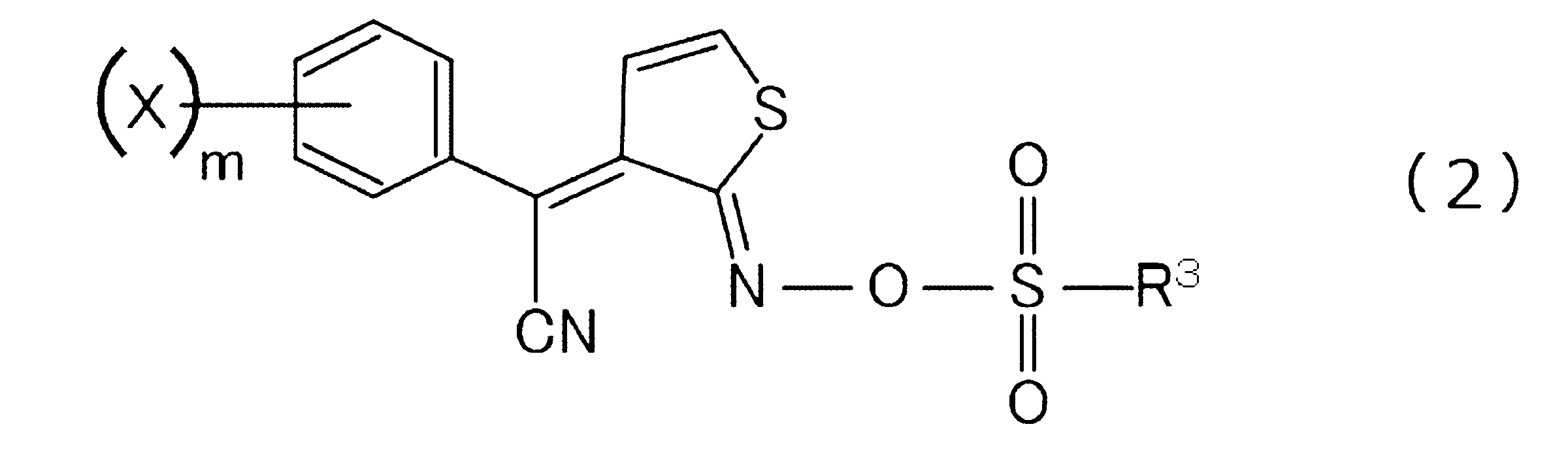
- the oxime sulfonate compound (B) preferably has a structure represented by the following formula (2).
- X is a hydrocarbon group or a halogen atom
- m is an integer of 0 to 3
- R3 is a hydrogen atom, a hydrocarbon group, an organic group including a ketone group, or a halogen atom.
- the crosslinking agent (C) contains a heterocycle.
- the crosslinking agent (C) is preferably a compound having a triazine ring.
- the negative photosensitive resin composition preferably includes (D) a compound containing a phenolic hydroxyl group.
- the compound (D) containing a phenolic hydroxyl group preferably contains a polyhydroxystyrene polymer or a polyhydroxystyrene copolymer.
- the negative photosensitive resin composition preferably contains (E) a basic compound.
- an electronic component characterized by having the cured product.
- Negative photosensitive resin composition The negative photosensitive resin composition of the present disclosure comprises a specific (A) polyhydroxyamide compound shown below, a specific (B) oxime sulfonate compound, and a specific (C) crosslinked including agents. Since the negative photosensitive resin composition of the present disclosure has high resolution, fine patterning can be formed, and the cured product thereof has excellent insulation reliability. Specifically, the negative photosensitive resin composition of the present disclosure can have a line/space (L/S) in a pattern of a semiconductor circuit or a circuit board of less than 2 ⁇ m/2 ⁇ m, and 1.5 ⁇ m/1. It is also possible to set it to 5 ⁇ m or less, or even 1.0 ⁇ m/1.0 ⁇ m or less. Further, the aspect ratio (line height/line width) can be set to 2.0 or more, 3.0 or more, and even 3.5 or more. Furthermore, it is also possible to form vias with an opening diameter of 2.0 ⁇ m or less.
- L/S line/space
- the polyhydroxyamide compound includes a structural unit represented by the following formula (1). (In the formula, R 1 is a divalent organic group, and R 2 is a tetravalent organic group.)
- R 1 in formula (1) is not particularly limited as long as it is a divalent organic group, and examples include an alkylene group, a cycloalkylene group, an arylene group, an alkyl ether group, a ketone group, and an ester group. .
- divalent aromatic hydrocarbon groups having a skeleton such as benzene, naphthalene, perylene, biphenyl, diphenyl ether, diphenyl sulfone, diphenylpropane, diphenylhexafluoropropane, benzophenone, etc.
- divalent aromatic hydrocarbon groups having a skeleton such as butane, cyclobutane, etc.
- the number of carbon atoms in R 1 is preferably 4 to 30, and phenyl, biphenyl, diphenyl ether, and diphenylhexafluoropropane are preferable.
- two or more types of the groups exemplified above can be included as R 1 in the molecule of the polyhydroxyamide compound (A).
- R 2 in formula (1) is not particularly limited as long as it is a tetravalent organic group, but includes diphenyl, diphenyl ether, diphenylthioether, benzophenone, diphenylmethane, diphenylpropane, diphenylhexafluoropropane, diphenyl sulfoxide, diphenyl sulfone, biphenyl, A tetravalent aromatic hydrocarbon group having a skeleton such as benzene is preferred, and an organic group having the structure shown in the following formula (3) is more preferred. (In the formula, a is an integer from 0 to 3, * indicates bonding)
- the terminal structure of the polyhydroxyamide compound is not particularly limited, but examples include terminal structures having functional groups such as amino groups, alcoholic hydroxyl groups, phenolic hydroxyl groups, acid anhydride groups, carboxyl groups, and isocyanate groups. It is preferable to have a carboxyl group or a phenolic hydroxyl group from the viewpoint of solubility in a developer. Among these terminal structures, it is particularly preferable to have a phenolic hydroxyl group. When the polyhydroxyamide compound has a phenolic hydroxyl group at the end, the solubility of the polyhydroxyamide compound in the developer can be improved.
- these terminal structures may have the above-mentioned terminal structure as a terminal structure in which the molecular chain terminal of the polyhydroxyamide compound is capped with a terminal capping agent.
- the weight average molecular weight (Mw) of the polyhydroxyamide compound (A) is 2,000 to 20,000, preferably 2,000 to 15,000, more preferably 3,000 to 15,000, and 4,000 to 2,000. ⁇ 10,000 is particularly preferred. With such a range, it becomes possible to form an L/S pattern that is finer and has a higher aspect ratio.
- the number average molecular weight (Mn) of the polyhydroxyamide compound (A) is preferably 1,000 to 10,000, more preferably 1,500 to 6,000.
- the molecular weight dispersity (PDI) of the polyhydroxyamide compound (A) is preferably 1.5 to 4.0, more preferably 1.5 to 3.5.
- the weight average molecular weight (Mw), number average molecular weight (Mn), and molecular weight dispersity (PDI) of the polyhydroxyamide compound are within these ranges, the solubility in the developer in the unexposed area and the (C)
- the reaction with the crosslinking agent is suitably balanced, and a negative photosensitive resin composition with better resolution can be obtained.
- the weight average molecular weight and number average molecular weight are values measured by gel permeation chromatography (GPC) (GL7700 manufactured by GL Science) and converted to standard polystyrene. The specific measurement conditions are as follows.
- the polyhydroxyamide compound does not contain a carboxyl group, or if it contains a carboxyl group, the carboxyl group equivalent is 1,500 g/eq or more; It is preferably 2,000 g/eq or more, and more preferably contains no carboxyl group.
- the polyhydroxyamide compound (A) does not contain a carboxyl group or has a carboxyl group equivalent within this range, a negative photosensitive resin composition with better resolution can be obtained.
- the carboxyl group has the function of improving the solubility of the polyhydroxyamide compound in the developing solution, but it is difficult to react with the crosslinking agent (C) during the heat treatment (also referred to as PEB (Post Exposure Bake)) performed before the development process. It is presumed that this progresses excessively and deteriorates resolution, but the details are unknown.
- the hydroxyl equivalent of the polyhydroxyamide compound (A) is not particularly limited, but can be, for example, 100 to 400 g/eq, preferably 150 to 350 g/eq, and more preferably 200 to 300 g/eq.
- the chlorine atom concentration (or chlorine ion concentration) contained in the molecular structure of the polyhydroxyamide compound is not particularly limited, but is preferably 5 mass ppm or less based on the mass of the entire polyhydroxyamide compound (A). .
- Oxime Sulfonate Compound (B) Oxime sulfonate compound is used as an acid generator because when irradiated with radiation (exposure), the bonds of the sulfonic acid ester are broken and sulfonic acid is generated. (B) The oxime sulfonate compound can be used alone or in combination in any ratio.
- the oxime sulfonate compound (B) is not particularly limited, but preferably includes the structure of the following formula (2) from the viewpoint of improving the resolution and insulation reliability of the negative photosensitive resin composition.
- X is a hydrocarbon group or a halogen atom
- m is an integer of 0 to 3
- R3 is a hydrogen atom, a hydrocarbon group, an organic group including a ketone group, or a halogen atom.
- X in formula (2) is not particularly limited, and can be, for example, a hydrocarbon group (eg, an alkyl group, an alkenyl group, an alkynyl group, an aryl group, etc.) or a halogen atom.
- the hydrocarbon group may have a substituent and may have a linear, branched, or cyclic structure.
- a linear or branched hydrocarbon group having 1 to 4 carbon atoms is preferably used.
- a halogen atom a chlorine atom or a fluorine atom is preferably used.
- n in formula (2) represents an integer of 0 to 3, preferably 0 or 1.
- m is 2 or 3
- multiple Xs may be the same or different.
- R 3 in formula (2) is not particularly limited, and can be, for example, a hydrogen atom, a hydrocarbon group, an organic group including a ketone group, or a halogen atom.
- the hydrocarbon group eg, alkyl group, alkenyl group, alkynyl group, aryl group, etc.
- the hydrocarbon group is preferably a linear, branched, or cyclic group having 1 to 20 carbon atoms, and more preferably a linear, branched, or cyclic group having 1 to 10 carbon atoms.
- halogen atom a chlorine atom or a fluorine atom is preferably used.
- oxime sulfonate compounds include Irgacure PAG103, Irgacure PAG108, Irgacure PAG121, and Irgacure PAG203 manufactured by BASF.
- Crosslinking agent contains a plurality of methoxymethyl groups and/or methylol groups. These functional groups undergo a crosslinking reaction with the phenolic hydroxyl groups and carboxyl groups contained in the (A) polyhydroxyamide compound etc. by heating using the acid generated from the oxime sulfonate compound (B) as an active species. Negative photolithography (pattern formation) is realized by a development process. In addition, by further heating after pattern formation, the curing reaction of the negative photosensitive resin composition progresses, and the cured product exhibits excellent properties.
- the crosslinking agent (C) contains a heterocycle because it improves the resolution of the negative photosensitive resin composition and the insulation reliability after curing.
- Heterocycles are not particularly limited, and include one or more heteroatoms such as boron, nitrogen, oxygen, phosphorus, sulfur, antimony, arsenic, bismuth, selenium, silicon, tellurium, tin, and include 3-membered rings, 4-membered rings, It includes a 5-, 6-, 7-, or 8-membered saturated or unsaturated ring.
- the heterocycle is preferably a nitrogen-containing heterocycle, and more preferably a nitrogen-containing heterocycle.
- compounds having a triazine structure such as hexamethylolmelamine and hexamethoxymethylmelamine
- compounds having a guanamine structure such as tetramethylolbenzoguanamine and tetramethoxymethylbenzoguanamine
- glycolurils such as tetramethylolglycoluril and tetramethoxyglycoluril.
- compounds having an imidazolidinone structure such as 1,3-bis(methoxymethyl)-2-imidazolidinone are more preferable.
- compounds having a triazine structure containing a triazine ring and compounds having a guanamine structure are particularly preferred from the viewpoint of providing a negative photosensitive resin composition capable of forming an L/S pattern that is finer and has a higher aspect ratio. can be preferably used.
- the negative photosensitive resin composition of the present disclosure can contain (D) a compound containing phenolic hydroxyl group.
- the resolution of the negative photosensitive resin composition becomes more excellent. This is presumed to be due to the increase in phenolic hydroxyl groups in the negative photosensitive resin composition, which accelerates the crosslinking reaction with the crosslinking agent (C) in the exposed areas and the developability of the unexposed areas. The detailed mechanism is unknown as it significantly improves resolution.
- (D) a compound containing a phenolic hydroxyl group is a compound different from (A) a polyhydroxyamide compound, (B) an oxime sulfonate compound, and (C) a crosslinking agent.
- the compound containing a phenolic hydroxyl group is not particularly limited as long as it contains one or more phenolic hydroxyl groups.
- a compound containing a phenolic hydroxyl group for example, as a monomer, phenol, o-cresol, m-cresol, p-cresol, o-hydroxystyrene, m-hydroxystyrene, p-hydroxystyrene, hydroquinone , catechol, resorcinol, hydroxyquinol, phloroglucinol, pyrogallol, hexahydroxybenzene, p-tert-butylphenol, p-ethylphenol, 2,3-xylenol, 2,5-xylenol, m-ethylphenol, 3,5- Xylenol, m-methoxyphenol, bisphenol A, bisphenol F can be mentioned, Examples of multimers include phenolic resins such as resol type
- polyhydroxystyrene polymers obtained by polymerizing hydroxystyrene (which may be o-, m-, or p-) or other polymers obtained by polymerizing hydroxystyrene (which may be o-, m-, or p-)
- a polyhydroxystyrene copolymer copolymerized with a chemical compound is preferable, and a polyhydroxystyrene copolymer copolymerized with hydroxystyrene (which may be o-, m-, or p-) and styrene is more preferable.
- the weight average molecular weight (Mw) of the polyhydroxystyrene polymer or polyhydroxystyrene copolymer is preferably 2,000 to 10,000, more preferably 3,000 to 8,000, and preferably 4,000 to 6,000. More preferred.
- the number average molecular weight (Mn) of the polyhydroxystyrene polymer or polyhydroxystyrene copolymer is preferably 1,000 to 5,000, more preferably 1,500 to 4,000, and more preferably 2,000 to 3 ,000 is more preferred.
- the molecular weight dispersity (PDI) of the polyhydroxystyrene polymer or polyhydroxystyrene copolymer is preferably from 1.5 to 4.0, more preferably from 1.5 to 3.0.
- the negative photosensitive resin composition Resolution can be further improved.
- the hydroxyl equivalent of the compound containing a phenolic hydroxyl group (D) is not particularly limited, but is preferably, for example, 100 to 300 g/eq, more preferably 100 to 200 g/eq.
- the concentration of chlorine atoms (or chlorine ion concentration) contained in the molecular structure of the compound containing a phenolic hydroxyl group is not particularly limited, but is 5 mass based on the total mass of the compound containing (D) a phenolic hydroxyl group. It is preferably less than ppm. The lower the chlorine atom concentration (or chlorine ion concentration) contained in the molecular structure of the negative photosensitive resin composition, the easier it is to improve the insulation reliability of the cured product.
- (E) Basic compound The negative photosensitive resin composition of the present disclosure improves dissolution contrast and resolution, and stabilizes the coating film during the standing time after applying the photosensitive resin composition until exposure. From the viewpoint of improving properties and the like, it is preferable to include (E) a basic compound.
- a basic compound when the negative photosensitive resin composition of the present disclosure contains a basic compound, it is possible to suppress the acid generated from the oxime sulfonate compound from diffusing into the unexposed areas upon exposure. It is possible to prevent development residue from forming on the area.
- the basic compound is not particularly limited and includes, for example, trimethylamine, diethylamine, triethylamine, di-n-propylamine, tri-n-propylamine, tri-n-pentylamine, tribenzylamine, diethanolamine, tri- Ethanolamine, n-hexylamine, n-heptylamine, n-octylamine, n-nonylamine, ethylenediamine, N,N,N',N'-tetramethylethylenediamine, tetramethylenediamine, hexamethylenediamine, 4,4' - Amine compounds such as diaminodiphenylmethane, 4,4'-diaminodiphenyl ether, 4,4'-diaminobenzophenone, 4,4'-diaminodiphenylamine; formamide, N-methylformamide, N,N-dimethylformamide, acetamide, N- Amide compounds
- the negative photosensitive resin composition of the present disclosure can contain an inorganic filler.
- the inorganic filler is not particularly limited, and conventionally known inorganic fillers can be used, such as silica, aluminum hydroxide, alumina, aluminum nitride, boron nitride, glass powder, magnesium carbonate, barium sulfate, barium titanate, Examples include hydrotalcite. These can be used alone or in combination in any ratio. From the viewpoint of having excellent insulation reliability and lowering the coefficient of thermal expansion of the negative photosensitive resin composition, it is preferable to use silica, and it is particularly preferable to use spherical silica.
- the volume average particle diameter (D50) of the inorganic filler can be 1.0 ⁇ m or less, preferably 500 nm or less, and particularly preferably 100 nm or less.
- the volume average particle diameter of the inorganic filler can be measured by laser diffraction.
- the negative photosensitive resin composition of the present disclosure can contain a solvent.
- the solvent is not particularly limited and includes, for example, 2-methoxy-1-methylethyl acetate (PGMEA), 4-methyl-2-pentanone, ⁇ -butyrolactone, N-methylpyrrolidone, N-methylcaprolactam, dimethylsulfoxide, Tetramethylurea, pyridine, dimethyl sulfone, hexamethyl sulfoxide, ethyl acetate, butyl acetate, ethyl lactate, methyl 3-methoxypropionate, methyl 2-methoxypropionate, ethyl 3-methoxypropionate, ethyl 2-methoxypropionate , ethyl 3-ethoxypropionate, ethyl 2-ethoxypropionate, ethylene glycol dimethyl ether, diethylene glycol dimethyl ether, diethylene glycol diethyl ether, diethylene glycol methyl
- ⁇ -butyrolactone or cyclopentanone is preferred from the viewpoint of excellent affinity with each component in the negative photosensitive resin composition.
- cyclopentanone is particularly preferred from the viewpoint of excellent solvent removability during drying of the negative photosensitive resin composition and suitability for edge rinsing steps in semiconductor manufacturing.
- the negative photosensitive resin composition of the present disclosure can contain other components as long as the effects of the technology of the present disclosure are not impaired.
- known components that can be included in the negative photosensitive resin composition can be used, such as adhesives, surfactants, plasticizers, thermal acid generators, sensitizers, and leveling agents. , colorants, fibers, fine particles, etc.
- the surfactant is not particularly limited, and examples thereof include fluorine-based surfactants, silicon-based surfactants, and the like.
- fluorosurfactants include the "Megafac” series manufactured by DIC (for example, Megafac F-281, F-477, F-553, F-554, F-555, F-556, F -557, F-558, F-559, F-560, F-561, F-563, F-569, etc.).
- silicone surfactants include BYK-Chemie's surface conditioner series (for example, BYK-302, BYK-307, BYK-310, BYK-322, BYK-323, BYK-326, BYK-331, BYK- 332, BYK-333, BYK-348, BYK-349, BYK-377, BYK-378, BY-3455, BYK-3760, etc.). These may be used alone or in combination of two or more.
- BYK-Chemie's surface conditioner series for example, BYK-302, BYK-307, BYK-310, BYK-322, BYK-323, BYK-326, BYK-331, BYK- 332, BYK-333, BYK-348, BYK-349, BYK-377, BYK-378, BY-3455, BYK-3760, etc.
- the negative photosensitive resin composition of the present disclosure contains, in addition to the following components: (A) a polyhydroxyamide compound, (B) an oxime sulfonate compound, and (C) a crosslinking agent; It can be obtained by mixing arbitrary components including a compound containing a phenolic hydroxyl group and (E) a basic compound. Mixing of each component can be performed under heating if necessary.
- the blending amount of the polyhydroxyamide compound (A) can be 50 to 80% by mass when the total mass of the solid content of the negative photosensitive resin composition is 100% by mass.
- the solid mass in this specification refers to the mass of the residue after the volatile components have been completely volatilized.
- the blending amount of the oxime sulfonate compound can be 0.5 to 10% by mass, and 1 to 5% by mass when the total mass of the solid content of the negative photosensitive resin composition is 100% by mass. % is preferred.
- the blending amount of the crosslinking agent (C) can be 10 to 40% by mass, when the total mass of the solid content of the negative photosensitive resin composition is 100% by mass.
- the amount of the crosslinking agent (C) is determined by determining the ratio of the number of methoxymethyl groups and/or methylol groups contained in the crosslinking agent (C) to the number of phenolic hydroxyl groups contained in the negative photosensitive resin composition (methoxymethyl groups). and/or methylol group:phenolic hydroxyl group) can be set at a ratio of 120:100 to 200:100. By setting it as such a ratio, the resolution of a negative photosensitive resin composition and the insulation reliability after hardening can be made more excellent.
- the blending amount can be 1 to 15% by mass, when the total mass of the solid content of the negative photosensitive resin composition is 100% by mass. , preferably 5 to 12% by mass, more preferably 6 to 11% by mass. Further, the blending amount of (A) the polyhydroxyamide compound: (D) the blending amount of the compound containing a phenolic hydroxyl group can be 80:20 to 99:1, preferably 80:20 to 95:5, More preferably 85:15 to 90:10.
- the blending amount of (A) polyhydroxyamide compound and (D) compound containing phenolic hydroxyl group is determined by the number of methoxymethyl groups and/or methylol groups contained in (C) crosslinking agent and the number of methoxymethyl groups and/or methylol groups contained in (C) crosslinking agent.
- the ratio of the number of phenolic hydroxyl groups contained (methoxymethyl group and/or methylol group:phenolic hydroxyl group) can be adjusted to 120:100 to 200:100. By setting it as such a ratio, the resolution of a negative photosensitive resin composition and the insulation reliability after hardening can be made more excellent.
- the blending amount may be 0.01 to 0.50% by mass when the total mass of the solid content of the negative photosensitive resin composition is 100% by mass.
- the content is preferably 0.08 to 0.40% by mass.
- the blending amount can be 1% by mass to 50% by mass, and 10% by mass when the total mass of the solid content of the negative photosensitive resin composition is 100% by mass. % to 40% by mass. By setting it as such a range, the cured product of a negative photosensitive resin composition can be made into a low thermal expansion coefficient, maintaining the developability of a negative photosensitive resin composition.
- the dry film of the present disclosure includes a base material and a resin layer formed on the base material using the negative photosensitive resin composition of the present disclosure. Further, in order to protect the resin layer, a protective film may be further laminated on the surface of the resin layer.
- the base material is not particularly limited, and examples thereof include metal foil such as copper foil; films such as polyimide film, polyester film, and polyethylene naphthalate (PEN) film.
- metal foil such as copper foil
- films such as polyimide film, polyester film, and polyethylene naphthalate (PEN) film.
- the protective film is not particularly limited, but polyethylene film, polytetrafluoroethylene film, polypropylene film, paper, etc. can be used. It is preferable to select a protective film in which the adhesive strength between the protective film and the resin layer is lower than the adhesive strength between the base material and the resin layer. In order to make the adhesion between the protective film and the resin layer lower than the adhesion between the base material and the resin layer, the surface of the protective film may be subjected to a release treatment.
- the thickness of the resin layer is not particularly limited, but can be 1 to 150 ⁇ m depending on the application.
- the resin layer can be formed by applying a negative photosensitive resin composition onto a base material and using a comma coater, blade coater, lip coater, rod coater, squeeze coater, reverse coater, transfer roll coater, gravure coater, spray coater, etc.
- the resin layer can be obtained by adjusting the thickness of the resin layer and drying it.
- the cured product of the present disclosure is obtained by curing the negative photosensitive resin composition or the resin layer of the dry film of the present disclosure.
- the cured product may be a patterned cured product. Examples of methods for producing a patterned cured product include the following method.
- Dry coating film forming process is a process in which the negative photosensitive resin composition of the present disclosure is applied onto a substrate to form a coating film, and then dried. In the dry coating film forming step, it is also possible to form a dry coating film on the substrate by transferring the resin layer of the dry film onto the substrate.
- the method of applying the negative photosensitive resin composition onto the substrate is not particularly limited, and examples include methods of applying using a spin coater, bar coater, blade coater, curtain coater, screen printer, etc., and spraying with a spray coater. Examples include a coating method, an inkjet method, and the like.
- the coating film thickness is not particularly limited, but may be, for example, 10 ⁇ m or less, 5 ⁇ m or less, or 3 ⁇ m or less. By reducing the film thickness, finer L/S patterning becomes possible while maintaining the aspect ratio of the pattern.
- the method of drying the coating film is not particularly limited, and examples thereof include air drying, heating drying using an oven or hot plate, vacuum drying, and the like.
- the conditions for heat drying are, for example, a heating temperature of 70 to 140°C and a drying time of 1 to 30 minutes.
- the transfer of the resin layer of the dry film onto the base material is preferably performed under pressure and heat using a vacuum laminator or the like.
- the heating temperature can be, for example, 60 to 100°C.
- the substrate is not particularly limited, and may be, for example, a printed wiring board on which a circuit is formed, a flexible printed wiring board, or a wafer on which a semiconductor element is formed.
- Exposure process In the exposure process, the oxime sulfonate compound (B) in the exposed area is exposed by irradiating the dry coating film formed in the dry coating film formation process with radiation through a photomask capable of forming a desired pattern. This is a process of exposing to light and generating active species. If patterning is not required, there is no need to use a photomask. Alternatively, a pattern may be drawn directly with a laser using a direct drawing device.
- the wavelength of the radiation used is one that can activate the oxime sulfonate compound (B), and in order to perform fine patterning, the maximum wavelength is preferably 410 nm or less.
- the irradiation energy can be adjusted depending on the thickness of the dried coating film formed, and can be, for example, 10 to 1000 mJ/cm 2 .
- As the exposure light source a high pressure mercury lamp, an ultra-high pressure mercury lamp, a metal halide lamp, a mercury short arc lamp, a KRF laser, etc. can be used.
- the PEB process is a process in which the dried coating film exposed in the exposure process is heat-treated to impart development resistance to the exposed area (hereinafter sometimes abbreviated as "exposed area") of the dried coating film.
- exposed area the exposed area
- a crosslinking reaction between (A) a polyhydroxyamide compound, (D) a compound containing a phenolic hydroxyl group, and (C) a crosslinking agent is carried out using the acid generated from the (B) oxime sulfonate compound as an active species in the exposed area. progresses, and the exposed area becomes insoluble in the developer.
- the heating temperature in the PEB process can be 90 to 150°C, and the heating time can be 0.5 to 10 minutes. Heating can be performed using a known method such as a hot plate or a heating furnace.
- the development process is a process in which the dried coating film heated in the PEB process is treated with a developer, and the unexposed areas of the dried coating film are dissolved in the developer and removed, thereby obtaining a patterned coating film.
- a developing method a known method can be used, such as a rotary spray method, a paddle method, and an immersion method accompanied by ultrasonic treatment.
- developer known developers can be used, such as inorganic alkalis such as sodium hydroxide, sodium carbonate, sodium silicate, and aqueous ammonia, organic amines such as ethylamine, diethylamine, triethylamine, and triethanolamine, and tetrahydroxide.
- organic amines such as ethylamine, diethylamine, triethylamine, and triethanolamine
- tetrahydroxide examples include aqueous solutions of quaternary ammonium salts such as methylammonium hydroxide and tetrabutylammonium hydroxide.
- a water-soluble organic solvent such as methanol, ethanol, isopropyl alcohol, or a surfactant can be added.
- the coating film can be washed with a rinsing solution if necessary to obtain a patterned coating film.
- the rinsing liquid is not particularly limited, and examples thereof include pure water, methanol, ethanol, isopropyl alcohol, and the like. These can be used alone or in combination in any ratio.
- the post-development heating step is a step of heating the pattern coating film formed in the development step to complete curing of the pattern coating film and obtaining a cured pattern coating film (cured product).
- the heating temperature can be 150 to 200°C, and the heating time can be 1 to 120 minutes. Heating can be performed using a known method such as a hot plate or an inert oven, and heating is preferably performed under a nitrogen atmosphere.
- the negative photosensitive resin composition of the present disclosure can be suitably used as a forming material for display devices, semiconductor elements, electronic components, optical components, building materials, and the like.
- Forming materials for the semiconductor element include, for example, a resist material, a buffer coat film, and an insulating film for a rewiring layer of a wafer level package (WLP).
- WLP wafer level package
- the negative photosensitive resin composition of the present disclosure can form extremely fine wiring with an L/S of less than 2 ⁇ m/2 ⁇ m and an aspect ratio of 2.0 or more, and has excellent insulation reliability. In particular, it can be preferably used in a rewiring layer forming process using the damascene method.
- examples of materials for forming electronic components include printed wiring boards, interlayer insulating films, wiring coating films, and the like.
- the obtained polyhydroxyamide compound (A-1) has a weight average molecular weight (Mw) of 8,613, a number average molecular weight (Mn) of 4,557, a molecular weight dispersity (PDI) of 1.9, and a chloride ion content. 3.3 ppm, phenolic hydroxyl group equivalent was 294 g/eq, and carboxyl group equivalent was 2,279 g/eq.
- the obtained polyhydroxyamide compound (A-2) has a weight average molecular weight (Mw) of 4,580, a number average molecular weight (Mn) of 1,696, a molecular weight dispersity (PDI) of 2.7, and a chloride ion content. 2.3 ppm, and the phenolic hydroxyl equivalent was 218 g/eq.
- the obtained polyhydroxyamide compound (A-3) has a weight average molecular weight (Mw) of 9,222, a number average molecular weight (Mn) of 3,561, a molecular weight dispersity (PDI) of 2.6, and a chloride ion content. 3.1 ppm, and the phenolic hydroxyl equivalent was 252 g/eq.
- the obtained polyhydroxyamide compound has a weight average molecular weight (Mw) of 32,992, a number average molecular weight (Mn) of 12,310, a molecular weight dispersity (PDI) of 2.7, a chloride ion content of 2.8 ppm, and a phenol content.
- Mw weight average molecular weight
- Mn number average molecular weight
- PDI molecular weight dispersity
- the hydroxyl group equivalent was 294 g/eq
- the carboxyl group equivalent was 6,155 g/eq.
- the obtained polyamide acid compound has a weight average molecular weight (Mw) of 10,324, a number average molecular weight (Mn) of 4,382, a molecular weight dispersity (PDI) of 2.4, a chloride ion content of 2.1 ppm, and a carboxyl group.
- Mw weight average molecular weight
- Mn number average molecular weight
- PDI molecular weight dispersity
- the flask was immersed in an ice bath, and while keeping the inside of the flask at 0 to 5°C, 8.11 g (18.26 mmol) of 6FDA, 4,4'-oxybis(benzoyl chloride) ( 9.40 g (31.85 mmol) of DEDC was added as a solid over 10 minutes, and the mixture was stirred in an ice bath for 30 minutes. Thereafter, 2.95 g (18.00 mmol) of 5-norbornene-2,3-dicarboxylic anhydride was added as a solid to the stirred solution, and the mixture was stirred at room temperature for 3 hours.
- the stirred solution was poured into a large amount of ion-exchanged water, and the precipitate was collected.
- the obtained solid was dissolved in 150 g of ethyl acetate.
- 38 g of anion exchange resin (Organo Amberlyst B-20) was added to the mixture, and the mixture was vigorously stirred for 1 hour. After concentrating the stirred solution, it was poured into a large amount of ion-exchanged water, and the precipitate was collected. After collecting the precipitated solid, it was dried under reduced pressure to obtain a carboxyl group-terminated polyhydroxyamide-polyamic acid copolymer compound.
- the obtained polyhydroxyamide-polyamic acid copolymer compound had a weight average molecular weight (Mw) of 11,447, a number average molecular weight (Mn) of 5,283, a molecular weight dispersity (PDI) of 2.2, and a chloride ion content.
- Mw weight average molecular weight
- Mn number average molecular weight
- PDI molecular weight dispersity
- chloride ion content 4.2 ppm
- phenolic hydroxyl group equivalent was 458 g/eq
- carboxyl group equivalent was 1,069 g/eq.
- L/S is 0.5/0.5 ⁇ m, 0.6/0.6 ⁇ m, 0.7/0.7 ⁇ m, 0.8/0.8 ⁇ m, 1/1 ⁇ m, 1.2/1.2 ⁇ m, 1.5/1 .5 ⁇ m, 1.7/1.7 ⁇ m, 2/2 ⁇ m, 3/3 ⁇ m, 4/4 ⁇ m, 5/5 ⁇ m test patterns were exposed and post-exposure heating (PEB) was performed on a hot plate at 140°C for 60 minutes. went.
- the film was developed using a 2.38% TMAH aqueous solution for 60 seconds, rinsed with ultrapure water for 30 seconds, and spin-dried for 30 seconds.
- Samples having patterns of the negative photosensitive resin compositions of Examples and Comparative Examples were obtained.
- the exposure conditions (exposure amount and focus) for the negative photosensitive resin compositions of each Example and Comparative Example are such that the resolution is the best for each negative photosensitive resin composition of each Example and Comparative Example. I selected the conditions.
- the exposure conditions for each example and comparative example are shown in Tables 2 to 4. The obtained samples of each example and comparative example were cut so that a cross section perpendicular to the longitudinal direction of the pattern could be observed.
Landscapes
- Physics & Mathematics (AREA)
- General Physics & Mathematics (AREA)
- Spectroscopy & Molecular Physics (AREA)
- Chemical & Material Sciences (AREA)
- Health & Medical Sciences (AREA)
- Chemical Kinetics & Catalysis (AREA)
- Medicinal Chemistry (AREA)
- Polymers & Plastics (AREA)
- Organic Chemistry (AREA)
- Materials For Photolithography (AREA)
- Macromolecular Compounds Obtained By Forming Nitrogen-Containing Linkages In General (AREA)
Abstract
Description
即ち、本開示技術の一態様によれば、
下式(1)で示される構造単位を含む(A)ポリヒドロキシアミド化合物と、
(B)オキシムスルホネート化合物と、
(C)架橋剤と、
を含み、
前記(A)ポリヒドロキシアミド化合物の重量平均分子量は2,000~20,000であり、
前記(A)ポリヒドロキシアミド化合物は、カルボキシル基を含まないか又はカルボキシル基当量が1,500g/eq以上であり、
前記(C)架橋剤はメトキシメチル基及び/又はメチロール基を複数含むことを特徴とする、ネガ型感光性樹脂組成物を提供することができる。
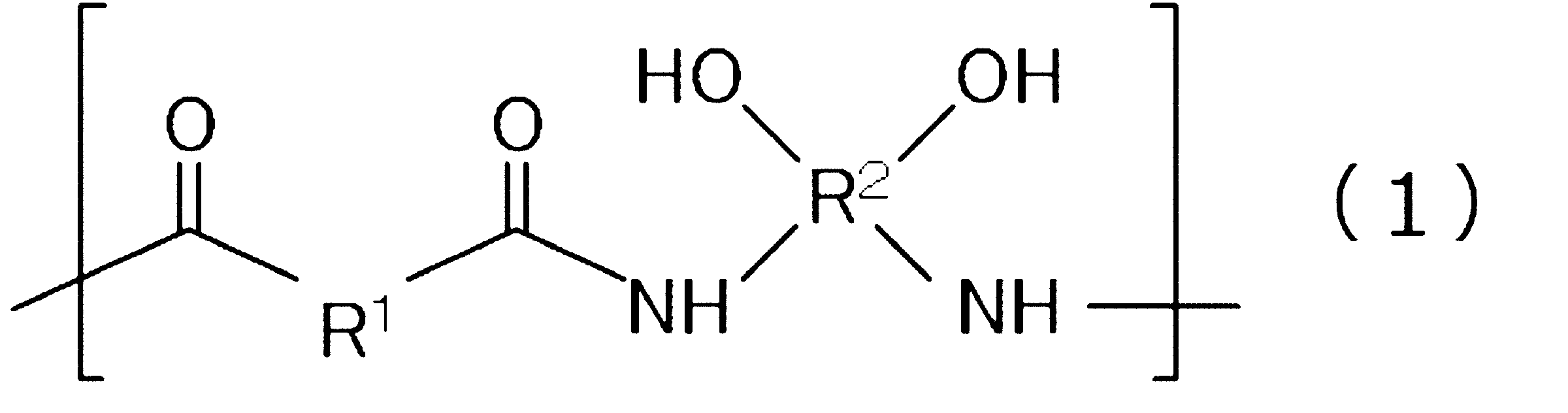
前記(A)ポリヒドロキシアミド化合物は、末端にカルボキシル基又はフェノール性水酸基を有することが好ましい。
前記(B)オキシムスルホネート化合物は、下式(2)で示される構造を有することが好ましい。
前記(C)架橋剤は複素環を含むことが好ましい。
前記(C)架橋剤はトリアジン環を有する化合物であることが好ましい。
前記ネガ型感光性樹脂組成物は、(D)フェノール性水酸基を含む化合物を含むことが好ましい。
前記(D)フェノール性水酸基を含む化合物は、ポリヒドロキシスチレン重合体又はポリヒドロキシスチレン共重合体を含むことが好ましい。
前記ネガ型感光性樹脂組成物は、(E)塩基性化合物を含むことが好ましい。
本開示の別の態様によれば、前記ネガ型感光性樹脂組成物により形成された樹脂層を備えることを特徴とするドライフィルムを提供することができる。
本開示の別の態様によれば、前記ネガ型感光性樹脂組成物又は前記ドライフィルムの樹脂層により形成されることを特徴とする、硬化物を提供することができる。
本開示の別の態様によれば、前記硬化物を有することを特徴とする電子部品を提供することできる。
本開示のネガ型感光性樹脂組成物は、下記に示される特定の(A)ポリヒドロキシアミド化合物と、特定の(B)オキシムスルホネート化合物と、特定の(C)架橋剤とを含む。本開示のネガ型感光性樹脂組成物は解像性が高いため、微細なパターニングを形成することができ、その硬化物は絶縁信頼性に優れる。具体的には、本開示のネガ型感光性樹脂組成物は、半導体回路や回路基板のパターンにおけるライン/スペース(L/S)を2μm/2μm未満とすることができ、1.5μm/1.5μm以下、さらには1.0μm/1.0μm以下とすることも可能である。また、アスペクト比(ラインの高さ/ラインの幅)を2.0以上とすることができ、3.0以上、さらには3.5以上とすることも可能である。また、開口径2.0μm以下のビアを形成することも可能である。
(A)ポリヒドロキシアミド化合物は、下式(1)で示される構造単位を含む。

これらの末端構造の中でも、フェノール性水酸基を有することが特に好ましい。ポリヒドロキシアミド化合物の末端にフェノール性水酸基を有する場合には、ポリヒドロキシアミド化合物の現像液への溶解性を向上させることができる。さらに、フェノール性水酸基はカルボキシル基と比較して反応性が低いことから架橋剤との過剰な反応が抑制され、PEB工程を行った場合であっても解像性を維持することができるために、より微細かつ高アスペクト比であるL/Sパターンを形成し得るネガ型感光性樹脂組成物を提供することができるものと推測される。
また、これらの末端構造は、ポリヒドロキシアミド化合物の分子鎖末端が末端封止剤により封止された末端構造として上述の末端構造を有していてもよい。
(A)ポリヒドロキシアミド化合物の数平均分子量(Mn)は、1,000~10,000であることが好ましく、1,500~6,000がより好ましい。
(A)ポリヒドロキシアミド化合物の分子量分散度(PDI)は、1.5~4.0が好ましく、1.5~3.5がより好ましい。
(A)ポリヒドロキシアミド化合物の重量平均分子量(Mw)、数平均分子量(Mn)、分子量分散度(PDI)がかかる範囲にある場合には、未露光部における現像液への溶解性と露光における(C)架橋剤との反応が好適なバランスとなり、解像性により優れたネガ型感光性樹脂組成物を得ることができる。
本明細書において、重量平均分子量及び数平均分子量は、ゲルパーミエーションクロマトグラフィー(GPC)(GL Sience社製 GL7700)で測定し、標準ポリスチレンで換算した数値である。具体的な測定条件は以下のとおりである。
カラム:TSKgelαM(東ソー社製)
カラム内温度:40℃
溶離液組成:100mmol/LのH3PO4(H3PO485%水溶液を原料として使用)及び10mmol/LのLiBrを含むNMP溶液
溶離液流速:0.5mL/min
校正用標準試薬:ポリスチレン
検出器波長:260nm及び300nm
検出器温度:室温
解析時ベースライン範囲:15分~40分
解析時分子量算出範囲:20~35分
また、本明細書において、分子量分散度(PDI)は下式(4)により算出される。
(式4)
PDI=Mw/Mn
(B)オキシムスルホネート化合物は、放射線を照射(露光)されるとスルホン酸エステルの結合が切断され、スルホン酸を発生するため酸発生剤として用いられる。(B)オキシムスルホネート化合物は、単独で、又は、複数を任意の比率で組み合わせて用いることができる。
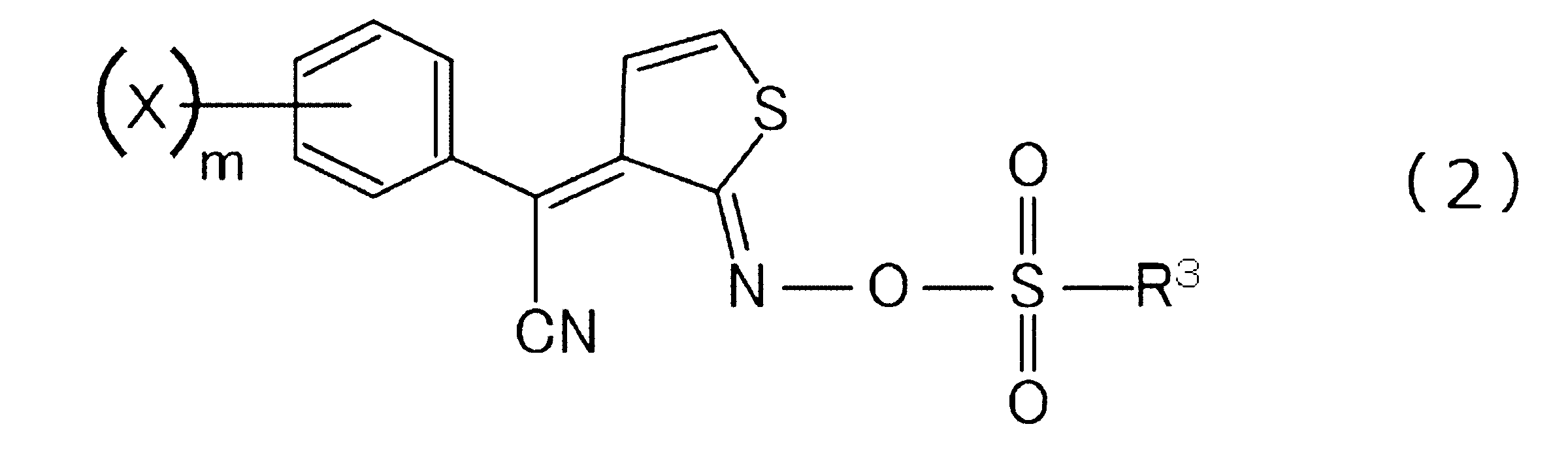
式(2)におけるXは、特に限定されず、例えば、炭化水素基(例えば、アルキル基、アルケニル基、アルキニル基、アリール基等)、又は、ハロゲン原子とすることができる。
炭化水素基は、置換基を有していてもよく、直鎖状、分岐鎖状、環状の構造を有することができる。炭化水素基は、炭素数1~4の直鎖状又は分岐鎖状のものが好ましく用いられる。
ハロゲン原子として、塩素原子又はフッ素原子が好ましく用いられる。
炭化水素基は、炭素数1~20の直鎖状、分岐鎖状、環状のものが好ましく、炭素数1~10の直鎖状、分岐鎖状、環状のものがより好ましく用いられる。
ハロゲン原子は、塩素原子又はフッ素原子が好ましく用いられる。
(C)架橋剤は、メトキシメチル基及び/又はメチロール基を複数含む。これらの官能基は、(B)オキシムスルホネート化合物から発生する酸を活性種として、加熱により(A)ポリヒドロキシアミド化合物等に含まれるフェノール性水酸基及びカルボキシル基と架橋反応を生じるため、露光、PEB及び現像処理によりネガ型のフォトリソグラフィ(パターン形成)が実現される。また、パターン形成後、さらに加熱することで、ネガ型感光性樹脂組成物の硬化反応が進行し、硬化物として優れた特性が発現させる。
本開示のネガ型感光性樹脂組成物は、(D)フェノール性水酸基を含む化合物を含むことができる。ネガ型感光性樹脂組成物が(D)フェノール性水酸基を含む化合物を含む場合には、ネガ型感光性樹脂組成物の解像性はより優れたものとなる。これはネガ型感光性樹脂組成物中のフェノール性水酸基の増加により、露光部の(C)架橋剤との架橋反応と未露光部の現像性が促進によるものと推測されるが、予想以上に解像性を著しく向上させるため詳細なメカニズムは不明である。
なお、(D)フェノール性水酸基を含む化合物は、(A)ポリヒドロキシアミド化合物、(B)オキシムスルホネート化合物、(C)架橋剤とは異なる化合物である。
多量体としては、レゾール型フェノール樹脂、ノボラック型フェノール樹脂等のフェノール樹脂;ヒドロキシスチレン(o-、m-、p-のいずれでもよい)を重合させたポリヒドロキシスチレン重合体等のポリフェノール重合体;ヒドロキシスチレン(o-、m-、p-のいずれでもよい)とスチレン等の他の重合性化合物を共重合させたポリヒドロキシスチレン共重合体等のポリフェノール共重合体を挙げることができる。
これらは単独で、又は、複数を任意の比率で組み合わせて用いることができる。これらのうち、ヒドロキシスチレン(o-、m-、p-のいずれでもよい)を重合させたポリヒドロキシスチレン重合体又はヒドロキシスチレン(o-、m-、p-のいずれでもよい)を他の重合性化合物と共重合させたポリヒドロキシスチレン共重合体が好ましく、ヒドロキシスチレン(o-、m-、p-のいずれでもよい)とスチレンとを共重合させたポリヒドロキシスチレン共重合体がより好ましい。
ポリヒドロキシスチレン重合体又はポリヒドロキシスチレン共重合体の数平均分子量(Mn)は、1,000~5,000であることが好ましく、1,500~4,000がより好ましく、2,000~3,000がさらに好ましい。
ポリヒドロキシスチレン重合体又はポリヒドロキシスチレン共重合体の分子量分散度(PDI)は、1.5~4.0が好ましく、1.5~3.0がより好ましい。
ポリヒドロキシスチレン重合体又はポリヒドロキシスチレン共重合体の重量平均分子量(Mw)、数平均分子量(Mn)、分子量分散度(PDI)がかかる範囲にある場合には、ネガ型感光性樹脂組成物の解像性をさらに優れたものとすることができる。
本開示のネガ型感光性樹脂組成物は、溶解コントラストや解像性の向上や、感光性樹脂組成物を塗布してから露光するまでの引き置き時間における塗膜の安定性等の向上の観点から、(E)塩基性化合物を含むことが好ましい。特に、本開示のネガ型感光性樹脂組成物が塩基性化合物を含む場合には、露光によりオキシムスルホネート化合物から生じた酸が未露光部にまで拡散することを抑制できるため、現像後の未露光部に現像残渣が生じることを防止できる。
本開示のネガ型感光性樹脂組成物は無機フィラーを含むことができる。無機フィラーとしては特に限定されず、従来公知の無機フィラーを用いることができるが、例えば、シリカ、水酸化アルミニウム、アルミナ、窒化アルミ、窒化ホウ素、ガラス粉末、炭酸マグネシウム、硫酸バリウム、チタン酸バリウム、ハイドロタルサイトなどが挙げられる。これらは、単独で、又は、複数を任意の比率で組み合わせて用いることができる。絶縁信頼性に優れ、ネガ型感光性樹脂組成物の熱膨張率を低くする観点からシリカを用いることが好ましく、特に球状シリカを用いることが好ましい。
本開示のネガ型感光性樹脂組成物は溶剤を含むことができる。溶剤としては、特に限定されず、例えば、酢酸-2-メトキシ-1-メチルエチル(PGMEA)、4-メチル-2-ペンタノン、γ-ブチロラクトン、N-メチルピロリドン、N-メチルカプロラクタム、ジメチルスルホキシド、テトラメチル尿素、ピリジン、ジメチルスルホン、へキサメチルスルホキシド、酢酸エチル、酢酸ブチル、乳酸エチル、3-メトキシプロピオン酸メチル、2-メトキシプロピオン酸メチル、3-メトキシプロピオン酸エチル、2-メトキシプロピオン酸エチル、3-エトキシプロピオン酸エチル、2-エトキシプロピオン酸エチル、エチレングリコールジメチルエーテル、ジエチレングリコールジメチルエーテル、ジエチレングリコールジエチルエーテル、ジエチレングリコールメチルエチルエーテル、プロピレングリコールジメチルエーテル、ジプロピレングリコールジメチルエーテル、エチレングリコールモノメチルエーテル、エチレングリコールモノエチルエーテル、ジエチレングリコールモノメチルエーテル、ジエチレングリコールモノエチルエーテル、プロピレングリコールモノメチルエーテル、プロピレングリコールモノエチルエーテル、ジプロピレングリコールモノメチルエーテル、ジプロピレングリコールモノエチルエーテル、プロピレングリコールモノメチルエーテルアセテート、カルビトールアセテート、エチルセロソルブアセテート、シクロへキサノン、シクロペンタノン、メチルエチルケトン、メチルイソブチルケトン、2-ヘプタノン等が挙げられる。これらは、単独で、又は、複数を任意の比率での組み合わせて用いることができる。これらの溶剤の中でも、ネガ型感光性樹脂組成物中の各成分との親和性に優れる観点から、γ-ブチロラクトン又はシクロペンタノンが好ましい。また、ネガ型感光性樹脂組成物の乾燥時における溶剤除去性に優れることや、半導体製造におけるエッジリンス工程への適合性の観点から、シクロペンタノンであることが特に好ましい。
本開示のネガ型感光性樹脂組成物は、本開示技術の効果を損なわない限りにおいて、その他の成分を含むことができる。その他の成分としては、ネガ型感光性樹脂組成物に含むことのできる公知のものを用いることができ、例えば、密着剤、界面活性剤、可塑剤、熱酸発生剤、増感剤、レベリング剤、着色剤、繊維、微粒子等を挙げることができる。
本開示のネガ型感光性樹脂組成物は、(A)ポリヒドロキシアミド化合物、(B)オキシムスルホネート化合物、(C)架橋剤の各成分に加え、(D)フェノール性水酸基を含む化合物、(E)塩基性化合物をはじめとする任意の成分を混合することにより得ることができる。各成分の混合は、必要に応じて加熱下で行うことができる。
また、(A)ポリヒドロキシアミド化合物及び(D)フェノール性水酸基を含む化合物の配合量は、(C)架橋剤に含まれるメトキシメチル基及び/又はメチロール基数と、ネガ型感光性樹脂組成物に含まれるフェノール性水酸基数との比(メトキシメチル基及び/又はメチロール基:フェノール性水酸基)を120:100~200:100にするように調整することができる。このような比率とすることで、ネガ型感光性樹脂組成物の解像性と硬化後の絶縁信頼性をより優れたものとすることができる。
本開示のドライフィルムは、基材と、この基材上に、本開示のネガ型感光性樹脂組成物を用いて形成された樹脂層とを備える。また、樹脂層の保護のため、さらに樹脂層の表面に保護フィルムを積層してもよい。
本開示の硬化物は、本開示のネガ型感光性樹脂組成物又はドライフィルムの樹脂層を硬化させたものである。硬化物としては、パターニングされた硬化物であってもよい。パターニングされた硬化物の製造方法の例として、以下の方法を挙げることができる。
乾燥塗膜形成工程は、本開示のネガ型感光性樹脂組成物を基板上に塗布し塗膜を形成し、その後乾燥させる工程である。乾燥塗膜形成工程は、ドライフィルムの樹脂層を基板上に転写することで基板上に乾燥塗膜を形成することも可能である。
露光工程は、乾燥塗膜形成工程において形成された乾燥塗膜に対し、所望するパターン形成が可能なフォトマスクを介して放射線を照射することにより、露光部の(B)オキシムスルホネート化合物を感光させ、活性種を発生させる工程である。パターニングが不要の場合にはフォトマスクを介す必要はない。また、直接描画装置を用いて、直接レーザーでパターンを描画してもよい。
PEB工程は、露光工程で露光された乾燥塗膜を加熱処理し、乾燥塗膜の露光部(以降、露光部と略す場合がある)に耐現像性を付与する工程である。PEB工程では、露光部にて(B)オキシムスルホネート化合物より発生した酸を活性種として、(A)ポリヒドロキシアミド化合物や(D)フェノール性水酸基を含む化合物と(C)架橋剤との架橋反応が進行し、露光部が現像液に対して不溶化する。PEB工程における加熱温度は、90~150℃とすることができ、加熱時間は、0.5~10分とすることができる。加熱は、ホットプレートや加熱炉等の公知の方法で行うことができる。
現像工程は、PEB工程で加熱した乾燥塗膜を現像液により処理し、乾燥塗膜の未露光部を現像液に溶解、除去することによって、パターン塗膜を得る工程である。現像方法としては、公知の方法を用いることができ、例えば、回転スプレー法、パドル法、超音波処理をともなう浸せき法等を挙げることができる。
現像後加熱工程は、現像工程で形成されたパターン塗膜を加熱して、パターン塗膜の硬化を完了し、硬化パターン塗膜(硬化物)を得る工程である。加熱温度は、150~200℃、加熱時間は、1~120分とすることができる。加熱は、ホットプレートやイナートオーブン等の公知の方法で行うことができ、窒素雰囲気下にて加熱することが望ましい。
本開示のネガ型感光性樹脂組成物は、表示装置、半導体素子、電子部品、光学部品、建築材料等の形成材料として好適に用いることができる。半導体素子の形成材料は、例えば、レジスト材料、バッファーコート膜、ウエハレベルパッケージ(WLP)の再配線層用絶縁膜である。本開示のネガ型感光性樹脂組成物は、L/Sが2μm/2μm未満かつアスペクト比2.0以上である極めて微細な配線を形成することができ、かつ絶縁信頼性にも優れることから、特にダマシン法を用いた再配線層形成工程に好ましく用いることができる。また、電子部品の形成材料として、例えば、プリント配線板、層間絶縁膜、配線被覆膜等が挙げられる。
<(A)ポリヒドロキシアミド化合物>
(合成例1:実施例のポリヒドロキシアミド化合物(A-1)の合成例)
攪拌機、温度計を備えた500mLフラスコ中で、2,2-ビス(3-アミノ-4-ヒドロキシフェニル)ヘキサフルオロプロパン(6FAP)21.62g(59.03mmol)を、N-メチルピロリドン(NMP)140g中で撹拌溶解した。その後、フラスコを氷浴に浸し、フラスコ内を0~5℃に保ちながら、4,4’-オキシビス(ベンゾイルクロリド)(DEDC)12.09g(40.97mmol)を固体のまま10分間かけて加え、氷浴中で30分間撹拌した。室温で18時間撹拌後、室温にて5-ノルボルネン-2,3-ジカルボン酸無水物5.93g(36.13mmol)加え、さらに3時間攪拌を続けた。撹拌した溶液を大量のイオン交換水に投入し、析出物を回収した。得られた固体を酢酸エチル160gに溶解させた。ここに陰イオン交換樹脂(オルガノ社アンバーリストB-20)20gを投入し、1時間激しく攪拌した。撹拌した溶液を濃縮した後、大量のイオン交換水に投入し、析出物を回収した。析出した固体を回収後、減圧乾燥してカルボキシル基末端のポリヒドロキシアミド化合物(A-1)を得た。
得られたポリヒドロキシアミド化合物(A-1)は、重量平均分子量(Mw)が8,613、数平均分子量(Mn)が4,557、分子量分散度(PDI)が1.9、塩素イオンが3.3ppm、フェノール性水酸基当量が294g/eq、カルボキシル基当量が2,279g/eqであった。

攪拌機、温度計を備えた500mLフラスコ中で、2,2-ビス(3-アミノ-4-ヒドロキシフェニル)ヘキサフルオロプロパン(6FAP)14.93g(44.39mmol)及び3-アミノフェノール4.90g(44.84mmol)を、N-メチルピロリドン(NMP)79g中で撹拌溶解した。その後、フラスコを氷浴に浸し、フラスコ内を0~5℃に保ちながら、4,4’-オキシビス(ベンゾイルクロリド)(DEDC)16.41g(55.61mmol)を固体のまま10分間かけて加え、氷浴中で30分間撹拌した。室温で18時間撹拌後、溶液を大量のイオン交換水に投入し、析出物を回収した。得られた固体を酢酸エチル135gに溶解させた。ここに陰イオン交換樹脂 (オルガノ社アンバーリストB-20)18gを投入し、1時間激しく攪拌した。撹拌した溶液を濃縮した後、大量のイオン交換水に投入し、析出物を回収した。析出した固体を回収後、減圧乾燥して水酸基末端のポリヒドロキシアミド化合物(A-2)を得た。
得られたポリヒドロキシアミド化合物(A-2)は、重量平均分子量(Mw)が4,580、数平均分子量(Mn)が1,696、分子量分散度(PDI)が2.7、塩素イオンが2.3ppm、フェノール性水酸基当量が218g/eqであった。
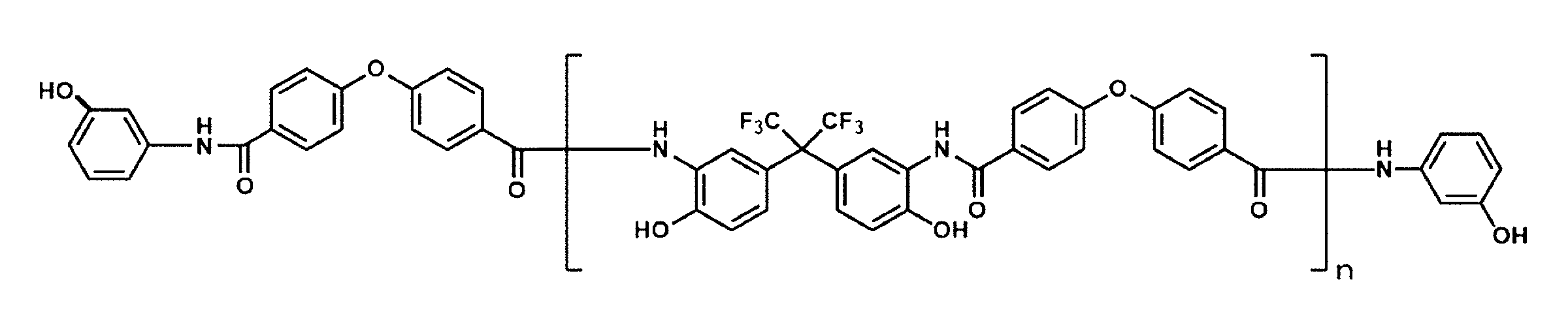
攪拌機、温度計を備えた500mLフラスコ中で、2,2-ビス(3-アミノ-4-ヒドロキシフェニル)ヘキサフルオロプロパン(6FAP)14.93g(44.39mmol)及び3-アミノフェノール2.45g(22.42mmol)を、N-メチルピロリドン(NMP)79g中で撹拌溶解した。その後、フラスコを氷浴に浸し、フラスコ内を0~5℃に保ちながら、4,4’-オキシビス(ベンゾイルクロリド)(DEDC)16.41g(55.61mmol)を固体のまま10分間かけて加え、氷浴中で30分間撹拌した。室温で18時間撹拌後、溶液を大量のイオン交換水に投入し、析出物を回収した。得られた固体を酢酸エチル79gに溶解させた。ここに陰イオン交換樹脂 (オルガノ社アンバーリストB-20)17gを投入し、1時間激しく攪拌した。撹拌した溶液を濃縮した後、大量のイオン交換水に投入し、析出物を回収した。析出した固体を回収後、減圧乾燥して水酸基末端のポリヒドロキシアミド化合物(A-3)を得た。
得られたポリヒドロキシアミド化合物(A-3)は、重量平均分子量(Mw)が9,222、数平均分子量(Mn)が3,561、分子量分散度(PDI)が2.6、塩素イオンが3.1ppm、フェノール性水酸基当量が252g/eqであった。
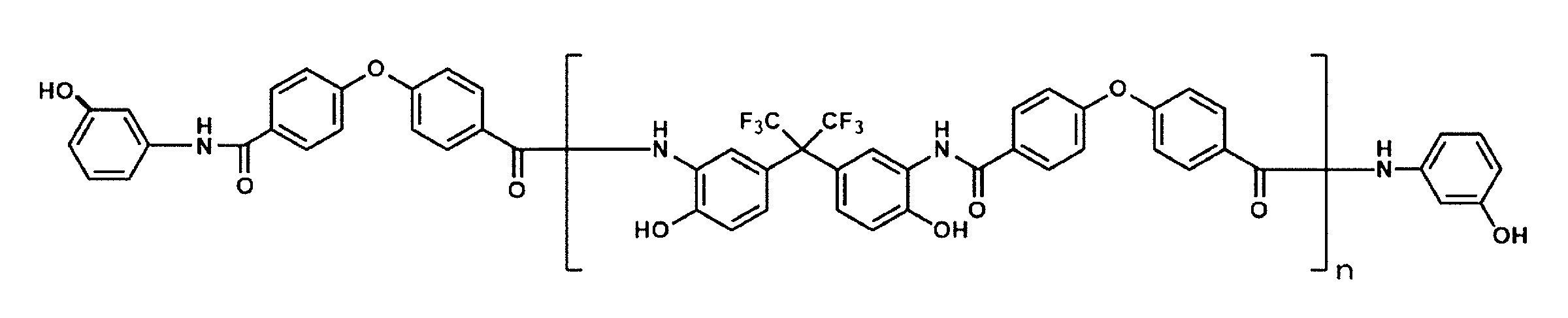
2,2-ビス(3-アミノ-4-ヒドロキシフェニル)ヘキサフルオロプロパン(6FAP)、3-アミノフェノール、4,4’-オキシビス(ベンゾイルクロリド)(DEDC)の配合量を表1に記載の割合とした以外は、合成例3と同様の方法によりポリヒドロキシアミド化合物を合成した。また、得られたポリヒドロキシアミド化合物の重量平均分子量、数平均分子量、分子量分散度も表1に示した。

攪拌機、温度計を備えた500mLフラスコ中で、2,2-ビス(3-アミノ-4-ヒドロキシフェニル)ヘキサフルオロプロパン(6FAP)18.90g(51.60mmol)を、N-メチルピロリドン(NMP)80g中で撹拌溶解した。その後、フラスコを氷浴に浸し、フラスコ内を0~5℃に保ちながら、4,4’-オキシビス(ベンゾイルクロリド)(DEDC)14.28g(48.40mmol)を固体のまま10分間かけて加え、氷浴中で30分間撹拌した。室温で18時間撹拌後、室温にて5-ノルボルネン-2,3-ジカルボン酸無水物1.05g(6.40mmol)加え、さらに3時間攪拌を続けた。撹拌した溶液を大量のイオン交換水に投入し、析出物を回収した。得られた固体を酢酸エチル140gに溶解させた。ここに陰イオン交換樹脂(オルガノ社アンバーリストB-20)8gを投入し、1時間激しく攪拌した。撹拌した溶液を濃縮した後、大量のイオン交換水に投入し、析出物を回収した。析出した固体を回収後、減圧乾燥してカルボキシル基末端のポリヒドロキシアミド化合物を得た。
得られたポリヒドロキシアミド化合物は、重量平均分子量(Mw)が32,992、数平均分子量(Mn)が12,310、分子量分散度(PDI)が2.7、塩素イオンが2.8ppm、フェノール性水酸基当量が294g/eq、カルボキシル基当量が6,155g/eqであった。

攪拌機、温度計を備えた500mLフラスコ中で、酢酸-2-メトキシ-1-メチルエチル(PGMEA)96g、2,2’-ビス(トリフルオロメチル)ベンジジン(TFMB)14.87g(46.45mmol)を仕込み撹拌溶解した。モノマーが完全に溶解したことを確認した後、6FDA23.79g(53.55mmol)を固体のまま5分間かけて加え、室温で1時間撹拌を続けた。その後、攪拌溶液に5-ノルボルネン-2,3-ジカルボン酸無水物2.33g(14.20mmol)を固体のまま加え、室温で16時間攪拌した。撹拌した溶液を大量のイオン交換水に投入し、析出物を回収した。減圧乾燥してカルボキシル基末端のポリアミド酸化合物を得た。
得られたポリアミド酸化合物は、重量平均分子量(Mw)が10,324、数平均分子量(Mn)が4,382、分子量分散度(PDI)が2.4、塩素イオンが2.1ppm、カルボキシル基当量が382g/eqであった。

攪拌機、温度計を備えた500mLフラスコ中で、N-メチルピロリドン(NMP)80g中、2,2-ビス(3-アミノ-4-ヒドロキシフェニル)ヘキサフルオロプロパン(6FAP)13.97g(38.15mmol)、2,2’-ビス(トリフルオロメチル)ベンジジン(TFMB)5.24g(16.35mmol)を仕込み撹拌溶解した。モノマーが完全に溶解したことを確認した後、フラスコを氷浴に浸し、フラスコ内を0~5℃に保ちながら、6FDA8.11g(18.26mmol)、4,4’-オキシビス(ベンゾイルクロリド)(DEDC)9.40g(31.85mmol)を固体のまま10分間かけて加え、氷浴中で30分間撹拌した。その後、攪拌溶液に5-ノルボルネン-2,3-ジカルボン酸無水物2.95g(18.00mmol)を固体のまま加え、室温で3時間攪拌した。撹拌した溶液を大量のイオン交換水に投入し、析出物を回収した。得られた固体を酢酸エチル150gに溶解させた。ここに陰イオン交換樹脂(オルガノ社アンバーリストB-20)38gを投入し、1時間激しく攪拌した。撹拌した溶液を濃縮した後、大量のイオン交換水に投入し、析出物を回収した。析出した固体を回収後、減圧乾燥してカルボキシル基末端のポリヒドロキシアミド-ポリアミド酸共重合化合物を得た。
得られたポリヒドロキシアミド-ポリアミド酸共重合化合物は、重量平均分子量(Mw)が11,447、数平均分子量(Mn)が5,283、分子量分散度(PDI)が2.2、塩素イオンが4.2ppm、フェノール性水酸基当量が458g/eq、カルボキシル基当量が1,069g/eqであった。
(B-1)PAG-103(BASF社製オキシムスルホネート化合物)


(C-1)MW-390(日本カーバイド工業社製ヘキサメトキシメチルメラミン化合物)

(D-1)VPS-2515(日本曹達社製ポリヒドロキシスチレン-スチレン共重合体、重量平均分子量(Mw):4,667、数平均分子量(Mn):2,593、分子量分散度(PDI):1.8、塩素イオン:2.8ppm、フェノール性水酸基当量:140g/eq)
(E-1)トリエタノールアミン(TEA)
<無機フィラー>
Y50SV-AH2(アドマテックス社製球状シリカ、体積平均粒子径D50=50nm)
<界面活性剤>
BYK-310(ビックケミー社製、シリコン系界面活性剤)
<溶剤>
γ-ブチロラクトン(大伸化学社製)
シクロペンタノン(東京化成工業社製)
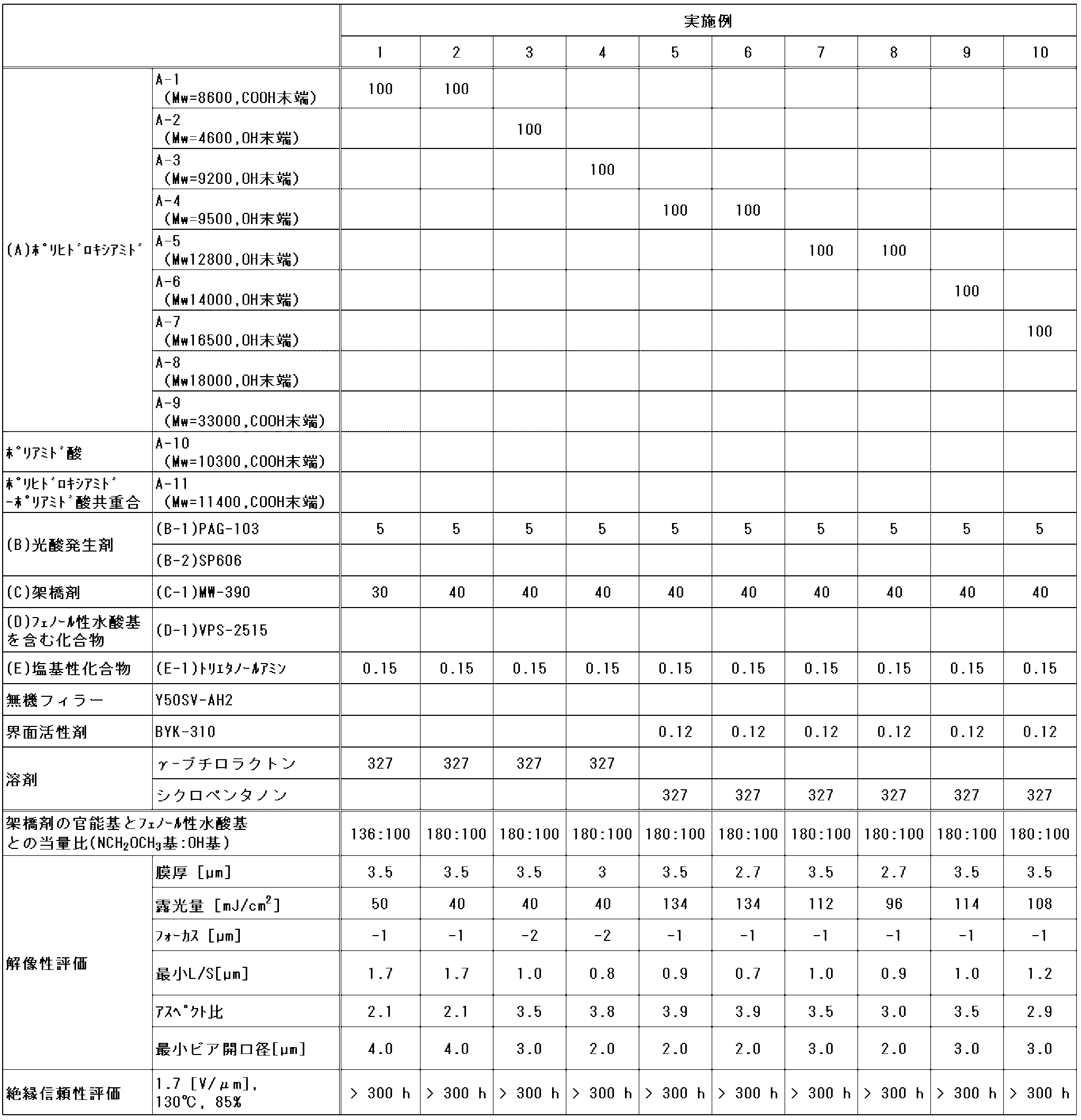
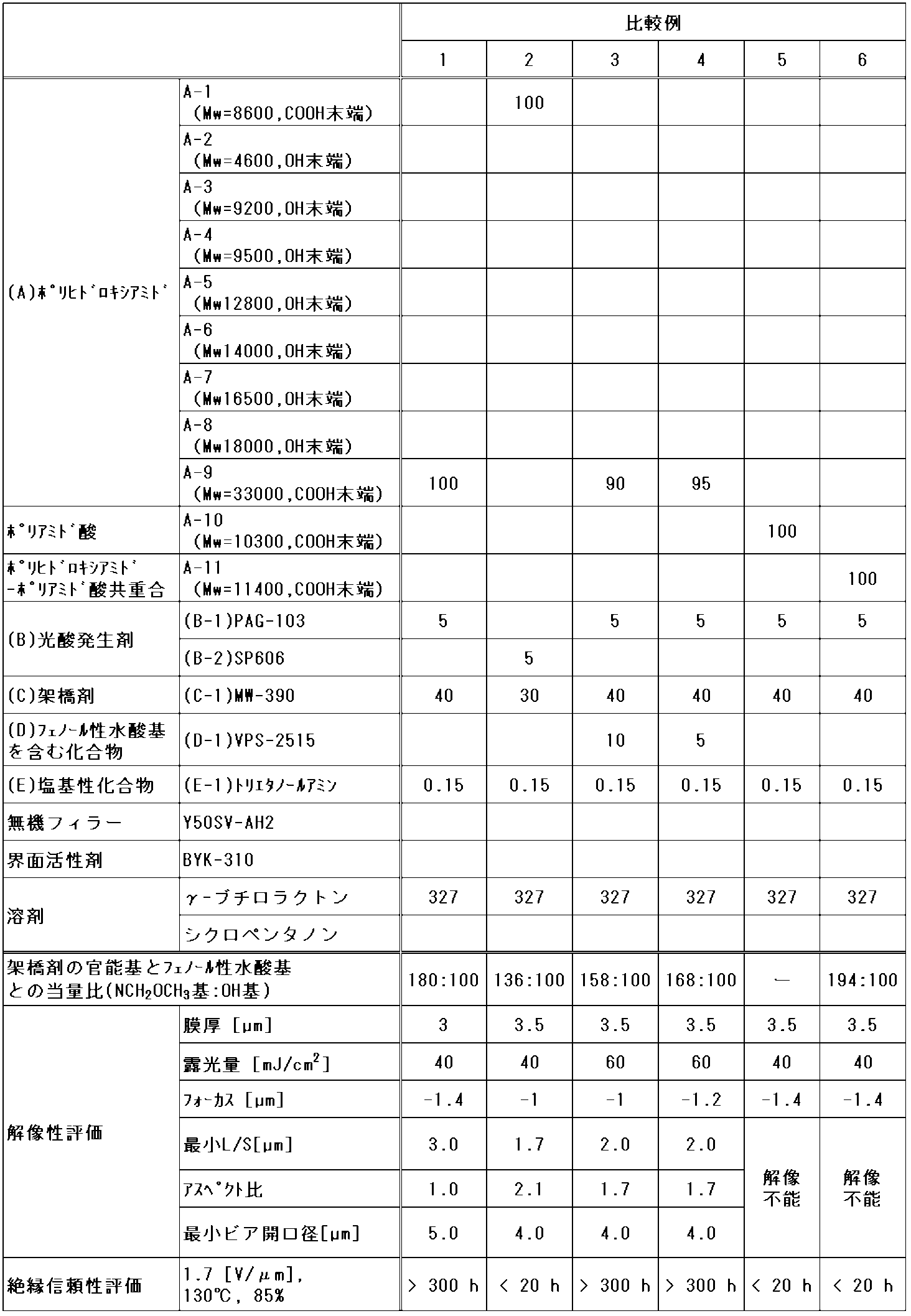
各成分を表2~4に示された量にて配合し、溶剤にてワニス中の不揮発成分の濃度が30%となるように溶解、調整することで、各実施例及び比較例のネガ型感光性樹脂組成物のワニスを得た。なお、表2~4における各成分の配合量のうち、溶剤の配合量以外は固形分質量を示す。また、ネガ型感光性樹脂組成物の原料の配合量から算出した架橋剤の官能基とフェノール性水酸基との当量比(NCH2OCH3基:OH基)を表2~4に示した。
得られた各実施例及び比較例のワニスを用いて以下の評価を行った。各評価結果を表2~4に示した。
・ライン/スペース(L/S)の測定、アスペクト比の測定
各実施例及び比較例のワニスをシリコンウエハ上にスピンコーターを用いて硬化後の膜厚が3.0μm又は3.5μmとなるように塗布し、ホットプレートを用いて110℃、3分乾燥させ、各実施例及び比較例のネガ型感光性樹脂組成物の乾燥塗膜を得た。この乾燥塗膜に線ステッパー(縮小投影露光装置:NSR-2005i9C(ニコン社製;NA(開口数)=0.5、σ=0.68、光源:高圧水銀灯ランプ))を用い、L/Sが0.5/0.5μm、0.6/0.6μm、0.7/0.7μm、0.8/0.8μm、1/1μm、1.2/1.2μm、1.5/1.5μm、1.7/1.7μm、2/2μm、3/3μm、4/4μm、5/5μmのテストパターンを露光し、ホットプレートにて140℃、60分間の露光後加熱(PEB)を行った。その後、2.38%TMAH水溶液を用いて、60秒間現像し30秒間超純水にてリンスを行い、30秒間スピン乾燥を行った。各実施例及び比較例のネガ型感光性樹脂組成物のパターンを有する試料を得た。なお、各実施例及び比較例のネガ型感光性樹脂組成物における露光条件(露光量及びフォーカス)は、各実施例及び比較例のネガ型感光性樹脂組成物ごとに最も解像性が良くなる条件を選択して行った。各実施例及び比較例の露光条件を表2~4に示した。
得られた各実施例及び比較例の試料を、パターンの長手方向に垂直な断面が観察できるように切断した。パターンの切断面を、走査型電子顕微鏡(観察倍率は10,000倍)を用いて観察し、正常にパターニングされている最小のL/Sを求めた。なお、各パターンが倒れることなく垂直にパターニングされている試料が正常にパターニングされていると判断した。
また、各実施例及び比較例のネガ型感光性樹脂組成物にて形成された最小のL/Sのパターンについて、アスペクト比(=膜厚÷最小L/Sのライン幅)を求めた。
また、正常にパターニングされている最小のL/Sについて前述した断面観察の際に、未露光部に現像残渣があるか否かについても合わせて観察を行った。わずかに現像残渣が見られた試料については、表2~4中の最小L/Sの欄に(残渣)と記載した。
コンタクト露光装置(光源:高圧水銀灯ランプ)を用い、開口径1.0、2.0、3.0、4.0、5.0、6.0、7.0、8.0、9.0、10.0、15.0、20.0μmのテストパターンを露光した。露光工程以外は上記のL/Sの測定と同様の方法で、パターニング可能な最小ビア開口径を求めた。わずかに現像残渣が見られた試料については、表2~4中の最小ビア開口径の欄に(残渣)と記載した。
各実施例及び比較例のワニスについて、京セラ社製のL/S=12/13μmの櫛場配線基板にスピンコーターを用いて膜厚20μmとなるよう塗布した。ホットプレートを用いて、110℃、5分乾燥させ、櫛場配線基板上に形成された各実施例及び比較例のネガ型感光性樹脂組成物塗膜を得た。この塗膜に高圧水銀灯ランプを用いて全面露光(1000mJ/cm2)し、イナートオーブンにて窒素雰囲気下で、200℃、1時間加熱硬化を行った。その後、櫛場配線基板の電極部上の硬化物をカッターナイフにて除いた後、電源プラグをハンダ接続して絶縁信頼性評価基板とした。この評価基板について、130℃、85RH%の環境下で20V(配線12μmに対して、1.7V/μmとなる)の電圧を印加し、櫛場配線間(ネガ型感光性樹脂組成物からなる硬化物)の抵抗が10MΩ以下になるまでの時間を測定した。なお、櫛場配線間(ネガ型感光性樹脂組成物フィルム)の抵抗が10MΩ以下になった場合には、回路が故障したとみなされる。
なお測定結果に「>300h」と記載されている場合は、300時間を超えても、櫛場配線間(ネガ型感光性樹脂組成物フィルム)の抵抗が10MΩ以下にならなかったことを示す。また、「<20h」と記載されている場合には、20時間未満で櫛場配線間(ネガ型感光性樹脂組成物フィルム)の抵抗が10MΩ以下になったことを示す。

Claims (11)
- 下式(1)で示される構造単位を含む(A)ポリヒドロキシアミド化合物と、
(B)オキシムスルホネート化合物と、
(C)架橋剤と、
を含み、
前記(A)ポリヒドロキシアミド化合物の重量平均分子量は2,000~20,000であり、
前記(A)ポリヒドロキシアミド化合物は、カルボキシル基を含まないか又はカルボキシル基当量が1,500g/eq以上であり、
前記(C)架橋剤はメトキシメチル基及び/又はメチロール基を複数含むことを特徴とする、ネガ型感光性樹脂組成物。
- 前記(A)ポリヒドロキシアミド化合物は、末端にカルボキシル基又はフェノール性水酸基を有することを特徴とする、請求項1に記載のネガ型感光性樹脂組成物。
- 前記(B)オキシムスルホネート化合物は、下式(2)で示される構造を有することを特徴とする、請求項1又は2に記載のネガ型感光性樹脂組成物。
- 前記(C)架橋剤は、複素環を含むことを特徴とする、請求項1~3のいずれか一項に記載のネガ型感光性樹脂組成物。
- 前記(C)架橋剤は、トリアジン環を有する化合物であることを特徴とする、請求項4に記載のネガ型感光性樹脂組成物。
- (D)フェノール性水酸基を含む化合物を含むことを特徴とする、請求項1~5のいずれか一項に記載のネガ型感光性樹脂組成物。
- 前記(D)フェノール性水酸基を含む化合物は、ポリヒドロキシスチレン重合体又はポリヒドロキシスチレン共重合体を含むことを特徴とする、請求項6記載のネガ型感光性樹脂組成物。
- (E)塩基性化合物を含むことを特徴とする、請求項1~7のいずれか一項に記載のネガ型感光性樹脂組成物。
- 請求項1~8のいずれか一項に記載のネガ型感光性樹脂組成物により形成された樹脂層を備えることを特徴とする、ドライフィルム。
- 請求項1~8のいずれか一項に記載のネガ型感光性樹脂組成物又は請求項9に記載のドライフィルムの樹脂層により形成されることを特徴とする、硬化物。
- 請求項10に記載の硬化物を有することを特徴とする、電子部品。
Priority Applications (5)
| Application Number | Priority Date | Filing Date | Title |
|---|---|---|---|
| US18/852,053 US20250216781A1 (en) | 2022-03-31 | 2023-03-30 | Negative type photosensitive resin composition, dry film, cured product, and electronic component |
| EP23780887.8A EP4502728A4 (en) | 2022-03-31 | 2023-03-30 | Composition of negative-type photosensitivity resin, dry film, hardened product, and electronic component |
| KR1020247035286A KR20240170548A (ko) | 2022-03-31 | 2023-03-30 | 네거티브형 감광성 수지 조성물, 드라이 필름, 경화물 및 전자 부품 |
| JP2024512802A JPWO2023190879A1 (ja) | 2022-03-31 | 2023-03-30 | |
| CN202380031054.1A CN119032325A (zh) | 2022-03-31 | 2023-03-30 | 负型感光性树脂组合物、干膜、固化物和电子部件 |
Applications Claiming Priority (2)
| Application Number | Priority Date | Filing Date | Title |
|---|---|---|---|
| JP2022059913 | 2022-03-31 | ||
| JP2022-059913 | 2022-03-31 |
Publications (1)
| Publication Number | Publication Date |
|---|---|
| WO2023190879A1 true WO2023190879A1 (ja) | 2023-10-05 |
Family
ID=88202892
Family Applications (1)
| Application Number | Title | Priority Date | Filing Date |
|---|---|---|---|
| PCT/JP2023/013199 Ceased WO2023190879A1 (ja) | 2022-03-31 | 2023-03-30 | ネガ型感光性樹脂組成物、ドライフィルム、硬化物及び電子部品 |
Country Status (7)
| Country | Link |
|---|---|
| US (1) | US20250216781A1 (ja) |
| EP (1) | EP4502728A4 (ja) |
| JP (1) | JPWO2023190879A1 (ja) |
| KR (1) | KR20240170548A (ja) |
| CN (1) | CN119032325A (ja) |
| TW (1) | TW202348684A (ja) |
| WO (1) | WO2023190879A1 (ja) |
Citations (7)
| Publication number | Priority date | Publication date | Assignee | Title |
|---|---|---|---|---|
| JP2001125267A (ja) | 1999-10-29 | 2001-05-11 | Hitachi Chemical Dupont Microsystems Ltd | ネガ型感光性樹脂組成物、パターンの製造法及び電子部品 |
| JP2008033159A (ja) | 2006-07-31 | 2008-02-14 | Hitachi Chemical Dupont Microsystems Ltd | ネガ型感光性樹脂組成物、パターン硬化膜の製造方法および電子部品 |
| JP2009036863A (ja) * | 2007-07-31 | 2009-02-19 | Fujifilm Corp | 感光性樹脂組成物、それを用いた硬化レリーフパターンの製造方法及び半導体装置 |
| JP2010174195A (ja) * | 2009-01-30 | 2010-08-12 | Asahi Kasei Corp | ポリイミドポリアミド共重合体及び感光性樹脂組成物 |
| WO2017061561A1 (ja) * | 2015-10-08 | 2017-04-13 | 日本化薬株式会社 | 新規ポリスルホンアミド化合物、及び該化合物を含有する樹脂組成物 |
| WO2017064984A1 (ja) * | 2015-10-16 | 2017-04-20 | 東レ株式会社 | 樹脂および感光性樹脂組成物 |
| JP2017179364A (ja) * | 2016-03-28 | 2017-10-05 | 東レ株式会社 | ポリアミド樹脂の製造方法およびそれを用いた感光性樹脂組成物の製造方法 |
Family Cites Families (2)
| Publication number | Priority date | Publication date | Assignee | Title |
|---|---|---|---|---|
| WO2007148384A1 (ja) * | 2006-06-20 | 2007-12-27 | Hitachi Chemical Dupont Microsystems Ltd. | ネガ型感光性樹脂組成物、パターンの製造方法及び電子部品 |
| JP5657882B2 (ja) * | 2009-12-16 | 2015-01-21 | 旭化成イーマテリアルズ株式会社 | 感光性樹脂組成物 |
-
2023
- 2023-03-28 TW TW112111755A patent/TW202348684A/zh unknown
- 2023-03-30 KR KR1020247035286A patent/KR20240170548A/ko active Pending
- 2023-03-30 JP JP2024512802A patent/JPWO2023190879A1/ja active Pending
- 2023-03-30 CN CN202380031054.1A patent/CN119032325A/zh active Pending
- 2023-03-30 WO PCT/JP2023/013199 patent/WO2023190879A1/ja not_active Ceased
- 2023-03-30 US US18/852,053 patent/US20250216781A1/en active Pending
- 2023-03-30 EP EP23780887.8A patent/EP4502728A4/en active Pending
Patent Citations (7)
| Publication number | Priority date | Publication date | Assignee | Title |
|---|---|---|---|---|
| JP2001125267A (ja) | 1999-10-29 | 2001-05-11 | Hitachi Chemical Dupont Microsystems Ltd | ネガ型感光性樹脂組成物、パターンの製造法及び電子部品 |
| JP2008033159A (ja) | 2006-07-31 | 2008-02-14 | Hitachi Chemical Dupont Microsystems Ltd | ネガ型感光性樹脂組成物、パターン硬化膜の製造方法および電子部品 |
| JP2009036863A (ja) * | 2007-07-31 | 2009-02-19 | Fujifilm Corp | 感光性樹脂組成物、それを用いた硬化レリーフパターンの製造方法及び半導体装置 |
| JP2010174195A (ja) * | 2009-01-30 | 2010-08-12 | Asahi Kasei Corp | ポリイミドポリアミド共重合体及び感光性樹脂組成物 |
| WO2017061561A1 (ja) * | 2015-10-08 | 2017-04-13 | 日本化薬株式会社 | 新規ポリスルホンアミド化合物、及び該化合物を含有する樹脂組成物 |
| WO2017064984A1 (ja) * | 2015-10-16 | 2017-04-20 | 東レ株式会社 | 樹脂および感光性樹脂組成物 |
| JP2017179364A (ja) * | 2016-03-28 | 2017-10-05 | 東レ株式会社 | ポリアミド樹脂の製造方法およびそれを用いた感光性樹脂組成物の製造方法 |
Non-Patent Citations (1)
| Title |
|---|
| See also references of EP4502728A4 |
Also Published As
| Publication number | Publication date |
|---|---|
| EP4502728A1 (en) | 2025-02-05 |
| TW202348684A (zh) | 2023-12-16 |
| KR20240170548A (ko) | 2024-12-03 |
| US20250216781A1 (en) | 2025-07-03 |
| JPWO2023190879A1 (ja) | 2023-10-05 |
| CN119032325A (zh) | 2024-11-26 |
| EP4502728A4 (en) | 2026-04-08 |
Similar Documents
| Publication | Publication Date | Title |
|---|---|---|
| EP3121651B1 (en) | Radiation-sensitive resin composition and electronic component | |
| JP2012226044A (ja) | ポジ型感光性樹脂組成物、レジストパターンの製造方法、半導体装置及び電子デバイス | |
| TW201539140A (zh) | 感放射線樹脂組成物以及電子構件 | |
| WO2013122208A1 (ja) | 感光性樹脂組成物、パターン硬化膜の製造方法及び電子部品 | |
| WO2024204763A1 (ja) | ネガ型感光性樹脂組成物、ドライフィルム、硬化物、電子部品 | |
| WO2023190879A1 (ja) | ネガ型感光性樹脂組成物、ドライフィルム、硬化物及び電子部品 | |
| KR102789993B1 (ko) | 감광성 수지 조성물, 드라이 필름, 경화물 및 전자 부품 | |
| JP7403268B2 (ja) | 感光性樹脂組成物、ドライフィルム、硬化物および電子部品 | |
| JP2025050419A (ja) | ネガ型感光性樹脂組成物、ドライフィルム、硬化物及び電子部品 | |
| JP2025050418A (ja) | ネガ型感光性樹脂組成物、ドライフィルム、硬化物及び電子部品 | |
| JP2025050420A (ja) | ネガ型感光性樹脂組成物、ドライフィルム、硬化物及び電子部品 | |
| KR20180101440A (ko) | 포지티브형 감광성 수지 조성물 | |
| JP6825217B2 (ja) | 感放射線樹脂組成物及び電子部品 | |
| WO2025069827A1 (ja) | ネガ型感光性樹脂組成物、ドライフィルム、硬化物および電子部品 | |
| JP2025050421A (ja) | ネガ型感光性樹脂組成物、ドライフィルム、硬化物及び電子部品 | |
| WO2025100236A1 (ja) | ポリヒドロキシアミド化合物、ネガ型感光性樹脂組成物、ドライフィルム、硬化物および電子部品 | |
| JP2024170755A (ja) | ポリヒドロキシアミド化合物、樹脂組成物、ドライフィルム、硬化物、電子部品 | |
| JP7336949B2 (ja) | 感光性樹脂組成物、ドライフィルム、硬化物および電子部品 | |
| JP2025171117A (ja) | 硬化性組成物、ドライフィルム、および、硬化物 | |
| WO2026063316A1 (ja) | 硬化性樹脂組成物、ドライフィルム、及び、硬化物 | |
| WO2025150348A1 (ja) | ポリヒドロキシアミド化合物、感光性樹脂組成物、ドライフィルム、硬化物および電子部品 | |
| JP2026054862A (ja) | ポリヒドロキシアミド化合物、硬化性樹脂組成物、ドライフィルム、及び、硬化物 | |
| JP2026004721A (ja) | 樹脂組成物、硬化物、及び、半導体装置 | |
| WO2025074871A1 (ja) | 樹脂、感光性樹脂組成物およびそれらの硬化物、ならびに、前記硬化物を用いた電子部品および表示装置 | |
| JP2024165942A (ja) | ネガ型感光性樹脂組成物、ドライフィルム、硬化物及び電子部品 |
Legal Events
| Date | Code | Title | Description |
|---|---|---|---|
| 121 | Ep: the epo has been informed by wipo that ep was designated in this application |
Ref document number: 23780887 Country of ref document: EP Kind code of ref document: A1 |
|
| ENP | Entry into the national phase |
Ref document number: 2024512802 Country of ref document: JP Kind code of ref document: A |
|
| WWE | Wipo information: entry into national phase |
Ref document number: 18852053 Country of ref document: US Ref document number: 202380031054.1 Country of ref document: CN |
|
| WWE | Wipo information: entry into national phase |
Ref document number: 202417076351 Country of ref document: IN |
|
| ENP | Entry into the national phase |
Ref document number: 20247035286 Country of ref document: KR Kind code of ref document: A |
|
| WWE | Wipo information: entry into national phase |
Ref document number: 2023780887 Country of ref document: EP |
|
| ENP | Entry into the national phase |
Ref document number: 2023780887 Country of ref document: EP Effective date: 20241031 |
|
| NENP | Non-entry into the national phase |
Ref country code: DE |
|
| WWP | Wipo information: published in national office |
Ref document number: 18852053 Country of ref document: US |