WO2023190920A1 - 共重合体、成形体および射出成形体 - Google Patents
共重合体、成形体および射出成形体 Download PDFInfo
- Publication number
- WO2023190920A1 WO2023190920A1 PCT/JP2023/013284 JP2023013284W WO2023190920A1 WO 2023190920 A1 WO2023190920 A1 WO 2023190920A1 JP 2023013284 W JP2023013284 W JP 2023013284W WO 2023190920 A1 WO2023190920 A1 WO 2023190920A1
- Authority
- WO
- WIPO (PCT)
- Prior art keywords
- copolymer
- present disclosure
- units
- ppve
- molding
- Prior art date
- Legal status (The legal status is an assumption and is not a legal conclusion. Google has not performed a legal analysis and makes no representation as to the accuracy of the status listed.)
- Ceased
Links
Classifications
-
- C—CHEMISTRY; METALLURGY
- C08—ORGANIC MACROMOLECULAR COMPOUNDS; THEIR PREPARATION OR CHEMICAL WORKING-UP; COMPOSITIONS BASED THEREON
- C08F—MACROMOLECULAR COMPOUNDS OBTAINED BY REACTIONS ONLY INVOLVING CARBON-TO-CARBON UNSATURATED BONDS
- C08F214/00—Copolymers of compounds having one or more unsaturated aliphatic radicals, each having only one carbon-to-carbon double bond, and at least one being terminated by a halogen
- C08F214/18—Monomers containing fluorine
- C08F214/26—Tetrafluoroethene
- C08F214/262—Tetrafluoroethene with fluorinated vinyl ethers
-
- B—PERFORMING OPERATIONS; TRANSPORTING
- B29—WORKING OF PLASTICS; WORKING OF SUBSTANCES IN A PLASTIC STATE IN GENERAL
- B29C—SHAPING OR JOINING OF PLASTICS; SHAPING OF MATERIAL IN A PLASTIC STATE, NOT OTHERWISE PROVIDED FOR; AFTER-TREATMENT OF THE SHAPED PRODUCTS, e.g. REPAIRING
- B29C45/00—Injection moulding, i.e. forcing the required volume of moulding material through a nozzle into a closed mould; Apparatus therefor
-
- C—CHEMISTRY; METALLURGY
- C09—DYES; PAINTS; POLISHES; NATURAL RESINS; ADHESIVES; COMPOSITIONS NOT OTHERWISE PROVIDED FOR; APPLICATIONS OF MATERIALS NOT OTHERWISE PROVIDED FOR
- C09D—COATING COMPOSITIONS, e.g. PAINTS, VARNISHES OR LACQUERS; FILLING PASTES; CHEMICAL PAINT OR INK REMOVERS; INKS; CORRECTING FLUIDS; WOODSTAINS; PASTES OR SOLIDS FOR COLOURING OR PRINTING; USE OF MATERIALS THEREFOR
- C09D127/00—Coating compositions based on homopolymers or copolymers of compounds having one or more unsaturated aliphatic radicals, each having only one carbon-to-carbon double bond, and at least one being terminated by a halogen; Coating compositions based on derivatives of such polymers
- C09D127/02—Coating compositions based on homopolymers or copolymers of compounds having one or more unsaturated aliphatic radicals, each having only one carbon-to-carbon double bond, and at least one being terminated by a halogen; Coating compositions based on derivatives of such polymers not modified by chemical after-treatment
- C09D127/12—Coating compositions based on homopolymers or copolymers of compounds having one or more unsaturated aliphatic radicals, each having only one carbon-to-carbon double bond, and at least one being terminated by a halogen; Coating compositions based on derivatives of such polymers not modified by chemical after-treatment containing fluorine atoms
- C09D127/18—Homopolymers or copolymers of tetrafluoroethene
-
- F—MECHANICAL ENGINEERING; LIGHTING; HEATING; WEAPONS; BLASTING
- F16—ENGINEERING ELEMENTS AND UNITS; GENERAL MEASURES FOR PRODUCING AND MAINTAINING EFFECTIVE FUNCTIONING OF MACHINES OR INSTALLATIONS; THERMAL INSULATION IN GENERAL
- F16L—PIPES; JOINTS OR FITTINGS FOR PIPES; SUPPORTS FOR PIPES, CABLES OR PROTECTIVE TUBING; MEANS FOR THERMAL INSULATION IN GENERAL
- F16L11/00—Hoses, i.e. flexible pipes
- F16L11/04—Hoses, i.e. flexible pipes made of rubber or flexible plastics
- F16L11/06—Hoses, i.e. flexible pipes made of rubber or flexible plastics with homogeneous wall
-
- H—ELECTRICITY
- H01—ELECTRIC ELEMENTS
- H01B—CABLES; CONDUCTORS; INSULATORS; SELECTION OF MATERIALS FOR THEIR CONDUCTIVE, INSULATING OR DIELECTRIC PROPERTIES
- H01B3/00—Insulators or insulating bodies characterised by the insulating materials; Selection of materials for their insulating or dielectric properties
- H01B3/18—Insulators or insulating bodies characterised by the insulating materials; Selection of materials for their insulating or dielectric properties mainly consisting of organic substances
- H01B3/30—Insulators or insulating bodies characterised by the insulating materials; Selection of materials for their insulating or dielectric properties mainly consisting of organic substances plastics; resins; waxes
- H01B3/44—Insulators or insulating bodies characterised by the insulating materials; Selection of materials for their insulating or dielectric properties mainly consisting of organic substances plastics; resins; waxes vinyl resins; acrylic resins
- H01B3/443—Insulators or insulating bodies characterised by the insulating materials; Selection of materials for their insulating or dielectric properties mainly consisting of organic substances plastics; resins; waxes vinyl resins; acrylic resins from vinylhalogenides or other halogenoethylenic compounds
- H01B3/445—Insulators or insulating bodies characterised by the insulating materials; Selection of materials for their insulating or dielectric properties mainly consisting of organic substances plastics; resins; waxes vinyl resins; acrylic resins from vinylhalogenides or other halogenoethylenic compounds from vinylfluorides or other fluoroethylenic compounds
-
- H—ELECTRICITY
- H01—ELECTRIC ELEMENTS
- H01B—CABLES; CONDUCTORS; INSULATORS; SELECTION OF MATERIALS FOR THEIR CONDUCTIVE, INSULATING OR DIELECTRIC PROPERTIES
- H01B7/00—Insulated conductors or cables characterised by their form
- H01B7/02—Disposition of insulation
-
- C—CHEMISTRY; METALLURGY
- C08—ORGANIC MACROMOLECULAR COMPOUNDS; THEIR PREPARATION OR CHEMICAL WORKING-UP; COMPOSITIONS BASED THEREON
- C08F—MACROMOLECULAR COMPOUNDS OBTAINED BY REACTIONS ONLY INVOLVING CARBON-TO-CARBON UNSATURATED BONDS
- C08F2800/00—Copolymer characterised by the proportions of the comonomers expressed
- C08F2800/20—Copolymer characterised by the proportions of the comonomers expressed as weight or mass percentages
Definitions
- the present disclosure relates to a copolymer, a molded article, and an injection molded article.
- Patent Document 1 describes (A) 0.1 to 99% by weight of a methylol group-containing fluoropolymer having a number average molecular weight of 5 ⁇ 10 2 to 5 ⁇ 10 5 and (B) 1 to 99.9% by weight of a liquid crystal polyester.
- the methylol group-containing fluorine-containing polymer (A) has a methylol group at the end of its molecular chain for every 1 ⁇ 10 6 carbon atoms, and the methylol group-containing fluorine-containing polymer (A) contains 2 ⁇ 10 2 to 1 ⁇ 10 5 carbon atoms.
- a thermoplastic resin composition comprising at least one member selected from the group consisting of perfluorinated polymers is described.
- the object of the present invention is to provide a copolymer that can yield a molded article having excellent creep properties, durability against repeated loads, solvent crack resistance, and durability against tensile force applied at 230°C.
- the present disclosure contains a tetrafluoroethylene unit and a perfluoro(propyl vinyl ether) unit, and the content of the perfluoro(propyl vinyl ether) unit is 4.4 to 5.2 with respect to the total monomer units. % by mass, a melt flow rate at 372° C. of 11.0 to 16.0 g/10 minutes, and a number of functional groups of 50 or less per 10 6 carbon atoms in the main chain. Ru.
- beautiful injection molded articles of various shapes can be easily obtained by molding using an injection molding method, and have wear resistance at 60°C, low hydrogen permeability, high temperature rigidity at 100°C, and high temperature rigidity at 230°C. It is possible to provide a copolymer from which a molded article having excellent tensile creep resistance, durability against repeated loads, solvent crack resistance, and durability against tensile force applied at 230° C. can be obtained.
- copolymers of the present disclosure contain tetrafluoroethylene (TFE) units and perfluoro(propyl vinyl ether) (PPVE) units.
- Patent Document 1 states that perfluorinated fluororesins (for example, PTFE, FEP, PFA, etc.) can be used in a wide temperature range, and have excellent chemical resistance, alkali resistance, acid resistance, water resistance, weather resistance, corrosion resistance, and abrasion resistance. Due to its excellent electrical insulation properties, it is used for a variety of purposes, including lining materials for pipes, valves, and pumps, flexible tubes, films, wafer baskets, pump impellers, mechanical parts, and chemical laboratory equipment. ing.
- perfluorinated fluororesins for example, PTFE, FEP, PFA, etc.
- Patent Document 1 describes that perfluorinated fluororesins are often inferior in mechanical properties, physical heat resistance indicated by deflection temperature under load, dimensional stability indicated by linear expansion coefficient, moldability, etc.
- a thermoplastic resin composition comprising a perfluoro polymer having a methylol group at the end and a liquid crystal polyester has been proposed.
- the moldability of the copolymer can be significantly improved, and at the same time, such
- MFR melt flow rate
- MFR melt flow rate
- the moldability of the copolymer can be significantly improved, and at the same time, such
- a copolymer it is possible to achieve 60°C abrasion resistance, low hydrogen permeability, high temperature rigidity at 100°C, tensile creep resistance at 230°C, and repeatability without adding other polymers such as liquid crystalline polyester to the copolymer. It has been found that it is possible to obtain a molded article that has excellent durability against loads, solvent crack resistance, and durability against tensile force applied at 230°C.
- piping members, tubes, valves, etc. that are resistant to wear and deformation even when they come into contact with high-temperature fluids whose pressure changes frequently, and that are less permeable to hydrogen. It can be made.
- the copolymer of the present disclosure is a melt-processable fluororesin. Melt processability means that the polymer can be melted and processed using conventional processing equipment such as extruders and injection molding machines.
- the content of PPVE units in the copolymer is 4.4 to 5.2% by mass based on the total monomer units.
- the content of PPVE units in the copolymer is preferably 5.1% by mass or less, more preferably 5.0% by mass or less, still more preferably 4.9% by mass or less, still more preferably It is 4.8% by mass or less. If the content of PPVE units in the copolymer is too large, low hydrogen permeability, high temperature rigidity at 100°C, tensile creep resistance at 230°C, and durability against repeated loads will be poor. If the content of PPVE units in the copolymer is too small, the abrasion resistance at 60°C, solvent crack resistance, and durability against tensile force applied at 230°C will be poor.
- the content of TFE units in the copolymer is preferably 95.6% by mass or less, preferably 94.8% by mass or more, and more preferably 94.9% by mass, based on all monomer units.
- the content is more preferably 95.0% by mass or more, still more preferably 95.1% by mass or more, particularly preferably 95.2% by mass or more. If the content of TFE units in the copolymer is too small, low hydrogen permeability, high temperature rigidity at 100°C, tensile creep resistance at 230°C, and durability against repeated loads may be poor. If the content of TFE units in the copolymer is too large, the abrasion resistance at 60°C, solvent crack resistance, and durability against tensile force applied at 230°C may be inferior.
- the content of each monomer unit in the copolymer is measured by 19 F-NMR method.
- the copolymer can also contain monomer units derived from monomers copolymerizable with TFE and PPVE.
- the content of monomer units copolymerizable with TFE and PPVE is preferably 0 to 0.8% by mass, more preferably 0.8% by mass, based on the total monomer units of the copolymer. 05 to 0.4% by mass, more preferably 0.1 to 0.3% by mass.
- the content of monomer units copolymerizable with TFE and PPVE may be 0.1% by mass or less based on all monomer units of the copolymer.
- the copolymer is preferably at least one selected from the group consisting of a copolymer consisting only of TFE units and PPVE units, and a TFE/HFP/PPVE copolymer, and a copolymer consisting only of TFE units and PPVE units. Polymers are more preferred.
- the melt flow rate (MFR) of the copolymer is 11.0 to 16.0 g/10 minutes.
- the MFR of the copolymer is preferably 11.1 g/10 minutes or more, more preferably 11.5 g/10 minutes or more, still more preferably 12.0 g/10 minutes or more, particularly preferably 12. 5 g/10 minutes or more, most preferably 13.0 g/10 minutes or more, preferably 15.8 g/10 minutes or less, more preferably 15.6 g/10 minutes or less, even more preferably 15 .4 g/10 minutes or less, particularly preferably 15.2 g/10 minutes or less, and most preferably 15.0 g/10 minutes or less.
- the MFR of the copolymer is too high, the abrasion resistance at 60°C, solvent crack resistance, and durability against tensile force applied at 230°C will be poor. If the MFR of the copolymer is too low, beautiful injection molded products of various shapes cannot be easily obtained by injection molding. Furthermore, if the MFR of the copolymer is too low, low hydrogen permeability, rigidity at a high temperature of 100° C., and durability against repeated loads will be poor.
- MFR is defined as the mass of polymer flowing out per 10 minutes (g/10 minutes) from a nozzle with an inner diameter of 2.1 mm and a length of 8 mm at 372 °C and under a 5 kg load using a melt indexer according to ASTM D1238. ) is the value obtained as
- MFR can be adjusted by adjusting the type and amount of the polymerization initiator, the type and amount of the chain transfer agent, etc. used when polymerizing monomers.
- the number of functional groups per 10 6 carbon atoms in the main chain of the copolymer is 50 or less.
- the number of functional groups per 10 6 carbon atoms in the main chain of the copolymer is preferably 40 or less, more preferably 30 or less, still more preferably 20 or less, and even more preferably 15 or less.
- the number is particularly preferably 10 or less, and most preferably less than 6. If the number of functional groups is too large, low hydrogen permeability and tensile creep resistance at 230°C will be poor.
- Infrared spectroscopy can be used to identify the type of functional group and measure the number of functional groups.
- the number of functional groups is measured by the following method.
- the above copolymer is molded by cold pressing to produce a film having a thickness of 0.25 to 0.30 mm.
- This film is analyzed by Fourier transform infrared spectroscopy to obtain an infrared absorption spectrum of the copolymer and a difference spectrum from the base spectrum which is completely fluorinated and has no functional groups. From the absorption peak of a specific functional group appearing in this difference spectrum, the number N of functional groups per 1 ⁇ 10 6 carbon atoms in the copolymer is calculated according to the following formula (A).
- N I ⁇ K/t (A) I: Absorbance K: Correction coefficient t: Film thickness (mm)
- the number of functional groups in -COF is the number of functional groups determined from the absorption peak at absorption frequency 1883 cm -1 caused by -CF 2 COF and the absorption peak at absorption frequency 1840 cm -1 caused by -CH 2 COF. This is the total number of functional groups.
- the functional group is a functional group present at the main chain end or side chain end of the copolymer, and a functional group present in the main chain or side chain.
- the above-mentioned functional group is introduced into the copolymer by, for example, a chain transfer agent or a polymerization initiator used in producing the copolymer.
- a chain transfer agent or a polymerization initiator used in producing the copolymer.
- a polymerization initiator for example, when an alcohol is used as a chain transfer agent or a peroxide having a -CH 2 OH structure is used as a polymerization initiator, -CH 2 OH is introduced at the end of the main chain of the copolymer.
- the functional group is introduced into the end of the side chain of the copolymer.
- a copolymer having the number of functional groups within the above range can be obtained. That is, the copolymer of the present disclosure is preferably fluorinated. It is also preferred that the copolymers of the present disclosure have -CF 3 end groups.
- the melting point of the copolymer is preferably 295 to 315°C, more preferably 298°C or higher, even more preferably 300°C or higher, particularly preferably 301°C or higher, and most preferably 302°C or higher.
- the temperature is more preferably 308°C or lower.
- the melting point can be measured using a differential scanning calorimeter (DSC).
- DSC differential scanning calorimeter
- the hydrogen permeability coefficient of the copolymer is preferably 2140 cm 3 ⁇ mm/(m 2 ⁇ 24h ⁇ atm) or less, more preferably 2000 cm 3 ⁇ mm/(m 2 ⁇ 24h ⁇ atm) or less.
- the copolymer of the present disclosure has excellent low hydrogen permeability because the PPVE unit content, melt flow rate (MFR), and number of functional groups of the copolymer containing TFE units and PPVE units are appropriately adjusted. It has a sexual nature.
- the hydrogen permeability coefficient can be measured under the conditions of a test temperature of 60° C. and a test humidity of 0% RH. Specific measurement of the hydrogen permeability coefficient can be performed by the method described in Examples.
- the copolymer of the present disclosure can be produced by a polymerization method such as suspension polymerization, solution polymerization, emulsion polymerization, or bulk polymerization.
- a polymerization method such as suspension polymerization, solution polymerization, emulsion polymerization, or bulk polymerization.
- emulsion polymerization or suspension polymerization is preferred.
- various conditions such as temperature and pressure, a polymerization initiator, and other additives can be appropriately set depending on the composition and amount of the copolymer.
- an oil-soluble radical polymerization initiator or a water-soluble radical polymerization initiator can be used as the polymerization initiator.
- the oil-soluble radical polymerization initiator may be a known oil-soluble peroxide, for example, Dialkyl peroxycarbonates such as di-n-propyl peroxydicarbonate, diisopropyl peroxydicarbonate, disec-butyl peroxydicarbonate, di-2-ethoxyethyl peroxydicarbonate; Peroxy esters such as t-butylperoxyisobutyrate and t-butylperoxypivalate; Dialkyl peroxides such as di-t-butyl peroxide; Di[fluoro(or fluorochloro)acyl]peroxides; etc. are listed as representative examples.
- Dialkyl peroxycarbonates such as di-n-propyl peroxydicarbonate, diisopropyl peroxydicarbonate, disec-butyl peroxydicarbonate, di-2-ethoxyethyl peroxydicarbonate
- Peroxy esters such as t-but
- di[fluoro(or fluorochloro)acyl]peroxides include diacyl represented by [(RfCOO)-] 2 (Rf is a perfluoroalkyl group, an ⁇ -hydroperfluoroalkyl group, or a fluorochloroalkyl group); Examples include peroxide.
- di[fluoro(or fluorochloro)acyl]peroxides examples include di( ⁇ -hydro-dodecafluoroheptanoyl) peroxide, di( ⁇ -hydro-tetradecafluorooctanoyl) peroxide, di( ⁇ - - Hydro-hexadecafluorononanoyl) peroxide, di(perfluoropropionyl) peroxide, di(perfluorobutyryl) peroxide, di(perfluoroparelyl) peroxide, di(perfluorohexanoyl) peroxide , di(perfluoroheptanoyl) peroxide, di(perfluorooctanoyl) peroxide, di(perfluorononanoyl) peroxide, di( ⁇ -chloro-hexafluorobutyryl) peroxide, di( ⁇ -chloro -decafluorohexanoyl)
- the water-soluble radical polymerization initiator may be a known water-soluble peroxide, such as ammonium salts, potassium salts, sodium salts, disulfur salts, etc., persulfuric acid, perboric acid, perchloric acid, perphosphoric acid, percarbonate, Examples include organic peroxides such as acid peroxide and diglutaric acid peroxide, t-butyl permalate, and t-butyl hydroperoxide. Reducing agents such as sulfites may be used in combination with peroxide, and the amount used may be from 0.1 to 20 times the amount of peroxide.
- surfactants In the polymerization, surfactants, chain transfer agents, and solvents can be used, and conventionally known ones can be used for each.
- surfactant known surfactants can be used, such as nonionic surfactants, anionic surfactants, cationic surfactants, etc.
- fluorine-containing anionic surfactants are preferable, and may contain ether-bonding oxygen (that is, an oxygen atom may be inserted between carbon atoms), and may contain straight-chain or branched surfactants having 4 to 20 carbon atoms. More preferred are fluorine-containing anionic surfactants.
- the amount of surfactant added is preferably 50 to 5000 ppm.
- chain transfer agents examples include hydrocarbons such as ethane, isopentane, n-hexane, and cyclohexane; aromatics such as toluene and xylene; ketones such as acetone; acetate esters such as ethyl acetate and butyl acetate; methanol , alcohols such as ethanol; mercaptans such as methyl mercaptan; halogenated hydrocarbons such as carbon tetrachloride, chloroform, methylene chloride, and methyl chloride.
- the amount of the chain transfer agent added may vary depending on the size of the chain transfer constant of the compound used, but it is usually used in the range of 0.01 to 20% by mass based on the polymerization solvent.
- Examples of the solvent include water, a mixed solvent of water and alcohol, and the like.
- a fluorine-based solvent may be used in addition to water.
- fluorine-based solvents include hydrochlorofluoroalkanes such as CH 3 CClF 2 , CH 3 CCl 2 F, CF 3 CF 2 CCl 2 H, CF 2 ClCF 2 CFHCl; CF 2 ClCFClCF 2 CF 3 , CF 3 CFClCFClCF 3, etc.
- Hydrofluoroalkanes such as CF3CFHCFHCF2CF2CF3 , CF2HCF2CF2CF2CF2H , CF3CF2CF2CF2CF2CF2H ; CH _ _ _ _ _ 3 OC 2F5 , CH 3 OC 3 F 5 CF 3 CF 3 CH 2 OCHF 2 , CF 3 CHFCF 2 Och 3 , CHF 2 CF 2 Och 2 F, (CF 3 ) 2 CHCF 2 Och 3 , CF 3 CF 2 Hydrofluoroethers such as CH2OCH2CHF2 , CF3CHFCF2OCH2CF3 ; perfluorocyclobutane , CF3CF2CF2CF3 , CF3CF2CF2CF2CF3 , CF3CF2 _ _ _ _ Examples include perfluoroalkanes such as CF 2 CF 2 CF 2 CF 3 , and among them, perflufluoro
- the polymerization temperature is not particularly limited and may be from 0 to 100°C.
- the polymerization pressure is appropriately determined depending on the type and amount of the solvent used and other polymerization conditions such as vapor pressure and polymerization temperature, but it may usually be 0 to 9.8 MPaG.
- the copolymer When an aqueous dispersion containing a copolymer is obtained by a polymerization reaction, the copolymer can be recovered by coagulating the copolymer contained in the aqueous dispersion, washing, and drying. Further, when the copolymer is obtained as a slurry by the polymerization reaction, the copolymer can be recovered by taking out the slurry from the reaction vessel, washing it, and drying it. By drying, the copolymer can be recovered in the form of a powder.
- the copolymer obtained by polymerization may be formed into pellets.
- the method for forming pellets There are no particular limitations on the method for forming pellets, and conventionally known methods can be used.
- a method may be used in which a copolymer is melt-extruded using a single-screw extruder, a twin-screw extruder, or a tandem extruder, and then cut into predetermined lengths and molded into pellets.
- the extrusion temperature during melt extrusion needs to be changed depending on the melt viscosity of the copolymer and the manufacturing method, and is preferably from the melting point of the copolymer +20°C to the melting point of the copolymer +140°C.
- the method for cutting the copolymer is not particularly limited, and conventionally known methods such as a strand cut method, hot cut method, underwater cut method, and sheet cut method can be employed.
- the volatile matter in the pellets may be removed by heating the obtained pellets (deaeration treatment).
- the obtained pellets may be treated by contacting them with hot water at 30 to 200°C, steam at 100 to 200°C, or hot air at 40 to 200°C.
- the copolymer obtained by polymerization may be subjected to fluorination treatment.
- a functional group such as -CF 2 H, which is thermally stable, can be converted to -CF 3 , which is extremely stable thermally.
- the fluorine-containing compound is not particularly limited, but includes a fluorine radical source that generates fluorine radicals under fluorination treatment conditions.
- a fluorine radical source that generates fluorine radicals under fluorination treatment conditions.
- the fluorine radical source include F 2 gas, CoF 3 , AgF 2 , UF 6 , OF 2 , N 2 F 2 , CF 3 OF, fluorinated halogens (eg, IF 5 , ClF 3 ), and the like.
- the fluorine radical source such as F2 gas may be at 100% concentration, but from the viewpoint of safety, it is preferable to mix it with an inert gas and dilute it to 5 to 50% by mass. It is more preferable to use it diluted to ⁇ 30% by mass.
- the inert gas include nitrogen gas, helium gas, argon gas, etc., but nitrogen gas is preferable from an economical point of view.
- the conditions for the fluorination treatment are not particularly limited, and the copolymer in a molten state and the fluorine-containing compound may be brought into contact with each other. Preferably, it can be carried out at a temperature of 100 to 220°C.
- the above fluorination treatment is generally carried out for 1 to 30 hours, preferably for 5 to 25 hours.
- the fluorination treatment is preferably one in which the non-fluorinated copolymer is brought into contact with fluorine gas (F 2 gas).
- a composition may be obtained by mixing the copolymer of the present disclosure and other components as necessary.
- Other ingredients include fillers, plasticizers, processing aids, mold release agents, pigments, flame retardants, lubricants, light stabilizers, weather stabilizers, conductive agents, antistatic agents, ultraviolet absorbers, antioxidants, Foaming agents, perfumes, oils, softeners, dehydrofluorination agents, etc. can be mentioned.
- Examples of the filler include silica, kaolin, clay, organized clay, talc, mica, alumina, calcium carbonate, calcium terephthalate, titanium oxide, calcium phosphate, calcium fluoride, lithium fluoride, crosslinked polystyrene, potassium titanate, Examples include carbon, boron nitride, carbon nanotubes, glass fibers, and the like.
- Examples of the conductive agent include carbon black and the like.
- Examples of the plasticizer include dioctyl phthalic acid and pentaerythritol.
- processing aids include carnauba wax, sulfone compounds, low molecular weight polyethylene, and fluorine-based aids.
- Examples of dehydrofluorination agents include organic oniums and amidines.
- polymers examples include fluororesins, fluororubbers, and non-fluorinated polymers other than the above-mentioned copolymers.
- the above composition can be produced by dry mixing the copolymer and other components, or by mixing the copolymer and other components in advance in a mixer and then using a kneader, melt extruder, etc. Examples include a method of melt-kneading.
- the copolymer of the present disclosure or the above composition can be used as a processing aid, a molding material, etc., and is preferably used as a molding material.
- Aqueous dispersions, solutions, suspensions, and copolymer/solvent systems of the copolymers of the present disclosure are also available and can be applied as coatings or used for encapsulation, impregnation, and film casting. You can However, since the copolymer of the present disclosure has the above-mentioned properties, it is preferably used as the above-mentioned molding material.
- a molded article may be obtained by molding the copolymer of the present disclosure or the above composition.
- the method for molding the above copolymer or the above composition is not particularly limited, and examples include injection molding, extrusion molding, compression molding, blow molding, transfer molding, roto molding, roto lining molding, and the like. .
- extrusion molding, compression molding, injection molding, and transfer molding are preferred, and injection molding, extrusion molding, and transfer molding are more preferred because molded products can be produced with high productivity.
- injection molding is more preferable. That is, the molded product is preferably an extrusion molded product, a compression molded product, an injection molded product, or a transfer molded product, and since it can be produced with high productivity, it is an injection molded product, an extrusion molded product, or a transfer molded product. is more preferable, and an injection molded article is even more preferable.
- Molded objects containing the copolymer of the present disclosure include, for example, nuts, bolts, joints, films, bottles, gaskets, wire coatings, tubes, hoses, pipes, valves, sheets, seals, packings, tanks, rollers, and containers. , faucet, connector, filter housing, filter cage, flow meter, pump, wafer carrier, wafer box, etc.
- a molded article containing the copolymer of the present disclosure has wear resistance at 60°C, low hydrogen permeability, stiffness at 100°C high temperature, tensile creep resistance at 230°C, durability against repeated loads, solvent crack resistance, and 230°C Since it has excellent durability against tensile force applied by other people, it can be particularly suitably used for piping members, valves, films, tubes, electric wire coatings, and the like.
- the copolymer of the present disclosure, the above-mentioned composition, or the above-mentioned molded article can be used, for example, in the following applications.
- Fluid transfer members for food manufacturing equipment such as food packaging films, lining materials for fluid transfer lines used in food manufacturing processes, packing, sealing materials, and sheets;
- Pharmaceutical liquid transfer members such as drug stoppers, packaging films, lining materials for fluid transfer lines used in drug manufacturing processes, packing, sealing materials, and sheets; Inner lining materials for chemical tanks and piping in chemical plants and semiconductor factories;
- Fuel transfer members such as O (square) rings, tubes, packings, valve core materials, hoses, sealing materials, etc. used in automobile fuel systems and peripheral devices; hoses, sealing materials, etc.
- the fuel transfer member used in the fuel system of the automobile include fuel hoses, filler hoses, evaporative hoses, and the like.
- the above fuel transfer member can also be used as a fuel transfer member for sour gasoline-resistant fuel, alcohol-resistant fuel, and fuel containing gasoline additives such as methyl tertiary butyl ether and amine-resistant fuel.
- the drug stopper/packaging film for drugs described above has excellent chemical resistance against acids and the like. Further, as the chemical liquid transfer member, an anticorrosion tape that is wrapped around chemical plant piping can also be mentioned.
- Examples of the above-mentioned molded bodies include automobile radiator tanks, chemical liquid tanks, bellows, spacers, rollers, gasoline tanks, containers for transporting waste liquids, containers for transporting high-temperature liquids, fisheries and fish farming tanks, and the like.
- the above-mentioned molded products include automobile bumpers, door trims, instrument panels, food processing equipment, cooking equipment, water- and oil-repellent glass, lighting-related equipment, display panels and housings for OA equipment, illuminated signboards, displays, and liquid crystals.
- Examples include components used for displays, mobile phones, printed circuit boards, electrical and electronic components, miscellaneous goods, trash cans, bathtubs, unit baths, ventilation fans, lighting frames, etc.
- a molded article containing the copolymer of the present disclosure can be suitably used as a compressed member such as a gasket or packing.
- the compressed member of the present disclosure may be a gasket or packing.
- the size and shape of the compressed member of the present disclosure may be appropriately set depending on the application and are not particularly limited.
- the shape of the compressed member of the present disclosure may be, for example, annular.
- the compressed member of the present disclosure may have a shape such as a circle, an ellipse, or a square with rounded corners in a plan view, and may have a through hole in the center thereof.
- the compressed member of the present disclosure is preferably used as a member for configuring a non-aqueous electrolyte battery.
- the compressed member of the present disclosure is particularly suitable as a member used in a state in which it is in contact with a non-aqueous electrolyte in a non-aqueous electrolyte battery. That is, the compressed member of the present disclosure may have a liquid contact surface with the non-aqueous electrolyte in the non-aqueous electrolyte battery.
- the non-aqueous electrolyte battery is not particularly limited as long as it includes a non-aqueous electrolyte, and includes, for example, a lithium ion secondary battery, a lithium ion capacitor, and the like.
- examples of the members constituting the non-aqueous electrolyte battery include a sealing member, an insulating member, and the like.
- the non-aqueous electrolyte is not particularly limited, but includes propylene carbonate, ethylene carbonate, butylene carbonate, ⁇ -butyl lactone, 1,2-dimethoxyethane, 1,2-diethoxyethane, dimethyl carbonate, diethyl carbonate.
- One or more known solvents such as , ethyl methyl carbonate and the like can be used.
- the non-aqueous electrolyte battery may further include an electrolyte.
- the electrolyte is not particularly limited, but LiClO 4 , LiAsF 6 , LiPF 6 , LiBF 4 , LiCl, LiBr, CH 3 SO 3 Li, CF 3 SO 3 Li, cesium carbonate, etc. can be used.
- the compressed member of the present disclosure can be suitably used, for example, as a sealing member such as a sealing gasket or sealing packing, or an insulating member such as an insulating gasket or insulating packing.
- the sealing member is a member used to prevent leakage of liquid or gas or intrusion of liquid or gas from the outside.
- the insulating member is a member used for insulating electricity.
- the compressed member of the present disclosure may be a member used for both sealing and insulation purposes.
- the copolymer of the present disclosure can be suitably used as a material for forming a wire coating.
- the covered electric wire includes a core wire and a coating layer provided around the core wire and containing the copolymer of the present disclosure.
- the coating layer can be an extrusion molded product obtained by melt-extruding the copolymer of the present disclosure onto a core wire.
- the coated electric wire is suitable for high frequency transmission cables, flat cables, heat-resistant cables, etc., and is particularly suitable for high frequency transmission cables.
- the core wire for example, a metal conductor material such as copper or aluminum can be used.
- the core wire preferably has a diameter of 0.02 to 3 mm.
- the diameter of the core wire is more preferably 0.04 mm or more, even more preferably 0.05 mm or more, and particularly preferably 0.1 mm or more.
- the diameter of the core wire is more preferably 2 mm or less.
- core wires include AWG (American Wire Gauge)-46 (solid copper wire with a diameter of 40 micrometers), AWG-26 (solid copper wire with a diameter of 404 micrometers), and AWG-24 (solid copper wire with a diameter of 404 micrometers). 510 micrometer solid copper wire), AWG-22 (solid copper wire 635 micrometer in diameter), etc. may be used.
- AWG American Wire Gauge
- AWG-46 solid copper wire with a diameter of 40 micrometers
- AWG-26 solid copper wire with a diameter of 404 micrometers
- AWG-24 solid copper wire with a diameter of 404 micrometers
- AWG-22 solid copper wire 635 micrometer in diameter
- the thickness of the coating layer is preferably 0.1 to 3.0 mm. It is also preferable that the thickness of the coating layer is 2.0 mm or less.
- a coaxial cable generally has a structure in which an inner conductor, an insulating coating layer, an outer conductor layer, and a protective coating layer are laminated in order from the core to the outer periphery.
- a molded article containing the copolymer of the present disclosure can be suitably used as an insulating coating layer containing the copolymer.
- the thickness of each layer in the above structure is not particularly limited, usually the inner conductor has a diameter of about 0.1 to 3 mm, the insulating coating layer has a thickness of about 0.3 to 3 mm, and the outer conductor layer has a thickness of about 0.5-10 mm, the protective coating layer is approximately 0.5-2 mm thick.
- the coating layer may contain air bubbles, and it is preferable that the air bubbles are uniformly distributed in the coating layer.
- the average bubble diameter of the bubbles is not limited, for example, it is preferably 60 ⁇ m or less, more preferably 45 ⁇ m or less, even more preferably 35 ⁇ m or less, and even more preferably 30 ⁇ m or less. It is preferably 25 ⁇ m or less, particularly preferably 23 ⁇ m or less, and even more preferably 23 ⁇ m or less. Further, the average bubble diameter is preferably 0.1 ⁇ m or more, more preferably 1 ⁇ m or more. The average bubble diameter can be determined by taking an electron microscope image of a cross section of the wire, calculating the diameter of each bubble through image processing, and averaging the diameters.
- the covering layer may have a foaming rate of 20% or more. More preferably, it is 30% or more, still more preferably 33% or more, and still more preferably 35% or more.
- the upper limit is not particularly limited, but is, for example, 80%.
- the upper limit of the foaming rate may be 60%.
- the foaming rate is a value determined as ((specific gravity of wire sheathing material ⁇ specific gravity of sheathing layer)/specific gravity of wire sheathing material) ⁇ 100.
- the foaming rate can be adjusted as appropriate depending on the application, for example, by adjusting the amount of gas inserted into the extruder, which will be described later, or by selecting the type of gas to be dissolved.
- the covered electric wire may include another layer between the core wire and the coating layer, and may further include another layer (outer layer) around the coating layer.
- the electric wire of the present disclosure has a two-layer structure (skin-foam) in which a non-foamed layer is inserted between the core wire and the coating layer, or a two-layer structure in which the outer layer is coated with a non-foamed layer. (foam-skin), or even a three-layer structure (skin-foam-skin) in which the outer layer of skin-foam is coated with a non-foamed layer.
- the non-foamed layer is not particularly limited, and may include TFE/HFP copolymers, TFE/PAVE copolymers, TFE/ethylene copolymers, vinylidene fluoride polymers, polyolefin resins such as polyethylene [PE], polychlorinated It may be a resin layer made of resin such as vinyl [PVC].
- the covered electric wire can be manufactured by, for example, using an extruder to heat a copolymer and extrude the molten copolymer onto a core wire to form a coating layer.
- the above-mentioned coating layer containing air bubbles can also be formed by heating the copolymer and introducing gas into the copolymer in a molten state.
- a gas such as chlorodifluoromethane, nitrogen, carbon dioxide, or a mixture of the above gases can be used.
- the gas may be introduced as a pressurized gas into the heated copolymer or may be generated by incorporating a chemical blowing agent into the copolymer. The gas is dissolved in the copolymer in the molten state.
- copolymer of the present disclosure can be suitably used as a material for products for high frequency signal transmission.
- the above-mentioned high-frequency signal transmission products are not particularly limited as long as they are used for high-frequency signal transmission, and include (1) insulating plates for high-frequency circuits, insulators for connecting parts, molded plates for printed wiring boards, etc.; Examples include bases of high-frequency vacuum tubes, molded bodies such as antenna covers, and (3) coated electric wires such as coaxial cables and LAN cables.
- the above-mentioned product for high frequency signal transmission can be suitably used for equipment that uses microwaves, particularly microwaves of 3 to 30 GHz, such as satellite communication equipment and mobile phone base stations.
- the copolymer of the present disclosure can be suitably used as an insulator since it has a low dielectric loss tangent.
- a printed wiring board is preferable because good electrical properties can be obtained.
- the printed wiring board is not particularly limited, but includes, for example, printed wiring boards for electronic circuits such as mobile phones, various computers, and communication devices.
- an antenna cover is preferable because it has low dielectric loss.
- a molded article containing the copolymer of the present disclosure can be suitably used as a film or sheet.
- the film of the present disclosure is useful as a release film.
- the release film can be manufactured by molding the copolymer of the present disclosure by melt extrusion molding, calendar molding, press molding, casting molding, or the like. From the viewpoint of obtaining a uniform thin film, the release film can be manufactured by melt extrusion molding.
- the film of the present disclosure can be applied to the surface of a roll used for OA equipment.
- the copolymer of the present disclosure can be formed into a necessary shape by extrusion molding, compression molding, press molding, etc. into a sheet, film, or tube shape to form a surface material for OA equipment rolls, OA equipment belts, etc. It can be used for.
- thin-walled tubes and films can be produced by melt extrusion.
- a molded article containing the copolymer of the present disclosure can be suitably used as a bottle, tube, joint, valve, piping member, etc. These can be used for storage and distribution of drug solutions.
- ⁇ 1> Contains tetrafluoroethylene units and perfluoro(propyl vinyl ether) units, The content of perfluoro(propyl vinyl ether) units is 4.4 to 5.2% by mass based on the total monomer units, The melt flow rate at 372°C is 11.0 to 16.0 g/10 minutes, A copolymer is provided in which the number of functional groups is 50 or less per 10 6 carbon atoms in the main chain.
- a copolymer according to the first aspect is provided, in which the content of perfluoro(propyl vinyl ether) units is 4.4 to 5.0% by weight based on the total monomer units.
- a copolymer according to the first or second aspect which has a melt flow rate at 372° C. of 12.0 to 15.0 g/10 minutes.
- An injection molded article containing a copolymer according to any one of the first to third aspects is provided.
- a molded article containing a copolymer according to any one of the first to third aspects wherein the molded article is a piping member, a valve, a film, a tube, or a wire coating.
- the content of each monomer unit was measured using an NMR analyzer (for example, AVANCE 300 high temperature probe manufactured by Bruker Biospin).
- MFR Melt flow rate
- the copolymer pellets were molded by cold pressing to produce a film with a thickness of 0.25 to 0.30 mm. This film was scanned 40 times using a Fourier transform infrared spectrometer [FT-IR (Spectrum One, manufactured by PerkinElmer)] and analyzed to obtain an infrared absorption spectrum, which revealed that it was completely fluorinated and functional groups were present. A difference spectrum with no base spectrum was obtained. From the absorption peak of a specific functional group appearing in this difference spectrum, the number N of functional groups per 1 ⁇ 10 6 carbon atoms in the sample was calculated according to the following formula (A).
- FT-IR Spectrum One, manufactured by PerkinElmer
- N I ⁇ K/t (A)
- K Correction coefficient
- t Film thickness (mm)
- absorption frequencies, molar extinction coefficients, and correction coefficients for the functional groups in the present disclosure are shown in Table 2. The molar extinction coefficient was determined from FT-IR measurement data of a low-molecular model compound.
- melting point Using a differential scanning calorimeter (trade name: Cool from 350°C to 200°C at a rate of 10°C/min, then raise the temperature a second time from 200°C to 350°C at a rate of 10°C/min, and observe the melting curve peak that occurs during the second heating process. The melting point was determined from
- Comparative example 1 Pour 51.8L of pure water into a 174L autoclave with a stirrer, and after thoroughly purging with nitrogen, add 40.9kg of perfluorocyclobutane, 1.79kg of perfluoro(propyl vinyl ether) (PPVE), and 4.30kg of methanol. and the temperature in the system was maintained at 35°C. Next, tetrafluoroethylene (TFE) was pressurized to 0.64 MPa, and then 0.051 kg of a 50% methanol solution of di-n-propyl peroxydicarbonate was added to initiate polymerization.
- TFE tetrafluoroethylene
- the obtained powder was melt-extruded at 360°C using a screw extruder (trade name: PCM46, manufactured by Ikegai Co., Ltd.) to obtain copolymer pellets.
- the PPVE content was measured by the method described above using the obtained pellets.
- the obtained pellets were placed in a vacuum vibration reactor VVD-30 (manufactured by Okawara Seisakusho Co., Ltd.), and the temperature was raised to 210°C. After evacuation, F 2 gas diluted to 20% by volume with N 2 gas was introduced to atmospheric pressure. After 0.5 hours from the introduction of F 2 gas, the chamber was once evacuated and F 2 gas was introduced again. Further, 0.5 hours later, the vacuum was drawn again and F 2 gas was introduced again. Thereafter, the above operations of introducing F 2 gas and evacuation were continued once every hour, and the reaction was carried out at a temperature of 210° C. for 10 hours. After the reaction was completed, the inside of the reactor was sufficiently replaced with N 2 gas to complete the fluorination reaction. Various physical properties were measured using the fluorinated pellets by the methods described above.
- Comparative example 2 Fluorination was carried out in the same manner as in Comparative Example 1, except that 1.92 kg of PPVE, 4.79 kg of methanol, and 0.044 kg of PPVE were added for every 1 kg of TFE supplied to obtain 42.7 kg of dry powder. A pellet was obtained.
- Comparative example 3 2.05 kg of PPVE, 0.33 kg of methanol, 0.103 kg of 50% methanol solution of di-n-propyl peroxydicarbonate, and 0.046 kg of PPVE added for every 1 kg of TFE supplied, were added to dry powder. Fluorinated pellets were obtained in the same manner as in Comparative Example 1, except that 42.8 kg was obtained.
- Comparative example 4 Fluorination was carried out in the same manner as in Comparative Example 1, except that 2.69 kg of PPVE, 2.48 kg of methanol, and 0.057 kg of PPVE were added for every 1 kg of TFE supplied to obtain 43.2 kg of dry powder. A pellet was obtained.
- Comparative example 5 Fluorination was carried out in the same manner as in Comparative Example 1, except that 2.43 kg of PPVE, 1.75 kg of methanol, and 0.053 kg of PPVE were added for every 1 kg of TFE supplied to obtain 41.0 kg of dry powder. A pellet was obtained.
- Comparative example 6 Fluorination was carried out in the same manner as in Comparative Example 1, except that 2.43 kg of PPVE, 3.36 kg of methanol, and 0.053 kg of PPVE were added for every 1 kg of TFE supplied to obtain 43.1 kg of dry powder. Got no pellets.
- Example 1 Fluorination was carried out in the same manner as in Comparative Example 1, except that 2.05 kg of PPVE, 3.43 kg of methanol, and 0.046 kg of PPVE were added for every 1 kg of TFE supplied to obtain 42.8 kg of dry powder. A pellet was obtained.
- Example 2 Fluorination was carried out in the same manner as in Comparative Example 1, except that 2.17 kg of PPVE, 3.45 kg of methanol, and 0.048 kg of PPVE were added for every 1 kg of TFE supplied to obtain 42.9 kg of dry powder. A pellet was obtained.
- Example 3 Fluorination was carried out in the same manner as in Comparative Example 1, except that 2.30 kg of PPVE, 3.24 kg of methanol, and 0.050 kg of PPVE were added for every 1 kg of TFE supplied to obtain 43.0 kg of dry powder. A pellet was obtained.
- Example 4 2.43 kg of PPVE, 3.19 kg of methanol, 0.053 kg of PPVE added for every 1 kg of TFE supplied, the heating temperature of the vacuum vibration reactor was 180°C, and the reaction was continued at 180°C for 10 hours. Fluorinated pellets were obtained in the same manner as in Comparative Example 1, except that 43.1 kg of dry powder was obtained.
- a sheet-like test piece with a thickness of about 0.2 mm was prepared using a pellet and a heat press molding machine, and a 10 cm x 10 cm test piece was cut from it.
- the prepared test piece was fixed on the test stand of a Taber abrasion tester (No. 101 special type Taber type ablation tester, manufactured by Yasuda Seiki Seisakusho Co., Ltd.), the test piece surface temperature was 60°C, the load was 500 g, and the abrasion ring CS-10 (polished An abrasion test was conducted using a Taber abrasion tester under the conditions that the sample was polished 20 times with #240 paper and the rotation speed was 60 rpm.
- Amount of wear (mg) M1-M2 M1: Weight of test piece after 1000 rotations (mg) M2: Test piece weight after 6500 rotations (mg)
- hydrogen permeability coefficient A sheet-like test piece with a thickness of about 0.1 mm was produced using a pellet and a heat press molding machine. Using the obtained test piece, hydrogen permeability was measured using a differential pressure gas permeability meter (L100-5000 type gas permeability meter, manufactured by System illinois) according to the method described in JIS K7126-1:2006. I did it. Values for hydrogen permeability were obtained at a permeation area of 50.24 cm 2 , a test temperature of 60° C., and a test humidity of 0% RH. Using the obtained hydrogen permeability and test piece thickness, the hydrogen permeability coefficient was calculated from the following formula.
- a sheet-like test piece with a thickness of about 3.0 mm was produced using a pellet and a heat press molding machine, and a test piece of 80 x 10 mm was cut from it and heated at 100° C. for 20 hours in an electric furnace.
- the test temperature was 30 to 150°C and the heating rate was 120°C using a heat distortion tester (manufactured by Yasuda Seiki Seisakusho Co., Ltd.) in accordance with the method described in JIS K-K 7191-1, except that the obtained test piece was used.
- the test was conducted under the following conditions: °C/hour, bending stress: 1.8 MPa, and flatwise method.
- the deflection rate under load was determined using the following formula.
- a sheet with a small deflection rate under load at 100°C has excellent rigidity at high temperatures.
- Load deflection rate (%) a2/a1 x 100
- a1 Test piece thickness before test (mm)
- a2 Deflection amount at 100°C (mm)
- Tensile creep strain was measured using TMA-7100 manufactured by Hitachi High-Tech Science. A sheet with a thickness of about 0.1 mm was produced using a pellet and a heat press molding machine, and samples with a width of 2 mm and a length of 22 mm were produced from the sheet. The sample was mounted on a measurement jig with a distance between the jigs of 10 mm. A load was applied to the sample so that the cross-sectional load was 2.63 N/mm 2 , and the sample was left at 230°C. The length of the sample was measured from 90 minutes after the start of the test to 555 minutes after the start of the test.
- the displacement (mm) was measured, and the ratio of the length displacement (mm) to the initial sample length (10 mm) (tensile creep strain (%)) was calculated.
- a sheet with a small tensile creep strain (%) measured at 230° C. for 555 minutes is difficult to elongate even when a tensile load is applied in an extremely high temperature environment, and has excellent high-temperature tensile creep properties.
- the tensile strength after 80,000 cycles was measured after 80,000 cycles using a fatigue tester MMT-250NV-10 manufactured by Shimadzu Corporation.
- a sheet with a thickness of approximately 2.4 mm was produced using a pellet and heat press molding machine, and a dumbbell-shaped sample (thickness 2.4 mm, width 5.0 mm, measurement length 22 mm) was produced using an ASTM D1708 micro dumbbell. Created.
- the sample was attached to a measurement jig, and the measurement jig was placed in a constant temperature bath at 150° C. with the sample attached.
- Tensile strength in the uniaxial direction was repeated at a stroke of 0.2 mm and a frequency of 100 Hz, and the tensile strength for each pull (tensile strength when the stroke was +0.2 mm) was measured.
- the tensile strength after 80,000 cycles was calculated from the measured values according to the following formula. In this example, the cross-sectional area of the sample is 12.0 mm 2 .
- the tensile strength after 80,000 cycles is the ratio of the tensile strength when a repeated load is applied 80,000 times to the cross-sectional area of the sample.
- a sheet with high tensile strength after 80,000 cycles maintains high tensile strength even after being loaded 80,000 times, and has excellent durability against repeated loads.
- a molded article with a thickness of about 2 mm was produced using pellets and a heat press molding machine. Three test pieces were obtained by punching out the obtained sheet using a rectangular dumbbell measuring 13.5 mm x 38 mm. A notch was made in the center of the long side of each test piece obtained using a 19 mm x 0.45 mm blade according to ASTM D1693. Three notch test pieces and 25 g of an 85% phosphoric acid aqueous solution were placed in a 100 mL container, and after heating at 120°C for 20 hours in an electric furnace, the notch test pieces were taken out.
- notch test pieces Three of the obtained notch test pieces were attached to a stress crack test jig according to ASTM D1693, heated in an electric furnace at 200°C for 24 hours, and then the notch and its surroundings were visually observed and the number of cracks was counted.
- Ta A sheet that does not generate cracks has excellent solvent crack resistance even after being immersed in a chemical solution.
- ⁇ The number of cracks is 0.
- ⁇ The number of cracks is 1 or more.
- the copolymer was injection molded using an injection molding machine (manufactured by Sumitomo Heavy Industries, Ltd., SE50EV-A) at a cylinder temperature of 390° C., a mold temperature of 200° C., and an injection speed of 10 mm/s.
- a mold a mold made of HPM38 plated with Cr (100 mm x 100 mm x 2 mm, side gate) was used.
- the obtained injection molded product was observed and evaluated based on the following criteria. The presence or absence of surface roughness was confirmed by touching the surface of the injection molded article. ⁇ Evaluation (visual) 2: The entire surface is smooth, and no flow marks are observed on the entire molded product.
- a test piece (compression molded) with a thickness of 2.0 mm was obtained using a pellet and a heat press molding machine.
- a dumbbell-shaped test piece was cut out from the above test piece using an ASTM V-shaped dumbbell, and the obtained dumbbell-shaped test piece was subjected to ASTM D638 using an autograph (AG-I 300kN manufactured by Shimadzu Corporation). Accordingly, the tensile strength was measured at 230° C. under the condition of 50 mm/min.
- a molded article with a high tensile strength at 230°C is difficult to break even when a tensile force is applied at high temperatures.
- wire coating molding conditions A copper conductor having a conductor diameter of 0.50 mm was extruded and coated with the following coating thickness using a 30 mm ⁇ electric wire coating molding machine (manufactured by Tanabe Plastic Machinery Co., Ltd.) to obtain a coated electric wire.
- the wire coating extrusion molding conditions are as follows.
Landscapes
- Chemical & Material Sciences (AREA)
- Engineering & Computer Science (AREA)
- Organic Chemistry (AREA)
- Chemical Kinetics & Catalysis (AREA)
- Medicinal Chemistry (AREA)
- Polymers & Plastics (AREA)
- Health & Medical Sciences (AREA)
- General Engineering & Computer Science (AREA)
- Mechanical Engineering (AREA)
- Life Sciences & Earth Sciences (AREA)
- Materials Engineering (AREA)
- Wood Science & Technology (AREA)
- Manufacturing & Machinery (AREA)
- Spectroscopy & Molecular Physics (AREA)
- Physics & Mathematics (AREA)
- Addition Polymer Or Copolymer, Post-Treatments, Or Chemical Modifications (AREA)
- Injection Moulding Of Plastics Or The Like (AREA)
Abstract
Description
I:吸光度
K:補正係数
t:フィルムの厚さ(mm)

ジノルマルプロピルパーオキシジカーボネート、ジイソプロピルパーオキシジカーボネート、ジsec-ブチルパーオキシジカーボネート、ジ-2-エトキシエチルパーオキシジカーボネートなどのジアルキルパーオキシカーボネート類;
t-ブチルパーオキシイソブチレート、t-ブチルパーオキシピバレートなどのパーオキシエステル類;
ジt-ブチルパーオキサイドなどのジアルキルパーオキサイド類;
ジ[フルオロ(またはフルオロクロロ)アシル]パーオキサイド類;
などが代表的なものとしてあげられる。
食品包装用フィルム、食品製造工程で使用する流体移送ラインのライニング材、パッキン、シール材、シート等の食品製造装置用流体移送部材;
薬品用の薬栓、包装フィルム、薬品製造工程で使用される流体移送ラインのライニング材、パッキン、シール材、シート等の薬液移送部材;
化学プラントや半導体工場の薬液タンクや配管の内面ライニング部材;
自動車の燃料系統並びに周辺装置に用いられるO(角)リング・チューブ・パッキン、バルブ芯材、ホース、シール材等、自動車のAT装置に用いられるホース、シール材等の燃料移送部材;
自動車のエンジン並びに周辺装置に用いられるキャブレターのフランジガスケット、シャフトシール、バルブステムシール、シール材、ホース等、自動車のブレーキホース、エアコンホース、ラジエーターホース、電線被覆材等のその他の自動車部材;
半導体製造装置のO(角)リング、チューブ、パッキン、バルブ芯材、ホース、シール材、ロール、ガスケット、ダイヤフラム、継手等の半導体装置用薬液移送部材;
塗装設備用の塗装ロール、ホース、チューブ、インク用容器等の塗装・インク用部材;
飲食物用のチューブ又は飲食物用ホース等のチューブ、ホース、ベルト、パッキン、継手等の飲食物移送部材、食品包装材、ガラス調理機器;
廃液輸送用のチューブ、ホース等の廃液輸送用部材;
高温液体輸送用のチューブ、ホース等の高温液体輸送用部材;
スチーム配管用のチューブ、ホース等のスチーム配管用部材;
船舶のデッキ等の配管に巻き付けるテープ等の配管用防食テープ;
電線被覆材、光ファイバー被覆材、太陽電池の光起電素子の光入射側表面に設ける透明な表面被覆材および裏面剤等の各種被覆材;
ダイヤフラムポンプのダイヤフラムや各種パッキン類等の摺動部材;
農業用フィルム、各種屋根材・側壁等の耐侯性カバー;
建築分野で使用される内装材、不燃性防火安全ガラス等のガラス類の被覆材;
家電分野等で使用されるラミネート鋼板等のライニング材;
テトラフルオロエチレン単位およびパーフルオロ(プロピルビニルエーテル)単位を含有し、
パーフルオロ(プロピルビニルエーテル)単位の含有量が、全単量体単位に対して、4.4~5.2質量%であり、
372℃におけるメルトフローレートが、11.0~16.0g/10分であり、
官能基数が、主鎖炭素数106個あたり、50個以下である
共重合体が提供される。
<2> 本開示の第2の観点によれば、
パーフルオロ(プロピルビニルエーテル)単位の含有量が、全単量体単位に対して、4.4~5.0質量%である第1の観点による共重合体が提供される。
<3> 本開示の第3の観点によれば、
372℃におけるメルトフローレートが、12.0~15.0g/10分である第1または第2の観点による共重合体が提供される。
<4> 本開示の第4の観点によれば、
第1~第3のいずれかの観点による共重合体を含有する射出成形体が提供される。
<5> 本開示の第5の観点によれば、
第1~第3のいずれかの観点による共重合体を含有する成形体であって、前記成形体が、配管部材、バルブ、フィルム、チューブまたは電線被覆である成形体が提供される。
各単量体単位の含有量は、NMR分析装置(たとえば、ブルカーバイオスピン社製、AVANCE300 高温プローブ)により測定した。
ASTM D1238に従って、メルトインデクサーG-01(東洋精機製作所社製)を用いて、372℃、5kg荷重下で内径2.1mm、長さ8mmのノズルから10分間あたりに流出するポリマーの質量(g/10分)を求めた。
共重合体のペレットを、コールドプレスにより成形して、厚さ0.25~0.30mmのフィルムを作製した。このフィルムをフーリエ変換赤外分光分析装置〔FT-IR(Spectrum One、パーキンエルマー社製)〕により40回スキャンし、分析して赤外吸収スペクトルを得、完全にフッ素化されて官能基が存在しないベーススペクトルとの差スペクトルを得た。この差スペクトルに現れる特定の官能基の吸収ピークから、下記式(A)に従って試料における炭素原子1×10⁶個あたりの官能基数Nを算出した。
N=I×K/t (A)
I:吸光度
K:補正係数
t:フィルムの厚さ(mm)
参考までに、本開示における官能基について、吸収周波数、モル吸光係数および補正係数を表2に示す。モル吸光係数は低分子モデル化合物のFT-IR測定データから決定したものである。

示差走査熱量計(商品名:X-DSC7000、日立ハイテクサイエンス社製)を用いて、昇温速度10℃/分で200℃から350℃までの1度目の昇温を行い、続けて、冷却速度10℃/分で350℃から200℃まで冷却し、再度、昇温速度10℃/分で200℃から350℃までの2度目の昇温を行い、2度目の昇温過程で生ずる溶融曲線ピークから融点を求めた。
174L容積の撹拌機付きオートクレーブに純水51.8Lを投入し、充分に窒素置換を行った後、パーフルオロシクロブタン40.9kgとパーフルオロ(プロピルビニルエーテル)(PPVE)1.79kg、メタノール4.30kgとを仕込み、系内の温度を35℃に保った。次いで、テトラフルオロエチレン(TFE)を0.64MPaまで圧入した後、ジ-n-プロピルパーオキシジカーボネートの50%メタノール溶液0.051kgを投入して重合を開始した。重合の進行とともに系内圧力が低下するので、TFEを連続供給して圧力を一定にし、PPVEをTFEの供給1kg毎に0.042kg追加投入した。TFEの追加投入量が40.9kgに達したところで重合を終了させた。未反応のTFEを放出して、オートクレーブ内を大気圧に戻した後、得られた反応生成物を水洗、乾燥して42.5kgの粉末を得た。
PPVEを1.92kg、メタノールを4.79kg、PPVEをTFEの供給1kg毎に0.044kg追加投入に変更し、乾燥粉末42.7kgを得た以外は、比較例1と同様にして、フッ素化したペレットを得た。
PPVEを2.05kg、メタノールを0.33kg、ジ-n-プロピルパーオキシジカーボネートの50%メタノール溶液を0.103kg、PPVEをTFEの供給1kg毎に0.046kg追加投入に変更し、乾燥粉末42.8kgを得た以外は、比較例1と同様にして、フッ素化したペレットを得た。
PPVEを2.69kg、メタノールを2.48kg、PPVEをTFEの供給1kg毎に0.057kg追加投入に変更し、乾燥粉末43.2kgを得た以外は、比較例1と同様にして、フッ素化したペレットを得た。
PPVEを2.43kg、メタノールを1.75kg、PPVEをTFEの供給1kg毎に0.053kg追加投入に変更し、乾燥粉末41.0kgを得た以外は、比較例1と同様にして、フッ素化したペレットを得た。
PPVEを2.43kg、メタノールを3.36kg、PPVEをTFEの供給1kg毎に0.053kg追加投入に変更し、乾燥粉末43.1kgを得た以外は、比較例1と同様にして、フッ素化していないペレットを得た。
PPVEを2.05kg、メタノールを3.43kg、PPVEをTFEの供給1kg毎に0.046kg追加投入に変更し、乾燥粉末42.8kgを得た以外は、比較例1と同様にして、フッ素化したペレットを得た。
PPVEを2.17kg、メタノールを3.45kg、PPVEをTFEの供給1kg毎に0.048kg追加投入に変更し、乾燥粉末42.9kgを得た以外は、比較例1と同様にして、フッ素化したペレットを得た。
PPVEを2.30kg、メタノールを3.24kg、PPVEをTFEの供給1kg毎に0.050kg追加投入に変更し、乾燥粉末43.0kgを得た以外は、比較例1と同様にして、フッ素化したペレットを得た。
PPVEを2.43kg、メタノールを3.19kg、PPVEをTFEの供給1kg毎に0.053kg追加投入、真空振動式反応装置の昇温温度を180℃、反応を180℃の温度下で10時間に変更し、乾燥粉末43.1kgを得た以外は、比較例1と同様にして、フッ素化したペレットを得た。

ペレットおよびヒートプレス成形機を用いて、厚さ約0.2mmのシート状試験片を作製し、これから10cm×10cmの試験片を切り出した。テーバー摩耗試験機(No.101 特型テーバー式アブレーションテスター、安田精機製作所社製)の試験台に作製した試験片を固定し、試験片表面温度60℃、荷重500g、摩耗輪CS-10(研磨紙#240で20回転研磨したもの)、回転速度60rpmの条件で、テーバー摩耗試験機を用いて摩耗試験を行った。1000回転後の試験片重量を計量し、同じ試験片でさらに6500回転試験後に試験片重量を計量した。次式により、摩耗量を求めた。
摩耗量(mg)=M1-M2
M1:1000回転後の試験片重量(mg)
M2:6500回転後の試験片重量(mg)
ペレットおよびヒートプレス成形機を用いて、厚さ約0.1mmのシート状試験片を作製した。得られた試験片を用い、JIS K7126-1:2006に記載の方法に従って、差圧式ガス透過度計(L100-5000型ガス透過度計、Systech illinois社製)を用いて、水素透過度の測定を行った。透過面積50.24cm2、試験温度60℃、試験湿度0%RHでの水素透過度の数値を得た。得られた水素透過度と試験片厚みを用いて、次式より水素透過係数を算出した。
水素透過係数(cm3・mm/(m2・24h・atm))=GTR×d
GTR:水素透過度(cm3/(m2・24h・atm))
d:試験片厚み(mm)
ペレットおよびヒートプレス成形機を用いて、厚さ約3.0mmのシート状試験片を作製し、これから80×10mmの試験片を切り出し、電気炉にて100℃で20時間加熱した。得られた試験片を用いた以外は、JIS K-K 7191-1に記載の方法に準じて、ヒートディストーションテスター(安田精機製作所社製)にて、試験温度30~150℃、昇温速度120℃/時間、曲げ応力1.8MPa、フラットワイズ法の条件にて試験を行った。次式により荷重たわみ率を求めた。100℃での荷重たわみ率が小さいシートは、高温時剛性に優れている。
荷重たわみ率(%)=a2/a1×100
a1:試験前の試験片厚み(mm)
a2:100℃でのたわみ量(mm)
日立ハイテクサイエンス社製TMA-7100を用いて引張クリープ歪を測定した。ペレットおよびヒートプレス成形機を用いて、厚さ約0.1mmのシートを作製し、シートから幅2mm、長さ22mmのサンプルを作製した。サンプルを治具間距離10mmで測定治具に装着した。サンプルに対して、断面荷重が2.63N/mm2になるように荷重を負荷し、230℃に放置し、試験開始後90分の時点から試験開始後555分の時点までのサンプルの長さの変位(mm)を測定し、初期のサンプル長(10mm)に対する長さの変位(mm)の割合(引張クリープ歪(%))を算出した。230℃、555分間の条件で測定する引張クリープ歪(%)が小さいシートは、非常に高温の環境中で引張荷重が負荷されても伸びにくく、高温引張クリープ特性に優れている。
島津製作所社製疲労試験機MMT-250NV-10を用いて8万回サイクル後引張強度を測定した。ペレットおよびヒートプレス成形機を用いて、厚さ約2.4mmのシートを作製し、ASTM D1708マイクロダンベル用いて、ダンベル形状(厚み2.4mm、幅5.0mm、測定部長さ22mm)のサンプルを作製した。サンプルを測定治具に装着し、サンプルを装着した状態で測定治具を150℃の恒温槽中に設置した。ストローク0.2mm、周波数100Hzで、一軸方向への引張りを繰り返し、引張り毎の引張強度(ストロークが+0.2mmの時の引張強度)を測定した。以下の式に従って測定値から8万回サイクル後引張強度を算出した。本実施例では、サンプルの断面積は12.0mm2である。
8万回サイクル後引張強度(mN/mm2)=引張強度(8万回)(mN)/サンプルの断面積(mm2)
ペレットおよびヒートプレス成形機を用いて、厚み約2mmの成形体を作製した。13.5mm×38mmの長方形ダンベルを用いて、得られたシートを打ち抜くことにより、3個の試験片を得た。得られた各試験片の長辺の中心に、ASTM D1693に準じて、19mm×0.45mmの刃でノッチを入れた。100mL容器に、ノッチ試験片3個と85%りん酸水溶液25gを入れ、電気炉にて120℃で20時間加熱後、ノッチ試験片を取り出した。得られたノッチ試験片3個をASTM D1693に準じた応力亀裂試験治具に取り付け、電気炉にて200℃で24時間加熱した後、ノッチおよびその周辺を目視で観察し、亀裂の数を数えた。亀裂が生じないシートは、薬液に浸漬された後でも耐ソルベントクラック性が優れている。
○:亀裂の数が0個である
×:亀裂の数が1個以上である
・条件
射出成形機(住友重機械工業社製、SE50EV-A)を使用し、シリンダ温度を390℃、金型温度を200℃、射出速度10mm/sとして、共重合体を射出成形した。金型として、HPM38にCrめっきを施した金型(100mm×100mm×2mmt、サイドゲート)を用いた。得られた射出成形体を観察し、以下の基準により評価した。表面の荒れの有無は、射出成形体の表面を触ることにより、確認した。
・評価(目視)
2:表面全体が平滑であり、成形体全体にフローマークも観られない
1:金型のゲートが位置していた箇所から1cmの範囲内の表面に荒れが確認され、または、金型のゲートが位置していた箇所から1cmの範囲内にフローマークが観られるが、それ以外の範囲は、表面全体が平滑であり、フローマークも観られない
0:金型のゲートが位置していた箇所から4cmの範囲内の表面に荒れが確認され、または、金型のゲートが位置していた箇所から4cmの範囲内にフローマークが観られる
ペレットおよびヒートプレス成形機を用いて、2.0mm厚の試験片(圧縮成形)を得た。上記試験片から、ASTM V型ダンベルを用いてダンベル状試験片を切り抜き、得られたダンベル状試験片を用いて、オートグラフ(島津製作所社製 AG―I 300kN)を使用して、ASTM D638に準じて、50mm/分の条件下で、230℃で引張強度を測定した。
230℃引張強度が高い成形体は、高温で引張力が加わった場合でも破損しにくい。
得られたペレットを用いて、φ14mm押出機(井元製作所製)にて、Tダイを用い、フィルムを作成した。押出成形条件は以下の通りである。
a)巻き取り速度:1m/分
b)ロール温度:120℃
c)フィルム幅:70mm
d)厚み:0.10mm
e)押出条件:
・シリンダ軸径=14mm,L/D=20の単軸押出成形機
押出機の設定温度:バレル部C-1(330℃)、バレル部C-2(350℃)、バレル部C-3(370℃)、Tダイ部(380℃)
得られたフィルムを、目視で確認し、外観に問題がないことを確認した。
30mmφ電線被覆成形機(田辺プラスチック機械社製)により、導体径0.50mmの銅導体上に、下記被覆厚みで押出被覆し、被覆電線を得た。電線被覆押出成形条件は以下の通りである。
a)芯導体:導体径0.50mm
b)被覆厚み:0.20mm
c)被覆電線径:0.90mm
d)電線引取速度:50m/分
e)押出条件:
・シリンダー軸径=30mm,L/D=22の単軸押出成形機
・ダイ(内径)/チップ(外形)=8.0mm/5.0mm
押出機の設定温度:バレル部C-1(330℃)、バレル部C-2(360℃)、バレル部C-3(375℃)、ヘッド部H(390℃)、ダイ部D-1(405℃)、ダイ部D-2(395℃)。芯線予備加熱は80℃に設定した。
得られた電線を、目視で確認し、外観に問題がないことを確認した。
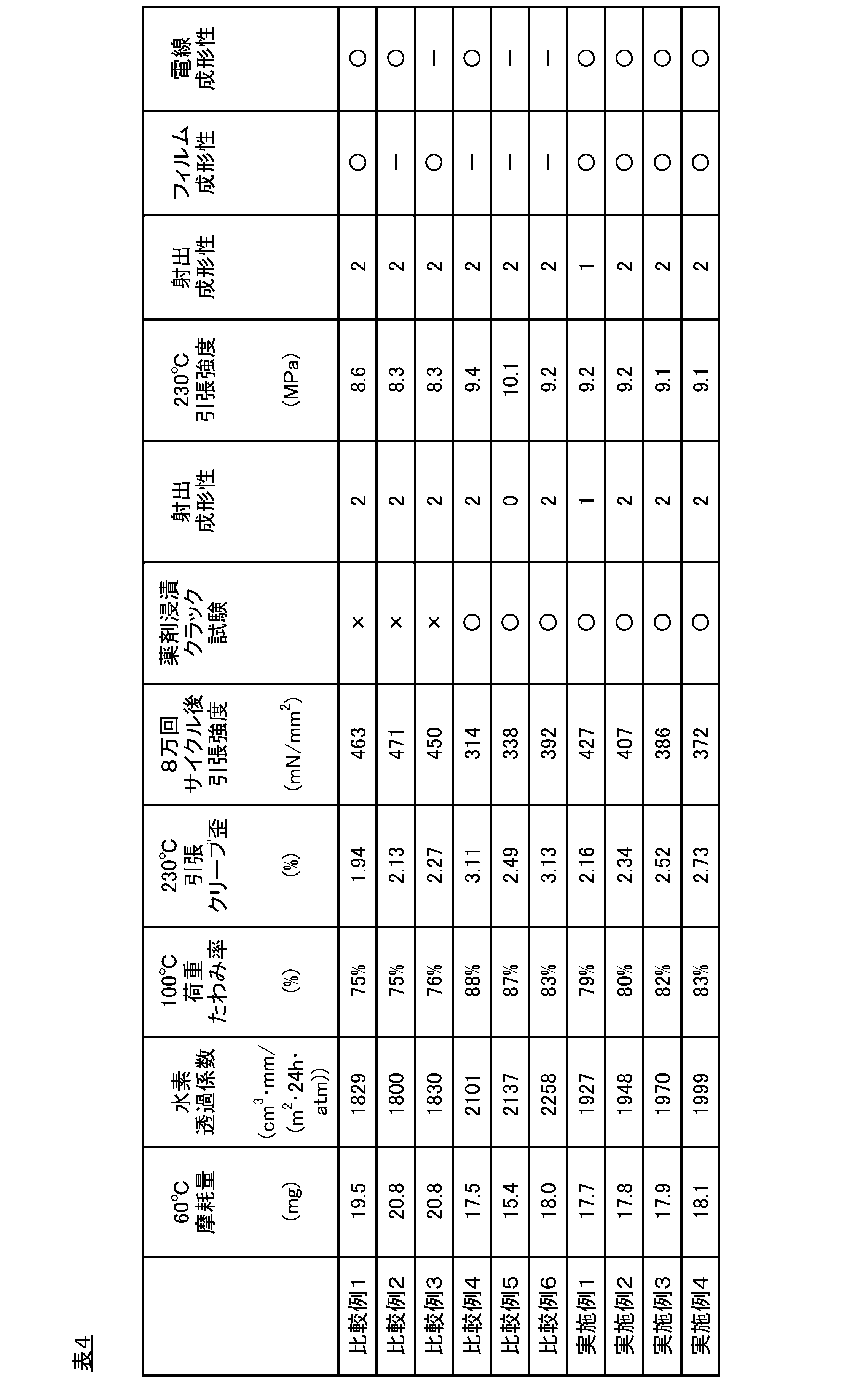
Claims (5)
- テトラフルオロエチレン単位およびパーフルオロ(プロピルビニルエーテル)単位を含有し、
パーフルオロ(プロピルビニルエーテル)単位の含有量が、全単量体単位に対して、4.4~5.2質量%であり、
372℃におけるメルトフローレートが、11.0~16.0g/10分であり、
官能基数が、主鎖炭素数106個あたり、50個以下である
共重合体。 - パーフルオロ(プロピルビニルエーテル)単位の含有量が、全単量体単位に対して、4.4~5.0質量%である請求項1に記載の共重合体。
- 372℃におけるメルトフローレートが、12.0~15.0g/10分である請求項1または2に記載の共重合体。
- 請求項1~3のいずれかに記載の共重合体を含有する射出成形体。
- 請求項1~3のいずれかに記載の共重合体を含有する成形体であって、前記成形体が、配管部材、バルブ、フィルム、チューブまたは電線被覆である成形体。
Priority Applications (3)
| Application Number | Priority Date | Filing Date | Title |
|---|---|---|---|
| CN202380028898.0A CN118946598A (zh) | 2022-03-30 | 2023-03-30 | 共聚物、成型体和注射成型体 |
| EP23780928.0A EP4501984A4 (en) | 2022-03-30 | 2023-03-30 | COPOLYMER, MOLDED BODY AND INJECTION MOLDED BODY |
| US18/888,386 US20250011488A1 (en) | 2022-03-30 | 2024-09-18 | Copolymer, formed article and injection molded article |
Applications Claiming Priority (4)
| Application Number | Priority Date | Filing Date | Title |
|---|---|---|---|
| JP2022-055215 | 2022-03-30 | ||
| JP2022055215 | 2022-03-30 | ||
| JP2022135152 | 2022-08-26 | ||
| JP2022-135152 | 2022-08-26 |
Related Child Applications (1)
| Application Number | Title | Priority Date | Filing Date |
|---|---|---|---|
| US18/888,386 Continuation US20250011488A1 (en) | 2022-03-30 | 2024-09-18 | Copolymer, formed article and injection molded article |
Publications (1)
| Publication Number | Publication Date |
|---|---|
| WO2023190920A1 true WO2023190920A1 (ja) | 2023-10-05 |
Family
ID=88202157
Family Applications (1)
| Application Number | Title | Priority Date | Filing Date |
|---|---|---|---|
| PCT/JP2023/013284 Ceased WO2023190920A1 (ja) | 2022-03-30 | 2023-03-30 | 共重合体、成形体および射出成形体 |
Country Status (4)
| Country | Link |
|---|---|
| US (1) | US20250011488A1 (ja) |
| EP (1) | EP4501984A4 (ja) |
| JP (1) | JP7364981B1 (ja) |
| WO (1) | WO2023190920A1 (ja) |
Families Citing this family (11)
| Publication number | Priority date | Publication date | Assignee | Title |
|---|---|---|---|---|
| CN114222654A (zh) | 2019-08-26 | 2022-03-22 | 大金工业株式会社 | 注射成型方法 |
| WO2021039864A1 (ja) | 2019-08-26 | 2021-03-04 | ダイキン工業株式会社 | 非水電解液電池用部材 |
| CN114270620A (zh) | 2019-08-26 | 2022-04-01 | 大金工业株式会社 | 非水电解液电池用部件 |
| JP6974777B2 (ja) | 2019-08-26 | 2021-12-01 | ダイキン工業株式会社 | 非水電解液電池用部材 |
| KR20230130736A (ko) | 2021-02-26 | 2023-09-12 | 다이킨 고교 가부시키가이샤 | 사출 성형체 및 그 제조 방법 |
| KR102867567B1 (ko) | 2021-02-26 | 2025-10-14 | 다이킨 고교 가부시키가이샤 | 관 조인트 및 관 조인트의 제조 방법 |
| EP4299275B1 (en) | 2021-02-26 | 2026-03-18 | Daikin Industries, Ltd. | Injection-molded body and production method therefor |
| WO2022181227A1 (ja) | 2021-02-26 | 2022-09-01 | ダイキン工業株式会社 | 射出成形体およびその製造方法 |
| WO2022181719A1 (ja) | 2021-02-26 | 2022-09-01 | ダイキン工業株式会社 | 射出成形体 |
| WO2022181240A1 (ja) | 2021-02-26 | 2022-09-01 | ダイキン工業株式会社 | 共重合体、成形体、射出成形体および被覆電線 |
| JP7137111B2 (ja) | 2021-02-26 | 2022-09-14 | ダイキン工業株式会社 | 射出成形体およびその製造方法 |
Citations (5)
| Publication number | Priority date | Publication date | Assignee | Title |
|---|---|---|---|---|
| WO1995029956A1 (en) | 1994-04-28 | 1995-11-09 | Daikin Industries, Ltd. | Thermoplastic resin composition |
| JP2002053620A (ja) * | 2000-05-30 | 2002-02-19 | Asahi Glass Co Ltd | テトラフルオロエチレン/パーフルオロ(アルキルビニルエーテル)共重合体及びその製造方法 |
| JP2009059690A (ja) * | 2007-08-08 | 2009-03-19 | Daikin Ind Ltd | 被覆電線及び同軸ケーブル |
| JP2019214641A (ja) * | 2018-06-11 | 2019-12-19 | Agc株式会社 | 成形体及び複合体 |
| JP2021141045A (ja) * | 2019-08-26 | 2021-09-16 | ダイキン工業株式会社 | 蓄電体およびガスケット |
Family Cites Families (6)
| Publication number | Priority date | Publication date | Assignee | Title |
|---|---|---|---|---|
| US20060035047A1 (en) * | 2002-10-29 | 2006-02-16 | Daikin Industries, Ltd | Fluororesin composition, molded fluororesin articles, fluororesin laminates and use of the laminates |
| JP5850082B2 (ja) * | 2013-04-19 | 2016-02-03 | ダイキン工業株式会社 | 金属張積層体及びプリント配線基板 |
| KR102442843B1 (ko) * | 2018-05-25 | 2022-09-14 | 다이킨 고교 가부시키가이샤 | 수지 조성물 |
| CN114270620A (zh) * | 2019-08-26 | 2022-04-01 | 大金工业株式会社 | 非水电解液电池用部件 |
| EP4299605A4 (en) * | 2021-02-26 | 2025-03-05 | Daikin Industries, Ltd. | COPOLYMER, MOLDED BODIES AND INJECTION MOLDED BODIES |
| WO2022181246A1 (ja) * | 2021-02-26 | 2022-09-01 | ダイキン工業株式会社 | 共重合体、成形体、射出成形体および被覆電線 |
-
2023
- 2023-03-30 EP EP23780928.0A patent/EP4501984A4/en active Pending
- 2023-03-30 JP JP2023054981A patent/JP7364981B1/ja active Active
- 2023-03-30 WO PCT/JP2023/013284 patent/WO2023190920A1/ja not_active Ceased
-
2024
- 2024-09-18 US US18/888,386 patent/US20250011488A1/en active Pending
Patent Citations (5)
| Publication number | Priority date | Publication date | Assignee | Title |
|---|---|---|---|---|
| WO1995029956A1 (en) | 1994-04-28 | 1995-11-09 | Daikin Industries, Ltd. | Thermoplastic resin composition |
| JP2002053620A (ja) * | 2000-05-30 | 2002-02-19 | Asahi Glass Co Ltd | テトラフルオロエチレン/パーフルオロ(アルキルビニルエーテル)共重合体及びその製造方法 |
| JP2009059690A (ja) * | 2007-08-08 | 2009-03-19 | Daikin Ind Ltd | 被覆電線及び同軸ケーブル |
| JP2019214641A (ja) * | 2018-06-11 | 2019-12-19 | Agc株式会社 | 成形体及び複合体 |
| JP2021141045A (ja) * | 2019-08-26 | 2021-09-16 | ダイキン工業株式会社 | 蓄電体およびガスケット |
Non-Patent Citations (1)
| Title |
|---|
| See also references of EP4501984A4 |
Also Published As
| Publication number | Publication date |
|---|---|
| JP7364981B1 (ja) | 2023-10-19 |
| JP2023158238A (ja) | 2023-10-27 |
| EP4501984A1 (en) | 2025-02-05 |
| EP4501984A4 (en) | 2026-04-08 |
| US20250011488A1 (en) | 2025-01-09 |
Similar Documents
| Publication | Publication Date | Title |
|---|---|---|
| JP7364981B1 (ja) | 共重合体、成形体および射出成形体 | |
| JP7364986B1 (ja) | 共重合体、成形体および射出成形体 | |
| JP7364982B1 (ja) | 共重合体、成形体および射出成形体 | |
| JP7364984B1 (ja) | 共重合体、成形体および射出成形体 | |
| JP7364985B1 (ja) | 共重合体、成形体および射出成形体 | |
| JP7364983B1 (ja) | 共重合体、成形体および射出成形体 | |
| JP7364988B1 (ja) | 共重合体、成形体、押出成形体およびトランスファー成形体 | |
| JP7364987B1 (ja) | 共重合体、成形体、押出成形体およびトランスファー成形体 | |
| JP7496844B2 (ja) | 共重合体、成形体、押出成形体、ブロー成形体、トランスファー成形体および被覆電線 | |
| JP7580418B2 (ja) | 共重合体、成形体、射出成形体および被覆電線 | |
| WO2022181825A1 (ja) | 含フッ素共重合体 | |
| WO2022181240A1 (ja) | 共重合体、成形体、射出成形体および被覆電線 | |
| WO2023190947A1 (ja) | 共重合体、成形体、押出成形体およびトランスファー成形体 | |
| WO2022181241A1 (ja) | 共重合体、成形体、押出成形体、ブロー成形体、トランスファー成形体および被覆電線 | |
| WO2022181835A1 (ja) | 含フッ素共重合体 | |
| WO2023190898A1 (ja) | 含フッ素共重合体 | |
| JP7397386B2 (ja) | 含フッ素共重合体 | |
| JP7397384B2 (ja) | 含フッ素共重合体 | |
| JP7401834B2 (ja) | 含フッ素共重合体 | |
| JP7364976B1 (ja) | 含フッ素共重合体 | |
| WO2023190960A1 (ja) | 含フッ素共重合体 | |
| WO2023190948A1 (ja) | 含フッ素共重合体 | |
| WO2023190954A1 (ja) | 含フッ素共重合体 | |
| WO2023190918A1 (ja) | 含フッ素共重合体 | |
| WO2023190917A1 (ja) | 含フッ素共重合体 |
Legal Events
| Date | Code | Title | Description |
|---|---|---|---|
| 121 | Ep: the epo has been informed by wipo that ep was designated in this application |
Ref document number: 23780928 Country of ref document: EP Kind code of ref document: A1 |
|
| WWE | Wipo information: entry into national phase |
Ref document number: 202380028898.0 Country of ref document: CN |
|
| WWE | Wipo information: entry into national phase |
Ref document number: 2023780928 Country of ref document: EP |
|
| NENP | Non-entry into the national phase |
Ref country code: DE |
|
| ENP | Entry into the national phase |
Ref document number: 2023780928 Country of ref document: EP Effective date: 20241030 |