WO2023195511A1 - 感熱記録体 - Google Patents
感熱記録体 Download PDFInfo
- Publication number
- WO2023195511A1 WO2023195511A1 PCT/JP2023/014184 JP2023014184W WO2023195511A1 WO 2023195511 A1 WO2023195511 A1 WO 2023195511A1 JP 2023014184 W JP2023014184 W JP 2023014184W WO 2023195511 A1 WO2023195511 A1 WO 2023195511A1
- Authority
- WO
- WIPO (PCT)
- Prior art keywords
- heat
- carbon atoms
- color developer
- sensitive recording
- phenyl
- Prior art date
- Legal status (The legal status is an assumption and is not a legal conclusion. Google has not performed a legal analysis and makes no representation as to the accuracy of the status listed.)
- Ceased
Links
Classifications
-
- B—PERFORMING OPERATIONS; TRANSPORTING
- B41—PRINTING; LINING MACHINES; TYPEWRITERS; STAMPS
- B41M—PRINTING, DUPLICATING, MARKING, OR COPYING PROCESSES; COLOUR PRINTING
- B41M5/00—Duplicating or marking methods; Sheet materials for use therein
- B41M5/26—Thermography ; Marking by high energetic means, e.g. laser otherwise than by burning, and characterised by the material used
- B41M5/30—Thermography ; Marking by high energetic means, e.g. laser otherwise than by burning, and characterised by the material used using chemical colour formers
- B41M5/333—Colour developing components therefor, e.g. acidic compounds
-
- B—PERFORMING OPERATIONS; TRANSPORTING
- B41—PRINTING; LINING MACHINES; TYPEWRITERS; STAMPS
- B41M—PRINTING, DUPLICATING, MARKING, OR COPYING PROCESSES; COLOUR PRINTING
- B41M5/00—Duplicating or marking methods; Sheet materials for use therein
- B41M5/26—Thermography ; Marking by high energetic means, e.g. laser otherwise than by burning, and characterised by the material used
- B41M5/40—Thermography ; Marking by high energetic means, e.g. laser otherwise than by burning, and characterised by the material used characterised by the base backcoat, intermediate, or covering layers, e.g. for thermal transfer dye-donor or dye-receiver sheets; Heat, radiation filtering or absorbing means or layers; combined with other image registration layers or compositions; Special originals for reproduction by thermography
- B41M5/46—Thermography ; Marking by high energetic means, e.g. laser otherwise than by burning, and characterised by the material used characterised by the base backcoat, intermediate, or covering layers, e.g. for thermal transfer dye-donor or dye-receiver sheets; Heat, radiation filtering or absorbing means or layers; combined with other image registration layers or compositions; Special originals for reproduction by thermography characterised by the light-to-heat converting means; characterised by the heat or radiation filtering or absorbing means or layers
-
- B—PERFORMING OPERATIONS; TRANSPORTING
- B41—PRINTING; LINING MACHINES; TYPEWRITERS; STAMPS
- B41M—PRINTING, DUPLICATING, MARKING, OR COPYING PROCESSES; COLOUR PRINTING
- B41M5/00—Duplicating or marking methods; Sheet materials for use therein
- B41M5/26—Thermography ; Marking by high energetic means, e.g. laser otherwise than by burning, and characterised by the material used
- B41M5/30—Thermography ; Marking by high energetic means, e.g. laser otherwise than by burning, and characterised by the material used using chemical colour formers
- B41M5/323—Organic colour formers, e.g. leuco dyes
-
- B—PERFORMING OPERATIONS; TRANSPORTING
- B41—PRINTING; LINING MACHINES; TYPEWRITERS; STAMPS
- B41M—PRINTING, DUPLICATING, MARKING, OR COPYING PROCESSES; COLOUR PRINTING
- B41M5/00—Duplicating or marking methods; Sheet materials for use therein
- B41M5/26—Thermography ; Marking by high energetic means, e.g. laser otherwise than by burning, and characterised by the material used
- B41M5/30—Thermography ; Marking by high energetic means, e.g. laser otherwise than by burning, and characterised by the material used using chemical colour formers
- B41M5/333—Colour developing components therefor, e.g. acidic compounds
- B41M5/3333—Non-macromolecular compounds
-
- B—PERFORMING OPERATIONS; TRANSPORTING
- B41—PRINTING; LINING MACHINES; TYPEWRITERS; STAMPS
- B41M—PRINTING, DUPLICATING, MARKING, OR COPYING PROCESSES; COLOUR PRINTING
- B41M5/00—Duplicating or marking methods; Sheet materials for use therein
- B41M5/26—Thermography ; Marking by high energetic means, e.g. laser otherwise than by burning, and characterised by the material used
- B41M5/40—Thermography ; Marking by high energetic means, e.g. laser otherwise than by burning, and characterised by the material used characterised by the base backcoat, intermediate, or covering layers, e.g. for thermal transfer dye-donor or dye-receiver sheets; Heat, radiation filtering or absorbing means or layers; combined with other image registration layers or compositions; Special originals for reproduction by thermography
- B41M5/41—Base layers supports or substrates
-
- B—PERFORMING OPERATIONS; TRANSPORTING
- B41—PRINTING; LINING MACHINES; TYPEWRITERS; STAMPS
- B41M—PRINTING, DUPLICATING, MARKING, OR COPYING PROCESSES; COLOUR PRINTING
- B41M5/00—Duplicating or marking methods; Sheet materials for use therein
- B41M5/26—Thermography ; Marking by high energetic means, e.g. laser otherwise than by burning, and characterised by the material used
- B41M5/40—Thermography ; Marking by high energetic means, e.g. laser otherwise than by burning, and characterised by the material used characterised by the base backcoat, intermediate, or covering layers, e.g. for thermal transfer dye-donor or dye-receiver sheets; Heat, radiation filtering or absorbing means or layers; combined with other image registration layers or compositions; Special originals for reproduction by thermography
- B41M5/42—Intermediate, backcoat, or covering layers
-
- B—PERFORMING OPERATIONS; TRANSPORTING
- B41—PRINTING; LINING MACHINES; TYPEWRITERS; STAMPS
- B41M—PRINTING, DUPLICATING, MARKING, OR COPYING PROCESSES; COLOUR PRINTING
- B41M5/00—Duplicating or marking methods; Sheet materials for use therein
- B41M5/26—Thermography ; Marking by high energetic means, e.g. laser otherwise than by burning, and characterised by the material used
- B41M5/40—Thermography ; Marking by high energetic means, e.g. laser otherwise than by burning, and characterised by the material used characterised by the base backcoat, intermediate, or covering layers, e.g. for thermal transfer dye-donor or dye-receiver sheets; Heat, radiation filtering or absorbing means or layers; combined with other image registration layers or compositions; Special originals for reproduction by thermography
- B41M5/42—Intermediate, backcoat, or covering layers
- B41M5/426—Intermediate, backcoat, or covering layers characterised by inorganic compounds, e.g. metals, metal salts, metal complexes
-
- B—PERFORMING OPERATIONS; TRANSPORTING
- B41—PRINTING; LINING MACHINES; TYPEWRITERS; STAMPS
- B41M—PRINTING, DUPLICATING, MARKING, OR COPYING PROCESSES; COLOUR PRINTING
- B41M2205/00—Printing methods or features related to printing methods; Location or type of the layers
- B41M2205/04—Direct thermal recording [DTR]
-
- B—PERFORMING OPERATIONS; TRANSPORTING
- B41—PRINTING; LINING MACHINES; TYPEWRITERS; STAMPS
- B41M—PRINTING, DUPLICATING, MARKING, OR COPYING PROCESSES; COLOUR PRINTING
- B41M2205/00—Printing methods or features related to printing methods; Location or type of the layers
- B41M2205/32—Thermal receivers
-
- B—PERFORMING OPERATIONS; TRANSPORTING
- B41—PRINTING; LINING MACHINES; TYPEWRITERS; STAMPS
- B41M—PRINTING, DUPLICATING, MARKING, OR COPYING PROCESSES; COLOUR PRINTING
- B41M2205/00—Printing methods or features related to printing methods; Location or type of the layers
- B41M2205/36—Backcoats; Back layers
-
- B—PERFORMING OPERATIONS; TRANSPORTING
- B41—PRINTING; LINING MACHINES; TYPEWRITERS; STAMPS
- B41M—PRINTING, DUPLICATING, MARKING, OR COPYING PROCESSES; COLOUR PRINTING
- B41M2205/00—Printing methods or features related to printing methods; Location or type of the layers
- B41M2205/38—Intermediate layers; Layers between substrate and imaging layer
-
- B—PERFORMING OPERATIONS; TRANSPORTING
- B41—PRINTING; LINING MACHINES; TYPEWRITERS; STAMPS
- B41M—PRINTING, DUPLICATING, MARKING, OR COPYING PROCESSES; COLOUR PRINTING
- B41M5/00—Duplicating or marking methods; Sheet materials for use therein
- B41M5/26—Thermography ; Marking by high energetic means, e.g. laser otherwise than by burning, and characterised by the material used
- B41M5/30—Thermography ; Marking by high energetic means, e.g. laser otherwise than by burning, and characterised by the material used using chemical colour formers
- B41M5/323—Organic colour formers, e.g. leuco dyes
- B41M5/327—Organic colour formers, e.g. leuco dyes with a lactone or lactam ring
- B41M5/3275—Fluoran compounds
-
- B—PERFORMING OPERATIONS; TRANSPORTING
- B41—PRINTING; LINING MACHINES; TYPEWRITERS; STAMPS
- B41M—PRINTING, DUPLICATING, MARKING, OR COPYING PROCESSES; COLOUR PRINTING
- B41M5/00—Duplicating or marking methods; Sheet materials for use therein
- B41M5/26—Thermography ; Marking by high energetic means, e.g. laser otherwise than by burning, and characterised by the material used
- B41M5/30—Thermography ; Marking by high energetic means, e.g. laser otherwise than by burning, and characterised by the material used using chemical colour formers
- B41M5/333—Colour developing components therefor, e.g. acidic compounds
- B41M5/3333—Non-macromolecular compounds
- B41M5/3335—Compounds containing phenolic or carboxylic acid groups or metal salts thereof
- B41M5/3336—Sulfur compounds, e.g. sulfones, sulfides, sulfonamides
-
- B—PERFORMING OPERATIONS; TRANSPORTING
- B41—PRINTING; LINING MACHINES; TYPEWRITERS; STAMPS
- B41M—PRINTING, DUPLICATING, MARKING, OR COPYING PROCESSES; COLOUR PRINTING
- B41M5/00—Duplicating or marking methods; Sheet materials for use therein
- B41M5/26—Thermography ; Marking by high energetic means, e.g. laser otherwise than by burning, and characterised by the material used
- B41M5/40—Thermography ; Marking by high energetic means, e.g. laser otherwise than by burning, and characterised by the material used characterised by the base backcoat, intermediate, or covering layers, e.g. for thermal transfer dye-donor or dye-receiver sheets; Heat, radiation filtering or absorbing means or layers; combined with other image registration layers or compositions; Special originals for reproduction by thermography
- B41M5/42—Intermediate, backcoat, or covering layers
- B41M5/423—Intermediate, backcoat, or covering layers characterised by non-macromolecular compounds, e.g. waxes
-
- B—PERFORMING OPERATIONS; TRANSPORTING
- B41—PRINTING; LINING MACHINES; TYPEWRITERS; STAMPS
- B41M—PRINTING, DUPLICATING, MARKING, OR COPYING PROCESSES; COLOUR PRINTING
- B41M5/00—Duplicating or marking methods; Sheet materials for use therein
- B41M5/26—Thermography ; Marking by high energetic means, e.g. laser otherwise than by burning, and characterised by the material used
- B41M5/40—Thermography ; Marking by high energetic means, e.g. laser otherwise than by burning, and characterised by the material used characterised by the base backcoat, intermediate, or covering layers, e.g. for thermal transfer dye-donor or dye-receiver sheets; Heat, radiation filtering or absorbing means or layers; combined with other image registration layers or compositions; Special originals for reproduction by thermography
- B41M5/42—Intermediate, backcoat, or covering layers
- B41M5/44—Intermediate, backcoat, or covering layers characterised by the macromolecular compounds
Definitions
- the present invention relates to a heat-sensitive recording medium.
- Thermal recording materials that record colored images by utilizing a heated coloring reaction between colorless or light-colored leuco dyes and phenols or organic acids have been widely put into practical use. Such a thermal recording medium forms a colored image simply by heating, so it has advantages such as a compact recording device, easy maintenance of the recording device, and low noise generation. Therefore, thermal recording materials are widely used as various information recording materials in issuing machines such as label printers, automatic ticket vending machines, CD/ATMs, order slip output machines in restaurants, data output machines in scientific research equipment, etc. There is.
- Patent Document 1 proposes a heat-sensitive recording material using a diaryl urea derivative as a color developer.
- the heat-sensitive recording material described in Patent Document 1 has insufficient water resistance, water plasticizer resistance, and alcohol resistance, and has room for improvement.
- the main object of the present invention is to provide a heat-sensitive recording material that has excellent water resistance and water plasticizer resistance in the recording part and excellent alcohol resistance in the recording part and the background part.
- the present invention relates to the following heat-sensitive recording material.
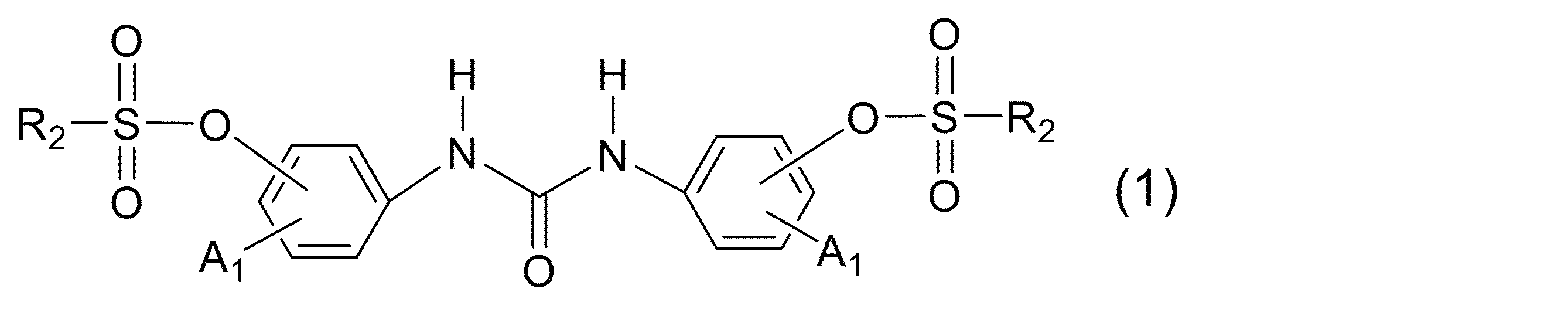
- Item 1 A heat-sensitive recording material having on a support at least an undercoat layer containing an inorganic pigment, hollow particles, and an adhesive, and a heat-sensitive recording layer containing a leuco dye, a color developer, and an adhesive in this order. It contains a first color developer and a second color developer as a coloring agent, and the second color developer has the general formula (1): (In the formula, R 2 represents an alkyl group having 1 to 12 carbon atoms, an aralkyl group having 7 to 12 carbon atoms, or an aryl group having 6 to 12 carbon atoms, and the aralkyl group and aryl group have 1 to 12 carbon atoms.
- the N,N'-diarylurea compound represented by the general formula (1) is N,N'-di-[3-(p-toluenesulfonyloxy)phenyl]urea, N,N'-diarylurea -[3-(o-toluenesulfonyloxy)phenyl]urea, N,N'-di-[3-(benzenesulfonyloxy)phenyl]
- the heat-sensitive recording material according to item 1 which is at least one member selected from the group consisting of -(p-toluenesulfonyloxy)]phenylurea.
- Item 3 The N,N'-diarylurea compound represented by the general formula (1) is N,N'-di[3-(p-toluenesulfonyl)oxy]phenylurea, according to item 1. Heat sensitive recording material.
- R 3 and R 4 are the same or different and are an alkyl group having 1 to 4 carbon atoms, an alkenyl group having 2 to 4 carbon atoms, an alkoxy group having 1 to 4 carbon atoms, an alkenyl group having 2 to 4 carbon atoms, It represents an oxy group, an aralkyloxy group having 7 to 12 carbon atoms, or a halogen atom.
- m is an integer of 0 to 2
- n is an integer of 1 to 3
- p and q are the same or different and represent integers of 0 to 2.
- thermosensitive recording material according to any one of Items 1 to 3, which contains a diphenylsulfone derivative represented by: Item 5:
- the diphenylsulfone derivative represented by the general formula (2) is 4-hydroxy-4'-isopropoxydiphenylsulfone, 4,4'-dihydroxydiphenylsulfone, 2,4'-dihydroxydiphenylsulfone, bis(3 -allyl-4-hydroxy)diphenylsulfone, 4-hydroxyphenyl(4'-n-propoxyphenyl)sulfone, 4-allyloxy-4'-hydroxydiphenylsulfone, and 4-hydroxy-4'-benzyloxydiphenylsulfone Item 4.
- thermosensitive recording material according to item 4 which is at least one type of thermosensitive recording material.
- Item 6 The heat-sensitive recording material according to any one of Items 1 to 3, wherein the first color developer is Np-tolylsulfonyl-N'-3-(p-tolylsulfonyloxy)phenylurea.
- Item 7 The heat-sensitive recording material according to any one of Items 1 to 3, wherein the first color developer is N-[2-(3-phenylureido)phenyl]benzenesulfonamide.
- Item 8 Items 1 to 3, wherein the first color developer is 5-(N-3-methylphenyl-sulfonamide)-N',N''-bis-(3-methylphenyl)-isophthalic acid diamide.
- the thermosensitive recording material according to any one of the above.
- Item 9 The heat-sensitive recording material according to any one of Items 1 to 8, wherein the second color developer is contained in an amount of 0.1 to 3 parts by mass per 1 part by weight of the first color developer.
- Item 10 The heat-sensitive recording material according to any one of Items 1 to 8, wherein the second color developer is contained in an amount of 0.1 to 1 part by weight per 1 part by weight of the first color developer.
- Item 11 The maximum particle diameter (D100) of the hollow particles is 10 to 30 ⁇ m, the average particle diameter (D50) is 4.0 to 15 ⁇ m, and the maximum particle diameter (D100) and the average particle diameter (D50) are Item 11.
- Item 12 The heat-sensitive recording material according to any one of Items 1 to 11, wherein the hollow particles have a hollowness ratio of 80 to 98%.
- Item 13 The thermosensitive recording material according to any one of Items 1 to 12, wherein the adhesive of the undercoat layer contains a binder resin having a glass transition temperature of -10° C. or lower.
- Item 14 The thermosensitive recording material according to any one of Items 1 to 13, wherein the adhesive of the undercoat layer contains a binder resin having a glass transition temperature of -30° C. or lower.
- Item 15 The heat-sensitive recording material according to any one of Items 1 to 14, wherein the support has an adhesive layer on at least one side.
- the heat-sensitive recording material of the present invention has excellent water resistance and water plasticizer resistance in the recording part, and excellent alcohol resistance in the recording part and the background part. It is also possible to increase the color density.
- a numerical range expressed using “ ⁇ ” means a range that includes the numerical values written before and after " ⁇ " as the lower limit and upper limit.
- the latex in the present invention includes a gel or a dry film formed by drying a dispersion medium.
- the present invention provides a heat-sensitive recording material having, on a support, at least an undercoat layer containing an inorganic pigment, hollow particles, and an adhesive, and a heat-sensitive recording layer containing a leuco dye, a color developer, and an adhesive in this order. It contains a first color developer and a second color developer as a color developer, and the second color developer has the general formula (1): (In the formula, R 2 represents an alkyl group having 1 to 12 carbon atoms, an aralkyl group having 7 to 12 carbon atoms, or an aryl group having 6 to 12 carbon atoms, and the aralkyl group and aryl group have 1 to 12 carbon atoms.
- a 1 represents a hydrogen atom or an alkyl group having 1 to 4 carbon atoms, and multiple A 1 's may be the same or different.
- the support in the present invention is not particularly limited in type, shape, size, etc., and includes, for example, wood-free paper (acidic paper, neutral paper), medium-quality paper, coated paper, art paper, cast coated paper, glassine paper, In addition to resin laminated paper, polyolefin synthetic paper, synthetic fiber paper, nonwoven fabric, synthetic resin film, etc., various transparent supports can be appropriately selected and used.
- the thickness of the support is not particularly limited and is usually about 20 to 200 ⁇ m. Further, the density of the support is not particularly limited, and is preferably about 0.60 to 0.85 g/cm 3 .
- the heat-sensitive recording material of the present invention has an undercoat layer between the support and the heat-sensitive recording layer.
- the undercoat layer contains an inorganic pigment, hollow particles and an adhesive.
- the hollow particles are preferably made of organic resin from the viewpoint of improving cushioning properties.
- the undercoat layer which has high heat insulation properties by containing hollow particles, can prevent the diffusion of heat applied to the heat-sensitive recording layer and increase the sensitivity of the heat-sensitive recording material.
- Hollow particles made of organic resin can be divided into foamed types and non-foamed types depending on the manufacturing method.
- expanded type hollow particles generally have a larger average particle diameter and higher hollowness ratio than non-expanded type hollow particles. Therefore, foamed hollow particles can provide better sensitivity and image quality than non-foamed hollow particles.
- Non-foaming type hollow particles are made by polymerizing seeds in a solution, then polymerizing another resin to enclose the seeds, and then removing the seeds by swelling and dissolving them to form a cavity inside. It can be manufactured by An alkaline aqueous solution or the like is used to swell and dissolve the internal seeds and remove them.
- Non-expandable hollow particles with a relatively large average particle diameter can also be obtained by subjecting core-shell particles, in which a core particle with alkali swelling property is coated with a shell layer without alkali swelling property, to an alkali swelling treatment. .
- Foamed type hollow particles can be produced by creating particles in which a volatile liquid is sealed inside a resin, softening the resin by heating, and vaporizing and expanding the liquid inside the particles.
- Foamed hollow particles increase the hollowness ratio by heating and expanding the internal liquid during the manufacturing process, resulting in high heat insulation properties, which can increase the sensitivity of thermal recording materials and improve recording density. . Improving sensitivity is particularly important when coloring a halftone region where little thermal energy is applied to the heat-sensitive recording layer. Further, if the heat-sensitive recording layer is formed through an undercoat layer with high heat insulation properties, diffusion of heat applied to the heat-sensitive recording layer is prevented, thereby providing excellent image uniformity and improving image quality. Therefore, in this embodiment, it is preferable to use foamed hollow particles that are excellent in improving the heat insulation properties of the undercoat layer.
- Resins that can be used for foamed hollow particles include styrene-acrylic resin, polystyrene resin, acrylic resin, polyethylene resin, polypropylene resin, polyacetal resin, chlorinated polyether resin, polyvinyl chloride resin, polyvinylidene chloride resin, Examples include thermoplastic resins such as acrylic resins (for example, acrylic resins containing acrylonitrile as a constituent component), styrene resins, vinylidene chloride resins, and copolymer resins mainly composed of polyvinylidene chloride and acrylonitrile.
- Gases contained inside foam-type hollow particles generally include propane, butane, isobutane, air, and the like.
- acrylonitrile resin and a copolymer resin mainly composed of polyvinylidene chloride and acrylonitrile are preferable as the resin used for the hollow particles from the viewpoint of strength to maintain the shape of the expanded particles.
- the maximum particle diameter of the hollow particles in the present invention is preferably 10 to 30 ⁇ m, more preferably 15 to 25 ⁇ m.
- the maximum particle diameter is also referred to as D100. If the maximum particle diameter of the hollow particles is 10 ⁇ m or more, the cushioning properties of the undercoat layer will improve, so the adhesion of the heat-sensitive recording material to the thermal head during printing will improve, and a heat-sensitive recording material with high image quality can be obtained. .
- This high image quality can bring about an improvement in the recording density in halftones where colors are developed with lower energy than that which provides the maximum recording density (Dmax).
- the smoothness of the undercoat layer will improve, so the heat-sensitive recording layer provided through the undercoat layer can be made uniform, and white spots in the image are less likely to occur in the heat-sensitive recording. You get a body.
- the average particle diameter of the hollow particles in the present invention is preferably 4.0 to 15 ⁇ m, more preferably 7.5 to 15 ⁇ m.
- the average particle size is the diameter at which the volume occupied by the larger particle and the smaller particle is equal when the particle size is divided into two, that is, the median diameter which is the particle size with a frequency of 50% by volume. Yes, it is also called D50. If the average particle diameter of the hollow particles is 4.0 ⁇ m or more, the cushioning properties of the undercoat layer will improve, so the adhesion of the heat-sensitive recording material to the thermal head during printing will improve, and a high-quality heat-sensitive recording material will be produced. can get.
- This high image quality can bring about an improvement in the recording density in halftones where colors are developed with lower energy than that which provides the maximum recording density (Dmax).
- Dmax maximum recording density
- the average particle diameter of the hollow particles is 15 ⁇ m or less, the smoothness of the undercoat layer is improved, so the heat-sensitive recording layer provided through the undercoat layer can be made uniform, and the heat-sensitive recording layer is less likely to have white spots in the image. You get a body.
- the maximum particle diameter (D100) and average particle diameter (D50) of the hollow particles can be measured using a laser diffraction particle size distribution analyzer. Alternatively, the particle diameter may be measured from each particle image (SEM image) using an electron microscope, and the average value of 10 values may be shown.
- the ratio D100/D50 between the maximum particle diameter (D100) and the average particle diameter (D50) of hollow particles is an index indicating the degree of particle size distribution.
- This ratio D100/D50 is preferably 1.8 to 3.0, more preferably 2.0 to 2.8.
- the D100/D50 of the hollow particles is 1.8 or more, the hollow particles are sufficiently foamed, the maximum particle size becomes sufficiently large, the hollowness ratio becomes high, and the heat insulation properties of the undercoat layer can be improved.
- the D100/D50 of the hollow particles is 3.0 or less, the sizes of the hollow particles are uniform, so the smoothness of the undercoat layer is improved and white spots in the image can be suppressed.
- the volume percent of hollow particles with a particle diameter of 2.0 ⁇ m or less is preferably 1% or less. Moreover, it is preferable that the volume % of hollow particles with a particle diameter of 2.0 ⁇ m or less is 0.5% or less, and it is more preferable that they are not contained. Hollow particles with a particle diameter of 2.0 ⁇ m or less are considered to have an extremely small contribution to heat insulation properties because the particle diameter is too small to provide a sufficient hollow region. By controlling the volume percent of hollow particles having a particle diameter of 2 ⁇ m or less in the undercoat layer to 1% or less, recording density, image quality, etc. can be improved.
- the hollow particles preferably have a hollowness ratio of 80 to 98%, more preferably 90 to 98%.
- the hollowness ratio of the hollow particles is 80% or more, high heat insulation properties can be imparted to the undercoat layer containing the hollow particles.
- the hollowness ratio of the hollow particles is 98% or less, the strength of the film surrounding the hollow portion is improved, so that the hollow particles can be made not to be crushed even during the formation of the undercoat layer.
- the porosity of the hollow particles is determined by measuring the true specific gravity using the IPA method, and from the true specific gravity value as follows.
- Sample pretreatment Dry the sample at 60°C for a day and night to obtain a sample.
- IPA Reagent/isopropyl alcohol
- Measurement method Accurately weigh the volumetric flask (W1). ⁇ Take approximately 0.5 g of the dried sample into a volumetric flask and accurately weigh it (W2). - Add about 50 mg of IPA and shake thoroughly to completely remove air outside the capsule. ⁇ Add IPA up to the marked line and weigh accurately (W3). - As a blank, add only IPA to the volumetric flask up to the marked line and weigh accurately (W4).
- the hollowness ratio is also a value determined by the following formula (d 3 /D 3 ) ⁇ 100.
- d represents the inner diameter of the hollow particle
- D represents the outer diameter of the hollow particle.
- the hollow particles in the present invention have a relatively large particle size, their content in the undercoat layer can be reduced.
- the content of the hollow particles is preferably 3 to 40% by mass, more preferably 5 to 35% by mass, based on the total solid content of the undercoat layer.
- the content of hollow particles is 3% by mass or more, the heat insulation properties of the undercoat layer can be improved.
- the content of hollow particles is 40% by mass or less, problems are unlikely to occur in terms of coatability, etc., it is easy to form a uniform undercoat layer, and recording density can be improved. Further, the strength of the coating film of the undercoat layer can be increased.
- adhesives examples include polyvinyl alcohol and its derivatives, starch and its derivatives, cellulose derivatives such as hydroxymethylcellulose, hydroxyethylcellulose, hydroxypropylcellulose, carboxymethylcellulose, methylcellulose, and ethylcellulose, sodium polyacrylate, polyvinylpyrrolidone, acrylamide-acrylic.
- Highly water-soluble materials such as acid ester copolymers, acrylamide-acrylic ester-methacrylic ester copolymers, styrene-maleic anhydride copolymers, isobutylene-maleic anhydride copolymers, casein, gelatin, and their derivatives.
- Molecular materials and emulsions such as polyvinyl acetate, polyurethane, polyacrylic acid, polyacrylic ester, vinyl chloride-vinyl acetate copolymer, polybutyl methacrylate, ethylene-vinyl acetate copolymer, or styrene-butadiene copolymer
- examples include latex of water-insoluble polymers such as polymers, styrene-butadiene-acrylic copolymers, and the like.
- an adhesive containing latex it is preferable to use an adhesive containing latex.
- the content of the adhesive can be selected from a wide range, but generally it is preferably about 20 to 70% by mass, more preferably about 25 to 60% by mass of the total solid content of the undercoat layer.
- the adhesive contains a binder resin having a glass transition temperature (Tg) of ⁇ 10° C. or lower. Since the glass transition temperature is ⁇ 10° C. or lower, image quality can be improved even in a low energy range.
- the glass transition temperature is more preferably ⁇ 30° C. or lower because image quality can be further improved in a low energy range.
- temperatures below -50°C are unfavorable as stickiness occurs, so temperatures above -40°C are preferred.
- the undercoat layer in the present invention contains an inorganic pigment.
- the oil absorption amount of the inorganic pigment is preferably 130 ml/100 g or less, more preferably 125 ml/100 g or less, and even more preferably 110 ml/100 g or less, from the viewpoint of increasing recording density and improving water plasticizer resistance and alcohol resistance. .
- the amount is preferably 50 ml/100 g or more, and more preferably 80 ml/100 g or more.
- the oil absorption amount is a value determined according to the method of JIS K 5101.
- inorganic pigments can be used, but calcined kaolin, clay, etc. are preferable.
- the content of the inorganic pigment is preferably 60% by mass or less, more preferably 50% by mass or less, based on the total solid amount of the undercoat layer, from the viewpoint of improving color development sensitivity.
- the amount of solids in the undercoat layer is preferably 20% by mass or more, and more preferably 25% by mass or more.
- the undercoat layer is formed on the support by, for example, applying an undercoat layer paint prepared by mixing hollow particles, an adhesive, an inorganic pigment, and optionally auxiliary agents in water as a medium, and then drying the paint. be done.
- the amount of coating for the undercoat layer is not particularly limited, but is preferably about 2 to 20 g/m 2 in terms of dry mass, more preferably about 2 to 12 g/m 2 .
- the heat-sensitive recording layer of the heat-sensitive recording material of the present invention can contain various known colorless or light-colored leuco dyes. Specific examples of such leuco dyes are listed below.
- leuco dyes include 3,3-bis(p-dimethylaminophenyl)-6-dimethylaminophthalide, 3-(4-diethylamino-2-methylphenyl)-3-(4-dimethylamino Phenyl)-6-dimethylaminophthalide, blue coloring dyes such as fluoran, 3-(N-ethyl-Np-tolyl)amino-7-N-methylanilinofluorane, 3-diethylamino-7-ani Green dyes such as linofluoran, 3-diethylamino-7-dibenzylaminofluoran, rhodamine B-anilinolactam, 3,6-bis(diethylamino)fluoran- ⁇ -anilinolactam, 3-cyclohexylamino- Red coloring dyes such as 6-chlorofluoran, 3-diethylamino-6-methyl-7-chlorofluoran, 3-dieth
- the content ratio of such leuco dye is not particularly limited, and is preferably about 3 to 30% by mass, more preferably about 5 to 25% by mass, and still more preferably about 7 to 20% by mass, based on the total solid amount of the heat-sensitive recording layer. preferable.
- the content ratio of such leuco dye is not particularly limited, and is preferably about 3 to 30% by mass, more preferably about 5 to 25% by mass, and still more preferably about 7 to 20% by mass, based on the total solid amount of the heat-sensitive recording layer. preferable.
- the content By setting the content to 3% by mass or more, the coloring ability can be enhanced and the recording density can be improved.
- Heat resistance can be improved by setting the content to 30% by mass or less.
- the color developer includes a first color developer and a second color developer, and the second color developer is an N,N'-diarylurea compound represented by the above general formula (1). Contains.
- the first color developer is the main color developer, and the second color developer also has the effect of improving storage stability. As a result, excellent water resistance, water plasticizer resistance, alcohol resistance, etc. can be exhibited.
- the first color developer examples include 4-tert-butylphenol, 4-acetylphenol, 4-tert-octylphenol, 4,4'-sec-butylidenediphenol, 4-phenylphenol, 4,4' -dihydroxydiphenylmethane, 4,4'-isopropylidene diphenol, 4,4'-cyclohexylidene diphenyl, 4,4'-cyclohexylidene diphenol, 1,1-bis(4-hydroxyphenyl)-ethane, 1, 1-bis(4-hydroxyphenyl)-1-phenylethane, 4,4'-bis(p-tolylsulfonylaminocarbonylamino)diphenylmethane, 1,1-bis(4-hydroxyphenyl)cyclohexane, 2,2'- Bis[4-(4-hydroxyphenyl)phenoxy]diethyl ether, 4,4'-dihydroxydiphenyl sulfide, 4,4'-thiobis(
- the heat-sensitive recording layer in the present invention preferably contains a diphenylsulfone derivative represented by the above general formula (2) as the first color developer. Thereby, the color density can be further improved.
- the alkyl group having 1 to 4 carbon atoms for R 3 and R 4 may be linear or branched, such as a methyl group, an ethyl group, an n-propyl group, Examples include isopropyl group, n-butyl group, isobutyl group, sec-butyl group, and t-butyl group.
- the alkyl group herein also includes the alkyl portion of an alkoxy group having 1 to 4 carbon atoms.
- the alkenyl group having 2 to 4 carbon atoms may be linear or branched, and includes, for example, a vinyl group, an n-propenyl group, and an n-butenyl group.
- the alkenyl group herein also includes the alkenyl moiety of an alkenyloxy group having 2 to 4 carbon atoms.
- aralkyl group means an arylalkyl group, and examples of the aralkyl group having 7 to 12 carbon atoms include benzyl group, 1-phenylethyl group, 2-phenylethyl group, and 3-phenylpropyl group. Examples of halogen atoms include fluorine, chlorine, bromine and iodine. When there is a plurality of R 3 and R 4 , each of them may be the same or different.
- substitution positions of R 3 , R 4 , and OH are not particularly limited, and the 3rd, 4th, or 5th positions are preferred.
- m is preferably 0 or 1
- n is preferably 1
- p and q are preferably the same or different and are 0 or 1.
- the diphenylsulfone derivative represented by the general formula (2) is not particularly limited, and includes 4-hydroxy-4'-isopropoxydiphenylsulfone, 4,4'-dihydroxydiphenylsulfone, 2,4'-dihydroxydiphenylsulfone, Bis(3-allyl-4-hydroxy)diphenylsulfone, 4-hydroxyphenyl(4'-n-propoxyphenyl)sulfone, 4-allyloxy-4'-hydroxydiphenylsulfone, and 4-hydroxy-4'-benzyloxydiphenyl At least one selected from the group consisting of sulfone is preferred.
- the first color developer is Np-tolylsulfonyl-N'-3-(p-tolylsulfonyloxy)phenylurea.
- the first color developer is N-[2-(3-phenylureido)phenyl]benzenesulfonamide.
- the first color developer is 5-(N-3-methylphenyl-sulfonamide)-N',N''-bis-(3-methylphenyl)-isophthalic acid diamide.
- the alkyl group having 1 to 12 carbon atoms in R 2 is linear, branched, or alicyclic. It may be any of the following, preferably an alkyl group having 1 to 6 carbon atoms, more preferably an alkyl group having 1 to 3 carbon atoms.
- alkyl group having 1 to 12 carbon atoms examples include methyl group, ethyl group, n-propyl group, i-propyl group, n-butyl group, i-butyl group, t-butyl group, cyclopentyl group, hexyl group, Examples include cyclohexyl group, 2-ethylhexyl group, and lauryl group.
- the alkyl group herein also includes the alkyl moiety of an alkoxy group having 1 to 12 carbon atoms.
- Aralkyl group means an arylalkyl group.
- Examples of the aralkyl group having 7 to 12 carbon atoms include benzyl group, 1-phenylethyl group, 2-phenylethyl group, and 3-phenylpropyl group.
- the aryl group means a monocyclic or polycyclic group consisting of a 5- or 6-membered aromatic hydrocarbon ring.
- Examples of the aryl group having 6 to 12 carbon atoms include phenyl group, 1-naphthyl group, and 2-naphthyl group.
- the aryl group herein also includes the aryl portion of an aralkyl group.
- halogen atoms include fluorine, chlorine, bromine, and iodine.
- substitution positions of a plurality of R 2 --SO 3 -- may be the same or different.
- the substitution position is preferably the 3rd, 4th or 5th position, more preferably the 3rd position.
- the number of substituents is not particularly limited, and is, for example, 1 to 4.
- the alkyl group having 1 to 4 carbon atoms in A1 may be linear or branched, such as methyl group, ethyl group, n-propyl group, isopropyl group, n-butyl group, isobutyl group. , sec-butyl group, t-butyl group, etc.
- the plurality of substitution positions of A1 may be the same or different.
- the substitution position is preferably the 3rd, 4th or 5th position.
- the N,N'-diarylurea compound represented by the general formula (1) is not particularly limited, and includes N,N'-di-[3-(p-toluenesulfonyloxy)phenyl]urea, N,N'-diarylurea, '-di-[3-(o-toluenesulfonyloxy)phenyl]urea, N,N'-di-[3-(benzenesulfonyloxy)phenyl]urea, N,N'-di-[3-(mesitylenesulfonyl) oxy)phenyl]urea, N,N'-di-[3-(4-ethylbenzenesulfonyloxy)phenyl]urea, N,N'-di-[3-(2-naphthalenesulfonyloxy)phenyl]urea, N, N'-di-[3-(p-methoxybenzen
- the content of the first color developer is preferably about 0.2 to 3 parts by mass per 1 part by mass of the leuco dye.
- the content of the second color developer is preferably about 0.1 to 3 parts by weight, more preferably about 0.1 to 1 part by weight, per 1 part by weight of the first color developer.
- the content of the N,N'-diarylurea compound is not particularly limited and may be adjusted depending on the leuco dye used, and is generally preferably 0.1 part by mass or more per 1 part by mass of the leuco dye.
- the amount is more preferably 0.2 parts by mass or more, and even more preferably 0.4 parts by mass or more.
- the content of the N,N'-diarylurea compound is preferably 6 parts by mass or less, more preferably 5 parts by mass or less, and even more preferably 4 parts by mass or less, per 1 part by mass of the leuco dye.
- water resistance, water plasticizer resistance, and alcohol resistance can be improved.
- recording performance can be improved.
- adhesives examples include polyvinyl alcohol and its derivatives, starch and its derivatives, cellulose derivatives such as hydroxymethylcellulose, hydroxyethylcellulose, hydroxypropylcellulose, methylcellulose, and ethylcellulose, sodium polyacrylate, polyvinylpyrrolidone, acrylamide-acrylic acid ester, etc.
- Water-soluble polymer materials such as polymers, acrylamide-acrylic acid ester-methacrylic acid ester copolymers, styrene-maleic anhydride copolymers, isobutylene-maleic anhydride copolymers, casein, gelatin, and derivatives thereof;
- emulsions such as polyvinyl acetate, polyurethane, polyacrylic acid, polyacrylic ester, vinyl chloride-vinyl acetate copolymer, polybutyl methacrylate, ethylene-vinyl acetate copolymer, or styrene-butadiene copolymer, styrene.
- Examples include latex of water-insoluble polymers such as -butadiene-acrylic copolymers. Among these, polyvinyl alcohol, latex, etc. are preferred.
- the content of the adhesive can be selected from a wide range, but generally it is preferably about 5 to 30% by weight, more preferably about 10 to 20% by weight, based on the total solid amount of the heat-sensitive recording layer.
- a preservability improving agent can be further contained in the heat-sensitive recording layer, mainly in order to further enhance the preservability of the colored image.
- storage improvers include 1,1,3-tris(2-methyl-4-hydroxy-5-cyclohexylphenyl)butane, 1,1,3-tris(2-methyl-4-hydroxy -5-tert-butylphenyl)butane, 1,1-bis(2-methyl-4-hydroxy-5-tert-butylphenyl)butane, 4,4'-[1,4-phenylenebis(1-methylethylidene) )] Bisphenol, 4,4'-[1,3-phenylenebis(1-methylethylidene)] Phenol compounds such as bisphenol; 4-benzyloxyphenyl-4'-(2-methyl-2,3-epoxypropyloxy ) Epoxy compounds such as phenylsulfone, 4-(2-methyl-1,2-epoxyethyl)diphenyls
- the amount used may be an amount effective for improving storage stability, and is usually preferably about 1 to 25% by mass of the total solid amount of the heat-sensitive recording layer. More preferably, it is about 5 to 20% by mass.
- a sensitizer can also be contained in the heat-sensitive recording layer in the present invention. Thereby, recording sensitivity can be increased.
- the sensitizer include stearamide, methoxycarbonyl-N-benzamide stearate, N-benzoylstearamide, N-eicosanoic acid amide, ethylenebisstearamide, behenic acid amide, methylenebisstearamide, N-methylolstearamide, dibenzyl terephthalate, dimethyl terephthalate, dioctyl terephthalate, diphenyl sulfone, benzyl p-benzyloxybenzoate, phenyl 1-hydroxy-2-naphthoate, 2-naphthylbenzyl ether, m-terphenyl , p-benzylbiphenyl, di-p-chlorobenzyl oxalate, di-p-methylbenzyl oxalate, dibenzyl ox
- the content of the sensitizer may be an effective amount for sensitization, and is usually preferably 2 to 25% by mass, more preferably 5 to 20% by mass of the total solid amount of the heat-sensitive recording layer. , 5 to 15% by mass is more preferable.
- a fine-particle pigment with high whiteness and an average particle diameter of 10 ⁇ m or less can be included in the heat-sensitive recording layer.
- inorganic pigments such as calcium carbonate, magnesium carbonate, kaolin, clay, talc, calcined clay, silica, diatomaceous earth, synthetic aluminum silicate, zinc oxide, titanium oxide, aluminum hydroxide, barium sulfate, surface-treated calcium carbonate, and silica.
- organic pigments such as urea-formalin resin, styrene-methacrylic acid copolymer resin, and polystyrene resin can be used.
- the content of the pigment is preferably an amount that does not reduce the recording density, that is, 50% by mass or less of the total solid amount of the heat-sensitive recording layer.
- heat-sensitive recording layer includes adhesives, and if necessary, auxiliary agents such as crosslinking agents, waxes, metal soaps, waterproofing agents, dispersants, colored dyes, and fluorescent dyes may be used. can.
- auxiliary agents such as crosslinking agents, waxes, metal soaps, waterproofing agents, dispersants, colored dyes, and fluorescent dyes may be used. can.
- crosslinking agents include aldehyde compounds such as glyoxal, polyamine compounds such as polyethyleneimine, epoxy compounds, polyamide resins, melamine resins, glyoxylates, dimethylol urea compounds, aziridine compounds, blocked isocyanate compounds; ammonium persulfate. , ferric chloride, magnesium chloride, sodium tetraborate, potassium tetraborate, and other inorganic compounds; boric acid, boric acid triesters, boron-based polymers, hydrazide compounds, glyoxylates, and the like. These may be used alone or in combination of two or more.
- the amount of crosslinking agent used is preferably about 1 to 5% by mass based on the total solid amount of the heat-sensitive recording layer.
- the heat-sensitive recording layer can be prepared, for example, by using water as a dispersion medium, and using a leuco dye and a color developer, optionally together with a sensitizer or a preservability improver, or separately using a ball mill, a coball mill, an attritor, a vertical type, and a horizontal type.
- Water-soluble synthetic polymer compounds such as polyacrylamide, polyvinylpyrrolidone, polyvinyl alcohol, methylcellulose, styrene-maleic anhydride copolymer salt, etc., and other surfactants are dispersed using various types of stirring/wet grinding machines such as sand mills.
- the obtained dispersion liquid is refined so that the average particle size is 2 ⁇ m or less, and then an adhesive is mixed with the obtained dispersion liquid, and if necessary, an inorganic pigment, an auxiliary agent, etc. are mixed.
- the prepared paint for the heat-sensitive recording layer is applied, it is dried and formed on the undercoat layer.
- the coating amount of the heat-sensitive recording layer is not particularly limited, and the coating amount after drying is preferably about 1 to 12 g/m 2 , more preferably 2 to 10 g/m 2 , and even more preferably 2.5 to 8 g/m 2 . , 3 to 5.5 g/m 2 is particularly preferred.
- the heat-sensitive recording layer can be formed into two or more layers if necessary, and the composition and coating amount of each layer may be the same or different.
- a protective layer can be provided on the heat-sensitive recording layer, if necessary.
- the protective layer contains a pigment and an adhesive.
- the protective layer preferably contains a lubricant such as polyolefin wax or zinc stearate for the purpose of preventing sticking to the thermal head, and may also contain a UV absorber. Further, by providing a protective layer with gloss, the added value of the product can be increased.
- Pigments contained in the protective layer are not particularly limited, and include, for example, amorphous silica, kaolin, clay, light calcium carbonate, heavy calcium carbonate, calcined kaolin, titanium oxide, magnesium carbonate, aluminum hydroxide, colloidal silica, synthetic Examples include inorganic pigments such as layered mica, and plastic pigments such as urea-formalin resin fillers.
- the adhesive contained in the protective layer is not particularly limited, and water-soluble or water-dispersible adhesives can be used.
- the adhesive can be appropriately selected from those that can be used in the heat-sensitive recording layer.
- various modified polyvinyl alcohols such as acetoacetyl-modified polyvinyl alcohol, carboxy-modified polyvinyl alcohol, and diacetone-modified polyvinyl alcohol are more preferably used.
- the protective layer is formed on the heat-sensitive recording layer by, for example, applying a protective layer paint prepared by mixing a pigment, an adhesive, and optionally an auxiliary agent using water as a dispersion medium, and then drying the coating. .
- the coating amount of the coating for the protective layer is not particularly limited, and is preferably about 0.3 to 15 g/m 2 in dry mass, more preferably about 0.3 to 10 g/m 2 , and 0.5 to 8 g/m 2 .
- the amount is more preferably about 1 to 8 g/ m2 , particularly preferably about 1 to 5 g/m2, and even more preferably about 1 to 5 g/m2.
- the protective layer can be formed into two or more layers if necessary, and the composition and coating amount of each layer may be the same or different.
- the support has an adhesive layer on at least one side.
- the adhesive layer can be made into adhesive paper, rewetting adhesive paper, delayed tack paper, etc. by coating one side with an adhesive, rewetting adhesive, delayed tack type adhesive, or the like.
- the side of the support opposite to the heat-sensitive recording layer we can provide it with functions such as thermal transfer paper, inkjet recording paper, carbonless paper, electrostatic recording paper, zeography paper, etc., and double-sided recording. It is also possible to use recording paper that is capable of Of course, a double-sided thermosensitive recording medium can also be used.
- a back layer may be provided to suppress penetration of oil and plasticizer from the back surface of the thermosensitive recording material, to control curling, and to prevent static electricity.
- thermosensitive recording material can be manufactured by forming each of the above layers on a support.
- Methods for forming each of the above layers on the support include an air knife method, a blade method, a gravure method, a roll coater method, a spray method, a dip method, a bar method, a curtain method, a slot die method, a slide die method, an extrusion method, etc. Any of the known application methods may be utilized.
- each layer of each paint may be applied and dried one by one to form each layer, or the same paint may be applied in two or more layers.
- simultaneous multilayer coating in which two or more layers are coated simultaneously, may be performed.
- smoothing treatment can be performed using a known method such as a super calender or a soft calender.
- parts and % refer to “parts by mass” and “% by mass,” respectively.
- Particle diameters such as average particle diameter and maximum particle diameter were measured using a laser diffraction particle size distribution analyzer SALD2200 (manufactured by Shimadzu Corporation).
- SALD2200 laser diffraction particle size distribution analyzer
- the average particle diameter is the median diameter (D50).
- the hollow particles used in Examples and Comparative Examples are as follows.
- Hollow particles A average particle diameter (D50) 5.0 ⁇ m, maximum particle diameter (D100) 13.5 ⁇ m, hollow ratio 90%, proportion of particles 2 ⁇ m or less 0.2% by volume, solid content concentration 15.0%
- Hollow particles B average particle diameter (D50) 11 ⁇ m, maximum particle diameter (D100) 23 ⁇ m, hollow ratio 93%, proportion of particles 2 ⁇ m or less 0 volume %, solid content concentration 15.0%
- Hollow particles C Low Peik SN-1055 (manufactured by Dow) average particle diameter (D50) 1.0 ⁇ m, maximum particle diameter (D100) 1.8 ⁇ m, hollow ratio 55%, solid content concentration 26.5%
- SALD2200 laser diffraction particle size analyzer
- Latexes used in Examples and Comparative Examples are as follows.
- Latex A Developed styrene-butadiene copolymer latex (Tg: -35°C, particle size 300nm, solid content concentration 48%)
- Latex B Developed styrene-butadiene copolymer latex (Tg: -10°C, particle size 190 nm, solid content concentration 48%)
- Example 1 Preparation of coating solution for undercoat layer 100 parts of hollow particles A, 38 parts of calcined kaolin (trade name: Ancilex 93, manufactured by BASF), 79.2 parts of latex A, 32 parts of a 25% solution of oxidized starch, carboxymethyl cellulose (A coating liquid for an undercoat layer was obtained by mixing and stirring 1.1 parts of Celogen AG Gum (trade name, manufactured by Dai-ichi Kogyo Seiyaku Co., Ltd.) and 100 parts of water.
- calcined kaolin trade name: Ancilex 93, manufactured by BASF
- 79.2 parts of latex A 32 parts of a 25% solution of oxidized starch, carboxymethyl cellulose
- a coating liquid for an undercoat layer was obtained by mixing and stirring 1.1 parts of Celogen AG Gum (trade name, manufactured by Dai-ichi Kogyo Seiyaku Co., Ltd.) and 100 parts of water.
- color developer dispersion (liquid B) 40 parts of 4-hydroxy-4'-isopropoxydiphenylsulfone, 40 parts of a 10% aqueous solution of polyvinyl alcohol (degree of polymerization 500, degree of saponification 88%), and 20 parts of water. were mixed and pulverized using a sand mill (manufactured by Imex Corporation, sand grinder) until the average particle size became 1.0 ⁇ m to obtain a color developer dispersion (liquid B).
- a sand mill manufactured by Imex Corporation, sand grinder
- sensitizer dispersion (solution D) 40 parts of 1,2-di(3-methylphenoxy)ethane (trade name: KS-232, manufactured by Sankosha), polyvinyl alcohol (degree of polymerization 500, degree of saponification 88) %) and 20 parts of water were mixed and ground using a sand mill (manufactured by Imex, Sand Grinder) until the average particle diameter was 1.0 ⁇ m to obtain a sensitizer dispersion (D liquid) was obtained.
- coating solution for protective layer 308 parts of a 12% aqueous solution of diacetone-modified polyvinyl alcohol (product name: DF-10, manufactured by Nihon Acetate & Poval Co., Ltd.), 60 parts of kaolin (product name: HYDRAGLOSS90, manufactured by KaMin LLC)
- a coating solution for a protective layer was prepared by mixing and stirring a composition consisting of 5.6 parts of zinc stearate wax (trade name: Hydrin Z-8, manufactured by Chukyo Yushi Co., Ltd., solid content concentration 36%), and 150 parts of water. I got it.
- Example 2 A heat-sensitive recording material was prepared in the same manner as in Example 1, except that in preparing the coating solution for the heat-sensitive layer in Example 1, the amount of developer dispersion C was changed to 6.8 parts instead of 15.9 parts. Obtained.
- Example 3 In the preparation of the heat-sensitive layer coating solution of Example 1, the amount of developer dispersion B was changed to 39.8 parts instead of 63.6 parts, and the amount of developer dispersion C was changed to 15.9 parts. A thermosensitive recording material was obtained in the same manner as in Example 1, except that 39.8 parts were used instead of 39.8 parts.
- Example 4 In the preparation of the heat-sensitive layer coating solution of Example 1, the amount of developer dispersion B was changed to 31.8 parts instead of 63.6 parts, and the amount of developer dispersion C was changed to 15.9 parts. A thermosensitive recording material was obtained in the same manner as in Example 1, except that 47.7 parts were used instead of 47.7 parts.
- thermosensitive recording medium was obtained.
- thermosensitive recording medium was obtained.
- Example 7 Preparation of color developer dispersion (G liquid) Bis(3-allyl-4-hydroxy)diphenylsulfone (trade name: TG-SH, manufactured by Nippon Kayaku Co., Ltd.) 40 parts, polyvinyl alcohol (polymerization degree 500, saponification 40 parts of a 10% aqueous solution of 88%) and 20 parts of water were mixed and ground using a sand mill (manufactured by Imex, Sand Grinder) until the average diameter was 1.0 ⁇ m. Solution G) was obtained.
- G liquid Bis(3-allyl-4-hydroxy)diphenylsulfone (trade name: TG-SH, manufactured by Nippon Kayaku Co., Ltd.) 40 parts, polyvinyl alcohol (polymerization degree 500, saponification 40 parts of a 10% aqueous solution of 88%) and 20 parts of water were mixed and ground using a sand mill (manufactured by Imex, Sand Grinder) until the average diameter was 1.0
- thermosensitive recording medium was obtained.
- thermosensitive recording medium was obtained.
- thermosensitive recording medium was obtained.
- thermosensitive recording medium was obtained.
- Example 11 (15) Preparation of color developer dispersion (L solution) 40 parts of Np-tolylsulfonyl-N'-3-(p-tolylsulfonyloxy)phenylurea (trade name: PF201, manufactured by Solenis), polyvinyl alcohol ( 40 parts of a 10% aqueous solution with a degree of polymerization of 500 and a degree of saponification of 88%) and 20 parts of water were mixed and ground using a sand mill (manufactured by Imex Corporation, sand grinder) until the average particle size was 1.0 ⁇ m. A color developer dispersion (Liquid L) was obtained.
- PF201 Np-tolylsulfonyl-N'-3-(p-tolylsulfonyloxy)phenylurea
- polyvinyl alcohol 40 parts of a 10% aqueous solution with a degree of polymerization of 500 and a degree of saponification of 88%) and 20 parts of
- thermosensitive recording medium was obtained.
- thermosensitive recording medium was obtained.
- Example 13 In the preparation of the coating solution for the undercoat layer in Example 12, the amount of hollow particles A was changed to 46.7 parts instead of 100 parts, and the amount of calcined kaolin (trade name Ansilex 93, manufactured by BASF) was changed to 38 parts.
- a thermosensitive recording material was obtained in the same manner as in Example 12, except that the amount of water was changed to 46 parts instead of 100 parts, and 145 parts instead of 100 parts.
- thermosensitive recording material was obtained in the same manner as in Example 12, except that Latex B was used in place of Latex A in the preparation of the coating solution for the undercoat layer in Example 12.
- thermosensitive recording material was obtained in the same manner as in Example 12, except that Latex C was used in place of Latex A in the preparation of the coating solution for the undercoat layer in Example 12.
- thermosensitive recording material was obtained in the same manner as in Example 12, except that hollow particles B were used instead of hollow particles A in preparing the coating solution for the undercoat layer in Example 12.
- Example 17 In the preparation of the coating solution for the undercoat layer of Example 12, the same procedure as Example 12 was performed, except that 100 parts of hollow particles A were replaced with 56.6 parts of hollow particles C, and the amount of water was replaced with 175 parts instead of 100 parts. A thermosensitive recording material was obtained in the same manner.
- thermosensitive recording medium was obtained.
- thermosensitive recording material was obtained in the same manner as in Example 1, except that 0 parts were used instead of 0 parts.
- thermosensitive recording medium was obtained.
- thermosensitive recording medium was obtained.
- thermosensitive recording medium was obtained.
- thermosensitive recording medium was obtained.
- thermosensitive recording material was obtained in the same manner as in Example 11, except that 0 parts were used instead of 0 parts.
- thermosensitive recording medium was obtained.
- thermosensitive recording medium was obtained.
- thermosensitive recording material was obtained in the same manner as in Example 12, except that 0 parts were used instead of 0 parts.
- thermosensitive recording medium was obtained.
- thermosensitive recording medium was obtained.
- Color density less than 0.80 Low sensitivity and many defects such as white spots, which is a practical problem. - The maximum color density was evaluated according to the following criteria. Color density 1.40 or more: Very excellent. Color density 1.20 or more and less than 1.40: practically required. Color density less than 1.20: Print density is low, which is not preferred in practice.
- Remaining rate (%) (Recording density after processing/Recording density before processing) x 100 -Evaluation criteria were as follows. Remaining rate 80% or more: Excellent. Remaining rate of 60% or more and less than 80%: No problem in practice. Remaining rate less than 60%: Recording density after processing is low, causing a practical problem.
- Remaining rate (%) (Recording density after processing/Recording density before processing) x 100 -Evaluation criteria were as follows. Residual rate 80% or more: Excellent. Remaining rate of 60% or more and less than 80%: No problem in practice. Remaining rate less than 60%: Recording density after processing is low, causing a practical problem.
- Blank paper density 0.20 or more: Strong fogging, which poses a practical problem.
- Residual rate 80% or more Excellent.
- Remaining rate of 60% or more and less than 80% No problem in practice.
- Remaining rate less than 60% Recording density after processing is low, causing a practical problem.
- the heat-sensitive recording materials of Examples 1 to 18 were excellent in water resistance, water plasticizer resistance, and alcohol resistance.
- D-90 was insufficient as a preservability improver, and UU caused fogging in the white paper area in terms of alcohol resistance.
Landscapes
- Physics & Mathematics (AREA)
- Optics & Photonics (AREA)
- Chemical & Material Sciences (AREA)
- Chemical Kinetics & Catalysis (AREA)
- General Chemical & Material Sciences (AREA)
- Inorganic Chemistry (AREA)
- Heat Sensitive Colour Forming Recording (AREA)
Abstract
Description

項2:前記一般式(1)で表されるN,N’-ジアリール尿素系化合物がN,N’-ジ-[3-(p-トルエンスルホニルオキシ)フェニル]尿素、N,N’-ジ-[3-(o-トルエンスルホニルオキシ)フェニル]尿素、N,N’-ジ-[3-(ベンゼンスルホニルオキシ)フェニル]尿素、N,N’-ジ-[3-(メシチレンスルホニルオキシ)フェニル]尿素、N,N’-ジ-[3-(4-エチルベンゼンスルホニルオキシ)フェニル]尿素、N,N’-ジ-[3-(2-ナフタレンスルホニルオキシ)フェニル]尿素、N,N’-ジ-[3-(p-メトキシベンゼンスルホニルオキシ)フェニル]尿素、N,N’-ジ-[3-(ベンジルスルホニルオキシ)フェニル]尿素、N,N’-ジ-[3-(エタンスルホニルオキシ)フェニル]尿素、N,N’-ジ-[3-(p-トルエンスルホニルオキシ)-4-メチル-フェニル]尿素、N,N’-ジ-[4-(p-トルエンスルホニルオキシ)フェニル]尿素、N,N’-ジ-[4-(ベンゼンスルホニルオキシ)フェニル]尿素、N,N’-ジ-[4-(エタンスルホニルオキシ)フェニル]尿素、及びN,N’-ジ-[2-(p-トルエンスルホニルオキシ)]フェニル尿素からなる群より選ばれる少なくとも1種である、項1に記載の感熱記録体。
項3:前記一般式(1)で表されるN,N’-ジアリール尿素系化合物がN,N’-ジ[3-(p-トルエンスルホニル)オキシ]フェニル尿素である、項1に記載の感熱記録体。
項4:前記第1顕色剤として一般式(2)

項5:前記一般式(2)で表されるジフェニルスルホン誘導体が4-ヒドロキシ-4’-イソプロポキシジフェニルスルホン、4,4’-ジヒドロキシジフェニルスルホン、2,4’-ジヒドロキシジフェニルスルホン、ビス(3-アリル-4-ヒドロキシ)ジフェニルスルホン、4-ヒドロキシフェニル(4’-n-プロポキシフェニル)スルホン、4-アリルオキシ-4’-ヒドロキシジフェニルスルホン、及び4-ヒドロキシ-4’-ベンジルオキシジフェニルスルホンから選ばれる少なくとも1種である、項4に記載の感熱記録体。
項6:前記第1顕色剤がN-p-トリルスルホニル-N’-3-(p-トリルスルホニルオキシ)フェニルウレアである、項1~3のいずれか1項に記載の感熱記録体。
項7:前記第1顕色剤がN-〔2-(3-フェニルウレイド)フェニル〕ベンゼンスルホンアミドである、項1~3のいずれか1項に記載の感熱記録体。
項8:前記第1顕色剤が5-(N-3-メチルフェニル-スルホンアミド)-N’,N’’-ビス-(3-メチルフェニル)-イソフタル酸ジアミドである、項1~3のいずれか1項に記載の感熱記録体。
項9:前記第二顕色剤が、前記第一顕色剤1質量部に対して0.1~3質量部含まれる、項1~8のいずれか1項に記載の感熱記録体。
項10:前記第二顕色剤が、前記第一顕色剤1質量部に対して0.1~1質量部含まれる、項1~8のいずれか1項に記載の感熱記録体。
項11:前記中空粒子の最大粒子径(D100)が10~30μmであり、平均粒子径(D50)が4.0~15μmであり、最大粒子径(D100)と平均粒子径(D50)との比D100/D50が1.8~3.0であり、粒子径2.0μm以下の体積%が1%以下である、項1~10のいずれか1項に記載の感熱記録体。
項12:前記中空粒子の中空率が80~98%である、項1~11のいずれか1項に記載の感熱記録体。
項13:前記下塗り層の接着剤がガラス転移温度が-10℃以下である結着剤樹脂を含む、項1~12のいずれか1項に記載の感熱記録体。
項14:前記下塗り層の接着剤がガラス転移温度が-30℃以下である結着剤樹脂を含む、項1~13のいずれか1項に記載の感熱記録体。
項15:前記支持体の少なくとも一方面に粘着層を有する、項1~14のいずれか1項に記載の感熱記録体。
本発明における支持体は、種類、形状、寸法等に格別の限定はなく、例えば、上質紙(酸性紙、中性紙)、中質紙、コート紙、アート紙、キャストコート紙、グラシン紙、樹脂ラミネート紙、ポリオレフィン系合成紙、合成繊維紙、不織布、合成樹脂フィルム等の他、各種透明支持体等の中から適宜選択して使用することができる。支持体の厚みは特に制限されず、通常、20~200μm程度である。また、支持体の密度は特に制限されず、0.60~0.85g/cm3程度が好ましい。
本発明の感熱記録体は、支持体と感熱記録層との間に下塗り層を有する。下塗り層は、無機顔料、中空粒子及び接着剤を含有している。
中空粒子は、クッション性を向上する観点から有機樹脂からなることが好ましい。中空粒子を含有することによって高い断熱性を有する下塗り層は、感熱記録層に加えられた熱の拡散を防ぎ、感熱記録体としての感度を高めることができる。
(1)サンプルの前処理
・サンプルを60℃で一昼夜乾燥してサンプルとする。
(2)試薬
・イソプロピルアルコール(IPA:試薬一級)
(3)測定法
・メスフラスコを精秤する(W1)。
・メスフラスコに乾燥済サンプルを約0.5g取り精秤する(W2)。
・IPAを約50mg加え、十分に振とうして完全にカプセル外の空気を除去する。
・IPAを標線まで加えて精秤する(W3)。
・ブランクとしてメスフラスコにIPAのみを標線まで加え精秤する(W4)。
(4)真比重の算出
真比重={(W2-W1)×((W4-W1)/100)}/{(W4-W1)-(W3-W2)}
(5)中空率の算出
中空率(%)={1-1/(1.1/真比重)}×100
接着剤としては、例えば、ポリビニルアルコール及びその誘導体、澱粉及びその誘導体、ヒドロキシメチルセルロース、ヒドロキシエチルセルロース、ヒドロキシプロピルセルロース、カルボキシメチルセルロース、メチルセルロース、エチルセルロース等のセルロース誘導体、ポリアクリル酸ソーダ、ポリビニルピロリドン、アクリルアミド-アクリル酸エステル共重合体、アクリルアミド-アクリル酸エステル-メタアクリル酸エステル共重合体、スチレン-無水マレイン酸共重合体、イソブチレン-無水マレイン酸共重合体、カゼイン、ゼラチン及びそれらの誘導体等の水溶性高分子材料、並びにポリ酢酸ビニル、ポリウレタン、ポリアクリル酸、ポリアクリル酸エステル、塩化ビニル-酢酸ビニル共重合体、ポリブチルメタクリレート、エチレン-酢酸ビニル共重合体等のエマルジョン、又はスチレン-ブタジエン系共重合体、スチレン-ブタジエン-アクリル系共重合体等の水不溶性重合体のラテックス等を挙げることができる。これらの中でも、ラテックスを含有する接着剤を用いることが好ましい。接着剤の含有割合は、広い範囲から選択できるが、一般には下塗り層の全固形量のうち、20~70質量%程度が好ましく、25~60質量%程度がより好ましい。
本発明における下塗り層は、無機顔料を含有している。無機顔料の吸油量は、記録濃度を高めて、耐水可塑剤性と耐アルコール性とを向上させる観点から、130ml/100g以下が好ましく、125ml/100g以下がより好ましく、110ml/100g以下がさらに好ましい。一方、ヘッドカスの発生、スティッキング等の印字障害を効果的に減らす観点から、50ml/100g以上が好ましく、80ml/100g以上がより好ましい。ここで、吸油量は、JIS K 5101の方法に従い、求められる値である。
(ロイコ染料)
本発明の感熱記録体における感熱記録層には、無色又は淡色の各種公知のロイコ染料を含有させることができる。そのようなロイコ染料の具体例を以下に挙げる。
本発明では顕色剤として、第1顕色剤と第2顕色剤とを含有し、前記第2顕色剤として上記一般式(1)で表されるN,N’-ジアリール尿素系化合物を含有する。第1顕色剤は主たる顕色剤であり、第2顕色剤は保存性を改善する作用も有する。これにより、優れた耐水性、耐水可塑剤性、耐アルコール性等を発揮することができる。
接着剤としては、例えば、ポリビニルアルコール及びその誘導体、澱粉及びその誘導体、ヒドロキシメチルセルロース、ヒドロキシエチルセルロース、ヒドロキシプロピルセルロース、メチルセルロース、エチルセルロース等のセルロース誘導体、ポリアクリル酸ソーダ、ポリビニルピロリドン、アクリルアミド-アクリル酸エステル共重合体、アクリルアミド-アクリル酸エステル-メタアクリル酸エステル共重合体、スチレン-無水マレイン酸共重合体、イソブチレン-無水マレイン酸共重合体、カゼイン、ゼラチン及びそれらの誘導体等の水溶性高分子材料、並びにポリ酢酸ビニル、ポリウレタン、ポリアクリル酸、ポリアクリル酸エステル、塩化ビニル-酢酸ビニル共重合体、ポリブチルメタクリレート、エチレン-酢酸ビニル共重合体等のエマルジョン、又はスチレン-ブタジエン系共重合体、スチレン-ブタジエン-アクリル系共重合体等の水不溶性重合体のラテックス等を挙げることができる。これらの中でも、ポリビニルアルコール、ラテックス等が好ましい。接着剤の含有割合は、広い範囲から選択できるが、一般には感熱記録層の全固形量のうち、5~30質量%程度が好ましく、10~20質量%程度がより好ましい。
感熱記録体では、感熱記録層上に必要に応じて保護層を備えることもできる。保護層は、顔料及び接着剤を含有することが好ましい。さらに保護層には、サーマルヘッドに対するスティッキングを防止する目的で、ポリオレフィンワックス、ステアリン酸亜鉛のような滑剤を含有させることが好ましく、紫外線吸収剤を含有させることもできる。また、光沢を有する保護層を設けることにより、製品の付加価値を高めることもできる。
本発明では、支持体の少なくとも一方面に粘着層を有することが好ましい。これにより、感熱記録体の付加価値を高めることができる。粘着層としては、例えば、一方面に粘着剤、再湿接着剤、ディレードタック型の粘着剤等による塗布加工を施すことにより粘着紙、再湿接着紙、ディレードタック紙等とすることができる。また、支持体の感熱記録層とは逆側の面を利用して、これに熱転写用紙、インクジェット記録用紙、ノーカーボン用紙、静電記録用紙、ゼオグラフィー用紙等としての機能を付与し、両面記録が可能な記録紙とすることもできる。もちろん、両面感熱記録体とすることもできる。また、感熱記録体裏面からの油及び可塑剤の浸透を抑制したり、カールコントロールしたり、帯電防止したりするためにバック層を設けることもできる。保護層上にシリコーンを含有した剥離層を塗布加工し、一方面に粘着剤を塗布加工することにより、剥離紙を必要としないライナーレスラベルとすることも可能である。
感熱記録体は、支持体上に上記各層を形成することにより製造することができる。支持体上に上記各層を形成する方法としては、エアナイフ法、ブレード法、グラビア法、ロールコーター法、スプレー法、ディップ法、バー法、カーテン法、スロットダイ法、スライドダイ法、エクストルージョン法等の既知の塗布方法のいずれを利用してもよい。また、各塗料は1層ずつ塗布及び乾燥して各層を形成してもよく、同一の塗料を2層以上に分けて塗布してもよい。さらに、2つ以上の層を同時に塗布する同時多層塗布を行ってもよい。また、各層を形成し終えた後、又は全ての層を形成し終えた後の任意の過程で、スーパーカレンダー、ソフトカレンダー等の既知の方法を用いて平滑化処理することができる。
中空粒子A:平均粒子径(D50)5.0μm、最大粒子径(D100)13.5μm、中空率90%、2μm以下の粒子の割合0.2体積%、固形分濃度15.0%
中空粒子B:平均粒子径(D50)11μm、最大粒子径(D100)23μm、中空率93%、2μm以下の粒子の割合0体積%、固形分濃度15.0%
中空粒子C:ローペイクSN-1055(ダウ社製)平均粒子径(D50)1.0μm、最大粒子径(D100)1.8μm、中空率55%、固形分濃度26.5%
各中空粒子の平均粒子径(D50)と最大粒子径(D100)は、レーザ回折式粒径測定器SALD2200(島津製作所社製)を用いて、屈折率1.70-0.01iにて測定した。
ラテックスA:スチレン-ブタジエン系共重合体ラテックス開発品(Tg:-35℃、粒子径300nm、固形分濃度48%)
ラテックスB:スチレン-ブタジエン系共重合体ラテックス開発品(Tg:-10℃、粒子径190nm、固形分濃度48%)
ラテックスC:スチレン-ブタジエン系共重合体ラテックス(商品名L-1571、旭化成社製、Tg=-3℃、粒子径190nm、固形分濃度48%)
(1)下塗り層用塗工液の調製
中空粒子A100部、焼成カオリン(商品名アンシレックス93、BASF社製)38部、ラテックスA79.2部、酸化澱粉の25%溶液32部、カルボキシメチルセルロース(商品名:セロゲンAGガム、第一工業製薬社製)1.1部、及び水100部を混合撹拌して、下塗り層用塗工液を得た。
3-ジ-(n-ブチル)アミノ-6-メチル-7-アニリノフルオラン40部、ポリビニルアルコール(重合度500、鹸化度88%)の10%水溶液40部、及び水20部を混合し、サンドミル(アイメックス社製、サンドグラインダー)を用いて、平均粒子径が0.5μmになるまで粉砕してロイコ染料分散液(A液)を得た。
4-ヒドロキシ-4’-イソプロポキシジフェニルスルホン40部、ポリビニルアルコール(重合度500、鹸化度88%)の10%水溶液40部、及び水20部を混合し、サンドミル(アイメックス社製、サンドグラインダー)を用いて、平均粒子径が1.0μmになるまで粉砕して顕色剤分散液(B液)を得た。
N,N’-ジ-[3-(p-トルエンスルホニル)オキシ]フェニル尿素40部、ポリビニルアルコール(重合度500、鹸化度88%)の10%水溶液40部、及び水20部を混合し、サンドミル(アイメックス社製、サンドグラインダー)を用いて、平均粒子径が1.0μmになるまで粉砕して顕色剤分散液(C液)を得た。
1,2-ジ(3-メチルフェノキシ)エタン(商品名:KS-232、三光社製)40部、ポリビニルアルコール(重合度500、鹸化度88%)の10%水溶液40部、及び水20部を混合し、サンドミル(アイメックス社製、サンドグラインダー)を用いて、平均粒子径が1.0μmになるまで粉砕して増感剤分散液(D液)を得た。
ロイコ染料分散液A液31.8部、顕色剤分散液B液63.6部、顕色剤分散液C液15.9部、増感剤分散液D液22.7部、完全鹸化ポリビニルアルコール(商品名:PVA110、鹸化度:99モル%、平均重合度:1000、クラレ社製)の15%水溶液46.7部、スチレン-ブタジエン系共重合体ラテックス(商品名:L-1571、旭化成社製、固形分濃度48%)20.8部、水酸化アルミニウム(商品名:ハイジライトH-42、昭和軽金属社製)18部、アジピン酸ジヒドラジド(大塚化学社製)5部、及び水200部を混合撹拌して感熱記録層用塗工液を得た。
ジアセトン変性ポリビニルアルコール(商品名:DF-10、日本酢ビ・ポバール社製)の12%水溶液308部、カオリン(商品名:HYDRAGLOSS90、KaMinLLC社製)60部、ステアリン酸亜鉛ワックス(商品名:ハイドリンZ-8、中京油脂社製、固形分濃度36%)5.6部、及び水150部からなる組成物を混合撹拌して保護層用塗工液を得た。
坪量60g/m2の上質紙の片面上に、下塗り層用塗工液、感熱記録層用塗工液、及び保護層記録用塗工液を乾燥後の塗布量がそれぞれ4.5g/m2、3.5g/m2、2.5g/m2になるように塗布及び乾燥して、下塗り層、感熱記録層、及び保護層を順次形成した後、スーパーカレンダーで表面を平滑化して感熱記録体を得た。
実施例1の感熱層用塗工液の調製において、顕色剤分散液C液の量を15.9部に代えて6.8部とした以外は、実施例1と同様に感熱記録体を得た。
実施例1の感熱層用塗工液の調製において、顕色剤分散液B液の量を63.6部に代えて39.8部とし、顕色剤分散液C液の量を15.9部に代えて39.8部とした以外は、実施例1と同様に感熱記録体を得た。
実施例1の感熱層用塗工液の調製において、顕色剤分散液B液の量を63.6部に代えて31.8部とし、顕色剤分散液C液の量を15.9部に代えて47.7部とした以外は、実施例1と同様に感熱記録体を得た。
(9)顕色剤分散液(E液)調製
2,4’-ジヒドロキシジフェニルスルホン(商品名:2,4’-BPS、日華化学社製)40部、ポリビニルアルコール(重合度500、鹸化度88%)の10%水溶液40部、及び水20部を混合し、サンドミル(アイメックス社製、サンドグラインダー)を用いて、平均粒子径が1.0μmになるまで粉砕して顕色剤分散液(E液)を得た。
(10)顕色剤分散液(F液)調製
4,4’-ジヒドロキシジフェニルスルホン(商品名:4,4’-BPS、日華化学社製)40部、ポリビニルアルコール(重合度500、鹸化度88%)の10%水溶液40部、及び水20部を混合し、サンドミル(アイメックス社製、サンドグラインダー)を用いて、平均粒子径が1.0μmになるまで粉砕して顕色剤分散液(F液)を得た。
(11)顕色剤分散液(G液)調製
ビス(3-アリル-4-ヒドロキシ)ジフェニルスルホン(商品名:TG-SH、日本化薬社製)40部、ポリビニルアルコール(重合度500、鹸化度88%)の10%水溶液40部、及び水20部を混合し、サンドミル(アイメックス社製、サンドグラインダー)を用いて、平均径が1.0μmになるまで粉砕して顕色剤分散液(G液)を得た。
(12)顕色剤分散液(H液)調製
4-ヒドロキシフェニル(4’-n-プロポキシフェニル)スルホン(商品名:トミラックKN、三菱ケミカル社製)40部、ポリビニルアルコール(重合度500、鹸化度88%)の10%水溶液40部、及び水20部を混合し、サンドミル(アイメックス社製、サンドグラインダー)を用いて、平均粒子径が1.0μmになるまで粉砕して顕色剤分散液(H液)を得た。
(13)顕色剤分散液(J液)調製
4-ヒドロキシ-4’-ベンジルオキシジフェニルスルホン(商品名:BPS-MBE、日華化学社製)40部、ポリビニルアルコール(重合度500、鹸化度88%)の10%水溶液40部、及び水20部を混合し、サンドミル(アイメックス社製、サンドグラインダー)を用いて、平均粒子径が1.0μmになるまで粉砕して顕色剤分散液(J液)を得た。
(14)顕色剤分散液(K液)調製
4-アリルオキシ-4’-ヒドロキシジフェニルスルホン(商品名:BPS-MAE、日華化学社製)40部、ポリビニルアルコール(重合度500、鹸化度88%)の10%水溶液40部、及び水20部を混合し、サンドミル(アイメックス社製、サンドグラインダー)を用いて、平均粒子径が1.0μmになるまで粉砕して顕色剤分散液(K液)を得た。
(15)顕色剤分散液(L液)調製
N-p-トリルスルホニル-N’-3-(p-トリルスルホニルオキシ)フェニルウレア(商品名:PF201、Solenis社製)40部、ポリビニルアルコール(重合度500、鹸化度88%)の10%水溶液40部、及び水20部を混合し、サンドミル(アイメックス社製、サンドグラインダー)を用いて、平均粒子径が1.0μmになるまで粉砕して顕色剤分散液(L液)を得た。
(16)顕色剤分散液(M液)調製
N-〔2-(3-フェニルウレイド)フェニル〕ベンゼンスルホンアミド(商品名:NKK-1304、日本曹達社製)40部、ポリビニルアルコール(重合度500、鹸化度88%)の10%水溶液40部、及び水20部を混合し、サンドミル(アイメックス社製、サンドグラインダー)を用いて、平均粒子径が1.0μmになるまで粉砕して顕色剤分散液(M液)を得た。
実施例12の下塗層用塗工液の調製において、中空粒子Aの量を100部に代えて46.7部とし、焼成カオリン(商品名アンシレックス93、BASF社製)の量を38部に代えて46部とし、水の量を100部に代えて145部とした以外は、実施例12と同様に感熱記録体を得た。
実施例12の下塗層用塗工液の調製において、ラテックスAに代えてラテックスBを使用した以外は、実施例12と同様に感熱記録体を得た。
実施例12の下塗層用塗工液の調製において、ラテックスAに代えてラテックスCを使用した以外は、実施例12と同様に感熱記録体を得た。
実施例12の下塗層用塗工液の調製において、中空粒子Aに代えて中空粒子Bを使用した以外は、実施例12と同様に感熱記録体を得た。
実施例12の下塗層用塗工液の調製において、中空粒子A100部に代えて中空粒子C56.6部とし、水の量を100部に代えて175部とした以外は、実施例12と同様に感熱記録体を得た。
(17)顕色剤分散液(N液)調製
5-(N-3-メチルフェニル-スルホンアミド)-N’,N’’-ビス-(3-メチルフェニル)-イソフタル酸ジアミド40部(商品名:PF425、Solenis社製)、ポリビニルアルコール(重合度500、鹸化度88%)の10%水溶液40部、及び水20部を混合し、サンドミル(アイメックス社製、サンドグラインダー)を用いて、平均粒子径が1.0μmになるまで粉砕して顕色剤分散液(N液)を得た。
実施例1の感熱層用塗工液の調製において、顕色剤分散液B液の量を63.6部に代えて79.5部とし、顕色剤分散液C液の量を15.9部に代えて0部とした以外は、実施例1と同様に感熱記録体を得た。
(18)顕色剤分散液(O液)調製
下記一般式(3)で表されるジフェニルスルホン誘導体(商品名:D-90、日本曹達社製)40部、ポリビニルアルコール(重合度500、鹸化度88%)の10%水溶液40部、及び水20部を混合し、サンドミル(アイメックス社製、サンドグラインダー)を用いて、平均粒子径が1.0μmになるまで粉砕して顕色剤分散液(O液)を得た。

(19)顕色剤分散液(P液)調製
4,4-ビス(4-メチル-3-フェノキシカルボニルアミノフェニルウレア)ジフェニルスルホン(商品名:UU、ケミプロ化成社製)40部、ポリビニルアルコール(重合度500、鹸化度88%)の10%水溶液40部、及び水20部を混合し、サンドミル(アイメックス社製、サンドグラインダー)を用いて、平均粒子径が1.0μmになるまで粉砕して顕色剤分散液(P液)を得た。
実施例10の感熱層用塗工液の調製において、顕色剤分散液C液15.9部に代えて顕色剤分散液O液15.9部とした以外は、実施例10と同様に感熱記録体を得た。
実施例10の感熱層用塗工液の調製において、顕色剤分散液C液15.9部に代えて顕色剤分散液P液15.9部とした以外は、実施例10と同様に感熱記録体を得た。
実施例11の感熱層用塗工液の調製において、顕色剤分散液L液の量を63.6部に代えて79.5部とし、顕色剤分散液C液の量を15.9部に代えて0部とした以外は、実施例11と同様に感熱記録体を得た。
実施例11の感熱層用塗工液の調製において、顕色剤分散液C液15.9部に代えて顕色剤分散液O液15.9部とした以外は、実施例11と同様に感熱記録体を得た。
実施例11の感熱層用塗工液の調製において、顕色剤分散液C液15.9部に代えて顕色剤分散液P液15.9部とした以外は、実施例11と同様に感熱記録体を得た。
実施例12の感熱層用塗工液の調製において、顕色剤分散液M液の量を63.6部に代えて79.5部とし、顕色剤分散液C液の量を15.9部に代えて0部とした以外は、実施例12と同様に感熱記録体を得た。
実施例12の感熱層用塗工液の調製において、顕色剤分散液C液15.9部に代えて顕色剤分散液O液15.9部とした以外は、実施例12と同様に感熱記録体を得た。
実施例12の感熱層用塗工液の調製において、顕色剤分散液C液15.9部に代えて顕色剤分散液P液15.9部とした以外は、実施例12と同様に感熱記録体を得た。
感熱記録評価機(商品名:TH-PMD、大倉電機社製)を用い、印加エネルギー:0.17mJ/dot(中間調発色濃度)と0.25mJ/dot(最高発色濃度)にて各感熱記録体を記録し、得られた印字部を分光濃度計(X-Rite504、X-Rite社製)で測定した。数値が大きい程、印字の濃度が濃いことを示している。
・中間調発色濃度は、評価基準を下記とした。
発色濃度1.00以上:高速印字にも対応可能で、非常に優れている。
発色濃度0.80以上1.00未満:実用上必要とされる。
発色濃度0.80未満:低感度で白抜けなどの欠陥が多く、実用上問題がある。
・最高発色濃度は、評価基準を下記とした。
発色濃度1.40以上:非常に優れている。
発色濃度1.20以上1.40未満:実用上必要とされる。
発色濃度1.20未満:印字濃度が低く、実用上好ましくない。
ラベルプリンタ(商品名:L-2000、イシダ社製)を用いて発色させた各感熱記録体のサンプルを水に24時間浸漬し、処理した後の記録部の光学濃度を分光濃度計(X-Rite504、X-Rite社製)で測定した。また、下記式により、記録部の残存率を求めた。
残存率(%)=(処理後の記録濃度/処理前の記録濃度)×100
・評価基準を下記とした。
残存率80%以上:優れている。
残存率60%以上80%未満:実用上問題ない。
残存率60%未満:処理後の記録濃度が低く、実用上問題がある。
ポリカーボネイトパイプ(直径40mm)上にラップフィルム(商品名:ハイエスソフト、日本カーバイド工業社製)を3重に巻付け、その上にラベルプリンタ(商品名:L-2000、イシダ社製)を用いて発色させた各感熱記録体を水に5秒間浸漬させたサンプルを載せ、更にその上にラップフィルムを3重に巻き付けて40℃の環境下で24時間静置して処理した後の記録部の光学濃度を分光濃度計(X-Rite504、X-Rite社製)で測定した。また、下記式により、記録部の残存率を求めた。
残存率(%)=(処理後の記録濃度/処理前の記録濃度)×100
・評価基準を下記とした。
残存率80%以上:優れている。
残存率60%以上80%未満:実用上問題ない。
残存率60%未満:処理後の記録濃度が低く、実用上問題がある。
ラベルプリンタ(商品名:L-2000、イシダ社製)を用いて発色させた各感熱記録体のサンプルを、75体積%エタノール水溶液に10分間浸漬して処理した後の白紙部及び記録部の光学濃度を分光濃度計(X-Rite504、X-Rite社製)で測定した。また、下記式により、記録部の残存率を求めた。
残存率(%)=(処理後の記録濃度/処理前の記録濃度)×100
・評価基準を下記とした。
白紙部濃度0.10未満:優れている。
白紙部濃度0.10以上0.20未満:ややカブリが生じているが、実用上問題ない。
白紙部濃度0.20以上:カブリが強く、実用上問題がある。
残存率80%以上:優れている。
残存率60%以上80%未満:実用上問題ない。
残存率60%未満:処理後の記録濃度が低く、実用上問題がある。

Claims (15)
- 支持体上に少なくとも、無機顔料、中空粒子、及び接着剤を含有する下塗り層、ロイコ染料、顕色剤及び接着剤を含有する感熱記録層をこの順に有する感熱記録体において、前記顕色剤として第1顕色剤と第2顕色剤とを含有し、前記第2顕色剤として一般式(1):

- 前記一般式(1)で表されるN,N’-ジアリール尿素系化合物がN,N’-ジ-[3-(p-トルエンスルホニルオキシ)フェニル]尿素、N,N’-ジ-[3-(o-トルエンスルホニルオキシ)フェニル]尿素、N,N’-ジ-[3-(ベンゼンスルホニルオキシ)フェニル]尿素、N,N’-ジ-[3-(メシチレンスルホニルオキシ)フェニル]尿素、N,N’-ジ-[3-(4-エチルベンゼンスルホニルオキシ)フェニル]尿素、N,N’-ジ-[3-(2-ナフタレンスルホニルオキシ)フェニル]尿素、N,N’-ジ-[3-(p-メトキシベンゼンスルホニルオキシ)フェニル]尿素、N,N’-ジ-[3-(ベンジルスルホニルオキシ)フェニル]尿素、N,N’-ジ-[3-(エタンスルホニルオキシ)フェニル]尿素、N,N’-ジ-[3-(p-トルエンスルホニルオキシ)-4-メチル-フェニル]尿素、N,N’-ジ-[4-(p-トルエンスルホニルオキシ)フェニル]尿素、N,N’-ジ-[4-(ベンゼンスルホニルオキシ)フェニル]尿素、N,N’-ジ-[4-(エタンスルホニルオキシ)フェニル]尿素、及びN,N’-ジ-[2-(p-トルエンスルホニルオキシ)]フェニル尿素からなる群より選ばれる少なくとも1種である、請求項1に記載の感熱記録体。
- 前記一般式(1)で表されるN,N’-ジアリール尿素系化合物がN,N’-ジ[3-(p-トルエンスルホニル)オキシ]フェニル尿素である、請求項1に記載の感熱記録体。
- 前記第1顕色剤として一般式(2)

- 前記一般式(2)で表されるジフェニルスルホン誘導体が4-ヒドロキシ-4’-イソプロポキシジフェニルスルホン、4,4’-ジヒドロキシジフェニルスルホン、2,4’-ジヒドロキシジフェニルスルホン、ビス(3-アリル-4-ヒドロキシ)ジフェニルスルホン、4-ヒドロキシフェニル(4’-n-プロポキシフェニル)スルホン、4-アリルオキシ-4’-ヒドロキシジフェニルスルホン、及び4-ヒドロキシ-4’-ベンジルオキシジフェニルスルホンから選ばれる少なくとも1種である、請求項4に記載の感熱記録体。
- 前記第1顕色剤がN-p-トリルスルホニル-N’-3-(p-トリルスルホニルオキシ)フェニルウレアである、請求項1~3のいずれか1項に記載の感熱記録体。
- 前記第1顕色剤がN-〔2-(3-フェニルウレイド)フェニル〕ベンゼンスルホンアミドである、請求項1~3のいずれか1項に記載の感熱記録体。
- 前記第1顕色剤が5-(N-3-メチルフェニル-スルホンアミド)-N’,N’’-ビス-(3-メチルフェニル)-イソフタル酸ジアミドである、請求項1~3のいずれか1項に記載の感熱記録体。
- 前記第二顕色剤が、前記第一顕色剤1質量部に対して0.1~3質量部含まれる、請求項1~3のいずれか1項に記載の感熱記録体。
- 前記第二顕色剤が、前記第一顕色剤1質量部に対して0.1~1質量部含まれる、請求項1~3のいずれか1項に記載の感熱記録体。
- 前記中空粒子の最大粒子径(D100)が10~30μmであり、平均粒子径(D50)が4.0~15μmであり、最大粒子径(D100)と平均粒子径(D50)との比D100/D50が1.8~3.0であり、粒子径2.0μm以下の体積%が1%以下である、請求項1~3のいずれか1項に記載の感熱記録体。
- 前記中空粒子の中空率が80~98%である、請求項1~3のいずれか1項に記載の感熱記録体。
- 前記下塗り層の接着剤がガラス転移温度が-10℃以下である結着剤樹脂を含む、請求項1~3のいずれか1項に記載の感熱記録体。
- 前記下塗り層の接着剤がガラス転移温度が-30℃以下である結着剤樹脂を含む、請求項1~3のいずれか1項に記載の感熱記録体。
- 前記支持体の少なくとも一方面に粘着層を有する、請求項1~3のいずれか1項に記載の感熱記録体。
Priority Applications (4)
| Application Number | Priority Date | Filing Date | Title |
|---|---|---|---|
| US18/854,259 US20250242626A1 (en) | 2022-04-07 | 2023-04-06 | Heat-sensitive recording material |
| CN202380031697.6A CN118973826A (zh) | 2022-04-07 | 2023-04-06 | 热敏记录体 |
| KR1020247032998A KR20240168344A (ko) | 2022-04-07 | 2023-04-06 | 감열 기록체 |
| EP23784795.9A EP4506181A4 (en) | 2022-04-07 | 2023-04-06 | HEAT-SENSITIVE RECORDING MATERIAL |
Applications Claiming Priority (2)
| Application Number | Priority Date | Filing Date | Title |
|---|---|---|---|
| JP2022-063773 | 2022-04-07 | ||
| JP2022063773A JP7794064B2 (ja) | 2022-04-07 | 2022-04-07 | 感熱記録体 |
Publications (1)
| Publication Number | Publication Date |
|---|---|
| WO2023195511A1 true WO2023195511A1 (ja) | 2023-10-12 |
Family
ID=88243139
Family Applications (1)
| Application Number | Title | Priority Date | Filing Date |
|---|---|---|---|
| PCT/JP2023/014184 Ceased WO2023195511A1 (ja) | 2022-04-07 | 2023-04-06 | 感熱記録体 |
Country Status (6)
| Country | Link |
|---|---|
| US (1) | US20250242626A1 (ja) |
| EP (1) | EP4506181A4 (ja) |
| JP (1) | JP7794064B2 (ja) |
| KR (1) | KR20240168344A (ja) |
| CN (1) | CN118973826A (ja) |
| WO (1) | WO2023195511A1 (ja) |
Cited By (1)
| Publication number | Priority date | Publication date | Assignee | Title |
|---|---|---|---|---|
| WO2024176910A1 (en) * | 2023-02-22 | 2024-08-29 | Ricoh Company, Ltd. | Thermosensitive recording medium |
Citations (3)
| Publication number | Priority date | Publication date | Assignee | Title |
|---|---|---|---|---|
| WO2014181746A1 (ja) * | 2013-05-10 | 2014-11-13 | 王子ホールディングス株式会社 | 感熱記録体 |
| JP2019043005A (ja) * | 2017-08-31 | 2019-03-22 | 三光株式会社 | 感熱記録材料 |
| WO2020004558A1 (ja) * | 2018-06-29 | 2020-01-02 | 王子ホールディングス株式会社 | 感熱記録体 |
Family Cites Families (8)
| Publication number | Priority date | Publication date | Assignee | Title |
|---|---|---|---|---|
| US6677275B1 (en) * | 1999-03-05 | 2004-01-13 | Nippon Paper Industries Co., Ltd. | Thermal recording material |
| JP4108380B2 (ja) * | 2001-06-25 | 2008-06-25 | 株式会社リコー | 感熱記録材料 |
| EP2957427B1 (en) * | 2013-02-13 | 2019-07-24 | Oji Holdings Corporation | Heat-sensitive recording body |
| WO2019044462A1 (ja) * | 2017-08-31 | 2019-03-07 | 三光株式会社 | N,n'-ジアリール尿素誘導体、その製造方法及びそれを用いた感熱記録材料 |
| JP7302427B2 (ja) | 2019-10-17 | 2023-07-04 | 王子ホールディングス株式会社 | 感熱記録体及びその製造方法 |
| WO2021095751A1 (ja) | 2019-11-12 | 2021-05-20 | 日本製紙株式会社 | 感熱記録体 |
| JP7491181B2 (ja) * | 2020-10-20 | 2024-05-28 | 王子ホールディングス株式会社 | 感熱記録体 |
| EP4316861A4 (en) | 2021-03-29 | 2024-12-25 | Nippon Paper Industries Co., Ltd. | Heat-sensitive recording material |
-
2022
- 2022-04-07 JP JP2022063773A patent/JP7794064B2/ja active Active
-
2023
- 2023-04-06 EP EP23784795.9A patent/EP4506181A4/en active Pending
- 2023-04-06 US US18/854,259 patent/US20250242626A1/en active Pending
- 2023-04-06 WO PCT/JP2023/014184 patent/WO2023195511A1/ja not_active Ceased
- 2023-04-06 KR KR1020247032998A patent/KR20240168344A/ko active Pending
- 2023-04-06 CN CN202380031697.6A patent/CN118973826A/zh active Pending
Patent Citations (3)
| Publication number | Priority date | Publication date | Assignee | Title |
|---|---|---|---|---|
| WO2014181746A1 (ja) * | 2013-05-10 | 2014-11-13 | 王子ホールディングス株式会社 | 感熱記録体 |
| JP2019043005A (ja) * | 2017-08-31 | 2019-03-22 | 三光株式会社 | 感熱記録材料 |
| WO2020004558A1 (ja) * | 2018-06-29 | 2020-01-02 | 王子ホールディングス株式会社 | 感熱記録体 |
Non-Patent Citations (1)
| Title |
|---|
| See also references of EP4506181A4 * |
Cited By (3)
| Publication number | Priority date | Publication date | Assignee | Title |
|---|---|---|---|---|
| WO2024176910A1 (en) * | 2023-02-22 | 2024-08-29 | Ricoh Company, Ltd. | Thermosensitive recording medium |
| JP2025540446A (ja) * | 2023-02-22 | 2025-12-11 | 株式会社リコー | 感熱性記録媒体 |
| JP7838712B2 (ja) | 2023-02-22 | 2026-04-01 | 株式会社リコー | 感熱性記録媒体 |
Also Published As
| Publication number | Publication date |
|---|---|
| KR20240168344A (ko) | 2024-11-29 |
| EP4506181A1 (en) | 2025-02-12 |
| CN118973826A (zh) | 2024-11-15 |
| JP2023154474A (ja) | 2023-10-20 |
| JP7794064B2 (ja) | 2026-01-06 |
| US20250242626A1 (en) | 2025-07-31 |
| EP4506181A4 (en) | 2025-05-21 |
Similar Documents
| Publication | Publication Date | Title |
|---|---|---|
| US12528307B2 (en) | Heat-sensitive recording body | |
| JP7718419B2 (ja) | 感熱記録体 | |
| JPWO2020004558A1 (ja) | 感熱記録体 | |
| JP7375668B2 (ja) | 感熱記録体 | |
| JP7302427B2 (ja) | 感熱記録体及びその製造方法 | |
| JP7794064B2 (ja) | 感熱記録体 | |
| JP7831164B2 (ja) | 感熱記録体 | |
| WO2023199975A1 (ja) | 感熱記録体 | |
| JPWO2020067045A1 (ja) | 感熱記録体 | |
| JP2024162422A (ja) | 感熱記録体 | |
| US20240399777A1 (en) | Heat-sensitive recording body | |
| EP4140756A1 (en) | Heat-sensitive recording body | |
| JP7632195B2 (ja) | 感熱記録体 | |
| JP7848569B2 (ja) | 感熱記録体 | |
| JP7494713B2 (ja) | 感熱記録体 | |
| JP7367566B2 (ja) | 感熱記録体 | |
| JP2024046389A (ja) | 感熱記録体 | |
| JP2025132557A (ja) | 感熱記録体 | |
| JP2021070217A (ja) | 感熱記録体及びその製造方法 | |
| JP2021066044A (ja) | 感熱記録体及びその製造方法 | |
| JPWO2020100502A1 (ja) | 感熱記録体 |
Legal Events
| Date | Code | Title | Description |
|---|---|---|---|
| 121 | Ep: the epo has been informed by wipo that ep was designated in this application |
Ref document number: 23784795 Country of ref document: EP Kind code of ref document: A1 |
|
| WWE | Wipo information: entry into national phase |
Ref document number: 202380031697.6 Country of ref document: CN |
|
| WWE | Wipo information: entry into national phase |
Ref document number: 2401006501 Country of ref document: TH |
|
| ENP | Entry into the national phase |
Ref document number: 20247032998 Country of ref document: KR Kind code of ref document: A |
|
| WWE | Wipo information: entry into national phase |
Ref document number: 18854259 Country of ref document: US |
|
| REG | Reference to national code |
Ref country code: BR Ref legal event code: B01A Ref document number: 112024019858 Country of ref document: BR |
|
| WWE | Wipo information: entry into national phase |
Ref document number: 2023784795 Country of ref document: EP |
|
| NENP | Non-entry into the national phase |
Ref country code: DE |
|
| ENP | Entry into the national phase |
Ref document number: 2023784795 Country of ref document: EP Effective date: 20241107 |
|
| ENP | Entry into the national phase |
Ref document number: 112024019858 Country of ref document: BR Kind code of ref document: A2 Effective date: 20240926 |
|
| WWP | Wipo information: published in national office |
Ref document number: 18854259 Country of ref document: US |