WO2023199396A1 - ガスバリア性積層体 - Google Patents
ガスバリア性積層体 Download PDFInfo
- Publication number
- WO2023199396A1 WO2023199396A1 PCT/JP2022/017560 JP2022017560W WO2023199396A1 WO 2023199396 A1 WO2023199396 A1 WO 2023199396A1 JP 2022017560 W JP2022017560 W JP 2022017560W WO 2023199396 A1 WO2023199396 A1 WO 2023199396A1
- Authority
- WO
- WIPO (PCT)
- Prior art keywords
- gas barrier
- layer
- barrier laminate
- acid
- laminate according
- Prior art date
- Legal status (The legal status is an assumption and is not a legal conclusion. Google has not performed a legal analysis and makes no representation as to the accuracy of the status listed.)
- Ceased
Links
Images


Classifications
-
- B—PERFORMING OPERATIONS; TRANSPORTING
- B32—LAYERED PRODUCTS
- B32B—LAYERED PRODUCTS, i.e. PRODUCTS BUILT-UP OF STRATA OF FLAT OR NON-FLAT, e.g. CELLULAR OR HONEYCOMB, FORM
- B32B37/00—Methods or apparatus for laminating, e.g. by curing or by ultrasonic bonding
- B32B37/14—Methods or apparatus for laminating, e.g. by curing or by ultrasonic bonding characterised by the properties of the layers
- B32B37/24—Methods or apparatus for laminating, e.g. by curing or by ultrasonic bonding characterised by the properties of the layers with at least one layer not being coherent before laminating, e.g. made up from granular material sprinkled onto a substrate
-
- B—PERFORMING OPERATIONS; TRANSPORTING
- B32—LAYERED PRODUCTS
- B32B—LAYERED PRODUCTS, i.e. PRODUCTS BUILT-UP OF STRATA OF FLAT OR NON-FLAT, e.g. CELLULAR OR HONEYCOMB, FORM
- B32B9/00—Layered products comprising a layer of a particular substance not covered by groups B32B11/00 - B32B29/00
-
- B—PERFORMING OPERATIONS; TRANSPORTING
- B32—LAYERED PRODUCTS
- B32B—LAYERED PRODUCTS, i.e. PRODUCTS BUILT-UP OF STRATA OF FLAT OR NON-FLAT, e.g. CELLULAR OR HONEYCOMB, FORM
- B32B27/00—Layered products comprising a layer of synthetic resin
- B32B27/16—Layered products comprising a layer of synthetic resin specially treated, e.g. irradiated
-
- B—PERFORMING OPERATIONS; TRANSPORTING
- B32—LAYERED PRODUCTS
- B32B—LAYERED PRODUCTS, i.e. PRODUCTS BUILT-UP OF STRATA OF FLAT OR NON-FLAT, e.g. CELLULAR OR HONEYCOMB, FORM
- B32B27/00—Layered products comprising a layer of synthetic resin
- B32B27/18—Layered products comprising a layer of synthetic resin characterised by the use of special additives
-
- B—PERFORMING OPERATIONS; TRANSPORTING
- B32—LAYERED PRODUCTS
- B32B—LAYERED PRODUCTS, i.e. PRODUCTS BUILT-UP OF STRATA OF FLAT OR NON-FLAT, e.g. CELLULAR OR HONEYCOMB, FORM
- B32B27/00—Layered products comprising a layer of synthetic resin
- B32B27/30—Layered products comprising a layer of synthetic resin comprising vinyl (co)polymers; comprising acrylic (co)polymers
-
- B—PERFORMING OPERATIONS; TRANSPORTING
- B32—LAYERED PRODUCTS
- B32B—LAYERED PRODUCTS, i.e. PRODUCTS BUILT-UP OF STRATA OF FLAT OR NON-FLAT, e.g. CELLULAR OR HONEYCOMB, FORM
- B32B27/00—Layered products comprising a layer of synthetic resin
- B32B27/32—Layered products comprising a layer of synthetic resin comprising polyolefins
-
- B—PERFORMING OPERATIONS; TRANSPORTING
- B32—LAYERED PRODUCTS
- B32B—LAYERED PRODUCTS, i.e. PRODUCTS BUILT-UP OF STRATA OF FLAT OR NON-FLAT, e.g. CELLULAR OR HONEYCOMB, FORM
- B32B27/00—Layered products comprising a layer of synthetic resin
- B32B27/36—Layered products comprising a layer of synthetic resin comprising polyesters
-
- B—PERFORMING OPERATIONS; TRANSPORTING
- B32—LAYERED PRODUCTS
- B32B—LAYERED PRODUCTS, i.e. PRODUCTS BUILT-UP OF STRATA OF FLAT OR NON-FLAT, e.g. CELLULAR OR HONEYCOMB, FORM
- B32B7/00—Layered products characterised by the relation between layers; Layered products characterised by the relative orientation of features between layers, or by the relative values of a measurable parameter between layers, i.e. products comprising layers having different physical, chemical or physicochemical properties; Layered products characterised by the interconnection of layers
- B32B7/04—Interconnection of layers
- B32B7/12—Interconnection of layers using interposed adhesives or interposed materials with bonding properties
-
- C—CHEMISTRY; METALLURGY
- C08—ORGANIC MACROMOLECULAR COMPOUNDS; THEIR PREPARATION OR CHEMICAL WORKING-UP; COMPOSITIONS BASED THEREON
- C08J—WORKING-UP; GENERAL PROCESSES OF COMPOUNDING; AFTER-TREATMENT NOT COVERED BY SUBCLASSES C08B, C08C, C08F, C08G or C08H
- C08J7/00—Chemical treatment or coating of shaped articles made of macromolecular substances
- C08J7/04—Coating
- C08J7/042—Coating with two or more layers, where at least one layer of a composition contains a polymer binder
- C08J7/0423—Coating with two or more layers, where at least one layer of a composition contains a polymer binder with at least one layer of inorganic material and at least one layer of a composition containing a polymer binder
-
- C—CHEMISTRY; METALLURGY
- C08—ORGANIC MACROMOLECULAR COMPOUNDS; THEIR PREPARATION OR CHEMICAL WORKING-UP; COMPOSITIONS BASED THEREON
- C08J—WORKING-UP; GENERAL PROCESSES OF COMPOUNDING; AFTER-TREATMENT NOT COVERED BY SUBCLASSES C08B, C08C, C08F, C08G or C08H
- C08J7/00—Chemical treatment or coating of shaped articles made of macromolecular substances
- C08J7/04—Coating
- C08J7/048—Forming gas barrier coatings
-
- B—PERFORMING OPERATIONS; TRANSPORTING
- B32—LAYERED PRODUCTS
- B32B—LAYERED PRODUCTS, i.e. PRODUCTS BUILT-UP OF STRATA OF FLAT OR NON-FLAT, e.g. CELLULAR OR HONEYCOMB, FORM
- B32B37/00—Methods or apparatus for laminating, e.g. by curing or by ultrasonic bonding
- B32B37/14—Methods or apparatus for laminating, e.g. by curing or by ultrasonic bonding characterised by the properties of the layers
- B32B37/24—Methods or apparatus for laminating, e.g. by curing or by ultrasonic bonding characterised by the properties of the layers with at least one layer not being coherent before laminating, e.g. made up from granular material sprinkled onto a substrate
- B32B2037/243—Coating
-
- B—PERFORMING OPERATIONS; TRANSPORTING
- B32—LAYERED PRODUCTS
- B32B—LAYERED PRODUCTS, i.e. PRODUCTS BUILT-UP OF STRATA OF FLAT OR NON-FLAT, e.g. CELLULAR OR HONEYCOMB, FORM
- B32B37/00—Methods or apparatus for laminating, e.g. by curing or by ultrasonic bonding
- B32B37/14—Methods or apparatus for laminating, e.g. by curing or by ultrasonic bonding characterised by the properties of the layers
- B32B37/24—Methods or apparatus for laminating, e.g. by curing or by ultrasonic bonding characterised by the properties of the layers with at least one layer not being coherent before laminating, e.g. made up from granular material sprinkled onto a substrate
- B32B2037/246—Vapour deposition
-
- B—PERFORMING OPERATIONS; TRANSPORTING
- B32—LAYERED PRODUCTS
- B32B—LAYERED PRODUCTS, i.e. PRODUCTS BUILT-UP OF STRATA OF FLAT OR NON-FLAT, e.g. CELLULAR OR HONEYCOMB, FORM
- B32B2250/00—Layers arrangement
- B32B2250/02—2 layers
-
- B—PERFORMING OPERATIONS; TRANSPORTING
- B32—LAYERED PRODUCTS
- B32B—LAYERED PRODUCTS, i.e. PRODUCTS BUILT-UP OF STRATA OF FLAT OR NON-FLAT, e.g. CELLULAR OR HONEYCOMB, FORM
- B32B2255/00—Coating on the layer surface
- B32B2255/10—Coating on the layer surface on synthetic resin layer or on natural or synthetic rubber layer
-
- B—PERFORMING OPERATIONS; TRANSPORTING
- B32—LAYERED PRODUCTS
- B32B—LAYERED PRODUCTS, i.e. PRODUCTS BUILT-UP OF STRATA OF FLAT OR NON-FLAT, e.g. CELLULAR OR HONEYCOMB, FORM
- B32B2255/00—Coating on the layer surface
- B32B2255/20—Inorganic coating
- B32B2255/205—Metallic coating
-
- B—PERFORMING OPERATIONS; TRANSPORTING
- B32—LAYERED PRODUCTS
- B32B—LAYERED PRODUCTS, i.e. PRODUCTS BUILT-UP OF STRATA OF FLAT OR NON-FLAT, e.g. CELLULAR OR HONEYCOMB, FORM
- B32B2255/00—Coating on the layer surface
- B32B2255/26—Polymeric coating
-
- B—PERFORMING OPERATIONS; TRANSPORTING
- B32—LAYERED PRODUCTS
- B32B—LAYERED PRODUCTS, i.e. PRODUCTS BUILT-UP OF STRATA OF FLAT OR NON-FLAT, e.g. CELLULAR OR HONEYCOMB, FORM
- B32B2264/00—Composition or properties of particles which form a particulate layer or are present as additives
- B32B2264/10—Inorganic particles
- B32B2264/105—Metal
-
- B—PERFORMING OPERATIONS; TRANSPORTING
- B32—LAYERED PRODUCTS
- B32B—LAYERED PRODUCTS, i.e. PRODUCTS BUILT-UP OF STRATA OF FLAT OR NON-FLAT, e.g. CELLULAR OR HONEYCOMB, FORM
- B32B2307/00—Properties of the layers or laminate
- B32B2307/70—Other properties
- B32B2307/724—Permeability to gases, adsorption
- B32B2307/7242—Non-permeable
-
- B—PERFORMING OPERATIONS; TRANSPORTING
- B32—LAYERED PRODUCTS
- B32B—LAYERED PRODUCTS, i.e. PRODUCTS BUILT-UP OF STRATA OF FLAT OR NON-FLAT, e.g. CELLULAR OR HONEYCOMB, FORM
- B32B2307/00—Properties of the layers or laminate
- B32B2307/70—Other properties
- B32B2307/724—Permeability to gases, adsorption
- B32B2307/7242—Non-permeable
- B32B2307/7244—Oxygen barrier
-
- B—PERFORMING OPERATIONS; TRANSPORTING
- B32—LAYERED PRODUCTS
- B32B—LAYERED PRODUCTS, i.e. PRODUCTS BUILT-UP OF STRATA OF FLAT OR NON-FLAT, e.g. CELLULAR OR HONEYCOMB, FORM
- B32B2307/00—Properties of the layers or laminate
- B32B2307/70—Other properties
- B32B2307/724—Permeability to gases, adsorption
- B32B2307/7242—Non-permeable
- B32B2307/7246—Water vapor barrier
-
- B—PERFORMING OPERATIONS; TRANSPORTING
- B32—LAYERED PRODUCTS
- B32B—LAYERED PRODUCTS, i.e. PRODUCTS BUILT-UP OF STRATA OF FLAT OR NON-FLAT, e.g. CELLULAR OR HONEYCOMB, FORM
- B32B2323/00—Polyalkenes
- B32B2323/04—Polyethylene
-
- B—PERFORMING OPERATIONS; TRANSPORTING
- B32—LAYERED PRODUCTS
- B32B—LAYERED PRODUCTS, i.e. PRODUCTS BUILT-UP OF STRATA OF FLAT OR NON-FLAT, e.g. CELLULAR OR HONEYCOMB, FORM
- B32B2323/00—Polyalkenes
- B32B2323/10—Polypropylene
-
- B—PERFORMING OPERATIONS; TRANSPORTING
- B32—LAYERED PRODUCTS
- B32B—LAYERED PRODUCTS, i.e. PRODUCTS BUILT-UP OF STRATA OF FLAT OR NON-FLAT, e.g. CELLULAR OR HONEYCOMB, FORM
- B32B2367/00—Polyesters, e.g. PET, i.e. polyethylene terephthalate
-
- B—PERFORMING OPERATIONS; TRANSPORTING
- B32—LAYERED PRODUCTS
- B32B—LAYERED PRODUCTS, i.e. PRODUCTS BUILT-UP OF STRATA OF FLAT OR NON-FLAT, e.g. CELLULAR OR HONEYCOMB, FORM
- B32B2439/00—Containers; Receptacles
- B32B2439/70—Food packaging
-
- C—CHEMISTRY; METALLURGY
- C08—ORGANIC MACROMOLECULAR COMPOUNDS; THEIR PREPARATION OR CHEMICAL WORKING-UP; COMPOSITIONS BASED THEREON
- C08J—WORKING-UP; GENERAL PROCESSES OF COMPOUNDING; AFTER-TREATMENT NOT COVERED BY SUBCLASSES C08B, C08C, C08F, C08G or C08H
- C08J2333/00—Characterised by the use of homopolymers or copolymers of compounds having one or more unsaturated aliphatic radicals, each having only one carbon-to-carbon double bond, and only one being terminated by only one carboxyl radical, or of salts, anhydrides, esters, amides, imides, or nitriles thereof; Derivatives of such polymers
- C08J2333/04—Characterised by the use of homopolymers or copolymers of compounds having one or more unsaturated aliphatic radicals, each having only one carbon-to-carbon double bond, and only one being terminated by only one carboxyl radical, or of salts, anhydrides, esters, amides, imides, or nitriles thereof; Derivatives of such polymers esters
- C08J2333/06—Characterised by the use of homopolymers or copolymers of compounds having one or more unsaturated aliphatic radicals, each having only one carbon-to-carbon double bond, and only one being terminated by only one carboxyl radical, or of salts, anhydrides, esters, amides, imides, or nitriles thereof; Derivatives of such polymers esters of esters containing only carbon, hydrogen, and oxygen, the oxygen atom being present only as part of the carboxyl radical
- C08J2333/08—Homopolymers or copolymers of acrylic acid esters
-
- C—CHEMISTRY; METALLURGY
- C08—ORGANIC MACROMOLECULAR COMPOUNDS; THEIR PREPARATION OR CHEMICAL WORKING-UP; COMPOSITIONS BASED THEREON
- C08J—WORKING-UP; GENERAL PROCESSES OF COMPOUNDING; AFTER-TREATMENT NOT COVERED BY SUBCLASSES C08B, C08C, C08F, C08G or C08H
- C08J2333/00—Characterised by the use of homopolymers or copolymers of compounds having one or more unsaturated aliphatic radicals, each having only one carbon-to-carbon double bond, and only one being terminated by only one carboxyl radical, or of salts, anhydrides, esters, amides, imides, or nitriles thereof; Derivatives of such polymers
- C08J2333/04—Characterised by the use of homopolymers or copolymers of compounds having one or more unsaturated aliphatic radicals, each having only one carbon-to-carbon double bond, and only one being terminated by only one carboxyl radical, or of salts, anhydrides, esters, amides, imides, or nitriles thereof; Derivatives of such polymers esters
- C08J2333/06—Characterised by the use of homopolymers or copolymers of compounds having one or more unsaturated aliphatic radicals, each having only one carbon-to-carbon double bond, and only one being terminated by only one carboxyl radical, or of salts, anhydrides, esters, amides, imides, or nitriles thereof; Derivatives of such polymers esters of esters containing only carbon, hydrogen, and oxygen, the oxygen atom being present only as part of the carboxyl radical
- C08J2333/10—Homopolymers or copolymers of methacrylic acid esters
Definitions
- the present invention relates to a gas barrier laminate and its related technology.
- a laminate in which an inorganic layer with gas barrier properties is provided on a base material layer is used as a gas barrier material against water vapor or oxygen.
- this inorganic layer is weak against friction, etc., and such gas barrier laminates can suffer from cracks in the inorganic layer due to rubbing or stretching during post-processing, such as printing, lamination, or filling, and the gas barrier properties may deteriorate. It may decrease.
- Patent Document 1 International Publication No. 2016/017544 contains a polycarboxylic acid, a polyamine compound, a polyvalent metal compound, and a base (-COO- contained in the polycarboxylic acid).
- a gas barrier coating material in which the number of moles of groups)/(the number of moles of amino groups contained in the polyamine compound) is 100/20 to 100/90 is disclosed.
- Patent Document 1 describes that when such a gas barrier coating material is used, a gas barrier film with good gas barrier properties, especially good oxygen barrier properties, under both low humidity and high humidity conditions, and a laminate thereof. It has been disclosed that it can provide
- Patent Document 2 International Publication No. 03/091317) describes a film made from polycarboxylic acid (A) and a polyvalent metal compound (B), and the peak ratio of the infrared absorption spectrum of the film ( A film having an A 1560 /A 1700 ) of 0.25 or more is disclosed.
- Patent Document 2 states that such a film has excellent gas barrier properties against oxygen and other gases even in a high humidity atmosphere, and its appearance, shape, and gas barrier properties are impaired by the effects of neutral water, high-temperature steam, and hot water. It is disclosed that a film can be obtained which has water resistance that does not deteriorate and is easily soluble in acids and/or alkalis.
- Patent Document 3 International Publication No. 2016/088534 discloses a gas barrier polymer formed by heating a mixture containing a polycarboxylic acid and a polyamine compound, which absorbs infrared rays of the gas barrier polymer.
- A is the total peak area in the absorption band 1493 cm -1 to 1780 cm -1
- B is the total peak area in the absorption band 1598 cm -1 to 1690 cm -1 , it is expressed as B/A.
- a gas barrier polymer having an area ratio of amide bonds of 0.370 or more is disclosed.
- Patent Document 3 states that such a polymer has excellent gas barrier performance under both conditions of high humidity and after boil/retort treatment, while maintaining a good balance in appearance, dimensional stability, and productivity.
- Gas barrier polymers that can realize excellent gas barrier films and gas barrier laminates have been disclosed.
- Patent Documents 4 to 6 can also be cited.
- gas barrier materials such as those described in Patent Documents 1 to 3 have the following problems.
- Gas barrier materials made of a system containing polycarboxylic acid and a polyvalent metal compound, such as those described in Patent Documents 1 or 2 have a two-layer laminate structure and have a problem of deteriorating barrier performance after retort treatment.
- a gas barrier material made of a system containing a polycarboxylic acid and a polyamine compound, as described in Patent Document 3 has a three-layer laminate structure and has a problem in that the barrier performance after retort treatment deteriorates.
- the present invention has been made in view of the above circumstances.
- One of the objects of the present invention is to provide a barrier laminate that can be used as a barrier film that has good barrier performance after retort treatment, for example, water vapor permeability in a two-layer laminate structure.
- the object of this invention is particularly related to the first invention described below.
- Gas barrier materials are required to further improve their barrier properties against gases such as water vapor.
- heat treatment is performed after retort processing, that is, packaging the food with a gas barrier material, and there is a need for good barrier properties to be obtained even after retort processing.
- One of the objects of the present invention is to provide a gas barrier material with improved barrier properties against gases such as water vapor. (The object of this invention is particularly related to the second invention described below.)
- One of the objects of the present invention is to provide a barrier laminate that can be used as a barrier film with good barrier performance after retort treatment, regardless of the laminate structure. (The object of this invention is particularly related to the third invention described below.)
- One of the objects of the present invention is to provide a gas barrier material that has an excellent balance between productivity and barrier properties, and exhibits favorable barrier properties in various layer structures. (The object of this invention is particularly related to the fourth invention described below.)
- gas barrier materials such as those described in Patent Documents 4 and 5 require heating at high temperature for a long time in order to crosslink polycarboxylic acid and polyamine. , productivity may decrease.
- shortening the heat treatment time for crosslinking polycarboxylic acid and polyamine will reduce the amide formed by crosslinking polycarboxylic acid and polyamine. The rate of bonding may decrease, resulting in a decrease in barrier properties.
- One of the objects of the present invention is to provide a gas barrier material with an excellent balance of productivity and barrier properties. (The object of this invention is particularly related to the fifth invention described below.)
- XPS X-ray photoelectron spectroscopy
- TOF-SIMS time-of-flight secondary ion mass
- [First invention] comprising a base layer, a gas barrier layer provided on at least one surface of the base layer, and an inorganic layer provided between the base layer and the gas barrier layer,
- the composition ratio of Zn, as measured by X-ray photoelectron spectroscopy analysis of the gas barrier layer, is 1 to 10 atomic%
- the mass peak intensity of 64 ZnPO 4 H - measured by time-of-flight secondary ion mass spectrometry of the gas barrier layer is I( 64 ZnPO 4 H - ), and the mass peak intensity of C 3 H 3 O 2 -
- I (C 3 H 3 O 2 ⁇ ) I( 64 ZnPO 4 H ⁇ )/I(C 3 H 3 O 2 ⁇ ) is 6 ⁇ 10 ⁇ 4 or more and 5 ⁇ 10 ⁇ 2 or less
- the composition ratio of N, as measured by X-ray photoelectron spectroscopy analysis of the gas barrier layer is more than 0 atomic % and 12 atomic % or less, When the mass peak
- the mass peak intensity of PO 2 - measured by the time-of-flight secondary ion mass spectrometry of the gas barrier layer was defined as I(PO 2 - ), and the mass peak intensity of PO 3 - was defined as I(PO 3 - ).
- I(PO 2 - )+I(PO 3 ⁇ ))/I(C 3 H 3 O 2 ⁇ ) The value is 0.02 or more and 5 or less, 1.
- the value of is 0.05 or more and 1 or less, 1. or 2.
- the gas barrier layer is composed of a cured product of a mixture containing at least a polycarboxylic acid, Zn, and a phosphorus compound containing one or more -P-OH groups or a salt thereof. ⁇ 3.
- the gas barrier laminate according to any one of the above. 5. 4.
- the concentration of P atoms in the phosphorus compound or its salt in the mixture is 5 ⁇ 10 -4 mol or more and 0.3 mol or less per 1 mol of the polycarboxylic acid.
- the mixture further includes a polyamine. or 5.
- the polyamine is polyethyleneimine.
- the polycarboxylic acid contains one or more polymers selected from the group consisting of polyacrylic acid, polymethacrylic acid, and a copolymer of acrylic acid and methacrylic acid. ⁇ 7.
- the thickness of the gas barrier layer is 0.05 ⁇ m or more and 10 ⁇ m or less. ⁇ 8.
- [Second invention] comprising a base layer, a gas barrier layer provided on at least one surface of the base layer, and an inorganic layer provided between the base layer and the gas barrier layer,
- the mass peak intensity of PO 2 - is I(PO 2 - )
- the mass peak intensity of PO 3 - is I(PO 3 - )
- C 3 H is
- the gas barrier layer contains one or more metal elements selected from the group consisting of Zn, Ca, Mg, Ba, and Al, and has the gas barrier property determined by X-ray photoelectron spectroscopy analysis of the gas barrier layer.
- the gas barrier laminate according to any one of The inorganic material layer is a gas barrier laminate containing one or more inorganic materials selected from the group consisting of silicon oxide, aluminum oxide, and aluminum. 6. 1. ⁇ 5. The gas barrier laminate according to any one of A gas barrier laminate, wherein the gas barrier layer has a thickness of 0.01 to 15 ⁇ m. 7. 1. ⁇ 6. The gas barrier laminate according to any one of Furthermore, a gas barrier laminate including a sealant layer provided on a side of the gas barrier layer opposite to the inorganic layer. 8. 7. The gas barrier laminate according to The sealant layer is in contact with the gas barrier layer, or the gas barrier layer and the sealant layer are bonded together by an adhesive layer. 9. 7.
- the gas barrier laminate according to A gas barrier laminate comprising a polyamide-containing layer between the gas barrier layer and the sealant layer. 10. 1. ⁇ 9. The gas barrier laminate according to any one of Gas barrier laminate for food packaging. 11. 1. ⁇ 10. The gas barrier laminate according to any one of A gas barrier laminate used in the production of retort food. 12. 1. ⁇ 11. A packaging bag constructed from the gas barrier laminate according to any one of the above. 13. 1. ⁇ 12. A food packaged with the gas barrier laminate according to any one of the above.
- [Third invention] comprising a base layer, a gas barrier layer provided on at least one surface of the base layer, and an inorganic layer provided between the base layer and the gas barrier layer,
- the composition ratio of Zn, as measured by X-ray photoelectron spectroscopy analysis of the gas barrier layer, is 1 to 10 atomic%
- the mass peak intensity of 64 ZnPO 4 H - measured by time-of-flight secondary ion mass spectrometry of the gas barrier layer is I( 64 ZnPO 4 H - ), and the mass peak intensity of C 3 H 3 O 2 - When I (C 3 H 3 O 2 ⁇ ), I( 64 ZnPO 4 H ⁇ )/I(C 3 H 3 O 2 ⁇ )
- a gas barrier laminate having a value of 7 ⁇ 10 ⁇ 4 or more and 5 ⁇ 10 ⁇ 2 or less.
- the mass peak intensity of PO 2 - measured by the time-of-flight secondary ion mass spectrometry of the gas barrier layer was defined as I(PO 2 - ), and the mass peak intensity of PO 3 - was defined as I(PO 3 - ).
- I(PO 2 - )+I(PO 3 ⁇ ))/I(C 3 H 3 O 2 ⁇ ) The value is 0.02 or more and 5 or less, 1.
- I(PO 2 ⁇ )/I(PO 3 ⁇ ) which is the intensity ratio of the above I(PO 2 ⁇ ) and the above I(PO 3 ⁇ ); The value of is 0.05 or more and 1 or less, 1. or 2.
- the gas barrier layer is composed of a cured product of a mixture containing at least a polycarboxylic acid, Zn, and a phosphorus compound containing one or more -P-OH groups or a salt thereof. ⁇ 3.
- the gas barrier laminate according to any one of the above. 5.
- the concentration of the phosphorus compound containing one or more -P-OH groups or its salt in the mixture is 5 x 10 -4 mol or more and 0.3 mol or less per 1 mol of carboxyl group in the polycarboxylic acid. ,4.
- the polycarboxylic acid contains one or more polymers selected from the group consisting of polyacrylic acid, polymethacrylic acid, and a copolymer of acrylic acid and methacrylic acid. or 5.
- the thickness of the gas barrier layer is 0.05 ⁇ m or more and 10 ⁇ m or less. ⁇ 6.
- the gas barrier laminate according to any one of the above.
- [Fourth invention] [1] a base material layer; a gas barrier layer provided on at least one surface of the base layer; an inorganic layer provided between the base layer and the gas barrier layer; including;
- the gas barrier layer is composed of a cured product of a mixture containing a polycarboxylic acid, a polyamine compound, a polyvalent metal compound, and a phosphorus compound containing one or more -P-OH groups or a salt thereof.
- Gas barrier laminate [2] The gas barrier laminate according to [1], further comprising an undercoat layer provided between the base layer and the inorganic layer.
- the inorganic layer has an intervening layer on the base layer or between the base layer and the inorganic layer
- the inorganic layer is a vapor deposited film provided on the intervening layer, and comprises silicon oxide, silicon oxide,
- the gas barrier laminate according to any one of [1] to [7].
- [Fifth invention] [1] a base material layer; a gas barrier layer provided on at least one surface of the base layer; an inorganic layer provided between the base layer and the gas barrier layer; including; A gas barrier laminate, wherein the gas barrier layer is made of a cured product of a mixture containing a polycarboxylic acid, a polyamine compound, and a polyvalent metal compound. [2] The gas barrier laminate according to [1], further comprising an undercoat layer provided between the base layer and the inorganic layer.
- the inorganic layer When the inorganic layer has an intervening layer on the base layer or between the base layer and the inorganic layer, the inorganic layer is a vapor deposited film provided on the intervening layer, and comprises silicon oxide, silicon oxide,
- the polyvalent metal compound is a compound of one or more divalent or higher metals selected from the group consisting of Zn, Ca, Mg, Ba, and Al.
- the gas barrier laminate described in . [9] (Number of moles of polyvalent metal derived from the polyvalent metal compound in the mixture)/(Number of moles of -COO- group derived from the polycarboxylic acid in the mixture) is 0.10 or more and 0.80 or less.
- a gas barrier laminate having good barrier performance after retorting can be provided.
- a gas barrier material with improved gas barrier properties is provided.
- a gas barrier material with an excellent balance between productivity and barrier properties can be provided.
- FIG. 2 is a cross-sectional view schematically showing an example of the structure of a two-layer laminate structure gas barrier laminate in the first embodiment.
- FIG. 2 is a cross-sectional view schematically showing an example of the structure of a three-layer laminate structure gas barrier laminate in the first embodiment.
- FIG. 2 is a diagram (graph) for explaining a triangular function Y j (m) used in mass spectrometry data analysis in the first embodiment.
- FIG. 3 is a diagram (graph) showing an example of curve fitting of mass spectrometry data in the first embodiment.
- FIG. 2 is a cross-sectional view schematically showing an example of the structure of a gas barrier laminate in a second embodiment.
- FIG. 2 is a cross-sectional view schematically showing an example of the structure of a gas barrier laminate in a second embodiment.
- FIG. 7 is a diagram (graph) for explaining a triangular function Y j (m) used for mass spectrometry data analysis in the second embodiment.
- FIG. 7 is a diagram (graph) showing an example of curve fitting of mass spectrometry data in the second embodiment.
- FIG. 7 is a cross-sectional view schematically showing an example of the structure of a two-layer laminate structure gas barrier laminate in a third embodiment.
- FIG. 7 is a cross-sectional view schematically showing an example of the structure of a three-layer laminate structure gas barrier laminate in a third embodiment.
- FIG. 7 is a diagram (graph) for explaining a triangular function Y j (m) used for mass spectrometry data analysis in the third embodiment.
- FIG. 7 is a diagram (graph) showing an example of curve fitting of mass spectrometry data in the third embodiment.
- FIG. 7 is a cross-sectional view schematically showing an example of the structure of a gas barrier laminate in a fourth embodiment.
- FIG. 7 is a cross-sectional view schematically showing an example of the structure of a gas barrier laminate in a fourth embodiment.
- FIG. 7 is a cross-sectional view schematically showing an example of the structure of a gas barrier laminate in a fifth embodiment.
- FIG. 7 is a cross-sectional view schematically showing an example of the structure of a gas barrier laminate in a fifth embodiment.
- Embodiments of the first to fifth inventions will be described below with reference to the drawings.
- the embodiment of the first invention will be referred to as the first embodiment
- the embodiment of the second invention will be referred to as the second embodiment
- the embodiment of the third invention will be referred to as the third embodiment
- the embodiment of the fourth invention will be referred to as the third embodiment
- a fourth embodiment and a fifth embodiment of the invention will be described as a fifth embodiment, respectively.
- All figures are schematic diagrams for explanatory purposes and do not necessarily correspond to actual dimensional proportions.
- the same reference numerals may represent different elements in different embodiments. For example, in FIG.
- the reference numeral 10 represents a "three-layer laminate structure barrier film," while in FIG. 13, which is a diagram for explaining the fourth embodiment, 10 represents a "gas barrier film”. Unless otherwise specified, " ⁇ " between numbers in sentences represents the following from the above.
- a description that does not indicate whether it is substituted or unsubstituted includes both those without a substituent and those with a substituent.
- alkyl group includes not only an alkyl group without a substituent (unsubstituted alkyl group) but also an alkyl group having a substituent (substituted alkyl group).
- (meth)acrylic in this specification represents a concept that includes both acrylic and methacrylic. The same applies to similar expressions such as "(meth)acrylate”.
- the gas barrier laminate according to the first embodiment is comprising a base layer, a gas barrier layer provided on at least one surface of the base layer, and an inorganic layer provided between the base layer and the gas barrier layer,
- the composition ratio of Zn measured by X-ray photoelectron spectroscopy analysis of the gas barrier layer is 1 to 10 atomic%
- the peak intensity of 64 ZnPO 4 H - measured by time-of-flight secondary ion mass spectrometry of the gas barrier layer is I ( 64 ZnPO 4 H - )
- the peak intensity of C 3 H 3 O 2 - is I
- I( 64 ZnPO 4 H ⁇ )/I(C 3 H 3 O 2 ⁇ ) is 6 ⁇ 10 ⁇ 4 or more and 5 ⁇ 10 ⁇ 2 or less
- the composition ratio of N, as measured by X-ray photoelectron spectroscopy analysis of the gas barrier layer is more than 0 atomic% and 12 atomic% or less, When the peak intensity
- the Zn composition ratio of 1 to 10 atomic %, as measured by X-ray photoelectron spectroscopy, means that the gas barrier layer contains Zn at a constant concentration. Furthermore, the fact that C 3 H 3 O 2 ⁇ is detected from the gas barrier layer by mass spectrometry means that the gas barrier layer contains polyacrylic acid or its derivatives/similar compounds (polyacrylic acid, etc.) .
- the value of I(C 3 H 3 O 2 ⁇ ) is considered to be a value that correlates with the amount (concentration) of carboxyl groups in the gas barrier layer.
- the gas barrier layer contains Zn at a certain concentration and the polycarboxylic acid having a carboxyl group is present in the gas barrier layer, the polycarboxylic acid in the gas barrier layer forms a crosslinked body with Zn.
- the gas barrier layer in which the Zn crosslinked body is formed together with the inorganic layer provided between the base material layer and the gas barrier layer are responsible for the gas barrier properties of the gas barrier laminate.
- ZnPO 4 H - is detected from the gas barrier layer by mass spectrometry means that a bond between Zn and a phosphorus compound represented by phosphoric acid exists in the gas barrier layer, and I( 64 The value of ZnPO 4 H ⁇ ) is considered to be a value that correlates with the amount (concentration) of the bond between the phosphorus compound and Zn. From this, it is inferred that not only is Zn bonded to the carboxyl group of polycarboxylic acid, but also that some Zn is chemically bonded to each other through polyvalent phosphoric acid compounds. Ru.
- the value of I( 64 ZnPO 4 H ⁇ )/I(C 3 H 3 O 2 ⁇ ) is a value that correlates with the amount (concentration) of bonding of the phosphorus compound and Zn to the carboxyl group of the polycarboxylic acid.
- zinc phosphate is known as a compound that is insoluble in water, and the bond between the phosphorus compound and Zn is a bond that is difficult to break when hydrated by retort treatment or the like.
- the presence of a bond between the phosphorus compound and Zn in the gas barrier layer causes the gas barrier layer to expand and contract excessively during retort treatment and damage the adjacent inorganic layer, resulting in a significant decrease in gas barrier properties. It is thought that it suppresses the
- the fact that CN - is detected from the gas barrier layer by mass spectrometry means that the gas barrier layer contains polyamine.
- the composition ratio of N measured by X-ray photoelectron spectroscopy, must be more than 0 atomic% and no more than 12 atomic%, and the value of I(CN - )/I(C 3 H 3 O 2 - ) is greater than 0.
- the value of 2 or less is considered to be a value correlated with the amount (concentration) of amino groups derived from the presence of polyamine in the gas barrier layer containing polycarboxylic acid.
- carboxyl groups derived from polycarboxylic acid can bond not only to Zn but also to amino groups.
- an amide crosslink can be formed by a dehydration condensation reaction between a carboxyl group and an amino group.
- Polycarboxylic acid forms a crosslinked body through well-balanced ionic crosslinking and amide crosslinking with Zn and polyamine, and together with an inorganic layer provided between the base material layer and the gas barrier layer, a metal crosslinked body is formed. It is thought that the layer is responsible for the gas barrier properties of the gas barrier laminate.
- the composition ratio of Zn is 1 to 10 atomic%, and the value of I( 64 ZnPO 4 H ⁇ )/I(C 3 H 3 O 2 ⁇ ) is 6 ⁇ 10 ⁇ 4 or more and 5 ⁇ 10 ⁇ 2 or less. Furthermore, the composition ratio of N must be more than 0 atomic% and less than 12 atomic%, and the value of I(CN ⁇ )/I(C 3 H 3 O 2 ⁇ ) must be greater than 0 and less than 2. This allows good barrier performance to be maintained after retorting.
- FIG. 1 shows a schematic cross-sectional view of an example of a two-layer laminate structure barrier film including the gas barrier laminate according to the first embodiment.
- the two-layer laminate structure barrier film 1 includes a gas barrier laminate 8 .
- the gas barrier laminate 8 includes a base layer 2, a gas barrier layer 5 on at least one surface of the base layer 2, and an inorganic layer 4 between the base layer 2 and the gas barrier layer 5. .
- an undercoat layer (UC layer) 3 may be provided under the inorganic layer 4, that is, on the base layer 2.
- the gas barrier laminate 8 can be bonded to unstretched polypropylene (CPP) 7 via the adhesive layer 6.
- CPP polypropylene
- FIG. 2 shows a schematic cross-sectional view of an example of a three-layer laminate structure barrier film including the gas barrier laminate according to the first embodiment.
- a nylon film 9 is adhered onto the first adhesive layer 61 of the barrier laminate 8 provided with the first adhesive layer 61, and the nylon film 9 and the unstretched polypropylene 7 are bonded together. and can be bonded together via the second adhesive layer 62.
- the gas barrier layer 5 of the gas barrier laminate 8 according to the first embodiment is a layer in which at least zinc (Zn) and nitrogen (N) are detected by X-ray photoelectron spectroscopy (XPS) analysis. Furthermore, a 64 ZnPO 4 H - peak, a C 3 H 3 O 2 - peak, and a CN - peak are detected by time-of-flight secondary ion mass spectrometry (TOF-SIMS) analysis. Since the peak of 64 ZnPO 4 H - with high water resistance is detected in the gas barrier layer of the gas barrier laminate according to the first embodiment, the gas barrier laminate has good barrier performance after retorting.
- XPS X-ray photoelectron spectroscopy
- the composition of Zn contained in the gas barrier layer is determined by XPS analysis to be 1 atomic % or more, preferably 1.5 atomic % or more, more preferably 2 atomic % or more. Further, the composition of Zn contained in the gas barrier layer is 10 atomic % or less, preferably 8 atomic % or less, more preferably 7 atomic % or less. This corresponds to a Zn peak intensity relative to a carbon peak intensity, that is, a Zn/C ratio of 0.01 to 0.2 (atomic/atomic%). In this way, the presence of a certain amount of Zn in the gas barrier layer improves the barrier performance after retorting.
- the composition of N contained in the gas barrier layer is greater than 0%, preferably 2 atomic % or more, and more preferably 3 atomic % in XPS analysis. Further, the composition of N is 12 atomic % or less, preferably 10 atomic % or less, more preferably 9 atomic % or less. This corresponds to a peak intensity of N relative to a peak intensity of carbon, that is, N/C of 0 to 0.2 (atomic/atomic%). As described above, when the composition ratio of N in the gas barrier layer is more than 0 atomic % and 12 atomic % or less, the barrier performance after retorting is good.
- Analyzer AXIS-NOVA manufactured by KRATOS X-ray source: monochromatic Al-K ⁇ X-ray source output: 15kV, 10mA Analysis area: 300 x 700 ⁇ m
- XPS analysis a 1 ⁇ 1 cm measurement sample cut out from the gas barrier layer can be used.
- sputter-etch the surface of the gas barrier layer before analysis.
- Ar-gas cluster ion beam Ar-gas cluster ion beam is known as a method for etching without destroying the chemical structure of the specimen.
- a detected element is identified through a wide scan, and a spectrum of each element is acquired through a narrow scan. Then, the background is estimated from the obtained spectrum using the Shirley method, and the background is removed from the spectrum. For each element measured, a spectrum from which the background has been removed is obtained, and the atomic composition ratio (atomic %) of the detected element is calculated from the obtained peak area using the relative sensitivity coefficient method. Note that the detection sensitivity of the atomic composition ratio in general XPS analysis is approximately 0.1 atomic%. For example, if a trace amount of a phosphorus compound is added to the gas barrier layer, the presence of P may not be detected by XPS analysis.
- the peak intensity of 64 ZnPO 4 H - is defined as I( 64 ZnPO 4 H - ), and the peak intensity of the C 3 H 3 O 2 - fragment is defined as I( C 3 H 3 O 2 - ), I( 64 ZnPO 4 H ⁇ )/I(C 3 H 3 O 2 ⁇ )
- the value of is 6 ⁇ 10 ⁇ 4 or more, preferably 7 ⁇ 10 ⁇ 4 or more, more preferably 1 ⁇ 10 ⁇ 3 or more. Further, it is 5 ⁇ 10 ⁇ 2 or less, preferably 3 ⁇ 10 ⁇ 2 or less, more preferably 2 ⁇ 10 ⁇ 2 or less.
- the gas barrier laminate will have good barrier performance after retorting. Furthermore, if the value of ( 64 ZnPO 4 H ⁇ )/I(C 3 H 3 O 2 ⁇ ) is too large, fine particles of zinc phosphate compound will grow in the gas barrier layer, causing non-uniformity in the gas barrier layer. At the same time, the barrier performance after retorting tends to deteriorate.
- I (CN ⁇ ) / I( C3H3O2- ) is larger than 0, preferably 0.2 or more, more preferably 0.4 or more.
- the value of I(CN ⁇ )/I(C 3 H 3 O 2 ⁇ ) is 2 or less, preferably 1.8 or less, and more preferably 1.5 or less.
- TOF-SIMS analysis can be performed, for example, as follows.
- Analyzer PHI nano-TOFII manufactured by ULVAC-PHI Primary ion: Bi 3 2+ Primary ion source output: 30kV, 0.5 ⁇ A Analysis area: 300 x 300 ⁇ m (primary ion beam scanning area)
- charge neutralization can be performed using a low-energy electron beam and low-energy Ar ion irradiation attached to the device.
- a 1 ⁇ 1 cm measurement sample cut out from the gas barrier layer can be used, similar to the XPS analysis.
- the mass peak intensity of PO 2 ⁇ observed by TOF-SIMS analysis of the gas barrier layer is I(PO 2 ⁇ )
- the mass peak intensity of PO 3 ⁇ is I(PO 3 ⁇ )
- (I(PO 2 ⁇ )+I(PO 3 ⁇ ))/I(C 3 H 3 O 2 ⁇ ) The value is preferably 0.02 or more, more preferably 0.05 or more, still more preferably 0.07 or more.
- the value of I(PO 2 ⁇ )+I(PO 3 ⁇ )/I(C 3 H 3 O 2 ⁇ ) is preferably 5 or less, more preferably 3 or less, and still more preferably 2.5 or less.
- Detection of a PO 2 - or PO 3 - mass peak means that the gas barrier layer contains a phosphorus compound containing one or more P-OH groups, typified by phosphoric acid.
- the value of (I(PO 2 ⁇ )+I(PO 3 ⁇ ))/I(C 3 H 3 O 2 ⁇ ) is the amount (concentration) of the phosphorus compound relative to the carboxyl group of the polycarboxylic acid in the gas barrier layer. This value is considered to be correlated with
- I(PO 2 - )/I(PO 3 - ) which is the intensity ratio of the above I(PO 2 - ) and I(PO 3 - )
- the value of is preferably 0.05 or more, more preferably 0.08 or more, still more preferably 0.1.
- the value of I(PO 2 ⁇ )/I(PO 3 ⁇ ) is 1 or less, preferably 0.9 or less, and more preferably 0.8 or less.
- the detection of PO 2 - and PO 3 - mass peaks means that phosphorus compounds containing one or more P-OH groups, such as phosphoric acid (H 3 PO 4 ), are included.
- the ratio I(PO 2 ⁇ )/I(PO 3 ⁇ ) has a value that reflects the type of phosphorus compound.
- I( 64 ZnPO 4 H ⁇ )/I(C 3 H 3 O 2 ⁇ ) which reflects the amount (concentration) of zinc phosphate bonds in the gas barrier layer, influences the type of phosphorus compound. That is, it is also related to the value of I(PO 2 ⁇ )/I(PO 3 ⁇ ).
- the above value of I(PO 2 ⁇ )/I(PO 3 ⁇ ) is 0.05 or more and 1 or less, which means that the value of I( 64 ZnPO 4 H ⁇ )/I(C 3 H 3 O 2 ⁇ ) is within a suitable range, and the gas barrier laminate of the first embodiment can maintain good barrier performance after retorting.
- the data obtained by TOF-SIMS can be analyzed as follows.
- a raw data string consisting of a pair of mass number m i and a corresponding count number c i and Total Ion Counts (C T ) is obtained by an analyzer.
- i 0, 1, 2, . . . , N, and the raw data strings are arranged in ascending order with respect to m i .
- CT is the total count of secondary ions detected by the detector.
- Y j (m i ) is a function having a peak value Y 0 j when the mass number x 0 j as shown in FIG. 3, and is expressed by the following equation.
- b 0 , x 0 j , Y 0 j , B ⁇ j , and B + j are fitting parameters.
- the background of the spectrum is not a constant value but changes linearly with m i
- the background is approximated by combining b 0 and the triangular function Y j (m i ).
- the mass spectrum peak of interest is a single peak, it is approximated by one triangular function excluding the background, and if it is close to other mass peaks, it is approximated by multiple triangular functions including the other mass peaks. It is assumed that the approximation is performed using a function.
- m i ) is expressed as a numerical value normalized by Total Ion Counts (C T ), and is determined from the following equation.
- the mass spectrum peak is approximated by a triangular function. As a result, the number of counts in the tail portion of the mass spectrum peak will be ignored. It is assumed that curve fitting is performed so that the central part of the mass spectrum peak fits a triangular function.
- other components for example, mass peaks of different types with the same mass number
- the target peak component is obtained by approximating other components that overlap with the target peak component using a triangular function.
- the mass number of the fragment of interest in the first embodiment is calculated and shown below. The atomic weight numbers of isotopes can be found at http://physics. nist. It depends on gov/.
- FIG. 4 An example of curve fitting is shown in FIG. 4, and Table 2 shows the calculation results of the parameters used at that time and the total number of counts.
- the total number of counts obtained from the triangular function approximating the mass peak of the target 64 ZnPO 4 H ⁇ and the data of m i is 1514.
- FIG. 4 shows an example of curve fitting.
- the curves of the “background b 0 ” and “triangular function approximation of other components” and the “target and A curve of the triangular function Y j (m i ) is required.
- the curves of the “background b 0 ” and “triangular function approximation of other components” and the “target and A curve of the triangular function Y j (m i ) is required.
- the gas barrier layer is formed from a cured product of a mixture containing polycarboxylic acid, Zn, and a phosphorus compound containing one or more -P-OH groups such as phosphoric acid (H 3 PO 4 ) or a salt thereof. It is preferable that In the case of a gas barrier layer formed from a cured product of a mixture containing these components, the carboxyl group derived from polycarboxylic acid forms a metal ion crosslink via Zn, and Zn is a phosphorus compound containing a P-OH group. It also reacts with other substances to form a water-resistant bond.
- these metal ion crosslinks via Zn and the bond between Zn and phosphorus compounds are uniformly present in appropriate amounts in the gas barrier layer, forming a dense gas barrier layer. It is thought that this suppresses excessive expansion and contraction of the gas barrier layer during retort processing and the like.
- the values of 3 - )/I(C 3 H 3 O 2 - ) and I(PO 2 - )/I(PO 3 - ) can be controlled by appropriately adjusting the manufacturing conditions of the gas barrier layer. is possible.
- the concentration of phosphoric acid relative to polycarboxylic acid is determined to control the Zn composition ratio and the value of I( 64 ZnPO 4 H ⁇ )/I(C 3 H 3 O 2 ⁇ ). This is mentioned as one of the factors.
- a polycarboxylic acid has two or more carboxy groups in its molecule.
- homopolymers of ⁇ , ⁇ -unsaturated carboxylic acids such as acrylic acid, methacrylic acid, itaconic acid, fumaric acid, crotonic acid, cinnamic acid, 3-hexenoic acid, 3-hexenedioic acid, etc.
- copolymers of It may also be a copolymer of the above ⁇ , ⁇ -unsaturated carboxylic acid and esters such as ethyl ester, olefins such as ethylene, and the like.
- homopolymers of acrylic acid and methacrylic acid or copolymers thereof are preferred, and one or more types selected from polyacrylic acid, polymethacrylic acid, and copolymers of acrylic acid and methacrylic acid are preferred. It is more preferably a polymer, more preferably at least one kind of polymer selected from polyacrylic acid and polymethacrylic acid, and even more preferably at least one kind of polymer selected from acrylic acid homopolymer and methacrylic acid homopolymer. Particularly preferred is a type of polymer.
- polyacrylic acid includes both a homopolymer of acrylic acid and a copolymer of acrylic acid and other monomers.
- polyacrylic acid contains structural units derived from acrylic acid in 100% by mass of the polymer, usually at least 90% by mass, preferably at least 95% by mass, and more. Preferably it contains 99% by mass or more.
- polymethacrylic acid includes both a homopolymer of methacrylic acid and a copolymer of methacrylic acid and other monomers.
- polymethacrylic acid contains structural units derived from methacrylic acid in 100% by mass of the polymer, usually at least 90% by mass, preferably at least 95% by mass, and more. Preferably it contains 99% by mass or more.
- Polycarboxylic acid is a polymer obtained by polymerizing carboxylic acid monomers, and the molecular weight of polycarboxylic acid is preferably 500 to 2,500,000 from the viewpoint of excellent balance between gas barrier properties and handling properties, and 5,000 to 2,000. 000,000 is more preferable, 10,000 to 1,500,000 is more preferable, and even more preferably 100,000 to 1,200,000.
- the molecular weight of the polycarboxylic acid is the weight average molecular weight in terms of polyethylene oxide, and can be measured using gel permeation chromatography (GPC).
- a partially neutralized product is prepared by adding a volatile base to an aqueous solution of a polycarboxylic acid polymer, and the desired degree of neutralization can be achieved by adjusting the quantitative ratio of the polycarboxylic acid and the volatile base. I can do it.
- the degree of neutralization of the polycarboxylic acid with the volatile base is preferably 30 to 100 equivalent %, from the viewpoint of sufficiently suppressing gelation caused by the neutralization reaction with the amino group of the polyamine. More preferably 100% by weight.
- Any water-soluble base can be used as the volatile base.
- volatile base examples include tertiary amines such as ammonia, morpholine, alkylamines, 2-dimethylaminoethanol, N-methylmonophorine, ethylenediamine, triethylamine, aqueous solutions thereof, or mixtures thereof. From the viewpoint of obtaining good gas barrier properties, an ammonia aqueous solution is preferred.
- the mixture constituting the gas barrier laminate according to the first embodiment further contains a carbonate ammonium salt.
- the carbonate ammonium salt is added to convert zinc, which will be described later, into a zinc carbonate ammonium complex, improve the solubility of zinc, and prepare a uniform solution containing zinc.
- carbonate-based ammonium salts examples include ammonium carbonate and ammonium hydrogen carbonate.
- Ammonium carbonate is preferred because it evaporates easily and is difficult to remain in the resulting gas barrier layer.
- Zinc (Zn) can form a water-resistant Zn phosphate bond with a phosphorus compound, and a mass peak represented by 64 ZnPO 4 H - can be detected by TOF-SIMS analysis. Further, when the gas barrier layer contains polycarboxylic acid, a salt is formed with the polycarboxylic acid.
- Zn may be any zinc or zinc compound that can be added to the mixture forming the gas barrier layer, and for example, metal zinc, zinc oxide (ZnO), zinc compounds, etc. can be used. The amount of zinc added can be 0.1 mol or more and 0.5 mol or less with respect to 1 mol of carboxyl groups of the polycarboxylic acid.
- the mixture before curing preferably contains a phosphorus compound or a salt thereof.
- a phosphorus compound or a salt thereof contains one or more -P-OH groups in its molecular structure.
- the phosphorus compound may be incorporated into the mixture as a salt.
- the phosphorus compound preferably contains two or more -P-OH groups, more preferably three or more -P-OH groups.
- the number of -P-OH groups in the phosphorus compound may be, for example, 10 or less.
- Specific examples of phosphorus compounds include phosphoric acid, phosphorous acid, phosphonic acid, hypophosphorous acid, polyphosphoric acid, and derivatives thereof.
- polyphosphoric acid has a condensed structure of two or more phosphoric acids in its molecular structure, such as diphosphoric acid (pyrophosphoric acid), triphosphoric acid, and polyphosphoric acid in which four or more phosphoric acids are condensed. Examples include.
- derivatives include esters of the above-mentioned phosphorus compounds such as phosphorylated starch and phosphoric acid crosslinked starch; halides such as chlorides; anhydrides such as tetraphosphoric acid decaoxide; and nitrilotris (methylene phosphonic acid), N , N,N',N'-ethylenediaminetetrakis (methylenephosphonic acid) and other compounds having a structure in which a hydrogen atom bonded to a phosphorus atom is substituted with an alkyl group.
- esters of the above-mentioned phosphorus compounds such as phosphorylated starch and phosphoric acid crosslinked starch
- halides such as chlorides
- anhydrides such as tetraphosphoric acid decaoxide
- nitrilotris methylene phosphonic acid
- N ,N',N'-ethylenediaminetetrakis methylenephosphonic acid
- the phosphorus compound is one or two selected from the group consisting of phosphoric acid, phosphorous acid, hypophosphorous acid, polyphosphoric acid, phosphonic acid, and salts thereof. More preferably, it is at least one selected from the group consisting of phosphoric acid, phosphorous acid, phosphonic acid, and salts thereof.
- Specific examples of salts of phosphorus compounds include salts of monovalent metals such as sodium and potassium; ammonium salts. From the viewpoint of barrier properties, the salt of the phosphorus compound is preferably an ammonium salt.
- the concentration of P atoms in the phosphorus compound is typically 5 ⁇ 10 ⁇ 4 mol or more, preferably 1 ⁇ 10 ⁇ 3 mol or more, more preferably 3 ⁇ 10 ⁇ 3 mol or more, and typically 0.3 mol or less, preferably 0.1 mol or less, more preferably 0.05 mol or less.
- concentration of P atoms in the phosphorus compound is typically 5 ⁇ 10 ⁇ 4 mol or more, preferably 1 ⁇ 10 ⁇ 3 mol or more, more preferably 3 ⁇ 10 ⁇ 3 mol or more, and typically 0.3 mol or less, preferably 0.1 mol or less, more preferably 0.05 mol or less.
- the number of moles of the P atom and the number of moles of the phosphorus compound have the same meaning.
- the phosphorus compound is derived from a phosphorus compound or its salt at such a concentration, it will surely form a Zn bond with the water-resistant phosphorus compound, thereby preventing the gas barrier layer from expanding or contracting excessively during retort processing, etc. It is considered that the gas barrier properties of the gas barrier laminate after retort treatment can be further improved.
- the presence of phosphorus compounds and Zn bonds is reflected in the mass peak of 64 ZnPO 4 H ⁇ obtained by the TOF-SIMS analysis described above.
- the mixture constituting the gas barrier laminate according to the first embodiment further contains a polyamine.
- a polyamine By including a polyamine, the barrier properties of the obtained gas barrier laminate can be improved, and the interlayer adhesion of the obtained gas barrier laminate can be improved, and the delamination resistance can be improved.
- a polyamine is a polymer having two or more amino groups in its main chain, side chain, or terminal.
- aliphatic polyamines such as polyallylamine, polyvinylamine, polyethyleneimine, and poly(trimethyleneimine); polyamides having amino groups in side chains such as polylysine and polyarginine; and the like. It may also be a polyamine in which some of the amino groups are modified. From the viewpoint of obtaining good gas barrier properties, polyethyleneimine is more preferred.
- the amount of polyamine added can be 0 mol or more and 0.9 mol or less with respect to 1 mol of carboxyl groups contained in the polycarboxylic acid.
- the weight average molecular weight of the polyamine is preferably from 50 to 2,000,000, more preferably from 100 to 1,000,000, even more preferably from 1,500 to 500,000, from the viewpoint of an excellent balance between gas barrier properties and handleability. , 1,500 to 100,000 are even more preferred, 1,500 to 50,000 are even more preferred, 3,500 to 20,000 are even more preferred, 5,000 to 15,000 are even more preferred, 7 ,000 to 12,000 is particularly preferred.
- the molecular weight of the polyamine can be measured using a boiling point elevation method or a viscosity method.
- the gas barrier layer according to the first embodiment can be manufactured, for example, as follows. First, a completely or partially neutralized solution of the carboxy groups constituting the polycarboxylic acid is prepared.
- a volatile base is added to polycarboxylic acid to completely or partially neutralize the carboxy groups of polycarboxylic acid.
- the carboxy groups that make up the polycarboxylic acid react with the amino groups that make up zinc or polyamine, resulting in a reaction.
- a zinc salt compound and a carbonate ammonium salt are added and dissolved in the above intermediate, and the generated zinc ions form a zinc salt with the -COO- group constituting the polycarboxylic acid.
- the -COO- group that forms a salt with the zinc ion refers to both the carboxy group that was not neutralized with the base and the -COO- group that was neutralized by the base.
- the zinc ions derived from zinc are exchanged and coordinated to form a zinc salt of the -COO- group.
- a gas barrier coating material mixture
- phosphoric acid At this time, further polyamine can be added.
- the gas barrier coating material (mixture) produced in this way is applied onto the inorganic layer described below, dried and cured to form a gas barrier layer.
- the method of applying the gas barrier coating material to the base material layer is not particularly limited, and a conventional method can be used.
- a conventional method can be used.
- Examples include coating methods using various known coating machines such as a coater, a five-roll coater, a lip coater, a bar coater, a bar reverse coater, and a die coater.
- the coating amount (wet thickness) of the gas barrier coating material (mixture) is preferably 0.05 ⁇ m or more, more preferably 1 ⁇ m or more. Further, the coating amount is preferably 300 ⁇ m or less, more preferably 200 ⁇ m or less, still more preferably 100 ⁇ m or less. Further, the average thickness of the gas barrier layer after drying and curing is preferably 0.05 ⁇ m or more and 10 ⁇ m or less, more preferably 0.08 ⁇ m or more and 5 ⁇ m or less, and even more preferably 0.1 ⁇ m or more and 1 ⁇ m or less. When it is below the above upper limit, curling of the resulting gas barrier laminate or gas barrier film can be suppressed. Moreover, when it is more than the above-mentioned lower limit, the barrier performance of the gas barrier laminate or gas barrier film obtained can be made better.
- heat treatment may be performed after drying, or drying and heat treatment may be performed simultaneously.
- the method of drying and heat treatment is not particularly limited as long as it can achieve the purpose of the present invention, but any method that can cure the gas barrier coating material or heat the cured gas barrier coating material may be used.
- any method that can cure the gas barrier coating material or heat the cured gas barrier coating material may be used.
- convection heat transfer from ovens and dryers conductive heat transfer from heating rolls, radiation heat transfer using electromagnetic waves such as infrared, far-infrared, and near-infrared heaters, and internal heat generation from microwaves.
- the device used for drying and heat treatment it is preferable to use a device that can perform both drying and heat treatment from the viewpoint of production efficiency.
- a hot air oven because it can be used for various purposes such as drying, heating, and annealing, and it is preferable to use a heated roll because it has excellent heat conduction efficiency to the film. is preferred.
- the methods used for drying and heat treatment may be combined as appropriate.
- a hot air oven and a heated roll may be used in combination. For example, if the gas barrier coating material is dried in a hot air oven and then heat treated with a heated roll, the heat treatment step will be shortened, which is preferable from the viewpoint of manufacturing efficiency. Further, it is preferable to perform drying and heat treatment using only a hot air oven.
- the heat treatment temperature is 80 to 250°C
- the heat treatment time is 1 second to 10 minutes
- the heat treatment temperature is 120 to 240°C
- the heat treatment time is 1 second to 1 minute
- the heat treatment temperature is 170°C. It is desirable to perform the heat treatment at ⁇ 230°C for a heat treatment time of 1 second to 30 seconds. Further, as described above, by using a heating roll in combination, heat treatment can be performed in a short time. It is important to adjust the heat treatment temperature and heat treatment time depending on the wet thickness of the gas barrier coating material.
- the gas barrier coating material has a zinc salt of the -COO- group constituting the polycarboxylic acid that has metal crosslinks and a water-resistant Zn phosphate bond ( 64 ZnPO 4 H - obtained by the TOF-SIMS analysis mentioned above).
- a gas barrier layer having excellent gas barrier properties can be obtained by drying and heat treating.
- Examples of the inorganic substance constituting the inorganic substance layer 4 include metals, metal oxides, metal nitrides, metal fluorides, metal oxynitrides, etc. that can form a thin film having barrier properties.
- Examples of inorganic substances constituting the inorganic substance layer 4 include elements of Group 2A of the periodic table such as beryllium, magnesium, calcium, strontium, and barium; transition elements of the periodic table such as titanium, zirconium, ruthenium, hafnium, and tantalum; and periodic table elements such as zinc.
- one or more inorganic substances selected from the group consisting of silicon oxide, aluminum oxide, and aluminum are preferred, and aluminum oxide is more preferable, since it has an excellent balance of barrier properties, cost, etc. .
- silicon oxide may contain silicon monoxide and silicon suboxide in addition to silicon dioxide.
- the inorganic layer is formed of the above-mentioned inorganic material.
- the inorganic layer 4 may be composed of a single inorganic layer, or may be composed of a plurality of inorganic layers. Furthermore, when the inorganic layer 4 is composed of a plurality of inorganic layers, it may be composed of the same type of inorganic layer or different types of inorganic layers.
- the thickness of the inorganic layer 4 is generally 1 nm or more and 1000 nm or less, preferably 1 nm or more and 500 nm or less, from the viewpoint of balance of barrier properties, adhesion, handling properties, etc.
- the thickness of the inorganic layer can be determined from an image observed using a transmission electron microscope or a scanning electron microscope.
- the method for forming the inorganic layer is not particularly limited, and examples include vacuum evaporation, ion plating, sputtering, chemical vapor deposition, physical vapor deposition, chemical vapor deposition (CVD), and plasma CVD.
- the inorganic layer 4 can be formed on one or both sides of the base layer 2 by a sol-gel method or the like. Among these, film formation under reduced pressure such as sputtering, ion plating, chemical vapor deposition (CVD), physical vapor deposition (PVD), and plasma CVD is desirable.
- the base material layer 2 is not particularly limited and can be used as long as it can be coated with a solution of a gas barrier coating material.
- thermosetting resins, thermoplastic resins, organic materials such as paper, glass, ceramics, silicon oxide, silicon oxynitride, silicon nitride, cement, aluminum, aluminum oxide, metals such as iron, copper, stainless steel, etc.
- examples include inorganic materials, multilayer base material layers made of a combination of organic materials, or a combination of an organic material and an inorganic material. Among these, for example, in the case of various film applications such as packaging materials and panels, plastic films using thermosetting resins or thermoplastic resins, or organic materials such as paper are preferable.
- thermosetting resin a known thermosetting resin can be used. Examples include epoxy resin, unsaturated polyester resin, phenol resin, urea/melamine resin, polyurethane resin, silicone resin, polyimide, and the like.
- thermoplastic resin a known thermoplastic resin can be used.
- polyolefins polyethylene, polypropylene, poly(4-methyl-1-pentene), poly(1-butene), etc.
- polyesters polyethylene terephthalate, polybutylene terephthalate, polyethylene naphthalate, etc.
- polyamides nylon-6, nylon -66, polymethaxylene adipamide, etc.
- polyvinyl chloride polyimide, ethylene/vinyl acetate copolymer or its saponified product
- polyvinyl alcohol polyacrylonitrile
- polycarbonate polystyrene, ionomer, fluororesin, or mixtures thereof, etc.
- the base material layer 2 made of thermoplastic resin may be a single layer or may be a layer of two or more types depending on the use of the gas barrier laminate 8. Alternatively, a film formed from the thermosetting resin or thermoplastic resin may be stretched in at least one direction, preferably in two axial directions, to form the base layer.
- the base material layer 2 according to the first embodiment is one or more selected from polypropylene, polyethylene terephthalate, polyethylene naphthalate, polyamide, polyimide, and polybutylene terephthalate from the viewpoint of excellent transparency, rigidity, and heat resistance.
- a biaxially stretched film formed from a thermoplastic resin is preferred, and a biaxially stretched film formed from one or more thermoplastic resins selected from polyamide, polyethylene terephthalate, and polybutylene terephthalate is more preferred.
- the surface of the base layer 2 may be coated with polyvinylidene chloride, polyvinyl alcohol, ethylene/vinyl alcohol copolymer, acrylic resin, urethane resin, or the like.
- the base material layer 2 may be subjected to surface treatment to improve adhesiveness.
- surface activation treatments such as corona treatment, flame treatment, plasma treatment, and primer coating treatment may be performed.
- the thickness of the base layer 2 is preferably 1 to 1000 ⁇ m, more preferably 1 to 500 ⁇ m, and even more preferably 1 to 300 ⁇ m.
- the shape of the base material layer 2 is not particularly limited, and examples thereof include a sheet or film shape, a tray, a cup, a hollow body, and the like.
- an undercoat layer 3 can be formed on the surface of the base layer 2 from the viewpoint of improving the adhesiveness between the base layer 2 and the inorganic layer 4 .
- the undercoat layer is preferably a layer formed from an epoxy (meth)acrylate compound or a urethane (meth)acrylate compound.
- the undercoat layer 3 is preferably a layer formed by curing at least one selected from epoxy (meth)acrylate compounds and urethane (meth)acrylate compounds.
- Epoxy (meth)acrylate compounds include epoxy compounds such as bisphenol A epoxy compounds, bisphenol F epoxy compounds, bisphenol S epoxy compounds, phenol novolak epoxy compounds, cresol novolak epoxy compounds, aliphatic epoxy compounds, and acrylics. Examples include compounds obtained by reacting acids or methacrylic acid, and acid-modified epoxy (meth)acrylates obtained by reacting the above epoxy compounds with carboxylic acids or their anhydrides. These epoxy (meth)acrylate compounds are applied to the surface of the base layer together with a photopolymerization initiator and, if necessary, a diluent made of another photopolymerization initiator or a heat-reactive monomer, and then exposed to ultraviolet light, etc. An undercoat layer is formed by crosslinking reaction.
- urethane (meth)acrylate compound examples include those obtained by acrylating an oligomer (hereinafter also referred to as a polyurethane oligomer) consisting of a polyol compound and a polyisocyanate compound.
- a polyurethane oligomer can be obtained from a condensation product of a polyisocyanate compound and a polyol compound.
- Specific polyisocyanate compounds include methylene bis(p-phenylene diisocyanate), hexamethylene diisocyanate/hexanetriol adduct, hexamethylene diisocyanate, tolylene diisocyanate, tolylene diisocyanate trimethylolpropane adduct, 1,5 Examples include -naphthylene diisocyanate, thiopropyl diisocyanate, ethylbenzene-2,4-diisocyanate, 2,4-tolylene diisocyanate dimer, hydrogenated xylylene diisocyanate, tris(4-phenylisocyanate) thiophosphate, etc.
- Specific polyol compounds include polyether polyols such as polyoxytetramethylene glycol, polyester polyols such as polyadipate polyols and polycarbonate polyols, and copolymers of acrylic esters and hydroxyethyl methacrylate.
- Monomers constituting acrylate include methyl (meth)acrylate, ethyl (meth)acrylate, butyl (meth)acrylate, 2-ethylhexyl (meth)acrylate, methoxyethyl (meth)acrylate, butoxyethyl (meth)acrylate, Examples include phenyl (meth)acrylate.
- epoxy (meth)acrylate compounds and urethane (meth)acrylate compounds are used in combination as necessary.
- methods for polymerizing these include various known methods, specifically methods by irradiation with energy rays including ionizing radiation, heating, and the like.
- the undercoat layer is formed by curing with ultraviolet rays
- acetophenones, benzophenones, mifilabenzoyl benzoate, ⁇ -amyloxime ester, or thioxanthone are used as photopolymerization initiators, and n-butylamine, triethylamine, triethylamine, etc. It is preferable to use n-butylphosphine or the like in combination as a photosensitizer.
- the epoxy (meth)acrylate compound and the urethane (meth)acrylate compound are also used in combination.
- epoxy (meth)acrylate compounds and urethane (meth)acrylate compounds are diluted with a (meth)acrylic monomer.
- (meth)acrylic monomers include methyl (meth)acrylate, ethyl (meth)acrylate, butyl (meth)acrylate, 2-ethylhexyl (meth)acrylate, methoxyethyl (meth)acrylate, and butoxyethyl (meth)acrylate.
- Acrylate phenyl(meth)acrylate, trimethylolpropane tri(meth)acrylate, hexanediol(meth)acrylate, tripropylene glycol di(meth)acrylate, diethylene glycol di(meth)acrylate, pentaerythritol tri(meth)acrylate as a polyfunctional monomer
- examples include acrylate, dipentaerythritol hexa(meth)acrylate, 1,6-hexanediol di(meth)acrylate, and neopentyl glycol di(meth)acrylate.
- the thickness of the undercoat layer of the first embodiment is generally in the range of 0.01 to 100 g/m 2 , preferably 0.05 to 50 g/m 2 in terms of coating amount.
- an adhesive layer 6 may be provided on the gas barrier layer 5.
- the adhesive layer 6 may contain any known adhesive.
- the adhesive is composed of organic titanium resin, polyethylene imine resin, urethane resin, epoxy resin, acrylic resin, polyester resin, oxazoline group-containing resin, modified silicone resin, alkyl titanate, polyester polybutadiene, etc. Examples include laminating adhesives, one-component and two-component polyols and polyvalent isocyanates, water-based urethanes, and ionomers.
- a water-based adhesive mainly made of acrylic resin, vinyl acetate resin, urethane resin, polyester resin, etc. may be used.
- gas barrier laminate 8 may be used in hot water treatment such as retorts, from the viewpoint of heat resistance and water resistance, dry laminating adhesives such as polyurethane adhesives are preferred, and solvent-based adhesives are preferred. A two-component curing type polyurethane adhesive is more preferred.
- the gas barrier laminate 8 according to the first embodiment has excellent gas barrier performance after retorting, and is suitable for packaging materials, especially food packaging materials for contents that require high gas barrier properties, medical applications, industrial applications, and daily use. It can also be suitably used as a variety of packaging materials such as miscellaneous goods.
- gas barrier laminate 8 of the first embodiment can be used as, for example, a vacuum insulation film that requires high barrier performance; a sealing film for sealing electroluminescent elements, solar cells, etc. It can be suitably used.
- FIG. 5 is a cross-sectional view schematically showing an example of the structure of the gas barrier laminate according to the second embodiment.
- the gas barrier laminate 100 includes a base layer 101, a gas barrier layer 103 provided on at least one surface of the base layer 101, and an inorganic layer provided between the base layer 101 and the gas barrier layer 103. 102.
- the mass peak intensity of PO 2 ⁇ is I(PO 2 ⁇ )
- the mass peak intensity of PO 3 ⁇ is I(PO 3 ⁇ )
- the mass peak intensity of C 3 H 3 O 2 ⁇ is I(C 3 H 3 O 2 ⁇ )
- ⁇ I(PO 2 ⁇ )+I(PO 3 ⁇ ) ⁇ /I(C 3 H 3 O 2 ⁇ ) is between 0.02 and 5, preferably between 0.05 and 3.
- the gas barrier layer 103 contains one or more metal elements selected from the group consisting of Zn, Ca, Mg, Ba, and Al, and has a gas barrier property determined by X-ray photoelectron spectroscopy analysis of the gas barrier layer 103.
- the composition ratio of the metal elements in the magnetic layer 103 is 1 to 15 atomic %, preferably 1.5 to 12 atomic %.
- Detection of PO 2 - and PO 3 - from the gas barrier layer 103 by mass spectrometry means that the gas barrier layer 103 contains a phosphorus compound, typically phosphoric acid.
- the value of I(PO 2 ⁇ )+I(PO 3 ⁇ ) is considered to be a value correlated with the amount (concentration) of the phosphorus compound in the gas barrier layer 103.
- C 3 H 3 O 2 - is detected from the gas barrier layer 103 by mass spectrometry means that the gas barrier layer 103 is made of polycarboxylic acid such as polyacrylic acid or its derivatives/similar compounds (polyacrylic acid, etc.). It means to include.
- the value of I(C 3 H 3 O 2 ⁇ ) is considered to be a value that correlates with the amount (concentration) of carboxyl groups of the polycarboxylic acid contained in the gas barrier layer 103.
- phosphorus compounds of which phosphoric acid is a typical example, interact with polyvalent metals such as Zn, Ca, Mg, Ba, and Al, and generate phosphorus in the gas barrier layer 103.
- polyvalent metals such as Zn, Ca, Mg, Ba, and Al
- phosphorus compounds interact with polyvalent metals such as Zn, Ca, Mg, Ba, and Al, and generate phosphorus in the gas barrier layer 103.
- this phosphoric acid-polyvalent metal bond is a bond that is difficult to break due to hydration, so it is resistant to retort treatment. It is thought that good gas barrier properties can be obtained even after treatment.
- the value of ⁇ I(PO 2 ⁇ )+I(PO 3 ⁇ ) ⁇ /I(C 3 H 3 O 2 ⁇ ) is 0.02 to 5, which means that the gas barrier layer 103 contains polycarboxylic acid, etc. This means that a relatively sufficient amount of phosphorus compounds is included based on the standard. Furthermore, the fact that the composition ratio of the metal element in the gas barrier layer 103 is 1 to 15 atomic% means that the gas barrier layer 103 contains an appropriate amount of a polyvalent metal that crosslinks with phosphoric acid, etc. .
- the value of ⁇ I(PO 2 ⁇ )+I(PO 3 ⁇ ) ⁇ /I(C 3 H 3 O 2 ⁇ ) of the gas barrier layer 103 is 0.02 to 5, and the above-mentioned
- the fact that the composition ratio of the metal element is 1 to 15 atomic% corresponds to the presence of a sufficient amount of phosphoric acid-polyvalent metal bond (resistant to retort treatment, etc.) in the gas barrier layer 103. are doing.
- the gas barrier layer 103 contains one or more metal elements of Zn, Ca, Mg, Ba, and Al, so that the gas barrier layer 103 contains, for example, It is thought that a crosslinked structure such as -COO...M...OOC-, which can be formed between a carboxy group of polyacrylic acid or the like and a metal element, is introduced. It is thought that the barrier property is further enhanced by the barrier layer 103 containing such a crosslinked structure. To be sure, the "composition ratio of ZN, Ca, Mg, Ba, and Al in the gas barrier layer 103" refers to the total of these when the gas barrier layer 103 contains multiple types of metal elements. Represents a ratio.
- the surface layer of the gas barrier layer 103 is sputter-etched using an Ar-gas cluster ion beam (Ar-GCIB) attached to a TOF-SIMS analyzer. It is preferable to expose the inside of the. Use of Ar-GCIB reduces damage to the gas barrier layer 103 caused by etching.
- Ar-GCIB Ar-gas cluster ion beam
- GCIB output 5kV, 5 ⁇ A GCIB processing time: When the TOF-SIMS spectrum pattern stops changing
- Analyzer PHI NaNo TOF II manufactured by ULVAC-PHI Primary ion: Bi3 ++ Primary ion source output: 30kV, 0.5 ⁇ A Analysis area: 300 x 300 ⁇ m (as scanning area of primary ion beam) Charge neutralization is performed during analysis using the low-energy electron beam and low-energy Ar ion irradiation provided with the device.
- the count data c i in this range obtained through analysis is approximated by y i as shown in the following equation. Specifically, c i is approximated by curve fitting using the background level b 0 and K triangular functions Y j (m i ).
- b 0 is a constant.
- Y j (m i ) is a function (triangular function) having a peak value Y 0 j when the mass number x 0 j as shown in FIG. 7, and is expressed by the following equation.
- the half width of the triangular function Y j (m i ) is (B ⁇ j +B + j )/2.
- b 0 , x 0 j , Y 0 j , B ⁇ j , and B + j are fitting parameters.
- the background of the spectrum is not a constant value but changes linearly with m i , the background is approximated by combining b 0 and the triangular function Y j (m i ).
- the mass number of the fragment of interest in the second embodiment is calculated and shown below.
- the atomic masses of isotopes can be found at https://physics. nist. It depends on gov/.
- FIG. 8 shows an example of curve fitting.
- the curves of the “background b 0 ” and “triangular function approximation of other components” and the “target and A curve of the triangular function Y j (m i ) is required.
- the curves of the “background b 0 ” and “triangular function approximation of other components” and the “target and A curve of the triangular function Y j (m i ) is required.
- Analyzer AXIS-NOVA manufactured by KRATOS X-ray source: monochromatic Al-K ⁇ X-ray source output: 15kV, 10mA Analysis area: 300 x 700 ⁇ m Use of neutralizing electron gun for charge correction during analysis
- the detection sensitivity of the atomic composition ratio in general XPS analysis is said to be about 0.1 atomic%. For example, if a trace amount of a phosphorus compound is added to the gas barrier layer, the presence of P may not be detected by XPS analysis.
- the gas barrier layer 103 contains a certain amount of carboxylate structure (and as a result, the amount of free carboxy groups is small). This can be said to indicate that the gas barrier layer 103 includes, for example, a metal-carboxy group crosslinked structure to some extent. When the gas barrier layer 103 contains a certain amount of carboxylate structure, gas barrier properties can be further improved.
- the total peak area in the absorption band range of 1493 cm -1 to 1780 cm -1 is defined as A, and the absorption band
- the area ratio D/A is preferably 0.5 or more, more preferably 0.58 or more, and even more preferably 0.6 or more.
- the upper limit of D/A is, for example, 0.8 or less.
- D/A can be used as an index of the amount of carboxylate structure contained in the gas barrier layer 103 .
- infrared spectroscopic measurement using the total reflection measurement method can be performed as follows. First, a 1 cm x 3 cm measurement sample is cut out from the gas barrier layer 103. Next, an infrared absorption spectrum of the surface of the gas barrier layer 103 is obtained by infrared total reflection measurement (ATR method). In the obtained infrared absorption spectrum, the measurement point at 1493 cm -1 and the measurement point at 1780 cm -1 are connected with a straight line (baseline: N), and the difference spectrum between the obtained infrared absorption spectrum and N is obtained and this is Spectrum (S BN ).
- ATR method infrared total reflection measurement
- the measured infrared absorption spectrum includes the influence of layers below the gas barrier layer.
- prepare a base material consisting only of the lower layer without a gas barrier layer as a measurement sample obtain the ATR-IR spectrum of the base material surface in the same way, determine the difference spectrum from the baseline N, and calculate this.
- Spectrum (S SN ) If a clear absorption peak is shown in the wavenumber range of 1493 cm -1 to 1780 cm -1 , a difference spectrum analysis is performed according to the following formula to obtain a spectrum (S BN ') excluding the influence of the base material.
- the area of the spectrum in the wave number range from 1493 cm -1 to 1780 cm -1 is defined as the total peak area A
- the area of the spectrum in the wave number range from 1493 cm -1 to 1598 cm -1 is defined as the total peak
- the area be D.
- the base material layer is a polyethylene terephthalate (PET) film
- PET polyethylene terephthalate
- PET has a large absorption peak near 1700 cm -1 , which affects the calculation of the peak area in the wavenumber range of 1493 cm -1 to 1780 cm -1 .
- an absorption peak near 1340 cm -1 is selected as a sharp absorption peak of PET that is adjacent to the wave number range of 1493 cm -1 to 1780 cm -1 and does not overlap with the absorption peak of the gas barrier layer, and this is used as the reference peak.
- S BN ' obtained by the difference spectrum analysis described above, the influence of the PET absorption peak near 1700 cm -1 was removed by adjusting the coefficient ⁇ so that the reference peak near 1340 cm -1 was eliminated.
- a spectrum (S BN ′) can be obtained.
- the coefficient ⁇ can also be determined as the area ratio of the infrared absorption spectrum as follows. Regarding the infrared absorption spectrum measured from the surface of the gas barrier layer and the infrared absorption spectrum of the base material consisting only of the lower layer without the gas barrier layer, the measurement point at 1325 cm -1 and the measurement point at 1355 cm -1 are connected by a straight line (base line: M) to obtain the difference spectrum between the obtained infrared absorption spectrum and the baseline M in the wavenumber range of 1325 cm -1 to 1355 cm -1 , and calculate the spectrum (S BM ) and the spectrum (S SM ), respectively. do.
- Measurement of infrared absorption spectra can be carried out using, for example, an IRT-5200 device manufactured by JASCO Corporation, equipped with a PKM-GE-S (GermaNium) crystal, at an incident angle of 45 degrees, at room temperature, and at a resolution of This can be carried out under the conditions of 4 cm ⁇ 1 and 100 integrations.
- FIG. 6 is a cross-sectional view schematically showing another example of the structure of the gas barrier laminate.
- the basic configuration of the gas barrier laminate 110 in FIG. 6 is the same as that of the gas barrier laminate 100 in FIG. The difference is that it further includes an undercoat layer 104 provided between the inorganic layer 102 and the inorganic layer 102 .
- the same effects as the gas barrier laminate 100 can also be obtained in the gas barrier laminate 110.
- the gas barrier laminate 110 by providing an undercoat layer 104 between the base layer 101 and the inorganic layer 102, the adhesion between the base layer 101 and the inorganic layer 102 can be further improved. .
- the gas barrier laminate of the second embodiment can be manufactured by using appropriate amounts of appropriate materials and selecting appropriate manufacturing methods and manufacturing conditions. These details will be described later, but in terms of forming a crosslinked structure, in addition to the type and amount of materials, for example, the manufacturing conditions (temperature and time of heat treatment described later) when forming the gas barrier layer 103 must be appropriately set. It is preferable to do so.
- the gas barrier layer 103 is made of, for example, a cured product of a mixture containing a polycarboxylic acid such as polyacrylic acid, a polyamine compound, and a polyvalent metal compound. More specifically, the gas barrier layer 103 is a film (gas barrier film 10) made of the above-mentioned cured product. More specifically, the gas barrier layer 103 is formed by applying a pre-hardening mixture (gas barrier coating material) to a layer disposed directly below the gas barrier layer 103, such as the inorganic layer 102, followed by drying and heat treatment. It can be obtained by curing the gas barrier coating material.
- a pre-hardening mixture gas barrier coating material
- the gas barrier laminate of the second embodiment can be manufactured.
- Polycarboxylic acid has two or more carboxy groups in its molecule.
- homopolymers of ⁇ , ⁇ -unsaturated carboxylic acids such as (meth)acrylic acid, itaconic acid, fumaric acid, crotonic acid, cinnamic acid, 3-hexenoic acid, and 3-hexenedioic acid, or homopolymers of these Examples include copolymers. It may also be a copolymer of the above ⁇ , ⁇ -unsaturated carboxylic acid and esters such as ethyl ester, olefins such as ethylene, and the like.
- homopolymers or copolymers of acrylic acid, methacrylic acid, itaconic acid, fumaric acid, crotonic acid, and cinnamic acid are preferred, and polyacrylic acid, polymethacrylic acid, and acrylic acid and methacrylic acid are preferred. More preferably, it is one or more polymers selected from the group consisting of copolymers of polyacrylic acid and polymethacrylic acid. It is even more preferably at least one polymer selected from a homopolymer of methacrylic acid and a homopolymer of methacrylic acid.
- polyacrylic acid includes both a homopolymer of acrylic acid and a copolymer of acrylic acid and other monomers.
- polyacrylic acid contains structural units derived from acrylic acid in 100% by mass of the polymer, usually at least 90% by mass, preferably at least 95% by mass, and more. Preferably it contains 99% by mass or more.
- polymethacrylic acid includes both a homopolymer of methacrylic acid and a copolymer of methacrylic acid and other monomers.
- polymethacrylic acid contains structural units derived from methacrylic acid in 100% by mass of the polymer, usually at least 90% by mass, preferably at least 95% by mass, and more. Preferably it contains 99% by mass or more.
- Polycarboxylic acid is a polymer obtained by polymerizing carboxylic acid monomers.
- the molecular weight of the polycarboxylic acid is preferably 500 to 2,500,000, more preferably 5,000 to 2,000,000, 10,000 to 1,500, from the viewpoint of an excellent balance between gas barrier properties and handleability. 000 is more preferable, and 100,000 to 1,200,000 is even more preferable.
- the molecular weight of the polycarboxylic acid is the weight average molecular weight in terms of polyethylene oxide, and can be measured using gel permeation chromatography (GPC).
- the polycarboxylic acid may be at least partially neutralized with a volatile base.
- a volatile base By neutralizing the polycarboxylic acid with a volatile base, gelation can be suppressed when the polycarboxylic acid is mixed with a polyvalent metal compound or polyamine compound. Therefore, in the polycarboxylic acid, it is preferable to use a volatile base to partially or completely neutralize the carboxyl group from the viewpoint of preventing gelation.
- Neutralized products can be obtained by partially or completely neutralizing the carboxy groups of polycarboxylic acids with volatile bases, that is, by partially or completely converting the carboxy groups of polycarboxylic acids into carboxylic acid salts. can. This makes it possible to prevent gelation when adding a polyamine compound or a polyvalent metal compound.
- a partially neutralized product is prepared by adding a volatile base to an aqueous solution of a polycarboxylic acid polymer, and the desired degree of neutralization can be achieved by adjusting the quantitative ratio of the polycarboxylic acid and the volatile base. Can be done.
- the degree of neutralization of the polycarboxylic acid with the volatile base is preferably 70 to 300 equivalent % from the viewpoint of sufficiently suppressing gelation caused by the neutralization reaction with the amino group of the polyamine compound. 90 to 250 equivalent % is more preferable, and 100 to 200 equivalent % is even more preferable.
- any water-soluble base can be used as the volatile base.
- the volatile base include tertiary amines such as ammonia, morpholine, alkylamines, 2-dimethylaminoethanol, N-methylmonophorine, ethylenediamine, triethylamine, aqueous solutions thereof, or mixtures thereof. From the viewpoint of obtaining good gas barrier properties, an ammonia aqueous solution is preferred.
- the mixture before curing preferably contains a polyamine compound.
- a polyamine compound can react with a polycarboxylic acid to form a crosslinked structure (amide bond). Thereby, gas barrier properties can be further improved.
- the polyamine compound is a compound having two or more amino groups in its main chain, side chain, or terminal, and is preferably a polymer. Specifically, aliphatic polyamines such as polyallylamine, polyvinylamine, polyethyleneimine, and poly(trimethyleneimine); polyamides having amino groups in side chains such as polylysine and polyarginine; and the like. It may also be a polyamine in which some of the amino groups are modified. From the viewpoint of obtaining good gas barrier properties, the polyamine compound preferably contains polyethyleneimine, and more preferably polyethyleneimine.
- the number average molecular weight of the polyamine compound is preferably from 50 to 2,000,000, more preferably from 100 to 1,000,000, and even more preferably from 1,500 to 500,000, from the viewpoint of an excellent balance between gas barrier properties and handleability. preferably from 1,500 to 100,000, even more preferably from 1,500 to 50,000, even more preferably from 3,500 to 20,000, even more preferably from 5,000 to 15,000, 7,000 to 12,000 is even more preferred.
- the molecular weight of a polyamine compound can be measured using a boiling point elevation method or a viscosity method.
- (Number of moles of amino groups contained in the polyamine compound in the mixture)/(Number of moles of -COO- groups contained in polycarboxylic acid in the mixture) is calculated from the viewpoint of further improving the gas barrier performance after retort treatment.
- it is 0.20 or more, more preferably 0.25 or more, still more preferably 0.30 or more, even more preferably 0.35 or more, even more preferably 0.40 or more.
- (number of moles of amino groups contained in the polyamine compound in the mixture)/(number of moles of -COO- groups contained in polycarboxylic acid in the mixture) is preferably 0.90 or less, It is more preferably 0.85 or less, still more preferably 0.80 or less, even more preferably 0.75 or less, even more preferably 0.70 or less.
- the details of this reason are not clear, but the amide crosslinks due to the amino groups constituting the polyamine compound and the metal crosslinks due to the polyvalent metals constituting the salt of polycarboxylic acid and polyvalent metal form a well-balanced and dense structure. It is thought that by doing so, it is possible to obtain a gas barrier layer 103 having excellent gas barrier performance after retort treatment and a gas barrier laminate having the same.
- the peak intensity of CN - is I(CN - ), and the peak intensity of C 3 H 3 O 2 - is I(C 3 H 3 O 2 ⁇ ), the value of I(CN ⁇ )/I(C 3 H 3 O 2 ⁇ ) is 2 or less, preferably 1.8 or less, and more preferably 1.5 or less.
- the lower limit of the value of I(CN ⁇ )/I(C 3 H 3 O 2 ⁇ ) is, for example, 0, preferably 0.2, and more preferably 0.4. Details of time-of-flight secondary ion mass spectrometry are as described above.
- CN - detected by mass spectrometry is thought to originate from polyamines. Therefore, the fact that the value of I(CN - )/I(C 3 H 3 O 2 - ) is an appropriate value is due to the above-mentioned "amide crosslinking by amino groups constituting the polyamine compound, polycarboxylic acid and polyvalent This is thought to correspond to the formation of a well-balanced and dense structure by metal crosslinks caused by polyvalent metals that constitute salts with metals.
- the gas barrier layer 103 preferably contains one or more metal elements selected from the group consisting of Zn, Ca, Mg, Ba, and Al. Therefore, it is preferable that the mixture before curing contains compounds of these metals. Among these, Mg-containing compounds and Zn-containing compounds are preferred, and Zn-containing compounds are more preferred, in view of application to packaging of retort foods.
- the metal compound include oxides, hydroxides, halides, carbonates, phosphates, phosphites, hypophosphites, sulfates, and sulfites of the above metals. From the viewpoint of water resistance, impurities, etc., metal oxides or metal hydroxides are preferred.
- Preferably usable metal compounds are selected from the group consisting of oxides such as magnesium oxide, calcium oxide, barium oxide, zinc oxide, and magnesium hydroxide, and hydroxides such as calcium hydroxide, barium hydroxide, and zinc hydroxide. More preferably, it is at least one of zinc oxide and zinc hydroxide, and still more preferably zinc oxide.
- (number of moles of metal compound in the mixture)/(number of moles of -COO- group contained in polycarboxylic acid in the mixture) is calculated from the viewpoint of further improving gas barrier performance after retort treatment. , preferably 0.1 or more, more preferably 0.13 or more, still more preferably 0.15 or more, even more preferably 0.18 or more. From the same viewpoint, (number of moles of polyvalent metal compound in the mixture)/(number of moles of -COO- group contained in polycarboxylic acid in the mixture) is preferably 0.80 or less, more preferably 0.80 or less. It is 70 or less, more preferably 0.60 or less, even more preferably 0.55 or less, even more preferably 0.50 or less.
- (number of moles of metal compound in the mixture)/(number of moles of amino group derived from the polyamine compound in the mixture) is preferably 0 from the viewpoint of further improving gas barrier performance after retort treatment. It is .25 or more, more preferably 0.35 or more, even more preferably 0.40 or more. From the same viewpoint, (number of moles of metal compound in the mixture)/(number of moles of amino group derived from the polyamine compound in the mixture) is preferably 0.75 or less, more preferably 0.60 or less, and even more preferably It is 0.55 or less.
- the mixture before curing preferably contains a phosphorus compound or a salt thereof.
- a phosphorus compound or a salt thereof contains one or more -P-OH groups in its molecular structure.
- the phosphorus compound may be incorporated into the mixture as a salt.
- the phosphorus compound preferably contains two or more -P-OH groups, more preferably three or more -P-OH groups. Further, from the viewpoint of productivity, the number of -P-OH groups in the phosphorus compound may be, for example, 10 or less.
- phosphorus compounds include phosphoric acid, phosphorous acid, phosphonic acid, hypophosphorous acid, polyphosphoric acid, and derivatives thereof.
- polyphosphoric acid has a condensed structure of two or more phosphoric acids in its molecular structure, such as diphosphoric acid (pyrophosphoric acid), triphosphoric acid, and polyphosphoric acid in which four or more phosphoric acids are condensed. Examples include.
- derivatives include esters of the above-mentioned phosphorus compounds such as phosphorylated starch and phosphoric acid crosslinked starch; halides such as chlorides; anhydrides such as tetraphosphorus decaoxide; and nitrilotris (methylenephosphonic acid), N,
- Examples include compounds having a structure in which a hydrogen atom bonded to a phosphorus atom is substituted with an alkyl group, such as N,N',N'-ethylenediaminetetrakis (methylenephosphonic acid).
- the phosphorus compound is one or two selected from the group consisting of phosphoric acid, phosphorous acid, hypophosphorous acid, polyphosphoric acid, phosphonic acid, and salts thereof. More preferably, it is at least one selected from the group consisting of phosphoric acid, phosphorous acid, phosphonic acid, and salts thereof.
- salts of phosphorus compounds include salts of monovalent metals such as sodium and potassium; ammonium salts. From the viewpoint of barrier properties, the salt of the phosphorus compound is preferably an ammonium salt.
- (number of moles of P atoms of the phosphorus compound derived from the phosphorus compound or its salt in the mixture)/(number of moles of -COO- group derived from polycarboxylic acid in the mixture) is calculated as follows: From this point of view, it is preferably 0.0005 or more, more preferably 0.001 or more, even more preferably 0.003 or more, and even more preferably 0.005 or more.
- the number of moles of P atom and the number of moles of the phosphorus compound have the same meaning.
- the number of moles of acid-derived -COO- groups is preferably 0.3 or less, more preferably 0.1 or less, still more preferably 0.08 or less, even more preferably 0.05 or less.
- the mixture before curing may contain components other than the above-mentioned components.
- the mixture further includes a carbonate ammonium salt.
- a carbonate ammonium salt is added to convert a polyvalent metal compound into a polyvalent metal ammonium carbonate complex, improve the solubility of the polyvalent metal compound, and prepare a uniform solution containing the polyvalent metal compound. It is something.
- the carbonate ammonium salt in the mixture before curing, the amount of the polyvalent metal compound dissolved can be increased, and as a result, the mixture containing the polyvalent metal compound can be made more homogeneous.
- Examples of carbonate-based ammonium salts include ammonium carbonate and ammonium hydrogen carbonate.
- Ammonium carbonate is preferred because it evaporates easily and is difficult to remain in the resulting gas barrier layer.
- (Number of moles of carbonate ammonium salt in the mixture)/(Number of moles of metal compound in the mixture) is preferably 0.05 or more, and 0.10 from the viewpoint of further improving the solubility of the polyvalent metal compound. The above is more preferable, 0.25 or more is even more preferable, 0.50 or more is even more preferable, and 0.75 or more is particularly preferable.
- (number of moles of carbonate ammonium salt in the gas barrier coating material)/(number of moles of the metal compound in the gas barrier coating material) is: It is preferably 10.0 or less, more preferably 5.0 or less, even more preferably 2.0 or less, and even more preferably 1.5 or less.
- the mixture before curing preferably further contains a surfactant from the viewpoint of suppressing the occurrence of repellency when applied as a gas barrier coating material.
- the amount of surfactant added is preferably 0.01 to 3% by mass, more preferably 0.01 to 1% by mass, when the total solid content of the mixture is 100% by mass.
- surfactant examples include anionic surfactants, nonionic surfactants, cationic surfactants, and amphoteric surfactants.
- Surfactants are preferred, and polyoxyethylene alkyl ethers are more preferred.
- nonionic surfactants include polyoxyalkylene alkylaryl ethers, polyoxyalkylene alkyl ethers, polyoxyalkylene fatty acid esters, sorbitan fatty acid esters, silicone surfactants, and acetylene alcohol surfactants. , fluorine-containing surfactants, and the like.
- polyoxyalkylene alkylaryl ethers examples include polyoxyethylene nonylphenyl ether, polyoxyethylene octylphenyl ether, polyoxyethylene dodecylphenyl ether, and the like.
- polyoxyalkylene alkyl ethers examples include polyoxyethylene alkyl ethers such as polyoxyethylene oleyl ether and polyoxyethylene lauryl ether.
- polyoxyalkylene fatty acid esters include polyoxyethylene oleate, polyoxyethylene laurate, and polyoxyethylene distearate.
- sorbitan fatty acid esters examples include sorbitan laurate, sorbitan monostearate, sorbitan monooleate, sorbitan sesquiolate, polyoxyethylene monooleate, and polyoxyethylene stearate.
- silicone surfactants include dimethylpolysiloxane.
- acetylene alcohol surfactant examples include 2,4,7,9-tetramethyl-5-decyne-4,7-diol, 3,6-dimethyl-4-octyne-3,6-diol, 3, Examples include 5-dimethyl-1-hexyn-3ol.
- fluorine-containing surfactant examples include fluorine alkyl esters.
- the mixture before curing may contain additives other than the above-mentioned components.
- additives such as lubricants, slip agents, anti-blocking agents, antistatic agents, antifogging agents, pigments, dyes, and inorganic or organic fillers may be included.
- the solid content concentration of the mixture before curing is preferably 0.5 to 15% by mass, and 1 to 10% by mass from the viewpoint of improving the coating properties when applied as a gas barrier coating material. It is more preferable to do so.
- the gas barrier layer 103 can be manufactured by applying a mixture (coating material for gas barrier properties) before curing and curing it.
- the mixture can be obtained as follows. First, the carboxyl groups of the polycarboxylic acid are completely or partially neutralized by adding an appropriate volatile base to the polycarboxylic acid. Furthermore, all or part of the carboxy groups of the above polycarboxylic acid are neutralized with a volatile base by mixing a polyvalent metal salt compound and an appropriate ammonium carbonate salt, and the polycarboxylic acid that is not neutralized with a volatile base.
- a polycarboxylic acid By mixing a polycarboxylic acid, a polyvalent metal salt compound, a phosphorus compound or its salt, an appropriate carbonate ammonium salt, and a polyamine compound using such a procedure, it is possible to suppress the formation of aggregates and obtain a more uniform mixture. Can be done. This allows the dehydration condensation reaction between the -COO- group contained in the polycarboxylic acid and the amino group contained in the polyamine compound to proceed more effectively.
- a completely or partially neutralized solution of the carboxy groups constituting the polycarboxylic acid is prepared.
- a volatile base is added to the polycarboxylic acid to completely or partially neutralize the carboxy groups of the polycarboxylic acid.
- the carboxy groups that make up the polycarboxylic acid react with the amino groups that make up the polyvalent metal compound or polyamine compound when the polyvalent metal compound or polyamine compound is added. This can effectively prevent gelation and obtain a more homogeneous mixture.
- a polyvalent metal salt compound and a carbonate ammonium salt are added and dissolved, and the generated polyvalent metal ions form a polyvalent metal salt with the -COO- group constituting the polycarboxylic acid.
- the -COO- group that forms a salt with a polyvalent metal ion refers to both the carboxy group that was not neutralized with the base and the -COO- group that was neutralized by the base.
- the polyvalent metal ions derived from the polyvalent metal compound are exchanged and coordinated to form a polyvalent metal salt of the -COO- group.
- a mixture can be obtained by further adding a polyamine compound and a phosphorus compound or a salt thereof.
- the polyvalent metal salt coordinated to the -COO- group also coordinates to the -P-O 2 - group in the phosphorus compound, forming a -COO-polyvalent metal-OP- structure.
- an ionic bond is formed between the -NH 2 group in the polyamine and the -P-O 2 - group in the phosphorus compound.
- the mixture thus produced is applied as a gas barrier coating material onto the inorganic layer 102 or an intervening layer between the inorganic layer 102 and the gas barrier layer 103 formed on the inorganic layer 102, and is dried and cured to form the gas barrier layer 103.
- the polyvalent metal of the polyvalent metal salt of the -COO- group constituting the polycarboxylic acid forms a metal crosslink
- the amino group constituting the polyamine forms an amide crosslink
- a gas barrier layer 103 having excellent gas barrier properties is obtained by forming ionic crosslinks between the - group and the amino group in the polyvalent metal or polyamine. A more detailed method for manufacturing the gas barrier layer 103 will be described later.
- the thickness of the gas barrier layer 103 after drying and curing is preferably 0.01 ⁇ m or more, more preferably 0.05 ⁇ m or more, and still more preferably 0.1 ⁇ m or more from the viewpoint of improving barrier properties. Further, from the viewpoint of reducing the thickness of the entire gas barrier laminate, the thickness of the gas barrier layer 103 after drying and curing is preferably 15 ⁇ m or less, more preferably 5 ⁇ m or less, and still more preferably 1 ⁇ m or less.
- the base material layer 101 may be a single layer or may be a layer of two or more types.
- the shape of the base material layer 101 is not limited, but examples thereof include a sheet or film shape, a tray, a cup, a hollow body, and the like.
- the material for the base layer 101 is not limited as long as it can stably form the inorganic layer 102 on the base layer 101 and can coat the solution of the gas barrier coating material on the top of the inorganic layer 102. It can be used.
- materials for the base layer 101 include resins such as thermosetting resins and thermoplastic resins, and organic materials such as paper; glass, ceramics, ceramics, silicon oxide, silicon oxynitride, silicon nitride, cement, aluminum, and aluminum oxide. , inorganic materials such as metals such as iron, copper, and stainless steel; and base material layers with a multilayer structure consisting of a combination of organic materials or a combination of an organic material and an inorganic material.
- plastic films using at least one selected from the group consisting of thermosetting resins and thermoplastic resins, or organic materials such as paper are used. preferable.
- thermosetting resin a known thermosetting resin can be used. Examples include epoxy resin, unsaturated polyester resin, phenol resin, urea/melamine resin, polyurethane resin, silicone resin, polyimide, and the like.
- thermoplastic resin a known thermoplastic resin can be used.
- polyolefins polyethylene, polypropylene, poly(4-methyl-1-pentene), poly(1-butene), etc.
- polyesters polyethylene terephthalate, polybutylene terephthalate, polyethylene naphthalate, etc.
- polyamides nylon-6, nylon -66, polymethaxylene adipamide, etc.
- polyvinyl chloride polyimide, ethylene/vinyl acetate copolymer or its saponified product
- polyvinyl alcohol polyacrylonitrile
- polycarbonate polystyrene, ionomer, fluororesin, or mixtures thereof, etc.
- the base material layer 101 is preferably a layer containing one or more resins selected from the group consisting of polyamide, polyethylene terephthalate, and polybutylene terephthalate, and more preferably one or more resins. This is the layer of
- the base layer 101 absorbs moisture and swells in the gas barrier laminate, resulting in poor gas barrier performance under high humidity and poor gas barrier performance after retort processing.
- gas barrier performance and gas barrier performance when filled with acidic contents are likely to deteriorate
- the gas barrier laminate is Deterioration in gas barrier performance under high humidity and gas barrier performance after retort treatment can be suitably suppressed.
- the base layer 101 may also be formed by stretching a film made of a thermosetting resin or a thermoplastic resin in at least one direction, preferably in two axial directions.
- the base material layer 101 is preferably made of one or more thermoplastics selected from the group consisting of polypropylene, polyethylene terephthalate, polyethylene naphthalate, polyamide, polyimide, and polybutylene terephthalate. It is a biaxially stretched film formed of a resin, and more preferably a biaxially stretched film formed of one or more thermoplastic resins selected from the group consisting of polyamide, polyethylene terephthalate, and polybutylene terephthalate.
- the surface of the base layer 101 may be coated with polyvinylidene chloride, polyvinyl alcohol, ethylene/vinyl alcohol copolymer, acrylic resin, urethane resin, or the like.
- the base material layer 101 may be surface-treated to improve adhesion to the gas barrier layer 103.
- the surface of the base layer 101 facing the gas barrier layer 103 may be subjected to surface activation treatment such as corona treatment, flame treatment, plasma treatment, and primer coating treatment.
- the thickness of the base layer 101 is preferably 1 ⁇ m or more, more preferably 5 ⁇ m or more, even more preferably 10 ⁇ m or more, and preferably 1000 ⁇ m or less, more preferably 500 ⁇ m.
- the thickness is preferably 300 ⁇ m or less.
- an undercoat layer 104 may be provided between the base layer 101 and the inorganic layer 102.
- these adhesive properties can be further improved, and the barrier properties after retort processing can be further improved.
- the material for the undercoat layer 104 is, for example, one selected from the group consisting of polyurethane resin, polyester resin, oxazoline resin, and (meth)acrylic resin. A species or two or more species may be mentioned.
- polyurethane resin examples include various polyurethane resins, polyurethane polyurea resins, and prepolymers thereof.
- urethane resins include diisocyanate components such as tolylene diisocyanate, xylene diisocyanate, diphenylmethane diisocyanate, hexamethylene diisocyanate, cyclohexane diisocyanate, isophorone diisocyanate, and dicyclohexyl diisocyanate, and ethylene glycol, propylene glycol, and 1,4-butane.
- Reactants with diol components such as diol, 1,6-hexanediol, neopentyl glycol, cyclohexanedimethanol, bisphenol, polyester diol, polyether diol, polycarbonate diol, polyethylene glycol; Urethane prepolymers having isocyanate groups at the terminals. , amino compounds, aminosulfonic acid salts, polyhydroxycarboxylic acids, reaction products with bisulfite, etc., and the like.
- the polyurethane resin in the undercoat layer 104 has an aromatic ring structure in its main chain. It is also preferable that it is made of polyurethane resin.
- a polyurethane resin having an aromatic ring structure in its main chain can be obtained as a water-dispersed polyurethane resin, for example, by reacting a polyol, an organic polyisocyanate, and a chain extender. Thereby, an aromatic ring structure can be introduced into the main chain of the polyurethane resin. More specifically, as the polyurethane resin having an aromatic ring structure in its main chain, those described in JP 2018-171827A can be used.
- a crosslinking agent may be used in combination for the purpose of improving heat resistance, water resistance, hydrolysis resistance, etc.
- the crosslinking agent may be an external crosslinking agent that is a separate component from the polyurethane resin, or an internal crosslinking agent that preliminarily introduces reaction points that form a crosslinked structure into the molecular structure of the polyurethane resin.
- the crosslinking agent compounds having an isocyanate group, an oxazoline group, a carbodiimide group, an epoxy group, a melamine resin, a silanol group, etc. can be suitably used, and a compound having a carbodiimide group is more suitable.
- the amount of the compound having a carbodiimide group added is preferably 0.1 to 3.0 mol per 1.0 mol of carboxyl group in the polyurethane resin; The amount is preferably 0.2 to 2.0 mol, particularly preferably 0.3 to 1.0 mol.
- polyester resin used in the undercoat layer 104 examples include various polyester resins and modified products thereof.
- polyester resins include terephthalic acid, phthalic acid, isophthalic acid, trimellitic acid, pyromellitic acid, 2-sulfoisophthalic acid, 5-sulfoisophthalic acid, adipic acid, sebacic acid, succinic acid, and dodecane.
- examples include reactants of polyhydric carboxylic acid components such as diacids and diol components such as ethylene glycol, propylene glycol, 1,4-butanediol, 1,6-hexanediol, neopentyl glycol, cyclohexanedimethanol, and bisphenol. It also includes modified products such as acrylic resins and epoxy resins.
- the undercoat layer 104 is preferably composed of an oxazoline resin composition containing an oxazoline group-containing aqueous polymer, an aqueous (meth)acrylic resin, and an aqueous polyester resin.
- the oxazoline resin composition is, for example, an oxazoline group-containing aqueous polymer having an oxazoline group content of 6.0 to 9.0 mmol/g, an aqueous polymer having a carboxyl group content of 0.5 to 3.5 mmol/g, ) It is composed of an acrylic resin and an aqueous polyester resin having a carboxyl group content of 0.5 to 2.0 mmol/g.
- the oxazoline resin composition includes, for example, 10 to 55% by mass of the oxazoline group-containing aqueous polymer and the aqueous ( Contains 10 to 80% by mass of meth)acrylic resin and 10 to 80% by mass of aqueous polyester resin.
- the ratio of the number of moles of oxazoline group to the number of moles of carboxyl group [ratio of the number of moles of oxazoline group (xmmol) to the number of moles of carboxyl group (ymmol) (x/y) It is expressed as ⁇ 100 [mol%]. ] is 150 to 420 mol%. More specifically, as the oxazoline resin used for the undercoat layer 104, those described in International Publication No. 2016/186074 can be used.
- the thickness of the undercoat layer 104 is preferably 0.001 ⁇ m or more, more preferably 0.005 ⁇ m or more, even more preferably 0.01 ⁇ m or more, and even more preferably 0.05 ⁇ m or more. It is even more preferably 0.1 ⁇ m or more, still more preferably 0.2 ⁇ m or more. Further, from the viewpoint of economy, the thickness of the undercoat layer 104 is preferably 1.0 ⁇ m or less, more preferably 0.6 ⁇ m or less, even more preferably 0.5 ⁇ m or less, and even more preferably 0.1 ⁇ m. , even more preferably 0.05 ⁇ m or less.
- Examples of the inorganic material constituting the inorganic material layer 102 include metals, metal oxides, metal nitrides, metal fluorides, metal oxynitrides, and the like that can form a thin film having barrier properties.
- Examples of the inorganic substance forming the inorganic substance layer 102 include elements of group 2A of the periodic table such as beryllium, magnesium, calcium, strontium, and barium; transition elements of the periodic table such as titanium, zirconium, ruthenium, hafnium, and tantalum; and periodic table elements such as zinc.
- Group 2B elements Group 3A elements of the periodic table such as aluminum, gallium, indium, and thallium; Elements of group 4A of the periodic table such as silicon, germanium, and tin; Elements, oxides, and nitrides of group 6A elements of the periodic table such as selenium and tellurium Examples include one or more selected from compounds, fluorides, oxynitrides, etc. (group names in the periodic table are shown in the old CAS system).
- one or more inorganic substances selected from the group consisting of silicon oxide, aluminum oxide, and aluminum are preferable, and aluminum oxide is more preferable, since it has an excellent balance of barrier properties, cost, etc.
- silicon oxide may contain silicon monoxide and silicon suboxide in addition to silicon dioxide.
- the inorganic material layer 102 is formed of the above-mentioned inorganic material.
- the inorganic layer 102 preferably includes an aluminum oxide layer made of aluminum oxide because it has an excellent balance of barrier properties, cost, and the like.
- the inorganic layer 102 may be composed of a single inorganic layer, or may be composed of a plurality of inorganic layers. Furthermore, when the inorganic layer 102 is composed of a plurality of inorganic layers, it may be composed of the same type of inorganic layer or different types of inorganic layers.
- the thickness of the inorganic layer 102 is usually 1 nm or more, preferably 4 nm or more, and usually 1000 nm or less, preferably 500 nm or less, from the viewpoint of a balance between improving barrier properties and improving handling properties.
- the thickness of the inorganic layer 102 can be determined, for example, from an image observed using a transmission electron microscope or a scanning electron microscope.
- the method for forming the inorganic layer 102 is not limited, and includes, for example, a vacuum deposition method, an ion plating method, a sputtering method, a chemical vapor deposition method, a physical vapor deposition method, a chemical vapor deposition method (CVD method), and a plasma CVD method.
- the inorganic layer 102 can be formed on one or both sides of the base layer 101 by a sol-gel method or the like. Among these, film formation under reduced pressure such as sputtering, ion plating, chemical vapor deposition (CVD), physical vapor deposition (PVD), and plasma CVD is preferable.
- the inorganic layer 102 is preferably a vapor deposited film.
- the inorganic layer 102 may have an intervening layer on the base layer 101 or between the base layer 101 and the inorganic layer 102 from the viewpoint of improving the balance between the barrier properties and productivity of the gas barrier laminate.
- a sealant layer is provided on the side of the gas barrier layer 103 opposite to the inorganic layer 102.
- the sealant layer is in contact with the gas barrier layer 103, or the gas barrier layer 103 and the sealant layer are bonded together with an adhesive layer.
- the adhesive layer will be explained later.
- the sealant layer is made of, for example, a homopolymer or copolymer of ⁇ -olefin such as ethylene, propylene, butene-1, hexene-1, 4-methyl-1-pentene, octene-1, etc., high density polyethylene, medium density polyethylene.
- ⁇ -olefin such as ethylene, propylene, butene-1, hexene-1, 4-methyl-1-pentene, octene-1, etc.
- linear low-density polyethylene polyethylene such as low-density polyethylene, homopolypropylene, random copolymer of propylene and ⁇ -olefin having 2 or more than 4 and less than 10 carbon atoms, low-crystalline or amorphous ethylene,
- EVA ethylene-vinyl acetate copolymer
- two or more types of thermoplastic resins are included.
- thermoplastic resins include unstretched or stretched low-density polyethylene, linear low-density polyethylene (stretched LLDPE), random copolymers of propylene and ⁇ -olefin having 2 or 4 to 10 carbon atoms, etc. is also preferable.
- the sealant layer preferably contains an unstretched polypropylene polymer.
- the polypropylene polymer include propylene homopolymers, random copolymers of propylene and ⁇ -olefin having 2 or more than 4 carbon atoms and less than 10 carbon atoms.
- the sealant layer may contain components other than thermoplastic resin.
- additives such as antifogging agents and antiblocking agents, adhesive resins such as urethane resins, urea resins, melamine resins, epoxy resins, and alkyd resins may be included.
- the sealant layer may be provided as an adhesive, and an adhesive containing an adhesive resin such as acrylic resin, urethane resin, urea resin, melamine resin, epoxy resin, or alkyd resin is dried and cured. It can be provided by
- the thickness of the sealant layer is preferably 10 to 100 ⁇ m, more preferably 15 to 80 ⁇ m, and still more preferably 20 to 60 ⁇ m. With this thickness, it is possible to obtain sufficient heat-sealing properties and to improve the handling properties of the film.
- the gas barrier laminate may further include an adhesive layer.
- the gas barrier layer 103 and the above-mentioned sealant layer may be bonded together using an adhesive layer.
- the adhesive layer may contain any known adhesive.
- a laminate adhesive composed of organic titanium resin, polyethyleneimine resin, urethane resin, epoxy resin, acrylic resin, polyester resin, oxazoline group-containing resin, modified silicone resin, alkyl titanate, polyester polybutadiene, etc. Examples include one-component and two-component polyols, polyvalent isocyanates, water-based urethanes, and ionomers.
- a water-based adhesive whose main raw material is acrylic resin, vinyl acetate resin, urethane resin, polyester resin, etc. may be used. Further, other additives such as a curing agent and a silane coupling agent may be added to the adhesive depending on the use of the gas barrier laminate.
- dry laminating adhesives such as polyurethane adhesives are preferred, and solvent-based adhesives are preferable. Liquid curing type polyurethane adhesives are more preferred.
- a polyamide-containing layer (for example, a nylon layer) may or may not be provided between the gas barrier layer 103 and the sealant layer.
- the polyamide-containing layer can include, for example, one or more of nylon-6, nylon-66, polymethaxylene adipamide, and the like.
- its thickness is preferably 8 to 100 ⁇ m, more preferably 10 to 50 ⁇ m, and particularly preferably 13 to 30 ⁇ m.
- the method for manufacturing the gas barrier laminate 100 includes a step of preparing a base layer 101, a step of forming an inorganic layer 102 on the base layer 101, and a base material on which the inorganic layer 102 is formed.
- the method may include a step of forming a gas barrier layer 103 on top of the layer 101.
- the method may further include a step of forming an undercoat layer 104 on the inorganic layer 102 after the step of forming the inorganic layer 102 and before the step of forming the gas barrier layer 103 .
- the process of forming the inorganic layer 102 on the base layer 101 is as described above as the method for forming the inorganic layer 102.
- the step of forming the gas barrier layer 103 includes, for example, a step of applying a pre-cured mixture as a gas barrier coating material to the inorganic layer 102 and then drying to obtain a coating layer, and heating the coating layer.
- the method also includes a step of forming a gas barrier layer 103 having an amide bond by causing a dehydration condensation reaction between the carboxyl group contained in the polycarboxylic acid and the amino group contained in the polyamine compound.
- the method for applying the gas barrier coating material to the inorganic layer 102 is not limited, and any known method can be used.
- Examples include a method of coating using a known coating machine such as a coater, a five-roll coater, a lip coater, a bar coater, a bar reverse coater, and a die coater.
- the coating amount (wet thickness) is preferably 0.05 ⁇ m, more preferably 1 ⁇ m or more, from the viewpoint of improving the barrier performance of the resulting gas barrier laminate. In addition, from the viewpoint of suppressing curling of the resulting gas barrier laminate, and from the viewpoint of promoting more effectively the dehydration condensation reaction between the -COO- group contained in the polycarboxylic acid and the amino group contained in the polyamine compound.
- the wet thickness is preferably 300 ⁇ m or less, more preferably 200 ⁇ m or less, still more preferably 100 ⁇ m or less.
- drying and heat treatment may be performed after drying, or drying and heat treatment may be performed simultaneously.
- the method of drying and heat treatment is not limited as long as the effects of the present invention can be obtained, and any method that can cure the gas barrier coating material or heat the cured gas barrier coating material may be used.
- convection heat transfer from ovens and dryers conductive heat transfer from heating rolls, radiation heat transfer using electromagnetic waves such as infrared, far-infrared, and near-infrared heaters, and internal heat generation from microwaves.
- the apparatus used for drying and heat treatment from the viewpoint of manufacturing efficiency, it is preferable to use an apparatus that can perform both drying and heat treatment.
- a hot air oven because it can be used for various purposes such as drying, heating, and annealing, and it is preferable to use a heated roll because it has excellent heat conduction efficiency to the film. is preferred.
- the methods used for drying and heat treatment may be combined as appropriate. Specifically, a hot air oven and a heated roll may be used in combination. For example, if the gas barrier coating material is dried in a hot air oven and then heat treated with a heated roll, the heat treatment process will be shortened and this will improve manufacturing efficiency. preferred. Further, it is preferable to perform drying and heat treatment using only a hot air oven.
- the heat treatment temperature is 80 to 250 °C and the heat treatment time is 1 second to 10 minutes, preferably the heat treatment temperature is 120 to 240 °C, and the heat treatment time is 1 second to 1 minute. More preferably, the heat treatment temperature is 170°C to 230°C, and the heat treatment time is 1 second to 30 seconds, and even more preferably, the heat treatment temperature is 200°C to 220°C, and the heat treatment time is 1 second to 10 seconds. . Furthermore, as mentioned above, by using a heating roll in combination, heat treatment can be performed in a short time.
- the heat treatment temperature and heat treatment time are determined according to the gas barrier. It is important to adjust according to the wet thickness of the coating material.
- An appropriate crosslinked structure is formed by selecting an appropriate heat treatment temperature and heat treatment time.
- a gas barrier layer 103 having properties is formed.
- the gas barrier laminate has good pinhole resistance, tear resistance, heat resistance, etc., while preventing deterioration of gas barrier performance under high humidity and gas barrier performance after retort processing. This can be further suppressed.
- the gas barrier laminate of the second embodiment has excellent gas barrier performance, and can be used, for example, in packaging materials, food packaging materials for contents that require high gas barrier properties, medical applications, industrial applications, daily miscellaneous goods, etc. It can be suitably used as various packaging materials.
- the gas barrier laminate of the second embodiment is particularly preferably applied to food packaging applications, and more preferably applied to the production of retort food products.
- gas barrier laminate in the second embodiment is suitable as a vacuum insulation film that requires high barrier performance; a sealing film for sealing electroluminescent elements, solar cells, etc. can be used.
- a packaging bag can be constructed from the above gas barrier laminate.
- This packaging bag is preferably used, for example, in the production of retort food. That is, it is possible to produce a food packaged with a gas barrier laminate (retort food).
- the side with the base layer is usually the outer surface side
- the side with the gas barrier layer is the inner surface side. If there is a sealant layer, the side with the sealant layer is the inner surface side.
- Foods that can be stored at room temperature for a long period of time can be produced by heat-sealing foods that have been heat-sealed in packaging bags and subjecting them to moist heat sterilization using pressurized hot water/steam at 100° C. or higher (for example, at 130° C. for about 30 minutes).
- the gas barrier laminate according to the third embodiment is comprising a base layer, a gas barrier layer provided on at least one surface of the base layer, and an inorganic layer provided between the base layer and the gas barrier layer,
- the composition ratio of Zn measured by X-ray photoelectron spectroscopy analysis of the gas barrier layer is 1 to 10 atomic%
- the mass peak intensity of 64 ZnPO 4 H - measured by time-of-flight secondary ion mass spectrometry of the gas barrier layer is I ( 64 ZnPO 4 H - )
- the mass peak intensity of C 3 H 3 O 2 - When I (C 3 H 3 O 2 ⁇ ), I( 64 ZnPO 4 H ⁇ )/I(C 3 H 3 O 2 ⁇ )
- the gas barrier laminate has a value of 7 ⁇ 10 ⁇ 4 or more and 5 ⁇ 10 ⁇ 2 or less.
- the Zn composition ratio of 1 to 10 atomic % measured by X-ray photoelectron spectroscopy means that the gas barrier layer contains Zn at a constant concentration. Furthermore, the fact that C 3 H 3 O 2 - is detected from the gas barrier layer by mass spectrometry means that the gas barrier layer contains polyacrylic acid or its derivatives/similar compounds (polyacrylic acid, etc.) .
- the value of I(C 3 H 3 O 2 ⁇ ) is considered to be a value that correlates with the amount (concentration) of carboxyl groups of the polycarboxylic acid contained in the gas barrier layer.
- the gas barrier layer contains Zn at a certain concentration and the polycarboxylic acid having a carboxyl group is present in the gas barrier layer, the polycarboxylic acid in the gas barrier layer forms a crosslinked body with Zn. It is thought that the gas barrier layer in which the Zn crosslinked body is formed is responsible for the gas barrier properties of the gas barrier laminate, together with the inorganic layer provided between the base material layer and the gas barrier layer.
- ZnPO 4 H - is detected from the gas barrier layer by mass spectrometry means that a bond between Zn and a phosphorus compound represented by phosphoric acid exists in the gas barrier layer, and I( 64 The value of ZnPO 4 H ⁇ ) is considered to be a value that correlates with the amount (concentration) of the bond between the phosphorus compound and Zn. From this, it is inferred that not only Zn is bonded to the carboxyl group of the polycarboxylic acid, but also that some Zn is chemically bonded to each other via the polyvalent phosphorus compound.
- the value of I( 64 ZnPO 4 H ⁇ )/I(C 3 H 3 O 2 ⁇ ) is a value that correlates with the amount (concentration) of bonding of phosphoric acid and Zn to the carboxyl group of polycarboxylic acid.
- zinc phosphate is known as a compound that is insoluble in water, and the bond between the phosphorus compound and Zn is a bond that is difficult to be broken by water, which is one of the causes of a decrease in barrier properties after retort treatment.
- the presence of a bond between the phosphorus compound and Zn in the gas barrier layer causes the gas barrier layer to swell and contract excessively during retort treatment, etc., damaging the adjacent inorganic layer, resulting in a significant decrease in gas barrier properties. It is thought that it suppresses the That is, the composition ratio of Zn is 1 to 10 atomic%, and the value of I( 64 ZnPO 4 H ⁇ )/I(C 3 H 3 O 2 ⁇ ) is 7 ⁇ 10 ⁇ 4 or more and 5 ⁇ 10 ⁇ 2 or less. By doing so, it is possible to maintain good barrier performance after retorting.
- FIG. 9 shows a schematic cross-sectional view of an example of a two-layer laminate structure barrier film including the gas barrier laminate according to the third embodiment.
- the two-layer laminate structure barrier film 1 includes a gas barrier laminate 8 .
- the gas barrier laminate 8 includes a base layer 2, a gas barrier layer 5 on at least one surface of the base layer 2, and an inorganic layer 4 between the base layer 2 and the gas barrier layer 5. .
- an undercoat layer (UC layer) 3 may be provided under the inorganic layer 4, that is, on the base layer 2.
- the gas barrier laminate 8 can be bonded to unstretched polypropylene (CPP) 7 via the adhesive layer 6.
- CPP polypropylene
- FIG. 10 shows a schematic cross-sectional view of an example of a three-layer laminate structure barrier film including the gas barrier laminate according to the third embodiment.
- a nylon film 9 is adhered onto the first adhesive layer 61 of the barrier laminate 8 provided with the first adhesive layer 61, and the nylon film 9 and the unstretched polypropylene 7 are bonded together. and can be bonded together via the second adhesive layer 62.
- the gas barrier layer 5 of the gas barrier laminate 8 according to the third embodiment is a layer in which at least zinc (Zn) is detected by X-ray photoelectron spectroscopy (XPS) analysis. Further, a 64 ZnPO 4 H - peak and a C 3 H 3 O 2 - peak are detected by time-of-flight secondary ion mass spectrometry (TOF-SIMS) analysis. The peak of 64 ZnPO 4 H - , which has high water resistance, is detected in the gas barrier layer of the gas barrier laminate according to the third embodiment, which indicates that the gas barrier laminate has good barrier performance after retorting regardless of the laminate structure. Becomes a body.
- the composition of Zn contained in the gas barrier layer is 1 atomic % or more, preferably 2 atomic % or more, more preferably 3 atomic % or more in XPS analysis. Further, the composition of Zn contained in the gas barrier layer is 10 atomic % or less, preferably 9.5 atomic % or less, more preferably 9 atomic % or less. This corresponds to a Zn peak intensity relative to a carbon peak intensity, that is, a Zn/C ratio of 0.01 to 0.2 (atomic/atomic%). In this way, the presence of a certain amount of Zn in the gas barrier layer improves the barrier performance after retorting.
- Analyzer AXIS-NOVA manufactured by KRATOS X-ray source: monochromatic Al-K ⁇ X-ray source output: 15kV, 10mA Analysis area: 300 x 700 ⁇ m During analysis: use of neutralizing gun for charge correction
- a 1 ⁇ 1 cm measurement sample cut out from the gas barrier layer can be used.
- sputter-etch the surface of the gas barrier layer before analysis.
- Ar-GCIB Ar-gas cluster ion beam
- Ar-gas cluster ion beam etching is known as a technique that allows etching without destroying the chemical structure of the specimen.
- a detected element is identified through a wide scan, and a spectrum of each element is acquired through a narrow scan. Then, the background is estimated from the obtained spectrum using the Shirley method, and the background is removed from the spectrum. For each element measured, a spectrum from which the background has been removed is obtained, and the atomic composition ratio (atomic %) of the detected element is calculated from the obtained peak area using the relative sensitivity coefficient method. Note that the detection sensitivity of the atomic composition ratio in general XPS analysis is approximately 0.1 atomic%. For example, if a trace amount of a phosphorus compound is added to the gas barrier layer, the presence of P may not be detected by XPS analysis.
- the peak intensity of 64 ZnPO 4 H - is defined as I( 64 ZnPO 4 H - ), and the peak intensity of the C 3 H 3 O 2 - fragment is defined as I( C 3 H 3 O 2 - ), I( 64 ZnPO 4 H ⁇ )/I(C 3 H 3 O 2 ⁇ )
- the value of is 7 ⁇ 10 ⁇ 4 or more, preferably 1 ⁇ 10 ⁇ 3 or more, more preferably 2 ⁇ 10 ⁇ 3 or more. Further, it is 5 ⁇ 10 ⁇ 2 or less, preferably 3 ⁇ 10 ⁇ 2 or less, more preferably 2 ⁇ 10 ⁇ 2 or less.
- the mass peak of 64 ZnPO 4 H - which is a fragment derived from a highly water-resistant bond, was detected, and the value of I( 64 ZnPO 4 H - )/I(C 3 H 3 O 2 - ) was When it is within this range, the gas barrier laminate will have good barrier performance after retorting, regardless of the laminate structure. Furthermore, if the value of I( 64 ZnPO 4 H ⁇ )/I(C 3 H 3 O 2 ⁇ ) is too large, fine particles of zinc phosphate bond will grow in the gas barrier layer, causing non-uniformity in the gas barrier layer. At the same time, gas barrier performance tends to deteriorate.
- TOF-SIMS analysis can be performed, for example, as follows.
- Analyzer PHI nano-TOFII manufactured by ULVAC-PHI Primary ion: Bi 3 2+ Primary ion source output: 30kV, 0.5 ⁇ A Analysis area: 300 x 300 ⁇ m (primary ion beam scanning area)
- charge neutralization can be performed using a low-energy electron beam and low-energy Ar ion irradiation attached to the device.
- a 1 ⁇ 1 cm measurement sample cut out from the gas barrier layer can be used, similar to the XPS analysis.
- the mass peak intensity of PO 2 ⁇ observed by TOF-SIMS analysis of the gas barrier layer is I(PO 2 ⁇ )
- the mass peak intensity of PO 3 ⁇ is I(PO 3 ⁇ )
- I(PO 2 ⁇ )+I(PO 3 ⁇ )/I(C 3 H 3 O 2 ⁇ ) is preferably 0.02 or more, more preferably 0.07 or more, still more preferably 0.1 or more.
- the value of I(PO 2 ⁇ )+I(PO 3 ⁇ )/I(C 3 H 3 O 2 ⁇ ) is preferably 5 or less, more preferably 4 or less, and still more preferably 3 or less.
- Detection of a PO 2 - or PO 3 - mass peak means that the gas barrier layer contains a phosphorus compound containing one or more P-OH groups, typified by phosphoric acid.
- the value of I(PO 2 ⁇ )+I(PO 3 ⁇ )/I(C 3 H 3 O 2 ⁇ ) is correlated with the amount (concentration) of the phosphorus compound relative to the carboxyl group of the polycarboxylic acid in the gas barrier layer. This value is considered to be
- I(PO 2 - )/I(PO 3 - ) which is the intensity ratio of the above I(PO 2 - ) and I(PO 3 - )
- the value of is preferably 0.05 or more, more preferably 0.08 or more, still more preferably 0.1. Further, the value of I(PO 2 ⁇ )/I(PO 3 ⁇ ) is 1 or less, preferably 0.9 or less, and more preferably 0.8 or less.
- the detection of PO 2 - and PO 3 - mass peaks means that phosphorus compounds such as phosphoric acid (H 3 PO 4 ) are included, and their ratio I( PO 2 ⁇ )/I(PO 3 ⁇ ) is a value that reflects the type of phosphorus compound containing a P—OH group.
- I( 64 ZnPO 4 H ⁇ )/I(C 3 H 3 O 2 ⁇ ) which reflects the amount (concentration) of zinc phosphate binding, influences the type of phosphorus compound. That is, it is also related to the value of I(PO 2 ⁇ )/I(PO 3 ⁇ ).
- the above value of I(PO 2 ⁇ )/I(PO 3 ⁇ ) is 0.05 or more and 1 or less means that the value of I( 64 ZnPO 4 H ⁇ )/I(C 3 H 3 O 2 ⁇ ) is within a suitable range, and the gas barrier laminate of the third embodiment can maintain good barrier performance after retorting.
- the data obtained by TOF-SIMS analysis can be analyzed as follows.
- a raw data string consisting of a pair of mass number m i and a corresponding count number c i and Total Ion Counts (C T ) is obtained by an analyzer.
- i 0, 1, 2, . . . , N, and the raw data strings are arranged in ascending order with respect to m i .
- CT is the total count of secondary ions detected by the detector.
- Y j (m i ) is a function having a peak value Y 0 j when the mass number x 0 j as shown in FIG. 11, and is expressed by the following equation.
- b 0 , x 0 j , Y 0 j , B ⁇ j , and B + j are fitting parameters.
- the background of the spectrum is not a constant value but changes linearly with m i
- the background is approximated by combining b 0 and the triangular function Y j (m i ).
- the mass spectrum peak of interest is a single peak, it is approximated by one triangular function excluding the background, and if it is close to other mass peaks, it is approximated by multiple triangular functions including the other mass peaks. It is assumed that the approximation is performed using a function.
- the sum total of m i ) is expressed as a numerical value normalized by Total Ion Counts (C T ), and is determined from the following equation.
- the mass spectrum peak is approximated by a triangular function. As a result, the number of counts in the tail portion of the mass spectrum peak will be ignored. It is assumed that curve fitting is performed so that the central part of the mass spectrum peak fits a triangular function.
- other components for example, mass peaks of different types with the same mass number
- the target peak component is obtained by approximating other components that overlap with the target peak component using a triangular function.
- the mass number of the fragment of interest in the third embodiment is calculated and shown below. The atomic mass numbers of isotopes can be found at http://physics. nist. It depends on gov/.
- FIG. 12 An example of curve fitting is shown in FIG. 12, and Table 6 shows the calculation results of the parameters used at that time and the total number of counts.
- the total number of counts obtained from the triangular function approximating the mass peak of the target 64 ZnPO 4 H ⁇ and the data of m i is 1514.
- FIG. 12 shows an example of curve fitting.
- the curves of the “background b 0 ” and “triangular function approximation of other components” and the “target and A curve of the triangular function Y j (m i ) is required.
- the curves of the “background b 0 ” and “triangular function approximation of other components” and the “target and A curve of the triangular function Y j (m i ) is required.
- the gas barrier layer is formed by a cured product of a mixture containing polycarboxylic acid, Zn, and a phosphorus compound containing one or more P-OH groups such as phosphoric acid (H 3 PO 4 ) or a salt thereof. It is preferable that In the case of a gas barrier layer formed from a cured product of a mixture containing these components, carboxyl groups derived from polycarboxylic acid form metal ion crosslinks via Zn, and Zn forms a phosphorus containing P-OH group. It also reacts with compounds to form water-resistant bonds.
- these metal ion crosslinks via Zn and the bond between Zn and phosphorus compounds are uniformly present in appropriate amounts in the gas barrier layer, forming a dense gas barrier layer and making it easier to retort. It is thought that this suppresses excessive swelling and contraction of the gas barrier layer during processing and the like.
- the Zn composition ratio of the gas barrier layer according to the third embodiment the value of I( 64 ZnPO 4 H ⁇ )/I(C 3 H 3 O 2 ⁇ ) in TOF-SIMS, I(PO 2 ⁇ ) + I(PO 3 - )/I(C 3 H 3 O 2 - ) and I(PO 2 - )/I(PO 3 - ) values can be controlled by appropriately adjusting the manufacturing conditions of the gas barrier layer. is possible.
- the concentration of phosphoric acid relative to polycarboxylic acid is determined to control the Zn composition ratio and the value of I( 64 ZnPO 4 H ⁇ )/I(C 3 H 3 O 2 ⁇ ). This is mentioned as one of the factors.
- a polycarboxylic acid has two or more carboxy groups in its molecule.
- homopolymers of ⁇ , ⁇ -unsaturated carboxylic acids such as acrylic acid, methacrylic acid, itaconic acid, fumaric acid, crotonic acid, cinnamic acid, 3-hexenoic acid, 3-hexenedioic acid, etc.
- copolymers of It may also be a copolymer of the above ⁇ , ⁇ -unsaturated carboxylic acid and esters such as ethyl ester, olefins such as ethylene, and the like.
- homopolymers of acrylic acid and methacrylic acid or copolymers thereof are preferred, and one or more types selected from polyacrylic acid, polymethacrylic acid, and copolymers of acrylic acid and methacrylic acid are preferred. It is more preferably a polymer, more preferably at least one kind of polymer selected from polyacrylic acid and polymethacrylic acid, and even more preferably at least one kind of polymer selected from acrylic acid homopolymer and methacrylic acid homopolymer. Particularly preferred is a type of polymer.
- polyacrylic acid includes both a homopolymer of acrylic acid and a copolymer of acrylic acid and other monomers.
- polyacrylic acid contains structural units derived from acrylic acid in 100% by mass of the polymer, usually at least 90% by mass, preferably at least 95% by mass, and more. Preferably it contains 99% by mass or more.
- polymethacrylic acid includes both a homopolymer of methacrylic acid and a copolymer of methacrylic acid and other monomers.
- polymethacrylic acid contains structural units derived from methacrylic acid in 100% by mass of the polymer, usually at least 90% by mass, preferably at least 95% by mass, and more. Preferably it contains 99% by mass or more.
- Polycarboxylic acid is a polymer obtained by polymerizing carboxylic acid monomers, and the molecular weight of polycarboxylic acid is preferably 500 to 2,500,000 from the viewpoint of excellent balance between gas barrier properties and handling properties, and 5,000 to 2,000. 000,000 is more preferable, 10,000 to 1,500,000 is more preferable, and even more preferably 100,000 to 1,200,000.
- the molecular weight of the polycarboxylic acid is the weight average molecular weight in terms of polyethylene oxide, and can be measured using gel permeation chromatography (GPC).
- a partially neutralized product is prepared by adding a volatile base to an aqueous solution of a polycarboxylic acid polymer, and the desired degree of neutralization can be achieved by adjusting the quantitative ratio of the polycarboxylic acid and the volatile base. Can be done.
- the degree of neutralization of the polycarboxylic acid with the volatile base is preferably 30 to 100 equivalent %, more preferably 50 to 100 equivalent %.
- Any water-soluble base can be used as the volatile base.
- volatile base examples include tertiary amines such as ammonia, morpholine, alkylamines, 2-dimethylaminoethanol, N-methylmonophorine, ethylenediamine, triethylamine, aqueous solutions thereof, or mixtures thereof. From the viewpoint of obtaining good gas barrier properties, an ammonia aqueous solution is preferred.
- the mixture constituting the gas barrier laminate according to the third embodiment further contains a carbonate ammonium salt.
- the carbonate ammonium salt is added to convert zinc, which will be described later, into a zinc carbonate ammonium complex, improve the solubility of zinc, and prepare a uniform solution containing zinc.
- carbonate-based ammonium salts examples include ammonium carbonate and ammonium hydrogen carbonate.
- Ammonium carbonate is preferred because it evaporates easily and is difficult to remain in the resulting gas barrier layer.
- Zinc (Zn) can form a water-resistant Zn phosphate bond with a phosphorus compound, and a mass peak represented by 64 ZnPO 4 H - can be detected by TOF-SIMS analysis. Further, when the gas barrier layer contains polycarboxylic acid, a salt is formed with the polycarboxylic acid.
- Zn may be any zinc or zinc compound that can be added to the mixture forming the gas barrier layer, and for example, metal zinc, zinc oxide (ZnO), zinc compounds, etc. can be used. The amount of zinc added can be 0.1 mol or more and 0.5 mol or less with respect to 1 mol of carboxyl groups of the polycarboxylic acid.
- the mixture before curing preferably contains a phosphorus compound or a salt thereof.
- a phosphorus compound or a salt thereof contains one or more -P-OH groups in its molecular structure.
- the phosphorus compound may be incorporated into the mixture as a salt.
- the phosphorus compound preferably contains two or more -P-OH groups, more preferably three or more -P-OH groups.
- the number of -P-OH groups in the phosphorus compound may be, for example, 10 or less.
- Specific examples of phosphorus compounds include phosphoric acid, phosphorous acid, phosphonic acid, hypophosphorous acid, polyphosphoric acid, and derivatives thereof.
- polyphosphoric acid has a condensed structure of two or more phosphoric acids in its molecular structure, such as diphosphoric acid (pyrophosphoric acid), triphosphoric acid, and polyphosphoric acid in which four or more phosphoric acids are condensed. Examples include.
- derivatives include esters of the above-mentioned phosphorus compounds such as phosphorylated starch and phosphoric acid crosslinked starch; halides such as chlorides; anhydrides such as tetraphosphoric acid decaoxide; and nitrilotris (methylene phosphonic acid), N , N,N',N'-ethylenediaminetetrakis (methylenephosphonic acid) and other compounds having a structure in which a hydrogen atom bonded to a phosphorus atom is substituted with an alkyl group.
- esters of the above-mentioned phosphorus compounds such as phosphorylated starch and phosphoric acid crosslinked starch
- halides such as chlorides
- anhydrides such as tetraphosphoric acid decaoxide
- nitrilotris methylene phosphonic acid
- N ,N',N'-ethylenediaminetetrakis methylenephosphonic acid
- the phosphorus compound is one or two selected from the group consisting of phosphoric acid, phosphorous acid, hypophosphorous acid, polyphosphoric acid, phosphonic acid, and salts thereof. More preferably, it is at least one selected from the group consisting of phosphoric acid, phosphorous acid, phosphonic acid, and salts thereof.
- Specific examples of salts of phosphorus compounds include salts of monovalent metals such as sodium and potassium; ammonium salts. From the viewpoint of barrier properties, the salt of the phosphorus compound is preferably an ammonium salt.
- the concentration of P atoms in the phosphorus compound is typically 5 x 10 -4 mol or more, preferably 1 x 10 -3 mol or more, more preferably 5 ⁇ 10 ⁇ 3 mol or more, and typically 0.3 mol or less, preferably 0.15 mol or less, more preferably 0.1 mol or less.
- concentration of P atoms in the phosphorus compound is typically 5 x 10 -4 mol or more, preferably 1 x 10 -3 mol or more, more preferably 5 ⁇ 10 ⁇ 3 mol or more, and typically 0.3 mol or less, preferably 0.15 mol or less, more preferably 0.1 mol or less.
- the number of moles of the P atom and the number of moles of the phosphorus compound have the same meaning. If the phosphorus compound is derived from a phosphorus compound or its salt at such a concentration, the gas barrier layer will swell or contract excessively during retort treatment, etc.
- the mixture constituting the gas barrier layer according to the third embodiment may or may not contain other components, such as polyamine.
- a polyamine When a polyamine is contained, the barrier properties of the resulting gas barrier laminate can be improved, and the interlayer adhesion of the resulting gas barrier laminate can be improved, and the delamination resistance can be improved.
- the fragments detected in TOF-SIMS analysis are detected independently, so I( 64 ZnPO 4 H ⁇ )/I(C 3 H 3 O 2 ⁇ ), (I(PO 2 ⁇ ) + I(PO 3 ⁇ ))/I(C 3 H 3 O 2 ⁇ ), I(PO 2 ⁇ )/I(PO 3 ⁇ ) values depend on the presence or absence of polyamine. Not done.
- a polyamine is a polymer having two or more amino groups in its main chain, side chain, or terminal.
- aliphatic polyamines such as polyallylamine, polyvinylamine, polyethyleneimine, and poly(trimethyleneimine); polyamides having amino groups in side chains such as polylysine and polyarginine; and the like. It may also be a polyamine in which some of the amino groups are modified.
- the amount of polyamine added can be such that the amount of active hydrogen in the polyamine is 0 mol or more and 0.9 mol or less per 1 mol of carboxyl groups contained in the polycarboxylic acid.
- the weight average molecular weight of the polyamine is preferably from 50 to 2,000,000, more preferably from 100 to 1,000,000, even more preferably from 1,500 to 500,000, from the viewpoint of an excellent balance between gas barrier properties and handleability. , 1,500 to 100,000 are even more preferred, 1,500 to 50,000 are even more preferred, 3,500 to 20,000 are even more preferred, 5,000 to 15,000 are even more preferred, 7 ,000 to 12,000 is particularly preferred.
- the molecular weight of the polyamine can be measured using a boiling point elevation method or a viscosity method.
- the gas barrier layer according to the third embodiment can be manufactured, for example, as follows. First, a completely or partially neutralized solution of the carboxy groups constituting the polycarboxylic acid is prepared.
- a volatile base is added to polycarboxylic acid to completely or partially neutralize the carboxy groups of polycarboxylic acid.
- By neutralizing the carboxyl groups of the polycarboxylic acid it is possible to effectively prevent gelation that occurs due to the reaction of the carboxyl groups constituting the polycarboxylic acid when zinc is added in the subsequent process, and create a uniform gas barrier.
- a coating material intermediate is obtained.
- a zinc salt compound and a carbonate ammonium salt are added and dissolved in the above intermediate, and the generated zinc ions form a zinc salt with the -COO- group constituting the polycarboxylic acid.
- the -COO- group that forms a salt with the zinc ion refers to both the carboxy group that was not neutralized with the base and the -COO- group that was neutralized by the base.
- the zinc ions derived from zinc are exchanged and coordinated to form a zinc salt of the -COO- group.
- the gas barrier coating material (mixture) produced in this way is applied onto the inorganic layer described below, dried and cured to form a gas barrier layer.
- the method of applying the gas barrier coating material to the base material layer is not particularly limited, and a conventional method can be used.
- a conventional method can be used.
- Examples include coating methods using various known coating machines such as a coater, a five-roll coater, a lip coater, a bar coater, a bar reverse coater, and a die coater.
- the coating amount (wet thickness) of the gas barrier coating material (mixture) is preferably 0.05 ⁇ m or more, more preferably 1 ⁇ m or more. Further, the coating amount is preferably 300 ⁇ m or less, more preferably 200 ⁇ m or less, still more preferably 100 ⁇ m or less. Further, the average thickness of the gas barrier layer after drying and curing is preferably 0.05 ⁇ m or more and 10 ⁇ m or less, more preferably 0.08 ⁇ m or more and 5 ⁇ m or less, and even more preferably 0.1 ⁇ m or more and 1 ⁇ m or less. When it is below the above upper limit, curling of the resulting gas barrier laminate or gas barrier film can be suppressed. Moreover, when it is more than the above-mentioned lower limit, the barrier performance of the gas barrier laminate or gas barrier film obtained can be made better.
- the drying and heat treatment may be performed after drying, or may be performed simultaneously.
- the method of drying and heat treatment is not particularly limited as long as it can achieve the purpose of the present invention, but any method that can cure the gas barrier coating material or heat the cured gas barrier coating material may be used.
- any method that can cure the gas barrier coating material or heat the cured gas barrier coating material may be used.
- convection heat transfer from ovens and dryers conductive heat transfer from heating rolls, radiation heat transfer using electromagnetic waves such as infrared, far-infrared, and near-infrared heaters, and internal heat generation from microwaves.
- the device used for drying and heat treatment it is preferable to use a device that can perform both drying and heat treatment from the viewpoint of production efficiency.
- a hot air oven because it can be used for various purposes such as drying, heating, and annealing, and it is preferable to use a heated roll because it has excellent heat conduction efficiency to the film. is preferred.
- the methods used for drying and heat treatment may be combined as appropriate.
- a hot air oven and a heated roll may be used in combination. For example, if the gas barrier coating material is dried in a hot air oven and then heat treated with a heated roll, the heat treatment step will be shortened, which is preferable from the viewpoint of production efficiency. Further, it is preferable to perform drying and heat treatment using only a hot air oven.
- the heat treatment temperature is 80 to 250°C
- the heat treatment time is 1 second to 10 minutes
- the heat treatment temperature is 120 to 240°C
- the heat treatment time is 1 second to 1 minute
- the heat treatment temperature is 170°C. It is desirable to perform the heat treatment at ⁇ 230°C for a heat treatment time of 1 second to 30 seconds. Further, as described above, by using a heating roll in combination, heat treatment can be performed in a short time. It is important to adjust the heat treatment temperature and heat treatment time depending on the wet thickness of the gas barrier coating material.
- the gas barrier coating material has a zinc salt of the -COO- group constituting the polycarboxylic acid that has metal crosslinks and a water-resistant Zn phosphate bond ( 64 ZnPO 4 H - obtained by the TOF-SIMS analysis mentioned above).
- a gas barrier layer having excellent gas barrier properties can be obtained by drying and heat treating.
- Examples of the inorganic material constituting the inorganic material layer 4 include metals, metal oxides, metal nitrides, metal fluorides, metal oxynitrides, etc. that can form a thin film having barrier properties.
- Examples of inorganic substances constituting the inorganic substance layer 4 include elements of Group 2A of the periodic table such as beryllium, magnesium, calcium, strontium, and barium; transition elements of the periodic table such as titanium, zirconium, ruthenium, hafnium, and tantalum; and periodic table elements such as zinc.
- one or more inorganic substances selected from the group consisting of silicon oxide, aluminum oxide, and aluminum are preferred, and aluminum oxide is more preferable, since it has an excellent balance of barrier properties, cost, etc. .
- silicon oxide may contain silicon monoxide and silicon suboxide in addition to silicon dioxide.
- the inorganic layer is formed of the above-mentioned inorganic material.
- the inorganic layer 4 may be composed of a single inorganic layer, or may be composed of a plurality of inorganic layers. Furthermore, when the inorganic layer 4 is composed of a plurality of inorganic layers, it may be composed of the same type of inorganic layer or different types of inorganic layers.
- the thickness of the inorganic layer 4 is generally 1 nm or more and 1000 nm or less, preferably 1 nm or more and 500 nm or less, from the viewpoint of balance of barrier properties, adhesion, handling properties, etc.
- the thickness of the inorganic layer can be determined from an image observed using a transmission electron microscope or a scanning electron microscope.
- the method for forming the inorganic layer is not particularly limited, and examples include vacuum evaporation, ion plating, sputtering, chemical vapor deposition, physical vapor deposition, chemical vapor deposition (CVD), and plasma CVD.
- the inorganic layer 4 can be formed on one or both sides of the base layer 2 by a sol-gel method or the like. Among these, film formation under reduced pressure such as sputtering, ion plating, chemical vapor deposition (CVD), physical vapor deposition (PVD), and plasma CVD is desirable.
- the base material layer 2 is not particularly limited and can be used as long as it can be coated with a solution of a gas barrier coating material.
- thermosetting resins, thermoplastic resins, organic materials such as paper, glass, ceramics, silicon oxide, silicon oxynitride, silicon nitride, cement, aluminum, aluminum oxide, metals such as iron, copper, stainless steel, etc.
- examples include inorganic materials, multilayer base material layers made of a combination of organic materials, or a combination of an organic material and an inorganic material. Among these, for example, in the case of various film applications such as packaging materials and panels, plastic films using thermosetting resins or thermoplastic resins, or organic materials such as paper are preferable.
- thermosetting resin a known thermosetting resin can be used. Examples include epoxy resin, unsaturated polyester resin, phenol resin, urea/melamine resin, polyurethane resin, silicone resin, polyimide, and the like.
- thermoplastic resin a known thermoplastic resin can be used.
- polyolefins polyethylene, polypropylene, poly(4-methyl-1-pentene), poly(1-butene), etc.
- polyesters polyethylene terephthalate, polybutylene terephthalate, polyethylene naphthalate, etc.
- polyamides nylon-6, nylon -66, polymethaxylene adipamide, etc.
- polyvinyl chloride polyimide, ethylene/vinyl acetate copolymer or its saponified product
- polyvinyl alcohol polyacrylonitrile
- polycarbonate polystyrene, ionomer, fluororesin, or mixtures thereof, etc.
- the base material layer 2 made of thermoplastic resin may be a single layer or may be a layer of two or more types depending on the use of the gas barrier laminate 8. Alternatively, a film formed from the thermosetting resin or thermoplastic resin may be stretched in at least one direction, preferably in two axial directions, to form the base layer.
- the base material layer 2 according to the third embodiment is one or more selected from polypropylene, polyethylene terephthalate, polyethylene naphthalate, polyamide, polyimide, and polybutylene terephthalate from the viewpoint of excellent transparency, rigidity, and heat resistance.
- a biaxially stretched film formed from a thermoplastic resin is preferred, and a biaxially stretched film formed from one or more thermoplastic resins selected from polyamide, polyethylene terephthalate, and polybutylene terephthalate is more preferred.
- the surface of the base layer 2 may be coated with polyvinylidene chloride, polyvinyl alcohol, ethylene/vinyl alcohol copolymer, acrylic resin, urethane resin, or the like.
- the base layer 2 may be subjected to surface treatment to improve adhesion.
- surface activation treatments such as corona treatment, flame treatment, plasma treatment, and primer coating treatment may be performed.
- the thickness of the base layer 2 is preferably 1 to 1000 ⁇ m, more preferably 1 to 500 ⁇ m, and even more preferably 1 to 300 ⁇ m, from the viewpoint of obtaining good film properties.
- the shape of the base material layer 2 is not particularly limited, and examples thereof include a sheet or film shape, a tray, a cup, a hollow body, and the like.
- an undercoat layer 3 can be formed on the surface of the base layer 2 from the viewpoint of improving the adhesiveness between the base layer 2 and the inorganic layer 4 .
- the undercoat layer is preferably a layer formed from an epoxy (meth)acrylate compound or a urethane (meth)acrylate compound.
- the undercoat layer 3 is preferably a layer formed by curing at least one selected from epoxy (meth)acrylate compounds and urethane (meth)acrylate compounds.
- Epoxy (meth)acrylate compounds include epoxy compounds such as bisphenol A epoxy compounds, bisphenol F epoxy compounds, bisphenol S epoxy compounds, phenol novolak epoxy compounds, cresol novolak epoxy compounds, aliphatic epoxy compounds, and acrylics. Examples include compounds obtained by reacting acids or methacrylic acid, and acid-modified epoxy (meth)acrylates obtained by reacting the above epoxy compounds with carboxylic acids or their anhydrides. These epoxy (meth)acrylate compounds are applied to the surface of the base layer together with a photopolymerization initiator and, if necessary, a diluent made of another photopolymerization initiator or a heat-reactive monomer, and then exposed to ultraviolet light, etc. An undercoat layer is formed by crosslinking reaction.
- urethane (meth)acrylate compounds include those obtained by acrylating an oligomer (hereinafter also referred to as a polyurethane oligomer) consisting of a polyol compound and a polyisocyanate compound.
- a polyurethane oligomer can be obtained from a condensation product of a polyisocyanate compound and a polyol compound.
- Specific polyisocyanate compounds include methylene bis(p-phenylene diisocyanate), hexamethylene diisocyanate/hexanetriol adduct, hexamethylene diisocyanate, tolylene diisocyanate, tolylene diisocyanate trimethylolpropane adduct, 1,5 Examples include -naphthylene diisocyanate, thiopropyl diisocyanate, ethylbenzene-2,4-diisocyanate, 2,4-tolylene diisocyanate dimer, hydrogenated xylylene diisocyanate, tris(4-phenylisocyanate) thiophosphate, etc.
- Specific polyol compounds include polyether polyols such as polyoxytetramethylene glycol, polyester polyols such as polyadipate polyols and polycarbonate polyols, and copolymers of acrylic esters and hydroxyethyl methacrylate.
- Monomers constituting acrylate include methyl (meth)acrylate, ethyl (meth)acrylate, butyl (meth)acrylate, 2-ethylhexyl (meth)acrylate, methoxyethyl (meth)acrylate, butoxyethyl (meth)acrylate, Examples include phenyl (meth)acrylate.
- epoxy (meth)acrylate compounds and urethane (meth)acrylate compounds are used in combination, if necessary.
- methods for polymerizing these include various known methods, specifically methods by irradiation with energy rays including ionizing radiation, heating, and the like.
- the undercoat layer is formed by curing with ultraviolet rays
- acetophenones, benzophenones, mifilabenzoyl benzoate, ⁇ -amyloxime ester, or thioxanthone are used as photopolymerization initiators, and n-butylamine, triethylamine, triethylamine, etc. It is preferable to use n-butylphosphine or the like in combination as a photosensitizer.
- the epoxy (meth)acrylate compound and the urethane (meth)acrylate compound are also used in combination.
- epoxy (meth)acrylate compounds and urethane (meth)acrylate compounds are diluted with a (meth)acrylic monomer.
- (meth)acrylic monomers include methyl (meth)acrylate, ethyl (meth)acrylate, butyl (meth)acrylate, 2-ethylhexyl (meth)acrylate, methoxyethyl (meth)acrylate, and butoxyethyl (meth)acrylate.
- Acrylate phenyl(meth)acrylate, trimethylolpropane tri(meth)acrylate, hexanediol(meth)acrylate, tripropylene glycol di(meth)acrylate, diethylene glycol di(meth)acrylate, pentaerythritol tri(meth)acrylate as a polyfunctional monomer
- examples include acrylate, dipentaerythritol hexa(meth)acrylate, 1,6-hexanediol di(meth)acrylate, and neopentyl glycol di(meth)acrylate.
- the thickness of the undercoat layer in the third embodiment is generally in the range of 0.01 to 100 g/m 2 , preferably 0.05 to 50 g/m 2 in terms of coating amount.
- an adhesive layer 6 may be provided on the gas barrier layer 5.
- the adhesive layer 6 may contain any known adhesive.
- the adhesive is composed of organic titanium resin, polyethyleneimine resin, urethane resin, epoxy resin, acrylic resin, polyester resin, oxazoline group-containing resin, modified silicone resin, alkyl titanate, polyester polybutadiene, etc. Examples include laminating adhesives, one-component and two-component polyols and polyvalent isocyanates, water-based urethanes, and ionomers.
- a water-based adhesive mainly made of acrylic resin, vinyl acetate resin, urethane resin, polyester resin, etc. may be used.
- gas barrier laminate 8 other additives such as a curing agent and a silane coupling agent may be added to the adhesive. If the gas barrier laminate is to be used in hot water treatment such as retorts, from the viewpoint of heat resistance and water resistance, dry laminating adhesives such as polyurethane adhesives are preferred, and solvent-based adhesives are preferred. A two-component curing type polyurethane adhesive is more preferred.
- the gas barrier laminate 8 according to the third embodiment has excellent gas barrier performance after retorting regardless of the laminate structure. Therefore, it is preferably applied to packaging materials, especially food packaging materials whose contents require high gas barrier properties. Furthermore, it can be suitably used as a packaging material for various purposes such as medical use, industrial use, and daily miscellaneous goods use.
- gas barrier laminate 8 of the third embodiment can be used as, for example, a vacuum insulation film that requires high barrier performance; a sealing film for sealing electroluminescent elements, solar cells, etc. It can be suitably used.
- FIG. 13 is a cross-sectional view schematically showing an example of the configuration of a gas barrier laminate according to the fourth embodiment.
- the gas barrier layer 103 is composed of a cured product of a mixture containing a polycarboxylic acid, a polyamine compound, a polyvalent metal compound, and a phosphorus compound containing one or more -P-OH groups or a salt thereof. Ru.
- the specific structure of each layer will be described later.
- the base material layer 101, the inorganic layer 102, and the gas barrier layer 103 are laminated in this order, and the gas barrier layer 103 is composed of the cured product of the above-mentioned mixture, so that it has barrier properties and It has excellent productivity balance and exhibits favorable barrier properties in various layer structures. More specifically, the gas barrier laminate 100 has excellent barrier properties such as oxygen barrier properties and water vapor barrier properties after retort treatment.
- the gas barrier layer 103 is composed of the cured product of the above-mentioned mixture, so the curing time, specifically the heat treatment time, when obtaining the gas barrier layer 103 is short, for example. A gas barrier laminate 100 having excellent barrier properties can also be obtained.
- the gas barrier layer 103 is composed of a cured product of a mixture containing a polycarboxylic acid, a polyamine compound, a polyvalent metal compound, and a phosphorus compound containing one or more -P-OH groups or a salt thereof. Therefore, it is also possible to obtain, for example, a gas barrier laminate 100 with excellent barrier properties and water resistance.
- FIG. 14 is a cross-sectional view schematically showing another example of the structure of the gas barrier laminate.
- the basic structure of the gas barrier laminate 110 shown in FIG. 14 is the same as that of the gas barrier laminate 100 described above with reference to FIG. It differs in that it further includes a layer 104.
- the same effects as the gas barrier laminate 100 can also be obtained in the gas barrier laminate 110.
- in the gas barrier laminate 110 by providing an undercoat layer 104 between the base layer 101 and the inorganic layer 102, the adhesion between the base layer 101 and the inorganic layer 102 can be further improved.
- the structure of the layers included in the gas barrier laminate will be explained in more detail. First, the gas barrier layer 103 will be explained.
- the gas barrier layer 103 is composed of a cured product of a mixture containing a polycarboxylic acid, a polyamine compound, and a polyvalent metal compound. More specifically, the gas barrier layer 103 is a film (gas barrier film 10) made of the above-mentioned cured product. More specifically, the gas barrier layer 103 is formed by applying a mixture before curing, that is, a gas barrier coating material, to a layer disposed directly below the gas barrier layer 103, such as the inorganic layer 102, followed by drying and heat treatment. It is obtained by curing the gas barrier coating material.
- a mixture before curing that is, a gas barrier coating material
- ⁇ is the maximum peak height of absorbance in the range of 1300 cm -1 to 1490 cm -1
- ⁇ is the maximum peak height of absorbance in the range of 1690 cm -1 to 1780 cm -1
- the ratio of free carboxy groups to the NH 3 complex represented by ⁇ / ⁇ is preferably 0.00 or more, more preferably 0, from the viewpoint of liquid stability of the gas barrier coating material before coating. It is .01 or more, more preferably 0.02 or more.
- the above ⁇ / ⁇ is preferably 1.00 or less, more preferably 0.80 or less, still more preferably 0.60 or less, Still more preferably 0.40 or less, even more preferably 0.20 or less, still more preferably 0.10 or less.
- the total peak area in the absorption band range of 1493 cm -1 to 1780 cm -1 is defined as A
- the total peak area in the absorption band range of 1598 cm -1 to 1690 cm -1 is defined as B.
- the total peak area in the absorption band range from 1690 cm -1 to 1780 cm -1 is C
- the total peak area in the absorption band range from 1493 cm -1 to 1598 cm -1 is D
- a preferable example of the area ratio is It is shown below.
- the area ratio of amide bonds represented by B/A is preferably 0.200 or more, more preferably 0, from the viewpoint of further improving the gas barrier performance after retort treatment. It is .220 or more, more preferably 0.250 or more. Furthermore, from the viewpoint of further improving the balance between barrier properties and productivity, the area ratio of the amide bond represented by B/A is preferably 0.370 or less, more preferably 0.350 or less, and even more preferably is 0.300 or less.
- the area ratio of carboxylic acid represented by C/A is preferably 0.150 or less, more preferably 0, from the viewpoint of further improving the gas barrier performance after retort treatment. .100 or less, more preferably 0.080 or less, even more preferably 0.060 or less. Further, the lower limit of the area ratio of carboxylic acid represented by C/A is not limited, but is, for example, 0.000 or more, and may be, for example, 0.0001 or more.
- the area ratio of the carboxylic acid salt represented by D/A is preferably 0.580 or more, more preferably 0.580 or more, from the viewpoint of further improving the balance between barrier properties and productivity. is 0.600 or more. Further, from the viewpoint of further improving gas barrier performance after retort treatment, the above D/A is preferably 0.800 or less, more preferably 0.780 or less, still more preferably 0.760 or less, and even more preferably is 0.740 or less.
- the area ratio of amide bonds represented by B/A is 0.200 or more and 0.370 or less, and C/A is It is also preferable that the area ratio of the carboxylic acid shown is 0.150 or less, and the area ratio of the carboxylic acid salt shown as D/A is 0.580 or more and 0.800 or less.
- the area ratio of the carboxylic acid salt represented by D/A to the area ratio of the amide bond represented by B/A is preferably 1.2 or more from the viewpoint of improving barrier properties. Yes, more preferably 1.5 or more, more preferably 2.0 or more.
- the area ratio of the carboxylic acid salt represented by D/A to the area ratio of the amide bond represented by B/A is preferably 4.0 or less, and more preferably It is 3.5 or less, even more preferably 3.0 or less.
- the maximum peak height ⁇ of absorbance in the range of 1300 cm -1 to 1490 cm -1 in the infrared absorption spectrum represents one index of the amount of ammonia forming a complex, and The maximum peak height ⁇ in the range is believed to represent one indicator of the amount of free, ie, unreacted, carboxylic acid present.
- the maximum peak heights ⁇ and ⁇ can be specifically measured by the following procedure. That is, a 1 cm ⁇ 3 cm measurement sample is cut out from the gas barrier layer 103. Next, an infrared absorption spectrum of the surface of the gas barrier layer 103 is obtained by infrared total reflection measurement (ATR method). In the obtained infrared absorption spectrum, a line connecting absorbance at 900 cm -1 and absorbance at 1900 cm -1 is defined as a baseline, and the maximum peak height in each absorbance range is determined.
- the total peak area A in the absorption band range of 1493 cm -1 to 1780 cm -1 in the infrared absorption spectrum represents one index of the total amount of carboxylic acid, amide bond, and carboxylate, and the absorption band 1598 cm -1 and above
- the total peak area B in the range of 1690 cm -1 or less is considered to represent one index of the amount of amide bonds present.
- the total peak area C in the absorption band range from 1690 cm -1 to 1780 cm -1 represents one index of the amount of unreacted carboxylic acid, and the total peak area C in the absorption band range from 1493 cm -1 to 1598 cm -1
- the peak area D is considered to represent one index of the amount of carboxylate present.
- the total peak areas A to D can be specifically measured by the following procedure. First, a 1 cm x 3 cm measurement sample is cut out from the gas barrier layer 103. Next, an infrared absorption spectrum of the surface of the gas barrier layer 103 is obtained by infrared total reflection measurement (ATR method). From the obtained infrared absorption spectrum, the total peak areas A to D are calculated using the following steps (1) to (4). (1) Connect the absorbances at 1780 cm -1 and 1493 cm -1 with a straight line (N), and define the total peak area A as the area surrounded by N and the absorption spectrum in the range from 1493 cm -1 to 1780 cm -1 .
- the area surrounded by the absorption spectrum and absorbance Q in the absorption band range of 1690 cm -1 to 1780 cm -1 , straight line O, point P, and straight line N is defined as the total peak area C.
- the area surrounded by the absorption spectrum and absorbance R in the absorption band range of 1493 cm -1 to 1598 cm -1 , straight line S, point T, and straight line N is defined as the total peak area D.
- the area ratios B/A, C/A, and D/A are determined from the areas determined by the above method.
- the measurement of the infrared absorption spectrum is performed using, for example, an IRT-5200 device manufactured by JASCO Corporation, equipped with a PKM-GE-S (Germanium) crystal. This can be carried out under the following conditions: incident angle of 45 degrees, room temperature, resolution of 4 cm -1 , and number of integrations of 100 times.
- the maximum peak heights ⁇ and ⁇ of the gas barrier layer 103, the area ratio of amide bond represented by B/A, the area ratio of carboxylic acid represented by C/A, and the area of carboxylate represented by D/A The ratio can be controlled by appropriately adjusting the manufacturing conditions of the gas barrier layer 103. Specifically, the blending ratio of polycarboxylic acid, polyamine compound, polyvalent metal compound, and phosphorus compound, the method of preparing the mixture before curing, the method, temperature, time, etc. of heat treatment of the mixture are set to the maximum of the gas barrier layer 103.
- a polycarboxylic acid has two or more carboxy groups in its molecule. Specifically, homopolymers of ⁇ , ⁇ -unsaturated carboxylic acids such as (meth)acrylic acid, itaconic acid, fumaric acid, crotonic acid, cinnamic acid, 3-hexenoic acid, and 3-hexenedioic acid, or homopolymers of these Examples include copolymers. It may also be a copolymer of the above ⁇ , ⁇ -unsaturated carboxylic acid and esters such as ethyl ester, olefins such as ethylene, and the like.
- homopolymers or copolymers of acrylic acid, methacrylic acid, itaconic acid, fumaric acid, crotonic acid, and cinnamic acid are preferred, and polyacrylic acid, polymethacrylic acid, and acrylic acid and methacrylic acid are preferred. More preferably, it is one or more polymers selected from the group consisting of copolymers of polyacrylic acid and polymethacrylic acid. Even more preferably, at least one polymer is selected from a homopolymer of methacrylic acid and a homopolymer of methacrylic acid.
- polyacrylic acid includes both a homopolymer of acrylic acid and a copolymer of acrylic acid and other monomers.
- polyacrylic acid contains structural units derived from acrylic acid in 100% by mass of the polymer, usually at least 90% by mass, preferably at least 95% by mass, and more. Preferably it contains 99% by mass or more.
- polymethacrylic acid includes both a homopolymer of methacrylic acid and a copolymer of methacrylic acid and other monomers.
- polymethacrylic acid contains structural units derived from methacrylic acid in 100% by mass of the polymer, usually at least 90% by mass, preferably at least 95% by mass, and more. Preferably it contains 99% by mass or more.
- Polycarboxylic acid is a polymer obtained by polymerizing carboxylic acid monomers.
- the molecular weight of the polycarboxylic acid is preferably 500 to 2,500,000, more preferably 5,000 to 2,000,000, 10,000 to 1,500, from the viewpoint of an excellent balance between gas barrier properties and handleability. 000 is more preferable, and 100,000 to 1,200,000 is even more preferable.
- the molecular weight of the polycarboxylic acid is the weight average molecular weight in terms of polyethylene oxide, and can be measured using gel permeation chromatography (GPC).
- the polycarboxylic acid may be at least partially neutralized with a volatile base.
- a volatile base By neutralizing the polycarboxylic acid with a volatile base, gelation can be suppressed when the polycarboxylic acid is mixed with a polyvalent metal compound or polyamine compound. Therefore, in the polycarboxylic acid, it is preferable to use a volatile base to partially or completely neutralize the carboxyl group from the viewpoint of preventing gelation.
- Neutralized products can be obtained by partially or completely neutralizing the carboxy groups of polycarboxylic acids with volatile bases, that is, by partially or completely converting the carboxy groups of polycarboxylic acids into carboxylic acid salts. can. This makes it possible to prevent gelation when adding a polyamine compound or a polyvalent metal compound.
- a partially neutralized product can be prepared by adding a volatile base to an aqueous solution of a polycarboxylic acid polymer, but the desired degree of neutralization can be achieved by adjusting the quantitative ratio of the polycarboxylic acid and the volatile base. Can be done.
- the degree of neutralization of the polycarboxylic acid with the volatile base is preferably 70 to 300 equivalent % from the viewpoint of sufficiently suppressing gelation caused by the neutralization reaction with the amino group of the polyamine compound. 90 to 250 equivalent % is more preferable, and 100 to 200 equivalent % is even more preferable.
- any water-soluble base can be used as the volatile base.
- the volatile base include tertiary amines such as ammonia, morpholine, alkylamines, 2-dimethylaminoethanol, N-methylmonophorine, ethylenediamine, triethylamine, aqueous solutions thereof, or mixtures thereof. From the viewpoint of obtaining good gas barrier properties, an ammonia aqueous solution is preferred.
- the mixture before curing contains a polyamine compound.
- a polyamine compound By including a polyamine compound, the barrier properties of the resulting gas barrier material can be improved.
- the polyamine compound is a compound having two or more amino groups in its main chain, side chain, or terminal, and is preferably a polymer. Specifically, aliphatic polyamines such as polyallylamine, polyvinylamine, polyethyleneimine, and poly(trimethyleneimine); polyamides having amino groups in side chains such as polylysine and polyarginine; and the like. It may also be a polyamine in which some of the amino groups are modified. From the viewpoint of obtaining good gas barrier properties, the polyamine compound preferably contains polyethyleneimine, and more preferably polyethyleneimine.
- the number average molecular weight of the polyamine compound is preferably from 50 to 2,000,000, more preferably from 100 to 1,000,000, and even more preferably from 1,500 to 500,000, from the viewpoint of an excellent balance between gas barrier properties and handleability. preferably from 1,500 to 100,000, even more preferably from 1,500 to 50,000, even more preferably from 3,500 to 20,000, even more preferably from 5,000 to 15,000, 7,000 to 12,000 is even more preferred.
- the molecular weight of the polyamine compound can be measured using a boiling point elevation method or a viscosity method.
- (Number of moles of amino groups contained in the polyamine compound in the mixture)/(Number of moles of -COO- groups contained in polycarboxylic acid in the mixture) is calculated from the viewpoint of further improving the gas barrier performance after retort treatment.
- it is 0.20 or more, more preferably 0.25 or more, still more preferably 0.30 or more, even more preferably 0.35 or more, even more preferably 0.40 or more.
- (number of moles of amino groups contained in the polyamine compound in the mixture)/(number of moles of -COO- groups contained in polycarboxylic acid in the mixture) is preferably 0.90 or less, It is more preferably 0.85 or less, still more preferably 0.80 or less, even more preferably 0.75 or less, even more preferably 0.70 or less.
- the details of this reason are not clear, but the amide crosslinks due to the amino groups constituting the polyamine compound and the metal crosslinks due to the polyvalent metals constituting the salt of polycarboxylic acid and polyvalent metal form a well-balanced and dense structure. It is thought that by doing so, it is possible to obtain a gas barrier layer 103 having excellent gas barrier performance after retort treatment and a gas barrier laminate having the same.
- Polyvalent metal compounds specifically include metals and metal compounds belonging to groups 2 to 13 of the periodic table, and more specifically include magnesium (Mg), calcium (Ca), strontium (Sr), and barium (Ba). ), divalent or higher valent metals such as iron (Fe), cobalt (Co), nickel (Ni), copper (Cu), zinc (Zn), aluminum (Al), oxides, hydroxides, and halogens of these metals Examples include compounds, carbonates, phosphates, phosphites, hypophosphites, sulfates, and sulfites. From the viewpoint of water resistance, impurities, etc., metal oxides or metal hydroxides are preferred.
- the divalent or higher-valent metal in the polyvalent metal compound is preferably one or more metals selected from the group consisting of Zn, Ca, Mg, Ba, and Al, from the viewpoint of further improving the gas barrier performance after retort treatment.
- Zn is more preferred.
- the polyvalent metal compound is preferably a compound of one or more divalent or higher metals selected from the group consisting of Zn, Ca, Mg, Ba, and Al, and more preferably a compound of Zn. It is.
- polyvalent metal compounds are preferably selected from oxides such as magnesium oxide, calcium oxide, barium oxide, zinc oxide, and magnesium hydroxide, and hydroxides such as calcium hydroxide, barium hydroxide, and zinc hydroxide.
- oxides such as magnesium oxide, calcium oxide, barium oxide, zinc oxide, and magnesium hydroxide
- hydroxides such as calcium hydroxide, barium hydroxide, and zinc hydroxide.
- (number of moles of polyvalent metal compound in the mixture)/(number of moles of -COO- group contained in polycarboxylic acid in the mixture) further improves gas barrier performance after retort treatment. From this point of view, it is preferably 0.10 or more, more preferably 0.13 or more, even more preferably 0.15 or more, and even more preferably 0.18 or more. From the same viewpoint, (number of moles of polyvalent metal compound in the mixture)/(number of moles of -COO- group contained in polycarboxylic acid in the mixture) is preferably 0.80 or less, more preferably It is 0.70 or less, more preferably 0.60 or less, even more preferably 0.55 or less, even more preferably 0.50 or less.
- (number of moles of polyvalent metal compound in the mixture)/(number of moles of amino group derived from the polyamine compound in the mixture) is preferably set from the viewpoint of further improving gas barrier performance after retort treatment. is 0.25 or more, more preferably 0.35 or more, still more preferably 0.40 or more. From the same viewpoint, (number of moles of polyvalent metal compound in the mixture)/(number of moles of amino group derived from the polyamine compound in the mixture) is preferably 0.65 or less, more preferably 0.60 or less. , more preferably 0.55 or less.
- a phosphorus compound or its salt thereof contains one or more -P-OH groups in its molecular structure.
- the phosphorus compound may be incorporated into the mixture as a salt.
- the phosphorus compound preferably contains two or more -P-OH groups, more preferably three or more -P-OH groups.
- the number of -P-OH groups in the phosphorus compound may be, for example, 2 or less.
- phosphorus compounds include phosphoric acid, phosphorous acid, phosphonic acid, hypophosphorous acid, polyphosphoric acid, and derivatives thereof.
- polyphosphoric acid has a condensed structure of two or more phosphoric acids in its molecular structure, such as diphosphoric acid (pyrophosphoric acid), triphosphoric acid, and polyphosphoric acid in which four or more phosphoric acids are condensed. Examples include.
- esters of the above-mentioned phosphorus compounds such as phosphorylated starch and phosphoric acid crosslinked starch; Halides such as chlorides; Anhydrides such as tetraphosphorus decaoxide; and nitrilotris (methylenephosphonic acid), N,N,N',N'-ethylenediaminetetrakis (methylenephosphonic acid), etc. in which the hydrogen atom bonded to the phosphorus atom is substituted with an alkyl group.
- Compounds having a structure such as
- the phosphorus compound is one or two selected from the group consisting of phosphoric acid, phosphorous acid, hypophosphorous acid, polyphosphoric acid, phosphonic acid, and salts thereof. More preferably, it is at least one selected from the group consisting of phosphoric acid and phosphorous acid.
- salts of phosphorus compounds include salts of monovalent metals such as sodium and potassium; ammonium salts. From the viewpoint of improving barrier properties, the salt of the phosphorus compound is preferably an ammonium salt.
- (number of moles of P atoms derived from a phosphorus compound or its salt in the mixture)/(number of moles of -COO- groups derived from polycarboxylic acid in the mixture) is calculated from the viewpoint of improving barrier properties.
- it may be 0.0001 or more, preferably 0.001 or more, more preferably 0.003 or more, still more preferably 0.005 or more.
- the number of moles of P atom and the number of moles of the phosphorus compound have the same meaning.
- (number) is preferably 0.3 or less, more preferably 0.1 or less, still more preferably 0.08 or less, even more preferably 0.005 or less.
- the mixture before curing may contain components other than the above-mentioned components.
- the mixture further includes a carbonate ammonium salt.
- Carbonate ammonium salt is added to convert a polyvalent metal compound into a polyvalent metal ammonium carbonate complex, improve the solubility of the polyvalent metal compound, and prepare a homogeneous solution containing the polyvalent metal compound. It is something.
- the carbonate ammonium salt in the mixture before curing, the amount of the polyvalent metal compound dissolved can be increased, and as a result, the mixture containing the polyvalent metal compound can be made more homogeneous.
- Examples of carbonate-based ammonium salts include ammonium carbonate and ammonium hydrogen carbonate.
- Ammonium carbonate is preferred because it evaporates easily and is difficult to remain in the resulting gas barrier layer.
- (Number of moles of carbonate ammonium salt in the mixture)/(Number of moles of polyvalent metal compound in the mixture) is preferably 0.05 or more, and 0.05 or more from the viewpoint of further improving the solubility of the polyvalent metal compound. It is more preferably .10 or more, even more preferably 0.25 or more, even more preferably 0.50 or more, and even more preferably 0.75 or more.
- (number of moles of carbonate ammonium salt in the gas barrier coating material)/(number of moles of the polyvalent metal compound in the gas barrier coating material) is preferably 10.0 or less, more preferably 5.0 or less, even more preferably 2.0 or less, and even more preferably 1.5 or less.
- the mixture before curing preferably further contains a surfactant from the viewpoint of suppressing the occurrence of repellency when applied as a gas barrier coating material.
- the amount of surfactant added is preferably 0.01 to 3% by mass, more preferably 0.01 to 1% by mass, when the total solid content of the mixture is 100% by mass.
- surfactants include anionic surfactants, nonionic surfactants, cationic surfactants, and amphoteric surfactants.
- Surfactants are preferred, polyoxyalkylene alkyl ethers are more preferred, and polyoxyethylene alkyl ethers are even more preferred.
- nonionic surfactants include polyoxyalkylene alkylaryl ethers, polyoxyalkylene alkyl ethers, polyoxyalkylene fatty acid esters, sorbitan fatty acid esters, silicone surfactants, and acetylene alcohol surfactants. , fluorine-containing surfactants, and the like.
- polyoxyalkylene alkylaryl ethers examples include polyoxyethylene nonylphenyl ether, polyoxyethylene octylphenyl ether, and polyoxyethylene dodecylphenyl ether.
- polyoxyalkylene alkyl ethers examples include polyoxyethylene alkyl ethers such as polyoxyethylene oleyl ether and polyoxyethylene lauryl ether.
- polyoxyalkylene fatty acid esters include polyoxyethylene oleate, polyoxyethylene laurate, and polyoxyethylene distearate.
- sorbitan fatty acid esters examples include sorbitan laurate, sorbitan monostearate, sorbitan monooleate, sorbitan sesquiolate, polyoxyethylene monooleate, and polyoxyethylene stearate.
- silicone surfactant examples include dimethylpolysiloxane.
- acetylene alcohol surfactant examples include 2,4,7,9-tetramethyl-5-decyne-4,7-diol, 3,6-dimethyl-4-octyne-3,6-diol, 3, Examples include 5-dimethyl-1-hexyn-3ol.
- fluorine-containing surfactant examples include fluorine alkyl esters.
- the mixture before curing may contain additives other than the above-mentioned components.
- additives such as lubricants, slip agents, anti-blocking agents, antistatic agents, antifogging agents, pigments, dyes, inorganic or organic fillers, etc. may be added.
- the solid content concentration of the mixture before curing is preferably 0.5 to 15% by mass, and 1 to 10% by mass from the viewpoint of improving the coating properties when applied as a gas barrier coating material. It is more preferable to do so.
- the gas barrier layer 103 can be manufactured by applying a mixture (gas barrier coating material) before curing and curing it.
- the mixture can be obtained as follows. First, the carboxyl groups of the polycarboxylic acid are completely or partially neutralized by adding an appropriate volatile base to the polycarboxylic acid. Furthermore, all or part of the carboxy groups of the above polycarboxylic acid are neutralized with a volatile base by mixing a polyvalent metal salt compound and an appropriate ammonium carbonate salt, and the polycarboxylic acid that is not neutralized with a volatile base.
- a polycarboxylic acid By mixing a polycarboxylic acid, a polyvalent metal salt compound, a phosphorus compound or its salt, an appropriate carbonate ammonium salt, and a polyamine compound using such a procedure, it is possible to suppress the formation of aggregates and obtain a more uniform mixture. Can be done. This allows the dehydration condensation reaction between the -COO- group contained in the polycarboxylic acid and the amino group contained in the polyamine compound to proceed more effectively.
- a completely or partially neutralized solution of the carboxy groups constituting the polycarboxylic acid is prepared.
- a volatile base is added to the polycarboxylic acid to completely or partially neutralize the carboxy groups of the polycarboxylic acid.
- the carboxy groups that make up the polycarboxylic acid react with the amino groups that make up the polyvalent metal compound or polyamine compound when the polyvalent metal compound or polyamine compound is added. This can effectively prevent gelation and obtain a more homogeneous mixture.
- a polyvalent metal salt compound and a carbonate ammonium salt are added and dissolved, and the generated polyvalent metal ions form a polyvalent metal salt with the -COO- group constituting the polycarboxylic acid.
- the -COO- group that forms a salt with a polyvalent metal ion refers to both the carboxy group that was not neutralized with the base and the -COO- group that was neutralized by the base.
- the polyvalent metal ions derived from the polyvalent metal compound exchange and coordinate to form a polyvalent metal salt of the -COO- group.
- a mixture can be obtained by further adding a polyamine compound and a phosphorus compound or a salt thereof.
- the polyvalent metal salt coordinated to the -COO- group also coordinates to the -P- O- group in the phosphorus compound, forming a -COO-polyvalent metal-OP- structure.
- an ionic bond is formed between the -NH 2 group in the polyamine and the -PO - group in the phosphorus compound.
- the mixture thus produced is applied as a gas barrier coating material onto the inorganic layer 102 or an intervening layer between the inorganic layer 102 and the gas barrier layer 103 formed on the inorganic layer 102, and is dried and cured to form the gas barrier layer 103.
- the polyvalent metal of the polyvalent metal salt of the -COO- group constituting the polycarboxylic acid forms a metal crosslink
- the amino group constituting the polyamine forms an amide crosslink
- a gas barrier layer 103 having excellent gas barrier properties is obtained by forming ionic crosslinks between the - group and the amino group in the polyvalent metal or polyamine. A more detailed method for manufacturing the gas barrier layer 103 will be described later.
- the thickness of the gas barrier layer 103 after drying and curing is preferably 0.01 ⁇ m or more, more preferably 0.05 ⁇ m or more, and still more preferably 0.1 ⁇ m or more from the viewpoint of improving barrier properties. Further, from the viewpoint of reducing the thickness of the entire gas barrier laminate, the thickness of the gas barrier layer 103 after drying and curing is preferably 15 ⁇ m or less, more preferably 5 ⁇ m or less, and still more preferably 1 ⁇ m or less.
- the base material layer 101 may be a single layer or may be a layer of two or more types.
- the shape of the base material layer 101 is not limited, but examples thereof include a sheet or film shape, a tray, a cup, a hollow body, and the like.
- the material for the base layer 101 is not limited as long as it can stably form the inorganic layer 102 on the base layer 101 and can coat the solution of the gas barrier coating material on the top of the inorganic layer 102. It can be used.
- materials for the base layer 101 include resins such as thermosetting resins and thermoplastic resins, and organic materials such as paper; glass, ceramics, ceramics, silicon oxide, silicon oxynitride, silicon nitride, cement, aluminum, and aluminum oxide. , inorganic materials such as metals such as iron, copper, and stainless steel; and base material layers with a multilayer structure consisting of a combination of organic materials or a combination of an organic material and an inorganic material.
- plastic films using at least one selected from the group consisting of thermosetting resins and thermoplastic resins, or organic materials such as paper are used. preferable.
- thermosetting resin a known thermosetting resin can be used. Examples include epoxy resin, unsaturated polyester resin, phenol resin, urea/melamine resin, polyurethane resin, silicone resin, polyimide, and the like.
- thermoplastic resin a known thermoplastic resin can be used.
- polyolefins polyethylene, polypropylene, poly(4-methyl-1-pentene), poly(1-butene), etc.
- polyesters polyethylene terephthalate, polybutylene terephthalate, polyethylene naphthalate, etc.
- polyamides nylon-6, nylon -66, polymethaxylene adipamide, etc.
- polyvinyl chloride polyimide, ethylene/vinyl acetate copolymer or its saponified product
- polyvinyl alcohol polyacrylonitrile
- polycarbonate polystyrene, ionomer, fluororesin, or mixtures thereof, etc.
- the base material layer 101 is preferably a layer containing one or more resins selected from the group consisting of polyamide, polyethylene terephthalate, and polybutylene terephthalate, and more preferably one or more resins. This is the layer of
- the base layer 101 absorbs moisture and swells in the gas barrier laminate, resulting in poor gas barrier performance under high humidity and poor gas barrier performance after retort processing.
- the gas barrier performance and the gas barrier performance when filled with acidic contents are likely to deteriorate
- the gas barrier laminate is Deterioration in gas barrier performance under high humidity and gas barrier performance after retort treatment can be suitably suppressed.
- the base layer 101 may be formed by stretching a film made of a thermosetting resin or a thermoplastic resin in at least one direction, preferably in two axial directions.
- the base material layer 101 is preferably made of one or more thermoplastics selected from the group consisting of polypropylene, polyethylene terephthalate, polyethylene naphthalate, polyamide, polyimide, and polybutylene terephthalate. It is a biaxially stretched film formed of a resin, and more preferably a biaxially stretched film formed of one or more thermoplastic resins selected from the group consisting of polyamide, polyethylene terephthalate, and polybutylene terephthalate.
- the surface of the base layer 101 may be coated with polyvinylidene chloride, polyvinyl alcohol, ethylene/vinyl alcohol copolymer, acrylic resin, urethane resin, or the like.
- the base material layer 101 may be surface-treated to improve adhesion to the gas barrier layer 103.
- the surface of the base layer 101 facing the gas barrier layer 103 may be subjected to surface activation treatment such as corona treatment, flame treatment, plasma treatment, and primer coating treatment.
- the thickness of the base layer 101 is preferably 1 ⁇ m or more, more preferably 5 ⁇ m or more, even more preferably 10 ⁇ m or more, and preferably 1000 ⁇ m or less, more preferably 500 ⁇ m.
- the thickness is preferably 300 ⁇ m or less.
- Examples of the inorganic material constituting the inorganic material layer 102 include metals, metal oxides, metal nitrides, metal fluorides, metal oxynitrides, and the like that can form a thin film having barrier properties.
- Examples of the inorganic substance forming the inorganic substance layer 102 include elements of group 2A of the periodic table such as beryllium, magnesium, calcium, strontium, and barium; transition elements of the periodic table such as titanium, zirconium, ruthenium, hafnium, and tantalum; and periodic table elements such as zinc.
- Group 2B elements Group 3A elements of the periodic table such as aluminum, gallium, indium, and thallium; Elements of group 4A of the periodic table such as silicon, germanium, and tin; Elements, oxides, and nitrides of group 6A elements of the periodic table such as selenium and tellurium Examples include one or more selected from compounds, fluorides, oxynitrides, and the like.
- the group name of the periodic table for the inorganic layer 102 is shown in the old CAS format.
- one or more inorganic substances selected from the group consisting of silicon oxide, aluminum oxide, and aluminum are preferable, and aluminum oxide is more preferable, since it has an excellent balance of barrier properties, cost, etc.
- silicon oxide may contain silicon monoxide and silicon suboxide in addition to silicon dioxide.
- the inorganic material layer 102 is formed of the above-mentioned inorganic material.
- the inorganic layer 102 preferably includes an aluminum oxide layer made of aluminum oxide because it has an excellent balance of barrier properties, cost, and the like.
- the inorganic layer 102 may be composed of a single inorganic layer, or may be composed of a plurality of inorganic layers. Furthermore, when the inorganic layer 102 is composed of a plurality of inorganic layers, it may be composed of the same type of inorganic layer or different types of inorganic layers.
- the thickness of the inorganic layer 102 is usually 1 nm or more, preferably 4 nm or more, and usually 1000 nm or less, preferably 500 nm or less, from the viewpoint of a balance between improving barrier properties and improving handling properties.
- the thickness of the inorganic layer 102 can be determined, for example, from an image observed using a transmission electron microscope or a scanning electron microscope.
- the method for forming the inorganic layer 102 is not limited, and includes, for example, a vacuum deposition method, an ion plating method, a sputtering method, a chemical vapor deposition method, a physical vapor deposition method, a chemical vapor deposition method (CVD method), and a plasma CVD method.
- the inorganic layer 102 can be formed on one or both sides of the base layer 101 by a sol-gel method or the like. Among these, film formation under reduced pressure such as sputtering, ion plating, chemical vapor deposition (CVD), physical vapor deposition (PVD), and plasma CVD is desirable.
- the inorganic layer 102 is preferably a vapor deposited film.
- the inorganic layer 102 may have an intervening layer on the base layer 101 or between the base layer 101 and the inorganic layer 102 from the viewpoint of improving the balance between the barrier properties and productivity of the gas barrier laminate.
- An undercoat layer 104 may be provided between the base material layer 101 and the inorganic layer 102 (FIG. 14), and by providing the undercoat layer 104, the adhesiveness thereof can be further improved, and The barrier properties after retort treatment can be further improved.
- the material for the undercoat layer 104 is, for example, one selected from the group consisting of polyurethane resin, polyester resin, oxazoline resin, and (meth)acrylic resin. A species or two or more species may be mentioned.
- polyurethane resin examples include various polyurethane resins, polyurethane polyurea resins, and prepolymers thereof.
- urethane resins include diisocyanate components such as tolylene diisocyanate, xylene diisocyanate, diphenylmethane diisocyanate, hexamethylene diisocyanate, cyclohexane diisocyanate, isophorone diisocyanate, and dicyclohexyl diisocyanate, and ethylene glycol, propylene glycol, and 1,4-butane.
- Reactants with diol components such as diol, 1,6-hexanediol, neopentyl glycol, cyclohexanedimethanol, bisphenol, polyester diol, polyether diol, polycarbonate diol, polyethylene glycol; Urethane prepolymers having isocyanate groups at the terminals. , amino compounds, aminosulfonic acid salts, polyhydroxycarboxylic acids, reaction products with bisulfite, etc., and the like.
- the polyurethane resin in the undercoat layer 104 has an aromatic ring structure in its main chain. It is also preferable that it is made of polyurethane resin.
- a polyurethane resin having an aromatic ring structure in its main chain can be obtained as a water-dispersed polyurethane resin, for example, by reacting a polyol, an organic polyisocyanate, and a chain extender. Thereby, an aromatic ring structure can be introduced into the main chain of the polyurethane resin. More specifically, as the polyurethane resin having an aromatic ring structure in its main chain, those described in JP 2018-171827A can be used.
- a crosslinking agent may be used in combination with the above-mentioned water-dispersed polyurethane resin from the viewpoint of improving heat resistance, water resistance, hydrolysis resistance, and the like.
- the crosslinking agent may be an external crosslinking agent that is added as a third component to the water-dispersed polyurethane resin, or an internal crosslinking agent that preliminarily introduces reactive points that form a crosslinked structure into the molecular structure of the water-dispersed polyurethane resin. .
- the crosslinking agent compounds having an isocyanate group, an oxazoline group, a carbodiimide group, an epoxy group, a melamine resin, a silanol group, etc. can be suitably used, and a compound having a carbodiimide group is more suitable.
- the amount of the compound having a carbodiimide group added is preferably 0.1 to 3.0 mol per 1.0 mol of carboxy group in the polyurethane resin; The amount is preferably 0.2 to 2.0 mol, even more preferably 0.3 to 1.0 mol.
- polyester resin used in the undercoat layer 104 examples include various polyester resins and modified products thereof.
- polyester resins include terephthalic acid, phthalic acid, isophthalic acid, trimellitic acid, pyromellitic acid, 2-sulfoisophthalic acid, 5-sulfoisophthalic acid, adipic acid, sebacic acid, succinic acid, and dodecane.
- examples include reactants of polyhydric carboxylic acid components such as diacids and diol components such as ethylene glycol, propylene glycol, 1,4-butanediol, 1,6-hexanediol, neopentyl glycol, cyclohexanedimethanol, and bisphenol. It also includes modified products such as acrylic resins and epoxy resins.
- the undercoat layer 104 is preferably composed of an oxazoline resin composition containing an oxazoline group-containing aqueous polymer, an aqueous (meth)acrylic resin, and an aqueous polyester resin.
- the oxazoline resin composition is, for example, an oxazoline group-containing aqueous polymer having an oxazoline group content of 6.0 to 9.0 mmol/g, an aqueous (metal) polymer having a carboxyl group content of 0.5 to 3.5 mmol/g, ) It is composed of an acrylic resin and an aqueous polyester resin having a carboxyl group content of 0.5 to 2.0 mmol/g.
- the oxazoline resin composition includes, for example, 10 to 55% by mass of the oxazoline group-containing aqueous polymer and the aqueous ( Contains 10 to 80% by mass of meth)acrylic resin and 10 to 80% by mass of aqueous polyester resin.
- the ratio of the number of moles of oxazoline group to the number of moles of carboxyl group [ratio of the number of moles of oxazoline group (xmmol) to the number of moles of carboxyl group (ymmol) (x/y) It is expressed as ⁇ 100 [mol%]. ] is 150 to 420 mol%. More specifically, as the oxazoline resin used for the undercoat layer 104, those described in International Publication No. 2016/186074 can be used.
- the thickness of the undercoat layer 104 is preferably 0.001 ⁇ m or more, more preferably 0.005 ⁇ m or more, even more preferably 0.01 ⁇ m or more, and even more preferably 0.05 ⁇ m from the viewpoint of obtaining good adhesiveness. As mentioned above, the thickness is even more preferably 0.1 ⁇ m or more, still more preferably 0.2 ⁇ m or more. Further, from the viewpoint of economy, the thickness of the undercoat layer 104 is preferably 1.0 ⁇ m or less, more preferably 0.6 ⁇ m or less, still more preferably 0.5 ⁇ m or less, and, for example, 0.5 ⁇ m or less. It may be 1 ⁇ m or less, or for example 0.05 ⁇ m or less.
- the gas barrier laminate may further include an adhesive layer.
- the undercoat layer 104 is excluded from the adhesive layer.
- the adhesive layer is provided, for example, between the gas barrier layer 103 and the upper layer of the gas barrier layer 103.
- an adhesive layer may be provided between the plurality of layers.
- the upper layer of the gas barrier layer 103 refers to a layer laminated on the surface of the gas barrier layer 103 opposite to the surface facing the inorganic layer 102 .
- the adhesive layer may contain any known adhesive.
- a laminate adhesive composed of organic titanium resin, polyethyleneimine resin, urethane resin, epoxy resin, acrylic resin, polyester resin, oxazoline group-containing resin, modified silicone resin, alkyl titanate, polyester polybutadiene, etc.
- examples include one-component and two-component polyols, polyvalent isocyanates, water-based urethanes, and ionomers.
- a water-based adhesive whose main raw material is acrylic resin, vinyl acetate resin, urethane resin, polyester resin, etc. may be used.
- other additives such as a curing agent and a silane coupling agent may be added to the adhesive.
- gas barrier laminate When the gas barrier laminate is to be used in hot water treatment such as retorts, from the viewpoint of heat resistance and water resistance, dry laminating adhesives such as polyurethane adhesives are preferred, and solvent-based adhesives are preferable. A liquid curing type polyurethane adhesive is more preferred.
- the method for manufacturing the gas barrier laminate 100 includes, for example, a step of preparing a base layer 101, a step of forming an inorganic layer 102 on the base layer 101, and a step of forming the inorganic layer 102.
- a step of forming a gas barrier layer 103 on top of the base layer 101 is included.
- the method may further include a step of forming an undercoat layer 104 on the inorganic layer 102.
- the method for forming the inorganic layer 102 described above can be used.
- the step of forming the gas barrier layer 103 includes, for example, a step of applying a pre-cured mixture as a gas barrier coating material to the inorganic layer 102 and then drying to obtain a coating layer, and heating the coating layer.
- the method also includes a step of forming a gas barrier layer 103 having an amide bond by causing a dehydration condensation reaction between a carboxy group contained in a polycarboxylic acid and an amino group contained in a polyamine compound.
- the method for applying the gas barrier coating material to the inorganic layer 102 is not limited, and a conventional method can be used.
- a conventional method can be used.
- Examples include a method of coating using a known coating machine such as a coater, a five-roll coater, a lip coater, a bar coater, a bar reverse coater, and a die coater.
- the coating amount (wet thickness) is preferably 0.05 ⁇ m, more preferably 1 ⁇ m or more, from the viewpoint of improving the barrier performance of the resulting gas barrier laminate. In addition, from the viewpoint of suppressing curling of the resulting gas barrier laminate, and from the viewpoint of promoting more effectively the dehydration condensation reaction between the -COO- group contained in the polycarboxylic acid and the amino group contained in the polyamine compound.
- the wet thickness is preferably 300 ⁇ m or less, more preferably 200 ⁇ m or less, even more preferably 100 ⁇ m or less.
- the drying and heat treatment may be performed after drying, or may be performed simultaneously.
- the method of drying and heat treatment is not limited as long as the effects of the present invention can be obtained, and any method that can cure the gas barrier coating material or heat the cured gas barrier coating material may be used.
- convection heat transfer from ovens and dryers conductive heat transfer from heating rolls, radiation heat transfer using electromagnetic waves such as infrared, far-infrared, and near-infrared heaters, and internal heat generation from microwaves.
- the apparatus used for drying and heat treatment from the viewpoint of manufacturing efficiency, it is preferable to use an apparatus that can perform both drying and heat treatment.
- a hot air oven because it can be used for various purposes such as drying, heating, and annealing, and it is preferable to use a heated roll because it has excellent heat conduction efficiency to the film. is preferred.
- the methods used for drying and heat treatment may be combined as appropriate. Specifically, a hot air oven and a heated roll may be used in combination. For example, if the gas barrier coating material is dried in a hot air oven and then heat treated with a heated roll, the heat treatment process will be shortened and this will improve manufacturing efficiency. preferred. Further, it is preferable to perform drying and heat treatment using only a hot air oven.
- the heat treatment temperature is 80 to 250 °C and the heat treatment time is 1 second to 10 minutes, preferably the heat treatment temperature is 120 to 240 °C, and the heat treatment time is 1 second to 1 minute. More preferably, the heat treatment temperature is 170°C to 230°C, and the heat treatment time is 1 second to 30 seconds, and even more preferably, the heat treatment temperature is 200°C to 220°C, and the heat treatment time is 1 second to 10 seconds. . Furthermore, as mentioned above, by using a heating roll in combination, heat treatment can be performed in a short time.
- the heat treatment temperature and heat treatment time are determined according to the wet thickness of the gas barrier coating material. It is important to make adjustments accordingly.
- An appropriate crosslinked structure is formed by selecting an appropriate heat treatment temperature and heat treatment time.
- a gas barrier layer 103 having the following properties is formed.
- the gas barrier laminate has excellent gas barrier performance, and is used, for example, in packaging materials, food packaging materials for contents that require high gas barrier properties, medical applications, industrial applications, and daily miscellaneous goods. It can be suitably used as various packaging materials.
- gas barrier laminate in the fourth embodiment is suitable as, for example, a vacuum insulation film that requires high barrier performance; a sealing film for sealing electroluminescent elements, solar cells, etc. It can be used for.
- the gas barrier laminate has good pinhole resistance, tear resistance, heat resistance, etc., while preventing deterioration of gas barrier performance under high humidity and gas barrier performance after retort processing. This can be further suppressed.
- FIG. 15 is a cross-sectional view schematically showing an example of the configuration of the gas barrier laminate in the fifth embodiment.
- the gas barrier layer 103 is made of a cured mixture containing a polycarboxylic acid, a polyamine compound, and a polyvalent metal compound. The specific structure of each layer will be described later.
- the base material layer 101, the inorganic layer 102, and the gas barrier layer 103 are laminated in this order, and since the gas barrier layer 103 is constituted by the cured product of the above-mentioned mixture, barrier properties and It has an excellent balance of productivity. More specifically, the gas barrier laminate 100 has excellent barrier properties such as oxygen barrier properties and water vapor barrier properties after retort treatment.
- the gas barrier layer 103 is composed of the cured product of the above-mentioned mixture, so the curing time, specifically the heat treatment time, when obtaining the gas barrier layer 103 is short, for example. A gas barrier laminate 100 having excellent barrier properties can also be obtained.
- FIG. 16 is a cross-sectional view schematically showing another example of the structure of the gas barrier laminate.
- the basic structure of the gas barrier laminate 110 shown in FIG. 16 is the same as that of the gas barrier laminate 100 described above with reference to FIG. It differs in that it further includes a layer 104.
- the same effects as the gas barrier laminate 100 can also be obtained in the gas barrier laminate 110.
- in the gas barrier laminate 110 by providing an undercoat layer 104 between the base layer 101 and the inorganic layer 102, the adhesion between the base layer 101 and the inorganic layer 102 can be further improved.
- the structure of the layers included in the gas barrier laminate will be explained in more detail. First, the gas barrier layer 103 will be explained.
- the gas barrier layer 103 is composed of a cured product of a mixture containing a polycarboxylic acid, a polyamine compound, and a polyvalent metal compound. More specifically, the gas barrier layer 103 is a film (gas barrier film 10) made of the above-mentioned cured product. More specifically, the gas barrier layer 103 is formed by applying a mixture before curing, that is, a gas barrier coating material, to a layer disposed directly below the gas barrier layer 103, such as the inorganic layer 102, followed by drying and heat treatment. It is obtained by curing the gas barrier coating material.
- a mixture before curing that is, a gas barrier coating material
- ⁇ is the maximum peak height of absorbance in the range of 1300 cm -1 to 1490 cm -1
- ⁇ is the maximum peak height of absorbance in the range of 1690 cm -1 to 1780 cm -1
- the ratio of free carboxy groups to the NH 3 complex represented by ⁇ / ⁇ is preferably 0.00 or more, more preferably 0, from the viewpoint of liquid stability of the gas barrier coating material before coating. It is .01 or more, more preferably 0.02 or more.
- the above ⁇ / ⁇ is preferably 1.00 or less, more preferably 0.80 or less, still more preferably 0.60 or less, Still more preferably 0.40 or less, even more preferably 0.20 or less, still more preferably 0.10 or less.
- the total peak area in the absorption band range of 1493 cm -1 to 1780 cm -1 is defined as A
- the total peak area in the absorption band range of 1598 cm -1 to 1690 cm -1 is defined as B.
- the total peak area in the absorption band range from 1690 cm -1 to 1780 cm -1 is C
- the total peak area in the absorption band range from 1493 cm -1 to 1598 cm -1 is D
- a preferable example of the area ratio is It is shown below.
- the area ratio of amide bonds represented by B/A is preferably 0.200 or more, more preferably 0, from the viewpoint of further improving the gas barrier performance after retort treatment. It is .250 or more, more preferably 0.270 or more, even more preferably 0.290 or more, even more preferably 0.310 or more. Further, from the viewpoint of further improving the balance between barrier properties and productivity, the area ratio of the amide bond represented by B/A is preferably 0.370 or less, more preferably 0.360 or less, and even more preferably is 0.350 or less.
- the area ratio of carboxylic acid represented by C/A is preferably 0.150 or less, more preferably 0, from the viewpoint of further improving the gas barrier performance after retort treatment. .100 or less, more preferably 0.080 or less, even more preferably 0.060 or less. Further, the lower limit of the area ratio of carboxylic acid represented by C/A is not limited, but is, for example, 0.000 or more, and may be, for example, 0.0001 or more.
- the area ratio of the carboxylic acid salt represented by D/A is preferably 0.580 or more, more preferably 0.580 or more, from the viewpoint of further improving the balance between barrier properties and productivity. is 0.600 or more. Further, from the viewpoint of further improving gas barrier performance after retort treatment, the above D/A is preferably 0.800 or less, more preferably 0.720 or less, still more preferably 0.700 or less, and even more preferably is 0.680 or less.
- the area ratio of amide bonds represented by B/A is 0.200 or more and 0.370 or less, and C/A is It is also preferable that the area ratio of the carboxylic acid shown is 0.150 or less, and the area ratio of the carboxylic acid salt shown as D/A is 0.580 or more and 0.800 or less.
- the area ratio of the carboxylic acid salt represented by D/A to the area ratio of the amide bond represented by B/A is preferably 1.2 or more from the viewpoint of improving barrier properties. Yes, more preferably 1.6 or more, more preferably 1.8 or more. Further, from the viewpoint of improving barrier properties after retorting, the area ratio of the carboxylic acid salt represented by D/A to the area ratio of the amide bond represented by B/A is preferably 4.0 or less, and more preferably It is 3.5 or less, even more preferably 3.0 or less, even more preferably 2.5 or less.
- the maximum peak height ⁇ of absorbance in the range of 1300 cm -1 to 1490 cm -1 in the infrared absorption spectrum represents one index of the abundance of ammonia forming a complex, and The maximum peak height ⁇ in the range is believed to represent one indicator of the amount of free, ie, unreacted, carboxylic acid present.
- the maximum peak heights ⁇ and ⁇ can be specifically measured by the following procedure. That is, a 1 cm ⁇ 3 cm measurement sample is cut out from the gas barrier layer 103. Next, an infrared absorption spectrum of the surface of the gas barrier layer 103 is obtained by infrared total reflection measurement (ATR method). In the obtained infrared absorption spectrum, a line connecting absorbance at 900 cm -1 and absorbance at 1900 cm -1 is defined as a baseline, and the maximum peak height in each absorbance range is determined.
- the total peak area A in the absorption band range of 1493 cm -1 to 1780 cm -1 in the infrared absorption spectrum represents one index of the total amount of carboxylic acid, amide bond, and carboxylate, and the absorption band 1598 cm -1 and above
- the total peak area B in the range of 1690 cm -1 or less is considered to represent one index of the abundance of amide bonds.
- the total peak area C in the absorption band range of 1690 cm -1 to 1780 cm -1 represents one index of the amount of unreacted carboxylic acid, and the total peak area C in the absorption band range of 1493 cm -1 to 1598 cm -1
- the peak area D is considered to represent one index of the amount of carboxylate present.
- the total peak areas A to D can be specifically measured by the following procedure. First, a 1 cm x 3 cm measurement sample is cut out from the gas barrier layer 103. Next, an infrared absorption spectrum of the surface of the gas barrier layer 103 is obtained by infrared total reflection measurement (ATR method). From the obtained infrared absorption spectrum, the total peak areas A to D are calculated using the following steps (1) to (4). (1) Connect the absorbance at 1780 cm -1 and 1493 cm -1 with a straight line (N), and let the area surrounded by N and the absorption spectrum in the range of absorption band 1493 cm -1 to 1780 cm -1 be the total peak area A.
- ATR method infrared total reflection measurement
- the area surrounded by the absorption spectrum and absorbance Q in the absorption band range of 1690 cm -1 to 1780 cm -1 , straight line O, point P, and straight line N is defined as the total peak area C.
- the area surrounded by the absorption spectrum and absorbance R in the absorption band range of 1493 cm -1 to 1598 cm -1 , straight line S, point T, and straight line N is defined as the total peak area D.
- the area ratios B/A, C/A, and D/A are determined from the areas determined by the above method.
- the measurement of the infrared absorption spectrum is performed using, for example, an IRT-5200 device manufactured by JASCO Corporation, equipped with a PKM-GE-S (Germanium) crystal. This can be carried out under the following conditions: incident angle of 45 degrees, room temperature, resolution of 4 cm -1 , and number of integrations of 100 times.
- the maximum peak heights ⁇ and ⁇ of the gas barrier layer 103, the area ratio of amide bond represented by B/A, the area ratio of carboxylic acid represented by C/A, and the area of carboxylate represented by D/A The ratio can be controlled by appropriately adjusting the manufacturing conditions of the gas barrier layer 103.
- the maximum peak height of the gas barrier layer 103 is determined by the blending ratio of polycarboxylic acid, polyamine compound, and polyvalent metal compound, the method of preparing the mixture before curing, the method, temperature, time, etc. of heat treatment of the mixture.
- a polycarboxylic acid has two or more carboxy groups in its molecule. Specifically, homopolymers of ⁇ , ⁇ -unsaturated carboxylic acids such as (meth)acrylic acid, itaconic acid, fumaric acid, crotonic acid, cinnamic acid, 3-hexenoic acid, and 3-hexenedioic acid, or homopolymers of these Examples include copolymers. It may also be a copolymer of the above ⁇ , ⁇ -unsaturated carboxylic acid and esters such as ethyl ester, olefins such as ethylene, and the like.
- homopolymers or copolymers of acrylic acid, methacrylic acid, itaconic acid, fumaric acid, crotonic acid, and cinnamic acid are preferred, and polyacrylic acid, polymethacrylic acid, and acrylic acid and methacrylic acid are preferred. More preferably, it is one or more polymers selected from the group consisting of copolymers of polyacrylic acid and polymethacrylic acid. It is even more preferably at least one polymer selected from a homopolymer of methacrylic acid and a homopolymer of methacrylic acid.
- polyacrylic acid includes both a homopolymer of acrylic acid and a copolymer of acrylic acid and other monomers.
- polyacrylic acid contains structural units derived from acrylic acid in 100% by mass of the polymer, usually at least 90% by mass, preferably at least 95% by mass, and more. Preferably it contains 99% by mass or more.
- polymethacrylic acid includes both a homopolymer of methacrylic acid and a copolymer of methacrylic acid and other monomers.
- polymethacrylic acid contains structural units derived from methacrylic acid in 100% by mass of the polymer, usually at least 90% by mass, preferably at least 95% by mass, and more. Preferably it contains 99% by mass or more.
- Polycarboxylic acid is a polymer obtained by polymerizing carboxylic acid monomers.
- the molecular weight of the polycarboxylic acid is preferably 500 to 2,500,000, more preferably 5,000 to 2,000,000, 10,000 to 1,500, from the viewpoint of an excellent balance between gas barrier properties and handleability. 000 is more preferable, and 100,000 to 1,200,000 is even more preferable.
- the molecular weight of the polycarboxylic acid is the weight average molecular weight in terms of polyethylene oxide, and can be measured using gel permeation chromatography (GPC).
- the polycarboxylic acid may be at least partially neutralized with a volatile base.
- a volatile base By neutralizing the polycarboxylic acid with a volatile base, gelation can be suppressed when mixing the polyvalent metal compound or polyamine compound with the polycarboxylic acid. Therefore, in the polycarboxylic acid, it is preferable to use a volatile base to partially or completely neutralize the carboxy group from the viewpoint of preventing gelation.
- Neutralized products can be obtained by partially or completely neutralizing the carboxy groups of polycarboxylic acids with volatile bases, that is, by partially or completely converting the carboxy groups of polycarboxylic acids into carboxylic acid salts. can. This makes it possible to prevent gelation when adding a polyamine compound or a polyvalent metal compound.
- a partially neutralized product can be prepared by adding a volatile base to an aqueous solution of a polycarboxylic acid polymer, but the desired degree of neutralization can be achieved by adjusting the quantitative ratio of the polycarboxylic acid and the volatile base. I can do it.
- the degree of neutralization of the polycarboxylic acid with the volatile base is preferably 70 to 300 equivalent % from the viewpoint of sufficiently suppressing gelation caused by the neutralization reaction with the amino group of the polyamine compound. 90 to 250 equivalent % is more preferable, and 100 to 200 equivalent % is even more preferable.
- any water-soluble base can be used as the volatile base.
- the volatile base include tertiary amines such as ammonia, morpholine, alkylamines, 2-dimethylaminoethanol, N-methylmonophorine, ethylenediamine, triethylamine, aqueous solutions thereof, or mixtures thereof. From the viewpoint of obtaining good gas barrier properties, an ammonia aqueous solution is preferred.
- the mixture before curing contains a polyamine compound.
- the polyamine compound is a compound having two or more amino groups in its main chain, side chain, or terminal, and is preferably a polymer.
- aliphatic polyamines such as polyallylamine, polyvinylamine, polyethyleneimine, and poly(trimethyleneimine); polyamides having amino groups in side chains such as polylysine and polyarginine; and the like. It may also be a polyamine in which some of the amino groups are modified.
- the polyamine compound preferably contains polyethyleneimine, and more preferably polyethyleneimine.
- the number average molecular weight of the polyamine compound is preferably from 50 to 2,000,000, more preferably from 100 to 1,000,000, and even more preferably from 1,500 to 500,000, from the viewpoint of an excellent balance between gas barrier properties and handleability. preferably from 1,500 to 100,000, even more preferably from 1,500 to 50,000, even more preferably from 3,500 to 20,000, even more preferably from 5,000 to 15,000, 7,000 to 12,000 is even more preferred.
- the molecular weight of the polyamine compound can be measured using a boiling point elevation method or a viscosity method.
- (Number of moles of amino groups contained in the polyamine compound in the mixture)/(Number of moles of -COO- groups contained in polycarboxylic acid in the mixture) is calculated from the viewpoint of further improving the gas barrier performance after retort treatment.
- it is 0.20 or more, more preferably 0.25 or more, still more preferably 0.30 or more, even more preferably 0.35 or more, even more preferably 0.40 or more.
- (number of moles of amino groups contained in the polyamine compound in the mixture)/(number of moles of -COO- groups contained in polycarboxylic acid in the mixture) is preferably 0.90 or less, It is more preferably 0.85 or less, still more preferably 0.80 or less, even more preferably 0.75 or less, even more preferably 0.70 or less.
- the details of this reason are not clear, but the amide crosslinks due to the amino groups constituting the polyamine compound and the metal crosslinks due to the polyvalent metals constituting the salt of polycarboxylic acid and polyvalent metal form a well-balanced and dense structure. It is thought that by doing so, it is possible to obtain a gas barrier layer 103 having excellent gas barrier performance after retort treatment and a gas barrier laminate having the same.
- Polyvalent metal compounds specifically include metals and metal compounds belonging to Groups 2 to 13 of the periodic table, and more specifically include magnesium (Mg), calcium (Ca), strontium (Sr), and barium (Ba). ), divalent or higher valent metals such as iron (Fe), cobalt (Co), nickel (Ni), copper (Cu), zinc (Zn), aluminum (Al), oxides, hydroxides, and halogens of these metals Examples include compounds, carbonates, phosphates, phosphites, hypophosphites, sulfates, and sulfites. From the viewpoint of water resistance, impurities, etc., metal oxides or metal hydroxides are preferred.
- the divalent or higher-valent metal in the polyvalent metal compound is preferably one or more metals selected from the group consisting of Zn, Ca, Mg, Ba, and Al, from the viewpoint of further improving the gas barrier performance after retort treatment.
- Zn is more preferred.
- the polyvalent metal compound is preferably a compound of one or more divalent or higher metals selected from the group consisting of Zn, Ca, Mg, Ba, and Al, more preferably a compound of Zn. It is.
- polyvalent metal compounds are preferably selected from oxides such as magnesium oxide, calcium oxide, barium oxide, zinc oxide, and magnesium hydroxide, and hydroxides such as calcium hydroxide, barium hydroxide, and zinc hydroxide.
- oxides such as magnesium oxide, calcium oxide, barium oxide, zinc oxide, and magnesium hydroxide
- hydroxides such as calcium hydroxide, barium hydroxide, and zinc hydroxide.
- (number of moles of polyvalent metal compound in the mixture)/(number of moles of -COO- group contained in polycarboxylic acid in the mixture) further improves gas barrier performance after retort treatment. From this point of view, it is preferably 0.10 or more, more preferably 0.13 or more, even more preferably 0.15 or more, even more preferably 0.18 or more, still more preferably 0.20 or more, even more preferably It is 0.25 or more, more preferably 0.28 or more.
- (number of moles of polyvalent metal compound in the mixture)/(number of moles of -COO- group contained in polycarboxylic acid in the mixture) is preferably 0.80 or less, more preferably It is 0.70 or less, more preferably 0.60 or less, even more preferably 0.55 or less, even more preferably 0.50 or less.
- (number of moles of polyvalent metal compound in the mixture)/(number of moles of amino group derived from the polyamine compound in the mixture) is preferably set from the viewpoint of further improving gas barrier performance after retort treatment. is 0.25 or more, more preferably 0.35 or more, still more preferably 0.40 or more. From the same viewpoint, (number of moles of polyvalent metal compound in the mixture)/(number of moles of amino group derived from the polyamine compound in the mixture) is preferably 0.75 or less, more preferably 0.65 or less. , more preferably 0.60 or less, even more preferably 0.55 or less.
- the mixture before curing may contain components other than the above-mentioned components.
- the mixture further includes a carbonate ammonium salt.
- a carbonate ammonium salt is added to convert a polyvalent metal compound into a polyvalent metal ammonium carbonate complex, improve the solubility of the polyvalent metal compound, and prepare a uniform solution containing the polyvalent metal compound. It is something.
- the carbonate ammonium salt in the mixture before curing, the amount of the polyvalent metal compound dissolved can be increased, and as a result, the mixture containing the polyvalent metal compound can be made more homogeneous.
- Examples of carbonate-based ammonium salts include ammonium carbonate and ammonium hydrogen carbonate.
- Ammonium carbonate is preferred because it evaporates easily and is difficult to remain in the resulting gas barrier layer.
- (Number of moles of carbonate ammonium salt in the mixture)/(Number of moles of polyvalent metal compound in the mixture) is preferably 0.05 or more, and 0.05 or more from the viewpoint of further improving the solubility of the polyvalent metal compound. It is more preferably .10 or more, even more preferably 0.25 or more, even more preferably 0.50 or more, and even more preferably 0.75 or more.
- (number of moles of carbonate ammonium salt in the gas barrier coating material)/(number of moles of polyvalent metal compound in the gas barrier coating material) is preferably 10.0 or less, more preferably 5.0 or less, even more preferably 2.0 or less, and even more preferably 1.5 or less.
- the mixture before curing preferably further contains a surfactant from the viewpoint of suppressing the occurrence of repellency when applied as a gas barrier coating material.
- the amount of surfactant added is preferably 0.01 to 3% by mass, more preferably 0.01 to 1% by mass, when the total solid content of the mixture is 100% by mass.
- surfactants include anionic surfactants, nonionic surfactants, cationic surfactants, and amphoteric surfactants.
- Surfactants are preferred, polyoxyalkylene alkyl ethers are more preferred, and polyoxyethylene alkyl ethers are even more preferred.
- nonionic surfactants include polyoxyalkylene alkylaryl ethers, polyoxyalkylene alkyl ethers, polyoxyalkylene fatty acid esters, sorbitan fatty acid esters, silicone surfactants, and acetylene alcohol surfactants. , fluorine-containing surfactants, and the like.
- polyoxyalkylene alkylaryl ethers examples include polyoxyethylene nonylphenyl ether, polyoxyethylene octylphenyl ether, and polyoxyethylene dodecylphenyl ether.
- polyoxyalkylene alkyl ethers examples include polyoxyethylene alkyl ethers such as polyoxyethylene oleyl ether and polyoxyethylene lauryl ether.
- polyoxyalkylene fatty acid esters include polyoxyethylene oleate, polyoxyethylene laurate, and polyoxyethylene distearate.
- sorbitan fatty acid esters examples include sorbitan laurate, sorbitan monostearate, sorbitan monooleate, sorbitan sesquiolate, polyoxyethylene monooleate, and polyoxyethylene stearate.
- silicone surfactant examples include dimethylpolysiloxane.
- acetylene alcohol surfactant examples include 2,4,7,9-tetramethyl-5-decyne-4,7-diol, 3,6-dimethyl-4-octyne-3,6-diol, 3, Examples include 5-dimethyl-1-hexyn-3ol.
- fluorine-containing surfactant examples include fluorine alkyl esters.
- the mixture before curing may contain additives other than the above-mentioned components.
- additives such as lubricants, slip agents, anti-blocking agents, antistatic agents, antifogging agents, pigments, dyes, inorganic or organic fillers, etc. may be added.
- the solid content concentration of the mixture before curing is preferably 0.5 to 15% by mass, and 1 to 10% by mass from the viewpoint of improving the coating properties when applied as a gas barrier coating material. It is more preferable to do so.
- the gas barrier layer 103 can be manufactured by applying a mixture (gas barrier coating material) before curing and curing it.
- the mixture can be obtained as follows. First, a suitable volatile base is added to the polycarboxylic acid to completely or partially neutralize the carboxy groups of the polycarboxylic acid. All or part of the carboxylic acid groups of the above polycarboxylic acid are further mixed with a polyvalent metal salt compound and an appropriate ammonium carbonate salt and neutralized with a volatile base, and the polycarboxylic acid that is not neutralized with a volatile base. forms a metal salt at the carboxy group of Thereafter, a pre-cured mixture is obtained by further adding a polyamine compound.
- the formation of aggregates can be suppressed and a more uniform mixture can be obtained. This allows the dehydration condensation reaction between the -COO- group contained in the polycarboxylic acid and the amino group contained in the polyamine compound to proceed more effectively.
- a completely or partially neutralized solution of the carboxy groups constituting the polycarboxylic acid is prepared.
- a volatile base is added to the polycarboxylic acid to completely or partially neutralize the carboxy groups of the polycarboxylic acid.
- the carboxy groups that make up the polycarboxylic acid react with the amino groups that make up the polyvalent metal compound or polyamine compound when the polyvalent metal compound or polyamine compound is added. This can effectively prevent gelation and obtain a more homogeneous mixture.
- a polyvalent metal salt compound and a carbonate ammonium salt are added and dissolved, and the generated polyvalent metal ions form a polyvalent metal salt with the -COO- group constituting the polycarboxylic acid.
- the -COO- group that forms a salt with a polyvalent metal ion refers to both the carboxy group that was not neutralized with the base and the -COO- group that was neutralized by the base.
- the polyvalent metal ions derived from the polyvalent metal compound exchange and coordinate to form a polyvalent metal salt of the -COO- group.
- a mixture can be obtained by further adding a polyamine compound.
- the mixture thus produced is applied as a gas barrier coating material onto the inorganic layer 102 or an intervening layer between the inorganic layer 102 and the gas barrier layer 103 formed on the inorganic layer 102, and is dried and cured to form the gas barrier layer 103.
- the polyvalent metal of the polyvalent metal salt of the -COO- group constituting the polycarboxylic acid forms a metal crosslink
- the amino group constituting the polyamine forms an amide crosslink, resulting in a gas barrier with excellent gas barrier properties.
- a sexual layer 103 is obtained. A more detailed method for manufacturing the gas barrier layer 103 will be described later.
- the thickness of the gas barrier layer 103 after drying and curing is preferably 0.01 ⁇ m or more, more preferably 0.05 ⁇ m or more, and still more preferably 0.1 ⁇ m or more from the viewpoint of improving barrier properties. Further, from the viewpoint of reducing the thickness of the entire gas barrier laminate, the thickness of the gas barrier layer 103 after drying and curing is preferably 15 ⁇ m or less, more preferably 5 ⁇ m or less, and still more preferably 1 ⁇ m or less.
- the base material layer 101 may be a single layer or may be a layer of two or more types.
- the shape of the base material layer 101 is not limited, but examples thereof include a sheet or film shape, a tray, a cup, a hollow body, and the like.
- the material for the base layer 101 is not limited as long as it can stably form the inorganic layer 102 on the base layer 101 and can coat the solution of the gas barrier coating material on the top of the inorganic layer 102. It can be used.
- materials for the base layer 101 include resins such as thermosetting resins and thermoplastic resins, and organic materials such as paper; glass, ceramics, ceramics, silicon oxide, silicon oxynitride, silicon nitride, cement, aluminum, and aluminum oxide. , inorganic materials such as metals such as iron, copper, and stainless steel; and base material layers with a multilayer structure consisting of a combination of organic materials or a combination of an organic material and an inorganic material.
- plastic films using at least one selected from the group consisting of thermosetting resins and thermoplastic resins, or organic materials such as paper are used. preferable.
- thermosetting resin a known thermosetting resin can be used. Examples include epoxy resin, unsaturated polyester resin, phenol resin, urea/melamine resin, polyurethane resin, silicone resin, polyimide, and the like.
- thermoplastic resin a known thermoplastic resin can be used.
- polyolefins polyethylene, polypropylene, poly(4-methyl-1-pentene), poly(1-butene), etc.
- polyesters polyethylene terephthalate, polybutylene terephthalate, polyethylene naphthalate, etc.
- polyamides nylon-6, nylon -66, polymethaxylene adipamide, etc.
- polyvinyl chloride polyimide, ethylene/vinyl acetate copolymer or its saponified product
- polyvinyl alcohol polyacrylonitrile
- polycarbonate polystyrene, ionomer, fluororesin, or mixtures thereof, etc.
- the base material layer 101 is preferably a layer containing one or more resins selected from the group consisting of polyamide, polyethylene terephthalate, and polybutylene terephthalate, and more preferably one or more resins. This is the layer of
- the base layer 101 absorbs moisture and swells in the gas barrier laminate, resulting in poor gas barrier performance under high humidity and poor gas barrier performance after retort processing.
- gas barrier performance and gas barrier performance when filled with acidic contents are likely to deteriorate
- the gas barrier laminate is Deterioration in gas barrier performance under high humidity and gas barrier performance after retort treatment can be suitably suppressed.
- the base layer 101 may be formed by stretching a film made of a thermosetting resin or a thermoplastic resin in at least one direction, preferably in two axial directions.
- the base material layer 101 is preferably made of one or more thermoplastics selected from the group consisting of polypropylene, polyethylene terephthalate, polyethylene naphthalate, polyamide, polyimide, and polybutylene terephthalate. It is a biaxially stretched film formed of a resin, and more preferably a biaxially stretched film formed of one or more thermoplastic resins selected from the group consisting of polyamide, polyethylene terephthalate, and polybutylene terephthalate.
- the surface of the base layer 101 may be coated with polyvinylidene chloride, polyvinyl alcohol, ethylene/vinyl alcohol copolymer, acrylic resin, urethane resin, or the like. Furthermore, the base layer 101 may be surface-treated to improve adhesion to the gas barrier layer 103. Specifically, the surface of the base layer 101 facing the gas barrier layer 103 may be subjected to surface activation treatment such as corona treatment, flame treatment, plasma treatment, and primer coating treatment.
- surface activation treatment such as corona treatment, flame treatment, plasma treatment, and primer coating treatment.
- the thickness of the base layer 101 is preferably 1 ⁇ m or more, more preferably 5 ⁇ m or more, even more preferably 10 ⁇ m or more, and preferably 1000 ⁇ m or less, more preferably 500 ⁇ m.
- the thickness is preferably 300 ⁇ m or less.
- Examples of the inorganic material constituting the inorganic material layer 102 include metals, metal oxides, metal nitrides, metal fluorides, metal oxynitrides, and the like that can form a thin film having barrier properties.
- Examples of the inorganic material forming the inorganic material layer 102 include elements of group 2A of the periodic table such as beryllium, magnesium, calcium, strontium, and barium; transition elements of the periodic table such as titanium, zirconium, ruthenium, hafnium, and tantalum; and periodic table elements such as zinc.
- Group 2B elements Group 3A elements of the periodic table such as aluminum, gallium, indium, and thallium; Elements of group 4A of the periodic table such as silicon, germanium, and tin; Elements, oxides, and nitrides of group 6A elements of the periodic table such as selenium and tellurium Examples include one or more selected from compounds, fluorides, oxynitrides, and the like. Note that in the fifth embodiment, the group name of the periodic table for the inorganic layer 102 is shown in the old CAS format.
- one or more inorganic substances selected from the group consisting of silicon oxide, aluminum oxide, and aluminum are preferable, and aluminum oxide is more preferable, since it has an excellent balance of barrier properties, cost, etc.
- silicon oxide may contain silicon monoxide and silicon suboxide in addition to silicon dioxide.
- the inorganic material layer 102 is formed of the above-mentioned inorganic material.
- the inorganic layer 102 preferably includes an aluminum oxide layer made of aluminum oxide because it has an excellent balance of barrier properties, cost, and the like.
- the inorganic layer 102 may be composed of a single inorganic layer, or may be composed of a plurality of inorganic layers. Furthermore, when the inorganic layer 102 is composed of a plurality of inorganic layers, it may be composed of the same type of inorganic layer or different types of inorganic layers.
- the thickness of the inorganic layer 102 is usually 1 nm or more, preferably 4 nm or more, and usually 1000 nm or less, preferably 500 nm or less, from the viewpoint of a balance between improving barrier properties and improving handling properties.
- the thickness of the inorganic layer 102 can be determined, for example, from an image observed using a transmission electron microscope or a scanning electron microscope.
- the method for forming the inorganic layer 102 is not limited, and includes, for example, a vacuum deposition method, an ion plating method, a sputtering method, a chemical vapor deposition method, a physical vapor deposition method, a chemical vapor deposition method (CVD method), and a plasma CVD method.
- the inorganic layer 102 can be formed on one or both sides of the base layer 101 by a sol-gel method or the like. Among these, film formation under reduced pressure such as sputtering, ion plating, chemical vapor deposition (CVD), physical vapor deposition (PVD), and plasma CVD is preferable.
- the inorganic layer 102 is preferably a vapor deposited film.
- the inorganic layer 102 may have an intervening layer on the base layer 101 or between the base layer 101 and the inorganic layer 102 from the viewpoint of improving the balance between the barrier properties and productivity of the gas barrier laminate.
- An undercoat layer 104 may be provided between the base material layer 101 and the inorganic layer 102 (FIG. 16), and by providing the undercoat layer 104, their adhesion can be further improved, and The barrier properties after retort treatment can be further improved.
- the material for the undercoat layer 104 is, for example, one selected from the group consisting of polyurethane resin, polyester resin, oxazoline resin, and (meth)acrylic resin. A species or two or more species may be mentioned.
- polyurethane resin examples include various polyurethane resins, polyurethane polyurea resins, and prepolymers thereof.
- urethane resins include diisocyanate components such as tolylene diisocyanate, xylene diisocyanate, diphenylmethane diisocyanate, hexamethylene diisocyanate, cyclohexane diisocyanate, isophorone diisocyanate, and dicyclohexyl diisocyanate, and ethylene glycol, propylene glycol, and 1,4-butane.
- Reactants with diol components such as diol, 1,6-hexanediol, neopentyl glycol, cyclohexanedimethanol, bisphenol, polyester diol, polyether diol, polycarbonate diol, polyethylene glycol; Urethane prepolymers having isocyanate groups at the terminals. , amino compounds, aminosulfonic acid salts, polyhydroxycarboxylic acids, reaction products with bisulfite, etc., and the like.
- the polyurethane resin in the undercoat layer 104 has an aromatic ring structure in its main chain. It is also preferable that it is made of polyurethane resin.
- a polyurethane resin having an aromatic ring structure in its main chain can be obtained as a water-dispersed polyurethane resin, for example, by reacting a polyol, an organic polyisocyanate, and a chain extender. Thereby, an aromatic ring structure can be introduced into the main chain of the polyurethane resin. More specifically, as the polyurethane resin having an aromatic ring structure in the main chain, those described in JP 2018-171827A can be used.
- a crosslinking agent may be used in combination with the above-mentioned water-dispersed polyurethane resin from the viewpoint of improving heat resistance, water resistance, hydrolysis resistance, etc.
- the crosslinking agent may be an external crosslinking agent that is added as a third component to the water-dispersed polyurethane resin, or an internal crosslinking agent that preliminarily introduces reactive points that form a crosslinked structure into the molecular structure of the water-dispersed polyurethane resin.
- the crosslinking agent compounds having an isocyanate group, an oxazoline group, a carbodiimide group, an epoxy group, a melamine resin, a silanol group, etc. can be suitably used, and a compound having a carbodiimide group is more suitable.
- the amount of the compound having a carbodiimide group added is preferably 0.1 to 3.0 mol per 1.0 mol of carboxy group in the polyurethane resin; The amount is preferably 0.2 to 2.0 mol, even more preferably 0.3 to 1.0 mol.
- polyester resin used in the undercoat layer 104 examples include various polyester resins and modified products thereof.
- polyester resins include terephthalic acid, phthalic acid, isophthalic acid, trimellitic acid, pyromellitic acid, 2-sulfoisophthalic acid, 5-sulfoisophthalic acid, adipic acid, sebacic acid, succinic acid, and dodecane.
- examples include reactants of polyhydric carboxylic acid components such as diacids and diol components such as ethylene glycol, propylene glycol, 1,4-butanediol, 1,6-hexanediol, neopentyl glycol, cyclohexanedimethanol, and bisphenol. It also includes modified products such as acrylic resins and epoxy resins.
- the undercoat layer 104 is preferably composed of an oxazoline resin composition containing an oxazoline group-containing aqueous polymer, an aqueous (meth)acrylic resin, and an aqueous polyester resin.
- the oxazoline resin composition is, for example, an oxazoline group-containing aqueous polymer having an oxazoline group content of 6.0 to 9.0 mmol/g, an aqueous polymer having a carboxyl group content of 0.5 to 3.5 mmol/g, ) It is composed of an acrylic resin and an aqueous polyester resin having a carboxyl group content of 0.5 to 2.0 mmol/g.
- the oxazoline-based resin composition includes, for example, 10 to 55% by mass of the oxazoline group-containing aqueous polymer and the aqueous ( Contains 10 to 80% by mass of meth)acrylic resin and 10 to 80% by mass of aqueous polyester resin.
- the ratio of the number of moles of oxazoline group to the number of moles of carboxyl group [ratio of the number of moles of oxazoline group (xmmol) to the number of moles of carboxyl group (ymmol) (x/y) It is expressed as ⁇ 100 [mol%]. ] is 150 to 420 mol%. More specifically, as the oxazoline resin used for the undercoat layer 104, those described in International Publication No. 2016/186074 can be used.
- the thickness of the undercoat layer 104 is preferably 0.001 ⁇ m or more, more preferably 0.005 ⁇ m or more, even more preferably 0.01 ⁇ m or more, and even more preferably 0.05 ⁇ m from the viewpoint of obtaining good adhesiveness. As mentioned above, the thickness is even more preferably 0.1 ⁇ m or more, still more preferably 0.2 ⁇ m or more. Further, from the viewpoint of economy, the thickness of the undercoat layer 104 is preferably 1.0 ⁇ m or less, more preferably 0.6 ⁇ m or less, still more preferably 0.5 ⁇ m or less, and, for example, 0.6 ⁇ m or less, and even more preferably 0.5 ⁇ m or less. It may be 1 ⁇ m or less, or for example 0.05 ⁇ m or less.
- the gas barrier laminate may further include an adhesive layer.
- the undercoat layer 104 is excluded from the adhesive layer.
- the adhesive layer is provided, for example, between the gas barrier layer 103 and the upper layer of the gas barrier layer 103.
- an adhesive layer may be provided between the plurality of layers.
- the upper layer of the gas barrier layer 103 refers to a layer laminated on the surface of the gas barrier layer 103 opposite to the surface facing the inorganic layer 102 .
- the adhesive layer may contain any known adhesive.
- a laminate adhesive composed of organic titanium resin, polyethyleneimine resin, urethane resin, epoxy resin, acrylic resin, polyester resin, oxazoline group-containing resin, modified silicone resin, alkyl titanate, polyester polybutadiene, etc.
- examples include one-component and two-component polyols, polyvalent isocyanates, water-based urethanes, and ionomers.
- a water-based adhesive whose main raw material is acrylic resin, vinyl acetate resin, urethane resin, polyester resin, etc. may be used.
- other additives such as a curing agent and a silane coupling agent may be added to the adhesive.
- gas barrier laminate is to be used in hot water treatment such as retorts
- dry laminating adhesives such as polyurethane adhesives are preferred from the viewpoint of heat resistance and water resistance, and solvent-based adhesives are preferred.
- a liquid curing type polyurethane adhesive is more preferred.
- the method for manufacturing the gas barrier laminate 100 includes, for example, a step of preparing a base layer 101, a step of forming an inorganic layer 102 on the base layer 101, and a step of forming the inorganic layer 102.
- a step of forming a gas barrier layer 103 on top of the base layer 101 is included.
- the method may further include a step of forming an undercoat layer 104 on the inorganic layer 102.
- the method for forming the inorganic layer 102 described above can be used, for example.
- the step of forming the gas barrier layer 103 includes, for example, a step of applying a pre-cured mixture as a gas barrier coating material to the inorganic layer 102 and then drying to obtain a coating layer, and heating the coating layer.
- the method also includes a step of forming a gas barrier layer 103 having an amide bond by causing a dehydration condensation reaction between a carboxy group contained in a polycarboxylic acid and an amino group contained in a polyamine compound.
- the method for applying the gas barrier coating material to the inorganic layer 102 is not limited, and a normal method can be used.
- a normal method can be used.
- Examples include a method of coating using a known coating machine such as a coater, a five-roll coater, a lip coater, a bar coater, a bar reverse coater, and a die coater.
- the coating amount (wet thickness) is preferably 0.05 ⁇ m, more preferably 1 ⁇ m or more, from the viewpoint of improving the barrier performance of the resulting gas barrier laminate. In addition, from the viewpoint of suppressing curling of the resulting gas barrier laminate, and from the viewpoint of promoting more effectively the dehydration condensation reaction between the -COO- group contained in the polycarboxylic acid and the amino group contained in the polyamine compound.
- the wet thickness is preferably 300 ⁇ m or less, more preferably 200 ⁇ m or less, still more preferably 100 ⁇ m or less.
- the drying and heat treatment may be performed after drying, or may be performed simultaneously.
- the method of drying and heat treatment is not limited as long as the effects of the present invention can be obtained, and any method that can cure the gas barrier coating material or heat the cured gas barrier coating material may be used.
- convection heat transfer from ovens and dryers conduction heat transfer from heating rolls, radiation heat transfer using electromagnetic waves such as infrared, far-infrared, and near-infrared heaters, and internal heat generation from microwaves.
- the apparatus used for drying and heat treatment from the viewpoint of manufacturing efficiency, it is preferable to use an apparatus that can perform both drying and heat treatment.
- a hot air oven because it can be used for various purposes such as drying, heating, and annealing, and it is preferable to use a heated roll because it has excellent heat conduction efficiency to the film. is preferred.
- the methods used for drying and heat treatment may be combined as appropriate. Specifically, a hot air oven and a heated roll may be used in combination. For example, if the gas barrier coating material is dried in a hot air oven and then heat treated with a heated roll, the heat treatment process will be shortened and this will improve production efficiency. preferred. Further, it is preferable to perform drying and heat treatment using only a hot air oven.
- the heat treatment temperature is 80 to 250°C, and the heat treatment time is 1 second to 1 minute, preferably, the heat treatment temperature is 120 to 240 °C, and the heat treatment time is 1 second to 31 minutes. More preferably, the heat treatment temperature is 170°C to 230°C, and the heat treatment time is 1 second to 30 seconds, and even more preferably, the heat treatment temperature is 200°C to 220°C, and the heat treatment time is 1 second to 10 seconds. . Furthermore, as mentioned above, by using a heating roll in combination, heat treatment can be performed in a short time.
- the heat treatment temperature and heat treatment time are determined according to the wet thickness of the gas barrier coating material. It is important to make adjustments accordingly.
- a gas barrier layer 103 having the following properties is formed.
- the gas barrier laminate has excellent gas barrier performance, and is used, for example, in packaging materials, especially food packaging materials for contents that require high gas barrier properties, as well as medical applications, industrial applications, and daily miscellaneous goods applications. It can be suitably used as various packaging materials.
- gas barrier laminate in the fifth embodiment is suitable as, for example, a vacuum insulation film that requires high barrier performance; a sealing film for sealing electroluminescent elements, solar cells, etc. It can be used for.
- the gas barrier laminate has good pinhole resistance, tear resistance, heat resistance, etc., while preventing deterioration of gas barrier performance under high humidity and gas barrier performance after retort processing. This can be further suppressed.
- Example 1 Preparation of gas barrier coating material Polyacrylic acid (PPA) aqueous solution (manufactured by Toagosei Co., Ltd., product name: AC-10H, weight average molecular weight: 800,000) was diluted with purified water to 10% of the concentration of PPA. An aqueous solution was prepared, and 10% ammonia water was added so that the amount of ammonia was 1.5 mol per mol of carboxyl group, to obtain an aqueous ammonium polyacrylate solution with a PPA concentration of 7.38%.
- PPA polyacrylic acid
- purified water was added to polyethyleneimine (PEI: Nippon Shokubai Co., Ltd., product name: SP-200, number average molecular weight: 10,000) to obtain a polyethyleneimine aqueous solution having a PEI concentration of 10%.
- the above mixed solution (A) is mixed with the above polyethyleneimine aqueous solution at a molar ratio of (nitrogen of PEI)/(carboxyl group of PAA) of 0.55 to form a mixed solution (B). was prepared. Further, purified water was added to the mixture (B) so that the solid concentration of PPA+ZnO+PEI was 2%, and the mixture was stirred until a homogeneous solution was obtained.
- ammonium hydrogen phosphate (NH 4 ) 2 HPO 4 : manufactured by Kanto Kagaku Co., Ltd.) was added at a solid concentration of 2% so that the amount of ammonium hydrogen phosphate ((NH 4 ) 2 HPO 4 : manufactured by Kanto Kagaku Co., Ltd.) was 1 ⁇ 10 ⁇ 3 mol per mol of carboxyl group of PPA.
- an aqueous solution of the activator manufactured by Kao Corporation, trade name: Emulgen 120
- Emulgen 120 an aqueous solution of the activator with a solid content concentration of 1% so that the amount is 0.3% by mass based on the solid content of PPA + ZnO + PEI. They were mixed to prepare a gas barrier coating material.
- TOF-SIMS analysis conditions Measurement pretreatment: Surface etching with Ar-GCIB GCIB: 5kV, 5 ⁇ A GCIB processing time: When the TOF-SIMS spectrum pattern stops changing
- Analyzer PHI nano-TOFII manufactured by ULVAC-PHI Primary ion: Bi 3 2+ Primary ion source output: 30kV, 0.5 ⁇ A Analysis area: 300 x 300 ⁇ m (primary ion beam scanning area)
- charge neutralization was performed using a low-energy electron beam attached to the device and low-energy Ar ion irradiation.
- Table 9 shows the results of analyzing the data obtained by TOF-SIMS analysis based on the method described above.
- the relative mass peak intensity normalized by the intensity of C 3 H 3 O 2 - is calculated by dividing the mass peak intensity of each fragment by the intensity of C 3 H 3 O 2 - (I(C 3 H 3 O 2 - )). This is the value.
- the retorted films obtained by the above method are stacked so that the unstretched polypropylene is on the inner surface, the gas barrier laminated film is folded back, the two sides are heat-sealed to form a bag, and calcium chloride is added as the content. , and the other side was heat-sealed to make a bag with a surface area of 0.01 m 2 , and left to stand at 40°C and 90% RH for 300 hours.
- the water vapor permeability [g/( m 2 ⁇ day)] was measured.
- Table 10 shows the gas barrier property evaluation results after retort treatment.
- Example 2 A gas barrier layer was produced in the same manner as in Example 1, except that the concentration of ammonium hydrogen phosphate was 0.01 mol per mol of carboxyl group of polyacrylic acid. The manufacturing conditions are also shown in Table 3. Further, the obtained gas barrier layer was subjected to XPS analysis and TOF-SIMS analysis. The results of the XPS analysis and TOF-SIMS analysis are shown in Tables 8 and 9. Further, Table 10 shows the gas barrier property evaluation results after retort treatment.
- Example 3 A gas barrier laminate was produced in the same manner as in Example 1 except that the concentration of ammonium hydrogen phosphate was 0.1 mol per mol of carboxyl group of polyacrylic acid. The manufacturing conditions are also shown in Table 3. Further, the obtained gas barrier layer was subjected to XPS analysis and TOF-SIMS analysis. The results of the XPS analysis and TOF-SIMS analysis are shown in Tables 8 and 9. Further, Table 10 shows the gas barrier property evaluation results after retort treatment.
- Example 4 A gas barrier laminate was produced in the same manner as in Example 1, except that the concentration of ammonium hydrogen phosphate was 0.2 mol per mol of carboxyl group of polyacrylic acid. The manufacturing conditions are also shown in Table 3. Further, the obtained gas barrier layer was subjected to XPS analysis and TOF-SIMS analysis. The results of the XPS analysis and TOF-SIMS analysis are shown in Tables 8 and 9. Further, Table 10 shows the gas barrier property evaluation results after retort treatment.
- Example 5 Instead of the ammonium hydrogen phosphate ((NH 4 ) 2 HPO 4 ) aqueous solution with a solid content concentration of 2% in Example 1, phosphonic acid (also known as phosphorous acid) (manufactured by Kanto Kagaku Co., Ltd., H 3 PO 3 ) was replaced with ammonia water. An aqueous solution of ammonium phosphonate salt ((NH 4 ) 2 HPO 3 ) with a solid concentration of 2% was prepared, and the concentration of ammonium phosphonate salt was adjusted to 0.01 mol per mol of carboxyl group of polyacrylic acid. A gas barrier laminate was produced in the same manner as in Example 1 except for the above. The manufacturing conditions are also shown in Table 3.
- gas barrier layer of the obtained gas barrier laminate was subjected to XPS analysis and TOF-SIMS analysis.
- the results of the XPS analysis and TOF-SIMS analysis are shown in Tables 8 and 9. Further, Table 10 shows the gas barrier property evaluation results after retort treatment.
- Example 1 A gas barrier laminate was produced in the same manner as in Example 1, except that the concentration of ammonium hydrogen phosphate was 0.0001 mol per mol of carboxyl group of polyacrylic acid. The manufacturing conditions are also shown in Table 3. Further, the gas barrier layer of the obtained gas barrier laminate was subjected to XPS analysis and TOF-SIMS analysis. The results of the XPS analysis and TOF-SIMS analysis are shown in Tables 8 and 9. Further, Table 10 shows the gas barrier property evaluation results after retort treatment.
- the mass peak intensity of 64 ZnPO 4 H - which is a fragment indicating the presence of a phosphate-zinc bond, which is a bond with high water resistance, was small in TOF-SIMS analysis. Poor barrier properties.
- the gas barrier laminate according to the first embodiment it was possible to obtain a gas barrier laminate that exhibits high gas barrier properties after retort treatment.
- Example 1' (1) Production of gas barrier coating material In the same manner as in Example 1, first, a gas barrier coating material was produced.
- the obtained gas barrier laminate was folded back so that the unstretched polypropylene was on the inner surface, and the two sides were heat-sealed to form a bag. 70 cc of water was added as the content, and the other side was heat-sealed to make a bag. This was subjected to retort treatment at 130° C. for 30 minutes using a high temperature and high pressure retort sterilizer. After the retort treatment, the water from the contents was drained and the sealed portion was removed to obtain a film after the retort treatment (water filled).
- Example 1' Evaluation of gas barrier properties of three-layer laminate structure
- the water vapor permeability of the gas barrier laminate having the three-layer laminate structure obtained in Example 1' was evaluated in the same manner as the water vapor permeability of Example 1.
- the oxygen permeability was evaluated in the same manner as in (1) of Example 1'.
- Table 11 shows the gas barrier property evaluation results after retort treatment.
- Example 2' A gas barrier laminate was produced in the same manner as in Example 1', except that the gas barrier coating material produced in Example 2 was used. Then, in the same manner as in Example 1', the gas barrier properties (oxygen permeability of the two-layer laminate structure, oxygen permeability and water vapor permeability of the three-layer laminate structure) after the retort treatment were evaluated. Table 11 shows the gas barrier property evaluation results after retort treatment.
- Example 3' A gas barrier laminate was produced in the same manner as in Example 1', except that the gas barrier coating material produced in Example 3 was used. Then, the gas barrier property (oxygen permeability of the two-layer laminate structure) after the retort treatment was evaluated in the same manner as in Example 1'. Table 11 shows the gas barrier property evaluation results after retort treatment.
- Example 4' A gas barrier laminate was produced in the same manner as in Example 1', except that the gas barrier coating material produced in Example 5 was used. Then, in the same manner as in Example 1', the gas barrier properties (oxygen permeability of the two-layer laminate structure, oxygen permeability and water vapor permeability of the three-layer laminate structure) after the retort treatment were evaluated. Table 11 shows the gas barrier property evaluation results after retort treatment.
- Example' A gas barrier laminate was produced in the same manner as in Example 1', except that the gas barrier coating material produced in the comparative example was used. Then, in the same manner as in Example 1', the gas barrier properties (oxygen permeability of the two-layer laminate structure, oxygen permeability and water vapor permeability of the three-layer laminate structure) after the retort treatment were evaluated. Table 11 shows the gas barrier property evaluation results after retort treatment.
- Example 1 Preparation of gas barrier coating material A polyacrylic acid (PAA) aqueous solution (manufactured by Toagosei Co., Ltd., product name: AC-10H, weight average molecular weight: 800,000) was diluted with purified water, and a PAA concentration of 10% was prepared. An aqueous solution was created. 10% aqueous ammonia was added to this aqueous solution. The amount of ammonia was adjusted to 1.5 mol of ammonia per 1 mol of carboxyl group of PAA. In this way, an aqueous polyammonium acrylate solution with a PAA concentration of 7.38% was obtained.
- PAA polyacrylic acid
- purified water was added to polyethyleneimine (PEI: manufactured by Nippon Shokubai Co., Ltd., product name: SP-200, number average molecular weight: 10,000) to obtain a polyethyleneimine aqueous solution with a PEI concentration of 10%.
- the mixed solution (A) and the polyethyleneimine aqueous solution are mixed at a molar ratio of (nitrogen of PEI)/(carboxyl group of PAA) of 0.55 to obtain mixed solution (B).
- purified water was added to the above mixed solution (B) so that the solid content concentration of PAA+ZnO+PEI was 2%, and the mixture was stirred until a homogeneous solution was obtained.
- phosphoric acid with a solid content concentration of 2% was added so that the amount of ammonium hydrogen phosphate (manufactured by Kanto Kagaku Co., Ltd., (NH 4 ) 2 HPO 4 ) was 1 ⁇ 10 ⁇ 3 mol per mol of carboxyl group of PAA.
- An aqueous ammonium hydrogen solution was added and stirred. Thereafter, an aqueous solution of the activator (manufactured by Kao Corporation, trade name: Emulgen 120) having a solid content concentration of 1% was mixed so that the amount of the activator (manufactured by Kao Corporation, trade name: Emulgen 120) was 0.3% by mass based on the solid content of PAA+ZnO+PEI.
- a gas barrier coating material was prepared as described above.
- an isocyanate curing agent (trade name: Takenate A525S, manufactured by Mitsui Chemicals), 1 part by mass of an isocyanate curing agent (trade name: Takenate A50, manufactured by Mitsui Chemicals), and 7.5 parts by mass of ethyl acetate. A mixture of these was used.
- the retorted film obtained by the above method was stacked so that the unstretched polypropylene was on the inner surface, the gas barrier laminate film was folded back, and the two sides were heat-sealed to form a bag. Thereafter, calcium chloride was added as the contents, and the other side was heat-sealed to create a bag with a surface area of 0.01 m 2 . This bag was left for 300 hours at 40° C. and 90% RH. The water vapor permeability [g/(m 2 ⁇ day)] was measured from the weight change before and after standing. Table 15 shows the gas barrier property evaluation results after retort treatment.
- Example 2 A gas barrier coating material was produced in the same manner as in Example 1, except that the concentration of ammonium hydrogen phosphate was set to 0.01 mol per 1 mol of carboxyl groups of polyacrylic acid, and a gas barrier laminate was produced. .
- the manufacturing conditions are shown in Table 12.
- Tables 13 and 14 show the results of the analysis performed on the gas barrier layer of the obtained gas barrier laminate in the same manner as in Example 1. Further, Table 15 shows the gas barrier property evaluation results after retort treatment.
- Example 3 A gas barrier coating material was produced in the same manner as in Example 1, except that the concentration of ammonium hydrogen phosphate was set to 0.1 mol per mol of carboxyl group of polyacrylic acid, and a gas barrier laminate was produced. .
- the manufacturing conditions are shown in Table 12.
- Tables 13 and 14 show the results of the analysis performed on the gas barrier layer of the obtained gas barrier laminate in the same manner as in Example 1. Further, Table 15 shows the gas barrier property evaluation results after retort treatment.
- Example 4 A gas barrier coating material was produced in the same manner as in Example 1, except that the concentration of ammonium hydrogen phosphate was set to 0.2 mol per mol of carboxyl group of polyacrylic acid, and a gas barrier laminate was produced.
- the manufacturing conditions are shown in Table 12.
- Tables 13 and 14 show the results of the analysis performed on the gas barrier layer of the obtained gas barrier laminate in the same manner as in Example 1. Further, Table 15 shows the gas barrier property evaluation results after retort treatment.
- Example 5 Instead of the ammonium hydrogen phosphate ((NH 4 ) 2 HPO 4 ) aqueous solution with a solid content concentration of 2% in Example 1, phosphonic acid (also known as phosphorous acid) (manufactured by Kanto Kagaku Co., Ltd., H 3 PO 3 ) was replaced with ammonia water. An aqueous solution of ammonium phosphonate ((NH 4 ) 2 HPO 3 ) with a solid concentration of 2% was used, and the concentration of ammonium phosphonate was adjusted to 0 for 1 mol of carboxyl group of polyacrylic acid.
- phosphonic acid also known as phosphorous acid
- a gas barrier coating material was produced in the same manner as in Example 1, except that the amount was adjusted to .01 mol, and a gas barrier laminate was produced.
- the manufacturing conditions are shown in Table 12.
- Tables 13 and 14 show the results of the analysis performed on the gas barrier layer of the obtained gas barrier laminate in the same manner as in Example 1. Further, Table 15 shows the gas barrier property evaluation results after retort treatment.
- Example 6 Instead of the ammonium hydrogen phosphate ((NH 4 ) 2 HPO 4 ) aqueous solution with a solid content concentration of 2% in Example 1, phosphinic acid (also known as hypophosphorous acid) (manufactured by Kanto Kagaku Co., Ltd., H 3 PO 2 ) was replaced with ammonia. An aqueous solution of ammonium phosphinate ((NH 4 )H 2 PO 2 ) neutralized with water and having a solid concentration of 2% was used, and the concentration of ammonium phosphinate was adjusted per mol of carboxyl group of polyacrylic acid.
- phosphinic acid also known as hypophosphorous acid
- a gas barrier coating material was produced in the same manner as in Example 1, except that the amount was set to 0.01 mol, and a gas barrier laminate was produced.
- the manufacturing conditions are shown in Table 12.
- Tables 13 and 14 show the results of the analysis performed on the gas barrier layer of the obtained gas barrier laminate in the same manner as in Example 1. Further, Table 6 shows the gas barrier property evaluation results after retort treatment.
- Example 1 A gas barrier coating material was produced in the same manner as in Example 1, except that the concentration of ammonium hydrogen phosphate was set to 0.0001 mol per mol of carboxyl group of polyacrylic acid, and a gas barrier laminate was produced.
- the manufacturing conditions are shown in Table 3.
- Tables 4 and 5 show the results of the analysis performed on the gas barrier layer of the obtained gas barrier laminate in the same manner as in Example 1. Further, Table 15 shows the gas barrier property evaluation results after retort treatment.
- Example 7 (1) Preparation of gas barrier coating material First, 10% ammonia water (Wako Pure Chemical Industries, Ltd. Ammonia (manufactured by Co., Ltd.) was added to the solution to give a concentration of 150% by weight, and purified water was further added to obtain an aqueous ammonium polyacrylate solution having a concentration of 7.29% by weight. Next, zinc oxide (manufactured by Kanto Kagaku Co., Ltd.) and ammonium carbonate were added to the obtained ammonium polyacrylate aqueous solution, mixed and stirred to prepare a mixed solution (A).
- 10% ammonia water (Wako Pure Chemical Industries, Ltd. Ammonia (manufactured by Co., Ltd.) was added to the solution to give a concentration of 150% by weight, and purified water was further added to obtain an aqueous ammonium polyacrylate solution having a concentration of 7.29% by weight.
- zinc oxide manufactured by Kanto Kagaku Co., Ltd.
- ammonium carbonate
- the amount of zinc oxide added is such that (number of moles of zinc oxide in gas barrier coating material)/(number of moles of -COO- group contained in polyacrylic acid in gas barrier coating material) is 0.225.
- the amount was set as follows. Further, ammonium carbonate was used in an amount such that (number of moles of carbonate ammonium salt in the gas barrier coating material)/(number of moles of zinc oxide in the gas barrier coating material) was 1.0. Next, purified water was added to polyethyleneimine (manufactured by Nippon Shokubai Co., Ltd., product name: SP-200, number average molecular weight: 10,000) to obtain a 10% polyethyleneimine aqueous solution.
- a gas barrier coating material was prepared as described above.
- An undercoat layer (UC) was formed on the corona-treated surface of a 12 ⁇ m thick biaxially stretched polyethylene terephthalate film (manufactured by Unitika, PET12) by the following method.
- a biaxially stretched polyethylene terephthalate film (manufactured by Unitika, PET12) having a thickness of 12 ⁇ m was used as a base material, and a resin composition having the following composition was applied to one side of the film using a Meyer bar and dried. Thereby, an undercoat (UC) layer having a thickness of 0.20 ⁇ m after drying was formed.
- composition Main ingredient: Polyurethane resin aqueous dispersion (manufactured by Mitsui Chemicals, product name: Takelac WS-4033, aromatic polyester type polyurethane resin)
- Crosslinking agent Compound having a carbodiimide group (manufactured by Nisshinbo Chemical Co., Ltd., product name: Carbodilite SV-02)
- Blending ratio The crosslinking agent was blended into the main resin so that the carbodiimide group in the crosslinking agent was 0.4 mol per 1.0 mol of carboxyl groups of the polyurethane resin in the main resin. ”
- an alumina vapor deposition layer was formed on the undercoat layer by the following method.
- An aluminum oxide film with a thickness of 7 Nm was formed on the UC layer by heating and evaporating aluminum using a high-frequency induction heating method and depositing it while introducing oxygen.
- an aluminum oxide vapor-deposited PET film was obtained.
- the water vapor permeability of this aluminum oxide vapor-deposited PET film was 1.5 g/(m 2 ⁇ 24 h).
- the manufacturing conditions are shown in Table 12.
- Example 8 A gas barrier coating material was produced in the same manner as in Example 7, except that the concentration of diammonium hydrogen phosphate was set to 0.03 mol per 1 mol of carboxyl groups of polyacrylic acid, and a gas barrier laminate was produced. .
- the manufacturing conditions are shown in Table 12.
- Tables 13 and 14 show the results of the analysis performed on the gas barrier layer of the obtained gas barrier laminate in the same manner as in Example 7. Further, Table 15 shows the gas barrier property evaluation results after retort treatment.
- Example 2' (1) Production of gas barrier coating material First, a gas barrier coating material was produced in the same manner as in Example 2.
- gas barrier laminate was produced in the same manner as in (2) of Example 1, except that the above material was used as the gas barrier coating material.
- the oxygen permeability [mL/( m2 ⁇ day ⁇ MPa)] of the film obtained by the above method after the retort treatment was measured at 20°C according to JIS K 7126 using OX-TRAN2/21 manufactured by Mocon Co., Ltd. , 90% RH. Further, the retorted film obtained by the above method was stacked so that the unstretched polypropylene was on the inner surface, the gas barrier laminate film was folded back, and the two sides were heat-sealed to form a bag. Thereafter, calcium chloride was added as the contents, and the other side was heat-sealed to create a bag with a surface area of 0.01 m 2 . This bag was left for 300 hours at 40° C. and 90% RH. The water vapor permeability [g/(m 2 ⁇ day)] was measured from the weight change before and after standing. Table 16 shows the gas barrier property evaluation results after retort treatment.
- Example 5' A gas barrier laminate was produced in the same manner as in Example 2', except that the gas barrier coating material produced in Example 5 was used. Then, the gas barrier properties after retort treatment were evaluated in the same manner as in Example 2'. The evaluation results are shown in Table 16.
- Example 6' A gas barrier laminate was produced in the same manner as in Example 2', except that the gas barrier coating material produced in Example 6 was used. Then, the gas barrier properties after retort treatment were evaluated in the same manner as in Example 2'. The evaluation results are shown in Table 16.
- Example 1 Preparation of gas barrier coating material Polyacrylic acid (PPA) aqueous solution (manufactured by Toagosei Co., Ltd., product name: AC-10H, weight average molecular weight: 800,000) was diluted with purified water, and a PPA concentration of 10% was prepared. An aqueous solution was prepared. To this aqueous solution, aqueous ammonia with a concentration of 10% was added so that 1.5 mol of ammonia per mol of carboxyl group in PPA was obtained, thereby obtaining an aqueous ammonium polyacrylate solution with a PPA concentration of 7.38%.
- PPA polyacrylic acid
- zinc oxide (ZnO) manufactured by Kanto Kagaku Co., Ltd.
- ammonium carbonate manufactured by Kanto Kagaku Co., Ltd.
- the amount of zinc oxide added was such that the molar ratio of (zinc oxide)/(carboxyl group of polyacrylic acid) was 0.3.
- the amount of ammonium carbonate was set to be 0.3 in molar ratio to the carboxyl group of polyacrylic acid.
- an aqueous solution of an activator (manufactured by Kao Corporation, product name: Emulgen 120) with a solid content concentration of 1% was mixed so that the amount was 0.3% by mass based on the solid content of PPA+ZnO, and a gas barrier coating was applied.
- the material was prepared.
- TOF-SIMS analysis conditions Measurement pretreatment: Surface etching with Ar-GCIB GCIB: 5kV, 5 ⁇ A GCIB processing time: When the TOF-SIMS spectrum pattern stops changing
- Analyzer PHI nano-TOFII manufactured by ULVAC-PHI Primary ion: Bi 3 2+ Primary ion source output: 30kV, 0.5 ⁇ A Analysis area: 300 x 300 ⁇ m (primary ion beam scanning area)
- charge neutralization was performed using a low-energy electron beam attached to the device and low-energy Ar ion irradiation.
- Table 19 shows the results of analyzing the data obtained by TOF-SIMS analysis based on the method described above.
- the relative mass peak intensity normalized by the intensity of C 3 H 3 O 2 ⁇ means the mass peak intensity of the fragment by the intensity I of C 3 H 3 O 2 ⁇ (C 3 H 3 O 2 ⁇ ). This is the divided value.
- the oxygen permeability [mL/( m2 ⁇ day ⁇ MPa)] of the film obtained by the above method after the retort treatment was measured at 20°C according to JIS K 7126 using OX-TRAN2/21 manufactured by Mocon Co., Ltd. Measurement was performed under the condition of 90% RH. Further, the retorted film obtained by the above method was stacked so that the unstretched polypropylene was on the inner surface, the gas barrier laminated film was folded back, and the two sides were heat-sealed to form a bag. Thereafter, calcium chloride was added as the contents, and the other side was heat-sealed to create a bag with a surface area of 0.01 m 2 .
- Example 2 A gas barrier laminate was produced in the same manner as in Example 1, except that ammonium hydrogen phosphate ((NH 4 ) 2 HPO 4 ) was used in an amount of 0.03 mol per mol of carboxyl group of polyacrylic acid.
- the manufacturing conditions are shown in Table 17.
- the gas barrier layer of the obtained gas barrier laminate was subjected to XPS analysis and TOF-SIMS analysis.
- the results of the XPS analysis and TOF-SIMS analysis are shown in Tables 18 and 19. Further, Table 20 shows the gas barrier property evaluation results after retort treatment.
- Example 3 A gas barrier laminate was produced in the same manner as in Example 1, except that ammonium hydrogen phosphate ((NH 4 ) 2 HPO 4 ) was used in an amount of 0.05 mol per mol of carboxyl group of polyacrylic acid.
- the manufacturing conditions are shown in Table 17.
- the gas barrier layer of the obtained gas barrier laminate was subjected to XPS analysis and TOF-SIMS analysis.
- the results of the XPS analysis and TOF-SIMS analysis are shown in Tables 18 and 19. Further, Table 20 shows the gas barrier property evaluation results after retort treatment.
- Example 2 A gas barrier laminate was produced in the same manner as in Example 1 except that ammonium phosphate was not added. The manufacturing conditions are shown in 17. Further, the gas barrier layer of the obtained gas barrier laminate was subjected to XPS analysis and TOF-SIMS analysis. The results of the XPS analysis and TOF-SIMS analysis are shown in Tables 18 and 19. Further, Table 20 shows the gas barrier property evaluation results after retort treatment. However, after the retort treatment, some delamination occurred in the gas barrier laminate.
- the gas barrier properties of the gas barrier laminate of the comparative example which did not contain a phosphorus compound and in which no mass peak of 64 ZnPO 4 H -fragment was detected, were lower than those of Examples 1 to 3 after retort treatment. In addition, some delamination occurred.
- Example 1 Preparation of gas barrier coating material 10% ammonia water (manufactured by Wako Pure Chemical Industries, Ltd.) based on the carboxyl group of polyacrylic acid (manufactured by Toagosei Co., Ltd., product name: AC-10H, weight average molecular weight: 800,000) ) was added so that the ammonia content was 150% by weight, and purified water was further added to obtain an aqueous ammonium polyacrylate solution having a concentration of 7.29% by weight.
- ammonia water manufactured by Wako Pure Chemical Industries, Ltd.
- carboxyl group of polyacrylic acid manufactured by Toagosei Co., Ltd., product name: AC-10H, weight average molecular weight: 800,000
- a mixed solution (A) zinc oxide (manufactured by Kanto Kagaku Co., Ltd.) and ammonium carbonate were added to the obtained ammonium polyacrylate aqueous solution, and mixed and stirred to prepare a mixed solution (A).
- the amount of zinc oxide added is calculated by (number of moles of zinc oxide in the gas barrier coating material)/(number of moles of -COO- group contained in polyacrylic acid in the gas barrier coating material) for ZnO in Table 1. The amount was set to the value shown in the /PAA column.
- ammonium carbonate was used in an amount such that (number of moles of carbonate ammonium salt in the gas barrier coating material)/(number of moles of zinc oxide in the gas barrier coating material) was 1.0.
- purified water was added to polyethyleneimine (manufactured by Nippon Shokubai Co., Ltd., product name: SP-200, number average molecular weight: 10,000) to obtain a 10% polyethyleneimine aqueous solution. Further, purified water was added to diammonium hydrogen phosphate (manufactured by Kanto Kagaku Co., Ltd. (NH 4 ) 2 HPO 4 ) to prepare a 10% aqueous solution.
- polyethyleneimine manufactured by Nippon Shokubai Co., Ltd., product name: SP-200, number average molecular weight: 10,000
- diammonium hydrogen phosphate manufactured by Kanto Kagaku Co., Ltd. (NH 4 ) 2 HPO 4
- the number of moles of -COO- group contained in polyacrylic acid is the value shown in the PEI/PAA column in Table 1, and (number of moles of (NH 4 ) 2 HPO 4 )/(number of moles of -COO- group contained in polyacrylic acid)
- a mixed solution (B) was prepared by mixing at a ratio such that the number of moles of COO- group was the value shown in the amount added in the column of acid compound/PAA in Table 1.
- composition Main ingredient: Polyurethane resin aqueous dispersion (manufactured by Mitsui Chemicals, product name: Takelac WS-4033, aromatic polyester type polyurethane resin)
- Crosslinking agent Compound having a carbodiimide group (manufactured by Nisshinbo Chemical Co., Ltd., product name: Carbodilite SV-02)
- Blending ratio The crosslinking agent was blended into the base resin so that the carbodiimide group in the crosslinker was 0.4 mol per 1.0 mol of carboxy groups of the polyurethane resin in the base resin.
- an alumina vapor deposition layer was formed on the undercoat layer by the following method.
- An aluminum oxide film with a thickness of 7 nm was formed on the UC layer by heating and evaporating aluminum using a high-frequency induction heating method and depositing it while introducing oxygen. As a result, an aluminum oxide vapor-deposited PET film was obtained. The water vapor permeability of this aluminum oxide vapor-deposited PET film was 1.5 g/(m 2 ⁇ 24 h). Then, on the vapor deposition layer, apply the gas barrier coating material obtained in step (1) using a Meyer bar so that the coating amount after drying is 0.2 ⁇ m, and use a hot air dryer to Heat treatment was performed under the conditions shown in the heat treatment column in Table 1 to obtain a gas barrier laminate. Table 21 shows a list of production conditions.
- the gas barrier layer of the gas barrier laminate obtained in step (2) above was subjected to infrared absorption spectrum analysis using the ATR method described below.
- the infrared absorption spectrum was measured (infrared total reflection measurement: ATR method) using an IRT-5200 device manufactured by JASCO Corporation, equipped with a PKM-GE-S (Germanium) crystal, at an incident angle of 45 degrees, room temperature, and a resolution of 4 cm . 1. Measured under the condition of 100 integrations.
- the obtained absorption spectrum was analyzed by the method described above to determine the maximum peaks ⁇ and ⁇ , and the total peak areas A to D were calculated. Then, the area ratios B/A, C/A, and D/A were determined from the total peak areas A to D.
- Table 22 shows the results of infrared absorption spectrum analysis by ATR method.
- the adhesive contained 9 parts by mass of an isocyanate curing agent (trade name: Takenate A525S, manufactured by Mitsui Chemicals), 1 part by mass of an isocyanate curing agent (trade name: Takenate A50, manufactured by Mitsui Chemicals), and 7.5 parts by mass of ethyl acetate. A blended product was used.
- the oxygen permeability [ml/( m2 ⁇ day ⁇ MPa)] of the film obtained by the above method after retort treatment was measured at 20°C according to JIS K 7126 using OX-TRAN2/21 manufactured by Mocon Co., Ltd. Measurement was performed under the condition of 90% RH.
- the retort-processed films obtained by the above method were stacked so that the unstretched polypropylene was on the inner surface, the laminate structure was folded back, and the two sides were heat-sealed to form a bag, and calcium chloride was added as the content.
- a bag was made with a surface area of 0.01 m 2 by heat-sealing the other side, and the bag was left for 300 hours at 40°C and 90% RH, and the water vapor permeability [ g/(m 2 ⁇ day)] was measured.
- Table 23 shows the gas barrier property evaluation results after retort treatment.
- Example 2 For each example, a gas barrier laminate and each laminate structure were obtained in the same manner as in Example 1, except that the raw material formulation and manufacturing conditions were changed to the values shown in Table 21.
- Table 22 shows the results of analysis conducted on the gas barrier layer of the obtained gas barrier laminate according to Example 1. Further, Table 23 shows the gas barrier property evaluation results after retort treatment.
- Example 1 A gas barrier laminate and a three-layer laminate structure were obtained according to Example 1, except that zinc oxide and ammonium carbonate were not used, and the diammonium hydrogen phosphate solution was not used.
- Table 22 shows the results of analysis conducted on the gas barrier layer of the obtained gas barrier laminate according to Example 1. Further, Table 23 shows the gas barrier property evaluation results after retort treatment.
- Example 9 Preparation of gas barrier coating material A polyacrylic acid (PAA) aqueous solution (manufactured by Toagosei Co., Ltd., product name: AC-10H, weight average molecular weight: 800,000) was diluted with purified water, and a PAA concentration of 10% was prepared. An aqueous solution was prepared, and 10% ammonia water was added so that the amount of ammonia was 1.5 mol per carboxyl group, thereby obtaining an aqueous polyammonium acrylate solution with a PAA concentration of 7.38%.
- PAA polyacrylic acid
- purified water was added to polyethyleneimine (PEI: manufactured by Nippon Shokubai Co., Ltd., product name: SP-200, number average molecular weight: 10,000) to obtain a polyethyleneimine aqueous solution having a PEI concentration of 10%.
- the mixed solution (A) and the polyethyleneimine aqueous solution are mixed at a molar ratio of (nitrogen of PEI)/(carboxy group of PAA) of 0.55 to obtain mixed solution (B).
- purified water was added to the mixture (B) so that the solid content concentration of PAA+ZnO+PEI was 2%, and the mixture was stirred until a homogeneous solution was obtained.
- diammonium hydrogen phosphate (manufactured by Kanto Kagaku Co., Ltd., (NH 4 ) 2 HPO 4 ) was added at a solid concentration of 2% so that the amount of diammonium hydrogen phosphate (manufactured by Kanto Kagaku Co., Ltd., (NH 4 ) 2 HPO 4 ) was 1 ⁇ 10 -3 mol per mol of carboxy group of PAA.
- an activator aqueous solution with a solid content concentration of 1% so that the activator (manufactured by Kao Corporation, trade name: Emulgen 120) is 0.3% by mass based on the solid content of PAA + ZnO + PEI.
- Emulgen 120 Emulgen 120
- gas barrier laminate A transparent vapor-deposited film (manufactured by Mitsui Chemicals Tohcello Co., Ltd., model number: TL-PET-H), in which aluminum oxide is vapor-deposited as an inorganic layer on a 12 ⁇ m PET film as a base material layer, is attached to a glass plate, and an applicator is applied.
- the gas barrier coating material obtained in step (1) was applied so that the film thickness after drying was 0.2 ⁇ m, and the glass plate was dried in a hot air dryer at 120° C. for 5 minutes.
- Example 10 A gas barrier laminate and each laminate structure were produced according to Example 9, except that the concentration of diammonium hydrogen phosphate was 0.01 mol per mol of carboxy group of polyacrylic acid.
- the manufacturing conditions are also shown in Table 21.
- Table 22 shows the results of the analysis performed on the gas barrier layer of the obtained gas barrier laminate according to Example 9. Further, Table 23 shows the gas barrier property evaluation results after retort treatment.
- Example 11 A gas barrier laminate and each laminate structure were produced according to Example 9, except that the concentration of diammonium hydrogen phosphate was 0.03 mol per mol of carboxy group of polyacrylic acid.
- the manufacturing conditions are also shown in Table 21.
- Table 22 also shows the results of analysis conducted on the gas barrier layer of the obtained gas barrier laminate according to Example 9. Further, Table 23 shows the gas barrier property evaluation results after retort treatment.
- Example 1 Preparation of gas barrier coating material 10% ammonia water (manufactured by Wako Pure Chemical Industries, Ltd.) based on the carboxyl group of polyacrylic acid (manufactured by Toagosei Co., Ltd., product name: AC-10H, weight average molecular weight: 800,000) ) was added so that the ammonia content was 150% by weight, and purified water was further added to obtain an aqueous ammonium polyacrylate solution having a concentration of 7.29% by weight.
- ammonia water manufactured by Wako Pure Chemical Industries, Ltd.
- carboxyl group of polyacrylic acid manufactured by Toagosei Co., Ltd., product name: AC-10H, weight average molecular weight: 800,000
- a mixed solution (A) zinc oxide (manufactured by Kanto Kagaku Co., Ltd.) and ammonium carbonate were added to the obtained ammonium polyacrylate aqueous solution, and mixed and stirred to prepare a mixed solution (A).
- the amount of zinc oxide added is expressed as (number of moles of zinc oxide in gas barrier coating material)/(number of moles of -COO- group contained in polyacrylic acid in gas barrier coating material) as shown in Table 1. It was defined as the amount that corresponds to the value.
- ammonium carbonate was used in an amount such that (number of moles of carbonate ammonium salt in the gas barrier coating material)/(number of moles of zinc oxide in the gas barrier coating material) was 1.0.
- a mixed solution (B) was prepared by mixing at a ratio such that the number of moles of COO- group became the value shown in Table 1.
- a gas barrier coating material was applied onto the vapor deposited layer using a Meyer bar so that the coating amount after drying was 0.3 ⁇ m, and heat treatment was performed using a hot air dryer at 130°C for approximately 6.5 seconds.
- a gas barrier laminate film was obtained.
- the obtained gas barrier laminate film was evaluated as follows. The results are shown in Table 24.
- Example 2 (Number of moles of zinc oxide in gas barrier coating material)/(Number of moles of -COO- group contained in polyacrylic acid in gas barrier coating material) and (Amino group contained in polyethyleneimine in gas barrier coating material) )/(number of moles of -COO- groups contained in polyacrylic acid in the gas barrier coating material) were changed to the values shown in Table 1, and the drying temperature in the hot air dryer was changed to the values shown in Table 1.
- a gas barrier laminate film was obtained in the same manner as in Example 1 except that the temperature was set as shown in .
- the obtained gas barrier laminate film was evaluated as follows. The results are shown in Table 24.
- Example 1 A gas barrier laminate film was obtained according to Example 1 except that zinc oxide and ammonium carbonate were not used. The obtained gas barrier laminate film was evaluated as follows. The results are shown in Table 24.
- Example 3 (1) Preparation of gas barrier coating material (Number of moles of zinc oxide in gas barrier coating material)/(Number of moles of -COO- group contained in polyacrylic acid in gas barrier coating material) and (Number of moles of -COO- group contained in polyacrylic acid in gas barrier coating material) Example 1, except that the ratio (number of moles of amino groups contained in polyethyleneimine)/(number of moles of -COO- groups contained in polyacrylic acid in gas barrier coating material) was changed to the values shown in Table 1. It was carried out according to 1.
- composition Main ingredient: Polyurethane resin aqueous dispersion (manufactured by Mitsui Chemicals, product name: Takelac WS-4033, aromatic polyester type polyurethane resin)
- Crosslinking agent Compound having a carbodiimide group (manufactured by Nisshinbo Chemical Co., Ltd., product name: Carbodilite SV-02)
- Blending ratio The crosslinking agent was blended into the base resin so that the carbodiimide group in the crosslinker was 0.4 mol per 1.0 mol of carboxy groups of the polyurethane resin in the base resin.
- Example 4 to 11 (Number of moles of zinc oxide in gas barrier coating material)/(Number of moles of -COO- group contained in polyacrylic acid in gas barrier coating material) and (Amino group contained in polyethyleneimine in gas barrier coating material) )/(number of moles of -COO- groups contained in polyacrylic acid in the gas barrier coating material) were changed to the values shown in Table 1, and the drying temperature in the hot air dryer was changed to the values shown in Table 1.
- a gas barrier laminate film was obtained in accordance with Example 3 except that the temperatures shown were used. The following evaluations were performed on each of the obtained gas barrier laminate films, and the results are shown in Table 24.
- Example 2 A gas barrier laminate film was obtained according to Example 3 except that zinc oxide and ammonium carbonate were not used. The obtained gas barrier laminate film was evaluated as follows. The results are shown in Table 24.
- the barrier side (the side coated with the gas barrier coating material) of the gas barrier laminate film obtained in the Examples and Comparative Examples and the unstretched polypropylene film with a thickness of 60 ⁇ m ( (manufactured by Mitsui Chemicals Tohcello Co., Ltd., trade name: RXC-22)) to obtain a film before retort processing.
- Oxygen permeability [mL/( m2 ⁇ day ⁇ MPa)]
- the oxygen permeability of the film before retort treatment and the film after retort treatment (filled with water) obtained by the above method was measured using OX-TRAN 2/21 manufactured by Mocon Co., Ltd. according to JIS K 7126 at a temperature of 20 ° C. Each measurement was performed under conditions of humidity and RH of 90%. Those whose oxygen permeability before or after retorting was 6.0 mL/(m 2 ⁇ day ⁇ MPa) or less were considered to be acceptable.
Landscapes
- Chemical & Material Sciences (AREA)
- Health & Medical Sciences (AREA)
- Chemical Kinetics & Catalysis (AREA)
- Medicinal Chemistry (AREA)
- Polymers & Plastics (AREA)
- Organic Chemistry (AREA)
- Inorganic Chemistry (AREA)
- Laminated Bodies (AREA)
Abstract
Description
特許文献1または2に記載されているような、ポリカルボン酸と多価金属化合物を含む系からなるガスバリア性材料は、2層ラミネート構造でレトルト処理後のバリア性能が悪化してしまう問題がある。
また、特許文献3に記載されているような、ポリカルボン酸とポリアミン化合物を含む系からなるガスバリア性材料は、3層ラミネート構造でレトルト処理後のバリア性能が悪化してしまう問題がある。
このように、本発明者らは、特許文献1~3に記載されているような従来のガスバリア性材料は、ラミネート構造でレトルト処理後のバリア性能が悪化する問題があった。
すなわち、本発明者らは、従来のガスバリア性材料には、レトルト処理後のバリア性能という観点において、改善の余地があることを見出した。
(この発明の目的は、特に、後述する第1発明に関係する。)
本発明の目的の1つは、水蒸気などの気体のバリア性が改善されたガスバリア性材料を提供することである。
(この発明の目的は、特に、後述する第2発明に関係する。)
本発明の目的の1つは、ラミネート構造によらず、レトルト処理後のバリア性能が良好なバリアフィルムに用いることができるバリア性積層体を提供するものである。
(この発明の目的は、特に、後述する第3発明に関係する。)
本発明の目的の1つは、生産性およびバリア性のバランスに優れ、様々な層構造において好ましいバリア性が発揮されるガスバリア性材料を提供するものである。
(この発明の目的は、特に、後述する第4発明に関係する。)
また、このようなガスバリア性材料の生産性を向上するために、ポリカルボン酸とポリアミンとを架橋させるための加熱処理時間を短くすると、ポリカルボン酸とポリアミンとが架橋することにより形成されるアミド結合の割合が低くなり、バリア性が低下する場合がある。
これらのことから、本発明者らは、従来のガスバリア性材料には、生産性およびバリア性をバランスよく向上するという観点において、改善の余地があることを見出した。これまでバリア性能の向上に着目した技術は多くあったものの、バリア性と生産性とをバランスよく向上する技術は、これまでに報告されていなかった。
本発明の目的の1つは、生産性およびバリア性のバランスに優れたガスバリア性材料を提供するものである。
(この発明の目的は、特に、後述する第5発明に関係する。)
また、本発明者らは、以下の第2発明、第3発明、第4発明および第5発明を完成させた。
1.
基材層と、前記基材層の少なくとも一方の面に設けられたガスバリア性層と、前記基材層と前記ガスバリア性層との間に設けられた無機物層と、を備え、
前記ガスバリア性層をX線光電子分光分析することにより測定される、Znの組成比が1~10atomic%であり、
前記ガスバリア性層を飛行時間型二次イオン質量分析することにより測定される、64ZnPO4H-の質量ピーク強度をI(64ZnPO4H-)、C3H3O2 -の質量ピーク強度をI(C3H3O2 -)としたとき、
I(64ZnPO4H-)/I(C3H3O2 -)
の値が6×10⁻⁴以上5×10⁻²以下であって、
前記ガスバリア性層をX線光電子分光分析することにより測定される、Nの組成比率が0atomic%を超え12atomic%以下であり、
前記ガスバリア性層を飛行時間型二次イオン質量分析することにより測定される、CN-の質量ピーク強度をI(CN-)としたとき、
I(CN-)/I(C3H3O2 -)
の値が0より大きく2以下であるガスバリア性積層体。
2.
前記ガスバリア性層を前記飛行時間型二次イオン質量分析により測定される、PO2 -の質量ピーク強度をI(PO2 -)、PO3 -の質量ピーク強度をI(PO3 -)としたとき、
(I(PO2 -)+I(PO3 -))/I(C3H3O2 -)
の値が0.02以上5以下である、1.に記載のガスバリア性積層体。
3.
前記I(PO2 -)と前記I(PO3 -)の強度比である
I(PO2 -)/I(PO3 -)
の値が0.05以上1以下である、1.または2.に記載のガスバリア性積層体。
4.
前記ガスバリア性層が、ポリカルボン酸と、Znと、1つ以上の-P-OH基を含むリン化合物またはその塩とを少なくとも含む混合物の硬化物により構成される、1.~3.のいずれか1つに記載のガスバリア性積層体。
5.
前記混合物中の前記リン化合物またはその塩のP原子の濃度は、前記ポリカルボン酸1molに対し、5×10⁻⁴mol以上0.3mol以下である、4.に記載のガスバリア性積層体。
6.
前記混合物は、ポリアミンをさらに含む、4.または5.に記載のガスバリア性積層体。
7.
前記ポリアミンがポリエチレンイミンである、6.に記載のガスバリア性積層体。
8.
前記ポリカルボン酸が、ポリアクリル酸、ポリメタクリル酸、およびアクリル酸とメタクリル酸との共重合体からなる群から選択される1または2以上の重合体を含む、4.~7.のいずれか1つに記載のガスバリア性積層体。
9.
前記ガスバリア性層の厚みが0.05μm以上10μm以下である、1.~8.のいずれか1つに記載のガスバリア性積層体。
1.
基材層と、前記基材層の少なくとも一方の面に設けられたガスバリア性層と、前記基材層と前記ガスバリア性層との間に設けられた無機物層と、を備え、
前記ガスバリア性層を飛行時間型二次イオン質量分析した際の、PO2 -の質量ピーク強度をI(PO2 -)、PO3 -の質量ピーク強度をI(PO3 -)、C3H3O2 -の質量ピーク強度をI(C3H3O2 -)としたとき、{I(PO2 -)+I(PO3 -)}/I(C3H3O2 -)の値が0.02~5であり、
前記ガスバリア性層は、Zn、Ca、Mg、BaおよびAlからなる群より選ばれる1または2以上の金属元素を含み、前記ガスバリア性層をX線光電子分光分析することで求められる、前記ガスバリア性層中の前記金属元素の組成比率は1~15atomic%であるガスバリア性積層体。
2.
1.に記載のガスバリア性積層体であって、
前記ガスバリア性層を飛行時間型二次イオン質量分析した際の、CN-の質量ピーク強度をI(CN-)、C3H3O2 -の質量ピーク強度をI(C3H3O2 -)としたとき、I(CN-)/I(C3H3O2 -)の値が2以下であるガスバリア性積層体。
3.
1.または2.に記載のガスバリア性積層体であって、
前記ガスバリア性層を全反射測定法により赤外分光測定することで得られる吸収スペクトルにおいて、
吸収帯1493cm-1以上1780cm-1以下の範囲における全ピーク面積をAとし、吸収帯1493cm-1以上1598cm-1以下の範囲における全ピーク面積をDとしたとき、面積比率D/Aが0.5以上であるガスバリア性積層体。
4.
1.~3.のいずれか1つに記載のガスバリア性積層体であって、
前記無機物層は前記基材層と接しているか、または、前記無機物層と前記基材層の間にはアンダーコート層が設けられているガスバリア性積層体。
5.
1.~4.のいずれか1つに記載のガスバリア性積層体であって、
前記無機物層は、酸化ケイ素、酸化アルミニウムおよびアルミニウムからなる群から選択される1または2以上の無機物を含むガスバリア性積層体。
6.
1.~5.のいずれか1つに記載のガスバリア性積層体であって、
前記ガスバリア性層の厚みが0.01~15μmであるガスバリア性積層体。
7.
1.~6.のいずれか1つに記載のガスバリア性積層体であって、
さらに、前記ガスバリア性層の、前記無機物層とは反対の面側に、シーラント層が設けられたガスバリア性積層体。
8.
7.に記載のガスバリア性積層体であって、
前記シーラント層は前記ガスバリア性層と接しているか、または、前記ガスバリア性層と前記シーラント層とは接着剤層により接着されているガスバリア性積層体。
9.
7.に記載のガスバリア性積層体であって、
前記ガスバリア性層と前記シーラント層の間にポリアミド含有層が設けられたガスバリア性積層体。
10.
1.~9.のいずれか1つに記載のガスバリア性積層体であって、
食品包装用であるガスバリア性積層体。
11.
1.~10.のいずれか1つに記載のガスバリア性積層体であって、
レトルト食品の製造に用いられるガスバリア性積層体。
12.
1.~11.のいずれか1つに記載のガスバリア性積層体により構成された包装用袋。
13.
1.~12.のいずれか1つに記載のガスバリア性積層体により包装された食品。
1.
基材層と、前記基材層の少なくとも一方の面に設けられたガスバリア性層と、前記基材層と前記ガスバリア性層との間に設けられた無機物層と、を備え、
前記ガスバリア性層をX線光電子分光分析することにより測定される、Znの組成比が1~10atomic%であり、
前記ガスバリア性層を飛行時間型二次イオン質量分析することにより測定される、64ZnPO4H-の質量ピーク強度をI(64ZnPO4H-)、C3H3O2 -の質量ピーク強度をI(C3H3O2 -)としたとき、
I(64ZnPO4H-)/I(C3H3O2 -)
の値が7×10⁻⁴以上5×10⁻²以下
であるガスバリア性積層体。
2.
前記ガスバリア性層を前記飛行時間型二次イオン質量分析により測定される、PO2 -の質量ピーク強度をI(PO2 -)、PO3 -の質量ピーク強度をI(PO3 -)としたとき、
(I(PO2 -)+I(PO3 -))/I(C3H3O2 -)
の値が0.02以上5以下である、1.に記載のガスバリア性積層体。
3.
前記I(PO2 -)と前記I(PO3 -)の強度比である
I(PO2 -)/I(PO3 -)
の値が0.05以上1以下である、1.または2.に記載のガスバリア性積層体。
4.
前記ガスバリア性層が、ポリカルボン酸と、Znと、1つ以上の-P-OH基を含むリン化合物またはその塩とを少なくとも含む混合物の硬化物により構成される、1.~3.のいずれか1つに記載のガスバリア性積層体。
5.
前記混合物中の前記1つ以上の-P-OH基を含むリン化合物またはその塩の濃度は、前記ポリカルボン酸中のカルボキシル基1molに対し、5×10⁻⁴mol以上0.3mol以下である、4.に記載のガスバリア性積層体。
6.
前記ポリカルボン酸が、ポリアクリル酸、ポリメタクリル酸、およびアクリル酸とメタクリル酸との共重合体からなる群から選択される1または2以上の重合体を含む、4.または5.に記載のガスバリア性積層体。
7.
前記ガスバリア性層の厚みが0.05μm以上10μm以下である、1.~6.のいずれか1つに記載のガスバリア性積層体。
[1]
基材層と、
前記基材層の少なくとも一方の面に設けられたガスバリア性層と、
前記基材層と前記ガスバリア性層との間に設けられた、無機物層と、
を含み、
前記ガスバリア性層が、ポリカルボン酸と、ポリアミン化合物と、多価金属化合物と、1つ以上の-P-OH基を含むリン化合物またはその塩と、を含む混合物の硬化物により構成される、ガスバリア性積層体。
[2]
前記基材層と前記無機物層との間に設けられたアンダーコート層をさらに含む、[1]に記載のガスバリア性積層体。
[3]
前記無機物層が、前記基材層上に、あるいは、前記基材層と前記無機物層との間に介在層を有する場合には前記介在層上に設けられた蒸着膜であって、酸化ケイ素、酸化アルミニウムおよびアルミニウムからなる群から選択される1または2以上の無機物により構成される、[1]または[2]に記載のガスバリア性積層体。
[4]
前記ガスバリア性層の赤外線吸収スペクトルにおいて、
1300cm-1以上1490cm-1以下の範囲における吸光度の最大ピーク高さをαとし、
1690cm-1以上1780cm-1以下の範囲における吸光度の最大ピーク高さをγとしたとき、
γ/αで表されるNH3錯体に対する遊離カルボキシ基の割合が、0.00以上1.00以下である、[1]~[3]のいずれか1項に記載のガスバリア性積層体。
[5]
前記ガスバリア性層の赤外線吸収スペクトルにおいて、
吸収帯1493cm-1以上1780cm-1以下の範囲における全ピーク面積をAとし、
吸収帯1598cm-1以上1690cm-1以下の範囲における全ピーク面積をBとし、
吸収帯1690cm-1以上1780cm-1以下の範囲における全ピーク面積をCとし、
吸収帯1493cm-1以上1598cm-1以下の範囲における全ピーク面積をDとしたとき、
B/Aで示されるアミド結合の面積比率が0.200以上0.370以下であり、
C/Aで示されるカルボン酸の面積比率が0.150以下であり、
D/Aで示されるカルボン酸塩の面積比率が0.580以上0.800以下である、[1]~[4]のいずれか1項に記載のガスバリア性積層体。
[6]
前記ガスバリア性層の厚みが0.01μm以上15μm以下である、[1]~[5]のいずれか1項に記載のガスバリア性積層体。
[7]
前記多価金属化合物が、Zn、Ca、Mg、BaおよびAlからなる群から選択される1または2以上の2価以上の金属の化合物である、[1]~[6]のいずれか1項に記載のガスバリア性積層体。
[8]
(前記混合物中の前記リン化合物またはその塩由来のP原子のモル数)/(前記混合物中の前記ポリカルボン酸由来の-COO-基のモル数)が0.001以上0.3以下である、[1]~[7]のいずれか1項に記載のガスバリア性積層体。
[9]
前記リン化合物が、リン酸、亜リン酸、次亜リン酸、ポリリン酸、ホスホン酸およびこれらの塩からなる群から選択される1種または2種以上である、[1]~[8]のいずれか1項に記載のガスバリア性積層体。
[10]
(前記混合物中の前記多価金属化合物由来の多価金属のモル数)/(前記混合物中の前記ポリカルボン酸由来の-COO-基のモル数)が、0.10以上0.80以下である、[1]~[9]のいずれか1項に記載のガスバリア性積層体。
[11]
(前記混合物中の前記多価金属化合物由来の多価金属のモル数)/(前記混合物中の前記ポリアミン化合物由来のアミノ基のモル数)が0.25以上0.65以下である、[1]~[10]のいずれか1項に記載のガスバリア性積層体。
[12]
前記ポリカルボン酸が、ポリアクリル酸、ポリメタクリル酸、および、アクリル酸とメタクリル酸との共重合体からなる群から選択される1または2以上の重合体を含む、[1]~[11]のいずれか1項に記載のガスバリア性積層体。
[13]
前記ポリアミン化合物がポリエチレンイミンを含む、[1]~[12]のいずれか1項に記載のガスバリア性積層体。
[14]
前記基材層が、ポリアミド、ポリエチレンテレフタレートおよびポリブチレンテレフタレートからなる群から選択される1または2以上の樹脂を含む、[1]~[13]のいずれか1項に記載のガスバリア性積層体。
[1]
基材層と、
前記基材層の少なくとも一方の面に設けられたガスバリア性層と、
前記基材層と前記ガスバリア性層との間に設けられた無機物層と、
を含み、
前記ガスバリア性層が、ポリカルボン酸と、ポリアミン化合物と、多価金属化合物と、を含む混合物の硬化物により構成される、ガスバリア性積層体。
[2]
前記基材層と前記無機物層との間に設けられたアンダーコート層をさらに含む、[1]に記載のガスバリア性積層体。
[3]
前記無機物層が、前記基材層上に、あるいは、前記基材層と前記無機物層との間に介在層を有する場合には前記介在層上に設けられた蒸着膜であって、酸化ケイ素、酸化アルミニウムおよびアルミニウムからなる群から選択される1または2以上の無機物により構成される、[1]または[2]に記載のガスバリア性積層体。
[4]
前記無機物層が酸化アルミニウムにより構成された酸化アルミニウム層を含む、[1]~[3]のいずれか1項に記載のガスバリア性積層体。
[5]
前記ガスバリア性層の赤外線吸収スペクトルにおいて、
1300cm-1以上1490cm-1以下の範囲における吸光度の最大ピーク高さをαとし、
1690cm-1以上1780cm-1以下の範囲における吸光度の最大ピーク高さをγとしたとき、
γ/αで表されるNH3錯体に対する遊離カルボキシ基の割合が0.00以上1.00以下である、[1]~[4]のいずれか1項に記載のガスバリア性積層体。
[6]
前記ガスバリア性層の赤外線吸収スペクトルにおいて、
吸収帯1493cm-1以上1780cm-1以下の範囲における全ピーク面積をAとし、
吸収帯1598cm-1以上1690cm-1以下の範囲における全ピーク面積をBとし、
吸収帯1690cm-1以上1780cm-1以下の範囲における全ピーク面積をCとし、
吸収帯1493cm-1以上1598cm-1以下の範囲における全ピーク面積をDとしたとき、
B/Aで示されるアミド結合の面積比率が0.200以上0.370以下であり、
C/Aで示されるカルボン酸の面積比率が0.150以下であり、
D/Aで示されるカルボン酸塩の面積比率が0.580以上0.800以下である、[1]~[5]のいずれか1項に記載のガスバリア性積層体。
[7]
前記ガスバリア性層の厚みが0.01μm以上15μm以下である、[1]~[6]のいずれか1項に記載のガスバリア性積層体。
[8]
前記多価金属化合物が、Zn、Ca、Mg、BaおよびAlからなる群から選択される1または2以上の2価以上の金属の化合物である、[1]~[7]のいずれか1項に記載のガスバリア性積層体。
[9]
(前記混合物中の前記多価金属化合物由来の多価金属のモル数)/(前記混合物中の前記ポリカルボン酸由来の-COO-基のモル数)が、0.10以上0.80以下である、[1]~[8]のいずれか1項に記載のガスバリア性積層体。
[10]
(前記混合物中の前記多価金属化合物由来の多価金属のモル数)/(前記混合物中の前記ポリアミン化合物由来のアミノ基のモル数)が0.25以上0.75以下である、[1]~[9]のいずれか1項に記載のガスバリア性積層体。
[11]
前記ポリカルボン酸が、ポリアクリル酸、ポリメタクリル酸、および、アクリル酸とメタクリル酸との共重合体からなる群から選択される1または2以上の重合体を含む、[1]~[10]のいずれか1項に記載のガスバリア性積層体。
[12]
前記ポリアミン化合物がポリエチレンイミンを含む、[1]~[11]のいずれか1項に記載のガスバリア性積層体。
[13]
前記基材層が、ポリアミド、ポリエチレンテレフタレートおよびポリブチレンテレフタレートからなる群から選択される1または2以上の樹脂を含む層である、[1]~[12]のいずれか1項に記載のガスバリア性積層体。
本発明によれば、例えば、気体のバリア性が改善されたガスバリア性材料が提供される。
本発明によれば、例えば、ラミネート構造によらず、レトルト後のバリア性能が良好なガスバリア性積層体を提供することができる。
本発明によれば、例えば、生産性およびバリア性のバランスに優れ、様々な層構造において好ましいバリア性が発揮されるガスバリア性材料を提供することができる。
本発明によれば、例えば、生産性およびバリア性のバランスに優れたガスバリア性材料を提供することができる。
第1発明の実施の形態を第1実施形態と、第2発明の実施の形態を第2実施形態と、第3発明の実施の形態を第3実施形態と、第4発明の実施の形態を第4実施形態と、第5発明の実施の形態を第5実施形態と、それぞれ記載する。
全ての図は説明用の概略図であり、実際の寸法比率とは必ずしも一致していない。
図中の符号について、異なる実施形態の間では、同一の符号が異なる要素を表す場合がある。例えば、第1実施形態について説明するための図である図2において、符号10は「3層ラミネート構造バリアフィルム」を表す一方、第4実施形態について説明するための図である図13において、符号10は「ガスバリア性フィルム」を表す。
文中の数値の間にある「~」は、特に断りがなければ、以上から以下を表す。
本明細書における「(メタ)アクリル」との表記は、アクリルとメタクリルの両方を包含する概念を表す。「(メタ)アクリレート」等の類似の表記についても同様である。
第1実施形態に係るガスバリア性積層体は、
基材層と、上記基材層の少なくとも一方の面に設けられたガスバリア性層と、上記基材層と上記ガスバリア性層との間に設けられた無機物層と、を備え、
上記ガスバリア性層をX線光電子分光分析することにより測定される、Znの組成比が1~10atomic%であり、
上記ガスバリア性層を飛行時間型二次イオン質量分析することにより測定される、64ZnPO4H-のピーク強度をI(64ZnPO4H-)、C3H3O2 -のピーク強度をI(C3H3O2 -)としたとき、
I(64ZnPO4H-)/I(C3H3O2 -)
の値が6×10⁻⁴以上5×10⁻²以下であって、
上記ガスバリア性層をX線光電子分光分析することにより測定される、Nの組成比率が0atomic%を超え12atomic%以下であり、
上記ガスバリア性層を飛行時間型二次イオン質量分析することにより測定される、CN-のピーク強度をI(CN-)としたとき、
I(CN-)/I(C3H3O2 -)
の値が0より大きく2以下であるガスバリア性積層体である。
また、質量分析によりガスバリア性層からC3H3O2 -が検出されるということは、ガスバリア性層が、ポリアクリル酸またはその誘導体/類似化合物(ポリアクリル酸等)を含むことを意味する。そして、I(C3H3O2 -)の値は、ガスバリア性層中のカルボキシル基の量(濃度)と相関した値であると考えられる。
ガスバリア性層が一定の濃度でZnを含む事、また、ガスバリア性積層中にカルボキシル基を有したポリカルボン酸が存在する事から、ガスバリア性層中のポリカルボン酸は、Znと架橋体を形成し、基材層とガスバリア性層の間に設けられた無機物層と共に、Zn架橋体を形成したガスバリア性層が、ガスバリア性積層体のガスバリア性を担うと考えられる。
ところで、リン酸亜鉛は水に不溶な化合物としてしられ、リン化合物とZnの結合は、レトルト処理等による水和に対して切断され難い結合である。よって、ガスバリア性層におけるリン化合物とZnの結合の存在は、レトルト処理等でガスバリア性層が過度に膨張・収縮し、隣接する無機物層に損傷を与えることで、ガスバリア性が大きく低下してしまうのを抑制していると考えられる。
ガスバリア性層にある程度の濃度でポリアミンとポリカルボン酸が存在することから、ポリカルボン酸由来のカルボキシル基は、Znだけでなく、アミノ基とも結合し得る。さらには、カルボキシル基とアミノ基の脱水縮合反応により、アミド架橋を形成し得る。ポリカルボン酸は、Znやポリアミンにより、バランスよくイオン架橋やアミド架橋による架橋体を形成し、基材層とガスバリア性層との間に設けられた無機物層と共に、金属架橋体を形成したガスバリア性層が、ガスバリア性積層体のガスバリア性を担っていると考えられる。
即ち、Znの組成比が1~10atomic%であることや、I(64ZnPO4H-)/I(C3H3O2 -)の値が6×10⁻⁴以上5×10⁻²以下であること、さらには、Nの組成比が0atomic%を超え12atomic%以下であること、I(CN-)/I(C3H3O2 -)の値が0より大きく2以下であることにより、レトルト後のバリア性能が良好に保たれる。
第1実施形態に係るガスバリア性積層体のガスバリア性層において、耐水性の高い64ZnPO4H-のピークが検出されることで、レトルト後のバリア性能が良好なガスバリア性積層体となる。
ガスバリア性層に含まれるZnの組成は、XPS分析において、1atomic%以上、好ましくは1.5atomic%以上、より好ましくは2atomic%以上である。また、ガスバリア性層に含まれるZnの組成は、10atomic%以下、好ましくは8atomic%以下、より好ましくは7atomic%以下である。これは、炭素のピーク強度に対するZnのピーク強度、すなわちZn/Cが0.01以上0.2以下(atomic/atomic%)に相当する。
このように、Znがガスバリア性層に一定量存在することで、レトルト後のバリア性能が良好となる。
このように、ガスバリア性層のNの組成比が0atomic%を超えて12atomic%以下の場合において、レトルト後のバリア性能が良好となる。
分析装置:KRATOS社製AXIS-NOVA
X線源:単色化Al-Kα
X線源出力:15kV、10mA
分析領域:300×700μm
分析時:帯電補正用中和銃使用
XPS分析では、ガスバリア性層から切り出した1×1cmの測定用サンプルを用いることができる。また、ガスバリア性層の内部を分析するため、分析前に、ガスバリア性層の表面をスパッタエッチングすることが好ましい。スパッタエッチングは、ガスバリア性層へのダメージを軽減するため、Ar-ガスクラスターイオンビーム(Ar-GCIB)源の使用が望ましい。Ar-ガスクラスターイオンビームは、検体の化学構造を壊さずにエッチングな手法として知られている。
尚、一般的なXPS分析における原子組成比率の検出感度は、0.1atomic%程度とされる。例えば、ガスバリ性層中にリン化合物が微量添加されている場合、XPS分析ではPの含有を検出できない場合がある。
ガスバリア性層のTOF-SIMS分析において検出されるフラグメントの内、64ZnPO4H-のピーク強度をI(64ZnPO4H-)とし、C3H3O2 ―のフラグメントのピーク強度をI(C3H3O2 ―)としたとき、
I(64ZnPO4H-)/I(C3H3O2 ―)
の値が、6×10⁻⁴以上、好ましくは7×10⁻⁴以上、より好ましくは1×10⁻³以上である。また5×10⁻²以下、好ましくは3×10⁻²以下、より好ましくは2×10⁻²以下である。
このように、耐水性の高い結合に由来する64ZnPO4H-の質量ピークが検出され、I(64ZnPO4H-)/I(C3H3O2 ―)の値が上記範囲にある場合、レトルト後のバリア性能が良好なガスバリア性積層体となる。また、(64ZnPO4H-)/I(C3H3O2 ―)の値が大き過ぎると、ガスバリア性層中にリン酸亜鉛化合物の微粒子が成長し、ガスバリア性層に不均一性をもたらすと共に、レトルト後のバリア性能が悪化する傾向を示す。
I(CN-)/I(C3H3O2 ―)
の値が、0より大きく、好ましくは0.2以上、より好ましくは0.4以上である。また、I(CN-)/I(C3H3O2 ―)の値は2以下、好ましくは1.8以下、より好ましくは1.5以下である。
このようなガスバリア性層であれば、レトルト後のバリア性能が良好なガスバリア性積層体となる。
ガスバリア性層の内部を分析するため、TOF-SIMS分析前に、ガスバリア性層の表層をTOF-SIMS分析装置に付帯するAr-ガスクラスターイオンビーム(Ar-GCIB)により、スパッタエッチングことが好ましい。Ar-GCIBの使用は、ガスバリア性層へのダメージを低減することができる。
第1実施形態に適用可能なAr-GCIBの具体的な条件の一例を示す。
GCIB:5kV、5μA
GCIB処理時間:TOF-SIMSのスペクトルパターンが変化しなくなった時点
分析装置:アルバック・ファイ社製 PHI nano-TOFII
1次イオン:Bi3 2+
1次イオン源出力:30kV、0.5μA
分析領域:300×300μm(1次イオンビームの走査領域)
分析時、装置に付属の低エネルギー電子線および低エネルギーArイオン照射により、帯電中和を実施することができる。また、TOF-SIMS分析では、XPS分析と同様、ガスバリア性層から切り出した1×1cmの測定用サンプルを用いることができる。
(I(PO2 -)+I(PO3 -))/I(C3H3O2 -)
の値が、0.02以上が好ましく、より好ましくは0.05以上、更に好ましくは0.07以上である。また、I(PO2 -)+I(PO3 -)/I(C3H3O2 -)の値が、好ましくは5以下、より好ましくは3以下、更に好ましくは2.5以下である。
PO2 -やPO3 -の質量ピークが検出されるということは、ガスバリア性層が、リン酸に代表されるP-OH基を1個以上含むリン化合物を含むことを意味する。そして、(I(PO2 -)+I(PO3 -))/I(C3H3O2 -)の値は、ガスバリア性層中のポリカルボン酸のカルボキシル基に対するリン化合物の量(濃度)と相関した値であると考えられる。
I(PO2 -)/I(PO3 -)
の値が、0.05以上が好ましく、より好ましくは0.08以上、更に好ましくは0.1である。また、I(PO2 -)/I(PO3 -)の値が1以下、好ましくは0.9以下、より好ましくは0.8以下である。
TOF-SIMS分析において、PO2 -とPO3 -の質量ピークが検出されるということは、リン酸(H3PO4)等に代表されるP-OH基を1個以上含むリン化合物が含まれることを意味し、その比率であるI(PO2 -)/I(PO3 -)は、リン系化合物の種類を反映した値となる。
ガスバリア性層中のリン酸亜鉛結合の量(濃度)を反映したI(64ZnPO4H-)/I(C3H3O2 ―)は、リン化合物の種類に影響する。即ち、I(PO2 -)/I(PO3 -)の値にも関係する。上記I(PO2 -)/I(PO3 -)の値が0.05以上1以下であるということは、I(64ZnPO4H-)/I(C3H3O2 ―)の値を適した範囲とし、第1実施形態のガスバリア性積層体のレトルト後のバリア性能を良好に保つことができる。
詳細なスペクトル解析を行うため、第1実施形態では、正と負の各2次イオンについて、質量数miと、それに対応するカウント数ciをペアとする生データ列およびTotal Ion Counts(CT)を分析装置により取得する。ここで、i=0、1、2、・・・、Nであり、生データ列はmiについて昇順に並んでいるものとする。なお、CTは、検出器で検出された2次イオンの総カウント数である。


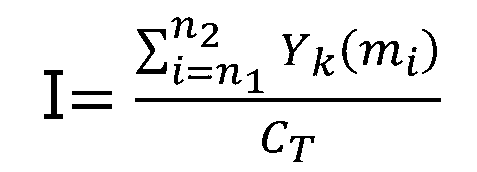
また、ターゲットとするピーク成分と重なる他の成分(例えば、同じ質量数の別種の質量ピーク)が観測される場合がある。このような場合、ターゲットするピーク成分と重なる他の成分を三角形状関数で近似することでターゲットとするピーク成分を求める。
第1実施形態において注目しているフラグメントの質量数を計算して以下に示しておく。同位体の原子量数は、http://physics.nist.gov/に依った。

Znは5つの同位体が知られ、TOF-SIMS分析では、そのうち64Zn,66Zn,68Znに関連したフラグメントが主に検出される。第1実施形態では、最も存在比率の高い64Znに着目した。64ZnとP-OHを含有するリン化合物との結合を示すフラグメントには、64ZnPO4H-、64ZnP2O6H-、64ZnP2O7H-、64ZnP3O9 -等が検出されるが、比較的質量ピーク強度の大きい64ZnPO4H-に着目した。
負の2次イオンスペクトルの質量数=159.5~160.3の範囲に着目し、64Zn31P16O4 1H-に相当する159.890近傍の質量ピークを近似した三角形状関数とmiのデータから、カウント数の総和を計算し、CTで規格化した値を64ZnPO4H-の質量ピーク強度とする。
I(64ZnPO4H-)=1514/8571746=1.77×10-4
となる。
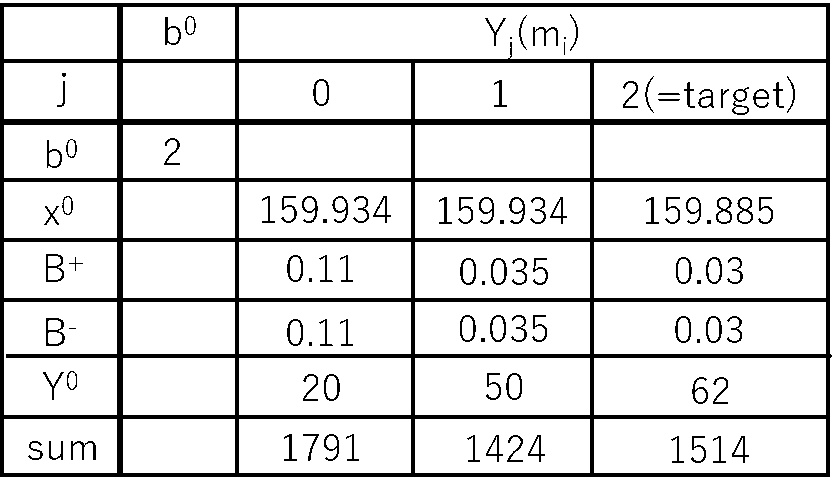
(i)ターゲットとするピーク位置近傍の測定データciを再現する近似曲線yiを得るには、「バックグランドb0」と「他の成分の三角形状関数近似」の曲線と、「ターゲットとする三角形状関数Yj(mi)」の曲線が必要である。
(ii)図4の例では、質量数(m/z)が159.7~160.2において、測定データciを再現した「近似曲線yi」を得るために、「バックグランドb0」と、「ターゲットとする三角形状関数Yj(mi)」の曲線(表2において、j=2)と、「他の成分の三角形状関数近似」の曲線2つ(表2において、j=0,1)を用いた。
負の2次イオンスペクトルの質量数=70.7~71.4の範囲に着目し、カーブフィッティングより得た12C3 1H3 16O2 -に相当する71.013近傍の質量ピークを近似した三角形状関数Yk(mi)とmiのデータから、カウント数の総和を計算し、CTで規格化した値をC3H3O2 -の質量ピーク強度I(C3H3O2 -)とする。
負の2次イオンスペクトルの質量数=62.5~63.3の範囲に着目し、31P16O2 -に相当する62.964近傍の質量ピークを近似した三角形状関数とmiのデータから、カウント数の総和を計算し、CTで規格化した値をPO2 -の質量ピーク強度I(PO2 -)とする。
負の2次イオンスペクトルの質量数=78.5~79.3の範囲に着目し、31P16O3 -に相当する78.959近傍の質量ピークを近似した三角形状関数とmiのデータから、カウント数の総和を計算し、CTで規格化した値をPO3 -の質量ピーク強度I(PO3 -)とする。
負の2次イオンスペクトルの質量数=25.5~26.3の範囲に着目し、12C14N-に相当する26.003近傍の質量ピークを近似した三角形状関数とmiのデータから、カウント数の総和を計算し、CTで規格化した値をCN-の質量ピーク強度I(CN-)とする。
これらの成分を含む混合物の硬化物により形成されたガスバリア性層であれば、ポリカルボン酸由来のカルボキシル基はZnを介して金属イオン架橋を形成し、またZnはP-OH基を含むリン化合物とも反応し、耐水性のある結合を形成する。詳細なメカニズムは不明であるが、これらのZnを介した金属イオン架橋やZnとリン化合物との結合が、ガスバリア性層中に均一に適量存在することにより、ち密なガスバリア性層を形成するとともに、レトルト処理等でガスバリア性層が過度に膨張・収縮するのを抑制していると考えられる。
第1実施形態においては、例えば、ポリカルボン酸に対するリン酸の濃度が、上記Zn組成比とI(64ZnPO4H-)/I(C3H3O2 -)の値を制御するための因子の1つとして挙げられる。
ポリカルボン酸は、分子内に2個以上のカルボキシ基を有するものである。具体的には、アクリル酸、メタアクリル酸、イタコン酸、フマル酸、クロトン酸、桂皮酸、3-ヘキセン酸、3-ヘキセン二酸等のα,β-不飽和カルボン酸の単独重合体またはこれらの共重合体が挙げられる。また、上記α,β-不飽和カルボン酸と、エチルエステル等のエステル類、エチレン等のオレフィン類等との共重合体であってもよい。
亜鉛(Zn)は、リン化合物と耐水性のあるリン酸Zn結合を形成でき、TOF-SIMS分析により、64ZnPO4H-で表される質量ピークが検出できる。また、ガスバリア性層にポリカルボン酸を含む場合、ポリカルボン酸と塩を形成する。Znは、ガスバリア性層を形成する混合物中に添加できる亜鉛や亜鉛化合物であればよく、例えば、金属亜鉛、酸化亜鉛(ZnO)、亜鉛化合物等を用いることができる。亜鉛の添加量は、上記ポリカルボン酸のカルボキシル基1molに対して、0.1mol以上0.5mol以下とすることができる。
前述のように、バリア性層を質量分析したとき、好ましくはPO2 -および/またはPO3 -が検出される。このようなバリア性層を設けるためには、硬化前の混合物はリン化合物またはその塩を含むことが好ましい。
リン化合物またはその塩におけるリン化合物は、分子構造中に1つ以上の-P-OH基を含む。リン化合物は塩として混合物に配合されてもよい。
レトルト処理後の水蒸気バリア性をさらに向上する観点から、リン化合物は、好ましくは2個以上の-P-OH基を含み、より好ましくは3個以上の-P-OH基を含む。また、生産性の観点から、リン化合物中の-P-OH基の数は、例えば10個以下であってもよい。
リン化合物の具体例として、リン酸、亜リン酸、ホスホン酸、次亜リン酸、ポリリン酸、これらの誘導体が挙げられる。
ポリリン酸は、具体的には、分子構造中に2以上のリン酸の縮合構造を有し、たとえば、二リン酸(ピロリン酸)、三リン酸、4つ以上のリン酸が縮合したポリリン酸などが挙げられる。
誘導体の具体例として、リン酸化澱粉、リン酸架橋澱粉等の上述のリン化合物のエステル;塩化物等のハロゲン化物;十酸化四リン酸等の無水物;およびニトリロトリス(メチレンホスホン酸)、N,N,N‘,N’-エチレンジアミンテトラキス(メチレンホスホン酸)等のリン原子に結合する水素原子がアルキル基に置換された構造を有する化合物が挙げられる。
バリア性および生産性のバランスをさらに向上する観点から、リン化合物は、リン酸、亜リン酸、次亜リン酸、ポリリン酸、ホスホン酸およびこれらの塩からなる群より選択される1種または2種以上であり、より好ましくはリン酸および亜リン酸、ホスホン酸およびこれらの塩からなる群から選択される少なくとも1つである。
また、リン化合物の塩における、塩の具体例として、ナトリウム、カリウム等の1価の金属の塩;アンモニウム塩が挙げられる。バリア性の観点から、リン化合物の塩は好ましくはアンモニウム塩である。
リン化合物のP原子の濃度は、混合物中における上記ポリカルボン酸のカルボキシル基1molに対し、典型的には5×10⁻⁴mol以上、好ましくは1×10⁻³mol以上、より好ましくは3×10⁻³mol以上であり、また典型的には0.3mol以下、好ましくは0.1mol以下、より好ましくは0.05mol以下である。リン酸のように化学式中にP原子が1個含まれるリン化合物は、P原子のモル数とリン化合物のモル数は同じ意味になる。
このような濃度のリン化合物またはその塩由来のリン化合物であれば、耐水性のあるリン化合物とZn結合を確実に形成することで、レトルト処理等でガスバリア性層が過度に膨張・収縮するのを抑制し、レトルト処理後のガスバリア性積層体のガスバリア性をより向上する事ができると考えられる。リン化合物とZn結合の存在は、前述のTOF-SIMS分析で得られる64ZnPO4H-の質量ピークに反映されている。
第1実施形態に係るガスバリア性積層体を構成する混合物は、ポリアミンをさらに含むことが好ましい。ポリアミンを含むことによって、得られるガスバリア性積層体のバリア性を向上できるとともに、得られるガスバリア性積層体の層間接着性を向上でき、耐デラミ性を良好にすることができる。
ここで、第1実施形態において、ポリアミンの分子量は沸点上昇法や粘度法を用いて測定することができる。
第1実施形態に係るガスバリア性層は、例えば、以下のようにして製造することができる。
まず、ポリカルボン酸を構成するカルボキシ基の完全または部分中和溶液を調製する。
また、乾燥・硬化後のガスバリア性層の平均厚みは0.05μm以上10μm以下が好ましく、0.08μm以上5μm以下がより好ましく、0.1μm以上1μm以下がさらに好ましい。上記上限値以下であると、得られるガスバリア性積層体やガスバリア性フィルムがカールすることを抑制できる。また、上記下限値以上であると、得られるガスバリア性積層体やガスバリア性フィルムのバリア性能をより良好なものとすることができる。
無機物層4を構成する無機物は、例えば、バリア性を有する薄膜を形成できる金属、金属酸化物、金属窒化物、金属弗化物、金属酸窒化物等が挙げられる。
なお、第1実施形態では、周期表の族名は旧CAS式で示している。
なお、酸化ケイ素には、二酸化ケイ素の他、一酸化ケイ素、亜酸化ケイ素が含有されていてもよい。
第1実施形態において、無機物層の厚さは、透過型電子顕微鏡や走査型電子顕微鏡による観察画像により求めることができる。
これらの結合反応を迅速に行うには、その無機原子や化合物が化学的に活性な分子種もしくは原子種であることが望ましい。
基材層2は、ガスバリア用塗材の溶液を塗工できるものであれば、特に限定されず、用いることができる。例えば、熱硬化性樹脂、熱可塑性樹脂、または紙等の有機質材料、ガラス、陶、セラミック、酸化珪素、酸化窒化珪素、窒化珪素、セメント、アルミニウム、酸化アルミニウム、鉄、銅、ステンレス等の金属等の無機質材料、有機質材料同士または有機質材料と無機質材料との組合せからなる多層構造の基材層等が挙げられる。これらの中でも、例えば、包装材料やパネル等の各種フィルム用途の場合、熱硬化性樹脂、熱可塑性樹脂を用いたプラスチックフィルム、または紙等の有機質材料が好ましい。
また、熱可塑性樹脂からなる基材層2は、ガスバリア性積層体8の用途に応じて、単層であっても、二種以上の層であってもよい。
また、上記熱硬化性樹脂、熱可塑性樹脂により形成されたフィルムを少なくとも一方向、好ましくは二軸方向に延伸して基材層としてもよい。
ガスバリア性積層体8において、基材層2と無機物層4との接着性を向上させる観点から、基材層2の表面にアンダーコート層3を形成することができる。アンダーコート層は、エポキシ(メタ)アクリレート系化合物またはウレタン(メタ)アクリレート系化合物により形成する層であることが好ましい。
第1実施形態のアンダーコート層の厚さは、コート量として、通常、0.01~100g/m2、好ましくは0.05~50g/m2の範囲にある。
また、ガスバリア性層5上に接着剤層6を設けてもよい。接着剤層6は、公知の接着剤を含むものであればよい。接着剤としては、有機チタン系樹脂、ポリエチレンイミン系樹脂、ウレタン系樹脂、エポキシ系樹脂、アクリル系樹脂、ポリエステル系樹脂、オキサゾリン基含有樹脂、変性シリコーン樹脂及びアルキルチタネート、ポリエステル系ポリブタジエン等から組成されているラミネート接着剤、または一液型、二液型のポリオールと多価イソシアネート、水系ウレタン、アイオノマー等が挙げられる。または、アクリル系樹脂、酢酸ビニル系樹脂、ウレタン系樹脂、ポリエステル樹脂等を主原料とした水性接着剤を用いてもよい。
図5は、第2実施形態のガスバリア性積層体の構成の一例を模式的に示す断面図である。
ガスバリア性積層体100は、基材層101と、基材層101の少なくとも一方の面に設けられたガスバリア性層103と、基材層101とガスバリア性層103との間に設けられた無機物層102と、を含む。
ガスバリア性層103を飛行時間型二次イオン質量分析(TOF-SIMS)した際の、PO2 -の質量ピーク強度をI(PO2 -)、PO3 -の質量ピーク強度をI(PO3 -)、C3H3O2 -の質量ピーク強度をI(C3H3O2 -)としたとき、{I(PO2 -)+I(PO3 -)}/I(C3H3O2 -)の値は、0.02~5、好ましくは0.05~3である。
また、ガスバリア性層103は、Zn、Ca、Mg、BaおよびAlからなる群より選ばれる1または2以上の金属元素を含み、ガスバリア性層103をX線光電子分光分析することで求められる、ガスバリア性層103中の上記金属元素の組成比率は、1~15atomic%、好ましくは1.5~12atomic%である。
また、ガスバリア性層103中の上記金属元素の組成比率は1~15atomic%であることは、ガスバリア性層103中に、リン酸等と架橋する多価金属が適量含まれていることを意味する。
つまり、ガスバリア性層103の{I(PO2 -)+I(PO3 -)}/I(C3H3O2 -)の値が0.02~5であり、ガスバリア性層103中の上記金属元素の組成比率が1~15atomic%であるということは、ガスバリア性層103中に、十分な量のリン酸-多価金属の結合(レトルト処理などに耐性がある)が存在することに対応している。
念のため述べておくと、「ガスバリア性層103中のZN、Ca、Mg、BaおよびAlの組成比率」とは、ガスバリア性層103が複数種の金属元素を含む場合にはそれらの合計の比率を表す。
ガスバリア性層103の内部を分析するため、分析前に、ガスバリア性層103の表層をTOF-SIMS分析装置に付帯するAr-ガスクラスターイオンビーム(Ar-GCIB)によりスパッタエッチングし、ガスバリア性層103の内部を露出させることが好ましい。Ar-GCIBの使用は、エッチングによるガスバリア性層103のダメージを軽減する。
GCIB出力:5kV、5μA
GCIB処理時間:TOF-SIMSのスペクトルパターンが変化しなくなった時点
分析装置:アルバック・ファイ社製PHI NaNo TOF II
1次イオン:Bi3++
1次イオン源出力:30kV、0.5μA
分析領域:300×300μm(1次イオンビームの走査領域として)
分析時に装置に付属の低エネルギー電子線および低エネルギーArイオン照射により、帯電中和を実施
詳細な質量スペクトル解析を行うため、正と負の各2次イオンについて、質量数miと、それに対応するカウント数ciをペアとする生データ列、及びTotal IoN CouNts(CT)を分析装置より取得することが好ましい。ここで、i=0,1,...,Nである。生データ列は、miについて昇順に並んでいるものとする。CTは、検出器で検出された2次イオンの総カウント数である。
注目する質量スペクトルピーク周辺の質量数の範囲をi=N1,N1+1,...,N2とする。分析で得た、この範囲のカウント数のデータciを、次式のようなyiで近似する。具体的には、バックグランドレベルb0と、K個の三角形状関数Yj(mi)を用いたカーブフィッティングにより、ciを近似する。


b0、x0 j、Y0 j、B- j、B+ jがフィッティングパラメータとなる。jは、j=1,...,Kである。
例えば、スペクトルのバックグランドが一定値でなく、miに対して直線的に変化する場合は、b0と三角形状関数Yj(mi)とを組み合わせて、バックグランドを近似する。
注目する質量スペクトルピークがシングルピークの場合は、バックグランドを除き、1つの三角形状関数で近似することとし、その他の質量ピークと近接している場合は、その他の質量ピークも含め複数の三角形状関数を用いて近似するものとする。
近似した注目する質量スペクトルピークが、K個の三角形状関数のうち、j=k番目のピークであるとすると、ピーク強度Iは、i=N1,...,N2までのYk(mi)の総和を、Total IoN CouNts(CT)で規格化した数値で表し、次式から求める。

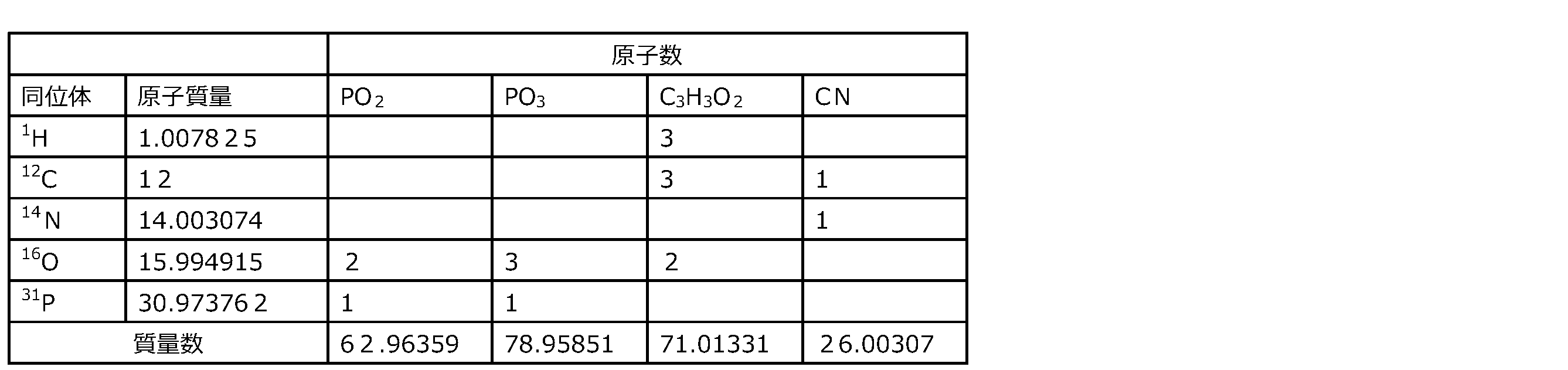
負の2次イオンスペクトルの質量数=62.5~63.3の範囲に着目し、31P16O2 -に相当する62.964近傍の質量ピークを近似した三角形状関数とmiのデータから、カウント数の総和を計算し、CTで規格化した値をPO2 -の質量ピーク強度I(PO2 -)とする。
I(PO2 -)=436/6838528=5.48×10-5
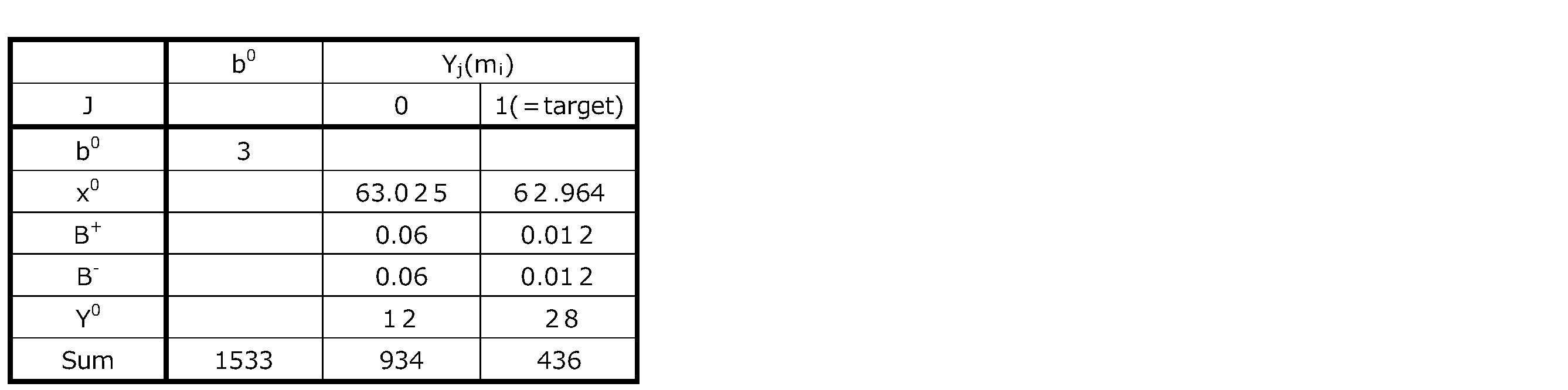
(i)ターゲットとするピーク位置近傍の測定データciを再現する近似曲線yiを得るには、「バックグランドb0」と「他の成分の三角形状関数近似」の曲線と、「ターゲットとする三角形状関数Yj(mi)」の曲線が必要である。
(ii)図8の例では、質量数(m/z)が62.94~62.98近傍において、測定データciを再現した「近似曲線yi」を、得るために、「バックグランドb0」と、「ターゲットとする三角形状関数Yj(mi)」の曲線(表2において、j=1)と、「他の成分の三角形状関数近似」の曲線(表2において、j=0)を用いた。
(iii)m/zが63~63.05付近の大きなピークを三角形状関数で近似していないのは、ターゲットとするピーク成分と明らかに重なっていないためである。
負の2次イオンスペクトルの質量数=78.5~79.3の範囲に着目し、31P16O3 -に相当する78.959近傍の質量ピークを近似した三角形状関数とmiのデータから、カウント数の総和を計算し、CTで規格化した値をPO3 -の質量ピーク強度I(PO3 -)とする。
負の2次イオンスペクトルの質量数=70.7~71.4の範囲に着目し、カーブフィッティングより得た12C3 1H3 16O2 -に相当する71.013近傍の質量ピークを近似した三角形状関数Yk(mi)とmiのデータから、カウント数の総和を計算し、CTで規格化した値をC3H3O2 -の質量ピーク強度I(C3H3O2 -)とする。
負の2次イオンスペクトルの質量数=70.7~71.4の範囲に着目し、カーブフィッティングより得た12C14N-に相当する26.003近傍の質量ピークを近似した三角形状関数Yk(mi)とmiのデータから、カウント数の総和を計算し、CTで規格化した値をCN-の質量ピーク強度I(CN-)とする。
分析の具体的な条件の一例を示す。
分析装置:KRATOS社製AXIS-NOVA
X線源:単色化Al-Kα
X線源出力:15kV、10mA
分析領域:300×700μm
分析時に帯電補正用の中和電子銃使用
ワイドスキャンにより、検出元素を特定し、個々の元素についてナロースキャンでスペクトルを取得する。そして、得られたスペクトルから、Shirley法で求めたバックグラウンドを除き、得られたピーク面積から相対感度係数法を用いて、検出元素の原子組成比率(atomic%)を算出する。
ちなみに、一般的なXPS分析における原子組成比率の検出感度は、0.1atomic%程度とされている。例えば、ガスバリア性層中にリン化合物が微量添加されている場合、XPS分析ではPの含有を検出できない場合がある。
具体的には、ガスバリア性層103を全反射測定法により赤外分光測定することで得られる吸収スペクトルにおいて、吸収帯1493cm-1以上1780cm-1以下の範囲における全ピーク面積をAとし、吸収帯1493cm-1以上1598cm-1以下の範囲における全ピーク面積をDとしたとき、面積比率D/Aは、0.5以上が好ましく、0.58以上がより好ましく、0.6以上がより好ましい。D/Aの上限値は、例えば0.8以下である。
赤外分光法の過去知見や本発明者らの知見によれば、フリーのカルボン酸のνC=Oに基づく吸収が1700cm-1付近であることや、カルボン酸塩のν(C=O)に基づく吸収が1540~1560cm-1付近であることから、D/Aを、ガスバリア性層103が含むカルボン酸塩構造の量の指標とすることができる。ちなみに、後述のように、ガスバリア性層103中にポリアミンを含めた場合、アミド結合のν(C=O)に基づく吸収が1630~1685cm-1付近にみられる場合がある。
まず、ガスバリア性層103から1cm×3cmの測定用サンプルを切り出す。
次いで、そのガスバリア性層103の表面の赤外線吸収スペクトルを赤外線全反射測定(ATR法)により得る。
得られた赤外線吸収スペクトル中、1493cm-1における測定点と1780cm-1における測定点とを直線(ベースライン:N)で結び、得られた赤外線吸収スペクトルとNとの差スペクトルを得てこれをスペクトル(SBN)とする。但し、ガスバリア性層103の厚みがおおよそ0.5μm以下の場合、測定された赤外線吸収スペクトルにガスバリア性層よりも下層の影響を含む。
その場合は、ガスバリア性層の無い下層のみで構成される基材も測定サンプルとして用意し、同様に基材表面のATR-IRスペクトルを得て、ベースラインNとの差スペクトルを求め、これをスペクトル(SSN)とする。1493cm-1から1780cm-1の波数範囲において、明らかな吸収ピークを示す場合には、次式に従った差スペクトル解析を行い、基材の影響を除いたスペクトル(SBN')を得る。
<スペクトル(SBN')>=<スペクトル(SBN)>-α*<スペクトル(SSN)>
ここで、αは、基材の影響を除くための係数で、0≦α<1である。
ここで、具体例として、基材層がポリエチレンテレフタレート(PET)フィルムである場合について、基材層や無機層等で構成される基材の影響を除くための係数αの決定方法について補足する。
PETは、1700cm-1近傍に大きな吸収ピークを持つため、1493cm-1から1780cm-1の波数範囲におけるピーク面積の計算に影響する。この影響を除くため、一般的な差スペクトル解析法を用いた。例えば、1493cm-1から1780cm-1の波数範囲に隣接し、ガスバリア性層の吸収ピークと被らないPETの鋭い吸収ピークとして1340cm-1近傍の吸収ピークを選び、これを基準ピークとする。上述した差スペクトル解析で得たスペクトル(SBN')において、1340cm-1近傍の基準ピークが無くなるように係数αを調節する事で、1700cm-1近傍のPETの吸収ピークの影響が除かれたスペクトル(SBN')を得ることができる。
また、係数αは、次のように赤外線吸収スペクトルの面積比として求めることもできる。
ガスバリア性層の表面から測定した赤外線吸収スペクトルと、ガスバリア性層の無い下層のみで構成される基材の赤外線吸収スペクトルについて、1325cm-1における測定点と1355cm-1における測定点とを直線(ベースライン:M)で結び、1325cm-1~1355cm-1の波数範囲において、得られた赤外線吸収スペクトルとベースラインMとの差スペクトルを得て、それぞれスペクトル(SBM)、スペクトル(SSM)とする。スペクトル(SBM)及びスペクトル(SSM)について、1325cm-1以上1355cm-1以下のピーク面積をそれぞれ面積(ABM)、面積(ASM)とすると、係数αは次式から求められる。
α=ABM/ASM
図6のガスバリア性積層体110の基本構成は、図5のガスバリア性積層体100と同様であるが、基材層101と無機物層102とが直接には接しておらず、基材層101と無機物層102との間に設けられたアンダーコート層104をさらに含む点で異なる。
ガスバリア性積層体110においても、ガスバリア性積層体100と同様の効果が得られる。加えて、ガスバリア性積層体110では、基材層101と無機物層102との間にアンダーコート層104を設けることにより、基材層101と無機物層102との接着性をさらに向上することができる。
ガスバリア性層103は、例えば、ポリアクリル酸などのポリカルボン酸と、ポリアミン化合物と、多価金属化合物と、を含む混合物の硬化物により構成される。さらに具体的には、ガスバリア性層103は、上記硬化物により構成されたフィルム(ガスバリア性フィルム10)である。
さらに具体的には、ガスバリア性層103は、例えば、無機物層102等のガスバリア性層103の直下に配置される層に、硬化前の混合物(ガスバリア用塗材)を塗布した後、乾燥、熱処理を行い、ガスバリア用塗材を硬化させて得ることができる。
ポリカルボン酸は、分子内に2個以上のカルボキシ基を有するものである。具体的には、(メタ)アクリル酸、イタコン酸、フマル酸、クロトン酸、桂皮酸、3-ヘキセン酸、3-ヘキセン二酸等のα,β-不飽和カルボン酸の単独重合体またはこれらの共重合体が挙げられる。また、上記α,β-不飽和カルボン酸と、エチルエステル等のエステル類、エチレン等のオレフィン類等との共重合体であってもよい。
また、第2実施形態において、ポリメタクリル酸とは、メタクリル酸の単独重合体、メタクリル酸と他のモノマーとの共重合体の両方を含む。メタクリル酸と他のモノマーとの共重合体の場合、ポリメタクリル酸は、重合体100質量%中に、メタクリル酸由来の構成単位を、通常は90質量%以上、好ましくは95質量%以上、より好ましくは99質量%以上含む。
ここで、第2実施形態において、ポリカルボン酸の分子量はポリエチレンオキサイド換算の重量平均分子量であり、ゲルパーミエーションクロマトグラフィー(GPC)を用いて測定することができる。
部分中和物は、ポリカルボン酸重合体の水溶液に揮発性塩基を添加することにより調製するが、ポリカルボン酸と揮発性塩基の量比を調節することにより、所望の中和度とすることができる。第2実施形態においてはポリカルボン酸の揮発性塩基による中和度は、ポリアミン化合物のアミノ基との中和反応に起因するゲル化を十分に抑制する観点から、70~300当量%が好ましく、90~250当量%がより好ましく、100~200当量%がさらに好ましい。
揮発性塩基としては、たとえば、アンモニア、モルホリン、アルキルアミン、2-ジメチルアミノエタノール、N-メチルモノホリン、エチレンジアミン、トリエチルアミン等の三級アミンまたはこれらの水溶液、あるいはこれらの混合物が挙げられる。良好なガスバリア性を得る観点から、アンモニア水溶液が好ましい。
硬化前の混合物は、好ましくはポリアミン化合物を含む。ポリアミン化合物は、ポリカルボン酸と反応して架橋構造(アミド結合)を形成することができる。これにより、ガスバリア性を一層高めることができる。
ポリアミン化合物は、主鎖あるいは側鎖あるいは末端にアミノ基を2つ以上有する化合物であり、好ましくはポリマーである。具体的には、ポリアリルアミン、ポリビニルアミン、ポリエチレンイミン、ポリ(トリメチレンイミン)等の脂肪族ポリアミン類;ポリリジン、ポリアルギニンのように側鎖にアミノ基を有するポリアミド類;等が挙げられる。また、アミノ基の一部を変性したポリアミンでもよい。
良好なガスバリア性を得る観点から、ポリアミン化合物は好ましくはポリエチレンイミンを含み、より好ましくはポリエチレンイミンである。
ポリアミン化合物の分子量は、沸点上昇法や粘度法を用いて測定することができる。
同様の観点から、(混合物中のポリアミン化合物に含まれるアミノ基のモル数)/(混合物中のポリカルボン酸に含まれる-COO-基のモル数)は、好ましくは0.90以下であり、より好ましくは0.85以下、さらに好ましくは0.80以下、さらにより好ましくは0.75以下、よりいっそう好ましくは0.70以下である。
かかる理由の詳細は、明らかではないが、ポリアミン化合物を構成するアミノ基によるアミド架橋と、ポリカルボン酸と多価金属との塩を構成する多価金属による金属架橋がバランスよく緻密な構造を形成することにより、レトルト処理後のガスバリア性能に優れたガスバリア性層103およびこれを有するガスバリア性積層体を得ることができると考えられる。
質量分析で検出されるCN-は、ポリアミンに由来すると考えられる。よって、I(CN-)/I(C3H3O2 -)の値が適当な数値であることは、上記の「ポリアミン化合物を構成するアミノ基によるアミド架橋と、ポリカルボン酸と多価金属との塩を構成する多価金属による金属架橋がバランスよく緻密な構造を形成すること」に対応していると考えられる。
前述のように、ガスバリア性層103は、好ましくはZn、Ca、Mg、BaおよびAlからなる群より選ばれる1または2以上の金属元素を含む。よって、硬化前の混合物は、これら金属の化合物を含むことが好ましい。これらの中でも、レトルト食品の包装への適用を鑑みると、Mg含有化合物およびZn含有化合物が好ましく、Zn含有化合物がより好ましい。
金属化合物としては、上記金属の酸化物、水酸化物、ハロゲン化物、炭酸塩、リン酸塩、亜リン酸塩、次亜リン酸塩、硫酸塩、亜硫酸塩等が挙げられる。耐水性や不純物等の観点からは、金属の酸化物もしくは金属水酸化物が好ましい。
同様の観点から、(混合物中の多価金属化合物のモル数)/(混合物中のポリカルボン酸に含まれる-COO-基のモル数)は、好ましくは0.80以下、より好ましくは0.70以下、さらに好ましくは0.60以下、さらにより好ましくは0.55以下、よりいっそう好ましくは0.50以下である。
同様の観点から、(混合物中の金属化合物のモル数)/(混合物中のポリアミン化合物由来のアミノ基のモル数)は、好ましくは0.75以下、より好ましくは0.60以下、さらに好ましくは0.55以下である。
前述のように、バリア性層103を質量分析したとき、PO2 -および/またはPO3 -が検出される。このようなバリア性層103を設けるためには、硬化前の混合物は、リン化合物またはその塩を含むことが好ましい。
リン化合物またはその塩におけるリン化合物は、分子構造中に1つ以上の-P-OH基を含む。リン化合物は塩として混合物に配合されてもよい。
レトルト処理後の水蒸気バリア性をさらに向上する観点から、リン化合物は、好ましくは2個以上の-P-OH基を含み、より好ましくは3個以上の-P-OH基を含む。また、生産性の観点から、リン化合物中の-P-OH基の数は、例えば10個以下であってもよい。
ポリリン酸は、具体的には、分子構造中に2以上のリン酸の縮合構造を有し、たとえば、二リン酸(ピロリン酸)、三リン酸、4つ以上のリン酸が縮合したポリリン酸などが挙げられる。
誘導体の具体例として、リン酸化澱粉、リン酸架橋澱粉等の上述のリン化合物のエステル;塩化物等のハロゲン化物;十酸化四リン等の無水物;およびニトリロトリス(メチレンホスホン酸)、N,N,N',N'-エチレンジアミンテトラキス(メチレンホスホン酸)等のリン原子に結合する水素原子がアルキル基に置換された構造を有する化合物が挙げられる。
また、バリア性および生産性(塗液の安定性、塗膜の均一性/外観)の観点から、(混合物中のリン化合物またはその塩由来のリン化合物のモル数)/(混合物中のポリカルボン酸由来の-COO-基のモル数)は、好ましくは0.3以下であり、より好ましくは0.1以下、さらに好ましくは0.08以下、さらにより好ましくは0.05以下である。
硬化前の混合物は、上述の成分以外の成分を含んでもよい。
例えば、混合物は炭酸系アンモニウム塩をさらに含むことが好ましい。炭酸系アンモニウム塩は、多価金属化合物を、炭酸多価金属アンモニウム錯体の状態にして、多価金属化合物の溶解性を向上させ、多価金属化合物を含む均一な溶液を調製するために添加するものである。硬化前の混合物が炭酸系アンモニウム塩を含むことにより、多価金属化合物の溶解量を増やすことができ、その結果、多価金属化合物が配合された混合物をさらに均質なものとすることができる。
炭酸系アンモニウム塩として、たとえば、炭酸アンモニウム、炭酸水素アンモニウム等が挙げられ、揮発しやすく、得られるガスバリア性層に残存し難い点から、炭酸アンモニウムが好ましい。
(混合物中の炭酸系アンモニウム塩のモル数)/(混合物中の金属化合物のモル数)は、多価金属化合物の溶解性をより一層向上する観点から、0.05以上が好ましく、0.10以上がより好ましく、0.25以上がさらに好ましく、0.50以上がさらにより好ましく、0.75以上が特に好ましい。
また、ガスバリア用塗材としての塗工性をより一層向上する観点から、(ガスバリア用塗材中の炭酸系アンモニウム塩のモル数)/(ガスバリア用塗材中の金属化合物のモル数)は、10.0以下が好ましく、5.0以下がより好ましく、2.0以下がさらに好ましく、1.5以下がさらにより好ましい。
界面活性剤の添加量は、混合物の固形分全体を100質量%としたとき、0.01~3質量%が好ましく、0.01~1質量%がより好ましい。
ポリオキシアルキレンアルキルエーテル類としては、例えば、ポリオキシエチレンオレイルエーテル、ポリオキシエチレンラウリルエーテル等のポリオキシエチレンアルキルエーテル類を挙げることができる。
ポリオキシアルキレン脂肪酸エステル類としては、例えば、ポリオキシエチレンオレイン酸エステル、ポリオキシエチレンラウリン酸エステル、ポリオキシエチレンジステアリン酸エステル等を挙げることができる。
ソルビタン脂肪酸エステル類としては、例えば、ソルビタンラウレート、ソルビタンモノステアレート、ソルビタンモノオレエート、ソルビタンセスキオレート、ポリオキシエチレンモノオレエート、ポリオキシエチレンステアレート等を挙げることができる。
シリコーン系界面活性剤としては、例えば、ジメチルポリシロキサン等を挙げることができる。
アセチレンアルコール系界面活性剤としては、たとえば、2,4,7,9-テトラメチル-5-デシン-4,7-ジオール、3,6-ジメチル-4-オクチン-3,6-ジオール、3,5-ジメチル-1-ヘキシン-3オール等を挙げることができる。
含フッ素系界面活性剤としては、例えば、フッ素アルキルエステル等を挙げることができる。
ガスバリア性層103は、具体的には、硬化前の混合物(ガスバリア性用塗材)を塗工し、硬化することにより製造できる。
混合物は、以下のようにして得ることができる。
まず、ポリカルボン酸に、適宜揮発性塩基を加えることによりポリカルボン酸のカルボキシ基を完全にまたは部分的に中和する。さらに多価金属塩化合物および適宜炭酸系アンモニウム塩を混合して、揮発性塩基と中和した上記ポリカルボン酸のカルボキシ基の全部または一部、および揮発性塩基と中和しなかったポリカルボン酸のカルボキシ基において金属塩を形成する。
その後、さらにポリアミン化合物を添加し、最後にリン化合物またはその塩を添加することによって、硬化前の混合物が得られる。これにより、リン化合物と多価金属化合物またはポリアミンのアミノ基とにおいて塩が形成される。
このような手順でポリカルボン酸、多価金属塩化合物、リン化合物またはその塩、適宜炭酸系アンモニウム塩およびポリアミン化合物を混合することにより、凝集物の生成を抑制でき、より均一な混合物を得ることができる。これにより、ポリカルボン酸に含まれる-COO-基とポリアミン化合物に含まれるアミノ基との脱水縮合反応をより効果的に進めることが可能となる。
まず、ポリカルボン酸を構成するカルボキシ基の完全または部分中和溶液を調製する。
ポリカルボン酸に、揮発性塩基を添加して、ポリカルボン酸のカルボキシ基が完全中和または部分中和する。当該ポリカルボン酸のカルボキシ基を中和することにより、多価金属化合物やポリアミン化合物の添加時にポリカルボン酸を構成するカルボキシ基と、多価金属化合物やポリアミン化合物を構成するアミノ基とが反応することによって発生するゲル化を効果的に防止し、より均一な混合物を得ることができる。
次いで、多価金属塩化合物および炭酸系アンモニウム塩を添加、溶解させ、生成された多価金属イオンによりポリカルボン酸を構成する-COO-基との多価金属塩を形成する。このとき多価金属イオンと塩を形成する-COO-基は上記塩基と中和しなかったカルボキシ基および塩基によって中和された-COO-基の双方をいう。塩基と中和した-COO-基の場合は上記多価金属化合物由来の多価金属イオンが入れ替わって配位して-COO-基の多価金属塩を形成する。
そして、多価金属塩を形成した後、さらにポリアミン化合物、および、リン化合物またはその塩を添加することによって、混合物を得ることができる。このとき、-COO-基に配位した多価金属塩がリン化合物中の-P-O-基にも配位して、-COO-多価金属-O-P-構造が形成される。また、ポリアミン中の-NH2基とリン化合物中の-P-O-基との間にイオン結合が形成される。
また、ガスバリア性積層体全体の薄型化の観点から、乾燥、硬化後のガスバリア性層103の厚みは、好ましくは15μm以下であり、より好ましくは5μm以下、さらに好ましくは1μm以下である。
基材層101は、単層であっても、2種以上の層であってもよい。基材層101の形状は、限定されないが、たとえば、シートまたはフィルム形状、トレー、カップ、中空体等の形状が挙げられる。
また、耐ピンホール性、耐破れ性および耐熱性等に優れる観点では、ポリアミド、ポリエチレンテレフタレートおよびポリブチレンテレフタレートからなる群から選択される1または2以上の樹脂が好ましい。同様の観点から、基材層101は、好ましくはポリアミド、ポリエチレンテレフタレートおよびポリブチレンテレフタレートからなる群から選択される1または2以上の樹脂を含む層であり、より好ましくはこれら1または2以上の樹脂の層である。
透明性、剛性および耐熱性に優れる観点から、基材層101は、好ましくはポリプロピレン、ポリエチレンテレフタレート、ポリエチレンナフタレート、ポリアミド、ポリイミドおよびポリブチレンテレフタレートからなる群から選択される1または2以上の熱可塑性樹脂により形成された二軸延伸フィルムであり、より好ましくはポリアミド、ポリエチレンテレフタレートおよびポリブチレンテレフタレートからなる群から選択される1または2以上の熱可塑性樹脂により形成された二軸延伸フィルムである。
さらに、基材層101はガスバリア性層103との接着性を改良するために、表面処理が施されたものであってもよい。具体的には、基材層101のガスバリア性層103との対向面に、コロナ処理、火炎処理、プラズマ処理、プライマーコート処理等の表面活性化処理をおこなってもよい。
図6で説明したように、基材層101と無機物層102との間にはアンダーコート層104が設けられてもよい。アンダーコート層104を設けることによりこれらの接着性をさらに向上することができ、また、レトルト処理後におけるバリア性をさらに向上することができる。
芳香族環構造を主鎖に有するポリウレタン樹脂として、さらに具体的には、特開2018-171827号公報に記載のものを用いることができる。
オキサゾリン系樹脂組成物は、たとえば、オキサゾリン基含有量が6.0~9.0mmol/gであるオキサゾリン基含有水性ポリマー、カルボキシル基含有量が0.5~3.5mmol/gである水性(メタ)アクリル樹脂およびカルボキシル基含有量が0.5~2.0mmol/gである水性ポリエステル樹脂により構成されている。
また、オキサゾリン系樹脂組成物は、オキサゾリン基含有水性ポリマー、水性(メタ)アクリル樹脂および水性ポリエステル樹脂の合計量を100質量%として、たとえば、オキサゾリン基含有水性ポリマーを10~55質量%、水性(メタ)アクリル樹脂を10~80質量%、水性ポリエステル樹脂を10~80質量%含有する。
また、オキサゾリン系樹脂組成物においては、たとえば、オキサゾリン基のモル数とカルボキシル基のモル数の比率〔オキサゾリン基のモル数(xmmol)とカルボキシル基のモル数(ymmol)の比(x/y)×100[mol%]で示される。〕が150~420mol%である。
アンダーコート層104に用いられるオキサゾリン樹脂として、さらに具体的には、国際公開第2016/186074号に記載のものを用いることができる。
また、経済的であるという観点からアンダーコート層104の厚さは、好ましくは1.0μm以下であり、より好ましくは0.6μm以下、さらに好ましくは0.5μm以下、さらにより好ましくは0.1μm、よりいっそう好ましくは0.05μm以下である。
無機物層102を構成する無機物は、たとえば、バリア性を有する薄膜を形成できる金属、金属酸化物、金属窒化物、金属弗化物、金属酸窒化物等が挙げられる。
無機物層102を構成する無機物としては、たとえば、ベリリウム、マグネシウム、カルシウム、ストロンチウム、バリウム等の周期表2A族元素;チタン、ジルコニウム、ルテニウム、ハフニウム、タンタル等の周期表遷移元素;亜鉛等の周期表2B族元素;アルミニウム、ガリウム、インジウム、タリウム等の周期表3A族元素;ケイ素、ゲルマニウム、錫等の周期表4A族元素;セレン、テルル等の周期表6A族元素等の単体、酸化物、窒化物、弗化物、または酸窒化物等から選択される一種または二種以上を挙げることができる(周期表の族名は旧CAS式で示している)。
なお、酸化ケイ素には、二酸化ケイ素の他、一酸化ケイ素、亜酸化ケイ素が含有されていてもよい。
無機物層102は単層の無機物層から構成されていてもよいし、複数の無機物層から構成されていてもよい。また、無機物層102が複数の無機物層から構成されている場合には同一種類の無機物層から構成されていてもよいし、異なった種類の無機物層から構成されていてもよい。
ここで、無機物層102の厚さは、たとえば透過型電子顕微鏡や走査型電子顕微鏡による観察画像により求めることができる。
また、ガスバリア性積層体のバリア性と生産性とのバランスを向上する観点から、無機物層102は好ましくは蒸着膜である。
レトルト食品の製造などの実用上の観点から、ガスバリア性層103の、無機物層102とは反対の面側に、シーラント層が設けられていることが好ましい。
シーラント層はガスバリア性層103と接しているか、または、ガスバリア性層103とシーラント層とは接着剤層により接着されている。接着剤層については追って説明する。
レトルト食品の製造への適用の観点では、シーラント層は、無延伸のポリプロピレン系ポリマーを含むことが好ましい。ポリプロピレン系ポリマーとしては、プロピレンのホモポリマー、プロピレンと炭素数が2または4以上10以下のα-オレフィンとのランダムコポリマーなどが挙げられる。
ガスバリア性積層体には、接着剤層がさらに設けられてもよい。具体的には、ガスバリア性層103と上述のシーラント層とは接着剤層により接着されていてもよい。
接着剤層は、公知の接着剤を含むものであればよい。接着剤としては、有機チタン樹脂、ポリエチレンイミン樹脂、ウレタン樹脂、エポキシ樹脂、アクリル樹脂、ポリエステル樹脂、オキサゾリン基含有樹脂、変性シリコーン樹脂およびアルキルチタネート、ポリエステルポリブタジエン等から組成されているラミネート接着剤、または一液型、二液型のポリオールと多価イソシアネート、水系ウレタン、アイオノマー等が挙げられる。または、アクリル樹脂、酢酸ビニル樹脂、ウレタン樹脂、ポリエステル樹脂等を主原料とした水性接着剤を用いてもよい。
また、ガスバリア性積層体の用途に応じて、接着剤に硬化剤、シランカップリング剤等の他の添加物を添加してもよい。ガスバリア性積層体の用途が、レトルト等の熱水処理に用いられるものである場合、耐熱性や耐水性の観点から、ポリウレタン接着剤に代表されるドライラミネート用接着剤が好ましく、溶剤系の二液硬化タイプのポリウレタン接着剤がより好ましい。
ガスバリア性層103とシーラント層の間には、ポリアミド含有層(例えば、ナイロン層)が設けられてもよいし、設けられていなくてもよい。ポリアミド含有層を設けることによりフィルム自体の強度を向上させることができる。例えば、包装体の落下時に破袋しにくくなる。
ポリアミド含有層は、例えば、ナイロン-6、ナイロン-66、ポリメタキシレンアジパミド等のうち1または2以上を含むことができる。
ポリアミド含有層を設ける場合、その厚みは、8~100μmが好ましく、10~50μmがより好ましく、13~30μmが特に好ましい。
第2実施形態において、ガスバリア性積層体100の製造方法は、基材層101を準備する工程と、基材層101上に無機物層102を形成する工程と、無機物層102が形成された基材層101の上部にガスバリア性層103を形成する工程と、を含むことができる。
無機物層102を形成する工程の後であってガスバリア性層103を形成する工程の前に、無機物層102上にアンダーコート層104を形成する工程をさらに含んでもよい。
また、得られるガスバリア性積層体がカールすることを抑制する観点、および、ポリカルボン酸に含まれる-COO-基とポリアミン化合物に含まれるアミノ基との脱水縮合反応をより効果的に進める観点から、ウェット厚みは、好ましくは300μm以下であり、より好ましくは200μm以下、さらに好ましくは100μm以下である。
乾燥、加熱処理する方法は、本発明の効果が得られるものであれば限定されず、ガスバリア用塗材を硬化させられるもの、硬化したガスバリア用塗材を加熱できる方法であればよい。たとえば、オーブン、ドライヤー等の対流伝熱によるもの、加熱ロール等の伝導伝熱によるもの、赤外線、遠赤外線・近赤外線のヒーター等の電磁波を用いる輻射伝熱によるもの、マイクロ波等内部発熱によるものが挙げられる。乾燥、加熱処理に使用する装置としては製造効率の観点から乾燥と加熱処理の双方をおこなえる装置が好ましい。その中でも具体的には乾燥、加熱、アニーリング等の種々の用途に利用できるという観点から熱風オーブンを用いることが好ましく、また、フィルムへの熱伝導効率に優れているという観点から加熱ロールを用いることが好ましい。また、乾燥、加熱処理に使用する方法を適宜組み合わせてもよい。具体的には、熱風オーブンと加熱ロールを併用してもよく、たとえば、熱風オーブンでガスバリア用塗材を乾燥後、加熱ロールで加熱処理をおこなえば、加熱処理工程が短時間となり製造効率の観点から好ましい。また、熱風オーブンのみで乾燥と加熱処理をおこなうことが好ましい。
なお、架橋構造の形成(例えば、ポリカルボン酸に含まれる-COO-基とポリアミン化合物に含まれるアミノ基とのアミド結合形成)を効果的に進める観点から、加熱処理温度および加熱処理時間はガスバリア用塗材のウエット厚みに応じて調整することが重要である。適切な加熱処理温度および加熱処理時間を選択することで、適切な架橋構造が形成される。
第2実施形態において、ガスバリア性積層体を含んで構成される積層構造の具体例を以下に示す。
(積層構造例1)基材層101(PET基材)/無機物層102(アルミナ蒸着層)/ガスバリア性層103/接着剤層/ポリオレフィン層
(積層構造例2)基材層101(PET基材)/アンダーコート層104/無機物層102(アルミナ蒸着層)/ガスバリア性層103/接着剤層/ポリオレフィン層
(積層構造例3)基材層101(PET基材)/無機物層102(アルミナ蒸着層)/ガスバリア性層103/接着剤層/ポリアミド層/接着剤層/ポリオレフィン層
(積層構造例4)基材層101(PET基材)/アンダーコート層104/無機物層102(アルミナ蒸着層)/ガスバリア性層103/接着剤層/ポリアミド層/接着剤層/ポリオレフィン層
ここで、積層構造中に、ポリエチレン、ポリプロピレン、ポリ(4-メチル-1-ペンテン)、ポリ(1-ブテン)等のポリオレフィンにより構成されるポリオレフィン層を含むことにより、ガスバリア性積層体において、耐ピンホール性、耐破れ性および耐熱性等を良好にしながら、高湿度下のガスバリア性能やレトルト処理後のガスバリア性能の低下をより一層抑制することができる。
第2実施形態のガスバリア性積層体は、ガスバリア性能に優れており、例えば、包装材料、中でも高いガスバリア性が要求される内容物の食品包装材料を始め、医療用途、工業用途、日常雑貨用途等さまざまな包装材料として好適に使用することができる。第2実施形態のガスバリア性積層体は、特に、食品包装用途に適用されることが好ましく、レトルト食品の製造に適用されることがより好ましい。
上述のガスバリア性積層体により包装用袋を構成することができる。この包装用袋は、例えばレトルト食品の製造に好ましく用いられる。すなわち、ガスバリア性積層体により包装された食品(レトルト食品)を製造することができる。
包装用袋を構成するガスバリア性積層体においては、通常、基材層のある側が外表面側、ガスバリア性層のある側が内表面側となる。シーラント層がある場合にはシーラント層のある側が内表面側となる。
第3実施形態に係るガスバリア性積層体は、
基材層と、上記基材層の少なくとも一方の面に設けられたガスバリア性層と、上記基材層と上記ガスバリア性層との間に設けられた無機物層と、を備え、
上記ガスバリア性層をX線光電子分光分析することにより測定される、Znの組成比が1~10atomic%であり、
上記ガスバリア性層を飛行時間型二次イオン質量分析することにより測定される、64ZnPO4H-の質量ピーク強度をI(64ZnPO4H-)、C3H3O2 -の質量ピーク強度をI(C3H3O2 -)としたとき、
I(64ZnPO4H-)/I(C3H3O2 -)
の値が7×10⁻⁴以上5×10⁻²以下
であるガスバリア性積層体である。
また、質量分析によりガスバリア性層からC3H3O2 -が検出されるということは、ガスバリア性層が、ポリアクリル酸またはその誘導体/類似化合物(ポリアクリル酸等)を含むことを意味する。そして、I(C3H3O2 -)の値は、ガスバリア性層中に含まれるポリカルボン酸のカルボキシル基の量(濃度)と相関した値であると考えられる。
ガスバリア性層が一定の濃度でZnを含むこと、またガスバリア性層中にカルボキシル基を有したポリカルボン酸が存在することから、ガスバリア性層中のポリカルボン酸は、Znと架橋体を形成し、基材層とガスバリア性層との間に設けられた無機物層と共に、Zn架橋体を形成したガスバリア性層が、ガスバリア性積層体のガスバリア性を担うと考えられる。
また、I(64ZnPO4H-)/I(C3H3O2 -)の値は、ポリカルボン酸のカルボキシル基に対する、リン酸とZnの結合の量(濃度)と相関した値であると考えられる。
ところで、リン酸亜鉛は水に対して不溶な化合物として知られ、リン化合物とZnの結合は、レトルト処理後でのバリア性低下の原因の1つである、水により切断され難い結合である。よって、ガスバリア性層におけるリン化合物とZnの結合の存在は、レトルト処理等でガスバリア性層が過度に膨潤・収縮し、隣接した無機物層に損傷を与える事で、ガスバリア性が大きく低下してしまうのを抑制していると考えられる。
即ち、Znの組成比が1~10atomic%であることや、I(64ZnPO4H-)/I(C3H3O2 -)の値が7×10⁻⁴以上5×10⁻²以下であることで、レトルト後のバリア性能を良好に保つことができる。
第3実施形態に係るガスバリア性積層体のガスバリア性層において、耐水性の高い64ZnPO4H-のピークが検出されることで、ラミネート構造によらずレトルト後のバリア性能が良好なガスバリア性積層体となる。
ガスバリア性層に含まれるZnの組成は、XPS分析において、1atomic%以上、好ましくは2atomic%以上、より好ましくは3atomic%以上である。また、ガスバリア性層に含まれるZnの組成は、10atomic%以下、好ましくは9.5atomic%以下、より好ましくは9atomic%以下である。これは、炭素のピーク強度に対するZnのピーク強度、すなわちZn/Cが0.01以上0.2以下(atomic/atomic%)に相当する。
このように、Znがガスバリア性層に一定量存在することで、レトルト後のバリア性能が良好となる。
分析装置:KRATOS社製AXIS-NOVA
X線源:単色化Al-Kα
X線源出力:15kV、10mA
分析領域:300×700μm
分析時:帯電補正用中和銃使用
XPS分析では、ガスバリア性層から切り出した1×1cmの測定用サンプルを用いることができる。また、ガスバリア性層の内部を分析するため、分析前に、ガスバリア性層の表面をスパッタエッチングすることが好ましい。スパッタエッチングは、ガスバリア性層へのダメージを軽減するため、Ar-ガスクラスターイオンビーム(Ar-GCIB)源の使用が望ましい。Ar-ガスクラスターイオンビームエッチングは、検体の化学構造を壊さずにエッチングが可能な手法として知られている。
尚、一般的なXPS分析における原子組成比率の検出感度は、0.1atomic%程度とされている。例えば、ガスバリア性層中にリン化合物が微量添加されている場合、XPS分析ではPの含有を検出できない場合がある。
ガスバリア性層のTOF-SIMS分析において検出されるフラグメントの内、64ZnPO4H-のピーク強度をI(64ZnPO4H-)とし、C3H3O2 ―のフラグメントのピーク強度をI(C3H3O2 ―)としたとき、
I(64ZnPO4H-)/I(C3H3O2 ―)
の値が、7×10⁻⁴以上、好ましくは1×10⁻³以上、より好ましくは2×10⁻³以上である。また5×10⁻²以下、好ましくは3×10⁻²以下、より好ましくは2×10⁻²以下である。
このように、耐水性の高い結合に由来するフラグメントである64ZnPO4H-の質量ピークが検出され、I(64ZnPO4H-)/I(C3H3O2 ―)の値が上記範囲にある場合、ラミネート構造によらず、レトルト後のバリア性能が良好なガスバリア性積層体となる。また、I(64ZnPO4H-)/I(C3H3O2 ―)の値が大きすぎると、ガスバリア性層中にリン酸亜鉛結合の微粒子が成長し、ガスバリア性層に不均一性をもたらすと共に、ガスバリア性能が悪化する傾向がある。
ガスバリア性層の内部を分析するため、TOF-SIMS分析前に、ガスバリア性層の表層をTOF-SIMS分析装置に付帯するAr-ガスクラスターイオンビーム(Ar-GCIB)により、スパッタエッチングことが好ましい。Ar-GCIBの使用は、ガスバリア性層へのダメージを低減することができる。
第3実施形態に適用可能なAr-GCIBの具体的な条件の一例を示す。
GCIB:5kV、5μA
GCIB処理時間:TOF-SIMSのスペクトルパターンが変化しなくなった時点
分析装置:アルバック・ファイ社製 PHI nano-TOFII
1次イオン:Bi3 2+
1次イオン源出力:30kV、0.5μA
分析領域:300×300μm(1次イオンビームの走査領域)
分析時、装置に付属の低エネルギー電子線および低エネルギーArイオン照射により、帯電中和を実施することができる。また、TOF-SIMS分析では、XPS分析と同様、ガスバリア性層から切り出した1×1cmの測定用サンプルを用いることができる。
I(PO2 -)+I(PO3 -)/I(C3H3O2 -)
の値が、0.02以上が好ましく、より好ましくは0.07以上、更に好ましくは0.1以上である。また、I(PO2 -)+I(PO3 -)/I(C3H3O2 -)の値が、好ましくは5以下、より好ましくは4以下、更に好ましくは3以下である。
PO2 -やPO3 -の質量ピークが検出されるということは、ガスバリア性層が、リン酸に代表されるP-OH基を1個以上含むリン化合物を含むことを意味する。そして、I(PO2 -)+I(PO3 -)/I(C3H3O2 -)の値は、ガスバリア性層中のポリカルボン酸のカルボキシル基に対するリン化合物の量(濃度)と相関した値であると考えられる。
I(PO2 -)/I(PO3 -)
の値が、0.05以上が好ましく、より好ましくは0.08以上、更に好ましくは0.1である。また、I(PO2 -)/I(PO3 -)の値が1以下、好ましくは0.9以下、より好ましくは0.8以下である。
TOF-SIMS分析において、PO2 -とPO3 -の質量ピークが検出されるということは、リン酸(H3PO4)等のリン化合物が含まれることを意味し、その比率であるI(PO2 -)/I(PO3 -)は、P-OH基を含むリン化合物の種類を反映した値となる。
リン酸亜鉛結合の量(濃度)を反映したI(64ZnPO4H-)/I(C3H3O2 -)は、リン化合物の種類に影響する。即ち、I(PO2 -)/I(PO3 -)の値にも関係する。上記I(PO2 -)/I(PO3 -)の値が、0.05以上1以下であることは、I(64ZnPO4H-)/I(C3H3O2 -)の値を適した範囲とし、第3実施形態のガスバリア性積層体のレトルト後のバリア性能を良好に保つことができる。
詳細なスペクトル解析を行うため、第3実施形態では、正と負の各2次イオンについて、質量数miと、それに対応するカウント数ciをペアとする生データ列およびTotal Ion Counts(CT)を分析装置により取得する。ここで、i=0、1、2、・・・、Nであり、生データ列はmiについて昇順に並んでいるものとする。なお、CTは、検出器で検出された2次イオンの総カウント数である。

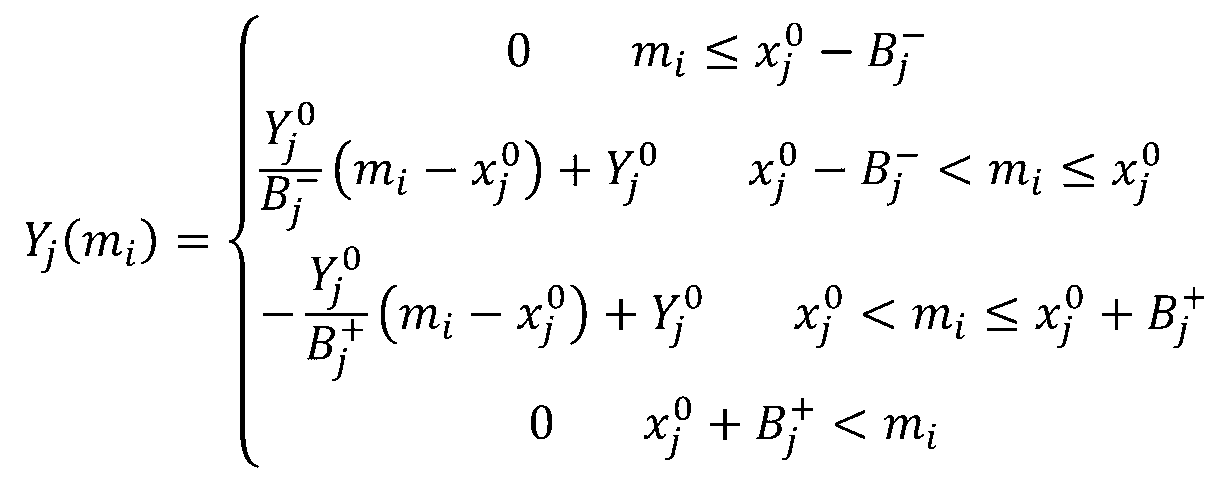

また、ターゲットとするピーク成分と重なる他の成分(例えば、同じ質量数の別種の質量ピーク)が観測される場合がある。このような場合、ターゲットするピーク成分と重なる他の成分を三角形状関数で近似することでターゲットとするピーク成分を求める。
第3実施形態において注目しているフラグメントの質量数を計算して以下に示しておく。同位体の原子量数は、http://physics.nist.gov/に依った。

Znは5つの同位体が知られ、TOF-SIMS分析では、そのうち64Zn,66Zn,68Znに関連したフラグメントが主に検出される。第3実施形態では、最も存在比率の高い64Znに着目した。64ZnとP-OHを含有するリン化合物との結合を示すフラグメントには、64ZnPO4H-、64ZnP2O6H-、64ZnP2O7H-、64ZnP3O9H-等が検出されるが、比較的質量ピーク強度の大きい64ZnPO4H-に着目する。
負の2次イオンスペクトルの質量数=159.5~160.3の範囲に着目し、64Zn31P16O4 1H-に相当する158.890近傍の質量ピークを近似した三角形状関数とmiのデータから、カウント数の総和を計算し、CTで規格化した値を64ZnPO4H-の質量ピーク強度I(64ZnPO4H-)とする。
I(64ZnPO4H-)=1514/8571746=1.77×10-4
となる。

(i)ターゲットとするピーク位置近傍の測定データciを再現する近似曲線yiを得るには、「バックグランドb0」と「他の成分の三角形状関数近似」の曲線と、「ターゲットとする三角形状関数Yj(mi)」の曲線が必要である。
(ii)図12の例では、質量数(m/z)が159.7~160.2において、測定データciを再現した「近似曲線yi」を得るために、「バックグランドb0」と、「ターゲットとする三角形状関数Yj(mi)」の曲線(表2において、j=2)と、「他の成分の三角形状関数近似」の曲線2つ(表6において、j=0,1)を用いた。
負の2次イオンスペクトルの質量数=70.7~71.4の範囲に着目し、カーブフィッティングより得た12C3 1H3 16O2 -に相当する71.013近傍の質量ピークを近似した三角形状関数Yk(mi)とmiのデータから、カウント数の総和を計算し、CTで規格化した値をC3H3O2 -の質量ピーク強度I(C3H3O2 -)とする。
負の2次イオンスペクトルの質量数=62.5~63.3の範囲に着目し、31P16O2 -に相当する62.964近傍の質量ピークを近似した三角形状関数とmiのデータから、カウント数の総和を計算し、CTで規格化した値をPO2 -の質量ピーク強度I(PO2 -)とする。
負の2次イオンスペクトルの質量数=78.5~79.3の範囲に着目し、31P16O3 -に相当する78.959近傍の質量ピークを近似した三角形状関数とmiのデータから、カウント数の総和を計算し、CTで規格化した値をPO3 -の質量ピーク強度I(PO3 -)とする。
これらの成分を含む混合物の硬化物により形成されたガスバリア性層であれば、ポリカルボン酸由来のカルボキシル基は、Znを介して金属イオン架橋を形成し、またZnはP-OH基を含むリン化合物とも反応し、耐水性のある結合を形成する。詳細なメカニズムは不明であるが、これらのZnを介した金属イオン架橋やZnとリン化合物との結合がガスバリア層中に均一に適量存在することにより、緻密なガスバリア性層を形成するとともに、レトルト処理等でガスバリア性層が過度に膨潤・収縮するのを抑制していると考えられる。
第3実施形態においては、例えば、ポリカルボン酸に対するリン酸の濃度が、上記Zn組成比とI(64ZnPO4H-)/I(C3H3O2 -)の値を制御するための因子の1つとして挙げられる。
ポリカルボン酸は、分子内に2個以上のカルボキシ基を有するものである。具体的には、アクリル酸、メタアクリル酸、イタコン酸、フマル酸、クロトン酸、桂皮酸、3-ヘキセン酸、3-ヘキセン二酸等のα,β-不飽和カルボン酸の単独重合体またはこれらの共重合体が挙げられる。また、上記α,β-不飽和カルボン酸と、エチルエステル等のエステル類、エチレン等のオレフィン類等との共重合体であってもよい。
亜鉛(Zn)は、リン化合物と耐水性のあるリン酸Zn結合を形成でき、TOF-SIMS分析により、64ZnPO4H-で表される質量ピークが検出できる。また、ガスバリア性層にポリカルボン酸を含む場合、ポリカルボン酸と塩を形成する。Znは、ガスバリア性層を形成する混合物中に添加できる亜鉛や亜鉛化合物であればよく、例えば、金属亜鉛、酸化亜鉛(ZnO)、亜鉛化合物等を用いることができる。亜鉛の添加量は、上記ポリカルボン酸のカルボキシル基1molに対して、0.1mol以上0.5mol以下とすることができる。
前述のように、ガスバリア性層を質量分析したとき、好ましくはPO2 -および/またはPO3 -が検出される。このようなガスバリア性層を設けるためには、硬化前の混合物は、リン化合物またはその塩を含むことが好ましい。
リン化合物またはその塩におけるリン化合物は、分子構造中に1つ以上の-P-OH基を含む。リン化合物は塩として混合物に配合されてもよい。
レトルト処理後の水蒸気バリア性をさらに向上する観点から、リン化合物は、好ましくは2個以上の-P-OH基を含み、より好ましくは3個以上の-P-OH基を含む。また、生産性の観点から、リン化合物中の-P-OH基の数は、例えば、10個以下であってもよい。
リン化合物の具体例として、リン酸、亜リン酸、ホスホン酸、次亜リン酸、ポリリン酸これらの誘導体が挙げられる。
ポリリン酸は、具体的には、分子構造中に2以上のリン酸の縮合構造を有し、たとえば、2リン酸(ピロリン酸)、三リン酸、4つ以上のリン酸が縮合したポリリン酸などが挙げられる。
誘導体の具体例として、リン酸化澱粉、リン酸架橋澱粉等の上述のリン化合物のエステル;塩化物等のハロゲン化物;十酸化四リン酸等の無水物;およびニトリロトリス(メチレンホスホン酸)、N,N,N‘,N’-エチレンジアミンテトラキス(メチレンホスホン酸)等のリン原子に結合する水素原子がアルキル基に置換された構造を有する化合物が挙げられる。
バリア性および生産性のバランスをさらに向上させる観点から、リン化合物は、リン酸、亜リン酸、次亜リン酸、ポリリン酸、ホスホン酸およびこれらの塩からなる群より選択される1種または2種以上であり、より好ましくはリン酸および亜リン酸、ホスホン酸およびこれらの塩からなる群より選択される少なくとも1つである。
また、リン化合物の塩における塩の具体例として、ナトリウム、カリウム等の1価の金属の塩;アンモニウム塩が挙げられる。バリア性の観点から、リン化合物の塩は好ましくはアンモニウム塩である。
リン化合物のP原子の濃度は、化合物中における上記ポリカルボン酸中のカルボキシル基1molに対し、典型的には5×10⁻⁴mol以上、好ましくは1×10⁻³mol以上、より好ましくは5×10⁻³mol以上であり、また典型的には0.3mol以下、好ましくは0.15mol以下、より好ましくは0.1mol以下である。リン酸のように化学式中にP原子が1個含まれるリン化合物は、P原子のモル数とリン化合物のモル数は同じ意味になる。
このような濃度のリン化合物またはその塩に由来するリン化合物であれば、耐水性のあるリン化合物とZn結合を確実に形成することで、レトルト処理等でガスバリア性層が過度に膨潤・収縮するのを抑制し、レトルト処理後のガスバリア性積層体のガスバリア性をより向上する事ができると考えられる。リン化合物とZn結合の存在は、前述のTOF-SIMS分析で得られる64ZnPO4H-の質量ピークに反映されている。
第3実施形態に係るガスバリア性層を構成する混合物は、その他成分として、例えばポリアミンを含んでもよいし、含まなくてもよい。ポリアミンを含む場合、得られるガスバリア性積層体のバリア性を向上できるとともに、得られるガスバリア性積層体の層間接着性を向上でき、耐デラミ性を良好にすることができる。
尚、TOF-SIMS分析において検出されるフラグメントは、独立して検出されるため、TOF-SIMS分析結果を解析して得られるI(64ZnPO4H-)/I(C3H3O2 -)、(I(PO2 -)+I(PO3 -))/I(C3H3O2 -)、I(PO2 -)/I(PO3 -)の値は、ポリアミンの有無に左右されない。
ここで、第3実施形態において、ポリアミンの分子量は沸点上昇法や粘度法を用いて測定することができる。
第3実施形態に係るガスバリア性層は、例えば、以下のようにして製造することができる。
まず、ポリカルボン酸を構成するカルボキシ基の完全または部分中和溶液を調製する。
また、乾燥・硬化後のガスバリア性層の平均厚みは0.05μm以上10μm以下が好ましく、0.08μm以上5μm以下がより好ましく、0.1μm以上1μm以下がさらに好ましい。上記上限値以下であると、得られるガスバリア性積層体やガスバリア性フィルムがカールすることを抑制できる。また、上記下限値以上であると、得られるガスバリア性積層体やガスバリア性フィルムのバリア性能をより良好なものとすることができる。
無機物層4を構成する無機物は、例えば、バリア性を有する薄膜を形成できる金属、金属酸化物、金属窒化物、金属弗化物、金属酸窒化物等が挙げられる。
なお、第3実施形態では、周期表の族名は旧CAS式で示している。
なお、酸化ケイ素には、二酸化ケイ素の他、一酸化ケイ素、亜酸化ケイ素が含有されていてもよい。
第3実施形態において、無機物層の厚さは、透過型電子顕微鏡や走査型電子顕微鏡による観察画像により求めることができる。
これらの結合反応を迅速に行うには、その無機原子や化合物が化学的に活性な分子種もしくは原子種であることが望ましい。
基材層2は、ガスバリア用塗材の溶液を塗工できるものであれば、特に限定されず、用いることができる。例えば、熱硬化性樹脂、熱可塑性樹脂、または紙等の有機質材料、ガラス、陶、セラミック、酸化珪素、酸化窒化珪素、窒化珪素、セメント、アルミニウム、酸化アルミニウム、鉄、銅、ステンレス等の金属等の無機質材料、有機質材料同士または有機質材料と無機質材料との組合せからなる多層構造の基材層等が挙げられる。これらの中でも、例えば、包装材料やパネル等の各種フィルム用途の場合、熱硬化性樹脂、熱可塑性樹脂を用いたプラスチックフィルム、または紙等の有機質材料が好ましい。
また、熱可塑性樹脂からなる基材層2は、ガスバリア性積層体8の用途に応じて、単層であっても、二種以上の層であってもよい。
また、上記熱硬化性樹脂、熱可塑性樹脂により形成されたフィルムを少なくとも一方向、好ましくは二軸方向に延伸して基材層としてもよい。
ガスバリア性積層体8において、基材層2と無機物層4との接着性を向上させる観点から、基材層2の表面にアンダーコート層3を形成することができる。アンダーコート層は、エポキシ(メタ)アクリレート系化合物またはウレタン(メタ)アクリレート系化合物により形成する層であることが好ましい。
第3実施形態のアンダーコート層の厚さは、コート量として、通常、0.01~100g/m2、好ましくは0.05~50g/m2の範囲にある。
また、ガスバリア性層5上に接着剤層6を設けてもよい。接着剤層6は、公知の接着剤を含むものであればよい。接着剤としては、有機チタン系樹脂、ポリエチレンイミン系樹脂、ウレタン系樹脂、エポキシ系樹脂、アクリル系樹脂、ポリエステル系樹脂、オキサゾリン基含有樹脂、変性シリコーン樹脂及びアルキルチタネート、ポリエステル系ポリブタジエン等から組成されているラミネート接着剤、または一液型、二液型のポリオールと多価イソシアネート、水系ウレタン、アイオノマー等が挙げられる。または、アクリル系樹脂、酢酸ビニル系樹脂、ウレタン系樹脂、ポリエステル樹脂等を主原料とした水性接着剤を用いてもよい。
図13は、第4実施形態におけるガスバリア性積層体の構成の一例を模式的に示す断面図である。図13に示したガスバリア性積層体100は、基材層101と、基材層101の少なくとも一方の面に設けられたガスバリア性層103と、基材層101とガスバリア性層103との間に設けられた無機物層102と、を含む。そして、ガスバリア性層103が、ポリカルボン酸と、ポリアミン化合物と、多価金属化合物と、1つ以上の-P-OH基を含むリン化合物またはその塩と、を含む混合物の硬化物により構成される。
各層の具体的構成については後述する。
さらに具体的には、ガスバリア性積層体100は、レトルト処理後の酸素バリア性や水蒸気バリア性等のバリア性能に優れるものである。また、ガスバリア性積層体100においては、ガスバリア性層103が、上述の混合物の硬化物により構成されるため、たとえばガスバリア性層103を得る際の硬化時間、具体的には加熱処理時間が短くてもバリア性に優れるガスバリア性積層体100を得ることができる。
また、ガスバリア性層103が、ポリカルボン酸と、ポリアミン化合物と、多価金属化合物と、1つ以上の-P-OH基を含むリン化合物またはその塩と、を含む混合物の硬化物により構成されるため、たとえば、バリア性および耐水性に優れるガスバリア性積層体100を得ることも可能となる。
ガスバリア性積層体110においても、ガスバリア性積層体100と同様の効果が得られる。加えて、ガスバリア性積層体110では、基材層101と無機物層102との間にアンダーコート層104を設けることにより、基材層101と無機物層102との接着性をさらに向上することができる。
以下、ガスバリア性積層体に含まれる層の構成をさらに具体的に説明する。まず、ガスバリア性層103について説明する。
ガスバリア性層103は、ポリカルボン酸と、ポリアミン化合物と、多価金属化合物と、を含む混合物の硬化物により構成される。さらに具体的には、ガスバリア性層103は、上記硬化物により構成されたフィルム(ガスバリア性フィルム10)である。
さらに具体的には、ガスバリア性層103は、たとえば、無機物層102等のガスバリア性層103の直下に配置される層に、硬化前の混合物すなわちガスバリア用塗材を塗布した後、乾燥、熱処理をおこない、ガスバリア用塗材を硬化させて得られるものである。
また、塗工後に得られるガスバリア性層103のバリア性向上の観点から、上記γ/αは、好ましくは1.00以下であり、より好ましくは0.80以下、さらに好ましくは0.60以下、さらにより好ましくは0.40以下、よりいっそう好ましくは0.20以下、さらにまた好ましくは0.10以下である。
ガスバリア性層103の赤外線吸収スペクトルにおいて、B/Aで示されるアミド結合の面積比率は、レトルト処理後のガスバリア性能をより一層向上する観点から、好ましくは0.200以上であり、より好ましくは0.220以上、さらに好ましくは0.250以上である。
また、バリア性および生産性のバランスをより一層向上する観点から、上記B/Aで示されるアミド結合の面積比率は、好ましくは0.370以下であり、より好ましくは0.350以下、さらに好ましくは0.300以下である。
また、上記C/Aで示されるカルボン酸の面積比率の下限は、限定されないが、たとえば0.000以上であり、また、たとえば0.0001以上であってもよい。
また、レトルト処理後のガスバリア性能をより一層向上する観点から、上記D/Aは、好ましくは0.800以下であり、より好ましくは0.780以下、さらに好ましくは0.760以下、さらにより好ましくは0.740以下である。
また、レトルト後のバリア性向上の観点から、B/Aで示されるアミド結合の面積比率に対するD/Aで示されるカルボン酸塩の面積比率は、好ましくは4.0以下であり、より好ましくは3.5以下、さらにより好ましくは3.0以下である。
まず、ガスバリア性層103から1cm×3cmの測定用サンプルを切り出す。次いで、そのガスバリア性層103の表面の赤外線吸収スペクトルを赤外線全反射測定(ATR法)により得る。得られた赤外線吸収スペクトルから、以下の手順(1)~(4)で上記全ピーク面積A~Dを算出する。
(1)1780cm-1と1493cm-1の吸光度を直線(N)で結び、吸収帯1493cm-1以上1780cm-1以下の範囲の吸光スペクトルとNで囲まれる面積を全ピーク面積Aとする。
(2)1690cm-1の吸光度(Q)から垂直に直線(O)を下ろし、NとOの交差点をPとし、1598cm-1の吸光度(R)から垂直に直線(S)を下ろし、NとSの交差点をTとし、吸収帯1598cm-1以上1690cm-1以下の範囲の吸収スペクトルと直線S、点T、直線N、点P、直線O、吸光度Q、吸光度Rで囲まれる面積を全ピーク面積Bとする。
(3)吸収帯1690cm-1以上1780cm-1以下の範囲の吸収スペクトルと吸光度Q、直線O、点P、直線Nで囲まれる面積を全ピーク面積Cとする。
(4)吸収帯1493cm-1以上1598cm-1以下の範囲の吸収スペクトルと吸光度R、直線S、点T、直線Nで囲まれる面積を全ピーク面積Dとする。
次いで、上記の方法で求めた面積から面積比B/A、C/A、D/Aを求める。
(ポリカルボン酸)
ポリカルボン酸は、分子内に2個以上のカルボキシ基を有するものである。具体的には、(メタ)アクリル酸、イタコン酸、フマル酸、クロトン酸、桂皮酸、3-ヘキセン酸、3-ヘキセン二酸等のα,β-不飽和カルボン酸の単独重合体またはこれらの共重合体が挙げられる。また、上記α,β-不飽和カルボン酸と、エチルエステル等のエステル類、エチレン等のオレフィン類等との共重合体であってもよい。
また、第4実施形態において、ポリメタクリル酸とは、メタクリル酸の単独重合体、メタクリル酸と他のモノマーとの共重合体の両方を含む。メタクリル酸と他のモノマーとの共重合体の場合、ポリメタクリル酸は、重合体100質量%中に、メタクリル酸由来の構成単位を、通常は90質量%以上、好ましくは95質量%以上、より好ましくは99質量%以上含む。
ここで、第4実施形態において、ポリカルボン酸の分子量はポリエチレンオキサイド換算の重量平均分子量であり、ゲルパーミエーションクロマトグラフィー(GPC)を用いて測定することができる。
部分中和物は、ポリカルボン酸重合体の水溶液に揮発性塩基を添加することにより調製できるが、ポリカルボン酸と揮発性塩基の量比を調節することにより、所望の中和度とすることができる。第4実施形態においてはポリカルボン酸の揮発性塩基による中和度は、ポリアミン化合物のアミノ基との中和反応に起因するゲル化を十分に抑制する観点から、70~300当量%が好ましく、90~250当量%がより好ましく、100~200当量%がさらに好ましい。
揮発性塩基としては、たとえば、アンモニア、モルホリン、アルキルアミン、2-ジメチルアミノエタノール、N-メチルモノホリン、エチレンジアミン、トリエチルアミン等の三級アミンまたはこれらの水溶液、あるいはこれらの混合物が挙げられる。良好なガスバリア性を得る観点から、アンモニア水溶液が好ましい。
硬化前の混合物は、ポリアミン化合物を含む。ポリアミン化合物を含むことによって、得られるガスバリア性材料のバリア性を向上できる。
ポリアミン化合物は、主鎖あるいは側鎖あるいは末端にアミノ基を2つ以上有する化合物であり、好ましくはポリマーである。具体的には、ポリアリルアミン、ポリビニルアミン、ポリエチレンイミン、ポリ(トリメチレンイミン)等の脂肪族ポリアミン類;ポリリジン、ポリアルギニンのように側鎖にアミノ基を有するポリアミド類;等が挙げられる。また、アミノ基の一部を変性したポリアミンでもよい。
良好なガスバリア性を得る観点から、ポリアミン化合物は好ましくはポリエチレンイミンを含み、より好ましくはポリエチレンイミンである。
ここで、第4実施形態において、ポリアミン化合物の分子量は沸点上昇法や粘度法を用いて測定することができる。
同様の観点から、(混合物中のポリアミン化合物に含まれるアミノ基のモル数)/(混合物中のポリカルボン酸に含まれる-COO-基のモル数)は、好ましくは0.90以下であり、より好ましくは0.85以下、さらに好ましくは0.80以下、さらにより好ましくは0.75以下、よりいっそう好ましくは0.70以下である。
かかる理由の詳細は、明らかではないが、ポリアミン化合物を構成するアミノ基によるアミド架橋と、ポリカルボン酸と多価金属との塩を構成する多価金属による金属架橋がバランスよく緻密な構造を形成することにより、レトルト処理後のガスバリア性能に優れたガスバリア性層103およびこれを有するガスバリア性積層体を得ることができると考えられる。
多価金属化合物は、具体的には周期表の2~13族に属する金属および金属化合物であり、さらに具体的には、マグネシウム(Mg)、カルシウム(Ca)、ストロンチウム(Sr)、バリウム(Ba)、鉄(Fe)、コバルト(Co)、ニッケル(Ni)、銅(Cu)、亜鉛(Zn)、アルミニウム(Al)等の2価以上の金属、これら金属の酸化物、水酸化物、ハロゲン化物、炭酸塩、リン酸塩、亜リン酸塩、次亜リン酸塩、硫酸塩若しくは亜硫酸塩等が挙げられる。耐水性や不純物等の観点から金属の酸化物もしくは金属水酸化物が好ましい。
同様の観点から、多価金属化合物は、好ましくはZn、Ca、Mg、BaおよびAlからなる群から選択される1または2以上の2価以上の金属の化合物であり、より好ましくはZnの化合物である。
同様の観点から、多価金属化合物は、好ましくは酸化マグネシウム、酸化カルシウム、酸化バリウム、酸化亜鉛、水酸化マグネシウム等の酸化物および水酸化カルシウム、水酸化バリウム、水酸化亜鉛等の水酸化物からなる群から選択される1または2以上の化合物であり、より好ましくは酸化亜鉛および水酸化亜鉛の少なくとも1つであり、さらに好ましくは酸化亜鉛である。
同様の観点から、(混合物中の多価金属化合物のモル数)/(混合物中のポリカルボン酸に含まれる-COO-基のモル数)は、好ましくは0.80以下であり、より好ましくは0.70以下、さらに好ましくは0.60以下、さらにより好ましくは0.55以下、よりいっそう好ましくは0.50以下である。
同様の観点から、(混合物中の多価金属化合物のモル数)/(混合物中のポリアミン化合物由来のアミノ基のモル数)は、好ましくは0.65以下であり、より好ましくは0.60以下、さらに好ましくは0.55以下である。
リン化合物またはその塩におけるリン化合物は、分子構造中に1つ以上の-P-OH基を含む。リン化合物は塩として混合物に配合されてもよい。
レトルト処理後の水蒸気バリア性をさらに向上する観点から、リン化合物は、好ましくは2個以上の-P-OH基を含み、より好ましくは3個以上の-P-OH基を含む。また、ガスバリア塗材の液安定性向上の観点から、リン化合物中の-P-OH基の数は、たとえば2個以下であってもよい。
ポリリン酸は、具体的には、分子構造中に2以上のリン酸の縮合構造を有し、たとえば、二リン酸(ピロリン酸)、三リン酸、4つ以上のリン酸が縮合したポリリン酸などが挙げられる。
誘導体の具体例として、リン酸化澱粉、リン酸架橋澱粉等の上述のリン化合物のエステル;
塩化物等のハロゲン化物;
十酸化四リン等の無水物;および
ニトリロトリス(メチレンホスホン酸)、N,N,N',N'-エチレンジアミンテトラキス(メチレンホスホン酸)等のリン原子に結合する水素原子がアルキル基に置換された構造を有する化合物が挙げられる。
また、バリア塗材(混合物)の液安定性向上の観点から、(混合物中のリン化合物またはその塩由来のP原子のモル数)/(混合物中のポリカルボン酸由来の-COO-基のモル数)は、好ましくは0.3以下であり、より好ましくは0.1以下、さらに好ましくは0.08以下、さらにより好ましくは0.005以下である。
たとえば、混合物は炭酸系アンモニウム塩をさらに含むことが好ましい。炭酸系アンモニウム塩は、多価金属化合物を、炭酸多価金属アンモニウム錯体の状態にして、多価金属化合物の溶解性を向上させ、多価金属化合物を含む均一な溶液を調製するために添加するものである。硬化前の混合物が炭酸系アンモニウム塩を含むことにより、多価金属化合物の溶解量を増やすことができ、その結果、多価金属化合物が配合された混合物をさらに均質なものとすることができる。
炭酸系アンモニウム塩として、たとえば、炭酸アンモニウム、炭酸水素アンモニウム等が挙げられ、揮発しやすく、得られるガスバリア性層に残存し難い点から、炭酸アンモニウムが好ましい。
(混合物中の炭酸系アンモニウム塩のモル数)/(混合物中の多価金属化合物のモル数)は、多価金属化合物の溶解性をより一層向上する観点から、0.05以上が好ましく、0.10以上がより好ましく、0.25以上がさらに好ましく、0.50以上がさらにより好ましく、0.75以上がよりいっそう好ましい。
また、ガスバリア用塗材としての塗工性をより一層向上する観点から、(ガスバリア用塗材中の炭酸系アンモニウム塩のモル数)/(ガスバリア用塗材中の多価金属化合物のモル数)は、10.0以下が好ましく、5.0以下がより好ましく、2.0以下がさらに好ましく、1.5以下がさらにより好ましい。
界面活性剤の添加量は、混合物の固形分全体を100質量%としたとき、0.01~3質量%が好ましく、0.01~1質量%がより好ましい。
ポリオキシアルキレンアルキルエーテル類としては、たとえば、ポリオキシエチレンオレイルエーテル、ポリオキシエチレンラウリルエーテル等のポリオキシエチレンアルキルエーテル類を挙げることができる。
ポリオキシアルキレン脂肪酸エステル類としては、たとえば、ポリオキシエチレンオレイン酸エステル、ポリオキシエチレンラウリン酸エステル、ポリオキシエチレンジステアリン酸エステル等を挙げることができる。
ソルビタン脂肪酸エステル類としては、たとえば、ソルビタンラウレート、ソルビタンモノステアレート、ソルビタンモノオレエート、ソルビタンセスキオレート、ポリオキシエチレンモノオレエート、ポリオキシエチレンステアレート等を挙げることができる。
シリコーン系界面活性剤としては、たとえば、ジメチルポリシロキサン等を挙げることができる。
アセチレンアルコール系界面活性剤としては、たとえば、2,4,7,9-テトラメチル-5-デシン-4,7-ジオール、3,6-ジメチル-4-オクチン-3,6-ジオール、3,5-ジメチル-1-ヘキシン-3オール等を挙げることができる。
含フッ素系界面活性剤としては、たとえば、フッ素アルキルエステル等を挙げることができる。
ガスバリア性層103は、具体的には、硬化前の混合物(ガスバリア性用塗材)を塗工し、硬化することにより製造できる。
混合物は、以下のようにして得ることができる。
まず、ポリカルボン酸に、適宜揮発性塩基を加えることによりポリカルボン酸のカルボキシ基を完全にまたは部分的に中和する。さらに多価金属塩化合物および適宜炭酸系アンモニウム塩を混合して、揮発性塩基と中和した上記ポリカルボン酸のカルボキシ基の全部または一部、および揮発性塩基と中和しなかったポリカルボン酸のカルボキシ基において金属塩を形成する。
その後、さらにポリアミン化合物を添加し、最後にリン化合物またはその塩を添加することによって、硬化前の混合物が得られる。これにより、リン化合物と多価金属化合物またはポリアミンのアミノ基とにおいて塩が形成される。
このような手順でポリカルボン酸、多価金属塩化合物、リン化合物またはその塩、適宜炭酸系アンモニウム塩およびポリアミン化合物を混合することにより、凝集物の生成を抑制でき、より均一な混合物を得ることができる。これにより、ポリカルボン酸に含まれる-COO-基とポリアミン化合物に含まれるアミノ基との脱水縮合反応をより効果的に進めることが可能となる。
まず、ポリカルボン酸を構成するカルボキシ基の完全または部分中和溶液を調製する。
ポリカルボン酸に、揮発性塩基を添加して、ポリカルボン酸のカルボキシ基が完全中和または部分中和する。当該ポリカルボン酸のカルボキシ基を中和することにより、多価金属化合物やポリアミン化合物の添加時にポリカルボン酸を構成するカルボキシ基と、多価金属化合物やポリアミン化合物を構成するアミノ基とが反応することによって発生するゲル化を効果的に防止し、より均一な混合物を得ることができる。
次いで、多価金属塩化合物および炭酸系アンモニウム塩を添加、溶解させ、生成された多価金属イオンによりポリカルボン酸を構成する-COO-基との多価金属塩を形成する。このとき多価金属イオンと塩を形成する-COO-基は上記塩基と中和しなかったカルボキシ基および塩基によって中和された-COO-基の双方をいう。塩基と中和した-COO-基の場合は上記多価金属化合物由来の多価金属イオンが入れ替わって配位して-COO-基の多価金属塩を形成する。
そして、多価金属塩を形成した後、さらにポリアミン化合物、および、リン化合物またはその塩を添加することによって、混合物を得ることができる。このとき、-COO-基に配位した多価金属塩がリン化合物中の-P-O-基にも配位して、-COO-多価金属-O-P-構造が形成される。また、ポリアミン中の-NH2基とリン化合物中の-P-O-基との間にイオン結合が形成される。
また、ガスバリア性積層体全体の薄型化の観点から、乾燥、硬化後のガスバリア性層103の厚みは、好ましくは15μm以下であり、より好ましくは5μm以下、さらに好ましくは1μm以下である。
基材層101は、単層であっても、2種以上の層であってもよい。基材層101の形状は、限定されないが、たとえば、シートまたはフィルム形状、トレー、カップ、中空体等の形状が挙げられる。
また、耐ピンホール性、耐破れ性および耐熱性等に優れる観点では、ポリアミド、ポリエチレンテレフタレートおよびポリブチレンテレフタレートからなる群から選択される1または2以上の樹脂が好ましい。同様の観点から、基材層101は、好ましくはポリアミド、ポリエチレンテレフタレートおよびポリブチレンテレフタレートからなる群から選択される1または2以上の樹脂を含む層であり、より好ましくはこれら1または2以上の樹脂の層である。
透明性、剛性および耐熱性に優れる観点から、基材層101は、好ましくはポリプロピレン、ポリエチレンテレフタレート、ポリエチレンナフタレート、ポリアミド、ポリイミドおよびポリブチレンテレフタレートからなる群から選択される1または2以上の熱可塑性樹脂により形成された二軸延伸フィルムであり、より好ましくはポリアミド、ポリエチレンテレフタレートおよびポリブチレンテレフタレートからなる群から選択される1または2以上の熱可塑性樹脂により形成された二軸延伸フィルムである。
さらに、基材層101はガスバリア性層103との接着性を改良するために、表面処理が施されたものであってもよい。具体的には、基材層101のガスバリア性層103との対向面に、コロナ処理、火炎処理、プラズマ処理、プライマーコート処理等の表面活性化処理をおこなってもよい。
無機物層102を構成する無機物は、たとえば、バリア性を有する薄膜を形成できる金属、金属酸化物、金属窒化物、金属弗化物、金属酸窒化物等が挙げられる。
無機物層102を構成する無機物としては、たとえば、ベリリウム、マグネシウム、カルシウム、ストロンチウム、バリウム等の周期表2A族元素;チタン、ジルコニウム、ルテニウム、ハフニウム、タンタル等の周期表遷移元素;亜鉛等の周期表2B族元素;アルミニウム、ガリウム、インジウム、タリウム等の周期表3A族元素;ケイ素、ゲルマニウム、錫等の周期表4A族元素;セレン、テルル等の周期表6A族元素等の単体、酸化物、窒化物、弗化物、または酸窒化物等から選択される一種または二種以上を挙げることができる。
なお、第4実施形態では、無機物層102についての周期表の族名は旧CAS式で示している。
なお、酸化ケイ素には、二酸化ケイ素の他、一酸化ケイ素、亜酸化ケイ素が含有されていてもよい。
無機物層102は単層の無機物層から構成されていてもよいし、複数の無機物層から構成されていてもよい。また、無機物層102が複数の無機物層から構成されている場合には同一種類の無機物層から構成されていてもよいし、異なった種類の無機物層から構成されていてもよい。
ここで、無機物層102の厚さは、たとえば透過型電子顕微鏡や走査型電子顕微鏡による観察画像により求めることができる。
また、ガスバリア性積層体のバリア性と生産性とのバランスを向上する観点から、無機物層102は好ましくは蒸着膜である。
基材層101と無機物層102との間にはアンダーコート層104が設けられてもよく(図14)、アンダーコート層104を設けることによりこれらの接着性をさらに向上することができ、また、レトルト処理後におけるバリア性をさらに向上することができる。
芳香族環構造を主鎖に有するポリウレタン樹脂として、さらに具体的には、特開2018-171827号公報に記載のものを用いることができる。
オキサゾリン系樹脂組成物は、たとえば、オキサゾリン基含有量が6.0~9.0mmol/gであるオキサゾリン基含有水性ポリマー、カルボキシ基含有量が0.5~3.5mmol/gである水性(メタ)アクリル樹脂およびカルボキシ基含有量が0.5~2.0mmol/gである水性ポリエステル樹脂により構成されている。
また、オキサゾリン系樹脂組成物は、オキサゾリン基含有水性ポリマー、水性(メタ)アクリル樹脂および水性ポリエステル樹脂の合計量を100質量%として、たとえば、オキサゾリン基含有水性ポリマーを10~55質量%、水性(メタ)アクリル樹脂を10~80質量%、水性ポリエステル樹脂を10~80質量%含有する。
また、オキサゾリン系樹脂組成物においては、たとえば、オキサゾリン基のモル数とカルボキシ基のモル数の比率〔オキサゾリン基のモル数(xmmol)とカルボキシ基のモル数(ymmol)の比(x/y)×100[mol%]で示される。〕が150~420mol%である。
アンダーコート層104に用いられるオキサゾリン樹脂として、さらに具体的には、国際公開第2016/186074号に記載のものを用いることができる。
また、経済的であるという観点からアンダーコート層104の厚さは、好ましくは1.0μm以下であり、より好ましくは0.6μm以下、さらに好ましくは0.5μm以下であり、また、たとえば0.1μm以下、またはたとえば0.05μm以下であってもよい。
ガスバリア性積層体には、接着剤層がさらに設けられてもよい。なお、接着剤層からアンダーコート層104は除かれる。
接着剤層は、たとえば、ガスバリア性層103とガスバリア性層103の上層との間に設けられる。また、上記上層が複数の層から形成されるとき、複数の層の間に接着層が設けられていてもよい。ここで、ガスバリア性層103の上層とは、ガスバリア性層103の無機物層102と対向面との反対側の面に積層される層をいう。
接着剤層は、公知の接着剤を含むものであればよい。接着剤としては、有機チタン樹脂、ポリエチレンイミン樹脂、ウレタン樹脂、エポキシ樹脂、アクリル樹脂、ポリエステル樹脂、オキサゾリン基含有樹脂、変性シリコーン樹脂およびアルキルチタネート、ポリエステルポリブタジエン等から組成されているラミネート接着剤、または一液型、二液型のポリオールと多価イソシアネート、水系ウレタン、アイオノマー等が挙げられる。または、アクリル樹脂、酢酸ビニル樹脂、ウレタン樹脂、ポリエステル樹脂等を主原料とした水性接着剤を用いてもよい。
また、ガスバリア性積層体100の用途に応じて、接着剤に硬化剤、シランカップリング剤等の他の添加物を添加してもよい。ガスバリア性積層体の用途が、レトルト等の熱水処理に用いられるものである場合、耐熱性や耐水性の観点から、ポリウレタン接着剤に代表されるドライラミネート用接着剤が好ましく、溶剤系の二液硬化タイプのポリウレタン接着剤がより好ましい。
第4実施形態において、ガスバリア性積層体100の製造方法は、たとえば、基材層101を準備する工程と、基材層101上に無機物層102を形成する工程と、無機物層102が形成された基材層101の上部にガスバリア性層103を形成する工程と、を含む。また、無機物層102を形成する工程の後、ガスバリア性層103を形成する工程の前に、無機物層102上にアンダーコート層104を形成する工程をさらに含んでもよい。
また、得られるガスバリア性積層体がカールすることを抑制する観点、および、ポリカルボン酸に含まれる-COO-基とポリアミン化合物に含まれるアミノ基との脱水縮合反応をより効果的に進める観点から、ウェット厚みは、好ましくは300μm以下であり、より好ましくは200μm以下、さらに好ましくは100μm以下である。
乾燥、加熱処理する方法は、本発明の効果が得られるものであれば限定されず、ガスバリア用塗材を硬化させられるもの、硬化したガスバリア用塗材を加熱できる方法であればよい。たとえば、オーブン、ドライヤー等の対流伝熱によるもの、加熱ロール等の伝導伝熱によるもの、赤外線、遠赤外線・近赤外線のヒーター等の電磁波を用いる輻射伝熱によるもの、マイクロ波等内部発熱によるものが挙げられる。乾燥、加熱処理に使用する装置としては製造効率の観点から乾燥と加熱処理の双方をおこなえる装置が好ましい。その中でも具体的には乾燥、加熱、アニーリング等の種々の用途に利用できるという観点から熱風オーブンを用いることが好ましく、また、フィルムへの熱伝導効率に優れているという観点から加熱ロールを用いることが好ましい。また、乾燥、加熱処理に使用する方法を適宜組み合わせてもよい。具体的には、熱風オーブンと加熱ロールを併用してもよく、たとえば、熱風オーブンでガスバリア用塗材を乾燥後、加熱ロールで加熱処理をおこなえば、加熱処理工程が短時間となり製造効率の観点から好ましい。また、熱風オーブンのみで乾燥と加熱処理をおこなうことが好ましい。
なお、ポリカルボン酸に含まれる-COO-基とポリアミン化合物に含まれるアミノ基との脱水縮合反応を効果的に進める観点から、加熱処理温度および加熱処理時間はガスバリア用塗材のウエット厚みに応じて調整することが重要である。適切な加熱処理温度および加熱処理時間を選択することで、適切な架橋構造が形成される。
(積層構造例1)基材層101(PET基材)/無機物層102(アルミナ蒸着層)/ガスバリア性層103/接着剤層/ポリオレフィン層
(積層構造例2)基材層101(PET基材)/アンダーコート層104/無機物層102(アルミナ蒸着層)/ガスバリア性層103/接着剤層/ポリオレフィン層
(積層構造例3)基材層101(PET基材)/無機物層102(アルミナ蒸着層)/ガスバリア性層103/接着剤層/ポリアミド層/接着剤層/ポリオレフィン層
(積層構造例4)基材層101(PET基材)/アンダーコート層104/無機物層102(アルミナ蒸着層)/ガスバリア性層103/接着剤層/ポリアミド層/接着剤層/ポリオレフィン層
ここで、積層構造中に、ポリエチレン、ポリプロピレン、ポリ(4-メチル-1-ペンテン)、ポリ(1-ブテン)等のポリオレフィンにより構成されるポリオレフィン層を含むことにより、ガスバリア性積層体において、耐ピンホール性、耐破れ性および耐熱性等を良好にしながら、高湿度下のガスバリア性能やレトルト処理後のガスバリア性能の低下をより一層抑制することができる。
図15は、第5実施形態におけるガスバリア性積層体の構成の一例を模式的に示す断面図である。図15に示したガスバリア性積層体100は、基材層101と、基材層101の少なくとも一方の面に設けられたガスバリア性層103と、基材層101とガスバリア性層103との間に設けられた無機物層102と、を含む。そして、ガスバリア性層103が、ポリカルボン酸と、ポリアミン化合物と、多価金属化合物と、を含む混合物の硬化物により構成される。
各層の具体的構成については後述する。
さらに具体的には、ガスバリア性積層体100は、レトルト処理後の酸素バリア性や水蒸気バリア性等のバリア性能に優れるものである。また、ガスバリア性積層体100においては、ガスバリア性層103が、上述の混合物の硬化物により構成されるため、たとえばガスバリア性層103を得る際の硬化時間、具体的には加熱処理時間が短くてもバリア性に優れるガスバリア性積層体100を得ることができる。
ガスバリア性積層体110においても、ガスバリア性積層体100と同様の効果が得られる。加えて、ガスバリア性積層体110では、基材層101と無機物層102との間にアンダーコート層104を設けることにより、基材層101と無機物層102との接着性をさらに向上することができる。
以下、ガスバリア性積層体に含まれる層の構成をさらに具体的に説明する。まず、ガスバリア性層103について説明する。
ガスバリア性層103は、ポリカルボン酸と、ポリアミン化合物と、多価金属化合物と、を含む混合物の硬化物により構成される。さらに具体的には、ガスバリア性層103は、上記硬化物により構成されたフィルム(ガスバリア性フィルム10)である。
さらに具体的には、ガスバリア性層103は、たとえば、無機物層102等のガスバリア性層103の直下に配置される層に、硬化前の混合物すなわちガスバリア用塗材を塗布した後、乾燥、熱処理をおこない、ガスバリア用塗材を硬化させて得られるものである。
また、塗工後に得られるガスバリア性層103のバリア性向上の観点から、上記γ/αは、好ましくは1.00以下であり、より好ましくは0.80以下、さらに好ましくは0.60以下、さらにより好ましくは0.40以下、よりいっそう好ましくは0.20以下、さらにまた好ましくは0.10以下である。
ガスバリア性層103の赤外線吸収スペクトルにおいて、B/Aで示されるアミド結合の面積比率は、レトルト処理後のガスバリア性能をより一層向上する観点から、好ましくは0.200以上であり、より好ましくは0.250以上、さらに好ましくは0.270以上、さらにより好ましくは0.290以上、よりいっそう好ましくは0.310以上である。
また、バリア性および生産性のバランスをより一層向上する観点から、上記B/Aで示されるアミド結合の面積比率は、好ましくは0.370以下であり、より好ましくは0.360以下、さらに好ましくは0.350以下である。
また、上記C/Aで示されるカルボン酸の面積比率の下限は、限定されないが、たとえば0.000以上であり、また、たとえば0.0001以上であってもよい。
また、レトルト処理後のガスバリア性能をより一層向上する観点から、上記D/Aは、好ましくは0.800以下であり、より好ましくは0.720以下、さらに好ましくは0.700以下、さらにより好ましくは0.680以下である。
また、レトルト後のバリア性向上の観点から、B/Aで示されるアミド結合の面積比率に対するD/Aで示されるカルボン酸塩の面積比率は、好ましくは4.0以下であり、より好ましくは3.5以下、さらにより好ましくは3.0以下、よりいっそう好ましくは2.5以下である。
まず、ガスバリア性層103から1cm×3cmの測定用サンプルを切り出す。次いで、そのガスバリア性層103の表面の赤外線吸収スペクトルを赤外線全反射測定(ATR法)により得る。得られた赤外線吸収スペクトルから、以下の手順(1)~(4)で上記全ピーク面積A~Dを算出する。
(1)1780cm-1と1493cm-1の吸光度を直線(N)で結び、吸収帯1493cm-1以上1780cm-1以下の範囲の吸光スペクトルとNで囲まれる面積を全ピーク面積Aとする。
(2)1690cm-1の吸光度(Q)から垂直に直線(O)を下ろし、NとOの交差点をPとし、1598cm-1の吸光度(R)から垂直に直線(S)を下ろし、NとSの交差点をTとし、吸収帯1598cm-1以上1690cm-1以下の範囲の吸収スペクトルと直線S、点T、直線N、点P、直線O、吸光度Q、吸光度Rで囲まれる面積を全ピーク面積Bとする。
(3)吸収帯1690cm-1以上1780cm-1以下の範囲の吸収スペクトルと吸光度Q、直線O、点P、直線Nで囲まれる面積を全ピーク面積Cとする。
(4)吸収帯1493cm-1以上1598cm-1以下の範囲の吸収スペクトルと吸光度R、直線S、点T、直線Nで囲まれる面積を全ピーク面積Dとする。
次いで、上記の方法で求めた面積から面積比B/A、C/A、D/Aを求める。
(ポリカルボン酸)
ポリカルボン酸は、分子内に2個以上のカルボキシ基を有するものである。具体的には、(メタ)アクリル酸、イタコン酸、フマル酸、クロトン酸、桂皮酸、3-ヘキセン酸、3-ヘキセン二酸等のα,β-不飽和カルボン酸の単独重合体またはこれらの共重合体が挙げられる。また、上記α,β-不飽和カルボン酸と、エチルエステル等のエステル類、エチレン等のオレフィン類等との共重合体であってもよい。
また、第5実施形態において、ポリメタクリル酸とは、メタクリル酸の単独重合体、メタクリル酸と他のモノマーとの共重合体の両方を含む。メタクリル酸と他のモノマーとの共重合体の場合、ポリメタクリル酸は、重合体100質量%中に、メタクリル酸由来の構成単位を、通常は90質量%以上、好ましくは95質量%以上、より好ましくは99質量%以上含む。
ここで、第5実施形態において、ポリカルボン酸の分子量はポリエチレンオキサイド換算の重量平均分子量であり、ゲルパーミエーションクロマトグラフィー(GPC)を用いて測定することができる。
部分中和物は、ポリカルボン酸重合体の水溶液に揮発性塩基を添加することにより調製できるが、ポリカルボン酸と揮発性塩基の量比を調節することにより、所望の中和度とすることができる。第5実施形態においてはポリカルボン酸の揮発性塩基による中和度は、ポリアミン化合物のアミノ基との中和反応に起因するゲル化を十分に抑制する観点から、70~300当量%が好ましく、90~250当量%がより好ましく、100~200当量%がさらに好ましい。
揮発性塩基としては、たとえば、アンモニア、モルホリン、アルキルアミン、2-ジメチルアミノエタノール、N-メチルモノホリン、エチレンジアミン、トリエチルアミン等の三級アミンまたはこれらの水溶液、あるいはこれらの混合物が挙げられる。良好なガスバリア性を得る観点から、アンモニア水溶液が好ましい。
硬化前の混合物は、ポリアミン化合物を含む。ポリアミン化合物を含むことによって、得られるガスバリア性材料のバリア性を向上できる。
ポリアミン化合物は、主鎖あるいは側鎖あるいは末端にアミノ基を2つ以上有する化合物であり、好ましくはポリマーである。具体的には、ポリアリルアミン、ポリビニルアミン、ポリエチレンイミン、ポリ(トリメチレンイミン)等の脂肪族ポリアミン類;ポリリジン、ポリアルギニンのように側鎖にアミノ基を有するポリアミド類;等が挙げられる。また、アミノ基の一部を変性したポリアミンでもよい。
良好なガスバリア性を得る観点から、ポリアミン化合物は好ましくはポリエチレンイミンを含み、より好ましくはポリエチレンイミンである。
ここで、第5実施形態において、ポリアミン化合物の分子量は沸点上昇法や粘度法を用いて測定することができる。
同様の観点から、(混合物中のポリアミン化合物に含まれるアミノ基のモル数)/(混合物中のポリカルボン酸に含まれる-COO-基のモル数)は、好ましくは0.90以下であり、より好ましくは0.85以下、さらに好ましくは0.80以下、さらにより好ましくは0.75以下、よりいっそう好ましくは0.70以下である。
かかる理由の詳細は、明らかではないが、ポリアミン化合物を構成するアミノ基によるアミド架橋と、ポリカルボン酸と多価金属との塩を構成する多価金属による金属架橋がバランスよく緻密な構造を形成することにより、レトルト処理後のガスバリア性能に優れたガスバリア性層103およびこれを有するガスバリア性積層体を得ることができると考えられる。
多価金属化合物は、具体的には周期表の2~13族に属する金属および金属化合物であり、さらに具体的には、マグネシウム(Mg)、カルシウム(Ca)、ストロンチウム(Sr)、バリウム(Ba)、鉄(Fe)、コバルト(Co)、ニッケル(Ni)、銅(Cu)、亜鉛(Zn)、アルミニウム(Al)等の2価以上の金属、これら金属の酸化物、水酸化物、ハロゲン化物、炭酸塩、リン酸塩、亜リン酸塩、次亜リン酸塩、硫酸塩若しくは亜硫酸塩等が挙げられる。耐水性や不純物等の観点から金属の酸化物もしくは金属水酸化物が好ましい。
同様の観点から、多価金属化合物は、好ましくはZn、Ca、Mg、BaおよびAlからなる群から選択される1または2以上の2価以上の金属の化合物であり、より好ましくはZnの化合物である。
同様の観点から、多価金属化合物は、好ましくは酸化マグネシウム、酸化カルシウム、酸化バリウム、酸化亜鉛、水酸化マグネシウム等の酸化物および水酸化カルシウム、水酸化バリウム、水酸化亜鉛等の水酸化物からなる群から選択される1または2以上の化合物であり、より好ましくは酸化亜鉛および水酸化亜鉛の少なくとも1つであり、さらに好ましくは酸化亜鉛である。
同様の観点から、(混合物中の多価金属化合物のモル数)/(混合物中のポリカルボン酸に含まれる-COO-基のモル数)は、好ましくは0.80以下であり、より好ましくは0.70以下、さらに好ましくは0.60以下、さらにより好ましくは0.55以下、よりいっそう好ましくは0.50以下である。
同様の観点から、(混合物中の多価金属化合物のモル数)/(混合物中のポリアミン化合物由来のアミノ基のモル数)は、好ましくは0.75以下であり、より好ましくは0.65以下、さらに好ましくは0.60以下、さらにより好ましくは0.55以下である。
たとえば、混合物は炭酸系アンモニウム塩をさらに含むことが好ましい。炭酸系アンモニウム塩は、多価金属化合物を、炭酸多価金属アンモニウム錯体の状態にして、多価金属化合物の溶解性を向上させ、多価金属化合物を含む均一な溶液を調製するために添加するものである。硬化前の混合物が炭酸系アンモニウム塩を含むことにより、多価金属化合物の溶解量を増やすことができ、その結果、多価金属化合物が配合された混合物をさらに均質なものとすることができる。
炭酸系アンモニウム塩として、たとえば、炭酸アンモニウム、炭酸水素アンモニウム等が挙げられ、揮発しやすく、得られるガスバリア性層に残存し難い点から、炭酸アンモニウムが好ましい。
(混合物中の炭酸系アンモニウム塩のモル数)/(混合物中の多価金属化合物のモル数)は、多価金属化合物の溶解性をより一層向上する観点から、0.05以上が好ましく、0.10以上がより好ましく、0.25以上がさらに好ましく、0.50以上がさらにより好ましく、0.75以上がよりいっそう好ましい。
また、ガスバリア用塗材としての塗工性をより一層向上する観点から、(ガスバリア用塗材中の炭酸系アンモニウム塩のモル数)/(ガスバリア用塗材中の多価金属化合物のモル数)は、10.0以下が好ましく、5.0以下がより好ましく、2.0以下がさらに好ましく、1.5以下がさらにより好ましい。
界面活性剤の添加量は、混合物の固形分全体を100質量%としたとき、0.01~3質量%が好ましく、0.01~1質量%がより好ましい。
ポリオキシアルキレンアルキルエーテル類としては、たとえば、ポリオキシエチレンオレイルエーテル、ポリオキシエチレンラウリルエーテル等のポリオキシエチレンアルキルエーテル類を挙げることができる。
ポリオキシアルキレン脂肪酸エステル類としては、たとえば、ポリオキシエチレンオレイン酸エステル、ポリオキシエチレンラウリン酸エステル、ポリオキシエチレンジステアリン酸エステル等を挙げることができる。
ソルビタン脂肪酸エステル類としては、たとえば、ソルビタンラウレート、ソルビタンモノステアレート、ソルビタンモノオレエート、ソルビタンセスキオレート、ポリオキシエチレンモノオレエート、ポリオキシエチレンステアレート等を挙げることができる。
シリコーン系界面活性剤としては、たとえば、ジメチルポリシロキサン等を挙げることができる。
アセチレンアルコール系界面活性剤としては、たとえば、2,4,7,9-テトラメチル-5-デシン-4,7-ジオール、3,6-ジメチル-4-オクチン-3,6-ジオール、3,5-ジメチル-1-ヘキシン-3オール等を挙げることができる。
含フッ素系界面活性剤としては、たとえば、フッ素アルキルエステル等を挙げることができる。
ガスバリア性層103は、具体的には、硬化前の混合物(ガスバリア性用塗材)を塗工し、硬化することにより製造できる。
混合物は、以下のようにして得ることができる。
まず、ポリカルボン酸に、適宜揮発性塩基を加えることによりポリカルボン酸のカルボキシ基を完全にまたは部分的に中和する。さらに多価金属塩化合物および適宜炭酸系アンモニウム塩を混合して、揮発性塩基と中和した上記ポリカルボン酸のカルボキシ基の全部または一部、および揮発性塩基と中和しなかったポリカルボン酸のカルボキシ基において金属塩を形成する。
その後、さらにポリアミン化合物を添加することによって、硬化前の混合物が得られる。このような手順でポリカルボン酸、多価金属塩化合物、適宜炭酸系アンモニウム塩およびポリアミン化合物を混合することにより、凝集物の生成を抑制でき、より均一な混合物を得ることができる。これにより、ポリカルボン酸に含まれる-COO-基とポリアミン化合物に含まれるアミノ基との脱水縮合反応をより効果的に進めることが可能となる。
まず、ポリカルボン酸を構成するカルボキシ基の完全または部分中和溶液を調製する。
ポリカルボン酸に、揮発性塩基を添加して、ポリカルボン酸のカルボキシ基が完全中和または部分中和する。当該ポリカルボン酸のカルボキシ基を中和することにより、多価金属化合物やポリアミン化合物の添加時にポリカルボン酸を構成するカルボキシ基と、多価金属化合物やポリアミン化合物を構成するアミノ基とが反応することによって発生するゲル化を効果的に防止し、より均一な混合物を得ることができる。
次いで、多価金属塩化合物および炭酸系アンモニウム塩を添加、溶解させ、生成された多価金属イオンによりポリカルボン酸を構成する-COO-基との多価金属塩を形成する。このとき多価金属イオンと塩を形成する-COO-基は上記塩基と中和しなかったカルボキシ基および塩基によって中和された-COO-基の双方をいう。塩基と中和した-COO-基の場合は上記多価金属化合物由来の多価金属イオンが入れ替わって配位して-COO-基の多価金属塩を形成する。そして、多価金属塩を形成した後、さらにポリアミン化合物を添加することによって、混合物を得ることができる。
また、ガスバリア性積層体全体の薄型化の観点から、乾燥、硬化後のガスバリア性層103の厚みは、好ましくは15μm以下であり、より好ましくは5μm以下、さらに好ましくは1μm以下である。
基材層101は、単層であっても、2種以上の層であってもよい。基材層101の形状は、限定されないが、たとえば、シートまたはフィルム形状、トレー、カップ、中空体等の形状が挙げられる。
また、耐ピンホール性、耐破れ性および耐熱性等に優れる観点では、ポリアミド、ポリエチレンテレフタレートおよびポリブチレンテレフタレートからなる群から選択される1または2以上の樹脂が好ましい。同様の観点から、基材層101は、好ましくはポリアミド、ポリエチレンテレフタレートおよびポリブチレンテレフタレートからなる群から選択される1または2以上の樹脂を含む層であり、より好ましくはこれら1または2以上の樹脂の層である。
透明性、剛性および耐熱性に優れる観点から、基材層101は、好ましくはポリプロピレン、ポリエチレンテレフタレート、ポリエチレンナフタレート、ポリアミド、ポリイミドおよびポリブチレンテレフタレートからなる群から選択される1または2以上の熱可塑性樹脂により形成された二軸延伸フィルムであり、より好ましくはポリアミド、ポリエチレンテレフタレートおよびポリブチレンテレフタレートからなる群から選択される1または2以上の熱可塑性樹脂により形成された二軸延伸フィルムである。
さらに、基材層101はガスバリア性層103との接着性を改良するために、表面処理が施されたものであってもよい。具体的には、基材層101のガスバリア性層103との対向面に、コロナ処理、火炎処理、プラズマ処理、プライマーコート処理等の表面活性化処理をおこなってもよい。
無機物層102を構成する無機物は、たとえば、バリア性を有する薄膜を形成できる金属、金属酸化物、金属窒化物、金属弗化物、金属酸窒化物等が挙げられる。
無機物層102を構成する無機物としては、たとえば、ベリリウム、マグネシウム、カルシウム、ストロンチウム、バリウム等の周期表2A族元素;チタン、ジルコニウム、ルテニウム、ハフニウム、タンタル等の周期表遷移元素;亜鉛等の周期表2B族元素;アルミニウム、ガリウム、インジウム、タリウム等の周期表3A族元素;ケイ素、ゲルマニウム、錫等の周期表4A族元素;セレン、テルル等の周期表6A族元素等の単体、酸化物、窒化物、弗化物、または酸窒化物等から選択される一種または二種以上を挙げることができる。
なお、第5実施形態では、無機物層102についての周期表の族名は旧CAS式で示している。
なお、酸化ケイ素には、二酸化ケイ素の他、一酸化ケイ素、亜酸化ケイ素が含有されていてもよい。
無機物層102は単層の無機物層から構成されていてもよいし、複数の無機物層から構成されていてもよい。また、無機物層102が複数の無機物層から構成されている場合には同一種類の無機物層から構成されていてもよいし、異なった種類の無機物層から構成されていてもよい。
ここで、無機物層102の厚さは、たとえば透過型電子顕微鏡や走査型電子顕微鏡による観察画像により求めることができる。
また、ガスバリア性積層体のバリア性と生産性とのバランスを向上する観点から、無機物層102は好ましくは蒸着膜である。
基材層101と無機物層102との間にはアンダーコート層104が設けられてもよく(図16)、アンダーコート層104を設けることによりこれらの接着性をさらに向上することができ、また、レトルト処理後におけるバリア性をさらに向上することができる。
芳香族環構造を主鎖に有するポリウレタン樹脂として、さらに具体的には、特開2018-171827号公報に記載のものを用いることができる。
オキサゾリン系樹脂組成物は、たとえば、オキサゾリン基含有量が6.0~9.0mmol/gであるオキサゾリン基含有水性ポリマー、カルボキシ基含有量が0.5~3.5mmol/gである水性(メタ)アクリル樹脂およびカルボキシ基含有量が0.5~2.0mmol/gである水性ポリエステル樹脂により構成されている。
また、オキサゾリン系樹脂組成物は、オキサゾリン基含有水性ポリマー、水性(メタ)アクリル樹脂および水性ポリエステル樹脂の合計量を100質量%として、たとえば、オキサゾリン基含有水性ポリマーを10~55質量%、水性(メタ)アクリル樹脂を10~80質量%、水性ポリエステル樹脂を10~80質量%含有する。
また、オキサゾリン系樹脂組成物においては、たとえば、オキサゾリン基のモル数とカルボキシ基のモル数の比率〔オキサゾリン基のモル数(xmmol)とカルボキシ基のモル数(ymmol)の比(x/y)×100[mol%]で示される。〕が150~420mol%である。
アンダーコート層104に用いられるオキサゾリン樹脂として、さらに具体的には、国際公開第2016/186074号に記載のものを用いることができる。
また、経済的であるという観点からアンダーコート層104の厚さは、好ましくは1.0μm以下であり、より好ましくは0.6μm以下、さらに好ましくは0.5μm以下であり、また、たとえば0.1μm以下、またはたとえば0.05μm以下であってもよい。
ガスバリア性積層体には、接着剤層がさらに設けられてもよい。なお、接着剤層からアンダーコート層104は除かれる。
接着剤層は、たとえば、ガスバリア性層103とガスバリア性層103の上層との間に設けられる。また、上記上層が複数の層から形成されるとき、複数の層の間に接着層が設けられていてもよい。ここで、ガスバリア性層103の上層とは、ガスバリア性層103の無機物層102と対向面との反対側の面に積層される層をいう。
接着剤層は、公知の接着剤を含むものであればよい。接着剤としては、有機チタン樹脂、ポリエチレンイミン樹脂、ウレタン樹脂、エポキシ樹脂、アクリル樹脂、ポリエステル樹脂、オキサゾリン基含有樹脂、変性シリコーン樹脂およびアルキルチタネート、ポリエステルポリブタジエン等から組成されているラミネート接着剤、または一液型、二液型のポリオールと多価イソシアネート、水系ウレタン、アイオノマー等が挙げられる。または、アクリル樹脂、酢酸ビニル樹脂、ウレタン樹脂、ポリエステル樹脂等を主原料とした水性接着剤を用いてもよい。
また、ガスバリア性積層体100の用途に応じて、接着剤に硬化剤、シランカップリング剤等の他の添加物を添加してもよい。ガスバリア性積層体の用途が、レトルト等の熱水処理に用いられるものである場合、耐熱性や耐水性の観点から、ポリウレタン接着剤に代表されるドライラミネート用接着剤が好ましく、溶剤系の二液硬化タイプのポリウレタン接着剤がより好ましい。
第5実施形態において、ガスバリア性積層体100の製造方法は、たとえば、基材層101を準備する工程と、基材層101上に無機物層102を形成する工程と、無機物層102が形成された基材層101の上部にガスバリア性層103を形成する工程と、を含む。また、無機物層102を形成する工程の後、ガスバリア性層103を形成する工程の前に、無機物層102上にアンダーコート層104を形成する工程をさらに含んでもよい。
また、得られるガスバリア性積層体がカールすることを抑制する観点、および、ポリカルボン酸に含まれる-COO-基とポリアミン化合物に含まれるアミノ基との脱水縮合反応をより効果的に進める観点から、ウェット厚みは、好ましくは300μm以下であり、より好ましくは200μm以下、さらに好ましくは100μm以下である。
乾燥、加熱処理する方法は、本発明の効果が得られるものであれば限定されず、ガスバリア用塗材を硬化させられるもの、硬化したガスバリア用塗材を加熱できる方法であればよい。たとえば、オーブン、ドライヤー等の対流伝熱によるもの、加熱ロール等の伝導伝熱によるもの、赤外線、遠赤外線・近赤外線のヒーター等の電磁波を用いる輻射伝熱によるもの、マイクロ波等内部発熱によるものが挙げられる。乾燥、加熱処理に使用する装置としては製造効率の観点から乾燥と加熱処理の双方をおこなえる装置が好ましい。その中でも具体的には乾燥、加熱、アニーリング等の種々の用途に利用できるという観点から熱風オーブンを用いることが好ましく、また、フィルムへの熱伝導効率に優れているという観点から加熱ロールを用いることが好ましい。また、乾燥、加熱処理に使用する方法を適宜組み合わせてもよい。具体的には、熱風オーブンと加熱ロールを併用してもよく、たとえば、熱風オーブンでガスバリア用塗材を乾燥後、加熱ロールで加熱処理をおこなえば、加熱処理工程が短時間となり製造効率の観点から好ましい。また、熱風オーブンのみで乾燥と加熱処理をおこなうことが好ましい。
なお、ポリカルボン酸に含まれる-COO-基とポリアミン化合物に含まれるアミノ基との脱水縮合反応を効果的に進める観点から、加熱処理温度および加熱処理時間はガスバリア用塗材のウエット厚みに応じて調整することが重要である。
(積層構造例1)基材層101(PET基材)/無機物層102(アルミナ蒸着層)/ガスバリア性層103/接着剤層/ポリオレフィン層
(積層構造例2)基材層101(PET基材)/アンダーコート層104/無機物層102(アルミナ蒸着層)/ガスバリア性層103/接着剤層/ポリオレフィン層
(積層構造例3)基材層101(PET基材)/無機物層102(アルミナ蒸着層)/ガスバリア性層103/接着剤層/ポリアミド層/接着剤層/ポリオレフィン層
(積層構造例4)基材層101(PET基材)/アンダーコート層104/無機物層102(アルミナ蒸着層)/ガスバリア性層103/接着剤層/ポリアミド層/接着剤層/ポリオレフィン層
ここで、積層構造中に、ポリエチレン、ポリプロピレン、ポリ(4-メチル-1-ペンテン)、ポリ(1-ブテン)等のポリオレフィンにより構成されるポリオレフィン層を含むことにより、ガスバリア性積層体において、耐ピンホール性、耐破れ性および耐熱性等を良好にしながら、高湿度下のガスバリア性能やレトルト処理後のガスバリア性能の低下をより一層抑制することができる。
以下、第1~第5実施形態を、実施例・比較例を参照して詳細に説明する。なお、第1~第5実施形態は、これらの実施例の記載に何ら限定されるものではない。
(実施例1)
(1)ガスバリア用塗材の作製
ポリアクリル酸(PPA)水溶液(東亜合成社製、製品名:AC-10H、重量平均分子量:800,000)を精製水で希釈し、PPAの濃度の10%の水溶液を作製し、カルボキシル基1molに対して1.5molのアンモニアになるよう10%のアンモニア水を添加し、PPAの濃度が7.38%のポリアクリル酸アンモニウム水溶液を得た。
次いで、得られたポリアクリル酸アンモニウム水溶液に、酸化亜鉛(ZnO:関東化学社製)および炭酸アンモニウム(関東化学社製)を添加して混合、撹拌した。ここで、酸化亜鉛の添加量は、(酸化亜鉛)/(PPAのカルボキシル基)がmol比で0.3となる量とした。また、炭酸アンモニウムは、PPAのカルボキシル基に対してmol比で0.3となる量とした。このようにして混合液(A)を作製した。
ついで、ポリエチレンイミン(PEI:日本触媒製、製品名:SP-200、数平均分子量:10,000)に精製水を添加してPEIの濃度10%の水溶液にしたポリエチレンイミン水溶液を得た。
次に、上記混合液(A)に、上記ポリエチレンイミン水溶液とを、(PEIの窒素)/(PAAのカルボキシル基)がmol比で0.55となる割合で混合して、混合液(B)を調製した。
さらに、上記混合液(B)をPPA+ZnO+PEIの固形分濃度が2%になるように精製水を添加し、均一溶液になるまで撹拌した。さらに、リン酸水素アンモニウム((NH4)2HPO4:関東化学社製)がPPAのカルボキシル基1molに対して、1×10⁻³molとなるように固形分濃度2%のリン酸水素アンモニウム水溶液を添加・撹拌した後、活性剤(花王社製、商品名:エマルゲン120)をPPA+ZnO+PEIの固形分に対して、0.3質量%となるように、固形分濃度1%の活性剤水溶液を混合し、ガスバリア用塗材を調整した。
無機物層として酸化アルミを基材層の12μmPETフィルムに蒸着した透明蒸着フィルム(三井化学東セロ株式会社製、型番:TL-PET-H)を準備した。このフィルムをガラス板に張り付け、アプリケータで乾燥後の膜厚が0.2μmとなるようにガスバリア用塗材を塗布した。そして、ガラス板ごと120℃で5分、熱風乾燥機にて乾燥した。乾燥したフィルムの両端を固定してフィルムを中空状態とした上で、150℃で1分の条件で熱風乾燥器にて熱処理を行った。以上により、透明蒸着フィルム上にガスバリア性層を形成して、ガスバリア積層体を作製した。
ガスバリア性層の作製条件を表7に示す。
また、上記(2)で得られたガスバリア性積層体のガスバリア性層に対して、XPS分析とTOF-SIMS分析を行った。
分析装置:KRATOS社製AXIS-NOVA
X線源:単色化Al-Kα
X線源出力:15kV、10mA
分析領域:300×700μm
分析時:帯電補正用中和銃使用
試料サイズ:1×1cm
XPS分析の結果を表8に示す。
測定前処理:Ar-GCIBで表面エッチング
GCIB:5kV、5μA
GCIB処理時間:TOF-SIMSのスペクトルパターンが変化しなくなった時点
分析装置:アルバック・ファイ社製 PHI nano-TOFII
1次イオン:Bi3 2+
1次イオン源出力:30kV、0.5μA
分析領域:300×300μm(1次イオンビームの走査領域)
分析時、装置に付属の低エネルギー電子線および低エネルギーArイオン照射により、帯電中和を行った。TOF-SIMS分析で得たデータを上述した方法に基づき解析した結果を表9に示す。C3H3O2 -の強度で規格化した相対質量ピーク強度とは、各フラグメントの質量ピーク強度をC3H3O2 -の強度(I(C3H3O2 -))で割った値である。
厚さ70μmの無延伸ポリプロピレン(三井化学東セロ社製、商品名:RXC-22)のコロナ放電処理面に接着剤を塗工し、上記(2)で得られたガスバリア性積層体のガスバリア性面と張り合わせて、2層ラミネート構造のガスバリア性積層体を作製した。接着剤は、三井化学社製、商品名:タケラックA525Sを9質量部、イソシアネート系硬化剤(三井化学社製、商品名:タケネートA50)1質量部および酢酸エチルを7.5質量部配合したものを用いた。
(4)で得られたガスバリア性積層体を無延伸ポリプロピレンが内面になるように折り返し、2方をヒートシールして袋状にした後、内容物として水70cc入れ、もう一方をヒートシールにより袋を作製し、これを高温高圧レトルト殺菌装置で、130℃で30分レトルト処理を行った。レトルト処理後、内容物の水を抜き、シール部を除いてレトルト処理後(水充填)のフィルムを得た。
上記方法で得られたレトルト処理後のフィルムを無延伸ポリプロピレンが内面になるように重ねてガスバリア性積層フィルムを折り返し、2方をヒートシールし、袋状にした後、内容物として塩化カルシウムを入れ、もう1方をヒートシールにより表面積が0.01m2となるように袋を作製し、40℃90%RHの条件で300時間放置し、放置前後の重量変化により、水蒸気透過率[g/(m2・day)]を測定した。
レトルト処理後のガスバリア性評価結果を表10に示す。
リン酸水素アンモニウムの濃度をポリアクリル酸のカルボキシル基1molに対し、0.01molにしたこと以外は実施例1と同様にガスバリア性層を作製した。作製条件を表3に併せて示す。また、得られたガスバリア性層に対して、XPS分析とTOF-SIMS分析を行った。XPS分析及び、TOF-SIMS分析の結果を表8および9に示す。また、レトルト処理後のガスバリア性評価結果を表10に示す。
リン酸水素アンモニウムの濃度をポリアクリル酸のカルボキシル基1molに対し、0.1molにしたこと以外は実施例1と同様にガスバリア性積層体を作製した。作製条件を表3に併せて示す。また、得られたガスバリア性層に対して、XPS分析とTOF-SIMS分析を行った。XPS分析及び、TOF-SIMS分析の結果を表8および9に示す。また、レトルト処理後のガスバリア性評価結果を表10に示す。
リン酸水素アンモニウムの濃度をポリアクリル酸のカルボキシル基1molに対し、0.2molにしたこと以外は実施例1と同様にガスバリア性積層体を作製した。作製条件を表3に併せて示す。また、得られたガスバリア性層に対して、XPS分析とTOF-SIMS分析を行った。XPS分析及び、TOF-SIMS分析の結果を表8および9に示す。また、レトルト処理後のガスバリア性評価結果を表10に示す。
実施例1の固形分濃度2%のリン酸水素アンモニウム((NH4)2HPO4)水溶液に代え、ホスホン酸(別名、亜リン酸)(関東化学社製、H3PO3)をアンモニア水で中和した、固形濃度2%のホスホン酸アンモニウム塩((NH4)2HPO3)水溶液を用意し、ホスホン酸アンモニウム塩の濃度をポリアクリル酸のカルボキシル基1molに対し、0.01molにしたこと以外は、実施例1と同様にガスバリア性積層体を作製した。作製条件を表3に併せて示す。また、得られたガスバリア性積層体のガスバリア性層に対して、XPS分析とTOF-SIMS分析を行った。XPS分析及び、TOF-SIMS分析の結果を表8および9に示す。また、レトルト処理後のガスバリア性評価結果を表10に示す。
リン酸水素アンモニウムの濃度をポリアクリル酸のカルボキシル基1molに対し、0.0001molにしたこと以外は、実施例1と同様にガスバリア性積層体を作製した。作製条件を表3に併せて示す。また、得られたガスバリア性積層体のガスバリア性層に対して、XPS分析とTOF-SIMS分析を行った。XPS分析及び、TOF-SIMS分析の結果を表8および9に示す。また、レトルト処理後のガスバリア性評価結果を表10に示す。

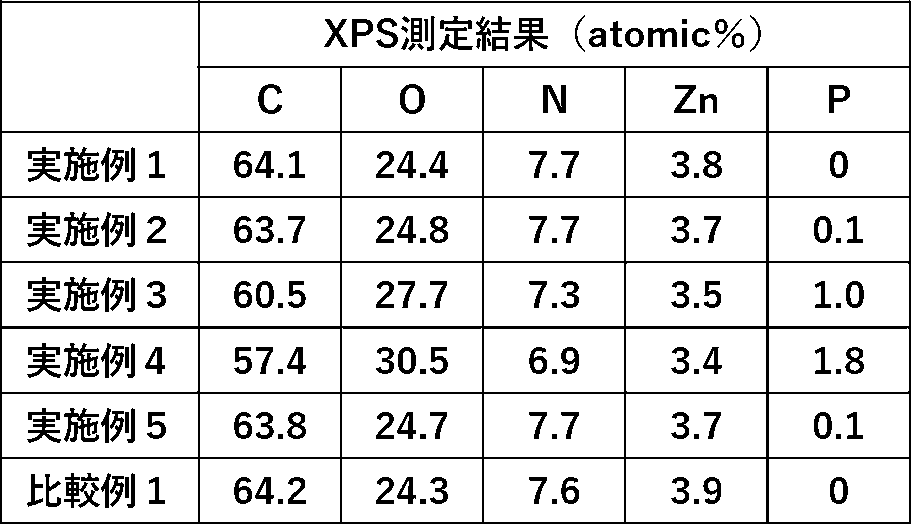


上記実施例1~5、比較例では、2層ラミネート構造の水蒸気透過率について評価した。これらに加え、以下のようにして2層ラミネート構造の酸素透過率、3層ラミネート構造のガスバリア性積層体の作製と評価(酸素透過率および水蒸気透過率)も行った。
(1)ガスバリア用塗材の作製
実施例1と同様にして、まず、ガスバリア用塗材を作製した。
ガスバリア用塗材として、上記のものを用いて、実施例1と同様にして、2層ラミネート構造レトルト処理後のフィルムを得た。
得られた2層ラミネート構造レトルト処理後のフィルムの酸素透過率[mL/(m2・day・MPa)]を、モコン社製OX-TRAN2/1を用いて、JIS K 7126に準じ、20℃90%RHの条件で測定した。
まず、厚さ60μmの無延伸ポリプロピレン(三井化学東セロ社製、商品名:RXC-22)のコロナ放電処理面に接着剤を塗工し、厚さ15μmのナイロンフィルム(ユニチカ社製、商品名:エンブレムONBC)を貼り合わせた積層体を用意した。
上記積層体のナイロンフィルム面に接着剤を塗工し、実施例1’の(2)で得られたガスバリア性積層体のガスバリア性面と貼り合わせ、3層ラミネート構造のガスバリア性積層体を作製した。使用した接着剤は、実施例1の(4)と同じである。得られたガスバリア性積層体を無延伸ポリプロピレンが内面になるように折り返し、2方をヒートシールして袋状にした後、内容物として水70cc入れ、もう一方をヒートシールにより袋を作製し、これを高温高圧レトルト殺菌装置で130℃で30分レトルト処理を行った。レトルト処理後、内容物の水を抜き、シール部を除いてレトルト処理後(水充填)のフィルムを得た。
実施例1’で得られた3層ラミネート構造のガスバリア性積層体の水蒸気透過率を、実施例1の水蒸気透過率と同様の方法で評価した。また、酸素透過率を実施例1’の(1)と同様の方法で評価した。レトルト処理後のガスバリア性評価結果を表11に示す。
ガスバリア用塗材として実施例2で作製したものを用いた以外は、実施例1’と同様にしてガスリア性積層体を作製した。そして、実施例1’と同様にして、レトルト処理後のガスバリア性(2層ラミネート構造の酸素透過率、3層ラミネート構造の酸素透過率および水蒸気透過率)を評価した。レトルト処理後のガスバリア性評価結果を表11に示す。
ガスバリア用塗材として実施例3で作製したものを用いた以外は、実施例1’と同様にしてガスリア性積層体を作製した。そして、実施例1’と同様にして、レトルト処理後のガスバリア性(2層ラミネート構造の酸素透過率)を評価した。レトルト処理後のガスバリア性評価結果を表11に示す。
ガスバリア用塗材として実施例5で作製したものを用いた以外は、実施例1’と同様にしてガスリア性積層体を作製した。そして、実施例1’と同様にして、レトルト処理後のガスバリア性(2層ラミネート構造の酸素透過率、3層ラミネート構造の酸素透過率および水蒸気透過率)を評価した。レトルト処理後のガスバリア性評価結果を表11に示す。
ガスバリア用塗材として比較例で作製したものを用いた以外は、実施例1’と同様にしてガスリア性積層体を作製した。そして、実施例1’と同様にして、レトルト処理後のガスバリア性(2層ラミネート構造の酸素透過率、3層ラミネート構造の酸素透過率および水蒸気透過率)を評価した。レトルト処理後のガスバリア性評価結果を表11に示す。
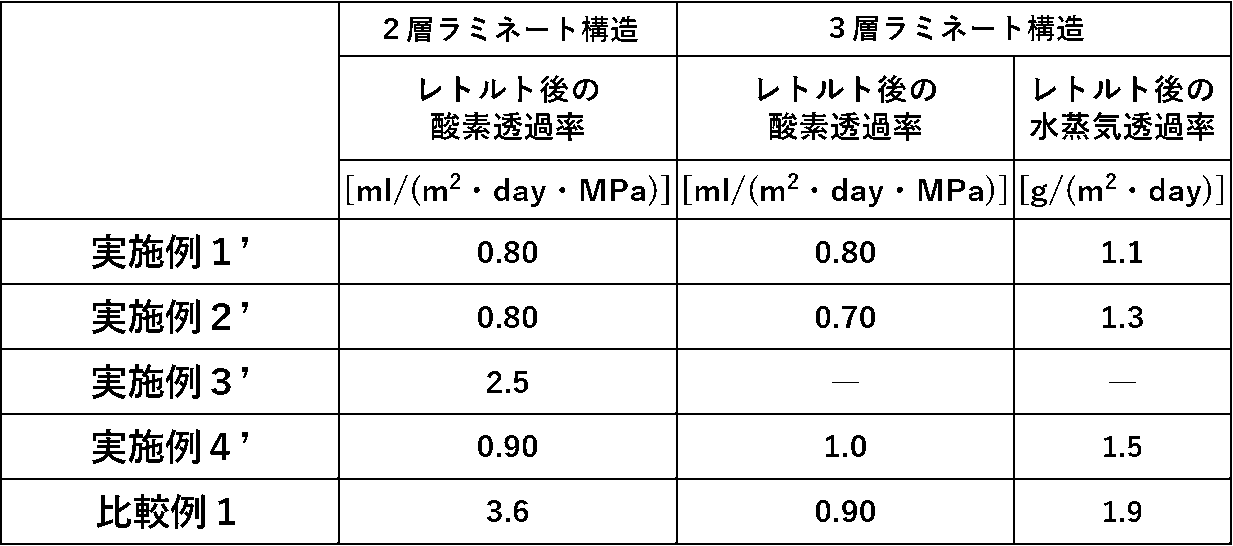
(実施例1)
(1)ガスバリア用塗材の作製
ポリアクリル酸(PAA)水溶液(東亜合成社製、製品名:AC-10H、重量平均分子量:800,000)を精製水で希釈し、PAAの濃度10%の水溶液を作成した。この水溶液中に10%のアンモニア水を添加した。アンモニアの量は、PAAのカルボキシル基1molに対して1.5molのアンモニアになるようにした。このようにして、PAAの濃度が7.38%のポリアクリル酸アンモニウム水溶液を得た。
次いで、得られたポリアクリル酸アンモニウム水溶液に、酸化亜鉛(ZnO:関東化学社製)および炭酸アンモニウム(関東化学社製)を添加して混合、撹拌した。ここで、酸化亜鉛の添加量は、(酸化亜鉛)/(PAAのカルボキシル基)がmol比で0.3となる量とした。また、炭酸アンモニウムは、PAAのカルボキシル基に対してmol比で0.3となる量とした。このようにして、混合液(A)を作製した。
次いで、ポリエチレンイミン(PEI:日本触媒社製、製品名:SP-200、数平均分子量:10,000)に精製水を添加して、PEIの濃度10%のポリエチレンイミン水溶液を得た。
次に、上記混合液(A)と上記ポリエチレンイミン水溶液とを、(PEIの窒素)/(PAAのカルボキシル基)がmol比で0.55となる割合で混合して、混合液(B)を調製した。
さらに、上記混合液(B)に、PAA+ZnO+PEIの固形分濃度が2%になるように精製水を添加し、均一溶液になるまで撹拌した。
さらに、リン酸水素アンモニウム(関東化学社製、(NH4)2HPO4)の量がPAAのカルボキシル基1molに対して1×10⁻³molとなるように、固形分濃度2%のリン酸水素アンモニウム水溶液を添加・撹拌した。
その後、活性剤(花王社製、商品名:エマルゲン120)の量が、PAA+ZnO+PEIの固形分に対して0.3質量%となるように、固形分濃度1%の活性剤水溶液を混合した。
以上のようにして、ガスバリア用塗材を調製した。
無機物層として酸化アルミを基材層の12μmPETフィルムに蒸着した透明蒸着フィルム(三井化学東セロ株式会社製、型番:TL-PET-H)をガラス板に張り付けた。この透明蒸着フィルムの蒸着面に、アプリケータにて乾燥後の膜厚が0.2μmとなるようにガスバリア用塗材を塗布した。塗布後、ガラス板ごと120℃で5分熱風乾燥器にて乾燥した。
乾燥したフィルムの両端を固定してフィルムを中空状態としたうえで、150℃で時間1分の条件で熱風乾燥器にて熱処理を行い、透明蒸着フィルム上にガスバリア性層を形成した。このようにしてガスバリア性積層体を作製した。
ガスバリア性層の作製条件を表12に示す。
上記(2)で得られたガスバリア性積層体のガスバリア性層に対して、ATR-IR分析、XPS分析およびTOF-SIMS分析を行った。
前述の記載のようにして、基材(PET)の影響を除いたスペクトルを得た。そして、そのスペクトルに基づき、ピーク面積比率D/Aを求めた。結果を表13に示す。
ガスバリア性積層体を1×1cmに切断したサンプルを用いて分析した。具体的な分析条件は前述の通りとした。結果を表13に示す。
まず、前処理として、Ar-GCIBエッチングにより、ガスバリア性層の内部を露出させた。Ar-GCIBエッチングの具体的条件は前述の通りとした。
その後、TOF-SIMS分析を行った。具体的な条件は前述の通りとした。
TOF-SIMS分析で得たデータを上述した方法に基づき解析した結果を表14に示す。表14において、C3H3O2 -の強度で規格化した相対質量ピーク強度とは、各フラグメントの質量ピーク強度をC3H3O2 -の強度:I(C3H3O2 -)で割った値である。
厚さ70μmの無延伸ポリプロピレン(三井化学東セロ社製、商品名:RXC-22)のコロナ放電処理面に接着剤を塗工し、上記(2)で得られたガスバリア性積層体のガスバリア性面と張り合わせ、2層ラミネート構造のガスバリア性積層体を作製した。接着剤としては、三井化学社製、商品名:タケラックA525S):9質量部、イソシアネート系硬化剤(三井化学社製、商品名:タケネートA50):1質量部および酢酸エチル:7.5質量部を配合したものを用いた。
(4)で得られたガスバリア性積層体を、無延伸ポリプロピレンが内面になるように折り返し、2方をヒートシールして袋状にした。その後、内容物として水を70cc入れ、もう一方をヒートシールにより袋を作製した。この袋を、高温高圧レトルト殺菌装置を用いて、130℃で30分レトルト処理した。レトルト処理後、内容物の水を抜き、シール部を除いてレトルト処理後(水充填)のフィルムを得た。
上記の方法で得られたレトルト処理後のフィルムを、無延伸ポリプロピレンが内面になるように重ねてガスバリア性積層フィルムを折り返し、2方をヒートシールし、袋状にした。その後、内容物として塩化カルシウムを入れ、もう1方をヒートシールにより表面積が0.01m2となるように袋を作製した。この袋を40℃、90%RHの条件で300時間放置した。放置前後の重量変化により、水蒸気透過率[g/(m2・day)]を測定した。
レトルト処理後のガスバリア性評価結果を表15に示す。
リン酸水素アンモニウムの濃度を、ポリアクリル酸のカルボキシル基1molに対し、0.01molにしたこと以外は、実施例1と同様にしてガスバリア用塗材を作製し、そしてガスバリア性積層体を作製した。作製条件を表12に示す。
実施例1と同様に、得られたガスバリア積層体のガスバリア性層に対して行った分析の結果を表13および14に示す。また、レトルト処理後のガスバリア性評価結果を表15に示す。
リン酸水素アンモニウムの濃度を、ポリアクリル酸のカルボキシル基1molに対し、0.1molにしたこと以外は、実施例1と同様にしてガスバリア用塗材を作製し、そしてガスバリア性積層体を作製した。作製条件を表12に示す。
実施例1と同様に、得られたガスバリア積層体のガスバリア性層に対して行った分析の結果を表13および14に示す。また、レトルト処理後のガスバリア性評価結果を表15に示す。
リン酸水素アンモニウムの濃度を、ポリアクリル酸のカルボキシル基1molに対し、0.2molにしたこと以外は、実施例1と同様にガスバリア用塗材を作製し、そしてガスバリア性積層体を作製した。作製条件を表12に示す。
実施例1と同様に、得られたガスバリア積層体のガスバリア性層に対して行った分析の結果を表13および14に示す。また、レトルト処理後のガスバリア性評価結果を表15に示す。
実施例1の固形分濃度2%のリン酸水素アンモニウム((NH4)2HPO4)水溶液に代え、ホスホン酸(別名、亜リン酸)(関東化学社製、H3PO3)をアンモニア水で中和した、固形分濃度2%のホスホン酸アンモニウム塩((NH4)2HPO3)水溶液を用いたこと、また、ホスホン酸アンモニウム塩の濃度をポリアクリル酸のカルボキシル基1molに対し、0.01molにしたこと以外は、実施例1と同様にガスバリア用塗材を作製し、そしてガスバリア性積層体を作製した。作製条件を表12に示す。
実施例1と同様に、得られたガスバリア積層体のガスバリア性層に対して行った分析の結果を表13および14に示す。また、レトルト処理後のガスバリア性評価結果を表15に示す。
実施例1の固形分濃度2%のリン酸水素アンモニウム((NH4)2HPO4)水溶液に代え、ホスフィン酸(別名、次亜リン酸)(関東化学社製、H3PO2)をアンモニア水で中和した、固形分濃度2%のホスフィン酸アンモニウム塩((NH4)H2PO2)水溶液を用いたこと、また、ホスフィン酸アンモニウム塩の濃度をポリアクリル酸のカルボキシル基1molに対し、0.01molにしたこと、以外は実施例1と同様にガスバリア用塗材を作製し、そしてガスバリア性積層体を作製した。作製条件を表12に示す。
実施例1と同様に、得られたガスバリア積層体のガスバリア性層に対して行った分析の結果を表13および14に示す。また、レトルト処理後のガスバリア性評価結果を表6に示す。
リン酸水素アンモニウムの濃度を、ポリアクリル酸のカルボキシル基1molに対し、0.0001molにしたこと以外は、実施例1と同様にガスバリア用塗材を作製し、そしてガスバリア性積層体を作製した。作製条件を表3に示す。
実施例1と同様に、得られたガスバリア積層体のガスバリア性層に対して行った分析の結果を表4および5に示す。また、レトルト処理後のガスバリア性評価結果を表15に示す。
(1)ガスバリア用塗材の作製
まず、ポリアクリル酸(東亜合成社製、製品名:AC-10H、重量平均分子量:800,000)のカルボキシル基に対して10%アンモニア水(和光純薬工業社製)のアンモニアが150当量%になるよう添加、更に精製水を添加して濃度が7.29質量%のポリアクリル酸アンモニウム水溶液を得た。
次いで、得られたポリアクリル酸アンモニウム水溶液に、酸化亜鉛(関東化学社製)および炭酸アンモニウムを添加して混合、撹拌して混合液(A)を作成した。ここで、酸化亜鉛の添加量は、(ガスバリア用塗材中の酸化亜鉛のモル数)/(ガスバリア用塗材中のポリアクリル酸に含まれる-COO-基のモル数)が0.225になる量とした。また、炭酸アンモニウムは、(ガスバリア用塗材中の炭酸系アンモニウム塩のモル数)/(ガスバリア用塗材中の酸化亜鉛のモル数)が1.0になる量とした。
次いで、ポリエチレンイミン(日本触媒社製、製品名:SP-200、数平均分子量:10,000)に精製水を添加して10%溶液にしたポリエチレンイミン水溶液を得た。
また、リン酸水素二アンモニウム(関東化学社製(NH4)2HPO4)に精製水を添加して10%水溶液を調製した。
次に、上記混合液(A)、上記ポリエチレンイミン水溶液および上記リン酸水素二アンモニウム溶液を、(ガスバリア用塗材中のポリエチレンイミンに含まれるアミノ基のモル数)/(ガスバリア用塗材中のポリアクリル酸に含まれる-COO-基のモル数)が0.55、また、((NH4)2HPO4のモル数)/(ポリアクリル酸に含まれる-COO-基のモル数)が0.01になる割合で混合して混合液(B)を調製した。
さらに、上記混合液(B)の固形分濃度が1.5%になるように精製水を添加し、均一溶液になるまで撹拌した。そして、活性剤(花王社製、商品名:エマルゲン120)を、混合液(B)の固形分に対して0.3質量%となるように添加、混合した。以上のようにしてガスバリア用塗材を調製した。
厚さ12μmの二軸延伸ポリエチレンテレフタレートフィルム(ユニチカ社製、PET12)のコロナ処理面に、以下の方法でアンダーコート層(UC)を形成した。
厚さ12μmの二軸延伸ポリエチレンテレフタレートフィルム(ユニチカ社製、PET12)を基材とし、この片面に下記組成の樹脂組成物をメイヤーバーにて塗布して乾燥した。これにより、乾燥後の厚みが0.20μmのアンダーコート(UC)層を形成した。
(組成)
主剤:ポリウレタン樹脂水分散液(三井化学社製、製品名:タケラックWS-4033、芳香族ポリエステル型ポリウレタン樹脂)
架橋剤:カルボジイミド基を有する化合物(日清紡ケミカル社製、製品名:カルボジライトSV-02)
配合比:主剤中のポリウレタン樹脂のカルボキシル基1.0molに対し、架橋剤中のカルボジイミド基が0.4molとなるように、主剤に架橋剤を配合した。」
UC層上に、高周波誘導加熱方式により、アルミニウムを加熱蒸発させ、酸素を導入しながら蒸着することで、厚さ7Nmの酸化アルミニウム膜を形成した。これにより酸化アルミニウム蒸着PETフィルムを得た。この酸化アルミニウム蒸着PETフィルムの水蒸気透過度は1.5g/(m2・24h)であった。
そして、蒸着層の上に、上記(1)で作製したガスバリア用塗材を、メイヤーバーにて乾燥後の塗工量が0.2μmになるように塗布し、熱風乾燥器を使用して温度;130℃、時間;6.5秒の条件で熱処理した。作製条件を表12に示す。
上記(2)で得られたガスバリア積層体のガスバリア性層に対して、実施例1の(3)と同様の分析をした。分析の結果を表13および14に示す。
上記(2)で得られたガスバリア積層体のガスバリア性層に対して、実施例1の(4)と同様に2層ラミネート構造のガスバリア性積層体を作製した。
上記(4)で得られたガスバリア性積層体に対して、実施例1の(6)と同様にレトルト処理後のガスバリア性評価を行った。結果を表15に示す。
リン酸水素二アンモニウムの濃度を、ポリアクリル酸のカルボキシル基1molに対し、0.03molにしたこと以外は、実施例7と同様にガスバリア用塗材を作製し、そしてガスバリア性積層体を作製した。作製条件を表12に示す。
実施例7と同様に、得られたガスバリア積層体のガスバリア性層に対して行った分析の結果を表13および14に示す。また、レトルト処理後のガスバリア性評価結果を表15に示す。
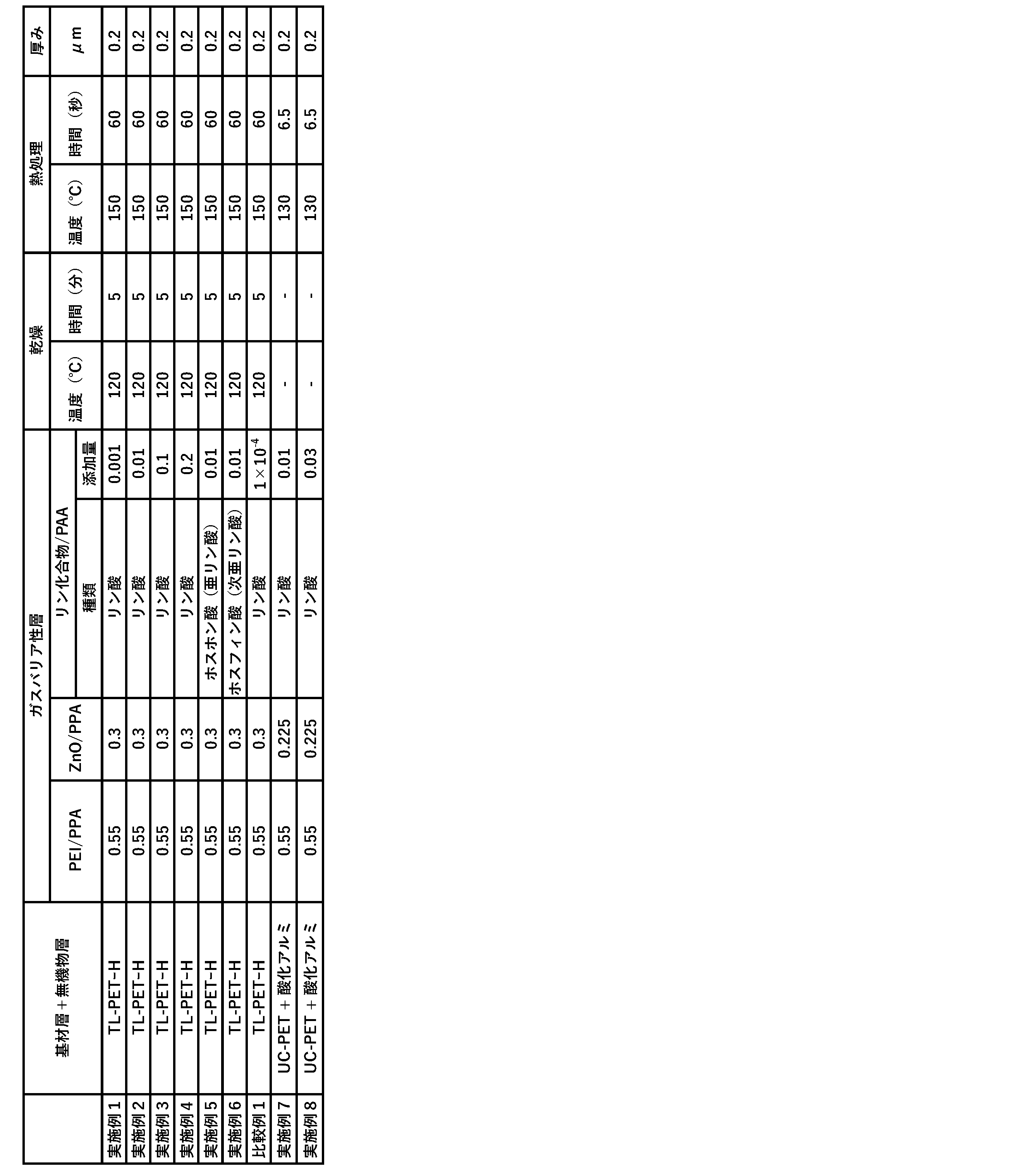

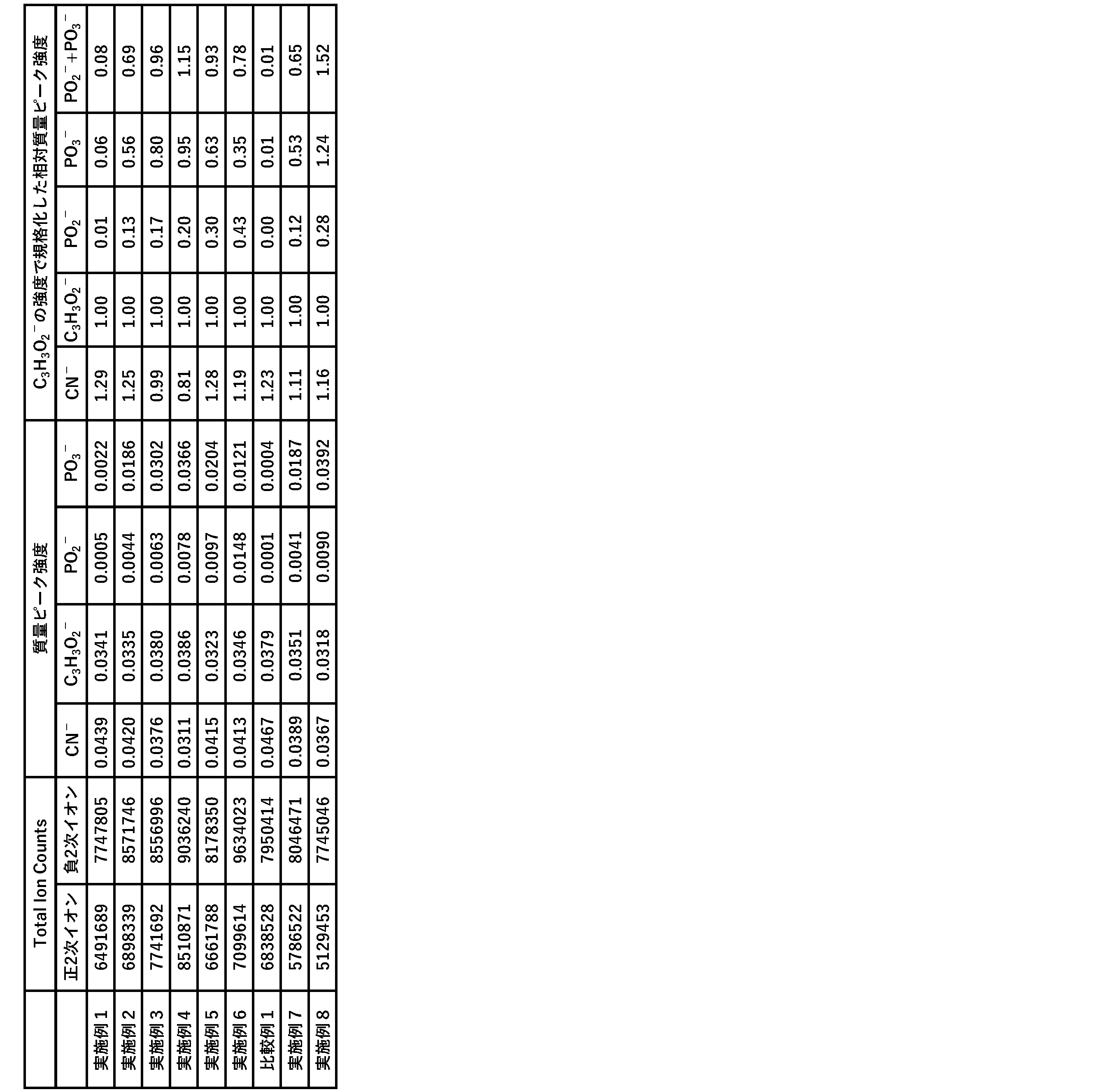

上記実施例1~8では、2層ラミネート構造のガスバリア性積層体を作製し、評価した。
これらに加え、以下のようにして、3層ラミネート構造のガスバリア性積層体の作製・評価も行った。
(1)ガスバリア用塗材の作製
実施例2と同様にして、まず、ガスバリア用塗材を作製した。
ガスバリア用塗材として上記のものを用いた以外は、実施例1の(2)と同様にしてガスバリア性積層体を作製した。
まず、厚さ60μmの無延伸ポリプロピレン(三井化学東セロ社製、商品名:RXC-22)のコロナ放電処理面に接着剤を塗工し、厚さ15μmのナイロンフィルム(ユニチカ社製、商品名:(エンブレムONBC)を張り合わせた積層体を用意した。
上記積層体のナイロンフィルム面に接着剤を塗工し、(2)で得られたガスバリア性積層体のガスバリア性面と張り合わせ、3層ラミネート構造のガスバリア性積層体を作製した。使用した接着剤は、実施例1の(4)と同様である。
(3)で得られたガスバリア性積層体を、無延伸ポリプロピレンが内面になるように折り返し、2方をヒートシールして袋状にした。その後、内容物として水を70cc入れ、もう一方をヒートシールにより袋を作製した。この袋を、高温高圧レトルト殺菌装置を用いて、130℃で30分レトルト処理した。レトルト処理後、内容物の水を抜き、シール部を除いてレトルト処理後(水充填)のフィルムを得た。
上記の方法で得られたレトルト処理後のフィルムの酸素透過率[mL/(m2・day・MPa)]を、モコン社製OX-TRAN2/21を用いて、JIS K 7126に準じ、20℃、90%RHの条件で測定した。
また、上記の方法で得られたレトルト処理後のフィルムを、無延伸ポリプロピレンが内面になるように重ねてガスバリア性積層フィルムを折り返し、2方をヒートシールし、袋状にした。その後、内容物として塩化カルシウムを入れ、もう1方をヒートシールにより表面積が0.01m2となるように袋を作製した。この袋を40℃、90%RHの条件で300時間放置した。放置前後の重量変化により、水蒸気透過率[g/(m2・day)]を測定した。
レトルト処理後のガスバリア性評価結果を表16に示す。
ガスバリア用塗材として実施例5で作製したものを用いた以外は、実施例2'と同様にしてガスバリア性積層体を作製した。そして、実施例2'と同様にレトルト処理後のガスバリア性を評価した。評価結果を表16に示す。
ガスバリア用塗材として実施例6で作製したものを用いた以外は、実施例2'と同様にしてガスバリア性積層体を作製した。そして、実施例2'と同様にレトルト処理後のガスバリア性を評価した。評価結果を表16に示す。
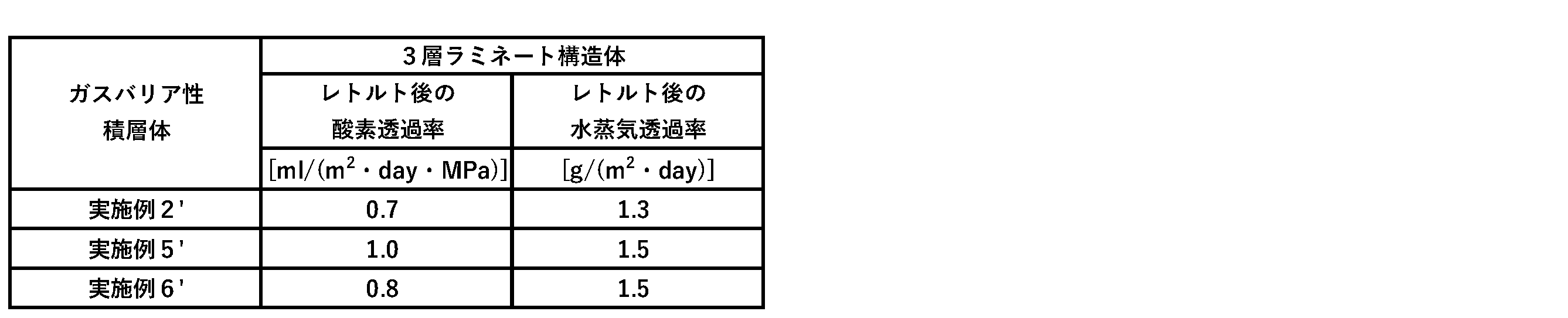
(実施例1)
(1)ガスバリア用塗材の作製
ポリアクリル酸(PPA)水溶液(東亜合成社製、製品名:AC-10H、重量平均分子量:800,000)を精製水で希釈し、PPAの濃度10%の水溶液を作製した。この水溶液に、PPA中のカルボキシル基1molに対して1.5molのアンモニアになるよう濃度10%のアンモニア水を添加し、PPAの濃度が7.38%のポリアクリル酸アンモニウム水溶液を得た。
次いで、得られたポリアクリル酸アンモニウム水溶液に、酸化亜鉛(ZnO)(関東化学社製)および炭酸アンモニウム(関東化学社製)を添加して混合、撹拌して混合液を得た。ここで酸化亜鉛の添加量は、(酸化亜鉛)/(ポリアクリル酸のカルボキシル基)がmol比で0.3となる量とした。また、炭酸アンモニウムは、ポリアクリル酸のカルボキシル基に対してmol比で0.3となる量とした。
さらに、上記混合液にPPA+ZnOの固形分濃度が2%になるように精製水を添加し、均一溶液になるまで撹拌した。さらに、リン酸水素アンモニウム((NH4)2HPO4)(関東化学社製)がPPAのカルボキシル基1molに対して0.01molとなるように固形成分濃度2%のリン酸水素アンモニウム水溶液を添加・撹拌した。さらにその後、活性剤(花王社製、製品名:エマルゲン120)をPPA+ZnOの固形分に対して、0.3質量%となるように固形分濃度1%の活性剤水溶液を混合し、ガスバリア用塗材を調製した。
無機物層として酸化アルミを基材層の12μmPETフィルムに蒸着した透明蒸着フィルム(三井化学東セロ株式会社、型番:TL-PET-H)を準備した。このフィルムを無機蒸着層を上面にしてガラス板に貼り付け、アプリケータにて乾燥後の膜厚が0.2μmとなるようにガスバリア用塗材を塗布した。そして、ガラス板ごと120℃で5分熱風乾燥器にて乾燥した。乾燥したフィルムの両端を固定してフィルムを中空状態としたうえで、150℃で時間1分の条件で熱風乾燥器にて熱処理を行った。以上により、透明蒸着フィルム上にガスバリア性層を形成したガスバリア性積層体を作製した。
表17に作製条件をまとめて示す。
また、上記(2)で得られたガスバリア性積層体のガスバリア性層に対して、XPS分析とTOF-SIMS分析を行った。
分析装置:KRATOS社製AXIS-NOVA
X線源:単色化Al-Kα
X線源出力:15kV、10mA
分析領域:300×700μm
分析時:帯電補正用中和銃使用
試料サイズ:1×1cm
XPS分析の結果を表18に示す。
測定前処理:Ar-GCIBで表面エッチング
GCIB:5kV、5μA
GCIB処理時間:TOF-SIMSのスペクトルパターンが変化しなくなった時点
分析装置:アルバック・ファイ社製 PHI nano-TOFII
1次イオン:Bi3 2+
1次イオン源出力:30kV、0.5μA
分析領域:300×300μm(1次イオンビームの走査領域)
分析時、装置に付属の低エネルギー電子線および低エネルギーArイオン照射により、帯電中和を行った。
TOF-SIMS分析で得たデータを上述した方法に基づき解析した結果を表19に示す。表19において、C3H3O2 -の強度で規格化した相対質量ピーク強度とは、フラグメントの質量ピーク強度をC3H3O2 -の強度I(C3H3O2 -)で割った値である。
厚さ70μmの無延伸ポリプロピレン(三井化学東セロ社製、商品名RXC-22)のコロナ放電処理面に接着剤を塗工し、上記(2)で得られたガスバリア性積層体のガスバリア性面と貼り合わせ、2層ラミネート構造のガスバリア性積層体を作製した。接着剤は、三井化学社製、商品名:タケラックA5252Sを9質量部、イソシアネート系硬化剤(三井化学社製、商品名:タケネートA50)1質量部および酢酸エチル7.5質量部を配合したものを用いた。
まず、厚さ60μmの無延伸ポリプロピレン(三井化学東セロ社製、商品名:RXC-22)のコロナ放電処理面に接着剤を塗工し、厚さ15μmのナイロンフィルム(ユニチカ社製、商品名:エンブレムONBC)を貼り合わせた積層体を用意した。
上記積層体のナイロンフィルム面に接着剤を塗工し、上記(2)で得られたガスバリア性積層体のガスバリア性面と貼り合わせ、3層ラミネート構造のガスバリア性積層体を作製した。使用した接着剤は、上記(4)と同様である。
(4)及び(5)で得られたガスバリア性積層体を無延伸ポリプロピレンが内面になるように折り返し、2方をヒートシールして袋状にした。その後、内容物として水を70cc入れ、もう一方をヒートシールにより袋を作製した。この袋を高温高圧レトルト殺菌装置で、130℃で30分処理した。レトルト処理後、内容物の水を抜き、シール部を除いて、レトルト処理後(水充填)のフィルムを得た。
また、上記の方法で得られたレトルト処理後のフィルムを無延伸ポリプロピレンが内面になるように重ねてガスバリア性積層フィルムを折り返し、2方をヒートシールし、袋状にした。その後、内容物として塩化カルシウムを入れ、もう1方をヒートシールにより表面積が0.01m2となるように袋を作製した。そして、40℃90%RHの条件で300時間放置した。放置前後の重量変化により、水蒸気透過率[g/(m2・day)]を測定した。
レトルト処理後のガスバリア性評価結果を表20に示す。
リン酸水素アンモニウム((NH4)2HPO4)をポリアクリル酸のカルボキシル基1molに対し、0.03molとした以外は実施例1と同様にガスバリア性積層体を作製した。作製条件を表17に示す。また、得られたガスバリア性積層体のガスバリア性層に対して、XPS分析とTOF-SIMS分析を行った。XPS分析及び、TOF-SIMS分析の結果を表18および19に示す。また、レトルト処理後のガスバリア性評価結果を表20に示す。
リン酸水素アンモニウム((NH4)2HPO4)をポリアクリル酸のカルボキシル基1molに対し、0.05molとした以外は、実施例1と同様にガスバリア性積層体を作製した。作製条件を表17に示す。また、得られたガスバリア性積層体のガスバリア性層に対して、XPS分析とTOF-SIMS分析を行った。XPS分析及び、TOF-SIMS分析の結果を表18および19に示す。また、レトルト処理後のガスバリア性評価結果を表20に示す。
リン酸アンモニウムを加えない以外は、実施例1と同様にガスバリア性積層体を作製した。作製条件を17に示す。また、得られたガスバリア性積層体のガスバリア性層に対して、XPS分析とTOF-SIMS分析を行った。XPS分析及び、TOF-SIMS分析の結果を表18および19に示す。また、レトルト処理後のガスバリア性評価結果を表20に示す。ただし、レトルト処理後、ガスバリア性積層体に一部デラミネーションが生じてしまった。
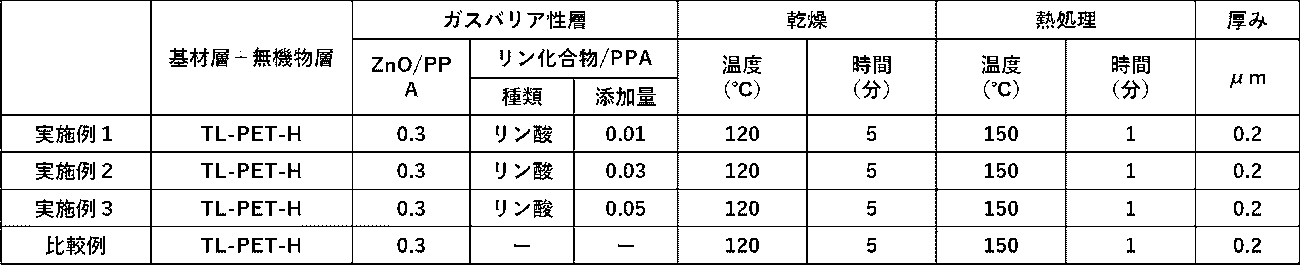
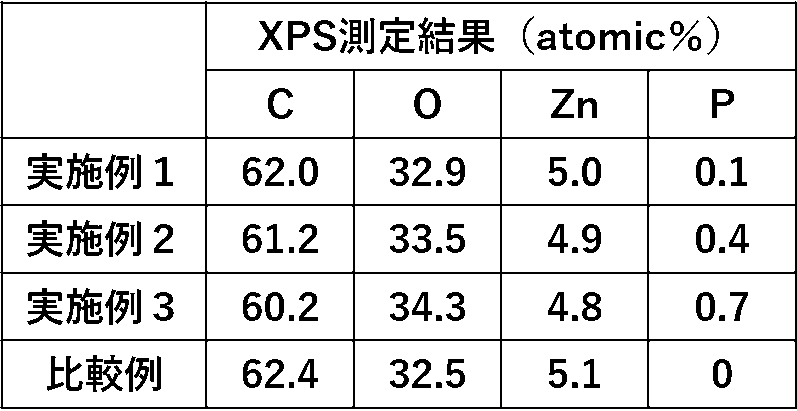


(実施例1)
(1)ガスバリア用塗材の作製
ポリアクリル酸(東亜合成社製、製品名:AC-10H、重量平均分子量:800,000)のカルボキシ基に対して10%アンモニア水(和光純薬工業社製)のアンモニアが150当量%になるよう添加、更に精製水を添加して濃度が7.29質量%のポリアクリル酸アンモニウム水溶液を得た。
次いで、得られたポリアクリル酸アンモニウム水溶液に、酸化亜鉛(関東化学社製)および炭酸アンモニウムを添加して混合、撹拌して混合液(A)を作製した。ここで、酸化亜鉛の添加量は、(ガスバリア用塗材中の酸化亜鉛のモル数)/(ガスバリア用塗材中のポリアクリル酸に含まれる-COO-基のモル数)が表1におけるZnO/PAAの欄に示す値になる量とした。また、炭酸アンモニウムは、(ガスバリア用塗材中の炭酸系アンモニウム塩のモル数)/(ガスバリア用塗材中の酸化亜鉛のモル数)が1.0になる量とした。
次いで、ポリエチレンイミン(日本触媒社製、製品名:SP-200、数平均分子量:10,000)に精製水を添加して10%溶液にしたポリエチレンイミン水溶液を得た。
また、リン酸水素二アンモニウム(関東化学社製(NH4)2HPO4)に精製水を添加して10%水溶液を調製した。
次に、上記混合液(A)、上記ポリエチレンイミン水溶液および上記リン酸水素二アンモニウム溶液を、(ガスバリア用塗材中のポリエチレンイミンに含まれるアミノ基のモル数)/(ガスバリア用塗材中のポリアクリル酸に含まれる-COO-基のモル数)が表1におけるPEI/PAAの欄に示す値、および、((NH4)2HPO4のモル数)/(ポリアクリル酸に含まれる-COO-基のモル数)が表1における酸化合物/PAAの欄の添加量に示す値になる割合で混合して混合液(B)を調製した。
さらに、上記混合液(B)の固形分濃度が1.5%になるように精製水を添加し、均一溶液になるまで撹拌したのちに、活性剤(花王社製、商品名:エマルゲン120)を混合液(B)の固形分に対して0.3質量%となるように混合し、ガスバリア用塗材を調製した。
厚さ12μmの二軸延伸ポリエチレンテレフタレートフィルム(ユニチカ社製、PET12)を基材とし、この片面(コロナ処理面)に以下の組成の樹脂組成物をメイヤーバーにて塗布して乾燥することにより、乾燥後の厚みが0.20μmのアンダーコート(UC)層を形成した。
(組成)
主剤:ポリウレタン樹脂水分散液(三井化学社製、製品名:タケラックWS-4033、芳香族ポリエステル型ポリウレタン樹脂)
架橋剤:カルボジイミド基を有する化合物(日清紡ケミカル社製、製品名:カルボジライトSV-02)
配合比:主剤中のポリウレタン樹脂のカルボキシ基1.0molに対し、架橋剤中のカルボジイミド基が0.4molとなるように、主剤に架橋剤を配合した。
次に、アンダーコート層上に、以下の方法でアルミナ蒸着層を形成した。
UC層上に高周波誘導加熱方式により、アルミニウムを加熱蒸発させ、酸素を導入しながら蒸着することで、厚さ7nmの酸化アルミニウム膜を形成させた。これにより酸化アルミニウム蒸着PETフィルムを得た。この酸化アルミニウム蒸着PETフィルムの水蒸気透過度は1.5g/(m2・24h)であった。
そして、蒸着層の上に、手順(1)で得られたガスバリア用塗材を、メイヤバーにて乾燥後の塗工量が0.2μmになるように塗布し、熱風乾燥器を使用して、表1における熱処理の欄に示す条件で熱処理をして、ガスバリア性積層体を得た。作製条件の一覧を表21に示す。
また、上記手順(2)で得られたガスバリア性積層体のガスバリア性層に対して、次に示すATR法による赤外線吸収スペクトル分析を行った。
赤外線吸収スペクトルの測定(赤外線全反射測定:ATR法)には日本分光社製IRT-5200装置を用い、PKM-GE-S(Germanium)結晶を装着して入射角度45度、室温、分解能4cm-1、積算回数100回の条件で測定した。得られた吸収スペクトを前述した方法で解析し、最大ピークαおよびγを求めるとともに、全ピーク面積A~Dを算出した。そして、全ピーク面積A~Dから面積比B/A、C/A、D/Aを求めた。
ATR法による赤外線吸収スペクトル分析結果を表22に示す。
厚さ70μmの無延伸ポリプロピレン(三井化学東セロ社製、商品名:RXC-22)のコロナ放電処理面に接着剤を塗工し、上記手順(2)で得られたガスバリア性積層体のガスバリア性面(ガスバリア性層の側の面、以下同じ。)と張り合わせ、2層ラミネート構造のラミネート構造体を作製した。接着剤は、三井化学社製、商品名:タケラックA525S):9質量部、イソシアネート系硬化剤(三井化学社製、商品名:タケネートA50):1質量部および酢酸エチル:7.5質量部を配合したものを用いた。
まず、厚さ60μmの無延伸ポリプロピレン(三井化学東セロ社製、商品名:RXC-22)のコロナ放電処理面に接着剤を塗工し、厚さ15μmのナイロンフィルム(ユニチカ社製、商品名:(エンブレムONBC)を張り合わせた積層体を用意した。
上記積層体のナイロンフィルム面に接着剤を塗工し、上記手順(2)で得られたガスバリア性積層体のガスバリア性面と張り合わせ、3層ラミネート構造のラミネート構造体を作製した。使用した接着剤は、上記手順(4)と同様である。
手順(4)及び手順(5)で得られたラミネート構造体を無延伸ポリプロピレンが内面になるように折り返し、2方をヒートシールして袋状にした後、内容物として水を70mL入れ、もう一方をヒートシールにより袋を作製し、これを高温高圧レトルト殺菌装置で130℃で30分レトルト処理を行った。レトルト処理後、内容物の水を抜き、シール部を除いてレトルト処理後(水充填)のフィルムを得た。
上記の方法で得られたレトルト処理後のフィルムの酸素透過率[ml/(m2・day・MPa)]を、モコン社製OX-TRAN2/21を用いて、JIS K 7126に準じ、20℃90%RHの条件で測定した。
また、上述の方法で得られたレトルト処理後のフィルムを無延伸ポリプロピレンが内面になるように重ねてラミネート構造体を折り返し、2方をヒートシールし、袋状にした後、内容物として塩化カルシウムを入れ、もう1方をヒートシールにより表面積が0.01m2となるように袋を作製し、40℃、90%RHの条件で300時間放置し、放置前後の重量変化により、水蒸気透過率[g/(m2・day)]を測定した。
レトルト処理後のガスバリア性評価結果を表23に示す。
各実施例について、原料の配合および作製条件を表21に示す数値にそれぞれ変えたこと以外は実施例1に準じてガスバリア性積層体および各ラミネート構造体を得た。
実施例1に準じて、得られたガスバリア積層体のガスバリア性層に対して行った分析の結果を表22に示す。また、レトルト処理後のガスバリア性評価結果を表23に示す。
酸化亜鉛および炭酸アンモニウムを使用しないこと、および、リン酸水素二アンモニウム溶液を使用しないこと以外は実施例1に準じてガスバリア性積層体および3層ラミネート構造体を得た。
実施例1に準じて、得られたガスバリア積層体のガスバリア性層に対して行った分析の結果を表22に示す。また、レトルト処理後のガスバリア性評価結果を表23に示す。
(1)ガスバリア用塗材の作製
ポリアクリル酸(PAA)水溶液(東亜合成社製、製品名:AC-10H、重量平均分子量:800,000)を精製水で希釈し、PAAの濃度10%の水溶液を作製し、カルボキシ基に対して1.5molのアンモニアになるよう10%のアンモニア水を添加し、PAAの濃度が7.38%のポリアクリル酸アンモニウム水溶液を得た。
次いで、得られたポリアクリル酸アンモニウム水溶液に、酸化亜鉛(ZnO:関東化学社製)および炭酸アンモニウム(関東化学社製)を添加して混合、撹拌した。ここで、酸化亜鉛の添加量は、(酸化亜鉛)/(PAAのカルボキシ基)がmol比で0.3となる量とした。また、炭酸アンモニウムは、PAAのカルボキシ基に対してmol比で0.3となる量とした。このようにして、混合液(A)を作製した。
次いで、ポリエチレンイミン(PEI:日本触媒社製、製品名:SP-200、数平均分子量:10,000)に精製水を添加してPEIの濃度10%の水溶液にしたポリエチレンイミン水溶液を得た。
次に、上記混合液(A)と上記ポリエチレンイミン水溶液とを、(PEIの窒素)/(PAAのカルボキシ基)がmol比で0.55となる割合で混合して、混合液(B)を調製した。
さらに、上記混合液(B)をPAA+ZnO+PEIの固形分濃度が2%になるように精製水を添加し、均一溶液になるまで撹拌した。さらに、リン酸水素二アンモニウム(関東化学社製、(NH4)2HPO4)がPAAのカルボキシ基1molに対して1×10⁻³molとなるように固形分濃度2%のリン酸水素二アンモニウム水溶液を添加・撹拌した後、活性剤(花王社製、商品名:エマルゲン120)をPAA+ZnO+PEIの固形分に対して0.3質量%となるように固形分濃度1%の活性剤水溶液を混合し、ガスバリア用塗材を調製した。
無機物層として酸化アルミニウムを基材層の12μmPETフィルムに蒸着した透明蒸着フィルム(三井化学東セロ社製、型番:TL-PET-H)をガラス板に張り付け、アプリケータにて乾燥後の膜厚が0.2μmとなるように、手順(1)で得られたガスバリア用塗材を塗布し、ガラス板ごと120℃で5分熱風乾燥器にて乾燥した。乾燥したフィルムの両端を固定してフィルムを中空状態としたうえで、150℃で時間1分の条件で熱風乾燥器にて熱処理を行い、透明蒸着フィルム上にガスバリア性層を形成してガスバリア性積層体を作製した。
ガスバリア性層の作製条件を表21に示す。
上記手順(2)で得られたガスバリア積層体のガスバリア性層に対して、実施例1の手順(3)と同様の分析を行った。分析の結果を表22に示す。
上記手順(2)で得られたガスバリア積層体のガスバリア性層を用い、実施例1の手順(4)と同様に2層ラミネート構造体を作製した。
上記手順(2)で得られたガスバリア積層体のガスバリア性層を用い、実施例1の手順(5)と同様に3層ラミネート構造体を作製した。
上記手順(4)及び手順(5)で得られたラミネート構造体に対して、実施例1の手順(6)と同様にレトルト処理後のガスバリア性評価を行った。結果を表23に示す。
リン酸水素二アンモニウムの濃度をポリアクリル酸のカルボキシ基1molに対し、0.01molにしたこと以外は実施例9に準じてガスバリア性積層体および各ラミネート構造体を作製した。作製条件を表21に併せて示す。
実施例9に準じて、得られたガスバリア積層体のガスバリア性層に対して行った分析の結果を表22に示す。また、レトルト処理後のガスバリア性評価結果を表23に示す。
リン酸水素二アンモニウムの濃度をポリアクリル酸のカルボキシ基1molに対し、0.03molにしたこと以外は実施例9に準じてガスバリア性積層体および各ラミネート構造体を作製した。作製条件を表21に併せて示す。
実施例9に準じて、得られたガスバリア積層体のガスバリア性層に対して行った分析の結果を表22に併せて示す。また、レトルト処理後のガスバリア性評価結果を表23に示す。


(実施例1)
(1)ガスバリア用塗材の作製
ポリアクリル酸(東亜合成社製、製品名:AC-10H、重量平均分子量:800,000)のカルボキシ基に対して10%アンモニア水(和光純薬工業社製)のアンモニアが150当量%になるよう添加、更に精製水を添加して濃度が7.29質量%のポリアクリル酸アンモニウム水溶液を得た。
次いで、得られたポリアクリル酸アンモニウム水溶液に、酸化亜鉛(関東化学社製)および炭酸アンモニウムを添加して混合、撹拌して混合液(A)を作製した。ここで、酸化亜鉛の添加量は、(ガスバリア用塗材中の酸化亜鉛のモル数)/(ガスバリア用塗材中のポリアクリル酸に含まれる-COO-基のモル数)が表1に示す値になる量とした。また、炭酸アンモニウムは、(ガスバリア用塗材中の炭酸系アンモニウム塩のモル数)/(ガスバリア用塗材中の酸化亜鉛のモル数)が1.0になる量とした。
次いで、ポリエチレンイミン(日本触媒社製、製品名:SP-200、数平均分子量:10,000)に精製水を添加して10%溶液にしたポリエチレンイミン水溶液を得た。
次に、上記混合液(A)と上記ポリエチレンイミン水溶液とを、(ガスバリア用塗材中のポリエチレンイミンに含まれるアミノ基のモル数)/(ガスバリア用塗材中のポリアクリル酸に含まれる-COO-基のモル数)が表1に示す値になる割合で混合して混合液(B)を調製した。
さらに、上記混合液(B)の固形分濃度が1.5%になるように精製水を添加し、均一溶液になるまで撹拌したのちに、活性剤(花王社製、商品名:エマルゲン120)を混合液(B)の固形分に対して0.3質量%となるように混合し、ガスバリア用塗材を調製した。
厚さ12μmの二軸延伸ポリエチレンテレフタレートフィルム(ユニチカ社製、PET12)を基材とし、そのコロナ処理された面に、高周波誘導加熱方式により、アルミニウムを加熱蒸発させ、酸素を導入しながら蒸着することで、厚さ7nmの酸化アルミニウム膜を形成させた。これにより酸化アルミニウム蒸着PETフィルムを得た。この酸化アルミニウム蒸着PETフィルムの水蒸気透過度は1.5g/(m2・24h)であった。
次に、蒸着層の上に、ガスバリア用塗材を、メイヤバーにて乾燥後の塗工量が0.3μmになるように塗布し、熱風ドライヤー;130℃、時間;約6.5秒の熱処理をして、ガスバリア性積層フィルムを得た。
得られたガスバリア性積層フィルムについて、以下の評価をおこなった。結果を表24に示した。
(ガスバリア用塗材中の酸化亜鉛のモル数)/(ガスバリア用塗材中のポリアクリル酸に含まれる-COO-基のモル数)および(ガスバリア用塗材中のポリエチレンイミンに含まれるアミノ基のモル数)/(ガスバリア用塗材中のポリアクリル酸に含まれる-COO-基のモル数)を表1に示す値にそれぞれ変えたこと、ならびに、熱風乾燥器での乾燥温度を表1に示す温度としたこと以外は実施例1に準じてガスバリア性積層フィルムを得た。
得られたガスバリア性積層フィルムについて、以下の評価をおこなった。結果を表24に示した。
酸化亜鉛および炭酸アンモニウムを使用しないこと以外は実施例1に準じてガスバリア性積層フィルムを得た。
得られたガスバリア性積層フィルムについて、以下の評価をおこなった。結果を表24に示した。
(1)ガスバリア用塗材の作製
(ガスバリア用塗材中の酸化亜鉛のモル数)/(ガスバリア用塗材中のポリアクリル酸に含まれる-COO-基のモル数)および(ガスバリア用塗材中のポリエチレンイミンに含まれるアミノ基のモル数)/(ガスバリア用塗材中のポリアクリル酸に含まれる-COO-基のモル数)を表1に示す値にそれぞれ変えた他は、実施例1に準じておこなった。
(2)ガスバリア性積層フィルムの作製
厚さ12μmの二軸延伸ポリエチレンテレフタレートフィルム(ユニチカ社製、PET12)を基材とし、この片面に以下の組成の樹脂組成物をメイヤーバーにて塗布して乾燥することにより、乾燥後の厚みが0.20μmのアンダーコート(UC)層を形成した。
(組成)
主剤:ポリウレタン樹脂水分散液(三井化学社製、製品名:タケラックWS-4033、芳香族ポリエステル型ポリウレタン樹脂)
架橋剤:カルボジイミド基を有する化合物(日清紡ケミカル社製、製品名:カルボジライトSV-02)
配合比:主剤中のポリウレタン樹脂のカルボキシ基1.0molに対し、架橋剤中のカルボジイミド基が0.4molとなるように、主剤に架橋剤を配合した。
次いで、UC層上に高周波誘導加熱方式により、アルミニウムを加熱蒸発させ、酸素を導入しながら蒸着することで、厚さ7nmの酸化アルミニウム膜を形成させた。これにより酸化アルミニウム蒸着PETフィルムを得た。この酸化アルミニウム蒸着PETフィルムの水蒸気透過度は1.5g/(m2・24h)であった。
そして、蒸着層の上に、ガスバリア用塗材を、メイヤバーにて乾燥後の塗工量が0.3μmになるように塗布し、熱風ドライヤー;210℃、時間;約6.5秒の熱処理をして、ガスバリア性積層フィルムを得た。
得られたガスバリア性積層フィルムについて、以下の評価をおこなった。結果を表24に示した。
(ガスバリア用塗材中の酸化亜鉛のモル数)/(ガスバリア用塗材中のポリアクリル酸に含まれる-COO-基のモル数)および(ガスバリア用塗材中のポリエチレンイミンに含まれるアミノ基のモル数)/(ガスバリア用塗材中のポリアクリル酸に含まれる-COO-基のモル数)を表1に示す値にそれぞれ変えたこと、ならびに、熱風ドライヤーでの乾燥温度を表1に示す温度としたこと以外は実施例3に準じてガスバリア性積層フィルムを得た。
得られた各ガスバリア性積層フィルムについて、以下の評価をおこない、結果を表24に示した。
酸化亜鉛および炭酸アンモニウムを使用しないこと以外は実施例3に準じてガスバリア性積層フィルムを得た。
得られたガスバリア性積層フィルムについて、以下の評価をおこなった。結果を表24に示した。
(1)厚さ15μmのナイロンフィルム(ユニチカ社製、商品名:エンブレムONBC)の両面に、エステル系接着剤(ポリウレタン系接着剤(三井化学社製、商品名:タケラックA525S):9質量部、イソシアネート系硬化剤(三井化学社製、商品名:タケネートA50):1質量部および酢酸エチル:7.5質量部)を塗布した。次いで、接着剤を付与したナイロンフィルムの両面に、実施例および比較例で得られたガスバリア性積層フィルムのバリア面(ガスバリア用塗材を塗布した面)と、厚さ60μmの無延伸ポリプロピレンフィルム(三井化学東セロ社製、商品名:RXC-22)とをそれぞれ貼り合わせ、レトルト処理前のフィルムを得た。
上記(1)にて得られたレトルト処理前のフィルムを無延伸ポリプロピレンフィルムが内面になるように折り返し、2方をヒートシールして袋状にした後、内容物として水を70mL入れ、もう1方をヒートシールにより袋を作製し、これを高温高圧レトルト殺菌装置で130℃、30分間の条件でレトルト処理をおこなった。レトルト処理後、内容物の水を抜き、レトルト処理後(水充填)のフィルムを得た。
上述の方法で得られたレトルト処理前のフィルムおよびレトルト処理後(水充填)のフィルムの酸素透過度を、モコン社製OX-TRAN2/21を用いて、JIS K 7126に準じ、温度20℃、湿度90%RHの条件でそれぞれ測定した。
レトルト前または後の酸素透過度が6.0mL/(m2・day・MPa)以下であるものを合格とした。
上述の方法で得られたレトルト処理前のフィルムおよびレトルト処理後(水充填)のフィルムを無延伸ポリプロピレンフィルムが内面になるように重ねてガスバリア性積層フィルムを折り返し、3方をヒートシールし、袋状にした後、内容物として塩化カルシウムを入れ、もう1方をヒートシールにより、表面積が0.01m2になるように袋を作製し、40℃、90%RHの条件で300時間放置し、その重量差で水蒸気透過度をそれぞれ測定した。
レトルト前または後の水蒸気透過度が5.5g/(m2・day)以下であるものを合格とした。
各例で得られたガスバリア性積層フィルムのガスバリア性層について、ATR法による赤外線吸収スペクトル分析を行った。
すなわち、赤外線吸収スペクトルの測定(赤外線全反射測定:ATR法)には日本分光社製IRT-5200装置を用い、PKM-GE-S(Germanium)結晶を装着して入射角度45度、室温、分解能4cm-1、積算回数100回の条件で測定した。得られた吸収スペクトを前述した方法で解析し、最大ピークαおよびγを求めるとともに、全ピーク面積A~Dを算出した。そして、全ピーク面積A~Dから面積比B/A、C/A、D/Aを求めた。

1 2層ラミネート構造バリアフィルム
2 基材層
3 アンダーコート層(UC層)
4 無機物層
5 ガスバリア性層(OC層)
6 接着層
7 無延伸ポリプロピレンフィルム(CCP)
8 バリア性積層体
9 ナイロンフィルム
10 3層ラミネート構造バリアフィルム
61 第1の接着層
62 第2の接着層
[第2実施形態を説明するための図5~8に用いられている符号の説明]
10 ガスバリア性フィルム
100 ガスバリア性積層体
101 基材層
102 無機物層
103 ガスバリア性層
104 アンダーコート層
[第3実施形態を説明するための図9~12に用いられている符号の説明]
1 2層ラミネート構造バリアフィルム
2 基材層
3 アンダーコート層(UC層)
4 無機物層
5 ガスバリア性層(OC層)
6 接着層
7 無延伸ポリプロピレンフィルム(CCP)
8 バリア性積層体
9 ナイロンフィルム
10 3層ラミネート構造バリアフィルム
61 第1の接着層
62 第2の接着層
[第4実施形態を説明するための図13および14に用いられている符号の説明]
10 ガスバリア性フィルム
100 ガスバリア性積層体
101 基材層
102 無機物層
103 ガスバリア性層
104 アンダーコート層
110 ガスバリア性積層体
[第5実施形態を説明するための図15および16に用いられている符号の説明]
10 ガスバリア性フィルム
100 ガスバリア性積層体
101 基材層
102 無機物層
103 ガスバリア性層
104 アンダーコート層
110 ガスバリア性積層体
Claims (56)
- 基材層と、前記基材層の少なくとも一方の面に設けられたガスバリア性層と、前記基材層と前記ガスバリア性層との間に設けられた無機物層と、を備え、
前記ガスバリア性層をX線光電子分光分析することにより測定される、Znの組成比が1~10atomic%であり、
前記ガスバリア性層を飛行時間型二次イオン質量分析することにより測定される、64ZnPO4H-の質量ピーク強度をI(64ZnPO4H-)、C3H3O2 -の質量ピーク強度をI(C3H3O2 -)としたとき、
I(64ZnPO4H-)/I(C3H3O2 -)
の値が6×10⁻⁴以上5×10⁻²以下であって、
前記ガスバリア性層をX線光電子分光分析することにより測定される、Nの組成比率が0atomic%を超え12atomic%以下であり、
前記ガスバリア性層を飛行時間型二次イオン質量分析することにより測定される、CN-の質量ピーク強度をI(CN-)としたとき、
I(CN-)/I(C3H3O2 -)
の値が0より大きく2以下であるガスバリア性積層体。 - 前記ガスバリア性層を前記飛行時間型二次イオン質量分析により測定される、PO2 -の質量ピーク強度をI(PO2 -)、PO3 -の質量ピーク強度をI(PO3 -)としたとき、
(I(PO2 -)+I(PO3 -))/I(C3H3O2 -)
の値が0.02以上5以下である、請求項1に記載のガスバリア性積層体。 - 前記I(PO2 -)と前記I(PO3 -)の強度比である
I(PO2 -)/I(PO3 -)
の値が0.05以上1以下である、請求項1または2に記載のガスバリア性積層体。 - 前記ガスバリア性層が、ポリカルボン酸と、Znと、1つ以上の-P-OH基を含むリン化合物またはその塩とを少なくとも含む混合物の硬化物により構成される、請求項1~3のいずれか1項に記載のガスバリア性積層体。
- 前記混合物中の前記リン化合物またはその塩のP原子の濃度は、前記ポリカルボン酸1molに対し、5×10⁻⁴mol以上0.3mol以下である、請求項4に記載のガスバリア性積層体。
- 前記混合物は、ポリアミンをさらに含む、請求項4または5に記載のガスバリア性積層体。
- 前記ポリアミンがポリエチレンイミンである、請求項6に記載のガスバリア性積層体。
- 前記ポリカルボン酸が、ポリアクリル酸、ポリメタクリル酸、およびアクリル酸とメタクリル酸との共重合体からなる群から選択される1または2以上の重合体を含む、請求項4~7のいずれか1項に記載のガスバリア性積層体。
- 前記ガスバリア性層の厚みが0.05μm以上10μm以下である、請求項1~8のいずれか1項に記載のガスバリア性積層体。
- 基材層と、前記基材層の少なくとも一方の面に設けられたガスバリア性層と、前記基材層と前記ガスバリア性層との間に設けられた無機物層と、を備え、
前記ガスバリア性層を飛行時間型二次イオン質量分析した際の、PO2 -の質量ピーク強度をI(PO2 -)、PO3 -の質量ピーク強度をI(PO3 -)、C3H3O2 -の質量ピーク強度をI(C3H3O2 -)としたとき、{I(PO2 -)+I(PO3 -)}/I(C3H3O2 -)の値が0.02~5であり、
前記ガスバリア性層は、Zn、Ca、Mg、BaおよびAlからなる群より選ばれる1または2以上の金属元素を含み、前記ガスバリア性層をX線光電子分光分析することで求められる、前記ガスバリア性層中の前記金属元素の組成比率は1~15atomic%であるガスバリア性積層体。 - 請求項10に記載のガスバリア性積層体であって、
前記ガスバリア性層を飛行時間型二次イオン質量分析した際の、CN-の質量ピーク強度をI(CN-)、C3H3O2 -の質量ピーク強度をI(C3H3O2 -)としたとき、I(CN-)/I(C3H3O2 -)の値が2以下であるガスバリア性積層体。 - 請求項10または11に記載のガスバリア性積層体であって、
前記ガスバリア性層を全反射測定法により赤外分光測定することで得られる吸収スペクトルにおいて、
吸収帯1493cm-1以上1780cm-1以下の範囲における全ピーク面積をAとし、吸収帯1493cm-1以上1598cm-1以下の範囲における全ピーク面積をDとしたとき、面積比率D/Aが0.5以上であるガスバリア性積層体。 - 請求項10~12のいずれか1項に記載のガスバリア性積層体であって、
前記無機物層は前記基材層と接しているか、または、前記無機物層と前記基材層の間にはアンダーコート層が設けられているガスバリア性積層体。 - 請求項10~13のいずれか1項に記載のガスバリア性積層体であって、
前記無機物層は、酸化ケイ素、酸化アルミニウムおよびアルミニウムからなる群から選択される1または2以上の無機物を含むガスバリア性積層体。 - 請求項10~14のいずれか1項に記載のガスバリア性積層体であって、
前記ガスバリア性層の厚みが0.01~15μmであるガスバリア性積層体。 - 請求項10~15のいずれか1項に記載のガスバリア性積層体であって、
さらに、前記ガスバリア性層の、前記無機物層とは反対の面側に、シーラント層が設けられたガスバリア性積層体。 - 請求項16に記載のガスバリア性積層体であって、
前記シーラント層は前記ガスバリア性層と接しているか、または、前記ガスバリア性層と前記シーラント層とは接着剤層により接着されているガスバリア性積層体。 - 請求項16に記載のガスバリア性積層体であって、
前記ガスバリア性層と前記シーラント層の間にポリアミド含有層が設けられたガスバリア性積層体。 - 請求項1~9のいずれか1項に記載のガスバリア性積層体であって、
食品包装用であるガスバリア性積層体。 - 請求項10~19のいずれか1項に記載のガスバリア性積層体であって、
レトルト食品の製造に用いられるガスバリア性積層体。 - 請求項10~20のいずれか1項に記載のガスバリア性積層体により構成された包装用袋。
- 請求項10~20のいずれか1項に記載のガスバリア性積層体により包装された食品。
- 基材層と、前記基材層の少なくとも一方の面に設けられたガスバリア性層と、前記基材層と前記ガスバリア性層との間に設けられた無機物層と、を備え、
前記ガスバリア性層をX線光電子分光分析することにより測定される、Znの組成比が1~10atomic%であり、
前記ガスバリア性層を飛行時間型二次イオン質量分析することにより測定される、64ZnPO4H-の質量ピーク強度をI(64ZnPO4H-)、C3H3O2 -の質量ピーク強度をI(C3H3O2 -)としたとき、
I(64ZnPO4H-)/I(C3H3O2 -)
の値が7×10⁻⁴以上5×10⁻²以下
であるガスバリア性積層体。 - 前記ガスバリア性層を前記飛行時間型二次イオン質量分析により測定される、PO2 -の質量ピーク強度をI(PO2 -)、PO3 -の質量ピーク強度をI(PO3 -)としたとき、
(I(PO2 -)+I(PO3 -))/I(C3H3O2 -)
の値が0.02以上5以下である、請求項23に記載のガスバリア性積層体。 - 前記I(PO2 -)と前記I(PO3 -)の強度比である
I(PO2 -)/I(PO3 -)
の値が0.05以上1以下である、請求項23または24に記載のガスバリア性積層体。 - 前記ガスバリア性層が、ポリカルボン酸と、Znと、1つ以上の-P-OH基を含むリン化合物またはその塩とを少なくとも含む混合物の硬化物により構成される、請求項23~25のいずれか1項に記載のガスバリア性積層体。
- 前記混合物中の前記1つ以上の-P-OH基を含むリン化合物またはその塩の濃度は、前記ポリカルボン酸中のカルボキシル基1molに対し、5×10⁻⁴mol以上0.3mol以下である、請求項26に記載のガスバリア性積層体。
- 前記ポリカルボン酸が、ポリアクリル酸、ポリメタクリル酸、およびアクリル酸とメタクリル酸との共重合体からなる群から選択される1または2以上の重合体を含む、請求項26または27に記載のガスバリア性積層体。
- 前記ガスバリア性層の厚みが0.05μm以上10μm以下である、請求項23~28のいずれか1項に記載のガスバリア性積層体。
- 基材層と、
前記基材層の少なくとも一方の面に設けられたガスバリア性層と、
前記基材層と前記ガスバリア性層との間に設けられた、無機物層と、
を含み、
前記ガスバリア性層が、ポリカルボン酸と、ポリアミン化合物と、多価金属化合物と、1つ以上の-P-OH基を含むリン化合物またはその塩と、を含む混合物の硬化物により構成される、ガスバリア性積層体。 - 前記基材層と前記無機物層との間に設けられたアンダーコート層をさらに含む、請求項30に記載のガスバリア性積層体。
- 前記無機物層が、前記基材層上に、あるいは、前記基材層と前記無機物層との間に介在層を有する場合には前記介在層上に設けられた蒸着膜であって、酸化ケイ素、酸化アルミニウムおよびアルミニウムからなる群から選択される1または2以上の無機物により構成される、請求項30または31に記載のガスバリア性積層体。
- 前記ガスバリア性層の赤外線吸収スペクトルにおいて、
1300cm-1以上1490cm-1以下の範囲における吸光度の最大ピーク高さをαとし、
1690cm-1以上1780cm-1以下の範囲における吸光度の最大ピーク高さをγとしたとき、
γ/αで表されるNH3錯体に対する遊離カルボキシ基の割合が、0.00以上1.00以下である、請求項30~32のいずれか1項に記載のガスバリア性積層体。 - 前記ガスバリア性層の赤外線吸収スペクトルにおいて、
吸収帯1493cm-1以上1780cm-1以下の範囲における全ピーク面積をAとし、
吸収帯1598cm-1以上1690cm-1以下の範囲における全ピーク面積をBとし、
吸収帯1690cm-1以上1780cm-1以下の範囲における全ピーク面積をCとし、
吸収帯1493cm-1以上1598cm-1以下の範囲における全ピーク面積をDとしたとき、
B/Aで示されるアミド結合の面積比率が0.200以上0.370以下であり、
C/Aで示されるカルボン酸の面積比率が0.150以下であり、
D/Aで示されるカルボン酸塩の面積比率が0.580以上0.800以下である、請求項30~33のいずれか1項に記載のガスバリア性積層体。 - 前記ガスバリア性層の厚みが0.01μm以上15μm以下である、請求項30~34のいずれか1項に記載のガスバリア性積層体。
- 前記多価金属化合物が、Zn、Ca、Mg、BaおよびAlからなる群から選択される1または2以上の2価以上の金属の化合物である、請求30~35のいずれか1項に記載のガスバリア性積層体。
- (前記混合物中の前記リン化合物またはその塩由来のP原子のモル数)/(前記混合物中の前記ポリカルボン酸由来の-COO-基のモル数)が0.001以上0.3以下である、請求項30~36のいずれか1項に記載のガスバリア性積層体。
- 前記リン化合物が、リン酸、亜リン酸、次亜リン酸、ポリリン酸、ホスホン酸およびこれらの塩からなる群から選択される1種または2種以上である、請求項30~37のいずれか1項に記載のガスバリア性積層体。
- (前記混合物中の前記多価金属化合物由来の多価金属のモル数)/(前記混合物中の前記ポリカルボン酸由来の-COO-基のモル数)が、0.10以上0.80以下である、請求項30~38のいずれか1項に記載のガスバリア性積層体。
- (前記混合物中の前記多価金属化合物由来の多価金属のモル数)/(前記混合物中の前記ポリアミン化合物由来のアミノ基のモル数)が0.25以上0.65以下である、請求項30~39のいずれか1項に記載のガスバリア性積層体。
- 前記ポリカルボン酸が、ポリアクリル酸、ポリメタクリル酸、および、アクリル酸とメタクリル酸との共重合体からなる群から選択される1または2以上の重合体を含む、請求項30~40のいずれか1項に記載のガスバリア性積層体。
- 前記ポリアミン化合物がポリエチレンイミンを含む、請求項30~41のいずれか1項に記載のガスバリア性積層体。
- 前記基材層が、ポリアミド、ポリエチレンテレフタレートおよびポリブチレンテレフタレートからなる群から選択される1または2以上の樹脂を含む、請求項30~42のいずれか1項に記載のガスバリア性積層体。
- 基材層と、
前記基材層の少なくとも一方の面に設けられたガスバリア性層と、
前記基材層と前記ガスバリア性層との間に設けられた無機物層と、
を含み、
前記ガスバリア性層が、ポリカルボン酸と、ポリアミン化合物と、多価金属化合物と、を含む混合物の硬化物により構成される、ガスバリア性積層体。 - 前記基材層と前記無機物層との間に設けられたアンダーコート層をさらに含む、請求項44に記載のガスバリア性積層体。
- 前記無機物層が、前記基材層上に、あるいは、前記基材層と前記無機物層との間に介在層を有する場合には前記介在層上に設けられた蒸着膜であって、酸化ケイ素、酸化アルミニウムおよびアルミニウムからなる群から選択される1または2以上の無機物により構成される、請求項44または45に記載のガスバリア性積層体。
- 前記無機物層が酸化アルミニウムにより構成された酸化アルミニウム層を含む、請求項44~46のいずれか1項に記載のガスバリア性積層体。
- 前記ガスバリア性層の赤外線吸収スペクトルにおいて、
1300cm-1以上1490cm-1以下の範囲における吸光度の最大ピーク高さをαとし、
1690cm-1以上1780cm-1以下の範囲における吸光度の最大ピーク高さをγとしたとき、
γ/αで表されるNH3錯体に対する遊離カルボキシ基の割合が0.00以上1.00以下である、請求項44~47のいずれか1項に記載のガスバリア性積層体。 - 前記ガスバリア性層の赤外線吸収スペクトルにおいて、
吸収帯1493cm-1以上1780cm-1以下の範囲における全ピーク面積をAとし、
吸収帯1598cm-1以上1690cm-1以下の範囲における全ピーク面積をBとし、
吸収帯1690cm-1以上1780cm-1以下の範囲における全ピーク面積をCとし、
吸収帯1493cm-1以上1598cm-1以下の範囲における全ピーク面積をDとしたとき、
B/Aで示されるアミド結合の面積比率が0.200以上0.370以下であり、
C/Aで示されるカルボン酸の面積比率が0.150以下であり、
D/Aで示されるカルボン酸塩の面積比率が0.580以上0.800以下である、請求項44~48のいずれか1項に記載のガスバリア性積層体。 - 前記ガスバリア性層の厚みが0.01μm以上15μm以下である、請求項44~49のいずれか1項に記載のガスバリア性積層体。
- 前記多価金属化合物が、Zn、Ca、Mg、BaおよびAlからなる群から選択される1または2以上の2価以上の金属の化合物である、請求項44~50のいずれか1項に記載のガスバリア性積層体。
- (前記混合物中の前記多価金属化合物由来の多価金属のモル数)/(前記混合物中の前記ポリカルボン酸由来の-COO-基のモル数)が、0.10以上0.80以下である、請求項44~51のいずれか1項に記載のガスバリア性積層体。
- (前記混合物中の前記多価金属化合物由来の多価金属のモル数)/(前記混合物中の前記ポリアミン化合物由来のアミノ基のモル数)が0.25以上0.75以下である、請求項44~52のいずれか1項に記載のガスバリア性積層体。
- 前記ポリカルボン酸が、ポリアクリル酸、ポリメタクリル酸、および、アクリル酸とメタクリル酸との共重合体からなる群から選択される1または2以上の重合体を含む、請求項44~53のいずれか1項に記載のガスバリア性積層体。
- 前記ポリアミン化合物がポリエチレンイミンを含む、請求項44~54のいずれか1項に記載のガスバリア性積層体。
- 前記基材層が、ポリアミド、ポリエチレンテレフタレートおよびポリブチレンテレフタレートからなる群から選択される1または2以上の樹脂を含む層である、請求項44~55のいずれか1項に記載のガスバリア性積層体。
Priority Applications (6)
| Application Number | Priority Date | Filing Date | Title |
|---|---|---|---|
| PCT/JP2022/017560 WO2023199396A1 (ja) | 2022-04-12 | 2022-04-12 | ガスバリア性積層体 |
| CN202280094677.9A CN119255911A (zh) | 2022-04-12 | 2022-04-12 | 气体阻隔性层叠体 |
| JP2024515206A JPWO2023199396A1 (ja) | 2022-04-12 | 2022-04-12 | |
| EP22937376.6A EP4509313A4 (en) | 2022-04-12 | 2022-04-12 | LAMINATE FORMING A GAS BARRIER |
| KR1020247034090A KR20250006021A (ko) | 2022-04-12 | 2022-04-12 | 가스 배리어성 적층체 |
| US18/856,206 US20250242578A1 (en) | 2022-04-12 | 2022-04-12 | Gas barrier laminate |
Applications Claiming Priority (1)
| Application Number | Priority Date | Filing Date | Title |
|---|---|---|---|
| PCT/JP2022/017560 WO2023199396A1 (ja) | 2022-04-12 | 2022-04-12 | ガスバリア性積層体 |
Publications (1)
| Publication Number | Publication Date |
|---|---|
| WO2023199396A1 true WO2023199396A1 (ja) | 2023-10-19 |
Family
ID=88329241
Family Applications (1)
| Application Number | Title | Priority Date | Filing Date |
|---|---|---|---|
| PCT/JP2022/017560 Ceased WO2023199396A1 (ja) | 2022-04-12 | 2022-04-12 | ガスバリア性積層体 |
Country Status (6)
| Country | Link |
|---|---|
| US (1) | US20250242578A1 (ja) |
| EP (1) | EP4509313A4 (ja) |
| JP (1) | JPWO2023199396A1 (ja) |
| KR (1) | KR20250006021A (ja) |
| CN (1) | CN119255911A (ja) |
| WO (1) | WO2023199396A1 (ja) |
Cited By (1)
| Publication number | Priority date | Publication date | Assignee | Title |
|---|---|---|---|---|
| JP2022090978A (ja) * | 2020-12-08 | 2022-06-20 | 三井化学東セロ株式会社 | ガスバリア性積層体、ガスバリア性積層体により構成された包装用袋およびガスバリア性積層体により包装された食品 |
Citations (15)
| Publication number | Priority date | Publication date | Assignee | Title |
|---|---|---|---|---|
| US20030152766A1 (en) * | 1998-01-30 | 2003-08-14 | Vargo Terrence G. | Oxyhalopolymer protective multifunctional appliques and paint replacement films |
| WO2003091317A1 (fr) | 2002-04-23 | 2003-11-06 | Kureha Chemical Industry Company, Limited | Film et procede de production |
| JP2005225940A (ja) | 2004-02-12 | 2005-08-25 | Toray Ind Inc | ガスバリア性フィルム |
| WO2011122036A1 (ja) | 2010-03-30 | 2011-10-06 | 株式会社クラレ | 複合構造体、それを用いた包装材料および成形品、複合構造体の製造方法、ならびにコーティング液 |
| JP2013010857A (ja) | 2011-06-29 | 2013-01-17 | Kohjin Holdings Co Ltd | ガスバリア性フィルム及び製造方法 |
| WO2016017544A1 (ja) | 2014-07-31 | 2016-02-04 | 三井化学東セロ株式会社 | ガスバリア用塗材、ガスバリア性フィルム、及び積層体 |
| WO2016088534A1 (ja) | 2014-12-04 | 2016-06-09 | 三井化学東セロ株式会社 | ガスバリア性重合体、ガスバリア性フィルムおよびガスバリア性積層体 |
| WO2016186074A1 (ja) | 2015-05-18 | 2016-11-24 | 三井化学東セロ株式会社 | ガスバリア性積層体 |
| WO2017104695A1 (ja) * | 2015-12-14 | 2017-06-22 | 凸版印刷株式会社 | ガスバリア性包装材料用前駆体、その製造方法、ガスバリア性包装材料および包装体の製造方法 |
| JP2018171827A (ja) | 2017-03-31 | 2018-11-08 | 三井化学東セロ株式会社 | バリア性積層フィルム |
| JP6478736B2 (ja) * | 2014-03-18 | 2019-03-06 | 株式会社クラレ | 包装材およびそれを用いた製品 |
| JP2020185672A (ja) * | 2019-05-10 | 2020-11-19 | 大日本印刷株式会社 | バリアフィルム |
| JP2021107472A (ja) * | 2019-12-27 | 2021-07-29 | 三井化学東セロ株式会社 | ガスバリア性フィルムおよびガスバリア性積層体 |
| JP2022090978A (ja) * | 2020-12-08 | 2022-06-20 | 三井化学東セロ株式会社 | ガスバリア性積層体、ガスバリア性積層体により構成された包装用袋およびガスバリア性積層体により包装された食品 |
| JP2022090979A (ja) * | 2020-12-08 | 2022-06-20 | 三井化学東セロ株式会社 | ガスバリア性積層体 |
Family Cites Families (5)
| Publication number | Priority date | Publication date | Assignee | Title |
|---|---|---|---|---|
| JPH0391317A (ja) | 1989-09-04 | 1991-04-16 | Mitsubishi Electric Corp | 比較回路 |
| JP5285587B2 (ja) | 2009-12-10 | 2013-09-11 | 大日精化工業株式会社 | 成形用の樹脂組成物及びそれを成形して得られる成形物 |
| JP6013798B2 (ja) | 2011-07-19 | 2016-10-25 | 住友化学株式会社 | レジスト組成物及びレジストパターンの製造方法 |
| JP2016017544A (ja) | 2014-07-07 | 2016-02-01 | 日本精工株式会社 | 駒式ボールねじ |
| JP6349230B2 (ja) | 2014-10-31 | 2018-06-27 | 株式会社吉野工業所 | 積層剥離容器 |
-
2022
- 2022-04-12 CN CN202280094677.9A patent/CN119255911A/zh active Pending
- 2022-04-12 JP JP2024515206A patent/JPWO2023199396A1/ja active Pending
- 2022-04-12 US US18/856,206 patent/US20250242578A1/en active Pending
- 2022-04-12 WO PCT/JP2022/017560 patent/WO2023199396A1/ja not_active Ceased
- 2022-04-12 EP EP22937376.6A patent/EP4509313A4/en active Pending
- 2022-04-12 KR KR1020247034090A patent/KR20250006021A/ko active Pending
Patent Citations (15)
| Publication number | Priority date | Publication date | Assignee | Title |
|---|---|---|---|---|
| US20030152766A1 (en) * | 1998-01-30 | 2003-08-14 | Vargo Terrence G. | Oxyhalopolymer protective multifunctional appliques and paint replacement films |
| WO2003091317A1 (fr) | 2002-04-23 | 2003-11-06 | Kureha Chemical Industry Company, Limited | Film et procede de production |
| JP2005225940A (ja) | 2004-02-12 | 2005-08-25 | Toray Ind Inc | ガスバリア性フィルム |
| WO2011122036A1 (ja) | 2010-03-30 | 2011-10-06 | 株式会社クラレ | 複合構造体、それを用いた包装材料および成形品、複合構造体の製造方法、ならびにコーティング液 |
| JP2013010857A (ja) | 2011-06-29 | 2013-01-17 | Kohjin Holdings Co Ltd | ガスバリア性フィルム及び製造方法 |
| JP6478736B2 (ja) * | 2014-03-18 | 2019-03-06 | 株式会社クラレ | 包装材およびそれを用いた製品 |
| WO2016017544A1 (ja) | 2014-07-31 | 2016-02-04 | 三井化学東セロ株式会社 | ガスバリア用塗材、ガスバリア性フィルム、及び積層体 |
| WO2016088534A1 (ja) | 2014-12-04 | 2016-06-09 | 三井化学東セロ株式会社 | ガスバリア性重合体、ガスバリア性フィルムおよびガスバリア性積層体 |
| WO2016186074A1 (ja) | 2015-05-18 | 2016-11-24 | 三井化学東セロ株式会社 | ガスバリア性積層体 |
| WO2017104695A1 (ja) * | 2015-12-14 | 2017-06-22 | 凸版印刷株式会社 | ガスバリア性包装材料用前駆体、その製造方法、ガスバリア性包装材料および包装体の製造方法 |
| JP2018171827A (ja) | 2017-03-31 | 2018-11-08 | 三井化学東セロ株式会社 | バリア性積層フィルム |
| JP2020185672A (ja) * | 2019-05-10 | 2020-11-19 | 大日本印刷株式会社 | バリアフィルム |
| JP2021107472A (ja) * | 2019-12-27 | 2021-07-29 | 三井化学東セロ株式会社 | ガスバリア性フィルムおよびガスバリア性積層体 |
| JP2022090978A (ja) * | 2020-12-08 | 2022-06-20 | 三井化学東セロ株式会社 | ガスバリア性積層体、ガスバリア性積層体により構成された包装用袋およびガスバリア性積層体により包装された食品 |
| JP2022090979A (ja) * | 2020-12-08 | 2022-06-20 | 三井化学東セロ株式会社 | ガスバリア性積層体 |
Non-Patent Citations (1)
| Title |
|---|
| See also references of EP4509313A4 |
Cited By (2)
| Publication number | Priority date | Publication date | Assignee | Title |
|---|---|---|---|---|
| JP2022090978A (ja) * | 2020-12-08 | 2022-06-20 | 三井化学東セロ株式会社 | ガスバリア性積層体、ガスバリア性積層体により構成された包装用袋およびガスバリア性積層体により包装された食品 |
| JP7541911B2 (ja) | 2020-12-08 | 2024-08-29 | アールエム東セロ株式会社 | ガスバリア性積層体、ガスバリア性積層体により構成された包装用袋およびガスバリア性積層体により包装された食品 |
Also Published As
| Publication number | Publication date |
|---|---|
| US20250242578A1 (en) | 2025-07-31 |
| JPWO2023199396A1 (ja) | 2023-10-19 |
| EP4509313A4 (en) | 2026-02-25 |
| EP4509313A1 (en) | 2025-02-19 |
| KR20250006021A (ko) | 2025-01-10 |
| CN119255911A (zh) | 2025-01-03 |
Similar Documents
| Publication | Publication Date | Title |
|---|---|---|
| JP7541911B2 (ja) | ガスバリア性積層体、ガスバリア性積層体により構成された包装用袋およびガスバリア性積層体により包装された食品 | |
| EP1561774B1 (en) | Film and process for producing the same | |
| JP5282445B2 (ja) | ガスバリア性前駆積層体、ガスバリア性積層体およびこれらの製造方法 | |
| EP3228654B1 (en) | Gas barrier polymer, gas barrier film, and gas barrier laminate | |
| US20180126696A1 (en) | Gas barrier laminate | |
| JP7519181B2 (ja) | ガスバリア性フィルムおよびガスバリア性積層体 | |
| EP3603953A1 (en) | Multilayer barrier film | |
| JP7470628B2 (ja) | ガスバリア性積層体 | |
| JP7606864B2 (ja) | ガスバリア性積層体 | |
| US20250242578A1 (en) | Gas barrier laminate | |
| JP7461863B2 (ja) | ガスバリア性積層体 | |
| WO2023234344A1 (ja) | ガスバリア用塗材およびガスバリア性積層体 | |
| US20230132536A1 (en) | Gas-barrier coating composition and gas-barrier laminate | |
| JP7606863B2 (ja) | ガスバリア性積層体 | |
| TW202340400A (zh) | 氣體阻擋性積層體 | |
| JP7807989B2 (ja) | ガスバリア用塗材およびガスバリア性積層体 | |
| JP7807988B2 (ja) | ガスバリア用塗材およびガスバリア性積層体 | |
| JP7389645B2 (ja) | ガスバリア用塗材、ガスバリア性フィルム、ガスバリア性積層体およびガスバリア性積層体の製造方法 | |
| JP7372147B2 (ja) | ガスバリア性フィルムおよびガスバリア性積層体 | |
| JP7807987B2 (ja) | ガスバリア用塗材およびガスバリア性積層体 | |
| TWI881007B (zh) | 阻氣用塗材、阻氣性膜、阻氣性積層體及阻氣性積層體的製造方法 | |
| WO2026038528A1 (ja) | 電子デバイス保護シート及びその製造方法 |
Legal Events
| Date | Code | Title | Description |
|---|---|---|---|
| 121 | Ep: the epo has been informed by wipo that ep was designated in this application |
Ref document number: 22937376 Country of ref document: EP Kind code of ref document: A1 |
|
| WWE | Wipo information: entry into national phase |
Ref document number: 2024515206 Country of ref document: JP Ref document number: 202280094677.9 Country of ref document: CN |
|
| WWE | Wipo information: entry into national phase |
Ref document number: 2401006765 Country of ref document: TH |
|
| WWE | Wipo information: entry into national phase |
Ref document number: 18856206 Country of ref document: US |
|
| WWE | Wipo information: entry into national phase |
Ref document number: 2022937376 Country of ref document: EP |
|
| NENP | Non-entry into the national phase |
Ref country code: DE |
|
| ENP | Entry into the national phase |
Ref document number: 2022937376 Country of ref document: EP Effective date: 20241112 |
|
| WWP | Wipo information: published in national office |
Ref document number: 202280094677.9 Country of ref document: CN |
|
| WWP | Wipo information: published in national office |
Ref document number: 18856206 Country of ref document: US |