WO2023199974A1 - ゴム組成物 - Google Patents
ゴム組成物 Download PDFInfo
- Publication number
- WO2023199974A1 WO2023199974A1 PCT/JP2023/015004 JP2023015004W WO2023199974A1 WO 2023199974 A1 WO2023199974 A1 WO 2023199974A1 JP 2023015004 W JP2023015004 W JP 2023015004W WO 2023199974 A1 WO2023199974 A1 WO 2023199974A1
- Authority
- WO
- WIPO (PCT)
- Prior art keywords
- parts
- mass
- rubber
- rubber composition
- silica
- Prior art date
- Legal status (The legal status is an assumption and is not a legal conclusion. Google has not performed a legal analysis and makes no representation as to the accuracy of the status listed.)
- Ceased
Links
Classifications
-
- C—CHEMISTRY; METALLURGY
- C08—ORGANIC MACROMOLECULAR COMPOUNDS; THEIR PREPARATION OR CHEMICAL WORKING-UP; COMPOSITIONS BASED THEREON
- C08L—COMPOSITIONS OF MACROMOLECULAR COMPOUNDS
- C08L7/00—Compositions of natural rubber
-
- B—PERFORMING OPERATIONS; TRANSPORTING
- B60—VEHICLES IN GENERAL
- B60C—VEHICLE TYRES; TYRE INFLATION; TYRE CHANGING; CONNECTING VALVES TO INFLATABLE ELASTIC BODIES IN GENERAL; DEVICES OR ARRANGEMENTS RELATED TO TYRES
- B60C1/00—Tyres characterised by the chemical composition or the physical arrangement or mixture of the composition
-
- B—PERFORMING OPERATIONS; TRANSPORTING
- B60—VEHICLES IN GENERAL
- B60C—VEHICLE TYRES; TYRE INFLATION; TYRE CHANGING; CONNECTING VALVES TO INFLATABLE ELASTIC BODIES IN GENERAL; DEVICES OR ARRANGEMENTS RELATED TO TYRES
- B60C1/00—Tyres characterised by the chemical composition or the physical arrangement or mixture of the composition
- B60C1/0016—Compositions of the tread
-
- B—PERFORMING OPERATIONS; TRANSPORTING
- B60—VEHICLES IN GENERAL
- B60C—VEHICLE TYRES; TYRE INFLATION; TYRE CHANGING; CONNECTING VALVES TO INFLATABLE ELASTIC BODIES IN GENERAL; DEVICES OR ARRANGEMENTS RELATED TO TYRES
- B60C1/00—Tyres characterised by the chemical composition or the physical arrangement or mixture of the composition
- B60C1/0025—Compositions of the sidewalls
-
- B—PERFORMING OPERATIONS; TRANSPORTING
- B60—VEHICLES IN GENERAL
- B60C—VEHICLE TYRES; TYRE INFLATION; TYRE CHANGING; CONNECTING VALVES TO INFLATABLE ELASTIC BODIES IN GENERAL; DEVICES OR ARRANGEMENTS RELATED TO TYRES
- B60C1/00—Tyres characterised by the chemical composition or the physical arrangement or mixture of the composition
- B60C1/0041—Compositions of the carcass layers
-
- C—CHEMISTRY; METALLURGY
- C08—ORGANIC MACROMOLECULAR COMPOUNDS; THEIR PREPARATION OR CHEMICAL WORKING-UP; COMPOSITIONS BASED THEREON
- C08K—Use of inorganic or non-macromolecular organic substances as compounding ingredients
- C08K3/00—Use of inorganic substances as compounding ingredients
- C08K3/02—Elements
- C08K3/04—Carbon
-
- C—CHEMISTRY; METALLURGY
- C08—ORGANIC MACROMOLECULAR COMPOUNDS; THEIR PREPARATION OR CHEMICAL WORKING-UP; COMPOSITIONS BASED THEREON
- C08K—Use of inorganic or non-macromolecular organic substances as compounding ingredients
- C08K3/00—Use of inorganic substances as compounding ingredients
- C08K3/34—Silicon-containing compounds
- C08K3/36—Silica
-
- C—CHEMISTRY; METALLURGY
- C08—ORGANIC MACROMOLECULAR COMPOUNDS; THEIR PREPARATION OR CHEMICAL WORKING-UP; COMPOSITIONS BASED THEREON
- C08K—Use of inorganic or non-macromolecular organic substances as compounding ingredients
- C08K5/00—Use of organic ingredients
- C08K5/16—Nitrogen-containing compounds
- C08K5/29—Compounds containing one or more carbon-to-nitrogen double bonds
- C08K5/30—Hydrazones; Semicarbazones
-
- C—CHEMISTRY; METALLURGY
- C08—ORGANIC MACROMOLECULAR COMPOUNDS; THEIR PREPARATION OR CHEMICAL WORKING-UP; COMPOSITIONS BASED THEREON
- C08K—Use of inorganic or non-macromolecular organic substances as compounding ingredients
- C08K5/00—Use of organic ingredients
- C08K5/54—Silicon-containing compounds
- C08K5/548—Silicon-containing compounds containing sulfur
-
- B—PERFORMING OPERATIONS; TRANSPORTING
- B60—VEHICLES IN GENERAL
- B60C—VEHICLE TYRES; TYRE INFLATION; TYRE CHANGING; CONNECTING VALVES TO INFLATABLE ELASTIC BODIES IN GENERAL; DEVICES OR ARRANGEMENTS RELATED TO TYRES
- B60C1/00—Tyres characterised by the chemical composition or the physical arrangement or mixture of the composition
- B60C2001/005—Compositions of the bead portions, e.g. clinch or chafer rubber or cushion rubber
-
- C—CHEMISTRY; METALLURGY
- C08—ORGANIC MACROMOLECULAR COMPOUNDS; THEIR PREPARATION OR CHEMICAL WORKING-UP; COMPOSITIONS BASED THEREON
- C08L—COMPOSITIONS OF MACROMOLECULAR COMPOUNDS
- C08L2205/00—Polymer mixtures characterised by other features
- C08L2205/02—Polymer mixtures characterised by other features containing two or more polymers of the same C08L -group
- C08L2205/025—Polymer mixtures characterised by other features containing two or more polymers of the same C08L -group containing two or more polymers of the same hierarchy C08L, and differing only in parameters such as density, comonomer content, molecular weight, structure
-
- Y—GENERAL TAGGING OF NEW TECHNOLOGICAL DEVELOPMENTS; GENERAL TAGGING OF CROSS-SECTIONAL TECHNOLOGIES SPANNING OVER SEVERAL SECTIONS OF THE IPC; TECHNICAL SUBJECTS COVERED BY FORMER USPC CROSS-REFERENCE ART COLLECTIONS [XRACs] AND DIGESTS
- Y02—TECHNOLOGIES OR APPLICATIONS FOR MITIGATION OR ADAPTATION AGAINST CLIMATE CHANGE
- Y02T—CLIMATE CHANGE MITIGATION TECHNOLOGIES RELATED TO TRANSPORTATION
- Y02T10/00—Road transport of goods or passengers
- Y02T10/80—Technologies aiming to reduce greenhouse gasses emissions common to all road transportation technologies
- Y02T10/86—Optimisation of rolling resistance, e.g. weight reduction
Definitions
- the present invention relates to a rubber composition.
- Natural rubber which has excellent strength and durability, is used as the mainstream rubber composition for tires, and rubber compositions with even better fuel efficiency are currently being developed. It is being said.
- NR Natural rubber
- silica is added to NR in addition to carbon black as a filler in order to provide further fuel efficiency.
- Patent Document 1 discloses a rubber component (A) containing at least one selected from natural rubber and synthetic diene rubber, a filler containing an inorganic filler (B), a silane coupling agent (C), and a hydrazide compound ( D), wherein the rubber composition is kneaded in multiple stages, and in the first stage of kneading, all or part of the rubber component (A) and the inorganic filler (B) are mixed.
- a method for producing a rubber composition which comprises kneading all or part of the silane coupling agent (C) and the hydrazide compound (D).
- Patent Document 2 discloses a first step of kneading a rubber component (A) containing natural rubber and a modified conjugated diene polymer having at least one nitrogen-containing functional group and at least one filler (B); A second step of kneading in which a hydrazide compound (C) is kneaded into the rubber composition obtained in the first step of kneading, and a vulcanizing agent and a vulcanization accelerator are added to the rubber composition obtained in the second step of kneading. A final step of kneading in which a rubber composition is kneaded is disclosed.
- An object of the present invention is to improve reinforcing properties and heat resistance as well as improve fuel efficiency when blending carbon black and silica with NR in a rubber composition used for tires, for example. It is an object of the present invention to provide a rubber composition that improves the performance of the rubber composition.
- a hydrazone compound and 3-octanoylthio-1-propyltriethoxysilane are added to a rubber composition in which NR is blended with carbon black and silica.
- the present inventor has conducted further research based on such knowledge and has completed the present invention.
- the rubber composition of the present invention includes the following rubber component, a hydrazone compound, carbon black, silica, and 3-octanoylthio-1-propyltriethoxysilane.
- a rubber composition Contains a rubber component, a hydrazone compound, carbon black, silica, and 3-octanoylthio-1-propyltriethoxysilane,
- the rubber component contains 50 parts by mass or more of natural rubber in 100 parts by mass of the rubber component, For 100 parts by mass of the rubber component, Containing 0.1 parts by mass to 2 parts by mass of the hydrazone compound, Containing 15 parts by mass to 60 parts by mass of the carbon black, Containing 18 parts by mass to 80 parts by mass of the silica, For 100 parts by mass of the silica, 3 to 10 parts by mass of the 3-octanoylthio-1-propyltriethoxysilane, Rubber composition.
- the hydrazone compound includes 3-hydroxy-N'-(1,3-dimethylbutylidene)-2-naphthoic acid hydrazide, 3-hydroxy-2-naphthoic acid hydrazide, N'-(1-methylethylidene) salicylic acid hydrazide, N'-(1-methylpropylidene) salicylic acid hydrazide, N'-(1,3-dimethylbutylidene) salicylic acid hydrazide, N'-(2-furylmethylene) salicylic acid hydrazide, 1-hydroxy-N'-(1- methylethylidene)-2-naphthoic acid hydrazide, 1-hydroxy-N'-(1-methylpropylidene)-2-naphthoic acid hydrazide, 1-hydroxy-N'-(1,3-dimethylbutylidene)-2- Naphthoic acid hydrazide,
- Item 3 The rubber composition according to item 1, wherein the hydrazone compound is 3-hydroxy-N'-(1,3-dimethylbutylidene)-2-naphthoic acid hydrazide.
- the rubber composition of the present invention can improve not only reinforcement properties and heat resistance but also fuel efficiency when blending carbon black and silica with NR in tire applications, for example.
- Rubber composition contains a rubber component, a hydrazone compound, carbon black, silica, and 3-octanoylthio-1-propyltriethoxysilane.
- the rubber component contains 50 parts by mass or more of natural rubber in 100 parts by mass of the rubber component.
- the rubber composition contains 0.1 parts by mass to 2 parts by mass of a hydrazone compound, 15 parts by mass to 60 parts by mass of carbon black, and 18 parts by mass to 80 parts by mass of silica, based on 100 parts by mass of the rubber component. .
- the rubber composition contains 3 to 10 parts by weight of 3-octanoylthio-1-propyltriethoxysilane per 100 parts by weight of silica.
- the hydrazone compound is preferably 3-hydroxy-N'-(1,3-dimethylbutylidene)-2-naphthoic acid hydrazide.
- the rubber composition of the present invention can improve not only reinforcement properties and heat resistance but also fuel efficiency when blending carbon black and silica with NR in tire applications, for example.
- the rubber composition of the present invention is particularly useful as a rubber composition for heavy-duty tires such as truck tires or bus tires, such as trucks, buses, aircraft, or industrial vehicles that carry high loads. be.
- Rubber component The rubber composition of the present invention includes a rubber component, and the rubber component contains 50 parts by mass or more of natural rubber in 100 parts by mass of the rubber component.
- the natural rubber (NR) is preferably natural rubber latex, technically graded rubber (TSR), smoked sheet (RSS), gutta-percha, natural rubber derived from mori, natural rubber derived from guayule, natural rubber derived from Russian dandelion, etc.
- NR examples include modified natural rubbers such as epoxidized natural rubber, methacrylic acid-modified natural rubber, and styrene-modified natural rubber, which are modified natural rubbers.
- the synthetic diene rubber is butadiene rubber (BR), styrene-butadiene copolymer rubber (SBR), isoprene rubber (IR), nitrile rubber (NBR), chloroprene rubber (CR), or ethylene-propylene rubber.
- Modified synthetic diene rubbers include diene rubbers obtained by modification methods such as main chain modification, one end modification, and both end modification.
- the modified functional groups of the modified synthetic diene rubber include various functional groups such as epoxy groups, amino groups, alkoxysilyl groups, and hydroxyl groups, and one or more of these functional groups are present in the modified synthetic diene rubber. It may be included in rubber.
- the method for producing synthetic diene rubber is not particularly limited, and examples include emulsion polymerization, solution polymerization, radical polymerization, anionic polymerization, and cationic polymerization. Furthermore, there are no particular limitations on the glass transition point of the synthetic diene rubber.
- rubber components such as BR, IR, and SBR are preferably used, and BR is more preferably used.
- the cis/trans/vinyl ratio of the double bond in synthetic diene rubbers such as NR and BR there is no particular restriction on the cis/trans/vinyl ratio of the double bond in synthetic diene rubbers such as NR and BR, and any ratio can be suitably used.
- the number average molecular weight and molecular weight distribution of the synthetic diene rubber such as BR are not particularly limited, and preferably a number average molecular weight of 500 to 3,000,000 and a molecular weight distribution of 1.5 to 15.
- rubber components other than synthetic diene rubber such as NR and BR, polysulfide rubber, silicone rubber, fluororubber, and urethane rubber can be used.
- the rubber component in addition to NR, at least one rubber component selected from the group consisting of the above-mentioned rubber components may be used, or two or more kinds may be mixed (blended) and used.
- the rubber component is preferably a blend of NR and BR, or a blend of NR and BR together with IR, SBR, etc.
- the content of NR in 100 parts by mass of the rubber component is 50 parts by mass or more, preferably 60 parts by mass or more, and there may be an embodiment in which the rubber component consists only of NR.
- the total content of NR and BR is preferably 80 parts by mass or more, more preferably 90 parts by mass or more, and the rubber component is It may also be an embodiment consisting of only NR and BR.
- the rubber composition of the present invention contains a hydrazone compound, and contains 0.1 parts by mass to 2 parts by mass of the hydrazone compound based on 100 parts by mass of the rubber component.
- the hydrazone compound is preferably 3-hydroxy-N'-(1,3-dimethylbutylidene)-2-naphthoic acid hydrazide, 3-hydroxy-2-naphthoic acid hydrazide, N'-(1-methylethylidene) Salicylic acid hydrazide, N'-(1-methylpropylidene) salicylic acid hydrazide, N'-(1,3-dimethylbutylidene) salicylic acid hydrazide, N'-(2-furylmethylene) salicylic acid hydrazide, 1-hydroxy-N'- (1-methylethylidene)-2-naphthoic acid hydrazide, 1-hydroxy-N'-(1-methylpropylidene)-2-naphthoic acid hydrazide, 1-hydroxy-N'-(1,3-dimethylbutylidene) -2-naphthoic acid hydrazi
- hydrazone compound at least one hydrazone compound selected from the group consisting of the above-mentioned hydrazone compounds may be used, and one of these hydrazone compounds may be used alone, or two or more types may be mixed (blended). May be used.
- the hydrazone compound is more preferably 3-hydroxy-N'-(1,3-dimethylbutylidene)-2-naphthoic acid hydrazide.
- the rubber composition of the present invention contains 0.1 parts by mass to 2 parts by mass of a hydrazone compound per 100 parts by mass of the rubber component.
- the rubber composition preferably contains 0.5 parts by mass to 1.5 parts by mass of a hydrazone compound based on 100 parts by mass of the rubber component.
- the processability of the rubber composition is good, and when the rubber composition is used as a tire, it has excellent fuel efficiency (rolling resistance performance). ).
- the rubber composition of the present invention contains carbon black, and contains 15 parts by mass to 60 parts by mass of carbon black per 100 parts by mass of the rubber component. By incorporating carbon black into the rubber component, it is possible to obtain the effect of lowering the electrical resistance of the rubber, suppressing electrification, and further improving the strength of the rubber.
- carbon black examples include high, medium or low structure SAF, ISAF, IISAF, N110, N134, N220, N234, N330, N339, N375, N550, HAF, FEF, GPF, SRF grade carbon black, etc. It will be done.
- preferable carbon blacks include SAF, ISAF, IISAF, N134, N234, N330, N339, N375, HAF, or FEF grade carbon black.
- the DBP absorption amount of carbon black is not particularly limited, and is preferably 60cm 3 /100g to 200cm 3 /100g, preferably 70cm 3 /100g to 180cm 3 /100g or more, and 80cm 3 /100g to 160cm. More preferably, it is 3 /100g.
- the nitrogen adsorption specific surface area (N 2 SA, measured according to JISK6217-2:2001) of carbon black is preferably 30 m 2 /g to 200 m 2 /g, and 40 m 2 /g to 180 m 2 /g. More preferably, it is 50 m 2 /g to 160 m 2 /g.
- carbon black commercially available carbon black can be used, for example, Carbon-Silica Dual phase filler, etc. can be used.
- the carbon black at least one compound selected from the group consisting of the above carbon blacks may be used, and one type of these carbon blacks may be used alone, or two or more types may be used as a mixture (blend). It's okay.
- the amount of carbon black blended is 15 parts by mass to 60 parts by mass, preferably 20 parts by mass to 50 parts by mass, and more preferably 25 parts by mass, based on 100 parts by mass of the rubber component. parts to 40 parts by mass.
- the processability of the rubber composition is good, and when the rubber composition is used as a tire, coloring is prevented. In good condition.
- the rubber composition of the present invention contains silica, and contains 18 parts by mass to 80 parts by mass of silica based on 100 parts by mass of the rubber component.
- silica it is preferable to use wet silica, dry silica, or colloidal silica, and it is more preferable to use wet silica.
- the surface of these silicas may be organically treated in order to improve their affinity with the rubber component.
- the BET specific surface area of silica is not particularly limited, and may range from 40 m 2 /g to 350 m 2 /g, for example. Silica having a BET specific surface area within this range has the advantage of being able to achieve both rubber reinforcing properties and dispersibility into the rubber component.
- the BET specific surface area is measured in accordance with ISO5794/1.
- silica is silica with a BET specific surface area of 80 m 2 /g to 300 m 2 /g, more preferably silica with a BET specific surface area of 100 m 2 /g to 270 m 2 /g. Particularly preferred is silica having a BET specific surface area of 110 m 2 /g to 270 m 2 /g.
- silica products include Quechen Silicon Chemical Co. , Ltd.
- At least one compound selected from the group consisting of the above-mentioned silicas may be used, and these silicas may be used alone or in a mixture (blend) of two or more types. .
- the amount of silica blended is 18 parts by mass to 80 parts by mass, preferably 19 parts by mass to 45 parts by mass, and more preferably 20 parts by mass, based on 100 parts by mass of the rubber component. ⁇ 40 parts by mass.
- the rubber composition by adjusting the blending amount of silica to 18 parts by mass to 80 parts by mass with respect to 100 parts by mass of the rubber component, it is possible to achieve both low heat generation property and wear resistance of the rubber composition.
- the rubber composition of the present invention contains 3-octanoylthio-1-propyltriethoxysilane as a silane coupling agent, and 3-octanoylthio-1-propyltriethoxysilane is added to 100 parts by mass of silica. Contains 3 to 10 parts by weight of -octanoylthio-1-propyltriethoxysilane.
- silane coupling agents titanate coupling agents, aluminate coupling agents, and zirconate coupling agents may be blended in combination.
- the silane coupling agent is not particularly limited, and commercially available products can be suitably used.
- examples of the silane coupling agent include sulfide-based, polysulfide-based, thioester-based, thiol-based, olefin-based, epoxy-based, amino-based, and alkyl-based silane coupling agents.
- bis(3-triethoxysilylpropyl)tetrasulfide is used as the silane coupling agent.
- the titanate coupling agent is not particularly limited, and commercially available products can be suitably used.
- Examples of the titanate coupling agent include alkoxide-based, chelate-based, and acylate-based titanate coupling agents.
- the aluminate coupling agent is not particularly limited, and commercially available products can be suitably used.
- the zirconate coupling agent is not particularly limited, and commercially available products can be suitably used.
- Examples of the zirconate coupling agent include alkoxide-based, chelate-based, and acylate-based zirconate coupling agents.
- titanate coupling agent As the other silane coupling agent, titanate coupling agent, aluminate coupling agent, and zirconate coupling agent, at least one compound selected from the group consisting of the above compounds may be used, and one of these compounds may be used alone. It may be used either as a mixture or as a mixture (blend) of two or more types.
- the blending amount of 3-octanoylthio-1-propyltriethoxysilane is 3 parts by mass to 10 parts by mass, preferably 4 parts by mass to 9 parts by mass, based on 100 parts by mass of silica. , more preferably from 5 parts by weight to 8 parts by weight.
- the rubber composition by setting the blending amount of 3-octanoylthio-1-propyltriethoxysilane to 100 parts by mass of silica from 3 parts by mass to 10 parts by mass, when blending carbon black and silica with NR, By blending 3-octanoylthio-1-propyltriethoxysilane with the hydrazone compound, it is possible to improve not only reinforcing properties and fuel efficiency, but also heat resistance.
- the rubber composition of the present invention may contain inorganic fillers other than carbon black and silica, vulcanizing agents, vulcanization accelerators, vulcanization accelerators, and aging agents.
- Compounding agents commonly used in the rubber industry such as inhibitors, softeners, plasticizers, scorch inhibitors, antiozonants, blowing agents, and vulcanization retarders can be appropriately blended.
- inorganic fillers examples include calcium carbonate (CaCO 3 ), alumina (Al 2 O 3 ), alumina hydrate (Al 2 O 3 .H 2 O), aluminum hydroxide [Al(OH) 3 ], Aluminum carbonate [Al 2 (CO 3 ) 3 ], magnesium hydroxide [Mg(OH) 2 ], magnesium oxide (MgO), magnesium carbonate (MgCO 3 ), talc (3MgO ⁇ 4SiO 2 ⁇ H 2 O), attapulgite ( 5MgO ⁇ 8SiO 2 ⁇ 9H 2 O), titanium white (TiO 2 ), titanium black (TiO 2n-1 ), calcium oxide (CaO), calcium hydroxide [Ca(OH) 2 ], aluminum magnesium oxide (MgO ⁇ Al 2O3 ) , clay ( Al2O3.2SiO2 ), kaolin ( Al2O3.2SiO2.2H2O ) , pyrophyllite ( Al2O3.4SiO2.H
- Ca 2 ⁇ SiO 4 etc. Aluminum calcium silicate (Al 2 O 3 ⁇ CaO ⁇ 2SiO 2 etc.), Magnesium calcium silicate (CaMgSiO 4 ), Zirconium oxide (ZrO 2 ), Zirconium hydroxide [ZrO(OH) 2 ⁇ nH 2 O], zirconium carbonate [Zr(CO 3 ) 2 ], zinc acrylate, zinc methacrylate, and crystalline aluminosilicates containing charge-correcting hydrogen, alkali metals, or alkaline earth metals, such as various zeolites. etc. can be blended.
- the inorganic filler at least one type of inorganic filler selected from the group consisting of the above-mentioned inorganic fillers may be used, and one type of these inorganic fillers may be used alone, or two or more types may be mixed ( It may also be used as a blend.
- Vulcanizing agent As the vulcanizing agent, an organic peroxide or a sulfur-based vulcanizing agent can be blended.
- organic peroxides examples include benzoyl peroxide, dicumyl peroxide, di-t-butyl peroxide, t-butylcumyl peroxide, methyl ethyl ketone peroxide, cumene hydroperoxide, 2,5-dimethyl-2, 5-di(t-butylperoxy)hexane, 2,5-dimethyl-2,5-di(benzoylperoxy)hexane, 2,5-dimethyl-2,5-di(t-butylperoxy)hexane- 3,1,3-bis(t-butylperoxypropyl)benzene, di-t-butylperoxy-diisopropylbenzene, t-butylperoxybenzene, 2,4-dichlorobenzoyl peroxide, 1,1-di- t-Butylperoxy-3,3,5-trimethylsiloxane, n-butyl-4,4-di-
- sulfur-based vulcanizing agent for example, sulfur, morpholine disulfide, etc. can be blended.
- sulfur is preferred.
- vulcanizing agent at least one vulcanizing agent selected from the group consisting of the above-mentioned vulcanizing agents may be used, and one of these vulcanizing agents may be used alone, or two or more types may be mixed ( It may also be used as a blend.
- Vulcanization Accelerator As the vulcanization accelerator, sulfenamide type, thiazole type, thiuram type, thiourea type, guanidine type, dithiocarbamate type, aldehyde-amine type, aldehyde-ammonia type, etc. can be blended.
- stearic acid As a vulcanization accelerating aid, stearic acid, zinc white (zinc oxide), etc. can be blended.
- the vulcanization accelerator and vulcanization accelerating aid may be at least one vulcanization accelerator and vulcanization accelerating aid selected from the group consisting of the above-mentioned vulcanization accelerators and vulcanization accelerating aids;
- One type of vulcanization accelerator and vulcanization accelerator aid may be used alone, or two or more types may be used as a mixture (blend).
- Anti-aging agent As the anti-aging agent, amine-based, phenol-based, imidazole-based compounds, carbamate metal salts, wax, etc. can be blended.
- anti-aging agent at least one anti-aging agent selected from the group consisting of the above-mentioned anti-aging agents may be used, and one type of these anti-aging agents may be used alone, or two or more types may be mixed ( It may also be used as a blend.
- Softeners Softeners include process oil, lubricating oil, paraffin, liquid paraffin, petroleum asphalt, petroleum softeners such as vaseline, fatty oil softeners such as castor oil, linseed oil, rapeseed oil, and coconut oil; tall oil. , waxes such as beeswax, carnauba wax, and lanolin; fatty acids such as linoleic acid, palmitic acid, stearic acid, and lauric acid; and the like can be blended.
- At least one softener selected from the group consisting of the above-mentioned softeners may be used, and one of these softeners may be used alone, or two or more kinds may be mixed (blended). May be used.
- the kneading processability can be further improved.
- Plasticizers include DMP (dimethyl phthalate), DEP (diethyl phthalate), DBP (dibutyl phthalate), DHP (diheptyl phthalate), DOP (dioctyl phthalate), DINP (diisononyl phthalate), DIDP.
- diisodecyl phthalate BBP (butylbenzyl phthalate), DLP (dilauryl phthalate), DCHP (dicyclohexyl phthalate), hydrophthalic anhydride, DOZ (di-2-ethylhexyl azelaate), DBS (dibutyl sebacate) , DOS (dioctyl sebacate), acetyl triethyl citrate, acetyl tributyl citrate, DBM (dibutyl maleate), DOM (2-ethylhexyl maleate), DBF (dibutyl fumarate), etc. can be blended.
- plasticizer at least one type of plasticizer selected from the group consisting of the above plasticizers may be used, and one type of these plasticizers may be used alone, or two or more types may be mixed (blended). May be used.
- Scorch inhibitors As scorch inhibitors, organic acids such as phthalic anhydride, salicylic acid, and benzoic acid; nitroso compounds such as N-nitrosodiphenylamine; N-cyclohexylthiophthalimide; and the like can be blended.
- scorch inhibitor at least one scorch inhibitor selected from the group consisting of the above-mentioned scorch inhibitors may be used, and one of these scorch inhibitors may be used alone, or two or more types may be mixed ( It may also be used as a blend.
- the rubber composition of the present invention has improved reinforcing properties and fuel efficiency, and also improves heat resistance due to the inclusion of the hydrazone compound.
- the composition of the present invention can be obtained by kneading the ingredients using a kneader such as an open kneader such as a roll or a closed kneader such as a Banbury mixer.
- a kneader such as an open kneader such as a roll or a closed kneader such as a Banbury mixer.
- tire composition of the present invention is preferably used for tires, and in particular can be used for various members such as tire treads, undertreads, carcass, sidewalls, and bead parts.
- the tire of the present invention has low heat generation properties, so the rolling resistance of the tire is reduced, and it has excellent fuel efficiency. In addition, it has excellent resistance to high loads, so it can be suitably used as a tire for heavy-duty vehicles such as trucks, buses, aircraft, or industrial vehicles (heavy-duty tires).
- the present invention is not limited to these.
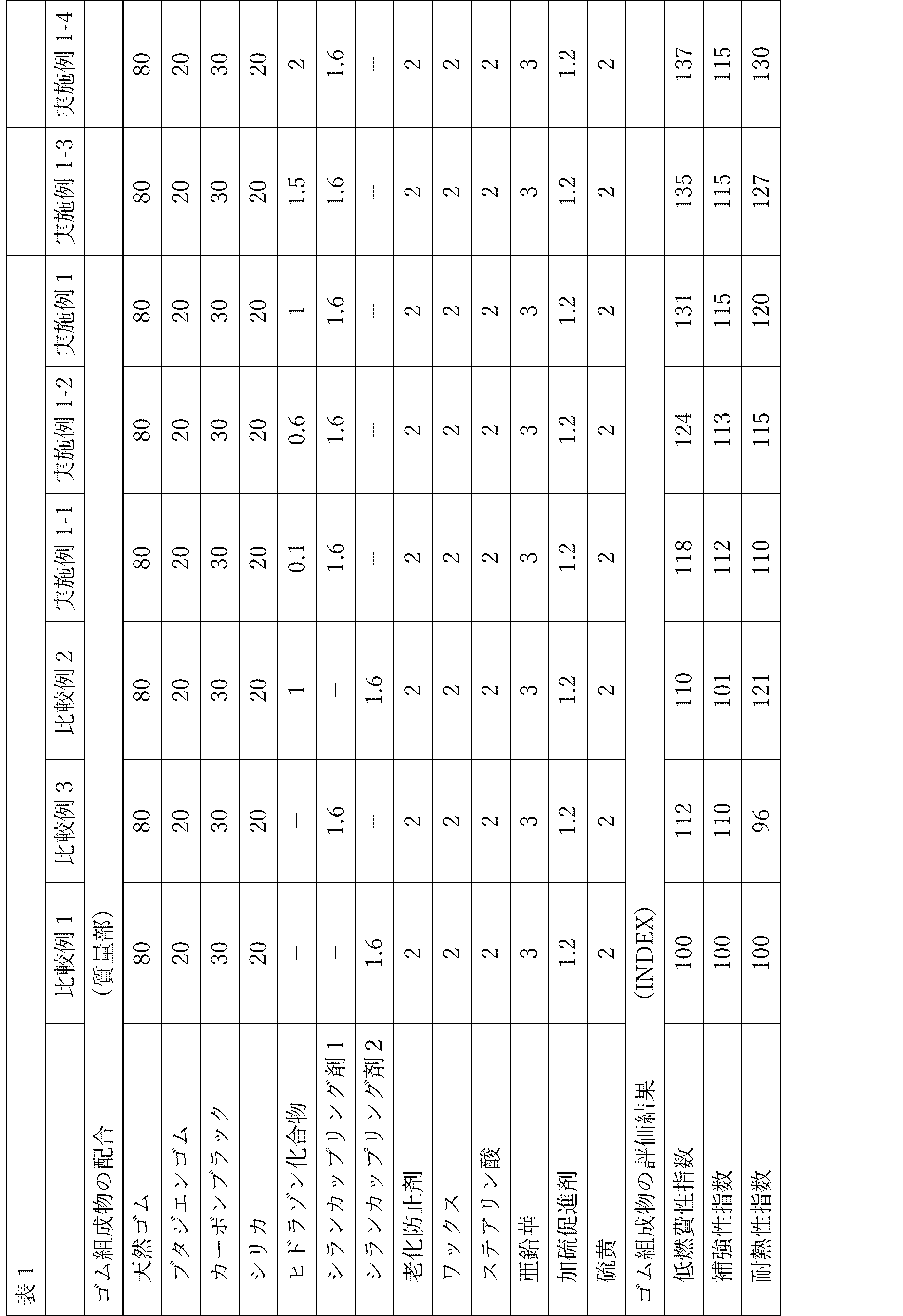
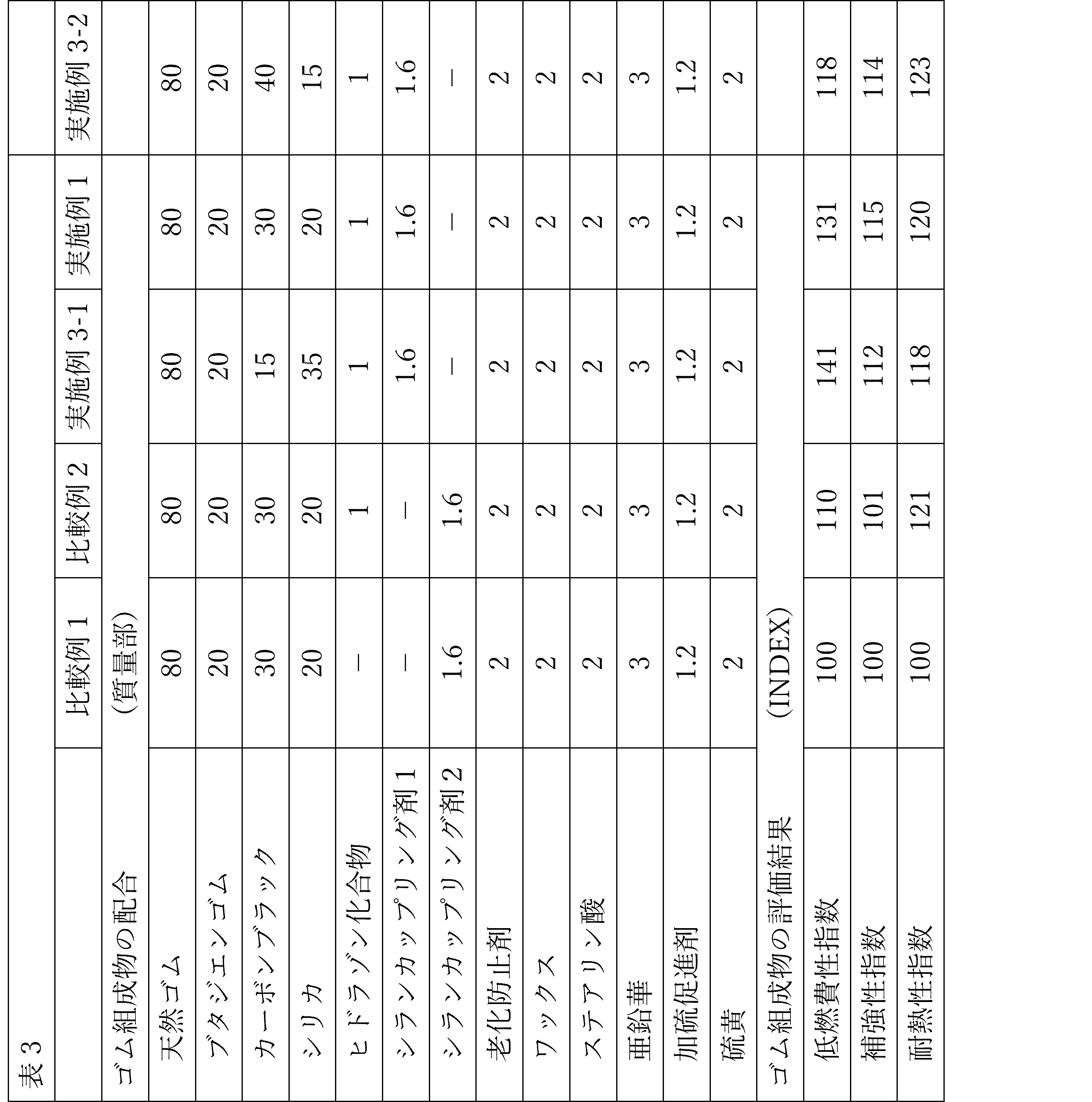
- test composition Production of rubber composition (test composition) Mix each component listed in Table 1 below in the proportions (parts by mass), and adjust the rotation speed using a plastomill so that the maximum temperature of the mixture is 160 ° C. Each rubber composition was manufactured by kneading the mixture for 5 minutes.
- the loss tangent (tan ⁇ ) of the obtained vulcanized rubber was measured using a viscoelasticity measuring device (manufactured by TA Instruments) at room temperature, dynamic strain of 5%, and frequency of 15 Hz.
- the low heat build-up based on the loss tangent (tan ⁇ ) of the rubber composition of each sample is expressed as a low heat build-up index, which is expressed as the reciprocal index when the tan ⁇ value of Comparative Example 1 is set to 100.
- the reinforcing property based on the 300% modulus of the rubber composition of each sample is expressed as a reinforcing property index, and is expressed as an index when the value of the 300% modulus of Comparative Example 1 is set as 100.
- the heat resistance based on the change in tensile strength of the rubber composition of each sample is expressed as a heat resistance index, and is expressed as an index when the value of change in tensile strength in the tensile test of Comparative Example 1 is set as 100.
- Natural rubber Manufactured by GUANGKEN RUBBER, TSR-20 Butadiene rubber: Manufactured by Ube Industries Co., Ltd., product name "BR150B” Carbon black: N234 grade silica: Manufactured by Tosoh Silica Co., Ltd., product name "Nipsil (brand AQ)” Hydrazone compound: 3-hydroxy-N'-(1,3-dimethylbutylidene)-2-naphthoic acid hydrazide
- Silane coupling agent 1 3-octanoylthio-1-propyltriethoxysilane
- Silane coupling agent 2 Bis(3 -triethoxylylpropyl) disulfide anti-aging agent: N-phenyl-N'-(1,3-dimethylbutyl)-p-phenylenediamine (6-PPD) Wax: Manufactured by Rhein Chemie Rheinau, product name “Antilux111” Vulcanization accelerator: N-
- the rubber composition of the present invention is produced by incorporating a combination of a hydrazone compound and 3-octanoylthio-1-propyltriethoxysilane (silane coupling agent) into a rubber composition in which NR is blended with carbon black and silica.
- silane coupling agent 3-octanoylthio-1-propyltriethoxysilane
- the rubber composition of the present invention is particularly useful as a rubber composition for heavy-duty tires such as truck tires or bus tires, such as trucks, buses, aircraft, or industrial vehicles that carry high loads. be.
Landscapes
- Chemical & Material Sciences (AREA)
- Health & Medical Sciences (AREA)
- Chemical Kinetics & Catalysis (AREA)
- Medicinal Chemistry (AREA)
- Polymers & Plastics (AREA)
- Organic Chemistry (AREA)
- Engineering & Computer Science (AREA)
- Mechanical Engineering (AREA)
- Compositions Of Macromolecular Compounds (AREA)
Abstract
Description
ゴム組成物であって、
ゴム成分、ヒドラゾン化合物、カーボンブラック、シリカ、及び3-オクタノイルチオ-1-プロピルトリエトキシシランを含み、
前記ゴム成分は、ゴム成分100質量部中、天然ゴムを50質量部以上含み、
前記ゴム成分100質量部に対して、
前記ヒドラゾン化合物を0.1質量部~2質量部含み、
前記カーボンブラックを15質量部~60質量部含み、
前記シリカを18質量部~80質量部含み、
前記シリカ100質量部に対して、
前記3-オクタノイルチオ-1-プロピルトリエトキシシランを3質量部~10質量部含む、
ゴム組成物。
前記ヒドラゾン化合物は、3-ヒドロキシ-N'-(1,3-ジメチルブチリデン)-2-ナフトエ酸ヒドラジド、3-ヒドロキシ-2-ナフトエ酸ヒドラジド、N'-(1-メチルエチリデン)サリチル酸ヒドラジド、N'-(1-メチルプロピリデン)サリチル酸ヒドラジド、N'-(1,3-ジメチルブチリデン)サリチル酸ヒドラジド、N'-(2-フリルメチレン)サリチル酸ヒドラジド、1-ヒドロキシ-N'-(1-メチルエチリデン)-2-ナフトエ酸ヒドラジド、1-ヒドロキシ-N'-(1-メチルプロピリデン)-2-ナフトエ酸ヒドラジド、1-ヒドロキシ-N'-(1,3-ジメチルブチリデン)-2-ナフトエ酸ヒドラジド、1-ヒドロキシ-N'-(2-フリルメチレン)-2-ナフトエ酸ヒドラジド、3-ヒドロキシ-N'-(1-メチルエチリデン)-2-ナフトエ酸ヒドラジド、3-ヒドロキシ-N'-(1-メチルプロピリデン)-2-ナフトエ酸ヒドラジド、及び3-ヒドロキシ-N'-(2-フリルメチレン)-2-ナフトエ酸ヒドラジドから成る群から選ばれる少なくとも1種のヒドラゾン化合物である、前記項1に記載のゴム組成物。
前記ヒドラゾン化合物は、3-ヒドロキシ-N'-(1,3-ジメチルブチリデン)-2-ナフトエ酸ヒドラジドである、前記項1に記載のゴム組成物。
本発明のゴム組成物は、ゴム成分、ヒドラゾン化合物、カーボンブラック、シリカ、及び3-オクタノイルチオ-1-プロピルトリエトキシシランを含む。
本発明のゴム組成物は、ゴム成分を含み、当該ゴム成分は、ゴム成分100質量部中、天然ゴムを50質量部以上含む。
本発明のゴム組成物は、ヒドラゾン化合物を含み、ゴム成分100質量部に対して、ヒドラゾン化合物を0.1質量部~2質量部含む。

ゴム組成物では、ゴム成分100質量部に対して、ヒドラゾン化合物を0.1質量部~2質量部含む。ゴム組成物では、ゴム成分100質量部に対して、ヒドラゾン化合物を、好ましくは、0.5質量部~1.5質量部含む。
本発明のゴム組成物は、カーボンブラックを含み、ゴム成分100質量部に対して、カーボンブラックを15質量部~60質量部含む。ゴム成分にカーボンブラックを含有させる事に依り、ゴムの電気抵抗を下げて、帯電を抑止する効果、更にゴムの強度を向上させる効果を得る事が出来る。
本発明のゴム組成物は、シリカを含み、ゴム成分100質量部に対して、シリカを18質量部~80質量部含む。
本発明のゴム組成物は、シリカに加えて、シランカップリング剤として、3-オクタノイルチオ-1-プロピルトリエトキシシランを含み、シリカ100質量部に対して、3-オクタノイルチオ-1-プロピルトリエトキシシランを3質量部~10質量部含む。

本発明のゴム組成物には、前記成分に加えて、カーボンブラック及びシリカ以外の無機充填剤、加硫剤、加硫促進剤、加硫促進助剤、老化防止剤、軟化剤、可塑剤、スコーチ防止剤、オゾン防止剤、発泡剤、加硫遅延剤等のゴム業界で通常使用される配合剤を適宜配合する事が出来る。
無機充填剤としては、炭酸カルシウム(CaCO3)、アルミナ(Al2O3)、アルミナ水和物(Al2O3・H2O)、水酸化アルミニウム[Al(OH)3]、炭酸アルミニウム[Al2(CO3)3]、水酸化マグネシウム[Mg(OH)2]、酸化マグネシウム(MgO)、炭酸マグネシウム(MgCO3)、タルク(3MgO・4SiO2・H2O)、アタパルジャイト(5MgO・8SiO2・9H2O)、チタン白(TiO2)、チタン黒(TiO2n-1)、酸化カルシウム(CaO)、水酸化カルシウム[Ca(OH)2]、酸化アルミニウムマグネシウム(MgO・Al2O3)、クレー(Al2O3・2SiO2)、カオリン(Al2O3・2SiO2・2H2O)、パイロフィライト(Al2O3・4SiO2・H2O)、ベントナイト(Al2O3・4SiO2・2H2O)、ケイ酸アルミニウム(Al2SiO5、Al4・3SiO4・5H2O等)、ケイ酸マグネシウム(Mg2SiO4、MgSiO3等)、ケイ酸カルシウム(Ca2・SiO4等)ケイ酸アルミニウムカルシウム(Al2O3・CaO・2SiO2等)、ケイ酸マグネシウムカルシウム(CaMgSiO4)、酸化ジルコニウム(ZrO2)、水酸化ジルコニウム[ZrO(OH)2・nH2O]、炭酸ジルコニウム[Zr(CO3)2]、アクリル酸亜鉛、メタクリル酸亜鉛、各種ゼオライトのように電荷を補正する水素、アルカリ金属又はアルカリ土類金属を含む結晶性アルミノケイ酸塩等を配合することが出来る。
加硫剤としては、有機過酸化物又は硫黄系加硫剤を配合することが出来る。
加硫促進剤としては、スルフェンアミド系、チアゾール系、チウラム系、チオウレア系、グアニジン系、ジチオカルバミン酸系、アルデヒド-アミン系またはアルデヒド-アンモニア系等を配合することが出来る。
老化防止剤としては、アミン系、フェノール系、イミダゾール系の各化合物、カルバミン酸金属塩、ワックス等を配合することが出来る。
軟化剤としては、プロセスオイル、潤滑油、パラフィン、流動パラフィン、石油アスファルト、ワセリン等の石油系軟化剤、ヒマシ油、アマニ油、ナタネ油、ヤシ油等の脂肪油系軟化剤;トール油、サブ、蜜ロウ、カルナバロウ、ラノリン等のワックス類;リノール酸、パルミチン酸、ステアリン酸、ラウリン酸等の脂肪酸;等を配合することが出来る。
可塑剤としては、DMP(フタル酸ジメチル)、DEP(フタル酸ジエチル)、DBP(フタル酸ジブチル)、DHP(フタル酸ジヘプチル)、DOP(フタル酸ジオクチル)、DINP(フタル酸ジイソノニル)、DIDP(フタル酸ジイソデシル)、BBP(フタル酸ブチルベンジル)、DLP(フタル酸ジラウリル)、DCHP(フタル酸ジシクロヘキシル)、無水ヒドロフタル酸エステル、DOZ(アゼライン酸ジ-2-エチルヘキシル)、DBS(セバシン酸ジブチル)、DOS(セバシン酸ジオクチル)、クエン酸アセチルトリエチル、クエン酸アセチルトリブチル、DBM(マレイン酸ジブチル)、DOM(マレイン酸-2-エチルヘキシル)、DBF(フマル酸ジブチル)等を配合することが出来る。
スコーチ防止剤としては、無水フタル酸、サリチル酸、安息香酸等の有機酸;N-ニトロソジフェニルアミン等のニトロソ化合物、N-シクロヘキシルチオフタルイミド;等を配合することが出来る。
本発明のゴム組成物の製造方法では、NRにカーボンブラック及びシリカを配合する際に、併せて、3-オクタノイルチオ-1-プロピルトリエトキシシランと共に、ヒドラゾン化合物を配合する事に依り、3-オクタノイルチオ-1-プロピルトリエトキシシランとシリカとの反応性が向上する。
本発明のゴム組成物は、好ましくは、タイヤ用途であり、特に、タイヤトレッド、アンダートレッド、カーカス、サイドウォール、ビード部等の各部材に用いる事が出来る。
下記表1に記載の各成分をその割合(質量部)で混合し、プラストミルで混合物の最高温度が160℃になる様に、回転数を調整しながら5分間混練して、各ゴム組成物を製造した。
各実施例及び比較例で作製したゴム組成物について、低発熱性、補強性及び耐熱性を評価した。
各実施例及び比較例で作製したゴム組成物を、150℃で25分間加硫して加硫ゴムを得た。
各実施例及び比較例で作製したゴム組成物を、JIS K6251に準拠し、ダンベル型3号試験で室温下、500mm/minの条件で、300%モジュラスを測定した。
各実施例及び比較例で作製したゴム組成物を、100℃×72時間のギアーオーブンにて劣化させ、JIS K6257に準拠し、引張試験に依り、引張強度変化を測定した。


ブタジエンゴム:宇部興産株式会社製、商品名「BR150B」
カーボンブラック:N234グレード
シリカ:東ソー・シリカ株式会社製、商品名「Nipsil(銘柄AQ)」
ヒドラゾン化合物:3-ヒドロキシ-N'-(1,3-ジメチルブチリデン)-2-ナフトエ酸ヒドラジド
シランカップリング剤1:3-オクタノイルチオ-1-プロピルトリエトキシシラン
シランカップリング剤2:ビス(3-トリエトシキシリルプロピル)ジスルフィド
老化防止剤:N-フェニル-N'-(1,3-ジメチルブチル)-p-フェニレンジアミン(6-PPD)
ワックス:Rhein Chemie Rheinau社製、商品名「Antilux111」
加硫促進剤:N-シクロヘキシル-2-ベンゾチアゾールスルフェンアミド(CBS)
Claims (3)
- ゴム組成物であって、
ゴム成分、ヒドラゾン化合物、カーボンブラック、シリカ、及び3-オクタノイルチオ-1-プロピルトリエトキシシランを含み、
前記ゴム成分は、ゴム成分100質量部中、天然ゴムを50質量部以上含み、
前記ゴム成分100質量部に対して、
前記ヒドラゾン化合物を0.1質量部~2質量部含み、
前記カーボンブラックを15質量部~60質量部含み、
前記シリカを18質量部~80質量部含み、
前記シリカ100質量部に対して、
前記3-オクタノイルチオ-1-プロピルトリエトキシシランを3質量部~10質量部含む、
ゴム組成物。 - 前記ヒドラゾン化合物は、3-ヒドロキシ-N'-(1,3-ジメチルブチリデン)-2-ナフトエ酸ヒドラジド、3-ヒドロキシ-2-ナフトエ酸ヒドラジド、N'-(1-メチルエチリデン)サリチル酸ヒドラジド、N'-(1-メチルプロピリデン)サリチル酸ヒドラジド、N'-(1,3-ジメチルブチリデン)サリチル酸ヒドラジド、N'-(2-フリルメチレン)サリチル酸ヒドラジド、1-ヒドロキシ-N'-(1-メチルエチリデン)-2-ナフトエ酸ヒドラジド、1-ヒドロキシ-N'-(1-メチルプロピリデン)-2-ナフトエ酸ヒドラジド、1-ヒドロキシ-N'-(1,3-ジメチルブチリデン)-2-ナフトエ酸ヒドラジド、1-ヒドロキシ-N'-(2-フリルメチレン)-2-ナフトエ酸ヒドラジド、3-ヒドロキシ-N'-(1-メチルエチリデン)-2-ナフトエ酸ヒドラジド、3-ヒドロキシ-N'-(1-メチルプロピリデン)-2-ナフトエ酸ヒドラジド、及び3-ヒドロキシ-N'-(2-フリルメチレン)-2-ナフトエ酸ヒドラジドから成る群から選ばれる少なくとも1種のヒドラゾン化合物である、請求項1に記載のゴム組成物。
- 前記ヒドラゾン化合物は、3-ヒドロキシ-N'-(1,3-ジメチルブチリデン)-2-ナフトエ酸ヒドラジドである、請求項1に記載のゴム組成物。
Priority Applications (4)
| Application Number | Priority Date | Filing Date | Title |
|---|---|---|---|
| US18/856,415 US20250257197A1 (en) | 2022-04-14 | 2023-04-13 | Rubber composition |
| CN202380033246.6A CN118984854A (zh) | 2022-04-14 | 2023-04-13 | 橡胶组合物 |
| JP2024515001A JPWO2023199974A1 (ja) | 2022-04-14 | 2023-04-13 | |
| EP23788392.1A EP4509558A4 (en) | 2022-04-14 | 2023-04-13 | RUBBER COMPOSITION |
Applications Claiming Priority (2)
| Application Number | Priority Date | Filing Date | Title |
|---|---|---|---|
| JP2022-066664 | 2022-04-14 | ||
| JP2022066664 | 2022-04-14 |
Publications (1)
| Publication Number | Publication Date |
|---|---|
| WO2023199974A1 true WO2023199974A1 (ja) | 2023-10-19 |
Family
ID=88329908
Family Applications (1)
| Application Number | Title | Priority Date | Filing Date |
|---|---|---|---|
| PCT/JP2023/015004 Ceased WO2023199974A1 (ja) | 2022-04-14 | 2023-04-13 | ゴム組成物 |
Country Status (5)
| Country | Link |
|---|---|
| US (1) | US20250257197A1 (ja) |
| EP (1) | EP4509558A4 (ja) |
| JP (1) | JPWO2023199974A1 (ja) |
| CN (1) | CN118984854A (ja) |
| WO (1) | WO2023199974A1 (ja) |
Citations (3)
| Publication number | Priority date | Publication date | Assignee | Title |
|---|---|---|---|---|
| JP2018203937A (ja) * | 2017-06-07 | 2018-12-27 | 株式会社ブリヂストン | タイヤ用ゴム組成物及びタイヤ |
| JP2019089868A (ja) * | 2016-03-31 | 2019-06-13 | 株式会社大阪ソーダ | 低燃費タイヤ用ゴム組成物 |
| JP2021185212A (ja) * | 2020-05-25 | 2021-12-09 | 大塚化学株式会社 | ゴム組成物、タイヤ、及びゴム用低発熱化剤 |
Family Cites Families (1)
| Publication number | Priority date | Publication date | Assignee | Title |
|---|---|---|---|---|
| DE69835841T2 (de) * | 1997-04-02 | 2007-01-04 | Otsuka Chemical Holdings Co., Ltd. | Hydrazonderivate |
-
2023
- 2023-04-13 WO PCT/JP2023/015004 patent/WO2023199974A1/ja not_active Ceased
- 2023-04-13 US US18/856,415 patent/US20250257197A1/en active Pending
- 2023-04-13 CN CN202380033246.6A patent/CN118984854A/zh active Pending
- 2023-04-13 JP JP2024515001A patent/JPWO2023199974A1/ja active Pending
- 2023-04-13 EP EP23788392.1A patent/EP4509558A4/en active Pending
Patent Citations (3)
| Publication number | Priority date | Publication date | Assignee | Title |
|---|---|---|---|---|
| JP2019089868A (ja) * | 2016-03-31 | 2019-06-13 | 株式会社大阪ソーダ | 低燃費タイヤ用ゴム組成物 |
| JP2018203937A (ja) * | 2017-06-07 | 2018-12-27 | 株式会社ブリヂストン | タイヤ用ゴム組成物及びタイヤ |
| JP2021185212A (ja) * | 2020-05-25 | 2021-12-09 | 大塚化学株式会社 | ゴム組成物、タイヤ、及びゴム用低発熱化剤 |
Non-Patent Citations (1)
| Title |
|---|
| See also references of EP4509558A4 * |
Also Published As
| Publication number | Publication date |
|---|---|
| EP4509558A4 (en) | 2025-07-23 |
| EP4509558A1 (en) | 2025-02-19 |
| CN118984854A (zh) | 2024-11-19 |
| JPWO2023199974A1 (ja) | 2023-10-19 |
| US20250257197A1 (en) | 2025-08-14 |
Similar Documents
| Publication | Publication Date | Title |
|---|---|---|
| JP4915467B2 (ja) | タイヤ用ゴム組成物 | |
| CN102112327B (zh) | 轮胎与包含氧杂环丁烷衍生物和羧酸的可交联弹性体组合物 | |
| US20120270966A1 (en) | Composition based on natural rubber and a reinforcing inorganic filler comprising dihydrazide | |
| JP6561847B2 (ja) | タイヤ用ゴム組成物の製造方法および空気入りタイヤ | |
| JP6481255B2 (ja) | タイヤ用ゴム組成物 | |
| JPH1067885A (ja) | ゴム組成物およびその組成物のトレッドを有するタイヤ | |
| EP2174801A2 (en) | Rubber composition and pneumatic tire | |
| JP7441114B2 (ja) | ゴム組成物、タイヤ、及びゴム用低発熱化剤 | |
| JP2014133843A (ja) | トレッド用ゴム組成物及び空気入りタイヤ | |
| EP3842486A1 (en) | Rubber composition and tire | |
| JP2002363346A (ja) | タイヤトレッド用ゴム組成物およびそれを用いた空気入りタイヤ | |
| JP5920544B2 (ja) | タイヤ用ゴム組成物 | |
| JP2002338750A (ja) | タイヤトレッド用ゴム組成物およびそれを用いた空気入りタイヤ | |
| WO2023199974A1 (ja) | ゴム組成物 | |
| JP2000219779A (ja) | ゴム組成物の製造方法 | |
| JP5463734B2 (ja) | タイヤ用ゴム組成物 | |
| JP2005194418A (ja) | 空気入りタイヤ用ゴム組成物 | |
| JP7427488B2 (ja) | ゴム組成物及びタイヤ | |
| WO2019117217A1 (ja) | ゴム組成物およびタイヤ | |
| JP5418142B2 (ja) | タイヤ用ゴム組成物 | |
| JP2023116960A (ja) | トラック又はバスタイヤ用ゴム組成物、及びその製造方法 | |
| WO2017217528A1 (ja) | ゴム用添加剤 | |
| JP7663797B2 (ja) | タイヤ用ゴム組成物 | |
| JP5795862B2 (ja) | ゴム組成物及びそれを用いた空気入りタイヤ | |
| JP2012153787A (ja) | タイヤ用ゴム組成物及び空気入りタイヤ |
Legal Events
| Date | Code | Title | Description |
|---|---|---|---|
| 121 | Ep: the epo has been informed by wipo that ep was designated in this application |
Ref document number: 23788392 Country of ref document: EP Kind code of ref document: A1 |
|
| WWE | Wipo information: entry into national phase |
Ref document number: 2024515001 Country of ref document: JP |
|
| WWE | Wipo information: entry into national phase |
Ref document number: 202380033246.6 Country of ref document: CN |
|
| WWE | Wipo information: entry into national phase |
Ref document number: 18856415 Country of ref document: US |
|
| WWE | Wipo information: entry into national phase |
Ref document number: 2023788392 Country of ref document: EP |
|
| NENP | Non-entry into the national phase |
Ref country code: DE |
|
| ENP | Entry into the national phase |
Ref document number: 2023788392 Country of ref document: EP Effective date: 20241114 |
|
| WWP | Wipo information: published in national office |
Ref document number: 18856415 Country of ref document: US |