WO2023203952A1 - 正極活物質、及び非水電解質二次電池 - Google Patents
正極活物質、及び非水電解質二次電池 Download PDFInfo
- Publication number
- WO2023203952A1 WO2023203952A1 PCT/JP2023/011125 JP2023011125W WO2023203952A1 WO 2023203952 A1 WO2023203952 A1 WO 2023203952A1 JP 2023011125 W JP2023011125 W JP 2023011125W WO 2023203952 A1 WO2023203952 A1 WO 2023203952A1
- Authority
- WO
- WIPO (PCT)
- Prior art keywords
- positive electrode
- active material
- electrode active
- transition metal
- composite oxide
- Prior art date
- Legal status (The legal status is an assumption and is not a legal conclusion. Google has not performed a legal analysis and makes no representation as to the accuracy of the status listed.)
- Ceased
Links
Images

Classifications
-
- C—CHEMISTRY; METALLURGY
- C01—INORGANIC CHEMISTRY
- C01G—COMPOUNDS CONTAINING METALS NOT COVERED BY SUBCLASSES C01D OR C01F
- C01G53/00—Compounds of nickel
- C01G53/40—Complex oxides containing nickel and at least one other metal element
- C01G53/42—Complex oxides containing nickel and at least one other metal element containing alkali metals, e.g. LiNiO2
- C01G53/44—Complex oxides containing nickel and at least one other metal element containing alkali metals, e.g. LiNiO2 containing manganese
- C01G53/50—Complex oxides containing nickel and at least one other metal element containing alkali metals, e.g. LiNiO2 containing manganese of the type (MnO2)n-, e.g. Li(NixMn1-x)O2 or Li(MyNixMn1-x-y)O2
- C01G53/502—Complex oxides containing nickel and at least one other metal element containing alkali metals, e.g. LiNiO2 containing manganese of the type (MnO2)n-, e.g. Li(NixMn1-x)O2 or Li(MyNixMn1-x-y)O2 containing lithium and cobalt
- C01G53/504—Complex oxides containing nickel and at least one other metal element containing alkali metals, e.g. LiNiO2 containing manganese of the type (MnO2)n-, e.g. Li(NixMn1-x)O2 or Li(MyNixMn1-x-y)O2 containing lithium and cobalt with the molar ratio of nickel with respect to all the metals other than alkali metals higher than or equal to 0.5, e.g. Li(MzNixCoyMn1-x-y-z)O2 with x ≥ 0.5
- C01G53/506—Complex oxides containing nickel and at least one other metal element containing alkali metals, e.g. LiNiO2 containing manganese of the type (MnO2)n-, e.g. Li(NixMn1-x)O2 or Li(MyNixMn1-x-y)O2 containing lithium and cobalt with the molar ratio of nickel with respect to all the metals other than alkali metals higher than or equal to 0.5, e.g. Li(MzNixCoyMn1-x-y-z)O2 with x ≥ 0.5 with the molar ratio of nickel with respect to all the metals other than alkali metals higher than or equal to 0.8, e.g. Li(MzNixCoyMn1-x-y-z)O2 with x ≥ 0.8
-
- H—ELECTRICITY
- H01—ELECTRIC ELEMENTS
- H01M—PROCESSES OR MEANS, e.g. BATTERIES, FOR THE DIRECT CONVERSION OF CHEMICAL ENERGY INTO ELECTRICAL ENERGY
- H01M10/00—Secondary cells; Manufacture thereof
- H01M10/05—Accumulators with non-aqueous electrolyte
- H01M10/052—Li-accumulators
-
- H—ELECTRICITY
- H01—ELECTRIC ELEMENTS
- H01M—PROCESSES OR MEANS, e.g. BATTERIES, FOR THE DIRECT CONVERSION OF CHEMICAL ENERGY INTO ELECTRICAL ENERGY
- H01M10/00—Secondary cells; Manufacture thereof
- H01M10/42—Methods or arrangements for servicing or maintenance of secondary cells or secondary half-cells
- H01M10/4235—Safety or regulating additives or arrangements in electrodes, separators or electrolyte
-
- H—ELECTRICITY
- H01—ELECTRIC ELEMENTS
- H01M—PROCESSES OR MEANS, e.g. BATTERIES, FOR THE DIRECT CONVERSION OF CHEMICAL ENERGY INTO ELECTRICAL ENERGY
- H01M4/00—Electrodes
- H01M4/02—Electrodes composed of, or comprising, active material
- H01M4/36—Selection of substances as active materials, active masses, active liquids
- H01M4/362—Composites
- H01M4/366—Composites as layered products
-
- H—ELECTRICITY
- H01—ELECTRIC ELEMENTS
- H01M—PROCESSES OR MEANS, e.g. BATTERIES, FOR THE DIRECT CONVERSION OF CHEMICAL ENERGY INTO ELECTRICAL ENERGY
- H01M4/00—Electrodes
- H01M4/02—Electrodes composed of, or comprising, active material
- H01M4/36—Selection of substances as active materials, active masses, active liquids
- H01M4/48—Selection of substances as active materials, active masses, active liquids of inorganic oxides or hydroxides
- H01M4/50—Selection of substances as active materials, active masses, active liquids of inorganic oxides or hydroxides of manganese
- H01M4/505—Selection of substances as active materials, active masses, active liquids of inorganic oxides or hydroxides of manganese of mixed oxides or hydroxides containing manganese for inserting or intercalating light metals, e.g. LiMn2O4 or LiMn2OxFy
-
- H—ELECTRICITY
- H01—ELECTRIC ELEMENTS
- H01M—PROCESSES OR MEANS, e.g. BATTERIES, FOR THE DIRECT CONVERSION OF CHEMICAL ENERGY INTO ELECTRICAL ENERGY
- H01M4/00—Electrodes
- H01M4/02—Electrodes composed of, or comprising, active material
- H01M4/36—Selection of substances as active materials, active masses, active liquids
- H01M4/48—Selection of substances as active materials, active masses, active liquids of inorganic oxides or hydroxides
- H01M4/52—Selection of substances as active materials, active masses, active liquids of inorganic oxides or hydroxides of nickel, cobalt or iron
- H01M4/525—Selection of substances as active materials, active masses, active liquids of inorganic oxides or hydroxides of nickel, cobalt or iron of mixed oxides or hydroxides containing iron, cobalt or nickel for inserting or intercalating light metals, e.g. LiNiO2, LiCoO2 or LiCoOxFy
-
- H—ELECTRICITY
- H01—ELECTRIC ELEMENTS
- H01M—PROCESSES OR MEANS, e.g. BATTERIES, FOR THE DIRECT CONVERSION OF CHEMICAL ENERGY INTO ELECTRICAL ENERGY
- H01M4/00—Electrodes
- H01M4/02—Electrodes composed of, or comprising, active material
- H01M4/62—Selection of inactive substances as ingredients for active masses, e.g. binders, fillers
-
- H—ELECTRICITY
- H01—ELECTRIC ELEMENTS
- H01M—PROCESSES OR MEANS, e.g. BATTERIES, FOR THE DIRECT CONVERSION OF CHEMICAL ENERGY INTO ELECTRICAL ENERGY
- H01M4/00—Electrodes
- H01M4/02—Electrodes composed of, or comprising, active material
- H01M4/62—Selection of inactive substances as ingredients for active masses, e.g. binders, fillers
- H01M4/624—Electric conductive fillers
- H01M4/625—Carbon or graphite
-
- C—CHEMISTRY; METALLURGY
- C01—INORGANIC CHEMISTRY
- C01P—INDEXING SCHEME RELATING TO STRUCTURAL AND PHYSICAL ASPECTS OF SOLID INORGANIC COMPOUNDS
- C01P2002/00—Crystal-structural characteristics
- C01P2002/20—Two-dimensional structures
-
- C—CHEMISTRY; METALLURGY
- C01—INORGANIC CHEMISTRY
- C01P—INDEXING SCHEME RELATING TO STRUCTURAL AND PHYSICAL ASPECTS OF SOLID INORGANIC COMPOUNDS
- C01P2002/00—Crystal-structural characteristics
- C01P2002/50—Solid solutions
- C01P2002/52—Solid solutions containing elements as dopants
-
- C—CHEMISTRY; METALLURGY
- C01—INORGANIC CHEMISTRY
- C01P—INDEXING SCHEME RELATING TO STRUCTURAL AND PHYSICAL ASPECTS OF SOLID INORGANIC COMPOUNDS
- C01P2002/00—Crystal-structural characteristics
- C01P2002/50—Solid solutions
- C01P2002/52—Solid solutions containing elements as dopants
- C01P2002/54—Solid solutions containing elements as dopants one element only
-
- C—CHEMISTRY; METALLURGY
- C01—INORGANIC CHEMISTRY
- C01P—INDEXING SCHEME RELATING TO STRUCTURAL AND PHYSICAL ASPECTS OF SOLID INORGANIC COMPOUNDS
- C01P2002/00—Crystal-structural characteristics
- C01P2002/70—Crystal-structural characteristics defined by measured X-ray, neutron or electron diffraction data
- C01P2002/76—Crystal-structural characteristics defined by measured X-ray, neutron or electron diffraction data by a space-group or by other symmetry indications
-
- C—CHEMISTRY; METALLURGY
- C01—INORGANIC CHEMISTRY
- C01P—INDEXING SCHEME RELATING TO STRUCTURAL AND PHYSICAL ASPECTS OF SOLID INORGANIC COMPOUNDS
- C01P2002/00—Crystal-structural characteristics
- C01P2002/80—Crystal-structural characteristics defined by measured data other than those specified in group C01P2002/70
- C01P2002/85—Crystal-structural characteristics defined by measured data other than those specified in group C01P2002/70 by XPS, EDX or EDAX data
-
- C—CHEMISTRY; METALLURGY
- C01—INORGANIC CHEMISTRY
- C01P—INDEXING SCHEME RELATING TO STRUCTURAL AND PHYSICAL ASPECTS OF SOLID INORGANIC COMPOUNDS
- C01P2004/00—Particle morphology
- C01P2004/01—Particle morphology depicted by an image
- C01P2004/04—Particle morphology depicted by an image obtained by TEM, STEM, STM or AFM
-
- C—CHEMISTRY; METALLURGY
- C01—INORGANIC CHEMISTRY
- C01P—INDEXING SCHEME RELATING TO STRUCTURAL AND PHYSICAL ASPECTS OF SOLID INORGANIC COMPOUNDS
- C01P2004/00—Particle morphology
- C01P2004/30—Particle morphology extending in three dimensions
- C01P2004/45—Aggregated particles or particles with an intergrown morphology
-
- C—CHEMISTRY; METALLURGY
- C01—INORGANIC CHEMISTRY
- C01P—INDEXING SCHEME RELATING TO STRUCTURAL AND PHYSICAL ASPECTS OF SOLID INORGANIC COMPOUNDS
- C01P2004/00—Particle morphology
- C01P2004/51—Particles with a specific particle size distribution
-
- C—CHEMISTRY; METALLURGY
- C01—INORGANIC CHEMISTRY
- C01P—INDEXING SCHEME RELATING TO STRUCTURAL AND PHYSICAL ASPECTS OF SOLID INORGANIC COMPOUNDS
- C01P2004/00—Particle morphology
- C01P2004/60—Particles characterised by their size
- C01P2004/61—Micrometer sized, i.e. from 1-100 micrometer
-
- C—CHEMISTRY; METALLURGY
- C01—INORGANIC CHEMISTRY
- C01P—INDEXING SCHEME RELATING TO STRUCTURAL AND PHYSICAL ASPECTS OF SOLID INORGANIC COMPOUNDS
- C01P2004/00—Particle morphology
- C01P2004/60—Particles characterised by their size
- C01P2004/64—Nanometer sized, i.e. from 1-100 nanometer
-
- C—CHEMISTRY; METALLURGY
- C01—INORGANIC CHEMISTRY
- C01P—INDEXING SCHEME RELATING TO STRUCTURAL AND PHYSICAL ASPECTS OF SOLID INORGANIC COMPOUNDS
- C01P2004/00—Particle morphology
- C01P2004/80—Particles consisting of a mixture of two or more inorganic phases
-
- H—ELECTRICITY
- H01—ELECTRIC ELEMENTS
- H01M—PROCESSES OR MEANS, e.g. BATTERIES, FOR THE DIRECT CONVERSION OF CHEMICAL ENERGY INTO ELECTRICAL ENERGY
- H01M4/00—Electrodes
- H01M4/02—Electrodes composed of, or comprising, active material
- H01M2004/026—Electrodes composed of, or comprising, active material characterised by the polarity
- H01M2004/028—Positive electrodes
-
- Y—GENERAL TAGGING OF NEW TECHNOLOGICAL DEVELOPMENTS; GENERAL TAGGING OF CROSS-SECTIONAL TECHNOLOGIES SPANNING OVER SEVERAL SECTIONS OF THE IPC; TECHNICAL SUBJECTS COVERED BY FORMER USPC CROSS-REFERENCE ART COLLECTIONS [XRACs] AND DIGESTS
- Y02—TECHNOLOGIES OR APPLICATIONS FOR MITIGATION OR ADAPTATION AGAINST CLIMATE CHANGE
- Y02E—REDUCTION OF GREENHOUSE GAS [GHG] EMISSIONS, RELATED TO ENERGY GENERATION, TRANSMISSION OR DISTRIBUTION
- Y02E60/00—Enabling technologies; Technologies with a potential or indirect contribution to GHG emissions mitigation
- Y02E60/10—Energy storage using batteries
Definitions
- the present disclosure relates to a positive electrode active material and a non-aqueous electrolyte secondary battery.
- non-aqueous electrolyte secondary batteries have been widely used as high-output, high-capacity secondary batteries that include a positive electrode, a negative electrode, and a non-aqueous electrolyte, and charge and discharge by moving Li ions between the positive and negative electrodes. It's being used.
- the positive electrode active material contained in non-aqueous electrolyte secondary batteries lithium transition metal composite oxides having a layered rock salt structure are generally used, and lithium transition metal composite oxides having a spinel structure, olivine structure, etc. are used. are also being considered.
- Patent Document 1 discloses a positive electrode active material in which the surface of a lithium transition metal composite oxide having an olivine structure is coated with a carbonaceous film containing S and Li for the purpose of improving electronic conductivity. .
- Patent Document 1 is a technique for a lithium transition metal composite oxide having an olivine structure, and has not been studied for a lithium transition metal composite oxide having a layered rock salt structure, so there is still room for improvement.
- an object of the present disclosure is to provide a positive electrode active material with low resistance and improved rate characteristics.
- a positive electrode active material that is an embodiment of the present disclosure includes a lithium transition metal composite oxide and a carbonaceous film formed on the surface of the lithium transition metal composite oxide, and the carbonaceous film includes an alkali metal other than Li and a carbonaceous film formed on the surface of the lithium transition metal composite oxide. It is characterized by containing at least one of alkaline earth metals.
- a non-aqueous electrolyte secondary battery that is one aspect of the present disclosure is characterized by comprising a positive electrode containing the above-described positive electrode active material, a negative electrode, and a non-aqueous electrolyte.
- the rate characteristics can be improved while lowering the electrical resistance of a nonaqueous electrolyte secondary battery.
- FIG. 1 is a longitudinal cross-sectional view of a cylindrical secondary battery that is an example of an embodiment.
- 3 is a diagram showing the results of TEM-EDX analysis of the positive electrode active material of Example 1.
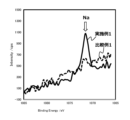
- FIG. 3 is a diagram showing the results of XPS analysis of positive electrode active materials of Example 1 and Comparative Example 1.
- FIG. 1 is a longitudinal cross-sectional view of a cylindrical secondary battery that is an example of an embodiment.
- 3 is a diagram showing the results of TEM-EDX analysis of the positive electrode active material of Example 1.
- FIG. 3 is a diagram showing the results of XPS analysis of positive electrode active materials of Example 1 and Comparative Example 1.
- Lithium transition metal composite oxides containing Co have been used as positive electrode active materials for non-aqueous electrolyte secondary batteries.
- Co is a rare metal, and in recent years, studies have been conducted to reduce the Co content in lithium-transition metal composite oxides.
- the Co content of a lithium transition metal composite oxide is lowered, the electronic conductivity may decrease and the electrical resistance may increase.
- the Co content of the lithium transition metal composite oxide is lowered, the efficiency in charging and discharging at high current density may decrease.
- the carbonaceous coating has a carbonaceous coating on the surface, and that the carbonaceous coating contains at least one of an alkali metal and an alkaline earth metal other than Li. It has been found that by using the contained lithium transition metal composite oxide as a positive electrode active material, it is possible to improve the rate characteristics while lowering the direct current resistance (DCIR) of a nonaqueous electrolyte secondary battery. It is presumed that this is because the inclusion of an alkali metal or alkaline earth metal having a larger ionic radius than Li improves the uniformity of the carbonaceous film on the surface of the lithium-transition metal composite oxide.
- DCIR direct current resistance
- a cylindrical secondary battery in which a wound electrode body is housed in a cylindrical outer can with a bottom is exemplified, but the outer case is not limited to a cylindrical outer can, and for example, a square outer can.
- the exterior body may be made of a laminate sheet including a metal layer and a resin layer.
- the electrode body may be a laminated type electrode body in which a plurality of positive electrodes and a plurality of negative electrodes are alternately laminated with separators interposed therebetween.
- a liquid non-aqueous electrolyte is illustrated below, the non-aqueous electrolyte is not limited to a liquid and may be solid.
- FIG. 1 is a longitudinal cross-sectional view of a cylindrical secondary battery 10 that is an example of an embodiment.
- an electrode body 14 and a non-aqueous electrolyte (not shown) are housed in an exterior body 15.
- the electrode body 14 has a wound structure in which a positive electrode 11 and a negative electrode 12 are wound with a separator 13 in between.
- the solvent organic solvent
- carbonates, lactones, ethers, ketones, esters, etc. can be used, and two or more of these solvents can be used as a mixture.
- a mixed solvent containing a cyclic carbonate and a chain carbonate For example, ethylene carbonate (EC), propylene carbonate (PC), butylene carbonate (BC), etc. can be used as the cyclic carbonate, and dimethyl carbonate (DMC), ethylmethyl carbonate (EMC), and diethyl carbonate ( DEC) etc. can be used.
- EC ethylene carbonate
- PC propylene carbonate
- BC butylene carbonate
- DEC diethyl carbonate
- the electrolyte salt of the nonaqueous electrolyte LiPF 6 , LiBF 4 , LiCF 3 SO 3 , etc., and mixtures thereof can be used.
- the amount of electrolyte salt dissolved in the solvent can be, for example, 0.5 to 2.0 mol/L.
- non-aqueous electrolyte may further contain vinylene carbonate or propane sultone additives.
- the sealing body 16 side will be referred to as “upper” and the bottom side of exterior body 15 will be referred to as “lower”.
- the interior of the secondary battery 10 is sealed by closing the open end of the exterior body 15 with the sealing body 16.
- Insulating plates 17 and 18 are provided above and below the electrode body 14, respectively.
- the positive electrode lead 19 extends upward through the through hole of the insulating plate 17 and is welded to the lower surface of the filter 22, which is the bottom plate of the sealing body 16.
- the cap 26, which is the top plate of the sealing body 16 electrically connected to the filter 22, serves as a positive terminal.
- the negative electrode lead 20 passes through the through hole of the insulating plate 18 , extends to the bottom side of the exterior body 15 , and is welded to the bottom inner surface of the exterior body 15 .
- the exterior body 15 serves as a negative terminal. Note that when the negative electrode lead 20 is installed at the terminal end, the negative electrode lead 20 passes through the outside of the insulating plate 18, extends to the bottom side of the exterior body 15, and is welded to the bottom inner surface of the exterior body 15.
- the exterior body 15 is, for example, a cylindrical metallic exterior can with a bottom.
- a gasket 27 is provided between the exterior body 15 and the sealing body 16 to ensure airtightness inside the secondary battery 10.
- the exterior body 15 has a grooved portion 21 that supports the sealing body 16 and is formed by, for example, pressing a side surface from the outside.
- the grooved portion 21 is preferably formed in an annular shape along the circumferential direction of the exterior body 15, and supports the sealing body 16 via the gasket 27 on its upper surface.
- the sealing body 16 includes a filter 22, a lower valve body 23, an insulating member 24, an upper valve body 25, and a cap 26, which are laminated in order from the electrode body 14 side.
- Each member constituting the sealing body 16 has, for example, a disk shape or a ring shape, and each member except the insulating member 24 is electrically connected to each other.
- the lower valve body 23 and the upper valve body 25 are connected to each other at their central portions, and an insulating member 24 is interposed between their peripheral edges.
- the positive electrode 11, negative electrode 12, separator 13, and non-aqueous electrolyte that constitute the secondary battery 10 will be explained in detail, particularly the positive electrode active material contained in the positive electrode 11.
- the positive electrode 11 includes, for example, a positive electrode current collector and a positive electrode mixture layer formed on the surface of the positive electrode current collector.
- the positive electrode mixture layer is preferably formed on both sides of the positive electrode current collector.
- a metal foil such as aluminum or an aluminum alloy that is stable in the potential range of the positive electrode 11, a film having the metal disposed on the surface, or the like can be used.
- the positive electrode mixture layer may include a positive electrode active material, a conductive agent, and a binder.
- the positive electrode 11 is made by applying a positive electrode mixture slurry containing a positive electrode active material, a conductive agent, a binder, etc. to the surface of a positive electrode current collector, drying the coating film, and then rolling the coating film using a roller or the like. It can be made by rolling.
- Examples of the conductive agent contained in the positive electrode mixture layer include carbon materials such as carbon black, acetylene black, Ketjen black, graphite, carbon nanotubes, carbon nanofibers, and graphene.
- the content of the conductive agent is, for example, 0.01% by mass to 10% by mass, preferably 0.1% by mass to 5% by mass, based on the total mass of the positive electrode mixture layer.
- binder included in the positive electrode mixture layer examples include fluororesins such as polytetrafluoroethylene (PTFE) and polyvinylidene fluoride (PVdF), polyacrylonitrile (PAN), polyimide, acrylic resin, and polyolefin. Furthermore, these resins may be used in combination with carboxymethyl cellulose (CMC) or a salt thereof, polyethylene oxide (PEO), or the like.
- the content of the binder is, for example, 0.1% by mass to 10% by mass, preferably 0.5% by mass to 5% by mass, based on the total mass of the positive electrode mixture layer.
- the positive electrode active material contained in the positive electrode mixture layer includes a lithium transition metal composite oxide and a carbonaceous film formed on the surface of the lithium transition metal composite oxide, and the carbonaceous film contains alkali metals other than Li and Contains at least one of alkaline earth metals. Thereby, the rate characteristics can be improved while lowering the electrical resistance of the non-aqueous electrolyte secondary battery.
- the lithium transition metal composite oxide includes, for example, secondary particles formed by agglomeration of primary particles.
- the surface of the lithium transition metal composite oxide means the surface of secondary particles of the lithium transition metal composite oxide. That is, the carbonaceous film exists on the surface of the secondary particles of the lithium-transition metal composite oxide.
- the carbonaceous film may exist in a dotted manner so as to cover at least a part of the surface of the secondary particle of the lithium transition metal composite oxide, or it may exist so as to cover the entire surface of the secondary particle. good. Note that the carbonaceous film may be present at the interface where the primary particles of the lithium-transition metal composite oxide are in contact with each other.
- the particle size of the primary particles constituting the secondary particles of the lithium-transition metal composite oxide is, for example, 0.02 ⁇ m to 2 ⁇ m.
- the particle size of a primary particle is measured as the diameter of a circumscribed circle in a particle image observed by a scanning electron microscope (SEM).
- SEM scanning electron microscope
- the average particle diameter of the secondary particles of the lithium transition metal composite oxide is, for example, 2 ⁇ m to 30 ⁇ m.
- the average particle diameter means the volume-based median diameter (D50).
- D50 means a particle size at which the cumulative frequency is 50% from the smallest particle size in the volume-based particle size distribution, and is also called the median diameter.
- the particle size distribution of the secondary particles of the lithium-transition metal composite oxide can be measured using a laser diffraction type particle size distribution measuring device (for example, MT3000II manufactured by Microtrac Bell Co., Ltd.) using water as a dispersion medium.
- a laser diffraction type particle size distribution measuring device for example, MT3000II manufactured by Microtrac Bell Co., Ltd.
- the lithium transition metal composite oxide has, for example, a layered rock salt structure belonging to space group R-3m, space group C2/m, etc.
- the lithium transition metal composite oxide preferably has a layered rock salt structure belonging to space group R-3m.
- the layered rock salt structure of the lithium-transition metal composite oxide may include a transition metal layer, a Li layer, and an oxygen layer. The charging and discharging reaction of the battery progresses as Li ions present in the Li layer reversibly move in and out.
- the Co content in the lithium transition metal composite oxide is preferably 5 mol% or less, more preferably 2 mol% or less, and even more preferably 1 mol%, based on the total number of moles of metal elements excluding Li. % or less, particularly preferably 0.1 mol%. Since Co is a rare metal and is expensive, it is preferable to reduce the amount of Co used.
- the lithium transition metal composite oxide may be represented by the general formula Li a Ni 1-x-y Mn x M y O 2+b .
- this general formula is 0.9 ⁇ a ⁇ 1.1, 0 ⁇ x ⁇ 0.5, 0 ⁇ y ⁇ 0.1, 0.5 ⁇ 1-xy ⁇ 0.95, and - 0.05 ⁇ b ⁇ 0.05 is satisfied, and the element M is an element other than Li, Ni, Mn, and oxygen.
- the value of a indicating the molar ratio of lithium increases or decreases due to charging and discharging.
- Element M includes Co, Nb, Al, Zr, B, Fe, Cu, Zn, Sn, W, Mo, Si, Ti, Fe, and Preferably, it is at least one selected from the group consisting of Cr.
- the content of the elements constituting the lithium-transition metal composite oxide can be measured using an inductively coupled plasma emission spectrometer (ICP-AES), an electron beam microanalyzer (EPMA), or the like.
- ICP-AES inductively coupled plasma emission spectrometer
- EPMA electron beam microanalyzer
- the carbonaceous film preferably contains at least one of an alkali metal and an alkaline earth metal other than Li, and preferably contains at least one of Na and K.
- the carbonaceous film may further contain S.
- the carbonaceous film may contain Li.
- the presence of S in the carbonaceous film can be confirmed by energy dispersive X-ray spectroscopy (TEM-EDX).
- TEM-EDX energy dispersive X-ray spectroscopy
- XPS X-ray photoelectron spectroscopy
- the thickness of the carbonaceous film is, for example, 30 nm or less.
- the lower limit of the thickness of the carbonaceous film is, for example, 1 nm.
- the thickness of the carbonaceous film is measured by an image of a cross section of the positive electrode active material observed using a transmission electron microscope (TEM).
- the positive electrode mixture layer may contain other positive electrode active materials in addition to the above positive electrode active materials.
- Other positive electrode active materials include, for example, lithium transition metal composite oxides that do not have a carbonaceous film on the surface.
- the above positive electrode active material preferably accounts for 90% by mass or more, more preferably 99% by mass or more, based on the total mass of the positive electrode active material.
- the positive electrode active material is produced, for example, as follows. (1) An aqueous solution is prepared by dissolving an anionic surfactant in water. (2) A powder of lithium transition metal composite oxide is added to the aqueous solution and stirred to prepare a suspension in which the lithium transition metal composite oxide is dispersed in the aqueous solution. (3) A positive electrode active material is obtained by filtering the suspension and firing the resulting residue.
- the anionic surfactant can be adsorbed onto the surface of the lithium-transition metal composite oxide in water to create a substantially uniform carbonaceous film.
- the surfactant is not particularly limited as long as it contains C and at least one of an alkali metal and an alkaline earth metal other than Li. It is preferable that the surfactant contains at least one of Na and K. Moreover, the surfactant may further contain S. Examples of the surfactant include sodium lauryl sulfate and potassium lauryl sulfate.
- the concentration of the surfactant in the aqueous solution is, for example, 0.1% by mass to 10% by mass.
- the negative electrode 12 includes, for example, a negative electrode current collector and a negative electrode mixture layer formed on the surface of the negative electrode current collector.
- the negative electrode mixture layer is preferably formed on both sides of the negative electrode current collector.
- a metal foil such as copper or copper alloy that is stable in the potential range of the negative electrode 12, a film having the metal disposed on the surface layer, or the like can be used.
- the negative electrode mixture layer may include a negative electrode active material and a binder.
- the negative electrode 12 can be produced, for example, by applying a negative electrode mixture slurry containing a negative electrode active material, a binder, etc. to the surface of a negative electrode current collector, drying the coating film, and then rolling the coating film using a roller or the like. It can be made with
- the negative electrode active material contained in the negative electrode mixture layer is not particularly limited as long as it can reversibly absorb and release lithium ions, and carbon materials such as graphite are generally used.
- the graphite may be natural graphite such as flaky graphite, lumpy graphite, or earthy graphite, or artificial graphite such as lumpy artificial graphite or graphitized mesophase carbon microbeads.
- metals that alloy with Li such as Si and Sn, metal compounds containing Si, Sn, etc., lithium titanium composite oxide, etc. may be used.
- fine particles of Si may be present in a Si-containing compound represented by SiO x (0.5 ⁇ x ⁇ 1.6) or in a lithium silicate phase represented by Li 2y SiO (2+y) (0 ⁇ y ⁇ 2).
- a dispersed Si-containing compound or the like may be used in combination with graphite.
- binder contained in the negative electrode mixture layer examples include styrene-butadiene rubber (SBR), nitrile-butadiene rubber (NBR), carboxymethylcellulose (CMC) or its salts (CMC-Na, CMC-K, CMC-NH). 4 , etc., or may be a partially neutralized salt), polyacrylic acid (PAA) or a salt thereof (PAA-Na, PAA-K, etc., or may be a partially neutralized salt), Examples include polyvinyl alcohol (PVA). These may be used alone or in combination of two or more.
- the content of the binder is, for example, 0.1 parts by mass to 10 parts by mass, and preferably 0.5 parts by mass to 5 parts by mass, based on 100 parts by mass of the negative electrode active material.
- a conductive agent such as carbon black, acetylene black, Ketjen black, etc. may be added to the negative electrode mixture layer.
- separator 13 for example, a porous sheet having ion permeability and insulation properties is used. Specific examples of porous sheets include microporous thin films, woven fabrics, and nonwoven fabrics. Suitable materials for the separator include polyolefins such as polyethylene and polypropylene, cellulose, and the like.
- the separator 13 may be a laminate having a cellulose fiber layer and a thermoplastic resin fiber layer such as an olefin resin.
- a multilayer separator including a polyethylene layer and a polypropylene layer may be used, or a separator 13 whose surface is coated with a material such as aramid resin or ceramic may be used.
- Example 1 Sodium lauryl sulfate as a surfactant was dissolved in water to prepare a 1% by mass aqueous solution. A lithium transition metal composite oxide with a median diameter (D50) of 17 ⁇ m and a composition of LiNi 0.8 Mn 0.2 O 2 was added to this aqueous solution, and stirred for 60 minutes to form a suspension with a concentration of 1000 g/L. Adjust. The residue obtained by filtering this suspension was vacuum dried at 80° C. for 10 hours, and then baked at 600° C. for 5 hours to obtain the positive electrode active material of Example 1. As a result of observation using a transmission electron microscope (TEM), the thickness of the carbonaceous film was 10 nm. Additionally, as shown in Figure 2, as a result of observation using energy dispersive X-ray spectroscopy (TEM-EDX), a peak caused by S was observed near 2.2 keV, confirming the presence of S in the carbonaceous film. did.
- TEM transmission electron microscope
- a positive electrode active material 100 parts by mass of a positive electrode active material, 1.1 parts by mass of acetylene black as a conductive agent, and 0.9 parts by mass of polyvinylidene fluoride as a binder were mixed, and this was mixed with N-methyl-2-pyrrolidone (NMP). ) to prepare a positive electrode mixture slurry.
- NMP N-methyl-2-pyrrolidone
- the positive electrode mixture slurry was applied to one side of a positive electrode current collector made of aluminum foil with a thickness of 15 ⁇ m, and after drying the coating film, the coating film was rolled with a rolling roller and cut into a predetermined electrode size. , a positive electrode for evaluation was produced.
- the positive electrode was provided with a 20 mm x 20 mm area to function as a positive electrode and a 5 mm x 5 mm connection area with a lead. Thereafter, the positive electrode mixture layer formed on the connection area was further scraped off to expose the positive electrode current collector. Thereafter, the exposed portion of the positive electrode current collector was connected to the positive electrode lead, and a predetermined area around the outer periphery of the positive electrode lead was covered with an insulating film.
- a negative electrode was produced by pasting lithium metal foil (thickness: 300 ⁇ m) on one side of an electrolytic copper foil serving as a negative electrode current collector. Thereafter, the negative electrode was cut into the same shape as the positive electrode to obtain a negative electrode for evaluation. The lithium metal foil formed on the connection region formed in the same manner as the positive electrode was peeled off to expose the negative electrode current collector. Thereafter, similarly to the positive electrode, the exposed portion of the negative electrode current collector was connected to the negative electrode lead, and a predetermined area on the outer periphery of the negative electrode lead was covered with an insulating film.
- Ethylene carbonate (EC), ethyl methyl carbonate (EMC), and dimethyl carbonate (DMC) were mixed at a volume ratio of 20:5:75.
- a non-aqueous electrolyte (non-aqueous electrolyte) was prepared by dissolving lithium hexafluorophosphate (LiPF 6 ) in the mixed solvent to a concentration of 1.3 mol/liter.
- a battery for evaluation was produced using a positive electrode and a negative electrode for evaluation.
- a positive electrode and a negative electrode were made to face each other with a separator in between so that the positive electrode mixture layer and the negative electrode mixture layer overlapped to obtain an electrode plate group.
- an Al laminate film (thickness: 100 ⁇ m) cut into a rectangle of 60 ⁇ 90 mm was folded in half, and the end of the 60 mm long side was heat-sealed at 230° C. to form a cylindrical shape of 60 ⁇ 45 mm.
- the prepared electrode plate group was placed in a cylinder, and the end face of the Al laminate film and the insulating film of each lead were aligned and heat-sealed at 230°C.
- 0.3 cm3 of non-aqueous electrolyte was injected from the short side of the Al laminate film that was not heat-sealed. The inside was impregnated with electrolyte.
- the end face of the Al laminate film on the side into which the liquid was injected was heat-sealed at 230°C to produce a battery A1 for evaluation.
- the evaluation cell was produced in a dry environment with a dew point of ⁇ 50° C. or lower.
- DCIR direct current resistance
- Example 2 A positive electrode active material was obtained in the same manner as in Example 1, except that the amount of sodium lauryl sulfate added was changed to 5% by mass.
- Example 2 A positive electrode active material was obtained in the same manner as in Example 1 except that lithium lauryl sulfate was used instead of sodium lauryl sulfate.
- a positive electrode active material was obtained in the same manner as in Example 1 except that lithium lauryl sulfate was used instead of sodium lauryl sulfate and the amount added was changed to 5% by mass.
- Table 1 shows the rate characteristics and DCIR evaluation results of the batteries of Examples and Comparative Examples.
- the rate characteristics and DCIR of the batteries of Examples 1 and 2 and Comparative Examples 2 and 3 are shown as relative values when the rate characteristics and DCIR values of the battery of Comparative Example 1 are set to 100.
- Table 1 also shows the type of surfactant and the concentration of the aqueous solution.
- the battery of the example had higher rate characteristics and lower DCIR than the battery of the comparative example. Therefore, in a lithium transition metal composite oxide with a carbonaceous film formed on the surface, the carbonaceous film contains at least one of an alkali metal and an alkaline earth metal other than Li, thereby reducing the electrical resistance of the battery. , it can be seen that the rate characteristics can be improved.
- FIG. 3 shows the XPS results of the carbonaceous coatings of Example 1 and Comparative Example 1. From FIG. 3, it can be seen that Na is present in the carbonaceous film of Example 1.
- Configuration 1 comprising a lithium transition metal composite oxide and a carbonaceous film formed on the surface of the lithium transition metal composite oxide,
- the carbonaceous film is a positive electrode active material containing at least one of an alkali metal and an alkaline earth metal other than Li.
- Configuration 2 The positive electrode active material according to Configuration 1, wherein the carbonaceous film further contains S.
- Configuration 3 The positive electrode active material according to configuration 1 or 2, wherein the carbonaceous film contains at least one of Na and K.
- Configuration 4 The positive electrode active material according to any one of Structures 1 to 3, wherein the Co content in the lithium transition metal composite oxide is 5 mol% or less based on the total number of moles of metal elements excluding Li.
- Configuration 5 The lithium transition metal composite oxide has the general formula Li a Ni 1-x-y Mn x M y O 2+b (0.9 ⁇ a ⁇ 1.1, 0 ⁇ x ⁇ 0.5, 0 ⁇ y ⁇ 0.1, 0.5 ⁇ 1-xy ⁇ 0.95, and -0.05 ⁇ b ⁇ 0.05, and element M is an element other than Li, Ni, Mn, and oxygen. ), the positive electrode active material according to any one of configurations 1 to 4.
- Configuration 6 The positive electrode active material according to any one of configurations 1 to 5, wherein the thickness of the carbonaceous film is 30 nm or less.
- Configuration 7 A nonaqueous electrolyte secondary battery comprising a positive electrode containing the positive electrode active material according to any one of Configurations 1 to 6, a negative electrode, and a nonaqueous electrolyte.
Landscapes
- Chemical & Material Sciences (AREA)
- Chemical Kinetics & Catalysis (AREA)
- Electrochemistry (AREA)
- General Chemical & Material Sciences (AREA)
- Composite Materials (AREA)
- Inorganic Chemistry (AREA)
- Engineering & Computer Science (AREA)
- Manufacturing & Machinery (AREA)
- Organic Chemistry (AREA)
- Battery Electrode And Active Subsutance (AREA)
Abstract
Description
正極11は、例えば、正極集電体と、正極集電体の表面に形成された正極合剤層とを有する。正極合剤層は、正極集電体の両面に形成されることが好ましい。正極集電体には、アルミニウム、アルミニウム合金など、正極11の電位範囲で安定な金属の箔、当該金属を表層に配置したフィルム等を用いることができる。正極合剤層は、正極活物質、導電剤、及び結着剤を含んでもよい。正極11は、例えば、正極集電体の表面に正極活物質、導電剤、及び結着剤等を含む正極合剤スラリーを塗布し、塗膜を乾燥させた後、ローラ等を用いて塗膜を圧延することで作製できる。
(1)水にアニオン性の界面活性剤を溶解させて水溶液を作製する。
(2)上記水溶液に、リチウム遷移金属複合酸化物の粉末を添加し、攪拌して、リチウム遷移金属複合酸化物が水溶液中に分散した懸濁液を調整する。
(3)上記懸濁液をろ過して得られた残渣を焼成することで、正極活物質を得る。
負極12は、例えば、負極集電体と、負極集電体の表面に形成された負極合剤層とを有する。負極合剤層は、負極集電体の両面に形成されることが好ましい。負極集電体には、銅、銅合金等の負極12の電位範囲で安定な金属の箔、当該金属を表層に配置したフィルムなどを用いることができる。負極合剤層は、負極活物質及び結着剤を含んでもよい。負極12は、例えば、負極集電体の表面に負極活物質、結着剤等を含む負極合剤スラリーを塗布し、塗膜を乾燥させた後、ローラ等を用いて塗膜を圧延することで作製できる。
セパレータ13には、例えば、イオン透過性及び絶縁性を有する多孔性シートが用いられる。多孔性シートの具体例としては、微多孔薄膜、織布、不織布等が挙げられる。セパレータの材質としては、ポリエチレン、ポリプロピレン等のポリオレフィン、セルロースなどが好適である。セパレータ13は、セルロース繊維層及びオレフィン系樹脂等の熱可塑性樹脂繊維層を有する積層体であってもよい。また、ポリエチレン層及びポリプロピレン層を含む多層セパレータであってもよく、セパレータ13の表面にアラミド系樹脂、セラミック等の材料が塗布されたものを用いてもよい。
<実施例1>
界面活性剤としてのラウリル硫酸ナトリウムを水に溶解させて1質量%の水溶液を作製した。この水溶液に、メジアン径(D50)が17μmで、組成がLiNi0.8Mn0.2O2のリチウム遷移金属複合酸化物を添加し、60分間攪拌して、濃度1000g/Lの懸濁液を調整する。この懸濁液をろ過して得られた残渣を、80℃で10h真空乾燥させた後、600℃で5時間焼成して、実施例1の正極活物質を得た。透過電子顕微鏡(TEM)による観察の結果、炭素質被膜の厚みは10nmであった。また、図2に示すように、エネルギー分散型X線分光法(TEM-EDX)による観察の結果、2.2keV近傍にSに起因するピークが見られ、炭素質被膜中のSの存在を確認した。
正極活物質を100質量部、導電剤としてアセチレンブラックを1.1質量部、結着剤としてポリフッ化ビニリデンを0.9質量部の割合で混合し、これをN-メチル-2-ピロリドン(NMP)と混合して正極合剤スラリーを調製した。次いで、当該正極合剤スラリーを厚み15μmのアルミニウム箔からなる正極集電体の片面に塗布し、塗膜を乾燥した後、圧延ローラにより、塗膜を圧延し、所定の電極サイズに切断して、評価用の正極を作製した。正極には20mm×20mmの正極として機能させる領域と、5mm×5mmのリードとの接続領域とを設けた。その後さらに、上記接続領域上に形成された正極合剤層を削り取り、正極集電体を露出させた。その後、正極集電体の露出部分を正極リードと接続し、正極リードの外周の所定の領域を絶縁フィルムで覆った。
負極集電体である電解銅箔の片面にリチウム金属箔(厚み300μm)を貼り付けることによって負極を作製した。その後、負極を正極と同様の形状に切り出し、評価用の負極を得た。正極と同様に形成した接続領域上に形成されたリチウム金属箔を剥がし取り、負極集電体を露出させた。その後、正極と同様に負極集電体の露出部分を負極リードと接続し、負極リードの外周の所定の領域を絶縁フィルムで覆った。
エチレンカーボネート(EC)と、エチルメチルカーボネート(EMC)と、ジメチルカーボネート(DMC)とを、20:5:75の体積比で混合した。当該混合溶媒に対して、六フッ化リン酸リチウム(LiPF6)を1.3モル/リットルの濃度となるように溶解させて、非水電解質(非水電解液)を調製した。
評価用の正極と負極を用いて評価用の電池を作製した。まず、正極と負極とを、セパレータを介して正極合剤層と負極合剤層とが重なるように対向させて極板群を得た。次に、60×90mmの長方形に切り取ったAlラミネートフィルム(厚さ100μm)を半分に折りたたみ、60mmの長辺側の端部を230℃で熱封止し、60×45mmの筒状にした。その後、作製した極板群を、筒の中に入れ、Alラミネートフィルムの端面と各リードの絶縁フィルムの位置を合わせて230℃で熱封止した。次に、Alラミネートフィルムの熱封止されていない短辺側から非水電解液を0.3cm3注液し、注液後、0.06MPaの減圧下で5分間静置し、各合剤層内に電解液を含浸させた。最後に、注液した側のAlラミネートフィルムの端面を230℃で熱封止し、評価用の電池A1を作製した。評価用セルの作製は、露点-50℃以下のドライ環境下で行った。
25℃の温度環境下、電池を、0.2Cで4.5Vまで定電流充電した後、4.5Vで0.05Cになるまで定電圧充電した。その後、0.2Cの定電流でセル電圧が2.5Vになるまで定電流放電を行い、0.2Cにおける放電容量C1を測定した。次に、0.2Cでセル電圧が4.5Vになるまで定電流充電した後、4.2Vで0.05Cになるまで定電圧充電を行った。その後、3Cの定電流でセル電圧が2.5Vになるまで定電流放電を行い、3Cにおける放電容量C2を測定した。レート特性は、以下の式より算出した。
レート特性=C2/C1
初期充放電試験後の電池について、25℃の温度環境下、0.2Cで充電状態(SOC)が50%になるまで定電流充電を行った。その後、2時間の休止し、0.3Cの電流で30秒間放電した前後の電圧降下から抵抗値を算出し、DCIRとした。
正極活物質の作製において、ラウリル硫酸ナトリウムの添加量を5質量%に変更したこと以外は実施例1と同様にして正極活物質を得た。
正極活物質の作製において、ラウリル硫酸ナトリウムを添加しなかったこと以外は実施例1と同様にして正極活物質を得た。
正極活物質の作製において、ラウリル硫酸ナトリウムの代わりにラウリル硫酸リチウムを使用したこと以外は実施例1と同様にして正極活物質を得た。
正極活物質の作製において、ラウリル硫酸ナトリウムの代わりにラウリル硫酸リチウムを使用し、添加量を5質量%に変更したこと以外は実施例1と同様にして正極活物質を得た。

構成1:
リチウム遷移金属複合酸化物と、前記リチウム遷移金属複合酸化物の表面に形成された炭素質被膜とを含み、
前記炭素質被膜は、Liを除くアルカリ金属及びアルカリ土類金属の少なくとも一方を含有する、正極活物質。
構成2:
前記炭素質被膜は、さらに、Sを含有する、構成1に記載の正極活物質。
構成3:
前記炭素質被膜は、Na及びKの少なくとも一方を含有する、構成1又は2に記載の正極活物質。
構成4:
前記リチウム遷移金属複合酸化物におけるCoの含有率は、Liを除く金属元素の総モル数に対して、5モル%以下である、構成1~3のいずれか1つに記載の正極活物質。
構成5:
前記リチウム遷移金属複合酸化物が、一般式LiaNi1-x-yMnxMyO2+b(ただし、0.9≦a≦1.1、0≦x≦0.5、0≦y≦0.1、0.5≦1-x-y≦0.95、及び、-0.05≦b≦0.05を満たし、元素Mは、Li、Ni、Mn、及び酸素以外の元素である)で表される、構成1~4のいずれか1つに記載の正極活物質。
構成6:
前記炭素質被膜の厚みが、30nm以下である、構成1~5のいずれか1つに記載の正極活物質。
構成7:
構成1~6のいずれか1つに記載の正極活物質を含む正極と、負極と、非水電解質とを備える、非水電解質二次電池。
Claims (7)
- リチウム遷移金属複合酸化物と、前記リチウム遷移金属複合酸化物の表面に形成された炭素質被膜とを含み、
前記炭素質被膜は、Liを除くアルカリ金属及びアルカリ土類金属の少なくとも一方を含有する、正極活物質。 - 前記炭素質被膜は、さらに、Sを含有する、請求項1に記載の正極活物質。
- 前記炭素質被膜は、Na及びKの少なくとも一方を含有する、請求項1に記載の正極活物質。
- 前記リチウム遷移金属複合酸化物におけるCoの含有率は、Liを除く金属元素の総モル数に対して、5モル%以下である、請求項1に記載の正極活物質。
- 前記リチウム遷移金属複合酸化物が、一般式LiaNi1-x-yMnxMyO2+b(ただし、0.9≦a≦1.1、0≦x≦0.5、0≦y≦0.1、0.5≦1-x-y≦0.95、及び、-0.05≦b≦0.05を満たし、元素Mは、Li、Ni、Mn、及び酸素以外の元素である)で表される、請求項1に記載の正極活物質。
- 前記炭素質被膜の厚みが、30nm以下である、請求項1に記載の正極活物質。
- 請求項1~6のいずれか1項に記載の正極活物質を含む正極と、負極と、非水電解質とを備える、非水電解質二次電池。
Priority Applications (4)
| Application Number | Priority Date | Filing Date | Title |
|---|---|---|---|
| US18/856,481 US20250260002A1 (en) | 2022-04-18 | 2023-03-22 | Positive electrode active material and nonaqueous electrolyte secondary battery |
| EP23791605.1A EP4489133A4 (en) | 2022-04-18 | 2023-03-22 | ACTIVE POSITIVE ELECTRODE MATERIAL AND SECONDARY BATTERY WITH NON-AQUEOUS ELECTROLYTE |
| CN202380033507.4A CN119013801A (zh) | 2022-04-18 | 2023-03-22 | 正极活性物质及非水电解质二次电池 |
| JP2024516139A JPWO2023203952A1 (ja) | 2022-04-18 | 2023-03-22 |
Applications Claiming Priority (2)
| Application Number | Priority Date | Filing Date | Title |
|---|---|---|---|
| JP2022068070 | 2022-04-18 | ||
| JP2022-068070 | 2022-04-18 |
Publications (1)
| Publication Number | Publication Date |
|---|---|
| WO2023203952A1 true WO2023203952A1 (ja) | 2023-10-26 |
Family
ID=88419581
Family Applications (1)
| Application Number | Title | Priority Date | Filing Date |
|---|---|---|---|
| PCT/JP2023/011125 Ceased WO2023203952A1 (ja) | 2022-04-18 | 2023-03-22 | 正極活物質、及び非水電解質二次電池 |
Country Status (5)
| Country | Link |
|---|---|
| US (1) | US20250260002A1 (ja) |
| EP (1) | EP4489133A4 (ja) |
| JP (1) | JPWO2023203952A1 (ja) |
| CN (1) | CN119013801A (ja) |
| WO (1) | WO2023203952A1 (ja) |
Cited By (2)
| Publication number | Priority date | Publication date | Assignee | Title |
|---|---|---|---|---|
| WO2025205120A1 (ja) * | 2024-03-26 | 2025-10-02 | パナソニックIpマネジメント株式会社 | 非水電解質二次電池 |
| WO2026070536A1 (ja) * | 2024-09-26 | 2026-04-02 | パナソニックIpマネジメント株式会社 | 正極活物質および非水電解質二次電池 |
Citations (3)
| Publication number | Priority date | Publication date | Assignee | Title |
|---|---|---|---|---|
| JP2009140876A (ja) | 2007-12-10 | 2009-06-25 | Sumitomo Osaka Cement Co Ltd | 電極材料およびその製造方法、並びに、電極および電池 |
| JP2011238594A (ja) * | 2010-04-13 | 2011-11-24 | Nippon Electric Glass Co Ltd | リチウムイオン二次電池正極材料およびその製造方法 |
| WO2022011939A1 (zh) * | 2020-07-14 | 2022-01-20 | 蜂巢能源科技有限公司 | 无钴正极材料及其制备方法以及锂离子电池正极和锂电池 |
Family Cites Families (1)
| Publication number | Priority date | Publication date | Assignee | Title |
|---|---|---|---|---|
| KR20150101873A (ko) * | 2014-02-27 | 2015-09-04 | 삼성에스디아이 주식회사 | 양극 활물질, 이를 채용한 양극과 리튬 전지 및 이의 제조 방법 |
-
2023
- 2023-03-22 CN CN202380033507.4A patent/CN119013801A/zh active Pending
- 2023-03-22 JP JP2024516139A patent/JPWO2023203952A1/ja active Pending
- 2023-03-22 EP EP23791605.1A patent/EP4489133A4/en active Pending
- 2023-03-22 US US18/856,481 patent/US20250260002A1/en active Pending
- 2023-03-22 WO PCT/JP2023/011125 patent/WO2023203952A1/ja not_active Ceased
Patent Citations (3)
| Publication number | Priority date | Publication date | Assignee | Title |
|---|---|---|---|---|
| JP2009140876A (ja) | 2007-12-10 | 2009-06-25 | Sumitomo Osaka Cement Co Ltd | 電極材料およびその製造方法、並びに、電極および電池 |
| JP2011238594A (ja) * | 2010-04-13 | 2011-11-24 | Nippon Electric Glass Co Ltd | リチウムイオン二次電池正極材料およびその製造方法 |
| WO2022011939A1 (zh) * | 2020-07-14 | 2022-01-20 | 蜂巢能源科技有限公司 | 无钴正极材料及其制备方法以及锂离子电池正极和锂电池 |
Non-Patent Citations (1)
| Title |
|---|
| See also references of EP4489133A4 |
Cited By (2)
| Publication number | Priority date | Publication date | Assignee | Title |
|---|---|---|---|---|
| WO2025205120A1 (ja) * | 2024-03-26 | 2025-10-02 | パナソニックIpマネジメント株式会社 | 非水電解質二次電池 |
| WO2026070536A1 (ja) * | 2024-09-26 | 2026-04-02 | パナソニックIpマネジメント株式会社 | 正極活物質および非水電解質二次電池 |
Also Published As
| Publication number | Publication date |
|---|---|
| CN119013801A (zh) | 2024-11-22 |
| JPWO2023203952A1 (ja) | 2023-10-26 |
| EP4489133A4 (en) | 2025-11-26 |
| EP4489133A1 (en) | 2025-01-08 |
| US20250260002A1 (en) | 2025-08-14 |
Similar Documents
| Publication | Publication Date | Title |
|---|---|---|
| WO2023171564A1 (ja) | 非水電解液二次電池 | |
| JP7325050B2 (ja) | 非水電解質二次電池用正極活物質、非水電解質二次電池、及び非水電解質二次電池用正極活物質の製造方法 | |
| WO2023203952A1 (ja) | 正極活物質、及び非水電解質二次電池 | |
| WO2024004578A1 (ja) | 非水電解質二次電池 | |
| JP7358229B2 (ja) | 非水電解質二次電池用負極及び非水電解質二次電池 | |
| CN114303261B (zh) | 非水电解质二次电池 | |
| JP2025028269A (ja) | 非水電解質二次電池用正極活物質、及び非水電解質二次電池 | |
| US20260100378A1 (en) | Non-aqueous electrolyte secondary battery | |
| JP5941999B2 (ja) | リチウムイオン二次電池用負極活物質及びそれらを用いたリチウムイオン二次電池 | |
| JP7783200B2 (ja) | 非水電解質二次電池 | |
| WO2024070259A1 (ja) | 非水電解質二次電池 | |
| WO2023176503A1 (ja) | 非水電解質二次電池 | |
| WO2021106727A1 (ja) | 非水電解質二次電池用負極、非水電解質二次電池、及び非水電解質二次電池用負極の製造方法 | |
| US12300815B2 (en) | Positive electrode active material for nonaqueous electrolyte secondary batteries, and nonaqueous electrolyte secondary battery | |
| WO2025070060A1 (ja) | 正極活物質、及び二次電池 | |
| WO2025070418A1 (ja) | 正極活物質、及び二次電池 | |
| WO2025069996A1 (ja) | 二次電池用正極、及び二次電池 | |
| WO2024116785A1 (ja) | 二次電池用電極活物質、及び二次電池 | |
| US20220344644A1 (en) | Positive electrode active material for nonaqueous electrolyte secondary batteries, and nonaqueous electrolyte secondary battery | |
| WO2024042998A1 (ja) | 非水電解質二次電池 | |
| WO2024004836A1 (ja) | 非水電解質二次電池 | |
| WO2023053582A1 (ja) | 二次電池用正極、及びそれを用いた二次電池 | |
| WO2024042931A1 (ja) | 非水電解質二次電池 | |
| WO2024142825A1 (ja) | 非水電解質二次電池 | |
| WO2024042937A1 (ja) | 非水電解質二次電池 |
Legal Events
| Date | Code | Title | Description |
|---|---|---|---|
| 121 | Ep: the epo has been informed by wipo that ep was designated in this application |
Ref document number: 23791605 Country of ref document: EP Kind code of ref document: A1 |
|
| ENP | Entry into the national phase |
Ref document number: 2024516139 Country of ref document: JP Kind code of ref document: A |
|
| WWE | Wipo information: entry into national phase |
Ref document number: 2023791605 Country of ref document: EP |
|
| ENP | Entry into the national phase |
Ref document number: 2023791605 Country of ref document: EP Effective date: 20241001 |
|
| WWE | Wipo information: entry into national phase |
Ref document number: 202380033507.4 Country of ref document: CN Ref document number: 18856481 Country of ref document: US |
|
| NENP | Non-entry into the national phase |
Ref country code: DE |
|
| WWP | Wipo information: published in national office |
Ref document number: 18856481 Country of ref document: US |